
Chapter 7 Resource Of India Introduction
The first day after the Puja vacation, Rita and Mahmuda were gossiping in school about the places they visited on vacation. Rita visited Bhutan while Mahmuda visited Singapore with their parents.
From their discussion, they found that economically these two countries differ very much from each other and they learned that this difference is mainly due to the resources and their utilization by the people of these countries.
Concept Classification And Conservation Of Resources
Concept:
‘Resource’ is a valuable thing to the common people Example. land, gold, money, etc. But in geography, a resource is characterized by two factors-its functionality and utility.
Functionality is the operational capacity and utility is nothing but satisfying human needs. Example. The function of coal is to produce thermal power.
Read And Learn Also WBBSE Notes For Class 9 Geography and Environment
The utility of coal is to satisfy human needs For Example. electricity. So, coal is a resource. Similarly, fallow land is not a resource unless it produces crops.
The resource is of two forms
- Tangible and
- Intangible.
Coal is traceable so, it is a tangible resource. Human intellect, skill, and knowledge also satisfy human needs but these are abstract. So, these are intangible resources.
In 1951, Proof. E.W. Zimmerman explained the word ‘resource’ in his book that it does not refer to a thing but to its function which it may perform and its operation to satisfy a want.
In 1992, the word ‘resource’ was introduced at the ‘Earth Summit’ held at Rio-de-Janeiro as a thing that satisfies human needs through its functionality and at the same time preserves the biotic environment through sustainable development.
Class 9 Geography Chapter 7 WBBSE Solutions
A resource, therefore, may be tangible like coal, iron ore, etc., and intangible such as knowledge skill, intellect, etc. A resource that may not be utilized by man. is a neutral Example. mineral reserves in Antarctica.
Classification Of Resource
Resources are, though nature’s gift, mostly created by the combination of three factors
- man,
- nature and
- culture.
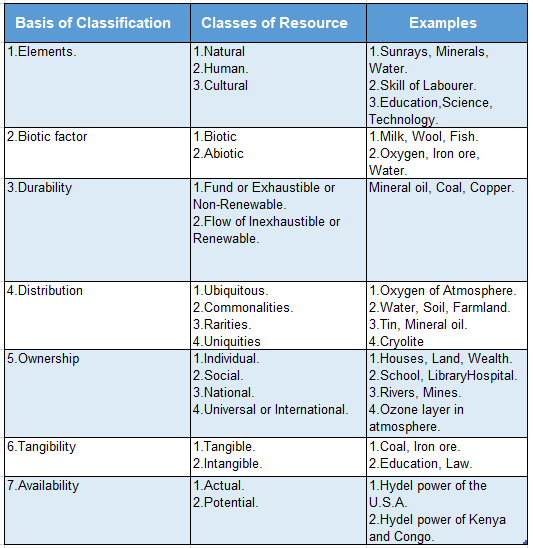
Resources are usually classified based on the durability of elements, characteristics, availability, ownership, etc.

Based on durability resources are of two types
- Fund or Exhaustible or Non-renewable resources such as petroleum, coal, iron ore, etc. These are exhausted by continuous use.
- Flow or In-exhaustible or Renewable resources such as sun rays, wind, rivers, forests, grasslands, etc.
Conditionally renewable resources are those due to overconsumption, depletion of resources may result. Example. forests etc. These are also known as Choked flow resources.
Fund resources may be reused as iron scrap and are known as Revolving fund resources.
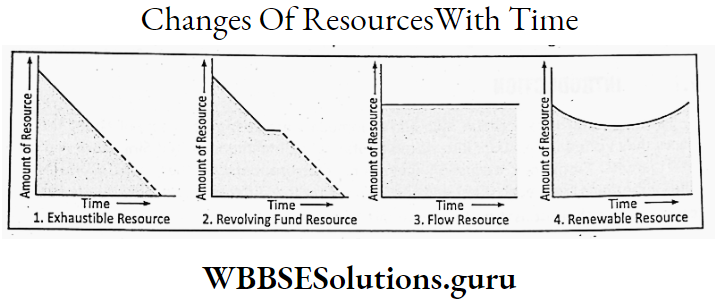
Resources are of three types based on the elements
- Natural resources are those that are available in nature For Example. land, water, sun rays, minerals, etc.
- Human resources are population, nation, skill, labor, etc.
- Cultural resources are science, education, literature, technical knowledge, etc.
Class 9 Geography Chapter 7 WBBSE Solutions
Based on biotic factors resources are of two types
- Biotic resources are obtained from the biosphere Examples. forest products, animals, birds, etc.
- Abiotic resources are non-living things Example. land, water, minerals, etc.
On the basis of distribution, resources are of four types
- Ubiquitous resources are found everywhere Example. air, light, water, etc.
- Commonalities resources are forests, grasslands, etc.
- Rarities are those available in a few countries for Example. mica.
- Uniquities like cryolite which is found only at Ivigtut in Greenland.
On the basis of own resources are four types
- Individual resources Example. health, and education of a person.
- Social resources like schools, hospitals,s, etc.
- National resources like the mineral resources of India.
- Universal resources are the atmosphere, resources of Antarctica, etc.
Classification Of Resource
Conservation Of Resources:
Reserves of natural resources, especially, Fund resources are limited.
Unwise and unscientific use of resources by man is leading to the depletion of natural resources, Conservation of resources means providing resources to the present generation and maintaining provisions to satisfy the needs of future generations.
Measures of resource conservation i.e. resource management are
- To reduce the use of resources,
- To stop the overuse and depletion of resources,
- To reduce the free and unwise use of resources,
- To use flow resources,
- Planned and scientific use of Fund resources etc.
Class 9 Geography Chapter 7 Important Questions
Chapter 7 Resource Of India Mineral Resources
Iron Ore, Coal And Petroleum-Importance And Uses, Classification, Regional Distribution, Reserves, Trade:
Iron Ore:
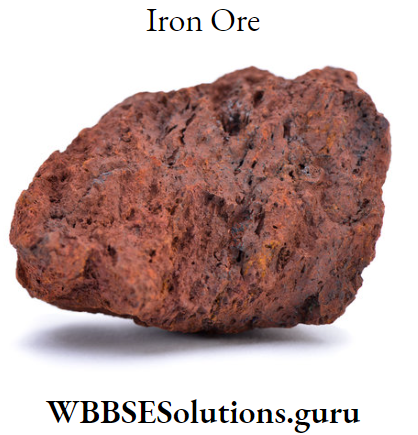
Iron ore is a Non-renewable, exhaustible resource.
Importance And Uses Of Iron Ore :
Iron ore is the most important metallic mineral. Based on iron ore has developed the iron and steel industry which is the ‘backbone’ of industries. Iron ore is smelted and pure iron and steel are produced.
These two products are again used in the manufacturing of heavy machines, fish plates, rail engines, ships, etc; agricultural machinery like tractors, weapons, utensils, construction materials, automobiles, factories, bridges, etc.
Classification Of Iron Ore
Based on the percentage of iron content iron ore is of four types
- Magnetite the best quality iron ore with 72% iron content is black in color.
- Hematite is reddish in color and contains less than 70% iron.
- Limonite is brownish and contains 60% iron.
- Siderite is greyish brown with only 48% iron. Most of the Indian iron ore is hematite.
Chapter 7 Resource Of India Regional Distribution
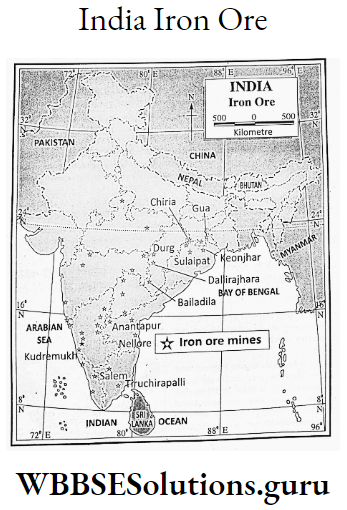
Odisha, Karnataka, Chhattisgarh, Goa, Jharkhand, and Andhra Pradesh are the important iron-producing states of India.
Odisha:
The largest producer of iron ore in India. Important mines are found at Gurumahisani, Sulaipat, and Badampahar in the Mayurbhanj district, Kiriburu and Bagiabura in the Keonjhar district, and Bonai in the Sundargarh district.
Karnataka:
Important mines are located at Donai Malai in the Bellari-Hospet region, Bababudan in the Chikmagalur district, and Kudremukh in the Chittradurg district.
Class 9 Geography Chapter 7 Important Questions
Chhattisgarh:
The second largest producer of iron ore. Iron ore mines are found at Dallirajhara in the Durg district and Bailadila in the Bastar district.
Goa :
Important iron ore mines are located at Pirna, Sirigao, Kudnem, Barjan, etc.
Jharkhand:
Iron ore mines are located at Noamundi, Gua, Budaburu, and Panshiraburu in Singhbhum district.
Iron ore mines are also located at Nellore, Cudappah, and Anantapur in Andhra Pradesh; Chanda and Ratnagiri in Maharastra; Salem, Tiruchirapalli, and Madurai in Tamil Nadu.
Jaipur and Alwar in Rajasthan; Mahendragarh in Haryana and Kangra Valley in Himachal Pradesh.
Statewise Iron Ore Production In India: 2012-2013

Source:
Indian Bureau of Mines, Statistical Profiles of Minerals: 2012-13
Reserves Of Iron Ore :
According to the Geological Survey of India and the Indian Bureau of Mines, the total iron ore reserves of India estimates nearly 25,250 million tonnes.
Trade Of Iron Ore:
About 50% of iron produced in India is exported to the countries of Japan, South Korea, Italy, Iran, Poland, China, etc.
Coal :
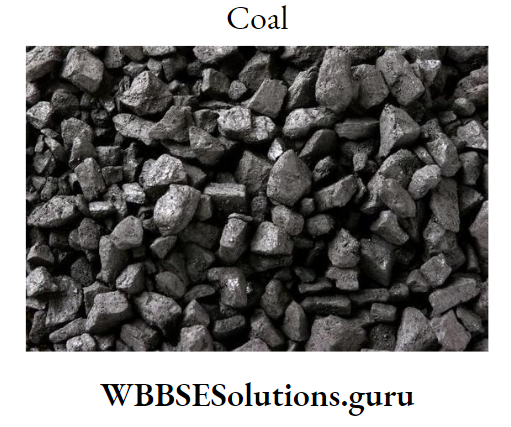
Coal is an important non-renewable fuel mineral.
Importance And Uses Of Iron Ore
75 % of electricity produced in India is based on coal. Coal is used in all the integrated iron and steel plants in India. Coal is also used as raw material in the chemical industry.
Coal as a fuel as well as its all by-products are used in most industries. So, coal is known as the ‘black diamond’ for its immense economic importance.
In India coal is used mainly as 74% of thermal power stations for production.
electricity, 5% in the iron and steel industry for smelting iron ore, 4% in the cement industry, 1% in the fertilizer industry, 1% in a steam engine, and the remaining 15% in household activities.
Chapter 7 Resource Of India Classification Of Coal
Based on the percentage of carbon content coal is classified into four types
- Anthracite is the best quality coal which contains 90% carbon.
- Bituminous is a good quality coal with a carbon content ranging between 50% and 85%.
- Lignite, low-grade coal contains 35% to 50% carbon content.
- Peat consists of less than 35% carbon.
Regional Distribution Of Coal
According to the geological age, Indian coal is of two types
- Gondwana coal and
- Tertiary coal.
Gondwana Coal
About 280 to 300 million years ago the river valleys of Damodar, Mahanadi, Godavari, Wardha, etc were forested and marshy tracts. Slowly the forests were buried underground and the plants were turned into coal.
This ancient coal is known as Gondwana coal and this coal belt is mostly 10 to 20 m thick. Nearly 90% of the coal mines in India belong to the Gondwana type. It is distributed in
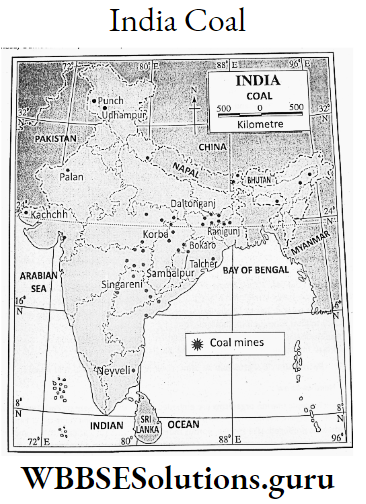
- Damodar river valley. Important mines are found at Raniganj, Asansol in West Bengal; Jharia, Bokaro, Karanpura, Giridih, Ramgarh, Daltonganj, and Rajmahal in Jharkhand.
- Mahanadi Valley in Odisha. Important mines are located at Talcher and Rampur.
- Mahanadi and Son river valleys of Chhattisgarh and Madhya Pradesh. Important mines are located at Korba, Umaria, Singarauli, Tatapani, Bishrampur, etc.
- Wainganga and Wardha river basin in Maharastra. An important mine is Singareni. Amongst these, the Damodar Valley coal belt produces nearly 70% of the Gondwana coal in India.
Class 9 Geography Chapter 7 Important Questions
Tertiary Coal
This type of coal was formed during the formation of the Himalayas only 70 to 80 million years ago. The tremendous earth movement of this period caused the coal beds to be intensely contorted. It occurs in
- Hills of Mikir and Makum of Assam,
- In the northern part of Nagaland,
- Arunachal Pradesh,
- Bagrakot and Kalimpong of West Bengal,
- Rangit Valley of Sikkim,
- Udhampur, Punch areas of Jammu and Kashmir,
- Palan in Bikaner district of Rajasthan, Kachchh and Varuch of Gujarat and
- Neyveli in the North Arcot district of Tamil Nadu. Neyveli is the largest lignite coal-producing mine in India.
Statewise Coal Production In India: 2011-2012

Source:
Coal Directory of India: 2011-12, Coal Controller Organisation, Indian Minerals Year Book: 2012 (Part III)
Note:
In the year 2011-12, India also produced 40 million 23 lakh tons of lignite coal (Tamil Nadu contributed 24.6 million tons and Gujarat contributed 14.8 million ton of lignite coal).
Reserves:
According to the Geological Survey of India, the coal reserves in India are about 2,67,210 million tons (up to a depth of 1200 m).
Trade:
Coal is exported to the countries of Bangladesh, Nepal, Sri Lanka, etc. Good-quality coal is also imported from the countries like Australia, Indonesia, etc.
Chapter 7 Resource Of India Petroleum
Petroleum or Mineral oil is a non-renewable fuel mineral.
Importance And Uses Of Petroleum
Petroleum, nowadays, is a multifunctional resource. Modern road, rail, and water transport systems mostly depend on petroleum.
Agricultural equipment like tractors, harvesters, and pump sets also depend on petroleum. Chemical fertilizers as well as pesticides are produced from petroleum.
Raw materials of Petro-chemical and its allied industries require petroleum. In defense, aircraft, ships, tankers, and trucks also require petroleum.
Petroleum is also used in the production of electricity as well as to keep machinery mobile. So petroleum is known as ‘liquid gold’ for its immense economic importance.
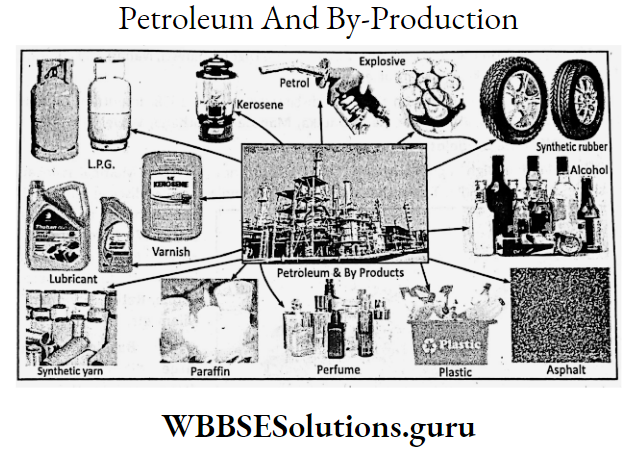
Petroleum is widely used as
- Petrol for running automobiles, aircraft, etc.
- Diesel is used for running buses, trucks, rail engines, ships,s, etc.
- Lubricating oil used for running machines,
- Kerosene is used for domestic and lighting purposes.
- The tar used for the construction of metalled roads,
- Paraffin and vaseline are used for the manufacturing of candles and pharmaceuticals,
- Diesel used in power stations,
- Naphtha is used in chemical industries to produce fertilizer, explosives, polythene, plastics, synthetic, rubber, nylon, paints, pesticides, etc.
Class 9 Geography Notes Bengali Medium Chapter 7
Distribution Of Petroleum In India
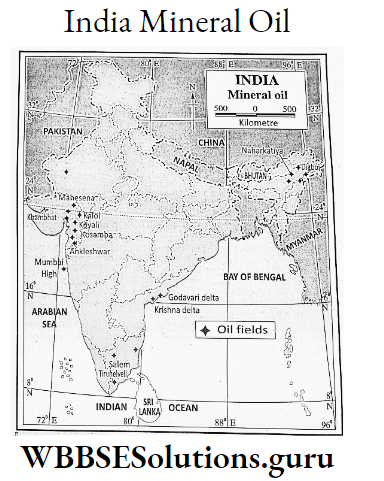
Potential oil-bearing sedimentary rocks are widely distributed in India, but extraction on a commercial basis is practiced only in seven areas.
Upper Assam Valley:
Important oil fields are Digboi (oldest), Naharkatiya, Rudrasagar, Moran, Hugrijan, Lakwa, Badarpur, etc.
Gujarat-Khambat Region:
Oil was discovered here in 1958. Important oil fields are Lunej, Kalol, Sanand, Ankleswar, Kadi, Dholka, Mahesana, Kathana, Wavel, etc.
Off-Shore Oil Fields:
Mumbai High Region:
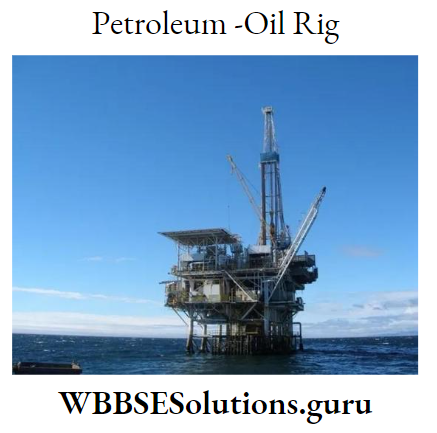
About 100 to 150 km northwest of Mumbai has located an offshore oil field in India. This is the largest oil field in India and was discovered in 1967.
But the extraction of oil started in 1974. Sagar Samrat, an Oil rig is engaged in oil extraction. Important oil fields are Hira, Panna, Ratna, Gandhar, Thuja, Nilam, etc.
Bassien Region:
A large oil field has been discovered to the south of Mumbai High and north of Mumbai at Bassien region.
Gulf Of Khambat Region :
Petroleum has been discovered in the Aliabet region near the Gulf of Khambat.
Oil fields are located at Mangala of Barmer district of Rajasthan, foothills of Arunachal Pradesh, Godavari delta region in Andhra Pradesh, and Kaveri basin in Tamil Nadu.
Statewise Mineral Oil Production In India: 2011-2012
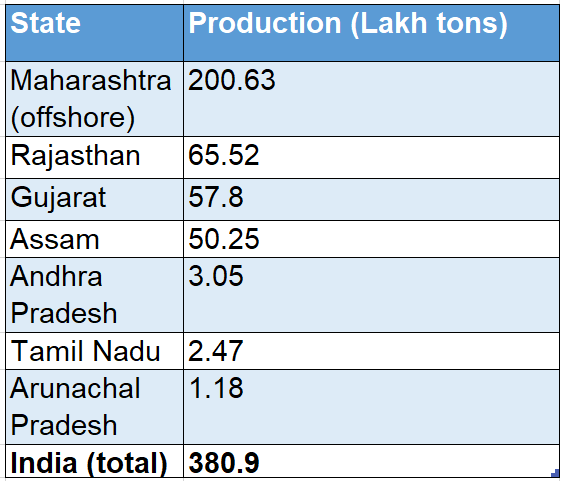
Source:
Indian Minerals Year Book: 2012, Part-Ill, 51st ed. Govt. of India
Potential Areas:
ONGC (Oil and Natural Gas Corporation) and OIL (Oil India Limited) together are engaged in exploring. potential areas of oil fields in India.
These oil fields are the deltas of the river valleys of Godavari, Kaveri, Mahanadi, and Krishna; the Continental shelf around Andaman and Nicobar islands; Ganga plains, Sundarban and its adjacent continental shelf, Tripura plains, Kangra valley, etc.
Reserves Of Petroleum :
Petroleum is found in sedimentary rocks mainly in sandstone and limestone. Crude oil in India estimates nearly 6000 million tonnes.
Trade Of Petroleum:
Petroleum produced in India satisfies 30% of the country’s demand. So, every year, India has to import petroleum from Russia, Iran, Nigeria, Saudi Arabia, Iraq, etc.
Class 9 Geography Notes Bengali Medium Chapter 7
Chapter 7 Resource Of India Power Resources (Conventional And Non-Conventional)
Sources of electricity or power resources are mostly flow resources. Four friends Sumana, Latif, Sujata, and Sumita in a group discussion found that depending on the locality.
whether in hills or plains or coastal areas, the source of power varies, such as water, air, coal or petroleum, etc. Accordingly, power resources are of various types like hydel power, thermal power, solar energy, etc.
Conventional And Non-Conventional Sources Of Power-Their Advantages And Disadvantages
All kinds of sources of power or electricity may be grouped into two types
- Conventional sources and
- Non-Conventional sources.
Conventional Sources
Conventional sources of power are used traditionally year after year. These sources are coal, mineral oil and natural gas, swift-flowing river, and radioactive minerals like uranium-thorium.
The most important advantage of Conventional sources of power is longevity. Conventional power is used for a long time eg. coal is being used for more than 300 years.
Except for hydel power, all other sources of conventional power are transportable and therefore these are imported to produce electricity.
The most important disadvantage of Conventional sources of power is, it causes environmental pollution. Most of these sources are non-renewable, so they are exhaustible.
Production cost is high, so, only developed countries are the leading producer of conventional sources of power. Reserves of these sources are also localized.
Non-Conventional Sources
Non-Conventional sources of energy are flow resources and are renewable. These sources are wind energy, solar energy, tidal energy, sea wave energy, geothermal energy, and biogas energy.
The most important advantage of non-conventional energy is that their sources are renewable i.e. they never exhaust. This type of energy is eco-friendly. Production cost is low. Reserves are unlimited and are available in most countries.
The most important disadvantage of non-conventional energy is that these sources are newly introduced, so, the technologies are not well available. All reserves are not evenly distributed.
Example. Tidal energy is available only near the sea coasts. Wind energy is also not applicable everywhere. Solar energy is not enough in frigid regions. These sources of power are not transportable.
Chapter 7 Resource Of India Conventional Sources Of Power (Thermal Hydel Atomic) Uses And Distribution
Conventional sources of power are of three types
- Thermal,
- Hydel,
- Atomic.
Thermal Power
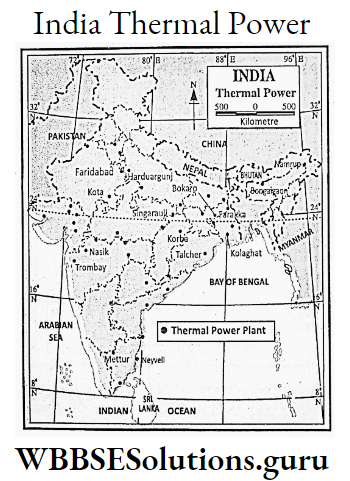
Thermal power is generated with the help of a turbine from the heat produced by burning coal, petroleum, and natural gas.
Coal-based thermal power accounts for nearly 75% of the electricity produced in India. It is used in factories, household purposes, transport systems, institutions, hospitals, offices, etc.
These plants are located at Durgapur, Farakka, Bandel, Santaldih, Titagarh, and Kolaghat in West Bengal; Bokaro, Patratu, and Chandrapura in Jharkhand.
Talcher in Odisha, Korba and Amarkantak in Chhattisgarh; Satpura and Singarauli in Madhya Pradesh; Panki, Obra and Harduarganj.
In Uttar Pradesh; Ukai and Gandhinagar in Gujarat; Badarpur in Delhi; Nasik and Bhuswal in Maharastra and Neyveli in Tamil Nadu.

Class 9 Geography Chapter 7 Summary
Hydel Power
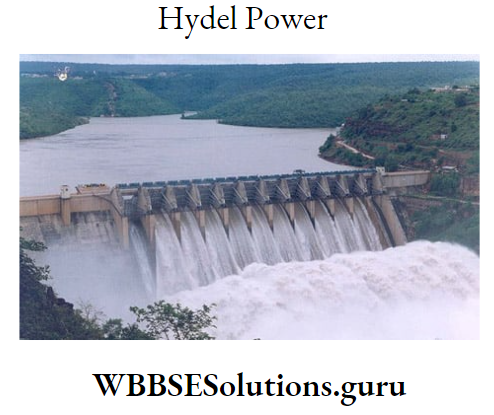
Hydel power is generated by turning the turbine with the help of a swift-flowing river or waterfall. Hydel power is used in factories, households, the agricultural sector, transport, etc.
Hydel power is cheap, so, it is used in the extraction of aluminum from bauxite a process that involves a huge amount of electricity. It is also required in copper extraction and paper mills.
The Himalayan mountainous region and the plateau of South India are the potential areas for hydel power generation in India. Due to a lack of coal, hydel power is mainly generated in South India.
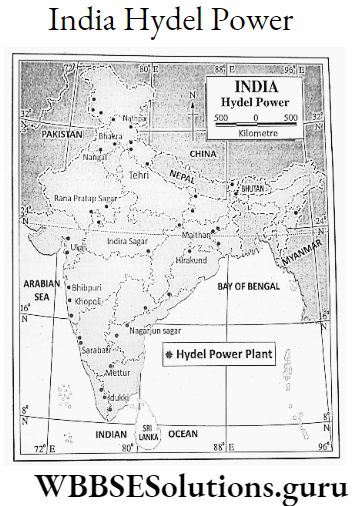
Important hydel power stations in India are Khopali, Bhira, Bhibpuri, and Koyna in Maharastra; Shivasamudram and Sarabati in Karnataka.
Pykara and Mettur in Tamil Nadu; Pallivasal and Idukki in Kerala; Shri Sailam, Nagarjun Sagar and Tungabhadra in Andhra Pradesh.
Bhakra-Nangal in Himachal Pradesh; Baramula in Jammu and Kashmir; Loktak in Manipur; Jaldhaka in West Bengal; Hirakund in Odisha; Tilaiya in Jharkhand.
Saloa, Mahammadpur in Uttar Pradesh; Lagiyup in Sikkim, etc. Hydel power plants have also been set up at Chameri in Himachal Pradesh, Narmada in Gujarat, etc.
Atomic Power
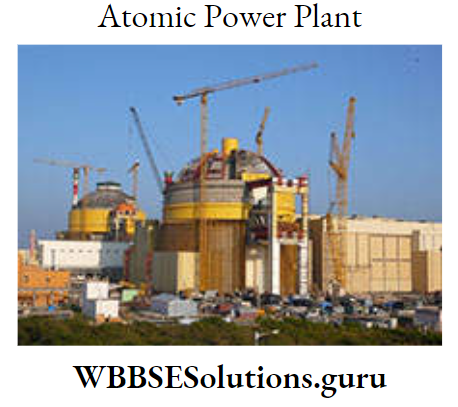
Atomic power is produced by the nuclear fusion of radioactive minerals like uranium, thorium, and plutonium applying modern and high technology.
Atomic power is used in the production of electricity, production of salt from seawater, artificial satellites, ships, and submarines, and in medical therapy.
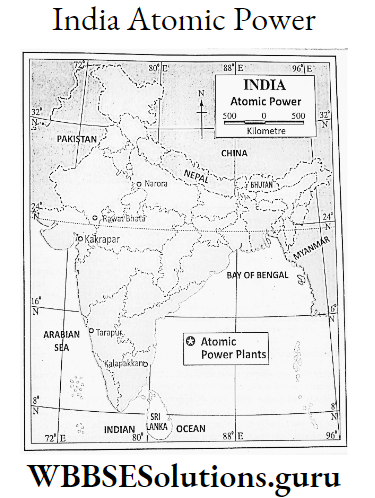
Atomic power stations in India are located at Tarapur in Maharastra, Rana Pratap Sagar in Rajasthan; Kalapakkam in Tamil Nadu.
Narora in Uttar Pradesh, Kakrapar in Gujarat, Kaiga in Karnataka, Rawat-Bhata in Rajasthan Kudankulam in Tamil Nadu.
Class 9 Geography Chapter 7 Summary
Chapter 7 Resource Of India Non-Conventional Sources Of Power (Solar Wind Geo-Thermal)-Uses And Importance
Solar Energy
Uses:
Solar energy is a renewable flow and ubiquitous resource. It is continually released from the sun in all directions through light and heat.
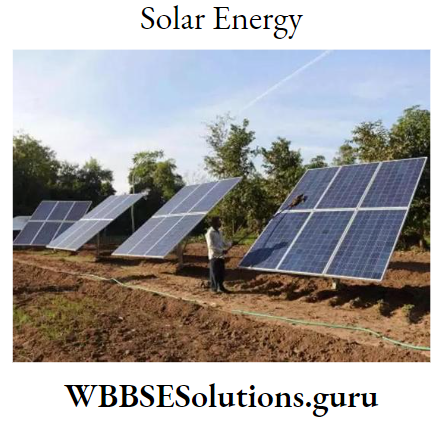
Earlier, it was used in heating water, drying up clothes, and agriculture. Now, it is also used in the generation of electricity, as cooking fuel, and in manufacturing salt from seawater.
Importance:
The solar water heater has been installed in many houses, trade centers, and industries. The largest solar pond in the world has been developed at Madhapur near the Kachchh peninsula of Gujarat.
Solar cells set up in different parts of India produce electricity, such as Mou and Kalyanpur in Uttar Pradesh, Jamuria and Sagardwip in West Bengal; Pokhran and Jodhpur in Rajasthan, Patapur in Odisha.
Charank solar park in Gujarat and Shibganga in Tamil Nadu. India is the leading user of solar cookers in the world. India also holds a remarkable position in using solar lanterns, solar pumps, and solar lights in the world.
Wind Energy
Uses:
Wind energy is renewable, flow as well an inexhaustible resource. It is produced by turning wind velocity by windmills.
Wind energy is used in lifting water from the wells to irrigate farmlands. It is principally used to produce electricity.
Importance:
India is the fifth largest user of wind energy in the world. The wind plant is located at Lamba in Gujarat, Kojhikod in Kerala; Kayathar and Kanyakumari in Tamil Nadu; Jogmatti in Karnataka; Frezergunj and Sagardwip in West Bengal, etc.
Lamba in Gujarat is the largest wind plant in Asia. In coastal areas with the help of windmills, India may produce 45,000 M.W. electricity every year.

Class 9 Geography Chapter 7 WBBSE Solutions
Geo-Thermal Energy
Uses:
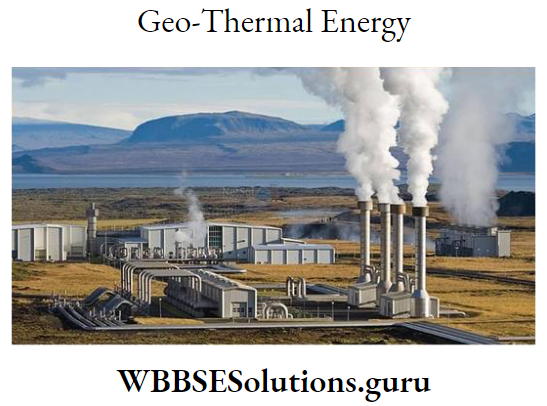
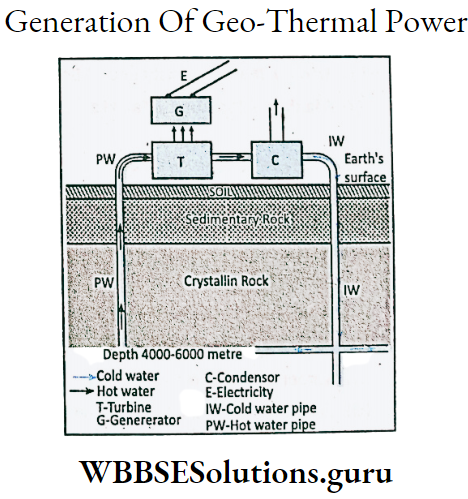
Geothermal energy is a flow resource as well as inexhaustible. It is generated from the heat released from the earth’s interior.
through hot springs, geysers, etc. It is used to produce electricity, heat water, dry fruits, and household purposes.
Importance :
A small geothermal plant has been set up at Manikaran in the Kulu district. There are about 340 hot springs in Dumathang in Jammu and Kashmir, Tapoban in Uttarakhand, and in Jharkhand and Chhattisgarh districts.
These are in the experimental stage to produce electricity.