
Statistics Chapter 1 Mean
⇒ An average or a central value of a data or a statistical series is the value of the variable which describes the characteristics of the entire data or the associated frequency distribution.
⇒ Central position: If the numbers of data are arranging in ascending order then the middle number / or the positions of nearly numbers is called the central position.
⇒ There are three measures of central tendency:
- Mean
- Median
- Mode.
⇒ Arithmetic mean can be defined in the following three cases separately:
- Individual observations (or ungrouped data).
- Discrete frequency distribution (or grouped data)
- Grouped or continuous frequency distribution.
⇒ Arithmetic Mean of individual observation (or ungrouped data)
Definition: If x1, x2, x3 ………., xn are n values of a variable X, then the arithmetic mean or simply the mean of these values is denoted by \(\overline{\mathrm{X}}\) and is defined as
\(\overline{\mathrm{X}}=\frac{x_1+x_2+x_3+\cdots \cdots+x_n}{n}\)Read and Learn More WBBSE Solutions for Class 10 Maths
= \(\frac{1}{n} \sum_{i=1}^n x_i\) [symbol ‘∑’ reading as capital sigma]
or, simply \(\bar{X}=\frac{\sum x_1}{n}\)

Arithmetic mean of grouped data or discreate frequency distribution
In a discreate frequency distribution, the arithmetic mean may be computed by any one of the following methods
- Direct method,
- Short-cut method,
- Step deviation method.
⇒ Direct method: If a variate X takes values x1, x2, x3 ………., xn with corresponding frequencies ƒ1, ƒ2, ƒ3 ……….,ƒn respectively, then the arithmetic mean of these values is given by
\(\overline{\mathrm{X}}=\frac{f_1 x_1+f_2 x_2+\cdots \cdots+f_n x_n}{f_1+f_2+\cdots \cdots+f_n}\)
= \(\frac{\sum_{i=1}^n f_i x_i}{\sum_{i=1}^n f_i} \text { or simply } \overline{\mathrm{X}}=\frac{\sum f_i x_i}{\sum f_i}\)
⇒ Short-cut method: Let x1, x2, x3 ………., xn be values of a variable X with corresponding frequencies respectively.
Taking deviations about an arbitary point ‘a’ we have
\(d_i=x_i-\dot{a}, i=1,2,3, \ldots \ldots, n\) \(f_i d_i=f_i\left(x_i-a\right)\)⇒ \(\sum_{i=1}^n f_i d_i=\sum_{i=1}^n f_i\left(x_i-a\right)\)
⇒ \(\sum_{i=1}^n f_i d_i=\sum_{i=1}^n f_i x_i-a \sum_{i=1}^n f_i \quad \text { [as a is constant] }\)
⇒ \(\frac{1}{\sum_{i=1}^n f_i} \sum_{i=1}^n f_i d_i=\frac{\sum_{i=1}^n f_i x_i}{\sum_{i=1}^n f_i}-\frac{a \sum_{i=1}^n f_i}{\sum_{i=1}^n f_i}\)
⇒ \(\frac{1}{\sum_{i=1}^n f_i} \sum_{i=1}^n f_i d_i=\overline{\mathrm{X}}-a\)
⇒ \(\overline{\mathrm{X}}=a+\frac{\sum_{i=1}^n f_i d_i}{\sum_{i=1}^n f_i}\)
or, simply \(\overline{\mathrm{X}}=a+\frac{\sum f_i d_i}{\sum f_i}\)
[a is known as assumed mean and is generally chosen in such a way that the deviation are small]
⇒ Step-deviation method:
Mean \((\overline{\mathbf{X}})=a+h \frac{\sum f_i u_i}{\sum f_i}\)
where \(u_i=\frac{x_i-\dot{a}}{n}\) [n = class size]
Class 10 Maths Statistics Chapter 1 Solutions
Statistics Chapter 1 Median
Definition: Median of a distribution is the value of the variable which divides the distribution into two equal parts i.e. it is the value of the variable such that the number of observations above.
It is equal to the number of observations below it.
⇒ Median of ungrouped data: If the values xi in the raw data arranged in order of increasing or decreasing magnitude, then the middle, most value in the arrangement is called the median.
Let x1, x2, x3 ………., xn be the n values of a variable. X arranged in x1, x2, x3 ………., xn [where x1< x2 < x3 ………., < xn]
[Few may be equal among the values]
1. If n is odd, median is the value of \(\left(\frac{n+1}{2}\right)\)th observation
∴ Median = \(X_{\frac{n+1}{2}}\) when n is odd
2. If n is even the median is the mean of the \(\frac{n}{2}\)th and the (\(\frac{n}{2}\) + 1)th
∴ Median = \(=\frac{X_n+X_n \frac{2}{2}}{2}\), when n is even
⇒ Median of a grouped data:
Median = \(=l+\left[\frac{\frac{n}{2}-c_f}{f}\right] \times h\)
Where, l = lower limit of median class
ƒ = frequency of median class
n = number of observation
cƒ = cumulative frequency of Class preceding the median class
n = class size of the median class
Wbbse Class 10 Maths Statistics Solutions
Statistics Chapter 1 Mode
Mode is the value that occurs most frequently in a set of observations and around which the other items of the set cluster densely.
Thus, the mode of frequency distribution is the value of the variable which has the maximum frequency
Mode = \(l+\frac{f_1-f_0}{2 f_1-f_0-f_2} \times h\)
Where, l = lower limit of the modal class
h = length of the modal class
ƒ1 = frequency of the modal class
ƒ0= frequency of the class preceding the modal class
ƒ2 = frequency of the class succeeding the modal class
Relation between mean, median, and mode:
Mode = 3 x median – 2 x mean
Statistics Chapter 1 Ogive
⇒ Ogive: Ogives are graphs that can be used to determine how many data values lie above or below a particular value in a data set.
Statistics Chapter 1 Mean Median Ogive Mode True Or False
Example 1. Value of mode of data 2, 3, 9, 10, 9, 3, 9 is 10
Solution: Let us write the numbers of given data in ascending order in magnitude.
2, 3, 3, 9, 9, 9, 10
As 9 occurs a maximum number of times.
∴ The mode of data is 9
∴ The statement is false.
Example 2. Median of data 3, 14, 18, 20, and 5 is 18
Solution: Arranging the number of the given data in ascending order in magnitude, we have,
3, 4, 5, 18, 20
Here n = 5 [i.e. n is odd]
∴ Median = \(\frac{5+1}{2}\) th term = 3rd term = 5
∴ The given statement is false.
Example 3. If the arithmetic mean of 7, 10, x – 2, and x + 3 is 9 then the value of x is 9.
Solution: \(\text { Mean }(\bar{X})=\frac{7+10+x-2+x+3}{4}=9\)
⇒ 2x + 18 = 36 ⇒ x = 9
∴ The statement is true.
Example 4. If the median of arranging the ascending order of data 6, 7, x – 2, x, 17, 20 is 16 then the value of x is 18.
Solution: Here n = 6 [i.e. n is even]
∴ Median = \(\frac{1}{2}\)[\(\frac{1}{2}\) th observation + (\(\frac{1}{2}\) + 1) ovservation]
= \(\frac{1}{2}\) [3rd observation + 4th observation]
= \(\frac{1}{2}\) (x – 2 + x) = x – 1
According to question x- 1 = 16
⇒ x = 17
∴ The statement is false.
Statistics Class 10 Solutions
Statistics Chapter 1 Mean Median Ogive Mode Fill In The Blanks
Example 1. Mean, median, and mode are the measures of ______
Solution: centrally.
Example 2. If Mean of x1, x2, x3 ……….,xn is \(\bar{X}\), then mean of ax1, ax2, ax3 ……….,axn is _____
Solution: If mean of x,, x2, is \(\bar{X}\) then
\(\bar{x}=\frac{x_1+x_2+\cdots \cdots+x_n}{n}\)The mean of \(a x_1, a x_2, \ldots \ldots, a x_n is \frac{a x_1+a x_2+\cdots \cdots+a x_n}{n}\)
= \(\frac{a\left(x_1+x_2+\cdots \cdots+x_n\right)}{n}=a \bar{x}\)
Example 3. At the time of finding the arithmetic mean by the step-deviation method, the lengths of all classes are _________
Solution: equal.
Example 4. The arithmetic mean of first n natural numbers is _________
Solution: \(\frac{n+1}{2}\)
Example 5. The median of a frequency distribution is determine by ________ graph.
Solution: Ogive.
Class 10 Statistics Chapter 1 Solved Examples
Statistics Chapter 1 Mean Median Ogive Mode Short Answer Type Question
Example 1. Find the difference between upper-class limit in median class and lower class limit of modal class of the frequency distribution table

Solution:
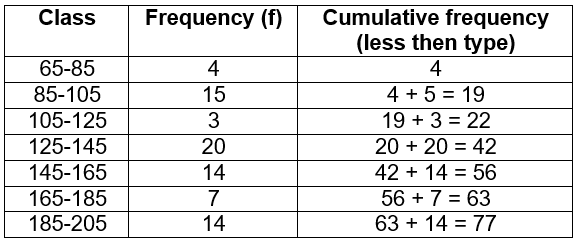
N = ∑ƒ=77
At first, we locate the class where the cumulative frequency is equal to \(\frac{n}{2}\) or greater than \(\frac{n}{2}\) in the above frequency distribution table.
\(\frac{n}{2}\) = \(\frac{77}{2}\) = 38.5
∴ The cumulative frequency of the class is 42 which is just greater than 38.5 and the corresponding class is (125 – 145)
∴ The medians class is (125 – 145)
∴ The upper-class limit in median class is 145
As highest frequency in the above frequency distribution table is 20.
∴ The modal class is (125 – 145)
∴ Lower class limit of modal class is 125.
The difference between upper class limit in median class and lower class limit of modal class is (145 – 125) or 20.
Example 2. The following frequency distribution shows the time taken to complete 100 metre hardle race of 150 athletics

Find the number of athletics who complete the 100-metre hardle race within 14.6 seconds.
Solution: The number athletics are (2 + 4 + 5 + 71) = 82
Example 3. The mean of a frequency distribution is 8.1, if \(\sum \dot{f_I} x_i=132+5 \mathrm{k} \text { and } \sum f_i=20\); find the value of k.
Solution: Mean \(\bar{x}=\frac{\sum {f_i}{x_i}}{\sum f_i}=\frac{132+5 k}{20}\)
According to the question = \(\frac{132+5 \mathrm{k}}{20}=8 \cdot 1 \\\)
⇒ \(132+5 \mathrm{k}=162\)
⇒ \(\mathrm{k}=\frac{162-132}{5}=6\)
Wbbse Class 10 Statistics Notes
Example 4. If \(u_i=\frac{x_i-25}{10}, \Sigma f_i u_i=20 and \Sigma f_i=100\), find the value of \(\bar{x}\).
Solution: If assumed mean = a and class size = h then [/latex]u_i=\frac{x_i-a}{h}[/latex]
∴ \(\frac{x_i-a}{h}=\frac{x_i-25}{10}\)
equating both sides, we get a = 25 and h = 10
∴ Mean \((\bar{x})=a+\frac{\sum f_i u_i}{\sum f_i} \times h\)
= 25 + \(\frac{20}{100}\) x 10
= 25 + 2 = 27
∴ The value of \(\bar{X}\) is 27.
Example 5. Write the modal class from the above frequency distribution table.

Solution:
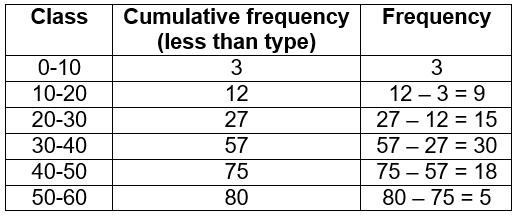
Highest frequency in above frequency distribution table is 30
∴ The modal class is (30- 40)
Example 6. A table of weight of 50 students are given below

Find the mean of their weights by direct method.
Solution:

∴ Mean weight of students = \(\frac{\sum f_i x_i}{\sum f_i}\)
= \(\frac{1919}{50} \mathrm{~kg}=38.38 \mathrm{~kg}\)
Example 7. The marks obtained by 80 students of class nine in mathematics are given in the table below

Find the average marks of 80 students bj using assumed mean method.
Solution: Let assumed mean (a) = 60
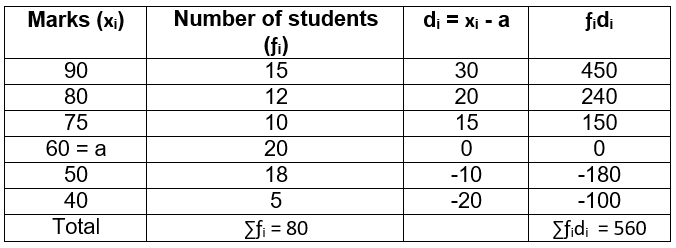
∴ Average marks = \(a+\frac{\sum f_i d_i}{\sum f_i}\)
= 60 + \(\frac{560}{80}\)
= 60 + 7 = 67
Measures Of Central Tendency Class 10 Solutions
Example 8. Find the mean of the following data by using direct method.

Solution:
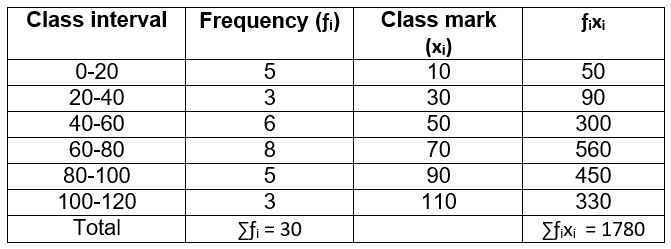
∴ Mean \(\bar{x}=\frac{\sum f_i x_i}{\sum f_i}\)
= \(\frac{1780}{30}\) = 59.33 (approx)
Example 9. Find the mean of the following data by using the assumed mean method.

Solution: Let assumed mean (a) = 25
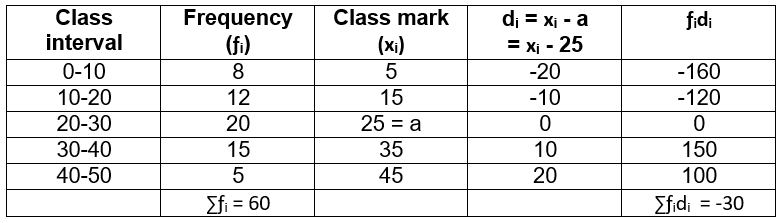
∴ Mean \((\overline{\mathrm{X}})=a+\frac{\sum f_i d_i}{\sum f_i}\)
= \(25+\frac{-30}{60}\)
= 25 – 0.5 = 24.5
Example 10. Find the mean of the following data given below by using the step-deviation method.

Solution: Let the assumed mean (a) = 52.5
class size (h) = 15

∴ Mean \((\bar{X})=a+\frac{\sum f_i u_i}{\sum f_i} \times h\)
= \(52 \cdot 5+\frac{-10}{50} \times 15\)
= 52.5 – 3 = 49.5
Example 11. Height of some students in cm are 155, 145, 148, 144, 146, 150, 152, 147. Find their median.
Solution: Arranging their heights in ascending order we get,
144 cm, 145 cm, 146 cm, 147 cm, 148 cm, 150 cm, 152 cm, 155 cm, 156 cm.
Here, n = 9 i.e. n is odd
∴ Median of height = \(\frac{n+1}{2}\)th value
= \(\frac{9+1}{2}\)th value = 5 th value = 148 cm.
Class 10 Maths Statistics Important Questions
Example 12. The marks obtained by 10 students of class 9 in Bengali are 88, 65, 80, 52, 38, 70, 44, 75, 62, and 35. Find the median of marks.
Solution: Arranging the marks in ascending order we get,
35, 38, 44, 52, 62, 65, 70, 75, 80, 88
Here, n = 10 i.e. n is even
∴ Median = \(\frac{1}{2}\)[\(\frac{10}{2}\)th value + (\(\frac{1}{2}\) + 1)th value]
= \(\frac{1}{2}\)[5th value + 6th value]
= \(\frac{1}{2}\)(62 + 65) = \(\frac{127}{2}\) = 63.5
∴ Median of marks is 63.5.
Example 13. Find the median from the frequency distribution table given below

Solution:

Here n = ∑ƒ = 37 i.e. n is odd
∴ Median = (\(\frac{n+1}{2}\))th observation
= (\(\frac{37+1}{2}\))th observation
= 19 th observation = 42
Example 14. Find the median from frequency distribution table given below:

Solution:

n = ∑ƒ = 100 i.e. n is even
∴ Median = \(\frac{1}{2}\) [\(\frac{n}{2}\) th observation + (\(\frac{n}{2}\) + 1) th observation]
= \(\frac{1}{2}\)[\(\frac{100}{2}\) th observation + (\(\frac{100}{2}\) + 1) th observation]
= \(\frac{1}{2}\) [50th observation + 51th observation]
= \(\frac{1}{2}\)[42 + 4] = \(\frac{1}{2}\) x 8 = 4
Example 15. Find the median from the frequency distribution table given below

Solution:
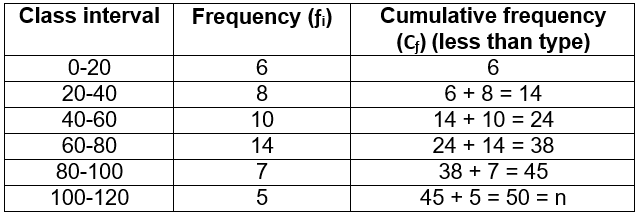
n = 50,
∴ \(\frac{n}{2}\) = \(\frac{50}{2}\) = 25
(60 – 80) is the class whose cumulative frequency 38 is just greater than 25
Median = \(l+\left[\frac{\frac{n}{2}-c f}{f}\right] \times h\)
Here, l = lower limit of median class
n = number of observation
ƒ = frequency of median class
cƒ = cumulative frequency of class preceding the median class
h = class size of the median class
∴ Median = \(l+\left[\frac{\frac{n}{2}-\mathrm{C}_f}{f}\right] \times h\) [ l = 60, n = 50, Cƒ= 24, ƒ = 14, h = 20]
= \(60+\left[\frac{\frac{50}{2}-24}{14}\right] \times 20\)
= 60 + \(\frac{1}{14} \times 20\) = 60 + 1.42 (approx) = 61.42 (approx)
Class 10 Maths Board Exam Solutions
Example 16. Find the mode of the data given below
4, 6, 10, 5, 8, 12, 5, 10, 6, 7, 5, 9, 11, 5, 12, 6, 8, 5, 12, 5
Solution: Arranging the numbers of given data in ascending order in magnitude.
4, 5, 5, 5, 5, 5, 5, 6, 6, 6, 7, 8, 8, 9, 10, 10, 11, 12, 12, 12
As 5 occurs maximum number of times.
∴ The mode of data = 5
Example 17. Find the mode of frequency distribution table given below

Solution: The modal class of given frequency distribution table is (30 – 40)
[As maximum number of frequency is 15]
Reqired mode = \(l+\left(\frac{f_1-f_0}{2 f_1-f_0-f_2}\right) \times h\)
Here, l = lower limit of the modal class = 30
h = length of the modal class = 10
ƒ1 = Frequency of the rhodal class =15
ƒ0 = Frequency of the class preceding the modal class = 10
ƒ2 = Frequency of the class succeeding the modal class = 8
∴ Mode = \(30+\left(\frac{15-10}{2 \times 15-10-8}\right) \times 10\)
= 30 + \(\frac{5}{12}\) x 10
= 30 \(+\frac{50}{12}\)
∴ Mode = 30 + 4.17 = 34.17(approx).