
Geometry Chapter 4 Theorems On Concurrence
⇔ Concurrent lines: If two or more different straight lines having a common point is said to be concurrent lines.
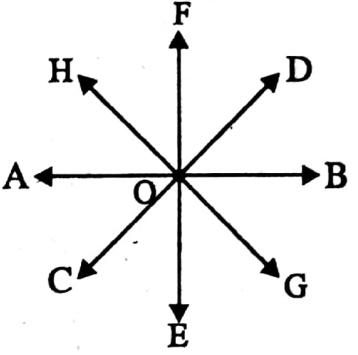
⇒ AB, CD, EF and GH are concurrent lines.
⇔ Circumcentre of a triangle: The point where the three perpendicular bisectors of sides of a triangle intersect is called the circumcentre of the triangle.
⇒ In ΔABC, the three perpendicular bisectors of AB, BC and CA meet at the point O; the point O is called the circumcentre and OA or OB or OC is the circumradius of ΔABC.
Read and Learn More WBBSE Solutions For Class 9 Maths
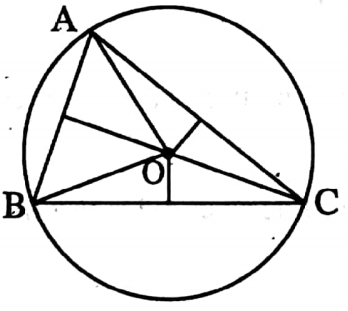
⇒ [OA = OB = OC]
⇒ A circle is drawn passing through the points A, B and C is called circum circle.
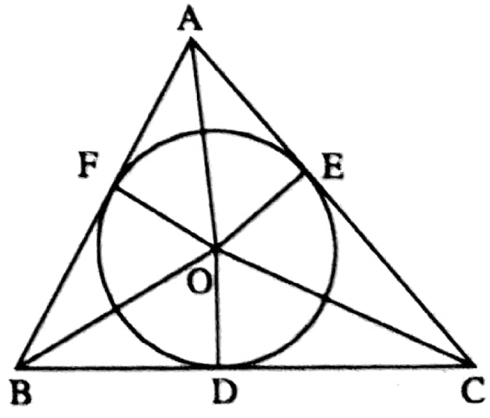
⇔ Incentre of a triangle: The point where the three internal bisectors of angles of a triangle intersect is called the incentre of the triangle.
In ΔABC, the internal bisectors of angles ∠A, ∠B and ∠C intersect each other at the point O.
I drawn OD ⊥ BC;

A circle is drawn with centre O and length of equal radius of OD is said to be in circle of ΔABC.
The circle touch AC and AB at E and F respectively. Centre of the circle is called incentre.
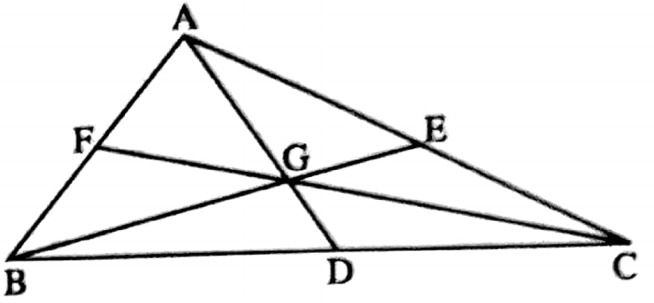
⇔ Centroid of a triangle: The point where the three medians of a triangle intersect is said to be centroid of a triangle.
⇒ Three medians AD, BE and CF of a triangle ABC, intersect at the point G.
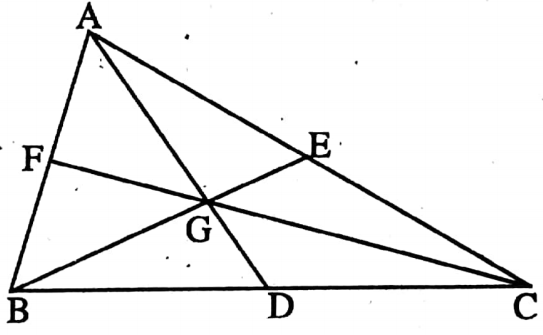
⇒ The point G is called the centroid of the ΔABC.
⇒ The centroid divides any median from the vertex in the ratio 2: 1.
⇔ Orthocentre of a triangle: The point where perpendiculars on the opposite sides from the three vertices of any triangle is called the orthocentre of the triangle.
⇒ In ΔABC, AD ⊥ BC, BE ⊥ CA and CF ⊥ AB;

⇒ AD, BE and CF meets at point O.
⇒ The point O is the orthocentre of ΔABC.
⇒ The triangle DEF obtained by joining the three points D, E, and F of ΔABC, is called a pedal triangle.
⇔ External centre: The point where the external bisectors of two angles and one internal bisector of an angle of a triangle intersect is called external centre.
⇒ In ΔABC, external bisectors of ∠ABC and ∠ACB and internal bisector of ∠BAC intersect at point O.
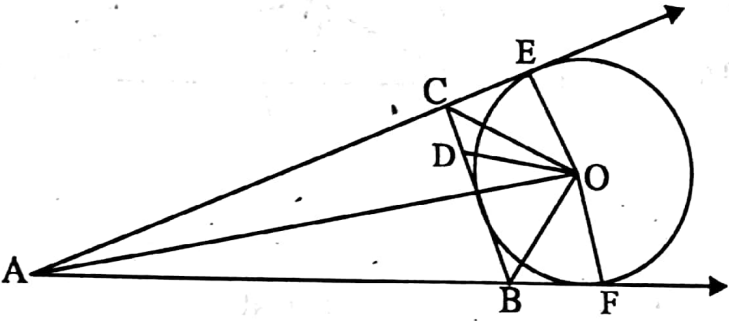
So O is the external centre.
OD, OE, OF are said to be external radius and the circle passes through the points D, E and F are called external circles of the triangle ABC.
Theorems:
- The perpendicular bisectors of sides of triangle are concurrent.
- The perpendiculars from vertices of triangle on the opposite sides are concurrent.
- The internal bisectors of angles of triangle are concurrent.
- The three medians of a triangle are concurrent.
Geometry Chapter 4 Theorems On Concurrence True Or False
Example 1. The sum of lengths of three medians of a triangle is greater than three-fourth of its perimeter.
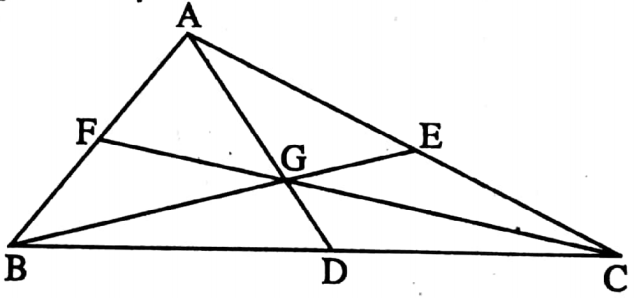
Solution: In ΔABC, the medians AD, BE and CF intersects at G (centroid).
∴ \(\frac{A G}{G D}=\frac{2}{1}\)
[centroid of a triangle divides any median from the vertex in the ratio 2: 1]
⇒ \(\frac{G D}{A G}=\frac{1}{2}\)
⇒ \(\frac{G D}{A G}+1=\frac{1}{2}+1\)
⇒ \(\frac{G D+A G}{A G}=\frac{3}{2}\)
⇒ \(\text { i.e. } \frac{A D}{A G}=\frac{3}{2}\)
⇒ \(A G=\frac{2}{3} A D\)
Similarly, BG = \(\frac{2}{3}\) BD and CG = \(\frac{2}{3}\) CF
In ΔABG, AG + BG > AB…….(1)
In ΔBCG, BG + CG > BC……..(2)
In, ΔACG, CG + AG > AC……….(3)
[The sum of lengths of two sides of a triangle is greater than the length of third side]
(1) + (2) + (3) we get
2(AG + BG + CG) > AB + BC + AC
2(\(\frac{2}{3}\) AD + \(\frac{2}{3}\) BE + \(\frac{2}{3}\) CF) > AB + BC + CA
⇒ \(\frac{4}{3}\)(AD + BE + CF) > AB + BC + CA
⇒ AD + BE + CF > \(\frac{3}{4}\) (AB + BC + CA)
So the statement is true.
Example 2. The orthocentre of a triangle is a point equidistance from its three sides.
Solution: In the adjoining figure, if O is the incentre of the triangle ABC, then OD = OE = OF [Inradius]
i.e. the point equidistance from three side of a triangle is incentre.
So the statement is false.
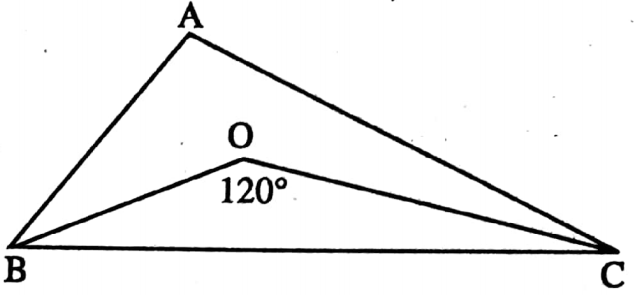
Example 3. In ΔABC, the internal bisectors ∠B and ∠C are meets at point O; if ∠BOC = 112°, then the value of ∠BAC is 44°.
Solution: In ΔABC, OB and OC are bisectors of ∠B and ∠C.
∴ ∠OBC = \(\frac{1}{2}\) ∠ABC and ∠OCB = \(\frac{1}{2}\) ∠ACB
∠OBC + ∠OCB = \(\frac{1}{2}\) (∠ABC + ∠ACB)
⇒ 180° – ∠BOC = \(\frac{1}{2}\) (180° – ∠BAC)
⇒ 180° – ∠BOC = 90° – \(\frac{1}{2}\) ∠BAC
⇒ 180° – 112° = 90° – \(\frac{1}{2}\) ∠BAC
⇒ 68° = 90° – \(\frac{1}{2}\) ∠BAC
⇒ \(\frac{1}{2}\) ∠BAC = 90° – 68° = 22°
⇒ BAC = 44°
∴ The statement is true.
Geometry Chapter 4 Theorems On Concurrence Fill In The Blanks
Example 1. The length of circumradius of a right-angled triangle is ________ of hypotenuse.
Solution: Half

[OA = OB = OC]
Example 2. The two medians of triangle are together than the third median.
Solution: Greater.
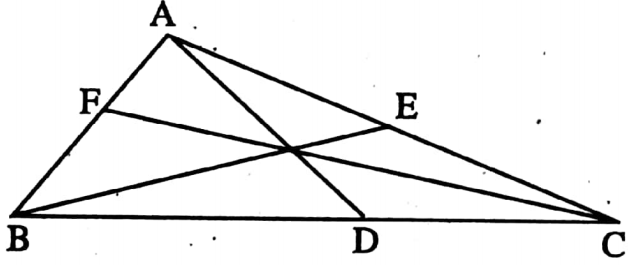
Example 3. If in ΔABC, three medians AD, BE and CF meets at point G then area of ΔABC area of ΔAGE is __________
Solution: ΔAGE = \(\frac{1}{6}\) ΔABC
⇒ \(\frac{\triangle \mathrm{ABC}}{\triangle \mathrm{AGE}}=\frac{6}{1}\)
⇒ ΔABC: ΔAGE = 6 : 1
Geometry Chapter 4 Theorems On Concurrence Short Answer Type Questions
Example 1. If the lengths of sides of triangle are 6 cm, 8 cm and 10 cm, then write where the circumcentre of this triangle lies.
Solution: 62+ 82 = 100 = 102
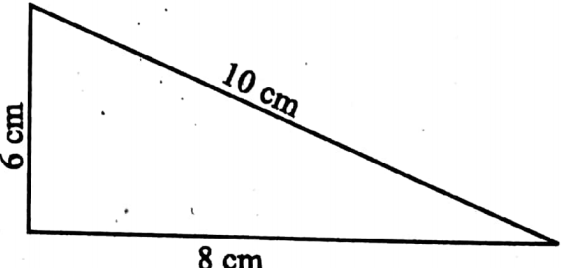
⇒ So the triangle is a right-angled triangle.
⇒ So the circumcentre of the triangle lies on the midpoint of hypotenuse i.e. lies on the midpoint of side with 10 cm in length.
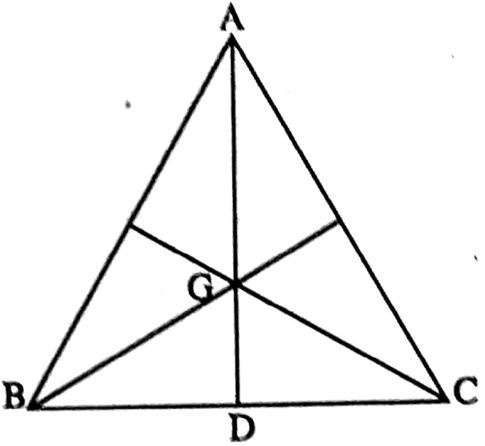
Example 2. AD is the median and G is the centroid of an equilateral triangle. If the length of side 3√3 cm, then find the length of AG.
Solution: The medians and heights of any equilateral triangle are equal in length.
∴ The length of median AD.
= \(\frac{\sqrt{3}}{2}\) x length of side
= \(\left(\frac{\sqrt{3}}{2} \times 3 \sqrt{3}\right) \mathrm{cm}\)
= \(\frac{9}{2} \mathrm{~cm}=4.5 \mathrm{~cm}\)
centroid of a triangle divides any median from the vertex in the ratio 2: 1
∴ \(\frac{AB}{GD}\) = \(\frac{1}{2}\)
let AG = 2x cm
and GD x cm [x is common multiple and x > 0]
AG + GD = (2x + x) cm = 3x cm
3x = 4.5
⇒ x = 1.5
∴ AG = (2 x 1.5) cm = 3 cm.
Example 3. DEF is a pedal triangle of an equilateral triangle ABC. Find the value of ∠FDA.
Solution: In ΔABD and ΔACD,
∠ADB = ∠ADC = 90° [AD ⊥ BC]
⇒ hypotenuse AB = hypotenuse AC [ΔABC is an equilateral]
⇒ and AD = AD [common side]
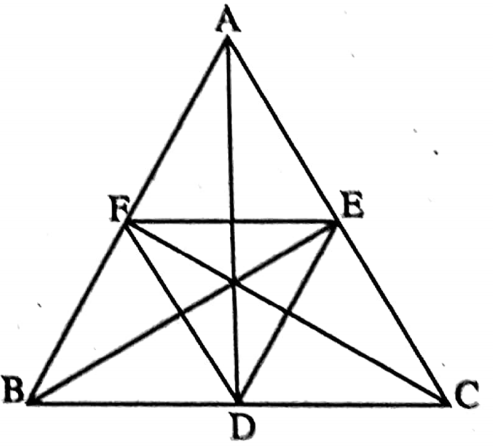
∴ ΔABD ≅ ΔACD [by R-H-S criterion of congruency]
∴ BD = CD i.e. D is the mid point of BC
and ∠BAD = ∠CAD = \(\frac{60^{\circ}}{2}\) = 30°
Similarly, F and E are the mid points of AB and AC respectively.
∴ FE || BC and FE = \(\frac{1}{2}\) BC
⇒ Similarly, DE = \(\frac{1}{2}\) AB and FD = \(\frac{1}{2}\) AC
As AB = BC = CA
∴ DE = FE = FD
∴ ΔDEF is an equilateral triangle.
∴ ∠ZDFE = 60°
⇒ As FE || BC and AB is intersection
∴ ∠AFE corresponding ∠ABC = 60°
∴ ∠AFD = ∠AFE + ∠DEF
= 60° + 60° = 120°
In ΔAFD, ∠FDA + ∠AFD + ∠FAD = 180°
∠FDA + 120° + 30 ° = 180°
⇒ ∠FDA = 30°
Example 4. ABC is an isosceles triangle in which ∠ABC = ∠ACB and median AD = \(\frac{1}{2}\) BC. If AB = √2 cm, then find the length of the circumradius of this triangle.
Solution: In ΔABC, ∠ABC = ∠ACB
∴ AC = AB
⇒ In ΔABD and ΔACD,
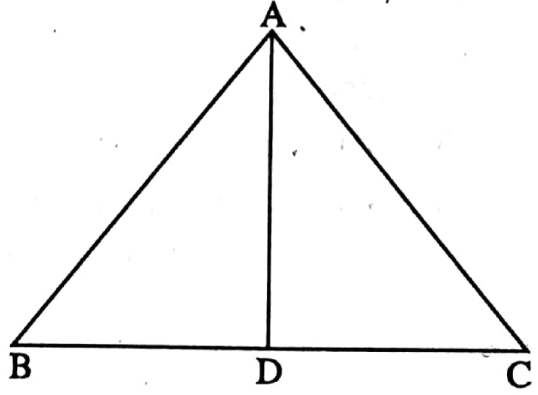
⇒ AB = AC, AD = AD [common side]
⇒ and BD = CD [D is the mid point of BC]
∴ ΔABD ≅ ΔACD [By S-S-S criterion of congruency]
∴ ∠ADB = ∠ADC
∠ADB + ∠ADC = 180°
∴ ∠ADB + ∠ADB = 180°
⇒ 2 ∠ADB = 180°
⇒ ∠ADB = 90°
∴∠ADC = 90°
⇒ Again, AD = \(\frac{1}{2}\) BC = BD = CD
∴ BD or CD or AD is the circumradius of ΔABC.
⇒ In right-angled triangle ABD, ∠ADB = 90°
∴ AD2+ BD2 = AB2 [By Pythagorus theorem]
BD2 + BD2 = (√2)2 cm2
⇒ 2BD2 = 2 cm2
⇒ BD2 = 1 cm2
⇒ BD = √1 cm = 1 cm
⇒ The length of circumradius of ΔABC is 1 cm.
Example 5. In ΔABC, two medians AD and BE are perpendicular each other at point G. If BC = 8 cm and AC = 6 cm, then find the length of AB.
Solution: In ΔABC, the medians AD and BE intersects at G.
⇒ So G is the centroid of the ΔABC.
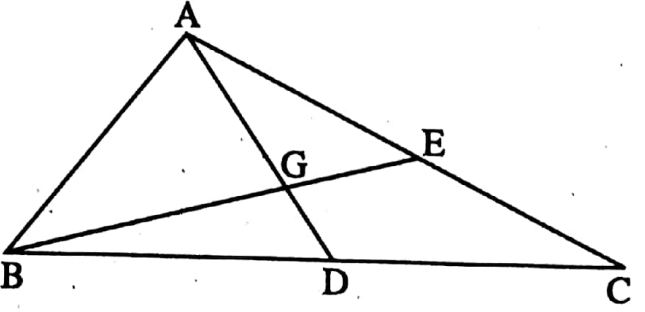
⇒ ∠AGB = ∠AGE = ∠DGB = 90° [AD ⊥ BE]
⇒ AG: GD = 2 : 1 and BG: GE = 2:1
⇒ Let, AG = 2x cm and GD = x cm
⇒ BG= 2y cm and GE = y cm
⇒ BG = 2y cm and GE = y cm [x and y are common multiples and x > 0, y > 0]
∴ BD = \(\frac{1}{2}\) BC = (\(\frac{1}{2}\) x 8) cm = 4 cm and AE = \(\frac{1}{2}\) AC = (\(\frac{1}{2}\) x 6) cm = 3 cm
⇒ In ΔAGE, ∠AGE = 90°
∴ AG2 + GE2 = AE2 [By Pythagorus theorem]
⇒ (2x)2 + (y)2 = (3)2
⇒ 4x2 + y2 = 9………(1)
⇒ In ΔBGD, ∠BGD = 90°
∴ BG2 + GD2 = BD2
⇒ (2y)2 + x2 = 42
⇒ 4y2 + x2 = 16 …….(2)
⇒ (1) + (2), we get,
⇒ 4x2 + y2 + 4y2 + x2 = 9 + 16
⇒ 5x2 + 5y2 = 25 ⇒ x2 + y2 = 5
⇒ In ΔABG, ∠AGB = 90°
∴ AB2 = AG2 + BG2
= ((2x)2 + (2y)2) cm2
= 4(x2 + y2) cm2
= 4 x 5 cm2 = 20 cm2
⇒ AB = √20 cm
= √4×5 cm = 2√5 cm
⇒ The length of AB is 2√5 cm.
Example 6. O is the circumcentre of triangle ABC. If ∠OBC = 30° then find the value of ∠BAC.
Solution: I join A, O and AO is extended at P.
⇒ In ΔBOC, OB = OC [circumradius]
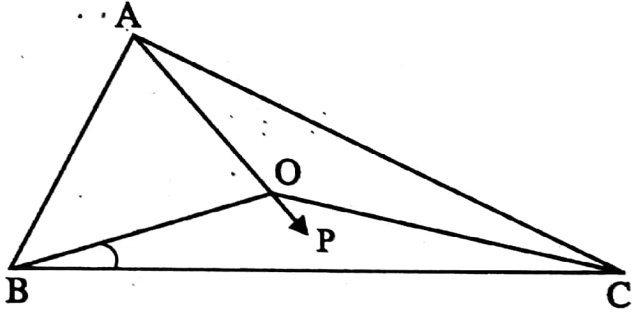
∴ ∠OCB = ∠OBC = 30°
⇒ ∠BOC = 180° (30° + 30°) = 120°
⇒ In ΔAOB, OA = OB
∴ ∠OAB = ∠OAB
The exterior ∠BOP = ∠OAB + ∠OBA
= ∠OAB + ∠OAB = 2 ∠OAB
Similarly, ∠COP = 2 ∠OAC
∠BAC = ∠OAB + ∠OAC
= \(\frac{1}{2}\)(∠BOP + ∠COP)
= \(\frac{1}{2}\) ∠BOC = \(\frac{1}{2}\) x 120° = 60°
Example 7. If the point O is the orthocentre of ΔABC then find the relation between ∠BOC and ∠BAC.
Solution: In ΔABC,
⇒ AD ⊥ BC, BE ⊥ AC and CF ⊥ AB.
⇒ AD, BE and CF intersects at point O.
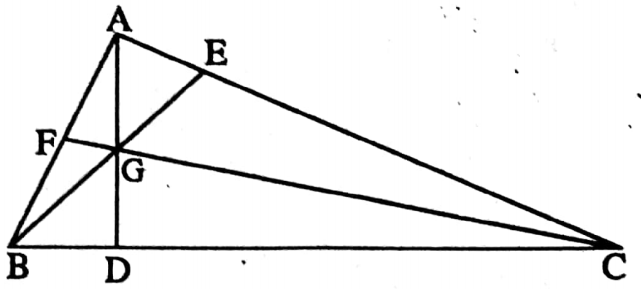
∴ ∠AEB = ∠AFC = 90°
⇒ In quadrilateral AEOF,
⇒ ∠EAF + ∠AFO + ∠EOF + ∠AEO = 360°
⇒ ∠EAF + 90° + ∠EOF + 90° = 360°
⇒ ∠EAF + ∠BOC = 360° – 180° [∠EOF = vertically opposite ∠BOC]
⇒ i.e. ∠BAC + ∠BOC = 180° [required relation]
Example 8. In ΔABC, D, E and F are midpoints of side, BC, CA and AB respectively. If AB = 5 cm, BC = 6 cm and CA = 7 cm, then find the perimeter of ΔDEF.
Solution: In ΔABC, F and E are midpoints of side AB and AC respectively,
∴ FE = \(\frac{1}{2}\) BC = (\(\frac{1}{2}\) x 6) cm = 3 cm
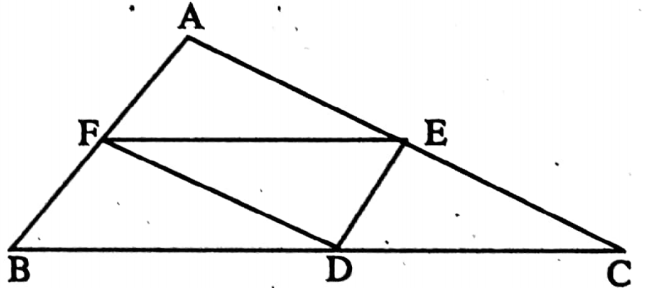
⇒ Similarly, DE = \(\frac{1}{2}\) = AB = (\(\frac{1}{2}\) x 5) cm = 2.5 cm
⇒ and FD = \(\frac{1}{2}\) AC = (\(\frac{1}{2}\) x 7) cm = 3.5 cm
∴ Perimeter of ΔDEF = (3 + 2.5+ 3.5) cm = 9 cm.