
Arithmetic Chapter 5 Percentage
The term is per cent or per centum, per means divided by and cent means 100. So, percentage implies calculation per every hundred.
The words per cent is briefly expressed by the symbols %.
Read and Learn More WBBSE Solutions For Class 8 Maths
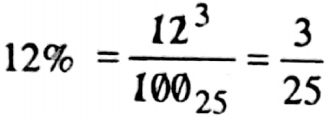
Express 12% as a fraction.
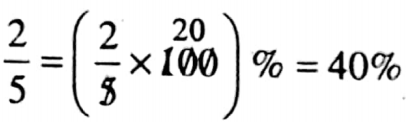
Express into percentage
Express 1% of 0.1 in decimal.
⇒ \(1 \% \text { of } 0 \cdot 1=0 \cdot 1 \times \frac{1}{100}=\frac{1}{10} \times \frac{1}{100}=\frac{1}{1000}=0.001\)
Equivalent discount: On a particular principal the equivalent discount is equal to more than one successive discounts on that principal.
The discount equivalent to successive discounts of q% and b% is (a + b – \(\frac{ab}{100}\))%
| WBBSE Class 8 English Functional Grammar | WBBSE Class 8 English Reading Skills |
| WBBSE Solutions For Class 8 English | WBBSE Solutions For Class 8 Maths |
Arithmetic Chapter 5 Percentage Examples
Example 1. Calculate:
- 45% of 900
- 115% of 25.5 metre
- 205% of 150 gm
Solution:
45% of ₹900
= 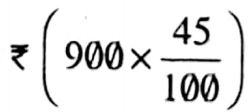
= ₹405
45% of ₹900 = ₹405
115% of 25.5 metre
= 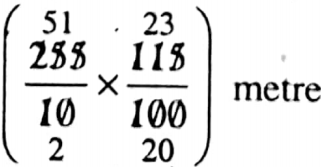
= \(\frac{1173}{40}\) metre = 29.325 metre
115% of 25.5 metre = 29.325 metre
205% of 150 gm
= 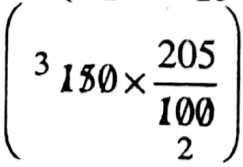
= \(\frac{615}{2}\) gm = 307.5 gm
205% of 150 gm = 307.5 gm
Example 2. Express the following in percentage.
- 2 kg 250 gm out of 0.72 quintal
- ₹1.75 out of ₹3.50
Solution:
1. 2 kg 250 gm = 2250 gm
0.72 quintal = 0.72 x 100 x 1000 gm = 72000 gm.
2250 gm out of 72000 gm is
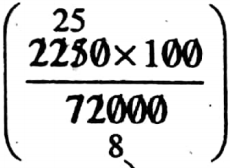
= \(\frac{25}{8}\)% = 3.125%
2 kg 250 gm out of 0.72 quintal = 3.125%
2. ₹1·75 out of ₹3.50 is
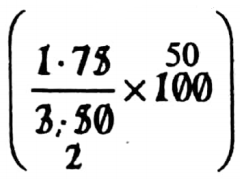
= 50%
₹1·75 out of ₹3.50 is 50%
Example 3. The length of each side of a square is increased by 20%. Find the increase of percentage area of the square.
Solution: Let the length of each side of a square is x units.
∴ Area is x2 square units.
If the lengths of each side of a square is increased by 20% then the length is
\(\left(x+x \times \frac{20}{100}\right) \text { units }=\left(x+\frac{x}{5}\right) \text { units }=\frac{6 x}{5} \text { units }\)
Area of the square = \(\left(\frac{6 x}{5}\right)^2\) square units = \(\frac{36 x^2}{25}\) square units
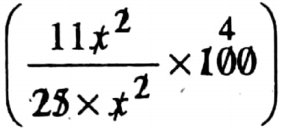
Area increased = \(\left(\frac{36 x^2}{25}-x^2\right)\) square units = \(\frac{36 x^2-25 x^2}{25}\) square units = \(\frac{11 x^2}{25}\) square units.
∴ Area increased by
= 44%
The increase of percentage area of the square = 44%
Example 4. The ratio of measurements of copper and zinc in a brass is 4: 1. Find the percentage of copper and zinc.
Solution: The ratio of measurement of copper and zinc is 4: 1.
The percentage of copper is \(\left(\frac{4}{4+1} \times 100\right)=\left(\frac{4}{5} \times 100\right)=80\)
The percentage of zinc is \(\left(\frac{1}{4+1} \times 100\right) \text { or, } \frac{100}{5} \text { or, } 20\)
∴ Copper has 80% and zinc has 20%.
The percentage of copper and zinc 80% and 20%.
Example 5. If A’s income be 20% more than B’s income, how much per cent is B’s income less than A’s income?
Solution: If B’s income is ₹100 then A’s income is ₹(100+20) ⇒ ₹120.
If A’s income is ₹120, then B’s income less is ₹20
If A’s income is ₹1 then B’s income less is ₹\(\frac{20}{120}\)
If A’s income is ₹100 then B’s income less is ₹\(\frac{20 \times 100}{120}=₹ \frac{50}{3}=₹ 16 \frac{2}{3}\)
∴ B’s income is 16\(\frac{2}{3}\)% less than A’s income.
Example 6. If 40% of (2a – b) = 30% of (a + 3b), then find a : b.
Solution: 40% of (2a – b) 30% of (a + 3b)
⇒ (2a-b) x \(\frac{40}{100}\) = (a+3b) x \(\frac{30}{100}\)
⇒ 40 (2a – b) = 30 (a + 3b)
⇒ 4 (2a – b) = 3 (a + 3b)
⇒ 8a – 4b = 3a + 9b
⇒ 8a – 3a = 9a + 4b
⇒ 5a = 13b
⇒ \(\frac{a}{b}\) = \(\frac{13}{5}\)
⇒ a: b = 13: 5
Example 7. The price of sugar has increased by 20%. Find the percentage of decreased is consumption sugar if the monthly expenses of sugar remain same.
Solution: Let previously 100 units of sugar was used whose price was ₹100.
Now the cost of sugar increased by 20% i.e. now ₹120 costs for 100 units of sugar.
Now ₹120 costs 100 units of sugar
₹1 costs \(\frac{100}{120}\) units of sugar
₹100 costs \(\frac{100 \times 10}{120}\) units of sugar = \(\frac{250}{3}\) units of sugar
In order to keep the monthly expense for sugar same, it will reduce the use of sugar per month by (100-\(\frac{250}{3}\))units
= \(\frac{300 – 250 }{3}\) units = 16\(\frac{2}{3}\)
∴ It will reduce the use of sugar by 16\(\frac{2}{3}\)%
Example 8. In a certain school 85% of the candidates passed in Bengali, 70% passed in Mathematics and 65% passed in both the subjects in the annual examination. If the number of students are 120, then find the number of students failed in both the subjects.
Solution: 65% passed in both the subjects.
∴ Passed only in Bengali = (85 – 65)% = 20%
Passed only in Mathematics = (70 – 65)% = 5%
∴ Passed either in both the subjects or in any one subject only is (65 + 20 + 5) % = 90%
∴ Failed in both the subjects is (100 – 90)% = 10%
∴ The number of students failed in both the subjects is \(\left(120 \times \frac{10}{100}\right)\) or 12
Example 9. If money is devalued by 4%, find the percentage increase in money that will have to be spend to buy a particular article.
Solution: Let the marked price of particular article be ₹100
So the present value of a coin of previous valuation of ₹100 is ₹(100-4) or ₹96
To purchase a particular article of ₹100 is required more by ₹(100 – 96) or ₹4.
So,
If the present value of a coin is ₹96, then ₹4 more is required
If the present value of a coin is ₹1, then ₹\(\frac{4}{96}\) more is required
If the present value of a coin is ₹100, then ₹\(\frac{4 \times 100}{96}\) more is required
=₹\(\frac{25}{6}\) more is required
= ₹4\(\frac{1}{6}\) more is required
∴ Required increase is 4\(\frac{1}{6}\)%.
Example 10. 89% of pure milk is water. If 90% of a sample milk is water, then find the quantity of water mixed in 22 litres of such milk.
Solution: Let x litres of water mixed in 22 litres of such milk.
∴ The quantity of pure milk is (22 – x) litres.
The quantity of water in (22 – x) litres of pure milk is (22 – x) x \(\frac{89}{100}\) litre.
The quantity of water in 22 litres of sample milk is \(\left(\frac{22 \times 90}{100}\right)\) litre.
According to questions,
\(\frac{89(22-x)}{100}+x=\frac{22 \times 90}{100} \Rightarrow \frac{1958-89 x+100 x}{100}=\frac{1980}{100}\)
⇒ 11x + 1958 = 1980
⇒ 11x = 1980 – 1958
⇒ 11x = 22 ⇒ x = \(\frac{22}{11}\) = 2
∴ The 2 litres water mixed in 22 litres of such milk.
Example 11. When water freezes into ice, it increases in volume by 10%. Find out in percentage how much it will decreased in volume if the ice melts into water.
Solution: When 100 unit of water freezes into ice its volume increases to (100 + 10) unit or 110 units.
In the mathematical language, the problem is:
Volume of ice (unit)
110
100
Volume of water by melting of ice (unit)
100
? (x) (say)
Volume of ice and volume of water by melting of ice are directly proportional.
∴ 110: 100 : : 100: x
⇒ \(\frac{110}{100}=\frac{100}{x} \Rightarrow x=\frac{100 \times 100}{110} \Rightarrow x=\frac{1000}{11}\)
If 100 unit of ice melted to water, then the volume decrease to \(\frac{100}{11}\) unit
∴ Volume decreases = (100-\(\frac{1000}{11}\))% = (\(\frac{1100-1000}{11}\))% = \(\frac{100}{11}\)% = 9\(\frac{1}{11}\)%
Example 12. Due to use of high-yielding seed Gopalbabu has got 40% production high in paddy cultivation. But for this the cost of cultivation has increased by 30%. Previously a yield of ₹2500 was produced by investing 1000. Find out whether his income will be increased or decreased after using high-yielding seeds.
Solution: Previously the cost of cultivation was ₹1000.
At present cost of cultivation is ₹(1000+1000x\(\frac{30}{100}\)) = ₹(1000+300) = ₹1300
Previously yield ₹2500 was produced.
Due to use of high-yielding seed at present yield of ₹(25000+2500x\(\frac{40}{100}\)) =₹(2500 + 1000) = ₹3500
Previously his income was ₹(2500-1000) = ₹1500
At present his income is ₹(3500-1300) = ₹2200
His income increases by ₹(2200-1500) or ₹700.
Example 13. Choose the correct answer:
1. 15% of ₹80 is
- ₹10
- ₹12
- ₹20
- ₹24
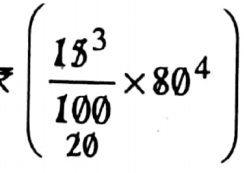
Solution: 15% of ₹80
= ₹12
∴ So the correct answer is 2. 12
15% of ₹80 is 12.
2. The ratio of hydrogen and oxygen in water is 2: 1. The percentage of hydrogen in water is
- 33\(\frac{1}{3}\)
- 50
- 25
- 66\(\frac{2}{3}\)
Solution: The percentage of hydrogen is (\(\frac{2}{2+1}\)x100) = \(\frac{200}{3}\) = 66\(\frac{2}{3}\)
∴ The correct answer is 4. 66\(\frac{2}{3}\)
The percentage of hydrogen in water is 66\(\frac{2}{3}\)
3. Aloke has got 36 marks out of 50 in Bengali. He has got a percentage
- 18
- 36
- 54
- 72
Solution: Out of 50 marks Aloke has got 36 marks.
Out of 1 mark he has got \(\frac{36}{50}\) marks
Out of 100 marks he has got \(\frac{36 \times 100}{50}\) marks = 72 marks
He has got 72% marks.
∴ So the correct answer is 4. 72
He has got a percentage 72.
Example 14. Write ‘True’ or ‘False’:
1. 200% of 480 gm is 960 gm.
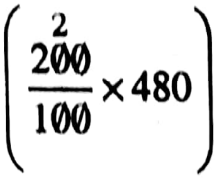
Solution: 200% of 480 gm
= 960gm
∴ So the statement is true.
2. 60% of 3.16 = 1.9
Solution: 60% of 3.16
= \(\frac{60}{100} \times \frac{316-31}{90}\)
= 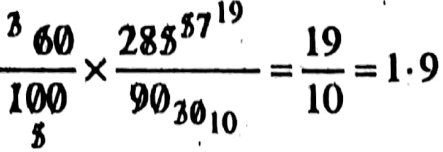
∴ So the statement is true.
Example 15. Fill in the blanks:
1. If 30% of A = 50% of B. Then A = _______ % of B.
Solution: A x \(\frac{30}{100}\) = 50% of B
A = of B = \(\frac{500}{3}\)% of B
2. The expression of 125% in ratio is ________
Solution: 125% = \(\frac{125}{100}\) = \(\frac{5}{4}\) = 5: 4