
WBBSE Chapter 1 Sensitivity And Response In Plants Introduction To Changing Environment
Living organisms are surrounded by and are harmful, the organisms move away from them to the environment undergoing continuous changes at all times.
Changes may be favorable or unfavorable. Changes that are detected by the organisms lead to responses.
The stimuli are a form of physiochemical change of energy, in the surrounding environment, which is detected by the organism and they respond in various ways.
Stimuli can be external, which includes modifying the outside environment like water, temperature, oxygen level, etc.

But sometimes these changes are internal like the accumulation of nitrogenous waste that necessitates excretion, osmoregulation, etc.
Sometimes these stimuli are beneficial, so organisms tend to move toward these stimuli. Unicellular green algae Chlamydomonas move towards the illuminated part of the water body, and plant roots grow towards water.
When the soil pH stimuli is acidic, the plant roots tend to retract from that part of the soil.
Read and Learn MoreWBBSE Solutions For Class 10 Life Science
What is sensitivity?
Sensitivity is the ability to detect the change in the environment and react to the stimuli accordingly. It is more pronounced in animals because they can show locomotion.
Some of the lower plants can exhibit locomotion like in unicellular or colonial green algae. Their response to stimuli is easily detectable in the form of positive or negative tactic movement.
WBBSE Class 10 Life Science Chapter 1 Solutions
Higher plants on the other hand are fixed to the substratum with the help of roots and cannot move from place to place. So they exhibit slow growth movement that cannot be detected easily.
Certain other plants are relatively more sensitive and exhibit turgor movement in response to electrical or mechanical shock.
WBBSE Chapter 1 Sensitivity And Response In Plants Mechanism Of Sensing Environmental Changes And Stimuli In Plant
Plant organs sensing light with photosensitive compounds:
The organs are called phototropin, cryptochromes, and phytochromes, each reacting very specifically to certain wavelengths of light.
These light sensors tell the plant whether it is day or night, how long the day is, how much light is available, and where the light comes.
Shoots grow towards light and roots usually grow away from light. These responses are called phototropism and skototropism respectively.
Phototropism is affected by plant hormones along with the pigments mentioned above.
Many plants exhibit certain phenomena at specific times of the day; for example, certain flowers open only in the mornings.
Plants keep track of the time of the day with an internal molecular clock. This internal clock is set to the solar clock every day using sunlight.
The internal clock coupled with the ability to perceive light also allows plants to measure the time of the day and find the year’s season.
The seeds of many plants sprout only after they are exposed to light. This response is carried out by phytochrome signaling. Plants are also able to sense the quality of light and respond appropriately.
For example, in low light conditions, plants produce more photosynthetic pigments.
If the light is very bright or if the levels of harmful UV increase, plants produce more protective pigments, that act as sunscreens.

Production of signaling molecules:
Wounded tomatoes are known to produce the volatile methyl-jasmonate as an alarm signal.
Plants in the neighborhood can then detect the chemical by its odor and prepare for the attack by producing chemicals that defend against insects or attacking predators.
WBBSE Class 10 Life Science Chapter 1 Solutions
Hormonal signaling in plants:
Plants systematically use hormonal signaling to coordinate their development and morphology.
A delicate balance between auxin and cytokinin brings about morphogenesis in a developing plant.
Phytochrome, gibberellin, and the hypothetical hormone florigen modify apical meristem to floral meristem.
Trapping of prey by insectivorous plants:
Stinging hairs of insectivorous plants like Sundew close the leaflets when they contact the insect body.
This is primarily due to the monastic movement.
Shock-based movement in plants:
Any mechanical or electrical pressure releases the water molecule from the pulvinus in Mimosa pudica and the plant droops down.
After some time with the discontinuity of the touch, the plant again regains its original configuration. This is called the seismonastic movement.

A sensitivity test on Mimosa was first carried out by Acharya J.C. Bose, who showed that a low electricity shock of 1.3 volts can result in drooping and retraction movement in Mimosa pudica.
Bose used Crescograph for measuring the rate of growth of plants which is a device to magnify plant growth up to 10,000 times when different stimuli like temperature, chemicals, gases, and electricity stimulate them.
He proved that plants have life and showed that they show varied responses to stimuli.
Movement due to osmotic stress:
The leaflets of the Indian Telegraph plant Desmodium gyrans automatically go up and down with the basal leaflets’ loss and gain of turgidity.
As the leaflets go down, they lose turgidity, become light, and go up.
WBBSE Class 10 Life Science Chapter 1 Solutions
Growth movement due to touch:
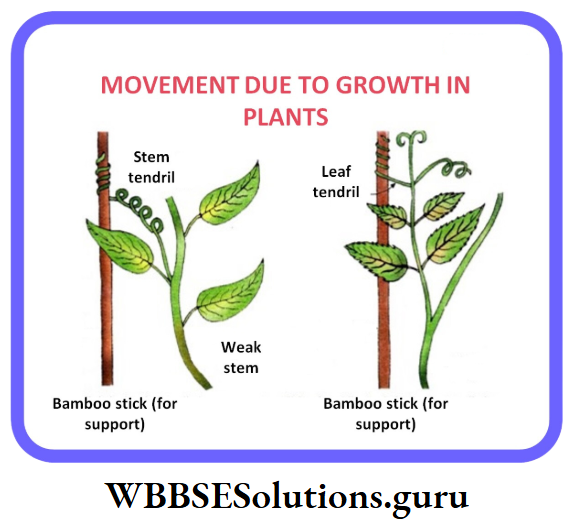
The tendril of a pea or vine grows like a spring surrounding a solid rod-like support and thereby the plant can stand erect despite having a non-woody stem.
This phenomenon occurs by the initial touch of the solid support causing the bending of the tendril (thigmotropism) followed by growth in a spring manner (circumnutate-)
Plant Movement responding to different stimuli:
Movement is the displacement of the body parts of an organism keeping the whole body fixed to a position.
Major characteristics of plant movements are:-
The capacity of the movements of plants is often doubted. Many lower forms of plants like unicellular organisms have the distinct power of locomotion.
The higher plants show movements by changing the positions of the organs in various ways. The rate of movement in higher plants is usually very slow.
Plant sensitivity happens due to the action of photosensors, hormonal signaling, variation of osmotic stress, the action of alarm signaling molecules, etc.
Generally, plant movements are slow-growth movements or turgor movements. Rapid movements by plants are extremely rare the complete plant movements.
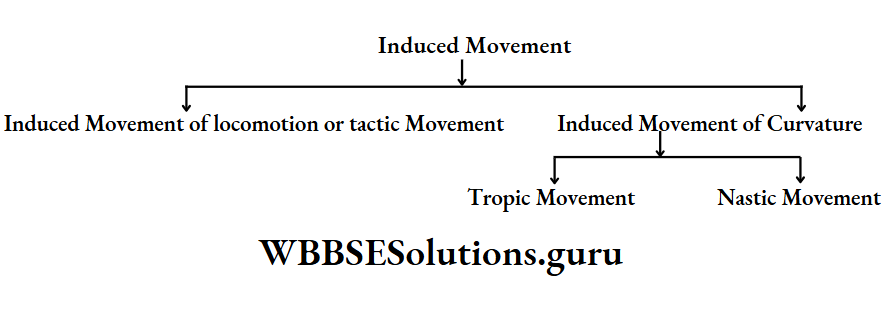
Movements in plants may be of two classes:
Movement of locomotion: Here the entire organism may move from place to place.
Movement of curvature: Here the organs of the stationary parts change positions and thus curve in different ways.
- Both kinds of movements may be
- Autonomic or spontaneous, i.e. without any external influence, or
- Induced, i.e. due to some kind of external stimulus like light, the force of gravity, moisture, etc.
Induced movement: Some plant movements are caused in response to certain stimuli and they are said to be induced or paratonic movements that take place spontaneously, without any irritability and sensitivity of protoplasm.
Paratonic Movements Are Of the Following Kinds:
Chapter 1 Topic A Sensitivity And Response In Plants’ Tactic Movements
It is the induced movement of locomotion where a plant can move freely or swim from one place to another by the influence of light, temperature, chemicals, etc. Tactic movements are of the following types:
Phototactic Movement: These tactic movements are in response to unidirectional light.
In free-swimming algae like Chlamydomonas, zoospores, and gametes when swim toward the diffused light are said to be positively phototactic they move away from the strong light, and they are called negatively phototactic.
WBBSE Class 10 Life Science Chapter 1 Solutions
Chemotactic Movement: The movement of locomotion induced by chemical compounds is chemotactic movement; e.g., the movement of male antherozoids of fern towards the archegonia induced by malic acid.

Thermotactic Movement: This type of movement of locomotion is induced by temperature, e.g., Colonial algae like Volvox move away from the hot water to a relatively cooler part of the water body.
Magnetotactic Movement: A polyphyletic group of bacteria orients themselves along the magnetic field lines of Earth’s magnetic field to reach regions of optimal oxygen concentration.
This biological phenomenon of microorganisms tending to move in response to the environment’s magnetic characteristics is known as magnetotaxis.

Chapter 1 Topic A Sensitivity And Response In Plants Tropic Movements
The induced movement of curvature of any plant part or organ which occurs in response to unidirectional external stimuli and results in the positioning of the plant part in the direction of the stimulus, is said to be tropic movement.
Depending upon the nature of the stimuli, these movements are of the following types:
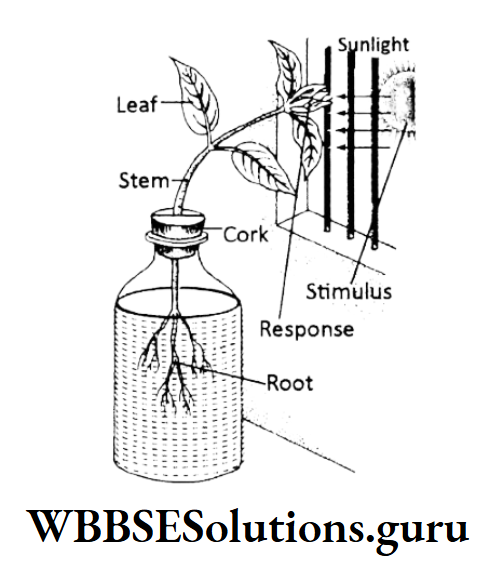
Phototropism: These curvature movements occur when a plant is provided with artificial or natural light only from one direction.
Stems that generally show a curvature toward the source of light are said to be positively phototropic.
Roots that grow away from the source of light are called negatively phototropic Leaves remain at a right angle to the source of light and so they are called transversely phototropic.
Class 10 Life Science Chapter 1 Questions And Answers
Phototropism is also known as Heliotropism.
Geotropism: Growth movements induced by the stimulus of gravity are said to be geotropism.
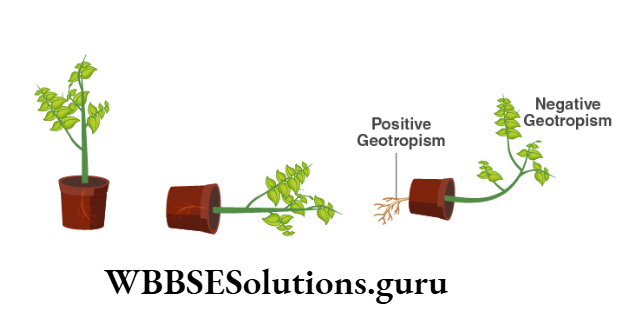
Primary roots always grow downward in the direction of gravity and thus are positively geotropic, whereas the main shoots grow upward away from gravity and are thus negatively geotropic.
The secondary lateral roots and shoots show a weaker response to gravity and thus take up a position at a right angle to the gravitational stimulus and are called diageotropic or transversely geotropic.
Demonstration of geotropism: Geotropism can be demonstrated in the laboratory with the instrument known as Klinostat. It can allow a potted plant fixed on it to rotate at a definite speed.
Two klinostats are taken and a potted plant on each is fixed in a horizontal position. One klinostat is rotated and the other is kept stationary.
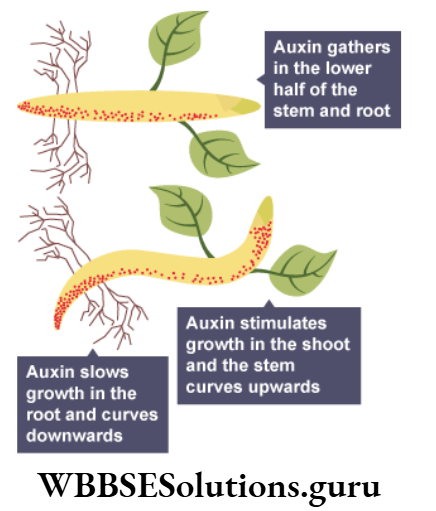
Observations made after some time will show that the shoot of the plant fixed on the stationary klinostat bends upwards showing negative geotropism and the root bends downwards showing positive geotropism.
But there is no bending in the root and shoot of the plant fixed on the rotating klinostat. This is because gravitational stimulus is not unilateral as it affects the sides of the rotating organs equally.
Hydrotropism: Growth movements in response to the unilateral stimulus of water are known as hydrotropism. Roots are both positively geotropic and hydrotropic.
However because they bend towards the source of water while being attracted by gravity, it is said that hydrotropism is a greater force than geotropism.
An interesting example of negative hydrotropism can be observed in the pneumatophores of mangroves where the roots are simultaneously negatively hydrotropic and negatively geotropic.

Thigmotropism: The tropic movement induced by touch is thigmotropism. The roots of a potted plant form an armor surrounding the soil and hold on to it even when the pot is broken.
Chemotropism: The tropic movement induced by a chemical compound is called chemotropic movement.
Movement of the pollen tube from the germinating pollen grain on the stigma, moving down through the style induced by sugar produced from the ovule helps in fertilization through chemotropic movement.
WBBSE Chapter 1 Sensitivity And Response In Plants’ Nastic Movements
The induced movement of curvature in the plant where the direction of the movement is not determined by the direction of the stimulus, but rather by its intensity is known as a nastic movement.
This can be due to changes in turgor or changes in growth. Depending upon the nature of the stimuli,
These movements are of the following types-
Photonastic movement: These nastic movements are induced by a change in light intensity.
Some flowers like Water lilies, sunflowers, poppies,ies, etc open at sunrise and close down at sunset. These are examples of positive photonastic movement.
Class 10 Life Science Chapter 1 Questions And Answers
Flowers of Night Queen (Cestrum nocturnum) open at night. This is an example of negative photonastic movement.
Thermonastic movement: This type of nastic movement is induced by a change in temperature intensity.
Example: Tulip and Saffron (Crocus). A temperature rise of only 0.36 °C is enough to begin the opening of a Crocus flower.
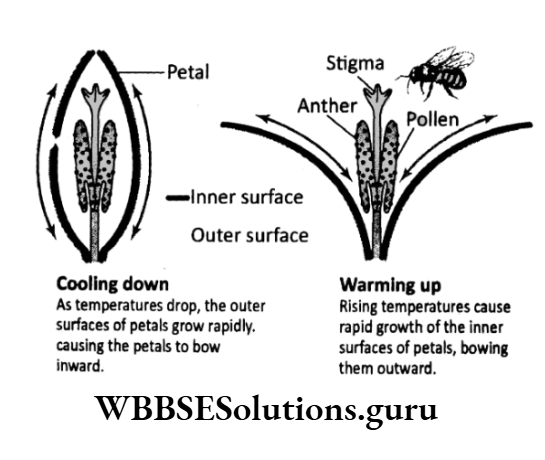
Chemonastic movement: This type of nastic movement occurs in response to some chemical stimulus.
Strong chemo nasty is exhibited by long peripheral tentacles of sundew leaves (Drosera) which respond to the presence of organic nitrogenous compounds by bending towards the middle of the leaf.
Nyctinasty: The independent movement of plant parts due to the change in light intensity and temperature is called nyctinastic movement.
Nyctinastic movements are associated with diurnal light and temperature changes and are controlled by the circadian clock and the light receptor phytochrome.
Examples are the closing of the petals of a flower at dusk and the sleep movements of the leaves of many legumes.
Thigmonasty: The nastic movement induced by touch is called a thigmotactic movement, e.g. the trapping of insects by the closing leaflets of a Venus flytrap.
Class 10 Life Science Chapter 1 Questions And Answers
Seismonastic movement: These movements are in response to shock by a touch stimulus or other mechanical stimuli.
It is exhibited by the touch me not or Mimosa pudica plant. The extent of seismonastic movements depends upon the intensity of the stimulus, the vigor, and the age of the plant.
Chapter 1 Sensitivity And Response In Plants The Sequence Of Events Of Seismonastic Movement Is As Follows
The movements are caused by differential loss of turgor on the two sides of the pulpiness. The swollen base of the petiole is called the pulvinus. Similar but smaller pulvinus are present at the base of each leaflet.
The lower half of the pulvinus is made up of thin-walled cells. It has large intercellular spaces. The cells in the upper half are comparatively thick-walled. They have few intercellular spaces.
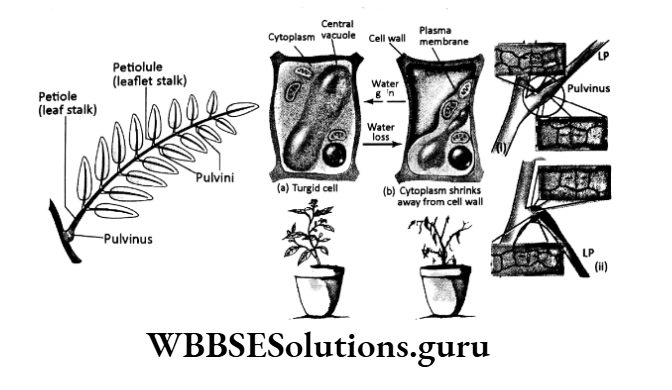
The cells of both sides of the pulvinus are fully turgid during norm The ability of a plant to react to external stimulus is
- Movement
- Locomotion
- evolution
- Irritability Conditions, Therefore, the leaf is fully erect.
The cells of the lower half lose water into the intercellular spaces on stimulation in the form of touch or blow. Therefore, their turgor falls considerably.
The cells of the upper half retain their turgidity. They even become more turgid by absorbing water from the intercellular spaces.
Therefore, the upper turgid half of the pulvinus presses down on the lower flaccid half. Thus the leaf droops.
The cells of Acid Half gradually reabsorb water from the intercellular spaces, therefore, they regain their turgor, and the leaf returns to its normal position after some time.
Class 10 Life Science Chapter 1 Questions And Answers
Here the stimulus is perceived by the leaf, whereas the action takes place at a distance from it;
there is a sensory organ that receives the stimulus and the motor organ is the swollen pulvinus which brings about the movement.
An analogy is apparent here with the nervous mechanism in animals.
WBBSE Chapter 1 Sensitivity In Plants
Acharya Jagadish Chandra Bose made substantial discoveries in plant physiology. One of his inventions is the Crescograph, which he used to measure plants’ responses to different stimuli.
He demonstrated with experiments that plants too have life. A crescograph was used to record the plant pulses when it was connected to a plant called Desmodium gyrans.
The plant root was immersed in hydrobromic acid up to the stem.
Initially, the plant showed a steady deflection of the pointer in the crescograph and soon it became unsteady and then vibrated violently and finally stopped suddenly, indicating the death of the plant.
Sir J. C Bose also worked in the area of the action of microwaves on plant tissues.
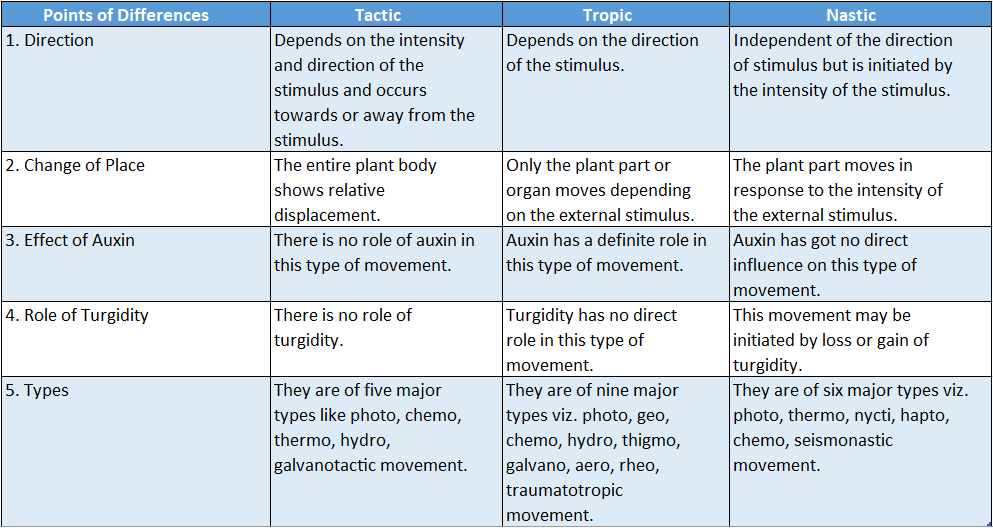
Chapter 1 Sensitivity And Response In Plants Contribution Comparison Between Tactic, Tropic, And Nastic Movement
Chapter 1 Sensitivity And Response In Plants Fill In The Blanks
Question 1. Stimulus is a form of_______________.
Answer: Energy
Question 2. The movement towards light is positive _______________.
Answer: Phototropism
Question 3. Movement controlled by the intensity of the stimulus is also called_______________.
Answer: Nastic
Question 4. Phototropism is also controlled by_______________.
Answer: Light
Question 5. Movement of Mimosa is also called_______________.
Answer: Sesimonasty
Class 10 Life Science Chapter 1 Exercise Solutions
Question 6. The movement of Indian Telegraph plant is_______________
Answer: Movement of variation
Question 7. The direction of the stimulus controls the movement of_______________.
Answer: Tropism
Question 8. Movement of plant roots towards gravity is_______________
Answer: Positive geotropism
Question 9. The movement of fern antherozoid towards archegonium is_______________.
Answer: Chemotaxis
Question 10. The movement in the tulip flower is by _______________.
Answer: Thermonasty
Question 11. _______________is exhibited by tendril of pea plant.
Answer: Circumnutation
Question 12. Movement of cytoplasm is also called_______________.
Answer: Tropism
Question 13. The moss antherozoid are attracted by_______________.
Answer: Positive Geotropism
Question 14. Lateral growth of leaflet towards light is called_______________
Answer: Diaheliotropism
Question 15. The_______________ flower blooms in evening.
Answer: 4 O’Clock
Question 16. Leaflets of insectivorous plant exhibit_______________ .
Answer: Chemonastism
Question 17. Roots of potted plant exhibits_______________ .
Answer: Thigmotropism
Question 18. _______________exhibit amoeboid movement.
Answer: Myxomycetes
Question 19. _______________controls the movement of fern antherozoid.
Answer: Malic acid
Question 20. Cyclosis around central vacuole is called_______________
Answer: Rotation
Class 10 Life Science Chapter 1 Exercise Solutions
Question 21. The pneumatophores exhibit_______________ movement.
Answer: Aerotropic
Question 22. The nastic movement controlled by both light and temperature is_______________ .
Answer: Nyctinasty
Question 23. Roots exhibit negative_______________ .
Answer: Phototropism
Question 24. Hydrotropism is a greater force than_______________
Answer: Geotropism
Question 25. Movement of variations is controlled by_______________
Answer: Osmosis
WBBSE Chapter 1 Sensitivity And Response In Plants Write True Or False
Question 1. Phototropism is independent of the direction of light intensity.
Answer: False
Question 2. Auxin controls tropism in plants.
Answer: True
Question 3. Nastic movement is the movement of locomotion.
Answer: False
Question 4. Thigmonasty is controlled by shock generated by touch.
Answer: False
Question 5. Thermotaxism is controlled by temperature.
Answer: True
Question 6. Photonastism controls the blooming of sunflowers.
Answer: True
Class 10 Life Science Chapter 1 Exercise Solutions
Question 7. The direction of stimuli determines nastic movement.
Answer: False
Question 8. Movement of variation is controlled by osmosis.
Answer: True
Question 9. Sir J. C. Bose discovered a machine called a crescograph.
Answer: True
Question 10. Fern ovum shows chemotactic movement.
Answer: False
Class 10 Life Science Chapter 1 Exercise Solutions
Question 11. Movement of variation is exhibited by the Indian Telegraph plant.
Answer: True
Question 12. Pneumatophores exhibit positive geotropic movement.
Answer: False
Question 13. Water current controls rheotaxis in aquatic plants.
Answer: True
Question 14. The flower closes by hyponasty.
Answer: True
Question 15. Matured plant cell shows circulation.
Answer: True
Question 16. Nutation is a movement induced by growth.
Answer: False
Question 17. Epinasty leads to the opening of a flower.
Answer: True
Question 18. Roots are positively geotropic.
Answer: True
Class 10 Life Science Chapter 1 Exercise Solutions
Question 19. Geotropism is a greater force than hydrotropism.
Answer: False
Question 20. Galvanotaxism is controlled by an electric current.
Answer: True
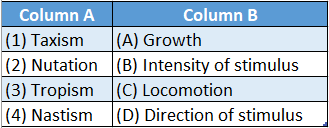
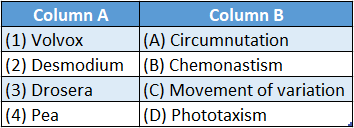
Chapter 1 Sensitivity And Response In Plants Match The Column

Answer: 1-D,2-A,3-B,4-C
Answer: 1-C,2-A,3-D,4-B
Answer: 1-D,2-C,3-B,4-A
Chapter 1 Sensitivity And Response In Plants Very Short Answer Questions
Question 1. What is the ability of a plant to react to a stimulus known as?
Answer: Sensitivity.
Question 2. Name the movement of growth by which the plant part opens.
Answer: Epinasty.
Question 3. What is the name given to the growth of tendrils?
Answer: Circumnutation.
Question 4. Name the process by which the energy of the stimulus is transferred to the biological organism.
Answer: Biological transduction.
Question 5. Name the movement that is induced by osmosis.
Answer: Movement of variation.
WBBSE Life Science Class 10 Sensitivity And Response Notes
Question 6. Name the nastic movement induced by touch.
Answer: Thigmonasty.
Question 7. What is the other name for phototropism?
Answer: Heliotropism.
Question 8. How insects are trapped by Drosera?
Answer: Chemonasty.
Question 9. What is the movement of root towards air known as?
Answer: Aerotropism.
Question 10. Name the movement of the pollen tube toward the ovule.
Answer: Chemotropism.
Question 11. Name the hormone that induces phototropism and geotropism.
Answer: Auxin (IAA)
Question 12. Name a plant that exhibits seismonasty.
Answer: Mimosa pudica
Question 13. Name two algae that exhibit locomotion.
Answer: Chlamydomonas and Volvox.
WBBSE Life Science Class 10 Sensitivity And Response Notes
Question 14. Name an internal stimulus.
Answer: Hormone.
Question 15. Name a plant that exhibits movement of variation.
Answer: Indian telegraph plant (Desmodium gyrans).
Question 16. What type of movement is exhibited by myxomycetes?
Answer: Amoeboid movement.
Question 17. Name a chemical to which the plant shows negative chemotropism.
Answer: Acid or Alkali.
Question 18. Name a plant that exhibits sleep movement.
Answer: Tamariad/Caesalpinae.
Question 19. What is the reason for the opening and closing of the stomata?
Answer: Osmosis.
Question 20. What are the two types of cyclosis?
Answer: Rotation and Circulation.
Question 21. Name the stimuli that control the movement of aerial roots in orchids.
Answer: Air.
Question 22. Name the stimuli for seismonasty.
Answer: Touch or pressure.
Question 23. Name the major stimuli for taxes.
Answer: Light, temperature, chemicals.
Question 24. How do roots grow towards soil?
Answer: Geotropism and hydrotropism.
Question 25. Give an example of negative phototropism.
Answer: Movement of root towards the soil.
WBBSE Life Science Class 10 Sensitivity And Response Notes
Question 26. Name an instrument that can measure the sensitivity of plants.
Answer: Crescograph.
Question 27. Choose the odd one and write it:
Answer: Movement of male fern antherozoids induced by malic acid, bending of roots towards the source of water, movement of volvox towards cooler part of water, swimming of Chlamydomonas zoospores.
Bending of roots towards the source of water: It is a tropic movement while the other examples are tactic movements.
Question 28. A pair of related terms is given below. Based on the relationship in the first pair, write the suitable word in the gap of the second pair:
Answer: Negatively geotropic: main shoot::
Positively geotropic:___________ primary root.
__________Plant movement that depends on the direction of the stimulus:: Nastic: Plant movement that depends on the intensity of the stimulus Tropic.
Question 29. Among the following four terms, one includes the other three. Find out the term and write it:
Answer:
- Rotation, circulation, Autonomic movement, amoeboid movement Autonomic movement
- Phototropin, cryptochromes, phytochromes, photoreceptors photoreceptors
Question 30. Which movements are commonly known as ‘sleeping movements’?
Answer: Nyctinastic movements.
Chapter 1 Sensitivity And Response In Plants Short Answer Questions
Question 1. What is meant by excitability in plants Give an example.
Answer: Excitability in plants
The reaction of a plant in response to an environmental stimulus is known as excitability; e.g. Dropping down of the branches and leaves of Mimosa pudica in response to touch or pressure stimulus.
Question 2. Who discovered the instrument for measuring sensitivity in plants? Name the instrument.
Answer:
Sir J.C. Bose exhibited a sensitivity of plant to external stimulus and it was shown with a crescograph.
Question 3. What is haptotropism?
Answer: Haptotropism
Haptotropism or thigmotropism is the tropic movement of plants induced by touch either towards or away from the stimulus; e.g. Movement of a tendril of a gourd plant.
WBBSE Life Science Class 10 Sensitivity And Response Notes
Question 4. What is spontaneous movement?
Answer: Spontaneous movement
The movement of a plant body or plant part without any external stimulus is autonomous or spontaneous. Spontaneous movement of cytoplasm within the cell or cyclosis is a spontaneous movement.
Question 5. What is meant by transverse geotropic movement?
Answer: Transverse geotropic movement
The lateral branching of a stem or root normally grows at a right angle to gravity and it is called transverse geotropism.
Question 6. State the major difference between a tactic and a tropic movement.
Answer: Tactic movement is induced movement of locomotion induced by light, temperature, and chemicals. Tropic movement is induced movement of curvature induced by the above-mentioned stimuli.
Question 7. What is heliotropic movement?
Answer: Heliotropic movement
The leaves or lateral branches of a plant may grow parallel to the ground surface induced by sunlight, which is called heliotropic movement.
Question 8. What is the major difference between tropic and nastic movement?
Answer: The tropic movement is a movement of curvature that is controlled by the direction of stimuli.
Nastic movement is independent of the direction of the stimulus. It is initiated by the intensity of the stimulus.
Question 9. What will be the direction of growth of the stem of a potted plant placed horizontally to the ground surface?
Answer:
The stem grows horizontally parallel to the surface and then it grows vertically upward due to positive phototropic curvature.
Question 10. Would you consider displacement of water hyacinth on a water body as locomotion?
Answer:
It is the movement of the plant body using water flow in the water body involving no energy expenditure. So it is not considered as locomotion.
Question 11. What is the nature of the movement of Volvox?
Answer:
The nature of the movement of Volvox
Volvox moves towards light with the help of flagella but it cannot withstand high-intensity light and usually moves away from it.
Question 12. What is tropic movement? What are its types?
Answer:
Tropic movement
The movement of curvature induced by the direction of the stimulus is called tropic movement.
It can be induced by light (phototropism), temperature (thermo-tropism), gravity (geotropism), water (hydrotropism), chemical (chemotropism), and touch (thigmotropism).
WBBSE Life Science Class 10 Sensitivity And Response Notes
Question 13. What is meant by chemotropism?
Answer:
Chemotropism
The tropic movement induced by chemicals is chemotropism, e.g. movement of the pollen tube from the stigma to the ovule is induced by sugar produced from the ovule.
Question 14. Why does negative geotropic movement occur in plants?
Answer: In the case of the root of certain mangrove plants like Sundari, the breathing roots or pneumatophores grow against gravity to take up oxygen as the soil is deficient in oxygen. This is an example of negative geotropism.
Question 15. What is the difference between thigmonasty and seismonasty?
Answer:
In the case of thigmonasty, the nastic movement is only induced by touch e.g., the movement of leaflets of certain insectivorous plants.
But in the case of seismonasty, it is due to the shock generated by touch e.g., the drooping down of leaflets in Mimosa pudica.
Question 16. How does hydrotropism predominate over geotropism?
Answer:
The roots growing down due to positive geotropism may grow laterally due to adjacent sources of water, which indicates that hydrotropism is a greater force than geotropism.
Question 17. What is nyctinasty?
Answer:
Nyctinasty:
The leaflets of Delonyx open during the daytime but close during the evening with the fall in both temperature and light. This is called nyctinasty.
These movements are commonly called ‘sleeping movements’ since the leaves or other organs of plants assume positions suggestive of sleep induced by the alternation of day and night.
Question 18. What are the major aims of locomotion?
Answer:
The aims of locomotion are
- Search for nutrients
- Search for light
- Search for water
- Reproduction and
- Protection from enemies.
Question 19. What is meant by osmotic movement?
Answer:
Osmotic movement
The basal leaflets of the Indian telegraph plant or Desmodium gyrans gain water by endosmosis,
Become heavy, and come down; then there occurs exosmosis, the leaflets become light and they go up. This is an autonomic movement due to variation of turgidity.
Question 20. “Movement does not involve locomotion, but locomotion always involves movement”-why?
Answer:
Movement does not involve the actual displacement of an organism. The organism remains static at a point and only the body parts move spontaneously or under the influence of stimuli.
Locomotion, on the other hand, involves the change of positions due to the movement of the locomotory organizer The whole body of an organism is shifted from one place to another by way of locomotion. Hence it involves movement also.
Sensitivity And Response In Plants Class 10 WBBSE
Question 21. which appears to be correct and why? State brief reasons.
Answer:

Question 22. What is a Klinostat? Why is it used?
Answer: Klinostat
A Klinostat is a device that uses rotation to negate the effects of gravitational pull on plant growth (gravitropism) and development (gravitropism).
A single-axis horizontal Klinostat consists of a disc attached to a motor. The disc is held vertically and the motor rotates it slowly at rates in the order of one revolution per minute.
A plant is attached to the disc so that it is held horizontally. The slow rotation means that the plant experiences a gravitational pull that is averaged over 360 degrees, thus approximating a weightless environment.
Question 23. Nastic movement may or may not be a growth movement with examples.
Answer:
Folding up of the leaves of a sensitive plant on touching (e.g. Mimosa pudica) is not a growth movement but the opening and closing of petals of flowers (e.g. Dandelion flower) is a growth movement.
Both of these are nastic movements. Hence nastic movement may or may not be a growing movement.
Question 24. Roots are negatively thigmotropic-explain.
Answer:
Roots follow the line of least resistance through the soil. They depend upon touch sensitivity to navigate their way through the soil.
The general touch response in roots is negative, i.e., when a root feels an object, the root goes away from the object. Thus roots are negatively thigmotropic.
Question 25. Differentiate between tropic and nastic movements concerning Response to stimulus Time of action and Reason for action
Answer:

WBBSE Chapter 1 Sensitivity And Response In Plants Long Answer Questions
Question 1. Define stimuli. How many types of stimuli are there? Give examples of each type. What is sensitivity?
Answer:
Introduction to Changing Environment
Living organisms are surrounded by and are harmful, the organisms move away from them. the environment which is undergoing continuous changes at all times.
Changes may be favorable or unfavorable. Changes that are detected by the organisms lead to responses.
The stimuli are a form of physiochemical change of energy, in the surrounding environment, which is detected by the organism and they respond in various ways.
Stimuli can be external, which includes the modification of the outside environment like water, temperature, oxygen level, etc.
But sometimes these changes are internal like the accumulation of nitrogenous waste that brings in the necessity for excretion, osmoregulation, etc.
Sometimes these stimuli are beneficial, so organisms tend to move toward these stimuli. Unicellular green algae Chlamydomonas move towards the illuminated part of the water body, and plant roots grow towards water.
When the stimuli the soil pH is acidic, the plant roots tend to retract from that part of the soil.
What is sensitivity?
Sensitivity is the ability to detect the change in the environment and react to the stimuli accordingly. It is more pronounced in animals because they can show locomotion.
Some of the lower plants can exhibit locomotion like in unicellular or colonial green algae and their response to stimuli is easily detectable which is in the form of positive or negative tactic movement.
Higher plants on the other hand are fixed to the substratum with the help of roots and they cannot move from place to place. So they exhibit growth movement which is very slow and cannot be detected easily.
Certain other plants are relatively more sensitive and exhibit turgor movement in response to electrical or mechanical shock.
Question 7. Distinguish between rotation and circulation. Name the type of plant movement:
- Waterlily opens at bright light but closes at low light,
- Tendril moves away from chloroform
- Lateral roots and branches grow at a right angle to the force of gravity,
- Coiling of a tendril around support.
Answer:
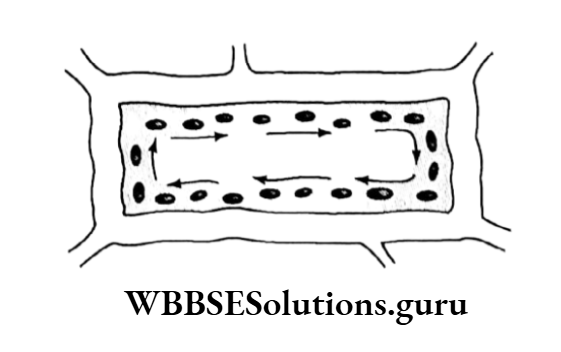
Rotation
A type of cyclosis movement in which protoplasm lining the cell wall shows a streaming movement along the cell wall surrounding a large central vacuole in a definite direction.
Example: Ribbon-like leaves of Vallisneria (Patashaola)
Plant movement:
- Positive photonastic movement
- Chemonastlc movement
- Transversely geotropic or diageotropic movement
- Positive thigmotropism movement
Sensitivity And Response In Plants Class 10 WBBSE
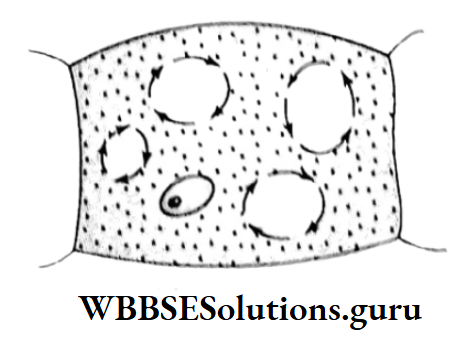
Circulation
A type of cyclosis movement In which the streaming movement of protoplasm takes place centering more than one vacuole in an Irregular fashion, l.e. not In a definite direction.
Chapter 1 Topic A Sensitivity And Response In Plants Nastic Movements
Question 1. Differentiate between autonomic and paratonic movements. What is meant by diaphototropic? What are positive and negative stimuli?
Answer:
The movements induced by Internal causes like changes in turgor pressure, growth
movements etc are called autonomic movements.
The movements induced by external stimuli like water, chemicals, light, gravity, etc are called paratonic movements.
Leaves show a response to light. They twist the petioles and place the upper sides of faces at a right angle to the light.
Thus leaves are diaphototropic or transversely phototropic. The movement of the plant part can be either towards or away from the stimulus.
If the movement of the plant Is towards the stimulus, It is called a positive stimulus. If the movement of the plant Is away from the stimulus, It Is called a negative stimulus.
Question 2. In a fern, antherozoids are attracted to archegonia. In higher plants, the pollen tube moves through the style towards the ovule.
In both cases, the male part is attracted to the female part using certain chemicals, yet the former is known as chemotactic movement and the latter as chemotropic movement. Give reasons.
Answer:
Chemotaxis is the movement of locomotion induced by chemical compounds in the surrounding environment.
In multi-cellular plants, it may be critical to early development, e.g. the movement of male antherozoids of fern towards archegonia induced by malic acid.
On the other hand, chemotropism is the growth of an organism (or parts of an organism including individual cells) navigated by chemical stimulus from outside of the organism or organism’s parts.
Thus the movement of the pollen tube from the germinating pollen grain of the stigma moving down the style induced by sugar produced from the ovule is a chemotropic movement towards the ovule.