
WBBSE Chapter 2 Sexual Reproduction In Flowering Plants Introduction To Flower
The flower is the most attractive organ of the plant that is solely concerned with reproduction, ultimately resulting in the formation of fruits and seeds.
The flower is equivalent to a shoot, having an axis (called Thalamus) with several specialised leaves (accessory whorls like sepals and petals) meant for reproduction.
Flowers may arise singly, as in the china rose- the stalk of the single flower is called a peduncle. More commonly, flowers arise in groups at the axils of special leaves or the terminal position.
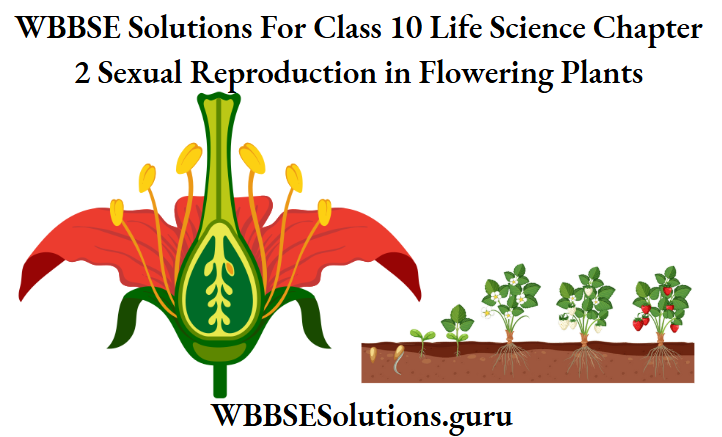
A branch or a branch system bearing a cluster of flowers is called an inflorescence. The branched floral axis is called rachis and the branches are the pedicels. Flowers having pedicels are called pedicellate and those without pedicels or stalks are sessile.
Read and Learn More WBBSE Solutions For Class 10 Life Science

WBBSE Chapter 2 Sexual Reproduction In Flowering Plants Typical Structure Of A Flower
A typical flower has four sets of floral leaves arranged on a short axis called the thalamus in a definite order. They are calyx, corolla, androecium and gynoecium.
Of the four sets of floral leaves the last two, androecium and gynoecium, are directly concerned with reproduction. They are known as reproductive whorls or essential whorls.
Flowering Plants Reproduction Process
The outer two sets, calyx and corolla, do not take any active part in reproduction, but just help in the process. So they are called accessories or helping whorls. Calyx and corolla are often collectively referred to as perianth.
Protective Structures:
Flower buds develop either at the apex of the stem or at the axils of special leaves called bracts. Bracts are generally small green bodies though in some cases they become brightly coloured.
These outermost leafy structures present in some flowers, which are represented by bracts and bracteoles, that respectively cover the inflorescence stalk and individual flowers, function as protective structures to the flower.
China rose has a whorl of green bracts placed beneath the calyx called the epicalyx.
WBBSE Chapter 2 Sexual Reproduction In Flowering Plants Parts Of A Flower
Thalamus:
The thalamus is the short abbreviated axis bearing the four sets of floral leaves.
It is the swollen end of the pentacle or pedicel with four nodes and very much compressed internodes. The floral leaves remain inserted on the nodes in whorls or spirally.
Function:
Floral whorls are arranged on the thalamus separately and successively.
Calyx:
The calyx is the outermost accessory set of floral leaves consisting of individual units called sepals (Fig. 2.45). Sepals are usually green inconspicuous bodies.
Sepals of some plants become coloured like the petals and are called petaloids, eg.
Krishnachura.
The sepals of the calyx may be united (gamosepalous) or they may be free (polysepalous). In many cases, sepals fall off before the flowers fully open out.
Flowering Plants Reproduction Process
They are called caducous sepals, eg. Poppy; while in others they fall off with other parts after fertilization. These are deciduous sepals.
The calyx may sometimes be retained even after the fruit is formed, it is called persistent calyx; it can grow along with the fruit (accrescent) as in brinjal or it can just be retained without any size change (marcescent) e.g. tomato.

Function:
Sepals protect the inner parts of the flower in bud condition from heat, cold, rain etc.
Green sepals perform photosynthesis.
Coloured and showy sepals help in pollination by attracting insects.
A persistent feathery calyx helps the distribution of fruit by the wind.
Corolla:
It is the second accessory or protective whorl inside the calyx, represented by coloured leafy structures called petals containing different pigments like orange-carotene, red-lycopene, violet-anthocyanin etc.
They are often sweetly scented. The petals of Debdaru are called sepaloid as they are green and sepal-like in appearance.
They also exhibit a specific pattern of arrangement, remaining in one or multiple whorls, which also falls off with the maturity of the fruit.
The petals also can be united (gamopetalous) as in Datura or they can be free (polypetalous) as in the china rose. The free petals often have two parts narrow stalk called a claw and an upper flat blade known as a limb.
Sometimes it looks like a butterfly (papilionaceous) as in a pea flower.
Function:
In the bud stage of the flower, the corolla encloses the essential whorls and protects them from external heat, rain and insect attack.
They attract insects for pollination through colour, scent and nectaries or by providing a seat for them.
Androecium:
It is the first essential whorl and the male reproductive structure of a flower, represented by individual subunits called stamens.
Each stamen is divided into two major parts, the slender stalk-like filament and the apical sac-like anther, containing the yellow-coloured male reproductive spores or pollen grains, which come out through a specific line of dehiscence.
In china rose, one pollen sac is present in each anther lobe. The stamens may either be attached by cohesion or may be attached to the calyx (episepalous) or corolla (epipetalous).
In China, the stamens are called monadelphous since the filaments are united to form one bundle with the anthers remaining free.
The stamens of a flower may be of equal or unequal length. All stamens do not always bear fertile anthers. In Kalkasunde four out of ten stamens are sterile. They are called staminodes.

Function:
Anther of stamen produces male reproductive gametes or units of flower called pollen grains or pollinia.
Gynoecium or pistil:
It is the innermost female reproductive whorl with the individual units called carpels. Pistil may be made of one, two, three or many carpels.
Accordingly, they are monocarpellary, bicarpellary or polycarpellary. The monocarpellary pistil is called simple while others are termed as compound. Each carpel consists of three specific parts, viz.
the uppermost flat receptive structure called the stigma, the middle filamentous portion called style and the basal swollen portion called the ovary.

The stigma that receives the pollen grain, is sticky or feathery to trap the pollen grain. The germination of the pollen grain produces the pollen tube which carries the male gametes into the ovary.
The ovary contains one or more egg-shaped bodies called the ovules which remain in a specific arrangement called placentation. It is the site for fertilization.
After fertilization, the ovules produce the seeds while the entire ovary produces the fruit. The fruits and seeds are disseminated by specific agents, which help in the perpetuation of the flowering plants.
In China multiple carpels are united at the common ovary and style portion with carpels remaining free only in the region of stigma.
Such a pistil is known as syncarpous.
Function:
The ovary contains ovules which are the female gametes that become the seeds after fertilization takes place. Seeds germinate to form new plants.
Some Descriptive Terms
A flower having all four floral sets is said to be complete, but if one or more sets are absent, it is incomplete.
When both stamens and carpels are present in the same flower, it is hermaphrodite or bisexual; if only one of them is present, the flower is unisexual.
Unisexual flowers may be staminate or male, or pistillate or female according to the stamens or carpels present in them. If both the whorls are absent the flower is neuter.
Wbbse Class 10 Life Science Notes
Thus unisexual and neutered flowers are incomplete.
A plant is called monoecious when it bears both staminate and pistillate flowers, eg. Gourd; but when the plants bear either staminate or pistillate flowers only, they are called dioecious, eg. palms. Some plants like mango, mangosteen etc bear all types of flowers bisexual, unisexual and even neutered.
They are called polygamous.
A flower is called regular when the individual parts of the whorls are similar in size and shape, as in China rose; but if the parts are dissimilar, the flower is irregular, eg. pea, Atasi etc.
A flower is termed actinomorphic when it can be cut into two halves by any number of planes passing through the centre. Regular flowers are usually actinomorphic.
It is zygomorphic, when it can be cut into two halves by only one plane through the centre, eg. pea. When even that is not possible, a flower is said to be asymmetrical having no symmetry, eg. Canna.
WBBSE Chapter 2 Sexual Reproduction In Flowering Plants Description Of China Rose Hibiscus Rosa Sinensis
Flowers:
Solitary, pedunculate, complete, regular, hermaphrodite.
Bracts 5 or more forming a whorl called epicalyx. Calyx: Sepals 5, gamosepalous, tubular.
Corolla:
Regular, showy, petals 5, slightly united at the base with the staminal column Androecium: Stamens many, monadelphous, anthers-free, one-celled.
Gynoecium:
Carpels 5, syncarpous, stigma 5, ovary- 5 chambered with many ovules.
WBBSE Chapter 2 Sexual Reproduction In Flowering Plants Pollination
Flowers are essentially meant for reproduction through seeds. The two reproductive organs, stamens and carpels, contain male and female gametes inside pollen grains and ovules respectively.
For fertilization, which involves a union of the two dissimilar gametes, the pollen grains must be carried to the stigma of the carpels. This process of transference of the pollen grains from the anthers to the stigma is known as pollination.
The transfer of pollen grains from the anther of a flower to the stigma of the same or a different flower of the same species is called pollination.

WBBSE Chapter 2 Sexual Reproduction In Flowering Plants Self-Pollination
The transfer of pollen grain from the anther of a flower to the stigma of the same flower (evidently bisexual) or the stigma of another flower (bisexual or unisexual) of the same plant, is called self-pollination.
When the pollination occurs in the same flower, it is called autogamy and when the pollination occurs between two different flowers of the same plant, it is called geitonogamy.
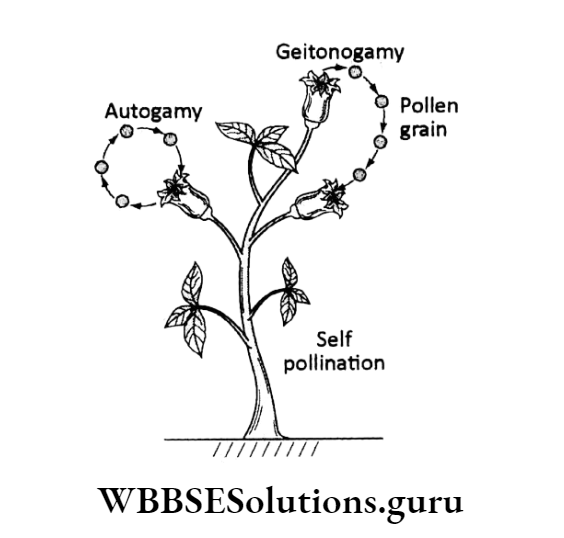
In either of the processes, only one parent plant is concerned with producing the offspring. Therefore the progeny becomes weaker due to the lack of recombination of contrasting characters.
Adaptations That Facilitate Self-Pollination Are As Follows:
Cleistogamous flower:
The flowers are minute, underground and do not open on maturity, so there cannot be any cross-pollination, e.g. Commeima.
The stamens and carpels mature at the same time in a bisexual flower.
It is likely then that some of the pollen grains are necessarily dropped on the stigma of the same flower through the agency of wind or insects. This phenomenon is known as homogamy.
Examples: Cactus, Pea etc.
The stamens are bigger than the carpels and grow just above the stigma.
The pollen grains have unique proteins in their outer coats, which are specific for the stigma of the same flower.
WBBSE Chapter 2 Sexual Reproduction In Flowering Plants Cross-Pollination
The transfer of pollen grains from the anther of one flower to the stigma of another flower (bisexual or unisexual) borne by two separate parent plants belonging to the same species or closely related species is called cross-pollination.
Pollen Grain Cross When the pollination takes place between two flowers borne by two separate plants of the same species, it is called xenogamy, while if it occurs between two closely related species, it is called hybridism.
In this process, two parent plants are concerned and therefore, the progeny often becomes stronger and healthier owing to the recombination of contrasting characters. Unisexual flowers are always cross-pollinated.
Adaptations That Facilitate Cross Pollination Are As Follows:
The flower is unisexual like in palms. This is called Dicliny.
The anther and stigma mature at different times. This is called Dichogamy.
Examples: Chinarose, Champa etc.
There is some physical barrier between the anther and the stigma e.g. Gynostegium of Calotropis. This is called Herkogamy.
The anthers are never released outside but are borne within sac-like structures called pollinia, which can easily be carried by insects, e.g. Orchid flowers.
There is an unusual growth of the style, which makes them taller than others, so pollen grains cannot reach the stigma. This is called Heteromorphism.
Wbbse Class 10 Life Science Notes
Pollen grains are light in weight, produced in bulk amounts and are not easily destroyed.
There is another phenomenon called self-sterility in which the pollen of a flower has no fertilizing effect on the stigma of the same flower, eg.
Tea flowers, grasses, and some orchids are self-sterile. Only pollen applied from other plants or other species is effective in such cases.
WBBSE Chapter 2 Sexual Reproduction In Flowering Plants Merits And Demerits Of Self And Cross-Pollination

WBBSE Chapter 2 Sexual Reproduction In Flowering Plants Agents Of Cross-Pollination
There are different agents that help in cross-pollination. Based on the type of agents, cross-pollination may be broadly divided as
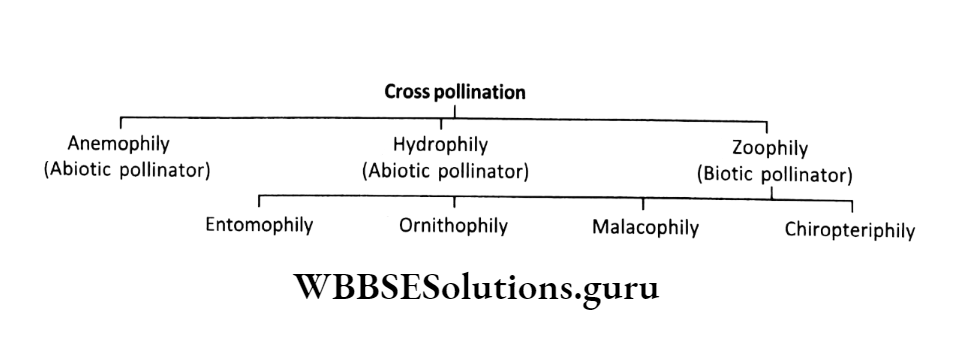
Anemophily or pollination with the help of wind: In this case, the wind is the abiotic agent of pollination.
Floral Character:
Flowers are generally smaller, devoid of any colour, nectar and fragrant odour. Pollen grains are light-weight, and produced in bulk amounts. Stigma is feathery and branched. Anthers are easily cut off from the filament, that is, they are versatile in nature.
Anemophilous plants:
Paddy, maize, bamboo etc.
(H) Hydrophily or pollination with the help of water: In this case, water is the abiotic agent of pollination.
Floral Character:
Flowers are small, inconspicuous, lightweight, colourless and can float easily on the surface of the water. Floral parts are covered by a waxy layer to prevent flowers from getting wet easily.
Pollen grains are impervious to water. Male flowers are superior in position in comparison to the female flower. Male flowers mature slightly before female ones. Stigmas are provided with bristles to catch nearby floating pollen grains.
Hydrophilous plants:
Hydrilla, Vallisneria etc.
Zoophily or pollination with the help of animals:
In this case, animals are the biotic agent of pollination. Depending on the nature of pollinators, zoophilous plants are categorized as:
Entomophily or pollination with the help of insects:
Insects are the pollinators for entomophilous plants.
Floral Character:
The flowers have a corolla tube. The nectaries are present. The anthers are large & projected outward from the corolla, while carpels remain within. The flowers are showy. Stigma may be sticky in nature. Pollen grains are rough, large and sweet in taste.
Entomophilous plants:
Mango, Sunflower, Karabi etc.
Ornithophily or pollination with the help of birds:
Birds pollinate ornithophilous plants.
Floral Character:
The flowers are large, showy and conspicuous.
They are mostly red in colour. The corolla is stout and may remain in the form of a tube, The pollen grains are produced in bulk amounts and are sticky in nature.
Ornithophilous plants:
Shimul, Palash etc.
Malacophily or pollination with the help of slugs, snails and squirrels:
Land plants like chrysanthemums and water plants like Lemna show malacophilous. Arisaema (snake plant) is often visited by snails. Squirrels also visit a large number of malacophilous plants and play a role in their pollination.
Floral Character:
Flowers are usually small. Male and female flowers are arranged in the same spadix. There may be attractive apathy bracts with nectar glands at the basal region of the inflorescence.
Sexual Reproduction In Flowering Plants
Chiropteriphily or pollination with the help of bats: Bat pollination is most common in tropical and desert areas that have many night-blooming plants.
Floral Character:
Bat-pollinated flowers tend to be large and showy, white or light-coloured, open at night and have strong musty odours. They are often large and have bell-shaped or ball of stamens. Flowers are rich with nectar.
Chiropteriphilous Plants:
Agave, Kadam etc.
WBBSE Chapter 2 Sexual Reproduction In Flowering Plants Fertilization And Development Of New Plant
Pollen grains are carried to the stigma of a flower by pollination. It is a necessary preliminary to the more important process called fertilization.
Fertilization is the process of the union of two dissimilar haploid isogametes (male and female). It is also known as syngamy. In angiosperms, it is internal and takes place between pollen grain and ovule.
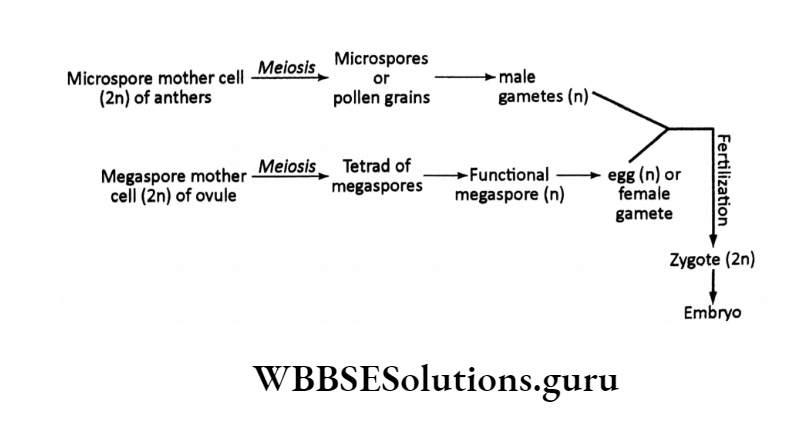
WBBSE Chapter 2 Sexual Reproduction In Flowering Plants Stages Of Syngamy Or Sexual Reproduction
Germination Of Pollen & Formation Of Male Gamete:
Uninucleate pollen grains generally become binucleate before liberation from the anthers. Of the two, the larger one is the tube nucleus and the smaller one is the generative nucleus.
Subsequent to pollination while resting on the stigma of the carpels, the stigmatic fluid stimulates germination of the pollen grain, as a result of which the exine is stretched and intine with the protoplasmic contents comes out through a weak spot, germ pore, to form a tube, called the pollen tube.
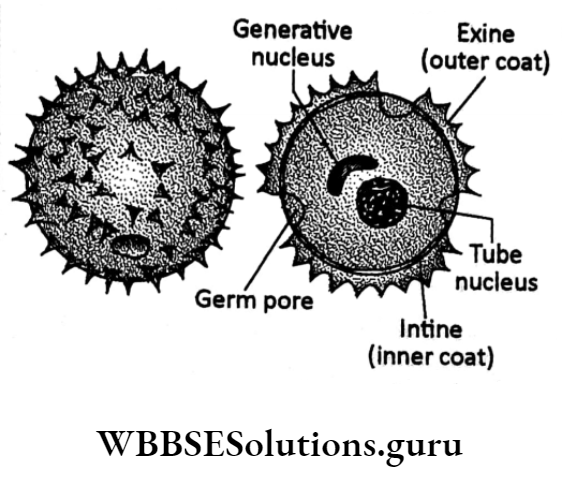
The tube nucleus is located at the tip of the pollen tube and is followed by the generative nucleus. Now the pollen tube elongates and pushes its way through the style ultimately reaching the ovary.
During the growth of the pollen tube, the tube nucleus gradually disintegrates and the generative nucleus divides into two nuclei, called sperm nuclei. They are the haploid (n) male gametes.

Formation of female gamete:
The embryo sac contains the haploid (n) egg at the micropyle end and the diploid (2n) definitive or secondary nucleus at its centre.
Fertilization:
After piercing into the embryosac, the pollen tube bursts at its tip liberating the two male gametes within the embryo sac.
One male gamete fuses with the egg, i.e., the female gamete, and that results in Pollen grains’ actual fertilisation. The fertilised egg soon secretes a wall around itself and forms the diploid (2n) zygote called oospore, which in the course of time, develops into the embryo.
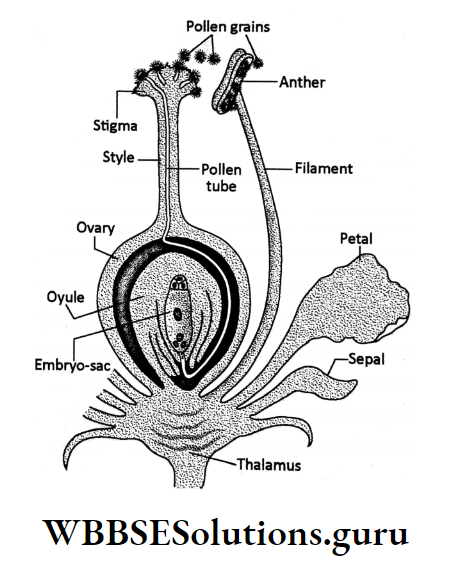
The second male gamete moves on to the definitive nucleus located at the centre of the embryo sac and fuses with it, forming the triploid (3n) endosperm nucleus.
Sexual Reproduction In Flowering Plants
Though the second method is subsidiary to fertilisation it is nevertheless important, because the endosperm nucleus ultimately produces the nutritive tissue endosperm by method of free cell formation. This behaviour of the male gametes is called double fertilisation.
WBBSE Chapter 2 Sexual Reproduction In Flowering Plants Post-Fertilization Changes
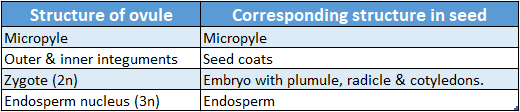
After fertilization, the ovule gets transformed to produce the seed and the entire ovary forms the fruit. Thus the seed is the bearer of the future plant in the form of an embryo.
The different structures of the ovule transforming into the corresponding structures in the seed are-
The seed remains intact for a short period of dormancy before getting germinated to produce the radicle and then the plumule and thereby the entire seedling is generated.
WBBSE Chapter 2 Sexual Reproduction In Flowering Plants Fill In The Blanks
Question 1. Sepals are usually______________ in colour.
Answer: Green
Question 2. Corolla are formed of units called______________ .
Answer: Petals
Question 3. Gamopetalous flower includes______________ petals.
Answer: United
Question 4. The unit of androecium is______________ .
Answer: Stamen
Question 5. The unit of______________ is carpels.
Answer: Gynoecium
Question 6. The parts of stamen are and ______________.
Answer: Filament, they
Class 10 Life Science Chapter 2 MCQS
Question 7. The carpel consists of stigma, ______________ and ovary.
Answer: Style
Question 8. Pollination involves the transfer of pollen grain from to______________.
Answer: Anther, Stigma
Question 9. The ovule is present within ______________.
Answer: Ovary
Question 10. ______________ is pollination within the same flower.
Answer: Autogamy
Question 11. ______________is pollination between two flowers of the same plant.
Answer: Geitonogamy
Question 12. Pollination by wind is called______________ .
Answer: Anemophily
Question 13. When the pollen tube penetrates the nucleus through the micropyle, the condition is called the______________
Answer: Programs
Question 14. Pollination by water is called______________ .
Answer: Hydrophily
Question 15.______________ flower always shows self-pollination.
Answer: Cleistogamous
Question 16.______________ is also called accessary cells.
Answer: Synergids
Question 17. Pollination by bats is also called ______________.
Answer: Chiropteriphily
Class 10 Life Science Chapter 2 MCQS
Question 18. The fusion nucleus is ______________in nature.
Answer: Triploid
Question 19. Ornithophily is pollination by ______________ .
Answer: Birds
Question 20. Wind pollinated flower has______________ stigma.
Answer: Feathery
WBBSE Chapter 2 Sexual Reproduction In Flowering Plants
Question 1. The phenomenon of double fertilization is also called triple fusion.
Answer: True
Question 2. The essential whorls are four in number.
Answer: False
Question 3. The gynoecium is formed of carpels.
Answer: True
Question 4. Stamens are units of the male reproductive whorl.
Answer: True
Question 5. Vallisneria is pollinated by air.
Answer: False
Question 6. Kadam is a self-pollinated flower.
Answer: False
Question 7. Geitonogamy occurs within the same plant.
Answer: True
Question 8. The zygote develops from a fusion nucleus.
Answer: False
Class 10 Life Science Chapter 2 MCQS
Question 9. Sepals may help in photosynthesis.
Answer: True
Question 10. Flower is a modified shoot.
Answer: True
Question 12. Stigma of chinarose is five lobed.
Answer: True
Question 13. Endosperm is haploid in a gymnosperm.
Answer: True
Question 14. Fragrant flowers with well-developed nectaries are adapted for anemophily.
Answer: False
Question 15. The antipodals are haploid in nature.
Answer: True
WBBSE Chapter 2 Sexual Reproduction In Flowering Plants Very Short Answer Type Questions
Question 1. What is pollination by insects called?
Answer: Entomophily.
Question 2. Name the unit of the corolla.
Answer: Petals.
Question 3. if there are 4 microspore mother cells in anthers, what will be the number of pollen grains?
Answer: 4 (mother cells) x 4 = 16 pollen grains through meiosis.
Question 4. Name the gland that produces nectar.
Answer: Nectaries.
Question 5. Name the innermost whorl.
Answer: Gynoecium.
Class 10 Life Science Chapter 2 MCQS
Question 6. Name the type of flower which has fused petals.
Answer: Gamopetalous.
Question 7. Name the bract of chinarose.
Answer: Epicalyx.
Question 8. State the nature of stigma in insect-pollinated flowers.
Answer: Sticky.
Question 9. What is the other name for undifferentiated sepals and petals?
Answer: Perianth
Question 10. Name the nutritive layer of the anther.
Answer: Tapetum.
Question 11. Name two wind-pollinated flowers.
Answer: Paddy, wheat.
Question 12. What are the units of perianth called?
Answer: Tepals.
Question 13. What is the nature of the endosperm?
Answer: Triploid (3n).
Question 14. Name the part of the flower where the whorls are arranged.
Answer: Thalamus.
Question 15. Name a plant where pollinia (ie. pollen grains occurring in masses) are found.
Answer: Calotropis (Madar).
Question 16. What is the name of the stalkless flower?
Answer: Sessile.
Question 17. What is the name given to a flower with 4 whorls?
Answer: Complete.
Class 10 Life Science Chapter 2 MCQS
Question 18. Name the flower that can be cut into two halves at any plane.
Answer: Actinomorphic.
Question 19. How many nuclei participate in double fertilization?
Answer: egg (n) + secondary nucleus (2n) + [2 x male gamete (n) ] = 5 nuclei
Question 20. Among the following four terms, one includes the other three. Find out the term and write it:
Answer:
- Stigma, style, carpel, ovary
- Malacophilous, ornithophily, myrmecophily, zoophily
- Carpel
- Zoophily
Question 21. How many types of hydrophilous plants are there?
Answer:
Two types: Hypohydrogamous (pollination taking place completely underwater) and Epihydrogamous (pollination taking place on the water’s surface).
Question 22. What is microsporogenesis?
Answer: Microspore or pollen grain formation within the anther is called microsporogenesis.
Question 23. Name the three nuclei of the egg apparatus at the micropyle end.
Answer: The middle nucleus is the egg and the other two are called synergids.
Question 24. Out of the eight nuclei in the embryo sac, which one degenerates after fertilization?
Answer: The antipodals (3 nuclei) and the synergids (2 nuclei) degenerate after fertilization.
Question 25. A pair of related terms is given below. Based on the relationship in the first pair, write the suitable word in the gap of the second pair:
Answer:
sepals:calyx:: petals: corolla
Paddy: anemophily:: Hydrill: hydrophily
WBBSE Chapter 2 Sexual Reproduction In Flowering Plants Short Answer Type Questions
Question 1. What is autogamy?
Answer:
Autogamy
The transfer of pollen grains from the anther of a flower to the stigma of the same flower (evidently bisexual) or to the stigma of another flower (bisexual or unisexual) of the same plant is called autogamy or self-pollination. Evcactus, pea etc.
Question 2. What is allogamy?
Answer:
Allogamy
The transfer of pollen grains from the anther of one flower to the stigma of another flower (bisexual or unisexual) borne by two separate parent plants belonging to the same species or closely related species is known as allogamy or cross-pollination.
Question 3. What is double fertilization?
Answer:
Double fertilization
The process of double fertilization takes place in angiosperms where after the discharge of two male gametes into the embryo sac, the first male gamete fertilizes the egg to produce the diploid zygote (2n) while the second male gamete fertilizes the diploid fusion nucleus to produce the triploid endosperm mother nucleus (3n).
Wbbse Solutions Class 10 Life Science
Thus both the male gametes participate in fertilization, ie. fertilization takes place twice: true fertilization or syngamy and triple fusion. Hence it is known as Double fertilization.
Consequent to double fertilization, the zygote develops into the embryo and the endosperm nucleus into the endosperm which supplies nutrition to the embryo.
Question 4. What is porogamy?
Answer:
Porogamy
The entry of the pollen tube through the micropylar pore of the ovule during fertilization is called porogamy. It occurs in the majority of angiosperm plants.
Question 5. What is monogamy?
Answer:
Monogamy
The entry of the pollen tube through the integument of the ovule during fertilization is called misogamy, e.g. Cucurbita.
Question 6. What is chalazogamy ?
Answer:
Chalazogamy
The entry of the pollen tube through the chalaza during fertilization is called chalazogamy, e.g. Casuarina.
Question 7. What is a monoecious plant?
Answer:
Monoecious plant
The plant where the pollination occurs between the male and female flower of the same plant is called a monoecious plant, e.g. Gourd. These plants carry male and female flowers on the same plant. They are also called homothallic plants.
Question 8. What is the nature of the endosperms in gymnosperm? A gymnosperm plant has 24 chromosomes in the microspore mother cell. How many chromosomes are there in its endosperm?
Answer:
Nature of the endosperms in gymnosperm
The endosperm of gymnosperm is haploid and it is formed before fertilization. Since the diploid (2n) microspore mother cell of the gymnosperm has 24 chromosomes, both its haploid (n) microspore and endosperm (n) contain 12 chromosomes each.
Wbbse Solutions Class 10 Life Science
Question 9. Explain the construction embryo sac before double fertilization. In an angiosperm, there are 12 chromosomes in the microspore mother cell. How many chromosomes does it have in the endosperm?
Answer:
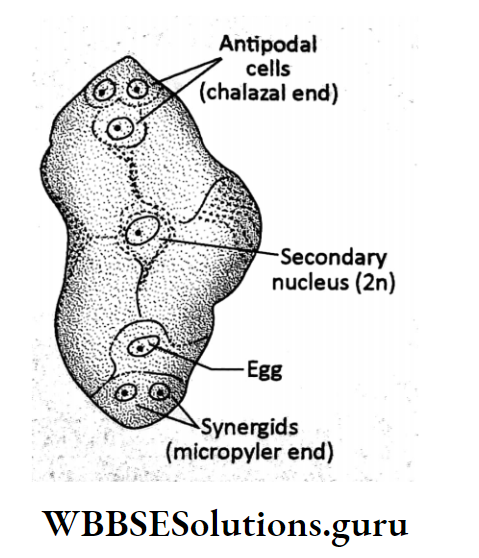
The female gametophyte or embryo sac consists of eight nuclei. Out of these eight nuclei four lie at one end of the embryo sac and the remaining four at the other.
One nucleus from each pole moves towards the centre and is known as the polar nucleus. Both polar nuclei fuse with each other to form a diploid nucleus known as the secondary nucleus (2n).
The remaining three nuclei at the chalazal end organize themselves to form the antipodal cells and the three nuclei towards the micropyler end constitute the egg apparatus.
The central cell of the egg apparatus constitutes the female gamete or the egg and the other two cells are called synergids. Since the diploid microspore mother cell (2n) of the angiosperm has 12 chromosomes, the triploid endosperm (3n) has 18 chromosomes.
Since the diploid microspore mother cell (2n) of the angiosperm has 12 chromosomes, the triploid endosperm (3n) has 18 chromosomes
Question 10. Mention the differences between self-pollination and cross-pollination.
Answer:
The differences between self-pollination and cross-pollination

WBBSE Objective Type Questions Write True Or False
Question 1. Self-pollination or cross-pollination can be exercised in flowers of pea plants according to the need.
Answer: True
Question 2. The carpel of flowering plants collects pollen grains with the help of a hairy and sticky style.
Answer: False