
Lesson 4 A Day in the Zoo Word Meanings
Para 1-3
- visit (ভিজিট)- to go to see
- ZOO – a place where animals and birds
- quite (কোয়াইট) একদম, একেবারে মালিক হওয়া- entirely, completely to possess
- own (গুন)-To posses
- enables (এনাবেলস্)- Allows,makes able
- observe (অবসার্ভ)- See, watch
- average (অ্যাভারেজ)- Common,usal
- dawn (ডন)-Daybreak,early morning
- slightly ভোর, ঈযৎ, সামান্য উষাকাল- a little
- tinged- Sliently coloured,tinted
- awakened (অ্যাওয়েকেনড্)- a tittle
- rich (রিচ্)- Pleasntly deep
- fruity সুমিষ্ট- Sweet
- hoarse (হোর্স)- husky,harsh sound
- touracos (টুরাকোস)- a species of bird originally from South Africa
- thrush (থ্রাস্)- a type of sweet singing bird
- courtyard (কোর্টে- an open space inside buildings
- earnest (আর্নেস্ট)- eager, sincere
- peahen (পিহেন)- female peacock
- dewy (ডিউই)- wet with dew
- burnished (বার্নিশড্)-polished
- greetings (গ্রিটিংস)- words of welcome
| Class 9 English Bliss | Class 9 Life Science |
| Class 3 English | Class 9 Geography |
| Class 10 Life Science | Class 9 History |
| Class 9 History | Class 9 Maths |
Para 4-6
- mammals (ম্যাম্যালস্)- animals that give birth to live babies, not eggs, and feed their young on breast milk
- cage (কেজ)- a place where animals are kept confined
- gallop (গ্যালপ )- move by leaps
- wrench (রেনশ্)- to pull with a twist
- broom (ম)- long-handled sweeping brush
- ape (এপ)- an animal like a monkey without a tail
- plump (প্রা- rather fat ; having a soft, round body
- ever-amiling (এভার স্মাইলিং)- always smiling
- mess (মেস- dirt, untidy condition
- sweep (সুইপ)- to clean with a broom
- scatter (স্ক্যাটার)- spread
- sawdust (স্যাডাস্ট)- powdery remains of wood after sawing
- assure (অ্যাশিওর) -make sure / certain
- eager (ইগার)- very keen
- bustle about (ব্যাসল এবাউট)- move about hurriedly
- cling (ক্লিং)- hold on to something lightly
- parakeet (প্যারাকীট )- a type of small parrot with a long tail
- cacophony (ক্যাকোফোনি) -loud unpleasand sound
- a host of (এ হোস্ট অফ)- a number of, a group of
- patter (প্যাটার)- to walk making repeated, quick and light sound
- armadillo (আর্মাডিলো)- an Americal mammal and insect-eating animal
- twitching (ট্যুইচিং)- to move or contract (muscles) spasmodically
- source (টোরাকো)- a fruit-eating African bird with brightly coloured plumage and a long tail (COD)
- reared (রিয়ারড)- brought up
- peer (পিয়ার)- look closely
- perch (পার্চ)- a high seat where the birds rest
- husky (হাস্কি )- hoarse
Para 7-10
- reptile (রেপটাইল)- cold-blooded species of animals like snakes, lizards, etc.
- doze (ডোজ)- sleep drowsily
- regard (রিগার্ড)- stare at, watch
- calmly (কালি)- quietly
- lidless (লিডলেস)- without an eyelid
- gulping sound (গালপিং সাউন্ড) গিলে ফলার মতো শব্দ করা-making sound like swallowing food
- draped (ড্রেপড্)- hung loosely on something
- trunk (ট্রাংক)- stem of a tree
- visitors (ভিজিটার্স)- spectators
- flooding into-coming in large number
- alert (অ্যালার্ট)-careful, cautions
- ensure (এনসিওর)- make sure
- hurt (হার্ট)- cause injury
- prod (প্রড)- to prick or poke
- uncivilized (আনসিভিলাইজ্ড়)- savage, barbaric
- to be seen to be believed -hard to accept unless one sees it
- thins out (থিন্স আউট) – decreases, becomes fewer in number
- slanting (স্ল্যানটিং)- oblique
crowned pigeons - fades (ফেস্)- becomes less bright
- robin (রবিন)- a type of bird
- roost (রুষ্ট)- settle for rest on the perch
- owl (আউল)- a kind of bird
- pretending (প্রিটেন্ডিং) – feigning
- tree stump (ট্র স্টাম্প)- the bottom of a tree left after the main part has been cut
- creeping – spreading slowly
- rockery (রকারি)- garden decorated with pieces of rocks
- Chorus- the sound made by many people together
- chorus (কোরাস)- hay
- separating (সেপারেটিং)- isolating
- together- gain
Summary: The author draws a pen picture of a typical day at the zoo.
At the outset, he points out that while general people come to the zoo during visiting hours to see the animals for enjoyment, the owner of the zoo has to live in the zoo and remain busy looking after the animals.
So he is on duty for twenty-four hours a day. The average zoo day begins just before dawn marked by songs of birds, cries of turacos, and blackbirds, and the thrush and dancing of peacocks.
The day’s work starts at 8 a.m. with the arrival of the zoo staff. A lot of activities go on when they start cleaning the cages.
The monkeys, mammals, gorillas and the apes become excited and they bustle about the cages.
The parrots and parakeets, mongooses, the armadillo and touracos are busy moving about and making sounds at the start of the day. In the reptile house, the snakes are quiet, the frogs croak and the lizards lie still.
The zoo gates open at 10 o’clock for the visitors. Some of them make fun by torturing the animals by poking them with sticks and offering them lighted cigarettes and razor blades.
The zoo staff has to be on alert for the safety and security of the animals.
Towards evening the visitors start leaving. The robin stops singing, the chimpanzees start quarrelling amongst themselves. The lions cough.
The zoo day comes to an end.
Tick the correct answer from the given alternatives:
Question 1. The average day in a zoo begins just before
- Dusk
- Dawn
- Afternoon
- Evening
Answer: 2. Dawn
Question 2. The birds searching the dewy grass on the lawn were
- Peahens
- Peacocks
- Robins
- Thrushes
Answer: 1. Peahens
Question 3. Stephen with a broom in his hand was guarding over the
- Bears
- Gorilla
- Apes
- Armadillo
Answer: 3. Peahens
Question 4. The name of the black celebs ape was-
- Etam
- Jeremy
- Mike
- Stephen
Answer: 1. Etam
Question 5. The reptiles dozed in the temperature of
- Sixty degrees
- Seventy degrees
- Eighty degrees
- Ninety degrees
Answer: 3. Eighty degrees
Answer the following questions within fifteen words:
Question 1. How does the sky look as one is awakened by the birdsong?
Answer: The sky looks slightly tinged with yellow when one is awakened by the birdsong at dawn.
Question 2. How do the parrots and parakeets salute the people?
Answer: The parrots and parakeets salute the people with a cacophony of sounds.
Question 3. What do all the animals do at the start of a new day?
Answer: All the animals, excited and eager at the start of a new day, bustle about the cages.
Question 4. As the light fades, where does the robin fly off to?
Answer: As the light fades, the robin flies off to roost in the mimosa tree.
Answer the following questions within twenty-five words:
Question 1. What work do Jeremy and Mike do in the gorillas’ cages?
Answer: Jeremy and Mike are always busy keeping everything all right in the gorilla’s cage. They sweep up the mess on the floor and scatter white sawdust there.
Question 2. Describe the state of the frogs and snakes in the reptile house.
Answer: In the reptile house with a temperature of eighty degrees, the reptiles doze. Snakes stare at others calmly with lidless eyes and the frogs make gulping sounds.
Question 3. What would one see and hear while lying in bed at night?
Answer: Lying in bed, one can see through the window the moon separating itself from the shadow of the tree. One can also hear the coughing sound of the lions.
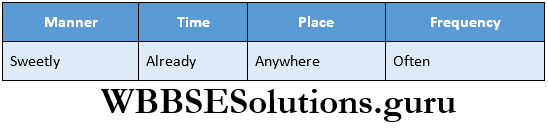
Classify the underlined adverbs according to their functions in the chart given below:
1. I have already done the job.
2. Bappa can go anywhere for his work.
3. Puja often comes to my place.
4. Nargis sings sweetly.
Answer: Functions of adverbs
Underline the clauses in the following sentences and state what kind of clauses they are:
Question 1. As he was not there, I spoke to his brother.
Answer: As he was not there-Sub. Adverbial clause of Reason. I spoke to his brother-Principal clause.
Question 2. The house where Nazrul was born is in Churulia.
Answer: The house is in the Churulia-Principal Clause where Nazrul was born-Sub. Adjective clause.
Question 3. She said that she would return soon.
Answer: She said-Principal clause. that she would return soon-Sub. Noun clause.
Question 4. Have you read the book which you borrowed from me?
Answer: Have you read the book-Principal Clause? which you borrowed from me-Sub. Adjective clause.
Identify the following sentences as simple, complex or compound sentences:
Question 1. He is too tired to walk alone.
Answer: Simple sentence
Question 2. I have a friend who lives in Mumbai.
Answer: Complex sentence.
Question 3. Priyam wrote a letter but he got no reply.
Answer: Compound sentence
Question 4. Being ill, I could not attend school.
Answer: Simple sentence.
Question 5. She told me that she would enter a house which is believed to be haunted.
Answer: Complex sentence.
Question 6. The sun shines brightly and the flowers bloom.
Answer: Compound sentence.
Lesson 4 A Day in the Zoo Examples Worked Out
1. It is one thing to visit a zoo as an ordinary member of the public.
It is quite another thing to own a zoo and live in it. It certainly enables you to rush out at any hour of the day or night to observe the animals.
It also means you are on duty twenty-four hours a day.
The average zoo day begins just before dawn.
The sky will be slightly tinged with yellow when you are awakened by the birdsong.
You can hear a robin singing. You hear the rich, fruity, slightly hoarse cries of the touracos and a joyful blackbird.
As the last of his song dies, the white-headed thrush bursts into an excited cry.
Looking out into the courtyard on the velvet green lawns you can see an earnest group of peahens searching the dewy grass.
A male peahen is dancing his burnished tail raised like a fountain in the sunlight.
Read the above text and answer the following questions.
Tick the correct answer from the given alternatives:
Question 1. The owner of a zoo can observe the animals-
- Only during visiting hours.
- Only during the day time
- At any time the whole day and night
- Only at night
Answer: 3. At any time the whole day and night
Question 2. The day in the zoo generally begins-
- At noon
- Just before dawn
- In the morning
- At 2 p.m
Answer: 2. Just before dawn
Question 3. The zoo owner is awakened by the birds
- Excited cries of birds
- Hoarse cries of the animals
- Croaking of frogs
- Song of
Answer: 4. Song of
Question 4. In the morning one can hear in the zoo the slightly hoarse cries of the
- Touracos
- Birds
- Peahens
- Robins
Answer: 1. Touracos
Question 5. The raised tail of the male peahen looks like a-
- Flag
- Fountain
- Fan
- A small branch of a tree
Answer: 2. Fountain
Answer the following questions within fifteen words.
Question 1. What hardship does the owner of the zoo have to face?
Answer: The owner of the zoo has to face the hardship of remaining on duty twenty-four hours a day.
Question 2. When does the average zoo day begin?
Answer: The average zoo day begins just before dawn.
Question 3. Name some birds that cry up in the morning in the zoo.
Answer: Hoarse cries of the touracos and the excited cry of white-headed thrush can be heard in the morning.
Question 4. What can be seen looking out into the courtyard at dawn?
Answer: A group of peahens can be seen searching for something in the dewy grass on the lawn.
Question 5. How does the tail of the male peahen look when it dances?
Answer: When it dances, the tail of the male peahen looks like a fountain in the sunlight.
Answer the following questions within twenty-five words.
Question 1. How does the involvement of a zoo owner differ from that of a visitor of the zoo?
Answer: A visitor comes to the zoo only during the visiting hours just for watching the animals for entertainment. But the owner has to live in the zoo and remain engaged in taking care of the animals twenty-four hours a day.
Question 2. When and how does an average zoo day begin?
Answer: The average zoo day begins just before dawn. The sky is then slightly tinged with yellow and one can hear the song of a robin and the hoarse cries of the touracos and a joyful blackbird. The thrush bursts into an excited cry.
Question 3. What do the peahens do?
Answer: A group of peahens are seen searching the dewy grass on the velvet green lawns in the courtyard. A male peahen is found dancing raising his polished tail like a fountain in the sunlight.
2. At eight o’clock the zoo staff arrives. You can hear them shout greetings to each other. Sounds made by their buckets and brushes are heard. You go out into the cool fresh morning to see if all is right with the zoo.
The monkeys and other mammals live in the long, two-storied granite house.
Here you find a lot of activity. The gorillas have been let out of their cages while the cages are cleaned.
They gallop about on the floor with the high spirit of children just out of school.
They try to wrench the electric heaters from their sockets or break the fluorescent lights.
Stephen, broom in hand, stands guard over the apes. Inside the gorilla’s cages Mike, plump and ever-smiling, is busy along with Jeremy.
They sweep up the mess on the floor and scatter fresh white sawdust. Everything, they assure you, is all right.
All the animals, excited and eager at the start of a new day, bustle about the cages. Etam, the black Celebes ape, clings to the wire, baring his teeth at you in greeting.
Read the above text and answer the following questions.
Tick the correct answer from the given alternatives:
Question 1. The zoo staff arrives at-
- 6 O’clock
- 8 O’clock
- 9 O’clock
- 11 O’clock
Answer: 2. 8 O’clock
Question 2. The owner of the zoo goes out in the morning to see-
- If all the staff members have joined
- That all is right with the zoo
- The cages
- The animals.
Answer: 2. That all is right with the zoo
Question 3. The granite house is meant for-
- Birds
- Only gorillas
- Only monkeys
- The monkeys and other mammals
Answer: 4. The monkeys and other mammals
Question 4. When the cages are cleaned-
- The gorillas are kept tied down
- All the animals are let out
- The gorillas are let out
- Mike stands guard over the apes
Answer: 3. The gorillas are let out
Question 5. The gorillas try to break the
- Fluorescent lights
- Cages
- The granite walls
- The electric heaters
Answer: 1. Fluorescent lights
Question 6. The name of the black celebs is-
- Mike
- Jeremy
- Stephen
- Etam
Answer: 4. Etam
Answer the following questions within fifteen words:
Question 1. What kinds of sounds are heard after the arrival of the zoo staff in the morning?
Answer: Shouts of their greetings to each other and sounds made by their buckets and brushes are heard after their arrival.
Question 2. Where do the monkeys and other mammals live in the zoo?
Answer: The monkeys and other mammals live in the long two-storied granite house of the zoo.
Question 3. Why are the gorillas let out of the cages?
Answer: The gorillas are let out of their cages because the cages need to be cleaned.
Question 4. What do Mike and Jeremy do?
Answer: Mike and Jeremy sweep up the mess on the floor of the gorillas’ cages and scatter fresh white sawdust on it.
Question 5. Who is Etam? What does he do?
Answer: Etam is a black Celebes ape who clings to the wire baring his teeth as a sign of greeting.
Answer the following questions within twenty-five words:
Question 1. How does the day’s work start in the zoo?
Answer: The day’s work starts at 8 o’clock when the zoo staff arrives with loud shouts of greetings to each other. They become busy with buckets and brushes in cleaning the cages.
Question 2. What do the gorillas do when they are let out of the cages?
Answer: The gorillas gallop about on the floor joyfully like children just out of school. They also try to wrench the electric heaters from their buckets or break the fluorescent lights.
Question 3. How do Stephen, Mike and Jeremy help with the day’s work?
Answer: Stephen stands guard over the apes, carrying a broom in hand Mike and Jeremy sweep up the mess inside the gorillas’ cages and scatter white sawdust on the floor.
Question 4. How do the animals feel at the start of the day? What do they do then?
Answer: At the start of the day all the animals feel very excited. They bustle about the cages. Etam, the black Celebes ape, clings to the wire and shows his teeth to greet the visitors.
3. At ten o’clock the zoo gates open and the first rush of visitors arrive.
As they come flooding into the grounds, everyone has to be alert. This is not to ensure that the animals do not hurt the people but to make sure that the people do not hurt the animals.
If an animal is asleep, they want to throw stones at it or prod it with sticks to make it move.
We have found visitors trying to give the chimpanzee lighted cigarettes and razor blades.
The uncivilized behaviour of some human beings in a zoo has to be seen to be believed.
Towards evening the visiting crowd thins out. The slanting rays of the sun floodlight the cage where the crowned pigeons live.
As the light fades, the robin ceases to sing and flies off to roost in the mimosa tree.
The white-faced owls that have spent all day pretending to be grey tree stumps, now open large golden eyes.
Shadows are creeping over the flower beds and rockery. There is a sudden chorus from the chimpanzee’s bedroom.
You know they are quarrelling over who should have the straw.
As you lie in bed, you watch through the window the moon separating itself from the shadow of the trees.
You hear the lion cough. Soon it will be dawn and a chorus of birds will take over; the cold morning air will ring with song.
Read the above text and answer the following questions.
Tick the correct answer from the given alternatives:
Question 1. The zoo gates open for visitors at-
- 8 O’clock
- 7 O’clock
- 10 O’clock
- 12 O’clock
Answer: 3. 10 O’clock
Question 2. After the arrival of the visitors, the staff has to remain alert about the safety of the
- Visitors
- Staffs
- Animals
- Cages
Answer: 3. Animals
Question 3. The visitors are found giving the chimpanzees
- Razor blades
- Knives
- Rods
- Forks
Answer: 1. Razor blades
Question 4. The author cannot believe that the behaviour of the visitors could be so-
- Uncivilised
- Unusual
- Cruel
- Inhuman
Answer: 1. Uncivilised
Question 5. Towards the evening the visitors in the zoo-
- Increase
- Decrease
- Remain the same
- Become nil
Answer: 2. Decrease
Question 6. The robin stops singing when-
- It becomes dark
- Light fades
- The moon rises
- It rains
Answer: 2. Light fades
Question 7. The owls have-
- Golden eyes
- Black eyes
- Lidless eyes
- Grey eyes
Answer: 1. Golden eyes
Question 8. The slanting rays of the sun floodlight the cage of the-
- Chimpanzees
- Owls
- Crowned pigeons
- Robin
Answer: 3. Crowned pigeons
Question 9. The chimpanzees quarrel over-
- Fruit
- Straw
- A piece of meat
- A safe shelter
Answer: 2. Straw
Question 10. At dawn, one could hear the song of-
- Birds
- Owls
- Chimpanzees
- Animals
Answer: 1. Birds
Answer the following questions within fifteen words.
Question 1. When do the gates of the zoo open for the visitors?
Answer: The gates of the zoo open for visitors at 10 o’clock in the morning.
Question 2. Why should the zoo staff be alert when visitors come flooding into the zoo?
Answer: The zoo staff should be alert to ensure that the visitors do not hurt the animals in any way.
Question 3. What do the visitors do when an animal is asleep?
Answer: When an animal is asleep, visitors try to throw stones at it or prod it with sticks to make it move.
Question 4. How do the visitors irritate the chimpanzee?
Answer: The visitors irritate the chimpanzee by trying to give it lighted cigarettes and razor blades.
Question 5. What is the author’s opinion about the behaviour of some visitors in the zoo?
Answer: The author feels that the behaviour of some visitors is so uncivilised that nobody will believe it unless he sees it.
Question 6. What does the robin do when the light fades?
Answer: As the light fades the robin ceases to sing and flies off to sleep in the mimosa tree.
Question 7. What do the owls do?
Answer: As the light fades the robin ceases to sing and flies off to sleep in the mimosa tree.
Question 8. Why do the chimpanzees start a sudden chorus?
Answer: The chimpanzees have a quarrel amongst themselves over who should have the straw, and they break into a sudden chorus.
Question 9. What sound can be heard in late at night?
Answer: The sound of lions coughing can be heard late at night.
Question 10. How will be the dawn at the zoo?
Answer: At dawn, the morning air will be cold and birds will fill the air with songs in the zoo.
Answer the following questions within twenty-five words.
Question 1. Why do the zoo staff remain alert during the rush hours?
Answer: During the rush hours, visitors come flooding into the zoo. The zoo staff remain alert to ensure that no injury is caused to the animals.
Question 2. Why does the author think that some visitors are uncivilised?
Answer: Some visitors behave with the animals rudely. They throw stones at the animals and push them with sticks when they fall asleep. They try to give the chimpanzees lighted cigarettes and razor blades. The author, therefore, thinks they are uncivilized.
Question 3. How does the evening come slowly in the zoo?
Answer: The slanting rays of the sun gradually fall on the cage of the crowned pigeons. With the fading of light, shadows creep over the flower beds and rockery. As the evening comes, the visiting crowd thins out slowly.
Question 4. What does the author want to say in the text “A Day in the Zoo”?
Answer: The author wants to say that animals should never be the victims of our negligence. We should be aware of the life of innocent animals in the zoo. We should love them and let them live an undisturbed and carefree life.