
WBBSE Chapter 15 Conjunctions
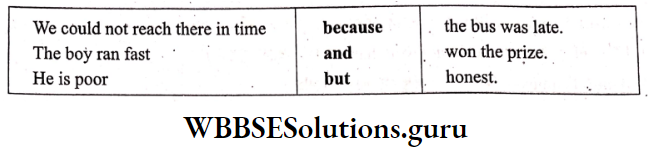
উপরের sentence-গুলিতে মোটা word-গুলি দুইটি আলাদা sentence-কে অথবা দুইটি ভিন্ন word-কে যুক্ত করেছে বলে এদের Conjunction বলা হয়।, নীচে কিছু Conjunction-এর ব্যবহার লক্ষ্য করো :
Conjunctions Joining
- Word to word:
- Noun to Noun:
- Is that a tiger or a lion?
- Rathin and Papia will not come here. You and he are both young.
- Pronoun to Pronoun: You and he are both young.
- Verb to Verb: The child sit down young.
- Adv. to Adv.: Slowly and steadily the tortoise won the race.
- Adj. to Adj.: He is slow but steady.
- Noun to Noun:
- Sentence to sentence:

Note:
- Unless ও until এই দুইটি Conjunction-ই Negative অর্থ প্রকাশ করে।
- Until— তক্ষণ পর্যন্ত না । Unless — যদি না।
সুতরাং “হ্যাঁ” অর্থ বোঝাতে এদের সাথে not বসবে না।
Read And Learn More WBBSE Class 8 English Functional Grammar
- Wait here until I come—আমার আসা পর্যন্ত এখানে অপেক্ষা করো। (until I do not come হবে না।)
- Unless you work hard you will fail—কঠোর পরিশ্রম না করলে তুমি অসফল হবে। (Unless you do not work hard হবে না; তবে If you do not work hard ব্যবহার হতে পারে।)
- He worked until I came – আমি আসা পর্যন্ত সে কাজ করেছিল।
- I shall be ruined unless you help me — যদি তুমি আমায় সাহায্য না করো আমার সর্বনাশ হবে।
If, Unless-এর ব্যবহার
উপরে বলা হয়েছে যে unless শব্দটি একটি Conjunction এবং এটা Negative অর্থ বহন করে।
Unless— যদি না
সুতরাং “হ্যাঁ” অর্থ বোঝাতে এর সাথে not বসবে না।
- Unless you work hard, you will fail – কঠোর পরিশ্রম না করলে তুমি অসফল হবে।
- Unless you come in time you will miss the train — সময়মত না আসলে তুমি ট্রেনটি ধরতে পারবে না।
এখানে ‘unless you do not work এবং ‘unless you do not come’ হবে না।
“If” ব্যবহার করেও উপরের sentence-গুলি লেখা যায়। কিন্তু সেক্ষেত্রে not ব্যবহার করতে হবে যথা :
- If you do not work hard, you will fail.
- If you do not come in time, you will miss the train.
এইরূপ, নীচের Sentence গুলি লক্ষ্য করো :
- If you do not feel hungry, you should not eat. Or, Unless you feel hungry, ‘you should not eat.
- If the drains are not cleaned properly, mosquitoes will grow. Or, Unless the drains are cleaned properly, mosquitoes will grow.
Sentence-লि “” দ্বারা কীভাবে যৌগ করা হয়েছে দেখেঃ
- Do you feel unwell? Consult a doctor.
- If you feel unwell, consult a doctor.
- You want to save the patient. You should take him to the hospital.
- If you want to save the patient, you should take him to hospital.

Conjunctions দ্বারা কীভাবে দুইটি sentence-কে যোগ করা যায়, তার আরও কিছু উদাহরণ নীচে দেওয়া হল।
1. And দ্বারা ঃ
- I shall go to school. I shall meet the teacher.
- I shall go to school and meet the teacher.
- He likes mangoes. He likes oranges.
- He likes mangoes and oranges.
- Sita is singing. Roma is dancing.
- Sita is singing and Roma is dancing.
2. But:
- Pranab goes to school. His brother stays at home.
- Pranab goes to school but his brother stays at home.
- Ice is cold. The fire is hot.
- Ice is cold but fire is hot.
- He is poor. He is honest.
- He is poor but honest.
- He worked hard. He failed.
- He worked hard but he failed.
3. If, or else, otherwise, unless it?
- Mind your steps. You will fall down.
- Mind your steps, or you will fall down.
- Mind your steps, otherwise, you will fall down.
- Mind your steps, or else you will fall down.
- Unless you mind your steps, you will fall down.
- If you do not mind your steps, you will fall down.
4. So, as, therefore, because, since, for:
- He was ill. He could not come.
- He was ill, so he could not come.
- As he was ill, he could not come.
- He was ill, therefore he could not come.
- He could not come because he was ill.
- Since he was ill, he could not come.
- He could not come, for he was ill.
5. Though, although, still
- He worked hard. He failed.
- He worked hard, still, he failed.
- Though he worked hard, he failed.
- Or, He failed, though he worked hard.
- Although he worked hard, he failed.
Either-or, Neither-nor
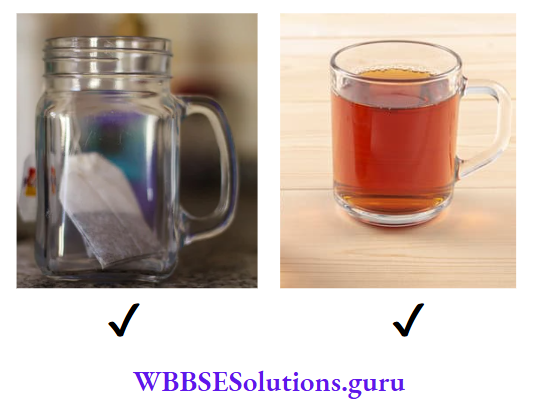
Neither-nor( কোনোটাই নয় )
Neither coffee nor tea, thank you.
Either-or—দুটোর মধ্যে যে-কোনো একটা
Either milk or tea please.
Or follows either.

Nor follows neither.
দুই জনের মধ্যে যে-কোনো একজন অর্থে either-or, এবং কেউ না অর্থে neither-nor ব্যবহৃত হয়।
- Either Mohan or Sunil will go there —— হয় মোহন কিংবা সুনীল সেখানে যাবে।
- Neither he nor his sister can do this—সে কিংবা তার বোন কেউই এটা করতে পারে না।
- Either Roma or her sister is responsible for this—হয় রমা কিংবা তার বোন এর জন্য দায়ী।
- Neither Jayanta nor Bibhas was present there—জয়ন্ত কিংবা বিভাস কেউই ওখানে উপস্থিতছিল না।
| WBBSE Class 8 English Functional Grammar | WBBSE Class 8 English Reading Skills |
| WBBSE Solutions For Class 8 English | WBBSE Solutions For Class 8 Maths |
Either or এবং Neither nor ব্যবহার করতে লক্ষ্য রেখো, তাদের উভয় অংশের পরই একই জাতীয় Part of speech বসবে। নীচের Sentence গুলি দেখো :
Incorrect: I shall say this either to him or his brother
Correct:
- I shall say this either to him or to his brother.
- I shall say this to either him or his brother.
Incorrect: He may either go to the cinema or to the theatre.
Correct:
- He may go either to the cinema or to the theatre.
- He may go to either the cinema or the theatre.
Incorrect: He neither gave me the book nor its price.
Correct:
- He gave me neither the book nor its price.
- He neither gave me the book nor paid its price.
প্রথম বাক্যে either-এর পরে যদি to এই Preposition থাকে তবে or-এর পরেও to এই Preposition দিতে হবে। অথবা to কথাটিকে either-এর পূর্বে বসিয়ে either ও anaর পরে একই জাতীয় Part of Speech (Pronoun ও Noun) বসাতে হবে।
দ্বিতীয় বাক্যে either-এর পরে go (verb) এবং or-এর পরে to (prep.) বসেছে। এটা ভুল। Either-এর পরে to (prep.) বসাতে হবে। নতুবা to wordটিকে either-এর পূর্বে বসিয়ে either ও or-এর পরে একই জাতীয় Part of Speech the cinema (Noun) ও the theatre (Noun) বসাতে হবে।
তৃতীয় বাক্যে neither-এর পরে যদি gave এই ‘Verb’ টি রাখো, তবে nor-এর পরেও একটি verb দিতে হবে, অথবা gave কথাটিকে neither-এর পূর্বে সরিয়ে neither ও nor-এর পরে book ও price-এই দুটি Noun বসাবে।
WBBSE Chapter 15 Conjunctions Excercise
Question 1. Combine the two sentences into a single one with the following Conjunctions in as many ways as you can. One is done for you. (as, so, therefore, and, because, but, unless, if, until, though.)
I am ill: I cannot play.
Answer:
As I am ill, I cannot play.
I am ill, so I cannot play.
Amal will go there. Subir will go there. He works hard. His brother is idle.
You will fail.
You should work hard.
I shall return.
Wait here.
He tried hard.
He failed.
I shall help him.
He is my friend.
He ran fast.
He could not reach it in time.
You tell me the truth.
I shall punish you.
Question 2. Join the sentences with:
Answer:
1. Neither-nor
I could not do it; You could not do it.
I do not want you; I do not want your brother.
He did not go there; his sister did not go there.
I have not seen him; I have not heard from him.
Answer:
Neither I nor you could do it.
She cannot sing; she cannot paint.
He will not help me; he will not help you.
He will not give me the book; he will not pay its price.
2. Either-or
It must be done by Rana; it must be done by his brother.
Answer:
It must be done either by Rana or by his brother.
Give me a red pen; give me a blue pen.
The boys will play football; the boys will play cricket.
You can buy a radio; you can buy a TV.
You must come; your brother must come.