
Reading Skill Lesson 10 Tales Of Childhood
Word meanings:
Part 1
prosperous (প্রস্পারাস্)—সমৃদ্ধশালী; traded (ট্রেডেড্ )–কেনাবেচা করতেন; cheese (চীজ)— পনির; chicken- wire (চিকেন্ ওয়্যার্)—মুরগির ছানা রাখার জন্য তারের জাল; ship broker (শিপ্ ব্রোকার) — জাহাজের দালাল, অর্থাৎ জাহাজের জন্য প্রয়োজনীয় জিনিষ পত্রের যোগানদার, enormous ( এনরমাস্) — বিশাল; fuel (ফুয়েল্) – জ্বালানি; imposing (ইম্পোজিং) — জমকালো ; turret (টারেট্ ) — ছোট গম্বুজ ; majestic (ম্যাজেটিক্) –রাজকীয়, চমৎকার; terrace (টেরাস্)—সমতল ছাদ; woodland (উডল্যান্ড) – বনভূমি meadows (মেডোস্) – পশুচারণভূমি, sties (স্টাইজ)—শূয়োরের খোঁয়ারগুলি; chicken run — হাঁস মুরগি চরার জায়গা; plough (প্লাউ ) — লাঙল ; hay-wagon- খড় বোঝাই গাড়ি; gardener ( গারডেনার) – মালি।
Part 2
appendicities (অ্যাপেনডিসাইটিস্) – বৃহদন্ত্র সংলগ্ন নলের এক প্রকারের প্রদাহ; favourite (ফেবারিট্)— প্রিয়পাত্র; adored (এ্যাডের্ড্)—খুব ভালবাসত; literally (লিট্যারালি ) – আক্ষরিক অর্থে; speechless (স্পিচলেস্) – হতবাক্ overwhelmed (ওভার হোয়েল্ড্) – কাতর হয়ে পড়েছিলেন; pneumonia (নিউমোনিয়া) — নিউমোনিয়া রোগ; threat (থ্রেট্)—ভীতি বা আশঙ্কার লক্ষণ; antibiotic (অ্যান্টিবায়োটিক) — জীবাণু প্রতিরোধকারী ওষুধ; cure (কিওর্)—প্রতিকার; survive (সারভাইভ)—আরও বেশিকাল বেঁচে থাকা; gravest (গ্রেভেস্ট) – গুরুতর; responsibilities (রেস্পন্সিবিলিটিস্) —দায়িত্বভার; · médium sized – মাঝারি মাপের ; suburban (সুবারবন্)—শহরতলী সংলগ্ন।
Read And Learn Also WBBSE Class 8 English Reading Skills
Part 3
kindergarten (কিন্ডারগাটেন)—শিশুদের বিদ্যালয় ; astonising (অ্যাশটনিশিং)—বিস্ময়কর; remember (রিমেম্বার —মনে থাকে; blurred (ব্লাড) – আবছা ; shoolaces (শূলেসে ) – জুতোর ফিতেগুলো ; to and from –যাওয়া ও আসা; tremendously (ট্রিমেনড্যালি) – দারুণভাবে ; exciting (এক্সাইটিং) – রোমাকের; excitement—উদ্দীপনা; interests (ইন্টারেস)—আগ্রহী করে; grown-ups (গ্রোন্-আপস্) – বড়োরা ; vividly (ভিভিলি)—স্পষ্টভাবে; enormous (এনরমাস্)—প্রচণ্ড, দুর্দান্ত; glorius (গ্লোরিয়্যাস্) — গৌরবময় ; lean (লীন্ ) — হেলে যাওয়া, ঝুঁকে যাওয়া; whooping (হুপিং)—হৈচৈ করতে করতে; memories (মেমরিজ্ ) — স্মৃতি।

Reading Skill Lesson 10 Tales Of Childhood Examples
Read the texts below and do as directed.
Question 1. My father, Harold Dahl, was a Norwegian who came from a small town near Oslo, called Sarpsborg. His own father, my grandfather, was a fairly prosperous merchant who owned a store in Sarpsborg and traded in just about everything from cheese to chicken wire.
My father had lost an arm when he was fourteen but had become a successful shipbroker. A shipbroker is a person who supplies the ship with everything it needs when it comes into port fuel and food, recipes and paint, soap and towels, hammers and nails, and thousands of other little items.
A shipbroker is a kind of enormous shopkeeper for ships, and by far the most important item he supplies to them is the fuel on which the ship’s engines run in those days, only coal. He set up a shipbroking firm at Cardiff of South Wales. My father met my mother Sofie Magdalene Hesselberg during the summer of 1911 and were married soon after.
| WBBSE Class 8 English Functional Grammar | WBBSE Class 8 English Reading Skills |
| WBBSE Solutions For Class 8 English | WBBSE Solutions For Class 8 Maths |
1. Answer the questions below:
- Who was Harold Dahl?
- What was the author’s grandfather?
- What does a shipbroker do?
- Where did the author’s father set up a shipbroking firm?
- What is the most important item that the shipbroker supplies to the ship?
Answer:
- Harold Dahl was the father of the author who came from a small town near Oslo called Sarpsborg. He was a successful shipbroker.
- The author’s grandfather was a prosperous merchant who owned a store in Sarpsborg and traded in almost every essential item.
- A shipbroker supplies the ship with everything it needs when it comes to a port-fuel, food, ropes and paint, soap and towels, nails and hammers-almost everything it needs.
- The author’s father set up a shipbroking firm at Cardiff in South Wales.
- The most important item that the shipbroker supplies to the ship is the fuel for running ship engines- in those days, only coal.
2. Pick out the correct answer from the alternatives given and complete the sentences.
Question 1. The author’s father was-
- A Norwegian,
- An English man,
- An Italian.
Answer: 1. A Norwegian
Question 2. The native town of the author’s father was-
- Oslo,
- Sarpsborg,
- Cardiff.
Answer: 2. Sarpsborg
Question 3. The author’s mother was-
- Sofie Magdelene,
- Sophie Jane,
- Sofie Loren.
Answer: 1. Sofie Magdelene
Question 4. The author was the son of a
- Writer,
- Sailor,
- Merchant.
Answer: 3. Merchant
Question 5. The fuel used by ships in olden days was-
- Petrol,
- Diesel,
- Coal.
Answer: 4. Coal
3. Fill in the blanks with words taken from the text.
List of words: married, trade, person, everything, successful.
Question 1. He _________ in fars and skins
Answer: Traders
Question 2. Ramen proved to be a _________ lawyer
Answer: Successful
Question 3. Ram was ______ to Sita.
Answer: Married
Question 4. __________ depends on him.
Answer: Everything
Question 5. He is a very honest ________
Answer: Person
Question 2. In 1920, when I was still only three, my mother’s eldest child, my own sister Astri, died from appendicitis. She was seven years old when she died. Astri was far and away my father’s favourite. He adored her beyond measure and her sudden death left him literally speechless for days afterwards. He was so overwhelmed with grief that when he himself went down with pneumonia a month or so afterwards, he did not much care whether he lived or died.
If they had penicillin in those days, neither appendicitis nor pneumonia would have been so much of a threat, but with no penicillin or any other magical antibiotic cures, pneumonia, in particular, was a very dangerous disease indeed. The patient had to fight to survive. My father refused to fight. He was thinking, I am quite sure, of his beloved daughter, and he was wanting to join her in heaven. So he died. He was fifty-seven years old.
1. Answer the questions below
- Who was Astri and how did she die?
- Which incident left the author’s father literally speechless?
- Why was pneumonia a very dangerous disease?
- Why does the author rue for the absence of penicillin in those days?
- What made the author’s father refuse to fight for survival?
Answer:
- Astri was the author’s sister, and she died from appendicitis.
- The author’s father loved his daughter Astri so dearly that her sudden death at the age of seven left him severely shocked and literally speechless.
- In those days, there was no such magical antibiotic cures as penicillin; so pneumonia was a very dangerous disease.
- The author rues for the absence of penicillin in those days because if penicillin treatment were in vogue, his sister Astri and father would have been cured by antibiotic treatment.
- The author’s father loved his daughter Astri so dearly that when she died, he lost all interest to live any more and wanted to join her in heaven. So he did not want to fight against the disease, as he wanted to die.
2. Write ‘T’ for true and ‘F’ for false statements. Give supporting sentences for each of your answers.
Question 1. Astri was the youngest child in the family.
Answer: False
My mother’s eldest child, my own sister Astri, died from appendicitis.
Question 2. Astri was a favourite child of her father.”
Answer: True
Astri was far and away my father’s favourite.
Question 3. The author’s father died of appendicitis.
Answer: False
He himself went down with pneumonia and did not care much whether he lived or died
Question 4. The author’s father lost the desire of living after his daughter’s death.
Answer: True
My father refused to fight so he died.
Question 5. The author lost his father when he was fifty-five years old.
Answer: False
He died. He was fifty-seven years old.
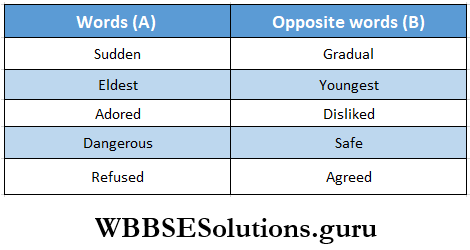
3. Match the words in A and with their opposite words in B.

Answer:
Question 3. My mother had now lost a daughter and a husband all in the space of a few weeks. Here she was, suddenly having to face all alone the very gravest problems and responsibilities. She had five children to look after. She sold the big house and moved to a smaller one a few miles away in Llandaff. It was called Cumberland Lodge and was nothing more than a pleasant medium-sized suburban villa. So it was in Llandaff two years later, when I was six years old, that I went to my first school.
1. Answer the questions below:
- In what a situation did the author’s mother fall after the death of her daughter and husband?
- Why did she sell the big house?
- Where was the new house located?
- How was the new house and what was its name?
- When did the author join school?
Answer:
- After the death of her daughter and husband, the mother fell into a situation when she had to face great problems and responsibilities all alone.
- The sudden death of her husband and daughter made her face financial problems with five children to take care of. So she sold the big house and moved to a small house.
- The new house was located a few miles away in Llandaff.
- The new house was called Cumberland Lodge, and it was a pleasant medium-sized suburban villa.
- The author went to his first school in Llandaff when he was six years old.
2. Write “T’ for true and ‘F’ for false statements.
Question 1. The author’s mother lost her two children in quick succession.
Answer: False
Question 2. The mother had to take care of five children.
Answer: True
Question 3. She moved to a bigger house for safety.
Answer: False
Question 4. The new house was located outside the city centre area.
Answer: True
Question 5. The author had gone to school for the first time before he came to Llandaff.
Answer: False
3. Rearrange the following sentences in the proper order as they happened. Write the numbers in the boxes.
1. The author’s father died.
2. The mother had to face great difficulties all alone.
3. She moved to a new house in Llandaff.
4. The author’s sister died.
5. The author went to school for the first time.
6. The mother sold the big house.
Answer:
2. The mother had to face great difficulties all alone.
3. She moved to a new house in Llandaff.
5. The author went to school for the first time.
1. The author’s father died.
6. The mother sold the big house.
4. The author’s sister died.
4. Male sentences of your own with the following words:
- Space;
- Suddenly;
- Pleasant;
- Suburban;
- Problems.
Answer:
- The table takes up too much space.
- Suddenly he fell ill.
- The weather there was very pleasant.
- Life in suburban Kolkata is peaceful.
- I had to face lots of problems initially in the new place.
Question 4.
The school was a kindergarten run by two sisters, Mrs Corfield and Miss Tucker, and it was called the Elmtree House. It is astonishing how little one remembers about one’s life before the age of seven or eight. I can tell you all sorts of things that happened to me from eight onwards, but only very few before that. I went for a whole year to Elmtree House but I cannot even remember what my classroom looked like. Nor can I picture the faces of Mrs Corfield or Miss Tucker, although I am sure they were sweet and smiling. I do have a blurred memory of sitting on the stairs and trying over and over again to tie one of my shoelaces, but that is all that comes back to me at this distance of the school itself.
1. Answer the questions below:
- What was the name of the author’s first school? What type of school was it?
- Who used to run the school?
- What makes the author astonished.?
- What blurred memory does the author have of his early days”
- How were the two sisters Mrs Corfield and Miss Tucker?
Answer:
- The name of the school was Elmtree House. The school was a kindergarten.
- Two sisters Mrs Corfield and Miss Tucker used to run the school.
- The author feels astonished to note that one can hardly remember one’s life before the ages of seven or eight, but can tell everything that happened to one from the age of eight onwards.
- The author has a blurred memory of sitting on the stairs of his kindergarten school and trying over and over again to tie one of his shoelaces.
- The two sisters Mrs Corfield and Miss Tucker were very sweet and smiling.
2. Write ‘T’ for true and ‘F’ for false statements. Give supporting sentences for each of your answers.
Question 1. Elmtree House was the middle school for the author.
Answer: False
The school was a kindergarten.
Question 2. The school was run by two ladies.
Answer: True
The school was run by two sisters,
Question 3. The author studied in that school for three years.
Answer: False
I went for a whole year to Elmtree House
Question 4. The author had a vivid memory of his Elmtree House school.
Answer: False
But cannot even remember what my classroom looked like.
Question 5. The author could tell out of his memory everything that happened to him from the age of eight onwards.
Answer: True
I can tell you all sorts of things that happened to me from eight onwards.
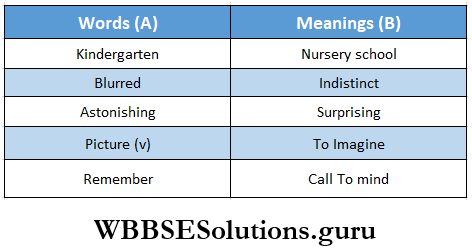
3. Match the words in A and their meanings in B.
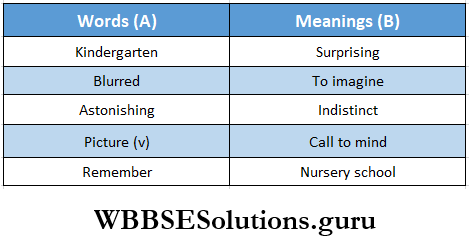
Answer:
Question 5. On the other hand, I can remember very clearly the journeys. I made to and from the school because they were so tremendously exciting. Great excitement is probably the only thing that really interests a six-year-old boy and it sticks in his mind.
In my case, the excitement centred around my new tricycle. I rode to school on it every day with my eldest sister riding on hers. No grown-ups came with us, and I can remember oh so vividly how the two of us used to go racing at enormous speeds down the middle of the road and then, most glorious of all when we came to a corner, we would lean to one side and take it on two wheels.
All this, you must realize, was in the good old days when the sight of a motor car on the street was an event, and it was quite safe for tiny children to go tricycling and whooping their way to school in the centre of the highway.
So much, then, for my memories of kindergarten sixty-two years ago. It’s not much, but it’s all there is left.
1. Answer the questions below:
- How did the author go to his kindergarten school?
- Which journeys does the author still remember? Why did he not forget those journeys?
- Describe how the author enjoyed his rides to school.
- Why was it safe for children to go tricycling on highways?
- What was considered an ‘event’ in those days?
- “It’s not much, but it’s all there is left.”-Why do you think did the author make this comment?
Answer:
The author used to go to his school in his new tricycle.
- The author still remembers the journeys he made to and from the school in his tricycle. He did not forget those journeys because they were very exciting.
- The author and his sister used to go to school in their tricycles racing at great speeds down the middle of the road. When they came to a corner, they would lean to one side and take it on two wheels, The journeys were tremendously exciting and they enjoyed them thoroughly.
- Those days motor cars were hardly seen on roads. So it was quite safe for children to go tricycling on highways.
- The sight of a motor car on the street was considered an ‘event’ in those days.
- The author could not remember many incidents of his school days, because he was a small boy then. Yet he treasured some of the joyous moments of the school days and got pleasure in recollecting them.
2. Write “T? for true and ‘F’ for false statements.
Question 1. The author went to school by bicycle.
Answer: False
Question 2. His eldest sister rode on her tricycle along with him.
Answer: True
Question 3. They were accompanied by a servant on their trip to school.
Answer: False
Question 4. The journeys to school were very exciting to the author.
Answer: True
Question 5. Motor vehicles were quite frequent on the street.
Answer: False
Question 6. The author wrote this text when he was sixty-two years old.
Answer: True
3. Complete the sentences with information from the text.
Question 1. The only thing that probably interests a six-year-old boy is __________
Answer: The only thing that probably interests a six-year-old boy is great excitement.
Question 2. The author remembers vividly ___________
Answer: The author remembers vividly how he and his sister used to go racing in their tricycles in the middle of the road.
Question 3. The most glorious of all was __________
Answer: The most glorious of all was their leaning to one side and taking the tricycle on two wheels when they came to a corner.
Question 4. The sight of a motor car on the street ___________
Answer: The sight of a motor car on the street was an event.
4. Fill in the blanks with words opposite in meaning of the following:
- Remember,
- Exciting,
- Vividly,
- Enormous,
- Glorius.
Question 1. I can __________ remember my first day at school.
Answer: Vagely
Question 2. We spent some _____ days there.
Answer: Horrible
Question 3. Do not ________ to bring the book.
Answer: Forget
Question 4. The children rode on a _________ elephant.
Answer: Tiny
Question 5. The match was a _________ one.
Answer: Drap