
Arithmetic Chapter 3 Proportion
Question 1. Find if the pair of ratios given below are equal and also Find if Four members are in proportion.
Solution:
1. 4:5 and 20:25
4:5 = 4:5
20:25 = 4:5
∴ 4:5 and 20:25 are equal
Hence 4,5, 20, 25 are in proportion.
2. 2ac: 3ac and 14 ab: 21ab. [a ≠ 0; b ≠ 0. c ≠ 0]
2ac:3ac ⇒ \(\frac{2 a c}{3 a c} \Rightarrow \frac{2}{3}\) ⇒ 2:3
14ab: 21ab ⇒ \(\frac{14 a b}{21 a b} \Rightarrow \frac{2}{3}\) ⇒ 2:3
∴ 2ac : 3ac and 14ab:21ab are equal.
Hence 2ac, 3ac and 14ab, 21ab are in proportion.
3. 5:7 and 15:18
5:7 = 5:7
15:18 = 5:6
∴ 5:7 = 5:6
Hence 5:7, 15 and 18 are not in proportion.
Class 7 Arithmetic Problems With Solutions
Question 2. Fill in the blank squares
- 3: 7:: 21: ▢
- ▢: 6:: 20: 24
- 9: 8:: ▢: 56
- 18: ▢:: 30: 45
1. 3: 7:: 21: ▢
Let the square be ‘X’
∴ \(\frac{3}{7}=\frac{21}{x}\)
3x = 21×7
3x = 147
x = \(\frac{147}{3}\)
x = 49
∴ 3:7::21:49
2. ▢: 6:: 20: 24
Let the square be ‘x’
∴ \(\frac{x}{6}=\frac{20}{24}\)
24x = 120
x = \(\frac{120}{24}\)
x = 5
∴ 5: 6:: 20: 24
3. 9: 8:: ▢: 56[/latex]
Let the square be ‘x’
∴\(\frac{9}{8}=\frac{x}{56}\)
8x = 9×56
x = \(\frac{504}{8}\)
x = 63
∴ 9:8::63:56
4. 18:▢:: 30: 45
Let the square be ‘x’.
⇒ \(\frac{18}{x}=\frac{30}{45}\)
30x = 18×45
x = \(\frac{810}{30}\)
x = 27
∴ 18:27:30:45
WBBSE Class 7 Arithmetic Chapter 3
Question 3. Verify whether the following numbers are in proportion.
- 2, 3, 4, 6
- 10,8, 5,4
- 6,2,5,9
- 16, 24, 6, 9
1. 2,3,4,6
Here product of extreme = 2×6 = 12 and product of mean = 3×4 =12
∴ Product of extreme = product of means
Hence the four members are in proportion.
2. 10, 8, 5,4
Here product of extreme = 10×4 = 40 and product of mean = 8×5 = 40·
∴ Product of extreme = product of mean
Hence the four members are in proportion.
3. 6,2,5,9
Here product of extreme = 6×9= 54 and product of mean = 2×5=10
∴ Product of extreme product of mean
Hence the four members are not in proportion
4. 16, 24,6,9
Here product of extreme = 16×9 = 144 product of mean = 24×6 = 144
∴ Product of extreme = product of mean
Hence the Four members are in proportion.
1. 2,3,4,6
⇒ 2:3 and 4:6
⇒ 2:3 = 2:3
4:6 = 2:3
2:3 and 4:6 are equal Hence 2, 3, 4, 6 are in proportion.
2. 10,8,5, 4
⇒ 10:8 and 5:4
⇒ 10:8 = 5:4
5:4 = 5:4
10:8 and 5:4 are equal.
Hence 10,8,5,4 are in proportion.
Alternating method
3. 6, 2,5,9
⇒ 6:2 and 5:9
⇒ 6:2 = 3:1
5:9 = 5:9
∴ 6:2 and 5:9 are not equal.
∴ 6, 2, 5, 9 are not in proportion.
4. 16, 24, 6, 9
⇒ 16:24 and 6:9
⇒ 16:24 = 2:3
6:9 = 2:3
16:24 and 6:9 are equal
Hence 16, 24, 6,9 are in proportion.
Class 7 Maths Arithmetic Solutions WBBSE
Question 4. Form different proportions with the following numbers.
- 7,5, 14, 10,
- \(\frac{1}{3}, \frac{1}{2}, \frac{1}{6}, \frac{1}{4}\)
- 8,7,16,14
1. 7,5, 14, 10,

2. \(\frac{1}{3}, \frac{1}{2}, \frac{1}{6}, \frac{1}{4}\)

3. 8,7, 16, 14

WBBSE Class 7 Arithmetic Exercise Solutions
Question 5. Find whether the following sets of numbers are in continued proportion and write the proportionality:
- 5,25, 125
- 7, 21,63,
- 12, 48, 192,
- 6, 10, 18.
1. 5, 25, 125
5×125 = 625 = (25)2
i.e, 1st and × 3rd term = (mean)2
so, 5, 25 and 15 are in continued proportion
The proportionality is 5:25:25:125
2. 7, 21, 69
7×63 = 441=(21)2
i·e, 1st × 3rd term = (mean)2
so, 7, 21, 63 are in continued proportion.
The proportionality is 7:21:21:63
3. 12, 48, 192
12×192 = 2304 =(48)2
i.e; 1st and 3rd term = (mean)2
So 12, 48, 192 are in continued proportion.
The proportionality is 12:48:48:192
4. 6, 10, 18
6×18 = 108 ≠ (10)2
i.e, 1st term x 3rd term 7 (mean)2
so 6, 10, 18 are not in continued proportion.
WBBSE Maths Study Material Class 7
Question 6. The three numbers in continued proportion 1st and 2nd numbers are 18 and 3 respectively. Find the third number of this proportion.
Solution:
Givent
The first number is 18
the second number is 3
18:3::3:X
⇒ \(\frac{18}{3}=\frac{3}{x}\)
18x = 9
x = \(\frac{9}{18}\)
x = \(\frac{1}{2}\)
∴ The third number in this proportion = \(\frac{1}{2}\)
Verify
18, 3, \(\frac{1}{2}\)
18 × 1/2 = 9 = (3)2 = (mean)2
∴ The three numbers are in continued proportion.
The proportion will be 18:3:3:\(\frac{1}{2}\)
Question 7. Find the mean of the following two numbers.
- 15,135
- \(\frac{1}{2}, \frac{1}{8}\)
Let positive mean proportion of 15 and 135 is ‘X’
∴ 15:x :: 2:135
⇒ \(\frac{15}{x}=\frac{x}{135}\)
x2 = 15×135
x= \(\sqrt{2025}\)
x= 45
∴ Mean proportion 15, 135, 45.
2. \(\frac{1}{2}, \frac{1}{8}\)
Let the positive mean proportion of \(\frac{1}{2} {and}\frac{1}{8}\) is ‘X’.
∴ \(\frac{1}{2}: x:: x: \frac{1}{8}\)
⇒ \(\frac{\frac{1}{2}}{x}=\frac{x}{\frac{1}{8}}\)
⇒ \(\frac{1}{2} \times \frac{1}{8}=x^2\)
⇒ \(\frac{1}{16}=x^2\)
x= \(\sqrt{\frac{1}{16}}\)
x= \(\frac{1}{4}\)
∴ Mean proportion \(\frac{1}{2}\) and \(\frac{1}{8}\) is \(\frac{1}{4}\)
WBBSE Maths Study Material Class 7
Question 8. If \(x: \frac{27}{64}:: \frac{3}{4}: x\) (x≠0) then find the value of x.
Solution:
⇒ \(x: \frac{27}{64}:: \frac{3}{4}: x\)
⇒ \(\frac{x}{\left(\frac{27}{64}\right)}=\frac{\left(\frac{3}{4}\right)}{x}\)
Cross-multiply
⇒ \(x^2=\frac{3}{4} \times \frac{27}{64}\)
⇒ \(\frac{81}{256}\)
x = \(\sqrt{\frac{81}{256}}\)
x = \(\frac{9}{16}\)
∴ The proportion will be \(\frac{9}{16}: \frac{27}{64}:: \frac{3}{4}: \frac{9}{16}\)
Question 9. The ratio of the price of two books is 5:7. If the price of the Second book is 63, Find the price of 1st book.
Solution:
Given:
The ratio of the price of two books is 5:7
Let the price of the first book is ‘x’
Let the price of the second book be ‘y’
∴ х:y = 5:7
\(\frac{x}{y}=\frac{5}{7}\)The price of the second book is (y) = 63
∴ \(\frac{x}{63}=\frac{5}{7}\)
7x = 63×5
7x = 315
x = \(\frac{315}{7}\)
x = 45
∴ The price of the first book is ₹45
Question 10. If 10 men can do a piece of work in 12 days. Find in how many days will 15 men finish the same work.
Solution:
In the mathematical language.
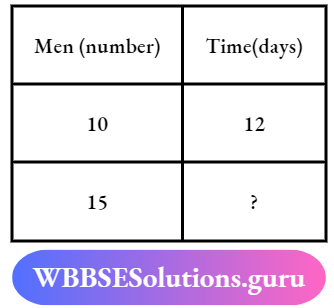
For a particular work, if the number of persons increases less time is required to finish the work.
⇒ \(\frac{10}{15} \times 12\)
⇒ \(\frac{2}{3} \times12\)
⇒ 8
∴ In 8 days 15 men finish the Same work.
Class 7 Arithmetic Problems With Solutions
Question 11. In a relief camp, there is a provision of food For 200 people for 60 days. After 15 days 50 people went away elsewhere. Find how many days the remaining food lasts for the remaining people in this camp.
Solution:
Let the required number of days be ‘x’
In mathematical language the problem is.

200-50 = 150 Remaining.
150: 200: 45:x
⇒ \(\frac{150}{200}=\frac{45}{x}\)
150x = 200×45
x = \(\frac{9000}{150}\)
x = 60
∴ The food will go for Bodays for 150 people.
Question 12. If 8 men can do a piece of work in 12 days. Find in how many days amen can do the same work?
Solution:
In the mathematical language, the problem is.

For a particular work, if the number of persons increases, less time is required to finish the work.
⇒ \(\frac{3}{9} \times 12\)
⇒ \(\frac{1}{3} \times 12\)
⇒ 1×4
⇒ 4
∴ In 4 days 9men can do the same work.
Class 7 Arithmetic Problems With Solutions
Question 13. The ratio of boys and girls in a school with 612 students is 5:4 which will be the new ratio of 12 new boys admitted.
Solution:
Total number of students = 612
The ratio of boys and girls is 5:4
5x+4x = 612
9x = 612
x = \(\frac{612}{9}\)
x = 68
∴ 5x = 5×68
5x = 340
4x = 4×68
4x = 272
with 12 new boys, the number of boys becomes.
340+12= 352
∴ The new ratio = \(\frac{352}{272}\)
The GCD OF 352 and 272 is 16.
So we divide both by 16.
⇒ \(\frac{352 \div 16}{272 \div 16}=\frac{22}{17}\)
∴ The new ratio of boys and girls is 22:17
Question 14. The Sum of the ages of A and B is 95 years. 5 years ago the ratio of their ages were 10:7. Find the ratio of their ages 5 years hence.
Solution:
Let’s denote the current ages of A and B as ‘A’ and ‘B’ respectively.
A+B = 95 ⇒ A = 95-B
Five years ago their ages were A-5, B-5
∴ \(\frac{A-5}{B-5}=10: 7\)
⇒ \(\frac{(95-B)-5}{B-5}=\frac{10}{7}\)
⇒ \(\frac{95-B-5}{B-5}=\frac{10}{7}\)
⇒ \(\frac{90-B}{B-5}=\frac{10}{7}\)
7×90-7×B = 10B-50
630-7B = 10B-50
630+50 = 10B+7B
680 = 17B
⇒ \(\frac{680}{17}\)
B = 40
5 years Hence the ages will be A+ 5 = 55+5=60,
B+5= 40 +5=45
The ratio of their ages:
⇒ \(\frac{A+5}{B+5}=\frac{60}{45}=\frac{4}{3}\)
The ratio of the ages 5year Hence will be 4:3
Class 7 Arithmetic Problems With Solutions
Question 15. There are 5 litres of Syrup in 15 litres of a Soft drink Find how much syrup will be required to make 21 litres of soft drink.
Solution:
Given:
Syrup Soft drink.
5 → 15
? ← 21
⇒ \(\frac{21}{15} \times 5\)
⇒ 7 litres
∴ 7 litres of Syrup is required to make 21 litres of Soft drink.