Geometry Chapter 7 Types Of Quadrilateral
Question 1. Choose the correct Answer
1. The measurement of the sum of four angles of any quadrilateral is
- 90°
- 180°
- 360°
- None of these.
∴ Option (3)360° is the correct answer
2. The each angle of a rectangle is.
- Acute Angle
- Right angle
- Obtuse angle,
- None of these
∴ Option (2) right angle is the correct answer
Read and Learn More Class 7 Maths Solutions
3. The opposite angles of the parallelogram are
- Equal
- Nonequal
- Complementary
- None of these.
∴ Option (1) equal is the correct answer
WBBSE Class 7 Maths Geometry Chapter 7
4. The angle of each square is.
- Acute Angle,
- Right angle,
- Obtuse triangle
- None of these
∴ Option (2) right angle is the correct answer.
Question 2. Write true or false
1. An isocelges trapezium is a parall dogram. → False
2. The diagonals of a rectangle bisect each other at right angles → The statement is False
3. Quadrilateral has two diagonals → The Statement is True
Question 3. Fill in the blanks:
1. The sum of the measurement of two adjacent angles of a parallelogram is 180°
2. The opposite sides of a parallelogram are Parallel to each other.
3. Quadrilateral has two diagonals
4. The length of the diagonals of an isosceles trapezium is equal.
Question 4. Each rhombus is a special type of square Explain.
Solution:
- Every square is a rhombus (since all sides are equal and the diagonals, bisect each other at right angles
- Not every rhombus is a square (since a rhombus does not require right angles between its sides.
- Thus, while a square can be considered a special type of Thombus due to its right angles, a rhombus cannot be considered a type of square unless it also has right angles.
Class 7 Geometry Chapter 7 Exercise Solutions
Question 5. Write the difference between the Parallelogram and the rectangle.
Solution:

Class 7 Maths Chapter 7 Geometry PDF
Question 6. Write the difference between a rectangle and a square
Solution:

Question 7. Write the properties of the parallelogram
Solution:
Properties of parallelogram
- Each pair of opposite sides are parallel to each other.
- Each pair of opposite sides is equal in length
- Each pair of opposite sides is equal in length
- Each pair of consecutive angles sum to 180°
- The diagonals of a parallelogram bisect each other meaning they cut each other into two equal parts.
- The area of the parallelogram can be calculated using the formula
- Area = Base x Height (where Height is the perpendicular distance between the bases).
- when transversal crosses the parallelo gram, alternate interior angles, are equal.
- If one pair of opposite sides is both parallel and equal the quadrilateral is a parallelogram.
WBBSE Solutions for Class 7 Maths Chapter 7
Question 8. What is a convex quadrilateral, and what is a concave quadrilateral
Solution:
Convex Quadrilateral
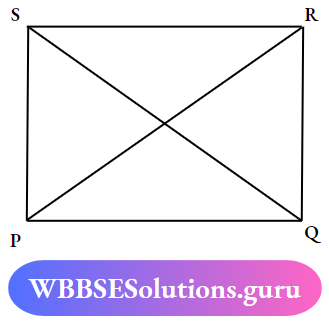
A convex quadrilateral is a four-sided Polygon that has interior angles that measure less than 180° each The diagonals are contained entirely inside of these quadrilaterals. PQRS is a convex Quadrilateral.
Concave Quadrilateral:
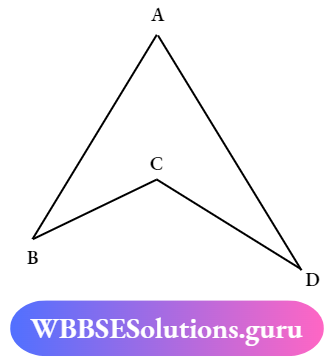
If the quadrilateral has an interior angle greater than 180° It is called a concave quadrilateral.
ABCD is a quadrilateral whose interior ∠BCD >180°