
WBBSE Class 9 Maths Arithmetic Chapter 1 Real Numbers Multiple Choice Questions
Example 1. The decimal expansion of √5 is
- A terminating decimal
- A terminating or recurring decimal
- A non-terminating and non-recurring decimal
- None of them
Solution:
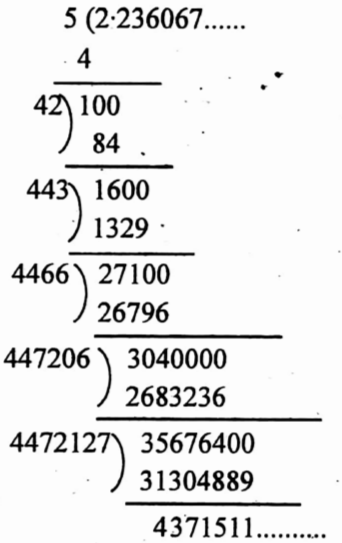
√5 = 2.236067……….
⇒ Therefore the decimal expansion of √5 is a non-terminating and non-recurring decimal.
∴ So the correct answer is 3. A non-terminating and non-recurring decimal
Read and Learn More WBBSE Class 9 Maths Multiple Choice Questions
The decimal expansion of √5 is a non-terminating and non-recurring decimal.
Example 2. The product of two irrational numbers is
- Always irrational number
- Always rational number
- Always an integer
- Rational or irrational number
Solution: The product of two irrational number √18 and √2 is √18 x √2 = √36 = 6 [rational number]
⇒ Again √7 x √2 = √14 [irrational number]
⇒ Therefore product of two irrational number is rational or irrational number.
∴ So the correct answer is 4. None of them
The product of two irrational numbers is rational or irrational number
Example 3. π and \(\frac{22}{7}\)
- Both are rational number
- Both are always irrational number
- π is rational and \(\frac{22}{7}\) is irrational
- π is irrational and \(\frac{22}{7}\) is irrational
Solution: The ratio of perimeter and diameter of each circle is a fixed number and is denoted by π where π= (approx) or 3.14 (approx).
⇒ Therefore the value of π can not be expressed as the ratio of two integers so π is a irrational number.
⇒ As \(\frac{22}{7}\) is a ratio of two integers 22 and 7, therefore \(\frac{22}{7}\) is a rational number.
∴ So the correct answer is 4. π is irrational and \(\frac{22}{7}\) is irrational
π and \(\frac{22}{7}\) is irrational and \(\frac{22}{7}\) is irrational
Example 4. Between two rational numbers, there exist.
- No rational number
- Only one rational number
- Infinite numbers of rational numbers.
- No irrational number
Solution: If x and y are two rational numbers and x < y, then the rational numbers between x and y are (x + d), (x+2d),……, (x + nd).
⇒ where \(d=\frac{y-x}{x+1}\)
⇒ It is possible to take the value of n as large as we like, the number of rational numbers lying between x and y is infinite.
∴ So the correct answer is 3. Infinite numbers of rational numbers.
Between two rational numbers, infinite numbers of rational numbers exist.
Example 5. Between two irrational numbers, there exists
- No rational number
- Only one irrational number
- Infinite numbers of irrational
- No irrational number
Solution: There are infinite numbers of irrational numbers between two irrational numbers.
⇒ √2 = 1.4142103………
⇒ √3 = 1.732050807……..
⇒ The irrational numbers between √2 and √3 are 1.41421030030003……, 1.4142126122612226…..
∴ So the correct answer is 3. Infinite numbers of irrational
Between two irrational numbers, there exists Infinite numbers of irrational
Example 6. The number 0 is
- Whole number but not an integer
- Integer but not rational
- Rational but not a real number
- Whole numbers, integers, rational, and real numbers but not irrational
Solution: 0 = \(\frac{0}{1}\) = \(\frac{0}{2}\) = \(\frac{0}{17}\)
⇒ So 0 is a rational number,
⇒ Again 0 is a whole number and 0 is an integer that is neither positive nor negative.
∴ So the correct answer is 4. Whole numbers, integers, rational, and real numbers but not irrational
The number 0 is Whole numbers, integers, rational, and real numbers but not irrational
Example 7. The sum of two rational numbers is
- Always rational
- Always irrational
- Always integer
- None of them
Solution: The sum of two rational numbers will always be rational.
⇒ e.g.\(\frac{2}{3}\) + \(\frac{5}{6}\) = \(\frac{9}{6}\), √25 + √16 = \(\frac{9}{1}\)
∴ So the correct answer is 1. Always rational
The sum of two rational numbers is Always rational
Example 8. Which is not an irrational number from the following number?
- 25
- √7 – √3
- 4 + 2√25
- 9
Solution: 4 + √25 = 4 + 5 = \(\frac{9}{1}\) (rational number)
⇒ √3 x √2 = √6 (irrational number)
⇒ 2√5 (irrational number)
⇒(√7-√3) is a irrational number
∴ So the correct answer is 3. 4 + 2√25
Example 9. Which is not a rational number from the following number?
- √0.4
- 3.06
- \(\sqrt{1 \frac{9}{16}}\)
- √8
Solution: √0.4 = \(\sqrt{\frac{4}{9}}\) = \(\frac{2}{3}\) (rational number)
⇒ 3.06 = 3\(\frac{6}{90}\) (rational number) = 3\(\frac{1}{5}\) = \(\frac{46}{15}\) (rational number)
⇒ \(\sqrt{1 \frac{9}{16}}=\sqrt{\frac{25}{16}}=\frac{5}{4}\) (rational number)
⇒ √8 = \(\sqrt{4 \times 2}\) = 2√2 (irrational number)
∴ So the correct answer is 4. √8

Example 10. Which of the following number is a recurring decimal?
- \(\frac{5}{8}\)
- \(\frac{11}{25}\)
- \(\frac{13}{80}\)
- \(\frac{19}{24}\)
Solution: If the rational numbers of the form \(\frac{p}{q}\) where q has the prime factors 2 and 5 only be expressed into decimals, it will be terminating decimal numbers.
⇒ But if the rational numbers of the form be expressed into decimals, it will be recurring decimal numbers, where q has prime factors other than 2 and 5.
1. The denominator of \(\frac{5}{8}\) is 8 and 8 = 23; 8 has no prime factor except 2.
∴ a terminating decimal number will be found if \(\frac{5}{8}\) be expressed into decimal.
2. The denominator of \(\frac{11}{25}\) is 25 and 25 = 52; 25 has no prime factor except 5.
∴ a terminating decimal number will be found if \(\frac{11}{25}\) is expressed into decimal.
3. The denominator of \(\frac{13}{80}\) is 80 and 80 = 24 x 5;
⇒ 80 has no prime factor except 2 and 5.
∴ a terminating decimal number will be found if \(\frac{13}{80}\) is expressed into decimal.
4. The denominator of \(\frac{19}{24}\) is 24 and 24 = 23 x 3;
⇒ 24 has a prime factor 3 other than 2
∴ The decimal form of \(\frac{19}{24}\) will not be terminating. It will be recurring.
∴ So the correct answer is 4. \(\frac{19}{24}\)