
WBBSE Class 9 Maths Geometry Chapter 4 Theorems On Concurrence Multiple Choice Questions
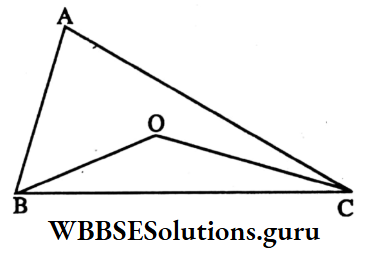
Example 1. O is the circumcentre of ΔABC; if ∠BOC = 80°, the ΔBAC is
- 40°
- 160°
- 130°
- 110°
Solution: The correct answer is 1. 40°
Read and Learn More WBBSE Class 9 Maths Multiple Choice Questions
I join A, O and AO is extended at T.

⇔ In ΔAOB, OA = OB [circumradius]
∴ ∠OAB = ∠OBA
⇔ In ΔAOB, the exterior ∠BOT = ∠OAB+ ∠OBA
= ∠OAB + ∠OAB = 2 ∠OAB.
⇒ Similarly, ∠COT = 2 ∠OAC
⇒ ∠BOC = ∠BOT + ∠COT
⇒ ∠BOC = 2(∠OAB + ∠OAC)
⇒ 80° = 2 ∠BAC
⇒ or, ∠BAC 40°
Example 2. O is the orthocentre of ΔABC; if ∠BAC = 40°, the ∠BOC is
- 80°
- 140°
- 110°
- 40°
Solution: The correct answer is 2. 140°
⇔ In ΔABC, AD ⊥ BC, BE ⊥ CA and CF ⊥ AB.

⇒ As BE ⊥ AC,
∴ ∠AEO = 90°
⇒ CF ⊥ AB,
∴ ∠AFO = 90°
⇒ In quadrilateral AEOF,
⇒ ∠EAF + ∠AEO + ∠EOF+ ∠AFO = 360°
⇒ 40° + 90° + ∠EOF+ 90° = 360° [∠BAC= 40°]
⇒ ∠EOF = 140°
⇒ ∠BOC = vertically opposite ∠EOF= 140°
Example 3. O is the incentre of ΔABC; if ∠BAC 40°, then ∠BOC is
- 80°
- 110°
- 140°
- 40°
Solution: The correct answer is 110°
⇔ O is the incentre of ΔABC
∴ ∠OBC = \(\frac{1}{2}\) ∠ABC and
∠OCB = \(\frac{1}{2}\) ∠ACB
∠OBC + ∠OCB = \(\frac{1}{2}\) (∠ABC + ∠ACB)
= \(\frac{1}{2}\) (180° – ∠BAC)
= \(\frac{1}{2}\) (180° – 40°) = 70°
In ΔBOC, ∠BOC = 180° – (∠OBC + ∠OCB)
= 180° – 70° = 110°
∠BOC = 110°
Example 4. G is the centroid of triangle ABC; if area of ΔGBC is 12 sq. cm, then the area of ΔABC is
- 24 sq. cm
- 6 sq. cm
- 36 sq. cm
- None of them
Solution: The correct answer is 3. 36 sq. cm
⇔ AD is a median of ΔABC
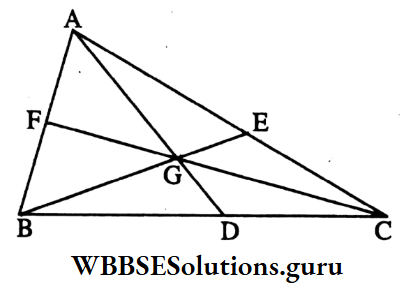
∴ ΔABD = ΔACD
⇒ GD is a median of ΔGBC
∴ ΔBGD = ΔCGD
∴ ΔABD – ΔBGD = ΔACD – ΔCGD
i.e. ΔAGB = ΔACG
⇒ Similarly, ΔABG = ΔGBC
∴ ΔABG = ΔACG = ΔGBC
⇒ ΔABG + ΔACG + ΔGBC = ΔABC
⇒ ΔGBC + ΔGBC + ΔGBC = ΔABC
⇒ΔABC = 3 ΔGBC
= (3 x 12) sq. cm = 36 sq. cm.
The area of ΔABC is = 36 sq. cm.
Example 5. If the length of circumradius of a right-angled triangle is 5 cm, then the length of the hypotenuse is
- 2.5 cm
- 10 cm
- 5 cm
- None of these
Solution: The correct answer is 2. 10 cm
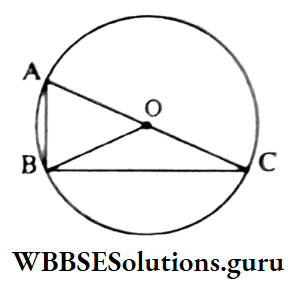
⇒ The circumcentre of a right-angled triangle is on the midpoint of hypotenuse.
⇒ The length of hypotenuse = 2 x circumradius
= (2 × 5) cm = 10 cm
The length of hypotenuse = 10 cm
Example 6. If the length of two median of a triangle are equal, then the triangle will be
- Equilateral triangle
- Isosceles triangle
- Scalene triangle
- None of them
Solution: The correct answer is 2. Isosceles triangle
⇔ In ΔABC, two medians intersect at G (centroid).
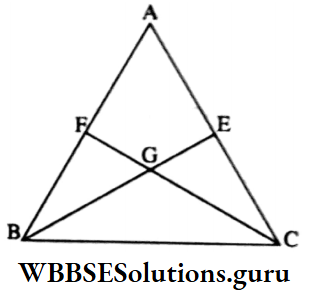
⇒ BE = CF [Given]
⇒ BG: GE = 2: 1 and CG: GF = 2:1
⇒ \(\frac{\mathrm{BG}}{\mathrm{GE}}=\frac{2}{1}\)
⇒ or, \(\frac{\mathrm{GE}}{\mathrm{BG}}=\frac{2}{1}\)
⇒ or, \(\frac{\mathrm{GE}}{\mathrm{BG}}+1=\frac{1}{2}+1\)
⇒ or, \(\frac{\mathrm{BE}}{\mathrm{BG}}=\frac{3}{2}\)
⇒ or, \(\mathrm{BG}=\frac{2}{3} \mathrm{BE}\)
⇒ Similarly, CG = \(\frac{2}{3}\) CF
⇒ BE = CF
⇒ or, \(\frac{2}{3}\) BE = \(\frac{2}{3}\) CF
∴ BG = CG
⇒ BE – BG = CF – CG i.e., GE GF
⇒ In ΔBGF and ΔCGE, BG = CG, GF = GE and ∠BGF = ∠CGE [vertically opposite angle]
∴ ΔBGF ≅ ΔCGE [by, SAS criterion of congruency]
∴ FB = EC
⇒ or, \(\frac{1}{2}\) AB = \(\frac{1}{3}\) AC
⇒ or, AB = AC
∴ ΔABC is a isosceles triangle.
Example 7. If the length of circum-radius of a equilateral triangle is 6 cm, then the perimeter of the triangle is
- 6√3 cm
- 12 cm
- 18√3 cm
- 3√/2 cm
Solution: The correct answer is 3. 18√3 cm
⇒ In an equilateral triangle, circumcentre and centroid are coincide.
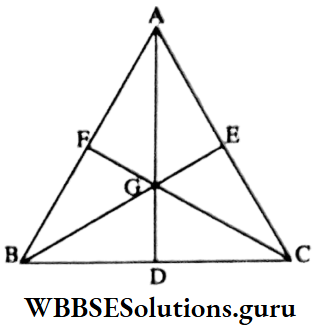
⇔ In equilateral triangle ABC, the medians AD and BE intersects at point G (centroid).
⇒ The length of circumradius (AG) is 6 cm.
⇒ Again, AG : GD = 2:1
∴ GD = (\(\frac{1}{2}\) x 6) cm = 3 cm
⇒ AD = AG+ GD (6 + 3) cm = 9 cm
⇒ If the length of each side is x cm then the height of triangle is \(\frac{\sqrt{3}}{2}\) x cm [x > 0]
⇒ \(\frac{\sqrt{3x}}{2}\) = 9
⇒ or, x = \(\frac{9 \times 2}{\sqrt{3}}\) = 3√3 x 2 = 6√3
∴ Perimeter of the triangle is (3 x 6√3) cm = 18√3 cm
Example 8. If the three medians of ΔABC are AD, BE and CF, then
- AB + BC + CA > AD + BE + CF
- AB + BC + CA < AD + BE + CF
- AB + BC + CA = AD + BE + CF
- None of them
Solution: The correct answer is 1. AB + BC + CA > AD + BE + CF
⇔ AD is extended at P such that AD = DP;
I join C, P.
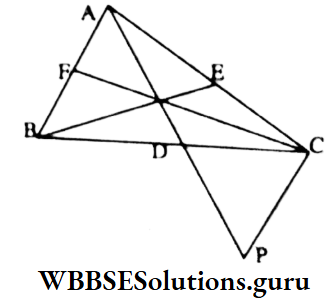
In ΔABD and ΔCDP,
BD = CD, AD = DP and ∠ADB = ∠CDP [vertically opposite angles]
∴ ΔABD ≅ ΔCDP [by S-A-S criterion of congruency]
∴ AB = CP
In ΔAPC, AC + CP > AP [Sum of length of two sides of a triangle is greater than the length of third side]
∴ AC + AB > AD + PD
AB + AC > AD + AD
AB + AC > 2 AD …….(1)
Similarly BC + AC > 2 CF……(2)
and AB = BC > 2BE…..(3)
(1) + (2) + (3) we get,
2(AB + BC + CA) = 2(AD+ BE + CF)
⇒ AB + BC + CA > AD + BE + CF