
WBBSE Class 9 Maths Mensuration Chapter 1 Area And Perimeter Of Triangle And Quadrilateral Useful Information And Formulae Multiple Choice Questions
Example 1. The length of the diagonal of a square is 12√2 cm, and the area of the square is
- 288 sq cm
- 144 sq cm
- 72 sq cm
- 18 sq cm
Solution: \(\frac{12 \sqrt{2}}{\sqrt{2}}\) cm = 12 cm
Area = (12)2 sq cm = 144 sq cm
Read and Learn More WBBSE Class 9 Maths Multiple Choice Questions
∴ The correct answer is 2. 144 sq cm
∴ The area of the square is 144 sq cm
Example 2. If the area of a square is A1 sq units and the area of square drawn on the diagonal of that square is A2 sq units then A1:A2 is
- 1: 2
- 2: 1
- 1: 4
- 4: 1
Solution: Let the length of the side of A1 be a units
∴ length of the side of A2 = √2a units
∴ Ratio a2: (√2a)2 = 1:2
∴ The correct answer is 1. 1: 2
∴ A1:A2 is 1: 2
Example 3. If the rectangular place of which length and breadth are 6 mt & 4 mt is desired to prove it with 2 cm square tiles, then the no. of tiles will be
- 120000
- 240000
- 60000
- 180000
Solution: No. of tiles = \(\frac{600 \times 400}{2 \times 2}\) = 300 x 200 = 60000
∴ The correct answer is 3. 60000
Example 4. If a square and a rectangle having the same perimeter and areas are S and R, then
- S = R
- S > R
- S < R
Solution: Let the length and breadth of the rectangle be x units and y units and length of the square be a units
∴ 2(x + y) = 4a
∴ x + y = 2a
Now, (x − y)2 > 0
or,(x + y)2 > 4xy
or, \(\left(\frac{x+y}{2}\right)^2\) > xy
or, a2 > xy
∴ S > R
∴ The correct answer is 2. S > R
Example 5. If the length of the diagonal of a rectangle is 10 cm and the area is 62.5 sq cm, then the sum of their length and breadth is
- 12 cm
- 15 cm
- 20 cm
- 25 cm
Solution: If the length and breadth be x cm and y cm, then x2 + y2 = 100 and xy = 62.5
or, (x + y)2 – 2xy = 100
or, (x + y)2 = 100+ 2 x 62.5 = 100 + 125 = 225
∴ x + y = 15
∴ The correct answer is 2. 15 cm
∴ The sum of diagonal of a rectangle length and breadth is 15 cm
Example 6. If each side of an equilateral triangle is 4 cm, the measure of height is
- 4√3 cm
- 16√3 cm
- 8√3 cm
- 2√3 cm
Solution: Height = \(\frac{\sqrt{3}}{2} \times 4^2 \mathrm{~cm}=2 \sqrt{2}\) cm
∴ The correct answer is 4. 2√3 cm
∴ Equilateral triangle height is 2√3 cm
Example 7. Isosceles right-angled triangle of which the length of each side of equal two sides of a units. The perimeter is
- (1 + √2) a units
- (2 + √2) a units
- 3a units
- (3 + 2√2 )a units
Solution: Hypotenuse AC = \(\sqrt{a^2+b^2} \text { units }=a \sqrt{2} \text { units }\)

perimeter = (a + a + a√2) units = (2 + √2) a units
∴ The correct answer is 2. (2 + √2) a units
∴ The perimeter of Isosceles right-angled triangle is (2 + √2) a units
Example 8. If the area, perimeter, and height of an equilateral triangle are a, s, h then \(\frac{2a}{h}\) =
- 1
- \(\frac{1}{2}\)
- \(\frac{1}{3}\)
- \(\frac{1}{4}\)
Solution: \(\frac{2 a}{s h}=\frac{2 \times \frac{\sqrt{3}}{4} \times(\text { sidc })^2}{3 \times \text { side } \times \frac{\sqrt{3}}{2} \times \text { side }}=\frac{2 \sqrt{3}}{4} \times \frac{2}{3 \sqrt{3}}=\frac{1}{3}\)
∴ The correct answer is 3. \(\frac{1}{3}\)
Example 9. The length of each equal side of an isosceles triangle is 5 cm and length of base is 6 cm. The area is
- 18 sq cm
- 12 sq cm
- 15 sq cm
- 30 sq cm
Solution: area = \(\frac{1}{2} \times 6 \sqrt{5^2-\frac{6^2}{4}} sq cm\)
= 3\(\sqrt{25-9} \mathrm{sq} \mathrm{cm}=12 \mathrm{sq} \mathrm{cm}\)
∴ The correct answer is 2. 12 sq cm
The area is isosceles triangle is
Example 10. D is such a point on AC of triangle ABC so that AD: DC = 3:2 if the area of triangle ABC is 40 sq cm the area of ΔDBC is
- 16 sq cm
- 24 sq cm
- 15 sq cm
- 30 sq cm
Solution: \(\frac{A D}{D C}=\frac{3}{2}\)
\(\frac{\triangle \mathrm{ABC}}{\Delta \mathrm{BDC}}=\frac{\frac{1}{2} h \mathrm{AC}}{\frac{1}{2} h \mathrm{DC}}=\frac{5}{2}\)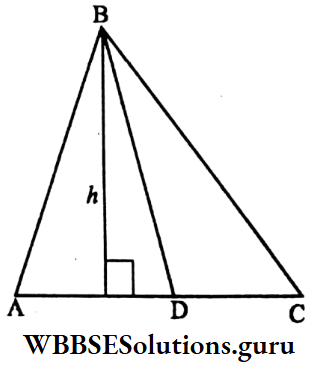
or \(\frac{A D+D C}{D C}=\frac{3+2}{2}\)
or, \(\frac{40}{\triangle B D C}=\frac{5}{2}\)
or, \(\frac{\mathrm{AC}}{\mathrm{DC}}=\frac{5}{2}\)
or, \(\triangle \mathrm{BDC}=\frac{40 \times 2}{5}=16\)
∴ The correct answer is 1. 16 sq cm
∴ The area of ΔDBC is 16 sq cm
Example 11. The difference of length of each side of a triangle from its semi-perimeter are 8 cm, 7 cm and 5 cm respectively. The area is
- 20√7 sq cm
- 10√14 sq cm
- 20√14 sq cm
- 140 sq cm
Solution: s – a = 8
\(\begin{gathered}s-b=7 \\
s-c=5 \\
\hline 3 s-s=20
\end{gathered}\)
\(\Delta=\sqrt{10(8)(7)(5)} \text { sq cm }\)
= \(\sqrt{400 \times 7} \mathrm{sq} \mathrm{cm}\)
= 20√7
∴ s = 10
∴ The correct answer is 1. 20√7 sq cm
∴ The area of a triangle is 20√7 sq cm
Example 12. The height of the parallelogram is 1/3 rd of its base. If the area is 192 sq cm, the height is
- 4 cm
- 8 cm
- 16 cm
- 24 cm
Solution: Base x height = 192
or, 3h × h = 192
or, h2 = 64
h = 8
∴ The correct answer is 2. 8 cm
∴ The parallelogram height is 2. 8 cm
Example 13. If the length of one side of a rhombus is 6 cm, and one angle is 60° the area will be
- 9√3 sq cm
- 18√3 sq cm
- 36√3 sq cm
- 6√3 sq cm
Solution: ΔABC is an equilateral triangle
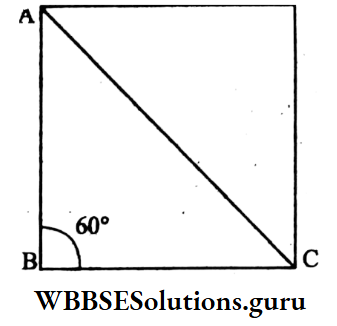
∴ Area = 2\(\frac{\sqrt{3}}{4}\) x 62 sq cm = 18√3 sq cm
∴ The correct answer is 2. 18√3 sq cm
∴ The area will be a rhombus 18√3 sq cm
Example 14. The length of one diagonal of rhombus is its 3 times, of another diagonal. If the area of field in the shape of rhombus is 96 sq cm. Then the length of long diagonal is
- 8 cm
- 12 cm
- 16 cm
- 24 cm
Solution: \(\frac{1}{2}\) x 3 x (shorter diagonal)2 = 96
or, shorter diagonal = \(\sqrt{\frac{3296 \times 2}{3}}=\sqrt{64}\) = 8 cm
∴ length of the long diagonal = 24 cm
∴ The correct answer is 4. 24 cm
∴ The length of long diagonal of rhombus is 24 cm
Example 15. A rhombu and a square are on the same base. If the area of square is x2 sq units and area of rhombus be y sq units then
- y > x2
- y < x2
- y = x2
Solution: CP ⊥ EF
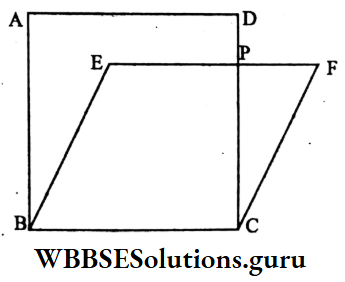
CF > CP
or, AB > CP (AB = CF)
∴ AB x AB > AB x CP
or, x2 > y
∴ The correct answer is 2. y < x2
Example 16. Area of a field of a trapezium is 162 sq cm and height is 6 cm. If length of one parallel side is 23 cm, then the length of other parallel side is
- 29 cm
- 31 cm
- 32 cm
- 33 cm
Solution: \(\frac{1}{2}\)(23 + x)x 6 = 162
(Let length of other parallel side be x cm)
or, 23 + x = 54
∴ x = 31
∴ The correct answer is 2. 31 cm
∴ The length of other parallel side is 31 cm