
WBBSE Class 9 Maths Statistics Chapter 1 Statistics Multiple Choice Questions
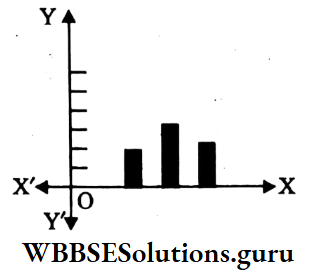
Example 1. Which one of the following is a graphical representation of statistical data?
- Line-graph
- Raw data
- Cumulative frequency
- Frequency distribution
Solution: Line graph is a graphical representation of statistical data.
Read and Learn More WBBSE Class 9 Maths Multiple Choice Questions
∴ So the correct answer is 1. Line-graph
Example 2. The range of the data 12, 25, 15, 18, 17, 20, 22, 26, 6, 16, 11, 8, 19, 10, 30, 20, 32 is
- 10
- 15
- 18
- 26
Solution: The range = 32 – 6 = 26
∴ The correct answer is 4. 26
Example 3. The class size of the classes 1-5, 6-10 is
- 4
- 5
- 4.5
- 5.5
Solution: The difference (d) between classes 1-5, and 6-10, is 1
The lower class boundary of class 1-5 is (1- \(\frac{1}{2}\)) or 0.5 and the upper-class boundary is (5 + \(\frac{1}{2}\)) or 5.5
The class size = upper class boundary – lower class boundary = 5.5 – 0.5 = 5
∴ The correct answer is 2. 5
Example 4. In a frequency distribution table, the midpoints of the classes are 15, 20, 25, and 30, respectively. The class having a midpoint as 20 is
- 12.5 – 17.5
- 17.5 – 22.5
- 18.5 – 21.5
- 19.5 – 20.5
Solution: The difference between two consecutive midpoints
= 20 – 15 = 25 – 20 = 30 – 25 = 5
So, the class size = 5
The midpoint of class (12.5 – 17.5) = \(\frac{12 \cdot 5+17 \cdot 5}{2}=\frac{30}{2}=15\)
and class-length = 17.5 – 12.5 = 5
The midpoint of class (17.5 – 22.5) = \(\frac{17 \cdot 5+22 \cdot 5}{2}=\frac{40}{2}=20\)
and class length = 22.5 – 17.5 = 5
The midpoint of class (18.5 – 21.5) = \(=\frac{18 \cdot 5+21 \cdot 5}{2}=20\)
and class length = 21.5 – 18.5 = 3
The midpoint of class (19.5 – 20.5) = \(=\frac{18 \cdot 5+21 \cdot 5}{2}=20\)
and class length = 20.5 – 19.5 = 1
∴ The required class is 17.5 – 22.5
∴ The correct answer is 2. 17.5 – 22.5
Example 5. In a frequency distribution table, the midpoints of a class is 10 and the class size of each class is 6; the lower limit of the class is
- 6
- 7
- 8
- 12
Solution: Let, lower limit of given class is x;
As class size is 6 then upper limit is (x+6)
The midpoint = \(\frac{x+x+6}{2}=\frac{2 x+6}{2}=x+3\)
As per question, x + 3 = 10
⇒ x = 10 – 37 = 7
∴ The lower limit is 7
∴ The correct answer is 2. 7
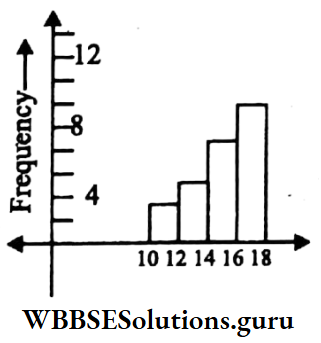
Example 6. Each of area of each of the rectangles of a histogram is proportional to
- The mid-point of that class
- The class size of that class
- The frequency of that class
- The cumulative frequency of that class
Solution: Which increasing frequency the area of each of the rectangles of a histogram will also increase.
So the area of a rectangle is proportional to the frequency.
∴ The correct answer is 3. The frequency of that class
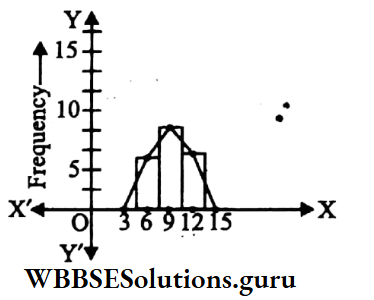
Example 7. A frequency polygon is drawn by the frequency of the class and
- The upper limit of the class
- The lower limit of the class
- Mid-value of the class
- Any value of the class
Solution: A frequency polygon is drawn by the frequency of the class and mid value of the class.
∴ The correct answer is 3. Mid-value of the class
Example 8. To draw a histogram, the class boundaries are taken
- Along Y-axis
- Along X-axis
- Along X-axis and Y-axis both
- In between X-axis and Y-axis
Solution: To draw a histogram, the class boundaries are taken along X-axis.
∴ The correct answer is 2. Along X-axis
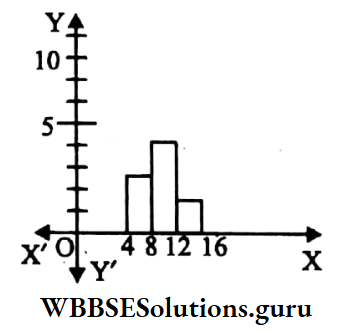
Example 9. In case of drawing a histogram, the base of the rectangle of each class is
- Frequency
- Class-boundary
- Range
- Class-size
Solution: In case of drawing a histogram the length of base of a rectangle of each class is class size.
class- the size of each class is 5.
∴ The correct answer is 4. Class-size
Example 10. A histogram is the graphical representation of grouped data whose class boundary and frequency are taken respectively.
- Along the vertical axis and the horizontal axis
- Only along the vertical axis
- Only along the horizontal axis
- Only the horizontal axis and vertical axis
Solution: A histogram is the graphical representation of grouped data whose class boundary and frequency are taken respectively only the horizontal axis and vertical axis.
∴ The correct answer is 4. Only the horizontal axis and vertical axis
Example 11.

The frequency density of the third class of the above frequency distribution table is
- 1.5
- 0.55 (approx)
- 0.36
- 2.8 (approx)
Solution: The difference between two consecutive class is 1
∴ Lower boundary of third class is \(\left(21-\frac{1}{2}\right)\) or 20.5
and upper-boundary of third class is \(\left(30+\frac{1}{2}\right)\) or 30.5
∴ class-size = 30.5 – 20.5 = 10
The frequency density of third class = \(\frac{\text { class frequency }}{\text { class size }}=\frac{18}{10}\) = 1.8
∴ The correct answer is 1. 1.5
Example 12. The upper-class boundary of the fifth class of the classes 30-39, 40-49,….. is
- 69.5
- 79.5
- 69
- 79
Solution: Classes are 30-39, 40-49, 50-59, 60 – 69, 70-79,……
The fifth class is 70 – 79
The difference between the two consecutive class is 1
∴ The upper-class boundary of the fifth class is \(\left(79+\frac{1}{2}\right)\) or, 79.5
∴ The correct answer is 2. 79.5
Example 13. If lower class boundary and mid value of a class are a and m respectively, then the upper class boundary will be
- a + 2m
- a – 2m
- 2m – a
- 2a – m
Solution: Let upper-class boundary of the given class is b
As lower class boundaries a
So the mid value (m) = \(\frac{a+b}{2}\)
or, a + b = 2m or, b = 2m – a
∴ The correct answer is 3. 2m -a
∴ Then the upper class boundary will be 2m -a