
Chapter 5 Weathering Introduction
Concept Of Weathering Erosion Mass Wasting And Denudation
Surface features of the earth consist of landforms such as mountains, plateaus, plains etc. A landscape is thus, the result of internal processes as well as external processes.
Actually, the primary landforms are weathered or prepared for their weathered materials to be transported by natural agents of gradation leading to erosion and denudation.
Geography Chapter 5 Class 9 WBBSE Solutions
Weathering
Weathering involves two processes that work in concert. This is the combined action of several physical and chemical processes which together are responsible for the disintegration and decomposition of rocks of the earth.
Read And Learn Also WBBSE Notes For Class 9 Geography and Environment
The crust is exposed to the actions of various elements of ‘weather’ like air temperature, pressure, humidity, rainfall etc.
The term weathering has been coined from the word ‘weather’ and is often described as the preparation of rock materials for transportation by the agents of erosion like rivers, glaciers, wind etc.
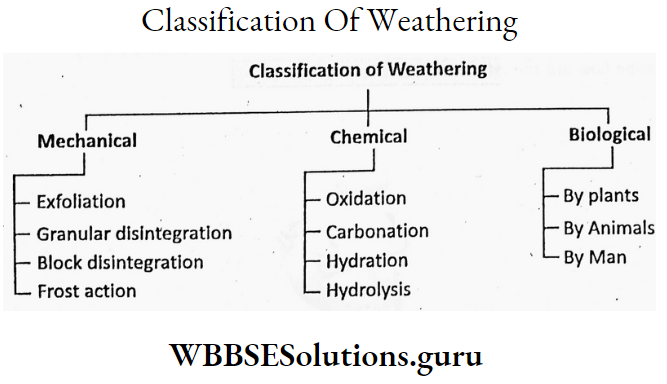
It is of three types
- Mechanical,
- Chemical,
- Biological.
Mass Wasting:
Mass wasting is the movement of weathered materials downslope due to gravity. Rock falls, slumps and debris flows are all examples of mass wasting.
Erosion:
Weathered rock particles, if transported by some flowing agents such as wind, river or glacier are deposited at distant places resulting reduction in the elevation of primary landforms.
This process of wearing away rocks is known as Erosion.
Geography Chapter 5 Class 9 WBBSE Solutions
Denudation:
Denudation is the long-term combination of processes that cause the wearing away of the earth’s surface leading to a reduction in the elevation of landforms.
Denudation involves weathering, mass wasting as well as erosion of exposed rocks on the earth’s surface.
Chapter 5 Weathering Mechanical Weathering
Mechanical Or Physical Weathering Of Rocks Takes Place In Various Ways To Form Smaller Fragments Of Rocks :
Exfoliation
Fragments like concentric shells are formed in homogenous mineral composition like granitic rocks, the outer surface of which nabi xo becomes heated faster than the inner ones and is peeled off one after another like an onion.
This is known as Exfoliation or Onion Peeling or o Spheroidal Weathering.

Granular Disintegration
Granular Disintegration occurs in a rock of heterogenous Imineral composition in which different minerals expand and contract at different rates.
Thus, rock disintegrates into small grains and the process is known as Granular Disintegration.

WBBSE Class 9 Geography Questions And Answers
Block Disintegration
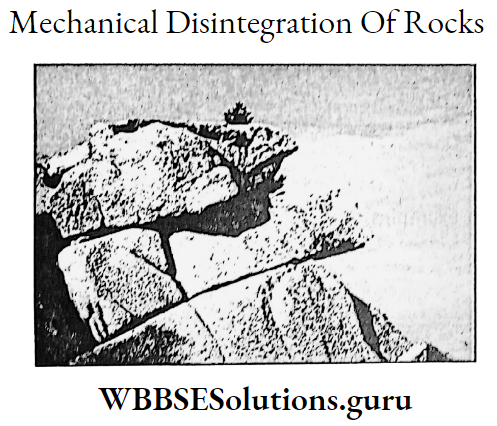
Well-bedded and jointed rocks of homogenous mineral composition split along the joints or cracks, thus, breaking the rock into rectangular blocks. This process is known as Block Disintegration.


Frost Action:
In temperate regions or on high mountains, water present in the cracks or joints of a rock freezes at night when the temperature drops below the freezing point and exerts pressure within the rock wall because of its increased volume.
Therefore, the rock breaks into fragments which form screes or tali found at the foothills of a mountain.
Chapter 5 Weathering Chemical Weathering
Role Of Oxygen, Carbon Dioxide Etc.:
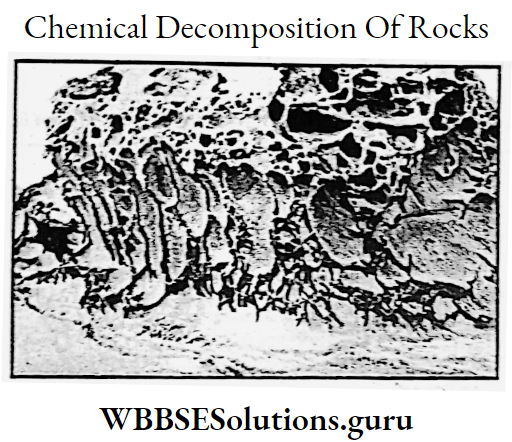
Chemical weathering decomposes rocks by air and water which contain elements like oxygen, carbon dioxide etc. that react with the minerals present in the rock. It is predominant in a hot humid and humid tropical climate.
Oxidation:
In oxidation, minerals present in a rock react with the oxygen in the air and form oxides. When oxygen from the air is added to iron, ferrous oxide turns into ferric oxide of yellowish-brown rust which crumbles easily.
4FeO + 3H2O + 02= 2Fe2O3 + 3H20
Carbonation :
Carbonation involves the absorption of carbon dioxide from the atmosphere by minerals present in the rocks.
Limestone i.e. calcium carbonate changes into calcium bicarbonate when carbonic acid (carbon dioxide dissolved in water) reacts with limestone.
CaCO3 + H2O + CO2= Ca (HCO3)2
Hydration :
Hydration involves the absorption of water molecules. Anhydrite or calcium sulphate changes into gypsum.
CaSO4 + 2H2O→ CaSO4⋅2H2O
Class 9 Geography Environment Chapter Summary
Hydrolysis:
Hydrolysis involves the formation of hydroxyls. Example. Orthoclase changes into alumina-silicic acid.
KAISi308 + H2O = HAISi308 + KOH

Chapter 5 Weathering Biological Weathering
Role Of Man, Plant And Animals :
Plants and animals are responsible for the disintegration as well as decomposition of rocks.
Disintegration Of Rocks By Plants:
Plant roots enlarge cracks or joints present in rock and disintegrate the rock into fragments.
Decomposed leaves, and flowers also form humus which mixed with water, forms acid to react with rock and cause chemical weathering.

Disintegration Of Rocks By Animals:
Burrowing animals such as rats, rabbits, ants etc. are responsible for the mechanical weathering of rocks. The decomposition of animals produces acids which may also. cause chemical weathering of rocks.
Class 9 Geography Notes Bengali Medium
Disintegration Of Rocks By Man :
Deforestation, mining and quarrying are responsible for breaking rocks into fragments. Construction of roads in the mountainous region which is blown up with dynamites is also responsible for the mechanical breaking of rocks.
Chapter 5 Weathering Effects Of Weathering And Soil Erosion
Effects Of Weathering
The most important effect of weathering is soil formation. Minerals like bauxite are produced by weathering. Regolith which is the source of soil is also produced by weathering of rocks.
Weathering of rocks reduces the elevation of landforms, and land area increases but the area becomes prone to earthquakes.
Surface water and rainwater easily percolate through weathered rocks and thus underground water resource increases.

Soil Formation
Due to weathering, overlying the firm and solid rock of the crust. there is loose unconsolidated material i.e. insoluble residual products of weathering made of decomposed and fragmentary materials of variable thickness.
This is known as Regolith. The upper portion of Regolith under suitable conditions is transformed into soil. Actually, the top layer of the regolith is the soil.
It is composed of organic materials like decayed plant bodies or humus, bacteria, fungi etc. known as humus and the process known as Humification; inorganic materials like minerals produced by weathering of rocks known as Mineralisation; water and gases like oxygen, nitrogen, and carbon dioxide etc.
Some minerals like iron and aluminium are leached downwards. This is known as Eluviation. The deposition of minerals in the lower layer is known as Illuviation.
Weathering thus makes the soil fertile as well as porous so that the soil becomes airy and helps in plant growth.
WBBSE Class 9 Geography And Environment Notes
Soil Erosion And Conservation Measures
Soil erosion takes place in two ways-natural and manmade.
Natural Causes Of Soil Erosion:
River, wind and sea waves are responsible for soil erosion. Rainfall washes away the topsoil. Soil is also removed by gullies.
In deserts and coastal areas, strong wind removes huge amounts of soil. Sea wave also breaks the coastal rocks and washes away the soil particles.
Soil Erosion By Human Activities:
Unwise cutting of trees, unscientific cultivation, excessive grazing, jhum cultivation by man are responsible for the quick erosion of soil.
Soil Conservation Measures:
To save soil we all earnestly have to think of soil conservation measures such as afforestation, control of overgrazing, use of the scientific method of cultivation, and covering soil to control evaporation from the soil.
Contour ploughing or step cultivation in mountainous regions, planting trees along the river banks, planting trees across the wind direction.
Improving drainage systems in agricultural fields and development of grasslands on sloping land, control of jhum cultivation etc.