WBBSE Class 7 Maths Solutions For Algebra Chapter 7 Formation Of Equation And Solutions

Algebra Chapter 7 Formation Of Equation And Solutions

Question 1. Choose the correct answer:

1. If ax-bx = a-b then the value of ‘x’ is

  1. 0
  2. 1
  3. ab
  4. a-b

Solution:

ax-bx = a-b

x(a-b) = a-b

x = \(\frac{a-b}{a-b}\)

x = 1

∴ The option (2) 1 is the correct answer.

Read and Learn More Class 7 Maths Solutions
WBBSE Class 7 Maths Solutions For Algebra Chapter 7 Formation Of Equation And Solutions

2. If \(\frac{x}{a}-\frac{x}{b}=b-a\) then the value of x is.

  1. 0
  2. 1
  3. ab
  4. b-a

Solution:

⇒ \(\frac{x}{a}-\frac{x}{b}=b-a\)

⇒ \(\frac{b x-a x}{a b}=b-a\)

⇒ \(\frac{x(b-a)}{a b}=b-a\)

x = \((b-a) \times \frac{a b}{(b-a)}\)

x = ab

∴ The option (3) ab is the correct answer.

3. If the difference of 1/3 rd and 1/4 th of a number is 12 then the number is 12 then the number is

  1. 144
  2. 12
  3. 1
  4. None of these.

Solution:

Let the number be ‘x’

⇒ \(\frac{x}{3}-\frac{x}{4}=12\)

⇒ \(\frac{4 x-3 x}{12}=12\)

⇒ \(\frac{x(4-3)}{12}=12\)

x = 12×12

x = 144

∴ The option (1) 144 is the correct answer.

Wbbse Class 7 Algebra Chapter 7

4. The Sum of the present ages of the father and his son is 62 years. If the age of the father is 2 years more than three times of his son’s age then the Son’s age will be.

  1. 20 years
  2. 30 years
  3. 15 years
  4. 17 year.

Solution:

Let’s define the son’s age as – ‘x’

According to the given information.

Father’s age is 2 Years more than three times of son’s age,

So the father’s age would be 3x+2

Now, the sum of their ages is 62

x+(3x+2)=62

2+3x+2 = 62

4x+2=62

4x =62-2

x = \(\frac{60}{4}\)

x = 15

∴ The Son’s age is 15 years

Option (3) 15 years is the correct answer.

5. The root of the equation 3x-2(x+5)=7x-16 is

  1. 2
  2. 1
  3. 3
  4. 4

Solution:

3x-2(x+5)=7x-16

32-2x-10 = 7x-16

x-10 = 7x-16

16-10=7x-x

6 = 6x

x = \(\frac{6}{6}\)

x = 1

∴ The option (2) 1 is the correct answer.

Class 7 Maths Algebra Solutions WBBSE

Question 2. Write true or False:

1. The Solution of the equation \(\frac{x}{3}\)-1\(\frac{1}{2}\)= \(\frac{x}{6}\) + 4 is x =-3
Solution:

⇒ \(\frac{x}{3}-1 \frac{1}{2} x=\frac{x}{6}+4\)

⇒ \(\frac{x}{3}+\frac{3 x}{2}=\frac{x}{6}+\frac{4}{1}\)

⇒ \(\frac{2 x-9 x}{6}=\frac{x+24}{6}\)

Denominators are equal Numaninators are equalized

2x-9x = x+24

-7x = x+24

-7x-x = 24

-8x = 24

x = \(\frac{-24}{8}\)

∴ \(\frac{x}{3}-1 \frac{1}{2} x=\frac{x}{6}+4\) is -3

True

2. If \(\frac{x-1}{5}+\frac{x-2}{5}+\frac{x-3}{5}=1\) then the Value of x is 10.
Solution:

⇒ \(\frac{x-1}{5}+\frac{x-2}{5}+\frac{x-3}{5}=1\)

⇒ \(\frac{x-1+x-2+x-3}{5}=1\)

3x-6 = 5

3x = 5+6

3x = 11

x = \(\frac{11}{3}\)

∴ The value of x is 10

False.

3. If \(\frac{a x-b}{c}\) and \(\frac{b x-a}{d}\) are equal then the value of ‘x’ is 1.
Solution:

⇒ \(\frac{a x-b}{c}\) = \(\frac{b x-a}{d}\)

d(ax-b) = c(bx-a)

ada-bd = bcx-ac

Now let’s isolate the terms with ‘x’ on one side.

adx – bcx = bd – ac

x(ad-bc) = bd-ac

х = \(\frac{b d-a c}{a d-b c}\)

∴ The value of ‘x’ is 1 i.e., False

WBBSE Class 7 Maths Chapter 7 Answers

Question 3. Fill in the blanks.

1. The Specific value of an unknown number for which the two sides of the ‘equal to sign are equal is called the ___________ of the equation.
Solution: Root or solution

2. The method of finding the value of the unknown number is called ________ of the equation.
Solution: Solving

3. The root of \(\frac{2 x}{5}\) = ________
Solution: \(\frac{5 x}{2}-\frac{7}{15}\)

Question 4. If \(\frac{x}{6}\) + 3(x+1) = \(\frac{x}{2}\) – 1 then find the value of ‘x’
Solution:

⇒ \(\frac{x}{6}\) + 3(x+1) = \(\frac{x}{2}\) – 1

⇒ \(\frac{x+(3 x+3)}{6}=\frac{x-2}{2}\)

⇒ \(\frac{x+18 x+18}{6}=\frac{x-2}{2}\)

⇒ \(\frac{19 x+18}{6}=\frac{x-2}{2}\)

2(19x+18)=6(x-2)

38x+36 = 6x-12

38x-6x = -36-12

32x = -48

x = \(\frac{48}{32}\) = \(\frac{3}{2}\)

x = 1 \(\frac{1}{2}\)

∴ The value of the x = 1 \(\frac{1}{2}\)

Question 5. If \(\frac{2 x}{7}+\frac{x-1}{5}=\frac{x}{3}+\frac{x}{7}\) then find the value of ‘x’.
Solution:

⇒ \(\frac{2 x}{7}+\frac{x-1}{5}=\frac{x}{3}+\frac{x}{7}\)

⇒ \(\frac{10 x+7 x-7}{35}=\frac{7 x+3 x}{21}\)

⇒ \(\frac{17 x-7}{35}=\frac{10 x}{21}\)

21(17x-7)=35(10x)

357x – 147 = 350x

357x-350x = 147

7x = 147

х = \(\frac{147}{7}\)

∴ x = 21

WBBSE Class 7 Algebra Exercise Solutions

Question 6. Solve the equations.

1. \(\frac{1}{2}\)(x-2)+ \(\frac{1}{3}\)(x-3) = \(\frac{1}{4}\)(x-4) + \(\frac{1}{5}\)(x-5) + 23
Solution:

Given, \(\frac{1}{2}\)(x-2)+ \(\frac{1}{3}\)(x-3) = \(\frac{1}{4}\)(x-4) + \(\frac{1}{5}\)(x-5) + 23

⇒ \(\frac{1}{2} x-1+\frac{1}{3} x-1=\frac{1}{4} x-1+\frac{1}{5} x-1+23\)

⇒ \(\frac{1}{2} x+\frac{1}{3} x-2=\frac{1}{4} x+\frac{1}{5} x+23-2\)

⇒ \(\left(\frac{1}{2}+\frac{1}{3}\right) x-2=\left(\frac{1}{4}+\frac{1}{5}\right) x+21\)

⇒ \(\left(\frac{3}{6}+\frac{2}{6}\right) x-2=\left(\frac{5}{20}+\frac{4}{20}\right) x+21\)

⇒ \(\frac{5}{6} x-2 \quad=\frac{9}{20} x+21\)

multiplying every term by the least common denominator

120\(\left(\frac{5}{6} x-2\right)=120\left(\frac{9}{20} x+21\right)\)

120 \(\times \frac{5}{6} x-120 \times 2=120 \times \frac{9}{20} x+120 \times 21\)

100x – 240 = 54x + 2520 (isolate x)

100x – 54x = 2520 + 240.

46x = 2760

x = \(\frac{2760}{46}\)

x = 60

∴ The Solution to the equation is x = 60

2. 0.5x – 0.75x + 0·85x = 1·2

⇒ 0.5x – 0.75x + 0·85x = 1.2

⇒ 1.35x – 0.75x = 1.2

⇒ 0.6x = 1.2

⇒ х = \(\frac{1.2}{0.6}\)

∴ The Solution to the equation is x = 2

3. \(\frac{b}{a x}-\frac{a}{b x}=\frac{a}{b}-\frac{b}{a}\)
Solution:

⇒ \(\frac{b}{a x}-\frac{a}{b x}=\frac{a}{b}-\frac{b}{a}\)

⇒ \(\frac{b^2-a^2}{a b x}=\frac{a^2-b^2}{a b}\)

The right side of the equation by multiplying both the Numerator and the denominator by ‘x’

⇒ \(\frac{b^2-a^2}{a b x}=\frac{\left(a^2-b^2\right) x}{a b x}\)

⇒ \(b^2-a^2=a^2 x-b^2 x\)

⇒ \(b^2-a^2=\left(a^2-b^2\right) x\)

⇒ \(x =\frac{b^2-a^2}{a^2-b^2}\)

⇒ \(x =\frac{(b+a)(b-a)}{(a+b)(a-b)}\)

x = \(-\left\{\frac{b+a}{a+b}\right\}\)

x =-1

∴ The Solution of the equation is x =-1

4. \(\frac{x+1}{2}+\frac{x+2}{3}+\frac{x+3}{4}=0\)
Solution:

⇒ \(\frac{6 x+6+4 x+8+3 x+9}{12}=0\)

6x+4x+3x+6+8+9 = 0

13x+23 = 0

13x = -23

x = \(-\frac{23}{13}\)

x = \(-1 \frac{10}{13}\)

∴ The Solution of the equation is x = -1 \(\frac{10}{13}\)

5. \(\frac{2}{15}\left(\frac{x}{3}-1\right)-\frac{5}{4}\left(2-\frac{x}{10}\right)=\frac{3}{5}\left(\frac{x}{4}-4\right)\)
Solution:

⇒ \(\left(\frac{2 x}{45}-\frac{2}{15}\right)-\left(\frac{10}{4}-\frac{5 x}{40}\right)=\frac{3 x}{20}-\frac{12}{5}\)

⇒ \(\left(\frac{2 x-6}{45}\right)-\left(\frac{100-5 x}{40}\right)=\left(\frac{3 x-48}{20}\right)\)

⇒ \(\frac{8(2 x-6)-9(100-5 x)}{360}=\frac{3 x-48}{20}\)

⇒ \(\frac{16 x-48-900+45 x}{360}=\frac{3 x-48}{20}\)

⇒ \(\frac{61 x-948}{360}=\frac{3 x-48}{20}\)

⇒ (61x-948)20 = (3x-48)360

⇒ 1220x – 18960 = 1080x-17280

⇒ 1220x-1080x = 18960-17280

⇒ 140x = 1680

x = \(\frac{1680}{40}\)

x = 12

∴ The Solution of the equation is x = 12

Class 7 Algebra Problems With Solutions

6. \(\frac{3 x+1}{5}+\frac{2 x-3}{8}=\frac{13 x+15}{16}-\frac{4 x+3}{15}\)
Soluton:

⇒ \(\frac{8(3 x+1)+5(2 x-3)}{40}=\frac{15(13 x+15)-16(4 x+3)}{240}\)

⇒ \(\frac{24 x+8+10 x-15}{40}=\frac{195 x+225-64 x-48}{240}\)

⇒ \(\frac{34 x-7}{11}=\frac{131 x+177}{240}\)

⇒ 240(34x-7) = 40(131x+177)

⇒ 8160x -1680 = 5240x + 7080

⇒ 8160x-5240x = 1680+7080

⇒ 2920x = 8760

⇒ x = \(\frac{8760}{2920}\)

x = 3

∴ The Solution of the equation is x = 3

7. 54-8(5+x) = (5-3x)-13(5x+27)
Solution:

54-8(5+x) = (5-3x)-13(5x+27)

⇒ 54-40-8x = 5-3x-65x-351

⇒ 14-8x = -68x-346

⇒ 14+346 = −68x+8x

⇒ 360 = -60x

⇒ x = \(\frac{360}{60}\)

x = -6

∴ The Solution of the equation is x = -6

8. \(\frac{2 x}{3}-\frac{x}{4}=\frac{x}{5}-\frac{x}{6}+23\)
Solution:

⇒ \(\frac{8 x-3 x}{12}=\frac{6 x-5 x+23 \times 30}{30}\)

⇒ \(\frac{5 x}{12}=\frac{x+690}{30}\)

150x = 12x + 690×12

150x – 12x = 8280

138x = 8280

x = \(\frac{8280}{138}\)

x = 60

∴ The Solution of the equation is x = 60

Question 7. The measurements of angles of a quadrilateral are (x-5)°, (2x-3)°; (3x+10)° and (42+8)°. Find the measurement of the greatest angle.
Solution:

Sum of all angles in a quadrilateral which is 360° (x-5)° + (2x-3)° + (3x+10)° + (4x+8)° = 360

x-5+2x-3+3x+10+4x+8 = 360

10x+10 = 360

10x = 350

x = \(\frac{350}{10}\)

x = 35

First Angle: (x-5)°= (35-5)= 30°

Second Angle: (2x-3)° (2×35-3)

⇒ 70-3

⇒ 67°

Third Angle; (3x+10)° = (3×35+10) ⇒ 105+10=115°

Fourth Angle; 4x+8= (4×35+8)

⇒ 140 +8 = 148°

∴ The Greatest Angle = 148°

Class 7 Maths Chapter 7 Solved Exercises

Question 8. If the sum of three consecutive even numbers is 60 then find the numbers
Solution:

The sum of three consecutive even numbers is 60

∴ n + (n+2) + (n+4)=60

n+n+2+n+4 = 60

30+6 = 60

3n = 60-6

3n = 54

n = \(\frac{54}{3}\)

n = 18

∴ n+2 = 18+2

= 20

∴ n+4 = 18+4

= 22

∴ The three consecutive even numbers are 18, 20, 22.

Question 9. If a train maintains an average speed of 48km/hr it arrives at its destination Punctually, if however, the average speed is 36 km/hr it arrives 10 minutes late. Find the length of the Journey.
Solution:

Speed (S1) = 48km/hr, t1 = T

Speed (S2) = 36km/hr, t2 = T+\(\frac{10}{6}\)

we know that Speed x time

Distance = Speed x time

when the distances are the same

48 x T = \(36 \times\left(T+\frac{10}{60}\right)\)

48T = \(36 \times\left(T+\frac{1}{6}\right)\)

48T = \(36 T+\frac{366}{66}\)

48T-36T = 6

12T = 6

T = \(\frac{6}{12}\)

T = \(\frac{1}{2}\)

Substitute in the above value

48 X T = Distance.

48x – \(\frac{1}{2}\)

24 = Distance

D = 24km/hr

Algebra Formulas For Class 7 WBBSE

Question 10. The sum of the present ages of a father and his Son is 80 years, 10 years ago the ratio of their ages was 5:1 Find their present ages.
Solution:

Let’s denote:

F is the present age of the father.

S is the present age of the son.

F+S = 80

10years ago the father’s age was F-10 and the son’s age was S-10.

The ratio of their ages 10 years ago was 5:1

⇒ \(\frac{F-10}{S-10}=\frac{5}{1}\)

(F-10) = 5(S-10)

F-10 = 5S -50

F = 80-S

(80-5)-10 = 5s-50

70-s = 5s-50

70+50 = 5s+s

120 = 6s

120 = 6s

s = \(\frac{120}{6}\)

s = 20

Now, F = 80-S

F = 80-20

F = 60

The father and son’s present ages are 60 and 20.

Algebra Formulas For Class 7 WBBSE

Question 11. If the difference between the five-times and three-times of number is 40. then Find the numbers.
Solution:

Given Condition:

The difference between the five-times and three-times of number is 40.

∴ Let the number be ‘x’

5x-3x = 40

2x = 40

x = \(\frac{40}{2}\)

x = 20

Substitute the value of ‘x’ in the above equation.

5x-3x = 40

5(20)-3(20) = 40

100 – 60 = 40

∴ The numbers are 100, 60.

Question 12. The denominator of a fraction exceeds its numerator by 7. If 3 is added to both its numerator and denominator the fraction becomes \(\frac{8}{15}\). Find the original fraction.
Solution:

Let’s denote the original numerator of the Fraction as’n! and the original denominator is ‘d’.

the denominator exceeds its numerator by 7 so we have:

d = n+7 → 1

n = d-7

when 3 is added to both the numerator and denominator the Fraction becomes \(\frac{8}{15}\), so we have

⇒ \(\frac{n+3}{d+3}=\frac{8}{15}\)

⇒ \(\frac{d-7+3}{d-3}=\frac{8}{15}\)

⇒ \(\frac{d-4}{d-3}=\frac{8}{15}\)

15d – 60 = 8d+24

15d-8d = 60+24

7d = 84

d = \(\frac{84}{7}\)

d = 12

Now, Finding the value of n

n = d-7 = 12-7

n = 5

∴ The original Fraction is \(\frac{5}{12}\).

Question 13. The length of a rectangle is 1 \(\frac{1}{2}\) times its breadth. If the perimeter of the rectangle is 200 meters, then find its area.
Solution:

Length of a rectangle(l) = 1 \(\frac{1}{2}\) x b

⇒ \(\frac{3}{2}\) b

⇒ 2l = 3b

perimeter of rectangle 200m

P = 2(l+b)

= 2l+2b

= 3b+2b

200 = 5b

b = \(\frac{200}{5}\)

b = 40

l = \(\frac{3}{2}\) x b

= \(\frac{3}{2}\) x 40

l = 60

∴ Area of the rectangle (A) = l x b

= 60×40

= 2400 Sq.m

Class 7 Maths Algebra Solutions WBBSE

Question 14. Gopal is at present 12 years older than his younger brother 7 years hence his age will be double that of his brother Find the present age of Gopal.
Solution:

Let’s denote:

G as the present age of Gopal.

B is the present age of his younger brother.

According to the problem.

G = B+12….(1)

G+7 = 2(B+7) …..(2)

Substitute 1 in 2

B+12+7 = 2(B+7)

B+19 = 2B+14

19-14 = 2B-B

B = 5

Substitute the ‘B’ value in 1

G = 5+12

G = 17

The present age of the Gopal is 17


WBBSE Class 7 Maths Solutions For Algebra Chapter 8 Double Bar Graph

Algebra Chapter 8 Double Bar Graph

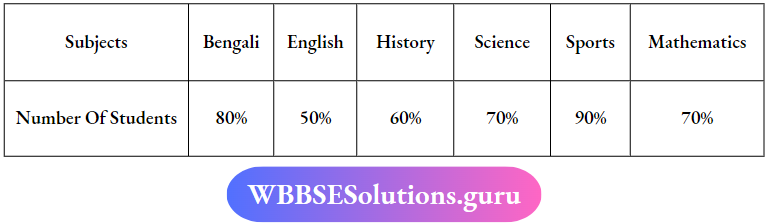
The following data gives the number of students of class in their choice of Subjects in Percentage has been made.

Double Bar Graph Subjects And Number Of Students

Represent the above data with the help of a bar graph and answer the following questions.

Question 1. Choose the correct answer

1. Number of students who like mathematics.

  1. 50%
  2. 60%
  3. 70%
  4. 80%

Solution: 3. 70%

The option (3) 70%. is the Correct Answer.

Read and Learn More Class 7 Maths Solutions

WBBSE Class 7 Maths Solutions For Algebra Chapter 8 Double Bar Graph

2. Studenns like most.

  1. Mathematics
  2. Bengali
  3. English
  4. Sports.

Solution: 4. Sports.

Option (4) Sports is the correct Answer

Double Bar Graph Subjects And Number Of Students Bar Graph

Class 7 Algebra Problems With Solutions

Question 2. Write true or False:

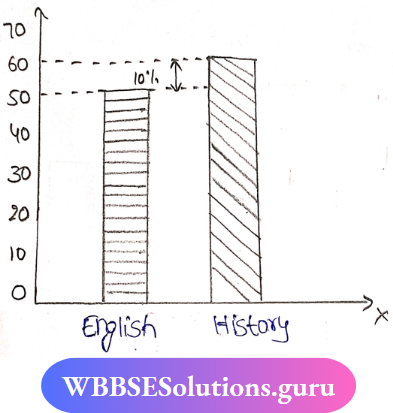
  1. 10% more Students like History than English.
  2. Most of the students like Bengali.

Solution:

Double Bar Graph Students LIke History And English

Double Bar Graph Students Like Bengali

Question 3. Fill in the Blanks.

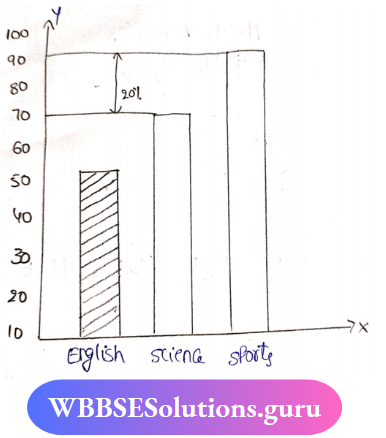
1. ______ % of Students like English.
Solution:
50%

2. ______ % of more students like sports than science.
Solution:
20%

Double Bar Graph Students Like English

Algebra Formulas For Class 7 WBBSE

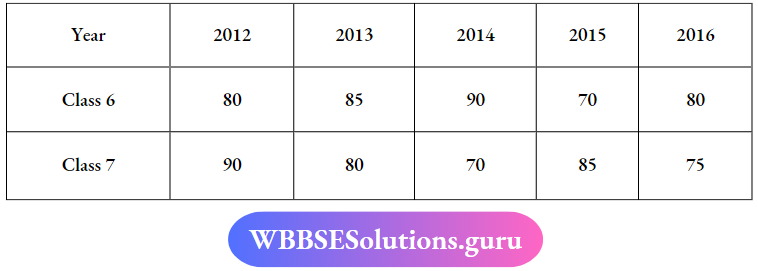
Question 4. The results of the pass percentage of class 6 and class 7 in the annual examination for 5 years of our school are given in the following table.

Double Bar Graph Percentages Of Annual Examination

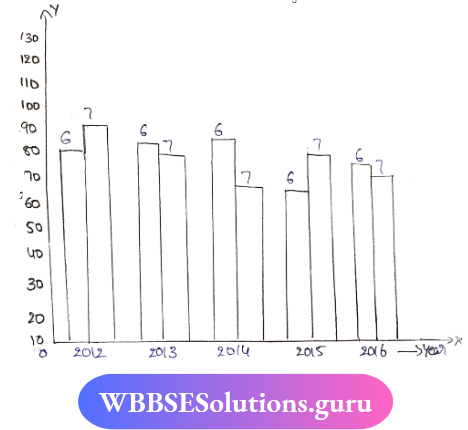
Drawbar graphs to represent the data.

Double Bar Graph Percentages Of Annual Examination Graph Reprents The Data

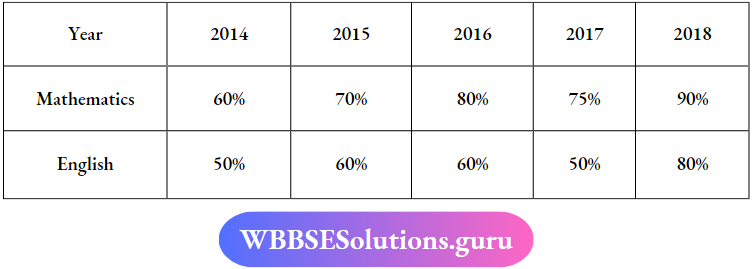
Question 5. The Students of a school have got the numbers in mathematics and English in the Madhyamik Examination in the year 2014-2018 are given below:

Double Bar Graph Students Of A School Has The umber Of Maths And English

Draw the bar graphs to represent the data.

Double Bar Graph Students Of A School Has The umber Of Maths And English Graph Represents The Data

WBBSE Maths Study Material Class 7

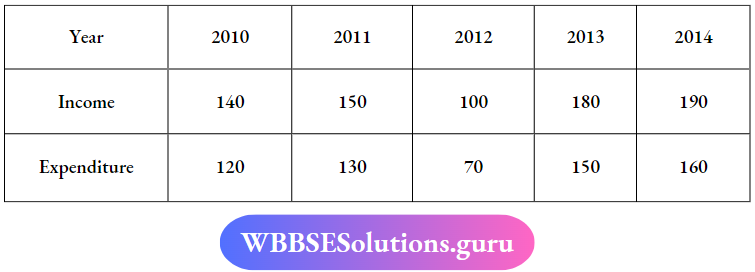
Question 6. The income and expenditure for 5 years of a family. is given in the following data.

Double Bar Graph Income And Expenditure Data

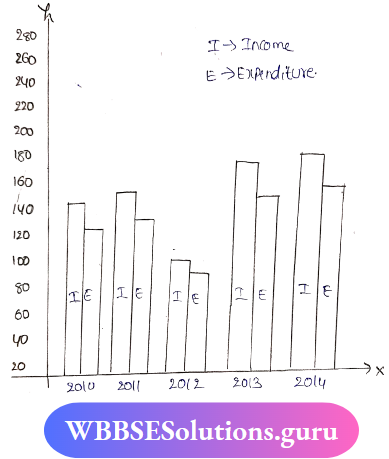
Represent the above data with a bar graph

Double Bar Graph Income And Expenditure Data Represents The Data By A Bar Graph

Question 7. The production of the Saha Textile factory from the month of January to June is given below.

Double Bar Graph Cotton Dress And Woolen Dress

Express the above information on a bar graph.

Double Bar Graph Cotton Dress And Woolen Dress Represents The Bar Graph

Class 7 Maths Exam Preparation WBBSE

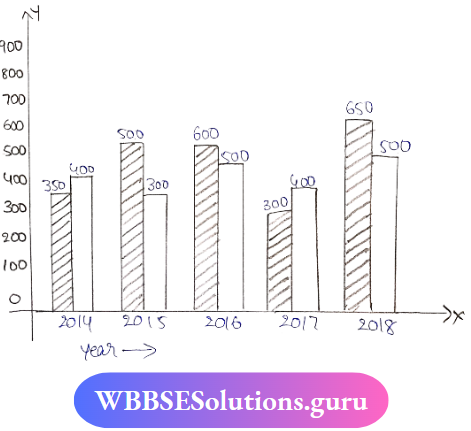
Question 8. Read the following bar graph and answer the following questions:

Scale: 1unit 100 books

Double Bar Graph Cotton Dress And Woolen Dress 10 Uniy Equal To 100 Books Bar Graph

1. Write the change in the requirement of Textbooks during the year from 2014 to 2018
Solution: 2400

2. Find in which year it will sell of storybooks maximum ad in which year it was the least
Solution:

Sell of story books maximum in the year 2018

Sell of story books least in the year 2015

3. In which year does the difference between the number of story books and textbooks sold maximum and in Which Year is this difference maximum?
Solution:

The maximum number of story books and textbooks sold in the year of difference is 2015

The minimum difference between the story and textbooks sold in the year is 2014


WBBSE Class 7 Maths Solutions For Algebra Chapter 6 Factorisation

Algebra Chapter 6 Factorisation

Question 1. Choose the correct answers

1. The number of prime factors of 20 a²bc³

  1. 7
  2. 6
  3. 9
  4. 10

Solution:

Prime Factor 20a²bc³

20a²bc³

= 2 х 5 х 2 х а х a x b x c x c x c

= 9

∴ 20a²bc³ = 9

∴ 20a²bc³ = 9 option ‘3’ = 9 corret Answer.

Read and Learn More Class 7 Maths Solutions

WBBSE Class 7 Maths Solutions For Algebra Chapter 6 Factorisation

2. The sum of factors of (12a4 – 18a2 + 30a) is

  1. 2a4 – 2a2 + 10
  2. a4 – a2 + 9
  3. 2a3 – 2a – 10
  4. 2a3 + 2a – 10

Solution:

Sum of factors (12a4 – 18a2 + 30a)

12a4 – 18a2 + 30a

6a(2a3 – 3a2 + 5)

cubic polynomial ax3 + bx2 + cx + d

sum of factors = –\(\frac{b}{a}\)

so for 2a3 – 3a2 + 5 = -(\(\frac{-3}{2}\)) = \(\frac{3}{2}\)

Now let’s substitute the sum back to the original equation

6a x \(\frac{3}{2}\) = 2a3 – 2a + 10

∴ The sum of factors of 12a4 – 18a2 + 30a is 2a3 – 2a + 10

∴ The option (1) 2a3 – 2a + 10 is correct answer

Class 7 Algebra Problems With Solutions

3. The Common Factor of 24a3b2c4, 36ab3c3 and 48a4bc2 is

  1. 6abc
  2. 12abc2
  3. 6a3bc2
  4. 12a2b2c2

Solution:

24a3b2c4 = 2 x 12 x a x a x a x b x b x c x c x c x c

36ab3c3 = 3 x 12 x a x b x b x b x c x c x c

48a4bc2 = 4 х 12 х а х а х ах а х b x c x с

Common Factor 12abc2

∴ Option (2) 12abc2 is the correct answer.

4. The sum of factors of x(x2-q) is

  1. x + x2 – 29
  2. x + 9
  3. x – 9

Solution:

x(x2-9)

x(x2-(3)2)

x(x+3)(x-3)

Sum of factors x + x + 3 + x – 3 = 3x

∴ The option (4) 3x is the correct answer.

5. The difference of two factors of (4x2 – 25) is

  1. 4x
  2. 4x – 10
  3. 10
  4. x – 5

Solution:

(4x2 – 25)

{(2x)2 – (5)2} [a2-b2=(a+b)(a-b)]

(2x+5)(2x-5)

The differences between the factors are

⇒ (2x + 5) – (2x – 5)

⇒ 2x + 5 – 2x + 5

⇒ 10

∴ Option (3) 10 is the correct answer.

Question 2. Write true or False

1. The number of prime factors of 6x is 3
Solution:

Prime factors of 6x  2 x 3 x x =3 → True

2. The sum of factors of (4-x2) is ‘2’
Solution:

⇒ ((2)2 – x2)

⇒ (2 + x) (2 – x)

⇒2 + x + 2 – x

⇒ 4

∴  (4-x2) sum of factors is ‘2’

∴ False

Class 7 Maths Chapter 6 Solved Exercises

3. One of the factors of (a2-a-5a3) is (a2-1-5a)
Solution:

⇒ (a2-a-5a3)

⇒ a(a-1-5a2) is (a2-1-5a)

∴ False

4. The Prime Factors of 18ab2c5 are 2 x 3 x 3 x a, b, C
Solution:

18ab2c5

2 x 3 x 3 x a x b x b x c x c x c x c x c.

prime Factors of 18ab2c5 is 2 x 3 x 3 x a x b x b x c x c x c x c x c.

∴ False

5. The Common Factor of (2a2 + 3a) and (4a – 7a2) is a
Solution:

(2a2 + 3a), (4a – 7a2)

a(2a + 3) – a(-4-7a).

a + 2a + 3 – a – 4 + 7a

3a + 3

3(a+1)

and

(6a – 4)

2(30 + 2)

Here the common factor is ‘a’

∴  True

Question 3. Fill in the Blanks:

1. There is no common Prime factor of 5a2b and 9cd2
Solution: Prime

2. The sum of factors of (3x2-27) is
Solution:

(3x2 – 27)

3(x2 – 9)

3(x2-(3)2)

3(x+3)(x-3)

3 = x + 3 + x – 3

2x + 3

∴ The sum of factors of (3x2 – 27) is (2x + 3)

3. The difference of factors of (9x2 – 16)
Solution:

9x2 – 16

⇒ (3x)2 – (4)2 [a2 – b2 = (a+b) (a-b)]

⇒ (3x + 4) (3x – 4)

Difference of factors we subtract the smaller

Factor from the larger one: (3x+4)- (3x-4)

Expanding this expression: 3x + 4 – 3x + 4 = 8

∴ The difference of factors of (9x2 – 16) is 8

Algebra Formulas For Class 7 Wbbse

Question 4. If a2 – 7a + 12 = (a – 4) (a + p). then find the value of ‘P’
Solution:

a2 – 7a + 12 = (a – 4)(a + p)

⇒ a2 – 7a +12 = a(a + p) – 4(a + p)

⇒ a2 – 7a +12 = a2 + ap – 4a – 4P

⇒ a2 – 7a + 12 = a2 + a(p-4) – 4p

∴ -7a = a(p-4)

⇒ \(\frac{7a}{a}\) = p – 4

-7 = p – 4

-7 + 4 = p

p = -3

and

12 = -4p

p = \(\frac{123}{-4}\)

p = -3

∴ a2 – 7a + 12 = (a – 4)(a + p)

∴ p = -3

Question 5. The product of two expression is \(\left(\frac{81}{a^4}-\frac{b^4}{25}\right)\) if one expresion is \(\left(\frac{a}{a^2}-\frac{b^2}{5}\right)\) then Find the other expression.
Solution:

⇒ \(\left(\frac{81}{a^4}-\frac{b^4}{25}\right)\)

⇒ \(\left\{\left(\frac{a}{a^2}\right)^2-\left(\frac{b^2}{5}\right)^2\right\}\) (\(a^2-b^2=(a+b)(a-b)\))

⇒ \(\left(\frac{9}{a^2}+\frac{b^2}{5}\right),\left(\frac{a}{a^2}-\frac{b^2}{5}\right)\)

The other expression is \(\left(\frac{9}{a^2}+\frac{b^2}{5}\right)\)

Question 6. Find the value of ‘p’ in expression (x2-px-6) if one of the Factors is (x-3) Find also another factor.
Solution:

(x2 – px – 6)

given that one factor is (x – 3) = 0

x = 3 Substitute in the above equation.

((3)2 – p(3)-6)= 0

9 – 3p – 6 = 0

-3P = -9 + 6

-3p = -3

p = \(\frac{-3}{-3}\)

∴ p = 1

(x2 – px – 6) = 0

(x2 – (1)x – 6) = 0

x2 – x – 6 = 0

x2 + 2x – 3x – 6 = 0

x(x+2)-3(x+2)=0

∴ (x+2)=0, (x-3)=0

x = -2, x = 3

∴ The value of p is 1

The other factor is (x+2)=0

∴ x = -2, and x = 3

WBBSE Maths Study Material Class 7

Question 7. Express \(\left(\frac{a}{b}-\frac{b}{a}\right)\) as a product of two expressions such that the sum of the expression is \(\left(\frac{a}{b}+\frac{b}{a}\right)\)
Solution:

⇒ \(\left(\frac{a}{b}-\frac{b}{a}\right)\)

Some of the expression is \(\left(\frac{a}{b}+\frac{b}{a}\right)\)

This can be be written as 1 + \(\frac{b}{a}\) x (\(\frac{a}{b}\) + 1)

Now let’s verify if the given expression can be factored as the product of two expressions whose sum is \(\left(\frac{a}{b}+\frac{b}{a}\right)\):

⇒ \(\left(\frac{a}{b}-\frac{b}{a}\right)\)

= \(\frac{a^2-b^2}{a b}\)

= \(\frac{(a+b)(a-b)}{a b}\)

= \(\frac{a-b}{b} \times \frac{a+b}{a}\)

= \(\left(\frac{a}{b}-1\right)\left(1+\frac{b}{a}\right)\)

∴ So \(\left(\frac{a}{b}-\frac{b}{a}\right)\) can be expressed as the product of (\(\frac{a}{b}\)-1) and (1 + \(\frac{b}{a}\)), and their sum is \(\frac{a}{b}\) + \(\frac{b}{a}\)

Question 8. Find the sum of the Factors of the expression (3a2 – b2 – c2 – 2ab – 2bc – 2ca)
Solution:

(3a2 – b – c2 – 2ab – 2bc – 2ca)

⇒ 3 + 3 + a + a – b – b – c – 2a + b − 2 + b + c – 2 + c + a

⇒ 6 + 4а – 6

⇒ 4a.

∴ The sum of factors of the expression (3a2-b2-c2-2ab-2bc-2ca) = 4a

Question 9. Resolve into factors.

1. \(\frac{a^4}{16}-\frac{81}{b^4}\)
Solution:

⇒ \(\frac{a^4}{16}-\frac{81}{b^4}\)

⇒ \(\left(\frac{a^2}{4}\right)^2-\left(\frac{9}{b^2}\right)^2\) (\(a^2-b^2=(a+b)(a-b)\))

⇒ \(\left(\frac{a^2}{4}+\frac{9}{b^2}\right)\left(\frac{a^2}{4}-\frac{9}{b^2}\right)\)

⇒ \(\left(\frac{a^2}{4}+\frac{9}{b^2}\right)\left(\left(\frac{a}{2}\right)^2-\left(\frac{3}{b}\right)^2\right)\)

⇒ \(\left(\frac{a^2}{4}+\frac{9}{b^2}\right)\left(\frac{a}{2}+\frac{3}{b}\right)\left(\frac{a}{2}-\frac{3}{b}\right)\)

∴ \(\frac{a^4}{16}-\frac{81}{b^4}=\left(\frac{a^2}{4}+\frac{9}{b^2}\right)\left(\frac{a}{2}+\frac{3}{b}\right)\left(\frac{a}{2}-\frac{3}{b}\right)\)

2. \(a^4-5 a^2+6 a\)
Solution:

⇒ \(a^4-5 a^2+6 a\)

⇒ \(a\left(a^3-5 a+6\right)\)

∴ \(a^4-5 a^2+6 a=a\left(a^3-5 a+6\right)\)

3. \(a^2-b^2+18 b-81\)
Solution:

⇒ \(a^2-b^2+18 b-81\)

⇒ \(a^2-\left(b^2-18 b+81\right)\)

⇒ \(a^2-(b-9)^2\)

(a+b-a)(a-b+9)

∴ \(a^2-b^2+18 b-81=(a+b-9)(a-b+9)\)

WBBSE Maths Study Material Class 7

4. 3x2 – xy – 4y2
Solution:

3x2 -xy – 4y2

⇒ 3x2 + 3xy – 4xy – 4y2

⇒ 3x(x+y) -4(x+y)

⇒ (x+y) (3x-4)

∴ 3x2 – xy – 4y2 = (x+4) (3x-4)

5. 18ax2 – 128a(x-2y)2
Solution:

18ax2 – 128a(x-2y)2

a[18x2 – 128(x-2y)2]

6. 18ax2 – 128a(x – 2y)2
Solution:

⇒ \(2 a \cdot 9 x^2-2 a \cdot 64(x-2 y)^2\)

⇒ \(2 a \cdot 9 x^2-2 a \cdot 64\left(x^2-4 x y+4 y^2\right)\)

⇒ \(2 a\left(9 x^2-64 x^2+256 x y-256 y^2\right)\)

⇒ \(2 a\left(9 x^2-64 x^2\right)+2 a\left(256 x y-256 y^2\right)\)

⇒ \(2 a\left(-55 x^2+256 x y-256 y^2\right)\)

⇒ \(2 a\left(-11 x^2+16 x y-16 y^2\right)\)

Now Let’s re-arrange the terms:

⇒ \(2 a\left(16 x y-11 x^2-16 y^2\right)\)

⇒ \(2 a\left(16 y(11 x-16 y)-11 x^2\right)\)

⇒ \(2 a(11 x-16 y)(16 y-5 x)\)

So, \(18 a x^2-128 a(x-2 y)^2\) can be simplified to \(2 a(11 x-6 y)(16 y-5 x)\).

7. \(81 a^4+643^4\)
Solution:

⇒ \(81 a^4+64 b^4\)

⇒ (3a+2b)(3a-2b)(3a+2b)(3a-2b)

⇒ (3a+2b)\(^2(3 a-2 b)^2\)

⇒ \(\left(9 a^2+12 a b+4 b^2\right)\left(9 a^2-12 a b+4 b^2\right)\)

And we can simplify the expression by distributing the terms.

⇒ \(\left(9 a^2+12 a b+8 b^2\right)\left(9 a^2-12 a b+8 b^2\right)\)

So, \(81 a^4+64 b^4 \mathrm{can}\) indeed be expressed as

∴ \(\left(9 a^2+12 a b+8 b^2\right)\left(9 a^2-12 a b+8 b^2\right)\)

8. 4(a+3b-c)2 – (4a-3b+2c)2
Solution:

Expand 4(a+3b-c)2

4(a+3b-c)(a+3b-c)

4(a2 + 3ab – ac + 3ab + 9b2 – 3bc – ac – 3bc + c2)

4(a2 + 6ab – 2ac + 9b2 – 6bc + c2)

Expand (4a – 3b + 2c)2

(4a-3b+2c) (4a-3b+2c)

⇒ (4a)2 -2(4a) (3b) + 2(4a)(2c) + (-3b)2 – 2(-3b)(2c)+ (2c)2

⇒ 16a2 – 24ab + 16ac + 9b2 + 12bc + 4c2

Now let’s substitute these expansions back into the original expression:

4(a+3b-c)2 – (4a-3b+2c)2

= 4(a2 + 6ab- 2ac + 9b2 – 6 bc + c2) – (16a2 – 24ab + 16ac + 9b2 + 12bc + 4c2)

= 4a2 + 24ab – 8ac + 36b2 – 24bc + 4c2 – 16ac + 24ab – 16ac – 9b2 – 12bc – 4c2

9. 4a2 – 16a2 + 24ab + 24ab – 8ac – 16ac + 36b2 – 9b2 – 24bc – 12bc + 4c2 – 4c2
Solution:

= -12a2 + 48ab – 24a + 27b2 – 36bc

Now we can factor out common terms from this expression

= -12(a2 – 4ab + 2ac – \(\frac{9}{4}\)b2 + 3bc)

Now observe that a2 – 4ab + 2ac – \(\frac{9}{4}\)b2 + \(\frac{3}{2}\)bc

Can be factored as (a – 2b + \(\frac{3}{2}\)c) (a – 2b + \(\frac{3}{4}\)c)

Thus the expression becomes:

= -12(a – 2b + \(\frac{3}{2}\)c) (a-2b+\(\frac{3}{4}\)c)

Now let’s factor this expression further.

= −12(2a – 4b + 3c)(a − 2b + \(\frac{3}{4}\)c)

= 3(-4a + 8b – 6c)(2a – 4b + \(\frac{3}{2}\)c)

= 3(2a – 4b + \(\frac{3}{2}\)c)(-4a + 8b – 6c)

= 3(2a – 4b + \(\frac{3}{2}\)c)(9b – 2a – 4c)

So, 4(a + 3b – c)2 – (4a – 3b + 2c)2 can be simplified to 3(2a + b) (9b – 20 – 4c).

10. a2 – b2 – c2 + d2+ 2(ad + bc)
Solution:

⇒ a2 – b – c2 + ď2 + 2(ad +bc)

⇒ a2 – b2 – c2 + d + 2ad + 2bc

⇒ a2+ 2ad + d2 – (b2 + c2 – 2bc)

⇒ (a+d)2 – (b-c)2

⇒ {(a+d) + (b-c)} {(a+d) – (b-c)}

⇒ (a+b-c+d) (a-b+c+d)

∴ a2 – b2 – c2 + d2 + 2(ad+bc) = (a + b – c + d) (a – b + c + d)

Class 7 Maths Algebra Solutions WBBSE

11. 7a(7a-2b) + (b+c)(b-c)
Solution:

7a(7a-2b) + (b+c) (b-c)

49a2 – 14ab + b2 – c2

((7a)2 -2(7a)(b) + b2) – c2

(7a-b)2 – c2

(7a-b+c)(7a-b-c)

∴ 7a(7a-2b)+(b+C)(b-c) = (7a-b+c) (7a-b-c)

12. (a+b)(x+cy) – (b+c)(x+ay)
Solution:

(a+b)(x+cy) – (b+c)(x+ay)

{a(x+cy) + b(x+cy)} – {b(x+ay) + c(x+ ay)}

{ax + ayc + bx + byc} – {bx + aby + cx + acy}

ax + ayc + bx + byc – bx – aby – cx – acy

ax + byc -aby -cx

(ax-cx)- by(a-c)

x(a-c)- by(a-c)

(a-c)(x-by)

∴ (a+b)(x+cy) – (b+c)(x+ay) = (a-c)(x-by)

Question 10. Factorize the following

1. a4 + a2b2 + b4
Solution:

⇒ (a2)2+ a2b2 + (b2)2

⇒ (a2 + ab + b2) (a2 – ab + b2)

∴ a4 + a2b2 + b4 = (a2 + ab + b2) (a2– ab + b2)

2. a4 – 2a2b2 – 15b4
Solution:

⇒ a4 – 2a2b2 – 15b4

⇒ a4 – 5a2b2 + 3a2b2 – 15b4

⇒ (a2-5b2) + 3b2(a2-5b2)

⇒ (a2-5b2) (a2+3b2)

∴ a4 – 2a2b2 – 15b4 = (a2-5b2) (a2+3b2)

3. 16 (3x+2y)2 – 9(x-2y)2
Solution:

⇒16(9x2 + 4y2 + 12xy) – 9(x2 + 4xy2 – 4xy)

⇒ (144x2+64y2 + 192xy) (-9x2-36y2+36xy)

⇒ (144x -9x2)+(64y2-36y2) + (192xy+36xy)

⇒ 135x2 + 28y2 + 228xy

⇒ 135x2 + 228xу + 28y2

⇒ 135x2 + 210xy + 18xy + 28y2

⇒ 15x(9x+14y) + 2y(9x+14y)

⇒ (9x+14y) (15x+2y)

∴ 16(3x+2y)2 – 9(x-2y)2= (9x+14y) (15x+2y)

Class 7 Maths Algebra Solutions WBBSE

4. x8-16y8
Solution:

(x4)2 – {(4y)4}2 (a2-b2=(a+b)(a-b))

⇒ {(x)4 + (4y)4} {(x)4-(4y)4}

⇒ {(x2)2+{(2y)2}2} {(x2)2-{(2y)2}2}

⇒ {(x2 + 2y2)2 – 2.x2.2y2} {(x2+ 2y2)x(x2– 2y2)}

⇒ {(x2+2y2)2 – 4x2y2} {(x2+2y2) × (x2-2y2)}

⇒ {(x2+2y2)2-(2xy)2} {(x2+2y2)x(x2-2y2)}

⇒ (x2 + 2x2 + 2xy)(x2 + 2y2 -2xy) (x2+2y2) x (x2-2y2)

∴ x8-16y8 = (x2+2y2+2xy) (x2+2y2-2xy) (x2+2y2)(x2-2y2)

5. (1+x)(y-z)+(1+z)(x−y)
Solution:

⇒ {1(y-z)+x(y-z)} + {1(x-y) + z(x-y)}

⇒ {y-2+xy-zx} + {x-y+2x-zy}

⇒ y-z+xy-zx+x-y+zx-zy

⇒ (xy-zy) + (x-z)

⇒ y((x-z)) + 1(x-z)

⇒ (x-z)(y+1)

∴ (1+x)(y-z) + (1+z)(x-y) = (x-z)(y+1)


WBBSE Class 7 Maths Solutions For Algebra Chapter 5 Algebraic Formula

Algebra Chapter 5 Algebraic Formula Exercise

Question 1. Choose the correct answer.

1. If (25x² + pxy+ 36y²) is a perfect square then the Value of P is
Solution:

25x² + Pxy + 36y²

⇒ (5x)² + pxy + (6y)²

Now this expression is in the form of (a+b)²= a²+2ab+b²

Here, a = 5x, b = 6y

∴ 2ab = рху

2(5x)(6x) = pxy

2(30xy) = pxy

60xy = pxy

P = 60

∴ The value of the ‘p’ is 60′

WBBSE Class 7 Maths Solutions For Algebra Chapter 5 Algebraic Formula

Read and Learn More Class 7 Maths Solutions

2. If x² – 12x + 36 = (x+m)² then the value of ‘m’?
Solution:

⇒ x² – 12x+36 = (x+m)²

⇒ x² – 2.6x + (6)² = (x+m)²

⇒ (x-6)² = (x+m)²

Cancel the equal terms on both sides

⇒ (x-6)² = (x+m)²

⇒ x – 6 – x – m = 0

⇒ -6 – m =0

⇒ -(6+m)=0

m + 6 =0

m = -6

∴ x² – 12x+36= (X+m)² The value of m is -6′

Algebra Formulas For Class 7 WBBSE

3. If a+b+c= 6 and a² + b² + c² = 8 then the value of (ab+ bc+ca) is

  1. 28
  2. 24
  3. 14
  4. 12

Solution:

a+b+c= 6 and a²+ b²+c²=8.

Squaring the equation a+b+c=6;

⇒ (a+b+c)² = 62

⇒ a² + b²+c² + 2(ab+bc+ca) =36

Given that a² + b² + c² = 8 substitute in above expression

⇒ 8 + 2(ab+bc+ca) = 36

⇒ 2(ab+bc+ca)=36-8

⇒ (ab+bc+ca) = \(\frac{28}{2}\)

∴ ab+bc + ca = 14

The value of (ab+bc+ca) is 14

4. If a² – b² = 55 [a>b] then the value of a and b are respectively.

  1. 8,3
  2. 11,5
  3. 3,8
  4. 5,11

Solution:

a² – b² =55

⇒ (a+b)(a-b) = 55

By checking the options in a given condition.

⇒ 8, 3

a² – b² = 55

(8)² – (3)² = 55

64 – 9 =55

55 = 55

∴ The values of a and b are 8, 3

Class 7 Maths Chapter 5 Solved Exercises

5. If \(x^4+\frac{1}{x^4}=119\) then the value of \(\left(x-\frac{1}{x}\right)\)

  1. 11
  2. 121
  3. 9
  4. 3

Solution:

⇒ \(x^4+\frac{1}{x^4}=119\)

⇒ \(\left(x^2\right)^2+2 \cdot x^2 \frac{1}{-x^2}+\frac{1}{\left(-x^2\right)^2}=119\)

⇒ \(\left(x^2\right)^2+\frac{1}{\left(-x^2\right)^2}=119+2\)

⇒ \(\left(x^2\right)^2+\frac{1}{\left(x^2\right)^2}=121\)

Applying square root on both sides.

⇒ \(\sqrt{\left(x^2\right)^{x^1}+\left(\frac{1}{x^2}\right)^2}=\sqrt{121}\)

⇒ \(x^2+\frac{1}{x^2}=11\)

⇒ \(x^2+2 x \cdot \frac{1}{-x}+\left(\frac{1}{-x^2}\right)^2=11\)

⇒ \(x^2-\frac{1}{x^2}=11-2\)

⇒ \(x^2-\left(\frac{1}{x}\right)^2=9\)

Applying square root on both sides.

⇒ \(\sqrt{(x)^2-\left(\frac{1}{x}\right)^x}=\sqrt{9}\)

⇒ \(x-\frac{1}{x}=3\)

∴ Option (4) 3 is the correct Answer.

6. If 3a-\(\frac{1}{5a}\) = 12 then the value of (25a² + \(\frac{1}{9a^2}\)) is

  1. 147\(\frac{1}{3}\)
  2. 403\(\frac{1}{3}\)
  3. 7\(\frac{1}{5}\)
  4. 5\(\frac{1}{7}\)

Solution:

3a – \(\frac{1}{5a}\) Multiplying \(\frac{5}{3}\) on both sides

⇒ \(\frac{5}{3}\left(3 a-\frac{1}{5 a}\right)=14 \times \frac{5}{3}\)

⇒ \(\frac{5}{7} \times 3 a-\frac{8}{3} \times \frac{1}{5 a}=20\)

5a – \(\frac{1}{3 a}=20\)

Squaring on Both sides

⇒ \(\left(5 a-\frac{1}{3 a}\right)^2=(20)^2\)

(5a)\(^2+\left(\frac{1}{3 a}\right)^2-2(5 a) \times\left(\frac{1}{3 a}\right)=400\)

25 \(a^2+\frac{1}{9 a^2}=400+2\left(\frac{5}{3}\right)\)

= \(\frac{3(400)+10}{3}\)

= \(\frac{1200+10}{3}\)

= \(\frac{1210}{3}\)

= \(403 \cdot 33\)

∴ 25 \(a^2+\frac{1}{9 a^2}=403 \cdot \frac{1}{3}\)

Question 2. Write true or false

1. If x² + \(\frac{1}{x^2}\) = 2 then the value of (x-\(\frac{1}{x}\)) is 0
Solution:

x² + \(\frac{1}{x^2}\) -2(x)(\(\frac{1}{x}\))=0

a² + b² -2ab = (a – b)²

(x-\(\frac{1}{x}\))² = 0

(x-\(\frac{1}{x}\)) = 0

∴ True

2. If 3a – 5b then the value of (9a² – 30ab+25b²) is 64
Solution:

9a² – 30ab+ 25b² = 64

(3a)² – 2(30) (5b)+(5b)² = 64

(3a-5b)² = 64

∴ 3a=5b

(5b-5b)² = 64

(0)²=64

∴ False

Class 7 Algebra Problems With Solutions 

3. If x² – 6x + 9=0 then the value of (x² + 6x + 9) is 16
Solution:

x² – 6x + 9 = 0

x² – 2·x·3 + (3)² = 0

(x – 3)² = 0

x – 3 =0

∴ x = 3

x² + 6x + 9 = 16

⇒ (3)² + 6(3) + 9 = 16

⇒ 9+18+9 = 16

⇒ 36 = 16

∴ False

Question 3. Fill in the blanks

1. (a+2b)² =(a-2b)² + 8ab
Solution:

(a+b)² = (a−b)² + 4ab

(a+2b)² = (a-2b)² + 4a(2b)

= (a-2b)²+ 8ab

(a+b)² = (a-2b)² + 8ab

2. The value of (7.3 x 7.3 + 2·3 × 2·3 – 7.3 × 4.6) is
Solution:

⇒ 7.3 x 7.3 + 2·3 × 2·3 – 7.3 × 4.6

⇒ 53.29 + 5.29 – 33.58

⇒ 58.58 – 33.58

⇒ 25

∴ (7·3 × 7·3 + 2.3 × 2·3 – 7·3 × 4.6) = 25

3. If (x-y)² = x² – 10x +25 then the value of y is
Solution:

= (x-y)² = x² – 10x + 25

(x-y)² = x² – 2·x·5 + (5)²

∴ The value of ‘y’ is ‘5’

(x-y)² = x² – 2xy + y²

2xy = 2x.5

∴ y =5

Question 4. Find the Square

  1. 995
  2. 805
  3. 2a-3b+4c

Solution:

1. 995 x 995 = 990025

2. 805 x 805 = 648025

3. (2a-3b+4c)²

⇒ (2a+(-3b)+4c)²

⇒ (a+b+c)²= a² + b²+c² + 2ab+ 2bc + 2ca

Here a= 2a, b= -3b, c = 4c

⇒ (2a+(-3b)+4c)² = (2a)² + (-3b)² +(4c)² + 2(2a)(−3b) + 2(3b)(4c) + 2(4c)(2a)

= 4a² + 9b² + 16c² – 12ab – 24bc + 16ac

Class 7 Maths Exam Preparation WBBSE

Question 5. Find the value of 998 × 1002
Solution:

⇒ \(\begin{array}{r}
1002 \\
\times 998 \\
\hline 8016 \\
9018 \times \\
9018 \times \\
\hline 999996 \\
\hline
\end{array}\)

∴ 998 × 1002 = 999996

Question 6. Express (a²+b²) (c²+ d²) as a sum of two square
Solution:

(a²+b²)(c²+d²)

Let us expand it a²c² + a²d² + c²b² + b²d² ⇒ (a²c² + b²d²) + (a²d² + b²c²)

Notice that both pairs have the same structure but with different terms. Each pair is a perfect square of two terms.

⇒ a²d²+ b²c²

⇒ (ad)² + (bc)²

Or,

⇒ (a²c²+b²d²)

⇒ (ac)² + (bd)²

∴ (a² + b²) (c² + d²) can be expressed as the

Sum of two squares: (ac)² +(bd)² + (ad)² + (bc)²

Question 7. If (a-3)² + (b-2)² = 0 then find the value of (a+3)² + (b+2)²
Solution:

(a-3)² + (b-2)² = 0

(a – 3)² =0,

a – 3 = 0

a = 3

and

(b – 2)² =0

b – 2 = 0

b = 2

(a+3)² + (b+2)²

Now Substitute the a and b values in the above equation.

(3+3)²+(2+2)²

(6)² +(4)²

⇒ 36+16

⇒ 52

∴ (a+3)² + (b+2)² = 52

Class 7 Maths Algebra Solutions WBBSE

Question 8. If x² – ax – 1 = 0 then find the value of \(\left(x^4+\frac{1}{x^4}\right)\)
Solution:

x² – ax – 1 = 0

⇒ x² – 1 = ax

⇒ \(\frac{x^2-1}{x}=a, \Rightarrow x-\frac{1}{x}=a\)

squaring on both sides

⇒ \(\left(x-\frac{1}{x}\right)^2=(a)^2\)

⇒ \(x^2-2 \cdot x\left(\frac{1}{x x}\right)+\frac{1}{x^2}=a^2\)

⇒ \(x^2+\frac{1}{x^2}=a^2+2\)

⇒ \(\left(x^2+\frac{1}{x^2}\right)^2=\left(a^2+2\right)^2\) (squaring on both sides)

⇒ \(\left(x^2\right)^2+2\left(x^2\right)\left(\frac{1}{x^2}\right)+\left(\frac{1}{x^2}\right)^2=\left(a^2\right)^2+(2)^2+2\left(a^2\right)(2)\)

⇒ \(\left(x^4+\frac{1}{x^4}\right)=a^4+4+4 a^2-2\)

⇒ \(x^4+\frac{1}{x^4}=a^4+4 a^2+2\)

∴ \(\left(x^4+\frac{1}{x^4}\right)=a^4+4 a^2+2\)

Question 9. If a = 2017, b = 2018, and c = 2019 then Find the value of (a²+b+c²-ab-bc-ca)
Solution:

a = 2017, b = 2018, C = 2019

(a² + b² + c² – ab – bc – ca)

⇒ a² + b² + c² – (ab + bc + ca)

⇒ (2017) ‍+ (2018) + (2019)² – {(2017x 2018) + (2018x 2019) + (2019×2019)}

⇒ {(4068289 + 4072324 + 407636)} – {(4070306) + (4074342) + (4072323)}

⇒ 12216974 – 12216971

⇒ 3

∴ (a² + b + c² – ab – bc – ca) = 3

Question 10. If 4x – \(\frac{1}{4x}\) = 16 then find the value of x² + \(\frac{1}{256 x^2}\)
Solution:

4x – \(\frac{1}{4x}\) = 16

Multiply with \(\frac{1}{4}\) on Both sides

⇒ \(\left(4 x-\frac{1}{4 x}\right) \times \frac{1}{4}=46 \times \frac{1}{4}\)

⇒ \(\frac{4 x}{4}-\frac{1}{16 x}=4\)

squaring on Both sides

⇒ \(\left(x-\frac{1}{16 x}\right)^2=(4)^2 \quad(a-b)^2=a^2-2 a b+b^2\)

⇒ \(x^2-2 \cdot x \cdot\left(\frac{1}{16 x}\right)+\left(\frac{1}{16 x}\right)^2=16\)

⇒ \(x^2+\frac{1}{256 x^2}=\frac{16+\frac{1}{8}}{8}\)

⇒ \(x^2+\frac{1}{256 x^2}=\frac{128+1}{8}\)

⇒ \(x^2+\frac{1}{256 x^2}=\frac{129}{8}\)

⇒ \(x^2+\frac{1}{256 x^2}=16.125\)

⇒ \(16 \frac{1}{8}\)

∴ \(x^2+\frac{1}{256 x^2}=16 \cdot \frac{1}{8}\)

Class 7 Maths Algebra Solutions WBBSE

Question 11. If 3(a² + b² + c²) = (a + b + c)² then Find a:b:c
Solution:

3(a² + b² + c²) = (a + b + c)²

3a² + 3b² + 3c² = a² + b² + c² + 2(ab + bc + ca)

3a² + 3b² + 3c² – (a² + b² + c) = 2(ab + bc + ca)

3a² + 3b² + 3c² – a² – b² – c² = 2(ab + bc + ca)

2a² + 2b² + 2c² = 2(ab+bc+ca)

Dividing the equation by ‘2’ on Both sides

a² + b² + c² = ab + bc + ca

a² + b² + c² = ab – bc + ca = 0

Now Let’s Factorize and rearrange.

a² – 2ab + b² + a² – 2ac + c² + b² + 2bc + c² = 0

(a – b)² + (a-c)² + (b – c)² = 0

For the expression to be equal to zero

(a-b)² = 0

a – b = 0

and

(a-c)² = 0

a – c = 0

and

(b-c)² = 0

b – c = 0

This implies. a=b = c

∴ The ratio of a:b:c is 1:1:1

Question 13. Express \(\left(x^2-\frac{1}{y^2}\right)\left(y^2-\frac{1}{x^2}\right)\) as a perfect square
Solution:

⇒ \(\left(x^2-\frac{1}{y^2}\right)\left(y^2-\frac{1}{x^2}\right)\)

⇒ \(x^2\left(y^2-\frac{1}{x^2}\right)-\frac{1}{y^2}\left(y^2-\frac{1}{x^2}\right)\)

⇒ \(x^2 y^2-\frac{x^2}{x^2}-\frac{y^2}{x^2}+\frac{1}{x^2 y^2}\)

⇒ \(x^2 y^2-1-1+\frac{1}{x^2 y^2}\)

⇒ \(x^2 y^2-2+\frac{1}{x^2 y^2}\)

⇒ \(x^2 y^2-2(x y)\left(\frac{1}{x^2 y}\right)+\frac{1}{x^2 y^2}\)

(\(a^2-2 a b+b^2=(a-b)^2\); \(a^2=x^2 x^2\); \(b^2=\frac{1}{x^2 y^2}\))

⇒ \(\left(x y-\frac{1}{x y}\right)^2\)

∴ \(\left(x^2-\frac{1}{y^2}\right)\left(y^2-\frac{1}{x^2}\right)=\left(x y-\frac{1}{x y}\right)^2\)

Question 15. Express the following as a perfect square and hence Find the values

1. \(\frac{169}{a^2}-\frac{104}{a b}+\frac{16}{b^2}\) when a = 13, and b=-4
Solution:

⇒ \(\frac{169}{(13)^2}-\frac{104}{(13)(-4)}+\frac{16}{(-4)^2}\)

⇒ \(\frac{169}{169}-\frac{104}{-52}+\frac{16}{16}\)

⇒ \(1+\frac{104}{52}+1\)

⇒ 1 + 2 + 1

⇒ 4

∴ \(\frac{169}{a^2}-\frac{104}{a b}+\frac{16}{b^2}=4\)

2. \(121 a^2 b^2-66 a b+9\) when a = 1 b = -1
Solution:

⇒ \(121(1)^2(-1)^2-66(1)(-1)+9\)

⇒ 121+66+9

⇒ 196

∴ \(121 a^2 b^2-66 a b+9=196\)

WBBSE Class 7 Algebra Exercise Solutions

Question 16. Multiply: \(\left(a^2+a b+b^2\right)\left(a^2-a b+b^2\right)\left(a^4+a^2 b^2+b^4\right)\)
Solution:

⇒ \(\left(a^2+a b+b^2\right)\left(a^2-a b+b^2\right)\left(a^4+a^2 b^2+b^4\right)\)

⇒ \(\left\{\left(a^2+b^2\right)+a b\right\}\left\{\left(a^2+b^2\right)-a b\right\}\left(a^4+a^2 b^2+b^4\right)\)

⇒ \(\left\{\left(a^2+b^2\right)^2-(a b)^2\right\}\left\{a^2+a^2 b^2+b^4\right\}\)

((a+b)(a-b)=\(a^2-b^2\)

(a+b)\(^2=a^2+b^2+2 a b\))

⇒ \(\left.\Rightarrow\left\{\left(a^4+b^4+2 a^2 b^2\right)\right\}-a^2 b^2\right\}\left\{a^4+a^2 b^2+b^4\right\}\)

⇒ \(\left\{\left(a^4+a^2 b^2+b^4\right)\right\}\left\{\left(a^4+a^2 b^2+b^4\right)\right\}\)

⇒ \(\left(a^4+a^2 b^2+b^4\right)^2\)

⇒ \(\left(a^4\right)^2+\left(a^2 b^2\right)^2+\left(b^4\right)^2 \Rightarrow\left(a^4 \times a^4\right)+a^2 b^2 \times a^2 b^2+b^4 \times b^4\)

⇒ \(a^8+a^4 \cdot b^4+b^8\) (\(a^m \cdot a^n=a^{m+n}\))

∴ \(\left(a^2+a b+b^2\right)\left(a^2-a b+b^2\right)\left(a^4+a^2 b^2+b^4\right)=a^8+a^2 b^4+b^8\)

Question 17. If a + b = 10, and a – b = 4, then find the value of 7ab(a² + b²)
Solution:

a + b = 10

Squaring on Both sides

(a + b)² = (10)²

⇒ a² + b² + 2ab = 100

⇒ a² + b² = (100 – 2ab)

⇒ (a – b)2 2ab = (100 – 2ab)

⇒ (4)² + 2ab = 100 – 2b

⇒ 2ab + 2ab = 100 – 16

⇒ 4ab = 84

ab = \(\frac{84}{4}\)

∴ ab = 21

a² + b² = 100 – 2ab

= 100 – 2(21)

=100 – 42

∴ a² + b² = 58

7ab(a² + b²) = 7(21)(58)

7ab(a²+b²)= 8526

WBBSE Class 7 Algebra Exercise Solutions

Question 18. If \(\frac{a}{1-a}+\frac{b}{1-b}+\frac{c}{1-c}=1\) then find the value of \(\left(\frac{1}{1-a}+\frac{1}{1-b}+\frac{1}{1-c}\right)\)
Solution:

⇒ \(\frac{a}{1-a}+\frac{b}{1-b}+\frac{c}{1-c}=1\)

Adding 3 on Both sides

1 + \(\frac{a}{1-a}+1+\frac{b}{1-b}+1+\frac{c}{1-c}=1+3\)

⇒ \(\frac{1-a+a}{1-a}+\frac{1-b+b}{1-b}+\frac{1-c+c}{1-c}=4\)

⇒ \(\frac{1}{(1-a)}+\frac{1}{(1-b)}+\frac{1}{(1-c)}=4\)

Question 19. (x+y+z) (x-y+z) (x+y-z) (y+z-x)
Solution:

{(x+z)+y}{(x+z)-y}{y-(z-x)}{y+(z-x)} [(a+b)(a−b) = a² – b²]

{(x+z)² + y2²} {(y)² -(z-x)²}

{x²+ z²+2xz-y²} {y²-(z²+x²- 2xz)}

{x²+z²+2xz-y²} {y²-z²-x²+ 2xz}

{(2xz)² + (x² – y+ z²)} {(2xz)-(x²- y²+z²)}

(2xz)² – (x²-y²+z²)²

4x²z² – ((x²- y²)² + 2(x² – y²)z² + (z²)²}

4x²z² – {(x4 +y4 – 2x²y² + 2x²z² – 2y²z² + z4

4x²z² – x4 – y4 + 2x²y² – 2x²z² + 2y²z² – z4

2x²z² + 2 y²z² + 2x²y² =x4 – y4 – z4

∴ (x + y +z) (z – y + z) (x + y – z) (y + z – x) = 2x²z² + 2y²z² + 2x²y² – x4 – y4 – z4


WBBSE Class 7 Maths Solutions For Algebra Chapter 4 Algebraic Operations

Algebra Chapter 4 Algebraic Operations

Question 1. Choose the correct answer.

1. Sum of x²y – 3xy and 7xy² is

  1. 7xy² + 2x²y
  2. 7xy² – 2x²y
  3. 5x²y
  4. 8xy² – 3x²y

Solution:

x²y – 3x²y and 7xy²

⇒ 7xy² – 2x²y

∴ (x²y-3x²y) and 7xy² = 7xy² -2x²y

Option (2) 7xy² – 2x²y is the correct answer.

Read and Learn More Class 7 Maths Solutions

WBBSE Class 7 Maths Solutions For Algebra Chapter 4 Algebraic Operations

WBBSE Class 7 Algebra Chapter 4

2. The numerical co-efficient of the term -3x²+5x-7 other than the constant term is

  1. (-3,5)
  2. (-3,5,-7)
  3. (5, -7)
  4. (-3,-7)

Solution: -3x² + 5x -7

The numerical coefficient of the term (-3,5)

∴ Option (1) (3,5) is the correct answer,

3. The product of (5abc) and (-3abc) is

  1. -15a8b12c10
  2. 15 a6b7c7
  3. -15 a6b7c7
  4. 15 a8b12c10

Solution:

⇒ \(\left(5 a^4 b^3 c^2\right) \text { and }\left(-3 a^2 b^4 c^5\right)\)

⇒ \(\left(5 a^4 b^3 c^2\right) \times\left(-3 a^2 b^4 c^5\right)\)

⇒ \(5 a^4 \times\left(-3 a^2\right) \times b^3 \times b^4 \times c^2 \times c^5\)

⇒ \(-15 a^6 b^7 c^7\)

⇒ \(\left(5 a^4 b^3 c^2\right) \text { and }\left(-3 a^2 b^4 c^5\right)=-15 a^6 b^7 c^7\)

∴ Option (3) \(-15 a^6 b^7 c^7\) is the correct Answer.

Class 7 Maths Algebra Solutions WBBSE

4. The value of \(\frac{(-8 y) \div(4 z)}{4}\) is

  1. -8yz
  2. -16yz
  3. \(\frac{2z}{y}\)
  4. \(\frac{-y}{2z}\)

Solution:

⇒ \(\frac{(-8 y) \div(4 z)}{4}\)

⇒ \(\frac{\frac{-8 y}{4 z}}{4}\)

⇒ \(\frac{-8 y}{4 z} \times \frac{1}{4}\)

⇒ \(\frac{-8 y}{\frac{16 z}{2}}\)

⇒ \(\frac{-y}{2 z}\)

∴ \(\frac{(-8 y) \div(4 z)}{4}=\frac{-y}{2 z}\)

∴ Option (4) \(\frac{-y}{2 z}\) is correct answer.

Question 2. Write true or False:

  1. a ÷ b of c = a ÷ b x c
  2. a (b x c) = ab x ac
  3. If the HFC of a and b is c then their LCM is \(\frac{ab}{c}\)

Solution:

  1. a ÷ b of c = a ÷ b x c → False
  2. a (b x c) = ab x ac → False
  3. If the HFC of a and b is then their LCM is \(\frac{ab}{c}\) → True

Question 3. Fill in the blanks.

  1. The value of ax-y x ay-z x az-x is _______
  2. The sum of numerical coefficients of the term \(-\frac{1}{2} x^2, \frac{3}{4} y^2, \frac{1}{4} z^2 \text { and }-\frac{5}{2} x y\) is _______
  3. The Subtraction of (5x² -4xy-y²) from O is ______

Solution:

1. \(a^{x-y} \times a^{y-z} \times a^{z-x}\)

⇒ \(a^{x-y+y-z+z+x} \quad a^m \times a^n \times a^0=a^{m+n+0}\)

⇒ \(a^{\prime}=0\)

⇒ \(a^{x-y} \times a^{y-z} \times a^{z-x}=0\)

2. The Sum of numerical coefficients of the term \(-\frac{1}{2} x^2, \frac{3}{4} x^2, \frac{1}{4} z^2\) and \(-\frac{5}{2} x y\) is

⇒ \(-\frac{1}{2}+\frac{3}{4}+\frac{1}{4}+\left(-\frac{5}{2}\right)\)

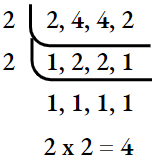
Algebra LCM Of 2

⇒ \(\frac{-2+3+1-10}{4}\)

⇒ \(\frac{-12+4}{4}\)

⇒ \(2 \times 2=4\)

∴ \(\frac{-8}{4}\)

∴ -2

∴ \(-\frac{1}{2} x^2, \frac{3}{4} y^2, \frac{1}{4} z^2 \text { and }-\frac{5}{2} x y=-2\)

3. The Subtraction of (5x²-4xy-y²) from 0 is

⇒ 0-(5x²-4xy-y²)

⇒ -5x² + 4ху + y²

∴ -5x² + 4xy + y²

WBBSE Class 7 Maths Chapter 4 Answers

Question 4. Identify the like terms. -a²b, 7ab², 1/2a²b, 5/2ab, 7a²b
Solution:

Like terms = -a²b, 7a²b, 1/2 a²b.

Question 5. Find the numerical coefficient of the terms other than the constant term.

  1. 3x² – 5xy + 7
  2. x – 3xy + 7y² – 6
  3. \(\frac{5x^3}{7}\) + 4x – 8

Solution:

1. 3x² – 5xy + 7

The numerical coefficients are (3,-5).

2. x – 3xy + 7y² – 6

The numerical coefficients are (1,-3, +7)

3. \(\frac{5x^3}{7}\) + 4x – 8

The numerical coefficient is (5/7,4)

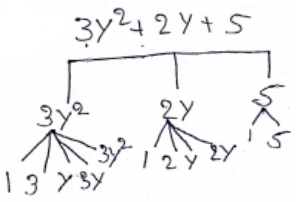
Question 6. Represent the following algebraic expressions into a factor tree type of figure mentioning the prime factors of each term.

  1. 7x
  2. 3y²+27+5

Solution:

Algebra Eqaution For 7x

Algebra Algebraic Expression Into Factor Term

WBBSE Class 7 Algebra Exercise Solutions

Question 7. How much must be added to (x² – 7x + 8) to get (3x² + 8x – 9)
Solution:

(x² +7x +8) to get (3x² + 8x -9)

(3x² + 8x-9) – (x² – 7x + 8)

3x² + 8x – 9 – x² + 7x – 8

2x² + 15x – 17
∴ 2x² + 15x – 17 must be added to (x² – 7x + 8) to get (3x² + 8x – 9).
Question 8. Multiply

  1. (5x – 7y) (5x + 7y)
  2. \(\left(-\frac{2}{3} a^2 b c^2\right) \times\left(\frac{7}{2} a b^5 c^5\right) \times\left(\frac{3}{7} a^3 b c^4\right)\)

Solution:

1. (5x – 7y)(5x + 7y)

Here a = 5, b = 7y

⇒ (5x)² – (7y)²

⇒ 25x² – 49y²

∴ (5x-7y)(5x+7y) = 25x² – 49y²

2. \(\left(-\frac{2}{3} a^2 b c^2\right) \times\left(\frac{7}{2} a b^5 c^5\right) \times\left(\frac{3}{7} a^3 b c^4\right)\)

⇒ \(-\left(\frac{2}{3} \times \frac{7}{2} \times \frac{3}{7}\right) \times\left(a^2 b c^2\right) \times\left(a b^5 c^5\right) \times\left(a^3 b c^4\right)\)

⇒ \(-\left(a^{2+1+3} \cdot b^{1+5+1} \cdot c^{2+5+4}\right)\)

⇒ \(-\left(a^6 \cdot b^7 \cdot c^{11}\right)\)
∴ \(\left(-\frac{2}{3} a^2 b c^2\right) \times\left(\frac{7}{2} a b^5 c^5\right) \times\left(\frac{3}{7} a^3 b c^4\right)=-\left(a^6 \cdot b^7 \cdot c^{11}\right)\)

Question 9. Divide:

  1. \(\left(22 x^5-11 x^3+33 x^2 y\right)\) by \(11 x^4\)
  2. \(169 a^2 b c^4-52 a b^4 c^5-78 a^3 b^3 c^3 b y-13 a b c^4\)

Solution:

1. \(\left(22 x^5-11 x^3+33 x^2 y\right)\) by \(11 x^4\)

⇒ \(\frac{22 x^5}{11x^3}-\frac{11 x^4}{11 x^4}+\frac{33 x^2 y}{11 x^4}\)

⇒ \(2 x-\frac{1}{x}+\frac{3 y}{x^2}\)

∴ \(\left(22 x^5-11 x^3+33 x^2 y\right) \text { by } 11 x^4\) = \(2 x-\frac{1}{x}+\frac{3 y}{x^2}\)

2. \(169 a^2 b c^4-52 a b^4 c^5-78 a^3 b^3 c^3 b y-13 a b c^4\)

⇒ \(\frac{169 a^2 bc^4}{-13 a b c^4}-\frac{52 a b^4 c^5}{-13 a b c^4}-\frac{78 a^3 b^3 c^3}{-13 a b c^4}\)

⇒ \(-13 a+4 b^3 c+6 a^2 b^2 c^{-1}\)

⇒ \(-13 a+4 b^3 c+\frac{6 a^2 b^2}{c^-1}\)

∴ \(169 a^2 b c^4-52 a b^4 c^5-78 a^3 b^3 c^3 by -13 a b c^4\) is \(-13 a+4 b^3 c+\frac{6 a^2 b^2}{c}\)

Class 7 Algebra Problems With Solutions

Question 10. If the perimeter of an isosceles triangle is (3a-4b+5c) cm and the length of its base is (a+2b-c)cm then Find the length of the other sides.
Solution:

Given Data, Isosceles Triangle

Perimeter = (3a-4b+5c)cm

Base length = (a+2b-c)cm

length of other sides =?

In the Isoceles Triangle two sides are equal in length

perimeter = 2a+b; a = side , b = base

(3a-4b+5c) = 2a +(a+2b-c)

(3a-4b+5c) – (a+2b-c) = 2a

3a – 4b + 5c – a – 2b + c = 2a

3a – a – 4b -2b + 5c + c = 2a

2a – 6b + 6c = 2a

2(a-3b+3c) = 2a

∴ Length of other sides are a = (a-3b+3c) cm

Question 11. Simplify

1. \(\frac{a-b}{a b}+\frac{b-c}{b c}+\frac{c-a}{c a}\)
Solution:

⇒ \(\frac{a-b}{a b}+\frac{b-c}{b c}+\frac{c-a}{c a}\)

⇒ \(\frac{c(a-b)+a(b-c)+b(c-a)}{a b c}\)

⇒ \(\frac{a c-b c+a b-ac c+b c-a b}{a b c}\)

⇒ \(\frac{1}{a b c}\)

∴ \(\frac{a-b}{a b}+\frac{b-c}{b c}+\frac{c-a}{c a}=\frac{1}{a b c}\)

2. \((x-5)\left(x^2+5 x+25\right)+(2 x-1)\left(4 x^2+2 x+1\right)-(3 x-2)\left(9 x^2+6 x+4\right)\)
Solution:

⇒ \(x^3+5 x^2+25 x-5 x^2-25 x-125+8 x^3+4 x^2+2 x-4 x^2-2 x-1\)–\((27 x^3+18 x^2+12 x-18 x^2-12 x-8)\)

⇒ \(x^3+8 x^3-27 x^3+5 x^2-5 x^2+4 x^2-4 x^2\)–\(18 x^2+18 x^2+25 x-25 x+2 x-2 x+12 x-12 x-125-1+18\)

∴ \(-18 x^3-118\)

3. (a – b)(b – 2c + a)+ (b – c)(c – 2a + b) + (c – a) (a – 2b + c)
Solution:

⇒ (a – b)(b – 2c + a)+ (b – c)(c – 2a + b) + (c – a) (a – 2b + c)

⇒ ab-2ac+a²-b²+2bc-ab+bc-2ab+b²-c²+2ac-bc+ac-2bc+c²-a²+2ab-ac

∴ (a-b) (b-2c+a)+(b-c)(c-2a+b) + (c-a)(a-2b+c) = 0

Class 7 Maths Chapter 4 Solved Exercises

Question 12. If A = 2x+3y-4z; B = 2y+3x-4z and C = 2z + 3x – 4y then find the value of (A-2B-3C)
Solution:

Given that.

A = 2x+3y-4z

B = 2y+3x-4z

C = 2z+3x-4y

(A-2B-3c) = {(2x+3y-4z) – 2(2x+3x-4z)-3(2z +3x-4y)}

= {(2x+3y-4z)-4y-6x+8z-6z-9x+12y}

= (2x+3x-4z-4y-6x+8z-6z-9x+12y)

= (2x-6y-9x + 3y – 4y + 12y -4z + 8z – 62)

(A-2B-3C) = (-13x + 11y – 2z)


WBBSE Class 7 Maths Solutions For Algebra Chapter 3 Concept of Index

Algebra Chapter 3 Concept of Index

Question 1. Choose the correct Answer

1. If we express the number 1234500000 in an index. form as power of 10 then we get

  1. 1234.5 x 106
  2. 12345 x 106
  3. 123.45 x 10⁶
  4. 12.345 x 10⁶

Solution:

Given number 1234500000

Now Count the Zero one in the number is ‘5’

we must be present in a form as the power of 10.

∴ 12345 x 105 = 1234.5x 106 (Power should not be Odd)

Option (1) 1234.5 x 106 is the correct answer.

Read and Learn More Class 7 Maths Solutions

WBBSE Class 7 Maths Solutions For Algebra Chapter 3 Concept of Index

2. The value of \(\frac{3^4 \times 3^{-5}}{3^{-6}}\) is

  1. 243
  2. 343
  3. 81
  4. 1/9

⇒ \(\frac{3^4 \times 3^{-5}}{3^{-6}}\) is

Solution:

am x an = am+n

Here a = 3, m = 4, n =-5

⇒ \(\frac{3^{4+(-5)}}{3^{-6}}\)

⇒ \(\frac{3^{-1}}{3^{-6}}\)

⇒ \(3^{-1)-(-6)}\) \(\frac{a^m}{a^n}=a^{m-n}\)

Here, a = 3, m = -1, n = -6

⇒  \(3^{-1+6}\)

⇒  \(3^5\)

⇒ 3 x 3 x 3 x 3 x 3

⇒ 243

∴ \(\frac{3^4 \times 3^{-5}}{3^{-6}}\) = 243

Option 1 is 243 is the correct answer

Class 7 Algebra Problems With Solutions

3. The value of (a3 x b)2 x (a2 x b-3)3 is

  1. \(\frac{a^6}{b^7}\)
  2. \(a^6 \cdot b^7\)
  3. \(a^7 \cdot b^6\)
  4. \(\frac{a^7}{b^6}\)

Solution:

(a0 x b)2 x (a2 x b-3)3  a = 1

⇒ (1x b)2 x (a2 x b-3)3  ∵  (a x b)m = am x bm

⇒ (1)2 x (b)2 x (a2)3 x (b-3)3

In first bracket (1 x b)2

a = 1, b = b, m = 2

In the second bracket (a2 x b-3)3

∵ a = a2, b = b-3, m = 3

⇒ 1 x b2 x a2×3 x b-3×3

⇒ b2 x a6 x b-9

⇒ a6 x b2 x b-9

⇒ a6 × b2-9

⇒ a6 x b-7

Here, a = b,

m = 2

n = -9

⇒ a6 x \(\frac{1}{b^7}\)

⇒ \(\frac{a^6}{b^7}\)

Option 1 is correct

Question 2. Write true or false.

  1. 2 x 10⁵ + 3 × 10⁴ +4 × 10³ + 5 × 10² + 6 × 10 + 7 = 765433
  2. The expression of 6x6x6x6x6 in terms of the index of a prime number is (25 x 35)
  3. The value of \(\frac{2^6 \times 8 \times 16}{2^{11} \times 2^2}\) is 1

Solution:

1. 2 x 10⁵ + 3 × 10⁴ + 4 x 10³ + 5 × 10² +6 × 10 + 7= 765433

⇒ 200000+30000+4000 + 500+60 +7 = 765433

⇒ 234,567 = 765433

∴ 2 x 10⁵ + 3 × 10⁴ + 4 × 10³ + 5 x 10² + 6 x 10 + 7 = 76.5433; False

2. 6 × 6 x 6 x 6 x 6 = (25 х 35)

⇒ 2×3×2×3×2×3×2×3×2×3 = 25 × 35

⇒ 2×2×2×2×2×3×3×3×3×3 = 25 x 35

⇒ 25 x 35 = 25 x 35

∴ 6x6x6x6x6 =(25 x 35) → True

WBBSE Class 7 Algebra Chapter 3 

3. The value of \(\frac{2^6 \times 8 \times 16}{2^{11} \times 2^2}\) is 1

⇒ \(\frac{2^8 \times 8 \times 16}{\frac{2^{14}}{2^5} \times 2^2}\)

⇒ \(\frac{128}{32 \times 4}\)

⇒ \(\frac{128}{128}=1\)

∴ \(\frac{2^6 \times 8 \times 16}{2^{11} \times 2^2}=1\); True

Question 3. Fill in the blanks:

  1. (-5)2 x (6)2 = ( )5
  2. 0.53= 0·053 x 10
  3. The value of \(\frac{3 \times 7^2 \times 2^5}{14 \times 42}\) is

Solution:

1. (-5)2 x(6)2 = ( )2

⇒ 2.5×36

⇒ 900

⇒ (30)²

∴ (-5)2 x (6)2 = (30)2

2. 0.53 = 0.053 × 101

⇒ 0.053×101

⇒ 0.53

∴ 0.53= 0.053×101

3. The value of \(\frac{3 \times 7^2 \times 2^5}{14 \times 42}\)

⇒ \(\frac{3 \times 7^2 \times 2^5}{14 \times 42}\)

⇒ \(\frac{3 \times 49 \times 32}{588}\)

⇒ \(\frac{4.704}{588}\)

= 8

∴ \(\frac{3 \times 7^2 \times 2^5}{14 \times 42}=8\)

Class 7 Maths Algebra Solutions WBBSE

Question 4. Express the following number in terms of the index

  1. 4672
  2. 12045
  3. 400608

Solution:

1. 4672

Number in terms of index 4 ×10³+6×10²+7×101 +2

⇒ 4000+600+ 70+2

⇒ 4672

2. 12045

Number in terms of index 19 x 104 +2 ×10³+ 4 ×10 + 5

⇒ 10000+2.000+40+5

⇒ 12,045

3. 4000608

Number in terms of index

⇒ 4×10⁶+6×10² +8

⇒ 4000000 +600+8

⇒ 4000608.

WBBSE Class 7 Maths Chapter 3 Answers

Question 5. Express in terms of the index of a prime number.

  1. 1800
  2. 882
  3. 80

Solution:

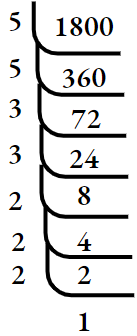
1. 1800

Taking LCM of 1800

Algebra LCM For 1880

∴ 2 x 2 x 2 x -3 x 3 x 5 x 5

∴ 23×32 x 52

∴ 1800 = 23 x 32 x 52

Index of prime number.

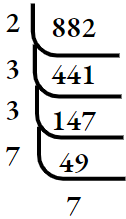
2. 882

Taking LCM of 882

Algebra LCM For 882

∴ 2 x3 × 3 ×7 x 7

∴2 x 32 x 72

∴ 882=2 x 32 x 72 index of prime number.

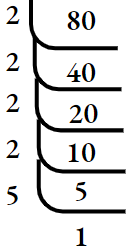
3. 80

Taking LCM of 80.

Algebra LCM For 80

∴ 2 x 2 x 2 x 2 x 5

∴ 24 x 5

∴ 80 = 24 x 5 index of prime number.

Class 7 Maths Chapter 3 Solved Exercises

Question 6. Simplify

  1. \(\frac{x^{-2} \times x^7}{x^8 \times x^{-4}}\)
  2. \(\frac{(18)^3 \times(2.5)^2}{(30)^4}\)

Solution:

1. \frac{x^{-2} \times x^7}{x^8 \times x^{-4}} \quad a^m \times d^n=a^{m-n}[/latex]

Here a = x, m = -2, n = 7 → Numerator

a = x, m = 8, n = -4 → Denominatore

⇒ \(\frac{x^{-2+7}}{x^{8+(-4)}}\)

⇒ \(\frac{x^5 x}{x^4}\)

∴ x

∴ \(\frac{x^{-2} \times x^7}{x^8 \times x^{-4}}=x\)

2. \(\frac{(18)^3 \times(2.5)^2}{(30)^4}\)

⇒ \(\frac{18 \times 18 \times 18 \times 25 \times 25}{30 \times 30 \times 30 \times 30}\)

⇒ \(\frac{58,32 \times 625}{810,000}\)

⇒ \(\frac{3.64,5,000}{810,000} \Rightarrow \frac{364.5}{810}=4.5\)

∴ \(\frac{(18)^3 \times(2.5)^2}{(30)^4}=4.5\)

Question 7. Find the value of

  1. \(\frac{7^3 \times 2^6 \times 10}{3.5 \times 224}\)
  2. \(\frac{3^4 \times 6^5}{72}\)

Solution:

1. \(\frac{7^3 \times 2^6 \times 10}{35 \times 224}\)

⇒ \(\frac{343 \times 64 \times 10}{35 \times 224}\)

⇒ \(\frac{219,520}{7840}\)

= 28

∴ \(\frac{7^3 \times 2^6 \times 10}{35 \times 224}=28\)

2. \(\frac{3^4 \times 6^5}{72}\)

⇒ \(\frac{81 \times 776}{72}\)

⇒ \(\frac{629,856}{72}=8748\)

⇒ \(\frac{3^4 \times 6^5}{72}=8748\)

WBBSE Maths Study Material Class 7

Question 8. Express in terms of index.

  1. \(\frac{(a b)^6 \times\left(a^2 c\right)^2}{\left(a^4\right)^2 \times(b c)^5}\)
  2. \(9 \times 27 \times 81 \times 243\) (index of 3)

Solution:

1. \(\frac{a^6 \times b^6 \times a^2 \times a^2 \times c^2}{a^4 \times a^4 \times b^5 \times c^5 c^3}\)

⇒ \(\frac{a^2 \times b}{c^3}\)

⇒ \(a^2 \times b \times c^{-3}\)

∴ \(\frac{(a b)^6 \times\left(a^2 c\right)^2}{\left(a^4\right)^2 \times(b c)^2}=a^2 \times b \times c^{-3}\)

2. \(9 \times 27 \times 81 \times 243\) (index of 3)

⇒ 3 x 3 x 9 x 3 x 9 x 9 x 3 x 81

⇒ 3 x 3 x 3 x 3 x 3 x 3 x 3 x 3 x 3 x 3 x 9 x 9

⇒ 3 x 3 x 3 x 3 x 3 x 3 x 3 x 3 x 3 x 3 x 3 x 3 x 3

⇒ 314

∴ 9 x 27 x 81 x 243 = 314


WBBSE Class 7 Maths Solutions For Algebra Chapter 2 Addition and Subtraction

Algebra Chapter 2 Exercise

Question 1. Choose the correct answers:

1. The value of (-6) x (-12) -(-4) x (+3) is

  1. 60
  2. -84
  3. 84
  4. -60

Solution:

⇒ (-6) x (-12)  – (-4) x (+3)

⇒+72 +12

⇒ +84

∴ The value of (-6) x (-12) – (-4) x (+3) is 84

Option (3) → 84 is the correct Answer

Read and Learn More Class 7 Maths Solutions

WBBSE Class 7 Maths Solutions For Algebra Chapter 2 Addition And Subtraction

2. If x = -2, y = 3 and z = -5 then the value of (x-y+z) is

  1. 0
  2. -4
  3. -10
  4. -4

Solution:

Given that

x = -2,

y = 3

z = -5

(x-y+z)=?

∴ (x-y+z) = {(-2) – (3) + (-5)}

Here Substituted the values of x,y,z

= {(-2-3-5)}

∴ (x-y+z) = -10

Option (3)=-10 is correct.

Class 7 Algebra Problems With Solutions 

3. The value of 4(3+1)÷(-4) of (2) is

  1. 2
  2. -2
  3. 8
  4. -8

Solution:

⇒ 4(3+1) ÷ (-4) Of (-2)

⇒  4(3+1) ÷ (-4)

⇒ 4(4) ÷ (-4)

⇒ 16÷(-4)

⇒ -4

∴ -4 of (-2)

Question 2. Write true or false:

  1. a ÷ (b + c) = \(\frac{a}{b} + {a}{c}\)
  2. If a and b are two different integers then a + b = b + a but a-b ≠ b-a
  3. For any three integers, the law of association of integers is not valid in the case of subtraction.

Solution:

  1. False
  2. a+b = b+a but a-b ≠ b-a; True
  3. True

Question 3. Fill in the blanks

  1. (-15) ÷ (-5) ÷ (-3)=
  2. (-1) x (-2) x (-3) × ____ = (-5) × (-6)
  3. (-20) ÷ (-4) of 5 x 2 = _____

Solution:

1. (-15)÷(+5)=(-3)

⇒ \(\frac{-15}{-5}{\frac{-3}{-1}}\)

⇒ \(\frac{-15}{-5} \times \frac{1}{-3}\)

⇒ -1

∴ (-15) ± (-5) ÷ (-3) = -1

2. (-1) x (-2 )x (-3) × _____ = (-5) x (-6)

(-1) x (-2)× (-3) × x = (-5)× (-6)

Let the number be x

⇒ 2 × (-3) x x = 30.

⇒ -3x = \(\frac{30}{2}\)

x = \(\frac{15}{-3}\)

∴ x = -5

∴ (-1) × (-2) x (-3) × (-5) = (-5) x (-6)

3. (-20) ÷ (-4) of (5 x 2 )= _____

⇒ (-20) ÷ (-4) of (5×2)

⇒ (-20) ÷ (-20) x (2)

⇒ (+1) x (2)

⇒ 2

∴ (-20) ÷ (-4) of (5 x 2) = 2

Class 7 Maths Algebra Solutions WBBSE

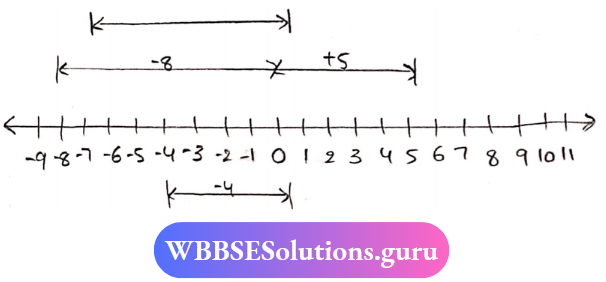
Question 4. Find the Sum with the help of a number line.

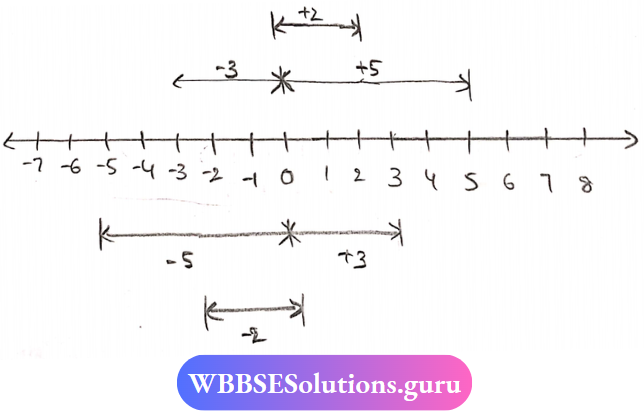
  1. (-8)+(+5)+(-4)
  2. (-7)+(-3)+(+10).

Solution:

1. (-8)+(+5) + (-4)

⇒ -8 + 5 -4

⇒ -12 + 5

⇒ -7

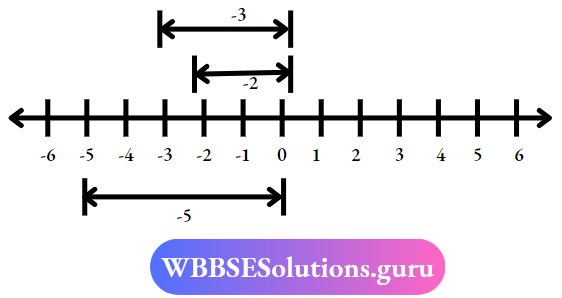
Algebra Number Line At -8 5 And -4

2. (-7) + (-3) + (+10)

⇒ (-7-3+10)

⇒ -10 + 10

⇒ 0

Algebra Number Line At -7, 10 And -3

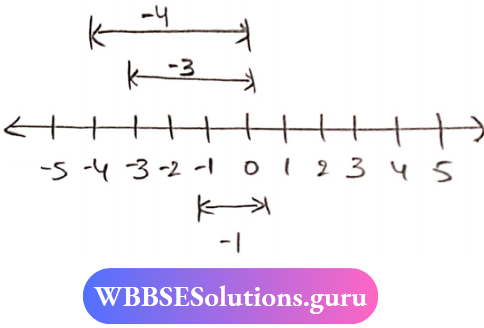
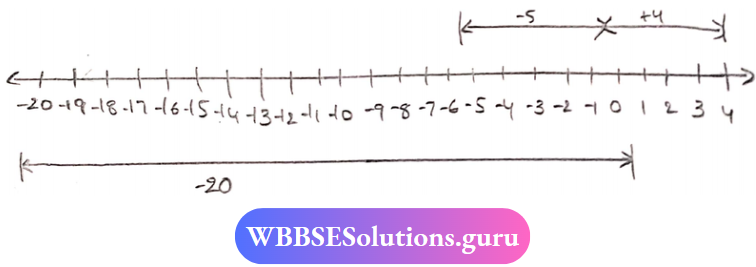
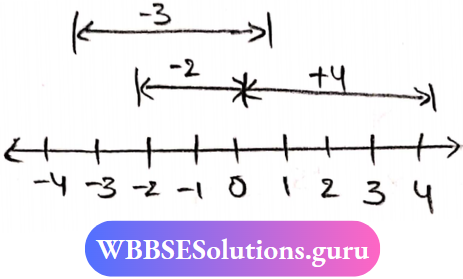
Question 5. Find the values of the following on the number line:

  1. (-4)-(-3)
  2. (-5)x(+4)
  3. (-3)+{(+4)+(-2)}
  4. (-8)÷(+2)

Solution:

1. (-4) – (-3)

⇒ -4 + 3

⇒ -1

Algebra Number Line At -4, -3 And -1

2. (-5) x (+4)

⇒ -20

Algebra Number Line At -5, 4 And -20

3. (-3)+{(+4)+(-2)}

⇒ (-3) + {4-2}

⇒ -3 +2

⇒ -1

Algebra Number Line At -3, -2 And -4

4. (-8) ÷ (+2)

⇒ -4

WBBSE Class 7 Maths Chapter 2 Answers

Question 6. Verify if the distributive law of multiplication holds for integers:

  1. (-5) x {(-2)+(-4)}
  2. (+8) ÷ {(+4)+(-2)}

Solution:

(-5) x {(-2)+(-4)}

⇒ (-5) x {-6}

⇒ +30

Or,

(-5) x (-2) + (-5) x (-4)

⇒ (-10) + (-20)

⇒ +30

∴ (-5) × {(-2) + (-4)}

= (-5) X (2) + (-5) x (-4)

∴ The distributive face of multiplication is verified

Question 7. The temperature of Kashmir is 24°C If the temperature reduces uniformly every hour and reaches to -4°C after 7 hours. Find the rate of reduction of temperature. per hour.
Solution:

Given Data,

The temperature of Kashmir is (Ti) = 24°C

Final Temperature after 7hrs (Tc) = -4°C

Change in temperature is Tf-Ti = -4-24 = -28°C

∴ Rate of Reduction = \(\frac{\text { change in temperature }}{\text { Time }}\)

= \(\frac{-28}{7}\)

= -4°c/hour.

∴ The rate of reduction of temperature per hour is 4°C

WBBSE Class 7 Algebra Exercise Solutions

Question 8. Draw a number line and verify with examples that the commutative law of Subtraction does not hold.
Solution:

Let us take a simple example

  1. 5-3=2 and also
  2. 3-5=-2

These results are not the same.

∴ The commutative law of Subtraction does not hold true for these numbers.

Algebra Number Line At -2 and 2

Question 9. By what number should be added to ((-5)x(4)-(+3) to get the number [{(-12) (-3)}x (-2)]
Solution:

⇒ [{(-12) ÷ (-3)} x (-2)] – {(5)x(4)-(+3)}

⇒ [{\(\frac{-12}{-3}\) x(-2)] – {(20-3)}

⇒ [4 x (2)] – (17)

⇒ -8-17

⇒ -25

∴ {(-5)× (4) −(+3)} to get the number [{(-12) ÷ (-3)} × (-2)] is -25

Algebra Formulas For Class 7 WBBSE

Question 10. Find the value of [720÷ (21+3) ÷ (-6) x 5] ÷ (-25)  
Solution:

⇒ \([720 \div(21+3) \div(-6) \times 5] \div(-25)\)

⇒ \([720 \div(24) \div(-30)] \div(-25)\)

⇒ \(\left[\frac{\frac{720}{24}}{(-30)}\right] \div(-2.5)\)

⇒ \(\left[\frac{720}{24} \times \frac{1}{(-30)}\right] \div(-25)\)

⇒ \(\left(\frac{720}{-720}\right) \div(-25)\)

⇒ \((-1) \div(-25)\)

⇒ \(\frac{+1}{+25}\)

∴ 0.04

∴ \([720 \div(21+3) \div(-6) \times 5] \div(-25)=0.04\)


WBBSE Class 7 Maths Solutions For Algebra Chapter 1

Algebra Chapter 1 Revision

Question 1. The sum of 9 and (-y) is
Solution:

Sum of ‘a’ and ‘b’ is (a + b)

⇒ 9 + (-y)

⇒ a + (b)

⇒ Here a = 9;

b = -y

⇒ a – b

∴ The sum of 9 and (-y) is a-b

WBBSE Class 7 Maths Solutions For Algebra Chapter 1 Revision

Question 2. What must be done added to (-17) to get 12?
Solution:

The number which is added to be (-17) to get 2 is {a+b}

Let us assume a = -17

b = 12

⇒ {12 -(-17)}

⇒ {12 + 14}

⇒ 29

∴ Added to (-17) to get (12) is 29

Read and Learn More Class 7 Maths Solutions

Class 7 Algebra Problems With Solutions

Question 3. The value of (-2) x (-3) x (-5) is
Solution:

⇒ (-2)² x (-3)² x (-5) a² = a x a

⇒ (-2) x (-2) x (-3)² x (-3) x (-5)

⇒ 4 x 9 x (-5)

⇒ 36 x (-5)

⇒ -180

∴ The value of (-2)² x (-3)² x (-5)² is -180

Question 4. Write ‘true or false’

1. A profit of -10 rupees means that loss of 10 rupees.
Solution: The statement is true

2. If the length and breadth of a rectangle are ‘ and ‘y’ respectively, its semi-perimeter is 2(x+y).
Solution:

Semi-Perimeter is (x + y),

So the statement is false

3. The difference between the two numbers is x. If the greater number is y then the least number is (x+y).
Solution:

The least number is (y-x)

So the statement is false

Algebra Questions For Class 7 WBBSE

Question 3. Fill in the blanks.

1. The value of (-5)² x (-7) x (-6) is
Solution:

⇒ (-5)² x (-7) x (-6)

⇒ (-5)x (-5) × (7) ×(-6)  a² = a x a

⇒ 25×42

⇒ 1050

∴ The value of (-5)² x (-7) x (-6) is 1050

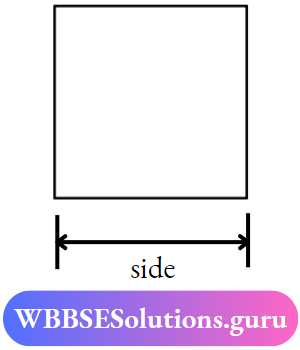
2. If the perimeter of a square is x cm, then its area is ________ Sq. cm.
Solution:

The perimeter of the square is x cm.

Length of each side is \(\frac{x}{4}\) cm

Area Of Square

Area is \(\left(\frac{x}{4}\right)^2\) sq cm

Area = \(\frac{x^2}{16}\) Sq.cm

3. The absolute value of (-3) is
Solution: 3

WBBSE Class 7 Algebra Chapter 1

Question 4. Write in language the following expressions.

  1. x/4 – 3
  2. a </ 4
  3. 3P-2

Solution:

  1. x/4 -3 ⇒  Three less than one fourth of ‘x’
  2. a </ 4 ⇒ ‘a’ is not less than four.
  3. 3P-2 ⇒ 2 is less trim three times of p

Question 5. Form the algebraic expansion with signs and Symbols:

  1. 5 is subtracted from 4 times y
  2. 4 is not less than x
  3. x is not equal to ‘y’.
  4. The sum of Five times y and 6.

Solution:

  1. 5 is subtracted from 4 times y ⇒ 4y-5
  2. 4 is not less than ‘x’ ⇒ 4 </ x
  3. ‘x’ is not equal to ‘y’ ⇒ x ≠ y
  4. The sum of five times y and ‘6’ ⇒ 5y+6

Question 6. Subtract using the Concept of opposite number:-

  1. (-13)-(-16)
  2. (+12)-(-15)
  3. (-17)-(+18)
  4. (+10)-(+15)

Solution:

1. (-13)-(-16) ⇒ Subtract with opposite number.

⇒ (-13)+(+16)

⇒ +3

⇒ (-13)-(-16)=+3

2. (+12) – (-15)

⇒ (+12) + (opposite number (-15))

⇒ (+12)+(+15)

⇒ +27

∴ (+12)-(-15) = +27

3. (-17)-(+18)

⇒ (-17)+(opposite number +18)

⇒ (-17)+(-18)

⇒ -35

∴ (-17)-(+18)= -35

4. (10) – (+15).

⇒ (+10)+(opposite number of +15)

⇒ (+10) + (-15)

⇒ -5

∴ (10)-(+15)=-5

Class 7 Maths Algebra Solutions WBBSE

Example: 7 Simplify: 10(opposite number of -25)-(opposite number of +12)- (opposite number of -18) – (-6).
Solution:

⇒ 10 -(+25)-(-12) – (+18)-(-6).

⇒ 10-25+12-18+6

⇒ (10+12+6) – (25+18)

⇒ 28-43

⇒ -15

⇒ 10-(+25)-(-12)-(+18) -(-6)=-15

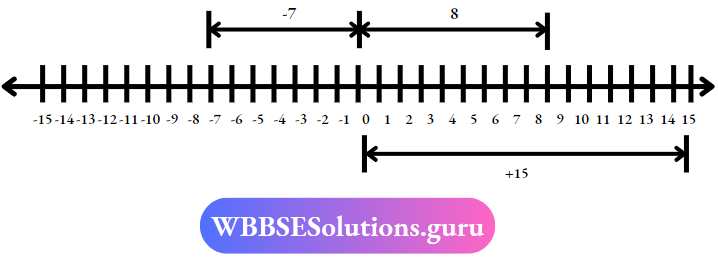
Question 8. Add the following on the number line:

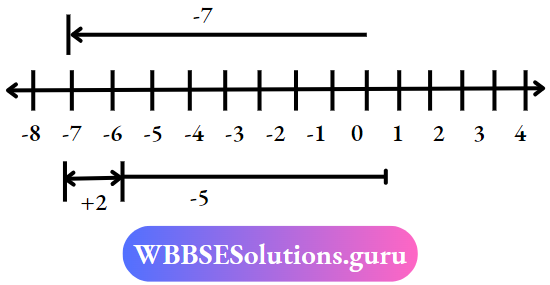
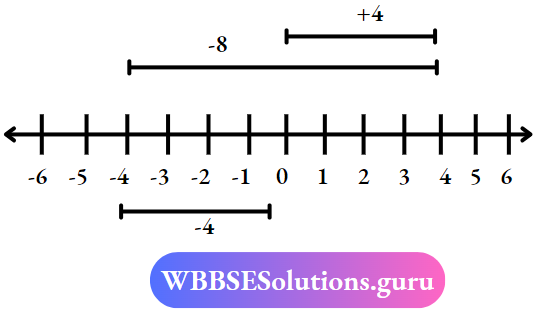
  1. (-7), (+2);
  2. (+ 4), (-8).

Solution:

1. (-7), (+2)

⇒ -7 +2

= -5

Number Line At -7 And +2

2. (+4), (-8)

⇒ (+4)+(-8)

⇒ 4-8

⇒ -4

Number Line At 4 And -8

WBBSE Class 7 Algebra Exercise Solutions

Question 9. Verify associative property of addition. (-5), (-3), (+2)
Solution:

⇒ {(-5) + (-3)} + (+2)

⇒ {(-8) + (+2)}

∴ -6

Or,

⇒ (-5) + {(-3) + (+2)}

⇒ (-5) + {(-1)}

∴ -6

So, {(-5) + (-3)} + (+12) = (-5) + {(-3) + (+2)}

∴ The associative property of addition is verified.

Question 10. Find what must be added to the first to get the Second.

  1. (-15), (-10)
  2. (+6), (-18).

Solution:

1. The number which added to the (-15) to get (-10) is

⇒ (-10) -(-15)

⇒ (-10) + 15

⇒ +5

∴ (-15), (-10) = +5

2. (+6), (-18)

The number added to the (+6) to get (18) is.

⇒ (-18) – (+6)

⇒ -18-6

⇒ -24

The required number is (-18) – (+6) = -24

Algebra Chapter 1 Exercise 2

Question 1. Choose the correct answer:

1. The sum of two numbers is a; if the least number is b. then the greater number is

  1. a-b
  2. a+b
  3. b-a
  4. None of these.

Solution:

Let us assume the two numbers are x, y

Given that,

⇒ The sum of two numbers is ‘a’

⇒ x+y=a ……(1)

Given condition.

If the least number is ‘b’

Now, y = b

∴ x + b = a

x = a-b

∴ The greater number is x = a -b so, option (1) is correct.

2. If the length and breadth of a rectangle are X cm and Y cm then its Area is

  1. 2(x+y) Sq cm.
  2. хуcm
  3. xy sq. cm
  4. x/y sq. cm

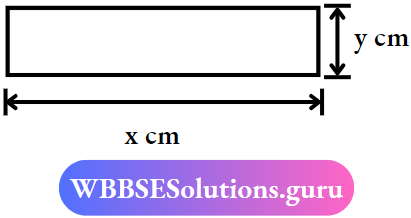
Solution:

Given Rectangle Dimensions.

Length (l) = x cm

breadth (b) = y cm

Area =?

Rectangle Dimensions

we know that,

⇒ The area of the rectangle is length x breadth.

⇒ l x b

⇒ х х у

∴ xy sq. cm

∴ The area of the rectangle is xy sq cm.

∴ The correct answer is option 3

Class 7 Maths Chapter 1 Solved Exercises

3. If the digits in the unit’s place and ten’s place are x and y respectively, then the number is.

  1. x+y
  2. 10x+y
  3. 10y+2
  4. 10(x+y)

Solution:

This problem is solved by verifying the options.

Given condition:

⇒ The digits in the unit’s place and ten’s Place are x and y.

∴ The number is y+x

The unit’s place digit is ‘x’

The ten’s place digit is y.

Here the equation is 10y+x.

The correct answer is ‘3’

Question 2. Write true or false:

  1. The value of (+3)+(-6)+(+9) Is 0.
  2. The value of (-2)2 x 52x (-3)2 is 900
  3. \(\frac{1}{x}+\frac{1}{y}=\frac{x+y}{x y}\)

Solution:

1. The value of (+3) + (-6) + (+9) = 0

⇒ +3+(-6)+(+9)

⇒ 3-6+9

⇒ 12-6

⇒ 6 ≠ 0

∴ The value of (13) + (-6) + (+9) is ‘0’ → False

2. The value of (-2)² x (5)² x (-3)²

⇒  (-2)² x (5)² × (-3)²

⇒ 4 × 25 × 9

⇒  100×9

⇒  900

∴ The value of (-2)x(5) x (-3)² = 900 True

3. \(\frac{1}{x}+\frac{1}{y}=\frac{x+y}{x y}\)

⇒ \(\frac{1}{x}+\frac{1}{y}\) {Lcm of x, y}

⇒ \(\frac{y+x}{x y} \Rightarrow \frac{x+y}{x y}\)

∴ The value of \(\frac{1}{x}+\frac{1}{y}=\frac{x+y}{x y}\) is True.

Question 3 Fill in the blanks:

  1. The absolute value of (-15) is
  2. The Value of (-18) ÷ (-3) is
  3. The difference between two numbers is ‘x’; if the greater number is ‘p’ then the last one is ________

Solution:

1. The absolute value of (-15) is 15

2. The Value of (-18)= ÷ (-3) is 6

3. The difference between two numbers is ‘x’; if the greater number is ‘p’ then the last one is p-x

a-b = x  Let the two numbers be ab

p-b = x Greater number is p’ then a = P

∴ Least number = b

b= p – x

Class 7 Algebra Problems With Solutions 

Question 4. From two Algebraic expressions.

  1. 5 is not greater than ‘y’
  2. x is Subtracted from 6 times p.
  3. The difference of 7 times between ‘a’ and ‘b’

Solution:

  1. 5 >/ y
  2. 6p – x
  3. 7(a-b)

Question 5. Write in language the following expression:

  1. \(\frac{p}{6}\) – 8
  2. x + y + 7
  3. 3a-b
  4. x >/ Y

Solution:

  1. \(\frac{p}{6}\) ⇒ 8 ‘g’ is subtracted from one-sixth of “p’.
  2. (x+y+z) ⇒ The sum of x,y,z
  3. (3a-b) ⇒ ‘b’ is subtracted from three times ‘a’
  4. (x >/ y) ) ⇒ ‘x’ is not greater than ‘y’

Question 6. Subtract using the concept of opposite numbers.

  1. (+16)-(-25)
  2. (-15)-(+36)
  3. (-18)-(-6)

Solution:

1. (+16)-(-25)

⇒ (+16)+(opposite number of (-25)).

⇒ (+16)+(25)

⇒ +41

∴ (+16)-(-25)= +41.

2. (-15)-(+36)

⇒ (-15)+(opposite number of (+36))

⇒ (-15)+(-36)

⇒ -51

∴ (-15)-(+36) = -51

3. (-18)-(-6)

⇒ (-18)+(opposite number of (-6))

⇒ (-18) + (+6)

⇒ -12

∴ (-18)-(-6) =-12

Algebra Questions For Class 7 WBBSE

Question 7. Adding on a number line

  1. (-7) + (+15)
  2. (+25)+(-20)
  3. (-3)+(-2)

Solution:

1. (-7)+(+15)

⇒ -7+15

⇒ +8

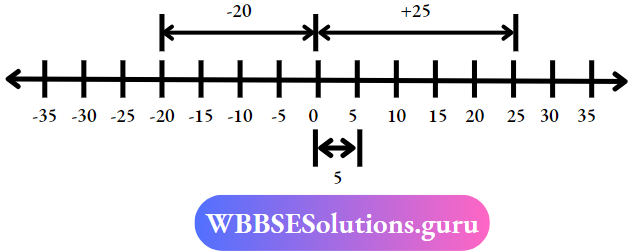
Number Line At -7 And 15

2. (+25)+(-20)

⇒ +25-20

⇒ +5

Number Line At -20 And 25

3. (-3)+(-2)

WBBSE Class 7 Algebra Chapter 1

Question 8. Add the following

  1. (-14), (+12), (-16)
  2. (+13), (-4), (-9)
  3. (-18), (-12) (+19)

Solution:

1. (-14) + (+12) + (-16)

⇒ -14 +12-16

⇒ +12-30

⇒ -18

2. (+13)+(-4)+(-9)

⇒ 13-4-9

⇒ 13-13

⇒ 0

3. (-18) + (-12)+(+19)

⇒ -18-12+19

⇒ -30+19

⇒ -11

Question 9. Find what must be added to the first to get the second:

  1. (-13), (+15)
  2. (+18), (-19)
  3. (+18), (-17)

Solution:

1. (-13), (+15)

The number added to the (-13) to get (+15) is

⇒ (15)-(-13)

⇒ 15+13

⇒ +28

∴  (-13), (+15)= +28

The number that must be added to the First to get the second is +28

2. (+18), (-19)

The required number is (-19)-(+18)

⇒ (-19)-(+18)

⇒-19-18

⇒ -37

3. (+18), (+7).

The required number is (+7) – (+18)

⇒ +7-18

⇒ -11

The number that must be added to the first to get the second is -11

Class 7 Maths Algebra Solutions WBBSE

Question 10. Verify the Associative property of addition for the following.

  1. (-3)(-2), (-5)
  2. (-7) (+9), (-8)
  3. (+4) (-6) (-10)

Solution:

1. (-3)(-2), (-5)

Associative Property {(a) + (b)} + c = (a)+{(b) + (c)}

{(-3)+(-2)}+(-5)

⇒ {-3-2} – 5

⇒ {-5-5}

⇒ -10

or,

⇒ (-3) + {(-2)+(-5)}

⇒ (3)+ {-2-5}

⇒ (-3)+{-7}

⇒ -3-7

⇒ -10

So, {(-3) + (-2)} +(-5) = (-3)+ {(-2)+(-5)}

2. (-7) (+9), (-8)

⇒ {(-7)+(+9)}+(-8)

⇒ {(-7 +9)} +(-8)

⇒ (+2)+(-8)

⇒ +2-8

⇒ -6

Or,

(-7) + {(+9) + (-8)}

⇒ (-7) + {9-8}

⇒ (-7) + (+1)

⇒ -7 + 1

⇒ -6

So, {(7) + (+9)} + (-8) = (-7) + {(+9) + (-8)}

3. (-14), (-6), (-10)

⇒ {(-14)+(-6)}+(-10)

⇒ {(-14-6)} +(-10)

⇒ (-20)-10

⇒ -30

Or,

⇒ (-14)+{(-6)+(-10)}

⇒ (-14)+{-6-10}

⇒ (-14)+(-16)

⇒ -30

So, {(-14)+(-6)} +(-10) = (-14) + {(-6) + (-10)}

WBBSE Class 7 Algebra Exercise Solutions

Question 11. Simplify 18-(-7)+(opposite number of -15)-(opposite number -6) -(opposite number of +14).
Solution:

⇒ 18-(-7) + (+15) −(+6) −(-14)

⇒ 18+7+15-6+14

⇒ 25+ 15-6 +14

⇒ 54-6

⇒ 48.

∴ 18-(-7)+(+15)-(+6)-(-14)=48

Question 12.If a= -2, b=-3, c = +6, then Find the values of

  1. (a – b + c)
  2. (a x b) ÷ c
  3. a ÷ b x c
  4. a + b ÷ c

Solution:

1. (a – b + c)

⇒ (-2) – (-3) + 6

⇒ (-2)+3+6

⇒ -2+9

⇒ 7

2. (a x b) ÷ c

⇒ (-2)+(-3)÷6

⇒ (2)x(-0.5)

⇒ 1

3. a ÷ b x c

⇒ (-2) ÷ (-3) x (+6)

⇒ 0.6 x 6

4

4. a + b ÷ c

⇒ (-2) + (-3) ÷ 6

⇒ (-2) – 0.5

= -2.5

⇒ -5/2


WBBSE Solutions For Class 10 Maths Mensuration Chapter 4 Sphere

Mensuration Chapter 4 Sphere

⇔ A sphere is a solid boundary by one surface and it may be seen to be generated by the revolution of a semi circle about its diameter an axis.

⇒ If the radius of a sphere be r, then

⇒ The area of the surface = π x (diameter)2 = 4πr2 sq. units

WBBSE Solutions For Class 10 Maths Mensuration Chapter 4 Sphere Sphere Area Of The Surface

⇒ Volume = \(\frac{4}{3}\)πr3 cubic units.

⇒ The volume of a hollow sphere = \(\left(\frac{4}{3} \pi R^3-\frac{4}{3} \pi r^3\right) \text { cu. units }=\frac{4}{3} \pi\left(R^3-r^3\right) \text { cu. units }\)

⇒ (External radius = R units, internal radius = r units)

Read and Learn More WBBSE Solutions for Class 10 Maths

⇒ The area of the whole surface and the volume of a hemisphere

WBBSE Solutions For Class 10 Maths Mensuration Chapter 4 Sphere Sphere Area Of The Whole Surface And Volume Of The Hemisphere

  1. Area of curved surface = 2πr2 sq. units
  2. Area of whole surface = 3πr2 sq. units
  3. Volume = \(\frac{2}{3}\)πr2 cu. units.

WBBSE Solutions For Class 10 Maths Mensuration Chapter 4 Sphere

Mensuration Chapter 4 Sphere True Or False

Example 1. If we double the length of radius of a solid sphere, the volume of sphere will be doubles.

[Hints: \(\frac{4}{3} \pi(2 r)^3=8 \times \frac{4}{3} \pi r^3\)]

Solution: False

Class 10 Mensuration Chapter 4 Solved Examples

Example 2. If the ratio of the curved surface areas of two hemisphere is 4: 9, the ratio of their lengths of radius is 2 : 3.

Hint: \(\frac{2 \pi r_1^2}{2 \pi r_1^2}=\frac{4}{9} \Rightarrow \frac{r_1}{r_2}=\frac{2}{3}\)

Solution: True

Example 3. Curved surface area of sphere = 4 x (area of the circle with radius r units)

Solution: True

Example 4. The curved surface area ≠ whole surface area for a solid sphere.

Solution: False

Example 5. No. of plane surface area of a sphere is 1.

Solution: False

Example 6. Volume of a solid hemisphere = \(\frac{1}{2}\) x volume of sphere with same radius.

Solution: True

Wbbse Class 10 Mensuration Notes

Example 7. If the length of outer radius and inner radius of hollow sphere are R and r units respectively, volume of metal is required to make the hollow sphere is \(\frac{4}{3}\)π (R3 – r3) cu. units.

Solution: True

Example 8. No. of corner points of a sphere is 2.

Solution: False

WBBSE Notes For Class 10 Geography And EnvironmentWBBSE Notes For Class 10 History And Environment
WBBSE Solutions For Class 10 Life ScienceWBBSE Class 10 Life Science Multiple Choice Questions
WBBSE Solutions for Class 10 MathsWBBSE Class 10 Maths Multiple Choice Questions
WBBSE Notes For Class 10 Physical Science And Environment

Mensuration Chapter 4 Sphere Fill In The Blanks

Example 1. The name of the solid which is composed of only one surface is _______

Solution: sphere

Example 2. The number of surface of a solid hemisphere is _______

Solution: 2

Example 3. If the length of radius of a solid hemisphere is 2r units, its whole surface area is ________ sq. units.

Solution: 12

Example 4. An icecream is a shape of a cone and a _________

Solution: hemisphere

Surface Area And Volume Of Sphere Class 10

Example 5. If curved surface area and volume of a sphere are S and V respectively, then relation between S and V is _______

Solution: S3 = 36 πr2

Example 6. If length of radii of a cylinder and a hemisphere are equal, then ratio of their volumes is ________

Solution: 3: 2

Example 7. Volumes of a sphere of radius r units and a cube of length a units are equal, r : a = _________

Solution: 3 √21: 23 √11

Example 8. Volume of a biggest solid cone made from a solid hemisphere of radius r unit is ________

Solution: πr3

Example 9. If length of the radius of a hemisphere ps 2r units, then total surface area is _______ cu.

Solution: 12 πr2

Example 10. If ratio of length of radii of two sphere is 2 : 3, then ratio of their volumes is _______

Solution: 8: 27

Class 10 Maths Mensuration Important Questions

Mensuration Chapter 4 Sphere Short Answer Type Questions

Example 1. The numerical values of volume and whole surface area of a solid hemisphere are equal, let us write the length of radius of the hemisphere.

Solution: \(\frac{2}{3} \pi r^3=3 \pi r^2\)

or, r = \(\frac{9}{2}\) = 4.5 units

Example 2. The curved surface area of a solid sphere is equal to the surface area of a solid cylinder. The lengths of both height and diameter of cylinder are 12 cm. Write the length of the radius of the sphere.

Solution: 2π (6).12 = 4 πr2

or, r2 = \(\frac{12 \times 12}{4}\)

∴ r = 6 cm

Example 3. Whole surface area of a solid hemisphere is equal to the curved surface area of the solid sphere. Let us write the ratio of lengths of radius of hemisphere and sphere.

Solution: \(3 \pi r_1^2=4 \pi r_1^2\)

or, \(\frac{r_1^2}{r_2^2}=\frac{4}{3}\)

∴ \(r_1: r_2=2: \sqrt{3}\)

Example 4. If curved surface area of a solid sphere is S and volume is V, write the value of \(\frac{S^3}{V^2}\) (not putting the value of π).

Solution: S = 4πr2, V = \(\frac{4}{3}\) πr3

∴ \(\frac{s^3}{V^2}=\frac{\left(4 \pi r^2\right)^3}{\left(\frac{4}{3} \pi r^3\right)^2}\) = 9 x 4 = 36

Example 5. If the lengths of radius of a sphere is increased by 50%, let us write how much percent will be increased of its curved surface area.

Solution: Change of curved surface area

[r1 and r2 are the lengths of radii of hemisphere and sphere respectively]

= \(4 \pi\left\{\left(r+\frac{r}{2}\right)^2-r^2\right\} \text { sq. units }\)

= \(4 \pi\left(\frac{9 r^2-4 r^2}{4}\right) \text { sq. unit }\)

= \(\pi \times 5 r^2\)

% change = \(\frac{5 \pi r^2}{4 \pi r^2} \times 100 \text { sq.u }=125 \text { sq units. }\)

Class 10 Mensuration Chapter 4 Solved Examples

Example 6. The external and internal radii of a hollow sphere are 4 cm and 3 cm respectively. Find the volume of metal.

Solution: Volume = \(\frac{4}{3} \pi\left(4^3-3^3\right)\) cu. cm

= \(\frac{4}{3}\) x \(\frac{22}{7}\) x 37 cu. cm = 155\(\frac{1}{21}\)

Example 7. Find the ratio of the whole surface areas of a hemisphere and a sphere of the same radius.

Solution: Let the length of the radius = r unit

Required ratio = 3 πr2 : 4 πr2 = 3 : 4.

Example 8. A cylinder and a sphere have equal volume. The diameter of the cylinder is equal to the radius of the sphere. Find the relation between the height of the cylinder and radius of that.

Solution: Let the length of the cylinder = r unit, height = h unit

∴ radius of the sphere = 2r unit

ATP, \(\pi r^2 h=\frac{4}{3} \pi(2 r)^3\)

or, h = \(\frac{32}{3}\) r

Example 9. The perimeter of the base of a solid iron hemisphere is 6\(\frac{2}{7}\) metres. Find its volume.

Solution: 2πr = 6\(\frac{2}{7}\)

or, r = \(\frac{44 \times 7}{7 \times 2 \times 22}=1\)

Volume = \(\frac{1}{2} \times\left(\frac{4}{3} \pi r^3\right)=\frac{2}{3} \pi r^3=\frac{2}{3} \times \frac{22}{7} \times(1)^3\)

= \(\frac{44}{21}=2 \frac{2}{11} \text { cu. metres. }\)

Wbbse class 10 Maths Mensuration Solutions

Example 10. A sphere of diameter 1 metre is cut out from a wooden cube of edge 1 metre. Find the volume of the remaining wood in the cube.

Solution: Volume of sphere = \(\frac{4}{3} \pi\left(\frac{1}{2}\right)^3\) cu. mt.

= \(\frac{\pi}{6}\) cu. mt.

= \(\frac{22}{7 \times 6}\) cu. mt.

= \(\frac{11}{21}\) cu. mt.

∴ Volume of remaining woods = (13 – \(\frac{11}{21}\)) cu.mt = \(\frac{10}{21}\) cu.mt

WBBSE Solutions For Class 10 Maths Mensuration Chapter 3 Right Circular Cone

Mensuration Chapter 3 Right Circular Cone

⇔ The solid generated by the revolution of a right-angled triangle about one of the sides containing the right angle as axis is called a right circular cone.

⇒ If h be the height, r the radius of the base, and l the slant height of a right circular cone, then we have.

WBBSE Solutions For Class 10 Maths Mensuration Chapter 3 Right Circular Cone

  1. The area of curved surface = \(\frac{1}{2}\) (circumference of the base) x slant height = πrl sq. unit.
  2. l2 = h2 + r2.
  3. The area of the whole surface area = πrl + πr2 = πr (l + r) sq. units.
  4. Volume = \(\frac{1}{3}\)πr2h cubic units.

Read and Learn More WBBSE Solutions for Class 10 Maths

WBBSE Solutions For Class 10 Maths Mensuration Chapter 3 Right Circular Cone

Mensuration Chapter 3 Right Circular Cone True Or False

Example 1. If the length of base radius of a right circular cone is decreased by half and its height is increased by twice of it then the volume remains same.

(Hints: Volume = \(\frac{1}{3} \pi\left(\frac{r}{2}\right)^2 \cdot 2 h=\frac{1}{2} \cdot \frac{1}{3} \pi r^2 h \neq \frac{1}{3} \pi r^2 h\))

Solution: False

Example 2. The height, radius and slant height of a right circular cone are always the three sides of a right angled triangle.

Solution: True

Class 10 Maths Mensuration Chapter 3 Solutions

Example 3. Total surface area of a cone which one face open is πrl sq. units.

Solution: True

Example 4. Height of a cone = \(\sqrt{(\text { slant height })^2+(\text { radius })^2}\)

Solution: False

Example 5. Volume of a cone= \(\frac{1}{3}\) x volume of cylinder if heights and length of radii are same for both.

Solution: True

Example 6. The radius and the height of a cone are increased by 20%. Then the volume of the cone is increased by 60%.

Solution: False

Example 7. Curved surface area = \(\pi r \sqrt{r^2-h^2} \text { sq. u. }\)

Solution: True

Combination Of Solids Class 10 Solutions

Example 8. The sharpened end of a pencil is an example of a cone.

Solution: True

WBBSE Notes For Class 10 Geography And EnvironmentWBBSE Notes For Class 10 History And Environment
WBBSE Solutions For Class 10 Life ScienceWBBSE Class 10 Life Science Multiple Choice Questions
WBBSE Solutions for Class 10 MathsWBBSE Class 10 Maths Multiple Choice Questions
WBBSE Notes For Class 10 Physical Science And Environment


Mensuration Chapter 3 Right Circular Cone Fill In The Blanks

Example 1. AC is the hypotenuse of a right-angled triangle ABC, the radius of the right circular cone formed by revolving the triangle once around side AB as axis is _____

Solution: BC

Example 2. If the volume of a right circular cone is V cubic unit and the base area is A sq. unit, then its height is _______

Solution: \(\frac{3V}{A}\)

Example 3. The lengths of the base radii and the heights of a right circular cylinder and a right circular cone are equal. The ratio of their volumes is ________

Solution: 3: 1

Example 4. If the heights of two cones are equal the ratio of their volumes is ________

Solution: (Ratio of radii)2

Class 10 Mensuration Chapter 3 Solved Examples

Example 5. If heights of two cones are equal the ratio of their volumes is _______

Solution: 1: √3

Example 6. Centre of a semicircular paper is O and diameter is AB. A _______ is formed as OA and OB are joined.

Solution: Diameter

Example 7. A _____ is generated by the revolution of a right angled triangle about one of the sides containing the right angle an axis.

Solution: cone

Example 8. The Bare of a right circular cone is ________

Solution: circular

Mensuration Chapter 3 Right Circular Cone Short Answer Type Questions

Example 1. A solid circular cylinder is made by melting a solid circular cone. The radii of both are equal. If the height of the cone is 15 cm, then find the height of the solid cylinder.

Solution: πr2h = \(\frac{1}{3}\)πr2 (15)

∴ h = 5 cm

∴ Required height 5 cm.

Example 2. The height of a right circular cone is 12 cm and its volume is 100 π cm3. Write the length of the ratius of the cone.

Solution: \(\frac{1}{3}\)πr2h = 100π

or, \(\frac{1}{3}\).π.r2.12 = 100π

or, r = 5 cm.

Example 3. The curved surface area of a right circular cone is √5 times of its base area. Write the ratio of the height and the length of radius of the cone.

Solution: πrl= √5πr2

or, πr \(\sqrt{r^2+h^2}\) = √5πr2

or, r2( r2+ h2) = 5r2.r2

or, 4r2 = h2

∴ h : r = 2:1

Wbbse Class 10 Mensuration Notes

Example 4. If the volume of a right circular cone is V cubic unit, base area is A sq unit and height is H unit, find the value of \(\frac{AH}{V}\).

Solution: \(\frac{\mathrm{AH}}{\mathrm{V}}=\frac{\pi r^2 \cdot h}{\frac{1}{3} \pi r^2 h}=3\)

Example 5. The numerical values of the volume and the lateral surface area of a right circular cone are equal. If the height and the radius of the H and r respectively, then find the value of \(\frac{1}{h^2}+\frac{1}{r^2}\).

Solution: \(\frac{1}{3} \pi r^2 h=\pi r \sqrt{\left(h^2+r^2\right)}\)

or, \(r^2 h^2=9\left(h^2+r^2\right)\)

or, \(\frac{h^2+r^2}{r^2 h^2}=\frac{1}{9}\)

or, \(\frac{1}{r^2}+\frac{1}{h^2}=\frac{1}{9}\)

Example 6. The ratio of the lengths of the base radii of a right circular cylinder and a right circular cone is 3: 4 and the ratio of their heights is 2 : 3. Write the ratio of the volume of the cylinder and cone.

Solution: \(\frac{\pi r_1{ }^2 h_1}{\frac{1}{3} \pi r_2{ }^2 h_2}=3\left(\frac{3}{4}\right)^2 \cdot\left(\frac{2}{3}\right)\)

= \(3 \times \frac{9}{16} \times \frac{2}{3}=9: 8\)

Example 7. Lateral surface area of a cone is √10 times the length of radius. Find the ratio of height and length of the diameter.

Solution: πr\(\sqrt{r^2+h^2}\) = √10.πr2

or, r2 + h2= 10r2

or, 9r2= h2

or, \(\frac{h}{2r}=\frac{3}{2}\) = 3: 2

Example 8. If length of the diameter, height, and slant height of a cone are d, h, and l respectively then what is the relation between d, h, and l?

Solution: We know r2 + h2 = l2

or, \(\left(\frac{d}{2}\right)^2\) + h2 = l ⇒ d = \(2 \sqrt{l^2-h^2}\)

Example 9. Length of the diameter and height of a cone are same which is x mt. Find its volume.

Solution: Volume = \(\frac{1}{3}\)πr2h

= \(\frac{1}{3} \pi\left(\frac{x}{2}\right)^2 \cdot x\) cubic mt = \(\frac{\pi x^3}{12}\) cu.mt

Surface Area And Volume Of Combined Solids Class 10

Example 10. Perimeter of the base and height of a cone are \(\frac{660}{7}\) cm and 20 cm respectively. Find its curved surface area.

Solution: 2πr = \(\frac{660}{7}\) ⇒ r = \(\frac{660 \times 7}{7 \times 2 \times 22}\) = 15

l = \(\sqrt{(20)^2+(15)^2}\) cm = 25 cm

πrl = \(\frac{22}{7}\) x 15 x 25 sq. cm = 1178\(\frac{4}{7}\)sq. cm