WBBSE Solutions For Class 9 Maths Geometry Chapter 1 Properties Of Parallelogram

Geometry Chapter 1 Properties Of Parallelogram

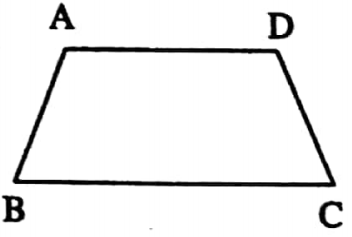
⇔ Trapezium: A quadrilateral of which one pair of opposite sides are parallel is called Trapezium.


WBBSE Solutions For Class 9 Maths Geometry Chapter 1 Properties Of Parallelogram Trapezium

ABCD is a trapezium in which AB || DC

⇔ Isosceles trapezium: A trapezium of which non parallel sides are equal is called isosceles trapezium.


WBBSE Solutions For Class 9 Maths Geometry Chapter 1 Properties Of Parallelogram Isosceles Trapezium

ABCD is an isosceles trapezium whose AD || BC and AB = DC

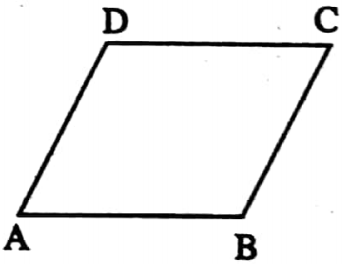
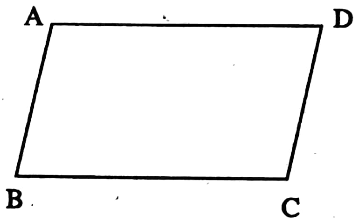
⇔ Parallelogram: The quadrilateral of which opposite sides are parallel is called parallelogram.

Read and Learn More  WBBSE Solutions For Class 9 Maths


WBBSE Solutions For Class 9 Maths Geometry Chapter 1 Properties Of Parallelogram Parallelogram

ABCD is a parallelogram whose AB || DC and AD || BC.

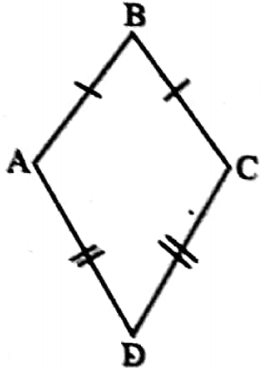
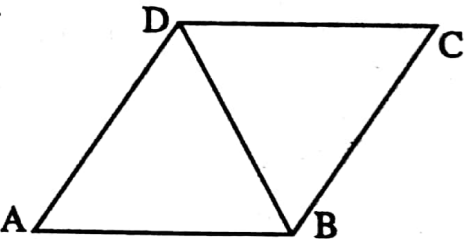
⇔ Rhombus: The parallelogram of which adjacent sides are equal in length is called Rhombus.


WBBSE Solutions For Class 9 Maths Geometry Chapter 1 Properties Of Parallelogram Rhombus

ABCD is a rhombus whose AB BC= CD = DA

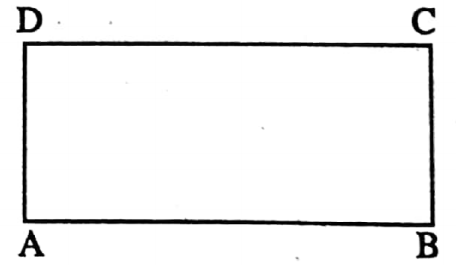
⇔ Rectangle: A parallelogram of which one angle is right-angle is called rectangle.


WBBSE Solutions For Class 9 Maths Geometry Chapter 1 Properties Of Parallelogram Rectangle


ABCD is a rectangle whose AB || DC, AD || BC, and ∠A = ∠B = ∠C = ∠D = 90°.

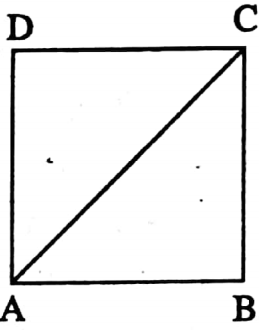
⇔ Square: The rectangle of which one pair of adjacent sides are equal in length is called square.

or, the Rhombus of which one angle is right-angle is called square.


WBBSE Solutions For Class 9 Maths Geometry Chapter 1 Properties Of Parallelogram Square


ABCD is a square whose AB = BC = CD = DA and ∠A = ∠B = ∠C = ∠D = 90°.

⇔ Kite: The quadrilateral of which one pair of adjacent sides are equal and the remaining two sides are also equal in length is called kite.


WBBSE Solutions For Class 9 Maths Geometry Chapter 1 Properties Of Parallelogram Kite


ABCD is a kite whose AB BC, AD CD but AB ≠ AD and BC ≠ CD

Theorem:

1. For any parallelogram:

  1. Each diagonal bisects it into congruent triangles.
  2. Opposite sides are equal
  3. Opposite angles are equal.

2. The diagonals of a parallelogram bisect each other.

3. If opposite sides of any quadrilateral are equal, then the quadrilateral will be a parallelogram.

4. If the opposite angles of a quadrilateral are equal, then this will be a parallelogram.

5. If one pair of opposite sides of any quadrilateral is equal as well as parallel then the quadrilateral will be a parallelogram.

6. If the two diagonals of a quadrilateral bisect each other, then the quadrilateral will be a parallelogram.

WBBSE Solutions For Class 9 Fundamentals Of HistoryWBBSE Class 9 English Functional Grammar
WBBSE Class 9 Fundamentals Of History Long Answer QuestionsWBBSE Class 9 English Reading Skill
WBBSE Class 9 Fundamentals Of History Short Answer QuestionsWBBSE Class 9 English Writing Skill
WBBSE Class 9 Fundamentals Of History Very Short Answer QuestionsWBBSE Class 9 Maths Multiple Choice Questions
WBBSE Class 9 Fundamentals Of History Multiple Choice QuestionsWBBSE Solutions For Class 9 Maths
WBBSE Notes For Class 9 Geography and Environment


Geometry Chapter 1 Properties Of Parallelogram True Or False

Example 1. In parallelogram ABCD if ∠BAD = ∠ABC then parallelogram ABCD will be a rectangle.

Solution: In parallelogram ABCD,


WBBSE Solutions For Class 9 Maths Geometry Chapter 1 Properties Of Parallelogram Parallelogram Will Be A Rectangle


∠BAD + ∠ABC = 180°

∠BAD + ∠BAD = 180° [ ∠BAD = ∠ABC]

2 ∠BAD = 180°

∠BAD = 90°

∴ Parallelogram will be a rectangle.

So the statement is true.

Example 2. In rectangle ABCD, if the diagonal AC is bisects angles ∠A and ∠C, then the rectangle ABCD will be a square.

Solution: The diagonal AC of rectangle ABCD is bisects the angles ∠A and ∠C.


WBBSE Solutions For Class 9 Maths Geometry Chapter 1 Properties Of Parallelogram ABCD Is A Square


∴ ∠BAC = ∠DAC and ∠BCA = ∠DCA

Again, AB || DC and AC is the intersection

∴ ∠BAC = ∠DCA but ∠BAC = ∠DAC

∴ ∠DAC = ∠DCA

In ΔADC, ∠DAC = ∠DCA, ∴ DC = AD

but DC = AB and AD = BC

∴ AB = BC = CD

∴ ABCD is a square.

So the statement is true.

Geometry Chapter 1 Properties Of Parallelogram Fill In The Blanks

Example 1. The diagonals of a square or a rhombus bisect each other ________

Solution: Perpendicularly.

Example 2. The lengths of opposite sides of a kite is ________

Solution: Unequal.


Geometry Chapter 1 Properties Of Parallelogram Short Answer Type Questions

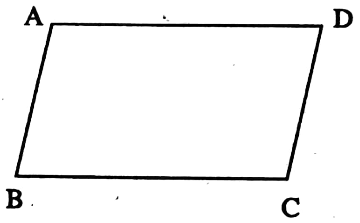
Example 1. In the parallelogram ABCD, ∠A: ∠B = 3: 2, write the measures of the angles of the parallelogram.

Solution: In parallelogram ABCD, ∠A: ∠B = 3:2


WBBSE Solutions For Class 9 Maths Geometry Chapter 1 Properties Of Parallelogram The Parallelogram ABCD


Let, ∠A = 3x° and ∠B = 2x° [x° is a common multiple and x > 0]

∠A + ∠B = 180°

3x° + 2x° = 180°

5x = 180°  ⇒ x° = 36°

∴ ∠D = ∠B = 2 x 36° = 72° [opposite angles of parallelogram are equal]

and ∠C = ∠A = 3 × 36° = 108°

∴ The measures of the angles of the parallelogram is 108°.

Example 2. In the parallelogram ABCD, the bisectors of ∠A and ∠B meets CD at the point E. The length of the side BC is 2 cm. Write the length of the side AB.

Solution: In parallelogram, AD = BC = 2 cm


WBBSE Solutions For Class 9 Maths Geometry Chapter 1 Properties Of Parallelogram Parallelogram ABCD The Lenght Of The Side AB Is 4 cm


As AE is the bisector of the ∠BAD

∴ ∠BAE = ∠DAE

Again, DC || AB and AE is the intersection

∴ ∠AED = alternate ∠BAE

∴ ∠AED = ∠DAE

∴ AD = DE = 2 cm [BC= 2 cm]

Similarly, CE = 2 cm

AB = DC = DE = CE = (2 + 2) cm = 4 cm.

∴ The length of the side AB is 4 cm.

Example 3. The equilateral triangle AOB lie within the square ABCD. Write the value of ∠COD.

Solution: In equilateral triangle ΔAOB, OA = AB = OB


WBBSE Solutions For Class 9 Maths Geometry Chapter 1 Properties Of Parallelogram Equilateral Triangle AOB Lie With In The Square ABCD


and ∠AOB = ∠OAB = ∠OBA = 60°

∠OBC = 90° – 60° = 30° [∠ABC = 90°]

In ΔBOC, OB = BC [OB = AB and AB = BC]

∴ ∠OCB = ∠BOC = \(\frac{180^{\circ}-30^{\circ}}{2}\) = 75°

∠OCB = 90° – ∠OCB = 90° – 75° = 15°

Similarly, ∠ODC = 15°

In ACOD, COD = 180° – ∠OCD – ∠ODC

= 180° – 15° – 15° = 150°

∴ The value of ∠COD is 150°.

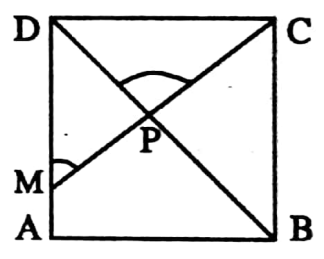
Example 4. In the square ABCD, M is a point on AD so that ∠CMD= 30°. The diagonal BD intersects CM at the point P. Write the value of ∠DPC.

Solution: As BD is a diagonal of square ABCD


WBBSE Solutions For Class 9 Maths Geometry Chapter 1 Properties Of Parallelogram In The Square ABCD M Is A Point On AD


∴ ∠BDC= 45° i.e. ∠PDC= 45°

In ΔCMD, ∠CMD 30° and ∠MDC = 90°

∠DCM = 180° (30° + 90°) = 60° i.e. ∠DCP = 60°

In ΔPDC, ∠PDC = 45°, ∠DCP = 60°

∠DPC = 180° – (45° + 60°) = 75°

∴ The value of ∠DPC is 75°.

Example 5. In the rhombus ABCD, the length of the side AB is 4 cm, and ∠BCD = 60°. Write the length of the diagonal BD.

Solution: In rhombus ABCD, BC = CD = DA = AB = 4 cm


WBBSE Solutions For Class 9 Maths Geometry Chapter 1 Properties Of Parallelogram In Rhombus ABCD


In ΔBCD, BC = DC

∴ ∠BDC = ∠DBC

∠BCD = 60°

∴ ∠DBC = ∠BDC = \(\frac{180^{\circ}-60^{\circ}}{2}\) = 60°

∠BCD = ∠DBC = ∠BDC

∴ BD = DC = BC 4 cm

∴ The length of the diagonal BD is 4 cm.

Example 6. In parallelogram ABCD, if ∠B = 60°, then write the measures of the angles of the parallelogram.

Solution: In parallelogram ABCD, ∠D = ∠B = 60°


WBBSE Solutions For Class 9 Maths Geometry Chapter 1 Properties Of Parallelogram The Parallelogram ABCD


∠A + ∠B = 180° [as AD || BC and AB is intersection]

∠A + 60° = 180° or, ∠A = 120°

∴ ∠C = ∠A = 120°

∴ The measures of the angles of the parallelogram is 120°.

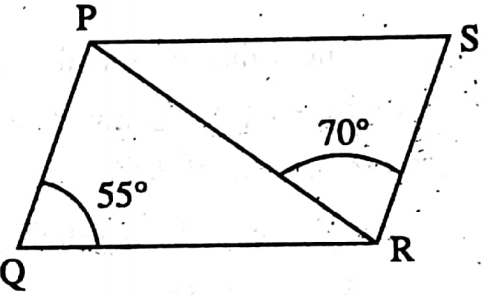
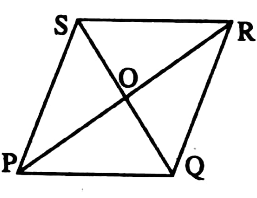
Example 7. Determine the ∠PRQ of the parallelogram PQRS.

Solution: In parallelogram, ∠PSR = ∠PQR = 55°


WBBSE Solutions For Class 9 Maths Geometry Chapter 1 Properties Of Parallelogram Angle PRO Of The Parallelogram PQRS Is 55 Degrees


In ΔPRS, ∠RPS = 180°- ∠PSR – ∠PRS

= 180° – 55°-70° = 55°.

PS || QR and PR is intersection

∴ ∠PRQ = alternate ∠RPS = 55°

∴ The ∠PRO of the parallelogram PQRS is 55°.

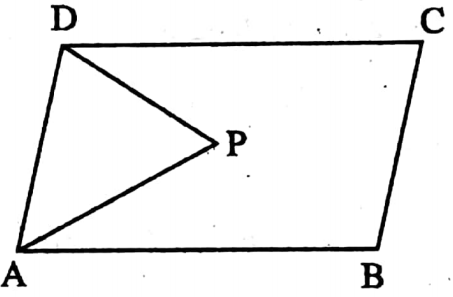
Example 8. In parallelogram ABCD, AP and DP are the bisectors of ∠BAD and ∠ADC respectively, find the measures of ∠APD.

Solution: In ΔAPD,

∠APD = 180° – (∠PAD + ∠ADP)


WBBSE Solutions For Class 9 Maths Geometry Chapter 1 Properties Of Parallelogram ABCD AP And DP Are Bisectors Of Angle BAD


= 180° – \(\left(\frac{1}{2} \angle \mathrm{BAD}+\frac{1}{2} \angle \mathrm{ADC}\right)\)

= 180° – \(\frac{1}{2}\)(∠BAD + ∠ADC)

= 180° – \(\frac{1}{2}\) x 108° [DC || AB and AD is intersection]

= 90°

∴ The measures of ∠APD is 90°.

Example 9. PQRS is rectangle. Find the value of x and y.

Solution: In rectangle PQRS, PR = QS; PR and QS bisect each other.


WBBSE Solutions For Class 9 Maths Geometry Chapter 1 Properties Of Parallelogram PQRS Is A Rectangle


∴ OP OQ= OR = OS

In ΔQOR, OQ = OR  ∴ ∠ORQ = ∠OQR = 25°

∠ORS = ∠QRS – ∠ORQ

x° = 90° – 25° = 65°

In, ΔROS, OR = OS,  ∴ ∠OSR = ∠ORS = 65°

exterior ∠POS = ∠ORS + ∠OSR

y° = 65° + 65° = 130°

⇒ The value of x and y are 65 and 130 respectively.

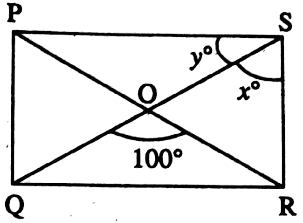
Example 10. PQRS is a rectangle. Find the value of x and y.

Solution: In rectangle PQRS, PR = QS; PR and QS bisect each other,


WBBSE Solutions For Class 9 Maths Geometry Chapter 1 Properties Of Parallelogram PQRS Is A Rectangle


∴ OP = OQ = OR = OS

∠ROS = 180° – ∠QOR = 180° – 100° = 80°

In, ΔROS, OR = OS

∴ ∠OSR = ∠ORS

\(x^{\circ}=\frac{180^{\circ}-\angle R O S}{2}=\frac{180^{\circ}-80^{\circ}}{2}=50^{\circ}\)


Again, ∠OSR + ∠OSP = 90°

⇒ ∠OSP = 40°

⇒ y° = 40°

∴ The value of x and y are 50 and 40 respectively.

Example 11. In parallelogram ABCD, AD  (5x – 2) cm, BC = (3x + 4) cm and AB = (x + 4) cm. Find the length of DC.

Solution: In parallelogram ABCD, AD = BC


WBBSE Solutions For Class 9 Maths Geometry Chapter 1 Properties Of Parallelogram The Parallelogram ABCD


5x – 2 = 3x + 4

2x = 6 ⇒ x = 3

DC = AB = (x + 4) cm = (3 + 4) cm = 7cm

∴  The length of DC is 7 cm.

Example 12.  In rhombus PQRS, if ∠SPQ = 60° and the perimeter is 24 cm, then find the length of diagonal PR.

Solution: In rhombus PQRS, PQ = QR = RS = SP = \(\frac{24}{4}\) cm = 6 cm


WBBSE Solutions For Class 9 Maths Geometry Chapter 1 Properties Of Parallelogram In Rhombus PQRS

∠SPQ = 60°

∴ ∠PQS = ∠PSQ = 60°

∴ ΔPQS is an equilateral triangle

∴ QS = PQ = 6 cm the length of diagonal PR.

Let PR and SQ meets at point O; The diagonals of a rhombus bisects each other perpendicularly.

∴ OQ = OS = \(\frac{6}{2}\) cm = 3 cm and OP = OR

In ΔPOQ, ∠POQ = 90°

PQ2 = OP2 + OQ2 [by Pythagorus theorem]

OP = \(\sqrt{P Q^2-O Q^2}=\sqrt{6^2-3^2} \mathrm{~cm}=\sqrt{27}\) cm = 3√3 cm

PR = 2 × 3√3 cm = 6√3 cm

∴ The length of diagonal PR is 6√3 cm.

WBBSE Solutions For Class 9 Maths Algebra Chapter 6 Logarithm

Algebra Chapter 6 Logarithm

If ax = N (N > 0, a > 0, N ≠ 1), then x is called the logarithm of the number N to the base a and is written as x = logaN

Thus, if ax = N, then x = logaN

Conversely, if x = logaN, then ax = N

WBBSE Solutions For Class 9 Maths Algebra Chapter 6 Logarithm

Formulae on logarithm: (M > 0, N > 0, a > 0, b > 0, a ≠ 1, b ≠ 1 and n is any real number)

  1. \(\log _a(\mathrm{MN})=\log _a \mathrm{M}+\log _a \mathrm{~N}\)
  2. \(\log _a\left(\frac{M}{N}\right)=\log _a \mathrm{M}-\log _a \mathrm{~N}\)
  3. \(\log _a \mathrm{M}^n=x \log _a \mathrm{M}\)
  4. \(\log _a \mathrm{M}=\log _b \mathrm{M} \times \log _a b\)
  5. \(\log _a 1=0\)
  6. \(\log _a a=1\)
  7. \(a^{\log _a M}=M\)
  8. \(\log _b a \times \log _a^b\) = 1
  9. \(\log _b a=\frac{1}{\log _a b}\)
  10. \(\log _b M=\frac{\log _a M}{\log _a b}\)


Read and Learn More  WBBSE Solutions For Class 9 Maths


Algebra Chapter 6 Logarithm True Or False

Example 1. loga1 = 1

Solution: The statement is False.

Example 2. logaa = 1

Solution: The statement is True.

Example 3. alogaM = a

Solution: The statement is False.

Example 4. \(\log _b a=\frac{1}{\log _a b}\)

Solution: The statement is True.

Example 5. \(\log _a \frac{1}{a}\) = 1

Solution: The statement is False.

Example 6. \(\log _b a \times \log _a b\) = 1

Solution: The statement is True.

Example 7. Solving the equation 2x = 7, we get x = log27.

Solution: The statement is True.

Example 8. Logarithm is said that idea of logarithm is 6th fundamental process.

Solution: The statement is False.

Example 9. logaM is undefined when a = 1.

Solution: The statement is True.

Example 10. logaM is defined when a = 0.

Solution: The statement is False.

WBBSE Solutions For Class 9 Fundamentals Of HistoryWBBSE Class 9 English Functional Grammar
WBBSE Class 9 Fundamentals Of History Long Answer QuestionsWBBSE Class 9 English Reading Skill
WBBSE Class 9 Fundamentals Of History Short Answer QuestionsWBBSE Class 9 English Writing Skill
WBBSE Class 9 Fundamentals Of History Very Short Answer QuestionsWBBSE Class 9 Maths Multiple Choice Questions
WBBSE Class 9 Fundamentals Of History Multiple Choice QuestionsWBBSE Solutions For Class 9 Maths
WBBSE Notes For Class 9 Geography and Environment

Algebra Chapter 6 Logarithm Fill In The Blanks

Example 1. If log10x + 1 = 0 then x _______

Solution: \(\frac{1}{10}\)

log10x = -1

x = 10-1 = \(\frac{1}{10}\)

Example 2. If b2 = ae, then logb(abc) = _______

Solution: 3

\(\log _b(b . a c)=\log _b\left(b . b^2\right)=\log _b b^3=3 \log _b b=3\)


Example 3. If \(\log _{a b} a=x\), then \(\log _{a b} b\) = ______

Solution: 1 – x

\(\log _{a b} a+\log _{a b} b=\log _{a b}(a b)=1\)


∴ \( x + \log _{a b} b=1\)

or, \(\log _{a b} b=1-x\)

Example 4. If log4(3x+4)= 3 then the value of x is

Solution: 20

43 = 3x + 4

x = \(\frac{64-4}{3}\) = 20

Example 5. If log202 = a then the value of log2010 is ______

Solution: 1 – a.

\(\log _{20} 10=\log _{20} \frac{20}{2}\)


= \(\log _{20} 20-\log _{20} 2=1-a\)

Example 6. The value of log12(log1916 x log1619) = _______

Solution: 0

log12(1) = 0

Example 7. If log4 = -2, then n = _______

Solution: \(\frac{1}{2}\)

\(x^{-2}=4\)


∴ \(\left(\frac{1}{x}\right)^2=2^2\)

∴ \(x=\frac{1}{2}\)

Example 8. If log10(x – 2) = 1 – log102 then x = _____

Solution: 7

log10 (x -2)+ log102 = 1

or, log10(2x – 4) = 1

∴ 2x – 4 = 4

x = 7

Example 9. The value of logs log√28 = ______

Solution: \(2^{\log 2 x^2 x^2}\)

\(\log _6 \cdot 3 \cdot \log _{\sqrt{2}} 2=\log _6 3 \cdot 2 \times 2=\log _6 6=1\)


Example 10. The value of \(4 \log 2^x\) is _______

Solution: \(_2 2 \log _2 x=_2 \log _2 x^2 x^2\)


Algebra Chapter 6 Logarithm Short Answer Type Questions

Example 1. Let us calculate the value of log4 log4 log4 256.

Solution: log4 log4 log4(4)4 = log4 log44

= log41 = 0

Example 2. Calculate the value of \(\frac{a^n}{b^n}+\log \frac{b^n}{c^n}+\log \frac{c^n}{a^n}\)

Solution: log ax – log bx + log bx – log cx + log cx – log ax = 0

Example 3. Show that \(a^{\log _a x}=x\)

Solution: Let \(\log _a x=\mathrm{M}\)

∴ \(a^M=x\)

Example 4. If \(\log _e 2 \log _x 25=\log _{10} 16 . \log _e 10\)

Solution: \(\log _e 2 \log _x 5^2=\log _{10} 2^4 \log _e 10\)

or, \(\log _e 2 . \log _x 5^2=4 \log _{10} 2 \log _e 10\)

or, \(\log _e 2 \log _x 5^2=4 \log _e 2\)

∴ \(x^4=5^2\)

∴ \(x^4=100\),

∴ \(x= \pm \sqrt{5}\)

Example 5. Find the value of \(\log _{2 \sqrt{3}} 1728\).

Solution: let \(\log _{2 \sqrt{3}} 1728\)

∴ \((2 \sqrt{3})^x=1728\)

or, \((2 \sqrt{3})^x=2^6 3^3=(2 \sqrt{3})^6\)

∴ x = 6

Example 6. Expression terms of \(N: \frac{1}{2} \log _3 M+\log _3 N=1\)

Solution: \(\log _3 \sqrt{M}+\log _3 N^3=1\)

or, \(\log _3 \sqrt{M} N^3=1\)

or, \(\sqrt{M} N^3=3\)

or, \(M=\left(\frac{3}{N^3}\right)^2=\frac{9}{N^6}\)

Example 7. Prove that (log x)2 – (log y)2 = \(\log (x y) \log \frac{x}{y}\)

Solution: (log x + log y) (log x log y) = log (xy) log\(\frac{x}{y}\)

Example 8. If \(\log _{30} 3=a \text { and } \log _{30} 5=b\), then find the value of \(\log _{30} 8\)

Solution: \(\log _{30} 2^3=3 \log _{30} \frac{30}{15}=3\left(\log _{30} 30-\log _{30} 15\right)\)

= \(3\left\{1-\log _{30}(3 \times 5)\right\}=3(1-a-b)\)

Example 9. Find the base when 3 is the logarithm of 343.

Solution: logx 343 = 3

∴ x3 = 343 = 73

∴ x = 7

Example 10. Find the simplest value of \(\log _3 5 \times \log _{25} 27\)

Solution: \(\log _3 5 \times \log _{5^2} 3^3=\frac{3}{2} \log _3 5 \times \log _5 3=\frac{3}{2}\)

WBBSE Solutions For Class 9 Maths Algebra Chapter 5 Factorisation

Algebra Chapter 5 Factorisation

By factorisation of a polynomial, it means that the polynomial should be represented as the product of two or more polynomials.

Each of the polynomials obtained is called a factor of the original one.

WBBSE Solutions For Class 9 Maths Algebra Chapter 5 Factorisation

If f(x) = ax3 + bx + c, then we first find the zero of the polynomial.

Let f(α) = 0 then (x – α) is a factor of fx).

This method is called vanishing or trial or zero method.

We are going to use these formulae to factorise.

  1. a2 – b2 = (a + b) (a – b)
  2. a3 + b3 = (a + b) (a2 – ab + b2)
  3. a3 – b3 = (a – b) (a2 + ab + b2)
  4. a3 + b3 + c3 – 3abc = (a + b + c) (a2 + b2 +c – ab – bc – ca) = \(\frac{1}{2}\)(a + b + c ) {(a – b)2 + (b − c)2 + (c − a)2}
  5. If a + b + c = 0 then a3 + b3 + c3 = 3abc
  6. If a3 + b3 + c3 = 3 abc then either a + bc = 0 or a = b = c
  7. For quadratic expressions, we break the middle term of factorise like x2 + (a + b)x + ab = x2 + ax + bx+ ab = x (x + a) + b (x + a) = (x + a) (x + b)

Read and Learn More  WBBSE Solutions For Class 9 Maths

Algebra Chapter 5 Factorisation True Or False

Example 1. (2a + 1) is a factor of 8a3+ 8a – 5.

Solution: The correct answer is False.

Example 2. x + \(\frac{3}{2}\) is a factor of 2x3 + x2 – 9x – 9.

Solution: The correct answer is True.

Example 3. If f(x) = x3 + 3x – 4 then (x – 1) is a factor of x3 + 3x – 4

Solution: The correct answer is True.

Example 4. If a + b + c ≠ 0 and a3 +b3 + c3 =3abc then a ≠ b ≠ c

Solution: The correct answer is False.

Example 5. There are 6 factors of 1 – x12

Solution: The correct answer is True.

Example 6. Value of a3 +b3 + c3 – 3abc when a = 999, b = 998, c = 997 is 8982.

Solution: The correct answer is True.

Example 7. (x – a) (x – b) = x2 + (a + b) x + ab

Solution: The correct answer is False.

Example 8. If x + y + z = 0 then x3 + y3 + z3 = -3xyz

Solution: The correct answer is False.

Example 9. x and (x + 9) are two factors of x2 + 9x.

Solution: The correct answer is True.

Example 10. (x – 1) and (x2 + x + 4) are two factors of x3 + 3x – 4.

Solution: The correct answer is True.

Algebra Chapter 5 Factorisation Fill In The Blanks

Example 1. 2x3 + x2 – 9x – 9 = (2x + 3) x (______)

Solution: x2

Example 2. x2 – 2ax + (a + b)(a – b) = (x – a – b) x (________)

Solution: x – a + b.

Example 3. 4x2 – 12xy + 9y2 + 2x – 3y =(2x – 3y) x (__________)

Solution: 2x – 3y + 1.

Example 4. x2 + 5x + 6 = x2 + x (_______) + 6

Solution: 3 + 2

Example 5. x2 – 5x + 6 = x2 – x (________) + 6

Solution: 3 + 2.

Example 6. a6 + 5a3 + 8 = (a2)3 + (_______)3+ 23 -3a2(_______).2

Solution: -a, – a.

Example 7. (a – b)3 + (b – c)3 + (c – a)3 = 3 ______

Solution: (a – b)(b – c)(c – a).

Example 8. (80)3 – (20)3 – (60)3 = _______

Solution: 96000.

Example 9. If a – b = -1 then a3 – b3+ 3ab + 1 = _______

Solution: 0

Example 10. If a + b + c = 0 then a3 + b3 – 3abc + c3 = _______

Solution: 0

Algebra Chapter 5 Factorisation Short Answer Type Questions

Example 1. Simplify: \(\frac{\left(b^2-c^2\right)^3+\left(c^2-a^2\right)^3+\left(a^2-b^2\right)^3}{(b-c)^3+(c-a)^3+(a-b)^3}\)

Solution: \(b^2-c^2+c^2-a^2+a^2-b^2=0\)

∴ \(\left(b^2-c^2\right)^3+\left(c^2-a^2\right)^3+\left(a^2-b^2\right)^3\)

Similarly, \(3\left(b^2-c^2\right)\left(c^2-a^2\right)\left(a^2-b^2\right)\)

∴ \(\frac{\left(b^2-c^2\right)^3+\left(c^2-a^2\right)^3+\left(a^2-b^2\right)^3}{(b-c)^3+(c-a)^3+(a-b)^3}=\frac{3\left(b^2-c^2\right)\left(c^2-a^2\right)\left(a^2-b^2\right)}{3(b-c)(c-a)(a-b)}\)

= (b+c)(c+a)(a+b)

\(\frac{\left(b^2-c^2\right)^3+\left(c^2-a^2\right)^3+\left(a^2-b^2\right)^3}{(b-c)^3+(c-a)^3+(a-b)^3}\) = (b+c)(c+a)(a+b)

WBBSE Solutions For Class 9 Fundamentals Of HistoryWBBSE Class 9 English Functional Grammar
WBBSE Class 9 Fundamentals Of History Long Answer QuestionsWBBSE Class 9 English Reading Skill
WBBSE Class 9 Fundamentals Of History Short Answer QuestionsWBBSE Class 9 English Writing Skill
WBBSE Class 9 Fundamentals Of History Very Short Answer QuestionsWBBSE Class 9 Maths Multiple Choice Questions
WBBSE Class 9 Fundamentals Of History Multiple Choice QuestionsWBBSE Solutions For Class 9 Maths
WBBSE Notes For Class 9 Geography and Environment


Example 2. Let us write the relation of a, b, c if a3 +b3 + c3 – 3abc = 0 and a + b + c ≠ 0.

Solution: a3 + b3 + c3 – 3abc

= \(\frac{1}{2}\) (a + b + c) {(a – b)2 + (b − c)2 + (c − a)2} = 0

Now, a + b + c ≠ 0

∴ (a – b)2 + (b – c)2 + (c – a)2 = 0

If sum of the squares are zero, then each term is zero

∴ a – b = 0, a = b and b – c = 0, b = c

∴ a = b = c.

Example 3. If a2 – b2 = 224 or b are negative integers (a < b) then find the values of a and b.

Solution: a2 – b2 = 225 – 1 = (15)2– (1)2

or, a2 – b2 = (-15)2 – (-1)2

a and b are negative integers and a < b

∴ a = -15, b = -1.

The values of a and b -15 and -1.

Example 4. Let us write the value of (x – a)3 + (x − b)3 + (x − c)3 – 3(x -a)(x – b)(x – c) if 3x = a + b + c.

Solution: Now x – a + x – b + x – c

= 3x – (a + b + c)

= 3x – 3x = 0

∴ (x – a)3 + (x – b)3 + (x−c)3 = 3(x − a)(x – b)(x – c)

or, (x – a)3 + (x – b)3 + (x – c)3 – 3 (x – a)(x – b)(x – c) = 0

The value of (x – a)3 + (x − b)3 + (x − c)3 – 3(x -a)(x – b)(x – c) is 0.

Example 5. Let us write the values of a and p if 2x2 + px + 6 = (2x – a)(x-2)

Solution: 2x2 + px + 6 = 2x2 – 4x – ax + 2a

= 2x2 + x (-4 – a) + 2a

Comparing both sides by coefficients of x and constant terms, we get 2a = 6, a = 3 and p = – 4- a = -4 – 3 = -7.

The values of a and p are 3 and -7 .

Example 6. Find the values of (10)3 – 53 – 53.

Solution: 10 + (-5) + (-5) = 0

∴ (10)3 + (-5)3 + (-5)3 =3.10(-5)(-5) = 750

The values of (10)3 – 53 – 53 = 750

Example 7. Find the value of \(\frac{10^3+5^3}{10^2-25}\)

Solution: \(\frac{10^3+5^3}{10^2-25}=\frac{(10+5)\left(10^2-10 \times 5+5^2\right)}{10^2-5 \times 10+5^2}\)

= 10 + 5 = 15

The value of \(\frac{10^3+5^3}{10^2-25}\) = 15

Example 8. If a3 – 0.216 = (a – 0.6) (a2 + 0.6a + k), then find the value of k.

Solution: a3 – 0.216 = (a – 0.6) (a2 + 0.6a + (0.6)2}

∴ k = (0.6)2 = 0.36

The value of k = 0.36

Example 9. Factorise 8x3 – y3 – 12xy + 6xy2.

Solution: (2x)3 + (-y)3 – 6xy (2x – y)

= (2x)3 + (-y)3 + 3 x 2x (-y) (2x + (-y)}

= (2x – y)3 = (2x – y) (2x – y)(2x – y)

8x3 – y3 – 12xy + 6xy2 = (2x – y)3 = (2x – y) (2x – y)(2x – y)

Example 10. If x + y = – 4 then find the value of x3 + y3 – 12xy + 64.

Solution: x3 + y3 – 12xy + 64

= x3 + y3 + 43 – 3xy x 4

= (x + y + 4) (x2 + y2 + 16 – xy – 4x – 4y)

= 0 x (x2 + y2 + 16 – xy – 4x – 4y) = 0

The value of x3 + y3 – 12xy + 64 = 0

WBBSE Solutions For Class 9 Maths Algebra Chapter 4 Polynomial

Algebra Chapter 4 Polynomial

All algebraic expressions in which the indices of the variables are whole numbers are called Polynomials.

x = 1, x3 + 1, x2 – 9. x3 + x2 + 9…… all these are polynomials of which the variable is x, i.e. all these are polynomials with one variable. x2 + 8 is a Binomial.

WBBSE Solutions For Class 9 Maths Algebra Chapter 4 Polynomial

5x, x, 9x2 are called Monomials, and x3 – x2 + 2 is called a Trinomial. 0 is called zero polynomial.

Index of the highest power of the variable in any polynomial is called Degree of the polynomial. The degree of any constant polynomial is 0.

⇒ The degree of zero constant polynomial is indefined.

In case of determining the degree of a polynomial in more than one variable, we will find the sum of the indices of all variables of each term and the highest sum of indices will be the degree of that polynomial.

⇒ Degree of the polynomial f (x, y) = x5 + y2 + x3y3 + 4 is 3 + 3 = 6

A number C will be called zero of the polynomial f(x), if f(C) = 0.

Read and Learn More  WBBSE Solutions For Class 9 Maths

There is no zero of constant polynomial (non zero). Zero of zero constant polynomial cannot be defined.

⇒ Remainder Theorem: f(x) is a polynomial of degree x (x ≥ 1) and a is any real number.

If f (x) is divided by (x – a), then the remainder will be f(a).

⇒ Factor Theorem: If f (x) is any polynomial with degree x (x ≥ 1) and a is any real number, then

  1. (x – a) will be a factor of f (x), if (a) = 0
  2. f(a) = 0 if (x – a) is a factor of f (x).

Algebra Chapter 4 Polynomial Fill In The Blanks

Example 1. The co-efficient of the term x of the polynomial 10 is _______

Solution: 0.

Example 2. The polynomials which have only one term are called _______

Solution: monomial.

Example 3. The polynomials having four terms are called _______

Solution: tetramonials.

Example 4. Polynomials of degree 0 are called ______ polynomials.

Solution: constant.


WBBSE Solutions For Class 9 Fundamentals Of HistoryWBBSE Class 9 English Functional Grammar
WBBSE Class 9 Fundamentals Of History Long Answer QuestionsWBBSE Class 9 English Reading Skill
WBBSE Class 9 Fundamentals Of History Short Answer QuestionsWBBSE Class 9 English Writing Skill
WBBSE Class 9 Fundamentals Of History Very Short Answer QuestionsWBBSE Class 9 Maths Multiple Choice Questions
WBBSE Class 9 Fundamentals Of History Multiple Choice QuestionsWBBSE Solutions For Class 9 Maths
WBBSE Notes For Class 9 Geography and Environment


Example 5. The co-efficient of x0 of the polynomial √11- 3√11x + x2 is ______

Solution: √11

Example 6. x + \(\frac{5}{x}\) is _______ a polynomial.

Solution: not.

Example 7. Polynomial having degree 4 are called _______ polynomial.

Solution: bignadratic

Example 8. The polynomial of degree 3 are called _______ polynomial.

Solution: cubic.

Example 9. bx + c is a ______ polynomial.

Solution: linear.

Example 10. Graph of any linear polynomial is a _______ line.

Solution: straight.

Algebra Chapter 4 Polynomial True Or False

Example 1. A binomial can have at most two terms.

Solution: The statement is False.

Example 2. Every polynomial is a binomial.

Solution: The statement is False.

Example 3. A binomial may have degree 5.

Solution: The statement is True.

Example 4. Zero of a polynomial is always 0.

Solution: The statement is False.

Example 5. A polynomial cannot have more than one zero.

Solution: The statement is False.

Example 6. The degree of the sum of two polynomials cach of degree 5 is always 5.

Solution: The statement is True.

Example 7. √5x is a linear polynomial.

Solution: The statement is False.

Example 8. The division between two polynomials may or may not be a polynomial.

Solution: The statement is True.

Example 9. The sum of two polynomials is always a polynomial.

Solution: The statement is True.

Example 10. The difference of two polynomials may or may not be a polynomial.

Solution: The statement is False.

Algebra Chapter 4 Polynomial Short Answer Type Questions

Example 1. Let us write the zero of the polynomial P(x) = 2x – 3

Solution: 2x – 3 = 0, x = \(\frac{3}{2}\)

Example 2. If P(x) = x + 4, let us write the value of P(x) + P(-x)

Solution: P(x) + P(-x) = x + 4x +4 = 8

Example 3. Let us write the remainder if the polynomial x3 + 4x2 + 4x – 3 is divided by x

Solution: Zero of polynomial x is 0

Remainder = f(0) = 03 + 402 + 4.0 – 3 (by Remainder theorem)

= -3

Example 4. If (3x – 1)7 = a7x7 + a6x6 + a5x5 +…….. +a1x + a0 then find the value of a7 + a6 + a5 + ……….+ a0.

Solution: It is an identify, we put x = 1

∴ (3 × 1 – 1)7 = a7(1)7 + a6(1)6 + a5(1)5 +…….a1.1  + a0

or, 128 = a7 + a6 + a5 + …….. + a1 + a0

Example 5. For the polynomial \(\frac{x^3+2 x+1}{5}-\frac{7}{2} x^2-x^6\), find

  1. The degree of the polynomial
  2. The co-efficient of x3
  3. The co-efficient of x6
  4. The coefficient of x0

Solution:

  1. degree is 6,
  2. \(\frac{1}{5}\)
  3. -1
  4. \(\frac{1}{5}\)

Example 6. If f(x)=3x3 -4x2 + 7x – 5, find f(3), f (-3)

Solution: f(3) = 3.33. 4.32 + 7.3 – 5

= 81 – 36 + 21 – 5 = 102 – 41 = 61.

f(-3) = 3(-3)3 – 4(-3)2 + 7(-3) – 5 = -81 – 36 – 21 – 5 = -143

Example 7. Calculate and write the value of a for which (x + a) will be a factor of the polynomial x3 + ax2 – 2x + a – 12.

Solution: Let f (a) = x3 + ax2 – 2x + a – 12

We have to find the zero of the linear polynomial x + a

x + a = 0, x = -a

∴ by factor theorem f(-a) = 0

or, (-a)3 + a (-a)2 – 2(-a) + a – 12 = 0

or, (-a)3 + a3 + 2a + a – 12 = 0

or, 3a = 12

∴ a = 4

Example 8. Find the value of k for which (x-3) will be a factor of the polynomial k2x3 – kx2 + 3kx – k

Solution: First find the zero of the linear polynomial (x-3),

x – 3= 0, x = 3

By factor theorem f(3) = 0

or, k2(3)3 – k (3)2 + 3k.3 – k = 0

or, 27k2 – 9k + 9k -k = 0

or, k (27k – 1) = 0

∴ k =0, \(\frac{1}{27}\)

Example 9. Let us write the value of f (x) + f (-x) when f(x) = 2x + 5.

Solution: f(x) + f (-x) = 2 + 5 + 2 (-x)+ 5 = 10

Example 10. Both (x – 2) and (x – \(\frac{1}{2}\)) are factors of the polynomial px2 + 5x + r, let us calculate and write the relation between p and r.

Solution: Zeros of the polynomials (x-2) and (x – \(\frac{1}{2}\))

x – 2 = 0 x = 2 and x – \(\frac{1}{2}\) = 0  x = \(\frac{1}{2}\)

Now, p(2)2 + 5(2) + r = 0

or, 4p + r = -10….. (1)

and p\(\left(\frac{1}{2}\right)^2\) + 5\(\frac{1}{2}\) + r = 0

or, \(\frac{p}{4}+\frac{5}{2}+r=0\)

or, \(\frac{p}{4}+r=-\frac{5}{2}\)……..(2)

By (1) – (2), we have,

\(4 p-\frac{p}{4}=-10+\frac{5}{2}\)

\(\frac{18 p}{4_2}=\frac{-18}{2}\)

or, p = -2

∴ p = r.

r = – 10 – 4p

= -10 – 4(-2) = -2

Example 11. Find the roots of the polynomial f(x)= 2x + 3

Solution: Zeros of the polynomials are the roots.

To find the zero of linear polynomial 2x + 3

2x + 3 = 0; x = –\(\frac{3}{2}\)

Example 12. Check the following statement, ‘The two zeros of the polynomial p(x)= x2 – 9 are 3, -3′

Solution: x2 – 9 = 0,

x = ±3

The given statement is true.

Example 13. Find the number of terms of the polynomial \(\left(\frac{x+2 x^2+x^3}{x}\right)^n\)

Solution: \(\left(\frac{x+2 x^2+x^3}{x}\right)^n=\left\{\frac{x\left(1+2 x+x^2\right)}{x}\right\}^n=\left(1+2 x+x^2\right)^n\)

= (1 + x)2x number of terms = 2x + 1

Example 14. If f(x) = 2ax + 1, then find the value of f(a).f(b).f(c)

Solution: f(a).f(b).f(c) = 2a.a+1.2ab+1 .2ac+1

= 2a2 + 1 + ab + 1 + ac + 1

= 2a(a + b+ c) + 1.22 = 4.2ax+1

When x = ax + b + c

= 4f(a + b + c)

Example 15. If f(x) = 2x, then show that f(x + 1) = 4f(x – 1)

Solution: f(x + 1) = 2x+1 = 2.2x

4f(x – 1) = 4.2x-1 = \(\frac{4.2^x}{2}\) = 2.2x

∴ f(x + 1) = 4 + (x – 1)

WBBSE Solutions For Class 9 Maths Algebra Chapter 3 Linear Simultaneous Equations

Algebra Chapter 3 Linear Simultaneous Equations

Linear equations:

You have learned from your Algebra Chapter 3 Linear Simultaneous Equations about the equations in one and two variables, and simultaneous linear equations in one and two variables.

You have learned how graphs of these linear equations are drawn on graph papers and also how they are solved with the help of a graph.

WBBSE Solutions For Class 9 Maths Algebra Chapter 3 Linear Simultaneous Equations

The general standard form of two simultaneous linear equations in two variables are:

a1x + b1y + c1 = 0 where a1, b1, c1 are constants and both a1 and b1, are not zero simultaneously.

a2x+b2y+c2 =0, where a2, b2, c2 are constants and both a2, b2 are not zero simultaneously.

You can solve two equations by two methods

Read and Learn More  WBBSE Solutions For Class 9 Maths

By drawing graphs:

  1. By finding the relations among the ratios of the coefficients of the same variables and of the constant terms of the two equations. By drawing graph if those two straight lines intersect to each other, then the two simultaneous equations are solvable and there is one and only one solution set of these two equations.
  2. If two straight lines coincide then the given two simultaneous linear equations are solvable and there are infinitely many solutions sets of these two equations.
  3. If two straight lines are parallel to each other then the given two simultaneous linear equations are not solvable. There is no solution set of these equations.

By finding the relations among the ratios between the coefficients of the same variable and the constant terms of the two equations:

  1. If \(\frac{a_1}{a_2} \neq \frac{b_1}{b_2}\), then the given two simultaneous linear equations are solvable and there is one and only one set of solutions in this case.
  2. If \(\frac{a_1}{a_2}=\frac{b_1}{b_2} \neq \frac{c_1}{c_2}\), then the given two simultaneous linear equations are solvable and there are infinitely many sets of solutions in this case.
  3. \(\frac{a_1}{a_2}=\frac{b_1}{b_2} \neq \frac{c_1}{c_2}\), then the given simultaneous linear equations are not solvable and there is
    no set of solutions in this case.

Now we can say that,

  1. If \(\frac{a_1}{a_2} \neq \frac{b_1}{b_2}\), then the graph of two given simultaneous equations intersect each other.
  2. If \(\frac{a_1}{a_2}=\frac{b_1}{b_2}=\frac{c_1}{c_2}\), then the graph of the given two simultaneous linear equations coincide.
  3. If \(\frac{a_1}{a_2}=\frac{b_1}{b_2} \neq \frac{c_1}{c_2}\), then the graph of the given two simultaneous linear equations are parallel to each other.
WBBSE Solutions For Class 9 Fundamentals Of HistoryWBBSE Class 9 English Functional Grammar
WBBSE Class 9 Fundamentals Of History Long Answer QuestionsWBBSE Class 9 English Reading Skill
WBBSE Class 9 Fundamentals Of History Short Answer QuestionsWBBSE Class 9 English Writing Skill
WBBSE Class 9 Fundamentals Of History Very Short Answer QuestionsWBBSE Class 9 Maths Multiple Choice Questions
WBBSE Class 9 Fundamentals Of History Multiple Choice QuestionsWBBSE Solutions For Class 9 Maths
WBBSE Notes For Class 9 Geography and Environment

Algebra Chapter 3 Linear Simultaneous Equations True Or False

Example 1. The equations 2x + 3y -7 = 0 and 3x + 2y – 8 = 0 are solvable

Solution: The statement is True.

Example 2. The equations x + 5y = 7, and x + 5y = 20 cannot be solved.

Solution: The statement is True.

\(\frac{1}{1}=\frac{5}{5} \neq \frac{7}{20}\)


Example 3. The equations 5x + 3y = 11, and 2x – 7y = -12 have an infinite no. of solutions.

Solution: The statement is False.

\(\frac{5}{2} \neq \frac{3}{-7}\)


Example 4. Two equations x + y = 5 and 2x + 2y = 10 are overlapping.

Solution: The statement is True.

Example 5. The equations 3x – 4y = 1 and 9x + 8y = 2 have one and only one solution.

Solution: The statement is True.

Example 6. The value of r for which rx + 2y = 5 and (r + 1) x + 3y = 2 will have no solution is 3.

Solution: The statement is False.

Example 7. x + y = 20 and 10x + 5y = 140 are solvable and there is only one common solution.

Solution: The statement is True.

Example 8. There are 3 methods to solve two linear simultaneous equations of two variables.

Solution: The statement is False. The correct answer is Four.

Example 9. We can substitute the value of one variable by another variable in the elimination method.

Solution: The statement is True. (substitution method)

Example 10. From the equations \(a_1 x+b_1 y+c_1=0 \text { and } a_2 x+b^2 y+c_2=0\) we get by method of cross multiplication, \(\frac{x}{b_1 c_2-b_2 c_1}=\frac{y}{c_2 a_2-c_2 a_1}=\frac{1}{a_1 b_2-a_2 b_1}\)

Solution: The statement is True.


Algebra Chapter 3 Linear Simultaneous Equations Fill In The Blanks

Example 1. If the equation rx + 2y = 5 and (r – 5) x + 3y = 2 have no solution then r = _______

Solution: 10.

Example 2. If the equation rx + 2y = 5 and (r + 1)x + 3y = 2 have no solution then r = _______

Solution: 2

Example 3. If the simultaneous linear equations 3x + 4y = 18 and kx – 4y = 180 have no solution then the value of k is _______

Solution: -3.

Example 4. The simultaneous linear equations in two variables will be inconsistent of their graph is _______

Solution: parallel.

Example 5. The straight lines x + y = p and \(\frac{1}{2} x+\frac{1}{2} y=\frac{1}{2} p\) are _______

Solution: parallel.


Algebra Chapter 3 Linear Simultaneous Equations Short Answer Type Questions

Example 1. If x = 3t and y = \(\frac{2t}{3}\) – 1 then for what velue of 1, x = 3y.

Solution: x = 3y

\(3 t=3\left(\frac{2 t}{3}-1\right)\)


or, 3t = 2t – 3

or, t = -3

Example 2. For what value of k two equation 2x + 5y = 8 and 2x – ky = 3 will have no solution?

Solution: \(\frac{2}{2}=\frac{5}{-k} \neq \frac{8}{3}\)

or, \(\frac{5}{-k}\) = 1 or, k = -5

Example 3. If x and y are real numbers and (x – 5)2 + (x  – y)2 = 0, then what are the values of x and y?

Solution: If sum of the squares is zero, then each is zero.

∴ x – 5 = 0, x = 5 and x – y = 0, x = y = 5

Example 4. If x2 + y2 – 2x + 4y =-5, then find the values of x and y.

Solution: (x – y)2 + (y + 2)2 = 0

If the sum of the squares is zero, then each term is zero.

∴ x – y = 0, x = y and y + 2 = 0

or, y = -2

∴ x = y = 2.

Example 5. For what values of r, the two equations rx – 3y – 1 = 0 and (4 – r) x – y + 1 = 0 would have no solution?

Solution: For no solution \(\frac{r}{4-r}=\frac{-3}{-1} \neq \frac{1}{-1}\)

∴ -r = -12 + 3r

4r = 12

or, r = 3

Example 6. Let us write the equation a1x + b1y + c1 = 0 in the form y = mx + c where m and c are constants.

Solution: a1x+b1y+ c1 = 0,

\(y_1=\frac{-a_1 x-c_1}{b_1} \quad \text { or, } \quad y_1=-\frac{a_1}{b_1} x-\frac{c_1}{b_1}\)


Example 7. For what value of k, the two equations kx – 21y + 15 = 0 and 8x – 7y = 0 have only one solution.

Solution: For only one solution, \(\frac{k}{8} \neq \frac{-21}{-7}\)

or, \(\frac{k}{8} \neq 3\)

or, k ≠ 24

Example 8. For what values of a and b, the two equations 5x + 8y = 7 and (a + b) x + (a – b) y = (2a + b + 1) have infinite number of solutions?

Solution: For infinite number of solution, \(\frac{5}{a+b}=\frac{8}{a-b}=\frac{7}{2 a+b+1}\)

or, 5a – 5b = 8a + 8b

or, 3a = -13b and, 16a + 8b + 8 = 7a – 7b

or, 9a + 15b = -8 or, 3·3a + 15b = -8

or, -24b = -8

b = \(\frac{1}{3}\)

∴ a = \(\frac{-13}{3} \times \frac{1}{3}=\frac{-13}{9}\)

Example 9. For what value of x will the two expressions \(\frac{3 x-1}{2} \text { and } \frac{2 x+6}{3}\) have the same value?

Solution: By condition, \(\frac{3 x-1}{2}\) = \(\frac{2 x+6}{3}\)

or, 3(3x – 1)= 2 (2x + 6)

or, 9x – 3 = 4x + 12

or, 5x 15, x = 3.

Example 10. For what value of p, the equation 3(x + 5)= 2p(x + 10) cannot have any solution?

Solution: 3(x + 5)= 2p(x + 10).

or, 3x + 15 = 2px + 20p

or, x (3 – 2p) = 20p – 15

or, x = \(=\frac{20 p-15}{3-2 p}\)

Clearly, the value of x cannot be determined when 3 – 2p = 0, or, p = \(\frac{3}{2}\)

When p = \(\frac{3}{2}\), the given equation cannot have any solution.

Example 11. If \(m=\sqrt{\frac{n}{x+b}}\) then express n interms of m and b.

Solution: \(m=\sqrt{\frac{n}{x+b}}\), \(m^2=\frac{n}{x+b}\)

or, \(\left(1-m^2\right) n=m^2 b\), \(n=\frac{m^2 b}{1-m^2}\)

Example 12. If x, y, z are real numbers and (x – 5)2 + (x − y)2 + (z + 4)2 = 0, find x, y, z

Solution: If the sum of three squares is zero, then each term is zero, x – 5 = 0, x = 5

∴ x – y = 0, x = y = 5, z + 4 = 0, z = -4

∴ x = y = 5, z = -4

WBBSE Solutions For Class 9 Maths Algebra Chapter 1 Laws Of Indices

Algebra Chapter 1 Laws Of Indices

If a certain real number x is multiplied m times in succession (where m is a positive integer) then the continued product so obtained is called the mth power of x and is written by xm.

Then x = x x x x x x …………. to m factors.

Here x is called the base of xm and m is called the index or exponent of xm.

WBBSE Solutions For Class 9 Maths Algebra Chapter 1 Laws Of Indices

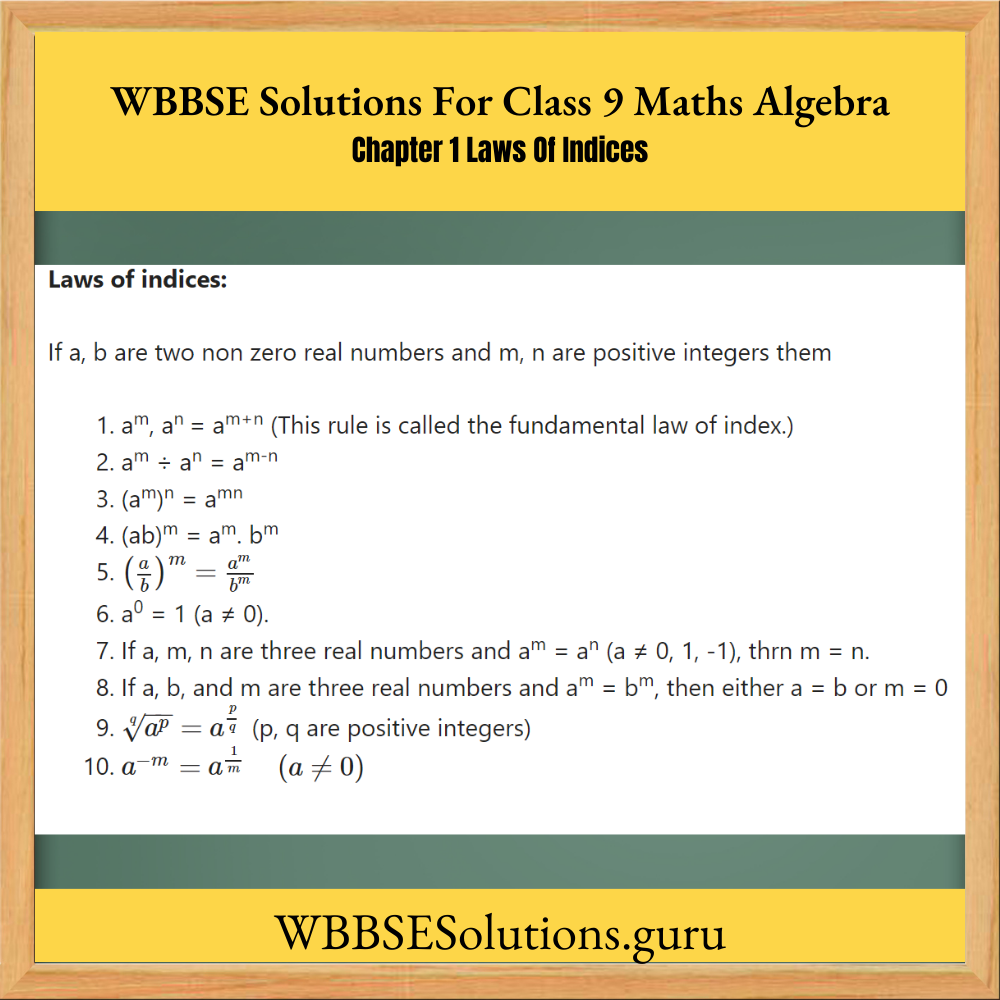
Laws of indices:

If a, b are two non zero real numbers and m, n are positive integers them

  1. am, an = am+n (This rule is called the fundamental law of index.)
  2. am ÷ an = am-n
  3. (am)n = amn
  4. (ab)m = am. bm
  5. \(\left(\frac{a}{b}\right)^m=\frac{a^m}{b^m}\)
  6. a0 = 1 (a ≠ 0).
  7. If a, m, n are three real numbers and am = an (a ≠ 0, 1, -1), thrn m = n.
  8. If a, b, and m are three real numbers and am = bm, then either a = b or m = 0
  9. \(\sqrt[q]{a^p}=a^{\frac{p}{q}}\) (p, q are positive integers)
  10. \(a^{-m}=a^{\frac{1}{m}} \quad(a \neq 0)\)


Read and Learn More  WBBSE Solutions For Class 9 Maths

Algebra Chapter 1 Laws Of Indices True Or False

Example 1. In xm, x is called index and m is called the basc.

Solution: The statement is False.

Example 2. \(\left(\frac{a}{b}\right)^2=\left(\frac{b}{a}\right)^{-2}\)

Solution: The statement is True.

Example 3. x0 = 1 for any real number x.

Solution: The statement is False.

Example 4. If ax = ay then x = y for any real number a.

Solution: The statement is False.

Example 5. \(a^{\frac{m}{n}}=\sqrt[n]{a^m}\)

Solution: The statement is True.

Example 6. If ax = k then a = k-x

Solution: The statement is False.

Example 7. If 3x = 2x then x = 0

Solution: The statement is True.

Example 8. \(a^{-\frac{p}{q}}=\sqrt[q]{a^p}\) (p, q are positive integers a ≠ 0)

Solution: The statement is True.

Example 9. \((-27)^{\frac{1}{3}}=-3\)

Solution: The statement is True.

Example 10. If m, n, and p are positive integers, then am. an. ap = am+n+p.

Solution: The statement is True.

WBBSE Solutions For Class 9 Fundamentals Of HistoryWBBSE Class 9 English Functional Grammar
WBBSE Class 9 Fundamentals Of History Long Answer QuestionsWBBSE Class 9 English Reading Skill
WBBSE Class 9 Fundamentals Of History Short Answer QuestionsWBBSE Class 9 English Writing Skill
WBBSE Class 9 Fundamentals Of History Very Short Answer QuestionsWBBSE Class 9 Maths Multiple Choice Questions
WBBSE Class 9 Fundamentals Of History Multiple Choice QuestionsWBBSE Solutions For Class 9 Maths
WBBSE Notes For Class 9 Geography and Environment


Algebra Chapter 1 Laws Of Indices Fill In The Blanks

Example 1. Value of \((81)^{\frac{3}{4}}\) is ________

Solution: 27.

Example 2. Value of p0 (p ≠ 0) is ________

Solution: 1

Example 3. \(\sqrt[3]{\left(\frac{1}{64}\right)^2}\) = ___________

Solution: \(\frac{1}{2}\)

Example 4. If (27)x = (81)x then x: y

Solution: 4:3.

Example 5. If x = 5 and y = 3 then \((x+y)^{\frac{x}{y}}\) is ___________

Solution: 32.

Example 6. If a ≠ b ≠ 0, and ax = bx then x ________

Solution: 0.

Example 7. If 4x = 83 then x = ________

Solution: \(\frac{9}{2}\)

Example 8. \(2^{\frac{1}{2}}\times 2^{-\frac{1}{2}} \times(64)^{\frac{1}{6}}\) = ________

Solution: 1

Example 9. √√2 = ________

Solution: \(2^{\frac{1}{4}}\)

Example 10. \(x^{a-b} \times x^{b-c} \times x^{c-a}\) = _______

Solution: 1.

Algebra Chapter 1 Laws Of Indices Short Answer Type Questions

Example 1. If (55+0.01)2– (520-0.01)2 = 5x then find the value of x.

Solution: 4.55.0.01 = 5x [(a + b)2 – (a – b)2 = 4.ab]

⇒ or, \(\frac{4 \times 5}{100}=5^x\)

⇒ or, 55-2 = 5x

⇒ or, x=3

The value of x is 3

Example 2. If 3 x 27x = 9x+4 then find the value of x.

Solution: 3 x (33)x = (32)x+4

or, 31+3x = 32x+8

∴ 1+3x= 2x + 8

or, x = 7.

The value of x is 7.

Example 3. Which is greater \(3^{3^3} \text { or, }\left(3^3\right)^3 \text { ? }\)

Solution: \(3^{3^3}=3^{27}, \quad\left(3^3\right)^3=3^9, 27>9\)

∴ \(3^{3^3}>\left(3^3\right)^3\)

Example 4. \((\sqrt[5]{8})^{\frac{5}{2}} \times(16)^{-\frac{3}{8}}\) = ?

Solution: = \(\left(8^{\frac{1}{5}}\right)^{\frac{5}{2}} \times\left(2^4\right)^{-\frac{3}{8}}\)

= \(8^{\frac{1}{5} \times \frac{8}{2}} \times 2^{4 \times\left(-\frac{3}{8}\right)}\)

= \(\left(2^3\right)^{\frac{1}{2}} \times 2^{-\frac{3}{2}}=2^{\frac{2}{2}+\left(-\frac{3}{2}\right)}=2^0=1\)

\((\sqrt[5]{8})^{\frac{5}{2}} \times(16)^{-\frac{3}{8}}\) = \(\left(2^3\right)^{\frac{1}{2}} \times 2^{-\frac{3}{2}}=2^{\frac{2}{2}+\left(-\frac{3}{2}\right)}=2^0=1\)

Example 5. Simplify \(\sqrt[5]{x^8 \cdot \sqrt{x^6 \cdot \sqrt{x^4}}}\)

Solution: \(\sqrt[5]{x^8 \sqrt{x^6 x^{-\frac{4^2}{2}}}}\)

= \(\sqrt[5]{x^8 \sqrt{x^{6-2}}}=\sqrt[5]{x^8 \sqrt{x^4}}\)

= \(\sqrt[5]{x^8 x^{\frac{24}{2}}}\)

= \(\sqrt[5]{x^{8+2}}=x^{\frac{10}{5}}=x^2\)

\(\sqrt[5]{x^8 \cdot \sqrt{x^6 \cdot \sqrt{x^4}}}\) = \(\sqrt[5]{x^{8+2}}=x^{\frac{10}{5}}=x^2\)

Example 6. Simplify \(\left\{(81)^{-\frac{3}{4}} \times \frac{16^{\frac{1}{4}}}{6^{-2}} \times\left(\frac{1}{27}\right)^{\frac{4}{3}}\right\}^{\frac{1}{3}}\)

Solution: =\(\left\{3 \times\left(-\frac{3}{4}\right) \times \frac{2^{4 \times \frac{1}{4}}}{3^{-2} \times 2^{-2}} \times\left(3^{-3}\right)^{-\frac{4}{3}}\right\}^{\frac{1}{3}}\)

=\(\left\{3^{-3} \times \frac{2^1}{2^{-2} \times 3^{-2}} \times 3^{-3 \times\left(-\frac{4}{3}\right)}\right\}^{\frac{1}{3}}\)

= \(\left\{3^{-3+4+2} \times 2^{1+2}\right\}^{\frac{1}{3}}\)

= \(\left(3^3 \times 2^3\right)^{\frac{1}{3}}=6^{3 \times \frac{1}{3}}=6\)

Example 7. If \(x^{p^q}=\left(x^p\right)^q\), find p in terms of q, (x ≠ 0, 1, −1)

Solution: \(x^{p^q}=x^{p q}\)

⇒ or, \(xp^q=p q \quad(x \neq 0,1,-1)\)

⇒ or, \(\frac{p^q}{p^1}=q\)

⇒ or, \(p^{q-1}=q\)

∴ \(p=q-1 \sqrt{q}\)

Example 8. Arrange in the ascending order of magnitude, 263, 345, 527, 618

Solution: 263 = (27)9 = (128)9

⇒ 345 = (35)9 = (243)9

⇒ 527 = (53)9 = 1259

⇒ 618 = (62)9 = (36)9

[Note: You have to find out the H.C.F. of 63, 45, 27, 18 which is 9]

⇒ Since 36125 < 128 < 243

⇒ Hence 618 < 527 < 263 < 345

Example 9. If \(x^{x \cdot \sqrt{x}}=(x \sqrt{x})^x\), find the value of x.

Solution: \((x \sqrt{x})^x=(x \sqrt{x})^x\)

⇒ or, \(x^{\sqrt{x}}=x \sqrt{x}\)

⇒ Now, \(x \sqrt{x}=x^{1+\frac{1}{2}}=x^{\frac{3}{2}}\)

∴ \(\sqrt{x}=\frac{3}{2}, \quad x=\frac{9}{4}\)

The value of x  \(\sqrt{x}=\frac{3}{2}, \quad x=\frac{9}{4}\)

WBBSE Solutions For Class 9 Maths Arithmetic Chapter 1 Real Numbers

Arithmetic Chapter 1 Real Numbers

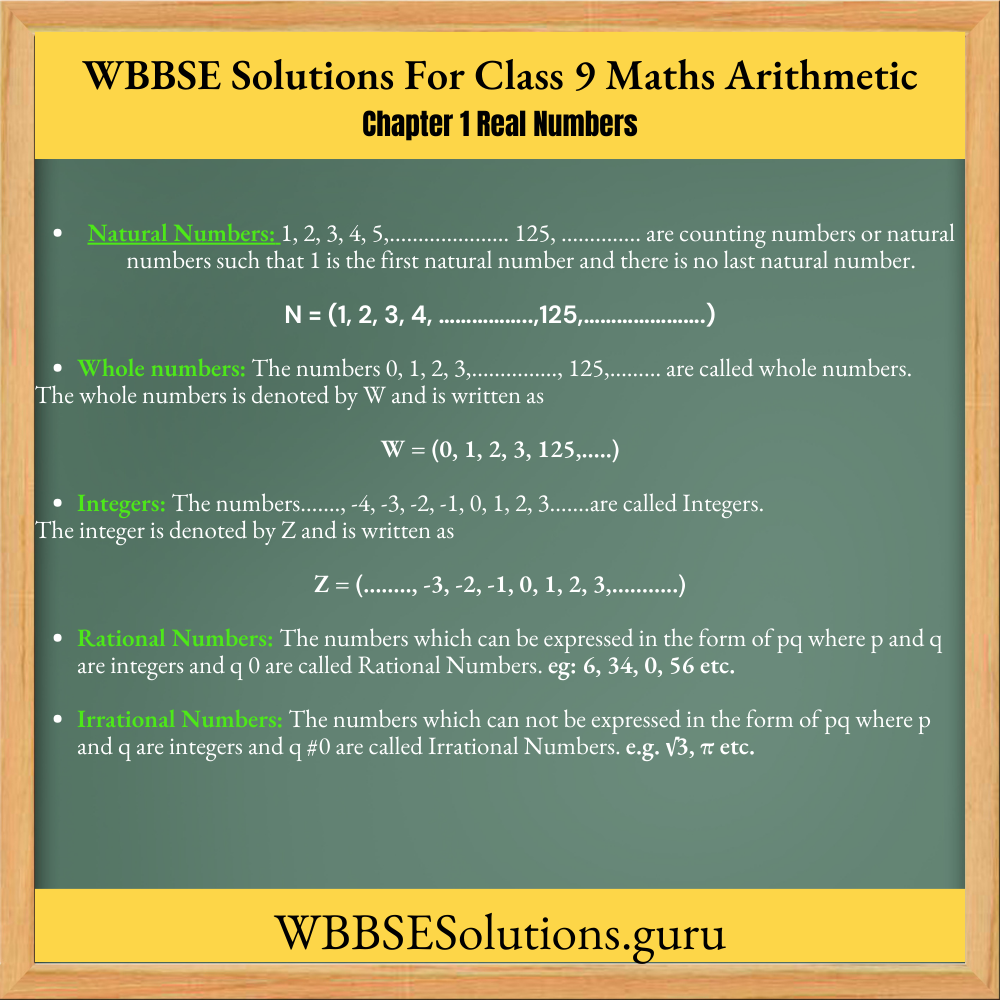
⇔ Natural Numbers: 1, 2, 3, 4, 5,………………… 125, ………….. are counting numbers or natural numbers such that 1 is the first natural number and there is no last natural number.

⇒The natural number is denoted by N and is written as

⇒ N = (1, 2, 3, 4, ……………..,125,………………….).

WBBSE Solutions For Class 9 Maths Arithmetic Chapter 1 Real Numbers


⇔ Whole numbers: The numbers 0, 1, 2, 3,……………, 125,……… are called whole numbers.

⇒ The whole numbers is denoted by W and is written as

⇒ W = (0, 1, 2, 3, 125,…..)

⇔ Integers: The numbers……., -4, -3, -2, -1, 0, 1, 2, 3…….are called Integers.

⇒ The integers is denoted by Z and is written as Z = (…….., -3, -2, -1, 0, 1, 2, 3,………..)

WBBSE Solutions For Class 9 Maths

⇒ The integers greater than 0, i.e. 1, 2, 3,……. are called Positive Integers and the integers less than 0, i.e.-1,2,3,….. are called Negative Integers.

⇒ 0 (Zero) is an integer that is neither positive nor negative.

⇔ Rational Numbers: The numbers which can be expressed in the form of \(\frac{p}{q}\) where p and q are integers and q 0 are called Rational Numbers. eg: 6, \(\frac{3}{4}\), 0, \(\frac{5}{6}\) etc.

⇒ [All integers are Rational Numbers.]

⇔ Irrational Numbers: The numbers which can not be expressed in the form of \(\frac{p}{q}\) where p and q are integers and q #0 are called Irrational Numbers. e.g. √3, π etc.

Some important points:

  1. If two rational numbers x and y such that x < y there is a rational number \(\frac{x+y}{2} \text { i.e. } x<\frac{x+y}{2}<y\)
  2. If x and y are two rational numbers and x < y then, n rational numbers between x and y are (x + d), (x + 2d), (x + 3d),….. (x + nd), where d = \(d=\frac{y-x}{n+1}\)
  3. If the rational numbers of the form \(\frac{p}{q}\) be expressed into decimals, it will be terminating decimal numbers, where q has prime factors 2 and 5 only.
  4. If the rational numbers of the form \(\frac{p}{q}\) be expressed into recurring decimals where q has prime factors other than 2 and 5.
  5. If rational numbers are expanded into decimals it will be terminating are recurring and the fraction whose decimal form is terminating or recurring will be rational.


WBBSE Solutions For Class 9 Fundamentals Of HistoryWBBSE Class 9 English Functional Grammar
WBBSE Class 9 Fundamentals Of History Long Answer QuestionsWBBSE Class 9 English Reading Skill
WBBSE Class 9 Fundamentals Of History Short Answer QuestionsWBBSE Class 9 English Writing Skill
WBBSE Class 9 Fundamentals Of History Very Short Answer QuestionsWBBSE Class 9 Maths Multiple Choice Questions
WBBSE Class 9 Fundamentals Of History Multiple Choice QuestionsWBBSE Solutions For Class 9 Maths
WBBSE Notes For Class 9 Geography and Environment


Arithmetic Chapter 1 Real Numbers True Or False

Example 1. The sum of two rational numbers is always rational.

Solution: The statement is true.

⇒ [e.g. [\(\frac{5}{7}\) + \(\frac{2}{3}\) = \(\frac{29}{21}\)]

Example 2. The sum of two irrational numbers is always irrational.

Solution: The statement is false.

⇒ [6.8. (2+√3)+(4-√3)=6]

Example 3. The product of two rational numbers is rational.

Solution: \(\frac{3}{4}\) x \(\frac{5}{6}\) = \(\frac{5}{6}\) [rational number]

∴ The statement is true.

Example 4. The product of two irrational numbers is always rational.

Solution: √3 × √5 = √15 [irrational number]

⇒ (3+√5)(3-√5)=(3)2-(√5)2

= 9 – 54 [rational number]

∴ The statement is false.

Example 5. Each rational number is real number.

Solution: \(\frac{3}{5}\), 0, √9, –\(\frac{4}{7}\) all are real number.

∴ So the statement is true.

Example 6. Each real number is irrational.

Solution: Clearly the statement is False.


Arithmetic Chapter 1 Real Numbers Fill In The Blanks

Example 1. The division of two integers is not always ______

Solution: Integer.

Example 2. The value of (2 + √3)(2 – √3) is ______

Solution: 1

(2 + √3)(2 -√3) = 22 – (√3)2 = 4 – 3 = 1

Example 3. The difference between 1 and 0.9 is ________

Solution: 0

1 – 0.9 = 1 – \(\frac{9}{9}\) = 1 – 1 = 0

Example 4. We will get _______ decimal if \(\frac{7}{20}\) are expanded into decimal.

Solution: Terminating.

20 = 22 x 5

20 has no prime factors except 2 and 5.

∴ The decimal form of \(\frac{7}{20}\) will be terminating.

Arithmetic Chapter 1 Real Numbers Short Answer Type Questions

Example 1. Give an example where sum of two irrational numbers is a rational number.

Solution:

  1. √5, -√5 √5 + (-√5) = 0 [rational number]
  2. 7 + √5; 7 – √5 (7 + √5) + (7 – √5) = 14 [rational number]

Example 2. Give an example where subtraction of two irrational number is a rational number.

Solution:

  1. √7, √7 ⇒ √7-√7=0 [rational number]
  2. (5+√3), (2+√3) ⇒ (5+√3)-(2+√3) = 5 + √3 – 2 – √3 = 3 [rational number]

Example 3. Write a rational number between \(\frac{1}{7}\) and \(\frac{2}{7}\)

Solution: A rational number between \(\frac{1}{7}\) and \(\frac{2}{7}\) is \(\frac{\frac{1}{7}+\frac{2}{7}}{2}\) = \(\frac{3}{7 \times 2}=\frac{3}{14}\)

Example 4. Determine a irrational number between \(\frac{1}{7}\) and \(\frac{2}{7}\).

Solution: \(\frac{1}{7}\) = 0.1428571428571……..= 0.142857

⇒ \(\frac{2}{7}\) = 0.285714285714……= 0.285714

⇒ The irrational number lying between \(\frac{1}{7}\) and \(\frac{2}{7}\) will be non-terminating and non-recurring.

∴ One required irrational number is 0.15015001500015………..

Example 5. Express 0.0123 in the form of \(\frac{p}{q}\) where p and q are integers and q ≠ 0.

Solution: 0.0123 = \(\frac{0123-12}{9000}=\frac{111}{9000}=\frac{37}{3000}\)

Example 6. Write four rational numbers between 2 and 3.

Solution: If x and y are two rational numbers and x < y then, n rational numbers between x and y are (x + d), (x + 2d), (x + 3d)………..(x+nd.), where \(d=\frac{y-x}{x+1}\)

⇒ Here, x = 2, y = 3 and n = 4

⇒ d = \(\frac{3-2}{4+1}=\frac{1}{5}\)

∴ The four rational numbers are

⇒ \(\left(2+\frac{1}{5}\right)\left(2+\frac{2}{5}\right)\left(2+\frac{3}{5}\right),\left(2+\frac{4}{5}\right)\)

i.e. \(\frac{11}{5}, \frac{12}{5}, \frac{13}{5} \text { and } \frac{14}{5}\)

Example 7. Write four irrational numbers between \(\frac{2}{3}\) and \(\frac{5}{3}\)

Solution: \(\frac{2}{3}\) = 0·666…………..0.6

⇒ \(\frac{5}{3}\) = 1.666…………. = 1.6

⇒ The irrational number between \(\frac{2}{3}\) and \(\frac{5}{3}\) will be non-terminating and non-recurring.

∴ Four irrational numbers between \(\frac{2}{3}\) and \(\frac{5}{3}\) are 0.707007000700007……….

⇒ 0.72572557255572………, 0.81481448144481…………., 0.93293229322293……….

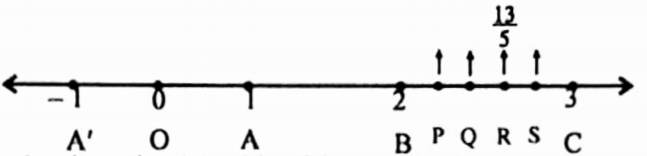
Example 8. Place the rational numbers on a Number line.

  1. –\(\frac{3}{4}\)
  2. \(\frac{13}{5}\)

Solution:

1.

WBBSE Solutions For Class 9 Maths Arithmetic Chapter 1 Real Numbers Placing The Rational Number On Number Line-1


⇒ At first, 9 take OA’ = 1 unit on the left side of the point ‘0’, OA’ is divided into 4 equal parts.

⇒ OR = –\(\frac{3}{4}\) unit.

2.

WBBSE Solutions For Class 9 Maths Arithmetic Chapter 1 Real Numbers Placing The Rational Number On Number Line-2


At first, 9 take OA 1 unit on the right side of the point ‘O’,

∴ OB = 2 units and OC = 3 units.

⇒ BC is divided into 5 equal parts BR = \(\frac{3}{5}\) unit.

∴ OR = OB + BR = = (2 + \(\frac{3}{5}\)) units = \(\frac{13}{5}\) units.

Example 9. Write two rational numbers between 0.2101 and 0.2

Solution: 0.2 = 0.2222………..

⇒ The two rational numbers between 0.2101 and 0.2 are 0.211 and 0.212

Example 10. Express each of the following numbers in the form of \(\frac{p}{q}\) where p and q are integers and q 0.

  1. 0.2345
  2. 12.0366

Solution:

  1. 0.2345 = \(\frac{2345-234}{9000}=\frac{2111}{9000}\)
  2. 12.0306 = \(\frac{120306-1203}{9900}=\frac{119103}{9900}=\frac{39701}{3300}\)

WBBSE Solutions For Class 8 English Functional Grammar Lesson 24 Revisional Exercises

Lesson 24 Revisional Exercises

Fill in the blanks with the prepositions given below.

(in, at, to, for, of)

Question 1. Don’t look ____ me
Answer: at

Question 2. She is going _____ school
Answer: to

Read And Learn More WBBSE Class 8 English Functional Grammar

Question 3. The baby is crying ________ food.
Answer: for

Question 4. Come here _______ time.
Answer: in

Question 5. Don’t be afraid _____ death.
Answer: for

Fill in the blanks with the correct verb forms given within brackets.

Question 1. He ___________ (is reading, was reading, reads) when I
Answer: was reading

Question 2. Have you ______ (saw, seen, see) my brown cat?
Answer: seen

Question 3. Dipak _______ (has come, came, will come) is here tomorrow.
Answer: will come

Question 4. Let me know who __________ (do, did, done) it.
Answer: did

Question 5. “I have not __________ (broken, break, broke) it”, said Sumita.
Answer: broken

WBBSE Solutions For Class 8 English Functional Grammar Lesson 24 Revisional Exercises

Find out the countable and uncountable nouns from the following.

(child, oil, box, shirt, petrol, beggar, rice, milk, girl, sugar, bird, sand.

Answer:

  1. Countable: child, box, shirt, beggar, girl, bird.
  2. Uncountable: oil, petrol, rice, milk, sugar, sand

Join the sentences using ‘if’ and ‘unless” clauses.

Question 1. I shall give you some money. Give me the book first.
Answer: If you give me the book, I shall give you some money.

Question 2. You should have good food. Otherwise, you will fall ill.
Answer: Unless you have good food, you will fall ill.

Question 3. Do you have a cold? Take rest.
Answer: If you have a cold, take a rest.

Question 4. Ruma wants to take part in the competition. She should practise well.
Answer: If Ruma wants to take part in the competition, she should practice well.

Question 5. You do not have a permit. You cannot have a job.
Answer: Unless you have a permit, you cannot have a job.

Question 6. You must hurry up. You will miss the train.
Answer: Unless you hurry up, you will miss the train.

Question 7. Do not smoke. You will be punished.
Answer: If you smoke, you will be punished.

Join the following pairs of sentences using “that”, “which”, and “whose” clauses.

Question 1. A thermometer is an instrument. It is used to measure temperature.
Answer: A thermometer is an instrument that is used to measure temperature.

Question 2. A compass is an instrument. Its needle points to the North.
Answer: A compass is an instrument whose needle points to the North

Question 3. There is another type of volcano. It is on the verge of getting extinct.
Answer: There is another type of volcano that is on the verge of getting extinct.

Question 4. This is the boy. His father died yesterday.
Answer: This is the boy whose father died yesterday

Question 5. Pesticide is a substance. It is used to kill insects.
Answer: Pesticide is a substance which (that) is used to kill insects.

Use ‘may’ or ‘can’ and rewrite the following sentences.

Question 1. Rain is likely to fall in the evening.
Answer: Rain may fall in the evening

Question 2. He is able to work out this sum.
Answer: He can work out this sum

Question 3. You are permitted to leave this place.
Answer: You may leave this place.

Question 4. We cat to live.
Answer: We eat so that we can live.

Question 5. I wish you a long life.
Answer: May you have a long life.

WBBSE Class 8 English Functional GrammarWBBSE Class 8 English Reading Skills
WBBSE Solutions For Class 8 EnglishWBBSE Solutions For Class 8 Maths


Say if the sentences are Simple or Complex. For Complex sentences, write down the principal and dependent clauses.

Question 1. You may go now.
Answer: You may go now – Simple.

Question 2. I know that he is a good boy.
Answer:

  • I know that he is a good boy – Complex.
  • I know — The principal clause

Question 3. They are playing in the park.
Answer: They are playing in the park — Simple.

Question 4. That he is ill is known to all.
Answer:

  • That he is ill is known to all — Complex.
  • (It) is known to all — Principal clause
  • that he is ill — Dependent clause

Question 5. They are reading now.
Answer: They are reading now — Simple.

Question 6. This is the boy who stood first in the examination.
Answer:

  • This is the boy who stood first in the examination — Complex.
  • This is the boy — Principal clause
  • who stood first in the examination — Dependent clause

Use a suitable ‘self’ form (Reflexive or Emphatic Pronoun) in the following sentences.

Question 1. I did all the work without anybody’s help.
Answer: I my self did all the work

Question 2. He went to the station without asking anybody to accompany him.
Answer: He himself went to the station

Question 3. The girl did the sum without the help of others.
Answer: The girl herself did the sum

Question 4. They dug the field without others’ help.
Answer: They themselves dug the field.

Question 5. Ranjan did the work alone. Nobody helped him.
Answer: Ranjan himself did the work.

Report the following dialogues.

Question 1. The teacher: King Charles built this castle.
Student: His son built this church.

Answer: The teacher, told the student that King Charles had built that castle; the student said that his son had built that Church

Question 2. Aruna: How are you?
Priti: I am well.

Answer: Aruna asked Priti how she was. Priti replied that she was well.

Question 3. Dipti: I could not do the exercise.
Moly: It is not difficult.

Answer: Dipti said that she could not do the exercise. Moly said that it was not difficult

Question 4. Babul: Hallo! Is it Ranjan ?
Voice: No, wrong number.

Answer:

  • Talking over the telephone, Babul enquired if it was Ranjan at the other end.
  • The voice replied that it was the wrong number.

Question 5. Mr. Chakraborty (five years ago): I can run a mile in less than four minutes.
Amal: I can swim for 8 hours.

Answer:

  • Mr. Chakraborty said that he could run a mile in less than four minutes.
  • Amal said that he could swim for 8 hours.

Question 6. Shyamal to Kabita: I have a brother and he is working in a firm.
Answer: Shyamal told Kabita that he had a brother and he was working in a firm.

Fill in the gaps with “may” or “might”.

Example: You -have told me. I came all this way for nothing.

Answer: You might have told me. I came all this way for nothing.

Question 1. I thought he ____ be able to help me, but he was useless.
Answer: I thought he might be able to help me, but he was useless.

Question 2. You _______ leave the class when you finish the exercise.
Answer: You may leave the class when you finish the exercise.

Question 3. I asked him if I ______ leave the class early.
Answer: I asked him if I might leave the class early

Question 4. Passengers ______ smoke at the back of the plane.
Answer: Passenger’s may smoke at the back of the plane.

Rewrite as directed:

Question 1. My grandfather gave the book on my birthday. I have lost it. (Join with an adjective clause)
Answer: I have lost the book that my grandfather gave me on my birthday.

Question 2. I told him all about the brilliant student. (Make it a complex sentence)
Answer: I told him all I knew about the brilliant student.

Question 3. The game was over. Aff the players left. (Combine into a compound sentence)
Answer: The game was over and all the players left.

Question 4. She will come. Nobody knows the time. (Make two complex sentences using a Noun clause and an Adjective clause)
Answer:

  • Nobody knows when she will come — Noun clause, object to ‘knows’
  • Nobody knows the time when she will come — Adjective clause, qualifying the noun ‘time.’

Question 5. The man answered the phone. He told me that you were out. (Make it a complex sentence and mark the sub-clauses)
Answer:

  • The man who answered the phone told me that you were out. The man told me – Principal clause.
  • who answered the phone – Sub. Adj. clause, qualifying ‘man’.
  • that you were out —Sub. Noun clause, object to ‘told’.

Fill in the blanks with the correct form of verbs given within brackets:

Question 1. A major fire _____ (break) out near Esplanade this evening. The fire _____ (caused) by a short circuit in a market complex. Several fire tenders ______(rush) to bring flames under control. By that time hundreds of stalls _______ (burn) to ashes. The police _______ (order) an official inquiry into the matter. The forensic reports _______ (expect) in a few days.

Answer:

A major fire broke out near Esplanade this evening. The fire was caused by a short circuit in a market complex. Several fire tenders were rushed to bring the flames under control. By that time hundreds of stalls were burnt to ashes. The police ordered an official inquiry into the matter. The forensic reports are expected in a few days.

Articles, Prepositions, and Adverbs, eight in total, are missing in the passage. Rewrite’ the passage supplying them in the right places.

Question 1. Some people go to bed late night and get up late morning. This is not good for them. We must sleep at night when it is dark. Darkness helps us to sleep properly. When daylight comes we must get.
Answer: Some people go to bed late at night, and get up late in the morning. This is not good for them. We must sleep at night when it is dark. Darkness helps us to sleep properly. When the daylight comes, we must get up.

Use ‘some’ or ‘any’ properly to fill in the blanks.

Question 1. She has ______ pens but has not got _____ pencils.
Answer: She has some pens, but has not got my pencil.

Question 2. I want _______ milk, but don’t think there is _____ in the bottle.
Answer: I want some milk, but don’t think there is any in the bottle

Question 3. Have you ____ ink? If not, I’ll give you ______
Answer: Have, you any ink? If not, I’ll give you some.

Question 4. I can see _____ boys, but cannot find _______ girl.
Answer: I can see some boys, but cannot find any girl

Question 5. Will you give me _____ sugar, of course, if you have ________
Answer: Will you give me some sugar, of course, if you have any?

Join each pair of sentences into a single sentence as per the direction in the brackets.

Question 1. Ghee does not contain protein. It does not contain carbohydrates too. (Use ‘neither-nor’)
Answer: Ghee contains neither protein nor carbohydrates.

Question 2. I don’t want to be a doctor. I don’t want to be an engineer. (Use ‘either… or’)
Answer: I want to be neither a doctor nor an engineer

Change the voice of:

Question 1. People still remember him.
Answer: He is still remembered by people

Question 2. Lightning struck the old tree.
Answer: The old tree was struck by lightning

Question 3. She visits the zoo quite often.
Answer: The zoo is visited by her quite often.

Question 4. My grandmother told me a nice tale.
Answer: I was told a nice tale by my grandmother. Or, A nice tale was told me by my grandmother.

Question 5. He sold his best books.
Answer: His best books were sold by him.

Join the following sentences with Emphatic Pronouns.

Question 1. Ranjan, do the homework. Don’t ask anyone to help you.
Answer: Ranjan, do the homework yourself

Question 2. My sister sewed her blouse. She did not give it to the tailor.
Answer: My sister herself sewed her blouse.

Question 3. The students cleaned the room. Nobody helped them..
Answer: The students themselves cleaned the room.

Punctuate the following sentences.

Question 1. I’ll do that he said
Answer: “I’ll do that”, he said.

Question 2. What are you doing here he asked me
Answer: “What are you doing here ?” he asked me.

Question 3. Never never be late in school
Answer: Never, never be late in school.

Question 4. Oh what a sight
Answer: Oh, what a sight!

Question 5. If i am not at home you may talk to bimal my brother
Answer: If I am not at home, you may talk to Bimal, my brother.

Question 6. Ramen Shankar and rina went to delhi last October
Answer: Ramen, Shankar, and Rina went to Delhi last October.

Question 7. Have you read the bible asked his teacher
Answer: “Have you read the Bible?” asked his teacher,

Find out the transitive and intransitive verbs from the following, in case of transitive verbs pick out their objects.

Question 1. They are laughing.
Answer: laughing — Intransitive

Question 2. The bell rang.
Answer: rang — Intransitive

Question 3. He rang the bell.
Answer: rang — Transitive, object — bell

Question 4. He is reading a book
Answer: reading — Transitive, object — book

Question 5. He can run fast.
Answer: run — Intransitive

Question 6. He ran a race.
Answer: ran — Transitive, object — race

Question 7. Bring a book for me.
Answer: bring — Transitive, objects— book, me

Fill in the blanks with proper form of verbs given in brackets.

Question 1. The Gupta period ______ (call) the Golden Age in the history of India. The Gupta kings _____ (love) and ________ (respect) by the people. The country ________(progress) a lot during the period.

Answer: The Gupta period was called the Golden Age in the history of India. The Gupta kings were loved and respected, by the people. The country progressed a lot during the period.

Question 2. A serious road accident _______ (occur) near chowmatha yesterday. A young girl ____(wound) seriously in the accident. A bus hit the girl when she ______(cross) the road. The passersby ______ (take) her to the nearby hospital. But she ______(die) there the next day.

Answer:

A serious road accident occurred near chowmatha yesterday. A young girl was wounded, seriously in the accident. A bus hit the girl when she was crossing, the road. The passersby took her to the nearby hospital. But she died there the next day.

Join the sentences as directed.

Question 1. The mountain is very high. It is very difficult to climb. (Use too … to)
Answer: The mountain is too high to climb

Question 2. We boil water. It is safe for drinking. (Use because)
Answer: We boil water because it is safe for drinking

Question 3. She wanted to score good marks in the examination. She read well (Use so…..)
Answer: She read- well so as to score good marks in the examination.

Question 4. I came back from school. He was playing (Use when….)
Answer: He was playing when 1 came back from school.

Question 5. She was looking tired. I asked her the reason. (Use why…..)
Answer: I asked her why she was looking tired.

Make new words opposite in meaning of the following words by adding suitable prefixes from the list given.

(Prefixes mis-, dis-, un-, il-)

  1. -understand
  2. -licit
  3. -qualify
  4. -connect
  5. -courage
  6. -avoidable
  7. -lock
  8. -calculate
  9. -popular
  10. -legitimate
  11. -controlled
  12. -behavior.

Answer:

  1. Misunderstand
  2. Illicit
  3. Disqualify
  4. Disconnect
  5. Discourage
  6. Unavoidable
  7. Unlock
  8. Miscalculate
  9. Unpopular
  10. Illegitimate
  11. Uncontrolled
  12. Misbehaviour

Change into indirect speeches.

Question 1. Arati said, “My sister is ill.”
Answer: Arati said that her sister was ill.

Question 2. He said to me, “You are wrong.”
Answer: He told me that I was wrong.

Question 3. She said, “The sky is blue.”
Answer: She said that the sky is blue

Question 4. He said to me, “Are you well?”
Answer: She asked me if I was well

Question 5. He said to her, “Do not go out.”
Answer: He ordered her not to go out.

Join each of the following sets of sentences into one sentence using a “that” or “who” clause.

Question 1. The school remained closed. The boy did not know it.
Answer: The boy did not know that the school remained closed,

Question 2. He sang a sweet song. It came into his mind.
Answer: He sang a sweet song that came into his mind.

Question 3. Air in motion is called wind. Everybody knows it.
Answer: Everybody knows that air in motion is called wind

Question 4. Sunil came here yesterday. He told me the story.
Answer: Sunil, who came here yesterday, told me the story.

Question 5. Aparna is a poetess. She will attend the function.
Answer: Apama, who is a poetess, will attend the function.

Combine each of the following sets of sentences in at least two ways:

Question 1. Some volcanoes remain inactive for a long period. These are called dormant volcanoes.
Answer:

  • Some volcanoes that remain inactive for a long period are called dormant volcanoes
  • Dormant volcanoes are those that remain inactive for a long period.

Question 2. Oxygen is a gas. It has no color, taste or smell.
Answer:

  • Oxygen is a gas that has no colour, taste or smell
  • Oxygen is a colorless, tasteless and odourless gas

Question 3. Rubber is processed as a solid sheet. The passage tells us about it.
Answer:

  • The passage tells us about rubber which is processed as a solid sheet.
  • This passage tells us about the processing of rubber as a solid sheet.

Question 4. My friend wrote me a letter. I read it out to my mother.
Answer:

  • I read out to my mother the letter which my friend wrote me.
  • The letter which my friend wrote me was read out to my mother by me

Question 5. Someone has left a banana skin on the pavement. A girl stepped on it.
Answer:

  • A girl stepped on the banana skin which someone has left on the pavement.
  • The banana skin left on the pavement by someone was stepped on by the girl.

Join the following sets of sentences using “neither….. nor”. One has been done for you.

[Example: Ram was not present at school. Madhu also was not present at school. ‘Ans. Neither Ram nor Madhu was present at school.]

Question 1. I don’t take tea. I don’t take coffee also.
Answer: I take neither tea nor coffee

Question 2. He won’t come in. He won’t go out, either.
Answer: He would neither come in nor go out

Question 3. Mr. Roy did not come. Mrs. Roy also didn’t come.
Answer: Neither Mr Roy nor Mrs Roy came

Question 4. I didn’t see him at home. I didn’t see him at school.
Answer: I saw him neither at home nor at school

Question 5. This pen won’t do. That pen won’t do either.
Answer: Neither this pen nor that pen would do.

Question 6. It’s not pleasant to eat. It’s not good for health.
Answer: It is neither pleasant to eat nor good for health.

Fill in the blanks with appropriate articles and prepositions.

Question 1. ________ tree plays _________ important role in our life. It stops erosion of soil, supplies us _______ oxygen, and keeps the environment free of ________ pollution.
Answer: The tree plays an important role in our life. It stops the erosion of soil, supplies us with oxygen, and keeps the environment freedom pollution.

Fill in the gaps with proper forms of verbs in the brackets.

Question 1. The examination will ______ (hold) in March.
Answer: be held

Question 2. The man has ________ (kill) the tiger.
Answer: killed.

Question 3. The police ________ (inform) in time.
Answer: was informed

Question 4. They came back _______ (dance) all the way.
Answer: dancing

Question 5. I shall get the house _____ (repair) very soon.
Answer: repaired.

Change the mode of narration:

Question 1. Anand: What is especially interesting about the story?
Ravi: It tells us about some adventures of the sailor Sindbad.
Anand: Who was Sindbad?
Ravi: He was a rich merchant. He lived in Baghdad.

Answer: Ananda asked Ravi what was especially interesting about the story. Ravi replied that it told them about some adventures of the sailor Sindbad. Ananda asked who Sindbad had been. Ravi replied that he had been a rich merchant who lived in Baghdad.

Re-write the following sentences according to the directions given in the brackets.

Question 1. Isaac built a windmill. It had no miller. (Join the sentences into a single sentence).
Answer: Isaac built a windmill that had no miller.

Question 2. Leaving Diamond sleeping in the room, Newton went out of his chamber. (Split up into three sentences.)
Answer: Diamond was sleeping in Netwon’s chamber. Newton left it in the”room. He then went out of his chamber.

Fill in the blanks with appropriate prepositions.

Question 1. They became angry _________ me.
Answer: with

Question 2. He does not take care ______ his health.
Answer: of

Question 3. Do not depend ______ others.
Answer: on

Question 4. The boys are grateful ______ their teacher.
Answer: to

Question 5. The child is fond ______ sweets.
Answer: of

Join the following sets of sentences using the suitable linkers given below. (since, because, if, as, therefore)

Question 1. He was ill. He did not go to school.
Answer: As he was ill, he did not go to school.

Or, He did not go to school because he was ill.
Or, He was ill, therefore he did not go to school.

Question 2. He may come late. In that case he will miss the train.
Answer: If he comes late, he will miss the train.

Question 3. You are a mere child. I pardon you this time.
Answer: Since you are a mere child, I pardon you this time.

Question 4. He asked me for help. I helped him.
Answer: As he asked me for help, I helped him.

Or, He asked me for help, therefore I helped him.
Or, I helped him because he asked me for help.
Or, Since he asked me for help, I helped him.

Question 5. Don’t be lazy. You will learn nothing.
Answer: If you are lazy, you will learn nothing.

Report these statements or questions beginning with the words given.

Statements/Questions

  • “It is too late.”
  • “You must not worry.”
  • “Have you finished ?”
  • “Have you not finished yet?”
  • “I saw her yesterday.”
  • “Give him this book.”
  • “Can I talk to Bina?”

Report

  • He told me _____
  • He advised me ______
  • He asked me ________
  • He seemed surprised that I ______
  • He told me that _____
  • He told me _____
  • He asked me _______

Answer:

  • He told me that it was too late.
  • He advised me not to worry.
  • He asked me if I had finished.
  • He seemed surprised that I had not finished till that time.
  • He told me that he had seen her the day before.
  • He told me to give him that book.
  • He asked me if he could talk to Bina

11. Rewrite as directed :

Question 1. If you are not serious, you will fail. (Rewrite using ‘unless’)
Answer: Unless you are serious, you will fail.

Question 2. Sita’s mother came from Mumbai. She was a religious lady. (Join using an Adjective clause)
Answer: Sita’s mother who was a religious lady came from Mumbai.

Question 3. Sincerity is an essential quality for success. You must remember this. (Join using a Noun clause)
Answer: You must remember that sincerity is an essential quality for success.

Question 4. He is educated. He is immodest. (Join using a ‘though’ clause)
Answer: Though he is educated, he is immodest.

Question 5. Mr Sen is a reputed person in the locality. He is a doctor. (Join using a Relative clause).
Answer: Mr Sen who is a reputed person in the locality is a doctor

Question 6. He has got the highest marks in mathematics. I know it. (Join using a Nominal clause)
Answer: I know that he has got the highest marks in mathematics.

Change the following Simple sentences into Complex sentences.

Question 1. Tell me your name.
Answer: Tell me what your name is.

Question 2. I heard of his success.
Answer: I heard that he had become successful

Question 3. I cannot read without glasses.
Answer: I cannot read if I have no glasses.

Question 4. She went out inspite of the rain.
Answer: She went out though it was raining

Question 5. She found the boy playing in the field.
Answer: She found that the boy was playing in the field

Change the voice of the following.

Question 1. He writes a letter.
Answer: A letter is written by him

Question 2. Sima did the work.
Answer: The work was done by Sima.

Question 3. The teacher teaches us English.
Answer: English is taught us by the teacher

Question 4. Arun has done the work.
Answer: The work has been done by Arun.

Question 5. I am reading the newspaper.
Answer: The newspaper is being read by me.

Say if the verbs are Transitive or Intransitive. Find out the objects of the Transitive verbs.

Question 1. The lion killed a cow.
Answer: killed — Transitive, obj. — cow

Question 2. You should go now.
Answer: go — Intransitive

Question 3. He grows vegetables.
Answer: grows — Transitive, obj. — vegetables

Question 4. The driver stopped the train.
Answer: stopped — Transitive, obj. — train

Question 5. The train stopped suddenly.
Answer: stopped — Intransitive.

Question 6. We eat everyday.
Answer: eat — Intransitive

Question 7. We eat rice.
Answer: eat — Transitive, obj. — rice

Join the sentences-using ‘either-or”.

Question 1. You must do it. You must get out.
Answer: You must either do it or get out

Question 2. You may give me the red pen. You may give me the blue one.
Answer: You may give me either the red or the blue pen

Question 3. Ram should play. Bhanu should play.
Answer: Either Ram or Bhanu should play

Question 4. Jamuna must come. Sheela must come.
Answer: Either Jamuna or Sheela must come.

Question 5. Ranu is guilty. Tapan is guilty.
Answer: Either Ranu or Tapan is guilty.

Fill in the gaps with the self-forms of the pronouns.

Question 1. Father washes his clothes _______
Answer: Father washes his clothes himself.

Question 2. We _________ organized the function.
Answer: We ourselves organised the function.

Question 3. She cursed _______
Answer: She cursed herself.

Question 4. Sheela does her homework _________
Answer: Sheela does her homework herself.

Question 5. He lost _________
Answer: He lost himself

Question 6. The teacher said to me, ‘You should clean your room _______
Answer: The teacher said to me, ‘You should clean your room yourself.’

Question 7. Ramen, Bela, and Amar _______ went to the headmaster.
Answer: Ramen, Bela, and Amar themselves went to the Headmaster.

Fill in the gaps with appropriate articles (a, an, the):

Question 1. My father is ____ M.A.
Answer: an

Question 2. I did it ____ hour ago.
Answer: an

Question 3. There is ______ university at Kalyani.
Answer: a

Question 4. I want ______ tea of Darjeeling.
Answer: the

Question 5. It is _______ one rupee note.
Answer: a

Complete the following statements, using the linking words given. One is done for you.

(as, so, therefore, because, hence)

Question 1. _______ we were late for school, we could not attend the class.
Answer: as

Question 2. They asked me to do it, _____ I did it.
Answer: so

Question 3.He failed, ______ he did not prepare his studies.
Answer: because

Question 4. He did not follow his advice and ____ his father grew angry with him.
Answer: hence

Question 5. There is not much time, _____ you’d better take a taxi.
Answer: therefore

Choose the word that best fits into the blank in each of the following sentences.

Question 1. I shall look _______ your son while you are away. (at, on, after)
Answer: after

Question 2. They call ______ me quite often. (in, on, off)
Answer: on

Question 3. He has put ______ a nice shirt. (of, out, on)
Answer: on

Question 4. We were held _________ by the traffic jam. (on, up, off)
Answer: up

Question 5. Go ______ the book quickly. (over, through, on)
Answer: through

Identify the Principal and Dependent clauses in the following sentences. For Dependent clauses, say whether they are noun clauses, adjective clauses, or adverbial clauses.

Question 1. I asked why he was late.
Answer:

  • I asked – Principal clause.
  • why he was late — Dependent, Noun clause

Question 2. This is the place where the accident happend.
Answer:

  • This is the place — Principal clause
  • where the accident happened — Dependent, Adj. clause

Question 3. As he is ill, he could not come.
Answer:

  • he could not come — Principal clause
  • As he is ill — Dependent, Adv. clause

Question 4. I know what he wants.
Answer:

  • I know — Principal clause
  • what he wants — Dependent, Noun clause

Question 5. You would not pass unless you work hard.
Answer:

  • You would not pass — Principal clause
  • unless you work hard — Dependent, Adv. clause

Question 6. I heard that she was ill.
Answer:

  • I heard — Principal clause
  • that she was ill — Dependent, Noun clause

Fill in the blanks with the correct verb forms from the alternatives given within brackets.

Question 1. The sun ______ during the day (shine, shines, is shine)
Answer: shines

Question 2. I __________ him last Sunday. (have met, met, was meeting)
Answer: met

Question 3. The Ganga ____________ between the two cities, Kolkata and Howrah. (is flowing, flows, has flown)
Answer: flows

Question 4. We shall come if you _________ (think, thought, have thought) it necessary.
Answer: think

Question 5. We him here yesterday. (were seeing, saw, have seen).
Answer: saw

Fill in the blanks with the correct verb forms given within brackets.

Question 1. A 30-year-old man Sumit Roy ________ (injure) when a portion of a three-storied building collapsed at C.R. Avenue in North Kolkata. He _________ (remove) to the Medical College Hospital. The residents of the house _________(shift) to two adjacent buildings. People _________ (rush) to the spot and __________ (start) rescue operations.

Answer: was injured, was removed, were shifted, rushed, started

Join each of the following pairs of sentences into one sentence by using a Noun in Apposition:

Question 1. I have bought the works of a great poet. He is Rabindranath.
Answer: I have bought the works of Rabindranath, the great poet.

Question 2. Haren is ten years old. He is Raghu Maity’s son.
Answer: Haren, Raghu Maity’s son, is ten years old.

Combine the following sentences using a suitable ‘self’ form :

Question 1. The farmers tilled the land. They did not take the help of anyone.
Answer: The farmers themselves tilled the land.

Question 2. We will do it. We will not take the help of anyone.
Answer: We ourselves will do it.

Combine each of the following pairs of sentences. into one sentence by using an Infinitive:

Question 1. Every school has a headmaster. He looks after the affairs of the school.
Answer: Every school has a headmaster to look after the affairs of the school.

Question 2. He reads story book. This is his hobby.
Answer: His hobby is to read a storybook

Change the voice of the following:

Question 1. At first, the Chinese grew tea.
Answer: Tea was first grown by the Chinese

Question 2. We get milk from soyabeans.
Answer: Milk is got from soyabeans.

Question 3. Bring a cup of milk.
Answer: A cup of milk may be brought.

Frame questions with the Interrogatives given in the brackets.

Question 1. Mahatma Gandhi is the Father of the Nation. (Who)
Answer: Who is the father of the nation?

Question 2. I went to Kolkata yesterday. (Where)
Answer: Where did you go yesterday?

Question 3. He beat the dog severely. (How)
Answer: How did he beat the dog?

Use the correct form of verbs given in brackets and complete the sentences.

Question 1. You _________ (request) to answer the question in short.
Answer: are requested

Question 2. The thief ______ (catch) by the crowd and _____ (beat) mercilessly.
Answer: was caught, beaten

Question 3. America _________ (discover) by Columbus. He _______ (help) by Queen Isabella.
Answer: was discovered, was helped

Question 4. Five persons _______ (killed) in a road accident at Shyambazar today. In another accident at Shyambaxar today. In another accident ___________ (injure) seriously.
Answer: were killed, were injured

Question 5. The Pyramids _____ (built) by the Egyptians. three persons
Answer: were built.

Question 6. A gap at the joint of the railway line ________ (leave) in order to allow the rails to expand when they _________ (heat). If an allowance ______ (not make) for expansion, an accident may ______ (occur).
Answer: is left, are heated, is not made, occur,

Question 7. It is ________ (say) that Ashoka ______ (be) very cruel in his early life. History ______ (say) that the sights of killing in the Kalinga war _______ (give) him a great shock and he ____ (draw) to the principle of non-violence preached by Lord Buddha.
Answer: is said, was, says, gave, was drawn

Form sentences as directed using ‘may’, ‘can’, and ‘must’.

Question 1. Request your friend to give you her English dictionary.
Answer: Can you give me your English dictionary?

Question 2. Ask your friend’s permission to use his telephone.
Answer: May I use your telephone, please?

Question 3. Ask your friend to shut the window immediately.
Answer: You must shut the window immediately.

Question 4. Tell your friend that it is possible that you will return soon.
Answer: I may return soon.

Question 5. Someone is disturbing the class. Draw his attention.
Answer: You must not disturb the class.

Fill in the blanks with ‘who’/’whose’.

Question 1. Kabita is the girl _______ father is a doctor. 
Answer: whose

Question 2. She is the person _______ wants to be photographed.
Answer: who

Question 3. Marie is the girl _____ mother is French.
Answer: whose

Question 4. Here is the lady _________ photograph is hanging on the wall.
Answer: whose

Question 5. She is the girl _____ parents must be proud of her.
Answer: whose

Question 6. He is a person ______ always had lots of close friends.
Answer: who

Complete the dialogue by filling in the blanks with suitable prepositions.

Question 1. 1. Robin: Hurry up! I am not going to wait _______ you any longer.

2. Champa: Oh! please wait. Don’t go _____ leaving me. I’m looking _______ my umbrella. It is going to rain. Look ______ the sky.

3. Robin: Well, you are not afraid ________ getting wet, are you?

4. Champa: No, I will travel _______ my car.

Answer:

1. Robin: Hurry up! I am not going to wait for you any longer.

2. Champa: Oh! please wait. Don’t go away leaving me. I’m looking for my umbrella. It is going to rain. Look at the sky.

3. Robin: Well, you are not afraid of getting wet, are you?

4. Champa: No, I will travel by my car.

Fill in the blanks with appropriate prepositions.

Question 1. He was absent ________ school.
Answer: from

Question 2. Add this ______ that.
Answer: to

Question 3. He does not agree ______ me.
Answer: with

Question 4. Rajib came here accompanied ________ his mother.
Answer: by

Question 5. Arun is married _______ Sharmila.
Answer: to

Question 6. I have no control _________ him.
Answer: over

Fill in the blanks with words made by adding suffixes or prefixes with the base words given within brackets.

Question 1. I am very _______ (happy) to note his ________ (legal) _________ act.
Answer: unhappy, illegal, action

Question 2. He is a very ______ (right) and ______ (trust) fellow.
Answer: upright, trustworthy.

Question 3. Do not ______ (understand) me as I value your _______ (friend) much.
Answer: misunderstanding, friendship

Fill in the blanks suitably with the words given.

Question 1. One morning a sage was __ in the Ganga. A _____ flew over his head carrying a little she-mouse. The she-mouse _____ out of the kite’s claw and ______ into the _____ hands ______ the power of yoga, the sage _______ the mouse into a girl. She grew up _____ a beautiful girl.

Words: bathing, by, to be, kite, sage’s, fell, slipped, turned.

Answer: One morning a sage was bathing in the Ganga. A kite flew over his head carrying a little she-mouse. The she-mouse slipped out of the kite’s claw and fell into the sage’s hands by the power of yoga, the sage turned the mouse into a girl. She grew up to be a beautiful girl.

Fill in the blanks with appropriate articles and prepositions. West Bengal. The city stands on University Kolkata. Its citizens are proud

Question 1. Kolkata is the capital ____ West Bengal. The city stands on _____ Hooghly. There is university ______ Kolkata. Its citizens are proud ________ this city.
Answer: of the, a, in, of.

Join the following pairs of sentences as directed.

Question 1. He is ill. It is known to all. (use that’)
Answer: He is ill js known to all

Question 2. Orpheus had a wife. He loved her very much. (use a relative pronoun)
Answer: Orpheus had a wife whom he loved very much.

Question 3. I shall give you some money. Give me the book first. (use an ‘if’ clause)
Answer: I shall give you some money if you give me the book first

Rahul is weak in English. He wrote some sentences containing mistakes. Correct them.

Question 1. The news are true.
Answer: The news is true

Question 2. Neither Ram nor his friend were hurt.
Answer: Neither Ram nor his friend was hurt.

Question 3. He and his father has arrived.
Answer: He and his father have arrived

Question 4. Ratan, do your homework himself.
Answer: Ratan, do your homework yourself.

Join the following sentences using suitable linking words given below.

(as, therefore, so)

Question 1. The English are very polite. They do not interfere with other peoples’ business.
Answer: The English are veiy polite, so they do not interfere with other people’s business.

Question 2. He is ill. He could not come.
Answer: He is ill, therefore he could not come.

Question 3. He did not work hard. He failed.
Answer: As he did not work hard, he failed.

Combine each set of the following sentences in different ways.

Question 1. Rocket is a spaceship. It is used to travel in space.
Answer:

  • Rocket is a spaceship that is used to travel in space.
  • Rocket, a space ship, is used to travel in space.

Question 2. A computer is an instrument. It is a wonder of science.
Answer:

  • A computer is an instrument that is a wonder of science.
  • The computer, the wonder of science, is an instrument.

Question 3. A botanist is a scientist. He collects plants and studies them.
Answer:

  • A botanist is a scientist who collects plants and studies them.
  • A scientist, “who collects plants and studies them, is a botanist.

Change the mode or narration:

Question 1. Charlie said, “Nora and Jim are getting married next month.”
Answer: Charlie said that Nora and Jim were getting married the next month.

Question 2. Andrew asked me, “Are you thinking of going to live in Canada ?”
Answer: Andrew asked me if I was thinking of going to live in Canada.

Question 3. I told Jim not to shout.
Answer: I said, “Jim, do not shout.”

Question 4. “I am enjoying my new job”, George told Ann.
Answer: George told Ann that he was enjoying his new job.

Question 5. I told him not to come before 6 o’clock.
Answer: I said to him, “Do not come before 6 o’clock.”

Rewrite as directed:

Question 1. A man answered the phone. He told me you were out. (Join with ‘who’).
Answer: A man who answered the phone told me that you were out. ‘

Question 2. I recently went back to the town. I was born there. (Join with ‘where’).
Answer: I recently went! back to the town where I was born.

Question 3. The government has called out troops. (Change the voice).
Answer: Troops have been called out by the government.

Question 4. The trains were held up by the fog. (Change the voice).
Answer: The fog held up the trains.

Question 5. He was poor, yet he was honest. (Begin with “although’).
Answer: Although he was poor, he was honest

Combine the sentences as directed.

Question 1. Mohan, do the homework. Don’t ask anyone to help you (use a suitable ‘self’ form).
Answer: Mohan, do the homework yourself.

Question 2. Somen likes clay modelling. He likes bamboo work too. (use, both…and)
Answer: Somen likes both clay modeling and bamboo work.

Question 3. Mala is not interested in gardening. She is not interested in cane and bamboo work also. (use ‘either….or’)
Answer: Mala is not interested either in gardening or in cane and bamboo work.

Question 4. Someone was careless. The life of the girl was ruined. (use ‘because’)
Answer: The life of the girl was ruined because someone was careless.

Question 5. They are dishonest fellows. They deserve to be hanged. (use ‘who’)
Answer: They are dishonest fellows who deserve to be hanged.

Fill in the blanks with appropriate articles and prepositions.

Question 1. It was ____ lovely day. Nila was playing in the garden ______ her brother. They were looking ______ the butterflies.
Answer:
a, with, at.

Fill in the blanks with the words given.

Question 1. ______ Sunday last, he came _____ my place at 7 p.m. I was busy doing my Bengali homework, I asked him to wait _____ me for a few minutes. _______ he was waiting for me, he was going through a magazine __________ on the table.

as, while, on, about, for, to, lying,

Answer: On Sunday last, he came to my place at 7 p.m. I was busy doing my Bengali homework, I asked him to wait about me for a few minutes. As he was waiting for me, he was going through a magazine lying on the table.

Replace the italicized words with suitable group verbs given.

(Group verbs: call off, go on, put on, call at, give up)

Question 1. You should wear a clean dress.
Answer: put on

Question 2. The child continued crying for a long time.
Answer: went on

Question 3. Do not surrender, I am sure you will be successful.
Answer: give up

Question 4. She will visit my place soon.
Answer: call at

Question 5. The meeting was at last canceled.
Answer: called off.

Group verbs (go after, make out, put down, pull down, pass on)

Question 1. I do not understand what he wants.
Answer: make out

Question 2. Let us proceed to another subject.
Answer: pass on

Question 3. The building was demolished last night.
Answer: pulled down

Question 4. You must write here what you want.
Answer: put down

Question 5. The hunter followed the hare.
Answer: went after.

Change the following into Complex sentences.

Question 1. He boarded a running bus.
Answer: He boarded a bus which was running.

Question 2. People poured water on the burning car.
Answer: People .poured water on the car which was burning.

Question 3. I got back the missing articles.
Answer: I got back the articles that were missing.

Question 4. The cuckoo is a singing bird.
Answer: The cuckoo is a bird that sings.

Rewrite the following as directed:

Question 1. Where was he born? Do you know it? (Join using a Nominal clause and an Adjective clause)
Answer:

  • Do you know where he was born ?—Nominal clause.
  • Do you know the place where he was born ?—Adjective clause.

Question 2. I met the man last night. He is a scholar. (Join using an Adjective clause)
Answer: The man I met last night is a scholar.

Question 3. Don’t smoke. You will be punished. (Join using an Adverbial clause)
Answer: If you smoke, you will be punished.

Question 4. The Sun is far away. Our light comes from it. (Join using an Adjective clause)
Answer: Our light comes from the sun which is far away

Fill in the blanks with the correct form of verbs given within brackets.

Question 1. The bird ___ (buy) by Amal. It ____ (keep) in a cage. Today in the morning someone ______ (open) the door of the cage and the bird ______ (fly) away.
Answer: The bird was bought by Amal. It was kept in a cage. Today in the morning someone opened the door of the cage and the bird flew away.

Question 2. Nine people including a civilian ______ (kill) and fifteen others ______ (injure) when the militants _____ (attack) the security forces. The BSF today ______ (arrest) 39 militants. Till now no clues ___ (find) regarding the kidnapped engineers.
Answer: Nine people including a civilian were killed and fifteen others injured when the militants attacked the security forces. The BSF today arrested 39 militants. Till now no clues have been found regarding the kidnapped engineers.

WBBSE Solutions For Class 8 English Second Summative Evaluation Test

Second Summative Evaluation Test Set 1

Reading Comprehension (Seen)

Read the following passage and answer the questions given below :

“Wake up, wake up, little bird,” she said. She began to cry and her tears fell on the little bird. “I cannot sing unless I’m free and if I cannot sing, I die,” he said.

“Then take your freedom,” the Princess said. “I shut you in a golden cage because I loved you and wanted to have you all to myself. But I never knew it would kill you. Go. Fly away among the trees that are round the lake and fly over the green rice fields. I love you enough to let you be happy in your own way.”

Read And Learn Also WBBSE Solutions For Class 8 English

She threw open the window and gently placed the little bird on the sill.

“I will come because I love you, little Princess,” said the bird. “And I will sing you the loveliest songs I know. I shall go far away, but I shall always come back, and I shall never forget you.”

1. Write ‘T’ for True and ‘F’ for False statements. Give Supporting Statements:

Question 1. The little bird would sing for Princess even in cage.
Answer: False

SS: “I cannot sing unless I’m free and if I cannot sing. I die”, he said.

Question 2. The little bird promised to return to Princess.
Answer: True

SS: “I will come because I love you, little princess,” said the bird.

2. Answer the question:

Question 1. Why did the princess free the little bird?
Answer: The Princess felt that she loved the bird enough to let it be happy in her own way.

Read the poem and do as directed:

The sea is a hungry dog.
Giant and grey.
He rolls on the beach all day.
With his clashing teeth and shaggy jaws Hour upon hour he gnaws
The rumbling, tumbling stones,
And ‘Bones, bones, bones !’
The giant sea dog moans,
Licking his greasy paws.

WBBSE Class 8 English Functional GrammarWBBSE Class 8 English Reading Skills
WBBSE Solutions For Class 8 EnglishWBBSE Solutions For Class 8 Maths


1. Choose the correct answer:

Question 1. The sea rolls on the beach

  1. Only at night
  2. All day
  3. At midnight

Answer: 2. All day

Question 2. The sea is compared to a

  1. Lazy man
  2. Active man
  3. Hungry dog

Answer: 3. Hungry dog

2. Complete the sentences with information for the passage:

Question 1. The sea dog moans, licking ___________
Answer: His greasy paws

Question 2. The colour of the sea is ___________
Answer: Grey

WBBSE Solutions For Class 8 English Second Summative Evaluation Test

Reading Comprehension (Unseen)

Read the following passage and do as directed:

My next pet was a pigeon, the most revolting bird to look at, with his feathers, pushing through the wrinkled scarlet skin, mixed with the horrible yellow down that covers baby pigeons and makes them look as though they have just played holi. Because of his repulsive and obese appearance, we called him Bhutum. Since he had on unorthodox upbringing, without parents to teach him, Bhutum became convinced that he was not a bird at all, and refused to fly. He walked everywhere. He was always eager to join us in anything we did.

He would even try to come for walks with us. So you had to either carry him on your shoulder, which was risking an accident to your clothes, or else you let him walk behind. If you let him walk, then you had to slow down your own pace to suit his, for should you get too far ahead you would hear the most frantic and imploring coos and turn around to find Bhutum running desperately after you.

1. Choose the correct answer:

Question 1. The narrator describes the pigeon as a ‘revolting bird’ because:

  1. He could not fly
  2. He had to be carried everywhere
  3. He had wrinkled skin covered with yellow feathers

Answer: 3. He had wrinkled skin covered with yellow feathers

Question 2. Bhutum got his name because:

  1. He was fat and ugly.
  2. He was attractive
  3. He could not fly

Answer: 1. He was a fat and ugly.

Answer the following questions:

Question 1. What happened when Bhutum would go out on a walk and you went far too ahead?
Answer: When the narrator went far too ahead leaving Bhutum behind, he would hear the most frantic and imploring coos, and turning around, he would find Bhutum running desperately after him.

Grammar: Do as directed

Question 1. The boy said to his father, “I am going to my friend’s house now.” (Change the narration)
Answer: The boy said to his father that he was going to his friend’s house then.

Question 2. Do not tell lies. (Change the voice)
Answer: Let lies not be told.

Question 3. He was a man full of hope. (Underline the Adjective Phrase).
Answer: He was a man full of hope.

Question 4. The boy wore a new shirt. (Replace the underlined word with their antonym).
Answer: The boy wore an old shirt.

Question 5. She is the girl who saved the little boy from drowning. (Underline the main clause)
Answer: She is the girl.

Question 6. Find out the word which is the type of bird.
Answer: Pegion.

Writing

Question 1. Suppose you have gone to your friend’s house and see she has a pet bird. Suddenly. the bird starts talking to you. Write an imaginary dialogue between you and the caged bird.
Answer:

Me: Hi Rohan, how are you? Looks like you have a new pet. What have you named it?

Pet: My name is Ria.

Me: Wow! Rohan. Did I hear the bird talk?

Rohan: Yes

Pet: I can speak well. Rohan got me 3 weeks back.

Me: How do you like it here?

Pet: Rohan takes really good care of me. He takes me to the garden, and I can hear the | other birds there. He gives me food and water and shows me around. Life is pretty comfortable stop I don’t have to hunt for worms and food. However, sometimes, I | do miss the bright blue skies, the feeling of having the wind beneath my wings, and the adventures of unknown lands.

Second Summative Evaluation Test Set 2

Reading Comprehension (Seen)

Read the below passage and do as directed.

“This is the Excalibur.”, Merlin said. “Only an honest and fearless knight who protects the common people can possess this sword.”
King Arthur accepted the enchanted sword from the mysterious hand appearing from the depths of the lake. “I shall never use this magic sword for any personal benefit,” King Arthur declared.

King Arthur could gift peace and prosperity to England. The greedy barons were unhappy with King Arthur because he was gentle and just. He married the beautiful Lady Guinevere, daughter of the king of Cornwall. On the wedding day, Merlin took him to a richly gilded pavilion, painted crimson and dark blue. The floor was marbled. In the middle of the room was a huge, round, oak table, richly carved, capable of seating fifty people. This was the famous round table around which gathered King Arthur’s devoted knights. These knights promised that they would help the helpless, be gentle to the weak, and to punish the wicked.

1. Fill in the blank with information from the text :

Question 1. The Excalibur can be possessed by ___________
Answer: Only an honest and fearless knight who protects the common people

Question 2. King Arthur declared ___________
Answer: He would never use that magic sword for any personal benefit.

2. Answer the following questions:

Question 1. Describe King Arthur’s round table.
Answer: It was a huge round table made of oak. It was richly carved, capable of seating fifty people.

Question 2. Why were the barons unhappy with King Arthur?
Answer: The barons were unhappy because they were greedy and did not like that King Arthur was gentle and just.

3. Write True or False:

Question 1. There were 20 devoted knights of King Arthur.
Answer: False

Question 2. Excalibur was the name of King Arthur’s horse.
Answer: False

Read the poem and do as directed:

But on quiet days in May or June,
When even the grasses on the dune
Play no more their reedy tune,
With his head between his paws
He lies on the sandy shores,
So quiet, so quiet, he scarcely snores

1. Fill in the blanks with words from the text:

Question 1. The _________ is green on the other side of the fence.
Answer: Grass

Question 2. The dog is licking its _________
Answer: Paws

Question 3. I was born in the month of _________
Answer: May

Question 4. Children loves to _________
Answer: Play

Reading Comprehension (Unseen)

Read the passage and do as directed:

Last year my parents and I went to Susunia in Bankura. We put up in the forest guest house there. The place was rich with flora and fauna. The guest house was situated on about a 500 feet tall hill. It was the full moon day in August. The entire region looked amazing in the silver light. Unknown birds and animals were interrupting the nocturnal silence. The smell of unknown flowers reigned in the air. We decided not to stay at the room. We went out. The silver plate in the sky was our guide. Suddenly we heard a rustling sound. Dad told us that a herd of elephants might be coming. So we quickly went back to the guest house. The beauty and mystery of that silvery night is still fresh in my memory.

1. Fill in the blanks with information from the text:

Question 1. I went to ____________
Answer: Susunia in Bankura

Question 2. The guest house was situated on about ___________
Answer: A 500 feet tall hill

Question 3. The _______ was our guide.
Answer: Silver plate in the sky

2. Answer the following questions:

Question 1. What was the rusting sound about?
Answer: The rustling sound could have been a heard of elephants coming

Question 2. What remained fresh in the narrator’s memory?
Answer: The beauty and mystery of that silvery night is still fresh in the narrator’s memory.

Grammar: Do as directed

Question 1. He said to me, “Yesterday was a holiday.” (Change the Narration)
Answer: He said to me that the day before was a holiday

Question 2. He _________ (meet) us next week. (Fill with the correct form of verb given in the bracket).
Answer: He will be meeting us next week

Question 3. India became _________ (dependent) nation in 1947. (Add a suitable prefix or suffix)
Answer: India became an independent nation -in 1947

Question 4. Mt. Everest is the highest mountain in the world. (Change into positive degree)
Answer: No other mountain is as high as Mt. Everest

Question 5. The mother hugged the child. (Change the voice)
Answer: The child was hugged by the mother

Writing

Question 1. Recently you help an elderly person cross a very busy street. Write a letter to your friend (in about eighty words) how you felt after helping the old man.
Answer:

XYZ Road
Narendrapur
14.10.22

Dear Deba,

How are things with you? I wanted to share an incident today that made me happy. I was trying to cross the main Gariahat junction around 6 p.m. The traffic was really bad cars, buses, and rickshaws all honking at each other and trying to move forward.

There was an elderly gentleman with a walking stick next to me. He had glasses on and it seemed he couldn’t see properly. He was getting anxious and frustrated. I rushed to his side to hold his hand and slowly walked him across to the other side while dealing with traffic. He was almost in tears and blessed me. His smile made my day!

Love,
Krish

Second Summative Evaluation Test Set 3

Reading Comprehension (Seen)

Read the below passage and do as directed:

Swallow: It’s cold night. But strange, I am feeling warm.

Statue: That happens when you do something good to help someone. [Stage light changes to yellow]

Swallow: I will leave for Egypt tonight. I will stay with you through the day.

Statue: Swallow, Swallow, little Swallow, please stay with me for one more night.

Swallow: But all my friends are waiting for me. Tomorrow they are going to fly up River Nile to Luxor.

Statue: Far away in a little attic. I see a brown-haired young man. He is unhappy and poor. He is writing a play. for the theatre. Little Swallow, take one of my sapphire eyes and give it to him.

Swallow: Dear Prince, I can’t do that!

Statue: Swallow, little Swallow, you must.

1. Complete the following sentences with information from the text:

Question 1. The Swallow was feeling warm because ___________
Answer: He had helped someone

Question 2. The statue wished to help the brown-haired boy because ___________
Answer: Unhappy and poor.

2. Write the opposite of the following words:

  1. Going:
  2. Cold:
  3. Good:
  4. day:

Answer:

  1. Going: Coming
  2. Cold: Hot
  3. Good: Bad
  4. Day: Night

3. Answer the following question:

Question 1. The Swallow wanted to leave for Egypt. Why?
Answer: The Swallow wanted to leave for Egypt because his friends were waiting for him.

Read the poem and do as directed:

And when the night wind roars
And the moon rocks in the stormy ‘cloud,
He bounds to his feet and snuffs and sniffs,
Shaking his wet sides over the cliffs,
And howls and hollos long and loud.

1. Choose the correct answer:

Question 1. The wind roars during:

  1. Morning
  2. Afternoon
  3. Night

Answer: 3. Night

Question 2. Cliff means:

  1. Overhanging pieces of rocks
  2. Stormy cloud
  3. Hollos

Answer: 1. Overhanging pieces of rocks

Reading Comprehension (Unseen)

Read the above passage and complete the following sentences:

A girl, returning home from school, stepped on a banana skin that someone had left on the pavement, slipped, and fell. She was taken to hospital with a badly broken leg. Though her life is not in danger, it is feared that she will not get back the full use of her leg. In fact, she had to limp all her life.

The life of the girl was ruined because someone was careless. I am sure that neither you nor I would care to think that either of us was that someone. Yet how often do we not do similar thoughtless things? We throw banana skins in the street or send a stone high up into the air for fun. We take dirty sweepings from our house and leave them about in the lane, and are too lazy to carry them to the dustbin although it is so near. We spit everywhere. Smokers often throw burning matchsticks and cigarette ends everywhere. People do all these things themselves and never think about the result.

1. Read the above passage and complete the following sentences:

Question 1. Someone had left a ________ on the pavement.
Answer: Banana skin.

Question 2. Neither you nor I would care ________
Answer: To think that either of us was -that someone.

Question 3. We send stone high up ___________
Answer: Into the air for tun.

2. Write True or False:

Question 1. The life of the girl was ruined because someone was careless.
Answer: True

Question 2. Smokers often throw burning matchsticks and cigarette ends everywhere.
Answer: True

Grammar: Do as directed

Question 1. _________ old man helped the little boy. (Fill in the blank with appropriate Article).
Answer: An

Question 2. The statue said to the Swallow, ‘Please give her the sapphire remaining in my other eye.” (change the narration.)
Answer: The statue requested the Swallow to give her the sapphire remaining in this other eye.

Question 3. She knows him. (Change the voice).
Answer: He is known to her.

Question 4. She _________ (run). (Fill with Present Continuous Tense.)
Answer: Is running

Question 5. A square is an area that has four equal sides. (Underline the Adjective Clause)
Answer: which has four equal sides

Writing

Question 1. Write a paragraph on about 80 words on ‘A Winter Morning.’

[Points: Introduction – chill morning – look of nature-fog-silent all round-road wet- people under the quilt or heavily dressed-some basking in the sun].

Answer:

My favorite season

My favorite season is winter and I love the winter mornings. The smell of the air and the smell of the soil is so refreshing. There is dew in the grass and it is moist. When the sun shines through, it is very pleasant and warms up the body. On weekends, I love to stay inside my quilt and my mother brings me tea and tasty snacks. I love to snuggle with my cat inside my blanket and she is very warm too.

WBBSE Solutions For Class 8 English First Summative Evaluation Test

First Summative Evaluation Test Set 1

Reading Comprehension (Seen)

Read the following passage and do as directed:

There was once a lad who wanted to be a sailor but his mother would not let him go to the sea. “Child, what do you know of sailing?” she would say. “You’re a farmer’s son, you know the turn of the seasons and the smell of the soil but you do not know the sea.”

Read And Learn Also WBBSE Solutions For Class 8 English

Now the boy whose name was Jon, had always obeyed his mother. So he went about his farm work with a heavy heart but did not again mention the sea.

One day, he had been walking behind the plow. He all but ran over a tiny green turtle on a clod of dirt. He picked the turtle up and set it on his head where he knew it would be safe. When he was done with plowing, Jon plucked the turtle.

1. Choose the correct answer:

Question 1. The lad wanted to be a

  1. Doctor
  2. Sailor
  3. Pilot

Answer: 2. Sailor

Question 2. The lad was the son of a

  1. Sailor
  2. Farmer
  3. Doctor

Answer: 2. Farmer

2. Write True or False:

Question 1. Jon always obeyed his mother.
Answer: True

Question 2. Jon’s mother wanted Jon to go to the sea.
Answer: False

WBBSE Class 8 English Functional GrammarWBBSE Class 8 English Reading Skills
WBBSE Solutions For Class 8 EnglishWBBSE Solutions For Class 8 Maths


3. Answer the following questions:

Question 1. Why did the boy go about his farm work with a heavy heart?
Answer: The boy went about his farm work with a heavy heart because he wanted to be a sailor, but his mother would not let him go to the sea.

Question 2. What did the boy know?
Answer: The boy knows about the turn of the seasons and the smell of the soil.

Grammar: Do as directed

Question 1. They ______ (study) since morning. (Fill in the blanks with either the Present Perfect Continuous or the Past Perfect Continuous).
Answer: They are studying since morning.

Question 2. She was very unpopular in the school. (Replace the word with its antonym).
Answer: She was very popular in the school.

Question 3. I shall be playing in the field. (find the Future Continuous Tense).
Answer:  I shall be playing in the field.

Question 4. Please give me ______ egg for breakfast. (Fill in with the appropriate article).
Answer: Please give me an egg for breakfast

Writing

Question 1. Write a paragraph on the ‘Your likes and dislikes.’
Answer:

My likes and dislikes

I like spending time with my friends, books, and movies, but my favorite is nature. I like to go to the mountains and trek there. I love to go to the sea and rivers as well. I love to run around I bare feet in the grass and feel the soil in my feet. I dislike traffic, noise, and pollution. The traffic causes pollution and it makes me allergic. The sound of the horns are too loud. They hurt my ears. I wish I could be in nature for more time.

WBBSE Solutions For Class 8 English First Summative Evaluation Test

First Summative Evaluation Test Set 2

Reading Comprehension (Seen)

Read the following passage and do as directed:

He stopped the man and asked,

“Have you seen the clouds there?”

“Clouds ?”

The grass-cutter was amazed, as though he had been asked the most peculiar question.

“Yes, clouds,”

He was disappointed to see that the grass-cutter was still mystified.

He walked on until he came upon a farmer plowing his field. He asked him the same question, “Did the clouds come here ?”.

The farmer, too couldn’t make sense of the question. “Clouds ?” he asked.

“Yes clouds.”

He was asking after the clouds like a man who has lost a child and asks wayfarers if they have seen a child wandering. Perhaps the clouds, too, were lost children and he was going around asking people about them. But no one could give him a satisfactory answer.

1. Complete the following sentences with information form the above passage:

Question 1. Seeing the grass cutter mystified, the little boy felt ______
Answer: Seeing the grass cutter mystified, the little boy felt Disappointed

Question 2. He was asking after the clouds like a _________
Answer: Man who has lost a child and asks wayfarers if they have seen a child wandering.

2. Choose the correct answer:

Question 1. The boy was looking for

  1. The clouds
  2. His mother
  3. The grass cutter

Answer: 1. The clouds

Question 2. The farmer was

  1. Sleeping
  2. Drinking water
  3. Plowing his field

Answer: 3. Ploughing his field

3. Write True or False. Give a Supporting Sentence to your answer:

Question 1. The farmer answered his question promptly ______
Answer: True

SS: The farmer, too couldn’t make any sense of the question.

Grammar: Do as directed

Question 1. Underline the verbs that denote actions that will be in progress at a time in the future
Answer: I shall be going to Delhi next week.

Question 2. Underline the verb that denotes an action that will be completed in the future.
Answer: We will have left before you go to see the doctor.

Question 3. “Come in.” (Change the narration)
Answer: You are requested to come in.

Question 4. Find out word from the passage which mean the following- surprised.
Answer: Surprised: Mystified

Question 5. Find out word from the passage which mean opposite to the following: (found)
Answer: Found: Lost

Writing

1. Write a story in about eighty words using the following hints :

[Outline: A farmer’s sons quarrel among themselves Father worried – asks them to bring some sticks – sons break sticks easily but cannot break the sticks when tied in a bundle Father explains the reason.]

Answer: Farmer and his sons

An old farmer had four sons. They always quarreled among themselves. They made their father unhappy. He would always advise them not to do so, but they would not listen.
One day the unhappy farmer gave his sons a bundle of sticks. He then told each of his sons to break the bundle of sticks. They tried with all their might to break it, but none of them succeeded. Then the farmer told them to untie the bundle and break the sticks one by one. This time they broke | the sticks easily.
Then the farmer advised them by saying, “Thus you see, my sons, as long as you remain | untied like the bundle of sticks, no one can do any harm to you. But if you quarrel and fight, anyone | I can easily break you down” The sons realized their folly and promised to follow their father’s advice. They lived together in peace and happiness.

Moral: Unity is strength.

First Summative Evaluation Test Set 3

Reading Comprehension (Seen)

Read the following passage and do as directed:

On 16th January 1941, Sisir finished his dinner early and drove to Elgin road around 8.30 p.m. He parked the Wanderer at the back of the house.

Sisir and Subhas had maintained total secrecy about the plan of escape. None of the family members knew anything except Subhas’s niece Ila and a male cousin, Dwijen. Subhas and Sisir waited until the rest of the Bose family had fallen asleep.

Subhas had changed into his disguise as Muhammad Ziauddin. He was dressed in a long, brown coat, baggy shalwars, and a black fez. He wore gold wire-rimmed spectacles.

1. Choose the correct alternative:

Question 1. Sisir had his ___ early and rode to Elgin Road.

  1. Breakfast
  2. Lunch
  3. Dinner

Answer: 3. Dinner

Question 2. Subhas had changed into his disguise as

  1. Muhammad Ziauddin
  2. Muhammad Zilauddin
  3. Muhammad Ziakuddin

Answer: 1. Muhammad Ziauddin

2. Complete the following sentences with information from the passage:

Question 1. Subhas was dressed in a long _________
Answer: Brown coat, baggy shalwars, and a black fez. He wore gold wire-rimmed spectacles.

Question 2. Sisir and Subhas maintained _____________
Answer: total secrecy about the plan of escape.

3. Answer the question:

Question 1. What is the name of Subhas’ niece?
Answer: Subhas’s niece name is Ila

Grammar

4. Write the opposite of the underlined word by adding a prefix:

Question 1. He understood the situation.
Answer: understood: Misunderstood

5. Fill in the blank by choosing the correct form of verb from those given in the bracket:

Question 1. My father and I __________ (go) to Puri next week.
Answer: Will go

6. Auntie gave Rakee a nice dress on her birthday. (Change the voice)
Answer: A nice dress was given to Rakee on her birthday by her auntie.

7. The apple is not fit to eat. (Underline the infinite).
Answer: The apple is not fit to eat

8. Find out the word which means opposite to the meaning of late
Answer: Late: Early

Writing

9. Write a letter to your friend describing how you are feeling after returning to school after a gap of two years because of Corona Virus.
Answer:

Babuijore
Birbhum
14.7.22

My dear Piku,

Hope things are going well with you. On my side, we are finally back in school in person, after 2 years because of the pandemic.

I cannot tell you how excited I am to go back to school. I love the sight and smell of everything our corridors, playground, classrooms, prayer hall, etc. I am really excited to be able to meet all my friends, my teachers, and Principal in person and catch up..

I really think that while online classes were our only option at the time, education is far more impactful when we are able to interact in person. We, as human beings, require the human touch, a hug, a smile, or even a tap on the shoulder to feel complete.

Hope you are having the same experience.

Love,
Kabir