WBBSE Solutions For Class 8 English Reading Skill Seen Lesson 2 Clouds

Reading Skill Seen Lesson 2 Clouds

Word meanings:

Part 1

wandered (ওয়ান্ডারড) – ঘুরে বেড়াল ; in search of – খোঁজে; alley (অ্যালি ) – সরু গলিপথ; track (ট্র্যাক) —রাস্তা, পথ; grass-cutter (গ্রাস কাটার) – ঘাস কাটে যে, ঘাসুড়ে; amazed (অ্যামেড ) — অতি বিস্মিত; peculiar (পিকিউলিয়ার)—অদ্ভুত; disappointed (ডিস্যাপয়েন্টেড্)— হতাশ হওয়া; mystified (মিটিফায়েড) হতবুদ্ধি হওয়া; plough (v.) (প্লাউ)—লাঙল দেওয়া; wayfarers (ওয়েফেয়ারাস) – পথচারীরা; satisfactory (স্যাটিফ্যাক্‌টি)—সন্তোষজনক, মনের মতো।

Part 2

exceptionally stupid (এক্সেনালি স্টুপিড)—অস্বাভাবিক রকমের বোকা; lost your mind — মাথা খারাপ হয়েছে; dejectedly (ডিজেটেলি)—নিরাশ হয়ে; haunt (হন্ট)—তাড়া করে বেড়ানো; rumbling (রাম্বলিং)—গর্জন করছিল; flash (ফ্ল্যাশ)–ঝলকানি ; lightning (লাইটনিং) – বিদ্যুৎ; বাজ; dense (ডেন্‌স ) – ঘন; saddened (স্যাডেন্ড)~~ বিমর্ষ হল; slipping away — ফুরিয়ে যাচ্ছিল, শেষ হয়ে যাচ্ছিল; beat down (বেট্‌ ডাউন)—তপ্ত কিরণ দিচ্ছিল; Persian wheel (পারসিয়ান হুইল) – পার্শী জলচক্র; oasis (ওয়েসিস্ ) —- মরুদ্যান; fill (ফিল্) – প্রাণ ভরে।

Read And Learn Also WBBSE Class 8 English Reading Skills

Part 3

refreshed (রিফ্রেড)-সতেজ হয়ে, চাঙ্গা হয়ে; hesitated (হেজিটেটেড)—ইতস্তত করল ; suddenly (সাডেলি) —হঠাৎ; fiercely (ফিয়ার্সলি) – প্রবলভাবে; nip (নিপ্) – ঠান্ডা বোধ; draped (ড্রেড)–ঢাকা; scrubbed (স্ক্রাব্‌ড) —ঘষে মেজে ধোওয়া; wisp (উইস্প)—চিতে, দীর্ঘ সরু রেখা।

WBBSE Solutions For Class 8 English Reading Skill Seen Lesson 2 Clouds

Reading Skill Seen Lesson 2 Clouds Examples

Read the texts below and do as directed.

Question 1. He wandered far in search of the clouds, down winding paths and alleys, till he reached the old mud hut. There, he turned onto the dirt track. He saw a grass cutter coming from the other direction, a bundle of freshly cut grass balanced on his head. He stopped the man and asked, “Have you seen the clouds there?”
“Clouds?”

The grass-cutter was amazed, as though he had been asked the most peculiar question. “Yes, clouds.” He was disappointed to see that the grass-cutter was still mystified. He walked on until he came upon a farmer plowing his field. He asked him the same question, “Did the clouds come here ?”

The farmer, too, couldn’t make sense of the question. “Clouds ?” he asked.
“Yes, clouds.”

He was asking after the clouds like a man who has lost a child and asks wayfarers if they have seen a child wandering. Perhaps the clouds, too, were lost children and he was going around asking people about them. But no one could give him a satisfactory answer.

WBBSE Class 8 English Functional GrammarWBBSE Class 8 English Reading Skills
WBBSE Solutions For Class 8 EnglishWBBSE Solutions For Class 8 Maths


1. Answer the questions below:

  1. What was the boy searching for?
  2. Where did he wander in search of the clouds?
  3. What question did he ask the grass-cutter?
  4. What was the reaction of the grass-cutter on hearing the question?
  5. “But no one could give him a satisfactory answer”-Why do you think no one could give him a satisfactory answer?

Answer:

  1. The boy was searching for clouds.
  2. He wandered down the winding paths and alleys in search of the clouds.
  3. He asked the grass-cutter if he had seen the clouds there.
  4. The grass-cutter was amazed to hear the peculiar question.
  5. The presence of clouds in the sky is a natural phenomenon unknown to human beings. That is why nobody could give him a satisfactory answer.

2. Choose the correct answers from the alternatives:

Question 1. The grass-cutter had on his head a bundle of

  1. Straw,
  2. Grass,
  3. Hay,

Answer: 2. Grass

Question 2. The boy was in search of

  1. A lost child
  2. His parents,
  3. The clouds.

Answer: 3. The clouds

Question 3. The farmer-

  1. Could not understand the question,
  2. Gave a satisfactory reply,
  3. Refused to answer the question.

Answer: 1. Could not understand the question

Question 4. The clouds were as if

  1. Lost children,
  2. Lost pets,
  3. Lost parents.

Answer: 1. Lost Children

3. Rearrange the following sentences in the correct order.

1. He saw a grass cutter coming from the other direction.

2. The grass-cutter was surprised.

3. He reached the old mud hut.

4. He wandered in search of the clouds.

5. He asked the grass cutter if he had noticed the clouds.

6. He turned onto the dirt track.

Answer:

4. He wandered in search of the clouds.

6. He turned onto the dirt track.

2. The grass-cutter was surprised.

1. He saw a grass cutter coming from the other direction.

5. He asked the grass cutter if he had noticed the clouds.

3. He reached the old mud hut.

4. Complete the sentences with information from the text.

Question 1. He met a grass-cutter who, ___________
Answer: He met a grass-cutter who was coming from the other direction with a bundle of grass on his head.

Question 2. Seeing the grass-cutter mystified he, ___________
Answer: Seeing the grass-cutter mystified he felt disappointed.

Question 3. The farmer could not, ___________
Answer: The farmer could not make sense of the question.

Question 4. He was asking for the clouds as if ___________
Answer: He was asking for the clouds as if he has lost a child.

5. Find words in the passage which have the following meanings:

  1. Surprised;
  2. Dejected;
  3. Confused;
  4. Travelers;
  5. Walking in a casual way.

Answer:

  1. Amazed;
  2. Disappointed;
  3. Mystified;
  4. Wayfarers;
  5. Wandering.

Question 2. His mother was the first he had asked in the morning, “Ammaji, where have the clouds gone?” “Who’s gone where ?” Ammaji said, as if he had asked an exceptionally stupid question. “Clouds.”

“Clouds! Have you lost your mind, boy? Hurry up, now. Wash quickly, eat your breakfast, and go to school.”

Dejectedly, he washed his hands and face, ate his breakfast, and left home. But the question still haunted him: Where did the clouds go?

He remembered what he had seen the night before clouds gathering in the dark sky. But when he went to sleep, the sky was clear and full of stars. When he awoke again, he had no idea of the time. All he knew was that it was the middle of the night. Up there in the sky, the clouds were rumbling. In the occasional flashes of lightning, they were dense and black. It looked as if it will be raining. Rain will have ruined his sleep, he knew. When he got up in the morning, he was amazed. The sky was clear and empty! Not a trace of rain in the courtyard. He was surprised and saddened–the clouds had moved across the skies without shedding a drop of rain.

And it saddened him to think that he had fallen asleep. Had he stayed awake, perhaps, the clouds would not have disappeared like that. It would have been the season’s first rainfall.

1. Answer the questions below:

  1. Who was the first in the morning he had asked the question?
  2. Which question haunted the boy?
  3. What did the boy see in the middle of the night?
  4. Why was he amazed when he got up in the morning?
  5. What did he think when he found that the clouds had disappeared?

Answer:

  1. He first asked his mother the question in the morning.
  2. The question of where did the clouds go haunted the boy.
  3. He saw dense and black clouds up there in the sky rumbling, with occasional flashes of lightning. It looked as if it would be raining.
  4. When he got up in the morning, he was ‘amazed to see that the sky was clear and there was no trace of clouds or rain.
  5. He thought that had he stayed awake, perhaps, the clouds would not have disappeared, and the season’s first rainfall would have been there.

2. Write ‘T’ for true and ‘F’ for false statements. Give supporting sentences for each of your answers.

Question 1. The boy’s mother thought that the boy had asked a very intelligent question.
Answer: False

Ammoji said, as if he had asked an exceptionally stupid question.

Question 2. The boy’s mother asked him to go to school.
Answer: True

“Wash quickly”, eat your breakfast, and go to school.

Question 3. The boy was happy to think that he had fallen asleep.
Answer: False

And it saddened him to think that he had fallen asleep.

Question 4. When the boy got up in the morning, he saw that the sky was cloudless.
Answer: False

When he got up in the morning…………sky was clear and empty!

Question 5. The boy’s mother could follow what her son asked.
Answer: True

“Clouds! Have you lost your mind boy?

Question 6. There was no rainfall at all.
Answer: True

The clouds had moved across without shedding a drop of rain.

3. Choose the correct alternatives

Question 1. The mother thought that the boy

  1. Had gone mentally unbalanced,
  2. Was feeling sleepy,
  3. Was feeling ill.

Answer: 1. Had gone mentally unbalanced

Question 2. The boy washed his hands and face-

  1. Hurriedly,
  2. Sadly,
  3. Dejectedly.

Answer: 3. Dejectedly

Question 3. The boy woke up

  1. Late at night,
  2. In the middle of the night,
  3. In the evening.

Answer: 2. In the middle of the night

Question 4. For falling asleep, the boy felt

  1. Sad,
  2. Comfortable,
  3. Happy.

Answer: 1. Sad

4. Complete the sentences with information from the text.

Question 1. In the morning he asked ______________
Answer: In the morning he asked his mother where the clouds had gone.

Question 2. The boy’s mother told him to ______________
Answer: The boy’s mother told him to wash himself quickly, eat his breakfast, and go to school.

Question 3. The boy was surprised and sad to see that ___________
Answer: The boy was surprised and sad to see that the clouds had moved across the skies without shedding a drop of rain.

Question 4. In the middle of the night when the boy woke up, he ___________
Answer: In the middle of the night when the boy woke up, he saw that dense and black clouds were rumbling in the sky with occasional flashes of lightning.

Question 5. If he had stayed awake, the clouds ___________
Answer: If he stayed awake, the clouds perhaps, would not have disappeared and the season’s first rainfall would have been there.

5. Fill in the blanks with words from the text. There are a few extra words:

List of words: occasional, dejectedly, dense, haunted, empty, exceptionally, disappeared, questions.

Question 1. He is an _________ brilliant student.
Answer: Exceptionally

Question 2. I could not answer all the ________ correctly.
Answer: Questions

Question 3. She is still _______ by the memory of the dreadful day.
Answer: Haunted

Question 4. He spent five years in Mumbai, with ________ visits to Pune.
Answer: Occasional

Question 5. The sky was covered with __________ and black clouds.
Answer: Dense

Question 3. Refreshed, he looked around. An old man sat on a wall by the Persian wheel. He looked at the old man, wanting to say something but hesitated. Finally he asked, “Did the clouds come here ?”

The old man looked closely at him and said, “Son, when the clouds come, the earth and the sky know of their coming.”

“But the clouds were here last night and no one got to know.”

The old man said, “It is not enough for the clouds to come. I once lived in a place where it hadn’t rained for ten years.”

“Ten years?” He was open-mouthed.

He sat there listening to his tales. Suddenly, he realized how late it was.

He walked for miles in the sun and dust. He went back by the same dirt track he had taken to come there. The sun was still fiercely hot but when he reached the mud hut, he felt à nip in the air and the earth was damp underfoot.

1. Answer the questions below:

  1. What did the old man say about the place where he once lived?”
  2. Why was the boy open-mouthed before the old man?
  3. What was he listening to?
  4. How did the boy feel when he reached the mud-hut
  5. Why was the earth damp underfoot?

Answer:

  1. The old man said that once he lived in a place where it had not rained for ten years.
  2. The boy was open-mouthed because he heard an unbelievable tale that in the old man’s place it had not rained for ten years.
  3. He was listening to the tales told by the old man..
  4. When he reached the mud hut, he felt a nip in the air and the earth under his feet damp.
  5. The earth under his feet was damp because the rain had drenched everything.

2. Choose the correct answers from the alternatives given.

Question 1. The old man sat on a wall beside-

  1. A pond,
  2. The Persian well,
  3. A big building.

Answer: 2. The Persian well

Question 2. The boy asked the question to the old man-

  1. Straightway,
  2. Most reluctantly,
  3. After some hesitation.

Answer: 3. After some hesitation

Question 3. The clouds were there-

  1. The previous night,
  2. In the afternoon,
  3. In the morning.

Answer: 1. The previous night

Question 4. He felt the earth underfoot-

  1. Dusty,
  2. Damp,
  3. Muddy.

Answer: 2. Damp

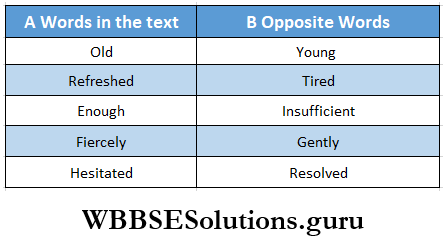
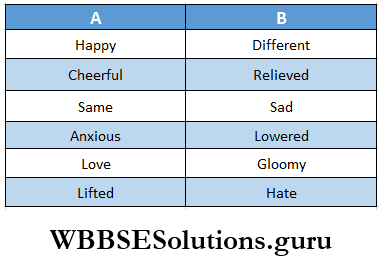
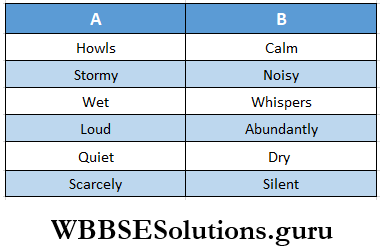
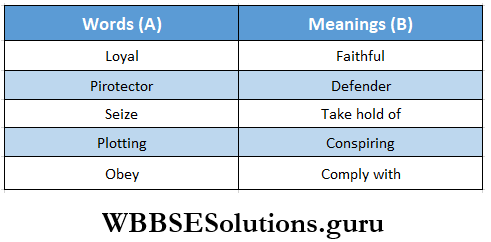
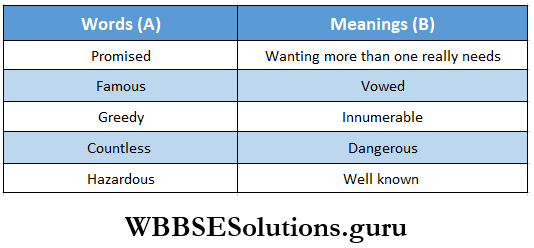
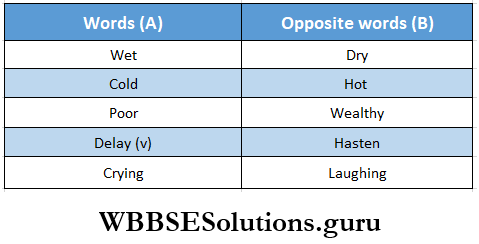
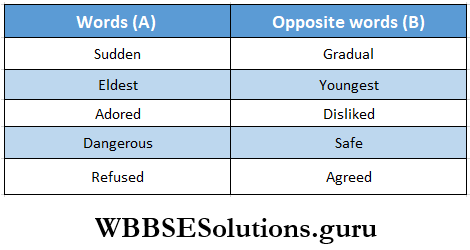
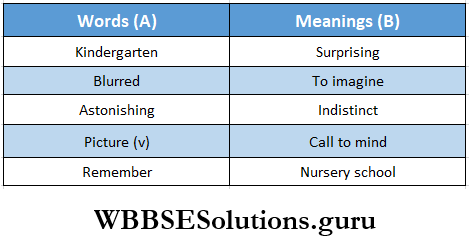
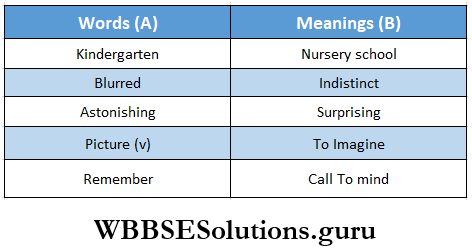
3. Complete the chart with words from the text in A to match with words in B.

Question 1.
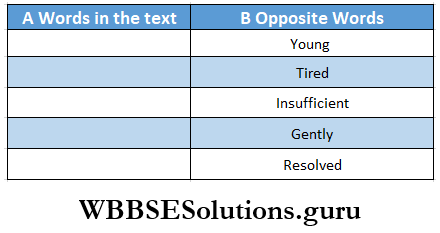
WBBSE Solutions For Class 8 English Reading Skill Seen Lesson 2 Clouds Complete The Chart With Words From Text In A With Words B

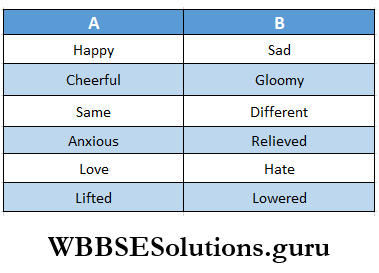
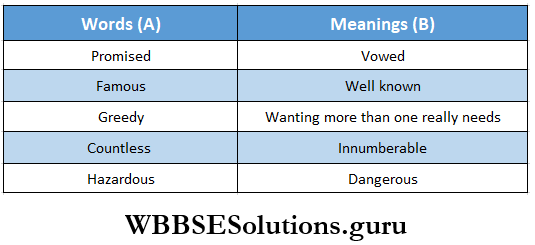
Answer:

WBBSE Solutions For Class 8 English Reading Skill Seen Lesson 2 Clouds Complete The Chart With Words From Text In A With Words B Answers

Question 4.

As he neared his village, he saw the roads were wet. Trees that had been standing draped in layers of dust when he had left in the morning now looked freshly bathed. He felt a wave of happiness. He hurried home. He wanted to see how fresh and clean the jamun tree in his courtyard looked.

When he got home, he saw that the rain had changed everything. The jamun tree stood clean and scrubbed, freshly showered, and Ammaji was saying, “That was a good shower, thank God !’

Raindrops were still rolling off the leaves of the jamun. He stood beneath the tree and let them fall on his head and face. He raised his eyes to the sky and saw it clear, without even a wisp of cloud. He had walked so far in the dust and sun in search of the clouds, and in his absence, they had come, shed their rain, and gone away!

1. Answer the questions below:

  1. What did the boy see as he neared his village?
  2. Why did he feel happy?
  3. What did the boy see when he got home?
  4. What did the boy do as he stood under the Jamun tree?
  5. Why did the clouds shed rain in the absence of the boy?

Answer:

  1. As he neared his village, the boy saw that the roads were wet and trees, which had been covered with dust, were now looking freshly bathed.
  2. The boy felt happy seeing everything clean and fresh after the shower of rain.
  3. He saw that the rain had changed everything. The Jamun tree looked clean and scrubbed after the fresh shower.
  4. He stood beneath the tree and let raindrops fall on his head and face.
  5. The boy went through much hardship in search of the clouds, and perhaps to give him a surprising reward, the clouds shed rain in his absence.

2. Write “T” for true and ‘F’ for false statements. Give supporting sentences for each of your answers.

Question 1. Nearing his village, he found the trees looking freshly bathed.
Answer:

Trees that had been now looked freshly bathed.

Question 2. The rain had changed nothing.
Answer:

The rain had changed everything.

Question 3. The boy felt very happy.
Answer:

He felt a wave of happiness.

Question 4. He thanked God for the good shower.
Answer:

…and Ammaji was saying, “That was a good shower, thank God!”

Question 5. It rained when he was away from his village.
Answer:

…and in his absence, they had come, shed. their rain and gone away..

3. Complete the sentences with information from the text.

Question 1. He saw the roads were wet as ____________
Answer: He saw the roads were wet as he neared his village.

Question 2. Trees that had been covered in ________
Answer: Trees that had been covered in layers of dust now looked freshly bathed.

Question 3. He hurried home to ___________
Answer: He hurried home to see how fresh and clean the Jamun tree in his courtyard looked.

Question 4. Coming home, he saw __________
Answer: Coming home, he saw that the rain had changed everything.

Question 5. His mother said that _________
Answer: His mother said that there had been a good shower and she thanked God for that.

Question 6. In his absence, the clouds, ________
Answer: In his absence, the clouds had come, shed their rain, and gone away.

4. Write words opposite in meaning of the following words, and frame sentences with them.

  1. Raised,
  2. Happiness,
  3. Beneath,
  4. Clean,
  5. Absence.

Answers

  1. Raised – lowered – She lowered her eyes and spoke to the teacher
  2. Happiness – Sorrow – He expressed his sorrow -at the news of her death.
  3. Beneath – above – The plane was Hying above the clouds.
  4. Clean – dirty – The room has become very dirty.
  5. Absence – presence – Your presence is requested at the meeting
WBBSE Solutions For Class 8 English Reading Skill Seen Lesson 3 An April Day

Reading Skill Seen Lesson 3 An April Day

Word meanings:

Stanza 1

warm (ওয়ার্ম)–উয় seed-time (সিড টাইম) বীজ পোতার সময়; harvest (হারভেস্ট) – শস্য সংগ্রহ; still (স্টিল) নিশ্চল, স্থির; wood (উজ্)—বনভূমি; prings (স্প্রিংস) ফুটে ওঠে, plain (প্লেন) — সমভূমি।

Stanza 2

glades (গ্রেড) তৃণভূমি teeming (টিমিং) পরিপূর্ণ, many folded অনেক স্তরের; foretell (ফোরটেল) -আগে থেকে বলে দেয়; coming on—আগমন, আসা।

Stanza 3

loosend (লুজেন্ড )—আলগা, ঝুরঝুরে; sapling (স্যালিং) – চারাগাছ ; sustenance (সাটেনান্স)—বাঁচার রসদ ; thrives (থ্রাইভস্)— বেড়ে ওঠে; stricken (স্ট্রিকেন)—আর্ত, পীড়িত; drooping (ড্রপিং) – নুয়ে পড়া; revives (রিভাইভ্স) —সজীব হয়ে ওঠে।

Read And Learn Also WBBSE Class 8 English Reading Skills

Stanza 4

warbled (ওয়ার্লড্) – কাপানো স্বর; glance (গ্লানস্) – ঝিলিক দেওয়া।

Stanza 5

slope (স্লোপ ) –ঢাল ; shadows (শ্যাডোজ) – ছায়া; hollows (হলোজ্)—গুহাগুলি (এখানে); upland (আপ্‌প্ল্যানড্) ——উচ্চভূমি; glows (গ্লোজ) উজ্জ্বল হয়ে ওঠে।

Substance:

The poet Longfellow here expresses his joy as he enjoys the diverse and beautiful nature in spring in the month of April. The warm sun with the advent of spring brings seed time and harvest. The still wood looks pleasant with the appearance of the first flower.

The open spaces in the wood are filled with flowers, and the clouds indicate the approaching storms. Saplings grow in the soft soil and the winter-stricken bent trees are infused with new life.

The woods are filled with the sweet chirping sounds of birds as they fly with their colourful wings around the woods. The bright sunset covers the silver woods and the caves look shadowy when the highland is lit up.

বঙ্গানুবাদ :

কবি Longfellow এখানে এপ্রিল মাসে বসন্তকালে প্রকৃতির বিচিত্র সৌন্দর্য্য দেখে যে আনন্দ উপভোগ করেন তার কথা বলেছেন। বসন্তের আবির্ভাবে উয় সূর্য্য বীজবপন এবং ফসল কাটার সময় নিয়ে আসে। প্রথম ফুল ফুটে ওঠায় নীরব বনভূমি-তখন খুবই সুন্দর দেখায়। বনভূমির উন্মুক্ত প্রাঙ্গনগুলো সব ফুলে ভরে যায় এবং মেঘেরা আসন্ন ঝটিকার পূর্ব্বাভাস দেয়। কোমল মাটিতে চারাগাছগুলো বাড়তে থাকে। শীতের ঠাণ্ডায় কাতর হয়ে নুয়ে পড়া গাছগুলি আবার নতুন প্রাণ ফিরে পায়। বনভূমিতে রঙ্গীন ডানা মেলে পাখীরা তখন উড়ে বেড়ায় এবং তাদের মধুর কিচির মিচির শব্দে চারদিক ভরে যায়। উজ্জ্বল সূর্য্যাস্ত অরণ্যকে রূপালি আলোয় ভরিয়ে তোলে। উচ্চভূমি আলোকিত হয়ে পাহাড়ের গুহাগুলিকে তখন ছায়াময় করে ফেলে।

WBBSE Solutions For Class 8 English Reading Skill Seen Lesson 3 An April Day

Reading Skill Seen Lesson 3 An April Day Examples

Read the texts below and do as directed.

Question 1. When the warm sun, that brings

Seed time and harvest has returned again,

‘T is sweet to visit the still wood, where springs

The first flower of the plain.

I love the season well,

When forest glades are teeming with bright forms, Nor dark and many-folded clouds foretell

The coming-on of storms.

WBBSE Class 8 English Functional GrammarWBBSE Class 8 English Reading Skills
WBBSE Solutions For Class 8 EnglishWBBSE Solutions For Class 8 Maths


1. Answer the questions below:

  1. What does the warm sun bring?
  2. Why is it sweet to visit the wood during springtime?
  3. Why does the poet love the season well?
  4. What do the many-folded clouds indicate?

Answer:

  1. The warm sun brings seed time and harvest.
  2. It is sweet to visit the wood in the springtime because the first flower of the plain blooms in the wood during this time and the trees become brighter.
  3. The poet loves the season well because the forest glades are filled with bright colourful flowers at this time, and many-folded clouds foretell the coming on of storms.
  4. The many-folded clouds indicate the advent of storms.

2. Write ‘T’ for true and ‘F’ for false statements.

Question 1. Warm sun brings rain.
Answer: False

Question 2. The first flower of the plain blooms in the still wood.
Answer: True

Question 3. To the poet, it is a pleasure to visit the still wood in summer.
Answer: False

Question 4. The forest glades look very colourful.
Answer: True

3. Find words in the text which mean the following:

Question 1. Cutting and collecting crops
Answer: Harvest

Question 2. Not moving
Answer: Still

Question 3. Small open areas of grass in a wood
Answer: Glades

Question 4. An area of trees, smaller than a forest
Answer: Wood

Question 5. Predict
Answer: Foretell

Question 2. From the earth’s loosened mould

The sapling draws its sustenance and thrives
Though stricken to the heart with winter’s cold,
The drooping tree revives.

The softly-warbled song.
Comes from the pleasant woods, and coloured wings
Glance quickly in the bright sun, that moves along
The forest openings.

When the bright sunset fills
The silver woods with light, the green slope throws
Its shadows in the hollows of the hill;
And wide the upland glows.

1. Complete the sentences with information from the text.

Question 1. The drooping tree is stricken with
Answer: The drooping tree is stricken with the cold of winter.

Question 2. From the pleasant woods comes
Answer: From the pleasant woods comes the softly-warbled song.

Question 3. The bright sun moves
Answer: The bright sun moves along the forest openings..

Question 4. The bright sunset fills.
Answer: The bright sunset fills the silver woods with light.

2. Write ‘T’ for true and ‘F’ for false statements.

Question 1. The saplings get their food from the earth’s loose soil.
Answer: True

Question 2. The silver woods are filled with light at sunrise.
Answer: False

Question 3. The sapling is affected with cold.
Answer: True

Question 4. Birds fly with their white wings.
Answer: False

3. Answer the questions below.

  1. From where does the sapling draw its sustenance?
  2. What happens to the sapling in winter’s cold?
  3. Where does the softly-warbled song come from?
  4. What do the coloured wings do?
  5. What does the bright sunset fill?

Answer:

  1. The sapling draws its sustenance from the loosened mould of the earth.
  2. The sapling is stricken with the cold of winter and becomes drooping.
  3. The softly-warbled, song comes from the pleasant wood.
  4. The coloured wings glance quick in the bright sun.
  5. The bright sunset fills the silver woods with light.

4. Fill in the blanks with words taken from the text. There are a few extra words.

List of words: mould, sustenance, pleasant, bright, sapling, shadows, silver, revives.

Question 1. She is watering the ________________lengthened
Answer: Sapling

Question 2. Whenever I look at the picture, it ___________ my old memories.
Answer: Revives

Question 3. The ________________lengthened as the sun went down.
Answer: Shadows

Question 4. He needs a job urgently for his ___________
Answer: Sustenance

Question 5. We had a __________ weather at Digha.
Answer: Pleasant

WBBSE Solutions For Class 8 English Reading Skill Seen Lesson 5 Princess September

Reading Skill Seen Lesson 5 Princess September

Word meanings:

Part 1

hop (হপ্)~~লাফ দিয়ে চলা; reflected (রিফ্লেক্টেড)—প্রতিফলিত; still (ষ্টিল) – স্থির; delight (ডিলাইট)— আনন্দ ; stretched out (স্ট্রেচড্ আউট)—বাড়িয়ে দিল; perch (পার্চ) – পাখির বসার দাঁড় ; jealous (জেলাস্)— ঈর্ষান্বিত ; pop (পপ্)–রাখা, ঢোকান; ominously (ওমিনালি) – সতর্কতার সঙ্গে; uneasy (আইজি)—উদ্বিগ্ন; fancy (ফ্যান্সি ) – পছন্দ।

Part 2

tweet (টুইট্ )—পাখির কিচির মিচির শব্দ ; quietly (কোয়ায়েট্‌লি ) – নিঃশব্দে ; thump (থাম্প) –ধুপ-ধুপ করা; risk (রিস্ক)—ঝুঁকি; ‘suspected (সাপেকটেড)—সন্দেহ করল; hopped (হড্)—লাফিয়ে উঠল; ivory (আইভরি) —হাতির দাঁত; prowling (প্রাউলিং) — শিকারের খোঁজে ঘুরে বেড়ান ; supper — নৈশভোজন; instead (ইনষ্টেড্)— পরিবর্তে; dawn (ডন)— ভোর, ঊষা; awakened. (এ্যাওকেড্)—জাগিয়ে তোলা হল; dew (ডিউ)—শিশির; heart’s content (হার্টস কনটেন্ট)—মনের সুখে, হৃদয়ভরে; slip through — বের হয়ে যাওয়া; fond (ফল্ড) – অনুরাগী।

Read And Learn Also WBBSE Class 8 English Reading Skills

Part 3

stretched (স্ট্রেড)—বিস্তৃত হয়েছিল; anxious (অ্যাংশাস) – উদ্বিগ্ন; used to – অভ্যস্ত; startled (স্টার্টেড্)— ভীত, ভয়ার্ত; sob (সর্) — দীর্ঘশ্বাস; relief (রিলিফ ) – স্বস্তি; freedom (ফ্রিডম) — স্বাধীনতা; enough ( এনাফ ) — যথেষ্ট; gently (জেন্টলি)—ধীরে ধীরে; sill (সিল্)— চৌকাঠ; day and night—দিবারাত্র; whenever (হোয়েএভার)—যখনই।

WBBSE Solutions For Class 8 English Reading Skill Seen Lesson 5 Princess September

Reading Skill Seen Lesson 5 Princess September Examples

Read the texts below and do as directed.

Question 1. Princess September, the daughter of the king of Siam, was very unhappy. She was weeping alone one day in her own room when she saw a little bird hop in. Then the little bird began to sing. He sang a beautiful song all about the lake in the king’s garden and the willow trees reflected in the still- water. When he had finished, the Princess was not crying anymore. That was a very nice song”, she said. “Would you want me to live with you ?” said the little bird.

Princess September clapped her hands with delight. Then the little bird hopped onto the end of the bed and sang her to sleep. When she awoke the next day the little bird was still sitting there, and as she opened her eyes he said good morning. She stretched out the first finger of her right hand so that it served as a perch.

The little bird flew down and sat on it. Then she went through the palace and called on each of the princesses in turn. And, for each of the princesses, the little bird sang a different song.

WBBSE Class 8 English Functional GrammarWBBSE Class 8 English Reading Skills
WBBSE Solutions For Class 8 EnglishWBBSE Solutions For Class 8 Maths


1. Answer the questions below:

  1. Who was Princess September?
  2. Why was she weeping?
  3. What did the little bird ask her?
  4. Why did the princess clap her hand in delight?
  5. What did the little bird do for each of the princesses?

Answer:

  1. Princess September was the daughter of the king of Siam.
  2. She was weeping because she was very unhappy.
  3. The little bird asked her if she would want him to live with her.
  4. The princess clapped her hand in delight because the bird was ready to stay with her.
  5. The little bird sang a different song for each of the princesses.

2. Write “T for true and F for false statement. Give supporting sentences for each of your answers.

Question 1. Listening to the song of the bird, the princess stopped crying.
Answer: True

When he had finished, the Princess was not crying anymore.

Question 2. The princess did not appreciate the bird’s song.
Answer: False

“This was a very nice song”, she said.

Question 3. As the bird sang, the princess fell asleep.
Answer: True

On to the end of the bed and sang her to sleep.

Question 4. The princess could not find the bird when she woke up the next day.
Answer: False

And as she opened her eyes he said good morning.

Question 5. The little bird sat on the right-hand palm of the princess.
Answer: False

The first finger of her right hand so that it served as a perch.

3. Complete the sentences with information of the text.

Question 1. The princess was weeping alone in her room because _____________
Answer: The Princess was weeping alone in her room because she was very unhappy.

Question 2. The bird sang a beautiful song about _____________
Answer: The bird sang a beautiful song about the lake in the king’s garden and the willow trees that reflected in the still water

Question 3. When the bird finished singing, the _____________
Answer: When the bird finished singing, the Princess was not crying anymore.

Question 4. The bird wished her good morning when _____________
Answer: The bird wished her good morning when the Princess opened her eyes next morning.

4. Fill in the blanks with words from the text. There are a few extra words.

List of words: unhappy, alone, clapped, opened, sleep, beautiful, reflected, finger. girl walking in the garden.

Question 1. I saw a _____________
Answer: Beautiful

Question 2. The baby was all _____________ in the room.
Answer: Alone

Question 3. Her face was __________ in the mirror.
Answer: Reflected

Question 4. The audience cheered and _______ the musicians.
Answer: Clapped

Question 5. She _________ the box and took out the books.
Answer: Opened

Question 2. Suddenly, September heard a tweet-tweet just behind her ear. The bird had come in quietly. September felt her heart go thump-thump against her chest, and she made up her mind to take no more risks. She put up her hand and took hold of the bird. The bird was quite used to this, so he suspected nothing. He was surprised when she carried him to the cage, put him in, and shut the door on him. He hopped up on the ivory perch and said, “What is wrong?”

September said, “Some of Mamma’s cats are prowling about tonight, and I think you are much safer out here.”

“Well, just for this once I don’t mind,” said the little bird, “so long as you let me out in the morning.” He ate a very good supper and began to sing. But in the middle of his song he stopped.

“I don’t know what the matter with me is,” he said, “but I don’t feel like singing tonight.” “Very well,” said September, “go to sleep instead!”

1. Answer the questions below:

  1. What made September’s heart go thump-thump against her chest?
  2. “She made up her mind to take no more risks”-What were the ‘risks’ involved?
  3. What did the princess do with the bird?
  4. What excuse did the princess give to justify her action?
  5. Why didn’t the bird feel like singing that night?

Answer:

  1. Her heart went thump-thump against her chest as she decided to take no more risks, and put the bird in the cage.
  2. The risk was that the bird might forget her and go to someone else, if it was, allowed to fly freely.
  3. The princess held the bird in her hand and put him into the cage.
  4. She said that some of her mother’s cats were moving about in search of prey so the bird would be safe in the cage only.
  5. The bird did not feel like singing because he was put in a cage and he was no longer a free living being.

2. Write ‘T’ for true and ‘F’ for false statements.

Question 1. The bird came without making any noise.
Answer: True

Question 2. The bird was quite used to remaining in the cage.
Answer: False

Question 3. The bird suspected something wrong.
Answer: True

Question 4. September was very worried about the bird’s safety.
Answer: False

Question 5. The bird sang heartily at night.
Answer: False

3. Match the words in A with their meanings in B.

WBBSE Solutions For Class 8 English Reading Skill Seen Lesson 5 Princess September Match The Words In A With Their Meaning In B

Answer:

WBBSE Solutions For Class 8 English Reading Skill Seen Lesson 5 Princess September Match The Words In A With Their Meaning In B Answer

Question 3. She picked up the cage and walked down to the lake round which grew the willow trees. She stood at the edge of the rice fields that stretched as far as the eye could see. “I’ll take you out every day,” she said, “I love you and I only want to make you happy.”

“It’s not the same thing,” said the little bird. “The rice fields and the lake and the willow trees look quite different when you see them through the bars of a cage.”

So she brought him home, again and gave him supper. But he wouldn’t eat a thing. The Princess was anxious. “Perhaps he’ll have got used to his cage by tomorrow,” she thought.

And next day when she awoke she cried out good morning in a cheerful voice. She got no answer. She jumped out of bed and ran to the cage. She gave a startled cry, for there the little bird lay with his eyes closed, and he looked as if he were dead. She opened the door and lifted him out. She gave a sob of relief, for she felt that his little heart was beating still.

1. Answer the questions below:

  1. What did the princess promise to the bird and why?
  2. “It’s not the same thing”-What’s not the same thing?
  3. Why did the princess bring the bird home again?
  4. Why did the princess run to the cage?
  5. Why did the princess give a startled cry?

Answer:

  1. The princess promised to the bird that as she loved him and wanted to make him happy, she would take him out every day and walk down to the lake round which grew the willow trees.
  2. The rice fields, the lake and the willow trees which the bird saw through the bars of a cage were not the same as the ones he saw while standing at the edge of the rice fields.
  3. The princess brought him home again for serving him supper.
  4. As the princess did not get any response from the little bird when she bade him good morning, she ran to the cage to see him.
  5. The princess gave a startled cry because she found the little bird lying with his eyes closed and looked as if he were dead.

2. Write “T” for true and ‘F’ for false statements. Write supporting sentences for each of your answers.

Question 1. The princess held the bird in her hand and took him to the lake.
Answer: False

She picked up the cage and walked down.

Question 2. The princess got anxious when the bird did not eat anything.
Answer: True

But he would not eat a thing. The princess was anxious.

Question 3. The next morning the princess found the bird lying and making no response.
Answer: True

She got no answer for there the little bird lay with his eyes closed.

Question 4. The princess could not feel the bird’s heart beat.
Answer: False

For she felt that his little heart was beating still.

3. Rearrange the following sentences in the correct order. Fut the numbers in the boxes.

1. She ran to the cage.

2. She got no response from him.

3. She brought the bird out from the cage.

4. She cried out in surprise and fear.

5. The Princess bade the little bird good morning.

6. She felt relieved.

7. She saw the bird lying with his eyes closed as if he were dead.

8. She could feel his heart beating.

Answer:

3. She brought the bird out from the cage.

2. She got no response from him.

6. She felt relieved.

5. The Princess bade the little bird good morning.

1. She ran to the cage.

8. She could feel his heart beating.

4. She cried out in surprise and fear.

7. She saw the bird lying with his eyes closed as if he were dead.

4. Match the words in A with their opposite meanings in B.

WBBSE Solutions For Class 8 English Reading Skill Seen Lesson 5 Princess September Match The Words In A With Their Opposite Meaning In B

Answer:

WBBSE Solutions For Class 8 English Reading Skill Seen Lesson 5 Princess September Match The Words In A With Their Opposite Meaning In B Answer

Question 4. “Wake up, wake up, little bird,” “she said. She began to cry and her tears fell on the little bird. ‘I cannot sing unless I’m free and if I cannot sing, I die”, he said.

“Then take your freedom,” the princess said. ‘I shut you in a golden cage because I loved you and wanted to have you all to myself. But I never knew it would kill you. Go. Fly away among the trees that are round the lake, and fly over the green rice fields. I love you enough to let you be happy in your own way.”

She threw open the window and gently placed the little bird on the sill.

“I will come because I love you, little Princess, said the bird. “And I will sing you the loveliest songs I know.

I shall go far away, but I shall always come back, and I shall never forget you.”

Then he opened his wings and flew right away into the blue. September kept her window open, day and night so that the little bird might come into her room whenever he wished.

1. Answer the questions below:

  1. What was the reason for the Princess shutting the bird in a cage?
  2. What did the bird tell the Princess about his captive life?
  3. Why was the little bird granted freedom by the Princess?
  4. What did the Princess do ultimately?
  5. Why did the Princess keep her window open?

Answer:

  1. The Princess shut the bird in a golden cage because she deeply loved him and wanted to have him all to herself.
  2. The bird said that he could not sing unless he was free, and if he could not sing he would die.
  3. The Princess realized that her way of loving the bird by keeping him in the cage and depriving him of his freedom might kill the bird. So she let him free to be happy in his own way.
  4. Ultimately, the Princess allowed the little bird to fly away.
  5. The Princess kept her window open so that the little bird could come into her room whenever he wished.

2. Write ‘T’ for true and ‘F’ for false statements. Write supporting sentences for each of your answers:

Question 1. The bird said that he could not sing unless he got freedom.
Answer: True

I cannot sing unless I’m free.”

Question 2. The Princess did not want the bird to live in his own way.
Answer: False

“I love you enough to let you be happy in your own way.”

Question 3. Once made free, the bird would never come back to the Princess.
Answer: False

“I will come because I love you, little Princess”, said the bird.

Question 4. The bird was granted freedom.
Answer: True

Then he opened his wings and flew right away into the blue.

Question 5. The Princess hoped the bird would come into her room whenever he wished.
Answer: True

so that the little bird might come into her room whenever he wished.

3. Complete the sentences with information from the text.

Question 1. As the Princess loved the bird and wanted to have him all to herself, she __________
Answer: As the Princess loved the bird and wanted to have him all to herself, she shut the bird in a golden cage.

Question 2. If the bird is not free, he __________
Answer: If the bird is not free, he cannot sing, and he will die.

Question 3. The bird promised that __________
Answer: The bird promised that he would come and sing her songs. He would never forget her, and would always come back.

Question 4. In order that the bird might come into the room, the Princess ________________
Answer: In order that the bird might come into her room, the princess kept her window open.

4. Frame sentences of your own with the following words:

  1. Unless;
  2. Myself;
  3. Among;
  4. Enough;
  5. Loveliest;
  6. Day and night.

Answer:

  1. I sleep with the window open unless it is really cold.
  2. I did the work myself without anybody’s help.
  3. Among the four brothers, Subir is the most intelligent one.
  4. I didn’t have enough money to buy the house.
  5. The rose is the loveliest flower of all.”
  6. You can hear the traffic noise from your room day and night.

WBBSE Solutions For Class 8 English Reading Skill Seen Lesson 6 The Sea

Reading Skill Seen Lesson 6 The Sea

Word meaning:

Stanza 1

hungry (হাংরি)—ক্ষুধার্ত ; grey (গ্রে ) – ধূসরবর্ণ; rolls (রোস্‌) – গড়াগড়ি খায়; beach (বীচ্)—সমুদ্রতীর; clashing (ক্ল্যাশিং)—ঠোকাঠুকি করে; shaggy (শ্যাগি) — রুক্ষ; gnaws (ন্যস্)—অনবরত কামড়ায়, চিবায়; rumbling (রাম্বলিং)—গুড় গুড় শব্দময় ; tumbling (টাম্বলিং)— গড়াগড়ি দিচ্ছে এমন; moans (মোস্‌) –বিলাপ করে; greasy (গ্রীসি) — তৈলাক্ত; paws (প্যজ্) – থাবাগুলি ।

Stanza 2

roars (রোরস্)— গৰ্জ্জন করে ; rocks (রক্স) — টলমল করে ; bounds (বাউন্ডস্) – লাফ দেয়; snuffs (স্না) —নাকের মধ্যে টেনে নেয়; sniffs (স্নি)— শোঁকে; cliffs (ক্লি)—খাড়া উঁচু পাহাড় ; howls (হাউস্‌ )–গর্জন করে; hollos (হলোজ) – উচ্চৈঃস্বরে ডাকে ।

Read And Learn Also WBBSE Class 8 English Reading Skills

Stanza 3

quiet (কোয়ায়েট্)—শান্ত ; dune (ডিউন্) – বালিয়াড়ি; reedy tune (রীডি টিউন) – বাদ্যযন্ত্রের সুর; scarcely (স্কেয়ারলি) – কোনোমতে; snores (স্নোর্স্)—নাক ডাকে।

Substance:

The poet here describes a sea at different times by comparing it to a huge, grey-hungry dog. The sea- dog rolls on the beach the whole day biting and chewing the rolling stones in the wave-like bones, and groans for more.

At night the moon swings in the stormy cloud with the roaring night wind. The sea dog shakes off his wet limbs over the cliffs and howls loud. But in summar in May or June, the mighty sea- dog becomes quiet. Even the grasses on the dune stop playing their high pitch tune. The sea then lies still on the beach.

বঙ্গানুবাদ :

কবি এখানে বিভিন্ন সময়ের সমুদ্রকে একটি বিশাল, ধূসর ও ক্ষুধার্ত কুকুরের সঙ্গে তুলনা করেছেন। সমুদ্র-কুকুর সৈকতের উপর সারাদিন গড়াগড়ি দিয়ে ঢেউয়ের মধ্যে লুটোপুটি খাওয়া পাথরগুলোকে হাড়ের মত চিবোয় আর কামড়ায় এবং আরও হাড়ের জন্য কাতরাতে থাকে। রাত্রিবেলা গর্জনশীল রাতের বাতাসে ঝোড়ো মেঘে চাঁদটা দুলতে থাকে। সমুদ্র-কুকুর তখন তার দেহের ভিজে অঙ্গ-প্রত্যঙ্গ সব তটের পাথরের উপর ঝেড়ে ফেলে এবং তীব্র চিৎকার করে। কিন্তু গ্রীষ্মকালে মে অথবা জুন মাসে শক্তিমান্ সমুদ্র-কুকুর শান্ত হয়ে পড়ে। বালিয়ারির উপরের ঘাসগুলিও তাদের তীক্ষ্ণ সুর বাজানো বন্ধ রাখে (অর্থাৎ নিয়মিত ছন্দে খেলা করে না)। বালির তটে সমুদ্র তখন স্থির হয়ে শুয়ে থাকে।

WBBSE Solutions For Class 8 English Reading Skill Seen Lesson 6 The Sea

Reading Skill Seen Lesson 6 The Sea Examples

Read the texts below and do as directed.

Question 1. The sea is a hungry dog,

Giant and grey.

He rolls on the beach all day.

With his clashing teeth and shaggy jaws

Hour upon hour he gnaws

The rumbling, tumbling stones,

And ‘Bones, bones, bones!’

The giant sea dog moans,

Licking his greasy paws.

WBBSE Class 8 English Functional GrammarWBBSE Class 8 English Reading Skills
WBBSE Solutions For Class 8 EnglishWBBSE Solutions For Class 8 Maths


1. Answer the questions below:

  1. What does the sea look like?
  2. What does the sea do all day?
  3. How has the sea been described in the poem?
  4. What does the sea dog moan for?

Answer:

  1. The sea looks like a giant, hungry dog grey in colour.
  2. The sea rolls on the beach all day.
  3. The sea has been described as a huge hungry dog that rolls on the beach all day long with his clashing teeth and shaggy jaws.
  4. The sea dog moans for bones.

2. Choose the correct answers from the alternatives given:

Question 1. The sea is compared to a-

  1. Fierce lion,
  2. Wolf,
  3. Hungry dog.

Answer: 3. Hungry dog

Question 2. The sea looks-

  1. Blue,
  2. GZrey,
  3. White.

Answer: 2. GZrey

Question 3. Stones are compared to

  1. Bones,
  2. Teeth,
  3. Nuts.

Answer: 1. Bones

Question 4. The sea dog has-

  1. Broken teeth,
  2. Rough teeth,
  3. Clashing teeth.

Answer: 3. Clashing teeth

3. Complete the sentences with information from the text.

Question 1. With his clashing teeth and rough jaws, the sea ________
Answer: With his clashing teeth and rough jaws, the sea rolls on the beach all day.

Question 2. The hungry sea-dog gnaws ____________
Answer: The hungry sea dog gnaws the rumbling and tumbling stones.

Question 3. When the giant sea dog moans, he ________
Answer: When the giant sea dog moans, he licks his greasy paws.

4. Find words in the text which have the following meanings:

  1. The seashore,
  2. Rough,
  3. The mouth and teeth of a person or an animal,
  4. Bites and chews,
  5. Very large.

Answer:

  1. Beach;
  2. Shaggy,
  3. Jaws,
  4. Gnaws;
  5. Giant.

Question 2. And when the night wind roars

And the moon rocks in the stormy cloud,
He bounds to his feet and snuffs and sniffs,
Shaking his wet sides over the cliffs
And howls and hollos long and loud.

But on quiet days in May or June,
When even the grasses on the dune
Play no more their reedy tune,
With his head between his paws
He lies on the sandy shores,
So quiet, so quiet, he scarcely snores.

1. Answer the questions below:

  1. Who rocks in the stormy cloud?
  2. When does the moon rock?
  3. When do the quiet days come?
  4. When do the grasses stop playing their reedy tune?
  5. What does the sea dog do is May or June?

Answer:

  1. The moon rocks in the stormy cloud.
  2. The moon rocks in the stormy cloud when the night wind roars.
  3. The quiet days come during May and June.
  4. The grasses on the dune stop playing their reedy tune during May and June.
  5. In May and June the sea dog lies on the sandy shores quietly keeping his head between his paws.

2. Write ‘T’ for true and ‘F’ for false statements.

Question 1. The moon rocks in a calm weather.
Answer: False

Question 2. The sea shakes his wet sides over the cliffs.
Answer: True

Question 3. The quiet days come before May.
Answer: False

Question 4. The weather remains calm in May and June.
Answer: True

Question 5. On quiet days the sea seldom snores.
Answer: True

3. Complete the sentences with information of the text.

Question 1. In the stormy cloud the moon ____________
Answer: In the stormy cloud the moon rocks when the night wind roars.

Question 2. In May or June the grasses on the dune ___________
Answer: In May or June the grasses on the dune do not play their reedy tune.

Question 3. In quiet days in May or June, the sea dog lies ________
Answer: In quiet days in May or June, the sea dog lies on the sandy shores quietly keeping his head between the paws.

Question 4. The sea-dog shakes his ________
Answer: The sea dog shakes his wet sides over the cliffs.

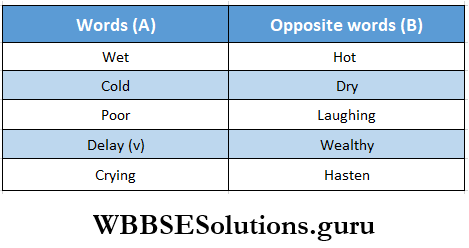
4. Match the words in A with their opposite meanings in B.

WBBSE Solutions For Class 8 English The Sea Reading Skill Seen Lesson 6 The Sea Match The Words In A With Their Opposite Meanings In B

Answer:

WBBSE Solutions For Class 8 English The Sea Reading Skill Seen Lesson 6 The Sea Match The Words In A With Their Opposite Meanings In B Answer

WBBSE Solutions For Class 8 English Reading Skill Seen Lesson 7 A Kings Tale

Reading Skill Seen Lesson 7 A Kings Tale

Word meanings:

Part 1

protector (প্রোটেক্টর)-রক্ষক; tending (টেন্ডিং) — পালন করে; flocks (ফ্ল) – পশুর পাল / দল; tilling (টিলিং)—চাষ করে ; heir (হেয়ার ) — উত্তরাধিকারী; royal throne – রাজ সিংহাসন; opponents (অপোনেন্টস্)— প্রতিদ্বন্দ্বীরা, বিরোধীরা; seize (সীজ্ ) — দখল করা; counsellors (কাউন্সেলর)— পরামর্শদাতারা; prophet (প্রফেট্)— ভবিষ্যদ্বক্তা ; knight (নাইট্)— যোদ্ধা; loyal (লয়াল্) – বিশ্বস্ত; wrapped (রা)—জড়ানো; scarlet (স্কারলেট্)— উজ্জ্বল লাল রঙের; bring up (ব্রিং আপ) – লালন-পালন করা; obey (ওবে) — মেনে চলা; broke out — সুরু হল; passing away—মারা যাওয়া; barons – অভিজাতরা; plotting (প্লটিং) – ষড়যন্ত্র করা; lawlessness (ললেনেস্)—অরাজকতা ; robbed (রবড্)—লুটতরাজের শিকার হওয়া।

Part 2

handsome (হ্যান্ডসাম)—সুশ্রী; torn (টন)—ছিন্নভিন্ন; rivalry (রাইভারি) — শত্রুতা, প্রতিদ্বন্দ্বিতা; longed for —চেয়েছিল; prosperity (প্রপ্যারিটি) — সমৃদ্ধি; festivity (ফেটিভিটি) — উৎসব; all around — চারিদিকে; frightened (ফ্রাইটেড্)—ভীত; magnificent (ম্যাগনিফিসেন্ট্) — জমকালো; inscribed (ইন্‌স্ক্রাইব) – খোদিত; right of birth— জন্মাধিকার; jostled (জলড্) –ধাক্কাধাক্কি করল ; succeeded (সাক্সীডেড্) – সফল হয়েছিল ; disappointed (ডিসাপয়েন্টেড)—হতাশ হওয়া; demanded (ডিমান্‌ডেড) – দাবি করল; craftsmen (ক্রাফ্টমেন্)—কারিগরগণ ; slender (স্লেন্ডার্)—ছিপ্‌ ছিপে; hailed (হেইড্) – অভিবাদন জানাল; secure (সিকিওর) — সুনিশ্চিত করা; concerned (কন্সার্নড্)—চিন্তিত; humblest (হাম্বলে)—দীনহীনতম; bracelets (ব্রেসলেট্স)—বালা; rubies (রুবিজ্‌)—চুনিগুলি ; emeralds (এমারেল্স্) – পান্নাগুলি

Read And Learn Also WBBSE Class 8 English Reading Skills

Part 3

fearless (ফিয়ারলেস্)—নির্ভীক ; protect (প্রোটেক্ট) — রক্ষা করে; possess (পসেস্) – অধিকারী হওয়া; enchanted (এচ্যান্টেড)—মায়াবি; mysterious (মিস্টিরিয়াস্)— রহস্যময়; personal (পারসোনাল)—ব্যক্তিগত; benefit (বেনিফিট্ —সুবিধা, স্বার্থ, gift (গিট্)—উপহার; greedy (গ্রীডি)— লোভী ; gilded (গিলডেড্)–ঝলমলে ; pavilion (প্যাভিলিয়ন্)—মণ্ডপ; crimson (ক্রিসন্)—টক্টকে লাল; carved (কার)–কারুকার্য্য করা; gathered (গ্যাদার্ড্) —জমায়েত হত; vows (ভাওস্)—অঙ্গীকার; hazardous (হ্যাজারডাস্) –ঝুঁকিপূর্ণ; adventures (অ্যাডভেনচার) – দুঃসাহসিক অভিযানগুলি; perished (পেরিশড্) — প্রাণ হারিয়েছিল ; trusted (ট্রাটেড্)—বিশ্বস্ত ; disappeared (ডিস্যাপিয়ার্ড)— অদৃশ্য হয়ে গেল; barge (বার্জ) –বজরা; twilight (টুইলাইট্)— গোধুলি ; tearful (টিয়ারফুল – অশ্রুপূর্ণ; goodbye (গুড্‌বাই)— বিদায়।

WBBSE Solutions For Class 8 English Reading Skill Seen Lesson 7 A Kings Tale

Reading Skill Seen Lesson 7 A Kings Tale Examples

Read the texts below and do as directed.

Question 1. Many hundreds of years ago, England was ruled by a king called Uther-Pendragon. The king, who was a friend and protector to all his people, was fair to everyone. The people of Britain lived in peace and happiness, tending their flocks and tilling their fields.

King Uther-Pendragon had married the beautiful Lady Igraine and had a son. This child was the heir to the royal throne.

The king and the queen died soon after the baby boy was born. It was a difficult time. Many of the king’s oponents were looking to seize the throne. King Uther-Pendragon had two wise counselors- Merlin, a prophet and a magician, and the brave knight, Sir Ulfius. They were greatly trusted by the royal family. When the king and the queen were no more, the two counselors met Sir Ector the Trustworthy, a loyal subject of the king, on a cold and windy midnight. They placed in his hands a baby wrapped in a scarlet cloak. Merlin said, “We order you and your wife to bring up this child as though he were your own son.”

“The boy is to be called Arthur,” Sir Ulfius said. Sir Ector, being a true knight asked no questions and promised to obey his late king’s counsellors.

As Merlin and Sir Ulfius had feared, trouble broke out in Britain after the passing away of the king. The barons were fighting among themselves and plotting to capture the throne. Britain was in the grip of lawlessness. Travelers were regularly robbed. The peasants were unhappy.

WBBSE Class 8 English Functional GrammarWBBSE Class 8 English Reading Skills
WBBSE Solutions For Class 8 EnglishWBBSE Solutions For Class 8 Maths


1. Answer the questions below:

  1. Who was the king of England and how did he treat his people?
  2. What happened to Britain soon after the death of king Uther-Pendragon?
  3. Who were Merlin and Ulfius?
  4. What did they do for the king’s orphan child?
  5. How did Sir Ector respond to the counselor’s order?

Answer:

  1. Uther-Pendragon was the king of England, and he was a friend and protector to all his people and was fair to everyone.
  2. Soon after the death of king Uther-Pendragon, trouble broke out in Britain. The barons started to fight among themselves and plot to capture the throne.
  3. They were king Uther’s two wise counselors greatly trusted by the royal family. Merlin was a prophet and magician and Sir Ulfius was a brave knight.
  4. After passing away of the king and the queen, they took the king’s orphan baby to Sir Ector, a loyal subject of the king, and ordered him and his wife to bring up the child as if he were their own son.
  5. Sir Ector asked no questions and promised to obey the counselor’s order.

2. Choose the correct answers from the alternatives given:

Question 1. During the reign of King Uther-Pendragon, the people of Britain lived a-

  1. Peaceful life,
  2. Disturbed life,
  3. Unhappy life.

Answer: 1. Peaceful life

Question 2. Lady Igraine was Uther-Pendragon’s-

  1. Mother,
  2. Wife,
  3. Sister.

Answer: 2. Wife

Question 3. The royal baby was to be brought up by-

  1. Merlin,
  2. Sir Ulfius,
  3. Sir Ector.

Answer: 3. Sir Ector

Question 4. Sir Ulfius was a-

  1. Knight,
  2. Prophet,
  3. Merchant.

Answer: 1. Knight

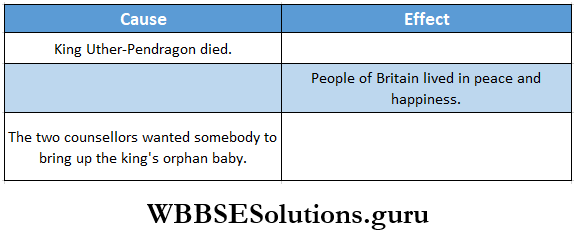
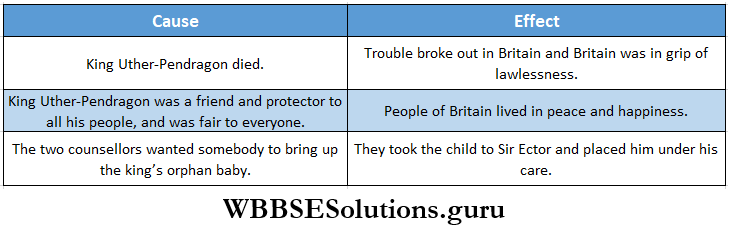
3. Fill in the chart with information from the text.

WBBSE Solutions For Class 8 English Reading Skill Seen Lesson 7 A Kings Tale Fill In The Chart With Information From The Test

Answer:

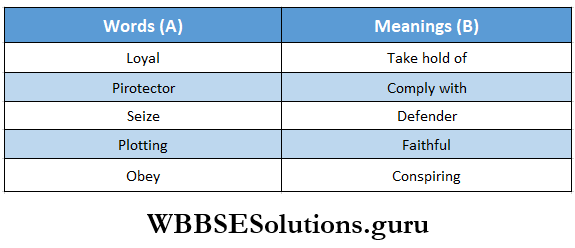
4. Match the words in A with their meanings in B.

WBBSE Solutions For Class 8 English Reading Skill Seen Lesson 7 A Kings Tale Match The Words In A With Their Meaning In B

Answer:

WBBSE Solutions For Class 8 English Reading Skill Seen Lesson 7 A Kings Tale Match The Words In A With Their Meaning In B Answer

Question 2.

In the home of Sir Ector, Arthur, the son of the late king, was spending his boyhood in happiness and safety. As he grew older, he became gentle, strong, handsome and good like his father Uther-Pendragon.

Eighteen years passed. Britain was torn by bitter rivalry. None of the fighting barons had managed to become the king. The people longed for the old days of peace and prosperity under Uther-Pendragon.

It was Christmas time, a time of festivity. But all around Britain, people were hungry, cold and frightened. One day, in a churchyard, people found a large stone on which was fixed a magnificent sword.

Upon the stone, in gold letters, was inscribed, “Whoever pulls out this sword is by right of birth, the king of England.” Immediately, the eager barons who longed to become the king,, jostled among themselves to lift the sword. None succeeded. The sword remained fixed to the stone.

1. Answer the questions below:

  1. Describe the royal baby as he grew at the home of Sir Ector.
  2. What was written upon the stone on which the sword was fixed?
  3. What was the condition of Britain for eighteen years after King Uther-Pendragon had passed?
  4. What did the people long for?

Answer:

  1. As the royal baby started growing older at the home of Sir Ector, he became gentle, strong, handsome, and good like his father Uther-Pendragon.
  2. Upon the stone was written in gold letters the words “whoever pulls out this sword is by right of birth, the king of England.”
  3. For eighteen years after the King Uther-Pendragon had passed away, Britain was torn by bitter rivalry among the barons fighting to become the king.
  4. The people longed for the old days of peace and prosperity that prevailed during the time of Uther- Pendragon.

2. Choose the correct answers from the alternatives given:

Question 1. The royal child was brought up by —

  1. Sir Ulfius,
  2. Sir Ector,
  3. Merline.

Answer: 2. Sir Ector

Question 2. The barons fought amongst themselves to become—

  1. The king,
  2. The knight,
  3. The lord.

Answer: 1. The king

Question 3. The sword was found—

  1. Under the ground,
  2. Fixed on a stone,
  3. Fixed on a large tree.

Answer: 2. Fixed on a stone

Question 4. The sword was lifted by—

  1. A baron,
  2. Arthur,
  3. None.

Answer: 3. Arthur

3. Complete the sentences with information from the text

Question 1. Arthur was growing up in __________
Answer: Arthur was growing up in the home of Sir Ector as a gentle, strong, and handsome boy, and good like his father Uther-Pendragon.

Question 2. For eighteen years__________
Answer: For eighteen years after the king had passed away, Britain was torn by bitter rivalry among the barons.

Question 3. None was successful________
Answer: None was successful in pulling out the sword fixed on the stone.

Question 4. The people longed for___________
Answer: The people longed for the old days of peace and prosperity under Uther-Pendragon.

Question 5. The stone was found_______
Answer: The stone was found to have some inscription’s on it in gold letters.

4. Fill in the blanks with words from the text. There are a few extra words.

List of words: rivalry, torn, festivity, people, handsome, safety, frightened, immediately.

Question 1. Her husband looks very __________
Answer: Handsome

Question 2. October is the mouth of __________
Answer: Festivity

Question 3. The children were _______ to see the elephant.
Answer: Frightened

Question 4. Our main concern is the ______________ of the child.
Answer: Safety

Question 5. The hoardings were __________ to pieces by the storm.
Answer: Torn

Question 3.

It was Arthur, at the age of eighteen, who succeeded in lifting the sword for the first time. The barons were angry and disappointed. They demanded a test.

Upon a bright May morning, a great trial took place in the presence of many people. There were the peasants, the craftsmen, the merchants, as well as the barons. In front of everyone, Arthur, slender and young, lifted the sword easily. The crowd hailed him as the king.

After becoming the king of England, Arthur’s first duty was to secure peace in England. He was helped by wise Merlin. Like his father, Arthur was concerned about the good of the common people. King Arthur fought battles so that no one could ill-treat the humblest of his subjects.

King Arthur had lost his royal sword in a battle. One day, Merlin took him to a valley of sweet-smelling flowers. At the edge of the plain there was a deep lake. As Arthur approached the lake, a beautiful arm with golden bracelets rose from the water. The hand held a sword set with rubies and emeralds.

1. Complete the sentences with information from the text.

Question 1. At the age of eighteen, Arthur ______________
Answer: At the age of eighteen, Arthur became of the king of England.

Question 2. The barons were angry and disappointed because ______________
Answer: The barons were angry and disappointed because while none of them could lift the sword, Arthur lifted the sword for the first time and became the king of England

Question 3. Arthur’s first duty after becoming the king was ______________
Answer: Arthur’s first duty after becoming the king was to secure peace in England.

Question 4. The crowd hailed Arthur as the king when __________
Answer: The crowd hailed Arthur as the king when he lifted the sword easily.

Question 5. When Arthur and Merlin came to the edge of the deep lake __________
Answer: When Arthur and Merline came to the edge of the deep lake, a beautiful arm with golden bracelets holding in hand a sword set with rubies and emeralds rose from the water

Question 6. Arthur needed a new sword because _______
Answer: Arthur needed a new sword because he had lost his royal sword in a battle.

2. Write ‘T’ for true and ‘F’ for false statements.

Question 1. Arthur lifted the sword with great effect.
Answer: False

Question 2. A trial was held for the lifting of the sword by Arthur.
Answer: True

Question 3. Arthur was concerned about the good of his people.
Answer: True

Question 4. A sword was held in a hand rising from the sea.
Answer: False

Question 5. Arthur was slender and young.
Answer: True

3. Find words in the text which mean the following:

  1. Disheartened;
  2. Artisans;
  3. Welcomed;
  4. Worried;
  5. Precious stones of green colour
  6. Ensure.

Answers:

  1. Disappointed,
  2. Craftsmen,
  3. Hailed,
  4. Concerned;
  5. Emeralds;
  6. Secure.

Question 4.

“This is the Excalibur”, Merlin said, “Only an honest and fearless knight who protects the common people can possess this sword.”

King Arthur accepted the enchanted sword from the mysterious hand appearing from the depths of the Jake. “I shall never use this magic sword for any personal benefit,” King Arthur declared.

King Arthur could gift peace and prosperity to England. The greedy barons were unhappy with King Arthur because he was gentle and just. He married the beautiful Lady Guinevere, daughter of the king of Cornwall. On the wedding day, Merlin took him to a richly gilded pavilion, painted crimson and dark blue.

The floor was marbled. In the middle of the room was a huge, round, oak table, richly carved, capable of seating fifty people. This was the famous round table around which gathered King Arthur’s devoted knights. These Knights promised that they would help the helpless, be gentle to the weak and punish the wicked. To keep their vows, the knights undertook countless hazardous adventures. The stories of their goodness and kindness spread throughout the country.

King Arthur ruled for many happy years and grew old with time. Many of his trusted knights had perished during their adventures. The king gave his magic sword, the Excalibur, to a trusted Knight. At the king’s command, the Knight threw the sword into the lake amid the plain of the sweet-smelling flowers. A beautiful arm arose from the lake, caught the sword, and disappeared into the green depths of water.

The Knight came back and told the king what had happened. King Arthur smiled. He instructed his people to put him on a barge. It was the hour of twilight. With tearful eyes, everyone bade goodbye to the old king as the barge sailed with him toward the setting sun.

1. Answer the questions below:

  1. Who could possess the Excalibur?
  2. Where did Merline take King Arthur on the wedding day?
  3. Describe the pavilion where the round table was placed.
  4. What did the devoted Knights of King Arthur promise?
  5. What happened when the Excalibur was thrown into the lake?

Answer:

  1. Only an honest and fearless Knight who protects the common people can possess Excalibur.
  2. On the wedding day, Merlin took King Arthur to a pavilion which was richly gilded and painted crimson and dark blue.
  3. The pavilion was richly gilded and painted crimson and dark blue. The floor was marbled, and in the middle of the room was a huge, round oak table, richly carved, capable of seating fifty people.
  4. The devoted Knights of King Arthur promised that they would help the helpless, be gentle to the weak and punish the wicked.
  5. When the sword was thrown into the lake, a beautiful arm arose from the lake, caught the sword, and disappeared into the water.

2. Write ‘T’ for true and ‘F’ for false statements. Write supporting sentences for each of your answers:

Question 1. King Arthur failed to bring peace and prosperity to England.
Answer: False

King Arthur could gift peace and prosperity to England.

Question 2. Arthur married the daughter of the king of Cornwall.
Answer: True

He married the beautiful lady Guinevere, daughter of the king of Cornwall.

Question 3. The devoted Knights of King Arthur gathered around the round table.
Answer: True

This was the famous round table around which gathered King Arthur’s devoted Knights.

Question 4. The goodness and kindness of the barons were known all over the country.
Answer: False

Question 5. The king himself threw the sword into the lake.
Answer: False

The Knights undertook. The stories of their goodness and kindness spread throughout the country.

3. Match the words in A with their meanings in B.

WBBSE Solutions For Class 8 English Reading Skill Seen Lesson 7 A Kings Tale Match The Words In A With Meaning In B

Answer:

WBBSE Solutions For Class 8 English Reading Skill Seen Lesson 7 A Kings Tale Match The Words In A With Meaning In B Answer

WBBSE Solutions For Class 8 English Reading Skill Seen Lesson 8 The Happy Prince

Reading Skill Seen Lesson 8 The Happy Prince

Word meanings:

Part 1

pedestal (পেডেস্টাল্)– বেদি; stiffly (স্টিলি ) – শক্তভাবে; resembling (রিজেম্বলিং) — দেখতে একই রকম: tunic (টিউনিক্)—পোশাক ; hilt (হিল্ট) – তরবারির বাঁট; individually — (ইনডিভিজুয়ালি ) –আলাদা আলাদা ভাবে; glued (গ্লুড)—আঠা দিয়ে সাঁটা; audience’ (অডিয়্যান্স)— শ্রোতৃমণ্ডলী; admiringly (অ্যাডমায়ারিংলি ) – প্রশংসা করার ভঙ্গিতে ; sapphire (স্যাফায়ার্) – নীলকান্ত মণি (a bright blue jewel) ; ruby (রুবি) – চুনি; awe (অ)- শ্রদ্ধামিশ্রিত ভয় বা বিস্ময়; limp (লিপ্) – খুঁড়িয়ে চলা; muttering (মাটারিং) – বিড়বিড় বা গজগজ করতে করতে; dragging (ড্র্যাগিং)— টেনে নিয়ে যেতে যেতে; twittering (টুইটারিং)— কিচিরমিচির শব্দ; flap (ফ্ল্যাপ্) –ডানা ঝাপটানো ; perch (পার্চ)—উড়ে এসে বসা; jerk (জার্ক) – ঝাঁকুনি দেওয়া; puzzled (পাজড) – হতভম্ব হওয়া।

Part 2

tossing (টসিং)—এপাশ ওপাশ বা ছটফট করছে; Luxor (লাক্সর) – ইজিপ্টের একটি শহর; playwright (প্লেরাইট্) –নাট্যকার; overjoyed (ওভারজয়েড্ ) – অত্যন্ত খুশী।

Read And Learn Also WBBSE Class 8 English Reading Skills

Part 3

amazed (এ্যামেজ্ড)—বিস্মিত ; track (ট্র্যাক্)—অনুসরণ করা; miserable (মিসারেল) – দুর্দশাগ্রস্ত; darken (ডারকেন্)—অন্ধকার করা; unfed (আফেড) – অভুক্ত; pluck (প্লাক্) – তোলা; clustered (ক্লাস্টারড) – একজোট হওয়া; drooping (ড্রপিং) – ঝিমোচ্ছে; crumpled (ক্রম্‌পলড্) – দুমড়ে মুচড়ে যাওয়া অবস্থা; Mayor (মেয়র) — মহানাগরিক; councillors (কাউন্সিলরস ) – পরিষদবর্গ; angel (এঞ্জেল্)—দেবদূত।

WBBSE Solutions For Class 8 English Reading Skill Seen Lesson 8 The Happy Prince

Reading Skill Seen Lesson 8 The Happy Prince Examples

Read the following texts and do as directed.

Question 1. Student 1: So this is the famous statue of Happy Prince.

[They pause and gather admiringly around the statue of the Happy Prince]

Student 2: He is very well known in this land. Happy Prince lived in the wonderful palace of Sans- Souci. During the day, he played with his friends in the palace garden. By night, he sang and laughed. He had no idea about the people of this world who live outside his palace.

Student 1: You mean he never felt sad?

Student 2: Nothing sad ever entered the door of the prince’s palace. Everyone called him the Happy Prince and when he died, the town built this statue and named it the same.

Student 3: The Happy Prince is built with gold from head to foot. His eyes are two precious sapphires and there is a big red ruby on his sword hilt.

[Student I glances up at the Happy Prince with awe. They start walking. Student 2 speaks when they are close to the right-wing exit.]

Student 2: In this town, everyone loves the Happy Prince.

[They go out. A sad, tired-looking man immediately enters the stage from the right. He limps down with an unhappy expression. He stops before the statue of the Happy Prince and looks unhappily for three seconds. He starts limping towards the left wing exit, muttering loudly to himself.]

Man: At least, there’s one truly happy man in this town. That is something!

[The sad, tired man goes out through the left-wing exit. Immediately from the left wing emerges a young mother dragging her little boy by the hand. The boy is crying. The mother is trying to stop the boy from crying. They reach the statue of the Happy Prince. Mother speaks while walking.]

WBBSE Class 8 English Functional GrammarWBBSE Class 8 English Reading Skills
WBBSE Solutions For Class 8 EnglishWBBSE Solutions For Class 8 Maths


Young mother: I can’t understand why you keep crying! Why can’t you be happy? The Happy Prince never cries for new things.

1. Answer the questions below:

  1. Whose statue was it?
  2. Who was the Happy Prince?
  3. What was the statue of the Happy Prince made of?
  4. Why was his statue built?
  5. What did the mother tell the child when he was crying?

Answer:

  1. It was the statue of Happy Prince.
  2. He was a prince who lived in the palace Sans-Souci and was always happy. During the day he played with his friends and by night he sang and laughed.
  3. The statue of the Happy Prince was made of gold.
  4. Everyone called him Happy Prince because nothing sad ever entered his palace. So when he died, the people of the town built his statue and named it the same.
  5. The mother told the child not to cry and then informed him that the Happy Prince never cried for new things.

2. Choose the correct answer from the alternatives given:

Question 1. The students gathered around the-

  1. King,
  2. The statue of the Happy Prince,
  3. Prince.

Answer: 2. The statue of the Happy Prince

Question 2. When alive, Happy Prince knew no-

  1. Sufferings,
  2. Happiness,
  3. Joy.

Answer: 1. Sufferings

Question 3. The eyes of the Happy Prince were of

  1. Diamond,
  2. Ruby,
  3. Sapphires.

Answer: 3. Sapphires

3. Write ‘T’ for true and ‘F’ for false statements:

Question 1. The statue of the Happy Prince was built by the King.
Answer: False

Question 2. On his sword hilt, there was a red ruby.
Answer: True

Question 3. The Happy Prince was loved by everyone in the town.
Answer: True

4. Complete the sentences with information from the text.

Question 1. When alive the Happy Prince lived _____________
Answer: When alive the Happy Prince lived in the wonderful palace of Sans-Souci.

Question 2. When alive the Prince had no idea __________
Answer: When alive the Prince had no idea about the people of this world who lived outside his palace.

Question 3. The young mother could not understand ____________
Answer: The young mother could not understand why the child kept crying and why he could not be happy.

5. Fill in the blanks with words from the text. There are a few extra words.

List of words happy, idea, famous, outside, wonderful, understand, precious, never.

Question 1. His father was a _______ scientist.
Answer: Famous

Question 2. We had a ________ time last night.
Answer: Wonderful

Question 3. I have no _______ where he lives now.
Answer: Idea

Question 4. The crown was set with _________ jewels.
Answer: Precious

Question 5. I cannot ________ what he says.
Answer: Understand

Question 2. Swallow: It’s too cold here. All my friends have left for warm Egypt. I too must fly. But tonight I will rest in this unknown town. The shelter between the feet of this golden statue looks good enough.

[The Swallow perches on the pedestal-shaped box, holding a leg of the statue and resting his head against it. Swallow jerks and jumps up suddenly after five seconds]

Swallow: I thought this golden room was good shelter. But I’m getting wet in the rain.

[The Swallow sticks its neck out and looks upwards. He looks puzzled.]

Swallow: And yet, the sky is clear. It’s not raining.

[Swallow jumps up again as if a second drop of water had fallen. He now looks up at the statue and is amazed to see teardrops beneath its eyes.]

Swallow: Who are you? Why are you crying?

Status: I’m the Happy Prince. I spent my life in a palace. Now I am dead, and a statue. I stand in the middle of this town. I can see the poor people and all the ugly things in my land.

Swallow: I see you have a golden heart.

Statue: My feet are fixed here. I cannot move. Please help me, little Swallow.

[The stage is darkened. Only the Happy Prince’s voice is heard.]

Statue: There is a poor house in a little street. A woman is making a dress for a beautiful, young lady of the palace. The woman is poor and her son is suffering from a fever. Swallow, take the ruby from my sword hilt, and give it to her.

[The stage is lit again. The light is blue. Close to the right wing, there stands now an open cottage made of cardboard. There is a backdoor to the cottage for entry from the right wing. A curtain hangs in front of the cottage.]

Swallow: But all my friends have flown to Egypt. I cannot delay. It’s too cold here.

Statue: Swallow, little Swallow, please stay with me for one night.

1. Answer the questions below:

  1. Where did the Swallow take shelter and why?
  2. Why was Happy Prince crying?
  3. Why does the Swallow think that the statue of the Happy Prince has a golden heart?
  4. What help did the Happy Prince seek from the Swallow?

Answer:

  1. The Swallow took shelter between the feet of the statue of the Happy Prince because he thought the place would be good enough and not too cold like outside.
  2. Happy Prince was crying as he felt sad to see the poor people and all the ugly things in his land.
  3. The Happy Prince felt sad and his eyes were full of tears when he saw the sufferings of the poor people and all the ugly things in his land about which he was not aware when alive. This made the Swallow think that the Happy Prince had a golden heart.
  4. The Happy Prince sought Swallow’s help in taking a ruby from his sword hilt and giving it to a poor woman.

2. Write “T’ for true and ‘F’ for false statements.

Question 1. The Swallow mistook the teardrops for rain.
Answer: True

Question 2. The statue of the Happy Prince cannot see.
Answer: False

Question 3. Swallow’s friends had gone to Egypt.
Answer: True

Question 4. When the Swallow went to the woman’s house, he found her son was playing.
Answer: False

3. Complete the sentences with information from the text.

Question 1. Swallow decided that he too must fly as __________
Answer: Swallow decided that he too must fly as all his friends have left for warm Egypt.

Question 2. Swallow thought he was getting wet because ______________
Answer: Swallow thought he was getting wet because it was raining.

Question 3. The statue of the Happy Prince can see ____________
Answer: The statue of the Happy Prince can see the poor people and all the ugly things in his land.

Question 4. The poor woman was engaged in ____________
Answer: The poor woman was engaged in making a dress for a beautiful, young lady of the palace.

Question 5. The statue requested little Swallow to stay ____________
Answer: The statue requested little Swallow to stay with him for one night.

4. Match the words in A and with their opposite words in B.

WBBSE Solutions For Class 8 English Reading Skill Seen Lesson 8 The Happy Prince Match The WordIn A And With Their Oppsite Words In B

Answer:

WBBSE Solutions For Class 8 English Reading Skill Seen Lesson 8 The Happy Prince Match The WordIn A And With Their Oppsite Words In B Answer

Question 3. Statue: I see a poor little girl in the town square. She has no shoes. Little Swallow, please give her the sapphire remaining in my other eye.

Swallow: Impossible! I can’t make you blind.

Statue: Please help me, little Swallow!

[The swallow plucks the other sapphire from the prince’s eye. He goes to the cardboard cottage and removes the curtain. A little girl is discovered weeping inside. The Swallow flaps its arms and goes in. He drops the sapphire into the girl’s hand.]

Girl: That’s so nice!

[She looks up amazed. The Swallow flies out. He pulls the curtain back, and flies to the Happy Prince. The stage light changes to blue.]

Swallow: You are blind now, so I must stay with you always. But it’s too cold here.

Statue: No, little Swallow, you must fly away to Egypt and the Sun.

Swallow: I am staying with you.

Statue: Little Swallow, if you stay fly over this land. Tell me what you see.

[The stage goes dark. A. Blue spotlight trucks the Swallow. He is making a flying motion flapping his arms. He runs around the stage in a circle, The stage goes dark again, stays dark for four seconds. A red spotlight falls on a bunch of beggars in front of the stage, their clothes torn, they look hungry and miserable. Running, the Swallow crosses the stage before them flapping its arms, right wing to left wing. Stage darkens again. The blue stage light comes on immediately. The Swallow faces the Happy Prince from the left.]

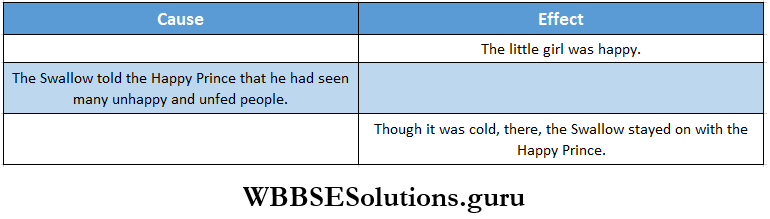
Swallow: I saw many unhappy and unfed people.

Statue: Take all the gold from my body and give it to the poor people.

[The Swallow makes a plucking motion with its mouth on the Happy Prince’s golden tunic. The stage darkens. The same beggars who appeared previously, are seen again clustered on stage. They are wearing good clothes, look better, they are eating and laughing. A single-red spotlight holds them on the dark stage. The stage darkens briefly, blue light comes on. The Swallow is discovered sitting on the pedestal-shaped box, leaning against the Happy Prince’s feet. He is looking unwell and dropping. The Happy Prince has given away all the gold on his body. He is wearing a grey tunic.]

Swallow: Goodbye, my prince.

Statue: Ah, good, you’re going to Egypt! I’m happy about that. Swallow I’m going to the house of the brother of Sleep. The cold has got me. I’m dying!

1. Answer the questions below:

  1. To whom did the Swallow give the second sapphire?
  2. How did the Happy Prince become blind?
  3. How did the beggars look when the gold from the tunic of the Happy Prince was given to them?
  4. How did the Swallow die?
  5. What request did the Happy Prince make to Swallow when he said that he would stay with him?

Answer:

  1. The Swallow gave the second sapphire to a poor little girl who had no shoes.
  2. The happy prince gave away the two sapphires from his eyes to the playwright and the poor girl. Thus he became blind.
  3. The beggars looked better wearing good clothes and eating and laughing merrily.
  4. The Swallow died of cold.
  5. The Happy Prince requested the little Swallow to fly over the land and tell him what he sees.

2. Choose the correct answers from the alternatives given:

Question 1. The poor little girl had no-

  1. Shoes,
  2. Dress,
  3. Socks.

Answer: 1. Shoes

Question 2. The number of Precious stones the Happy Prince had with him was-

  1. Four,
  2. Three,
  3. Two.

Answer: 2. Three

Question 3. The Swallow decided to stay with the Happy Prince always as-

  1. It was too cold there,
  2. The Happy Prince had become blind
  3. The Happy Prince became sick.

Answer: 2. The Happy Prince had become blind

Question 4. The Swallow bade the Happy Prince goodbye before-

  1. Going to Egypt
  2. Going to the house of his brother,
  3. Dying.

Answer: 3. Dying

3. Fill in the following chart with information from the text.

WBBSE Solutions For Class 8 English Reading Skill Seen Lesson 8 The Happy Prince Fill In The Following Chart With Information From The Text

Answer:

WBBSE Solutions For Class 8 English Reading Skill Seen Lesson 8 The Happy Prince Fill In The Following Chart With Information From The Text With Answer

4. Match the words in A and with their meanings in B.

WBBSE Solutions For Class 8 English Reading Skill Seen Lesson 8 The Happy Prince Match The WordIn A And With Their Meaning In B

Answer:

WBBSE Solutions For Class 8 English Reading Skill Seen Lesson 8 The Happy Prince Match The WordIn A And With Their Meaning In B With Answer

WBBSE Solutions For Class 8 English Reading Skill Seen Lesson 10 Tales Of Childhood

Reading Skill Lesson 10 Tales Of Childhood

Word meanings:

Part 1

prosperous (প্রস্পারাস্)—সমৃদ্ধশালী; traded (ট্রেডেড্ )–কেনাবেচা করতেন; cheese (চীজ)— পনির; chicken- wire (চিকেন্ ওয়্যার্)—মুরগির ছানা রাখার জন্য তারের জাল; ship broker (শিপ্ ব্রোকার) — জাহাজের দালাল, অর্থাৎ জাহাজের জন্য প্রয়োজনীয় জিনিষ পত্রের যোগানদার, enormous ( এনরমাস্) — বিশাল; fuel (ফুয়েল্) – জ্বালানি; imposing (ইম্পোজিং) — জমকালো ; turret (টারেট্‌ ) — ছোট গম্বুজ ; majestic (ম্যাজেটিক্) –রাজকীয়, চমৎকার; terrace (টেরাস্)—সমতল ছাদ; woodland (উডল্যান্ড) – বনভূমি meadows (মেডোস্‌) – পশুচারণভূমি, sties (স্টাইজ)—শূয়োরের খোঁয়ারগুলি; chicken run — হাঁস মুরগি চরার জায়গা; plough (প্লাউ ) — লাঙল ; hay-wagon- খড় বোঝাই গাড়ি; gardener ( গারডেনার) – মালি।

Part 2

appendicities (অ্যাপেনডিসাইটিস্) – বৃহদন্ত্র সংলগ্ন নলের এক প্রকারের প্রদাহ; favourite (ফেবারিট্)— প্রিয়পাত্র; adored (এ্যাডের্ড্‌)—খুব ভালবাসত; literally (লিট্যারালি ) – আক্ষরিক অর্থে; speechless (স্পিচলেস্) – হতবাক্ overwhelmed (ওভার হোয়েল্ড্) – কাতর হয়ে পড়েছিলেন; pneumonia (নিউমোনিয়া) — নিউমোনিয়া রোগ; threat (থ্রেট্)—ভীতি বা আশঙ্কার লক্ষণ; antibiotic (অ্যান্টিবায়োটিক) — জীবাণু প্রতিরোধকারী ওষুধ; cure (কিওর্)—প্রতিকার; survive (সারভাইভ)—আরও বেশিকাল বেঁচে থাকা; gravest (গ্রেভেস্ট) – গুরুতর; responsibilities (রেস্পন্সিবিলিটিস্) —দায়িত্বভার; · médium sized – মাঝারি মাপের ; suburban (সুবারবন্)—শহরতলী সংলগ্ন।

Read And Learn Also WBBSE Class 8 English Reading Skills

Part 3

kindergarten (কিন্ডারগাটেন)—শিশুদের বিদ্যালয় ; astonising (অ্যাশটনিশিং)—বিস্ময়কর; remember (রিমেম্বার —মনে থাকে; blurred (ব্লাড) – আবছা ; shoolaces (শূলেসে ) – জুতোর ফিতেগুলো ; to and from –যাওয়া ও আসা; tremendously (ট্রিমেনড্যালি) – দারুণভাবে ; exciting (এক্সাইটিং) – রোমাকের; excitement—উদ্দীপনা; interests (ইন্টারেস)—আগ্রহী করে; grown-ups (গ্রোন্-আপস্) – বড়োরা ; vividly (ভিভিলি)—স্পষ্টভাবে; enormous (এনরমাস্)—প্রচণ্ড, দুর্দান্ত; glorius (গ্লোরিয়্যাস্) — গৌরবময় ; lean (লীন্ ) — হেলে যাওয়া, ঝুঁকে যাওয়া; whooping (হুপিং)—হৈচৈ করতে করতে; memories (মেমরিজ্‌ ) — স্মৃতি।

WBBSE Solutions For Class 8 English Reading Skill Seen Lesson 10 Tales Of Childhood

Reading Skill Lesson 10 Tales Of Childhood Examples

Read the texts below and do as directed.

Question 1. My father, Harold Dahl, was a Norwegian who came from a small town near Oslo, called Sarpsborg. His own father, my grandfather, was a fairly prosperous merchant who owned a store in Sarpsborg and traded in just about everything from cheese to chicken wire.

My father had lost an arm when he was fourteen but had become a successful shipbroker. A shipbroker is a person who supplies the ship with everything it needs when it comes into port fuel and food, recipes and paint, soap and towels, hammers and nails, and thousands of other little items.

A shipbroker is a kind of enormous shopkeeper for ships, and by far the most important item he supplies to them is the fuel on which the ship’s engines run in those days, only coal. He set up a shipbroking firm at Cardiff of South Wales. My father met my mother Sofie Magdalene Hesselberg during the summer of 1911 and were married soon after.

WBBSE Class 8 English Functional GrammarWBBSE Class 8 English Reading Skills
WBBSE Solutions For Class 8 EnglishWBBSE Solutions For Class 8 Maths


1. Answer the questions below:

  1. Who was Harold Dahl?
  2. What was the author’s grandfather?
  3. What does a shipbroker do?
  4. Where did the author’s father set up a shipbroking firm?
  5. What is the most important item that the shipbroker supplies to the ship?

Answer:

  1. Harold Dahl was the father of the author who came from a small town near Oslo called Sarpsborg. He was a successful shipbroker.
  2. The author’s grandfather was a prosperous merchant who owned a store in Sarpsborg and traded in almost every essential item.
  3. A shipbroker supplies the ship with everything it needs when it comes to a port-fuel, food, ropes and paint, soap and towels, nails and hammers-almost everything it needs.
  4. The author’s father set up a shipbroking firm at Cardiff in South Wales.
  5. The most important item that the shipbroker supplies to the ship is the fuel for running ship engines- in those days, only coal.

2. Pick out the correct answer from the alternatives given and complete the sentences.

Question 1. The author’s father was-

  1. A Norwegian,
  2. An English man,
  3. An Italian.

Answer: 1. A Norwegian

Question 2. The native town of the author’s father was-

  1. Oslo,
  2. Sarpsborg,
  3. Cardiff.

Answer: 2. Sarpsborg

Question 3. The author’s mother was-

  1. Sofie Magdelene,
  2. Sophie Jane,
  3. Sofie Loren.

Answer: 1. Sofie Magdelene

Question 4. The author was the son of a

  1. Writer,
  2. Sailor,
  3. Merchant.

Answer: 3. Merchant

Question 5. The fuel used by ships in olden days was-

  1. Petrol,
  2. Diesel,
  3. Coal.

Answer: 4. Coal

3. Fill in the blanks with words taken from the text.

List of words: married, trade, person, everything, successful.

Question 1. He _________ in fars and skins
Answer: Traders

Question 2. Ramen proved to be a _________ lawyer
Answer: Successful

Question 3. Ram was ______ to Sita.
Answer: Married

Question 4. __________ depends on him.
Answer: Everything

Question 5. He is a very honest ________
Answer: Person

Question 2. In 1920, when I was still only three, my mother’s eldest child, my own sister Astri, died from appendicitis. She was seven years old when she died. Astri was far and away my father’s favourite. He adored her beyond measure and her sudden death left him literally speechless for days afterwards. He was so overwhelmed with grief that when he himself went down with pneumonia a month or so afterwards, he did not much care whether he lived or died.

If they had penicillin in those days, neither appendicitis nor pneumonia would have been so much of a threat, but with no penicillin or any other magical antibiotic cures, pneumonia, in particular, was a very dangerous disease indeed. The patient had to fight to survive. My father refused to fight. He was thinking, I am quite sure, of his beloved daughter, and he was wanting to join her in heaven. So he died. He was fifty-seven years old.

1. Answer the questions below

  1. Who was Astri and how did she die?
  2. Which incident left the author’s father literally speechless?
  3. Why was pneumonia a very dangerous disease?
  4. Why does the author rue for the absence of penicillin in those days?
  5. What made the author’s father refuse to fight for survival?

Answer:

  1. Astri was the author’s sister, and she died from appendicitis.
  2. The author’s father loved his daughter Astri so dearly that her sudden death at the age of seven left him severely shocked and literally speechless.
  3. In those days, there was no such magical antibiotic cures as penicillin; so pneumonia was a very dangerous disease.
  4. The author rues for the absence of penicillin in those days because if penicillin treatment were in vogue, his sister Astri and father would have been cured by antibiotic treatment.
  5. The author’s father loved his daughter Astri so dearly that when she died, he lost all interest to live any more and wanted to join her in heaven. So he did not want to fight against the disease, as he wanted to die.

2. Write ‘T’ for true and ‘F’ for false statements. Give supporting sentences for each of your answers.

Question 1. Astri was the youngest child in the family.
Answer: False

My mother’s eldest child, my own sister Astri, died from appendicitis.

Question 2. Astri was a favourite child of her father.”
Answer: True

Astri was far and away my father’s favourite.

Question 3. The author’s father died of appendicitis.
Answer: False

He himself went down with pneumonia and did not care much whether he lived or died

Question 4. The author’s father lost the desire of living after his daughter’s death.
Answer: True

My father refused to fight so he died.

Question 5. The author lost his father when he was fifty-five years old.
Answer: False

He died. He was fifty-seven years old.

3. Match the words in A and with their opposite words in B.

WBBSE Solutions For Class 8 English Reading Skill Lesson 10 Tales Of Childhood Match The Word In A And With Thrie Opposite Words In B

Answer:

WBBSE Solutions For Class 8 English Reading Skill Lesson 10 Tales Of Childhood Match The Word In A And With Thrie Opposite Words In B Answer

Question 3. My mother had now lost a daughter and a husband all in the space of a few weeks. Here she was, suddenly having to face all alone the very gravest problems and responsibilities. She had five children to look after. She sold the big house and moved to a smaller one a few miles away in Llandaff. It was called Cumberland Lodge and was nothing more than a pleasant medium-sized suburban villa. So it was in Llandaff two years later, when I was six years old, that I went to my first school.

1. Answer the questions below:

  1. In what a situation did the author’s mother fall after the death of her daughter and husband?
  2. Why did she sell the big house?
  3. Where was the new house located?
  4. How was the new house and what was its name?
  5. When did the author join school?

Answer:

  1. After the death of her daughter and husband, the mother fell into a situation when she had to face great problems and responsibilities all alone.
  2. The sudden death of her husband and daughter made her face financial problems with five children to take care of. So she sold the big house and moved to a small house.
  3. The new house was located a few miles away in Llandaff.
  4. The new house was called Cumberland Lodge, and it was a pleasant medium-sized suburban villa.
  5. The author went to his first school in Llandaff when he was six years old.

2. Write “T’ for true and ‘F’ for false statements.

Question 1. The author’s mother lost her two children in quick succession.
Answer: False

Question 2. The mother had to take care of five children.
Answer: True

Question 3. She moved to a bigger house for safety.
Answer: False

Question 4. The new house was located outside the city centre area.
Answer: True

Question 5. The author had gone to school for the first time before he came to Llandaff.
Answer: False

3. Rearrange the following sentences in the proper order as they happened. Write the numbers in the boxes.

1. The author’s father died.

2. The mother had to face great difficulties all alone.

3. She moved to a new house in Llandaff.

4. The author’s sister died.

5. The author went to school for the first time.

6. The mother sold the big house.

Answer:

2. The mother had to face great difficulties all alone.

3. She moved to a new house in Llandaff.

5. The author went to school for the first time.

1. The author’s father died.

6. The mother sold the big house.

4. The author’s sister died.

4. Male sentences of your own with the following words:

  1. Space;
  2. Suddenly;
  3. Pleasant;
  4. Suburban;
  5. Problems.

Answer:

  1. The table takes up too much space.
  2. Suddenly he fell ill.
  3. The weather there was very pleasant.
  4. Life in suburban Kolkata is peaceful.
  5. I had to face lots of problems initially in the new place.

Question 4.

The school was a kindergarten run by two sisters, Mrs Corfield and Miss Tucker, and it was called the Elmtree House. It is astonishing how little one remembers about one’s life before the age of seven or eight. I can tell you all sorts of things that happened to me from eight onwards, but only very few before that. I went for a whole year to Elmtree House but I cannot even remember what my classroom looked like. Nor can I picture the faces of Mrs Corfield or Miss Tucker, although I am sure they were sweet and smiling. I do have a blurred memory of sitting on the stairs and trying over and over again to tie one of my shoelaces, but that is all that comes back to me at this distance of the school itself.

1. Answer the questions below:

  1. What was the name of the author’s first school? What type of school was it?
  2. Who used to run the school?
  3. What makes the author astonished.?
  4. What blurred memory does the author have of his early days”
  5. How were the two sisters Mrs Corfield and Miss Tucker?

Answer:

  1. The name of the school was Elmtree House. The school was a kindergarten.
  2. Two sisters Mrs Corfield and Miss Tucker used to run the school.
  3. The author feels astonished to note that one can hardly remember one’s life before the ages of seven or eight, but can tell everything that happened to one from the age of eight onwards.
  4. The author has a blurred memory of sitting on the stairs of his kindergarten school and trying over and over again to tie one of his shoelaces.
  5. The two sisters Mrs Corfield and Miss Tucker were very sweet and smiling.

2. Write ‘T’ for true and ‘F’ for false statements. Give supporting sentences for each of your answers.

Question 1. Elmtree House was the middle school for the author.
Answer: False

The school was a kindergarten.

Question 2. The school was run by two ladies.
Answer: True

The school was run by two sisters,

Question 3. The author studied in that school for three years.
Answer: False

I went for a whole year to Elmtree House

Question 4. The author had a vivid memory of his Elmtree House school.
Answer: False

But cannot even remember what my classroom looked like.

Question 5. The author could tell out of his memory everything that happened to him from the age of eight onwards.
Answer: True

I can tell you all sorts of things that happened to me from eight onwards.

3. Match the words in A and their meanings in B.

WBBSE Solutions For Class 8 English Reading Skill Lesson 10 Tales Of Childhood Match The Word In A And With Their Meaning In B

Answer:

WBBSE Solutions For Class 8 English Reading Skill Lesson 10 Tales Of Childhood Match The Word In A And With Their Meaning In B Answer

Question 5. On the other hand, I can remember very clearly the journeys. I made to and from the school because they were so tremendously exciting. Great excitement is probably the only thing that really interests a six-year-old boy and it sticks in his mind.

In my case, the excitement centred around my new tricycle. I rode to school on it every day with my eldest sister riding on hers. No grown-ups came with us, and I can remember oh so vividly how the two of us used to go racing at enormous speeds down the middle of the road and then, most glorious of all when we came to a corner, we would lean to one side and take it on two wheels.

All this, you must realize, was in the good old days when the sight of a motor car on the street was an event, and it was quite safe for tiny children to go tricycling and whooping their way to school in the centre of the highway.

So much, then, for my memories of kindergarten sixty-two years ago. It’s not much, but it’s all there is left.

1. Answer the questions below:

  1. How did the author go to his kindergarten school?
  2. Which journeys does the author still remember? Why did he not forget those journeys?
  3. Describe how the author enjoyed his rides to school.
  4. Why was it safe for children to go tricycling on highways?
  5. What was considered an ‘event’ in those days?
  6. “It’s not much, but it’s all there is left.”-Why do you think did the author make this comment?

Answer:

The author used to go to his school in his new tricycle.

  1. The author still remembers the journeys he made to and from the school in his tricycle. He did not forget those journeys because they were very exciting.
  2. The author and his sister used to go to school in their tricycles racing at great speeds down the middle of the road. When they came to a corner, they would lean to one side and take it on two wheels, The journeys were tremendously exciting and they enjoyed them thoroughly.
  3. Those days motor cars were hardly seen on roads. So it was quite safe for children to go tricycling on highways.
  4. The sight of a motor car on the street was considered an ‘event’ in those days.
  5. The author could not remember many incidents of his school days, because he was a small boy then. Yet he treasured some of the joyous moments of the school days and got pleasure in recollecting them.

2. Write “T? for true and ‘F’ for false statements.

Question 1. The author went to school by bicycle.
Answer: False

Question 2. His eldest sister rode on her tricycle along with him.
Answer: True

Question 3. They were accompanied by a servant on their trip to school.
Answer: False

Question 4. The journeys to school were very exciting to the author.
Answer: True

Question 5. Motor vehicles were quite frequent on the street.
Answer: False

Question 6. The author wrote this text when he was sixty-two years old.
Answer: True

3. Complete the sentences with information from the text.

Question 1. The only thing that probably interests a six-year-old boy is __________
Answer: The only thing that probably interests a six-year-old boy is great excitement.

Question 2. The author remembers vividly ___________
Answer: The author remembers vividly how he and his sister used to go racing in their tricycles in the middle of the road.

Question 3. The most glorious of all was __________
Answer: The most glorious of all was their leaning to one side and taking the tricycle on two wheels when they came to a corner.

Question 4. The sight of a motor car on the street ___________
Answer: The sight of a motor car on the street was an event.

4. Fill in the blanks with words opposite in meaning of the following:

  1. Remember,
  2. Exciting,
  3. Vividly,
  4. Enormous,
  5. Glorius.

Question 1. I can __________ remember my first day at school.
Answer: Vagely

Question 2. We spent some _____ days there.
Answer: Horrible

Question 3. Do not ________ to bring the book.
Answer: Forget

Question 4. The children rode on a _________ elephant.
Answer: Tiny

Question 5. The match was a _________ one.
Answer: Drap


WBBSE Solutions For Class 8 English Reading Skill Seen Lesson 11 Midnight Express

Reading Skill Seen Lesson 11 Midnight Express

Word meanings

Part 1

battered (ব্যাটাড)—জরাজীর্ণ; bound (বাউন্ড) – বাঁধানো; library (লাইব্রেরী) – গ্রন্থাগার ; rest (রেস্ট)— বাকি / অবশিষ্ট; candle light (ক্যান্ড্ল লাইট)— মোমবাতির আলো; ticked (টি)—টিক্ টিক্ শব্দ করছিল; fascinated (ফ্যাসিনেটেড্)—আকৃষ্ট হল; illustration (ইলাস্ট্রেশন)— ছবি; threatened (থ্রেটেন্‌ড্)—ভয় দেখিয়েছিল; empty (এমট্)ি—খালি, ফাঁকা; lit (লিট্‌) – আলোকিত; tunnel (টার্নেল) – সুড়ঙ্গ; midnight (মিডনাইট)—মধ্যরাত্রি।

Part 2

glowing (গ্লোয়িং)—জ্বলছিল; suddenly (সাডেলি) – হঠাৎ; solitary (সলিটারি) – নিঃসঙ্গ; instinct (ইটিংক্ট) —তাৎক্ষণিক প্রতিক্রিয়া; staring (স্টেয়ারিং)—একদৃষ্টিতে তাকিয়ে থাকা; panic (প্যানিক্)—আতঙ্ক; surged (সার্জড্) —উত্তাল হয়ে বয়ে গেল; gasp ( গ্যাপ ) – হাঁপিয়ে ওঠা, কষ্টে শ্বাস নেওয়া; stumbled (স্টাম্বলড্)— ছুটে দৌঁড়ে বেরল; moonlit (মুনলিট)—চন্দ্রালোকিত; echo (ইকো) – প্রতিধ্বনি; paused (পজড্) – থামল; shaken with — বিপর্যস্ত হয়ে পড়েছিল; desperate (ডেস্পারেট) — মরিয়া ; pounded (পাউন্ডেড্) –সজোরে ধাক্কা দিল; creaking (ক্রীকিং)—মচমচ শব্দ করে; shadowy figure — ছায়ামূর্তি; beckoned (বেকন্ড্)—ইশারা করে ডাকল।

Read And Learn Also WBBSE Class 8 English Reading Skills

Part 3

arm chair (আরম্ চেয়ার) – হাতল লাগানো আরাম কেদারা; departed (ডিপার্টেড)—চলে গেল; collapsed (কোলাসড্)—এলিয়ে পড়ল; realised (রিয়ালাইজ্‌ড্)—বুঝতে পারল; afraid (অ্যাফ্রেড) – ভীত; trembling (ট্রেম্বলিং) –কম্পিত; frightening (ফ্রাইটেনিং) – ভয়াবহ ; grasp (গ্র্যাম্প) – বুঝতে পারা, বোঝা; acute (এ্যাকিউট্) –তীব্র; dread (ড্রেড্‌)—আতঙ্ক; host (হোস্ট)— গৃহকর্তা; edged (এড্) – ধীরে-ধীরে এগিয়ে এলো; chill (চিল্‌)—শিহরণ; spine (স্পাইন্)—শিরদাঁড়া; flickered (ফ্লিকার্ড্)— দপদপ করে কাঁপছিল।

WBBSE Solutions For Class 8 English Reading Skill Seen Lesson 11 Midnight Express

Reading Skill Seen Lesson 11 Midnight Express Examples

Read the texts below and do as directed.

Question 1. It was a battered old book, bound in red leather. When Mortimer was twelve years old, he found the book in his father’s library. When the rest of his large, old house was covered in darkness, he took the book to his bedroom to read by candlelight. The clock ticked in the hall below and the sea roared outside.

Mortimer was fascinated by the battered old book. It contained a story called the ‘Midnight Express’. There was an illustration on page fifty, which threatened him for some unknown reason. The illustration showed an empty railway platform at night lit by a dull, yellow lamp. A single man stood under the lamp, his face turned towards the black mouth of a tunnel. Mortimer never read beyond page fifty.

WBBSE Class 8 English Functional GrammarWBBSE Class 8 English Reading Skills
WBBSE Solutions For Class 8 EnglishWBBSE Solutions For Class 8 Maths


1. Answer the questions below:

  1. Where did Mortimer find the book?
  2. How did the book look?
  3. When and where did Mortimer read the book?
  4. What did the illustration depict?
  5. Why do you think Mortimer never read beyond page fifty of the book?

Answer:

  1. Mortimer found the book in his father’s library.
  2. The book looked old and damaged.”
  3. When the rest of his large house was covered in darkness. Mortimer took the book to his bedroom and read it by candlelight.
  4. The illustration showed an empty railway platform at night lit by a dull, yellow lamp. A man stood there under the lamp with his face turned towards the black mouth of the tunnel.
  5. The picture on page fifty threatened Mortimer for some unknown reason. So he never read the book beyond page fifty.

2. Choose the correct answers from the alternatives given:

Question 1. The book was bound in—

  1. Red cloth,
  2. Green leather,
  3. Red leather.

Answer: 3. Red leather

Question 2. Here Midnight Express is the name of

  1. An express train,
  2. A story in a book,
  3. A railway station.

Answer: 2. A story in a book

Question 3. Mortimer was very fascinated by-

  1. The story “Midnight Express”,
  2. The old battered book,
  3. The books in the library.

Answer: 2. The old battered book

Question 4. Mortimer was able to read up to

  1. Page fifty of the book,
  2. Page sixty of the book,
  3. The last page of the book.

Answer: 1. Page fifty of the book

3. Rearrange the following sentences in the proper order as they happened. Write the numbers in the boxes.

1. He took the book to his bedroom.

2. The illustration of the story frightened him.

3. Mortimer got an old, battered book.

4. He read the book only up to page fifty.

5. He started reading the book by candlelight.

Answer:

2. The illustration of the story frightened him.

4. He read the book only up to page fifty.

1. He took the book to his bedroom.

5. He started reading the book by candlelight.

3. Mortimer got an old, battered book.

4. Find words in the text which mean the following:

  1. The room preserved for sleeping
  2. Damaged
  3. Very loud sound
  4. Attracted
  5. Picture

Answer:

  1. Bedroom,
  2. Battered,
  3. Roar,
  4. Fascinated,
  5. Illustration.

Question 2. There was a single dull lamp glowing. Mortimer, in the lamplight, suddenly noticed a dark and solitary figure he knew. It was seen on page fifty of his book in his childhood. The figure faced the black mouth of a tunnel.

Mortimer’s instincts were aroused. He walked quickly towards the figure and looked into its face. Mortimer was shocked. He was staring into his own face.

A wave of panic surged through Mortimer. He turned, gasped, and broke into a wild run. He stumbled out of the platform and rushed down a moonlit road. He could hear the echo of his own footsteps behind him. The footsteps were steadily gaining on him. Mortimer paused for a moment. He was completely shaken with fear. He began to run again.

A quarter of a mile down, Mortimer saw a small white cottage. Seeking desperate shelter, Mortimer pounded on the wooden door. He heard heavy footsteps coming down creaking stairs. The door opened and a shadowy figure stood with a candle. They exchanged no words. The shadowy figure beckoned him inside. They went up the creaking stairs.

1. Answer the questions below:

  1. What did Mortimer notice in the lamplight?
  2. When had Mortimer seen the dark and solitary figure in his childhood?
  3. When was Mortimer shocked and why?
  4. Why did he begin to run?
  5. What could Mortimer hear as he was rushing down the road?
  6. What did Mortinier do on seeing a small white cottage?

Answer:

  1. Mortimer suddenly noticed a dark and solitary figure standing on the empty platform with his face turned towards the tunnel.
  2. While reading a book from his father’s library in his childhood, he had seen the figure in an illustration on page fifty of the book.
  3. Mortimer was reminded of his childhood book on the seeing the solitary figure on the platform, and when he walked towards the figure and looked into its face he was shocked as he was staring at his own face.
  4. He began to run as a wave of panick surged through him when he saw that the man’s face resembled his own.
  5. As he was rushing down the road, Mortimer could hear the echoe of his own footsteps behind him which were steadily gaining on him.

2. Write ‘T’ for true and ‘F’ for false statements.

Question 1. Mortimer saw a host of figures.
Answer: False

Question 2. Mortimer saw the figure in his childhood in a book
Answer: True

Question 3. Mortimer was frightened.
Answer: True

Question 4. Mortimer pounded on the iron door.
Answer: False

Question 5. The door opened but nobody was found.
Answer: False

3. Rearrange the following sentences in the proper order as they happened. Write the numbers in the boxes.

1. He banged on the door.

2. Mortimer became panicky

3. The door of the cottage opened.

4. Mortimer and the shadowy figure went up the stairs.

5. A shadowy figure beckoned him inside.

6. He noticed a cottage.

7. He began to run along the road.

Answer:

4. Mortimer and the shadowy figure went up the stairs.

1. He banged on the door.

5. A shadowy figure beckoned him inside.

7. He began to run along the road.

6. He noticed a cottage.

3. The door of the cottage opened.

2. Mortimer became panicky

3. Match the words in A and with their meanings in B.

WBBSE Solutions For Class 8 English Reading Skill Seen Lesson 11 Midnight Express Match The Word In A And With Their Meaning In B

Answer:

WBBSE Solutions For Class 8 English Reading Skill Seen Lesson 11 Midnight Express Match The Word In A And With Their Meaning In B Answer

Question 3. The shadowy figure took him. to an upper room where a bright fire was burning. There was an armchair beside the fire. By the armchair was a small, oak table on which lay a battered old book bound in red leather. The shadowy figure put the candle on the table and departed silently.

Mortimer collapsed into the armchair and picked up the old book. With a shock, he realized it was the same book from his childhood, the book which contained the story of ‘Midnight Express’. Mortimer was greatly afraid. He turned the pages with trembling hands. He began to read. The story was about a man who in his childhood had read a book which contained a frightening picture.

1. Answer the questions below:

  1. Where did the shadowy figure lead Mortimer to? Give a small description of the room.
  2. What happened to Mortimer after he went to the room?
  3. Why was Mortimer shocked?
  4. What did he do then?
  5. Why do you think Mortimer’s hands trembled when he turned the pages of the book?

Answer:

  1. The shadowy figure led Mortimer to an upper room where a bright fire was burning. There was an armchair beside the fire, and a small oak table on which lay a battered old book in red leather. There was also a candle on the table.
  2. Mortimer collapsed into the armchair and picked up an old book and started reading it.
  3. He was shocked when he realized that it was the same book containing the story of “Midnight Express” which he had read in his childhood. He was greatly afraid.
  4. He turned the pages with trembling hands and began to read it.
  5. Mortimer’s hands trembled with fear when he realized that it was the same book as he had read in his childhood and which had an illustration that frightened him.
    Supporting sentence

2. Write ‘T’ for true and ‘F’ for false statements. Give supporting sentences for each of your answers.

Question 1. The room where Mortimer was taken was in the ground floor.
Answer:  False

The shadowy figure took him to an upper room.

Question 2. Mortimer sat on an armchair in the room.
Answer: True

Mortimer collapsed into the armchair.

Question 3. Midnight Express” was a story.
Answer: True

The book which contained the story of “Midnight Express”.

Question 4. Mortimer was greatly delighted.
Answer: False

Mortimer was greatly afraid

Question 5. The figure who led Mortimer to the room was with him all the time.
Answer: False

The shadowy figure put the candle on the table and departed silently.

3. Complete the sentences with information from the text.

Question 1. On the oak table was __________
Answer: On the oak table was lying a battered old book bound in red leather.

Question 2. The shadowy figure took Mortimer to_________
Answer: The shadowy figure took Mortimer to an upper room: where a bright fire was burning.

Question 3. After sitting on the armchair, Mortimer, __________
Answer: After sitting on the armchair, Mortimer picked up the old book.

Question 4. Mortimer was greatly afraid because ____________
Answer: Mortimer was greatly afraid because he realized that it was the same book from his childhood that contained the story of “Midnight Express” that frightened him.

Question 5. The story was about ___________
Answer: The story was about a man who in his childhood had read a book that contained a frightening picture.

4. Find words in the text which are opposite in meaning of the following.

  1. Dim,
  2. Arrived,
  3. Different,
  4. Reassuring,
  5. Steady.

Answer:

  1. Right,
  2. Departed,
  3. Same,
  4. Frightening,
  5. Trembling.

Question 4. Mortimer tried to grasp the strange cycle of events he was going through. He was filled with acute dread. “Who is the strange man who asked me into this cottage ?”Mortimer asked himself fearfully.

At that very moment the door opened and the strange host came in. His face was covered in darkness. The candle on the table cast huge shadows on the walls. The shadowy figure stood before Mortimer. Slowly he edged forward.

Mortimer, sitting on the armchair, felt a chill run up his spine. He looked up into the face of the shadowy figure. Mortimer realized he was looking at himself.

The clock ticked in the hall below and sea roared outside. The candlelight flickered. The old, battered book bound in red leather lay open on the table.

1. Answer the questions below:

  1. What was the strange cycle of events Mortimer was going through?
  2. What did Mortimer try to understand?
  3. What is the question that upset his mind with a sense of fear?
  4. Do you think the strange incidents that happened to Mortimer would not have occurred if he had not read the book?
  5. What did he feel when Mortimer looked up in the face of the shadowy figure?

Answer:

  1. Mortimer was undergoing through the same experiences as he had while reading a story in his childhood. All the incidents of the book were coming alive in front of him.
  2. Mortimer tried to understand the strange cycle of events he was going through.
  3. The question that upset his mind was “who is the strange man who asked me into this cottage.”
  4. Reading the book had implanted a sense of fear in Mortimer’s mind. The illustration on page fifty had made a permanent dent in his subconscious mind. The strange incidents that happened to Mortimer would not have occurred if he had not read the book.
  5. When Mortimer looked up in the face of the shadowy figure, he realized he was looking at himself.

2. Write ‘T’ for true and ‘F’ for false statements.

Question 1. Mortimer tried to understand the strange cycle of events he was going through.
Answer: True

Question 2. Mortimer faced the situation confidently.
Answer: False

Question 3. Mortimer could recognise the strange host.
Answer: False

Question 4. Mortimer realised that he was looking at himself.
Answer: True

Question 5. The old battered book disappeared all on a sudden.
Answer: False

3. Rearrange the events in proper order as they happened.

1. The shadowy figure stood before Mortimer.

2. Mortimer felt a chill run up his spine.

3. The door opened.

4. He realized that he was looking at himself.

5. The strange host came in.

6. Mortimer looked up in the face of the figure.

7. Slowly he came forward.

Answer:

3. The door opened.

5. The strange host came in.

1. The shadowy figure stood before Mortimer.

7. Slowly he came forward.

2. Mortimer felt a chill run up his spine.

6. Mortimer looked up in the face of the figure.

4. He realized that he was looking at himself.

4. Match the words in A and with their opposite words (antonyms) in B.

Question 1.

WBBSE Solutions For Class 8 English Reading Skill Seen Lesson 11 Midnight Express Match The Word In A And With Their Opposite Words In B

Answer:

WBBSE Solutions For Class 8 English Reading Skill Seen Lesson 11 Midnight Express Match The Word In A And With Their Opposite Words In B Answer

WBBSE Solutions For Class 8 English Reading Skill Seen Lesson 12 Someone

Reading Skill Seen Lesson 12 Someone

Word meaning:

Stanza 1 (Someone came ………dark night )

someone (সামওয়ান) কোনো একজন; knocking (নকিং) – কড়া নাড়ছিল, টোকা দিচ্ছিল; wee (উই)—খুব ছোট; Sure (শিওর) – নিশ্চিত listened (দিসেভ) শুনেছিলাম; opened (পেন্ড) – খুললাম: nought (নট) কিছুই না stirring (স্টারিং)—নড়াচড়া ; still (স্টিল) – নিস্তব্ধ ।

Stanza 2 (Only the busy ……………. at all, at all.)

busy (বিজি)—ব্যস্ত; beetle (বিল) – গুবরে পোকা ; tap-tapping (ট্যাপ-ট্যাপিং) –ঠক্ঠক্ আওয়াজ করা ; screech- owl (স্ট্রীচ-আউল্)—লক্ষ্মী প্যাচা; cricket (ক্রিকেট) –ঝিঁঝি পোকা ; whistling (হুইসলিং) – শিস্ দিচ্ছিল; dewdrops (ডিউড্রপস) –শিশির কণা ; at all (অ্যাট অল) – আদৌ!

Read And Learn Also WBBSE Class 8 English Reading Skills

Substance:

The poet heard a knocking sound on his door. But on opening the door, he did not find anybody nearby. He looked around but there was nobody there, only the sounds of beetle, owl, and cricket were heard in the still dark night. The poet is puzzled finding no clue to the knocking sound. He is sure about listening to the sound but feels mystified at not knowing who made the knock. There was nobody at all at his doorstep.

বঙ্গানুবাদ :

কবি তাঁর দরজায় কেউ ঠক্‌ঠক্ করে আওয়াজ করছে শুনতে পেলেন, কিন্তু দরজা খুলে কাওকেই আশে পাশে দেখতে পেলেন না। এদিক ওদিক ভাল করে দেখলেন কিন্তু কাউকেই পেলেন না। শুধু গুবরে পোকা, ঝিঝি ও লক্ষ্মী পেঁচার ডাক নিঝুম রাতে শুনতে পাচ্ছিলেন। কে দরজায় টোকা দিল তার কোন হদিশ করতে না পেরে কবি হতবুদ্ধি হয়ে গেলেন। শব্দ তিনি ঠিকই শুনেছেন, কিন্তু কিভাবে সেটা হল তা জানতে না পেরে তিনি বিস্মিত হয়ে গেলেন। তার দরজায় যে আদৌ কেউই ছিল না।

WBBSE Solutions For Class 8 English Reading Skill Seen Lesson 12 Someone

Reading Skill Seen Lesson 12 Someone Examples

Read the text below and do as directed.

Question 1.

Someone came knocking
At my wee, small door;
Someone came knocking;
I’m sure-sure-sure; I listened, I opened,
I looked to left and right,
But naught there was a stirring

In the still, dark night;
Only the busy beetle
Tap-tapping in the wall,
Only from the forest
The screech-owl’s call,
Only the cricket whistling
While the dewdrops fall,
So I know not who came knocking,
At all, at all, at all.

WBBSE Class 8 English Functional GrammarWBBSE Class 8 English Reading Skills
WBBSE Solutions For Class 8 EnglishWBBSE Solutions For Class 8 Maths


1. Answer the following questions:

  1. What did the poet hear?
  2. What did he do then?
  3. What did he find?
  4. Where from was the screechowl’s call coming?
  5. What was the night like?

Answer:

  1. The poet heard someone knocking at the door.
  2. The poet opened the door and looked to left and right.
  3. He could not find anybody at the door.
  4. The screech owl’s call was coming from the forest.
  5. The night was still and dark.

2. Pick out the correct answer from the given alternatives.

Question 1. The door was-

  1. Big,
  2. Small,
  3. Wide.

Answer: 2. Small

Question 2. The poet looked-

  1. Backward and forward,
  2. Up and down,
  3. To left and right.

Answer: 3. Up and down

Question 3. The owl’s call came from the-

  1. Cage,
  2. Forest,
  3. Garden

Answer: 3. Garden

Question 4. Listening to the knock the poet-

  1. Asked who it was,
  2. Opened the door,
  3. Ignored it.

Answer: 2. Opened the door

Question 5. The night was-

  1. Still,
  2. Very stormy,
  3. Nicely moonlit.

Answer: 1. Still

3. Complete the following sentences with information from the text.

Question 1. The tip-taping on the wall was done by __________
Answer: The tip-taping on the wall was done by the busy beetle.

Question 2. Someone came knocking at __________
Answer: Someone came knocking at night on the poet’s door.

Question 3. The cricket whistles when ____________
Answer: The cricket whistles when the dew drops fall.

Question 4. The poet was sure that ____________
Answer: The poet was sure that someone came knocking.

Question 5. The poet did not know ___________
Answer: The poet did not know who came knocking.

4. Fill in the blanks with suitable words taken from the list below. Change their form if necessary. There are a few extra words.

[List: still, small, sure, screech, listened, busy, knock]

Question 1. He stood _____ and did not utter a single word.
Answer: Still

Question 2. I am _______ that he will come today.
Answer: Sure

Question 3. Please ________ before entering.
Answer: Knock

Question 4. The car ________ to a halt.
Answer: Screech

Question 5. He has a ______ schedule today.
Answer: Busy

WBBSE Solutions For Class 8 English Reading Skill Seen Lesson 13 The Man Who Planted Trees

Reading Skill Seen Lesson 13 The Man Who Planted Trees

Word meanings:

Part 1

hike (হাইক)—দীর্ঘ পদযাত্রা ; absolutely (অ্যাবসলিউট্‌লি)—সম্পূর্ণরূপে, একেবারে; penetrate (পেনিট্রেট)— প্রবেশ করেছে ; Provence (প্রভেন্স ) – দক্ষিণ-পূর্ব ফ্রান্সের একটি পূর্বতন প্রদেশ; barren (ব্যারেন) — অনুর্বর ; monotonous : (মনোটোনাস)—একঘেয়ে; wild (ওয়াইল্ড) – বুনো; desolation (ডেসোলেশন) — নির্জনতা; abandoned (অ্যাবান্ডাড —পরিত্যক্ত; ruined (রুইল্ড) – ধ্বংসপ্রাপ্ত, ভাঙ্গাচোরা; spring (স্প্রিং) – ঝরনা ; plenty of sun— রোদে ভরা; continually (কন্‌টিউনিয়ালি)—একনাগাড়ে।

Part 2

dryness (ড্রাইনেস্)—শুষ্কতা ; woody (উডি) – কাঠ কাঠ ; headed (হেডেড) – এগিয়ে গেলাম; shepherd (শেফার্ড)–মেষপালক; scorching (স্করচিং) – খুব গরম, ঝলসানো; dispersed (ডিস্পার্সড) – ছড়িয়ে ছিটিয়ে থাকা; flanks (ফ্ল্যঙ্কস্)—আশেপাশে; inhabited (ইহ্যাবিটেড)—বাস করত; charcoal (চারকোল্) – কাঠকয়লা; acorns (অ্যাকর্নস) – ওক গাছের বীজ; separating (সেপারেটিং) – আলাদা করা; intrigued (ইট্রি গড)— কৌতূহল হচ্ছিল।

Read And Learn Also WBBSE Class 8 English Reading Skills

Part 3

soak (সোক)—ভেজানো; pound (পাউন্ড) – ঠোকা; solitary (সলিটারী) – নিঃসঙ্গভাবে, একা একা; solitude (সলিচুড়)—নির্জনতা; pleasure (প্লেজার) – আনন্দ, তৃপ্তি; concluded (কনক্লুডেড) – সিদ্ধান্তে উপনীত হল; resolved (রিসলড)—মনস্থির করল, ঠিক করল; remedy (রেমিডি) – সুরাহা করা, প্রতিকার করা; parted (পার্টেড)—বিদায় নিলাম; trail (ট্রেল্)—চলার পথ; deserted (ডেসার্টেড)—পরিত্যক্ত; disturbed (ডিস্টার্বড)—বিচলিত; impressive (ইমপ্রেসিভ)—চোখ জুড়ানো; speechless (স্পিচ্‌লেশ)—হতবাক্ ; sprung (স্প্রাং)— গজিয়ে উঠেছে; soul (সোল্) – আন্তরিক প্রচেষ্টা; technical (টেক্‌নিকাল) – প্রযুক্তিগত; aid (এইড্ )–সাহায্য; effective (এফেক্টিভ)—কার্য্যকারী; ফলপ্রসূ; domains (ডোমেইন্‌স্‌) – ক্ষেত্রে; destruction (ডেস্‌ট্রাকশান্)—ধ্বংস।

WBBSE Solutions For Class 8 English Reading Skill Seen Lesson 13 The Man Who Planted Trees

Reading Skill Seen Lesson 13 The Man Who Planted Trees Examples

Read the texts carefully and do as directed.

Question 1. About forty years ago I went on a long hike through hills absolutely unknown to tourists, in that very old region where the Alps penetrate into Provence. It consisted of barren and monotonous lands. Nothing grew there except wild lavender.

I was crossing this country at its widest part, and after walking for three days, I found myself in the most complete desolation. I was camped next to an abandoned village. I had used the last of my water the day before and I needed to find more. These ruined houses of the village made me think that there must, at one time, have been a spring or a well there. There was indeed a spring, but it was dry. All life had disappeared.

WBBSE Class 8 English Functional GrammarWBBSE Class 8 English Reading Skills
WBBSE Solutions For Class 8 EnglishWBBSE Solutions For Class 8 Maths


1. Answer the questions below:

  1. Where did the author go about forty years ago?
  2. How was the place where the author went ?
  3. What was the author’s feeling after walking for three days?
  4. Where did the author camp?
  5. Why do you think the village was abandoned?

Answer:

  1. About forty years ago the author went on a long hike to a hilly region where the Alps penetrated into Provence.
  2. The place was totally barren and monotonous, and nothing grew there except wild lavender.
  3. After walking for three days, the author found himself in a state of complete desolation.
  4. The author camped next to an abandoned village.
  5. The author could see only ruined houses in the village. There was no trace of any water source. There was a spring, but it was dry. There was no sign of any life. The village, therefore, looked abandoned.

2. Choose the correct answers from the alternatives given.

Question 1. The author was speaking of his experience

  1. Of recent times,
  2. About forty years ago,
  3. Of his childhood.

Answer: 2. About forty years ago

Question 2. Alps is the name of a famous-

  1. Mountain range,
  2. River,
  3. Desert.

Answer: 1. Mountain range

Question 3. The village near which the author was camped looked-

  1. Moderately inhabited,
  2. Densely populated,
  3. Abandoned.

Answer: 3. Abandoned

Question 4. The land could produce-

  1. Plants of all types,
  2. Only wild lavender,
  3. Oak trees.

Answer: 2. Only wild lavender

3. Complete the table with information from the text.

WBBSE Solutions For Class 8 English Reading Skill Seen Lesson 13 The Man Who Planted Trees Complete The Table With Information From The Text

Answer:

WBBSE Solutions For Class 8 English Reading Skill Seen Lesson 13 The Man Who Planted Trees Complete The Table With Information From The Text Answer

Question 2. Everywhere there was the same dryness, the same stiff, woody plants. I thought I saw in the distance the shadow of a figure. On a chance I headed towards it. It was a shepherd. Thirty lambs or so were resting near him on the scorching ground.

He gave me a drink and a little later he led me to his shepherd’s cottage. He shared his soup with me. It had been agreed immediately that I would pass the night there, the closest village being still more than a day and a half farther on. There are four or five villages dispersed far from one another on the flanks of the hills in this area. They are inhabited by woodcutters who make charcoal.

1. Complete the sentences with information from the text.

Question 1. The author saw from a distance __________
Answer: The author saw from a distance the shadow of a figure which, in fact, was that of a shepherd.

Question 2. After giving him a drink, the shepherd led __________
Answer: After giving him a drink, the shepherd led the author to his cottage.

Question 3. The shepherd’s cottage would be the shelter for the author __________
Answer: The shepherd’s cottage would be the shelter. for the author for the might as the closest village was still more than a day and a half farther on.

Question 4. The shepherd shared his __________
Answer: The shepherd shared his soup with the author.

Question 5. On the flanks of the hill there __________
Answer: On the flanks of the hill there are four or five villages dispersed far from one another.

2. Write ‘T’ for true and ‘F’ for false statements.

Question 1. The area the author reached was different from the areas he visited earlier.
Answer: False

Question 2. The shadow the author had seen was that of the lambs.
Answer: False

Question 3. The shepherd was very helpful to the author.
Answer: True

Question 4. The villages were inhabited by woodcutters.
Answer: True

Question 5. The shepherd offered rice to the author.
Answer: False

3. Rearrange the following sentences in the correct order as they happened.

1. The shepherd gave the author a drink.

2. He headed towards it.

3. He shared his soup with the author.

4. The author saw the shadow of a figure from a distance.

5. He took him to his cottage.

6. The author agreed to pass the night in the shepherd’s cottage.

7. It was a shepherd.

Answer:

4. The author saw the shadow of a figure from a distance.

2. He headed towards it.

6. The author agreed to pass the night in the shepherd’s cottage.

1. The shepherd gave the author a drink.

5. He took him to his cottage.

7. It was a shepherd.

3. He shared his soup with the author.

4. Match the words with their meanings.

WBBSE Solutions For Class 8 English Reading Skill Seen Lesson 13 The Man Who Planted Trees Match The Words With Their Meanings

Answer:

WBBSE Solutions For Class 8 English Reading Skill Seen Lesson 13 The Man Who Planted Trees Match The Words With Their Meanings Answer

Question 3. The shepherd took out a bag and poured a pile of acorns out onto the table. He began to examine them one after another with a great deal of attention, separating the good ones from the bad. When he had before him one hundred perfect acorns he stopped, and we went to bed. The company of this man brought me a feeling of peace. He gave me the impression that nothing could disturb him. I was intrigued and I wanted to find out more about this man.

1. Answer the questions below:

  1. “The shepherd took out a bag”-What did the bag contain?
  2. What did the shepherd do with the a corn?
  3. How did the author feel?
  4. Why did the author feel intrigued?

Answer:

  1. Before going out the next day, the shepherd soaked the acorns in a bucket of water.
  2. The shepherd dug the ground with an iron rod and made several holes. He then placed an acorn in each hole and filled the hole again with soil.
  3. The shepherd planted one hundred acorns when the author was with him.
  4. So far he planted one hundred thousand acorns and, of them, twenty thousand survived.

2. Complete the sentences with information from the text.

Question 1. With a great deal of attention, the shepherd ___________
Answer: With a great deal of attention, the shepherd began to examine the acorns, separating the good ones from the bad.

Question 2. The shepherd stopped his job __________
Answer: The shepherd stopped his job when he collected one hundred perfect acorns.

Question 3. The shepherd poured a __________
Answer: The shepherd poured a pile of acorns out onto a table.

Question 4. The author developed the impression that __________
Answer: The author developed the impression that nothing could disturb the shepherd.

Question 5. The company of the shepherd brought the author __________
Answer: The company of the shepherd brought the author a feeling of peace.

3. Choose the correct answers from the alternatives given:

Question 1. From the bag, the shepherd took out many-

  1. Coins,
  2. Charcoal pieces,
  3. Acorns.

Answer: 3. Acorns

Question 2. The shepherd chose to retain-

  1. All the acorns,
  2. The bad acorns,
  3. The good acorns.

Answer: 3. The good acorns

Question 3. Seeing the shepherd’s activities, the author became

  1. Curious,
  2. Shocked,
  3. Frightened.

Answer: 1. Curious

Question 4. The author wanted to know

  1. About the acorns,
  2. More about the shepherd,
  3. About the shepherd’s village.

Answer: 2. More about the shepherd

4. Make sentences of your own with the following words taken from the text.

  1. Examine;
  2. Attention;
  3. Company;
  4. Disturb;
  5. Perfect.

Answer:

  1. Her mother started to examine the articles he had brought.
  2. He turned his attention back to his lessons.
  3. I enjoyed his company during the journey.
  4. I am sorry to disturb you.
  5. It was a perfect day for picnic.

Question 4. Before going out the next day, he soaked in a bucket of water the acorns that he had so carefully chosen and counted. He carried an iron rod too, as a walking stick. He invited me to come along with him.

Having arrived at the place he had been heading for, he began to pound his iron rod into the ground. This made a hole in which he placed an acorn, and covered over the hole again. He was planting oak trees. In this way, he planted his one hundred acorns with great care.

He told me that for three years now he had been planting trees in this solitary way. He had planted one hundred thousand. Of these one hundred thousand, twenty thousand had come up.

1. Answer the questions below:

  1. What did the shepherd do with the acorns before going out the next day?
  2. How did the shepherd plant the acorns?
  3. How many acorns did he plant when? the author was with him?
  4. How many acorns did he plant so far? How many survive among them?

Answer:

  1. Before going out the next day, the shepherd soaked the acorns in a bucket of water.
  2. The shepherd dug the ground with, an iron rod and made several holes. He then placed an atom in each hole and filled the hole again with soil.
  3. The shepherd planted one hundred acorns when the author was with him.
  4. So far he planted one hundred thousand acorns and, of them twenty thousand survived.

2. Write ‘T’ for true and ‘F’ for false statements. Give supporting sentences for each of your answers.

Question 1. The shepherd soaked the acorns in a soap solution before planting.
Answer: He soaked in a bucket of water the acorns.

Question 2. For walking stick, the shepherd took an iron rod.
Answer: He carried an iron rod too, as a walking stick.

Question 3. The next morning the shepherd left his house all by himself.
Answer: He invited me to come along with him.

Question 4. The shepherd had been planting acorns for three years.
Answer: He told me that for three years now he had been planting trees.

Question 5. The shepherd was planting oak trees.
Answer: He was planting oak trees.

3. Find words in the text which mean the following.

  1. Fruits of oak trees;
  2. Put in liquid;
  3. Hit;
  4. Sowing seeds;
  5. Lonely

Answer:

  1. Acorns;
  2. Soak;
  3. Pound;
  4. Planting;
  5. Solitary.

Question 5. It was at this moment that I began to wonder about his age. He was clearly more than fifty. Fifty-five, he told me. His name was Elzeard Bouffier. He had owned a farm in the plains, where he lived most of his life. He had lost his only son, and then his wife. He had retired into this solitude, where he took pleasure in living slowly, with his flock of sheep and his dog. He had concluded that this country was dying for lack of trees. He added that having nothing more important to do, he had resolved to remedy the situation.

1. Complete the sentences with information from the text.

Question 1. The family members whom the shepherd had lost were ______________
Answer: The family members whom the shepherd had lost were his wife and only son.

Question 2. After retirement, the companions of the shepherd were __________
Answer: After retirement the companions of the shepherd were solitude, his flock of sheep, and his dog.

Question 3. He concluded that __________
Answer: He concluded that this country was dying for lack of trees.

Question 4. Having nothing more important to do the shepherd ___________
Answer: Having nothing more important to do, the shepherd resolved to remedy the situation in which the country was dying for lack of trees.

2. Answer the questions below:

  1. What did the author guess about the age of the shepherd?
  2. What was the age of the shepherd and what was his name?
  3. Where did the shepherd spend most of his life?
  4. Why did the shepherd retire into a life of solitude?
  5. What situation did the shepherd resolve to solve and how?

Answer:

  1. The author guessed that the age of the shepherd would be clearly more than fifty.
  2. The age of the shepherd was fifty-five and his name was Elzeard Bouffier.
  3. The shepherd spent most of his life in his farm in the plains.
  4. The shepherd retired into a life of solitude to enjoy the pleasure in living slowly with his flock of sheep and his dog.
  5. The country was dying for lack of trees, and the shepherd resolved to remedy that situation by planting more trees.

3. Write ‘T’ for true and ‘F’ for false statements. Write supporting sentences for each of your answers.

Question 1. The author was correct in assessing the shepherd’s age.
Answer: True

I began to wonder about his age. He was clearly more than fifty. Fifty-five he told me.

Question 2. The shepherd had spent most of his life in the hills.
Answer: False

He has owned a farm in the plains, where he lived most of his life.

Question 3. The shepherd enjoyed living his retired life in solitude.
Answer: True

He had retired into this solitude, where he took pleasure in living slowly.

Question 4. He lost his wife before his son’s death.
Answer: False

He had lost his only son, and then his wife.

Question 5. He resolved to plant more trees.
Answer: True

This country was dying for lack of trees he had resolved to remedy the situation.

4. Fill in the blanks with suitable words from the text.

Question 1. It was a great ______ meeting him.
Answer: Pleasure

Question 2. I __________ who she is.
Answer: Wounder

Question 3. She longed for peace and __________
Answer: Solitude

Question 4. This house is ________ by my friend Subir.
Answer: Owned

Question 5. He has ___________ the essay with a quotation from Tagore.
Answer: Concluded

Question 6.

The next year the war came, in which I was engaged for five years. With the war behind me, I had a great desire to breathe a little pure air, and I set out again along the trail through that deserted country. The land had not changed. Ever since the day before, I had been thinking about the shepherd who planted trees. Ten thousand oaks, I had said to myself, must really take up a lot of space.
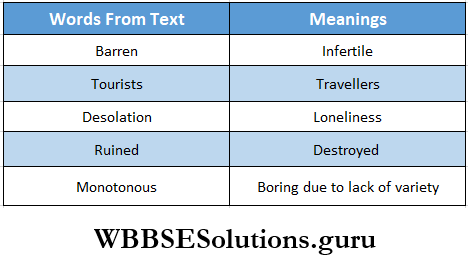
When I met Elzeard Bouffier this time, I found that the war had not disturbed him at all. He had continued with his planting. The oaks of 1910 were now ten years old and were taller than me and than him. The scene was impressive. I was actually speechless and we passed the whole day in silence, walking through his forest. It was in three sections, eleven kilometers long overall and, at its widest point, three kilometers wide. When I considered that this had all sprung from the hands and from the soul of this one man-without technical aids-it struck me that men could be as effective as God in domains other than destruction.
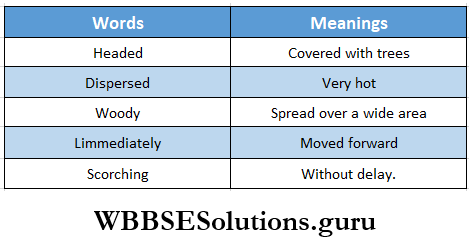
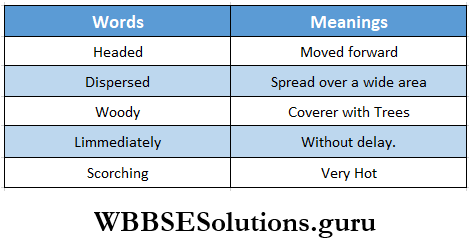
1. Answer the questions below:

  1. How long was the author engaged in war?
  2. How many years later did the author revisit the country?
  3. How did the war affect Elzeard Bouffier?
  4. What impressed the author?
  5. How did he spend the day?
  6. What was the realization of the author after seeing the oak forest?

Answer:

  1. The author was engaged in war for five years.
  2. The author revisited the country after ten years.
  3. The war had not disturbed him at all and he continued with his planting.
  4. The sight of the oak trees planted in 1910, growing into a vast forest eleven kilometers long and three kilometers wide at the widest point impressed the author very much.
  5. The author spent the whole day in silence by walking through the oak forest with the shepherd.
  6. After seeing the vast oak forest that had sprung from the hands and the soul of just one man-the shepherd-without any technical help, the author realised that men could be as effective as God in domains other than destruction.

2. Choose the correct answers from the alternatives given:

Question 1. The author found that the land had

  1. Remained the same,
  2. Changed,
  3. Become barren.

Answer: 1. The woodcutters

Question 2. The oak trees were planted by-

  1. The woodcutters,
  2. The gardener,
  3. The shepherd.

Answer: 3. The shepherd

Question 3. The oak trees the author saw were-

  1. Fifteen years old,
  2. Ten years old.
  3. Five years old.

Answer: 2. Ten years old

Question 4. The forest was grown with the effort of

  1. Men and machineries,
  2. One man only
  3. All the villagers

Answer: 2. One man only

Question 5. The number of sections of the oak forest was-

  1. Three,
  2. Five,
  3. Six.

Answer: 1. Three

3. Write ‘T’ for true and ‘F’ for false statements. Quote words or expressions in support of your choice.

Question 1. The author remained engaged in war for a decade.
Answer: False

The next year the war came, in which I was engaged for five years.

Question 2. The author met Elzeard Bouffier after a time span of five years.
Answer: False

The oaks of 1910 were now ten years old.

Question 3. The author longed for breathing fresh air.
Answer: True

I had a great desire to breath a little pure air.

Question 4. The war broke out in 1911.
Answer: True

The next year the war came the oaks of 1910 were now ten years old.

Question 5. The author was highly impressed seeing the oak forest.
Answer: True

T The scene was impressive.

4. Complete the chart with suitable words from the text.

Question 1.

WBBSE Solutions For Class 8 English Reading Skill Seen Lesson 13 The Man Who Planted Trees Complete The Chart With Suitable Wordsw From The Text

Answer:

WBBSE Solutions For Class 8 English Reading Skill Seen Lesson 13 The Man Who Planted Trees Complete The Chart With Suitable Wordsw From The Text Answer