WBBSE Solutions For Class 8 English Reading Skill Unseen Cause And Effect Relationship

Reading Skill Unseen Cause And Effect Relationship

By reading a passage thoroughly it is possible to understand the theme and then identify the cause-and-effect relationship.

The exercises under this heading aim at testing the student’s power of comprehension in establishing the cause-and-effect relationship.

One thing may cause another.

For example, Heavy rain often causes floods.

এখানে flood-এর cause (কারণ) heavy rain. অন্যভাবে বিচার করলে heavy rain-এর effect (ফলাফল) flood.

Read And Learn Also WBBSE Solutions For Class 8 English

heavy rain is the cause, flood is the effect.

আবার দেখো ঃ

Sonia was happy because she had received a prize.

WBBSE Class 8 English Functional GrammarWBBSE Class 8 English Reading Skills
WBBSE Solutions For Class 8 EnglishWBBSE Solutions For Class 8 Maths


What was the cause of Sonia’s happiness (ask ‘why’)? The answer is, “She had received a prize.” What was the effect of receiving the prize? prize? The answer is, “Sonia was happy.”

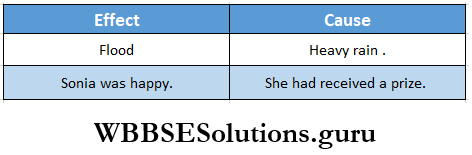
সুতরাং sentence-গুলি থেকে Cause এবং Effect-এর সারাংশ এইভাবে সাজানো যেতে পারে :

WBBSE Solutions For Class 8 English Reading Skill Unseen Cause And Effect Relationship Sencentences

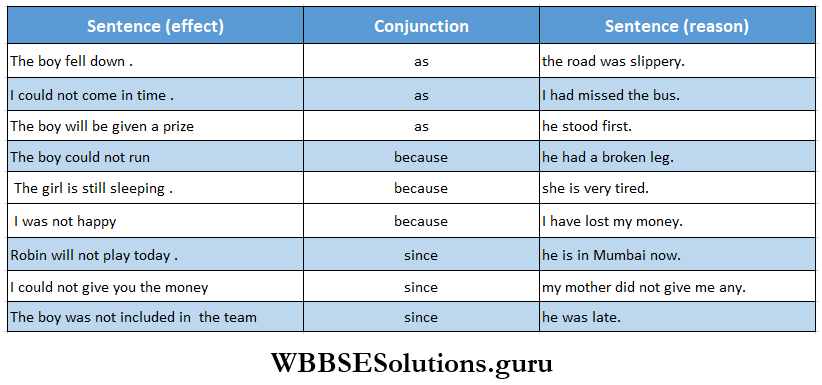
এইরূপ cause-effect relation যুক্ত sentence-গুলি সাধারণত নিম্নলিখিত Conjunctions দ্বারা যুক্ত হয় :

নীচের examples-গুলি দেখো :

WBBSE Solutions For Class 8 English Reading Skill Unseen Cause And Effect Relationship Sencentences Examples

পূর্বের Example-এর sentence-গুলি এইভাবেও সাজানো যায় :

WBBSE Solutions For Class 8 English Reading Skill Unseen Cause And Effect Sencentances Examples

নীচের sentence-টি ভালোভাবে লক্ষ্য করো :

  1. The team played well
  2. because they had practiced hard.

What was the cause?

The answer is ‘2’: They had practiced hard.”

What was the effect?

The answer is ‘1’: The team played well”.

WBBSE Solutions For Class 8 English Reading Skill Unseen Cause And Effect Relationship

Reading Skill Unseen Cause And Effect Relationship Examples

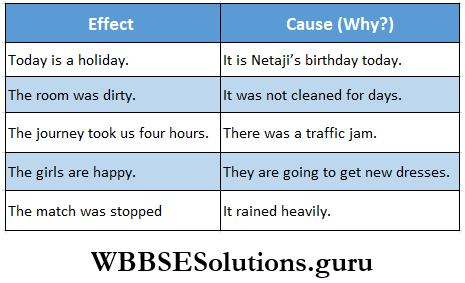
Question 1. In the following table the ’cause’ and their ‘effect’ are given in separate sentences in each case. Join each pair together to write one sentence, using conjunctions like ‘because’, ‘as’, and ‘since’.

WBBSE Solutions For Class 8 English Reading Skill Unseen Cause And Effect
Answer:

Today is a holiday since/because/as it is Netaji’s birthday today. Or,

Because/as/since it is Netaji’s birthday today, it is a holiday.

The room was dirty because/as/since it was not cleaned for days. Or,

As/since the room was not cleaned for days, the room was dirty.

The journey took us four hours, as /because there was a traffic jam.

The girls are happy because/as/since they are going to get new dresses. Or,

As/since the girls are going to get new dresses, they are happy.

The match stopped since/because/as it rained heavily. Or,

As/since it rained heavily, the match stopped.

WBBSE Solutions For Class 8 English Reading Skill Unseen Order Or Sequence

Reading Skill Unseen Order Or Sequence

বিভিন্ন paragraph বার বার পাঠ করে তাদের বক্তব্য সঠিক উপলব্ধি করতে পারা যায়। এই সম্বন্ধে এতক্ষণ অনুশীলন করা হয়েছে। কোনো paragraph সম্বন্ধে পরিষ্কার ধারণা করতে হলে এতে বর্ণিত ঘটনা বা বক্তব্যের ধারাক্রম (sequence order) বিশেষভাবে অনুধাবন করা প্রয়োজন। নীচের উদাহরণটি দেখো।

Pranab hurried home and shut himself in his bedroom. Who would be the goalkeeper? Tomorrow all the boys will blame him. “How unjust”, he thought.

Read And Learn Also WBBSE Solutions For Class 8 English

At the semi-final, he had been the hero and he was carried shoulder high from the field. But today there had been no cheers. As he took up position between the goalposts, he remembered Mr. Dutta’s advice, “Don’t throw the ball. Kick it hard up-field” And then in his excitement with barely a couple of seconds to go, he had thrown the ball to Jayanta, but not far enough. The opposite striker got the ball and scored a goal easily.

WBBSE Class 8 English Functional GrammarWBBSE Class 8 English Reading Skills
WBBSE Solutions For Class 8 EnglishWBBSE Solutions For Class 8 Maths


উপরের paragraph- এ ঘটনাগুলি এই পর্যায়ক্রমে বলা হয়েছে :

  1. Pranab went home.
  2. He had been the hero in the semi-final.
  3. He took up position between goalposts.
  4. He threw the ball.
  5. The opposite striker got the ball and scored.
  6. The game was lost.

কিন্তু ঘটনাগুলি ঠিক এই ধারাক্রমে ঘটেনি। প্রকৃত ধারাক্রম এইরূপ ঃ

2. He had been the hero in the semi-final.

3. He took up position between goal posts.

4. He threw the ball.

5. The opposite striker got the ball and scored.

6. The game was lost.

1. Pranab went home.

সুতরাং, কোনো paragraph-এর বক্তব্য সম্পূর্ণভাবে জানতে হলে passage-এ বর্ণিত ঘটনা বা বক্তব্যের ধারাক্রম _ sequence / order) সম্বন্ধে পরিষ্কার ধারণা থাকা প্রয়োজন।

WBBSE Solutions For Class 8 English Reading Skill Unseen Order Or Sequence

Reading Skill Unseen Order Or Sequence Examples

Question 1. Put the following statements in the correct sequence to make a comprehensive paragraph.

  1. The umpire signaled an over-boundary.
  2. The spectators left the field happily.
  3. He hit the ball hard again.
  4. Some excited spectators ran inside the area to garland Rathin.
  5. It flew into the crowd over the boundary line.
  6. He scored the winning run with a boundary.

Answer:

3. He hit the ball hard again.

5. It flew into the crowd over the boundary line.

1. The umpire signaled an over-boundary.

6. He scored the winning run with a boundary.

4. Some excited spectators ran inside the area to garland Rathin.

2. The spectators left the field happily.

Question 2. Arrange the following sentences in the proper sequence to make a meaningful passage.

  1. He became unconscious.
  2. They pulled him out of the traffic.
  3. People ran to help him.
  4. At around 9-15 one morning, a passenger fell out of a running bus.
  5. They took him to a nearby hospital.

Answer:

4. At around 9-15 one morning, a passenger fell out of a running bus.

1. He became unconscious.

3. People ran to help him.

2. They pulled him out of the traffic.

5. They took him to a nearby hospital.

Question 3. Put the following speeches in the correct sequence to make a comprehensive dialogue.

  1. No, not sure; but I suppose it is here.
  2. What are you doing here?
  3. But I am sure it is not here. You’d better leave this place.
  4. I am looking for my pen.
  5. Are you sure it is here?

Answer:

2. What are you doing here?

3. I am looking for my pen.

5. Are you sure it is here?

1. No, not sure; but I suppose it is here.

3. But I am sure it is not here. You’d better leave this place.

WBBSE Solutions For Class 8 English Reading Skill Seen Lesson 4 The Great Escape

Reading Skill Seen Lesson 4 The Great Escape

Word meanings:

Part 1

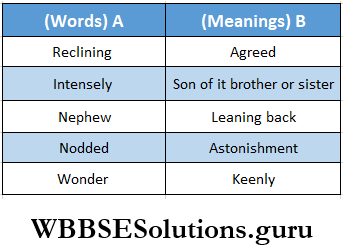
nationalist (ন্যাশনালিষ্ট) – জাতীয়তাবাদী ; founded (ফাউন্ডেড্ ) – প্রতিষ্ঠা করেছিলেন; included (ইনক্লুডে)— অন্তর্ভূক্তি করা; regiment (রেজিমেন্ট) – সেনাদল; confined (কনফাইন্ড) – বন্দী ; narrative (ন্যারেটিভ) – আখ্যান ; courageous (কারেজিয়াস ) – সাহসী; escape (এস্কেপ) – পলায়ন; clutches (ক্লাচেস্) – করল; struggle (স্ট্রাগল)— লড়াই; pale (পেল)—বিবর্ণ, ফ্যাকাশে; reclining (রিক্লাইনিং) – হেলান দিয়ে থাকা; intensely (ইনটেনলি)- গভীর ভাবে; nodded (নডেড) – মাথা নেড়ে সম্মতি জানাল; residence (রেসিডেন্স) – বাসা; wonder (ওয়ান্ডার)- বিস্ময়; subdued (সাবডিউড) – চাপা ; excitement (এক্সাইটমেন্ট) – উত্তেজনা; ailing (এইলিং) – অসুস্থ; additional (অ্যাডিশনাল)—অতিরিক্ত ; excuse (এক্সকিউজ) – অজুহাত; operating (অপারেটিং)— চালানো; broadcasts (ব্রডকাস্টস) —রেডিয়োর বার্তা; means (মিস্‌) – উপায়; drive out (ড্রাইভ আউট) — মোটরগাড়ি চালিয়ে যাওয়া; natural fashion —স্বাভাবিক উপায় ।

Part 2

cabled ( কেবল্ড)—টেলিগ্রাম করেছিল ; freedom struggle — স্বাধীনতা সংগ্রাম; operated (অপারেটেড্) – কাজ করতেন; frontier (ফ্রন্টিয়ার) – সীমান্তবর্তী; introduced (ইনট্রডিউসড্)—পরিচয় করিয়ে দিয়েছিল; baggy (ব্যাগি) —ঢিলেঢালা; fez (ফেজ)—এক ধরনের টুপি; disguise (ডিস্‌গাইজ)—ছদ্মবেশ; identity (আইডেনটিটি)—পরিচয় ; secrecy (সিকেসি) — গোপনীয়তা; asleep (অ্যাস্লিপ) – ঘুমিয়ে পড়া অবস্থায়; spectacles (স্পেকটাকেলস)— চশমা; moonlit (মুনলিট)—চন্দ্রালোকিত; signalled (সিগন্যালড্) – সংকেত দিল; preferred (প্রেফারড)—বেশী পছন্দ করল; comfort (কমফর্ট)—আরাম; blanket (ব্ল্যাংকেট্) — কম্বল।

Read And Learn Also WBBSE Class 8 English Reading Skills

Part 3

tiptoed—পা টিপে টিপে চলল; precincts (প্রেসিংট্স)—সীমানা ; thermos (থারমোস) — ফ্লাস্ক; faltered (ফলটারড্)—গোলমাল করল ; put up — আস্তানা নিল; parting (পার্টিং) – বিদায়ী; gait (গ্যেট)—চলনভঙ্গী; disappeared (ডিস্যাপিয়াড)—অদৃশ্য হয়ে গেলেন; clutter (ক্লাটার) – অবিরাম শব্দ।

Reading Skill Seen Lesson 4 The Great Escape Examples

1. Read the texts below and do as directed.

Question 1. Looking pale and thin, with a bushy half-grown beard, Subhas was reclining on his pillows when Sisir, his nephew, entered Subhas’s bedroom that December afternoon. Subhas made him sit to his right on the bed. Looking intensely at Sisir, he said, “Can you do some work for me?”
Sisir nodded.

The task, as it turned out, was to help plan and carry out Subhas’s escape from India. Sisir would have to drive his uncle, in the dead of the night, to a railway station far away from Calcutta.

From his uncle’s residence at Elgin Road, Sisir walked back that night to his own house at 1, Woodburn Park in a state of wonder and subdued excitement.

WBBSE Class 8 English Functional GrammarWBBSE Class 8 English Reading Skills
WBBSE Solutions For Class 8 EnglishWBBSE Solutions For Class 8 Maths


Answer the questions below:

  1. How was Subhas looking when Sisir visited him?
  2. What request.did Subhas make to Sisir ?
  3. Where did Sisir plan to drive his uncle too?
  4. How did Sisir feel after making out the plan of escape?

Answer:

  1. Subhas was looking pale and thin with a bushy half-grown beard. He was reclining on his pillows.
  2. Subhas requested Sisir to help him plan and carry out his escape from India.
  3. Sisir planned to drive his uncle, in the dead of the night, to a railway station far away from Calcutta.
  4. Sisir was in a state of wonder and subdued excitement after making out the plan.

WBBSE Solutions For Class 8 English Reading Skill Seen Lesson 4 The Great Escape

2. Write ‘T’ for true and ‘F’ for false statement. Give supporting sentences for each of your answers.

Question 1. Sisir was Subhas’s younger brother.
Answer: False

When Sisir, his nephew, entered Subhas’s bedroom.

Question 2. Sisir agreed to Subhas’s request for helping him to escape.
Answer: True

Sisir nodded

Question 3. Subhas looked healthy and cheerful.
Answer: False

Looking pale and thin, with a bushy half-grown beard, Subhas was reclining on his pillow.

Question 4. Subhas lived at Elgin Road.
Answer: True

From his uncle’s residence at Elgin Road, Sisir walked

Question 5. Sisir lived with Subhas at Elgin Road.
Answer: False

Sisir walked back to his own house at I, Woodburn Park.

3. Rearrange the following sentences in the correct order. Write the numbers in the boxes against each.

1. Subhas asked Sisir to sit to his right on the bed.

2. Sisir agreed to his request.

3. Subhas was reclining on his pillows.

4. Sisir walked back to his home.

5. Sisir came to visit Subhas.

6. Subhas made a request to Sisir.

Answer:

3. Subhas was reclining on his pillows.

5. Sisir came to visit Subhas.

1. Subhas asked Sisir to sit to his right on the bed.

6. Subhas made a request to Sisir.

2. Sisir agreed to his request.

4. Sisir walked back to his home.

4. Match the words in A with their meanings in B.

WBBSE Solutions For Class 8 English Reading Skill Seen Lesson 4 The Great Escape Match The Word In A With Their Meaning In B

Answer:

WBBSE Solutions For Class 8 English Reading Skill Seen Lesson 4 The Great Escape Write Words In A From The Text B

Question 2. The police were keeping watch on Subhas’s house. Though it was normal for a nephew to visit an ailing uncle, Subhas had an additional excuse for meeting his nephew: Sisir was good at operating the radio. He helped Subhas listen to foreign broadcasts.

Subhas and Sisir discussed various means of escape. Finally, they decided to drive out, in the most natural fashion, through the main gate. Sisir owned a German car called the Wanderer, which he and Subhas chose for their journey.

  1. Answer the questions below:
  2. Who were keeping watch on Subhas’s house?
  3. What additional excuse did Subhas have for meeting his nephew?
  4. What did Subhas and Sisir decide finally?
  5. What was the ‘Wanderer’ referred to in the text?
  6. Why did Subhas and Sisir decide to drive out through the main gate?

Answer:

  1. The police were keeping watch on Subhas’s house.
  2. Subhas had an additional excuse in meeting his nephew Sisir in that he was good at operating radio, and Subhas needed his help in listening to foreign broadcasts.
  3. Subhas and Sisir finally, decided to drive out by. car through the main gate.
  4. ‘Wanderer’ was a German car owned by Sisir which was used for Subhas’s escape from his house.
  5. Subhas and Sisir decided to drive out through the main gate because that would be the most natural way, and nobody would suspect that they were escaping.

2. Choose the correct answers from the list of alternatives given.

Question 1. It was normal for a nephew to-

  1. Guard his uncle’s house,
  2. Visit an ailing uncle,
  3. Operate his uncle’s radio.

Answer: 2. Visit an ailing uncle

Question 2. Sisir helped Subhas in-

  1. Listening to foreign broadcasts,
  2. Reading out newspapers,
  3. Operating television.

Answer: 1. Listening to foreign broadcasts

Question 3. The most natural fashion for escaping was to

  1. Hire a taxi,
  2. To take a personal car,
  3. To drive out through the main gate.

Answer: 3. To drive out through the main gate

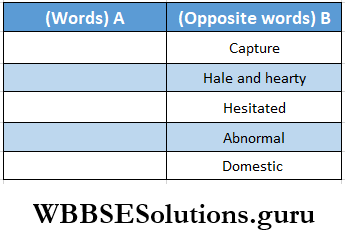
3. Write words in A from the text which are opposite in meaning of the words given in B.

WBBSE Solutions For Class 8 English Reading Skill Seen Lesson 4 The Great Escape Write Words In A From The Text B

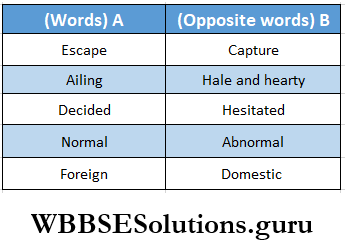
Answer:

WBBSE Solutions For Class 8 English Reading Skill Seen Lesson 4 The Great Escape Write Words In A From The Text B Answer

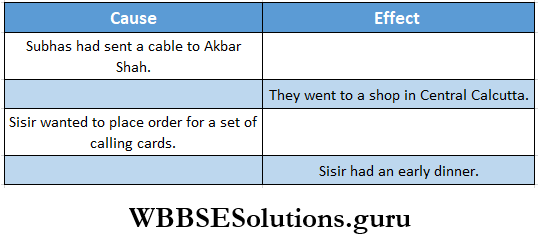
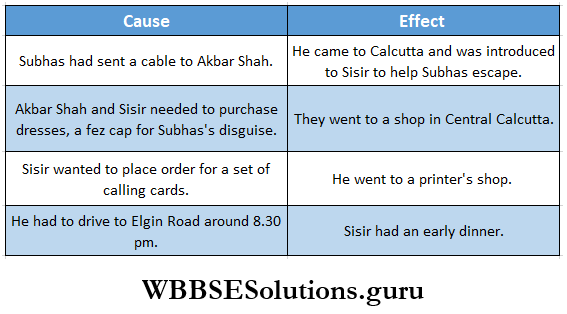
Question 3. Subhas had cabled Akbar Shah to meet him at Calcutta. Akbar Shah was a co-worker in the freedom struggle against British Raj. He operated in the north-western frontier provinces. He was to help Subhas escape.

Akbar Shah came to Calcutta. He was introduced to Sisir. Together they went to a shop in Central Calcutta where they purchased baggy shalwars (trousers) and a black fez for Subhas’s disguise. Later, Sisir also purchased a suitcase, a bedroll, shirts, and pillows. Subhas was to carry these with him in the journey. Sisir then went to a printer’s shop. He ordered a set of calling cards that read: ‘Muhammad Ziauddin, Travelling Inspector, the Empire of India Life Insurance Co. Ltd.’ This was the false identity with which Subhas was to travel.

On 16th January 1941, Sisir finished his dinner early and drove to Elgin Road around 8.30 pm. He parked the Wanderer at the back of the house.

1. Answer the questions below:

  1. Who was Akbar Shah?
  2. What items were purchased for Subhas to be carried with him on his journey?
  3. What was the real identity of Muhammad Ziauddin?
  4. Why do you think Subhas had to put on a false identity?

Answer:

  1. Akbar Shah was a co-worker of Subhas in the freedom struggle against British Raj. He operated in the north-western frontier provinces.
  2. A suitcase, a bedroll, shirts, pillows, baggy salwars, and a black fez were purchased for Subhas to be carried with him on his journey.
  3. Muhammed Ziauddin was no other than Subhas himself in disguise.
  4. Subhas had to put on a false identity to deceive the British police to escape from house arrest.

2. Fill in the chart with information from the text.

WBBSE Solutions For Class 8 English Reading Skill Seen Lesson 4 The Great Escape Fill In The Chart With Information

Answer:

WBBSE Solutions For Class 8 English Reading Skill Seen Lesson 4 The Great Escape Fill In The Chart With Information Answer

3. Rearrange the sentences in the correct order. Write the numbers in the boxes provided.

1. Akbar was introduced to Sisir.

2. Sisir purchased a suitcase, a bedroll, shirts, and pillows for Subhas.

3. Subhas sent a cable to Akbar Shah.

4. They purchased clothes for Subhas’s disguise.

5. Sisir went to a printer’s shop and ordered for a set of calling cards.

6. Akbar Shah came to Calcutta.

Answer:

3. Subhas sent a cable to Akbar Shah.

5. Sisir went to a printer’s shop and ordered for a set of calling cards.

1. Akbar was introduced to Sisir.

4. They purchased clothes for Subhas’s disguise.

6. Akbar Shah came to Calcutta.

2. Sisir purchased a suitcase, a bedroll, shirts, and pillows for Subhas.

4. Complete the sentences with information from the text.

Question 1. The main purpose of asking Akbar Shah to come to Calcutta was ___________
Answer: The main purpose of asking Akbar Shah to come to Calcutta was to help Subhas escape.

Question 2. Sisir and Akbar purchased baggy shalwars and a black fez for Subhas from ___________
Answer: Sisir and Akbar purchased baggy shalwars and a black fez for Subhas from a shop in Central Calcutta.

Question 3. The calling cards read ____________
Answer: The calling cards read Muhammad Ziauddin, Travelling Inspector, the Empire of India Life Insurance Co. Ltd.

Question 4. Subhas set off his journey on ___________
Answer: Subhas set off his Journey on 16th January 1941.

Question 5. Sisir parked his car ___________
Answer: Sisir parked his car at the back of his hous

5. Find words in the text which are similar in meaning of the following:

  1. Independence;
  2. Made known;
  3. A person that somebody works with;
  4. Bought ;
  5. False appearance.

Answer:

  1. Freedom,
  2. Introduced,
  3. Co-worker,
  4. Purchased,
  5. Disguise.

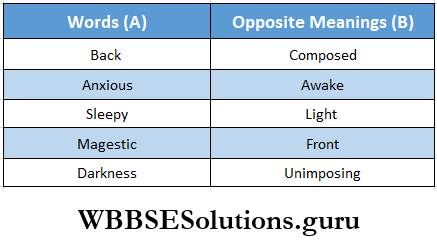
Question 4. Subhas and Sisir hugged the inner wall of the long house corridor and tiptoed down the back stairs to the car. Subhas sat in the back, Sisir drove the car. He started the engine and drove out from 38/2 Elgin Road as he had done on so many past occasions. At Subhas’s Elgin Road residence, the light glowed in his bedroom to give the impression that he was still there. As Calcutta slept, uncle and nephew crossed Howrah Bridge and went beyond the city’s precincts. Subhas poured Sisir coffee from a thermos. They shared a few anxious moments together when the car engine faltered once. It started again and Sisir dashed at high speed through the dark night. At around 8.30 am, they arrived at Bararee, near Dhanbad. They put up at the house of Sisir’s brother, Ashok. Subhas kept his disguise on as Muhammad Ziauddin and said he had come on insurance business, and was given room to rest during the day. They met and talked in the evening and had an early dinner.

Muhammad Ziauddin left alone for Gomoh station which was some distance away. He wanted to catch the Delhi-Kalka Mail from there.

A little further from the house, Sisir picked him up in his Wanderer and drove towards the railway station. They reached Gomoh station in the moonlit night. A sleepy porter collected their luggage.

“I am off-you go back”, Subhas said as parting words. Sisir watched him mount the railway overbridge and walk across it with his usual majestic gait. He disappeared into the darkness towards the platform on the opposite side. The Delhi-Kalka Mail released steam. Sisir heard the rhythmic clutter of the wheels and saw the train lights moving away.

1. Answer the questions below:

  1. In which direction did Sisir drive after leaving Elgin Road?
  2. Why did Subhas keep the light glowing in his bedroom?
  3. Why did Sisir pick Subhas up in his car a little further from Ashok’s house?
  4. Why did Subhas leave for Gomoh station?
  5. Describe Sisir’s last sight of Subhas.

Answer:

  1. After leaving Elgin Road, Sisir drove towards Howrah Bridge and then went beyond the city’s boundary.
  2. Subhas kept the light glowing in his bedroom to give the impression that he was still in his bedroom.
  3. He did so to show that Muhammad Ziauddin had left the house alone.
  4. Subhas left for Gomoh station to catch the Delhi-Kalka Mail from there.
  5. Subhas left Sisir in the station and told him to go back. Sisir then watched him walking across the railway over bridge with his usual majestic gait.

2. Write “T” for true and F for false statement. Give supporting sentences for each of your answers.

Question 1. Sisir and Subhas hurriedly an down the corridor and the back stairs.
Answer: False

Subhas and Sisir… and tiptoed down the back stairs to the car.

Question 2. Sisir drove out from Subhas’s Elgin Road residence many times before.
Answer: True

He started the engine and drove out from 38/2 Elgin Road as he had done on so many past occasions.

Question 3. Subhas and Sisir had to face an anxious moment during the road drive.
Answer: True

They shared a few anxious moments together when the car engine faltered once.

Question 4. In Dhanbad, they put up in a hotel.
Answer: False

They put up at the house of Sisir’s brother, Ashoke.

Question 5. Subhas sent off Sisir at Gomoh station.
Answer: True

They reached Gomoh station… …” I am off-you go back”, Subhas said as parting words.

3. Rearrange the following sentences in the correct order. Put the numbers in the boxes.

1. They reached Bararee near Dhanbad.

2. Sisir picked him up in his car on the way.

3. Subhas and Sisir took their seats in the car.

4. They reached Gomoh station.

5. “Subhas left alone for Gomoh station in disguise.

6. Subhas saw off Sisir and boarded the train.

7. They put up at the house of Sisir’s brother, Ashok.

8. They crossed Howrah Bridge.

Answer:

3. Subhas and Sisir took their seats in the car.

6. Subhas saw off Sisir and boarded the train.

1. They reached Bararee near Dhanbad.

7. They put up at the house of Sisir’s brother, Ashok.

5. “Subhas left alone for Gomoh station in disguise.

8. They crossed Howrah Bridge.

4. They reached Gomoh station.

2. Sisir picked him up in his car on the way.

4. Match the words in A with their opposite meanings in B.

WBBSE Solutions For Class 8 English Reading Skill Seen Lesson 4 The Great Escape Match The Word In A With Their Opposite Meaning In B

Answer:

WBBSE Solutions For Class 8 English Reading Skill Seen Lesson 4 The Great Escape Match The Word In A With Their Opposite Meaning In B Answer

WBBSE Solutions For Class 8 English Reading Skill Unseen Detailed Reading

Detailed Reading Examples

Read the following passages carefully and then answer the questions that follow each.

Question 1. It was on January 30, 1948. Bapuji was coming for his evening prayer. He was resting on the shoulders of Ava and Manu, his grandchildren. Godse had shot the frail old man with his revolver thrice. He was arrested by the crowd present there. The police investigation continued for five months. The special court began in Red Fort in New Delhi on June 22, 1948. On February 10, 1949, the court sentenced Godse to death.

Read And Learn Also WBBSE Solutions For Class 8 English

1. Answer the questions:

Question 1. Who murdered Gandhiji and how?
Answer: Godse murdered Gandhiji by shooting him down thrice with a revolver.

Question 2. When was he murdered?
Answer: He was murdered on January 30, 1948, when he was coming for his evening prayer.

Question 3. Who were his grandchildren?
Answer: Ava and Manu were his grandchildren.

Question 4. What was the punishment of the murderer?
Answer: The murderer Godse was sentenced to death as punishment

WBBSE Class 8 English Functional GrammarWBBSE Class 8 English Reading Skills
WBBSE Solutions For Class 8 EnglishWBBSE Solutions For Class 8 Maths


2. Complete the sentences with the word/words from the passage:

Question 1. The frail old man was ___________
Answer: The frail old man was Gandhiji.

Question 2. Two companions of Gandhiji were ___________
Answer: Two companions of Gandhiji were Ava and Manu.

Question 3. The day on which he was murdered ___________
Answer: The day on which he was murdered was 30th January 1948.

Question 4. The murderer was arrested by ___________
Answer: The murderer was arrested by the crowd present on the spot.

3. Some of the following statements are true and some are false. Write ‘True’ or ‘False’.

Question 1. Gandhiji was stabbed to death.
Answer: False

Question 2. He was murdered by Godse with his revolver.
Answer: False

Question 3. People present there caught the murderer.
Answer: False

Question 4. Godse shot Gandhiji with a revolver once.
Answer: False

Question 5. The police investigated the matter for five years.
Answer: False

Question 2. During the reign of Queen Elizabeth, there lived a famous Englishman named Sir Walter Raleigh. He was a gentleman and a favorite with the Queen. He was a scholar, a poet, and a brave and daring soldier. He sailed to the new world which we call America, and had many adventures there. He did two useful things. He brought back from America two plants that became very popular with Europeans. One was tobacco, the other was the potato. Before his time the potato was unknown in Europe, but it is now one of the commonest foods all over the world.

Raleigh first planted potatoes in Ireland, and the potato became to the Irish what wheat is to the Punjabi, and rice to the Bengalee and the Madrasi-their chief food.

[Word meaning: reign — রাজত্বকাল ; favourite – প্রিয় ; scholar — বিদ্বান ; daring – সাহসী ; adventure — দুঃসাহসিক ঘটনা ]

1. Answer the questions.

Question 1. Who was Sir Walter Raleigh?
Answer: Sir Walter Raleigh, was a famous English man who was a scholar, a poet, and a brave and daring soldier.

Question 2. What is the new world?
Answer: The new world referred to here is America.

Question 3. What were the two useful things Raleigh did?
Answer: The two useful things Raleigh did were that he brought from America two plants-one tobacco and the other potato- to Europe and he first planted potatoes in Ireland.

Question 4. What is the importance of the potato?
Answer: The importance of potato lies in the fact that it has become one of the commonest foods all over the world.

2. Some of the statements are true and some are false. Write ‘T’ against the true and ‘F’ against the false statements.

Question 1. Sir Raleigh lived during the time of Queen Elizabeth.
Answer: True

Question 2. The Queen did not like him.
Answer: False

Question 3. He was a learned soldier.
Answer: True

Question 4. He went on a pleasure trip of America.
Answer: False

3. Complete the following statements.

Question 1. The chief food of the Bengalee is _______
Answer: The chief food of the Bengalee is rice.

Question 2. The chief food of the Madrasi is _______
Answer: The chief food of the Madrasi is rice.

Question 3. The chief food of the Irish is _______
Answer: The chief food of the Irish is potato.

Question 4. The chief food of the Punjabi is _______
Answer: The chief food of the Punjabi is wheat.

4. Write the opposites of ‘Favourite’ and ‘Popular’.
Answer:

Favorite: unfavourite

Popular: unpopular

Question 3.

It was a dark night. A blind man was going along a road. He had a lamp in his hand. Two men laughed at him. One of them said, “What is the use of a lamp to a blind man?” The other called the blind man a fool. The blind man heard this. He said, “The lamp is not for me. It is for those people who are careless. They will not notice me in darkness. The lamp will show them the way.” They felt sorry for their foolishness.

[Word meaning: blind— অন্ধ; laughted at — উপহাস করল ; careless — অসাবধানী ; foolishness বোকামি

1. Answer the following questions.

Question 1. Who laughed at the blind man?
Answer: Two men laughed at the blind man.

Question 2. Do you think the lamp was useful to the blind man?
Answer: Yes, it was useful to the blind man in the dark.

Question 3. Why did the blind man carry the lamp with him?
Answer: The blind man carried the lamp with him to make others careful about him in the dark.

Question 4. Why did the two men laugh at the blind man?
Answer: The two men laughed at the blind man as they thought the lamp would be of no use to him.

2. Complete the following sentences with information from the text.

Question 1. In a dark night a blind man was going with ___________
Answer: In a dark night a blind man was going with a lamp in his hand.

Question 2. Two men laughed at the blind man as there was no use of ___________
Answer: Two men laughed at the blind man as there was no use of the lamp for the blind man.

Question 3. The blind man was carrying a lamp because _______
Answer: The blind man was carrying a lamp because it was a dark night and careless people might collide with him in the darkness.

Question 4. Two men, at last, could understand ___________
Answer: The two men at last could understand their foolishness.

3. Say whether the following statements are true or false.

Question 1. The blind man had a torchlight in his hand.
Answer: False

Question 2. The blind man was also deaf.
Answer: False

Question 3. The light would make others careful about the blind man.
Answer: True

Question 4. The two men hated the blind man.
Answer: False

Question 4.

Once there was a greedy farmer. He had a goose. When she laid her first egg, he was very much happy and excited to find that it was not an ordinary egg, but a golden one. The next day, too, the goose laid another golden egg. In this way the farmer got in possession of a number of golden eggs. He became rich by selling them one by one. But the more he got, the more did his greed increase. He thought the goose had many golden eggs in her belly. So he resolved to get them out all at once in order that he might become very rich in the quickest possible time. With this object in view, he one day killed the goose and cut open her belly. Alas! there was no golden egg inside. The farmer repented of having lost the treasure he had been getting so long daily.

[Word meaning: greedy – লোভী ; excited — উত্তেজিত; belly — পেট ; resolved —মন স্থির করল; quickest সবচেয়ে তাড়াতাড়ি। object উদ্দেশ্য; repented আপশোষ করল; treasure – সম্পদরাশি ]

1. Pick out the correct alternative from each group.

Question 1. The farmer

  1. Was very lazy.
  2. Was very cruel.
  3. Wanted to be rich very quickly.

Answer: 3. Wanted to be rich very quickly

Question 2. The goose laid a golden egg

  1. Everyday.
  2. Very often.
  3. Every alternate day.

Answer: 1. Everyday

Question 3. The farmer became rich by

  1. Selling the golden eggs.
  2. Selling the goose.
  3. Selling goose meat.

Answer: 1. Selling the golden eggs

Question 4. On cutting open the belly of the goose the farmer got

  1. Many golden eggs.
  2. No golden eggs.
  3. A few golden eggs.

Answer: 2. No golden eggs

Question 5. The goose was

  1. Made of gold.
  2. An ordinary goose.
  3. A magician.

Answer: 2. An ordinary goose

2. Write ‘T’ for true and ‘F’ for false.

Question 1. The farmer was very kind.
Answer: False

Question 2. The goose used to lay an ordinary egg daily.
Answer: False

Question 3. The farmer killed the goose to be rich very quickly.
Answer: True

Question 4. The farmer found no golden egg in the belly of the dead goose.
Answer: True

Question 5. The farmer felt happy after killing the goose.
Answer: False

3. Answer the questions in short.

Question 1. What was the specialty of the goose?
Answer: The specialty was that she would lay a golden egg every day.

Question 2. What was the farmer’s wish?
Answer: The farmer wished to become rich very quickly by getting many golden eggs from the belly of the goose all at a time

Question 3. What did he do to fulfill his wish?
Answer: He killed the goose and cut open her belly.

Question 4. What was the result?
Answer: He found no golden egg inside the belly and lost the source of his fortunes.

Question 5.

Formerly many people believed that cholera was caused by a goddess ‘Sitala’ and these super- stitous people tried to please the goddess by offering puja instead of calling in a doctor when a person is attacked with cholera.

Now we know that cholera germs get into our body through food and drink. People often sell food and sweets and cut-fruits which are often covered with flies. These make them infectious and dangerous. And people often drink unclean water from ponds and wells. Sometimes clothes used by cholera patients are washed in ponds. This should be strictly prohibited. When someone is attacked with cholera, we should give him for immediate relief plenty of salted water sweetened with sugar. This is to make up for loss of water caused by dehydration. In critical cases medical advice should be taken immediately. However, vaccination against cholera can protect us against this deadly disease.

[Word meaning: superstitious – কুসংস্কারাচ্ছন্ন; infectious — সংক্রামক ; dangerous— ভয়াবহ; prohibited—নিষিদ্ধ ; plenty — প্রচুর পরিমাণে; make up for-ক্ষতিপূরণ করে; dehydration—শরীরে জলীয় ভাগ কম হওয়া; critical — সংকটাপন্ন ; vaccination—টিকা; protect — রক্ষা করা ]

1. Fill in the chart below with information from the text.
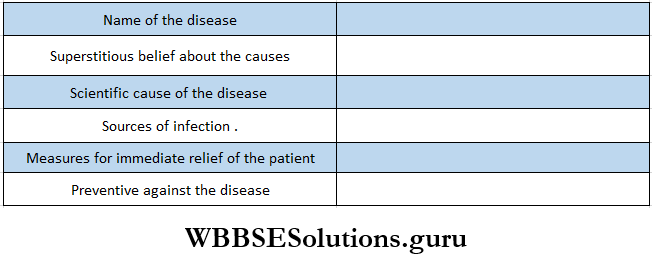
WBBSE Solutions For Class 8 English Reading Skill Unseen Detailed Reading Fill In The Chart Below With Information From The Text

Answer:

WBBSE Solutions For Class 8 English Reading Skill Unseen Detailed Reading Fill In The Chart Below With Information From The Text Answer

2. Some precautionary measures have been suggested against the disease cholera. Write them in brief.
Answer:

  1. Food, sweets, and cut fruits kept in the open should be avoided.
  2. We should not drink unclean water from ponds and wells.
  3. Clothes of cholera patients should not be washed in ponds.

3. Pick out the correct answers.

Question 1. Cholera is caused by

  1. Anger of goddess.
  2. Infection from germs.
  3. Bites of mosquitoes.

Answer: 2. Infection from germs

Question 2. Cholera patients need

  1. Dehydration.
  2. Rehydration. (“tificeer weer we offer)
  3. Vaccination.

Answer: 2. Rehydration

Question 3. Dehydration causes

  1. High temperature.
  2. Infections.
  3. Loss of fluid.

Answer: 3. Loss of fluid

Question 4. Vaccination is meant for

  1. Prevention of cholera.
  2. Treatment of cholera.
  3. Cure of cholera.

Answer: Prevention of cholera

4. Answer the questions in brief.

Question 1. How do cholera germs get into our body?
Answer: Cholera germs get into our body when we take uncovered food, sweets and cut fruits and drink unclean water from ponds and wells.

Question 2. What should be given to a cholera patient for immediate relief?
Answer: A cholera patient should be given plenty of salt water sweetened with sugar for immediate relief.

Question 3. How can we protect ourselves against this deadly disease?
Answer: We can protect ourselves against the disease by taking the cholera vaccine.

5. Write ‘T’ for true and ‘F’ for false statements.

Question 1. Cholera disease occurs because of an act of sin.
Answer: False

Question 2. Cholera is an infectious disease.
Answer: True

Question 3. We should always drink pure water to avoid infection from cholera.
Answer: True

Question 4. A cholera patient should be immediately shifted to a hospital.
Answer: False

Question 5. Vaccination is the real prevention of this disease.
Answer: True

Question 6. Flies are carriers of cholera germs.
Answer: True

6. Find words from the passage which mean the following.

Question 1. Showing unreasoning belief in supernatural influences
Answer: Superstitious

Question 2. That which spreads from one person to another
Answer: Infections

Question 3. Large quantity
Answer: Plenty

Question 4. Make up for
Answer: Compensate

Question 6.

Einstein was very simple in his ways of life and indifferent to his great fame. Once the queen of Belgium invited him to Brussels. When he got down from the train at Brussels, he could not think that there were many gorgeously dressed officials to receive him at the station. The officials also expected somebody who would appear to be rich and aristocratic to them. They never imagined that this shabby man would be Einstein himself. So they went back to the queen and informed her that he had not come by train. Einstein; however, walked the whole way with a suitcase in one hand and a violin in the other. When he reached the destination the queen said to him, “I sent a car for you, Dr. Einstein.” “I did not think,” replied the great scientist with a smile, “that anybody would send a car for me. But I can assure you, I have greatly enjoyed the walk.”

[Word meaning: indifferent; fame-; gorgeously; aristo- cratic—অভিজাত; shabby—মলিন বস্ত্র পরিহিত; destination—গন্তব্যস্থল ; assure—নিশ্চিত করা

1. Choose the correct answer.

Question 1. Einstein used to live a

  1. Gorgeous life.
  2. Simple life.
  3. Bohemian life.

Answer: 2. Simple life

Question 2. He was dressed

  1. Nicely.
  2. Gorgeously.
  3. Shabbily.

Answer: 3. Shabbily

Question 3. The officials missed Einstein because they expected to see a

  1. Simple man.
  2. Rich and aristocratic-looking man.
  3. Poorly dressed man.

Answer: 2. Rich and aristocratic-looking man

Question 4. Einstein missed the officials sent by the queen because he

  1. Found none at the station.
  2. Did not expect any officials.
  3. Did not wait long at the station.

Answer: 2. Found none at the station

Question 5. On hearing that the queen had sent a car for him Einstein said that

  1. He did not need the car and he had enjoyed the walk.
  2. He had not seen any car at the station.
  3. He found none.

Answer: 1. He did not need the car and he had enjoyed the walk

2. Write ‘T’ for true and ‘F’ for false statements.

Question 1. Einstein was very conscious of his fame.
Answer: False

Question 2. He went to Brussels, to attend a seminar.
Answer: False

Question 3. The queen sent a car to receive him.
Answer: True

Question 4. Einstein went to the palace by the queen’s car.
Answer: False

Question 5. Einstein was a great scientist.
Answer: True

3. Answer the questions in short.

Question 1. What was unexpected to Einstein at the Brussels Railway station?
Answer: Einstein did not expect that gorgeously dressed officials would come to the station with a car to receive him.

Question 2. What did the officials expect to see at the station?
Answer: The officials expected to see a rich and aristocratic-looking person as their guest.

Question 3. Describe the dress of Einstein as he came down from the train.
Answer: Einstein’s dress was quite poor and shabby.

Question 4. What did he carry in his hands?
Answer: He carried a suitcase and a violin in his hands.

Question 5. Describe Einstein’s attitude towards life and fame.
Answer: Einstein lived a simple life and was indifferent to fame.

Question 6. What did the officials report to the Queen?
Answer: The officials reported to the queen that Einstein had not come.

4. Complete the sentences with information from the text.

Question 1. The queen of Belgium invited ____________
Answer: The queen of Belgium invited Einstein to Brussels.

Question 2. The officials did not ____________
Answer: The officials did not expect that their guest would look like ordinary man in a poor dress.

Question 3. Einstein enjoyed the walk to _________
Answer: Einstein enjoyed the walk to the queen’s palace.

Question 4. The officials reported to the queen _______
Answer: The officials reported to the queen that Einstein had not come.

5. Match the words in ‘A’ with the words nearest in meaning in ‘B’.
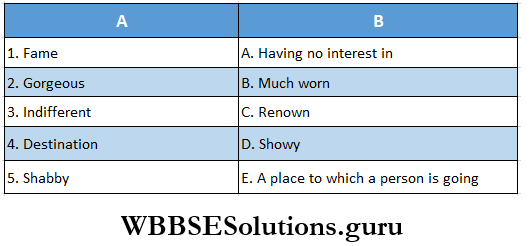
WBBSE Solutions For Class 8 English Reading Skill Unseen Detailed Reading Match The Word A With B

Answer: 1. C, 2. D, 3. A, 4. E, 5. B

Question 7.

There was a venomous snake in a field. One day a sage passed by that field and the snake ran after him to bite. The sage advised the snake not to bite anyone. The snake promised to follow his advice. The sage went away. The snake entered his hole and began to live without attempting to harm anyone. In a few days, the people concluded that the snake had lost its venom and was no longer danger- ous. They teased him, pelted him with stones, and dragged him mercilessly. Fortunately, the sage again passed by that field. Seeing the injured condition of the snake the sage enquired of the cause. “Holy Sir”, the snake replied, “this is because I do not injure anyone after your advice.” The sage smilingly said, “My friend, I simply advised you not to bite anyone, but I did not tell you not to frighten them in your self-defense.”

[Word meaning: venomous – বিষধর ; promised — প্রতিজ্ঞা করেছিল; concluded— সিদ্ধান্তে উপনীত হল; dangerous বিপদসঙ্কুল। teased বিরক্ত করল; pelted হয়েছিল; mercilessly নির্ণয়ভাবে injured—আহত; frighten — ভয় দেখানো ]

1. Answer in short.

Question 1. Where did the snake live?
Answer: The snake lived inside a hole in a field.

Question 2. What happened when a sage passed by the snake?
Answer: When the sage was passing, the snake ran after him to bite.

Question 3. What did the sage advise? Did the snake obey him?
Answer: The sage advised the snake not to bite anyone. The snake obeyed him.

Question 4. What was the conclusion of the people?
Answer: The people concluded that the snake had lost its venom and was no longer dangerous

Question 5. What did they do to the snake?
Answer: They teased the snake, pelted him with stones, and dragged him mercilessly.

Question 6. Give a suitable title to the passage.
Answer: The Sage and the Snake

2. Write ‘T’ for true and ‘F’ for false statements.

Question 1. The snake bit the sage.
Answer: False

Question 2. The snake followed the sage’s advice.
Answer: True

Question 3. The snake lost its venom.
Answer: False

Question 4. The people injured the snake.
Answer: True

Question 5. The sage advised the snake not to frighten anybody.
Answer: False

3. Complete the following sentences

Question 1. The snake wanted ___________
Answer: The snake wanted to bite the sage.

Question 2. The sage advised the snake _________
Answer: The sage advised the snake not to bite anyone.

Question 3. The people were ___________
Answer: The people were merciless

4. Find words in the passage meaning the following:

  1. Something with venom
  2. Made fun unkindly
  3. Without any mercy or compassion
  4. Cause to be afraid

Answer:

  1. Venomous,
  2. Teased,
  3. Mercilessly,
  4. Frighten

Question 8.

Astronomers, those people who study the stars, tell us that long, long ago the earth and all the planets were part of the sun. The sun was then as it is now a mass of flaming matter, terribly hot. Somehow little bits of the sun got loose and they shot out into the air.

In this way our earth also shoot out from the sun. It must have been very hot, with terribly hot gases and air all around it, but as it was very much smaller than the sun it started to cool. The sun also is getting less hot but it will take millions of years to cool down. The earth took much less time to cool. When it was hot of course, nothing could live on it—no man or animal or plant or tree. Everything should have been burnt up then.

Just as a bit of the sun shot out and became the earth, so also a bit of the earth shot out and became the moon. Many people think that the moon came out of the great hollow which is now the Pacific Ocean, between America and Japan.

[Word meaning : Astronomer – জ্যোতির্বিদ ; planet — গ্রহ; flaming — জলন্ত ; bit—অল্প অংশ ]

1. Pick out the correct alternatives.

Question 1. According to astronomers, long ago

  1. The earth was separate from the sun.
  2. The planets were separate from the sun.
  3. The earth and the planets were part of the sun.

Answer: 3. The earth and the planets were part of the sun

Question 2. Initially, the earth was

  1. Very cold.
  2. Very hot.
  3. Moderately hot.

Answer: 2. Very hot

Question 3. The moon originated from

  1. The Pacific Ocean.
  2. The earth.
  3. The sun.

Answer: 2. The earth

Question 4. The Pacific Ocean has been formed due to the shooting out of a portion of

  1. The earth.
  2. The moon.
  3. The sun.

Answer: 1. The earth

2. Write ‘T’ against true and ‘F’ against false statements.

Question 1. The sun was originally a mass of flaming matter but not now.
Answer: False

Question 2. The earth shot out of the moon.
Answer: False

Question 3. Initially, the earth had hot gases and air all around it.
Answer: True

Question 4. The sun will take a very long time to cool down.
Answer: True

Question 5. There was no life on earth when it was formed.
Answer: True

3. Complete the sentences with information from the text.

Question 1. The earth originated from _________
Answer: The earth originated from the sun.

Question 2. A bit of the earth shot out and became _________
Answer: A bit of the earth shot out and became the moon.

Question 3. People studying stars are called _________
Answer: People studying stars are called astronomers.

4. Give a suitable title to the passage.
Answer: The Origin of the Earth and the Moon

WBBSE Solutions For Class 8 English Reading Skill Unseen Detailed Reading

Question 9.

One wintry night an old infirm beggar, shivering with cold, knocked at the door of a farmer who was sitting with his children around his hearth. In a feeble voice he begged for shelter and hospitality. His feet were trembling and he could no longer drag his weary body in the chilly weather of the night. His tattered clothes could hardly afford him protection against the snow. The farmer opened the door and when the children saw the old, infirm beggar standing at the door, they ran to comfort him. They warmed his frozen limbs and gave him food and did all they could to cheer him up. The beggar was moved to tears. In the midst of their sorrow for the misery of that man, the farmer’s children felt that night a joy they had never felt in their happiest days.

[Word meaning: infirm-; hearth-s; feeble-; hospitality-fr weary— দুর্বল ; tattered— ছিন্নভিন্ন ]

1. How would you classify the text?

  1. A description;
  2. A public notice;
  3. A report
  4. A story

Answer: 4. A story

2. Choose the correct answers in the following:

Question 1. An old infirm beggar knocked at the door of

  1. A prince.
  2. A weaver.
  3. A peasant.

Answer: 3. A peasant

Question 2. The beggar asked for

  1. Shelter and hospitality.
  2. Power and position.
  3. Money and clothes

Answer: 1. Shelter and hospitality

Question 3. The farmer and his children

  1. Drove the beggar.
  2. Served the beggar.
  3. Beat the beggar

Answer: 2. Served the beggar

Question 4. The children of the farmer

  1. Fed the beggar
  2. Clothed the beggar
  3. Gave the beggar money

Answer: 1. Fed the beggar

Question 5. The beggar was moved by the farmer and his children’s

  1. Sympathy.
  2. Kindness
  3. Hospitality.

Answer: 3. Hospitality

3. Write ‘T’ against correct statements and ‘F’ against incorrect statements.

Question 1. The farmer was a selfish man.
Answer: False

Question 2. The farmer’s children felt for the beggar.
Answer: True

Question 3. When the beggar came, the farmer was standing at the door.
Answer: False

Question 4. It was raining when the beggar came in.
Answer: False

Question 5. The beggar was weak.
Answer: True

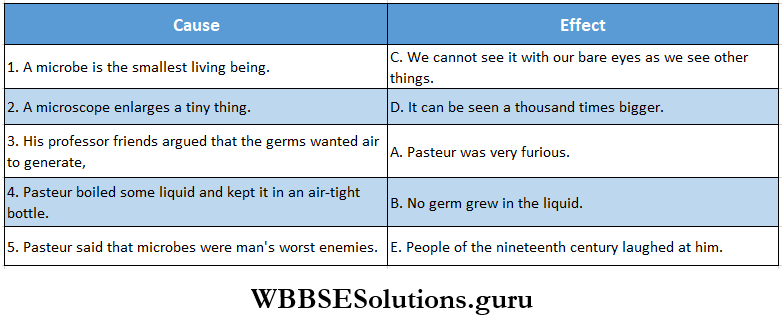
4. Match the causes with the results.
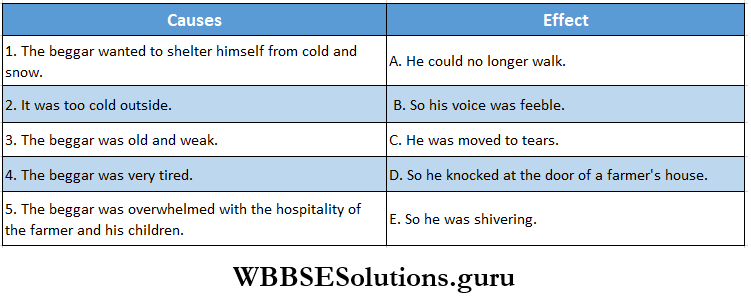
WBBSE Solutions For Class 8 English Reading Skill Unseen Detailed Reading Match The Cause With Effect

Answer: 1. D, 2. C, 3. E, 4. A, 5. B

5. Write the nearest meaning of the following words from the above text:

  1. Torn
  2. Weak

Answer:

  1. Torn: Tatters
  2. Weak: Infirm

Question 10.

Conan Doyle was a young doctor who had just entered practice. In those days it took some time for a doctor to become popular and get patients. He spent many hours in his room waiting for patients. He began to think of other ways in which he could earn his living. He tried his hand at writing and wrote a novel. It did not attract much attention. Nobody seemed interested in it. But after several years Conan Doyle wrote some short detective stories about the detective Sherlock Holmes which brought him money and fame.

[Word meaning young practice-551; popular; living- AHA: attention; interested; detective – রহস্যমূলক ]

1. Write ‘T’ for true and ‘F’ for false statements.

Question 1. Conan Doyle had a good practice as a young doctor.
Answer: False

Question 2. To earn money he took to writing.
Answer: True

Question 3. In the beginning, Doyel earned great reputation as a writer.
Answer: False

Question 4. Doyle became famous as a detective story writer.
Answer: True

Question 5. Sherlock Holmes was the name of a detective.
Answer: True

2. Answer the questions in short.

Question 1. What was Conan Doyle by profession?
Answer: Conan Doyel was a doctor by profession

Question 2. Why did he try to earn money in other ways?
Answer: Because he was not successful as a young doctor.

Question 3. How did he meet success?
Answer: He met success as a writer of short detective stories which brought him money and fame

3. Pick up a sentence from the passage that shows that Doyle’s first novel had no market.

4. Fill in the blanks with words taken from the text. Change their forms if necessary.

Question 1. He is a ______ businessman.
Answer: Successful

Question 2. Pay ____ to your studies.
Answer: Attention

Question 3. The loud sound ________ our attention.
Answer: Attracted

Question 4. She is _______ in music.
Answer: Interested

Question 11.

There lived in a certain town of Persia two painters, whose name had spread far. Both were so good at their work that it was hard to say who the better painter was. So it was settled that each was to draw a picture and there would be judges to decide who had done the better work. One of the painters painted a bunch of grapes that looked so natural that birds came and pecked at it.

The judges were struck with wonder and thought he was surely going to win. When they went to see what the other painter had done, he pointed to a screen that was before their eyes. The rival painter thought that the picture was behind the screen and went forward to see to it. He was greatly surprised to find that there was no screen there but only the picture of one that had been painted on the wall. The judges were speechless with wonder and gave the second painter the place of honor as his picture had deceived a man while that of his rival had deceived only the birds.

[Word meaning : hard — কষ্টসাধ্য; settled — স্থির করা হল; decides — মীমাংসা করা ; natural— স্বাভাবিক; pecked ঠোকরাল ; struck — হতভম্ব হল surprised — বিস্মিত; speechless নির্বাক; wonder-fe; deceived-affe; rivals]

1. Read the passage carefully and pick out the correct answers from the statements below:

Question 1. The first painter’s picture deceived.

  1. The judges.
  2. The rival painter.
  3. The birds.

Answer: 3. The birds

Question 2. The second painter’s picture deceived

  1. The judges.
  2. The rival painter.
  3. The birds.

Answer: 2. The rival painter

Question 3. The painter who had painted a screen was given the place of honour by the judges because

  1. He was the better painter.
  2. He was the best painter.
  3. He was one of the best painters.

Answer: 1. He was the better painter

Question 4. The bunch of grapes misled

  1. The judges and the birds.
  2. The birds.
  3. The rival painter.

Answer: 2. The birds

Question 5. The screen misled

  1. The birds.
  2. The rival painter.
  3. The rival painter as well as the judges.

Answer: 2. The rival painter

2. Some of the following statements are true and some are false. Write ‘T’ against the true and ‘F’ against the false statements.

Question 1. The two painters were unknown.
Answer: False

Question 2. The two painters were quite famous.
Answer: True

Question 3. One of the painters was very good but the other was quite inferior.
Answer: False

Question 4. The first painter’s painting deceived the judges.
Answer: False

Question 5. The second painter was declared the winner.
Answer: True

Question 12.

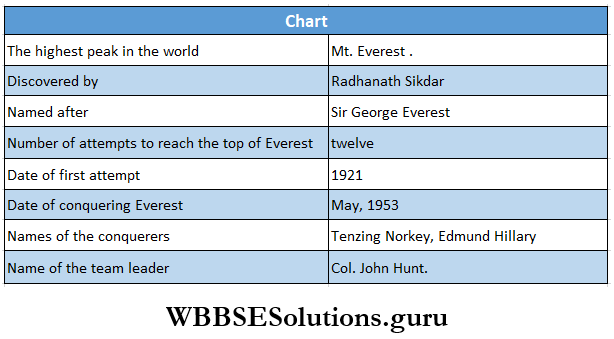
You all know that Everest, a peak of the Himalayas, is the highest mountain in the world. It was discovered by a Bengalee named Radhanath Sikdar, an officer in the Government of India. It, however, came to be called after his chief, Sir George Everest.

For many years, people have been trying to get to the top of Everest. The first attempt was made in 1921, followed by ten others up to 1952. But so great are the difficulties of the climb that they ended in failure. Even several lives were lost.

The sides of Everest are always covered with snow. It often slips and falls, and in falling, kills the climbers. There are also fearful storms of frost and snow at the top almost all the year.

No wonder, Everest stood unconquered so long. But its pride was humbled at last. The top was reached in the twelfth attempt in May, 1953, by the party led by Col. John Hunt. And the heart of every Indian is filled with pride that, of the two that reached the top, one was an Indian, Tenzing Norkey. The other was a man from New Zealand, Edmund Hillary. It is in the fitness of things that the peak which was discovered by an Indian should also be conquered by another Indian.

[Word meaning: peak – চূড়া; discovered — আবিষ্কৃত হয়েছিল; failure — ব্যর্থতা; fearful — ভয়াবহ ; frost— তুষারপাত ; unconquered — অপরাজিত; humbled — হতমান হয়েছিল; prise — গর্ব ; fitness of things— সঙ্গত কারণেই; conquered — জয় লাভ করল ]

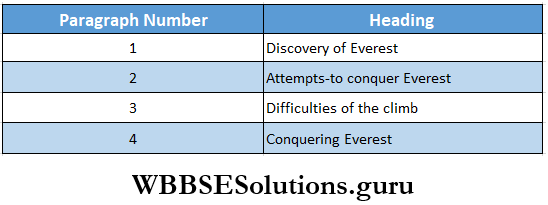
1. Four headings are written for the four paragraphs in the above text. Match the proper headings for the paragraphs.

Headings

  1. Conquering Everest
  2. Discovery of Everest
  3. Attempts to conquer Everest
  4. Difficulties of the climb

Answer:

WBBSE Solutions For Class 8 English Reading Skill Unseen Detailed Reading Paragraphs With Headings

2. Fill in the chart below with information from the text.

WBBSE Solutions For Class 8 English Reading Skill Unseen Detailed Reading Fill In The Chart Below With Information From The Text-1

Answer:

WBBSE Solutions For Class 8 English Reading Skill Unseen Detailed Reading Fill In The Chart Below With Information From The Text Answer 1

3. Write ‘T’ against the true and ‘F’ against the false statements.

Question 1. Radhanath Sikdar was an Englishman.
Answer: False

Question 2. Everest was conquered in the twelfth attempt.
Answer: True

Question 3. There was no risk in climbing up the peak.
Answer: False

Question 4. Indians were proud at the conquest of Everest.
Answer: True

Question 5. The top of Everest remains covered with snow only for a few months.
Answer: False

Question 13.

Long ago there was a slave in a country. His name was Androcles. He committed an offence. So he was punished. Out of fear he ran away from his master’s house and lived in a cave. In that cave lived a big lion. A thorn stuck into his left foot. So he felt great pain and could not walk properly. He came limping towards Androcles. Androcles saw the thorn. He boldly came forward and drew it out. The lion got rid of the pain and felt relieved. Later on Androcles was caught and brought to the town and was asked to fight a hungry lion. It was the same lion whose thorn Androcles had drawn out. The lion at once recognized him and quietly lay down at his feet.

[Word meaning : committed – কোনো দুষ্কর্মাদি করা; offence – অপরাধ; limping – খুড়িয়ে b; got rid of মুক্ত’ হল ; relieved – নিবৃত্তি হল ; hungry – ক্ষুধার্ত ; recognised — চিনতে পারল ; quietly – ধীর ভাবে ]

1. Pick out the correct answers and write in full sentences.

Question 1. Androcles was a

  1. Greek god.
  2. A slave.
  3. A king.

Answer: 2. A slave

Question 2. Androcles ran away from his master’s house and took shelter secretly

  1. In a village.
  2. In a forest.
  3. In a cave.

Answer: 3. In a cave

Question 3. The lion came limping towards Androcles because

  1. A thorn stuck into his left foot.
  2. One of his legs was broken.
  3. He could recognize Androcles.

Answer: 1. A thorn stuck into his left foot.

Question 4. The lion which Androcles was asked to fight was

  1. A new lion.
  2. The same lion whose thorn he had drawn out.
  3. A lion used in a circus.

Answer: 2. The same lion whose thorn he had drawn out.

Question 5. The lion lay down quietly beside Androcles because

  1. He was grateful to him.
  2. He was angry with him.
  3. He was afraid of him.

Answer: 3. He was afraid of him.

2. Suggest a suitable title for the passage.

Answer: Androcles and the lion

3. Fill in the following chart with information from the text.
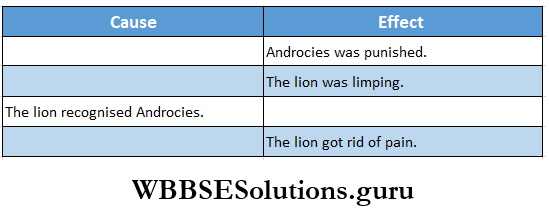
WBBSE Solutions For Class 8 English Reading Skill Unseen Detailed Reading Fill In The Folowing Chart With Information From The Text

Answer:

WBBSE Solutions For Class 8 English Reading Skill Unseen Detailed Reading Fill In The Folowing Chart With Information From The Text Answer

4. How would you classify the above text?

  1. A public notice
  2. A description
  3. A report
  4. A story

Answer: 4. A story

5. Which of the following statements are true and which are false?

Question 1. Androcles saw the lion in a cave.
Answer: True

Question 2. Androcles was killed by the lion.
Answer: True

Question 3. The lion had pain in his stomach.
Answer: True

Question 4. The lion was limping because he had lost one of his legs.
Answer: True

Question 5. The lion had a sense of gratitude.
Answer: True

Question 14.

Although Louis Braille died when he was only forty-three years old, he succeeded in devising a system of reading and writing for the blind which is now taught all over the world.

Braille lost his sight accidentally as a child. Nevertheless, he was able to complete his education at a school for the blind in Paris and became a teacher. In his days the few books that were available for the blind people were printed in big, raised type; the letters used were those of the ordinary alphabet. The reading of such books required immense effort. And writing was almost impossible, for a blind person was still restricted to an alphabet which was extraordinarily difficult to reproduce on paper. Braille’s idea was to use raised dots instead of raised letters. He evolved a system that made use of only six dots in all. By various combinations of these dots, it not only proved possible to represent each letter in the alphabet but punctuation marks, numbers, and notation as well. Reading and writing have thus been enormously simplified. The sensitive fingers of a blind person can travel rapidly over the dots; and there is a small machine something like a typewriter, which enables the blind to write quickly and clearly.

[Word meaning: Devising-; alphabet-; immense-2, restricted– সীমাবদ্ধ; extraordinarily — অস্বাভাবিক ভাবে ; reproduce — অনুলিপি করা; evolved – বের করেছিলেন; enormously-b]

1. Answer the following questions:

Question 1. How did Braille become blind?
Answer: Braille became blind accidentally.

Question 2. What type of books were available for the blind in Braille’s time?
Answer: The books available for the blind at that time were printed in big raised type ordinary alphabet.

2. Write ‘T’ for true statements and ‘F’ for false ones:

Question 1. Braille was blind from his birth.
Answer: False

Question 2. Braille died at the age of 43.
Answer: True

Question 3. Braille evolved a system of raised type using ordinary alphabet.
Answer: False

Question 4. It is easy to use the Braille system of reading and writing.
Answer: True

Question 5. Musical notation can also be written in Braille language.
Answer: True

3. Complete the following with information from the passage:

Question 1. Luois Braille became a ____________
Answer: a teacher after completing his education at a school for the blind.

Question 2. He completed his education in ____________
Answer: Paris

Question 3. Reading books for the blind in Braille’s time required ____________
Answer: immense effort.

Question 4. Braille system used only ____________
Answer: six raised dots.

4. Find out words from the text to match meaning of the following:

  1. Signs or symbols to represent numbers, amounts, etc.:
  2. Came after:
  3. Thinking out a plan:
  4. Put a limit:
  5. Greatly:

Answer:

  1. Signs or symbols to represent numbers, amount etc.: dots.
  2. Came after: evolved
  3. Thinking out a plan: devising
  4. Put a limit: restricted
  5. Greatly: enormously

Question 15.

We know that plants and trees do not move about as cats and dogs do, and so men at first thought that plants and trees are not actually alive. But now we know that plants and trees are not only alive but they can feel as well, like other living things. Sir Jagadish Chandra Bose was able to prove this and spread the idea throughout the world.

He showed that there is no difference between the life of plants and that of animals. If we give the plants a blow, they feel it, and if we make them drink a poison, they are affected by it like us. Like human beings they also sleep at night and wake up in the morning. They even die like men. He proved all these by experimenting in the laboratory with the most delicate instruments. He added something new to science and brought about a great change in the world of science.

Honors were heaped upon him. He received a knighthood and came to be known as Sir Jagadish Chandra Bose. He was asked by the various scientific institutions of the world to deliver lectures on his research. These lectures made him world-famous as a scientist. Thus we see that his discoveries gave a new light to the world and brought honour and glory to India. Jagadish Chandra is in the world of science what Rabindranath is in the world of letters.
throughout the world

Word meaning: alive; able; spread পৃথিবী ব্যাপি; difference— তফাৎ ; poison – বিষ; affected – ক্ষতিগ্রস্ত হয়; delicate— সূক্ষ্ম ; heaped — স্তূপীকৃত করা হয়েছিল; deliver lectures -বক্তৃতা দেওয়া; researches famous বিখ্যাত; glory” “গৌরর+ world of letters সাহিত্য জগত

1. Answer the questions in brief:

Question 1. Why did people think that plants had no life?
Answer: Because plants cannot move like living animals.

Question 2. Who was Sir Jagadish Chandra Bose?
Answer: Sir Jagadish Chandra Bose was a famous Indian scientist.

Question 3. What did he discover?
Answer: He discovered that plants and trees have life and they can also feel like other living things.

Question 4. How did he become famous?
Answer: He became famous by his discovery that there is no difference between the life of plants and that of animals.

Question 5. What was his contribution to science?
Answer: His discovery gave a new idea to science and brought about a great change in the world of science.

2. Complete the sentences with information from the text.

Question 1. In recognition of his great work, Jagadish Chandra was awarded ____________
Answer: In recognition of his great work, Jagadish Chandra was awarded a knighthood and came to be known as Sir Jagadish Chandra Bose.

Question 2. He proved that plants react to a poison as ____________
Answer: He proved that plants react to a poison as a man does.

Question 3. He was asked to deliver ____________
Answer: He was asked to deliver lectures on his researches at various scientific institutions of the world.

Question 4. His discovery made him ____________
Answer: His discovery made him a world-famous scientist.

Question 5. He brought honour and glory to India by ____________
Answer: He brought honour and glory to India by his famous discoveries.

Question 6. Jagadish Chandra is famous in ____________ as Rabindranath is in ____________
Answer: Jagadish Chandra is famous in the scientific world as Rabindranath is in the literary world.

3. Write ‘T’ for true and ‘F’ for false statements.

Question 1. Jagadish Chandra became famous because of his discoveries.
Answer: True

Question 2. The scientific world did not accept his theories.
Answer: False

Question 3. Plants and trees can feel and respond like human beings.
Answer: True

Question 4. India was proud of Jagadish Chandra.
Answer: True

Question 5. Rabindranath earned fame both in arts and science.
Answer: False

Question 6. Plants sleep in the daytime and wake up at night.
Answer: False

4. Make sentences of your own with the following words.

  1. Alive;
  2. Throughout;
  3. Difference;
  4. Affected;
  5. Delicate.

Answer:

  1. The animal was injured but it is still alive.
  2. He suffered a lot throughout his life.
  3. There is no difference between the two schemes.
  4. They were affected by the flood.
  5. It is a very delicate matter.

5. Write words opposite in meaning of the following.

  1. Alive;
  2. Able;
  3. Difference;
  4. Delicate;
  5. Glory.

Answer:

Alive: Dead;

Able: Unable;

Difference: Similarity;

Delicate: Coarse;

Glory: Disgrace.

Question 16.

One morning a boy, tending cattle by the side of a railway line, noticed that a small railway bridge had given way following the previous night’s heavy shower. He also saw a passenger train in the distance, coming towards it at full speed. A simple cowboy as he was, he at once realised the great danger that awaited the train and its passengers. He ran up to the line and standing on it began to wave his shirt as a warning to the driver. The driver thought that this was a mere prank of a village urchin. So the train continued to advance, whistling furiously to scare away the boy. But he would not leave his post. The driver was at last compelled to stop the train a little distance from the boy. As he and the guard came down, the boy took them to the breach. They now realized what a great danger they had escaped. The boy was later richly rewarded by the railway authorities.

Word meaning tending: চড়াচ্ছিল ; previous = আগের দিন ; realised বুঝতে পারল awaited- অপেক্ষা করছিল; wave ওড়ানো ; warning — বিপদের সঙ্কেত ; prank— দুষ্টামি কাজ urchin— দুরন্ত শিশু ; furiously – জোরে জোরে ; scare away- ভয় দেখিয়ে বিরত করা; compelled- বাধ্য হল ; breach—— ফাটল ; escaped — পরিত্রাণ পেয়েছে ; rewarded —— পুরস্কৃত হল

1. Complete the following sentences with information from the above text. You may also use your own words:

Question 1. The train driver thought __________
Answer: The train driver thought that the boy was waving his shirt just to enjoy a playful trick,

Question 2. The boy was rewarded for ____________
Answer: The boy was rewarded for preventing an accident.

Question 3. The boy saved __________
Answer: The boy saved the train and the passengers from a serious accident

Question 4. The train whistled __________
Answer: The train whistled to scare away the boy from the railway lines.

Question 5. At last the driver and __________
Answer: At last the driver and the guard came down up to the boy who took them to the breach

2. Arrange the following sentences in their proper order.

  1. The driver was forced to stop the train.
  2. The cowboy began to wave his shirt.
  3. The bridge developed a breach due to heavy overnight rain.
  4. The cowboy got the reward from the railway authorities.
  5. The train advanced whistling furiously.

Answer:

4. The cowboy got the reward from the railway authorities.

2. The cowboy began to wave his shirt.

1. The driver was forced to stop the train.

5. The train advanced whistling furiously.

3. The bridge developed a breach due to heavy overnight rain.

3. Choose an answer against the most suitable of the titles for the above text:

  1. The train and the breach
  2. A cowboy waved his shirt
  3. A cowboy prevented a train accident
  4. A heavy shower and a train accident

Answer: 3. A heavy shower and a train accident

Question 17.

Forests are far from towns and cities. So people who live in cities and towns do not think that they have any connection with the forests. But they are dependent on forests for timber, which is nothing but wood used in building houses, carts, boards, bridges, plows, paper, and many other things. People in villages also use wood as fuel for cooking their meals.

In the past there was no fear of shortage of wood. But random cutting of trees has created scarcity of firewood. It has also caused soil erosion and less rainfall.

We can, however, overcome the problems by stopping the destruction of forests and planting more trees.

[Word meaning: dependent-; random-; scarcity-; fire-wood- জ্বালানী কাঠ; soil erosion — ভূমিক্ষয়; overcome— বশে আনা ]

1. Correct the following sentences according to the passage:

Question 1. People of cities and towns are connected with forests.
Answer: People of cities and towns do not think that they have any connection with the forests.

Question 2. People of cities and towns use wood only as fuel.
Answer: People of cities and towns use wood as fuel and also for building houses, carts, boards, bridges, paper and many other things.

Question 3. Soil erosion helps trees to grow.
Answer: Soil erosion is caused by random cutting of trees.

Question 4. The cutting of trees has increased the amount of rainfall.
Answer: The cutting of trees has decreased the amount of rainfall.

Question 5. Planting of more trees is not essential.
Answer: Planting of more trees is essential.

2. Random cutting of trees has created three problems. Write them in the space. Answer in words not in sentence.
Answer:

  1. Less rainfall
  2. Soil erosion
  3. Scarcity of firewood

3. Answer in brief:

Question 1. Why do people of cities and towns think that they have no connection with forests?
Answer: As the people of cities and towns live far away from forests, they think that they have no connection with forests.

Question 2. Where do village people get firewood from?
Answer: Village people get firewood from timber which is obtained from trees.

Question 3. For what purposes is timber used?
Answer: Timber is widely used as fuel, in building houses, in making carts, boards, bridges, plows, paper, and many other things.

Question 4. Why should we plant more trees?
Answer: We should plant more trees to obtain wood which is needed for various purposes, and also for inducing rain and preventing soil erosion.

4. Find out words from the passage that mean:

  1. Link or relation
  2. Lack

Answer:

  1. Connection
  2. Shortage

5. Find out words opposite in meaning to the following: (from the passage)

  1. More
  2. Creation

Answer:

  1. More: less
  2. Creation: Destruction

Question 18.

The Kimono is the national dress of Japan worn by both men and women. The word Kimono means ‘clothing’ or literally ‘something to wear’ and it has been just that for the Japanese for several hundred years. With changing times though, the people of Japan now wear the Kimono only on special or ceremonial occasions.

Kimonos are ‘T’ shaped robes that fall up to the ankles. The garment has a flat collar and wide sleeves that fall to the wrists. It is always worn left side over night and held together at the waist by a broad sash called ‘obi’. Most women’s Kimonos are one standard size and tucked in to fit the weaver. However, very tall and large sized women have to have their Kimonos stitched to their size. Men wear a shorter version of the women’s Kimono, called haori, along with hakama or loose-fitting pants.

These days a kimono can cost up to 10,000 dollars! Also, a silk one is but naturally more expensive than a cotton one. Today, in Japan, more women than men wear kimonos but only on special occasions like tea ceremonies, weddings, and funerals.

[Word meaning literally — আক্ষরিক অর্থে; ceremonial — আনুষ্ঠানিক ; tucked গুটিয়ে নিয়ে।

1. Find a word from the passage that means the same as the words below:

  1. Wide
  2. Costly
  3. Dresses

Answer:

  1. Wide: Broad
  2. Costly: Expensive
  3. Dresses: Clothing

2. Choose the correct answer:

Question 1. The kimono

  1. Used to be the national dress of men and women in Japan.
  2. Is the national dress of men and women in Japan.
  3. Is the national dress of women in Japan.

Answer: 2. Is the national dress of men and women in Japan.

Question 2. The kimono is worn

  1. Left side over right.
  2. Right side over left.
  3. Left side under right.

Answer: 1. Left side over right.

Question 3. Very tall women need to get their kimonos

  1. Tucked in.
  2. With an ‘obi’.
  3. Stitched up.

Answer: 3. Stitched up.

3. Write answers to the following questions:

Question 1. Describe a kimono.
Answer: A kimono is a ‘T’ shaped robe that falls up to the ankles. It has a flat collar and wide sleeves that fall to the wrists. It is always worn left side over right and held together at the waist by a broad sash called ‘obi’.

Question 2. What is a hakama?
Answer: A hakama is a loose-fitting pant worn by men in Japan.

Question 3. What can be the cost of a kimono?
Answer: A kimono can cost up to 10,000 dollars.

Question 4. On what occasions do the Japanese wear kimonos?
Answer: The people of Japan wear the kimono only on special or ceremonial occasions like tea ceremonies, weddings, and funerals.

4. Write whether the following statements are True or False.

Question 1. The kimono is the national dress of Jamaica.
Answer: False

Question 2. Men’s kimono in Japan is called haori.
Answer: True

Question 3. ‘Obi’ is a loose-fitting pant.
Answer: False

Question 19.

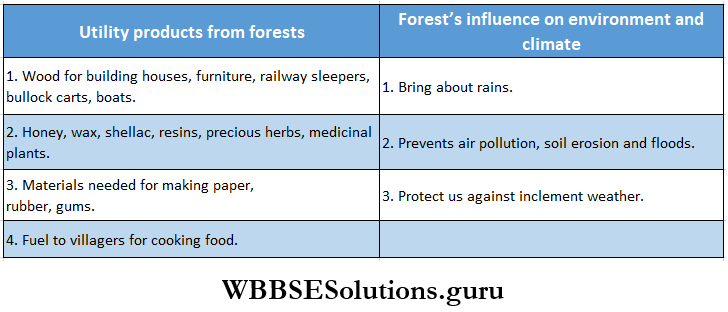
Forests are called the green gold of a country because they provide immense wealth and riches for the country. They produce wood for building houses, furniture, railway sleepers, bullock carts, boats, and ships. People in the villages use wood as fuel for cooking food.

The other useful products from forests are honey, wax, shellac, resins, precious herbs, and medicinal plants. They are also great sources of material for paper, rubber, and gums.

Forests have a direct influence on the climate of a region. They bring about rain and prevent air pollution. An area devoid of forests will go barren and turn into a desert in the course of time. The roots of trees bind loose soil and prevent soil erosion: The top fertile soil is thus retained which is so vital for agriculture. The arrest of soil erosion also prevents siting and raising of river beds and the subsequent overflowing of rivers causing floods. Forests protect us from inclement weather also.

The thoughtless cutting of trees has reduced forest wealth considerably. It has caused less rainfall, a lowering of groundwater level, and droughts. We can, however, overcome the problems by stopping the destruction of forests and planting more trees. People have to be made tree-conscious.

Word meaning: immense • প্রচুর; riches– সম্পদ; produce – উৎপাদন করে; shellac- লাক্ষা; resin— রজন; herb — ঔষধি; bring about — ঘটানো; devoid— হীন, বর্জিত ; erosion— ক্ষয় inclement— ঝড়ো ; drought— খরচ

1. Answer the questions in brief.

Question 1. Why are forests called the green gold of a country?
Answer: Forests are called green gold as they are the health of the country.

Question 2. How are forests important for us?
Answer: Forests are important because they give us useful products like wood, fuel, wax, honey, shellac, precious herbs, etc. They also bring about rains and prevent air pollution and soil erosion.

Question 3. How do forests influence the climate of a place?
Answer: Forests influence the climate of a place because they bring about rains, and prevent air pollution, soil erosion, and floods.

Question 4. Why are forests so useful to the village people?
Answer: Because villagers use wood as fuel for cooking food.

Question 5. What should be done to save forests?
Answer: To save forests, we should stop random cutting of trees and encourage tree planting.

2. Complete the chart with information from the text.

WBBSE Solutions For Class 8 English Reading Skill Unseen Detailed Reading Complete The Chart With Information From The Text

Answer:

WBBSE Solutions For Class 8 English Reading Skill Unseen Detailed Reading Complete The Chart With Information From The Text Answer

3. Thoughtless cutting of trees has created some problems. Write them down in brief.
Answer:

  1. Causing less rainfall
  2. Lowering groundwater level
  3. Causing droughts

4. Write ‘T’ for true and ‘F’ for false statements.

Question 1. Forests are very useful to people.
Answer: True

Question 2. Soil erosion helps trees to grow and survive.
Answer: False

Question 3. Rural people use wood as fuel.
Answer: True

Question 4. Rainfall has increased as a result of cutting of trees.
Answer: False

Question 5. Soil erosion should be controlled to prevent floods.
Answer: True

Question 6. Mass consciousness is necessary to prevent the cutting of trees.
Answer: True

5. Given below are three headings. Match them with the paragraphs. Write their numbers only against the headings.

Headings

  1. Forest products
  2. Preservation of forests
  3. Influence of forests on the climate

Answer:
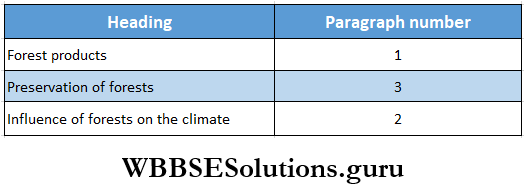
WBBSE Solutions For Class 8 English Reading Skill Unseen Detailed Reading Pragraph And Headings

Question 20.

There was once a little girl who lived with her mother in a small house near a village. The mother worked as hard as she could every day but still they were very poor. Often they did not have enough to eat.

One day when there was nothing left in the house, the little girl went out in the woods, hoping to find some wild fruit or flowers. There she met a strange-looking old woman. The little girl’s face was sad. So the old woman said, “You seem in trouble my child. What’s the matter ?” “I’m looking for food for my mother and myself, for we have none at home,” replied the little girl.

The old woman gave her a small iron pot and said, “This is a magic pot. Just say to it, ‘Cook, little pot, cook,’ and it will cook you nice sweet porridge. And when you say, ‘Stop, little pot, stop’, it will stop cooking”. The little girl was happy.

[Word meaning : worked as hard as she could – যতটা সম্ভব পরিশ্রম সে করত; woods – বন; cook— রান্না করা; porridge — একপ্রকারের খাবার (যবের মণ্ড]

1. Answer the following questions:

Question 1. Where did the little girl live and with whom?
Answer: The little girl lived in a small house near a village with her mother.

Question 2. Who gave a small iron pot to the little girl?
Answer: An old woman gave a small iron pot to the little girl.

Question 3. Why did the little girl go out in the woods?
Answer: The little girl went to the woods to find some wild fruit or flowers.

Question 4. How was the old woman in the woods?
Answer: The old woman was very strange-looking.

Question 5. Why is the small iron pot called a ‘magic pot’?
Answer: The small iron pot was called a magic pot because it would cook nice sweet porridge when asked to cook and it would stop doing so when asked to stop.

2. Complete the following with the information from the text above:

Question 1. Though the mother worked as hard as possible __________
Answer: Though the mother worked as hard as possible, she and her daughter did not get enough to eat.

Question 2. The old woman told the little girl that she was looking quite depressed __________
Answer: The old woman told the little girl that she was looking quite depressed and wanted to know the reason for it.

Question 3. Ordering the little pot to stop will lead to __________
Answer: Ordering the little pot to stop will lead to a stoppage of cooking.

3. State whether the following statements are True or False:

Question 1. The mother and the little girl were very idle by nature.
Answer: False

Question 2. They were so poor that they went without food everyday.
Answer: False

Question 3. Finding no fruit or flowers in the woods, the little girl’s face was very sad.
Answer: True

Question 4. The little girl was in search of food for herself and her parents.
Answer: True

Question 5. The strange-looking woman troubled the little girl.
Answer: False

4. Find out the appropriate words from the passage meaning the following:

  1. Sorrowful;
  2. Sufficient

Answer:

  1. Sorrowful: Sad
  2. Sufficient: Enough

Question 21.

Netaji Subhas Chandra was not a man to appeal to the grace of the British ruler for the freedom of the country. He hated any idea of compromising with anything unjust and wrong. So he started a vigorous campaign against the British Government in public. The foreign ruler sent him behind bars but could not curb his indomitable spirit. In the third week of January 1941, befooling the British Police Force he escaped from internment in his own house and went to Germany in disguise. From there he went to Japan traveling under waters in a submarine. From Japan he went to Singapore and built up the Azad Hind Fouj and established the Azad Hind Government. He was called ‘Netaji’ by the soldiers of the Azad Hind Fauj, the first Indian National Army (INA). As the leader of the Azad Hind Fauj, Netaji said to the soldiers of the Fauj. ‘Comrades! Soldiers! Let your battle cry be-to Delhi, to Delhi !’

The national salutation ‘Jai Hind’ was first conceived by Azad Hind Fauj. Netaji’s breath is still felt in this national salutation of today’s free India: ‘Jai Hind’!

[Word meaning : grace – অনুগ্রহ ; compromise — আপসে নিষ্পত্তি করা; indomitable — অদম্য; befooling— বোকা বানিয়ে; internment— গৃহবন্দী অবস্থা ; conceived— কল্পনা করা হয়েছিল ]

1. Choose the correct alternatives

Question 1. Netaji did not like to appeal to the British rulers because-

  1. He did not like to compromise with injustice hated the British
  2. He did not like the rulers
  3. He hated the British

Answer: 1. He did not like to compromise with injustice hated the British

Question 2. The foreign rulers sent Netaji to jail because-

  1. Netaji campaigned against the rulers in public
  2. Netaji killed many Britishers
  3. Netaji escaped from his house

Answer: 1. Netaji campaigned against the rulers in public

Question 3. Netaji escaped from internment

  1. In Cuttack
  2. In Calcutta
  3. In jail

Answer: 2. In Calcutta

Question 4. The Azad Hind Government was established in-

  1. Japan
  2. India
  3. Singapore

Answer: 3. Singapore

Question 5. The first Indian National Army was established in-

  1. New Delhi
  2. Singapore
  3. Calcutta

Answer: 2. Singapore

2. Complete the following chart with information from the text:
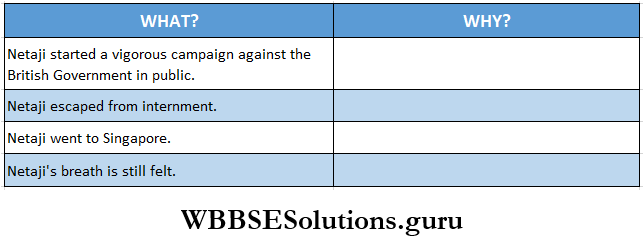
WBBSE Solutions For Class 8 English Reading Skill Unseen Detailed Reading Complete The Following Chart With Information From The Text What And Why

Answer:

WBBSE Solutions For Class 8 English Reading Skill Unseen Detailed Reading Complete The Following Chart With Information From The Text What And Why Answer 1

3. Match the words in column A with their meanings in column B.
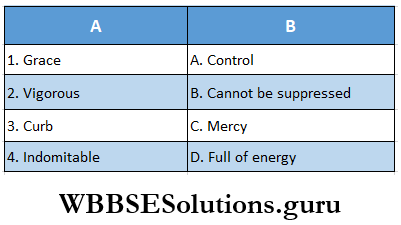
WBBSE Solutions For Class 8 English Reading Skill Unseen Detailed Reading Complete Match The Words
Answer: 1. C,2. D, 3. A, 4. B

Question 22.

Today we know the virus. It is a microbe when it is inside our body. A microbe is a living being so small that we cannot see it with our bare eyes. It is so called because it can be seen only with a microscope which enlarges a microbe thousand times and makes it visible to us. In fact, some microbes cannot be seen at all. It was Louis Pasteur who discovered microbes.

In the middle of the nineteenth century, people laughed at Pasteur when he said that microbes were man’s worst enemies. Pasteur insisted that all microbes, or germs came from the air and that it was possible, therefore, to protect milk, wine, and so on, from microbes. But the professors who thought they understood science said that Pasteur was wrong. They insisted that microbes were born spontaneously, and it was, therefore, nonsense to think that Pasteur could keep microbes out of milk or wine.

In order to convince these doubting professors, Pasteur boiled some broth in bottles, protected the broth from the air, and proved that no germs were created in this liquid. The professors answered that germs must have air in order to generate themselves. Pasteur was furious. He insisted that it was the ‘dust’ in the air and not the air itself that carried germs into the broth.

[Word meaning: microbe – জীবাণু; insisted– জোর দিয়ে বলতেন; spontaneously——-স্বতঃস্ফূর্তভাবে; -nousenise——অর্থহীন; convince – বিশ্বাস জন্মানো ]

1. Answer the following Questions:

Question 1. What is a microbe?
Answer: A microbe is a very small living being that cannot be seen with our bare eyes.

Question 2. Why is it called so?
Answer: It is so-called because it can be seen only with a microscope.

Question 3. What did the professors believe?
Answer: The professors believed that microbes were born spontaneously and they could not be kept out of milk or wine.

Question 4. How did Louis Pasteur prove that he was right?
Answer: Pasteur boiled some broth in bottles, protected the broth from the air, and showed that no germs were created in this liquid. Thus he proved himself right that it was dust in the air and not the air itself that carried germs into the broth.

Question 5. What is a microscope?
Answer: A microscope is an optical instrument that enlarges a microbe thousand times.

2. Match the cause and effect chart:
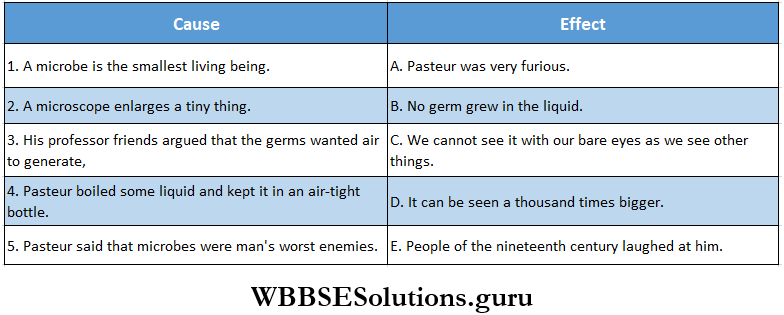
WBBSE Solutions For Class 8 English Reading Skill Unseen Detailed Reading Complete Cause And Effect

Answer:

WBBSE Solutions For Class 8 English Reading Skill Unseen Detailed Reading Complete Cause And Effect Answer

3. Fill up the blanks with information from the passage:

Question 1. There are many things that we can see without the use of a ________
Answer: Microscope

Question 2. A powerful machine can ________ the smallest thing to make it _____ to our eyes.
Answer: Visible

Question 3. It is really ______ to say that smoking is not harmful.
Answer: Wrong

Question 4. I told him the truth but could not ____ him.
Answer: Convince

Question 23.

David Livingstone was born many years ago at a small village in Scotland. His father was a poor man. So David was sent to work in a cotton mill at the age of ten. After a long day at the loom, he would read his books late into the night until his mother ordered him to go to bed. As he grew older, David began to go to school in the evening. In this way, he learnt a good deal of Latin, Greek, and medicine. And then he gave up his work in the cotton mill and went to Africa to find new rivers and lakes in that dark land and to teach the people there the story of the Bible. Accompanied by some faithful men, Livingstone set out to cross the Kalahari Desert. On the northern edge of the desert, he found the river Zuga and a great lake. Two years later he crossed the Zuga and pushed further north till he reached the great river Zambesi. Following the course of the river, he came upon the mighty falls which he named the Victoria Falls after Queen Victoria. From a distance, Livingstone had noticed five colors of spray. They were so high that they seemed to mingle with the clouds. They were white below and higher up became dark and thus looked like smoke. Tearing himself away from the beautiful sight, Livingstone pushed on down the river and reached the coast safely. In two and a half years he crossed Africa and completed one of the most wonderful travels.

[Word meanings : late into the night – অনেক রাত্রি পর্যন্ত ; tearing himself away – নিজেকে সরিয়ে নিয়ে।]

1. Choose the answer against the correct alternative:

Question 1. Livingstone’s attempt to cross Kalahari was-

  1. With some brave companions.
  2. With some reliable companions.
  3. With some able-bodied companions.

Answer: 2. With some reliable companions.

Question 2. Livingstone had to work in a loom-

  1. For experience.
  2. For poverty.
  3. For attending school in the evening.

Answer: 2. For poverty.

Question 3. Livingstone saw the great falls

  1. When he reached the river Zuga.
  2. When he reached the great lake.
  3. When he reached the river Zambesi.

Answer: 3. When he reached the river Zambesi.

2. Fill in the chart with information from the text:

WBBSE Solutions For Class 8 English Reading Skill Unseen Detailed Reading

Answer:

WBBSE Solutions For Class 8 English Reading Skill Unseen Detailed Reading

3. Supply the following information from the text:

Question 1. Birthplace of David Livingstone _________
Answer: At a small village in Scotland.

Question 2. Languages learnt by Livingstone ______
Answer: Latin and Greek.

Question 3. Time taken to complete the travel by Livingstone __________
Answer: Two and a half years.

Question 4. Subject matter of teaching the people _________
Answer: The story of the Bible.

Question 5. Name of the dark land ________
Answer: Africa

Question 6. Location of the lake _________
Answer: On the northern edge of the Kalahari Desert.

WBBSE Notes For Class 10 History And Environment Chapter 8 Post Colonial India

Post Colonial India Introduction

  • Finally, the British rule ended in India, and independence was achieved. The post-colonial era, or the Nehru Era, began on 15th August 1947, the day India became independent.
  • Jawaharlal Nehru was the first Prime Minister of India from 1947 to 1964. Independence came through riots, partition of the country, and the formation of Pakistan.
  • Many a fault and defect of colonial days kept haunting the country even after independence. Pandit Nehru was at the center of Indian politics and its Constitution till he died on 27th May 1964.

The Endeavour And Disputes Regarding The Inclusion Of The Native States In The Indian Union

  • The British Government, while transferring power to India, wanted to give freedom to the. Native States. Before independence, there were 552 Native States in India. They constituted 48% of the total territory of the country and their population was 20% of the entire population of India.
  • Out of these Native States, some, like Kashmir, Mysore, and Hyderabad were so big that they could be compared to some European countries. There were small states also, with meager revenue, comparable to the income of a hotel.
  • In 1947, more than 50% of Indian population was poor, 22% of rural people did not own. any land and 25% of people had less than one acre of land, while, two-thirds of the arable land in the country was owned by 13% of large landlords.
  • After independence, it was a daunting task to regroup the 552 Native States, which were spread all over the country. To solve this problem, the State Department was formed on 27th June 1947, under the leadership of Sardar Vallavbhai Patel (1875-1950) and his personal assistant V. Sankar and the secretary of States Reorganisation Commission V. P. Menon.
  • With great foresight and diplomacy, he sorted out the problem. On 5th July 1947, the kings of the Native States were asked to hand over all responsibilities regarding their foreign policy transport and defense to the Government of India. Separate agreements could be made as regards the other activities.
  • Patel went on a hurricane tour in order to convince the Native States to concede to his request. It was informed that within 5th August 1947, the Native” States have to be merged with the Indian Union.

WBBSE Class 10 History Chapter 8 Notes

  • These states gained independence as per Indian Independence Act of 14th July 1947. But it was left to the discretion of the ‘states involved to decide whether they would be part of India or Pakistan. The controversy started at this point.
  • The British Prime Minister Clement Atlee made an announcement on 20th February 1947 that the Native States could maintain their sovereign status if they so wanted.
  • Government of India was not agreeable to that, because, it might jeopardise the unity and national integration of the country and become dangerous for India. Hence, Government aimed at putting an end to all controversy and integrate the Native States in Indian Union.
  • Under the leadership Sardar Vallavbhai Patel within 3 weeks most of the native states signed the deed of ‘Instrument of Agreement’ and included into the territory of India 216 native states were annexed with the adjoining provinces, 275 native states together transformed into 5 separate provinces and 61 native states were annexed with 7 central Government ruled areas.
  • Though these states were included in the territory of India, Hyderabad, Junagarh, and Kashmir were not included till then. After inclusion of native states, Indian Republic was newly rearranged with four groups, such as ‘A’, ‘B’, ‘C’, and ‘D’.
  1. Group ‘A’ was formed with 9 British Indian Provinces combining 216 native states; like West Bengal, Assam, Bihar, Orissa, UP, MP, Punjab, Bombay, and Madras.
  2. Group ‘B’ was formed with 8 big native states ruled by kings or like that, such as Hyderabad, Central India, Patiala and East Punjab States Union (PEPSU), Jammu-Kashmir, Saurashtra, Rajasthan, Mysore, and Trivancore-Cochin.
  3. Group ‘C’ was formed with 10 states run by a commissioner including Delhi, such as Himachal Pradesh, Delhi, Kachcha, Curg, Vindhya Province, Tripura, and Manipur. and
  4. Group ‘D’ was formed with the states ruled by Central like Andaman and Nicobar Island.
  • Sardar Vallavbhai Patel used political pressure and-diplomatic tactics and tried to merge. the Native States with India. Some of the States went to the Constituent Assembly and agreed for inclusion within India. But Native States like Travancore, Bhupal, and Hyderabad wanted to remain independent.
  • But Patel requested them to join the Indian Union. The other Native States, out of fear of resistance from their subjects and considering Patel’s rigid and strict’ policy, conceded to remain within India. But the larger States like Hyderabad, Junagarh, and Jammu relented because they had sufficient army, artillery, and air force at their disposal.

1. Junagar assexation:

  • When the disputes and protests about the inclusion of Junagarh within India started, Patel and Nehru sided with the protesters. On the other hand, when the Babai dynasty’s last Muslim ruler Mohammad Mahabat Khanji 3 and his adviser Nabi Baksh of Junagarh showed his interest about joining Pakistan, Jinnah congratulated them.
  • However, among the citizens of Junagarh, majority were Hindus. They started terrible protests demanding inclusion within India and, as a result, the Nawab of Junagarh Mohammad Mahabat Khanji 3 fled the country and took shelter in Sind of Pakistan.
  • Under these circumstances, Shahnawaz Bhutto, the Prime minister or Dewan of Junagarh, requested help and intervention from the Government of India. The Government deployed the army to conduct a referendum and Junagarh was annexed to the Indian territory in December 1947.
  • In February 1948, the inclusion of Junagarh within India was supported by a large majority.
  • In the same, way, Muslim ruled Hyderabad and Hindu ruled Kashmir was included within India. In 1961 it was Goa and in 1975, Sikkim that was included in India.
  • Historians felt that Vallavbhai Patel was a successful statesman of highest degree, even greater than Otto Von Bismark of Germany, and named. him ‘The Iron Man of India’.

Kashmir Issue: After the independence of India, problems continued to bug the country regarding the inclusion of Kashmir within India. Kashmir was bordered by Pakistan on one side and India on the other; also 75% of the subjects were Muslims. Sk. Abdullah started a movement demanding the inclusion of Kashmir within India.

WBBSE Class 10 History Chapter 8 Notes

  • Lord Mountbatten, the Viceroy of India, visited Kashmir in June 1947. King Harisingh of Kashmir was asked to take a quick decision about Kashmir being joined to the Union of India, provided his subjects were agreeable to do so.
  • Even Mahatma Gandhi himself had gone to meet King Harisingh. Finally, King Harisingh of Kashmir sent his Prime Minister, Meherchand Mahajan, with a letter agreeing to join the territory of India.
  • At this time Pakistan, with the help of Pathan Tribal Raiders, attacked Kashmir on October 21-22, 1947, and proceeded up to Srinagar. By that time the agreement for the inclusion of Kashmir in the Indian Union was already signed.
  • So, on 26th October, at the request of Harisingh, V. P. Menon, Secretary to Patel, deployed Indian Army to drive out Pakistani raiders and free Kashmir of enemies. Now, since Kashmir was already included in India, Pandit Nehru had complained. to the Security Council of United Nations against Pakistani raiders.
  • The Council asked both the parties to move away from that place. In spite of that, Pakistan has forcibly occupied one-third of the territory, which is called ‘Azad Kashmir’ (or, Pakistan Occupied Kashmir or P. O. K) As per Article 370 of the Constitution of India, the independence, sovereignty, and special status of Kashmir has been recognised.
  • Sk. Abdullah, the then Chief Minister (1948-50) of Kashmir had good rapport with Nehru. But even today, Kashmir has not been freed from the clutches of Pakistani raiders. So, the Government of India has to deploy army along the ‘Line of Control’ and spend sleepless nights.

WBBSE Notes For Class 10 History And Environment Chapter 8 Post Colonial India Sk Abdullah

WBBSE Notes For Class 10 History And Environment Chapter 8 Post Colonial India Lord Mountbatten

2. Annexation of Hyderabad within India:

  • Hyderabad was the largest Native State. There were more Hindus than Muslims among the subjects. Even then, the Nizam, with the support of Britain and Pakistan, tried to remain independent instead of becoming a part of India.
  • They formed a communal organization named ‘Majlis-Ittehad-Ul-Muslimin’ and an armed force called ‘Rajakar’ by illegally procuring arms from Pakistan. The Congress leaders started a mass movement as a protest. The Communists also started the Peasants’ revolt in Telangana. Many people were scared at the situation and left Hyderabad for the main territory of India.
  • In September 1948, Nehru and Patel jointly gave an ultimatum to the Nizam to dismantle the ‘Rajakar’ force. On 13th September 1948 under General J. N. Choudhury when the Indian Army entered Hyderabad, the Nizam surrendered and on 18th September the inclusion of Hyderabad in India was completed.

WBBSE Class 10 Environment Chapter 8 Solutions

  • This operation against Nizam was known as ‘Operation Polo’. For this operation near about 40,000 people died. As a result within two months, Nizam Osman Ali Khan signed the deed of inclusion of India. On 26th January 1950, Hyderabad was officially included in India, and in 1956 Hyderabad was divided into three parts and added it to Andhra Pradesh, Bombay, and Mysore respectively.
  • On 28th September, a proud Patel wrote to Surawardy, ‘This has surely created a healthy mindset in India’. Historian Sumit Sarkar said, ‘It was a great achievement of Sardar Vallavbhai Patel to unify India in such a fast manner’.

WBBSE Notes For Class 10 History And Environment Chapter 8 Post Colonial India Refugee Problem

Initiative To Solve The Refugee Problem Post 1947 And Controversy

  • After the independence and partition of India in 1947, a huge humanity of homeless and destitute people had to leave East and West Pakistan in search of livelihood, food-clothing- shelter, and safety.
  • Those people, who were compelled to leave their homeland and came to India like an avalanche, were called ‘Refugees’. Every country in the world has some kind of ‘Refugee’ problem or other. But post-independence.
  • India was witness to the heart-rending situation of an unprecedented number of more than 1 crore uprooted people, the like of which the world has not yet seen. In the history of India, the ‘Refugee’ problem became a national issue. Historian Sarvapalli Gopal remarked it “Sad morning”. Immigration of people is not a problem.
  • But, after partition, the exchange of citizens created a peculiar and worrisome situation in India. This has been the largest immigration of humanity in the history of the world. The number of people who were displaced after the partition of India is more than double the population of Australia and almost equal to that of Canada.
  • 49,00,000 refugees came to India from West Pakistan and 25,00,000 from East Pakistan (Bangladesh). After partition, such a huge number of people were compelled to move to India.
  • Prafulla Chakraborty in his book ‘Prantik Manab’ or the Marginal Man, wrote, from 15th October 1952, when Pakistan started the system of passports and visas, India also followed ‘suit.
  • As per the 1951 census, till that time, 35 lakh refugees came to West Bengal alone. Subsequently, the exodus continued, and lakhs of refugees still kept coming. It was the ‘Largest Migration’ in world history.
  • Because more than one crore forty lakhs people came to India as refugees at that time one lake woman was kidnapped along with their 50,000 illegal. babies. Six lakhs died on the road and many lakhs became homeless.

WBBSE Notes For Class 10 History And Environment Chapter 8 Post Colonial India Refugee Problem

Problems: At that time, because of the exodus of refugees, some immediate problems cropped up. For example:

  1. There was a huge pressure on the population of Bengal in particular and India in general;
  2. It was difficult to open so many relief camps;
  3. There were problems in rehabilitating the refugees;
  4. It was a daunting task to find proper livelihood and safety of so many refugees;
  5. Massive food shortage took place, which culminated in ‘Food Movement’ (1959);
  6. The influx of refugees across the border from East Bengal to flooded West Bengal;
  7. There were problems of squatting and illegal, occupation of land to form colonies 59 thousand acres of land was illegally occupied by the refugees.

WBBSE Class 10 Environment Chapter 8 Solutions

  • The Government addressed the refugee problem on war footing. For example, houses were constructed, shops were set up, and employment arrangements were made for them.
  • The initiative was taken by the Government to get back any property that they had to leave behind in East Bengal. It should be mentioned that even after the ‘Nehru-Liakat Agreement’ (Delhi Agreement) of 1950, the influx of refugees to India continued.
  • After this agreement, the Hindu refugees came in smaller numbers, but it did not stop altogether. As per this agreement, the Muslims, who had left West Bengal and Assam, came back in droves.
  • Along with them, Muslims from East Bengal also came to India. Nehru himself took the initiative to return their movable. and immovable properties back in East Bengal. Nehru did not have much confidence in Dr. Bidhan Chandra Roy, the then Chief Minister of West Bengal.
  • The controversy started when Nehru did not take much interest in returning the properties of the Hindu refugees that they had abandoned in East Bengal. Perhaps, Nehru was interested in keeping the Muslims in good humour because of the ongoing Kashmir issue.
  • The government had built a huge refugee colony in Cupars P. L. Home, Rupasreepally P. L. Home (Ranaghat), Chandmari P. L. Home, Dhubulia P. L. Home, Dandakaranya, (Madhya Pradesh), just like the refugee colonies of Jadavpur, Baghajatin, Ganguly Bagan, and Bijoygarh in Calcutta.
  • There used to be long queues for everything in the refugee colonies, starting from getting an eligibility certificate, to distribution of aid and getting vaccinated against cholera and other diseases.
  • The 946 colonies, which were set up, were not enough to accommodate all the refugees. Some of the people were sent to Government camps, but in those camps too, there was scarcity of space.
  • When Dr. Bidhan Chandra Roy became the Minister in Charge of Relief and Refugee Rehabilitation, he solicited the help of Hironmoy Banerjee to address the problem immediately.
  • From the end of 1949 till the middle of 1950, nearly 2 lakh refugees came from East Bengal to West Bengal. Dr. Bidhan Chandra Roy was the Chief Minister of West Bengal at that time.

1. Disputes Regarding Refugee Problem:

  • Nehru had told Dr. Bidhan Chandra Roy that it was wrong on part of the Hindus to leave East Bengal. According to him rehabilitation would not solve the problem. Many people, for the sake of argument, said that Nehru did not have the guts to solve the refugee problem properly.
  • He could have told that, unless the minority community was allowed to live in East Bengal, there would be war. Moreover, he did not address the problem of East Pakistan in the same way as he did for West Pakistan.
  • Dr. Roy, in a letter to Nehru, expressed his resentment at Nehru’s indifference to the refugee problem of East Bengal and the meager help that was meted out. The reply which came from Nehru clearly showed his apathy towards the refugees in West Bengal.
  • Before Partition, Congress leaders like Nehru and Gandhi had promised asylum to the refugees if they could not be ensured safety in their own country. However, later on, they completely denied having promised that. Nehru himself said, ‘Do not come to this country.
  • There will be disaster if you come and I will not be able to do anything’. If people imposed themselves, they would be identified as ‘foreign guests’ or ‘illegal infiltrators’.
  • So, it would be better to stay back in East Bengal with other Hindu people living. there. Sir Jadunath Sarkar, the President of a conference of East Bengal refugees at University Institute Hall, said in his speech-‘Add this new and dynamic branch to the old and dying tree of the refugees.
  • You will be able to stand up with renewed vigour and prosperity this will be good for you merge the populace. Otherwise you will be doomed and the future of your children will also be bleak.’ Sir Jadunath had foreseen something, which Nehru did not see or perhaps did not want to see.

WBBSE Notes For Class 10 History And Environment Chapter 8 Post Colonial India Jadunath Sarkar

WBBSE Solutions for Class 10 History Chapter 8

2. Role of Shyamaprasad in the Dispute:

  • Central Minister Dr. Shyamaprasad Mukhopadhyay, who was a known sympathizer of the refugees, discussed the problem of East Bengal refugees at length with engineer Sri Surendra Kumar De (15th March 1950).
  • They were joined by Dr. Bidhan Chandra Roy, Chief Minister of Bengal. They went on a tour of inspection of the refugee camps of Dhubulia, Banshberia, Ranaghat, Bongaon, and Barasat and saw the plight of the refugees there.
  • There was a great deal of debate in the Central Government, whether there will be ‘exchange of people and property’ before Nehru came to see the problems of the refugees in West Bengal.
  • Central Ministers Dr. Shyamaprasad Mukhopadhyay and Sri Kshitish Chandra Neogi were in favour of the move, while Prime Minister Nehru did not agree with them. There was turmoil in the Lok Sabha over this issue (22nd February 1950).
  • There was Shyamaprasad on one side of the debate and Prime Minister on the other. When Dr. Mukhopadhyay demanded the implementation of the policy of ‘exchange of people and property’, Nehru vehemently opposed citing high political morality.
  • Dr. Mukhopadhyay reminded him that no such high political morality was seen in case of the Punjab. On the basis of an understanding between Nehru and Liakat Ali, Prime Minister of Pakistan, initiative was taken and a Central policy was adopted to help the refugees to return to their respective countries.
  • Shyamaprasad and Kshitish Chandra both resigned from the post of Ministers after seeing Nehru’s attitude towards solution of East Bengal refugees’ problems.
  • Shyamaprasad formed a new political party called ‘Janasangha’ and launched strong criticism of Nehru. Later on, Nehru endeavored to solve the refugee problem of both the countries through maintenance of peace, instead of adopting the policy of exchange of people.
  • As per Nehru’s new policy, Government promised to take the responsibility of rehabilitating those people who came to India to take refugee from ‘riots. Sri Meherchand Khanna, Central Minister of Refugee and Rehabilitation, adopted a number of humanitarian policies in this regard.
  • The government arranged for land and jobs for the refugees.” Many refugee colonies came up with Government assistance. Dr. Bidhan Chandra Roy, who was also the Minister of Refugee Relief and Rehabilitation, and Governor Kailash Nath Katju worked together to solve the refugee problem as soon as possible.
  • Dramatist Manmotho Roy wrote the play ‘Bhanga Gora’, or Demolition and Rebuilding, to increase their confidence.

WBBSE Notes For Class 10 History And Environment Chapter 8 Post Colonial India Dr Shyamaprasad Mukhopadhyay

3. Partition in Autobiography and Memoirs:

  • We know the pathetic story of partition. India from the autobiographical books like ‘Swaralipi’ of Sabitri Roy, ‘Epar Ganga Apar Ganga’ of Jyotirmoyi Devi, ‘Marginal Man’ of Prafulla Chakraborty, ‘Pitamahi’ of Shanta Sen ‘Chhere Asha Gram’ of Dakshina Ranjan Basu, etc.
  • Ritu Menon’s ‘Borders and Boundaries How Women Experienced the Partition of India’, Choudhury Khalikuzzaman’s ‘Pathway to Pakistan’, Manik Bandyopadhyay’s ‘Swadhinatar Swad’, Selina Hossain’s Japita Jiban’, Abu Issac’s ‘Suryadighal Bari’, Kaliprasad Mukherjee’s ‘Sikarer Sandhane’, and the novels ‘Nilkantha Pakhir Khonje’ of Atin Bandyopadhyay, ‘Bipasha’ of Tarasankar Bandyopadhyay, ‘Ardhek Jiban’ of Sunil Gangopadhyay, ‘Agun Pakhi’ of Azizul Haque and ‘Forgotten Atrocities’ of B. K. Gupta.
  • Some autobiographical books and memoirs like ‘Supuriboner Sari’ of Sanksha Ghosh, ‘Keyapatar Nouka’ of Prafulla Roy, and essays of Santa Sen know the picture of post-partition of India. Annadashankar Roy, in his book ‘Jukto Banger Smriti or Memories of Undivided Bengal said, ‘Provincial Government was like the beginning of another Muslim rule’.
  • Sandip Bandyopadhyay wrote in his book ‘Deshbhag Deshtyag’ or Partition and Leaving the Country that after partition 90 Sikh women, led by a single Sikh lady, committed suicide by jumping into a well, to save themselves from being murdered or raped.
  • Raja Singh killed 25 young. girls, along with his own daughter, in order to save their honor. Punjab and Rawalpindi resembled living hell after partition.

Class 10 History Chapter 8 Important Questions

  • We come to know about post-partition riots, murders, torture of women and sorry tales of the refugees from the memoirs of Kalidas Nag and ‘My Reminiscences’ of Renuka Roy. Books such as, ‘Dhakar Chithi’ or Letters from Dhaka by Saralananda Sen, ‘Udbastu’ or Refugees by Hiranmoy Bandyopadhyay, ‘The Uprooted the book written by Kanti Pakrashi, etc. bring out the emotional history of that time in front of the present generation.
  • The vivid picture of partition of India have been described in the books like ‘Tamosh’ of Viswa Shahni, ‘A Train to Pakistan’ of Kushwant Singh, ‘Godan’ of Munshi Premchand, ‘Midnight Children’ of Salman Rushdie, ‘Andhar Manik’ of Mahasweta Devi and ‘Ekattarer Dairy’ (Diary of ’71) written by Begum Sufia Kamal, etc.

Initiative And Controversies Regarding Reorganising The States On Linguistic Basis

  • The linguistic policies of the Nehru Government (1947-64) raised a lot of controversies. After the transfer of power, there was a demand for demarcating the state boundaries on the basis of language spoken by the people of that area.
  • Nehru was not agreeable to this’ demand. He wanted Hindi to be the universal language. The reason for this could be the pressure mounted on Nehru, who was a secular person, by the exponents of ‘Hindu-Hindi- Sanghati’ or the connection of Hindus with Hindi.
  • The Constituent Assembly decided to declare Hindi as not the National language, winning the voting by one vote only. Nehru implemented the decision, but controversy kept haunting him.
  • Many people felt that it was a bourgeois attitude to impose something on the multi-cultural weave of India. Big industrialists belonging to Hindu, Parsi, and Jain communities felt that by declaring Hindi as the National language, the Government was aiming at’ developing a centralized power structure in India.
  • The Constituent Assembly formed the ‘Linguistic Provincial Committee in 1948 under justice. S. K. Dhar. It was known as ‘Dhar Committee’. It failed to solve the linguistic problem.
  • In 1948, the J. V. P Committee, comprising of Jawaharlal Nehru, Vallavbhai Patel, and Pattabhi Sitaramaiah, was set up. It was the duty of the committee to re-organize the Indian states on a linguistic basis and without any controversy. On 1st April 1949, the committee submitted its report saying that, ‘No state will be formed right now on the basis of language’.
  • In the report of the Linguistic, Provinces Commission it was informed that, ‘The narrow demand for linguistic provinces should be subdued till India becomes a Nation’.
  • The Telugu-speaking Gandhian leader. Patti Sriramalu (1901-1952), without paying any heed to these recommendations, started 58 days of fasting with a demand to form a separate state of Andhra Pradesh with the 11 Telugu-speaking districts of Madras.
  • He ultimately died due to fasting. Nehru was not much perturbed, instead he was quite displeased. When Sriramalu died while fasting, on 15th December 1952, his followers started 3 days riot in the Telugu-speaking districts. So, the Govt. of India was compelled to form a separate state of Andhra Pradesh on 18th December 1952 and was recognised as the first linguistic state of India in 1953.
  • States Reorganisation Commission was formed to reorganize the states. The important members of this Commission were Justice Fazal Ali, Hridaynath Kunjur, and K. M. Panikkar. In 1956 Indian Parliament ended all controversies and passed the States Reorganisation Act.

Class 10 History Chapter 8 Important Questions

  • As per this Act, 14 states and 6 centrally administered areas were formed on linguistic basis. Telangana area from Hyderabad was joined with Andhra Pradesh in 1956.
  • Andhra Pradesh emerged as Independent India’s first state formed on linguistic basis. Similarly, Gujarat was separated from Maharashtra in 1956 for the same reasons. Malabar, Travancore, and Cochin were joined together to form the state of Kerala.
  • The area of the state of Bombay was increased by adding the Marathi-speaking areas of Kutch, Saurashtra, and Hyderabad to it.
  • States Reorganisation Commission rejected the demand to separate the Gujarati and Marathi-speaking areas of the state of Bombay. This again resulted in great turmoil. Finally, Bombay was joined with the state of Maharashtra and Maharashtra was recognized for Marathi-speaking people, and Gujarat was formed for the Gujarati-speaking people.
  • During the linguistic reorganization of states, Sardar Vallavbhai Patel joined the smaller native states with their neighboring states, in order to maintain the solidarity of the country.

WBBSE Notes For Class 10 History And Environment Chapter 8 Post Colonial India Internal Area Of Revised India 1948

WBBSE Notes For Class 10 History And Environment Chapter 8 Post Colonial India Internal Boundary Of Revised India 1964

WBBSE Notes For Class 10 History And Environment Chapter 8 Post Colonial India Mother Language Day

1. States Reorganisation Commission and Act (1953-56):

  • Central Government of India had formed the States Reorganisation Commission in 1953. The main purpose of the Commission was to make recommendations for reorganisation of state boundaries. After two years, in 1955, the Commission suggested that new state boundaries should be re-demarcated for the formation of 16 dominions and 3 union territories.
  • States Reorganisation Commission was formed with Fazal Ali, K. M. Panikkar and H. N. Kunjur. Some recommendations of States Reorganisation Commission were adopted in the States Reorganisation Act of 1956.
  • The States Reorganisation Commission (1953) was formed to identify the state boundaries in the post-independence (1947) period. All the Indian states were divided into four categories. There were 9 states in part A, 8 in part B, 10 in part C and Andaman and Nicobar Islands were kept in part D.
  • States Reorganisation Commission was needed to determine the boundaries of these states. Different opinions started being expressed on whether the states should be reorganized on linguistic basis or on the basis of race and religion. Fazal Ali, the retired judge of Supreme Court was appointed as the Chairman of States Reorganisation Commission (SRC).

WBBSE Class 10 History and Environment Notes

  • This Commission made four observations in its report on 30th September 1955. Firstly, the three-tier system of states (Parts A, B, and C) will be removed. Secondly, the institution of ‘Rajpramukh’ and special agreement with former Princely states should be abolished. Thirdly, the general control vested in the Government of India by Article 371, will have to be removed.
  • Fourthly, Andaman and Nicobar, Delhi, and Manipur only will remain. Union Territories and other parts C and D territories will have to be merged with the adjoining states. The second part of the report was titled ‘Factors Bearing on Reorganisation’.
  • It was said in the report, ‘it is not possible to reorganise states on the basis of a single factor of either language or culture’. It was also recommended to convert Lakshadwip, Amindivi and Minicoy Islands, Himachal Pradesh, and Tripura into Union Territories in State Reorganisation Act.

2. Languages Recognised in the Constitution (until 1964):

Until 1964 there were 14 recognised languages in the Constitution mentioned in Articles 344 and 351 of the 8th Scheduled of the Constitution. The Home Minister Lal Bahadur Shastri planned to do it. Those are:

  1. Assamese (Assam),
  2. Bengali (West Bengal, Tripura, Andaman and Nicobar),
  3. Gujarati (Gujarat, Dadra, and Nagar Haveli, Daman and Diu,
  4. Hindi (Bihar, Delhi, Haryana, Himachal Pradesh, Madhya Pradesh, Rajasthan, Uttar Pradesh,
  5. Kannada (Karnataka),
  6. Kashmiri (Jammu and Kashmir),
  7. Malayalam (Kerala, Lakshadwip, and Pondicherry),
  8. Marathi (Maharashtra, Goa, Dadra and Nagar Haveli, Daman, and Diu),
  9. Oriya (Orissa),
  10. Punjabi (Haryana, Delhi, and Punjab),
  11. Sanskrit (Uttar Pradesh),
  12. Tamil (Tamil Nadu, Andaman and Nicobar, Pondicherry),
  13. Telugu (Andhra Pradesh, Pondicherry),
  14. Urdu (Jammu and Kashmir, Uttar Pradesh, Bihar).
  • At present, in the Constitution of Independent India, there are 22 recognised languages. These languages have been recognized in the eighth schedule of the Constitution of India.
  • In 1950, while adopting the Constitution of India, these 14 languages were officially recognised. Hindi and English are recognised as official languages, but nowhere in the Constitution, the term ‘National Language’ has been used.
  • In 1964 there was a demand to have only Hindi as the official language instead of English, but it was not accepted.

WBBSE Notes For Class 10 History And Environment Chapter 8 Post Colonial India Time Table

WBBSE Class 10 History and Environment Notes

Post Colonial India Very Short Answers

Question 1. Which Department was formed to regroup the Native States?
Answer:

The State Department.

Question 2. Who was called ‘The Iron Man of India’?
Answer:

Sardar Vallavbhai Patel.

Question 3. Who was the Viceroy of India when India got independence?
Answer:

Lord Mountbatten.

Question 4. Name a few books which tell us about the plight of refugees who came to India after partition.
Answer:

‘Gandhiji in Noakhali’ by Monoranjan Choudhury, ‘Jukto Bonger Smriti’ by Annadashankar Roy, ‘Deshbhag Deshtyag’ by Sandip Bandyopadhyay etc.

Question 5. Who were the members of the J.V.P. Committee?
Answer:

Jawaharlal Nehru, Vallavbhai Patel and Pattabhi Sitaramajah.

Question 6. Why was the state Reorganisation Commission formed?
Answer:

It was formed to identify the state boundaries in the post-independence period.

Question 7. Which areas were joined together to form the state of Kerala?
Answer:

Malabar, Travancore and Cochin.

WBBSE Class 10 Chapter 8 Question Answers

Question 8. Which states formed the PEPSU?
Answer:

Patiala and East Punjab States union.

Question 9. How many recognised languages were there in the Constitution till 1964?
Answer:

14 recognised languages.

Post Colonial India True Or False

Question 1. UNO has declared 21st February as International, Mother Language Day.
Answer: True

Question 2. The States Reorganisation Commission was formed with Fazal. Ali, K,M.Panikkar and Vallavbhai Patel.
Answer: False

Question 3. Travancore was the largest of the native states.
Answer: False

Post Colonial India Fill In The Blanks

Question 1. The army of the Nizam was called ________
Answer: Rajakar

Question 2. King ________ of Kashmir wanted to join the Union of India.
Answer: Harisingh

Question 3. After the partition of India, the huge number of people who had to leave East and West Pakistan were called ________
Answer: Refugees

WBBSE Class 10 Chapter 8 Question Answers

Question 4. _______ was the Chief Minister of Bengal after Independence.
Answer: Bidhan Chandra Roy

Question 5. ‘Dhakar Chithi’ was written by __________
Answer: Saralananda Sen

Post Colonial India Short Answers

Question 1. What were the observations of the States Reorganisation Commission?
Answer:

The SRC had made four observations. The three-tier system of states (parts A, B, and C) would be removed, the institution of ‘Rajpramukh’ and special agreement with the former princely states should be abolished, the general control vested in Government of India by Article 371 will have to be removed and only Andaman and Nicobar, Delhi and Manipur will remain Union Territories and other parts C and D territories will have to be merged with the adjoining states.

Question 2. What were the immediate problems of the influx of refugees from East Pakistan?
Answer:

There was a huge pressure on the population of West Bengal, it was difficult to open so many relief camps and rehabilitate so many people, it was a daunting task to find proper livelihood and provide safety for so many refugees, there was massive food shortage which resulted in ‘Food Movement’ and there were also the problem of squatting and illegal occupation of land.

Question 3. Why did Shyamaprasad Mukhopadhyay form the party called ‘Janasangha’?
Answer:

Shyamaprasad, who was a central minister, wanted to implement the policy of ‘Exchange of people and property’ to solve the refugee problem, while Nehru vehemently. opposed him. There was a great debate in the Lok Sabha. Shyamaprasad resigned from the post of minister after seeing Nehru’s attitude and formed a new party named ‘Janasangha’.


WBBSE Notes For Class 10 History And Environment Chapter 6 Peasants Working Class And Left Movements In Twentieth Century India

Peasants Working Class And Left Movements In Twentieth Century India Characteristics And Observations Introduction:

  • If we analyse the genre of peasant and working-class movements, it will be observed that the labour movement was much more organised than the peasant movement.
  • The peasant organisations were lagging in the way the workers’ organisations were growing since the nationalist movements. The peasant movements were primarily against the landlords.
  • Sometimes they took the form of anti-government revolts. At times, peasant rebellion assumed communal colours because of the prevalence of the caste system. In that respect, the labour movements had far-reaching implications.
  • The main purpose of the labour movement was to protest against the oppression and deprivation of the workers in the hands of the factory. owners. While the target of the farmers was the landlords, money lenders and government, the target of the workers was the entrepreneurs.

Read and Learn More WBBSE Notes For Class 10 History And Environment

WBBSE Notes For Class 10 History And Environment Chapter 6 Peasants Working Class And Left Movements In Twentieth Century India

The Relationship Of Congress And Leftist Politics In Twentieth Century India

Before the emergence of Mahatma Gandhi in Indian politics, several revolts took place viz.,

  1. The revolt of the Chenchu Tribes of Andhra (1916),
  2. Farmers revolt in the Bastar district (1910) against the ban on Jhum cultivation in Jabalpur,
  3. Revolt of the Khond people in Orissa (1914) and
  4. Tana Bhagat Movement of the Mundas, which, in the. interests of the mass movement eventually merged with the Gandhian Movement.
WBBSE Notes For Class 10 Geography And EnvironmentWBBSE Notes For Class 10 History And Environment
WBBSE Solutions For Class 10 Life ScienceWBBSE Class 10 Life Science Multiple Choice Questions
WBBSE Solutions for Class 10 MathsWBBSE Class 10 Maths Multiple Choice Questions
WBBSE Notes For Class 10 Physical Science And Environment


  • When the farmers of Rajasthan were united against feudal oppression, Congress connected itself with the farmers in the larger interests of a mass movement (1913).

WBBSE Notes For Class 10 History And Environment Chapter 6 Peasants Working Class And Left Movements In Twentieth Century India Tana Bhagat Movement

  • In the history of farmers’ rebellion, Champaran in Bihar and Kheda in Gujarat are of great importance. During this time, because of the Congress’ connection with the farmers, many Gandhian leaders like Rajkumar Shukla, Rajendraprasad and Jamunalal Bajaj, joined the farmers’ movement.

WBBSE Class 10 History Notes

  • As a result, the Government was forced to withdraw the Teen Kathiya system and promulgated the Champaran Cultivation Law in 1918. According to the Teen Kathiya system, it was mandatory for the farmers to cultivate indigo in 3 kottas of land for every bigha (20 kottas) owned by them.

WBBSE Notes For Class 10 History And Environment Chapter 6 Peasants Working Class And Left Movements In Twentieth Century India Champaran Rebellion

  • However, during 1919-20, the Congress leaders refused to support the farmers actively, in spite of a request from Swami Vidyananda, leader of the Indigo farmers’ rebellion in Darbhanga and Bhagalpur in Bihar.
  • The 1920’s decade was of great historical importance as far as the farmers’ movement is concerned because it was known as the golden era of leftist organisation. A greater connection of Congress and Leftist politics with the farmers can be noted during this time.

WBBSE Notes For Class 10 History And Environment Chapter 6 Peasants Working Class And Left Movements In Twentieth Century India Kheda Satyagraha

  • Gandhiji considered it to be a reasonable idea to connect with the farmers’ movement in the larger interests of a national movement. During the non-cooperation movement, a certain spice trader from Udaipur called himself a representative of Mahatma Gandhi and joined the farmers’ movement.
  • The Moplah Revolt (1873-1921) of Malabar was a militant farmers’ rebellion. Moplahs were the Muslim peasants of the Malabar coast of Kerala who were originally descendants of Arab merchants. Gandhiji was shell-shocked at the death of 10,000 Muslim farmers in this rebellion in 1921. In the 1920s, the leftist powers played an important role in strengthening the organisation of the farmers’ movement.
  • In 1922, Leftist leader Manabendranath Roy, in his book India in Transition and What Do We Want, called the Gandhian Philosophy as ‘a pathetic and frustrating expression of reactionary forces’. Sripad Amrit Dange, Muzaffar Ahmed and Singafavellu Chettiyer, followers of Mr Roy, put more emphasis on Dual Organisation.
  • The leftist parties covertly supported the farmers’ movement while maintaining contacts with Indian National Congress, thereby strengthening the left organisations in the country.
  • Dange had mentioned it in his journal Socialist (1922). The two journals, Birendranath Chattopadhyay’s ‘Atmoshakti’ and Abani Mukherjee’s ‘Dhumketu’, were published with the same aim in view.
  • The leftist leader Singaravellu strongly criticised the Gaya Congress Session (December 1922) and the decision to withdraw the Non-Cooperation Movement.

WBBSE Notes For Class 10 History And Environment Chapter 6 Peasants Working Class And Left Movements In Twentieth Century India Mahatma Gandhi

  • Under these circumstances, the leftists took up a new political strategy and initiated the formation of a political party with people from both inside and outside Congress. The purpose was
    • To keep the Congress on its toes and
    • To keep the reactionary forces in Congress at bay so that in future the Communist Party can assume leadership at the national level.

WBBSE Notes For Class 10 History And Environment Chapter 6 Peasants Working Class And Left Movements In Twentieth Century India Moplah Revolt

  • Hence, the leftists tried to strengthen the peasant movement while maintaining cordial relationship with the Congress. In 1923, Singaravellu formed the ‘Hindustan Labourer-Peasant Party’ and having accepted the leadership of the Congress, expressed his willingness to work as a workers-farmers wing of the National Congress.
  • He was the first person to observe May Day in India on 1st May 1923. Muzaffar Ahmed established the Labour Swaraj Party in 1925 and Congress Labour Party was established in 1926 for the same purpose.

WBBSE Class 10 History Notes

  • Later, these local organisations were united together and the Workers and Peasants Party was formed in the interests of the farmers’ movement at the national level. This organisation was very strong in Punjab, Uttar Pradesh, Bengal and Bombay. During 1926-27, the left Leader Dharani Goswami started a farmers’ movement against the landlords and moneylenders of Rajshahi and Mymensingh. He formed ‘Young Comrades League’ for this movement.
  • The principle characteristic of the peasant movement in 1929-30 was that it was a revolt against the landlords, sub-lease holders and tenants’ rights.prevalent at that time.
  • Many Muslims and lower caste Hindus like namashudra formed tenants groups without depending on Congress. Later, this got transformed into the ‘Krishak Proja Party’ of Fazlul Haque. Strong farmers’ movements against the landlords started taking shape from this time onwards.
  • In the middle of the third decade, The Communist Party of India (1925), the Congress Socialist Party (1934) and some Congressmen with leftist tendencies wanted to form an all-India farmers’ association. As a result of this endeavour, All India Kishan Sabha was formed in April 1936.

WBBSE Notes For Class 10 History And Environment Chapter 6 Peasants Working Class And Left Movements In Twentieth Century India Fazlul Haque

  • When the Communist Party of India was banned in July 1934, many communist leaders became members of this organisation This was a fantastic time of unity between the Congress and the Leftists. In 1934 Jayprakash Nararyan and Acharya Narendra Deb formed the Congress Socialist Party with leaders of both, the Congress and left parties.

WBBSE Notes For Class 10 History And Environment Chapter 6 Peasants Working Class And Left Movements In Twentieth Century India Jayprakash Narayan

  • Anyway, the All India Kishan Sabha was formed jointly by the Communist Socialist Party and the Congress in 1936 and the Andhra Congress farmer leader N. G..Ranga was elected as the first General Secretary and Swami Sahajananda Saraswati was elected the first President.

WBBSE Notes For Class 10 History And Environment Chapter 6 Peasants Working Class And Left Movements In Twentieth Century India Swami Sahajananda Saraswati

  • Sahajananda was the leader of Kishan Sabha from 1935-38. In 1936, at the behest of the Kishan Sabha, the Congress adopted an agriculture-based programme. After 1938, Subhash Chandra Bose became known as a leftist leader of Congress.
  • In 1939, under the leadership of Congress Socialist leader Nabakrishna Chowdhury, farmers’ Swami Sahajananda Saraswati movement became quite violent in some places.

1. Peasant’s Role during Anti-Partition Movement Introduction: A novel genre of farmers’ rebellion developed during the Anti-Partition Movement. Rabindranath Tagore, in his lecture named ‘Swadeshi Samaj’ said, people would become more powerful and independent if ‘co-operative farming and jointly owned farms develop in all the villages’.

  • Aswini Kumar Dutta formed the ‘Swadesh Bandhab Samity’ (1906) to solve problems in the villages and to safeguard the interests of the peasants, which solved 523 local issues. Till 1907, this organisation had 1000 branches.
  • During the Anti-Partition Movement, the farmers’ rebellion had a communal character, because, whenever the farmers demanded justice and protested against the landlords, the Government labelled the farmers’ rebellion as communal unrest.
  • It was easy for the Government to investigate the rebelling farmers, who were mostly Muslims, against the landlords and moneylenders who were mostly Hindus. During 1906-07, farmers’ unrest took the form of communal riots in Komilla and Mymensingh.
  • The Muslim farmers tore off the loan agreement papers of the Hindu moneylenders. At that time the Muslims brought out a booklet called ‘Nabab Saheber Subichar’ and wanted help from Nawab Salimullah.
  • Rabindranath Tagore, in his novel ‘Ghare Baire’, had described how the British took advantage of the helplessness of the poor Muslim peasants. During 1906-07 the farmers of Pratapgarh in Uttar Pradesh also suffered similar predicaments. 936 farmers were ousted from their lands.
  • During Anti-partition Movement, the scheduled caste Hindus, like the Namahshudra, had not given much importance to the Nationalist Movement like the poor Muslim farmers.

WBBSE Class 10 Environment Chapter 6 Solutions

  • The Hindu farmers were oppressed by the higher caste people to such an extent that the Nationalist Movement led by people of higher caste did not have much appeal to them. Dr Sumit Sarkar in his book ‘The Swadeshi Movement in Bengal’ iterated that since there was no agriculture-based programme during Anti-partition Movement, the peasants did not participate in a movement led by the middle class.
  • Aurobindo Ghosh in his essay ‘Passive Resistance’ (attack without arms) wrote, the landlords are patriots, hence any movement by those who pay them taxes, cannot be accepted. If the landlords are not happy, the Anti-Partition Movement would suffer. But Sumit Sarkar said that the role of the landlords in the movement has been unduly highlighted.
  • After the Partition of Bengal, the five Muslim-dominated districts of East Bengal viz.,. Dhaka, Faridpur, Tripura, Barishal and Mymensingh was witnessed strong revolts.
  • In 1907, the Muslim farmers of Jamalpur and Dewangunj areas of Mymensingh started savage rioting. But, it can be said that, the farmers were successful in keeping the British Government under tremendous pressure. Thus, on 12th December 1911, the British Government decided to announce their decision to partition Bengal.

Conclusion: While analysing the Anti-Partition Movement, the first thing that comes to mind is that the leaders of the movement did not adopt any programme for the exclusive benefit of the farmers.

  • In the journal ‘Bengali’, Surendranath Banerjee expressed his concern about the distress of the farmers and wrote that the leaders were least bothered about the difficulties of the farmers due to the high rates of taxes imposed upon them or the oppression by the moneylenders. Nobody thought about forming an organisation of the farmers to deal with their demands.
  • Moreover, the farmers never adopted the tactful fight through passive resistance or boycott. While a large section of the country’s population belonged to the peasant class, their absence surely reduced the steam of the movement.

2. Peasant during the Peaceful Non-Cooperation Movement:

The injustice to Turkey by British through the treaty of Sevres (14 May 1920), the Jalianwallabag massacre (13th April 1919), high prices of essential goods, high revenue, govt. oppression etc. were the background of Non-Cooperation Movement. Apart from these

  • Support of Congress leaders Madan Mohan Malavya, Vallavbhai Patel, Jawaharlal Nehru and
  • Support of the Home Rule League members to the Congress strengthened the peasant movement during Non-Cooperation Movement. Besides ‘UP Kishan Sabha’ (1918) of Indranarayan Dwivedi and Gouri Sankar Mishra added a new spirit to the movement.

Rajasthan: During the Non-Cooperation Movement of Gandhiji, farmers’ movements from different corners of India added a new force to the Nationalist Movement.

  • Fight against feudalism was an important aspect of farmers’ rebellion at that time. All over Rajasthan, the farmers demanded that the farmers should be recognized as rightful owners of the land and neither the state, nor the landlords. This particular movement by the farmers was stronger and more organised. Bijoy Singh Pathik and Maniklal Verma were leaders of the peasants.
  • On the other hand Motilal Tejwat organised the Bhil tribes of Udayapur and Jaynarayan Byash in Marwar united the peasants for no tax movement. The farmers of Bijolia managed to wrestle out some benefits even from big landlords.
  • This movement was called ‘Bijalia Satyagraha’. When the Bhil Tribes joined forces with the farmers and started a joint movement, the Maha Rana repressed them in a violent way. Towards the end of the Non-Cooperation Movement, even the police indulged in arson and burned down two Bhil-dominated villages and gunned down 156 protesting farmers of Alwar in Rajasthan (1925).

WBBSE Notes For Class 10 History And Environment Chapter 6 Peasants Working Class And Left Movements In Twentieth Century India Non Cooperation Movement

Role of Nehru in U.P.: During the Non-Co-operation movement, the farmers’ rebellion was indeed a mass movement. Jawaharlal Nehru’s autobiography, ‘The Discovery of India’, tell us that the political ideals of the Congress had influenced the farmers’ movement in India.

  • So, the Congress endeavoured to establish cordial relationships between the landlords and the farmers, request the Government to formulate laws in the interests of the farmers, to form village Panchayats (local self-government) and to promote cooperation between the rulers and the ruled. Nehru founded ‘Ayadhya Kishan Sabha’ in 1920.

Role of Baba Ramchandra in UP: Baba Ramchandra was the main leader of UP Kishan Sabha (1928), which was founded by Gourishankar Mishra and Indra Narayan Dwivedi. Due to his leadership, Members of UP Kishan Sabha started aggressive movement which was not supported by Gandhiji.

  • But many Congressmen joined the members of this Kishan Sabha and strengthened the peasant movement in Sultanpur, Raiberili and Pratapgarh regions in U.P. Baba Ramchandra was the Icon of this peasant movement for this reason, Ramchandra was arrested by police which made reaction among his followers. To protest against the arrest of Ramchandra, his followers founded “Eka” movement (1921) and Bardouli Satyagraha (1928).

United Province: The peasant leader Baba Ramchandra of Faizabad was in the forefront of this movement. The farmers were mortified, when Ramchandra was arrested in Ayodhya Taluk on false charges of theft. In Sultanpur, Faizabad, Pratapgarh and Raiberili of Uttar Pradesh, the peasants burned down the houses of the landlords and courted arrests in the hands of the police.

  • Jawaharlal Nehru formed the ‘Ayodhya Kishan Sabha’ in 1920 in order to control the militant behaviour of the farmers. This Sabha had 350 branches all over Uttar Pradesh. Baba Ramchandra and Gourishankar Mishra became members of this organisation. Fierce revolt broke out under the banners of this Sabha but it failed because of tortures meted out by the police.

Gujarat: The farmers’ movement of Bardauli in Gujarat was known for other characteristic features. There, at the request of the head men of 60 villages, Vallavbhai Patel started the ‘Boycott paying taxes’ movement as a protest against the atrocities of the landlords.

  • Both common and higher classes of farmers, as well as many women like Patel’s daughter Maniben Patel Bhaktiba, Mithuben Petit, Sardaben Shah and Sarda Mehta, joined in a united movement against the oppression of the landlords.
  • As a result, the Government reduced the rate of taxes there by 6-03%. The Bardauli Farmers’ Movement was comparatively stronger and better organised. Similarly, Vidyananda and Rajendraprasad were instrumental in giving an anti-landlord colour to the farmers’ movement in Gaya; Darbhanga and Munger in Bihar. The ‘Unionist Party’ of Fazli Hossain had taken the lead in the Farmers’ Movement in the Punjab.

WBBSE Class 10 Environment Chapter 6 Solutions

Bengal: The Farmers’ Movement in Bengal was in the hands of the worthy leader ‘Deshapran’ Birendranath Sashmal. In 1920 he started revolts in Medinipur to stop “Chowkidari Taxes’ and to boycott ‘Union Board’.

  • In 1921, the leaders of the Non-Cooperation Movement gave a call to the jute farmers to stop the cultivation of jute in the bordering areas of Rajshahi, Nadia and Pabna-Rashidabad in Bengal.
  • Jitendralal Banerjee in Birbhum and Someswar Prasad Chowdhury, a devoted follower of Deshbandhu, led this militant farmers’ movement in Rajshahi. Apropos it may be mentioned that sharecroppers and sub-lease holders of Dhaka, Pabna, Khulna, and Nadia fought in order to gain rights over the land they tilled.
  • Andhra In 1921-22, during Non-Cooperation Movement, the farmers of Andhra stopped paying taxes to the Government under the leadership of Congress leaders Konda Venkatappaiyya and O. T. Prakasham. However, Alluri Sitharam Raju, farmer leader in the ‘Rumpa’ areas of Andhra, transformed the farmers’ movement into guerrilla warfare. In 1924, with the help of Assam Rifles, the Madras Government had subdued the Rumpa revolt and killed Sitharam Raju.
  • Bihar Swami Vidyananda took the leadership of peasant movement first in Madhubani and then in Darbhanga, Muzaffarpur, Bhagalpur, Purnia districts of Bihar against high taxation and additional revenue imposed by Landlords. Police and peasants conflicted at that time. Finally, Zamindars surrendered themselves to the peasants.
  • Deccan Yaquab Hassan took the leadership of the peasants’ revolt of Malabar and Sitharam Raju became the leader of the Rumpa revolt (1922-24), the peasants of Godabari Valley. This movement was spread in Guntur, Kudappa etc. districts of Andhra Pradesh. Prof N. G. Ranga founded ‘Ryot Sabha’ in 1923 in the Guntur district.

Role of Lefts: The leftists had strengthened the peasant movement during Non- Cooperation Movement. The Peasant Movement had its own agenda and characteristics but it added a new perspective to the anti-British national movement.

  • The most important was the role of the farmers in the mass movement in India. During this time of the twentieth century, some peasants’ associations and local organisations had inspired the peasant movement.
  • Peasant Movement was a grand success against feudal oppression at the time of the Non-Cooperation Movement. However, the farmers could not adhere to the non-violent policy of Gandhiji at all times.
  • So, he never supported the farmers who adopted the method of violent protests. He just recognised the participation of the farmers in the interests of the mass movement.

3. Eka Movement:

Eka Movement Introduction: From the Hindi word ‘Ekta’ (unity) the word ‘Eka’ has come. The Eka Movement started in Hardoi, Bahraich, Sitapur and Barabanki districts of North West Ayodhya in UP in 1921-22. Though the movement was started by local Congress leaders, later radical leader Madari Pasi, Gabibdas and Sahreb took the reins of the movement in their own hands. Leaders of many backward communities had joined in the Eka Movement.

Eka Movement Objectives: The principle objectives or causes of this movement were

  1. The farmers would pay their taxes in cash or money
  2. They were not forced pay tax with their cultivated crops,
  3. They did not tolerate the “Bet Begari system” or forced labour.
  4. Oppression of the tax collectors of Zamindar-Feudal lord’s on peasants,
  5. Collection of additional and illigal taxes by the thikadars,
  6. The poor peasants were whimsically evicted from land and property,
  7. Without any document or receipt tax was collected,
  8. Pay only recorded tax and solve problems through village Parichyat and make unity among peasants.

Eka Movement Evaluation: The farmers would get a chance to make some profits as the price of agricultural produce had increased substantially by that time. Anyway, the Government adopted a policy of ruthless oppression and the police restrained the movement by arresting Madari Pasi in June 1922. According to Jawaharlal Nehru “All rural areas were electrified with marvellous fanaticism”.

4. Bardauli Satyagraha (12th February, 1928):

Bardauli Satyagraha Introduction: The peasant movement by the Gandhian protesters, which was started in Bardauli Taluk of Surat District in Gujarat, is known as the ‘Bardauli Movement’. After the Ryotwari land revenue settlement in place of zamindars government had become the owner of land and revenue to protest against it on request of peasants of 60 villages, Vallavbhai Patel join the movement.

Bardauli Satyagraha Causes: Main causes of the movement were

  • The wealthy Patidars or Zamindars of Bardauli belonged to the Sunabi-Patidar community of farmers. They got their land cultivated by the ‘Rinadas’, who belonged to lower class or weaker clan and were also called ‘Kaliparaj’ or ‘the dark-skinned folks’, who were 60% of the total population.
  • The higher caste people of Bardauli were known as ‘Ujaliparaj’ or ‘the fair-skinned folks’, who indulged in oppression, exploitation, forced labour and raping the women of the dark-skinned people called ‘Kaliparaj’. Oppression by the moneylenders was a matter of regular occurrence.
  • Moreover, the rate of taxes was increased to 22% (1927) although the price of cotton had decreased. Under these circumstances, the Gandhian idealists ‘Mehta Brothers’ Kunwarji Mehta, Kalyanji Mehta and Dayalji Desai, requested Vallavbhai Patel (4th Feb. 1928) to organise a Tax boycott movement.
  • Vallavbhai Patel was welcomed by women as “Sardar” and Gandhiji said Bardauli made easier to ger “Swaraj”. Bardauli Satyagraha Patrika played vital role to unite peasants. Slowly, Bardauli came to the forefront of national politics.
  • For terrible flood and famine in Bardauli in 1925 agricultural crops were destroyed, but yet government imposed first 30% revenue which was reduced later in 21.97%. It was the another cause, of this movement,
  • As per “Hali System” lower caste “Kaliparaj” people worked hard in the land of the upper caste “Ujaliparaj” and were ruthlessly tortured, exploited and evicted form land,
  • Peasants were united and conscious against hali system, dowry system and drinking wine and they were widely supported by Hindu Muslims, women and students.
  • Gandhiji called the lower caste people of this area as ‘Raniparaj’ or ‘forest dwellers’. They. joined this movement. The workers of the cotton mills of Ahmedabad handed over a subscription of Rs.1300/- to the participants of the movement.
  • The leaders of the ‘Girni Kamgar Union’ (1928) of Bombay also extended their help. Even the communists gave mental support to the movement. The leaders of the movement were Narahari Parek, Rabi Sankar Byash, Mohanlal Pande, Mithuben Patel, Maniben Patel, Sarada Mehta, Bhakti Bai, Lalji Narunji, K.M. Munshi, etc.
  • As a result, instead of adopting a policy of suppression, the Government set up an enquiry committee to investigate the matter and subsequently reduced the rate of taxes from 22% to 6.25%.

WBBSE Class 10 Environment Chapter 6 Solutions

Bardauli Satyagraha Importance: In spite of the success of the non-violent, Satyagraha Movement of Bardauli, R. S. Nimbakar, leader of the ‘Worker and Peasant Party’ of Bombay, felt that the Congress had led the movement with narrow and limited views.

  • As a result in August 1928 governor general Willingdon appointed “Broomfield Maxwell Investigation Committee” in 1928 on the basis which rate of tax reduced in 6.03% the movement stopped.
  • Historian D. N. Dhanagare said that this movement was directed in the interests of the higher caste Patidars instead of being a fight against the oppression by the landlords.

5. Peasants Revolt during Civil Disobedience Movement:

  • The factors like
    • Anti-Simon Commission Movement (1927-28),
    • Nehru Report (1928) of Motilal Nehru,
    • Demand for complete independence or ‘Purna Swaraj’ in the Lahore Congress Sesson (1929) by Jawaharlal Nehru,
    • Failure of Gandhiji’s ‘Eleven Point demands’ including salt and abgari tax (1930) and
    • The Great Economic Depression (1929- 31) and economic crisis etc. together affected the peasants and common men of India.
  • In this regard
    • ‘Patidar Yubak Mandal’ in Bardouli (1928),
    • Andhra Provincial Ryots Association (1928) of M. B. Naidu and N. G. Ranga,
    • Bihar Provincial Kishan Sabha (BPKS) of Swami Sahajananda Saraswati (1929),
    • Bankim Mukherjee and Muzaffar Ahmed’s ‘Bengal Provincial Kishan Sabha’ played a vital role.
    • ‘All India Workers and Peasants Party’ (1928) of R. S. Nimbakar and ‘Young Comrades League’ (1930) of Dharani Goswami in Kishorgunj and Mymensingh encouraged. peasant for movement.
  • During Civil Disobedience Movement (1930-33), the peasants’ revolt had assumed a much organised form. As a result of the Great Depression all over the world, the condition of the farmers deteriorated even further. So, Swami Sahajananda Saraswati, Swami Kariananda Sharma, Jadunanadan Sharma, Panchanan Sharma and Pandit Rahul Sansgkrityayan led the farmers in a revolt.
    • In the Punjab, with the initiative of Akali Dal organisations like ‘Riyasati Prajamandal Party’, ‘Krishak Akali’ and ‘Keerti Kishan’ strengthened the farmers’ movement.
  • In 1933-34, N. G. Ranga, B. M. Naidu and T. Prakasham formed the ‘Royti. Sabha’ for the protection of the farmers. Soon afterwards, South Indian Federation of Peasants and Agricultural Labourer was formed.
    • In this way, a number of steps were taken to build a strong organisational base for Peasant Movement during the Civil Disobedience Movement. ‘Andhra Provincial Ryots’ Association (1928) of N. G. Ranga and M. B. Naidu.
  • In the 1930’s decade the peasant movement was reorganised because of the effect of the Great Depression. The price of agricultural products went down considerably during the Depression, but the rates of revenue payable to the Government or taxes of landlords remained the same.
    • The price of factory-produced goods also did not go down. As a result there was no end to the woes of the farmers, burdened with heavy rents and taxes. Accordingly, Civil Disobedience Movement quickly turned into a protest to stop taxes and rents.
    • This was the main characteristic feature of the movement during this time. But Gandhiji did not support non-payment of taxes or protests against the landlords. He was more interested in ‘Ryot Swaraj’.
  • In 1929 the All India Index for agricultural products was 203, which went down to 171 in 1930 and 127 in 1931. The lands, which were taken away from the farmers by the landlords due to non-payment of taxes during the Great Depression, are called ‘Bokasto Land’. The rebellion to get back this land was known as ‘Bokasto Movement’.
    • In 1931, leftist leaders like Jadunandan Sharma, Panchanan Sharma and Rahul Sankrityayan of Bihar gave a violent turn to the Bokasto Movement. Dr. Binita Damodaran in her book ‘Broken Promises’ admired the leaders in the peasant movement of Bihar.
    • Besides in Patiala of Punjab the peasants were called ‘Mujara’ who started a movement for the abolition of feudal rule, Congress did not show much interest in this matter. But still, Civil Disobedience Movement was dependent on the Farmers’ Movement to a great extent.
  • The Congress Committee in UP under Jawaharlal Nehru supported the no-rent and no-revenue campaign of peasants. All India Congress Working Committee (AICWC) approved it.
    • For this agitation and campaign nearly 10,000 congress volunteers were accused. The Workers and Peasant’s Party (1927) founded by S. A. Dange, P. C. Joshi, Muzaffar Ahmed and others empowered the peasant movement in both the provincial and national levels.
    • The Congress Socialist Party (1934) also played vital role in it. According to Dr Bipan Chandra said ‘No- revenue was a movement of zaminder not to pay revenue to the government and no-rent was a movement of the tenants not to pay rent to the zaminders.

WBBSE Solutions for Class 10 History Chapter 6

6. Peasant Movement during Quit India Movement:

Peasant Movement during Quit India Movement Origin: During Quit India Movement, the main characteristic feature of peasant movement was to mobilise mass movement against the repressive policies of the Government.

  • When Quit India Movement spread throughout the length and breadth of the country, the peasants could come in contact with this movement. The wholehearted and spontaneous participation of the farmers in Uttar Pradesh, Bihar, Madhya Pradesh and Bengal. gave a full-fledged form to Quit India Movement.
  • The Peasants Movement took a deadly turn in Bihar and Medinipur in Bengal. Especially, in Medinipur and Birbhum there was a remarkable mass awakening. Ratan Mani was the leader of ‘Riang Rebellion’ of Tripura in 1942. Quit India Movement turned into people’s war because of the participation of the peasant class.

WBBSE Notes For Class 10 History And Environment Chapter 6 Peasants Working Class And Left Movements In Twentieth Century India Magangini Hazra

Medinipur The farmers set fires to many police stations, while laid siege on others. On 29th September, a group of 20,000 people tried to occupy the police station and court in the town of Tamluk, without caring for the police and ignoring inclement weather and flood. The people of Medinipur would never forget the bravery of Matangini Hazra (Gandhiburi), the 73-year-old woman from a peasant family in the village of Alinan.

  • Lakshmi Narayan Das, Purimadhab Pramanik and Jeeban Krishna Bera also died in the encounter. In six police station areas, in Tamluk sub-division of Medinipur District, namely, Tamluk, Moyna, Pashkura, Mahishadal, Sutahata and Nandigram, Peasant Movement turned into a mass movement because of the participation of the peasant class.
  • A large number of armed farmers of ‘Bidyut Bahini’, founded by Ajoy Mukherjee, Satish Samanta and Sushil Dhara, ignored police firing and occupied Sutahata and Nandigram police stations.
  • On 20th November 1942, Shyama Prasad Mukhopadhyay, the then Finance Minister of Bengal, resigned from the council of ministers as a protest against Government oppression and police atrocities in Contai and Tamluk Sub-divisions, demanding independent enquiry. He had formed ‘The Bengal Relief Committee’ and saved people during the famine of 1943.

Bengal The Peasant Movement of Tamluk and Contai inspired farmers and lower-class people of Birbhum, Bardhamaan, Howrah, Hooghly, Dinajpur, Dhaka, Faridpur and Barishal gave a mass appeal to Quit India Movement.

  • In the revolts of Dhaka, students, youth, middle class and the working class joined the farmers. In Bolpur, Birbhum, thousands of Santhal adivasis and Muslim farmers attacked railway station and other government institutions.
  • In Balurghat, North Bengal, people of Santhal and Rajbangshi community snatched away firearms from the police and engaged in combat with them. In syhlet and Naogaon also, the movement became people oriented. Tribal farmers of Talcher in Orissa also played similar roles Peasant Movement during Quit India Movement

WBBSE Solutions for Class 10 History Chapter 6

Other States: In the states such as the Punjab, Bengal, Uttar Pradesh and Tamil Nadu, where the progress of agriculture was comparatively higher, the rich and influential farmers, in the interests of their own class, remained aloof from the Quit India Movement.

  • However, large tracts of agricultural land in Eastern India being undeveloped, the lower classes of farmers and common man spontaneously participated in the movement. So, excitement at the national level and deplorable financial crisis were the primary feature of this time.
  • Small farmers and agricultural workers were badly affected by the famine of 1943, post war inflation, price escalation of basic goods etc. For these reasons it was quite justified for the farmers of this class to join the movement,
  • All India Kishan Sabha (AIKS) founded in 1936 had a great influence in the peasant movement during Quit India Movement. Apart from this new congress ministers formed in 1937 and the Bihar Provincial Kishan Sabha (BPKS) joined the peasant movement.
  • They started movement with the demands like moratorium on debts and abolition of zamindari system. The communist leader P. C. Joshi wrote an essay in the paper National Front’ on the transformation of the peasant’s Struggle into the people’s struggle.

Peasant Movement during Quit India Movement Impacts: Active participation of the farmers at various places

  • Transformed Quit India Movement into mass uprising. The heat of the movement could be felt in every state, district, sub-division and village.
  • In Orissa a new independent government called ‘Chashi- Muliya Raj’ was formed under the leadership of Pabitra Mohan.
  • In Medinipur ‘Tamralipta Jatiya Sarkar’ was formed by Ajoy Mukherjee.
  • In Madhya Pradesh, ‘Swadhin Jatiya Sarkar’ (independent national government) was formed.
  • The ‘Patri Sarkar’ formed in Maharashtra also looked after the interests of the farmers.
  • Quit India Movement was withdrawn after Gandhiji was released from the prison on 8th August 1944. But Farmers’ Movement had not lost its steam.
  • The next outbursts of farmers’ discontent were the Tebhaga Rebellion (1946-49), Telengana Movement (1946-51) and Punnapra-Vialar Movement of Trivancore (1946-51), which further strengthened the movement in general.

The Connection Of The Labour Movement In Twentieth Century India With The National Congress And Leftist Politics

The Connection Of The Labour Movement In Twentieth Century India With The National Congress And Leftist Politics Introduction:

  • The Nationalist Congress leader G. Subrahmanya Ayre wrote an essay ‘Problem of our Labour’ (1901) and criticise both the Congress and British Govt. for ignoring the interests of the labours.
  • A humanist Brahmo leader Sashipada Banerjee was the first supporter of the labour movement. He found the ‘Sramajibi Samiti’ in 1870 at Baranagar. However, he published a monthly magazine ‘Bharater Sramajibi’ in 1874 to create public openion about the miserable conditions of the workers. Thereafter, the first organised labour strike of India was held in the ‘Empress Mills’ of Nagpur in 1877.
  • Narayan Meghaji Lokhande founded ‘Bombay Mills Association in 1890. The first labour movement in Bengal was started with the strike in the Budge Budge Jute Mill’ in 1895. But the first largest organised and united labour movement started with the strike by the ‘G. I. P. Railway’s Signalmen’ in 1899. The preparation for this strike was taken for two years.
  • If we analyse the development of the Farmers’ Movement in the Twentieth Century India, it can be observed that it had close link with the National Congress and leftist politics. Since the Non-Cooperation Movement, the leftists worked with the Congress through legal methods on one hand, while covertly strengthening their organisation with support of the labourers. But it was Gandhiji who started the first labour movement by forming ‘Mazdoor Mahajan Sabha’ in 1917.
  • The Congress had strong organisational base for quite some time, but the leftist political organisation started after World War I, with the influence of the Russian Revolution (1917).
  • During 1928-29 the labourers’ organisations, at the initiative of the leftists, called a number of strikes which had great political importance. Gandhiji, in the interest of mass movement, had extended his support to these strikes. In this way, a connection developed between the Congress and the leftists through labour movement. Communistic ideals developed among the workers because of their connection with the leftists.
  • The ‘Workers and Peasants Party’ (1927) had an important role to play in bringing together Congress and the leftists during labour. movement. Because of this party, leftist influence on Congress increased considerably.
  • So, ‘Bam Sanghati’ or solidarity with the left was declared within the Congress. ‘Girni Kamgarh Union’ (1928) of Bombay led a successful labour movement with the influence of the party.
  • In December 1929, a contingent of thousands of workers, led by leftists, went to the Calcutta conference of Congress with a demand for ‘Purna Swaraj’ or complete independence. The demand of the workers was included in the programme of Congress.
  • Jawaharlal Nehru and Motilal Nehru formed the ‘Meerut Defence Committee to support the leftists who accused in the Meerut conspiracy case. But, during Non-Cooperation Movement, the leftists were detached from the Congress in spite of workers’ strikes.
  • The leftists formed the ‘Anti-Gandhi League’ in 1934 and strengthened the labour movement. But, in the 1937 elections as per the law for the governance of India, 1935, the leftists had supported the Congress.

WBBSE Notes For Class 10 History And Environment Chapter 6 Peasants Working Class And Left Movements In Twentieth Century India Motilal Nehru

WBBSE Notes For Class 10 History And Environment Chapter 6 Peasants Working Class And Left Movements In Twentieth Century India Jawaharlal Nehru

The Connection Of The Labour Movement In Twentieth Century India With The National Congress And Leftist Politics Evaluation: As a result, the Congress formed the council of ministers in a number of provinces and thwarted the rights of the workers.

  • However, later, the Congress and the leftists were found jointly supporting the labour movement. Yet, on 22nd February 1946, when there was a mutiny on the ship called ‘Talwar’ in Bombay, the Congress took action against the striking workers.

1. Labour Movement during the Anti-Partition of Bengal Movement:

  • Monopoly dominent of British capital in the industries of Bengal was the main grievance of the workers. Shyamsundar Chakraborty, Brahmabandhab Upadhyay etc, supported to the workers. In September 1905 the first labour strike during swadeshi period was held in the ‘Burn Iron workers’ of Howrah.
  • Then the workers of ‘Govt of India’s Press’, ‘East India Railway’, ‘Jute Mill’ and the strikers of the Railway founded ‘Railway Men’s Union’ in September 1906.

Class 10 History Chapter 6 Question Answers

Labour Movement during the Anti-Partition of Bengal Movement Causes:

During the Anti-Partition of Bengal Movement, the workers had become very important. In a government survey report named, ‘Administration of Bengal under Andrew Froser’, it was stated that, ‘The main characteristic feature of labour movement at this time was workers’ ‘industrial unrest’ and ‘the role of professional rebels’. Labourer strikes. in the manufacturing organisations run by the whites started increasing by leaps and bounds. The main reasons were

  • Escalation of price,
  • National deprivation and insult,
  • Active support of the nationalist leaders and

The campaign and development of public opinion by the nationalist journals in the interests of the labourers.

Role of Nationalists: During Anti-Partition of Bengal Movement many nationalist leaders formed trade unions, gave legal counsel and collected contributions for ‘strike funds’.

  • A part from this, many leaders gave lectures, at various places, in support of the striking workers and helped to maintain the pace of labour movement. A few important leaders among them were Bipin Chandra Pal, Chittaranjan Das and Liaquat Hossain.
  • The leaders in the Benaras Congress Session (1906) opposed the Partition of Bengal but did not have open support in the peasant movement.

Role of Nationalists Leaders: Four important people who came forward to organise the labour movement were Probhat Kusum Roychowdhury, Premtosh Basu, Aswini Kumar Bandopadhyay and Apurbo Kumar Ghosh.

  • Out of these four men, Premtosh Basu was owner of a printing press in North Calcutta and the rest were barristers by profession. These leaders united the workers of government press, railway workshop, jute mill and truck labourers and led a successful labour movement.

A main reason for the success of the movement was the fact that foreign funds and control of the colonial government reigned supreme in all these cases.

Role of Nationalists Strikes: In September 1905, 247 clerks of Martin-burn Company of Howrah and, for the first time, workers of the ‘Calcutta Tram Company’ stopped work and called a strike. Inspired by Aswini Kumar Bandopadhyay and Apurbo Ghosh, 950 guards of ‘East India Railway struck work’, demanding higher salary.

  • The labourers of ‘Clive Jute Mill’ in Budge Budge and the labourers and scavenging crew of ‘Calcutta Corporation’ actively participated in labour movement through a strike. In July 1906, the clerks of the ‘East India Rail’ formed a ‘Railway Workers Union’ for the first time. At the initiative of Bipin Chandra Pal, Liaquat Hossain and Shyamsundar Chakraborty, many coolies and labourers of Asansol, Ranigunj and Jamalpur came under its purview.

Role of Nationalists Press strike: On 16th October 1905, the day on which the partition of Bengal was finally put into effect, the labourers, along with people from all walks of life, protested on the streets.

  • The labourers in the Jute mills and railway workshops struck work without any prior notice. On 21st October, the workers of the ‘Bengal Secretariat Press’ formed, a Press Union (1905) in support of the strike by the workers of the ‘India Government Press’.

Role of Nationalists Spread: On August 1906, Aswini Kumar Bandopadhyay formed the ‘Indian Mill Workers Union’ in Budge Budge and merged the Labour Movement with the National Anti-Partition of Bengal Movement. This was a remarkable feature of the labour movement at that time.

  • Monoranjan Guha Thakurta, in his journal ‘Nabashakti’ (1907) requested the workers of Bengal to take lesson from the workers of Russia. In this connection it can be mentioned that the labourers of the tea gardens ånd mines were somewhat neglected by the labour leaders. They were indifferent to boycott or other nationalist activities.

Outside Bengal: In connection with Partition of Bengal, the workers of a cloth mill owned by a foreigner, in Tuticorin, Tamil Nadu launched extensive work strike and confrontations under the leadership of Chidambaram Pillai and Subramanyam Shiv in 1907.

  • Around this time, the workers of Rawalpindi arms factory and railway workshop, under the leadership of Ajit Singh and Lala Lajpat Rai, struck work as an Anti-British Movement in the Punjab. In 1908 Bal Gangadhar Tilak was imprisoned in Mandalay Prison of Burma for writing in the journals, ‘Marathi’ and ‘Kesahri’, against atrocities of the state.
  • On protest, the garment traders of Bombay kept the market. closed for 10 days and the workers of Bombay’s garment factory and railway workshop ignored police brutalities and struck work for 6 days.
  • During this time 16 workers were killed and 50 were injured in police bullets. Lenin had sent a congratulatory message to the Indian workers at that time. After World War I, the labour movement took a new turn.

WBBSE Notes For Class 10 History And Environment Chapter 6 Peasants Working Class And Left Movements In Twentieth Century India Bala Gangadhar Tilak

2. Labour Movement At The Time Of Non-Violent, Non-Cooperation Movement

Labour Movement At The Time Of Non-Violent, Non-Cooperation Movement Origin: The main feature of labour movement during non-Cooperation was the beginning of an organised and militant labour movement.

  • The Government resorted to two kinds of approaches to control the labourers’ movement-to destroy the movement through oppression on one hand and sympathise with the workers by forming various enquiry commissions on the other.
  • But before the non-cooperation movement first trade-union organisation like the ‘Madras Labour Union’ was founded by B. P. Wadia in 1918 and was supported by Singaravelu Chettier and G. Ramanajulu Naidu.

Labour Movement At The Time Of Non-Violent, Non-Cooperation Movement Formations of AITUC: The All India Trade Union Congress (AITUC) was formed on 31st October 1920, in which Joseph Baptista, N. M. Joshi and Bal Gangadhar Tilak had an important role to play.

The first elected president of AITUC was Lala Lajpat Rai and the first Vice-President was Joseph Baptista. Dewan Chamanlal was the first General Secretary of AITUC. The left leader Sripad Amrita Dange said, although Gandhiji was not much enthusiastic about the formation of AITUC, people like Lajpat Rai, Tilak, Motilal Nehru, Vitthalbhai Patel and Mohammad Ali Jinnah had important contributions in it.

  • It may be mentioned that ‘Ahmedabad Mazdoor Mahajan Sabha’ of Gandhiji never joined the AITUC. Main objectives of AITUC were
  • To help and co-ordinate the activities of all the organisations of the workers in all provinces all over India,
  • To fulfill the interests of the working class regarding social, political and economic issues and
  • To strengthen trade union movement of India. After that president of the Gaya Congress Session (1922). C. R. Das said “The Congress must take Labour and peasantry in hand and organised them both”.

A handbill of AITUC read like this, ‘Indian workers’ political independence is useless without economic independence. So please do not ignore your struggle for national independence. You are an integral part of the freedom movement. If you ignore this, your own freedom will be jeopardised.

WBBSE Notes For Class 10 History And Environment Chapter 6 Peasants Working Class And Left Movements In Twentieth Century India Lala Lajpat Rai

Class 10 History Chapter 6 Question Answers

Role of Khilafat: After this, the labour movement, centred round the Khilafat Non-Cooperation Movement in 1919-21, became very important. In 1920 the number of unions were 125, with 2,50,000 members. Although the workers responded very well to the Non-violent Non-cooperation movement, very often they resorted to violence to protest against the Government’s repressive policies.

  • While protesting against Gandhiji’s imprisonment, 28 of the protesting workers were killed and 123 were severely injured only in Gujarat. Such brutality on the working class affected the labour unions in Calcutta and Bombay. Multiple ‘strikes took place in Bombay, Kanpur and Jamalpur railway workshop.
  • This time, the workers called strikes in support of movements like the. Khilafat and Non-Cooperation. In April 1919, the workers of the North. West province of India observed Bharat Bandh. In 1919, 110 labour strikes took place in. Bengal alone.
  • At that time there were only 40 permanent unions, which became 55 in 1921 and 75 in 1922. But according to the report of the ‘Industrial Agitations Committee’, there, were 137 labour strikes in Bengal during 1920-21.

WBBSE Notes For Class 10 History And Environment Chapter 6 Peasants Working Class And Left Movements In Twentieth Century India Md. Ali Jinnah

Labour strikes During the Non-Violent, Non-Cooperation Movement, the labourers’ strikes were spontaneous. A few local Congress leaders also supported them. The workers of East Bengal Rail and Steamer Company struck work as a protest against the firing on the tea garden labourers of Assam and the coolies of Chandpur (Komilla District) railway station.

  • In January 1921, the workers of Calcutta Tram Company called a strike against the retrenchment of workers and a demand for higher salaries. In this case monetary demands were predominant. But the reasons behind the railway strikes of Jhajha, Kumardubi and Tundula, the main reason was the European officials’ racial discrimination against the Indian workers.

Leaders In the November of 1921, the labourers of Belgachhia Tram Depot of Calcutta joined hands with jute mill workers and, together with 5,000 labourers from the port, clashed with the police.

  • At this time, when Congress called for a boycott of the visit of the ‘Prince of Wales’-Edward VIII (1921), the labourers responded in great numbers and observed an all India national strike.
  • The labourers of Bombay attacked the Parsis when they went to welcome the prince. The workers’ unions during this time were led by moderate, middle-class leaders like N. M. Joshi, Annie Besant, Joseph Baptista, Byomkesh Chakraborty, Prabhat Kusum Roy Chowdhury and Hemanta Sarkar.
  • Many radical young labour leaders like Mrinal Kanti Basu and Jitendralal Banerjee joined the moderates, thereby changing the character of the movement altogether.

Chauri-Choura incident: A shocked Mahatma Gandhi withdrew the Non- cooperation Movement after the Chouri Choura massacre on 5th February 1922 and as a result, the labour movement also ebbed.

  • But no one can deny the contribution of the workers in giving the movement a mass appeal. We are informed from a survey by the ‘Royal Commission of Labour’ (1931), that there were 336 labour strikes in 1921. In that case, during 1924-27, there were, on an average, 130 workers’ strikes per year. In the Jharia Conference” of AITUC, the enthusiasm of the labourers was at its zenith.

Conclusion: Towards the end of the Non-Cooperation Movement, effective strikes were called in the railways in Eastern India by Biswananda and Darshananda ‘Jamshedpur Labour Organisation’ (1920) formed by Surendra Nath Halder was more interested in militant activities.

  • Gandhiji told Sapoorji Shaklatwala, the communist leader of Great Britain, ‘The Indian workers are unorganised and at times communal’. In fact, although the workers wanted Gandhiji, yet, the question remains whether he wanted them or not.

3. Labour Movement during Civil Disobedience Movement:

Labour Movement during Civil Disobedience Movement Background: The force of Labour Movement did not ebb during Civil Disobedience Movement. On 26th January 1930, Congress celebrated the first independence day of India and soon afterwards, 20,000 workers of Bombay started a rebellion on 4th February. They demanded ‘Purna Swaraj’ or complete independence. At that time most of the striking workers were railway workers.

Role of Gandhiji: On 6th April 1930, Gandhiji disobeyed the ‘Salt Law’ and started the Civil Disobedience Movement through satyagraha. On the same day, the workers of G. I. P. Railwaymen’s Union resorted to a unique form of protest. They came in droves, brandishing red flags, and lay down on the tracks of all the stations of Northern Bombay. The police gunned down a number of them.

  • In 1928 A. D. about 1,50,000 cotton mill workers of ‘Girni Kamgarh Union’ of Bombay went on strike for six months at a stretch. During that time 25,000 workers out of 60,000 of that union endured the tortures of the police and continued strike for 26 days and they demanded the animal conference of Congress in Calcutta (Dec. 1928 A.D.).
  • At this time more than 5,00,000 workers participated in 203 strikes in the country. Out of this around 110 strikes were of cotton mills. In that year, 5 railway workers were shot dead in Howrah and Liluah.
  • ‘Red Trade Union Congress’, the leftist labour organisation almost finished the cotton mills. The most important event of 1928 A.D. was the workers of various jute mills and TISCO went on strike with the demand for 56 hours duty in a week.
  • Due to worldwide depression in 1928 A.D. the mill owners and others tried to destroy the labour organisations with the help of the Government. As a result, the workers had to initiate a militant movement.

West Bengal Class 10 History Important Questions

Whitley Commission 1929 A.D.: In 1929 A.D. it was mentioned in ‘Whitley Commission’ report the poverty of 3rd population of the workers. But in spite of that, Government did not become aware of this fact.

  • Over and above, by passing the ‘Trade Dispute Bill’ and ‘Public Safety Act’ in 1929 A.D. the degree of torture and oppression upon the workers increased a lot. On the other hand, after the Jharia Conference’ in 1928 A.D. the movement of AITUC did not slower down though the communists detached themselves from this organisation.

Armed and militant movement: In 1930-31 A.D. during the time of civil disobedience, the workers of the cotton mills of Sholapur, being very much tortured by the owners and the Government, started militant movements.

  • Some labour leaders like Srikrishna Sarada, Qurban Hossain, Malappa Dhane Shesthy and Jagannath Sindhre were sentenced to death because, some people were killed by the agitating workers.
  • On the other hand, Fazlul Haque of Bengal formed ‘Bengal Praja Party’ in 1926-28 A.D. and communist organisations like ‘Workers and Peasants Party’ started travelling in Bengal, Bombay, Punjab, Central provinces, Madras etc. against the extreme expolitation of the zamindar class. The Government brought false charges against many communist leaders as the labour movement turned into an armed and militant movement.

Meerut Conspiracy Case: On 20th March, 1929 A.D. Government started ‘Meerut Conspiracy Case’ against 33 union leaders. In that case, the leaders like Mujaffar Ahmed, Sripad Amrit Dange, Gangadhar Adhikary, P. C. Joshi, Mirajkar, Benjamin Bradly, Philip Sprat etc. were sentenced with long-term imprisonment. On the basis on this case in 1933 A. D. all the publicities of Congress and the communist parties were banned. It was a serious challenge towards the growth of the labour movement.

  • Reformative labour leaders like V. V. Giri and N. M. Joshi left AITUC and formed ‘All India Trade Union Federation’ (AITUF) and so they had tiffs with the leftist labour leaders. Again, communists like Somnath Lahiri and Ranadive left the association with Congress and formed the ‘Red Trade Union Congress’ (RTUC) in 1931.
  • In this way, because of idealistic breakups on one hand and suppressive policies of the government on the other, the labour movement started ebbing in 1931. In 1935, when the communists kept aside their rivalries and joined together with AITUC, the Labour Movement was once again revived.

The Formation and objectives of the Congress Socialist Party (1934 A.D.): In the context of the Meerut conspiracy case, when the trend of labour movement was decaying, Jayprakash Narayan and Acharya Narendra Dev united the ideas of communist and Congress parties and formed the ‘Congress Socialist Party’.

  • Jayprakash Narayan had played a unique role in uniting the labour movement with the movement of independence. A new phase was initiated when Jawaharlal Nehru and Subhas Chandra Bose of the Congress joined the leftist labour movement and ‘The National Trade Union Federation’, set up by Jamunadas Mehta and V. V. Giri had jointly started labour movement with the Congress Socialist Party.
  • A powerful movement was started against the ‘Rationalisation Scheme’ 1934 A.D. of all industrialists. The rise of the labout movement was proved by the participation of 2,20,808 labourers in 159 strikes in 1934 A.D.
  • The Congress Socialist Party was founded by Jayprakash Narayan and Acharya Narendra Deb for some objectives like
    • To establish socialist form of government,
    • To abolish the zamindary system,
    • To recognise the occupying right of tenants,
    • To excuse the old debts of the poor peasants,
    • To formulate the agrarian wages of the peasants,
    • To ensure the swaraj for peasants and workers.
    • To adopt a Nationalisation Scheme in all industries,
    • To mix the ideals of the Communist Party of India and the Indian. National Congress for strengthening ‘National Trade Union Federation”.

Evaluation: Historian Sumit Sarkar says that the movement which was started by the Congress, received its militancy by the working class struggle. In that way the working class movement was a progressive trend in the history of the freedom movement.

  • Subhas Chandra Bose was eager to fulfil the economic freedom and other demands of the working class and to form a Government with the workers, as parallel to the British Government.
  • But Gandjhiji criticised Subhas’s policy of utilising the workers for political interests. The working class movement was non-violent, as it was guided by the ideal of communism. In spite of the Congress, could not fulfil the interests of the workers as it feared to be unpopular to the Birla Company.
  • So the working class movement could not be organised like the ludite movement. Inspite of that Sumit Sarkar had acknowledged ‘As for labour, it concrete achievement in the building up to a fairly strong, countrywide trade union movement should not be underestimated’.-Modern India.

West Bengal Class 10 History Important Questions

4. Labour Movement during Quit India Movement:

  • In 1942, during Quit India Movement, a pan Indian mass movement started against the nationwide British imperialism. The Communist Party of India did not participate in it. The communist leaders instructed the working class not to participate in Quit India Movement. But, they ignored that instruction and joined the movement. The labourers actively participated in Quit India Movement, in spite of the fact that the communists remained aloof from the line ‘people’s war’.
  • On 9th August 1942, at the onset of Quit India Movement, when Gandhiji and other. prominent leaders were arrested, the workers observed general shutdown and strikes for one whole week without anybody’s instructions.
  • The vibes of that labour movement could be felt at Delhi, Kanpur, Lucknow, Bombay, Nagpur, Jamshedpur, Madras, Bangalore and Ahmedabad. In Jamshedpur, the labourers of Tata Iron and Steel Company kept the factory closed for 13 consecutive days. In between 1937 to 1939 member of trade union increased form 271 to 562 that made a tremendous impact in the movement.
  • During Quit India Movement, the workers iterated that until and unless a national government was formed, they would not rejoin their duties. Just like the workers of TISCO, shut down for 13 days, thousands of workers in the garment factories of Ahmedabad continued. their strike for 90 days in support of the Quit India Movement.
  • It is noted that, during Quit India Movement, the labourers invariably avoided the communists or were scared of them. As a result, lesser number of labourers was found joining the movement where there was greater communist influence. However, in some places, ordinary communist leaders moved out of their party lines and joined with the labourers in Quit India Movement.
  • From May to July of 1942, the leaders of Tram Workers’ Union in communist-dominated Calcutta, ignored party diktats and many times joined the strikes. The Communist Party of India following the ‘People’s War line disliked for join the Quit India Movement.

5. Workers and Peasants Party:

Workers and Peasants Party Foundation: Phases of Workers and Peasants Party are

  1. In 1925, ‘Labour Swaraj Party was formed under the leadership of Muzaffar Ahmed and Hemanta Kumar Sarkar in Kanpur. It was later renamed as ‘Peasants and Workers Party’ (1927).
  2. Dr. Naresh Chandra Sengupta proposed first for the foundation of ‘All Bengal Peasants and Workers Party’ (1926). In 1927 ‘Workers and Peasants Party’ was founded to spread communist activities in Bengal, Bombay, UP and Punjab.
  3. Muzaffar Ahmed was secretary of this party in Bengal, Mohan Singh Josh in Punjab, P. C. Joshi in UP and S. S. Mirajkar in Bombay.
  4. Member of ‘Workers and Peasants. Party’ of Bengal were Hemanta Kumar Sarkar, Dharani Goswami, Gopen Chakraborty and poet Kazi Nazrul Islam.
  5. In December, 1928 ‘All India Workers and Peasants Conference’ was held. Its secretary was R. S. Nimbakar.

Workers and Peasants Party Activities:

  1. This party’s main activity was to form the militant labour movement in the big industries of India.
  2. As a result the activities of this party was limited only in the urban and industrial areas.
  3. In 1928, a group of politicians with communists formed ‘All India Workers’ and Peasants’ Party.
  4. The party was active in Bengal, Bombay, the Punjab and Uttar Pradesh.
  5. Naresh Sen Gupta was the leader of this party in Bengal. He demanded the abolition of the zamindari system.
  6. The Workers’ and Peasants’ Party (1928) was constituted by unifying local organisations like Singaravellu Chettiyar’s ‘Labour. Kishan Party of Hindustan’ (1923), ‘Labour Swaraj Party (1925) formed by Muzaffar Ahmed and Hemanta Kumar Sarkar in Bengal and ‘Congress Labour Party’ (1926) of Bombay.
  7. Two British communists, Phillip Sprat and Benjamin Bradley, took a lot of initiative in the formation of Workers’ and Peasants’ Party.
  8. Communist influence increased within Congress through this party.
  9. But the members did not associate themselves with the ‘Communist League’. However, they were extremely successful in mobilising the trade union movement.
  10. Two famous mouthpieces were the ‘Langal’ edited by Kazi Nazrul Islam and ‘Ganabani’ of Muzaffar Ahmed.

WBBSE Notes For Class 10 History And Environment Chapter 6 Peasants Working Class And Left Movements In Twentieth Century India Muzaffar Ahmed

WBBSE Notes For Class 10

6. The Participation of Leftist Politics in the Anti-Colonial Movement in Twentieth-century India-Characteristic features and Discussions:

The Participation of Leftist Politics in the Anti-Colonial Movement in Twentieth-century India Origin: People from all sections of society developed apathy against the oppression and deprivation policies of the British. Subsequently, leftist politics grew in power using this favourable condition in their favour.

  • Leftist politics got a well-defined character with the influence of the Russian Revolution (1917) and with the formation of the Communist Party of India by Manabendranath Roy, Abani Mukherjee and others in Tashkend in 1920. However, after the Communist Party was set up in India in 1925, the character of anti-colonial leftist politics totally changed.

The Participation of Leftist Politics in the Anti-Colonial Movement in Twentieth-century India Popularity: Leftist politics started moving towards a more orderly and organised fashion towards the anti-colonial movement. Leftist politics started gaining popularity after the formation of AITUC in 1920. A large section of the Indian populace was labourers and farmers, who supported. the democratic ideals of communism and participated in the anti-British colonial movement through strikes.

  • Whenever anti-colonial national freedom movements led by the bourgeois class, assumed revolutionary character, it received full support of leftist politics. Hence, we can say that leftist politics had a direct connection with the Non-Cooperation movement, Anti-Simon Commission Movement (1928), or Civil Disobedience Movement.
  • But the leftists could never accept the reformatory, bourgeois in Congress party. Many leftist Indian leaders like Manabendra Roy opined that the Indian workers were politically more conscious and organisationally stronger and so, the people of M. N. Roy India would accept communism wholeheartedly and make the freedom movement a great success.

WBBSE Notes For Class 10 History And Environment Chapter 6 Peasants Working Class And Left Movements In Twentieth Century India M N Roy

The Participation of Leftist Politics in Anti-Colonial Movement in twentieth-century India Policies: Many politicians joined the left politics having lost their faith in Gandhian principles. It was not just independence, but economic and social equality gained importance in leftist politics.

  • The leftists wanted to reform and control the Congress and make it a member of the ‘Anti-Colonial League’, thereby strengthening the anti-British movement even further. Hence, during Anti-Simon Commission Movement, the left and the Congress, along with other political. parties fought together. This made the movement more militant and progressive at the same time.

The Participation of Leftist Politics in the Anti-Colonial Movement in Twentieth-century India Trade Union: The strikes and other movements undertaken by different labour organisations, with leftist tendencies, added extra mileage to the freedom struggle of India.

  • The trade union movement was not only for the working class but also in the larger interests of the anti-colonial movement. Because of the uncontrolled influence and display of the power of the communists, a number of clashes and divides took place in leftist politics. For example, Dewan Chamanlal left the AITUC and formed Indian Trade Union Federation under the leadership of V.V. Giri.

The Participation of Leftist Politics in the Anti-Colonial Movement in Twentieth-century India Left activity: It must be noted that, in the beginning, the communist organisation was not very strong in the rural areas. So, the rural farmers often became prey to state terrorism.

  • The British colonists were somewhat weary of the leftist politics and its organisation, in spite of the shortcomings of communism. For that reason, the Government introduced. two suppressive bills namely, Public Safety Bill and Trade Disputes Bill, in order to oust foreign communists, from India and ban workers’ strikes respectively.
  • Many people are of opinion that the communists opposed these two bills and instigated the workers to start a militant movement. However, a few Congressmen accepted these activities of the leftists.

The Participation of Leftist Politics in Anti-Colonial Movement in Twentieth-century India Meerut Case: Around this time, in order to weaken the communist movement, 33 leftist trade union leaders were convicted under a false lawsuit in Meerut Conspiracy Case (1929-33) and jailed.

  • The people who were convicted in the Meerut Case were M. A. Dange, M. S. Mirajkar, Nimbakar, Ghate, Gangadhar Adhikari, Dharani Goswami, Gopen Chakraborty, Shibnath Banerjee, Muzaffar Ahmed, Kazi Nazrul Islam, P. C. Joshi, Maqbul Fida among others and British communist leaders like Benjamin Bradley and Phillip Sprat.
  • Prof Harold John Laski, Albert Einstein and Roman Rolland wrote letters to the Government protesting against the verdict of this conspiracy case. Because of this verdict, the Communist Party of India, the Young Workers’ League and 12 other trade unions were banned in India in 1934.

WBBSE Notes For Class 10 History And Environment Chapter 6 Peasants Working Class And Left Movements In Twentieth Century India Kazi Najrul Islam

WBBSE Notes For Class 10

The Participation of Leftist Politics in the Anti-Colonial Movement in twentieth-century India Failure: During Civil Disobedience Movement, there was a vacuum in the leadership. of leftist politics. J. P. Hythcox and J. S. Mathur said that between 1930 and 1931, 70% of strikes had failed. The reasons for this failure were,

  1. Extreme leftist ideals,
  2. All strikes were not conducted by the left,
  3. Many trade union leaders were behind bars and
  4. Presence of reformatory leaders.

The Participation of Leftist Politics in the Anti-Colonial Movement in twentieth-century India Nature: The nature of leftist movement changed a lot when it got connected to the anti-colonial movement of India. The leftists implored people to join the anti-imperialist revolutionary movement because, the bourgeois class, with the blessings of the government, had lost its bite.

  • At the same time, people were also told to continue fighting against the local supporters, that is, Indian landlords and capitalists, who were actually sycophants of imperial-colonial rule. In 1934, the Congress and leftists started to fight together. But the leftists had not accepted the reconciliatory and compromising attitude of the Congress.
  • So, the leftists continued their protests against reconciliatory policy while remaining within Congress. They formed a Gandhi Boycott Committee in Calcutta.

The Participation of Leftist Politics in Anti-Colonial Movement in Twentieth-century India CPI and Left Movement: In March 1925, the Communist Party of India prepared to adopt a united front to start an anti-imperialist movement. It was stated there that they would wrangle out full and unconditional independence from the British, they would not join the British Parliament and stop all dialogues with the British colonial rulers.

  • It was the aim of leftist politics to form a united front from fop to bottom and to strengthen the united nationalist revolutionary movement. The leftists felt that an anti-imperialist front could make the anti-colonial movement a success.
  • When World War 2 started in 1939, the leftists called it an Imperialist war. So, taking advantage of the war, the leftists intensified their anti-colonial movement. The leftists initiated mass movements in Kanpur, Patna, Punjab, Andhra and Malabar regions in 1940.

The Participation of Leftist Politics in the Anti-Colonial Movement in Twentieth-century India People’s War But, when German Nazi forces attacked Communist Soviet Russia in 1941, the lefts assured to help the British Government in all respects. In this way the ‘Imperialist War’ overnight became ‘People’s War’. The communists supported the Cripps’ Mission.

  • The Communist party asked the Congress and the Muslim League to form a ‘National Government’. Satisfied with this kind of loyalty, the British Government withdrew all bans from the Communist Party and released their leaders from the jail.
  • For this reason when Gandhiji, started Quit India Movement in 1942, there was a mass awakening, but the leftists distanced themselves from the movement. They called the freedom fighters as Mad Patriots.
  • The term Peoples’ War appealed to the intellectuals. As a result, Indian People’s Theatre Association or IPTA was formed during this time (1942-44).
  • After 1946, the main aim of leftist politics was to unify and organise the farmers’ and labour movements. The observation of Rashid Ali Day (12th February 1946), students’ movements and farmers’ movements in places like Telengana and Tebhaga intensified the left movements.
  • In 1947 when interim Government was in force, the then Home Minister Sardar Ballav Bhai Patel ordered the arrest of all leftist leaders.

WBBSE Notes For Class 10 History And Environment Chapter 6 Peasants Working Class And Left Movements In Twentieth Century India Cripp's Mission

The Participation of Leftist Politics in the Anti-Colonial Movement in twentieth-century India Characteristics: If we discuss the participation of leftist politics in the anti-colonial movement of the twentieth century, a number of interesting features can be observed.

  • Firstly, during the first decade of the twentieth century leftist politics had hardly any organised existence. There was some organised form after World War 1.
  • Secondly, birth of leftist politics’ was from the Russian Revolution. So, armed revolutionary movement started against the British imperialist power which speeded up the nationalist movements of the Congress.
  • Thirdly, the leftists converted the anti-colonial movement into a mass movement. The main feature of their movement was to raise an uncompromising war against the British.
  • Fourthly, mass awakening started through participation in the anti-colonial movement of leftist politics. They had helped in bringing success to India’s Freedom struggle, sometimes by giving a lot of importance to Congress and sometimes by joining it.
  • Fifthly, the leftists supported various labour organisations and used the strikes as tools of the anti-imperialist movement.
  • Sixthly, the leftists kept their protests alive sometimes by supporting the Congress and sometimes criticizing it. However, economic demands and democratic ideals were always more important to them than political freedom.
  • Seventhly, through their labour organisations, the leftists sent a clear message to the Congress and British that economic independence was the primary demand and characteristic of their movement.
  • Eighthly, a noticeable feature of leftist politics was the participation of British communists. But the Indians were way led a number of times because of their influence.
  • Ninthly, during the anti-colonial movement, the leftists were found wavering ‘from their ideals at times. Sometimes, they had to move away from extreme left ideals also.

WBBSE Notes For Class 10 History And Environment Chapter 6 Peasants Working Class And Left Movements In Twentieth Century India Time Table

WBBSE History And Environment Chapter 6 Peasants Working Class And Left Movements In Twentieth Century India Very Short Question And Answers

Question 1. What was Moplah Revolt?
Answer:

Moplah Revolt of Malabar was a militant farmers’ rebellion in which thousands of Muslim Farmers had died.

Question 2. What was the name of the party established by the leftist leader Singaravellu?
Answer:

Hindustan Workers-Farmers Party.

Question 3. Which organisation was formed, by Aswini Kumar Dutta to solve problems in the villages and to safeguard the interests of the peasants?
Answer:

Swadesh Bandhab Samity.

West Bengal Class 10 History Important Questions

Question 4. What was the most important aspect of farmers’ rebellion during the non-cooperation movement?
Answer:

Fight against feudalism was the most important aspect of farmers’ rebellion during. non-cooperation movement.

Question 5. Who was the founder of ‘Ayodhya Kishan Sabha’?
Answer:

Jawaharlal Nehru.

Question 6. What was the outcome of the Bardauli Movement?
Answer:

Government was forced to reduce taxes of the farmers by 6.03%.

Question 7. Who was the leader of farmers’ movement in Bengal?
Answer:

Deshapran Birendranath Sasmal

Question 8. Where did the workers struck work for the first time as a part of labour movement?
Answer:

The workers of Calcutta Tram Company stopped work and called a strike as a part of labour movement in Bengal.

Question 9. Name the two bills that were passed by the Government in order to oust foreign Communists and ban workers’ strikes respectively.
Answer:

Public Safety Bill and Trade Disputes Bill.

WBBSE History And Environment Chapter 6 Peasants Working Class And Left Movements In Twentieth Century India True Or False

Question 1. During the farmers’ movement, Congress and the leftists worked together.
Answer: True

Question 2. Gandhiji started the first labour movement by forming ‘Mazdoor Mahajan Sabha’.
Answer: True

Question 3. Strikes and trade unions were important features of the labour movement during Quit India Movement.
Answer: False

WBBSE History And Environment Chapter 6 Peasants Working Class And Left Movements In Twentieth Century India Fill In The Blanks

Question 1. The All India Trade Union Congress was formed in ________
Answer: 1920

Question 2. Mahatma Gandhi withdrew the Non-Cooperation Movement after the _______
Answer: Chouri Choura massacre

Question 3. ‘Labour Swaraj Party’ was formed under the leadership of _______
Answer: Muzaffar Ahmed and Hemanta Kumar Sarkar

Question 4. Manabendranath Roy was a ________ leader.
Answer: Leftist

Question 5. The principal demand of the _______ovement was that the farmers would pay taxes _______ with money and not with their cultivated crops.
Answer: Eka

Class 10 History Chapter 6 Question Answers 

Peasants Working Class And Left Movements In Twentieth Century India Characteristics And Observations Short Answers

Question 1. Why did the farmers’ rebellion during Anti-Partition Movement take a communal character?
Answer:

Whenever farmers demanded justice and protested against the landlords, the Government labelled it as communal unrest. It was easy for the Government to instigate the poor farmers, who were mostly Muslims, against the landlords and money-lenders, who were mostly Hindus.

Question 2. How was the Communist Party of India formed?
Answer:

Leftist politics was greatly influenced by the Russian Revolution and the Communist party of India was formed by Manabendranath Roy, Abani Mukherjee and others in Taskend in 1920. Communist Party was set up in India in the year 1925.

Question 3. What was the ‘Meerut Conspiracy Case’?
Answer:

Around the third decade of the twentieth century, in order to weaken the communist movement, 33 leftist trade union leaders were convicted under a false lawsuit in ‘Meerut Conspiracy Case’ (1929-33) and jailed. Because of this verdict, the Communist Party of India, Young Workers’ League and 12 other trade unions were banned in India in 1934.

WBBSE Notes For Class 10 History And Environment Chapter 7 Movements Organized by Women Students

Movements Organized by Women Students And Marginal People India Characteristics And Analyses Introduction

  • Incidents in history flow like water in a river. Those events through the ages, with their character and form, merge in the great cauldron of history. Who would not want to have a glimpse of such history?
  • As the nineteenth century went by and the twentieth century evolved, we found, in the pages of history, so many diverse and intriguing tales of fights and revolutions.
  • The movements of women, students, and marginal or impoverished people were three such movements for getting something that is rightfully theirs.

Read and Learn More WBBSE Notes For Class 10 History And Environment

WBBSE Notes For Class 10 History And Environment Chapter 7 Movements Organized by Women Students

Women’s Movements In Twentieth-Century India

Women’s Movements In Twentieth Century India Background: ‘The Democratic Women’s Federation’ was formed not only to establish their rights and address problems of women alone but for the larger mass movement in the country. The phases and factors of the women’s movement were as

  • In the pre-independence era, on Gandhiji’s request, women had actively taken part in National Freedom Movement. In 1927 All India Women Conference was formed.
  • Apart from this, the women’s movement gained momentum for gaining democratic, social, and legal rights for themselves as well as addressing various women’s issues.
  • Since World War 2, women’s organizations were formed in states like Bengal, Punjab, Maharashtra, Andhra, and Madras to gain social independence and fight against Fascism as part of India’s National Movement.
  • Women’s groups had important role to play in many freedom movements like the Tebhaga Movement in Bengal, the Telengana-Adiyar-Sayur Peasant Movement and the movement for the freedom of Worli Adivasis of Maharashtra,
WBBSE Notes For Class 10 Geography And EnvironmentWBBSE Notes For Class 10 History And Environment
WBBSE Solutions For Class 10 Life ScienceWBBSE Class 10 Life Science Multiple Choice Questions
WBBSE Solutions for Class 10 MathsWBBSE Class 10 Maths Multiple Choice Questions
WBBSE Notes For Class 10 Physical Science And Environment


In post-independence India, women’s movements suffered even more. Communal riots (1946-47) had spilled venom on the women’s movement during that period. The women’s movement of the ’50s had two main agendas, namely,

  • To initiate political battle through social changes and
  • To include women in the implementation of Government projects. In 1954, the ‘Women’s Federation of India’ was formed, based on communist ideals. During this time, the women’s movement, demanding the prevention of the dowry system, equal pay, equal work, and maternity leave, became highly successful. In 1973, the ‘Social Welfare Department’ of the Central Government took some steps for the uplift of women.
  • However, since nothing much was achieved by this step, the women’s movement started again in 1974. When Prime Minister Indira Gandhi declared an emergency in 1975, the protesting women supported her. The first woman Prime Minister of Asia, Mrs. Indira Gandhi is often called ‘the Margaret Thatcher of India’. 4th March 1975 was declared as International Women’s Day and 1975-85 was called the Women’s Decade.

WBBSE Class 10 History Chapter 7 Notes

1. Women’s Movement during the Anti-Partition of Bengal Movement:

Women’s Movement during Anti-Partition of Bengal Movement Nature: If we analyse the character and features of women’s movement during the Anti-Partition of Bengal Movement, it will be noticed that the women who participated in the movement belonged to higher caste and were well educated or Western-educated.

  • There was hardly any participation from lower caste, uneducated and conservative families.
  • Many ladies from the Tagore family of Jorasanko were involved in the movement. The women, who were involved in national movement, developed a strong sense of revolutionary ideals against social torment and deprivation of women.

WBBSE Notes For Class 10 History And Environment Chapter 7 Women's Participation In ANti Partition Movement

Social reformation did not help much in the emancipation of women, but it could be achieved through freedom struggle.

  1. During the period of Partition of Bengal, Swarna Kumari Debi, daughter of Debendra Nath Tagore formed the ‘Sakhi Samity (friends’ circle).
  2. Her daughter, Sarala Devi Chowdhurani formed ‘Byam Samiti’, ‘Lakhmir Bhandar’; an organisation producing indigenous goods. These organisations along with her ‘Birastami Brata’ (1904), ‘Pratapaditya Utsab’ and made a link with ‘Suhrid Samiti’ of Mymensingh. helped to awaken nationalist feelings. Sarala Devi formed ‘Bharat-Stri Mahamandal’ in 1911 for unity and self-development of women.
  3. Krishna Kumar Mitra’s daughter Kumudini Mitra published a magazine ‘Suprabhat’ in 1907 to encourage revolutionary women of Bengal and Khairunnisha wrote a poem ‘Swadeshanurag’ in ‘Nabanur patrika’.
  4. Nanibala Devi a paternal aunty of revolutionary Amarendranath Chattopadhyay used to keep the revolutionaries in the secret shelters.
  5. During the anti-partition movement Madam Vikaji Cama hoested a tri-colored Indian flag in the Stuttgart City of Germany.
  6. Sarojini Naidu (1879-1949) wrote the book ‘The Golden Threshold’ in 1905 and ‘The Broken Wing’ in 1917. She was the first woman president of Indian National Congress.
  7. Hemanta Kumari Choudhuri by editing a journal ‘Antahpur’ for the period from 1901 to 1904 encouraged women to participate in the political struggle,
  8. During the day of partition (16th October 1905) nearby 5000 women gathered to see the foundation of Town Hall in North Calcutta,
  9. An eleven-year school girl of Dacca, Ashalata Sen due inspiration from her grandmother Nabasashi Sen encouraged women to join the Swadeshi Movement.
  10. A young housewife Manarama Basu and Labanyaprabha Datta led the procession during the anti-partition movement in Barishal and Khulna respectively. For her request women broke foreign glass bangles as symbol of boycott.
  11. Apart from them, ladies like Sister Nibedita, Annie Besant, Nellie Sengupta, Hemaprobha Majumdar and Labanyaprobha Chanda took active participation in nationalist movement. Otherhand, Ramendrasundar Trivedi and his daughter Girijasundari organised a religious festival ‘Bangalaxmi Bratakatha’ with 500 women at Murshidabad, in favor of Swadeshi Movement.
  12. South Indian women like Maharani Tejaswini, Pandita Ramabai, Ramabai Ranade, Tanubai Tarkhud, Birubai Lime, etc., also played active role in the Anti-Partition of Bengal Movement. Ramabai Ranade, the second wife of M. G. Ranade, was the founder of ‘Mahila Parishad’ (1905), Bharat Mahila Parishad, and ‘Sebasadan’.

The principle characteristic feature of women’s movement during the Anti-Partition of Bengal Movement was that urban women of higher castes, wealthy, and bourgeois class were the main leaders of the movement. But they all aimed at promoting national interest.

WBBSE Class 10 History Chapter 7 Notes

2. Women’s Movement during Non-Cooperation Movement:

During 1920-22, many women throughout the country joined the Non-Cooperation Movement.

  1. Gandhiji laid stress on women’s participation through Charka and Khadi. movement. He felt that it was important for the poor rural women to participate in khadi and cottage industry because that would make them economically independent. So, during Non-Cooperation Movement, the restrictions and parochial ideals of the women’s movement had dispersed to a great extent.
  2. Gandhiji said that unless the women worked side by side with the men, Mother India would never be freed from her chains. This time Annie Besant first woman congress president (1917), Heerabai Tata, Sabitribai Tata, Begum Hamid Ali, Rajkumari Amrita Kaur and Dr. Muthulaxmi Reddy a popular physician of Madras moved demanding voting rights for women. Dr. Reddy put forward a bill to abolish the ‘devadasi system’ (first. She was the first woman member of the Legislative Assembly of India.
  3. This role of women in the Non-Cooperation Movement is indeed highly commendable. At this time the leaders of ‘The Young Women’s Christian Association’ and ‘Women Indian Association’, like Annie Besant, Margaret Cousins, Kamala Devi Chattopadhyay (1903-1988), Vijoy Laxmi Pandit, Begum Rokeya, and Renuka Roy, became icons of Non-Cooperation Movement. Kamala Devi was the first secretary and later president of ‘All India Women Conference’ (AIWC).
  4. Renuka Roy a follower of Gandhiji became the member of parliament and was the first woman minister of West Bengal.
  5. More than 1000 women revolted against visit of the’ Prince of Wales (Edward 8) to India in 1921 at the city of Bombay. Many of them donated money and ornaments to the ‘Tilak Swaraj Fund’ of Rs. 1.20 crore.

WBBSE Notes For Class 10 History And Environment Chapter 7 Proclamation Against Anti Partition Movement

Gandhiji wrote in an article that it was essential for women to participate in Non- Cooperation Movement because of the following reasons

  1. Colonial economics has affected the self-dependence and social stand of women.
  2. It was essential for the women to leave the confinement of their households and connect with the outside world.
  3. Participation of women in khadi movement would pave the way for their participation in the nationalist movement, the spinning wheel being the symbol of the Non-Cooperation Movement.
  4. The women were encouraged by menfolk to join the movement.
  5. It was not restricted to women of higher class and middle class, but even women from poor backgrounds became interested main the integrity derece Se help in spinning and weaving.
  6. The negative and positive Whereas the gym big offer are the Faitien et Bengal in split at the eneral print of the Brace, we bett Rider and or operate
    So creating in care le interact the coll effects of the dismembers at 4 Protere and Fler agenda-boycott of foreign goods and promotion of indigenous industry-greatly inspired the women.

    • Kamala Nehru wife of Jawaharlal Nehru joined the movement. During the movement 80,000 were arrested of which 17,000 were women. Urmila Devi, Chittaranjan Das’s sister with the help of his wife Basanti Devi founded ‘Nari Karma Mandir’ (1921) in Calcutta for Nari Satyagraha Movement and Neli Sengupta at that time took the leadership of the steamer strike (1922).
    • Similarly, Prabhabati Bose, mother of Subhas Chandra Bose presided over Women’s State Union to propagate the ideal of the movement in remote villages.

3. Women’s Movement during the Civil Disobedience Movement:

During the Civil Disobedience Movement women’s movement assumed a comprehensive form.

After the Dandi March of Gandhiji ‘Nari Satyagraha Samiti‘ was formed by Santi Das, Indumati Goyenka, and Sajjan Debi on 13th April 1930. Kamaladevi Chattopadhyay looted the salt godown at Wadalla with 15000 women satyagrahis. The salt satyagraha was conducted by Matangini Hazra in Midnapur, Satyabala Devi in Birbhum, Susama Palit in Bankura, etc.

  1. Ten thousand members of ‘The National Council of Women’ established in 1925 and All India Women’s Conference (AIWC) established in 1927 joined the Civil Disobedience Movement (1930).
  2. During the movement, AIWC had 180 branches spread over 18 provinces with a total membership of 8000. These women were involved in service to people and spread of education. They were also active in demanding government regulation securing equal rights for women.
  3. During this time the main purpose of women’s movement was political reformation and protesting against imperialism. Certain events like the International Conference on equality of women in Geneva (1931), the proposal of women’s equality adopted by the Communist Party of China, and the ‘Asian Women Equality Congress’ in Lahore helped to spread women’s rights issues in Civil Disobedience Movement.
  4. The women who had participated in active women’s movements throughout India were, Kamala Devi Chattopadhyay, Basanti Devi, Urmila Devi, Durga Devi, Ashalata Sen, Binapani Devi, TY Jyotirmoyee Ganguly, B. Amma (Aradi Banu Begum), Avantikabai Gokhale and Anasuyabai Phale among others.
  5. Apart from these, Devdasis from West Godavari and Maharashtra and women from red-light he areas in Bengal, in the interests of the movement, gave up their jewelry and personal belongings in response to call from Gandhiji. This was another aspect of the movement.
  6. Sarojini Naidu, (first Indian Woman Congress president in 1926) also known as the ‘Nightingale of India’, while leading the campaign to capture Dharsana salt godown in May 1930 and told her women-force, “the honour of India is now in your hands, so, do not resort to violence under any circumstances”.
  7. A large number of women from rural and urban areas joined the ‘Civil Disobedience Movement’, but in time of Non- the Cooperation Movement number of women participants were comparatively limited. Total 81 women of Midnapur were arrested during Civil Disobedience Movement.
  8. Parsee, Christan, and other communities women of Gujarat and Maharashtra, Kumudini Bose, Hemlata Tagore, and Latika Ghosh of Bengal, Jawaharlal Nehru’s mother Swaruprani Nehru and his wife.
  9. Kamala Nehru and muslim women leaders like Rajiya Khatun, Daulatunnisha Khatun, Halima Khatun, Hassaine Ara Begum, and ‘Syhlet Women Association’ of Zobeda Khatun in as played their leading role in the Civil Disobedience Movement. During the movement 80,000 were imprisoned of 17,000 were women and in Midnapur 81 women were arrested.

WBBSE Notes For Class 10 History And Environment Chapter 7 Newspaper Reporting On Salt Defying India's Law

WBBSE Solutions For Class 10 History Chapter 7

4. Women’s Movement during Quit India Movement:

During the Quit India Movement of 1942, most of the men were arrested. But the women kept the movement alive with great expertise.

  1. Rajkumari Amrita Kaur, Bhogeswari Fukononi, Amar Kaur and Pushan Gujral successfully directed the Quit India Movement. It was at this time that a home maker in Punjab, Bhogeswari Phuknani, who was pregnant with a child, was gunned down by the police.
  2. Sarojini Naidu, Sucheta Kripalini, Khurshed Ben, Usha Mehta, Kasturba Gandhi, Mridula Sarabhai, and others went into hiding and continued to organise the movement. Aruna Asaf Ali (1909-96) from Delhi was the most expert in covert operations. She hoasted tri-colour flag in the August Kranti Maidan of Bombay on 9th August 1942.
  3. Usha Mehta founded Radio Transmiter named ‘Voice of Freedom’ to preach the ideal ‘Korange Yeh Morange’.
  4. Sarojini and Mira Ben in Bombay, Kamala Dasgupta, Santa Banik and Sushila Roy in Bengal, Laxmi Menon, Rukmani Laxmipati, Durga Bai Deshmukh in Madras, Hemu Kalani in Karachi were eminent leaders.
  5. 16 years old school student, Kanaklata Barua, led the Quit India Movement in Brahmaputra Valley; Assam. Rani Godala was the leader in Manipur.
  6. Matangini Hazra, a 73 year old lady from Midnapur added a remarkable feature to the women’s movement. She gathered 20,000 women and formed ‘Bhagini Sena’ (army of sisters): Matangini Hazra, also known as ‘Gandhiburi’ (old lady Gandhi), Sashibala. Dasi were killed in police firing when she went to capture the ‘Lalbari’ (red building) in Tamluk.
  7. During this time 73 rebel women were kidnapped by Tamluk Sub-divisional police. It was the Government who was responsible for the death of 10 lakh people during the famine of 1943. The role of the ‘Mahila Atmorakhsha Samity’ or Women’s Self Defence Society deserves credit.
  8. In Birbhum Nandita Kripallini, Rani Chanda, Ela Datta, Santi Dasgupta, Sumita Sen, etc, in Bankura Santashila Palit, in Dacca Ashalata Sen, in Koomilla Labanya Lata Chanda, in Balurghat Prabha Chatterjee, in Dinajpur Labanyaprabha Dasgupta and in Noakhali Sushila Mitra joined the Quit India movement.
  9. Dalit women Santabai Bhalerao and Tarabai Kumble gave shelter to the freedom fighters. In the history of women’s movement, the role of women’s organisations. in preventing famine and directing the freedom movement will be remembered at all times.

WBBSE Notes For Class 10 History And Environment Chapter 7 Sarojini Naidu

5. The Participation of Women in Armed Revolution:

The Participation of Women in Armed Revolution Introduction: It is noted in history that men and women had fought together in armed revolutionary movement in India.

  • If we analyse the characteristic features of the movement, it will be observed that women started showing interest in armed revolution towards the last part of the nineteenth century. This era was called the ‘Age of Freedom of Captive Women’.
  • Women had actively taken part in armed movements during the period from the first decade of the twentieth century to the third decade.

The Participation of Women in Armed Revolution Era of Revolutionary Women: Great revolutionary Arun Chandra Guha in his book ‘The Spark of Revolution’ described the revolutionary contribution of some eminent women like

  1. Soudamini Devi of Faridpur,
  2. Sarojini Devi of Barishal,
  3. Dukadi Bala
  4. Devi of Birbhum, Brahmamoyee Sen of Dhaka etc.

Bhupendranath Dutta wrote the famous book ‘Second Freedom Struggle in India’ where he described the revolutionary role of

  1. Nibedita in the ‘Anusilan Samity’ of Bengal. She gifted the book like ‘Memories of a Revolutionist’ written by Cropetkin to Bhupendranath Dutta.
  2. Two school girls of Coomilla, Suniti Choudhury and Shanti Ghosh killed district magistrate Mr. C. G. V. Steven on 14th December 1931 and
  3. Ujalla Majumder attemped to murder governor of Darjeeling Mr. Anderson and went to jail for 14 years.

The Participation of Women in Armed Revolution Causes of participation:

  1. The women were self-confident and were ready to sacrifice themselves. That was the reason for their participation in the movement.
  2. Actually, the spread of education helped to arouse such a revolutionary spirit among women.
  3. Women’s movement, as a protest against the wrongful oppression of women, had two main branches- one was a non-violent protest, the other was armed revolutionary movement. The women were inspired by the regeneration, spread of education among women, nationalist feeling, and patriotism in general, and joined the armed movement to free the Motherland from captivity.
  4. Gandhiji iterated in the journal ‘Young India’ that it was essential for women to join the movement to free the Motherland.
  5. The direct role of women in this movement was to boycott all foreign goods, picketing, fasting, Civil Disobedience Movement, and to spread terror,
  6. While indirectly, it was their duty to secretly supply arms to the revolutionaries, pass information from one source to another, to guard safe houses, and to protect the revolutionaries from police in different ways.
  7. The women were self-confident and were ready to sacrifice themselves. That was the reason for their participation in the movement.

WBBSE Solutions For Class 10 History Chapter 7

The Participation of Women in Armed Revolution Madam Kama: Mrs. Vikaji Rustamji Kama, who is known as the ‘Mother of Indian revolutionary ideals’, told a gathering outside India in 1910, ‘Remember, the hand that rocks the cradle rules the world.

  • These soft hands build the national character. So, please do not ignore these strong hands’. Actually, the spread of education helped to arouse .such revolutionary spirit among women. Women’s movement, as a protest against wrongful oppression of women, had two main branches-one was a non-violent protest, the other was armed revolutionary movement.

WBBSE Notes For Class 10 History And Environment Chapter 7 Madam Kama

WBBSE Notes For Class 10 History And Environment Chapter 7 Lakshmi Swaminathan

The Participation of Women in Armed Revolution Women’s Brigade in Azad Hind Fauj: The women’s brigade of Azad Hind Fauj was called the ‘Jhansi Brigade’. Netaji Subhas Chandra Bose vested the leadership of this women’s brigade in Smt. Lakshmi Swaminathan (24.10.1914-23.07.2012).

WBBSE Notes For Class 10 History And Environment Chapter 7 Women's Brigade Of Azad Hind Fauj

WBBSE Solutions For Class 10 History Chapter 7

  • Her mother Ammu Swaminathan was a devotee of Netaji. Later she became Lakshmi Saigal. She was a true revolutionary in Indian Freedom Movement, who was the Minister of Women’s Affairs in Azad Hind Government. Towards the end of World War 2, she was imprisoned in a jail in Burma under the name of ‘Captain Lakshmi’.
  • Lakshmi, who hailed from Malabar region, had passed MBBS Examination from ‘Madras Medical College’ before she took charge of the women’s brigade of Azad Hind Fauj at Netaji’s call. In 1947, she married Prem Kumar Saigal and started living permanently in Kanpur.
  • Anyway, Dr. Lakshmi Swaminathan took charge of Jhansi Brigade’, comprising of 856 women, on 16th July 1943. Her crusade against the British started on 23rd October. These women had a role in the establishment of a Red Cross Unit also.
  • Lakshmi Swaminathan made the ‘Jhansi Brigade’ ever stronger by recruiting voluntary women from Burma and Malay. A woman soldier of Jhansi Brigade once commented, ‘We are all ready to die.
  • There is no women in this brigade who is scared of death’. In March 1946 Lakshmi Swaminathan was arrested and kept in the Red Fort, Delhi. In 1998, Dr. Lakshmi Saigal was awarded with the title ‘Padmabibhushan’ by the then President of India, K. R. Narayanan.

Women of Bengal Women started leaning towards armed movement during the Anti-Partition of Bengal Movement in 1905. From 1910, upper-class, educated women started forming various social organisations.

  • Bina Das got her inspiration for armed movement from the students’ organisation of which she was a member. In Coomilla, school students Suniti Choudhury and Shanti Ghosh assassinated District Magistrate Stevens on 14th December 1931 and were sentenced to life imprisonment.
  • Ujjwala Majumdar was sentenced to 14 years in prison for the attempted murder of Governor Anderson. Jyotikana Dutta was jailed for 4 years
    for secretly possessing a pistol and Sabitri Devi for giving refuge to Surya Sen.
  • Parul Mukherjee was convicted in ‘Titagarh Conspiracy Case’ and sentenced for three years in jail. They were all educated, urban women. But from the time of World War 2, many peasant women became involved in the movement.

The Participation of Women in Armed Revolution Tebhaga and Women: From Tebhaga Movement the nature of women’s. participation had undergone a sea change. Adivasi, Tribal, Namashudra, Scheduled Caste, and Muslim women, followed the path of armed resistance, ignoring the police and administration’s brutalities. Ela Mitra, Rina Guha, and others were fire-brand leaders of the Tebhaga Movement (1948-49).

6. Deepali Sangha (1923):

Deepali Sangha (1923) Foundation: In December 1923, Leela Nag (Roy) (2.10.1903.-11.06.1970) established ‘Deepali Sangha’ in Dhaka consisting 12 members. She was born in Panchgaon of Sylhet, Bangladesh. Her father was Girish Chandra Nag.

Deepali Sangha (1923) Objectives: She passed the B. A. degree in English from Bethune College with a ‘Padmavati gold medal’ and passed the M. A. from Dhaka University with first class first in English literature.

  • She got married Anil Roy (13.5.1939) and they joined the ‘Forward Bloc’ of Netaji. Before her death Leela Roy was senseless for 29 days in hospital. The organisation had played vital role in the emancipation of women of Bengal. The objectives of Deepali Sangha were as
  1. A Girls’ High School named ‘Nari Shiksha Mandir’ in 1928.
  2. An Adult Education Centre and
  3. 15 Primary Schools were opened.
  4. ‘Kamrunnesha Girls High School’ was founded in 1924 for Muslim girls. These educational institutions were run by the ladies of Deepali Sangha. Apart from this,
  5. Prepare women for the anti-British freedom movement,
  6. Training for physical exercise, sword fighting, Lathikhela to crease energy and courage of women.
  7. For exihibition of arts and crafts and other hand made products of women ‘Deepali Art Exihibition’ started in 1924.
  8. Foundation of ‘Deepali School’, ‘Deepali Siksha Mandir’, ‘Siksha Bhaban’, etc.
  9. To appoint young girls in the creative and welfare activities.
  10. Deepali Sangha also organised exercise and physical education for women. Branches of this organisation were spread all over Bengal, even in remote areas. From 1925 “Srisangha” of Anil Roy and Deepali Sangha of Leela Roy helped each other. Practically ‘Srisangha’ was a branch of Deepali Sangha for revolutionary women.

Class 10 History Chapter 7 Important Questions

Deepali Sangha (1923) Evaluation: Rabindranath Tagore joined the sabha formed by the members of Deepali Sangha. One of the main aims of Deepali Sangha was to inculcate the spirit of patriotism among women.

  • Leela Roy founded ‘Deepali Chhatri Sangha’ in 1926, the first girl students’ organisation in India, and introduced the practice of politics among women. She founded ‘Chhatri Bhavan’ in 1930 and edited a monthly magazine ‘Jayashri’ in 1931. She was arrested in 1931 and was sent to jail up to 1938, which weakened her organisation.

7. Pritilata Waddedar (05.05.1911-24.09.1932):

  1. Pritilata of Chittagong was the first revolutionary woman of India to become a martyr. During her student days, she was an enthusiastic worker of ‘Deepali Sangha’ in Dhaka and ‘Chhatri Sangha’ in Calcutta. She regularly contributed from her meagre family income to the revolutionary group in Chittagong. She was an associate of Masterda Surya Sen during the Chittagong Armoury Raid on 18th April 1930.
  2. She was in regular contact with Ramakrishna Biswas, who was on death row, and Surya Sen, who was in hiding in Dhalghat. She, along with Surya Sen, Nirmal Sen, and Apurba Sen, assassinated Captain Cameroon of the Army and had to go on hiding in the jungles (1932) at night at 10.00 pm.
  3. On 24th September 1932, Pritilata led a group of seven young men, raided a European club in the hilly. areas of Chittagong and killed a high-ranking official, while seriously injuring a few. She came back unscathed, called her countrymen for similar self-sacrifice, and committed suicide on the same day by consuming Potassium Cyanide (KCN).
  4. She’ also fought in the battle of ‘Jalalabad hill’ (1930) and ‘Battle of Dhalghat’ (1932). She took the disguise name ‘Phulhar’ as the first female martyr of India. Dr. R. C. Majumder in his book ‘The History of Modern Bengal’ said the main objective of Pritilata’s sacrifice of live is to encourage the youths of India to join to the revolutionary movement.

WBBSE Notes For Class 10 History And Environment Chapter 7 Pritilata Waddedar

8. Kalpana Dutta (Joshi) (1913-1995):

  1. Kalpana Dutta was born in a famous family of Chittagong. When she was a student of Bethune College, Kalpana Dutta made relation with the revolutionaries Purnendu Dastidar and Nirmal Sen. Rabindranath Tagore called her by the name “Agnikanya”. Pritilata Waddedar, Kalpana Dutta, Indumati Singha and others had participated with Surya Sen in Chittagong Armoury Raid (1930).
  2. After the raid of the European club, Pritilata choose to commit suicide, but Kalpana Dutta was on the run, eluding the police. Later on they captured her and she was sentenced for life imprisonment. History still remembers Kalpana Dutta with great respect for her anti-British, revolutionary activities during Gandhiji’s Civil Disobedience Movement.
    • It can be mentioned that she was staying in Gahira village when she was in hiding after Chittagong Armoury Raid. She planned to destroy the jail with the Dynamite for releasing the revolutionaries from prison.
    • For this reason ‘Dynamite Conspiracy Case’ was started. The Police got the information and surrounded the village. All the revolutionaries managed to escape except Kalpana Dutta (wife of P. C. Joshi) and Tarakeswar Dastidar.
  3. On 18th May 1933, they surrendered to the police after the battle of Gahira. Kalpana was sentenced to life-long imprisonment and Tarakeswar was hanged. After release, she joined the Communist Party of India.

WBBSE Notes For Class 10 History And Environment Chapter 7 Kalpana Dutta

Revolutionary Students Movements in 20th Century India

  • Students’ movement began in India in the second half of the nineteenth century. The editor of Hindu Patriot, Harish Chandra Mukherjee, and eminent writers like Girish Chandra Ghosh, Bankim Chandra Chattopadhyay and Rangalal Banerjee wielded the pen to instill patriotism among the students.
  • Satyendra Nath Tagore in an article ‘Amar Balyokatha’, or Reminiscences of my Childhood, wrote about students’ awakening. During the nationalist period, various patriotic songs, poems, and plays had influenced the student community.
  • According to Krishna Kumar Mitra, Ananda Mohan Basu was the first sponsor of students’ organisations. But, the ‘Students’ Association’ was formed in Calcutta at the behest of Surendra Nath Banerjee. In this way, students’ movement started assuming definite features and character.

Class 10 History Chapter 7 Important Questions

Revolutionary Students’ Movements in 20th Century India Features: If we analyse the growth of students’ movement during the twentieth century, the notable feature that will be observed is that, from Partition of Bengal to World War 1 (1905-1918),

  1. The main basis of the students’ movement was an anti-British, political movement.
  2. Spontaneous protests of individuals culminated into united and well-organized students movement.
  3. During this time, the students answered to the calls of national leaders and joined the National Movement.
  4. The students of Brajamohan College founded by Aswini Kumar Dutta took part in the freedom movement in 1905.
  5. Kshudiram Bose and Prafulla Chaki were accused for their attempt to murder of Kingsford.
  6. They also conducted the movements by themselves whenever it was needed. During the freedom movement, when there were idealistic differences of opinions between the left and the right-winged politics, the students got involved wholeheartedly.
  7. The students” movement of this time was also noted for its secular and non-communal character. It was free from all kinds of conservative ideas and from the influence of national leaders.
  8. The students primarily protested against unfair dealings, injustice, discrimination, and deprivation in society. Growth of separate students’ organizations was an important feature of post World War 1 students’ movement.

WBBSE Notes For Class 10 History And Environment Chapter 7 Kshudiram Bose And Prafulla Chaki

Revolutionary Students’ Movements in 20th Century India Activities:

  1. Their self-sacrifice, service, fearlessness, and truthful, progressive nature gave a unique character to the students’ movement.
  2. Students’ Movement before 1919 had two main features, namely, during Swadeshi period, their extreme enthusiasm about boycotting British goods helped to enhance anti-British feeling all around.
  3. The young students community were greatly influenced by revolutionary movements, Russian Revolution (1917), and equality and socialist ideals. Gunadhar Hazra was the first student martyr of Bengal who was killed in the police custody for his revolutionary activities.
  4. After World War 1, on one hand independent students organizations and movements started taking shape, while on the other, an idealistic war was raging centered around social development. Students’ movement during 1918, and 1939 was marked by different features.
  5. According to Government Report 190 national schools and colleges in and its 15,000 students joined the anti-partition movement. Jatin Das, the president of the Students’ Union of Bangabasi College died in Lahore Jail for 64 days of fasting.
  6. At that time founder of ‘Nao Jawan Bharat Sabha’, a college student Bhagat Singh was hanged on 23rd March 1931 at the end of the trial “Lahore Conspiracy Case” (1929-31). From the movement protesting against the Rowlatt Act of 1919 to Civil Disobedience. Movement of 1933, the students started a larger movement through. their own organisation and independent demands.
  7. We can say that it was a movement of the students, for the students, and by the students, directed towards the well-being of the people in general. On 6th April 1919, a students’ strike took place across the country from Lahore to Kanyakumari and from Bombay to Calcutta, against Rowlatt Act. Gandhiji was arrested during the strike. Students from all communities, Hindu, Muslim, and Sikh, brought out processions and organised meetings.

WBBSE Notes For Class 10 History And Environment Chapter 7 Jatin Das

Revolutionary Students’ Movements in 20th Century India Students’ Union: Khusiram was the first student martyr from the Punjab, who died from police bullets. In course of time, need for their own political agenda and organisation was felt among the students, so, students’ organisations like ‘Lahore Students’ Union (1927), All India Students’ Federation (1936), Delhi Students’ Union (1931) and Indus Students’ Union were formed.

  • Students’ Movement of Bengal was a part of National Movement, yet it lacked proper direction because the student leaders became divided into two groups in 1929. ‘All Bengal Students’ Association’ (ABSA) was formed under the leadership of Jyotindra Mohan Sengupta and ‘Bengal Presidency Students Association’ was formed under the leadership of Subhas Chandra Bose.
  • On 25th July 1935, a provincial students’ organisation called the ‘Bengali Students’ League’ was formed by Biswanath Mukhopadhyay. In 1942, the first Parliament of Students was constituted in Calcutta University, which was presided over by Pratap Chandra Chanda.
  • Differences of opinion and clashes between the leftists and the rightists marked the students’ movement in the post-World War 2 period. The character of the movement itself changed because of the political scenario in this period. Anti-Fascism students’ movement became the order of the day. This continued from 1935 to 1945. However, this movement did not take place in all the provinces of India.
  • On 27th November 1933, Romain Rolland warned the students of India about the dangers of Fascism. This supplied oxygen to the anti-Fascism students’ movement in India.

WBBSE Notes For Class 10 History And Environment Chapter 7 Netaji Subhas Chandra Bose

Class 10 History Chapter 7 Important Questions

Revolutionary Students’ Movements in 20th Century India Importance: The students’ movement in the twentieth century was of great importance in many ways. Firstly, students’ movement empowered the Freedom Movement of India.

  • Secondly, although it was primarily directed by the students, the movement always manifested itself as an anti-British movement.
  • Thirdly, while the students’ movement was in one hand helpful in the growth of students’ politics, on the other it helped to consummate India’s Freedom Movement.
  • Fourthly, the progressive, spirited, fearless, self-sacrificing, and revolutionary nature of the movement had kept many national leaders in a spirited form.
  • Fifthly, inspired by the movement, many students organisations came into being, which kept their mark in the country through their service and social work.
  • Sixthly, Dr. Bidhan Chandra Roy, while addressing a meeting of the Students’ Federation in December 1944 at Mohammad Ali Park, told the gathering, ‘All India Students’ Federation deserves to be commended for their services during famine and epidemic.
  • Seventhly, many eminent politicians, leaders, ministers, and administrators have evolved out of students’ movement and students’ politics.
  • Whatever way the students’ movement of the twentieth century is presented in the pages of history, barring a few exceptions, it was a good thing that happened in our country.

1. Students’ Movement during the Anti-Partition Movement of Bengal:

  1. When Lord Curzon planned to partition Bengal (16th October 1905), the students’ movement went into turmoil, not only in Bengal, but outside also.
  2. The most important aspect of the movement was that the Hindu and Muslim students fought together.
  3. At the initiative of Ripon College (present-day Surendranath College), Calcutta, 5000 students took out a procession and had a meeting in College Square as a protest against the partition of Bengal. Barristers Abdul Rasul and Liaquat Hossain addressed the meeting.
  4. During the Anti-Partition of Bengal Movement, (1905-11) students, teachers, and intellectuals came together. Another important aspect of the students’ movement during this period was a boycott of all foreign goods and picketing.
  5. An important feature of students’ movement at that time was revolutionary activities and secret organisations like Anushilon Samity and Jugantar Dal. Kshudiram Bose, a student of Hamilton School of Midnapur in an attempt to assasinate Magistrate ‘Butcher’ Kingsford, inadvertently killed Miss and Mrs. Kennedy (1908).
  6. Students’ Movement in Bengal at that time was led by people like Surendranath Banerjee, Ananda Chandra Roy, Aswini Kumar. Dutta, Ambika Charan Majumdar, Umesh Chandra Gupta, Kishorimohan Choudhury, Anathbandhu Panja and Bipin Chandra Pal.
  7. Rabindranath Tagore, in a Rakshabandhan ceremony, gave a call to students of all categories to join the mass boycott movement.
  • To protest against Carlyle Circular Act (10th Oct. 1905) students of Rangpur and Madaripur were united for which 150 students of Rangpur were expelled from school. It was opposed by students in a meeting hold at College Square (4th Nov. 1905) where Calcutta University was criticised by Brahmabandhab Upadhyay as “Goldighir Golamkhana” by Brahmabandhab Upadhyay. Satish Chandra Mukherjee founded “Dawn Society” and “National School” for the growth of Swadeshi Education.
  • So, while analysing the students’ movement, it can be said that the Government was under great pressure and had to remove the capital from Calcutta to Delhi in 1912 and the decision for partition of Bengal was annulled on 12th December 1911.

WBBSE Notes For Class 10 History And Environment Chapter 7 Aswini Kr Dutta

West Bengal Class 10 History And Environment Notes

2. Students Movement during Non-Cooperation Movement:

At the Annual Conference of Congress at Nagpur in December 1920, it was decided to start Non-Cooperation Khilafat Movement for achieving independence.

  1. Hindu-Muslim unity and awakening was a direct outcome of this decision.
  2. During the movement, the students mostly engaged in boycotting schools, and colleges, strikes, street corner meetings, non-cooperation, and non-violence. The non-communal character of students’ movement was intact till then. Many students who joined the Non-Cooperation Movement promised themselves that they would not return to their classes till independence was achieved. Up to January 1921 nearly 90,000 students left school and colleges.
  3. In Bengal, during Non-Cooperation Movement, it was decided to launch strikes and boycotts under the leadership of Subhas Chandra Bose (1921). Students started hartal after coming Prince of Wales in Bombay (17 Nov. 1921) ‘Deshapran’ Birendranath Sashmal led the school and college students of Midnapur in the Non-Cooperation Movement. The main characteristic feature of the students’ movement in Bengal during Non-Co- operation Movement was that the national students’ organisation was yet to be formed.
  4. Two years after Non-Cooperation, Movement, the ‘Calcutta Students’ Association’ was formed under the leadership of Biren Dasgupta. Non-Cooperation Movement was a success although there were no students’ organisations present at that time. The students followed Gandhiji in his path of non-violent satyagraha and introduced mass following in anti-British protests. In India 800 schools were built known ‘National Institute’ as substitute education for the rusticated students.
  5. One of the important programmes of non-cooperation was to give up relations with government educational institutes. On the other hand the positive programme of it was to establish ‘Kashi Vidyapith’, ‘Gujarat Vidyapith’, ‘Gaudiya Sikha Niketan’, etc. of 190 national schools and colleges. There were 15,000 learners in these institutes. Under the leadership of Jakir Hossain Jamiya Milia Islamiya’s institute was set up in Delhi. This was possible because of the non-communal character of the movement.

WBBSE Notes For Class 10 History And Environment Chapter 7 Birendranath Sashmal

3. Students’ Movement during Civil Disobedience. Movement:

  1. On the eve of Civil Disobedience Movement Subhas Chandra Bose’s followers and students of Bangabashi College Jatin Das was appointed as the president and Promod Ghoshal as the secretary of ‘Bengal Provincial Students’ Association’ (BPSA, 1928).
  2. Towards the Civil Disobedience Movement, in 1930, students’ unions started developing in places like Kanpur, Lucknow, Aligarh, Allahabad, Berily, Barabbabi, Khurja, Meerut, and Dehradun after the formation of Students’ Federation in Uttar Pradesh.
    • These students were revolting off and on, that cannot be called a students’ movement in the strict sense of the term. Gandhiji had said, ‘In recent years, students were seen at the forefront of any revolution that had taken place’. During Civil Disobedience Movement the student movement extremely expanded in U.P. and was out of control of the Congress.
    • Their movement in Assam was aggressive, but in Bihar students were not so active in movement. The students of Bombay has apathy to form student movement and therefore Congress criticised them as “Passive students”.
    • ‘All Bengal Students Association organised the salt satyagraha. Jatindra Mohan Sengupta broke Govt. law by reading prohibited political booklets. Students of ‘Howrah Zilla School’, ‘Hooghly Mahasin College’ and ‘Dhaka University’ were physically tortured by police during this movement.
    • In 1930, many students were arrested on charges of barricade and satyagraha on the 12th of April at College Square, the 14th of July at Presidency College, 18th of July at Bethune College, and 19th July at Scottish Church College.
  3. During her prosecution, Bina Das said, ‘At all places and all times, the students’ community will inspire people to protest against unfairness and injustice. ‘She wanted the students’ movement to have a revolutionary character.

4. Students’ Movement during Quit India Movement:

Students Movement during Quit India Movement Characteristics: Quit India Movement started on 9th August 1942 and ended in 1944. During this time Gandhiji. gave his call, ‘If you want to remain unwavering in your struggle till independence is achieved, then, shun school-colleges and forget about studies for the time being and get ready for the ultimate fight. The characteristic features of the students’ movement at that time can be understood if we look at the glorious role played by them during Quit India Movement.

  1. The students joined the movement without caring for Government’s threats for arrest or paying any heed to various restrictions.
  2. Moreover, during this movement ‘Students-Peasants-Workers League’ was formed.
  3. Students’ movement took a violent form in Ajamgarh, Balia, Gorakhpur, Patna, Gaya, Bhagalpur, Munger, Champaran, and Shahabad.
  4. Widespread students’ strike took place in Calcutta on 13th August and on 15th August in Dhaka. In Assam the Students’ Movement was led by Patgiri, Charu Goswami, Kanaklata Barua and others.
  5. In Madras it was student leader K. R. Ganeshmohan Reddy who led the strikes against the repressive policies of the police.
  6. The armed Students’ Movement was led by Dharma Pokharkar (10th class student) in Maharashtra, Umabhai Desai in Bombay, Shankarappa in Mysore and Harish Tewari, Ravi Singha and Ram Amre in Lucknow. But, ‘Students’ Federation’, run by Congress and Congress Socialist Party, was banned at the onset of Quit India Movement.
  7. As a result, Students’ Movement was led by Communist Party, Forward Bloc and RSP. During the famine of 1943, the students of Bengal distributed food, medicine and other relief materials to the affected people under the umbrella of the ‘Students Teachers Joint Relief Committee’ formed by Dr. Bidhan Chandra Roy.

5. The Character of Students’ Participation in the Armed Revolutionary Movement:

Some special characteristic features of students’ participation in the armed movement of the twentieth century can be noted.

  1. Since the leadership of the Students’ Movement was in the hands of national leaders, the students remained in the forefront of national and armed revolutionary movements.
  2. They used their gut feelings and initiative to take instant decisions and run the movement whenever necessary.
  3. During National Freedom Movement, when there were differences of opinion between the leftists and the rightists, the students remained united in their progressive and leftist ideals and sacrificed a lot for the cause.
  4. In the changed circumstances, it was the students from Bengal who participated in armed movement with secular and non-communal attitude.
  5. During Swadeshi Movement, boycott of foreign goods and the awakening of extreme nationalism inspired the students to participate in the armed movement.
  6. The students were also influenced by Socialism, Russian Revolution, Democracy, Imperialism, and Revolutionist ideas and started participating in the armed movement,
  7. The nature of armed students’ movement was based on revolutionary ideals. So they were in contact with secret organisations of the revolutionaries. That way, neither Congress nor Communists nor any other political party could influence them.
  8. Whenever there was a change in the political scenario, the character of the armed revolutionary students’ movement has also changed.

6. Anti-Circular Society (1905):

Anti-Circular Society (1905) Formation: To control the students’ movement three circulars were adopted by British Government Carlyle circular (10th Oct 1905), Leone circular (16th Oct 1905), and Pedlar circular (21st Oct 1905). It was opposed by Sachindra Prasad Basu, who formed. the Anti-Circular Society on 4th November 1905.

  • Sachindra Prasad, a follower of Rashtraguru Surendranath Banerjee, formed this society when he was a 4th-year student of Ripon College. So, Sachindra Prasad Basu was arrested by the police and sent to Rawalpindi prison.

Anti-Circular Society (1905) Purposes: The main purpose of forming the Anti-Circular Society were

  1. To formulate a national education policy based on the new feeling of nationalism,
  2. To boycott foreign education and make people interested in indigenous education,
  3. To inculcate interest in swadeshi education,
  4. To enthuse national leaders to formulate national education policy as a protest against partition of Bengal,
  5. To help the rusticated students to continue their education.

The Carlyle Circular forbade the slogan of ‘Vande Mataram’ or Salutations to the Mother. People joined the Anti-Circular Society as a protest against this also. An important. branch of this society was Defence Association, Its president and secretary were Arabindo Ghosh and Sukumar Ghosh respectively. Its only mouthpiece was ‘Sanjibani’ edited by Krishna Kumar Mitra. The headquarter of the Anti-Circular Society was situated at 4/1, College Square, Calcutta.

West Bengal Class 10 History And Environment Notes

7. Bengal Volunteers:

Bengal Volunteers Foundation: Hemchandra, Ghosh (1884-1980), a young man from Barishal, formed ‘Bengal Volunteers’ (B. V.) in 1912, with a handful of local youth. In time of the Calcutta Session of Congress, Subhas Chandra Bose founded volunteer group in 1928. Many of its members joined the B. V. Párty of Hemchandra Ghosh. His followers were Bhupendrakishore.

  • Rakshit Roy, Supati Roy, Satya Ranjan Bakshi, Nikunja Sen, Binoy-Badal-Dinesh etc. The head office of this organization was in Dhaka. He was inspired by Swami Vivekananda, Aurobinda Ghosh, and Brahmabandhab Upadhyay in forming this group.
  • He got help from revolutionaries like Khagen Das, Suren Barman, and Krishna Adhikari. Apart from Hemchandra, the other important organizers were Haridas Dutta, Satya Gupta, Supati Roy, Satyaranjan Bakshi, Meera Dasgupta, and Jyotish Joardar.

WBBSE Notes For Class 10 History And Environment Chapter 7 Brahmabandhab Upadhyay

Bengal Volunteers Objectives and Activities: Activities of B. V. Party were

  1. While maintaining the secrecy of their revolutionary activities, B. V. party formed three social welfare organisations during 1921- 22, namely, ‘Social Welfare League’, Sri Sangha’ and ‘Dhruba Sangha’,
  2. To undertake various public welfare activities, many young men from Dhaka and a lady worker named Leela Nag (Roy) became members of B. V. party.
  3. The monthly journal of this party was called ‘Benu’. Hemchandra Ghosh was the chief whip of the party, however, no one person was responsible for anything in the party. The members worked together as a group.
  4. B. V. Party had a number of branches all over Bengal. The members of the B. V. Party started ‘Operation Freedom’ in 1930 to protect against the oppression of police on prisoners. Gandhiji criticized the activities of the B. V. Party as the “Circus of the Park Circus”.
  5. Heroic activities of, the party added new dimention to the freedom movement. Binoy, Badal, and Dinesh started the Writers’ Building campaign on 8th December 1930 and killed the Inspector General of Prison Mr. Simpson. It was reported by The Statesman as ‘Corridor Warfare’.
  6. Between 1930 and 1935, there were some revolutionaries in the party. They were, Dinesh Gupta (founder of B. V. in Midnapur), Binoy Basu (killer of Simpson), Prodyut Bhattacharya and Nripen Dutta (killers of Douglas); Anath Bandhu Panja (killer of Barge), Moti Mallick (killer of the village guard) and Bhabani Bhattacharya (killer of the Governor of Lebong).
  7. Many members of B.V. were jailed in Andamans and Bangladesh. In 1937, all the members of B.V., under the leadership of Hemchandra himself, joined the Forward Bloc party of Subhas Chandra Bose.

8. Surya Sen (1893-1934):

After the death of Bagha Jatin (1915), the revolutionary movement in Bengal was halted for about a decade. Then, with the initiative of Surya Sen, the revolutionary movement was once again revived.

  1. His revolutionary activities had started when he was a B. A. student in Behrampore College, but the most important achievement of his life was Chittagong Armoury Raid (18th April 1930). He had spent his prison days in the jails of Hijli, Ratnagiri, and Midnapur.
  2. After being released from jail in 1928, ‘Masterda’ Surya Sen formed the ‘Indian Republican Army’ to start his fight against the Government. The notable people who were associated with Surya Sen during this time were Loknath Bal, Ganesh Ghosh, Nirmal Sen, Ambika Chakraborty, Ananta Singha, Upen Bhattacharya, Jiban Ghosal, Kalpana Dutta, Pritilata Waddedar and others.
  3. The revolutionaries went out of the Congress office in Chittagong and attacked four centers. These were military armoury, police armory, telegram, and telephone office, and a European Club.
  4. The police remained quiet during the whole day of 22nd April 1930, but started their attack after 5 in the evening. For three hours, till 8, after continuous shelling from both sides, the British were forced to retreat.
  5. On 16th February 1933, the Gorkha regiment of police. arrested Surya Sen. He was hanged in Chittagong Jail itself on 12th January 1934.
  6. It is said that Surya Sen’s dead body was not handed over to his family; instead, it was taken out to deep sea on a ship and thrown into the water. 14 people were sentenced to life imprisonment in Chittagong Armoury Case. Jatin Das died in Lahore Jail after fasting for 63 days.

WBBSE Notes For Class 10 History And Environment Chapter 7 Masterda Surya Sen

WBBSE Notes For Class 10 History And Environment

9. Bina Das (24.08.1911-26.12.1986):

  • Bina was born in Krishnanagar, Nadia of Bengal Province on 24th August 1911. She was an active member of Jugantar Dal’. Her best friend was Suhasini Ganguli, a freedom fighter. Revolutionary Bina Das was a student of St. John Diocesan Girls’ Higher Secondary School, Calcutta.
  • She passed the B.A. (Honours in English) from Bethune College under Calcutta University. On 6th February 1932 Governor Stanley Jackson (former English cricketer) had come as the chief guest at the convocation of the university. She got up on the dais and shot five bullets at Jackson from a very close: range.
  • This revolver was given to Bina by her friend Kamala Das Gupta, which she kept into her shawl.
  • Somehow he got away unscathed and Bina Das was prosecuted and sentenced to nine years’ rigorous imprisonment at the age of 21 years. She was released from jail in 1939 and edited the magazine known as “Nandini Mandira”. In 1942 she join the Quit India movement. Indian National Congress party and. again went jail from 1942 to 1945.
  • From 1946-1947, she was a member of ‘The Bengal Provincial Legislative Assembly and from 1947 to 1951, of the ‘West Bengal Legislative Assembly’.
  • She involved in the relief works in Noakhali after riot in 1946. She is well known as an eminent revolutionary and nationalist of Bengal. Her father, Benimadhab Das, was a Brahmo teacher and her mother, Sarala Debi was a social worker.
  • Bina was a member of ‘Chhatri Sangha’, which was a semi-women revolutionary organisation of Calcutta. This Sangha was founded by his elder sister Kalyani Das (Bhattacharya).
  • Later on Bina got married a revolutionary of the Jugantar Group, named Jyotish Chandra Bhowmik in 1947: She wrote two autobiographical books in Bengali, named ‘Srinkhal Jhankar’ or Rattling of Chains and ‘Pitridaan’ or Gift from a Father. The “Padmashree” awarded Bina an a bitterly cold winter morning died at the roadside in Hrishikesh, present Uttarakhand on 26th December 1986.

WBBSE Notes For Class 10 History And Environment Chapter 7 Bina Das

10. Rashid Ali Day (12th February 1946):

  • Captain Rashid Ali, an eminent officer of Azad Hind Fauj, was sentenced to 7 year’s rigorous imprisonment by a kangaroo court of the British Government, ignoring all the protests, demonstrations, and burning situation at that time.
  • As a protest, few lakhs of people of Calcutta along with labourers, students, and workers of tramways, took out processions on 11th February 1946. During the procession 300 students and 48 common men were killed by firing of the police, though Govt.
  • Report says 84 students were killed. To protest against this assassination undeclaired strike was observed in Calcutta on 12th February 1946. Muslim League leader H. S. Suhrawardi and Gandhiji’s follower Satish Chandra Dasgupta joined the mass procession.
  • The same Communist party, which was passive to Quit India Movement, led processions demanding the release of Rashid Ali and gained tremendous popularity. The Communist Party of India decided to observe, 12th February 1946 as Rashid Ali Day Which was continued up to 14th February.
  • On that day the famous Communist leader Somnath Lahiri delivered his historical speech at Wellington Square (Subodh Mullick Square). To control the situation British government was compelled to send an army.

WBBSE Notes For Class 10 History And Environment

Movement Of Dalit People In 20th Century

Movement Of Dalit People In 20th Century Meaning: ‘Dalit’ is a Hindi word. It is being used in India for a very long time. The extremely poor people, who are deprived of human rights, because of forceful oppression, are called ‘Dalit’. In a journal edited by Dr. B. R. Ambedkar, the Depressed Classes of British Rule has been called ‘Dalit’.

WBBSE Notes For Class 10 History And Environment Chapter 7 Mahatma Jyotiba Phule

Movement Of Dalit People In 20th Century Role of Phule: The Dalit people of India have been prey to economic, social, political, and cultural deprivation as a result of century old apartheid issues. The first person to start. a. movement in Maharashtra was Mahatma Jyotiba Phule in 1872. For this purpose, he formed ‘Satya Shodhak Samaj’ in 1873.
Movement Of Dalit People In 20th Century Role of B. R. Ambedkar Dalit politics and movement started taking shape and extend with the initiative of his follower, Dr. Bhimrao Ramji Ambedkar. From 1924 to 1930, he transformed Dalit Movement into a radical movement. The main purpose of his movement was to
  1. End the social problems and deprivation faced by the Dalit people.
  2. It was a legal fight along the lines of direct satyagraha.
  3. Ambedkar led and organised movements like the Choudar Lake Movement and
  4. Kalaran Satyagraha.
  5. The untouchable Mahar community were forbidden to use water from Choudar Community Lake.
  6. Because of Ambedkar’s movement, not only were the rights of the Dalit people to drink water from the lake restored, but they were also given rights to serve water to all communities. This humane aspect of the movement was depicted in Tagore’s dance drama ‘Chandalika’.

Movement Of Dalit People In 20th Century Dalit Mission’s demands: V. R. Shilde founded ‘The Dalit Mission Society’ in 1906. Its president N. G. Chandravarkar demanded to British a separate electrorate for the backward dalits. Respected, justice Sir Narayan Ganesh Chandravarkar convened a dalit conference on 11 November 1917 where he demanded

  1. Compulsary free education for Dalits,
  2. To progress the social dignity and status of the dalits and
  3. Right, to elect the dalit representatives in the legislative council,
  4. In the Montague Chelmsford Reforms Act (1919) dalits were recognised in Indian Politics,
  5. As a result, Justice Party of the Dalit’ in Madras was formed and in the election, this party occupied 63 seats out of 98 seats in 1920, and Justice Party’s Government was formed in Madras.
  6. In 1918 all India dalit conference 191 was held. But Dr. Ambedkar officially convened the first ‘All India Dalit Conference’ on 30th May 1920.

Movement Of Dalit People In 20th Century Role of Narayan Guru: Sri Narayan Guru (1856-1928) belong to the Ezav community in Kerala and was a Dalit leader. For the restoration of self-respect and development of dalit people he founded 60 temples and started “Bhaikam Satyagraha” on March 1924 at the temple complex of Bhaikam in Travancore.

  • In 1925 Gandhiji made a mutual understanding to enter the temple by the lower caste Ezay and Pulaya communities. T. K. Madhaban and N. Kumaran Ashan had active role with Narayan Guru. On 21st October 1931 Gurubayur Satyagraha movement was started by Subrahamanyam Tirumanwar, A. K. Gopalan into, and P. Krishna Pillai for the entry of lower caste hiatus in the temple of Gurubhayaur.
  • Ultimately the door of the temple was opened by Maharaja of Tribȧncore for all.

WBBSE Notes For Class 10 History And Environment Chapter 7 Dalits Of India

Movement Of Dalit People In 20th Century Movement in Kalaram: The untouchable Dalits were not allowed inside Kalaram Temple in Nasik. As a result, the Dalit Movement was given a religious character.

  • A memorandum was signed in the presence of Sankaracharya of Kanchi and it was decided that the Dalits would be allowed to enter into the temple and also hold the holy ropes during Rath Yatra Festival.
  • But, finally, the upper-caste Hindus did not allow that to happen. Ambedkar, along with lakhs of followers embraced Buddhism on 14th August 1956. He felt that Buddhism was the true alternative of Brahmanical practices.

WBBSE Notes For Class 10 History And Environment

Movement Of Dalit People In 20th Century Views of Gandhiji and Ambedkar: In 1930, Gandhiji organised the Dalit classes struggle and brought it to the notice of the Government. He felt that the problem of the Dalit people was, in fact, a social problem.

  • But Dr. Ambedkar, the first Law Minister of India, viewed it as a political problem created by upper caste people. He took the initiative to solve the problems related to their land, house, and untouchability. The plight of the Dalit people of Madhya Pradesh, Andhra Pradesh, and Tamil Nadu was even greater. Hence, in these states, separate houses, toilets, drinking water, tube-wells, and even crematorium, had to be kept.

Movement Of Dalit People In 20th Century Dalit Rights: During 1960’s, a movement to safeguard the rights of the Dalits had started. It was mainly to safeguard the social and economic rights. This movement was influenced by the ‘Black Panther Rebellion’ of America.

  • In India, the Dalit ‘Panther’ had a militant political agenda. The protesters demanded equal distribution of land, increase in the rates of daily wages, chance for free schooling of children and stopping economic oppression.
  • Later on, the ‘Bahujan Samaj Party’ (BSP) was adopted. the programs like ‘Dalit-culture Preservation Bill’ and ‘Ambedkar Village Programme’. On 9th July 1972, Namdeb Dhamal, Daya Pawar, Ramdas Sorte, J. V. Pawar and Arjan Dangle started a movement called ‘Dalit Panther’.
  • Dalit literature movement spread across India through the ‘D.S-4 Movement’ and through ‘The Republican Party of India’ (RPI) formed by Ambedkar. D.S-4 stands for ‘Dalit-Shoshit-Samaj-Sangharsh-Samity’.

WBBSE Notes For Class 10 History And Environment Chapter 7 Dr.B.R Ambedkar

Movement Of Dalit People In 20th Century Evaluation: This movement had been very popular in Maharashtra, Karnataka, Andhra Pradesh and Madhya Pradesh. Dalit thoughts received national stature through the fortnightly journal, ‘Dalit Voice’, edited by the national journalist V. T. Rajshekhar and published from Bangalore.

WBBSE Notes For Class 10 History And Environment Chapter 7 Dalits Movements

  • Gayle Omvet, in his book ‘Dalit Vision’, has vividly analysed the social and political reality faced by the Dalit community. The Dalit Movement of Prof. Yashowant Manohar and its effect on Dalit literature had spread across the country, including Bengal.

1. Gandhiji and Ambedkar Controversy on Rights of the Dalit People:

  • Dr. B. R. Ambedkar (1891-1956) could not accept Gandhiji’s views regarding the rights of the Dalit people. When the British Prime Minister, Sir Ramsey McDonald announced the ‘Communal Award’ (17th August 1932), Gandhiji considered it to be detrimental to both Hinduism and the Dalit people alike. That would stall the process of removal of untouchability from India.
  • Gandhiji demanded that there was no harm in reserving more seats for the Dalit people, but they should be elected by the general electorate. He started fasting in Yarbera Jail with this demand (20th September 1932).
  • Dr. Ambedkar felt that this fasting was, in fact, a trick to tactfully keep the Dalit leaders under pressure. Later on, the ‘Puna Pact’ (1932) was signed by Dr. Rajendra Prasad, Ghanashyam Das Birla, Walchand Hirakchand, Madan Mohan Malviya, Thakurdas Tejbahadur Sapru, M. R. Jayakar, Ambedkar and others.
  • According to the agreement, a separate electorate for the Dalit people was discarded. As per the Communal Award System, there were 71 seats reserved for the Dalit people in the provincial legislatures, which increased to 147 as per ‘Puna Pact’. In the Central Legislature, 18 seats were reserved for the Dalits.

WBBSE Class 10 History Chapter 7 Notes

  • After his release from prison, Gandhiji published a journal called ‘Harijan Patrika’ and started the ‘Harijan Movement’ (February 1933) to recognised the Dalits as ‘harijan’ (Son of god).
  • Ambedkar was not in favour of this movement by Gandhiji. He told Gandhiji, ‘Adversity of the Dalit community will not be reduced simply by opening the doors of the temples to them, or if they have their meals with the people of higher caste’.
  • So, according to Ambedkar, instead of caste politics, one should concentrate on devising ways to improve their socio-economic condition. Booker Prize winner Arundhati Roy remarked, ‘Dr. B. R. Ambedkar was a dangerous opponent of Mahatma Gandhi’. In the Round Table Conference held in London (1930) Ambedkar opposed castism and untouchability.
  • Gandhiji had viewed the problems of the Dalit community and untouchability as a religious issue. But Ambedkar opposed this view and wanted to deal with it as a socio-economic problem. Ambedkar could not support Gandhiji when he merged the Dalit Movement with the National Civil Disobedience Movement or the involvement of capitalists like the Birlas in the movement.
  • Gandhiji supported traditional castism and remarked it as the “tree” of Hindu Society but at the same time he disliked untouchability from society as its “weed”. Therefore he wanted to remove untouchability from society, which will fulfill the dalit rights. But Ambedkar in his book ‘Annihilation of the caste’ said, unless we root out castism from Hindu society, Dalits would not get their proper dignity and rights.
  • Ambedkar burnt the first Hindu law book ‘Manu Samhita’ (an early book on untouchability) and formed “The all India Depressed class Congress” (1930). Ultimately through the debate. Ambedkar had become a defender and icon of, the ‘Dalits’ in India. But Gandhiji did not make any organization for dalits or did not take immediate step to ensure equal rights of the dalits in society through constitutional remedies and reservations like Ambedkar. Gandhiji’s ‘Harijan Movement’, ‘Harijan Sebak Sangha’, and publication of ‘Harijan Patrika did not satisfy the Dalits or abolish untouchability or fulfill the Dalit rights.

WBBSE Notes For Class 10 History And Environment Chapter 7 Round Table Conference

2. Namashudra Movement in Bengal:

Namashudra Movement in Bengal Role of Harichand: The poor and uprooted oppressed and untouchable peasants of East Bengal were called ‘Namasudra’. Protest against the oppression of the upper class on them was the main cause of namasudra movement which was started in 1872 and ended in 1947.

  1. Harichand Thakur (1812-1878) was the founder leader of this movement in. Faridpur.
  2. His disciples are called ‘Matua’ whose aim is to create self-respect and self-consciousness among the ‘Namashudras’.
  3. Harichand told the Matuas to observe-‘Twelve Orders’ or conducts during the movement against the exploitation of the Brahmins, Zaminders, Priest etc.
  4. He advised the namashudras for taking education and said “No lose for lack of food, but education is must for the children”.

Namashudra Movement in Bengal Role of Guruchand:

  1. Harichand’s son Guruchand (1846-1937) demanded to change the name of the Chandalas as ‘Namashudra’ in 1881. His demand was recognised in the census report of 1911.
  2. Therefore he is called the father of Namashudra reform movement. In 1908 the Namashudras founded their own organisation for movement with the publication its mouthpiece namely ‘The Pataka’ Patrika.
  3. It was edited by Namashudra leader Raicharan Biswas. He claimed the Namashudras as Brahmin. In the editorial, he said that 25 lac Namashudras, are depressed for the oppression of the Hindu Kings.
  4. Under the presidentship of Guruchand ‘the first namashudra conference’ was held in 1881 at Dattadangha of Khulna.
  5. He founded a primary school and Higher English School for the Motuas at Oriakandi, Faridpur.
  6. Guruchand’s grand son Promoth Ranjan Thakur joined the Motuas with the Indian National Congress and protested against the partition of Bengal on the eve of independence. He founded ‘Motua Maha Sangha’ at Thakurnagar of North 24 Parganas.

WBBSE Notes For Class 10 History And Environment Chapter 7 Guruchand

Namashudra Movement in Bengal Nature: Namashudra is a large community among Hindus.

  1. They hail from different areas of India and Bangladesh. They are peasants and boatmen by profession.
  2. Sócially, they do not belong to the four main castes of Hinduism, they are outcastes. They have been prey to social deprivation and oppression for racist reasons.
  3. They were very often referred as ‘Chandals’ or bad people. The Namashudras had fought not only against social ostracization but also against the imposition of additional taxes on them.
  4. In Faridpur, East Bengal, ‘Namashudra. Samity’ was formed to oppose communalism. Towards the end of the nineteenth century and the beginning of the twentieth century, they tried to gain improvement in their social conditions and other benefits through the ‘Namahshej Samaj Movement’.
  5. The Hindu sage of the Nineteenth century, Swami Vivekananda was so disheartened from the conditions of the Namashudra community that, he said, ‘One day the Chandals will rise to the level of the Brahmins’.
  6. When the ‘Tenants’ Act’ was passed in 1929, Desahpran Birendranath Sashmal, a peasant leader from Midnapur had opposed it. During this time, the British Government and Congress both sided with the landlords and moneylenders belonging to higher castes.

Namashudra Movement in Bengal Progress: In Bengal, the Nama’shudra community and Muslims were detached from the Congress. When Fajlul Haque formed the ‘Krishak Proja Party’ with these people, radical Hindu leaders like Jitendralal Banerjee and Atul Gupta joined it, thereby giving a boost to the Namashudra Movement. After Montague Chelmsford reforms (1919) demand for Namashudra representatives was accepted by British Govt.

Namashudra Movement in Bengal Leaders and organization:

Some eminent leaders of the Namashudra Movement were Harichand Thakur, Guruchand Thakur, Pramoth Ranjan Thakur, Mukunda Bihari Mallick, Rajendranath Mondal, Virat Chandra Mondal, Jogendranath Mondal, etc. They build some organisation for Namashudra like ‘Namashudra Welfare Association’, ‘The all Bengal Namashudra Conference’ (1881), ‘Bengal Namashudra Association (1912), ‘All Bengal Namashudra Society (1926), ‘Bengal Depressed Classes Association’ (1926), ‘All India. Depressed Classes Association’ (1930) etc.

WBBSE Notes For Class 10 History And Environment Chapter 7 Time Table

Movements Organized by Women Students And Marginal People In 20th Century India Very Short Question And Answers

Question 1. Which day was declared as International Women’s Day?
Answer:

4th March 1975.

Question 2. Which class of women were more active during the Anti-partition of Bengal Movement?
Answer:

The women of higher caste and educated or western educated women.

Question 3. Who formed the ‘Bhagini Sena’ or army of sisters?
Answer:

Matangini Hazra.

WBBSE Class 10 Environment Chapter 7 Solutions

Question 4. Which institutions were opened at the initiative of Deepali Sangha’?
Answer:

A girls’ High School, an Adult Education Centre, and 15 Primary schools.

Question 5. What was the women’s brigade in ‘Azad Hind Fauj’ known as?
Answer:

Jhansi Brigade.

Question 6. When did the students’ movement begin in India?
Answer:

The second half of the nineteenth century.

Question 7. What was the reason for the students’ strike all over the country on 6th April 1919?
Answer:

Protest against Rowlatt Act.

Question 8. What was the character of students’ movement in the post-World War 2 period?
Answer:

The anti-Fascism students’ movement became popular.

Question 9. What was the main achievement of Surya Sen?
Answer:

Chittagong Armoury Raid was the main achievement of Surya Sen.

Movements Organized by Women Students And Marginal People In 20th Century India True Or False

Question 1. Leela Nag was associated with Deepali Sangha.
Answer: True

Question 2. The students movement before World War 1 was secular and hon-communal in character.
Answer: True

Question 3. Women did not participate in armed revolutionary activities.
Answer: False

Movements Organized by Women Students And Marginal People In 20th Century India Fill In The Blanks

Question 1. Gandhiji laid stress on women’s participation in Non-violent, Non-co-operation Movement through ________ movement.
Answer: Khadi

Question 2. Sarojini Naidu was also known as the ________
Answer: Bulbul of India

Question 3. The first women martyr of Quit India Movement was ________
Answer: Pritilata Waddedar

Question 4. ________ was the first student martyr from the Punjab.
Answer: Khusiram

Question 5. Students’ Association was formed at Calcutta at the behest of _________
Answer: Surendranath Banerjee

Class 10 History Chapter 7 Important Questions

Movements Organized by Women Students And Marginal People In 20th Century India Short Answers

Question 1. What were the features of the students’ movement before 1919?
Answer:

Students’ movement during this period were marked by two important features, viz., their extreme enthusiasm about boycotting British goods enhanced anti-British. feeling all around and the young students community was greatly influenced by revolutionary movements, The Russian Revolution, and equality and socialist ideals.

Question 2. What was ‘Bengal Volunteers’?
Answer:

Bengal Volunteers or B.V. was a social welfare organization, with its head office in Dhaka, set up by Hemchandra Ghosh. He was inspired by Swami Vivekananda, Aurobindo Ghosh, and Brahmabandhab Upadhyay. The B.V. party also participated in many covert revolutionary activities. Later, all the members joined the Forward Bloc party of Subhas Chandra Bose.

Question 3. How did the students participate in Quit India Movement?
Answer:

The students joined the movement without caring for the government’s threat of arrests or paying heed to any restrictions. Students’ movement took a violent form throughout India. Since the ‘Students’ Federation’ run by Congress was banned, it was led by Communist Party, Forward Bloc, and RSP. They actively participated in various social service and relief activities. Students’ Movement spread like a huge wave from Kashmir to Kanyakumari during this time.

WBBSE Notes For Class 10 History And Environment Chapter 1 Ideas Of History

WBBSE Class 10 History And Environment Chapter 1 Ideas Of History Introduction of History

  • In the universe, change is inevitable, without any exception. While going through this changing process, our ideas and contemplations have also undergone a transformation. New ideas have been born in different fields.
  • As a result, history, as we know it. it today, is not the same as before. We have broken the barriers of tradition and brought many subjects within the purview of Historical Studies which were hitherto not discussed or highlighted. It has brought variety, novelty, and growth in the study of history. This trend will, no doubt, enrich and enhance the knowledge bank of the studies of history.
  • Because history is ‘the mother of all sciences’ and ‘tower of experience’. The word ‘history’ has come from the Greek word ‘history’. It has come from the Latin word ‘history’ or ‘knowledge.
  • According to Sir William Jones History is the scientific study of our complete past. The Greek scholar Herodotus is called “the father of history.” As per modern historiography royal history now has become the ‘history for you’, ‘history for me’, and ‘history. for all. These new ideas and trends are indeed quite relevant to the progressive society and modern generation.

Read and Learn More WBBSE Notes For Class 10 History And Environment

WBBSE Notes For Class 10 History And Environment Chapter 1 Ideas Of History

Ideas Of History Variety In The Studies Of Modern History

  • From 19th century A.D., the study of history has recognised as a separate stuff, which is really ‘history of history’. Today history is the complete story of man’s life and struggle. It expanded the scope and variety of modern history.
  • The modern trends in the studies of History help us to know the numerous aspects of history; for example, the history of new society, sports, food habits, art, clothes, transport, communication, etc.
  • Local history, the history of individual cities, the history of environment and technology, and even the history of women’s studies have found their places in modern studies of History. The study of modern history has freed itself from all mundane bondage and expanded to a new horizon. Very often, old Government records, letters, and reports of Government officials and the Police help in the study of History.

Class 10 History Important Questions WBBSE

  • Apart from these, biographies and autobiographies also occupy important place in the study of History, because they reveal many unknown facts. Similarly, magazines, newspapers, photographs, and information available in the internet are of great importance in the study of modern history. And that has added variety to the subject.
  • In the words of historian G. M. Trevalion, ‘Study of history is the mother of the study of other social studies’. French philosopher Voltaire said about ‘eternal and universal history’, which is the main aim of most historians.
WBBSE Notes For Class 10 Geography And EnvironmentWBBSE Notes For Class 10 History And Environment
WBBSE Solutions For Class 10 Life ScienceWBBSE Class 10 Life Science Multiple Choice Questions
WBBSE Solutions for Class 10 MathsWBBSE Class 10 Maths Multiple Choice Questions
WBBSE Notes For Class 10 Physical Science And Environment


1. New Social History:

The purview of Social History is much wider. A society consists of millions of people, yet history has never given them their due recognition. The main purposes of New social history are-

  1. To bring the plight of these unrecognized masses to the limelight. It aims at giving due importance to the dignity, existence, and contribution of the common man in the development of a society.
  2. The History of the common man is the principal subject matter of Social History. Hence, the study of history should not be contained within history alone, but, new avenues can be opened through Geography, Sociology Environmental Studies, etc.
  3. Till now, the real history of the services rendered, the toiling and struggle of the people at large was never revealed. The aim now is to bring this truth to the forefront.
  4. Even Rabindranath was aware of such studies of History. He felt that the combined force of the nameless and faceless people in history has immense social power.
  5. Michael Foucault was the first person to take the initiative to include common people in the new Social History. He aimed to study the history of the common man. Foucault, in his book ‘Madness and Civilization’, has illustrated that the common man has an existence in society but is unrecognized in history.
  6. As a result, we find that, at present, criminals, thieves, anti-socials, mentally deranged people, and even eunuchs are being studied as a part of the larger society.
  7. The wide range and novelty.are special features of this new history. Instead of getting data from the ‘History Laboratory’ or ‘Historical Archives’, information is collected from society itself. With the foundation of ‘The Social Science Research Council in England in 1965 the study of New Social History took a revolutionary shape.

WBBSE Notes For Class 10 History And Environment Chapter 1 Ideas Of History Michael Foucault

WBBSE Notes For Class 10 History And Environment Chapter 1 Ideas Of History Historical Archives

New Social History Importance:

  • Firstly, If necessary, importance is attributed to ‘Old Social History’ (1850-1900) or ‘Social History’ (1901-1947). Studies in this New Social History started in the 1960s decade, having broken away from the banal form of historical studies and Fernand Braudel was the pioneer.
  • He let go of the traditional system of historical studies and founded the ‘Annales School’ in France for a proper study of social history by collecting information from society itself.
  • Secondly, Historian Harold Parkin of Lancasyre University was appointed as the Professor of new social history in 1969. That is why the 1970’s decade is called the ‘Golden Age’ of new social history.
  • Thirdly, In the 1980’s decade, historical studies initiated by Dr. Ranajit Guha, Dr. Dipesh Chakraborty, Dr. Gautam Bhadra, and Dr. Partha Chatterjee with the lower strata of society, clearly shows the characteristic features of the new age of Social History.
  • This social history gave birth to the study of ‘Subaltern history’ (1982). It aim is ‘to study the history from below.’ Founder of this subaltern history is Ranajit Guha. Fourthly, This new approach is an important source of History at present and can be called the ‘Mother of Modern History’.
  • The new social history was widely discussed by the French scholars Marc Bloc and Lucien Favor in the journal called ‘The Annales’ (1928). They tried to express a complete or total history.

Class 10 History Important Questions WBBSE

2. History Of Sports: The main aspects of the history of sports are as

  1. In the history of sports the Olympic game started first in 776 B.C. in ancient Greece is mention worthy. Now various games like cricket, football, baseball, rugby, hockey, polo, etc. are parts of today’s culture. It is essential to know the influence of these games on our life.
  2. The game of cricket started in England. The cricket club was ‘Calcutta Cricket Club’ (1792) and ‘Oriental Cricket Club of the Persians’ (1848) in Bombay which had visited England first in 1886. It is also known as the game of 22 yards because the length of the pitch between the two wickets is 22 yards. The game of cricket was first played at Dartford in Surrey in 1709.
  3. However, rules of the game were laid down in 1744. From 1814 the Lords ground in England became the Mecca of international cricket. Professional cricket came into existence in 1962. ‘International Cricket Conference’ or ICC was formed in 1965, which was later renamed as ‘International Cricket Council’ (ICC) in 1989.
  4. The first women’s cricket club was established in England in 1887. Women’s Cricket Association (WCA) was formed in 1926 and the International Women’s Cricket Council (IWCC) in 1958. The first International Women’s Test Match was played in 1973. According to historian Dr. Ramchandra Guha “It views sport as a rational idiom, a share of activity that expresses, in concentrated for the values, Prejudices, divisions and unifying symbols of a society.”
  5. The rugby ball is like an oval-shaped football. England started playing rugby in 1823. ‘Rugby Football Union’ (RFU) was formed in 1871. Till 1995 rugby was considered to be an amateur game.
  6. Separate rules for rugby and football became into being after the ‘Football Association’ (FA) was established in London in 1863. The landmark event in the history of football in Bengal was the formation of the Mohan Bagan Atheletic Club in the July of 1889, ‘East Bengal Club (1920), and Hockey Club (1885-1886) in Kolkata.
  7. On 29th July 1911, the Mohan Bagan under the captainship of Shibdas Bhaduri, won the IFA shield having defeated the European East Yorkshire Civil and Military Teams. The Indian football team came fourth at the Melbourne Olympics in 1956.
  8. Eight times the Indian Hockey team had won the Olympic gold medal. The first gold in hockey was won by India in 1928 at Amsterdam Olympics. In 1932, India set a world record having defeated USA 24-1 at Los Angeles. In 1936, India won the gold medal in hockey at Berlin Olympics and the captain of the team, Dhyanchand, received the prize from none other than Hitler himself. The last time India won the gold medal in hockey was in 1980 at Moscow Olympics.
  9. in 1996, Kabaddi has replaced hockey as the National Game of India.

WBBSE Notes For Class 10 History And Environment Chapter 1 Ideas Of History Hippocrates 1911 IFA Shield Winner Mohan Bagan

WBBSE Notes For Class 10 History And Environment Chapter 1 Ideas Of History Dhyanchand

History of Sports Importance: The study of sports history started in Europe in 1970 and ‘The British Society of Sports History’ was founded in 1982. We know the history of sports from the books ‘Corner of Foreign. Field of Ram Chandra Guha, ‘A History of Indian Cricket’ of Mihir Bose, ‘A Social History of Indian Cricket of Kaushik Bandyopadhyay, ‘The Illustrated History of Indian Cricket, and ‘Twenty-two yards to Freedom’ of Boria Majumder, ‘The Games Ethic and Imperialism’ of J. A. Mangan, etc.

WBBSEW Class 10 History Syllabus

3. History Food Habits And Cuisine:

The purposes of studying the history of food habits are

  1. To know about the culinary diversity of a society and the source of such habits. When the food habit of people started undergoing various changes, it was observed at some point that people were consuming a kind of food made with flour or spaghetti and noodles, thin strings resembling the Indian semai, which are also made of flour and eggs.
  2. In Sicily, the Arab traders ate Pasta. Pasta is also made of flour and eggs and is also known as macaroni or spaghetti. This particular food is still popular in Italy. Similar food is also consumed in India and Japan.
  3. The comprehensive study of Food history have been found from the researched books like ‘Food, Drink, and Identity in Europe’ of Thomas Wilson, ‘Indian Food: A Historical Companion’ of K. T. Achaya, ‘Food and Cultural Study of Ben Taylor, etc.
  4. The main purpose of studying the history of food habit is to know about its diversity. The food habits of people differ from country to country. If we study the culinary history of India, we will see that in some regions rice is the staple diet, in some areas it is roti, while there are others who prefer millets, ‘depending on the climate and geographical features of that area.
  5. Apart from diverse food habits, in social history, we also study the evolution of food habits. It is interesting to know that common vegetables like the potato, ground nut, corn, tomato, chilies, sweet potato, soybean, or any other kind of bean were not known to our forefathers five hundred years ago.
  6. Many of our food items came from the American Indians (Red Indians). Plenty of oats are cultivated in Scotland and cakes are made with this cereal. So, Scotland is known as the ‘land of cakes’.
  7. Today, oats are widely consumed even in India.

History of Food Habits and Cuisine Importance:

  1. From the history of food habits we come to know that there was a time when the poor people of Ireland survived on potatoes.
  2. In the present times, when restaurant culture has become very popular, variety and luxury in food is a part of contemporary lifestyle.
  3. Recently the book ‘Culinary culture in Colonial India: A Cosmopolitan Pattern and The Middle Class written by Utsha Roy helps to know the changing food habits of the middle-class Bengalees.

4. History The Performing Arts:

Music: The main characteristic feature of the History of the practice of art is its varied nature.

  1. Music, dance, drama, and cinema are all parts of this branch of history. These should not be treated as mere entertainment, but they are the carriers of the cultural heritage of a society.
  2. If we study the history of music, we come to know that the Sama Vedas are the source of Indian music.
  3. The part of Birbhum District and the associated songs havea  distinctive style which varies from region to region.
  4. Tappa, originally songs sung by the camel riders of the Punjab, was promoted by Gulam Nabi (1742-92) of Lucknow.
  5. The mind-blowing ‘thumri’ was promoted by Bade Gulam Ali Khan (1903-68).
  6. Again, Ghazal is a prelude to the songs sung in the praise of the kings in Arabia..

Dance forms also have their own aesthetic characters and variety. The masked ‘Chou’ dances of Purulia, Mohini Atyam (Karnataka), Krishnanatyam and Bharat Natyam (Tamilnadu), Odishi (performed by temple dancers or devadasis) of South India and Kathakali dance of Kerala and Malabar regions are perfect, examples of regional variations found in dance forms.

WBBSE Notes For Class 10 History And Environment Chapter 1 Ideas Of History Kathakali Dance

Drama: A wide range of variety can be noted in drama also. For example, rural- drama, street plays, one-act plays, musical plays, people’s theatre, etc. Near about 2000 years ago Bharat Muni wrote the book ‘Natyashastra’ and said that drama was popular in India.

WBBSE Notes For Class 10 History And Environment Chapter 1 Ideas Of History Dadasaheb Phalke Award

The first theatre hall of Bengal was the ‘Hindu Theatre’ (1830) and then ‘National Theatre’, ‘Star Theatre’ (1884), etc. were founded. On 25th May 1943, anti-fascist writers and artists came together and formed the ‘Indian People’s Theatre Association (IPTA).

Cinema: The history of cinema consists of documentary films, art films, and commercial films. This stream of study is called ‘Film Studies’. Hiralal Sen and Mohilal Sen introduced short documentary films in Kolkata.

  • The founder of the present day’s motion picture was Louis and Auguste. On 28th December 1895 the first motion picture emerged in Paris. ‘Bilwamangal was the first Bengali cinema made by Hiralal Sen, founder of ‘Royal Bioscope Company’: The first mythological feature film ‘Raja Harishchandra’ was released in 1913 by Dhundiraj Govind Phalke.
  • But the film ‘Alam Ara’ was the first full-length motion picture released in 1931. The first motion picture ‘A wrestling Match’ made by Harishchandra Sakharam Bhatwadekar was released in 1896 in India. The ‘Dadasaheb Phalke Award’ is given to outstanding works in commercial films.
  • New studies of modern history have been enriched by showcasing the varied forms of art practiced over a period of time. Jacob Burckhardt in his books Agonal Age’ and ‘Civilisation of Renaissance in Italy’ have elucidated how art and culture have influenced Renaissance in Italy.
  • H. Zimmer in his book ‘Myths and Symbols in Indian Art and Civilisation’ has done extensive research on the importance of Indian arts and so has Tapati Guha Thakurata in her book ‘The Making of a New Indian Art, Artists, Aesthatics and Nationalism in Bengal’.

WBBSEW Class 10 History Syllabus

5. History Of Clothes And Dresses:

Variety and evolution are the specialities of this new history. Such as

  1. We come to know about the different kinds of dresses and attires worn by people of different regions, depending on the climate and preferences of the people.
  2. In Europe, there was a marked change in the clothes worn by people after the French revolution (1789). Women started wearing red hats, capris, and long skirts.
  3. While studying the history of clothes and dresses we can see that in England there was a revolutionary change in the dresses of men and women during the Victorian Age (1837-1901).
  4. In our country people shifted from traditional to Western attire during the British rule. Michael Madhusudan Dutta was the first person to wear European clothes (1843).
  5. But the dresses worn by the English-educated youth in India of 1885 were called Musalmani dress instead of Hindustani dress. Although the Bengali gentry started wearing boots, coats, hats, and ties, according to ‘Somprakash magazine (1881), ‘People of any region can be recognised by the dresses. they wear, but not the Bengali’.
  6. For hundreds of years ago Bengalee women knew the use of saree. The “brahmika style of saree” worn in the present-day society of Bengal has come from the women of the Jorasanko Tagore family in 19th century.
  7. A study of the history of dresses worn in India reveals that people living in warmer areas like Rajasthan preferred cotton clothes, while those living in colder places like Kashmir wore warm woolen clothes.
  8. The traditional dress of men in Kerala was ‘Mundu’ and sarees for women and in Bengal it was ‘Dhoti-Kurta’ for men and sarees for women. In the Punjab, the men wore ‘Lungi-Kurta’ and women wore ‘Salwar-Kameez’, in Gujarat the men wore ‘Angrakha’ and the women wore ‘Channia-Choli’.
  9. A sea change came about in the dresses of the English people after the Victorian Age (1901). Loose-fitting dresses became popular instead of the tight-fitting clothes worn earlier.

WBBSE Notes For Class 10 History And Environment Chapter 1 Ideas Of History Dhoti Punjabi

History of clothes and dresses Importance

  1. The dress history helps to know the social, religious, cultural, economic, political, and geographical changes and its impacts on dress. So the study of the history of clothes and dresses is very important today.
  2. For this reasons the Association of Dress Historians’ (1991) was set up in England.
  3. The book on dress was written an accountant of Augsburg city in Germany, named Matthaus Schwarz. His pictorial book on fashion is a document.
  4. After coming the British in India Colonel Dalton started writing about Indian dress. From 1950 the history of Indian dress and clothes are authentically written.
  5. A book like ‘Clothing Matters: Dress and Identify in India’ by Emma. Tarol, ‘Clothing. A Global History by Robert Ross etc. are important.
  6. Magazines and medical prescriptions also opined that loose-fitting dresses were a healthier option.
  7. Peter MacLean in his book ‘Fashion, Critical and Primary Sources’ published in four volumes (Oxford, 2009) has provided much researched information on the history and evolution of dresses.

6. History Of Transport And Communications: Important aspects of this new historical study are

  1. To bring the variations and evolution of transport and communication system to the forefront and show its importance in human life.
  2. From the literary sources like ‘Mangal Kavya’ and other it has been known that early transportation in India mainly based on boats, bullock carts, horse-driven carrages, palanquins, elephants, etc.
  3. An important aspect of this new History is the study of the history of communication system. Modern technology has brought about a revolution in the development of communication system with steam and petrol-driven means of transport.
  4. The three means of transport are water transport, land transport, and air transport. The first tram car carried by horse started in Kolkata in 1880s from Esplanade to Khidirpur and electric tram car started in 1902. The aeroplane flies in 1919 and in Dumdum, India in 1930.
  5. The transport system has become highly developed because of the introduction of new methods of communication.
  6. After Michael Faraday discovered ‘Electro Magnetic Induction’, controlled flow of electricity with the help of signals became very convenient.
  7. Morse had used this theory to further develop the telegraph system. New avenues opened up in the history of communication when Graham Bell invented telephone in 1876.
  8. In the field of telecom, in 1901 the Italian scientist, Marconi used the advanced electro-magnetic principles of Hertz and Jagadish Chandra Bose.
  9. The Calcutta Central Telephone Exchange was established on 28th January 1882 and then in other provinces. The motor bus services started in Bengal in the beginning of the 20th century.

WBBSE Notes For Class 10 History And Environment Chapter 1 Ideas Of History Graham Bell

WBBSE Notes For Class 10 History And Environment Chapter 1 Ideas Of History Jagadish Chandra Bose

History of Transport and Communications Importance:

  1. This study of the history of transportation started from 1960-1970.
  2. Mass media and mass communication became much simpler after the invention of radio and television in the decade between 1920 and 1930.
  3. Apart from these, news media, news photographs, radio bulletin, live television, e-mail (electronic mail), internet, mobile phones etc has totally changed the history of communication system.
  4. The first railway line of India was introduced in Bombay in 1853. Indian Railway was the fourth world largest Railway in 1910.
  5. It is the purpose of this new historical study to inform people of these developments. ‘The Transport History’ of John Armstrong, ‘Engines of change’. The Railroad that made India’ of Lan Karr, ‘Geography of Transportation in Eastern India under Britishraj’ by Sunil kumar Munsi, etc. are important sources of transport history.
  6. Some other famous books on transportation are ‘History of Modern India’ 1700-2000 of R. S. Chaurasia, ‘London and the Victorian Railway’ of David Brandon, ‘Indian Demands for Transportation’ of William Ernest Welt, etc.

Class 10 History Environment Book Pdf

7. History Of Visual Arts (painting and photography): Main aspects of the study of this history are

  1. The principal subject matter of visual art is the work of different artists including drawing, painting, cartoon, and photography.
  2. During the Renaissance period in the fifteenth century, artists like Michael Angelo, Leonardo da Vinci, and Raphael, etc. practiced art after obtaining trade licence from the authorities.
  3. All forms of art and craft came under its purview. It is said that Da Vinci’s famous portrait Mona Lisa was in fact the portrait of the wife of a noted businessman of Italy. The Medici and Flemish Berger families of Italy commissioned many painters and artists.
  4. In 1648, Louis 14, the king of France established the Academy Art to approve drawings and paintings of different artists.
  5. ‘Messers Bourne and Shepherd’ was the first photographic Institution that brought cameras in Calcutta in 1840 and opened a studio in 1864. Sri Ramakrishnadeva and Rabindranath Tagore were its customers.
  6. Camera was invented by Nishefore Niye Poche of France in 1826 and colour photography came in 1861. The first Indian ICS Satyendranath Tagore’s wife Jnanadanandini Devi developed the art of camera.
  7. Gradually ‘Calcutta school of Industrial Art’ (1854) or present-day Govt.
  8. Art College and ‘Photographic Society of Bengal’ (1856) etc. were established.
  9. Many renouned persons like Rajendralal Mitra, Priyanath Seth, and Kanailal Dey were members of the photographic society. Rabindranath Tagore, Abanindranath Tagore, Gaganendranath Tagore, and Ravi Verma (Kerala) were famous Indian painters.
  10. Samuel Bourne and Lala Dindayal were famous Indian photographers in 19th. century India. Photography came to India in 1860 through the East India Company.
  11. Kolkata is an important centre for modern Indian painting. ‘Calcutta Art School’ was founded by English are administrator Ernest Binfield Havell. He wrote the ‘A Handbook of Indian Art. Havell appointed Abanindranath Tagore as the Vice-principal of this art school. It is now known as ‘Bengal Art School’.
  12. The ‘Kala Bhavan’ of Shantiniketan under Nandalal Bose, Ram Kinkar Beij, Binod Behari Mukherjee, Jamini Roy, and Ganesh Pyne made an epoch in aesthetic modern Indian art. ‘Indian Academy of Fine Arts’ was set up in 1919.

WBBSE Notes For Class 10 History And Environment Chapter 1 Ideas Of History Monalisa

History of Visual Arts (painting and photography) Importance:

  1. Paintings of different artists, indigenous paintings like the pat pictures of Behrampore and photographs of Mughal age, the era of East India Company, and later period provide us with great insight into the real history of that time.
  2. The special features of the visual art of that period were human figures, natural panorama, animals, gods and goddesses, and depiction of events in the backdrop of social and political scenario.
  3. An 1820 painting of a huge Muharram procession in Dhaka shows that only two persons had shoes on in the whole crowd.
  4. The Kalighat Temple painted by Thomas Daniel in 1792 can be easily identified from the prominent Dochaia (double-roofed) gate and the Atchala (eight-roofed) temple.
  5. This new approach to history helps to express a lot from pictures and photographs which were not known earlier.
  6. We know many information of the history of visual arts from the books such as ‘Photography in Victorian India’ by Deshmunda Roy, ‘India: Pioneering Photographers 1850-1900’ by John Falcon, etc.

8. History Of Architecture And Sculpture: The specialties of this area of history are

  1. To find out the building style and striking features of different schools of architecture.
  2. Architecture and sculpture include ornamentally designed buildings, lobbies, domes, pillars, arches, temple architecture, mosque architecture, church architecture, etc.
  3. European influence on Indian architecture and sculpture were predominant, particularly in the building of pillars, arches, and cornices.
  4. The Kalighat Temple was originally constructed as an indigenous Atchala (eight-roofed) building, but the later extensions in 1809 clearly bear European style.
  5. In 1712, the 700 feet long wall of Fort William was 40 feet thick and 18 feet high.
  6. Apart from these, the Hastings House (1770), Asiatic Society (1784), Town Hall (1813), Ochterlony Monument in Kolkata (1828), High Court Building (1872), etc. are examples of finest architecture.
  7. The High Court Building of Kolkata was the first example of neo-Gothic Architecture. The Calcutta Town Hall (1813), Indian Museum (1814), and Victoria Memorial (1921) at Kolkata is an example of Indian Architecture with marked European influence.

WBBSE Notes For Class 10 History And Environment Chapter 1 Ideas Of History Kalighat Temple

WBBSE Notes For Class 10 History And Environment Chapter 1 Ideas Of History Victoria Memorial

History of Architecture and Sculpture Importance:

  • These are all examples of new studies of the history of Architecture. The books like ‘History of Indian and Eastern Architecture’ (1876) of James Fergusson, ‘An Imperial Vision’ (1989) of Thomas Melcalf, ‘Monument, Objects, Histories’ and ‘The Making of a New Indian Art (1992) of Tapati Guha Thakurta widely focused the features of Indian arts and architectures.
  • It help to the various temple architectural styles like ‘roofing style’, ‘Bhanga style’, ‘Bangalow style’ etc. The Dakshineswar Kali Temple is the best example of the Bhanga Style of architecture. The chief architect of President’s House was Luton.

9. Local History: The basic tenets of the study of local history are

  1. The main objective of local history is ‘Start history at your door’.
  2. To know more about local history and to collect information, schools can organise tours and a ‘History Society’.
  3. The special feature of this branch of history is to study and construct local history from practical materials. As a result, the students can associate freely with the subject.
  4. Social scientists have adopted space or territory as the basis for constructing history. Modern researcher Dr. David Luden wrote the book ‘Early Capitalism and Local History in South India’ as an important step of the study of local history.
  5. In the recent times, space has been given greater importance while writing history. Space is closely linked to local history, micro-history, and the history of different families.
  6. Local history is also associated with traditions, economics, and sociology. Local history is also linked with globalization, albeit to a very small degree.
  7. It should be noted that there is a difference between locality and region. A region includes a locality, but a locality does not include a region. The relationship between the two can be shown like this (from bottom. to top): local->sub-regional->regional->national->international.
  8. This history is constructed. on the basis of local matters. In ‘St. Paul’s Western Side’ a conference called ‘A Flood of History was organised for the first time. The local people, teachers, students, and historians collected a good deal of information for the study of History.
  9. A study of local History results in camaraderie and friendship among neighboring areas. Social activities of man, community service, and social reforms are influenced by such friendly relationships. In the West Side Conference of America, local history has been called Community Empowerment through Neighbourhood History.
  10. Local Development and awareness are the key issues of this History. The lifestyle of people, culture, psychology, the past and present of urban life- are all taken into consideration while constructing the local History.

Local History Importance

  1. In the 1960’s decade local history was defined like this it is the history of a new village, history of a new city, history of a new locality, and also the story of the locality’s families, men, women, and children.
  2. History should be re-written for every generation and the source material should be none other than the local history.
  3. The speciality of this branch of History is to collect information by travelling in a region and analyzing various events and incidents that had taken place in that area.
  4. ‘Nadiya Kahini’ of Kumud nath Mallick, ‘Murshidabad Kahini” of Nikhilnath Ray, ‘History of Jessore and Khulna’ of Satishchandra Mitra, ‘History of Coochbehar of Amanatullah Ahmed, ‘A History of Jaypur’ of Dr. Jadunath Sarkar, etc. are some of the directions of the study of local History.

Class 10 History Environment Book Pdf

10. Urban History:

  1. If we analyse the history of the cities, we come to know that
  2. The cities started developing and extending after the Industrial revolution.
  3. The three main factors in the growth of cities are emergence of economics, colonisation of vast areas, and growth of democratic ideas.
  4. In the process of urbanisation, this method is equally applicable to all the countries of the world. Two cities can be named while discussing urbanisation in the nineteenth century. The first one is London in England, which, in the nineteenth century, was the largest city in the world. The second one is Bombay in India.
  5. Before the Industrial Revolution in the 1850’s decade, most of the Western countries had rural-based economy. During the initial period of Industrial Revolution, there were only two industrial towns in England, viz. Leeds and Manchester.
  6. In 1851, of the total population of Manchester, three fourth consisted of people who had migrated from rural areas. In 1750 in England and Wales, at least one in every nine persons lived in London, which had a population of 6,75,000. This number increased to 1 million in 1810 and 4 million in 1880.
  7. According to historian Gareth Stedman Jones, in the nineteenth century London was a city for all, including clerks, shopkeepers, teachers, craftsmen, soldiers, servants, hawkers, laborers, and beggars.
  8. In the course of time, problems of the city have increased and so have anti-social activities. There were 20,000 anti-social people in London alone in the 1870’s decade.
  9. In the cities roads, houses, and lifestyles of the people have undergone changes with the, growth of urbanisation.
  10. In colonised India, cities in the three Presidencies of Bombay, Madras and Calcutta developed to a great height.
  11. Historian Stephen Tharnstorm of Harvard University gave special effort on the study of Urban History in 1970. It encouraged Radharaman Mitra, Radha Prasad. Gupta, Purnendu Patri, Nikhil Sarkar, etc. to study the history of Kolkata.
  12. Bombay was declared as the capital city of the Presidency of Bombay in 1819. It was called a ‘city of dreams’.
  13. In the nineteenth century, the main cities of the Indian sub-continent were Bombay, Madras, Lucknow, Lahore, Surat, and Kolkata. Bombay (Mumbai) is called the ‘Business City’, Jaipur is called the ‘Pink City’ and Calcutta is called ‘the City of Culture’.

WBBSE Notes For Class 10 History And Environment Chapter 1 Ideas Of History Industrial Revolution

Urban History Importance:

  1. Hence, the subject matter of Urban History is to study the origin and evolution of cities.
  2. The new view of urban history have been expressed by Dr. S. N. Mukherjee, Rina Oldenberg, Pradip Singh, Dr. Narayani Gupta, and Dr. Aniruddha Ray.
  3. They thought that the study of urban history was neglected. Therefore Dr. Ashis Bose said ‘In India, urban history is non-existent.
  4. (The importance of urban history have been discussed by historian Louis Mumford in his book ‘Cities in History’ and Charles Tilly and W. Blocman in the book ‘Cities and the Rise of States in Europe.

11. Military History: Main aspects and features of this history are as

  1. Study of Military History has increased after the World War 2 and globalisation in general. Its importance has grown especially after the Second World War.
  2. Military equipments, military methods,military organisation, changes in military strategy, etc. have become subject matter of this branch of history.
  3. Richard J. Evans, Professor of Modern History in Cambridge University, wrote his book ‘In Defence of History’ in 1997 and proved that military history was indeed a part of traditional history and has immense importance in this field.
  4. Keith Windscuttle, an Australian historian, wrote his book ‘The Killing of History’ about the history of defense, with a critical view of the post-modern era.

Military History Importance:

  1. These writers have dealt mainly with military history which includes study of military methods, various wars fought earlier, and also Naval History as a branch of military history.
  2. This branch of history highlights the fact that armed forces are essential to defend a nation and its people from enemies,
  3. The study of New Military History started from the 1970’s decade. Since then, in historical studies, greater stress are being laid on
    • soldiers than the Generals,
    • psychology of war than tactics of warfare and
    • the larger effect of war on society and culture

12. History Of Environment: Main aspects of the study of this history are as

  1. In the context of the history of the environment, the terms ecology and environment were first used in 1866 by the German zoologist H. P. Hackel. Madhab Gadgil and Ramchandra Guha discussed environmental problems, pollution, and the adverse effects of chemicals and insecticides in India and set up a separate Toxicology Department.
  2. On the basis of environmental studies and research, they wrote the book ‘This Fissured Lands, Ecological History of India’. Dr. Mahesh Rangarajan’s books “Hunting and Shooting’ and ‘Facing and Forest, Donald Ursir’s ‘The End of the Earth’ and ‘Green Imperialism’ of Richard Grove, etc are important to the study of the history of Environment.
  3. Studies on the History of Environment started in the United States during the 1940s and 1950’s decades. ‘World Environment Day’ or ‘Eco Day’ was first celebrated on 5th June 1974.
  4. The aim was to establish a friendly relationship with the environment, From 1980 it became a widely popular event. Environment is made up of the world around us with its flora and fauna.
  5. The History of Environment tells us that environment has an effect on our minds and bodies. Survival of the living being, intelligence, and development depend on the environment to a great extent.
  6. The future of our environment depends on how we treat the environment around us. In every country of the world primitive forest dwellers used to take extra care of their natural environment, so they are considered to be the true children of nature.
  7. Today industrialisation, urbanisation, development, and pollution of every kind stand as obstacles in saving the environment. Greeneries are being damaged and as a result, habitat of birds are being lost.

History of Environment Importance:

  1. The main importance of the new Environmental History is to make the present generation aware of these facts.
  2. Scientist and writer Rachel Carson (1962,) in. her book ‘The Silent Spring’, expressed her deep concern that if we keep ignoring nature and brutalise her in this way, she will surely take her revenge on us.
  3. This book became quite sensational all over the world including the US. It is still a vital document in the study of the environment and in creating awareness among people.
  4. The main aim of this branch of History is to create awareness about our environment. Movement for the protection of the environment have been organised today, such as the ‘Chipko Movement (1973), ‘Narmada Bachao Movement’ (1985) of Medha Patekar, ‘And the there-Garwal Movement’, etc. are important.

Class 10 History Environment Book Pdf

13. History Of Science Technology And Medicine: The features and aspects of this history are as

  1. The main subject matter of this study is the extent, variety, and evolution of science, technology, and medical science. In the recent times, the study of the history of science, technology, and medical science has become an integral part of the New Historical Studies.
  2. In 1927 Harvard University took special initiative and started this kind of study. In the 1930’s decade, the Soviet historian Boris Hessen stressed on the importance of the study of the history of Technology.
  3. We come to know how the Study of Science and Technology changed in the post-war (World War 2) period. In the decade of 1960, Thomas Koon also stressed on the importance of the History of Science.
  4. It has also been known how Technology is being used in the larger interest of human beings. At present we cannot imagine a life without the blessings of Science.
  5. Through this study we know about various scientific endeavours, experiments, different areas of research, and ‘the general revolution brought about by science.
  6. We also know that the origin of Mathematics and Science, the basis of modern Engineering studies, was from Greece, Mesopotamia, China, India, and Arabia.
  7. With this knowledge of History we can plan for future research and studies in the field of Science. Hippocrates, Selsus, and Gallen of Greece, the Unani doctors of Arabia, Vesalius, Paracelsus, etc. of Seventeenth-century Science. On the basis of their contribution, new ideas in this field of history can be developed.
  8. We also become aware of the history of developments in the areas of Immunology, Bacteriology, Virology, Chemotherapy, etc. during the Twentieth Century.

WBBSE Notes For Class 10 History And Environment Chapter 1 Ideas Of History Harvard University

WBBSE Notes For Class 10 History And Environment Chapter 1 Ideas Of History Hippocrates

History of Science, Technology, and Medicine Importance:

  1. From the Study of the History of Science it has been known the Civil Engineering Department was opened in Hindu College in 1843 and the study of Medical Science in the Bengali language was started in 1852.
  2. Bankim Chandra as ‘Bigyan Rahasya’ (1895), Jagadish Chandra Bose’s book ‘Response in Living and Non-Living’, and Acharya Prafulla Chandra Ray’s ‘History of Hindu Chemistry’ were published.
  3. For the Study of Science ‘The Botanical Garden’ at Shibpur, the Geological Survey of India (1851), IACS (1876), ‘Indian Institute of Science’, ‘Council of Scientific and Industrial Research or CSIR (1942), etc have been founded.
  4. Some important books on the Study of the History of Science are ‘Science and the Raj’ of Deepak Kumar, ‘The History of Modern Science’ of S. G. Brush, ‘Science, Technology and Medicine in Colonial India’ of David Arnold etc. help to know the History of Science.

14. Women’s History: The study of women’s history is very relevant for many reasons

  1. Half of the world’s population consists of women, so, the study of the history of women’s existence has become an absolutely essential part of history. The year 1975 was celebrated as Women’s Year and the decade of 1975-85 was celebrated, as the decade of women.
  2. From time immemorial, with a few exceptions, women have been subject to male domination, deprivation, neglect, and injustice and study of women’s history started as a fight against these atrocities and establishing the rights of women.
  3. The main features of this branch of history are rise of Feminism, women’s resistance movements, political, economic, and social empowerment of women, women education, health, culture, etc.
  4. In other words the study of every aspect of a woman’s development is known as Feminism. Feminism is not just a theory, but many women’s movements and intellectual discussions have emerged out of this.
  5. Helen Dearsay said that the original purpose of women’s history is to give due importance to the contributions of women, to criticize subjects dealing with the derogation of women, to develop correct socio-economic and moral views about women, and transform women into complete citizens through social changes.
  6. Women’s history came to be included in the modern study of Sociology during the 1960’s decade in the US. Later on, it spread to Western Europe, especially in France. Subsequently, in India and other countries of Asia independent studies about the history of women came to be recognised.
  7. Since the 1980’s decade Calcutta and Jadavpur Universities, in their Women’s Studies Departments, are carrying on extensive high-quality research into the history of women.
  8. The main ingredient of Women’s history is obviously women and the idea of Eco-feminism evolved out of that. The term eco-feminism was first used by the French feminist Francois Doban in 1970. In his book ‘Feminism of Death’, Francois while using the term eco-feminism said that nature or environment and women were complementary to each other. Hence to hurt women is to hurt nature. But Indian feminists. prefer to use the term ‘womanism’ rather than ‘eco-feminism’.

Women’s History Importance:

  1. The purpose and importance of studying history of women is to bring all this information to the forefront.
  2. The famous French feminist Simon de Beauvoir in her book ‘The Second Sex’ (1949), has stressed on the importance of women’s movement but has rejected the idea of a separate entity for women.
  3. We come to know that history of women is inseparable from domestic history from the book ‘Democratic Revolution’ written by Steven Minz and Dr. Susan Kellog.
  4. Barabara Cann in her book ‘Women in English Social History-1800-1949’, has. also discussed in detail about the special role of women in English society.
  5. Many researched books like Aluwalia’s ‘Rethinking Boundaries of Feminism and Internationalism’, Geraldine Forbes’s ‘Women in Modern India’, Luis A. Tilly and G. W. Scott’s ‘Women, Work and Family’ (1978), Malobika Karlekar’s ‘Voice from within’ etc. are very helpful to the study of women history.

Ideas Of History Method Of Using Sources In Modern Indian History

  • The whole process of acquiring data from a ‘historical event’, analysing the information, accepting or rejecting the same, collating the information, and arriving at a conclusion on the basis of this information is called ‘method of using materials in history’. It is essential to apply the correct method of using the materials while studying history in modern India
  • All the available information is not necessarily historical material.
  • History may become distorted if we do not properly analyse the information available from Government documents, autobiographies, letters, contemporary magazines, and newspapers while constructing history in modern India.
  • Extra caution should be taken while constructing history from information and other materials because there is always the risk of providing wrong interpretation of society, politics, culture etc., as a result of which the country and the nation will suffer as a whole.
  • So, one should be neutral and alert while applying this method of using historical information and other materials.

1. Government Documents (reports/narratives/letters of police/intelligence/ government officials):

  • A great deal of information on Indian history is available from Government documents. The reports compiled by the police on a daily basis also reveal many facts of history.
  • Only the police can provide correct information about murders, robberies, tyranny of anti-social. people etc. Reports and documents prepared by Government Detective Department, specially C.I.D., E.D., C.B.I. (Central Bureau of Investigation) are generally unprejudiced.
  • A proper scientific analysis of these documents can reveal much information about history. These documents are of great historical importance because they are prepared after a minute and detailed analysis of incidents.
  • Historical materials can also be procured from reports and files maintained by senior Government servants like the WBCS, IPS, and IAS officers. But one should always be on the lookout for deception, fraud, or simple lies in those documents.
  • The historical deeds and documents, recombs, letters, and reports of high government officers are generally. preserved in a place which is called ‘Archives. The National Archieve is situated in Delhi.

2. Autobiographies and Memoirs:

  1. When a person writes ‘unadulterated truth about himself, it is called an autobiography. Memoirs are reminiscences or compilation of one’s memories. Some well-known autobiographies are: ‘Atmochorit’ of Debendra Nath Tagore, ‘Ramtanu Lahiri O Totkalin Banga Samaj” by Shibnath Shastri, ‘A Nation in the Making’ by Surendra Nath Banerjee, ‘Discovery of India’ by Jawaharlal Nehru, ‘India Wins Freedom’ by Maulana Abul Kalam Azad and ‘Probhabati Sambhashan’, the incomplete work of Iswar Chandra Vidyasagar.
  2. While applying the information gathered from these sources it is essential to assess the mindset of the author, any hidden purpose of writing, any mistakes in writing, whether the information was directly collected by the author or indirectly received from some other source, and finally the credibility of the materials gathered.
  3. An autobiography which helps in understanding the life of the author, but also the country, time, culture, and history of his time, is a true ingredient of New History.

Sattar Bathsar (Seventy Years) by Bipin Chandra Pal: If my autobiography consisted of my own memories alone, there would have been.no justification of promoting it to society. But the memoires of the seventy years of my life is actually about the modern history of Bengal’ From ‘Sattar Bathsar’.

WBBSE Notes For Class 10 History And Environment Chapter 1 Ideas Of History Bipin Chandra Pal

Sattar Bathsar (Seventy Years) by Bipin Chandra Pal Importance

  1. Sattar Bathsar (1858-1957) is the autobiography of Bipin Chandra Pal. Many anecdotes of his life have found place in this book.
  2. His autobiography is not just a compilation of his personal memories, but we get to know a lot about contemporary society from this book.
  3. Although, at times, certain facts remain far from reality, yet ‘Sattar Bathsar’ can be considered as a dependable source of historical information.
  4. However, the material should be scientifically used without deviating from the correct method. The historical data collected should be properly assessed.
  5. The editor Ramananda Chattopadhyay of the ‘Prabasi’ patrika published the ‘Sattar Bathsar from 1333-1335 Bengali era. It was compiled and published in the form of a book in 1955.

Sattar Bathsar (Seventy Years) by Bipin Chandra Pal The contents:

  • The book ‘Sattar Bathsar comprises of 27 chapters. In the first chapter called ‘Explanations’ he writes, ‘I have just turned seventy on last 22nd Kartik (October-November) 1333 (C.E.1926). Today, in this country, it is not a matter of joke to live till seventy’.
  • It is not quite clear why he called the Bengali a ‘dead race’, because at that time Bengal was going through great awakening.
  • He also wrote, ‘Rammohan had sowed the seed of new life in India’. In this way, anecdotes from the life of many people. have been intertwined with his own memories.
  • He said, ‘This is the reason that memories of my short life of seventy years is of any real value. Otherwise, there would be no reason for my writing this book and present it to society.
  • His autobiography has portrayed a genuine picture of society as a whole during his time.

Sattar Bathsar (Seventy Years) by Bipin Chandra Pal Evaluation:

  • Firstly, ‘Sattar Bathsar’ is a memoir that gives us an insight into contemporary Calcutta, its students’ hostels, theatre halls, Presidency College, the influence of the ‘Brahmo Samaj’, ‘Hindu Mela’ of Nabagopal Mitra, patriotism, national schools, groups of freedom fighters and also tells us about people like Surendra Nath, Ananda Mohan Basu, Shibnath Sastri, and others.
  • Secondly, We are told about happenings in Sylhet and Hindu- Muslim relations. From ‘Sattar Bathsar’ we come to know that many people from Manipur used to live in Srihatta. He remembered his mother’s love for him, at the same time he said that perhaps his mother was more affectionate towards his younger sister Kripa.
  • Thirdly, In ‘Sattar Bathsar’ we get a vivid description of contemporary society, politics, religion, culture, festivals, functions, theatre, reading of folk and mythological tales, the disintegration of the Brahmo Samaj, Bharat Sabha, spread of western education and real nature of indigenous education. Fourthly, When we study history from these materials, the changes that took place from earlier times to modern age become quite clear. If we apply a proper philosophical method, the history of history can be derived from this book ‘Sattar Bathsar’.

Jibansmriti (1912) by Rabindra Nath Tagore: Rabindranath in his book ‘Jibansmriti’ (Memories) has told many stories from his childhood. The memoir ‘Jibansmriti’ was published as a form of book in 1912, just before his getting the ‘Noble Prize’. Rabindranath himself said that Jibansmriti is not the history of life, it is a picture of life in his memory.

WBBSE Notes For Class 10 History And Environment Chapter 1 Ideas Of History Sarala Debi Chowdhurani

Jibansmriti (1912) by Rabindra Nath Tagore Importance:

  1. We come to know about the customs and traditions which were followed in the Tagore family residence at Jorasanko.
  2. He was brought up by a governess in his childhood and in his adolescent years he had to follow the strict discipline imposed by his teacher at home.
  3. During his childhood, while being confined to his own room, he used to watch the world move around him through the window.
  4. Jibansmriti’ has helped us to know many things about the society of that time. Lives of many others have been revealed to us along with a picture of the social lattice.
  5. From ‘Jibansmriti’ we come to know that revolutionary freedom movements were started by Rajnarayan Basu and Jyotirindranath Tagore at Jorasanko (1860), Nabagopal Mitra in Sankar Ghosh Lane, Kolkata (1870) and by Tinkori Chattopadhyay in Hooghly.
  6. Rabindranath was almost 50 years old when he wrote ‘Jibansmriti’ and many omissions and forgetfulness can be noted. There seem to be discrepancies between what was written by him and actual historical fact.
  7. For example, he wrote that he used to be admonished by a certain servant named Shyam. But in reality, Shyam joined the Tagore household when Rabindranath was a grown-up person and not a child anymore.
  8. Hence, materials from ‘Jibansmriti’ should be very closely scrutinised before applying them to construct proper history.

WBBSE Class 10 History Sample Papers

Jibansmriti (1912) by Rabindra Nath Tagore Evaluation

  • Rabindranath himself said that ‘Jibansmriti’ was not a historical treatise of his life, but reminiscences of his life sketched from memory. Here he has given a description of the life and people seen by him at his Jorasanko and Sadar Street residences.
  • In Jibansmriti we also find an account of how the Tagore family had gone beyond religious reforms and got themselves deeply involved in nationalism. He observed that externally the Tagore family seemed to be oriented in English culture and lifestyle, but deep within, ran a predominantly. strong Indian feeling.

Jibaner Jharapata by Sarala Debi Chowdhurani: I have made a garland out of the dry leaves of life which have already been shed-this is my memoir, my life’s story’-These were the opening lines of ‘Jibaner Jharapata’. This book helps to know

  • Sarala Debi Chowdhurani (1872-1945) was the second daughter of Swarnakumari Debi and Janakinath Ghoshal. She was a graduate in English; having been awarded the ‘Padmavati gold medal.
  • She wrote books like ‘Nababarsher Swapna’ (Dreams in the New Year), ‘Jibaner Jharapata’ (The Fallen Leaves of life), ‘Shibratrir Puja’ (Worship on Shibratri) etc.
  • Jibaner Jharapata is a unique material in the study of Indian history.
  • This book was published in as a series in the weekly magazine ‘Desh’ from 24th Kartik, 1351 to 26th Jaishtha, 1352. It was first published as a book on International Women’s Year, in 1975.

Jibaner Jharapata by Sarala Debi Chowdhurani Contents:

  1. The autobiography ‘Jibaner Jharapata’ tells us not only about the story of the young Sarala’s growing up into a lady, but also gives us glimpses of our country during that time. Normally a woman’s autobiography contains mundane incidents about daily life. But Sarala Debi boldly defied the diktats of society and wrote about her activities outside the confinements of her home.
  2. Many of these events have made their place in history. ‘Jibaner Jharapata’ is of immense importance to understanding Bengali society today. In those days she helped in women’s organisations, encouraged boys to undertake physical training and form clubs, and even sang herself in functions and conferences.
  3. As the first political leader of modern India, Sarala Devi had involvement with ‘Suhrid Samiti’ (1905) and pioneered the ‘Bharat Stri Mahamandal’ (1911).
  4. She introduced ‘Birashtami Utsav’ (1902) and ‘Pratapaditya Utsav’ (1903) to encourage the youths with the ideals of Lathi and sword fighting.
  5. Sarala Devi got married barister of Punjab Pandit Rambhanja Dutta Choudhury in 1905.
  6. The music for the first two lines of the song ‘Vande Mataram’ by Bankim Chandra was composed by her maternal uncle Rabindranath: But Jadu Bhatta set the music on ‘Vande Mataram’ first.
  7. Sarala Debi composed music for the remaining lines, sung the song ‘Vande Mataram’ in Calcutta Congress Conference (1905), and proposed to name it the National Song India.

Jibaner Jharapata by Sarala Debi Chowdhurani Evaluation: ‘Jibaner Jharapata’ is indeed steeped in history. As a result

  1. If attracted the attention of top intellectuals and politicians of that time.
  2. To build a nation from the roots, she wielded the pen to write about problems facing the nation and also participated in the freedom struggle and proved that after all women are not that soft-minded.
  3. This autobiography is not about only loving a child, but a saga of a woman’s love for the girl child and other women.

Letters written by Jawaharlal Nehru to his Daughter Indira Gandhi: Background:

  1. In 1928 Jawaharlal Nehru wrote 30 letters to his ten-year-old daughter Indira’s early name (Priyadarshini). Through these letters, he taught his daughter about Natural History and different civilizations of the world.
  2. These letters, written in English, were sent from Ananda Bhavan, Allahabad to Mussoorie, Uttarakhand where Indira lived in a residential school hostel. Munshi Premchanda had translated these letters in Hindi and named it ‘Pita ke Patra Putri ke Naam’. The letters had important role to play in developing
    Indira into a great leader and fine human being.
  3. In 1929 the letters were published by “Law Journal Press of Allahabad’ in a form of book named ‘Letters from a Father to his Daughter’. These letters were again published as a book by the Children’s Book Trust in 1973.

WBBSE Notes For Class 10 History And Environment Chapter 1 Ideas Of History Indira NAd Jawaharlal Nehru

Jibaner Jharapata by Sarala Debi Chowdhurani Importance:

  1. In the first letter he wrote that one must overcome sluggishness and narrowness in order to understand the world at large. If we remain confined within the country in which we are born, we will never be able to know about different countries of the world and their people.
  2. Nehru wrote in a letter the people in every country think that they are more intelligent and superior to all others. Everybody wants to think well of himself and his country. We must try to accept what is good and reject what is bad. If a country has something good to offer, it must be forthrightly accepted.
  3. Nehru adviced Indira through a letter, if we keep accepting what is good, the world will become a dreamland of peace and happiness. Religion and morality are of utmost importance in our lives.
  4. In one of the letters he told Indira about the importance of agriculture for the supply of food.
  5. The politics and farsightedness of politicians were discussed in yet another letter. He said that the king should never forget that it was the people who had selected him to sit on the throne.
  6. In some letters while projecting India as a democratic republic, he maintained that growth of trade and commerce was essential for globalisation.
  7. Through his letters Nehru told his daughter that he wore handloom clothes instead of foreign clothes. He also told his daughter about various kinds of social divisions. Through the letters Nehry said his daughter ‘Morality is essential for maintaining peace and justice’.
  8. He told his daughter, ‘Power is not your right, but it is a special privilege, which must be used selflessly in an intelligent manner.”

WBBSE Class 10 History Sample Papers

3. Periodicals and Newspapers:

Periodicals are published at regular intervals. Some periodicals are ‘Sabuj-patra’, ‘Prabasi’, ‘Kollol’ etc. They are called magazines when they publish articles of entertainment. The Newspaper are generally published regularly with sufficient supply of various types of news and reports.

The difference between periodical and newspaper are as

Newspapers are printed daily on cheap paper and are distributed without any binding, whereas periodicals are printed on comparatively more expensive papers, binding, and are published weekly, fortnightly, monthly, tri-monthly, or yearly.

Periodicals generally do not deal with fresh current news, but they give more importance to personal views. On the other hand Newspapers deals with current news and events.

Periodicals with pictures started being published from the end of the Nineteenth century. Little magazines are periodical that made their appearance towards the beginning of the Twentieth century (1912). But newspapers starting it publishing after the publication of periodicals and magazines.

The first Bengali periodical to be published were ‘Digdarshan’ (April 1818) as a monthly paper and ‘Samachar Darpan’ (1818) as a weekly magazine published in Bengali and the first weekly English paper was the ‘Bengal Gazettee’ of James Augustus Hicky. But first daily Bengali newspaper was the ‘Sambad Prabhakar’ edited by Iswar Chandra Gupta (1831) by John Clarke Marshman.

Some periodicals worth mentioning from the olden times are the German magazine ‘Erbauliche Monaths-Unterredungen (1663-1668), the French magazine Journal des Scavans’ (1665), and ‘Philosophical Transaction’ published by the Royal Society in England (1665).

  1. Bangadarshan (1872): In April, 1872 Bankim Chandra Chattopadhyay started publishing the magazine Bangadarshan as a periodical.
    • Originally, articles written by Bankim Chandra alone were published in this magazine.
    • But it covered many topics like the Farmers’ Rebellion in the post-Indigo Revolt period.
    • British oppression, mal-administration,
    • Portrait of contemporary society, ‘Babu’ culture of Kolkata etc. In other words, Bangadarshan was a true mirror of the society at that time. Bangadarshan was published by Bankim Chandra for four years. He was the first person to stress the importance of nationalism and patriotism in a monthly journal.
    • Bankim Chandra, the publisher of Bangadarshan, directly challenged the ‘Babu Culture’ or the decadent lifestyle of the young gentry of Kolkata. This trend was later followed by Jogendra Nath Bidyabhushan, publisher of ‘Arjadarshan’.
    • Bangadarshan had witnessed three eras-the era of Bankim Chandra Chattopadhyay (1872- 1876), the era of Sanjib Chandra Chattopadhyay (1876-1887) and the era of Rabindra Nath Tagore (1901). When Bhudeb Chattopadhyay was publishing Bangadarshan, he laid more emphasis on ancient culture and theosophical life, rather than contemporary events.
    • But Bankim Chandra was more intellectual in his approach. He laid more emphasis on the history and philosophy of Bengal. His Bengal was a land of valiant people, a holy place, which he worshipped through his song ‘Vande Mataram’ written in 1875.
    • In Bangadarshan, Bankim Chandra scorned the English and Farsi languages and gave more importance to Bengali language, and brought about a Renaissance in Bengal. Dr. Ramesh Chandra Majumder remarked that Bangadarshan is the first literary newspaper, in Bengal.
  2. Somprakash (1858):
    • Somprakash, the first political newspaper in Bengali, was published by Dwaraka Nath Bidyabhushan on 15th November 1858. It was a weekly journal where political news was published rather than creative literary work. From this magazine we come to know about the fate of British rule. Dwarakanath Bandopadhyay (1819-1886), the publisher of Somprakash, had the title ‘Bidyabhushan’. His two renowned students were Ramtanu Lahiri and Iswar
    • Chandra Gupta (publisher of Sambad Prabhakar). Dwarakanath, an academic, journalist and social activist, published Somprakash magazine from Champatala in Kolkata. These lines were printed at the end of the magazine- ‘This magazine is published every Monday by Sri Gobinda Chandra Bhattacharya from house number 1, Siddheswar Lane of Champatala, Amherst Street’.
    • It was called ‘Somprakash’ because it was published every Monday (Sombar): The Government banned the publication of the magazine because
    • It had protested against the ‘Vernacular Press Act’ of Lord Lytton passed in 1878.
    • This paper criticised government activities and oppressive measures on common people.
    • Apart from this oppression of the European Indigo planters on poor Indigo cultivators were also reported in the ‘Somprakash’ during Indigo Revolt.
    • For the publication anti British reports government asked for an apology to the editor. But he denied apology or fine. That is why the Somprakash was banned by Lytton. But after banned of Somprakash the same magazine came out again in a new form on 9th April, 1883 from Mirjapur Street. It was the responsibility of the newspaper to criticize the activities of the Government. Dwarakanath also published a monthly magazine called ‘Kalpadrum’ in 1878.
    • He had constructed the D. V. A. School in Harinavi, Sonarpur-Rajpur Municipality, and Rajpur Post Office. It was Vidyasagar who proposed the publication of the weekly magazine. He wanted to bring to the notice of the Government the need for providing employment to the educated deaf and dumb people.

WBBSE Notes For Class 10 History And Environment Chapter 1 Ideas Of History Bankim Chandra Chattopadhyway

WBBSE Class 10 History And Environment Chapter 1 Ideas Of History Very Short Question And Answers

Question 1. What is the principal subject matter of Social History?
Answer: History of the common man is the principal subject matter of Social History.

Question 2. Who founded the ‘Annales School’?
Answer: Fernand Braudel.

Question 3. Where did the game of cricket start?
Answer: England.

Question 4. What is the source of Indian music?
Answer: Sam Veda.

Question 5. What is the name of the traditional dress worn by the men in Gujarat?
Answer: Angrakha.

Question 6. In which year did photography come to India?
Answer: In 1860.

WBBSE Class 10 History Sample Papers

Question 7. What is the name of the book written by Madhab Gadgil and Ramchandra Guha on environmental problems and pollution?
Answer: These Fissured Lands, an Ecological History of India’.

Question 8. What is the title of the autobiography of Bipin Chandra Pal?
Answer: Sattar Bathsar.

Question 9. What is the name of the book which is a compilation of letters written by Jawaharlal Nehru to Indira Gandhi?
Answer: Letters from a Father to his Daughter.

WBBSE Class 10 History And Environment Chapter 1 Ideas Of History True Or False

Question 1. New Social History is a study of kings and their empires.
Answer: False

Question 2. The song ‘Vande Mataram’ was composed by Rabidranath Tagore.
Answer: False

Question 3. The first Bengali periodical to be published was ‘Digdarshan”.
Answer: True

WBBSE Class 10 History And Environment Chapter 1 Ideas Of History Fill In The Blanks

Question 1. The autobiography of Sarala Debi Chowdhurani is called ______
Answer: Jibaner Jharapata

Question 2. The first women’s cricket club was established in England in _______
Answer: 1887

Question 3. After Michael Faraday discovered _______, the controlled flow of signals became very convenient. (Electro Magnetic Induction)
Answer: Electro Magnetic Induction

Question 4. The term eco-feminism was first used by the French feminist ______
Answer: Francois Doban

Question 5. Rabindranath in his book _______ has told many stories from his childhood.
Answer: Jibansmriti

WBBSE Class 10 History And Environment Chapter 1 Ideas Of History Short Question And Answers

Question 1. How are autobiographies and memoirs useful as source of historical information?
Answer:

Autobiographies and memoirs useful as source of historical information are as follows 

When a person writes unadulterated truth about himself, it is called an autobiography and memoirs are personal reminiscences. Hence, it is possible to get authentic information about the events and people of that time from these materials.

Some well-known autobiographies are Jibansmriti’ of Rabindranath Tagore, ‘Atmochorit’ of Debendra Nath Tagore, ‘Ramtanu Lahiri O Totkalin Bango Samaj by Sibnath Shastri, ‘A Nation in the Making’ by Surendra Nath Banerjee, ‘Discovery of India’ by Jawaharlal Nehru, ‘India Wins Freedom’ by Maulana Abul Kalam Azad, etc.

Question 2. What are the advantages of using the internet in the study and collection of historical information?
Answer:

The advantages of using the internet in the study and collection of historical information

In the present age of electronic media, we get much information about history from the internet. The advantages of using the Internet are

  • No books are needed;
  • Information can be collected as and when required and
  • Internet helps us by providing the correct information about many complex problems.

WBBSE Notes For Class 10 History And Environment Chapter 5 Alternative Ideas And Initiative Characteristics And Discussions

Alternative Ideas And Initiative Characteristics And Discussions Introduction

  • The pre-modern era can be said to have started from the middle of the 19th century which on advent of the 20th century had attained a lot of diversity and can be said to have reached its logical conclusion.
  • The contemporary thoughts and initiatives had started evolving into more drastic thoughts and actions resulting in the culmination of the pre-modern era. Alternatives were thought over and practiced.
  • The main traits of this period were thoughts that led to alternatives that were more logical, analytical, and rational. The Bengali printing era started in 1767 and was quite diverse and extensive at the start of a pre-modern era in 1834.

Read and Learn More WBBSE Notes For Class 10 History And Environment

WBBSE Notes For Class 10 History And Environment Chapter 5 Alternative Ideas And Initiative Characteristics And Discussions

Alternative Ideas And Initiative Characteristics And Discussions The Progress of Printing Press In Bengal

The Progress of Printing Press In Bengal Introduction:

  • In 1557 Portuguese Jesuits founded the first printing press in Goa. The printing press in Calcutta was set up after 1778. Within 1800 there were 17 printing presses in Calcutta of which only one was under government.
  • The Christian Missionaries were the real founder. of Bengali printing press. Printing press in Bombay was founded in 1764 and the Printing press in Madras was founded in 1772.
  • James Augustus Hicky established the first printing press in Calcutta spending Rs. 2000 in 1778. The first English weekly newspaper ‘Bengal Gazette’ of Hicky was published by this press in 1780. Nine months after.
  • Hickey’s gazetted ‘India Gazettee’ was published in November 1780 by Bernard Mesenic Charles Wilkins (Caston of Bengal) was founder of moveable bengali type or letters, who came to India in 1770 and as per instruction of Warren Hastings he prepared to publish the book ‘A Grammar of the Bengali Language’ of Nathaniel Brussi Halhead in 1778. At that time Wilkins took the help of Panchanan Karmakar of Hooghly to make Bengali blocks.
WBBSE Notes For Class 10 Geography And EnvironmentWBBSE Notes For Class 10 History And Environment
WBBSE Solutions For Class 10 Life ScienceWBBSE Class 10 Life Science Multiple Choice Questions
WBBSE Solutions for Class 10 MathsWBBSE Class 10 Maths Multiple Choice Questions
WBBSE Notes For Class 10 Physical Science And Environment


  • From 1780 to 1800 three english newspapers were published like ‘Bengal Gazettee (1780) ‘The Calcutta Gazettee’ (1784) and ‘The Calcutta Chronicle’ (1786).
  • In 1800 Serampore Mission Press was established by William Carey with the help of J. C. Marshman and William Ward. For the progress of press in Serampore Carey, Ward, and Marshman are still remembered with honour and also known as “Seramporetrio”.
  • From ‘Serampore Press’ first monthly Bengali periodical ‘Digdarshan’ and the weekly Bengali paper ‘Samachar Darpan’ by Marshman were published in 1818. Ganga Kishore Bhattacharya was a compositor of the Serampore Press who resigned from his service and founded the ‘Bengal Gazette Press’ in 1818. From this press, he edited and published the “Bangala Gazettee” (1818).

WBBSE Class 10 History Chapter 5 Solutions

After 1820 bengali printing press rapidly spread and popularised: The first bengali daily newspaper ‘Sambad Prabhakar edited by Iswar Chandra Gupta was published in 1831.

  • If we analyze the history of Bengali Press then we will be able to see how it had evolved over a period of time from its establishment in the eighteenth century to the pre-modern period starting in the middle of the nineteenth century.
  • Most of the changes visible in the Bengali Press in the pre-modern age were due to the changes in printing technology. This also led to changes in the inscriptions of Bengali script resulting in more beautiful alphabets. Because of increasing demand, a new market for Bengali script blocks started spawning in the province.
  • The writers became more independent and they were choosing their own publishers and printers according to their requirements. The progress in printing technology led to the reduction in time and costs of printing.
  • Amateurism gave way to professionalism in the printing industry. Writers were also becoming more professional and commercially viable projects were being undertaken. The revolution. in the printing industry led to a proliferation of free thinkers who used this medium extensively to propound their thoughts.
  • With the advent of modern printing technology, periodicals and newspapers were published regularly. Because of this the common man started getting associated with the new printing industry. The main reason for the pre-modern period of press being heralded in 1835 was because Charles Metcalfe had declared the Freedom of the press in that year.
  • Some events of importance happened during the pre-modern period of 1835 to 1934, for instance Freedom of Press act of 1823 gave way to the Press Law of 1835 which removed the curbs on the private press.
  • This led to tremendous development of the press in India, both in terms of the quality of writings and also the advancement of technology in the country. In 1831, the first Bengali Newspaper Sambad Prabhakar was started by Iswar Chandra Gupta. This was first a weekly but from 1839 onwards was converted to a daily newspaper.
  • Establishment of printing press in India and Bengal. The printing press was introduced in India by the Portuguese. In Bengal also printing press was introduced by foreigners. John Andrews was the owner of the first printing press in Bengal. He was assisted in making letter blocks by Charles Wilkins and the only Bengali in his team was Panchanan Karmakar.
  • In modern Bengal, printing and publishing started getting modernized from 1935. Instead of wooden blocks, metal blocks were introduced, printing of colored photographs was made possible through the introduction of the linotype and monotype printing processes. In 1935, linotype was first used in Ananda Bazar Patrika where 122 words were printed in linotype.

1. The relation of the development of printing to the growth of education or dissemination of knowledge Introduction:

  • With the modernizing of the printing press, there was massive growth. in the spread of education since cheap books of education were easily available. After the start of the monthly Bangadarshan in 1872, the era of social newspapers started in Bengal.
  • From the very first edition of Bangadarshan being published by Bankim Chandra, his novel Bishbriksha was introduced serially through this monthly. This was followed by his other works Indira, Chandrasekhar, Rajani, and Krishnakanter Will being published serially in the monthly magazine. Bangadarshan is acknowledged às, the first social newsletter.
  • The famous Barnaparichay (Introduction to Alphabets) by Iswarchandra Vidyasagar was published in two volumes in the year 1855. From this work, it is clear that he wanted to introduce the system of 12 vowels and 40 consonants = 52 letters instead of the existing 16 vowels and 34 consonants 50 letters. A special Vidyasagar shart was formed to cater to the new alphabet system of Vidyasagar.
  • Even before Vidyasagar, from 1840 to 1870 a new Bengali publication trend by the name of Battala was already existing. This was known as the ‘Battala Literature’.
  • The most prominent publishers of this trend were Bisweshar Deb and Bhabanicharan Bandyopadhyay. Their publications were able to quench the thirst of new English-educated youth for more knowledge and literary works.
  • The most prominent examples of Battala Literature were Nabobabubilash, Kolkatar Rangalaya, and Karunnidhan Bilash. Kabikankan Mukundaram’s Chandimangal, Bharatchandra’s Annadamangal (1847), Bidyasundar etc.

A lot of information about the kind of society existing those days can be found from plays written in those days like Kaliprasanna Singha’s Babu (1853), Ramnarayan Tarkaratna’s Kulinkula Sarbashya (1854) and Benisanghar (1856), Dinabandhu Mitra’s Nil Darpan (1816), Girish Chandra Ghose’s Prafulla (1889), Jana (1893), Billamangal (1888) and Pandava Gaurav (1900), Dwijendralal Roy’s Mewer Patan (1908), Shah Jahan (1909), Chandra Gupta (1911), etc. Contemporary readers were highly inspired by the literature that had the country’s ancient and historical content.

WBBSE Class 10 History Chapter 5 Solutions

  • In 1876, a housewife of East Bengal Rashsundari Debi had clandestinely educated herself in her kitchen and went on to write her autobiography. This is supposed to be Bengal’s first complete autobiography.
  • The readers were having an easy access to knowledge because of the printed books. There was a sea change in the thought process of the Bengali readers due to this. Examples of the most thought-provoking works however were ‘Fulmoni O Karunar Bibaran’ by Mrs. Molence (1852) and Aalaler Gharer Dulal by Pyarichand Mitra (1858). About Calcutta it is was mentioned it was a city of mosquitoes in the night and flies in the morning.
  • For 22 years Bankim Chandra wrote nearly 14 novels, some of which were Kapalkundala (1866), Bishbriksha (1873), Anandamath (1882), and Debi Choudhurani (1884).
  • The other great author of the times was Rabindranath Tagore whose works included Bowthakuranir Haat (1883), Rajarshi (1887), Chokher Bali (1903), Nowkadubi (1906), Gora (1910), and Ghare Baire (1916). Apart from being interested in these novels people were also getting inspired to revolt against the oppressive British rule existing those days.
  • The relation of the development of printing to the growth of education or dissemination of knowledge Evaluation: Some other works in the same class were Taraknath Bandyopadhyay’s Swarnalata (1874) and Madhusudan Dutta’s Meghnadbadh (1861).
  • Shibnath Shastri’s Ramtanu Lahiri O Tatkalin Bangosamaj (1903) was a work from which we can get a clear picture of the existing Bengali society. Similarly, wordsmith Sarat Chandra Chattopadhyay’s Birajbow (1914) and Grihadaha (1926) are works that throw light on the society of the times.

2. Commercial Initiative Of The Press:

  • From 1780 to 1790 total 19 weekly and 6 monthly magazines were published from various printing presses of Calcutta. Gangakishore Bhattacharya was the first Bengali publisher and bookseller in Calcutta who published the book ‘Annadamangal of Bharatchandra.

In 1800, total number of printed books on Calcutta were 650:

Gradually various types of books were printed and sold. Barnaparichaya of Vidyasagar (1855) was published in 1869 to 1880-a total number of 50,000. In 1885-1886 there were 1094 printing presses in India of which 229 were in Bengal.

  • The commercial initiative of the Bengali Press in the latter half of 19th century was spearheaded by Iswar Chandra Vidyasagar. He had tried to bring about the commercial advantages of the Press in Bengal.
  • It must be said that he had a great influence on the Bengali publication. industry of those days. He along with his friend Madanmohan had established the Sanskrit Press in 1847 at Patoldanga 62, Amherst Street. He became the absolute owner of the press in 1856. From here many copies of his and others works were printed regularly.
  • For instance nearly 50,000 copies of his work Barnaparichay was sold in the year 1856. He also opened the Sanskrit Press Depository the first book shop in College Street. Those days he used to earn a princely sum of three to four thousand rupees every month by just selling his educational books. For this reason, he is considered the first commercial book vendor of modern Bengal.
  • However in transferred the exclusive rights of his bookstore to Brajanath Mukherjee in 1864. In 1885 in the autumn of his life, he opened another book store Kalikata Pustakalay on 24, Sukia Street.
  • His own and other copywriting books were published and sold from this place. For these reasons Vidyasagar is also called Vidyabanik or the commercial educationist.
  • In the second half of the 19th century Serampore Press was printing. books in 34 languages. Here the first Bengali book was printed by William Carey. He was assisted in this work by William Ward and J. C. Marshman. These persons were called “Serampore Trio”.
  • Besides this many low-priced books and photographs for the common man were published by the Battala Publishers (1840-70). The printers were mostly located in Chitpur, Shobha Bazaar, Kumartoli, Jorashankho, Mirzapur, Simla, and Sealdah.
  • Later on in 1912, the ‘Association of Bengali Book Publishers and Book Sellers’ was formed whose General Secretary was Sharat Kumar Lahiri and Chairman was Gurudas. Chattopadhyay. Following the footsteps of Vidyasagar, in the eighties of the 19th century, S. K. Lahiri (1883), Gurudas Chattopadhyay (1885), B. Dasgupta, S. K. Moinuddin (1886), etc. were the new age publishers who took the business initiative to develop the printing industry.
  • S. K. Lahiri & Co., Jogesh Chandra Bannerji’s Canning Library, Gurudas Library, Bengal Medical Library, Dasgupta And Co. (1886), Indian Publishing House (1908), M. C. Sarkar & Sons (1910) etc. were the major printing houses. At the beginning of the 20th century, Allahabad resident Chintamani Ghosh established the Indian Publishing House in Kailash Bose Street.
  • This House was mainly publishing books covering children’s literature, scientific dictionaries, children’s dictionary, etc. The joint efforts by the book publishers and booksellers helped to stabilize the book industry in the pre-modern period and took the industry into the modern period.

WBBSE Class 10 History Notes

3. Upendra Kishore Roy Choudhury And U Roy And Sons Introduction:

  • Upendra Kishore Roy Choudhury (12th March 1863-20th December 1915) was better known as Upendra Kishore Roy. He was a prominent Bengali writer, artist, violin player, and composer and was also an entrepreneur.
  • Though he was born in the Kishorganj district of Bangladesh, his professional life was spent in Calcutta. He was the son-in-law of the author of the book ‘Slave Trade in Assam’, Dwarkanath Ganguly, father of famous writer Sukumar Roy and the grandfather of the eminent Oscar-winning film director Satyajit Roy. He was one of the active members of the Brahmo Samaj. He had very close relations with the. Jorashanko Tagore family.

WBBSE Solutions For Class 10 History And Environment Chapter 5 Alternative Ideas And Initiative Characteristics And Discussions Upendra Kishore Roy Chowdhury

Upendra Kishore Roy Choudhury And U Roy And Sons Incredible Achievements:

The low-quality pointing and printing technology were highly developed under the initiative of Upendra Kishore Roy Choudhuri

  • He introduced the “halftone block” which was a suitable block-making technique for using photographs in the book. Though he used wooden blocks at the evil of time, they gradually modified into metal blocks.
  • He purchased modern equipment colour and chemicals.” from England in 1885, which brought a revolutionary change in the printing press.
    Upendra Kishore Roy.”
  • He was the first person to introduce color printing in Bengal after it was started in Western countries. He was the first to introduce the modern half-tone blocks in South Asia.
  • He had realized that the use of wooden blocks for printing his book Chotoder Ramayan was very outdated. So he went to England and learnt the craft of printing with modern blocks and in came to India and started a successful business of making modern printing blocks.
  • He had written about his knowledge and experience in making modern printing blocks and this was also published in England in “Penrose Annual and was awarded and admired.
  • Upendra Kishore with the help of photography printed pictures, inside the book and cover page, which was called “Process Work”.
  • To develop the printed picture quality in the composed matter, he used the art of process namely the ‘Sixty-degree screen’, ‘diagram method’, ‘screen adjuster machine’, ‘idiotype’, ‘reprint method’, and ‘tint process’ to print properly the color pictures. He was the first and last Indian for these incredible achievements.
  • He founded a studio for drawing pictures parallel with the growth of printing. He founded his own publication house at Sibnarayan Das Lane Kolkata in 1895 namely ‘U. Roy & Sons’ and the advertisement of this company was published first in 1896. He surprised the Western World by reforming ‘The European Engraving Printing Method’. It is very interesting to note that Upendra Kishore’s invention of the Screen Adjester Machine was commercially made in England with the new brand name ‘Roy Screen Adjester Machine’.
  • In 1913 he was the first Bengali in Asia to start coloured printing press named U: Roy and Sons, located in 100, Garpar Road near Maniktala North Calcutta, from where the first children’s magazine ‘Sandesh’ published in 1913 AD. He was also an expert in drawing building plans.
  • His son Sukumar Roy was sent to England in 1911 with the “Guruprasanna Scholarship” from Calcutta University for higher education on printing and as a result, he got his engineering degree in printing technology from the University of Manchester (UK). In 1904-05 he has been mentioned in the Penrose Annual Volume 10, a handbook of British Printing and Technology as ‘Mr. Roy is a successful person in the world of printing.

WBBSE Solutions For Class 10 History And Environment Chapter 5 Alternative Ideas And Initiative Characteristics And Discussions Sukumar Roy

WBBSE Class 10 History Notes

Upendra Kishore Roy Choudhury And U Roy And Sons Evaluation:

  • Upendra Kishore made a stellar contribution to children’s literature. He published books like ‘Goopi Gayen Bagha Bayen’ which was made into a movie by his grandson. Satyajit Roy. Besides this, his other works included ‘Tuntunir Boi’ and ‘Chheleder Ramayan’, ‘Sekaler Katha’ etc. He started the first colored children’s magazine ‘Sandesh’ (1913).
  • Though the publishing house U. Roy & Sons was a business house, many of the creations of Upendra Kishore and his son Sukumar Roy were published from this place.

Alternative Ideas And Initiative Characteristics And Discussions The Progress Of Bengals Science And Technology

  • The progress of science and technology in Bengal started in the latter half of the 19th century. The first college of technology, Bengal College of Civil Engineering was established in 1856. Initially, it started its operations from the Writers Building. Later on in 1857 it was re-christened as Bengal College of Engineering. This was accredited to the Calcutta University.
  • In 1865 this was attached to the Presidency College. In 1880 this was delinked from the Presidency College and shifted to the Bishop College premises in Shibpur. Some other elements which contributed to Bengal’s development in science were Acharya Prafulla Chandra Roy’s ‘Bengal Chemicals’ and Dr. Nil Ratan Sarkar’s ‘National Soap and Medicine’s Factory’.
  • Besides this Sir Roland Ross’s works on the Blood Circulatory System and the discovery of the Kalajar medicine by Upendranath Brahmachari are notable developments in the progress of Bengal’s science. Besides this Sir Jagadish Chandra Bose’s contribution in the development of the radio is noteworthy.

WBBSE Solutions For Class 10 History And Environment Chapter 5 Alternative Ideas And Initiative Characteristics And Discussions Acharya Prafulla Ch Roy

1. Indian Association For Cultivation Of Science Introduction:

On 29th July 1876. Mahendra Lal Sarkar established the Indian Association for Cultivation of Science (IACS). This was India’s first and oldest center for study in the areas of basic science.

This is why Dr. Mahendralal Sarkar is called “The Father of the Study of Modern Science: Professor C. V. Raman was attached to this institute from 1907 to 1933. He received his ‘Nobel Prize’ in 1930 because of his research in light waves called the “Raman Effect’ (1928) from this institute.

Class 10 History And Environment Chapter 5 Notes

Indian Association For Cultivation Of Science Objectives:

This institution was run by contributions from the citizens and was located at 210, Bowbazar Street but now it is situated at Jadavpur.

  • In the 19th century Bengal, this institution contributed immensely to the development of Bengal’s intellectual and cultural faculties. This institution was proud of its solely native and purely national character. The objectives of IACS were
    • To spread the scientific knowledge without government aid,
    • To spread and popularise the scientific movement,
    • To encourage young students the study and research the basic sciences,
    • To make the progress of country science education is needed,
    • Cultivation of science for the welfare of the country in the future. The main goal is research in basic sciences. Even today the IACS is continuing to work with this goal in mind and the object is to make the lives of mankind more comfortable.
  • In the first phase the lecturers at this institution were highly qualified people. They included the likes of Father Eugene Lafont, Jagadish Chandra Basu, Chunilal Bose, Premnath Bose, and Ashutosh Mukherjee.
  • Then in the IACS trusty board luminaries like Vidyasagar and Keshab Chandra Sen were present. In 1912 the first Indian President of IACS was Raja Pyarimohan Mukherjee. His successors included here Dr. Nil Ratan Sarkar, Gyan Chandra Ghosh, and Satyendranath Bose (an eminent physicist).
  • In 1907 with the leadership of Sir C. V. Raman, IACS started developing into a new trajectory. At that time Dr. Mahendralal Sarkar’s son Amritlal Sarkar was the institute’s secretary.
  • He provided leadership to all the research work. Dr. Raman published his papers on physics called the “Raman Effect” in 1928. He was awarded the Nobel Prize for this research. Following Raman’s footsteps many new areas of science were developed from the IACS. Prominent amongst them was K. S. Krishnan who worked on Modern Magnetism and Structural Physics. Similarly prominent scientist K. Banerjee worked on Crystallography.

WBBSE Solutions For Class 10 History And Environment Chapter 5 Alternative Ideas And Initiative Characteristics And Discussions Satyendranath Bose

Indian Association For Cultivation Of Science Evaluation:

Later on, the IACS became India’s premier center for research in material sciences. Today also many students come from various places of India to study and continue. research in the IACS. Some of the eminent scientists who carried out research in the latter years were D. S. Bhagwantam, L. Srinivastav, N. K. Seti, C. Prasad, and Meghnad Saha.

2. Calcutta Science College Introduction:

Sir Ashutosh Mukhopadhyay founded the “Calcutta Science College” or “University College of Science and Technology” on 27th March 1914. He also founded the ‘Calcutta Mathematical Society’.

  • Lawyer and educationist Sir Tarak Nath Palit and Sir Rashbehari Ghosh helped him to establish Calcutta Science College for the purpose of the study of Swadeshi science.

Calcutta Science College Objectives:

They contributed Rs. 37-5 lakhs and land for Calcutta Science College. For these reasons the two main campuses are “Rajabazar Science College” is now known as “Rashbehari Shiksha Prangan” and “Ballygunj Science College” is known as “Taraknath Shiksha Prangan”.

  • Those who came to teach the students of Calcutta Science College were Sir C. V. Raman (Physics), Dr. Sishir Kumar Mitra (Physics), Acharya Prafulla Chandra Roy (Chemistry), etc. Many students of the college (1915) who became scientists in their later life were Satyendra Nath Bose and Meghnad Saha (Physics), Gaganendra Nath Mukherjee, Gyan Chandra Ghosh and’ Priyada Ranjan Roy (Chemistry), Ganesh Prasad and Nikhil Ranjan Sen (Maths).
  • Calcutta was soon made a centre for research in Radio Physics by Shishir Kumar Mitra (28 August 1890-13 August 1963). In spite of the tremendous research being done in the West in the field of Radio Physics, Shishir Kumar Mitra along with his colleagues made a great invention in this area in 1930. Dr. Mitra and his fellow researcher. Dr. P. Shyam took the research of Radio Physics to new height.
  • Dr. Mitra started a separate course in Radio Physics at Calcutta University. This was the first established course in the study of Radio Physics in India. Dr. Mitra followed this up with the opening of the new Department of Radio Physics and Technology at Calcutta University.

Calcutta Science College Evaluation:

‘A lot of research was done about the various layers of the lone sphere. He established the Lonespheric Field Station in Haringhata about 45 kilometers from Calcutta in 1950. He was also India’s first pathfinder for Radio Broadcasting.

  • He was the founding member of the National Institute of Sciences in Calcutta. He was also the President of the Asiatic Society from 1951 to 1952. Because of his achievements, he was awarded the ‘George V Silver Jubilee Medal’ in 1935.
  • He was also the recipient of other awards like the ‘Joy Kishen Mukherjee Gold Medal’ in 1943 from the Indian Association for the Cultivation of Science and again in 1956 received the ‘Calcutta Science Congress Medal’ from the Asiatic Society.
  • In 1958 he was declared a fellow of the Royal Society in London’. In 1962 he was awarded the ‘Padma Bhushan’.

Class 10 History And Environment Chapter 5 Notes

Meghnad Saha (6.10.1893-16.2.1956):

Meghnad Saha was a space scientist and in 1916 he joined the Applied Mathematics department of the University College of Sciences.

  • After getting many accolades both nationally and in the international arena, he established the Institute of Nuclear Physics in Calcutta, which later on was renamed Saha Institute of Nuclear Physics.
  • After establishing the National Institute of Sciences advised the then Prime Minister Jawaharlal Nehru on the development of industry and national planning. Because of his efforts the Indian Institute for the Cultivation of Science and Glass and Ceramic Research Institute were established.
  • Meghnad Saha was born into a very poor family but rose to great heights because of his efforts and brilliance. He died in a road accident while on his way to attend the Planning Commission meeting at the Rashtrapati Bhawan in New Delhi.

WBBSE Solutions For Class 10 History And Environment Chapter 5 Alternative Ideas And Initiative Characteristics And Discussions Meghnad Saha

Prasanta Chandra Mahalanabis (21.6.1893-28.6.1972):

Prasanta Chandra Mahalanabis was the nephew of Dr. Nil Ratan Sarkar and after finishing his studies in Mathematics and Statistics from Cambridge had joined the Indian Education Service.

  • He established the Indian Institute of Statistical Sciences at Baranagar in 1931. Acharya Prafulla Chandra Ray (1861-1944) established the ‘Bengal Chemical and Pharmaceutical Works Limited. He was the first to initiate a discussion on science and technology in Bengali.
  • The ISI was earlier known as the Statistical Laboratory. This was started as a department in the Presidency College of Calcutta. Mahalanabis had modeled the institute along the lines of the Institute of Statistics in the US. In 1951 the institute was renamed as the Institute of Statistical Sciences by the Indian Parliament.

3. Bose Institute of Sciences 1917 Foundation:

On 30th November 1917, Acharya Jagadish Chandra Bose established the ‘Bose Institute of Sciences’. He resigned from the physics department of the Presidency College on 30th November 1915.

Bose Institute of Sciences 1917 Objectives: The objectives of the foundation of this institute were

  • To study both life and non-life sciences. From his early life, he was associated with many weird researchers.
  • He was fascinated by electromagnetism and did a lot of research and experiments on the subject.
  • According to physicist J. J. Thomson, Basu had heralded the scientific culture in India. Influenced by his research Dr. D. M. Bose and Dr. Bibha Choudhury did research on sound motion tracks.
  • Bose also contributed to the research on paramagnetic compounds.
  • The Bose Institute of Sciences focused on six areas of research-Material Sciences, Chemistry, Botany, Micro-Biology, Bio-Chemistry, and Bio-Physics. Apart from these Physics, Physiology, Environment Science, etc. are also studied and researched.
  • A very important contribution by the Bose institute of Sciences was the invention of the vaccination for cholera. Prof S. N. Dey was the main architect of this project. The study of modern biology was started at the Bose Institute.
  • Prof B. B. Biswas and his team of scientists were able to invent the Phosphate Cycle in plants.
  • About 600 staff and students continue to study and research in three of the campuses of the Bose Institute of Sciences. The main campus of this interdisciplinary research institute is situated at the former residence of Jagadish Chandra Bose nearby Raja Bazar. Science College, Kolkata. Prof S. N. Dey invented vaccination of cholera from Bose Institute of Science. Jagadish Ch. Bose invented the ‘Crescograph machine’ to prove the life of tree.
  • In 1920 he was elected as a member of ‘The Royal Society of London’ and his research was recognized. Located on the main campus is the J. C. Bose Museum. Many of his handwritten documents, his instruments and machines that he designed, and also many of his personal items have been preserved here.
  • The ‘National Information System for Science & Technology’ (NISSAT) has mentioned about the unparalleled contribution and influence the Bose institute of Sciences has made on the research in the field of biology and microbiology in India.

Bose Institute of Sciences 1917 Evaluation:

This multifaceted institution is one of the fountain heads of research in India. In the 9th Planning Commission, the institute was granted funds to the tune of thirty crore rupees to ensure continuation of research in key areas.

  • Here national and international researchers of all areas of science are recognized and awarded prizes for excellent work in their respective fields. Many of the accomplished scientists from this institution have received awards like the “S. S. Bhatnagar “and the “Homi Jehangir Bhava Fellowships”. The young scientists receive the young scientists DST, DBT, and INSA awards.

4. National Council of Education 1906 Background:

By passing the ‘Indian University Act. of 1904’ Lord Curzon encroached upon the autonomy of Calcutta University. It dissatisfied the educated people of Bengal.

  • The Land Holders Society of Calcutta had a meeting on 16th November 1905 in Park Street. Some of the noteworthy personalities among the 1500 people present were Brajendranath Ray Choudhury, Aurobindo Ghosh, Raja Subodh Chandra Mullick, and Rajendra Kishore Roy Choudhuri.
  • Then at the behest of the Chairman of the Meeting Barrister Satyendra Nath Thakur, it was decided to form the National Council of Education. The NCE was established on 15th August 1906.

Class 10 History And Environment Chapter 5 Notes

National Council of Education 1906 Purposes:

The contemporary nationalists of Bengal thought about establishing the National Council of Education (NCE) for some purposes like

  • To set up an education system controlled by Indians in place of British dominance,
  • To create national consciousness;
  • To challenge British control over the country’s education system,
  • To keep peoples’ education in the hands of concerned people,
  • To offer education to the masses of Bengal on “National line and national control” under NCE,
  • To draw up a curriculum for three-year primary, seven-year secondary, and four-year collegiate courses,
  • To arrange for literary, scientific, and technical education under the control of NCE. The role of the National Council of Education (NCE) in development of the technical education in Bengal is noteworthy. Following this S. C. Mullick agreed to donate one lakh rupees for the creation of the National University.
  • The creation of this University was a challenge to the education system of the British government. Rashbehari Ghosh was appointed the first President of the NCE. The NCE was set up in defiance of the existing University Law instituted by Curzon (1904).

National Council of Education 1906 Evaluation:

  • The Bengal National College and The Bengal Technical Institute was set up during this period. The National School was also set up during this time.
  • This constituted of 25 high schools and 300 primary schools. But the National Council of Education’s activities were limited to Calcutta. The districts and villages were not covered by the NCE. From the records of 1908 it is quite evident that out of a total budget of 1,25,000 rupees only 12,000 rupees was allocated for the development of schools in the districts.

5. Bengal Technical Institute:

  • The Bengal Technical Institute (BTI) was set up by a Bengali engineer Taraknath Palit on 25th July 1906. The main objective was to provide technical manpower to the Swadeshi (native) engineering projects. This institute was set up almost at the same time as the NCE. Today this institute is known as the Jadavpur Engineering College.
  • During the foundation of BTI Dr. Palit also founded SPTE. In 1910 the Society for the Promotion of Technical Education (SPTE) was entrusted with the work of controlling the Bengal Technical Institute. Bengal National College was merged with the Bengal Technical Institute in the year 1910. The first Principal of the Bengal National College was Arabindo Ghosh.
  • In 1924 Bengal Technical Institute was shifted to Jadavpur. The study of ‘Chemical Engineering’ started first in 1921 in the Bengal Technical Institute (BTI). Later on this institute was re-christened 1928 as the “College of Engineering and Technology”. The institute was deeply connected to the National Council of Education. The students of this institute published a paper named ‘Tech”.
  • The NCE from 1940 got the status of a University. On 24th December 1955 the Government of India through an act of the Parliament converted this council to the Jadavpur University. But it is to be noted that the first Mayor of Calcutta Deshbandhu Chittaranjan Das had provided leased land to the engineering college.

WBBSE Solutions For Class 10 History And Environment Chapter 5 Alternative Ideas And Initiative Characteristics And Discussions Deshbandhu Chittaranjan Das

Alternative Ideas And Initiative Characteristics And Discussions Criticism of the Colonial System Of Education

The existing or established education system during British rule in India was colonial. In this system,

  1. Strict discipline was enforced by the teacher,
  2. There was always a fear of failing the exams and
  3. The students were usually confined to their classes. Therefore, Rabindranath was not at all in favor of this system of education. He was a rabid opponent of the existing system of education in the country, though he was influenced by Western education and studied at London University.

Class 10 History And Environment Study Material

As a critique, Rabindranath criticized the colonial ideas of education for many reasons

  • He was not ready to accept the methods adopted by his teachers during his school days. He had himself admitted that he was more of a school dropout.
  • The fact was the children never enjoyed the strict discipline employed by their teachers. For Rabindranath, a school was necessarily a tool or a factory for providing education to children. The teacher was just a part of this factory.
  • The factory was necessarily opened by ringing the bell at 10:30 in the morning and again closed by ringing the bell again at 4 in the evening.
  • Opposing this colonial mode of education, according to Rabindranath, education should be such that it enables and promotes the students to think and evaluate. Only then education will lead to the all-round development of the thought process of the mind and a child will not simply grow but evolve into a complete man with an ideal character.
  • This type of education has to be imparted to students from their childhood. The European kind of education was not able to provide this freedom for the development of the mind.
  • In his work Rabindra Rachanabali 14th volume he has dwelt on the problem of education existing in the country. He had commented, “We have studied in English schools, where only the English ideals are visible.
  • This education ignores our country’s history and culture. Commenting on the colonial system of education he has stated that this was more like a chain that was forcibly ensuring that we remain in bondage. There is no development of the mind in this system of education.
  • He thought that the Gurukul system of education existing in ancient India was far more effective for the development of the Indian mind. According to him contrary to the colonial education system the Gurukul system allowed the mind to evolve and develop on its own.

According to him the joy of education and going to school was missing in the colonial form of education. First, the child should learn through traditional methods in his mother tongue and after his mental faculties are developed he should enter into the world of education.

  • Colonial education was imparted through the medium of English language which was alien to the Primary and Secondary level of Indian children.
  • Moreover, the course and the thoughts were also foreign. This was more like that education had to be swallowed by the child. The alien language was creating a deep chasm between education and the real life.
  • To maintain a balance between education and life the mother language had to be an integral part of the education system.
  • In colonial education, there is no glory of Indian cultural legacy of past or feeling national heritage of the country. Besides English medium and english words are very obscure and lifeless to the learners.
  • So they lose their link with the core of life and their living world and therefore quality of life and teaching is impossible through colonial ideas of education. According to Rabindranath, the fundamental purpose of education is not “to enrich ourselves through the fullness of knowledge”, the bond of love is equally important. He also thought that humanist creative education within natural environment must promote inner harmony between nature, man, and god.
  • Rabindranath felt that in the name of education, there was oppression on the students. He advocated that the students should themselves be able to evolve on their own, decide and analyze their own performance and in case of failures should be able to stand up to the punishments on their own.
  • From these thoughts, Rabindranath was able to create his education system in form of the creation of the institute of Shantiniketan.

1. Rabindranath And The Ideals Of Shantiniketan:

  • The ideals of Rabindranath’s education system had two sides-theory and practical. The. theoretical side of his views on education has been described by him in numerous writings, speeches, and discussions. These views he had put into practice by the creation of Shantiniketan, Sriniketan, and Visvabharati. And this he did in the harsh lands (khowai) of Shantiniketan.
  • For this, he had not asked for any moral or economic support from his countrymen. Maharshi Debendranath Tagore had set up a small ashram named Shantiniketan on nearly twenty bighas of land in Bolepur.
  • The Maharshi had been able to rest his tired’ body, replenish his soul from the natural surroundings, and had a very mind-fulfilling stay at the ashram. That’s why he had named it Shantiniketan. His son Rabindranath had first visited this place at the age of twelve.
  • Later on this became the place where Rabindranath was able to set up the educational institute of his dreams and gave birth to today’s Visvaniketan.
    The first school of Shantiniketan was set up in 22nd December 1901. This school was known as Path Bhavan. Brahmabandhav Upadhyay one Christian gentleman had helped Rabindranath greatly in this project.
  • The country had awarded him the title Raj Chakraborty for his efforts. However, it must be said that the original idea for setting up school here was that of Bolendranath Thakur, the elder brother of the poet. However, on his sudden demise, Rabindranath took it upon himself to fructify the dreams of his brother.
  • Rabindranath started the school with just five students. He had laid down strict rules of conduct for them. The morning was to start with prayers after the ablutions. Then this was to.. be followed by recitation of the Vedic mantras and paying respects to the teachers. They were then made to go barefoot in saffron attires without any umbrella and sit for lessons under a tree. The food served to them was purely vegetarian. Other than cooking, almost all the work including drawing water from the well was to be done by them.
  • The last forty years of Rabindranath Tagore were centered in Shantiniketan. The great poet had shifted permanently to Shantiniketan in September 1901. At that time he was the editor of Bangadarshan. The very next year on 23 November 1902 his wife Mrinalini Debi died in the ashram. However, all obstacles and tragedies could not keep the bard from realizing his dreams.

WBBSE Solutions For Class 10 History And Environment Chapter 5 Alternative Ideas And Initiative Characteristics And Discussions Shantiniketan

Class 10 History And Environment Study Material

2. Initiative For the Creation Of Visvabharati:

  • Gurudev Rabindranath at the age of 57 took the initiative for the creation of Visvabharati. He shared his ideas first to some Gujrati businessmen. Then he used the word Visvabharati for the first time in magazine Shantiniketan.
  • Finally in 1918, on 23rd December he established Visvabharati. The actual work for the institution started in 18th July 1919. He was helped in his efforts by Charles Frear Andrews. Also, he was influenced by Madras based National University which was set up by Annie Besant.
  • After touring Europe and America in 1921, Rabindranath Tagore formed the Visvabharati Council and the Association for Creation of Visvabharati. Then in December of the same year with Pandit Brajendranath Sil as the Chancellor and 10 students the Visvabharati University was formed.
  • The first Principal of the college was Bidhusekhar Bhattacharya, Without him the idea of Visvabharati would not have fructified. He took Rabindranath’s idea of the Visvabharati’ forward by resorting to the following ideals.
    • The entire world’s combined knowledge to be studied here.
    • Visvabharati will be the home for the students from all over the world.
    • It will be a residence for the entire world’s knowledgeable personalities who will congregate here to discuss and evaluate their knowledge.
    • The ideals of Rabindranath and the entire world will merge at Visvabharati.
  • With the encouragement of Rabindranath Tagore many foreign teachers had gained admittance in the university. Some of them were Marc Clarke from Germany, M. Bonoya and Silvat Levi from France, Others were Lesin from Prague, Winternitz and Tucci Fermici from Italy, Casanova from Russia, the Bakes couple from England, Casahara and Tan Yun Sun from Japan, and Dr. Harry Timber and Mrs. Timber from the USA.
  • The idea of Shantiniketan was to merge the thoughts and philosophies of all countries of the world with that of India’s. The University came up in the Bolepur district of Bengal and it was established a month after the end of the First World War. The war had a great influence on the poet and he wanted to create an institution that valued world peace.
  • Brajendranath Sil tried to describe the endeavour of creating the University, in his words as ‘the whole world. should come to India (Shantiniketan), the people who come here will be educated in Indian ethos and culture, will adopt Indian thoughts and ways of life, and this will inspire the locals (Indians) to understand their own values and culture.
  • Simply searching an identity for oneself in the world is not enough, the objectives of Visvabharati are far wider. It is essential to not only realize oneself, but it is also to feel oneself. through others also.
  • Man will achieve salvation here through interaction with other men. These ideals were the basis of the formation of Visvabharati. Born out of Colonialism, Shantiniketan is a historic name in the annals of history.
  • Ten years after Rabindranath’s death, Visvabharati was given the status of a Central University and its first Chancellor was Jawaharlal Nehru and the first Vice-Chancellor was Rathindranath Tagore, the poet’s son.

WBBSE Solutions For Class 10 History And Environment Chapter 5 Alternative Ideas And Initiative Characteristics And Discussions Visvabharati

Srinikatan:

  • The poet has said that the education in every country gives way to the ways of life in.that country. In India he said that the current education ensures that a person will become a clerk or a daroga (head constable). Modern education is very difficult to introduce in a country full of tillers and potters.
  • In no other educated country this is possible. From this concept of vocational education Rabindranath Tagore founded the second campus of Shantiniketan in Surul village of Birbhum named Sriniketan in 1922-23 AD. Its first director was Sir Leonard Elmheirst. Its main objectives and activities are
    • Agriculture training,
    • Training in the dairy firm,
    • Poultry firm,
    • Pisciculture,
    • Set up of charitable dispensary-“Palli Mangal”,
    • Weaving textile,
    • Rural reconstruction,
    • Training in art and craft, etc.
  • An ideal school according to Rabindranath should be a place where economics, agricultural science, and health. sciences and all other practical sciences should be taught which will help in making the lives of his countrymen more easy.
  • This school should be a place that studies subjects that the average Indian usually deals in like-cow rearing, cloth weaving, existing economic systems, and even the lives of the Adivasis in the country.

3. The Fusion Of Man Nature And Education:

  • Rabindranath was not only a poet, novelist, dramatist, artist or a literary figure, he was also an educationist. He believed that a child not only grows in the arms of nature.
  • According to him for the child, nature is the ideal teacher. This is possible only in a Gurukul-like atmosphere. Only then man, nature, and education can be fused together. Rabindranath was aware of the difficulties that such an education system will face in future.
  • He said, ‘Even the most ignorant person cannot deny the necessity of open air, skies, and green vegetation for the proper development of a child. When the child’s heart is new and untouched when his mind is full of curiosity, all his senses are sharp, then one should allow him to play under the sun and the clouds, we should not lock them up in the classrooms.
  • Simple way of life and love for nature had influenced Rabindranath to a great extent which he put into practice in envisaging Shantiniketan’s environment.
  • In his childhood days while studying in ‘Norman School’ he had missed the open skies and fresh air, as the marble floors, and brick walls of the school had stared down at him. He realized that a child’s mind always longed for outdoor activities and that nature have an important role in developing the mind and the body of a child.
  • The poet’s mind resided in the open environment of Shantiniketan. The greens of nature were the best teacher for the children. Probably the poet himself took the first class of the children under a blueberry tree.
  • The education philosophy of Rabindranath Tagore was related to his philosophy of life. It is difficult to make understand his education philosophy through a definition. As an idealist he realized that education is needed only for the man of soil of this earth; not for any spiritual world.
  • The thought of education philosophy of Rabindranath had been explained in his 23 essays on education written during 44 years. Some of these articles are very important and relevant in this connection.
  • Theoritical and practical aspects of education in reference of Brahma Charia Ashram Vidyalaya, Visvabharati, and Sriniketan of Santiniketan have been discussed in the articles named ‘Siksher Herpher’ (1893) and ‘Chatra Sambhasan’ (1937) without experiment and practical proper education is not possible.
  • Rabindranath wanted the ‘gurukul system’ of Vedic Ashramik education in modern life. It help to grow up the cognitive development of the children. Vernacular language rather than English language is the best way of teaching. In the colonial education system medium of English for primary and secondary level students in very difficult than Bengali.

WBBSE History And Environment Notes Chapter 5

Rabindranath thought that it will never promote national sentiment amongst learners. So English may be a language of working it could hardly evoke any joy of impression in the heart of Bengali knowing learner.”

  • In the education philosophy of Tagore, he planned for an education system to be a perfect and complete man. The fundamental purpose of education is not to enrich ourselves through the fulfillment of knowledge, but to establish bond of love, humanity, and hearty relationship with others.
  • His idea of education was related to the growth of knowledge as well as physical, mental, and spiritual growth and development. For an inner harmony between man, nature, and god these are necessary.
  • A village welfare program was included to his education philosophy. He founded the “Welfare fund” for village welfare, village reconstruction, and the foundation of a school- Madrassa-Mosjid-Temple, etc. In Shilaidaha he founded ‘Maharshi charitable Hospital’ and sent his son Rathindranath and his son-in-law Nagendranath Ganguly to America for higher study in agriculture.
  • He preferred creative learning for learners in the lap of nature. He believed that by staying in harmony with nature, learners must be able to create their natural creativity. Nature and lonely place is the best ideal education.
  • It encouraged him to establish ‘Panchabati’ in 1925. In the article ‘Aranyadevata’ he advocated aforestation and heated the policy of deforestation. In his another article ‘Siksha Samasya’ he suggested a peaceful, lonely, and greeny place for the foundation of school with natural and beautiful scenery.
  • Rabindranath was in favor full freedom for child education. Teachers must be “friend, philosophers, and guides” to the students. The must understand the child and help to improve curiosity in the mind of the learners. The aims of his philosophy of education were
    • To leave laxyry and gain brahmacharya,
    • To learn Indian culture to students,
    • To develop universal mental outlook,
    • To arrange for all round development of the learners.
    • To him the aim of education is “Sunthesize knowledge and feeling”. The article ‘Sikshar Milan’ (1921) he wrote that Indians must obtained the western knowledge and Western philosophy to synthesize east and west. In the essay ‘Siksha’ he wrote “Our true education is possible only in the forest, through intimate contace with nature and purifying austere pursuits.”

WBBSE History And Environment Chapter 5 Alternative Ideas And Initiative Characteristics And Discussions Very Short Answers

Question 1. What was the first Bengali newspaper?
Answer: Sambad Prabhakar.

Question 2. When was linotype used for the first time?
Answer: Linotype was first used in Ananda Bazar Patrika in 1935.

Question 3. Who was the author of ‘Alaler Ghorer Dulal’?
Answer: Pyarichand Mitra.

Question 4. Which press was set up by Vidyasagar and his friend Madanmohan?
Answer: Vidyasagar along, with his friend Madanmohan set up the Sanskrit Press in 1847 at Patoldanga, 62 Amherst Street.

Question 5. Who was the pioneer of coloured printing press in Asia?
Answer: Upendra Kishore Roy Choudhury.

Question 6. What was the first college of technology in Bengal?
Answer: Bengal College of Civil Engineering established in 1856.

Question 7. Which institution was established by Mahendralal Sarkar in 1876?
Answer: Indian Association for the Cultivation of Science.

Question 8. Who were the founders of Rajabazar Science College?
Answer: Taraknath Palit and Sir Rashbehari Ghosh.

Question 9. What was the objective of the Bengal Technical Institute?
Answer: The main objective of Bengal Technical Institute was to provide technical manpower to the Swadeshi engineering projects.

WBBSE History And Environment Notes Chapter 5

WBBSE History And Environment Chapter 5 Alternative Ideas And Initiative Characteristics And Discussions True Or False

Question 1. ‘Bengal Chemical’ was set up by Jagadish Chandra Bose.
Answer: False

Question 2. Prof. C. V. Raman was associated with Calcutta Science College.
Answer: False

Question 3. Rabindranath Tagore was apposed to the colonial system of education.
Answer: True

WBBSE History And Environment Chapter 5 Alternative Ideas And Initiative Characteristics And Discussions Fill In The Blanks

Question 1. _______ declared freedom of press in the year 1835.
Answer: Charles Metcalfe

Question 2. ________ was the first English newspaper in Bengal.
Answer: Bengal Gazette

Question 3. The readers could have easy access to knowledge because of ______
Answer: Printing press

Question 4. The university set up by Rabindranath Tagore was called _______
Answer: Visvabharati

Question 5. ________ established the Indian Institute of Statistical Sciences at Baranagar.
Answer: Prasanta Kumar Mahalanabis

WBBSE History And Environment Chapter 5 Alternative Ideas And Initiative Characteristics And Discussions Short And And Answers

Question 1. What was the contribution of Upendra Kishore Roy Chowdhury in the field of printing press?
Answer:

The contribution of Upendra Kishore Roy Chowdhury in the field of printing press

He was the first person to introduce modern halftone blocks in South Asia, which he learned from England. He was also the first person to start a colored printing press located at Garpar Road and named it U. Roy and Sons.

Question 2. What was the contribution of Meghnad Saha in the field of science?
Answer:

The contribution of Meghnad Saha in the field of science

Dr. Meghnad Saha was a space scientist and joined the Applied Mathematics Department of the University College of Science. He established the Institute of Nuclear Physics in Calcutta, which, later came to be known as the Saha Institute of Nuclear Physics.

Question 3. What were the ideals on which Visvabharati was established?
Answer:

The ideals of Visvabharati were:

The entire world’s combined knowledge to be studied there; it would be the home for students all over the world; it would be a congregation of academics from all over the world and the entire world would merge at Visvabharati.

WBBSE Notes For Class 10 History And Environment Chapter 4 Early Stages Of Collective Action

Early Stages Of Collective Action Introduction

  • “United we stand”-thus goes the proverbial saying. This power develops through collective action. Numerous institutions and organizations have been formed for the development of united and collective power.
  • Initially, it was the rich and socially higher classes of people, influenced by Western education, who took the initiative for some united movement. Later on, the movement became universal among people irrespective of their race, caste, or creed This initiative was mostly against the British power, against superstitions and to promote nationalism.

Read and Learn More WBBSE Notes For Class 10 History And Environment

WBBSE Notes For Class 10 History And Environment Chapter 4 Early Stages Of Collective Action

The Characteristics Of The Revolt Of 1857 And Its Nature

The first argument about the characteristics and nature of the Sepoy Mutiny of 1857 started in 1858. J. B. Norton, in his book ‘Topics for Indian Statesmen’, says that it was not just a revolt by the. soldiers, but gradually took the form of a mass uprising.

The Characteristics Of The Revolt Of 1857 And Its Nature Introduction:

WBBSE Notes For Class 10 Geography And EnvironmentWBBSE Notes For Class 10 History And Environment
WBBSE Solutions For Class 10 Life ScienceWBBSE Class 10 Life Science Multiple Choice Questions
WBBSE Solutions for Class 10 MathsWBBSE Class 10 Maths Multiple Choice Questions
WBBSE Notes For Class 10 Physical Science And Environment


  • The historians greatly differ about the characteristics of the revolt. Some say that it is a fight between the ‘black and white’, while others call it people’s response to Feudalism and its ‘dying pangs’.
  • Some call it the Sepoy Mutiny, while some call it the National Uprising. Again, others prefer to call this India’s first National Movement. The British Indian Association, Mohammedan Association, and Sir Syed Ahmed of Calcutta preferred to publicize the movement as Sepoy Mutiny.

WBBSE Solutions For Class 10 History And Environment Chapter 4 Early Stages Of Collective Action Sepoys Of Bahadur Shah 2 In Delhi

National Revolt: The nationalist historian, Rajanikanta Gupta in his book, Sipahi Juddher Itihash (The History of the Sepoy. War), has said, almost one lakh soldiers, inspired by the spirit of nationalism, wanted an end to British rule.

  • Dr. Sashibhushan Chowdhury in his book, Civil Rebellion in Indian Mutiny, has not only called the Sepoy Mutiny a national war, but also described it as an unconscious machine of nationalism”.
  • Promod Sen Gupta in his book ‘Bharatiya Mahabidroho’ (The Great Indian Mutiny) says mass uprisings in places like Lucknow, Ayodhya, and Bihar gave birth to strong nationalist feelings among people. The debate does not stop here.
  • In July 1857, the Tory leader Disreily named this great revolt a National Revolt. English thinkers like Alexander Duff and Outram have also called this a national revolt V.A. Smith too agreed and called it a national revolt.
  • Karl Marx accepted the national character of the movement. Though it started as a revolt among the soldiers, it developed a national character over time. The reason was, the revolting soldiers wanted to end. the foreign rule and proclaimed Bahadur Shah the Second as the emperor of India.

WBBSE Class 10 History Notes

Sepoy Mutiny: Among the people who named this revolt as Sepoy Mutiny, the names that are worth mentioning are Charles Reikes, Earl Roberts, John Silly, John Laurence, John Kae, etc.

  • People like Al Stanley, Charles Bol, H. T. R. Holmes, G. W. Forrest, and Maleson also called the uprising of 1857 Sepoy Mutiny. Contemporary Indians who called this great revolt of 1857 as Sepoy Mutiny are Ishwar Chandra Gupta, Sambhu Chandra Mukherjee, Harish Chandra Mukherjee, Akshay Kumar Dutta, Durgadas Banerjee, Syed Ahmed Khan, Rajnarayan Basu and Dadabhai Nauraji among others.
  • These people felt that since it was the soldiers who were active in this revolt from the beginning till the end, it should be apt to call it a Sepoy Mutiny. Hence the question of development of national feeling does not arise.

WBBSE Solutions For Class 10 History And Environment Chapter 4 Early Stages Of Collective Action The Spread Of Mutiny Of 1857

War of Independence: The revolutionary and nationalist leader Vinayak Damodar Savarkar, in his book ‘Indian War of Independence’ said that the revolt of 1857 was the ‘first war of Independence of India’.

  • Historian Ashoke Mehta also supported this view. But, Ramesh Chandra Majumdar in his book ‘The Sepoy Mutiny and the Revolt of 1857’ was critical of this opinion and said, “The revolt of 1857 can be called neither national nor war of Independence.” Dr. Majumdar opined that people at that time had not yet understood the full meaning of nationalism.
  • Hence, this was nothing but a revolt by the soldiers. However, historian Surendranath Sen in his book ‘Eighteen Fifty-Seven’ commented that the revolt of 1857 can be called a National movement.
  • He was against Dr. Majumdar’s view and maintained that although it started as a revolt of the soldiers, it grew with the support of the masses. A mere rumor helped to bring the Hindu and Muslim communities together.
  • Many Hindu soldiers were forbidden to wear a tilak (sacred mark on the forehead) or sport a turban. Prisoners in jail were often offered freedom if they accepted to be converted to Christianity. At the recommendations of the Inam Commission of Lord Dalhousie, large properties of both Hindus and Muslims were confiscated.
  • This action angered both the Hindus and the Muslims alike. On 17th November 1857, Commissioner Harvey of Agra informed that the resentment among the Hindus and the Muslims gave rise to the revolt of the soldiers.
  • Traveling thinks that Indians across all social strata wanted an improvement in the political condition and desperately wanted the re-establishment of a national government. From that perspective, it can be considered to be the first war of independence.

WBBSE Solutions For Class 10 History And Environment Chapter 4 Early Stages Of Collective Action Revolt Of Meerut

Feudal Revolt: Marxist historian Rajanipalme Dutta has called this revolt a military uprise against the Feudal and conservative powers. Jawaharlal Nehru in his book ‘Discovery of India’ has called this revolt reactionary.

  • However, did not want to call it a ‘feudal revolt. P. C. Joshi in his book 1857 in Our History called it a National struggle directed by Feudal lords. Historian Hirendranath Mukherjee also held the same opinion.
  • Communist leader E.M.S.Namboodripad, in his book ‘A History of Freedom Struggle’, has called this revolt a military uprising. Subaltern historians like Dr. Ranajit Guha and Gautam Bhadra feel that without the huge participation of the common man, this revolt would never have been such a great success.
  • C. A. Baily, a Cambridge historian has said that from the onset of the mutiny, the revolt of the civilian masses and the military uprising have fuelled each other.
  • As a result, nationalist feelings started developing among all, starting from artisans, daily laborers, and offended policemen to city dwellers.

WBBSE Class 10 History Notes

The Characteristics Of The Revolt Of 1857 And Its Nature Attitude Of The Educated Bengali Society Towards The Revolt Of 1857

  • Educated Bengali Society did not support the Revolt of 1857. They thought that the leaders of the revolt of 1857 wanted to reestablish mediavel feudal society and state system in place of modern education and reforms of British.
  • If we study contemporary papers and journals, we must see that educated Bengali society hated the mutineers, but paid their respect and homage to the British administration. Iswar Chandra Gupta disliked Laxmibai, Tantia Tope, Nana Saheb, etc. leaders.
  • The icon of so-called educated Bengali society like Iswar Chandra Gupta, Sambhu Chandra Mukherjee, Akshay Kumar Dutta, Durga Das Banerjee, Rajnarayan Basu, Iswar Chandra Vidyasagar, Bankim Chandra Chattopadhyay, etc. compared the British rule in India as the blessings of God.
  • Durgadas Banerjee in the book ‘Bidrohe Bengall directly underestimated the sepoys who started the revolt of 1857 in a large part of north India.
  • Harish Chandra Mukherjee editor of the ‘Hindu Patriot’ said that during sepoy mutiny. soft-minded Lord Canning was gentle and kind-hearted to Indians. He wrote.
  • “The loyalty”.” Bankim Chandra Chattopadhyay, “the father of Indian Nationalism,” thought the revolt of 1857 was epidemic dangerous, and harmful. By supporting ‘British Raj’ he said, we have to be ruled many years under British’.
  • So he advised, it would be better to cooperate with the British and to be respectful to them with bended knees. Iswar Chandra Gupta editor of ‘Sambad Prabhakar’ criticized the sepoys as ‘arrogant, ungrateful and unlawful and therefore he prayed for “the victory of British in India forever”.
  • Gouri Sankar Bhattacharya (1799-1859) editor ‘Of Sambad Bhaskar’ advised to dance with joy after the failure of the sepoys.
  • Girish Chandra Ghosh had apathy towards the sepoys. He said, “A simple strike among the army has been magnified into national rebellion”. Kaliprasanna Singha, Harachandra Ghosh, and Kamalkrishna Bahadur convended a sabha at Metropoliton School, where they hated the sepoy mutiny.
  • In the drama ‘Malati Madhab’ Kaliprasanna prayed for destruction of the sepoys. Jadunath Sarbadhikari, author of the first book on tourism written in the Bengali language ‘Tirthabharaman’ described the sepoys as ‘indisciplined and oppressive by nature’.
  • Thus the educated Bengali Society had negative reactions towards the revolt of 1857.

The Characteristics Of The Revolt Of 1857 And Its Nature Proclamation Of The Queen

After the end of the revolt of 1857, ‘An Act for the Better Government of India’ was passed on 2nd August 1858, by which English East India Company’s rule in India was ended and Viceroy’s (royal representative) rule was introduced. Lord Canning after being appointed as the first viceroy of India, representing Victoria (1837-1901), the Queen of England, organised a formal court in Allahabad.

WBBSE Solutions For Class 10 History And Environment Chapter 4 Early Stages Of Collective Action Queen Victoria

In this court, on 1st November 1858, he read out a proclamation on behalf of the Queen. This came to be known as “The Proclamation of the Queen”. In this proclamation, several promises were made for the benefit of India. For example,

  1. Indigenous kings without a son were allowed to adopt a son.
  2. Abolition of Title will no longer be a valid law.
  3. The British Government will not extend its empire on Indian soil anymore.
  4. Indians will be employed in the Government according to their qualifications.
  5. All Indians will be given, equal importance, irrespective of their race, religion, or caste.
  6. The Government will be bound to honor any agreement or treaty signed with the Company. Historian Bipan Chandra has called this a “political bluff’, and Dr. R. C. Majumder remarked it was “an era of broken pledges” because Queen wanted just to appease the people of India to gain political mileage. These benefits were not fulfilled, but yet Queen Victoria was given the title “Empress of India” on 1st January 1877.

WBBSE Solutions For Class 10 History And Environment Chapter 4 Early Stages Of Collective Action Lord Canning

Class 10 History Important Questions WBBSE

The Age Of Associations Characteristics And Analysis

  • Political consciousness was a direct outcome of nationalism that developed in the nineteenth century. The main purpose of organizing meetings was to inculcate political consciousness and spread its activities and also to discuss various socio-political issues.
  • Several organizations were formed during the period from 1828 to 1830. The Academic Association formed by Derozio was open to all independent discussions, In Calcutta, the Society for the Acquisition of General Knowledge was formed by Pyarichand Mitra, Debendranath Tagore, and two hundred other like-minded people.

Age of Association:

  1. The whole of the nineteenth century has seen the formation and development of many such associations. So, Cambridge historian Dr. Anil Sil, in his book ‘The Emergence of Indian Nationalism: Competition and Collaboration in the Late Nineteenth Century’, has called “this period an age of associations”. Because
  2. In the second half of the nineteenth century, a large number of political organizations emerged.
  3. They were instrumental in the development of political consciousness.

Some of the well-known political organizations were: ‘Puna Sarbojonik Sabha’ of Gopal Hari Deshmukh (1867), ‘Madras Mahajan Sabha’ (1884), ‘Madras Native Association’ (1852) and ‘East India Association, London’ of Dadabhai Naoroji and K. R. Cama (1866).

  1. In 1871 a branch of East India Association was formed in Bombay. Rangaiyya Naidu, the President of Mahajana Sabha (1884), spread the popularity of his association among small towns and villages.
  2. In 1885, Firoz Shah Mehta, Badruddin Tayebji, and Kashinath Trimbak Telang formed ‘The Bombay Presidency Association’. In 1886 Rajnarayan Basu formed a ‘Secret Samity’ in Midnapore and Jyotirindra Nath Tagore formed ‘Sanjeebani Sabha’. The ‘Indian Reform Society’ and ‘London Indian Society’ (1865) were formed. through foreign initiatives.

The Age Of Associations Characteristics And Analysis Bangabhasha Prakashika Sabha 1836

  • Bangabhasha Prakashika Sabha was formed on 8th December 1836. Kalinath Ray Chowdhury, the zamindar of Taki, Prasanna Kumar Tagore, Dwarkanath Tagore, and some followers of Rammohan Roy formed this association.
  • The first meeting of this association was convened under the first presidentship of Gaurishankar (Tarkabagish) Bhattacharya and the first secretary was Durgamohan Tarkabagish. The association vehemently opposed the imposition of taxes on non-taxable land.

WBBSE Solutions For Class 10 History And Environment Chapter 4 Early Stages Of Collective Action Dwarkanath Tagore.

The main objectives and activities of Bangabhasa Prakashika Sabha were

  1. To create political consciousness in Bengal for the organization of a permanent political movement,
  2. To convene a meeting every Thursday to discuss religious, political, and philosophical matters,
  3. To oppose the tax on rent-free lands adopted by British Govt.
  4. Four-five thousand people signed a memorandum opposing government living tax,
  5. To pave the way for establishing organised political activities. But yet Bangabhasa Prakashika Sabha did not servive due to “lack of unity” (Dr. R. C: Majumder).
  6. The Secretary, poet Iswar Chandra Gupta, commented in the journal ‘Sambad Prabhakar (2-3-1852)-“Bangabhasha Prakashika Sabha was the first association among those that were formed to discuss matters. of the state”. Researcher Jogesh Chandra Bagol also said, ‘Bangabhasha Prakashika Sabha was the first political association, not only in Bengal but also in the whole of India’.

Class 10 History Important Questions WBBSE

The Age Of Associations Characteristics And Analysis Jamidar Sabha or Landholders’ Society 1837

  • On 12th November 1837, zamindar Radhakanta Deb, Dwarkanath Tagore, and Prasanna Kumar Tagore, a disciple of Rammohan Roy met at the Hindu College and formed the Jamidar Sabha or Land Holders’ Association.
  • Then its president was Radhakanta Deb and its secretary was Prasanna Kumar Tagore. In April 1838 the name of Zamindari Sabha was changed to the ‘Zamindari Association’. The latter name. was suggested by Dwarkanath Tagore.
  • At this time Ramkamal Sen and Bhabani Charan Mitra were also associated with this society. The orientalist, Rajendra Lal Mitra, said, ‘This society was the pioneer of the freedom movement in this country’.
  • He felt that this association looked after the interests of the landlord and tenants alike. Its main objectives were
    • To oppose Regulation 3,
    • To protect the interests of the zamindars of Bengal, Bihar, and Orissa,
    • To bring the British bureaucracy in favor of zamindars,
    • To spread the Permanent Settlement (1793) Act over India and
    • To reform the Department of Police, judiciary, and Revenue. To become a member of this association, initially one had to pay Rs. 5/- and later a yearly subscription of Rs. 20/- had to be paid.
  • They set up branches in different parts of India to fulfill the expectations of the people. On the recommendations of this association, the Government earmarked some non-taxable land in every village.
  • The British rulers and Indian Zamindars could meet and come together under the banner of this association. Pyarichand Mitra said that this association had branches in England and Scotland. In July 1839 William Adam, a friend of Rammohan Roy, formed the British India Society.
  • The members of the Land Holders’ Society assured to help the British India Society of London in different ways. In 1851, the educated Bengali middle class earnestly wanted to set up the largest political association.
  • Hence, Land Holders’ Society and Bengal British India Society were combined together and the British Indian Association was formed in 1851. Zamindar Radhakanta Deb was its first President and Dwarkanath Tagore was the first secretary.
  • This association opened branches in Madras and Puna with the initiative of Dendranath Tagore. It had branches in Bombay and Ayodhya too. MacPherson, a member of ‘The Carr Tagore Company’, placed several philanthropic proposals in the House of Commons, London, on behalf of the British Indian Association.

WBBSE Solutions For Class 10 History And Environment Chapter 4 Early Stages Of Collective Action Prasanna Kumar Tagore

The Age Of Associations Characteristics And Analysis Bharat Sabha or Indian Association 1876

  • Many people believe that the Indian League of Sisir Kumar Ghosh (1875) was merged with Bharat Sabha. Bharat Sabha or Indian Association was the largest political institution in the pre-Congress era.
  • The movement organized by Bharatsabha was like a rehearsal for the organized freedom movement in this country. On 26th July 1876, Surendranath Banerjee formed the Bharat Sabha or Indian Association.
  • In front of the huge congregation in Calcutta Albert Hall, he said that he considered the formation of the Bharat Sabha as a symbol of people’s expectations.
  • Krishna Mohan Bandopadhyay was the first president and Ananda Mohan Basu was the first secretary of the Indian Association. Eminent people like Sibnath Sastry and Dwarakanath Gangopadhyay supported Surendranath.
  • Bharat Sabha had four aims-First, to unite people of all races, religions, and communities for political purposes. Secondly, to develop strong public opinion throughout the country.
  • Thirdly, to involve people in the mass movement, and fourthly, to unite the Hindus and Muslims together. Surendranath delivered a number of speeches in places like Meerut, Lucknow, and Lahore, where the main topics were unity of India, emergence of the Sikh community, etc.
  • In his speeches, he mentioned the names of patriots like Cavour and Maccini who had led the Italian unity movement. Henry Cotton feels that the Bengali educated class, from Peshawar to Chattagram, became active in developing public opinion. Surendranath, the name itself, motivated the youth from Dhaka to Multan and inspired patriotic feelings among them.
  • The Bharatsabha had an important role to play in the movement against the Ilbert Bill, bringing down the age of Indian ICS examinees from 21 to 19 years. The journal, The Bengalee, edited by Surendranath, as a front of Bharat Sabha was active in inculcating the spirit of nationalism. It provided a platform to develop a pan-Indian movement at large.

WBBSE Solutions For Class 10 History And Environment Chapter 4 Early Stages Of Collective Action Surendranath Banerjee

Class 10 History Important Questions WBBSE

The Age Of Associations Characteristics And Analysis Hindu Mela 1867 To 1880

Hindu Mela 1867 To 1880 Origin: Rajnarayan Basu (1826-1899), who was a favorite of the Bramho Movement leader Debendranath Tagore, and Nabogopal Mitra (1840-1894) were instrumental in regenerating Hinduism.

  • Nabogopal Mitra had an important role to play in establishing the tradition and excellence of the Hindu religion. He established Jatiyo Mela in 1867. In 1870 it was renamed as Hindumela. Nabogopal Mitra was eternally indebted to Rajnarayan Basu (Grand Father of Indian Nationalism) for planning and setting up the Hindumela.
  • The main purpose of Hindumela was to re-establish the dignity of the ancient Hindu religion and inspire people in the ideal of patriotism and freedom movement. In 1880 the Hindumela ceased to exist. In 1887 Swami Satyanand Agnihotri formed the Dev Samaj and continued the movement. Hindumela was also known as “Chaitramela”.
  • From the writing of Satyendranath Tagore it has been known that Gonendranath Tagore was the first secretary and Nabagopal Mitra was. the first assistant secretary, of the Hindumela.
  • Rajnarayan Bose’s organization ‘Sabha’ and Nabagopal Mitra’s ‘The National Paper’ (1865) helped to form Hindumela on 12th April 1867. However, Dwijendra Nath Tagore, Girish Chandra Ghosh, Pinaki Sarkar, etc. were involved in it.

Hindu Mela 1867 To 1880 Objective and Importance: Hindu Mela had some limitations like

  • This mela was organized once in a year,
  • It had no role in promoting strong Hindu-Muslim unity.
  • There was a communal feeling among the Hindus,
  • The Hindu nationalists only were the conveners of the mela,
  • Besides this mela raised only Hindu nationalism, Hindu awakening, and unity only in India.

WBBSE Solutions For Class 10 History And Environment Chapter 4 Early Stages Of Collective Action Rajnarayan Basu

Hindu Mela 1867 To 1880 Objectives: The main objectives of the Hindumela were

  1. To spread the glory of the ancient Hindu religion among the educated youths,
  2. To develop the country with their effort,
  3. To encourage the study of native language and education,
  4. To respect our national emblems,
  5. To protect the educated youths of India from the hands of moral degradation and lavish Westernization,
  6. To raise the glory of India,
  7. To encourage the youths with physical education and physical training,
  8. To exhibit and sell the products of Indigenous industries,

To spread the ideal of patriotism and social welfare activities. Thus Hindumela had become jatiya or national mela for national development. Dr. Ramesh Chandra Majumder. raised three main objectives of the Hindumela, such as

  1. To spread nationalism,
  2. To create patriotism and
  3. To form the attitude of self-dependency among the Hindus.

Hindu Mela 1867 To 1880 Importance: The Hindumela had some limitations firstly, it was held only once a year, secondly, the remote villagers were not so encouraged with it and thirdly, it helped to spread Hindu awakening and Hindu nationalism only, but at the same time it was clear that the Hindumela was not the organization of Hindu religion. It greatly helped

  • To spread the growth of nationalism and economic nationalism in India.
  • In favour of the ideal of Hindumela Nabagopal Mitra founded ‘National Gymnasium’ etc.
  • However, the ‘National Theatre’ was founded due to the influence of the Hindumela.
  • Rabindranath Tagore said that the Hindumela helped to realize “India is our Swadesh”,
  • The covert purpose of Hindumela was to inspire the Hindu youth to develop revolutionary ideals,
  • Gaganendranath Tagore made the following observations-“This congregation of ours is not for religious ceremonies, for material benefits or fun and enjoyment-it is for our country, Bharat”.

WBBSE Class 10 History Syllabus

Expression Of Nationalism In Literature And Art

  • There are numerous examples to prove that it is possible to develop nationalism through literature and art. However it should be noted that all literary works and art are not capable of developing this feeling. Mainly humanist and realist literature and art can help in this matter.
  • If a literary work or piece of art does not uphold patriotism or sing the praise of the country and the race, it would be impossible for the same to help in the growth of nationalism. It would be extremely difficult for fictive imagination and ‘art for art’s sake’ to inspire nationalism unless there is a humanist touch.
  • So, ‘some writers and artists try to add a human touch to their creations to bring about a true awakening of the nation and its people. It is not done for self-satisfaction alone; art and literature have important roles to play in the development of nationalist emotion.
  • Old and Occidental literature, ‘no doubt, left a prominent mark on Indian art and literature. Books such as ‘Pamela’ by Samuel Richardson, ‘Hard Times (1858) and ‘Oliver Twist’ (1838) by Charles Dickens (1812-1870), ‘Germinal’ (1885) by Emil Zola, ‘Mayor of Casterbridge’ by Thomas Hardy, and ‘Robinson Crusoe’ (1917) by Daniel Defoe have influenced. Indian literature and hence helped in the growth of nationalist feelings.
  • The first Malayalam novel ‘Indulekha’ is considered to be the best work of Chandu Menon (1847-1899). Similarly, books like ‘Rajshekhar Charitam’ by the eminent Telugu writer Kandukari Birshalingam (1848-1919), ‘Sebasadan’ (1916) by the famous Hindi writer Munshi Premchand, ‘Anguri Binimoy (1857), the first historical novel in Bengali by Bhudeb Mukhopadhyay and ‘Anandamath’ (1882) by Bankim Chandra Chattopadhyay were instrumental in developing nationalist feelings. Street plays (Jatra) and poetic duels (Kabir larai) also played an important part in this regard.
  • Most of the literary works and art of the nineteenth century focussed on colonialism and the shortcomings of society: The message was mostly reformation and call for collective action.
  • Injustice, superstition, exploitation, oppression, etc. became popular themes of art and literature. This trend was predominant in the writings of the Bengali writer Sarat Chandra Chattopadhyay (1876-1938) and the Oriya writer Fakir Mohan Senapati (1843-1918).
  • Books like ‘Padmaraag’ by Rokeya Hossain (1880-1932), ‘Neeldarpan’ (1860) by Dinabandhu Mitra, ‘Gora’ (1910), and ‘Ghorey Bairey’ (1916) by Rabindranath Tagore were not mere literature, but strong nationalist feelings were deeply ingrained in them.
  • Paintings of the Malabar artist Raja Rabi Barma (1848-1898) were quite inspiring. ‘Bharat Mata’ by Abanindranath Tagore and paintings of Nandalal Basu had their own. social implications.

Expression Of Nationalism In Literature And Art Anandamath 1882

  • The great writer Bankim Chandra Chattopadhyay (1838-1898) helped in the development of militant nationalism in India through his essays and novels. His essay ‘Krishnacharitra’ stressed the need to establish the kingdom of Krishna in India.
  • This emotion was further enhanced in his novel ‘Anandamath’ written in 1882. This was the first historical novel of Bankim Chandra. He dedicated this novel to the memory of Dinabandhu Mitra of ‘Neel Darpan’. ‘Debi Chowdhurani’ written in 1884 was second in the line of such novels.

WBBSE Solutions For Class 10 History And Environment Chapter 4 Early Stages Of Collective Action Anandamath

Anandamath 1882 Importance aspects:

  1. In ‘Anandamath’ Bankim Chandra promoted nationalism, because he has portrayed the self sacrifice of a group of patriots.
  2. This book influenced the youth to develop patriotism and groom them in militant nationalism. Barrister Promothonath Mitra used the term ‘Anushilon. Samiti’ (1902) from this book.
  3. For the revolutionaries of the ‘Anushilon Samiti’, ‘Anandamath’ was like a nationalist. Bible. In this novel the two characters of ‘Shanti’ and ‘Bhabananda’ shows exceptional strength. of mind.
  4. At the request of Surendranath Banerjee, Bankim Chandra composed the song ‘Bande Mataram’ in 1875, which was later included in ‘Anandamath’ as a guiding force. Through the song ‘Bande Mataram’ in this novel, Bankim Chandra portrayed a real life picture of India, our motherland. So, ‘Anandamath’ is considered to be an immortal creation of Bankim Chandra.
  5. Bankim Chandra wrote another novel, “Rajsingha’, in the same year, that is 1882. However, it did not receive the same accolade as ‘Anandamath’. Revolutionary Aurobindo Ghosh was greatly inspired by Bankim Chandra’s ideals and called him a teacher of nationalism.
  6. In this novel, Bankim Chandra drew a parallel between Hinduism and Nationalism. Since he was a great supporter of Hinduism, his thought is considered to be religious and conservative. But it is not entirely true, because, although ‘Anandamath’ was created by following the tradition of Hinduism.
  7. It had successfully inspired the spirit of nationalism among the. pan-Indian, irrespective of their religion, caste, or creed. In 1872 Bankim Chandra published his journal “Bangadarshan’. Though a number of essays and novels were published there, ‘Anandamath was not. Yet, the novel received unparalleled publicity.
  8. ‘Anandamath’ was written on the background of great famine of Bengal in 1770 (1176 Bengali era) and the Sannyasi revolt. (1760-1800). He requested countrymen to be united against British despotism. The novel had active role in awakening patriotism. For these reason government banned the novel.

WBBSE Solutions For Class 10 History And Environment Chapter 4 Early Stages Of Collective Action Bangadarshan

Anandamath 1882 Evaluation: Rabindranath Tagore felt that the three books that had important roles to play in India’s freedom movement were: ‘Gita’ by Lord Krishna, writings of Swami Vivekananda, and ‘Anandamath’ by Bankim Chandra. In ‘Anandamath’ Bankim Chandra sent this message to the people of India-“Motherland is your mother, patriotism is your religion, and serving the country is your worship”.

WBBSE Class 10 History Syllabus

Expression Of Nationalism In Literature And Art Bartaman Bharat 1905

  • The individual’s life is in the life of the whole; the individual’s happiness is in the happiness of the whole; apart from the whole, the individual existence is inconceivable-this is an eternal truth and is the bed-rock on which the universe is built.-Bartaman Bharat or Modern India’ (2004, June) by Swami Vivekananda.
  • The Hindu Indian sage, Swami Vivekananda (1863-1902), wrote a book named “Bartaman Bharat’ in Bengali, which was an essay. It was published in March 1899 from ‘Udbodhan’, the only Bengali publishing house of Ramkrishna Math and Ramkrishna Mission. Later in 1905, Swami Suddhananda published ‘Bartaman Bharat in the form of a book.

WBBSE Solutions For Class 10 History And Environment Chapter 4 Early Stages Of Collective Action Bartaman Bharat

Bartaman Bharat 1905 Importance aspects:

  • In this essay, Swamiji has discussed Indian history in a concise form. He had predicted that there would be a mass uprising in India in the near. future when the lower caste people will rule Indian society. In ‘Bartaman Bharat’, not only did he talk about the awakening of lower caste people, he thought deeply about the poor and the downtrodden people. He implored people to remove the caste barrier and consider every Indian as a “brother”.
  • He started writing essays-Bharat Katha, Bartaman Bharat, Paribrajak, and Prachyo o Pashchatyo for this journal. Among these, Bartaman Bharat is a remarkable piece. In this essay, he iterated that in ancient India the Vaidik Brahmins ruled the land with the backing of the kings. But they lost their control in the course of time and the Vaishyas or the trading class started wielding more power. Then, as per Swamiji’s prediction, it was time for the rule of the lower caste.
  • Swamiji pointed out that we should never forget that Sita, Savitri, and Damayanti are the ideals of all Indian women. He said, ‘The soil of India is my heaven; India’s well-being is my well-being’. In ‘Bartaman Bharat’ he also wrote that it would be foolish to blindly follow the Western culture.
  • Swami Jitatmananda feels that in ‘Bartaman Bharat’ Swamiji is expected to live to witness the awakening of India. Srivastav, the author of ‘Teacher in Emerging Indian Society’, has written that through his essay Swamiji expressed his expectation that India should have an education system that will inspire people to be of service to humanity.
  • ‘Patriotic saint’ Swami Vivekananda of India had a deep love for his motherland. His essay ‘Bartaman Bharat’ or ‘Modern India’ is the history of the real soul of India. The real history of a country is not the history of fights and battles, invasions and conquests, not even the record of the rise and the fall of dynasties, but it is the history of the evolution of the inner national life. So Modern India in this perspective, is very helpful for the growth of nationalism.
  • In the beginning of the book Swamiji said about the power of the Vedic priests. He described the rise of kings and royal dynastics and the background of the importance of the Buddhist revolution. He raised the rise of Muslim royal powers, establishment of the British Raj, emergence of capitalist, imperialism, power of the Vaishyas, and finally the awakening of the Sudras.
  • The conflict between east and West was also expressed in the book. At the end of ‘Bartaman Bharat’ Swamiji wrote in “Swadesh mantra”, “I am an Indian, every Indian is my brother. The ignorant Indian, the poor and destitute Indian, the Brahmin Indian, the Parish Indian, is my brother”.

Bartaman Bharat 1905 Evaluation: He said ‘India’s gods and goddesses are my God. India’s society is the cradle of my infancy, the pleasure garden of my youth, the sacred heaven, the Varanasi of my old age. O India! Forget not that the ideal of thy womanhood is Sita, Savitri, Damayanti.’

  • At the end of Bartaman Bharat Swamiji also said, ‘Say, brother; the soil of India is my highest heaven, the good of India is my good. Mother of Strength, take away my weakness, take away my unmanliness, and make me a man.’

Class 10 History Environment Book Pdf

Expression Of Nationalism In Literature And Art Gora 1910

  • Rabindranath Tagore (1861-1941) wrote three controversial novels. They are ‘Gora’ (1910), ‘Ghare Baire’ (1916), and ‘Char Adhyay’ (1938). Gora, written at the beginning of the twentieth century, dealt with doubts and conflicts in the minds of the Bengalis about social, moral, and national issues.
  • The beginning of the twentieth century saw the emergence of a narrow-minded, proud nationalism among the educated Bengali society to promote militant political movements. In ‘Gora’ Tagore successfully promoted larger humanism having condemned the narrow-minded arrogance.

WBBSE Solutions For Class 10 History And Environment Chapter 4 Early Stages Of Collective Action Ghare Baire

Gora 1910 Importance aspects:

  1. While Gora was preparing himself to fight an all-out war to uphold Hinduism, he came to know that he was not an Indian at all, but an Irishman by birth. This revelation destroyed his narrow-minded arrogance and brought him back to the ideals of a caste-less and liberal Indian society.
  2. Gora is set on a larger canvas of an epic; showing deep-rooted consciousness in the pursuit of truth in Indian society. The diverse ideals, leading to ultimate truth have made ‘Gora’ a wonder in its own value. The word Gora means fair complexioned. Gora is an Irishman. Like Nibedita or Annie Besant, his love for India brought him to this country.
  3. The novel ‘Gora’ by Rabindranath Tagore is more than a hundred years old. ‘Gora’ was written before ‘Gitanjali’. ‘Gora’ is the only novel of Rabindranath Tagore where the character Gora is the main protagonist. This is not to be found in any of his other novels. Through, the character of Gora, the writer has expressed his opinion that rebellion does not exist in the outside world, but lies within one’s self.
  4. However, the novel is not about fine analysis of Bengali language and Bengali people, but there is more to it. India is a diverse land with multiple races, languages, and ideals and in Gora we find a unification of all these diverse forces. Gora was written when the writer’s age was 47 to 49 years. The wonderful reminiscences of Jibonsmriti have not been written then.
  5. The easygoing style of writing brought out the spirit of Gora in a wonderful way. In the novel ‘Gora’, the helplessness and traditional beliefs of the Hindu religion have come to the forefront. time and again. At a later stage, it was revealed that Gora was born a westerner. His father had to give up ‘ritualistic practices because of Gora’s staunch beliefs.
  6. In the novel ‘Gora’ Rabindranath Tagore extremely highlighted the concept of nationalism. As a leader of the Anti-Partition Movement Rabindranath wanted complete development of the lifestyle of the Bengali and Indians. He never supported aggressive nationalism in place of patriotism. It was the political background of the novel ‘Gora’.
  7. Its central character was Gora himself, who was a man of principle and high personality. He was Irish by birth, but after the death of her foreign mother just after his birth, Gora was brought by Krishnadayalbabu and Anandamoyi. They thought of Gora as their son.
  8. Rabindranath drew the character Gora as an aggressive Hindu nationalist. When Gora knew that he was Irish, not Indian; then and there his pride in Hindutva was broken. Gora was mentally changed by the vast Indianness in his mind. Gora said, ‘Today I am Indian. There is no conflict in my mind about Hindu-Muslim-Christian. Today all races of India are my race. and their food is my food.
  9. Rabindranath through his novel ‘Gora’ tried to express the message of liberal, universal, and integrated national patriotism in place of blind and egoistic nationalism. In a specific era of Hindu nationalism conflict between man and society, society and religion, religion and humanism gave birth to many questions, from which the character. came out.
  10. The background of this novel was the conflict between neo-Hindu nationalism and Hindus of the Brahmo religion, where Gora was a national liberal character who after abolishing Hindu-Brahmo differences got married to Sucharita. As the symbol of secular nationalism Gora fully involved himself in the welfare activities of the country. For this reason, the novel “‘Gora’ is so important for us.

WBBSE Solutions For Class 10 History And Environment Chapter 4 Early Stages Of Collective Action Gora.

Gora 1910 Evaluation: Again, we find, that the same Gora preferred to take a holy dip at the confluence of the three rivers instead of the holy Ganges. It is written in the novel, “I am yours and you are mine”.

  • Gora thinks, ‘Undifferentiated Brahman can also be found in particular. He is infinite, at the same time undifferentiated; he who is infinite is also formless. No faithful Indian will ever deny that God has surpassed even the infinite! Gora is a traveler.
  • He is bound to move forward towards the future having expressed himself in this way. Many thinkers feel that Gora is none other than Rabindranath himself.

WBBSE Class 10 History Sample Papers

Expression Of Nationalism In Literature And Art Bharatmata Painting 1905

Abanindranath Tagore (1871-1951), nephew of Rabindranath was both an artist and a writer. What he created with his brush’ is painting and what he created with his words is literature. Abanindranath is called the father of modern Bengali art. His student Nandalal Basu kept this art trend alive.

WBBSE Solutions For Class 10 History And Environment Chapter 4 Early Stages Of Collective Action Abanindranath Tagore

Bharatmata Painting 1905 Importance aspects:

  1. In 1905 he created Bharatmata, which is considered to be an immortal creation of Abanindranath. This creation in watercolor is a world-renowned painting. It was painted at a time when the country was in a turmoil fighting the partition of Bengal.
  2. The specialty of Bharatmata is that it is Bangamata (Bengal as a mother). Through the brushes of the painter, mother India was portrayed as a Goddess of prosperity. She looks like a hermit; she is in fact Mother India herself. She is Indian tradition personified as Mother India.
  3. Abanindranath’s Bharatmata has four hands. A special characteristic of this painting is that a nationalist spirit flows through it. She wears saffron clothes and appears as a Hindu nun. On her two left hands, she holds a book and a bunch of paddy. On the two right hands, we find a pair of white clothing and a string of Rudraksha (sacred beads). It means Bharatmata gives us food, clothes, knowledge, and religion.
  4. The most important characteristic of Bharatmata is that she is a combination of all the gods and goddesses worshipped in India. Above all, she is Devi Durga. She is often seen as a lady on the back of a lion, in saffron clothing, and sporting the Indian national flag. In the second half of the Nineteenth Century, Kiran Chandra Banerjee wrote a play called ‘Bharat Mata’ in 1873.
  5. The famous painting Bharatmata by Abanindranath is of great historical importance because it is not just an artwork. It expresses the concept of the eternal mother. Motherland has been personified as a lady in this picture. Jayanta Sengupta, secretary and curator of the Victoria Memorial Hall, says ‘In this way the mother is seeking liberation through her sons.
  6. Among all the paintings of Abanindranath, this one is regarded as an icon and the most important among them all. The painting ‘Bharatmata’ is on display at Victoria Memorial Hall for viewing by the general public. Rabindra Bharati Society is also quite active in this matter.
  7. Sister Nivedita (Margaret Elizabeth Nobel) was a great patron of ‘Bharatmata’. She wanted the painting to be carried all over India, from Kashmir to Kanyakumari, thereby promoting the spirit of nationalism among all Indians.

WBBSE Solutions For Class 10 History And Environment Chapter 4 Early Stages Of Collective Action Bharatmata

Bharatmata Painting 1905 Evaluation: Abanindranath himself made this picture the main logo of Bengal School of Art. Hence he is considered to be the father of Modern Indian art. Of the 123 paintings of Abanindranath, Bharatmata holds the top position. He was influenced by modern western art, but still, he was a reformer of the Mughal and Rajput style of painting and should be considered as an inventor of a new style of art.

Expression Of Nationalism In Literature And Art The Cartoons Of Gaganendranath Tagore:

Gaganendranath Tagore (1867-1938) was the elder brother of Abanindranath Tagore (1871-1951). He learned painting from a Japanese artist and a Bengali artist. However, unlike Abanindranath, he did not follow indigenous tradition; instead we find the influence of French Cubism in his drawings.

The Cartoons Of Gaganendranath Tagore Importance aspects:

  1. Through his cartoons, he criticized colonialism in contemporary society. He criticized certain sections of the British Indian colonialist society and the ‘babu culture’ of Western-educated people through his cartoons and was able to enhance the fondness for traditional Indian culture among the Bengali gentry.
  2. His cartoons should not be taken at face value, because they inspired nationalism among all sections of society. Gaganendranath emerged as a cartoonist in the second half of the nineteenth century.
  3. His cartoons made a mockery, satire, and caricature of the then-British rule and helped to inspire nationalism. Montague Chemsford’s reforms were criticized by a cartoon as a weak rule. This is why. Lord Chelmsford became angry to see the Cartoon of Gaganendranath Tagore. He compared the Western education system in India with the factory.
  4. By the cartoons, Gaganendranath Tagore critisised the foreign rulers in one hand, and on the other hand he criticised the swadeshi leaders including his uncle Rabindranath Tagore. His cartoons on the inventions of Jagadish Chandra Bose and Prafulla Chandra Ray, Rabindranath’s first riding of the airplane, the acceptance of the ministership of Surendranath Banerjee, and on Sir Ashutosh Mukherjee are valuable deeds of history.
  5. In the book ‘Bidrupbajra’ of Gaganendranath Tagore, first cartoon is ‘Shankar Jater Bangali’. He expressed the character of new English stylished Bengali babus.
  6. His other cartoons named ‘Puchcha Paribartan’, ‘China Putul”, “Nirlajjya Ukil’, ‘University Machine, (Calcutta University is called “golddigger gymkhana” said by Brahamabandhab Upadhyay) ‘Sabar Urdhe Charka’, he criticized the weak points of the Bengalis, Bengali Ukils, Calcutta University and the Charka of Gandhiji, the symbol of Non-Co-operation Movement. He thought that ‘Chakra’ is not the solution of all. Apart from cartoons Gaganendranath also founded ‘The Indian Society for Oriental Art’ (1907) and ‘The Bengal Home Industries Association (1916).

The Cartoons Of Gaganendranath Tagore Evaluation: All of his book ‘Reform Screams’ published in 1922. His cartoons were published in ‘Prabasi’ and ‘Modern Review’ edited by Ramananda Chattopadhyay. The single-coloured or bi-coloured cartoons mirrored the Bengali society of that time.

  • It was not just in Bengal, but the importance of Indian cartoons increased manifold under Gaganendranath. Hence, he is often called the father of modern nationalist Bengali cartoons.
  • Bengali cartoons became very popular in illustrated magazines like ‘Panchananda’, ‘Bibhor’, ‘Bangabashi’, ‘Sachitra Bharat’, etc. Rabindranath Tagore was the inspiration for Bengali cartoonists like Jatindranath Sen, Rebati Bhushan, Chandi Lahiri, Debashish Deb, and Amal Chakraborty.

WBBSE Class 10 History Sample Papers

WBBSE Class 10 History And Environment Chapter 4 Early Stages Of Collective Action Very Short Question And Answers

Question 1. Name a few English people who called the Sepoy Mutiny a National Revolt.
Answer:

Tory leader Disreily and English thinkers like J.B. Norton, Alexander Duff, Maleson, Bol, James, Outram, and Holmes.

Question 2. Who formed the Society for the Acquisition of General Knowledge?
Answer:

Pyarichand Mitra, Debendranath Tagore, and two hundred other like-minded people.

Question 3. What was the name of the society formed by Kalinath Chowdhury, Prasanna Kumar Tagore, and Dwarkanath Tagore?
Answer:

Bangabhasha Prakashika Sabha.

Question 4. Which was the largest political institution in the pre-Congress era?
Answer:

Bharat Sabha or Indian Association.

Question 5. Name a few old, occidental literature that helped in the growth of nationalist feelings by influencing Indian Literature.
Answer:

‘Pamela’ by Samuel Richardson, ‘Hard Times’ and ‘Oliver Twist” by Charles Dickens, ‘Germinal’ by Emil Zola, ‘Mayor of Casterbridge’ by Thomas Hardy, and ‘Robinson Crusoe’ by Daniel Defoe.

Question 6. Name the famous painting by Abanindranath Tagore which greatly inspired nationalist feelings among the people.
Answer:

Bharat Mata

Question 7. Who wrote ‘Anandamath’?
Answer:

Bankim Chandra Chattopadhyay

Question 8. Who said these words: the soil of India is my heaven, India’s well-being is my well-being?
Answer:

Swami Vivekananda.

Question 9. Who was called the father of modern nationalist Bengali cartoons?
Answer:

Gaganendranath Tagore.

WBBSE Class 10 History And Environment Chapter 4 Early Stages Of Collective Action True Or False

Question 1. The Sepoy Mutiny was an uprising of the soldiers.
Answer: True

Question 2. On 1st December, 1877 Queen Victoria was proclaimed the Empress of India.
Answer: False

Question 3. The British rulers and Indian Zamindars could come together under the banner of Bharat Sabha.
Answer: False

WBBSE Class 10 History And Environment Chapter 4 Early Stages Of Collective Action Fill In The Blanks

Question 1. The Indian League of ________ was merged with Bharat Sabha. (Sisir Kumar Ghosh).
Answer: Sisir Kumar Ghosh

Question 2. Jatiyo Mela, set up by Rajnarayan Basu and Nabagopal Mitra was later renamed as _______
Answer: Hindu Mela

Question 3. The song Vande Mataram was composed by _________
Answer: Bankimchandra Chattopadhyay

Question 4. ‘Gora’ was written by __________(Rabindranath Tagore)
Answer: Rabindranath Tagore

Question 5. The first modern cartoon was published in ________
Answer: Amrita Bazar Patrika

WBBSE Class 10 History Sample Papers

WBBSE Class 10 History And Environment Chapter 4 Early Stages Of Collective Action Short Question And Answers

Question 1. What was the ‘Proclamation of the Queen’?
Answer:

‘Proclamation of the Queen’

On 1st November 1858 Lord Canning, as a representative of Queen Victoria, held a special court in Allahabad. In this proclamation a number of promises were made for the benefit of India and its people. This came to be known as ‘Proclamation of the Queen’.

Question 2. What were the aims of Bharat Sabha?
Answer:

The aims of Bharat Sabha

The aims of Bharat Sabha were to unite people of all races, religions, and communities; to develop strong public opinion throughout the country; to involve people in the mass movement, and to unite Hindus and Muslims.

Question 3. What was the significance of ‘Anandamath’ in developing nationalist feelings?
Answer:

The significance of ‘Anandamath’ in developing nationalist feelings

‘Anandamath’ had helped to develop militant nationalism in India. It portrayed” the self-sacrifice of a group of young patriots and influenced the youth to develop strong patriotism. In this novel, the two characters ‘Shanti’ and ‘Bhabananada’ show exceptional strength of mind.”