WBBSE Notes For Class 10 History And Environment Chapter 2 Culture Characteristics And Discussions

Nineteenth-Century Bengal Magazines Newspapers And Literature As Reflections Of Culture Introduction

  • The culture of nineteenth-century Bengal was best reflected through magazines, newspapers, and other literary activities. Now we shall examine the nature of magazines being published in those days.
  • Like present-day magazines the nineteenth century were also published regularly in equal intervals. The magazines or journals were published with a specific directive in mind or maybe just for the sake of reading pleasure.
  • The newspaper was a daily or periodical which focused on news items. Like the present times both were a medium for publication of stories, poems, essays, and serial novels. The three (magazines, newspapers, and literature) are an important source of our knowledge of the societies existing in those times.

Read and Learn More WBBSE Notes For Class 10 History And Environment

WBBSE Notes For Class 10 History And Environment Chapter 2 Culture Characteristics And Discussions

Nineteenth-Century Bengal Magazines Newspapers And Literature As Reflections Of Culture Bengal Bamabodhini 1863

Bamabodhini (1863) Origin:  In the nineteenth century amongst the magazines in Bengal which focused on women’s issues-Bamabodhini was the most popular. This monthly periodical was published first in August 1863 and continued for sixty years till the publication of the last issue in 1922.

  • The first editor of the magazine was Umesh Chandra Dutta (1840-1907) of Mazilpur, Jayanagar, 24 Pgs (S) who the ‘Bamabodhini Sabha’ a society that was devoted to the emancipation of women.
  • He was the first Principal of the City College, Calcutta and at that time he published a weekly newspaper ‘Bharat Samskar’. In fact, the Bamabodhini was the mouthpiece of this society.
  • Bamabodhini is actually a fusion of two words in Bengali, ‘Bama’ meaning women, and Bodhini meaning an ode to the woman. During the start of the publication of this periodical, Umesh Chandra Dutta was assisted in his work, especially by Kshetra Mohan Dutta and Basanta Kumar Dutta.
WBBSE Notes For Class 10 Geography And EnvironmentWBBSE Notes For Class 10 History And Environment
WBBSE Solutions For Class 10 Life ScienceWBBSE Class 10 Life Science Multiple Choice Questions
WBBSE Solutions for Class 10 MathsWBBSE Class 10 Maths Multiple Choice Questions
WBBSE Notes For Class 10 Physical Science And Environment


  • After continuous editing of the magazine for 44 years by Umesh Chandra Dutta, the work was carried forward by other luminaries the prominent amongst them being Sukumar Dutta, Tarakumar Kabiratna, Surya Kumar Chattopadhyay and Kshetra Gopal Mukhopadhyay.

WBBSE Class 10 History Notes

  • The last editor of this magazine was Ananada Kumar Dutta and the Bamabodhini lasted for total 60 years. Its best writer was Mankumari Basu.
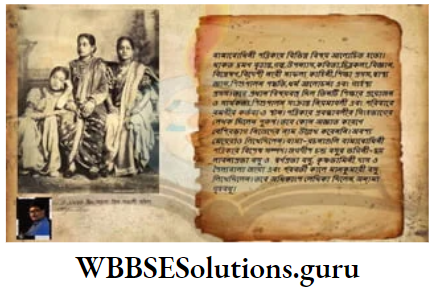
WBBSE Solutions For Class 10 History And Environment Chapter 2 Culture Characteristics And Discussions Bamabodhini Sabha

Bamabodhini (1863) Impacts: Usually the progressive luminaries contributed in form of writings to the Bamabodhini magazine.

  1. The topics usually dwelt on the existing issues of the then society and covered discussions on religions, laws, science, history, traditional medicines, child care, women’s education, etc.
  2. One of the primary goals of the magazine was to educate the housewife and bring to force their importance in the progress of the society.
  3. Bamabodhini without any qualms protested regularly against oppression of women in the society.
  4. The magazine stressed the only way to ensure progress of the society, was to ensure progress of the woman in the family and it was tried to understand that by educating a woman in the family, meant educating the whole family.
  5. Like Bamabodhini, Pyarichand Mitra (author of ‘Alaler Ghorer Dulal’) and Radhanath Sikdar also published the magazine ‘Monthly Paper’ in 1858, but this could run for only four years. Along with Umesh Chandra Dutta, two other members from the ‘Bamabodhini Society’, Ashutosh Ghosh and Santosh Kumar Dutta were part of the editorial board of the magazine.  The main office of the magazine was located at 16, Raghunath Street, Simulia, Calcutta.
  6. The magazine catered to finding solutions to women’s problems. The main focus was the removal of ignorance and superstitious dogmas prevalent in society those days.
  7. This was evident from the first issue of the magazine itself where in the very beginning it was written, ‘Bamabodhini will cover the topics of language, geography, history, life’s character, science, health, law and justice, country, poem, home remedies, child care, skills, and home development. The essays published in the ‘Bamabodhini’ were codified by Pyarichand Mitra and Shibchandra Deb, in the book ‘Women Education’ (“Nari Shiksha”).
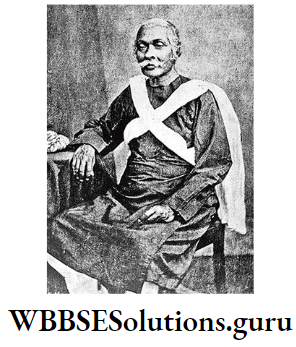
WBBSE Solutions For Class 10 History And Environment Chapter 2 Culture Characteristics And Discussions Pyarichand Mitra

Bamabodhini (1863) Evaluation:

  • In the second issue, the following lines were published-‘God is the father of all the people and his mercy is applicable equally to man and woman. He has bestowed the mind of men and women equally with the power to acquire knowledge, then why should you women who have eyes remain blind?
  • In another one of its later issues, it had stressed the need for caring of the girl child and ensuring the need for her proper education. It had stated that if the light of education is not allowed to enter the mind of the woman, then mankind will not be benefited.
  • The magazine went on to identify the main hindrances to woman’s education-paucity of time, lack of interest, and disinterest shown by teachers.

WBBSE Class 10 History Notes

  • Hence the Bamabodhini took it upon itself to remove fear, ignorance, and superstitious dogmas from the mind of the women and replace these with the glowing light of knowledge, truth, power to analyse and most important identify the weaknesses and eradicate them completely.
  • The efforts by this magazine had to a great extent been instrumental in converting the nineteenth-century Bengali woman in bondage into a modern free woman.

Nineteenth-Century Bengal Magazines Newspapers And Literature As Reflections Of Culture Hindu Patriot 1853

Hindu Patriot (1853) Origin:

  • The Hindu Patriot was a weekly newspaper. It was a mouthpiece of the ‘British Indian Association’ (1851). It was started publishing on 6th January 1853. The first proprietor of this news paper was Madhusudhan Ray and the first managing editor of the paper (1849). was Girish Chandra Ghosh.
  • In 1855 the proprietorship of the periodical changed hands and Haran chandra Mukherjee the elder brother of Harish Chandra Mukherjee (1824-1861) became its new owner and first editor. Basically, the latter was got associated with the editorial work of the newspaper along with his elder brother

Hindu Patriot (1853) Importance:

  1. As the first editor Harish Chandra played an important role during the Indigo Revolt (1860) and also the Sepoy Mutiny (1857). The Indigo Revolt was in reaction to the Indigo Tax imposed on the poor farmers along with the oppression by their British landlords. This was extensively covered by Harish Chandra in the Hindu Patriot. The newspaper was able to fire up the imagination of the people against the British oppressive rule on the poor farmers.
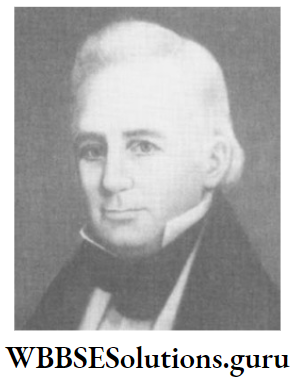
  2. Hindu Patriot also threw a lot of light on women’s education and widow remarriage. This newspaper encourages people to follow the path of John Elliot Drinkwater Bethune who had started the Bethune School for Girls in 1841
  3. Many advantages of widow remarriage were highlighted in this newspaper. Hindu Patriot also opposed the Hindu Divorce Law, oppression on the Santhal revolt (1855), and oppression of the European Indigo planters on the poor Indigo cultivators.
  4. This newspaper was highly critical of the British misrule in India. Everyone wanted the publication to be liberal. Harishchandra always advised the public through this paper to rise in revolt or movement whenever the British administration or Parliament failed to meet the aspirations of the people:
  5. However, he didn’t consider the British rule in India as an imperial rule. In fact he advised the people to learn from the British and their rule and become more enlightened in the process. This has been described in detail in the 11th October 1855 issue of the Hindu Patriot
  6. During the Sepoy Mutiny of 1857, the Act 15 of banning Hindu Intelligence was however not criticized in the newspaper. Ramgopal Sanyal commented that the newspaper had been even sympathetic to the British during these turbulent days. For this reason, Lord Canning and the contemporary British parliamentarian Lord Grenwill had been very impressed with the editorial of the newspaper.

Hindu Patriot (1853) Evaluation: The Hindu Patriot though popular was an expensive newspaper. This is the reason its circulation gradually went down. Coupled with this the sudden demise of

  • Harishchandra Mukherjee almost sounded the death knell for the newspaper. Whatever efforts made by the subsequent editors Krishna Pada Pal from 1861 to 1884 and Sambhu Chandra Mukherjee all were in vain and the newspaper was soon closed down. In March 1892 the Hindu Patriot became a daily newspaper.
  • Nineteenth Century Bengal Hutum Pyanchar Naksha 1862

Class 10 History Important Questions WBBSE

Nineteenth-Century Bengal Magazines Newspapers And Literature As Reflections Of Culture Hutum Pyanchar Naksha 1862

Background: Pandit Kaliprasanna Singha (23rd February 1841 to 24th July 1870) was famous for two brilliant works,

  • Translation of the mammoth epic ‘Mahabharat’ to Bengali with the help of 10 scholars and.
  • ‘Hutum Pyanchar Naksha’ in 1862, The translation took him several years (1858 to 1866), but his other works were plays ‘Babu’ (1858), ‘Bikramabarshi’ (1857), ‘Sabitri Satyavan’ (1858) and ‘Malati Madhab’ (1859). His disguised name was ‘Hutum Pyancha’ taken in 1861.
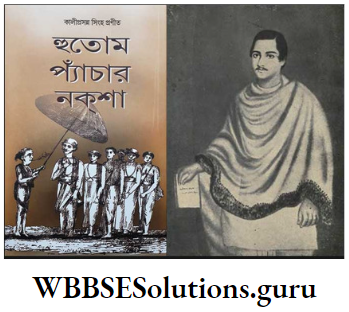
WBBSE Solutions For Class 10 History And Environment Chapter 2 Culture Characteristics And Discussions Kaliprasanna Singha

Hutum Pyanchar Naksha 1862 Importance:

  1. We are able to understand a lot about the society existing in nineteenth-century Bengal, through the Hutum Pyanchar Naksha. Though he was born in the rich Jora.. Shankha, Zamindar family, we can get the picture of the ordinary man on the streets, from this novel.
  2. Having an incredible memory, Kaliprasanna Singha’s multi-faceted talents were visible from his early childhood. Hutum Pyanchar Naksha is a remarkable timeless novel in which Calcutta’s Babu culture has been described eloquently. The Babu culture was evident mostly in Calcutta’s rich landlords, traders, rich alcoholics, and the unscrupulous rich. Bankim Chandra has described this class of people as one of the world’s ten avatars.
  3. In the book ‘Hutum Pyanchar Naksha’ Kaliprasanna ‘criticized
    • Attitude of english educated middle class,
    • Rich and prosperous babus and their social and moral degradation,
    • Contemporary city-dwellers of Kolkata were divided by him into three types like
      • Blind followers english culture,
      • English educated new rational class,
      • Orthodox hindu society without knowing English were dishonest and cheaters,
    • Picture of ordinary Calcutta, where Kaliprasanna discussed charak, barware festivals, boy-kidnapper, flying Nilkantha Pakshi, Durgapuja, Rathyatra, and Ramlila festivals, etc.
  4. Kaliprasanna has described this in disciplined class in detail. In recent times writer Sunil Gangopadhyay has re-written this novel in a new format, ‘Sei Samay. Like the earlier writing this novel also tries to capture the society of the present day youth.
  5. On one hand Kaliprasanna was a writer, editor, and publisher on the other hand he was an accomplished social worker. On the publishing of his novel Hutum Pyanchar Naksha, in 1862, he started getting accolades from all corners. In this novel, he has criticized the middle class of the existing times.
  6. The novel throws light on the existing interpersonal behavior, religious occasions and festivities, and the various social groupings and societies of that time. This was the first Bengali book which was written in the colloquial language in a total of 140 pages. As it was very critical of certain classes of society, many feathers were ruffled by this novel. In retaliation two or three other novels were also published which tried to present a contradictory picture to the public.

Hutum Pyanchar Naksha 1862 Evaluation:

  1. Hutum Pyanchar Naksha was a very popular novel in Bengal in the nineteenth century. Till date innumerable editions of this book have been published.
  2. Bankim Chandra Chattopadhyay had compared this book of Charles Dickens’s ‘Sketches By Boz’. According to him this book in a very strong language has described all stratas of the society existing in the latter half of nineteenth century Bengal.
  3. This book like many others at that time has described vividly the dance of the nautch girls in the farm houses of the zamindars of Bengal.
  4. Even forty years before the publishing of this book Bhavani Charan Bandhopadhya in his book ‘Kolikata Kamalaloy (1823) had mentioned about similar trends in the society.
  5. Besides, this ‘Nabababubilas’ (1825) and ‘Babubilas’ (1831), Pyarichand Mitra’s ‘Aalaler Gharer Dulal’, Michael Madhusudhan Dutta’s ‘Ekei ki Bole Sabhyata’ and Dinabandhu Mitra’s ‘Sadhabar Ekadoshi’ all had described the nineteenth century Bengal society which find reflection in the book ‘Hutum Pyanchar Naksha’. Kaliprasanna also gave financial help to ‘Tatwabodhini’, ‘Somprakash’, ‘Bengalee’, ‘Hindu Patriot’ and ‘Mukherjee’s magazine’.

Class 10 History Important Questions WBBSE

Nineteenth-Century Bengal Magazines Newspapers And Literature As Reflections Of Culture Nil Darpan 1860

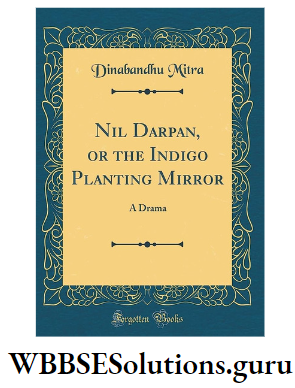
Famous writer and dramatist, Dinabandhu Mitra (1829-1873) composed the drama Nil Darpan in 1860. The real name of Dinabandhu Mitra was Gandharbanarayan with the pseudonym, ‘Kenchit Pathikenavipranitam’ (coffee) Dinabandhu wrote the. drama ‘Nil Darpan’, who was a staff of Postal department under British Government.
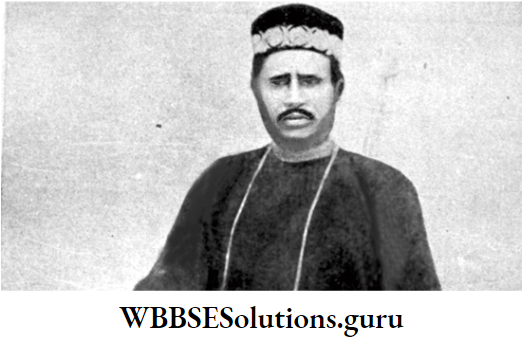
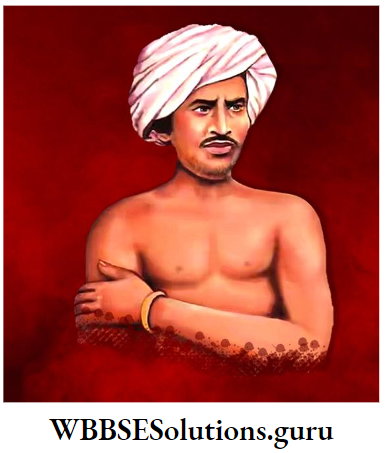
WBBSE Solutions For Class 10 History And Environment Chapter 2 Culture Characteristics And Discussions Dinabandhu Mitra

Importance aspects of Nil Darpan were

  1. This drama was based on the Indigo Revolt of 1859-60.
  2. The drama highlighted the oppression of the poor indigo farmers by the British landlords and money lenders.
  3. The analysis of the movement in the work is noteworthy. On 7th December, 1872 the drama was played for the first time in theaters.
  4. In this drama, the playwright had very aptly. projected the picture of the English gentleman Roghses. While viewing this play at Calcutta’s Great National Theatre, Vidyasagar got so worked up with the character of Roxes, played by Ardhendu Sekhar Mustafi that he threw a shoe at the actor.
  5. The christian clergy James. Long who was a great admirer of Dinabandhu Mitra wanted Michael Madhusudan Dutta to translate the drama into English. The British Government did not like this effort by the priest and ordered him to be put behind bars for three months. On request. of christian clergy Reverend James Long the drama ‘Nil Darpan’ was translated by Michael Madhusudan Dutta in English. For this reason Long Saheb was sent to jail and had to pay Rs. 20,000 as fine.
  6. It made reaction among the people of India. Nil Darpan was the first Bengali play to be translated into English. Bankim Chandra had compared the Nil Darpan, to Harriet Beecher Stowe’s Uncle Tom’s Cabin.
WBBSE Solutions For Class 10 History And Environment Chapter 2 Culture Characteristics And Discussions Nil Darpan

Nineteenth-Century Bengal Magazines Newspapers And Literature As Reflections Of Culture Grambarta Prakashika 1863

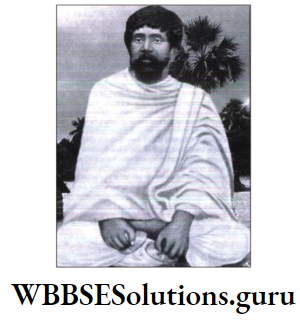
Grambarta Prakashika 1863 Origin: Grambarta was an important and exceptional periodical of nineteenth-century Bengal published first in April 1863. Its editor was a rural journalist ‘Kangal Harinath Mazumdar’ (1833-1896). He was a headmaster of Kumarkhali Bangla Pathsala of Bangladesh.

Grambarta Prakashika 1863 Importance:

  1. Only 19 episodes of his periodical ‘Grambarta’ was published by Jessor. As this periodical highlighted the life and condition of the villagers, and villages of Santipur, Meherpur Chakdaha, etc. its name had been “Grambarta. Prakashika”
  2. Its objective was to inform the whereabouts of the villagers to British Government for immediate action. So the name ‘Grambarta’, was meaningful no doubt.
  3. In 1864 (June- July months) this became a fortnightly magazine and in 1871 (April-May months) it got converted to a weekly magazine. First, this was printed in the Girish Bidyaratna Press and later on the magazine was published from Maturanath Press of Kumrakhali village in Pabna district (Present day Nadia).
  4. Kangal Harinath was helped many ways by Mathuranath Maitra. The magazine usually focused on culture, philosophy, and science. Rabindranath Kangal Harinath Tagore, Mir Musharaf Hossien, and Jalandhar Sen had contributed many essays to this magazine. Kangal Harinath continued to be the editor of this magazine alone for eighteen years.
  5. In this magazine, he had tried to bring forth the progress of Bengal’s education and also its misuse. He also tried to highlight the mistakes committed by the society and the politicians of those times like the oppression by the British, landlords, and money lenders on the indigo farmers have been sharply criticized by the magazine.
WBBSE Solutions For Class 10 History And Environment Chapter 2 Culture Characteristics And Discussions Kangal Harinath

Grambarta Prakashika 1863 Evaluation:

  1. Kangal Harinath did not have formal education, but yet he thought that education is life. Though he was a hindu, he was highly inspired with the ideals of Brahmo leader Bijoy Krishna Goswami and Lalan Fakir.
  2. He composed the Baul Songs for village men by his new name “Kaħgal Fikirchand”. Besides the ‘Sambad Prabhakar’ of Iswar Chandra Gupta had a deep impact in his life.
  3. Harinath’s ‘Grambarta Prakashika’ had highlighted the sorrows and sufferings of the village people. He strictly criticised the oppressive Zamindars, money-lenders, indigo-planters, Zamindars of the Tagore family of Jorasanko.
  4. ‘Grambarta’ was the only literary magazine that supported the rival peasants in the Pubna Revolt (1870).

WBBSE History And Environment Notes PDF 

Nineteenth-Century Bengal Education Culture Characteristics

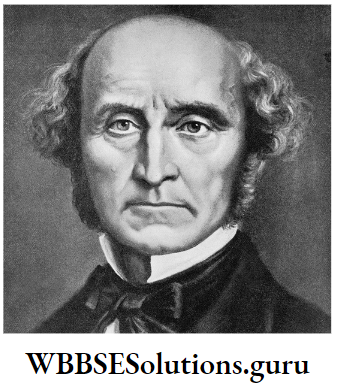
  • Philosopher Jeremi Bentham (1748-1823), his pupil James Mill (1773-1836), and the latter’s son John Stuart Mill advocated the theory ‘greatest happiness for the greatest number’. This theory was called Hedonism. This western thinking and education, induced a new enthusiasm, energy and enlightened the Indian society and civilization.
  • East India Company as such didn’t encourage the introduction of Western education in India. On the contrary, the company was apprehensive of this and there was a thinking that enlightening Indians with this education will be detrimental for the Company. Warren Hastings on the other hand was a great protagonist of the native education system. He started many endeavors for the encouragement of the learning of Indian languages.
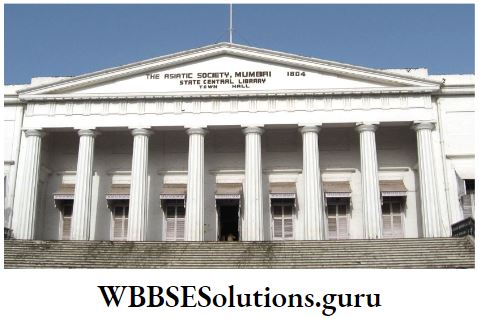
  • In 1781 on the request of the Muslims, Hastings built the Calcutta Madrasa. In 1784 the Judge of Calcutta High Court, Sir William Jones established the Asiatic Society.
  • In 1787, Charles Wilkins created the Bengali alphabet blocks to print Halhed’s Bengali Grammer book. In 1792, Jonathan Duncan established the Sanskrit College in Benaras.
  • To ensure an able administration in India, Company thought that its staff must be educated in Indian languages, traditions, etc, and with this specific purpose, Lord Wellesley established the Fort William College in 1800.
WBBSE Solutions For Class 10 History And Environment Chapter 2 Culture Characteristics And Discussions John Stuart Mill

Nineteenth-Century Bengal Education Culture Characteristics Conflicts Between Oriental And Western Education

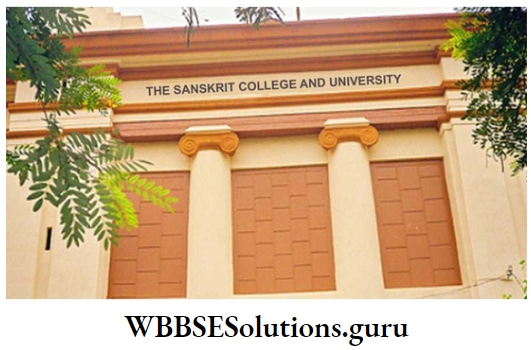
  • Famous Orientalist H. H. Wilson in 1821 laid the foundation of the Sanskrit college in Calcutta. The College started functioning on 1st January 1824. The main function of the college was researching Hindu Literature and the influence of Western knowledge.
  • For the growth of education, Lord Amherst instituted the General Committee of Public Instruction (GCPI) in 1823 A.D. This Committee, majority orientalist members like James Princep, W. W. Wilson, H. T. Colbrooke, and Halt Mackenzie had suggested the merger of ancient Indian and modern European science.
  • They tried to spend government money for the growth and development of Indian Science and classical literature and its teaching through Sanskrit, Arabic, and Persian languages. Therefore they patronised the Sanskrit College, and traditional oriental institutes like Tole, Madrasah, etc. But they had also noted that it was essential to know English to study Western science and culture.
  • This was the beginning of the competition between Oriental and Western education. The first evidence of this competition was visible when the Charter Act of 1813 was passed. The reason was that this law ensured the spending of rupees one lakh (Rs. 1,00,000) education-but on which education-Indian or Western.
  • A tug of war ensured between the protagonists of Western and Indian education. This was called the Evangelical Movement. But the progressive-minded middle class wanted the induction of western education in India and that too without any governmental assistance. For this reason, Anglicist Raja Ram Mohan Roy wrote a letter to Lord Amherst in 1823 which reflected his strong views on the uselessness of Sanskrit education.
  • In an essay published in 7th September 1833 in Sudhakar magazine, it was noted that other than the Brahmins no one else will be benefited by Sanskrit education.
  • Favoring western education were the ‘Elphinston Minute’ (16th December 1823), Bombay Governor John Malcolm’s request (1828), the order by the Court of Directory (29th September 1830), and on 2nd February 1835 the ‘Macaulay Minute’.
  • Anglicist Macaulay’s efforts on 7th March 1835 in spreading Western education in India met with very strong criticism from orientalist H. T. Princep, H. H. Wilson, and Brian Hudson.
  • Through this conflict the western education system was followed and as a result the Calcutta Medical College (1835) and the Bombay Elphinston College were established in 1835 along with 14 new institutions.
  • Finally, the ‘Auckland Minute’ of 24th November 1831 put the arguments to rest, when it declared that without disturbing the foundations of Western education, the government will spend an extra rupees thirty-one thousand on native education.
  • Also, the medium of education will be Bengali and English and the students were given the freedom to pursue their studies in any one of the mediums of their desire.

WBBSE Solutions For Class 10 History And Environment Chapter 2 Culture Characteristics And Discussions Calcutta Medical College

Nineteenth-Century Bengal Education Culture Characteristics Spread Of English Education

Spread Of English Education Reasons:

  • In 1803 William Ward commented that almost every village in Bengal had a school. Later on in Adam’s Report it has been stated that there were more than a hundred thousand schools in Bengal.
  • But the conditions of these schools were not at all up to the mark. Historian Dr. Amitabha Mukherjee has also noted in his work Reform and Regeneration in Bengal, that this existing system.of education was ordinary and they had no access to modern education.
WBBSE Solutions For Class 10 History And Environment Chapter 2 Culture Characteristics And Discussions Asiatic Society

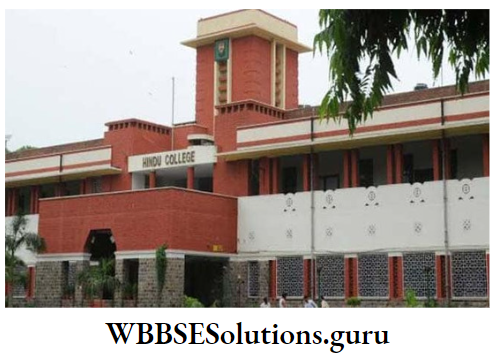
WBBSE Solutions For Class 10 History And Environment Chapter 2 Culture Characteristics And Discussions Hindu College

WBBSE Solutions For Class 10 History And Environment Chapter 2 Culture Characteristics And Discussions James Long

WBBSE Solutions For Class 10 History And Environment Chapter 2 Culture Characteristics And Discussions Madhusudan Dutta

WBBSE Solutions For Class 10 History And Environment Chapter 2 Culture Characteristics And Discussions Sanskrit College

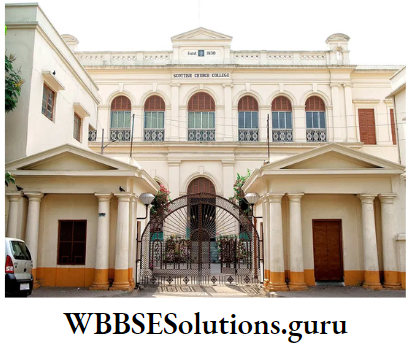
WBBSE Solutions For Class 10 History And Environment Chapter 2 Culture Characteristics And Discussions Scottish Church College

Spread of English Education Private Efforts: Bengalis were the first to show interest in English education. Dwarkanath Thakur was influenced by the English school opened by a Eurasian named Sherbon in Jorashanko.

  • In Calcutta, another Eurasian was employed as an English tutor in the house of Motilal Shil. Later on with the efforts of Radhakanta Deb, the Hindu College was established in 1817 and later on in 1855 this was renamed as the Presidency College.
  • The prominent students of Hindu College were Bhudeb Mukhopadhya, Madhusudan Dutta, Parichand Mitra, and Rajnarayan Basu. Besides this David Hare opened an English school which today exists by the name of Hare School.
  • In 1800 in Bhawanipore, Calcutta, and in 1824 in Chinsurah two English schools were opened. A new wave of development of schools and school books started taking place after the Calcutta School Book Society (1817) and the Calcutta School Society (1818) were established.
  • The young lecturer in Hindu College Louis Henry Vivian Derozio and some of his students had established six primary schools in Calcutta in 1831. Ram Mohan himself had opened a school in Surikhana in Calcutta. In 1828, Gourmohan Adda had also opened a school by the name of Oriental Seminari.
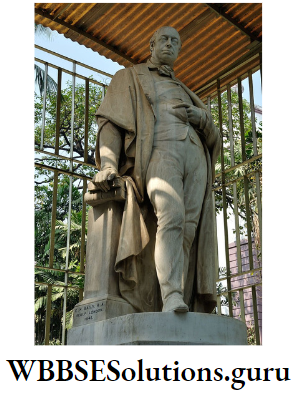
WBBSE Solutions For Class 10 History And Environment Chapter 2 Culture Characteristics And Discussions Dayid Hare

WBBSE History And Environment Notes PDF 

Spread of English Education The efforts by Missionaries: The missionary groups which had made a lot of efforts in trying to open education institutions in India were the Clapham Group, Church Missionary Society, Calcutta Diocesan Committee, London Missionary Society, Church of Scotland, etc.

  • In 1793, Baptist Missionary William Kerry and his wife Anna Kerry to spread the Christian religion opened a mission in Sreerampore.
  • On Kerry’s instructions, the editor of Samachar Darpan and Dikdarshan, Marshman, and his associated William Ward had established the Sreerampore Baptist Mission. This Mission was able to publish the Bible in 27 Indian languages other than Bengali.
  • They also took the responsibility to publish Bengali and Tamil Grammar books from their publishing house. The Sreerampore Mission went on to establish 126 schools imparting western education which catered to almost 10,000 Indian students.
  • Charles Grant had commented in the book ‘Observations on the state of Society among the Asiatic Subjects of Great Britain’, that to save the people from the negative traits of the Hindu religion it is important to convert them to Christianity.
  • The Mission had stared the Monterial System in which the students of higher classes were required to teach the students of the primary section. This system was started by Andrew Bell and is also known as the Bell System.
  • Robert May of the London Missionary Society had established nearly 36 schools. The Church Missionary Society in 1799 had set up a few schools in Bengal and South India.
  • The other establishments set up by the Missionaries were Bishos College, Shibpur (1820), Christian College, Madras (1837), Wilson College, Bombay, and ‘Belgium’s Jesuit Missionaries had set up the Lorreto House College and St. Xavier’s College.
  • In 1830 Alexander Duff established the General Assemblies Institution. Later on this came to be known as the Scottish Church College. In fact, the period from 1830 to 1857, is known as the “Duff’s era”.
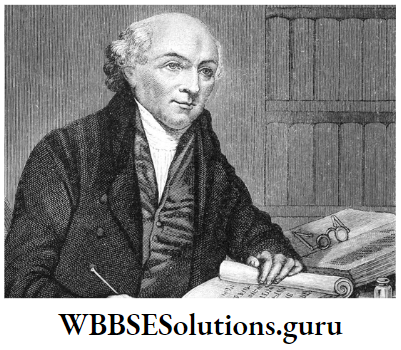
WBBSE Solutions For Class 10 History And Environment Chapter 2 Culture Characteristics And Discussions William Kerry

Spread of English Education Government Efforts: The first request to the East India Company to promote western education was made by two educationists Charles Grant and William Wilbur Force. The Company after passing of the Charter Act in 1813 had agreed to spend one lakh rupees for the promotion of education in India. The Charter of laissez faire’ in 1833 gave a new. direction to the promotion of education systems in India.

  • The Education Secretary, Thomas Babington Edward Macaulay, was the Chairman of the General Committee of Public Instructions. He took up the work of spreading western education in India. But he had to face the resistance in his work by orientalists Princep and Wilsons.
  • After many obstacles he presented his Minutes to the. Governor General. He stated in his Minutes that Oriental education is unscientific and narrow-minded. A single shelf of a good European Library was worth the whole native literature of India and Arabia.
  • Lord William Bentinck was of the opinion that western education should be allowed to filter down into the masses. On receiving the Macaulay Minutes, lord Bentinck decided that western education should be imparted in English.
  • Bentinck established the Calcutta Medical College, Madras University High School, Thomson Engineering College, and Bombay Elphinstone Institution in 1835. He felt that except the blood and the colour of the skin of the Indians everything else amongst them should be Indian.
  • The great objective of the British Government ought to be the promotion of European literature and science among the native of India. In his times 14 schools were opened by the Government. This went up to 48 in a short span of two years.
  • In Chandannagar one English school was opened. To promote western education in 1842 the Council of Education was formed. In 1844 Lord Hardinge in his ‘Educational Dispatch’ mentioned the need of English language skills for government employees and this language was also recognised as official language in the same year. Following this every Indian wanted to learn English for a bright future.
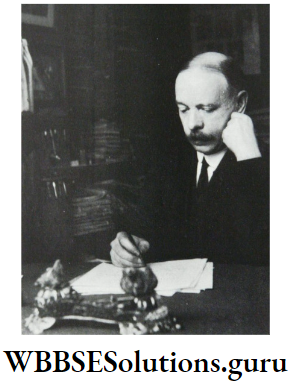
WBBSE Solutions For Class 10 History And Environment Chapter 2 Culture Characteristics And Discussions Charles Wood

The Chairman for the Board of Controller, Charles Wood in his Wood’s Dispatch in 1854 had mentioned that

  1. There, was a synchronize the higher education in India to its primary education facilities.
  2. The need for promotion of English education in India through ‘Wood’s Despatch’ was very important for which it is known as “Magna Carta”.
  3. The immediate need was felt to establish three Universities in Calcutta, Bombay, and Madras Presidencies. Sir James William Colvile was the first vice chancellor of the Calcutta University.
  4. The other needs were the establishment of a separate education department (D.P.I.).
  5. Training facilities for training of teachers.
  6. It was also felt that a regular maintenance of the government schools was required and also a need for institution of grant-in-aid facilities for the non-governmental schools.
  7. It was also said that there was a need for middle schools and vastly increase the number of government primary schools.
  • Under Lord Rippon, the first education commission was chaired by Sir William Hunter in 1882. This was known as the “Hunter Commission”. The commission espoused that more primary schools need to be established.
  • The number of secondary schools also needs to be increased. Even the number of Universities was set to increase under the directives of the commission. Also scholarships needed to be instituted for the deserving students.

Conclusion: According to Dr. Judith, Brown, other than the Brahmins and other people of the higher strata of the society no one else benefited from the spurt in western education. In 1821 the illiterates consisted of nearly 14% of the population. Amongst the women illiteracy was nearly 18%.

WBBSE History And Environment Notes PDF 

Nineteenth-Century Bengal Education Culture Characteristics Women’s Education And Iswarchandra Vidyasagar 1820 To1891

  • In this era not only there was a spread in English education, but also there was a spurt in education of women. The main protagonists for the women’s education were Ram Mohan Roy, Radha Kanta Deb, David Hare, and Vidyasagar.
  • In 1819 the Female Juvenile Society was established. This society published. Gourmohan Bidyalankar’s “Sri-Sikhya Bishayak” which expounded the need for women’s education.
  • In 1828 the chief of this society Miss Cook established the ‘Calcutta Female School’. With the help of Vidyasagar and Dakshina Ranjan Mukherjee, ‘Bethun Saheb’ changed its name as Bethun School. In 1825 the Ladies Association was established.
  • In 1845 the British Indian Society and Uttarpara’s zamindar Joy Krishna Mukherjee had set up a ‘Balika Bidyalaya’ and in 1847 Pyarichand Mitra had established a ‘Balika Bidyalaya’ in Barasat where role of Vidyasagar is remembered with honour.
  • With the help of John Elliot Drinkwater Bethune, Vidyasagar established the Bethune School on 7th May 1849 and College in 1879 for Women In the Wood’s Despatch (1854) women education was included which encouraged Vidyasagar.
  • After being appointed as assistant inspector of Bengali medium schools in South Bengal in 1855, Vidyasagar individually founded some girl schools and arranged for govt. aids for its in May 1857.
  • The govt. approved two girls schools in Hooghly and Burdwan which inspired him to establish 40 girl schools in which total number of girls increased to 1348 in between November. 1857 to June 1848. Vidyasagar spent 3,400.
  • Unfortunately in the later period govt. aids were given but schools were not affiliated. On the memory of his mother Bhagabati. Dévi Vidyasagar founded ‘Bhagabati Vidyalaya’ (1890) in his native village Birsingha, Midnapur.
  • With the help of Miss Mari Karpenter, Annet Acroaid and Keshab Ch. Shene founded ‘Normal School’ for girls in 1872. In the spread of female education his friend Madan Mohan Tarkalankar (1817-1858) supported Vidyasagar and admitted two of his daughters Bhubanmala and Kundanmala to the Bethun School. Due to his inspiration, Kalikrishna Mitra founded the first girl school at Barasat, North 24 Parganas.
  • After being the secretary of Bethun School in 1850 Vidyasagar became more advance in founding female schools. Vidyasagar founded “Stri-Siksha Bidhayani Sammilani” in many districts for spread of female education.
  • He himself carried the cost of 3400 for 1300 girl students of 35 girl school, as govt disliked to pay any aid for them. Vidyasagar wrote “TTER ” i.e. ‘like son daughters are to be cared for and given education’ by the side of the carriage of the girls of the Bethun School.
  • Vidyasagar opened nearly 35 schools, exclusively for the education of the girl child. Some of literary works included Barnoparichay (1855), Bodhodoy, Kathamala, Sitar Bonobas and Bhranti Bilas. Vidyasagar was in favour of the western education in India.
  • He considered the British colonial occupation of India as blessing for the Indians. For this reason he never joined the numerous freedom movements against the British rule.
  • It needs to be noted here that in 1870, when the Lt. Governor of Bengal, George Campbell scared with the youth of Bengal’s enthusiasm to undergo western education; to bring down the number of colleges in semi-towns, then a spontaneous movement was started against British.
  • Vidyasagar instead of taking part in the protests quietly set up the Metropolitan Institution with his own money. Today this college goes by the name of Vidyasagar College. Vidyasagar kept his cultural ethos intact, in spite of taking up western education.
  • That is why Professor Amalesh Tripathy had called him a ‘Traditional Modernizer’. Michael Madhusudan Dutta remarked about Vidyasagar, “He has the genious and wisdom of an ancient sage, the energy of an Englishman and the heart of a Bengali mother”.-Vidyasagar and Bengali Society by Binay Ghosh.
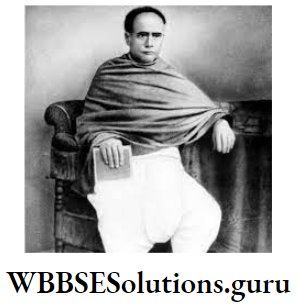
WBBSE Solutions For Class 10 History And Environment Chapter 2 Culture Characteristics And Discussions Iswarchandra Vidyasagar

Nineteenth-Century Bengal Education Culture Characteristics Efforts To Spread Western Education Raja Ram Mohan Roy And Radha Kanta Deb

Both Raja Ram Mohan Roy and Radha Kanta Deb had played an equal role in the spread of western education in India. But their approach to the issue was quite different. While the former was more aggressive in his approach the latter had adopted a slow and steady approach to the problem of spreading western education.

WBBSE Class 10 Chapter 2 Summary

Nineteenth-Century Bengal Education Culture Characteristics Raja Ram Mohan Roy 1772 To1833

  • Raja Ram Mohan Roy was like an angel who delivered Indian society into the modern world. Through the prism of western education he could see that the Bengali religious world was not only very. complex but also very inclusive.
  • To get into the essence of religion he read the Upanishads in Sanskrit, Koran in Arabic, New Testament in Greek, and in Hebrew he read the Talmud and the Old Testament. On reading these he came to the conclusion that all the religious dogmas are meaningless.
  • He had gained literacy in twelve worldwide languages. On being impressed by the preachers of the New Testament he wrote the book The Percepts of Jesus. Kishori Chand Mitra has for this reason named him as Religious Benthamite.
  • Ram Mohan was vehemently opposed to polygamy and child marriage of the girls. Ram Mohan (1772-1833) was very impressed with western education and the development of science in the west. The work plan that Ram Mohan adopted against primitive dogmas prevalent in the society, included the emancipation of women in India.
  • He challenged the mouthpiece of the old school of thought, the Samachar Chandrika through his own Samachar Darpan, Sambad Kumudi, Calcutta Journal, Indian Gazette, and the Friends of India. When in 1829 Bentinck banned the Sati practice through Regulation-17, Ram Mohan had sent him a congratulatory letter. Ram Mohan was highly impressed with western education.
  • He had a special role to play in the establishment of the Hindu College in 1817. He gave special attention to Western science, philosophy, law, economics, and political science. He wrote a letter to Lord Amherst in 1823 demanding the introduction of western education and the study of Mathematics, Physics, Chemistry, and Anatomy.
  • It was not enacted. Rammohan supported Scottish Missionary Alexander Duff of set up ‘General Assemblies Institution’ in 1830 A.D. Rammohan himself founded an English medium school at Sunrikhana, Kolkata. For the spread of english education, Rammohan himself founded ‘Pataldangha Anglo.
  • Hindu School’. He helped David Hare to established ‘Hare School’ in 1818 A.D. Its early name was ‘Pataldangha Institution’. He had started a movement against the Press Act of 1826 and the Jury Act in 1827.
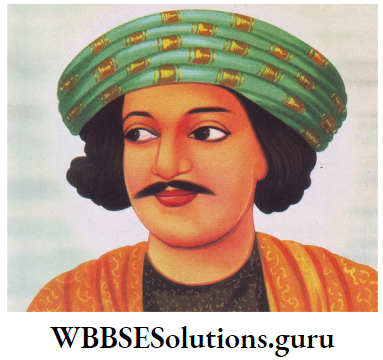
WBBSE Solutions For Class 10 History And Environment Chapter 2 Culture Characteristics And Discussions Raja Ram Mohan Roy

Raja-Ram Mohan Roy (1772-1833) Evaluation: Ram Mohan died in Bristol, London in 1833. He was laid to engrave or Samadhi in London itself. But Ram Mohan had his limitations and for this he had been criticized extensively.

  • Firstly, though he stood up against some of the primordial customs existing in the society, he never made in comments against the caste system existing in the country. Also though he had raised his voice against the barbaric custom of sati, he did it only after his sister in law was sacrificed in this act. In his Brahma Samaj, he didn’t allow anyone other than a Brahmin to become an Acharya.
  • Secondly, though he was a votary of the western education he was not able to clearly move away from his oriental-leanings.
  • Thirdly, though he was against the Doctrine of Lapse and the Permanent Settlement Bill, he never fully protested against the zamindari system.
  • According to historian Salauddin Ahmed, Ram Mohan was instead of an aggressive agent of change was more of a careful reformer. Dr. Ramesh Chandra Mazumdar remarked and compared him with famous muslim reformer Sir Syed Ahmed Khan. Rabindranath Tagore called Rammohan ‘the pioneer of modern India’ and ‘the father of modern India’.

Nineteenth-Century Bengal Education Culture Characteristics Radhakanta Deb

  • Radhakanta belonged to the aristocratic family of Shobhabażar. The aristocracy was established by his grandfather Munshi Nabakrishna.
  • Radhakanta had his primary education in Calcutta Academy. He had learnt both Sanskrit and French languages.
  • After his father Gour Mohan’s demise he got associated to the managing council of the Hindu College in 1818. He continued to ‘do this for the next 32 years of his life and in this period contributed extensively towards the shaping of the college’s rules and regulations.
  • He would help -college stúdents to pursue higher University education and also if necessary provide financial help for this purpose.
  • Radhakanta wrote a scientific essay on the agricultural activities of the district of 24 Parganas. In 1832 he had translated a French book Horticultural into English and sent it to the Royal Horticultural Society in London. He received many accolades for this act. He had died in Brindavan, Mathura.
  • Radhakanta was the first person to. stress the need for an engineering and agricultural college with the medium of instruction being Bengali.
  • He was very enthusiastic for the spread of women’s education. Through his magazine Tatwabodhini, and his Hindu Charitable Institution had tried to break the influence of the Christian missionary activities.
  • When he was at loggerheads with the government regarding the running of the Hindu College he resigned from its management council in 1850. But Radhakanta’s interest in the spread of Western education was not diminished due to this incident.
  • In 1853 along with help from Debendranath Tagore, Motilal Shil, and Rajendra Lal Dutta he established the Metropolitan College. This was the first national college fully owned by Indians. However, due to the paucity of funds this college was later converted to a school.
  • Radhakanta Deb (10.3.1783-19.4.1867) Evaluation: His book Shabdakalpadrum which ran into 8 volumes is highly appreciable. This huge work took work. The British government awarded him the title of ‘Raj Bahadur’ for this monumental piece of work. He was a member of the Zamindar Sabha and the Bengal British Society. The general idea prevalent in Britain is that Radhakanta was the first Hindu who had changed with times and was a great votary of women’s education.

WBBSE Solutions For Class 10 History And Environment Chapter 2 Culture Characteristics And Discussions Radhakanta Deb

Nineteenth-Century Bengal Education Culture Characteristics David Hare

David Hare was a Scott and had come to India to set up a business of watches in 1800 in Calcutta. After running this business for eighteen years he handed it over to his partner Grey and started involving himself in the education activity in India.

While in the business he had come across numerous classes of people and realized that the society in India was deeply affected by superstitions and primitive and often barbaric customs. He understood that the only way to free the Indians from these primitive dogmas was to expose them to the western education which was more scientific in nature. On his death David Hare was accused as an antagonist of the Bible and hence his body was refused burial at the Christian graveyard. For this reason he was buried at College Square.

  1. In 1816, through the Dewan Baidyanath Mukhopadhyay, he had sent a proposal to Justice Sir Edward Hyde East, to start a new educational institution. The result was the establishment of the Hindu College on 20th January 1817. In 1855 this was renamed as the Presidency College.
  2. Because of Hare’s initiative the ‘School Book Society’ and the ‘Indian School Society’ came up in the years 1817 and 1818 respectively. The three main objectives were first, to spread the western education, second, to open the distribution channels for English books and third, spread of the Christian religion through the Bibles.
  3. He was the chairman of the School Book Society and took care of the students of Hindu College who excelled in their studies. David Hare’s ‘Pataldanga Institution’ is now known as “Hare School”.
  4. To ensure regular attendance of the students at his schools ‘Arpuli Free Vernacular School’ and ‘Patoldanga English School’ and at his ‘Hindu College’, Hare used to institute many prizes.
  5. On 18th November 1828 he wrote a letter to the students who are able to see the light of modern education, will be responsible to spread modern education in the country. In 1825 he became the Director of the Management Committee of the Hindu College.
  6. In his whole life whatever income he was making was being spent on spread of modern education in Bengal. When the main funding agent for the School Society, ‘Barito and Company’ was found to be bankrupt then he himself started funding the School Society.
  7. But once ‘Macintosh and Co. closed down all his schools were shut down because of paucity of funds. ‘Arpuli Free Vernacular School’ and ‘Patoldanga English School’ were merged into one new entity known as Hare School.
  8. David Hare had contributed to the creation of the Calcutta Medical College on 1st June 1835. Being a member of the College’s management council he would encourage the students to learn how to dissect a dead body. Besides this he would try to give free medicines to the patients. He was against the students getting converted to Christianity in spite of him being a Christian. He was against the Jury Act and the Press Act. Even today he is held in very high esteem in the Bengali Society.

Nineteenth-Century Bengal Education Culture Characteristics John Elliot Drinkwater Bethune

  • Bethune was proficient in English, Bengali, Greek and Latin, German, French, and Italian languages. In 1837 he was appointed as a law advisor in the British Commonwealth Office.
  • In 1848 he was appointed as the Law Minister to Governor General Lord Canning. On coming to India he became the Chairman of the Council of Education. With his initiative and the help of Dakshinarjan Mukherjee, Madanmohan Tarkalankar, and Vidyasagar the Native Female School was established with 21 female students on 7th May 1849.
  • Presently this goes by the name of Bethune School. Later on the Bethune College was also formed for women. It was the first female college in Asia. He had donated his entire wealth for setting up these institutions. Besides this he had established the Female Juvenile Society and Calcutta Public Library. Bethun Saheb arranged the carriage for the girls to go to his school and college.
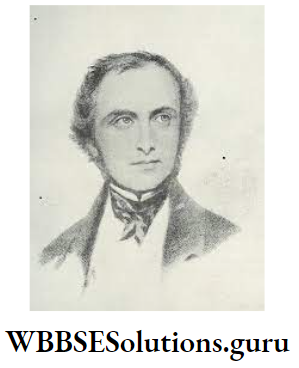
WBBSE Solutions For Class 10 History And Environment Chapter 2 Culture Characteristics And Discussions Bethune

Nineteenth-Century Bengal Education Culture Characteristics The Development of Medical Research and Calcutta Medical College 1835

  • With the initiative of Lord William Bentinck, on 28th January 1835 the Calcutta Medical College was established in Calcutta. In Asia this is supposed to be the second medical college established by the Europeans.
  • The first one was Ecole De Medicine, Pondicherry. On 2nd February, 1835 this Madras. Medical College was established. After studying here for nearly five and half years the students were awarded the degree of Bachelor of Medicine and the Bachelor of Surgery (MBBS). The first principal of the college was M. J. Bramley (1835-1837).
  • He was followed by David Hare (1837-1841), F. J. Mouat (1841-1851), and H. Goodway (1851- 1856). The first batch of 100 students were drawn from young boys in the age group of 14 to 20 years of age after a preliminary test.
  • The first batch started its classes on 20th February 1835 in different venues like Hindu College, Hare School, or at the Scottish Church College. Every student was given a stipend of one rupee.
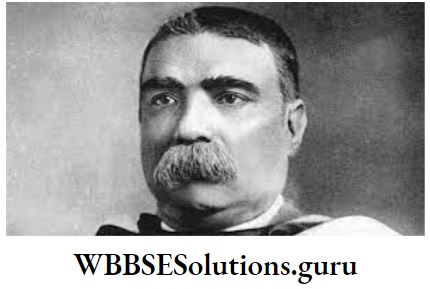
WBBSE Solutions For Class 10 History And Environment Chapter 2 Culture Characteristics And Discussions Sir Ashutosh Mukherjee

  1. After completion of studies in four to six years they were called Native Doctors. These doctors were then sent for general public service at a pay of ₹ 30 per month. Later on this salary was increased to 40 after seven years and to 50 after 14 years.
  2. The first batch of students included, Umacharan Seth, Rajkrishna Dey, Dwarkanath Gupta, and Nabin Chandra Mitra. On 29th June 1883, the first woman Kadambini Ganguly was admitted to the college. Next year Bidhumukhi Bose was admitted to the college. They were given a stipend of 20 every month.
  3. After the foundation of the Medical College its two famous Indian physicians were Madhusudan Gupta (1800-1856) and Dr. Surya Kumar Chakraborty (1824-1874). In his later life Surya Kumar got MD degree from foreign country and also passed the I.M.F. in the first position. Then he join the Medical College as a professor.
  4. Development of higher education and Calcutta University (1857): Sir Charles Wood the chairman of Board of control in his educational despatch named ‘Wood Despatch’ published on 19th July 1854 announced to establish the Calcutta University.
  5. The Calcutta University Act was passed on 24th January 1857 and the University started its functioning with 41 members of the Senet, a chancellor, and a Vice-Chancellor. At that time all the members of the governing were british government officials.
  6. Calcutta University came up under Lord Dalhousie on 24th January 1857. Based on the lines of Oxford University this is the first multi-disciplinary and secular Western-style university in Asia. Presently this University is considered 2nd in rank in India, 143rd in Asia, and 601st in the world. But in 2001 this.
  7. University got the credit of being a Five Star University. Four Nobel Laureates Ronal Ross, Rabindranath Tagore, CV Raman, and Amartya Sen are associated with this University. In the entire country, the maximum number of students study in the Calcutta University. This University has presently 14 campuses in Kolkata.
  8. The first Chancellor of it was Lord Canning. The first Vice Chancellor of the University was Sir James William Colvile (1857 to 1859). The next Vice-Chancellor was Sir William Richie (1857-1862).
  9. The first Bengali Vice-Chancellor was Sir Gurudas Banerji (1890-1892) and the next Bengali Vice-Chancellor was Sir Ashutosh Mukherjee (1906-1918). The first two women graduates who passed from this University 1882 were Kadambini Ganguli and Chandramukhi Basu and the first two male graduate passed in 1858 were was Bankim Chandra Chattopadhyay and Jadunath Bose.
  10. Calcutta University was founded as a role model of London University. In 1925 a famous educationist Henry Sharp proudly remarked, ‘the higher education from the Calcutta University is the passport to paradise in life’.

WBBSE History And Environment Chapter 2 

Nineteenth-Century Bengal Social Reforms Characteristics

  • With Western education, there was a rise in awareness which led to a revolution in the society which led to its reformation and development. The main characteristics of this reformation of society were first, the influence of Western education on society.
  • Secondly, the active participation of the middle class in this, change.
  • Thirdly, the rise of voices and movements against primitive and often barbaric customs and practices.
  • Fourthly, the protests against the practices of the caste system, untouchability, child marriage, polygamy, Sati the drowning of children in Ganga Sagar, etc.
  • Fifthly, the reformation of the male-dominated society.
  • Sixthly, the creation of a new social structure over the decaying society ridden with primitive customs and practices.
  • Seventhly, the reformation of the society through humane values, logic, nationalism, and scientific values.
  • Eighthly, inspiring all the men and women in the society to rise against the customs that mainly existed for oppression and domination of sections of society.
  • Ninthly, inspire the society to accept modern ideas like the widow. remarriage.
  • Finally, the reformation of the society would not have been possible without the active participation of the Government, missionaries, and intellectuals.

Nineteenth-Century Bengal Social Reforms Characteristics Initiative By Brahmo Samaj

  • In the nineteenth century Bengal based on the new thought process, induced by the western education Brahmo Samaj came into being. The Samaj based on the basic tenets of the Vedas. The Atmiya Sabha in 1815 and Brahmo Sabha in 1828 founded by Raja Ram Mohan Roy were converted to the Brahmo Samaj in 1830. After the death of Rammohan in 1833 Debendranath Tagore join the Brahmo Samaj in 1843.
  • This was called the ‘Adi Brahmo Samaj’ and this existed till 1866. This Samaj was vehemently opposed to the customs like child marriage, Sati, polygamy, and the caste system.
  • But Radhakanta Deb a votary of the old school of thought was against the outright banning of the custom of Sati. This led to a tussle between him and the members of Brahmo Samaj.
  • Also, Debendranath Tagore though being at the helm of the affairs of Brahmo Samaj was not able to shed off his old beliefs and become a complete liberal. He was not fully reconciled to the new thoughts of the young leader Akshaya Kumar Dutta.
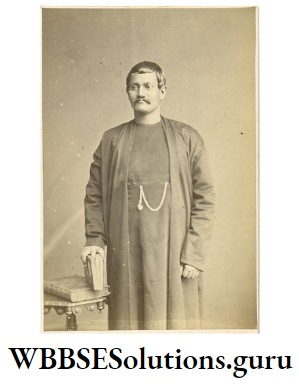
  • Keshab Sen, in his speech Destiny of Human Life had said that the untouchability in Indian society was a disease. ‘Keshab ch. Sen joined the Brahmo Samaj in 1857 and developed prayer as means of spiritual illumination and substance. After studying the writings of Theodor Parker Kerhab founded a society named “Good Will Fraternity”.
  • In 1859 he set up “Brahmo School” where weekly lectures were delivered and was greatly popular with the rising generation. In 1860 he published tracts of new Brahmoism and the first chapter was called “Young Bengal, this is for you!” The “Sangat Sabha” (1860) was founded by Keshab which was really a society of fellow believers to promote mutual spiritual intercourse among its members. It also served the famine striken people of Bengal.
  • On 13th April 1962 Debendranath elevated Keshab to the post of Acharya of Brahmo Samaj. He established the Brahmo Bandhu Sabha with the sole purpose of Keshab Chandra Sen (1838-1884) emphasizing on women’s power and help in spread of women’s education. For this purpose Keshab Chandra Sen was given the title of “Brahmanananda” by Debendra Nath Tagore.

WBBSE Solutions For Class 10 History And Environment Chapter 2 Culture Characteristics And Discussions Brahmo Sabha

On 15th November 1866 AD, Keshab established the Indian Brahmo Samaj, which could have members belonging to all religions of India. The tenets of “Indian Brahmo Samaj” were

  1. The vast universe is the temple of God,
  2. Wisdom is the pure land of pilgrimage,
  3. Truth is the everlasting scripture,
  4. Faith is the root of religion,
  5. Love is the true spiritual culture,
  6. Destruction of selfishness is true as criticism. He encouraged widow remarriage, education for women, and even established evening schools for them. He was strongly against child marriage, polygamy, and the purdah system.

In spite of being against such regressive customs like child marriage, he gave his own eleven years old, but as per rumour fourteen years old daughter Suniti Devi in married to 14 years, but as per rumour eighteen years old prince Nripendra Narayan of Cooch Behar.

  • There was a strong rumour of child marriage in 1877, but Dr. David Kopf said that the marriage was not consummated until 1880 when Nripendra Narayan and Suniti were 18 and 16 respectively. He had broken the ‘Act-III of 1872’, which banned child marriage. In this act, minimum age for marriage was fixed in at least 14 years for females.
  • Unsatisfied with this act of Keshab Sen, the prominent members Shibnath Shastri and Ananda Mohan Basu resigned membership of the ‘Indian Brahmo Samaj’ After coming out they convened a meeting at Town Hall and established the ‘Sadharan or Ordinary Brahmo Samaj’ on 15 May 1878 AD. Isolated in his own Brahamo Samaj, Keshab left it and formed the Nababidhan Brahmo Samaj in 1880 AD.
  • In 1857 AD, on taking over the leadership of Brahmo Samaj, Keshab Chandra Sen* started movements against many social evils apart from child marriage. Under his stewardship, 54 branches of the Brahmo Samaj were set up in various places in, the country.
  • Amongst them, fifty were in Bengal, two in United Province, and- one each in Madras and Punjab. Keshab Sen founded ‘Indian Reforms Association’ in 1870 for the spread of reform movement.
  • He also introduced the ‘Brahmo Marriage Act’ popularly called Act-3 (1872) and Victoria College for female education. Act 3 mainly. based on the popularity of widow marriage and intercaste marriage and the prohibition of child marriage.
WBBSE Solutions For Class 10 History And Environment Chapter 2 Culture Characteristics And Discussions Keshab Chandra Sen

WBBSE History And Environment Chapter 2 

Nineteenth-Century Bengal Social Reforms Characteristics Movement Against Sati 1829

Phases of the anti-sati movement were as

  1. The Christian Missionaries were the first to impress upon the British Government in India the need to ban the barbaric custom of Sati. In 1799, the Baptist Missionary from. Serampore, William Kerry was the first to start the movement against the evil custom. In 1802 he started research on this subject.
  2. In 1803, Carey arranged for a debate in the subject in the Fort William College. According to him this custom was not propagated by the Hindu religion.
  3. The main issue of Sati was the live cremation of the widow on the funeral pyre of her dead husband. Almost for 15 years, William Carey continued his movement against this cruel custom. Due to the stiff opposition by the fundamentalist Hindus the efforts by William Carey were in vain.
  4. Ram Mohan Roy on permanently settling down in Calcutta in 1814, started discussions on this matter with the Missionaries of Serampore. After this in 1817, he formally requested the British government to start an investigation in the subject. He started a movement against the custom through the press. Friend of India-now The Statesman and the Samachar Darpan but the ‘Samachar Chandrika’ Patrika of the fanatic hindu brahmins challanged against it.
  5. Two complaints were lodged against the custom to William Bentinck in May 1829 AD. On that basis on 4th December 1829, the anti-Sati act was passed in form of the Regulation 17.
  6. Though William Carey and the Serampore Missionaries had raised their voices against the custom as also protests were made by government employees Ramram Basu (1804) and Mritunjay Bidyalankar (1817). The main credit for this goes to Ram Mohan Roy because of his sustained campaign against the custom.
  7. No doubt the western educated ‘society of Calcutta which included Dwarkanath Tagore assisted Rammohan in this objective. The fundamentalist Hindus made an application against the Act in the Privy Council of the British Parliament in 11th July 1831 but Ram Mohan Roy went to England and debated in the Parliament against it. The request of the orthodox hindus was then rejected by the British Parliament.

WBBSE Solutions For Class 10 History And Environment Chapter 2 Culture Characteristics And Discussions Sati Movement

Nineteenth-Century Bengal Social Reforms Characteristics Young Bengal

  • The Young Bengal Association was started by Henry Louis Vivian Derozio (1809-31) as a movement against the social evils existing in India. After studying for some days in Bhagalpur, he came to Calcutta to join the Hindu College as a teacher of English language and History in 1826 AD. He was not only a teacher but also a friend of his students who formed, the main section of his followers. These followers came to be known as Derozians.
  • The Derozians were mostly students of Hindu College. Some of his followers included Pyarichand Mitra, Radhanath Shikdar, Lalbehari Dey, Krishnamohan Banerjee, Ramtanu Lahiri, Ramgopal Ghosh, Rashik Krishna Mallick, and Dakshinaranjan Mukhapadhya. They formed the crux of the Young Bengal Association. Derozio died at the young age of 23 years.
  • Several people had raised their voices against the activities of the Young Bengal Association. They mostly belonged to the conservative and fundamentalist sections of society. The reason was that the association was involved in activities against the Hindu customs of casteism, untouchability, and the superiority of the higher classes. But given his zeal in reforming the society he had himself succumbed to the bad habits of consumption of alcohol and beef.
  • In spite of this he continued his campaign through the magazines, Parthenan, Hesaperus, Calcutta Literary Gazette, Calcutta Magazine, Indian Magazine, Bengal Annual, Kaleidoscope, Enquirer, and Gyananeshan. Derozio founded the ‘Academic Association’ in 1828, just to protect against castism, superstition, idol worshipping, etc. He was inspired with the book ‘Age of Reason’ by Thomas Paine which was the bible to the Ceroziaus.
  • Derozio’s patriotic feeling was expressed in the book ‘Fakir of Jhungibeer’ written by him. He was highly inspired with the ideal of the French Revolution-equality, liberty, and fraternity. After his death, the Derozians founded the ‘Sadharan Jnanaryan Sabha’ in 1838. But a large number of Hindus criticised the radical reform movement of the Young Bengal.

Nineteenth-Century Bengal Social Reforms Characteristics Movement Favouring Widow Remarriage 1856

  • In Indian society after the death of husband if his wife is not remarried then she is called a ‘widow’. Widows were neglected in India in the early times. The upper caste hindu widows specially had a suffer severely in the orthodox society as on the words of Prof.
  • Alka Ranjan, they are an “inauspicious dependent society”. Therefore widow marry and wodow remarriage were smoothly considered as a socie-religious taboo in India society. Women’s property right was not reconquered.
  • They were fully commoditized in the patriarchal society. “Dudra case and the (so-called) ‘Un-couthcable’-who represented approximately 80 percent of the Hindu population neither practice child marriage nor prohibited the remarriage of widows”-Lycy Carroll (1983).
  • For the re-establishment through remarriage of widows attempts were made many times in the 18th century. Vidyasagar wrote an article ‘Balya Bibahayer Dosh’ (faults of child marriage) in the “Sarbasuvankari Patrika’ in 1850 to raise the measurable condition of the windows.
  • He also wrote an article in support of widow remarriage to create public openion. in 1853. Vidyasagar wrote a booklet one “Widow Remarriage” (Bidhaba Bibaha Prachalita Hoa Uchit-Athat Bisayak Mantabya”). He also explained the “Parashar Samhita” in favour of widow marriage.
  • It was opposed by Radhakanta Deb of Sovabazar. North Calcutta and Maharaja Krishna Chandra and his advisers of Nadia. The conservative society of Bengal rose in open protest against Vidyasagar.
  • Radhakanta also submitted a letter with the signatures of 36,763 conservative people to British Government to stop Vidyasagar. On the other hand Vidyasagar sent a letter with the signatures of 987 influential persons to Lord Canning requesting him for passing the ‘Widow REmarriage Act’.
  • Attempts were made for hindu widow remarriage by Raja Rajballav, Kalikrishna Mitra, and Nilkamal Bondopadhyay before Vidyasagar, but were in vain Western educated Indians, ‘British India Society’ and ‘Calcutta Press club’ jointly started a campaign advocating widow marriage.
  • Akshay kumar Dutta, Joykrishna Mukherjee, and Ramnarayan Tarkaratna were famous supporters of the widow remarriage. East India Company’s government and christian missionaries of Serampur took steps in mitigating the sorrows and sufferings of the Hindu widows.
  • ‘Jananveshan Patrika of the Young Bengal highly appreciated the positive role of Haldhar Mallik and Motilal Sil in the popularity of Hindu widow remarriage. Another journal ‘Bengal Spectator’ predicted that in near future all prejudices regarding widow marriage would be removed from society. Not only widow marriage, but Vidyasagar also wanted to provide economic support of the poor widows by founding the Hindy Family Annuity Fund (1872).
  • Gradually widow remarriage was started among the lower castes. The wodow remarriage movement spread in Madras and Maharashtra. Pandita RAmabai founded ‘Widow Anociation’ (1870). The ‘Prarthana Samaj’ established ‘Wodow Marriage Association in 1883 and arranged the first wodow marriage in Maharashtra (1883).
  • On the word historian Binoy Ghosh “In the history of 19th centyry social reform movement Vidyasagar’s widow marriage movement was the first all India movement”. The main protagonist of widow remarriage was Pandit Iswar Chandra Vidyasagar (1820- 91). He first declared his intention of starting.. a movement favouring the widow remarriage was when he was just 21 years of age.
  • He also wrote a book outlining the necessity for the widow remarriage. After analyzing the ancient Hindu scriptures he came to the conclusion that
  • There was no religious binding amongst the Hindus to stop a widow from getting remarried and
  • The widow had absolute rights over her dead husband’s property. After consulting experts and collecting the witness signatures of 987 Pandits, he submitted an application to Lord Canning to legalize widow remarriage.
  • Lord Canning was agreed to pass the ‘Widow Remarriage Act’ on 26th July 1856 through ‘And regulation-15’ was passed which legalize the remarrying of widows. With this act, the hereditary laws regarding transfer of properties to the widow as per the Hindu Act was also put into place.
  • To set an example Vidyasagar had his son Narayan Chandra to marry a widow named Bhabasundari and this was the second ever widow remarriage to happen in the province of Bengal, The first campaign favoring the widow remarriage was Nilkanta Bandhopadhya. Some of the people who had supported Vidysagar in this movement included Maharaja of Burdwan and Keshab Chandra Sen.
  • Historians Agarwal and Dandekar have stated that in the days of Vidyasagar, out of the age of 0-4 years married girls nearly 30 to 40 out of every 1000 girls became widows. In the age group of 10 about 40 to 60 were widowed. In the age group of 10 to 14 about 20-40 became widows and in the age group of 50-55 years, the number went up to 550.
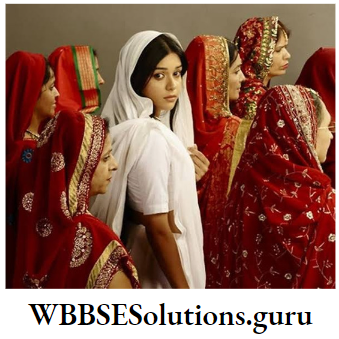
  • The first remarriage of widow took place on 7th December 1856 when Vidyasagar helped another widow eleven years old Kalimoti Mukhopadhya daughter of Brahmananda Mukhopadhyay to marry the professor of Sanskrit College, Srish Chandra Vidyaratna (Bandhopadhya). Vidyasagar donated nearly eighty thousand rupees (Rs. 80,000) to help nearly 62 widows to get remarried and start a new life.
WBBSE Solutions For Class 10 History And Environment Chapter 2 Culture Characteristics And Discussions Widow Remarriage

WBBSE History And Environment Chapter 2 

Nineteenth-Century Bengal Religious Reforms Characteristics And Observations

Side by side with the onset of the social reforms in Bengal the religious reforms also started in the nineteenth century. The main characteristics of the religious culture in this period were religious ceremonies, yagnas, and animal sacrifice, idol worship, etc.

Complex religious practices and the dictates by the orthodox priests were never really tolerated by the masses. People wanted the religious rules to be made more simpler so that they could be followed easily.

Nineteenth-Century Bengal Religious Reforms Characteristics And Observations Brahmo Samaj Evolution Division Characteristics And Conclusion

  • With the advent of western education the society was evolving into a new modern dimension and during this times many groups were formed, the first and the most prominent amongst which was the Brahmo Samaj. Impressed by the Christian religion’s unitarian rules, Raja Rammohan Roy took on rent Kamal Basu’s residence and primarily established the base of Brahmo Samaj on 20th August 1824 AD.
  • The Sabha used to take place every Saturday with the recitation of ‘Bhagwat Brahmo Sangeet’ and the Upanishads, followed by discussions on these subjects. In 1830 the name of the Brahmo Samaj was changed to ‘Calcutta Brahmo Samaj’.
  • This name continued till 1866. But during the course of its evolution the Brahmo Samaj had undergone many changes and even division. This was primarily due to different opinions which were often at loggerheads with each other amongst the members of the Samaj.
  • On 23rd January 1830 the Brahmo Samaj had its permanent location in Chitpore. The orthodox Hindus, meanwhile had created the Dharma Sabha (Chairman-Bhavani Charan Bandyopadhya & Secretary Radhakanta Deb) to oppose the reformation activities of the Brahmo Samaj.
  • The orthodox Hindus had their main mouthpiece in the form of the newspaper ‘Samachar Chandrika’ which was in direct opposition to the periodical ‘Sambad- Koumudi’ published by Ram Mohan Roy.
  • In the Chitpore location of Brahmo Samaj all people from all walks of life and following diverse religions were welcome and were allowed to have prayer meetings. After Rammohan Roy left for England in 1833 and his subsequent death the Brahmo Samaj started getting divided into different organizations.
  • In 1839 AD, inspired by the thoughts and ideals of the Brahamo Samaj, Debendra Nath Tagore the eldest son of Dwarkanath Tagore (who was one of the founder members of Rammohan’s Brahmo Samaj) formed the ‘Tatwabodhini Sabha’ (1839) with its mouthpiece being the periodical ‘Tatwabodhini Patrika’ (1843).
  • The editor of this periodical was Akshay Kumar Dutta. The main idea behind this magazine was the spread of the ideals of the Upanishads and carry out research in religious doctrines. Subsequently with twenty disciples. Debendra Nath Tagore converted to the Brahmo faith in 1843 AD. In 1845, Alexander Duff’s Hindu pupil Umesh Chandra Sarkar forcefully converted his wife to Christianity.
  • This was vehemently opposed by the Brahmo Samaj. Duff. then in his work India and ‘Indian Mirror’ criticized the Hindu religion and culture. After these episodes it was felt that the Upanishad should be made the primary religious book for the Brahmo Samaj.
  • In 1841 Maharshi Debendranath Tagore to rejuvenate the activities of the Brahmo Samaj, instituted the school Tatwabodhini Pathshala to impart education on the tenets of the Brahmo Samaj. The teacher in this school was Akshay Kumar Dutta.

Characteristics and Division: Between 1850 to 1856 is supposed to be the period when Brahmo Samaj itself went through many changes. Some of the changes led to the division of the Samaj later. The primary changes were:

  1. Under the leadership of Akhay Kumar Dutta the Brahmo Samaj started doing social work for the general public and started looking at social problems.
  2. There was in a way a movement within the intellectuals of Brahmo Samaj.
  3. A new strength to the movement was visible with the initiatives of Raj Narain Basu.
  4. To keep the Samaj vibrant various reform works in the society was undertaken.
  5. Under the influence of the intellectuals, women’s education and widow remarriage was encouraged and the evils like polygamy and alcohol consumption were vehemently opposed.
  6. However, with new more radical thoughts and opinions being voiced within the Samaj, Debendranath was not very happy with the evolving situation.
  7. In this period the Brahmo Samaj movement started taking shape of a social movement.
  • After some time one of the Acharyas of the Brahmo Samaj, Keshab Chandra Sen started voicing opposition to the existing casteism, idol worship, etc which didn’t go down well with Debendra Nath Tagore. The latter then expelled Keshab Sen from the Samaj.
  • This led Keshab Sen to form his own Bharatiya Brahmo Samaj in 1866 AD. To strike a balance between the mandir, church, and the masjid he formed the Bharatiya Brahmo Mandir.
  • With his efforts in 1872 AD three laws were passed. These were the laws that were concerned with widow remarriage; inter caste marriage and banning of child marriages.
  • Thus the Brahmo Samaj got divided into two institutions, the Aadi (old) Brahmo Samaj led by Debendra Nath Tagore and the Bharatiya Brahmo Samaj led by Keshab Chandra Sen. But there was a division of thoughts within the Bharatiya Brahmo Samaj regarding child marriage and two of its prominent members
  • Shibnath Shastri and Ananda Mohan Basu resigned from its membership and formed the new Sadharan (ordinary) Brahmo Samaj (1878). Two years later Keshab Chandra Sen came up with a completely new association the Nababidhan Samaj (1880).
WBBSE Solutions For Class 10 History And Environment Chapter 2 Culture Characteristics And Discussions Ramakrishna Paramhansha

Evaluation: The Brahmo Samaj movement for nearly fifty years made a deep influence on Bengali and Indian society, religion, and culture. This could be viewed as firstly, it was instrumental in creating awareness in the Bengali society.

  • Secondly, though there were certain limitations to the movement it was still successful in removing orthodox ideas from the minds of the people.
  • Thirdly, from the time of Keshab Sen the movement had also influenced the formation of the nation-state.
  • Fourthly, the values which was preached by the Brahmo Samaj didn’t give precedence to idol worship, animal sacrifice, and religious ceremonies. Lastly, we have to consider the yeoman service done to the nation by the Samaj in spread of western education.

WBBSE Class 10 History Notes

Nineteenth-Century Bengal Religious Reforms Characteristics And Observations Equality Of All Religions Sarbo Dharma Samanyay As Preached By Ramakrishna

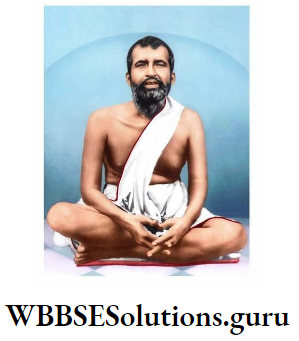
  • Sri Ramakrishna Paramhansha Deb (1836-1886) had a primary role in reforming the Indian culture. His ideal of “Sarba-dharma-samonnya” is simply the concept of religious harmony. His opposition to social and religious orthodoxy and his teachings on the equality of all religions greatly influenced Indian society. The society was enlightened by his simple and liberal thoughts on religious matters.
  • He was able to give the right direction to the people in their search for the eternal truth. Ramakrishna preached god was Omnipotent, and was called by various names like Krishna, Christ, and Allah.
  • The faith and path for attaining God may be different but the objective was the same across all religions. Mahatma Gandhi had written about Ramakrishna Paramhansha and the latter’s life story itself gives us an idea of visualizing God directly. He was an icon for all religions.
  • Swami Vivekananda was his most important disciple. Besides this Keshab Chandra Sen, Girish Ghosh, Vidyasagar, Noti Binodini were amongst other people who gained from his wisdom. Even Max Mueller had played glowing tributes to him.
  • According to Ramakrishna Paramahansa, one can attain God by devotion or attaining knowledge or by simple devotion. to his work. One need not renounce his family or work to attain God.
  • In 1875 Keshab Chandra Sen while meeting Ramakrishna for the first time had changed. his own outlook. After his meeting, Keshab Chandra Sen focused in his work more to attain God.
  • Bijoy Krishna Goswami, Balaram Basu, Girish Chandra Ghosh, and Mahendranath Gupta were the prominent people who were influenced by Ramakrishna Paramahansa.
  • People were able to see the simplicity of religion, the path to truth, new hope and aspirations when they met Ramakrishna. About all religions, he had commented “Jata Math, Tata Path” which literally means the more different the faiths more pathways are established for the attainment of God. He said “Yatra Jeeb Tatra Shib”.
  • Bal Gangadhar Tilak commented if Ramakrishna was a living Veda then Swami Vivekananda was its mouthpiece. In his first biography, the writer Ramchandra Dutta has called him a sage of the middle classes.

Nineteenth-Century Bengal Religious Reforms Characteristics And Observations Swami Vivekananda’s Religious Culture

  • Nababedanta- Characteristics and Conclusion.
  • Swami Vivekananda is one of the most popular sages of modern India. He had used the scientific analysis of Hinduism to oppose the orthodox values of the religion. Vivekananda (1863-1902) devoted his life for the betterment of his country and its people. He changed the entire religious discourse to the ideals of the Nababedanta.
  • He had highlighted the evils of the Man-Making Religion i.e. he used to espouse that all religious dogmas were created by men themselves. That’s why he stressed on liberation of religions and practical Vedanta.
  • Though he was a spiritual person, still he was impressed with the philosophical works of Mill, Bentham, and Hubert Spencer. He believed that the religions which could not wipe the tears off a widow’s eyes was no religion at all.
  • On September 11th, 1893 he addressed the World Religious Conference in the Columbus Hall of Chicago as the only representative of the Hindus.
  • He was a brilliant orator and in a very simple and precise language he had explained the tenets of the oriental culture and its. importance to the world. He had tried to bring down the walls between the oriental and the western cultures and had tried to bring out the tenets of a global culture. Jawaharlal Nehru had commented that he tried to fuse the eastern philosophy with the West’s objective quests.
  • Swamiji dreamt of an equal India, errespective of all religions, castes, regional and class imbalances. That’s why The first Parliament of World’s Religions, held in Chicago in 1893, some experts feel that he was India’s first social reformer which was very much evident in his thoughts and ideas. This was all the more clear when he said, ‘let there be the awakening of the new India.
  • Let it awake through plough and the hut of the tiller, let it awake through the huts of the fishermen, cobbler, and sweeper, let it awake through the shop of the grocer and the factory floor, let it awake through the markets and let India awake through its bushes forests and mountains’.
  • Swamiji orchestrated the idea that to ensure service for the poor and the needy one has to be devoted to his country and his society. He advised ‘God resides in those who serve other people’.
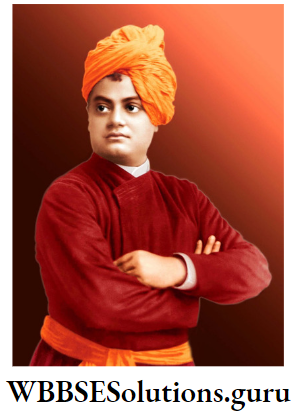
WBBSE Solutions For Class 10 History And Environment Chapter 2 Culture Characteristics And Discussions Swami Vivekananda

Evaluation: Swamiji not only wanted the people to serve others but also dreamt of an awakened India through devotion to one’s country and advising all to be proud of their culture. As the main disciple of Ramakrishna Paramahansha, he established the Ramakrishna Mission on May 1st, 1897 AD. The objective was to serve many through many people. On 9th December 1898 AD he established the Ramakrishna Math in Belur.
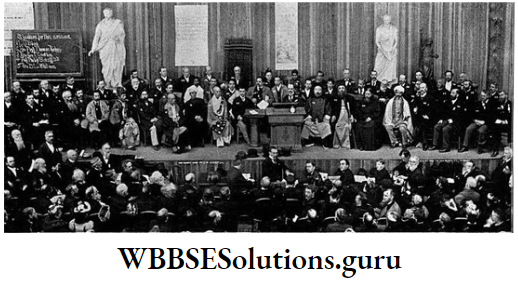
WBBSE Solutions For Class 10 History And Environment Chapter 2 Culture Characteristics And Discussions The First Parliament Of World's Religions Held In Chicago In 1893

Nature And Assessment Of the Bengal Renaissance

Nature And Assessment Of Bengal Renaissance Nature:

  1. Some feel that the Renaissance in Bengal was more intense and revolutionary than that in Europe.
  2. The Renaissance was visible in every sphere of life- literature, culture, society and also politics.
  3. The main nature of this Renaissance was the opposition and dismantling of ideas and customs pertaining to the middle ages. This resulted in a set of intellectuals, poets, artists, literary figures, and philosophers taking center stage for Bengal’s renaissance.
  4. The main awakenings and need for change was brought about through the writings of Pyarichand Mitra, Kishori Chand Mitra, Rajnarayan Basu, Bankim Chandra, and Rabindranath Tagore.
  5. The renaissance did of course create a rift between the Hindus and the Brahmo Samajis. According to Ramesh Chandra Majumdar the 18th century India was the darkest period of Indian history as many customs and conventions were not highlighted and enlighted till then.
  6. It is to be noted that at this time a liberal Europe had already started taking shape. It was the English who brought this positivism to India through the spread of Western education.
  7. Jawaharlal Nehru pointed out that due to the colonial rule it was only the upper classes of Hindus in Bengal who were benefited most with the Renaissance.
  8. Other classes continued to dwell in the darkness. In fact the leadership didn’t bother about the changes required in the lower strata of the society.

Debates regarding the Usage of the Concept of Renaissance in. relation to 19th Century Bengal:

  • Nineteenth Century society in Bengal went through a rapid change due to the influence of colonial rule and Western education. This is also known as the Bengal Renaissance. But whether this change has to be defined as a renaissance is a matter of great debate amongst historians.
  • Pandit Ashok Mitra was the first person to point out this change as a so-called Renaissance in 1951. He said that some landowners who had amassed huge wealth by oppressing landless laborers, had settled down in Calcutta and used their ill-earned wealth in the spread of Western education.
  • The British helped them in this matter as it was in their self-interest. The common man had nothing to do with these changes in the upper strata of society. Binay Ghosh has that’s why said this has nothing to do with the concept of Renaissance. In fact he called this a myth and “a historical hoax”.
  • Many historians like Broomfield said that the change in the society was limited to the Bengali middle Class which was an English creation. This gentry had no connections to the thousands of poor and unlettered people of the villages and cities.
  • This was limited to the middle classes in their own island of change. The so-called renaissance was brought about by the persons who had benefited from firstly, Dalhousie’s Doctrine of Lapse. Secondly, the English East India Company’s selfish business interests had helped this class of people and lastly, the some chosen few who got Government jobs under British rule had adopted the changes.
  • So it is debatable that the Renaissance as claimed in Bengal may not have been inclusive as that was in Europe. The protagonists of change in the Bengal society were building institutions and temples for showing off their philanthropic sides rather than in real interests in bringing change to the rank and file of the society.
  • The leadership in this renaissance had its limitations as some progressive socio-economic leaders were not available to ensure that change percolates to the grass root levels.
  • Even a social reformer like Vidyasagar had spent huge money for providing lunch to Brahmins during his Mother’s funeral. The english educated intellectuals of the urban areas were the forerunner Renaissance.
  • These intellectual middle-class people gave birth to the socio-religious movement in 19 century Bengal. The emergence of this new awakening was known rebirth or renaissance of Bengal. It enlightened Bengal with western knowledge, literature, art and science. From Bengal, the rising tide of the renaissance spread all over India.
  • This renaissance led the foundation of modern livelihood on the ruins of medieval thoughts and culture. As a result, equality and secularity along with the consciousness nationalism and internationalism became very popular. So the Bengal Renaissance in the nineteenth century was no doubt a historical event. It highlighted the glorious cultural life of Bengal.
  • Though the widespread impacts of Renaissance is accepted, but the nature of the Renaissance is debatable. Some say that this awakening of Bengal was a result of Brahmo Movement.
  • Another group of scholars remarked in a Hindu awakening. Some scholars gave importance on the role of Ramakrishna-Vivekananda in the Hindu awakening rather than the Brahmo Samaj. Historian Dr. Ramesh Chandra Majumder said that narrow Hindu nationalism a keen impact in the Bengal Renaissance.
  • Marxist Historian, Dr. Rajani Palme Dutta in his book ‘India Today’, had however praised the reformers of 19th-century Bengal. Many feel that the reformers were not able to convert their institutions to productive enterprises.
  • This probably was due to their dependence on the British rulers. American historian Dr. Kopf has not accepted the role played by Ram Mohan and Derozio in renaissance primarily because of the lack of percolation of their thoughts to the grass root level.
  • Dr. Anil Sil has called the reformers as belonging to the ‘elitist group’ who were agents of their British rulers. Dr. Barun Dey feels it is just an enlightening of the Bengali society and in no way it can be called a Renaissance in Bengal. It was because the city dwellers only had gained from these reforms and the thousands in the rural areas continued to remain in the dark ages.

WBBSE Class 10 History Notes

WBBSE Class 10 History And Environment Chapter 2 Culture Characteristics And Discussions Very Short Questions And Answers

Question 1. Name two important works of Kaliprasanna Singha.
Answer: Hutom Pyanchar Naksha and the translation of Mahabharata.

Question 2. What was Hindu Patriot?
Answer: Hindu Patriot was a weekly newspaper.

Question 3. When did the Sanskrit College start functioning?
Answer: 1st January 1884.

Question 4. Name the school established by Iswar Chandra Vidyasagar.
Answer: Bethune School.

Question 5. Name the first national college fully owned by Indians.
Answer: The Metropolitan College.

Question 6. Which Medical College came into being at the initiative of Lord Bentinck?
Answer: The Calcutta Medical College.

Question 7. Who were the first two women ‘graduates from Calcutta University?
Answer: Kadambini Ganguli and Chandramukhi Basu.

Question 8. Who was primarily responsible for the abolition of Sati system?
Answer: Raja Rammohan Roy.

Question 9. Where did Swami Vivekananda deliver his famous speech as a representative of Hindu Religion?
Answer: In the Columbus Hall in Chicago.

Question 10. Name one organisation. which was set up as a part of religious reform in the 19th- century Bengal.
Answer: Brahmo Samaj.

WBBSE Class 10 History And Environment Chapter 2 Culture Characteristics And Discussions True Or False

Question 1. The Asiatic Society was set up by Radhakanta Deb.
Answer: False

Question 2. After passing of the Charter Act (1813), the Compny agreed to spend one lakh rupees on Indian education.
Answer: False

Question 3. Ecole de Medicine, Pondicherry was the first medical college of India.
Answer: True

Culture Characteristics And Discussions Fill In The Blanks

Question 1. _______ was the most popular Bengali magazine of the 19th century which focussed on women’s issues.
Answer: Bamabodhini

Question 2. _______ belonged to the aristocratic family of Sobhabazar.
Answer: Radhakanta Deb

Question 3. The original name of the Bethune School was _______
Answer: The Native Female School

Question 4. _______ was the first multi-discipline, western-style university in Asia.
Answer: Calcutta

Question 5. The ‘Young Bengal Association was formed by ________
Answer: Henry Louis Vivian Derozio

Class 10 History Important Questions WBBSE 

WBBSE Class 10 History And Environment Chapter 2 Culture Characteristics And Discussions Short Question And Answers

Question 1. What was the role of Raja Rammohan Roy in the emancipation of women?
Answer:

The role of Raja Rammohan Roy in the emancipation of women

He tried to remove the primitive dogmas prevalent in society and spread education among women. He was also instrumental in stopping the practice of Sati or the burning of widows on the funeral pyre of the dead husband.

Question 2. What was the ‘Young Bengal Association’?
Answer:

The ‘Young Bengal Association’

The Young Bengal Association was started by Henry Louis Vivian Derozio as a movement against social evils existing in India. His followers were mostly students of Hindu College.

Question 3. What was Swami Vivekananda’s idea of religious reformation?
Answer:

Swami Vivekananda’s idea of religious reformation

Swami Vivekananda, one of the most popular sages of modern India, used scientific analysis of Hinduism to oppose orthodox values of the religion. He changed the entire religious discourse to the ideals of Naba Vedanta.
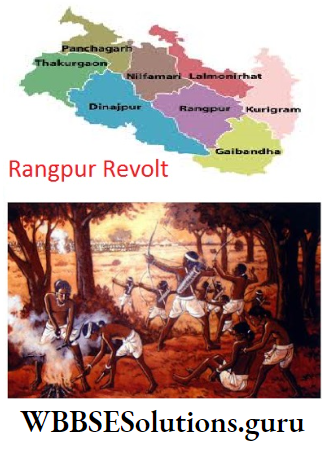
WBBSE Notes For Class 10 History And Environment Chapter 3 Resistance And Rebellion

Resistance And Rebellion Various Revolts

  • After the battle of Plassey, the British assumed full political control over India. Since then, the British colonial power had resorted to exploitation.
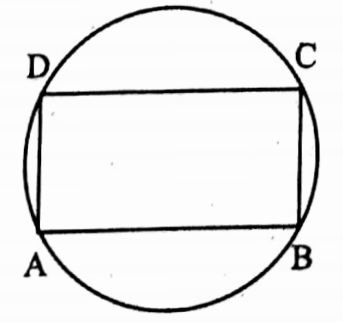
  • A senior British officer wrote, “For the common man, the police was nothing but the whip; their torture and exploitation was the main reason of grievance against our Government”.
  • The first group to rebel were different kinds of monks like naga, giri, grain, and fakir along with the grieving landlords, jobless soldiers, farmers, and other famine-stricken people. For a long period of forty years, this rebellion was called the Sannyasi Rebellion (1763-1800).
  • The Chuar Rebellion (1766-1772,1795- 1799) in the five districts of Bengal and Bihar, viz. Bankura Midnapur, Ghatshila, Dhalbhum and Manbhum, The Rebellion of Abu Torap Choudhury in the island of Sandip(1769), the Peasants’ Rebellion led by Samsher Gazi in Tripura (1776), Rebellion led by the king of Dhalbhum (1767) and also the rebellions in Rangpur and Dinajpur (1783), Bishnupur and Birbhum (1799), Orissa (1804-1817) and Sambalpur (1827-1880) were major source of embarrassment for the British rulers.
WBBSE Notes For Class 10 Geography And EnvironmentWBBSE Notes For Class 10 History And Environment
WBBSE Solutions For Class 10 Life ScienceWBBSE Class 10 Life Science Multiple Choice Questions
WBBSE Solutions for Class 10 MathsWBBSE Class 10 Maths Multiple Choice Questions
WBBSE Notes For Class 10 Physical Science And Environment


  • In 1870, the ‘Malangis’ employed in the salt industry in the 24 Parganas along with the landlords and their managers, started armed revolt against the British.
  • During the same period, the King of Vizianagaram started revolting (1794). Mention should be made of the Tamil Paligar Rebellion (1790) and Parlekamedi Rebellion (1813-1814).
  • Similarly, an important mass uprising was the revolt of the oppressed tribal people in Eastern India.
  • The history of the nineteenth century comprises mainly of the mass awakening, mass movement, and mass rebellion of the tribal people, The Chero Rebellion of Palamau (1800), the Ho Rebellion of Singbhum (1821), the Kol Rebellion of Manbhum (1820-1837) and the Santhal Rebellion of Ranchi and Hazaribagh (1855-1856) are worth mentioning.

Read and Learn More WBBSE Notes For Class 10 History And Environment

WBBSE Notes For Class 10 History And Environment Chapter 3 Resistance And Rebellion

Resistance And Rebellion The Colonial Forest Law And Reactions Of The Adivasi People

Forest laws: When the British started colonising the country, many Adivasi people had to leave their villages to work as laborers in coal mines, tea gardens, or factories. A number of Colonial Forest Laws were formulated to oust those who stayed back.

  1. British Government introduced the first colonial ‘forest act’ in 1865 just to capture and control over forest regions. By this act forest regions were divided into three separate belts, like
    • Reserve forest belt,
    • Subordinate or protected forest belts and
    • Rural belts of forest.
      • Except last two belts reserve forest zones were allowed to collect any type of forest property. It was an important cause of tribal revolt.
  2. From 1870 the British Government, greedy for more taxes, started distributing the arable land in the forest areas to landlords and money-lenders from other places. Because of the Forest Law, many tribal people had to give up their rights to non-taxable lands, which they have been using for a very long time.
  3. The Colonial Forest Law was the principal cause of resentment and reaction of the Adivasi people. This law introduced cooperative farming in the country.
  4. Before the Indigo Rebellion (1860), many land laws were instrumental in causing resentment among the tribal people. Banishment of grazing and shifting cultivation known as “Jhum Cultivation” was an another important bad effect of ‘Forest Act of 1878’.

WBBSE Class 10 History Notes

Reactions: In 1879, the local Mansabdar and the British Government in the Godavari basin came into some land settlement and as a result, the indigenous forest dwellers called the ‘Rumpa Tribe’ had to pay taxes for cutting trees in the forest or grazing their animals in the area. The Rumpa Rebellion was a direct outcome of this arrangement.

  • The rebellion spread like wildfire over an area of 5000 square mile. The Forest Law of 1859 made the Santals lose their “Damin-i-Koh” or ‘God gifted hereditary tax-free land’.
  • The Mundas had to lose their Khutkathi, which was jointly owned land. The Santals and the Mundas revolted against this. When the tribal people wanted to oust the antagonistic outsiders or diku from their area and reclaim their rights over the forest land, the British, the landlords, and the money lenders vehemently opposed them.

Causes of Forest Laws:

  1. From the beginning from the 18th century British Colonial Government was set up in India. From then the establishment of town and construction of the Railway line started in India. This was the cause of capturing forest resources from tribals.
  2. Government control was increased over India forests by the ‘Forest Act’ in 1855.
  3. A separate ‘Forest department’ was built under German Inspector General Dietrich Brandis in 1864.
  4. The first ‘Indian Forest Act was introduced in 1865 and the second Act in 1878. As a result, tribals lost their hereditary rights on the forest. It became the cause of the Kol revolt, Santhal revolt, Munda revolt, etc.
  5. To punish the rival tribes government passed three separate ‘Criminal Tribes Acts’ in 1871, 1911, and 1924.
  6. Dr. Sekhar Bandyapadhyay in his book ‘From Plassey to Partition and After’, said that this act helped to monopoly control of government over Indian forests. By the act of 1905 government reserved 2/3 of the Indian forests.
  7. Besides, jhum cultivation or shifting cultivation, hunting, and use of forest resources by tribals were strictly prohibited by the government. In 1906 ‘Scientific Forest Policy’ was accepted with the foundation of ‘Forest land Research Centre’.

Resistance And Rebellion Rebellion Uprising And Revolution

Etymologically, the three words rebellion, uprising, and revolution have differences in meaning.

  1. Rebellion: When turmoil and unrest accumulate inside people, once it takes the form of ‘rebellion’. For torture, injustice, and oppression over a long period of time people. organised protest and rebellion. A rebellion generally, is started by a particular group of people, in a particular location and for a particular cause. It is just beginning of a larger movement. We can cite the example of the Santhal Rebellion or the Sepoy Mutiny.
  2. Uprising: An uprising took place as the major outcome of a rebellion. Thus, ‘uprising’ and ‘rebellion’ are closely related to each other. For example, the uprising of the western educated middle class of India resulted in National movement on a larger scale.
  3. Revolution: Similarly the word ‘revolution’ means rapid change in Society and thoughts against traditional defective system and society. Its main objective is to change anything for the benefit of man and civilization. Revolution does not become imperative unless a great change takes place through rebellion and uprising. A revolution takes place only after crossing the preliminary stages of rebellion and uprising. For example, the French Revolution, the Industrial Revolution, the Russian Revolution, the Armed Revolution in India, etc. brought changes. Uprising + Rebellion = Revolution.

The Chuar Rebellion

Beginning:

  • The landlords, supported by the British, called some adivasis of Chuar adivasis started the Chuar Rebellion in the northwest of Midnapur and southwest of Bankura from March 1798 to December 1799. In course of time it spread to areas like Dhalbhum, Manbhum, Birbhum, Salboni and. Ghatshila.
  • However, this was not their first rebellion. They first started revolt in 1768-69 at Ghatshila under the leadership of King Jagannath Singh. 50,000 Chuar peasants or paiks (security guards of zaminders) who lost their ‘paikan land’, or tax-free land which was given in place of salary, joined the church revolt.

WBBSE Solutions For Class 10 History And Environment Chapter 3 Resistance And Rebellion Chuar And Rangpur Revolts

Main causes of the Chuar Revolt were

  1. High rate of land revenue’ on them,
  2. Driving out of old zamindars, ijaradars, and chukar peasants,
  3. After losing lands, houses, and forest the chars penetrated into endangered situation,
  4. The government abolished the zamindari right for which “Paikan lands” or tax-free lands of the chuars were out of hand. For this reason, chuar revolt was started by Gobardhan Dikhpati, Lal Singh, and Mohanlal.

WBBSE Class 10 History Notes

Chuar Rebellion Characteristics: The main characteristic features of the Chuar Rebellion were firstly, it was a fight to maintain their rights over the forest. These independent and fearless Chuar tribals revolted to save the forest resources and land given by landlords.

WBBSE Solutions For Class 10 History And Environment Chapter 3 Resistance And Rebellion Lord Cornwalls

  • Secondly, After Lord Cornwallis introduced the Permanent Settlement Act (1793) in Bengal, the landlords started to forcibly take away the lands belonging to the Chuar people.
  • Thirdly, In north-west Medinipur the queen of Karnagarh Rani Shiromoni took the leadership of the revolt. Her three main centres were Shalbani, Bahadur, and Karnagarh. When she started revolt with the help of Paiks and common men, Gobardhan Dighpati helped them.
  • Fourthly, Though Rani Shiromani and her naib were arrested, ultimately they were released and Rani get back her zamindary right from British. Rani Shiromoni was popularly called ‘Rani Laxmibai of Midnapur’.
  • So, Chuar rebels, under the leadership of Durjon Singha, occupied 30 villages of Raipur.
  • Fifthly, They also burned down Government offices in Salboni. Gang dacoity, looting, and mass kiling occured in Raipur, Basudevpur, Balarampur, Ramgarh, Dubagarh, Jaieswar, Tamluk, etc.
  • Another leader of this rebellion, Achal Singha, led the Layek community of Bagri in a guerilla-style revolt. This is the unique characteristic of the Chuar Rebellion.
  • Sixthly, The valiant Chuar Rebellion against the oppression and deprivation by the British was a great inspiration to the freedom movement in India.

WBBSE Solutions For Class 10 History And Environment Chapter 3 Resistance And Rebellion Chuar And Rangpur Revolts

Importance: The forested land inhabited by the Chuar people was named ‘Jangal Mahal’ by the British. The lexical meaning of the word ‘Chuar’ is ‘vagabond and vile people’. They were also called an ‘uncivilized’ tribe.

  • According to the interpretation of an English author, the original, ‘ancient tribals of Bankura, Dhalbhum (Ghatshila), Medinipur and Manbhum are called Chuar. On the other hand, Kora, Mundari, Kurmi, Bhagdi, Majhi, Lodha, etc. tribes who had relations with the plunderers lived in the forest and hilly regions were called ‘Chuar’.
  • The entire Adivasi population of Jangal Mahal united together and fought an unprecedented, bloody war. Police and the army from Medinipur town were dispatched to contain this terrible revolt. The Government adopted a divide-and-rule policy. But some English officials held the Government responsible for the revolt, having accepted the rationality behind the ‘genocide’, ‘cruelty’, and ‘brigandage’ of the Chuar rebels.

WBBSE Class 10 History And Environment Solutions

The Chuar Rebellion The Kol Rebellion 1831 To 32

Beginning:

  • The tribals who started revolting against the landlords, money-lenders, and the British Government were mainly Kol, Koli, Kachari, Tipra, Lusai, Khashi, Garo, Koą, Chakma, Chuar, etc. Among these, the Kol Rebellion was of great importance. The Oraon, Munda, and Ho, belonging to the Kol community, used to live in the Chhotanagpur area of Bihar.
  • After the introduction of the Permanent Settlement Act, when the oppression of the Kol tribals in the hands of the landlords and moneylenders started increasing, they resorted to the path of rebellion.
  • In 1820-21, the Kols were defeated in the Battle of Chaibasa, at the hands of the Zamindar of Porahaat and his English general and were forced to surrender. With their indigenous bows and arrows, spears, etc., they couldn’t cope with the British forces armed with modern firearms.

WBBSE Solutions For Class 10 History And Environment Chapter 3 Resistance And Rebellion Kol Rebellion

Characteristics: The actual Kol Rebellion took place in 1831-32. The main leaders of this rebellion were Buddha Bhagat, Bindrai Manki, Sui, Munda, etc. Features of the revolt were first, an important feature of this rebellion is that it spread quickly over the forested areas of Manbhum, Singbhum, Ranchi, Hazaribagh, Palamau, and Chhotanagpur.

  • Secondly, for two months the rebels aimed their attacks exclusively on the landlords, hoarders, moneylenders, and British officials. They also protested against leasing out the land to Hindu, Muslim, and Sikh moneylenders, who charged exorbitant taxes.
  • Thirdly, another important feature of this rebellion was mass movement and collective action. The Kols used the term diku, meaning enemy, to describe the outsiders.
  • Fourthly, having acquired the lease over the land inhabited by the Kols, the landlords ruthlessly subjugated them. They imposed taxes on liquor, forced the tribals to cultivate opium, made them work as forced laborers, and abducted tribal women. This resulted in Kol Rebellion.
  • Fifthly, if the tribals were unable to pay their taxes, their houses were burned down, and plundered, their womenfolk dishonored and the land was confiscated. The Kol people became vocal against such outrage.
  • Sixthly, while discussing the characteristic features of the Kol rebellion it is observed that the Munda and Oraon people of Ranchi, belonging to the Kol community, started the initial phase of the revolt by playing kara-Takara and madol, their indigenous drums.
  • They went from village to village, distributing bows and arrows and asking people to unite against the three oppressors, namely, moneylenders, leaseholders, and the government.
  • Seventhly, they insisted that whenever people saw a tyrant moneylender, he should be immediately sacrificed to god. Major Sutherland says, “High rate of land tax and introduction of new leasing laws were the main reason of discontent among the Kol tribe”.

WBBSE Solutions For Class 10 History And Environment Chapter 3 Resistance And Rebellion Main Centres Of Kol Rebellion

Importance: Having noticed the warring attitude of the Kols, Warren Hastings instructed British soldiers to be sent from Patna and Danapur. They successfully crushed the rebellion and most of the 10 thousand rebels were killed during this time.

  • Many women, children, and common men also died in the hands of the British soldiers. The rebellion, which lasted for two years (1831-32), did not become successful because of the repressive tactics by the Government.
  • There were incidents of genocide and arson. However, the blacksmiths and the carpenters were spared because weapons and other military equipment were made by these people. Soldiers sent from Calcutta, Patna, Danapur, Sambalpur, and Benaras, under the leadership of Captain Wilkinson and his artillerymen, completely destroyed the Kol resistance who were armed with nothing but bows and arrows.

The four principal reasons for the failure of this revolt are

  1. Absence of proper planning,
  2. Absence of a worthy leader,
  3. Modern weaponry and
  4. Absence of any support from the middle class.
  • By 1833 the intensity of the rebellion was reduced to a great extent, but the heat of their discontent could be felt till 1837. In order to appease the Kol people, the Government created a reserve called South-West Border Agency exclusively for them. British laws were withdrawn and the Kol people were given, the power to formulate their own laws.
  • The dishonest money lenders and leaseholders were evicted from the land which was illegally acquired by them. The Kol Rebellion fell apart because of proper leadership, restriction as a local issue, absence of support from the educated people and absence of proper communication among the rebels.

WBBSE History Chapter 3 Important Questions 

The Chuar Rebellion Santhal Rebellion Or Hool 1855 To 56

Beginning: The Santhal Rebellion was a landmark. unrest which was fallout of the Permanent Settlement. The Santhal Rebellion started in 1855. It started as a demand for their rights over the trees of the forest.

  • Initially, it was restricted to ‘damin I koh’ or foothill lands or their non-taxable lands. This area extended from Purulia to the foothills of Rajmahal Hills 1366 square miles were covered under this area, of which 866 square mile was surrounded by hills and 500 square mile was agricultural land.
  • According to a report (1851), about four years before the Santhal Rebellion, there were 1437 villages in the area with a total Santhal population of 82,715. They were united and a close-knit group by nature. When the zaminders, money lenders, etc. outsiders, or diku, started troubling them, the anger of these simple folks new no bounds.

WBBSE Solutions For Class 10 History And Environment Chapter 3 Resistance And Rebellion Santhal Rebellion

WBBSE Solutions For Class 10 History And Environment Chapter 3 Resistance And Rebellion Sidhu And Kanu

Characteristics: In 1855 the Santhals, peace-loving forest dwellers who lived in the vast area between Rajmahal in Bihar to Murshidabad in West Bengal, started revolting. Features were

  • The main characteristic feature of this rebellion is that the Santhals united against the oppression of the landlords, the double-crossing of the leaseholders, and the government’s policy to increase taxes.
  • After the implementation of the Permanent Settlement, the Zamindar of Pora Haat acquired a large area’ on lease and as a result, Santhal Tribals living in Bankura, Medinipur, Birbhum, Manbhum, Chhota Nagpur, Palamau, Ranchi, Hazaribagh etc. lost their agricultural land.

Causes

  1. When taxes were imposed on them, they had to borrow from the moneylenders at steep rates of interest.
  2. Being heavily in debt, the Santhal people had to sell off all their worldly possessions to repay their loans.
  3. During this time, the Christian Missionaries tried to convert many of them. The Government employees did not hesitate to dishonor Santhal women. So, the main cause of the Santhal Rebellion was oppression by the landlords and the moneylenders.
  4. Sidhu himself had complained, ‘The money lenders torture us and we have to pay interests at 50% to 500%. He had made it very clear that their protest was not against the Government but against the landlords. Historian William Hunter has written that the poor Santhals did not possess enough land or crops to repay even the basic loans.
  5. Having lost everything in their possession, the Santhals became desperate to revolt against the diku (enemy).
  6. The Santhals used to enjoy tax-free land in the forest area from Rajmahal to Murshidabad. The landlord’s employees went there and indiscriminately chopped down the holy sal trees to increase arable land. It was common practice to enter the Santhal territory and loot them.
  7. The tax-free land used by the Santhals was known as damin i koho and was a peaceful area.
  8. Over time, as the tyranny of the new landlords and money-lenders increased manifolds, almost 20,000 Santhals, under the leadership of Sidhu, Kanu, Chand, and Bhairab congregated in the fields of Bhagna-Dihi. They took an oath to start ‘Hool’ or a revolt (30th June 1855).

WBBSE Solutions For Class 10 History And Environment Chapter 3 Resistance And Rebellion Santhal And Munda Revolt

Result or Importance: On the instructions of Sidhu and Kanu, the rebellion started on 7th July 1855 and had far-reaching effects

  1. It spread like wildfire to Ranchi, Hazaribag, Birbhum, Chhotanagpur, Medinipur, Purulia, and Bhagalpur. A police inspector named Mahesh and his colleague were killed.
  2. The Santhal rebels went on a rampage, indiscriminately killing moneylenders. During the time of Lord Dalhousie, the English army crushed the revolt with a heavy hand. Commander Jarvis himself admitted, ‘What we engaged in was not a battle but genocide’.
  3. Although the Government restrained the Santhal Rebellion, it had to bow down to the intensity of the revolt and create a separate area called ‘Santhaldihi Paragana’ in the interests of the minority community. Despite the failure of the Santhal Rebellion, it was of great importance for various reasons.
  • Firstly, the British Government had to concede to the demands of the Santhals and create a separate state of Santhal Paragana.
  • Secondly, the Government learned a lesson that even unarmed poor farmers can build up resistance that can turn into large-scale rebellion.
  • Thirdly, the rebellion spread outside Santhal territory among non-tribal people. According to William Hunter, semi-adivasi and very poor lower-caste Hindus participated in this rebellion.
  • Fourthly, in the post-rebellion period, the Government had to create a separate reserve for the Santhals and named it ‘Santhal Paragana’.
  • Fifthly, when the Forest Act was passed in 1859, parts of the forest land were reserved for them. As a result of this law, when the occupancy rights of the Santhal people in some parts of Chhotanagpur were withdrawn, they became resentful.
  • Sixthly, they were dissatisfied when the Government refused to accept the special rights of the ‘Majhi’ and ‘Muliya’ castes in the Santhal society. So, once again, they started to revolt.
  • Seventhly, during 1870-82, this movement was called the Kherwar Movement. It was considered to be ‘senator’ or holy because religious sentiments were involved. Eighthly, despite the failure of the Santhal Rebellion, the anti-British leaning and anti-exploitation attitude had a direct influence on the Noikoda Movement (1868) in Gujarat and the revolt of Rup Singh Gobar.

WBBSE History Chapter 3 Important Questions 

The Chuar Rebellion Munda Rebellion 1899 To 1900

Beginning: The Munda community used to live in Chhotanagpur and its adjoining areas. The word ‘Munda’ means the village headman. They believed that the farmland and residential buildings that their ancestors or khuntoktidar had made by clearing deep forest were forcibly taken away by the diku.

  • The British even ousted the main priest or the Pahan community. The land acquired by traditional khuntoktidar was called khuntokti. The system of collective ownership of the Munda people over this property is called khutkati.
  • When the employees of The Company wanted to put an end to this system and introduce individual ownership, it gave rise to unrest all around.
  • The Munda community had their system of administration, laws, and justice system. When the Government wanted to abolish these and their social customs and replace them with a new system of paying taxes in money, instead of crops, it increased public anger to a great extent.
  • Apart from additional taxes, the Munda people were compelled to forced labor and as a result, they started agitating. In 1845, when the Lutheran, Anglican, and Catholic Missionaries went to preach Christianity, they received stiff resistance.

Causes: Main causes of the Munda Revolt were

  1. ‘Bet-began or forced labour of the Mundas,
  2. No help from Missionaries,
  3. No proper justice from government,
  4. Torture and exploitation from the Dikus and
  5. According historian K. S. Singh religious and cultural devastation of Munda tribe turned them towards the revolt.

WBBSE Solutions For Class 10 History And Environment Chapter 3 Resistance And Rebellion Birsa Munda

  • Under these circumstances, the famous Munda leader Birsa Munda (1875-1900) took up the reins of the revolt in his own hands. He was the son of Sugan Munda, a sharecropper of Ulihatu village in Ranchi. Because of utter poverty, he was forced to live with his maternal uncle’s house for some time and then in the Primary School of his village.
  • Later, at the age of 12, he adopted Christianity and lived in the German Missionary School in Chaibasa. His relationship with the missionaries soured over the years and he went back to his own village to be re-introduced to the traditional religion of his forefathers.
  • He was deeply influenced by the traditions of Hinduism. In 1895, at a young age of 21 years, Birsa developed a new religious philosophy and called himself ‘dharti aba’ or ‘father of the earth’.
  • He worshipped Birsa Munda ‘singbonga’ or the Sun God. He received divine instructions from this God that through moral lifestyle, self-purification, and collective prayers the Munda people would have all their wishes fulfilled.
  • As a result, in the Munda society, Singbonga emerged as the one and only God instead of multiple Gods and Goddesses. Birsa also advised his followers to give up meat and the drinks called Haria and wear the sacred thread in order to lead a moral and holy life.

Features: Most important features of the Munda Revolt were

  • To drive out the dikus and abolish British rule establish Munda rule,
  • To destroy the Zaminders, Jaigirders, Hákim, and Christians,
  • To burn the doll of Raban (British) and Mondadori (British Queen),
  • Munda tribes tried to follow the cultural aspects of the landlords and zamindars,
  • To spread the message of revolt through secret gathering, discussion, and prayer,
  • No antagonism was shown to other subordinate tribal groups and
  • Munda fighters were brave and patriotic against the British.

Spread of Revolt: Once Birsa Munda was released from the Ranchi jail in the January of 1898. He started moving from village to village and holding meetings in the light of fire torches at the dead of night.

  • The Munda Rebellion was formed with only 6000 destitute Munda people. Their covert weapons were bows, arrows, spears, axes, and special battle axes called ‘tangi’.
  • In order to jeopardize the ensuing Christmas celebrations, Birsa wanted to start the rebellion on the night of 24th December 1899. Accordingly, the Munda rebels attacked Churches, Government offices, and police stations in Ranchi and Singbhum. So, having a definite aim was an important feature of this rebellion. On 7th January 1900, the attacks intensified.
  • Armed with spears and bows and arrows, 300 Munda people, attacked the Khunti police station. In order to deal with this rebellion, the Deputy Commissioner of Ranchi took up a position in the Dumari Hills with 2000 soldiers in his command 10 Mundas were killed in this battle.
  • On 9th January Commander Gaya Munda was killed in a fierce battle in Soil Raka Hills. Few hundred Munda leaders also perished. Many of them were either sentenced for life or deported. ‘A total of 450 followers were imprisoned. 87 were presented at the session’s court and only two were hanged.
  • This incident came to be known as Ulgulan or dangerous muddle. In the midst of this situation, Birsa was jailed in Ranchi on 3rd February 1900. On 2nd June, at the age of 26 years, he succumbed to cholera while still in custody. Hence, intensity and comprehensiveness were two important characteristic features of this rebellion.

Result: The rebellion led by Birsa Munda had far-reaching effects

  • In spite of the fact that the rebellion had failed, the Government recognised their system of Khuntakati and passed a bill called Chhotanagpur Law of Tenants’ Rights (1908). But the Dikus had already grabbed 90% of the Khuntakati land from the Munda people.
  • According to the new law, the bet begari system or forced labour and eviction of the Munda people from their land was forbidden.
  • Although an independent Munda State was not established, the rebellion had awakened political consciousness among them.
  • The Oraon community of Chhotanagpur started the Tana Bhagat Movement in 1914 in order to get back their rights over their Bhainyara land. The main demand of this movement was that, the adivasis would not pay any taxes on the cleared land that was once part of the forest.
  • Miloniyal and Messianic movement of the Oraon community was led by a 25 years old man named Jatra Oraon, from Bekarin Owatol village under Bishnupur police station, Gumla District. He was associated with Tana Bhagat Movement.
  • Even after his death, Birsa Munda remained immortal in the hearts of his people. A new group developed which was known as Birsa Community. They worshipped Birsa as their God.

WBBSE History Chapter 3 important Questions 

Sannyasi Fakir Rebellion

Beginning: People from all walks of life, viz. farmers, laborers, weavers, artisans, fishermen, cobblers, cleaners, traders, artists, and the middle class, joined the pan-Indian anti-British protest, albeit intermittently.

  • Between 1763 and 1856 at least 40 rebellions of various scales had taken place all over India, of which the Sannyasi-Fakir revolt is important. We know this revolt from Poems of Majnu written by, Panchanan Das, Rhym of Mahasthangarh by Dwija Gourikanta, and ‘Anandamath’ of Bankim Chandra.

Characteristics: Some features are

  1. The sannyasi-Fakir revolt was purely a peasant revolt.
  2. Many hungry peasants, landless zamindars, and jobless armies were united under Sannyasis and Fakirs.
  3. To attack the company’s Kuthis, treasury, Granary, and Godowns of money lenders and Kacharis of rich zaminders.
  4. The leaders of the revolts were religious-minded, but the revolt was free from religious roles.
  5. The leaders of the revolt introduced guerilla tactics of warfare against the British.
  6. Internal conflict among the leaders was an important feature, for the revolt was weakened.

Spread Sannyasi-Fakir Rebellion was a remarkable event in the history of peasants’ rebellions. Almost 50,000 people participated in this rebellion. The fakirs of North Bengal, belonging to the ‘Madari’ sect and ‘Giri’, ‘Gosain’ and ‘Naga’ sages of North Bengal and Mymensing were the first to lead this rebellion.

  • Later, ousted landlords, jobless soldiers and deported farmers also joined the rebellion. We find the mention of Sannyasi Rebellion in the famous writer Bankim Chandra Chattopdhyay’s novel, ‘Debi Chowdhurani’.
  • The famous leaders of this rebellion were Bhabani Pathak, Debi Chowdhurani, Kripanath, Musha Shah, Majnu Shah, and Paragal Shah. Bhabani Pathak fought valiantly and died in 1787.
  • The principal causes of this rebellion were: sages and fakirs or minstrels, who lived in Bengal and Bihar for a long time, had eventually become farmers.
  • The British kept oppressing them for a long time. They used to go for their annual pilgrimage at a particular time of the year. They became resentful when the British administration intentionally imposed pilgrim taxes on them. During the famine of 1176 Bengali era (1770) having witnessed the diabolic torture meted out by the British, the rebels lost confidence on the administration, moneylenders, and some landlords. The tyranny and looting by the representatives of the Company in the name of collecting taxes. led to the spread of the rebellion all over the area.

WBBSE Solutions For Class 10 History And Environment Chapter 3 Resistance And Rebellion Place Of Fakir Paglapanthi And Sasnnyasi Revolts

Importance: At the onset of the rebellion,

  • The rebels looted the treasury Company and landlords offices and granaries of merchant moneylenders’ houses.
  • The rebellion was at its zenith between 1763 and 1778.
  • The rebellion spread from Rampur and Boaliar in Rajshahi and Dhaka to Rangpur.
  • In the absence of proper leadership, organization, firearms, definite aims, and ideals, the rebellion that lasted for four decades finally fell apart. According to Sirajul Islam, it was a step of the brave and patriotic struggle of mass protest against colonialism, inspite of its religious nature.

WBBSE Solutions For Class 10 History And Environment Chapter 3 Resistance And Rebellion Sannyasi Fakir Rebellion

Sannyasi Fakir Rebellion Farazi Rebellion 1818 To 1905

Haji Shariyatullah (1781-1837) was the pioneer of Farazi movement in India. The Farazi Movement lasted from 1818 to 1906. The word Farazi means ‘mandatory duties as per Islam’.

WBBSE Solutions For Class 10 History And Environment Chapter 3 Resistance And Rebellion Dudhu Miyan

Class 10 History And Environment Study Material 

Characteristics: The Farazi Movement is characterised by these features

  1. To remove all superstitions prevalent in Islam, provide financial independence to people and secure an independent state.
  2. It also aimed at ending tyranny and frustration and introducing hope in. the minds of people for a new life.
  3. The Farazi Movement had started to deal with religious issues, but in course of time, it took a political turn. Many Hindu farmers also joined the movement.
  4. Farazi Movement had a role to play in giving a full revolutionary touch to the freedom movement of India. An independent government, army, and court were established under the leadership of Dudhu Mian.
  5. Shariyatullah wanted to build a society that was based on communism and free of superstitions.
  6. Farazi Movement had a constructive role to play in protesting against the indigo planters and Hindu-Muslim landlords.
  7. The poor farmers, weavers, artisans, labourers, and all, belonging to both communities, in Faridpur, Dhaka, Mymensingh, Barishal, etc. joined this movement. In 1820 he formed a religious sect called “Farazi”.
  8. After the death of Shariyatullah in 1837, his son Dudhu Mian took up the reins of this movement. Dudhu Miyan (1819-62), or Md. Musin converted Farazi movement into a political, economic, and social movement. They raised a slogan that, ‘the land belonged to those who tilled it’ or ‘all lands belong to God.

Importance: The ideology of the Farazi Movement was not contained within Dhaka, Pabna, Bakhargunj, Mymensingh, Noakhali, and Khulna alone, but it spread to Tripura and West Bengal also.

  • After the death of Dudhu Mian (1862), his son Noah Mian again changed the Farazi Movement into a religious movement. Firstly, because of narrow religious principles, the Hindu-Muslim unity did not hold ground.
  • Secondly, the absence of political consciousness, real-life experience, and definite goals failed the movement. Thirdly, when Dudhu Mian was imprisoned, the movement became rudderless without a leader. Finally, the Farazi Movement crumbled under the joint attack of the British landlords and indigo planters.

Wahabi Movement:

  • Wahabi Movement had an important role to play in the revival of Islam. The word Wahabi means regeneration. To reform the Islamic religion from superstitions and immoral practices, Abdul Wahab (1703-87), a devout scholar, started a movement in Saudi Arabia.
  • The Wahabi Movement was named after him. Syed Ahmed (1786-1831) of Rai Beriley, Uttar Pradesh, with the influence of Abdul Aziz, son of Haji Waliullah, popularised the Wahabi Movement in India. His slogan was, ‘go back to the holy Quoran’.

Wahabi Movement Features: The Wahabi Movement had religious, political, economic, and other features. First, it was not a non-communal, national movement; because although the Hindus had joined the movement, it was primarily a movement by the Muslims and for the Muslims. Secondly, many people feel that it was a theocentric, socio-economic movement.

  • Again from a political angle, the Wahabis were communistic. So, although it started as a religious movement, soon it assumed a political and economic character because of the participation of the masses.
  • Thirdly, its religious characteristic was that in the beginning, it started as a fight against religious superstitions. Many lower caste oppressed Hindus joined the movement.
  • Fourthly, politically, the Wahabi Movement was an uninterrupted fight against British rule till 1870. Lord Canning observed, “It was the principle of Islam to revolt against the Queen’s rule”. Fifthly, they called the British-ruled India as ‘land of the enemy’ (dar-ul-harb).
  • In their endeavour to establish the ‘land of piety (dar-ul-Islam), the Wahabis declared jihad. Though the movement started for religious reasons, it got transformed into an economic revolt of the peasants against the landlords.

Sannyasi Fakir Rebellion Role Of Titumir

  • Syed Ahmed had an important role during the golden era of the Wahabi Movement between 1820 and 1850. He set up his head office at Siolo in the North-west corner of India.
  • Having given up the ideals of Hijrat, he moved to Afghanistan, which was not occupied by the British, and to the North West corner of India. In the Battle of Balakot (1831), he declared war against the anti-Muslim landlords of Parbatar and the Government.
  • He was defeated and killed by the Sikh people in 1831. Although Wahabi Movement started as a religious movement, later it took a political form. Otherwise, the movement would have lost its importance long time ago.
  • In the words of the District Superintendent, Reiki, Prosperous and religious zealot farmers took part in the political movement. The boundaries of religion and caste fell apart in the Wahabi farmers’ movement against the landlords in Bengal.
  • But, in spite of the enthusiasm of the people and widespread participation, this movement did not receive national importance. The main reason was that during the half-a-century-long movement, it did not have a Hindu leader. In Bengal, the Barasat Revolt (1831) of Titumir took place for political and religious reasons.
  • Titumir (Mir Nishar Ali 1782-1831) took an active role in spreading the movement in Bengal. During this time, his nephew Commander Golam Masum, colleague Moinuddin and his followers namely ‘Hedayetis’ were his main associates.
  • Many lower-caste Hindus also joined the forces of Titumir. He constructed a bamboo fort or banderilla in a village called Narkelberia, ten kilometers from Baduria police station, and started collecting taxes by ignoring the British Administration.
  • Titumir and his 600 followers defended the fort with green wood apples, brickbats, bows-arrows, spears, etc., but was defeated by the British army, and the bamboo fort was reduced to ruins When Lord Bentinck forbade him to do so, a fierce battle was raised between the two groups.
  • They attacked the British forces from the bamboo fortress on 19th November 1831. At the instructions of Bentinck, they bombarded the bamboo fortress with cannon shells and most of the soldiers perished. This incident came to be known as ‘Barasat Revolt’.

WBBSE Solutions For Class 10 History And Environment Chapter 3 Resistance And Rebellion Titumir

Importance: Wahabi Movement also failed, just like the Farazi Movement. But, the Hindu and Muslim farmers learned to fight together for freedom. Historian Quemuddin Ahmed, while analysing this movement, laid stress on its national and people-oriented aspects. Dr. Abhijit Dutta thought that the abolition of British rule in India was their main aim.

Class 10 History And Environment Study Material 

The Indigo Revolt

Background: The British Government, in order to redress the growing grievances among the Indians, formulated a number of changes in the ruling system; but it was unable to do away totally with the discontent. During 1859-60 nearly 60 lakh indigo farmers révolted against the atrocities of British indigo planters. The indigo planters forced the farmers to cultivate only indigo in their agricultural land.

The Indigo Revolt Causes Of Indigo Revolt

Demand of the Peasants-The indigo planters used two kinds of land for the cultivation of indigo. These two kinds of land were ‘Melaka’ and ‘be-elaka’. The land which was owned by the planters themselves was called elaka land, i.e., belonging to their own territory. Daily laborers were used to cultivating indigo in this land.

  • The ‘be-elaka’ land belonged to the farmer. The farmers were paid an advance or ‘dadan’ of Rs. 2/- per bigha of land. The poor farmers very often fell into this death trap. As a result, the farmers used to become target of utter deprivation.
  • The number of indigo plantations kept growing in places like Nadia, Jessore, Khulna, Dhaka, Pabna and Faridpur, By 1830, there were one thousand indigo plantations in Bengal. The oppression by the indigo planters also kept increasing.

The system of Dadan-The cultivation of indigo was extremely profitable for the planters, but not so for the farmers. The land which was once used for the cultivation of indigo became unsuitable for growing food crops. The plight of the farmers caught in the debt trap of dadan was unimaginable. When the farmers refused to plant indigo in their land, the planters increased their oppression manifolds.

Tormenting the Tenants-The farmers, who refused to plant indigo, were brought to the office of the plantation and whipped with leather bound whips called ‘Shyam Chand’. Their agricultural equipment and livestock were looted. The planters used to plunder the houses of unwilling farmers and set them on fire. Women were regularly dishonored. Not only were the poor farmers affected by the torments, even well-off people and landlords had to suffer in the hands of the indigo planters. The condition of the indigo farmers worsened after 27 indigo planters were appointed as honorary Magistrates in 1857.

Regulation V-In 1830 William Bentinck passed. Regulation V. A as a result any breach of contract between the indigo farmer and the indigo planter was considered to be a criminal offense. Hence, Regulation V was discarded in 1835. However, the planters continued to torment the farmers with the help of police and the Magistrate.

Cooperation of some of the Magistrates- After laws were passed against the oppression of the indigo farmers in 1835, J. H. Manglers (1855), the Joint Magistrate of Barasat and Abdul Latif (1854), Joint Magistrate of Kalaroa sided with the indigo farmers in cases pertaining to indigo cultivation. This gave a boost to the farmers to start a revolt. In 1858, another Joint Magistrate of Barasat, Ashley Eden, announced in a bulletin that it was the prerogative of the farmer to cultivate indigo in his land or not. In 1859, Hemchandra Kar, Deputy Magistrate of Kalaroa told the police that if there was a dispute regarding the indigo farmers, the title of the land would be vested with the farmer and he would be free to cultivate any crop that he wished. Nobody could force him to cultivate indigo.

Role of newspapers and the middle class-The contemporary newspapers had encouraged the revolt of the indigo farmers. In ‘Hindu Patriot’, Harish Chandra Mukhopadhyay gave a vivid description of the oppression by indigo planters and the apathy of the police.

  • Sisir Kumar Ghosh, the editor of ‘Amrita Bazar Patrika’, assumed the pseudonym ‘M.L.L. and wrote a number of letters in ‘Hindu Patriot’ to encourage the farmers. ‘Sangbad Prabhakar’ of Ishwar Gupta and ‘Tatwabodhini Patrika’ of Akshay Kumar Dutta had important roles to play in the background of the Indigo Revolt.
  • Uproar was raised when Madhusudan Dutt translated Deenabandhu Mitra’s play, Nildarpan (1860), in English and published it in the name of Father James Long. When Father Long was fined Rs. 5000/- for going against the British, Kaliprasanna Singha cleared the dues for him. At this time, when the famous lawyer Sambhu Nath Pandit and Prasanna Kumar Tagore insisted that the farmers should declare all-out war against the indigo planters, the situation became turbulent.

WBBSE Solutions For Class 10 History And Environment Chapter 3 Resistance And Rebellion Nil Darpan

The Leaders-In 1859 Bishnucharan Biswas and Digambar Biswas of Chougacha village. in Krishnanagar started the Indigo Revolt. In course of time, people who actively led the revolt in Nadia, Jessore, Khulna, Pabna, Faridpur and Rajshahi were Baidyanath Sardar and Biswanath Sardar (Bishe Dakat) of Banshberia, Rafique Mondal of Malda, Rahimaullah of Sundarban, Zamindar Ramratan Mallick, (Nanasaheb of Bengal), Ramratan Roy and Girish Mullick of Jessore, Mahesh Banerjee of Pabna, Lal Chand Saha and Morad Biswas of Aurangabad, to name a few.

WBBSE Solutions For Class 10 History And Environment Chapter 3 Resistance And Rebellion Nil Kuthi

Class 10 History And Environment Study Material 

Characteristics: The main characteristic feature of Indigo Revolt is that

  1. It was the largest farmers’ revolt in Bengal, where nearly 60 lakh farmers had taken part.
  2. This revolt also received the support of the educated middle class.
  3. Some Englishmen and Christian Missionaries were also found supporting the farmers.
  4. It started after the Sepoy Mutiny and Santhal Rebellion.
  5. The Indigo Revolt was especially important because it was instrumental in mobilizing mass movement on a huge scale.

Results or Importance:

  • Firstly, Formation of the Indigo Commission-Going by the results, Indigo Revolt was a successful farmers’ rebellion. Having felt the intensity of the revolt, J. P. Grant, the Deputy Viceroy of Bengal, constituted the Indigo Commission on 31st December 1860. This five-member commission reported that on principle, the cultivation of indigo was harmful and erroneous. At the recommendations of the Indigo Commission, the price of indigo increased.
  • Secondly, ‘Teen kathiya’, or the system of cultivating indigo in three cottas of land for every bigha, was introduced. There should be no coercion. Luckily, by 1891, Germany started producing synthetic indigo and as a result, the importance of indigo cultivation in India was greatly reduced. The business of natural indigo came to an end.
  • Thirdly, The importance of this revolt was accepted in an article in Calcutta Review and stated that, ‘this was indeed a revolt’-the whole country participated in it. The Indigo Revolt which started two years after the Sepoy Mutiny continued for two long years. Considering its outcome and importance, the Indigo Revolt is very significant.
  • Fourthly, The main objective of the Indigo Revolt was not political, but economic. The poor farmers united with strong determination and started the revolt against economic oppression and wilfulness. Almost 60 lakh farmers of Bengal, without any military training, leaped in to the revolt. Prof Chittabroto Palit feels that in this revolt the peasants, as such, had no role to play. The landlords participated actively and spontaneously in order to safeguard their own interests.
  • Fifthly, The educated middle class of Bengal came forward in the interests of the farmers, to unite the nation against the tyranny of the British rulers. Unlike the Sepoy Mutiny, in the Indigo Rebellion, the middle class had an important role to play. Sixthly, A section of English clergymen and officials were sympathetic towards this revolt. As a result, there was a change among the common men about their outlook towards English well-wishers.

WBBSE Solutions For Class 10 History And Environment Chapter 3 Resistance And Rebellion Time Table

WBBSE Class 10 History And Environment Chapter 3 Resistance And Rebellion Very Short Question And Answers

Question 1. Who were the first group of people to revolt against the oppression of the British Government?
Answer:

The first group of people to revolt were different kinds of monks like naga, fakir, Giri, and grain along with grieving landlords, jobless soldiers, and farmers.

Question 2. Who were mostly affected by the Colonial Forest Laws?
Answer:

The tribal or adivasi people, who were indigenous forest dwellers, were mostly affected by these laws.

Question 3. Who was the leader of the Chuar Rebellion?
Answer:

The leader of the Chuar Rebellion was Durjon Singha.

Question 4. What was the term used by the Kols to describe any outsider?
Answer:

Any outsider was called ‘Diku’.

Question 5. What was the fallout of the Permanent Settlement Act?
Answer:

The Santhal Rebellion was the fallout of the Permanent Settlement Act.

Question 6. Who was the most noted leader of the Munda Rebellion?
Answer:

Birsa Munda was the most noted leader of the Munda Rebellion.

Question 7. Which book was written, on the backdrop of Sannyasi Rebellion?
Answer:

‘Debi Chowdhurani’ by Bankim Chandra Chattopadhyay was written on the backdrop of Sannyasi Rebellion.

WBBSE History Chapter 3 Important Questions

Question 8. Which movement had an important role to play in the revival of Islam?
Answer:

Wahabi Movement had an important role to play in the revival of Islam.

Question 9. What was ‘Shyamichand’?
Answer:

‘Shyamchand’ was a leather-bound whip which was used by the planters on farmers who refused to cultivate indigo.

Question 10. Who was the author of ‘Nildarpan’?
Answer:

Dinabandhu Mitra was the author of Nildarpan.

WBBSE Class 10 History And Environment Chapter 3 Resistance And Rebellion True Or  False

Question 1. Lord Cornwallis introduced the Permanent Settlement Act.
Answer: True

Question 2. The Kol Rebellion took place in 1841-42.
Answer: False

Question 3. Titumir is associated with the ‘Barasat Revolt’.
Answer: True

WBBSE Class 10 History And Environment Chapter 3 Resistance And Rebellion Fill In The Blanks

Question 1. Tariqua i Mohammadia means ________
Answer: Path of Mohammad

Question 2. ______was a tax imposed of Indigo farmers. (Dadan)
Answer: Dadan

Question 3. In the _______ the Kols were defeated in the hands of the Zamindar of Porahaat.
Answer: Battle of Chaibasa

Question 4. The tax-free land used by the santhals was called _______
Answer: Damin i koho

Question 5. The Oraon rebellion was led by a 25-year-old man named __________

Answer: Jatra Oraon

WBBSE History Chapter 3 Important Questions

WBBSE Class 10 History And Environment Chapter 3 Resistance And Rebellion Short Question And Answers

Question 1. What were the main features of the Chuar Rebellion?
Answer:

The independent Chuar tribals revolted to save the forest resources and land from the landlords supported by the British. It was a fight to maintain their rights over the forest.

Question 2. What was the Farazi Rebellion?
Answer:

Farazi Rebellion

Haji Shariyatullah was the pioneer of Farazi Movement (1818-1905). It aimed at removing the religious superstitions of Islam, provide financial independence to people, and secure an independent state.

Question 3. What was the outcome of the Munda Rebellion?
Answer:

The outcome of the Munda Rebellion

The Munda Rebellion led by Birsa Munda had far-reaching implications. The Government recognised their system of khuntakati and passed a bill called Chhotanagpur Law of Tenents’ Rights. Although a separate Munda state was not established, the rebellion had awakened political consciousness among them.

WBBSE Solutions For Class 10 Maths Algebra Chapter 3 Quadratic Surds

Algebra Chapter 3 Quadratic Surds

⇔ If n is a positive integer and fl in a positive rational number, which can not express the nth power of some rational number, then the irrational number \(\sqrt[n]{a} \text { or } a^{\frac{1}{n}}\) that is the positive nth root of a is called surdor a radical.

⇒ The symbol \(\sqrt[n]{ }\) is called the radical sign n is the called the radical sign, n is called the order of the surd (or radical) and a is called the radicand.

⇒ Hence \(\sqrt[3]{\sqrt{2}}\) is not a surd as 2 is not a rational number.

⇒ A surd of order 2 is called a quadratic surd or square root.

⇒ Hence \(\sqrt{7}, \sqrt{\frac{4}{7}}\) are quadratic surd.

  1. If a is only a positive rational number that is not the square of a rational number, then ±√a type of number is called pure quadratic surd.
  2. Again a number of the form a±√b or ±a√b is called mixed quadratic surds where a is a rational number (≠0) and √b is a pure quadratic surd.
  3. Two or more quadratic surds are said to be similar surds if they can be expressed as rational multiple of the same surd.
  4. If a and b are such numbers prime Jo each other (i.e. HCF of a and b is 1) and neither of which is perfect square, then √a, √b are dissimilar surds.
  5. Any factor multiplying with any surds, if the product is free from surds then the factor, is called (the Rationalisation factor of that surround the process is called the Rationalisation.
  6. If the sum and the product of any mixed quadratic surd with rationalising factor are both rational number, the mixed quadratic surd is said to be conjugate or complementary surd.

Read and Learn More WBBSE Solutions for Class 10 Maths

WBBSE Solutions For Class 10 Maths Algebra Chapter 3 Quadratic Surds

Maths Algebra Chapter 3 Quadratic Surds True Or False

Example 1. √75 and √147 are similar surd.

Solution: True

Example 2. √π is a quadratic surd.

Solution: False

Example 3. Product of two surds is a surd.

Solution: False

Class 10 Maths Algebra Chapter 3 Solutions

Example 4. Product of two surds is not a surd.

Solution: False

Example 5. Sum of two surds is a surd.

Solution: False

Example 6. √6 + √3 = √7+ √7 .

Solution: False

WBBSE Notes For Class 10 Geography And EnvironmentWBBSE Notes For Class 10 History And Environment
WBBSE Solutions For Class 10 Life ScienceWBBSE Class 10 Life Science Multiple Choice Questions
WBBSE Solutions for Class 10 MathsWBBSE Class 10 Maths Multiple Choice Questions
WBBSE Notes For Class 10 Physical Science And Environment


Example 7. √6+ √ 3 > √7 + √2

Solution: False

Example 8. π is an irrational number which is not a surd.

Solution: True

Factorization Class 10 Solutions

Example 9. √32 is a surd but \(\sqrt[5]{32}\) is not a surd.

Solution: False

Example 10. Conjugate surd of √5-2 is √5 + 2

Solution: False

Maths Algebra Chapter 3 Quadratic Surds Fill In The Blanks

Example 1. 5√11 a _______ number (Rational/irrational)

Solution: Irrational

Example 2. Conjugate surd of √3-5 is _______

Solution: -√3 – √5

Example 3. If the product and sum of two quadratic surd is a rational number, then surds are ________ surd.

Solution: Conjugate

Class 10 Algebra Chapter 3 Solved Examples

Example 4. Rationalising factor of 7- √3 is _______

Solution: 7 + √3 or, -7 – √3

Example 5. Product of \(3^{\frac{1}{2}}\) and √3 is _______

Solution: 3

Example 6. √6 x √15 = x√10 then x = ________

Solution: 3

Example 7. Conjugate of -√5-1 is________

Solution: √5 -1

Wbbse Class 10 Algebra Notes

Example 8. To denote square root, we use √ instead of ______

Solution: \(\sqrt[2]{ }\)

Example 9. √108 – √75 = ______

Solution: √3

Example 10. Two quadratic surd √8 and √32 are rational multiple of same surd _______

Solution: √2

Maths Algebra Chapter 3 Quadratic Surds Short Answer Type Questions

Example 1. x = 3 + 2√2 let us write the value of x + \(\frac{1}{x}\)

Solution: \(\frac{1}{x}=\frac{1}{3+2 \sqrt{2}}\)

= \(\frac{3-2 \sqrt{2}}{(3+2 \sqrt{2})(3-2 \sqrt{2})}=\frac{(3-2 \sqrt{2}}{9-8}=3-2 \sqrt{2}\)

x + \(\frac{1}{x}\) = 3 + 2√2 + 3 -2√2 = 6

∴ The value of x + \(\frac{1}{x}\) = 6.

Example 2. Which is greater of (√15+√3) and (√10 + √8)

Solution: √15 + √10 > √8 + √3

⇒  or, \(\frac{1}{\sqrt{15}+\sqrt{10}}<\frac{1}{\sqrt{8}+\sqrt{3}}\),

⇒  or, \(\frac{\sqrt{15}-\sqrt{10}}{15-10}<\frac{\sqrt{8}-\sqrt{3}}{8-3}\)

⇒  or, √15 – √10 < √8 – √3

⇒  or, √15 + √3 < √10 + √8

∴ The value of x + \(\frac{1}{x}\) = 6.

Example 3. Let us write what should be subtracted from √72 to get √32.

Solution: √72 -√32 = \(\sqrt{4 \times 2 \times 9}-\sqrt{16 \times 2}\)

= 6√2 -4√2 = 2√2

Factorization Formulas Class 10 

Example 4. Simplify \(\frac{1}{\sqrt{2}+1}+\frac{1}{\sqrt{3}+\sqrt{2}}+\frac{1}{\sqrt{4}+\sqrt{3}}\)

Solution: Rationalising, we get

⇒  \(\frac{\sqrt{2}-1}{2-1}+\frac{\sqrt{3}-\sqrt{2}}{3-2}+\frac{\sqrt{4}-\sqrt{3}}{4-3}\)


= \(\sqrt{2}-1+\sqrt{8}-\sqrt{2}+2-\sqrt{3}=1\)

Example 5. \(\frac{\sqrt{24}+\sqrt{216}}{\sqrt{96}}=?\)

Solution: \(\frac{\sqrt{4 \times 6}+\sqrt{6 \times 6 \times 6}}{\sqrt{6 \times 16}}\)

= \(\frac{2 \sqrt{6}+6 \sqrt{6}}{4 \sqrt{6}}=\frac{8 \sqrt{6}}{4 \sqrt{6}}=2\)

Example 6. 2x = √5 +1, x2 – x – 1 = ?

Solution: x2 – x- 1

= \(\left(\frac{\sqrt{5}+1}{2}\right)^2-\left(\frac{\sqrt{5}+1}{2}\right)-1=\frac{5+1+2 \sqrt{5}}{4}-\frac{\sqrt{5}+1}{2}-1\)

= \(\frac{6+2 \sqrt{5}-2 \sqrt{5}-2-4}{4}=\frac{0}{4}=0\)

Example 7. \(x=\sqrt{3}+\sqrt{2}, \quad x^2+\frac{1}{x^2}=?\)

Solution: \(\frac{1}{x}=\frac{1}{\sqrt{3}+\sqrt{2}}=\frac{\sqrt{3}-\sqrt{2}}{3-2}\)

= \(\sqrt{3}-\sqrt{2}\)

\(\left(x^2+\frac{1}{x^2}\right)=\left(x+\frac{1}{x}\right)^2-2 x \frac{1}{x}\)


= \((\sqrt{3}+\sqrt{2}+\sqrt{3}-\sqrt{2})^2-2=4 \times 3-2=10\)

Example 8. x + y = √3, = √2, 8xy (x2+y2) = ?

Solution: 8xy (x2 + y2)

⇒  x + y ≠ x- y = √3+√2

= 4xy x 2 (x2 + y2)

= [{(x + y)2– (x – y)2} {(x + y)2} + {(x – y)2} (x + y)- x – y] = √3 – √2

={(√3)2-(√2)2} {(√3)2+(√2)2}

= (3 – 2) (3 + 2) = 5

Class 10 Maths Algebra Important Questions

Example 9. \(x+\frac{1}{x}=\sqrt{3} ; \quad x^3+\frac{1}{x^3}=?\)

Solution: \(x^3+\frac{1}{x^3}=\left(x+\frac{1}{x}\right)^3-3 x \frac{1}{x}\left(x+\frac{1}{x}\right)\)

= \((\sqrt{3})^3-3 \sqrt{3}=3 \sqrt{3}-3 \sqrt{3}=0\)

Example 10. If \(\frac{\sqrt{7}-2}{\sqrt{7}+2}=a \sqrt{7}+b\) then the value of b.

Solution: \(\frac{(\sqrt{7+2})(\sqrt{7}-2)}{7-4}=a \sqrt{7}+b\)

⇒ or, \(\frac{7+4-4 \sqrt{7}}{3}=a \sqrt{7}+b\)

⇒  or, \(\frac{11}{3}-\frac{4}{3} \sqrt{7}=a \sqrt{7}+b\) comparing relation and irrational part,

⇒  a = \(-\frac{4}{3}, b=\frac{11}{3}\).

WBBSE Solutions For Class 10 Maths Geometry Chapter 1 Theorems Related To Circle

Geometry Chapter 1 Theorems Related To Circle

⇔ Circle Definition: A circle is the locus of a point which moves in a plane in such a way that its distance from a given fixed point in the plane is always constant.

⇒ The fixed point is called the centre and the given constant distance is called the radius of the circle.

WBBSE Notes For Class 10 Geography And EnvironmentWBBSE Notes For Class 10 History And Environment
WBBSE Solutions For Class 10 Life ScienceWBBSE Class 10 Life Science Multiple Choice Questions
WBBSE Solutions for Class 10 MathsWBBSE Class 10 Maths Multiple Choice Questions
WBBSE Notes For Class 10 Physical Science And Environment


⇒ O is centre and OA is the radius of circle.

⇔ Chord Definition:  A line segment joining any two points on a circle is called a chord or a circle.

WBBSE Solutions For Class 10 Maths Geometry Chapter 1 Theorems Related To Circle Chord

⇒ PQ is the chord of a circle of centre O.

⇔ Diameter Definition:  A chord passing through the centre is known as its diameter.

⇒ AB is the diameter of the circle.

⇔ Arc Definition: The part of the circle is called Arc.

⇒ The greater arc is called Major Arc and Smaller arc is called Minor Arc.

WBBSE Solutions For Class 10 Maths Geometry Chapter 1 Theorems Related To Circle

Read and Learn More WBBSE Solutions for Class 10 Maths

WBBSE Solutions For Class 10 Maths Geometry Chapter 1 Theorems Related To Circle Arc

⇒ Major Arc is \(\overparen{\mathrm{PSQ}}\) and Minor Arc is \(\overparen{\mathrm{PRQ}}\).

⇔ Semicircle Definition:  A diameter of a circle divides it into two equal parts which are arcs. Each of these two arcs is called a semi-circle.

WBBSE Solutions For Class 10 Maths Geometry Chapter 1 Theorems Related To Circle Semicircle

⇒ \(\overparen{\mathrm{ABC}}\) is the semi circle.

Class 10 Maths Geometry Chapter 1 Solutions

⇔ Segment of a circle Definition:  The chord of a circle divides the circular region into two parts. Each of the parts is called a segment.


WBBSE Solutions For Class 10 Maths Geometry Chapter 1 Theorems Related To Circle Segment Of A Circle

⇒ The greater segment is Major segment and the Smaller segment is Minor segment.

⇒ The region ABC is Major segment and the region ADC is Minor segment.

⇔ Concentric circles Definition: Circles having the same centre but with different radii are said to be concentric circles.

WBBSE Solutions For Class 10 Maths Geometry Chapter 1 Theorems Related To Circle Concentric Circles

WBBSE Solutions For Class 10 Maths Geometry Chapter 1 Theorems Related To Circle Concentric Circle

⇒ ∠ACB is called the front angle by the circular arc \(\overparen{\mathrm{APB}}\) and ∠AOB is called the angle at the centre O which is made by the arc \(\overparen{\mathrm{APB}}\).

Theorems related to circle:

  1. In the same circle or in equal circles, equal chords intercept equal angles at the centre.
  2. In the same circle or in equal circles, the chords which subtend equal angles at the centre are equal.
  3. One and only one circle can be drawn through three non-collinear points.
  4. If a line drawn from the centre of any circle bisects the chord, which is not a diameter, will be perpendicular on the chord.
  5. A perpendicular is drawn from the centre of a circle on a chord, which in not a diameter, and bisects the chord.
  6. The angle subtended at the centre by an arc is twice that of an angle subtended in the circle.
  7. In any circle angles in the same segment are equal.
  8. The angle in a semicircle is a right angle.
  9. If a straight line segment makes equal angles at the two points situated on the same side of it, then the four points are concyclic.
  10. The opposite angles of a cyclic quadrilateral are supplementary to each other.
  11. If the opposite angles of q quadrilateral are supplementary to each other, then the vertices of the quadrilateral are concyclic. [In case of asterisk marks proofs are not necessary.]

Basic Geometrical Concepts Class 10 Solutions

Geometry Chapter 1 Theorems Related To Circle True Or False

Example 1. Only one circle can be drawn through three collinear points.

Solution: Only one circle can be drawn through three non-collinear points.

∴ the statement is false.

Example 2. The two circles ABCDA and ABCEA are same circle.

WBBSE Solutions For Class 10 Maths Geometry Chapter 1 Theorems Related To Circle True Or False Example 2

Solution: Clearly the statement is true

Example 3. If two chords AB and AC of a circle with its centre O are situated on the opposite sides of the radius OA, then ∠OAB = ∠OAC.

WBBSE Solutions For Class 10 Maths Geometry Chapter 1 Theorems Related To Circle True Or False Example 3

Solution: If AB = AC then ∠OAB = ∠OAC

∴ the statement is false

Example 4. If O is the centre of the circle, then ∠AOB = 2∠ACD

WBBSE Solutions For Class 10 Maths Geometry Chapter 1 Theorems Related To Circle True Or False Example 4

Solution: Since the angle ∠AOB is at the centre of the circle formed by circular arc AB and ∠ACD is on the circle formed by circular arc ABD of a circle with centre O,

∴ ∠AOB ≠ 2 ∠ACD

∴ The statement is false.

Class 10 Geometry Chapter 1 Solved Examples

Example 5. Point O lies within the triangular region ABC in such a way that OA = OB and ∠AOB = 2 ∠ACB. If we draw a circle with centre O and length of radius OA, then the point C lies on the circle.

WBBSE Solutions For Class 10 Maths Geometry Chapter 1 Theorems Related To Circle True Or False Example 5

Solution: as OA = OB

∴ If we drew a circle with centre O and radius OA, then the circle passes through the point B.

∴ The angle ∠AOB is at the centre O formed by a circular arc AB.

Again ∠AOB = 2 ∠ACB

∴ ∠ACB is the angle on the circle formed by circular arc AB

∴the point C lies on the circle.

∴ The statement is true

Example 6. AD and BE are the perpendiculars on side BC and CA of the triangle ABC. A, B, D, and E are concyclic.

WBBSE Solutions For Class 10 Maths Geometry Chapter 1 Theorems Related To Circle True Or False Example 6

Solution: ∠AEB = ∠ADB = 90°

as a line segment AB joining two points A and B subtends equal angles at two other points D and E on the same side of AB.

∴ A, B, D, and E points are concyclic.

∴ The statement is true

Example 7. In ΔABC, AB = AC, BE and CF are the bisectors of the angles ∠ABC and ∠ACB and they intersect AC and AB at the points E and F respectively. Four points B, C, E, F are not concyclic.

WBBSE Solutions For Class 10 Maths Geometry Chapter 1 Theorems Related To Circle True Or False Example 7

Solution: Join E, F

⇒ InΔABC, AB = AC

⇒ ∠ACB = ∠ABC

⇒ or, \(\frac{1}{2}\) ∠ACB = \(\frac{1}{2}\) ∠ABC

∴ ∠ECF = ∠EBF

⇒ as line segment BC joining two points B and C subtends equal angle at two other points E and F on the same side BC

⇒ B, C, E, and F points are concyclic.

∴ The statement is false.

Example 8. The angle in the segment of a circle which is greater than a semicircle is an obtuse angle.

Solution: Clearly statement is false.

Example 9. O is the midpoint of the side AB of the triangle ABC, and OA = OB = OC ; if we draw a circle with side AB as diameter, the circle passes through the point C.

WBBSE Solutions For Class 10 Maths Geometry Chapter 1 Theorems Related To Circle True Or False Example 9

Solution: As OA = OB = OC,

∴ The statement is true.

Geometry Theorems Class 10 Solutions

Example 10. The opposite angle of a cyclic quadrilateral is complimentary.

Solution: The statement is false.

Example 11. If any side of a cyclic quadrilateral be produced the exterior angle so formed is equal to the interior opposite angle.

WBBSE Solutions For Class 10 Maths Geometry Chapter 1 Theorems Related To Circle True Or False Example 11

Solution: The statement is true.

Geometry Chapter 1 Theorems Related To Circle Fill In The Blanks

Example 1. If the ratio of two chords PQ and RS of a circle with its centre O is 1 : 1, then, ∠POQ: ∠ROS = _________

Solution:

WBBSE Solutions For Class 10 Maths Geometry Chapter 1 Theorems Related To Circle Fill In The Blanks Example 1

Ratio of length of chord PQ and RS of a circle with its centre O is 1: 1

∴ PQ = RS

∴ ∠POQ = ∴ ∠ROS

∠POQ : ∠ROS =1:1

∴ 1: 1

Example 2. The perpendicular bisector of any chord of a circle is ________ of that circle

Solution:

WBBSE Solutions For Class 10 Maths Geometry Chapter 1 Theorems Related To Circle Fill In The Blanks Example 2

∴ Passes through centre.

Example 3. The angle at the centre is ________ the angle on the circle, subtended by the same arc.

Solution: Double.

Example 4. The length of two chord AB and AC are equal of a circle with centre O. If ∠APB and∠AQC are angles on the circle, then the value of the two angles are_______

Solution:

WBBSE Solutions For Class 10 Maths Geometry Chapter 1 Theorems Related To Circle Fill In The Blanks Example 4

join O, A; O, B and O, C.

⇒ As AB = AC, ∴ ∠AOB = ∠AOC

⇒ ∠AOB = 2 ∠APB and ∠AOC = 2 ∠AQC

∴ 2 ∠APB = 2 ∠AQC

⇒ or, ∠APB = ∠AQC

∴ Equal.

Example 5. All angles in the same segments are ________

Solution: Equal

Example 6. If the line segment joining two points subtends equal at two other points on the same side, then the four points are ________

Solution: Concyclic

Class 10 Maths Geometry Important Questions

Example 7. If two angles on the circle formed by two arcs are equal then the lengths of arcs are __________

Solution: Equal

Example 8. The semicircular angle is ______

Solution: Right angle.

Example 9. The angle in the segment of a circle which is less than a semicircle is an ______ angle.

Solution: obtuse

Example 10. The circle drawn with a hypotenuse of a right-angled triangle as diameter passes through the _______

Solution: Right angular vertex.

Example 11. If the opposite angles of a quadrilateral be supplementary then the vertices of the quadrilateral will be ______

WBBSE Solutions For Class 10 Maths Geometry Chapter 1 Theorems Related To Circle Concyclic

Solution: Concyclic

Class 10 Maths Geometry Chapter 1 Solutions

Example 12. A cyclic parallelogram is a ______ picture.

WBBSE Solutions For Class 10 Maths Geometry Chapter 1 Theorems Related To Circle Rectangular

Solution: Rectangular.

Example 13. The vertics of square is __________

WBBSE Solutions For Class 10 Maths Geometry Chapter 1 Theorems Related To Circle Vertics Of Square Is Concyclic

Solution: Concyclic.

Geometry Chapter 1 Theorems Related To Circle Short Answer Type Question

Example 1. Two equal circles of radius 10 cm. intersect each other and the length of their common cord is 12 cm. Determine the distance between the two centres of two circles.

Solution:

WBBSE Solutions For Class 10 Maths Geometry Chapter 1 Theorems Related To Circle Short Answer Question Example 1

⇒  Let AC and BC are the radius of two circles of centres A and B respectively.

∴ AC = BC = 10 cm their common chord is CD where CD = 12 cm AB and CD intersect at O;

∴ OC = OD = \(\frac{1}{2}\) x 12 cm = 6 cm

⇒  and ∠AOC = ∠BOC = 90°

⇒ In ΔAOC, OA2 + OC2 = AC2 [From pythagorus theorem]

⇒ OA2 + 6= 102

⇒ or, OA = \(\sqrt{100-36}\)cm = √64 cm = 8 cm

⇒ Similarly, OB = 8 cm

∴ AB = (8 + 8) cm = 16 cm.

Basic Geometrical Concepts Class 10 Solutions

Example 2. AB and AC are two equal chords of a circle having the radius of 5 cm. The centre of the circle situated at the outside of the triangle ABC. If AB = AC = 6 cm, then calculate the length of the chord BC.

Solution:

WBBSE Solutions For Class 10 Maths Geometry Chapter 1 Theorems Related To Circle Short Answer Question Example 2

⇒  OA = OB = OC = 5 cm

⇒  OA and BC intersect at P,

⇒  Let OP = x cm, AP = (5 – x) cm

⇒  In ΔAOB and ΔAOC,

⇒  AB = AC, OB = OC and OA common side

∴ ΔAOB = ΔAOC [By SSS axiom of congruency]

∴ ∠BAO = ∠CAO

⇒  i.e. ∠BAP = ∠CAP

⇒ In ΔBAP and ΔCAP,

⇒ AB = AC, ∠BAP = ∠CAP and AP = AP (common side)

∴ ΔBAP ≅ ΔCAP [By SAS axiom of congruency]

∴ ∠APB = ∠APC = \(\frac{180^{\circ}}{2}\) =90°

∴ AP ⊥ BC

∴ BP = CP [The perpendicular drawn to a chord, which is not a diameter, from the centre of the circle, bisects the chord]

In ΔABP, ∠APB = 90°

AP2 + BP2 = AB2

(5 – x)2 + BP2 = 62

⇒ BP2 = 36 – (5 – x)2

In ΔBOP, OP2 + BP2 = OB2

x2 + BP2 = 52

⇒ BP2 = 25 – x2

∴ 36 – (5 – x)2 = 25 – x2

⇒ 36 – 25 + 10x – x2 = 25 – x2

⇒ 10x = 14

⇒ x = \(\frac{7}{5}\)

\(\mathrm{BP}^2=\left\{25-\left(\frac{7}{5}\right)^2\right\} \mathrm{cm}^2=\left(25-\frac{49}{25}\right) \mathrm{cm}^2=\frac{576}{25} \mathrm{~cm}^2\) \(\mathrm{BP}=\sqrt{\frac{576}{25}} \mathrm{~cm}=\frac{24}{5} \mathrm{~cm}\)

BC = 2 x \(\frac{24}{5}\) cm = \(\frac{48}{5}\) cm = 9.6cm

∴ Length of chord BC is 9.6 cm.

Example 3. The length of two chords AB and CD of a circle with its centre O are equal. If ∠AOB 60° and CD = 6 cm; then calculate the length of the radius of the circle.

Solution:

WBBSE Solutions For Class 10 Maths Geometry Chapter 1 Theorems Related To Circle Short Answer Question Example 3

Chord AB = chord DC [given]

In ΔAOB, OA = OB [Radii of same circle]

∴ ∠OBA = ∠OAB = \(\frac{180^{\circ}-\angle \mathrm{AOB}}{2}=\frac{180^{\circ}-60^{\circ}}{2}\) = 60°

∴ ∠OAB = ∠OBA = ∠AOB

∴ OB = OA = AB

∴ ΔAOB is equilateral triangle

∴ OA = AB = CD = 6 cm

∴ The length of radius of the circle is 6 cm.

Class 10 Geometry Chapter 1 Solved Examples

Example 4. P is any point in a circle with its centre O. If the length of the radius is 5 cm and OP = 3 cm. then determine the least length of the chord passing through the point.

Solution:

WBBSE Solutions For Class 10 Maths Geometry Chapter 1 Theorems Related To Circle Short Answer Question Example 4

⇒  The minimum distance of chord AB from centre O of the circle is (OP) = 3 cm.

⇒ length radius (OB) = 5 cm

⇒ In ΔBOP, OP2 + BP2 = OR2 [from Pythagorus theorem]

⇒ 32 + BP2 = 52

⇒ BP = \(\sqrt{25-9}\) cm = 4 cm as OP ⊥ AB

∴ BP = \(\frac{1}{2}\)AB

⇒ AB = 2BP = 2 x 4 cm = 8 cm

∴ Length of chord is 8 cm.

Example 5. The two circles with their centres at P and Q intersect each other, at the points A and B. Through the point A, a straight line parallel to PQ intersects the two circles at the points C and D respectively. If PQ = 5 cm, then determine the length of CD.

Solution:

WBBSE Solutions For Class 10 Maths Geometry Chapter 1 Theorems Related To Circle Short Answer Question Example 5

⇒  From the points P and Q, two perpendiculars PR and QS are drawn on the chord AC and AD respectively which intersects.

⇒ AC at the point R and AD at the point S.

⇒ As PR ⊥ AC and QS ⊥ CD

∴ PR || QS

⇒ Again PQ || RS

∴ PQRS is a parallelogram.

∴ RS = PQ = 5 cm

⇒ PR ⊥ AC,  ∴ AR = \(\frac{1}{2}\) AC

⇒ QS ⊥ AD, ∴ AS =\(\frac{1}{2}\) AD

⇒ AR + AS = \(\frac{1}{2}\) (AC + AD) i.e. RS = \(\frac{1}{2}\) CD

⇒ CD = 2 RS = 2 x 5 cm = 10 cm

Example 6. O is the centre of the circle, if ∠OAB = 30°,∠ABC = 120°, ∠BCO = y° and ∠COA = x°, find x and y.

Solution:

WBBSE Solutions For Class 10 Maths Geometry Chapter 1 Theorems Related To Circle Short Answer Question Example 6

AOC is the reflex angle at the centre and ∠ABC is the angle at the circle are formed with the circular arc

∴ Reflex ∠AOC = 2∠ABC = 2 x 120° = 240°

⇒ ∠AOC = 360° – 240°

⇒ x° = 120°

⇒ ∠BCO = 360° – ∠OAB -∠ABC – ∠AOC

⇒ y° = 360° – 30° – 120° – 120°

⇒ y° = 90°

∴ value of x and y are 120 and 90 respectively.

Geometry Theorems Class 10 Solutions

Example 7. O is the circumcentre of the triangle ∠ABC and D is the midpoint of the side BC. If ∠BAC = 40°, find the value of ∠BOD.

Solution:

WBBSE Solutions For Class 10 Maths Geometry Chapter 1 Theorems Related To Circle Short Answer Question Example 7

∠BOC is the angle to the centre O and ∠BAC is the angle on the circle formed by circular arc BC

∴ ∠BOC = 2 ∠BAC = 2 x 40° = 80°

⇒ In ΔBOD and ΔCOD

⇒ OB = OC [radii of same circle]

⇒ BD = CD [D is the mid point of BC]

⇒ and OD = OD [common side]

∴ ΔBOD ≅ ΔCOD [By SSS aniom of congruency]

∴ ∠BOD = ∠COD = \(\frac{1}{2}\) ∠BOC = \(\frac{1}{2}\) x 80° = 40°

Example 8. Three points A, B and C lie on the circle with centre O in such a way that ΔOCB is a parallelogram, calculate the value of ∠AOC.

Solution:

WBBSE Solutions For Class 10 Maths Geometry Chapter 1 Theorems Related To Circle Short Answer Question Example 8

Reflex ∠AOC = 2 ∠ABC

= 2 ∠AOC [opposite angles of OABC parallelogram]

Again, Reflex ∠AOC + ∠AOC = 360°

⇒ 2 ∠AOC + ∠AOC = 360°

⇒ ∠AOC = 360°

⇒ ∠AOC = 120°

Example 9. O is the circumcentre of isosceles triangle ∠ABC and ∠ABC = 120°, if the length of the radius of the circle is 5 cm, find the value of the side AB.

Solution:

WBBSE Solutions For Class 10 Maths Geometry Chapter 1 Theorems Related To Circle Short Answer Question Example 9

I join O, A and O, B

⇒ In ΔAOB and ΔBOC

⇒ AB = BC [given]

⇒ OA = OC [radii of same circle]

⇒ OB = OB [common side]

∴ ΔAOB ≅ ∠BOC [by SSS axiom of congruency]

∴ ∠ABO = ∠CBO = \(\frac{120^{\circ}}{2}\) = 60°

In ΔAOB, OA = OB [same radius]

∴ ∠OAB = ∠ABO = 60°

∠AOB = 180° – 60° – 60° = 60°

∴ ∠AOB = ∠OAB = ∠OBA

⇒  AB = OB = OA = 5 cm

Class 10 Maths Geometry Important Questions

Example 10. Two circles with centres A and B intersect each other at the points C and D. The centre B on the other circle lies on the circle with centre A. If ∠CQD = 70°, find the value of ∠CPD

Solution:

WBBSE Solutions For Class 10 Maths Geometry Chapter 1 Theorems Related To Circle Short Answer Question Example 10

I join A, C; A, D; C, Q and D, Q

⇒ ∠CBD is the angle at centre B and ∠CQD is the angle on the circle at Q formed by a circular arc CD

∴ ∠CBD = 2 ∠CQD

= 2 x 70° = 140°

⇒ Reflex ∠CAD is the angle at the centre A and ∠CBD is the angle on the circle at B formed by circular arc CPD

⇒ Reflex ∠CAD = 2 ∠CBD = 2 x 140° = 280°

∴ ∠CAD = 360° – Reflex ∠CAD = 360° – 280° = 80°

⇒ ∠CAD = 2 ∠CPD

⇒ 80° = 2 ∠CPD

⇒ ∠CPD = 40°

Example 11. O is the centre of the circle, AC is diameter and chord DE is parallel to the diameter AC. IF ∠CBD = 60°, find the value of ∠CDE.

Solution:

WBBSE Solutions For Class 10 Maths Geometry Chapter 1 Theorems Related To Circle Short Answer Question Example 11

I join A, B

⇒ ∠ABC = 90° [semi-circular angle]

⇒ ∠CBD = 60°

⇒ ∠ABD = 90° – 60° = 30°

⇒ ∠ACD = ∠ABD [angles in the same segment]

= 30°

⇒ AC || DE and CD is the intersection

∴ ∠CDE = alternate ∠ACD = 30°

Class 10 Maths Board Exam Solutions

Example 12. QS is bisector of an angle ∠PQR, if ∠SQR = 35° and ∠PRQ = 32°, find the value of ∠QSR.

Solution:

WBBSE Solutions For Class 10 Maths Geometry Chapter 1 Theorems Related To Circle Short Answer Question Example 12

∠PQR = 2 ∠SQR [QS is the bisector of ∠PQR]

= 2 x 35° = 70°

In ΔPQR, ∠PQR = 70°, ∠PRQ = 32°

∴ ∠QPR = 180° – (70° + 32°) = 78°

∠QSR = ∠QPR [angles in the same segment]

= 78°

Example 13. O is the centre of the circle and AB is diameter. If AB and CD are mutually perpendicular to each other and ∠ADC = 50°, find the value of ∠CAD.

Solution:

WBBSE Solutions For Class 10 Maths Geometry Chapter 1 Theorems Related To Circle Short Answer Question Example 13-1

I join B, D.

AB and CD intersect at point P.

AB ⊥ CD, ∴ ∠APC = 90°

∠ADB = 90°  [semi-circular angle]

∠ADC = 50°

∠BDC = ∠ADB – ∠ADC = 90° – 50° = 40°

∠BAC = ∠BDC = 40° [angles in the same segment]

In ΔABC, ∠ACB = 90°, ∠BAC = 40°

∴ ∠ABC = 180° – (90° + 40°) = 50°

In ΔPBC, ∠PCB = 180° – (90° + 50°) = 40°

i.e. ∠DCB = 40°

∴ ∠BAD = ∠DCB = 40° [angles in the same segment]

∠CAD = ∠BAC + ∠BAD

= 40° + 40° 80°

Class 10 Maths Board Exam Solutions

Example 14. O is the centre of the circle and AB = AC; if ∠ABC = 32°, find the value of ∠BDC.

Solution:

WBBSE Solutions For Class 10 Maths Geometry Chapter 1 Theorems Related To Circle Short Answer Question Example 14

In ΔABC, AB = AC

∴ ∠ACB = ∠ABC = 32°

∠ADC = ∠ABC [angles in the same segment]

= 32°

Similarly, ∠ADB = ∠ACB = 32°

∴ ∠BDC = ∠ADC + ∠ADB

= 32° + 32° = 64°

Example 15. BX and CY are the bisectors of the angles ∠ABC and ∠ACB respectively. If AB = AC and BY = 4 cm, find the length of AX.

Solution:

WBBSE Solutions For Class 10 Maths Geometry Chapter 1 Theorems Related To Circle Short Answer Question Example 15

In AABC, AB = AC

∴ ∠ACB = ∠ABC

or, \(\frac{1}{2}\) ∠ACB = \(\frac{1}{2}\) ∠ABC

∴ ∠BCY = ∠ABX [BX and CY are bisectors of angle ∠ABC and ∠ACB respectively]

∴ BY = AX

Again, BY = 4 cm

∴ AX = 4 cm.

Example 16. In Isosceles triangle ABC, AB = AC; a circle drawn taking AB as diameter meets the side BC at the point D. If BD = 4 cm find the value of CD

Solution:

WBBSE Solutions For Class 10 Maths Geometry Chapter 1 Theorems Related To Circle Short Answer Question Example 16

I join A, D

∠ADB = 90° [semicircular angle)

∴ ∠ADC = 180° – 90° = 90°

In ΔABD and ΔACD,

AB = AC, ∠ADB = ∠ADC = 90° and ∠ABD = ∠ACD [AB = AC]

∴ ΔABD ≅ ΔACD [by AAS axiom of congruency]

∴ BD = CD BD = 4 cm

∴ CD = 4 cm

Class 10 Maths Board Exam Solutions

Example 17. Two chords AB and AC of a circle are mutually perpendicular to each other. If AB = 4cm, AC = 3 cm, find the length of the radius of the circle.

Solution:

WBBSE Solutions For Class 10 Maths Geometry Chapter 1 Theorems Related To Circle Short Answer Question Example 17

∠BAC = 90° [AB ⊥ AC]

In ΔABC, BC2 = AB2 + AC2 [From Pythagorus theorem]

= (42 + 32) cm2

= 25 cm2

BC = √25 cm = 5 cm and ∠BAC = 90°.

So BC is diameter of the circle.

∴ length of radius \(\frac{5}{2}\) cm = 2.5 cm

Example 18. Two chords PQ and PR of a circle are mutually perpendicular to each other. If the length of the radius of the circle is r cm, find the length of the chord QR.

Solution:

WBBSE Solutions For Class 10 Maths Geometry Chapter 1 Theorems Related To Circle Short Answer Question Example 18

∠QPR = 90° [PQ ⊥ PR]

∴ QR is the diameter of the circle of centre O.

OQ = OR = r cm [given]

∴ QR = 2r cm

Example 19. AOB is a diameter of a circle. The point C lies on the circle. If ∠OBC = 60°, find the value of ∠OCA.

Solution:

WBBSE Solutions For Class 10 Maths Geometry Chapter 1 Theorems Related To Circle Short Answer Question Example 19

In ΔBOC,

OB = OC [radii of same circle]

∴ ∠OCB = ∠OBC = 60°

∠ACB = 90° [semicircular angle]

∠OCA = ∠ACB – ∠OCB

= 90° – 60° = 30°

WBBSE class 10 Maths Geometry Solutions

Example 20. In the picture beside, O is the centre of the circle and AB is the P diameter. The length of chord CD is equal to the length of the radius of the circle. AC and BD produced meet at point P, and find the value of ∠APB.


WBBSE Solutions For Class 10 Maths Geometry Chapter 1 Theorems Related To Circle Short Answer Question Example 20

Solution:

WBBSE Solutions For Class 10 Maths Geometry Chapter 1 Theorems Related To Circle Short Answer Question Example 20-1

I join A, D

In ΔCOD, OC = OD [radii of same circle]

∴ CD = OC = OD [according to condition]

∴ ΔCOD is an equilateral triangle

∴ ∠COD = 60°

∠COD is the angle to the centre O and ∠CAD is the angle on the circle at A formed by circular arc DC

∴ ∠CAD = \(\frac{1}{2}\) ∠COD = \(\frac{1}{2}\) x 60° = 30°

i.e. ∠PAD = 30°

again ∠ADB = 90° [semi-circular angle]

∴ ∠ADP = 180° – 90° = 90°

In ΔAPD, ∠APD = 180° – ∠ADP – ∠PAD

= 180° – 90° – 30° = 60°

i.e. ∠APB = 60°

Example 21. In the picture beside two circles with centres P and Q intersecting each at points B and C. ACP is a line segment. If ∠ARB = 150°, ∠BQD = x°, find the value of x.


WBBSE Solutions For Class 10 Maths Geometry Chapter 1 Theorems Related To Circle Short Answer Question Example 21

Solution: Reflex ∠APB is the angle to the centre P and ∠ARB is angle on the circle formed by circular arc ACB

∴ Reflex ∠APB = 2 ∠ARB = 2 x 150° = 300°

∴ ∠APB = 360° – Reflex ∠APB

= 360° – 300° = 60°

Angle ∠APB is the angle to the centre P and ∠ACB is the angle on the circle formed by circular arc ARB

∴ ∠ACB = \(\frac{1}{2}\) ∠APB = \(\frac{1}{2}\) x 60° = 30°

∴ ∠BCD = 180° – ∠ACB = 180° – 30° = 150°

Similarly reflex ∠BQD = 2 ∠BCD = 2 x 150°

∴ ∠BQD = 360° – reflex ∠BQD

x° = 360° – 300° = 60°

∴ the value of x is 60.

WBBSE class 10 Maths Geometry Solutions

Example 22. In picture beside two circles intersect at the points P and Q. If ∠QAD = 80° and ∠PDA = 84°, find the value of ∠QBC and ∠BCP.


WBBSE Solutions For Class 10 Maths Geometry Chapter 1 Theorems Related To Circle Short Answer Question Example 22

Solution: ln ADPQ cyclic quadrilateral,

exterior ∠QPC = interior opposite ∠QAD = 80° and exterior ∠PQB = interior opposite ∠PDA = 84°

PQBC is a cyclic quadrilateral

∴ ∠QBC + ∠QPC = 180°

∠QBC + 80° =180°

or, ∠QBC = 100°

Again, ∠BCP + ∠PQB = 180°

∠BCP + 84° = 180°

or, ∠BCP = 96°

Example 23. In picture beside, if ∠BAD = 60°, ∠ABC = 80°, then find the value of ∠DPC and ∠BQC.

WBBSE Solutions For Class 10 Maths Geometry Chapter 1 Theorems Related To Circle Short Answer Question Example 23

Solution: In ΔABP, ∠BAP = 60° and ∠ABP = 80°

∴ ∠APB = 180° – 60° – 80° i.e. ∠DPC = 40°

In ABCD cyclic quadrilateral, ∠ADC + ∠ABC = 180°

∠ADC + 80° = 180°

⇒ ∠ADC = 180° – 80° = 100°

In ΔADQ, ∠QAD = 60°, ∠ADQ = 100°

∴ ∠AQD = 180° – 60° – 100° = 20°

i.e., ∠BQC = 20°

Example 24. In picture beside O is the centre of circle and AC is diameter. If ∠AOB = 80° and ∠ACE = 10°, find the value of ∠BED.

WBBSE Solutions For Class 10 Maths Geometry Chapter 1 Theorems Related To Circle Short Answer Question Example 24

Solution: ∠BOC = 180° – ∠AOB = 180° – 80° = 100°

∠BOC is the angle to centre O and ∠BEC is the angle on the circle at E formed by circular arc BC

∴ ∠BEC = \(\frac{1}{2}\) ∠BOC = \(\frac{1}{2}\) x 100° = 50°

DC || EB and EC its intersection

∴ ∠DCE = alternate ∠BEC = 50°

Similarly, ∠ACB = \(\frac{1}{2}\) ∠AOB = \(\frac{1}{2}\) x 80° = 40°

∠BCD = ∠ACB + ∠ACE + ∠DCE = 40° + 10° + 50° = 100°

In BCDE cyclic quadrilateral, ∠BED + ∠BCD = 180°

∠BED + 100° = 180°

⇒ ∠BED = 80°

WBBSE class 10 Maths Geometry Solutions

Example 25. In picture beside O is the centre of circle and AB is diameter. If ∠AOD = 140° and ∠CAB = 50°, find the value of ∠BED.

WBBSE Solutions For Class 10 Maths Geometry Chapter 1 Theorems Related To Circle Short Answer Question Example 25

Solution: ∠AOD is the angle to centre O and ∠ABD is the angle on the circle at B formed by circular arc ACD.

∴ ∠ABD = \(\frac{1}{2}\) ∠AOD = \(\frac{1}{2}\) x 140° = 70°

∴ ∠DBE = 180° – 70° = 110

In cyclic quadrilateral ABCD, exterior ∠BDE = interior opposite ∠CAB = 50°

In ΔDBE, ∠BED = 180° – ∠BDE – ∠DBE

= 180° – 50° – 110° = 20°

Example 26. The perpendicular distance of a chord from the centre of a circle, having the radius of 5 cm is 3 cm in length. Calculate the length of its chord.

Solution:

WBBSE Solutions For Class 10 Maths Geometry Chapter 1 Theorems Related To Circle Short Answer Question Example 26

Let, the length of the radius of the circle with its centre O and the perpendicular distance of the chord AB from O is OP where OP = 3 cm

In ΔBOP, ∠OPB = 90° [OP ⊥ AB]

OP2 + BP2 = OB2 [From Pythagorus theorem]

32 + BP2 = 52

⇒ BP = \(\sqrt{25-9}\) cm = √16 cm = 4 cm

∴ As, OP ⊥ AB

∴ BP = \(\frac{1}{2}\) AB [the perpendicular drawn on the chord, which is not a diameter, from the centre of the circle, bisects the chord]

⇒ AB = 2 BP

= 2 x 4 cm = 8 cm

∴ Length of chord is 8 cm.

WBBSE class 10 Maths Geometry Solutions

Example 27. The length of chord PQ of a circle with its centre O is 32 cm. If the length of radius of circle is 20 cm. then find the perpendicular distance from the centre O to the chord PQ.

Solution:

WBBSE Solutions For Class 10 Maths Geometry Chapter 1 Theorems Related To Circle Short Answer Question Example 27

The perpendicular OA, drawn on the chord PQ from centre O, intersects PQ at the point A.

∴ AQ = \(\frac{1}{2}\) PQ

= \(\frac{1}{2}\) x 32 cm = 16 cm

In right angle triangle AOQ,

OA2 + AQ2 = OQ2 [By Pythagorus theorem]

OA2 = OQ2 – AQ2

= (202 – 162) cm2

OA = \(\sqrt{400-256}\) cm

= √144 cm = 12 cm

∴ The distance from 0 to chord PQ is 12 cm.

Example 28. The perpendicular distance from the centre of a circle to a chord of length 1 2 cm is 4.5 cm. Find the length of diameter of the circle.

Solution:

WBBSE Solutions For Class 10 Maths Geometry Chapter 1 Theorems Related To Circle Short Answer Question Example 28

Let the perpendicular distance from the centre O of a circle to a chord DE is OP,

DE = 12 cm, OP = 4.5 cm

I join O, E,

Hence OE is the radius of the circle as OP ⊥ DE

∴ PE = \(\frac{1}{2}\) DE

= \(\frac{1}{2}\) x 12 cm = 6 cm

In ΔPOE, ∠OPE – 90°

∴ OE2 = OP2 + PE2 = { (4.5)2 + (6)2} cm2

= (20.25 + 36) cm2 = 56.25 cm2

OE = \(\sqrt{56 \cdot 25}\) cm = 7.5 cm

∴ Diameter of the circle is (2 x 7.5) cm or 15 cm.

Class 10 Maths Geometry Chapter 1 Solutions

Example 29. Two chords AH and CD of length x cm and y cm respectively produce an angles 60° and 90° to the centre O of a circle. Establish the relation between x and y. [x> 0, y>0]

Solution:

WBBSE Solutions For Class 10 Maths Geometry Chapter 1 Theorems Related To Circle Short Answer Question Example 29

AB = x cm, CD = y cm ∠AOB = 60° and ∠COD = 90°

In ΔAOB, OA = OB [radii of same circle]

∴ ∠OBA = ∠OAB = \(\frac{180^{\circ}-\angle \mathrm{AOB}}{2}=\frac{180^{\circ}-60^{\circ}}{2}\) = 60°

∴ ΔAOB is equilateral triangle.

∴ OA = OB = AB = x cm.

In ΔCOD, OC = OD = x cm

∠COD = 90°

OC2 + OD2 = CD2

x2 + x2 = y2

⇒ 2x2 = y2

⇒ √2x = y

∴ This is the relation between x and y.

Example 30. The lengths of two parallel chords of a circle with a radius 5 cm in length 8 cm and 6 cm. Calculate the distance between two chords if they are in same side of the centre.

Solution:

WBBSE Solutions For Class 10 Maths Geometry Chapter 1 Theorems Related To Circle Short Answer Question Example 30

Let, the length of the radius of the circle with its centre O be 5 cm. and the two chords AB and CD are in the same side the centre.

The lengths of AB and CD are 8 cm. and 6 cm. respectively. AB || CD.

From the point O, a perpendicular OQ is drawn on the chord CD which intersects AB at the point P.

Since AB || CD and OQ ⊥ CD, ∴ OP ⊥ AB.

∠OQD = corresponding ∠OPB = 90°

∴ BP = \(\frac{1}{2}\) AB = \(\frac{1}{2}\) x 8 cm = 4 cm

Again, OB = 5 cm

In right angled ΔBOP, OP2 + BP2 = OB2

⇒ OP2 = BP2 – BP2 = (52 – 42) cm2 = 9 cm2

OP = √9 cm = 3 cm

In ΔQOD, ∠OQD = 90°

∴ OQ2 + QD2 = OD2.

OQ2 = OD2 – QD2 = (52 – 32) cm2 = 16 cm2

OQ = √16 cm = 4 cm

∴ The distance between the cords AB and CD is PQ = OQ – OP = (4 – 3) cm = 1 cm

Example 31. O is the centre of the circle. ∠POT = 50° and ∠PRQ = 40°, Find the values of ∠QRT and ∠QOT.

WBBSE Solutions For Class 10 Maths Geometry Chapter 1 Theorems Related To Circle Short Answer Question Example 31

Solution: ∠POQ is the angle to centre O and ∠PRQ is the angle on the circle at R formed by circular arc PQ

∴ ∠POQ = 2 ∠PRQ

∴ ∠POQ = 2 x 40° = 80°

∠QOT = ∠POQ + ∠POT

∠QOT = 80° + 50° = 130°

Example 32. O is the centre of the circle. If ∠AOC + ∠BOD = 100°, then find the value of ∠APC.

WBBSE Solutions For Class 10 Maths Geometry Chapter 1 Theorems Related To Circle Short Answer Question Example 32

Solution:

WBBSE Solutions For Class 10 Maths Geometry Chapter 1 Theorems Related To Circle Short Answer Question Example 32-1

I join B, C

∠AOC + ∠BOD

= 2 ∠ABC + 2 ∠BCD [The angle at the centre is double the angle on the circle, subtended by same arc]

= 2 ∠APC

2 ∠APC = 100°

⇒ ∠APC = 50°

Basic Geometrical Concepts Class 10 Solutions

Example 33. The circumcentre of ΔABC is O; if ∠OBC = 50°, then find the value of ∠BAC.

Solution:

WBBSE Solutions For Class 10 Maths Geometry Chapter 1 Theorems Related To Circle Short Answer Question Example 33

In Δ BOC, OB = OC [radii of same circle]

∠OCB = ∠OBC = 50°

∠BOC = 180° – (50° + 50°) = 80°

∠BAC = \(\frac{1}{2}\) ZBOC = \(\frac{1}{2}\) x 80° = 40°

Example 34. The circumcentre of ΔABC is O; if ∠BAC = 85° and ∠BCA = 55° find the value of ∠OAC.

Solution:

WBBSE Solutions For Class 10 Maths Geometry Chapter 1 Theorems Related To Circle Short Answer Question Example 34

In ΔABC,

∠BAC = 85°, ∠BCA = 55°

∴ ∠ABC = 180° – (85° + 55°) = 40°

∠AOC = 2 ∠ABC = 2 x 40° = 80°

In ΔAOC, OA = OC [radii of the same circle]

∠OCA = ∠OAC = \(\frac{180^{\circ}-\angle \mathrm{AOC}}{2}=\frac{180^{\circ}-80^{\circ}}{2}\) = 50°

Example 35. O is centre of the circle, ∠OAC = x°, ∠OBC = y°; find the value of ∠OAB.

WBBSE Solutions For Class 10 Maths Geometry Chapter 1 Theorems Related To Circle Short Answer Question Example 35

Solution: In ΔAOC, OA = OC [radii of same circle]

∴ ∠OCA = ∠OAC = x°

In ΔBOC, OB = OC

∠OCB = ∠OBC = y°

∠ACB = ∠OCA + ∠OCB = x° + y°

∠AOB = 2 ∠ACB = 2 (x° + y°)

In ΔAOB, OA = OB

∴ ∠OBA = ∠OAB = \(\frac{180^{\circ}-\angle \mathrm{AOB}}{2^{\circ}}\)

= \(\frac{180^{\circ}-2\left(x^{\circ}+y^{\circ}\right)}{2}\)

∴ ∠OBA = 90°-x°-y°

Example 36. O is the centre of the circle, if ∠BPC = 100° and ∠PBD = 70° then find the value of ∠BAC.

WBBSE Solutions For Class 10 Maths Geometry Chapter 1 Theorems Related To Circle Short Answer Question Example 36

Solution: In ΔPBD,

exterior ∠BPC = ∠PDB + ∠PBD

∴ 100° = ∠PDB + 70°

⇒ ∠PDB = 30° i.e. ∠CDB = 30°

Again ∠BAC =∠CDB [angles in the same segment]

∠BAC  = 30°

Example 37. AB is the diameter of the circle with its centre O; if ∠ABC = 40°, find the value of ∠BDC.

WBBSE Solutions For Class 10 Maths Geometry Chapter 1 Theorems Related To Circle Short Answer Question Example 37

Solution: ∠ACB = 90° [Semi circular angle]

In ∠ABC, ∠BAC = 180° – ∠ACB = ∠ABC

= 180° – 90° – 40° = 50°

∠BDC = ∠BAC [angles in the same segment]

∠BDC  = 50°

Example 38. O is the centre of the circle, if ∠AOB = 110° and ∠DCA = 40° then find the value of ∠BAD and ∠ADB.

WBBSE Solutions For Class 10 Maths Geometry Chapter 1 Theorems Related To Circle Short Answer Question Example 38

Solution: 2 ∠ACB = ∠AOB [the angle at the centre is double the angle =110° on the circle, subtended by same arc]

∠ACB = 55°

∠BCD = ∠DCA + ∠ACB

= 40° + 55° = 95°

In ABCD cyclic quadrilateral,

∠BAD + ∠BCD = 180°

∠BAD + 95° = 180°

⇒ ∠BAD = 85°

∠ADB = ∠ACB [angles in the same segment] = 55°

Class 10 Geometry Chapter 1 Solved Examples

Example 39. If ABCD is a cyclic parallelogram find the value of ∠BAC.

Solution:

WBBSE Solutions For Class 10 Maths Geometry Chapter 1 Theorems Related To Circle Short Answer Question Example 39

In cyclic parallelogram ABCD,

∠A + ∠C =180°

again ∠A = ∠C [as ABCD is a parallelogram]

∠A + ∠A = 180°

2 ∠A = 180°

⇒ ∠A = 90° [cyclic parallelogram is a rectangular picture]

Example 40. If an angle of the cyclic trapezium is 40° then find the values of other angles.

Solution:

WBBSE Solutions For Class 10 Maths Geometry Chapter 1 Theorems Related To Circle Short Answer Question Example 40

Let AB || DC of a cyclic trapezium and ∠BAD = 40°as AB || DC and AD is the intersection

∴ ∠BAD + ∠ADC = 180°

40° + ∠ADC = 180°

⇒ ∠ADC = 140°

again ABCD is also a cyclic quadrilateral

∴ ∠BCD + ∠BAD = 180°

∠BCD + 40° =180°

∠BCD = 140°

∠ABC = 180° – ∠ADC

= 180° – 140° = 40°

values of other angles are 40°, 140°, 140° [cyclic trapezium is isosceles trapezium]

Example 41. Side AB of a cyclic quadrilateral ABCD is produced to the points X, if ∠XBC = 82° and ∠ADB = 47° then the find the value of ∠BAC.

Solution:

WBBSE Solutions For Class 10 Maths Geometry Chapter 1 Theorems Related To Circle Short Answer Question Example 41

In cyclic quadrilateral ABCD, exterior ∠XBC = interior opposite ∠ADC

= 82° = ∠ADC

∠BDC = ∠ADC – ∠ADB

= 82° – 47° = 35°

∠BAC = ∠BDC [angles in the same segment]

= 35°

The value of ∠BAC = 35°

Example 42. If the ratio of three consecutive angles of a cyclic quadrilateral is 1: 2 : 3 then determine the 1st and 3rd angles.

Solution: Let the measurement of these consecutive angles is x°, 2x° and 3x°

[x is common multiple and x > 0]

The opposite angles a cyclic quadrilateral are supplementary.

∴ x° + 3x° = 180°

⇒ 4x° = 180°

⇒ x° = 45°

The measurement of 1st angle is 45° and third angle is 45° x 3 or 135°

Example 43. AB is a diameter and ∠ACB is a semicircular angle of a circle of radius 4 cm in length. If BC = 2√7 cm, find the length of AC.

Solution:

WBBSE Solutions For Class 10 Maths Geometry Chapter 1 Theorems Related To Circle Short Answer Question Example 43

∠ACB = 90°

In ΔACB, AC2 + BC2 = AB2

⇒ AC2 = AB2 – BC2 = {(2 x 4)2 – (2√7 )2} cm2

⇒ AC = \(\sqrt{64-28}\) cm = √36 cm = 6 cm.

WBBSE Solutions For Class 10 Maths Mensuration Chapter 1 Rectangular Parallelopiped Or Cuboid

Mensuration Chapter 1 Rectangular Parallelopiped Or Cuboid

The solids with rectangular surfaces of which the opposite surfaces are of equal measure and adjacent surfaces are perpendicular to each other, are called Rectangular parallelopiped or cuboid.


WBBSE Solutions For Class 10 Maths Mensuration Chapter 1 Rectangular Parallelopiped Or Cuboid Cuboid


  1. length = AB unit
  2. breadth = BC unit
  3. height = CE unit
  4. diagonal = AE unit

A rectangular parallelopiped has 8 vertices, 12 edges, 6 faces and 4 diagonals.

If each of the edges of a cuboid is of equal length, then the cuboid is called a cube.

Read and Learn More WBBSE Solutions for Class 10 Maths

WBBSE Solutions For Class 10 Maths Mensuration Chapter 1 Rectangular Parallelopiped Or Cuboid

If the length, breadth and height of a rectangular parallelopiped (or cuboid) be a unit, b unit, and c unit respectively then

  1. Volume = Area of the base x height = abc cubic unit
  2. The length of the diagonal = \(\sqrt{(\text { length })^2+(\text { breadth })^2+(\text { height })^2}=\sqrt{a^2+b^2+c^2}\)
  3. Area of total surface are a = 2 (ab + bc + ca) square unit

For cube:

  1. Volume = a3 cubic unit (Let each edge be a unit)
  2. Total surface area = 6a2 sq. unit.
  3. Length of each diagonal = √3a unit

Mensuration Chapter 1 Rectangular Parallelopiped Or Cuboid Fill In The Blanks

Example 1. Dimension of a parallelopiped is ______

Solution: 3

Example 2. No. of the surface of a cube is _____

Solution: 6

Class 10 Maths Mensuration Chapter 1 Solutions

Example 3. No. of vertices of a cuboid is ______

Solution: 8.

Example 4. If the length, breadth and height of a parallelopiped are equal then the parallelopiped is called a ______

Solution: cube.

Example 5. If side surface area of a cube is 256 sq. cm then length of each edge is _______ cm.

Solution: 8 cm.

Example 6. Ratio of the length of the diagonal of each surface of a cube and the length of the diagonal of that cube is _______

Solution: √2: √3

Example 7. The no. of diagonals of a cuboid is _____

Solution: 4

Example 8. The length of the diagonal on the surface of a cube = ________ x the length of one edge.

Solution: √2

Example 9. The number of the vertices, edges and plane surfaces of a cuboid be x, y, z respectively then x + y + z = _______

Solution: 26

Class 10 Maths Mensuration Chapter 1 Solutions

Example 10. If the size of a room is 8m x 6m x 5m, then the length of the largest straight rod that can be kept inside the room is _______

Solution: 5√5 m.

WBBSE Notes For Class 10 Geography And EnvironmentWBBSE Notes For Class 10 History And Environment
WBBSE Solutions For Class 10 Life ScienceWBBSE Class 10 Life Science Multiple Choice Questions
WBBSE Solutions for Class 10 MathsWBBSE Class 10 Maths Multiple Choice Questions
WBBSE Notes For Class 10 Physical Science And Environment


Mensuration Chapter 1 Rectangular Parallelopiped Or Cuboid True Or False

Example 1. If the length of each edge of a cube is twice of that 1st cube then the volume of this cube is 4 times more than that of the 1st cube.

Solution: False

Example 2. In the rainy season, the height of rainfall in 2-meter land is 5 cm, and the volume of rainwater is 1000 cubic meters.

Solution: True.

Example 3. The total surface area of a cuboid = (length x breadth + breadth x height + height x length) sq. unit.

Solution: False.

Example 4. No. of side faces of a cuboid is 6.

Solution: False

Surface Areas And Volumes Class 10 Solutions

Example 5. If the length of a edge of a cuboid is increased by a% then its length of the diagonal is also increased by a%.

Solution: True

Example 6. If two cubes are joined side by side, then it will be again a cube.

Solution: False.

Example 7. Sum of the edges of a cuboid = 4 (length + breadth + height).

Solution: True.

Example 8. Sum of the edges of cube = 12 x length of its one edge.

Solution: True.

Example 9. The intersecting point of the edges of a parallelopiped is called its vertex.

Solution: True.

Example 10. All cuboids are cubes.

Solution: False.

Class 10 Mensuration Chapter 1 Solved Examples

Mensuration Chapter 1 Rectangular Parallelopiped Or Cuboid Short Answer Type Questions

Example 1. If the number of surfaces of a cuboid is x, the number of edges is y, the number of vertices is z and the number of diagonals is p, then find the value of x – y + z + p.

Solution: x = 6, y – 12, z = 8, p = 4

∴ x – y + z + p = 6 – 12 + 8 + 4 = 6

The value of x – y + z = 6

Example 2. The length of dimensions of two cuboids are 4, 6, 4 units and 8, (2h – 1), 2 units respectively. If volumes of two cubes are equal find the value of h.

Solution: 4 x 6 x 4 = 8x (2h – 1) x 4

⇒ or, 2h – 1 = 6 or, h = 3.5

The value of h = 3.5

Example 3. If each edge of a cube is increased by 50% then how much the total surface area of the cube will be increased in percent?

Solution: Let each edge = a unit, total surface area = 6a2 sq. u

⇒ Increased edge = a x \(\frac{150}{100}\) unit = \(\frac{3}{2}\) a

⇒ Increased total surface area = \(6\left(\frac{3}{2} a\right)^2\)

= \(6 \times \frac{9}{4} a^2 \text { sq. } \mathrm{u}=\frac{27}{2} a^2 \text { sq. } u\)

⇒ increased % = \(\frac{\left(\frac{27}{2}-6\right) a^2}{6 a^2} \times 100 \text { sq. u }\)

= \(\frac{15}{2 \times 6} \times 100 \text { sq. } u=125 \text { sq. u }\)

∴ Total surface area is increased by 125%.

Wbbse Class 10 Mensuration Notes

Example 4. The length of two adjacent walls of a room are 12 m, and 8 m respectively. If the height of the room is 4 m, then calculate the area of the floor.

Solution: Area of the floor = length x breadth

= 12 x 8 sq. m = 96 sq. m

Example 5. The lengths of each edge of three solid cubes are 3 cm, 4 cm, and 5 cm respectively. A new solid is made by melting these three solid cubes. Write the length of each edge of the new cube.

Solution: Let the length of each edge of the new cube = a cm

∴ a3 = (33 + 43 + 53) or, a3 = 216

∴ a = 6 cm.

Example 6. No. of dimensions, vertices, edges, and surfaces of a parallelopiped are A, B, C, and D respectively, then find the value of \(\frac{2{A}+B+C-D}{B}\).

Solution: A = 3, B = 8, C = 12, D = 6

\(\frac{2 \mathrm{~A}+\mathrm{B}+\mathrm{C}-\mathrm{D}}{\mathrm{B}}=\frac{2 \times 3+8+12-6}{8}=\frac{5}{2}\)

Example 7. Volume, total surface area, and length of the diagonal of a cube are V, Z, and Z respectively, then find the value of \(\frac{AZ}{V}\).

Solution: V = a3, total surface area = 6a2, length of the diagonal = a√3

∴ \(\frac{\mathrm{AZ}}{\mathrm{V}}=\frac{6 a^2 \cdot a \sqrt{3}}{a^3}=6 \sqrt{3}\)

Example 8. Find the no. of cubes of edge 2 cm made from a cube of edge 1 m.

Solution: No. of cube made = \(\frac{(1 \mathrm{~m})^3}{(2 \mathrm{~cm})^3}=\frac{1000000}{2 \times 2 \times 2}=1,25,000\)

Surface Area And Volume Formulas Class 10

Example 9. How many boxes of dimensions 5 cm x 4 cm x 2 cm are to be kept in the box of dimensions 40 cm x 25 cm x 15 cm?

Solution: No. of boxes = \(\frac{40 \times 25 \times 15}{5 \times 4 \times 2}\) = 375

Example 10. If numerical values of total surface area and volume of a cube are equal the find the length of the diagonal.

Solution: 6a2 = a ∴ a = 6

length of the diagonal = 6√3 cm.

WBBSE Solutions For Class 10 Maths Geometry Chapter 4 Pythagoras Theorem

Geometry Chapter 4 Pythagoras Theorem

  1. In any right-angled triangle, the area of the square drawn on the hypotenuse is equal to the sum of the areas of the squares drawn on the other two sides.
  2. If in a triangle, the area of a square drawn on one side is equal to the sum of the areas of squares drawn on other two sides, then the angle opposite to the first side will be right angle.


WBBSE Solutions For Class 10 Maths Geometry Chapter 4 Pythagoras Theorem

In ΔABC, ∠ABC = 90°

∴ AC2 = AB2 + BC2

Read and Learn More WBBSE Solutions for Class 10 Maths

WBBSE Solutions For Class 10 Maths Geometry Chapter 4 Pythagoras Theorem

Geometry Chapter 4 Pythagoras Theorem True Or False

Example 1. If the ratio of the lengths of three sides of a triangle is 3: 4: 5, then the triangle will always be a right-angled triangle.

Solution: Let the length of three sides are 3x unit, 4x unit and 5x units

[x is a common multiple and x > 0]

(3x)2 + (4x)2 = 9x2 + 162 = 25x2 = (5x)2

∴ The triangle is right angled triangle.

WBBSE Notes For Class 10 Geography And EnvironmentWBBSE Notes For Class 10 History And Environment
WBBSE Solutions For Class 10 Life ScienceWBBSE Class 10 Life Science Multiple Choice Questions
WBBSE Solutions for Class 10 MathsWBBSE Class 10 Maths Multiple Choice Questions
WBBSE Notes For Class 10 Physical Science And Environment


∴The statement is true.

Example 2. If in a circle of radius 10 cm in length, a chord subtends right angle at the centre, then the length of the chord will be 5 cm.

Solution: Let PQ is a chord of a circle with centre O;

WBBSE Solutions For Class 10 Maths Geometry Chapter 4 Pythagoras Theorem Chord Of A Circle With Centre O

OP = OQ = 10 cm and ∠POQ = 90°

In right angled triangle POQ, PQ2 = OP2 + OQ2

∴ PQ = \(\sqrt{O P^2+O Q^2}\)

= \(\sqrt{10^2+10^2} \mathrm{~cm}\)

= √200 cm = 10√2 cm

∴ length of chord PQ is 10√2

∴ The given statement is false.

Geometry Chapter 4 Pythagoras Theorem Fill In The Blanks

Example 1. In a right-angled triangle, the area of a square drawn on the hypotenuse is equal to the _____ of the areas of the squares drawn on other two sides.

Solution: sum

Example 2. In an isosceles right-angled triangle if the length of each of two equal sides is 4√2 cm then the length of the hypotenuse will be _______ cm.

Solution: In a right-angled triangle ABC,

WBBSE Solutions For Class 10 Maths Geometry Chapter 4 Pythagoras Theorem Isosceles Right Angled Traingle

AB = BC = 4√2 cm and ∠ABC = 90°.

AC2 = AB2 + BC2

⇒ AC = \(\sqrt{A B^2+B C^2}=\sqrt{(4 \sqrt{2})^2+(4 \sqrt{2})^2 \mathrm{~cm}}\)

= \(\sqrt{32+32} \mathrm{~cm}=\sqrt{64} \mathrm{~cm}=8 \mathrm{~cm}\)

∴ The length hypotenuse will be 8 cm.

Class 10 Maths Geometry Chapter 4 Solutions

Example 3. In a rectangular ABCD, the two diagonals AC and BD intersect each other at the point O, if AB = 12 cm, AO = 6.5 cm, then the length of BC is _______ cm.

Solution: AC and BD are bisects each other.

WBBSE Solutions For Class 10 Maths Geometry Chapter 4 Pythagoras Theorem Rectangular

∴ OC = OA = 6.5 cm

∴ AC = (6.5 x 2) cm = 13 cm

In right angle ΔABC, ∠ABC = 90°

∴ AB2 + BC2 = AC2 [By Pythagoras theorem]

⇒ BC = \(\sqrt{A C^2-A B^2}\)

= \(\sqrt{13^2-12^2} \mathrm{~cm}\)

= √25 cm = 5 cm

∴ 5 cm

Geometry Chapter 4 Pythagoras Theorem Short Answer Type Question

Example 1. In ΔABC, if AB = (2a – 1) cm, AC = 2√2a cm and BC = (2a + 1) cm, then write the value of ∠BAC.

Solution:

WBBSE Solutions For Class 10 Maths Geometry Chapter 4 Pythagoras Theorem Short Answer Question Example 1

AB2 = (2a – 1)2

AC2 = (2√2a)2 = 8a

BC2 = (2a + 1)2

AB2 + AC2 = (2a – 1)2 + 8a

= (2a – 1)2 + 4.2a.1 = (2a + 1)2

∴ AB2 + AC2 = BC2

∴ ΔABC is a right-angled triangle whose hypotenuse is BC

∴ ∠BAC = 90°

Example 2. Point O has situated within P the triangle PQR in such a way that ∠POQ = 90°, OP = 6 cm and OQ = 8 cm. Write the length of QR.

WBBSE Solutions For Class 10 Maths Geometry Chapter 4 Pythagoras Theorem Short Answer Question Example 2

Solution: In a right-angled triangle POQ, ∠POR = 90°

∴ PQ2 = OP2 + OQ2

⇒ PQ = \(\sqrt{O P^2+O Q^2}\)

= \(\sqrt{6^2+8^2} \mathrm{~cm}=\sqrt{100} \mathrm{~cm}=10 \mathrm{~cm}\)

In right-angled ΔPQR, ∠QPR = 90°

∴ QR2 = PQ2 + PR2

QR = \(\sqrt{\mathrm{PQ}^2+\mathrm{PR}^2}\)

= \(\sqrt{10^2+24^2} \mathrm{~cm}=\sqrt{676} \mathrm{~cm}=26 \mathrm{~cm}\)

Example 3. The point O is situated within the rectangular figure ABCD in such a way that OB = 6cm, OD = 8 cm and OA = 5 cm. Determine the length of OC.

Solution: I draw a parallel line PQ through O which intersects AD and BC of P and Q respectively.

WBBSE Solutions For Class 10 Maths Geometry Chapter 4 Pythagoras Theorem Short Answer Question Example 3

In quadrilateral ABQP, AB || PQ and AP || BQ.

∴ ABQP is a parallelogram  ∴ AP = BQ

Similarly, CDPQ is a parallelogram  ∴ CQ = DP

In right-angled triangle AOP, ∠APO = 90°

∴ OA2 = AP2 + OP2

Similarly, In ΔCOQ, OC2 = CQ2 + OQ2

In ΔBOQ, OB2 = BQ2 + OQ2

and In ΔDOP, OD2 = DP2 + OP2

OA2 + OC2 = AP2 + CQ2 + OP2 + OQ2

= BQ2 + DP2 + OP2 + OQ2 [AP = BQ; CQ = D]

= (BQ2 + OQ2) + (DP2 + OP2)

OA2 + OC2 = OB2 + OD2

⇒ OC = \(\sqrt{O B^2+O D^2-O A^2}\)

= \(\sqrt{6^2+8^2-5^2} \mathrm{~cm}=\sqrt{75} \mathrm{~cm}=5 \sqrt{3} \mathrm{~cm}\)

∴ Length of OC is 5√3 cm.

Areas Related To Circles Class 10 Solutions

Example 4. In the triangle ABC the perpendicular AD from the point A BC at the point D. If BD = 8 cm, DC = 2 on the side BC meets the side BC at the point D. If BD = 8 cm, DC = 2 cm and AD = 4 cm, then write the measure of ∠BAC.

Solution: In ΔABD, ∠ADB = 90°cm [∵ AD ⊥ BC]

AB2 = BD2 + AD2

= {(8)2 + (4)2} sq. cm = 100 sq. cm

WBBSE Solutions For Class 10 Maths Geometry Chapter 4 Pythagoras Theorem Short Answer Question Example 4

In ΔACD, ∠ADC = 90°

∴ AC2 = AD2 + DC2

= {(4)2 + (2)2} sq. cm = 20 sq. cm

AB2 + AC2 = (100 + 20) sq. cm = 100 sq. cm

BC2 = (BD + DC)2 = (8 + 2)2 sq. cm = 100 sq. cm

∵ AB2 + AC2 = BC2

∴ ΔABC is right angled triangle whose hypotenuse is BC

∴ ∠BAC = 90°

Example 5. In the right-angled triangle, ABC, ∠ABC = 90°, AB = 3 cm, BC = 4 cm and the perpendicular BD on the side AC from the point B which meets the side AC at the point D. Determine the length of BD.

Solution:

WBBSE Solutions For Class 10 Maths Geometry Chapter 4 Pythagoras Theorem Short Answer Question Example 5

In ΔABC, ∠ABC = 90°

AC2 = AB2 + BC2

AC = \(\sqrt{\mathrm{AB}^2+\mathrm{BC}^2}=\sqrt{3^2+4^2} \mathrm{~cm}=\sqrt{25} \mathrm{~cm}=5 \mathrm{~cm}\)

let, AD = x cm [x>0]

CD = (5 – x) cm

In, ΔABD, BD2 = AB2 – AD2

In ΔBCD, BD2 = BC2 – DC2

∴ AB2 – AD2 = BC2 – DC2

32 – x2 = 42 – (5 – x)2

⇒ 9 – x2 = 16 – 25 + 10x – x2

⇒ 10x = 18

⇒ x = 1.8

∴ AD = 1.9 cm

BD = \(\sqrt{\mathrm{AB}^2-\mathrm{AD}^2}=\sqrt{(3)^2-(1 \cdot 8)^2} \mathrm{~cm}\)

= \(\sqrt{9-3 \cdot 24} \mathrm{~cm}=\sqrt{5 \cdot 76} \mathrm{~cm}=2 \cdot 4 \mathrm{~cm}\)

∴ The length of BD is 2.4 cm.

Example 6. The length of the hypotenuse of a right-angled triangle is 13 cm and the difference in length of other two sides is 7 cm. Find the perimeter of the triangle.

Solution: In right-angled ΔABC, ∠ABC = 90°

WBBSE Solutions For Class 10 Maths Geometry Chapter 4 Pythagoras Theorem Short Answer Question Example 6

hypotenuse (AC) = 13 cm and AB = AB = x cm [x > 0]

let AB < BC

∴ BC = (x + 7) cm

In ΔABC, AB2 + BC2 = AC2 [By Pythagoras theorem]

x2 + (x + 7)2 = (13)2

⇒ x2 + x2 + 14x + 49 – 169 = 0

⇒ x2 + 7x – 60 = 0

⇒ x2 + 12x- 5x- 60 = 0

⇒ x (x + 12) – 5 (x + 12) = 0

⇒ (x + 12) (x- 5) = 0

either x + 12 = 0

⇒ x =- 12

or, x- 5 = 0

⇒ x = 5

as x > 0

∴ Length of two sides are 5 cm and (5 + 7) cm and 12 cm.

∴ Perimeter of the triangle is (5 + 12 + 13) cm i.e. 30 cm.

Class 10 Geometry Chapter 4 Solved Examples

Example 7. A square is inscribed in a circle with radius 2 cm in length. Find the perimeter of the square.

Solution: ABCD is a cyclic square and the centre of the circle is O; AC is a diagonal of the square and also AC is the diameter of the circle.

WBBSE Solutions For Class 10 Maths Geometry Chapter 4 Pythagoras Theorem Short Answer Question Example 7

∴ AC = (2 x 2) cm = 4 cm

Let, AB = BC = CD = DA = x cm [x > 0]

In ΔABC, ∠ABC = 90°

∴ AB2 + BC2 = AC2

x2 + x2 = (4)2.

⇒ 2x2 = 16

⇒ x = √8 = 2√2

∴ Perimeter of the square is (4 x 2√2) cm or 8√2 cm

Example 8. The length of two equal sides of an isosceles triangle are (x + 2) cm and (2x – 1) cm. Find out the circumradius of the triangle.

Solution: ΔABC is an isosceles triangle whose ∠ABC = 90° and AB = B

WBBSE Solutions For Class 10 Maths Geometry Chapter 4 Pythagoras Theorem Short Answer Question Example 8

Let AB = (x + 2) cm and BC = (2x- 1) cm

∴ 2x – 1- x + 2  ⇒ x = 3

∴ AB = BC = (3 + 2) cm = 5 cm

ΔABC, ∠ABC = 90°

∴ AC2 = AB2 + BC2

⇒ AC = \(\sqrt{\mathrm{AB}^2+\mathrm{BC}^2}=\sqrt{5^2+5^2} \mathrm{~cm}\)

= \(\sqrt{50} \mathrm{~cm}=5 \sqrt{2} \mathrm{~cm}\)

∴ The circumradius of ΔABC is \(\frac{5 \sqrt{2}}{2}\) cm

Wbbse Class 10 Geometry Notes

Example 9. The length of a side of a rectangle is a unit and length of one diagonal is \(\sqrt{a^2+b^2}\) unit. What is the area of the rectangle?

Solution: AB unit and AC = \(\sqrt{a^2+b^2}\) unit of rectangle ABCD.

WBBSE Solutions For Class 10 Maths Geometry Chapter 4 Pythagoras Theorem Short Answer Question Example 9

Let BC = x unit

In a right-angled triangle ABC, ∠ABC = 90°

∴ AB2 + BC2 = AC2

BC = \(\sqrt{\mathrm{AC}^2-\mathrm{AB}^2}\)

= \(\sqrt{\left(\sqrt{a^2+b^2}\right)^2-a^2} \text { unit }\)

= \(\sqrt{a^2+b^2-a^2} \text { unit }=\sqrt{b^2} \text { unit }=b \text { unit }\)

∴ Area of the rectangle is = (a x b) sq. unit = ab sq. unit

Example 10. The lengths of two adjacent sides of right angle of a right-angled triangle are 16 cm and 12 cm. Find the length of the radius of incircle of the triangle.

Solution: In ΔABC, ∠ABC = 90°

AB = 12 cm, BC = 16 cm, AC2 = AB2 + BC2

AC = \(\sqrt{\mathrm{AB}^2+\mathrm{BC}^2}=\sqrt{12^2+16^2}\) = √400 cm = 20 cm

WBBSE Solutions For Class 10 Maths Geometry Chapter 4 Pythagoras Theorem Short Answer Question Example 10

Let length of radius of incircle of a triangle ABC is r cm.

∴ OD = OE = OF = r cm

ΔAOB + ΔBOC + ΔCOA = ΔABC

\(\frac{1}{2}\) x AB x OD + \(\frac{1}{2}\) x BC x OE + \(\frac{1}{2}\) x AC x OF = \(\frac{1}{2}\) x BC x AB

⇒ AB x OD + BC + OE + AC x OF = BC x AB

∴ 12 x r + 16 x r + 20 x r = 16 x 12

⇒ r = 4

∴ The length of radius of the circle is 4 cm.

Example 11. If semi perimeter of an equilateral triangle is 7.5 cm then calculate the area of the triangle.

Solution: Perimeter of the equlateral triangle ABC is (7.5 x 2) cm or 15 cm

∴ AB = BC = CA = \(\frac{15}{3}\) cm = 5 cm


WBBSE Solutions For Class 10 Maths Geometry Chapter 4 Pythagoras Theorem Short Answer Question Example 11

I draw AD ⊥ BC

In ΔABD and ΔACD,

AB = AC, ∠ABD = ∠ACD = 60° and ∠ADB = ∠ADC = 90°

∴ ΔABD ≅ ΔACD,

∴ BD = CD = \(\frac{5}{2}\) cm = 2.5 cm

In ΔABD, AD2 + BD2 = AB2

⇒ \(\mathrm{AD}=\sqrt{\mathrm{AB}^2-\mathrm{BD}^2}=\sqrt{5^2-\left(\frac{5}{2}\right)^2} \mathrm{~cm}=\sqrt{\frac{75}{4}} \mathrm{~cm}=\frac{5 \sqrt{3}}{4} \mathrm{~cm}\)

Area of ΔABC = \(\frac{1}{2}\) x BC x AD = \(\frac{1}{2}\) x 5 x \(\frac{5 \sqrt{3}}{2}\) sq cm = \(\frac{25 \sqrt{3}}{4}\) sq. cm

Area And Perimeter Of Circles Class 10

Example 12. BC is a diameter of the semicircle with centre O. If AB = (x + 3) cm, AC = (5x + 2) cm and BC = (7x – 1) cm, then find the length of the radius of the semicircle, [x > 0]


WBBSE Solutions For Class 10 Maths Geometry Chapter 4 Pythagoras Theorem Short Answer Question Example 12

Solution: ∠BAC = 90° [semicircular angle]

In a right-angled triangle, ABC, BC2 = AB2 + AC2

⇒ (7x- 1)2 = (x + 3)2 + (5x + 2)2

⇒ 49x2 – 14x + 1 = x2 + 6x + 9 + 25x2 + 20x + 4

⇒ 23x2 – 40x – 12 = 0

⇒ 23x2 – 46x + 6x – 12 = 0

⇒ 23x (x- 2) + 6 (x – 2) = 0

⇒ (x- 2) (23x + 6) = 0

either x- 2 = 0

⇒ x = 2

as x > 0,  ∴ x = 2

or, 23x + 6 = 0

⇒ x = –\(\frac{6}{23}\)

∴ BC = (7 x 2 – 1) cm = 13 cm

∴ The length of radius is \(\frac{13}{2}\) cm or 6.5 cm.

Example 13. If the perimeter of isosceles right angled triangle is √2(√2 +1) cm, then calculate the area of the triangle.

Solution: Let in ΔABC, AB = BC = x cm [x > 0]

and ∠ABC = 90°


∴ AC2 = AB2 + BC2

⇒ AC = \(\mathrm{AC}=\sqrt{\mathrm{AB}^2+\mathrm{BC}^2}=\sqrt{x^2+x^2} \mathrm{~cm}=\sqrt{2} x \mathrm{~cm}\)

Perimeter = (x + x + √2 x) cm

= (2x + √2x) cm = √2 (√2 + 1)x

According to question, √2(√2 + 1)x = √2 (√2 + 1)

⇒ x = 1

AB = BC = 1 cm

Area of ΔABC = \(\frac{1}{2}\) x BC x AB (\(\frac{1}{2}\) x 1 x 1)sq. cm = \(\frac{1}{2}\) sq. cm

Class 10 Maths Geometry Important Questions

Example 14. AB is a chord and AT is a tangent at A of a circle with centre O and OP ⊥ AB. If OP = 3 cm, AB = 8 cm and AT = 12 cm then find the length of OT.


WBBSE Solutions For Class 10 Maths Geometry Chapter 4 Pythagoras Theorem Short Answer Question Example 14


Solution: ∵ OP ⊥ AB

∴ AP = BP = \(\frac{1}{2}\) AB = (\(\frac{1}{2}\) x 8) cm = 4 cm

In ΔAOP, ∠APO = 90°

∴ OA2 = OP2 + AP2

⇒ \(\mathrm{OT}=\sqrt{\mathrm{OA}^2+\mathrm{AT}^2}=\sqrt{5^2+12^2} \mathrm{~cm}=13 \mathrm{~cm}\)

AT is a tangent at A and OA is radius of the circle

∴ OA ⊥ AT, ∴ ∠OAT = 90°

In ΔAOT, OT2 = OA2 + AT2.

⇒ OT = \(\sqrt{\mathrm{OA}^2+\mathrm{AT}^2}=\sqrt{5^2+12^2}\) = 13 cm

Class 10 Maths Geometry Important Questions

Example 15. The ratio of angles of a triangle is 1: 2 : 3; if the length of the biggest sides is 10 cm, find the lengths of the other two sides.

Solution:

WBBSE Solutions For Class 10 Maths Geometry Chapter 4 Pythagoras Theorem Short Answer Question Example 15

Ratio of angles of a triangle is 1: 2 : 3

∴ The value of 1st angle is \(\left(180^{\circ} \times \frac{1}{1+2+3}\right)\) or 30°

The value of 2nd angle is \(\left(180^{\circ} \times \frac{2}{1+2+3}\right)\) or 60°

and that of third angle is { 180° – (30° + 60°)} or 90°

Let, in ΔABC, ∠ABC = 90°, ∠BAC = 60° and ∠ACB = 30°

∴ AC = 10 cm [the biggest side]

AB is extended to BD such that AB = BD; I join C, D

In ΔABC and ΔDBC, AB = BD, ∠ABC = ∠DBC = 90° and BC = BC [common side]

∴ ΔABC ≅ ΔDBC,  ∴ ∠D = ∠A = 60° and ∠BCD = ∠ACB = 30°

∴ ∠ACD = 30° + 30° = 60°

In ΔACD, ∠DAC = ∠ACD = ∠ADC = 60°

∴ ΔACD is an equilateral triangle

∴ AD = AC = 10 cm

AB = \(\frac{1}{2}\) AD = (\(\frac{1}{2}\) x 10) cm = 5 cm

In ΔABC, AB2 + BC2 = AC2

⇒ BC = \(\sqrt{\mathrm{AC}^2-A B^2}=\sqrt{10^2-5^2} \mathrm{~cm}=\sqrt{75} \mathrm{~cm}=5 \sqrt{3} \mathrm{~cm}\)

∴ The length of other two sides are 5 cm and 5√3 cm.

WBBSE Solutions For Class 10 Maths Arithmetic Chapter 2 Compound Interest And Uniform Rate Of Increase Or Decrease

Arithmetic Chapter 2 Compound Interest And Uniform Rate Of Increase Or Decrease

Money is said to be lent at compound interest if the interest at the end of the year or a fixed period of time in added to the principal, and thus the amount obtained becomes the new principal for the next period and so on.

Important points to be remembered:

  1. For interest is calculated per annum i.e. time period is 1; compound interest is equal to simple interest.
  2. Compound interest for more than 1 year is always greater than simple interest (or for any time period, the same result will occur for more than 1 time period).

Important results: If R be the rate of interest per annum, T is the duration in years, A is the amount and P is the principal.

Read and Learn More WBBSE Solutions for Class 10 Maths

1. If interest is compounded annually, then—

  1. \(A=P\left(1+\frac{R}{100}\right)^T\)
  2. \(P=\frac{A}{\left(1+\frac{R}{100}\right)^T}\)

If interest is compounded half yearly, then (i.e. time period = \(\frac{12}{6}\) = 2)

\(A=P\left(1+\frac{\frac{\mathrm{R}}{2}}{100}\right)^{2 T}\)

If interest is compounded quarterly, then [time period \(\frac{12}{3}\) = 4]

\(A=P\left(1+\frac{\frac{R}{4}}{100}\right)^T\)

If rate of interest is R,%, R2%, R3% respeclively, for 1st, 2nd and 3rd years then

\(A=P\left[\left(1+\frac{R_1}{100}\right)\left(1+\frac{R_2}{100}\right)\left(1+\frac{R_3}{100}\right)\right]\)

WBBSE Solutions For Class 10 Maths Arithmetic Chapter 2 Compound Interest And Uniform Rate Of Increase Or Decrease

2. Compound interest = A- P

3. If a sum becomes x times in y years, then after xy years it will be (x)times.

4. It a certain sum becomes n times in T years, then rate of interest is

\(R=100\left[(n)^{\frac{1}{T}}-1\right]\)

Class 10 Maths Arithmetic Chapter 2 Solutions

5. Relation between simple interest and compound interest

Simple interest = \(\frac{\mathrm{R} \times \mathrm{T}}{100\left[\left(1+\frac{\mathrm{R}}{100}\right)^{\mathrm{T}}-1\right]} \times \mathrm{C} \cdot \mathrm{I}\)

6. Difference between compound interest and simple interest.

Compound interest- simple interest = \(P\left[\left(\frac{100+R}{100}\right)^T-\frac{R T}{100}-1\right]\)

WBBSE Notes For Class 10 Geography And EnvironmentWBBSE Notes For Class 10 History And Environment
WBBSE Solutions For Class 10 Life ScienceWBBSE Class 10 Life Science Multiple Choice Questions
WBBSE Solutions for Class 10 MathsWBBSE Class 10 Maths Multiple Choice Questions
WBBSE Notes For Class 10 Physical Science And Environment


Rate of growth and depreciation: Some basic terms:

  1. Growth: An increase in price or population or learners, production to any concerning time uniformly is called growth or appreciation.
  2. Similarly the rate decrease, uniformly concerning the time (fall of efficiency of a Machine, decrease valuation of old building, furniture, movable properties, or any) is called a uniform rate of decrease or depreciation.

Important result:

1. If the original value is P., the final value is A, the rate of growth is R% per annum and the period is T years then

For growth

1. \(A=P\left(1+\frac{R}{100}\right)^T\)

2. Increase = A – P

For depreciation

1. \(A=P\left(1-\frac{R}{100}\right) T\)

2. decrease = A – P

2. 1. If A > P, there is an increase

2 . If A < P, there is a decrease

Geometric Progression Class 10 Solutions 

Arithmetic Chapter 2 Compound Interest And Uniform Rate Of Increase Or Decrease True Or False

Example 1. In 2 years the simple interest and compound interest of a certain sum of money on a particular rate will be equal.

Solution: False

Example 2. The amount of simple interest is less than compound interest in 1 year when the principal and the rate of interest be equal.

Solution: False

Example 3. Amal borrowed Rs. P at 10% per annum simple interest and Bimal borrowed Rs. p at 10% compound interest per annum for 2 years. Bimal have to pay more than Amal to settle their loan.

Solution: True

Example 4. If P be the price of a building. It’s value decreases r% every year. The value of the building at the end of 2 years will be \(P\left(1-\frac{r}{100}\right)^2\)

Solution: True

Example 5. The formula I = \(\frac{p r t}{100}\) is used to calculating compound interest.

Solution: False

Example 6. The formula \(\mathrm{A}=\mathrm{P}\left(1-\frac{r}{100}\right)^n\) is used to find compound interest.

Solution: False

Class 10 Arithmetic Chapter 2 Solved Examples

Example 7. Compound interest will be always less than Simple Interest for some money at fixed rate of interest for a fixed time.

Solution: False

Example 8. In case of compound interest is to be added to the principal at the fixed time interval, i.e. the amount of principal increases continuously.

Solution: True

Example 9. The simple interest for the 1st year is the same as the compound interest (compounded annually) for the first year.

Solution: True

Example 10. If interest is compounded monthly, the formula for amount in compound interest is \(A=P\left(1+\frac{\frac{r}{12}}{100}\right)^{12 n}\)

Solution: True

Arithmetic Chapter 2 Compound Interest And Uniform Rate Of Increase Or Decrease Fill In The Blanks

Example 1. The formula to find the uniform rate of increase and compound interest are _______

Solution: Same

Example 2. On a certain sum of money at the same rate of simple interest and compound interest, the amount of interest receivable is equal for_______ years.

Solution: 1st

Example 3. The compound interest on Rs. 1000 for 2 years at 10% per annum is ₹ _______

Solution: Rs. 210

Wbbse Class 10 Arithmetic Notes 

Example 4. The rate of depreciation of a machine is 10% per annum two years ago the price of the machine was Rs. _______ when the present price of that machine is Rs. 500.

Solution: 405

Example 5. The compound interest and simple interest for one year at the fixed rate of interest oh fixed sum to money are______

Solution: Same

Example 6. If something are increased by fixed rate with respect time that is ______

Solution: Uniform rate

Example 7. If some things are decreased by a fixed rate with respect to time this is a uniform rate of ______

Solution: Decrease

Example 8. At 8% compound interest per annum Rs 10,000 amounts to Rs. 11664 in ____ years.

Solution: 2

Arithmetic Chapter 2 Compound Interest And Uniform Rate Of Increase Or Decrease Short Answer Type Questions

Example 1. Let us write the rate of compound interest per annum so that this amount on ₹ 400 for 2 years becomes 441.

Solution: \(A=P\left(1+\frac{r}{100}\right)^n\)

or, \(441=400\left(1+\frac{r}{100}\right)^2\)

or, \(\frac{441}{400}=\left(1+\frac{r}{100}\right)^2\)

or, \(\quad\left(1+\frac{r}{100}\right)^2=\left(\frac{21}{20}\right)^2\)

or, \(1+\frac{r}{100}=\frac{21}{20}\)

or, \(\quad \frac{r}{100}=\frac{21}{20}-1\)

or, \(\quad \frac{r}{100}=\frac{1}{20}\)

or, r=5

∴ Rate of interest in 5% per annum.

Example 2. If a sum of money doubles it self at compound interest in n years, let us write in how many years will it become four times.

Solution: \(2 \mathrm{P}=\mathrm{P}\left(1+\frac{r}{100}\right)^n\)

or, \(2=\left(1+\frac{r}{100}\right)^n\)

Now. let it become four times is T years.

\(4 P=P\left(1+\frac{r}{100}\right)^{\mathrm{T}}\)

or, \(4=\left(1+\frac{r}{100}\right)^{\mathrm{T}} \quad \text { or, }\left(1+\frac{r}{100}\right)^{2 n}=\left(1+\frac{r}{100}\right)^{\mathrm{T}}\)

∴ T = 2n; Required time is 2n years.

Example 3. Let us calculate the principle that at the rate of 5% compound interest per annum becomes  ₹ 615 after 2 years.

Solution: \(\mathrm{P}=\left(1+\frac{r}{100}\right)^n\)

WBBSE Solutions For Class 10 Maths Arithmetic Chapter 2 Compound Interest And Uniform Rate Of Increase Or Decrease Short Answer Question Example 3

∴ P = ₹ 6000.

∴ 5% compound interest per annum becomes  ₹ 615 after 2 years is ₹ 6000.

Example 4. The price of a machine depreciate at the rate of r% per annum let us find the price of the machine that was n years before.

Solution: \(P_1=\mathrm{P}\left(1-\frac{r}{100}\right)^n\)

or, \(P=A\left(1-\frac{r}{100}\right)^{-n}\)

∴ Required price = ₹ \(A\left(1-\frac{r}{100}\right)^{-n}\)

The price of the machine that was n years before ₹ \(A\left(1-\frac{r}{100}\right)^{-n}\)

Geometric Progression Formulas Class 10

Example 5. The price of a machine depreciates at the rate of \(\frac{r}{2}\) %.per annum. Let us find the price of the machine that was 2n years before.

Solution: \(\mathrm{A}=\mathrm{P}\left(1-\frac{\frac{r}{2}}{100}\right)^{2 n}=\mathrm{P}\left(1-\frac{r}{200}\right)^{2 n}\)

∴ \(\mathrm{P}=\mathrm{A}\left(1-\frac{r}{200}\right)^{-2 n}\)

∴ required price = ₹ \(\mathrm{A}\left(1-\frac{r}{200}\right)^{-2 n}\)

∴ The price of the machine that was 2n years before ₹ \(\mathrm{A}\left(1-\frac{r}{200}\right)^{-2 n}\)

Example 6. If the rate of increase in population is r% per annum the population after n years is p, let us find the population that was n years before.

Solution: \(\mathrm{P}=x\left(1+\frac{r}{100}\right)^n\)

∴ \(x=\mathrm{P}\left(1+\frac{r}{100}\right)^{-n}\)

∴ Population was \(P\left(1+\frac{r}{100}\right)^{-n}\)

Example 7. A certain sum of money invested at 4% per annum compounded semi-annually amounts to Rs 7803 at the end of 2 years find the sum.

Solution: \(\mathrm{A}=\mathrm{P}\left(1+\frac{r}{100}\right)^n\)

WBBSE Solutions For Class 10 Maths Arithmetic Chapter 2 Compound Interest And Uniform Rate Of Increase Or Decrease Short Answer Question Example 7

or, 7803 = \(P\left(1+\frac{1}{50}\right)^2 \quad \text { or, } \quad P=\frac{7803 \times 50 \times 50}{51 \times 51}=7500\)

∴ The sum invested is 7500.

Example 8. Find the effective rate when nominal rate is 8% compounded quarterly.

Solution: Effective rate = \(\left(1+\frac{8}{400}\right)^4-1=(1+0 \cdot 02)^4-1\)

= 1.0824 – 1 = .0824 = 8.24%

[If the given (nominal) rate of interest is R% and the interest compounded n times in the effective rate of interest = \(\left(1+\frac{\mathrm{R}}{100 n}\right)^n-1\)]

Example 9. Find the amount on Rs. 3000 at 10% compound interest per annum for 2 years.

Solution: \(A=P\left(1+\frac{r}{100}\right)^n\)

WBBSE Solutions For Class 10 Maths Arithmetic Chapter 2 Compound Interest And Uniform Rate Of Increase Or Decrease Short Answer Question Example 9

= Rs. 3630

10% compound interest per annum for 2 years is Rs. 3630

Geometric Progression Formulas Class 10

Example 10. What is the difference between simple interest & compound interest on 7 8000 at 10% for 2 years.

Solution:

WBBSE Solutions For Class 10 Maths Arithmetic Chapter 2 Compound Interest And Uniform Rate Of Increase Or Decrease Short Answer Question Example 10

∴ Difference = ₹ (1680 – 1600) = ₹ 80

Example 11. The population of a town increases every year by 5%. If the present population is 48000 then what will be the population of the town in the next 2 years?

Solution:

WBBSE Solutions For Class 10 Maths Arithmetic Chapter 2 Compound Interest And Uniform Rate Of Increase Or Decrease Short Answer Question Example 11

∴ The population will be 52920.

∴ The population of the town in the next 2 years is 52920.

WBBSE Solutions For Class 10 Maths Geometry Chapter 3 Similarity

Geometry Chapter 3 Similarity

Two polygons with same number of sides will be similar if,

⇔ Their corresponding angles are equal.


WBBSE Solutions For Class 10 Maths Geometry Chapter 3 Similarity Two Polygons With Same Number Of Sides Will Be Similar If Their Corresponding Angles Are Equal


⇔ Corresponding sides are proportional.

Read and Learn More WBBSE Solutions for Class 10 Maths


WBBSE Solutions For Class 10 Maths Geometry Chapter 3 Similarity Two Polygons With Same Number Of Sides Will Be Similar If Corresponding Sides Are Proportional

ΔABC and ΔDEF will be similar if

  1. ∠A = ∠D, ∠B = ∠E, ∠C = ∠F
  2. \(\frac{\mathrm{AB}}{\mathrm{DE}}=\frac{\mathrm{BC}}{\mathrm{EF}}=\frac{\mathrm{CA}}{\mathrm{FD}}\)

Two similar triangles ΔABC and ΔDEF can be written as ΔABC ~ ΔDEF

Class 10 Maths Geometry Chapter 3 Solutions

⇔ Necessary theorems:

  1. A straight line parallel to any side of any triangle divides two sides (or the extended two sides) proportionally.
  2. If a straight line divides any two sides (or their extended sides) in the same ratio, it will be parallel to the third side.
  3. If two triangles are similar then their corresponding sides are in the same ratio i.e. their corresponding sides are proportional.
  4. If the sides of two triangles are in same ratio, then their corresponding angles are equal i.e. two triangles are similar.
  5. If in two triangles, an angle of one triangle is equal to the angle of another triangle and the adjacent sides of the angle are proportional, then two triangles are similar.
  6. In any right angled triangle if a perpendicular is drawn from right angular point on the hypotenuse then the two triangles on both sides of this perpendicular are similar and each of them is similar to original triangle.

[In case of asterisk marks proofs are not included in the evaluation]

WBBSE Solutions For Class 10 Maths Geometry Chapter 3 Similarity

Geometry Chapter 3 Similarity True Or False

Example 1. Two similar triangles are always congruent.

Solution: Two congruent triangles are always similar. So the statement is false.

WBBSE Notes For Class 10 Geography And EnvironmentWBBSE Notes For Class 10 History And Environment
WBBSE Solutions For Class 10 Life ScienceWBBSE Class 10 Life Science Multiple Choice Questions
WBBSE Solutions for Class 10 MathsWBBSE Class 10 Maths Multiple Choice Questions
WBBSE Notes For Class 10 Physical Science And Environment


Example 2. If DE || BC then \(\frac{\mathrm{AB}}{\mathrm{BD}}=\frac{\mathrm{AC}}{\mathrm{CE}}\).


WBBSE Solutions For Class 10 Maths Geometry Chapter 3 Similarity True Or False Example 2

Solution: As DE || BC

∴ \(\frac{\mathrm{AD}}{\mathrm{BD}}=\frac{\mathrm{AE}}{\mathrm{EC}}\)

⇒ \(\frac{\mathrm{AD}}{\mathrm{BD}}\) + 1 = \(\frac{\mathrm{AE}}{\mathrm{EC}}\)

⇒ \(\frac{\mathrm{AD}+\mathrm{BD}}{\mathrm{BD}}=\frac{\mathrm{AE}+\mathrm{EC}}{\mathrm{EC}}\)

i.e. \(\frac{\mathrm{AB}}{\mathrm{BD}}=\frac{\mathrm{AC}}{\mathrm{EC}}\)

∴ The statement is true.

Constructions Class 10 Solutions

Example 3. If the corresponding angles of two quadrilaterals are equal, then they are similar.

Solution: Two quadrilaterals are similar if

  1. Corresponding sides are proportional and
  2. Corresponding angles are equal.

∴ The statement is false.

Example 4. If ∠ADE = ∠ACB then ΔADE ~ ΔACB.

WBBSE Solutions For Class 10 Maths Geometry Chapter 3 Similarity True Or False Example 4

Solution: In ΔADE and ΔACB,

∠ADE = ∠ACB

∠DAE = ∠BAC [common angle] and remaining ∠AED = remaining ∠ABC

∴ ΔADE ~ ΔACB

∴ The statement is true.

Example 5. In ΔPQR, D is a point on the side QR so that PD ⊥ QR; So ΔPQD ~ ΔRPD

Solution:

WBBSE Solutions For Class 10 Maths Geometry Chapter 3 Similarity True Or False Example 5

In ΔPQD and ΔRPD,

∠PDQ = ∠PDR = 90°

∴ The statement is false.

Geometry Chapter 3 Similarity Fill In The Blanks

Example 1. The line segment parallel to any side of a triangle divides other two sides or the extended two side.

Solution: Proportional.

Example 2. If the bases of two triangles are situated on a same line apd the other vertex of the two triangles are common, then the ratio of the areas of the two triangles are to the ratio of their bases.

Solution: Equal.

Example 3. The straight line parallel to the parallel sides of a trapezium divides _______ other two sides.

Solution: Proportional.

Class 10 Geometry Chapter 3 Solved Examples

Example 4. Two triangles are similar if their ______ sides are proportional.

Solution: Corresponding.

Example 5. The perimeters of ΔABC and ΔDEF are 30 cm. and 18 cm respectively. ΔABC ~ ΔDEF; BC and EF are corresponding sides. If BC = 9 cm, then EF = ______ cm

Solution: ΔABC ~ ΔDEF; BC and EF are corresponding sides.

∴ ∠A = ∠D, ∠B = ∠E and ∠C = ∠F

∴ \(\frac{AB}{\mathrm{DE}}=\frac{\mathrm{AC}}{\mathrm{DF}}=\frac{\mathrm{BC}}{\mathrm{EF}}=\frac{\mathrm{AB}+\mathrm{AC}+\mathrm{BC}}{\mathrm{DE}+\mathrm{DF}+\mathrm{EF}}\) [By applying addendo process]

= \(\frac{30}{18}=\frac{5}{3}\)

∴ \(\frac{\mathrm{BC}}{\mathrm{EF}}=\frac{5}{3}\)

⇒ \(\mathrm{EF}=\frac{3 \times \mathrm{BC}}{5}=\frac{3}{5} \times 9 \mathrm{~cm}=5.4 \mathrm{~cm}\)

∴ 5.4

Geometry Chapter 3 Similarity Short Answer Type Questions

Example 1. If in ΔABC, \(\frac{AD}{\mathrm{DB}}=\frac{\mathrm{AE}}{\mathrm{EC}}\) and ∠ADE = ∠ACB, then write the type of the triangle according to side.

WBBSE Solutions For Class 10 Maths Geometry Chapter 3 Similarity Short Answer Question Example 1

Solution: As \(\frac{AD}{\mathrm{DB}}=\frac{\mathrm{AE}}{\mathrm{EC}}\)

∴ DE || BC

∴ ∠ADE = ∠ABC [corresponding angle]

Again ∠ADE = ∠ACB

∴ ∠ABC = ∠ACB

∴ AC = AB

∴ ΔABC is as isosceles triangle.

Wbbse Class 10 Geometry Notes

Example 2. If DE || BC and AD: BD = 3:5, then write area of ΔADE: area of ΔCDE.


WBBSE Solutions For Class 10 Maths Geometry Chapter 3 Similarity Short Answer Question Example 2

Solution: As DE || BC

∴ \(\frac{AE}{\mathrm{EC}}=\frac{\mathrm{AD}}{\mathrm{BD}}\) = \(\frac{3}{5}\)

Bases of ΔADE and ΔCDE lies on the same straight line and has same vertex.

∴ \(\frac{\text { Area of } \triangle \mathrm{ADE}}{\text { Area of } \triangle \mathrm{CDE}}=\frac{\mathrm{AE}}{\mathrm{EC}}=\frac{3}{5}\)

∴ ΔADE: ΔCDE = 3 : 5

Example 3. If LM || AB and AL = (x – 3) unit, AC = 2x unit BM = (x – 2) unit and BC = (2x + 3) unit, then determine the value of x.


WBBSE Solutions For Class 10 Maths Geometry Chapter 3 Similarity Short Answer Question Example 3

Solution: LM || AB

∴  \(\frac{CL}{\mathrm{AL}}=\frac{\mathrm{CM}}{\mathrm{BM}}\)

i.e. \(\frac{\mathrm{AC}-\mathrm{AL}}{\mathrm{AL}}=\frac{\mathrm{BC}-\mathrm{BM}}{\mathrm{BM}}\)

⇒ \(\frac{\mathrm{AC}}{\mathrm{Al}}-1=\frac{\mathrm{BC}}{\mathrm{BM}}-1\)

⇒ \(\frac{\mathrm{AC}}{\mathrm{AL}}=\frac{\mathrm{BC}}{\mathrm{BM}}\)

∴ \(\frac{2 x}{x-3}=\frac{2 x+3}{x-2}\)

⇒ \(\frac{2(x-3)+6}{x-3}=\frac{2(x-2)+7}{x-2}\)

⇒ \(2+\frac{6}{x-3}=2+\frac{7}{x-2}\)

⇒ \(\frac{6}{x-3}=\frac{7}{x-2}\)

⇒ 7x – 21 = 6x-12 ⇒ x = 9

Geometric Constructions Class 10

Example 4. If in ΔABC, DE || PQ || BC and AD = 3 cm, DP = x cm, PB = 4 cm, AE = 4 cm, EQ = 5 cm, QC = y cm, then determine the value of x and y.

WBBSE Solutions For Class 10 Maths Geometry Chapter 3 Similarity Short Answer Question Example 4

Solution: In ΔAPQ, DE || PQ

∴ \(\frac{\mathrm{AD}}{\mathrm{DP}}=\frac{\mathrm{AE}}{\mathrm{EQ}}\)

∴ \(\frac{3}{x}=\frac{4}{5} \quad \Rightarrow \quad x=\frac{15}{4} \quad therefore \quad \mathrm{DP}=\frac{15}{4} \mathrm{~cm}\)

In ΔABC, PQ || BC

∴ \(\frac{\mathrm{AP}}{\mathrm{PB}}=\frac{\mathrm{AQ}}{\mathrm{QC}}\)

i.e. \(\frac{\mathrm{AD}+\mathrm{DP}}{\mathrm{PB}}=\frac{\mathrm{AE}+\mathrm{EQ}}{\mathrm{QC}}\)

∴ \(\frac{3+\frac{15}{4}}{4}=\frac{4+5}{y}\)

⇒ \(\frac{27}{16}=\frac{9}{y}\)

⇒ \(y=\frac{16 \times 9}{27}=\frac{16}{3}\)

∴ The values of x is \(\frac{15}{4}\) and value of y is \(\frac{16}{3}\)

Example 5. If DE || BC, BE || XC and \(\frac{\mathrm{AD}}{\mathrm{DB}}=\frac{2}{1}\) then determine the value of \(\frac{\mathrm{AX}}{\mathrm{XB}}\)

WBBSE Solutions For Class 10 Maths Geometry Chapter 3 Similarity Short Answer Question Example 5

Solution: DE || BC

∴ \(\frac{\mathrm{AE}}{\mathrm{EC}}=\frac{\mathrm{AD}}{\mathrm{DB}}=\frac{2}{1}\)

again BE || XC

∴ \(\frac{\mathrm{AB}}{\mathrm{XB}}=\frac{\mathrm{AE}}{\mathrm{EC}}\)

\(\frac{\mathrm{AX}-\mathrm{XB}}{\mathrm{XB}}=\frac{2}{1}\)

⇒ \(\frac{\mathrm{AX}}{\mathrm{XB}}-1=2\)

⇒ \(\frac{\mathrm{AX}}{\mathrm{XB}}=3\)

Example 6. If ∠ACB = ∠BAD, AC = 8 cm, AB = 10 cm, and AD = 3 cm, then find the length of BD.

WBBSE Solutions For Class 10 Maths Geometry Chapter 3 Similarity Short Answer Question Example 6

Solution: AD ⊥ BC,

∴ ∠ADB = ∠ADC = 90°

In ΔABC and ΔADC, ∠ADB = ∠ADC, ∠BAD = ∠ACD and remaining ∠ABD = remaining ∠CAD

∴ ΔABD ~ ΔACD

∴ \(\frac{\mathrm{AB}}{\mathrm{AC}}=\frac{\mathrm{BD}}{\mathrm{AD}}\)

⇒ \(\mathrm{BD}=\frac{\mathrm{AB} \times \mathrm{AD}}{\mathrm{AC}}=\frac{16 \times 3}{8} \mathrm{~cm}=6 \mathrm{~cm}\)

Example 7. ∠ABC = 90° and BD ⊥ AC, if AB = 5.7 cm BD = 38 cm, and CD = 5.4 cm, then determine the length of BC.

WBBSE Solutions For Class 10 Maths Geometry Chapter 3 Similarity Short Answer Question Example 7

Solution: ∠ADB = ∠BDC = 90°  [∵ BD ⊥ AC]

∠ABC = 90° [given]

In ΔABD, ∠ADB = 90°

∴ ∠BAD + ∠ABD = 90°

∴ ∠ABC = ∠BAD + ∠ABD

i.e. ∠ABD + ∠CBD = ∠BAD + ∠ABD

⇒ ∠CBD = ∠BAD

In ΔABD and ΔCBD, ∠ADB = ∠CDB = 90°

∠BAD = ∠CBD remaining ∠ABD = remaining ∠BCD

∴ ΔABD ~ ΔCBD

∴ \(\frac{\mathrm{AB}}{\mathrm{BC}}=\frac{\mathrm{BD}}{\mathrm{CD}}\)

⇒ BC = \(\frac{\mathrm{AB} \times \mathrm{CD}}{\mathrm{BD}}=\frac{5.7 \times 5.4}{3.8}\) cm = 8.1 cm

Class 10 Maths Geometry Important Questions

Example 8. ∠ABC = 90° and BD ⊥ AC, if BD = 8 cm and AD = 4 cm, then find the length of CD.

WBBSE Solutions For Class 10 Maths Geometry Chapter 3 Similarity Short Answer Question Example 8

Solution: In ΔABC, ∠ABC = 90° and BD ⊥ AC,  ∴ ∠ADB = ∠BDC = 90°

∴ ΔABD ~ ΔBCD

∴ \(\frac{A D}{B D}=\frac{B D}{C D}\)

⇒ \(C D=\frac{\mathrm{BD}^2}{\mathrm{AD}}=\frac{8 \times 8}{4} \mathrm{~cm}=16 \mathrm{~cm}\)

Example 9. In trapezium ABCD, BC || AD and AD = 4 cm. The two diagonals AC and BD intersect at the point O in such a way that, \(\frac{\mathrm{AO}}{\mathrm{OC}}=\frac{\mathrm{DO}}{\mathrm{OB}}=\frac{1}{2}\) Calculate the length of BC.

Solution: AD || BC and BD is the intersection

∴ ∠ADB = alternate ∠DBC

i.e. ∠ADO = ∠OBC

WBBSE Solutions For Class 10 Maths Geometry Chapter 3 Similarity Short Answer Question Example 9

Again, AD || BC and AC is the intersection

∴ ∠CAD = alternate ∠ACB i.e. ∠OAD = ∠OCB

In ΔAOD and ΔBOC,

∠ADO = ∠OBC, ∠AOD = ∠BOC [opposite angle]

∠OAD = ∠OCB

∴ ΔAOD – ΔBOC

∴ \(\frac{\mathrm{AD}}{\mathrm{BC}}=\frac{\mathrm{AO}}{\mathrm{OC}}=\frac{\mathrm{DO}}{\mathrm{OB}}=\frac{1}{2}\)

∴ \(\frac{\mathrm{AD}}{\mathrm{BC}}=\frac{1}{2}\)

⇒ BC = 2AD = (2 x 4) cm = 8 cm

Example 10. ΔABC – ΔDEF and in ΔABC and ΔDEF, the corresponding sides of AB, BC and CA are DE, EF and DF respectively, if ∠A = 47° and ∠E = 83°, then find the value of ∠C.

Solution:

WBBSE Solutions For Class 10 Maths Geometry Chapter 3 Similarity Short Answer Question Example 10

WBBSE Solutions For Class 10 Maths Geometry Chapter 3 Similarity Short Answer Question Example 10-1

ΔABC ~ ΔDEF and in AABC and ADEF, corresponding findings of AB, BC and CA DE, EF and DF respectively.

∴ \(\frac{\mathrm{AB}}{\mathrm{DE}}=\frac{\mathrm{BC}}{\mathrm{EF}}=\frac{\mathrm{CA}}{\mathrm{DF}}\)

∴ ∠D = ∠A = 47° and ∠B = ∠F = 83°

∠C = 180° – (∠A + ∠B) = 180° – (47° + 83°) = 50°

Example 11. AD = 3 cm, AB = 8 cm, AC = 12 cm and EC = 7.5 cm. Write down the relation between DE and BC.

WBBSE Solutions For Class 10 Maths Geometry Chapter 3 Similarity Short Answer Question Example 11

Solution: AD = cm, AB = 8 cm, DB = (8 – 3) cm = 5 cm, AC = 12 cm, EC = 7.5 cm

∴ AE = (12 – 7.5) cm = 4.5 cm

\(\frac{\mathrm{AD}}{\mathrm{DB}}=\frac{3}{5}, \frac{\mathrm{AE}}{\mathrm{EC}}=\frac{4 \cdot 5}{7 \cdot 5}=\frac{3}{5}\)

∴ \(\frac{\mathrm{AD}}{\mathrm{DB}}=\frac{\mathrm{AE}}{\mathrm{EC}}\)

∴ DE || BC  [This is the relation]

Class 10 Maths Board Exam Solutions

Example 12. In ΔABC and ΔDEF, ∠A = ∠D, ∠B = ∠E and ∠C = ∠F. Areas of ΔABC and ΔDEF are 9 sq. cm and 16 sq. cm. Find the value of AB: DE.

Solution:

WBBSE Solutions For Class 10 Maths Geometry Chapter 3 Similarity Short Answer Question Example 12

WBBSE Solutions For Class 10 Maths Geometry Chapter 3 Similarity Short Answer Question Example 12-1

In ΔABC and ΔDEF, ∠A = ∠D, ∠B = ∠E and ∠C = ∠F

∴ ΔABC ~ ΔDEF

AB and DE are corresponding sides \(\frac{\Delta \mathrm{ABC}}{\Delta \mathrm{DEF}}=\frac{\mathrm{AB}^2}{\mathrm{DE}^2}\)

\(\frac{9}{16}=\frac{\mathrm{AB}^2}{\mathrm{DE}^2}\)

⇒ \(\frac{\mathrm{AB}}{\mathrm{DE}}=\frac{3}{4}\)

⇒ AB : DE = 3 : 4

Example 13. Two chords AB and CD of a circle with centre O intersecting of P. If AP = 3 cm, BP = 4 cm, and CP = 6 cm then find the length of DP.


WBBSE Solutions For Class 10 Maths Geometry Chapter 3 Similarity Short Answer Question Example 13


Solution: In ΔAPC and ΔBPD

∠CAP = ∠PDB [angles in the same segment]

∠ACP = ∠PBD [angles in the same segment]

∠APC = ∠BPD [opposite angles]

∴ ∠APC – ∠BDP

∴ \(\frac{\mathrm{AP}}{\mathrm{DP}}=\frac{\mathrm{CP}}{\mathrm{BP}}\)

or, \(\mathrm{DP}=\frac{\mathrm{AB} \times \mathrm{BP}}{\mathrm{CP}}=\frac{3 \times 4}{6} \mathrm{~cm}=2 \mathrm{~cm}\)

Class 10 Maths Geometry Chapter 3 Solutions

Example 14. PQ is a diameter of a circle with centre O. Two tangents are drawn at points P and Q. Tangent drawn at T intersects the tangents drawn at P and Q at the points R and S respectively. If RT = 9 cm and ST = 4 cm then find the length of radius of the circle.

Solution: I join O, R; O, T and O, S

As RP and RT are two tangents of a circle with centre O.


WBBSE Solutions For Class 10 Maths Geometry Chapter 3 Similarity Short Answer Question Example 14

∠POR = ∠ROT = \(\frac{1}{2}\) ∠POT and ∠TOS = ∠QOS = \(\frac{1}{2}\) ∠QOT

∠ROS = ∠ROT + ∠TOS

= \(\frac{1}{2}\) (∠POT + ∠QOT) = \(\frac{1}{2}\) ∠POQ = \(\frac{1}{2}\) x 180° = 90°

RS is tangent to the circle at T and OT is a radius

∴ OT ⊥ RS, ∠OTR = ∠OTS = 90°

ΔROT ~ ΔTOS

∴ \(\frac{\mathrm{RT}}{\mathrm{OT}}=\frac{\mathrm{OT}}{\mathrm{ST}}\) or, OT2 + RT x ST = (9 x 4) cm2

OT = √36 cm = 6 cm

∴ Radius of the circle is 6 cm.

Example 15. ∠BAC = 90° and AD ⊥ BC; BD = 2 cm, AD = 3 cm, Find the length of CD.


WBBSE Solutions For Class 10 Maths Geometry Chapter 3 Similarity Short Answer Question Example 15

Solution: In ΔABC, ∠BAC = 90°, AD ⊥ BC

∴ ∠ADB = ∠ADC = 90°

In ΔABD, ∠BAD + ∠ABD = ∠BAC

ie. ∠BAD + ∠ADB = ∠BAD + ∠CAD

⇒ ∠ABD = ∠CAD

In ΔABD and ΔACD, ∠ADB = ∠CAD, ∠ADB = ∠ADC and remaining ∠BAD = remaining ∠ACD

∴ ΔABD ∼ ΔACD

∴ \(\frac{\mathrm{BD}}{\mathrm{AD}}=\frac{\mathrm{AD}}{\mathrm{CD}}\)

or, \(\mathrm{CD}=\frac{\mathrm{AD}^2}{\mathrm{BD}}=\frac{3 \times 3}{2} \mathrm{~cm}=4.5 \mathrm{~cm}\)

Class 10 Geometry Chapter 3 Solved Examples

Example 16. In ΔPQR, two point M and N on PQ and PR such that MN || QR ; If PM = a unit, MQ = b unit, PN = c unit and NR = d unit. Then calculate the values of (a2d2 + b2c2 – 2abcd)

Solution: In ΔPQR, MN || QR


WBBSE Solutions For Class 10 Maths Geometry Chapter 3 Similarity Short Answer Question Example 16

∴ \(\frac{\mathrm{PM}}{\mathrm{MQ}}=\frac{\mathrm{PN}}{\mathrm{NR}}\)

∴ \(\frac{a}{b}=\frac{c}{d}\)

⇒ ad = bc

⇒ ad – bc = 0

a2d2 + b2c2– 2abcd = (ad- bc)2 = (0)2 = 0

Example 17. DE || BC; If AD: DB = 2:3 then calculate of values of area of ΔADE: area of □DBCE.

Solution: \(\frac{\mathrm{AD}}{\mathrm{DB}}=\frac{2}{3} \Rightarrow \frac{\mathrm{DB}}{\mathrm{AD}}=\frac{3}{2}\)

⇒ \(\frac{\mathrm{DB}}{\mathrm{AD}}+1=\frac{3}{2}+1 \Rightarrow \frac{\mathrm{DB}+\mathrm{AD}}{\mathrm{AD}}=\frac{5}{2}\)

i.e., \(\frac{\mathrm{AB}}{\mathrm{AD}}=\frac{5}{2}\)


WBBSE Solutions For Class 10 Maths Geometry Chapter 3 Similarity Short Answer Question Example 17

In, ∠ABC, DE || BC, AB and AC are the intersection

∴ ∠ADE = ∠ABC and ∠AED = ∠ACB

In ΔABC and ΔADE, ∠ABC = ∠ADE, ∠ACB = ∠AED and ∠BAC = ∠DAE

∴ ΔABC ~ ΔADE

∴ \(\frac{\triangle \mathrm{ABC}}{\triangle \mathrm{ADE}}=\frac{\mathrm{AB}^2}{\mathrm{AD}^2}=\left(\frac{5}{2}\right)^2=\frac{25}{4}\)

\(\frac{\triangle \mathrm{ABC}}{\Delta \mathrm{ADE}}-1=\frac{25}{4}-1\)

⇒ \(\frac{\triangle \mathrm{ABC}-\triangle \mathrm{ADE}}{\triangle \mathrm{ADE}}=\frac{21}{4}\)

i.e. DBCE/ΔADE = \(\frac{21}{4}\)

∴ \(\triangle \mathrm{ADE}\): □DBCE = 4: 21

Example 18. In ΔABC, AD ⊥ BC and AD2 = BD.DC; Find the value of ∠BAC.

Solution: In ΔABD, AD ⊥ BC,  ∴ ∠ADB = 90°

WBBSE Solutions For Class 10 Maths Geometry Chapter 3 Similarity Short Answer Question Example 18

∴ AB2 = AD2 + BD2 [By Pythagorus theorem]

ΔACD, AC2 = AD2 + DC2

AB2 + AC2 = AD2 + BD2 + AD2 + DC2

= 2AD2 + BD2 + DC2

= 2BD.DC + BD2 + DC2

= (BD + DC)2

i.e., AB2 + AC2 = BC2

∴ ΔABC is a right-angled triangle whose hypotenuse is BC,

∴ ∠BAC = 90°

Example 19. AD is a median of ΔABC and EF || BC; If OE = 3 cm, then find the length of EF.

WBBSE Solutions For Class 10 Maths Geometry Chapter 3 Similarity Short Answer Question Example 19

Solution: ln ΔAOE and ΔABD,

∠AEO = corresponding ∠ABD

[∵ EF || BC, AB is intersected]

∠AOE = ∠ADB and ∠EAO = ∠BAD [common angle]

∴ ΔAOE – ΔABD

∴ \(\frac{E O}{B D}=\frac{A O}{A D}\) ……(1)

Similarly, ΔAOF ~ ΔADC

∴ \(\frac{O F}{D C}=\frac{A O}{A D}\)………(2)

From(1)and(2), \(\frac{E O}{B D}=\frac{O F}{D C} \Rightarrow \frac{E O}{B D}=\frac{O F}{B D}\)

⇒ OF = OE = 3 cm

EF = (OE + OF) = (3 + 3) cm = 6 cm

∴ The length of EF is 6 cm.

Wbbse Class 10 Geometry Notes

Example 20. DE || BC ; AD = (2x – 1) unit, AB = (3x + 1) unit, EC = (3x – 2) unit and AC = (4x – 1) unit ; what the values of x? [x > 0]

WBBSE Solutions For Class 10 Maths Geometry Chapter 3 Similarity Short Answer Question Example 20

Solution: DE || BC

∴ \(\frac{\mathrm{AD}}{\mathrm{DB}}=\frac{\mathrm{AE}}{\mathrm{EC}}\)

i.e. \(\frac{\mathrm{AD}}{\mathrm{AB}-\mathrm{AD}}=\frac{\mathrm{AC}-\mathrm{EC}}{\mathrm{EC}}\)

∴ \(\frac{2 x-1}{(3 x+1)-(2 x-1)}=\frac{(4 x-1)-(3 x-2)}{3 x-2}\)

⇒ \(\frac{2 x-1}{x+2}=\frac{x+1}{3 x-2}\)

⇒ (2x- 1) (3x- 2) = (x + 1) (x + 2)

⇒ 6x2 – 7x + 2 = x2 + 3x + 2

⇒ 5x2 – 10x = 0 ⇒ 5x (x – 2) = 0

⇒ x(x – 2) = 0

⇒ x ≠ 0,

= x – 2 = 0

⇒ x = 2

WBBSE Solutions For Class 10 Maths Mensuration Chapter 2 Right Circular Cylinder

Mensuration Chapter 2 Right Circular Cylinder

⇒ A right circular cylinder is a solid generated by the revolution of a rectangle round of its side as its axis.

⇒ In a right circular cylinder, we have a curved surface or lateral surface and two circular plane surfaces with same radius.

WBBSE Solutions For Class 10 Maths Mensuration Chapter 2 Right Circular Cylinder Cylinder

WBBSE Solutions For Class 10 Maths Mensuration Chapter 2 Right Circular Cylinder

⇒ The lateral surface area of a right circular cylinder = 2πrh units.

⇒ [Where r = length of the radius of the base of the right circular and h = height of the cylinder]

Read and Learn More WBBSE Solutions for Class 10 Maths

= 2πr x h units

= perimeter of the circular plane surface x height

⇒  Total surface area = Area of the lateral surface + area of two circular plane surface

= [2πrh + 2πr2] square unit

= 2 πr (h + r) square unit

⇒ Total surface area of one surface is open = 2 πrh + πr2

⇒ Volume = area of the base x height

= πr2 x h square unit

= πr2h square units

WBBSE Notes For Class 10 Geography And EnvironmentWBBSE Notes For Class 10 History And Environment
WBBSE Solutions For Class 10 Life ScienceWBBSE Class 10 Life Science Multiple Choice Questions
WBBSE Solutions for Class 10 MathsWBBSE Class 10 Maths Multiple Choice Questions
WBBSE Notes For Class 10 Physical Science And Environment


⇒ Volume of the material of a hollow cylinder = \(\left(\pi r_1{ }^2 h-\pi r_2{ }^2 h\right)\) cubic units.

= \(\pi\left(r_1^2-r_2^2\right) h\) cubic units

[where length of the outer radius is r1 units, the inner radius is r2 units and height is h units]

WBBSE Solutions For Class 10 Maths Mensuration Chapter 2 Right Circular Cylinder Total Surface Of Hollow Cylinder

Total surface area of the hellowy cylinder

= 2 π (r1 + r2) h + \(2\pi\left(r_1^2-r_2^2\right)\) sq units

Class 10 Maths Mensuration Chapter 2 Solutions

Mensuration Chapter 2 Right Circular Cylinder True Or False

Example 1. The length of right circular drum is r cm and height is h cm. If half part of the drum is tilled with water then the volume of water will be πr2h cubic cm.

Solution: False

Example 2. If the length of radius of a right circular cylinder is 20 unit, the numerical value of volume and lateral surface area of cylinder will be equal for any height.

Solution: True

Example 3. Volume of a cylinder = Perimeter of the base x height.

Solution: False

Example 4. If length of outer radius and inner radius of a hollow right circular cylinder r1 units and r2 units respectively and height is h units, sum of outer and inner curved surface area = 2π (r1 + r2) h sq. units.

Solution: True

Example 5. Number of curved surfaces is 2 of a cylinder.

Solution: False

Class 10 Mensuration Chapter 2 Solved Examples

Example 6. In a solid cylinder no. of plane surfaces are 2.

Solution: True

Example 7. Total surface area of a cylinder with one end open = area of the base + area of the lateral surface.

Solution: True

Example 8. Radius of the right circular cylinder means radius of the base.

Solution: True

Example 9. If the volume of a cylinder is V cubic cm and height is h cm the radius of the base will be \(\sqrt{\frac{\mathrm{V}}{\pi h}}\)cm.

Solution: True

Example 10. Base of a cylinder is a square.

Solution: False

Wbbse Class 10 Mensuration Notes

Mensuration Chapter 2 Right Circular Cylinder Fill In The Blanks

Example 1. The length of a rectangular paper is b units and the breadth is b units. The rectangular paper is rolled and a cylinder is formed of which the perimeter is equal to the length of the paper. The lateral surface area of the cylinder is _______ sq. units.

Solution: lb

Example 2. The largest rod that can be kept in a right circular cylinder having the diameter of 3 cm and height 4 cm, then the length of rod is ______ cm.

Solution: 5

Surface Area And Volume Of Frustum Class 10

Example 3. If the numerical values of volume and lateral surface area of a right circular cylinder are equal then the length of diameter of cylinder is _____ unit.

Solution: 4

Example 4. Volume of a cylinder = ______ x height.

Solution: Area of the base

Example 5. Total surface area of cylinder = 2π x _______ x ______

Solution: radius, radius + height

Example 6. The ratio of radii of two cylinders having equal height is 3. : 4. The ratio of volumes is ______

Solution: 9: 16

Example 7. A _______ is formed when a cylinder is cut off according to its generating line.

Solution: rectangle

Example 8. If a rectangular paper is rolled with respect to its breadth as an axis then a _____ is formed.

Solution: cylinder

Surface Area And Volume Of Frustum Class 10

Mensuration Chapter 2 Right Circular Cylinder Short Answer Type Questions

Example 1. If the lateral surface area of a right circular cylindrical piller is 264 sq. metres and volume is 924 cubic metres then write the length of radius of the base of the cylinder.

Solution: 2πrh = 264, πr2h = 924

∴ \(\frac{\pi r^2 h}{2 \pi r h}=\frac{924}{264}\)

or, \(r=\frac{924 \times 2}{264}=7 \mathrm{mt}\)

Example 2. If the lateral surface area of a right circular cylinder is C sq. unit, length of radius of base is r unit and volume is V cubic unit, then write the value of \(\frac{Cr}{V}\).

Solution: 2πrh = C

\(\frac{\mathrm{Cr}}{\mathrm{V}}=\frac{2 \pi r h \cdot r}{\pi r^2 h}=2\)

Example 3. If the height of a right circular cylinder is 14 cm and lateral surface area is 264 sq. cm, then write the volume of the cylinder.

Solution: 2πrh = 264

or, \(r=\frac{264 \times 7}{2 \times 22 \times 14}\) = 3

∴ Volume = πr2h

= \(\frac{22}{7}\) x 9 x 14 cubic cm = 396 cubic cm

Example 4. If the height of two right circular cylinder are in the ratio of 1 : 2 and perimeter are in the ratio of 3 : 4, then write two ratio of their volumes.

Solution: \(\frac{\pi r_1^2 h_1}{\pi r_2^2 h_2} \quad\left[\frac{2 \pi r_1}{2 \pi r_2}=\frac{3}{4} \Rightarrow \frac{r_1}{r_2}=\frac{3}{4}\right]\)

= \(\frac{9}{16}\) x \(\frac{1}{2}\) = 9: 32

Example 5. The length of the radius of a right circular cylinder is decreased by 50% and height is increased by 50%, then write how much percent of the volume will be changed.

Solution: New volume = \(\pi\left(\frac{r}{2}\right)^2 \cdot\left(3 \frac{h}{2}\right)\) cubic unit

= \(\frac{3}{8} \pi r^2 h\) cubic unit

% change = (1 – \(\frac{3}{8}\)) x 100 cubic unit

= \(\frac{5}{8}\) x 100 cubic unit

= \(\frac{125}{2}\) cubic unit = 62 \(\frac{1}{2}\) cubic unit

Example 6. The volume of a right circular cylinder is 352 c.c. If the height of the cylinder is 7 cm, what is the length of the radius?

Solution: πr2 x 7 = 352

⇒ \(r^2=\frac{352 \times 7}{7 \times 22}=16\)

∴ r = 4 cm.

Class 10 Maths Mensuration Important Questions

Example 7. The area of the curved surface area of a cylinder is 528 sq. mt and its volume is 792 cu. mt. What is its radius?

Solution: 2πrh = 528, πr2h = 792

∴ \(\frac{\pi r^2 h}{2 \pi r h}=\frac{792}{528} \quad r=\frac{3}{2} \times 2=3 \mathrm{mt} .\)

Example 8. Find the radius of a solid cylinder of height 6 cm, if the magnitude of the volume of the cylinder be equal to magnitude of its whole surface area.

Solution: 2πr (h + r) = πr2h

or, 2 (h + r) = rh

∴ 2 (6 + r) = 6r

∴ r = 3 cm

Example 9. The diameter and height of a cylindrical drum are 1 cm and 14 cm respectively, then find the volume.

Solution: Volume = πr2h = \(\frac{22}{7} \times\left(\frac{1}{2}\right)^2\) x 14 cu. cm = 11 cu. cm

Example 10. Volume and lateral surface area of a solid cylinder are equal by numerical value. find its radius of the base.

Solution: πr2h = 2πrh

or, r = 2 units

WBBSE Solutions For Class 10 Maths Geometry Chapter 2 Theorems Related To Tangent Of A Circle

Geometry Chapter 2 Theorems Related To Tangent Of A Circle

There are three different situations between a circle and a line in a plane.

⇔ The straight line AB does not intersect the circle.

WBBSE Solutions For Class 10 Maths Geometry Chapter 2 Theorems Related To Tangent Of A Circle The Straight Line AB Does Not Intersect The Circle


⇔ The straight line AB intersects the circle at two points P and Q.

Read and Learn More WBBSE Solutions for Class 10 Maths

WBBSE Solutions For Class 10 Maths Geometry Chapter 2 Theorems Related To Tangent Of A Circle The Straight Line AB Intersects The Circle At Two Points P And Q

WBBSE Solutions For Class 10 Maths Geometry Chapter 2 Theorems Related To Tangent Of A Circle

⇔ The straight line AB intersects the circle at point P.

WBBSE Solutions For Class 10 Maths Geometry Chapter 2 Theorems Related To Tangent Of A Circle The Straight Line AB Intersects The Circle At A Points P

⇔ Secant: A straight line which intersects a circle in two distinct points is called a secant of circle.

WBBSE Solutions For Class 10 Maths Geometry Chapter 2 Theorems Related To Tangent Of A Circle Secant

⇒ AB is a secant of a circle with centre O.

Class 10 Maths Geometry Chapter 2 Solutions

⇔ Tangent: When a straight line intersects the circle in only one point, the straight line is said to be a tangent to the circle and point is called the point contact of the tangent.

WBBSE Solutions For Class 10 Maths Geometry Chapter 2 Theorems Related To Tangent Of A Circle Tangent

⇒ AB is a tangent and P is the point of contact.

⇔ Common tangent: If a straight line touches each of two circles, then the straight line is called a common tangent of two circles.

⇔ Common tangents are two types:

  1. Direct common tangent,
  2. Transverse common tangent.

⇔ Direct common tangent: If the position of two circles are the same side of a common tangent.


WBBSE Solutions For Class 10 Maths Geometry Chapter 2 Theorems Related To Tangent Of A Circle Direct Common Tangent

⇒ Then the tangent is called a direct common tangent. AB and CD are direct common tangents.

⇔ Transverse common tangent: If the position of two circles are the opposite side of a common tangent then the tangent is called a transverse common tangent.

WBBSE Solutions For Class 10 Maths Geometry Chapter 2 Theorems Related To Tangent Of A Circle Transverse Common Tangent

⇒ AB and CD are transverse common tangents.

Theorems:

  1. The tangent and the radius passing through the point of contact are perpendicular to each other.
  2. If two tangents are drawn from an external point, the line segments joining the point of contact and the exterior point are equal and they subtend equal angles at the centre.
  3. If two circles touch each other, then the point of contact will lie on the line segment joining the two centres.
WBBSE Notes For Class 10 Geography And EnvironmentWBBSE Notes For Class 10 History And Environment
WBBSE Solutions For Class 10 Life ScienceWBBSE Class 10 Life Science Multiple Choice Questions
WBBSE Solutions for Class 10 MathsWBBSE Class 10 Maths Multiple Choice Questions
WBBSE Notes For Class 10 Physical Science And Environment


Geometry Chapter 2 Theorems Related To Tangent Of A Circle True Or False

Example 1. P is a point inside a circle. Any tangent drawn on the circle does not pass through the point P.

WBBSE Solutions For Class 10 Maths Geometry Chapter 2 Theorems Related To Tangent Of A Circle True Or False Example 1

Solution: Clearly the statement is true.

Circles Class 10 Solutions

Example 2. There are more than two tangents can be drawn to a circle parallel to a fixed line.

WBBSE Solutions For Class 10 Maths Geometry Chapter 2 Theorems Related To Tangent Of A Circle True Or False Example 2

Solution: Clearly the statement is false.

Geometry Chapter 2 Theorems Related To Tangent Of A Circle Fill In The Blanks

Example 1. If a straight line intersects the circles at two points, then the straight line is called _______ of circle.

WBBSE Solutions For Class 10 Maths Geometry Chapter 2 Theorems Related To Tangent Of A Circle The Straight Line Intersects The Circle At Two Points Is Intersection

Solution: Intersection.

Example 2. If two circles do not intersect or touch each other, then the maximum number of common tangents can be drawn is _________

WBBSE Solutions For Class 10 Maths Geometry Chapter 2 Theorems Related To Tangent Of A Circle Two Circles Do Not Intersect Or Touch Each Other

Solution: Four

Example 3. Two circles touch each other externally at the point A. A common tangent drawn to two circles at the point A is _______ common tangent.

WBBSE Solutions For Class 10 Maths Geometry Chapter 2 Theorems Related To Tangent Of A Circle Two Circles Touch Each Other Externally At Point A Is Transverse

Solution: Transverse

Geometry Chapter 2 Theorems Theorems Related To Tangent Of A Circle Short Answer Type Question

Example 1. O is the centre and BOA is a P diameter of the circle. A tangent drawn to a circle at the point P intersects the extended BA at the point T. If ∠PBO = 30°, find the value of ∠PTA.

WBBSE Solutions For Class 10 Maths Geometry Chapter 2 Theorems Related To Tangent Of A Circle Short Answer Question Example 1

Solution: In ΔPOB, OP = OB [radii of same circle]

∴ ∠OPB = ∠PBO

⇒ Again exterior ∠POT = ∠PBO + ∠OPB

= 30° + 30° = 60°

As TP is tangent and P is a radius of the circle with centre O

‎∴ OP ⊥ PT ; ∠OPT = 90°

In ΔPOT, ∠PTA = 180° – (∠OPT + ∠POT)

∠PTA = 180° – (90° + 60°) = 30°

Class 10 Geometry Chapter 2 Solved Examples 

Example 2. ΔABC circumscribed a circle and touches the circle at the points P, Q, R. If AP = 4 cm, BP = 6 cm, AC = 12 cm and BC = x cm, then determine the value of x.


WBBSE Solutions For Class 10 Maths Geometry Chapter 2 Theorems Related To Tangent Of A Circle Short Answer Question Example 2

Solution: I join, O, A; O, B; O, C; O, P; O, Q and O, R

AP and AR are two tangents to a circle with centre O, drawn from the exterior point A,


WBBSE Solutions For Class 10 Maths Geometry Chapter 2 Theorems Related To Tangent Of A Circle Short Answer Question Example 2-1

So, AR = AP = 4 cm

⇒ Similarly, BQ = BP = 6 cm and CQ = CR

= AC – AR = (12 – 4) cm = 8 cm

∴ BC = BQ + CQ = (6 + 8) cm = 14 cm

∴ The value of x is 14.

Example 3. The circles with centres A, B, C touch one another externally. If AB = 5 cm, BC = 7 cm and CA = 6 cm. Find the length of radius of circle with centre A.

WBBSE Solutions For Class 10 Maths Geometry Chapter 2 Theorems Related To Tangent Of A Circle Short Answer Question Example 3

Solution: Two circles with centres A and B touch each other externally at P

∴ A, P and B are collinear.

Similarly, A, Q and C are collinear

B, R and C are collinear

Let AP = AQ = x cm [radii of same circle]

BP = BR = y cm

and CR = CQ = z cm

AP + BP = AB

x + y = 5…….(1)

BR + CR = BC

y + z =7……(2)

CQ + AQ = CA

z + x = 6………(3)

(1) + (2) + (3)

2(x + y + z) = 5 + 7 + 6

or, x + y + z = 9 ………(4)

(4) – (2)

x + y + z – y – z = 9 – 7

⇒ x = 2

∴ The length of the radius of a circle with centre O is 2 cm.

Example 4. Two tangents drawn from enternal point C to a circle with centre Q touches the circle at the points P and Q respectively. A tangent drawn at another point R of a circle intersects CP and CA at the points A and B respectively. If CP = 11 cm and BC = 7 cm, determine the length of BR.

WBBSE Solutions For Class 10 Maths Geometry Chapter 2 Theorems Related To Tangent Of A Circle Short Answer Question Example 4

Solution: CP and CQ are tangents of a circle with centre O.

So, CQ = CP = 11 cm

BQ = CQ – BC = (11 – 7) cm = 4 cm

Again, BR = BQ = 4 cm [as BR and BQ are two tangent of a circle]

Example 5. The lengths of radii of two circles are 8 cm and 3 cm and distance between two centre is 13 cm. Find the length of a common tangent of two circles.

Solution: Let BE is a direct common tangent of two circles with centres A and B respectively.

I join A, D and B, E

The distance between two circle is AB where AB = 13 cm

WBBSE Solutions For Class 10 Maths Geometry Chapter 2 Theorems Related To Tangent Of A Circle Short Answer Question Example 5

A perpendicular BC is drawn from B to AC, DE is a tangent and AD is a radius of the circle with centre A

∴ AD ⊥ DE similarly BE ⊥ DE

∴ AD || BE i.e. CE || BE

Again, BC ⊥ AD and DE ⊥ AD  ∴ BC || DE

In quadrilateral BCDE, CD || BE and BC || DE

∴ BCDE is a parallelogram

∴ DC = BE = 3 cm and DE = BC

AC = AD – DC = (8 – 3) cm = 5 cm

In right angled ΔABC, ∠ACB = 90°

∴ AC2 + BC2 = AB2 [from Pythagorus theorem

⇒ BC = \(\sqrt{\mathrm{AB}^2-A C^2}\)

= \(\sqrt{13^2-5^2} \mathrm{~cm}\)

= √144 cm = 12 cm

∴ DE = BC = 12 cm

∴ The length of a common tangent of two circle is 12 cm.

Wbbse Class 10 Geometry Notes

Example 6. The length of radius of a circle with centre O is 6 cm. P is a point at the distance of 10 cm from the centre. Find the length of the tangent PQ from the point P to the circle.

Solution: PQ is a tangent to the circle with centre O and OQ is a radius of the circle.


WBBSE Solutions For Class 10 Maths Geometry Chapter 2 Theorems Related To Tangent Of A Circle Short Answer Question Example 6


∴ OQ ⊥ PQ

In right-angled ΔPOQ, ∠OQP = 90°

∴ OQ2 + PQ2 = OP2 [from Pythagorus teorem]

⇒ PQ = \(\sqrt{\mathrm{OP}^2-\mathrm{OQ}^2}\)

= \(\sqrt{(10)^2-(6)^2} \mathrm{~cm}\)

= √64 cm = 8 cm

∴ Length of the tangent is 8 cm.

Example 7. A circle with centre O, a point P is 20 cm away from the centre of the circle and the length of the tangent PQ to the circle is 16 cm. Find the length of the diameter of the circle.

Solution: OQ is a radius and PQ is tangent to the circle with centre O

∴ OQ ⊥ PQ

WBBSE Solutions For Class 10 Maths Geometry Chapter 2 Theorems Related To Tangent Of A Circle Short Answer Question Example 7

In right angled triangle ΔPOQ, ∠OQP = 90°

OQ2 + PQ2 = OP2 [From Pythagoras theorem]

⇒ OQ = \(\sqrt{\mathrm{OP}^2-\mathrm{PQ}^2}\)

= \(\sqrt{20^2-16^2} \mathrm{~cm}=\sqrt{400-256} \mathrm{~cm}=\sqrt{144} \mathrm{~cm}=12 \mathrm{~cm}\)

length of radius is 12 cm

Length of a diameter of the circle is (12 x 2) cm or 24 cm

Example 8. The lengths of radius of two concentric circles arc 3 cm and 5 cm respectively. If a tangent of the smaller circle is a chord of the larger circle, find the length of that chord.

Solution: Let O be the centre of two concentric circles.

WBBSE Solutions For Class 10 Maths Geometry Chapter 2 Theorems Related To Tangent Of A Circle Short Answer Question Example 8

AB is a tangent of the smaller circle at point P

So AB is a chord of the larger circle.

Radius of smaller circle (OP) = 3 cm and radius pf larger circle (OA) = 5 cm

As AB is a tangent and OP is a radius of the circle

∴ OP ⊥ AB  ∴ ∠APO = 90°

In right angled ΔAPO, AP2 + OP2 = OA2

AP = \(\sqrt{\mathrm{OA}^2-\mathrm{OP}^2}\)

= \(\sqrt{5^2-3^2} \mathrm{~cm}\) = √16 cm = 4 cm

In larger circle, AP ⊥ AB

∴ AB = 2AP = (2 x 4) cm = 8 cm

∴ Length of the chord is 8 cm.

Circle Theorems Class 10 Solutions 

Example 9. The length of a chord AB of a circle with centre O is 6 cm at the length of radius of that circle is 5 cm. Two tangents are drawn at the points A and B of the circle intersect at P. Find the length each of the tangent.

Solution: I join O, A; O, B and O, P.

AB and OP are intersect at M.

If two tangents are drawn to a circle from a point outside it, then the line segments joining the points of contact and the exterior are equal and they subtend equal angles at the centre.

WBBSE Solutions For Class 10 Maths Geometry Chapter 2 Theorems Related To Tangent Of A Circle Short Answer Question Example 9

∴ PA = PB and ∠AOP = ∠BOP

i.e. ∠AOM = ∠BOM

In ΔAOM and ΔBOM,

OA = OB [radii of same circle]

OM = OM [common side]

and ∠AOM = ∠BOM

∴ ΔAOM ≅ ΔBOM [By SAS axiom of congruency]

∴ AM = BM = \(\frac{1}{2}\) AB

= (\(\frac{1}{2}\) x 6) cm = 3 cm and ∠AMO = ∠BMO = \(\frac{180^{\circ}}{2}\) = 90°

In right angled triangle AOM, OM2 + AM2 = OA2

⇒ OM = \(\sqrt{\mathrm{OA}^2-\mathrm{AM}^2}\)

= \(\sqrt{5^2-3^2} \mathrm{~cm}\)

∴ Let PM = x cm and PA = PB = y cm  ∴ OP = (4 + x) cm

As PA is a tangent at A and OA is a radius of the circle.

∴ OA ⊥ AP  ∴ ∠OAP = 90°

In right-angled ΔAOP, OA2 + PA2 = OP2

52 + y2 = (4 + x)2

⇒ y2 = (4 + x)2 – 25…….(1)

In right-angled ΔAMP, AM2 + PM2 = AP2

32 + x2 = y2 ……(2)

From (1) and (2), (4 + x)2 – 25 = 9 + x2

⇒ 16 + 8x + x2 – 25 = 9 + x2

⇒ 8x = 18

⇒ x = \(\frac{9}{4}\)

From (2), y2 = 32 + \(\left(\frac{9}{4}\right)^2\) = 9 + \(\frac{81}{16}\) = \(\frac{225}{16}\)

y= \(\sqrt{\frac{225}{16}}=\frac{15}{4}\) = 3.75

∴ Length of each tangent is 3.75 cm.

Example 10. PQ is a chord of a circle with centre O. A tangent Is drawn at the point Q which intersects extended PQ at the point R. If ∠PRQ = 30° then calculate the value of ∠RPQ.

Solution: In joining O, Q

RQ is a tangent at Q and OQ is a radius of that circle

WBBSE Solutions For Class 10 Maths Geometry Chapter 2 Theorems Related To Tangent Of A Circle Short Answer Question Example 10

∴ OQ ⊥ RQ  ∴ ∠OQR = 90°

In ΔPOQ, OP = OQ [radii of same circle]

∠OPQ = ∠OQP

the exterior ∠QOR = ∠OPQ + ∠OQP

60° = ∠OPQ + ∠OPQ

⇒ 2 ∠OPQ = 50°

⇒ ∠OPQ = 30°

i.e. ∠RPQ = 30°

Class 10 Maths Geometry Important Questions 

Example 11. AB and CD are two tangents of a circle with centre O at P and Q respectively. Another tangent EF is drawn which intersects AB and CD at E and F respectively. If AB || CD then find the value of ∠EOF.

WBBSE Solutions For Class 10 Maths Geometry Chapter 2 Theorems Related To Tangent Of A Circle Short Answer Question Example 11

Solution: I join, O, P; O, Q and O, R.

EP and ER are tangents to a circle with centre O.

∴ PE = RE

WBBSE Solutions For Class 10 Maths Geometry Chapter 2 Theorems Related To Tangent Of A Circle Short Answer Question Example 11-1

In ΔPOE and ΔROE

OP = OR [radii of same circle]

OE = OE [common side]

PE = RE

∴ ΔPOE = ΔROE [by SSS axiom of congruency]

∴ ∠POE = ∠REO = \(\frac{1}{2}\) ∠PER

Similarly ΔROF = ΔQOF

∴ ∠RFO = ∠QFO = \(\frac{1}{2}\) ∠QFR

AB || CD and EF is intersection

∴ ∠PER + ∠QFR = 180°

∴ 2 ∠REO + 2 ∠RFO = 180°

⇒ ∠REO + ∠RFO = 90°

In ΔEOF, ∠EOF = 180° – (∠REO + ∠RFO)

= 180° – 90° = 90°

Example 12. Two tangents AB and AC drawn from an external point A of a circle with centre O touch the circle at an point B and C. A tangent drawn to a point D lies on minor arc BC intersects AB and AC at points E and F respectively. If AB = 4 cm then find the perimeter of the ΔAEF.

Solution: As AB and AC are tangents to a circle with centre O,

∴ AB = AC

WBBSE Solutions For Class 10 Maths Geometry Chapter 2 Theorems Related To Tangent Of A Circle Short Answer Question Example 12

Similarly, EB = ED and FD = FC

Perimeter of ΔAEF, AE + EF + AF

= AE + (ED + FD) + AF = AE + (EB + FC) + AF

= (AE + EB) + (FC + AF) = AB + AC = AB + AB

= 2AB = 2 x 4 cm s 8 cm

Example 13. Three equal circles touch one another externally. The length of radius of each circle is 5cm. Find the perimeter of the triangle obtained by joining the centres.

Solution: Three circles with centre A, B and C touch one another externally at points P, Q and R.

The points A, P, and B are collinear; B, Q, and C are collinear and C, R, and A are collinear.

Again, AP = BP = BQ = CQ = CR = AR = 5 cm

WBBSE Solutions For Class 10 Maths Geometry Chapter 2 Theorems Related To Tangent Of A Circle Short Answer Question Example 13

∴ AP + BP = BQ + CQ = CR + AR = (5 + 5) cm

i.e. AB = BC = CA = 10 cm

∴ Perimeter of the ΔABC is (10 x 3) cm = 30 cm

Class 10 Maths Board Exam Solutions

Example 14. BC is diameter of the circle with centre O and PAQ is a tangent at A. If ∠PAB = 60°, then find the values of ∠CAQ and ∠ABC.

Solution:

WBBSE Solutions For Class 10 Maths Geometry Chapter 2 Theorems Related To Tangent Of A Circle Short Answer Question Example 14

∠BAC = 90° [semi circular angle]

∠PAB + ∠BAC + ∠CAQ = 180°

60° + 90° + ∠CAQ = 180°

⇒ ∠CAQ = 30°

∠ABC = alternate circular ∠CAQ = 30°