WBBSE Class 9 Maths Geometry Chapter 1 Properties Of Parallelogram Multiple Choice Questions

WBBSE Class 9 Maths  Geometry Chapter 1 Properties Of Parallelogram Multiple Choice Questions

Example 1. In the parallelogram ABCD, ∠BAD = 75° and ∠CBD = 60°, then the value of ∠BDC is

  1. 60°
  2. 75°
  3. 45°
  4. 50°

Solution: The correct answer is 3. 45°
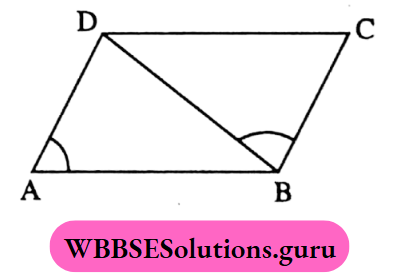
WBBSE Class 9 Maths Geometry Chapter 1 Angle BDC Equal To 45 Degrees


In the parallelogram ABCD, ∠C = ∠A = 75°

In ΔBCD, ∠BDC+ ∠CBD + ∠C = 180°

∠BDC +60° + 75° = 180°

or, ∠BDC = 180° – (60° + 75°) = 45°

The value of ∠BDC is 45°

Read and Learn More WBBSE Class 9 Maths Multiple Choice Questions

Example 2. Which of the following geometric diagonals equal in length

  1. Parallelogram
  2. Rhombus
  3. Trapezium
  4. Rectangle

Solution: The correct answer is 4. Rectangle
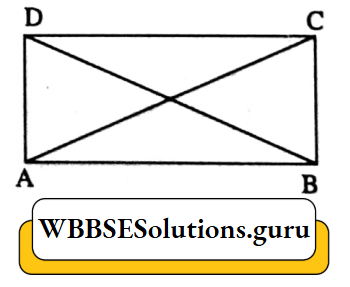
WBBSE Class 9 Maths Geometry Chapter 1 Geometric Has Diagonals Equal In Length Rectangle


The diagonals of each rectangle are equal in length.
WBBSE Class 9 Maths Geometry Chapter 1 Properties Of Parallelogram Multiple Choice Questions

Example 3. In the parallelogram ABCD, ∠BAD = ∠ABC, the parallelogram ABCD is a

  1. Rhombus
  2. Trapezium
  3. Rectangle
  4. None of them

Solution: The correct answer is 3. Rectangle
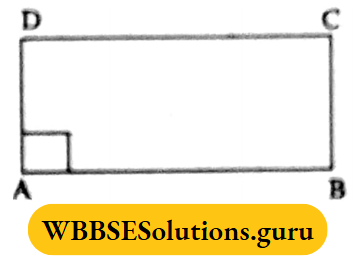
WBBSE Class 9 Maths Geometry Chapter 1 Parallelogram ABCD Is A Rectangle


In a parallelogram, ABCD, AD || BC, and AB is the intersection

∴ ∠BAD + ∠ABC = 180°

∠BAD + ∠BAD = 180°

2 ∠BAD = 180°

⇒ ∠BAD = 90°

∴ Parallelogram ABCD is a rectangle

WBBSE Solutions For Class 9 Fundamentals Of HistoryWBBSE Class 9 English Functional Grammar
WBBSE Class 9 Fundamentals Of History Long Answer QuestionsWBBSE Class 9 English Reading Skill
WBBSE Class 9 Fundamentals Of History Short Answer QuestionsWBBSE Class 9 English Writing Skill
WBBSE Class 9 Fundamentals Of History Very Short Answer QuestionsWBBSE Class 9 Maths Multiple Choice Questions
WBBSE Class 9 Fundamentals Of History Multiple Choice QuestionsWBBSE Solutions For Class 9 Maths
WBBSE Notes For Class 9 Geography and Environment


Example 4. In the parallelogram ABCD, M is the midpoint of the diagonal BD; if BM bisects ∠ABC, then the value of ∠AMB is

  1. 45°
  2. 60°
  3. 90°
  4. 75°

Solution: The correct answer is 3. 90°

WBBSE Class 9 Maths Geometry Chapter 1 In Parallelogram Angle AMB Is 90 Degrees


In parallelogram ABCD, AB || DC and BD its intersection.

∴ ∠ADB = alternate ∠DBC

∠ADB = ∠ABD [BM is the bisector of ∠ABC]

∴ AB = AD

In ΔABM and ΔADM,

AB = AD, BM = DM [M is the midpoint of BD] and AM = AM [common side]

∴ ΔABM ≅ ΔADM [by S.S.S. criterion of congruency)

∴ ∠AMB = ∠AMD

Again, ∠AMB+ ∠AMD = 180°

∠AMB + ∠AMB = 180°

2 ∠AMB = 180°

∠AMB = 90°

The value of ∠AMB is 90°

Example 5. In the rhombus ABCD, ∠ACB = 40°, the value of ∠ADB is

  1. 50°
  2. 110°
  3. 90°
  4. 120°

Solution: The correct answer is 1. 50°
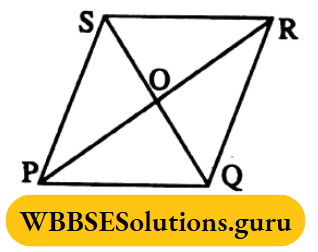
WBBSE Class 9 Maths Geometry Chapter 1 In Rhombus PQRS


Let O is the point of intersection of diagonals AC and BD of rhombus ABCD.

The diagonals of rhombus bisect each other perpendicularly.

∴ ∠BOC = 90°

In ΔBOC, ∠OBC + ∠BOC + ∠OCB = 180°

∠OBC + 90° + 40° = 180° [∠ACB = 40°]

or, ∠OBC = 50° i.e. ∠DBC = 50°

As DC || AB and BD is the intersection

∴ ∠ADB = alternate ∠DBC = 50°

The value of ∠ADB is 50°

Example 6. In parallelogram ABCD, if ∠A : ∠B = \(\frac{1}{2}\):\(\frac{1}{3}\),then the value of ∠C is

  1. 90°
  2. 36°
  3. 72°
  4. 108°

Solution: The correct answer is 4. 108°

∠A: ∠B = \(\frac{1}{2}\):\(\frac{1}{3}\) = 3: 2

∠A + ∠B = 180°

∠A = 180°x \(\frac{3}{3 + 2}\) = 180° x \(\frac{3}{5}\)=108°

∠C = ∠A = 108°

[Opposite angle of parallelogram are equal]

The value of ∠C is 108°

Example 7. The perimeter of a parallelogram is 22 cm. If the longer side measures 6.5 cm, then the measure of the shorter side is

  1. 9 cm
  2. 7.5 cm
  3. 4.5 cm
  4. 11 cm

Solution: The sum of two longer sides is (6.5 x 2) cm or 13 cm.

The sum of two shorter sides is (22 – 13) cm or 9 cm.

∴ The length of the shorter side is \(\frac{9}{2}\) cm or 4.5 cm.

∴ The correct answer is 3. 4.5 cm

Example 8. If the ratio of consecutive angles of a quadrilateral is 2: 1:3: 4, then the quadrilateral will be

  1. Parallelogram
  2. Square
  3. Rhombus
  4. None of them

Solution: The correct answer is 4. None of them

Let the angles are 2x°, x°, 3x°, 4x° [Where x is common multiple and x > 0]

2x + x + 3x + 4x = 360°

⇒ 10x = 360 ⇒ x = 36

∴ The angles are 36 x 2° 72°, 36°, 3 x 36° or 108°, 4 x 36° or 144°

{Opposite angle are not equal}

WBBSE Class 9 Maths Geometry Chapter 2 Transversal And Mid Point Theorem Multiple Choice Questions

WBBSE Class 9 Maths  Geometry Chapter 2 Transversal And Mid Point Theorem Multiple Choice Questions

Example 1. In the triangle PQR, ∠PQR = 90° and PR = 10 cm. If S is the midpoint of PQ, then the length of QS is

  1. 4 cm
  2. 5 cm
  3. 6 cm
  4. 3 cm

Read and Learn More WBBSE Class 9 Maths Multiple Choice Questions

Solution: The correct answer is 2. 5 cm

WBBSE Class 9 Maths Geometry Chapter 2 Triangle PQR Equal to 90 Degrees As S Is The Midpoint Of Hypotenuse PR


In ΔPQR, ∠PQR = 90°

As S is the midpoint of hypotenuse PR

∴ QS = \(\frac{1}{2}\)PR = (\(\frac{1}{2}\) x 10) cm = 5 cm

The length of QS is = 5 cm

Example 2. In the trapezium ABCD, AB || DC and AB = 7 cm, and DC = 5 cm. The midpoints of AD and BC are E and F respectively, the length of EF is

  1. 5 cm
  2. 6 cm
  3. 7 cm
  4. 12 cm

Solution: The correct answer is 3. 7 cm

WBBSE Class 9 Maths Geometry Chapter 2 In Triangle ABC The Value Of Angle APQ Is 60 Degrees


In trapezium ABCD, AB || DC and the midpoints of AD and BC are E and F respectively.

∴ EF = \(\frac{1}{2}\)(AB + DC) = \(\frac{1}{2}\)(7 + 5) cm = 6 cm

The length of EF is = 6 cm

WBBSE Class 9 Maths Geometry Chapter 2 Transversal And Mid Point Theorem Multiple Choice Questions

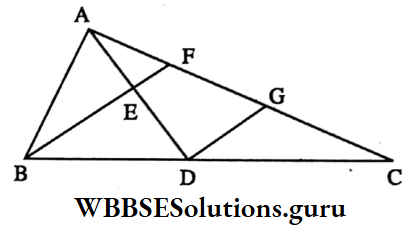
Example 3. In the triangle ABC, E is the midpoint of the median AD; the entended BE intersects AC at the point F. If AC = 10.5 cm, then the length of AF is

  1. 3 cm.
  2. 3.5 cm
  3. 2.5 cm
  4. 5 cm

Solution: The correct answer is 2. 3.5 cm

WBBSE 9 Maths Geometry Chapter 2 In Trapezium ABC The Length Of AF Is 2.5 cm


Through the midpoint D of the side BC a line segment parallel to the side BF is drawn which intersects AC at the point G.

In, ΔBFC, D is the midpoint of BC and DG || BF [According to construction]

∴ G is the midpoint of FC i.e. FG = GC

Again, In ΔADG, E is the midpoint of AD and EF || DG

∴ F is the midpoint of AG i.e. AF = FG

∴ AF = FG = GC = \(\frac{\mathrm{AF}+\mathrm{FG}+\mathrm{GC}}{3}\)

= \(\frac{1}{3} \mathrm{AC}=\left(\frac{1}{3} \times 10.5\right) \mathrm{cm}\) = 3.5 cm

The length of AF is 3.5 cm

WBBSE Solutions For Class 9 Fundamentals Of HistoryWBBSE Class 9 English Functional Grammar
WBBSE Class 9 Fundamentals Of History Long Answer QuestionsWBBSE Class 9 English Reading Skill
WBBSE Class 9 Fundamentals Of History Short Answer QuestionsWBBSE Class 9 English Writing Skill
WBBSE Class 9 Fundamentals Of History Very Short Answer QuestionsWBBSE Class 9 Maths Multiple Choice Questions
WBBSE Class 9 Fundamentals Of History Multiple Choice QuestionsWBBSE Solutions For Class 9 Maths
WBBSE Notes For Class 9 Geography and Environment


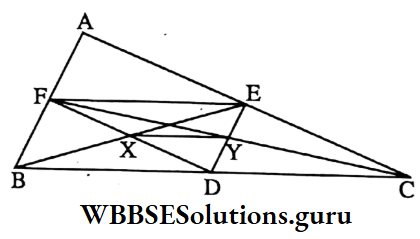
Example 4. In the ΔABC, the midpoints of BC, CA, and AB are D, E, and F respectively. BE and DF intersect at point X and CF and DE intersect at the point Y, the length of XY is equal to

  1. \(\frac{1}{2}\) BC
  2. \(\frac{1}{4}\) BC
  3. \(\frac{1}{3}\) BC
  4. \(\frac{1}{8}\) BC

Solution: The correct answer is 2. \(\frac{1}{4}\) BC

WBBSE Class 9 Maths Geometry Chapter 2 In Triangle ABC The Length Of XY Is Equal To 1 By 4 BC


In ΔABC, F and E are the midpoints of AB and AC respectively

∴ FE = \(\frac{1}{2}\) BC and FE || BC i.e. FE || BD

Again, D and E are the midpoints of BC and AC respectively.

∴ DE || AB i.e. DE || FB

In quadrilateral BDEF, BD || EF and DE || FB

∴ BDEF is a parallelogram.

The diagonals DF and BE of a parallelogram are bisects each other at X.

∴ X is the midpoint of DF

Similarly, DCEF is a parallelogram whose diagonals FC and DE bisect each other at Y

∴ Y is the midpoint of DE

In ΔDEF, X, and Y are the midpoints of DF and DE

∴ XY = \(\frac{1}{2}\) EF = \(\frac{1}{2}\) x \(\frac{1}{2}\) BC = \(\frac{1}{4}\) BC

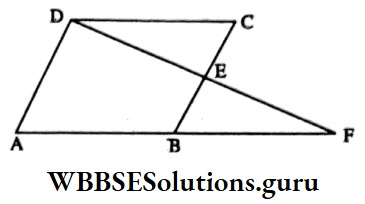
Example 5. In the parallelogram ABCD, E is the midpoint of the side BC; DE and extended AB meet at the point F. The length of AF is equal to

  1. \(\frac{3}{2}\) AB
  2. 2 AB
  3. 3 AB
  4. \(\frac{5}{4}\) AB

Solution: The correct answer is 2. 2 AB

WBBSE Class 9 Maths Geometry Chapter 2 In Parallelogram ABCD The Length Of AF Is Equal To 2 AB


In ΔDCF and ΔBEF,

CE = BE [E is the midpoint of BC]

∠DEC = ∠BEF [vertically opposite angles]

and ∠DEC = alternate ∠EBF  [DC || AF and BC is intersection]

∴ ΔDCF ≅ ΔBEF [by A-A-S criterion of congruency]

∴ DC = BF

Again, DC = AB [opposite sides of parallelogram ABCD]

∴ AB = BF

AF = AB + BF = AB + AB = 2 AB

The length of AF is equal to = 2 AB

Example 6. In ΔABC, D, and E are two midpoints of side AB and AC respectively. If DE = (a + b) cm the length of BC is

  1. \(\frac{a + b}{2}\)cm
  2. 2(a + b) cm
  3. (a – b) cm
  4. \(\frac{a – b}{2}\)cm

Solution: The correct answer is 2. 2(a + b) cm

WBBSE Class 9 Maths Geometry Chapter 2 In Triangle ABC The Length Of BC Is 2ab cm


As D and E are two midpoints of side AB and AC respectively.

∴ DE = \(\frac{1}{2}\) BC

or, BC = 2DE = 2(a + b) cm

The length of BC is = 2(a + b) cm

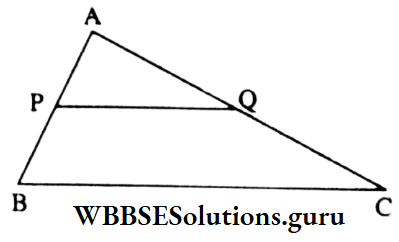
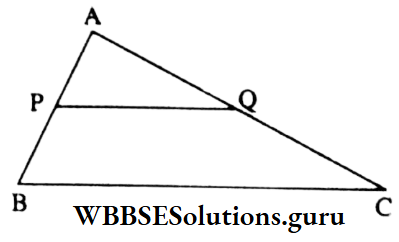
Example 7. In ΔABC, ∠A = 50°, ∠B = 60° and ∠C = 70°; P and Q are two midpoints of AB and AC respectively. The value of ∠APQ is

  1. 50°
  2. 70°
  3. 60°
  4. None of them

Solution: The correct answer is 3. 60°

WBBSE Class 9 Maths Geometry Chapter 2 In Triangle ABC The Value Of Angle APQ Is 60 Degrees


As, P, and Q are midpoints of side AB and AC

∴ PQ || BC

∴ ∠APQ corresponding ∠ABC = 60°

The value of ∠APQ is = 60°

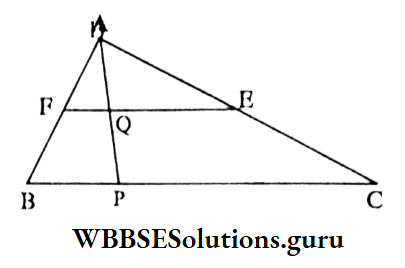
Example 8. In ΔABC, E and F are the midpoints of AC and AB respectively. The altitude AP to BC intersects FE at Q. If PQ = 6 cm, then the length of AQ is

  1. 6 cm
  2. 3 cm
  3. 12 cm
  4. none of them.

Solution: The correct answer is 1. 6 cm

WBBSE Class 9 Maths Geometry Chapter 2 In Triangle ABC The Length Of AQ Is 6 cm


In ΔABC, E and F are midpoints of sides AC and A respectively.

∴ EF || BC

⇒ FQ || BP

In ΔABP, F is the midpoint of AB and FQ || BP

∴ Q is the midpoint of AP

i.e. AQ = QP = 6 cm

The length of AQ i= 6 cm

WBBSE Class 9 Maths Geometry Chapter 3 Theorems On Area Multiple Choice Questions

WBBSE Class 9 Maths Geometry Chapter 3 Theorems On Area Multiple Choice Questions

Example 1. D, E, and F are midpoints of sides BC, CA, and AB respectively of a triangle ABC. If ΔABC = 16 sq. cm, then the area of the trapezium-shaped region FBCE.

  1. 50 sq. cm
  2. 8 sq. cm
  3. 12 sq. cm
  4. 100 sq. cm

Solution: The correct answer is 3. 12 sq. cm

Read and Learn More WBBSE Class 9 Maths Multiple Choice Questions

In ΔABC, F and E are the midpoints of AB and AC respectively.

WBBSE Class 9 Maths Geometry Chapte-3D E And F Are Midpoints Of Side BC CA AB


∴ FE || BC or, FE || BD

Similarly, DE || BF

In quadrilateral BDEF, FE || BD and BF || DE

∴ BDEF is a parallelogram whose one diagonal is FD

∴ ΔBDF ≅ ΔDEF

∴ ΔBDF = ΔDEF

Similarly, ΔDEF = ΔAEF and ΔDEF = ΔCDE

∴ ΔDEF = ΔBDF = ΔAEF = ΔCDE

ΔDEF + ΔBDF + ΔAEF + ΔCDE = ΔABC

∴ ΔDEF + ΔDEF + ΔDEF +ΔDEF

or, 4 ΔDEF 16 sq. cm

or, ΔDEF = 4 sq. cm

∴ ΔBDF = ΔCDE = 4 cq. cm

∴ Area of the trapezium shaped region FBCE = ΔBDF + ΔDEF + ΔCDE

∴ Area of the trapezium shaped region FBCE = (4 + 4 + 4) sq. cm = 12 sq. cm

Example 2. A, B, C, and D are the midpoints of sides PQ, QR, RS, and SP respectively of the parallelogram PQRS. If area of the parallelogram-shaped region PQRS = 36 sq. cm then area of the region ABCD is

  1. 24 sq. cm
  2. 18 sq. cm
  3. 30 sq. cm
  4. 36 sq. cm

Solution: The correct answer is 4. 36 sq. cm

I join D, B.

WBBSE Class 9 Maths Geometry Chapter 3 ABCD Are The Midpoints Of Sides PQ QR RS And SP


In quadrilateral PQBD, PD || QB  [PS || QR]

and PD = QB  [\(\frac{1}{2}\) PS = \(\frac{1}{2}\) QR]

∴ PQRS is a parallelogram,  ∴ DB || PQ

Similarly, DBRS is a parallelogram

ΔABD and parallelogram PQBD, are on same base DB and between same parallels DB and PQ

ΔABD = \(\frac{1}{2}\) parallelogram PQBD

Similarly, ΔBCD = \(\frac{1}{2}\) parallelogram DBRS

ΔABD = ΔBCD = \(\frac{1}{2}\) [parallelogram PQBD + parallelogram DBRS]

i.e. quadrilateral ABCD = \(\frac{1}{2}\) parallelogram PQRS

∴ Area of quadrilateral ABCD = (\(\frac{1}{2}\) x36) sq cm = 18 sq. cm

WBBSE Class 9 Maths Geometry Chapter 3 Theorems On Area Multiple Choice Questions

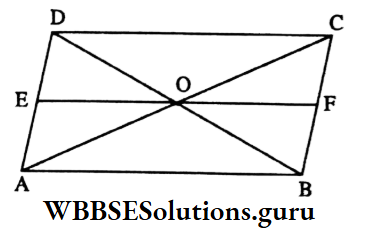
Example 3. O is any a point inside parallelogram ABCD. If ΔAOB + ΔCOD = 16 sq. cm, then area of the parallelogram-shaped region ABCD is

  1. 8 sq. cm
  2. 4 sq. cm
  3. 32 sq. cm
  4. 64 sq. cm

Solution: The correct answer is 3. 32 sq. cm

Through the point O a straight line parallel to AB or CD is drawn which intersects the sides AD and BC at the points E and F respectively.

In quadrilateral ΔBFE, AB || EF and AE || BF

∴ ABFE is a parallelogram.

WBBSE Class 9 Maths Geometry Chapter 3 Theorems On Area O Is Any Point Inside Parallelogram ABCD


ΔAOB and parallelogram ABFE, are on same base AB and between same parallels AB and EF

∴ ΔAOB = \(\frac{1}{2}\) parallelogram ABFE

Similarly, ΔCOD = \(\frac{1}{2}\) parallelogram CDEF

ΔAOB+ ΔCOD = \(\frac{1}{2}\)(parallelogram ABFE + parallelogram CDEF)

16 sq. cm = \(\frac{1}{2}\) parallelogram ABCD

or, Area of parallelogram = 32 sq. cm

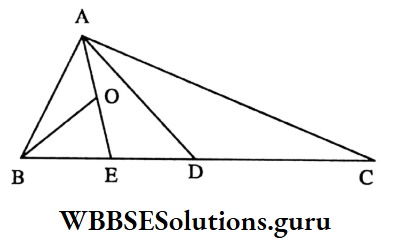
Example 4. D is the midpoint of side BC of triangle ABC. E is the midpoint of side BD and O is the midpoint of AE; area of triangular field BOE is

  1. \(\frac{1}{3}\) x Area of ΔABC
  2. \(\frac{1}{4}\) x Area of ΔABC
  3. \(\frac{1}{6}\) x Area of ΔABC
  4. \(\frac{1}{8}\) x Area of ΔABC
WBBSE Solutions For Class 9 Fundamentals Of HistoryWBBSE Class 9 English Functional Grammar
WBBSE Class 9 Fundamentals Of History Long Answer QuestionsWBBSE Class 9 English Reading Skill
WBBSE Class 9 Fundamentals Of History Short Answer QuestionsWBBSE Class 9 English Writing Skill
WBBSE Class 9 Fundamentals Of History Very Short Answer QuestionsWBBSE Class 9 Maths Multiple Choice Questions
WBBSE Class 9 Fundamentals Of History Multiple Choice QuestionsWBBSE Solutions For Class 9 Maths
WBBSE Notes For Class 9 Geography and Environment

Solution: The correct answer is 4. \(\frac{1}{8}\) x Area of ΔABC

I join A and D.

AD is a median of ΔABC

WBBSE Class 9 Maths Geometry Chapter 3 D IS The Midpoint Of Side Bc Triangle ABC


∴ ΔABD = \(\frac{1}{2}\) ΔABC

AE is a median of ΔABD

∴ ΔABE = \(\frac{1}{2}\) ΔABD

BO is a median of ΔABE

∴ ΔBOE = \(\frac{1}{2}\) ΔABE = \(\frac{1}{2}\) x \(\frac{1}{2}\) ΔABD = \(\frac{1}{4}\) x \(\frac{1}{2}\) ΔABC = \(\frac{1}{8}\) ΔABC

Example 5. A parallelogram, a rectangle, and a triangular region stand on same base and between same parallel, and it their area are P, R, and T respectively then

  1. P = R = 2T
  2. P = R = \(\frac{T}{2}\)
  3. 2P = 2R = T
  4. P = R = T

Solution: The correct answer is 1. P = R = 2T

If a parallelogram and a rectangle are on same base and between same parallel, then area of the parallelogram and rectangle are equal [As the rectangle is a parallelogram]

∴ P = R

Again a parallelogram and a triangle are on same base and between same parallel.

WBBSE Class 9 Maths Geometry Chapter-3 Parallelogram And A Rectangle Are On Same Base


∴ Area of triangle is equal to half of area of parallelogram.

∴ T = \(\frac{P}{2}\)

or, P = 2T

∴ P = R = 2T

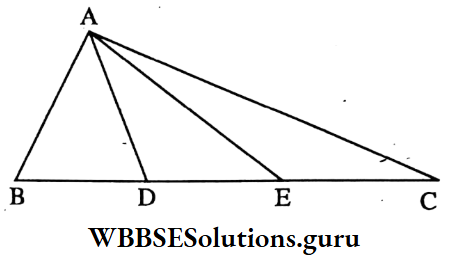
Example 6. The points D and E on sides BC of a triangle ABC such that BD = DE = EC; If the area of ΔABC is 12 sq. cm then the area of ΔABC is

  1. 6 sq. cm
  2. 12 sq. cm
  3. 18 sq. cm
  4. 24 sq. sm

Solution: The correct answer is 3. 18 sq. cm

AD is a median of ΔABE

∴ ΔADE = ΔABD = \(\frac{1}{2}\) ΔABE

WBBSE Class 9 Maths Geometry Chapter 3 Point D And E On Sides BC Of A Triangle ABC


= (\(\frac{1}{2}\) x 12) sq. cm = 6 sq. cm

AE is a median of ΔADC

∴ ΔABC = ΔABD + ΔADE + ΔAEC

= (6+6+6) sq. cm = 18 sq. cm

Example 7. In ΔABC, P is the midpoint of median AD. If area of ΔAPC is 12 sq. em then the area of ΔBPC is

  1. 6 sq. cm
  2. 12 sq. cm
  3. 15 sq. cm
  4. 24 sq. cm

Solution: The correct answer is 4. 24 sq. cm

CP is a median of ΔADC,

WBBSE Class 9 Maths Geometry Chapter 3 P Is The Midpoint Of Median AD


ΔDPC = ΔAPC = \(\frac{1}{2}\) ΔACD

or, ΔADC = 2 ΔAPC (2 x 12) sq. cm = 24 sq. cm

PD is a median of ΔBPC

∴ ΔBPD = ΔDPC = 12 sq. cm  [ΔAPC = ΔDPC]

ΔBPC = ΔBPD + ΔDPC

ΔBPC = (12 + 12) sq. cm = 24 sq. cm

Example 8. In ΔABC, D, E, and F are midpoints of sides BC, CA, and AB respectively. If area of trapezium ABDE is 15 sq. cm, then area of ΔABC is

  1. 7.5 sq. cm
  2. 12 sq. cm
  3. 20 sq. cm
  4. 30 sq. cm

Solution: The correct answer is 3. 20 sq. cm

I join E, F and F, D.

In ΔABC, D, and E are the midpoints of BC and AC respectively.

WBBSE Class 9 Maths Geometry Chapter 3 Area Of Trapezium ABCD


∴ DE || AB i.e. DE || AF and DE = \(\frac{1}{2}\) AB

or DE = AF

∴ AFDE is a parallelogram whose diagonal is EF.

∴ ΔDEF = ΔAEF

Similarly, ΔDEF= ΔBDF and ΔDEF = ΔCDE

∴ ΔAEF = ΔBDF = ΔCDE = ΔDEF = x sq. cm [say, x > 0]

Area of trapezium of ABDE = ΔAEF + ΔDEF + ΔBDF

=(x+x+x) sq. cm = 3x cm

According to question 3x = 15 or x = 5

ΔABC = ΔAEF + ΔBDF + ΔDEF+ ΔCDE = (5+5+5+5) sq. cm = 20 sq. cm

WBBSE Class 9 Maths Geometry Chapter 4 Theorems On Concurrence Multiple Choice Questions

WBBSE Class 9 Maths  Geometry Chapter 4 Theorems On Concurrence Multiple Choice Questions

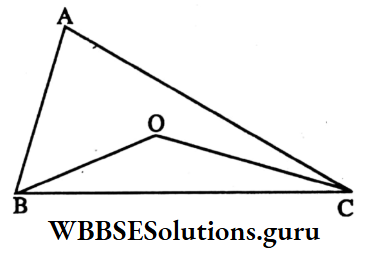
Example 1. O is the circumcentre of ΔABC; if ∠BOC = 80°, the ΔBAC is

  1. 40°
  2. 160°
  3. 130°
  4. 110°

Solution: The correct answer is 1. 40°

Read and Learn More WBBSE Class 9 Maths Multiple Choice Questions

I join A, O and AO is extended at T.

WBBSE-Solutions-For-Class-9-Maths-Geometry-Chapter-4-Theorems-On-Concurrence-O-Is-The-Circumcentre-Of-Triangle-ABC


In ΔAOB, OA = OB [circumradius]

∴ ∠OAB = ∠OBA

In ΔAOB, the exterior ∠BOT = ∠OAB+ ∠OBA

= ∠OAB + ∠OAB = 2 ∠OAB.

Similarly, ∠COT = 2 ∠OAC

∠BOC = ∠BOT + ∠COT

∠BOC = 2(∠OAB + ∠OAC)

80° = 2 ∠BAC

or, ∠BAC 40°

Example 2. O is the orthocentre of ΔABC; if ∠BAC = 40°, the ∠BOC is

  1. 80°
  2. 140°
  3. 110°
  4. 40°

Solution: The correct answer is 2. 140°

In ΔABC, AD ⊥ BC, BE ⊥ CA and CF ⊥ AB.

WBBSE Solutions For Class 9 Fundamentals Of HistoryWBBSE Class 9 English Functional Grammar
WBBSE Class 9 Fundamentals Of History Long Answer QuestionsWBBSE Class 9 English Reading Skill
WBBSE Class 9 Fundamentals Of History Short Answer QuestionsWBBSE Class 9 English Writing Skill
WBBSE Class 9 Fundamentals Of History Very Short Answer QuestionsWBBSE Class 9 Maths Multiple Choice Questions
WBBSE Class 9 Fundamentals Of History Multiple Choice QuestionsWBBSE Solutions For Class 9 Maths
WBBSE Notes For Class 9 Geography and Environment

WBBSE-Solutions-For-Class-9-Maths-Geometry-Chapter-4-Theorems-On-Concurrence-O-Is-The-Orthocentre-Of-Triangle-ABC


As BE ⊥ AC,

∴ ∠AEO = 90°

CF ⊥ AB,

∴ ∠AFO = 90°

In quadrilateral AEOF,

∠EAF + ∠AEO + ∠EOF+ ∠AFO = 360°

40° + 90° + ∠EOF+ 90° = 360° [∠BAC= 40°]

⇒ ∠EOF = 140°

∠BOC = vertically opposite ∠EOF= 140°

WBBSE Class 9 Maths Geometry Chapter 4 Theorems On Concurrence Multiple Choice Questions

Example 3. O is the incentre of ΔABC; if ∠BAC 40°, then ∠BOC is

  1. 80°
  2. 110°
  3. 140°
  4. 40°

Solution: The correct answer is 110°

O is the incentre of ΔABC

WBBSE-Solutions-For-Class-9-Maths-Geometry-Chapter-4-Theorems-On-Concurrence-O-Is-The-Incentre-Of-A-Triangle-ABC


∴ ∠OBC = \(\frac{1}{2}\) ∠ABC and

∠OCB = \(\frac{1}{2}\) ∠ACB

∠OBC + ∠OCB = \(\frac{1}{2}\) (∠ABC + ∠ACB)

= \(\frac{1}{2}\) (180° – ∠BAC)

= \(\frac{1}{2}\) (180° – 40°) = 70°

In ΔBOC, ∠BOC = 180° – (∠OBC + ∠OCB)

= 180° – 70° = 110°

∠BOC = 110°

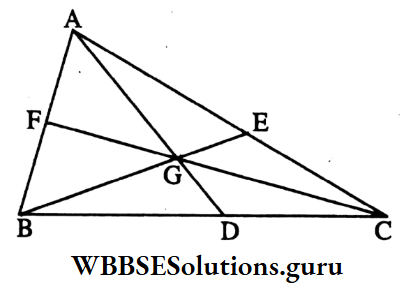
Example 4. G is the centroid of triangle ABC; if area of ΔGBC is 12 sq. cm, then the area of ΔABC is

  1. 24 sq. cm
  2. 6 sq. cm
  3. 36 sq. cm
  4. None of them

Solution: The correct answer is 3. 36 sq. cm

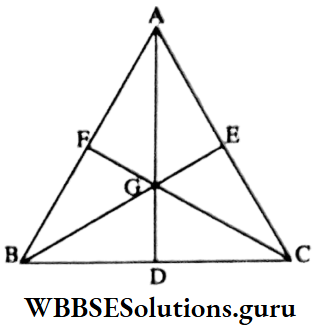
AD is a median of ΔABC

WBBSE-Solutions-For-Class-9-Maths-Geometry-Chapter-4-Theorems-On-Concurrence-G-Is-The-Centriod-Of-Triangle-ABC


∴ ΔABD = ΔACD

GD is a median of ΔGBC

∴ ΔBGD = ΔCGD

∴ ΔABD – ΔBGD = ΔACD – ΔCGD

i.e. ΔAGB = ΔACG

Similarly, ΔABG = ΔGBC

∴ ΔABG = ΔACG = ΔGBC

ΔABG + ΔACG + ΔGBC = ΔABC

ΔGBC + ΔGBC + ΔGBC = ΔABC

ΔABC = 3 ΔGBC

= (3 x 12) sq. cm = 36 sq. cm.

The area of ΔABC is = 36 sq. cm.

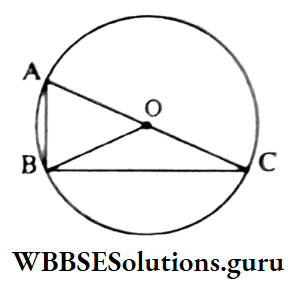
Example 5. If the length of circumradius of a right-angled triangle is 5 cm, then the length of the hypotenuse is

  1. 2.5 cm
  2. 10 cm
  3. 5 cm
  4. None of these

Solution: The correct answer is 2. 10 cm

WBBSE-Solutions-For-Class-9-Maths-Geometry-Chapter-4-Theorems-On-Concurrence-Length-Of-Circumradius-Of-A-Right-Angled-Triangle


The circumcentre of a right-angled triangle is on the midpoint of hypotenuse.

The length of hypotenuse = 2 x circumradius

= (2 × 5) cm = 10 cm

The length of hypotenuse = 10 cm

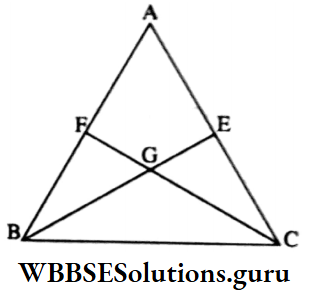
Example 6. If the length of two median of a triangle are equal, then the triangle will be

  1. Equilateral triangle
  2. Isosceles triangle
  3. Scalene triangle
  4. None of them

Solution: The correct answer is 2. Isosceles triangle

In ΔABC, two medians intersect at G (centroid).

WBBSE-Solutions-For-Class-9-Maths-Geometry-Chapter-4-Theorems-On-Concurrence-Length-Of-Circumradius-Of-Two-Median-Of-A-Triangle-Are-Equal


BE = CF [Given]

BG: GE = 2: 1 and CG: GF = 2:1

\(\frac{\mathrm{BG}}{\mathrm{GE}}=\frac{2}{1}\)

or, \(\frac{\mathrm{GE}}{\mathrm{BG}}=\frac{2}{1}\)

or, \(\frac{\mathrm{GE}}{\mathrm{BG}}+1=\frac{1}{2}+1\)

or, \(\frac{\mathrm{BE}}{\mathrm{BG}}=\frac{3}{2}\)

or, \(\mathrm{BG}=\frac{2}{3} \mathrm{BE}\)

Similarly, CG = \(\frac{2}{3}\) CF

BE = CF

or, \(\frac{2}{3}\) BE = \(\frac{2}{3}\) CF

∴ BG = CG

BE – BG = CF – CG i.e., GE GF

In ΔBGF and ΔCGE, BG = CG, GF = GE and ∠BGF = ∠CGE [vertically opposite angle]

∴ ΔBGF ≅ ΔCGE [by, SAS criterion of congruency]

∴ FB = EC

or, \(\frac{1}{2}\) AB = \(\frac{1}{3}\) AC

or, AB = AC

∴ ΔABC is a isosceles triangle.

Example 7. If the length of circum-radius of a equilateral triangle is 6 cm, then the perimeter of the triangle is

  1. 6√3 cm
  2. 12 cm
  3. 18√3 cm
  4. 3√/2 cm

Solution: The correct answer is 3. 18√3 cm

In an equilateral triangle, circumcentre and centroid are coincide.

WBBSE-Solutions-For-Class-9-Maths-Geometry-Chapter-4-Theorems-On-Concurrence-In-Equilateral-Triangle-Circumcentre-And-Centriod-Are-Coincide


In equilateral triangle ABC, the medians AD and BE intersects at point G (centroid).

The length of circumradius (AG) is 6 cm.

Again, AG : GD = 2:1

∴ GD = (\(\frac{1}{2}\) x 6) cm = 3 cm

AD = AG+ GD (6 + 3) cm = 9 cm

If the length of each side is x cm then the height of triangle is \(\frac{\sqrt{3}}{2}\) x cm [x > 0]

\(\frac{\sqrt{3x}}{2}\) = 9

or, x = \(\frac{9 \times 2}{\sqrt{3}}\) = 3√3 x 2 = 6√3

∴ Perimeter of the triangle is (3 x 6√3) cm = 18√3 cm

Example 8. If the three medians of ΔABC are AD, BE and CF, then

  1. AB + BC + CA > AD + BE + CF
  2. AB + BC + CA < AD + BE + CF
  3. AB + BC + CA = AD + BE + CF
  4. None of them

Solution: The correct answer is 1. AB + BC + CA > AD + BE + CF

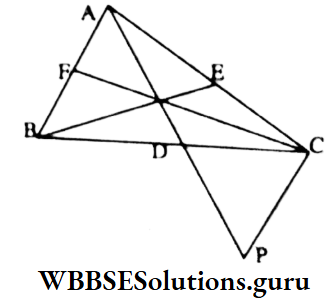
AD is extended at P such that AD = DP;

I join C, P.

WBBSE-Solutions-For-Class-9-Maths-Geometry-Chapter-4-Theorems-On-Concurrence-Three-Medians-Of-Triangle-ABC


In ΔABD and ΔCDP,

BD = CD, AD = DP and ∠ADB = ∠CDP [vertically opposite angles]

∴ ΔABD ≅ ΔCDP [by S-A-S criterion of congruency]

∴ AB = CP

In ΔAPC, AC + CP > AP [Sum of length of two sides of a triangle is greater than the length of third side]

∴ AC + AB > AD + PD

AB + AC > AD + AD

AB + AC > 2 AD …….(1)

Similarly BC + AC > 2 CF……(2)

and AB = BC > 2BE…..(3)

(1) + (2) + (3) we get,

2(AB + BC + CA) = 2(AD+ BE + CF)

⇒ AB + BC + CA > AD + BE + CF

WBBSE Class 9 Maths Mensuration Chapter 1 Area And Perimeter Of Triangle And Quadrilateral Useful Information And Formulae Multiple Choice Questions

WBBSE Class 9 Maths  Mensuration Chapter 1 Area And Perimeter Of Triangle And Quadrilateral Useful Information And Formulae Multiple Choice Questions

Example 1. The length of the diagonal of a square is 12√2 cm, and the area of the square is

  1. 288 sq cm
  2. 144 sq cm
  3. 72 sq cm
  4. 18 sq cm

Solution: \(\frac{12 \sqrt{2}}{\sqrt{2}}\) cm = 12 cm

Area = (12)2 sq cm = 144 sq cm

Read and Learn More WBBSE Class 9 Maths Multiple Choice Questions

∴ The correct answer is 2. 144 sq cm

∴ The area of the square is 144 sq cm

Example 2. If the area of a square is A1 sq units and the area of square drawn on the diagonal of that square is A2 sq units then A1:A2 is

  1. 1: 2
  2. 2: 1
  3. 1: 4
  4. 4: 1

Solution: Let the length of the side of A1 be a units

∴ length of the side of A2 = √2a units

∴ Ratio a2: (√2a)2 = 1:2

∴ The correct answer is 1. 1: 2

∴ A1:A2 is 1: 2

Example 3. If the rectangular place of which length and breadth are 6 mt & 4 mt is desired to prove it with 2 cm square tiles, then the no. of tiles will be

  1. 120000
  2. 240000
  3. 60000
  4. 180000

Solution: No. of tiles = \(\frac{600 \times 400}{2 \times 2}\) = 300 x 200 = 60000

∴ The correct answer is 3. 60000

WBBSE Class 9 Maths Mensuration Chapter 1 Area And Perimeter Of Triangle And Quadrilateral Useful Information And Formulae Multiple Choice Questions

Example 4. If a square and a rectangle having the same perimeter and areas are S and R, then

  1. S = R
  2. S > R
  3. S < R

Solution: Let the length and breadth of the rectangle be x units and y units and length of the square be a units

∴ 2(x + y) = 4a

∴ x + y = 2a

Now, (x − y)2 > 0

or,(x + y)2 > 4xy

or, \(\left(\frac{x+y}{2}\right)^2\) > xy

or, a2 > xy

∴ S > R

∴ The correct answer is 2. S > R

Example 5. If the length of the diagonal of a rectangle is 10 cm and the area is 62.5 sq cm, then the sum of their length and breadth is

  1. 12 cm
  2. 15 cm
  3. 20 cm
  4. 25 cm

Solution: If the length and breadth be x cm and y cm, then x2 + y2 = 100 and xy = 62.5

or, (x + y)2 – 2xy = 100

or, (x + y)2 = 100+ 2 x 62.5 = 100 + 125 = 225

∴ x + y = 15

∴ The correct answer is 2. 15 cm

∴  The sum of diagonal of a rectangle length and breadth is 15 cm

WBBSE Solutions For Class 9 Fundamentals Of HistoryWBBSE Class 9 English Functional Grammar
WBBSE Class 9 Fundamentals Of History Long Answer QuestionsWBBSE Class 9 English Reading Skill
WBBSE Class 9 Fundamentals Of History Short Answer QuestionsWBBSE Class 9 English Writing Skill
WBBSE Class 9 Fundamentals Of History Very Short Answer QuestionsWBBSE Class 9 Maths Multiple Choice Questions
WBBSE Class 9 Fundamentals Of History Multiple Choice QuestionsWBBSE Solutions For Class 9 Maths
WBBSE Notes For Class 9 Geography and Environment

Example 6. If each side of an equilateral triangle is 4 cm, the measure of height is

  1. 4√3 cm
  2. 16√3 cm
  3. 8√3 cm
  4. 2√3 cm

Solution: Height = \(\frac{\sqrt{3}}{2} \times 4^2 \mathrm{~cm}=2 \sqrt{2}\) cm

∴ The correct answer is 4. 2√3 cm

∴ Equilateral triangle height is 2√3 cm

Example 7. Isosceles right-angled triangle of which the length of each side of equal two sides of a units. The perimeter is

  1. (1 + √2) a units
  2. (2 + √2) a units
  3. 3a units
  4. (3 + 2√2 )a units

Solution: Hypotenuse AC = \(\sqrt{a^2+b^2} \text { units }=a \sqrt{2} \text { units }\)

WBBSE Class-9 Maths Mensuration Chapter 1 Isosceles Right Angled Triangle


perimeter = (a + a + a√2) units = (2 + √2) a units

∴ The correct answer is 2. (2 + √2) a units

∴ The perimeter of Isosceles right-angled triangle is  (2 + √2) a units

Example 8. If the area, perimeter, and height of an equilateral triangle are a, s, h then \(\frac{2a}{h}\) = 

  1. 1
  2. \(\frac{1}{2}\)
  3. \(\frac{1}{3}\)
  4. \(\frac{1}{4}\)

Solution: \(\frac{2 a}{s h}=\frac{2 \times \frac{\sqrt{3}}{4} \times(\text { sidc })^2}{3 \times \text { side } \times \frac{\sqrt{3}}{2} \times \text { side }}=\frac{2 \sqrt{3}}{4} \times \frac{2}{3 \sqrt{3}}=\frac{1}{3}\)

∴ The correct answer is 3. \(\frac{1}{3}\)

Example 9. The length of each equal side of an isosceles triangle is 5 cm and length of base is 6 cm. The area is

  1. 18 sq cm
  2. 12 sq cm
  3. 15 sq cm
  4. 30 sq cm

Solution: area = \(\frac{1}{2} \times 6 \sqrt{5^2-\frac{6^2}{4}} sq cm\)

= 3\(\sqrt{25-9} \mathrm{sq} \mathrm{cm}=12 \mathrm{sq} \mathrm{cm}\)

∴ The correct answer is 2. 12 sq cm

The area is isosceles triangle is

Example 10. D is such a point on AC of triangle ABC so that AD: DC = 3:2 if the area of triangle ABC is 40 sq cm the area of ΔDBC is

  1. 16 sq cm
  2. 24 sq cm
  3. 15 sq cm
  4. 30 sq cm

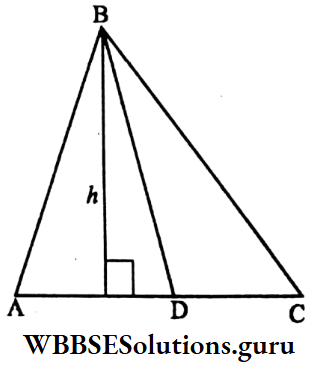
Solution: \(\frac{A D}{D C}=\frac{3}{2}\)

\(\frac{\triangle \mathrm{ABC}}{\Delta \mathrm{BDC}}=\frac{\frac{1}{2} h \mathrm{AC}}{\frac{1}{2} h \mathrm{DC}}=\frac{5}{2}\)

WBBSE Class 9 Maths Mensuration Chapter 1 Area And Perimeter Of Triangle And Quadrilateral Useful Information And Formulae


or \(\frac{A D+D C}{D C}=\frac{3+2}{2}\)

or, \(\frac{40}{\triangle B D C}=\frac{5}{2}\)

or, \(\frac{\mathrm{AC}}{\mathrm{DC}}=\frac{5}{2}\)

or, \(\triangle \mathrm{BDC}=\frac{40 \times 2}{5}=16\)

∴ The correct answer is 1. 16 sq cm

∴ The area of ΔDBC is 16 sq cm

Example 11. The difference of length of each side of a triangle from its semi-perimeter are 8 cm, 7 cm and 5 cm respectively. The area is

  1. 20√7 sq cm
  2. 10√14 sq cm
  3. 20√14 sq cm
  4. 140 sq cm

Solution: s – a = 8

\(\begin{gathered}
s-b=7 \\
s-c=5 \\
\hline 3 s-s=20
\end{gathered}\)


\(\Delta=\sqrt{10(8)(7)(5)} \text { sq cm }\)


= \(\sqrt{400 \times 7} \mathrm{sq} \mathrm{cm}\)

= 20√7

∴ s = 10

∴ The correct answer is 1. 20√7 sq cm

∴ The area of a triangle is 20√7 sq cm

Example 12. The height of the parallelogram is 1/3 rd of its base. If the area is 192 sq cm, the height is

  1. 4 cm
  2. 8 cm
  3. 16 cm
  4. 24 cm

Solution: Base x height = 192

or, 3h × h = 192

or, h2 = 64

h = 8

∴ The correct answer is 2. 8 cm

∴ The parallelogram height is 2. 8 cm

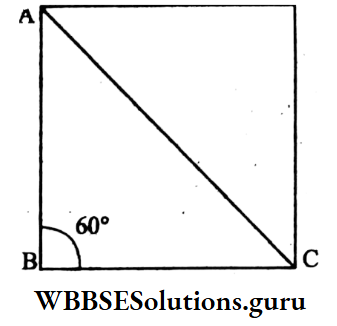
Example 13. If the length of one side of a rhombus is 6 cm, and one angle is 60° the area will be

  1. 9√3 sq cm
  2. 18√3 sq cm
  3. 36√3 sq cm
  4. 6√3 sq cm

Solution: ΔABC is an equilateral triangle

WBBSE Class 9 Maths Mensuration Chapter 1 Rhombus


∴ Area = 2\(\frac{\sqrt{3}}{4}\) x 62 sq cm = 18√3 sq cm

∴ The correct answer is 2. 18√3 sq cm

∴ The area will be a rhombus 18√3 sq cm

Example 14. The length of one diagonal of rhombus is its 3 times, of another diagonal. If the area of field in the shape of rhombus is 96 sq cm. Then the length of long diagonal is

  1. 8 cm
  2. 12 cm
  3. 16 cm
  4. 24 cm

Solution: \(\frac{1}{2}\) x 3 x (shorter diagonal)2 = 96

or, shorter diagonal = \(\sqrt{\frac{3296 \times 2}{3}}=\sqrt{64}\) = 8 cm

∴ length of the long diagonal = 24 cm

∴ The correct answer is 4. 24 cm

∴ The length of long diagonal of rhombus is 24 cm

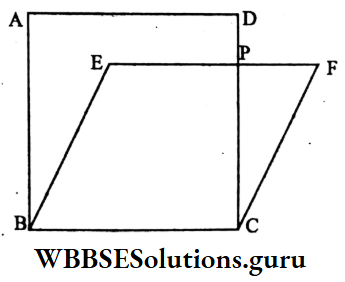
Example 15. A rhombu and a square are on the same base. If the area of square is x2 sq units and area of rhombus be y sq units then

  1. y > x2
  2. y < x2
  3. y = x2

Solution: CP ⊥ EF

WBBSE Class 9 Maths Mensuration Chapter 1 Rhombus And Sqaure Same Base


CF > CP

or, AB > CP (AB = CF)

∴ AB x AB > AB x CP

or, x2 > y

∴ The correct answer is 2. y < x2

Example 16. Area of a field of a trapezium is 162 sq cm and height is 6 cm. If length of one parallel side is 23 cm, then the length of other parallel side is

  1. 29 cm
  2. 31 cm
  3. 32 cm
  4. 33 cm

Solution: \(\frac{1}{2}\)(23 + x)x 6 = 162

(Let length of other parallel side be x cm)

or, 23 + x = 54

∴ x = 31

∴ The correct answer is 2. 31 cm

∴ The length of other parallel side is 31 cm

WBBSE Class 9 Maths Mensuration Chapter 2 Circumference Of Circle Multiple Choice Questions

WBBSE Class 9 Maths Mensuration Chapter 2 Circumference Of Circle Multiple Choice Questions

Example 1. The ratio of the velocity of the hour’s hand and minute’s hand at a clock is

  1. 1: 12
  2. 12: 1
  3. 1: 2h
  4. 2h: 1

Solution: Let the length of the radius of the clock = r unit

∴ In 1 hour hour’s hand covers = \(\frac{2 \pi r}{12}\) unit

In h hour minute’s hand covers 2πr unit

∴ Ratio = \(\frac{2 \pi r}{12}\): 2πr = \(\frac{1}{2}\): 1 = 1: 12

Read and Learn More WBBSE Class 9 Maths Multiple Choice Questions

∴ The correct answer is 1. 1: 12

Example 2. Some take \(\frac{\pi x}{100}\) minute to go one completer round of a circular path. Soma will take time for going round the park diametrically.

  1. \(\frac{x}{200}\)minutes
  2. \(\frac{x}{100}\)minutes
  3. \(\frac{\pi}{100}\)minutes
  4. \(\frac{\pi}{200}\)minutes

Solution: Soma covers 2πr unit in \(\frac{\pi x}{100}\)

Some covers 2r unit in \(\frac{\pi}{100}\) minute

∴ The correct answer is 3. \(\frac{\pi}{100}\)minutes

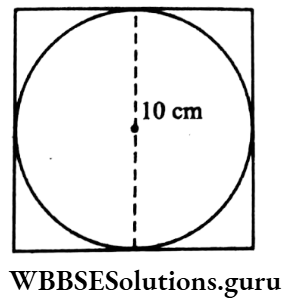
Example 3. A circle is inscribed by a square. The length of side of square is 10 cm. The length of diameter of circle is

  1. 10 cm
  2. 5 cm
  3. 20 cm
  4. 10√2 cm

Solution: Length of the side of the square

WBBSE Class 9 Maths Mensuration Chapter 2 A Circle Inscribed By A Square


= Diameter of the circle = 10 cm

∴ The correct answer is 1. 10 cm

∴ The length of diameter of circle is 10 cm

WBBSE Class 9 Maths Mensuration Chapter 1 Circumference Of Circle Multiple Choice Questions

Example 4. A circle circumscribed a square. The length of side of square is 5 cm. The length of diameter of circle is

  1. 5√2 cm
  2. 10√2 cm
  3. 5 cm
  4. 10 cm

Solution: Length of the diameter = Length of the diagonal of the square = 5√2 cm.

WBBSE Class 9 Maths Mensuration Chapter 2 A Circle Circumscribed A Square


∴ The correct answer is 1. 5√2 cm

∴ The length of diameter of circle is 5√2 cm

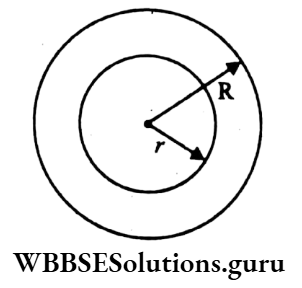
Example 5. A circular ring is 5 cm wide. The difference of outer and inner radius is

  1. 5 cm
  2. 2.5 cm
  3. 10 cm
  4. None of these

Solution: difference of outer and inner radius = width of the rise = 5 cm

WBBSE Class 9 Maths Mensuration Chapter 2 A Circular Ring Difference Of Outer And Inner Radius


∴ The correct answer is 1. 5 cm

∴ The difference of outer and inner radius is 5 cm

Example 6. The radius of a semi-circular plate is 3.5 cm. It is perimeter is one of the following

  1. 18 cm
  2. 22 cm
  3. 11 cm
  4. None of these

Solution: The length of semi-circumference = πr = \(\frac{22}{7}\) x 3.5 cm = 11 cm

Length of the diameter = 2 x 3.5 cm = 7 cm

WBBSE Class 9 Maths Mensuration Chapter 2 The Radius Of Semi Circle Plate


Total length of its perimeter = (11 + 7) cm = 18 cm

∴ The correct answer is 1. 18 cm

∴ perimeter of a semi-circular plate is 18 cm

WBBSE Solutions For Class 9 Fundamentals Of HistoryWBBSE Class 9 English Functional Grammar
WBBSE Class 9 Fundamentals Of History Long Answer QuestionsWBBSE Class 9 English Reading Skill
WBBSE Class 9 Fundamentals Of History Short Answer QuestionsWBBSE Class 9 English Writing Skill
WBBSE Class 9 Fundamentals Of History Very Short Answer QuestionsWBBSE Class 9 Maths Multiple Choice Questions
WBBSE Class 9 Fundamentals Of History Multiple Choice QuestionsWBBSE Solutions For Class 9 Maths
WBBSE Notes For Class 9 Geography and Environment

Example 7. There is a path of uniform width along the inner boundary of a circular park. The outer circumference of the path is 729 m and inner circumference of the paths is 770 m. Width of the path is

  1. 3.5 m
  2. 7 m
  3. 7.5 m
  4. None of these

Solution: 2πR – 2πr = 792 -770

or, R – r = \(\frac{22 \times 7}{2 \times 22}=\) = 3.5

∴ The correct answer is 1. 3.5 m

∴ Width of a circular park path is 3.5 m 

Example 8. Ratio of circum radius and inradius of a square is

  1. 1: √2
  2. √2: 1
  3. 1: 2
  4. 2: 1

Solution: Let length of the square be a unit.

Circum radius = \(\frac{1}{2}\) diagonal of a square = \(\frac{\sqrt{2 a}}{2}\) unit

in radius = \(\frac{a}{2}\) unit

∴ Ratio = \(\frac{\sqrt{2 a}}{2}\): \(\frac{a}{2}\) = √2: 1

∴ The correct answer is 2. √2: 1

∴ Ratio of circum radius and inradius of a square is √2: 1

Example 9. Length of a minute hand in 7 cm. It covers in 15 minute

  1. 11 cm
  2. 22 cm
  3. 1.1 cm
  4. 2.2 cm

Solution: In 15 minutes hand covers

= \(\frac{\frac{2 \times 22}{7} \times 7}{60} \times 15\) cm = 11 cm

∴ The correct answer is 1. 11 cm

Example 10. Perimeter of a semicircle is 36 cm. Length of its diameter is

  1. 14 cm
  2. 22 cm
  3. 21 cm
  4. None of these

Solution: πr + 2r = 36

⇒ r (π + 2) = 36

r x \(\frac{36}{7}\) = 36. ⇒ r = 7

Length of diameter = 7 x 2 cm = 14 cm

∴ The correct answer is 1. 14 cm

∴ Length of its diameter of semicircle 14 cm.

WBBSE Class 9 Maths Mensuration Chapter 3 Area Of Circle Multiple Choice Questions

WBBSE Class 9 Maths Mensuration Chapter 3 Area Of Circle Multiple Choice Questions

Example 1. If the area of circular field is X sq unit, the perimeter is Y unit and length of the diameter is Z unit, then the value of \(\frac{X}{YZ}\) is

  1. \(\frac{1}{2}\)
  2. \(\frac{1}{4}\)
  3. 1
  4. \(\frac{1}{8}\)

Solution: \(\frac{X}{Y Z}=\frac{\pi r^2}{2 \pi r 2 r}=\frac{1}{4}\)

∴ The correct answer is 2. \(\frac{1}{4}\)

∴ Then the value of \(\frac{X}{YZ}\) is \(\frac{1}{4}\)

Read and Learn More WBBSE Class 9 Maths Multiple Choice Questions

Example 2. The ratio of area of two square circumscribe and inscribe by a circle is

  1. 4:1
  2. 1:4
  3. 2:1
  4. 1:2

Solution: Area of the square inscribed in a circle = 2r2

WBBSE Class 9 Maths Mensuration Chapter 3 Two Square Circumscribe And Inscribe


Area of the square circumscribing the circle = 4r2

Ratio = 4r2: 2r2 = 2:1

∴ The correct answer is 3. 2: 1

∴ The ratio of area of two square circumscribe and inscribe by a circle is 2: 1

Example 3. The numerical value of perimeter and area of a circular field in equal. The length of diagonal of square circumscribe by a circle is

  1. 4 unit
  2. 2 unit
  3. 4√2 unit
  4. 2√2 unit

Solution: πr2 ⇒ 2πr  ⇒ r= 2 unit

∴ The correct answer is 2. 2 unit

∴ The length of diagonal of square circumscribe by a circle is 2 unit

WBBSE Class 9 Maths Mensuration Chapter 3 Area Of Circle Multiple Choice Questions

Example 4. The ratio of the areas circumscribed and inscribed circles of an equilateral triangle is

  1. 4:1
  2. 1:4
  3. 2:1
  4. 1:2

Solution: Ratio of length of circumradius and inradius = \(\frac{2}{3}\) x height: \(\frac{1}{3}\) x height = 2:1

Ratio of areas = 22: 12 = 4:1

∴ The correct answer is 1. 4:1

∴ The ratio of the areas circumscribed and inscribed circles of an equilateral triangle is 4:1

Example 5. The inner diameter and external diameter of an iron ring plate are 20 cm, 22 cm. Area of iron plate is

  1. 22 sq. cm
  2. 44 sq. cm
  3. 66 sq. cm
  4. 88 sq. cm

Solution: Area = \(=\pi\left[\left(\frac{22}{2}\right)^2-\left(\frac{20}{2}\right)^2\right]\) sq.cm = 66 sq.cm.

∴ The correct answer is 3. 88 sq. cm

Example 6. The area of a circle is A sq. units and its circumference is C units. The value of \(\frac{\mathbf{A}}{\mathbf{C}^2}\) =

  1. \(\frac{1}{4 \pi}\)
  2. \(\frac{4}{\pi}\)
  3. \(\frac{\pi}{4}\)
  4. None of these

Solution: \(\frac{A}{C^2}=\frac{\pi r^2}{(2 \pi r)^2}=\frac{1}{4 \pi}\)

∴ The correct answer is 1. \(\frac{1}{4 \pi}\)

∴  Area of iron plate is \(\frac{1}{4 \pi}\)

Example 7. The outer and inner circumference of a ring-shaped circular plate are A unit and B unit respectively. If the width is C unit, the value of π is

  1. \(\frac{A – B}{C}\)
  2. \(\frac{A – B}{2C}\)
  3. \(\frac{C}{A – B}\)
  4. \(\frac{A – B}{7C}\)
WBBSE Solutions For Class 9 Fundamentals Of HistoryWBBSE Class 9 English Functional Grammar
WBBSE Class 9 Fundamentals Of History Long Answer QuestionsWBBSE Class 9 English Reading Skill
WBBSE Class 9 Fundamentals Of History Short Answer QuestionsWBBSE Class 9 English Writing Skill
WBBSE Class 9 Fundamentals Of History Very Short Answer QuestionsWBBSE Class 9 Maths Multiple Choice Questions
WBBSE Class 9 Fundamentals Of History Multiple Choice QuestionsWBBSE Solutions For Class 9 Maths
WBBSE Notes For Class 9 Geography and Environment

Solution: 2π (R − r) = A − B

or, R – r = \(\frac{A – B}{2 \pi}\)

∴ π = \(\frac{A – B}{2C}\)

∴ The correct answer is 2. \(\frac{A – B}{2C}\)

∴ The value of π is \(\frac{A – B}{2C}\)

Example 8. The width of a circular ring shaped is 3.5 cm and its area is 60.5 sq. cm. The sum of inner and outer radii of the plate is

  1. 3.5 cm
  2. 4.5 cm
  3. 5.5 cm
  4. 6.5 cm

Solution: π(R + r) (R − r) = 60.5

or, \(\frac{22}{7}\)(R+r) x 3.5 = 60·5 or, R + r = 5·5

∴ The correct answer is 3. 5.5 cm

∴  The sum of inner and outer radii of the circular ring plate is 5.5 cm

Example 9. The area of a semi-circle is 77 sq. cm. The length of its diameter is

  1. 3.5 cm
  2. 7 cm
  3. 14 cm
  4. 10.5 cm

Solution: \(\frac{\pi r^2}{2}=77\)

or, r = \(\frac{77 \times 7 \times 2}{22}=7^2\)

⇒ R =7, 2R =14

∴ The correct answer is 3. 14 cm

The length of its diameter is

Example 10. The ratio of area of circumscribed and inscribed squares of a circle

  1. 2: 1
  2. 1: 2
  3. 4: 1
  4. 1: 4

Solution: Ratio = \(a^2: \frac{a^2}{2}\) = 2: 1

∴ The correct answer is 1. 2: 1

∴ Ratio of area of circumscribed and inscribed squares of a circle is 2: 1

WBBSE Class 9 Maths Coordinate Geometry Chapter 1 Distance Formulas Multiple Choice Questions

WBBSE Class 9 Maths Coordinate Geometry Chapter 1 Distance Formulas Multiple Choice Questions

Example 1. The distance between the two points (a + b, c – d) and (a -b, c + d) is

  1. \(2 \sqrt{a^2+c^2}\)
  2. \(2 \sqrt{b^2+d^2}\)
  3. \(\sqrt{a^2+c^2}\)
  4. \(\sqrt{b^2+d^2}$\)

Solution: The distance between the two points (a + b, c – d) and (a – b, c + d) is

\(\sqrt{\{(a+b)-(a-b)\}^2+\{(c-d)-(c+d)\}^2}\) units

Read and Learn More WBBSE Class 9 Maths Multiple Choice Questions

= \(\sqrt{(a+b-a+b)^2+(c-d-c-d)^2} \text { units }\)

= \(\sqrt{(2 b)^2+(-2 d)^2} \text { units }\)

= \(\sqrt{4 b^2+4 d^2} \text { units }\)

= \(\sqrt{4\left(b^2+d^2\right)} \text { units }=2 \sqrt{b^2+d^2} \text { units }\)

∴ So the correct answer is 2. \(2 \sqrt{b^2+d^2}\)

∴ The distance between the two points (a + b, c – d) and (a -b, c + d) is \(2 \sqrt{b^2+d^2}\)

Example 2. If the distance between the two points (x, -7) and (3, -3) is 5 units, then the values of x are

  1. 0 or 6
  2. 2 or 3
  3. 5 or 1
  4. – 6 or 0

Solution: The distance between the points (x, -7) and (3, -3) is

\(\sqrt{(x-3)^2+\{(-7)-(-3)\}^2} \text { units }\)

= \(\sqrt{x^2-6 x+9+(-7+3)^2} \text { units }\)

= \(\sqrt{x^2-6 x+9+(-4)^2} \text { units }\)

= \(\sqrt{x^2-6 x+9+16} \text { units }\)

= \(\sqrt{x^2-6 x+25} \text { units }\)

According to question, \(\sqrt{x^2-6 x+25}=5\)

⇒ x2 – 6x + 25 = 25

⇒ x2 – 6x = 0

⇒ x (x – 6) = 0

⇒ x = 6

either x = 0,. or, x – 6 = 0 ⇒ x = 0 or 6

∴ So the correct answer is 1. 0 or 6

∴ The values of x are 0 or 6

WBBSE Solutions For Class 9 Fundamentals Of HistoryWBBSE Class 9 English Functional Grammar
WBBSE Class 9 Fundamentals Of History Long Answer QuestionsWBBSE Class 9 English Reading Skill
WBBSE Class 9 Fundamentals Of History Short Answer QuestionsWBBSE Class 9 English Writing Skill
WBBSE Class 9 Fundamentals Of History Very Short Answer QuestionsWBBSE Class 9 Maths Multiple Choice Questions
WBBSE Class 9 Fundamentals Of History Multiple Choice QuestionsWBBSE Solutions For Class 9 Maths
WBBSE Notes For Class 9 Geography and Environment

Example 3. If the distance of the point (x, 4) from origin is 5 units, then the values of x are

  1. ±4
  2. ±5
  3. ±3
  4. None of these

Solution: The distance of the point (x, 4) from origin is \(\sqrt{x^2+4^2}\) units

= \(\sqrt{x^2+16}\) units

According to question, \(\sqrt{x^2+16}\) = 5

⇒ x2 + 16 = 25

⇒ x2 = 9

⇒ x = ±√9

⇒ x = ±3

‍∴ The correct answer is 3. ±3

∴ The values of x is ±3.

WBBSE Class 9 Maths Coordinate Geometry Chapter 1 Distance Formulas Multiple Choice Questions

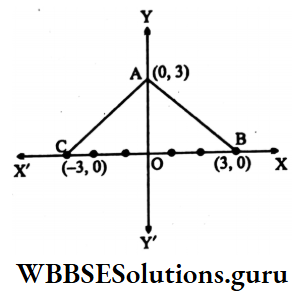
Example 4. The triangle formed by the points (3, 0), (-3, 0), and (0, 3) is

  1. Equilateral
  2. Isosceles
  3. Scalene
  4. Isosceles right-angled

Solution: A (0, 3), B (3, 0) and C (-3, 0) are three points

WBBSE Class 9 Maths Coordinate Geometry Chapter 1 Triangle Formed By The Isosceles Triangle


The length of AB = \(\sqrt{(0-3)^2+(3-0)^2} \text { units }\)

= \(\sqrt{9+9} \text { units }=\sqrt{18} \text { units }\)

The length of AC = \(\sqrt{\left\{(0-(-3)\}^2+(3-0)^2\right.} \text { units }\)

= \(\sqrt{9+9} \text { units }=\sqrt{18} \text { units }\)

The length of BC = \(\sqrt{\{3-(-3)\}^2+(0-0)^2} \text { units }\)

= \(\sqrt{(3+3)^2+0} \text { units }\)

= \(\sqrt{6^2} \text { units }=6 \text { units }\)

In ΔABC, AB = AC = √18 units

∴ ΔABC is a isosceles triangle

Again, AB2 + AC2 = (√18)2 +(√18)2

= 18+ 18 = 36 = 62 = BC2

∴ ΔABC is a right-angled triangle whose ∠BAC = 90°

So ΔABC is a right-angle isosceles triangle.

∴ The correct answer is 4. Isosceles right-angled

The triangle formed by the points (3, 0), (-3, 0), and (0, 3) is Isosceles right-angled triangle.

Example 5. The coordinates of the centre of the circle are (0, 0) and the coordinates of a point on the circumference are (3, 4), the length of the radius of the circle is

  1. 5 units
  2. 4 units
  3. 3 units
  4. None of these

Solution: The distance between the point (3, 4) on the circumference and the centre (0, 0) of the circle is \(\sqrt{(3-0)^2+(4-0)^2}\)

= \(\sqrt{9+16} units =\sqrt{25}=5 units\)

The length of the radius of the circle is 5 units.

∴ So the correct answer is 1. 5 units

∴ The length of the radius of the circle is 5 units

Example 6. The distance of points (a + b, a- b) from origin is

  1. \(2 \sqrt{a^2+b^2}\) units
  2. \(2 \sqrt{a b}\) units
  3. \(\sqrt{2\left(a^2+b^2\right)}\) units
  4. None of these

Solution: The distance of points (a + b, a – b) from origin (0, 0) is \(\sqrt{(a+b)^2+(a-b)^2}\) units

= \(2 \sqrt{a^2+b^2}\) units

∴ The correct answer is 3. \(\sqrt{2\left(a^2+b^2\right)}\) units

∴ The distance of points (a + b, a- b) from origin is \(\sqrt{2\left(a^2+b^2\right)}\) units

Example 7. If the coordinates of two extreme points of the greatest chord of a circle is (5, 3) and (3,3) then the length of radius of the circle is

  1. 2 units
  2. 3 units
  3. 4 units
  4. 5 units

Solution: The greatest chord of the circle is diameter of that circle.

The length of diameter is the distance between the points (5, 3) and (- 3,-3)

= \(\sqrt{\{5-(-3)\}^2+\{3-(-3)\}^2} \text { units }\)

= \(\sqrt{(5+3)^2+(3+3)^2} \text { units }\)

= \(\sqrt{(8)^2+(6)^2} \text { units }\)

= \(\sqrt{64+36} \text { units }\)

= \(\sqrt{100} \text { units }=10 \text { units }\)

∴ The length of radius is \(\frac{10}{2}\) units = 5 units

∴ So the correct answer is 4. 5 units

∴ The length of radius of the circle is 5 units.

Example 8. If the point (x, y) is equidistant from two points (2, -3) and (-2, 3), then the relation between x and y is

  1. 2x + 3y = 0
  2. 2x = 3y
  3. 3x – 2y = 0
  4. 3x + 2y = 0

Solution: The point (x, y) is equidistant from points (2, -3) and (-2, 3)

The distance between (x, y) and (2, -3) is \(\sqrt{(x-2)^2+\{y-(-3)\}^2}\) units

= \(\sqrt{(x-2)^2+(y+3)^2}\) units

The distance between (x, y) and (-2, 3) is \(\sqrt{\{x-(-2)\}^2+(y-3)^2}\) units

= \(\sqrt{(x+2)^2+(y-3)^2}\) units

According to question, \(\sqrt{(x-2)^2+(y+3)^2}=\sqrt{(x+2)^2+(y-3)^2}\)

⇒ (x – 2)2 + (y + 3)2 = (x + 2)2 +(y – 3)2 [squaring both side]

⇒ (y + 3)2 – (y – 3)2 = (x + 2)2 – (x – 2)2

⇒ 4.y.3 = 4.x.2 [By applying (a + b)2 – (a – b)2 = 4ab]

⇒ 3y = 2x

∴ The correct answer is 2. 2x = 3y

The relation between x and y is 2x = 3y.

WBBSE Class 9 Maths Statistics Chapter 1 Statistics Multiple Choice Questions

WBBSE Class 9 Maths Statistics Chapter 1 Statistics Multiple Choice Questions

Example 1. Which one of the following is a graphical representation of statistical data?

  1. Line-graph
  2. Raw data
  3. Cumulative frequency
  4. Frequency distribution

Solution: Line graph is a graphical representation of statistical data.

Read and Learn More WBBSE Class 9 Maths Multiple Choice Questions

∴ So the correct answer is 1. Line-graph

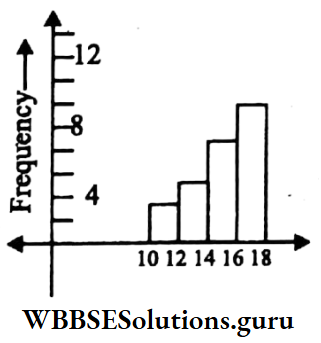
WBBSE Class 9 Maths-Statistics Chapter 1 Graphical Representation Of Statistical Data


Example 2. The range of the data 12, 25, 15, 18, 17, 20, 22, 26, 6, 16, 11, 8, 19, 10, 30, 20, 32 is

  1. 10
  2. 15
  3. 18
  4. 26

Solution: The range = 32 – 6 = 26

∴ The correct answer is 4. 26

Example 3. The class size of the classes 1-5, 6-10 is

  1. 4
  2. 5
  3. 4.5
  4. 5.5

Solution: The difference (d) between classes 1-5, and 6-10, is 1

The lower class boundary of class 1-5 is (1- \(\frac{1}{2}\)) or 0.5 and the upper-class boundary is (5 + \(\frac{1}{2}\)) or 5.5

The class size = upper class boundary – lower class boundary = 5.5 – 0.5 = 5

∴ The correct answer is 2. 5

WBBSE Class 9 Maths Statistics Chapter 1 Statistics Multiple Choice Questions

Example 4. In a frequency distribution table, the midpoints of the classes are 15, 20, 25, and 30, respectively. The class having a midpoint as 20 is

  1. 12.5 – 17.5
  2. 17.5 – 22.5
  3. 18.5 – 21.5
  4. 19.5 – 20.5

Solution: The difference between two consecutive midpoints

= 20 – 15 = 25 – 20 = 30 – 25 = 5

So, the class size = 5

The midpoint of class (12.5 – 17.5) = \(\frac{12 \cdot 5+17 \cdot 5}{2}=\frac{30}{2}=15\)

and class-length = 17.5 – 12.5 = 5

The midpoint of class (17.5 – 22.5) = \(\frac{17 \cdot 5+22 \cdot 5}{2}=\frac{40}{2}=20\)

and class length = 22.5 – 17.5 = 5

The midpoint of class (18.5 – 21.5) = \(=\frac{18 \cdot 5+21 \cdot 5}{2}=20\)

and class length = 21.5 – 18.5 = 3

The midpoint of class (19.5 – 20.5) = \(=\frac{18 \cdot 5+21 \cdot 5}{2}=20\)

and class length = 20.5 – 19.5 = 1

∴ The required class is 17.5 – 22.5

∴ The correct answer is 2. 17.5 – 22.5

WBBSE Solutions For Class 9 Fundamentals Of HistoryWBBSE Class 9 English Functional Grammar
WBBSE Class 9 Fundamentals Of History Long Answer QuestionsWBBSE Class 9 English Reading Skill
WBBSE Class 9 Fundamentals Of History Short Answer QuestionsWBBSE Class 9 English Writing Skill
WBBSE Class 9 Fundamentals Of History Very Short Answer QuestionsWBBSE Class 9 Maths Multiple Choice Questions
WBBSE Class 9 Fundamentals Of History Multiple Choice QuestionsWBBSE Solutions For Class 9 Maths
WBBSE Notes For Class 9 Geography and Environment


Example 5. In a frequency distribution table, the midpoints of a class is 10 and the class size of each class is 6; the lower limit of the class is

  1. 6
  2. 7
  3. 8
  4. 12

Solution: Let, lower limit of given class is x;

As class size is 6 then upper limit is (x+6)

The midpoint = \(\frac{x+x+6}{2}=\frac{2 x+6}{2}=x+3\)

As per question, x + 3 = 10

⇒ x = 10 – 37 = 7

∴ The lower limit is 7

∴ The correct answer is 2. 7

Example 6. Each of area of each of the rectangles of a histogram is proportional to

  1. The mid-point of that class
  2. The class size of that class
  3. The frequency of that class
  4. The cumulative frequency of that class

Solution: Which increasing frequency the area of each of the rectangles of a histogram will also increase.

So the area of a rectangle is proportional to the frequency.

∴ The correct answer is 3. The frequency of that class

WBBSE Class 9 Maths Statistics Chapter 1 Graphical Representation Of The area Of Rectangle Is Proportional To The Frequency


Example 7. A frequency polygon is drawn by the frequency of the class and

  1. The upper limit of the class
  2. The lower limit of the class
  3. Mid-value of the class
  4. Any value of the class

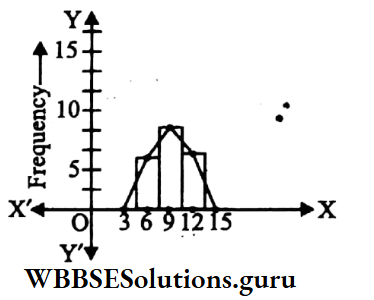
Solution: A frequency polygon is drawn by the frequency of the class and mid value of the class.

∴ The correct answer is 3. Mid-value of the class

WBBSE Class 9 Maths Statistics Chapter 1 Graphical Representation Of A Frequency Polygon Is Drawn By The Frequency Of The Class And Midvalue Of The Class


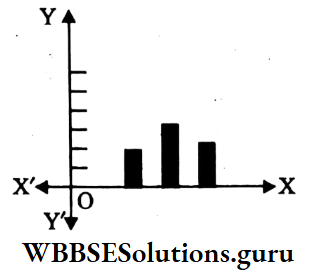
Example 8. To draw a histogram, the class boundaries are taken

  1. Along Y-axis
  2. Along X-axis
  3. Along X-axis and Y-axis both
  4. In between X-axis and Y-axis

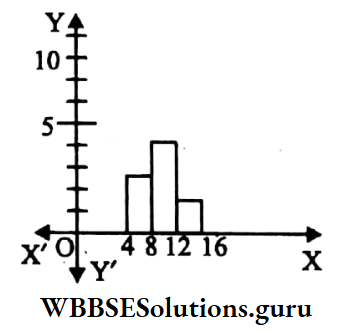
Solution: To draw a histogram, the class boundaries are taken along X-axis.

∴ The correct answer is 2. Along X-axis

WBBSE Class 9 Maths Statistics Chapter 1 Graphical Representation Draw A-Histogram The Class Boundaries- Are Taken Along X axis


Example 9. In case of drawing a histogram, the base of the rectangle of each class is

  1. Frequency
  2. Class-boundary
  3. Range
  4. Class-size

Solution: In case of drawing a histogram the length of base of a rectangle of each class is class size.

class- the size of each class is 5.

∴ The correct answer is 4. Class-size

WBBSE Class 9 Maths Statistics Chapter 1 Graphical Representation Draw A-Histogram The Class Boundaries- Are Taken Along X axis


Example 10. A histogram is the graphical representation of grouped data whose class boundary and frequency are taken respectively.

  1. Along the vertical axis and the horizontal axis
  2. Only along the vertical axis
  3. Only along the horizontal axis
  4. Only the horizontal axis and vertical axis

Solution: A histogram is the graphical representation of grouped data whose class boundary and frequency are taken respectively only the horizontal axis and vertical axis.

∴ The correct answer is 4. Only the horizontal axis and vertical axis

WBBSE Class 9 Maths Statistics Chapter 1 Graphical Representation Draw A-Histogram The Class Boundaries- Are Taken Along X axis


Example 11.

WBBSE Solutions For Class 9 Maths Statistics Chapter 1 Statistics Class Frequency Distribution

The frequency density of the third class of the above frequency distribution table is

  1. 1.5
  2. 0.55 (approx)
  3. 0.36
  4. 2.8 (approx)

Solution: The difference between two consecutive class is 1

∴ Lower boundary of third class is \(\left(21-\frac{1}{2}\right)\) or 20.5

and upper-boundary of third class is \(\left(30+\frac{1}{2}\right)\) or 30.5

∴ class-size = 30.5 – 20.5 = 10

The frequency density of third class = \(\frac{\text { class frequency }}{\text { class size }}=\frac{18}{10}\) = 1.8

∴ The correct answer is 1. 1.5

Example 12. The upper-class boundary of the fifth class of the classes 30-39, 40-49,….. is

  1. 69.5
  2. 79.5
  3. 69
  4. 79

Solution: Classes are 30-39, 40-49, 50-59, 60 – 69, 70-79,……

The fifth class is 70 – 79

The difference between the two consecutive class is 1

∴ The upper-class boundary of the fifth class is \(\left(79+\frac{1}{2}\right)\) or, 79.5

∴ The correct answer is 2. 79.5

Example 13. If lower class boundary and mid value of a class are a and m respectively, then the upper class boundary will be

  1. a + 2m
  2. a – 2m
  3. 2m – a
  4. 2a – m

Solution: Let upper-class boundary of the given class is b

As lower class boundaries a

So the mid value (m) = \(\frac{a+b}{2}\)

or, a + b = 2m or, b = 2m – a

∴ The correct answer is 3. 2m -a

∴ Then the upper class boundary will be 2m -a

WBBSE Class 9 Coordinate Geometry Chapter 3 Area Of Triangular Region Multiple Choice Questions

WBBSE Class 9  Coordinate Geometry Chapter 3 Area Of Triangular Region Multiple Choice Questions

Example 1. The area of triangular formed by three points (0, 4), (0, 0), (-6, 0) is

  1. 24 sq. unit
  2. 12 sq. unit
  3. 6 sq. unit
  4. 8 sq. unit

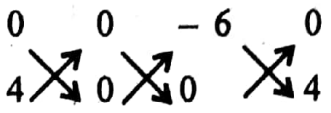
Solution: Area = \(\frac{1}{2}|0+0-24-(0+0+0)|\) sq. unit = 12 sq. unit

WBBSE Solutions For Class 9 Maths Coordinate Geometry Chapter 3 Area Of Triangular Region Area Of Triangular Formed By Three Points

Example 2. The coordinates of the centroid of a triangle formed by three points (7, -5), (-2, 5), and (4, 6) is

  1. (3,-2)
  2. (2, 3)
  3. (3, 2)
  4. (2, -3)

Solution: \(\left(\frac{7-2+4}{3}, \frac{-5+5+6}{3}\right)=(3,2)\)

Example 3. ΔABC is a right-angled triangle of which ∠B = ordinates of A, C are (0, 4) and (3, 0). The area of two triangles is

  1. 12 sq. unit
  2. 6 sq. unit
  3. 24 sq. unit
  4. 8 sq. unit

Solution: Area = \(\frac{1}{2}\) x 3 x 4 sq. u = 6 sq. unit

WBBSE Class 9 Maths Coordinate Geometry Chapter 3 Triangle ABC Is A Right Angled Triangle


WBBSE Solutions For Class 9 Fundamentals Of HistoryWBBSE Class 9 English Functional Grammar
WBBSE Class 9 Fundamentals Of History Long Answer QuestionsWBBSE Class 9 English Reading Skill
WBBSE Class 9 Fundamentals Of History Short Answer QuestionsWBBSE Class 9 English Writing Skill
WBBSE Class 9 Fundamentals Of History Very Short Answer QuestionsWBBSE Class 9 Maths Multiple Choice Questions
WBBSE Class 9 Fundamentals Of History Multiple Choice QuestionsWBBSE Solutions For Class 9 Maths
WBBSE Notes For Class 9 Geography and Environment


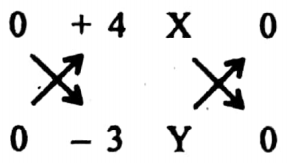
Example 4. If (0, 0), (+4, -3), (x, y) are collinear then

  1. x = 8, y = -6
  2. x = 8, y = 6
  3. x = 4, y = 6
  4. x = 8, y = 6

Solution:

WBBSE Solutions For Class 9 Maths Coordinate Geometry Chapter 3 Area Of Triangular Region Collinear

\(\frac{1}{2}|0+4 y+0-(0-3 x)|=0\)

or, \(\left|+2 y+\frac{3}{2} x\right|=0\)

x = +8, y = 6 satisfies the equations.

WBBSE Class 9 Coordinate Geometry Chapter 3 Area Of Triangular Region Multiple Choice Questions


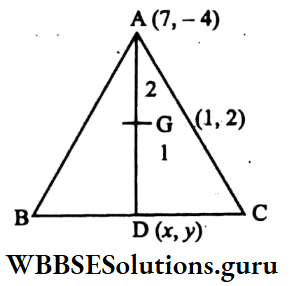
Example 5. If in triangle ABC, the co-ordinates of vertex A is (7, -4) and the centroid of the triangle is (1, 2) then the co-ordinates of midpoint of BC is

  1. (-2,-5)
  2. (-2, 5)
  3. (2, -5)
  4. (5, -2)

Solution: AG: GD = 2:1

Let the Co-ordinate of D be (x, y)

∴ \(\frac{2 x+7}{3}=1 \quad \frac{2 y-4}{3}=2\)

or, x = -2 or, y = 5

WBBSE Class 9 Maths Coordinate Geometry Chapter 3 Triangle ABC Coordinate Of Vertext And Centriod Of Triangle


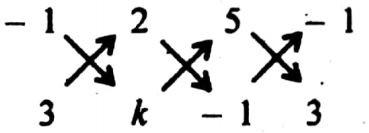
Example 6. (-1, 3), (2, k) and (5, -1) are collinear. k =

  1. 1
  2. 0
  3. 2
  4. None of these

Solution:

WBBSE Solutions For Class 9 Maths Coordinate Geometry Chapter 3 Area Of Triangular Region Collinear

= \(\frac{1}{2}|-k+13-7-5 k|=0 \Rightarrow k=1\)

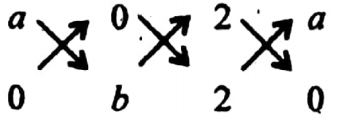
Example 7. The points (9, 0), (0, 4), (2, 2) are colinear if

  1. a + b = 2
  2. a + b + 4 = 0
  3. \(\frac{1}{a}+\frac{1}{b}=\frac{1}{2}\)
  4. ab = 2

Solution:

WBBSE Solutions For Class 9 Maths Coordinate Geometry Chapter 3 Area Of Triangular Region Collinear

= \(\frac{1}{2}|a b+0+0-2 b-2 a|=0 \text { or, } a b=2 b+2 a \text { or, } \frac{1}{a}+\frac{1}{b}=\frac{1}{2}\)

Example 8. If the points (a, 0), (0, 4), (1, 1) are on the same straight line then

  1. \(\frac{1}{a}+\frac{1}{b}\) = 1
  2. ab = 1
  3. a+b+1=0
  4. None of these

Solution:

WBBSE Solutions For Class 9 Maths Coordinate Geometry Chapter 3 Area Of Triangular Region Points Are Same Straight Line

= \(\frac{1}{2}|a b-b-a|=0\)

a + b = ab

\(\frac{1}{a}+\frac{1}{b}=1\)