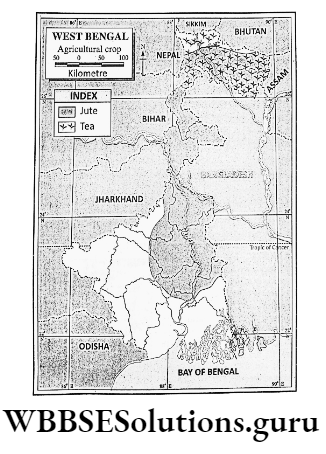
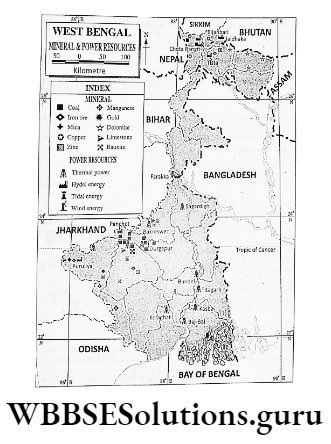
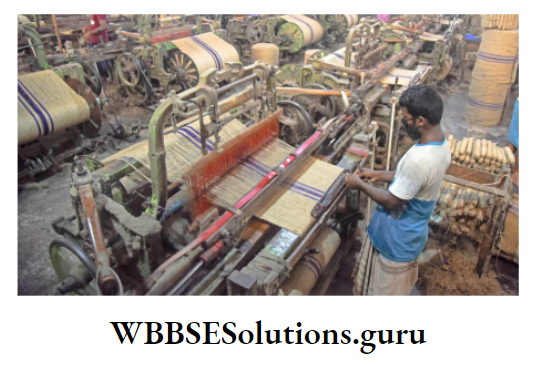
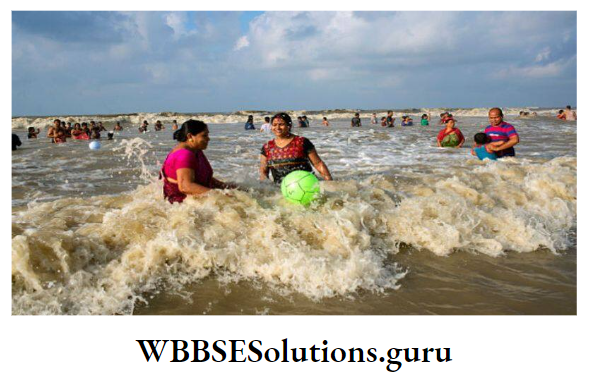
WBBSE Notes For Class 10 Geography And Environment Chapter 5 India

WBBSE Chapter 5 India Introduction

Geographical Location:

India is located in Northern Hemisphere to the southern part of the continent of Asia.

Latitude

According to latitude, the mainland of India stretches from 8°04′ north latitude(Kanniyakumari or Cape of Comorin) in the south to 37°06′ north latitude (Indira Kol in the northern extremity of Kashmir).

But the southernmost point of the Indian landmass (Indian Union) is Indira Point which was previously known as Persons Pygmalion.

It is, actually, the southernmost point of Car Nicobar where it touches the parallel of 6°45′ north.

Read And Learn Also WBBSE Notes For Class 10 Geography And Environment
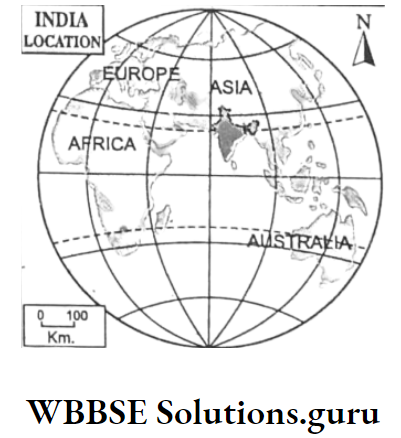
 

WBBSE Notes For Class 10 Geography Chapter 5 India Location Of India


Longitude

In the Eastern Hemisphere, India stretches from 68°07′ east longitude (Ghormota in the western extremity of Gujarat).

In the West to 97°25′ east longitude (Kibitu in the eastern frontier of Arunachal Pradesh) in the east.
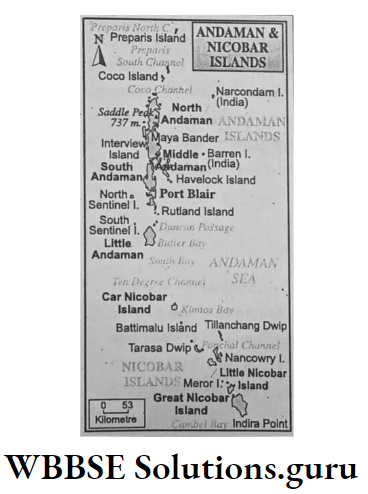
WBBSE Notes For Class 10 Geography Chapter 5 India Indira Point

Class 10 Geography And Environment Chapter 5 Solutions

Tropic Of Cancer

23% north latitude passes through the middle of India, thus, dividing India into two parts-North India and South India.

So, South India belongs to the Tropical belt and North India belongs to Sub-tropical and Temperate belt. 80° East longitude divides India into East India and West India.

WBBSE Notes For Class 10 Geography And EnvironmentWBBSE Notes For Class 10 History And Environment
WBBSE Solutions For Class 10 Life ScienceWBBSE Class 10 Life Science Multiple Choice Questions
WBBSE Solutions for Class 10 MathsWBBSE Class 10 Maths Multiple Choice Questions
WBBSE Notes For Class 10 Physical Science And Environment


In general, India stretches for 29° latitudes and 29° longitudes.

Extent Of India

India stretches for nearly 3214 Km in north-south extent while India is extended east-west for nearly 2933 km.

The land boundary of India is nearly 15,200 km and the length of the coastline is (including the mainland, Lakshadweep and Andaman-Nicobar islands) about 7517 km.

Boundaries Of India

India is bordered on the north by China, Nepal and Bhutan; on the west by Pakistan and the Arabian Sea, North-west by Afghanistan; on the east by Myanmar, Bangladesh and the Bay of Bengal and on the south by the Indian Ocean.

Contextually, it is to be noted that, to the south of India is Srilanka the island country which is located to the other side of the Palk strait and Gulf of Manner.
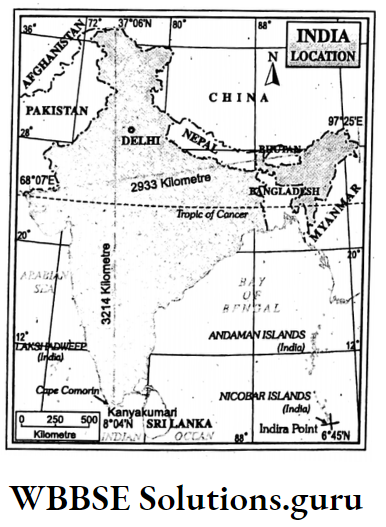
WBBSE Notes For Class 10 Geography Chapter 5 India India & Neighbouring Countries

WBBSE Chapter 5 India Brief History Of Demarcation Of Provinces Of India After Independence

After nearly 200 years of British rule, India became independent on 15th August 1947. Before independence, there were 562 princely states and 9 British Provinces in India.

India was split into two Dominious-India and Pakistan. India became the Sovereign Democratic Republic on January 26, 1950, when it was divided into 20 states which were followed by the newly framed ‘Indian Constitution’.
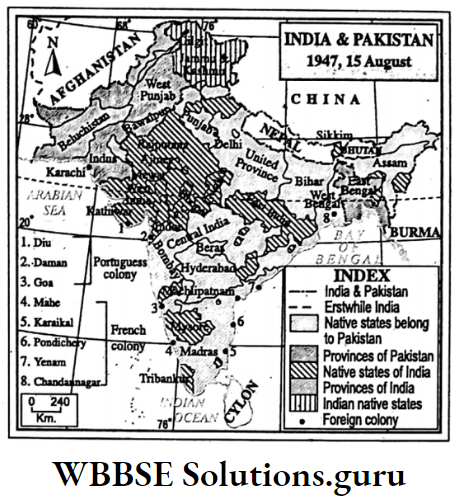
WBBSE Notes For Class 10 Geography Chapter 5 India India (1947)

Those states were classified as

  1. Part-1, states under Governor’s rule include West Bengal, Assam, Bihar, Orissa, Uttar Pradesh, Madhya Pradesh, Bombay, Madras, Punjab (9 states),
  2. Part-2, states ruled by native states include Hyderabad, Madhya Pradesh, Mysore, Patiala and East Punjab Union, Jammu and Kashmir, Rajasthan, Saurashtra, Tribancore- Cochin (8 states),
  3. Part-3, states ruled by chief commissioners include Ajmer, Bhopal, Bilaspur, Himachal Pradesh, Kutch, Kurg, Delhi, Manipur, Tripura and Vindhya Pradesh (10 states).
  4. Part-4, states under Central rule, include Andaman and Nicobar Islands (1 state). But a demand for linguistic states had been raised since then.
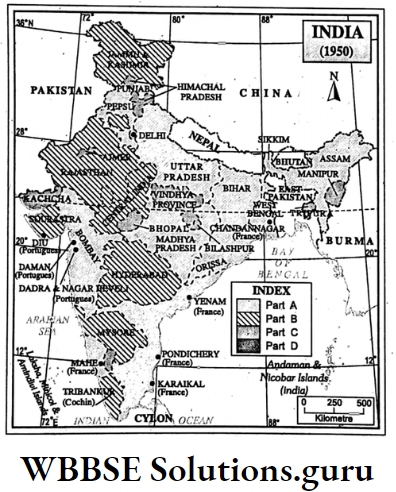
WBBSE Notes For Class 10 Geography Chapter 5 India India (1950)

Class 10 Geography And Environment Chapter 5 Solutions

WBBSE Chapter 5 India State Reorganisation On Linguistic Basis In 1956

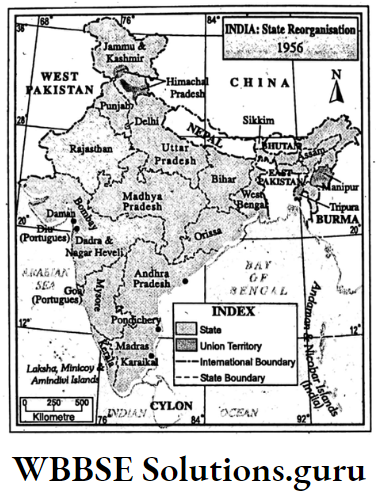
The government of India has formed State Reorganisation Commission in December 1953.

Accordingly, State Reorganisation Act was passed on 1st November 1956 and the Government of India reconstructed the states of India into 14 states and 6 Union territories.

States :

  1. Andhra Pradesh (Telegu),
  2. Assam (Asamia),
  3. Orissa (Oria),
  4. Uttar Pradesh (Hindi),
  5. Kerala (Malayalam),
  6. Jammu and Kashmir (Kashmiri),
  7. West Bengal (Bengali),
  8. Punjab (Punjabi),
  9. Bihar (Hindi),
  10. Bombay (Marathi and Gujarathi),
  11. Madhya Pradesh (Hindi),
  12. Mysore (Kanari),
  13. Madras (Tamil) and
  14. Rajasthan (Rajasthani)

Union Territories:

  1. Tripura,
  2. Andaman Nicobar Islands,
  3. Delhi,
  4. Lakshadweep,
  5. Manipur and
  6. Himachal Pradesh.

WBBSE Notes For Class 10 Geography Chapter 5 India India (1956)

WBBSE Chapter 5 India State Reorganisation In Later Period

After 1956, the succeeding state reconstructions other than linguistic basis are as follows:

  1. 4 Union territories were formed out of Assam between 1957 and 1972
  2. North-eastern Frontier,
  3. Nagaland in 1957,
  4. Meghalaya in 1970,
  5. Mizoram in 1972,
  6. In 1960 the state of Bombay was split into two-Maharastra and Gujarat,
  7. In 1961 Portuguese colonies, namely Goa, Daman, and Diu were included. Union Territories.
  8. In 1963, Nagaland became a state.
  9. In 1966, Punjab was split into two states Punjab and Haryana and one Union Territory of Chandigarh.
  10. In 1971, Himachal Pradesh got statehood.
  11. In 1972, Tripura, Manipur and Meghalaya also achieved statehood.
  12. In 1975, Sikkim was included as a state.
  13. In 1987, Mizoram and Arunachal Pradesh got statehood, Goa also became a state.
  14. In 1993, Delhi was recognised as National Capital Territory.
  15. In 2000, Chhattisgarh was separated from Madhya Pradesh, Uttaranchal (Uttarakhand) was separated from Uttar Pradesh and Jharkhand was separated
  16. from Bihar.
  17. On 2nd June 2014, Andhra Pradesh was divided into two states-Andhra Pradesh and Telangana. So, Telangana at present is the youngest state in India.
WBBSE Notes For Class 10 Geography And Environment Chapter 5 India

WBBSE Chapter 5 India Existing States And Union Territories In India

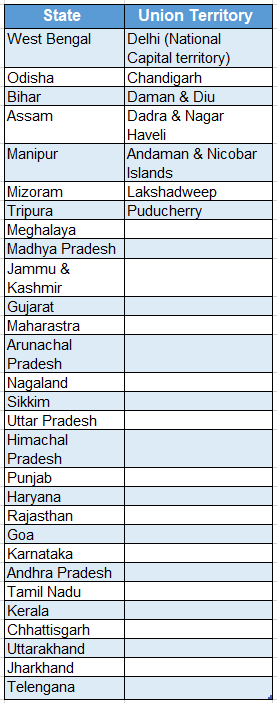
In India, at present, there are 29 States and 7 Union Territories.

States:

  1. West Bengal,
  2. Arunachal Pradesh,
  3. Madhya Pradesh,
  4. Kerala,
  5. Odisha,
  6. Nagaland,
  7. Jammu and Kashmir,
  8. Chhattisgarh,
  9. Bihar,
  10. Sikkim,
  11. Gujarat,
  12. Assam,
  13. Uttarakhand,
  14. Uttar Pradesh,
  15. Maharastra,
  16. Jharkhand
  17. Meghalaya,
  18. Himachal Pradesh,
  19. Goa,
  20. Manipur,
  21. Telangana,
  22. Punjab,
  23. Karnataka,
  24. Mizoram,
  25. Haryana,
  26. Andhra Pradesh,
  27. Tripura,
  28. Rajasthan,
  29. Tamilnadu.

Union Territories:

  1. Delhi (National Capital Territory),
  2. Chandigarh,
  3. Puducherry,
  4. Dadra and Nagar Haveli,
  5. Andaman and Nicobar,
  6. Lakshadweep and
  7. Daman and Diu.

WBBSE Notes For Class 10 Geography Chapter 5 India India (Political)

Class 10 Geography And Environment Chapter 5 Solutions

WBBSE Chapter 5 India’s Physical Environment

India, our motherland, occupies a strategic position in Asia in respect of diversified relief, climate, soil, natural vegetation, minerals etc.

Physiographic Divisions Of India:

Physiographically, India can be divided into five regions

  1. The Northern Mountainous Region,
  2. The Great Northern Plains,
  3. The Peninsular Plateau,
  4. The Coastal Plains and
  5. The Islands.

The Northern Mountainous Region :

the Northern Mountainous Region consists of

  1. The Himalayas,
  2. The Ladakh and
  3. The Karakoram Range and
  4. North-eastern Mountain or Purbachal.

The Himalayas

Originating from the Pamir Knot, the Himalayas stretches in a crescent shape to the extreme north of India.

It stretches for nearly 2500 km with a width of 150 km to 400 km from Nanga Parbat (8126 m) in Kashmir in the west to Namcha Barwa (7755m) in Arunachal Pradesh in the east.

The Ladakh Range

To the north of the Himalayas stands the Ladakh range stretching for about 350 km. with many peaks above 6000 m.

To the northeast of it lies the Ladakh plateau which is the highest (above 4000 m) and cold plateau of India and originated from the Tethys Sea.

Class 10 Geography Chapter 5 WBBSE Solutions

Karakoram Range

Further north of the Ladakh range stands the Karakoram range. It stretches for nearly 400 km with many peaks above 8000 m.

Godwin Austen or K2 (8611m), the highest peak of India lies here. It also originated from the Tethys Sea together with the Himalayas and the Ladakh ranges.

Siachen, the longest glacier (76 km) in India belongs to this range. Baltaro and Rimo are also famous glaciers that belong to this range.

WBBSE Notes For Class 10 Geography Chapter 5 India India (Physical Division)

Class 10 Geography Chapter 5 Question Answers

WBBSE Chapter 5 India Account Of The Himalayas

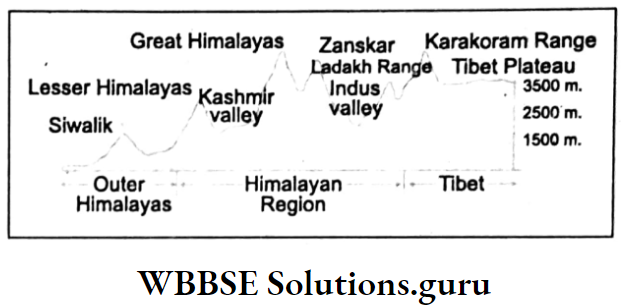
Parallel ranges Four phases of intensive earth movements caused the upliftment of four east-west extended parallel ranges. From the north to south are

1. Tethys or the Tibetan Himalayas:

which lies in the extreme north of India. It merges with the Tibetan plateau with an average height of 5500-6000 m, most of which lies in China. It was uplifted about 7 crores years back.
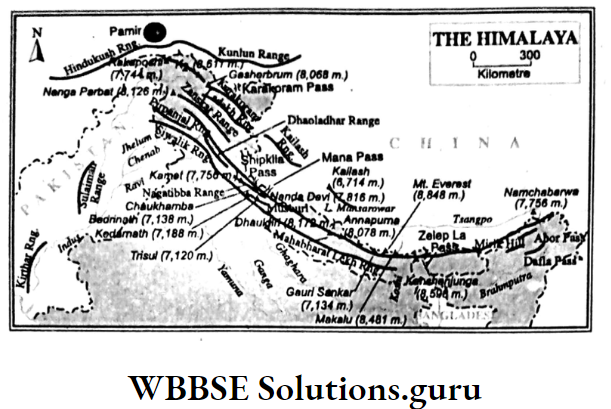
WBBSE Notes For Class 10 Geography Chapter 5 India The Himalayas

2. Himadri or the Great Himalayas:

It stands to the south of the Tethys Himalayas and consists of lofty snowcapped peaks with an average height of 6000 m. Mt.Everest, the highest (8848 m) peak in the world belongs to this range.

It also includes lofty peaks, namely Kanchenjungha, Nandadevi, Annapurna, Dhaulagiri etc. Kanchenjungha is the highest (8598 m) peak of the Himalayas located in India.

It also originated during the first phase of upliftment together with the Tethys Himalayas.
WBBSE Notes For Class 10 Geography Chapter 5 India Ranges of The Himalayas

3. Himachal or the Lesser Himalayas:

To the south of the Himadri stands the Himachal or the Lesser Himalayas. With height varying between 2000 and 3000 m.

It consists of Mussourie, Nagtibba, Pirpanjal, and Dhaoladhar peaks. It originated during the 2nd phase of upliftment of the Himalayas about 2 crore years back.

4. Siwalik or the Sub-Himalayas:

About 30 lakh years back during the third phase of upliftment of the Himalayas the Tethys, Himadri and Himachal were again uplifted. It is 10-15 km wide with an average height varying between 600-1500 m.

Mussourie, Jammu, and Dafla ranges are located here

WBBSE Chapter 5 India Regional Divisions Of The Himalayas

On the basis of regional characteristics the Himalayas can be divided into three sub-regions

  1. The Western Himalayas,
  2. The Central Himalayas (belongs to Nepal) and
  3. The Eastern Himalayas. Central Himalayas in Nepal includes the lofty peaks of Mt. Everest, Dhaulagiri, Annapurna etc.

The Western Himalayas

It May Be Subdivided Into Three Regions :

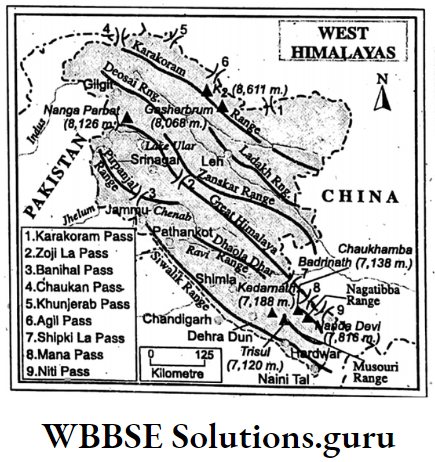
1. The Kashmir Himalayas:

It belongs to the state of Jammu and Kashmir. To the extreme south stands the Jammu and Punch Hills. Further north is the Pirpanjal range.

To the north of Pirpanjal lies the famous Kashmir valley which is bordered on the north by the Himadri and Zanskar ranges. Further north lies the Indus Gorge.

Class 10 Geography Chapter 5 Question Answers

To the extreme north stands the Karakoram range. Godwin, Austen or K2, the highest peak of the Karakoram range belongs to India.

2. Himachal Pradesh Himalayas:

It belongs to the state of Himachal Pradesh. To the extreme south stands the Siwalik range. Further north stands the Lesser Himalayan ranges, namely Dhaoladhar, Pirpanjal, Nagtibba and Mussourie.

3. Kumaon or Uttarakhand Himalayas:

It belongs to the state of Uttarakhand to the extreme south are found a few famous valleys or duns, namely Dehra Dun, Choukhamba etc.

To the north of these valleys stand the Nagtibba and Mussourie ranges. Further north are found lofty snow-capped peaks, such as Nandadevi (7817 m), Gangotri (6114 m), Kedarnath (7188 m) etc.
WBBSE Notes For Class 10 Geography Chapter 5 India West Himalayas

The Eastern Himalayas

It can be divided into three sub-regions:

Sikkim:

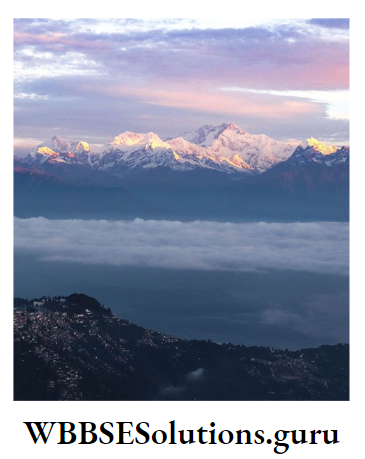
Darjeeling Himalayas-There is three important ranges, namely Singalila, Dawhill and Dongkia. Kanchenjungha (8598 m), the third highest peak of the world belongs to Sikkim Himalaya and this is the highest peak of the Himalayas in India.

Bhutan Himalayas:

The topography of this region is very much rugged. Kula Kangri (7554 m) is the highest peak in this region.

Assam Or Arunachal Himalayas:

It belongs to the state of Arunachal Pradesh. Siwalik range stands to the north of the Brahmaputra valley. Further north stands the Lesser Himalayas and to the extreme north stands the Great Himalayas.

The North-Eastern Hills Or Purbachal

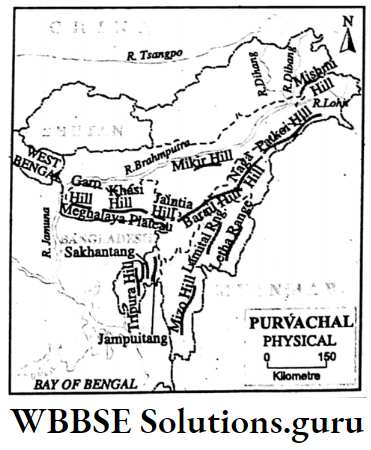
The Purbachal lies in North-east India extending in a north-south direction in the states of Assam, Arunachal Prades Nagaland, Manipur, Mizoram and Tripura.

There are many ranges of low heights varying between 1800 m and 4000 m. These hills are the southern continuation of the Himalayan ranges.

These are Patkoi and Mishmi in Arunachal Pradesh, and Naga hills in Nagaland, the highest peak of which is Saramati (3825 m).

Tuen sang in Manipur, and Mikir and Barail hills in Assam are connecting the Khasi-Garo-Jaintia hills of Meghalaya.

Dafabum (4579 m) of Mishmi hills of Arunachal Pradesh is the highest peak of this region.
WBBSE Notes For Class 10 Geography Chapter 5 India Purbachal

Class 10 Geography Chapter 5 Question Answers

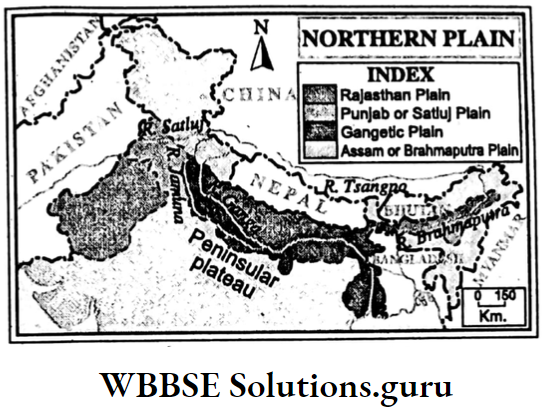
WBBSE Chapter 5 India The Plains Of Northern India

The Northern Plains are located to the south of the Himalayas and to the north of the Peninsular Plateau of India.

The plains of Punjab, Haryana, Uttar Pradesh, Bihar, West Bengal and Assam belong to this region. The Northern Plains consist of

  1. Rajasthan Plain,
  2. Punjab plain,
  3. The Ganga Plain and
  4. The Brahmaputra Valley.

WBBSE Notes For Class 10 Geography Chapter 5 India Northern Plain

Rajasthan Plain

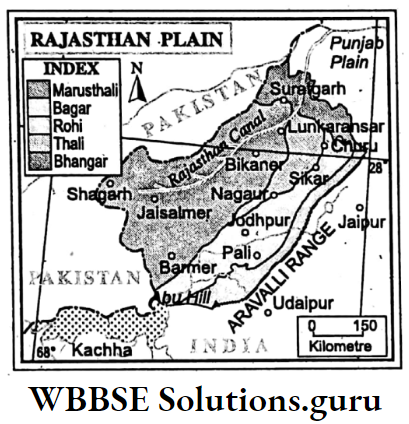
The southwestern part of the Northern Plain is known as the Rajasthan Plain. The region slopes from the east (325 m) to the west (150 m) and is located to the west of the Aravalli hills in the state of Rajasthan.

It is an extensively sandy plain and experiences an extreme type of climate because of which Luni, the only river in this region is saline. It is actually part of the Thar desert known as Marusthali.

There are a few saline lakes namely Panchpadra, Didwana, Sambhar etc. The dry shallow channels or lakes are called Dhand and shifting dunes are known as Dhrian.

Physiographically, the plain may be divided into five sub-divisions. To the extreme west lies the Marusthali made of sands, sand dunes and stones.

Areas made of stones are known as Hamada. To the east of Marusthali lies Bagar, the grassland along the riverside of Luni. To the east of Bagar lies Rohi which is a floodplain.

To the north of the river, Luni lies Thali the sandy region full of sand dunes.
WBBSE Notes For Class 10 Geography Chapter 5 India Rajasthan Plain

Punjab Plain

The western part of the Northern Plain is known as Punjab Plain. It is delimited by the river Yamuna, the right bank tributary of the Ganga on the east and belongs to the states of Punjab, Haryana and Uttar Pradesh.

This plan is made of silts deposited by the river Indus and its tributaries, namely the Sutlej, Beas, Ravi, and Chenab the new alluvium deposited near the river banks of these rivers forms a plain land locally called Bet.

Class 10 Geography Chapter 5 WBBSE Solutions

The land between two rivers is known as Doab. The floodplain is locally known as Dhaya and the crowded land is known as Chaos. Old alluvium to the south of the Punjab Plain is known as Bhangar.

The Ganga Plain

This is an extensive plain comprising nearly 3,75,000 sq. km. area in Uttar Pradesh, Bihar and West Bengal. It is a monotonous plain scattered with hills and natural levees.

The region slopes from the west to the east and southeast. It can be divided into sub-regions

  1. Upper Ganga plain extends from the river Yamuna in the west to the confluence at Ganga and Yamuna near Allahabad in the east with a height of 100-250 m.
  2. Middle Ganga Plain stretches from Allahabad in the west to Rajmahal Hill in the east with a height of about 50-100 m.
  3. Lower Ganga Plain stretches from Rajmahal Hill to the Bay of Bengal with a height of 450 m above sea level. The old alluvium is away from the river, and the bank is known as Bhangar.
  4. Fertile new alluvium along the river bank is known as Khadar. A stony plain located to the west of this plain at the foothills of the Himalayas is known as Bhabar.
  5. To the south of the Bhabar is located Terai, a narrow humid region.
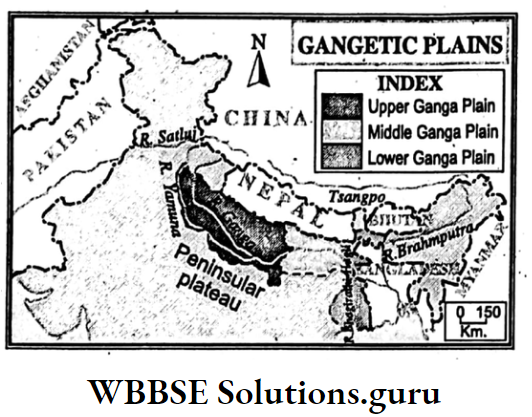
WBBSE Notes For Class 10 Geography Chapter 5 India Ganga Plain

The Brahmaputra Valley

The eastern part of the Northern Plain in Assam made by the deposition of silts of the river Brahmaputra is the Brahmaputra valley.

This is an elongated narrow plain which is bounded by the hills on the north, east and south. The plain slopes from the east (130 m) to the west (30 m).

The river Brahmaputra flows in a braided course. There are many sandbanks and river islands in the river Brahmaputra. Majuli island, the largest river island in the world is found in this river.

The northern part of this plain laying at the foothills of the Himalayas composed of sands, stones and pebbles is called Terai.
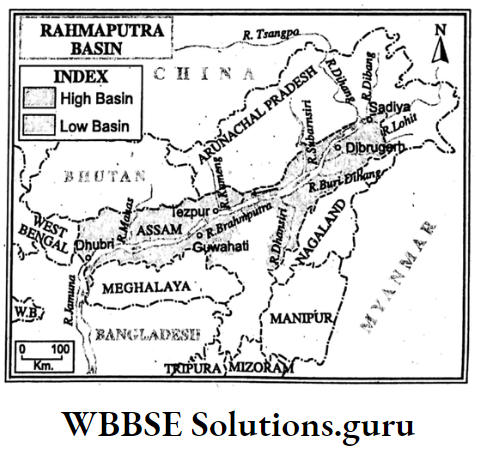
WBBSE Notes For Class 10 Geography Chapter 5 India Brahamaputra Basin

WBBSE Chapter 5 India The Peninsular Plateau

To the south of the Northern Plains is located the Peninsular Plateau of India. Geologically, it is part of the ancient landmass of the world, the Gondwanaland.

Based on variation in landform, this plateau may be divided into three regions

  1. The Central Highland,
  2. The Eastern Highland and
  3. The Deccan Plateau.

The Central Highland

It covers the highlands of Rajasthan, Madhya Pradesh and Uttar Pradesh. On the Western border of Central Highland stands the Aravalli, the oldest fold mountain of India as well as of the world.

Gurusikhar (1722 m) is the highest peak of Aravalli. Vindhya, the most important range of this highland has an average elevation of 300 m and is the source of the river Chambal.

The highest peak of this range is Manpur (881 m). To the west of the Vindhya is located the Malwa plateau.

The northeastern part of the Malwa plateau is composed of pink granite and is called the Bundelkhand plateau. The eastern part of the Vindya range is known as the Rewa plateau.
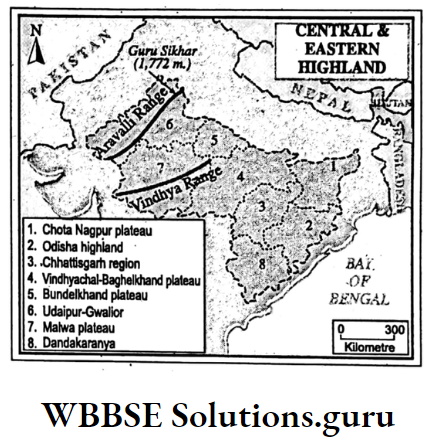
WBBSE Notes For Class 10 Geography Chapter 5 India Central & Eastern Highland

The Eastern Highland

It comprises Chota Nagpur plateau of Jharkhand, Baghelkhand plateau of Chhattisgarh, Mahanadi Basis and the plains of Chhattisgarh and Dandakaranya of Odisha.

Denudation has lowered this region. Pat, the highest (1100 m) part of the Chota Nagpur plateau lies to the west of this region. The famous Ranchi plateau dissected by the river Damodar is located to the east of the Pat region.

To the north of the river, Damodar lies the Hazaribag plateau where stands the Pareshnath hill (1366 m), the highest peak of the Chota Nagpur plateau.

To the northeastern corner of the plateau on the West Bengal-Bihar border stands the Rajmahal Hills. The Dalma, Porhat and Rajmahal hills of this region are made of basalt rock.

To the south of the Baghelkhand plateau lies the Chhattisgarh Basin of the river Mahanadi. Further south, stands the Dandakarnya hills of Odisha, the highest part of which is the Koraput.

Garjat Hills (400-1000 m) stand to the south of the Ranchi plateau.

Class 10 Geography Chapter 5 WBBSE Solutions

WBBSE Chapter 5 India Meghalaya Plateau

The Chota Nagpur plateau extends into the state of Meghalaya. Millions of years back, part of the old plateau lying between the Chota Nagpur plateau and the Meghalaya plateau subsided due to earth movement.

Thus Meghalaya Plateau became isolated from, the rest of the Peninsular Plateau. The subsided region was, eventually, occupied by the Ganga Plain.

Meghalaya plateau consists of Mikir hills in the east, Garo hills in the west and Khasi-Jaintia hills in the middle.

Shillong, Cherrapunji located in the central part of the plateau is the highest part of this region with an average height of 1500 m. Shillong (1966 m.) is the highest peak in this region.
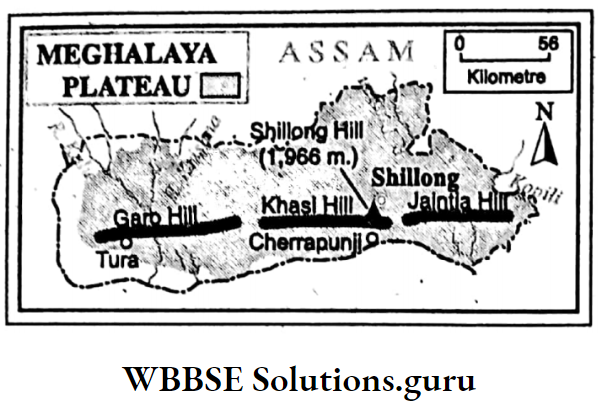
WBBSE Notes For Class 10 Geography Chapter 5 India Meghalaya Plateau

The Deccan Plateau

The Deccan plateau extends from the Vindya range in the north to the Kanniyakumari (Cape of Comoris) in the south.

It is bounded on the west by the Western Ghats or Sahyadri and on the east by the Eastern Ghats or Malayadri. The plateau is part of the ancient Gondwanaland of the world.

It is composed of ancient igneous rocks like Granite and metamorphic rocks like gneiss. The region slopes from the west to the east and rises gradually to the south.

Deccan trap, an extensive part of the plateau in the northwest, is covered by black soil and is known as the lava plateau.
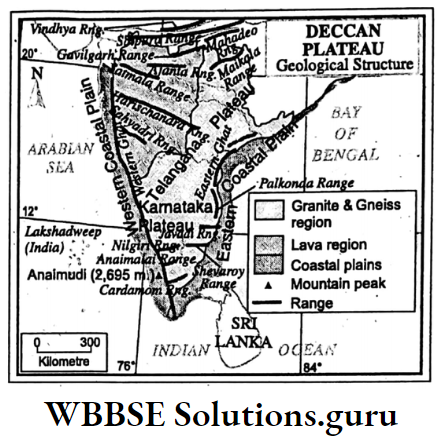
WBBSE Notes For Class 10 Geography Chapter 5 India Deccan Plateau

Ranges Of The Plateau

Satpura-Mahadeo range located to the south of the river Narmada is a block mountain. Its highest peak is Dhupgarh (1350 m). To the east of it stands the Maikala range.

Its highest peak is Amarkantak (1057 m). Along the western border of the Deccan plateau stands the north-south extended Western Ghats or Sahyadri.

Anaimudi (2695 m) 1500 is its highest peak which is also the highest peak in South India. Important peaks of the Western Ghats are Vavulmala (2339 m).

Kalsubai, Mahabaleswar etc. There are a few passes, namely Thal Ghat near Nasik and Bhor Ghat near Pune. To the extreme south of the plateau, there is the Nilgiri-Anaimalai-Palni-Cardamom range.

Dodabeta is the highest peak of Nilgiri (2637 m). To the south of Nilgiri lies the Pal Ghat gap. Further in the south stand the forested hills of Anaimalai, Palni and Cardamom.

Class 10 Geography And Environment Notes WBBSE

Actually, to the south of the Pal Ghat gap, the Western Ghats have reappeared to form Anaimalai the two branches of which are Palni to the east and Cardamom to the south.

So, Anaimudi is rightly considered the highest peak of the Western Ghats. To the east of the Deccan plateau stands the Eastern Ghats extended in a north-south direction.

Important peaks are Bilgiri Rangan, (1750 m), Armaconda and Mahendragiri.
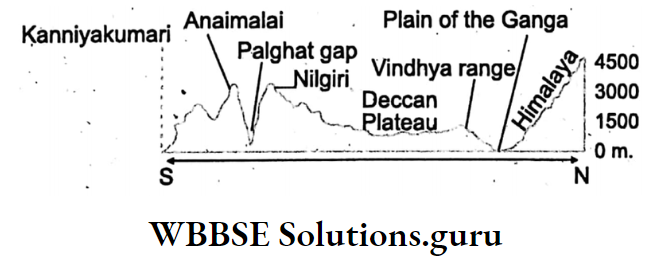
WBBSE Notes For Class 10 Geography Chapter 5 India Indian Landmass-Kanniyakumari to the Himalayas

WBBSE Chapter 5 India The Coastal Plains

The coastal plain of India stretches along the Arabian Sea coast in the west and the Bay of Bengal coast in the east. It may be broadly sub-divided into

  1. East Coastal Plain and
  2. West Coastal Plain.

WBBSE Notes For Class 10 Geography Chapter 5 India Coastal Plains

East Coastal Plain

It extends from the river Subarnarekha in the north to Kanniya- Kumari in the south for nearly 1500 km. It may be divided into two division

  1. North Circar Coast to the north of the river Krishna including Odisha Coastal Plains in between the river Subarnarekha in the north and the river Rushikulya in the south and Andhra Coastal Plain from the mouth of Rushikulya to the lake Pulicat.
  2. Coromandel Coast to the south of the river Krishna is known as the Tamil Nadu coast which stretches from Lake Pulicat to Kanniyakumari.
  3. There are many sand dunes and lagoons in the eastern coastal plain. Sand dunes in Tamil Nadu are locally called Theris. A few lagoons, namely Chilka on the Odisha coast.
  4. Kolleru and Pulicat on the Andhra coast are found between the sand dunes and the coast.

West Coastal Plain

It stretches from Runn of Kachchh in the north to Kanyakumari in the south. It is much narrow than the eastern coastal plain.

It is divided into four sections

  1. Gujarat Coastal Plain is found in Gujarat. It includes
  2. Kachchh and
  3. Kathiwar Peninsula. Runn of Kachchh, a marshy land is located in Kachchh Peninsula. In Kathiwar Peninsular there are two forested hills-Gir and Girnar.
  4. Konkan Coastal Plain of Maharastra is narrow and broken. It extends from north of Maharastra to Goa, in the south.
  5. Karnataka Coastal Plain of Karnataka extends from Goa in the north to the south of Karnataka. It is also narrow and broken.
  6. Malabar Coastal Plain of Kerala is 95 km wide. There are many sand dunes (Theris) and Kayals (backwaters) like Vembaonad near Cochi (80 km long) and Austamudi near Quilon (Kollam).

Comparison Between East And West Coastal Planes:
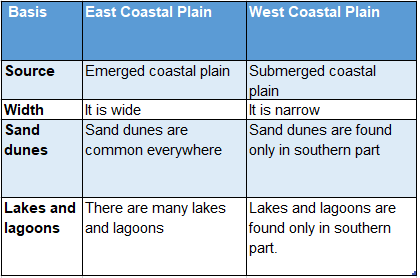
WBBSE Notes For Class 10 Chapter 5 India Comparison between East and West Coastal Plain

The Islands

The islands of India may be grouped into two divisions

  1. Islands of the Bay of Bengal which include Andaman and Nicobar Islands. These are actually, the tops of the submerged mountain ranges. The highest peak is Saddle (775 m). Barren and Narcondam are two volcanic peaks.
  2. Islands of the Arabian Sea include Lakshadweep located off the Malabar Coast in Kerala. These are coral islands and were referred to as Laccadivi, Minicoy and Amindivi.

WBBSE Chapter 5 India Significance Of Physiographic Divisions

Importance of the Himalayas:

  1. Defence: The Himalayas protects India like a wall from foreign invasion.
  2. Climate: It prevents cold winds to enter India in winter and gives rain in summer by obstructing moist southwest monsoon wind.
  3. Source of the river: The Ganga, Brahmaputra, Indus and their tributaries have originated in the Himalayas.
  4. Fertile plain land: Himalayan rivers have brought a large number of silts and deposited them to form the great plain land of North India.
  5. Others: The rich coniferous fruits and medicinal herbs, extensive pasturelands, hydel power generation on turbulent rivers as well as scenic beauties of the Himalayas play an important role in the life of Indian people.

Importance Of The Plains Of Northern India:

Excepting the Marusthali on the west the rest of the Northern Plain of India is agriculturally sound. This is known as the ‘Granary of India’.

The transport system is well developed because of its flat land. It is famous for many industries like sugar, jute, cotton textile, chemical and leather. This is the most populated region of India.

Important cities like Delhi, Kolkata, and Patna are located here. The saline lakes of Marusthali are famous for the production of salt.

Importance Of The Peninsular Plateau:

The Peninsular plateau is important for mineral resources like coal, copper, and iron ore as it is an ancient plateau, Chota Nagpur plateau is known as the ‘Mineral Storehouse of India’.

River valleys are agriculturally rich. Mineral, forest and agro-industries have well developed here. Swift-flowing rivers are favourable for hydel power generation.

For scenic beauties Mt. Abu, Netarhat, and Panchmari are famous tourist spots.

Class 10 Geography And Environment Notes WBBSE

Importance Of Coastal Plain :

The coastal plain is agriculturally famous. Rice, sugarcane, spices, and coconuts grow profoundly. Fishing is an important activity. Important ports like Mumbai, Chennai, Visakhapatnam, and Cochi are located here.

Many industries like cotton textile, oil refining, chemical and engineering have developed here.

Importance Of Islands:

The Islands are fertile as well as forested but sparsely populated. So, the scenic beauties of these islands attract many tourists.

WBBSE Chapter 5 India Water Resources Of India

Water is one of the most important renewable natural resources for supporting life.

Facts at a glance :
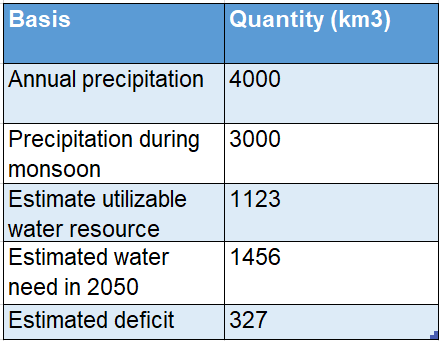
WBBSE Notes For Class 10 Chapter 5 India Water Resources of India

Source:

Water Resource at a Glance 2011 Report, CWC, New Delhi.

WBBSE Chapter 5 India Rivers Lakes Waterbodies And Canals

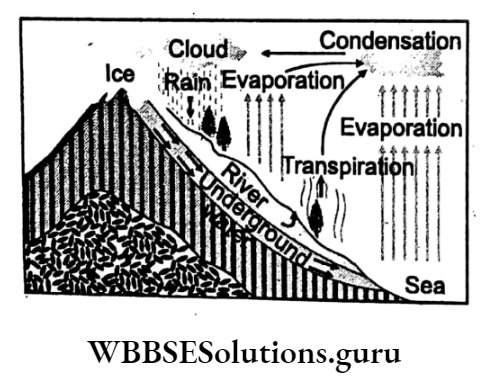
Most of the precipitation goes to sea or lakes by surface runoff i.e. Rivers.
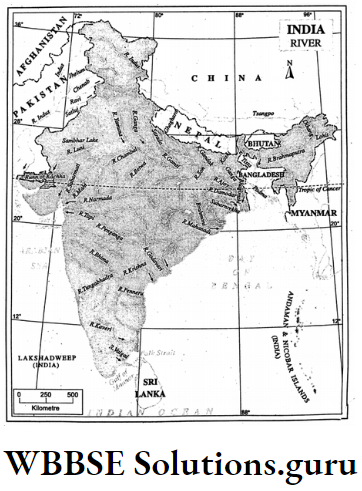
WBBSE Notes For Class 10 Geography Chapter 5 India Rivers of India

Rivers

Indian rivers can be divided into two groups according to their sources, courses and mouths

  1. Rivers of North India and
  2. Rivers of South India.

Rivers of North India

The North Indian Rivers are

  1. The Ganga,
  2. The Indus and
  3. The Brahmaputra.

The Ganga

Ganga is the principal river of India. From source to mouth, the river can be divided into three courses-the upper course, the middle course and the lower course.

The Upper Course:

28 Delhi Bhagirathi, the source of the river Ganga, rises in the Gangotri Glacier of Gomukh ice cave in Uttarakhand. It flows southwestward to meet the river Alakananda, a tributary of the river Ganga near Devaprayag.

The combined flow known as Ganga flows through the Siwalik range southwards. At Hardwar, the river Ganga leaves the upper or mountain course.

The Middle Course:

From Hardwar, the river Ganga flows southward and turns eastward flowing through Uttar Pradesh and Bihar. Near Rajmahal hills, the river Ganga enters West Bengal.

Lower Course:

In West Bengal, the river Ganga flows eastward and near Dhulian it is divided into two distributaries

  1. The Padma flowing through Bangladesh and
  2. The Bhagirathi flows southward and is known as Hugli from Chinsura up to the mouth of the Bay of Bengal forming an estuary.

The Ganga At A Glance:

The Ganga is 2510 km long (including 2071 km in Bangladesh). It has formed the largest delta in the world. Right Bank tributaries- The Yamuna and Son.

Left Bank Tributaries:

Gomti, Ghaghara, Gandak and Kosi.
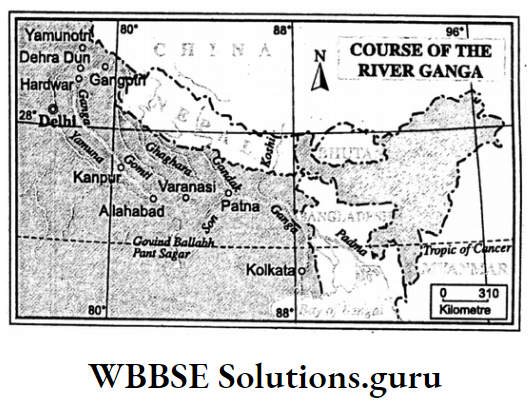
WBBSE Notes For Class 10 Geography Chapter 5 India River Ganga

The Indus

The river rises in the Sangekhabab glacier in Tibet. It flows westward in Jammu and Kashmir between Karakoram and Ladakh ranges. Near Nanga Parbat it turns through a deep gorge and enters Pakistan.

Indus at a Glance :

The Indus is 2880 km long (only 709 km is in India) Left Bank Tributaries-Sutlej, Beas, Ravi, Chenab and Jhelum.
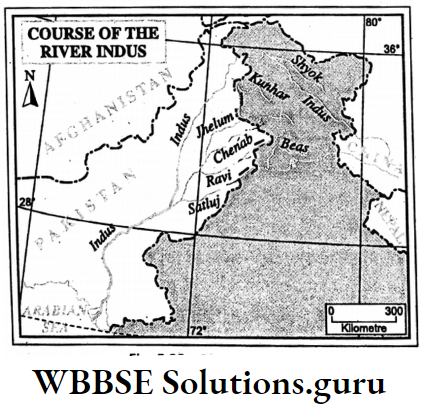
WBBSE Notes For Class 10 Geography Chapter 5 India River Indus

The Brahmaputra

The river Brahmaputra rises in the Chemayungdeng glacier located 90 km southeast of Rakshas Tal and Manas Sarovar in Tibet where it is known as Tsangpo.

Near Namcha Barwa peak it turns southward through a deep gorge and enters Arunachal Pradesh where it is called Dihang. The Dihang enters Assam near Sadiya and joins the Luhit and Dibang rivers.

The combined flow is known as the Brahmaputra. At Dhubri the Brahmaputra takes a southward turn and enters Bangladesh as Yamuna and finally drains into the Bay of Bengal.

Brahmaputra at a Glance :

  1. The Brahmaputra is 2580 km long. In India, it is about 885 km long.
  2. Right Bank tributaries-Subarnasiri, Manas, Sankosh.
  3. Left Bank tributaries-Dhansiri, Kopili, Lohit.
  4. The Brahmaputra has formed the world’s largest river island-Majuli.
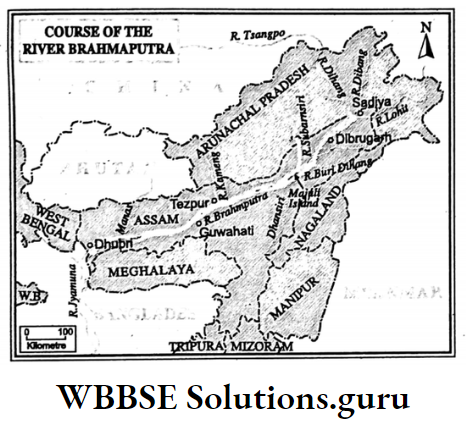
WBBSE Notes For Class 10 Geography Chapter 5 India River Brahmaputra

WBBSE Chapter 5 India Rivers Of South India

In South India, the Narmada and Tapi are west-flowing rivers and Mahanadi, Godavari, Krishna, and Kaveri are important east-flowing rivers.

The Narmada (1300 Km):

It rises on the Amarkantak peak of the Maikala range and flows through a narrow rift valley between Vindhyas in the north and Satpura in the south and finally drains into the gulf of Khambat forming an estuary.

It has formed the famous Dhuandhar waterfalls on the Bheraghat marble rock region near Jabbalpur. Two important tributaries of Narmada are Kolar and Hiran. However, Narmada forms no delta.

Class 10 Geography And Environment Notes WBBSE

The Tapti Or Tapi (724 Km):

It rises near Multai on the Mahadeo range in Madhya Pradesh. It flows through a rift valley between the Satpura in the north and Ajanta in the south.

It flows westward to drain into the Gulf of Khambat forming an estuary at its mouth. Important tributaries of Tapi are Purna, Girna, Vethor etc. Tapi also forms no delta.

The Mahanadi (880 Km):

It rises on the Sihwa range in Chhattisgarh and flows eastward and drains into the Bay of Bengal forming a large delta at its mouth. The Sheonath, Brahmani and Baitarani are the important tributaries of the river Mahanadi.

The Godavari (1465 Km):

This is the most important river in South India. It rises on the Trombok hills of Sahayadri in Maharastra and flows southeastward and drains into the Bay of Bengal forming a large delta at its mouth.

Important tributaries of Godavari are Penganga, Wardha, Wainganga, Manjira, Pranhita, Indravati etc. Important distributaries are Goutami, Basistha, Bainateo etc.

The Krishna (1400 Km):

It rises on the Mahabaleshwar hills of the Western Ghats and flows eastward to drain into the Bay of Bengal forming a large delta at its mouth. The important tributaries are Koyna, Bhima, Tunga, Bhadra and Bedbati.

The Kaveri (800 Km):

It rises on the Brahmagiri hills of the Western Ghats in Karnataka and drains into the Bay of Bengal forming a large delta.

It has formed the famous Shivsamudram waterfall. Important tributaries are Bhabani, Himabati.

Comparison Between The Rivers Of North And South India:
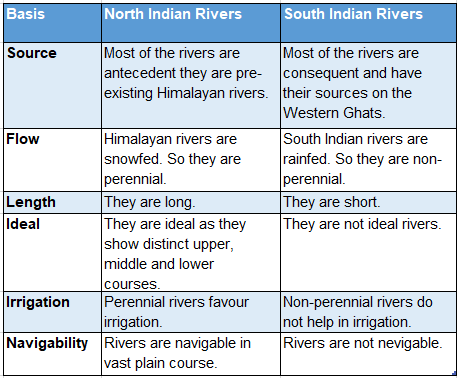
WBBSE Notes For Class 10 Chapter 5 India Comparison between the rivers of North and South India

Facts at a Glance :

  1. Godavari is the longest river in South India. So it is called the ‘Ganga of the South’ or ‘South Ganga’.
  2. Kaveri is the holy river of South India. So it is also known as the ‘Ganga of the South’ or ‘South Ganga’.
  3. Gersoppa or Yog is the highest waterfall (275 m) on the river Sarabati in India.

WBBSE Chapter 5 India Lakes

Many lakes are found in different parts of India. Lakes are usually natural. Man-made lakes are also found. On the basis of taste, lakes are of two types

  1. Fresh water lake and
  2. Saltwater Lake or Brackish Lake.

Fresh Water Lakes:

These are mostly Himalayan lakes, located in the upper part of the mountain. So the region is very cold and the lakes are snowed. There is also less evaporation.

All these have made freshwater lakes like Dal, and Wular in Kashmir and Punatal, Sattal, Bhimtal, and Nainital in the Kumaon region.

Class 10 Geography And Environment Notes WBBSE

Rupkund near Nanda Ghunti and Hemkund near Bhurj highlands are also freshwater lakes of the western Himalayas. Some freshwater lakes in the eastern Himalayas are Loktak in Manipur, Chhangu Lake in Sikkim etc.

Salt Water Lakes:

Most of the saltwater lakes of India are found in Rajasthan where evaporation is highest. Sambhar, Didwana, Puskar, Pachpadra of Rajasthan.

Pangong and Tso Moriri of the dry Ladakh plateau of Kashmir as well as Kolleru of Andhra Pradesh and Pulicat of Tamil Nadu are famous saltwater lakes.

Chilka on Odisha’s coast is the saltwater lagoon. Bhembonad and Austamudi are saltwater lagoons locally called Kayals.

Waterbodies

There are many ponds, reservoirs, bells and tanks found in India. Important waterbodies in India are Anantnag in Jammu and Kashmir, and Indiranagar in Rajasthan.

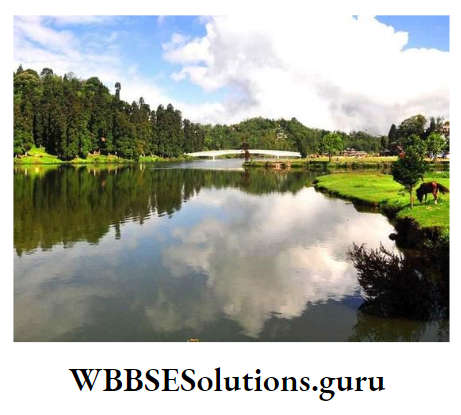
Mirik in West Bengal, Lonar in Maharastra, Sukhna in Chandigarh and Maithan, Panchet, Govind Sagar, Rana Pratap Sagar, and Nagarjuna Sagar reservoirs.

Canals

There are many perennial canals in India, such as Upper Ganga Canal, Lower Ganga Canal, Sarada Canal and Agra Canal in Uttar Pradesh; Son Canal and Koshi Canal in Bihar.

Durgapur Canal, East Damodar Canal, Eden Canal, Bakreswar Canal and Medinipur Canal in West Bengal; Indira Canal, Chambal Canal and Bikaner Canal in Rajasthan.

  1. Importance of rivers, lakes, waterbodies and canals on human life.
  2. Rivers have formed fertile alluvial plains which are the rich farmlands of India.
  3. Water from rivers, lakes, water bodies and canals is widely used for irrigation.
  4. River water is used for hydel power generation.
  5. Freshwater provides drinking water.
  6. Navigable rivers and canals are used as waterways.
  7. Job opportunities are provided by production of salt, fishing and tourism.

Facts at a Glance :

  1. Ular in Kashmir is the largest freshwater lake in India.
  2. Chilka is the largest lagoon in India.
  3. The Indira Canal of Rajasthan is the longest canal (582 km) in India.
  4. Medinipur Canal is the longest (520 km) canal in West Bengal.
  5. Bhembanad is the largest Kayal in India.

WBBSE Chapter 5 India Means Of Irrigation

The success of agriculture mostly depends on the supply of water. In a country like India where rainfall is irregular, Irrigation is indispensable.

Means Of Irrigation :

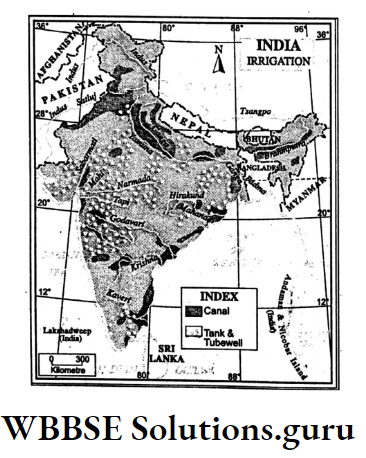
Irrigation is practised in India

  1. well and tubewell,
  2. canal and
  3. irrigation.

WBBSE Notes For Class 10 Geography Chapter 5 India Irrigation System

Well and Tubewell

38% of the irrigated land in India is irrigated by wells and tube wells. In this method of irrigation, wells are dug to reach the underground water table and water is lifted in two ways

  1. Persian wheel in which a wheel is attached by many buckets filled with water and is pulled by a rope and
  2. Electric pumps or diesel pumps by which irrigation is mainly practised in the plains of North India.
  3. Tubewells are of two types-Shallow tube wells are used in which a hand pump is used. Deep tube wells are used by electric pumps.

Wells and tube wells are mainly used in the plains of North India mainly in Uttar Pradesh, Bihar, West Bengal and Assam.
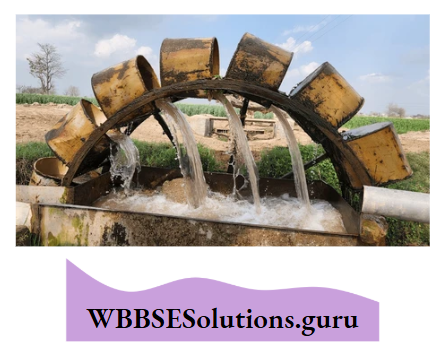
WBBSE Notes For Class 10 Geography Chapter 5 India Persian Wheel

Canal

Canals are of two types

  1. Inundation canal and
  2. Perennial canal.

Inundation canals get their supply of water only when a river rises above a certain level during the rainy season.

Perennial canals carry water throughout the year as they draw their water from the perennial rivers or artificial lakes or barrages which are built across a river.

There are many perennial canals in India, such as the Upper and Lower Ganga Canal, Agra Canal, and Sarada Canal in Uttar Pradesh; Yamuna Canal and Sirhind Canal in Punjab.

Medinipur Canal, Eden Canal and canals under the river Damodar, Mayurakshi and Kangsabati project in West Bengal; Mettur Canal in Tamil Nadu.
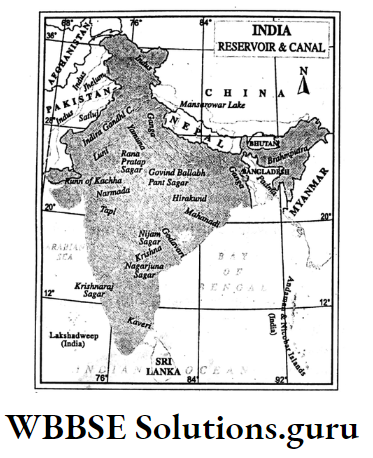
WBBSE Notes For Class 10 Geography Chapter 5 India India Reservoir and Canal

Advantages And Disadvantages Of Well Tubewell And Canal
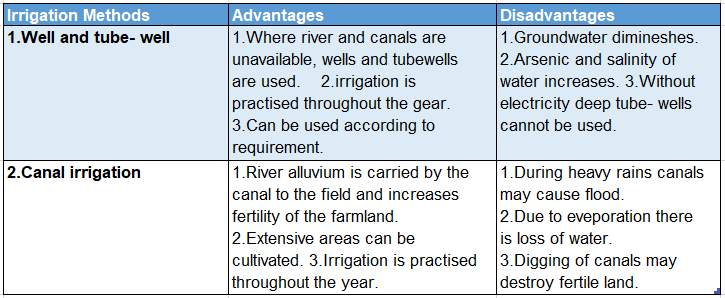
WBBSE Notes For Class 10 Chapter 5 India Advantages and Disadvantages of well, tubewell and canal

Overuse Of Underground Water And Its Impact

Groundwater is the main source of fresh usable water. Though the reserve of ground water is limited, yet we use and overuse it to satisfy our increasing demand in domestic, agricultural and industrial sectors. It may adversely affect.

Lowering Of Ground Water Table:

Due to the overuse of groundwater, the groundwater table is declining.

Reduction In Surface Runoff:

Due to the depletion of groundwater, there is seepage of water from rivers, lakes and other water bodies underground resulting in loss of surface water.

Landslide:

Due to overuse of underground water balance in rock layers underground is disturbed which may cause landslides.

Problem Of Salinity:

Excessive use of groundwater turns the soil into saline by the capillary.

Arsenic Pollution:

Vacuums formed underground due to over lifting water groundwater is filled with air and the oxygen present in the air mixes up with arsenic which easily.

dissolve in water and pollute the groundwater. This is rapidly increasing in some parts of West Bengal which is very much alarming.

WBBSE Chapter 5 India Multipurpose River Valley Projects

The river valley projects serve manifold benefits such as flood control, irrigation, generation of hydel powepisciculture, navigation, afforestation, control of soil erosion, supply of drinking water etc.

are known as the Multipurpose River Valley Project (MRVP). Example. Bhakra Nangal Project across the river Sutlej.

Important Multipurpose River Valley Project

Important Multipurpose River Valley Projects of India are Damodar Valley Project (Project on the river Damodar and its tributaries Barakar and Konar), Bhakra Nangal Project (Sutlej River).

Hirakund Project (Mahanadi river), Rihand Project (Rihand a tributary to Son), Nagarjuna Sagar Project (Krishna river), Tungabhadra Project (Tungabhadra, a tributary to the river Krishna).

Narmada Project (Narmada river), Kosi Project (Kosi river), Mayurakshi Project (Mayurakshi river).

Damodar Valley Corporation (D.V.C.)-A Case Study

Backdrop:

Damodar, the most important river of Chota Nagpur plateau originating from the Khamarpet hill flows through Jharkhand and West Bengal to join the river Hugli.

Many tributaries, namely Barakar, Konar, Bokaro, and Jamuria have joined this river. In the past, the river Damodar was called the ‘River of Sorrow’ because of its frequent floods.

Project

In 1948, ‘The Damodar Valley project’ was undertaken by the Central Government and Government of West Bengal and Bihar under the responsibility of Damodar Valley Corporation (D.V.C.) an autonomous body.
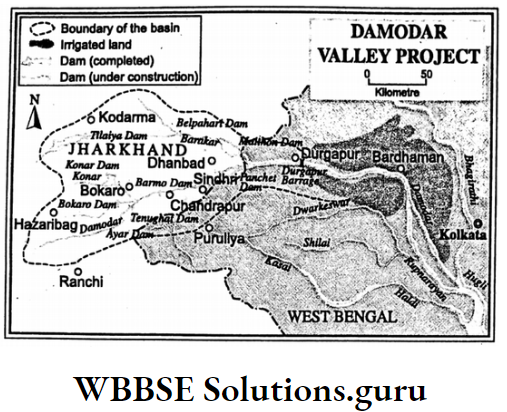
WBBSE Notes For Class 10 Geography Chapter 5 India Damodar Valley Project

Programmes Cons:

The construction of eight dams was planned

  1. Panchet,
  2. Barmo,
  3. Ayre on the river Damodar;
  4. Maithan,
  5. Belpahari and
  6. Tilaiya on the river Barakar;
  7. Konar on the river Konar and
  8. Bokaro on the river Bokaro.
  9. Finally, at Tenughat, another dam was built on the river Damodar.

Implementation

Apart from the construction of dams following activities were taken up:

Electricity:

Hydel power plants at Tilaiya, Maithan and Panchet and thermal power plants at Bokaro, Chandrapura and Durgapur were set up.

Barrage And Irrigation Canal:

Durgapur barrage at Durgapur on the river Damodar was constructed. Canals on both sides were constructed for about 2495 km.

Navigation:

137 km long canal has connected Kolkata by joining Hugli river.

Impact Of The Project:

  1. Flood has been controlled,
  2. Electricity produced in this project satisfies the demand of industrial regions of Chota Nagpur, Asansol, Durgapur and Kolkata
  3. Farmlands of Barddhaman, Bankura, Haora, and Hugli has benefitted from irrigation water,
  4. Pisciculture,
  5. Navigation,
  6. Development of tourism and
  7. Soil conservation has materialized.

Class 10 WBBSE Geography Chapter 5 Explanation

WBBSE Chapter 5 India Conservation Of Water-Importance And Methods:

Importance :

Nearly 97% of the water resource of the world is sea or ocean water which is saline. Rest 3% is fresh water out of which 2% is polar ice.

Only 1% of water is confined to groundwater, or surface water such as rivers, ponds, beels, canals etc. Without water, life will not exist. So conservation of water is indispensable.

Methods

There are two methods of conservation of water

  1. Rainwater Harvesting and
  2. Watershed Development.

Rain Water Harvesting

To recharge groundwater reserves by storing rainwater there are different methods. In urban areas, it is possible to roof water stored in a reservoir or by sending it into an underground well.

In rural areas, rainwater flowing through rivulets and trenches may be stored in a reservoir.

Watershed Development

The Highland that separates adjacent river systems is known as a Watershed which is actually a geo-hydrological unit.

Watershed development refers to the conservation, regeneration and judicious use of all the natural resources like land, soil, water, plants, animals and human resources within the watershed area.

Objectives are to mitigate the adverse effects of drought on crops and livestock, control desertification, encourage restoration of ecological balance and promote the economic development of the village community.
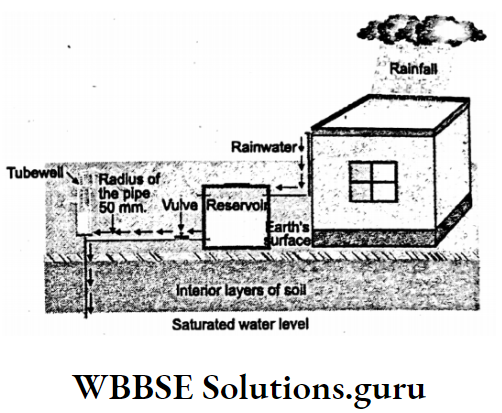
WBBSE Notes For Class 10 Geography Chapter 5 India Water Harvesting

Role Of Tamil Nadu In Rain Water Harvesting- A Case Study

In Tamil Nadu Rain Water Harvesting movement was launched in 2001. It has a tremendous impact on recharging groundwater tables all over Tamil Nadu.

It is mandatory to provide RWH structures in all new buildings. Out of a total of 2392457 buildings, Town Panchayats 2294342 buildings have provided RWH structures so far.

This is the outcome of the activities carried out in Town Panchayats areas to sustain the momentum of the programme.

WBBSE Chapter 5 India Climate Of India

India shows great diversity in landforms. So Indian climate is very much diversified. Nevertheless, the climate of India is greatly influenced by the monsoon winds.

Regional Variation In the Climate Of India:

Cycle Of Seasons

Four seasons, namely summer, rain, autumn and winter rotate in a cycle.

The Mainland of India extends from nearly 80° north latitude to about 37° north latitude.

When the hot humid equatorial climate is experienced in the extreme south, the Tropical climate prevails in Central India and the Subtropical and Temperate climates prevail in Northern India.

Interior of the Deccan, though not far from the sea, remains dry and the west and the East coastal Plains receive heavy rainfall due to the location of north-south extended Western Ghats and Eastern Ghats.

In Winter western Disturbances give snowfall in the mountains and rainfall in the plains. Tamil Nadu receives winter rain from the North-east Monsoon wind. The rest of India remains dry.

Being located on the same latitude climate as Darjeeling is different from that of Agra because of its altitude.

The climate of North India is extreme as it is far from the sea while the climate of South India is pleasant.

Except for North India, most parts of India enjoy mild winters.

WBBSE Chapter 5 India Factors Affecting The Climate Of India

Indian climate is largely controlled by the following factors:

Location And Latitudinal Extension:

India belongs to the Torrid zone. So Indian climate is, in general, warm and humid. India extends from 8°04′ north latitude in the south to 37°06′ north latitude in the north.

The Tropic of Cancer (23°30′ north latitude) passes through the middle of the country. So, a warm Tropical climate prevails in South India and a cold or Temperate climate prevails in North India.

Class 10 WBBSE Geography Chapter 5 Explanation

Role Of The Himalayas:

The transverse location of the Himalayas to the monsoon wind gives plenty of rain in summer and protects India from the severe cold winds in winter.
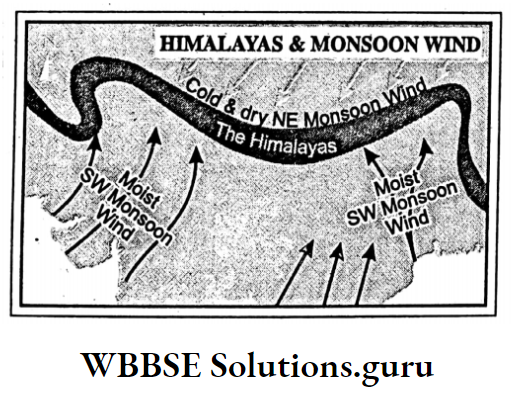
WBBSE Notes For Class 10 Geography Chapter 5 India Himalayas & Monsoon Wind

Relief :

Summers are pleasant in the mountainous regions of North and South India due to their altitude. But summers are hot in the plains and plateaus of North and South India.

Distance From The Sea:

Peninsular India as bordered on three sides by seas and oceans enjoys a maritime (moderate) climate while the interiors of north and central India experience extreme types of climate.

Monsoon Winds:

Being attracted by the low-pressure cell of the Rajasthan desert, the South-west monsoon wind gives rain in summer, while winter remains dry due to the dry and cold North-east monsoon wind.

Actually, the monsoon wind divides the Indian climate into four seasons.

Jet Stream:

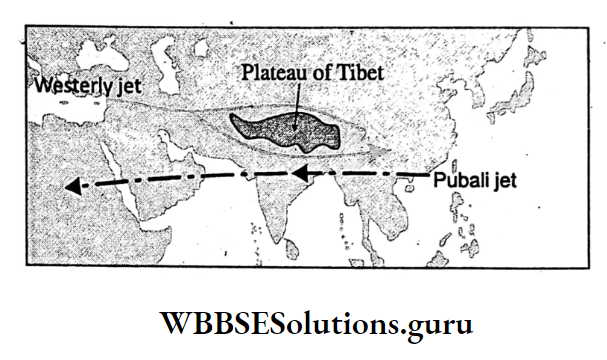
In India, Sub-tropical Westerly Jet blows in winter and Tropical Easterly Jet blow in the rainy season.

In winter with the advancement of the Westerly Jet southwards intensity of winter increases while with the shifting of the Easterly Jet, a northwards dry spell occurs resulting in drought.
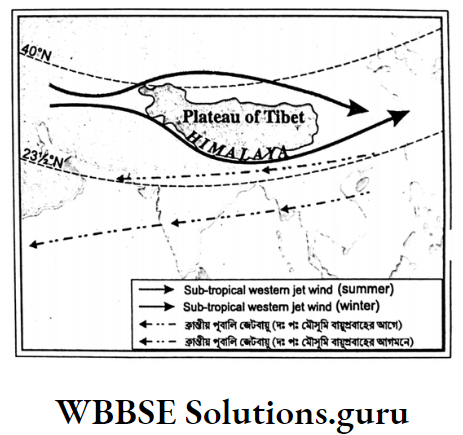
WBBSE Notes For Class 10 Geography Chapter 5 India Subtropical Westerly and Tropical Jet Stream

Tropical Cyclone And Western Disturbance:

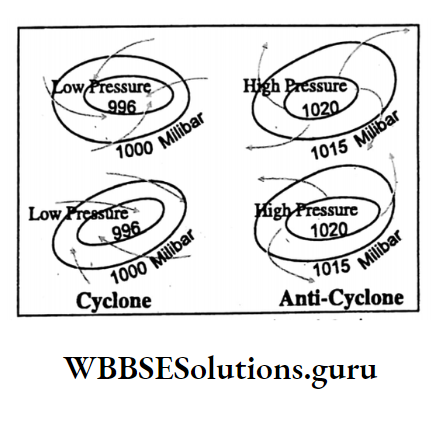
In Autumn, the conflict between the retreating Southwest monsoon wind and the advancing North-east monsoon (Trde) wind causes Tropical cyclones which give cyclonic rains in coastal areas.

In winter, Western Disturbances originating in the Mediterranean Sea also give cyclonic rain in North-west India and snowfall in the Himalayan region.

EL Nino and La-Nina:

Usually, cold Peru or Humboldt ocean current flows northward along the Peru-Equador coast in the Pacific Ocean. In some years, in December-January warm south-flowing current replaces the cold current.

This is known as El Nino. It is found that the arrival of South-west monsoon wind in South Asia including India is delayed in the years of the appearance of El Nino. It causes drought and forest fires in those countries.

In some years with the departure of El Nino intense High pressure and stable weather prevails along the Peru coast while along the west coast of the Pacific Ocean, intense low pressure and heavy rainfall occur.

This is known as La Nina. In the years of La Nina rainfall in India increases. It causes floods, landslides and foggy winters.

Class 10 Geography Chapter 5 WBBSE Solutions

WBBSE Chapter 5 India Monsoon Winds And Seasons In India

Based on the arrival and departure of monsoon winds, rainfall, temperature and air pressure the Meteorological Department of the Government of India has divided the climate of India into four seasons which rotate in a cycle as follows:

Summer (March to May)

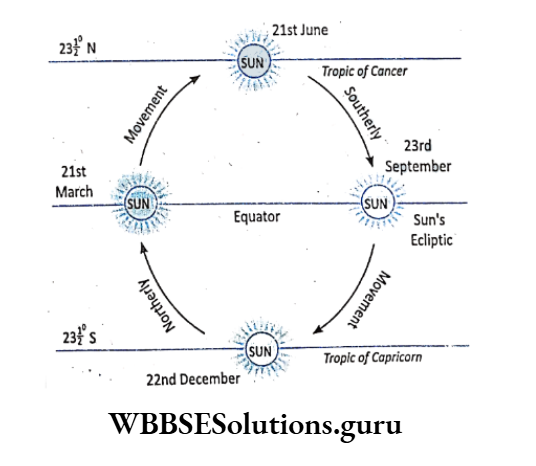
On the 21st of March, the sun lies over the equator. Gradually, it advances northward and accordingly temperature increases in India.

Temperature:

in the month of May, the temperature rises to 40°C in Madhya Pradesh and Gujarat. In the Rajasthan desert, it is nearly 48°C. By this time hot and dry wind called Loo sweeps over the Indo-Ganga plain. In Rajasthan, this is known as Andhi.

Rainfall:

In Summer, thundershower occurs which are locally known as Kalbasakhi in West Bengal, Mango Shower in South India and Bardichhila in Assam.

The rainy season (June to September)

On the 21st of June, the sun lies over the Tropic of Cancer. Therefore, an intense low-pressure cell develops in Rajasthan.

It pulls the South-east trade wind which on crossing the equator becomes South-west monsoon wind (according to Ferrel’s law) and arrives all of a sudden on the Cape of Comorin.

This is known as the ‘Burst of Monsoon’. It is then divided into two branches.

MAP

Arabian Sea Branch

It gives heavy orographic rain to the western coastal plains of India. But the Deccan plateau remains dry as it is located in the rainshadow areas of Western Ghats.

The northern section of the Arabian Sea branch does not give any rain in Gujarat as it blows parallel to the Aravalli range.

Class 10 WBBSE Geography Chapter 5 Explanation

Bay Of Bengal Branch

It gives heavy orographic rain to the southern slopes of the Himalayas and the Meghalaya plateau. Mausynram near Cherrapunji receives the highest rainfall (about 1250 cm) in the world.

But Shillong lies in the rainshadow area of the Meghalaya plateau. It gives rain in Assam, West Bengal and moves westward. As a result, rainfall decreases, gradually, in Bihar, Uttar Pradesh and Punjab.
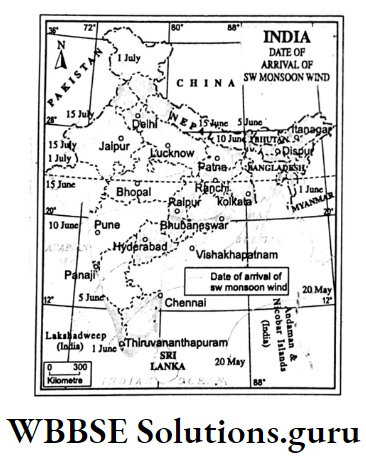
WBBSE Notes For Class 10 Geography Chapter 5 India Arrival of SW Monsoon Wind

Temperature:

The sky remains overcast. So, temperature varies between 20°C and 30°C.

Rainfall:

80% of rainfall in India occurs in the Rainy season. Rainfall is mostly orographic in nature. Maximum rainfall occurs in the Western coastal plains and in the Worth-eastern hills.

Except for the desert of the North-west, the rest of India receives rainfall varying between 60-200 cm.

Retreating Monsoon or Autumn (October and November)

On the 23rd of September, the sun lies over the equator and moves to the south. So, the temperature starts to decrease in India and the Low-pressure cell disappears.

Consequently, the South-west monsoon wind retreats from India with the advancement of the North-east monsoon wind. These two winds conflict with each other and create cyclones.

Temperature And Rainfall:

Temperature is moderate. The sky remains clear. But cyclones hit the coasts of West Bengal (locally called Aswiner Jhar), Odisha and Andhra Pradesh.

Winter (December to February)

On the 22nd of December the sun lies over the Tropic of Capricorn and the temperature in North India becomes very low forming high pressure. The wind, therefore, blows from the northeast as offshore wind.

Temperature:

The average temperature of winter in North India varies between 10°C and 15°C, while in South 15 Sep. India it rises to 25°C.

Rainfall:

The North-east monsoon wind is very dry. So it does not give any rainfall in India but causes snowfall in the Himalayas.

Western Disturbances of 12 cyclonic origins disrupt the stable weather condition in North India.

Tamil Nadu coast receives winter rain from the North-east trade wind which on crossing the Bay of Bengal Kilometre becomes moist.
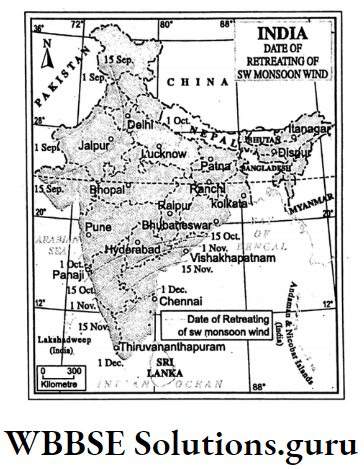
WBBSE Notes For Class 10 Geography Chapter 5 India Retreating of SW Monsoon Wind

WBBSE Chapter 5 India Impact Of Monsoon Rainfall On Soil Natural Vegetation Agriculture

The impact of the Monsoon wind in India is immense.
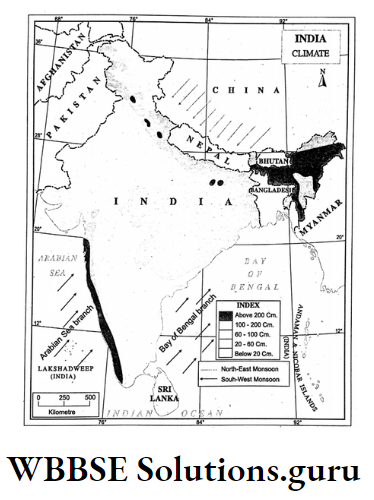
WBBSE Notes For Class 10 Geography Chapter 5 India India-Climate

Impact On Soil

The distribution of rainfall in India is uneven. Consequently, the soils of India also vary, accordingly.

Laterite soil is found in Meghalaya and Chota Nagpur plateau, Western slopes of the Western Ghat where due to excessive rainfall basic elements are leached underground while oxides of iron and aluminium are left on the topsoil.

Class 10 Geography Chapter 5 WBBSE Solutions

Desert or Sirozem soil is found in the Rajasthan desert, northern parts of Kachchh and Kathiwar where due to scarcity of rainwater (20-40 cm) minerals are accumulated on the top layers of soil.

Impact On Natural Vegetation

Excessive rainfall over the western and Eastern Himalayas has supported the growth of Evergreen trees.

Deciduous trees grow over most parts of India as India receives rain mostly in the rainy season and the trees shed their leaves in winter.

Impact On Agriculture

Agriculture in India mostly depends on monsoon rainfall. Paddy, sugarcane, cotton, tea, and jute are cultivated in the rainy season when the South-west monsoon wind gives rain.

But South-west monsoon wind is irregular and uncertain. Some years it arrives early, some years late. Sometimes rainfall occurs continuously for a few days.

Sometimes, it is rainless for a long time. As a result, floods and droughts are common. India. Ultimately, livelihood including agriculture is disrupted.

Concept Mapping
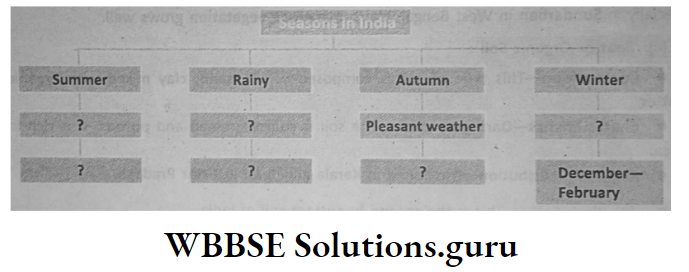
WBBSE Notes For Class 10 Geography Chapter 5 India Seasons in India

WBBSE Chapter 5 India Soils In India

Types Of Soils:

Based on variations in relief, rock type, climate and natural vegetation India may be divided into six soil types

  1. Alluvial soil,
  2. Black soil,
  3. Red soil,
  4. Laterite soil,
  5. Desert soil and
  6. Mountain soil.

Alluvial Soil

These are the principal soils of India. Alluvial soils are of three types

  1. Riverine soil,
  2. Coastal soil and
  3. Peat or Organic soil.

1. Riverine Soil :

Composition:

Riverine alluvial soil is composed of sand, silt and clay.

Characteristics:

This type of soil is formed by the deposition of silt, sand and clay in the river valleys. These are two types

  1. New alluvium or Khadar is deposited on the flood plains and near the river banks. It is fertile. It is fine-textured and acidic.
  2. The soil is grey in colour. It contains less amount of lime, humus and phosphorus.
  3. Old alluvium or Bhangar is found in old flood plains located away from the river. It is calcareous and coarse-grained. Its water-retaining capacity is low and its colour is dark.

Crop Association:

Alluvial soils favour the cultivation of rice, jute, wheat, cotton, oilseeds, sugarcane, jute, millets, pulses, tobacco and vegetables.

Regional Distribution:

River valleys of the Ganga, Indus and Brahmaputra.

2.Coastal Alluvial Soil:

Composition:

This type of soil is rich in oceanic silt, sand and salt.

Characteristics:

Coastal alluvial soil is light grey in colour. It is coarse-grained. The soil is rich in sodium, calcium, and magnesium. It is moderately fertile.

Crop Association:

Paddy, coconut, areca nut, and green chilly grow well.

Regional Distribution:

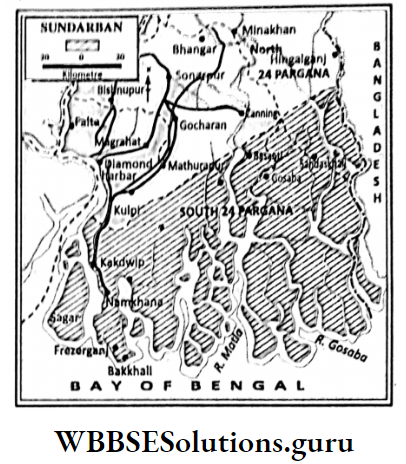
Coastal soil is found in the East and West coastal plains of India, especially in Sundarban in West Bengal where mangrove vegetation grows well.

3. Peat Or Organic Soil:

Composition:

This type of soil is composed of silt, sand, and clay mixed with organic matter.

Characteristics:

Dark grey colour. The soil is coarse-grained and porous. It is rich in silica.

Regional Distribution:

It is found in Kerala and Terai in Uttar Pradesh.

Class 10 Geography And Environment Notes WBBSE

Black Soil

This is the second most important soil in India.

Composition:

It is composed of clay (Kaolinite) and silt. Sand is less in amount.

Characteristics:

It is produced from lava rock basalt. Its colour is black. It is fine textured. The soil is rich in calcium carbonate, magnesium carbonate, iron, aluminium etc.

Its water-retaining capacity is high. It is popularly known as ‘Regur’. It favours cotton cultivation and hence, it is known as ‘black-cotton soil’. It is fertile.

Crop Association:

Cotton, rice, onion, oilseeds, oranges, grapes and vegetables are well-grown.

Regional Distribution:

Black soil is found in the Deccan Trap, especially Maharastra, the Southern part of Gujarat, Madhya Pradesh, Northern part of Karnataka. Telangana and the Northern part of Tamil Nadu.

WBBSE Notes For Class 10 Geography Chapter 5 India India-Soil

Red Soil

This is the third important soil of India.

Composition:

Red soil is rich in sand and clay particles like Kaolinite.

Characteristics:

It originated from disintegrated ancient igneous and metamorphic rocks like granite, and gneiss. Its colour is red as it is rich in iron.

Its water retaining capacity is poor. The soil is rich in Potassium and phosphate. It is coarse-grained as the soil is sandy.

Crop Association:

Millets, especially, ragi, rice, tobacco, groundnut, potato and vegetables grow well in red soil.

Regional Distribution:

Red soil is found in Tamil Nadu, Karnataka, Andhra Pradesh, and Odisha in Deccan Plateau; Jharkhand in the Chota Nagpur Plateau; North-eastern mountainous region and in Meghalaya Plateau.

Laterite Soil

This is the fourth important soil of India.

Composition:

Laterite is rich in iron and aluminium oxides and contains less amount of organic matter and silica.

Characteristics:

The soil is red in colour due to the presence of iron. The word ‘Laterite’ is derived from the Latin word ‘Later’ meaning ‘bricks’.

These rocks are washed out through the leaching process by rainwater leaving a high proportion of iron and aluminium as residue.

They are course grained and acidic in nature. They are poor in plant nutrients and cannot retain moisture. So they are infertile.

Crop Association:

Rubber, tea, coffee, corn, cashew nut and rice grow in laterite soil only with the application of irrigation.

Regional Distribution:

Laterite soil is found in Western Ghats, Nilgiri, Cardamom and Eastern Ghats, the hilly region of Odisha, Jharkhand in the Chota Nagpur plateau and in Meghalaya plateau.
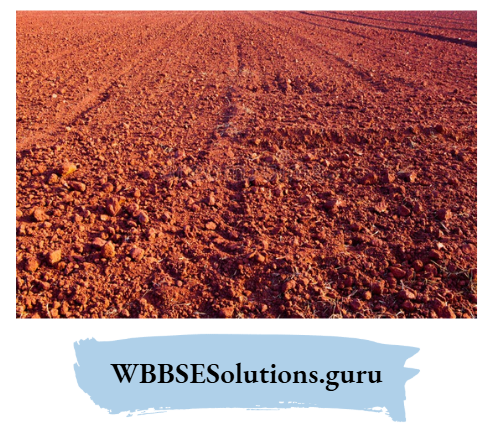
WBBSE Notes For Class 10 Geography Chapter 5 India Laterite Soil

Desert Soil

Composition:

The soil is sandy. Due to the absence of vegetation, the soil is devoid of organic matter.

Characterístics:

It is grey in colour. The soil is rich in minerals like quartz, feldspar, hornblende, phosphate etc. but poor in nitrogen. Desert soil is known as size.

Crop Association:

With help of irrigation through the Rajasthan Canal crops like cotton, jowar, sugarcane, oilseeds, and wheat are grown abundantly.

Class 10 Geography And Environment Notes WBBSE

Regional Distribution:

Desert soil is found in the Rajasthan desert and in the northern part of Kathiwar and Kachchh of Gujarat.

Mountain Soil

Composition:

It is rich in stones, clay and humus.

Characteristics:

Due to the slope of the land the soil is shallow. Its colour is greyish brown. The soil is poor in potash, phosphorus and lime but rich in nitrogen and organic matter. The soil is fine-grained.

Its water retaining capacity is medium. On the upper part of the mountain, the soil is acidic podzol type and in the lower part, brown chestnut soil is found.

Crop Association:

Rubber, tea, coffee, spices, and fruits grow well in this soil.

Regional Distribution:

The soil is found in the West and East Himalayas, Western Ghats, Eastern Ghats and Cardamom hills.

WBBSE Chapter 5 India Soil Erosion

Soil is the most valuable resource, yet its depth is only 10-20 cm. This loose layer of soil is easily removed by rain and wind if it is not held by plant roots.

Usually, the rate of removal of soil is faster than that of its formation. Soil erosion is its removal by natural or man-made processes. More than half of the Indian landmass is damaged by soil erosion.

WBBSE Notes For Class 10 Geography Chapter 5 India India-Soil Erosion

Causes Of Soil Erosion

Soil erosion is caused by two ways

  1. Natural and
  2. Human activities.

Natural Causes

Surface Runoff :

Rainwater washes the top layer of the soil. This is known as Sheet erosion. Gradually, Surface water runs in distinct paths and causes soil erosion.

This is known as Rill erosion. When rills are widened into gullies soil erosion increases further, this is known as Gully erosion.

Wind:

In deserts and seas sides strong wind causes soil erosion.

Nature Of Rainfall:

The amount of rainfall, especially the amount of rainfall per hour i.e. intensity of rainfall as well as sizes of raindrops are responsible for soil erosion.

Topography :

The greater the slope of the land higher is the amount of soil erosion. According to pedologist, H. H. Bennet, soil erosion increases by 25% with only a 1% increase in the slope of the land.

This is why soil erosion occurs more on the plateaus and the mountains than on the plains.

Landslide:

The landslide caused by heavy showers or earth movement is responsible for a huge amount of soil erosion.

Human Activities

Pressure Of Excessive Population:

The rapid increase in population is responsible for the increase in habitat land, and the establishment of factories which in turn, are responsible for the looseness of the soil and ultimately rainwater and wind wash away the loose soil particles.

Overgrazing :

Overgrazing causes the removal of plant and grass cover over land and the top soils are loosened as a result, soil erosion takes place easily.

Unscientific Mining:

Due to industrialisation increasing demand for minerals causes unscientific mining which may lead to soil erosion.

Deforestation :

Plant roots hold soil particles, Plant leaves protect soil from the strike of raindrops and the canopy protects soil from the heat by giving shade also wind velocity is reduced by the presence of forests. So deformation due to unscientific felling of trees may lead to excessive loss of soil particles.

Conventional Method Of Farming:

The conventional process of farming by which farmland becomes open when ploughing and by shifting cultivation which is locally known as jhum cultivation. In the states of North-eastern India when land is kept open for 3-4 years, topsoil is removed quickly.

Regions Of Soil Erosion

Soil erosion is increasing in India at an alarming rate, especially in the Himalayan mountainous region. North-eastern hills, a central part of Rajasthan.

Chambal- Betwa river basin in Uttar Pradesh and Madhya Pradesh, Namarda and Tapi river basin in Gujarat, Plateaus of Jharkhand and West Bengal and in the western part of Maharastra.

WBBSE Chapter 5 India Consequences Of Soil Erosion

Soil erosion affects not only the economic and cultural activities of man but also adversely affect our environment. This can be realised from the following facts:

Loss Of Top Layer Of Fertile Soil:

The top layer of soil is rich in organic and mineral contents and its removal turns the soil infertile causing low agricultural produce.

Fall of groundwater table and reduction in soil moisture:

Soil erosion causes the removal of the top layer of soil exposing bare hard rocks on which when river flows cannot penetrate.

As a result, the groundwater table is lowered due to a lack of supply of water. Consequently, moisture in the soil is also lost.

Expansion Of Deserts:

In deserts, wind removes soil from distant places. As a result, the process of desertification is intensified. This soil erosion leads to the expansion of deserts.

Frequency Occurrence Of Flood And Drought:

Due to siltation, the river becomes shallow. So, little rain causes floods. Erosion of topsoil lowers the humidity of the soil. Ultimately, the soil becomes dry and leads to drought.

Increasing Siltation In Canals And Rivers:

Soil is removed by rivers and wind and is deposited in canals, rivers and other water bodies. As a result, canals and rivers are filled up by silts and eventually, these canals and rivers dry up.

Increasing Landslide:

In the mountainous region, soil erosion takes place along the direction of the sloping land becomes open and causes landslides.

Hindrance In Economic Prosperity And Cultural Development:

Soil erosion reduces soil fertility and ultimately, lowers agricultural production. Consequently, agro-based people as well as agro-based industries are in crisis.

Again, siltation reduces the navigability of rivers. So, the waterway through the river was disrupted. River floods also destroy life and wealth.

WBBSE Chapter 5 India Prevention Of Soil Erosion And Soil Conservation

Soil conservation is to protect soil from soil erosion i.e. Soil conservation includes the methods of prevention of soil erosion.

Methods Of Prevention Of Soil Erosion

Tree Planting :

The plantation of trees is essential to protect the land from soil erosion by covering grasses and plants.

Terrace Farming:

Steep slopes foster soil erosion. So steep slopes are terraced and cultivation is practised on terraces or steps to reduce the rate of soil erosion.
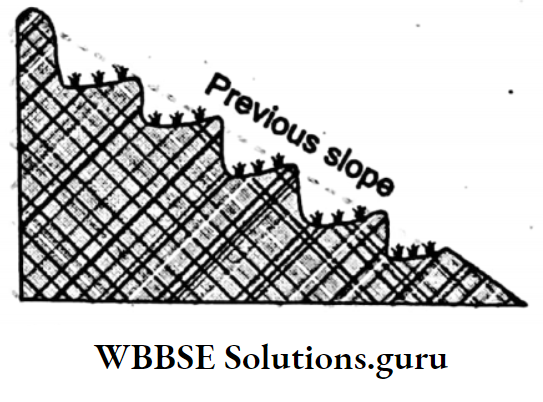
WBBSE Notes For Class 10 Geography Chapter 5 India Terrace Farming

Contour Ploughing:

Ploughing along the contours i.e.” transverse to slopes, soil erosion is reduced.

WBBSE Notes For Class 10 Geography Chapter 5 India Contour Ploughing

Strip cropping:

On treeless sloping land strips of farmlands are made on which cultivation of pulses, leguminous crops, and groundnut is practised to reduce soil erosion as well as to retain moisture in the soil.

Gully Ploughing:

Gullies or bad land topography is protected from soil erosion by planting trees beside the gullies. Leguminous crops and pulses are also cultivated along the gullies to reduce soil erosion.
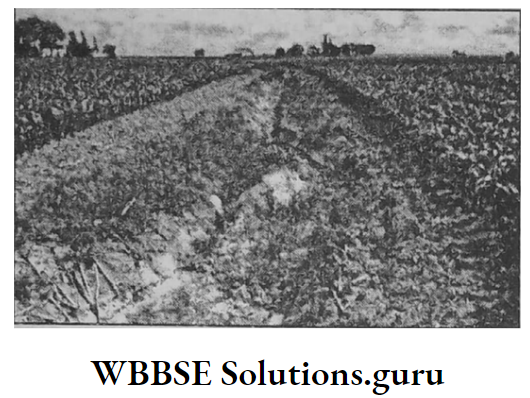
WBBSE Notes For Class 10 Geography Chapter 5 India Gully Ploughing

Prevention of Jhum cultivation:

Jhum cultivation is practised in the states of Northeastern hills by tribal people.

Through this process, a piece of land is cleared by burning trees and cultivated for 3-4 years after which they shift to another place and cultivate in a similar way.

This method of cultivation is known as the ‘slash and burn’ method or shifting cultivation. As a result, the forest is destroyed and soil erosion takes place rapidly. So it is indispensable to stop Jhum Cultivation to prevent soil erosion.
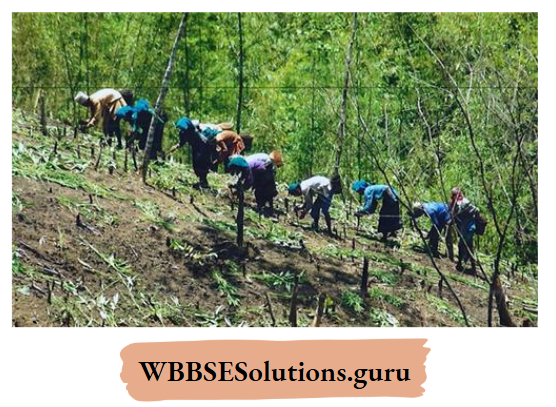
WBBSE Notes For Class 10 Geography Chapter 5 India Jhum Cultivation

Concept Mapping

WBBSE Notes For Class 10 Geography Chapter 5 India Indian Soil

WBBSE Chapter 5 India Natural Vegetation

Naturally growing trees, plants, and grasses are together called Natural Vegetation.

Types Of Natural Vegetation

Based on rainfall, temperature together with soil in India there are five types of Natural Vegetation which are described in a tabular form below:
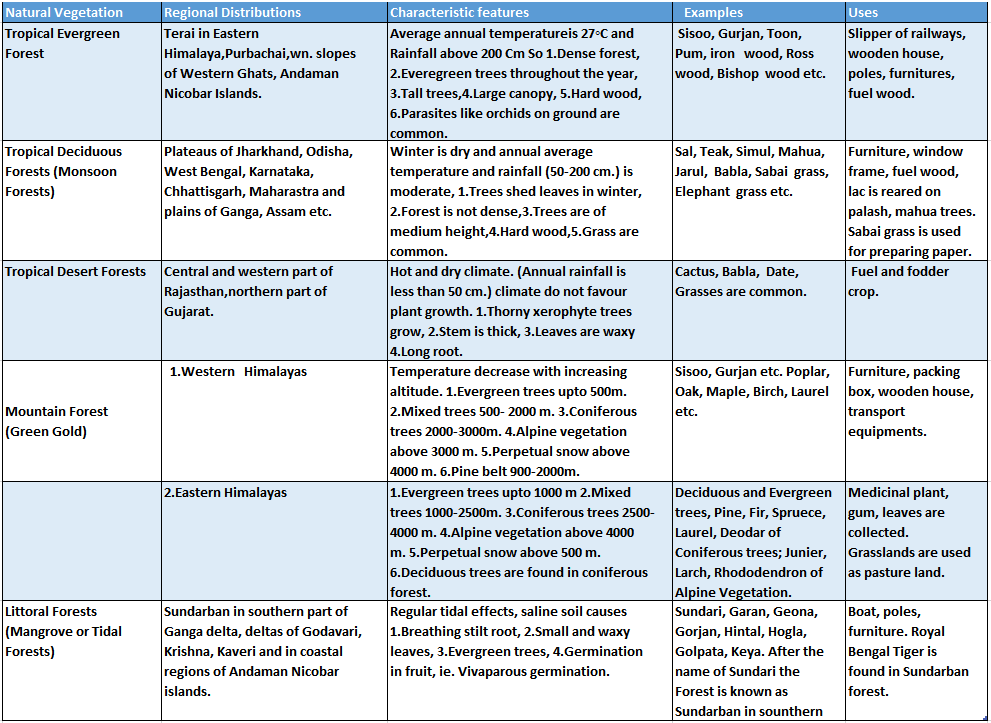
WBBSE Notes For Class 10 Chapter 5 India Types of Natural Vegetation

WBBSE Notes For Class 10 Geography Chapter 5 India Natural Vegetation

WBBSE Chapter 5 India Need For Conservation Of Forests

At present, in India, only 19-27% of the Geographical area is under forests. But according to the scientist, the said percentage should be 33 (one-third of the country).

Otherwise, the sustainability of the environment will be in danger. So Forest conservation is indispensable in India.

So that, forest produce will not be disrupted. The wise and scientific method of felling trees is known as Forests conservation.

Measures Of Forest Conservation

The following measures are necessary for the conservation of forests:

Reduction of felling of premature trees:

The feeling of immature trees should be controlled. Only mature trees should be cut.

Prohibition of indiscriminate deforestation:

Unwise felling of trees causes deforestation. So indiscriminate felling of trees should be checked.

Use of alternate source of energy instead of fuel wood:

Cheap and alternate methods of fuel should be used to control the loss of forest wood.

Prevention of forest fire:

Dry leaves and branches should be cleared to control the spread of forest fires.

Control of diseases of forest trees chemically and biologically:

Insecticides and pesticides should be spread to control plant diseases.

Controlled grazing of cattle:

Overgrazing causes the depletion of nursery plants and grassland. So afforestation is delayed.

Afforestation and reforestation:

Instead of felling trees in barren and fallow land trees should be planted and replanted there to check deforestation.

Adaptation of forest management like the felling of mature trees and selective tree felling operations:

For development activities only selected and mature trees from pure stands should be felled. For this purpose, forest management programmes should be undertaken.

People’s participation:

Forest is a natural gift and wealth to men. There is no alternative. So, the active involvement of man is indispensable for the conservation of forests.

Class 10 Geography And Environment Notes WBBSE

WBBSE Chapter 5 India Social Forestry And Agro-Forestry

Social Forestry

Social forestry is afforestation outside the forest area in barren and fallow land for the benefit of the economically weaker section of our society.

In this programme, trees are planted beside the canals and rivers, in open spaces of schools, offices and religious places, and along the road and railways.

As a result, the production of wood, fruits, fodder crops and forest products increases as well as unused barren and fallow lands.

Are used for economically profitable purposes leading to the development of the environment as well as a socio-economic field.

Agro-Forestry

Along with cultivations, farmers also plants trees in their fields, pond boundary, open spaces in and around houses, and barren or fallow lands.

This is known as agro-forestry. As a result, farmers can produce agricultural crops as well as wood and forest products commercially thereby increasing their income.

Consequently, the sustainability of the environment is also maintained.

WBBSE Chapter 5 India Economic Environment

Agriculture In India :

Most of the Indian people are agrarian. About half of the total working population of India depends on agriculture. (6% of Japanese and 3% of Americans are agrarian).

Major Characteristics Of Indian Agriculture

Indian agriculture is characterised by the following features:

Subsistance Agriculture:

As India is overpopulated, most of the agricultural produce is used by the Indians and the surplus is insignificant.

This type of agriculture is known as subsistence agriculture and is the main feature of Indian agriculture.

Population Pressure:

The rapid growth of the population is responsible for population pressure on agriculture. So Indian agriculture is labour-intensive.

Predominance Of Population Force:

In Indian agriculture instead of using modern machinery like a tractor, harvester traditional methods of cultivation using animate energy is still in practice.

Dependence On Monsoon Rain:

In most parts of India single cropping is practised using monsoon rain on a seasonal basis.

Use Of Irrigation Water:

In some places with the help of irrigation water multiple cropping (two/three crops) is also practised in India.

Small Size Of Land Holding:

In a labour-intensive subsistence agriculture population pressure is responsible for divided and subdivided holdings added by hereditary inheritance.

As a result, Indian agriculture is characterised by small holdings.

Uncontrolled Uses Of Pesticides And Chemical Fertilizers:

Unwise and unscientific use of insecticides, pesticides and chemical fertilizers leads to the deterioration of the ecosystem including soil and water pollution.

Predominance Of Food Crops:

About 66% of cultivated land is devoted to the production of rice and wheat.

Insignificant Place For Fodder Crops:

Though Indian agriculture depends on animate energy; the cultivation of fodder crops is insignificant so India is scarce in fodder crops.

Variety Of Food Crops:

Multiple cropping is practised here as there is no scope for an Extensive method of farming.

A variety of crops are produced here, such as food crops like rice, wheat, jawar, bajra, ragi, and corn; oilseeds like mustard, groundnut, sunflower etc.

Pulses like a mug, muser, matar, arhar, buli; fibre crops like cotton, jute, mesta and commercial crops like tea, coffee, rubber, sugarcane etc.

WBBSE Chapter 5 India Economic Environment Classification Of Crops On The Basis Of Uses

There are four types of crops produced in India on the basis of their uses:

Food Crops:

Crops which give nutrients in the diet are known as food crops these are two types

  1. Cereals like rice, wheat, oat, jowar, bajra etc. and
  2. Pulses like, mug, muser, cola etc.

Fibre Crops:

Crops from which yearn is produced are known as a fibre crop, such as cotton, jute, hemp, mesta etc.

Plantation Crops:

Crops produced in large farms for export are known as Plantation crops such as tea, coffee, rubber etc.

Other Crops:

Other crops produced in India are sugarcane, potato and a variety of fruits, vegetables and oilseeds.

WBBSE Chapter 5 India Economic Environment Classification Of Crops On The Basis Of Seasons

According to seasons crops produced in India are of three types:

Kharif Crops

Crops cultivated at the beginning of the rainy season and harvested at the end of autumn are known as Kharif crops, such as aman rice, cotton, sugarcane, jowar, bajra, ragi, corn, groundnut etc.

Rabi Crops

Crops cultivated at the beginning of winter and harvested at the beginning of summer are known as Rabi crops, such as wheat, oat, potato, mustard, pulses etc.

Zaid Crop

Crops cultivated in spring (March) and harvested at the beginning of the rainy season (June) are known as zaid crops, such as watermelon, cucumber, spinach and vegetables.

Major Crops Of India

Rice: Principal food crop of India

Rice is the principal food crop of India accounting for 25% of the cultivated land of the country.
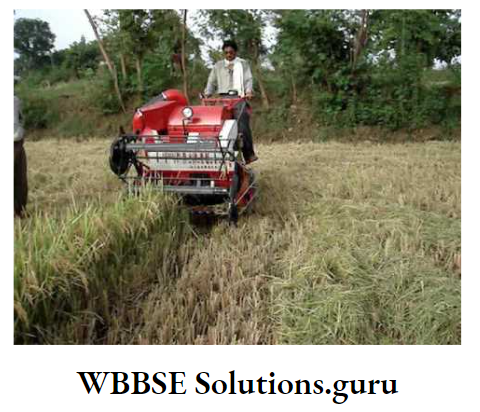
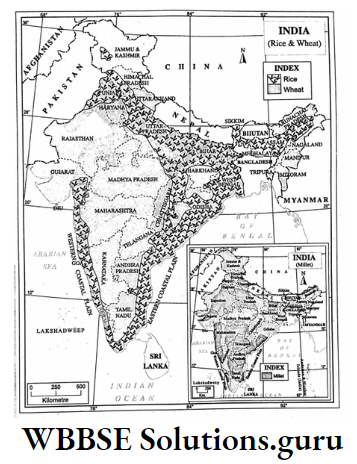
WBBSE Notes For Class 10 Chapter 5 India Economic Environment Rice Harvestor

WBBSE Notes For Class 10 Chapter 5 India Economic Environment Rice and Wheat

Favourable Geographical Conditions For Rice Production:

Physical Environment

Climate:

A hot and humid climate is ideal for rice cultivation

  1. Temperature: Rice cultivation requires 20° to 30°C temperature.
  2. Rainfall: 100 to 200 cms rainfall is ideal for rice cultivation.
  3. Soils: Fertile loamy soils especially, riverine alluvial soil ideal for rice cultivation.
  4. Relief: Level land is ideal because stagnant water is essential for rice cultivation.

Economic Environment

  1. Labour: plenty of cheap and skilled labours are required for the ploughing of soil, transplantation of seeds, weeding, harvesting, threshing etc.
  2. The facility of modern methods of cultivation: Production of rice increases if machinery, H.Y.V. seeds, fertilizer, insecticides, irrigation water etc. are used in the cultivation of rice.
  3. Capital: Large investment is required for the application of modern methods.
  4. Market: The demand for rice increases the production of rice.

Distribution

Nearly all the states and union territories of India produce rice, such as

  1. West Bengal ranks 1st position (16%) in rice production in India. Leading rice-producing districts are North and South 24 Parganas, Purba and Paschim Medinipur, Jalpaiguri, Barddhaman, Bankura, Birbhum, Uttar and Dakshin Dinajpur.
  2. Ganga Plain of Uttar Pradesh (ranks 2nd position) Godavari and Krishna Delta of Andhra Pradesh (ranks 3rd position), Sutlej Plain of Punjab, Kaveri Delta of
  3. Tamil Nadu, Mahanadi valley and delta of Odisha, and Brahmaputra valley of Assam also produce plenty of rice.

Production:

India ranks 2nd position in rice production in the world next to China. In the year 2013-14, India produced about 106 million tonnes of rice.

Trade:

Every year India exports fine-quality rice (Basmati and Dehradun rice) to France, Australia, the U.K., and Germany.

Wheat: Second Important Food Crop

Favourable Geographical Conditions For Wheat Production:

WBBSE Notes For Class 10 Chapter 5 India Economic Environment Wheat Field and Stored Wheat

Physical Environment

  1. Climate: Dry and cold weather is ideal for wheat cultivation.
  2. Temperature: Wheat cultivation requires 15°-20°C. But during ripening time it should be 25°C.
  3. Rainfall: 50 cm to 100 cm rainfall is ideal for wheat cultivation.
  4. Soils: Fertile heavy Loam or silty soils are necessary for the cultivation of wheat.
  5. Relief: Undulating or slightly sloping land is ideal for wheat cultivation.

Economic Environment

  1. Labour: The cultivation of wheat is not labour-intensive like rice.
  2. Capital: Wheat cultivation requires huge investments as most of the farming operations are done by machines.
  3. Fertilizer: Chemical fertilizer like nitrogen, potash, and phosphate is applied.
  4. Others: Modern method of farming requires H.Y.V. seeds, insecticides, and agricultural implements.

Distribution

States of North India have suitable climatic conditions for the cultivation of wheat. Uttar Pradesh (ranks first)-Districts of Saharanpur, Etwa, Muzzafarnagar.

Punjab (ranks second position)-Districts of Ferozepur, Ludhiana, Patiala, Bhatinda, Gurudaspur, Madhya Pradesh (ranks third position)-Districts of Sagar, Bidisha, Raisen.

Hisar, Ambala, Rohtak, and Gurgaon (Gurugram) of Haryana produce plenty of wheat. Other States include Bihar, Rajasthan, Gujarat and West Bengal.

Production:

India ranks 2nd position in the production of wheat in the world. In the year 2013-14, India produced about 95 million tonnes of wheat.

Trade :

Some amount of wheat is exported to the neighbouring countries namely, Bangladesh, Nepal, and Bhutan.

Millet: Jowar, bajra, and ragi are together, known as Millet which grows in India.

Favourable Geographical Conditions For Cultivation Of Millet:

Millets are hard varieties of crops. Usually, millets grow in poor land where irrigation is not possible.

Class 10 Geography Chapter 5 WBBSE Solutions

Physical Environment

  1. Climate: Millets grow in the rainy season as a Kharif crop, but need not require much water.
  2. Temperature and Rainfall: 25-30°C temperature and 30-70 cm rainfall favour the cultivation of millet.
  3. Soils: Infertile red soil and dry alluvial soil are used for the cultivation of millet.
  4. Relief: Millets grow in plain as well as undulating land.
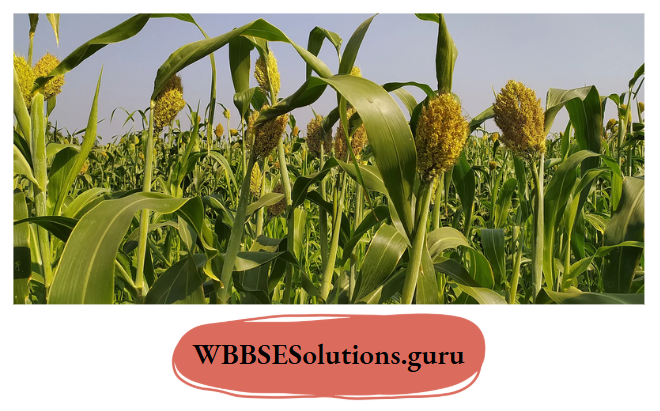
WBBSE Notes For Class 10 Chapter 5 India Economic Environment Millets

Economic Environment

  1. Labour: Skilled labours are required for sowing, harvesting etc.
  2. HYV Secds: HYV seeds are required to increase production.

Distribution

Bajra is the most important millet followed by jowar. Jowar grows well in Maharastra, Andhra Pradesh, Madhya Pradesh, Gujarat, and Rajasthan.

Bajra grows in Rajasthan, Haryana, Gujarat, Maharastra, Andhra Pradesh and Tamil Nadu. Ragi grows well in Karnataka, Tamil Nadu and Andhra Pradesh.

Maharastra ranks first position in jowar production, Rajasthan ranks first position in bajra production and Karnataka ranks first position in Ragi production.

Production Of Major Crops: 2013-14
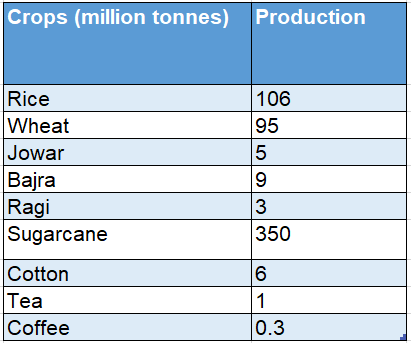
WBBSE Notes For Class 10 Chapter 5 India Economic Environment Production of Major Crops


Source: Economic Survey: 2014-2015 (Govt. of India)

Sugarcane: Cash crop. Sugar, Molasses alcohol are produced from sugarcane.

WBBSE Chapter 5 India Economic Environment Favourable Geographical Environment

Physical Environment

  1. Climate: Sugarcane grows in the Torrid zone.
  2. Temperature and Rainfall: 20°-26°C temperature and 150 cm rainfall are required for sugarcane cultivation.
  3. Sea breeze: Salty wind favours sugarcane cultivation.
  4. Soils: Fertile loamy soil mixed with lime and salt are favourable for sugarcane cultivation.
  5. Relief: Well-drained sloping land is favourable for cotton cultivation.
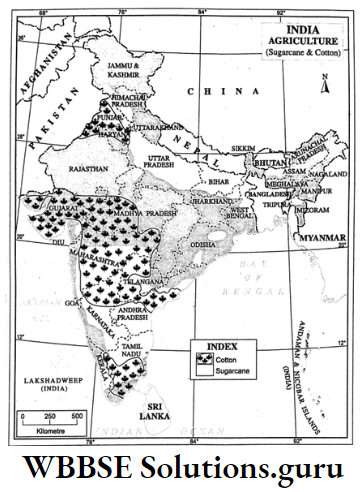
WBBSE Notes For Class 10 Chapter 5 India Economic Environment Sugarcane and Cotton

WBBSE Notes For Class 10 Chapter 5 India Economic Environment Sugarcane Field

Economic Environment

  1. Labour: Abundant skills are required for clearing land, sowing seeds, harvesting crops etc.
  2. Modern transport system: Well-knit quick transport is required for taking sugarcane from the field to the factory within 24 hours to extract sugar.
  3. Others: Regular application of fertilizer, and irrigation are also important factors for the cultivation of sugarcane.

Distribution

Uttar Pradesh (ranks first position)-Saharanpur, Faizabad, Bulandshahar, Ajamgarh, Balia, Baranasi. Maharastra (ranks second in production)-Kolhapur, Sholapur, Satara, Pune; Karnataka (Ranks third in production)-Shimoga, Belgaum produce sugarcane.

Champaran, Darbhanga of Bihar; Godavari and Krishna delta of Andhra Pradesh; Amritsar and Jalandhar of Punjab; Ganganagar of Rajasthan; Hisar and Rohtak of Haryana.

Barddhaman, Birbhum, Nadia and Murshidabad of West Bengal are also famous for sugarcane cultivation.

Production:

About 350 million tonnes of sugarcane was produced in India in the year 2013-14.

Trade:

The juice of sugarcane is extracted within 24 hours of its harvesting. So import-export is carried out for sugar.

Cotton: Principal fibre crop of India. 70% of cotton produced in India is used in the production of clothes.

WBBSE Chapter 5 India Economic Environment Favourable Geographical Conditions For Cotton Cultivation

Physical Environment

  1. Climate: Cotton grows best in Tropical and Subtropical climates.
  2. Temperature and Rainfall: 20°-25°C temperature and 60-100 cm rainfall are ideal for cotton cultivation.
  3. Sea Breeze: Salty wind favours cotton cultivation.
  4. Frost-free days: During its growth, at least 200 frost-free days are required.
  5. Soil: Fertile loamy soil mixed with lime, especially black lava soil of the Deccan plateau favours cotton cultivation.
  6. Relief: Well-drained plain land is suitable for cotton cultivation.


WBBSE Notes For Class 10 Chapter 5 India Economic Environment Cotton Field

Economic Environment

  1. Labour: Sufficient and cheap labours are required for planting, collecting cotton balls etc.
  2. Irrigation: In dry weather, cotton plants are less attacked by insects. So in dry regions, with the help of irrigation cultivation of cotton is better.
  3. Insecticides: Cotton balls are often attacked by White flies, Ball weevils.
  4. Others: HYV seeds and fertilizer are also essential for better production of cotton.

Distribution

Gujarat (Ranks first in production)-Ahmedabad, Varuch, Vadodara, Surendranagar, Surat; Maharastra (Ranks second in production)-Sholapur, Nasik, Nagpur, Wardha.

Andhra Pradesh (including Telangana)-Guntur, Kurnool, and Anantapur produce cotton abundantly.

Ferozpur, Ludhiana, Jalandhar of Punjab, Ambala, Hisar of Haryana; Ganganagar of Rajasthan; Coimbatore, Madurai of Tamil Nadu, Belgaum, Dharwar of Karnataka, Ujjaini of Madhya Pradesh are also famous for cotton cultivation.

Production:

In the year 2013-14, about 6 million tonnes of sugarcane were produced in India.

Trade:

India holds the second position in the production and export of cotton in the world. India exports cotton to Japan, Germany and other countries.

Tea: Tea is a cheap beverage and is widely used as a mild stimulator.

Class 10 Geography Chapter 5 WBBSE Solutions

WBBSE Chapter 5 India Economic Environment Favourable Geographical Conditions For Tea Cultivation

Physical Environment

  1. Climate: Tea is cultivated, generally, on the mountain slopes of monsoon climate.
  2. Temperature: Tea plantation requires an average summer temperature of 27°C.
  3. Rainfall: It requires plenty of rainfall, about 150 to 250 cm. annually.
  4. Soil: Fertile loamy soils rich in iron are ideal for tea plantations.
  5. Relief: Tea plantation requires hill slopes so that water can be easily drained out.

Economic Environment

  1. Labour: Skilled labours are required for plucking leaves. Women and children are employed to pluck two leaves and a bud.
  2. Fertilizer: Tea plants require the good application of fertilizer to replenish soil fertility as it absorbs nutrients of the soil quickly.
  3. Others: Application of modern equipment, organic pesticides, capital, advanced management system and domestic and international demand for tea are important factors in the plantation of tea.

Distribution

In India tea is cultivated in two areas

  1. North India,
  2. South India.

North India:

About 75% of tea produced in India comes from North India. Assam and West Bengal are two major producers of tea. Asam-The state holds 1st position in the production of tea in India.

Important tea-producing districts are Darang, Shibsagar, Lakhimpur and Kachhar. About 50% of the country’s production is contributed by Assam. West Bengal-The state ranks 2nd position in tea production in India.

About 22-23% of tea produced in India is contributed by West Bengal. Darjeeling district produces the best quality flavoured tea in the world.

Terai and Duars of Jalpaiguri and Koch Bihar districts also produce tea. Other states of North India-Hills of Tripura, Ranchi and Hazaribag of Jharkhand, Kangra valley of Himachal Pradesh, Dehradun and Garwal of Uttarakhand.
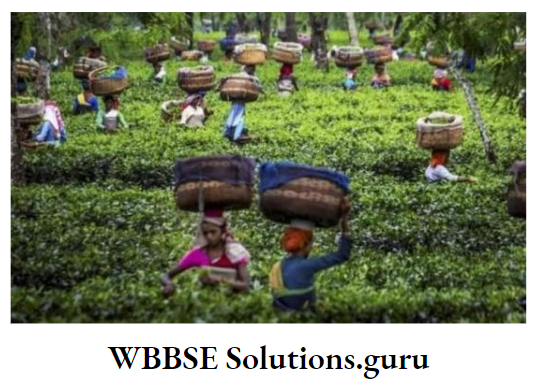
WBBSE Notes For Class 10 Chapter 5 India Economic Environment Tea Garden

South India:

South India contributes about 20% of the country’s total production of tea. In south India, tea is produced on the hill slopes of Nilgiri, Cardamom, Palni, Anaimalai etc.

Important tea-producing centres are Coimbatore and Nilgiri in Tamil Nadu; Chikmagalur, Coorg and Hasan of Karnataka, and Quilon (Kollam) of Kerala. Tamil Nadu ranks 3rd position in the production of tea in India.

Production:

In the year 2013-14, India produced nearly 1 million tons of tea.

Trade:

About 1/3rd of world tea is produced in India. About 1/5th of Indian tea is exported to the U.K., Russia, Iran, and Pakistan. Most of the Indian tea is exported through Kolkata port.

Coffee: Coffee is prepared by frying and grinding the berriés of the coffee plant.

WBBSE Chapter 5 India Economic Environment Favourable Geographical Conditions For Coffee Plantation

Physical Environment

  1. Climate: Coffee grows well in equatorial climates as well as in hot and humid tropical climates.
  2. Temperature: coffee plant requires 20°-30°C temperature.
  3. Rainfall: Coffee plants need very high rainfall of 150-200 cm.
  4. Soil: coffee tree thrives best on red loamy

WBBSE Notes For Class 10 Chapter 5 India Economic Environment India-Tea and Coffee

Economic Environment

  1. Labour: Plenty of workers are required for plantation, picking of berries, frying and grinding of berries.
  2. Others: Advance management including plantation, packaging and exporting are all important factors for coffee cultivation.

Distribution

Most Indian Coffee is produced in South India. Karnataka- the state ranks 1st position (70%) in coffee production in India. Important coffee-producing districts are Shimoga, Chikmagalur, Hasan, Mysore etc.

Kerala:

About 20-22% of coffee plantations are in Kerala which ranks 2nd position in coffee production in India. Important plantations are Palghat, Kottayam, Aleppi etc.

Tamil Nadu:

About 9% of the country’s coffee plantations are in Tamil Nadu which ranks 3rd position in coffee production in India.

Madurai, Salem, and Coimbatore are famous for coffee production. Other coffee-producing states are Maharastra, Tripura, Andaman-Nicobar Islands etc.

Production:

In the year 2013-14, India produced about 3 million tonnes of coffee. Trade-India exports coffee to the USA, France, Germany and Australia.

WBBSE Notes For Class 10 Chapter 5 India Economic Environment Coffee Berry

WBBSE Chapter 5 India Economic Environment Problems Of Indian Agriculture And Their Solutions

Problems:

Dependency on Monsoon rain-Indian agriculture mostly depends on the vagaries of monsoon rainfall. In most of the fields only one crop, single cropping is cultivated in the rainy season.

Solution:

With the application of irrigation, multiple cropping is now practised.

Problems:

The traditional method of cultivation-Yield rate is low as agriculture is mostly practised by traditional methods.

Solution:

The yield rate may be increased by the application of HYV seeds, fertilizer, and modern implements and by training farmers to cultivate using modern methods.

Problems:

Small holdings-Indian holdings are small, so it is not possible to use modern technology.

Solution:

Agriculture should be practised through a cooperative system by the consolidation of small holdings.

Problem:

Landless farmer-Most of Indian farmers do not have their own land.

Solution:

The government is now trying to make the tillers, owners of the lands by law of the Land Reform Ordinance.

Class 10 Geography And Environment Chapter 5 Solutions

Causes Of Agricultural Prosperity In Punjab Haryana-A Case Study

Punjab-Haryana, located in North-West India is the most important agriculturally rich area. This is the best wheat belt in India. Plenty of rice, cotton, and sugarcane are also produced here. Not only in India, but the region is also one of the highest producers of wheat, rice and sugarcane in the world. The causes of such tremendous development are:

Climate

The states of Punjab and Haryana are located in a Sub-tropical climate which is ideal for wheat cultivation. Western disturbance also gives winter rain which helps in the cultivation of wheat including other rabi crops.

Soil

The fertile alluvial soil of the plains of Punjab-Haryana favours the cultivation of wheat, rice, cotton, and sugarcane.

Irrigation

The irrigation facility has been extended to dry parts of this region. Well and tube well irrigation also helps in agriculture. Perennial canals of the Bhakra-Nangal multipurpose river valley project also irrigate wide areas of this region.

Impact Of the Green Revolution

In Indian agriculture, Green Revolution was initiated in Pubjab-Haryana during the late ’60s and early ’70s. Its impact was maximum on wheat cultivation and also on the cultivation of rice, cotton and sugarcane.

Consequently, there was a tremendous increase in the production of wheat, as well as rice, cotton and sugarcane.

Use Of Modern Technology:

Chemical fertilizers, insecticides and modern machinery like tractors, and harvesters are widely used.

Capital :

Most of the farmers of this region are financially rich.

WBBSE Chapter 5 India Economic Environment Industries In India

The Process by which raw material is changed into a useful secondary product is called Industry.

Though India is an agricultural country, industrial progress in India has placed her in a leading position among developing countries. Important industries in India are:

  1. The textile industry, namely cotton and jute,
  2. Iron and steel industry,
  3. Engineering industry,
  4. Petro-chemical industry,
  5. Automobile industry and
  6. Information technology.

Factors Affecting The Location Of Industries

Factors favourable to the location of an industry are :

1. Raw Material:

Raw material plays an important role in localising industries. Raw materials are of two types

  1. Impure raw material-raw materials which lose weight after production are known as impure raw materials, such as sugarcane, copper ore, iron ore etc. Industries using impure raw materials are, generally, located near the raw material-producing region.
  2. Pure raw material-There are some raw materials which do not lose their weight after production. These are known as pure raw materials, such as cotton, etc etc. Industries using pure raw materials may develop either near raw materials or far away in the market area.

2. Water:

Industries are, usually, set up near rivers, and lakes so as to get a supply of water for industrial activities as well as for the workers also.

3. Electricity:

A cheap and regular supply of electricity is essential for the uninterrupted production of industries. So, Industries prefer locations near the source or availability of electricity.

4. Transport:

Location of industry prefers a well-knit transport system to collect raw materials, marketing of finished goods and for movements of labours.

5. Labour:

The availability of cheap and skilled labours also controls the location of industries.

6. Market:

Market or demand for finished goods plays a vital role in setting up industries. Without the demand for products, the industry can not be set up.

7. Capital:

Monetary affluence is essential for the purchase of land, the establishment of factories, the collection of raw materials, the payment of wages of workers etc.

In addition, favourable climate and advanced technology also play important roles in localising industries.

Class 10 Geography And Environment Chapter 5 Solutions

WBBSE Chapter 5 India Economic Environment Classification Of Industries On The Basis Of Nature Of Raw Materials

Based on the nature of raw materials, industries are divided into four groups

  1. Agro-based industry,
  2. Animal-based industry,
  3. Forest-based industry and
  4. Mineral-based industry.

WBBSE Notes For Class 10 Chapter 5 India Economic Environment Classification Of Industries On The Basis Of Nature Of Raw Materials

Causes Of Development Of Industries

Iron and Steel Industry :

The iron and steel industry plays an important role in the economic upliftment of a developing country like India. The principal raw materials of the iron and steel industry are coal, iron ore, limestone, and manganese.

WBBSE Notes For Class 10 Chapter 5 India Economic Environment Iron and Steel Factory

WBBSE Chapter 5 India Causes Of Development Of Iron And Steel Industry In India

In India, large-scale integrated iron and steel factories are located in two areas:
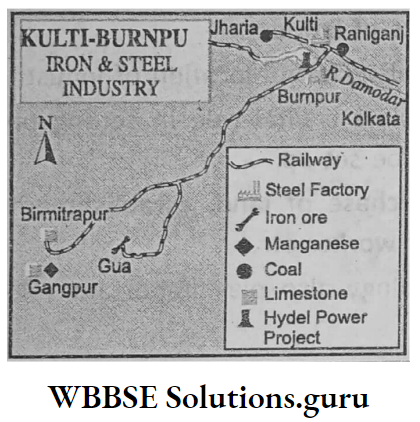
WBBSE Notes For Class 10 Chapter 5 India Economic Environment Kulti-Burnpu Iron & Steel Industry

WBBSE Notes For Class 10 Chapter 5 India Economic Environment Durgapur Iron & Steel Industry

WBBSE Notes For Class 10 Chapter 5 India Economic Environment Raurkela Iron & Steel Industry

WBBSE Notes For Class 10 Chapter 5 India Economic Environment Bhilai Iron & Steel Industry

WBBSE Notes For Class 10 Chapter 5 India Economic Environment Bokaro Iron & Steel Industry

WBBSE Notes For Class 10 Chapter 5 India Economic Environment Jamshedpur Iron & Steel Industry

East-Central India

Important iron and steel centres are Kulti-Burnpur and Durgapur of West Bengal; Bokaro and Jamshedpur of Jharkhand; Bhilai of Chhattisgarh and Rourkela of Odisha. The causes of the development of these factories are :

Availability Of Raw Materials:

Coal is supplied from Raniganj, Jharia, Giridih, Karanpura, Bokaro, and Talcher; iron ore from Gua, Noamundi, Badampahar, Bonai, Dalli-Rajhara, Bailadila; limestone from Birmitrapur, Daltongunj, Bhabnathpur; dolomite and manganese from Sambalpur, Gangpur and Sundargarh.

Water:

Water is supplied from the rivers Damodar, Barakar, Subarnarekha and Kharkai.

Electricity:

Korba, Talcher, Bokaro, Patratu, and Mejia power stations supply electricity to these factories.

Transport Facility:

Eastern and south-eastern railways and National Highways help in transporting raw materials and finished goods.

Port:

Nearness to the ports Kolkata, Haldia and Paradwip provide import-export facilities.

South India

Iron and steel centres of this region are Visakhapatnam of Andhra Pradesh, Bijoynagar and Bhadrabati of Karnataka and Salem of Tamil Nadu. The following factors are responsible for the development of the iron and steel industry in this region.
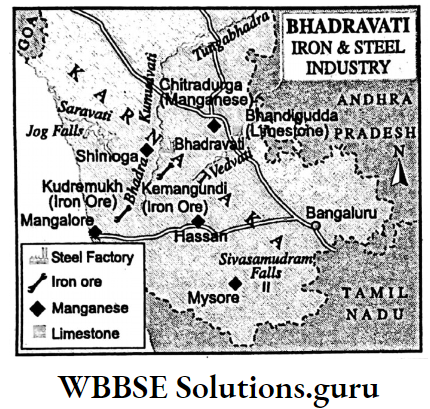
WBBSE Notes For Class 10 Chapter 5 India Economic Environment Bhadravati Iron & Steel Industry

WBBSE Notes For Class 10 Chapter 5 India Economic Environment Vishakhapatnam Iron & Steel Industry

WBBSE Notes For Class 10 Chapter 5 India Economic Environment Salem Iron & Steel Industry

Raw Material:

Iron ore of Bellari-Hospet, Cudappa, Kurnool, Babubadan hills, Salem and Tiruchirapalli; coal of Singareni, Neively; manganese of Shimoga, Chitradurg; limestone and dolomite of Salem and Tiruchirapalli are used in these factories.

Water:

River Tungabhadra and Bhadra and Stanly reservoirs provide water.

Electricity:

Thermal power plants of Ramgundam and Neively and hydel plants of the Tungabhadra project and Sarabati project supply electricity.

Port:

Nearness to Visakhapattanam, Marmagaon, Chennai, Mangalore and Tuticorin helps in the export-import of the factories.

Cotton Textile Industry:

Cotton textile is the single largest industry in India. Raw cotton is the principal raw material of this industry. Caustic soda, starch or arrowroot, and dyes are also used as raw materials.

Causes Of Development Of Cotton Textile Industry In India Vst.

The Cotton Textile Industries Of India Are Located In Four Regions:

Western Region

Important centres of this region are Mumbai, Pune, Nagpur, Sholapur, Akola, Jalgaon of Maharastra; Ahmedabad (Manchester of India), Surat, and Jamnagar.

Rajkot, Vadodara of Gujarat, Indore, Bhopal of Madhya Pradesh. The following factors are responsible for the development of these factories :

  1. Locally available cotton of ‘Black Soil Region’.
  2. Humid Climate of the Region.
  3. Hydel power of Western Ghats.
  4. Nearness to the ports of Mumbai, and Kandla.
  5. Capital invested by Parsi, and Bhutia businessmen.

Southern Region

Important centres are located at Coimbatore, Chennai, Madurai, and Salem of Tamil Nadu; Quilon (Kollam), Cochi, Kojhikod of Kerala, Hyderabad, Guntur of Telengana-Andhra Pradesh, Bengaluru, Mysore of Karnataka.

The causes of the development of factories are:

  1. Cotton of Tamil Nadu, Karnataka, Andhra Pradesh.
  2. Hydel power of Mettur, Shivasamudram, and Nagarjunsagar power plants.
  3. Nearness to the ports of Cochi, Chennai Tuticorin etc.
  4. The well-knit transport system,
  5. Local market.

Class 10 Geography And Environment Chapter 5 Solutions

Northern Region

Important centres are Amritsar, Ludhiana, Jalandhar of Punjab; Hisar of Haryana; Jaipur, Jodhpur, Kota of Rajasthan; Kanpur, Allahabad of Uttar Pradesh; Delhi.

The causes of the development of these factories are;

  1. Good quality cotton is produced in this region with the help of irrigation.
  2. A large market for cotton goods in North India.
  3. Well-knit transport system.
  4. Locally available cheap and skilled labours.

Eastern Region

Impotant centres are Haora, Sreerampur, Phuleswar of West Bengal; Patna, Gaya of Bihar; Cuttack, Bhubaneswar of Odisha.

The causes of the development of these centres are:

  1. Huge demand for cotton cloth in Eastern India.
  2. The electricity of Bandel, Titagarh, Barauni, and Talcher power plants.
  3. Eastern and South-eastern railways and National Highway to transport cotton from Western India.
  4. Nearness to the ports of Kolkata, Haldia and Paradwip.
  5. Availability of local cheap labours.

WBBSE Chapter 5 India Economic Environment Engineering Industry

The industry which produces a wide range of machinery and associated steel products is called Engineering Industry.

It is also known as the Mechanical or Public Work Industry. The engineering industry can be classified into two types

  1. Heavy Engineering and
  2. Light Engineering Industry.

Heavy Engineering industries produce machines needed in various large-scale manufacturing industries.

Light Engineering industries produce precision machinery, light machinery, camera, radio, television, watches, electrical fans etc.

Important Engineering Centres Of India

Locomotive Industry:

Chittaranjan in West Bengal, Varanasi in Uttar Pradesh, Jamshedpur in Jharkhand, Bhopal in Madhya Pradesh.

Ship Building Industry:

Kolkata (Garden Reach) in West Bengal, Visakhapatnam in Andhra Pradesh, Mumbai (Majgaon) in Maharastra and Cochi in Kerala.

Aircraft Industry:

Bengaluru in Karnataka, Koraput in Odisha, Nasik in Maharastra, and Hyderabad in Telangana.

Heavy Machinery:

Hatia near Ranchi in Jharkhand, Allahabad in Uttar Pradesh, Visakhapatnam in Andhra Pradesh.

Heavy Electrical Equipment:

Bhopal in Madhya Pradesh, Hardwar in Uttarakhand Tiruchirapalli in Tamil Nadu.

WBBSE Chapter 5 India Economic Environment Causes Of Development Of These Industries Are

  1. Iron and steel is the raw material for these industries. So they are located near iron and steel centres.
  2. Some of the centres have developed away from the iron and steel industry. In that case, they depend on either the transport system or the port facility.
  3. Availability of skilled labours and advanced technology.
  4. Easy availability of electricity.
  5. Marketing facility for finished goods.
  6. Government incentives.

WBBSE Notes For Class 10 Chapter 5 India Economic Environment India-Industry

WBBSE Chapter 5 India Economic Environment Petrochemical Industry

Industry in which Naptha, the by-product of petroleum and natural gas is used to produce chemicals and compounds like Propane, Butane, Ethane, Methane, hexane, Pentane, Benzol, Butadine, Ethanal.

Propylene and these compounds are used to produce items like artificial fibre (polyester, nylon etc.), plastic, paints, synthetic rubber, pesticides, resins, and perfumes are called the Petrochemical industry.

Causes Of Development Of the Petro-Chemical Industry

Petro-chemical Industry has developed in India in four regions:

1. Western Region:

Important Petrochemical centres of this region are Nagothane of Maharastra; Vadodara, Kayali, Hajira, and Jamnagar of Gujarat. The advantages of these centres are:

  1. By-products of oil refineries of Kayali, Trombay, and Jamnagar are used as raw materials.
  2. Supply of sufficient electricity, well-knit transport system, large market, cheap and skilled labours.

2. Southern Region:

Important centres of this region are Chennai and Tuticorin of Tamil Nadu; Mangalore of Karnataka. The advantages of this region are:

  1. Availability of raw materials from oil refineries of Chennai and Mangalore.
  2. The port facility of Chennai, Tuticorin, Mangalore.
  3. Local market.
  4. Well-knit transport system.
  5. Skilled labours.

3. Eastern Region:

Important centres of this region are Bongaigaon of Assam; Haldia of West Bengal. The causes of the development of these centres are:

  1. Availability of raw materials from the oil refineries of Haldia in West Bengal, Digboi, Nunmati and Bongaigaon of Assam.
  2. Well-knit transport system.
  3. Nearness to Haldia and Kolkata port.

4. Northern Region:

Important centres of this region are Panipath of Haryana; Auraiya of Uttar Pradesh and Payal of Punjab. The advantages of these centres are :

  1. Availability of raw materials from the oil refineries of Mathura, Panipat and Bhatinda.
  2. Well-knit transport system through railways and roadways.
  3. Availability of electricity.

WBBSE Chapter 5 India Economic Environment Automobile Industry

Automobile Industry produces buses, trucks, jeeps, motorcars etc.

 Causes Of Development Of Automobile Centres :

Two types of vehicles are produced in India

  1. Commercial Vehicles and
  2. Passenger Vehicles.

1. Commercial Vehicles:

Centres of manufacturing commercial vehicles are located at Jamshedpur in Jharkhand; Chennai in Tamil Nadu, Pune in Maharastra; Jabalpur in Madhya Pradesh.

2. Passenger Vehicles:

Centres manufacturing Passenger Vehicles are located at Gurgaon (Gurugram) in Haryana; Hindmotor near Kolkata in West Bengal; Mumbai, Chennai; Bengaluru; Surajpur in Uttar Pradesh; Pimpri near Pune.

There are also many factories in India which produce scooters, bicycles, auto-rickshaws etc. These factories are located in Delhi, Chennai, Lucknow, Kanpur, Mumbai, Pune, Satara, Bangaluru, Hyderabad, Faridabad etc.

Factors responsible for the development of such industries are :

  1. These factories use iron and steel as raw materials. So these factories are located near iron and steel factories, such as Jamshedpur, Kolkata, and Chennai.
  2. The ancillary industry (like tyres, tubes, batteries etc.) develops near these factories.
  3. These factories develop near the port cities to get the port facilities, such as Chennai, Mumbai, and Kolkata.
  4. In recent years these factories are also developed near markets, such as Gurugram, Pune, and Bengaluru.

WBBSE Chapter 5 India Economic Environment Information Technology

Information Technology is the activities related to storing, retrieving, transmitting and manipulating data for human needs through computers and telecommunication equipment.

The information technology industry involves all the work related to information technology, such as computer hardware, internet, e-commerce telecom equipment, computer services etc.

 Causes Of Development Of the Information Technology Industry In India :

In India, there are nine information technology centres. These are Bengaluru, Chennai, Hyderabad, Delhi, Pune, Mumbai, Kolkata, Thiruvananthapuram and Noida (Delhi). Bangaluru is not only of India but of the whole world’s best centre of Information Technology. Bengaluru is known as the ‘Silicon Valley’ of India. Cause as of such development are :

  1. These cities are advanced in the industry, research and educational centre.
  2. Necessary scientific and technical help is easily available.
  3. Necessary infrastructural facilities like land, electricity, water supply, and sewerage system are provided by the local administration.
  4. Multinational companies in our country as well as abroad invest abundant capital.
  5. Not only the domestic market, USA and European markets also provide large markets.

WBBSE Notes For Class 10 Chapter 5 India Economic Environment Information and Technology

WBBSE Chapter 5 India Economic Environment Indian Population

India, one of the most populous countries in the world has entered the 21st century with global recognition of its importance as a Regional Economic Power.

Brief Overview Of Census :

Census is the counting and activities related to the counting of the population. It is a systematic way of collecting, analysing and officially recording of population.

It is very much important for its counting, distribution and density which, in turn, play an important role in running the Government smoothly. The first census in India was carried out in 1872.

Since 1881 it is carried out every 10 years. The last census has been carried out in 2011 the next census will be made in 2021.

Basic Demographic Information About the Population Of India

India is the second most populous country. India with a total population of 121 crores 1 lakh 93 thousand and 422 people as of the 2011 census is the home of 17.5% of the world’s population; though she accounts for only 2-42% of the total area of the world.

It reflects population pressure on land in India.

WBBSE Notes For Class 10 Chapter 5 India Economic Environment India-Population

Fact At Your Fingertips:

Demographic Information of Indian Population (2011)
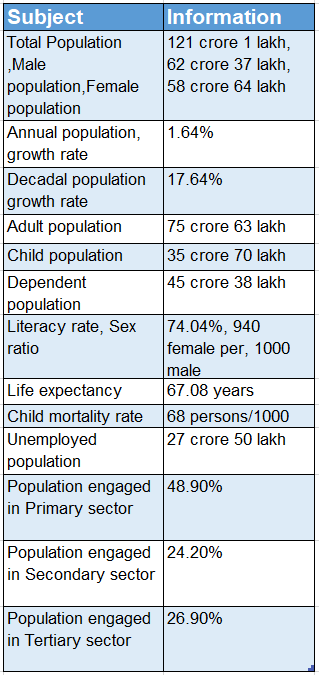
 

WBBSE Notes For Class 10 Chapter 5 India Economic Environment Demographic Informations of Indian Population (2011)

Source: Economic Survey:2614-15 (Govt. of India)

Concept Of Population Growth And Sustainable Development

The concept of Sustainable Development was accepted by the developed countries of the West in the decade of 1970.

Sustainable development is possible when population growth will keep pace with the supply of the resource in the country.

But overpopulation or population explosion will create excessive population pressure on land which, ultimately, leads to detrimental changes to water, air, soil and other non-renewable resources on the earth.

Consequently, there will be a great challenge to the existence of man, animals, plants, agriculture, industry, and culture leading to a threat to the civilisation and sustainability of a pollution-free environment.

The time has come to save the earth to provide a fair shelter for future generations. and this can only be achieved with a mission of Sustainable Development.

In 1901 population of India was about 24 crores. After 100 years, in 2001 it increased to nearly 103 crores i.e. with the rate of 330%.

In the last census of 2011, it was 121-01 crores. So in near future in India, it will be difficult to maintain the sustainability of progress and development unless the growth rate of the population is lowered or restricted within the limit of natural resources.

Factors Influencing Regional Distribution Of Population In India

The distribution of the population in India is very much uneven. Such uneven regional population distribution is due to the following factors:

1. Physical factors which influence: The distribution of population in India are

Landform:

The population is high in the Gangetic plains and in the river valleys of the south due to flat land. But it is low on high mountains and over the plateaus because of rugged topography.

Rivers:

River valleys of Ganga, Brahmaputra, Mahanadi, Godavari, Krishna, and Kaveri provide a regular supply of water to the industries, and farmlands; for navigation, irrigation as well as drinking purposes.

Climate:

The coastal location of Andhra Pradesh, Tamil Nadu, and Kerala are densely populated because of the congenial climate whereas the desert in Rajasthan is sparsely populated due to the extreme types of climate.

Soils:

The population is dense in the black cells of Maharastra and the fertile soils of river valleys.

Natural Vegetation:

Forested areas of the western slopes of the Western Ghats and foothills of the Himalayas do not provide any room for settlements.

Minerals:

Mining towns have developed in the Deccan plateau and in the Chota Nagpur plateau for job facilities.

2. Economic factors which influence: The distribution of population are

Transport System:

The Plains of North India are well populated for the road-rail network as well as waterways.

Industries:

Hugli Industrial Region or Asansol Industrial Region are well populated as the industries provide jobs to many people.

3. Cultural factors like the conversion of dry and fallow land into fertile green land are good examples of population concentration. Green Revolution has changed the scenario of Punjab, Haryana and east Rajasthan.

WBBSE Chapter 5 India Economic Environment Concept Of Density Of Population

The density of the population indicates population pressure on land which is very much high in India. It is derived as:

map

\(\text { Density of population }=\frac{\text { Total population }}{\text { Total area }}\)

According to the 2011 census, the density of the population in India is 382 persons per sq. km.

Amongst 29 states, the density of population is highest in Bihar (1102/sq. km), West Bengal has the second highest density (1029/sq km) and Kerala is the third in the density of population (859/sq. km) in India.

Amongst Union Territories, the density of the population is highest in Delhi (11,282/sq km) Amongst the states of India, the density of the population is lowest in Arunachal Pradesh.
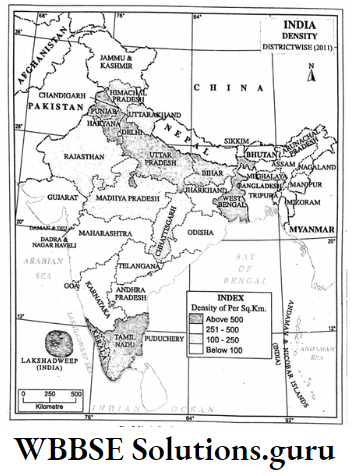
WBBSE Notes For Class 10 Chapter 5 India Economic Environment India-Density Districtwise

Density regions

Based on the density of population, 29 states and 7 unions Territories of India may be grouped into four probable density regions

  1. The thickly populated region includes 7 states like Bihar, West Bengal etc. and 5 union territories like Delhi, Chandigarh, Puducherry etc. where the density of
  2. the population is above 500 persons per square km.
  3. The moderately populated region includes 10 states like Jharkhand, Assam, Goa etc. where the density of population is 251-500 persons per square km.
  4. The thinly populated region includes 9 states like Uttarakhand, Chhattisgarh, Meghalaya etc. where the density of the population is 101-250 persons per square km.
  5. The sparsely populated region includes the states of Mizoram, Arunachal Pradesh and Sikkim and the Union Territory of Andaman Nicobar Island where the density of population is 100 persons or less per square km.

Causes Of Urbanisation

A Town may be defined as a settlement which has factories, pucca houses and metalled roads, a good transport network with the facilities of water and electricity supply and is inhabited by people engaged in non-agricultural activities.

A town with a population of at least 1 lakh is called a city. A city with a population of more than 10 lacks is called Metropolis.

Various physical and economic causes, either, individually or in combination are responsible for urbanisation, such as

  1. The administrative centre may gradually develop into a town like Chandigarh.
  2. Mining centres like Asansol,
  3. Communication centres like Siliguri,
  4. An industrial centre like Jamshedpur,
  5. Naval bases like Meerut,
  6. Religious centres like Varanasi,
  7. Health Resort likes Darjeeling.
  8. Centre of education and culture like Aligarh,
  9. A historical centre like Agra,
  10. Trading centres like Hapur in Uttar Pradesh,
  11. Tourist centres like Shimla and
  12. Port-like Paradwip.

Problems Of Urbanisation In India

Since independence, due to the rapid growth of population, the existing towns and cities are expanding in India as well as settlements centring industries and ports are transforming into new towns and cities.

At present, most of the cities and towns are facing problems like unplanned urbanisation-excepting cities like Chandigarh most of the Indian towns and cities have developed in an unplanned manner.

So houses, offices, institutions etc. have developed haphazardly in a town or a city. So these towns and cities are clumsy and deteriorating.

1. People’s Tendency To Settle In Cities:

To lead a better lifestyle, job opportunities and developed civil services are more in cities and towns than in villages.

So most Indians prefer urban centres for their dwellings. This leads to scarcity of space, the formation of slums and squatters and the spread of diseases.

2. Lack Of Infrastructure:

Population pressure on land results in weak infrastructure. Most of the cities and towns are facing the problems of lack of infrastructure and crises in health, education, electricity and drainage, and sewerage system.

WBBSE Chapter 5 India Economic Environment Transport And Communication System Of India

The movement of goods and passengers from one place to another by vehicles through different routes is known as Transportation.

The exchange of news and information is known as Communication. Letters, telephone, telegram, internet are the mode of transport.

Importance Of Transport

In a developing country like India, the transport network is important like an arterial system of the human body. It is so important because,

1. Development Of Domestic And International Trade:

Import-export activities of different parts of the country as well as with other countries are only possible through a good transport network.

2. Development Of Industries:

The transport system plays a vital role to carry raw materials and finished goods from an industry.

3. Distribution Of Resource In Every Corner Of A Country:

The transport system is indispensable for the distribution of cotton goods, and food grain in different parts of the country.

4. Extraction of natural resources:

To extract minerals and collection of forest products transport system is very much necessary.

5. To combat natural calamity:

Without a well-knit transport system, it is not possible to combat calamities like floods, droughts, cyclones, tsunamis and earthquakes.

6. Development of backward areas, defence of the country, development of education and culture and development of tourism mostly depend on the good transport network of a country.

Modes Of Transport

Modes or different routes of transport in India are as follows:
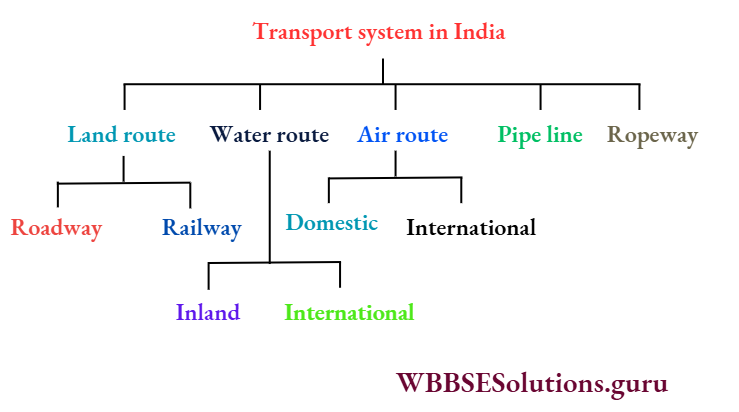
WBBSE Notes For Class 10 Chapter 5 India Economic Environment Modes of Transport

Importance Of Railways And Roadways:

Railways

Railways in India were initiated with the construction of 33-6 km long railway lines between Mumbai and Thane on 16th April 1853.

Now it has been extended to about 65,000 km India ranks 1st position in Asia and 2nd position in the World railway system. Railways play an important role as follows:

  1. Railways play an important role in the internal transport system because it is only possible for railways to transport heavy and bulky items in remote places of India and it is also a cheap and quick means of transportation.
  2. Agricultural progress in India depends on railways because excess agricultural products of one region are transported quickly to the regions where there is scarcity.
  3. There is no alternative to bringing raw materials to the factory and sending finished goods to the market quickly.
  4. Ports are connected with different parts of India by railways. So Railways play an important role in the import-export trade of India.
  5. Railways also play an important role in defence, sending various items to disaster-prone areas.

Roadways

In roadways, India ranks 3rd. position in the world. The total length of roadway in India is about 44 lacks 20 thousand km.

Roadways play an important role in the overall development of a developing country like India, because of the development of rural areas (villages are connected with roadways), utilisation of minerals, and development of the hilly regions.

Development in trade and deference mostly depend on roadways. Roadways are of different types-National Highway, State Highways, District Highways, Village roads etc.

WBBSE Notes For Class 10 Chapter 5 India Economic Environment Roadways-Transport

National Highway

National Highways connect one end to another end of the country. It is about 70 thousand 934 km long in India. It is maintained by Central Government.

It connects major cities like Delhi, Mumbai, Chennai, and Kolkata. It includes two important parts

  1. Golden Quadrilateral and
  2. North-South and East-West Corridor.

WBBSE Notes For Class 10 Chapter 5 India Economic Environment India-Transport

1.Golden Quadrilateral:

In 1999, India Government undertook a project, namely, National ‘Highways Development Project’ in which there was a plan to connect four metropolises, Delhi-Kolkata-Chennai-Mumbai by Six lane National Highways.

This is known as Golden Quadrilateral. The project was completed by 31st May 2005. Under this project, the length of the roadway was 5846 km.

2. North-South And East-West Corridor:

Along with the Golden Quadrilateral, India 20 Government undertook another project to connect Srinagar in the north to Kanniyakumari.

In the south and Silchar in the east to Porbandar in the west by National Highways, the length of which is 7300 km.

There are many National Highways in India, such as Grand Trunk Road (NH-2), Kolkata-Mumbai (NH-6), Agra-Mumbai (NH-3), Mumbai–Chennai (NH-4) etc.

State Highways:

State Highways extend within the state boundaries and are connected with National Highways. These are under State Government.

The total length of State Highways is 1 lakh 32 thousand km. Example. Assam Link Road, Jessore Road in North 24 Parganas etc.
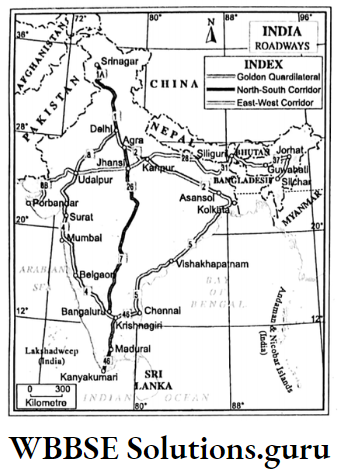
WBBSE Notes For Class 10 Chapter 5 India Economic Environment India-Roadways

WBBSE Chapter 5 India Economic Environment Waterways

The cheapest mode of transport is the waterway. Except can always there is no constructional cost for the waterway. Waterways are of two types

  1. Inland waterway and,
  2. Coastal (Sea) waterway. It also saves fuel costs.
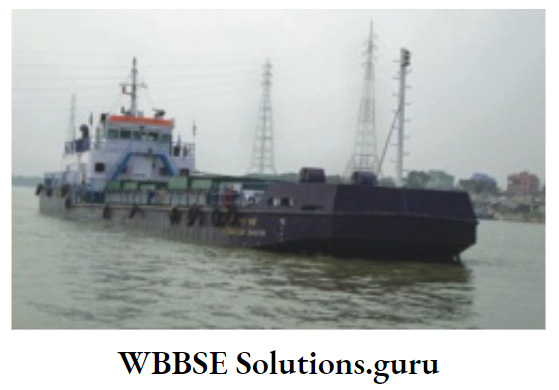
WBBSE Notes For Class 10 Chapter 5 India Economic Environment India-Waterways

Inland Waterway

Navigable rivers, lakes and lagoons, canals are used as waterways in India. The Inland waterway in India estimates at about 14,500 km.

River includes 3700 km and canals include a 4300 km route in which a steamer is used for the transport of passengers in canals. Boats are used for transport in rivers as well as canals.

Coastal (Sea) waterways

The peninsular location of India helps International trade with Egypt, Greece, and Rome through coastal waterways since ancient times. At present, in India, there are 12 ports in coastal locations. These are:

East coast:

  1. Kolkata-Haldia (West Bengal),
  2. Paradwip (Odisha),
  3. Visakhapatnam (Andhra Pradesh),
  4. Chennai (Tamil Nadu),
  5. Tuticorin (Tamil Nadu),
  6. Ennore (Tamil Nadu).

West Coast:

  1. Kandla (Gujarat),
  2. Mumbai (Maharastra),
  3. Jawaharlal Nehru Port (Maharastra),
  4. Marmagaon (Goa),
  5. Mangalore (Karnataka) and
  6. Cochi (Kerala).

Airways

Air transport is the fastest mode of transport. Remote places, rugged terrain, desert, and jungles all are accessible by airways. Indian airway is of two types

  1. Domestic or National Airways and
  2. International Airways.

Domestic Airways

Alliance Airline under ‘Indian Airlines Corporation’ operates domestic Aircraft. IndiGo, Jet Airways, Go Air, and Spicejet are private organisations which operate domestic aircraft.

Domestic airports are Koch Bihar, Balurghat, Bagdogra, Andal in West Bengal; Dehradun, Panthnagar in Uttarakhand; Agartala in Tripura; Tuticorin, Salem, Madurai in Tamil Nadu; Hirakund, Bhubaneswar, Berhampore in Odisha.

Dimapur in Nagaland, Aizawl in Mizoram; Imphal in Manipur; Sholapur, Ratnagiri, Nasik, Kolapur, Jalgaon in Maharastra; Jabbalpur in Madhya Pradesh; Mysore, Belgaon in Karnataka; Ranchi, Jamshedpur, Dhanbad in Jharkhand.

Jammu in Jammu and Kashmir; Kulu, Shimla, Kangra in Himachal Pradesh; Surat, Rajkot, Porbandar, Bhavnagar, Kandla, Vadodara in Gujarat; Diu in Daman and Diu.

Raipur in Chhattisgarh; Patna in Bihar; Tejpur, Dhubri, Dibrugarh in Assam; Port Blair in Andaman Nicobar Islands.

International Airways

Air India, Government airways operate International Airways. International airports (Netaji Subhas Chandra Bose) are Kolkata (Dum Dum) in West Bengal; Hyderabad in Telangana; Guwahati in Assam.

Gaya in Bihar; New Delhi; Ahmedabad in Gujarat; Bangaluru and Mangalore in Karnataka; Cochi, Kojhikod and Tiruvanantapuram in Kerala; Bhopal and Indore in Madhya Pradesh; Mumbai, Nagpur.

Pune in Maharastra; Shillong in Meghalaya; Jaipur in Rajasthan; Chennai, Coimbatore, Tiruchirapalli in Tamil Nadu, Lucknow in Uttar Pradesh, Visakhapatnam in Andhra Pradesh, Bhubaneswar in Odisha and Amritsar in Punjab.
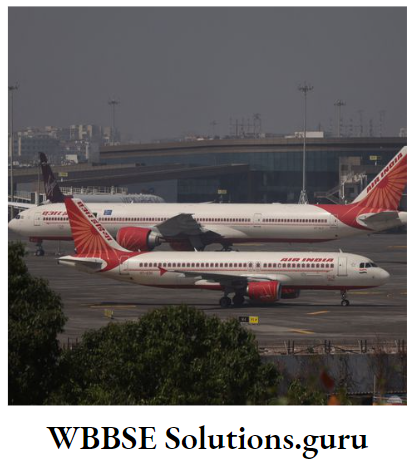
WBBSE Notes For Class 10 Chapter 5 India Economic Environment India-Airways

Other Transportation System

In the transport system of India ropeway, pipeline and underground railways (metro) also play very important roles.

Ropeway:

Ropeway is used to access difficult places where railways and roadways cannot reach. It is used in the Damodar Valley coal belt, and in Darjeeling, Joshimath, and Hardwar for recreation.

Pipeline:

Mineral oil and natural gas are transmitted by pipelines. Through pipelines, petroleum is transported from oil fields to oil refineries. A pipeline connects Haldia and Barauni, Naharkatia and Barauni etc.

Underground Railway:

To avoid crowds on roadways underground railway or metro started first in Kolkata. Now it is operating in Chennai, Delhi, Mumbai, Jaipur, and Hyderabad.

WBBSE Chapter 5 India Economic Environment Modern Communication System

The ancient mode of communication was the Postal facility which is a very much slow means of communication. To keep pace with the fast lifestyle, modern modes of communication systems have evolved, such as

  1. Internet,
  2. E-mail and
  3. Cell-phone.

WBBSE Notes For Class 10 Chapter 5 India Economic Environment Internet Connection System

1. Internet:

World wide Communication system is known as the Internet. At present about 100 countries are connected through Internet systems.

Vannevar Bush, Norbert Wiener and Marshall McLuhan are the founders of this concept. Since 1990, the Internet system was spread out in India.

The medium of Internet communication is satellite and telecommunication systems. The Internet system is the quickest and cheapest communication system.

2. E-mail:

Electronic mail or e-mail is an important part of the Internet communication system. News is sent to any place in the world within a second.

3. Cell phone:

This is a mobile wireless communication system. SMS (Short Message Service), MMS (Multimedia Messaging Service), and Mobile banking are special features of cell- phones.
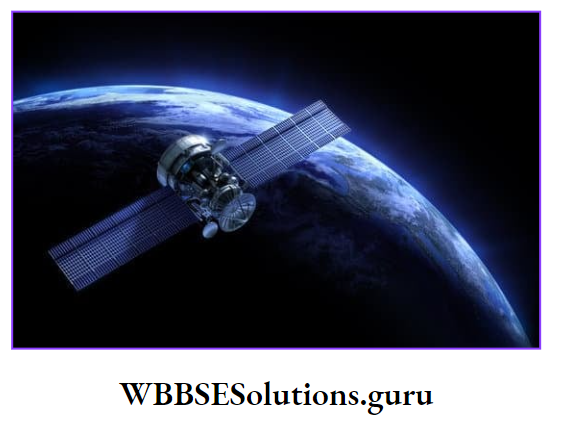
WBBSE Notes For Class 10 Geography And Environment Chapter 6 Satellite Imagery And Topographical Map

WBBSE Chapter 6 Satellite Imagery And Topographical Map

Satellite imagery consists of images of Earth or other planets collected by satellites. Imaging satellites are operated by governments and businesses around the world.

It is part of Remote sensing and is actually scanning of the earth by satellite or high-flying aircraft in order to obtain information about it.

Remote sensing is the acquisition of information about an object or phenomenon without making physical contact with the object.

It refers to Arial sensor technologies to detect and classify objects on Earth by means of propagated signals.

WBBSE Notes For Class 10 Geography And Environment

General Concept Of Satellite And Topographical Map :

The artificial satellites placed in orbits in space are attached with high-power cameras or sensors. It collects images of different parts of the earth. These images are known as Satellite images.

Some parts of the sunrays reflected back to space. During the images taken from satellites, these reflected sunrays are used as electromagnetic radiation by the camera or sensor.

WBBSE Notes For Class 10 Chapter 6 Satellite Imagery And Topographical Map An artificial Satellite orbiting the earth

Topographical Map

WBBSE Notes For Class 10 Geography And EnvironmentWBBSE Notes For Class 10 History And Environment
WBBSE Solutions For Class 10 Life ScienceWBBSE Class 10 Life Science Multiple Choice Questions
WBBSE Solutions for Class 10 MathsWBBSE Class 10 Maths Multiple Choice Questions
WBBSE Notes For Class 10 Physical Science And Environment


Topographical maps are prepared on the basis of detailed su

very of physical (relief, river) and cultural (settlement, transport) elements of our region and shown with conventional signs and symbols drawn to a scale.

Topographical maps, thus depend on primary data collected by surveying.

WBBSE Notes For Class 10 Chapter 6 Satellite Imagery And Topographical Map Satellite Launching Centre

WBBSE Chapter 6 Satellite Imagery And Topographical Map Differences Between Satellite Imagery And Topographical Map

WBBSE Notes For Class 10 Chapter 6 Satellite Imagery And Topographical Map Differences between Satellite imagery and Topographical Map

WBBSE Chapter 6 Satellite Imagery And Topographical Map Uses Of Different Types Of Scale On Topographical Map

To survey every part of India, Survey of India has divided our country into three divisions according to scale.

WBBSE Class 10 Geography Important Questions

Large Scale Division

A survey of India has divided India into 135 grids based on 4° latitudes and 4° longitudes. These are large-scale maps and their scale is 1 cm to 10 km (RF = 1: 10,00,000). This is known as the Million sheet map. Example. Grid No. 64.

WBBSE Notes For Class 10 Chapter 6 Satellite Imagery And Topographical Map Topo Sheet

WBBSE Notes For Class 10 Chapter 6 Satellite Imagery And Topographical Map Satellite Picture

Medium Scale Division

Each degree of the large-scale map (4° x 4°) is divided into 16 grids (1° x 1°) which are marked from Letters A to P of the English Alphabet.

The scale of this type of map is 1 cm to 2.5 km (R.F. = 1: 25,0000). These are known as Degree Sheets. Example. One small grid of No. 64 grid is D (64D).

Class 10 Geography Environment Notes Pdf

Small Scale Division

1° is again subdivided into 16 grids (15’x15′) which are marked from 1-16 digits. The scale of this map is 1 cm to 2 km (R.F. = 150,000). These are known as 15′ (Fifteen minutes) sheets. The smallest grid of 64D is 4. So Index No. of the map is 64 D/4.

WBBSE Notes For Class 10 Chapter 6 Satellite Imagery And Topographical Map Topo Map Of India

WBBSE Chapter 6 Satellite Imagery And Topographical Map Steps In Acquisition Of Satellite Image

Processes of preparing satellite images from information collected by artificial satellites involve the following steps:

First Step:

In this step, an artificial satellite consisting digital camera or sensor is placed at a specific height above the earth’s surface.

Second Step:

Sensors collect sunrays reflected from various objects and store them in digital form in different Bands on the basis of their Brightness Value (intensity).

Third Step:

Collected digital information is then transmitted to the Ground station and propagated through different impulses.

Fourth Step:

Errors, if any, defects in the information are corrected and images are prepared from that modified information based on the new Brightness Value (intensity).

Fifth Step:

With the help of a Geographical Information System (GIS), various geographical maps like agricultural maps, forest maps, and soil maps are prepared from those images.

WBBSE Class 10 Geography Solutions

The colour of different objects is expressed in another colour in a satellite image. This is known as False Colour Composite.

The blue colour of an object changes to green, green changes to red and red changes to infrared colour in satellite images.

WBBSE Chapter 6 Satellite Imagery And Topographical Map Characteristic Of Satellite Image

Important features of satellite images are :

Satellite images are prepared by information collected by artificial satellites placed in space.

  1. This is a high-tech system.
  2. Satellite images are prepared according to a definite scale.
  3. Latitudinal and longitudinal extents are marked on satellite images.
  4. The collection of information on date and time is mentioned on the map.
  5. The diversity of landforms is expressed in definite colours. The dense forest is represented by deep red colour, green field is expressed by a reddish tint.
  6. a yellow paddy field is represented by darkish red, marshy land is represented by sky blue, fallow land (laterite) is represented by green colour, and rivers and ponds are represented by deep blue colour.
  7. Agricultural land and settlements are of geometric shapes like circular, square, rectangle etc.

WBBSE Notes For Class 10 Geography And Environment Chapter 6 Satellite Imagery And Topographical Map

WBBSE Chapter 6 Satellite Imagery And Topographical Map Uses Of Satellite Image And Its Importance

In the modern age satellite images are very important and widely used :

  1. One satellite image gives an idea of a vast region (30,000 sq. km).
  2. It saves time as well as money.
  3. As information is expressed in digital numbers, these are easily used on computers.
  4. As these images are prepared repeatedly within 16 to 22 days, changes in the objects are easily identified.
  5. Sudden changes in weather conditions are easily depicted in satellite images. So, the weather forecast is accurate.
  6. The location of resources is identified in this map. So investigation of minerals becomes easier.
  7. Information regarding the conservation of resources, forestry, regional planning, the latest position in wars, changes in the river course, and landslides are identified accurately. Proper planning may be taken in time.

Class 10 Geography Chapter 6 Notes

Comparison Of Satellite Image And Topographical Map Of the Same Area

To compare both the Satellite image and Topographical map of the same region is shown here side by side :

  1. To the Southwestern part of the topographical map, there is a forested highland (closely spaced contours represent the highland). That area in the satellite image is
  2. deep red coloured.
  3. The rest of the Topographical map is yellow coloured. It is represented by a green colour on a satellite map.
  4. Water bodies and rivers are shown in light blue colour and settlements are shown in red colour in Topographical map.
  5. But in a Satellite map water bodies and rivers are represented as deep green colour and settlements as grey or ash colour in Satellite map.

WBBSE Notes For Class 10 Geography And Environment Chapter 4 Waste Management

WBBSE Chapter 4 Waste Management Concept Of Waste Management

Concept Waste With Reference To Locality :

Wastes are those materials that are thrown away or discarded as no longer useful or required.

Actually, wastes are substances or objects that are not the primary products for which the user has no further use in terms of production, and consumption but the user wants to dispose of them.

Wastes may be generated during the extraction of raw materials, processing of raw materials into intermediate and final products, consumption of final products, and other human activities.

WBBSE Notes For Class 10 Geography And Environment

So wastes are unwanted or unusable solid, liquid, and gaseous materials. These are substances that are discarded after primary use or they are, either worthless, defective, and of no use.

At home, you may find household wastes that are thrown into the waste bin every day. In the locality, you may also find commercial wastes thrown away by factories, offices, institutions, hospitals, etc. Wastes are also seen in slum and squatter areas.

Class 10 Geography And Environment Chapter 4 Solutions

Wastes like flowers, fruits, and vegetables are also found near the marketplaces as well as found as debris near the places of demolition as well as construction like wood, concrete, bricks, and electrical wiring.

All these websites locally pollute our environment.

WBBSE Notes For Class 10 Geography And Environment Chapter 4 Waste Management

WBBSE Chapter 4 Waste Management Classification Of Wastes

WBBSE Notes For Class 10 Geography And EnvironmentWBBSE Notes For Class 10 History And Environment
WBBSE Solutions For Class 10 Life ScienceWBBSE Class 10 Life Science Multiple Choice Questions
WBBSE Solutions for Class 10 MathsWBBSE Class 10 Maths Multiple Choice Questions
WBBSE Notes For Class 10 Physical Science And Environment


Wastes are of three types

  1. Solid,
  2. Liquid and
  3. Gaseous.

Solid Wastes:

Solid waste means garbage, old tires, scrap metal, broken furniture and toys, construction and demolition debris, asbestos, plastic, broken glass, paper, tube, ash, plastic bottles, cans, etc.

WBBSE Notes For Class 10 Chapter 4 Waste Management Solid Wastes

Liquid Wastes:

These are fluids, such as wastewater, fats, oils, or grease (FOG), manure, and household liquids such as urine water, detergent water, and sewage.

WBBSE Notes For Class 10 Chapter 4 Waste Management Liquid Wastes

Gaseous Wastes:

It is a waste product obtained from the manufacture, processing, material consumption, or biological processes in gaseous form. It includes gases emitted from factories and vehicles such as sulfur dioxide, nitrogen dioxide, etc.

WBBSE Notes For Class 10 Chapter 4 Waste Management Gaseous Waste

Depending on toxicity wastes are of two types

  1. Toxic waste and
  2. Non-toxic waste.

Toxic Waste:

It may be solid, liquid radioactive, or gaseous. Toxic wastes can harm humans, animals, and plants, such as mercury, cadmium, chromium, battery, nitric oxide, chemicals, paint, syringes, needles, pesticides, broken computer parts, etc.

Class 10 Geography And Environment Chapter 4 Solutions

Non-Toxic Wastes:

Wastes that do not cause any harm to live creatures and the environment are known as Non-toxic wastes. These are glass, dust, concrete, food leftover, fruit and vegetable peelings, paper bits, etc.

WBBSE Chapter 4 Waste Management Sources Of Waste And Its Effects

Source Of Waste :

Wastes are generated from seven sources:

Domestic Wastes:

Leftovers of vegetables, fruits, a leftover of fish and meat, etc.

Industrial Wastes:

Chromium compound of the leather factory, different types of metals from one extraction process, different chemicals, etc.

WBBSE Notes For Class 10 Chapter 4 Waste Management Sources Of Wastes

Agricultural Wastes:

Pesticides, insecticides, manures in the form of agricultural runoff, straw, husks, animal excretory, etc.

Municipal Wastes:

Leftover of vegetables, paper bits, cloth, plastic, and metallic parts are found near houses, offices, marketplaces, hotels, institutions, etc.

Organic Wastes:

Wastes produced from plant and animal bodies are organic wastes, such as leftovers from meat processing centers, leftovers of fish, and peelings of fruits and vegetables.

WBBSE Notes For Class 10 Chapter 4 Waste Management Organic Biomedical and Radioactive Wastes

Biomedical Wastes:

These are of medical and laboratory origins such as unused bandages, infusion kits, blood, human or animal tissues, syringe, and needles, which are generated from hospitals, health clinics, nursing homes, medical research laboratories, etc.

Radioactive Waste:

Ashes, heavy water discarded radioactive elements are radioactive waste that is generated as a by-product of nuclear power generation and other applications of nuclear fission or nuclear research and medicine.

WBBSE Chapter 4 Waste Management Effects Of Waste On The Environment

Disposing of waste has a huge environmental impact and can cause serious problems. Actually, the wastes lie littered on the streets and improperly disposed of in vacant land.

These may cause serious health hazards apart from being eyesores. Air, soil, and water pollution are increasing day by day.

Water Contamination:

Wastes that are thrown into the water body may negatively change the chemical composition of water and ultimately affect the ecosystems existing in the water.

Soil Contamination:

Similarly, if we sent rubbish to the landfill hazardous chemicals may contaminate the soil and can harm plants which can be a negative impact on the health of humans and animals if they eat.

Air Pollution:

When pollution occurs in the air, it can easily spread because we breathe in the air and cannot avoid it. This happens because the air becomes dirty or contaminated by poisonous gas, smoke, or odor emitted from the factories.

Class 10 Geography And Environment Chapter 4 Solutions

Impact On Health:

If the wastes are improperly disposed of, they may cause serious impacts on health and problems to the surrounding environment.

Excreta and other liquid and solid wastes from households and the community, are serious health hazards that may lead to the spread of infectious diseases by flies, rats, etc.

Diseases like Titenus, hepatitis, dysentery, allergy, and typhoid map spread quickly.

WBBSE Chapter 4 Waste Management Methods And Importance Of Waste Management

Concept Of Waste Management-Reduction, Reuse, And Recycling:

Waste management relates all those activities which are required to manage waste from its inception to its find disposal.

Apart from the collection, transport, and disposal of waste, it may also encompass reduction.

Reuse And Recycling:

the 3R which are the principles of waste hierarchy that classifies waste management strategies according to their desirability in terms of waste minimization.

In the hierarchy, the first action is to prevent the generation of waste followed by the reduction reuse, and recycling of waste.

Reduction Of Waste:

This is a process of elimination that involves reducing the amount of waste produced in society.

Activities may involve redesigning products, changing societal life patterns, and monitoring consumption and production to prevent the generation of waste.

Reuse Of Waste:

Waste management, actually, focuses on the processing of waste after it is created.

Class 10 Geography And Environment Notes WBBSE

Recycling Of Waste:

Recycling is a key component of modern waste reduction. It is a process to convert waste materials into reusable new materials.

Recyclable materials include many kinds of glass, paper, metal, plastic, textile, and electronics. Recycling of material produces a fresh supply of the same material Example. used office paper would be converted into new office paper.

Recycling waste is the process to prevent the waste of potentially useful materials, reducing the consumption of fresh raw materials, and reducing energy usage, and air water, and land pollution.

In this process, materials to be recycled are either brought to a collection center, then sorted, cleaned, and processed into new material.

Processes Of Solid Liquid And Gaseous Waste Disposal And Management

Disposal Of Solid Waste

Common methods of solid waste disposal and management are:

  1. Segregation,
  2. Landfill and
  3. Composting.

Segregation

Solid wastes are of two types on the basis of natural decomposition

  1. Bio-degradable, such as human waste, food and kitchen waste, manure, sewage sludge, and slaughterhouse waste which can be broken, in a few weeks or months, into its base compound by microorganisms
  2. Non-biodegradable wastes, such as rubber tires, plastic, fiberglass, and metals are of environmental concern as it creates, a disposal problem.

WBBSE Notes For Class 10 Chapter 4 Waste Management Sources Of Wastes

Landfill

Disposal of bio-degradable waste in a landfill involves burying the waste. It contains leachate such as clay or plastic lining material. Wastes are compacted to increase density and stability.

The layer is covered with a thick soil layer to prevent attracting rats and rabbits. Thus, bio-degradable wastes, naturally, decomposes physically, chemically, and organically.

During this process, landfill gases, namely methane, and ammonia are produced. Finally, the rest is used to fill up the lowlands. At Dhapa in East Kolkata, fertile farmlands have developed in this way.

Class 10 Geography And Environment Notes WBBSE

It is advantageous as the wastes are covered and do not cause any harm to human health. But the problem is that the polluted water may contaminate groundwater.

WBBSE Notes For Class 10 Chapter 4 Waste Management Landfill

Composting

The process of composting requires making a heap of wetted organic matter known as green waste (leaves, food waste) and waiting for the materials to break down into humus or soil rich in nutrients such as nitrogen, and phosphate.

There are two ways of composting.

WBBSE Notes For Class 10 Chapter 4 Waste Management Composting

Bangalore Method:

A trench is made on the ground in which bio-degradable wastes are dumped which is overlain by a layer of human and animal excreta.

Mechanical Process:

In this process, bio-degradable wastes are disintegrated by machines. Then it is mixed with bacteria for decomposition. Finally, nitrogen-rich compost fertilizer is produced.

Class 10 Geography And Environment Chapter 4 Solutions

WBBSE Chapter 4 Waste Management Disposal Of Liquid Waste

Drainage:

This is the process of sewage disposal in which sewage is transported through cities and inhabited areas to sewage treatment plants where it is treated to remove contaminants to produce environmentally safe waste.

In the treatment plant, there are blue-green algae that grow profoundly and release a huge amount of oxygen by photosynthesis.

As a result, water is filtered while solid wastes which settle down at the bottom are used as organic manure.

WBBSE Notes For Class 10 Chapter 4 Waste Management Disposal of Liquid and Gas Wastes

Disposal Of Gas Waste

Scrubber:

There are several methods to remove unwanted pollutants from the exhaust gas and neutralize it. Scrubber is a device that controls air pollution and is used to remove toxic gases from industrial exhaust streams.

WBBSE Chapter 4 Waste Management Need Of Waste Management

Improperly stored wastes can cause health, safety, and economic problems. It has been estimated that only 10% of hospital waste can contaminate the environment.

But if it mixes up with municipal waste a huge amount of waste may contaminate health and the environment. Wastes that pollute air, water, and soil may cause disaster.

To prevent damaging the earth’s ecosystem and maintain a high quality of life for the planet and its inhabitants we must manage and store the waste efficiently and safely.

Class 10 Geography And Environment Notes WBBSE

Role Of Students In Waste Management

Knowledge of waste management can practically be implemented by a student by taking part in school as well as in house

  1. They should throw paper bits and leftover food in the waste bin,
  2. They should not split everywhere,
  3. They should not use ‘use and throw’ pens,
  4. They can prepare placards mentioning the need for waste management,
  5. They must take part in awareness programs in school as well as in their locality.

Effects Of Waste Disposal On Bhagirathi-Hugli River-A Case Study

Bhagirathi:

Hugli is the distributary of the river Ganga which is the principal river of India. Presently, the river is very much polluted.

Urbanization and industrialization along both sides of the river are responsible for the disposal of huge amounts of municipal and industrial wastes into this river.

Actually, the river is polluted by

  1. Disposal of industrial and municipal wastes,
  2. Discharge of urine water,
  3. Animal bath,
  4. Discharge of soap and detergent water and
  5. Dispose of dead bodies of man and animals,
  6. Immersion of idols in Durga puja and Kali puja are also responsible for mixing up chemicals with the river water.

WBBSE Notes For Class 10 Chapter 4 Waste Management Wastes Disposal on Rivers

To arrest such pollution ‘Ganga Action Plan’, and ‘Namami Ganga’, etc. plans and programs have been taken up by government. But it is more important to the awareness among the people living along the riverside who can efficiently reduce waste.

WBBSE Notes For Class 10 Geography And Environment Chapter 3 Hydrosphere

WBBSE Chapter 3 Hydrosphere Ocean Currents

70% of the earth’s surface is occupied by waterbody or hydrospheres. Seas, oceans, lakes, and rivers belong to this hydrosphere.

Oceans occupy about 60% of it. The most important feature of the ocean is its currents i.e. ocean currents.

Ocean Currents-Concept And Types :

The horizontal movement of ocean water in a definite direction and regular pattern from one place to another is called ocean current. The vertical movement of ocean water is known as a wave.

WBBSE Notes For Class 10 Geography And Environment


WBBSE Notes For Class 10 Chapter 3 Hydrosphere Ocean Currents-Concept and Types


Types Of Ocean Currents :

Ocean currents are of two types:

Warm Current:

Warm and light ocean water of the equatorial region moves towards the polar region as surface current. This is known as Surface current.

Cold Current:

Cold and heavy ocean water of the polar region moves towards the equatorial region. This is known as Under current.

WBBSE Chapter 3 Hydrosphere Causes Of Origin Of Ocean Currents

Factors responsible for the origin of ocean currents are:

Earth’s Rotation

Earth’s rotation causes the ocean water to be deflected to the right in the northern hemisphere and to the left in the southern hemisphere following Ferrel’s law because Coriolis force is produced by the rotation of the earth

Wind

Ocean water is moved by the planetary winds in a clockwise direction in the northern hemisphere and in an anti-clockwise direction in the southern hemisphere.

  1. Trade winds move the ocean currents in the northeast direction in the northern hemisphere and in the southeast direction in the southern hemisphere.
  2. Westerlies move the ocean currents from the west to the east.
  3. Polar winds move the ocean currents from the east to the west.

WBBSE Notes for class 10 Geography chapter 3 Hydrosphere Influence of planetary winds on ocean currents

Class 10 Geography And Environment Chapter 3 Solutions

Temperature Of Ocean Water

Warm equatorial water is light. So, it flows along the surface of the ocean towards the poles as a surface current. But cold polar water is dense. So, it flows towards the equator as under current.

WBBSE Notes for class 10 Geography chapter 3 Hydrosphere Influence of Temperature on ocean currents

Salinity Of Ocean Water:

The salinity of ocean water varies. Less saline water is light. So, it flows as surface water while more saline water is dense. So, it flows as under current.

Density Of Ocean Water:

The density of ocean water depends on its temperature, salinity, and atmospheric pressure. Ocean water of high density flows under current towards the low dense ocean water.

Ocean water of low density flows as surface current towards the ocean water of high density.

Melting Of Ice:

In the polar region, the melting of ice causes the addition of ocean water leading to the ocean water being less saline. As a result, ocean water is moved to form ocean currents.

WBBSE Notes For Class 10 Geography And EnvironmentWBBSE Notes For Class 10 History And Environment
WBBSE Solutions For Class 10 Life ScienceWBBSE Class 10 Life Science Multiple Choice Questions
WBBSE Solutions for Class 10 MathsWBBSE Class 10 Maths Multiple Choice Questions
WBBSE Notes For Class 10 Physical Science And Environment


Shape Of Coastline:

Ocean currents are deviated and bifurcated due to the shape of the coastline of a continent as they are obstructed by the presence of landmasses.

Seasonal Variations:

With the change of seasons, the wind also changes its direction. As a result, with the change in wind direction ocean currents change their direction accordingly.

In summers in the Indian Ocean monsoon current flows to the right being moved by the southwest monsoon wind; while in winter it flows to the left being moved by the northeast monsoon wind.

The presence of oceanic ridges, evaporation, and variation in air pressure is also responsible for the origin of ocean currents.

WBBSE Notes For Class 10 Geography And Environment Chapter 3 Hydrosphere

WBBSE Chapter 3 Hydrosphere Effects Of Ocean Currents On The Earth

The following Are The Effects Of Ocean Currents:

Formation Of Banks And Their Commercial Importance:

Commercial fishing grounds are formed where warm and cold ocean currents meet. Cold currents bring icebergs which melt when coming in contact with warm ocean currents and deposit moraines which are the main food for plankton.

As a result, large banks are formed, namely Grand Bank, Georges Bank near New Found land; Doggers bank, and Rockfall Bank near the British Isles.

Oceans are shallow and sunlight can reach the ocean bottom. So, Phyto planktons and zooplanktons which are the principal food for sea fish grow profoundly.

These banks are therefore the commercial fishing grounds of the world.

WBBSE Notes for class 10 Geography chapter 3 Hydrosphere Effects of ocean currents

Coastal Climate

Countries passed by warm ocean currents experience warm weather conditions. Cold Labrador current keeps cool the coast of New Found land.

Warm Kuroshio current keeps warm the western coast of Japan. Wind originating over warm ocean currents picks up moisture and gives rain when blowing over the landmass.

But the wind blowing over cold ocean currents is dry and does not give any rain.

Where warm and cold currents flow side by side, water vapor of the warm current condenses in contact with the cold current, and foggy and stormy weather prevails due to the difference in temperature.

Climate Change

Ocean currents play an important role in the change of world climate. In general, the temperature of ocean water has already increased due to global warming.

consequently, the number and frequency of cyclones formed over warm ocean currents, namely Tropical cyclones, hurricanes, and typhoons, will have increased.

Due to the increase in evaporation over warm ocean currents rainfall over landmasses has also increased.

The origin and duration of the ‘El-Nino’ warm ocean current near Peru’s coast have increased. Similarly, ‘La-Nina’ near the western part of the Pacific Ocean has increased uncertainty over southeast Asian countries including India.

Class 10 Geography And Environment Chapter 3 Solutions

WBBSE Chapter 3 Hydrosphere Tides

Concept Of Tides, Origin:

Tides are alternate rise and fall of surface water. The rise of water is known as High tide while the fall of water is known as Ebb or Low tide.

Origin Of Tides

Tides are produced by

  1. Rotation of the earth and
  2. The gravitational pull of the sun and the moon.

Rotation Of The Earth:

The centrifugal force produced by the rotation of the earth causes tides on the opposite side of the earth facing the moon.

Gravitational Pull Of The Sun And The Moon:

According to Newton’s law of gravity, the sun and the moon are responsible for generating high and low tides on the Earth’s surface.

But the moon is nearer to the earth, so it is mainly due to the gravitational pull of the moon, tides occur on the earth’s surface.

WBBSE Notes for class 10 Geography chapter 3 Hydrosphere Attraction of moon on Tide Formation

Lunar Tides And Solar Tides:

A Tide formed by the attraction of the moon is known as the Lunar tide and a tide formed by the attraction of the sun is known as the Solar tide. The lunar tide is stronger than the solar tide.

Primary Tides :

Places on the rotating earth facing the moon experience maximum pull by the moon and enjoy high tide. This is known as Primary tide.

Class 10 Geography Chapter 3 Question Answers

Secondary Tides :

Places on the earth opposite to places experiencing primary tides enjoy secondary tides due to the centrifugal force of the earth.

According to Newton’s law of gravity, the pull is directly proportional to the mass but inversely proportional to the square of its distance.

As the sun is 2 crores 60 lakh times heavier than moon but far away (150 million Km from the earth) from the moon (3 lakh 84 thousand Km from the earth) the gravitational pull of the moon is 2.2 times greater than that of the sun.

Low Tides:

When high tides are formed simultaneously low tides occur at the right-angled position of high tides as water moves away causing a lowering of surface water i.e. ebb or low tide.

Tidal Interval

The time gap between two Primary High tides is 24 hours and 52 minutes. Moon takes nearly 27 days to revolve around the Earth and Earth spins once in 24 hours.

So, in one day the moon advances (360 27) 13° for which the earth requires 13 x 4 = 52 minutes more to experience another high tide.

The tidal interval between a primary and secondary high tide is 12 hours 26 minutes. Between one high tide and the next low tide, the interval is 6 hours 13 minutes.

So Secondary tide occurs 12 hours 26 minutes after primary tide low tide and takes place 6 hours 13 minutes after high tide.

WBBSE Notes for class 10 Geography chapter 3 Hydrosphere Tidal Interval

Spring Tide

In the syzygy position (straight line position of the sun, moon, and the earth), either Full Moon or New Moon, the tidal range (difference in height between high and low tide) is highest. This is known as Spring tide.

WBBSE Notes for class 10 Geography chapter 3 Hydrosphere Spring tide and Neap Tide

Neap Tide

At the right-angled position of the sun and the moon when they counteract each other tidal range becomes the least. This is known as Neap tide.

Class 10 Geography Chapter 3 WBBSE Solutions

Syzygy

moon and the earth when lying on a straight line the position is known as Syzygy. If the sun and moon lie on the same side of the
earth, it is known as a conjunction, when. New Moon takes place.

If the earth lies in the middle. between the sun and the moon, the position is known as opposition, when Full Moon appears. In Syzygy positions i.e. on New Moon and Full Moon spring tides occur.

WBBSE Notes for class 10 Geography chapter 3 Hydrosphere Syzygy

Apogee:

As the moon revolves around the Earth distance between the moon and the earth does not remain the same. When the moon is farthest from the earth the distance is 4,07,000 km. This is known as the Apogee position.

Perigee:

When the moon is nearest to the earth the distance is 3-56,000 km. This is known as the perigee position. In the perigee position High tides are highest and in the apogee position High tides are the least.

Class 10 Geography And Environment Notes WBBSE

WBBSE Chapter 3 Hydrosphere Ocean Currents Tidal Bore

A very large tidal wave about 5-7 meters high entering with great speed into an estuary is called a Tidal bore. It is common in the Hugli River estuary.

Conditions Of Tidal Bore:

A tidal bore is frequent

  1. During spring tide,
  2. To wide river and due to mouth,
  3. Obstruction from entering tide water into a river,
  4. Presence of funnel-shaped river mouth and
  5. Perennial river. In River Hugli, the height of the Tidal bore is 4-5 meters.

Effects Of Tides:

  1. Large vessels can enter the port with high tides and exit the port with low tides easily.
  2. Silts and urban wastes are washed away with the low tides.
  3. High tides turn the river water to be saline.
  4. High tides often cause river beds to be shallow by silting.
  5. During High tides, many sea fishes enter the rivers.
  6. In cool temperate regions, river ports remain frost free in winter because tide water turns the river water to be saline.
  7. Electricity is generated with the help of tidal energy.
  8. Tidal bores often damage settlements and farmlands.

WBBSE Notes For Class 9 Geography and Environment Chapter 2 Movements Of The Earth

Chapter 2 Movements Of The Earth Introduction Concept Of The Movements Of The Earth

All those questions mentioned above were interrogated by our ancestors and they thought that the primary cause was the earth-centric movement of the sun.

But, scientists have proved that it is the Earth that is moving around the sun as well as around its invisible axis. The earth is spinning around its axis in approximately 24 hours.

This movement is known as Rotation. Simultaneously, the Earth is also revolving around the sun for approximately 365 days. This movement of the earth is known as the Revolution. All the members of the solar family, like the earth, have two motions-Rotation and Revolution..

Read And Learn Also WBBSE Notes For Class 9 Geography and Environment

For example, Mercury, the closest planet to the Earth takes approximately, 58 Earth days (with the Earth) to spin around its axis, i.e. one day of the Mercury.

Along this rotation, the Mercury also travels around the sun in 88 earth days (about the earth), i.e. one year of the Mercury. Next to Mercury is the planet Venus which takes 243 Earth days and 225 Earth days to rotate and revolve respectively.

Other planets take more time as the distances increase with the sun. For example; Jupiter takes 11 years 10 months, Saturn takes 29 years 5 months, Uranus takes 84 years 27 days and Neptune takes 164 years 11 months.

WBBSE Notes For Class 9 Geography Chapter 2

But the time taken by each planet to revolve around the sun once is one year for that particular planet if not considered the time of the earth. For rotation, the distant planets take less time than the Earth.

WBBSE Notes For Class 9 Geography and Environment Chapter 2 Movements Of The Earth Speed of the Planets

WBBSE Notes For Class 9 Geography and Environment Chapter 2 Movements Of The Earth

Chapter 2 Movements Of The Earth Brief History Of Observation On Earths Movements

In ancient times, people thought that the sun was moving around the Earth. In the fifth century B.C. mathematician and astronomer Pythagoras and his disciples said first about the movement of the earth around the sun.

But no one believed this concept and even in the fourth century B. C. Aristotle (384-322 B.C.) also, did not believe it. After the birth of Christ, in the second century, Ptolemy also believed the concept of Aristotle.

WBBSE Solutions For Class 9 Fundamentals Of HistoryWBBSE Class 9 English Functional Grammar
WBBSE Class 9 Fundamentals Of History Long Answer QuestionsWBBSE Class 9 English Reading Skill
WBBSE Class 9 Fundamentals Of History Short Answer QuestionsWBBSE Class 9 English Writing Skill
WBBSE Class 9 Fundamentals Of History Very Short Answer QuestionsWBBSE Class 9 Maths Multiple Choice Questions
WBBSE Class 9 Fundamentals Of History Multiple Choice QuestionsWBBSE Solutions For Class 9 Maths
WBBSE Notes For Class 9 Geography and Environment


Indian mathematician and astronomer of ancient times, namely Aryabhatta, in 499 A.D. explained the movements of the sun and other stars as the effect of the movement of the earth around its axis.

But, till the medieval period, most people did not believe in the Pythagorean concept or the explanation of Aryabhatta.

Finally, in 1543 A. D. mathematician and astronomer Nicolaus Copernicus of Poland strongly explained the movement of the earth centering the sun.

Although, many people at that time followed the earth-centric movement of the sun.

Class 9 Geography Chapter 2 Important Questions WBBSE

Later on, Galileo, Kepler, Newton, and all eminent scientists were able to establish the movements of the planets by mathematical calculations and by visual proof with the help of a telescope.

Since then, people have been convinced and accepted the concept of the movements of the Earth and other planets.

Chapter 2 Movements Of The Earth Rotation

The spinning of the earth around its axis, since its origin, is known as Rotation. The time takes to rotate the earth around its axis is 23 hours, 56 minutes 4 seconds, i.e. nearly 24 hours or 1 day.

So, the Rotation of the earth is also known as Diurnal motion.

Direction Speed Effects Of Rotation

1. Direction of Rotation of the Earth:

Have you noticed the sun and other stars move from east to west? The earth is moving from the west to the east: It so happens just like from a running train we see the objects outside move in the opposite direction.

Around the poles, as it is not easy to find out the east and west directions, the direction of rotation at the north pole is anti-clockwise and at the south pole, Night is clockwise.

WBBSE Notes For Class 9 Geography and Environment Chapter 2 Movements Of The Earth At North Pole , Equator

2. Speed of Rotation of the Earth:

Due to its spherical shape, circumferences of “the earth at all parts are not equal in size. But, they take 24 hours to rotate once.

As the circumference of the earth is maximum at the equator (0°) and decreases gradually towards the two extremities at points, the speed of rotation of the earth also decreases away from the equator where it is 1630 km per hour.

It is 1536 km per hour at Kolkata (22°30′ north), 1438 km per hour at 30° north latitude, 990 km per hour at 60° north latitude, and finally zero (0) at 90° latitude. So, at the poles, there are no relative movements.


WBBSE Notes For Class 9 Geography and Environment Chapter 2 Movements Of The Earth Speed Of Rotation Varies


WBBSE Notes For Class 9 Geography and Environment Chapter 2 Movements Of The Earth Piece Of Stone Dropped From A High Tower


3. Effects Of Rotation Of The Earth:

Rotation of the earth results in major events like the formation of day and night, deflection of planetary winds and ocean currents, tides, and ebb, etc.

Class 9 Geography Chapter 2 Important Questions WBBSE

Chapter 2 Movements Of The Earth Alternation Of Day And Night

The rotation of the earth causes the alternation of day and night. The earth is round and is lighted and heated by the sun.

So during rotation, the hemisphere of the earth that faces the sun receives sun rays, and therefore, enjoys day while the opposite hemisphere remains in darkness and experiences night.

The demarcating line between the lighted and dark parts of the earth is known as a shadow circle and the transitional phases of day and night are dawn, dusk, morning, evening, noon, and midnight.

Shadow Circle

The circumference of the earth along which the lighted and dark parts of the earth cross each other is known as a shadow circle.

It moves westward on the surface of the earth with eastward rotation of the earth.

It bisects the equator which experiences 12 hours day and 12 hours night year round because of the inclination of the earth’s axis at 66° angle to its orbital plane.


WBBSE Notes For Class 9 Geography and Environment Chapter 2 Movements Of The Earth Shadow Circle


Morning And Evening

A place on the earth’s surface that crosses the shadow circle comes out from the darkness and eventually, experiences morning while the place located opposite to it crosses the shadow circle to enter the darkness and experiences evening.


WBBSE Notes For Class 9 Geography and Environment Chapter 2 Movements Of The Earth Different Parts Of Day and Night


Dawn And Dusk

The diffused sunlight seen in the sky before sunrise is known as dawn and the diffused sunlight seen in the sky after sunset is known as dusk or twilight.

WBBSE Class 9 Geography Chapter 2 Pdf

Noon And Midnight

When the sun stays at the zenith or the celestial meridian of a place it experiences noon or midday. The place is the opposite it remains in darkness and experiences midnight.

Chapter 2 Movements Of The Earth Coriolis Effect

In 1835, G. G. Coriolis (1792-1843), a French mathematician discovered the tendency of freely moving particles to deflect from their normal course.

This deflection is known as Coriolis. effect or Coriolis force after the name of the discoverer.

It is due to the Coriolis effect that ocean currents and planetary winds attached to the earth do not move directly in a north-south direction.

They deflect to the right in the northern hemisphere and the left in the southern hemisphere. The speed of the earth’s rotation is maximum at the equator while the minimum is at the poles.

So, the wind blowing towards the equator moves with less speed than that moves away from the equator. But the wind tries to maintain its initial speed and becomes deflected.

So, they deflect to the right in the northern hemisphere and the left in the southern hemisphere.

Example. Trade winds blowing toward the equatorial low-pressure belt are deflected as northeast trade wind in the northern hemisphere and southeast trade wind in the southern hemisphere.

WBBSE Notes For Class 9 Geography and Environment Chapter 2 Movements Of The Earth Wind Direction in Northern and Southern Hemispheres

Chapter 2 Movements Of The Earth Inclination Of The Earths Axis And Its Significance

Due to the rotation of the. earth from the west to the east an invisible imaginary line joining the north pole and the south pole passing through its center has formed. This is known as the axis of the earth.

It is actually, tilted at a 23°30′ angle from the vertical i.e. 90°. The axis of the earth is tilted on its orbital plane pointing always to the pole star.

The earth revolves along with its rotation around the sun in a fixed path or orbit to which its axis inclines at a 66°30′ angle.

WBBSE Notes For Class 9 Geography and Environment Chapter 2 Movements Of The Earth Axis Of The Earth During Revolution

It is Due to the tilting of the earth’s axis at 66°30′ angle, the northern and southern hemispheres are tilted towards the sun for six months alternately.

This results in variations in the length of day and night on the earth’s surface, variations in temperature at different times of the year, and ultimately the change of seasons.

WBBSE Class 9 Geography Chapter 2 Pdf

If the axis of the earth was perpendicular to the orbit, the days and nights would be 12 hours each everywhere on the earth’s surface like the equatorial region. No change of seasons would take place.

If the axis of the earth was parallel with the orbit of the earth, like Uranus, each hemisphere would remain in light or darkness at least for six months.

WBBSE Notes For Class 9 Geography and Environment Chapter 2 Movements Of The Earth Inclination Of The Earth's Axis

Chapter 2 Movements Of The Earth Revolution

Together with Rotation, the earth revolves around the sun, along an elliptical orbit to which its axis inclines at 66+ angle, in the anti-clockwise direction. This movement of the earth is known as the Revolution.

It takes 365 days 5 hours 48 minutes 46 seconds to revolve once around the sun or approximately 365 days or one year. So, the Revolution of the earth is also known as the Annual motion of the earth.

WBBSE Notes For Class 9 Geography and Environment Chapter 2 Movements Of The Earth Revolution Of The Earth

Direction Speed Effects

1. Direction Of Revolution Of The Earth :

The earth along its rotation from the west to the east revolves around the sun in an anti-clockwise direction with its axis always tilted at a 66½º angle to its orbit or fixed path of revolution.

WBBSE Notes For Class 9 Geography and Environment Chapter 2 Movements Of The Earth Anti-Clockwise Revolution

2. Speed Of Revolution Of The Earth :

The earth moves about 30 km each second along its orbit in the anti-clockwise direction. So the velocity of the earth’s revolution is about 30 km per second or 1,08,000 km/hour.

WBBSE Class 9 Geography And Environment Chapter 2 Notes 

3. Effects Of Revolution Of The Earth:

Revolution of the earth around the sun results in the concept of Leap year, Perihelion-Aphelion positions of the earth, sun’s ecliptic or apparent annual motion of the sun.

variation in the length of day and night, equinoxes- solstices, change of seasons, etc.

Leap Year Aphelion And Perihelion

The earth takes 365 days 5 hours 48 minutes 45.51 seconds or 46 seconds to revolve once around the sun. But for calculation, it is rounded off as 365 days.

So in each year there is an excess of 6 hours (5 hours 48 minutes 46 seconds) which may be added at the end of the 4th Find out the leap years year which becomes 366 days (6 hours x 4 = 24 hours or 1 day).

This extra one day is added in February and that year is called Leap Year. A leap year is divisible by 4, for Example. 2012 and 2016 are leap years.

But all the century years are not leap years even if they are divisible by 4 because there is an inbuilt excess of 11 minutes 14 seconds in each year (6 hours-5 hours 48 minutes 45-51 seconds = 11 minutes 14-09 seconds).

And cumulative 44 minutes 56 seconds (11 minutes 14-09 seconds x 4) in each leap year. Century years are, therefore, granted as a leap year, if only, these years are divisible by 400, for Example. 2000 is a leap year but 1800, 1900, and 2100 are not leap years.

Aphelion And Perihelion:

The earth revolves in a fixed path called orbit which is elliptical. The sun is located at one of its two foci. So, the distance between the sun and the earth is not the same with an average distance of 150 million km approximately.

Aphelion

The earth goes farthest from the sun on 4th July, about 152 million km away during its revolution along the elliptical orbit. This is called Aphelion (the Latin word Apo means away, and helion means sun).

Due to greater distance, the sun appears smaller in size and the speed of the earth’s revolution becomes slower. The sun is visible 9 days more at the north pole than at the south pole during the revolution of the earth.

WBBSE Notes For Class 9 Geography and Environment Chapter 2 Movements Of The Earth Perhelion and Aphelion

Perihelion

The earth comes closest to the sun on 3rd January at a distance of 147 million km during its revolution along the elliptical orbit. This is called the Perihelion position of the earth.

The Latin word ‘Peri’ means near and ‘helion’ means sun. Due to the shorter distance, the sun appears bigger and the speed of the earth’s revolution also becomes faster.

WBBSE Class 9 Geography And Environment Chapter 2 Notes 

The yearly Apparent Movement Of The Sun

Did you notice that the sun rises in due east and sets in due west in March and September only? Otherwise, the sun rises and sets either north or south of these positions. This apparent movement of the sun in a year is due to the revolution of the earth along an elliptical orbit.

On the 21st of March and 23rd of September, the sun rises and sets due east and west respectively. But on other days the sun shifts to either north or south of those positions.

As a result, the sun appears to move in a north-south direction within 23°30′ north and 23°30′ south latitudes. This apparent path of the sun in the sky is known as Sun’s Ecliptic.

The northerly apparent movement of the sun is northwards from 22nd December to 21st June i.e. from the Tropic of Capricorn to the Tropic of Cancer.

The southerly apparent movement of the sun is from 21st June (tropic of cancer) to 22nd December (tropic of Capricorn). This apparent movement of the sun is known as Sun’s Ecliptic.

WBBSE Notes For Class 9 Geography and Environment Chapter 2 Movements Of The Earth Sun's Ecliptic(annual apparent movement of the sun)

Chapter 2 Movements Of The Earth Variation In The Length Of Day And Night Equinoxes And Solstice

Excepting the equatorial region, places on the earth’s surface experience either longer days and shorter nights or vice-versa at different times of the year.

Only on the 21st of March and 23rd of September, days and nights are equal on all parts of the earth.

Causes Of Variation In The Length Of Day And Night

Two major factors are responsible for variation in the length of day and night

  1. Revolution of the earth and
  2. The inclination of the earth’s axis at 66°30′ angle on the orbital plane of the earth. Other factors are the spherical shape of the earth, rotation of the earth, elliptical shape of the orbit, etc.

Explanation Of Variation In The Length Of Day And Night:

If you observe minutely the different positions of the earth in its orbit at different times of the year you may easily understand the variation in the length of day and night.

21st June

On this date, the sun lies over the tropic of Cancer and the northern hemisphere inclines towards the sun.

So the northern hemisphere enjoys the longest day and shortest night while the southern hemisphere experiences the longest night and shortest day.

WBBSE Class 9 Geography And Environment Chapter 2 Notes 

Places beyond the Arctic Circle (66 N) experience 24 hours a day while places beyond the Antarctic Circle experience 24 hours of night.

WBBSE Notes For Class 9 Geography and Environment Chapter 2 Movements Of The Earth 21st June-Sunrays Spread Over Greater Parts Of Northern Hemisphere

Summer Solstice :

23°30′ North latitude is the northern extremity of the northerly apparent movement of the sun.

So 23°30′ north latitude is called the tropic of Cancer (Tropic means turning point) and the 21st of June is known as summer solstice (solstice means sun’s stopping time) as it is summer in the northern hemisphere.

23rd September

With the end of the summer solstice, the southerly apparent movement of the sun begins and the southern hemisphere comes nearer the sun. On 23rd September the sun lies at the zenith (90°) over the equator.

Shadow circle coincides with the earth’s axis. So days and nights are equal to 12 hours on all parts of the earth.

Autumnal Equinox:

The day which experiences equal day and night is known as the equinox (equal means equal and nox means night). As it is autumn in the northern hemisphere the day is known as the Autumnal equinox.

22nd December

As the journey of the earth goes on, the southern hemisphere comes nearer the sun and on 22nd December the sun lies, over the Tropic of Capricorn.

The days become longer than nights in the southern hemisphere, while the nights become longer than days in the northern hemisphere.

Places beyond the Arctic Circle enjoy 24 hours of the night while the places beyond the Antarctic Circle experience 24 hours a day.

WBBSE Notes For Class 9 Chapter 2 Spread Over Greater Parts Of Southern Hemisphere

Winter solstice:

23°30′ south latitude is the southern extremity of the southerly apparent movement of the sun, So 23°30′ south latitude is called the Tropic of Capricorn.

22nd December is known as winter solstice as it is winter in the northern hemisphere.

21st March

With the end of the winter solstice, the sun turns its apparent journey northward and lies at the zenith over the equator on 21st March.

Shadow circle, once again, coincides with the earth’s axis. So days and nights are equal to 12 hours in duration over all parts of the earth.

Vernal Equinox:

Like the autumnal equinox, on 21st March, it is spring in the northern hemisphere. So, the 21st of March is known as Spring or Vernal equinox.

WBBSE Notes For Class 9 Geography Chapter 2 

Chapter 2 Movements Of The Earth Change Of Seasons

Our earth is a seasoned traveler. Try to feel how autumn cools into winter and spring warms up to summer following the year-long apparent circuit of the sun.

These changes are responsible for temperature variations. On that basis, a year is divided into seasons that rotate in a cycle.

Change of seasons is mainly caused by variations in temperature which depends on variations in the length of day and night and variations in the inclination of sunrays falling on the earth.

Variation In The Length Of Day And Night

Excepting the equator, days and nights are not equal in all the places on the earth. This variation in the length of day and night causes summer when days are longer than nights thereby storing excess heat daily.

When nights are longer than days excess heat is released thereby cooling the earth’s surface daily leading to winter.


WBBSE Notes For Class 9 Geography and Environment Chapter 2 Movements Of The Earth Angle Of Incident Of Sunrays Variations in Temperature

Variation In Inclination Of Sunrays Falling On The Earth’s Surface

Due to the spherical shape of the earth and the inclination of the earth’s axis at 66 angles sunrays fall on the earth’s surface at different angles on different parts of the earth.

Vertical rays concentrate on smaller areas and travel shorter distances in the atmosphere while inclined rays spread over a wider area and travel long distances in the atmosphere.

Therefore, vertical rays are responsible for summer while inclined rays are responsible for winter.

Chapter 2 Movements Of The Earth Circle Of Seasons

Four seasons namely

  1. Summer,
  2. Autumn,
  3. Winter and
  4. Spring is rotating on the earth’s surface in both hemispheres.

Summer In the Northern Hemisphere And Winter In the Southern Hemisphere

From May to July, about 1 ½ months before and after the 21st of June days are longer in the northern hemisphere. So, the temperature is maximum. Therefore, it is summer in the northern hemisphere and winter in the southern hemisphere.

WBBSE Notes For Class 9 Geography and Environment Chapter 2 Change Of Seasons

Autumn In the Northern Hemisphere And Spring In the Southern Hemisphere

From August to October, about 1 month before and after 23rd September temperature becomes moderate as the temperature gradually decreases in the northern hemisphere and increases gradually in the southern hemisphere.

WBBSE Notes For Class 9 Geography Chapter 2 

So, it is autumn in the northern hemisphere and spring in the southern hemisphere.

Winter In the Northern Hemisphere And Summer In the Southern Hemisphere

From November to January, about 1 month before and after 22nd December nights are longer in the northern hemisphere. So, the temperature is minimum in the northern hemisphere resulting in winter while it is summer in the southern hemisphere.

Spring In the Northern Hemisphere And Autumn In the Southern Hemisphere

February to April, about 1 month before and after 21st March temperature increases in the northern hemisphere but decreases in the southern hemisphere.

So, temperature becomes moderate and spring follows the winter in the northern hemisphere and autumn follows summer in the southern hemisphere.

WBBSE Notes For Class 9 Geography and Environment Chapter 2 Variation in The Length Of Days And Nights And Change Of Seasons

WBBSE Notes For Class 9 Geography And Environment Chapter 1 Earth As A Planet

WBBSE Chapter 1 Earth As A Planet Shape Of The Earth

Facts At Your Fingertips:

  1. Amongst eight planets (Mercury, Venus, Earth, Mars, Jupiter, Saturn, Uranus and Neptune) of the solar system, the most unique is the planet Earth which is the habitat of life.
  2. The earth originated about 4.5 to 4.6 billion years ago, about 500 million years after the birth of the sun.
  3. It took about 2.5 billion years for the creation of life on the earth since the origin of the earth.
  4. Earth is the third in position next to Mercury and Venus with an average distance of 150 million km from the sun and the sunlight takes 8 minutes to reach the Earth with a velocity of 3 lakh km/sec.
  5. Earth is the fifth largest planet in the solar system and is revolved by the only satellite called the Moon.
  6. Land (29%) and water (71 %) bodies are antipodal and located around the poles.
  7. The envelope of the atmospheric layers consisting of oxygen helps to sustain life on the earth.
  8. The actual shape of the earth is ‘Oblate Spheroid’ and is better described as ‘Geoid’.
  9. The average circumference is about 40,000 km.
  10. The approximate mass of the earth is 5976 x 108 metric tonnes.

WBBSE Notes For Class 9 Geography and Environment Chapter 1 Earth As A Planet

WBBSE Chapter 1 Earth As A Planet Concept Of Shape Of The Earth

Evolution Of The Concept Of The Shape Of The Earth:

Flat Earth

The flat earth concept is an archaic belief that the earth’s shape is a plane or disc. This concept was held by many ancient cultures even in Greece until the Classical Period.

Read And Learn Also WBBSE Notes For Class 9 Geography and Environment

Ancient Chinese people believed that China was the only landmass which represented the earth and it was surrounded by oceans filled with dragons and giant fishes.

Phoenicians portrayed the earth as a flat disc floating in the ocean surrounded by a spherical sky.

WBBSE Notes For Class 9 Geography and Environment Chapter 1 The Earth Portrayed by Greek People

WBBSE Notes For Class 9 Geography Chapter 1 

Spherical Earth

The concept of spherical earth appeared in Greek philosophy with Pythagoras (6th century B.C.). Aristotle accepted the spherical shape of the earth on empirical grounds around 330 B.C.

Indian astronomer, Aryabhatta (476-550 A.D.) stated that the earth is spherical with a circumference of 39,968 km.

WBBSE Solutions For Class 9 Fundamentals Of HistoryWBBSE Class 9 English Functional Grammar
WBBSE Class 9 Fundamentals Of History Long Answer QuestionsWBBSE Class 9 English Reading Skill
WBBSE Class 9 Fundamentals Of History Short Answer QuestionsWBBSE Class 9 English Writing Skill
WBBSE Class 9 Fundamentals Of History Very Short Answer QuestionsWBBSE Class 9 Maths Multiple Choice Questions
WBBSE Class 9 Fundamentals Of History Multiple Choice QuestionsWBBSE Solutions For Class 9 Maths
WBBSE Notes For Class 9 Geography and Environment


Myth Of The Flat Earth :

The modern misconception that educated Europeans at the time of Columbus believed in a flat earth concept and his voyages refuted that belief has been referred to as the myth of the flat earth.

The paradigm of spherical earth gradually spread and was first accepted with the circumnavigation expedition (1519-1522) of Ferdinand Magellan and Juan Sebastian Elcano.

The spherical shape of the earth which was more accurately described as an ellipsoid dates back to the 18th century. In the 19th century, the flattening of the earth as an ‘ellipsoid’ was accepted.

WBBSE Chapter 1 Earth As A Planet Proofs From The Earliest Days Till Today

Portuguese exploration of Africa and Asia, Columbus’ voyage to America (1492) and finally F. Magellan’s circumnavigation of the earth (1522) is the practical evidence of the global shape of the earth.

Evidence For Spherical Earth

Sighting Of Boat:

At sea, it is possible to see the mast of a boat before the hull appears.

WBBSE Class 9 Geography Chapter 1 PDF

Position Of The Sun:

The sun is seen lower In the sky as one moves away from the tropics.

Length Of Day Light:

The length of daylight varies more between summer and winter the farther you are away from the equator.

WBBSE Notes For Class 9 Geography and Environment Chapter 1 Earth As A Planet Mast of Ship is Seen Before the Hull on Spherical Earth

Lunar Eclipse:

The Earth throws its circular shadow on the moon during a lunar eclipse.

WBBSE Notes For Class 9 Geography and Environment Chapter 1 Lunar Eclipse and, Earth Viewed From Space

Circumnavigation:

It is possible to circumnavigate the earth.

Gain Or Loss Of A Day :

Travellers who circumnavigate the earth observe the gain or loss of a day.

Satellites:

An artificial satellite can circle the Earth continuously.

WBBSE Notes For Class 9 Geography and Environment Chapter 1 Earth, Spherical Earth

Aerial Photograph:

The aerial photograph taken from space shows the disc shape of the Earth.

Bedford Level Experiment:

An experiment carried out by Dr Wallace along the Bedford Canal of Britain also proves the curvature of the earth.

He fixed three poles of equal length at regular intervals along the canal and found that the central pole was seen slightly above the poles at both ends.

WBBSE Class 9 Geography and Environment Chapter 1 Notes

Horizon Of The Earth:

As one goes up sees the horizon spherical as well as wider.


WBBSE Notes For Class 9 Geography and Environment Chapter 1 Earth As A Planet The Horizon Widens


WBBSE Chapter 1 Earth As A Planet Earth As An Oblate Spheroid

Proofs Of Oblate Spheroid Shape Of The Earth:

Variation In Diameter:

The Equatorial diameter is 43 km longer than ‘the polar diameter. So the earth is flattened at the poles with a bulge at the equator.

Swing Of Pendulum :

An experiment carried out by French astronomer Jean Richer in 1671 revealed that the oscillation of the pendulum of a clock in 24 hours took 2 minutes less at Cayenne island (nearly 0°) than at Paris. (53°N).

The greater the force of gravity longer the period of oscillation of the pendulum. So Cayenne is nearer to the centre of the earth- than Paris.

Weight Of An Object:

Any object weighs more at the poles than at the region near the equator. So the equatorial diameter is longer than the polar diameter.

Observation Of Star :

The star that is seen above the horizon (0°) at the equator will be seen at an angle of 1° above the horizon, traveling 111 km away from the equator.

WBBSE Notes For Class 9 Geography and Environment Chapter 1 Diameter and Equatorial Diameter of the Earth

WBBSE Class 9 Geography and Environment Chapter 1 Notes

WBBSE Chapter 1 Earth As A Planet Concept Of Geoid

The earth’s surface is not smooth like the geometrical shape of an oblate spheroid. It is intervened by high mountains and deep seas like Everest (8,848 m above sea level and the Dead Sea (392 m below sea level).

So the earth is often referred to as a ‘GEOID’ which means ‘earth shaped’ that is not identical with any other geometrical shapes.

In Geodesy (combination of survey and mathematical analysis), the shape of the earth i.e. Geoid is defined by the mean sea level surface.

Practically, differences in height between mountain peaks and sea bottoms are ignored when reduced in scale to a small globe which is, actually, spherical for practical purposes.

WBBSE Notes For Class 9 Geography and Environment Chapter 1 Earth as a Geoid, Oblate Spheroid and Geoid

WBBSE Chapter 1 Earth As A Planet Size Of The Earth

Size Of The Earth In Proportion To The Other Planets:

Earth Profile:

WBBSE Notes For Class 9 Chapter 1 Earth As A Plant Earth Profile

Among the eight solar system members, by size, Jupiter is the largest while Mercury is the smallest planet and the Earth is fifth in size.

In other words, Jupiter is 1319 times the size of the Earth, while Mercury is half the size of the Earth. Neptune is four times the size of the Earth.

Four planets, Jupiter, Saturn, Uranus and Neptune, are bigger than the Earth, while Mercury, Venus and Mars are smaller than the Earth.

Find Out The Position Of The Planets According To Their Sizes:

WBBSE Notes For Class 9 Geography and Environment Chapter 1 Earth As A Plant Positions of the Planets according to their Sizes


WBBSE Notes For Class 9 Geography and Environment Chapter 1 Earth As A Planet Solar System

Class 9 Geography Chapter 1 Important Questions WBBSE

WBBSE Unique Position Of The Earth In The Solar System

Unlike the other planets, the Earth is a unique member of the solar system. Its unique position i.e. 150 million km away from the sun enables the earth to receive optimum temperature i.e. 15°C (average).

Due to its proximity to the sun, Mercury is the hottest planet with day temperature rising to 450°C while Venus experiences 482°C (the atmosphere contains more carbon dioxide and sulphuric acid).

On the other hand, due to its distant location, the planet Mars is severely cold with summer temperature drops below freezing point.

Distant planets namely Jupiter, Uranus and Neptune are bitterly cold. The temperature of Uranus and Neptune remains always – 200°C.

Position Of The Planets From The Sun :

WBBSE Notes For Class 9 Geography and Environment Chapter 1 Earth As A Plant Positions of the Planets from the sun


WBBSE Earth As The Home Of Humankind

We are really lucky that our habitat is the earth only planet in our solar system.

Scientists inferred that the sustainability of life is possible only on the earth which can support life in all its forms from living microorganisms to highly intelligent human beings.

It is possible only because of its (earth’s) breathable atmosphere, a suitable climate with a moderate amount of carbon dioxide, and water the most important chemical necessary for life.

Adequate light received from the sun and probably, life wouldn’t exist if the earth was not in a position with an ideal distance from the sun with an average temperature of 15°C.

Time For Action-Save The Planet:

Man has deteriorated his beautiful habitat, the earth. His unwise actions are responsible for global warming, and the pollution of air, soil and water.

Now the time has come to act to repair what has been damaged and to prepare the future so that the earth will provide a fair shelter for its inhabitants once again.

WBBSE Chapter 1 Earth As A Planet Measurements Of The Earth

Circumference:

How Big Is The Earth?

The average circumference of the earth is 40,000 km. Along the equator, it is 40,075 km. While the polar circumference is 40,009 km.


WBBSE Notes For Class 9 Geography and Environment Chapter 1 Earth As A Planet Determination of Earth's Circumference


Class 9 Geography Chapter 1 Important Questions WBBSE

Area

The area of the earth can easily be calculated by applying the formula 4πг2 (π= 22/7, r = radius i.e. 12,736 km or on average (12,800 km). So the area of the surface of the earth is 4 x 22/7 x (6400)2 km or 5, 10,072 Km2 It consists of 71% water and 29% land.

Use Of Gps

GPS or Global Positioning System is a space-based satellite navigation system made up of a network of 24 artificial satellites in orbit. It provides the location of any place in the world in any type of climate.

The location of the place is determined in terms of

  1. Latitude,
  2. Longitude,
  3. Altitude and
  4. Time

GPS consists of 24 artificial satellites orbiting the Earth twice a day in six specific orbits and a GPS receiver on the Earth.

Out of 24 satellites only four of these satellites are visible from any place at any time.

From these four satellites, four types of signals are received, such as latitude, longitude, altitude and time by the GPS receiver.

WBBSE Notes For Class 9 Geography and Environment Chapter 1 GPS-24 Satellites


Class 9 Geography Chapter 1 Important Questions WBBSE

Works Of Gps


WBBSE Notes For Class 9 Geography and Environment Chapter 1 Earth As A Planet GPS-Handset


In GPS, Orbiting satellites transmit signal information to the Earth receiver. The GPS receiver compares the time, a signal is transmitted by a satellite with the time it was received.

The difference in time is measured by an electronic clock fitted in it. The GPS receiver, thus, determines the user’s exact location.

Nowadays, GPS receiver is used in automobiles, ships, aeroplanes, laptops, mobile, and wristwatches.

Now, it is widely used in the preparation of maps, transportation, and defence, as traveller’s guides, to collect weather information, etc.

WBBSE Notes For Class 10 Geography And Environment Chapter 1 Exogenetic Processes And Resultant Landforms

WBBSE Chapter 1 Exogenetic Processes And Resultant Landforms

Exogenetic Processes

The surface of the earth is not even everywhere—either very high or flat, somewhere it is sloping and in other places uneven. All these together, are referred to as ‘Landform’.

Landforms are of two types—

  1. Primary Landforms and
  2. Secondary or Sequential Landforms.

Primary landforms are formed by earth movement and tectonic movement which are caused by endogenetic forces.

Primary landforms, such as mountains, plateaus and plains, (that you have read about in class IX) are modified by exogenetic forces to develop Secondary landforms.

WBBSE Notes For Class 10 Geography And Environment

WBBSE Chapter 1 Exogenetic Processes And Resultant Landforms Role Of Exogenetic Processes on Formation Of Landforms

Exogenetic processes are active on the earth’s surface continually Earth’s surface is modified by the natural agents of gradation like rivers, glaciers, wind, sea waves, groundwater etc.

These processes can be identified by small and minute sculpturing on primary landforms.

These processes are active very slowly for a long time, and sources of energy, other than gravitations originating from solar energy, gradation, aggradation and degradation are three important features of secondary landforms.

River is the most important agent of exogenetic forces. River works pathway by aggradation as well as degradation.

Graduation

Levelling of the undulated surface of the earth is the aim of gradation. This process of levelling is active up to a certain limit known as the Base level of erosion.

So graduation is the levelling of the earth’s surface up to Base level. Gradation includes two processes Aggradation and Degradation.

Aggradation

Filling up of lowlands through the deposition of sand, silts and pebbles by the agents of gradation is known as Aggradation.

Features of aggradation are delta, sandbars and floodplains. The Ganga Delta is the result of aggradation by the river Ganga.

WBBSE Notes For Class 10 Geography And EnvironmentWBBSE Notes For Class 10 History And Environment
WBBSE Solutions For Class 10 Life ScienceWBBSE Class 10 Life Science Multiple Choice Questions
WBBSE Solutions for Class 10 MathsWBBSE Class 10 Maths Multiple Choice Questions
WBBSE Notes For Class 10 Physical Science And Environment

Degradation

Lowering of the earth’s surface by the agents of gradation like weathering, mass wasting, rivers, and glaciers is known as Degradation.

WBBSE Class 10 Geography Chapter 1 Notes

Example. transformation of lofty mountains through Residual mountains, erosional plateau and ultimately into erosional plains or peneplains. So, lowering the height of a landform is the main aim of degradation.

WBBSE Chapter 1 Exogenetic Processes And Resultant Landforms Works Of River And Resultant Landforms

The river plays an important role as an agent of gradation on primary landforms. A river is actually, a part of the most important natural phenomenon, the water cycle.

River As A Part Of Hydrological Cycle:

Due to the evaporation of surface water, water vapour is picked up by the air above. The moist and warm air rises and at high altitudes becomes cooled.

Water vapour turns into water droplets which become bigger and float as clouds and finally fall as rain by the gravitational pull of the earth.

Ultimately, rain or snow melt-water goes back to the sea or lake as a river to complete the hydrological cycle or water cycle. So river plays an important role in the completion of the water cycle or hydrological cycle.

River Basin:

An area drained by a river, its tributaries and distributaries is referred to as a River basin. In other words, a river basin drains all of its water through a central channel of water or a river.

The bigger the area of the River basin the role played by the river is more important. A river basin is usually, delimited by a water divide.

The river Ganga basin is delimited by the Himalayas in the north and the Vindhya- Satpura-Maikal-Kaimur range in the south river basin.

WBBSE Notes For Class 10 Geography And Environment Chapter 1 Exogenetic Processes And Resultant Landforms River Basin

Interfluves:

An interfluve is a narrow, elongated and plateau-like landform between two river valleys. It is better defined as an area of higher ground between two rivers in the same drainage system.

The interference may have a rounded and less rugged appearance. When adjacent River basins are separated by a line or, Especially by a single range of hills or mountains the term is referred to as water divide or watershed.

Amarkantak in Madhya Pradesh-Chhattisgarh is the water divide between the Narmada and the Son river basins.

Usually, adjacent river basins are formed on opposite sides of the highland. Rivers of the adjacent basins also flow in opposite directions.

WBBSE Notes For Class 10 Geography And Environment Chapter 1 Exogenetic Processes And Resultant Landforms Water divide

Courses Of River

From source to mouth the path along which a river flows is known as river course.

Depending on the flow of water and the works of the river, the course of a river can be divided into three divisions—Mountain or Upper course, Plain or Middle course and Delta or Lower course.

WBBSE Class 10 Geography Chapter 1 Notes

Upper Course :

In the mountainous regions, the upper course of a river extends from the source of the river to the plain land where the river leaves the l highland. The upper course of the river Ganga extends from the Gangotri glacier at Gomukh to Hardwar.

Middle course :

In the middle course, the river flows through plain land. The middle course of the river Ganga extends from Hardwar to Rajmahal hills.

Lower course :

In the lower course, a river flows through flat land. The lower course of the river Ganga extends from Rajmahal hills in Jharkhand to the Bay of Bengal.

WBBSE Notes For Class 10 Geography And Environment Chapter 1 Exogenetic Processes And Resultant Landforms Courses Of River

Works Of River

A river works in three ways

  1. erosion
  2. transportation and
  3. deposition.

In the upper course due to steep slope erosion, especially, vertical erosion is predominant along with transportation.

In the Middle course, the slope of the land becomes gentle so the velocity of the river is moderate. Therefore, Lateral erosion transportation along with little deposition are dominant works of a river.

In the Lower course the land is flat deposition, so is the only work of the river.

Erosion

River erosion takes place in four ways

  1. Soluble Rocks like limestone dissolve in river water and are removed by the process of Solution.
  2. By Hydraulic Action river picks up loose stones, and pebbles from the river bed and valley walls.
  3. Corrosion or Abrasion is the process by which stones, pebbles, boulders etc. carried by a river erode the river bed and valley walls.
  4. Attrition is the grinding action of stones, pebbles and boulders amongst themselves to produce fine particles.

WBBSE Notes For Class 10 Geography And Environment Chapter 1 Exogenetic Processes And Resultant Landforms River Transportation

Transportation

River transports the eroded materials called load. Load carrying capacity of the river depends on

  1. The volume of the river water,
  2. The velocity of the river and
  3. Size of transported materials.

River transports its load through four processes

  1. Soluble particles are carried by the Solution,
  2. The finest particles are carried in Suspension,
  3. By Saltation small pebbles leap up from the river bed intermittently and
  4. Big pebbles and boulders are rolled along the river bed by Traction.

WBBSE Class 10 Geography Chapter 1 Notes

Deposition

River deposits its load depending on three conditions

  1. When the volume of river water decreases,
  2. If the slope of the land becomes moderate and
  3. When the number of loads increases.

Landforms Produced By River

The combined action of river erosion, transportation and deposition develop different types of landforms.

V-Shaped Valley:

Due to vertical erosion and landslides narrow v-shaped river valley is formed in the mountain course.

In the plain course with increasing lateral erosion wide V-shaped valley and in the delta course where vertical erosion is stopped broad V-shaped valley is formed.

WBBSE Notes For Class 10 Geography And Environment Chapter 1 Exogenetic Processes And Resultant Landforms V-Shaped Valley

Interlocking Spur:

mountain course, projections from both sides of the valley wall i.e. spurs remain interlocked with each other and the young river is bound to move through in a winding course.

WBBSE Notes For Class 10 Geography And Environment Chapter 1 Exogenetic Processes And Resultant Landforms Interlocking Spur

Gorge:

A Gorge is formed when the river valley becomes very deep and narrow, for Example. Indus Gorge in Kashmir.

WBBSE Notes For Class 10 Geography And Environment Chapter 1 Exogenetic Processes And Resultant Landforms Gorge

Class 10 Geography And Environment Chapter 1 Solutions

Canyon:

In the dry regions, lateral erosion becomes insignificant and a V-shaped valley is formed. This is known as Canyon, for Example. Grand Canyon, is the largest canyon in the world river in the USA.

WBBSE Notes For Class 10 Geography And Environment Chapter 1 Exogenetic Processes And Resultant Landforms Canyon

Rapids:

Rapids are part of the river where the river descends over a series of small steps caused by gently dipping outcrops of hard rocks. Example. In Africa, on the river Nile, there are six rapids from Khartoum to Aswan.

WBBSE Notes For Class 10 Geography And Environment Chapter 1 Exogenetic Processes And Resultant Landforms Rapid Waterfall

Waterfall:

When a river descends down from a higher point to a lower point due to horizontally arranged alternate soft and hard rocks, a waterfall is formed.

Yog or Gersoppa waterfall on the river Kaveri is the highest (275 m) waterfall in India.

WBBSE Notes For Class 10 Geography And Environment Chapter 1 Exogenetic Processes And Resultant Landforms Downward Waterfall

Plunge Pool :

It is a deep pool formed at the base of a waterfall into which river the water plunges and is cut out by the whirling round of boulders and stones.
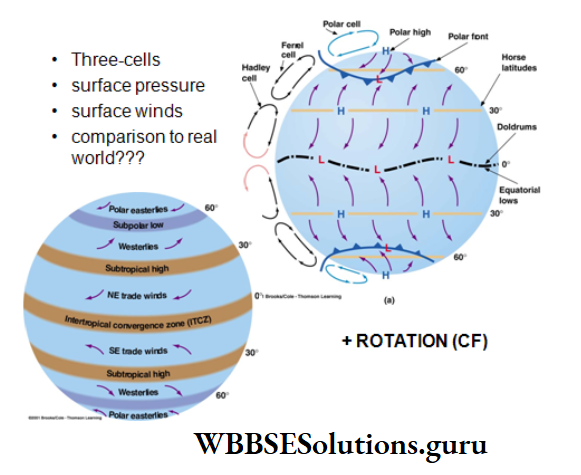
WBBSE Notes For Class 10 Geography And Environment Chapter 1 Exogenetic Processes And Resultant Landforms Plunge Pool

Pothole:

Tiny holes formed on the river bed due to strikes or stones or pebbles by the process of abrasion are called potholes.

WBBSE Notes For Class 10 Geography And Environment Chapter 1 Exogenetic Processes And Resultant Landforms Potholes

Alluvial Fan Or Cone:

At the foot of the mountains where the slope of the land is reduced, suddenly the velocity of the river is also checked.

Consequently, most of the river load like stones, pebbles are dropped to form a cone or fan-shaped landform known as the Alluvial cone or Alluvial fan.

WBBSE Notes For Class 10 Geography And Environment Chapter 1 Exogenetic Processes And Resultant Landforms Alluvial Fan

Meander :

Due to obstruction and low velocity of the river, it flows through a winding course which is known as Meander after the name of the river Meanderez in Turkey which is very much winded.

Example. River Ganga in Varanasi. A cliff is formed where the river erodes The bank i.e. the concave side of the meander.

Slip-off-slope (gentle slope) is formed where the river deposits the eroded materials i.e. the convex side of the meander.

WBBSE Notes For Class 10 Geography And Environment Chapter 1 Exogenetic Processes And Resultant Landforms River Meander

WBBSE Notes For Class 10 Geography And Environment Chapter 1 Exogenetic Processes And Resultant Landforms Sand Banks

Oxbow Lake :

In the middle as well as lower course, the river meander becomes very much prominent to form a loop as the river cuts the concave slope and deposits silt on the convex slope of the meander.

Class 10 Geography Chapter 1 Question Answers

Finally, only a narrow neck of land is left out. Consequently, the river cannot flow straight and leaves its old course which takes the shape of a horseshoe and is called a horse-shoe or ox-bow lake, for Example. the river Ganga near Patna.

WBBSE Notes For Class 10 Geography And Environment Chapter 1 Exogenetic Processes And Resultant Landforms Oxbow Lake

Flood Plain :

In the rainy season in the middle and lower courses river floods the adjoining areas where silts are -deposited. Due to repeated floods, a thick plain is formed known as a Flood Plain.

WBBSE Notes For Class 10 Geography And Environment Chapter 1 Exogenetic Processes And Resultant Landforms Flood Plain And Natural Levee

Natural Levee :

During floods deposition of silts takes place along the two banks of a river forming an embankment called a Natural levee.

Delta:

At the mouth of a river, silts are deposited forming a triangular landmass called a delta which looks like the fourth letter Δ (delta) of the Greek Alphabet, For Example, the delta formed by the river Ganga is the largest delta in the world.WBBSE Notes For Class 10 Geography And Environment Chapter 1 Exogenetic Processes And Resultant Landforms Gange Delta

Based on shapes deltas may be of different types

  1. The arcuate delta is a fan-shaped delta with a rounded outer margin (bow-shaped), the arc of the fan spreading into the sea, for Example. the Nile Delta.
  2. Bird’s foot delta is best explained by the Mississippi Delta which has several main branches like the foot of a bird extending into the Gulf of Mexico.
  3. A few rivers like Ebro in Spain have tooth-like projections at their mouths and these are known as Cuspate Delta.

WBBSE Notes For Class 10 Geography And Environment Chapter 1 Exogenetic Processes And Resultant Landforms Various Types Of Deltas

Estuary:

Many rivers do not form deltas if the river load is drained into the sea due to the greater velocity of the river by joining a number of tributaries or by the flushing action of the tidal waves.

For example. the river Ob in Russia has the largest estuary in the world.

Conditions Favourable For The Formation Of Delta

Rivers which have formed deltas are favoured by the following conditions :

  1. The slope of the land below the sea at the mouth of the river must be less.
  2. The river should be long and the number of tributaries should be large so that amount of silt becomes maximum.
  3. The salinity of the seawater at the mouth of the river should be high so that the deposition of silts will be more.
  4. Effects of High and Low tides at the mouth of the river should be less.
  5. The flow of the river at the mouth should be less.
  6. Delta formation accelerates if the wind blows from the opposite direction of river flow.
  7. Presence of a partially landlocked sea at the mouth of a river favours delta formation.

WBBSE Notes For Class 10 Geography And Environment Chapter 1 Exogenetic Processes And Resultant Landforms

Effect Of Global Warming On Active Delta Of Ganga-Padma-Meghna (The Sundarbans)

River Padma, the principal distributary of the river Ganga enters Bangladesh and combines with the river Meghna to drain into the Bay of Bengal.

The delta formed by Ganga-Padma- Meghna is the largest delta in the world. In the southern part of the delta, there is Sundarban the largest contiguous Mangrove forest in the world.

As it is part of an active delta so land building processes are still going on. There are, approximately, 102 islands of which 18 are uninhabited with a total of 9630 sq. km area.

Class 10 Geography Chapter 1 Question Answers

But due to global warming, the Sundarbans face several challenges, the most striking of which is the rising sea level by nearly 5 mm annually.

According to scientists, there are about a dozen vanishing islands under the sea. For the first time, Lohachara an inhabited island once the home. of 10,000 people have disappeared beneath the rising sea due to global warming.

Similarly, two-thirds of the nearby populated island, Ghoramara has also been permanently submerged underwater. New Moore or Purbasha Island was a small offshore island that emerged in the 2000s.

But in 2010 it was declared that the island has been completely submerged by rising seawater.

The Sundarbans also faces challenges like a threat to the health of mangrove forests and the quality of soil and crop types due to severely increasing salinity; changes in fishing pattern; frequent cyclones and erratic monsoon rain.

All these, together, are responsible for damaging the ecology and humanity of the Sundarbans.

WBBSE Notes For Class 10 Geography And Environment Chapter 1 Exogenetic Processes And Resultant Landforms Sundarbans

WBBSE Chapter 1 Exogenetic Processes And Resultant Landforms Works Of Glacier And Resultant Landforms

Glaciers are the moving ice and the most powerful gradational agent.

Concept Of Glacier

At present Glacial activity is restricted in the polar regions and in the high mountains.

But in the geological past during Ice Age, about 30,000 years back glaciers were active even in temperate latitudes where imprints of glacial activities are still found today.

Origin Of Glacier

Above the snowline, snowfall accumulates a huge amount of snow, the pressure of which turns the snow below into ice.

In Germany, fine and light snow is termed Tern’ and in France, it is termed ‘Neve’ which gradually turns into ice and eventually into a glacier.

A huge mass of ice when moves down the hill slopes by the gravitational force is known as a glacier.

Glacier Is The Largest Fresh Water Source Of The World :

Nearly 97% of the water reserve of the world belongs to the saline sea. Rest 3% as fresh water. belongs to the land.

About 69% of land water as fresh water is confined in ice or glacier, 30% is retained as groundwater and only 1% belongs to rivers, ponds, canals etc.

Class 10 Geography Chapter 1 Question Answers

So, the glacier is the most important source of fresh water. But due to global warming, glaciers are melting and mixing with seawater. So it results in rising sea levels as well as diminishing availability of fresh water.

Types Of Glacier

Glaciers are of three types.

  1. Mountain or Valley glacier descends through the mountain valleys, for Example. Gangotri glacier, Siachen glacier.
  2. A continental glacier or Ice sheet is a mass of ice which covers extensive areas of a continent. Lambert Glacier of Antarctica is the largest Ice sheet glacier in the world.
  3. Piedmont Glacier is formed at the foot of a mountain where several glaciers converge to form an extensive mass of ice, for Example. Malaspina in Alaska.

Snowline:

The altitude above which snow accumulates throughout the year is known as a snowline. The altitude of the snowline depends on latitude, the slope of the land, altitude, seasonal variation, wind direction, wind velocity and air temperature.

Snowline lies at sea level (0 m) in the polar region, 2000-2500 m in the temperate region, 4000-4500 m in the tropical region and above 5000 m in the equatorial region.

WBBSE Notes For Class 10 Geography And Environment Chapter 1 Exogenetic Processes And Resultant Landforms Snowlines

Iceberg :

Iceberg is a huge mass of ice broken from a glacier that floats on the ocean water. Only 1/9th of it remains above sea level.

WBBSE Notes For Class 10 Geography And Environment Chapter 1 Exogenetic Processes And Resultant Landforms Iceberg

Crevasse And Bergschrund:

Crevasse is a deep crack formed on the glacier. A very large crevasse formed near the head of the glacier is known as Bergschrund.

For mountaineering, these crevasses and bergschrunds are very much dangerous as they cannot be identified when covered with light snow.

WBBSE Notes For Class 10 Geography And Environment Chapter 1 Exogenetic Processes And Resultant Landforms Crevasse and Bergschrund

Works Of Glacier—Erosion Transportation And Deposition

Glacier works in three ways

  1. erosion,
  2. transportation and
  3. deposition.

Erosion Of Glacier

There are two processes of erosion

  1. Plucking—Picking up of stones and pebbles from the mountain wall by the glacier is known as plucking.
  2. Abrasion—Wearing away of rocks beneath the glacier due to frictional activity producing striations, grooving etc. or rock pebbles is known as abrasion.

Class 10 Geography Chapter 1 WBBSE Solutions

Resultant Landforms Of Glacial Erosion :

Corrie:

The moving ice usually forms. depressions on the mountain wall, as if, an armchair-shaped hollow is formed.
This hollow is known as Corrie and Cirque by the French.

WBBSE Notes For Class 10 Geography And Environment Chapter 1 Exogenetic Processes And Resultant Landforms Corrie and Arete

Arete:

When a number of corries or cirques develop on a mountain; glaciers cut their mountain walls and gradually a sharp edge is formed known as Arete.

Pyramidal Peak:

Sometimes, several cirques may develop on all sides of the mountain and the glaciers, usually, cut their headwalls until the mountain peak takes the shape of a pyramid.

The top of the peak is called the pyramidal peak. A sharp pointed pyramidal peak is called Horn. Example. Matterhorn of Switzerland and Neelkantha Peak in India are good examples of Horn.

WBBSE Notes For Class 10 Geography And Environment Chapter 1 Exogenetic Processes And Resultant Landforms Pyramidal Peak

Truncated Spur:

When the tributary valleys of interlocking spurs are occupied by glaciers, the noses of the spurs are cut by the process of abrasion. As a result, truncated spurs are formed.

U-Shaped Valley Or Glacial Trough:

A glacial valley has a wide flat floor with steep walls and looks like the English letter ‘U’.

The ‘U’-shaped valley is formed when the V-shaped valley of a pre-existing river has been over-deepened and widened by the passage of a glacier, for Example. St. Lawrence Valley in the U.S.A.

WBBSE Notes For Class 10 Geography And Environment Chapter 1 Exogenetic Processes And Resultant Landforms Truncated Spurs

Class 10 Geography Chapter 1 WBBSE Solutions

Hanging Valley:

It is formed by a tributary glacier which forms a valley less deep than that of the main glacier.

When glaciers melt, it is found that the tributary valley remains higher than the main valley and appears to be hanging over the main valley.

WBBSE Notes For Class 10 Geography And Environment Chapter 1 Exogenetic Processes And Resultant Landforms Hanging Valley

Roches Mountonnees:

These are the hillocks of rocks that are polished by glacial abrasion on the upstream side to form a gentle slope and remain rough and irregular with a steep slope due to plucking on the opposite side.

They appear to lie on the mountain like sheep and hence, are also called sheep rocks.

WBBSE Notes For Class 10 Geography And Environment Chapter 1 Exogenetic Processes And Resultant Landforms Roches Mountonnees

Crag And Tail:

A glacier may find a soft rock to be protected from its erosion by the presence of a hard rock which is called a Crag and the soft rock remains as a Tail.

WBBSE Notes For Class 10 Geography And Environment Chapter 1 Exogenetic Processes And Resultant Crag and Tail

Fjord:

A valley glacier extending up to the coast erodes the land below sea level forming an inlet through which sea water enters the land.

This is known as Fjord, These are common in Norway and Sweden. Small and shallow fjords are known as Fjords.

WBBSE Notes For Class 10 Geography And Environment Chapter 1 Exogenetic Processes And Resultant Fjord and Fjord (Front View)

Transportation Of Glacier

Carrying away of eroded materials called moraines embedded in a glacier is known as transportation.

Deposition Of Glacier

Moraines are carried by a glacier when dropped on the glacial valley the process is known as Deposition.

Depositional works may be grouped into two types

  1. Deposition on the upper part of the mountain and
  2. Deposition on the foothills of the mountain.

Class 10 Geography And Environment Notes WBBSE

Deposition On The Upper Part Of The Mountains

Moraines:

Sand, clay, gravel deposited by a glacier are called moraines. Moraines are of different types
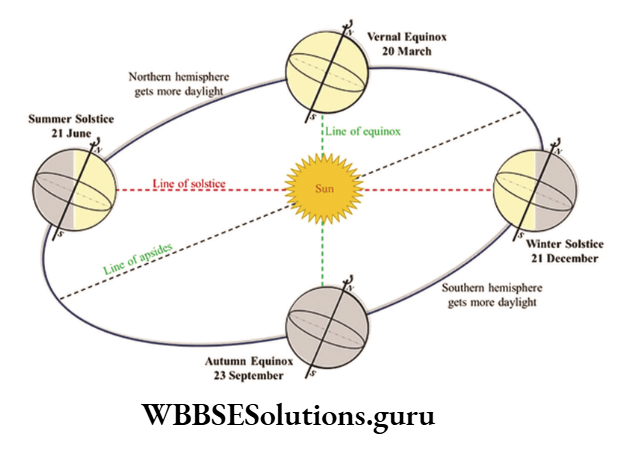
  1. Lateral moraines are deposited along the margins of a glacier,
  2. When two glaciers meet, the adjacent lateral moraines combine to form Medialmoraines,
  3. Terminal or End moraines are formed at the end of a glacier.

WBBSE Notes For Class 10 Geography And Environment Chapter 1 Exogenetic Processes And Resultant Landforms Moraine

Deposition At The Foothills Of A Mountain

At the foothills of a mountain, glaciers, as well as glacier-melt rivers together, form various types of landforms. Hence, these landforms are known as glacial-fluvial landforms.

Outwash Plain:

At the end of Terminal Moraine, streams derived from the melting of ice form a plain land by the deposition of sand, clay and gravel. This is known as Outwash Plain.

WBBSE Notes For Class 10 Geography And Environment Chapter 1 Exogenetic Processes And Resultant Landforms Outwash Plain and Esker

Class 10 Geography And Environment Notes WBBSE

Drumlins:

These are low elongated smooth and rounded hills like whale-back hummocks composed of boulder clay. The landscape scattered with a number of drumlins is called ‘Basket of Eggs terrain’. These are common in the Lake Region of the U.S.A.

WBBSE Notes For Class 10 Geography And Environment Chapter 1 Exogenetic Processes And Resultant Drumlin

Esker:

These are long and narrow, winding steep sided low ridges composed of sand and gravel. These are common in Scandinavia.

Kame:

A triangular feature made by a number of mounds of sand and gravel is known as Kame. A number of Karnes when developing steps are known as Kame terraces.
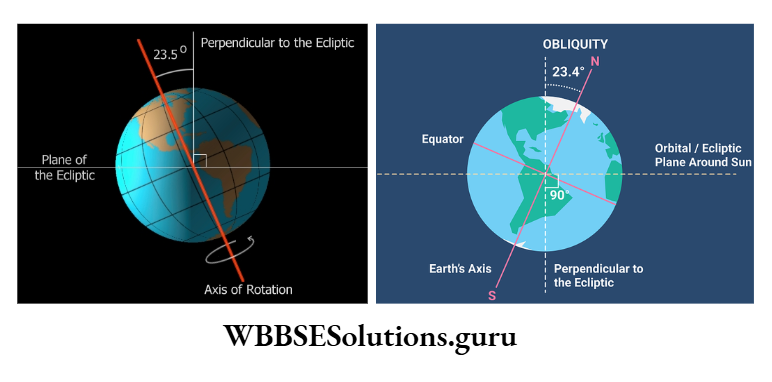
WBBSE Notes For Class 10 Geography And Environment Chapter 1 Exogenetic Processes And Resultant Landforms Kame and Kettle

Kettles:

These are depressions formed by the melting of a huge chunk of ice and are found on the outwash plain.

WBBSE Chapter 1 Exogenetic Processes And Resultant Landforms Works Of Wind And Resultant Land-Forms

Predominate Wind Action

Wind as an agent of * gradation is active in arid and semi-arid and the coastal regions. There are 7 large deserts in the world.
WBBSE Notes For Class 10 Geography And Environment Chapter 1 Exogenetic Processes And Resultant Landforms Principal Deserts Of the World

These are the Sahara and Kalahari in Africa, Atacama in South America, Soneran in North America, the Great Deserts of West and Central Australia, the Arabian Desert of Asia and the Thar desert of India-Pakistan.

In the deserts, wind action is predominant because

  1. There is little vegetation to hold firmly loose surface materials and at the same time wind can blow swiftly without any obstruction,
  2. Variations in temperature during the day and night cause mechanical weathering. In coastal regions, sea waves cut the coastal land and produce large amounts of sand particles which are blown by the wind uninterruptedly helping in wind erosion.
  3. South-west monsoon wind deposits sands in Digha and Contai coasts blown away from Andhra and Odisha coasts.

WBBSE Notes For Class 10 Geography And Environment Chapter 1 Exogenetic Processes And Resultant Landforms Sahara Desert

Class 10 Geography And Environment Notes WBBSE

Formation Of Sand Particles

Sand is a weathered naturally occurring fragmentary material ranging in size between 0.06 and 2.0 mm in diameter.

In deserts due to thermal variation in day and night temperature, rocks are disintegrated by the processes of granular disintegration, and block disintegration.

Exfoliation into grains which by the process of attrition themselves turn into fine grains known as Sands.

In coastal regions, rocks are also disintegrated by sea waves through the processes of abrasion, hydraulic action, attrition etc. into fine grains i.e. sands.

Works Of Wind :

Wind sculptures the earth’s surface through three processes

  1. Erosion,
  2. Transportation and
  3. Deposition.

Wind Erosion

Wind erodes in three ways

  1. Abrasion,
  2. Deflation,
  3. Deposition.

1. Abrasion :

This is the process by which the wind drives sand particles against an exposed rock which becomes scratched, polished and grooved. It is most effective near the base of a rock within one metre above the ground.

Resultant Landforms Carved Out By Wind Abrasion:

Gour :

Wind abrasion causes wearing away of softer rock layers of projecting rock masses and carving them into pillars called Rock pedestals.

Generally, the undercutting is more near the base of the rock and as a result, a mushroom-shaped rock is formed known as Gour which is common in the Sahara desert.

WBBSE Notes For Class 10 Geography And Environment Chapter 1 Exogenetic Processes And Resultant Landforms Gour

Class 10 Geography And Environment Notes WBBSE

Zeugen :

When horizontally arranged Gour alternate layers of hard and soft rocks are exposed to wind abrasion, soft rocks are removed quickly. But the hard rocks stand out uneroded as ridges which are known as Zeugens.

WBBSE Notes For Class 10 Geography And Environment Chapter 1 Exogenetic Processes And Resultant Landforms Zeugen

Yardang :

When vertically arranged alternate layers of hard and soft rocks are exposed to wind abrasion, columns of soft rocks wear away quickly leaving behind the pillars of hard rocks which are called Yardangs.

Inselberg :

This is a German word which means ‘island mountain’, these are isolated hills With steep slopes and rounded tops, often composed of granite and gneiss produced by wind abrasion.

These are common in the Kalahari desert of South Africa and in the West Australian desert.

WBBSE Notes For Class 10 Geography And Environment Chapter 1 Exogenetic Processes And Resultant Landforms Inselberg

2. Deflation :

Deflation is the process by which wind lifts and blows sand particles. Thus it lowers the desert surface and forms a depression.

Deflation Hollow :

Strong wind deflation causes the formation of depressions, for Example. Quattara depression in Egypt.

WBBSE Notes For Class 10 Geography And Environment Chapter 1 Exogenetic Processes And Resultant Landforms Deflation Hollow

3. Deposition :

The ultimate products of wind attrition between the pebbles are sands.

WBBSE Class 10 Geography Chapter 1 Notes

Wind Transportation

Eroded materials are transported by the wind in three ways

  1. Suspension,
  2. Saltation And
  3. Traction.

1. Suspension:

Fine sand particles are blown away by the wind at distant places.

2. Saltation:

Stones and pebbles are moved away by wind through saltation process i.e. by dropping and jumping of stones in the air.

3. Traction:

Through this process, bigger stones are dragged away by the wind along the surface of the earth.

By wind transportation area of the desert increases. Thus the Rajasthan desert in India has extended eastwards. This is known as desertification.

Wind Deposition

Huge amounts of sand carried by the wind are dropped when obstructed by a highland or when the velocity of the wind decreases.

Landforms Produced By Wind Deposition

Important landforms produced by wind deposition are sand dunes and loess plains.

Sand Dunes

Dunes are hills of sand formed by wind deposition. The wind being obstructed by natural vegetation, boulder or any kind of other obstructions deposits sands to form dunes.

According to Bagnold, a famous scientist, Dunes are of two types

  1. Barkhans and
  2. Seif dunes.

1. Barkhans:

This type of dune is formed transversely to the wind direction. So they are also known as transverse dunes. Crescent-shaped transverse dunes are called Barkhans.

These are common in the deserts of the Sahara, Arabia, Atacama and Kalahari. The windward slope of the Barkhan is gentle and convex, while the leeward slope is steep and concave.

Barkhan tapers off at two ends to two points called Horns. The average height of Barkhan varies between 15 and 30 metres. They are usually temporary and shifting in nature.

WBBSE Notes For Class 10 Geography And Environment Chapter 1 Exogenetic Processes And Resultant Landforms Barkhan

WBBSE Class 10 Geography Chapter 1 Notes

2. Seif Dunes :

‘Seif’ is an Arabic word which means ‘sword’. There are long, narrow sand dunes lying parallel to the wind direction. So they are also known as longitudinal sand dunes.

These are commonly found in the deserts of Arabia, the Sahara and the Thar in India. Seif dunes vary in length from a kilometre to a hundred kilometres.

Their height varies between 150 and 200 m. They lie parallel to each other. The top of the dunes is sharp. These are formed where the velocity of wind is high.

In Rajasthan, they are extended from southwest to northeast as they lie parallel to the direction of southwest monsoon wind.

WBBSE Notes For Class 10 Geography And Environment Chapter 1 Exogenetic Processes And Resultant Landforms Self Dunes

Loess

Fine sand particles of a desert when transported by wind are dropped at a distant place. Gradually, these sand particles accumulate there to form a thick plain land called Loess.

The best example is the Loess plain formed along the Hwang-Ho river valley in China where sand carried away from the Gobi desert is deposited by wind.

WBBSE Notes For Class 10 Geography And Environment Chapter 1 Exogenetic Processes And Resultant Landforms Loess Plain

Combined Actions Of Wind And Running Water :

In the desert, sometimes wind in combination with running water work as an agent of gradation.

Wadi

‘Wadi’ is an Arabic word which means ‘dry valley’. In the desert a short spell of rain results in flood. As a result, temporary rivers or gullies are formed. After the recession of water gullies are left out as dry valleys. These are known as a wadi.

WBBSE Notes For Class 10 Geography And Environment Chapter 1 Exogenetic Processes And Resultant Landforms Wadi

Pediment

A sloping stony plain formed by the combined action of wind and running water at the foot of a mountain is called a pediment. It is an erosional plain formed at the base of a surrounding mountain scarp.

WBBSE Notes For Class 10 Geography And Environment Chapter 1 Exogenetic Processes And Resultant Landforms Pediment

Bajada

A triangular or fan-shaped alluvial land formed by running water at the lower part of the pediment may join with others to form a plain land which is known as Bajada.

it is a depositional feature formed by intermittent streams.

WBBSE Notes For Class 10 Geography And Environment Chapter 1 Exogenetic Processes And Resultant Landforms Bajada and Playa

Playa

A shallow lake formed by a number of intermittent streams in a basin enclosed by mountains. It is a temporary lake and highly saline.

Expansion Of Deserts And Measures To Control:

  1. Usually, either naturally or by human interference deserts expand. Physical causes are
  2. Sands blown by the wind and deposited in the adjoining areas may extend into a desert,
  3. Frequent and prolonged dry weather increases aridity and drought for consecutive years

and climatic changes due to global warming. Human interferences like

  1. Deforestation
  2. Overgrazing,
  3. use of unscientific methods of agriculture. As a result, the Thar and the Sahara deserts have extended east and southwards respectively.

To control the extension of the desert a few measures have been taken in the Thar and the Sahara deserts. In Thar desert, Desert Afforestation Research Station was set in Jodhpur in 1952.

Afforestation started in 1958 in the Command Areas of the Indira Gandhi Canal.

Other programmes to control desertification are sand-dune fixation work, silvopastoral plantations, village fodder and fuel wood plantation, shelterbelt plantation, ecological regeneration, and restoration and rehabilitation of degraded desert.

Afforestation in barren hills, reseeding of old pasture and farm forestry, rainwater harvesting and recharge of groundwater. In the Sahara measures that have been taken to control desertification are making water free of salt with solar energy, and development.

wind break, sand shield at the margin of the desert and envision (The Great Green Wall (GGW) to stop desertification. It is 15 km wide and 8000 km long, a living green wall of trees, bushes and birds to the south of the Sahara.

WBBSE Notes For Class 10 Geography And Environment Chapter 2 Atmosphere

WBBSE Chapter 2 Atmosphere

Concept Of Atmosphere Composition

Concept of Atmosphere:

The atmosphere is an insulating blanket which protects the Earth from the intense heat and light of the sun and helps living organisms to survive.

It is held by the gravitational pull of the earth extending up to 10,000 km from the earth’s surface.

97% of the atmospheric elements are confined to only 29 km from the earth’s surface due to the gravitational force of the earth and the pressure of the upper layers of the atmosphere. Beyond 10,000 km there is space which is infinite.

WBBSE Notes For Class 10 Geography And Environment

Different Elements Of Atmosphere

The atmosphere is chiefly composed of three components—gases, water vapour and dust particles.

Gaseous Elements

The atmosphere comprises many gases. Among these gases, Nitrogen constitutes nearly 78% (78.08) of the atmosphere.

Oxygen, the second most important gas contributes nearly 21% (20.94) of the atmospheric content. The rest 1% of the atmosphere comprises of Argon (0.93%), Carbon dioxide (0.033%), Helium, Hydrogen, Krypton, Methene, Neon, Ozone, Xenon etc.

Amongst these gases nitrogen, argon, neon, helium, krypton and xenon are known as inert gases (these gases do not take part in a chemical reaction).

The proportion of these gases remains constant up to a height of 90 km from the earth’s surface.

WBBSE Notes For Class 10 Chapter 2 Atmosphere Gaseous elements of the atmosphere

Water Vapour

This is one of the most important elements of the atmosphere. This is the gaseous state of water. About 90% of atmospheric water vapour is confined within 6 km from the earth’s surface.

WBBSE Class 10 Geography Chapter 2 Notes

It accounts for nearly 1.4% of the atmosphere by volume. But this amount is very variable according to latitude and season. In the Tropical region it is only 4% while in the Polar region, it is as low as 0.0006%.

Dust Particles

Dust particles are also known as aerosols. It is also a variable element of the atmosphere. It is found in deserts, seasides, industrial towns, volcanic ashes etc.

WBBSE Notes For Class 10 Geography And EnvironmentWBBSE Notes For Class 10 History And Environment
WBBSE Solutions For Class 10 Life ScienceWBBSE Class 10 Life Science Multiple Choice Questions
WBBSE Solutions for Class 10 MathsWBBSE Class 10 Maths Multiple Choice Questions
WBBSE Notes For Class 10 Physical Science And Environment

WBBSE Chapter 2 Atmosphere Layers Of Atmosphere

The atmosphere can be divided into different layers based on

  1. Chemical composition and
  2. Variation in temperature.

Atmospheric Layers Based On Chemical Composition And Thermal Variation:

The atmosphere can be divided into two layers based on chemical composition.

Homosphere

‘Homo’ means uniform and ‘sphere’ means region. Up to 90 km above the earth’s surface there is no variation in the proportion of different gases found in the atmosphere.

Heterosphere

‘Hetero’ means dissimilar and ‘sphere’ means region. Above the homosphere, the Heterosphere extends up to nearly 10,000 km.

Different gases of this, layer vary in proportion and thickness and accordingly this layer is divided into four sublayers

  1. The molecular Nitrogen layer extends up to 200 km above the earth’s surface.
  2. The atomic Oxygen layer extends from 200 to 1100 km above the earth’s surface.
  3. The helium layer extends between 1100 km and 3500 km above the earth’s surface.
  4. The hydrogen layer extends up to 10,000 km above the helium layer.

WBBSE Notes For Class 10 Geography And Environment Chapter 2 Atmosphere

Atmospheric Layers Based On Variation In Temperature

According to variations in temperature the atmosphere can be divided into five layers

  1. Troposphere,
  2. Stratosphere,
  3. Mesosphere,
  4. Thermosphere,
  5. Exosphere and
  6. Magnetosphere.

Troposphere

This is the lowest layer of the atmosphere. In this layer, temperature decreases at a rate of 6.5°C for every 1000 metre or 1 km ascent.

At the equatorial region, the layer extends upward 18 km, but at the poles, it extends only up to 8 km. This layer contains a sufficient amount of different elements of gases, water vapour, dust particles etc.

WBBSE Class 10 Geography Chapter 2 Notes

So this layer is Known as weather making layer in which clouds and storms are formed. 75% of the gaseous elements of the atmosphere belong to this layer. Air-polluting elements are also blown in this layer.

WBBSE Notes For Class 10 Chapter 2 Atmosphere Atmospheric layers

Tropopause

At the upper limit of the troposphere temperature becomes – 55°C which remains constant for 2 to 3 km above Troposphere. This zone of constant temperature is known as Tropopause. A strong ‘Jet stream’ blows in this layer.

Stratosphere

Stratosphere lies above the Troposphere for nearly 50 km thickness. In this layer, temperature increases upward and at 50 km height temperature of the air becomes maximum, nearly 10°C.

There is Ozone (O3) layer because of the concentration of O3. The ozone layer protects the earth’s surface from the harmful rays of the sun.

Water vapour or cloud is absent in this layer except for the Noctilucent cloud. So jet air crafts fly through this layer.

Stratopause

Above the stratosphere at a 50 km height increase in temperature stops this zone is known as Stratopause.

Mesosphere

Mesosphere extends above stratopause for nearly 80 km above the earth’s surface. Temperature decreases with increasing height.

At 80 km, the temperature becomes lowest at about -93°C. Incoming meteors from outer space towards Earth are burnt in this layer. The pressure of air is also very low in this layer.

Mesopause

The height at which in the mesosphere the fall of temperature ceases is known as Mesopause.

Ionosphere

Above Mesosphere the layer of air is known as Ionosphere. In this layer temperature again rises rapidly and becomes nearly 1200°C at the elevation of 500 km.

In this layer ionisation of gas, molecules take place. This layer is known as Thermosphere. Auroras seen in the mighty sky at high latitudes are developed in this layer.

Auroras are probably an effect of magnetic storms i.e. the disturbance in the magnetic field of the earth and electric discharge of the sun during periods of sunspot activity.

From the ionosphere, radio waves are reflected back to the earth which helps maintain the world’s radio communication system.

Class 10 Geography And Environment Chapter 2 Solutions

Exosphere

Above the thermosphere lies the Exosphere. In this layer temperature also increases with increasing height but not so rapidly as it happens in the Thermosphere. At 650 km above the earth’s surface temperature increases to nearly 1240ºC.

Magnetosphere

Beyond Exosphere lies the Magnetosphere which gradually merges into space.

WBBSE Chapter 2 Atmosphere Importance Of Ozon And Its Depletion

In the stratosphere between 24 km and 40 km in height, there is an ozone layer which absorbs ultraviolet rays and other harmful rays of the sun. So it protects the earth and human life from cancer and other diseases.

But emission of Chlorofluro carbon (CFC), nitrous oxide and other gases deplete the formation of ozone (O3) and thus Ozone holes are found in the Arctic and Antarctic regions. So ozone layer must be conserved at any cost.

WBBSE Notes For Class 10 Chapter 2 Atmosphere Depletion of ozone layers

Heat, Temperature And Global Warming

Air temperature is the warmth of air received by a place from the sunrays measured in degrees Celsius or Fahrenheit with the help of a thermometer.

The sun is the source of this air temperature. Though the earth is about 150 million km away from the sun. It is heated directly or indirectly by the sun.

Insolation, Heat Budget, Processes Of Heating:

Insolation

Insolation is the incoming solar radiation which is about 1/2,000,000,000 part of solar radiation which spreads in all directions with a velocity of about 2,97,600 km per second.

About 35% of insolation is reflected back into space. It varies widely with the variation in nature of the earth’s surface.

The remaining 65% of the insolation is known as Effective Solar Radiation which enters the earth’s atmosphere.

14% is absorbed by dust, carbon the Atmosphere dioxide, and water vapour present in the air. 45% of the insolation, ultimately, reaches the earth’s surface.

WBBSE Notes For Class 10 Chapter 2 Atmosphere heat received by the earth and the atmosphere

Heat Budge

During the day the earth is heated by the sun. But at night the earth becomes cooled by releasing the same amount (65%) of heat into space. This is known as terrestrial heat balance or heat budget.

Processes Of Heating Of The Atmosphere :

The atmosphere is heated by the following processes :

Radiation:

The earth’s surface is heated by the sun’s rays and the terrestrial heat is radiated from the earth’s surface. This terrestrial radiation warms the lowest layer of the atmosphere.

Conduction:

Cold air from the upper layer comes in contact with the warm lower layer and the heat is transmitted to the upper layers gradually.

Convection:

The air of the lower layer heated by the terrestrial radiation becomes warm and light and it rises while cold heavy air of the upper layers descends to occupy the vacuum. Thus, heat is transferred to the upper layers of the atmosphere.

Advection:

The horizontal transfer of heat through horizontally moving airmass is known as advection.

Direct Absorption:

Elements like carbon dioxide, water vapour, and dust particles present in the air absorb heat directly, thus, the air is warmed up directly.

Class 10 Geography And Environment Chapter 2 Solutions

Radio-Active-Elements:

The heat generated from hot springs, and volcanic eruptions also warms up the atmosphere. The heat generated from hot springs, volcanic eruptions and from living bodies is also responsible for the warming of the air.

WBBSE Notes For Class 10 Chapter 2 Atmosphere processes of heating of the Atmosphere


Measurement Of Heat

Air temperature is measured by a thermometer. It is of various types. The highest and lowest temperature of a day is measured by Six’s thermometer.

In 1782, James Six invented this thermometer which is named after the inventor. It records the maximum and minimum temperature of the day.

Two types of scales, celsius and Fahrenheit for measuring air temperature are used in this thermometer.

Maximum And Minimum Temperature

The highest temperature of the day (24 hours) is recorded as the maximum temperature and the lowest temperature of that day (24 hours) is recorded as the minimum temperature in Six’s thermometer.

WBBSE Notes For Class 10 Chapter 2 Atmosphere Six's thermometer


Average Daily Temperature:

Maximum and minimum temperatures of a day at any place are added and divided by two to obtain the average daily temperature.

Daily Range Of Temperature:

The difference between the maximum and minimum temperature of a day at any place is the daily range of temperature.

Calculation


WBBSE Notes for class 10 geography chapter 2 Atmosphere Daily range of temperature


Average daily temperature is =24°C + 18°c = 42°C ÷2 = 21°c
Daily range of temperature is 24°C – 18°C = 6°C

Monthly Average Temperature :

The average daily temperatures of a month are added and then divided by the number of days of that month to get the monthly average temperature of a place.

Monthly Range Of Temperature :

The difference in temperature between the average highest temperature and the average lowest temperature of a month is the monthly range of temperature of a place.

Class 10 Geography And Environment Chapter 2 Solutions

Calculation

The temperature of January (°C)

WBBSE Notes for class 10 geography chapter 2 Atmosphere Monthly Range Of Temperature

The monthly average temperature of January is 20.1°C
Monthly range of temperature’s (25.5°C – 14.8°C) = 10.7°C

Annual Average Temperature :

The average monthly temperature of twelve months is added and then divided by 12 to obtain the annual average temperature.

Annual Range Of Temperature :

The difference in temperature between the highest monthly average temperature and a lowest monthly average temperature of a place.

Calculation

Temperature (°C)

WBBSE Notes for class 10 geography chapter 2 Atmosphere Annual range of temperature

The annual average temperature is 26.7°C and the Annual range of temperature is (31.5°C – 22.0°C) = 9.5°C.

Causes Of Variation In Atmospheric Temperature:

The atmosphere is heated mainly by terrestrial radiation, but the air temperature is not uniform on the Earth. The following factors are responsible for variations in air temperature.

Latitude

Temperature decreases from the equator to the poles because the equatorial region receives vertical rays, while inclined rays spread over the polar regions.

Vertical rays are responsible for more air temperature because,

  1. It passes through a relatively short distance in the atmosphere, so absorption of heat by dust, water vapour, and carbon dioxide present in the air is less, so more heat is received, Oblique rays spread over a greater extent. So temperature decreases away from the equator towards north and south. Temperature decreases away from the equator.
  2. The temperature of Tirubanantapuram  (8°30′ north) is higher than that of Srinagar which is located at 34° north latitude.

WBBSE Notes For Class 10 Chapter 2 Atmosphere Influence Of Temperature Of Latitude

Class 10 Geography Chapter 2 Question Answers

Altitude Of A Place

Usually, the temperature of the air decreases at the rate of 0-6°C per 100-metre rise. This is known as Lapse Rate or Normal Temperature Lapse Rate.

So higher places experience low temperatures. The temperature of Darjeeling is less than that at Siliguri (located on the plain) though these two places belong nearly to the same latitude.

WBBSE Notes For Class 10 Chapter 2 Atmosphere temperature decreases with increasing altitude

Inversion Of Temperature

Sometimes respecting the Lapse Rate, temperature increases with the increasing altitude of a place. This is known as the Inversion of temperature.

In mountain regions, cold and dense air slides down the mountain slopes into the valley by the earth’s gravitation! force. This is known as the Katabatic wind.

It lowers the valley temperature. In Europe, settlements and farmlands are, therefore, located on mountain slopes.

WBBSE Notes For Class 10 Chapter 2 Atmosphere inversion of temperature

Distribution Of Land And Waterbodies

In summer water bodies are not as warm as landmasses. Similarly, in winter water bodies are not as cold as landmasses.

Therefore, summers and winters are mild in coastal regions due to moderating effect of the sea breeze and the coastal regions experience maritime climate.

But in the interior locations, summers are very hot and winters are very cold. So extreme or continental climate prevails there.
This is due to the differential heating and cooling of land and water.

Wind:

In winter cold wind from central Asia blowing over India reduces temperature, especially, in the northern plains.

Ocean Currents :

A place will experience more air temperature, if, it is passed by warm ocean currents than the other place passed by cold ocean currents even though, the two places are located on the same latitude and altitude.

Nain and Glasgow though located on the same latitude, have different temperatures in winter because Nain receives Cold Labrador Current and Glasgow receives warm North Atlantic drift.

So, the temperature at Glasgow is 3.9°C it is -21.6°C at Nain.

WBBSE Notes For Class 10 Chapter 2 Atmosphere temperature and ocean currents

Class 10 Geography Chapter 2 Question Answers

Slope Of The Land

In the northern hemisphere, the southern slope of the east-west oriented mountain range receives comparatively more vertical rays because of which it remains warmer than the northern slope of the mountain.

It happens so because the sun remains within the tropics during its apparent annual movement.

WBBSE Notes For Class 10 Chapter 2 Atmosphere influence of slope of the land on temperature

Cloud Cover And Precipitation

During the day cloud cover prevents the sun’s rays to reach the ground, so the air temperature of that place becomes low. But a cloudless sky allows the sun’s rays to reach the ground to the full extent and thus the air temperature of that place increases.

On the contrary, cloudless nights keep the air temperature low by releasing heat into space and cloudy nights store heat in the atmosphere, thereby, increasing the air temperature of that place.

In Rajasthan, the temperature of a cloudless day is nearly 45°C while at cloudless nights it drops to about 20°C.

Precipitation like rainfall and snowfall is also responsible for lowering an air temperature of a place. Pre-monsoon rains in summer in India lower air temperatures.

WBBSE Notes For Class 10 Chapter 2 Atmosphere effect of temperature cloudy day and night

Natural Vegetation

In dense forests, air temperature remains low as the sun’s rays cannot penetrate the forest. The release of water through transpiration from trees also causes rain which also lowers the air temperature.

The temperature of selva in Brazil is much lower than that of Kenya or Uganda where there is no forest.

Soil

Wet and dryness of the soil are responsible for variations in air temperature. The temperature of the humid soil of the Gangetic plain is less warm than that of the dry soil of the eastern part of Rajasthan.

WBBSE Notes For Class 10 Chapter 2 Atmosphere temperature of industrial area higher than adjoining county side

Urbanisation And Industrilisation

Most parts of cities and towns are made of bricks, cement and concrete which are heated rapidly. So the temperature of cities and towns is high.

The heat emitted from the factories of industrial towns also increases air temperature. So the temperature in cities and town are higher than that of villages.

The temperature of Kolkata, Durgapur, and Jamshedpur is higher than in the adjoining countryside.

WBBSE Chapter 2 Atmosphere Heat Belts Isotherm And Horizontal Distribution Of Temperature

Heat Belts :

Based on variations in air temperature earth’s surface may be divided into Five heat or thermal belts or zones :

Torrid Zone :

Torrid zone is located between the Tropic of Cancer (23°30’N) and the Tropic of Capricorn (23°30’S). The region receives maximum heat because the equatorial region receives vertical rays twice in a year.

Variation in the length of day and night is minimum. Temperature is higher than any other places on the earth’s surface throughout the year.

Annual average temperature is 27°C. The isotherm 27°C is considered the northern limit of the Torrid zone. Places located between 30°N and S are included in this zone.

North Temperature Zone And South Temperate Zone :

North Temperate zone is located between the Tropic of Cancer (23°30’N) and the Arctic Circle (66°30’N) while South Temperate zone is located between the Tropic of Capricorn (23°30,S) and the Antarctic Circle (66°30’S).

Sunrays fall over these regions obliquely. Length of day and night is medium. Temperature remains moderate. Annual average temperature varies between 0°C and 27°C.

Due to higher temperature, regions close to Torrid zone (23°30/ to 45°) are known as warm Temperate zone. Due to low temperature, region close to Frigid zone (45° to 66°30′) are known as Cool Temperate zone.

Class 10 Geography Chapter 2 Wbbse Solutions

North Frigid Zone And South Frigid Zone

Regions beyond the Arctic circles and Antarctic circles are known as Frigid zones. North Frigid Zone lies between Arctic Circle (66°30’N) and North Pole (90°N) and South Frigid Zone lies between Antarctic Circle (66°30’S) and South Pole (90°S).
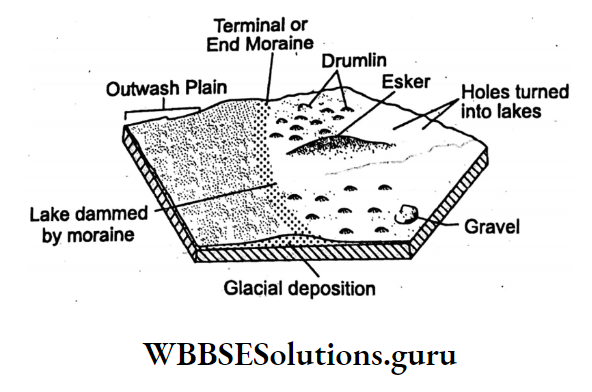
These regions receives very much inclined sunrays. They do not get sun rays for a few months in a year. Snowfall occurs most of the year and the land remains snow covered.

Annual average temperature is below 0°C. During long nights Auroras enlighten these regions.

WBBSE Notes For Class 10 Chapter 2 Atmosphere heat belts

Isotherm :

An imaginary line drawn on a map by joining the places having same temperature reduced to sea level is known as Isotherm, (‘iso’ means same and ‘thermos’ means temperature.

Horizontal Distribution Of Temperature

Distribution of global temperature may be understood with the help of isotherms.

As the months January and July experience extreme temperature conditions in a year so January and July isotherm give us some ideas regarding horizontal temperature distribution of the earth; such as :

  1. Highest and lowest temperatures of January and July are confined to land only.
  2. In January, isotherms on land masses bend towards the equator and over the equator bend towards the poles.
  3. Isotherms are Apart from each other in Southern Hemisphere because of more water bodies.
  4. Due to differential heating of land and water isotherms are not straight where land and water meet.
  5. Difference in temperature of two places is more in winter than that in summer. So in January, isotherms are closely spaced in Northern Hemisphere.

January Isotherm

  1. To the North of Asia, due to very low temperature (about — 40°C) isotherms do not follow the parallels, rather, they forms loops.
  2. Due to great differences in temperature in Northern Hemisphere isotherms are closely spaced.
  3. But in Southern Hemisphere (as it is summer) isotherms on the land bend towards the equator.

WBBSE Notes For Class 10 Chapter 2 Atmosphere horizontal temperature distribution- January

July Isotherm

  1. Temperature is high in Northern Hemisphere as it is summer there,
  2. Temperature is high in Central Asia and in North Africa, so isotherms becomes circular.
  3. In Southern Hemisphere water body is more and influence of warm current is also less. So, isotherms are more or less parallel to the parallels of latitude.

WBBSE Notes For Class 10 Chapter 2 Atmosphere horizontal temperature distribution- July

Global Warming—Role Of Green House Gases:

Class 10 Geography Chapter 2 Wbbse Solutions

Global Warming

The earth is heated by the small wave solar radiation. Sunrays reflected from the earth’s surface to space is in the form of long wave.

But these long wave terrestrial radiation is absorbed by the greenhouse gases which are increasing day by day in the troposphere.

As a result, temperature of atmosphere increases. This abnormal rise of atmospheric temperature is known as Global Warming.WBBSE Notes For Class 10 Chapter 2 Atmosphere green house in temperature region

Role Of Green House Gases

Green houses gases responsible for global warming are carbon dioxide, ozone, methane, chloroflurocorbon etc.

The amount of greenhouse gases in the atmosphere is increasing due to excessive burning of fossil fuel, deforestation, application of nitrogen fertilizer etc.

carbon dioxide alone is responsible for a 49% increase of air temperature. Warming capacity of one molecule of chloroflurocarbon is equal to that of 10,000 molecules of carbon dioxide.

Comparative warming capacity of different greenhouses gases in respect to carbon dioxide is listed below:

Green House GasesWarming capacity in respect to CO2Role in increase in global air temperature
1. Carbon dioxide, CO21 (equal)49
2. Water Vapour,H2O5 times less13
3. Ozone, O310 times more
4. Methane, CH423 times more18
5. Nitrous OxideN2O270  times more6
6. Chlorofluro Carbon, CFC10,000  times more14

Effects Of Global Warming

Melting Of Polar Ice Caps And Mountain Glacier :

Due to global warming most of the ice and glaciers of polar region and mountainous land will melt. As a result, snowfed rivers will be dried up leading to severe water crisis.

Rise Of Sea Level :

Due to global warming ice melt water will add to the seas and oceans. As a result, sea level will rise and coastal regions will be flooded and salinity of the soil will be increased.

Change In Nature In Precipitation :

Due to global warming evaporation rate will be high which will increase amount of water vapour in the atmosphere.

Consequently, many dry parts of the earth will receive rainfall, snowfall, hailtorms etc. Again, due to high temperature many humid regions will turn into dry regions.

Class 10 Geography And Environment Notes WBBSE 

Over And Under Production Of Crops :

Due to global warming there will be changes in the distribution of rainfall which will cause overproduction in dry regions and many humid regions will face underproduction due to a lack of rainfall.

Change In Agricultural Methods :

Due to changes in pattern of rainfall distribution caused by global warming there is changes in agricultural methods also. In dry region due to heavy rainfall wet farming and m humid regions due to scarcity of rain dry farming will be practised.

El-Nino And Its Global Effect :

Due to global warming El-Nino will be more frequent in Peru coast. In the years of El Nino there will be worldwide over rains, scarcity of rains and droughts.

Imbalance Earth’s Incoming And Outgoing Solar Radiation :

Since time immemorial the earth’s heat budget or heat balance between short wave insolation and long wave terrestrial radiation is maintained which is congenial for the living world.

But global warming will reduce terrestrial radiation which in turn, will increase heat waves, cold waves etc. and ultimately, will create crises in the living world.

WBBSE Chapter 2 Atmosphere Pressure Belts And Wind

Concept Of Air Pressure:

Concept:

Air pressure is the gravitational pull of the earth exerted on air i.e. the weight of the air given on the earth’s surface.

Actually, air exerts pressure on all matters in all directions. But, we do not feel air pressure as the pressure within our body is equal to the air pressure outside the body. Air pressure is of two types

  1. High pressure in which more air molecules are present and
  2. Low pressure in which fewer air molecules exist. Air pressure is expressed in millibar (MB). An air pressure of 1013 MB or more denotes high pressure, while an air pressure of 986 Mb or less indicates low pressure of air.

WBBSE Notes For Class 10 Chapter 2 Atmosphere Gaseous molecules in high pressure

Measurement Of Air Pressure :

Air pressure is measured by Barometer. In 1643 scientist Torricelli discovered Barometer. Later on, Fortin’s Barometer and Aneroid Barometer were produced. Fortin’s Barometer is widely used.

Class 10 Geography And Environment Notes WBBSE 

Torricelli Barometer

This simplest kind of barometer is the Torricellian barometer. This is an inverted (upside down) glass tube standing in a bath of mercury.

Air pressure pushes down on the surface of the mercury, making some rise up the tube. The greater the air pressure, the higher the mercury rises.

Pressure is read off a scale marked on to the glass. Sea level air pressure in this barometer is 76 cm or equal to 1013 MB.

WBBSE Notes For Class 10 Chapter 2 Atmosphere Torricelli barometer

Fortin’s Barometer

This is a modified form of Torricelli’s barometer. It consists of a narrow glass tube of about 90 cm. which is closed at one end.

It is fitted with mercury and kept inverted in a cistern filled with dry mercury. The glass tube is protected in a brass tube. A scale graduated in mm is attached to the brass tube and functions as the main scale.

For accurate measurement, a vernier scale, which can slide over the main scale is fixed to the barometer. The bottom of the cistern is actually a leather bag.

There is an ivory pointer in the cistern placed at the top, and it coincides with the zero of the main scale. The level of the mercury column in the cistern is changed with the screw below it.

WBBSE Notes For Class 10 Chapter 2 Atmosphere Fortin's barometer

Working Procedure:

To Determine The Height Of The Mercury Column In The Barometer using an adjustment screw mercury level is to be set so that the ivory point just touches the mercury. Vernier scale is to be so adjusted that its edge and the corresponding reading in the main scale are set tangentially to the meniscus.

Vernier constant is to be fixed to note the readings on the main scale and the vernier scale.

Aneroid Barometer :

Lucien Vidie, The French physicist invented the aneroid (without liquid) the barometer in 1843. An aneroid barometer is a container that holds a scaled chamber from which some air has been removed, creating a partial vacuum.

An elastic disk covering the chamber is connected to a pointer by a chain and springs. With the change in atmospheric pressure, it contracts or expands causing the pointer to move accordingly over a dial.

Class 10 Geography And Environment Notes WBBSE 

Advanced instruments:

The most modern instrument is MEMS or Micro electro-mechanical System. It is a micro (0,0001 – 0,01 mm) instrument which is used in electronic barometers.

There is also an automatic barograph which measures air pressure. Nowadays, an air pressure measuring automatic system is provided in smartphones, wrist watches etc.

Factors Affecting Atmospheric Pressure

Factors responsible for variation in air pressure on the earth’s surface are :

Altitude:

With an increasing height of place, air pressure decreases. On average for every 300-meter rise, there is a fall of air pressure by 34 MB.

Air Temperature:

Air pressure is inversely related to air temperature

  1. when air temperature increases, air expands and low pressure is developed, for Example. Equatorial Low-Pressure Belt,
  2. when temperature decreases air becomes dense and high pressure develops, Example. Polar High Pressure Belt.

WBBSE Notes For Class 10 Chapter 2 Atmosphere Atmospheric Pressure and altitude

Water Vapour:

In the rainy season, the air is moist. So it is light and low air pressure is formed. Dry air is dense and heavy. So it forms high pressure.

Rotation Of The Earth:

Due to the rotation of the earth, much of the air is removed from the polar region and the warm and light air above the equator is deflected to the north and to the south.

Finally, it descends over the tropics. Therefore, Sub-polar Low-Pressure Belts develop around 60* N and S. Sub-tropical High-Pressure Belts develop around 30° N and South latitudes.

WBBSE Notes For Class 10 Chapter 2 Atmosphere Air Pressure is inversely related to air temperature

Distribution Of Land And Water:

In mid-latitudes (30°- 60°) land is warmer than water in summer. In winter it is cooler than the water body. So low pressure develops on land in summer and high pressure develops on land in winter.

Isobar:

An imaginary line drawn on a map joining the places having the same air pressure reduced to sea level is called an isobar. Latin word ‘iso’ means same and ‘Baros’ means pressure.

Class 10 Geography And Environment Notes WBBSE 

Pressure Gradient:

The change in atmospheric pressure per unit of horizontal distance in the direction in which pressure changes most rapidly is known as the Pressure gradient.

A weak pressure gradient is formed when isobars are far apart, while a strong pressure gradient is formed when isobars are closely spaced.

WBBSE Notes For Class 10 Chapter 2 Atmosphere pressure Gradient

Pressure Belts Of The Earth—Shifting Of Pressure Belts, Winds:

WBBSE Chapter 2 Atmosphere Pressure Belts Of The Earth

On the earth’s surface, there exists a pattern of alternate high and low pressure throughout the year, each of them over a definite region almost encircling the earth. There are seven pressure belts on the Earth’s surface.

WBBSE Notes For Class 10 Chapter 2 Atmosphere Pressure belts of the Earth

1. Equatorial Low-Pressure Belt:

Location on either side of the equator extending between 5°-10° N and S latitudes lies the Equatorial Low-Pressure Belt throughout the year.

Origin:

It is formed due to

  1. Falling of vertical sun rays over the equator throughout the year.
  2. There is a vast water surface from which the air gets plenty of moisture and
  3. The rotation of the earth detects the air of the layers above the equator towards the north and the south. So there is a continuous ascent of light air because of which this low-pressure belt is formed.

2. sud- a tropical high-pressure belt of the northern hemisphere and
3. High-Pressure Belt of Southern Hemisphere.

Location:

There are two high-pressure belts located between 35° N and S latitudes.

Class 10 Geography And Environment Notes WBBSE 

Origin:

The reasons for the formation of these two high-pressure belts are

  1. Warm and light air above the equator rises, cools at higher altitudes and is deflected by the rotation of the earth polewards in both the hemispheres finally this cool and heavy air descends over the tropics,
  2. Due to the rotation of the earth cold wind of the polar region moves towards these regions. Therefore, there is a continuous descent of cold air over these regions and this is known as Sub-Tropical Calm.

 4. polar High-pressure belt of the Northern Hemisphere and
5. Polar High-Pressure Belt of Southern Hemisphere.

Location:

High-pressure belts develop around the North Pole and around the South Pole.

Origin:

These high-pressure belts develop mainly due to

  1. The air is very cold, therefore,  it is dense and heavy,
  2. Evaporation is slow, therefore, moisture is less,
  3. Air rising from the sub-polar low-pressure belt also comes down over this region.

6. Sub-polar Low-Pressure Belt of-Northern Hemisphere and
7. Sub-polar Low-Pressure Belt of Southern Hemisphere

Location:

Low pressure develops around the Arctic Circle and Antarctic Circle.

Origin:

  1. The rotation of the earth causes the air of these regions to move towards the equator,
  2. Air moving from the two poles towards sub-polar regions expands because of the greater extent.

Shifting Of Pressure Belts

Ideal positions of the pressure belts are not found all the time everywhere. They may shift due to the northerly and southerly annual apparent movement of the sun.

They shift by 5°-10° to the north and to the south with northerly (May-July) and southerly (Nov-Jan) annual apparent movement of the sun.

They’re a great influence on the shifting of pressure belts in world climates,

  1. With the northerly apparent movement of the sun, the Equatorial Low-Pressure Belt shifts to the north by 5°-8° northwards. As a result, the southeast trade wind crosses the equator and according to Ferret’s law becomes the southwest monsoon wind.
  2. Places between 30° and 40e latitudes in both hemispheres come under the influence of westerlies in winter and dry trade winds in summer.

WBBSE Notes For Class 10 Chapter 2 Atmosphere Shifting of Pressure belts

WBBSE Class 10 Environment Chapter 2 Important Points

Winds

The horizontal movement of air from one place to another on the earth’s surface is known as wind. The mechanism of blowing wind is mainly caused by the variation in air pressure on different parts of the earth.

Wind always blows from the region of high pressure to the region of low pressure. Winds are of four types

  1. Planetary winds,
  2. Periodic winds,
  3. Local winds,
  4. Sudden or Irregular winds.

Planetary Winds

Winds blowing permanently on the earth’s surface throughout the year in a definite direction from the high-pressure belts to low-pressure belts are Known as Planetary or Prevailing wind. They are three types

  1. Trade winds,
  2. Westerlies and
  3. Polar wind.

WBBSE Notes For Class 10 Chapter 2 Atmosphere Pressure belts and Planetary Winds

Trade Winds:

The word ‘Trade’ means track. Winds move in a definite track to the Equatorial Low-Pressure Belt. Trade winds move from Sub-Tropical High-Pressure Belts to the Equatorial tow Pressure Belt.

According to Ferrel’s law, they deflect to their right in the northern hemisphere and to their left in the southern hemisphere.

Westerlies:

Winds blowing from the Sub-Tropical High Pressure Belts to Sub-Polar Low-Pressure Belts are Known as Westerlies. They blow from 35°s N and S to 60° N and S latitudes.

Polar Winds:

Winds blowing from the Polar High Pressure Belt to Sub-Polar Low-Pressure Belts in both hemispheres are known as Polar winds. They blow from 65° to 80° latitudes in both hemispheres.

Periodic Winds

Variations in air temperature and pressure causes winds to change their direction for a specific period. This type of wind is called Periodic wind, for Example.

  1. Land Breeze,
  2. Sea Breeze,
  3. Monson Winds and
  4. Mountain and Valley Breeze

Land Breeze:

At night landmass cools faster than the adjacent water body due to the differential cooling capacity of land and sea.

Thus, low temperature forms high pressure on land from which wind blows to the low pressure of waterbody where the temperature is relatively high. This is known as a land Breeze. It becomes strongest in the morning.

WBBSE Notes For Class 10 Chapter 2 Atmosphere Land Breeze

Sea Breeze:

During the day, the landmass warms up faster than the adjacent waterbody because of the differential heating and cooling capacity of land and sea.

Thus, the high temperature on landforms is low pressure to which wind blows from the high pressure of the sea where the temperature is comparatively low.

WBBSE Class 10 Environment Chapter 2 Important Points

This is known as Sea Breeze. It is strongest in the afternoon and blows with a speed of 15 km. per hour in a temperate region.

WBBSE Notes For Class 10 Chapter 2 Atmosphere Sea Breeze

Monsoon Wind:

The word ‘Monsoon’ is coined from the Arabian word ‘Mausim’ meaning ‘season’. This is large-scale land and sea breeze that blows as southwest monsoon wind in summer from the high pressure of the Indian Ocean to the low pressure of the Indian landmass.

It blows as north-east monsoon wind in winter from the high pressure of the Indian landmass to the low pressure of the Indian Ocean.

Mountain And Valley Breeze:

In lofty mountainous land at night, mountain wind and during the day, valley wind blow. At night cold and heavy air is drained into the valley by the gravitational pull of the earth.

This is known as the Mountain wind or Katabatic wind (the Greek word ‘Kata’ means ‘down’). During the day in calm sunny weather, a hill or mountain top will be radiatively warmed by the sun and in turn, heat the air just above.

Air at a similar altitude over an adjacent valley or plain does not get warmed so much and high pressure is formed from which wind blows up the hill.

This upslope wind is known as the Anabatic wind. The Greek word ‘Ana’ means ‘up’.

Local Winds

Local winds are caused locally due to relief, environment etc. There are two types:

  1. Warm local winds are Fohn, chinook, loo, sirocco and
  2. Cold local winds are mistral, bora.

WBBSE Notes For Class 10 Chapter 2 Atmosphere Local Winds

Fohn:

It is a hot and dry wind which blows along the southern slopes of the Alps into the Rhine Valley and helps in blooming flowers.

Chinook:

The word ‘Chinook’ means ‘snow eater’. It is a hot and dry wind which blows along the eastern slopes of the Rockies into the plains of Prairie and melts ice in winter, thus, helping in agriculture.

Sirocco:

It is a warm dry dusty wind which originates in the Arabian and Sahara desert and flows towards the Mediterranean Sea. It is called Sirocco in Sicily of Italy.

Loo:

During summer hot and dry wind blows over the plateau of Uttar Pradesh, Bihar, and Jharkhand in India. This is known as Loo.

WBBSE Class 10 Environment Chapter 2 Important Points

Mistral:

The cold and dry wind which blows from the Alps in Europe into the Rhone Valley in Southern France in winter is known as Mistral.

Bora:

It is a cold and dry wind which blows on the Adriatic coast of Italy.

Sudden Or Irregular Winds

Cyclone:

Irregular winds with strong storms are called cyclones. In the cyclone, winds from outside blow spirally inside towards the centre. It moves clockwise in Southern Hemisphere and anti-clockwise in Northern Hemisphere. Cyclones are of two types-Tropical cyclones and Temperate cyclones.
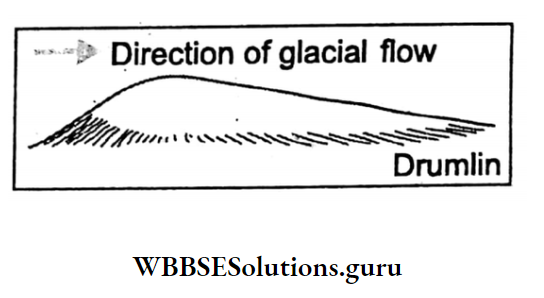
Tropical Cyclone:

Deep depression or low pressure may develop due to high temperatures over the oceans between 5° N to 30° S latitudes of the tropical region.

Due to low pressure (fall of air pressure by 20 to 40 MB within a few hours) cold and heavy air rushes into the centre of low pressure and finally rises with a great speed. This is known as a Tropical cyclone.

Centre of the cyclone Strong wind where the lowest air pressure prevails is known as the eye. It is characterised by calm and stable weather conditions. It is encircled by dense cumulonimbus cloud which causes heavy rain with storms.
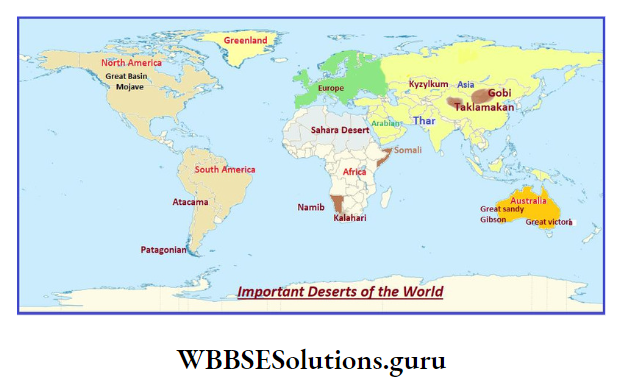
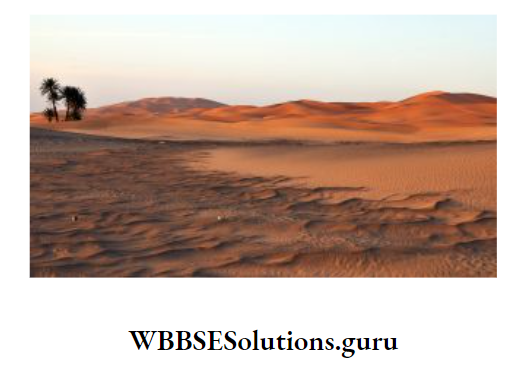
This is known as ‘Cyclone’ in the Bay of Bengal and the Arabian Sea, ‘Typhoon’ in the China Sea, ‘Hurricane’ in the Caribbean Sea ‘Wily Wily’ in Australia and ‘Baguio’ on the Philippine coast.

WBBSE Notes For Class 10 Chapter 2 Atmosphere Tropical Cyclones

Anti-Cyclone:

In anti-cyclone wind blows spirally outward from the centre of the high-pressure cell in a clockwise circulation in Northern Hemisphere and in an anti-clockwise circulation in Southern Hemisphere. Anti-cyclone presents stable weather conditions.

WBBSE Notes For Class 10 Chapter 2 Atmosphere Cyclone and Anti-Cyclone

Tornado:

In the southern part of the U.S.A., a devastating short-lived cyclone of land origin is known as Tornado. A dense cloud descends like a funnel which picks up almost everything on its way.

WBBSE Class 10 Environment Chapter 2 Important Points

Jet Stream

A jet stream is a strong flowing ribbon of air that flows in the upper part of the Troposphere (10 12 km height). It blows with a speed of a minimum of 90 km to a maximum of 500 km per hour.

It stretches for a few km. Jet streams are of three types-Polar, Sub-tropical and Westerly jet Tropical jet streams.

Relation Between Monsoon And Jet Streams:

with the southerly movement of Sub-tropical westerly jet streams in winter, the North-east Trade wind becomes stronger and more active.

In India and intensity of coldness in winter increases with the northerly shifting of the tropical easterly jet stream (Pubali jet) in the rainy season, south-west monsoon wind becomes weak and causes scanty rainfall and drought in India.

WBBSE Notes For Class 10 Chapter 2 Atmosphere Westerly and Easterly Jet

WBBSE Chapter 2 Atmosphere Humidity And Precipitation

Concept Of Hydrological Cycle:

About 3/4th of the earth’s surface is water which rotates in cycles in its three forms- liquid (water), gas (water vapour) and solid (ice).

The hydrological cycle or water cycle begins with the evaporation of water from the earth’s surface. As moist air rises, it cools and water vapour condenses to form clouds.

They have been transported to the earth’s surface again through precipitation it is either in the form of rain or snow. Some of it again evaporates and back into the atmosphere while part of it may penetrate the surface.

Groundwater either seeps into the ocean river or streams through springs are released back into the atmosphere through the transpiration of plants.

WBBSE Class 10 Environment Chapter 2 Important Points

The rest is the surface runoff which empties into lakes, rivers and streams and is finally back to the ocean from where the cycle begins again.

The water cycle plays a great role in the sustenance of life, the texture of the soil, the physiological processes of plants, the control of climate and the sustenance of the ecosystem.

WBBSE Notes For Class 10 Chapter 2 Atmosphere Water Cycle

Evaporation:

Evaporation is the process of transformation of water from the earth’s surface into a gaseous phase on water vapour.

Evaporation plays an important role in the formation of clouds, rain, fog and dew as it supplies water vapour into the atmosphere. Therefore, it also controls the weather and climate of a place.

Humidity:

Air containing water vapour is referred to as humid air. Humidity is the dampness of the atmosphere. Humid air consists of 2 to 5 per cent water vapour. Air without water vapour is known as dry air. Humidity is expressed in three ways

  1. Absolute humidity,
  2. Specific humidity and
  3. Relative humidity.

Absolute humidity:

This is the mass of water vapour in grams contained in one cubic centimetre of airmass.

Specific humidity:

The amount of water vapour in gram present in one kg. of air is known as Specific humidity eg. 20 gm. per kg.

Relative humidity:

This is the ratio between the absolute humidity and the amount of water vapour the air can hold at a given temperature, expressed in percentage, therefore, Relative humidity is

⇒ \(\text { Relative humidity }=\frac{\text { Absolute humidity }}{\text { Saturation content at the same temperature }} \times 100\)

Example:

47% relative humidity indicates that the air is unsaturated and holds 47% of the water vapour which is required to make it saturated.

Saturated Air:

Air containing its maximum capacity of water vapour is known as saturated air. Air containing less than its maximum capacity is known as unsaturated air.

Air can be said saturated if the relative humidity is 100%; otherwise, with less than 100% relative humidity in the air is said to be unsaturated air.

If the temperature of saturated air is decreased or water vapour is added to saturated air excess water will condense and form clouds to give rain.

Dew Point:

Usually, the air is unsaturated. But it may become saturated with the same water vapour content if temperature decreases because, at a lower temperature, the water retaining capacity of the air also decreases.

The temperature at which air becomes saturated is known as the dew point. At the dew point relative humidity is 100%. The air releases its extra water vapour content so that it condenses to form dew.

Measurement Of Humidity:

The relative humidity of air is measured by Hygrometer. It consists of dry and wet bulb thermometers.

WBBSE Notes For Class 10 Chapter 2 Atmosphere Hygrometer

Condensation And Its Different Forms

Moist air is light. So it rises and at high altitude it becomes cooled and ultimately at the dew point, the air becomes saturated.

Further cooling below the dew point turns water vapour into tiny water droplets or ice particles. This process is known as condensation.

Dew:

This is the condensation of water vapour into water droplets which rest on any surface like grass, leaf, roof etc.

WBBSE Class 10 Environment Chapter 2 Important Points

Fog:

These are condensation forms of water vapour into tiny water droplets which are floating in the air at a lower level of the atmosphere.

Smog:

In cities and towns smoke particles mix up with fog to form smog (smoke + fog = smog).

Cloud:

Moist and warm air is light. It rises and becomes cooled at higher altitudes. So condensation turns water vapour into tiny water droplets or ice particles which float in the air.

Thus floating particles are, together, known as clouds. These particles are very much tiny with an average diameter of 0.01 mm.

WBBSE Notes For Class 10 Chapter 2 Atmosphere Symbols for Cloudiness

Precipitation-Concept:

Precipitation is the fall of water through the atmosphere on the earth’s surface in the form of rainfall, drizzle, snowfall, sleet or hail because of the droplets of water.

Ice or frozen water vapour in a cloud grows too large for updrafts. But fog, dew, and mist are not considered as precipitation as the throwing down of moisture is not involved in the mechanism of their formation

Class 10 Geography And Environment Chapter 2 Solutions

Rainfall

Bigger water drops in a cloud ranging between 0-2 and 6 mm in diameter fall as rain by the gravitational pull of the earth.

WBBSE Notes For Class 10 Chapter 2 Atmosphere Origin of Rainfall

Types Of Rainfall:

Rainfall is of three types

  1. Convectional,
  2. Relief and
  3. Cyclonic.

Convectional Rainfall:

In the equatorial region, vast stretches of water bodies get heated Relief rainfall-When warm and moist and the warm and moist air above rises.

It attains a high altitude in the conventional process and becomes cool. Thus the air becomes saturated at dew point temperature.

Further cooling leads to the condensation of water vapour into water drops which fall vertically on the earth. This is known as convectional rain. It occurs every afternoon.

WBBSE Notes For Class 10 Chapter 2 Atmosphere Convectional Rainfall

Relief Rainfall:

when warm and moist air is forced to rise the windward slope of a mountain or highland, it becomes cooled and condenses to give heavy rainfall on the windward side.

But on the lee side the air descends and gives no rain. Thus the region on the lee side becomes a rainshadow area.

Southwest monsoon wind gives heavy rain to the western slope of the Western Ghats but the eastern slopes, especially, the interior of the Deccan plateau remain a rainshadow area.

WBBSE Notes For Class 10 Chapter 2 Atmosphere Relief Rainfall

Cyclonic Rainfall:

Parallel to the earth’s surface, two converging air masses of different temperatures are responsible for the warm and light airmass rising over the cold and dense air.

In its ascent, the warm air cools. Condensations take place to cause cyclonic rainfall. This is common in Temperate regions.

In Tropical regions, low pressure develops on waterbodies and it causes cyclones associated with heavy rainfall.

WBBSE Notes For Class 10 Chapter 2 Atmosphere Cyclonic Rainfall

Drizzle:

Sometimes, tiny water droplets (less than 0-5 mm in diameter) incessantly fall on the earth’s surface. This is known as a drizzle.

Snowfall:

In the upper part of the atmosphere where the temperature goes below freezing point, water droplets turn into ice particles to fall over the lofty mountains or in cold climatic regions such as snowfall.

Hail and Sleet:

In the upper part of the atmosphere, when water droplets ascend to a high altitude they turn into small grains of ice.

Class 10 Geography And Environment Chapter 2 Solutions

When these grains coalesce into bigger sizes, they fall to the earth like stones which are called hailstones and when they fall along with rain they are called sleet.

Measurement Of Rainfall:

A rain Gauge is used to measure the amount of rainfall. It is measured in mm, cm or inch.

WBBSE Notes For Class 10 Chapter 2 Atmosphere Rain Gauge

Isohyte:

The imaginary line drawn on a map connecting the places with the same amount of rainfall is known as Isohyet.

Major Climatic Regions Of The World:

There are certain areas of the world each of which has its own climatic characteristics, especially, identical temperature and rainfall conditions.

WBBSE Chapter 2 Atmosphere Principal Climatic Regions Of The World

WBBSE Notes for class 10 geography chapter 2 Atmosphere Climatic regions of the World

Identification Of Climate And Hemisphere With The Help Of Temperature And Rainfall Graph:

Representation of the average temperature and rainfall of a particular place at a particular time with a definite scale in a graph is known as a Temperature rainfall graph.

It helps to know many features regarding climate Example. the annual range of temperature of a place, the position of a place in which hemisphere from temperature.

The place belongs to which climate from the amount of temperature and rainfall, differences between climates of various places etc.

WBBSE Notes For Class 10 Chapter 2 Atmosphere World Climatic Region

Identification Of Hemisphere:

The hemisphere to which a place belongs can easily be identified from the shape of the temperature curve of the temperature rainfall graph:

WBBSE Notes for class 10 geography chapter 2 Atmosphere Identification of Hemisphere

Identification

Wet Equatorial Climate :

Temperature:

  1. The high temperature throughout the year.
  2. The range of temperature is low.

Rainfall :

Rainfall takes place every month.
Annual rainfall is also high.

Hemisphere :

Temperature is high from September to March. So the place belongs to Southern Hemisphere.

WBBSE Notes For Class 10 Chapter 2 Atmosphere Equatorial Climate of Northern Hemisphere

WBBSE Notes For Class 10 Chapter 2 Atmosphere Equatorial Climate of Southern Hemisphere

Climate :

Wet Equatorial Climate

WBBSE Notes for class 10 geography chapter 2 Atmosphere Wet equatorial Climate

Tropical Monsoon Climate

Temperature:

  1. High summer temperature.
  2. Mild winter temperature.
  3. The medium annual range of temperature.

Rainfall:

Summer rain, winter dry.

Hemisphere:

Temperature is high from March to August. So Northern Hemisphere.

WBBSE Notes For Class 10 Chapter 2 Atmosphere Tropical monsoon Climate region of Northern Hemisphere

WBBSE Notes For Class 10 Chapter 2 Atmosphere Tropical monsoon Climate region of Southern Hemisphere

Climate:

Tropical Monsoon climate.

WBBSE Notes for class 10 geography chapter 2 Atmosphere Tropical Monsoon Climate

Tropical Hot Desert Climate

Temperature:

  1. Summer temperature is high.
  2. Temperature is low in winter.
  3. The annual range of temperature is high.

Rainfall:

Rainfall is insignificant.

Hemisphere:

Temperature is high from May to September. So, Northern Hemisphere.

WBBSE Notes For Class 10 Chapter 2 Atmosphere Hot Desert Climate region of Southern Hemisphere

WBBSE Notes For Class 10 Chapter 2 Atmosphere Hot Desert Climate region of Northern Hemisphere

Climate:

Tropical Hot Desert Climate.

WBBSE Notes for class 10 geography chapter 2 Atmosphere Tropical Hot Desert Climate

Mediterranean climate

Temperature:

Summer temperature is moderate.
Winter temperature is low.

Class 10 Geography And Environment Chapter 2 Solutions

Rainfall:

Winter rain and summer dry.

Hemisphere:

Temperature is high from October to March. So it is Northern Hemisphere.

WBBSE Notes For Class 10 Chapter 2 Atmosphere Mediterranean Climate region of Northern Hemisphere

WBBSE Notes For Class 10 Chapter 2 Atmosphere Mediterranean Climate region of Southern Hemisphere

Climate:

Mediterranean Climate:

WBBSE Notes for class 10 geography chapter 2 Atmosphere Mediterranean Climate

Tundra Climate

Temperature:

Summer temperature is too low. Most of the time-temperature remains below freezing point.

Rainfall:

Rainfall is insignificant.

Hemisphere:

Temperature is minimum from March to May. So it is Southern Hemisphere.

WBBSE Notes For Class 10 Chapter 2 Atmosphere Tundra Climate region of Northern Hemisphere

WBBSE Notes For Class 10 Chapter 2 Atmosphere Tundra Climate region of Southern Hemisphere

Climate:

Tundra Climate.

WBBSE Notes for class 10 geography chapter 2 Atmosphere Tundra Climate

WBBSE Notes For Class 9 Geography and Environment Chapter 8 West Bengal

Chapter 8 West Bengal Location Administrative Divisions

Facts At Your Fingertips :

Area-88,752 sq km; Population-9,13,47,736 persons (2011); Highest peak- Sandakphu (3630 m); Principal river-Ganga (Bhagirathi-Hugli).

Principal Language-Bengali; Districts-23; Capital-Kolkata; Population of capital-1,40,13000 persons; Longest extension-623 km (north-south).

Read And Learn Also WBBSE Notes For Class 9 Geography and Environment

West Bengal is the most important state of the Indian Union which at present, consists of 29 states and 7 union territories. West Bengal is located in the eastern part of India.

WBBSE Notes For Class 9 Geography and Environment Chapter 8 West Bengal Indian West Bengal

Indian Union At A Glance:


WBBSE Notes For Class 9 Geography and Environment Chapter 8 West Bengal Indian Union at a Glance

Wbbse Class 9 Geography Chapter 8 Notes 

Chapter 8 West Bengal Brief Outline Of West Bengal As A State Of India After Independence

Why Is The State Called West Bengal :

Though our state is located in the eastern part of India; it is called West Bengal because at the time of independence of India.

In 1947 that area belonged to ‘Bangladesh’ which was then divided by the British the eastern part was called ‘East Pakistan’, eventually known as Bangladesh while the western part was known as ‘West Bengal’.

In the area, West Bengal accounts for only 2-7% of India i.e. 32,87,263 sq. km. About 8% people of India i.e. 1,21,02,00,000 people live in West Bengal.

WBBSE Solutions For Class 9 Fundamentals Of HistoryWBBSE Class 9 English Functional Grammar
WBBSE Class 9 Fundamentals Of History Long Answer QuestionsWBBSE Class 9 English Reading Skill
WBBSE Class 9 Fundamentals Of History Short Answer QuestionsWBBSE Class 9 English Writing Skill
WBBSE Class 9 Fundamentals Of History Very Short Answer QuestionsWBBSE Class 9 Maths Multiple Choice Questions
WBBSE Class 9 Fundamentals Of History Multiple Choice QuestionsWBBSE Solutions For Class 9 Maths
WBBSE Notes For Class 9 Geography and Environment


West Bengal ranks 4th position in population amongst 29 states of India. The density of the population in India is 382 persons per sq. km while in West Bengal, it is 1029 Persons per sq. km.

West Bengal is the leading producer of rice, jute and fish in our country. West Bengal ranks 2nd position in tea and potato production and 7th position in coal production in India.

Most of the jute mills of India are located in West Bengal. In the integrated iron and steel industry, engineering industry and tea industry, West Bengal also plays an important role in our country.

Kolkata, the capital of West Bengal is the largest trading centre of Eastern India and the biggest port of Eastern India. Netaji Subhas Chandra Bose international airport, the largest airport in Eastern India is located at Dum Dum near Kolkata.

The first metro rail in India was inaugurated in West Bengal. Kolkata is the headquarter of the Eastern and South-eastern railway.

WBBSE Notes For Class 9 Geography and Environment Chapter 8 West Bengal Political 23 Districts In West Bengal

Wbbse Class 9 Geography Chapter 8 Notes

Chapter 8 West Bengal Geographical Location

The geographical location of West Bengal can be identified in three ways

  1. With the help of latitude and longitude.
  2. According to the distance from the sea and
  3. In relation to the location of neighbouring states of India.

Location Of West Bengal According To Latitude And Longitude:

West Bengal is extending from 23°30′ north latitude in the south to 27°10′ north latitude in the north and from 85°50′ east longitude in the west to 89°53′ east longitude in the east.

Tropic of cancer i.e. 23°30′ north latitude passes through Puruliya, Bankura, Paschim Bardhaman (near Durgapur) and Nadia (near Krishnanagar) districts of the state.

Location Of West Bengal According To Boundaries:

West Bengal has land on three sides and water on one side. To the west are the states of Odisha, Jharkhand, Bihar and the neighbouring country Nepal.

To the north is the neighbouring state Sikkim and the neighbouring country Bhutan; to the east are Bangladesh and Assam. To the south is the Bay of Bengal.

Location Of West Bengal According To The Distance From The Sea:

West Bengal is bordered by the sea on its south. Hence, it is called a coastal location. North-south extent of West Bengal is about 623 km.

The east-west extension is not even. It is 320 km along the Tropic of Cancer while it is only 9 km in Uttar Dinajpur.

Chapter 8 West Bengal Neighbouring Countries And States Of West Bengal

Nepal, Bangladesh and Bhutan, the three independent neighbours are the border countries of West Bengal and five bordering states namely Bihar.

Jharkhand, Odisha, Assam and Sikkim as well as Tripura though not located along the border are very close in relation to West Bengal.

Nepal The Neighbouring Country

Nepal At A Glance :

Length of West Bengal-Nepal border about 90 km; Area of Nepal-1,40,797 sq km; Population-2,98, 001 000 persons; Density of population-211 persons per sq km; Capital-Kathmandu; Highest peak-Mt. Everest (8848 m); Longest river-Kaligandak.

Nepal is situated to the north of West Bengal along the western border of the Darjeeling district. It is a mountainous country with the highest peak Mt. Everest, the highest peak in the world. It is a sparsely populated country.

There are many valleys in Nepal, namely Kathmandu, Pokhara Valley etc. Important peaks are Makalu, Dhaulagiri, Annapurna etc. The country is occasionally forested.

Nepal is mostly dependent on agriculture. Rice is the principal crop. Other crops are jute, jowar, and millet. Fruits are apples, oranges etc. But the country lacks in industries.

Nepal is connected with West Bengal by roadways and railways, Nepal is a landlocked country. So, Nepal exports to other countries through Kolkata port.

Wbbse Class 9 Geography Chapter 8 Notes 

Bhutan The Neighbouring Country

Bhutan At A Glance :

Length of West Bengal-Bhutan border-About 150 km; Area-47,000 sq km; Population-72,00,000 persons; Density of population-15 persons per sq km.

Capital- Thimpu; Population of capital-13,000 persons; Official language-Dzonka; Highest peak- Kulakangri (7554 m); Longest river-Manas; Principal resource-Cardamom, apples, oranges, lac, orchids etc.

Bhutan belongs to the Himalayas and is another independent country located on the northern border of West Bengal. According to a special treaty Bhutan has to take advice from the Government of India about its foreign affairs.

Bhutan is a small sparsely populated country. In the northern part of Bhutan is extending the Great Himalayas, in the middle part is extending the Central Himalayas and in the southern part is extending the Siwalik Himalayas.

A few famous valleys, namely Paro, Punakha and Thimpu belong to the Central Himalayas. In the northern part of Bhutan stands the Chomolari (7314 m) which is also known as the ‘Queen of the mountains’.

The southern part of Bhutan experiences frequent ‘thunder showers’ because of which Bhutan is called the ‘Land of Thunder Dragon’. In the south at the foothills of the Himalayas, there is the ‘Duars’ which is the ‘Doorway to Bhutan’.

Torsa, Raidak, Sankosh, Manas are the principal rivers of Bhutan. Dense forests of sal, oak, and sissoo are found in Bhutan. Agriculture is not well developed. Large cardamom is the most important cash crop.

Rice, wheat, and corn are also cultivated. Bhutan is industrially backwards due to a lack of minerals. Bhutan depends on Kolkata port for its trade. Food products, medicines, and machinery are collected from West Bengal.

Bangladesh The Neighbouring Country

Bangladesh At A Glance:

Length of West Bengal-Bangladesh border-About 900 km. Area-1,43,998 sq km; Population-about 17,00,00,000 persons; Density of population-1165 persons per sq km.

Capital-Dhaka; Official language-Bengali; Highest peak-Keokradang (1230 m); Longest river-Padma-Meghna, Principal resources-jute, rice, tea, leather, natural gas etc.

Bangladesh is located along the eastern border of West Bengal. On 16th December 1971 Bangladesh established itself as an independent sovereign country.

Major parts of Bangladesh belong to the Bengal Delta except for the uplands in the east and southeast. The extensive plainland is made of alluvium deposited by the rivers Padma, Meghna, Jamuna etc.

Ganga, the principal river of West Bengal flows as Padma through Bangladesh Tista, and the principal river of North Bengal also flows through Bangladesh.

Fertile alluvial tract favours cultivation in Bangladesh. Important crops are jute, rice, tea, sugarcane, cotton, tobacco, potato, oilseeds etc.

Important industries of Bangladesh are the Jute industry, tea industry, silk industry etc.

Kolkata is connected with Dhaka, the capital of Bangladesh by airways. Bangladesh is also connected with West Bengal by waterways and roadways.


WBBSE Notes For Class 9 Geography and Environment Chapter 8 West Bengal W.B And Its Neighbouring States And Countries

Class 9 Geography And Environment Chapter 8 Solutions

Bihar The Neighbouring State

Bihar At A Glance :

Length of West Bengal-Bihar border-About 300 km; Area-94,163 km; Population- 10,38,4637 persons (2011); Density of population -1102 persons per sq km; Capital- Patna; Official language-Hindi; Principal river-Ganga.

Bihar is located on the western border of West Bengal. Ganga, the principal river of West Bengal has entered our state after flowing through Bihar.

The landform of Bihar is mostly plain. River Ganga and its tributaries are flowing through Bihar. Summers are warmer and winters are cooler than that of West Bengal.

But rainfall is less. Plenty of rice, wheat, pulses and oilseeds are produced on fertile plain land. Agro-based industries like sugar mills, and oil mills have developed.

West Bengal is connected by national highways, railways, the Ganga river and Kolkata-Patna airways with Bihar. Bihar gives oilseeds, and wheat to West Bengal and takes machinery, jute goods, and tea from West Bengal.

Chapter 8 West Bengal Jharkhand The Neighbouring State

Jharkhand At A Glance :

Length of West Bengal-Jharkhand border-About 79, 714 sq km; Population- 3,29,66,238 persons (2011); Density of population-about 414 persons per sq km; Capital- Ranchi; Official language-Hindi; Principal river-Damodar, Son etc.

Jharkhand is located on the western border of West Bengal. The state of Jharkhand was formed on 15th November 2000 comprising the mineral-rich southern part of Bihar.

The state of Jharkhand is a plateau country. The rivers, namely Damodar, Mayurakshi, and Subarnarekha have originated in Jharkhand and are flowing through West Bengal.

Due to the stony landscape, summers are too hot and winters are also severe. Trees namely sal, Palash, mahua are found in the forests which are scattered throughout the state.

Jharkhand is a mineral-rich state in India. Coal, iron ore, limestone, bauxite, mica, manganese etc. are abundant everywhere. Industries like iron and steel, cement, fertilizer, and engineering have developed.

The famous Grand Trunk Road, Eastern and South-eastern railways, and Kolkata-Ranchi airway connect West Bengal with Jharkhand.

Jharkhand gives coal, and iron to West Bengal and takes machinery, jute goods, and tea from West Bengal. Most of the import-export trade of Jharkhand is done through the Kolkata and Haldia ports of West Bengal.

Odisha The Neighbouring State

Odisha At A Glance :

Length of West Bengal-Odisha border-About 150 km; Area-1,55,782 sq km; Population-4,19,47,358 persons (2011); Density of population-269 persons per sq km; Capital-Bhubaneswar; Official language-Odia. Principal river-Mahanadi.

The state of Odisha is situated to the west of West Bengal along the border of the Purba and Paschim Medinipur districts.
The state of Odisha is a plateau country.

Moderate climate prevails in southern parts while the northern part of Odisha experiences an extreme type of climate. Forests are also scattered amidst the plateau.

Plenty of rice grows here. Jute, sugarcane, pulses and groundnut are also cultivated. Odisha is a mineral-rich state. Iron ore, coal, bauxite, limestone, graphite etc. are abundant.

Based on these minerals iron and steel, engineering as well as paper, and cement industries have developed. Bhubaneswar, the capital of Odisha and Cuttack are directly connected with Kolkata through the south-eastern railway as well as roadways and airways.

Odisha takes tea, jute goods, engineering goods, and machinery from West Bengal and gives rice, fish, minerals, machinery etc. to West Bengal.

Assam The Neighbouring State

Assam At A Glance :

Length of West Bengal-Assam border-About 90 km; Area-78,523 sq km; Population- 3,11,69,272 persons (2011); Density of population -397 persons per sq km; Capital- Dispur.; Official language-Asamiya; Principal river-Brahmaputra.

The state of Assam is situated to the northeast of West Bengal along the eastern border of Koch Bihar and Alipurduar.

The central part of Assam is occupied by the Brahmaputra valley which is bordered to the north and southeast by the mountain ranges. Excessive rainfall occurs and winters are severe.

Many parts of the state are densely forested. Assam is the leading producer of tea in India. Rice, jute, sugarcane, oranges and pineapples are produced abundantly.

Mineral oil is the most important resource of Assam. Assam is connected with West Bengal by the northeastern frontier railway and National Highway-31.

Assam is also connected with West Bengal by airways. Assam gives tea, jute, petroleum and wood to West Bengal and takes machinery, chemicals, and medicines from West Bengal.

Most of the import-export trade is carried out through the Kolkata port of West Bengal.

Sikkim The Neighbouring State

Sikkim At A Glance:

Length of West Bengal-Sikkim border-About 60 km; Area-7,96,000 sq km; Population-6,07,688 persons (2011); Density of population-86 persons per sq km.

Capital-Gangtok; Official language-Lepcha, Bhutia, Nepali; Principal river-Tista; Highest peak-Kanchenjungha (8598 m).

The state of Sikkim is situated to the northeast of West Bengal along the northern border of the Darjeeling district.

Sikkim is a mountainous state. Amidst the mountain ranges lies the Tista Valley. Rainfall is abundant, so, mountain slopes are densely forested.

Principal crops are rice, wheat, corn, large cardamom etc. Fruits like apples and oranges are common. Industries are lacking. Mainly fruit processing and cotton mills are common.

Sikkim is connected with West Bengal by National Highway-31 which runs along the river Tista.

Due to its infertile rugged terrain, Sikkim has to collect most of the items from West Bengal while West Bengal collects large cardamom, apples, and oranges from Sikkim.

Class 9 Geography And Environment Chapter 8 Solutions

Tripura The Neighbouring State

Tripura At A Glance :

Area-10,491 sq km; Population-36,71,,032 persons (2011); Density of population- 350 persons per sq km; Capital-Agartala; Official language-Bengali; Highest peak-Betling Sib (939 m); Principal river-Manu.

Tripura is located to the east of Bangladesh which is located to the east of West Bengal. Most parts of Tripura are hilly and forested.

Important agricultural crops are rice, jute, tea, rubber etc. Though the state is not developed in large-scale industries cottage industry is well developed in Tripura.

Cotton goods and cottage industrial products come from Tripura to West Bengal and from West Bengal machinery, chemicals, and medicines go to Tripura.

Chapter 8 West Bengal Administrative Divisions Of West Bengal

West Bengal, at present, consists of 23 districts. In West Bengal, four types of administrative structures are there-Division, District, Sub-division and Block.

Division:

23 districts of West Bengal have been grouped into five divisions. These are Bardhaman, Jalpaiguri, Presidency Malda and Medinipur divisions. Each division is administered by Divisional Commissioner.

District:

Each district of West Bengal is governed by District Collector or District Magistrate (D.M.) with exception of the Kolkata district which is administered by Kolkata Municipal Corporation (except law and order).

Sub-Division:

Each district consists of more than one sub-divisions. Example. Haora, Malda and Uttar and Dakshin Dinajpur each of these districts have two sub-divisions only. Each sub-division is governed by Sub-divisional Officer (S.D.O.)

Class 9 Geography Chapter 8 Question Answers

Administrative Divisions Of West Bengal

1. Bardhaman Division:

  1. Purba Bardhaman (H. Q. Bardhaman),
  2. Paschim Bardhaman (H. Q. Asansol),
  3. Hugli (H. Q. Chinchura),
  4. Birbhum (H. Q. Suri).

2. Presidency Division:

  1. Haora (H. Q. Haora),
  2. Kolkata (H. Q. Kolkata),
  3. Nadia (H. Q. Krishnanagar),
  4. 24 Parganas (N) (H. Q. Barasat),
  5. 24 Parganas (S) (H. Q. Alipur).

3. Jalpaiguri Division:

  1. Alipurduar (H. Q. Alipurduar),
  2. Koch Bihar (H. Q. Koch Bihar),
  3. Darjeeling (H. Q. Darjeeling),
  4. Jalpaiguri (H. Q. Jalpaiguri),
  5. Kalimpong (H. Q. Kalimpong).

4. Malda Division:

  1. Malda (H. Q. English Bazar),
  2. Uttar Dinajpur (H. Q. Raigunj),
  3. Dakshin Dinajpur (H. Q. Balurghat),
  4. Murshidabad (H. Q. Baharampur).

5.Medinipur Division:

  1. Purba Medinipur (H. Q. Tamluk),
  2. Paschim Medinipur (H. Q. Medinipur),
  3. Jhargram ( H. Q. Jhargram),
  4. Puruliya (H. Q. Puruliya,
  5. Bankura (H. Q. Bankura).


WBBSE Notes For Class 9 Geography and Environment Chapter 8 West Bengal Administrative Division

Chapter 8 West Bengal Community Development Block

Each sub-division consists of a number of C.D. Blocks. These are administered by Block Development Officer or B.D.O. Each Block consists of a few Gram Panchayats.

Panchayat Raj Or Village Council:

In West Bengal Panchayat Act was enacted in 1973. This is a three-tier administrative system. At its lowest level is Gram Panchayat which consists of a number of grams.

It is governed by Panchayat Pradhan. A few Gram Panchayat form Panchayat Samiti which is ruled by Sabhadhipati. Each block consists of one Panchayat Samiti.

At the top level is Zilla Parishad which consists of all the Panchayat Samities of the district. It is headed by the Zilla Sabhadhipati.

WBBSE Notes For Class 9 Geography and Environment Chapter 8 West Bengal 23 Districts In West Bengal

Gorkha Hill Council :

It was formed in 1988 and it consists of three sub-divisions (out of four) Darjeeling, Kalimpong and Kurseong. It administers all departments except a few like law and order, revenue etc.

Siliguri sub-division is administered by Mahakuma Parishad instead of Zilla Parishad.

Chapter 8 West Bengal Physical Environment

Physiography And Drainage Of West Bengal

The landform of West Bengal is very much diversified. Lofty mountain peaks, rolling uplands, and extensive fertile plains are the main physiographic characteristics of West Bengal.

Depending on such variation in landform, rivers of West Bengal flow either southward or southeastward.

Physiographically, West Bengal can be divided into three divisions

  1. Northern mountains,
  2. Western plateau and
  3. The Plains.

Northern Mountains

Location:

Northern Mountain consists of three sub-divisions of Darjeeling and Kalimpong district (Darjeeling town, Kalimpong and Kurseong sub-divisions) and Kumargram and Kalchini P.S. of Alipurduar district.

Relief:

Relief of this region is very much ruled due to the presence of lofty mountains intervened with deep gorges.

The river Tista is flowing from the north to the south and has divided the region into two parts-western and eastern parts of the Tista valley.

WBBSE Notes For Class 9 Geography and Environment Chapter 8 West Bengal Landforms

To the western part of the Tista Valley, Singalila and Darjeeling ranges stand in a north-south direction. Singalila stands along the border of Darjeeling district and Nepal.

There are a few lofty peaks in this range such as Sandakphu (3630 m), Phalut (3596 m), and Sabargram (3543 m). Sandakphu is the highest peak in this region as well as in West Bengal.

Class 9 Geography Chapter 8 Wbbse Solutions

The Darjeeling range rises steeply from the Terai region in the south. To the south of it stands Tiger Hill (2573 m). Further south stands Daw Hill and to the east is Takdah Peshak Hill.

An important peak of this area is Sinchal (2615 m). The Darjeeling range is also known as the Ghoom range.

WBBSE Notes For Class 9 Geography and Environment Chapter 8 West Bengal Northern Mountainous Region


The height of the eastern part of the Tista Valley is much less. Rishila (3121 m), the highest peak of this region is situated near Kalimpong town.

WBBSE Notes For Class 9 Geography and Environment Chapter 8 West Bengal Mountainous Land Darjeeling And Kalimpong District

Kumargram and Kalchini P.S. of Alipurduar district are also mountainous but of low relief.

Renigango (1885 m) and Little Sinchula (1726 m) are two important peaks. There is a pass called Bauxa Duar which leads to Bhutan.

WBBSE Notes For Class 9 Geography and Environment Chapter 8 West Bengal Darjeeling - Toy Train


WBBSE Notes For Class 9 Geography and Environment Chapter 8 West Bengal Darjeeling - Tiger Hill

Rivers:

Many rivers are flowing through the mountainous region of West Bengal. These rivers are snow-fed and have water throughout the year.

They are very much turbulent and are favourable for hydel power generation. Important rivers of this region are Tista, Jaldhaka, Mahananda, Torsa, Kaljani and Balason.

The principal river of this region is Tista which rises in the Zemu glacier then flows through this region and finally joins the river Jamuna (Brahmaputra) in Bangladesh.

Class 9 Geography Chapter 8 Wbbse Solutions

River Tista has many tributaries, namely the Rangeet, Riang, the right bank tributaries and Rangpo, Reeling the left bank tributaries. Tista is very much turbulent and often floods the region.

So, it is known as the ‘River of Horror’. Another important river in this region is Jaldhaka. There is a river project on the Jaldhaka River.

WBBSE Notes For Class 9 Geography and Environment Chapter 8 West Bengal Tista River

Chapter 8 West Bengal Western Mountains

Location:

The landform of the entire Puruliya district’ and its adjacent Jhargram, Bankura, Paschim Bardhaman and the western part of Birbhum district is undulating or rolling.

This undulating upland of the western part of West Bengal is called Western Plateau.

Relief:

Geologically western plateau is part of the Chotanagpur plateau of Jharkhand. This is the most ancient landmass of West Bengal and is made of ancient igneous and metamorphic rocks with an undulating surface.

To the west, the land is higher (maximum 677 m) and to the east, it is lower (lowest 75 m). So, the plateau slopes from the west to the east.

There are small hills made of hard rocks, such as Ayodhya Hill and Baghmundi Hill in Ayodhya Hill the western part of the Puruliya district.

Gorgaburu of Ayodhya Hill is the highest peak (677 m) in this region. To the north of this district is Panchet Hill (643 m) and to the south is located Bhandari Hill.

WBBSE Notes For Class 9 Geography and Environment Chapter 8 West Bengal Ayodhya Hill

The eastern part of this plateau slopes gradually and is extended in the western part of Paschim Medinipur, Bankura, Paschim Bardhaman and Birbhum districts.

Small hills of hard rocks are also in this area, such as Belpahari of Paschim Medinipur, Mathurkhali of Birbhum and Biharinath (435 m) and Susunia (440 m) of Bankura district.

WBBSE Notes For Class 9 Geography and Environment Chapter 8 West Bengal Western Plateau, Plateau Of Puruliya District

Rivers:

Damodar is the principal river of the plateau region. After originating in the Khamarpat hill, the river Damodar is flowing through this region and finally joins the Hugli River.

Mundeswari, the distributor of Damodar joins the river Rupnarayan. Kansai or Kangsabati, another important river originates in the north of Ayodhya hill in the Puruliya district flows south-eastward and finally joins the river Hugli.

A reservoir has been made at the confluence of the river Kangsabati and Kumari, a tributary to Kangsabati near Mukutmanipur for irrigation and to control floods.

Class 9 Geography Chapter 8 Wbbse Solutions

River Darakeswar and Silai or Silabati have joined each other near Ghatal in Paschim Medinipur. Rupnarayan, the confluent of these two rivers joins the river Hugli near Geokhali.

Other important rivers are Mayurakshi, Ajoy, Dwaraka, Brahmani, Bakreswar, Kopai, Subarnarekha etc.

Chapter 8 West Bengal The Plains

Location:

Except for the northern mountains and the western plateau, the rest of West Bengal is under the plain region. The Plains of West Bengal can be divided into three regions

  1. Plains of North Bengal,
  2. Rarh Plain and
  3. The Ganga Delta Plain.

Plains Of North Bengal

The plains of North Bengal include the plains of Malda, Uttar and Dakshin Dinajpur, Koch Bihar, Jalpaiguri and Darjeeling.

The region is again subdivided into Terai or Duars Plain and Ganga-Brahmaputra Plain.

1.Terai Or Duars Plain:

Southern parts of the Alipurduar district and most parts of the Jalpaiguri district and the Siliguri sub-division of the Darjeeling district belong to the Terai or Duars plain.

The mountainous land of Darjeeling Himalaya suddenly slopes into this plain which slopes from the north (200 m) to the south (75 m) and is made of stones and pebbles brought by the swift-flowing Himalayan rivers.

The plan is forested due to heavy rainfall and the ground is humid and damp. So, the plain is called ‘Terai’ a French word which means ‘damp’. It is actually, the entrance to Bhutan.

So, Terai is also known as ‘Duars’ which means ‘doors’. Tista, Torsa, Jaldhaka, and Raidak are the important rivers of the Terai Plain.

Following the slope of the land, these rivers are flowing from the north to the south and deposit sands, stones and pebbles as they suddenly drop from the mountains into the plains.

In some places rivers are braided. In the rainy season, they occasionally flood the region and often change their courses.

WBBSE Notes For Class 9 Geography and Environment Chapter 8 West Bengal Plains In West Bengal

2.Ganga-Brahmaputra Doab:

The land between the river Ganga and Brahmaputra is called Ganga-Brahmaputra Doab. It slopes from the north (about 75 m) to the south (about 30 m).

Based on the physiographic variation this is again divided into three sub-divisions-Tal, Barind or Barendrabhumi and Diara.

3. Tal:

Some parts of southern Jalpaiguri, most parts of Koch Bihar districts and the lowland between the river Kalindi and Mahananda of Malda district are known as Tal.

Rivers of this region often change their courses and are responsible for the occasional flood. Therefore, bills and marshes are common.

WBBSE Notes For Class 9 Geography and Environment Chapter 8 West Bengal Physigraphic Divisions And Drainage In West Bengal

4..Barind Or Barendrabhumi:

The eastern part of Dakshin Dinajpur and the eastern part of Maida districts are uneven and made of red old alluvium. This is known as Barind or Barendrabhuml.

5. Diara:

The land close to the river Ganga in the southwestern part of the Maida district is made of new alluvium and is fertile and densely populated. This is known as Diara.

Tista and Mahananda are two principal rivers of Ganga-Brahmaputra Doab region. The slope of the land is gentle, so, the rivers are flowing sluggishly in a meandering course.

Class 9 Geography And Environment Notes Wbbse

In the north important rivers are Kaljani, Raidak, and Dharall while in the south important rivers are Kalindi, Punarbhaba, Tangon, Nagar, and Atrai. The river Ganga is flowing through the southern part of the region.

Rarh Plain

The flat land in between the Bhagirathi-Hugli River in the east and the plateau in the west is known as the Rarh Plain. The region also includes the plains of Purba and Paschim Medinipur, Bankura and Bardhaman.

Rarh Plain is made of silts and alluvium deposited by the rivers which flow from the west (75 m) to the east (10 m) following the slope of the land. In the east floods are common and consequently, many lowlands have formed.

Rivers like Damodar, Mayurakshi, Ajoy, Rupnarayan and Kangsabati are flowing through the Rarh region and finally join the Bhagirathi- Hugli as tributaries.

These rivers are rainfed as they have originated in the plateau of the west. So, they become dry except in the rainy season. They flood often in the rainy season as their beds are shallow.

The Ganga-Delta Plain

The Ganga Delta comprises the districts of Murshidabad, Nadia, Kolkata, North and South 24 Parganas. The delta is formed by the deposition of silts of the river Ganga and its tributaries.

The plan is divided into four sub-divisions-Old or Moribund Delta, Mature Delta, Active Delta and Sandy coastal plain of Purba Medinipur district.

The plain slopes from the north to the south in a gentle slope with an average height of 15 m above sea level.

WBBSE Notes For Class 9 Geography and Environment Chapter 8 West Bengal Gange Delta

Moribund Delta comprises the northern part of 24 Paraganas (N), Nadia and the eastern part of Murshidabad districts.

The distributaries of Padma or Bhagirathi, namely Bhairab, Jalangi, Churni, and Mathabhanga cannot deposit silts any more. So, the process of delta formation.

Class 9 Geography And Environment Notes Wbbse

was stopped long ago and many abandoned river channels and bills have been left out. So, the region is a land of dead and decaying rivers and is locally called ‘Bagri’.

WBBSE Notes For Class 9 Geography and Environment Chapter 8 West Bengal Sundarban

The mature delta comprises the north and central parts of 24 Parganas (S), the central part of 24 Parganas (N) and the Kolkata districts.

A few rivers like the Ichhamati are still depositing a little number of silts thereby changing the landforms of the region. Many bills and marshy lands are common in this region. Example. Salt Lake to the east of Kolkata.

Active delta comprises southern parts of 24 Parganas (S) where delta formation is going on actively. So, new landmasses are developing, for Example. Purbasha or New Moore Island which is located to the south of Sundarban.

The slope of the land is very low, only 5 m above sea level. So, the saline Nurpur water of the Bay of Bengal enters easily through the rivers and the soil of this region becomes saline.

Class 9 Geography And Environment Notes Wbbse

Many islands are found Example. Sagar Island (largest), Kakdwip, Dalhousie, Lothian, Frezerganj, Baluchari etc.

The sandy coastal plain is the coastal strip along the Bay of Bengal of Purba Medinipur. It is flat but sandy, scattered with sand dunes.

In front of the Digha sand dune lies the sea beach of Digha. The land slopes from the north to the south.

WBBSE Notes For Class 9 Geography and Environment Chapter 8 West Bengal Coastal Sand Dunes

The river Bhagirathi-Hugli is flowing along the western margin of the delta region. In the eastern part, important rivers are Bhairab, Jalangi, Mathabhanga, Ichhamati, Churni and Saraswati.

These rivers are flowing from the north to the south following the slope of the land. Bhairab, Jalangi and Mathabhanga have branched out from the river Padma.

Jalangi and Mathabhanga have joined the river, Bhagirathi. The southern part of Mathabhanga is known as Churni. The river Ichhamati has branched out from Mathabhanga and drains into the Bay of Bengal.

Once the Saraswati was the main flow of Bhagirathi but now it is a dead river. In the Sundarban region, many rivers have branched into innumerable river channels like Matla, Gosaba, Vidyadhari, Piyali, Raimangal, Kalindi, and Bartala.

These rivers are tide-fed and they have wide estuaries through which saline water of the Bay of Bengal enters far into the rivers of the Sundarban region.

The rivers of the Sandy coastal plain of Purba Medinipur are small and drain into the Bay of Bengal following the slope of the land, for Example.Rasulpur, Pichhabani. Rasulpur is the principal river of this region.

Chapter 8 West Bengal Brief Overview Of Water Resources Of West Bengal

There is no alternative to water, the ‘Blue gold’ resource in which our planet Earth is rich, but scarce in fresh water. The source of this water is rainwater in which West Bengal is rich (about 175 cm annual rainfall).

Distribution Of Rainfall

Northern districts of West Bengal namely Darjeeling, Kalimpong, Jalpaiguri, Alipurduar, Koch Bihar and Uttar Dinajpur receive maximum yearly rainfall, of about 250 cm or more.

While Bankura, Birbhum, Puruliya, Jhargram, Paschim Medinipur, Nadia, and 24 Murshidabad districts receive annually 170 cm or less. Most of the rain (70 to 80%) in West Bengal occurs from June to September.

WBBSE Notes For Class 9 Geography and Environment Chapter 8 West Bengal River In West Bengal

Volume Of Rain Water

The volume of rainwater in West Bengal, if estimated will be nearly 165.56 cubic km. It is maximum in Jalpaiguri district (including Alipurduar district) about 19.15 cubic km.

It is 17.14 cubic km in 24 Parganas (S), 15-41 cubic km in Paschim Medinipur (including Jhargram), 11.23 cubic km in Bardhaman (Purba and Paschim) and 11-10 cubic km in Koch Bihar.

While it is not enough in Kolkata (0-31 cubic km), Haora (2.4-8 cubic km) Dakshin Dinajpur (4.12 cubic km), and Hugli (5.19 cubic km).

Inland Water Resource

Some of the rainwater goes underground, a little is evaporated while much of it flows as surface runoff. Inland water comprises both groundwater and surface water.

By volume, the inland water resource of West Bengal is about 129 cubic km. It is higher in Jalpaiguri including Alipurduar (16-85 cubic km), 24 Parganas (S) (11-78 cubic km), Paschim Medinipur (11.38 cubic km), Koch Bihar (9.94 cubic km).

But it is scarce in Kolkata (0.25 cubic km), Haora (2.0 cubic km), Dakshin Dinajpur (3.40 cubic km), Hugli (4.10 cubic km), and Nadia (4.83 cubic km).

The water reserves of West Bengal are only 6 cubic km. It is 4 cubic km in Ponds and bills while less than 2 cubic km in reservoirs.

Potential water per capita is decreasing. It was 5200 cubic km (yearly) in 1951, 2941 cubic km in 1971, 1870 cubic km in 1991 and 1411 cubic km in 2011.

Wbbse Class 9 Geography Chapter 8 Notes

In the previous decade’s rapid population growth, the increasing rate of using irrigation water, and global warming led to uncertainty.

Rainfall is responsible for such a reduction in the amount of per capita water resources which may cause various problems in future.

Chapter 8 West Bengal Merits And Demerits Of Multiple Use And Overuse Of Water From River Canal Tank Well Ground Water

We use mainly two types of water-surface water from ponds, bills, rivers etc. and underground water which is obtained from wells and tube wells.

Water is used mainly in three sectors-agriculture, industry and household purposes. In developed countries, water is mainly used in industries while in developing countries like India water is mainly used in agriculture.

In West Bengal, large quantities of underground water are used by wells and tube wells in agriculture for irrigation. As a result, the underground water level has been lowered and consequently, rivers, canals, ponds and bills are drying up.

Different types of salts mixed with underground water also increase the salinity of farmlands. In many parts of West Bengal, arsenic is also mixed with underground water and causes various types of diseases when used as drinking water.

Water is also polluted by household wastes, agricultural runoff from chemical and pesticide-treated fields, and runoff from domestic wastewater and sewage and waste products of industries.

Climate Of West Bengal

The climate of West Bengal is warm and humid. Rainfall occurs in summer while winters are dry and mild. This type of climate is known as Tropical Monsoon Climate.

 Climate Characteristics Of West Bengal:

The change of seasons is the most important feature of the climate of West Bengal. Four seasons, namely summer, rain, autumn and winter rotate in a cycle in the climate of West Bengal.

In summer moist south-west monsoon wind gives rain in West Bengal. In winter dry and cold north-east monsoon wind keeps the climate of West Bengal cool and dry.

In summer wind blows from the southwest direction while in winter wind blows in opposite direction.

In the mountainous region of North Bengal, summers are pleasant because of their altitude, but winters are severely cold. The rest of West Bengal experiences mild weather.

Chapter 8 West Bengal Seasons Of West Bengal

Based on variation temperature, arrival and departure of monsoon wind and the amount of rainfall the meteorological department of the Government of India has divided the climate of West Bengal into four seasons-summer, rainy season, autumn and winter.

Summer (March To May)

In March the sun crosses the equator and moves apparently towards the Tropic of Cancer. So, temperature increases in West Bengal. In April and May temperature rises from 35°C to 42°C.

WBBSE Class 9 Geography Environment Chapter 8 summary

In the plateau region in the west, the temperature reaches 44°/45°C when hot wind called ‘Loo’ blows over the plateau. But, the temperature in Darjeeling mountain remains as low as 16°C on average because of the altitude.

Often, in the evening thunder clouds from the north-west give rain along with hailstorms. This is called Nor’wester or Kalbaisakhi (Calamity of the Bengali month ‘Baisakh’).

WBBSE Notes For Class 9 Geography and Environment Chapter 8 West Bengal Average Annual Rainfall And Wind In West Bengal

Rainy Season (June To September)

By the second week of June, moist south-west monsoon wind enters West Bengal and gives plenty of rain. In this season maximum rainfall (275-300 cm) occurs in the Northern mountainous region.

Moderate rainfall takes place on the plains and scanty rainfall occurs on the plateau. But the average annual rainfall in West Bengal is 175 cm 80% of annual rainfall in West Bengal occurs in the rainy season.

Autumn (October To November)

By the end of September, the sun crosses the equator and moves towards the Tropic of Capricorn. South-west monsoon wind moves back and rainfall starts to decrease. This is known as the season of Retreating Monsoon.

Slowly the north-east monsoon wind starts to arrive in West Bengal and gives an indication of winter. Often cyclonic rainfall occurs which is locally known as ‘Aswiner Jhar’.

Winter (December To February)

In December the sun is at the zenith of the Tropic of Capricorn. West Bengal receives oblique sun rays, so, the temperature starts to decrease.

Cold and dry north-east monsoon wind also starts to blow over West Bengal. In January, the temperature becomes very low. The mountainous region of Darjeeling district becomes severely cold and the temperature drops to 4°C.

Occasionally snowfall occurs. Over the plateau, the temperature is 10°C and on the plains, it is 16°C only. Winter is dry as this wind does not capture any moisture.

This stable weather condition is disturbed only when the cyclonic storm from the west sets in. This storm is called ‘Western Disturbance’.

WBBSE Notes For Class 9 Geography and Environment Chapter 8 West Bengal Climate In West Bengal

Chapter 8 West Bengal Impact Of Monsoon On The Climate Of West Bengal

The word ‘monsoon’ has been coined from the Arabian word ‘Mausim’ means ‘seasons’. So the wind which blows according to the seasons is called monsoon wind.

Monsoon wind plays a great role in the climate of West Bengal. In summer when a moist southwest monsoon crossing the Bay of Bengal blows in West Bengal gives heavy rainfall.

About 70 to 80% of rain occurs during this time. Again, in winter, the cold and dry northeast monsoon wind of land origin keeps the climate of West Bengal dry and cool.

WBBSE Class 9 Geography Environment Chapter 8 summary

Cold and dry north-east monsoon wind from Siberia and Tibet blows over West Bengal in winter when the temperature becomes very low. The wind does not give any rain as it is dry.

So winters are dry in West Bengal. Based on the arrival and departure of the southwest and northeast monsoon wind the climate of West Bengal is divided into four seasons-Pre-monsoon or Summer.

Monsoon or Rainy, Retreating monsoon or Autumn and Post monsoon or Winter season.

Chapter 8 West Bengal Impact Of Change Of Seasons On Human Life

The change of seasons is an important feature of climate. There is a great impact of the change of seasons in human life.

Food habits are greatly influenced, for Example. vegetables like ladies’ fingers, mango, berry, jack fruit, leeching etc. grow in summer while cabbage, cauliflower, carrot, beet, spinach, and oranges grow in winter.

Therefore, our food habits also change according to the seasonal crops and fruits. Dresses In summer we wear light cloth while in winter we wear coarse and woollen garments.

Human skill-We get tired in summer while in winter we are energetic. Specialisation in livelihood In rainy season agriculture, pisciculture is well practised.

In autumn and in winter activities based on festivals and tourism become predominant. In winter harvesting of the Kharif crop and sowing of the Ravi crop; fairs, circuses and other entertainment-related jobs and activities become important.

Chapter 8 West Bengal Soil And Natural Vegetation Of West Bengal

Soil

The upper part of the earth’s crust that is made of fine loose materials where trees can grow is called soil. In West Bengal, three types of soils are found-alluvial soil, laterite soil and saline soil.

1. Alluvial :

Alluvial soil is formed by the deposition of sand, silt and clay brought by the rivers. It is found in the vast plain of West Bengal. Alluvial soil is of two types-old alluvium and new alluvium.

WBBSE Notes For Class 9 Geography and Environment Chapter 8 West Bengal Soil In West Bengal

2. Old Alluvium :

Old Alluvial is found in Koch Bihar, Dakshin Dinajpur and in parts of Malda. It is reddish in colour and is known as red soil. Rice, mulberry and mango grow well in this soil.

WBBSE Notes For Class 9 Geography and Environment Chapter 8 West Bengal Red Soil

3. New Alluvium:

New alluvium is found in the plains of North and South 24 Parganas, Uttar Dinajpur, Haora, Hugli, Purba Bardhaman and Nadia. The colour of the soil is grey and the soil is very much fertile. Rice, wheat, sugarcane and jute grow well.

4. Laterite Soil:

Laterite soil is found in Puruliya, Birbhum, Bankura, Murshidabad, Jhargram, Paschim Medinipur and Paschim Bardhaman districts. The word ‘Laterite’ is coined from the Latin word ‘Later’ means ‘brick’.

The iron content of the soil is high. So the soil is red in colour and is stony. Therefore it is infertile and cultivation is practised only with irrigation and the application of fertilizer.

5. Saline Soil:

Saline soil is found in North and South 24 Parganas. The soil of the Contai coast is also saline.

The soil of Sundarban is saline as the region is often flooded with seawater during high tides. Cultivation is not possible in this type of soil.

6. Mountain Soil:

Mountain soil is found in the Northern Mountains region. This soil is stony and acidic. In some places, oranges, cinchona, and apples grow.

Natural Vegetation

Trees and plants that grow naturally are together known as Natural vegetation. When it grows over a wide area is called a forest.

If only grasses grow over a wide area, it is called Grassland. In West Bengal, four types of natural vegetation are found.

1. Tropical Mixed Forest Of Mountainous Region:

In the Northern mountainous region, a mixed forest of Tropical deciduous and Tropical evergreen trees is found. Evergreen trees, namely sissoo, chapatis, gurjan and deciduous trees like oak, maple, laurel etc.

are common in this forest at an altitude of 2500 m. Above it are found coniferous trees like pine, deodar etc.

2. Tropical Humid Deciduous Forest Of Plains:

Most of the trees have been cut to make room for cultivation and settlements in the plain. Mango, banyan trees, and jackfruit are common in the plains. In terai plains sal, toon etc. grow.

WBBSE Class 9 Geography Environment Chapter 8 summary

3. Mangrove Vegetation Of Delta Or Sundarban:

On the saline soil of the Sundarban region Sundari, Goran, Geona, hentai, hola, and Kolkata are grown. They have breathing roots rising above the soil.

They also have stilt roots to protect them from storms, waves etc. This type of natural vegetation is called Mangrove vegetation.

Mangrove Vegetation Of Delta Or Sundarban:

On the saline soil of the Sundarban region Sundari, Goran, Geona, hentai, hola, and Kolkata are grown. They have breathing roots rising
above the soil.

They also have stilt roots to protect them from storms, waves etc. This type of natural vegetation is called Mangrove vegetation.

WBBSE Notes For Class 9 Geography and Environment Chapter 8 West Bengal Natural Vegetation In West Bengal

4. Dry Deciduous Forest Of The Plateau:

Deciduous trees like sal, Palash, and mahua grow abundantly on the plateau. In winter these trees shed their leaves to check the loss of water through transpiration.

It is found in the districts of Puruliya, Birbhum, Bankura, Murshidabad, Jhargram, Paschim Medinipur and Paschim Bardhaman.

Major Economic Activities

The economic activities and livelihood of the people of West Bengal depend largely on the geographical environment of the state. Since independence, West Bengal has developed various types of economic activities.

Agriculture, the industry even tourism and information technology have great importance in the economic activities of West Bengal.

Chapter 8 West Bengal Agriculture Of West Bengal Major Crops (Paddy Jute Tea)

West Bengal is principally an agricultural country. About 70% of people are engaged either directly or indirectly, in agriculture.

About one-third of the annual income of the state is contributed by agricultural activities. About 65% of the land of West Bengal is devoted to agriculture.

In Indian agriculture, West Bengal plays an important role. West Bengal accounts for nearly 15% of rice production, 74% of jute production and 23% of tea production in India.

Plenty of crops like potato, oilseeds, tobacco, wheat, corn, barley, betel leaf etc. also grow in West Bengal.

West Bengal is the leading producer of rice and jute in India. The state holds 2nd position in tea and potato production in India.

WBBSE Notes For Class 9 Geography and Environment Chapter 8 West Bengal Paddy Field

Though agriculture is the mainstay of the economy of West Bengal, yet West Bengal has to face problems in the agricultural sector.

Example. farmlands are mainly cultivated by traditional methods, the yield rate is low, about 50% of the agricultural fields have irrigation facilities, and small holdings in which modern.

implements are not applicable, want of store room, H.Y.V seeds, fertilizer etc. lack of adequate capital as the farmers are poor as well as they do not get proper remuneration.

WBBSE Class 9 Geography Environment Chapter 8 summary

Various measures have been undertaken to solve the difficulties faced by the agricultural sector in West Bengal by increasing the area of farmlands through the recovery of fallow land, marshy land, saline land etc.

Increasing multiple cropped land through irrigation; increasing use of fertilizer, pesticides and modern implements; increasing use of H.Y.V. seeds; emphasizing agricultural research; monetary help to small and marginal farmers etc.

Chapter 8 West Bengal Paddy

Paddy is the principal food crop as well as the principal agricultural crop of West Bengal. About 95% farmland of West Bengal is devoted to rice cultivation.

Rice also accounts for nearly 91% of the annual production of food crops in West Bengal.

WBBSE Notes For Class 9 Geography and Environment Chapter 8 West Bengal Agricultural Crop (Paddy) In West Bengal

1. Multiple Use Of Paddy:

Rice is obtained from paddy. Rice is used in various types of foods, such as boiled rice, puffed rice, flaked rice etc. Starch obtained from boiled rice is used in the textile industry.

Wine is also produced from boiled rice. Paddy husks are used as a fodder crop. Paddy straw is used to shed mud houses. The rope is also made from paddy straw. Rice husk obtained from paddy is used to produce rice oil and fuel oil.

WBBSE Class 9 Environment Chapter 8 Important Points

2. Producing Areas:

In West Bengal paddy is cultivated mostly everywhere. But it predominates in the districts of Purba Medinipur, Purba and Paschim Bardhaman, 24 Parganas (N).

24 Parganas (S), Nadia, Uttar Dinajpur, Dakshin Dinajpur, Murshidabad, Birbhum, Bankura etc. Purba and Paschim Bardhaman is the leading producer of paddy in West Bengal.

WBBSE Notes For Class 9 Geography and Environment Chapter 8 West Bengal Paddy

3. Production:

2013-14 about 15-2 million tons of paddy was produced in about 5-4 million hectares of land. West Bengal is the leading producer of paddy in India.

In West Bengal yield rate of paddy’ is 2690 kg per hectare. In West Bengal, Birbhum is the leading district followed by Bardhaman and Malda in yield rate of paddy in West Bengal.

4. Ideal Environment For Paddy Cultivation :

In West Bengal, there is extensive plain land which is ideal for cultivation. This plain is fertile and rich in alluvium.

Most parts of West Bengal receive 150-200 cm annual rainfall which is ideal for paddy cultivation. The average temperature of West Bengal varies between 22°C and 30°C which is also adequate for paddy. cultivation.

Necessary fertilizer, H.Y.V. seeds, pesticides, agricultural machinery for modern. the technique of paddy cultivation is easily available in West Bengal.

West Bengal being a densely populated state, provides cheap and skilled agricultural labour.

Chapter 8 West Bengal Jute

Jute is the principal fibre crop of West Bengal. It is bast fibre crop.


WBBSE Notes For Class 9 Geography and Environment Chapter 8 West Bengal Jute Plant

WBBSE Class 9 Environment Chapter 8 Important Points

1. Importance Of Jute:

Jute cultivation plays an important role in the economy of West Bengal. About 4 million people of West Bengal are engaged directly or indirectly in jute cultivation.

Millions of people in West Bengal are also linked to the production of jute goods. Every year exporting jute and jute goods large. quantities of foreign money are earned.

2. Multiple Use Of Jute:

Jute fibre Multiple uses of Jut is used in making cloth, bags, rope, carpet, tarpaulin etc. Jute stalk (stem) is used as fuel in making paper as well as in the plantation of betel leaf.

3. Types Of Jute:

There are two types of jute-White jute and Tossa jute. White jute grows well on all types of land. Tossa jute or golden jute grows on high land mainly.

4. Ideal Environment For Jute Cultivation :

In West Bengal, jute is cultivated as a Kharif crop in summer. In summer, West Bengal receives 100-120 cm rainfall on average and experiences 25°C temperature on average which is ideal for jute cultivation.

Jute cultivation prefers riverine flat plain land which is available in most parts of West Bengal. Water storage is essential for the retting of jute fibre after harvesting.

In the rainy season, a number of bills, marshes and ponds become filled with water in West Bengal. Densely populated West Bengal also provide plenty of cheap and skilled labourer for jute cultivation.

5. Producing Areas:

Plenty of jute is cultivated in almost all the districts of West Bengal, namely North and South 24 Parganas, Hugli, Nadia, Purba Medinipur, Purba Bardhaman, Malda, Uttar and Dakshin Dinajpur, Jalpaiguri including Alipurduar and Koch Bihar.

6. Production:

West Bengal is the leading producer of jute in India. In 2013-2014 about 1.5 million tons of jute were produced in about 6 lakh hectares of land and it accounts for nearly 74% of jute production in India.

Jute is the principal cash crop of West Bengal. But due to economic recession in a few previous decades, jute production has declined.

Chapter 8 West Bengal Tea

Tea is the principal cash crop of West Bengal. It is used as a mild stimulator and as a cheap beverage. It is also a plantation crop and is produced in tea estates or gardens.

1. Importance Of Tea Plant:

Tea plays an important role in the economy of West Bengal as many people are engaged directly or indirectly in tea plantations as well as by exporting tea large amount of foreign money is also earned.

2. Ideal Geographical Environment For Tea Plantation:

The tea plant is an evergreen tree. It grows well at the foothills of a mountain or along a sloping river valley of a monsoon climatic region.

Most parts of North Bengal receives 150-250 cms. of average rainfall and an average summer temperature of 27°C which are ideal climatic conditions for tea plantation.

WBBSE Class 9 Environment Chapter 8 Important Points

Tea plantation requires a hill slope which is ideal for their growth therefore, the hills of North Bengal are ideal for tea plantation.

The soil of the hills is also loamy with iron which is also ideal for tea cultivation. Women and children are engaged in the plucking of two leaves with a bud.

WBBSE Notes For Class 9 Geography and Environment Chapter 8 West Bengal Tea Plucking

3. Producing Areas:

Innumerable tea gardens have developed on the hills of Darjeeling and Kalimpong districts and on the sloping Terai and Duars of Alipurduar, Jalpaiguri and Koch Bihar districts.

Tea plantations started in 1870-1875 by the British people in the Duars region of Jalpaiguri district. Recently, tea gardens have developed in Uttar Dinajpur and on the Ayodhya hill of Puruliya district.

Best quality flavoured tea is produced on the hills of the Darjeeling district.

WBBSE Notes For Class 9 Geography and Environment Chapter 8 West Bengal Tea Plucking.


WBBSE Notes For Class 9 Geography and Environment Chapter 8 West Bengal Agricultural Crop In West Bengal

4. Production:

West Bengal ranks 2nd position in tea production in India. About 50% country’s tea is produced in Assam. In 2013-14 about 2-40 lakh tons of tea was produced in West Bengal and it was contributed by Darjeeling (5% ), Terai (33%) and Duars (62%).

Tea plantation in West Bengal is facing problems like

  1. old tea estates which reduce the quality as well as quantity of production,
  2. and scarcity in packing boxes. The development of new tea gardens and the manufacturing of packing boxes are essential to solving the problems of tea plantations.

Chapter 8 West Bengal Industries (Iron And Steel Jute Cotton Tea Food Processing Tourism Information Technology) Of West Bengal Causes Of Development Problems And Prospects

Before the independence of India the erstwhile undivided ‘Bengal’ was the leading state in industries in India.

After the independence of India, a few large-scale industries including the iron and steel industry have developed different five years plans in West Bengal.

Recently, industries like food processing, tourism, and information technology (I.T.) have also developed in West Bengal.

Iron And Steel Industry

1. Importance:

West Bengal plays an important role in the iron and steel industry in India. There are two large-scale integrated iron and steel plants-one at Durgapur and the other at Kulti-Burnpur.

One large-scale alloy steel plant has developed at Durgapur. Durgapur Steel Plant (D.S.P.) was set up at Durgapur during 2nd five-year plan.

The steel industry at Kulti-Burnpur (ISCO) was set up in 1918 and was undertaken by the Government of India in 1974. The alloy steel plant (A.S.P.) was set up at Durgapur after the independence of India during a Five-year plan.

Causes of development of these three iron and steel factories in West Bengal are: Local coal resource-Good quality coal is available from Ranigunj, Andal, Dishergarh and nearby Jharia coalfield.

Nearness to the iron ore producing region- Iron ore mines of Gua, Noamundi of Jharkhand and Gurumahisani and Badampahar of Odisha are located within 350 km distance.

Availability of limestone and manganese-Limestone of Birmitrapur of Odisha and manganese from Gangpur of Odisha are in close proximity.

Availability of water-Water is easily available from the nearby Damodar River. Good communication between the port and market-The region is connected with the port and market of the Hugli industrial region through the eastern railway, G.T.

road and the navigable canals of the D.V.C. Project. Abundant cheap labour-Labour is available from the overpopulated Jharkhand state.

Supply of electricity- Power is supplied from Durgapur and another thermal power project of D.V.C.

A number of mini steel plants and sponge iron factories have also developed in many parts of West Bengal, particularly, in the districts of Puruliya, Paschim Bardhaman, Paschim Medinipur, Haora etc.

WBBSE Notes For Class 9 Geography and Environment Chapter 8 West Bengal Iron And Steel Factory

2. Problems Of The Iron And Steel Industry:

The iron and steel industry in West Bengal is facing a few problems like iron which is not locally available in the state; good quality coking coal is not available in the state.

limestone and dolomites are collected from Odisha, Jharkhand which incurs transport costs; lack of skilled labour; old and obsolete machinery; traditional. production technique; high production cost etc.

WBBSE Notes For Class 9 Geography and Environment Chapter 8 West Bengal Mineral & Power Resources In West Bengal

3. Prospects Of The Iron And Steel Industry:

There is a rapid increase in demand for a steel with the improvement of the construction of automobiles and various engineering industries.

So the prospect of this industry is much bright provided better quality steel is produced at a cheaper rate utilising modern machinery and modern techniques in future.

WBBSE Class 9 Geography Environment Chapter 8 summary

Chapter 8 West Bengal Jute Industry

The first jute mill in our country was set up in 1859 at Rishra near Kolkata as a joint venture by George Auckland and Biswambhar Sen, a Bengali businessman.

Within a few years, a number of jute mills were set up in West Bengal. At present, there are 76 jute mills in India. Amongst these, 59 mills are located in West Bengal.

These mills are located along the two banks of the river Hugli between Kalyani-Bansberia in the north to Baj-Baj- Uluberia in the south.

WBBSE Notes For Class 9 Geography and Environment Chapter 8 West Bengal Golden Fiber

Causes Of Development Of The Jute Industry

Factors of tremendous concentration i.e. centralisation of jute mills along the Hugli River are

  1. Availability of local raw jute;
  2. Close proximity to Ranigunj coal mine;
  3. Nearness to the Kolkata port;
  4. The cheap waterway of the river Hugli;
  5. Good communication system by rail-road transport;
  6. Locally available cheap labour;
  7. Initiation and inspiration of the British people etc. Important centres of this region are Birlapur, Uluberia, Baj-Baj, Rishra, Agarpara, Naihati, Baidyabati,
  8. Shrirampur, Halisahar, Bansberia, Jagaddal, Shyamnagar, Kamarhati etc.

WBBSE Notes For Class 9 Geography and Environment Chapter 8 West Bengal Jute Mill

Problems Of The Jute Industry In West Bengal

At present jute mills in West Bengal are facing a number of problems such as

  1. Competition from alternative fibres has restricted domestic demand;
  2. Old obsolete machinery of the British period cannot produce good quality jute goods;
  3. Competition in the international market from newly developed mills of foreign countries, namely Bangladesh, Thailand, and China; Managerial inefficiency and
  4. labour disputes are responsible for the closure of many mills;
  5. High export duty;
  6. Uncertainty of good quality raw jute etc.

Prospects Of Jute Mills

A few measures to be taken to solve the problems faced by jute mills, such as new items like Jute clothes, wall decorations, and fancy items are to be produced.

High-yielding variety seeds are to be used to produce good quality jute fibre; modernisation of jute mills as well as awareness programme regarding publicity of jute goods as eco-friendly items than the items produced from synthetic fibres.

WBBSE Class 9 Geography Environment Chapter 8 summary

Chapter 8 West Bengal Cotton Textile Industry

The first cotton mill in India was set up in 1818 at Ghusuri near Kolkata in West Bengal. But it was closed shortly, due to a lack of raw materials.

Later on, many cotton mills were set up in West Bengal based on raw cotton from Western and Southern India.

Causes Of Development Of The Cotton Textile Industry

Factors responsible for the growth of cotton mills in the Hugli industrial region are rail-road communication which brings raw cotton from Western and Southern India.

Port facility of Kolkata to import machinery and cotton; humid climate for weaving clothes; local demand for cotton goods; availability of cheap labour etc.

Important centres of cotton mills are Sodepur, Belgharia, Shyamnagar, Ghusuri, Salkia, Shrirampur, Rishra, Konnagar, Haora, Uluberia, Kalyani etc.

WBBSE Notes For Class 9 Geography and Environment Chapter 8 West Bengal Textile Industry

Problem Of the Cotton Textile Industry

The main problem of the cotton textile industry is. West Bengal is

  1. The non-availability of raw material i.e. cotton. Production cost is high due to transport: cost incurred in bringing cotton From Western and Southern India,
  2. Old and obsolete machinery as well as traditional production techniques which do not favour the production of high-quality cotton goods,
  3. Competition from the modern mills of Western and Southern India;
  4. Lack of skilled labour,
  5. Managerial inefficiency and labour disputes etc.

Prospects Of The Cotton Textile Industry

There is a bright future for this industry in West Bengal if the cotton mills are renovated and modernised to produce good quality cotton goods at a cheaper rate.

Chapter 8 West Bengal Tea Industry

The tea industry plays an important role in the economy of West Bengal. It not only provides jobs to the people of West Bengal it also earns large quantities of foreign money by exporting tea.

Actually, the economy of North Bengal depends on tea plantations and the tea industry.

Development of communication systems, industrial infrastructure, and settlements of Darjeeling, Kalimpong, Alipurduar, Jalpaiguri and Koch Bihar districts are mainly oriented toward the development of the tea industry.

Most of the tea of West Bengal is exported.. through Kolkata port.

During the later part of the nineteenth century (1870-75), the British people developed a few tea estates attracted by favourable geographical conditions.

For tea plantation in Terai-Duars region. In the beginning, tea gardens were developed in the Duars of the Jalpaiguri district.

Flavoured tea plantation started in the Darjeeling district. At present, in North Bengal, there are about more than 300 tea gardens. Most of the owners at present are Indians.

WBBSE Notes For Class 9 Geography and Environment Chapter 8 West Bengal Industry In West Bengal

Causes Of Development Of The Tea Industry

  1. Tea industries are developed close to the tea gardens so that after the collection of two leaves with a bud, its flavour and taste are retained as much as possible.
  2. So, most of the tea gardens of Darjeeling, Jalpaiguri and Koch Bihar were accompanied by the development of tea factories. North Bengal is well populated but lacks industries. So, local labour is available for the tea industry.
  3. The Industry was Initiated by the British people, so, capital and foreign market were easily available.
  4. Manufacturing of packing boxes is easily available as the forests of Terai and Duars provide the necessary wood.
  5. The port facility of Kolkata exports tea. All these factors are responsible for the development of the tea industry in Darjeeling, Kalimpong, Alipurduar, Jalpaiguri and Koch Bihar districts.

Important tea-producing centres of North Bengal are Happy Valley, Lopchu, Takdah of Darjeeling, Makaibari of Kurseong etc.

A number of tea gardens, as well as tea factories, are in Terai and Duars regions. Tea gardens are also developed at the experimental level in Uttar Dinajpur and Ayodhya hills of Puruliya district.

Production:

In tea production, West Bengal accounts for nearly 23% (2nd position) in India.

Problems Of The Tea Industry

Most of the tea gardens were developed in the British period. So, quantitative as well as qualitative production of tea has been lowered.

The use of insecticides in tea plantations has reduced the demand for foreigners. Many tea gardens have closed due to managerial inefficiency and labour dispute.

Climatic change due to global warming causes uncertainty of rainfall which is an added factor to the problems of the tea industry in West Bengal.

Prospects

The future of the tea industry is quite bright provided, there is the modernisation of old tea gardens and new tea gardens are set up.

chemical pesticides are replaced by organic pesticides as well as research and developments on tea plantations are going on.

Chapter 8 West Bengal Food Processing Industry

Food processing is the transformation of raw ingredients from various sectors like agriculture, pisciculture, horticulture as well as animal husbandry into food or food into other forms.

Retaining their hygienic and other properties as it is by canning, jarring, freezing etc.

It involves fruits and vegetable processing, meat processing, millet processing, health drinks and wine production, confectionaries, milk processing etc.

Important food processing centres are Malda, Baharampur, Siliguri, Raigunj, Haldia, Purba Bardhaman, Sankrail (Haora), Chak Garia (South 24 Parganas), Shankarpur (Purba Medinipur), Sultanpur, Kakdwip (South 24 Parganas) etc.

WBBSE Notes For Class 9 Geography and Environment Chapter 8 West Bengal Food Processing Centre

Causes Of Development Of The Food Processing Industry

  1. Raw ingredients from various sectors like agriculture, pisciculture, and animal husbandry are easily available.
  2. With the changes in livelihood and tastes demands such items have increased.
  3. The increasing population has favoured to development of a large market for these products.
  4. Government initiative in creating new sectors of jobs and emphasizing attention to the food processing industry.
  5. Easy availability of modern technology for the food processing industry.
  6. Rapid urbanisation, increasing literacy rate and increase in per capita income have helped in the development of the food processing industry in West Bengal.

Problems Of The Food Processing Industry

  1. Raw ingredients are easily available but their quality is not always up to the mark.
  2. In most cases, the international standard of production is not maintained.
  3. Infrastructural facilities are not available everywhere.
  4. Most of the raw ingredients are seasonal so, production is also seasonal.
  5. Modern technologies are not available everywhere.

Prospects Of The Food Processing Industry

There is a rapid development of supermarkets in most of the cities and towns of West Bengal and automatically there will be a rapid increase in demand for food processing items.

Government initiatives to solve the problems faced by this industry will turn it into a prospective industry.

Chapter 8 West Bengal Tourism

Tourism is the most prospective industry in West Bengal. West Bengal with its snow-capped peaks of the Himalayas in the north and the blue waters of the Bay of Bengal in the south is famous for tourism to the people of India as well as abroad.

West Bengal is amongst the 10 (ten) leading states of India in tourism. The number of tourists has also increased in the last few decades.

In 2011-12 more than 12 lakh tourists from foreign and about 20 million tourists from different parts of India visited West Bengal.

WBBSE Notes For Class 9 Geography and Environment Chapter 8 West Bengal Digha

Causes Of Development Of Tourism

There are many places in West Bengal with natural scenic beauties such as places of Darjeeling Himalayas; Forests of Duars, Sundarban; Coastal Plains of Digha, Shankarpur, Mandarmani etc.

There are also many places of historical importance in Murshidabad and Maida. Many people visit West Bengal for medical treatment in Kolkata.

Many people also visit Kolkata which is the centre of education, art and culture, sports as well as trade and commerce. Most places of West Bengal are connected by modern rail road transport system. In most places of West Bengal hotels, resorts etc.

are well developed. Important tourist spots of West Bengal are Darjeeling, Kalimpong, Kurseong, Duars, Koch Bihar, Malda, Baharampur, and Murshidabad.

Mukutmanipur, Jhargram, Bishnupur, Digha, Shankarpur, Bakkhall, Sundarban, Ayodhya hill, Furfura Sharif, Mayapur etc.

WBBSE Notes For Class 9 Geography and Environment Chapter 8 West Bengal Sundarban.

Problems Of Tourism In West Bengal

In comparison to the services provided in rail-road, airways and waterways of Maharastra, Karnataka, Delhi, Goa, and Andhra Pradesh the services of those facilities in West Bengal are not satisfactory.

Excepting a few centres, most of the tourist spots of West Bengal are not well communicated. Hotels and resorts are not also satisfying the demands of tourists in many tourist spots.

Many historical tourist spots are losing their attraction to tourists due to a lack of maintenance.

WBBSE Notes For Class 9 Geography and Environment Chapter 8 West Bengal Elephant Ride At Duars


WBBSE Notes For Class 9 Geography and Environment Chapter 8 West Bengal Mirik Lake

Prospects Of Tourism

Tourism provides jobs to many people as well as it earns a lot of foreign money. Considering such importance of the industry attention has been given to the development of infrastructural facilities.

Many tourist centres have been linked with airways and helicopter services. So, the future of Tourism seems to be prospective.

Chapter 8 West Bengal Information Technology Industry (I.T.)

Information Technology is a newly developed industry in West Bengal. Information technology is the activities related to storing, retrieving, transmitting and manipulating data for human needs through computers and telecommunication equipment.

The information technology industry involves all the work related to information technology, such as computer hardware, software, electronics, semiconductor, the internet, e-commerce, telecom equipment, computer services etc.

In West Bengal, Information technology has been developed centring Kolkata. Sector-V of Saltlake close to Kolkata is the most important I. T. hub of not only West Bengal but of the whole of Eastern India.

WBBSE Notes For Class 9 Geography and Environment Chapter 8 West Bengal I.T. Centre

Causes Of Development Of Information Technology

At present almost every aspect of human life, such as education, medical treatment, communication system, trade, weather analysis, defence etc.

depend on information technology. Plenty of skilled and experienced labour is available in and around Kolkata. There is the rapid growth of this industry in West Bengal as Kolkata is the most important centre of information technology.

Plenty of skilled and experienced labour is available in and around Kolkata. There is a rapid increase in the use of information technology in agriculture and industry.

Infrastructural facilities have also developed in the Sector-V area of Salt lake city. The government is taking necessary actions to develop centres for information technology at Haldia.

Siliguri, Durgapur and other important cities and towns of West Bengal.

Problems Of I.T. Industry

Modern and high-tech infrastructural facilities as developed in Bangaluru, Hyderabad are lacking in West Bengal. Road barricades, strikes etc. are the problems faced by this industry. Monetary affluence is also not enough.

Prospects Of I.T. Industry

Skilled and experienced I.T. labour is abundant in West Bengal. The government is taking necessary plans for the growth of this industry. So the future of this industry is quite bright.

Chapter 8 West Bengal Small Scale And Cottage Industries Of West Bengal

Small-scale industries are localised in urban and semi-urban areas with a limit of capital investment of a small amount.

Cottage industries are carried out by the artisans in their cottages with their family members. The cottage industry invests a very small amount of capital.

The advantages of small-scale and cottage industries are

  1. Less investment of capital,
  2. Involvement of a few labours,
  3. Carried out at home apart from another livelihood,
  4. It is not much skill oriented etc. A variety of such industries have developed in West Bengal like shola work, handloom, zari work, silk work, brass work,
  5. Pottery, cane work, mat making etc.

WBBSE Notes For Class 9 Geography and Environment Chapter 8 West Bengal Cottage Industries.

In different corners of West Bengal cottage industries are scattered. The most important centres are the handloom industry of Santipur
Fulia, Dhanekhali of Nadia district.

Pottery of Krishnanagar, silk industry of Baharampur in Murshidabad district; brass work at Kagra, Nabadwip; mat making of Purba Medinipur district.

cutlery works of Kanchannagar of Purba Bardhaman district, leather and wood works of Santiniketan in Birbhum district and cane work of Jalpaiguri and Koch Bihar districts.

At present small scale and cottage. industries of West Bengal are facing problems like scarcity of capital and raw materials, competition from large-scale industries etc.

But this industry can provide jobs to many people as well as can earn foreign money also. Now the Government is trying to give monetary incentives, training to improve skills etc.

WBBSE Notes For Class 9 Geography and Environment Chapter 8 West Bengal Cottage Industries

Chapter 8 West Bengal Major Cities Ports And Tourist Sites Of West Bengal

The urbanisation of settlement along with developments in agriculture, industry and transport system is responsible for the development of many towns and tourist places in West Bengal.

But ports are few as the coast of West Bengal is not very long.

Important Cities

Kolkata is the most important city, and port as well as the tourist centre of West Bengal. Kolkata is also the capital of West Bengal, the principal industrial centre and an important centre of education, culture, trade and communication of the state.

Other important towns of West Bengal are Asansol, Durgapur, Haldia, Bardhaman, Siliguri, Haora, Kharagpur, Baharampur, Darjeeling etc.

Headquarters of all the districts are also important towns, such as Tamluk, Medinipur, Puruliya, Bankura, Suri, Krishnanagar, Barasat, English Bazar, Balurghat, Raigunj, Koch Bihar, Jalpaiguri, Alipurduar, Jhargram etc.

WBBSE Notes For Class 9 Geography and Environment Chapter 8 West Bengal Darjeeling - Batasia Loop

Ports

Two important commercial ports of West Bengal are Kolkata and Haldia. Haldia is actually a complementary port to Kolkata.

Other ports of West Bengal are known as fishing ports, such as Shankarpur, Diamond Harbour, Frezergunj etc. There is a possibility of developing of a new port at Sagardwip in 24 Parganas (S).

WBBSE Notes For Class 9 Geography and Environment Chapter 8 West Bengal Ship Anchored At Kolkata Port


WBBSE Notes For Class 9 Geography and Environment Chapter 8 West Bengal Principal Cities, Port And Tourist Centre In West Bengal

Tourist Spots

Kolkata is the most important tourist place of W.B. It is famous for the Victoria Memorial, Birla Planetarium, Nicco Park, Museum, Zoo etc.

The tourist places of West Bengal are famous for various reasons such as hills, forests, seaside, religious importance, historical importance etc.

WBBSE Notes For Class 9 Geography and Environment Chapter 8 West Bengal Hugli River And Rabindra Setu (Haora Bridge)


WBBSE Notes For Class 9 Geography and Environment Chapter 8 West Bengal Kolkata Birla Planetarium

Such tourist places are Darjeeling, Kurseong, Kalimpong, and Ayodhya which are famous for mountains and hills; Sundarban, Duars, and Jhargram are famous for forests.

Digha, Shankarpur, and Bakkhali are famous for the seaside; Tarakeswar, Bandel, Furfura Sharif, Mayapur, and Dakshineswar are famous as religious places; Gour, Murshidabad are famous as historical places.

Mukutmanipur is a famous tourist place for its reservoirs and Santiniketan is famous as the centre of education.

There are many tourist places in West Bengal such as Tarapith, Bakreswar, Susunia Hill, Jairambati, Kamarpukur, Plassey etc.

WBBSE Notes For Class 9 Geography and Environment Chapter 8 West Bengal Kolkata Victoria Memorial


WBBSE Notes For Class 9 Geography and Environment Chapter 8 West Bengal Dakshineswar Kali Temple

WBBSE Notes For Class 9 Geography and Environment Chapter 5 Weathering

Chapter 5 Weathering Introduction

Concept Of Weathering Erosion Mass Wasting And Denudation

Surface features of the earth consist of landforms such as mountains, plateaus, plains etc. A landscape is thus, the result of internal processes as well as external processes.

Actually, the primary landforms are weathered or prepared for their weathered materials to be transported by natural agents of gradation leading to erosion and denudation.

Geography Chapter 5 Class 9 WBBSE Solutions 

Weathering

Weathering involves two processes that work in concert. This is the combined action of several physical and chemical processes which together are responsible for the disintegration and decomposition of rocks of the earth.

Read And Learn Also WBBSE Notes For Class 9 Geography and Environment

The crust is exposed to the actions of various elements of ‘weather’ like air temperature, pressure, humidity, rainfall etc.

WBBSE Solutions For Class 9 Fundamentals Of HistoryWBBSE Class 9 English Functional Grammar
WBBSE Class 9 Fundamentals Of History Long Answer QuestionsWBBSE Class 9 English Reading Skill
WBBSE Class 9 Fundamentals Of History Short Answer QuestionsWBBSE Class 9 English Writing Skill
WBBSE Class 9 Fundamentals Of History Very Short Answer QuestionsWBBSE Class 9 Maths Multiple Choice Questions
WBBSE Class 9 Fundamentals Of History Multiple Choice QuestionsWBBSE Solutions For Class 9 Maths
WBBSE Notes For Class 9 Geography and Environment


The term weathering has been coined from the word ‘weather’ and is often described as the preparation of rock materials for transportation by the agents of erosion like rivers, glaciers, wind etc.

It is of three types

  1. Mechanical,
  2. Chemical,
  3. Biological.


WBBSE Notes For Class 9 Geography and Environment Chapter 5 Weathering Mechanical Disintegration Of Rocks

WBBSE Notes For Class 9 Geography and Environment Chapter 5 Weathering Classification Of Weathering

Mass Wasting:

Mass wasting is the movement of weathered materials downslope due to gravity. Rock falls, slumps and debris flows are all examples of mass wasting.

Erosion:

Weathered rock particles, if transported by some flowing agents such as wind, river or glacier are deposited at distant places resulting reduction in the elevation of primary landforms.

This process of wearing away rocks is known as Erosion.

Geography Chapter 5 Class 9 WBBSE Solutions 

Denudation:

Denudation is the long-term combination of processes that cause the wearing away of the earth’s surface leading to a reduction in the elevation of landforms.

Denudation involves weathering, mass wasting as well as erosion of exposed rocks on the earth’s surface.

Chapter 5 Weathering Mechanical Weathering

Mechanical Or Physical Weathering Of Rocks Takes Place In Various Ways To Form Smaller Fragments Of Rocks :

Exfoliation

Fragments like concentric shells are formed in homogenous mineral composition like granitic rocks, the outer surface of which nabi xo becomes heated faster than the inner ones and is peeled off one after another like an onion.

This is known as Exfoliation or Onion Peeling or o Spheroidal Weathering.

WBBSE Notes For Class 9 Geography and Environment Chapter 5 Weathering Exfoliation Of Rocks

Granular Disintegration

Granular Disintegration occurs in a rock of heterogenous Imineral composition in which different minerals expand and contract at different rates.

Thus, rock disintegrates into small grains and the process is known as Granular Disintegration.

WBBSE Notes For Class 9 Geography and Environment Chapter 5 Weathering Granular Disintegration

WBBSE Class 9 Geography Questions And Answers

Block Disintegration

Well-bedded and jointed rocks of homogenous mineral composition split along the joints or cracks, thus, breaking the rock into rectangular blocks. This process is known as Block Disintegration.

WBBSE Notes For Class 9 Geography and Environment Chapter 5 Weathering Block Disintegration


WBBSE Notes For Class 9 Geography and Environment Chapter 5 Weathering Frost Action In Rocks

Frost Action:

In temperate regions or on high mountains, water present in the cracks or joints of a rock freezes at night when the temperature drops below the freezing point and exerts pressure within the rock wall because of its increased volume.

Therefore, the rock breaks into fragments which form screes or tali found at the foothills of a mountain.

Chapter 5 Weathering Chemical Weathering

Role Of Oxygen, Carbon Dioxide Etc.:

Chemical weathering decomposes rocks by air and water which contain elements like oxygen, carbon dioxide etc. that react with the minerals present in the rock. It is predominant in a hot humid and humid tropical climate.

Oxidation:

In oxidation, minerals present in a rock react with the oxygen in the air and form oxides. When oxygen from the air is added to iron, ferrous oxide turns into ferric oxide of yellowish-brown rust which crumbles easily.

4FeO + 3H2O + 02= 2Fe2O3 + 3H20

Carbonation :

Carbonation involves the absorption of carbon dioxide from the atmosphere by minerals present in the rocks.

Limestone i.e. calcium carbonate changes into calcium bicarbonate when carbonic acid (carbon dioxide dissolved in water) reacts with limestone.

CaCO3 + H2O + CO2= Ca (HCO3)2

WBBSE Notes For Class 9 Geography and Environment Chapter 5 Weathering Chemical Decomposition Of Rocks

Hydration :

Hydration involves the absorption of water molecules. Anhydrite or calcium sulphate changes into gypsum.

CaSO4 + 2H2O→ CaSO4⋅2H2O

Class 9 Geography Environment Chapter Summary

Hydrolysis:

Hydrolysis involves the formation of hydroxyls. Example. Orthoclase changes into alumina-silicic acid.

KAISi308 + H2O = HAISi308 + KOH

WBBSE Notes For Class 9 Geography and Environment Chapter 5 Weathering Chemical Weathering In Limestone Region

Chapter 5 Weathering Biological Weathering

Role Of Man, Plant And Animals :

Plants and animals are responsible for the disintegration as well as decomposition of rocks.

Disintegration Of Rocks By Plants:

Plant roots enlarge cracks or joints present in rock and disintegrate the rock into fragments.

Decomposed leaves, and flowers also form humus which mixed with water, forms acid to react with rock and cause chemical weathering.

WBBSE Notes For Class 9 Geography and Environment Chapter 5 Weathering Biological Weathering By Plants

Disintegration Of Rocks By Animals:

Burrowing animals such as rats, rabbits, ants etc. are responsible for the mechanical weathering of rocks. The decomposition of animals produces acids which may also. cause chemical weathering of rocks.

Class 9 Geography Notes Bengali Medium

Disintegration Of Rocks By Man :

Deforestation, mining and quarrying are responsible for breaking rocks into fragments. Construction of roads in the mountainous region which is blown up with dynamites is also responsible for the mechanical breaking of rocks.

Chapter 5 Weathering Effects Of Weathering And Soil Erosion

Effects Of Weathering

The most important effect of weathering is soil formation. Minerals like bauxite are produced by weathering. Regolith which is the source of soil is also produced by weathering of rocks.

Weathering of rocks reduces the elevation of landforms, and land area increases but the area becomes prone to earthquakes.

Surface water and rainwater easily percolate through weathered rocks and thus underground water resource increases.

WBBSE Notes For Class 9 Geography and Environment Chapter 5 Weathering Effects Of Mechanical Weathering On Rocks

Soil Formation

Due to weathering, overlying the firm and solid rock of the crust. there is loose unconsolidated material i.e. insoluble residual products of weathering made of decomposed and fragmentary materials of variable thickness.

This is known as Regolith. The upper portion of Regolith under suitable conditions is transformed into soil. Actually, the top layer of the regolith is the soil.

It is composed of organic materials like decayed plant bodies or humus, bacteria, fungi etc. known as humus and the process known as Humification; inorganic materials like minerals produced by weathering of rocks known as Mineralisation; water and gases like oxygen, nitrogen, and carbon dioxide etc.

Some minerals like iron and aluminium are leached downwards. This is known as Eluviation. The deposition of minerals in the lower layer is known as Illuviation.

Weathering thus makes the soil fertile as well as porous so that the soil becomes airy and helps in plant growth.

WBBSE Class 9 Geography And Environment Notes 

Soil Erosion And Conservation Measures

Soil erosion takes place in two ways-natural and manmade.

Natural Causes Of Soil Erosion:

River, wind and sea waves are responsible for soil erosion. Rainfall washes away the topsoil. Soil is also removed by gullies.

In deserts and coastal areas, strong wind removes huge amounts of soil. Sea wave also breaks the coastal rocks and washes away the soil particles.

Soil Erosion By Human Activities:

Unwise cutting of trees, unscientific cultivation, excessive grazing, jhum cultivation by man are responsible for the quick erosion of soil.

Soil Conservation Measures:

To save soil we all earnestly have to think of soil conservation measures such as afforestation, control of overgrazing, use of the scientific method of cultivation, and covering soil to control evaporation from the soil.

Contour ploughing or step cultivation in mountainous regions, planting trees along the river banks, planting trees across the wind direction.

Improving drainage systems in agricultural fields and development of grasslands on sloping land, control of jhum cultivation etc.