WBBSE Class 9 Fundamentals Of History Very Short Answer Questions

WBBSE Class 9 Fundamentals Of History Very Short Answer Questions

WBBSE Class 9 Fundamentals Of History Short Answer Questions

WBBSE Class 9 Fundamentals Of History Short Answer Questions

WBBSE Class 9 Fundamentals Of History Chapter 1 Some Aspects Of The French Revolution SAQs

WBBSE Class 9 Fundamentals Of History Chapter 1 Some Aspects Of The French Revolution Short Answer Questions

Question 1. Why was France called the “Museum of Economic Errors”?
Answer:

France called the “Museum of Economic Errors” because

  • British economist Adam Smith described France as the “museum of economic errors” due to many factors
  • the extravagant lifestyles of the French monarchs, their corrupt officials, incompetent administration, huge borrowings, and drain of wealth as a result of wars carried out.
  • The common gentry was greatly affected by the increased taxation and high rate of inflation.
  • The peculiar system of taxation compelled the people of the Third Estates to pay 96% of the government tax while the majority of the land-owning class of France. belonging to the First and Second Estate paid only 4%.

Read And Learn More WBBSE Class 9 Fundamentals Of History Short Answer Questions

Some Aspects Of The French Revolution SAQs For WBBSE Political Prison

Question 2. Why was France called a ” Political Prison” before the Revolution?
Answer:

France called a “Political Prison” before the Revolution because

France was called the ” Political Prison “before the revolution by the eminent Historian Georges Lefebvre. The French monarchs of the 17th and 18th centuries became extremely autocratic and entertained no criticism.

People were subject to arbitrary arrest in case of criticized the government or opposing some of the nobles. During the time of Louis XV (around 1,50,000) and Louis XVI (around 14000) royal writs called Lettre de Cachet or sealed letters were issued for arresting any person who was considered a suspect and imprisoned at the fort of Bastille.

Question 3. What is meant by Ancien Regime?
Answer:

Ancien Regime

The word Ancien Regime meant old or primitive rule and it referred to the period before the Revolution of 1789 in France. It described the socio-political structure that was prevalent in France during the 15th century. The period marked the rule of autocratic monarchs accompanied by feudalism and the corruption and tyranny of the clergies and the aristocrats.

WBBSE Class 9 Fundamentals Of History Question 4. What was the nature of the French monarchy before the outbreak of the Revolution?
Answer:

The nature of the French monarchy before the outbreak of the Revolution

The French Monarchs who were devout followers of the Divine Right Theory of Kingship believed that they were ordained with divine powers and represented God on Earth. These monarchs were willful, despotic, and arrogant. The kings ignored the state generals completely and executed the administration without paying any heed to the sufferings of the common people.

Question 5. What was “Lettre de Cachet”?
Answer:

“Lettre de Cachet”

17th and 18th Century France witnessed the rise of French monarchs who were averse to any criticisms or opposition and issued royal warrants of arrests known as “Lettre de Cachet” against any citizen. These letters were signed by the monarchs of France countersigned by one of his ministers and closed with the royal seal. These orders containing arbitrary judgments used to leave no space for further appeal.

WBBSE Class 9 Fundamentals Of History Chapter 1 Some Aspects Of The French Revolution SAQs

Question 6. How was the structure of French society before the Revolution of 1789?
Answer:

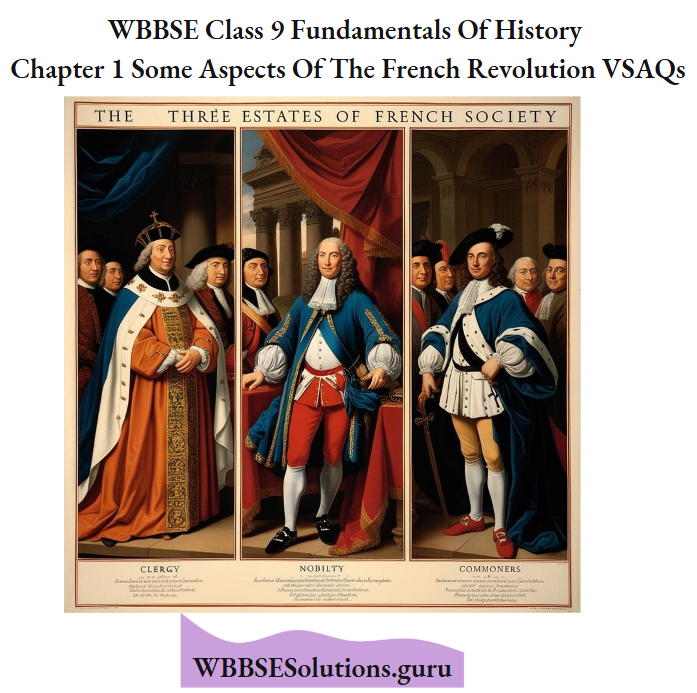
Before the Revolution of 1789, French society was divided into three classes or estates.

  1. The First Estate comprised the clergy.
  2. The Second Estate comprised of the landed people or aristocracy.
  3. The Third Estate comprised the bourgeoisie or the common people who were deprived of the special rights and privileges enjoyed by the people of the First and the Second Estates.

Important SAQs From Chapter 1 French Revolution WBBSE John Locke

WBBSE Class 9 Fundamentals Of History Question 7. Who was John Locke?
Answer:

John Locke was regarded as the “Father of Liberalism” was an English philosopher. His writings had a great influence on Voltaire and Rousseau as well as on the American revolutionaries. In his “Two Treatises of Government,” he opined against the Divine Right Theory of Kingship.

Question 8. Who was Montesquieu ?
Answer:

Montesquieu

Montesquieu was a great French philosopher born on 18th January and died on 10th February 1755. His famous book, The Spirit of the Laws, which stated the separation of power between the legislative, the executive, and the judiciary was a major contribution to the political theory that became the cornerstone of administration in all the Democracies of the world. The French monarchy, the aristocracy, and the social order were criticized by him in his book, The Persian Letters.

WBBSE History Chapter 1 Short Questions And Answers Rousseau

Question 9. Who was Rousseau?
Answer:

Jean Jacques Rousseau born on 28th June 1712 and died on 2nd July 1778, was a Swiss philosopher whose political theories influenced the leaders of the French Revolution and the Romantic generation to a large extent.

He wrote in his famous book, The Contract Sociale or Social Contract to abolish absolute monarchs and appoint the head of the state based on election and government to be formed based on a social contract between the people and their chosen representatives. He is regarded as the “Father of the French Revolution” and some of his other works include, Discourse on the Origin of Inequality, General Will, etc.

WBBSE Class 9 Fundamentals Of History Question 10. Who was Voltaire?
Answer:

Voltaire

Francois Marie Arouet known as Voltaire was a famous French philosopher and historian who criticized the Christian Catholic Church and advocated for the freedom of religion and speech. He believed in administrative excellence public welfare and politics to be based on the rule of law. Candide and Philosophical Dictionary were two of his famous books that influenced people to follow the way toward a revolution.

Question 11. Who was Diderot?
Answer:

Diderot

Denis Diderot born in 1713 and died in 1780 was a French philosopher who along with D’Alembert compiled a 35-volume Encyclopedia. In the Encyclopaedia, he wrote on social philosophical literary, and other issues which inspired the French people and made them turn against the old social system of France and rise against the people of the First and the Second Estates. According to him, human beings are the most superior creatures of the animal kingdom who can control their environment.

WBBSE Class 9 French Revolution SAQs For Quick Revision Turgot

Question 12. Who was Turgot?
Answer:

To eradicate the financial crisis of France, Louis XVI appointed Turgot as the Finance Minister in 1774. To improve the economic strength of the country he curved out a detailed program and proposed to bring the clergies and the nobles under the purview of taxation, to control trade and commerce on food items, etc. Turgot’s proposals were not liked by Queen Marie Antoinette and the nobles who opposed him and removed him from office in 1776.

WBBSE Solutions For Class 9 Fundamentals Of HistoryWBBSE Class 9 English Functional Grammar
WBBSE Class 9 Fundamentals Of History Long Answer QuestionsWBBSE Class 9 English Reading Skill
WBBSE Class 9 Fundamentals Of History Short Answer QuestionsWBBSE Class 9 English Writing Skill
WBBSE Class 9 Fundamentals Of History Very Short Answer QuestionsWBBSE Class 9 Maths Multiple Choice Questions
WBBSE Class 9 Fundamentals Of History Multiple Choice QuestionsWBBSE Solutions For Class 9 Maths
WBBSE Notes For Class 9 Geography and Environment


Question 13. Who was Necker?
Answer:

Neck

To solve the economic crisis of France, Louis XVI appointed Necker as the second Finance Minister after Turgot in 1776. During this time France’s participation in the American War of Independence further exhausted the French treasury to such an extent that Necker was compelled to put forward his idea of equal taxation for all classes of people in the society. This infuriated Queen Marie Antoinette who addressed him as a “Miser” and forced King Louis XVI to terminate him in 1781.

WBBSE Class 9 Fundamentals Of History Question 14. Who was Calonne?
Answer:

Neck

Calonne was made the Finance Minister of France in 1783 by King Louis XVI. He took huge loans to manage the deficit finance but soon realized its shortcomings and called for a meeting of the Assembly of Notables which was accepted by the king.

In 1786 he also proposed certain policies like –

  1. To impose a land tax on all classes of people
  2. Imposition of salt tax or Gabelle
  3. Free trade
  4. Abolition of Corvee and
  5. Stamp duties on government papers.

Question 15. Who was Brienne?
Answer:

Brienne

Brienne who became the Finance Minister of France in 1787 put forward his proposals of taxation at the “Paris Parlement” which was greatly resented by the aristocrats. He also failed to solve the economic problems of France and faced great opposition from the people belonging to the First and the Second Estates.

Question 16. What was the French Parlement?
Answer:

French Parlement

The French parliament was an institution that was entrusted with the task of keeping the royal power under control. The Parlement was the body where the people belonging to the First and Second Estates could put forward their appeals. Before the Revolution of 1789, there were around 13 such Parlement at Paris Toulouse, Grenoble, Bordeaux, Reims, etc.

Question 17. Who were the “Intendants”?
Answer:

Intendants

The “Intendants” were the officials of the administration who worked as the agents of the king in each of the provinces in France and were used to achieve administrative unification and centralization. Their great power made them extremely unpopular and their oppression and economic torture on the people of France was immense. However the powers of the “Intendants” were suppressed in 1789.

WBBSE Class 9 Fundamentals Of History Question 18. What were the different types of taxes that were imposed in France before the Revolution of 1789?
Answer:

The different types of taxes that were imposed in France before the Revolution of 1789

The taxes that were imposed on the people of France before the Revolution of 1789 were – Taille or wealth tax, Capitation or tax on production, Vingtiemes or tax from land, Gabelle or salt tax, Tithes or tax on religion, Aides or tax on wine and Corvee or forced labor.

The French Government divided the taxation system into two categories namely-

  1. Direct tax
    • Example: Capitation
  2. Indirect tax
    • Example: Gabelle.

Question 19. Who was known as the privileged class in France before the Revolution of 1789?
Answer:

Pre-revolutionary France was comprised of three estates apart from the king at the helm. (First Estate, Second Estate, Third Estate) The people belonging to the First and the Second Estates comprising of the Clergies and the Aristocrats were regarded as the privileged classes who enjoyed exemption from taxes and enjoyed all the benefits of the state by way of their position or birth without having any obligations towards the State. It was the Aristocrats, the members of the Second Estate who first rebelled in France when their privilege of exemption of tax was threatened.

Question 20. What was the “States-General”?
Answer:

States-General

The political and legislative organization to which the three estates of the French society namely the First Estate, Second Estate, and Third Estate sent their representatives was known as the “States General”. Each Estate voted collectively and not individually. The king of France during the Ancien Regime had no power to impose taxes. To impose or pass any order related to the taxes the king of France had to summon a meeting of the “States General”.

Question 21. What was known as the ” Assembly of Notables”?
Answer:

Assembly of Notables

The king of France appointed an assembly of priests, nobles, and magistrates to form a body known as the “Assembly of Notables”. In this Assembly, there was no place for the common people for the members chosen for this Assembly were chosen or appointed by the king himself.

Question 22. What do you understand by the term, First Estate?
Answer:

First Estate

Before the Revolution of France in 1789, French society was divided into three estates beside the king who was at the helm of power. In French society, the clergy which was again divided into two groups namely upper clergy (Abbot, Bishops, etc) and lower clergy (Priest, Vicars) comprised the First Estate and they formed only 1% of the population of France.

They were the privileged members of the society, who owned a large amount of land and wealth, stood above all laws of the state, and were exempted from paying taxes, except for the one they paid voluntarily through the “Contract of Poissey”.

WBBSE Class 9 Fundamentals Of History Question 23. What do you understand by the term, Second Estates?
Answer:

Second Estates

Before the Revolution of 1789, French society was divided into three estates with the king at the helm of power. The Aristocracy comprising of the nobles or landed class forming 1.5% of the total population of France belonged to the Second Estates. They performed no duties towards the state, were exempted from paying taxes, occupied high posts in the government, judicial, and legislative offices, and were considered the privileged class in French society.

Question 24. What do you understand by the term Third Estates?
Answer:

Third Estates

Before the Revolution of 1789, French society was divided into three estates with the king at the helm of power. In France, 97% of the population except those belonging to the First and Second Estates, the middle-class people, the peasants, the workers, and the Sans-culottes belonged to the Third Estates. People belonging to this class were educated, nurtured progressive thoughts and ideologies, and bore the entire burden of taxation but were barred from any privileges and political rights due to a lack of aristocratic connection.

Question 25. What do you understand by the term, Bourgeoisie?
Answer:

Bourgeoisie

The French word Bourgeoisie refers to the prosperous middle-class people of France belonging to the Third Estates residing in towns and earning their livelihood through intellectual skills.

The bourgeoisie class comprised teachers, lawyers, doctors, merchants, etc and they had a common past that their forefathers had earned a fortune through commercial activities. In the pre-revolutionary period, the bourgeoisie and the nobility had no fundamental hostility between them.

Question 26. Who was Marie Antoinette?
Answer:

Marie Antoinette

Marie Antoinette was the Queen of Louis XVI the Bourbon monarch. She was the sister of Leopold II the Austrian emperor and indulged in a life of great extravagance. She exercised great influence on her husband Louis XVI. (Marie Antoinette had two brothers Leopold II and Joseph II, and Leopold was the Austrian Emperor)

WBBSE Class 9 History Chapter 1 SAQs French Revolution Sans-Culottes

Question 27. Who were the “Sans-culottes”?
Answer:

The French word “Sans-culottes’ refers to those people belonging to the Third Estates who were deprived of wealth and depended on daily labor for their livelihood. Unlike the aristocrats who wore knee breeches, they used to wear long trousers and red caps that symbolized liberty. It was the Sans-culottes who began the Food Riots and entered the Royal Palace of Tuileries in 1792.

Question 28. Name a few philosophers who influenced the French Revolution.
Answer:

The French Revolution took place in July 1789. Many eminent philosophers prepared the ground for this revolution. Mention must be made of the philosophers like Montesquieu, Rousseau, Voltaire, and Diderot who influenced the people of France to a great extent.

Question 29. Who were the serfs?
Answer:

serfs

Before the revolution of France in 1789, eighty percent of her population consisted of peasants. The serfs who formed only 5% of the total belonged to the lowest strata of the French feudal society and lived completely at the mercy of their landlord. They had no rights on the land served the lord’s family for generations and were even denied the right to leave the land without the lord’s permission.

Question 30. What was the Tennis Court Oath?
Answer:

Tennis Court Oath

On 20th June 1789, the members of the Third Estate took the Tennis Court Oath under the leadership of Mirabeau and Abbe Sieyes. Louis XVI closed the meeting room for the members of the Third Estate and posted soldiers at the entrance for they demanded that the votes be counted individually and the States General be considered as the National Assembly of France.

This created a furor and they gathered at the nearby Tennis Court and took an oath never to be separated until a written constitution had been drafted and established in France and ultimately the king had to agree to the term of one vote for one individual.

WBBSE Class 9 Fundamentals Of History Question 31. What do you mean by “Cahiers”?
Answer:

Cahiers

The word “Cahiers” refers to the grievances or complaints that were enlisted by each of the three Estates in France at the time of the revolutionary situation in 1789. All the members who gathered at the Royal Palace of Versailles on 5th May 1789 brought memorandums stating their respective demands. It was the Bourgeoisie intellectuals who took the leading role in noting down the grievances and complaints.

WBBSE History Chapter 1 French Revolution Solved Questions Bastille

Question 32. What was Bastille? When was it attacked?
Answer:

The fortress prison in the city of Paris in France was known as the Fort of Bastille and it was originally built to save Paris from any invasion. A group of angry people of France both men and women belonging to the Third Estates attacked the Fort of Bastille on 14th July 1789.

Question 33. What was the role of the Paris National Guard?
Answer:

The role of the Paris National Guard

The National Guard that was meant to protect Paris was first formed by the Mayor named Bailly. However the Paris National Guard, a militia was formed after the fall of Bastille by Lafayette. It was separate from the French army, brought about significant changes in the municipal administration, and worked for the middle-class people acting as a military and police force.

Question 34. Why did the fall of Bastille take place?
Answer:

The fortress prison of Bastille in the city of Paris in France became a symbol of the autocratic rule of the Bourbon monarchs, especially Louis XVI. When Necker, the Finance Minister was removed from office by Louis XVI, people belonging to the Third Estate got agitated and aggressive and attacked the fortress, carried away the arms, killed the prison guard De Launay, and set the prisoners free. King Louis XVI’s dissolving of the States General and ordering of the troops to move to Paris also provided the cause for the mob to storm into the Fort of Bastille on 14th July 1789.

Question 35. What do you understand by the term, Aristocratic Revolt?
Answer:

Aristocratic Revolt

Aristocratic Revolt which is regarded as the precursor to the revolution of France in 1789 was a reaction of the French nobility to the reform measures suggested by the Finance Ministers of France namely Calonne and Brienne. The economic bankruptcy of the French government prompted the Finance Ministers of Louis XVI to propose such reforms which might have hampered the privileges enjoyed by the Aristocrats so long.

Louis’s attempt to reform was not approved by the sovereign Parlament of Paris. The king suspended Parlement- the act which infuriated the nobles. To retain their privileges the Aristocrats entered into a conflict with the royal army on 7th July 1788 thus marking the initiation of the French Revolution of 1789.

WBBSE Class 9 Fundamentals Of History Question 36. What was the significance of the fall of Bastille?
Answer:

The significance of the fall of Bastille

The fortress prison in the city of Paris, the capital of France, called Bastille was attacked and destroyed by the agitated mob belonging to the Third Estates on 14th July 1789.

The fall of Bastille marked the end of despotic monarchial rule, the impact of the event horrified the nobles, clergies, and the king as well, the king had to remove the army from Paris, and Finance Minister Necker was reappointed. The “Paris Commune “was formed, the king and the nobles started escaping to England, and the spirit of revolution spread among the villagers.

Girondins WBBSE Class 9 History French Revolution SAQs With Answers

Question 37. Who were the Girondins?
Answer:

The Girondins were a loose group of republican politicians, some of them belonging to the department of Gironde and played an important role in the Legislative Assembly in 1791-92. The Girondins were greatly influenced by the philosophers and economists of the time influenced public opinion and attracted the attention of businessmen, merchants, industrialists, and financiers.

The Girondins were also called Brissotins in honor of their famous spokesman and leader Jacques-Pierre Brissot and it was because of the moderate outlook of the Girondins they were disliked by the Jacobin leader Robespierre on 2nd June 1793 that the Jacobins crushed them completely at the National Assembly.

Question 38. Who were the Jacobins?
Answer:

Jacobins

The Jacobins were the members of a radical political group formed during the time of the French Revolution who planned to bring an end to kingship and give rise to the French Republic. The members of the Jacobins consisted of the bourgeoisie and the sans-culottes and their leader Robespierre unleashed a period of violence in France known as the “Reign of Terror”. On 2nd June 1793, the Jacobins completely crushed their rivals the Girondins at the National Assembly and established their sole authority.

Question 39. Who was Robespierre?
Answer:

Robespierre

Maximilien Robespierre born on 6th May 1758 and Guillotined on 28th July 1794 was a French lawyer and leader of a radical political group of France called the Jacobins. He unleashed a period of violence called the ” Reign of Terror” and dominated the Committee of Public Safety in the latter months of 1793. when innumerable persons were guillotined upon the suspect. In 1794 he was overthrown and guillotined in the Thermidorian Reaction.

Question 40. Why was the “Reign of Terror” ushered?
Answer:

The execution of Louis XVI gave rise to protests by the supporters of monarchical power and France also had to face the challenge of the foreign powers like Britain, Austria, Holland, and Prussia who waged a war against the republican government of France. To protect the country from both internal and external threats the National Convention unleashed a period of ruthlessness and terror to suppress any kind of opposition. This period from September 1793 to July 1794 under the leadership of the Jacobin leader Robespierre was known as the “Reign of Terror”.

Question 41. What was the Committee of Public Safety?
Answer:

The “Reign of Terror” was made effective by using three instruments namely

  • The Law of Suspects
  • The Revolutionary Tribunal and
  • The Committee of Public Safety.

This Committee maintained the task of appointing ministers and high-ranking officers of the armed forces. It functioned smoothly in coordination with the Revolutionary Tribunal and the Committee of General Security.

Question 42. Who were the Physiocrats?
Answer:

Physiocrats

The term, Physiocrats refers to the Economists in France who believed in the Laissez-Faire theory as propounded by Adam Smith in his, Wealth of Nations. Francois Quesnay and Turgot formed the Physiocratic School in France and opined against the control of the country’s economy and commerce by a single group in the society. They also propagated the concept of taking into account the views of the people upon whom taxes were imposed.

Law Of Suspects WBBSE Class 9 French Revolution SAQs For Quick Revision

Question 43. What was the Law of Suspects?
Answer:

Law of Suspects was one of the instruments through which the Reign of Terror was made effective by the Jacobins after they assumed total control over the National Assembly.

The Law of Suspects gave power to the local revolutionary committees to arrest those whose conduct, relations, or language written or spoken, displayed partisans of tyranny or enmity to liberalism. In the years 1793-94 around 200,000 citizens were detained under this law.

Question 44. Which incident is known as the “Second French Revolution”?
Answer:

The Jacobins attacked the Palace of Tuileries on 10th August 1792 and held the king hostage for long hours. They also voted to dethrone the king which resulted in turning France into a Republic. Scholars refer to this incident as the “Second French Revolution”.

Question 45. What is the Civil Constitution of Clergy?
Answer:

Civil Constitution of Clergy

On July 12th, 1790 a Civil Constitution of Clergy was framed in France on a national basis to reorganize the Roman Catholic Church and curb the authority of the Pope. By this Constitution, it was decided to confiscate the church properties, elect bishops and priests by the people, and entrust the states to pay their salaries and supervise their duties. This action naturally turned the devout followers of the Catholic faith against the Revolution.

Question 46. What does the “Declaration of the Rights of Man and Citizen” state?
Answer:

The “Declaration of the Rights of Man and Citizen” state

Following the writings of Rousseau in his famous book, “The Social Contract”, on August 1789 the “Declaration of the Rights of Man and Citizen” was issued. The declaration spoke in favor of freedom and equality of man in the eyes of the law and emphasized the concepts of natural rights to liberty, property, security, and protection. It also stated that the aspirations of the common man must be reflected in the laws that would be formulated by the state.

Question 47. What was the “Thermidorian Reaction”?
Answer:

Thermidorian Reaction

The Parliamentary revolt that took place on 27th July 1794 in France resulted in the fall of Robespierre who was executed on the following day ie, 28th of July, and the subsequent end of the Reign of Terror took place. The reaction that occurred after the death of Robespierre is known as the “Thermidorian Reaction”. The Paris Commune was dissolved, the terrorists were killed, prisoners who were not found guilty were released and the National Guards were reorganized.

Question 48. How was Tipu Sultan related to the Jacobins?
Answer:

Tipu Sultan the ruler of Mysore was a close associate of the Jacobin Club of France and was its founder member in India. In 1797 when the French soldiers wanted to establish the Jacobin club at Seringapatam he supported them wholeheartedly. Further, he also made arrangements and ordered a salute of 2300 canons and 500 rockets to mark the occasion.

Question 49. What was the guillotine? Who was the inventor of the guillotine?
Answer:

Guillotine

A guillotine was a machine used in France for cutting people’s heads off. A French physician Dr Guillotin invented this machine. The machine was named after its inventor.

WBBSE Class 9 Fundamentals Of History Question 50. Who created the White Terror?
Answer:

The Jacobin regime in France lasted from 1793 to 1794 and the Reign of Terror ended with the execution of Robespierre. This was followed by the White Terror or Thermidorian rule from 1794 to 1795. A general revolution against the Thermidorian rule took place and between May to October 1795, the National Assembly was attacked.

Question 51. What is known as the rule of the Directory?
Answer:

The rule of the Directory

The period between 1795 to 1799 witnessed a new government the “Rule of Directory” in France. A body of five Directors was entrusted with power and authority to execute the proper functioning of the state of France. The Directors were Baras, La Ravelliere, Letourner, Raubel and Carnot.

WBBSE Class 9 Fundamentals Of History Chapter 2 Revolutionary Ideals, Napoleonic Empire And Idea Of Nationalism SAQs

WBBSE Class 9 Fundamentals Of History Chapter 2 Revolutionary Ideals, Napoleonic Empire, And Idea Of Nationalism Short Answer Questions.

Question 1. What do you know about the early life of Napoleon?
Answer:

The early life of Napoleon

On 15th August 1769. Napoleon Bonaparte was born in a place called Ajaccio on the Mediterranean island of Corsica. His parents were Carlo Charles Bonaparte and Letizia Ramolino Bonaparte. Napoleon finished his education in the military academies of Paris and Brienne and joined as a Lieutenant in the French artillery.

Read And Learn More WBBSE Class 9 Fundamentals Of History Short Answer Questions

Question 2. What do you understand by the rule of the Consulate?
Answer:

The rule of the Consulate

Napoleon Bonaparte introduced a new administrative system in France known as the ‘Consulate’ after he overthrew the rule of the Directory in 1799. He assumed total control of power and ruled the country through the ‘Consulate’. France was ruled by a council consisting of three members and Abbe Sieyes was one of the important Consuls.

Question 3. How did Napoleon save the National Convention?
Answer:

The members of the National Convention were attacked by a rowdy mob on 5th October 1795. Napoleon Bonaparte who was a Brigadier General saved the National Convention by putting up a strong resistance with his soldiers. This incident was very significant in the course of Napoleon’s rise to power.

Question 4. Which incident is regarded as the lB Vendemiarie?
Answer:

On 5th October 1795, a rowdy mob attacked the members of the National Convention. Napoleon Bonaparte the Brigadier General launched an attack on the mob with his soldiers and saved the National Convention. This incident is known as the incident of October 5, 1795, or the 13thVendemiarie.

WBBSE Class 9 Fundamentals Of History Chapter 2 Question 5. Which period is known as the ‘Age of Napoleon’ in France?
Answer:

The period from 1799 to 1814 is known as the Age of Napoleon in France. On 9th November 1799, he brought an end to the rule of the Directory and introduced a new administrative system called the ‘Consulate’. Napoleon was first appointed as the Consul for ten years, then the Constitution was revised and he became the Consul for life in 1802 then through a plebiscite proposed by the Senate he became the Emperor of the French in 1804.

WBBSE Solutions For Class 9 Fundamentals Of HistoryWBBSE Class 9 English Functional Grammar
WBBSE Class 9 Fundamentals Of History Long Answer QuestionsWBBSE Class 9 English Reading Skill
WBBSE Class 9 Fundamentals Of History Short Answer QuestionsWBBSE Class 9 English Writing Skill
WBBSE Class 9 Fundamentals Of History Very Short Answer QuestionsWBBSE Class 9 Maths Multiple Choice Questions
WBBSE Class 9 Fundamentals Of History Multiple Choice QuestionsWBBSE Solutions For Class 9 Maths
WBBSE Notes For Class 9 Geography and Environment


Question 6. Which incident is regarded as the 18th Brumaire?
Answer:

Taking advantage of the chaotic and unpopular administration of the Directory, Napoleon made plans secretly with a few of the Directors to put an end to the rule of the Directory in France. On 9th or 10th November 1799, Napoleon launched a military coup and captured the administrative machinery of France. This incident is regarded as the 18th Brumaire.

WBBSE Class 9 Fundamentals Of History Chapter 2 Revolutionary Ideals, Napoleonic Empire, And Idea Of Nationalism Short Answer Questions

Question 7. Which incident helped Napoleon in achieving the post of Brigadier?
Answer:

In 1793, the English laid siege on the Toulon harbor which was ruled by France. Napoleon made a sudden attack and removed the English from the Toulon harbor. He also resisted the counter-revolutionary activities. All this helped him in acquiring the post of the Brigadier.

Question 8. Why is the Battle of the Nile important?
Answer:

In 1798 the Battle of the Nile was fought between England and France. Napoleon was severely defeated in this battle by Admiral Nelson of the British Navy.
It was the Battle of the Nile that exposed the weakness of the French navy and the supremacy of the British naval force.

Revolutionary Ideals And Their Impact On European History Class 9 WBBSE The Battle Of The Pyramids

Question 9. What do you know about the Battle of the Pyramids?
Answer:

Napoleon assumed the responsibility of invading Egypt against England. Soon a major battle was fought on 21st July 1798, known as the Battle of the Pyramids. The French army under the guidance of Napoleon Bonaparte won a decisive victory in this battle.

Question 10. What do you know about the ‘Treaty of Campo-Formio’?
Answer:

‘Treaty of Campo- Formio’

The Treaty of Campo-Formio was a peace settlement between France and Austria signed on 17th October 1797. This incident marked the first major military success of Napoleon Bonaparte. It crushed the First Coalition that was formed against France by the other European countries.

Question 11. Name the countries that formed the First Coalition against France.
Answer:

The First European Coalition against France was formed in 1793. England, Austria, Prussia, Spain, Portugal, and Sardinia were some of the countries that formed the First Coalition against France.

Question 12. Name the countries that formed the Second Coalition against France.
Answer:

The Second European Coalition against France was formed in 1799. England, Austria, Portugal, and Russia were some of the European countries that formed the Second European Coalition against France.

Class 9 Fundamentals Of History Chapter 2 Question 13. Name the countries that formed the Third Coalition against France.
Answer:

The Third European Coalition against France was formed in 1805. England, Austria, Sweden, and Russia were some of the countries that formed the Third European Coalition against France.

Question 14. What were the main objectives of Code Napoleon?
Answer:

The main objectives of Code Napoleon

Before the Revolution of 1789, France had numerous arbitrary laws (around 360) and so the primary aim of Napoleon was to bring his entire French empire under one law.

France now became a secular country and the people were free to follow their religion. Code Napoleon gave the farmers the right to own land of their own. It also helped to strengthen the three ideals (Equality, Liberty, and Fraternity) of the French Revolution and everybody was made equal in the eyes of the law.

WBBSE Class 9 History Chapter 2 SAQs With Answers Civil Code

Question 15. What is known as the Civil Code?
Answer:

Code Napoleon was divided into five parts namely the Civil Code, the Penal Code, the Commercial Code, the Criminal Code, and other codes. The Civil Code not only provided provisions for equal treatment of every French citizen, but it also gave equal opportunities to them.

The land was also divided equally among all the farmers and from the records of 1804, it was seen that 56.2% of the land was divided equally among the farmers and 28.5% of the land was divided among the bourgeoisie. However, the civil code was incomplete in many senses and had several inconsistencies.

Question 16. What were the economic reforms brought about by Napoleon?
Answer:

The economic reforms brought about by Napoleon

‘Several measures were adopted by Napoleon 1 Bonaparte and laws were made to improve the economic condition of France. First of all, he reduced the expenses in the Government departments and introduced a system of audit in every Government department.

He did not impose any new tax on the people and instead started concentrating on a collection of the existing taxes. In 1800, he formed the Central Bank of France which had the authority to issue currency notes.

Question 17. What do you know about the Education reforms of Napoleon?
Answer:

The Education Reforms of Napoleon

‘Code Napoleon also drew up a plan in the field of education. By the Code, each commune was to have a primary school, a teacher training school, and a military and technical school. The schools were supposed to develop and make progress in the French language and instill the spirit of loyalty to the Emperor among the students. The University of France was established. Institute of France was opened for research and higher studies.

Question 18. What were Lycees?
Answer:

Lycees

Napoleon Bonaparte had introduced educational reforms in France. Lycees were semi-military residential schools opened by Napoleon in France. In the Lycees the boys from aristocratic families used to study to become officers in the French army.

Revolutionary Ideals And Napoleonic Empire SAQs WBBSE Code Napoleon

Class 9 Fundamentals Of History Chapter 2 Question 19. What is Code Napoleon?
Answer:

Before the Revolution of 1789, France had as many as 360 arbitrary laws that lacked total uniformity. At the time of the Convention of the Directory, the revolutionary leaders attempted to form a uniform legal system and introduce a consistent Civil Code but they failed to complete the work. When Napoleon came to power he formed a Commission with four important lawyers that worked for four years from 1800 to 1804 and finally drew up a set of laws. Napoleon christened those laws as ‘Code Napoleon ‘ in 1807.

Question 20. Why is Code Napoleon regarded as the Bible of the French Society?
Answer:

Code Napoleon comprising 2281 articles was a combination of French rituals, Roman customs, and the legacy of the French Revolution. The Code achieved equality in legal matters, endorsed religious tolerance, abolished feudalism, and recognized the rights of property. Thus the Code Napoleon made the bourgeoisie, the peasants, and a large majority of the French population happy and historian Lefebvre had aptly called the Code the Bible of the French Society.

Question 21. What is the importance of the Treaty of Amiens? The Treaty of Amiens was signed between England and France in 1802.
Answer:

The importance of the Treaty of Amiens

As a result of this treaty both the countries were able to establish peace for a brief period. This Treaty was successful enough to break the Second European Coalition that was formed by England, Austria, Portugal, Russia, and others against France inl799.

Class 9 Fundamentals Of History Chapter 2 Question 22. What was the Berlin Decree?
Answer:

The Berlin Decree

The Berlin Decree was issued on 21st November 1806 by Napoleon after his success in the Battle of Jena against Prussia and also in retaliation to the British Order in council of May 1806. By this decree, Napoleon launched a naval blockade against England. Napoleon declared that the allies of France had to stop all commercial relations with England.

Question 23. What was the Milan Decree?
Answer:

The Milan Decree

The Milan Decree was issued by Napoleon Bonaparte on 17th December 1807 to enforce the Berlin Decree that was issued in 1806 to initiate the Continental System. The Milan Decree prohibited the European countries from having trade relations with Britain and any ship of any country that tried to reach England for commercial purposes was confiscated by the French navy. It was economic warfare waged against Britain by Napoleon.

Question 24. what was the Continental System?
Answer:

The Continental System

The Continental System was designed by Napoleon in 1806 to paralyze Great Britain which had a superior naval base, through the economic blockade. The neutrals and the French allies were prohibited from having any commercial relations with Britain. The Berlin Decree and the Milan Decree formed the basis of the Continental System, but the system was a failure as many countries resumed business with England. Finally, it must be admitted that the Continental System was a precursor to the fall of Napoleon.

Question 25. Why did Napoleon annex Portugal?
Answer:

To make his Continental System effective, Napoleon had to establish his control over Portugal and Spain. The king of Portugal an ally of the British disregarded the Continental System of Napoleon and continued commercial relations with Britain. This infuriated Napoleon and he sent a combined force of France and Spain in 1807 to Portugal and annexed it.

Question 26. What do you know about the Peninsular War of 1808?
Answer:

The Peninsular War of 1808

Greatly affected by the Continental System introduced by Napoleon in 1806. Portugal an ally of Britain denounced it and established trade relations with Britain much to the consternation of Napoleon. To fight the French both Spain and Portugal requested help from Britain and finally with the aid of the English Generals John Moore and Arthur Wellesley launched a combined war against Napoleon in 1808, known as the Peninsular War.
The first French General Victor was defeated In this war.

Question 27. What was the Importance of the Bottle of Trafalgar?
Answer:

The Importance of the Bottle of Trafalgar

The Battle of Trafalgar was fought between England and France on 21″ October 180S. In this battle, the British Navy under Admiral Nelson completely vanquished the French under Napoleon Bonaparte and foiled his plans of winning the English in the seas. The Battle of Trafalgar not only established the supremacy of the British Naval power it also marked the beginning of Napoleon’s end.

Question 28. what was the Importance of the Treaty of Tilsit?
Answer:

The Importance of the Treaty of Tilsit

The Treaty of Tilsit was signed between Czar Alexander I of Russia and Napoleon Bonaparte of France in 1807. This treaty enhanced the prestige of Napoleon in Europe as all the countries of Europe except England accepted his supremacy and the Third European Coalition that was formed against France was destroyed. This Treaty of Friendship with Napoleon forced the Czar to enforce the Continental System which later led to the decline of their relationship.

Question 29. What do you know about the Confederation of the Rhine?
Answer:

The Confederation of the Rhine

The Treaty of Pressburg gave way to the creation of the Confederation of the Rhine which lasted for the period from 1806 to 1813. Initially, it was formed with 16 German states after Napoleon’s victory in the Battle of Austerlitz against Austria and Russia. This Confederation of the Rhine acted as a satellite and major military aid of the French Empire under Napoleon. All political activities of the Confederation of the Rhine were controlled by Napoleon.

Class 9 history SAQs On Napoleonic Empire And Nationalism WBBSE The ‘Grand Army’ Of Napoleon

Question 30. What do you know about the ‘Grand Army’ of Napoleon?
Answer:

Napoleon decided to undertake the Moscow expedition to punish the Czar for deviating from the Continental System. He collected soldiers from around twenty countries of Europe like France, Austria, Prussia, Holland, Italy, etc, and built his ‘Grand Army’ numbering 6,75,000. Though large in number the soldiers of the army were inexperienced and unenterprising mercenaries who failed to prove themselves before the Russian troops which were only 2,00,000.

Question 31. What was the Fourth European Coalition?
Answer:

The Fourth European Coalition

The Fourth European Coalition against France was formed in 1813, as a result of Napoleon’s failure in the Moscow expedition.
Thirteen countries of Europe like England, Russia, Prussia,5weden, and Austria were part of this coalition.

Question 32. What was the significance of the Battle of Waterloo?
Answer:

The significance of the Battle of Waterloo

The Battle of Waterloo took place on 18th June 1815 between England and France, in which Napoleon Bonaparte the French Emperor was defeated by the Duke of Wellington, Arthur Wellesley, and the Prussian General Blucher. In the battle 37.000,13,000 and 6,000 French, British, and Prussian soldiers were killed. As a result of his defeat in the Battle of Waterloo Napoleon was exiled to St. Helena where he died in 1821.

Question 33. Why is Napoleon Bonaparte regarded as the ‘Destroyer of the Revolution’?
Answer:

Napoleon became the emperor of France in 1804 reinstated monarchical rule in France and denounced one of the main ideals of the French Revolution namely -Liberty. He assumed the status of a dictator and placed his family members to rule of countries he had conquered and thus he challenged the entire concept of freedom. Initially, people mistook him as a Liberator but soon they realized their mistake and he admitted that he was the ‘Destroyer of the Revolution’.

Question 34. What do you understand by the Scorched Earth Policy?
Answer:

The Scorched Earth Policy

In 1812, when Napoleon’s ‘Grand Army’ invaded Russia, the Russian troops avoided open warfare and kept retreating into the empire. While retreating, the Russian troops adopted the Scorched Earth Policy and destroyed the roads, bridges, burnt crops, houses, fields, towns, clothes, and every possible thing and even poisoned the water supplies to check the advance of Napoleon’s Army. This Scorched Earth Policy dealt a severe blow to the Grand Army of Napoleon.

Question 35. What is the significance of the Treaty of Fontainebleau?
Answer:

The significance of the Treaty of Fontainebleau

In 1814, Napoleon was defeated by the Allied forces and signed the Treaty of Fontainebleau. As a result of this Treaty, he was exiled to the Mediterranean isle of Elba and assured a sum of two million Francs as his pension. This treaty brought an end to the political ambitions of Napoleon.

Class 9 Fundamentals Of History Chapter 2 Question 36. What was known as the ‘Spanish Ulcer’ of Napoleon?
Answer:

The ‘Spanish Ulcer’ of Napoleon

From 1808 to 1813, Napoleon had to face the combined attack of the Peninsular countries of Portugal and Spain along with England. Napoleon made several attempts to conquer Spain but all his efforts ended in failure causing a huge loss in his wealth, military power, and reputation. Thus the Spanish attacks proved disastrous to Napoleon and exposed him to other severe dangers. So Napoleon himself considered Spain as an ulcer in his career.

WBBSE Class 9 History: Short Answer Questions on Europe’s 19th-Century Conflicts

WBBSE Class 9 Fundamentals Of History Chapter 3 Europe In The 19th Century: Conflict Of Monarchical And Nationalist Ideas Short Answer Questions

Question 1. What do you understand by the term, nationalism?
Answer:

Nationalism

The term nationalism refers to a feeling of unity among a large number of people who inhabit a particular region and share a common social, political, linguistic, cultural, and religious background.

Read And Learn More WBBSE Class 9 Fundamentals Of History Short Answer Questions

The idea of one nation, one state’ that emerged after the French Revolution and the downfall of Napoleon led to the growth of new states in Europe and the nationalist feeling gained more strength in the nations like France and Great Britain. The 19,h Century also saw the rise of nationalism in the countries like Italy, Germany, Spain, Poland, etc.

Question 2. What do you understand by the term nation-state?
Answer:

Nation-state

The word Nation means a tribe or a race in Latin. A nation-state has the following characteristics -A specific group of population and a geographical boundary. Ideally, it speaks of a sovereign state where the inhabitants share certain common heritages (language, culture, etc) and inhabit a particular geographical location. Europe witnessed the rise of nation-states in the 15,h, and 16th centuries which was fundamentally different from the nation-states that emerged in the 19th Century.

Question 3. State any two reasons that led to the development of nation-states in Europe.
Answer:

The two factors that led to the development of nation-states In Europe were —

  1. The royal powers or the strong and powerful monarchs were no longer opposed by the Christian Church and instead, they became the defenders of royal powers, thus providing the scope for the growth of nation-states.
  2. Another important factor was the increasing economic support of the rich middle-class people to the kings which not only made the monarchs powerful, it also aided in the growth of nation-states.

WBBSE Class 9 Fundamentals Of History Chapter 3 Europe In The 19th Century Conflict Of Monarchical And Nationalist Ideas Short Answer Questions

Question 4. What were the two contradictory trends that marked the history of Europe in the Century?
Answer:

The two contradictory trends that marked the history of Europe in the Century

The French Revolution and the downfall of Napoleon led to the growth of two contradictory trends in the history of Europe in the 19th Century. On one hand, there were conservative thoughts and ideas which were opposed to all changes and advocated for monarchy, feudalism, and supremacy of the church. The other group was highly influenced by the ideologies of the French Revolution and championed the lofty ideas of liberalism, democracy, and nationalism.

WBBSE Class 9 Fundamentals Of History Chapter 3 Question 5. How was monarchy restored in Europe in the first half of the 19th Century?
Answer:

The conservative diplomats who met at the Vienna Congress of 1815 were ardent supporters of monarchical rule and yearned to bring back the pre-revolutionary condition in Europe. Keeping in mind this concept, these conservative diplomats applied the Principle of Legitimacy and restored the kings and dynasties who ruled the countries before the revolution in France. (eg Bourbon dynasty in France ) Metternich, the Austrian Chancellor who presided over the Vienna Congress, successfully built up a “police system ” to preserve the supremacy of the monarchy and stall the spread of the ideas of liberalism and nationalism.

Question 6. When did the Vienna Conference take place and who were the representatives at this Conference?
Answer:

The Vienna Congress was held between September 1814 to June 1815. The important representatives were Prince Metternich, the Austrian Chancellor, Prince Hardenberg and Frederick William III from Prussia, Prince Talleyrand of France, Emperor Francis I of Austria, Prime Minister Castlereagh and Arthur Wellesley from Great Britain and Czar Alexander I and Count Nesselrode of Russia.

Europe In The 19th Century Class 9 Questions And Answers

Question 7. Who were the “Big Four “and what were the three basic principles of the Vienna Conference?
Answer:

All the important representatives of the European countries except the Pope and the Sultan of Turkey attended the Vienna Conference. But the four countries namely, Austria, Prussia, Great Britain, and Russia who were pivotal in bringing about the downfall of Napoleon had a dominant presence at the conference and were referred to as the “Big Four.”

The three basic principles of the Vienna Conference were

  1. The Principle of Legitimacy
  2. The Principle of Compensation and
  3. The Principle of Balance of Power.


WBBSE Solutions For Class 9 Fundamentals Of HistoryWBBSE Class 9 English Functional Grammar
WBBSE Class 9 Fundamentals Of History Long Answer QuestionsWBBSE Class 9 English Reading Skill
WBBSE Class 9 Fundamentals Of History Short Answer QuestionsWBBSE Class 9 English Writing Skill
WBBSE Class 9 Fundamentals Of History Very Short Answer QuestionsWBBSE Class 9 Maths Multiple Choice Questions
WBBSE Class 9 Fundamentals Of History Multiple Choice QuestionsWBBSE Solutions For Class 9 Maths
WBBSE Notes For Class 9 Geography and Environment


Question 8. What were the main objectives of the Principle of Legitimacy?
Answer:

The main objectives of the Principle of Legitimacy

The Principle of Legitimacy was one of the three basic principles adopted at the Vienna Conference (1815). This principle was not related to the common people, it applied to those monarchs and monarchies who had suffered due to Napoleon and the French Revolution. Thus it was directed to bring back the pre-revolutionary era in Europe as much as possible leading to the restoration of the Bourbon dynasty in France, the Orange dynasty in Holland, the Savoy dynasty in Sardinia and Piedmont, etc.

Question 9. What were the main objectives of The Principle of Compensation?
Answer:

The main objectives of The Principle of Compensation

The Principle of Compensation was one of the three basic principles adopted at the Vienna Conference (1815) The primary aim was to compensate for the great losses faced by those European countries in the wars with Napoleon but in reality however it was the Big Four who reaped the maximum benefit. As a result, Austria acquired Lombardy, Venetia, Tyrol, the Illyrian provinces, etc, Prussia received Northern Saxony, Posen, Danzig, etc, Russia got Finland and large parts of Poland and England got hold of several military and trade centers outside Europe.

Question 10. What were the objectives of the Principle of Balance of Power?
Answer:

The objectives of the Principle of Balance of Power

The Principle of Balance of Power was one of the basic principles adopted at the Vienna conference (1815). The main attempt of the principle was to ensure a condition of peace in Europe and maintain a balance so that no country especially France could pose a threat. To obtain this status of peace permanently the powers of Holland, Saxony. Bavaria and Prussia were increased and all measures to keep France under check were undertaken.

Question 11. Where was the first international conference of the world held?
Answer:

The first international conference of the world held

After the downfall of Napoleon and after his exile, the European powers except the Pope and the Sultan of Turkey convened a meeting at Vienna the capital of Austria, in 1815. This convention which was organized to achieve the reconstruction of the European kingdoms and redefine the boundaries and consequences of the Napoleonic wars was the first international conference of Europe as well as the whole world. This convention is regarded as the famous Vienna Conference of 1815.

Question 12. State the significance of the Vienna Congress of 1815.
Answer:

The significance of the Vienna Congress of 1815

The primary significance of the Vienna Congress of 1815 lay in its nature which was not at all vindictive and which succeeded in achieving a period of peace for forty years in Europe. According to Historian, David Thomson this Congress made “a reasonable and statesmanlike arrangement” and according to some the Vienna Congress provided the basis upon which the League of Nations and the UNO were built in the future. The period of peace was utilized by the people of Europe to develop their knowledge and scientific advancements.

Short answer questions for WBBSE Class 9 History Chapter 3

Question 13. What were the main weaknesses of the Vienna Congress of 1815?
Answer:

The main weaknesses of the Vienna Congress of 1815

The primary weakness of the Vienna Congress of 1815 was that it completely ignored the aspirations or trends of the contemporary people who were largely influenced by the lofty ideals of the French Revolution, namely, liberalism, nationalism, and democracy.

In the second place, the leaders of this Congress, the Big Four misused the Principle of Legitimacy to meet their self-interests and, as a result, Belgi um was forced to join Holland and instead of re-establishing the German kingdoms a bund comprising of 39 kingdoms was placed under Austria. The people of the countries like Italy and Germany were divided arbitrarily to meet the principles of the Vienna Congress which ultimately attributed to the cause of its failure.

Question 14. What was known as the Metternich System?
Answer:

Metternich System

Prince Metternich, the Chancellor of Austria was a firm believer in conservatism, opposed to any kind of progress, and outrightly rejected the concepts of democracy and nationalism. He followed an oppressive system called the ” Metternich System” to maintain a position of status -quo in Europe, rejected any forms of reforms, curbed the freedom of speech and press, and imposed restrictions on schools and colleges to restrict the growth of any revolutionary ideas.

He was a believer in the dynastic monarchy and divine right theory of kingship, feudal concepts, and the supremacy of the Catholic Church and tried to give form to these ideals through the ” Metternich System”.

Question 15. What were the internal and external policies undertaken by Metternich?
Answer:

The internal and external policies undertaken by Metternich

Prince Metternich successfully implemented certain internal and external policies in Austria and Germany-

  1. He curbed the freedom of the press and imposed severe restrictions upon schools and colleges.
  2. History, Social Science, Political Science, and Ethics were no longer allowed to study in the colleges.
  3. He followed the policy of ‘Divide and Rule’ to drive the people against each other in Austria and suppress the growth of nationalism.
  4. All political meetings and rallies were banned.
  5. Finally, all foreign books, and magazines as well as foreigners were banned by him.

Question 16. Why was the Vienna Congress summoned?
Answer:

The Vienna Congress was summoned in 1815 to reconstitute Europe which suffered heavily due to the Napoleonic wars based on truth, justice, and the establishment of peace. The Congress aimed to bring back the pre-revolutionary era in Europe through the application of the Principle of Legitimacy, to compensate for the losses suffered by many states of Europe through applying the Principle of Compensation. Finally, to maintain peace it was necessary to keep a check on all the powers in Europe especially France, so the Principle of Balance of Power was undertaken.

WBBSE Class 9 Fundamentals Of History Chapter 3 Question 17. What was the Holy Alliance Treaty of 1815?
Answer:

The Holy Alliance Treaty was signed in Paris, on 26th September 1815 at the initiative of Czar Alexander I. This was a coalition that aimed at linking the monarchist powers like Austria, Prussia, and Russia.

The main idea of this treaty was

  1. There-establishing of the hereditary rule and suppression of any kind of democratic or nationalist movements,
  2. To accept the supremacy of the Christian Church by the states and to frame their internal and external policies accordingly
  3. To promote the ideas of truth and justice, brotherhood, and taking good care of the subjects
  4. To prevent any possibility of such challenges as revolution and revolutionary wars.

Fundamentals Of History Class 9 Chapter 3 Explanation

Question 18. What do you know about the Troppau Protocol (1820)?
Answer:

The Troppau Protocol (1820)

The Troppau Protocol (1820), was implemented by Prince Metternich at the meeting of the Holy Alliance powers at Troppau in Silesia. It was a declaration that intended to take action against any revolutionary actions and ideals occurring at any place and the subsequent implementation of the policy of status -quo.

Question 19. What were the conferences held by the Concert of Europe?
Answer:

To implement the decisions taken in the Vienna Congress (1815), the Concert of Europe was formed which organized conferences at various cities of Europe.

The conferences were

  1. The Congress of Aix- la-Chapelle 1818
  2. The Congress of Troppau 1820
  3. The Congress of Laibach 1821
  4. The Congress of Verona 1822
  5. The Congress of St.Petersburg 1825.

Hence, the period between 1815-1825 is called the ‘Age of Conferences’ in the history of Europe. It was through these conferences of the concert that the idea of the Metternich 5ystem was tried to spread all over the European continent.

Question 20. What do you know about the Carlsbad Decrees?
Answer:

Carlsbad Decrees

In 1819 a series of reactionary measures were adopted by Metternich in Germany to impose severe restrictions on political parties, on the freedom of the press, and student organizations.

A federal commission was also appointed to investigate the activities of the students and the professors, strict control of the government was established upon the universities and both the liberal students and professors were imprisoned. All these reactionary measures were made through the infamous Carlsbad Decrees.

Question 21. What was the Monroe Doctrine (1823)?
Answer:

Monroe Doctrine (1823)

The Monroe Doctrine (1823) was a policy of the United States adopted by President James Monroe that resisted European colonialism in America. Monroe made it very clear that the Old World and the New World were different and they must retain that distinction for that, he put forward four basic points –

  1. The United States would not come in the way of any internal policies or wars between the European powers.
  2. The United States recognized and would not interfere with the colonies and dependencies that were already there in the Western Hemisphere.e
  3. There was no hope for colonization of the Western Hemisphere in the future
  4. Any attempt on the part of Europe to control or oppress any nation in the Western Hemisphere would be treated as a hostile act against the United States.

Question 22. Who was the king of France during the July Revolution? Who was his Prime Minister?
Answer:

The July Revolution of France took place in 1830. Charles X of the Bourbon Dynasty ruled France during the July Revolution. Poligna c, a reactionary person was the Prime Minister of Charles X.

Question 23. What was the path followed by Louis XVIII after ascending the throne of France?
Answer:

Following the Principle of Legitimacy, in 1815, Louis XVIII of the Bourbon Dynasty was made the new monarch of France.
He tried to follow the middle path and wanted to establish a compromise between conservatism and liberalism much to the dislike of the French royalists. However, after the murder of his cousin, Duke de Berry, in 1820 Louis XVIII gave up liberalism completely and became a despot.

WBBSE Class 9 History SAQs Chapter 3

Question 24. When and what were the four ordinances issued by Charles X?
Answer:

Charles X, a monarch of the Bourbon Dynasty appointed a reactionary person named Polignac as his Prime Minister in 1830 and on 26th July issued four ordinances.

They were –

  1. Abolition of the freedom of the press
  2. Dissolving of the Constituent Assembly
  3. Curtailing or changing of the electoral system
  4. Announcement of a fresh election day based on the electoral rights of a small number of citizens.

WBBSE Class 9 Fundamentals Of History Chapter 3 Question 25. Why did the rebel citizens of France claim Louis Philippe of the Orleans Dynasty, as the king of France?
Answer:

Charles X, the autocratic monarch of the Bourbon Dynasty issued four ordinances on July 1830 which led to a great upheaval in the city of Paris under the guidance of the liberal leader, Adolphe Thiers. The students, teachers, laborers, farmers, and common people all rose in rebellion, put up barricades in the streets, and forcibly removed Charles X from his throne. Then the citizens of France proclaimed Louis Philippe of the Orleans Dynasty as the constitutional monarch.

Question 26. What do you understand by the term, “July Monarchy”?
Answer:

July Monarchy

On the 30th of July 1830, the revolutionary citizens of France forcibly dethroned Charles X of the Bourbon Dynasty and proclaimed Louis Philippe as the constitutional monarch of France. As this monarchy was established due to the revolutionary movement that took place in July 1830, it is also known as the ” July Monarchy “.

Question 27. Which period was known as the Age of Metternich and why?
Answer:

The period of about 33 years from 1815 to 1848 was known as the Age of Metternich in Europe. This was due to the overwhelming attempt on the part of the European powers to give in to the conservative ideals of the Chancellor of Austria, Prince Metternich, to maintain the status quo. During this period, Metternich was not only the central figure in the politics of Austria but he was the most influential man in Europe.

Question 28. Why was Louis Philippe known as the ” Citizen ’ King”?
Answer:

The July Revolution of 1830, led to the establishment of a constitutional monarch Louis Philippe of the Orleans Dynasty to the throne of France. This monarchy which was known as the July Monarchy was also known as the ” Bourgeois Monarchy” due to the pre-eminence of the wealthy bourgeoisie. The way Louis Philippe dressed and the manners he followed were similar to the bourgeois and he was known as the “Citizen King “.

Question 29. Who was Louis Blanc?
Answer:

Louis Blanc

Louis Blanc was a socialist leader of France during the February Revolution of 1848. He was in favor of reforms. He was also a politician and historian who wanted to create cooperatives to employ the urban poor.

Question 30. Name the countries of Europe that were influenced by the July Revolution of 1830 in France.
Answer:

The July Revolution of 1830 had left its mark on the other European countries of the time. The Belgians who were unhappy with the Dutch rule rose in rebellion and declared their independence in 1831. Both in Italy and Germany it provided the impetus towards the revolt and in England also the Chartist Movement started. The insurrection was launched by the Poles against Russia and ideas of nationalism and liberalism started developing in countries like Spain and Portugal.

Question 31. What were the reasons behind the July Revolution of 1830 in France?
Answer:

The reasons behind the July Revolution of 1830 in France

Several factors led to the outbreak of the July Revolution of 1830 in France-

  1. The autocratic rule of the French monarch of the Bourbon dynasty and his adherence to the pre¬revolutionary system of administration
  2. The restoration of the power of the clergy and the aristocracy alienated the wealthy bourgeois of France.
  3. The appointment of Polignac, a reactionary as his prime minister also earned him the wrath of the liberals.

Last but not least was the enforcement of the four autocratic ordinances also known as the July ordinances by Charles X provided the immediate cause of the revolt.

Question 32. Why did the people of France oppose the rule of Louis Philippe?
Answer:

Louis Philippe of the Orleans Dynasty who was also referred to as the ” Citizen King ” failed to receive support from any of the parties in France. The Legitimists discarded him on grounds of legality and lack of authority, while his secular policies earned him the antipathy of the Catholic Church.

The Bonapartists who were eager to place Louis Napoleon were bent on removing him and lastly, he could not gain the support of the Republicans for he failed to provide voting rights to most of the French people.

Question 33. What were the causes behind the February Revolution of 1848?
Answer:

The causes behind the February Revolution of 1848

The government of Louis Philippe proved to be extremely unworthy and only added to the miseries of the people thus paving the path for the February Revolution of 1848 in France. During this period France met with a great economic crisis- trade and commerce were hampered due to the failure of crops and natural disasters, and there was an unemployment problem both for the laborers and the peasants.

Further, Louis Philippe failed to gain the support of any of the political parties, the Catholic Church, and when he tried to issue repressive measures to protect his throne, the people rose into rebellion.

Question 34. What was the immediate cause of the February Revolution of 1848 in France?
Answer:

The immediate cause of the February Revolution of 1848 in France

The people of France got agitated with the corrupt rule of Louis Phillipe and their anger was enhanced further when Guizot his Prime Minister issued repressive measures to manipulate the election.

When on 22nd February, the government of Louis Philippe tried to prevent the meeting of the political parties in Paris rebellion became inevitable. ‘ The rebellions protested in front of Guizot’s residence and as a result, the guards opened fire and killed 23 people and about 30 were injured This resulted in an immediate outbreak of the February Revolution of 1848 demanding the removal of Louis Philippe.

Monarchical And Nationalist Ideas In 19th Century Europe

Question 35. Why is 1848 generally known as the year of the revolution?
Answer:

The revolution which had started in Paris in – February 1848 had its impact all over Europe. Protests became evident against tyranny, autocracy, and political and economic anarchy in countries like Italy, Germany, Austria, Hungary, and even to some extent in England. About 15 countries in Europe were inspired to make nationalist movements and it is very apt to call 1848 the year of revolution.

Question 36. When and how was the ” Second French Republic ” established in France?
Answer:

The July Monarchy came to an end with the dethronement of Louis Philippe by the February Revolution of 1848 in France, On 26th February 1848, the Republican and the Socialist leaders together declared France as a ” Republic” In 1792, and the National Convention had declared France as a “Republic ” for the first time and in 1848 it was again declared a “Republic”, so it was known as the ” Second Republic”.

Question 37. What were the factors that contributed to the rise of Italian nationalism?
Answer:

The factors that contributed to the rise of Italian nationalism

Italy, for about 300 years before the French Revolution was divided into small states which were engaged in strikes with each other and it was only in 1796 that Napoleon conquered Italy and gave her the taste of unity. The Italians who were now filled with pride of their ancient glory were struck a blow by the leaders of the Vienna Congress, who by application of the Principle of Legitimacy once again divided the country. Italy which was now divided into eight kingdoms became just a “geographical expression”, thus hurting the nationalist sentiment of their patriots.

WBBSE Class 9 Fundamentals Of History Chapter 3 Question 38. What was ” Risorgimento”?
Answer:

Risorgimento

The Vienna Congress which reduced Italy to a mere ” Geographical Expression ” dealt a severe blow to the Italian nationalists. At this time of turmoil, Italian philosophers like Troya, Leopardi, Cantu, etc. imbibed a nationalist feeling and awakened the people against the old conservative and monarchical system. This new feeling of national consciousness to create a free and united Italy was known as ” Risorgimento”.

Question 39. What was ” Carbonari”?
Answer:

Carbonari

“Carbonari” was one of the most significant secret societies that was formed in Italy in the 19th century, influenced by the July Revolution of France. (1830). The chief purpose was to defeat tyranny and to establish a constitutional Government. It carried on terrorism, rebellions, and mass movements in various kingdoms of Central Italy with the view to attain freedom. However, lack of organization, poor leadership, and absence of popular support led to the failure of this secret society.

Question 40. What was “Young Italy”?
Answer:

Young Italy

In July 1831, ” Young Italy ” a patriotic organization was founded by Giuseppe Mazzini. The Italian youths up to the age of forty were allowed to be its members and were entrusted to spread patriotism and nationalism across the villages and cities of Italy. Mazzini had great faith in the strength and ability of the youth, yet his attempt to unify Italy based on national awakening failed.

Question 41. Who was Giuseppe Garibaldi?
Answer:

Giuseppe Garibaldi

Giuseppe Garibaldi, the “lion-hearted” patriotic and nationalist leader of Italy contributed greatly towards the unification of Italy. In 1860, when Naples and Sicily revolted, he mobilized around one thousand of his volunteers the “Red Shirts” to win their fight. Though a Republican, he handed over his conquests of Sicily and Naples to King Victor.
Emmanuel 2 to attain the unification of Italy.

Question 42. Who was Count Cavour?
Answer:

Count Camillo

Count Camillo Benso de Cavour {1810 to 1861) the Brain of the Italian unification movement” was a conservative statesman from Piedmont who became the Prime Minister of King Victor Emmanuel II in 1852. Cavour skillfully turned the Italian problem into an international issue, and through appropriate exploitation of international rivalries and revolutionary movements made the unification of Italy possible.

Question 43. What do you know about the “Treaty of Plombieres?
Answer:

Treaty of Plombieres

A secret treaty that was signed between Count Cavour the Prime Minister of Piedmont and the French Emperor Napoleon III in 1858, is known as the “Treaty of Plombieres”. It was agreed in the treaty that in the future Italy and France would ally themselves against the war with Austria and remove Austrian influence from the Italian peninsula. In return, France would be acquiring Savoy and Nice.

Question 44. What was Zollverein?
Answer:

Zollverein

The customs union that was founded by the economist Mazzen, under the leadership of Prussia in 1819 was known as the Zollverein. By the terms of the Zollverein free trade between the German states and uniform tariff on all frontiers became possible. The Zollverein was the significant economic step that provided the foundation stone for the unification of Germany in 1871.

Question 45. Who was Otto von Bismarck?
Answer:

Otto von Bismarck

Otto von Bismarck was a shrewd German politician who masterminded the unification of Germany under the Prussian monarchy. He utilized both his economic prowess and the military strength of Prussia or in other words, he used both his ” blood and iron” and “coal and iron” policies to achieve the unification of Germany in 1871. Bismarck served as the first chancellor of Germany until 1890.

Monarchy Vs Nationalism In European History Class 9

Question 46. What was the Ems Telegram?
Answer:

Ems Telegram

In 1870, the Prussian King, William I sent a telegram from the German city of Ems to his minister Bismarck informing his communication with the French ambassador Count Benedetti. Apprehending a possible patch-up between Prussia and France, Bismarck re-scripted the telegram in such a manner that it came as a humiliation to the French by the Prussian Emperor and published it in the newspapers the following day. This incident known as the ” Ems Telegram “, infuriated the French and led to the Franco-Prussian War of 1870.

Question 47. What was the ” Vienna Note”?
Answer:

Vienna Note

The three great European powers Great Britain, France, and Austria supported the Sultan of Turkey and the integrity of the Ottoman Empire. To contain the Russian expansion, these three powers met in Vienna to make a unanimous decision which was known as the ” Vienna Note “. By the terms of the ” Vienna Note “, Russia was given control over the Orthodox Greek Church in Turkey but she was asked to withdraw all other claims on Turkey at the same time.

Question 48. Why was Turkey called “The sick man of Europe “?
Answer:

Turkey which was ruled by the Muslim clerics had become weak in all aspects -social, economic, political, military, and administration and had little value to her European neighbors. Her weakness became very evident when she failed to control both internal rebellions and external attacks. The imperialist forces like Great Britain, Russia, and Prussia also exposed her financial weakness. As a result, she was called ” The sick man of Europe”.

Question 49. What was Philike Hetairia ?
Answer:

Philike Hetairia

A secret society was set up at the Black Sea port of Odesa in 1814 by a Greek merchant, Skoufhas and it was called Philike Hetairia. It was formed to earn the liberation of Greece and expel the Turks from Europe, and to this effect, it set up branches in various parts of Greece. In 1821, a rebellion was led by Philike Hetairia against Turkey in Moldavia and Wallachia.

Question 50. Who was called, “Czar the Liberator “and why?
Answer:

Czar the Liberator

Czar Alexander II of Russia was called, “Czar the Liberator”. In 1861, he signed the ” Edict of Emancipation”, which abolished the age-old system of serfdom in Russia. The ” Edict of Emancipation “, removed the control of the feudal lords upon the serfs and they could now have a free and independent life.

WBBSE Class 9 Fundamentals Of History Chapter 4 Industrial Revolution: Colonialism And Imperialism SAQs

WBBSE Class 9 Fundamentals Of History Chapter 4 Industrial Revolution: Colonialism And Imperialism Short Answer Questions

Question 1. What do you understand by the term Industrial Revolution?
Answer:

Industrial Revolution

A major change took place in the method of production and transportation in the 18th Century as a result of several scientific inventions. This unprecedented growth and development in the quality and quantity of manufactured goods produced by machines instead of human labour ushered in the age of industrial expansion. The French philosopher Auguste Blanqui first used the term Industrial Revolution in 1837.

Read And Learn More WBBSE Class 9 Fundamentals Of History Short Answer Questions

Question 2. Why did the Industrial Revolution start in England and then spread over the Continent?
Answer:

The Industrial Revolution started in England and then spread over the rest of the Continent due to some of the advantages it enjoyed.

  1. Many scientific inventions like the Flying Shuttle, Water Frame, and Steam Engine paved the ground for industrialization.
  2. The two important requisites of industrialization the supply of raw materials and the market were available from their colonies like India and America.

Moreover, England enjoyed more political and administrative stability in the 18th Century and the English were influenced by the Puritan and Calvinist religious leaders for developing their industries. Several other factors like the availability of cheap labour, capital, natural resources and the agricultural revolution also contributed to the industrial expansion.

Question 3. What are the prerequisites for the Industrial Revolution?
Answer:

The Industrial Revolution that took place in Europe from the middle to the end of the 18th Century was possible due to the availability of certain necessary conditions.

The pre-requisites for the Industrial Revolution to be successful were

  1. Availability of cheap labour and raw materials
  2. Sufficient capital resources and political stability
  3. Favourable government policy and efficient administration
  4. Conducive climatic conditions and enterprising people.

WBBSE Class 9 Fundamentals Of History Chapter 4 Industrial Revolution Colonialism And Imperialism Short Answer Questions

Question 4. How did the Industrial Revolution help in the development of new cities?
Answer:

  • In the period before the Industrial Revolution, a vast majority of the population lived in rural areas and were engaged in agriculture, handicrafts or cottage industries.
  • This scenario changed completely with the advent of the Industrial Revolution when more and more people thronged in the places where various commercial activities were undertaken. This resulted in the growth of cities and in England, the cities of London and Edinburgh had more than 50000 population in 1750.
WBBSE Solutions For Class 9 Fundamentals Of HistoryWBBSE Class 9 English Functional Grammar
WBBSE Class 9 Fundamentals Of History Long Answer QuestionsWBBSE Class 9 English Reading Skill
WBBSE Class 9 Fundamentals Of History Short Answer QuestionsWBBSE Class 9 English Writing Skill
WBBSE Class 9 Fundamentals Of History Very Short Answer QuestionsWBBSE Class 9 Maths Multiple Choice Questions
WBBSE Class 9 Fundamentals Of History Multiple Choice QuestionsWBBSE Solutions For Class 9 Maths
WBBSE Notes For Class 9 Geography and Environment


WBBSE Class 9 History Chapter 4 SAQs With Answers Industrial Revolution

Question 5. What do you understand by the second phase of the Industrial Revolution?
Answer:

The Industrial Revolution can be divided into two phases

  1. The period between 1750 to 1850 or the first phase of the Industrial Revolution
  2. The period between 1850 to 1914 was the second phase of the Industrial Revolution.

The second phase of the Industrial Revolution saw great technological advancements and the use of electrical power and the telephone came in vogue.

The first phase of the Industrial Revolution took place in England in the 18th Century while France, Belgium, Germany, and Russia witnessed the Second phase of the Industrial Revolution in the 19th Century.

Question 6. Why is the Industrial Revolution termed as a ‘Revolution’?
Answer:

The Industrial Revolution brought about a qualitative and quantitative expansion in industries from the middle to the end of the 18th Century. This resulted in a drastic change in the social political and economic life of the people leading to the rise in cities, an urban way of life and culture etc.

Thus it revolutionized the entire system that hitherto existed and prompted scholars like Professors A. Birnie and C. Beard to use the term ‘Revolution’ for the Industrial Revolution.

Question 7. Why did industrialization in France take time to succeed? Or, Why did industrialization start rather late in France?
Answer:

The Industrial Revolution started in England first and then spread over the rest of the countries of Europe like France. Industrialization in France was late due to several factors like-

  1. The French Revolution and the Napoleonic wars created instability in the socio-political life of France and hindered the expansion of industrialization
  2. The French monarchs depended on the wealthy section or the aristocratic section of the population who were averse to the idea of industrialization
  3. Also, France had a scarcity of natural resources like coal which was an essential item for industrial production
  4. The control of guilds prevented innovation in France.
  5. There was no Central Bank in France till 1800.

Question 8. What are the differences between the Industrial Revolution in England and in the Continent?
Answer:

The differences between the Industrial Revolution in England and in the Continent

There were a considerable amount of differences between the Industrial Revolution in England and the rest of the Continent. The First Industrial Revolution started in England in the second half of the 18th Century and gradually spread over the other countries of Europe like France, Germany, Holland, Belgium etc.

And thus became a model to those countries. The British Government did not provide any direct encouragement to the Industrial Revolution while in the other countries of the Continent like France, Russia and Germany the Government had played a significant role in their industrialization process. States used to promote heavy industries like railways.

Moreover, the British goods that were produced through industrialization were cheap and superior in quality compared to the other countries of Europe and naturally, they were more in demand.

Question 9. Name some of the scientific inventions that helped in the Industrial Revolution in England.
Answer:

18th Century England witnessed a major change in the process of production as a result of scientific inventions. England was the first country where industrialization took place. This was largely possible because of certain scientific inventions that took place there during that time like -The Flying Shuttle by John Kay in 1733, the Water Frame by Richard Arkwright in 1769 and the Steam Engine by James Watt by 1769.

Question 10. Mention the places in Europe where industrialization took place.
Answer:

The places in Europe where industrialization took place

A major change in the process of production was witnessed in Europe in the middle of the 18th Century as a result of scientific inventions. The application of those inventions led to a change and growth in the industries from the middle to the end of the 18th Century and ushered in the Age of Industrial Revolution. The main places where industrialization in Europe took place were England, France, Holland, Belgium, Russia, Germany and later in Spain, Sweden, Saxony, Austria, Bohemia and elsewhere.

WBBSE Class 9 Fundamentals Of History Chapter 4 Question 11. What were the characteristic features of the industrial cities or towns of England?
Answer:

The Industrial Revolution in England led to the influx of a large population of rural England to the regions where industries were formed.

As a result, several cities or urban centres developed which had certain characteristic features

  1. A large number of people dwelt in cities like Birmingham, Manchester, Newcastle etc.
  2. Most of the workers lived in small family houses which had only one window at the front
  3. The living conditions were deplorable – the houses being airless and unhygienic
  4. There were dingy lanes.

However, there were some signs of development in the transport and communication systems in the cities.

WBBSE Class 9 Fundamentals of History SAQs Chapter 4 Factory System

Question 12. What was the ‘Factory System’?
Answer:

The concept of the ‘Factory System’ came into being in the course of the Industrial Revolution that began in Europe in the 18th Century.

In the ‘Factory System’ large-scale production was executed in a big space under one roof and this involved huge capital investments. The capitalist class not only made investments to expedite production they introduced the division of labour, organized raw materials, used newly invented machines and employed workers on payment of wages.

Question 13. Who are called ‘Utopian Socialists’?
Answer:

Utopian Socialists

The term Utopian Socialism was put forward by Friedrich Engels when he mentioned the early 19th-century social theories and movements that criticized capitalism and contrasted it with the idea of an ideal society of harmony and plenty.

The noteworthy Utopian Socialists were Robert Owen, Charles Fourier, Louis Blanc, Henri de Saint Simon and Proudhan. These exponents of this theory criticized the exploitative system that was prevalent at that time but failed to offer a realistic solution to this issue.

Class 9 History Chapter 4 SAQs PDF Download WBBSE Robert Owen

Question 14. Who was Robert Owen?
Answer:

Born in 1771, Robert Owen introduced the term ‘Socialism’ and was regarded as the ‘Father of British Socialism’. He was an industrialist and in 1800 he established a model factory in New Lanark where he provided many benefits and welfare measures to improve the condition of the labourers. He believed that other industrialists would be inspired by his work but in reality, it did not happen.

Question 15. Who was Louis Blanc?
Answer:

Louis Blanc

Louis Blanc was a French politician and historian who was born in Spain in 1811 and died in France in 1882. He was a Utopian Socialist and advocated for reforms against the exploitation by the capitalists of the workers. He wanted to ensure employment for the urban poor by creating cooperatives.

Question 16. When was the First International Working Men’s Union formed and under whose leadership?
Answer:

In 1847, the First International Working Men’s Union was formed. This organization was formed under the able leadership of Karl Marx.

Question 17. Write the names of the books that contain the political ideals of Karl Marx.
Answer:

Karl Marx who is regarded as the ‘Father of modern scientific Socialism’ was born on 5th May 1818.

The books that contain the political ideals of Karl Marx are _

  1. Critique of Political Economy
  2. Communist Manifesto
  3. Poverty of Philosophy
  4. Das Kapital or Capital.

History Chapter 4 Short Questions For Class 9 WBBSE Board Paris Commune

Question 18. What is the Paris Commune?
Answer:

The French Emperor Napoleon III was captured after his defeat in the Franco-Prussian War in September 1870. In the wake of the collapse of the Second Empire and the beginning of the Third Republic, the Commune of Paris also known as the Paris Commune launched an insurrection against the French Government of Paris from March 18 to May 28, 1871. The Paris Commune was formed by the revolutionary workers from Paris.

WBBSE Class 9 Fundamentals Of History Chapter 4 Question 19. What is known as ‘Bloody May Week’?
Answer:

Bloody May Week

In the wake of the collapse of the Second Empire and the beginning of the Third Republic the Commune of Paris also known as the Paris Commune launched an insurrection against the French Government of Paris from March 18 to May 28, 1871.

The Commune of Paris governed Paris for two months after that the soldiers of the French Government started firing on the revolutionary workers and a week-long struggle continued from May 22 to May 29 killing about 12000 people.

Historians call this week ‘Bloody May Week’ and though the Paris Commune was destroyed its democratic reforms were of great importance.

Question 20. Name the closest associate of Karl Marx and also write the name of the booklet published by them.
Answer:

In Paris, Karl Marx came across a person named Friedrich Engels who became his dear friend and closest associate. Together they discarded all the unscientific theories of Socialism and introduced their Socialist theory from a completely scientific angle.
In 1848, they published a booklet called ‘Communist Manifesto’.

Question 21. What is imperialism?
Answer:

Imperialism

  • Imperialism refers to the way through which the powerful government increases its strength by using force and political influence on the people of other countries that are outside its boundaries.
  • This control over the subordinate country or the colony was actually to make them vulnerable from both the strategic and political points of view. The sole intention of imperialism was exploitation.

WBBSE Chapter 4 History SAQs Important Questions Colonialism

Question 22. What is colonialism?
Answer:

  • The term colonialism refers to the concept of establishment, exploitation and acquiring territories by a group of people or governments in regions that were outside their territorial limits.
  • The relationship between the colonial power and the indigenous population is never formed based on equality. India was a colony of the British for about 200 years. (1757 to 1947).

Question 23. What was ‘Plassey Plunder’?
Answer:

Plassey Plunder

The young Nawab of Bengal, Siraj-ud-daula and his French allies were defeated by the English East India Company on June 23rd,1757 in the Battle at Plassey. The company appointed Mir Jafar as the new Nawab and extracted a sum of rupees 17700000 as compensation and this marked the beginning of the plundering of wealth from Bengal.

This systematic drainage of wealth from Bengal in the post-Plassey period completely ruined the economy of Bengal and this was known as the ‘Plassey Plunder’.

Question 24. What is ‘Hard Times’?
Answer:

Hard Times

The Industrial Revolution brought a complete metamorphosis in the socio-economic lives of the people in Europe with the village economy giving way to an industrial or urban economic order.

More and more people left villages thronged in the cities worked under moneyed masters with meagre wages and lived in unhygienic and inhuman conditions. Charles Dickens the great English writer wrote about the impact of the Industrial Revolution on poor workers in his famous novel, ‘Hard Times’.

Question 25. When and how many wars were fought by the English to gain control over Mysore?
Answer: The English fought four wars to gain control over Mysore.

They were –

  1. First Anglo -Mysore War in 1767-1769
  2. Second Anglo -Mysore War in 1780 -1784
  3. Third Anglo -Mysore War 1790 -1792
  4. Fourth Anglo -Mysore War 1799.

Question 26. How many wars were fought by the English to establish their control over the Marathas?
Answer:

The English fought three wars to establish their control over the Marathas.

They were –

  1. First Anglo-Maratha War 1775 to 1882
  2. Second Anglo-Maratha War 1803 to 1805
  3. Third Anglo-Maratha War in 1818.

WBBSE Class 9 Fundamentals Of History Chapter 4 Question 27. Name the instruments that were invented at the time of the Industrial Revolution that helped in the expansion of textile industries.
Answer:

There was a major change in the system of production during the time of the Industrial Revolution as a result of a number of scientific inventions.

The inventions that particularly helped in the expansion of the textile industries were –

  1. The Flying Shuttle by John Kay in 1733
  2. The Spinning Jenny by James Hargreaves in 1764-1765
  3. Water Frame by Richard Arkwright in 1769
  4. Spinning Mule by Samuel Crompton in 1779
  5. Power Loom by Edmund Cartwright in 1787
  6. The Steam Engine was patented by James Watt in 1769.

Question 28. What was the contribution of Napoleon III towards industrialization in France?
Answer:

The contribution of Napoleon III towards industrialization in France

  • Napoleon 3, the nephew of the great Napoleon Bonaparte made certain significant contributions in the industrialization process of France.
  • He established two semi-government banking organizations to provide credit facilities to expand industrial growth, railroads also developed greatly during his rule. During his reign, France made progress in the iron, coal and textile industries.

Question 29. What was the result of the Industrial Revolution?
Answer:

The result of the Industrial Revolution

  • The Industrial Revolution in Europe brought a great change in the socio-political and economic life of the people and the world at large.
  • Two new social classes came into existence as a result of the Industrial Revolution — the Capitalist masters and the exploited workers. It also marked the beginning of imperialism, colonialism, the growth of cities and factories and also the concepts of Socialism and Trade Union.

WBBSE Class 9 Fundamentals Of History Chapter 4 Question 30. How were the women and children affected by the Industrial Revolution?
Answer:

The Industrial Revolution led to the employment of women and children in different factories. Both of them received meagre wages and were greatly exploited by their capitalist masters. Several child workers died in this period due to hunger and inhuman working conditions.

Question 31. When and where was the ‘Factory Law’ passed?
Answer:

Factory Law

One of the important aspects of the Industrial Revolution was the emergence of the ‘Factory System’. These factories became such an organization of exploitation that William Blake called them the ‘dark satanic mills’. However, in 1833, it was Great Britain that passed the Factory Law’ to restrict working hours etc.

Question 32. What do you know about the ‘Luddite Riot’?
Answer:

Luddite Riot

The Luddite movement in Nothingan was led by Ned Ludd a worker, in England and it lasted from 1811 to 1817. The Luddites were comprised of textile workers who realized that the introduction of machines was the primary cause of their sufferings and as a protest destroyed the textile machinery. They complained that poor-quality raw materials were provided to them to produce stockings.

They also presented their demands like minimum wages, the right to form trade unions etc but their movement was crushed with legal and military aid by the mill and factory owners.

WBBSE Class 9 Fundamentals Of History Chapter 4 Question 33. What do you understand by the term, ‘Division of Labour’?
Answer:

Division of Labour

The concept of ‘Division of Labour’ was an important aspect of the Industrial Revolution. By application of this theory, the task of performing the different parts of a manufacturing process is assigned to different individuals who are specialized for that particular work and this resulted in the efficiency and cost-effectiveness of the entire system of production. However, in this process, the labourer remains unaware of the entire system of production.

Question 34. what was the Chartist Movement?
Answer:

The Chartist Movement

Chartism was started in England in 1836 as a movement of the working class people. This movement also known as the Chartist Movement became most active between 1838 and 1848 and the workers put forward their demands through this movement. The Chartists wanted to achieve political rights and influence for the working class people like Universal Suffrage of men, annual elections, secret ballots etc.

Question 35. What is known as the ‘March of the Blanketeers’?
Answer:

March of the Blanketeers

  • The three working-class radicals namely John Johnson, John Bagguley and Samuel Drummond organized a protest march in March 1817 from Manchester to the Parliament House in London to draw attention to the helpless condition of the unemployed weavers and spinners of Lancashire.
  • The organizers made the workers carry their blankets on their shoulders for the dual cause of keeping them warm at night as well as to display their identity as weavers. As a result, this demonstration came to be known as the ‘March of the Blanketeers’.

Question 36. When and between whom was the First Balkan War fought? When did it end?
Answer:

The Balkan League was formed to free the Balkans from the Ottoman rule. In 1912 a war was fought between Turkey and the members of the Balkan League namely Greece, Bulgaria, Serbia and Montenegro, This was known as the First Balkan War. The First Balkan War ended in 1913 with the signing of the Treaty of London.

Question 37. What were the terms of the Treaty of Nanking?
Answer:

The terms of the Treaty of Nanking

  • The weak Manchu rulers of China had to sign the humiliating Treaty of Nanking on August 29, 1842, with the British after their defeat in the First Opium War. It was an unequal treaty in which China had to pay heavy war indemnity to the British and ceded the territory of Hong Kong.
  • China had to legalize the opium trade and open five ports including the Canton for foreign trade lastly it was also decided that the English subjects in China would not abide by Chinese law.

Question 38. What were the terms of the Treaty of Tientsin?
Answer:

The terms of the Treaty of Tientsin

The Treaty of Tientsin was signed between England, France and China in June 1858. By the terms of the treaty a nother 11 ports became accessible to the French and British traders, the residence was to be provided in Beijing for foreign envoys, war indemnities had to be paid and the right to freedom of movement of the foreigners in the interior of China had to accede.

Further, the Christian missionaries were granted the freedom of movement and the foreigners residing in China would not be subject to Chinese laws.

WBBSE Class 9 Fundamentals Of History Chapter 4 Question 39. What was the ‘Open Door Policy ‘ in China?
Answer:

Open Door Policy ‘ in China

The US Foreign Secretary John Hay drafted and announced the ‘Open Door Policy’ in China in 1899. This policy ensured that every country trading with China would enjoy equal privileges-trade rights, payment of equal port and trade duties. The policy also reaffirmed the sovereignty of China and its territorial and administrative integrity.

Question 40. State any two importance of the invention of the Telegraph.
Answer:

Two importance of the invention of the Telegraph

The invention of the Telegraph by Samuel Morse was an event of great importance. This allowed communications over long distances and so England, Russia, and Asia. Africa and America got technologically connected. The invention of the Telegraph also helped in expanding trade and commerce and it also helped at the time of war by enabling to sending of messages to the front in a shorter time.

Question 41. What does the term, ‘Scramble for Africa’ imply?
Answer:

Scramble for Africa’ imply

European powers like Britain, Belgium, France, Germany, and Italy tried to colonize the African territories to gain control over their natural resources. This competition to acquire and colonize the African territories by various means like invasion is called the Partition of Africa or Scramble for Africa. (1885 to 1814).

Question 42. What was the ‘Sarajevo Incident?
Answer:

Sarajevo Incident

In 1914, Austrian Prince, Archduke Franz Ferdinand and his wife Sophie visited Sarajevo, the capital of Bosnia. On 28th June 1914, Gavrilo Princip, a Slav terrorist belonging to the ‘Black Hand murdered the royal couple in broad daylight. Austria held Serbia for this, branded the Slavs as a ‘Race of Assassins’ and attacked Serbia thus leading to the outbreak of the First World War on 28th July 1914.

WBBSE Class 9 Fundamentals Of History Chapter 5 Europe In The 20th Century SAQs

WBBSE Class 9 Fundamentals Of History Chapter 5 Europe In The 20th Century Short Answer Questions

Question 1. What does the term Czar signify?
Answer:

Czar signify

The word ‘Czar’ means an emperor and the former autocratic rulers of Russia from 1547 to 1917 were known as the Czars.

The word Czar had its origin in the Latin word Caesar. Ivan IV first adopted the title of the Czar in Russia and the Czarist regime ended in 1917 with the abdication of Nicholas II.

Read And Learn More WBBSE Class 9 Fundamentals Of History Short Answer Questions

Question 2. What do you mean by Czardom?
Answer:

Czardom

Czarism or Czardom had its beginning with Ivan IV in 1547, much before Mikhail Romanov founded the Romanov dynasty in Russia in 1613.

The Romanov kings ruled Russia for more than 300 years. The Romanov kings considered themselves as the Czar or the sovereign ruler of Russia and this Czarist regime ended in 1917 with the abdication of Nicholas 2.

Question 3. Why did the Decembrist Movement take place?
Answer: On 25th December 1825, Czar Nicholas I ascended the throne of Russia because his elder brother Constantine had withdrawn himself from the line of succession.

On the very next day on 26th December 1825, the Russian army officers led around 3000 soldiers and protested against this assumption of power by Nicholas I. Since this revolt or movement occurred in December these rebels were known as the Decembrists.

Question 4. Why did the Decembrist Revolt end in failure?
Answer: The Decembrist Revolt took place in Russia on 26th December 1825 as a protest by the soldiers against the assumption of power or throne by Czar Nicholas I.

However, the movement lacked popular support and failed. There was also the absence of organizational strength which too contributed to the cause of its failure.

Question 5. Describe the Czarist rule in Russia before the Revolution of 1917.
Answer:

The Czarist rule in Russia before the Revolution of 1917

During the period of the Czarist rule, Russia was in a feudal condition with powers concentrated in the hands of the autocratic Czars.

The landlords dominated and exploited the peasants and the condition of the workers was miserable. Unlike the other countries of Europe which witnessed socio-economic and political developments in the 18th Century, the Russian Czars continued with their autocratic and reactionary rules and ignored the brewing resentments that were evident at all levels of the society.

WBBSE Solutions For Class 9 Fundamentals Of HistoryWBBSE Class 9 English Functional Grammar
WBBSE Class 9 Fundamentals Of History Long Answer QuestionsWBBSE Class 9 English Reading Skill
WBBSE Class 9 Fundamentals Of History Short Answer QuestionsWBBSE Class 9 English Writing Skill
WBBSE Class 9 Fundamentals Of History Very Short Answer QuestionsWBBSE Class 9 Maths Multiple Choice Questions
WBBSE Class 9 Fundamentals Of History Multiple Choice QuestionsWBBSE Solutions For Class 9 Maths
WBBSE Notes For Class 9 Geography and Environment


Question 6. Discuss the two repressive measures adopted by Nicholas 1.
Answer:

The two repressive measures adopted by Nicholas 1

Nicholas I was one of the most reactionary Czars of Russia who adopted certain repressive measures during his reign. He introduced a policy named, ‘The Board of Censorship’ to keep a strict vigil upon the people and especially over the universities, schools, and the press.

He also created a body of secret police or the ‘Third Section’ who had immense power at their disposal and could arrest, execute, imprison, or exile people.

Question 7. Write about any two contributions of Czar Nicholas I.
Answer:

Two contributions of Czar Nicholas I

Czar Nicholas I was an autocratic ruler and because of his reactionary policies, it has been said that he froze Russia for 30 years.

Yet, he had left behind some contributions –

  1. The Industrial Revolution in Russia began during his reign and both textile and light industries showed significant growth.
  2. He also encouraged the people of Russia to devote time to learning literature instead of engaging themselves in politics.

WBBSE Class 9 History Chapter 5 SAQs With Answers Duma

Question 8. What was Duma?
Answer:

  1. The Duma was the elected legislative body which along with the State Council, constituted the Russian legislature from 1906.
  2. This legislative body was formed by Czar Nicholas II after the Revolution of 1905 in Russia, Duma was dissolved in March 1917.

WBBSE Class 9 Fundamentals Of History Chapter 5 Europe In The 20th Century Short Answer Questions

Question 9. What was the Narodnik Movement?
Answer:

The Narodnik Movement

In the Russian language, the word ‘Narod’ means ‘people’ but in the context of 19th Century Russia, it referred to the peasantry.

The Narodnik Movement was a populist attempt to engage the rural people of Russia in a political debate that would bring about the downfall of the Czarist government in the 19th Century.

It was believed that political propaganda among the peasantry would lead to the awakening of the masses which in turn would result in the liberalization of the Czarist rule.

WBBSE Class 9 Fundamentals Of History Chapter 5 Question 10. What was the Narodnaya Volya?
Answer:

Narodnaya Volya

The term NarodnayaVolya means ‘People’s Will’. It was a revolutionary political organization of Russia formed in the 19th Century, which executed assassinations of government officials to put an end to the autocratic system as well as the reforms of Czar Alexander II. It was one of the members of Narodnaya Volya who murdered Czar Alexander II.

Question 11. How did the authors and philosophers influence the Russian Revolution of 1917?
Answer: The Russian authors and philosophers had a remarkable influence on the Revolution of 1917 in the same way as the French philosophers and authors had on the French people before the French Revolution.

The tyrannical rule of the Czars and the miserable condition of the Russian citizens were exposed through the writings of Tolstoy, Gorky, Dostoevsky, Gogol, Pushkin, and Turgenev.

The writings of Karl Marx on Scientific Socialism or Communism also influenced the Russian people who gradually lost their faith in their rulers.

Question 12. Why is the Revolution of 1917 known as the Bolshevik Revolution as well as the November Revolution?
Answer: The Russian Revolution of 1917 took place under the leadership of V.l. Lenin and his Bolshevik Party. It was on 7th November 1917 that the Bolsheviks seized State power. So, the Revolution of 1917 is known as the Bolshevik Revolution as well as the November Revolution.

WBBSE History Chapter 5 Europe In The 20th Century Short Questions Rasputin

Question 13. Who was Rasputin?
Answer:

  • Rasputin was a Siberian monk who gained considerable influence over Czarina Alexandra, the queen of Czar Nicholas II.
  • By manipulating the Queen and the Czar he exercised excessive control over administration, appointments of ministers, commanders, and bureaucrats, and also made decisions on wars. He was viewed by a large number of Russians as a religious charlatan.

Question 14. Who was the leader of the Bolshevik Party? What was his real name?
Answer: V.l. Lenin was the leader of the Bolshevik Party. Lenin was born in 1870 and died in 1924. His real name was Vladimir Ilyich Ulyanov.

Question 15. When and why was the Social Democratic Party of Russia divided?
Answer: In 1903, a dispute arose in the Russian Social Democratic Labour Party between Julius Martov and Vladimir Lenin.

The party thus divided into two factions

  1. The Bolsheviks
  2. The Mensheviks.

The party that had the majority was under the leadership of Lenin and formed the Bolshevik Party and the other group which did not have the support of the majority was the Menshevik Party.

Question 16. What do you know about the Nihilist Movement in Russia?
Answer:

The Nihilist Movement in Russia

The word ‘Nihilism’ is derived from the Latin word nihil which means nothing. The movement that took place in Russia against Czar Alexander II in 1860 is known as the Nihilist Movement.

The Nihilists voiced their protest against the abusive nature of the Eastern Orthodox Church, the Czarist regime, and the domination of the Russian economy by the aristocracy.

Class 9 Fundamentals Of History Chapter 5 Question 17. What were the differences between the Bolsheviks and the Mensheviks in Russia?
Answer:

The differences between the Bolsheviks and the Mensheviks in Russia

The Social Democratic Party was formed in Russia in 1898 and was divided into two groups namely the Bolshevik Party and Menshevik Party in 1903.

The Bolshevik Party which had the support of the majority was under the leadership of V. I. Lenin who wanted to establish the socialist government in Russia through a revolutionary movement.

The Menshevik Party did not have the support of the majority and was under the leadership of Martov who wanted to form a democratic government in Russia.

Question 18. How was the social condition of Russia at the end of the 19th Century?
Answer: Russian society was primarily an agricultural one even at the end of the 19th Century and it comprised two classes

  1. The nobility and
  2. The peasantry.

All the socio-political and economic privileges were enjoyed by the aristocracy and even after the emancipation of serfs they remained subject to oppression and exploitation. The middle class who represented a small number in Russian society was always unhappy with the policies of the government.

History Chapter 5 Europe In The 20th Century SAQs WBBSE Trotsky

Question 19. Who was Trotsky?
Answer:

Leon Trotsky was born on 7th November 1879 in a Jewish family in Russia and died on 21st August 1940. He was a close associate of V. I . Lenin during the November Revolution of 1917 and his real name was Lev Davidovich Bronstein.

After the death of Lenin, Joseph Stalin gained power dismissed Trotsky, and sent him into exile in 1929 it is further said that because of his anti-Stalinist attitude, he was murdered in 1940 by a Stalinist agent.

Question 20. Who was Kerensky?
Answer:

Kerensky

Kerensky was the leader of the moderate-socialist Trudovik faction of the Socialist Revolutionary Party. He became the Prime Minister of Russia in 1917 after the fall of the Czar and his government went to war against Germany.

On 7th November 1917, the Bolshevik Party with the help of the ‘Red Guards’ seized state power and Kerensky had to flee from Russia.

Question 21. Which incident was known as ‘Bloody Sunday’ in Russia?
Answer: On 22nd January 1905, Father Gapon along with his unarmed demonstrators marched to the Winter Palace of the Czar to meet him and put forward some of the demands drafting like

  1. A constitution that guaranteed the protection of the basic rights of the workers
  2. To release the political prisoners.

Unfortunately, the army of the Czar opened fire on those peaceful demonstrators killing and injuring many of the workers. This incident is known as the ‘Bloody Sunday’.

Class 9 Fundamentals Of History Chapter 5 Question 22. Why did the Revolution of 1905 take place in Russia?
Answer: The defeat of Russia in the Russo-Japanese War, the incident of Bloody Sunday, the autocratic and reactionary rule of the Czars, the economic exploitation of the peasantry, the inequalities in the social structure, and the grievances of the workers together contributed to the outbreak of the Revolution of 1905 in Russia.

The movement was ruthlessly suppressed by the Czarist government. But according to V.l.Lenin the Revolution of 1905 was a dress rehearsal for the Revolution of 1917 in Russia.

Question 23. What was the significance of the Revolution of 1905 in Russia?
Answer:

The significance of the Revolution of 1905 in Russia

The Revolution of 1905 in Russia failed no doubt but V.L. Lenin considered it as the dress rehearsal to the Revolution of 1917.

The revolution helped the people of Russia like the peasants and the workers to realize that they had to get rid of the Czarist rule to improve their conditions.

Also, it was due to the Revolution of 1905 that Czar Nicholas 2 was forced to make certain concessions –

  1. He allowed to hold elections to the legislative assembly known as Duma
  2. Legalized the political parties
  3. Propagated a set of Fundamental laws.

Question 24. What do you know about the ‘Red Guards’?
Answer:

The ‘Red Guards’

The Red Guards in Russia was formed by Leon Trotsky. It was formed with volunteers who were mainly factory workers, peasants, Cossacks, and partially of soldiers and sailors and they played an important role during the Revolution of 1917.

On November 7th, 1917, Lenin ordered Trotsky to lead the Red Guards and capture government offices, banks, rail stations, and telephone exchanges and this helped the Bolsheviks in capturing state power.

Class 9 Fundamentals Of History Chapter 5 Question 25. What was the social impact of the Bolshevik Revolution of 1917?
Answer:

The Bolshevik Revolution of 1917 had resulted in drastic changes in the social system –

  1. Socialism was established in Russia and inequalities became the story of the past
  2. The aristocratic privileges and the power of the church were curtailed
  3. It ended the exploitation of the workers and the peasantry
  4. The non-Russians living in Russia were conferred equal rights and status.
  5. Finally, the Revolution of 1917 can be regarded as the harbinger of the anti-capitalist movement and the development of Communist and Socialist ideologies.

Question 26. What was the immediate result of the Russian Revolution?
Answer:

The immediate result of the Russian Revolution

The success of the Russian Revolution gave rise to a new political belief called Communism and brought about a redefinition of democracy.

The privileges of the aristocracy and the clergies were curtailed, land and wealth were distributed among the people and socialist Russia also put an end to the concept of private property.

The reactionary community comprising of the landlords, clergies, and the rich protested against the government in Russia but the concept of Communism gained strength in different parts of the world like China, India, the Middle East, and Eastern Europe.

Question 27. Why was the Treaty of Brest-Litovsk signed?
Answer: The Treaty of Brest-Litovsk was a peace treaty signed between the new Russian Government and Germany on March 3rd, 1918.

By the terms of this treaty, Russia withdrew itself from the First World War and stopped further invasion. Also in his April Theses, Lenin promised to bring back peace in Russia which was fulfilled through this treaty.

WBBSE History Chapter 5 SAQs Important Questions New Economic Policy

Question 28. What was the New Economic Policy?
Answer:

V.l. Lenin was a realist and farsighted statesman who could not be limited by the term ‘Text-book Communist’ In 1917, he introduced ‘War Communism’ but when it failed to achieve the desired goal he adopted the New Economic Policy in 1921.

According to the New Economic Policy-

  1. The peasants were allowed to sell their surplus crops after payment of tax to the state
  2. There was no longer any control of the state on the small and medium-sized enterprises and private ownership was made possible in those areas
  3. All trades barring the foreign ones brought under individual control and not under the State
  4. In the case of internal trade private investment of capital was also granted.
  5. These measures surely strengthened the Russian economy.

Question 29. Who were the Allied Powers and Central Powers during the First World War?
Answer: The First World War began in 1914 and ended in 1918. It was fought between the Allied Powers and the Central Powers. The Allied Powers were comprised of Britain, France, Russia, Italy, and Serbia while the Central Powers were comprised of Germany, Austria-Hungary, and Turkey.

Question 30. What do you know about the Battle of Jutland?
Answer:

Battle of Jutland

The Battle of Jutland was a naval battle that took place between England and Germany in May 1916. The British Royal Navy Grand Fleet was under Admiral Sir John Jellicoe and the Imperial German Navy’s High Seas Fleet was under Vice¬Admiral Reinhard Scheer.

The Battle of Jutland was the largest naval battle of the First World War but the Germans failed to undermine the British naval strength in this war.

Question 31. Why did the USA join the First World War?
Answer: USA joined the First World War on the side of the Allied Powers in 1917. Germany sank as many as five American merchant ships around the British Isles which prompted America to come out of her neutral position and enter into the First World War.

Apart from the sinking of her merchant ships, Germany’s attempt to lure Mexico into an alliance against the United States was another reason for America to join the war on the side of the Allies.

Question 32. What was April Theses?
Answer:

April Theses

  1. On April 16th, 1917, V. I. Lenin, upon his return to Petrograd from his exile in Switzerland declared a series of ten directives which was known as the ‘April Theses’.
  2. He announced that after gaining political power the Bolsheviks would put an end to war and establish peace and state control over production, distribution, and system of banking.
  3. Further, he propagated the idea of confiscating the property of landlords and distributing them among the peasants, bringing industries under the control of the state and subsequently under the workers, destroying the entire notion of capitalism, and forming the dictatorship of the proletariat.

Question 33. Who were the Big Four at the peace conference in Paris?
Answer: The Allied Powers and 32 friendly countries met at a peace conference in Paris in 1919. Allied interests were represented by the leaders of four countries namely- Woodrow Wilson, the US President, Lloyd George, the British Prime Minister, George Clemenceau, the French Prime Minister and Vittorio Orlando, the Italian Prime Minister. These four were referred to as the Big Four at the peace conference in Paris.

Question 34. What were the treaties signed by Germany, Austria, and Turkey with the Allied Powers after the First World War?
Answer:

The treaties that were signed between Germany, Austria, and Turkey with the Allied Powers after the First World War were—

  1. On 28th June 1919, the Treaty of Versailles was signed between Germany and the Allied Powers.
  2. On 10th September 1919, the Treaty of St.Germain was signed between Austria and the Allied powers
  3. On 10th August 1920, the Treaty of Sevres was signed between Turkey and the Allied Powers.

Class 9 Fundamentals Of History Chapter 5 Question 35. Why was the First World War called a ‘total war’?
Answer: The First World War (1914 to 1918) was fought on land, water, and air and it crossed beyond the boundaries of Europe and spread across some parts of the world leaving an ineradicable mark upon generations of people.

Several lethal weapons were used in the war and most of the countries of the world were involved the war not only destroyed properties it also took away innumerable lives both civilians and soldiers. Taking into account all those destructions, ravages, and involvements of the nations the First World War was aptly considered as a ‘total war’.

Question 36. Why is the Treaty of Versailles known as a ‘dictated peace’?
Answer: The Treaty of Versailles was signed between Germany and the Allied Powers on 28th June 1919 through which the Allies tried to undermine Germany in such a manner that it could never raise its head again in Europe.

Guided by the feeling of vengeance the Allies made the officials of the Weimar Republic sign the treaty under a threat, refusing which Germany would face an invasion within 5 days.

There was no scope for mutual negotiation in the treaty and it condemned Germany as guilty of making war hence the Treaty of Versailles is known as ‘dictated peace’.

Question 37. Why was the Third International formed?
Answer: The Third International or Comintern was established in Moscow by V.l. Lenin. The Russian Revolution had led to the formation of Communist Parties in many countries and Socialist movements also started taking place across the globe.

So Lenin took up the initiative of uniting these movements and established the Comintern in March 1919 and Zinoviev became its Secretary.

Question 38. What were the economic implications of the? Treaty of Versailles?
Answer:

The economic implications of the? Treaty of Versailles

The Treaty of Versailles was signed between Germany and the Allied Powers on 28th June 1919 and according to the historians, the economic sanctions that were imposed upon Germany based on this treaty were impractical.

Historian Langsam mentioned that as a result of this treaty, the Germans lost 25,000 square miles of land, 7 million lives, 15% of her arable land, 12% of livestock and 10% of heavy industries, and also a very high amount of war indemnity was imposed on her.

This economic burden broke the backbone of Germany which was further aggravated by the evils of unemployment, inflation, and the Great Depression of 1929.

Question 39. Mention any two economic clauses that were imposed upon Germany by the Treaty of Versailles.
Answer: The Treaty of Versailles was signed between Germany and the Allied Powers on 28th June 1919.

According to the terms of the treaty –

  1. The Allies established their control over 40% of coal, 65% of iron, and almost the entire production of rubber of Germany; and the mineral-rich Saar region of Germany went to the hands of France for 15 years.
  2. Germany was also required to pay a huge amount (6600 million dollars) as reparations to cover the damages caused during the war.

Question 40. Mention any two military clauses that were imposed upon Germany by the Treaty of Versailles.
Answer: The Treaty of Versailles was signed between Germany and the Allied Powers on 28th June 1919.

According to the military clauses of the treaty –

  1. The universal compulsory military service was disbanded and the number of German soldiers was reduced to 100,000.
  2. Germany also had to surrender its fleet to the Allies.

Question 41. Why did Woodrow Wilson announce his famous ‘Fourteen Points’?
Answer: US President Woodrow Wilson announced his famous ‘Fourteen Points’ on 8th January 1918.

He announced this to—

  1. Establish permanent peace in the world
  2. Make impartial decisions about the colonies and there must be a reduction in the number of armaments by the countries,
  3. Support every nation’s right to self-determination
  4. Set up an international organization to resolve disputes and conflicts among the nations through discussions.

Question 42. What were the organs of the League of Nations?
Answer: The League Covenant was adopted on 28th April in 1919.

The different organizations of the League were

  1. The League Assembly
  2. The League Council
  3. The League Secretariat
  4. The Permanent Court of International Justice
  5. The International Labour Organization.

Question 43. Who were the permanent members of the League of Nations?
Answer: The US President, Woodrow Wilson played an important role in the formation of the League of Nations and its headquarters was at Geneva, Switzerland.

At the time of its formation England, France, Italy, and Japan were its permanent members. Later, Russia and Germany too became permanent members of the League.

Class 9 History Chapter 5 Europe In 20th Century SAQs PDF Weimar Republic

Question 44. What was the Weimar Republic?
Answer:

In 1918, Kaiser William II of Germany was dethroned following an uprising, and on 11th November 1918 Germany’s surrender ended the First World War.

Berlin the capital of Germany became a center of protests by the industrialists, the intellectuals, and the common people and as a result, the republican constitution was drafted in the nearby village called Weimar. The new republican government also started functioning from Weimar and hence it came to be known as the Weimar Republic.

Class 9 Fundamentals Of History Chapter 5 Question 45. What do you know of the Locarno Treaties?
Answer:

Locarno Treaties

In October 1925 the representatives of seven countries of Europe namely England, France, Germany, Belgium, Poland, Italy, and Czechoslovakia met at Locarno in Switzerland to negotiate seven agreements.

The Locarno Pact or Locarno treaties guaranteed Germany’s western frontier which was regarded as unchallengeable by the bordering states like France, Belgium, and others.

The Locarno Treaties divided the borders of Europe into two

  1. The western one that was guaranteed by Locarno treaties
  2. The eastern borders of Germany with Poland were open for revision.

Question 46. What was the Great Depression of 1929?
Answer:

The Great Depression of 1929

The Great Depression of October 1929 was a worldwide phenomenon that began in the United States and affected the global economy. This great economic crisis started with the crash of the US share market or The Wall Street Exchange when the US was unable to recover its debts.

There was a major recession which resulted in the closure of factories, bankruptcy, unemployment issues, and a plethora of other allied economic problems leading to a global financial decline.

Question 47. What was the New Deal policy?
Answer:

The New Deal policy

In 1932, Franklin D. Roosevelt the Democratic Party candidate of the USA won the Presidential election and immediately after assuming power, he enacted several financial reforms, public work programs and projects, and regulations to recover from the Great Depression.

This series of reforms and programs that Roosevelt made in the United States between 1933 and 1939 was known as the New Deal Policy.

Question 48. What was Fascism and who were known as the Fascists?
Answer:

Fascism

The early 20th Century saw the growth of an extreme rightist authoritarian power as opposed to the concepts of individualism, democracy, and socialism.

This way of concentration of power in a single person, forcible suppression of opposition, and rigidity of the economy and society was known as Fascism.

The followers of Benito Mussolini in Italy were known as the Fascists. Mussolini formed his party ‘fascist di Combattimento’ in 1919 and propagated new political ideas of antiauthoritarianism.

Question 49. Who were known as the ‘Black Shirts’?
Answer:

Black Shirts

On 23rd March 1919, Benito Mussolini formed his Fascist Party with 118 jobless soldiers in Italy. Mussolini transformed these jobless soldiers and the unemployed youths into a disciplined and well-equipped paramilitary force. These volunteers wore black outfits and were known as the ‘Black Shirts’.

Question 50. Who wrote Mein Kampf and why was it famous?
Answer: The 782-page book, Mein Kampf was the autobiography of Adolf Hitler which he wrote while he was in prison. Mein Kampf meant My Struggle.

This book was considered as the manifesto of the Nazi Party since it described in detail the ideals and program of the Party. Published in 1925 it sold around 500,000 copies within 5 years and was also regarded as the ‘Bible of the Nazis’.

Question 51. Mention about any two branches of the Nazi Party.
Answer:

Two branches of the Nazi Party

The National Socialist Party or the Nazi Party of Adolf Hitler had several branches.

  1. One branch of the Nazi Party was called the Storm-Troopers who were the paramilitary squad and who used to guard the Nazi meetings and rallies and disturbed the meetings of other parties.
  2. Another group was called the Elite Groups who were higher in position than the Storm Troopers and had the responsibilities to guard and protect the leaders and if needed courted death bravely.

Question 52. Who were known as the ‘Brown Shirts’?
Answer:

Brown Shirts

  1. The Nazi Party of Adolf Hitler had several branches. The Storm Troopers were one such branch of the Nazi Party that constituted the paramilitary squad with unemployed youths and were entrusted with the task of guarding Nazi rallies and meetings and disrupting meetings of other parties.
  2. These Storm Troopers wore brown outfits and were known as the ‘Brown Shirts’.

Class 9 Fundamentals Of History Chapter 5 Question 53. What was the ‘Herrenvolk Theory’ of Hitler?
Answer:

Herrenvolk’s Theory’ of Hitler

Adolf Hitler the leader of the Nazi Party was obsessed with racial purity and used the word Aryan to describe the pure German race or Herrenvolk and hence the ‘Herrenvolk Theory’.

To Hitler and his followers, Non-Aryans were considered evil or impure. He further believed that the Non-Aryans particularly the Jews were a threat to the Germans the pure Aryans.

Question 54. What do you know about the Spanish Civil War of 1936?
Answer:

Spanish Civil War of 1936

In 1936 a military revolt under the leadership of General Franco was launched against the Republican Government or the Popular Front Government in Spain.

As the military coup failed to achieve control of the whole country a bloody civil war followed. The Nationalists or the rebels received support from Italy and Germany and in 1939, General Franco emerged victorious in the Civil War.

Question 55. What was the significance of the Spanish Civil War (19S6 to 1939)?
Answer:

The significance of the Spanish Civil War (19S6 to 1939)

The Spanish Civil War witnessed the success of the Fascist forces which enabled General Franco to emerge victorious destroying the Republican government in Spain.

This event made the other statesmen across the world, especially the Indian leaders like Jawaharlal Nehru aware of the dangers of Fascism. The Spanish Civil War also gave Hitler the opportunity to try out his war planes and weapons and hence this war is regarded as the ‘dress rehearsal for the Second World War’.

WBBSE Class 9 Fundamentals Of History Chapter 6 The Second World War And Its Aftermath SAQs

WBBSE Class 9 Fundamentals Of History Chapter 6 The Second World War And Its Aftermath Short Answer Questions

Question 1. Who were the two powers who fought against each other in the Second World War?
Answer: The Second World War began on 1″ September 1939 and ended on 2r’d September 1945.

The two powers who fought against each other in this war were the Allied Powers and the Axis Powers. England, France, USSR, USA and China formed the Allied Powers and Italy, Germany and Japan formed the Axis Powers.

Question 2. What do you understand by the term Democracy?
Answer:

Democracy

Read And Learn More WBBSE Class 9 Fundamentals Of History Short Answer Questions

The word Democracy has its origin in the Greek words demos and kratia. The Greek word ‘ demos’ means a population and ‘kratia’ means rule.

Hence the term Democracy refers to a system of government by the whole population or all the eligible members of a state, typically through elected representatives.

Question 3. Why was democracy under severe strain around the 20s of the twentieth century?
Answer: Almost all of Europe (except Russia) was under democratic rule in the 1920s but by the time the Second World War broke out in 1939 most of Europe was under a dictatorship.

In the 20″’ Century there were instances of transition to democracy, challenges to democracy and military coups.

The political, economic, social, and racial crises along with the absence of able and charismatic democratic leaders during this period caused strain to democracy during this period.

WBBSE Solutions For Class 9 Fundamentals Of HistoryWBBSE Class 9 English Functional Grammar
WBBSE Class 9 Fundamentals Of History Long Answer QuestionsWBBSE Class 9 English Reading Skill
WBBSE Class 9 Fundamentals Of History Short Answer QuestionsWBBSE Class 9 English Writing Skill
WBBSE Class 9 Fundamentals Of History Very Short Answer QuestionsWBBSE Class 9 Maths Multiple Choice Questions
WBBSE Class 9 Fundamentals Of History Multiple Choice QuestionsWBBSE Solutions For Class 9 Maths
WBBSE Notes For Class 9 Geography and Environment


Question 4. What do you understand by the term nationalism?
Answer:

Nationalism

  1. The term nationalism refers to the common spirit, loyalty and patriotism of a nation. It involves a feeling of pride in one’s country.
  2. It is a sentiment formed on a common cultural basis which binds the people of a nation together and sometimes it results in the emergence of national independence or separatism.

WBBSE History Chapter 6 SAQs Solutions Aggressive Nationalism

Question 5. What is aggressive nationalism?
Answer:

  1. Fascism and Nazism that developed in Europe in the 1930s gave rise to the concept of aggressive nationalism. It stands for one’s love and feeling of superiority towards one’s own country and hatred towards other countries.
  2. The rise of aggressive nationalism in Fascist Italy of Mussolini and Nazi Germany of Adolf Hitler was one of the factors that contributed to the outbreak of the Second World War.

Question 6. What were the aims of the Fascist Party in Italy?
Answer:

The aims of the Fascist Party in Italy

  1. Benito Mussolini founded the Fascist Party in Italy in 1919 and in 1922 this Party came to power.
  2. The Fascists believed in the theory that ‘everything in the State, nothing outside the State and nothing against the State’ and as such they aimed to increase the power, glory and authority or control of the State.
  3. They adopted a strict foreign policy to re-establish the lost glory of Italy, took measures to keep the country away from the influence of the communists and safeguarded personal property.

WBBSE Class 9 Fundamentals Of History Chapter 6 The Second World War And Its Aftermath Short Answer Questions

Question 7. Why did Mussolini annex Abyssinia?
Answer: Italy had plans for conquering Abyssinia since 1896 but failed and this together with her feeling of disappointment with the share of territories after the First World War gave her the cause to invade Abyssinia.

This helped Mussolini to build an Italian empire and solve problems related to the living space of the surplus population and also provided raw materials and markets for Italian goods.

Mussolini also invaded Abyssinia as a result of the Walwal Incident of 1934 and finally annexed Abyssinia in 1936.

Second World War And Its Aftermath Class 9 SAQs PDF Walwal Incident

Question 8. What was the Walwal Incident?
Answer:

Walwal is situated on the Italian-Ethiopian frontier and on 5th December 1934 a skirmish took place between the Italian troops and the Ethiopian troops at the Walwal oasis in which more than 150 soldiers were killed.

The Ethiopian Emperor Haile Selassie refused to accept the demands of Italy (remuneration and apology) after this incident and wanted help from the League of Nations which reached a stalemate in negotiations. Finally in 1936 based on this Walwal Incident Mussolini annexed Abyssinia.

Question 9. Why did Italy leave the League of Nations?
Answer: Italy was one of the founding members of the League of Nations. When Italy launched an attack on another member nation of the League Abyssinia, the League imposed economic sanctions on Italy.

Infuriated by this, Italy under its Fascist ruler Benito Mussolini withdrew from the League of Nations in 1937.

Question 10. Why was the Pact of Steel signed?
Answer: The Pact of Steel was signed between Adolf Hitler of Germany and Benito Mussolini of Italy on 22nd May 1939.

Also known as a Friendship Alliance it was a military and political alliance between Germany and Italy.

It was also aimed at securing living space and peace for the people of both Italy and Germany and further, this pact was also motivated by Hitler’s fear of an upcoming confrontation with Anglo-French powers.

Chapter 6 History Short Questions For Class 9 WBBSE Battle Of Wheat

Question 11. What was the ‘Battle of Wheat’?
Answer:

  • Benito Mussolini launched the ‘Battle of Wheat’ in Italy in 1925. It was undertaken to increase the production of food and achieve economic solvency.
  • By 1935, Italy was largely successful in the production of wheat but this success was achieved at the cost of dairy and arable farming.

Question 12. What was the ‘Polish Corridor’?
Answer:

Polish Corridor

  • Polish Corridor was the strip of land covering 240×40 square miles area near the mouth of the Vistula River. Earlier it separated Germany from East Prussia.
  • The Treaty of Versailles(1919) allowed Poland to have this region under its control so that it could have easy access to the Baltic Sea.

WBBSE History Chapter 6 Important SAQs For Exams Corfu Incident

Question 13. What was the Corfu incident?
Answer:

  • In 1923, a military and diplomatic crisis took place between Greece and Italy.
  • It intensified when an Italian general heading a commission to settle a border dispute between Albania and Greece was murdered in a Greek territory along with members of his staff. This was the Corfu incident.

Question 14. Why did Hitler sign the Munich Pact?
Answer: On 29th September 1938, the Munich Pact was signed by Great Britain, France, Italy and Germany.

This pact gave Germany the power to occupy the four border territories of Czechoslovakia and also permitted Germany’s annexation of Sudetenland.

Great Britain and France to maintain peace in Europe unwisely signed the Agreement to appease Hitler.

Question 15. Why did Hitler leave the Disarmament Conference and the League of Nations?
Answer: Soon after Hitler assumed power in Germany in 1933, the League of Nations convened the Disarmament Conference in Geneva. The question of German equality became the predominant focus of the conference.

When the Western powers refused to meet Hitler’s demand for equality he announced his withdrawal from both the Disarmament Conference and the League of Nations.

Question 16. Why was the Anglo-German Naval Agreement important?
Answer: The Anglo-German Naval Agreement was signed on 18th June 1935. It was a bilateral concord which limited the size of the German navy to 35% of the size of the British navy.

It was an appeasement policy that was followed by Britain giving Germany the scope to violate the restrictions imposed by the Treaty of Versailles and successfully creating a rift between England and France.

Anti-Comintern Pact The Second World War And Its Aftermath SAQs WBBSE

Question 17. What was the Anti-Comintern Pact?
Answer:

  • The Anti-Comintern Pact was signed between Japan and Germany on 25th November 1936.
  • It was an agreement signed against Communist International or in other words, it was an agreement against Russia or Communism. In 1937, Italy also signed this pact.

Question 18. When was the Russo-German Non-Aggression Pact signed and for how many years?
Answer: The Russo-German Non-Aggression Pact ( also known as the Molotov-Ribbentrop Pact ) was signed between the Soviet Union and Nazi Germany on 23rd August 1939.

This Pact took the whole world by surprise. By the terms of this pact, the two countries agreed to take no military action against each other for the next ten years.

Question 19. What were the terms of the Molotov-Ribbentrop Pact?
Answer:

The terms of the Molotov-Ribbentrop Pact

  • The Molotov-Ribbentrop Pact or the Russo-German Non-Aggression Pact was signed on 23rd August 1939.
  • The Pact was signed in Moscow and it allowed both the powers to partition Poland between them.

By the terms of the Pact, it was decided

  1. Both countries would not take any military action against each other for the next ten years
  2. In case of an attack by a third party on them, neither Germany nor the Soviet Union would help the third party
  3. Both countries would peacefully settle all their disputes.

Question 20. When and by whom was the Rome-Berlin-Tokyo Axis formed?
Answer:

  1. On 25th November 1936 Germany and Japan made a bilateral agreement and signed the Anti-Comintern Pact.
  2. In 1937, on 6th November, Italy joined Germany and Japan and thus the Rome-Berlin-Tokyo Axis was formed.
  3. The Axis powers decided to help each other in case they were challenged by a fourth power.

Question 21. What was the significance of the Polish-German Non-Aggression Pact?
Answer:

The Significance of the Polish-German Non-Aggression Pact

  1. The Polish-German Non-Aggression Pact was signed on 26th January 1934. The Pact was made between Nazi Germany and the Second Polish Republic.
  2. By the terms of this Pact, both countries promised to resolve their problems through negotiations and avoid any armed conflict for a period often years.

WBBSE Class 9 History Chapter 6 Key Points And SAQs Appeasement Policy

Question 22. What do you understand by the term, Appeasement Policy?
Answer:

The British Prime Minister Neville Chamberlain and the French Prime Minister Daladier adopted a policy of Appeasement and fanned the imperialist desires of the Axis Powers, especially Hitler.

When Germany, Italy and Japan the Axis Powers violated the Treaty of Versailles and made preparations for the Second World War, Britain and France took no measures to thwart them.

Britain and France thought that the ambitions of Hitler were limited in Europe and by following the Appeasement Policy they wanted to avert another war.

Question 23. Why did Japan withdraw her membership from the League of Nations?
Answer: In 1931, Japan invaded Manchuria and China reported this incident to the League of Nations.

Accordingly, the League appointed a commission to investigate the matter and on the basis of the report blamed Japan for the events in Manchuria.

This infuriated Japan and defying the world opinion she withdrew herself from the League of Nations on 24th February 1933.

Question 24. What was the impact of the Anglo-French policy of Appeasement?
Answer:

The impact of the Anglo-French policy of Appeasement

The Anglo-French policy of appeasement had often been considered one of the primary causes that was responsible for the outbreak of the Second World War.

As a result of this policy Hitler carried out his militarization and annexed Rhineland, Austria, Sudetenland and Czechoslovakia, Mussolini annexed Abyssinia and Japan occupied Manchuria.

In short, this was an act of cowardice on the part of Britain and France and had they challenged Mussolini and Hitler from the beginning then the situation would have been different.

Question 25. When did Hitler seize Rhineland and by violating which treaties?
Answer: The Anglo-French policy of appeasement, strengthened Hitler who carried out his acts of militarization and seized the Rhineland. Rhineland was seized by Hitler in 1936.

In carrying out this militarization Hitler violated the Treaty of Versailles in 1919 and the Locarno Pact in 1925.

Question 26. Why did Hitler annex Czechoslovakia?
Answer: Immediately after coming to power in 1933, the Nazis in Germany under the leadership of Adolf Hitler wanted the return of the ethnic German population of Czechoslovakia together with the land where they dwelt, to the Reich.

By 1938, Hitler dared to threaten the world with a European war unless Sudetenland was ceded to Germany.

He also had desires to gain control of Skoda of Czechoslovakia which was the centre for the world’s largest manufacturer of munitions; Hitler wanted to occupy the whole of Czechoslovakia to fulfil his aspirations of expansion in Eastern Europe.

Question 27. When and why did Japan occupy Manchuria?
Answer: Japan occupied the Chinese territory of Manchuria in 1931. Japan which was an industrially developed nation had a scarcity of natural resources.

It wanted to occupy Manchuria to acquire natural resources like oil, rubber and lumber.

Question 28. Why was the Soviet Union expelled from the League of Nations?
Answer: Soviet Union became a member of the League of Nations in 1934 but she was expelled from the League for occupying Finland in 1939.

With the fall of Poland, the Russians feared a possible German attack and earned the right to build naval and air forces in the Baltic regions (Estonia, Latvia and Lithuania) and when Finland protested against this Russia occupied Finland. ( 30th November 1939).

The expulsion of Russia from the League because of this act was one of the final decisions taken by the League of Nations before it ceased to function due to the Second World War.

Question 29. Why did Germany invade the Soviet Union?
Answer: Germany and the Soviet Union signed a Non¬Aggression Pact in August 1939, for a period of ten years, yet Hitler invaded the Soviet Union on 22nd June 1941.

This invasion which was code-named Operation Barbarossa was an attempt on the part of Germany to get hold of the resources of the Soviet Union and also fulfil the Nazi ideological goal of conquering the western part of the Soviet Union and repopulating it with the Germans.

By this invasion, Hitler also wanted to undermine the desire of the Western Democratic Powers to crush the Nazis.

Question 30. What was the immediate cause of the Second World War?
Answer:

The immediate cause of the Second World War

On 1st September 1939, the German troops attacked Poland and thus initiated the commencement of the Second World War.

Two days after this incident, Britain and France joined the war on the side of Poland. This was the immediate cause of the Second World War.

Question 31. What do you know about the Battle of Leningrad?
Answer:

Battle of Leningrad

  • The Battle of Leningrad or the Seize of Leningrad (1941 to 1944) continued for 872 days and was regarded to be one of the most destructive and prolonged sieges in the history of the world.
  • The German army launched the operation from the Eastern front and the Nazis who encircled Leningrad from all directions to destroy it were initially successful.
  • But the Red Army of the Soviet Union under the leadership of Martial Voroshilov offered stiff resistance and ultimately the able leadership of the Russian generals and the heroism of the Russian people brought about the collapse of the siege.

Question 32. Who was the Premier of the Soviet Union and who was the President of the USA during the outbreak of the Second World War?
Answer: The Second World War broke out on 1st September 1939. The Premier of the Soviet Union was Joseph Stalin during that time. The President of the USA was Franklin D. Roosevelt during the time of the Second World War.

Question 33. Why is the Battle of Stalingrad famous in history?
Answer: The Battle of Stalingrad (1942-1943) was fought between Russia and Germany and is regarded as one of the longest and bloodiest wars in the world.

The battle was hard fought with house-to-house fighting and the battle hung in the balance for quite some time until Marshal Zhukov launched Operation Uranus and surrounded the German forces forcing them to surrender in the end.

This Battle of Stalingrad was a significant event in the history of the Second World War as it marked the ‘beginning of the end’ for the Nazi Party of Germany.

Question 34. Why did the USA join the Second World War?
Answer: The USA maintained a neutral position for a long time during the Second World War but the sudden attack of Japan on the US naval base at Pearl Harbour on 7th December 1941 forced the USA to join the Second World War on the side of the Allied Powers.

Apart from this immediate cause of the USA’s entry into the war, the other reasons were a) Japan’s control over Asia and especially China b) German aggression and the sinking of the U.S.

Vessels and uncontrolled submarine wars together with the fear of German invasion and expansion. Finally, the USA also tried to save democracy from the threat of Fascism.

Question 35. Why did Prof. W. Knapp remark it was ‘a day of supreme folly for Japan’?
Answer: On 7th December 1941, Japan attacked the U.S. naval base at Pearl Harbour in Hawaii islands with dive bombers and torpedo bombers killing 2,355 Americans and destroying 4 Battleships along with 188 aircraft.

The destruction at Pearl Harbour infuriated the USA who declared war against Japan on the following day on 8th December 1941.

This prompted Prof. Wilfred Knapp to remark it was ‘a day of supreme folly for Japan’ and President Roosevelt called this day ‘a date which will live in infamy.

WBBSE History Chapter 6 Important SAQs For Exams Pearl Harbour Incident

Question 36. What do you know about the Pearl Harbour Incident?
Answer:

Pearl Harbour was a major U. S. naval base situated on Hawaii Island.

On 7th December 1941, Japan attacked Pearl Harbour with dive bombers, torpedo bombers and fighters launched from six aircraft carriers in an attempt to destroy the US naval forces stationed there.

This incident which is known as the Pearl Harbour incident was the idea of Admiral Isoroku Yamamoto, the Commander-in-Chief of the Japanese Combined Fleet.

Question 37. Name two American and two British Generals who fought in the Second World War.
Answer: The Second World War was fought between the years 1939 to 1945.

General Dwight D. Eisenhower was a Five Star General in the US Army and General George S. Patton Jr. was another famous General of the US Army.

Field Marshal Bernard Montgomery nicknamed “Monty” was a senior British Army officer and Louis Mountbatten was another famous British Army general who fought the Burma War and was thereafter appointed the Viceroy of India.

Question 38. Name some of the important battles of the Second World War.
Answer: The Second World War was fought between the years 1939 to 1945. Some of the famous battles fought in the war were the Battle of El-Alamein Battle of Stalingrad Invasion of Normandy Battle of the Bulge Battle of Berlin

Question 39. Name some of the weapons used in the Second World War.
Answer: The Second World War was fought between the years 1939 to 1945. Some of the weapons used in the war were Lancaster Bombers De Havilland Mosquito Bombers V1 and V2 Rockets.

ME-262 Bombers (the world’s first Jet Fighter) The Tiger Tank and the Panther Tanks The Atom Bomb.

Question 40. State any two causes for the outbreak of the Second World War.
Answer: The Second World War was fought between the years 1939 to 1945.

There were numerous causes of the Second World War –

  • The policy of appeasement that was followed by Britain and France towards Germany was one of the major causes behind the outbreak of the Second World War.
  • The Treaty of Versailles 1919 was extremely humiliating for Germany and the German desire to take revenge was another important cause of the outbreak of the Second World War.

Question 41. Name some of the important Allied leaders and Axis leaders during the Second World War.
Answer: The Second World War was fought between the Allied Powers and the Axis Powers in the years between 1939 to 1945.

Some of the main leaders of the Allied Powers were—Winston Churchill, Franklin D. Roosevelt, Joseph Stalin and Chiang Kai-shek. Some of the Axis leaders were Adolf Hitler, Benito Mussolini and Emperor Hirohito.

Question 42. What was the Vichy Government?
Answer:

Vichy Government

In 1920, after France surrendered to Germany she had to give away large tracts of northern France and the ports in the western shores to the Germans.

Thus occupying nearly a fifth of France, German domination over there was established. A puppet French Government was formed under Marshal Petain with its capital at Vichy and so the Government was known as the Vichy Government.

Question 43. State two reasons for Hitler’s failure in the invasion of the Soviet Union.
Answer: Hitler invaded Soviet Union in 1941 but his attempt failed due to certain factors.  First of all the strategy that Hitler adopted was not appropriate, it was a misguided strategy. (Example: sending tanks to the south, away from Moscow, to save the southern pincer)

The Germans also underestimated the military strength of the Soviet Union and the severe Russian winter dealt a blow to the Nazi forces.

Question 44. Who was Friedrich Paulus?
Answer:

Friedrich Paulus

Friedrich Paulus was the German Field Marshal during the Second World War who commanded the 6th Army during the Battle of Stalingrad.

This German Commander gave a brave resistance against the Russian Red Army headed by Marshal Zhukov. However, in January 1943, he had to surrender before the Red Army.

Question 45. What do you understand by the term, Operation Overlord?
Answer:

Operation Overlord

  • On 6th June 1944, the Allied powers like the USA, Britain and Canadian forces made a simultaneous landing on five separate beachheads in Normandy, France.
  • Around 160,000 troops crossed the English Channel on 6th June and by the end of August, there were more than two million Allied troops in France.
  • This Battle of Normandy was also called the Operation Overlord in which the Allied made a successful invasion of German-occupied Western Europe during the Second World War and the 6th of June 1944 was regarded as D-Day.

Question 46. What was the Atlantic Charter?
Answer:

Atlantic Charter

The President of the USA, Franklin D. Roosevelt and the British Prime Minister Winston Churchill had a meeting at Newfoundland on 14th August 1941.

Following this meeting, the two heads of government of the USA and Great Britain released a joint declaration which was known as the Atlantic Charter.

The Atlantic Charter set out the American and British aims for the world( Example: peace, self – self-determination of nations) after the Second World War.

Question 47. What was known as the ‘Cash and Carry’ policy?
Answer:

‘Cash and Carry’ policy

The United States of America adopted a neutral position in world politics after the Second World War but President Franklin D. Roosevelt who wanted to play an important role in world politics wanted to give up this policy of neutrality.

On 21st September 1939, at a joint session of the United States Congress, he announced the ‘Cash and Carry’ policy.

Being sympathetic to the Allied democratic states USA decided to sell weapons and other military equipment to them; this ‘Cash and Carry’ policy helped the Allied Powers greatly.

Question 48. What was known as the ‘Lend-Lease Act’?
Answer:

Lend-Lease Act

The United States of America which came to be known as the ‘Arsenal of Democracy’ provided the Soviet Union with a large amount of military supplies under the ‘Lend-Lease Act’ that was passed by the U.S. Senate on October 23rd, 1941.

Initially created to help Great Britain, soon the Lend-Lease program was expanded to include China and the Soviet Union.

This Act gave President Roosevelt virtually unlimited authority to provide material aid such as ammunition, tanks, aeroplanes, trucks and food to the war effort in Europe without disturbing the nation’s official position of neutrality.

Question 49. When and how did Hitler die?
Answer: On 29th April 1945, Adolf Hitler the leader of the Nazi Party of Germany married Eva Braun in his bunker under Reich Chancellery headquarters; when the Russian Red Army reached Berlin, he became sure of Germany’s defeat in the war.

Hitler committed suicide on 30th April 1945 by shooting himself with a pistol, as his concept of the ‘1000-year’ Reich collapsed above him.

Question 50. Name the countries which saw the spread of Socialism after the Second World War.
Answer: The Second World War which broke out in 1939 lasted till 1945.

This war led to an uneasy alliance between communists and socialists – and between liberals and conservatives – in their fight against the common opposition namely Fascism.

However, after the end of the Second World War, Socialist ideologies or Socialism spread over the countries like Russia, Poland, Hungary, Czechoslovakia, Bulgaria, East Germany, Romania and Albania.

Question 51. What was known as the V. E. Day?
Answer:

V. E. Day

Adolf Hitler, the leader of the Nazi Party shot himself and died on 30th April 1945. On 7th May 1945, Germany officially surrendered to the Allied Powers.

The following day i.e. 8th May 1945 was known as the Victory in Europe Day that celebrated the formal acceptance by the Allied Powers of the Second World War, the unconditional surrender of Germany and marked the end of the Second World War in Europe.

Question 52. How did Italy, Germany and Japan collapse in the Second World War?
Answer: The Second World War (1939 to 1945) was fought between the Allied Powers comprised of England, France, USSR and the USA and the Axis Powers comprised of Italy, Germany and Japan.

In 1943, Rome in Italy was occupied by the Allied forces. In 1945, when the Red Army of the Soviet Union occupied Berlin, Germany surrendered before the Allied Powers.

In August 1945, when the USA dropped the atomic bombs on the Japanese cities of Hiroshima and Nagasaki, Japan also surrendered.

Question 53. How did the Second World War come to an end?
Answer: The Second World War ended on 2nd September 1945.

The invasion of Germany by the Western Allies, the capture of Berlin by the Soviet Red Army, the suicide of Adolf Hitler and the unconditional surrender of Germany before the Allied Powers concluded the war in Europe.

In Asia, the dropping of atom bombs by the USA on the Japanese cities of Hiroshima on 6th August and Nagasaki on 9th August 1945 left Japan with no option and had to make an unconditional surrender on 14th August 1945 —with this ending the Second World War.

Question 54. What was Hitler’s Blitzkrieg?
Answer:

Hitler’s Blitzkrieg

The word Blitzkrieg means ‘Lightning War’ and this method of warfare was responsible for the success of the German military forces during the early years of the Second World War.

“Blitzkrieg” is a method of warfare where the attacker breaks through the opponent by using a force concentration of armoured, mechanized or motorized infantry formations supported by close air support and gains complete surprise in the process.

This method of warfare was followed by Hitler in the Russian Campaign in the year 1941.

Question 55. What was known as the Cold War?
Answer:

Cold War

  • “Cold War” is referred to as the period of ideological tension from 1947 to 1991 based on the influence of capitalism and communism.
  • The period is characterized by the division of the world into two fronts-the Western and Eastern.
  • The Western or Capitalist Bloc was represented by the USA and supported by Britain, France and West Germany, while the Eastern or Communist Bloc was represented by the Soviet Union, East Germany, Czechoslovakia and Poland.

Question 56. What was known as the Phoney War?
Answer:

Phoney War

The eight months between the commencement of the Second World War in 1939 and the German onslaught towards the West in 1940 was known as the Phoney War.

There was a limited military operation on the Western Front by the Allies which gave rise to the concept of Sitzkrieg or sitting war. It ended with the German invasion of France and the low countries on 10th May 1940.

Question 57. When was the Potsdam Conference held and who attended it?
Answer: Between 16 July and 2 August 1945, after the surrender of Germany the Potsdam Conference was held in the German city of Potsdam near Berlin.

It was the last of the Big Three meetings during the Second World War. The meeting was attended by Joseph Stalin the Premier of the Soviet Union, the American President Harry S. Truman and Clement Att lee the British Prime Minister.

Question 58. What was known as the Truman Doctrine?
Answer:

Truman Doctrine

American President Harry S. Truman announced on 12th March 1947, to Congress, the Truman Doctrine—a foreign policy that aimed to contain Soviet geopolitical expansion after the Second World War.

By this Doctrine, it was declared that-

  • The USA would protect the freedom and territorial integrity of the independent democratic nations from communist aggression
  • The USA also wanted to protect Turkey and Greece from anticipated Communist aggression.

For this Harry S. Truman proposed a grant of 400 million dollars to those countries. On 22nd May the American Congress approved it which is known as the Truman Doctrine.

Generally speaking, the Truman Doctrine meant support of America to those nations who faced threats from Soviet Communism.

Question 59. What was known as the Marshall Plan?
Answer:

Marshall Plan

  • The American Foreign Secretary, George Marshall formulated a finance programme which would enable the war-ravaged Western Europe ( countries like Britain, France, West Germany, Italy and others) to recover from poverty, hunger and lawlessness.
  • The Plan was enacted in 1948 and it provided more than 15 billion pounds to the Continent to help in the ‘ return of the normal economic health in the world’. The Marshall Plan is also known as the European Recovery Program.

Question 60. What is internationalism?
Answer:

Internationalism

  • The concept of internationalism emerged as a phenomenon opposed to aggressive nationalism and it recognizes the right of all nations to national sovereignty, security and self-determination.
  • It promotes political and economic cooperation among the nations advocates cultural peace and the right to defend the borders of a country against external aggression.
  • Though the concept of internationalism which bloomed at present believed in settling disputes through understanding and negotiations it also suffered from the threat of international terrorism.

Question 61. Why was the United Nations Organization formed?
Answer: The United Nations Organization was formed on 24th October 1945 primarily by the initiatives of the USA, USSR and Great Britain.

The leaders of the world formed this organization to solve global problems through peaceful talks and negotiations. The headquarters of the United Nations Organization are located in New York.

WBBSE Class 9 Fundamentals Of History Chapter 7 The League Of Nations And The United Nations Organization SAQs

WBBSE Class 9 Fundamentals Of History Chapter 7 The League Of Nations And The United Nations Organisation Short Answer Questions

Question 1. When was the League of Nations founded and under whose initiative?
Answer: The League Covenant of the League of Nations was adopted in 1919 at the Paris Peace Conference and the League had its first session on 1 January 1920.

The League of Nations, an international organization which had its headquarters in Geneva was formed after the First World War to resolve all international disputes through peaceful discussions and negotiations.

Woodrow Wilson the President of the USA took great initiative in setting up this organization and is regarded as the ‘Father of the League of Nations’.

Read And Learn More WBBSE Class 9 Fundamentals Of History Short Answer Questions

Question 2. What were the objectives of the League of Nations?
Answer:

The objectives of the League of Nations that were discussed in the League Covenant were—

To settle all international disputes amicably through discussions and negotiations preventing wars and achieving peace and security across the globe

All the members of the League must take the solemn pledge to give up violence and maintain everlasting peace and security in the world through cooperation

In case of any unwanted aggression by any country over another, the League had the right to impose economic sanctions against the aggressor and if necessary could adopt military options to establish world peace and security

The members were also required to follow every clause of international laws, regulations, treaties or conditions.

Apart from these, it was the objective of the League to look after the social and economic welfare of the people, to work for the weaker section of society like – women, children, and workers, and the issues related to world health and other philanthropic activities.

WBBSE Class 9 Fundamentals Of History Chapter 7 The League Of Nations And The United Nations Organisation Short Answer Questions

WBBSE Class 9 History Chapter 7 SAQs With Answers League Of Nations

Question 3. Describe the structure of the League of Nations.
Answer:

The structure of the League of Nations

The League of Nations was formed with two kinds of members -the Original or Founding Members formed by the Allied States who signed the peace Covenant and the Non-Original Members formed by the defeated nations who joined the League.

In 1920, the League of Nations had 40 members which increased in the following years with the joining of newer Non-Original Members but again declined to 46 in 1939.

The three main constitutional organs of the League were –

  1. The League Assembly
  2. The League Council and
  3. The Secretariat

Along with these, there were the Permanent Court of International Justice and the International Labour Organization.

WBBSE Class 9 Fundamentals Of History Chapter 7 Question 4. What do you know about the Covenant of the League of Nations?
Answer:

The Covenant of the League of Nations

  1. The Constitution of the League of Nations was called the League Covenant and had 26 paragraphs which discussed in detail the purposes, structure and regulations of the League. The League Covenant was officially adopted at the Paris Peace Conference in 1919.
  2. The League Covenant in 1920, wanted to restrict and not prohibit war and stated that the nations must solve their disputes peacefully by referring them to arbitration, judicial settlement or to take their disputes to the League Council.

Question 5. What do you know about the General Assembly of the League of Nations?
Answer:

The General Assembly of the League of Nations

The General Assembly which had the highest authority in the League organization was formed with representatives of the States who signed the League Covenant. The Assembly had its sessions in Geneva once every year and each state could send three representatives to the Assembly though their vote was limited to one.

WBBSE Solutions For Class 9 Fundamentals Of HistoryWBBSE Class 9 English Functional Grammar
WBBSE Class 9 Fundamentals Of History Long Answer QuestionsWBBSE Class 9 English Reading Skill
WBBSE Class 9 Fundamentals Of History Short Answer QuestionsWBBSE Class 9 English Writing Skill
WBBSE Class 9 Fundamentals Of History Very Short Answer QuestionsWBBSE Class 9 Maths Multiple Choice Questions
WBBSE Class 9 Fundamentals Of History Multiple Choice QuestionsWBBSE Solutions For Class 9 Maths
WBBSE Notes For Class 9 Geography and Environment


The functions of the General Assembly were—

  1. To establish world peace and maintain security
  2. To solve political issues and conflicts
  3. To safeguard the interest of the minorities
  4. To perform a special function of admitting new members that was possible through the concurrence of 2/3rd of the members.

Question 6. Who were the members of the League Council?
Answer: The League Council, which acted as the executive body, handled the functions of the League and was comprised of five permanent and four temporary in total nine members.

England, France, Italy and Japan were permanent members and the USA which was recognized as a permanent member did not join the League, the temporary members were elected by the League Assembly.

After the permanent members were increased to six with the joining of Germany and Russia and temporary members to nine forming a total of 15 members.

The League Of Nations And The United Nations Organization SAQs WBBSE League Council

Question 7. State the functions of the League Council.
Answer:

The functions of the League Council

The League Council which acted as the executive body handled the functioning of the League and had its sessions at least thrice a year.

In the beginning, it had five permanent and four temporary members but later the permanent members were increased to six and temporary members to nine forming a total of fifteen members.

The functions of the League Council were

  1. It discussed global problems and tried to resolve them
  2. It tried to ensure disarmament policies of the nations and wanted to avert wars
  3. It also summoned international conferences to solve disputes between the nations.

Question 8. Who were the Original and Non-Original Members of the League of Nations?
Answer:

The League of Nations was comprised of two types of members-

  1. Original or Founding Members
  2. Non-Original Members.

The Allied States who signed the League Covenant were the Founding Members and the defeated nations who joined the League were called the Non-Original members.

At the time of its formation in 1920, the League had 40 members which increased over the years as more Non-Original Members joined but was again reduced to 46 in 1939 before the outbreak of the Second World War.

Question 9. Where was the headquarters of the League of Nations and who was its first Secretary General?
Answer: The headquarters of the League of Nations was in Geneva, Switzerland. Sir Eric Drummond was the first Secretary General of the League of Nations.

Question 10. Why was the League Council formed?
Answer:

The League of Nations chiefly consisted of three departments –

  1. The League Assembly.
  2. The League Council and
  3. A Secretariat.

The League Council which was comprised of permanent and temporary members handled the functions of the League and had sessions for at least three times in a year.

It was the duty of the Council to discuss and try to solve global issues, prevent war persuade the nations to adopt a disarmament policy and hold international conferences to resolve disputes.

WBBSE Class 9 Fundamentals Of History Chapter 7 Question 11. What were the functions of the League Assembly or General Assembly?
Answer:

The functions of the League Assembly or General Assembly

The General Assembly or League Assembly was one of the most important organs of the League of Nations which was formed with representatives of the States who had signed the League Covenant. The Assembly which enjoyed the highest authority met once a year.

It was the function of the General Assembly to –

  1. Discuss and adopt policies related to global peace and security
  2. Try to resolve political problems and conflicts and resolve international disputes
  3. Safeguard and look after the interests of the minorities.

Question 12. Who were the permanent members of the League Council?
Answer: The League Council which acted as the executive body of the League of Nations was comprised of permanent and temporary members.

In the beginning, it had five permanent members comprising England, France, Italy and Japan; the USA which was recognized as a permanent member did not join the League thus reducing the number of permanent members to four.

Later, with the joining of Russia and Germany the number of permanent members increased to six.

Question 13. What was the function of the Secretariat of the League of Nations?
Answer:

The function of the Secretariat of the League of Nations

The Secretariat was one of the important organs of the League of Nations. A Secretary-General was appointed by the League who presided over the Secretariat to execute the programme’s activities and important decisions.

The staff of the League’s Secretariat prepared the agenda for both the Assembly and the Council, published reports of meetings and other routine affairs and effectively performed all the civil service for the League.

Question 14. What do you know about the Permanent Court of International Justice?
Answer:

The Permanent Court of International Justice

The Permanent Court of International Justice had its headquarters in the Hague in the Netherlands. It was formed to resolve global disputes, explain international laws and agreements and settle disagreements between members of the League.

The bench was made up of fifteen judges selected from different member states for nine years but no one was compelled to follow the decisions taken by this Court.

Class 9 Chapter 7 History SAQs PDF download WBBSE The International Labour Organization

Question 15. What do you know about the International Labour Organization?
Answer:

The International Labour Organization was one of the essential wings of the League of Nations. The I.L.O. had its headquarters at Geneva, Switzerland and each member-state belonged to the I.L. o.

The functions of the I.L.O. included the development and promotion of standards for national legislation, to improve the conditions of workers all over the world and also protect them from being exploited.

Question 16. What was the Geneva Protocol?
Answer:

Geneva Protocol

The Geneva Protocol was signed on 17th June 1925 and it came into force on 8th February 1928. This Protocol prohibited the use of chemical and biological weapons in the war and wanted to settle international disputes peacefully.

Many countries submitted reservations when becoming parties to the Geneva Protocol and declared that they only regarded the non-use obligations as applying to other parties and these obligations would not be followed if the prohibited weapons were applied against them.

Question 17. State any two reasons for the failure of the League of Nations.
Answer: The League of Nations that was formed in 1919-1920 under the initiative of US President Woodrow Wilson failed. The United States of America who was recognized as the permanent member of the League refused to join the League of Nations and this reduced the effectiveness of the League from the very beginning.

The narrow and selfish attitude of the big nations, the Super Powers hindered the generation of feelings of cooperation and cordiality among the member nations.

Question 18. What do you know about the Atlantic Charter?
Answer:

The Atlantic Charter

Franklin D. Roosevelt the President of the USA and Winston Churchill the Prime Minister of Great Britain were in a conference amid the Atlantic in a vessel in August 1941.

On August 14th 1941, the two leaders issued a joint declaration which came to be known as the Atlantic Charter. The Charter declared/certain common principles in the national policies of their respective countries on which they based their hopes for a better future for the world.

WBBSE Class 9 Fundamentals Of History Chapter 7 Question 19. What was the significance of the Atlantic Charter?
Answer:

The Significance of the Atlantic Charter

On August 14th 1941, the two leaders, Franklin D. Roosevelt of USA and Winston Churchill of England issued a joint declaration which came to be known as the Atlantic Charter.

The Charter aimed to prevent the world from the threat of war and establish peace; and restorative self-government for those deprived of it; providing the basis for the modern United Nations.

The Atlantic Charter also inspired the international agreements and events that occurred after the Second World War like— the dismantling of the British Empire, and the signing of NATO.

Question 20. Who were the signatories of the Atlantic Charter?
Answer: The Atlantic Charter was a statement that was issued on 14th August 1941, that declared the goals that Britain and the USA had set for the world after the end of the Second World War. The adherents to the Atlantic Charter signed the declaration on 1st January 1942.

The representatives of 26 governments signed this Charter—USA, Great Britain, the Soviet Union, China, Australia, Belgium, Canada, Costa Rica, Cuba, Czechoslovakia, Dominican Republic, El Salvador, Greece, Guatemala, Haiti, Honduras, India, Luxembourg, Netherlands, Yugoslavia, New Zealand, Nicaragua, Norway, Poland, Panama and South Africa.

Question 21. What is the full form of UNO and when was it established?
Answer: The full form of UNO is the United Nations Organization. It was established on 24th October 1945 at the behest of the USA, the Soviet Union and England.

Question 22. When, where and between whom did the Dumbarton Oaks Conference take place?
Answer: The Dumbarton Oaks Conference took place in Washington, D.C., from August 21st 1944 to October 7th 1944.

The Dumbarton Oaks Conference which was also known as the Washington Conversations on International Peace and Security Organization was an international conference which was attended by the representatives of the nations like the USA, the Soviet Union, England, China and others.

It was at this conference the concept of the United Nations was formulated by the international leaders.

Question 23. How was the name United Nations chosen?
Answer: The term United Nations was first used on 1st January 1942. The President of the USA coined the term ‘United Nations’ inspired by the poem written by Lord Byron named Childe Harold’s Pilgrimage.

Question 24. How was the United Nations Organization formed?
Answer: The fall of the League of Nations and the horrors of the Second World War prompted the United States, Britain and the Soviet Union to begin formulating the original U.N. Declaration, signed by 26 nations in January 1942, as a formal act of opposition to the Axis Powers.

At the Moscow Conference of 1943, the leaders of the USA, Soviet Union, Britain and China unanimously decided to set up an international peace organization and this resolution was passed at the Dumbarton Oaks Conference in 1944.

In 1945, the representatives of 50 states met at San Francisco and prepared the UN Charter and on 24th October 1945 the United Nations Organization was formed.

WBBSE Class 9 Fundamentals Of History Chapter 7 Question 25. What are the main objectives of the United Nations?
Answer:

The main objectives of the United Nations

The United Nations Organization which was formed on 24th October 1945 mentions four fundamental purposes or objectives. They are- establishing peace across the globe by eradicating any possibilities of war and ensuring worldwide security.

It wanted to foster friendly relations between nations and emphasized fundamental human rights, the dignity of human persons and equal rights of all nations irrespective of their size big or small.

It adopted measures to promote education and culture and improve the health of mankind It also employed international machinery to develop the economic condition of the poor and underdeveloped nations.

Question 26. State the Principles of the United Nations Organization.
Answer:

In Article 2 of the UN Charter seven fundamental Principles of the U.N.O. are discussed—

  1. All members big or small must sincerely fulfil their duties as stated in the UN Charter to enjoy their rights and privileges.
  2. In case of any international disputes, the member states must resolve them by peaceful means
  3. All members must exercise self-control and refrain from making use of any threat or force against the territorial integrity or political independence of any state.
  4. All members of the U.N.O. will have equal sovereign status
  5. The U.N.O. will not interfere regarding any internal matters of any country
  6. All the members will pledge to help each other and safeguard world peace.
  7. The states which are not members of the United Nations will also act by these principles to maintain international peace and security.

WBBSE Chapter 7 History Important SAQs With Solutions UN Charter

Question 27. What do you know about the UN Charter?
Answer:

On 26th June 1945 the Charter of the United Nations was signed at the San Francisco Conference and the United Nations Organization came into force on 24th October 1945. The UN Charter comprises a Preamble, 19 chapters, and 3 Articles and the Statute of the International Court of Justice is an integral part of the Charter.

The UN Charter upholds the human rights of citizens mentions seven fundamental principles of the United Nations and advocates for peace and security of the world together with the promotion of economic, social, scientific and cultural development of all the people.

Question 28. What are the main organs of the United Nations Organization?
Answer:

The United Nations Organization has six main organs. They are-

  1. The General Assembly
  2. The Security Council
  3. The Economic and Social Council
  4. The Trusteeship Council
  5. The International Court of Justice
  6. The Secretariat.

WBBSE Class 9 Fundamentals Of History Chapter 7 Question 29. How does a country become a member of the U.N.O?
Answer: According to the UN Charter membership in the organization” is open to all peace-loving States that accept the obligations contained in the United Nations Charter and, in the judgement of the organization, can carry out these obligations”.

The 51 countries who first signed the UN Charter are the original members but other countries could also join as members and at present the U.N.O. has 193 nations as its members. States are permitted to become members of the UN by the decision of the General Assembly (vote of 2/3rd majority) upon the recommendation of the Security Council.

Question 30. Who are the permanent members of the UN Security Council? How does UNO annul the membership of a State?
Answer: The countries that are the permanent members of the UN Security Council are the USA, the Soviet Union, England, France and China.

In case a member state loses statehood or violates the principles of the Charter repeatedly and disrespects the clauses and articles mentioned in the Charter the Security Council can then recommend the annulment of membership of that state to the General Assembly.

The General Assembly can annul the membership of that particular state by the vote of assent by 2/3rd of the existing members.

Question 31. What do you know about the General Assembly of the UN?
Answer:

General Assembly of the UN

The General Assembly of the UNO which is the main deliberative body is formed of all the members of the organization where each member has a single vote but does not have veto power.

The General Assembly can discuss any matter mentioned in the Charter but its power is limited as it cannot legislate laws and hence acts as an observer or a platform for discussion among the free countries across the globe.

The session of the General Assembly can be convened every September and the Assembly performs certain functions like-

  1. Elects the UN Secretary-General and the judges of the International Court of Justice in conjunction with the members of the Security Council
  2. Review annual reports of various organizations
  3. It examines, discusses and passes the UN’s budget
  4. Also elects members of various UN organizations.

Question 32. Write a note on the Security Council of the UNO.
Answer:

The Security Council of the UNO

The Security Council of UNO which consists of 15 members ( 5 permanent and 10 non-permanent) enjoys the most important position in the structure of the UNO. Any permanent member of the Security Council namely the USA, the Soviet Union, England, France and China can veto a proposal.

The main functions of the Security Council are-

  1. Maintenance of global peace and security
  2. It has the power to pass legally binding resolutions and can suspend or expel a member state
  3. It can investigate, arbitrate, judge and even order for punishments on any matter.

WBBSE Class 9 Fundamentals Of History Chapter 7 Question 33. Write a note to the Secretariat of the United Nations.
Answer:

The Secretariat of the United Nations

The Secretariat of the United Nations was an important organization with its headquarters located in New York and comprising of a Secretary General, eight Deputy Secretaries- General and 10,000 employees.

The Secretary-General is appointed for five years by the General Assembly based on the recommendations made by the Security Council.

The Secretary-General has to perform certain functions-

  1. He monitors all the decisions and directives of the UN
  2. He is responsible for the proper working of the entire Secretariat, communicating with the member states, drafting the programme schedules
  3. He coordinates all the departments
  4. In case of any trouble in any part of the world, it is the responsibility of the Secretary-General to restore peace in that region and draw the attention of the UN.

Question 34. What are the main committees of the General Assembly of the United Nations Organization?
Answer:

The main committees of the General Assembly of the United Nations Organization

The General Assembly have six main committees and each committee deals with a particular topic.

The six main committees are-

  1. The Disarmament and International Security Committee
  2. Economic and Financial Committee
  3. Social, Cultural and Human Welfare Committee
  4. Political Committee
  5. Legal and Administrative Committee
  6. Public Health Committee

Question 35. What do you know about the Economic and Social Council of the UN?
Answer:

The Economic and Social Council of the UN

The Economic and Social Council of the UNO is formed under the General Assembly and Chapter Ten of the UN Charter describes its structure and programme.

The functions of this Council are-

  1. To look into matters like economic and social betterment, human rights and health issues, cultural and educational development of the member states and sending recommendations to the General Assembly.
  2. The extent of this Council’s activities is very vast and it has at least 13 organizations under its wing which are responsible for improving international cooperation.

The names of some of those significant organizations are-

  1. The Food and Agricultural Organization
  2. International Monetary Fund
  3. International Labour Organization
  4. World Health Organization etc.

Question 36. Write a note on the Trusteeship Council.
Answer:

Trusteeship Council

  1. The members of the Trusteeship Council are elected by Permanent Members of the Security Council and the General Assembly.
  2. Several underdeveloped countries like Cameroon, Somaliland, Tanganyika and a few others were placed under this Council to develop them socio-economically and culturally and prepare them for independence.
  3. The Trusteeship Council also worked to prevent the exploitation of that backward and underdeveloped nation.

Question 37. What is the full form of WHO? What is its function?
Answer: The full form of WHO is the World Health Organization. This organization is a specialized agency of the United Nations that works for international public health.

The functions of the WHO are-

Attainment by all people of the highest possible health

To direct and organize campaigns to fight against diseases like plague, cholera, COVID-19- 19 and others and also promote research to provide superior medical facilities.

Question 38. What is the function of UNESCO?
Answer: The United Nations Educational, Scientific and Cultural Organization or UNESCO was formed on 16th November 1945.

The functions of this organization are-

Economic and social welfare activities like improvement of the standard of living of the people, preservation of human rights, eradication of poverty, the spread of education and others.

It works for the development of scientific knowledge, mass communication, social sciences, cultural activities and relief services.

It also works on issues which are considered global priorities like “Africa” and “Gender Equality”.

Question 39. What do you know about the FAO?
Answer:

FAO

The Food and Agricultural Organization of the UNO was founded on 16th October 1945 and it has its headquarters in Rome, Italy.

The function of the organization is to undertake efforts to defeat hunger and make improvements in the process of providing nutrition and food security. The motto of this organization is-” Let there be bread”.

WBBSE Class 9 Fundamentals Of History Chapter 7 Question 40. What do you know about the IMF?
Answer:

IMF

The IMF or International Monetary Fund formed on 27th December 1945 is an organization which has 189 countries as its member.

The functions of the IMF are—

  1. It works to develop global monetary cooperation and economic growth
  2. Achieve economic stability and promote international trade
  3. Generate high employment scope and reduce poverty across the globe.

Question 41. What do you know about UNICEF?
Answer:

UNICEF

The United Nations Children’s Fund is an agency of the United Nations that works to assist in the development of the children of member countries. It was formed on 11th December 1946 and has its headquarters in New York.

The functions of UNICEF are-

  1. To protect the children from hunger and starvation
  2. To improve the health of the children affected by various diseases and even malnutrition
  3. Works to promote education and the general welfare of children.

Question 42. What do you know about the UNRRA?
Answer:

UNRAR

UNRRA or United Nations Relief and Rehabilitation Administration was founded in 1943 and became part of the United Nations in 1945. It worked as a relief agency and was primarily dominated by the United States of America. It had its headquarters in Washington, D.C., but it had largely stopped its operations in 1947.

Question 43. What do you understand by the term ‘Veto’?
Answer:

‘Veto’

The term ‘Veto’ means the right to reject a proposal and Veto power refers to the Latin word meaning ‘I forbid’.

The Security Council of the United Nations which is responsible for preserving global peace and security has five permanent members ( USA, Soviet Union, France, England and China) who can exercise ‘Veto Power’ to reject any proposal or resolution that comes under their purview.

A negative vote by any one of the members is regarded as a ‘Veto’ and in case of such a situation, the Security Council cannot do anything.

Question 44. What are the strengths and weaknesses of the United Nations Organization?
Answer:

The strengths and weaknesses of the United Nations Organization

The United Nations Organization, an international peace-making organization was formed on 24th October 1945 at the behest of the USA, Soviet Union and Great Britain.

Its strength lies in the amount of prestige it enjoys and in the number of its members including the USA, its role in achieving international peace and the exercise of control in the areas like disarmament and nuclear weapons.

The weakness of the UNO includes the veto power that the ‘Big Five’ has often misused to meet their selfish interests and it also failed to receive cooperation from the ‘Big Five’ on the issues of resolving disputes and ending conflicts in certain areas of the world.

Question 45. Name the first and the current Secretary-General of the United Nations.
Answer:

The first Secretary –

The General of the United Nations was Trygve Lie who was formerly the Foreign Minister of Norway.

The present Secretary-

The General of the United Nations is Antonio Guterres of Portugal.

WBBSE Class 9 Fundamentals Of History Chapter 1 Some Aspects Of The French Revolution VSAQs

WBBSE Class 9 Fundamentals Of History Chapter 1 Some Aspects Of The French Revolution Answer In A Single Sentence Very Short Answer Questions

Question 1. By what name is the period before the revolution in France known as?
Answer: The period before the revolution in France is known as the Ancien Regime.

Question 2. What are the three estates of the French Society?
Answer: The three estates of the French Society were the First Estate, the Second Estate, and the Third Estate.

Read And Learn Also WBBSE Class 9 Fundamentals Of History Very Short Answer Questions

Question 3. Write the names of the groups of people who belonged to the three estates respectively of French society.
Answer: The clergies belonged to the First Estate, the aristocrats belonged to the Second Estate, and the common people belonged to the Third Estate.

Question 4. What does the word Ancien Regime mean?
Answer: In French the word Ancien means primitive and Regime means to rule the period before the Revolution of 1789 in France was known as the Ancien Regime.

Very Short Answer Questions On French Revolution For Class 9 WBBSE Intendents

Question 5. Which group benefitted from the hike in revenue that was meant to meet the revenue deficit in France?
Answer: The revenue -collectors or farmers generally benefitted from the revenue hike in France.

Question 6. Who were known as the ‘Intendents’?
Answer: The ‘Intendents’ were the high government officials who formed the main pillar of the French administration during the pre-revolutionary period.

Question 7. Who wrote the book ‘An Enquiry into the Nature and Causes of the Wealth of Nations’?
Answer: The British Economist Adam Smith wrote the book “An Enquiry into the Nature and Causes of the Wealth of Nations”.

Question 8. What was Gabelle?
Answer: Gabelle was an inequitable salt tax imposed by the royal government in France.

Question 9. What was Corvee?
Answer: Corvee was the labor service exacted instead of taxes, particularly on public roads in France before 1776.

Question 10. What was Tithe?
Answer: Tithe was a form of tax imposed upon the members of the Third Estate by the Church for religion.

WBBSE Class 9 Fundamentals Of History Chapter 1 Some Aspects Of The French Revolution VSAQs

Question 11. What was Vingtiemes?
Answer: The income tax that was paid by the peasants of France during the period of the old regime was known as Vingtiemes.

Question 12. When did Louis XVI summon the States-General?
Answer: Louis XVI summoned the States-General on 5th May 1789.

Question 13. Who was the French monarch at the time when the French Revolution broke out?
Answer: Louis XVI was the French monarch at the time when the French Revolution broke out.

Question 14. Who were the first to rise in revolt against the French monarchy?
Answer: The French aristocracy was the first to rise in revolt against the French monarchy.

Question 15. Who mentioned that the rule of an individual not restrained by law was arbitrary?
Answer: The French philosopher Montesquieu mentioned that the rule of an individual not restricted by law was arbitrary.

WBBSE Solutions For Class 9 Fundamentals Of HistoryWBBSE Class 9 English Functional Grammar
WBBSE Class 9 Fundamentals Of History Long Answer QuestionsWBBSE Class 9 English Reading Skill
WBBSE Class 9 Fundamentals Of History Short Answer QuestionsWBBSE Class 9 English Writing Skill
WBBSE Class 9 Fundamentals Of History Very Short Answer QuestionsWBBSE Class 9 Maths Multiple Choice Questions
WBBSE Class 9 Fundamentals Of History Multiple Choice QuestionsWBBSE Solutions For Class 9 Maths
WBBSE Notes For Class 9 Geography and Environment


Question 16. What was the real name of Voltaire?
Answer: The real name of Voltaire was Francois-Marie Arouet.

WBBSE Class 9 Fundamentals Of History Chapter 1 Question 17. Who favored the concept of “free trade” in France?
Answer: The Physiocrats favored the concept of “free trade” in France.

Question 18. Which dynasty ruled in France at the time of the French Revolution?
Answer: The Bourbon dynasty ruled in France at the time of the French Revolution.

Question 19. From which word was the term “bourgeois” derived?
Answer: The term “bourgeois” is derived from the Anglican word “burgers” meaning city dwellers.

Class 9 History Chapter 1 WBBSE French Revolution VSAQs solutions

Question 20. What were the three main principles of the French Revolution?
Answer: The three main principles of the French Revolution were liberty, Equality, and Fraternity.

Question 21. When did the battle of Valmy take place?
Answer: The battle of Valmy took place on 20th September 1792.

Question 22. Write the name of the machine which became infamous during the Reign of Terror.
Answer: The name of the machine that became infamous during the Reign of Terror was the guillotine.

Question 23. Who formed the Third Estates?
Answer: The Third Estates of French Society comprised the bourgeoisie, the peasants, and the urban workers.

Question 24. Who was Marie Antoinette?
Answer: Marie Antoinette was the Queen of the Bourbon Monarch of France Louis XVI.

Question 25. When was the fortress of Bastille attacked?
Answer: The fortress of Bastille was attacked on 14th July 1789.

Question 26. Name two political parties of France that existed during the time of the Revolution.
Answer: The Jacobin Party and the Girondist Party were two of the political parties that existed during the time of the Revolution.

Question 27. When was the “Oath of the Tennis Court” taken?
Answer: On 20th June 1789 the “Oath of the Tennis Court” was taken.

Question 28. Name two leaders of the Jacobin Party.
Answer: Robespierre and Danton were two leaders of the Jacobin Party.

Question 29. Who wrote the book, Reflections on the Revolution in France?
Answer: Edmund Burke wrote the book, Reflections on the Revolution in France.

Short And Very Short Questions On French Revolution WBBSE Class 9

Question 30. What was known as the “Law of Suspects”?
Answer: The “Law of Suspects” was a decree that was passed by the French National Convention on 17th September 1793 during the French Revolution.

Question 31. What was “Lettre de Cachet”?
Answer: “Lettre de Cachet” were letters signed by the king of France, countersigned by one of his ministers, and closed with the royal seal, containing orders to enforce arbitrary actions and judgments that could not be appealed.

Question 32. What were the “assignats”?
Answer: The Constituent Assembly of France seized the properties of the church and retaining them as securities issued a kind of paper currency called, “assignats”.

Question 33. Where did the royal family of France take shelter after the Parisian mob broke into the royal palace at Tuileries?
Answer: The royal family of France took shelter at the Assembly House after the Parisian mob broke into the royal palace at Tuileries.

Question 34. Which political party was against the idea of the execution of the King?
Answer: The Girondins were against the idea of the execution of the King.

Question 35. Which special committee was entrusted with the supreme power of France in 1793?
Answer: The Committee of Public Safety was entrusted with the supreme power of France in 1793.

WBBSE Class 9 Fundamentals Of History Chapter 1 Question 36. Name the law that was enforced by the Revolutionary Tribunal.
Answer: The law that was enforced by the Revolutionary Tribunal was the “Law of Suspects”.

Question 37. What gift was given to America by France after she achieved independence from the colonial rule of the British?
Answer: France presented America with the Statue of Liberty after she achieved independence from British colonial rule.

Question 38. When did the Reign of Terror end in France? The Reign of Terror ended in
Answer:
France on 28th July 1794.

Question 39. Which book was called the ” Bible of France”?
Answer: Rousseau’s “Social Contract” was called the “Bible of France”.

Question 40. Which day is observed as the National Day of France?
Answer: The 14th of July is observed as the National Day of France.

Question 41. Who was the author of “Lettre Philosophique”?
Answer: Voltaire was the author of “Lettre Philosophique”.

Question 42. Who was the founder of the Patriotic Party?
Answer: Abbe Sieyes was the founder of the Patriotic Party.

WBBSE Class 9 Fundamentals Of History Chapter 1 Question 43. What was known as the States-General?
Answer: The Assembly of France which comprised of the three estates of the French society that passed legislation was known as the States-General.

Question 44. What was the “Contract of Poissey”?
Answer: 1/5th of the landed property of France was controlled by the church yet the members of the upper clergy like the Bishop paid tax to the government voluntarily through a contract known as the “Contract of Poissey”.

Question 45. What is meant by the Civil List?
Answer: The Constituent Assembly of France introduced the Civil List to control the royal expenditure which was expected not to exceed the amount determined by the List.

Question 46. Who were the Sans-culottes?
Answer: The French word Sans-culottes refers to the common people of the lower classes in late 18th Century France, a great many of whom turned radical and militant partisans of the French Revolution due to their sufferings during the Ancien Regime.

Question 47. Name a revolutionary women’s organization in France.
Answer: The Society of Revolutionary Republican Women was a revolutionary women’s organization in France.

Question 48. What is the ‘Thermidorian Reaction’?
Answer: Thermidorian Reaction is the tempering of the radical phase of the French Revolution and the return to the ideals of the liberal phase with an emphasis on the Republican Government.

Question 49. Who did the French women hold responsible for their distress?
Answer: The French women hold the French monarchy responsible for their distress.

Question 50. Who introduced the Principle of Separation of Powers?
Answer: Montesquieu introduced the Principle of Separation of Powers.

Question 51. Who invented the Guillotine Machine?
Answer: The Guillotine Machine was invented by Dr.Guillotin.

Question 52. Who was known as Lock Smith King?
Answer: Louis XVI was known as Lock Smith King.

Question 53. Who said, France was the “museum of economic errors”?
Answer: Adam Smith said these words.

VSAQs For WBBSE Class 9 Chapter 1 French Revolution

Question 54. What was the Directory?
Answer: The Directory was a five-member committee that ruled France from 2nd November 1795, replacing the Committee of Public Safety until 9th November 1799, when it was overthrown by Napoleon Bonaparte in the Coup of 18th Brumaire and was replaced by the French Consulate.

Question 55. Who in the 18th Century France authored the Encyclopedia?
Answer: Diderot authored the Encyclopedia in 18th century France.

WBBSE Class 9 Fundamentals Of History Chapter 1 Question 56. When did the “September Assassination” take place?
Answer: Between 2nd and 5th September 1792 the “September Assassination” took place.

Question 57. Who were the main architects of the New French Constitution?
Answer: The main architects of the New French Constitution were Mirabeau, Abbe Sieyes, Robespierre, Muniyer, Barnave, Lafayette, and Talleyrand.

Question 58. Who said, the new French Constitution was practically “a death certificate of the Old Regime”?
Answer: Aulard said the new French Constitution was practically “a death certificate of the Old Regime”.

Question 59. When were the democratic rights of the citizens of France declared?
Answer: In France, the democratic rights of the citizens were declared on 10th August 1792.

Question 60. Who said that the new constitution was a graveyard of the old system?
Answer: Historian T.W.Raikar said the new constitution was a graveyard of the old system.

Question 61. When was the third constitution drafted and by whom?
Answer: The third constitution was drafted by the National Convention in 1792-1795.

Question 62. Who wrote the novel, “A Tale of Two Cities”?
Answer: Charles Dickens wrote the novel, “A Tale of Two Cities”.

WBBSE Class 9 Fundamentals Of History Chapter 1 Question 63. When and which countries made the Declaration of Pilnitz?
Answer: In 1791 Austria and Russia made the Declaration of Pilnitz.

Question 64. Name the new system of administration introduced by the National Convention.
Answer: The directory was the new system of administration introduced by the National Convention.

Question 65. In which year did Napoleon become the First Consul?
Answer: In 1799 Napoleon became the First Consul.

Question 66. Which document condemned the Ancien Regime?
Answer: In her literary embrace of German romanticism, Madame De Stael discussed the weaknesses of the Ancien Regime and condemned it.

Question 67. How many direct taxes were there in France?
Answer: There were three direct taxes in France.

Question 68. Who was the wife of Louis XV?
Answer: Marie Leczinska was the wife of King Louis XV of France.

Question 69. What was the Paris Commune?
Answer: After the Fall of Bastille (14th July 1789) many of the members of the royal family of France fled to England leaving the administration of the city of Paris in the hands of the Paris Commune comprising of the elected representatives of the municipality of Paris.

WBBSE Class 9 Fundamentals Of History Chapter 1 Question 70. When was the Declaration of Rights of Man and Citizens made?
Answer: The Declaration of Rights of Man and Citizens was made on 26th August 1789.