WBBSE Solutions For Class 9 English Functional Grammar Chapter 2 Pronouns

Chapter 2 Pronouns

You know that a Pronoun is a word used for a noun or a clause.

  • Ram is not here; he is ill.
  • He failed, which broke his heart.

Read And Learn More WBBSE Class 9 English Functional Grammar

Pronouns may be divided into the following eight classes:

  • Personal (including Possessive) – – I, thou, ye, you, he, she, it, my, your, yours, hers, ours, etc.
  • Demonstrative – This, that, such, so, etc.
  • Relative Who, which, that, what, as, whoever, whatever, whichever, etc.
  • Interrogative- Who, which, what, etc.
  • Distributive Each, either, neither, etc.
  • Reflexive and Emphatic – Myself, thyself, himself, etc.
  • Indefinite -One, any, some, they, etc.
  • Reciprocal-Each other, one another.

WBBSE Solutions For Class 9 English Functional Grammar Chapter 2 Pronouns

Chapter 2 Pronouns Personal Pronouns

  1. Personal Pronouns are so called because they stand for persons, viz.
  2. The First Person denotes the person or persons speaking: as, I, my, me, we, our, etc.
  3. The Second Person denotes the person or persons spoken to as, you, thou, your, etc.
  4. The Third Person denotes the person or persons spoken of: as, he, she, it, they, their, etc.
WBBSE Solutions For Class 9 Fundamentals Of HistoryWBBSE Class 9 English Functional Grammar
WBBSE Class 9 Fundamentals Of History Long Answer QuestionsWBBSE Class 9 English Reading Skill
WBBSE Class 9 Fundamentals Of History Short Answer QuestionsWBBSE Class 9 English Writing Skill
WBBSE Class 9 Fundamentals Of History Very Short Answer QuestionsWBBSE Class 9 Maths Multiple Choice Questions
WBBSE Class 9 Fundamentals Of History Multiple Choice QuestionsWBBSE Solutions For Class 9 Maths
WBBSE Notes For Class 9 Geography and Environment


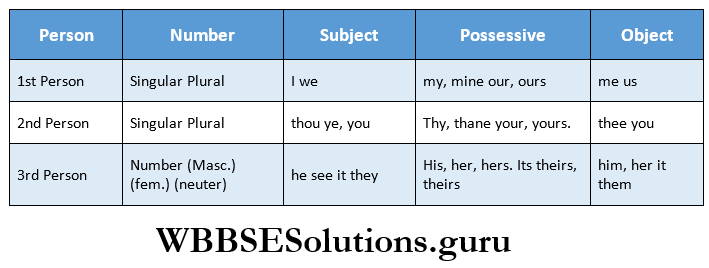
The form of Personal Pronouns varies according to their use in the sentence as subjects and objects. To indicate ownership or some other relationship, they take possessive forms.

WBBSE Solutions For Class 9 English Functional Grammar Chapter 2 Pronouns personal pronouns

Personal Pronouns I, we, she, and he, are all used as subjects in the Nominative:

  • He knows – I know the boy.
  • We shall go- They were present there.

The objective forms me, us, her, him, they are used as direct and indirect objects of verbs or after prepositions

  • I saw her- I gave him a book.
  • He talked with me- Ram spoke to her.
  • We tried for him- Between him and me.

In formal English, when the pronoun comes after the verb to be, the nominative form of the pronoun is the grammatically correct usage

  • Who’s there? -It is I.
  • Was it they?- It was they.

In formal conversation, however, the objective form is often used after the verb to be: It’s me.

  • Who’s there? – It’s me
  • Was it them?
  • That’s her.
  • I wouldn’t have done this if I were him.
  • Do you think he did it?
  • I am not sure.
  • It might have been him.
  • (In formal English “It might have been he” is preferred).

But the nominative form must be used when the pronoun acts as the subject of a verb and is followed by a clause

  • It was he (not him) who helped me.
  • It was I (not me) who arranged the meeting.

When a pronoun is put with some other word in the objective case, the pronoun must also be in the objective case

  • The boy is known to him and me (not I).
  • I brought this for you and him (not him).
  • The book may be given to Ram or me (not I).
  • You abused both him and me (not I).

The case of the pronoun following than and as has to be determined by mentally supplying the verb.

  • He is more intelligent than I (am).
  • He is taller than I (am).
  • He knows you more than (he knows) me.
  • He is not so strong as you (are).
  • He loves you as much as (he loves) me.
  • I don’t have more money than he (has).

In colloquial style, however, the objective form is often used in place of nominative after the verb to be followed by an adjective:

  • He is more intelligent than me (= than I am).
  • He is taller than me (= than I am).
  • You are cleverer than him (= than he is).
  • He is richer than us (= than we are).
  • He is several years older than me (= than I am).

With transitive verbs, the choice of the subject and object forms depends upon the sense of the complete sentence case

  • I know you better than he (does) (= he knows you).
  • I know you better than him (= I know him).
  • You like her as much as I (= as I like her).
  • You like her as much as me (= as you like me).
  • He helped you as well as I (= as well as I helped you).
  • He helped you as well as me (= as well as he helped me).

‘Between’ is a preposition and any pronoun that follows it must be in the objective

  • Between you and me
  • Between her and she
  • Between him and me
  • Between Ajoy and me
  • Between you and him

‘But’ when used as a preposition is followed by a pronoun in the objective case:

  • Nobody was present there but me (not I).
  • None but him (not, he) passed the test.

‘Let’ is followed by a pronoun in the objective case:

  • Let us go.
  • Let him and me do the job.

It will be seen that the Possessive Case of most Personal Pronouns has two forms. Of these:

My, they, her, its, our, your, and there are called Possessive Adjectives, because like adjectives, they are used before nouns: my book, your name, it’s color.

Mine, yours, hers, ours, theirs are called Possessive Pronouns, because they are now used without the noun and instead of the noun to which they refer:

  • Whose coat is this? It is mine (= my coat).
  • His is used both independently and before a noun:
  • This book is his. Or, This is his book.
  • Mine, thine, hers, ours, yours, theirs are used

When the noun is understood:

  • “Whose book is this? It is mine”. “This is my pen; where is yours?”
  • When a verb comes between the noun and pronoun:
  • This book is mine. This house is theirs.
  • When the pronoun is preceded by of:
  • This book of mine is cheap.

Caution: The possessive forms hers, ours, yours, its, theirs, etc. should never be written with the apostrophe. Thus, it is wrong to write her’s, it’s, your’s or yours’, their’s or theirs’, etc.

It should not be confounded with it which means it is or it has.

( hers, ours, yours, its, theirs প্রভৃতি possessive pronoun লিখতে “s”-এর পূর্বে কোনোও apostrophe দেবে না। চিঠিতে কখনও your’s faithfully লিখবে না।)

The Gender and Number of Personal Pronouns:

The pronoun must be of the same gender and number as the noun for which it stands; but when the sex is uncertain, or not clearly stated, we commonly use the neuter pronoun it.

(Pronoun—এর Number ও Gender সেটা যে noun-এর পরিবর্তে বসেছে সেই অনুযায়ী হয়। Noun-টি স্ত্রী বা পুরুষ বোঝা না গেলে আমরা সাধারণতঃ তার পরিবর্তে it ব্যবহার করি। )

  • The boy (or boys) has (or have) done his (or their) work.
  • The girl (or girls) has (or have) done her (or their) work.
  • It is a healthy baby.

But when the neuter form is not allowable, we sometimes use two pronouns, one masculine and the other feminine.

  • Every member can express his or her views.
  • Every boy or girl may do as he or she likes.

Chapter 2 Pronouns Exercise

Question 1. Point out the Personal Pronouns and the person and number of each. One is done for you. He told me to follow him.
Answer: me – First person singular number, him – Third person singular number.

  • I have lost the book you gave me.
  • I have sent your brother to him.
  • They are angry with me.
  • It is a pleasure to talk with him.
  • We will follow you.
  • He told them that they should mind their business.
  • We should do what you tell us to do.
  • It was these books that I wanted.
  • This pen is his, where is mine?

Chapter 2 Pronouns Demonstrative Pronouns

The words this, that, these, those, such, so, and one when used alone are Demonstrative Pronouns; when used with nouns, they are Adjectives. So cannot be used as an adjective.

  • This (or that) is my house.
  • What I mean is this.
  • Such (what was suggested) was not my object.

These are called Demonstrative Pronouns as they point out some objects to which they refer.

This (these) refers to something that is near to the speaker in position, time, or thought; That (those) denotes something being more distant: This house is ours, not that.

The uses of this and that as Pronouns:-

When two nouns have been mentioned before, this refers to the latter, and that to the former (পরের জিনিষটি বোঝাতে this এবং আগের জিনিষটি বোঝাতে that ব্যবহৃত হয়।) :

Work and play are both necessary; this (= play) gives us rest, and that (= work) gives energy.

Dogs are more faithful than cats: these (= cats) attach themselves to places, and those (= dogs) to persons.

They are often used for preceding nouns or clauses:

  • His book is better than that (= book) of Jadu.
  • I have read Latin, and that (I have read Latin) at Oxford.
  • He went there, and this (= the fact that he went there) proves his courage.

Chapter 2 Pronouns Reflexive And Emphatic Pronouns

Reflexive and Emphatic Pronouns are formed by adding –self to my, your, him, her, it, and -selves to our, you’re, and them:

  • Myself -Ourselves
  • Yourself -Yourselves
  • Himself -Themselves
  • Herself
  • Itself.

Though the same in form they are different in use:

They are Reflexive when the doer is both the subject and the object of the action expressed by the verb ( subject এবং object একইজনকে বোঝায় )

  • I hurt myself – He looked at himself in the mirror.
  • He lost himself – Can you see yourselves in the mirror?
  • They cursed themselves.

(myself, himself, themselves, yourselves object 4 subject object একই লোককে বোঝাচ্ছে। )

They are Emphatic when used with nouns or pronouns for the sake of emphasis (জোর দিবার জন্য ব্যবহৃত হয়)

  • I myself did the work.
  • I saw the man himself.
  • You yourself can do the job.
  • They themselves confessed their guilt.
  • The town itself is very large.

(এখানে myself, himself, yourself, themselves, itself ইত্যাদি word গুলি জোর দেবার জন্য ব্যবহৃত হয়েছে।)

“I myself saw the man” and “I saw the man himself” are more emphatic than “I saw the man”.

Emphatic Pronouns can never stand alone as subjects. (Emphatic Pronouns subject রূপে একা বসতে পারে না । )

Hence it is incorrect to write: “His brother and myself were present”. “I will do it”. But we can write,

  • His brother and I myself went there.
  • I myself will do it.

An Emphatic Pronoun may refer to a person who is not the doer of the action e.g., I saw the minister himself, whereas a Reflexive Pronoun invariably denotes a person who is the doer as well as the person affected by the action, e.g.,

  • The boy hid himself inside the bush (object of a verb).
  • Sumona looked at herself in the mirror (object of a preposition).
  • He thinks little of himself (object of a preposition).

Chapter 2 Pronouns Distributive Pronouns

Each, either, and neither are called Distributive Pronouns because they separate one person or thing from a group.

(Each, either 3 neither লোক বা বস্তু থেকে পৃথকভাবে বোঝায় বলে তাদেরকে Distributive Pronoun বলে।)

  • I gave a book to each of the boys.
  • Either of them may go.
  • Neither of them was present.

Either and neither are always used by two persons or things.

  • Either means one or the other of the two.
  • Neither means ‘none of the two’.
  • Each is used of any number, say two or fifty: Each of the two or ten boys was fined.
  • Distributive Pronouns take singular pronouns and verbs:
    • Neither of them is ill.
    • Each of the girls has done her work.

Chapter 2 Pronouns Reciprocal Pronouns

Each, other, and one another are called Reciprocal Pronouns (Reciprocal = পারস্পরিক).

Each other is generally used when two are referred to, one another when more than two are referred to. ( দুয়ের মধ্যে পরস্পরকে বোঝাতে each other. এবং দুয়ের বেশীর মধ্যে পরস্পরকে বোঝাতে one another ব্যবহৃত হয়।)

  • Dutta and Sharma struck each other.
  • The boys fought with one another.

আজকাল অবশ্য দুয়ের মধ্যেও পরস্পরকে বোঝাতে one another ব্যবহৃত হয়।

  • Relative Pronouns
  • Look at the following sentences:
  • He is a boy. He stood first in the examination.
  • This is a house. My father built it last year.

Now see how these sentences have been joined by using the words who and which:

  • He is the boy who stood first in the examination.
  • This is the house which was built by my father last year.

Who and which here refer to “boy” and “house” respectively and they are used to connect the sentences. Who and which here are Relative Pronouns.

(উপরের sentence গুলিতে who এবং which যথাক্রমে boy এবং house-এর পরিবর্তে বসে sentence গুলিকে যুক্ত করেছে। এইক্ষেত্রে who এবং which Relative Pronoun)

A Relative Pronoun is a word that not only refers to some Noun or pronoun mentioned before but also joins two sentences or parts thereof.

The principal Relative Pronouns are who, which, that, and what. As and but are also used as Relative Pronouns.

The word to which the Relative Pronoun refers is called the Antecedent. (Relative Pronoun যার পরিবর্তে বসে তাকে Antecedent বলে।)

  • The book which you gave me is lost.
  • I want the boy who came to see me.

In the first sentence, the book is the antecedent of which. In the second sentence, the boy is the antecedent of who.

Uses of Relative Pronouns:

Declension: Who and which are declined as follows: that is not declined.

Singular and Plural – Singular and Plural

  • Nom. – Who – Which
  • Poss – Whose – of which (also rarely, ‘whose’) Which
  • Obj – Whom – Which

The uses of who (subject) and whom (object) are very often confused.

Carefully note their usage:

  • The man who (not whom) came here was my uncle.
  • I know Mr. Sarkar who (not whom) is a big businessman.
  • He is a person whom (not who) you can trust.
  • He is a person who (not whom) is quite trustworthy.
  • Who (not whom) do you think has done it?
  • Please tell me whom (also, who) I should speak to.
  • These are the boys whom (not who) I saw there.
  • These are the boys who (not whom) were present there.

Uses of ‘who’ and ‘which’:

Restrictive- Who and which have a restrictive force when they limit or define the meaning of an antecedent?

  • This is the boy who did it.
  • This is the book which I bought.

Continuative, Co-ordinate, or Conjunctive – Who and which have sometimes a continuative force and are used only to make some additional statement about the antecedent.

They may then be replaced by a conjunction and a pronoun:

  • You must obey your parents, which (= and) will win you the love of others.
  • I saw your father, who (= and he) recognized me.

No ‘comma’ is generally placed before the Relative Pronoun when it is used in the restrictive sense; but when it is used in a continuative sense, it generally takes a comma before it.

That is always used in a restrictive sense. It is used instead of “who” and “which”: After adjectives in the superlative degree:

He is the best man that I ever saw.

After some, any, all, only, one, etc. that require a defining clause after them: Is this the same that (also, as) you showed me before?

  • All that I want is this.
  • He is the only boy that did it.
  • Answer any that you can.

After the Interrogatives who and what:

  • Who is the boy that did it?
  • What is it that you want?

After two antecedents, one requiring who and the other which:

  • Many are the men and countries that I saw.

As is a Relative Pronoun when it comes after the same, such, as much, as many, and is applied to both persons and things:

  • This is the same book as that. Only such boys as have passed need apply.
  • I gave him as much (or as many men) as he required.

The same is also followed by that:

  • This is the same book that I lost.

But is used as a Relative Pronoun when it means not (=). It has a negative sense and is used after a negative word.

  • There is no man but (who not) wishes to be happy.

Relative Pronouns agree in number, gender, and person with their antecedents:

  • I who am your master say so.
  • You are the person (or persons) who is (or are) guilty.
  • This is the lady who lost her ring.
  • It is useless to me who am ill.

Omission of a Relative Pronoun: The Relative Pronoun is often omitted when it is the object of a verb or of a preposition:

  • He is the man (whom) I saw.
  • The book (which or that) I bought is lost.
  • I can remember the day (on which) he came.

A noun or pronoun in the Possessive Case should not be used as the antecedent to a Relative Pronoun. (Possessive case- noun pronoun Relative Pronoun-4 antecedent ).

Thus, instead of writing, “I went to the man’s house who is my friend”, we should write, “I went to the house of the man who is my friend.”

Chapter 2 Pronouns Interrogative Pronouns

Interrogative Pronouns who, which, what, whose, and whom, ask questions:

  • Who are you?
  • Whom do you want?
  • What do you want?
  • Which is the house?
  • Whose book is this?

They are also used to ask indirect questions:

  • Tell me what you want.
  • I asked who he was.

The difference in use:

  • Who is applied to persons (f), and is indefinite: Who goes there (i.e., the person is not known)?
  • Which is applied to both persons and things (3), and refers to one out of a group : (একটি group-এর মধ্য হতে কোনো একটি বা কয়েকটি নির্দেশ করে।): Which of these do you want?
  • What is applied to things, and a person’s profession: What do you want? What is he ?-He is a doctor.

Note carefully the following distinctions:

Who is he? -enquires about the name or parentage of the person.

The answer should be of the form – He is Sri Ramesh Chandra Bose; or, He is Ramesh, my son; or, He is Ramesh, of whom I spoke to you.

What is he? – enquires about the profession or social status answer should be of the form – He is a merchant or a teacher.

Which is he?– The wants him to be pointed out from a definite group (সম্মুখে উপস্থিত দলের ?).

The answer should be of the form – He is the man on the extreme right, or with a red shirt on, etc.

The Interrogative is often used in exclamation in the sense of ‘how great’: What folly! What a clever boy are you!

Chapter 2 Pronouns Indefinite Pronouns

Indefinite Pronouns do not point out any particular person or thing like the Demonstrative but refer to persons in a general manner (কোনো ব্যক্তি বা বস্তুকে না বুঝাইয়া They are any, one, some, other, another, many, all, they, none, few.

Look at the following sentences:

  • One should take care of one’s health. Some of the boys were present there.
  • They say a war will break out.
  • None can do it.
  • I know a few of them.

Any, as a Pronoun, is used only in interrogative and negative sentences.

It may be both singular and plural and may refer to both persons and things.

Have you seen any man (or men), or dog (or dogs) there? No, I have not seen

I want a few chairs; can you give me any?

Some, as a Pronoun, is plural and may be used for both persons and things: Some say, he will come.

He has many books; some are new, some old.

One-As an Indefinite Personal Pronoun, one is always followed by one, one’s, and one (in the nominative, possessive, and objective), and not by he, his, and him.

Thus:

One must do one’s duty. One does not know when one will die.

When every or no stands before one, use he, his, or him after it. Everyone did his duty. No one knows when he will die.


WBBSE Solutions For Class 9 English Functional Grammar Chapter 1 Sentences Phrases And Clauses Parts Of Speech And Nouns

Chapter 1 Sentences

A sentence is a word or a group of words giving a complete sense. (যে শব্দ বা শব্দসমষ্টি একটি পূর্ণ অর্থ প্রকাশ করে তাকে sentence বা বাক্য বলা হয়।)

In the following examples, the groups of words on the left are not, because they do not make complete sense; but those on the right do so, and hence, they are

  • Did it – I did it.
  • Can do – I can do it.
  • In the garden – he is walking in the garden.
  • A good boy – he is a good boy.

In writing, the beginning and end of a sentence are indicated respectively by a capital letter and by a full stop, or a note of exclamation or interrogation.

A sentence may consist of one or more words. The one-word is, as a rule, intelligible only in connection with a particular situation. As:

  • In exclamations-good! What!
  • In imperatives-wait. Stop.

Assertive: these make simple statements (কোনো কিছু সাধারণভাবে ব্যক্ত করা হয়). As :

  • I know him.
  • He reads in class vii.
  • The boys love to play.

Interrogative: these ask questions (প্রশ্ন জিজ্ঞাসা করাহয়). As :

  • Why is he here?
  • What are you doing?
  • Will he come?

Read And Learn More WBBSE Class 9 English Functional Grammar

Imperative: these express commands, requests, etc. (এইসব বাক্যে কোনো আদেশ, উপদেশ, অনুরোধ ইত্যাদি বোঝায়). As :

  • Go away from here.
  • Don’t do this.
  • Please tell me your name.

Optative: these express wishes, prayers, etc. (কোনো ইচ্ছা, প্রার্থনা, আশীর্বাদ প্রভৃতি প্রকাশ করে). As :

  • God bless you.
  • May he live long.
  • Heaven help us.
WBBSE Solutions For Class 9 Fundamentals Of HistoryWBBSE Class 9 English Functional Grammar
WBBSE Class 9 Fundamentals Of History Long Answer QuestionsWBBSE Class 9 English Reading Skill
WBBSE Class 9 Fundamentals Of History Short Answer QuestionsWBBSE Class 9 English Writing Skill
WBBSE Class 9 Fundamentals Of History Very Short Answer QuestionsWBBSE Class 9 Maths Multiple Choice Questions
WBBSE Class 9 Fundamentals Of History Multiple Choice QuestionsWBBSE Solutions For Class 9 Maths
WBBSE Notes For Class 9 Geography and Environment


Exclamatory: these express sudden feelings or emotions (এইসব বাক্য দুঃখ, আনন্দ বা মনের কোনো আকস্মিক আবেগ প্রকাশ করে). As :

  • How nice!
  • Alas! He is no more.
  • What a fool you are!

May be further subdivided into two- (1) affirmative (-) and (2) negative (-).

WBBSE Solutions For Class 9 English Functional Grammar Chapter 1 Sentences Phrases And Clauses Parts Of Speech And Nouns

Affirmative are those that affirm something:

  • I know him.
  • He reads in class vii.
  • Go away from here.
  • May he live long?
  • How nice!

Negative are those that negate or deny something:

  • I do not know him.
  • He does not read in class vii.
  • Do not go away from here.
  • May he not suffer.
  • Alas! He is no more.

Some make a different division. They classify Sentences as follows:

Statements which simply affirm or deny something (হ্যাঁ বা না-সূচক সাধারণ বক্তব্য বোঝায়):

  • I know him.
  • He has not come today.

Questions which ask questions:

  • Why is he here?
  • Why did you not come yesterday?

Desires which contain some desire, order, or request (, ), etc:

  • May he live long?
  • Do not go there.
  • Please come here.

Exclamations which express a sudden feeling or emotion (প্রকাশ করা হয়) :

  • How nice!
  • Alas! I am undone.
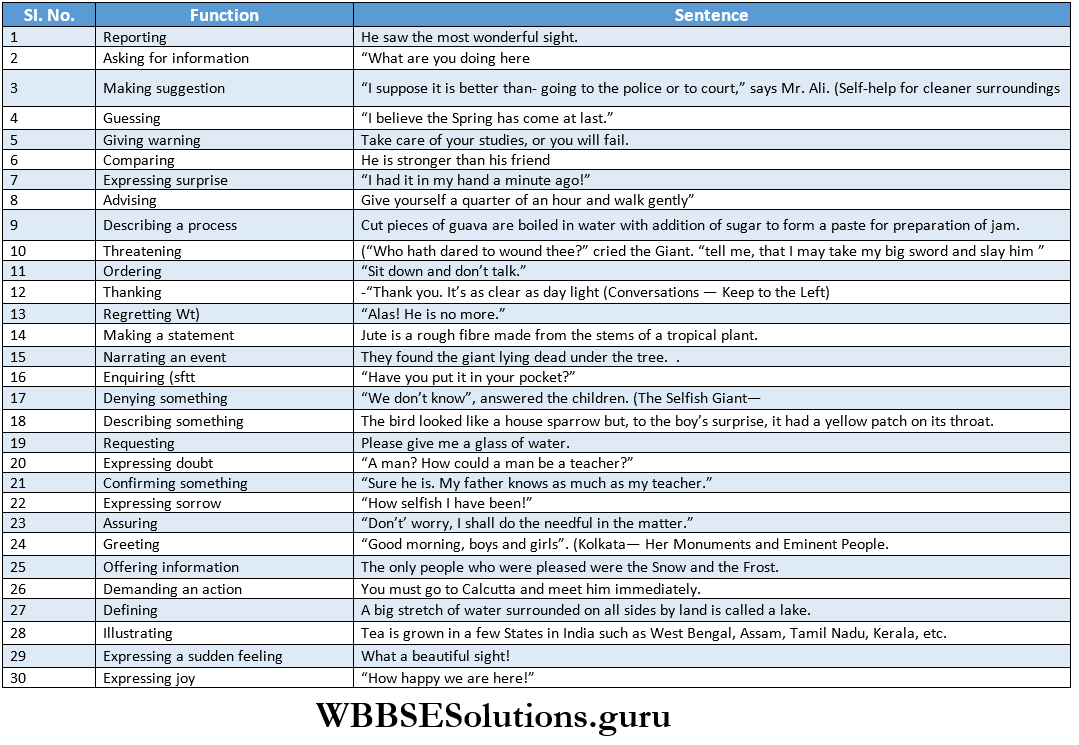
  • And language functions
  • Convey different messages depending on their functions.

Functions may be broadly listed as:

(বিভিন্ন sentence-এর মাধ্যমে বিভিন্ন প্রকারের বক্তব্য প্রকাশিত হয়। sentence-এর এই বক্তব্যের রূপনানা রকমের হয়। )

  • Reporting
  • Asking for
  • Ordering
  • Thanking
  • Confirming
  • Something
  • Expressing
  • Sorrow information
  • Making suggestion
  • Guessing
  • Giving warning
  • Comparing
  • Regretting
  • Making statement
  • Assuring
  • Narrating an event
  • Greeting
  • Enquiring
  • Denying something
  • Expressing surprise
  • Describing
  • Advising
  • Describing a process
  • Requesting
  • Threatening something
  • Expressing doubt
  • Offering information
  • Demanding an action
  • Defining
  • Illustration
  • Expressing a sudden feeling, etc.
  • Expressing joy

Look at the following and their functions:

WBBSE Solutions For Class 9 English Functional Grammar Chapter 1 Sentences Phrases And Clauses Parts Of Speech And Nouns Functions and sentences

Chapter 1 Sentences The Subject And The Predicate

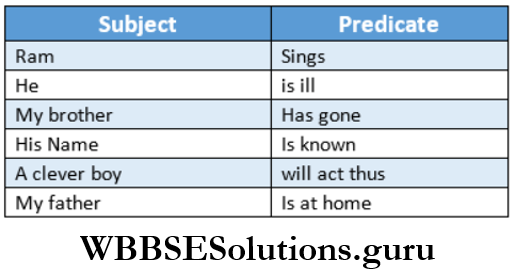
Every sentence can be divided into two parts, the subject and the predicate:

WBBSE Solutions For Class 9 English Functional Grammar Chapter 1 Sentences Phrases And Clauses Parts Of Speech And Nouns the subject of peridicate

The subject must be a noun or noun-equivalent and is found as an answer to the question what? Or who? Asked before the main verb.

Look at the following:

  • Noun: ramen went there. (Who went there ?)
  • Pronoun: she is a good girl. (Who is a good girl?)
  • Gerund: walking is good exercise. (What is a good exercise ?)
  • Infinite to. Tell a lie is a sin. (What is a sin ?)
  • Noun clause: why he did this is a puzzle. (What is a puzzle ?)

The subject usually comes at the beginning, but it may come in the middle or at the end of a sentence. Note the following :

  • He reads in class 8.
  • Though poor, he is honest.
  • For a long time, they whispered.
  • The best boy amongst them was Sandip.
  • The subject is often understood in some, especially in imperative ones.
  • Thus, go there = go you there. Sit down = sit you down. In analyzing such, the subject has to be supplied.

Chapter 1 Phrases And Clauses Phrases

  • He came to see me.
  • This is a chain of gold.

In the above, the groups of words written in italics do not make complete sense.

They do not have any subject or predicate and do not contain any finite verb, expressed or understood, but are used as single parts of speech.

In the first sentence the words ” to see me” act as an adverb to “came”; in the second sentence the words, “of gold” qualify the noun “chain” and thus act as an adjective; in the third sentence the words “on the table” are adverb qualifying “put”.

These groups of words are called phrases.

A phrase is a group of words that does not make complete sense, and does not contain a finite verb, expressed or understood, but is used as a single part of speech.

(যে শব্দ সমষ্টির নিজের কোনো finite verb নেই, এবং যারা পূর্ণ অর্থ প্রকাশ করে না, শুধু একটি single part of speech-এর মতো ব্যবহৃত হয়, তাকে phrase বলে।) agle part.

Phrases are of six kinds:

Noun phrase: It does the work of a noun.

  • He likes to play.
  • Walking is a good exercise.

In the first sentence, the phrase “to play” is the object of the verb “likes”. In the second sentence, the phrase “to walk” is the subject of the verb “is”. The groups of words here thus do the work of a noun and hence they are noun phrases.

Adjective phrase: It does the work of an adjective.

  • Hiren is a man of wealth.
  • The boys in the class stood up.
  • The book on the table is mine.

The phrase “of wealth” tells us what sort of man ‘Hiren’ is. It qualifies the noun ‘man’ just as an adjective does. It, therefore, does the work of an adjective. Similarly, the phrases “in the class”, and “on the table” are adjectives of ‘boys’ and ‘book’ respectively.

Adverbial phrase: it does the work of an adverb.

  • He came to see me.
  • He worked with care.
  • He fell from the tree.

The italicized phrase “to see me” tells us why ‘he’ came. It, therefore, does the work of an adverb and is an-adverbial phrase. Similarly “with care” and “from the tree” are adverbs qualifying “worked” and “fell” respectively.

Prepositional phrase: it does the work of a preposition.

  • He stood in front of me.
  • He could not come on account of illness.
  • The italicized phrases are prepositions for the objective cases “me” and “illness”.

Conjunctional phrase: it does the work of conjunction.

  • Come as soon as you can.
  • We went there in order that we might see him.
  • The phrase “as soon as” joins the two clauses “come” and “you can”.

The phrases “in order that” joins the two clauses, “we went there” and “we might see him.” They are all conjunctional phrases. Interjectional phrase-does the work of an interjection: what a pity! By Jove! Good heavens!

Chapter 1 Phrases And Clauses Clauses

  • I know that he is ill.
  • The boy who did it is my brother.
  • I went after he had gone.

The groups of words in italics in the above contain subjects (he, who, he respectively) and predicates (is ill, did it, had gone respectively) of their own, but form parts of bigger ., Such groups of words are called clauses.

A clause is a group of words having a subject and a predicate of its own, but forming part of a bigger sentence. (যে শব্দ সমষ্টি এক একটি sentence গঠন করে কারণ এতে subject ও predicate আছে, কিন্তু সেটি বৃহত্তর একটি sentence-এর অংশ মাত্র। )

Chapter 1 Parts Of Speech

Words are generally divided into eight classes or parts of speech according to the work they do in a sentence:

A noun is a word that names any person or thing:

(কোনো ব্যক্তি বা বস্তু বা বিষয়ের নামকে noun বলে।) man, book, gold, india, country, sweetness, honesty, air.

An adjective is a word which adds something to the meaning of a noun: ( যে word দ্বারা noun-এর কোনো গুণ, দোষ, অবস্থা, সংখ্যা, পরিমাণ ইত্যাদি বোঝায় তাকে adjective বলে। )

  • He is a good boy.
  • This is a dark room.
  • Give me a little milk.
  • Many men were present.

A pronoun is a word used for a noun or a clause:

(Noun বা clause-এর পরিবর্তে যে word বসে তাকে pronoun বলে।)

  • Ram is not here; he is ill.
  • He failed, which broke his heart.

A verb is a word used to express action, a state of being, or having something. ( যে word কোনো ব্যক্তি বা বস্তুর কোনো কিছু করা, হওয়া কিংবা থাকা বোঝায় তাকে verb বলে।)

  • he walks.
  • I go.
  • The sun shines.
  • The rose smells sweet.
  • He is tall.
  • I have a car.

An adverb is a word that generally adds something to the meaning of a verb, an adjective, or another adverb:

( যে word কোনো verb, adjective বা অন্য কোনো adverb-এর সম্বন্ধে কিছু বলে কিংবা তাদের অর্থ সীমাবদ্ধ করে তাকে adverb বলে। )

  • He walks fast.
  • He is very clever.
  • He did it quite easily.

A preposition is a word placed before a noun or a pronoun to show its relation to ‘some other word in the sentence:

(যে word noun বা pronoun-এর পূর্বে বসে sentence-এর অন্য কোনো word-এর সাথে এই noun বা pronoun- এর সম্বন্ধ বুঝিয়ে দেয় তাকে preposition বলে।)

  • The book is on the table.
  • He came to me.
  • She is in the garden.

A conjunction is a word that joins words or phrases or clauses:

(যে word অন্য words বা phrases বা clauses কে যুক্ত করে তাকে conjunction বলে।) he said this to Ram and Shyam.

  • He sat behind you but in front of me.
  • As he was ill, he did not go to school.

An interjection is a word which expresses some sudden feeling or emotion: (যে word মনের আকস্মিক উচ্ছাস বা ভাব প্রকাশ করে তাকে interjection বলে।)

Alas! Hello! Bravo!

Chapter 1 Nouns Classification

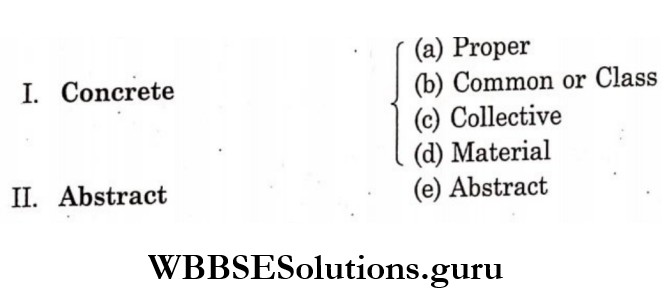
Nouns are of five different kinds:


WBBSE Solutions For Class 9 English Functional Grammar Chapter 1 Sentences Phrases And Clauses Parts Of Speech And Nouns classification

A concrete noun is the name of an object of sense, that is, an object which can be seen, touched, heard, smelt or tasted. ( যা দেখা যায়, স্পর্শ করা যায়, শোনা যায়, খাওয়া যায় অর্থাৎ যা ইন্দ্রিয়গ্রাহ্য তাইই concrete noun.)

Boy, dog, song, flower, milk.

An abstract noun is the name of a quality, action, or state belonging to an object. (যে noun দ্বারা কোনো মানুষ বা জিনিষের গুণ, অবস্থা, প্রকৃতি প্রভৃতি বোঝায়—মানুষ বা জিনিষকে বোঝায় না, তাকে abstract noun বলে।)

Softness, smile, wealth, silence.

A proper noun is the name of one particular person, place, thing, or event (or group of persons or places) as distinct from every other.

(Proper noun দ্বারা একটি নির্দিষ্ট প্রাণী, জায়গা, বস্তু বা ঘটনার নিজস্ব নাম বোঝায়।

  • Ramesh -the ganga
  • Kolkata -the himalayas
  • The french revolution- the ramayana
  • the hindus

A common or class noun denotes no one person or thing in particular but is common to any and every person or thing of the same kind.

[Common noun দ্বারা এক জাতীয় প্রাণী বা বস্তুর কোনো নির্দিষ্ট একটিকে না বুঝিয়ে তাদের সকলকেই বোঝায় (common = সাধারণ)। ] Man (not any particular man, but any and every man).

Book (not any particular book like the bible, the Vedas, the koran, etc., But any and every book).

River (not any particular river like the Ganga, or the Jamuna, but any and every river). Country (not any particular country, but any and every country) are common nouns.

Difference between a proper noun and common noun (proper no uncommon noun-এর মধ্যে পার্থক্য)

City বলতে আমরা যে কোনো শহরকেই বোঝাই। কিন্তু kolkata বলতে আমরা কেবলমাত্র kolkata city-কেই বোঝাই। এই ক্ষেত্রে city—common noun; কিন্তু kolkata —

Proper noun : এইরূপ :—

Proper – Common

  • The ganga- river
  • The gita- book
  • India -country
  • Indian ocean-ocean
  • Monday -day
  • B.t. Road- road

There are a few nouns, generally classed as common, which are sometimes called singular nouns because there is only one of each of them known to us

Earth, sun, moon, etc.

When god and lord refer to the almighty, they are proper; but when they refer to the different gods of mythology and temporal lords, they are common.

A collective noun is the name of a group or collection of persons or things taken as a whole.

(যে word দ্বারা একই প্রকারের অনেকগুলি প্রাণী বা জিনিষের সমষ্টি বোঝায়, স্বতন্ত্রভাবে তাদেরকে বোঝায় না তাকে collective noun বলে।)

Thus, in “a flock of sheep” “sheep” is a common noun, because it stands for any and every sheep; but flock is a collective noun, because it stands for all the sheep referred to, taken together, and not any one sheep taken separately. Similarly, in “an army of soldiers”, and “a crowd of people”, army and crowd are collective nouns, as they stand respectively for all the soldiers and people referred to, taken together.

(“Flock of sheep” এই বাক্যাংশে “sheep” কথাটি common noun, কারণ সেটি ভেড়ার সাধারণ নাম ; কিন্তু flock কথাটি collective noun, কারণ তা কতকগুলি ভেড়ার সমষ্টিকে বোঝাচ্ছে। এইরূপ, “crowd of men”, “army of soldiers” crowd army collective nouns, men and soldiers-এর সমষ্টিকে বোঝাচ্ছে।)

A collective noun takes a singular verb when the things and persons are taken collectively, and a plural when they are taken separately.

(Verbটি singular হয়; সকলকে সমষ্টিভাবে না বুঝিয়ে স্বতন্ত্রভাবে বোঝালে verbটি plural হয়।)

  • The audience is requested to take their seats.
  • The class is large.

But we must be consistent. Thus, we must write :

  • The board has agreed to grant bonuses to its (not, their) employees.
  • The mob does (not, does) not know their mind.

Chapter 1 Nouns A list of collective words

  • An army or regiment of soldiers
  • A band of robbers, musicians
  • A bouquet of flowers
  • A bevy of beauties, women
  • A bundle of rags, sticks, and firewood, lies
  • A bunch of keys, grapes, flowers a brood of chickens
  • A board of directors
  • A chain of events, mountains
  • A class of students, persons
  • A clump of trees.
  • A cloud of locusts
  • A cluster of grapes, islands, stars
  • A consignment of goods
  • A course of lectures
  • A crew of sailors
  • A crowd of people
  • A curriculum of studies
  • A drove of cattle (cattle being driven), sight-seers
  • A fleet of ships
  • A flight of birds or steps
  • A flock of sheep (generally small animals), geese
  • A gang of thieves, robbers
  • A galaxy of stars
  • A group of islands
  • A grove of trees
  • A herd of cattle (generally big animals), deer, elephants
  • A hive of bees
  • A heap or mass of ruins
  • A horde or tribe of Arabs
  • A litter of pups, pigs
  • A pack of hounds, wolves, cards, thieves, liars, lies
  • A pair of shoes
  • A Parliament of Owls
  • A pile of books
  • A pride of Lions
  • A range of mountains
  • A series of events
  • A stack of hay, wood
  • A shoal of fish
  • A shower of rain, arrows
  • A swarm of bees or flies.
  • A suit of clothes

A material noun denotes the matter or substance of which things are made.

It is also called the mass noun. (যে material বা পদার্থ দ্বারা কোনো জিনিষ গঠিত হয় তাকে material noun বলে।)

Thus, the river is a common noun, but water, of which it is made, is a material noun; sheep is a common noun, but mutton, the flesh of a sheep, is a material noun.

Chapter 1 Nouns Countable And Uncountable Nouns

Nouns can also be classified generally as countable and uncountable: countable nouns stand for something that can be counted (যা এক, দুই করে গণনা করা boy, egg, school, man, tree, house, etc.

Only, countable nouns have plural forms and can be used with the indefinite article an) in the singular or many, few, a few, several, etc.

In the plural: (countable singular noun- এর পূর্বে a, an, এবং plural noun-এর পূর্বে many, few, a few, several ইত্যাদি বসে।) a school, a boy, an umbrella, many cows, a few books.

Uncountable nouns stand for something that cannot be counted though they can be measured (যা এক, দুই করে গণনা করা যায় না কিন্তু যা পরিমাপ করা যায়) :

Water, air, glass, wood, sand, etc.

Such nouns have no plural form and are not used with the indefinite article (a/an). (4 কোনো plural form নেই এবং এদের পূর্বে a বা an বসে না।). They are preceded by much, little, etc.

(এদের পূর্বে much, little ইত্যাদি ব্যবহৃত হয়) to denote amount or quantity: much money, little water.

Some of these can, however, be both countable and uncountable according to the context in which they are used, with a change in their meaning.

কোনো কোনো ক্ষেত্রে এরা countable এবং uncountable উভয়ভাবেই ব্যবহৃত হতে পারে। সেক্ষেত্রে তাদের অর্থ ভিন্ন প্রকারের হয়।)

  • Paper =the substance on which we write (uncountable)
  • A paper = a newspaper (countable)
  • Glass = the material (uncountable)
  • A glass = a tumbler (countable)
  • Wood = The table is made of wood. (Material, uncountable)-কাঠ
  • A wood forest the bungalow is in the middle of a wood. (Countable)
  • Copper = metal (uncountable)
  • A copper = coin (countable)

Notice how often we put a piece of, a great deal of, a bit of, etc. Before uncountable nouns when we want to “individualize” them. We also use some when we want to indicate an indefinite quantity.

Note the following examples:

  • A bit of string (এক টুকরো সুতো) -some string (কিছু সুতো )
  • A piece of (bar) soap- some soap
  • A piece of work (কাজের অংশ)-some work
  • A lump of sugar (সামান্য একটু চিনি)-some sugar
  • A piece of advice (সামান্য পরামর্শ)-some advice
  • A flash of lightning (বিদ্যুতের খানিক চমক- some lightning
  • An act of cruelty-some cruelty
  • A piece of news (সংবাদ টুকু)-some news
  • A piece of furniture-some furniture
  • A piece of luggage-some- luggage
  • A piece of music-some music

Chapter 1 Nouns Number

In English, there are two numbers: singular and plural. When one thing is spoken of, the noun is singular, such as a boy, a girl, or a cat. But when more than one thing is spoken of, the noun is plural, such as boys, girls, and cats.

Rules for forming the plural:

Most nouns form their plural by adding s to the singular:

(Singular noun-এর শেষে সাধারণত s যোগ করে plural হয়।)

  • Singular – plural
  • Girl- girls
  • Eye- eyes
  • House- houses
  • Book- books
  • Ant- ants
  • Table- tables
  • Car- cars
  • Chair- chairs
  • Cat- cats
  • Pen- pens
  • Cow- cows
  • King- kings
  • Dog- dogs
  • Tree- trees
  • Bird- birds
  • Pencil- pencils
  • Doll- dolls
  • Leg- legs
  • River- rivers
  • Room- rooms
  • Brother- brothers
  • Lion- lions
  • Sister- sisters

Nouns ending in s, ss, sh, ch (soft), x, and z take es in the plural: (যে সব singular noun-এর শেষে s, ss, sh, x, 2 ও soft ch অর্থাৎ যে ‘ch’ -এর উচ্চারণ ‘চ্’-এর মত থাকে তাদের শেষে es যোগ করে plural হয়।)

  • Singular – plural
  • Gas- gases
  • Box- boxes
  • Fox- foxes
  • Fish- fishes
  • Watch- watches
  • Monarch -monarchs
  • Branch – branches
  • Topaz- topazes

But when ch is pronounced as k, only s is added: ( যদি ch -এর উচ্চারণ ‘ক’-এর মত হয় তবে শুধু s যোগ করে plural হয়।)

  • Singular – plural
  • Monarch – monarchs
  • Stomach -stomachs

Nouns ending in y preceded by a consonant or qu change y into and add es in the plural: (যদি noun-এর শেষে y এবং তার পূর্বে consonant অথবা qu থাকে, তা হলে plural করবার সময় y কে I করে পরে es যোগ করতে হবে।)

  • Singular- plural
  • Lady-ladies
  • City-cities
  • Army-armies
  • Country-countries
  • Copy-copies
  • Body- bodies
  • Soliloquy (off) soliloquies
  • Sky- skies
  • Baby- babies
  • Fly- flies

But if y is preceded by a vowel, add only যদি y– এর পূর্বে vowel থাকে তবে শুধু s যোগ করে plural হয়।) but safe-safes; strife-strifes; thief- thieves.

Some take both forms: staff-staffs (), staves (sticks); wharf (g)—wharves, wharves; scarf (a)- scarfs, scarves.

Nouns ending in ‘o’ preceded by a consonant generally take es in the plural: (যদি noun-এর শেষে ০ থাকে এবং তার পূর্বে consonant থাকে, তবে সাধারণত es যোগ করে plural হয়। )

  • Singular- plural
  • Hero -heroes
  • Mango -mangoes
  • Buffalo- buffaloes
  • Potato- Potatoes
  • Volcano- volcanoes
  • Mosquito- mosquitoes

Exceptions- canto-s, halo-s , piano-s, manifesto-s, photo-s, memento-s, dynamo-s, portico-s.

Nouns ending in ‘o’ preceded by a vowel generally take only s in the plural: (যদি noun-এর শেষে ০ থাকে এবং তার পূর্বে vowel থাকে, তবে সাধারণত s যোগ করে plural হয়।)

  • Singular – plural
  • Bamboo – bamboos
  • Radio -radios
  • Cuckoo- cuckoos
  • Folio- folios

Some nouns form their plural by change of vowels: (কতকগুলি noun-এর word-এর মধ্যেকার vowel-এর পরিবর্তন করে plural করতে হয়।)

  • Singular – plural
  • Man- men
  • Louse (উকুন)- lice
  • Woman- women
  • Mouse- mice
  • Foot- feet
  • Goose (রাজহাঁস)- geese
  • Tooth- teeth

Some nouns adden: (কতকগুলি noun-এর শেষে en যোগ করে plural করা হয়। )

  • Singular – plural
  • Ox – oxen
  • Child – children
  • Brother- brethren (also brothers)
  • Nouns that have no plural forms:
  • (এইসব noun-এর কোনো plural form: নাই, এরা সর্বদাই singular রূপে ব্যবহার হয়।)
  • Alphabet (বর্ণমালা)
  • Expenditure (ব্যয় )
  • Furniture (আসবাবপত্র)
  • Information (সংবাদ, খবর)
  • Luggage (মালপত্র)
  • Offspring (child or children)
  • Poetry
  • Scenery (দৃশ্য)

He has learned the alphabet. He has sold all his furniture or luggage. All his expenditure is shown here. These are my offspring. I got all the information I wanted.

These flowers by the riverside are beautiful scenery. He writes good poetry.

Nouns which have no singular forms: (এইসব noun-এর কোনো singular হয় না, সর্বদাই plural form-এ ব্যবহার হয়। )

  • Jeans (জিন কাপড়ের প্যান্টালুন)
  • Alms (ভিক্ষা)
  • Amends (ক্ষতিপূরণ
  • Annals (ইতিবৃত্ত)
  • Ashes (ছাই)
  • Assets (সম্পত্তি)
  • Auspices (প্রসাদ, আনুকূল্য
  • Bellows (হাপর )
  • Scissors (কাঁচি)
  • Shears (কাস্তে)
  • Shorts (খাটো প্যান্ট)
  • Spectacles (চশমা)
  • Thanks (ধন্যবাদ) )
  • Wages (বেতন)
  • Bowels (অন্ত্র)
  • Eaves (ঘরের ছাঁচ
  • Billiards (একরকম খেলা) proceeds (আয়)
  • Dregs (তলানি)
  • Entrails (নাড়িভুঁড়ি)
  • Fetters (শৃঙ্খল
  • Forceps (চিমটা)
  • Measles (হাম)
  • Mumps (গালফুলা রোগ) nuptials (বিবাহ)
  • Odds (ন্যূনাধিকভাবে তারতম্য) pyjamas (পাজামা)
  • Paints (রং)
  • Tidings (সংবাদ)
  • Tongs (চিম্‌টা)
  • Vitals (জীবনী শক্তি

Nouns which have the same form in both the numbers:

Apparatus, common, corps, deer, innings, means, picé, public, series, sheep, species, swine, and the nouns of number, weight or money such as dozen, score, yoke, stone (weight), hundred weight, when used after a numeral, especially if they join with that numeral to make a compound adjective (as in ‘two-ton lorry’).

The singular meaning is expressed by putting a singular adjective, such as a, an, one, this, that, etc. Before them.

A deer, one sheep, this piece; but, two deer, two-piece.

The words hundred, thousand, lakh (or, lac) million, dozen, score when preceded by a definite numeral (পূর্বে নির্দিষ্ট সংখ্যাবাচক শব্দ থাকলে) or by several or a few are never made plural:

  • I want three hundred (or, one hundred) rupees.
  • Five thousand (not, thousands) men assembled there.
  • He bought one (or two) dozen pencils.
  • Draw a cheque for rupees three lacks (or lac). (Not, lakhs or lacs).
  • A few hundred people collected there.
  • Give me five score eggs.
  • Several hundred (or dozen) eggs were damaged.
  • Three million (not, millions) tons of rice have been imported this year.

But when these words are not preceded by numerals and used ‘merely to convey the idea of a large number or are preceded by some, many (অনির্দিষ্ট সংখ্যাবাচক শব্দ পূর্বে থাকলে), they are made plural

Some dozens, many dozens, hundreds of people, thousands of ants, scores of animals, many thousands, millions of rupees, lacs, and lacs of rupees, etc.

The plural of compound nouns (except nouns ending in full and fall) is generally formed by adding s to the important word; as:

Governors-general (governors-general is also used); passers-by; brothers-in-law; on-lookers; but mouthfuls, handfuls, pitfalls (5), waterfalls (2).

In nouns ending in ‘man’, the plural is formed by changing man into man when a man is used in the sense of a human being; such as Englishmen, nobleman, or workman.

When, however, the final man does not mean a human being, but is a part of the word itself, the plural is formed by adding s only; as germans, Mussalmans, and Brahmans. “Mankind. The singular number, referred to by it and its, not they and their.”- Usage by f.t. Wood.

  • Plurals of letters of the alphabet and of numbers are formed by adding (s): b.a.’S d.d.’ S.
  • Cut your t’s and dot your I’s; 3’s, 5’s, etc.
  • Some add only s in the plural, leaving the apostrophe for the genitive.
  • He hit two 4’s (4s) and two 6’s (6s).
  • Three b.a.’S (b.a.s) and two m.a.’S (m.a..s) were selected.

Plurals of abbreviations:

Single letters are doubled:

  • Pp. For pages, ll. For lines, mss. For manuscripts.
  • Curt forms take s: secs. For sections, etc.

Miscellaneous:

  • Singular- plural
  • Mr- Messrs
  • Mrs madam- mesdames
  • Mrs brown – miss brown
  • The mrs browns – the miss browns the misses brown
  • Madam- ladies
  • Man-servant- master brown
  • The masters brown the master browns- mr brown
  • Messrs Browns- woman-servant lord-justice knight-templar
  • The Mr browns- men-servants
  • Women-servants- lords-justices
  • Knights templars

Foreign plurals:

  • Agendum (বিচাৰ্য- agenda
  • Singular crisis (সঙ্কটাপন্ন)
  • Crises বিষয়) অবস্থা )
  • Appendix – appendices
  • Analysis (বিশ্লেষণ)
  • Radius (ব্যাসার্ধ)
  • Radii- analyses
  • Erratum (শুদ্ধিপত্র)- errata
  • Axis (অক্ষ )- axes
  • Bandit (বোম্বেটে) – banditti (or bandits)
  • Focus (কেন্দ্র) – foci (or focuses)
  • Formula (সূত্র)- formulae
  • Basis (ভিত্তি)- bases
  • Medium (মাধ্যম)- media
  • Memorandum (স্মারকলিপি)- memoranda
  • Hypothesis seraph ( প্রথম শ্রেণির স্বৰ্গ-দূত) – hypotheses
  • Terminus (শেষপ্রান্ত ) – termini (or terminuses)
  • Phenomena- phenomenon
  • Seraphim (or seraphs)
  • Vertex (শীর্ষ) -vertices
  • Oases- oasis (মরুদ্যান)

The tendency of modern English is to reject all foreign forms.

The name of a country, or a thing, though plural in form, is treated as singular; as:

  • The united states of America is a rich country;
  • The folk tales of Bengal is a nice book.

WBBSE Solutions For Class 10 Physical Science And Environment Chapter 1 Concerns About Our Environment

Chapter 1 Concerns About Our Environment Physical Science And Environment

Physical science explains the naturally occurring phenomena in our everyday life. With the advancement of industrialization, at present, the entire environment is under greater threat.

We are to know the reasons for the threats, as well as to be conscious of the remedial measures for sustaining life on the earth.

Wbbse Class 10 Physical Science Notes

Chapter 1 Concerns About Our Environment Structure Of The Atmosphere

The Earth is surrounded by a blanket of air called the atmosphere. It keeps the average temperature of the earth nearly constant.

The earth’s atmosphere extends up to a height of about 1600 kilometers from the surface of the earth.

WBBSE Notes For Class 10 Physical Science And Environment 

The atmosphere is held near the surface of the earth by the force of gravity and it is made up of a mixture of gas molecules like N2, O2, CO2, Ar, O3, water vapors, and dust particles.

The density (mass per unit volume) and also temperature is not the same throughout the atmosphere at all heights.

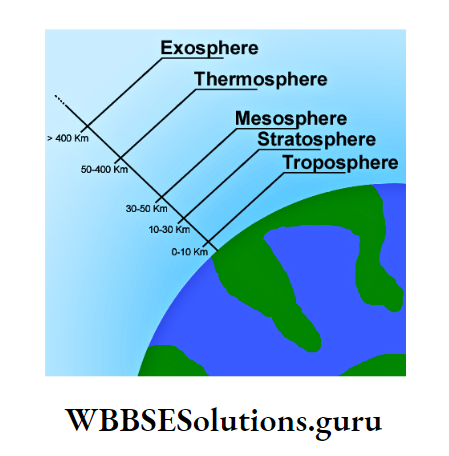
Earth’s atmosphere can be divided into four major layers separated from one another due to changes in air temperature.

WBBSESolutions For Class 10 Chapter 1 Concerns About Our Environment Physical Science And environment Sturcture of the Atmosphere

The layers are:

  1. Troposphere,
  2. Stratosphere,
  3. Mesosphere and
  4. Thermosphere.

Wbbse Class 10 Physical Science Notes

1. Troposphere: This is the layer where we all live in. It extends from the ground roughly 12 kilometers above the earth’s surface. About 80% of the total mass of the atmosphere is contained in this layer.

Almost all dust particles and water vapors are present in this layer, so all the weather phenomena like storms, clouds, rains, air currents, etc occur in this layer.

Components like O2, CO2, and N2 useful for sustaining life are available here.

WBBSE Notes For Class 10 Geography And EnvironmentWBBSE Notes For Class 10 History And Environment
WBBSE Solutions For Class 10 Life ScienceWBBSE Class 10 Life Science Multiple Choice Questions
WBBSE Solutions for Class 10 MathsWBBSE Class 10 Maths Multiple Choice Questions
WBBSE Notes For Class 10 Physical Science And Environment


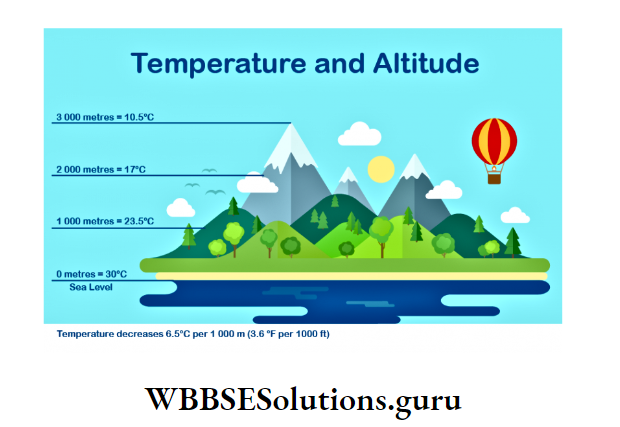
The temperature in the troposphere is constantly changing and it falls with increasing altitude at an average rate of 6-5°C per kilometer of height above the earth’s surface.

The upper limit of the troposphere at which the temperature stops decreasing is called tropopause. The temperature at this level may be as low as – 56°C.

2. Stratosphere: It is the second layer of the atmosphere. Above the tropopause, it extends up to 45 km above the earth’s surface.

The tropopause separates the troposphere from the stratosphere.

There is very little air (N2, O2) but practically no moisture in this layer, so no cloud is formed here and disturbances like storms, and tornadoes do not take place here.

Due to this fact, the layer is calm and quiet. Jet planes fly through this layer as the stratosphere is free from all weather disturbances. Due to a lack of O2, normal breathing is difficult in the upper levels of the stratosphere.

The farther side of the stratosphere is called the ozonosphere and this part contains most of the ozone (O3) gas molecules of the atmosphere.

The O3 molecules absorb most of the harmful UV rays of the sun and protect life on the earth. Thus, the ozonosphere acts as a filter.

The absorption of UV rays warms the stratosphere from – 56°C to 3°C. Here also temperature increases with the rise in altitude.

The end of the stratosphere where the temperature remains almost constant is called stratopause.

O3 molecules keep the upper layer of the stratosphere warm and it contains too little O2. While in the lower part of the stratosphere, no UV light-all is absorbed by O3 molecules in the upper layer.

Wbbse Class 10 Physical Science Notes

WBBSE Solutions For Class 10 Physical Science And Environment Chapter 1 Concerns About Our Environment

3. Mesosphere:  Above the stratosphere, the layer of atmosphere lying between 45-85 kilometers from the earth’s surface, is called the mesosphere.

In this layer, very little quantity of N2, O2, O2, and NO2 is present. In the mesosphere, the temperature drops again with altitude, reaching a minimum of 92°C.

It is the lowest temperature in the atmosphere. Thus, the mesosphere is the coldest layer. Because of the very low temperatures, ice crystals can be formed here.

It protects the earth from being struck by meteors. The upper end of the mesosphere where the temperature remains almost constant is called mesopause.

It acts as the boundary between the mesosphere and the thermosphere.

WBBSESolutions For Class 10 Chapter 1 Concerns About Our Environment Physical Science And environment temperature vs height

4. Thermosphere: The layer of the atmosphere above the mesosphere extending about 85-500 kilometers above the earth’s surface is called the thermosphere.

It is the layer where the air is very very thin. There is nothing protecting this layer from the heat of the sun, that’s why its temperature increases with altitude up to about 1200°C.

Wbbse Class 10 Physical Science Notes

It has two different parts:

  1. ionosphere
  2. Exosphere.

1. ionosphere: The lower part of the thermosphere consists of ions of lighter atoms like NO+, O+, electrons, etc.

Because of the presence of ions, this particular zone becomes highly electrically conducting, making radio communications possible around the world. The northern lights or aurora borealis are seen here.

2. Exosphere: It is the upper portion of the thermosphere, extending somewhere about 500- 1000 kilometers above the earth, having traces of lighter gas molecules like H2, He, etc.

The highest temperature of this layer is about 1200-1700°C. It is colder at night and much hotter during the day. Artificial satellites and space stations operate from this portion.

Beyond the exosphere, there is practically no air. It is almost a vacuum.

Variation of pressure with altitude: Normally, the pressure of the atmosphere is maximum at the lowest layer and it decreases as the height above the earth’s surface increases.

At the ground, the air pressure is about 1.013 atm (where 1 atm = 76 cm of Hg). The variation of pressure with altitude.

E:\Physical science and environment\Ch-1 Images\WBBSESoluttions For Class 10 Chapter 1 Concerns About Our Environment Physical Science And environment fuels.png

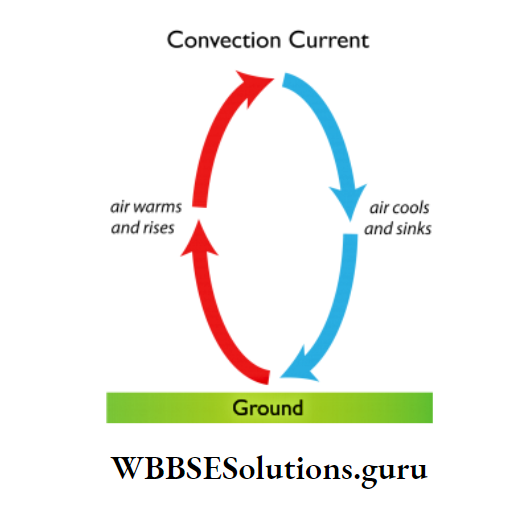
Convection currents and storms: Consider the first 50 kilometers where 99% of the atmosphere exists. Sunlight passes through the atmosphere and warms the ground heating up the air adjacent to the earth’s surface.

It expands and becomes less dense. While the cold air from above sinks, it pushes up the warm air to take the vacant space.

This action sets up the flow of air which is called convection currents. Sea breeze, and land breeze flow due to the convection of air.

In liquids and gases, heat is transmitted by convection as their molecules are quite free to move about.

On the other hand, molecules in a solid, being closely packed, cannot move like molecules of liquids and gases. So, convection currents does not occur in solids.

WBBSESolutions For Class 10 Chapter 1 Concerns About Our Environment Physical Science And environment Convention current.

All kinds of wind are caused due to uneven heating of the earth. When the air moves at a high speed over a surface, it results in decreasing pressure.

Thus, strong winds start blowing from the high-pressure area to the low-pressure area. This difference in air pressure results in the formation of a storm. Higher wind speed creates cyclones/tornados/typhoons/hurricanes.

Chapter 1 Concerns About Our Environment The Ozone Layer

Ozone (O3) is an allotrope of oxygen. Its molecules are made up of 3 oxygen atoms bonded together. The ozone layer in the stratosphere absorbs most of the harmful UV rays coming from the sun and protects life on Earth.

Formation of the ozone layer: Ozone (O3) is formed in the upper part of the stratosphere by a photochemical reaction of O2.

UV-rays of small wavelength 240 nm on being absorbed by O2 molecules in the stratosphere splits into 2 fast

Moving O-atoms. Each O-atom collides with air molecules (N2, O2) around them. This slows down the free O-atoms, and abling them to make bonds with O, molecules. In this way, O3 molecules are formed.

Depletion of the ozone layer: O3 molecules break down again by absorbing UV-radiation of high wavelength 300 nm and O2 is back again.

The density of the ozone layer is measured by the Dobson unit (DU). 1 DU refers to the 0.01 mm thick ozone layer at STP.

In this way, O3 is continuously formed and broken by UV light in the ozone-oxygen cycle. The thinning of the ozone layer in the upper atmosphere is called ozone layer depletion.

The main cause of it is the release of chlorofluorocarbons (CFCs mainly CF2, CI2, and CFCI3) used in refrigeration, air conditioning, fire extinguishers, foam production, and aerosol sprays and also by nitric oxide (NO), nitrogen dioxide (NO2).

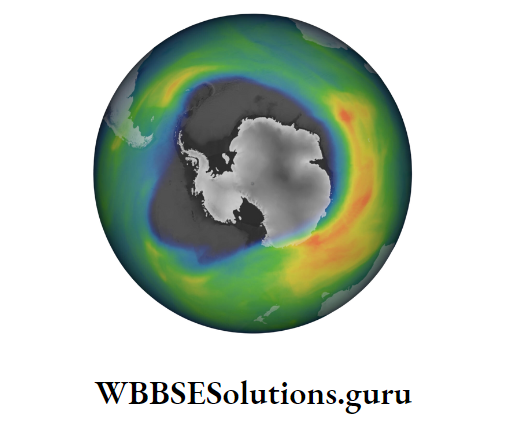
The thickness of the ozone layer is thus reduced. The thinning looks like a hole, called the ozone hole. This was observed by scientists in the 1980s over Antarctica.

In the Montreal Protocol (an international treaty), on 1 January 1989, thirty nations worldwide agreed to reduce the usage of CFCs and encouraged other countries to do so.

WBBSESolutions For Class 10 Chapter 1 Concerns About Our Environment The ozone layer Ozone hole over antarctica.

Role Of Cfcs In The Destruction Of Ozone Layer:

CFCs are comparatively inactive in the lower atmosphere, but highly reactive in the stratosphere.

When CFCs are hit by photons, they break up into ‘free chlorine’ (CI) atoms which grab one of the atoms of the O3 molecule.

As a result, O, molecules are broken down very rapidly (1 Cl-atom can break nearly 1000 no of O3 molecules). This led to the depletion of the ozone layer.

Role Of No, No, In The Destruction Of Ozone Layer:

⇒ \(\mathrm{NO}+\mathrm{O}_3 \rightarrow \mathrm{NO}_2+\mathrm{O}_2 ; \mathrm{O}_2 \stackrel{\text { UV-rays }}{\longrightarrow} \mathrm{O}+\mathrm{O}\)

Sources of NO, NO2 are supersonic jet planes, and nitrogenous fertilizers. Also, NO emitted from transportation oxidizes into NO2. However, NO reacts with O3 molecules in the stratosphere to form O2 and NO2.

The O2 molecules break down to atomic O by absorbing UV radiation. NO2 reacts with atomic O and forms NO back.

So, the amount of NO remains the same. As a result, O molecules get decomposed. In this way, the concentration of ozone in the stratosphere is destroyed.

Effects of ozone depletion on living bodies: 4th Proof User 5 (ASHIS) For humans Direct exposure to UV radiation can lead to serious health problems like sunburn, skin cancer, skin aging, cataracts, weak immune system, etc.

For animals: Skin cancer, eye problems, etc.

For plants, UV rays can affect the photosynthesis process, growth rate, flowering, etc. As a whole, it can destroy the total life cycle.

For marine life: Zooplanktons and phytoplanktons (the base of the food web) are also affected by strong UV rays.

Chapter 1 Concerns About Our Environment Greenhouse Effect And Global Warming

The earth is getting an enormous amount of heat radiation from the sun in the form of UV, visible, and IR rays.

While passing through the earth’s atmosphere, the ozone layer blocks some parts of UV rays. The remaining rays reach the earth’s surface.

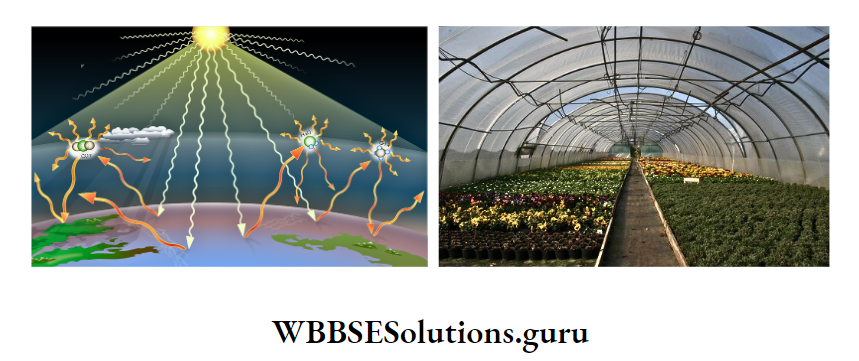
A part is absorbed by the earth and especially long wavelength IR-rays are reflected back. But some gases in the atmosphere, trap the heat radiation and obstruct to escape to space.

This leads to the warming up of the earth’s surface and also the atmosphere. This effect is known as the greenhouse effect.

The increase in the average temperature of the earth due to the greenhouse effect is known as global warming.

The gases involved in warming up the earth are known as greenhouse gases.

Question 1. Why it is called the greenhouse effect?
Answer:

Greenhouse effect

A greenhouse is a glass building in which plants that require protection from cold weather are kept. The glass cover traps all the heat radiation but cannot allow longwave IR rays.

So the inside environment keeps warm. For our planet Earth, the atmosphere acts as the glass cover and traps the heat.

Utility of greenhouse gases: If there were no greenhouse gases to trap the sun’s radiation, the temperature of the earth’s surface would have been -20°C~-30°C. It would have been impossible for the survival of living beings.

Greenhouse gases: The gas molecules of CO2, H2O vapor, CH4, N2O, CFCs, etc. absorb the sun’s IR radiation.

Among these, CO2 is the main greenhouse gas. They trap too much heat and the earth becomes hotter and hotter.

WBBSESolutions For Class 10 Chapter 1 Concerns About Our Environment Green house effect and global warming Causes of green house effect

Remember: N2 and O2 which form most of the atmosphere do not absorb IR radiation. So N2 and O2 are not greenhouse gases.

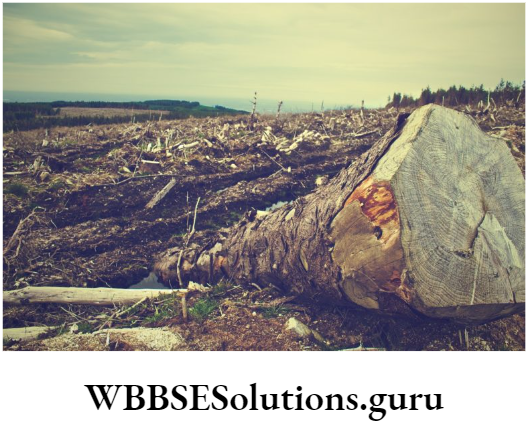
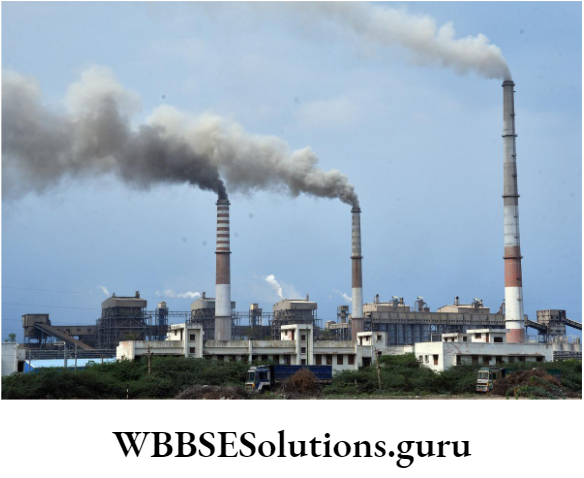
Causes of global warming: Both natural and human activities are responsible for the emission of greenhouse gases such as volcanic eruption, plants, forest fires, deforestation, smoke from vehicles & industries, etc.

Effects of global warming:

With the increase in the earth’s temperature, the glaciers melt faster than they accumulate new snow. As a result, the water level in oceans and seas rises up.

It causes flooding of lowlands, agricultural soil contamination with salt, soil erosion, etc.

From rising water levels more water vapors are evaporated-this leads to the formation of hurricanes/cyclones.

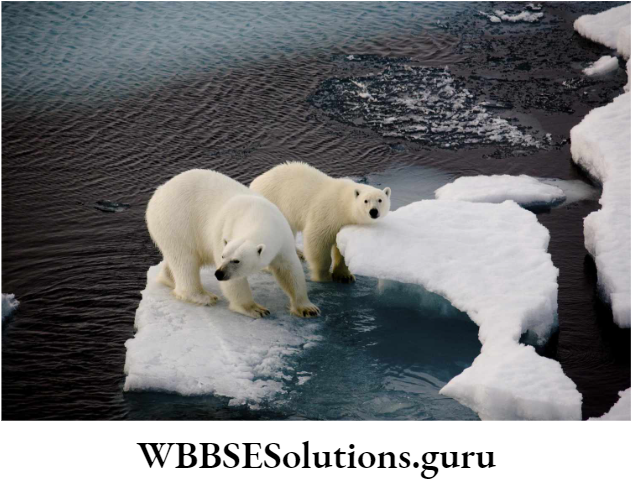
Because of global warming, birds, polar bears, and different insects migrate to move from one area to another.

Global warming helps mosquitoes to grow vigorously in tropical regions, and it causes the spread of diseases like dengue, chikungunya, malaria, etc.

How can we contribute to reducing global warming?:

  1. Planting more and more trees, to decrease the emission of CO2,
  2. Using renewable energies like solar energy, wind energy, hydropower, etc.
  3. Reducing the use of products that generate greenhouse gases.

Chapter 1 Concerns About Our Environment Calorific Value Of Fuels

Fuels are substances that can burn or which can undergo combustion in excess air (oxygen) such as coal, cow-dung cakes, matchstick, petrol, diesel, kerosene, alcohol, LPG (Liquefied Petroleum Gas), CNG (Compressed Natural Gas), etc.

So, fuels can be solid, liquid, or gas. All the fuels produce heat on burning. But, different fuels produce different amounts of heat on burning.

Such a difference in producing heat energy i.e. fuel efficiency is expressed in terms of its calorific value. The quality of fuel depends on its calorific value.

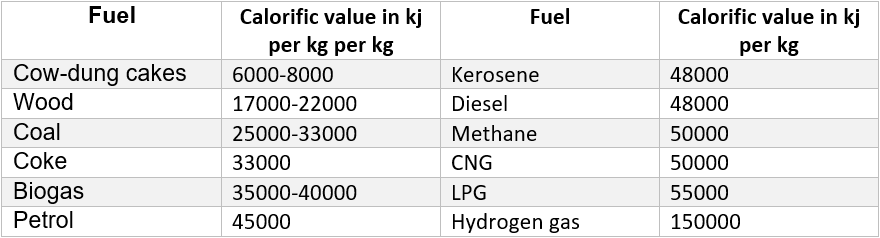
The total amount of heat produced in kilojoule by complete burning or complete combustion of one kilogram (or one gram) of solid or liquid fuel in excess air (O2) is called its calorific value.

It is expressed in the unit of ‘KJ per Kg’ or ‘KJ per g’. In the case of gaseous fuel, it is the total amount of heat produced by the complete combustion of 1 m3 of its volume at STP the calorific value of some common fuels.

WBBSESolutions For Class 10 Chapter 1 Concerns About Our Environment Physical Science And environment fuels

7 Higher calorific value of fuel means that the more heat it produces on burning, the better fuel it is.

The necessity of conservation of fossil fuels: Most of our energy requirements are met by the burning of fossil fuels like coal, petroleum, and natural gas.

Today we use them carelessly, without thinking that fossil fuels are non-renewable sources of energy that do not develop in a day or two but rather will take millions of years to form.

If we continue to burn these fuels at this rate, it leads to an increase in CO2 in the environment. This contributes to greenhouse gases and ultimately global warming.

So, the lesser would be the consumption, the lesser would be the pressure on the next generations.

Concept of sustainable development: Sustainable development refers to the development that will allow our future generations to lead a quality lifestyle same as what is being enjoyed by the current generation by utilizing all natural resources. We can use fossil fuels in fewer amounts only when required.

Harnessing alternate sources of energy for sustainable growth and development: Fossil fuels are non-renewable sources of energy. They are used in almost 90% of areas.

These, on combustion, produce harmful substances like C, CO, oxides of nitrogen (NO), oxides of sulfur (SO), soot, etc. which pollute the air around us.

Their stocks are also very limited. So, misuse of these fuels should be avoided.

Rather, we are looking for alternate or renewable or non-conventional sources of energy such as solar energy, wind energy, tidal energy, geothermal energy, biomass energy-biofuel, biogas, etc.

Solar energy: The Sun is the main source of all energy. The energy obtained from the sun is called solar energy.

WBBSE Solutions For Class 10 Chapter 1 Concerns About Our Environment Calorific value of fuels uses of solar panel.

Today scientists are able to make solar cookers, solar water heaters, and many other devices that work on solar energy.

A single solar cell can produce electricity on a very small scale. The solar cell is used in watches, transistors, calculators, and for domestic purposes in remote village areas. Solar batteries are used in space flight.

To obtain more electricity and more electric power, a large number of solar cells are joined together to form a solar panel.

These are used in artificial satellites, space stations, water pumps, street lighting, traffic signals, etc.

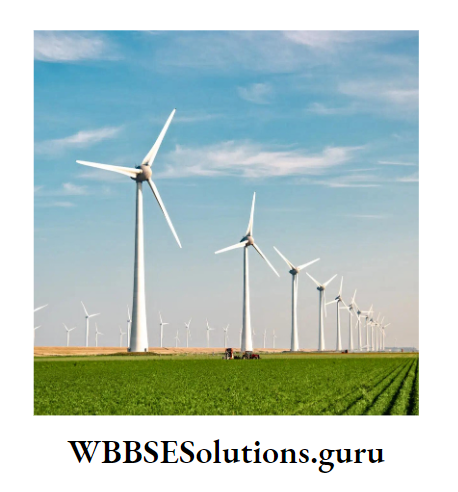
Wind energy: The energy obtained from very fast-moving wind is called wind energy. It is a natural, conventional, renewable source of energy.

It is available in high-wind regions without any cost. It also causes no pollution.

Nowadays high-speed wind energy is used in a wind turbine to generate electricity. The basic principle is here the same as any power plant. Here, the turbine is connected to the windmill.

WBBSESolutions For Class 10 Chapter 1 Concerns About Our Environment Calorific value of fuels wind mill

As wind strikes the blades of the windmill, it starts rotating. Hence, the turbine and the generator start rotating and electricity is generated. Also, windmills are used to grind grains.

The working of a windmill depends on the speed of the wind.

Tidal energy: The energy obtained from rising tides in coastal areas is called tidal energy. It’s a renewable source of energy.

In general, it is not enough to generate electricity on a large scale with tidal energy.

But, it is harnessed for generating electricity by constructing a dam across a comparatively narrower opening to the sea.

Geothermal energy: It is the energy obtained from the heat of the core of the earth. In a few places, rocks under the earth’s surface remain very hot, and the heat turns underground water into steam which is compressed at higher pressure between the rocks.

Drilling holes through pipes into such places, steam is ejected through the pipes, which in turn, rotates the turbine to generate electricity.

In our country, Madhya Pradesh, there is one such power station.

Biomass energy: A mixture of waste materials like wood filings, crop residues, garbage, excreta of animals, sewage, dead parts of plants, trees, animals, etc is known as biomass.

It mainly contains carbon-rich compounds. The chemical energy stored in biomass is known as bioenergy or biomass energy. Biomass can be used as a source of energy.

For example-

Dry biomass, like cow dung cake, is burnt to produce heat energy, which is used for cooking purposes.

In biogas plants, cow dung and sewage are used to produce biogas. The residue is used as organic manure in the fields.

WBBSESolutions For Class 10 Chapter 1 Concerns About Our Environment Calorific value of fuels Methanogenic bacteria

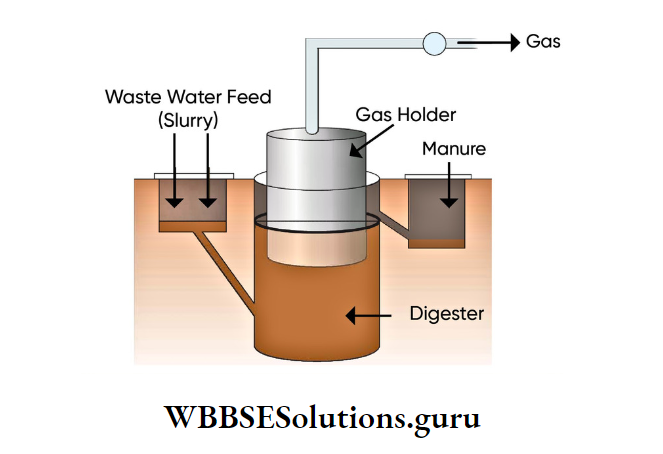
Biogas: It is prepared in biogas plants. When the slurry of cow dung and water (or a mixture of crop residue, sewage, or other waste materials) is allowed to make anaerobic fermentation in the absence of oxygen but in the presence of water,

They produce a mixture of methane, carbon dioxide, hydrogen, and traces of hydrogen sulfide. This mixture is called biogas.

The fermentation is carried out by anaerobic bacteria known as methanogenic bacteria which decompose the carbon compounds present in biomass (organic wastes) into methane gas and carbon dioxide.

Biogas is a renewable source of energy. It can never replace natural gas.

Uses: Biogas mainly contains methane (about 75%) which is an excellent fuel for cooking. It causes no environmental pollution. It can be used for street lighting and for running engines.

The waste products such as nitrogen and phosphorus left from biogas plants are used as fertilizers.

WBBSESolutions For Class 10 Chapter 1 Concerns About Our Environment Calorific value of fuels A biogas plant

Advantages of using biogas as fuel:

On burning, biogas does not produce any smoke or ash, which can be used for domestic cooking. The calorific value of biogas is very high (about 35000-40000 KJ/Kg).

Electricity from waste:

Tons of organic waste, foods, and unsold vegetables in everyday market pollute our environment and are used to turn into electricity in biogas plants.

These wastes are converted into a slurry and put into a large container (pit).

Using an anaerobic digester, the waste is converted into biofuel and put into a biogas generator which converts it into electricity. This type of project can make life more sustainable.

Biofuel: It is a form of biomass energy produced from biomass. Its examples are bio-ethanol (liquid) and bio-diesel (gaseous like gobar gas).

Bio-Ethanol: It is an alternative to petrol in road vehicles. It is produced by the sugar fermentation process of sugarcane, corn, rice straws, wheat, etc.

Bioethanol is added to petrol to minimize environmental pollution. It is carbon neutral and produces fewer greenhouse gases.

Biodiesel: It is an alternative to diesel. It is manufactured by the transesterification process from vegetable oil, animal fats, or unused oils from households. Bio-diesel can be used as a blend with regular diesel.

Coal-bed methane or CBM: In coal mines, plenty of methane gas (>95%) remains adsorbed in hard layers of coal. It is called coal-bed methane (CBM).

It is formed during the process of coalification by the transformation of plants into coal.

The coal-bed methane is a form of natural gas extracted from the coal bed by drilling steel pipes 100 -1500 m deep below ground into the layers of coal.

It is now being considered an alternative source for meeting household energy requirements.WBBSESolutions For Class 10 Chapter 1 Concerns About Our Environment Calorific value of fuel fire ice

Methane hydrate: It is a solid compound of methane. It is mainly found in polar regions under the ice and also under the sea level.

In methane hydrate, the density of methane is very high (about 160 m3 of methane remains in a block of methane hydrate of volume 1 m3).

Methane hydrate can rapidly dissociate with an increase in temperature and a decrease in pressure.

Other names of methane hydrate are methane clathrate, hydro methane, fire ice, etc. The name is ‘fire-ice’ because methane in it starts burning in contact with fire It appears as if ice is catching fire.

Due to the abundance of methane, the compound methane hydrate can be considered a source of energy. Scientists predict, it to be one of the largest sources of energy in the future.

If by adopting effective technology we are able to extract methane hydrate that could change the future energy needs by the replacement of coal, oil, and natural gas.

WBBSE Class 10 Life Science Model Question Paper 2023 Set 2

Model Question Paper Life Science Set 2 Group A

Answer to all questions is compulsory

Write the answer in a complete sentence by choosing the correct answer for each question with the respective serial number.

Question 1. Select the correct pair-

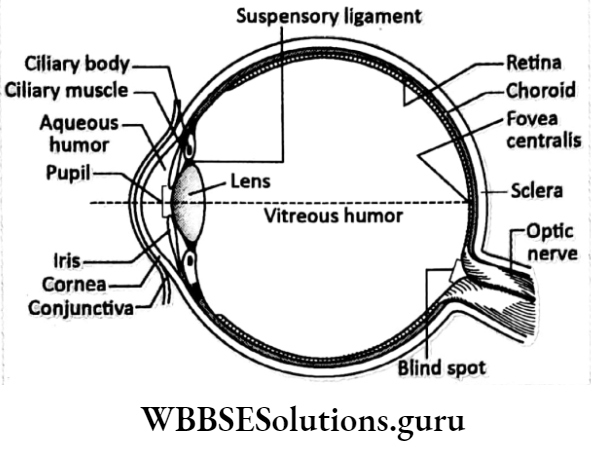
  1. Sclera—Absorbs excess light within the eyeball
  2. Choroid—Provides definite shape of the eyeball
  3. Lens-Causes refraction of light and accomplishes accommodation
  4. Retina-Holds the lens with the help of the suspensory ligaments

Answer: 3. Lens-Causes refraction of light and accomplishes accommodation

Question 2. Identify which of the following statements is not true regarding Adrenaline-

  1. Increases the rate of heartbeat
  2. Helps in the production of spermatozoa during adolescence
  3. Increases cardiac output
  4. Increases systolic blood pressure

Answer: 2. Helps in the production of spermatozoa during adolescence

Question 3. Select which of the following is the feature of tropic movement-

  1. Induced movement of curvature of particular parts of the plant controlled by the direction of the stimulus
  2. It is one type of turgor movement
  3. Induced movement of curvature of particular parts of plant controlled by the intensity of the stimulus
  4. Does not occur under the influence of Auxin

Answer: 1. Induced movement of curvature of particular parts of the plant controlled by the direction of the stimulus

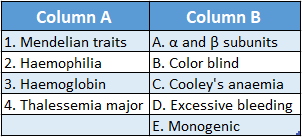
Question 4. Match the words of Column-A with that of Column-B and select which of the following options is correct—
Answer: table-

  1. A-2,B-3,C-1
  2. A-3,B-1,C-2
  3. A-1,B-2,C-3
  4. A-1,B-3,C-2

Answer: 2. A-1,B-3,C-2

WBBSE Class 10 Life Science Model Question Paper 2023

Question 5. Decide which of the following sequence is correct-

  1. Receptor→Effector→Sensory Nerve→Motor Nerve→Nerve Centre
  2. Receptor→Nerve Centre→Motor Nerve→Sensory Nerve→Effector
  3. Receptor→Sensory Nerve→Nerve Centre→Motor Nerve→Effector
  4. Receptor→Motor Nerve→Effector→Sensory Nerve→Nerve Centre

Answer: 3. Receptor→Sensory Nerve→Nerve Centre→Motor Nerve→Effector

Question 6. Select the correct pair-

  1. Telophase- Movement of daughter chromosomes towards poles
  2. Telophase- Disappearance of Nuclear Membrane and Nucleolus
  3. Telophase- Formation of spindle fibre
  4. Telophase- Reappearance of Nuclear Membrane and Nucleolus

Answer: 4. Telophase- Reappearance of Nuclear Membrane and Nucleolus

Question 7. The name of the terminal parts of the Chromosome is—

  1. Centromere
  2. Telomere
  3. Nucleolar Organizer
  4. Satellite

Answer: Telomere

Question 8. Identify which of the following statements is not true regarding cross-pollination-

  1. Requires agent
  2. Origin of new hereditary features
  3. Maintains the purity of species
  4. The rate of germination of seeds is higher

Answer: 3. Maintains the purity of species

Question 9. Consider the differences between asexual and sexual reproduction and select which of the options is/are correct-
Answer:

WBBSE Class 10 Life Science Model Question Paper 2023 Set 2

  1. 1,4
  2. 2,3
  3. 3,4
  4. 1,2

Answer: Correct option is not provided

Question 10. Select the correct pair in the case of humans:

  1. The normal pattern of the chromosome of ovum — 22A + XX
  2. The normal pattern of the chromosome of the ovum — 22A + Y
  3. The normal pattern of the chromosome of ovum — 22A + X
  4. The normal pattern of the chromosome of ovum — 22A + XY

Answer: 3. Normal pattern of the chromosome of ovum — 22A + X

WBBSE Class 10 Life Science Model Question Paper 2023

Question 11. 1.11Determine which of the following genotypes is homozygous for both the loci

  1. BbRr
  2. BBRr
  3. BbRR
  4. bbrr

Answer: 4. bbrr

Question 12. Identify the genotype of guineapig having white coat colour and rough hair-

  1. bbRR,brr
  2. BBRR,brr
  3. bb,bb
  4. BbRr, BbRR

Answer: 3. bbRR, bbRr

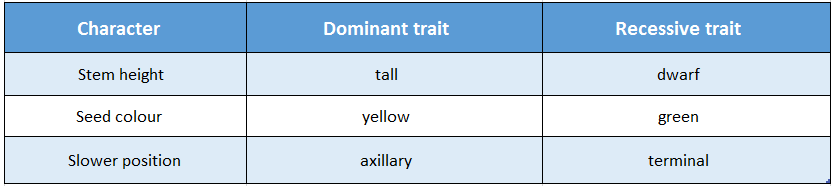
Question 13. Decide which of the following two were selected by Mendel as dominant traits—

  1. Length of stem — Long, Shape of seed — Round
  2. Position of flower — Terminal, the colour of flower — White
  3. Colour of the cotyledon — Green, and Shape of the seed – Wrinkled
  4. Length of stem — Dwarf, Shape of seed – Wrinkled

Answer: 1. Length of stem — Long, Shape of seed — Round

Question 14. Determine the nature of the pea plant germinated from the seed produced as a result of pollination between a hybrid tall (Tt) and a pure dwarf (tt) pea plant—

  1. 100% Tall
  2. 50% Tall, 50% Dwarf
  3. 100% Dwarf
  4. 75% Tall, 25% Dwarf

Answer: 2. 50% Tall, 50% Dwarf

Question 15. Decide which of the following diseases can be prevented by taking suggestions from pre-marital genetic counselling-

  1. Goitre
  2. Malaria
  3. Thalassaemia
  4. Tuberculosis

Answer: 3. Thalassaemia

Model Question Paper Life Science Set 2 Group B

2. Answer 21 questions out of 26 questions given below as instructed. Fill in the blanks with proper words in the following sentences (any five):

Question 1. The hormone is found in very high amounts in the ripe seeds of plants.
Answer: Gibberellin

Question 2. Reflex action is fast, spontaneous and 
Answer: Involuntary

Question 3. In cell division spindle fibres are not formed.
Answer: amitosis

Question 4. is an entomophilous flower.
Answer: Sunflower

WBBSE Class 10 Life Science Model Question Paper 2023

Question 5. The gene having the power of the rolling tongue is.
Answer: dominant

Question 6. As the gene responsible for hemophilia is recessive, the symptoms of this disease are only manifested in
condition.
Answer: X-linked inheritance

Decide whether the following statements are true or false (any five):

Question 7. The focal length of the lens increases in case of seeing distant objects.
Answer: True

Question 8. Each nucleoside contains a nitrogenous base and phosphoric acid.
Answer: False

Question 9. There is no role of females in determining the sex of humans.
Answer: True

Question 10. If any pea plant contains either TT or tt trait, then the pea plant becomes heterozygous with respect to such alleles.
Answer: False

Question 11. As the flowers of the pea plant are unisexual, so self-pollination and if needed, cross-pollination can be performed.
Answer: True

Question 12. The daughter cells are changed and modified in different ways during cell differentiation phase to form tissue, organ and system.
Answer: True

WBBSE Class 10 Life Science Model Question Paper 2023

Match the words in Column-A with those which are most appropriate in Column-8 and re-write the correct pair mentioning the serial no. of both columns (any five) :


WBBSE Class 10 Life Science Model Question Paper 2023 Set 2 table
Answer: 2.13 – (2), 2.14- (3) 2.15- (4), 2.16- (5), 2.17- (6), 2.18- (1)

Answer in a single word or in a single sentence (any six):

Question 19. Choose the odd one and write it: Olfactory nerve, Vagus nerve, Optic nerve, Auditory nerve
Answer: Vagus nerve

Question 20. What is the fate of hormones in the animal body after its function is over ?
Answer: Hormones are destroyed and excreted immediately after their functions are over.

Question 21. A pair of related terms is given below. On the basis of the relationship in the first pair write the suitable word in the I gap of the second pair. Purine : Adenine :: Pyrimidine :
Answer: Cytosine

Question 22. What happens if the functions of checkpoints in the cell cycle get hampered?
Answer: Genomic instability and/or tumorigenesis

Question 23. What is hybridization?
Answer: Process of interbreeding individuals from genetically distinct populations to produce hybrids.

Question 24. What is a dominant trait?
Answer: A trait produced by a dominant allele in individuals who have one copy of the allele which can come from just one parent.

Class 10 Life Science Model Question Paper With Answers

Question 25. Among the following four terms, one includes the other three. Find it out and write it :
Increase in Basal Metabolic Rate, Thyroxine, Gradual maturation of Red Blood Corpuscle, Exophthalmic Goitre.
Answer: Exophthalmic Goitre

Question 26. In which phase of Interphase are the proteins essential for the formation of spindle fibres in synthesized?
Answer: G2 – phase.

Extensor muscle:

to increase the angle between two body parts.

Abductor’s muscle:

to move limbs away from the midline.

Rotator muscle:

To move limbs around their long axis.

Question 27. Prepare a list of functions controlled by Auxin related to the growth of plants.
Answer:

Major Plant Hormones Auxin

Auxins are a class of nitrogenous phytohormones & the most important growth regulators produced from the growing regions of plant tissue including roots, shoots, and leaves.

These promote cell division, stem and root growth. These can also drastically affect plant orientation by promoting cell division on one side of the plant in response to sunlight & gravity.

The term auxin was first used by Frits Went.

Chemical composition:

Auxins generally occur as complexes, usually found with an amino acid or sugar. These are composed of carbon, hydrogen, oxygen, and nitrogen.

The amino acid Tryptophan and many other Indole compounds serve as precursors of auxins.

Class 10 Life Science Model Question Paper With Answers

Chemical composition:

Auxins generally occur as complexes, usually found with an amino acid or sugar. These are composed of carbon, hydrogen, oxygen, and nitrogen.

The amino acid Tryptophan and many other Indole compounds serve as precursors of auxins.

Types: They are classified into two types as detailed below:

Natural Auxin:

They are Indole compounds like Indole 3-Acetic Acid (IAA) and Non-Indole compounds like Naphthalene Acetic Acid. Indole 3-Acetic Acid was the first plant hormone identified.

It is manufactured primarily in the shoot tips (in leaf primordia and young leaves), in embryos, and in parts of developing flowers and seeds.

Synthetic Auxin:

These are synthetic compounds similar to natural auxin and they include 2,4-D (2,4-Dichlorophenoxy Acetic Acid) or 2, 4, 5-T (2,4,5- Trichlorophenoxy Acetic Acid).

Translocation:

The transport of IAA from cell to cell through the parenchyma surrounding the vascular tissues requires the expenditure of ATP energy.

IAA moves in one direction only i.e., the movement is polar and in this case, downward.

Such downward movement in shoots is said to be basipetal (apex to base) and in roots it is acropetal (outwards towards the root apices from the base).

Synthetic auxins move in all directions inside plants.

Function:

Apical Growth:

Auxins bring about apical dominance and thereby induce apical growth of the shoot.

Tropic movements:

These are deposited unequally on the shoot or root surface and thus cause phototropic curvature and geotropism


WBBSE Solutions Chapter 1 Control And Coordination In Living Organisms Topic B Response And Chemical Coordination In Plants Hormones Phototropic curvature and geotropism


Cell enlargement:

Auxin helps to increase the size and volume of the cells.

Cell enlargement is caused by the solubilization of carbohydrates, loosening of wall microfibrils, synthesis of more wall materials, increased membrane permeability, and respiration.

Metabolism:

Auxin stimulates respiration by increasing the availability of respiratory substrate. Thus it enhances metabolism by mobilizing plant resources.

Cambial activity:

The degree of cambial activity is directly proportional to auxin concentration. Auxin also controls xylem differentiation.

Cell division:

It initiates the cell division of the parenchymatous cells at the site of wounded tissue causing healing of wounds after mechanical injury in plants.

Class 10 Life Science Model Paper WBBSE 2023 Set 2

Root formation:

Auxin promotes root initiation at a concentration that is inhibitory for the growth of intact roots.

Parthenocarpic fruit Development:

Pollen contains a lot of auxin, it acts as a signal indicating the completion of pollination and transformation of the ovary to fruit.

Thus the application of synthetic auxin induces the development of fruit without the act of fertilization i.e. parthenocarpic fruit development.

Synthetic auxin (2,4-D) initiates rootings in stem cuttings.

(x)Synthetic auxin can act as a weedicide by killing dicotyledonous weeds preventing the division of cambial tissue.

As monocotyledonous plants are devoid of cambium, they are not destroyed by auxin compounds.

Anti-auxin:

Auxins have an inhibitory effect on the abscission of leaves and fruits, i.e., shedding of mature leaves and ripe fruits from the plant.

It has been found that the abscission zone does not form when the concentration of auxins is high in the leaves or fruits.

On the contrary, Abscisic acid (ABA) is a major hormone in plants that induces the formation of an abscission zone in the leaf stalk or petiole and brings about the shedding of leaves.

It acts as an antiauxin because it counteracts the auxin activity by initiating abscission.

In Plants Hormones Gibberellin

Gibberellins are one of the longest-known classes of non-nitrogenous phytohormones that regulate various developmental processes including stem elongation, germination, dormancy, flowering, and leaf and fruit senescence.

Gibberellic acid or gas can be of more than 100 types and the most common being 3- Gibberellic Acid (GA3).

Gibberellin was discovered by Kurosawa (1926) from rice plants suffering from Bakanae (foolish seedling) disease caused by Gibberella.

Gibberellins are naturally synthesized in maturing seeds, germinating seedlings, growing tissues of expanding cotyledons, growing leaves, apical buds, root tips, etc.

Class 10 Life Science Model Paper WBBSE 2023 Set 2

Chemical composition:

Gibberellins are tetracyclic diterpene acids. These consist of carbon, hydrogen, and oxygen.
Acetate is the precursor for the synthesis of all kinds of gibberellins.

The gibberellins are named GAj through GAn in the order of discovery.

Translocation:

All known gibberellins are synthesized in plastids and then modified in endoplasmic reticulum and cytosol until they reach their biologically active form.

The transport of gibberellin is not polar. These are transported in all directions from the site of formation through the xylem, phloem, or by cell tq cell.

Functions:

Elongation of internode:

It brings about the growth of the internode and thereby brings about apical growth along with auxin.

Flowering:

It modifies the apical bud to the floral bud, by bringing about the development of floral tissue through modification of the apical meristem.

Breaks seed dormancy:

It breaks seed dormancy and induces germination of seed through denovo synthesis of a-amylase.

Leaf growth:

It helps in the development of young leaves through stimulation of the leaf meristem

It promotes fruit growth and development. It also influences parthenocarpy.

Question 28. Distinguish between the mitosis of plant cells with the mitosis of animal cells on the basis of the following features—

  1. Formation of spindle fibers
  2. Process of cytokinesis

Answer:

Basic Differences Between Mitosis Of Animal Cell And Plant Cell


WBBSE Solutions For Class 10 Life Science Chapter 2 Continuity Of Life Topic A Cell Division And Cell Cycle Animal cell and plant cell


WBBSE Solutions For Class 10 Life Science Chapter 2 Continuity Of Life Topic A Cell Division And Cell Cycle diagrammatic representation of mitosis of a plant cell


Model Question Paper Life Science Set 2 Group C

3. Answer any 12 questions in 2-3 sentences out of 17 questions given below:

Question 1. Prepare a list of hormones that control the following functions—

Causes an increase in the length of bones through mineralization of the matrix of cartilage located at the terminal parts of long bones.

Answer: GH or STH

Transforms ruptured follicle into a temporary endocrine gland namely Corpus Luteum and provides necessary stimulation for the secretion of Progesterone hormone from that gland.

Answer: LH

Inhibits the production of glucose in the liver from protein and lipids.
Answer: Insulin

Causes contraction of uterine muscles during parturition
Answer: Relaxin

Class 10 Life Science Model Paper WBBSE 2023 Set 2

Question 2. Explain the causes of Myopia and Hyperopia
Answer:

Endocrine disorders or hormonal disorders are typically an endocrine disease that results when a gland produces too much (hyper-secretion) or too little (hypo-secretion) of an endocrine hormone, called a hormone imbalance.

Some important hormonal disorders of humans are—

Dwarfism:

Pituitary dwarfism is decreased bodily growth due to hormonal problems (hyposecretion of STH) in childhood.

Causes:

Pituitary dwarfism, or growth hormone deficiency, is a condition in which the pituitary gland does not make enough growth hormone (hypo-function of STH).

Pituitary gland dysfunction can be congenital, which means that the child is born with the abnormality, or can be acquired during or after birth. It tends to run in families.

Symptoms:

The main symptom of pituitary dwarfism is below-average growth, although body proportions will be normal. Other characteristics might include an immature appearance, a chubby body build, a prominent forehead, and an underdeveloped bridge of the nose.


WBBSE Solutions For Class 10 Life Science Chapter 1 Control And Coordination In Living Organisms Topic C Response And Chemical Coordination In Animals Hormones pituitary and dwarfism


Diabetes insipidus (Dl) is a condition in which the kidneys are unable to prevent the excretion of water due to the hyposecretion of ADH leading to the excretion of an abnormally large amount of urine from the body.

Causes:

During the day, our kidneys filter the blood many times. Normally, most of them are reabsorbed and only a small amount of concentrated urine is excreted.

Dl occurs when the kidneys cannot concentrate the urine normally due to a decrease in the reabsorption of water in the renal tubules and a large amount of dilute urine is excreted.

The amount of water excreted in the urine is controlled by antidiuretic hormone (ADH). Dl caused by a lack of ADH is called central diabetes insipidus.

Excessive thirst that may be intense or uncontrollable, usually with the need to drink large amounts of water.

Excessive urine volume,

Excessive urination, often needing to urinate every hour throughout the day and night.

Goitre:

Goitre is a swelling (hypertrophy) of the thyroid gland in the neck due to hypothyroidism.

Causes:

Iodine deficiency, leading to hypothyroidism, is the major cause of endemic goiter. The thyroid gland needs iodine in order to manufacture thyroid hormones, which regulate the body’s rate of metabolism.


WBBSE Solutions For Class 10 Life Science Chapter 1 Control And Coordination In Living Organisms Topic C Response And Chemical Coordination In Animals Hormones Diabetes insipidus


Hypothyroidism is the result of an underactive thyroid gland, and this causes goiter. Because the gland produces too little thyroid hormone, it is stimulated to produce more, leading to swelling.


WBBSE Solutions For Class 10 Life Science Chapter 1 Control And Coordination In Living Organisms Topic C Response And Chemical Coordination In Animals Hormones Hypothyrodism


Symptoms:

The main symptom of goiter is swelling of the thyroid gland, which causes a lump to develop in the front of the neck.

The following are the main symptoms that can result from neck swelling- symptoms of tightness, cough, and hoarseness; Trouble swallowing (dysphagia), dry & rough skin, hair loss, excessive fatigue, etc.

Class 10 Life Science Model Paper WBBSE 2023 Set 2

Diabetes mellitus:

Diabetes mellitus is a chronic, lifelong condition that affects the body’s ability to use the energy found in food.

There are two major types of diabetes:

  1. Type-1 diabetes and
  2. Type-2 diabetes.

Type-1 diabetes is also called insulin-dependent diabetes. It used to be called juvenile-onset diabetes because it often begins in childhood.

Type-2 diabetes used to be called adult-onset diabetes, but with the epidemic of obese and overweight kids, more teenagers are now developing type-2 diabetes.

Type-2 diabetes is also called non-insulin-dependent diabetes.

Causes:

All types of diabetes mellitus have something in common. Normally, our body breaks down the sugars and carbohydrates we eat into glucose.

Glucose fuels the cells in our body. But the cells need insulin, a hormone, in the bloodstream in order to take the glucose and use it for energy.

With diabetes mellitus, either the body doesn’t make enough insulin or it can’t use the insulin it produces or a combination of both.

In Type-2 diabetes, the pancreas usually produces some insulin. But either the amount produced is not enough for the body’s needs, or the body’s cells are resistant to it.

Symptoms:

Since the cells cannot take in the glucose, it builds up in the blood. High levels of FuncIaivientaIs of UFe Sconce
blood glucose can damage the tiny blood vessels in the kidneys, heart, eyes, or nervous system.

That is why diabetes – especially if left untreated – can eventually cause heart disease, stroke, kidney disease, blindness, and damage to nerves in the feet.

The early symptoms of untreated diabetes are related to elevated blood sugar levels and loss of glucose in the urine. The high amount of glucose in the urine can cause increased urine output and leads to dehydration.

This condition is called Polyuria. Dehydration causes increased thirst and water consumption. This condition is known as polydipsia.

The inability of insulin to perform normally has effects on protein, fat, and carbohydrate metabolism. A relative or absolute insulin deficiency eventually leads to weight loss despite an increase in appetite.

This condition is called polyphagia. Some untreated diabetes patients also complain of fatigue, nausea, and vomiting. Fluctuations in blood glucose levels can lead to blurred vision.

Extremely elevated glucose levels can lead to lethargy and coma.


WBBSE Solutions For Class 10 Life Science Chapter 1 Control And Coordination In Living Organisms Topic C Response And Chemical Coordination In Animals Hormones MAin Symtomps of Diabetes


The Common Hormonal Disorders Are Summarised In The Following Table:


WBBSE Solutions For Class 10 Life Science Chapter 1 Control And Coordination In Living Organisms Topic C Response And Chemical Coordination In Animals Hormones hormonal disorder


WBBSE Solutions For Class 10 Life Science Chapter 1 Control And Coordination In Living Organisms Topic C Response And Chemical Coordination In Animals hormone Hormonal disorder


Question 3. Explain what phenomena happen when the following muscles contract :

  1. Flexor muscle :
  2. Extensor muscle :
  3. Abductor’s muscle :
  4. Rotator muscle :

Answer:

Flexor muscle :

To decrease the angle between two body parts.

Extensor muscle :

To increase the angle between two body parts.

Abductor’s muscle :

To move limbs away from the midline.

Rotator muscle :

To move limbs around their long axis.

WBBSE Life Science Class 10 Question Paper Set 2

Question 4. Prepare a list of functions controlled by Auxin related to the growth of plants.
Answer:

Major Plant Hormones Auxin

Auxins are a class of nitrogenous phytohormones & the most important growth regulators produced from the growing regions of plant tissue including roots, shoots, and leaves.

These promote cell division, stem and root growth. These can also drastically affect plant orientation by promoting cell division on one side of the plant in response to sunlight & gravity.

The term auxin was first used by Frits Went.

Chemical composition:

Auxins generally occur as complexes, usually found with an amino acid or sugar. These are composed of carbon, hydrogen, oxygen, and nitrogen.

The amino acid Tryptophan and many other Indole compounds serve as precursors of auxins.

Chemical composition:

Auxins generally occur as complexes, usually found with an amino acid or sugar. These are composed of carbon, hydrogen, oxygen, and nitrogen.

The amino acid Tryptophan and many other Indole compounds serve as precursors of auxins.

Types: They are classified into two types as detailed below:

Natural Auxin:

They are Indole compounds like Indole 3-Acetic Acid (IAA) and Non-Indole compounds like Naphthalene Acetic Acid. Indole 3-Acetic Acid was the first plant hormone identified.

It is manufactured primarily in the shoot tips (in leaf primordia and young leaves), in embryos, and in parts of developing flowers and seeds.

Synthetic Auxin:

These are synthetic compounds similar to natural auxin and they include 2,4-D (2,4-Dichlorophenoxy Acetic Acid) or 2, 4, 5-T (2,4,5- Trichlorophenoxy Acetic Acid).

Translocation:

The transport of IAA from cell to cell through the parenchyma surrounding the vascular tissues requires the expenditure of ATP energy.

IAA moves in one direction only i.e., the movement is polar and in this case, downward.

Such downward movement in shoots is said to be basipetal (apex to base) and in roots it is acropetal (outwards towards the root apices from the base).

Synthetic auxins move in all directions inside plants.

Function:

Apical Growth:

Auxins bring about apical dominance and thereby induce apical growth of the shoot.

Tropic movements:

These are deposited unequally on the shoot or root surface and thus cause phototropic curvature and geotropism

WBBSE Solutions Chapter 1 Control And Coordination In Living Organisms Topic B Response And Chemical Coordination In Plants Hormones Phototropic curvature and geotropism

Cell enlargement:

Auxin helps to increase the size and volume of the cells.

Cell enlargement is caused by the solubilization of carbohydrates, loosening of wall microfibrils, synthesis of more wall materials, increased membrane permeability, and respiration.

Metabolism:

Auxin stimulates respiration by increasing the availability of respiratory substrate. Thus it enhances metabolism by mobilizing plant resources.

Cambial activity:

The degree of cambial activity is directly proportional to auxin concentration. Auxin also controls xylem differentiation.

Cell division:

It initiates the cell division of the parenchymatous cells at the site of wounded tissue causing healing of wounds after mechanical injury in plants.

Root formation:

Auxin promotes root initiation at a concentration that is inhibitory for the growth of intact roots.

Parthenocarpic fruit Development:

Pollen contains a lot of auxin, it acts as a signal indicating the completion of pollination and transformation of the ovary to fruit.

Thus the application of synthetic auxin induces the development of fruit without the act of fertilization i.e. parthenocarpic fruit development.

Synthetic auxin (2,4-D) initiates rootings in stem cuttings.

(x)Synthetic auxin can act as a weedicide by killing dicotyledonous weeds preventing the division of cambial tissue.

As monocotyledonous plants are devoid of cambium, they are not destroyed by auxin compounds.

Anti-auxin:

Auxins have an inhibitory effect on the abscission of leaves and fruits, i.e., shedding of mature leaves and ripe fruits from the plant.

It has been found that the abscission zone does not form when the concentration of auxins is high in the leaves or fruits.

On the contrary, Abscisic acid (ABA) is a major hormone in plants that induces the formation of an abscission zone in the leaf stalk or petiole and brings about the shedding of leaves.

It acts as an antiauxin because it counteracts the auxin activity by initiating abscission.

WBBSE Life Science Class 10 Question Paper Set 2

Question 5. Distinguish between the mitosis of plant cells with the mitosis of the animal cell on the basis of the following features—

  1. Formation of spindle fibers
  2. Process of cytokinesis

Answer:

Basic Differences Between Mitosis Of Animal Cell And Plant Cell


WBBSE Solutions For Class 10 Life Science Chapter 2 Continuity Of Life Topic A Cell Division And Cell Cycle Animal cell and plant cell

WBBSE Solutions For Class 10 Life Science Chapter 2 Continuity Of Life Topic A Cell Division And Cell Cycle diagrammatic representation of mitosis of a plant cell

Question 6. Explain how Bryophyllum undergoes vegetative propagation with the help of an adventitious bud.
Answer:

Vegetative Reproduction

Vegetative reproduction is basically a special type of asexual reproduction where a vegetative part of the plant body, separated from the original plant body, develops and grows into a new plant by simple cell division.

The Vegetative Reproduction Is Of Two Kinds:

  1. Methods of natural vegetative reproduction and
  2. Methods of artificial vegetative reproduction.

It occurs naturally through budding, fission, fragmentation, etc. Artificially this reproduction can be carried out by cutting, grafting, etc.

Parthenogenesis or parthenocarpy

Parthenogenesis is a form of asexual reproduction in which the growth and development of the embryo occur without fertilization.

In animals, parthenogenesis means the development of an embryo from an unfertilized egg cell. It is common in rotifers, aphids, bees, and crustaceans.

Some vertebrates like lizards also reproduce by parthenogenesis. Parthenogenesis may be natural or artificial.

Natural parthenogenesis occurs regularly in the life cycle of some animals. It is of two types:

Complete and incomplete parthenogenesis.

Complete parthenogenesis:

It is also called obligatory partheno-genesis.

In this case, the males are completely absent and the females develop from the unfertilized eggs as is found in aphids, phyllopods, and rotifers.

It is also found in some vertebrates.

A lizard Lacerta Mexico Americana reproduces exclusively by parthenogenesis with no males, in the population.

Incomplete parthenogenesis:

In this case sexual generation alternates with parthenogenesis generation.

For example, in bees and wasps, some eggs develop without fertilization and produce males, while those eggs that are fertilized develop into females.

In Gall fly, the larvae may lay eggs which develop parthenogenetically into a new generation of larvae. This is called paedogenetic parthenogenesis or paedogenesis.

In many sexually reproducing animals, the egg can be activated by artificial methods to start the development without fertilization.

This is called artificial parthenogenesis. Eggs of Sea urchins can be made to develop successfully if treated with weak salt solutions, weak organic acids, electric shock or shaking in seawater, or by pricking the egg with a glass needle.

In higher plants, the process of formation of fruits without pollination and fertilization is called parthenocarpy. Parthenocarpy is a form of asexual reproduction seen in flowering plants.

The fruits are generally seedless. During cultivation, parthenocarpy is introduced along with other plant hormones including gibberellin and it results in maturing of the ovaries without the process of fertilization and produces bigger and pulpy fruits.

Pineapples, bananas, cucumber, grapes, watermelon, oranges, pears,s, etc are some examples of parthenocarpy. In some plants, pollination or another stimulation is required for parthenocarpy. This is termed stimulative parthenocarpy.

Plants that do not require pollination or other stimulation to produce parthenocarpic fruits have vegetative parthenocarpy.

Seedless cucumbers are an example of vegetative parthenocarpy and seedful watermelon is an example of stimulative parthenocarpy.

WBBSE Life Science Class 10 Question Paper Set 2

Question 7. Tabulate which changes occur in a chromosome during the Anaphase of Karyokinesis.
Answer:

Changes occur in a chromosome during the Anaphase of Karyokinesis

1. Splitting into daughter chromosomes.
2. Poleward anaphase movement of daughter chromosomes.
3. V, L, or I shaped the appearance of daughter chromosomes.

Question 8. Describe how Yeast completes the process of budding.
Answer:

Yeast completes the process of budding

The asexual reproduction of yeast occurs by budding.

The parent nucleus divides into two daughter nuclei by mitosis.

During budding, the daughter cell first appears as an outgrowth since one daughter nucleus migrates to a corner of the parent cell. Both haploid and diploid cells can undergo budding. The outgrowth enlarges, matures, and detaches from the parent cell.

Question 9. Prepare a list of changes that occur during the adolescence phase of human development
Answer:

Changes that occur during the adolescence phase of human development

  1. The rate of growth becomes rapid.
  2. Secondary sexual characters develop.
  3. Significant growth of sexual organs takes place.
  4. The thought process becomes logical and complex.

Question 10. Explain the following two significances of meiotic cell division—
Maintains the constant number of chromosomes in a species Origin of variation in an organism
Answer

Significance Of Meiosis

1. Gametogenesis:

It is a necessary part of the life cycle of sexually reproducing animals since it leads to the formation of gametes (sex cells) through meiosis.

2. Maintenance Of Constant Chromosome Number Of A Species:

The gametes produced as a result of meiosis are haploid (n) and the zygote formed by their fusion is diploid (2n).

Thus, it is the only means for restoring the constancy in chromosome number, which is a characteristic of the species from generation to generation.

3. Production Of Variation In Organisms:

Meiosis results in new combinations of genetic material. During crossing over, the hereditary factors from male and female parents get mixed due to the breakage and exchange of chromatids.

This brings in genetic variation within the species. The variations are important raw materials for evolution and also help in the improvement of races.

4. Alternation of generation:

Meiosis causes conversion from sporophytic generation to gametophytic generation in plants, i.e. causes the alternation of generation through prezygotic, post-zygotic, or sporadic meiosis.

Meiosis occurs in sporogenous cells (micro and megaspore mother cells) of the sporophyte-producing haploid spores. The spores on germination form gametophytes (male and female).

Cells of the gametophyte form gametes. Fusion of these gametes again leads to diploid or sporophytic generation and in this way, the alternation of generation between gametophytic and sporophytic generations keeps on going.

Question 11. State Mendel’s second law of heredity.
Answer:

Mendel’s Fourth Postulate

The above analysis became the basis of Mendel’s second general principle or the fourth postulate, the law of independent assortment.

Independent Assortment:

During gamete formation, segregating pairs of unit factors assort independently of each other and undergo random recombination in all possible combinations governed by chance alone.

This postulate stipulates that any pair of unit factors segregate independently of all other unit factors. Thus, according to the postulate of independent assortment, all possible combinations of gametes will be formed in equal frequency.

Question 12. Prove the authenticity of the statement- “The phenotypic and genotypic ratio remain identical in case of Incomplete Dominance”.
Answer:

Incomplete Dominance

A common example of deviation from Mendelism is the phenomenon called incomplete dominance.

A cross between parents with contrasting traits may sometimes generate offspring with an intermediate phenotype.

In a heterozygote organism carrying both a dominant and a recessive allele of the same gene, when the dominant gene cannot express its dominant phenotype completely, a mixed or intermediate, or blended phenotype between the dominant and the recessive is expressed.

Such a situation is known as incomplete dominance. In many plant species, flower color serves as a striking example of incomplete dominance.

With the flowers of Four O’Clocks or floret clusters of Snapdragons Mirabilis jalapeno, a cross between pure breeding red flowered parents and pure breeding white yields hybrids with pink blossoms.

During gametogenesis, the pure red flowered parent plant (AA) produces (A) gametes and the pure white flowered parent plant (aa) produces (a) gametes.

WBBSE Solutions For Class 10 Life Science Chapter 3 Heredity And Common Genetic Diseases Topic A Heredity incomplete dominace

After cross-pollination of parental plants, (A) and (a) unite together to form (Aa) zygote that develops into plants with pink flowers.

Here both the allelomorphic genes have a partial or incomplete dominant relationship and hence, F1 hybrids show a mixture of characters of both parents. This is a case of incomplete dominance.

If allowed to self-pollinate, the F1 pink blooming plants produce F2 progeny bearing red, pink, and white flowers in a ratio of 1: 2 :1. This is the familiar genotypic ratio of an ordinary single gene F1 self-cross.

What is new is that because the heterozygotes look unlike either homozygote, the phenotypic ratios are an exact reflection of the genotypic ratios.

F2 Phenotypic ratio = 1 (Red): 2 (Pink): 1 (White) F2 Genotypic ratio = 1 (AA): 2 (Aa): 1 (aa) In this example of Mirabilis jalapa, the red gene is incompletely dominant over the white gene and so both of them give rise to an intermediate pink colored flower in heterozygous or hybrid condition.

WBBSE Life Science Class 10 Question Paper Set 2

Explanation:

The biochemical explanation for this type of incomplete dominance is that each allele of the gene under analysis specifies an alternative form of a protein molecule with an enzymatic role in pigment production.

If the ‘white’ allele does not give rise to the functional enzyme, no pigment appears.

Thus, in Snapdragons and four o’clock, two ‘red’ alleles per cell produce a double dose of a red-producing enzyme, which generates enough pigment to make the flowers look fully red.

In the heterozygote, one copy of the ‘red’ allele per cell results in only enough pigment to make the flowers look pink. In the homozygote for the ‘white’ allele, where there is no functional enzyme and thus no red pigment, the flowers appear white.

Question 13. Write two causes behind Mendel’s success in conducting experiments on heredity.
Answer:

Reasons for Mendel’s Success

Mendel’s success was dependent upon the following factors:

First, he chose the garden pea (Pisum sativum) as his experimental organism.

These plants can easily be cultivated, crossed, and for each successive generation, Mendel could thus obtain large members of individuals within a relatively short growing season.

By comparison, if he had worked with sheep, each mating would have generated only a few offspring and the time between generations would have been several years.

Second, Mendel examined the inheritance of clearcut contrasting forms of particular traits — round versus wrinkled seed, yellow versus green pod color, etc.

Using such ‘either-or’ traits, he could distinguish and trace unambiguously the transmission of one or the other observed characteristics, because there were neither any intermediate forms nor any of these characters located on separate chromosomes.

Third, Mendel isolated and perpetuated lines of peas that breed true. Mating with such pure breeding lines produce offsprings carrying specific parental traits that remain constant from generation to generation.

Fourth, Mendel carefully controlled his matings, going to great lengths to ensure that the progeny he observed really resulted from the specific fertilization he intended.

Thus he painstakingly prevented the intrusion of any foreign pollen and assured self or cross-pollination as the experiment demanded.

He also performed reciprocal crosses, in which by reversing the traits of male and female parents, he efficiently controlled the path of transmission of a particular trait either via the egg cell within the ovule or via the pollen as per experimental demand.

Fifthly, Mendel worked with a large number of plants, counted and subjected his findings to statistical analysis, and then compared his results with predictions based on mathematical models.

Finally, Mendel was a brilliant practical experimentalist. He could call and observe an optimum number of individuals from the limited space of the monastery garden.

In short, Mendel purposely set up a simplified ‘black and white’ experimental system and then successfully out how it worked.

Genetic Crosses With Guineapig

Mendel worked on pea plants but the application of his laws on animals was carried out by his successors.

Question 14. “Dispersal of animals is one of the driving forces of locomotion”— Judge the statement with the help of proper examples.
Answer:

Reasons And Motivations Behind Locomotion

Animals move for a variety of reasons, such as to find food, a mate, a suitable microhabitat, or to escape from predators.

Hunt For Food & Water:

Since animals can not prepare food, they are to perform locomotion to find out suitable area with plenty of food & water.

To seek shelter & escape from predators:

Locomotion increases the chances of survival of an organism by allowing the organism to seek shelter in favorable habitat, and to escape dangerous situations by avoiding predators.

Dispersal for mating or breeding:

Locomotion enables members of the species to disperse to find suitable mates to coordinate breeding activity and the survival of the young.

Search for a new & favorable environment:

Animals, especially birds, migrate from areas of low or decreasing resources to areas of high or increasing resources. The two primary resources being sought are food and nesting locations. Escaping from cold is also a factor.

Basic differences between movement and locomotion:

Though, in the case of animals, we often use the terms movement and locomotion, interchangeably, there are definite differences between the two.

Locomotion takes place at the organism level while movement can take place at any biological level from cellular to organisms.

In simple words, locomotion is movement from one place to another and involves shifting of the entire body parts (e.g. a person moving or running) and movement involves a change in shape, size, or direction of various body parts (e.g. shaking of your hands).

All kinds of locomotion are movements but all kinds of movements are not locomotion.

Movement is the motion that occurs in an organism or a body with or without the involvement of any change in the position or location of the organism or the body,

while locomotion is defined as the voluntary movement of an organism from one place to another either in search of food or shelter or mate or to escape from the predators.

Therefore, the differences between movement and locomotion may be summarized in a tabular form as below:

WBBSE Solutions For Class 10 Life Science Chapter 1 Control And Coordination In Living Organisms Topic E Locomotion As A Type Of Response In Animals Movement And locomotion

Question 15. Show the chemical constituents of chromosomes with the help of a table.
Answer:

WBBSE Class 10 Life Science Model Question Paper 2023 Set 2 chromosome


Question 16. Compare DNA and RNA on the basis of the following features

  1. Nature of carbohydrates
  2. Nature of pyrimidine base

Answer:


WBBSE Solutions For Class 10 Life Science Chapter 2 Continuity Of Life Topic A Cell Division And Cell Cycle DNA And RNA


Question 17. “Some phenotypes may have multiple genotypes and some other phenotypes may have a single genotype” justify the statement from the results derived from the dihybrid experiment in the case of the pea plant.
Answer:

Mendel’s Experiment And Laws For Dihybrid Cross

As a natural extension of the monohybrid cross, Mendel also designed experiments in which he examined two characters simultaneously. Such a cross, involving two pairs of contrasting traits, is called a dihybrid cross.

Experiment and Observation

Mendel-crossed pea plants that are heterozygous for two genes at the same time.

To construct such a dihybrid, he mated true-breeding plants grown from yellow round peas (YYRR) with true-breeding plants grown from green wrinkled peas (year).

From this cross, he obtained a dihybrid F1 generation (YyRr) showing only the two dominant phenotypes, yellow and round. He then allowed these F1 dihybrids to self-fertilize to produce the F2 generation.

When Mendel counted the F2 generation of one experiment, he found 315 yellow round, 101 yellow wrinkled, 108 round green, and 32 wrinkled green peas. There were, in fact, yellow wrinkled and green round recombinant phenotypes, providing evidence that some shuffling of alleles had taken place.

WBBSE Class 10 Life Science Previous Year Papers

Explanation

From the observed ratios, Mendel inferred the biological mechanism of shuffling the independent assortment of gene pairs during gamete formation.

Because the genes for peas’ color and for shape assort independently, Y can be with R or r in any gamete with equal probability.

Thus, the presence of a particular allele of one gene, say, the dominant Y for pea color, provides no information whatsoever about the alleles of the second gene.

That is, the allele for pea shape in Y carrying game could with equal likelihood be either R or r.

Each dihybrid of the F1 generation can, therefore, make four kinds of gametes:

YR, Yr, yR, and yr. In a large number of gametes, the four kinds will appear in an almost perfect ratio of 1:1:1:1.

At fertilization then, in a mating of dihybrids, 4 different kinds of eggs can combine with any one of 4 different kinds of pollen, producing a total of 16 possible zygotes in the F2 generation.

Once again, a Punnett square is a convenient way to visualize the process.

In fact, there are only nine different F2 genotypes — YYRR, YYRr, YyRr, YyRR, yyRR, yyRr, YYrr, Yyrr, and yyrr — because the source of the alleles (egg or pollen) does not make any difference.

If we look at the combination of the traits determined by nine genotypes, we will see only four phenotypes— yellow round, yellow wrinkled, green round, and green wrinkled — observed in a ratio of 9 : 3 : 3: 1.

If, however, we look at just pea color or just pea shape, we can see that each trait is inherited in the 3: 1 ratio as predicted by Mendel’s law of segregation.

Punnet Square or Checker Board of Dihybrid cross


WBBSE Solutions For Class 10 Life Science Chapter 3 Heredity And Common Genetic Diseases Topic A Heredity Punnet Square or Checker Board of Dihybrid cross


WBBSE Solutions For Class 10 Life Science Chapter 3 Heredity And Common Genetic Diseases Topic A Heredity f2 generation


Model Question Paper Life Science Set 2 Group D Long Answer Type Questions

4. Write the 6 questions or their alternatives given below. Sightless candidates have to answer a question no. 4.1 A instead of question no 4.1. The marks allotted for each question is 5 (the division of marks is either 3+2, 2+3, or 5) :

Question 1. Draw a scientific diagram of a neuron and label the following parts :

  1. Axon
  2. Node of Ranvier
  3. Dendron
  4. Schwann Cell

Answer:

WBBSE Solutions Chapter 1 Control And Coordination In Living Organisms Topic D Response And Physical Coordination In Animals Nervous System neuron

Draw a scientific diagram of the morphological structure of a eukaryotic chromosome and label the following parts—

  1. Chromatid
  2. Telomere
  3. Centromere
  4. Nucleolar Organizer

Answer:

WBBSE Solutions For Class 10 Life Science Chapter 2 Continuity Of Life Topic A Cell Division And Cell Cycle metaphase


Write the Functions of the following structural parts of a eukaryotic chromosome :

  1. Centromere
  2. Nucleolar Organizer
  3. Chromatid
  4. Telomere
  5. Kinetochore

Answer:

WBBSE Solutions For Class 10 Life Science Chapter 2 Continuity Of Life Topic A Cell Division And Cell Cycle parts of chromosome 2 WBBSE Solutions For Class 10 Life Science Chapter 2 Continuity Of Life Topic A Cell Division And Cell Cycle parts of chromosome

Question 2. Compare the antagonistic functions of the following three pairs of hormones in the human body:

  1. Insulin and Glucagon
  2. Estrogen and Progesterone
  3. FSH and LH

Explain the relationship between the hindbrain and the function of control of the breathing mechanism.

Antagonistic functions of insulin and glucagon :

1. Insulin increases cellular oxidation of glucose, stimulates the formation and storage of glycogen in the liver & muscles and inhibits the formation of glucose from non-carbohydrates. All these activities result in the maintenance of optimum levels of blood sugar.
Glucagon stimulates liver glycogen to undergo breakdown to be converted to glucose which increases blood sugar levels.

2. Insulin increases protein synthesis in the body. Glucagon hydrolyzes protein into amino acids.

3. Insulin decreases lipid & cholesterol levels in the blood. Glucagon stimulates the increase of fat & cholesterol level in the blood. Antagonistic functions of estrogen and progesterone :

1. Estrogen is secreted by ovaries prior to ovulation. Progesterone is secreted by ovaries after ovulation.

2. During pregnancy, estrogen induces enlargement of breasts and uterus. During pregnancy, progesterone reduces the contractility of the uterus and stimulates the growth of mammary glands.

Antagonistic features of FSH and LH :

1. FSH helps in the maturation of immature follicles into mature Graafian follicles. In the presence of FSH, LH ruptures Graafian follicles causing ovulation.

2. FSH stimulates the secretion of estrogen from Graafian follicles. LH stimulates the secretion of progesterone from the corpus luteum.

3. In males, FSH induces the development of seminiferous tubules and spermatogenesis. In males, LH stimulates the secretion of testosterone in the testis.

The breathing movements (ie., taking in oxygen and taking out carbon dioxide) are initiated in response to the ratio of carbon dioxide and oxygen within the body. High levels of C02 and low levels of 02 collectively influence the body to exhale C02 and take in 02.

This is regulated by the medulla oblongata of the hindbrain. In response to C02 and 02 ratios, medulla oblongata signals the heart and diaphragm accordingly to facilitate respiration.

The respiratory center of the medulla oblongata is concerned with controlling the depth and rate of respiration.

OR

The following physiological functions of a person wounded in an accident are found hampered. Write the name of the parts of the brain attached to those functions :

  1. Speech
  2. Hunger, thirst, and sleep
  3. Posture and the equilibrium of the body
  4. Movement of tongue and swallowing of food

Explain the mechanism of feedback control of the function of hormones with the help of a suitable example.

  1. Speech — Cerebellum
  2. Hunger, thirst, and sleep — Hypotha. lamus
  3. Posture and the equilibrium of the body – Cerebellum

Movement of tongue and swallowing of food – Medulla oblongata

Answer:

Feedback control:

The secretion of most, if not all, hormones is regulated by some type of closed-loop control system known as a feedback mechanism

(because the amount released or secreted is sensed and that information is relayed back to the secretory cell by a variety of ways). Feedback control is mostly negative, rarely positive.

In a negative feedback control, the synthesis of a hormone slows down or halts when its level in the blood rises above the normal or threshold limit.

In the less common positive feedback mechanism, one hormone further stimulates the production of another hormone instead of diminishing it. Some examples of feedback control are given below.

Hypothalamus, in response to some external stimulus, produces a thyrotropin-releasing hormone for the secretion of thyrotropic hormone.

The thyrotropin-releasing hormone (TRH) stimulates the anterior pituitary lobe to secrete thyrotropic hormone. The latter in turn stimulates the thyroid gland to produce thyroxine.

If thyroxine is in excess, it exerts an influence on the hypothalamus and anterior pituitary lobe, which then secrete a lesser amount of releasing hormone and thyroid-stimulating hormone (TSH) respectively.

A rise in the TSH level in the blood may also exert a negative feedback effect on the hypothalamus and retard the secretion of TRH. This restores the normal blood-thyroxine level.


WBBSE Solutions For Class 10 Life Science Chapter 1 Control And Coordination In Living Organisms Topic C Response And Chemical Coordination In Animals Hormones postively and negatively feedback


Sometimes, the accumulation of a biochemical increases its own production. For example, uterine contraction at the onset of labor stimulates the release of the hormone oxytocin, which intensifies uterine contractions.

The contractions further stimulate the production of oxytocin. This is a positive feedback control.

WBBSE Class 10 Life Science Previous Year Papers

Mode Of Transport Of Animal Hormones:

Most hormones are secreted into the general circulation to exert their effects on appropriate distant target tissues. Water-soluble hormone molecules circulate in watery blood plasma in a free state, (i.e. not attached to other molecules).

Steroid and thyroid hormones are less soluble in aqueous solution and over 90% circulate in blood as complexes bound to specific transport proteins like plasma globulins or albumin.

The transport proteins make the lipid-soluble hormones temporarily water-soluble and act as a ready reserve of hormones.


WBBSE Solutions For Class 10 Life Science Chapter 1 Control And Coordination In Living Organisms Topic C Response And Chemical Coordination In Animals Hormones Thyroid stimulating hormone


Functioning And Fate Of Hormones:

The chemical structure of a hormone enables it to combine with a receptor in the cells of its target. The receptor may be present on the plasma membrane of the cell or inside the cytoplasm or nucleus.

Only a hormone’s “target” cells, which have receptors for that hormone, will respond to its signal. When the hormone binds to its receptor, it forms a receptor-hormone complex.

This complex undergoes changes and enters into the nucleus of the target cell. Within the nucleus, it increases the synthesis of cell protein and takes part in the metabolic process of the cell.

All hormones diminish within the body at differing rates based on their chemical half-life. Once hormones have served their function on their target organs/tissues, these are destroyed.

These are either destroyed by the liver or the tissues of the target organs and excreted out of the body.

Role Of Hormones As Biochemical Messenger And Regulators:

Hormones are informational molecules that carry the message of metabolic change from the endocrine glands to the target cells or organizer

These are released into the extracellular fluid, where they are diffused into the bloodstream. The latter carries them from the site of production to the site of action.

Hormones stimulate or inhibit one or more Physiological processes for the welfare of the body.

Maintenance of the internal chemical environment of the body to a constant is called homeostasis. Hormones play a major role in maintaining homeostasis through their integrated action.

These also play a leading role in the chemical coordination of the living body. Thus hormones are known as chemical messengers.

Question 3. Prepare a list of the role of artificial plant hormones in agriculture and horticulture. What are the influences of Insulin hormone on the absorption and metabolism of glucose in the human body?
Answer:

Pancreas:

The pancreas is a large elongated gland located in the abdominal cavity just inferior and posterior to the stomach.

Hormonal Secretions:

The pancreas is considered to be a heterocrine or mixed gland as it contains both endocrine and exocrine tissue. The endocrine function consists primarily of the secretion of the two major hormones, insulin, and glucagon.

The endocrine cells of the pancreas are found in small groups throughout the pancreas called islets of Langer Within these islets are two major types of cells alpha and beta cells.

The alpha cells produce the hormone glucagon and the beta cells produce the hormone insulin.

Insulin:

It is an antidiabetogenic protein hormone that lowers blood sugar levels.

Functions:

Effect on carbohydrate metabolism:

Insulin increases the oxidation of glucose in the cells, stimulates the formation & storage of glycogen in the liver & muscle, inhibits the formation of glucose from non-carbohydrates in the liver, and increases the permeability of glucose through the cell membrane from blood to the cells.

All these activities result in the maintenance of optimum levels of blood sugar.

Effect on protein metabolism:

It increases protein synthesis in the body.

Effect on fat metabolism:

It also decreases lipid & cholesterol levels in the blood & prevents the formation of harmful ketone bodies in the liver.

Glucagon:

It is anti-insulin in nature. Together with insulin, it maintains a steady level of blood sugar in the body.

Functions:

Effect on carbohydrate metabolism: It stimulates liver glycogen to undergo breakdown to be converted into glucose which increases blood sugar levels.

WBBSE Class 10 Life Science Previous Year Papers

Effect on protein metabolism:

Glucagon hydrolyses protein into amino acids and increases nitrogen excretion through urine.

Effect on fat metabolism:

It stimulates the increase of fat & cholesterol level in the blood.

Gonads:

The gonads and ovaries in females and testes in males are responsible for producing the sex hormones of the body.

Testes:

The testes are a pair of ellipsoid Fun(Iami iniaIs of Lifi Sell no organs found in the scrotum of males that produce the androgen testosterone in males after the start of puberty.

Testosterone:

It has effects on many parts of the body, including the muscles, bones, sex organs (both primary & secondary), and hair follicles,

During puberty, testosterone controls the growth and development of the sex organs and secondary sex characteristics like muscular growth, breaking of voice, growth of hair on the face, chest, etc.

Ovaries:

The ovaries are a pair of almond-shaped glands located in the pelvic body cavity lateral and superior to the uterus in females. The ovaries produce the female sex hormones progesterone and estrogens. It also secretes another hormone called relaxin.

Estrogen:

Oestrogen stimulates the growth, development, and functional activities of primary and secondary sex organs in females during puberty.

It regulates the menstrual cycle and stimulates breast development.

It enhances the deposition of fat in the female body.

Progesterone:

In the presence of estrogen, progesterone stimulates the complete development of the primary & secondary female sex organizer

It is most active during ovulation & pregnancy. It helps the embedding of embryos in the uterus and stimulates the development & maintenance of pregnancy.

It also regulates the menstrual cycle & breast development at puberty.

Relaxin:

It is secreted from the uterus at the terminal stage of pregnancy. It facilitates the expulsion of the fetus from the uterus by causing relaxation of the pelvic ligaments.

OR

Write three differences between binocular vision with that of monocular vision on the following three aspects :

  1. Formation of image
  2. Field of vision
  3. Depth

Write differences between inborn and acquired reflex actions on any two of the following aspects-

  1. Nature
  2. Condition
  3. Prior experience
  4. Neural pathway

Answer:

WBBSE Class 10 Life Science Model Question Paper 2023 Set 2 table 2

  1. Applying the brake of a car at a red signal.
  2. Sweating
  3. opening the door on hearing the doorbell
  4. looking left or right before crossing the road
  5. knee jerk.

Mention the differences between conditioned and unconditioned reflex actions.

  1. Conditioned reflex action
  2. Unconditioned reflex action

WBBSE Solutions Chapter 1 Control And Coordination In Living Organisms Topic D Response And Physical Coordination In Animals Nervous Conditioned and unconditioned reflex


Question 4. Show the alternation of generation in fern with the help of a word diagram.
Answer:

 WBBSE Solutions For Class 10 Life Science Chapter 2 Continuity Of Life Topic 2 Reproduction Alternation of generation


WBBSE Solutions For Class 10 Life Science Chapter 2 Continuity Of Life Topic 2 Reproduction dryoptersis

OR

Show the process of sexual reproduction in flowering plants with the help of a word diagram :
Answer: 

WBBSE Class 10 Life Science Model Question Paper 2023 Set 2 mircosphore

Question 5. Distinguish between Mitosis and Meiosis on the basis of the following three aspects-

  1. Site of occurrence
  2. Nature of division of chromosome
  3. Number of cells produced

Explain the following phenomena related to meiotic cell division—

  1. Separation of chromosome and chromatid
  2. Crossing over

Answer:

Important features of meiosis

WBBSE Class 10 Life Science Previous Year Papers

1. Homologous Chromosomes:

These are chromosome pairs of approximately the same length and centromere position. Note that diploid cells have two sets or one pair of homologous chromosomes.

Out of the pair, one is inherited from the mother (maternal) and one from the father (paternal).


WBBSE Solutions For Class 10 Life Science Chapter 2 Continuity Of Life Topic A Cell Division And Cell Cycle Homologous chromosomes


2. DNA replication:

Replication of DNA takes place during the interphase preceding meiosis. DNA replication generates sister chromatids from each chromosome. Sister chromatids are two identical copies of a chromatid that remain closely aligned.

Although DNA replication occurs in interphase, no longitudinal doubleness of chromosomes is visibly evident in Leptotene of Prophase I owing to contraction.

3. Synopsis:

The movement of chromosomes initiates in the zygotene stage and this movement results from an attracting force that brings the homologous pair of chromosomes together.

The chromosomes become shorter and thicker due to compaction.

When they come closer, homologous chromosomes pair and align at the equatorial plate of the cell for equal qualitative and quantitative distribution. The pairing takes place throughout the length.

This process of pairing is known as synapsis Pairing takes place not only between the homologous chromosomes but also between homologous regions of the chromosomes. Chromosome pairs undergoing synapsis have approximately the same length and centromere position.

Out of the pair, one is inherited from the mother (maternal) and one from the father (paternal). Non-sister chromatids belong to homologs.

WBBSE Class 10 Life Science Model Question Paper 2023

These are chromosome pairs having the same length, staining pattern, centromere position as well as the same characteristics of genes at particular loci.

A homologous pair of chromosomes consists of one chromosome from each parent and they are known as bivalents. Each chromosome of a bivalent is found to have two chromatids. Thus the four chromatids of a bivalent are together known as a tetrad.

4. Crossing Over:

The pachytene subphase of Prophase I is marked by a process called Crossing over that happens after both the homologous chromosomes in a pair join up to form a structure called a tetrad through synapsis.

Once a tetrad is formed, a portion of each homologous chromosome breaks off transversely and is re-attached to the same part of its homolog. Crossing over occurs between non-sister chromatids of homologous Sister Chiasma chromatids chromosomes.

This mixes up the traits that are found in each of the chromosomes, thus resulting in genetic recombination due to the exchange of segments between two non-sister chromatids belonging to a bivalent tetrad.

As a result of crossing over, X like structure is formed between the non-sister chromatids. The point of attachment at the crossing-over is called chiasma. It occurs during Diplotene.

The number of chiasmas may be one, two, or more depending on the length of the chromosomes.


WBBSE Solutions For Class 10 Life Science Chapter 2 Continuity Of Life Topic A Cell Division And Cell Cycle crossing over


5. Terminalization Of Chiasmata:

Chiasmata are generally pushed to the terminal ends of the chromosomes and this process is known as the terminalization of chiasmata (singular: chiasma).

The pair of homologous chromosomes begin to separate in the diplotene subphase of prophase I and chiasmata are fully terminalized in the diakinesis subphase of prophase.

Reduction in chromosome number:

During metaphase I, the tetrads line up on the plate. During anaphase I, the homologous chromosomes separate from one another i.e. one homologous chromosome with its two sister chromatids move to opposite poles.

Thus each pole has a haploid (n) number of chromosomes i.e. a reduction in chromosome number is achieved at this stage.

Telophase results in the formation of two haploid (n) daughter nuclei with each chromosome having two chromatids. For this reason, the first meiotic division is known as the reductional or heterotypic cell division.

7. Equational division:

Meiosis II or the second meiotic division has four phases similar to mitosis and is the second round of cell divisions during meiosis whereby the cells formed during Meiosis I divide again to form four haploid (n) gametes.

Between these two stages, the interkinesis or interphase is either quite short or skipped, unlike normal mitosis. Because of this, the S phase does not occur and so the DNA in these cells is not copied, making the resulting cells from this phase haploid.

WBBSE Solutions For Class 10 Life Science Chapter 2 Continuity Of Life Topic A Cell Division And Cell Cycle Mother cells

OR

Distinguish between the cytokinesis of plant cells with the cytokinesis of animal cells on the basis of the following aspects :

  1. Process
  2. Time of initiation
  3. Role of Golgi bodies

Answer:

The longest phase of mitosis:
Prophase

 The shortest phase of mitosis:
Anaphase

WBBSE Class 10 Life Science Model Question Paper 2023

WBBSE Solutions For Class 10 Life Science Chapter 2 Continuity Of Life Topic A Cell Division And Cell Cycle Animal cell and plant cell

Establish the interrelationships among genes, DNA, and chromosome.
Answer:

Inter-Relationship Among Chromosome, DNA, And Gene

The eukaryotic cells contain a membrane-bound nucleus which is designated as the ‘Director of the cell’.

The nucleus contains many thread-like, coiled, and elongated structures called chromatin fibers or chromatin reticulum, or nuclear reticulum.

The fibers of chromatin are uniformly distributed in the nucleoplasm. Chromatin fibers are observed only during the interphase or the preparatory phase of the cell cycle.

Just prior to cell division, chromatin fibers condense, become thick, and wrap up very tightly to form ribbon-like structures called chromosomes.

WBBSE Solutions For Class 10 Life Science Chapter 2 Continuity Of Life Topic A Cell Division And Cell Cycle Chromosome

The number of particular species. They are usually found in pairs. Human beings have 23 pairs of chromosomes in each body cell.

The chromosome consists of a proteinaceous matrix and two spirally coiled chromonemata, each one of which contains a single DNA molecule.

The nucleus of an average human cell is only 6m in diameter, yet it contains 1.8 m of DNA which is distributed amongst the 23 pairs or 46 chromosomes each consisting of a single DNA molecule of about 40 mm.

Thus, Chromatin represents long-thin strands of the DNA-protein complex. It is unfolded and uncondensed form of DNA, while chromosomes are condensed DNA and protein.

The function of chromatin is to store DNA in the nucleus. Chromosomes are the bearers of hereditary instructions and regulate cellular processes.

DNA (or deoxyribonucleic acid) is the molecule that carries the genetic information in all cellular forms of life and some viruses.

It belongs to a class of molecules called nucleic acids, which are polynucleotides that is, long chains of nucleotides. Nucleotides are made up of a base, a sugar, and a phosphate. The four bases

chromosomes are constant in the nucleus for adenine (A), guanine (G), cytosine (C), and thymine (T) pair with each other (A with T and G with C).

WBBSE Class 10 Life Science Model Question Paper 2023

It is the order or sequence of these base pairs that provides the information needed for the growth and development of our bodies.

Specific parts of DNA carry the code for producing specific proteins which ultimately lead to the expression of different characters in an organism.

Each of these parts of DNA is termed a gene. Thus gene is the fundamental physical and functional unit of heredity that carries information from one generation to the next.

It is a segment of DNA, composed of a transcribed region and a regulatory sequence, that makes possible transcription. A series of genes are present in each DNA.

The coordinated interaction of two or more genes produces a given phenotypic trait. A complete set of chromosomal genes is inherited by the offspring as a unit from the parent.

Question 6. Predict what would be the hereditary results in the following cases :

  1. One of the parents is thalassaemic and the other is a carrier of the thalassaemic gene.
  2. Both of the parents are carriers of the thalassaemic gene.

What are the symptoms of Thalassaemia?
Answer:


WBBSE Class 10 Life Science Model Question Paper 2023 Set 2 normal carrier

OR

Tabulate three pairs of opposite traits regarding the seed of the pea plant as selected by Mendel. Show the process of sex determination in men with the help of a checkerboard.

Answer:

WBBSE Solutions For Class 10 Life Science Chapter 3 Heredity And Common Genetic Diseases Topic A Heredity antagonistic pairs

WBBSE Solutions For Class 10 Life Science Chapter 3 Heredity And Common Genetic Diseases Topic A Heredity Genetic sex

WBBSE Class 10 Life Science Model Question Paper 2023 Set 1

Model Question Paper Life Science Set 1 Group A

Answer to all questions is compulsory

1. Write the answer in complete sentences by choosing the correct answer for each question with the respective serial number.

Question 1. Select the correct pair-

  1. Cerebrum-Maintenance of the balance of the body
  2. Hypothalamus-Control of intelligence and emotion
  3. Cerebellum-Control of body temperature
  4. Medulla Oblongata-Control of heartbeat and swallowing of food

Answer: The correct Pair is- Medulla Oblongata—Control of heartbeat and swallowing of food.

Question 2. Identify which of the following statements is not true regarding Insulin-

  1. Helps in the absorption of glucose from the blood into most of the somatic cells
  2. Converts glucose into glycogen within liver and muscle cells
  3. Helps in the conversion of fat and protein into glucose
  4. Inhibits the conversion of protein and fat into glucose

Answer: The statement which is not true regarding Insulin is—Helps in the conversion of fat and protein into glucose.

Question 3. Match the words of Column-A with that of Column-B and select which of the following options is correct-

WBBSE Model Question Paper 2020 Life Science And Environment Set 3 Match The Columns.

  1. 1-1, 2-2,3-3
  2. 1-2, 2-3, 3-1
  3. 1-3, 2-1, 3-2
  4. 1-2, 2-1, 3-3

Answer: 3. 1-3, 2-1, 3-2

Question 4 Determine from the answers given below in which phases of karyokinesis during mitotic cell division following two incidents happen- 1. Daughter chromosomes tend to move apart from each other towards their own poles Nuclear membrane and nucleolus disappear

  1. 1. Prophase 2. Anaphase
  2. 1. Anaphase 2. Prophase
  3. 1. Telophase 2. Metaphase
  4. 1. Metaphase 2. Telophase

Answer: 2. During mitotic cell division—

  1. Daughter chromosomes tend to move apart from each other towards their own poles— Anaphase and
  2. Nuclear membrane and nucleolus disappear—Prophase

Question 5. Select which of the following is the feature of cross-pollination-

  1. Occurs within the same flower of the same plant
  2. Agents are not required
  3. Lesser chance of new characters being transmitted
  4. More wastage of pollen grains

Answer: The feature of cross-pollination is— More wastage of pollen grains.

WBBSE Class 10 Life Science Model Question Paper 2023

Question 6. Determine the number of DNA molecules that get coiled to form each chromosome in a newly formed daughter cell produced by mitotic cell division in the human body-

  1. 46
  2. 1
  3. 23
  4. Numerous

Answer: 2. The number of DNA molecules that get coiled to form each chromosome in a newly formed daughter cell produced by mitotic cell division in the human body is 1.

Question 7. Identify the genotype of guineapig having black colour and rough hair-

  1. BbRr, BBRr
  2. bbRR, bbRr
  3. BBrr, Bbrr
  4. bbrr, bbRr

Answer: 1. The genotype guineapig having black colour and rough hair are—BbRr, BBRr.

Question 8. Decide which of the following two were selected by Mendel as recessive traits-

  1. Colour of the flower-purple, the position of flower-axial
  2. Length of stem-dwarf, a form of ripe seed-wrinkled
  3. Form of the ripe seed-rund, the colour of seed- yellow
  4. Position of flower-axial, length of stem- tall

Answer: 2. Length of stem—dwarf and Form of ripe seed—wrinkled were two recessive traits selected by Mendel.

Question 9. Asses from the following, the probable genotype of parents having a haemophilic son and normal daughter-

  1. H || h, hWBBSE Model Question Paper 2020 Life Science And Environment Set 3
  2. H || H, HWBBSE Model Question Paper 2020 Life Science And Environment Set 3
  3. H || H, hWBBSE Model Question Paper 2020 Life Science And Environment Set 3
  4. H || h, HWBBSE Model Question Paper 2020 Life Science And Environment Set 3

Answer: 3. The probable genotype of parents having a haemophilic son and normal daughter are- H || H, hWBBSE Model Question Paper 2020 Life Science And Environment Set 3

Question 10. Parthenium is an exotic species in our country. Other indigenous species cannot survive in such places where it grows. This establishes one of the postulates of Darwin’s theory. Identify the postulate-

  1. Intraspecific struggle
  2. Interspecific struggle
  3. Struggle with environment
  4. Origin of new species

Answer: 2. The correct postulate is Interspecific struggle.

Question 11. Miller and Urey, in their experiment, were able to synthesize some preliminary constituents necessary for the creation of life. Identify the ones which were amino acids among them-

  1. Lactic acid, Acetic acid
  2. Urea, Adenine
  3. Glycine, Alanine
  4. Formic acid, Acetic acid

Answer: The amino acids were—Glycine and Alanine.

WBBSE Class 10 Life Science Model Question Paper 2023

Question 12. Decide for which of the following purposes bees demonstrate waggle dance-

  1. Search for reproductive mates
  2. Inform other worker bees about the direction and the distance of the source of food from the bee hive
  3. Selecting a place for the construction of the new bee hive
  4. Avoid attack by probable enemy

Answer: 2. Bees demonstrate waggle dance to-^ Inform other worker bees about the direction and the distance of the source of food from the bee hive.

Question 13. Identify which of the following is the correct information related to biosphere reserve-

  1. Conservation is promoted to local people and other biotic communities along with the conservation of the ecosystem
  2. National Park and Sanctuary are not included within the biosphere reserve
  3. The presence and participation of local people in the conservation of the ecosystem are not permissible
  4. Its size is usually smaller than a Sanctuary

Answer: 1. The correct information related to biosphere reserve is- conservation is promoted to local people and other biotic communities along with the conservation of the ecosystem.

Question 14. Decide which of the following pair is not correct-

  1. Poaching-Increase the endangeredness of gorilla
  2. Exotic species-Lantana, Tilapia
  3. Determination of hotspot-Number of endemic species and endangered species
  4. Greenhouse gas-Eutrophication

Answer: The wrong pair is—A greenhouse gas— Eutrophication

Question 15. Decide which of the following Project Tiger is located within our state-

  1. Bandipur
  2. Simlipal
  3. Sunderbans
  4. Kanha

Answer: Sunderbans Project Tiger is located within our state.

WBBSE Class 10 Life Science Model Question Paper 2023

Model Question Paper Life Science Set 1 Group B

2. Answer any 21 questions out of the 26 questions given below instructed.

Fill in the blanks with proper words in the following sentences (any five):

Question 1. Acharya Jagadish Chandra Bose proved the property of __________ by sending electrical impulses in Mimosa and Desmodium plants.
Answer: Sensitivity

Question 2. If gametes in humans were produced by mitosis instead of meiosis then the number of autosomes in a somatic cell of an offspring would have been __________.
Answer: 88

Question 3. A disease in the human population caused by a recessive gene located in the ‘X’ Chromosome is __________.
Answer: Haemophilia

Question 4. The hoof of modern horse is the transformation of the digit number __________ of their ancestors.
Answer: 3

Question 5. At the __________ phase of the nitrogen cycle, ammonia is converted into nitrite and nitrate by the action of some bacteria.
Answer: Nitrification

Question 6. To produce the bottled cold drinks widely sold in the market, a lot of __________ water is wasted.
Answer: 2.6 Fresh

Decide whether the following statements are true or false (any five):

Question 7. Tropic movement is the movement of growth in plants.
Answer: True

WBBSE Class 10 Life Science Model Question Paper 2023

Question 8. Crossing over takes place during mitotic cell division.
Answer: False

Question 9. Mendel used the term gene while describing his experiments related with heredity.
Answer: False

Question 10. The leaf of the Cactus is modified into the spine for the reduction of the rate of transpiration.
Answer: True

Question 11. Rhododendron is an endangered plant species conserved in the Eastern Himalaya hotspot.
Answer: True

Question 12. Choroid helps in the accommodation of the eye by changing the curvature and shape of the lens.
Answer: False

Match the words in Column-A with those which are most appropriate in Column-B and re-write the correct pair mentioning the serial no. of both Columns (any five):

WBBSE Model Question Paper 2020 Life Science And Environment Set 3 Match The Columns

Answer: 13. D, 14. G, 15. A, 16. E, 17. B, 18. C

Answer in a single word or in a single sentence (any six):

Question 19. Choose the odd one and write it: Cerebrum, Hypothalamus, Pons, Thalamus
Answer: Pons

Class 10 Life Science Model Paper WBBSE 2023

Question 20. Where the Schwann cells are located?
Answer: Schwann cells are found in close contact with axons in the peripheral nerves.

Question 21. A pair of related terms is given below. On the basis of the relationship in the first pair write the suitable word in the gap of the second pair. Mitosis: Radicle :: Meiosis: __________.
Answer: Spore mother cell

Question 22. Which law did Mendel conclude from his dihybrid cross experiment?
Answer: Law of Independent Assortment

Question 23. Give an example of a variation found among healthy persons which is transmitted through generations.
Answer: Rolling tongue and non-rolling tongue

Question 24. How do Chimpanzees break open the hard shells for eating the nuts?
Answer: Chimpanzees put the nut on the flat surface of a hard stone and use another stone or tough piece of wooden branch as a hammer to break the shell of nut.

Question 25. Among the following four terms, one includes the other three. Find it out and write it: SPM, Air Pollution, Greenhouse gas, Lung disease.
Answer: Air pollution

Question 26. Name the practice which jointly the local peoples and forest department maintain for the reclamation of a forest.
Answer: Joint Forest Management (JFM)

Model Question Paper Life Science Set 1 Group C

3. Answer any 12 questions in 2-3 sentences out of the 17 questions given below.

Question 1. Distinguish between the functions of hormones and the nervous system on the following parameters:

  1. Nature of function
  2. Pace of function
  3. A time span of function
  4. Fate

Answer:

Differences between the endocrine system and nervous system

WBBSE Solutions For Class 10 Life Science And Environment Chapter 1 Response And Physical Co-Ordination In Animals Nervous System Endocrine and nervous system


Question 2. ‘A person can see distant objects distinctly but is unable to visualize near objects in a perfect way’-Predict what would be the probable cause and suggest the corrective measure for such a problem.

Answer:

Defects Of Visions And Corrective Measures

A person with normal eyes can, by virtue of accommodation, see clearly all objects that are at a distance greater than about 25 cm from the eye.

If due to certain abnormalities the eye is unable to accommodate itself to various distances, then the eye is said to be defective.

Some common defects of the eye are—

1. Myopia:

Near-sightedness, also called myopia is the common name for impaired vision in which a person sees near objects clearly while distant objects appear blurred.

In such a defective eye, the image of a distant object is formed in front of the retina and not at the retina itself. Consequently, a nearsighted person cannot focus clearly on an object farther away than the far point of the defective eye.

Class 10 Life Science Model Paper WBBSE 2023

Causes:

This defect arises because the power of the eye is too great due to the decrease in the focal length of the crystalline lens.

This may arise due to either-

Excessive curvature of the cornea, or

Elongation of the eyeball.

Correction:

This defect can be corrected by using a concave (diverging) lens. A concave lens of appropriate minus (-) power or focal length is able to bring the image of the object back to the retina itself.

WBBSE Solutions Chapter 1 Control And Coordination In Living Organisms Topic D Response And Physical Coordination In Animals Nervous System conacave convex

2. Hyperopia or hypermetropia:

Far-sightedness, also called hyperopia or hypermetropia, is the common name for a defect in vision in which a person sees near objects with blurred vision, while distant objects appear in sharp focus.

In this case, the image is formed behind the retina.

Causes:

This defect arises because either

the focal length of the eye lens is too great, or

the eyeball becomes too short so that light rays from the nearby object cannot be brought to focus on the retina to give a distinct image.

Correction:

This defect can be corrected by using a convex (converging) lens of appropriate focal length. Eyeglasses with converging lenses supply the additional focusing plus (+) power required for forming the image on the retina.

3. Presbyopia:

Presbyopia is a progressive form of farsightedness that affects most people by their early 40s. The power of accommodation of the eye decreases with aging.

Most people find that the near point gradually recedes.

Causes:

It arises due to the gradual weakening of the ciliary muscles and diminishing flexibility of the crystalline lens.

Correction:

Simple reading eyeglasses with convex lenses correct most cases of presbyopia.

Sometimes, a person may suffer from both myopia and hypermetropia. Such people often require bifocal lenses.

In the bifocal lens, the upper portion of the bifocal lens is a concave lens, used for distant vision. The lower part of the bi-focal lens is a convex lens, used for reading purposes.

Class 10 Life Science Model Paper WBBSE 2023

Cataract:

Generally, this defect can be found in aged or old people. Persons with this defect get blurred vision which sometimes even lead to total blindness.

The reason for this defect is that the lens loses its transparency and become opaque due to the deposition of protein material and calcium mineral in the lens.

This opaque condition of the lens does not allow the light rays from an object to pass through the lens. This defect can be rectified by surgically removing the lens and it has to be replaced by a highly convex lens.

Before intraocular lenses (lOLs) were developed, people had to wear very thick eyeglasses or special contact lenses to be able to see after cataract surgery.

Now, with cataract lens replacement by phacoemulsification or phaco surgery, several types of IOL implants are available to help people enjoy improved vision.

Question 3. Analyze the role of synthetic plant hormones in increasing production and solving the problem of weeds in agriculture.

Answer:

Role of synthetic hormones:

Synthetic hormones are successfully used in agriculture and horticulture. The roles of these synthetic hormones are mentioned below.

1. Developing new plants from stem cuttings:

Cuttings are used for artificial vegetative propagation of different plants like roses, Hibiscus, marigold, Chrysanthemum, ‘etc. After cutting the twigs from a mother plant, a solution of synthetic auxin or auxin powder is applied at the cut end.

Then, these cuttings are planted in moistened soil. By the action of this hormone, adventitious roots grow from the cut end and the cutting grows as an individual daughter plant.

2. Preventing shedding of immature fruits:

Sometimes, immature fruits shed off from the plant if these plants are sprayed with synthetic auxin solution for a few times during ear y developmental phase of the fruits, the rate of immature shedding declines sharply.

Horticulturists spray auxin solution on mango, litchi, grapes, banana, and several other fruit plants to prevent immature shedding of fruits. Synthetic gibberellin and synthetic cytokinin are also effective.

Class 10 Life Science Model Question Paper With Answers

3. Destroying weeds:

Weeds growing in crop fields share water and nutrients with agricultural crops. This affects the quality of production. Scientists have revealed that the application of certain phytohormones destroys dicotyledonous herbs and shrubs.

Application of a synthetic auxin named 2, 4-D effectively kills dicotyledonous weeds from monocot crop (paddy, wheat, etc.) fields.

4. Production of parthenocarpic fruits:

Fruits, produced from the ovary without fertilization do not contain seeds and become larger. These are called parthenocarpic fruits. A treatment of auxin solution before the maturation of flowers triggers the development of the ovary.

As a result, seedless fruits are produced before fertilization. Synthetic auxin is successfully applied on the plants of guava, grapes, banana, watermelon, etc. to produce seedless fruits.

Synthetic gibberellin is comparatively more effective on tomato plants. These two synthetic phytohormones are used to produce parthenocarpic fruits.

Question 4. LH and ICSH control the secretion of hormones of the reproductive glands of the human body’-judge the validity of the statement.

Answer:

In the female body, Lutenising Hormone (LH) stimulates ovule secretion and the formation of corpus luteum from the Graafian follicle. It also helps in the secretion of progesterone hormone from the corpus luteum.

In the male body, Interstitial Cell Stimulating Hormone (ICSH) stimulates the interstitial cells of Leydig of testes to secrete testosterone.

Question 5. How can you distinguish between the mitosis of plant cells and that of animal cells on the basis of the formation of spindle fiber and the process of cytokinesis?

Answer:

Distinguish between the mitosis of plant cells and that of animal cells are-

WBBSE Solutions For Class 10 Life Science And Environment Chapter 2 Mitotic And Meiotic Differences between mitosis in plant cell and animal cell

Question 6. Establish the relationship between the formation of malignant tumors in the human body with the loss of control in the cell cycle.

Answer:

The relationship between the formation of malignant tumors in the human body with the loss of control in the cell cycle

Checkpoints prevent uncontrolled cellular growth and thereby cancer. It mainly checks the genetic as well as physical integrity, if they found any genetic defect, they immediately arrest the cell from going to cellular division.

All cells will be checked in three stages. But if the genes which are responsible for the synthesis of checkpoints are mutated then they lost their control over cell division and the cells are going to divide in an uncontrolled way.

This uncontrolled cellular division gives rise to a cellular lump, called a tumor.

Class 10 Life Science Model Question Paper With Answers

Question 7. ‘The adventitious leaf bud plays a significant role in natural vegetative propagation of plant’-Evaluate the validity of the statement with a proper example.
Answer:

Natural Vegetative Propagation

Different plant parts are variously modified for vegetative propagation.

WBBSE Solutions For Class 10 Life Science Chapter 2 Continuity Of Life Topic 2 Reproduction Formation of new plant from vegetative plant

Natural vegetative propagation in higher plants:

Root:

The storage root acts as a structure for perpetuation, they help the organism to survive during unfavorable conditions and also germinate to produce a new plant body. e.g. Root tuber of sweet potato, Dahlia.

WBBSE Solutions For Class 10 Life Science Chapter 2 Continuity Of Life Topic 2 Reproduction root

Stem:

The stem may also act as a parenting organ, which can grow and propagate on land and water and when separated, produces a new plant body. e.g. Offset of Water Hyacinth.

The propagation of stem in terrestrial plants is brought about by runner and stolon, e.g. There are various artificial methods like strawberries and grasses. Rhizomes are cutting, grafting, micropropagation, etc.

WBBSE Solutions For Class 10 Life Science Chapter 2 Continuity Of Life Topic 2 Reproduction stem

underground horizontally growing stems having nodes, internodes, and axillary buds. Branches grow from these buds.
Tuber is a modified underground stem tip.

The eyes or buds present on the tuber grow into new plants. The bulb is a modified shoot that has short stems and apical & axillary buds that grow to form shoots.

Leaf:

The leaf may become a propagating organ with the presence of storage food in the lamina and adventitious buds present at the edge of the lamina may germinate to produce a new plant body. e.g. Leaf of Bryophyllum.

WBBSE Solutions For Class 10 Life Science Chapter 2 Continuity Of Life Topic 2 Reproduction leaf

Question 8. Show with the help of a cross, who is more important among parents in determining the sex of their offspring.
Answer: 

Sex Determination In Human

The term sex refers to sexual phenotype. Most organisms have only two sexual phenotypes—male and female.

We, normally, define the sex of an individual organism in reference to its phenotype. The mechanism by which sex is established is termed sex determination.

Sometimes an individual organism has chromosomes that are normally associated with one sex. For example, the cells of female humans normally have two X chromosomes, and the cells of males have one X chromosome and one Y chromosome.

Class 10 Life Science Model Question Paper With Answers

Sex Determination In Humans:

In humans, Drosophila, and many other species, the cells of males and females have the same number of chromosomes, but the cells of males have a single X chromosome and a smaller sex chromosome, the Y chromosome.

The Y chromosome is not Y shaped as is commonly assumed but is acrocentric. In this type of sex determination system, the male (44A + XY) is heterogametic because half of the male gametes have an X chromosome and the other half have a Y chromosome.

The female (44A + XX) is homogametic because all the eggs contain a single X chromosome. Fertilization of an egg (always X-bearing) with an X-bearing sperm produces female offspring (XX), but a Y-bearing sperm produces male offspring (XY).


WBBSE Solutions For Class 10 Life Science Chapter 3 Heredity And Common Genetic Diseases Topic A Heredity homozygotes


The Total Chromosomes In Humans, In Each Body Cell, Can Be Represented As-

Female chromosomes – 44+XX where 44 are the autosomes and XX chromosomes are the sex chromosomes.

Male chromosomes – 44+XY where 44 are the autosomes and XY chromosomes are the sex chromosomes.

Although the X and Y chromosomes are not homologous, they pair and segregate into different cells in meiosis.

This is because of the fact that these chromosomes are homologous in small regions, called the pseudoautosomal region, in which they carry the same genes. In both types, the human X and Y chromosomes contain pseudoautosomal regions.

In humans and other placental mammals, maleness is due to a dominant effect of the Y chromosome. This is evidenced by the study of individuals with an abnormal number of sex chromosomes or aneuploidy.

XO persons (Turner syndrome) develop as females and XXY persons (Klinefelter syndrome) develop as males.

The dominant effect of the Y chromosome is exhibited early in development when it directs the primordial gonads to develop into testes.

Once the testes are formed, they secrete the hormone testosterone, which stimulates the development of male secondary sexual characteristics.

It is now known that the testis-determining factor (TDF) is the product of a gene called SRY (Sex-determining region Y), which is located outside the pseudoautosomal region in the short arm of the Y chromosome.

When fertilization occurs, the zygote (the initial cell from which a fetus grows) always inherits one of the mother’s X chromosomes, and either an X or a Y from the father, depending on which chromosome the fertilizing sperm cell happened to inherit.

One could say, then, that the father or, at least, his sperm determines the sex of the child.

The generally accepted theory is that males determine the sex because males can donate either an X chromosome or Y chromosome, while females can only donate an X chromosome to their offspring, making their contribution constant and the male’s contribution.

The variable, which under normal circumstances, determines the offspring’s genetic sex (at least, in humans Moreover, genetically there is a 50% chance of having a boy and a 50% chance of having a girl, as is found out from.

But there are actually slightly more boys born every year than girls.

It’s unclear why this is the case, but some research points out that more female fetuses die during pregnancy than male.

The Y chromosome contains all the directions that make the human zygote develop into a male. It is a relatively small chromosome with about 30 genes.

WBBSE Class 10 Life Science Previous Year Papers

In comparison, the X chromosome has between 800 and 900 genes.

With its limited number, the Y chromosome focuses primarily on male traits. It contains the all-important SRY gene, which instructs the embryo to develop male traits such as testicles.

Another gene unique to the Y chromosome is USP9Y, which contributes to sperm production.

WBBSE Solutions For Class 10 Life Science Chapter 3 Heredity And Common Genetic Diseases Topic A Heredity Genetic sex

Question 9. ‘Different genotypes produce the same phenotype’-Justify the statement in the form of a table by taking an example from the result of the dihybrid cross of the Pea plant.
Answer:

The seven pairs of characters as chosen by Mendel

Mating between individuals that differ in only one trait, such as seed color or stem length is known as a monohybrid cross.

In each monohybrid cross, one parent carries one form of the trait, and the other parent carries an alternative form of the same trait. Mendel selected seven such traits to study the monohybrid breeding experiment.

Each trait had two easily distinguishable, alternative appearances (phenotypes).

These are—

WBBSE Solutions For Class 10 Life Science Chapter 3 Heredity And Common Genetic Diseases Topic A Heredity antagonistic pairs

Experiment And Observation

Mendel carried out a series of monohybrid crosses.

For example, in the spring of 1854, he planted pure-breeding green peas and pure-breeding yellow peas and allowed them to grow into the parental (P) generation.

Later that spring when the plants had flowered, he dusted the female stigma of green-pea plant flowers with pollens from yellow-pea plants. He also performed the reciprocal cross between the female yellow pea plant and the male green pea plant.

In the fall (autumn), when he collected and separately analyzed the progeny peas he found that in both cases, the peas were all yellow.

The yellow peas, the progeny of the P generation, were the beginning of what we now call the first filial (Fx) generation. Mendel planted them and allowed the F1 plants to self-fertilize.

He then harvested and counted the peas of the resulting second filial (F2) generation, the progeny of the Fx generation.


WBBSE Solutions For Class 10 Life Science Chapter 3 Heredity And Common Genetic Diseases Topic A Heredity experiment and observation


Among the progeny of one series of F1 self-fertilization, there were 6022 yellow and 2001 green peas, an almost perfect ratio of 3 yellow to 1 green.

The results of reciprocal crosses produced a similar ratio. Monohybrid crosses involving other traits (such as long and short stem length) also showed similar results.

Question 10. Give your opinion about probable suggestions which can be given to a pair of contenders before marriage in order to prevent the spread of a genetic disease from the society already known to you.
Answer:

Genetic Counselling

Thalassemia mutations and various abnormal hemoglobins interact to produce a wide range of disorders of varying degrees of severity.

Hemoglobin disorders are the most common worldwide inherited conditions. They are common in populations of tropical Africa, Asia, and the Mediterranean region and are spreading by migration throughout the world.

WBBSE Class 10 Life Science Previous Year Papers

A stem cell transplant is the only treatment that can cure thalassemia. But only a small number of people who have severe thalassemias are able to find a good donor match and have the risky as well as expensive procedure.

Genetic counseling, therefore, plays the most important part in thalassemia prevention programs considering the diversity and severity of the problem.

Genetic counseling is defined as the process by which patients or relatives at risk of a disorder that may be hereditary are advised of the consequences of the disorder and the probability of developing and transmitting it and the ways in which this may be prevented.

It Involves The Followings:

A correct diagnosis using genetic tests after evaluation of family history and medical records Explanation of the nature of disorder & the treatment available Estimation of genetic risk for parents and family members.

Communication of genetic risks and the options for avoiding them to avoid undue complications in an unbiased manner Support in making the right decision Accessibility for long-term contact and counseling.

Premarital screening for thalassemia and sickle cell should be made mandatory to decrease at-risk marriages.

The objective is to make people aware of the consequences of thalassemia on health and socio-economics so that they voluntarily ask for screening, and prevention and change their reproductive plans when a possible risk is found.

If the risk is found before marriage, the options are to remain single, not to marry another carrier or to marry irrespective of carrier status.

If the risk is found after marriage, the options are to separate and find a non-carrier partner, to have a few or no children, selective termination of pregnancy, or to take a chance and have children as usual.

There are therefore challenges involved in genetic counseling because all the available choices involve difficult moral and social problems and in most cases, there appears to be no right answer.

But on the other hand, once people understand the risk, they can not escape from making a choice even if the decision ‘not to choose’ is a choice.

Question 11. A good number of Tilapia fishes are released in a pond having only different indigenous fish species grown naturally. Think and write which types of the struggle for existence Tilapia fishes have to face in order to survive.
Answer:

The Tilapia fishes have to face three types of struggle for existence in the pond where they are released.

These are

Intra-specific struggle:

It is the struggle among all the newly released tilapia fishes for food and habitat

Inter-specific struggle:

It is the struggle between Tilapia and other naturally grown indigenous fishes for food and habitat.

Struggle with the environment:

The Tilapia fishes struggle with the condition of the pond where they are newly released. Water content, Temperature of water, amount of dissolved oxygen, poisonous substances present in that pond water, etc. are the obstacles that they struggle, to overcome.

Question 12. Prepare a list of roles air sacs of pigeons play to fly in the air.

Answer:

Importance of air sacs in pigeons:

Pigeon is a primary volant animal. It has nine non-vascular and non-muscular air sacs, emerging from the bronchioles, typically helping in flight.

The importance of air sacs in pigeons is-

  1. During the flight, the pigeon needs extra energy, the production of which requires additional oxygen. Oxygen concentration near the ground level is higher than that in the high sky. Before the flight, pigeons fill the air sacs with this oxygen-rich air. When in the high sky, these air sacs supply oxygen-rich air to the lungs.
  2. The air-filled sacs decrease the specific gravity of the body of the pigeon, which is also beneficial for flight.

Importance of air bladder in rohu fish:

  1. The air bladder in rohu fish helps it to move up and down in the water. The air bladder changes the buoyancy of the body and thus, assists it to go at different depths of water.
  2. The red gland in the anterior chamber of the air bladder fills gas in it to reduce the specific gravity of the body and thus helps the fish to move upward in water. On the other hand, the rete mirabile of the posterior chamber absorbs the gas to increase the specific gravity of the body of fish and helps the fish to go deeper in the water.

WBBSE Class 10 Life Science Previous Year Papers

Question 13.

  1. Structure and function
  2. Indicating the nature of evolution

Based on the above two features establish the concept of the analogous organ with the help of a proper example.

Answer:

Analogous organs are those organs that are different in structure and origin but perform similar functions.

Analogous organs indicate convergent evolution. For example, the wings of birds, wings of insects, and patagium of bats perform the same function, i.e., they help the organisms to fly but they have different structures.

Wings of birds are modifications of forelimbs, wings of insects are an outgrowth of insects’ exoskeleton and the patagium of the bat is actually a fold of skin between forelimbs and hind limbs.

All these structures point toward the fact that in the same environment, different structures may evolve to perform the same function. This further points toward convergent evolution.

Question 14. Relate the following phenomena with the trend of disturbance in the Nitrogen Cycle resulting from different human activities:

  1. Global Warming
  2. Acidification of soil and water of river and lake.

Answer:

Global warming:

Around 40% increase of N20 (nitrous oxide) in the environment is due to human activities. N20 is released in the environment as a result of the combustion of fossil fuel and the overuse of nitrogen-rich fertilizers.

This N2O is a greenhouse gas that absorbs infrared radiation or heat of the sunlight which reflects on the earth and facilitates the greenhouse effect and global warming.

Acidification of soil and water of rivers and lakes:

Oxides of nitrogen get dissolved in rainwater and form nitric acid, which is a major component of acid rain. Acid rain destroys aquatic plants and animals and disrupts the ecological equilibrium of rivers lakes, ponds, etc.

Apart from this, the destruction of forest resources and harm to architecture and monuments take place due to acid rain.

Question 15. Hilsa, Bee, Penguin, Rauwolfia- Assess which are the causes of the endangeredness of the above-mentioned organisms.

Answer:

Hilsa:

Facing threat due to overexploitation of this population.

Bee:

Loss of habitat, and excessive use of cell phones that project electromagnetic waves, damage the ability of bees to return to their colony. In that way, it destroys the navigation system of bees.

Penguin:

Penguin faces threats from geological events like a volcanic eruption, pollution, climatic changes, and severe weather.

Rauwolfia:

This type of medicinal plant faces threats due to overexploitation.

WBBSE Class 10 Life Science Model Question Paper 2023

Question 16. Discuss any two roles of the People’s Biodiversity Register (PBR) in conserving local biodiversity.

Answer:

Joint Forest Management or JFM:

The proper management of biodiversity by the joint action of local people and the forest department of the state government which is approved by the Indian government, is known as Joint Forest Management or JFM.


WBBSE Solutions For Class 10 Life Science Chapter 5 Environment Its Resources And Their Conservation Topic D Biodiversity And Conservation forest range office arabari range

Role of JFM in the conservation of biodiversity:

In the conservation of biodiversity, the role of JFM is as follows

  1. The committee, formed by the local residents of any forest area, maintains coordination with the state forest department regarding the conservation of the biodiversity of that forest.
  2. The JFM committee members keep a vigil on the forest area along with their daily activities regarding forest fire, encroaching of the forest area, poaching, felling of trees, etc., and report it immediately to the forest department in case of any adversity.

People’s Biodiversity Register or PBR:

It is a ready reference prepared by the central forest department in accordance with the Biodiversity Law 2002. This document contains detailed information on the availability of local biodiversity, their habits and habitats, other behaviors, their ecological importance, etc.

Role of PBR in the conservation of biodiversity:

In the conservation of biodiversity, the role of PBR is as follows-

  1. PBR provides correct information about the biodiversity of the local areas so that, the rare and endangered animals and plants can be conserved properly.
  2. It makes people aware of the importance of the conservation of biodiversity and involves them directly with the conservation project.
  3. PBR makes the people aware of the sustainable utilization of forest resources and helps in the economic development of the area.
  4. PBR provides correct geographic information about conserved areas.
  5. Identify endangered species and collect information about the conservation of these species.
  6. Gather knowledge about local species and their cultural and social value.
  7. Gives an idea about the obtained product from species and their value along with their collection and transport procedure.

Question 17. Tabulate any of the four activities which are prohibited in a sanctuary following the provisions of the Wildlife Act.

Answer:

The four activities, that are prohibited in the sanctuary are-

  1. Human intervention in the sanctuary is strictly prohibited.
  2. Any human activity which disturbs wild animals is prohibited.
  3. Poaching, hunting, and fishing are strictly prohibited.
  4. Felling of trees is completely prohibited.

WBBSE Class 10 Life Science Model Question Paper 2023

Model Question Paper Life Science Set 1 Group D

Answer 6 questions or their alternatives given below.

Question 1. Draw a neat diagram of the vertical section of the eyeball of the human eye and label the following parts:

In order to be able to learn about and/or solve problems presented to them by their environment, humans must be able to take in information from that environment;

process it quickly and accurately; decide when, how, and what action to take; and then perform or execute that action. In order to receive information from the environment we are equipped with sense organizer

A sense organ is a specialized bodily structure that receives or is sensitive to internal or external stimuli. It is composed of receptors. Human sense organs are the eyes, ears, tongue, skin, and nose.

The Eye As A Sense Organ-Its Location, Structure, And Function

The sense organ consisting of photosensitive receptors (the rod & cone cells) and which helps us in vision is known as the eye.

The two eyes are located in the deep cavities of the skull called orbits on the frontal part of the cranium.

The structure of different parts of the human eye and their corresponding functions are given below:


WBBSE Solutions Chapter 1 Control And Coordination In Living Organisms Topic D Response And Physical Coordination In Animals Nervous system retina

Or,
Explain the importance of the following parts of an eukaryotic chromosome:

  1. Centromere
  2. Telomere

Analyze the role of cell divisions in controlling growth, reproduction, and repair in an organism.

Answer:

The physical structure of eukaryotic chromosomes:

The morphological features of a chromosome appear ‘most distinctly under a microscope during the metaphase stage of cell division. From this study, we can find 5 parts of a chromosome. These parts are described below.

1. Chromatids:

In a metaphase chromosome, two identical and longitudinal strands are seen. These are chromatids. Two chromatids of the same chromosome are called sister chromatids, which remain attached to a constricted region or centromere.

Each chromatid carries one or a few very fine filaments along its length. These are called chromonemata (singular—chromonema). Each chromonema is composed of a longitudinally arranged coiled DNA.

Along each chromonema, several spherical linearly arranged bead-like structures are seen, which are called chronometers.

2. Primary constriction and centromere:

Each chromosome has a distinct constricted region at which the sister chromatids remain attached to each other. This is known as primary constriction.

At e primary constriction, a round plate-like and dense heterochromatin structure is seen, which is called the centromere. The centromere has a few adhesive points, called kinetochores, which attach to the spindle fibers during metaphase.

The DNA present in the .centromere is genetically inactive in nature.

WBBSE Class 10 Life Science Model Question Paper 2023

3. Secondary constriction:

Other than primary constriction, there are one or a few constricted regions in the chromosomes. These are called secondary constrictions. Generally, the nucleolus is seen affixed to the secondary constriction.

During the telophase of cell division, this region helps to reorganize the nucleolus. Therefore, secondary constriction is also known as nucleolar organizer region or NOR.

4. Satellite:

In a few chromosomes, a bulb-shaped terminal portion is seen beyond the secondary constriction. This is called a satellite or SAT body. The chromosomes with SAT body are called SAT chromosomes.

5. Telomere:

The terminal portions of a chromosome are called telomeres. These are genetically inactive regions of a chromosome. During interphase, telomeres help in DNA replication.

It also prevents the joining of a chromosome with another and controls the ageing and death of a cell.

Significance of cell cycle:

The significance of the cell cycle is mentioned below-

1. Controlling cell division:

Certain points of the cell cycle control cell division. These are known as checkpoints. In case of any functional disruption at any of those points, the cell division process becomes uncontrolled, which may lead to tumor formation.

Tumors are of two types-benign tumors and malignant tumors. Benign tumors are harmless but malignant tumor cells invade other tissues through blood or lymph and form tumors there.

This phenomenon is called metastasis, which is a characteristic feature of cancer cells.

2. Normal growth and wound healing:

Cell division helps an organism to grow in size. It also assists in wound healing.

Importance of cell division:

The importance of the cell cycle is given below.

1. Growth:

The number of cells in an organism increases due to cell division. The daughter cells produced by this process also grow in size. Therefore, the growth of any organism depends directly upon cell division.

2. Reproduction:

Amitosis, mitosis, and meiosis help in different types of reproduction processes. Simple unicellular organisms like Amoeba, reproduce by the amitosis process. Mitosis helps in asexual and vegetative reproduction in animals and plants.

By meiotic division, gametes and spores are formed. Therefore, meiosis helps in sexual and asexual reproduction.

3. Wound healing:

Mitosis helps in the repair of wounds and the regeneration of organs in plants and animals.

4. Transfer of genetic characters:

By cell division, the characters of the mother cell are transferred to the daughter cells. From a broader perspective, the newer characters in daughter cells help in adaptation and evolution.

Question 3. Tabulate three pairs of dominant-recessive traits of pea plants as selected by Mendel. State the first law of Mendel as deducted from the experiment of the Monohybrid cross.

Answer :

Three pairs of dominant-recessive traits of pea plant as selected by Mendel

WBBSE Solutions For Class 10 Life Science And Environment Chapter 3 Mendel's Laws And Their Deviation Recessive traits of pea plant as selected by Mendal

Or,
A color-blind female married a normal male. Judge the probability of color blindness among their children in the first filial generation. Show with the help of a cross how the first law of Mendel deviates in the case of the Four-O clock plant in F2 generation.

Answer:

Inheritance of color blindness:

Sex-Linked Inheritance

The gene is located in the sex chromosome. Sex chromosomes may be X or Y chromosomes.

But, as the Y chromosome is more or less genetically inert (functionless or inactive) with respect to the X chromosome, we generally consider sex-linked genes and X-linked genes to be synonymous.

Some X-linked recessive characteristics are- color blindness, hemophilia, etc.

Haemophilia

Haemophilia is a rare disorder in which blood doesn’t clot normally because it lacks sufficient blood-clotting proteins (clotting factors) causing the sufferer to bleed severely even from a slight injury.

Symptoms:

The major signs and symptoms of hemophilia are excessive bleeding and easy bruising.

Children who have mild hemophilia may not have signs unless they have excessive bleeding from a dental procedure, an accident, or surgery,

Bleeding can occur on the body’s surface (external bleeding) or inside the body (internal bleeding)— blood in stool, blood in urine, bruising, nose bleeds, heavy or prolonged periods, etc.

Swollen joints and pain in the joints.

Causes:

A defect in one of the genes that determine how the body makes blood clotting factor VIII or IX causes hemophilia. These genes are located on the X chromosomes.

Chromosomes come in pairs. The two types of hemophilia are factor VIII deficiency (hemophilia A) and factor IX deficiency (hemophilia B, or Christmas disease).

The most common type of hemophilia is called hemophilia A in which the person does not have enough clotting factor VIII (factor eight).

A less common type is hemophilia B in which a person does not have enough clotting factor IX (factor nine). Females have two X chromosomes, while males have one X and one Y chromosome.

Only the X chromosome carries the genes related to clotting factors. Haemophilia usually occurs more in males than in females. About 1 in 5,000 males are born with hemophilia each year.

A male who has a hemophilia gene on his X chromosome will have hemophilia. When a female has a hemophilia gene on only one of her X chromosomes, she does not have symptoms of hemophilia, since at least one of the X- chromosomes have a factor VIII or IX gene that works to produce normal or near normal levels of factors.

Class 10 Life Science Model Paper WBBSE 2023

However, some women who carry this gene may have a bleeding tendency. They are called ‘symptomatic carriers’. They are recognized as having mild hemophilia.

In very rare cases, some women have particularly low factor levels causing them to have moderate or severe hemophilia. In such cases, both X chromosomes are affected or one is affected and the other is missing or inactive.

Inheritance Of Haemophilia:

In this example, the mother is a carrier of the hemophilia gene and the father does not have hemophilia There is a 50% chance that each son will have hemophilia.

There is a 50% chance that each daughter will be a carrier of the hemophilia gene.

In this example, the father has hemophilia and the mother does not carry the hemophilia gene:

None of the sons will have hemophilia All daughters will carry the hemophilia gene In this example, the father does not have hemophilia and the mother does not carry the hemophilia gene

None of the children (either daughters or sons) will have hemophilia or carry the gene.


WBBSE Solutions For Class 10 Life Science Chapter 3 Heredity And Common Genetic Diseases Topic B Some Common Genetic Diseases x=choromosomes with haemophilia gene


A Royal Disease:

Haemophilia is sometimes referred to as “the royal disease,” because it affected the royal families of England, Germany, Russia, and Spain in the 19th and 20th centuries.

Queen Victoria of England, who ruled from 1837-1901, is believed to have been the carrier of hemophilia B, or factor IX deficiency. She passed the trait on to three of her nine children.

Her son Leopold died of a hemorrhage after a fall when he was 30. Her daughters Alice and Beatrice passed it on to several of their children.

Alice’s daughter Alix married Tsar Nicholas of Russia, whose son Alexei had hemophilia.

Their family’s entanglement with Rasputin, the Russian mystic, and their deaths during the Bolshevik Revolution have been chronicled in several books and films.

Haemophilia was carried through various royal family members for three generations after Victoria and then disappeared.

Treatment of hemophilia:

Treatment of hemophilia involves regular injections of clotting factor medicine.

Color Blindness

Though most of us share a common color vision sensory experience, some people have a color vision deficiency, which means that their perception of colors is different from what most of us see.

Color-blind people are able to see things as clearly as other people but they are unable to fully ‘see’ red, green, or blue light.

Color blindness is the inability or reduced ability to see colors or to perceive obvious differences between two colors under normal lighting.

Symptoms:

Common symptoms of color blindness include difficulty in distinguishing between colors and inability to see shades or tones of the same color,

  1. People with Red-green color blindness are unable to see some shades of red and green,
  2. People with Blue-yellow color blindness are unable to see some shades of blue and yellow,
  3. People with complete color blindness do not see any colors.

Types:

Color blindness can be mild, moderate, or severe. Based on photo pigments defects in the three different kinds of cone cells that respond to blue, green & red light, color blindness can be of three types

Red-green color blindness:

People with this type of color blindness are unable to see some shades of red and green. Reds may appear brownish-yellow, and greens may look beige to some people.

Certain shades of orange, yellow, and green may appear yellow to others. Red may also appear black to some people. Red-green color blindness is sometimes called Daltonism after John Dalton, the famous scientist, who himself was red-green color blind.

Class 10 Life Science Model Paper WBBSE 2023

Blue-yellow color blindness:

People with this type of color blindness are unable to see some shades of blue and yellow. Blue may appear greener and it may be difficult to distinguish yellow and red from pink. Yellow may appear violet to some people.

Complete color blindness:

People with complete color blindness do not see any colors. Poor vision accompanies complete color blindness.

Red-green color blindness is the most common form of color vision deficiency in many parts of the world. It is also much more common in men than in women.

Blue-yellow color blindness affects men and women equally. Complete color blindness is rare.

Causes:

Color blindness is a genetic condition caused by a difference in how one or more of the light-sensitive cells found in the retina of the eye respond to certain colors.

Inherited forms of color blindness often are related to deficiencies in certain types of cones or outright absence of cones.

Usually, genes inherited from the parents cause the deficiency or are responsible for faulty photopigments.

Men are much more likely to be colorblind than women because the genes responsible for the most common, inherited color blindness are on the X chromosome.

Males only have one X chromosome, while females have two X chromosomes. In females, a functional dominant gene for normal vision on only one of the X chromosomes is enough to compensate for the loss on the other.

In X-linked inheritance, the mother carries the mutated gene on one of her X chromosomes and will pass on the mutated gene to 50 percent of her children.

Inheritance of colour blindness:

In X-linked inheritance, the mother carries the mutated gene on one of her X chromosomes and will pass on the mutated gene to 50 percent of her children.

Because females have two X chromosomes, the effect of a mutation on one X chromosome is offset by the normal gene on the other X chromosome.

In this case, the mother will not have the disease, but she can pass on the mutated gene and so is called a carrier.

If a mother is a carrier of an X-linked dis-ease (and the father is not affected), there is a, 1 in 2 chance that a son will have the disease, a 1 in 2 chance that a daughter will be a carrier of the disease, No chance that a daughter will have the disease.


WBBSE Solutions For Class 10 Life Science Chapter 3 Heredity And Common Genetic Diseases Topic B Some Common Genetic Diseases XY


Treatment:

In general, treatments include blood transfusions, bone marrow transplants, medications, and supplements, etc.

People who receive blood transfusions receive extra iron that the body can’t easily get rid of and iron can accumulate in tissues, which can be potentially fatal.

The human body has no active mechanism for the excretion of iron.

Excess iron in vital organs, even in mild cases of iron overload, increases the risk for liver disease (cirrhosis, cancer), heart attack or heart failure, diabetes mellitus, osteoarthritis, osteoporosis metabolic syndrome, hypothyroidism, etc.

Hence the treatment of blood transfusion is to be followed with Iron chelation which involves the removal of excess iron from the bloodstream.

Inheritance of thalassemia:

A child who inherits two thalassemia trait genes-one from each parent will have the disease.

A child of two carriers has a 25 percent chance of receiving two trait genes and developing the disease and a 50 per cent chance of being a thalassemia trait carrier.

As illustrated in marriages between two carriers (thalassemia minor) may result in – a 25% chance of thalassemia major children, a 50% chance of thalassemia minor children, and a 25% chance of normal children. Thus two thalassemia carriers should not get married.


WBBSE Solutions For Class 10 Life Science Chapter 3 Heredity And Common Genetic Diseases Topic B Some Common Genetic Diseases inheritance of thalassemia

Question 4. Evaluate the effects of the following pollutants on the environment and human health:

  1. Non-biodegradable insecticides
  2. Pollen grain
  3. Chemical fertilizers containing phosphate and nitrate
  4. Wastes containing pathogens originated from health centers
  5. Chlorofluorocarbon

Answer:

Effects of Pollutants on the Environment and human health

WBBSE Solutions For Class 10 Life Science And Environment Chapter 5 Topic 2 Environmental Pollution Effects of pollutants on environment and human health

Or,
Speculate the probable causes of each of the following phenomena:

  1. Insomnia, High blood pressure, Partial or Complete deafness
  2. Decrease in the concentration of dissolved oxygen in the water and floating of dead fishes
  3. Decrease in the number of Crocodiles’ Inflammation in the respiratory tract of the lung
  4. Decrease in the number of pollinating insects

Answer:

Probable causes of different phenomena

WBBSE Solutions For Class 10 Life Science And Environment Chapter 5 Topic 2 Environmental Pollution Probable cause of different phenomena


Question 5. ‘The ever-increasing population in the different cities of India is creating the crisis of ground water’-Support the statement with reasons on the basis of your experiences. Construct a concept map to show how the increase in human habitat is influencing the ecosystem of Sunderbans.

Answer:

Groundwater in aquifers below the surface of the earth is an important natural resource. It accounts for nearly 30% of all fresh water.

Class 10 Life Science Model Paper WBBSE 2023

Depletion of groundwater is caused due to the following reasons:

Overuse:

As the population continues to rise, frequent pumping of groundwater causes depletion since it does not have enough time to replenish itself. This has become a major cause in every big city and town.

Agricultural Needs:

Lack of adequate surface irrigation facilities leads to over-exploitation of groundwater to meet crop and livestock requirements. This is a persistent problem in Gangetic Plain and north India.

Anthropogenic pollution:

Groundwater contamination occurs due to the mixing of gas, oil, poisonous salts, and chemicals or pesticides rendering it unsafe.

The environmental effects of groundwater depletion include land subsidence, water shortage, loss of biodiversity, hampered precipitation rate, food shortage, etc.

(or)

Summarise which conservation measures have been adopted to increase the population of an endangered mammal exclusively found in the swampy grasslands under the foothills of the Eastern Himalayas. Discuss the role of biodiversity in maintaining the balance of the ecosystem of a river.
Answer:

Endangered mammal (Red panda) conservation measures:

Since river or lotic ecosystem refers to flowing water, hence biotic components are specialized to live with flow conditions. They include bacteria, primary producers, insects and other invertebrates, fish, and other vertebrates.

Bacteria decompose the organic matter, vegetation, and biofilm. They play a large role in energy recycling.

Primary producers:

These include phytoplanktons, mosses, liverworts, and many rooted plants. These are sources of energy and form microhabitats that shelter other fauna from predators and the water current.

Insects and other invertebrates act both as consumers and prey items in lotic systems.

Various species of fish and other vertebrates like salamanders, snakes, crocodiles, turtles, bird species, and mammals are part of the lotic ecosystem. They act as consumers and also as prey species to the larger vertebrates available.


WBBSE Class 10 Life Science Model Question Paper 2023 Set 1

WBBSE Solutions For Class 10 Life Science Chapter 3 Heredity

WBBSE Chapter 3 Heredity And Common Genetic Diseases Topic A Heredity Introduction To Heredity and Genetics

All living organisms reproduce. Reproduction results in the formation of offspring of the same kind. A pea plant, for example, produces only pea plants each time it reproduces.

Likewise, a rat produces only rats or humans produce only humans. On the other hand, members of a family share many similarities in appearance, such as height, eye color, hair color, etc.

However, the resulting offspring need not and most often do not resemble the parent. Several characteristic differences do occur between individuals belonging to the same species.
WBBSE Solutions For Class 10 Life Science Chapter 3 Heredity

It should be noted that the similarities and differences among the members of a species are not coincidental. Both the similarities and differences are received from their parents.

The mechanism of transmission of characters or traits comprising both resemblances as well as differences, from the parental generation to the offspring through reproduction is called heredity.

Read and Learn More WBBSE Solutions For Class 10 Life Science

WBBSE Chapter 3 Topic A Heredity Introduction To Heredity And Genetics Heredity And Variation

The offspring of all the organisms (plants and animals) resemble their parents in several aspects. This is only due to the phenomenon of heredity.

Heredity is the transmission of characters from one generation to successive generations or from parents to their offspring.

Thus, heredity is the cause of similarities between the offspring, so that the individuals of the same parents resemble each other in many aspects.

Heredity involves the transfer of genetic characteristics from parents to the offspring via the egg and sperm.

On the other hand, though offsprings receive all the characteristics of their parents, still they are not exactly alike.

Heredity Class 10 Life Science

Differences are found even between the offspring of the same parents in terms of the shape of faces, hair color, or even skin color.

It is thus difficult to find identical individuals. The progeny differs not only in itself but also with the parents.

These differences are called variations.

Thus, variations may be defined as the differences (morphological, physiological, cytological, and behavioral) between the parents and the offspring or between the offspring of the same parents, family, and race.

Significance Of Variations:

Variations differentiate one individual from another.

Variations enable individuals to adapt themselves according to the changing environment, ie. they make some individuals better fitted or suited to face the struggle for existence.

Discontinuous variations introduce new traits in the species.

Variations are the key to the evolution and development of new species.

WBBSE Chapter 3 Topic A Heredity Types Of Variation

Primarily Variations May Be Classified Into the Following Two Types:

Hereditary Variation:

The variations that arise as a result of any change in the structure and function of the gene and are inherited from one generation to another are called hereditary variations.

Environmental Variations:

Two individuals with the same genotype may become different in phenotype when they come in contact with different conditions of food, temperature, light, humidity, and other external factors.

Such differences among organisms of similar heredity are known as environmental variation. These are not heritable.

WBBSE Notes For Class 10 Geography And EnvironmentWBBSE Notes For Class 10 History And Environment
WBBSE Solutions For Class 10 Life ScienceWBBSE Class 10 Life Science Multiple Choice Questions
WBBSE Solutions for Class 10 MathsWBBSE Class 10 Maths Multiple Choice Questions
WBBSE Notes For Class 10 Physical Science And Environment


Variations may also be classified based on the following parameters:

Based On The Type Of Cells Involved,

Variation Is Classified Into Two Types:

Somatic Variation:

The variation which occurs in somatic cells is called somatic variation. It is generally insignificant because it is not inherited from parents.

It is acquired by the organisms during their lifetime and is lost with death. Hence, it is also called acquired variation.

Somatic variations are caused by three types of factors:

Environmental factors include temperature, light, nutrition, water supply, habitat, topography, enemies, etc.

Use & disuse of organs as may be found in singers whose vocal organs are far more developed than the non-singers.

Conscious efforts include receiving education, developing certain good or bad, or unhealthy habits, etc.

Germinal Variation:

The variation which affects the germinal or reproductive cells is called germinal variation. It is heritable and genetically significant.

It provides raw materials for evolution.

Heredity Class 10 Life Science

The factors that cause germinal variations include chance separation of chromosomes, a chance combination of chromosomes, crossing over, chromosomal aberrations, change in chromosome number, genetic mutations, etc.

Based On The Degree Of Differences, Variation Is Classified Into Two Types:

Continuous Variation:

Small and indistinct variations are called continuous variations, eg. the shape of the nose or the color of the skin, etc.

These fluctuate with environmental conditions.

These are non-heritable.

They have no role in evolution.

They are most common and occur in all organisms or races of a species.

Discontinuous Variation:

Large, distinct, and sudden variations are called discontinuous variations, or mutations, eg. the appearance of six fingers in a man, polydactyly, etc.

These are relatively unaffected by environmental conditions.

These are mostly heritable. However, not all the discontinuous variations pass to the next generations because of their appearance in the body cells after the differentiation of germ cells.

They provide raw materials for evolution on which selection is based.

They are not common and appear suddenly.

Based on the affected traits, variations may be of four types:

Morphological variation:

These are the differences that are found in the form and structure of organisms.

Physiological variation:

These are the variations observed in various functions of the body like BMR etc.

Cytological variation:

These variations occur in the number of cells, cell constituents, and their products.

Behaviouristic variation:

These variations are connected with the behavior of the organisms towards different conditions.

Based on impact, variations are of three types:

Beneficial Variation:

These are the variations that help the organisms skillfully adapt to the particular environment.

Heredity Class 10 Life Science

Harmful variations:

These variations make organisms unfit for their environment.

Neutral variations:

These variations do not affect the organisms in any way.

WBBSE Chapter 3 Topic A Heredity Sources Of Variation

Variations are more pronounced in sexually reproducing organisms. In sexual reproduction, the production of offspring takes place by the fusion of two types of gametes.

These gametes are formed by the reduction division. Thus, sexual reproduction introduces unlimited genetic variation into the population. The more closely related the sexual partners are, the lesser the variations in their offspring.

Common sources of variations are-

Recombination:

Recombination results in offspring that have a combination of characteristics different from that of their parents. Different types of combinations of characters bring about variation.

Crossing Over:

At the time of gamete formation, crossing over occurs during meiosis division, which causes variations in genetic characteristics.

Mutation:

It is a spontaneous, sudden, heritable, and permanent change in genetic characteristics that causes a detectable effect in the organisms. It occurs in nature or it can be caused artificially in an organism.

WBBSE Chapter 3 Topic A Heredity Mendel The Father Of Genetics

There have been several explanations on the possible mechanism of inheritance of traits from the parent to the offspring, put forth from time to time by different biologists.

All these early theories presume that the characteristics of the two parents somehow mix during inheritance. Hence these ideas came to be known as blending theories of inheritance.

Gregor Johann Mendel (1822-1884) was born in a family of poor peasants in Moravia, Austria. He received his school education with utmost difficulty due to poverty in the family.

Wbbse Class 10 Life Science Heredity Notes

In 1843 he joined a church as a monk where, in 1847, he became the abbot (head) of the monastery at Brunn, Austria (now called Bruno in Czechoslovakia).

In addition to his normal duties of preaching in the church, Mendel evinced a keen interest in the maintenance of the garden in the premises of the church.

In the course of his routine rounds in the garden, Mendel was keenly observing the pattern of inheritance of certain characters in some of the plants.
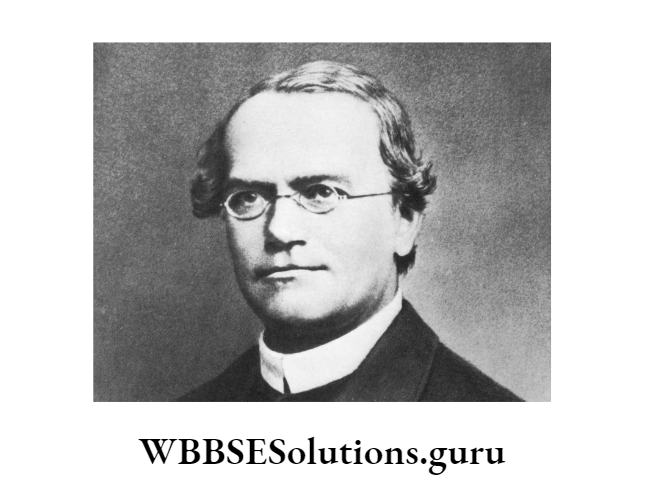
 

WBBSE Solutions For Class 10 Life Science Chapter 3 Heredity And Common Genetic Diseases Topic A Heredity Mendel the father of genetics

He became interested in investigating the mechanism by which the characters are transferred from the parent plants to their offspring. He decided to conduct some experiments in this direction.

After careful examination and thinking, Mendel selected the pea plants (Pisum sativum) for his experiments.

Gregor Mendel, through his work on pea plants, discovered the fundamental laws of inheritance.

He deduced that genes come in pairs and are inherited as distinct units, one from each parent. Mendel tracked the segregation of parental genes and their appearance in the offspring as dominant or recessive traits.

He recognized the mathematical patterns of inheritance from one generation to the next.

Thus, Mendel’s concept gave birth to the particulate theory of inheritance. Mendel’s excellent experiments, valid mathematical analysis, and formulation of laws of inheritance are collectively known as Mendelism.

The genetic experiments Mendel did with pea plants took him eight years (1856-1863) and he published his results in 1865. During this time, Mendel grew over 10,000 pea plants, keeping track of progeny number and type.

Wbbse Class 10 Life Science Heredity Notes

Mendel’s work and his Laws of Inheritance were not appreciated in his time. As a result, Mendel died in 1884 without any sort of recognition.

It was not until 1900, after the rediscovery of his Laws, that his experimental results were understood.

Three botanists – Hugo DeVries, Carl Corrensand Erich von Tschermak – independently rediscovered Mendel’s work in the year 1900, a generation after Mendel published his papers.

They helped expand awareness of the Mendelian laws of inheritance in the scientific world. The three Europeans, unknown to each other, were working on different plant hybrids when they each worked out the laws of inheritance.

WBBSE Chapter 3 Topic A Heredity Hereditary Variation

The variations that arise as a result of any change in the structure and function of the gene and that are inherited from one generation to another are called hereditary variations.

The ultimate source of all genetic variation is mutation. It leads to changes in gene function and permanent alteration to the DNA sequence.

It is a rare, random change in the genetic material and it can be inherited. The permanent alteration in the DNA sequence that makes up a gene results in difference which is found in most people.

Mutations range in size; they can affect anywhere from a single DNA building block (base pair) to a large segment of a chromosome that includes multiple genes.

This is the only way new alleles (varieties of a gene) are produced. Mutations are rare events: the average rate of mutation is about one per 100,000 genes.

Wbbse Class 10 Life Science Heredity Notes

Thus it would take on average 100,000 generations for a mutation to occur at any one specific gene. However, each individual has many, many functional genes.

Thus, at the level of the whole individual, mutations occur quite often. It is estimated that each human gamete (egg or sperm cell) has, on average, one mutation.

The heritable change in the composition of a gene that leads to the formation of a mutant gene having changed function and with the consequent appearance of a new phenotype is known as mutation.

Types Of Mutations:

There Are Two Types Of Mutations:

Gene mutations or point mutations, and

Chromosomal mutations.

1. Gene mutations:

A chemical change that occurs in the DNA of a cell is called a gene mutation or point mutation. Such a mutation may alter the sequence of the nucleotides within a part of the DNA molecule.

This alternation changes the information of the DNA chain and results in differences in the proteins being produced.

For Example:

In sickle cell anemia, the mutation of a single gene causes a slight change in the structure of the protein molecule of hemoglobin, and because of that slight change, the blood cell that carries the hemoglobin takes a sickle shape.

According to many scientists, the mutations may be caused naturally by the radiation that constantly enters the earth’s atmosphere from the cosmos.

For example, gene mutations are probably caused when the sex cells (gametes) of an organism are exposed to X-rays, gamma rays, cosmic rays, and ultraviolet rays. In addition to this radiation, certain chemicals called mutagens can change nucleotides within DNA molecules.

Wbbse Class 10 Life Science Heredity Notes

The chance for a particular human gene to mutate in one generation is about 1 in 10,000 to 1 in 1,000,000. Since humans have at least 30,000 genes, each person likely carries at least one mutation.

2. Chromosomal Aberrations (Chromosome mutations):

Another way for the genetic traits of an organism to be altered is through changes involving whole chromosomes or parts of chromosomes.

Structural changes in chromosomes are also caused by radiation, chemicals, and even some virus infections.

Chromosomal mutations may be of two basic types-

  1. Change of structure, and
  2. Change of number.

Chromosome structure changes:

Changes occur in the structure of chromosomes, during cell division. When homologous chromosomes pair up, linked genes on the chromosomes may break apart. The genes may join another chromosome, or they may be lost.

Thus, a deletion involves the loss of a piece of chromosome.

If a chromosome breaks and the parts do not reattach, the pieces may be lost. This is the most serious kind of chromosome mutation. Here, bits of genetic information are not available to the offspring.

Duplication occurs when one extra, but identical piece of a chromosome is added to the normal chromosome When an inversion occurs, the pieces of chromosomes break apart and pieces rejoin the same chromosome in a different order. Usually, inversions have no harmful effects on the offspring.

The joining of a fragmented chromosome to a non-homologous chromosome is a translocation. The piece of chromosome detaches from one chromosome and moves to a new position on another chromosome.


WBBSE Solutions For Class 10 Life Science Chapter 3 Heredity And Common Genetic Diseases Topic A Heredity Deletion

Chromosome number changes:

A chromosome mutation that causes individuals to have an abnormal number of chromosomes is termed aneuploidy. Aneuploid cells occur as a result of chromosome breakage or non-disjunction errors that happen during meiosis or mitosis.

Non-disjunction is the failure of homologous chromosomes to separate properly during cell division. It produces individuals with either extra or missing chromosomes.

Sex chromosome abnormalities that result from non-disjunction can lead to conditions such as Klinefelter and Turner syndromes. In Klinefelter syndrome, males have one or more extra X chromosomes.

In Turner syndrome, females have only one X chromosome. Down syndrome is an example of a condition that occurs due to non-disjunction in autosomal (non-sex) cells. Individuals with Down syndrome have an extra chromosome on autosomal chromosome 21.

Mendel’S Laws Of Heredity Class 10

A chromosome mutation that results in individuals with more than one haploid set of chromosomes in a cell is termed polyploidy. A haploid cell is a cell that contains one complete set of chromosomes.

Our sex cells are considered haploid and contain 1 complete set of 23 chromosomes. Our autosomal cells are diploid and contain 2 complete sets of 23 chromosomes.

If a mutation causes a cell to have three haploid sets, it is called triploidy. If the cell has four haploid sets, it is called tetraploidy.

Due to the mutagens, two types of mutations are found visible and lethal mutations. Mutations are located on either sex chromosomes or autosomes.

Common Variations In Human Population

Some examples of often un-noticed human traits are the ability or inability to roll the tongue, attached or unattached earlobes, dimples or freckles, naturally curly or straight hair, smooth or cleft chin, color blindness or normal vision, etc.

There are numerous traits in humans, but some traits occur more frequently than others. Between 70-90% of the human population have free-hanging earlobes, can roll their tongue, are right-handed, and can taste a chemical called PTC (Phenyl-thio-carbamide).

But these characters have nothing to do with life efficiencies.

Some common examples are-

Ear Lobe:

Some people have earlobes that curve up between the lowest point of the earlobe and the point where the ear joins the head; these are known as “free” or “unattached” earlobes.

Other people have earlobes that blend in with the side of the head, known as “attached” or “adherent” earlobes [Fig 3.3(b)]. Attached vs.

free earlobes are often used to illustrate basic genetics. The major form of the gene that determines the shape of the earlobe is known as an allele. An allele is a gene that is found at a specific position on a chromosome.
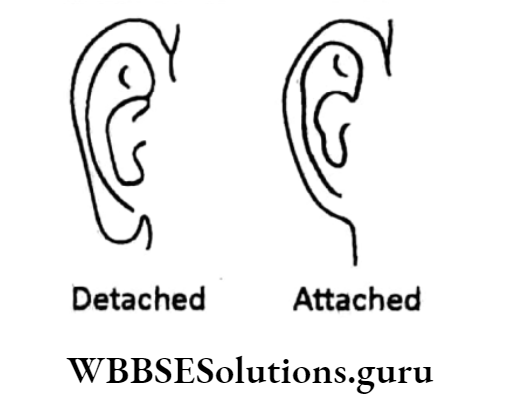
WBBSE Solutions For Class 10 Life Science Chapter 3 Heredity And Common Genetic Diseases Topic A Heredity Attached and detached

If the genes from the parents get expressed by the dominant allele, then the child will be born with free earlobes.

The structural formation of the attached earlobe is due to the absence of the dominant allele in the chromosomes. The recessive allele is expressed in the chromosomes to form an attached earlobe.

Thus, if a person is homozygous recessive for this trait, the earlobes attach directly to the head and do not hang free. However, it is not necessary that parents with attached earlobes should give birth only to the attached earlobe child.

If, on the other hand, parents with free earlobes give birth to a baby with attached earlobes, it is certain that both of them have a copy of the dominant and recessive alleles.

Tongue Rolling:

Tongue rolling is the ability to roll the lateral edges of the tongue upwards into a tube. A dominant allele enables some people to roll their tongues into a distinct U-shape. If you cannot roll your tongue you carry the recessive trait.

Recent studies have shown that this tongue-rolling could be dependent on multiple genes or alleles & some kind of environmental influences.
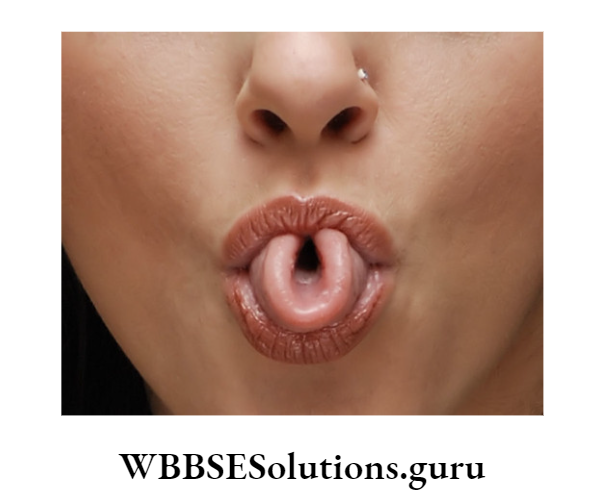
WBBSE Solutions For Class 10 Life Science Chapter 3 Heredity And Common Genetic Diseases Topic A Heredity u shaped tounge.jpg


WBBSE Chapter 3 Topic A Heredity Key Terms Associated With Heredity

Some basic key terms associated with heredity and genetics are—

Characteristics Or Trait:

A characteristic or phenotypic trait, or simply trait, is a distinct variant of a phenotypic characteristic of an organism that may be inherited, environmentally determined, or maybe a combination of the two.

For example, eye color is a character or abstraction of an attribute, while blue, brown, and hazel are traits.

Individuals and groups differ among themselves biologically, in a practically endless succession of more or less visible elements of their descriptions, which are named as traits, features, marks, nature, characteristics, characters, and others.

Mendel’s Laws Of Heredity Class 10

Each of these components is a description of, say, the observational nature, i.e. selected part of our vision or measuring the actual condition of the individual body or group structure.

Allele:

An allele is an alternative or some form of a gene (one member of a pair) that is located at a specific position (locus) on a specific chromosome.

These DNA codings determine distinct traits that can be passed on from parents to offspring through sexual reproduction. Alleles may occur in pairs, or there may be multiple alleles affecting the expression (phenotype) of a particular trait.

The word “allele” is a short form of allelomorph (“other form”), which was used in the early days of genetics to describe variant forms of a gene detected as different phenotypes.

Organisms generally have two alleles for each trait, for example- yellow or green seed colors of pea plants; in humans, the gene for eye color has an allele for blue eye color and an allele for brown.

For any gene, a person may have the same two alleles or two different ones.

Locus:

In genetics, a locus (plural loci) is the specific location of a gene, DNA sequence, or position on a chromosome.

Each chromosome carries many genes; in humans, the estimated number of ‘haploid’ protein-coding genes is 20,000-25,000, located on 23 different chromosomes. A variant of a similar DNA sequence located at a given locus is called an allele.

A locus is the specific physical location of a gene or other DNA sequence on a chromosome, like a genetic street address.

A locus is a spot or “address” on a chromosome at which a gene for a particular trait is located in all members of a species. It can also refer to the location of a mutation or other genetic marker.

A given locus can be found on any pair of homologous chromosomes. For example, in Drosophila, the locus of red and white eye colors is present on the X chromosome.

Unit of inheritance (Factor/Gene):

A gene is a stretch of DNA that helps to control the development and function of all organs and working systems in the body.

Mendel didn’t know about genes or discover genes, but he did speculate that there were two factors for each basic trait and that 1 factor was inherited from each parent.

We now know that Mendel’s inheritance factors are genes (the term was first used by Johannsen, 1909), or more specifically alleles – different variants of the same gene. It is now known that Mendelian factors, determinants, or genes are present in a linear sequence on the chromosomes.

Therefore, the gene is also defined as a unit of inheritance that consists of linear chromosome segments that can be assigned to the expression of a particular Character.

Mendel’s Laws Of Heredity Class 10

Its effect is, however, influenced by its allele, other genes, and the environment.

Genes are passed from parent to offspring; the combination of these genes affects all aspects of the human body, from eye and hair color to how well the liver can process toxins.

Monohybrid and dihybrid cross:

A monohybrid cross is a breeding experiment between P-generation (parental generation) organisms that differ in one trait.

It is a genetic cross between parents that differ in the alleles they possess for one particular gene, one parent having two dominant alleles and the other two recessives.

All the offspring (called monohybrids) have one dominant and one recessive allele for that gene (i.e. they are hybrid at that one locus). Generally, the monohybrid cross is used to determine the dominance relationship between two alleles.

Example:

The allele for green pod color is dominant and the allele for yellow pod color is recessive. The cross-pollination between a P-generation green pod pea plant and a P-generation yellow pod plant results in all green offspring.

Crossing between these offspring yields a characteristic 3:1 (monohybrid) ratio in the following generation of dominant recessive phenotypes.

A dihybrid cross is a cross between two pure lines (varieties, strains) that differ in two observed traits. A dihybrid cross describes a mating experiment between two organisms that are identically hybrid for two traits.

A hybrid organism is heterozygous, which means that it carries two different alleles at a particular genetic position or locus.

Therefore, a dihybrid organism is heterozygous at two different genetic loci. Mendel used these results as the basis for his Law of Independent Assortment.

Example:

Mendel performed a dihybrid cross using pea plants and the characteristics of seed color and texture: the parental plants had either smooth yellow seeds- the dominant characteristics – or wrinkled green seeds- the recessive characteristics.

All the offspring had smooth yellow seeds, being heterozygous for the two alleles. Crossing between these offsprings produced an F2 generation of plants with smooth yellow, smooth green, wrinkled yellow, and wrinkled green seeds in the ratio of 9:3:3:1.

Homozygous and heterozygous organisms:

Organisms can be homozygous or heterozygous for a gene. Homozygous means that the organism has two copies of the same allele for a gene.

An organism can be homozygous dominant if it carries two copies of the same dominant allele, or homozygous recessive if it carries two copies of the same recessive allele.

Heterozygous means that an organism has two different alleles of a gene. For example, pea plants can have red flowers and either be homozygous dominant (red-red), or heterozygous (red-white).

If they have white flowers, then they are homozygous recessive (white-white). Carriers are always heterozygous.

Example:

An organism is referred to as being homozygote or homozygous at a specific locus when it carries two identical copies of the gene affecting a given trait on the two corresponding homologous chromosomes (e.g., the genotype is PP or pp when P and prefers to different possible alleles of the same gene).

Such a cell or such an organism is called a homozygote.

An organism is a heterozygote or is heterozygous at a locus or gene when it has different alleles occupying the gene’s position in each of the homologous chromosomes.
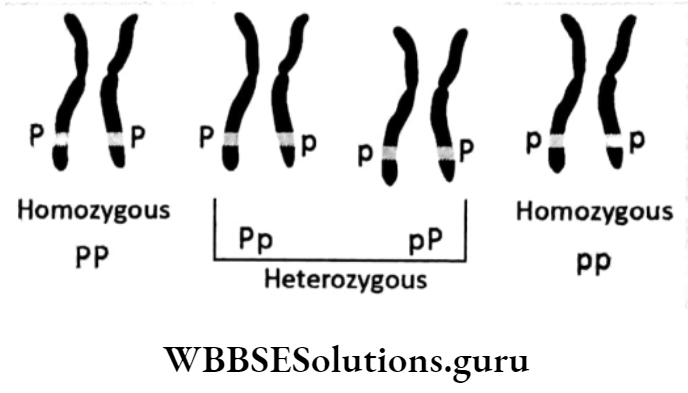
 

WBBSE Solutions For Class 10 Life Science Chapter 3 Heredity And Common Genetic Diseases Topic A Heredity genotype


In diploid organisms, the two different alleles are inherited from the organism’s two parents. For example, a heterozygous individual would have the allele combination Pp.

Hybridization:

Genetic hybridization is the process of interbreeding individuals from genetically distinct populations to produce a hybrid. A genetic hybrid would therefore carry two different alleles of the same gene.

During the 20th century planned hybridization between carefully selected parents has become dominant in the breeding of self-pollinated species.

The object of hybridization is to combine desirable genes found in two or more different varieties and to produce pure-breeding progeny superior in many respects to the parental types.

The process of hybridization is important biologically because it increases the genetic variety (number of different gene combinations) within a species, which is necessary for evolution to occur.

Mendel’s Laws Of Heredity Class 10

Example: Hybridization is the process of crossing two genetically different individuals to create new genotypes.

For example, a cross between parent 1, with the genetic makeup (genotype) BB, and parent 2, with bb, produces progeny with the genetic makeup Bb, which is a hybrid (the first filial generation or FI).


WBBSE Solutions For Class 10 Life Science Chapter 3 Heredity And Common Genetic Diseases Topic A Heredity hybridization


Hybridization was the basis of Gregor Mendel’s historic experiments with garden peas. Inheritance studies require crossing plants with contrasting or complementary traits.

Pure and hybrid:

A diploid organism has paired chromosomes, each with a similar arrangement of genetic loci.

Variations of these genes are called alleles. If an organism has one of the same types of alleles on each of its chromosomes, that organism has a pure trait.

If an organism has two different types of alleles on its chromosomes, that organism has a hybrid trait. Pure breed or true breeding are individuals that are homozygous and that will always produce the same offspring when crossed together.

A hybrid is an organism that has two different alleles for a trait.

In the simplest possible terms, purebreds are the offsprings that result from mating between genetically similar parents while hybrids are the offsprings that are the result of mating between two genetically dissimilar parents.

Thus, purebreds are composed of two (or more) like components while hybrids are created using two or more similar but not like components.

Parental generation:

The parental generation (P) is the first set of parents crossed. It is the generation of individuals of different genotypes that are mated, usually for scientific purposes, to produce hybrids.

These parental strains are purified and obtained by repeated cycles of self-fertilization. In a parental generation, two individuals are mated or crossed to determine or predict the genotypes of their offspring, called the first filial generation.

Immediate parents are designated as Pv grandparents P2; great grandparents are P3 and so on.


WBBSE Solutions For Class 10 Life Science Chapter 3 Heredity And Common Genetic Diseases Topic A Heredity parent generation


Filial generation:

Filial generation is the offspring generation. It is a generation in a breeding experiment that is successive to mating between parents of two distinctively different but usually relatively pure genotypes.

F1 is the first offspring or filial generation; F2 is the second; and so on.

Successive generations of progeny result in a controlled series of crosses, starting with two specific parents (the P generation) and selfing or intercrossing the progeny of each new (F1F2; etc. ) generation.

Filial 1 (F1) generation is the one resulting from the cross of such two selected parent generations; this generation expresses a high degree of uniformity (hybrids).

The progeny/generation derived from the Filial 1 generation is termed the Filial 2 generation (F2); this generation can show a very high degree of variation from progeny to progeny depending upon the parental generation used.

Dominant and recessive characteristics:

The terms dominant and recessive describe the inheritance patterns of certain traits. Sexually reproducing species, including people and other animals, have two copies of each gene.

The two copies, called alleles, can be slightly different from each other. The differences can cause variations in the proteins that are produced.

Proteins affect traits, so variations in protein activity or expression can produce different phenotypes. A dominant allele produces a dominant phenotype in individuals who have one copy of the allele, which can come from just one parent.

For a recessive allele to produce a recessive phenotype, the individual must have two copies, one from each parent.

An individual with one dominant and one recessive allele for a gene (heterozygous) will have the dominant phenotype.

Heredity Class 10 Life Science

For example, in humans, the allele for brown eyes is dominant, therefore offspring only need one copy of the ‘brown eye’ allele to have brown eyes (although, with two copies they will still have brown eyes).

Recessive alleles only show their effect if the individual has two copies of the allele (also known as being homozygous).

For example, the allele for blue eyes is recessive, therefore to have blue eyes the offsprings need to have two copies of the ‘blue eye’ allele.

WBBSE Solutions For Class 10 Life Science Chapter 3 Heredity And Common Genetic Diseases Topic A Heredity brown eyes


Phenotype And Genotype:

Genotype is the genetic makeup of an individual organism that functions as a set of instructions for the growth and development of the body.

The word ‘genotype’ is usually used when talking about the genetics of a particular trait (like eye color).

Phenotype is the observable physical or biochemical characteristics of an individual organism, determined by both genetic makeup and environmental influences, for example, height, weight, and skin color.

An organism’s genotype is the set of genes that it carries. An organism’s phenotype is all of its observable characteristics—which are influenced both by its genotype and by the environment.

The “internally coded, inheritable information”, or Genotype, carried by all living organisms, holds the critical instructions that are used and interpreted by the cellular machinery of the cells to produce the “outward, physical manifestation”, or Phenotype of the organism.

The entire set of genes or the genotype in a black mouse. It comprises a set of alleles that determines the expression of a particular characteristic or trait (phenotype). Her black hair is the trait or phenotype concerned.

All the key terms described in this article (3A.2), are explained with sample crosses in the following articles.

WBBSE Solutions For Class 10 Life Science Chapter 3 Heredity And Common Genetic Diseases Topic A Heredity genotype and phenotype


WBBSE Chapter 3 Topic A Heredity Mendel’s Work On Pea Plants

In 1854, Mendel began a series of breeding experiments with the garden pea Pisum sativum in an attempt to learn something about the mechanisms of heredity.

The bisexual flower of pea normally reproduces by self-fertilization.

That is, the stamen (male reproductive organs) produces pollens, which land on the pistil (female reproductive organs) within the same flower and consequently fertilize the plant. This process is called selfing.

To prevent selfing and to carry out cross-pollination in pea plants, three steps of emasculation, dusting and bagging are to be carried out as elaborated here:

It is relatively a simple procedure to prevent self-fertilization of the pea by removing the stamens from a developing flower bud before they produce any mature pollen.

For this purpose, the stamens are cut off by a scissor from the selected bisexual flowers to remove the masculine part of the flower.

This process is known as emasculation. The pollen taken from the stamens of another flower can then be dusted onto the stigma of the pistil of the emasculated one to cross-pollinate it. After cross-pollination, all the

flowers are covered with paper bags to avoid any contamination by undesired pollen grains.

Cross-fertilization, or more simply a cross, is the term used for the fusion of male gametes (pollen) from one individual and female gametes (eggs) from another.

Once cross-fertilization has occurred, the zygote develops in the seeds (peas), which are then planted.

For his experiment, Mendel obtained 34 strains of pea plants that differed in a number of traits.

He allowed each strain to self-fertilize for many generations to ensure that he only worked with pea strains in which the trait under investigation remained unchanged from parent to offspring for many generations.

Wbbse Class 10 Life Science Heredity Notes

Such strains are called true-breeding or pure-breeding strains.

In Mendel’s work true breeding or pure breeding homozygous strains constitute the parental (P) generation.

Once cross-fertilization is carried out in a parental generation, the progeny that is obtained is known as the First generation offspring or First filial (F1) generation.
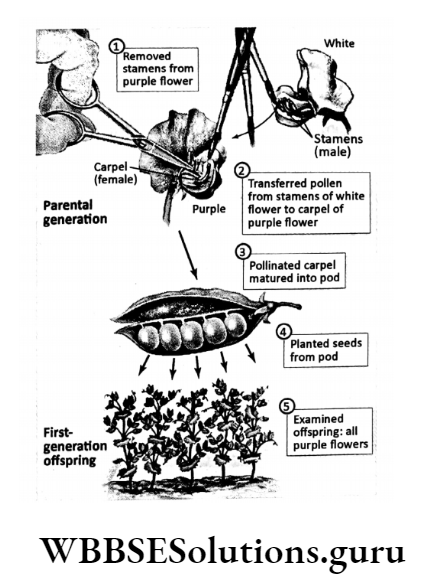
 

WBBSE Solutions For Class 10 Life Science Chapter 3 Heredity And Common Genetic Diseases Topic A Heredity parental generation


WBBSE Chapter 3 Topic A Heredity Mendel’s Experiment And Laws For Monohybrid Cross

Mendel performed several mono-hybridization experiments on pea plants involving crosses between parents that differ in a single gene.

WBBSE Chapter 3 Topic A Heredity The seven pairs of characters as chosen by Mendel

Mating between individuals that differ in only one trait, such as seed color or stem length is known as a monohybrid cross.

In each monohybrid cross, one parent carries one form of the trait, and the other parent carries an alternative form of the same trait. Mendel selected seven such traits to study the monohybrid breeding experiment.

Each trait had two easily distinguishable, alternative appearances (phenotypes).

These are—
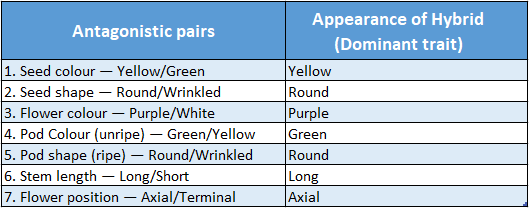
WBBSE Solutions For Class 10 Life Science Chapter 3 Heredity And Common Genetic Diseases Topic A Heredity antagonistic pairs

WBBSE Chapter 3 Topic A Heredity Experiment And Observation

Mendel carried out a series of monohybrid crosses.

For example, in the spring of 1854, he planted pure-breeding green peas and pure-breeding yellow peas and allowed them to grow into the parental (P) generation.

Later that spring when the plants had flowered, he dusted the female stigma of green-pea plant flowers with pollens from yellow-pea plants. He also performed the reciprocal cross between the female yellow pea plant and the male green pea plant.

In the fall (autumn), when he collected and separately analyzed the progeny peas he found that in both cases, the peas were all yellow.

The yellow peas, the progeny of the P generation, were the beginning of what we now call the first filial (Fx) generation. Mendel planted them and allowed the F1 plants to self-fertilize.

He then harvested and counted the peas of the resulting second filial (F2) generation, the progeny of the Fx generation.
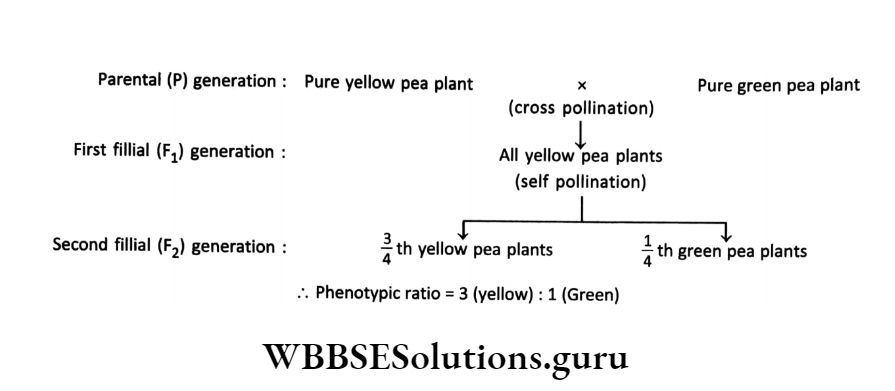
WBBSE Solutions For Class 10 Life Science Chapter 3 Heredity And Common Genetic Diseases Topic A Heredity experiment and observation


Among the progeny of one series of F1 self-fertilization, there were 6022 yellow and 2001 green peas, an almost perfect ratio of 3 yellow to 1 green.

The results of reciprocal crosses produced a similar ratio. Monohybrid crosses involving other traits (such as long and short stem length) also showed similar results.

WBBSE Chapter 3 Topic A Heredity Mendel’s explanation

To explain these results, Mendel proposed the existence of what he called particulate unit factors for each trait. He suggested that these factors served as the basic unit of heredity and passed unchanged from generation to generation, determining various traits expressed by each individual plant.

WBBSE Chapter 3 Topic A Heredity Mendel’s First Three Postulates

Using the constant pattern of result in the monohybrid crosses, Mendel derived the following three postulates or principles of inheritance

Unit Factors in Pairs:

Genetic characters are controlled by unit factors existing in pairs in individual organisms.

In the monohybrid cross involving yellow (Y) and green (y) seeds, a specific unit factor exists for each trait. Each diploid individual receives one factor from each parent.

Because the factors occur in pairs, three combinations are possible:

YY, Yy, and Yy. The seeds having unit factor combinations of either YY or yy have two copies of the same allele for a gene. Hence these are homozygous.

The seeds having a unit factor combination of Yy have two different alleles of a gene. Hence these are heterozygous.

Dominance/Recessiveness:

When two unlike unit factors, responsible for a single character, are present in a single individual, one unit factor is dominant to the other, which is said to be recessive.

In each monohybrid cross, the trait expressed in the F1 generation results from the presence of the dominant unit factor.

The trait that is not expressed in the F1 but which reappears in the F2 is under the genetic influence of the recessive unit factor.

In the above-mentioned case, the trait yellow seed color (Y) is said to be dominant to the recessive trait, green seed (y). Hence, the progeny of P, i.e. the F1 generation had all yellow pea plants.

Among the progeny of ie. in the F2 generation, green pea plants reappeared along with yellow pea plants.

Segregation:

During the formation of gametes, the paired unit factors responsible for contrasting traits do not blend with each other but separate or segregate randomly, so that each garnet receives one or the other with equal likelihood.

This is known as the 1st law of Mendel or the law of Segregation.

WBBSE Chapter 3 Topic A Heredity Analysis Of Monohybrid Cross And Checker Board
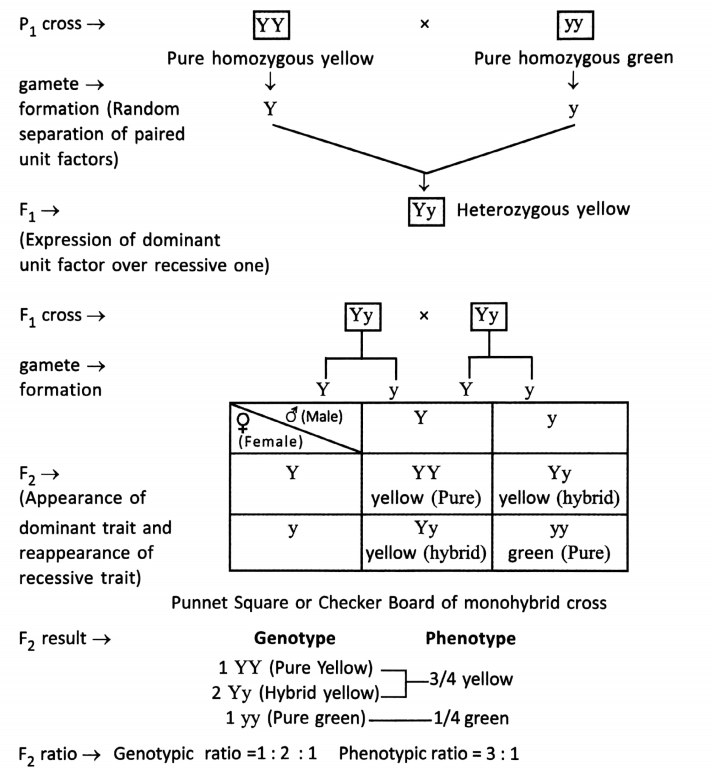
 

WBBSE Solutions For Class 10 Life Science Chapter 3 Heredity And Common Genetic Diseases Topic A Heredity Analysis of monohybrid cross

WBBSE Chapter 3 Topic A Heredity Punnett Squares

The genotypes and phenotypes resulting from the recombination of gametes during fertilization can be easily visualized by constructing a Punnett square, named after R. C.

Punnett who first devised this approach. In this construction, each of the possible gametes is assigned an individual column or a row, with the vertical column representing those of the female parent and the horizontal row those of the male parent.

After the gametes are entered in rows and columns, the new generation can be predicted by combining the male and female gametic information for each combination and entering the resulting genotype in the boxes. This process represents all possible random fertilization events.

WBBSE Chapter 3 Topic A Heredity Mendel’s Experiment And Laws For Dihybrid Cross

As a natural extension of the monohybrid cross, Mendel also designed experiments in which he examined two characters simultaneously. Such a cross, involving two pairs of contrasting traits, is called a dihybrid cross.

WBBSE Chapter 3 Topic A Heredity Experiment and Observation

Mendel-crossed pea plants that are heterozygous for two genes at the same time.

To construct such a dihybrid, he mated true-breeding plants grown from yellow round peas (YYRR) with true-breeding plants grown from green wrinkled peas (year).

From this cross, he obtained a dihybrid F1 generation (YyRr) showing only the two dominant phenotypes, yellow and round. He then allowed these F1 dihybrids to self-fertilize to produce the F2 generation.

When Mendel counted the F2 generation of one experiment, he found 315 yellow round, 101 yellow wrinkled, 108 round green, and 32 wrinkled green peas. There were, in fact, yellow wrinkled and green round recombinant phenotypes, providing evidence that some shuffling of alleles had taken place.

Explanation

From the observed ratios, Mendel inferred the biological mechanism of shuffling the independent assortment of gene pairs during gamete formation.

Because the genes for peas’ color and for shape assort independently, Y can be with R or r in any gamete with equal probability.

Thus, the presence of a particular allele of one gene, say, the dominant Y for pea color, provides no information whatsoever about the alleles of the second gene.

That is, the allele for pea shape in Y carrying game could with equal likelihood be either R or r.

Each dihybrid of the F1 generation can, therefore, make four kinds of gametes:

YR, Yr, yR, and yr. In a large number of gametes, the four kinds will appear in an almost perfect ratio of 1:1:1:1.

At fertilization then, in a mating of dihybrids, 4 different kinds of eggs can combine with any one of 4 different kinds of pollen, producing a total of 16 possible zygotes in the F2 generation.

Wbbse Class 10 Life Science Heredity Notes

Once again, a Punnett square is a convenient way to visualize the process.

In fact, there are only nine different F2 genotypes — YYRR, YYRr, YyRr, YyRR, yyRR, yyRr, YYrr, Yyrr, and yyrr — because the source of the alleles (egg or pollen) does not make any difference.

If we look at the combination of the traits determined by nine genotypes, we will see only four phenotypes— yellow round, yellow wrinkled, green round, and green wrinkled — observed in a ratio of 9 : 3 : 3: 1.

If, however, we look at just pea color or just pea shape, we can see that each trait is inherited in the 3: 1 ratio as predicted by Mendel’s law of segregation.

Punnet Square or Checker Board of Dihybrid cross
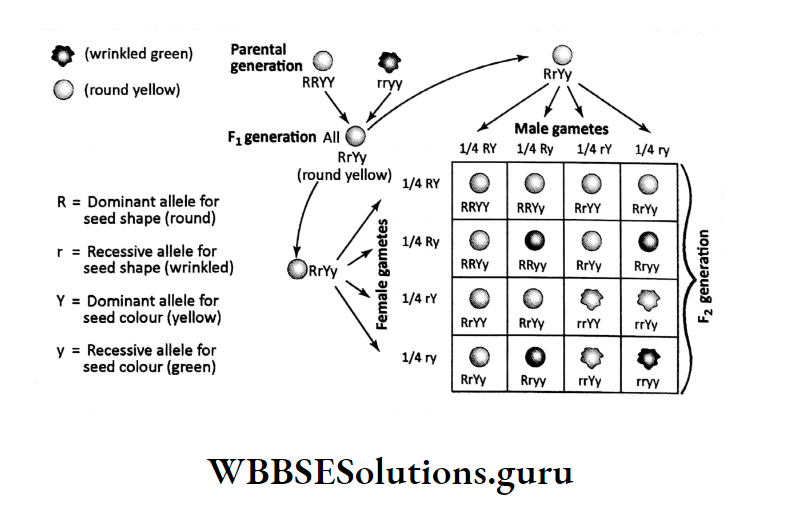
WBBSE Solutions For Class 10 Life Science Chapter 3 Heredity And Common Genetic Diseases Topic A Heredity Punnet Square or Checker Board of Dihybrid cross

WBBSE Solutions For Class 10 Life Science Chapter 3 Heredity And Common Genetic Diseases Topic A Heredity f2 generation

WBBSE Chapter 3 Topic A Heredity Mendel’s Fourth Postulate

The above analysis became the basis of Mendel’s second general principle or the fourth postulate, the law of independent assortment.

Independent Assortment:

During gamete formation, segregating pairs of unit factors assort independently of each other and undergo random recombination in all possible combinations governed by chance alone.

This postulate stipulates that any pair of unit factors segregate independently of all other unit factors. Thus, according to the postulate of independent assortment, all possible combinations of gametes will be formed in equal frequency.

WBBSE Chapter 3 Topic A Heredity Reasons for Mendel’s Success

Mendel’s success was dependent upon the following factors:

First, he chose the garden pea (Pisum sativum) as his experimental organism.

These plants can easily be cultivated, crossed, and for each successive generation, Mendel could thus obtain large members of individuals within a relatively short growing season.

By comparison, if he had worked with sheep, each mating would have generated only a few offspring and the time between generations would have been several years.

Second, Mendel examined the inheritance of clearcut contrasting forms of particular traits — round versus wrinkled seed, yellow versus green pod color, etc.

Using such ‘either-or’ traits, he could distinguish and trace unambiguously the transmission of one or the other observed characteristics, because there were neither any intermediate forms nor any of these characters located on separate chromosomes.

Third, Mendel isolated and perpetuated lines of peas that breed true. Mating with such pure breeding lines produce offsprings carrying specific parental traits that remain constant from generation to generation.

Fourth, Mendel carefully controlled his matings, going to great lengths to ensure that the progeny he observed really resulted from the specific fertilization he intended.

Thus he painstakingly prevented the intrusion of any foreign pollen and assured self or cross-pollination as the experiment demanded.

He also performed reciprocal crosses, in which by reversing the traits of male and female parents, he efficiently controlled the path of transmission of a particular trait either via the egg cell within the ovule or via the pollen as per experimental demand.

Fifthly, Mendel worked with a large number of plants, counted and subjected his findings to statistical analysis, and then compared his results with predictions based on mathematical models.

Wbbse Class 10 Life Science Heredity Notes

Finally, Mendel was a brilliant practical experimentalist. He could call and observe an optimum number of individuals from the limited space of the monastery garden.

In short, Mendel purposely set up a simplified ‘black and white’ experimental system and then successfully out how it worked.

Genetic Crosses With Guineapig

Mendel worked on pea plants but the application of his laws on animals was carried out by his successors.

WBBSE Chapter 3 Topic A Heredity Monohybrid Cross

When a pure (homozygous) black-haired guineapig (BB) is crossed with a pure white-haired guineapig (bb), all the F1 offsprings (Bb) are found to be black-haired despite the presence of two contrasting genes for black hair and white hair.

It means black color is dominant to white color in guineapig and F1 black offsprings (Bb) are heterozygous. Here the gene for the black color is represented by B and for the recessive white color by b.

When the F1 heterozygous guineapigs are bred among themselves, individuals of the F2 generation are produced. The F2 phenotypic ratio is 3 (black): 1 (white) whereas the F2 genotypic ratio is (pure black, BB) 1: (heterozygous black, Bb) 2: (pure white, bb) 1.

This shows that the inheritance of hair color in guinea pigs follows Mendel’s first law of Segregation.
The monohybrid cross in guinea pig is shown here with a checkerboard.

WBBSE Solutions For Class 10 Life Science Chapter 3 Heredity And Common Genetic Diseases Topic A Heredity Monohybrid cross

WBBSE Chapter 3 Topic A Heredity Dihybrid Cross

In guinea pigs, the black coat (BB) is dominant to the white coat (bb), and short hair (SS) is dominant over long hair (ss).

When a homozygous black short-haired male guinea pig (BBSS) is crossed with a white long-haired female (bass), all the F1 offspring obtained are with black short hair (BbSs).

This shows the dominance of black coats over white coats and the dominance of short hair over long hair.

When the hybrid individuals are allowed to interbreed, F2 generation consisting of four types of individuals is produced in the following phenotypic ratio = 9 (black short) : 3 (black long) : 3 (white short): 1 (white long).

The F1 hybrids (BbSs) produced gametes when Bb and Ss alleles were segregated and assorted independently to produce four types of gametes: BS, Bs, bS, and bs.

Thus four types of male gametes and similar four types of female gametes are produced.

These gametes undergo fertilization at random to produce 16 different types of zygotes in the F2 generation having the above-mentioned four types of phenotypes. This clearly explains Mendel’s law of independent assortment.
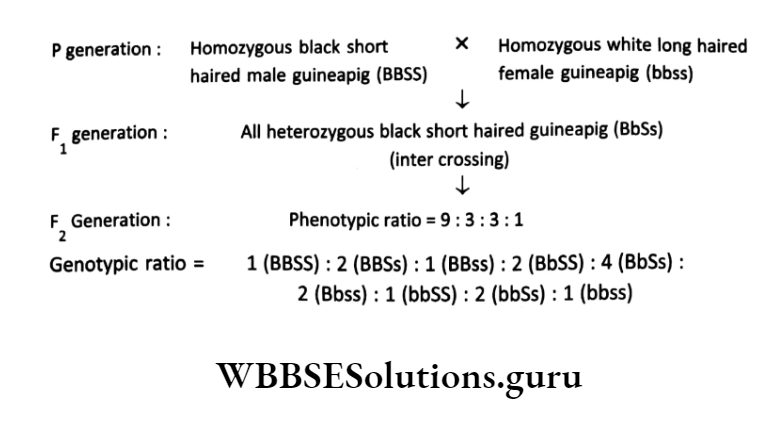
WBBSE Solutions For Class 10 Life Science Chapter 3 Heredity And Common Genetic Diseases Topic A Heredity Dihybrid cross

WBBSE Chapter 3 Topic A Heredity Deviation Of Menders Laws Of Heredity

Although Mendel formulated the postulates that provide the basis of our understanding of genetic principles, there are many types or modes of inheritance that Mendel simply didn’t encounter.

These modes of inheritance were encountered when investigators began using Mendel’s postulates to study inheritance in other organisms.

Some of these modes of inheritance appear, at first glance, to obey different rules than those that Mendel proposed. So, was Mendel wrong then? Not really.

Wbbse Class 10 Life Science Heredity Notes

His postulates fit the data that he collected, but as stated above, there are situations that he didn’t observe in his study of the pea.

This is a common occurrence in science: when a theory is proposed, it is used as long as it is useful in explaining some aspect of nature.

When data are encountered that don’t fit the theory, the theory may have to be modified (if possible) or discarded. Mendel’s ideas as originally presented may not fit every possible mode of inheritance, but they still provide the basis for explaining those other types of inheritance.

WBBSE Chapter 3 Topic A Heredity Genetic Interaction

According to Mendel each trait or character is controlled by a pair of factors or genes. But later discoveries proved that in many cases the expression of a single character is controlled by the interaction of more than one pair of genes.

The coordinated effect of two or more genes in producing a given phenotypic trait is known as genetic interaction. It was proposed by Bateson and Punnet in the form of a factor hypothesis.

This hypothesis states that certain characters are controlled by the interaction of two or more genes.

The interaction of genes may be classified into two types:

  1. Non-allelic and
  2. Allelic gene interaction.

The genetic interactions that occur between genes located in the same chromosome or different chromosomes are known as nonallelic gene interactions.

For instance, in some animals, a gene at one locus on a chromosome totally suppresses the expression of a gene at another locus. Such genes are called inhibiting genes and the phenomenon is known as epistasis, eg. ABO blood group in man.

There may be supplementary genes that interact in such a way that one dominant gene produces its effect whether another dominant gene is present or not, but when the second dominant gene is added to the first, a new character is expressed; eg. coat color in mice.

There may also be collaborator genes that influence the same trait but interact to produce totally new traits that neither of the genes could produce, eg. comb shape in fowls.

The other type of genetic interaction that occurs between the two alleles of a single type of gene is known as allelic gene interaction.

For instance, if genes are within a certain distance on the same chromosomes, they do not follow the Law of independent assortment; instead, they are linked when transmitted to the next generation.

This is called linkage. Genes that are located in the cytoplasm do not follow either of Mendel’s Laws, they exhibit maternal inheritance traits.

If the dominance is incomplete, a dominant trait wouldn’t be observed immediately. Sometimes genes become co-dominant, meaning both alleles will show a phenotype.

There may be multiple genes in which case two or more independent pairs of factors affect the same characters but in an additive manner, eg. human skin color.

WBBSE Chapter 3 Topic A Heredity Incomplete Dominance

A common example of deviation from Mendelism is the phenomenon called incomplete dominance.

A cross between parents with contrasting traits may sometimes generate offspring with an intermediate phenotype.

In a heterozygote organism carrying both a dominant and a recessive allele of the same gene, when the dominant gene cannot express its dominant phenotype completely, a mixed or intermediate, or blended phenotype between the dominant and the recessive is expressed.

Such a situation is known as incomplete dominance. In many plant species, flower color serves as a striking example of incomplete dominance.

With the flowers of Four O’Clocks or floret clusters of Snapdragons Mirabilis jalapeno, a cross between pure breeding red flowered parents and pure breeding white yields hybrids with pink blossoms.

During gametogenesis, the pure red flowered parent plant (AA) produces (A) gametes and the pure white flowered parent plant (aa) produces (a) gametes.

WBBSE Solutions For Class 10 Life Science Chapter 3 Heredity And Common Genetic Diseases Topic A Heredity incomplete dominace

After cross-pollination of parental plants, (A) and (a) unite together to form (Aa) zygote that develops into plants with pink flowers.

Here both the allelomorphic genes have a partial or incomplete dominant relationship and hence, F1 hybrids show a mixture of characters of both parents. This is a case of incomplete dominance.

If allowed to self-pollinate, the F1 pink blooming plants produce F2 progeny bearing red, pink, and white flowers in a ratio of 1: 2 :1. This is the familiar genotypic ratio of an ordinary single gene F1 self-cross.

What is new is that because the heterozygotes look unlike either homozygote, the phenotypic ratios are an exact reflection of the genotypic ratios.

F2 Phenotypic ratio = 1 (Red): 2 (Pink): 1 (White) F2 Genotypic ratio = 1 (AA): 2 (Aa): 1 (aa) In this example of Mirabilis jalapa, the red gene is incompletely dominant over the white gene and so both of them give rise to an intermediate pink colored flower in heterozygous or hybrid condition.

Explanation:

The biochemical explanation for this type of incomplete dominance is that each allele of the gene under analysis specifies an alternative form of a protein molecule with an enzymatic role in pigment production.

If the ‘white’ allele does not give rise to the functional enzyme, no pigment appears.

Thus, in Snapdragons and four o’clock, two ‘red’ alleles per cell produce a double dose of a red-producing enzyme, which generates enough pigment to make the flowers look fully red.

Wbbse Class 10 Life Science Heredity Notes

In the heterozygote, one copy of the ‘red’ allele per cell results in only enough pigment to make the flowers look pink. In the homozygote for the ‘white’ allele, where there is no functional enzyme and thus no red pigment, the flowers appear white.

WBBSE Chapter 3 Topic A Heredity Sex Determination In Human

The term sex refers to sexual phenotype. Most organisms have only two sexual phenotypes—male and female.

We, normally, define the sex of an individual organism about its phenotype. The mechanism by which sex is established is termed sex determination.

Sometimes an individual organism has chromosomes that are normally associated with one sex. For example, the cells of female humans normally have two X chromosomes, and the cells of males have one X chromosome and one Y chromosome.

Sex Determination In Humans:

In humans, Drosophila, and many other species, the cells of males and females have the same number of chromosomes, but the cells of males have a single X chromosome and a smaller sex chromosome, the Y chromosome.

The Y chromosome is not Y-shaped as is commonly assumed but is acrocentric. In this type of sex determination system, the male (44A + XY) is heterogametic because half of the male gametes have an X chromosome and the other half have a Y chromosome.

The female (44A + XX) is homogametic because all the eggs contain a single X chromosome. Fertilization of an egg (always X-bearing) with an X-bearing sperm produces female offspring (XX), but a Y-bearing sperm produces male offspring (XY).


WBBSE Solutions For Class 10 Life Science Chapter 3 Heredity And Common Genetic Diseases Topic A Heredity homozygotes


The Total Chromosomes In Humans, In Each Body Cell, Can Be Represented As-

Female chromosomes – 44+XX where 44 are the autosomes and XX chromosomes are the sex chromosomes.

Male chromosomes – 44+XY where 44 are the autosomes and XY chromosomes are the sex chromosomes.

Although the X and Y chromosomes are not homologous, they pair and segregate into different cells in meiosis.

This is because of the fact that these chromosomes are homologous in small regions, called the pseudoautosomal region, in which they carry the same genes. In both types, the human X and Y chromosomes contain pseudoautosomal regions.

In humans and other placental mammals, maleness is due to a dominant effect of the Y chromosome. This is evidenced by the study of individuals with an abnormal number of sex chromosomes or aneuploidy.

XO persons (Turner syndrome) develop as females and XXY persons (Klinefelter syndrome) develop as males.

The dominant effect of the Y chromosome is exhibited early in development when it directs the primordial gonads to develop into testes.

Mendel’S Laws Of Heredity Class 10

Once the testes are formed, they secrete the hormone testosterone, which stimulates the development of male secondary sexual characteristics.

It is now known that the testis-determining factor (TDF) is the product of a gene called SRY (Sex-determining region Y), which is located outside the pseudoautosomal region in the short arm of the Y chromosome.

When fertilization occurs, the zygote (the initial cell from which a fetus grows) always inherits one of the mother’s X chromosomes, and either an X or a Y from the father, depending on which chromosome the fertilizing sperm cell happened to inherit.

One could say, then, that the father or, at least, his sperm determines the sex of the child.

The generally accepted theory is that males determine the sex because males can donate either an X chromosome or Y chromosome, while females can only donate an X chromosome to their offspring, making their contribution constant and the male’s contribution.

The variable, which under normal circumstances, determines the offspring’s genetic sex (at least, in humans Moreover, genetically there is a 50% chance of having a boy and a 50% chance of having a girl, as is found out from.

But there are actually slightly more boys born every year than girls.

It’s unclear why this is the case, but some research points out that more female fetuses die during pregnancy than male.

The Y chromosome contains all the directions that make the human zygote develop into a male. It is a relatively small chromosome with about 30 genes.

In comparison, the X chromosome has between 800 and 900 genes.

With its limited number, the Y chromosome focuses primarily on male traits. It contains the all-important SRY gene, which instructs the embryo to develop male traits such as testicles.

Another gene unique to the Y chromosome is USP9Y, which contributes to sperm production.
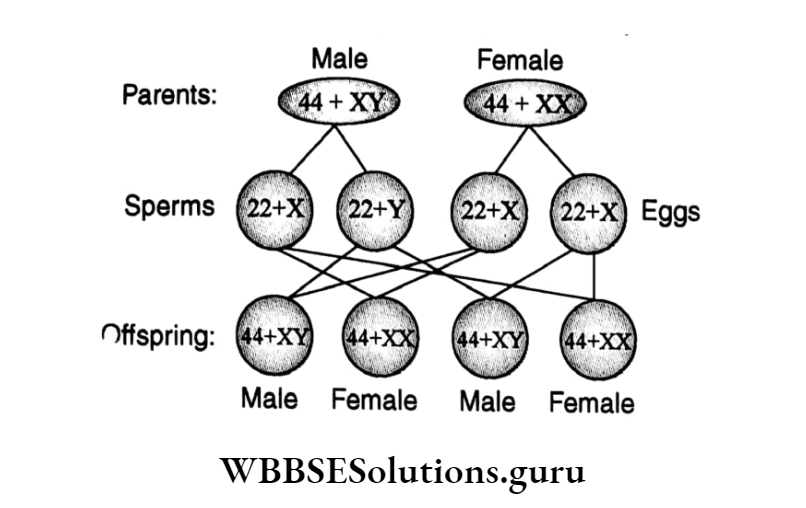
WBBSE Solutions For Class 10 Life Science Chapter 3 Heredity And Common Genetic Diseases Topic A Heredity Genetic sex


WBBSE Chapter 3 Topic A Heredity Fill In The Blanks

Question 1. _______________ is the cause of similarities between the offspring.
Answer: Heredity

Question 2. _______________ is considered as the father of genetics.
Answer: Mendel

Question 3. Mendel selected the _______________ plants for his experiments.
Answer: Garden Pea

Question 4. The process of removing stamens from flowers during hybridization is known as _______________.
Answer: Emasculation

Question 5. The mutation is a change in a gene or_______________.
Answer: Chromosome

Question 6. If a person is_______________ recessive for this trait, the earlobes attach directly to the head and do not hang free.
Answer: Homozygous

Heredity Class 10 MCQS

Question 7. If you cannot roll your tongue you carry the_______________ trait.
Answer: Recessive

Question 8. An _______________is an alternative form of a gene that is located at a specific position on a specific chromosome.
Answer: Allele

Question 9. In genetics, a _______________is the specific location of a gene on a chromosome.
Answer: Locus

Question 10. A_______________ cross describes a mating experiment between two organisms that are identically hybrid for two traits.
Answer: Dihybrid

Question 11. _______________ means that the organism has two copies of the same allele for a gene.
Answer: Ghomozygous

Question 12. Heterozygous means that an organism has two different_______________ of a gene.
Answer: Alleles

Question 13. _______________is the process of crossing two genetically different individuals to create new genotypes.
Answer: Hybridization

Question 14. Mating between parents of two distinctly different but usually relatively pure genotypes results in_______________ generation.
Answer: First filial (F1)

Heredity Class 10 MCQS

Question 15. An individual with one dominant and one recessive allele for a gene will have the_______________ phenotype.
Answer: Dominant

Question 16. _______________ is the observable physical or biochemical characteristics of an individual organism.
Answer: Phenotype

Question 17. Two crosses between the same pair of genotypes or phenotypes in which the sources of the gametes are reversed in one cross are known as_______________
Answer: Reciprocal Cross

Question 18. The law of_______________ is known as the first law of Mendel.
Answer: Segregation

Question 19. 9:3:3:1 F2 ratio is found in a _______________cross.
Answer: Dihybrid

Question 20._______________ genes do not show independent assortment.
Answer: Linked

Question 21. _______________dominance was observed in Snapdragons.
Answer: Incomplete

Question 22. In humans, maleness is due to a dominant effect of the_______________ chromosome.
Answer: Y

Question 23. A ratio of 1:2:1 as both the phenotypic and genotypic ratios is found in_______________.
Answer: Incomplete Dominance

Question 24. The genotypes and phenotypes resulting from the recombination of gametes during fertilization can be easily visualized by constructing a_______________
Answer: Punnett Square

Heredity Class 10 MCQS

Question 25. The coordinated effect that occurs between the two alleles of a single type of gene is known as_______________ gene interaction.
Answer: Athletic

WBBSE Chapter 3 Topic A Heredity Write True Or False

Question 1. It is difficult to find out identical individuals due to variations.
Answer: True

Question 2. Genetic variations are caused by environmental changes.
Answer: False

Question 3. Blending theories of inheritance were proposed by Mendel
Answer: False

Question 4. Mendel selected 7 pairs of contrasting traits of the pea plants for his experiments.
Answer: True

Question 5. Small and indistinct variations are referred to as discontinuous variations.
Answer: False

Question 6. Mendel’s concept gave birth to the particulate theory of inheritance.
Answer: True

Question 7. Masculation, dusting, and bagging are the methods to be followed to ensure cross-pollination in bisexual flowers.
Answer: True

Heredity Class 10 MCQS

Question 8. While Mendel is known as the ‘Father of Genetics, Bateson is called the ‘Father of modern genetics’.
Answer: True

Question 9. The mutation is a change in an environment.
Answer: False

Question 10. A dominant allele enables some people to roll their tongues into a distinct U-shape.
Answer: True

Question 11. An allele is a place where a gene is located.
Answer: False

Question 12. In human reproduction, the mother plays a vital role to determine the sex of the child.
Answer: False

Question 13. Mendelian monohybrid cross F2 ratio is 3:1.
Answer: True

Question 14. Homozygous means that an organism has two different alleles of a gene.
Answer: False

Question 15. Hybridization is the process of crossing two genetically different individuals to create new genotypes.
Answer: True

Question 16. A diploid organism has paired chromosomes.
Answer: True

Question 17. The progeny/generation derived from filial 2 generations is termed as filial 1 generation.
Answer: False

Question 18. In humans, the allele for brown eyes is dominant.
Answer: True

Question 19. An organism’s phenotype is the set of genes that it carries.
Answer: False

Question 20. The law of independent assortment is considered the first law of Mendel.
Answer: False

Question 21. Linked genes do not assort independently.
Answer: True

Question 22. The intermediate genotype is caused due to incomplete dominance.
Answer: True

Heredity Class 10 MCQS

Question 23. In humans, persons bearing XX chromosomes are females.
Answer: True

Question 24. Even if the dominance is incomplete, the dominant trait would prevail over the recessive one in the F1 generation.
Answer: False

Question 25. ‘Gametes are never hybrid’—this is a statement of the law of segregation.
Answer: True

WBBSE Chapter 3 Topic A Heredity Match The Column
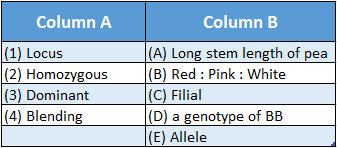
WBBSE Solutions For Class 10 Life Science Chapter 3 Heredity And Common Genetic Diseases Topic A Heredity match the column 1
Answer: 1-E,2-D,3-A,4-B

WBBSE Solutions For Class 10 Life Science Chapter 3 Heredity And Common Genetic Diseases Topic A Heredity match the column 2
Answer: 1-C,2-E,3-B,4-A

WBBSE Solutions For Class 10 Life Science Chapter 3 Heredity And Common Genetic Diseases Topic A Heredity match the column 3
Answer: 1-C,2-D,3-A,4-B

WBBSE Chapter 3 Topic A Heredity Very Short Answer Type Questions

Question 1. Name two sources of variation.
Answer: Mutation, deletion.

Question 2. Write the scientific name of the plant which Mendel chose for the hybridization experiment.
Answer: Garden pea plant – Pisum sativum.

Question 3. In which year, Mendel’s propositions were rediscovered?
Answer: In 1900.

Question 4. Give an example of a harmful variation.
Answer: Sickle cell anemia.

Question 5. What is mutation?
Answer: Mutation is the spontaneous, sudden, heritable, and permanent change in a gene or chromosome that causes a detectable effect in the organism.

Question 6. What is the average rate of mutation?
Answer: The average rate of mutation is about one per 100,000 genes.

Question 7. Are the environmental variations heritable?
Answer: No, they are not heritable.

Question 8. Give an example of discontinuous variation in man.
Answer: Appearance of six fingers in man.

Question 9. What are germinal variations?
Answer: The heritable variation which affects the germinal or reproductive cells is called germinal variation.

Mendel’s Laws Of Heredity Class 10

Question 10. Give an example of neutral variation.
Answer: Presence of left-handed and right-handed persons.

Question 11. Choose the odd one and write it:
Answer: Wrinkled seed shape, short stem length, round pod shape, terminal flower position.

Round Pod Shape:

It is a dominant trait in pea plants while the other examples are recessive traits.

Question 12. What is a gene mutation or point mutation?
Answer: A chemical change that occurs in the DNA of a cell is called a gene mutation or point mutation.

Question 13. How the structural changes of chromosomes may be caused?
Answer: Structural changes in chromosomes are caused by exposure to radiation, chemicals, and even by some virus infections.

Question 14. What is an inversion?
Answer: When an inversion occurs, the pieces of chromosome break apart and pieces rejoin the same chromosome in a different order.

Question 15. Name a visible dominant character of a human.
Answer: Free, unattached ear lobe.

Question 16. What is the diploid chromosome number of garden peas?
Answer: Diploid (2n) chromosome number = 14.

Question 17. Among the following four terms, one includes the other three. Find out the term and write it: blood type, trait, skin color, height.
Answer: Trait.

Question 18. Who is considered the father of experimental genetics?
Answer: Morgan.

Mendel’s Laws Of Heredity Class 10

Question 19. What is sex determination?
Answer: The mechanism by which sex is determined is known as sex determination.

Question 20. What is the vital role of the Y chromosome in humans?
Answer: It is responsible for male sex determination.

Question 21. A tall (dominant trait) and a dwarf (recessive trait) pea plant are crossed. How would you represent the test cross?
Answer: Ttxtt.

Question 22. Is the organism having a genotype of BbSS homozygous or heterozygous?
Answer: Heterozygous

Question 23. How many different types of gametes would be produced by an individual with genotype SsTt Uu?
Answer: Since the contrasting pairs of characters recombine randomly in all possible combinations, there would be 8 different types of gametes as shown: STU, STU, StU, Stu, sTU, stU, sTu, stu.

Question 24. A pair of related terms is given below. Based on the relationship in the first pair, write the suitable word in the gap of the second pair:
Answer:

1. Complete dominance : (3:1):: Incomplete dominance:1:2:1

2. Tall pea: dwarf pea::guineapig: smooth hair Rough hair guineapig.

3.Female parent: 44+XX:: Male parent:44 +XY.

Mendel’S Laws Of Heredity Class 10

Question 25. A monohybrid cross between two plants, one having 24cm long internodes and the other having 12cm long internodes, produced F1, hybrids all having 18cm long internodes. What type of phenomenon is this one?
Answer: Incomplete dominance.

Question 26. What type of gamete (for a given trait) is produced by a dominant homozygous individual? What is the genotypical proportion of these gametes? What about a recessive homozygous individual?
Answer: If an individual is dominant homozygous (AA say, for a given trait), it will produce only gametes with the allele A. The proportion is therefore 100%.

If an individual is recessive homozygous (aa say, for a given trait), it will produce only gametes with the allele a; also a 100% proportion.

Question 27. What type of gamete is produced by a heterozygous individual? What is the genotypic proportion of these gametes?
Answer: Heterozygous individuals (for example, Aa say, for a given pair of contrasting traits) produce two different types of gametes: one containing the allele A and another type containing the allele a. The proportion is 1:1.

Question 28. According to Mendel’s first law, how many genotypic and phenotypic forms are there in the F2 generation of hybridization for a given trait conditioned by a pair of alleles?
Answer: In the mentioned hybridization, F2 generation shows three different genotypic forms and two different phenotypic forms.

Question 29. What is the condition for Mendel’s second law to be valid?
Answer: Mendel’s second law is valid only for genes located in different chromosomes. For genes located in the same chromosome, such as linked genes, the law is not valid since the assortment of these genes is not independent.

If two white sheep produce a black offspring, what conclusion can you draw regarding the parent’s genotypes for color?
The parents must be heterozygous since black is the recessive trait.

Chapter 3 Topic A Heredity Short Answer Type Questions With Answers

Question 1. Explain the term heredity.
Answer:

Heredity

Hereditary means “tendency of like begets like” i.e. all living organisms tend to produce offspring like themselves.

Hereditary may be defined as the transmission of characters from one generation to successive generations or from parents to their offspring via the egg and the sperm.

Thus, heredity is the cause of similarities between the offspring, so that the individuals of the same parents resemble each other in many aspects.

Question 2. What is the blending theory of inheritance?
Answer:

Blending theory of inheritance

There have been several explanations on the possible mechanism of inheritance of traits from the parent to the offspring, put forth from time to time in the Pre-Mendelian era by different biologists like Swammerdam, Bonnet, Wolff, etc.

All these early theories presume that the characteristics of the two parents somehow mix during inheritance. Hence these ideas came to be known as blending theories of inheritance.

Question 3. Mention the advantages of selecting a pea plant for the experiment by Mendel.
Answer:

The advantages were-

Peas are cheap, easily available, and have many visible contrasting characteristics such as tall/dwarf plants, round/wrinkled seeds, green/yellow pods, purple/white flowers, etc.

Peas have bisexual flowers and therefore undergo self-pollination easily. Thus, pea plants produce offspring with same traits generation after generation, i.e. the plants breed true.

In pea plants, cross-pollination can be easily achieved by emasculation in which the stamen of the flower is removed without affecting the pistil.

Pea plants have a short life span and produce many seeds in one generation. Since the plants are annuals, repeated hybridization experiments could be conducted to study more number of generations.

Question 4. What is gene mutation?
Answer:

Gene mutation

Mutation is a change in a gene or chromosome. It is a rare, random change in the genetic material and it can be inherited.

A gene mutation is a permanent alteration in the DNA sequence that makes up a gene, such that the sequence differs from what is found in most people.

Mutations range in size; they can affect anywhere from a single DNA building block (base pair) to a large segment of a chromosome that includes multiple genes. This is the only way new alleles (varieties of a gene) are produced.

Question 5. Write briefly about the genetics of the ear lobe. 
Answer:

The genetics of the ear lobe

Some people have earlobes that curve up between the lowest point of the earlobe and the point where the ear joins the head; these are known as “free” or “unattached” earlobes.

Other people have earlobes that blend in with the side of the head, known as “attached” or “adherent” earlobes. Attached vs.

free earlobes are often used to illustrate basic genetics. If a person is homozygous recessive for this trait, the earlobes attach directly to the head and do not hang free.

The structural formation of the attached earlobe is due to the absence of the dominant allele in the chromosomes. The recessive allele is expressed in the chromosomes to form an attached earlobe.


WBBSE Solutions For Class 10 Life Science Chapter 3 Heredity And Common Genetic Diseases Topic A Heredity Attached and detached

On the other hand, if the genes from the parents get expressed by the dominant allele, then the child will be born with free earlobes.

However, parents with attached earlobes don’t need to give birth only to the attached earlobe child. If, on the other hand, parents with free earlobes give 10. birth to a baby with attached earlobes, it is certain that both of them had a copy of the dominant and the recessive allele.

Question 6. What is the environmental variation?
Answer:

The environmental variation

Two individuals with the same genotype may become different in phenotype when they come in contact with different conditions of food, temperature, light, humidity, and other external factors.

Such differences among organisms of similar heredity are known as environmental variation. These are not heritable.

Question 7. Write the characteristics of discontinuous variations.
Answer:

Characteristics of discontinuous variations

Large, distinct, and sudden variations are called discontinuous variations.

  1. These are relatively unaffected by environmental conditions.
  2. These are heritable.
  3. They provide raw materials for evolution on which selection is based.
  4. They are not common and appear suddenly.

Mendel’S Laws Of Heredity Class 10

Question 8. What are inversions and translocations?
Answer:

Inversions and translocations

Inversion and translocation are chromosomal aberrations in the structure of chromosomes. When an inversion occurs, the pieces of chromosome break apart and pieces rejoin the same chromosome in a different order.

Usually, inversions have no harmful effects on the offspring.

The joining of a fragmented chromosome to a non-homologous chromosome is a translocation.

The piece of chromosome detaches from one chromosome and moves to a new position on another chromosome.
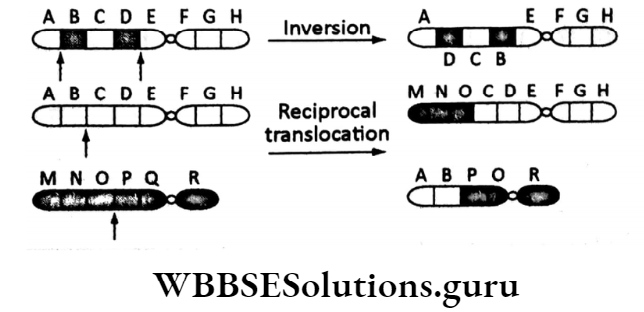


WBBSE Solutions For Class 10 Life Science Chapter 3 Heredity And Common Genetic Diseases Topic A Heredity Deletion


Question 9. What is aneuploidy?
Answer:

Aneuploidy 

Aneuploidy is the presence of an abnormal number of chromosomes in a cell (too many or too few copies), for example having 45 or 47 chromosomes when 46 is expected in a human cell. Klinefelter syndrome in humans is due to the trisomy condition of aneuploidy (2n + l).

Persons suffering from this clinical syndrome have 47 chromosomes (XXY).

Question 10. What is euploidy?
Answer:

Euploidy

It is a genomic condition of having a chromosome number that is an exact multiple of the haploid number. The individuals may be Triploid (3n), Tetraploid (4n), etc.

Though this condition is frequently found in plants, it is very rare in animals. Euploids above the diploid level may be referred to as polyploids.

Question 11. What is a monohybrid cross?
Answer:

Monohybrid cross

A monohybrid cross is a breeding experiment between P-generation (parental generation) organisms that differ in one trait.

It is a genetic cross between parents that differ in the alleles they possess for one particular gene, with one parent having two dominant alleles and the other two recessives.

All the offspring (called monohybrids) have one dominant and one recessive allele for that gene (i.e. they are hybrid at that one locus).

Generally, the monohybrid cross is used to determine the dominance relationship between two alleles.

Question 12. What is a dihybrid cross?
Answer:

Dihybrid cross

A dihybrid cross is a cross between two pure lines (varieties, strains) that differ in two observed traits. A dihybrid cross describes a mating experiment between two organisms that are identically hybrid for two traits.

A hybrid organism is heterozygous, which means that it carries two different alleles at a particular genetic position or locus.

Therefore, a dihybrid organism is heterozygous at two different genetic loci. Mendel used these results as the basis for his Law of Independent Assortment.

Question 13. What is incomplete dominance?
Answer:

Incomplete dominance

Incomplete dominance is a form of intermediate or blended inheritance in which one allele for a specific trait is not completely expressed over its paired allele.

This results in a third phenotype in which the expressed physical trait is a combination of the phenotypes of both alleles.

Unlike incomplete dominance inheritance, here one allele does not dominate or mask the other allele.

incomplete dominance is seen in cross-pollination experiments between red and white flower-colored snapdragon (Mirabilis jalapa) plants and as a result, pink flower is produced in the F1 generation.

The F2 generation consists of red, pink, and white flowers in a ratio of 1:2:1.

Question 14. What is the law of independent assortment?
Answer:

The law of independent assortment

It is the principle, originated by Gregor Mendel, stating that when two or more characteristics are inherited, individual hereditary factors assort independently during gamete production and undergo random recombination in all possible combinations, giving different traits an equal opportunity of occurring together.

Question 15. What is Mendel’s first law of inheritance?
Answer:

Mendel’s first law of inheritance

The principle of segregation is considered the first Law of Mendel.

It states that the two members of a gene pair (alleles) do not blend but instead segregate (separate) from each other randomly during the formation of gametes.

Therefore, half the gametes carry one allele, and the other half carry the other allele (ie. segregation with equal likelihood).

Question 16. What is Punnett Square?
Answer:

Punnett Square

The Punnett square is a diagram that is used to predict the outcome of a particular cross or breeding experiment. It is named after Reginald C.

Punnett, who devised the approach. The diagram is used by biologists to determine the probability of an offspring having a particular genotype. The Punnett square is a tabular summary of possible combinations of maternal alleles with paternal alleles.

Question 17. State the role of the Y chromosome in the sex determination of humans.
Answer:

The role of the Y chromosome in the sex determination of humans

Every Y chromosome has a gene known as the SRY gene that carries instructions for the development of a male fetus. The presence of the SRY gene and thus the Y chromosome mechanizes the development of testes in the human embryo.

In the absence of a Y chromosome, genes found in the X chromosome take over and develop the ovaries of a female fetus. Thus, in humans, maleness is due to the dominant effect of the Y chromosome.

Mendel’S Laws Of Heredity Class 10

Question 18. Why Mendel did not face the problem of linkage?
Answer:

Pea has seven homologous pairs of chromosomes. Mendel was lucky that he studied those seven traits whose allelic pairs were present on different homologous chromosomes.

So they were not linked. After Mendel, further research work on the pea plant revealed that out of 7 pairs of chromosomes

Genes for the length of the plant, the position of the flower, and the shape of the seed are present in chromosome 4, the shape of the seed in chromosome 7, and the color of the seed and the color of the flower in chromosome 1 and color of a pod in chromosome 5.

Question 19. Two red-eyed fruit flies are mated. They have the following offspring: 140 red-eyed flies and 48 flies with bright orange eyes. Which allele is dominant for the eye color gene: red or orange?
Answer:

This is a monohybrid cross between two heterozygous parents since very nearly the offspring are red-eyed and they are orange-eyed. Hence the red-eyed flies have the dominant phenotype.

A tall plant crossed with a dwarf one produces offspring of which about half are tall and half are dwarf.

Question 20. What are the genotypes of the two parents?
Answer:

The genotypes of the two parents

The genotype of the dwarf plant must be tt. If the tall parent plant were TT, all the offspring would have been tall (Tt) since tall is the dominant trait. Hence the tall parent must be Tt.

Giving and offspring as per the Punnet Square shown here:


WBBSE Solutions For Class 10 Life Science Chapter 3 Heredity And Common Genetic Diseases Topic A Heredity ratio


Question 21. Define Back cross and test cross.
Answer:

Back cross and test cross

The cross of a progeny individual with its parents is known as a back cross.
The cross of an individual (generally of dominant phenotype) with one having the recessive phenotype is known as a test cross. It is generally used to determine whether an individual of the dominant phenotype is homozygous or heterozygous.

Question 22. What do you mean by pure line or pure breeding line?
List the gametes that an individual with genotype AABbCc can produce.
Answer:

Pure line or pure breeding line

A strain of individuals homozygous for all genes being considered is known as a pure breeding line.
There will be four types of gametes that the individual can produce: ABC, ABc, AbC, and Abe.

Question 23. Variations are more pronounced in sexually reproducing organisms rather than in asexually reproducing organisms- explain why.
Answer:

Replication of DNA is so nearly perfect that there is little scope for variations occurring in the genotypes of asexually reproducing organisms.

Any apparent variation between these organisms is, therefore, almost certainly, newborn. Transmission of a gene from the male parent the result of environmental influences only.

In the case of sexually reproducing organisms, there is ample opportunity for genetic variation to arise.

Meiosis and the fusion of gametes during fertilization provide the means of introducing unlimited genetic variations into the population. Common sources of variations in sexually reproducing organisms include recombination, crossing over, and mutation.

Fill In The Blanks

Question 1. The different_________________of Pea plants may show the same phenotype.
Answer: genotypes

Question 2. The sexual reproduction that occurs among two genotypically different organisms belonging to the same species is called__________________.
Answer: Hybridization

Write True Or False

Question 1. In his monohybrid cross experiment, Mendel obtained 75% pure tall pea plants in the first filial generation.
Answer: False

Question 2. A pair of sex-determining sex chromosomes are present in the ovum of humans.
Answer: False

Long Answer Type Questions

Question 1. With the help of a checkerboard show the types of offspring that might be produced in a cross between a hybrid black guineapig and a pure white guineapig. State the law of segregation as proposed by Mendel.
Answer:

Monohybrid Cross

When a pure (homozygous) black-haired guineapig (BB) is crossed with a pure white-haired guineapig (bb), all the F1 offsprings (Bb) are found to be black-haired despite the presence of two contrasting genes for black hair and white hair.

It means black color is dominant to white color in guineapig and F1 black offsprings (Bb) are heterozygous. Here the gene for the black color is represented by B and for the recessive white color by b.

When the F1 heterozygous guineapigs are bred among themselves, individuals of the F2 generation are produced. The F2 phenotypic ratio is 3 (black): 1 (white) whereas the F2 genotypic ratio is (pure black, BB) 1: (heterozygous black, Bb) 2: (pure white, bb) 1.

This shows that the inheritance of hair color in guinea pigs follows Mendel’s first law of Segregation.
The monohybrid cross in guinea pig is shown here with a checkerboard.

Mendel’s First Three Postulates

Using the constant pattern of result in the monohybrid crosses, Mendel derived the following three postulates or principles of inheritance

Unit Factors in Pairs:

Genetic characters are controlled by unit factors existing in pairs in individual organisms.

In the monohybrid cross involving yellow (Y) and green (y) seeds, a specific unit factor exists for each trait. Each diploid individual receives one factor from each parent.

Because the factors occur in pairs, three combinations are possible:

YY, Yy, and Yy. The seeds having unit factor combinations of either YY or yy have two copies of the same allele for a gene. Hence these are homozygous.

The seeds having a unit factor combination of Yy have two different alleles of a gene. Hence these are heterozygous.

Dominance/Recessiveness:

When two unlike unit factors, responsible for a single character, are present in a single individual, one unit factor is dominant to the other, which is said to be recessive.

In each monohybrid cross, the trait expressed in the F1 generation results from the presence of the dominant unit factor.

The trait that is not expressed in the F1 but which reappears in the F2 is under the genetic influence of the recessive unit factor.

In the above-mentioned case, the trait yellow seed color (Y) is said to be dominant to the recessive trait, green seed (y). Hence, the progeny of P, i.e. the F1 generation had all yellow pea plants.

Among the progeny of ie. in the F2 generation, green pea plants reappeared along with yellow pea plants.

Segregation:

During the formation of gametes, the paired unit factors responsible for contrasting traits do not blend but separate or segregate randomly, so that each garnet receives one or the other with equal likelihood.

This is known as the 1st law of Mendel or the law of Segregation.

Question 2. Color of the seed and shape of the seed of a pea Taking these two characters Mendel performed a Dihybrid cross. Write the genotypes of pea plants having yellow and round seeds produced in the F2 generation of this experiment. State the law of independent assortment of Mendel.
Answer: Let,

R= Dominant allele for round seed shape

r= Recessive allele for wrinkled seed shape

Y= Dominant allele for yellow seed color

y = Recessive allele for green seed color.

Four types of genotypes obtained in the F2 generation of pea plants having yellow and round seeds are the following:

RRYY, RrYY, RrYy and RRYy

Independent Assortment:

During gamete formation, segregating pairs of unit factors assort independently of each other and undergo random recombination in all possible combinations governed by chance alone.

This postulate stipulates that any pair of unit factors segregate independently of all other unit factors. Thus, according to the postulate of independent assortment, all possible combinations of gametes will be formed in equal frequency.

Question 3. State the opposite traits for each of the characters of flowers of the pea plant chosen by Mendel for his experiment.
“For developing the scientific ideas on heredity the experiments performed by Mendel on pea plants are epoch-making”— mention three reasons behind his success in performing these experiments.

Answer:

 

WBBSE Solutions For Class 10 Life Science Chapter 3 Heredity And Common Genetic Diseases Topic A Heredity Flower charcter

Flowers of pea plant chosen by Mendel:

Second, Mendel examined the inheritance of clearcut contrasting forms of particular traits — round versus wrinkled seed, yellow versus green pod color, etc.

Using such ‘either-or’ traits, he could distinguish and trace unambiguously the transmission of one or the other observed characteristics, because there were neither any intermediate forms nor any of these characters located on separate chromosomes.

Third, Mendel isolated and perpetuated lines of peas that breed true. Mating with such pure breeding lines produces offspring carrying specific parental traits that remain constant from generation to generation.

Fourth, Mendel carefully controlled his matings, going to great lengths to ensure that the progeny he observed resulted from the specific fertilization he intended.

Heredity And Variation Class 10 Questions

Thus he painstakingly prevented the intrusion of any foreign pollen and assured self or cross-pollination as the experiment demanded.

He also performed reciprocal crosses, in which by reversing the traits of male and female parents, he efficiently controlled the path of transmission of a particular trait either via the egg cell within the ovule or via the pollen as per experimental demand.

Fifthly, Mendel worked with a large number of plants, counted and subjected his findings to statistical analysis, and then compared his results with predictions based on mathematical models.

Finally, Mendel was a brilliant practical experimentalist. He could call and observe an optimum number of individuals from the limited space of the monastery garden.

In short, Mendel purposely set up a simplified ‘black and white’ experimental system and then successfully out how it worked.

Question 4. Show the result of hybridization till F2 generation between a pure black (BB) coarse-haired (RR) guinea pig and a pure white (bb) 
smooth-haired (rr) guinea pig by a checkerboard. State the conclusion one can reach from this hybridization experiment.
Answer: 

WBBSE Solutions For Class 10 Life Science Chapter 3 Heredity And Common Genetic Diseases Topic A Heredity Hybridization till f2

Conclusion: 

There exists a biological mechanism of shuffling resulting in an independent assortment of gene pairs during gamete formation.

The genes for hair color (Black or White) and hair texture (coarse or smooth) assort independently in any gamete with equal probability.

Thus the presence of a particular allele for one gene provides no information whatsoever about the allele of the second gene.

WBBSE Solutions For Class 10 Life Science Chapter 2 Cell Division And Cell Cycle

WBBSE Chapter 2 Cell Division And Cell Cycle Introduction To Continuity Of Life

Each cell copies its chromosome exactly and passes on an identical copy to each daughter cell by cell division. Offspring may resemble or look different from the parents in bewilderingly complex ways.

This happens because individuals in nature contain many genes and different versions (alleles) of each gene.

WBBSE Solutions For Class 10 Life Science Chapter 2 Cell Division And Cell Cycle

Modern Cell Theory Or Cell Doctrine States That:

All organisms are made up of cells, ie., cells are structural & functional units of life.

Cells arise from pre-existing cells (Omnis cellula e cellula)

All organisms start their life from a single-cell

The multiplication of cells and their growth leads to the growth of an organism.

Read and Learn More WBBSE Solutions For Class 10 Life Science

WBBSE Chapter 2 Inter-Relationship Among Chromosome, DNA, And Gene

The eukaryotic cells contain a membrane-bound nucleus which is designated as the ‘Director of the cell’.

The nucleus contains many thread-like, coiled, and elongated structures called chromatin fibers or chromatin reticulum, or nuclear reticulum.

The fibers of chromatin are uniformly distributed in the nucleoplasm. Chromatin fibers are observed only during the interphase or the preparatory phase of the cell cycle.

Just before cell division, chromatin fibers condense, become thick, and wrap up very tightly to form ribbon-like structures called chromosomes.

WBBSE Solutions For Class 10 Life Science Chapter 2 Continuity Of Life Topic A Cell Division And Cell Cycle Chromosome

The number of particular species. They are usually found in pairs. Human beings have 23 pairs of chromosomes in each body cell.

The chromosome consists of a proteinaceous matrix and two spirally coiled chromonemata, each one of which contains a single DNA molecule.

The nucleus of an average human cell is only 6m in diameter, yet it contains 1.8 m of DNA which is distributed amongst the 23 pairs or 46 chromosomes each consisting of a single DNA molecule of about 40 mm.

Thus, Chromatin represents long-thin strands of the DNA-protein complex. It is an unfolded and uncondensed form of DNA, while chromosomes are condensed DNA and protein.

Class 10 Life Science Cell Division Solutions

The function of chromatin is to store DNA in the nucleus. Chromosomes are the bearers of hereditary instructions and regulate cellular processes.

WBBSE Notes For Class 10 Geography And EnvironmentWBBSE Notes For Class 10 History And Environment
WBBSE Solutions For Class 10 Life ScienceWBBSE Class 10 Life Science Multiple Choice Questions
WBBSE Solutions for Class 10 MathsWBBSE Class 10 Maths Multiple Choice Questions
WBBSE Notes For Class 10 Physical Science And Environment


DNA (or deoxyribonucleic acid) is the molecule that carries the genetic information in all cellular forms of life and some viruses.

It belongs to a class of molecules called nucleic acids, which are polynucleotides that is, long chains of nucleotides. Nucleotides are made up of a base, a sugar, and a phosphate. The four bases

chromosomes are constant in the nucleus for adenine (A), guanine (G), cytosine (C), and thymine (T) pair with each other (A with T and G with C).

It is the order or sequence of these base pairs that provides the information needed for the growth and development of our bodies.

Specific parts of DNA carry the code for producing specific proteins which ultimately lead to the expression of different characters in an organism.

Each of these parts of DNA is termed a gene. Thus gene is the fundamental physical and functional unit of heredity that carries information from one generation to the next.

It is a segment of DNA, composed of a transcribed region and a regulatory sequence, that makes possible transcription. A series of genes are present in each DNA.

The coordinated interaction of two or more genes produces a given phenotypic trait. A complete set of chromosomal genes is inherited by the offspring as a unit from the parent.

WBBSE Chapter 2 Cell Division And Cell Cycle Types Of Chromosome

Functionally there are two types of eukaryotic chromosomes-

  1. Autosomes and
  2. Allosomes or sex chromosomes.

A human somatic cell contains 23 pairs of chromosomes. Out of the 22 pairs are autosomes and 1 pair is allosomes. The identical male and female parent chromosomes occurring in a pair are known as homologous chromosomes.

Each chromosome of a homologous pair is known as a homolog.

Autosomes:

Autosomes are responsible for controlling all the somatic characteristics of the body (eg. height of the body, complexion, the texture of hair, etc) except sex determination.

There are 22 pairs of autosomes in humans.

The paired autosomes are numbered 1 through 22.

They are numbered according to size so that chromosome pair 1 is the longest, and chromosome pair 22 is the shortest. Each autosome contains a large number of genes arranged in a definite sequence.

Class 10 Life Science Cell Division Solutions

In these homologous pairs, the 2 chromosomes are of the same length. The position of the centromere is the same.

A diagram or photograph called a karyogram is often used to depict the chromosomes of a cell. In a karyogram, homologous chromosomes are placed next to each other.

For example, both homologs of chromosome pair 1 are put side by side. We get one homolog of each type of autosome pair from each of our parents.

WBBSE Solutions For Class 10 Life Science Chapter 2 Continuity Of Life Topic A Cell Division And Cell Cycle types of choromosone

Allosomes Or Sex Chromosomes

Allosomes are primarily responsible for the sex determination of an organism.

Out of the 23 pairs of chromosomes in each human somatic cell, one pair is known as the sex chromosome.

Sex Chromosomes Are Of Two Types In Humans:

  1. X and Y.
  2. Y is smaller, and X and Y are partially homologous.

However, they pair and segregate into daughter cells during meiosis. Males have X and Y combinations. Females have X and X combinations in their body cells.

Therefore, the Karyotype Of Each Human Somatic Cell Is Depicted As Below:


WBBSE Solutions For Class 10 Life Science Chapter 2 Continuity Of Life Topic A Cell Division And Cell Cycle male and female somatic cell

WBBSE Chapter 2 Topic A Cell Division And Cell Cycle Chromosome Number

The chromosome number is the precise number of chromosomes typical for a given species. In any species, the chromosome number is always the same and constant.

Therefore, the chromosome number is used in the identification of species and in tracing the relationship within the species.

In sexually reproducing organisms, the number of chromosomes in the body cells (or somatic cells = skin cell, blood cell, muscle cell, etc.) is diploid (2n; a pair of each chromosome),

since the nucleus of the somatic cell contains two homologs of each homologous pair of chromosomes-one is the paternal set (from the father) & the other is the maternal set (from the mother).

It may however be noted that the number of chromosomes does not correlate with the apparent complexity of an animal or a plant:

In humans, for example, the diploid number is 2n = 46 (that is, 23 pairs), compared with 2n = 78, or 39 pairs, in the dog and 2n = 36 (18 pairs) in the common earthworm.

The number of chromosomes in the sex cells (or germ cells or gametes) is haploid (n) since a single set of unpaired chromosomes is present in the nucleus of such cells.

Cell Cycle And Its Phases Class 10 Notes

In man, sperm and ova possess 23 chromosomes (n) each.

Thus the diploid (2n) number of chromosomes in somatic cells is just the double haploid (n) number of chromosomes in games. The haploid number is produced during meiosis.

WBBSE Chapter 2 Topic A Cell Division And Cell Cycle Structure Of Chromosome

In the nucleus of each cell, the DNA molecule is packaged into thread-like structures called chromosomes. Each chromosome is made up of DNA tightly coiled many times around proteins called histones that support its structure. A small amount of RNA is also present.

Chromosomes are not visible in the cell’s nucleus not even under a microscope when the cell is not dividing.

However, the DNA that makes up chromosomes becomes more tightly packed during cell division and is then visible under a microscope.

Chromosomes (Gr., chrom=colour, soma= body) are rod-shaped, dark-stained bodies seen during the metaphase stage of mitosis when cells are stained with a suitable basic dye and viewed under a light microscope.

Chromosomes were first described by Strasburger (1815), and the term ‘Chromosome’ was first used by Waldeyer in 1888.

During metaphase, a chromosome appears to possess two threads called chromatids, which become intertwined in the matrix of chromosomes.

These chromatids are spirally coiled chromonemata (sing., chromonema) at metaphase. Chromatin is composed of DNA, RNA, and protein.

Purified chromatin isolated from interphase nuclei consists of about 30-40% DNA, 50-65% protein, and 0.5-10% RNA; but there is a considerable variation due to species and tissues of the same species.

Each chromosome has a constriction point called the centromere, which divides the chromosome into two sections, or “arms”.

The location of the centromere on each chromosome gives the chromosome its characteristic shape and can be used to help describe the location of specific genes.

WBBSE Solutions For Class 10 Life Science Chapter 2 Continuity Of Life Topic A Cell Division And Cell Cycle Choromatin and condensed choromosome structure

The DNA double helix is bound to proteins called histones. The histones have positively charged (basic) amino acids to bind the negatively charged (acidic) DNA.

The DNA is wrapped around the histone core of eight protein subunits, forming the nucleosome. Now all of this DNA and protein organization, all the DNA rolled around the histone proteins, is called chromatin.

Chromomeres are serially aligned, small bead-like accumulations of chromatin material that are visible along the length of the chromosome, especially during prophase.

Cell Cycle And Its Phases Class 10 Notes

Chromosome morphology changes with the stage of cell division, and at mitotic metaphase, it is most suitable to study a eukaryotic chromosome morphology When the following structural features can be seen under a light microscope.

WBBSE Solutions For Class 10 Life Science Chapter 2 Continuity Of Life Topic A Cell Division And Cell Cycle metaphase

WBBSE Solutions For Class 10 Life Science Chapter 2 Continuity Of Life Topic A Cell Division And Cell Cycle parts of chromosome

WBBSE Solutions For Class 10 Life Science Chapter 2 Continuity Of Life Topic A Cell Division And Cell Cycle parts of chromosome 2

WBBSE Chapter 2 Topic A Cell Division And Cell Cycle Chemical Components Of Chromosomes

The material of the chromosomes is the chromatin.

Chromatin is composed of DNA, RNA, and protein.

Purified chromatin isolated from interphase nuclei consists of about 30-40% DNA, 50-65% protein, and 0.5-10% RNA, but there is a considerable variation due to species and species.

DNA: DNA (Deoxyribonucleic acid) is up of molecules nucleotides.

Each nucleotide contains a phosphate group (phosphoric acid), a sugar group, and a nitrogen base.

Nucleotides are arranged in two long strands that form a spiral called a double helix, tissues of the same The structure of the double helix is somewhat like a ladder, with the base pairs forming the ladder’s rungs and the sugar and phosphate molecules forming the vertical side pieces of the ladder.

Cell Cycle And Its Phases Class 10 Notes

There are two classes of nitrogen bases called purines (Adenine = A, Guanine = G) and pyrimidines (Cytosine = C, Thymine = T).

Each base pair is formed from two complementary nucleotides (purine with pyrimidine) bound together by hydrogen bonds. The base pairs in DNA are A with T and C with G.

WBBSE Solutions For Class 10 Life Science Chapter 2 Continuity Of Life Topic A Cell Division And Cell Cycle Deoxyribose sugar

The deoxyribose sugar in DNA is a pentose, a 5-carbon sugar (commonly we know of Hexose or 6- 6-carbon sugars as C6H12O6). The carbons are numbered 1′ to 5′(pronounced ” prime carbon”).

It is from this numbering system of the sugar group that DNA gets its polarity. The linkages between nucleotides occur between the 5′ and 3′ positions in the sugar group. One end has a free 5′ end and the other has a free 3′ end.

A phosphate group consists of a central phosphorous surrounded by four oxygen.

Protein:

  1. Proteins Associated With Chromosomes May Be Classified Into Two Broad Groups:
  2. basic proteins or histones and
  3. nonhistone proteins (may be acidic).
  4. Histones constitute about 80% of the total chromosomal protein. Histones contain amino acids like histidine, arginine, lysine, etc.
  5. Nonhistone proteins contain amino acids like tryptophan and tyrosine.

RNA:

RNA (Ribonucleic acid) is helical single stranded having structural units called ribonucleotide.

Each ribonucleotide contains the pentose sugar called ribose, a molecule of a phosphate group, and a nitrogen base. The nitrogen base of RNA is two purine bases (Adenine, Guanine) and two pyrimidine bases (Cytosine, Uracil).

Depending on their staining properties during interphase the following two types of chromatin may be distinguished in chromosomes.

Euchromatin:

Portions of chromosomes that stain lightly are only partially condensed; this chromatin is termed euchromatin. Euchromatin contains structural genes and is considered genetically active chromatin since it has a role in the phenotype expression of the genes.

Cell Cycle And Its Phases Class 10 Notes

Heterochromatin:

In the dark-staining regions, the chromatin remains condensed and is called heterochromatin.

Heterochromatin is characterized by its especially high content of repetitive DNA sequences and contains very few if any, structural genes.

It is late replicating (i.e., it is replicated when the bulk of DNA has already been replicated) and is not transcribed.

However, heterochromatin helps in gene regulation and the protection of chromosome integrity. Centromeric regions invariably contain heterochromatin.

The distribution of euchromatin and heterochromatin portions in a typical chromosome.

WBBSE Solutions For Class 10 Life Science Chapter 2 Continuity Of Life Topic A Cell Division And Cell Cycle Euchromatin

WBBSE Chapter 2 Topic A Cell Division And Cell Cycle Cell Organelles And Structures Involved In Cell Division

All cells have within them a variety of different organelles. Organelles are cell parts that are adapted and specialized to perform various vital activities of the cell like the organs of the human body.

The cell organelles directly associated with cell division are—

Nucleus:

The nucleus is the seat of the chromosomes that are to be divided. A unique feature of the nucleus is that it disassembles and re-forms each time most cells divide.

At the beginning of cell division, the chromosomes condense, the nucleolus disappears, and the nuclear envelope breaks down, resulting in the release of most of the contents of the nucleus into the cytoplasm.

At the end of cell division, the process is reversed. The interphase chromatin condenses approximately a thousandfold further to form the compact chromosomes as seen in dividing cells.

WBBSE Solutions For Class 10 Life Science Chapter 2 Continuity Of Life Topic A Cell Division And Cell Cycle nucleus

Centrosome and microtubules:

The centrosome is located in the cytoplasm of an animal cell usually close to the nucleus. It consists of two centrioles — oriented at right angles to each other.

It is duplicated duringthe  S- phase of the cell cycle. Just before cell division, the two centrosomes move apart until they are on opposite sides of the nucleus.

As cell division proceeds, microtubules grow out from each centrosome with their ends growing toward the metaphase plate. Microtubules are thick, strong spirals of thousands of subunits.

Cell Division And Cell Cycle Class 10 WBBSE 

Those subunits are made of a protein called tubulin. The microtubule spokes radiate from a central site occupied by the centrosome, which is the primary microtubule-organizing center (MTOC) in many interphase cells.

This cytoskeleton transports material within cells and coordinates cell division. These clusters of microtubules are called spindle fibers.


WBBSE Solutions For Class 10 Life Science Chapter 2 Continuity Of Life Topic A Cell Division And Cell Cycle tublin

Microtubules are critical throughout the cell cycle – they organize chromosomal components and split them in two.

Spindle fibers have three destinations are attached to one kinetochore of a chromatid. Some bind to the arms of the chromosomes.

Still, others continue growing from the two centrosomes until they extend between each other in a region of overlap.

All three groups of spindle fibers participate in the assembly of the chromosomes at the metaphase plate at metaphase and the separation of the chromosomes at anaphase. In plant cells, however, the spindle is formed from cytoplasm and nucleoplasm.

Ribosome:

Ribosomes are the workbench of protein synthesis. Therefore, ribosomes play an important role in cell division. Several ribosomes become associated with Messenger RNA (mRNA) to form polyribosomes or polysomes. Polysomes act as sites for polypeptide synthesis.

A cell will not copy its DNA in preparation for cell division unless it knows that it has enough ribosomes to make new proteins because copying DNA requires a huge amount of proteins and energy.

This copying process happens during the interphase. Thus, the number of ribosomes in a cell is a form of regulating cellular homeostasis.

WBBSE Solutions For Class 10 Life Science Chapter 2 Continuity Of Life Topic A Cell Division And Cell Cycle RNA

Mitochondria:

Cells require an ample amount of ATP (Adenosine triphosphate) to synthesize bioactive compounds such as lipids, proteins, and nucleotides for cell division.

Mitochondrial ATP production is also vital for cell division in addition to other basic functions in the cell including the regulation of cell volume, solute concentration, and cellular architecture.

WBBSE Solutions For Class 10 Life Science Chapter 2 Continuity Of Life Topic A Cell Division And Cell Cycle mitochondria

Mitochondria are the fuel of the cell and act as a type of “driver” in cell division. The mitochondrial network fragments during mitosis to allow proper segregation of the organelles between daughter cells.

WBBSE Chapter 2 Topic A Cell Division And Cell Cycle Cell Cell Division Fit Its Significance

The fundamental and active biological process by which a cell produces its replica having similar structural, genetic, and physiological properties and thereby, brings upon continuity of life is called cell division.

Significance Of Cell Division:

The importance of cell division can be appreciated by realizing the following facts:

Continuity of life:

Cell division is a prerequisite for the continuity of life.

On one hand, it helps cells to maintain a favorable surface area to volume relationship and on the other, forms the basis of evolution to various life forms,

Cell Division And Cell Cycle Class 10 WBBSE 

Means of reproduction:

In unicellular organisms, cell division is the means of asexual reproduction, which produces two or more new individuals from the mother cell.

In sexually reproducing organisms, the reduction division of meiosis helps to maintain constancy of the chromosome number of a species,

Growth:

In multicellular organisms, life starts from a single cell called a zygote (fertilized egg). The zygote transforms into an adult that is composed of millions of cells formed by successive divisions.

Thus, growth occurs by cell division,

Means of repair, healing & regeneration:

Cell division is the basis of the repair and regeneration of old and worn-out tissues. It causes healing of the injured regions of the body.

WBBSE Chapter 2 Topic A Cell Division And Cell Cycle Cell Types Of Cell Division

Plant & animal cells generally undergo three types of cell division-amitosis (direct cell division), mitosis (indirect equational cell division), and meiosis (indirect reduction division).

Amitosis occurs in prokaryotes and protozoans, while mitosis and meiosis occur in eukaryotes.

In the case of direct division, the nucleus and cell body undergo a simple mass division into two parts. During indirect division, the nucleus undergoes complicated changes before it is divided into two daughter nuclei.

Amitosis:

Amitosis, also known as binary fission, is a type of direct cell division in which both the nucleus and the cytoplasm undergo a simple mass division without going through complicated stages involving spindle or chromosome formation, maneuvers, and wall formation.

It is the means of asexual reproduction in unicellular organisms like bacteria & protozoans and also a method of multiplication or growth in fetal membranes of some vertebrates.

In amitosis, the splitting of the nucleus is followed by cytoplasmic constriction.

The nucleus elongates first & then assumes simple mass division without going through complicated stages involving spindle or chromosome formation, their maneuvers, and wall formation.

It is the means of asexual reproduction in unicellular organisms like bacteria & protozoans and also a method of multiplication or growth in fetal membranes of some vertebrates.

In amitosis, the splitting of the nucleus is followed by cytoplasmic constriction. The nucleus elongates first & then assumes a dumb-bell-shaped appearance.


WBBSE Solutions For Class 10 Life Science Chapter 2 Continuity Of Life Topic A Cell Division And Cell Cycle nucleus elongates

The depression or constriction increases in size & ultimately divides the nucleus into two nuclei.

Next, the cytoplasmic constriction divides the cell into two equal or approximately similar halves. Therefore, without the occurrence of any nuclear events, two daughter cells are formed each of which can grow into a completely new organism.

Mitosis:

Mitosis producestwo genetically identical daughter cellsl. It means the two daughter cells have a similar genetic composition to their parents.

Meiosis:

Meiosis produces four haploid (n) daughter cells that come from diploid parents (2n). In this process, each of the daughter cells has half the chromosome of the parental cells.

WBBSE Chapter 2 Topic A Cell Division And Cell Cycle Cell Cycle

During development from a zygote to a fully differentiated body, cells in the body alternately divide (mitosis) and “appear” to be resting (interphase).

Cell Division And Cell Cycle Class 10 WBBSE 

The sequence of activities exhibited by cells in the period between the end of one division and the end of the next is termed the cell cycle.

Cell Cycle Constitutes Of Two Phases:

  1. Interphase &
  2. M phase.

Interphase:

Interphase, which appears to be a long resting stage between cell divisions, is a period of diverse activities that are indispensable in making the next mitosis possible.

During this long period, the cell constantly synthesizes DNA, RNA & protein, stores up energy, and grows in size.

The volume of the cell decreases highly as a result. The nuclear membrane, however, remains intact and chromosomes remain as long thread-like chromatin fiber in the nucleoplasm.

By studying molecular events in cells, scientists have determined that interphase can be divided into four steps:

Gap 0 (G0), Gap 1 (G1), S (synthesis) phase, Gap 2 (G2).

WBBSE Solutions For Class 10 Life Science Chapter 2 Continuity Of Life Topic A Cell Division And Cell Cycle resting state

Gap 0 (G0):

There are times when a cell will leave the cycle and quit dividing. This may be a temporary resting period or permanent.

An example of the latter is a cell that has reached an end stage of development and will no longer divide (e.g. neuron). After birth, the nerve cells in mammals do not divide and remain in the perpetual G0 phase throughout life.

Gap 1 (G1): 

Cells increase in size in Gap 1, produce RNA, and synthesize protein.

An important cell cycle control mechanism that is activated during this period (G1 Checkpoint, also known as the restriction or start checkpoint) ensures that everything is ready for DNA synthesis.

If a cell meets the requirements for the G1 checkpoint, the cell will enter the S phase and begin DNA replication.

This transition, as with all of the major checkpoint transitions in the cell cycle, is signaled by cyclins and cyclin-dependent kinases (CDKs).

Cyclins are If a cell meets the requirements for the G1 checkpoint, the cell will enter the S phase and begin DNA replication.

This transition, as with all of the major checkpoint transitions in the cell cycle, is signaled by cyclins and cyclin-dependent kinases (CDKs). Cyclins are cell signaling molecules that regulate the cell cycle.The

G12 phase varies from 3-4 hours to serval days, months, or even years

S Phase:

To produce two similar daughter cells, the complete DNA instructions in the cell must be duplicated.

DNA replication and synthesis of histone occur during this S (synthesis) phase. As a result, chromosome duplication occurs in this phase. It lasts for 7-8 hours.

Gap 2 (G2):

During the gap between DNA synthesis and mitosis, the cell will continue to grow and produce new proteins.

At the end of this gap, there is another control checkpoint (G2 Checkpoint) to determine if the cell can now proceed to enter M (mitosis) and divide.

However, the most important role of the G2 checkpoint is to ensure that all of the chromosomes have been accurately replicated without mistakes or damage.

Cell Division And Cell Cycle Class 10 WBBSE 

If the checkpoint mechanisms detect problems with the DNA, the cell cycle is halted and the cell attempts to either complete DNA replication or repair the damaged DNA. In this stage, diploid cells contain 4X times the amount of DNA.

It is then followed by mitosis.

Mitosis or M Phase:

Cell growth and protein production stop at this stage in the cell cycle. All of the cell’s energy is focused on the complex and orderly division into two similar daughter cells.

Mitosis is much shorter than interphase, lasting perhaps only for one to two hours.

As in both G1 and G2, there is a Checkpoint in the middle of mitosis (Metaphase checkpoint) that ensures the cell is ready to complete cell division.

The M checkpoint is also known as the spindle checkpoint because it determines whether all the sister chromatids are correctly attached to the spindle microtubules.

Because the separation of the sister chromatids during anaphase is an irreversible step, the cycle will not proceed until the kinetochores of each pair of sister chromatids are firmly anchored to at least two spindle fibers arising from opposite poles of the cell.

WBBSE Chapter 2 Topic A Cell Division And Cell Cycle Tumor

Uncontrolled cell division or propagation of damaged DNA can contribute to genomic instability and tumorigenesis.

If cell division is not regulated, a tumor will develop due to uncontrolled cell proliferation.

A tumor, also called neoplasm, is a mass of abnormal tissue that arises without obvious cause from pre-existing body cells, has no purposeful function, and is characterized by a tendency to autonomous and unrestrained growth.

The Abnormal Cells That Generally Makeup Tumors, Differ From Normal Cells In Having Undergone One Or More Of The Following Alterations:

  1. Hypertrophy (or an increase in the size of individual cells)
  2. Hyperplasia (or an increase in the number of cells within a given zone)
  3. Anaplasia (or regression of the physical characteristics of a cell towards a more primitive type).

Tumors may be-

Benign or Malignant type

Benign Or Non Cancerous Tumor:

The cells keep enlarging in size but are confined to the site of origin only.

They do not spread to the other parts of the body. The cells may cause pain, and discomfort and affect other organs due to their increased size, but their effect is not lethal. However, sometimes, benign tumors can also turn cancerous.

Cell Division Class 10 Life Science Pdf

Malignant Or Cancerous Tumor:

The tumor cells do not remain confined to the site of origin. They move & spread to other parts via blood or other tissue fluid of the body to form secondary tumors.

The moving and setting process is called metastasis. Metastasis is always fatal and these cells kill other cells or tissues.

WBBSE Chapter 2 Topic A Cell Division And Cell Cycle Mitosis

Mitosis is a type of equational & indirect cell division in which chromosomes of the parent cell are equally distributed resulting in two genetically identical daughter cells.

The cells undergoing mitosis are called mitocytes. In plants, the myocytes are mostly meristematic cells. In animals, the myocytes are stem cells, germinal epithelium, and embryonic cells.

This division was first observed by Strassburger (1870) in plant cells and by Fleming (1882) in animal cells. The basic outline of mitosis remains the same in all living organisms.

Chromosomes replicated during mitosis are divided in such a way as to ensure that each daughter cell receives a copy of every chromosome of the parent cell.

The replicated chromosomes are attached to a ‘mitotic apparatus’ that aligns them and then separates the sister chromatids to produce an even partitioning of the genetic material.

This separation of the genetic material in a mitotic nuclear division (or karyokinesis) is followed by a separation of the cell cytoplasm in a cellular division (or cytokinesis) to produce two daughter cells. A mitosis division generally takes a time of 30 minutes to 3 hours.

WBBSE Chapter 2 Topic A Cell Division And Cell Cycle Stages Of Mitosis

Though Mitosis Is A Continuous Process, For a Better Understanding

The Whole Process Is Divided Into the Following Stages:

1. Prophase (Longest phase)
2. Prometaphase
3. Metaphase
4. Anaphase (shortest phase)
5. Telophase
C-Phase or Cytokinesis (a division of cell cytoplasm)

Karyokinesis (nuclear division):

It is the process by which the nucleus of the parent cell divides into two daughter nuclei.

WBBSE Solutions For Class 10 Life Science Chapter 2 Continuity Of Life Topic A Cell Division And Cell Cycle Stages Of mitosis

WBBSE Chapter 2 Topic A Cell Division And Cell Cycle Description Of Different Stages

Prophase:

It is the longest stage of mitosis during which chromatin threads condense, shorten & thicken to form chromosomes followed by the disappearance of both the nucleolus & the nuclear membrane and the formation of the mitotic apparatus.

The observed changes are-Nucleus becomes spherical and the cytoplasm becomes more viscous.

The chromatin threads slowly condense due to dehydration, shorten & thicken to form well-defined chromosomes.

WBBSE Solutions For Class 10 Life Science Chapter 2 Continuity Of Life Topic A Cell Division And Cell Cycle prophase

Since each chromosome is already doubled due to the doubling of DNA contents in interphase, each chromosome now appears as two sister chromatids joined at the centromere or kinetochore.

During early prophase, the chromosomes remain evenly distributed in the nucleoplasm but as prophase progresses, the chromosomes migrate towards the nuclear membrane.

The spindle fibers (microtubules) begin to form outside the nucleus.

In plants, the microtubule organizing center (MTOC) may be of plastid MTOC or nuclear envelope MTOC or may be organized from many of the microtubules that originate from the rigid cell wall.

In plants the spindle apparatus or mitotic spindle is ancestral.

In animals, the movement of centrioles occurs due to the pushing apart by the growth of the spindle fiber between them. Fibrils appear like spokes of a wheel around each centriole to form asters.

The asters are formed from the cytoplasm and the spindle fibers are formed mainly from the nuclear material. In animals and brown algae, the mitotic spindle is amphiastral which includes two asters in opposite poles of the spindle.

Each aster consists of two centrioles surrounded by astral rays.

Cell Division Class 10 Life Science Pdf

Prometaphase

At the end of prophase, ie. during a cell’s entry to the prometaphase, the major event that happens is the breakdown of the nuclear envelope into small vesicles.

The observed changes are

The nuclear envelope breaks down into membrane vesicles with the result that nucleoplasm and cytoplasm mix. The chromosomes are therefore set free into the cytoplasm.

Specialized protein complexes or Kine- to chores become fully matured on the centromeres of the chromosomes.

The disruption of the nuclear envelope allows the mitotic spindles to gain access to the mature into- chores.

As the microtubules of the mitotic spindle enter the nuclear region, some chromosomes are attached to spindle microtubules through kinetochores.

These are called kinetochore microtubules. The remaining microtubules are called non-kinetochore microtubules.

Once they have captured the chromosomes, the kinetochore microtubules begin to exert force on the chromosomes to move them.

Nucleolus disappears.

Some cell biologists consider the prometaphase stage as early metaphase and include it under metaphase i.e. no separate prometaphase stage is considered.

WBBSE Solutions For Class 10 Life Science Chapter 2 Continuity Of Life Topic A Cell Division And Cell Cycle microtubules


WBBSE Solutions For Class 10 Life Science Chapter 2 Continuity Of Life Topic A Cell Division And Cell Cycle periphery

Metaphase:

Metaphase is marked by the appearance of the spindle and the arrangement of chromosomes on the equator of the spindle. The diamond-shaped spindle formation starts in prophase and gets completed in metaphase.

Two pointed ends of the spindle are called the poles and the central broad part is known as the equator or the equatorial plate. The spindle is formed of spindle fibers that are composed of tubulin protein. There are two types of spindle fiber.s

Short fiber discontinuous fiber or chromosomal fiber-these are extended from the pole to the equator.

Long fiber continuous fiber or chromosomal fiber-these are extended from one pole to another pole.

The main events during this phase are—

The chromosomes migrate toward the equator of the spindle.

Each chromosome becomes more compact and short and its two chromatids remain separate except at the centromere which has not divided so far.

Kinetochore microtubules align the chromosomes in one plane to form a metaphase plate or equatorial plate.

The process of formation of a metaphase plate is called congression.

In animal cells, larger chromosomes remain attached to the periphery of the metaphase plate and smaller ones are placed at the central part. In plant cells, however, the orientation of chromatids on the equatorial plate is random.

Centromeres lie on the equatorial plane while the chromosome arms are directed away from the equator through a process called auto orientation.

Anaphase:

It is the shortest stage of mitosis during which the centromeres and the daughter chromosomes separate and begin to move towards the opposite poles of the equatorial plate.

The following changes occur during anaphase-

Chromosomes split simultaneously at the centromeres so that the sister chromatids separate. They are now called daughter chromosomes, each one consisting of a single chromatid.

The separated sister chromatids move towards opposite poles. This is called the anaphase movement.

The Poleward anaphase movement of daughter chromosomes occurs due to the shortening of kinetochore microtubules, the appearance and elongation of interzonal fibers, and the consequent pulling, pushing & repulsive forces.

Cell Division Class 10 Life Science Pdf

Daughter chromosomes may appear as V-shaped (metacentric) L-shaped (sub-metacentric), and L-shaped (telocentric).

The arms of daughter chromosomes remain directed towards the equator and centromere towards the pole of the spindle apparatus.

WBBSE Solutions For Class 10 Life Science Chapter 2 Continuity Of Life Topic A Cell Division And Cell Cycle poleward anaphase

Telophase:

At the end of the polar migration of the daughter chromosomes, the telophase is marked by the uncoiling & deserialization of chromosomes followed by the reappearance of the nuclear membrane and nucleolus.

The main events during this phase are as follows-

Chromosomes reach the poles of the spindle and form two groups

Chromosomes begin to uncoil, undergo hospitalization, and form the chromatin network.

Kinetochore microtubules disappear.

The nuclear membrane is formed around each mass of chromatin from the endoplasmic reticulum resulting in the formation of two daughter nuclei.

Both the nucleoplasm and the cytoplasm are rehydrated.

Finally, a nucleolus is reorganized in each daughter nucleus at the chromosomal organizer site.

WBBSE Solutions For Class 10 Life Science Chapter 2 Continuity Of Life Topic A Cell Division And Cell Cycle spindle

Cytokinesis:

Cytokinesis is the division of cell-cytoplasm into two separate cells each having a nucleus along with the redistribution of various cell organelles (mitochondria, Golgi bodies, etc).

It usually occurs in telophase along with the formation of daughter nuclei after the nuclear division. If cytokinesis does not occur after karyokinesis, the cell will be a binucleate one.

The process of cytokinesis differs in plant and animal cells.

Cytokinesis in Animal Cells:

In animal cells, cytokinesis starts with the appearance of a shallow groove cleavage, or furrow in the cytoplasm at the equator of the spindle. Slowly and slowly it deepens and constricts the cytoplasm and divides the cell into two parts.

WBBSE Solutions For Class 10 Life Science Chapter 2 Continuity Of Life Topic A Cell Division And Cell Cycle cytoplasm

Cytokinesis In Plant Cells:

In plant cells, cytokinesis is accomplished by the formation of phragmoplast and cell plate at the equator of the dividing cell. Cell plate or phragmoplast is formed by the fusion of small vesicles of Golgi bodies called phragmosomes.

Cell Division Class 10 Life Science Pdf

Gradually more amount of materials like cellulose, hemicellulose, pectin, etc are deposited on both sides of the cell plate to form a complete cell wall that separates the cytoplasm of the two daughter cells.

WBBSE Solutions For Class 10 Life Science Chapter 2 Continuity Of Life Topic A Cell Division And Cell Cycle diagrammatic represenatation of mitosis of an animal cell

Basic Differences Between Mitosis Of Animal Cell And Plant Cell

WBBSE Solutions For Class 10 Life Science Chapter 2 Continuity Of Life Topic A Cell Division And Cell Cycle Animal cell and plant cell


WBBSE Solutions For Class 10 Life Science Chapter 2 Continuity Of Life Topic A Cell Division And Cell Cycle diagrammatic representation of mitosis of a plant cell

WBBSE Chapter 2 Topic A Cell Division And Cell Cycle Significance Of Mitosis

The Importance Of Mitosis For The Organisms Has Been Summarised As Follows:

1. Maintaining the same genetic constitution:

In mitosis cell division, the two resulting daughter cells always contain the same number of chromosomes as the parent cell from which they derive.

Thus, It maintains equilibrium in the amount of DNA and RNA contents through equational division.

2. Opportunity for growth & development:Itt provides an opportunity for the growth and development of organs and the body of organisms. The number of cells within an organism increases by mitosis and this is the basis of growth in multicellular organisms from a single-celled zygote.

3. Repair & Replacement:

Old, decaying, and dead cells are constantly dying and being replaced by mitosis. For example- our skin cells and blood cells regularly die off; they are replaced and repaired by mitosis.

4. Regeneration & Healing:

Regeneration is the ability to replace lost or damaged body parts. Plants can regenerate all body parts from precursor cells. Some animals can regenerate whole parts of their body i.e.

legs in crustaceans, arms in starfish, and tails in lizards. The production of these new cells involves mitosis. Similarly, the healing process of a wound involves mitosis. We can regenerate skin, a large amount of liver, and the very tips of fingers and toes.

Class 10 Life Science Cell Division Solutions

5. Asexual reproduction:

Mitosis helps the organisms in asexual reproduction. By cell division, one cell divides to become two. This process is used by some organisms, such as protozoans, most plants, and lower invertebrates to reproduce.

WBBSE Chapter 2 Topic A Cell Division And Cell Cycle Melosis

Meiosis is the form of reductional eukaryotic cell division comprising a heterotypic division followed by a homotype division that produces haploid sex cells or gametes [which contain a single copy (n) of each chromosome] from diploid germ mother cells

[which contains two copies (2n) of each chromosome] in which genetic recombination takes place by crossing over between the genes.

The process takes the form of one DNA replication followed by two successive nuclear and cellular divisions (Meiosis I and Meiosis II).

Let us illustrate cell division by taking the chromosome number of humans. The cells of human beings contain a constant diploid (2n) number of chromosomes (23 pairs or 46 numbers 44 + XY in males and 44 + XX in females).

Humans reproduce sexually in which male and female gametes fuse to form the zygote. Gametes should contain haploid (n) number of chromosomes.

(23 numbers 22 + X or 22 + Y)so thatt the chromosome number of the zygote remains constant at 46 from generation to generation.

This happens due to meiosis which reduces the chromosome number to half in gametes and prevents it to go on doubling with each generation. Vanbeneden (1883) first reported meiosis. Farmer and Moore (1905) coined the term meiosis.

The cells undergoing meiosis are known as meiocytes. In plants, the meiocytes are microsporocytes (pollen mother cell) of anthers and megasporocytes (megaspore mother cell) of ovules.

In animals, the meiocytes are primary spermatocytes in the testes and primary oocytes in the ovaries.

WBBSE Chapter 2 Topic A Cell Division And Cell Cycle Stages Of Meiosis

Meiosis consists of two cycles of nuclear division (Meiosis-I and Meiosis-II), usually accompanied by cell division

[especially in sexually reproducing multicellular forms, where it is generally used to produce gametes through gametogenesis], preceded by DNA replication inintermeioticc interphase.

The stages of meiosis are as follows:

WBBSE Solutions For Class 10 Life Science Chapter 2 Continuity Of Life Topic A Cell Division And Cell Cycle melosis

The process takes the form of one DNA replication followed by two successive nuclear and cellular divisions (Meiosis I and Meiosis II).

Let us illustrate cell division by taking the chromosome number of humans. The cells of human beings contain a constant diploid (2n) number of chromosomes (23 pairs or 46 numbers 44 + XY in males and 44 + XX in females).

Humans reproduce sexually in which male and female gametes fuse to form the zygote. Gametes should contain a haploid (n) number of chromosomes (23 numbers 22 + X or 22 + Y) so that the chromosome number of the zygote to remain constant at 46 from generation to generation.

This happens due to meiosis which reduces the chromosome number to half in gametes and prevents it to go on doubling with each generation. Vanbeneden (1883) first reported meiosis. Farmer and Moore (1905) coined the term meiosis.

Class 10 Life Science Cell Division Solutions

The cells undergoing meiosis are known as meiocytes. In plants, the meiocytes are microsporocytes (pollen mother cell) of anthers and megasporocytes (megaspore mother cell) of ovules.

In animals, the meiocytes are primary spermatocytes in the testes and primary oocytes in the ovaries.

WBBSE Chapter 2 Topic A Cell Division And Cell Cycle Stages Of Meiosis

Meiosis consists of two cycles of nuclear division (Meiosis-I and Meiosis-II), usually accompanied by cell division [especially in sexually reproducing multicellular forms, where it is generally used to produce gametes through gametogenesis], preceded by DNA replication in iintermeioticinterphase.

The stages of meiosis are as follows:

WBBSE Solutions For Class 10 Life Science Chapter 2 Continuity Of Life Topic A Cell Division And Cell Cycle stages of melosis

Important features of meiosis

1. Homologous Chromosomes:

These are chromosome pairs of approximately the same length and centromere position. Note that diploid cells have two sets or one pair of homologous chromosomes.

Out of the pair, one is inherited from the mother (maternal) and one from the father (paternal).

WBBSE Solutions For Class 10 Life Science Chapter 2 Continuity Of Life Topic A Cell Division And Cell Cycle Homologous chromosomes

2. DNA replication:

Replication of DNA takes place during the interphase preceding meiosis. DNA replication generates sister chromatids from each chromosome. Sister chromatids are two identical copies of a chromatid that remain closely aligned.

Although DNA replication occurs in interphase, no longitudinal doubleness of chromosomes is visibly evident in Leptotene of Prophase I owing to contraction.

3. Synopsis:

The movement of chromosomes initiates in the zygotene stage and this movement results from an attracting force that brings the homologous pair of chromosomes together.

The chromosomes become shorter and thicker due to compaction.

When they come closer, homologous chromosomes pair and align at the equatorial plate of the cell for equal qualitative and quantitative distribution. The pairing takes place throughout the length.

This process of pairing is known as synapsis Pairing takes place not only between the homologous chromosomes but also between homologous regions of the chromosomes. Chromosome pairs undergoing synapsis have approximately the same length and centromere position.

Out of the pair, one is inherited from the mother (maternal) and one from the father (paternal). Non-sister chromatids belong to homologs.

These are chromosome pairs having the same length, staining pattern, centromere position as well as the same characteristics of genes at particular loci.

A homologous pair of chromosomes consists of one chromosome from each parent and they are known as bivalents. Each chromosome of a bivalent is found to have two chromatids. Thus the four chromatids of a bivalent are together known as a tetrad.

4. Crossing Over:

The pachytene subphase of Prophase I is marked by a process called Crossing over that happens after both the homologous chromosomes in a pair join up to form a structure called a tetrad through synapsis.

Once a tetrad is formed, a portion of each homologous chromosome breaks off transversely and is re-attached to the same part of its homolog. Crossing over occurs between non-sister chromatids of homologous Sister Chiasma chromatids chromosomes.

This mixes up the traits that are found in each of the chromosomes, thus resulting in genetic recombination due to the exchange of segments between two non-sister chromatids belonging to a bivalent tetrad.

As a result of crossing over, X liX-liketructure is formed between the non-sister chromatids. The point of attachment at the crossing-over is called chiasma. It occurs during Diplotene.

The number of chiasmas may be one, two, or more depending on the length of the chromosomes.

WBBSE Solutions For Class 10 Life Science Chapter 2 Continuity Of Life Topic A Cell Division And Cell Cycle crossing over

5. Terminalization Of Chiasmata:

Chiasmata are generally pushed to the terminal ends of the chromosomes and this process is known as the terminalization of chiasmata (singular: chiasma).

The pair of homologous chromosomes begin to separate in the diplotene subphase of prophase I and chiasmata are fully terminalized in the diakinesis subphase of prophase.

Wbbse Life Science Class 10 Chapter 2 Questions And Answers

Reduction in chromosome number:

During metaphase I, the tetrads line up on the plate. During anaphase I, the homologous chromosomes separate from one another i.e. one homologous chromosome with its two sister chromatids move to opposite poles.

Thus each pole has a haploid (n) number of chromosomes i.e. a reduction in chromosome number is achieved at this stage.

Telophase results in the formation of two haploid (n) daughter nuclei with each chromosome having two chromatids. For this reason, the first meiotic division is known as the reductional or heterotypic cell division.

7. Equational division:

Meiosis II or the second meiotic division has four phases similar to mitosis and is the second round of cell divisions during meiosis whereby the cells formed during Meiosis I divide again to form four haploid (n) gametes.

Between these two stages, the interkinesis or interphase is either quite short or skipped, unlike normal mitosis. Because of this, the S phase does not occur and so the DNA in these cells is not copied, making the resulting cells from this phase haploid.

WBBSE Solutions For Class 10 Life Science Chapter 2 Continuity Of Life Topic A Cell Division And Cell Cycle Mother cells

WBBSE Chapter 2 Topic A Cell Division And Cell Cycle Significance Of Meiosis

1. Gametogenesis:

It is a necessary part of the life cycle of sexually reproducing animals since it leads to the formation of gametes (sex cells) through meiosis.

2. Maintenance Of Constant Chromosome Number Of A Species:

The gametes produced as a result of meiosis are haploid (n) and the zygote formed by their fusion is diploid (2n).

Thus, it is the only means for restoring the constancy in chromosome number, which is a characteristic of the species from generation to generation.

3. Production Of Variation In Organisms:

Meiosis results in new combinations of genetic material. During crossing over, the hereditary factors from male and female parents get mixed due to the breakage and exchange of chromatids.

This brings in genetic variation within the species. The variations are important raw materials for evolution and also help in the improvement of races.

4. Alternation of generation:

Meiosis causes conversion from sporophytic generation to gametophytic generation in plants, i.e. causes the alternation of generation through prezygotic, post-zygotic, or sporadic meiosis.

Meiosis occurs in sporogenous cells (micro and megaspore mother cells) of the sporophyte-producing haploid spores. The spores on germination form gametophytes (male and female).

Wbbse Life Science Class 10 Chapter 2 Questions And Answers

Cells of the gametophyte form gametes. Fusion of these gametes again leads to diploid or sporophytic generation and in this way, the alternation of generation between gametophytic and sporophytic generations keeps on going.

WBBSE Chapter 2 Topic A Cell Division And Cell Cycle Difference Between Mitosis And Meiosis

The basic differences are—

WBBSE Solutions For Class 10 Life Science Chapter 2 Continuity Of Life Topic A Cell Division And Cell Cycle Mitosis and meiosis

WBBSE Chapter 2 Topic A Cell Division And Cell Cycle Some Important Terminologies Associated With Cell Division

WBBSE Solutions For Class 10 Life Science Chapter 2 Continuity Of Life Topic A Cell Division And Cell Cycle Some Important Terminologies Associated With Cell Division 1

WBBSE Solutions For Class 10 Life Science Chapter 2 Continuity Of Life Topic A Cell Division And Cell Cycle Some Important Terminologies Associated With Cell Division 2

WBBSE Solutions For Class 10 Life Science Chapter 2 Continuity Of Life Topic A Cell Division And Cell Cycle Some Important Terminologies Associated With Cell Division 3

WBBSE Chapter 2 Topic A Cell Division And Cell Cycle Fill In The Blanks

Question 1. The series of cell division is prophase,___________, anaphase &___________.
Answer: Metaphase, Telophase

Question 2. The 4 bases of nucleic nucleotides of DNA are- adenine,___________, cytosine, and thymine.
Answer: Guanine

Question 3. ___________are long thread-like structures made of a DNA molecule and protein.
Answer: Chromosomes

Question 4. There are two types of chromosomes___________ and sex chromosomes or allosomes.
Answer: Autosomes

Question 5. The phenomenon of fast cell divisions in the cancerous cells leading to a stage when the cells start moving to different body parts is known as___________.
Answer: Metastasis

Wbbse Life Science Class 10 Chapter 2 Questions And Answers

Question 6. Several mitotic divisions of a mother cell required for the production of 64 cells are___________.
Answer: 6

Question 7. If meiosis II fails to occur after meiosis I, it is called___________.
Answer: Brachymeiosis

Question 8. The sequence of the cell cycle is___________.
Answer: G1.S.G2,M

Question 9. ___________protect the ends of the chromosomes.
Answer: Telomers

Question 10. Centromeric regions of chromosomes invariably contain ___________.
Answer: Hetrochormatin

Question 11. Organelles are specialized structures of the ___________ which perform specific functions.
Answer: Cell

Question 12. The___________ consists of two centrioles.
Answer: Centrosome

Question 13. As cell division proceeds,___________ grow out from each centrosome.
Answer: Microtubules

Question 14. Ribosomes are the workbench of___________ synthesis.
Answer: Protein

Question 15. Cell division is the basis of repair and___________ of old and worn-out tissues.
Answer: Regeneration

Question 16.___________ produces 4 haploid (n) daughter cells that come from diploid parents (2n).
Answer: Meiosis

Question 17. DNA replication occurs during___________ phase of interphase.
Answer: S

Question 18. The___________ checkpoint is also known as the spindle checkpoint.
Answer: M

Question 19. During the stage of cell division,___________ the chromosomes move towards the opposite poles.
Answer: Anaphase

Wbbse Life Science Class 10 Chapter 2 Questions And Answers

Question 20. In plant cells, Cytokinesis is accomplished by the formation of___________ and cell-plate.
Answer: Phragmoplast

Question 21. The cells undergoing meiosis are known as___________
Answer: Meiocytes

Question 22. If 2n = 8, the number of chromatids in each daughter cell after meiosis will be___________.
Answer: 8.

Question 23. Anastral mitosis can be traced in___________ .
Answer: Plant cells

Question 24.___________ is the shortest and is the longest phase of cell division.
Answer: Anaphase, prophase

Question 25. The pairing of homologous chromosomes in meiosis is known as___________.
Answer: Synapsis

WBBSE Chapter 2 Topic A Cell Division And Cell Cycle Write True Or False

Question 1. Genetic information is transferred from parents to offspring.
Answer: True

Question 2. The character of all living organisms results from the interaction of the environment and parents.
Answer: False

Question 3. The DNA molecule contains proteins.
Answer: False

Question 4. Nucleotides are made up of a base, a sugar, and a nitrate.
Answer: False

Question 5. Chromosomes are long thread-like structures made of a DNA molecule and protein.
Answer: True

Class 10 Life Science Cell Division Solutions

Question 6. The number of chromosomes increases with the growth of the apparent complexity of an organism.
Answer: False

Question 7. Chromatin is long strands of the DNA-protein complex.
Answer: True

Question 8. Human sex chromosomes are of 2 types- X and Y.
Answer: True

Question 9. A picture called a karyogram is often used to look at our chromosomes.
Answer: True

Question 10. Human females inherit the Y chromosome from their fathers.
Answer: False

Question 11. One arm is very long and the other is very short in the acrocentric chromosome.
Answer: True

Question 12. The chromosome region distal to the secondary constriction is called primary constriction.
Answer: False

Question 13. DNA is a polynucleotide structure.
Answer: True

Question 14. The base pairs in DNA are A-G and T-C.
Answer: False

Question 15. The deoxyribose sugar in DNA is a hexose.
Answer: False

Class 10 Life Science Cell Division Solutions

Question 16. Histones constitute about 80% of the total chromosomal protein.
Answer: True

Question 17. Nerve cells are postmitotic.
Answer: False

Question 18. Two ribosomes become associated with mRNA to form polyribosomes.
Answer: False

Question 19. The mitochondrial network fragments during mitosis to allow proper segregation of the organelles between daughter cells.
Answer: True

Question 20. Interphase is a period of no activities.
Answer: False

Question 21. Normally mitosis is much longer than interphase.
Answer: False

Question 22. Karyokinesis is the division of the nucleus.
Answer: True

Question 23. During telophase, the chromosomes reach the poles of the spindle and form two groups.
Answer: True

Question 24. Mitosis helps the organisms in asexual reproduction.
Answer: True

Question 25. Diploid cells are produced by meiosis.
Answer: False

WBBSE Chapter 2 Topic A Cell Division And Cell Cycle Match The Column

WBBSE Solutions For Class 10 Life Science Chapter 2 Continuity Of Life Topic A Cell Division And Cell Cycle match the column 1
Answer: 1-C,2-D,3-B,4-E

WBBSE Solutions For Class 10 Life Science Chapter 2 Continuity Of Life Topic A Cell Division And Cell Cycle match the column 2
Answer: 1-B,2-E,3-A,4-D

WBBSE Solutions For Class 10 Life Science Chapter 2 Continuity Of Life Topic A Cell Division And Cell Cycle match the column 3
Answer: 1-E,2-A,3-D,4-B

WBBSE Chapter 2 Topic A Cell Division And Cell Cycle Very Short Answer Type Questions

Question 1. What contains the information of a cell that is inherited by future cells?
Answer: Segments of DNA, composed of a transcribed region and a regulatory sequence, called genes.

Question 2. Which are the keepers of the genetic material in eukaryotic cells?
Answer: Chromosomes

Question 3. What are the components of a nucleotide?
Answer: Nucleotides are made up of a nitrogenous base, a pentose sugar, and a phosphate group.

Question 4. What are the components of chromosomes?
Answer: Chromosomes are long thread-like structures made up of chromatin which is composed of DNA (30-40%), RNA (0.5-10%), and protein (50-65%).

Question 5. What is chromatin reticulum?
Answer: Uncoiled chromosomes are called chromatin reticulum that remain twisted, fine, anastomosed, and uniformly distributed in the nucleoplasm of an interphase nucleus

Question 6. What are sex chromosomes?
Answer: Sex chromosomes or allosomes are primarily responsible for the sex determination of an organism which differs in males and females of the same species, viz. X and Y chromosomes of humans. Males have an X and Y combination. Females have an X and X combination.

Class 10 Life Science Cell Division Solutions

Question 7. What is a karyogram?
Answer: It is a diagram or photograph of homologous chromosomes from a cell, arranged according to their size.

Question 8. What is the diploid chromosome number of human beings?
Answer: It is 2n=46.

Question 9. Who first described chromosomes?
Answer: Chromosomes were first described by Strassburger (1815).

Question 10. What will be the chromosome number of mesophyll tissue cells and male gametes in a flowering plant where 2n = 18?
Answer: Mesophyll tissue cells (somatic cells) = 2n = 18 Male gametes = n = 9

Question 11. What are sub-metacentric chromosomes?
Answer: Chromosomes with a centromere slightly away from the mid-point so that the two arms are unequal are called sub-metacentric chromosomes.

Question 12. What are the functions of telomeres?
Answer: Telomeres protect the ends of the chromosomes from damage and stop them from becoming attached

Question 13. A pair of related terms are given below: Based on the relationship in the first pair, write the suitable word in the gap of the second pair.
Answer:

DNA pyrimidine:Thymine:: RNA pyrimidine Uracil.

Embryonic cell: monocytes:: Primary oocyte Meiocytes.

Nuclear division:: cytoplasmic division: cytokinesis Karyokinesis.

Animal cell: cleavage cytokinesis:: Plant cell: Cell plate cytokinesis.

Question 14. Write the characteristics of heterochromatin.
Answer: Heterochromatin is characterized by its especially high content of repetitive DNA sequences and contains very few if any, structural genes.

Question 15. Write the full form of MTOC.
Answer: Microtubule-organizing center.

Question 16. What is tubulin?
Answer: Microtubules are made up of protein subunits called tubulin.

Question 17. What are the sub-phases of interphase?
Answer: Interphase can be divided into 4 sub-phases: Gap 0 (G0), Gap 1 (G1), S (synthesis) phase, and Gap 2 (G2).

Question 18. What are the G0 phases?
Answer: The G0 phase is the time when a cell leaves the cell cycle either permanently or temporarily and quits division.

Question 19. Write the full form of CDK.
Answer: Cyclin-dependent kinase.

Question 20. During which stage of mitosis, do chromosomes get aligned on the equator?
Answer: Metaphase

Question 21. By which type of cell division, haploid sex cells are produced?
Answer: Meiosis

Class 10 Life Science Cell Division Solutions

Question 22. What is synapsis?
Answer: The lengthwise pairing of homologous chromosomes during the zygotene stage of the first meiotic prophase is known as synapsis.

Question 23. Among the following four terms, one includes the other three. Find out the term and write it:
Answer:

Synopsis, crossing over, meiosis cell division, reduction in chromosome number Meiosis cell division.

Sporocytes, microsporocytes, megas- porocytes, meiocytes Meiocytes

G1; S, cell cycle, G2 Cell cycle

Question 24. What is endomitosis?
Answer: In endomitosis the chromosomes and DNA duplicate but fail to separate which leads to polyploidy. It occurs notably in the salivary glands of Drosophila and other flies.

Question 25. How many mother cells will form 1000 microspores?
Answer: \(\frac{1000}{4}=250 \text { mother cells. }\)

WBBSE Chapter 2 Topic A Cell Division And Cell Cycle Short Answer Type Questions

Question 1. What is nucleic acid? How is it chemically composed?
Answer:

Nucleic acid:

The organic acid that is found predominantly within the nucleus and takes part in the formation of chromosomes is known as nucleic acid.

Example:

Ribonucleic Acid or RNA (single helical) and Deoxyribonucleic Acid or DNA (double helical).

Chemically nucleic acid is made up of nucleotides. Each nucleotide is composed of a nitrogen base, a pentose sugar, and a Phosphoric acid.

Question 2. DNA consists of two complementary nucleotide chains. If the sequence of nucleotides in one of the chains is AGCTTCGA, then find the nucleotide sequence in the other chain.
Answer:

The adenine(A) base of one strand of DNA is hydrogen bonded to a thymine (T) in the opposite strand; while the guanine (G) is hydrogen bonded to a cytosine (C). Hence the complementary nucleotide sequence in the other chain would be TCGAAGCT.

Question 3. Mention The Difference Between DNA and RNA.
Answer:

The Difference Between DNA and RN

WBBSE Solutions For Class 10 Life Science Chapter 2 Continuity Of Life Topic A Cell Division And Cell Cycle DNA And RNA

Question 4. What are giant chromosomes? Give examples. Some cells at certain stages contain large nuclei with giant or large-sized chromosomes. These chromosomes are known as giant chromosomes.
Giant chromosomes are of two types:

Polytene Chromosome:

These are also called salivary gland chromosomes.

Example:

Drosophila melanogaster

Lampbrush Chromosome:

These chromosomes are found in yolk-rich amphibian oocytes.

Question 5. Write the differences between diploid and haploid.
Answer:

The differences between diploid and haploid

WBBSE Solutions For Class 10 Life Science Chapter 2 Continuity Of Life Topic A Cell Division And Cell Cycle Diploid and haploid

Question 6. Enumerate the difference between euchromatin and heterochromatin
Answer:

The difference between euchromatin and heterochromatin

WBBSE Solutions For Class 10 Life Science Chapter 2 Continuity Of Life Topic A Cell Division And Cell Cycle euchromatin And Hetrochromatin

Question 7. Which organisms have the least and the most number of chromosomes?
Answer:

The organism with the least number of chromosomes is the male Australian ant; Myrmecia pilosula with one chromosome per cell.

Ophioglossum reticulatum, a species of fern also known as Adderstongue, has the largest number of chromosomes with more than 1260 or 680 pairs per cell.

Cell Cycle And Its Phases Class 10 Notes

Question 8. What are aneuploidy and polyploidy?
Answer:

Aneuploidy

Aneuploidy refers to the random abnormal number of chromosomes in the cells due mostly to nondisjunction. It is a type of numerical change in the usual chromosomal count of the cell.

A condition in which organisms have more than two complete sets of chromosomes in their cells is called polyploidy.

Question 9. Write the differences between autosomes and allosomes.
Answer:

The differences between autosomes and allosomes

WBBSE Solutions For Class 10 Life Science Chapter 2 Continuity Of Life Topic A Cell Division And Cell Cycle Autosomes and allosomes

Question 10. Name two haploid organisms. In haploid organisms that undergo sexual reproduction, name the stage in the life cycle when meiosis occurs. Give reasons in support of your answer.
Answer:

WBBSE Solutions For Class 10 Life Science Chapter 2 Continuity Of Life Topic A Cell Division And Cell Cycle Scienfitic name

Meiosis takes place during the post-zygotic stage in haploid organisms. Since the organism is haploid, meiosis cannot occur during gametogenesis.

Question 11. Give the differences between pro-mitosis and mitosis.
Answer:

The differences between pro-mitosis and mitosis

WBBSE Solutions For Class 10 Life Science Chapter 2 Continuity Of Life Topic A Cell Division And Cell Cycle promitosis eumitosis

Question 12. Write the specific scientific term for each of the following:

The Period Between Two Successive Mitotic Divisions
Interphase

Point At Which Two Sister Chromatids Are Held Together
Centromere

Nuclear Division
Karyokinesis

Process Of Cell Division By Which Chromosome Number Is Halved
Meiosis

Question 13. Write about the role of mitochondria in cell division.
Answer:

The role of mitochondria in cell division can be summarised as :

Cells require an ample amount of ATP (Adenosine triphosphate) to synthesize bioactive compounds such as lipids, proteins, and nucleotides for cell division.

Mitochondrial ATP production is also vital for cell division in addition to other basic functions in the cell including the regulation of cell volume, solute concentration, and cellular architecture.

Mitochondria are the fuel of the cell and act as a type of “driver” in cell division.

The mitochondrial network fragments during mitosis to allow proper segregation of the organelles between daughter cells.

Mitochondria contributes to synthesizing, breaking down, and recycling biochemicals needed for the functioning of genetic materials.

Mitochondrial dysfunction is associated with tumor metabolic pathways.

Question 14. What are the stages of mitosis?

Mitosis is a continuous process and for better understanding, the whole process is divided into the following stages:

1. Prophase
2. Prometaphase
3. Metaphase
4. Anaphase
5. Telophase
6. C-Phase or Cytokinesis (a division of cell cytoplasm)

Question 15. What are the characteristics of mitotic telophase?
Answer:

The characteristics of mitotic telophase

At the end of the polar migration of the daughter chromosomes, the telophase is marked by the uncoiling & deserialization of chromosomes followed by the reappearance of the nuclear membrane and nucleolus.

The main events during this phase are as follows-

Chromosomes reach the poles of the spindle and form two groups.

Chromosomes begin to uncoil, undergo hospitalization, and form the chromatin network.

Kinetochore microtubules disappear.

The nuclear membrane is formed around each mass of chromatin from the endoplasmic reticulum resulting in the formation of two daughter nuclei.

Both the nucleoplasm and the cytoplasm are rehydrated.

Finally, a nucleolus is reorganized in each daughter nucleus at the chromosomal organizer site.

Cell Cycle And Its Phases Class 10 Notes

Question 16. Between a prokaryote and a eukaryote, which cell has a shorter cell division time? Given that the average duplication time of E. coli is 20 minutes, how much time will two E. coli cells take to become 32 cells?

A prokaryotic cell divides by amitosis and an eukaryotic cell divides by mitosis. Amitosis is the fastest cell division which, on average, takes 20-30 minutes to complete.

The time required for mitosis differs with species and environment. Normally mitosis takes around 3 hours to complete.

Since there are two E.coli cells at the beginning, let us calculate the time required for one cell to produce 16 cellsso thatt the final count of cells to become 32.

Each cell produces two cells through one division. Since 24 = 16, therefore there will be 4 divisions to produce 16 cells.

Time required = 4 x 20 min = 80 min = 1 hr. 20 min.

Question 17. Mention the advantages and disadvantages of amitosis.
Answer:

Advantages of amitosis:

Amitosis is the fastest cell division and takes minimum time to complete. Thus it is the major means of reproduction in lower organisms like yeast, bacteria, etc.

Disadvantages of amitosis: Amitosis may result in different daughter nuclei with unequally distributed chromosome numbers.

Moreover, in this process of cell division, there is no possibility of genetic recombination and there is a possibility of expression of unwanted recessive genes.

Question 18. State the phases of the cell cycle or cell division in which the following phenomena occur:
Answer:

Interkinesis
After telophase I & before meiosis II

Chromatin fibers are present
Interphase

Synaptonemal complex formation
Prophase I of meiosis I

Centriole replication taking place
S-phase

the lowest amount of cellular growth & synthesis taking place.
Mitosis or M-phase

the cell increases in size and produces new organelles
G1 phase

Question 19. Which factors might cause cell cycle growth arrest? The following are the factors for cell cycle growth arrest:
Answer:

DNA damage:

DNA damage activates pathways either to repair the damage or to activate apoptotic pathways if the damage cannot be fixed. This causes the arrest of the cell cycle at the G2 checkpoint.

Lack of appropriate growth factors:

This will keep the cell from progressing through the cell cycle. A prolonged lack of growth is referred to as G0 of the cell cycle and occurs when the cell cannot pass the G1 checkpoint.

Failure of the chromosomes to line up on the equatorial plate during mitosis:

This prevents the cell from activating pathways to degrade the cohesion that holds the sister chromatids together. This is called metaphase checkpoint and it ensures proper segregation of chromosomes.

Question 20. State The Consequence If Each Of The Following Irregularities occurs during Mitosis:

Nuclear membrane fails to disintegrate
Intranuclear mitosis or promitosis:

The spindle is formed inside the nucleus. This happens in some protozoa (amoeba) and yeast.

Duplication of DNA does not occur
The G1 checkpoint does not allow the cell to proceed to the S phase.

Cytokinesis does not occur
Coenocyte or syncytium:

A multinucleate condition arises as it happens in Rhizopus and Vaucheria etc.

Dinomitosis:

Chromosomes get attached to the nuclear membrane during the movement. The nuclear envelope persists and the microtubular spindle is not formed.

WBBSE Chapter 1 Fill In The Blanks

Question 1. Adenine is a ______________ type of nitrogenous base.
Answer: Purine

Question 2. During embryonic development and growth in vertebrates____________cell division takes place.
Answer: Mitosis

Question 3. Chromosome is the condensed coiled structure of_____________ molecule.
Answer: DNA & protein

WBBSE Chapter 1 Write True Or False

Question 1. Ovum is only produced as a result of mitosis
Answer: False

Question 2. In DNA, Adenine is linked with Guanine by hydrogen bonds.
Answer: False

WBBSE Chapter 1 Very Short Answer Type Questions

Question 1. A pair of related terms is given below.Based onf the relationship in the first pair write the suitable word in the gap of the second pair. Prophase: Disappearance of nuclear membrane and nucleolus:: ____________________: Reappearance of nuclear membrane and nucleolus.
Answer: Telophase.

Question 2. Mitosis : Radicle ::__________________ : Spore mother cell
Answer: Meiosis.

WBBSE Chapter 1 Short Answer Type Questions

Question 1. Write two importance of the cell cycle.
Answer:

Importance of cell cycle:

The cell cycle plays an important part in the development of embryos and it is important for the growth & development of our bodies as well. The cell cycle produces new cells and also replaces cells that are old, lost, or damaged.

Cell cycles have checkpoints to detect abnormal mutations arising out of radiation, chemicals, carcinogens, etc.

Abnormal cells may either be identified or repaired through the cell cycle as it happens in case of repair by P53 protein during G1 to S stages.

Question 2. Distinguish Between DNA and RNA based On The Following Features:

  1. Pyrimidine base
  2. 5-C sugar

Answer:

WBBSE Solutions For Class 10 Life Science Chapter 2 Continuity Of Life Topic A Cell Division And Cell Cycle DNA And RNA


Question 3. Distinguish between autosome and sex chromosome of humans based on the following features:

  1. Nature
  2. Number

Answer:

WBBSE Solutions For Class 10 Life Science Chapter 2 Continuity Of Life Topic A Cell Division And Cell Cycle Autosomes and allosomes


Question 4. “In case of Prophase and Telophase changes of opposite nature happen” — Write two such changes.
Answer: 

Two Opposite Nature Of Changes That Take Place In Prophase And Telophase Are Shown Below:

Cell Cycle And Its Phases Class 10 Notes

Question 5. During the meiosis cell division, a reduction in the number of chromosomes and exchange of segments between chromatids take place — Analyse what are the significance of these two phenomena.
Answer:

Significances of the following phenomena in connection with meiosis cell division:

Reduction in the number of chromosomes:

During anaphase I, the homologous chromosomes separate from one another and move to opposite poles.

Telophase I results in the formation of two haploid (n) daughter nuclei with each chromosome having two chromatids. Meiosis II is an equational division.

Thus the gametes produced as a result of meiosis are haploid (n) while the zygote formed by their fusion is diploid (2n).

Hence, meiosis is the only means for restoring the constancy in chromosome number, which is a characteristic of the species from generation to generation.

Exchange of segments between chromatids:

During crossing over, the hereditary factors from male and female parents get mixed up due to the breakage and exchange of chromatids.

This brings in genetic variation within the species. The variations are important raw materials for evolution and also help in the improvement of races.

Question 6. Identify the stages ofKaryokinesis of mitotic cell division depending on the following features:
Answer:

Alignment of chromosomes along the equator of the cell and their arrangement in a definite pattern
Metaphase

The disintegration of spindle fibers
Anaphase

The disappearance of nuclear membrane and nucleolus
Prophase and prometaphase

Movement of daughter chromosomes to the opposite poles of the cell
Anaphase

Question 7.”Meiosis is characteristically different from mitosis”— how would you justify the statement?
Answer:

WBBSE Solutions For Class 10 Life Science Chapter 2 Continuity Of Life Topic A Cell Division And Cell Cycle Mitosis and meiosis

WBBSE Solutions For Class 10 Life Science Chapter 3 Some Common Genetic Diseases

WBBSE Chapter 3 Some Common Genetic Diseases Introduction To Genetic Diseases Or Genetic Disorders

Gene is the fundamental physical and functional unit of heredity which carries information from one generation to the next. A complete set of chromosomal genes, inherited as a unit from one parent, or the entire genotype of a cell or an individual is known as the genome.

A genetic disease or disorder is a disease in whole or in part of the individual’s genome by a change in the DNA sequence away from the normal sequence.

It can be caused by a mutation in one gene only (monogenic disorder), by mutations in multiple genes (multifactorial inheritance disorder),

by a combination of gene mutations and environmental factors, or by damage to chromosomes (changes in the number or structure of entire chromosomes).

Common Genetic Diseases Class 10

Some genetic disorders are inherited from the parents, while other genetic diseases are caused by acquired changes or mutations in a pre-existing gene or group of genes.

Mutations can occur either randomly or due to some environmental exposure to ultraviolet radiations from the sun or can occur if an error is made as DNA copies itself during cell division.

Read and Learn More WBBSE Solutions For Class 10 Life Science

Genetic disorders that typically involve the inheritance of a particular mutated disease-causing gene include sickle cell disease, cystic fibrosis, etc.

The mutated gene is passed down through a family and each generation of children can inherit the gene that causes the disease.

Rarely, one of these monogenic diseases can occur spontaneously in a child when his/her parents do not have the disease gene or there is no history of the disease in the family.

Acquired mutations are not hereditary and hence, they do not pass from parents to the offspring. Acquired mutations are much more common than inherited mutations.

Most cancers are caused by acquired mutations. This type of mutation is also called sporadic or somatic recessive.

The mutation can be spontaneous and where there is no mutation. Every time a cell divides, it creates an opportunity for mutations to occur.

Thus the number of gene mutations builds up over time which is why we have a higher risk of cancer as we get older.

WBBSE Chapter 3 Some Common Genetic Diseases Symptoms And Causes Of Some Single-Gene Disorders In Population

Single gene disorders (or monogenic disorders) are the result of a single defective gene that is inherited according to Mendel’s laws (Mendelian disorder).

Inheritance patterns can be autosomal dominant, autosomal recessive, or X-linked single-gene disorders in the population:

previous family history. There are more than 10,000 monogenic disorders that have been identified today.

Mendelian disorders or single gene disorders fall into two main categories or inheritance patterns based on the chromosomal

Location Of The Gene:

WBBSE Solutions For Class 10 Life Science Chapter 3 Heredity And Common Genetic Diseases Topic B Some Common Genetic Diseases Single gene disorders

WBBSE Chapter 3 Some Common Genetic Diseases Sex-Linked Inheritance

The gene is located in the sex chromosome. Sex chromosomes may be X or Y chromosomes.

But, as the Y chromosome is more or less genetically inert (functionless or inactive) to the X chromosome, we generally consider sex-linked genes and X-linked genes to be synonymous.

Some X-linked recessive characteristics are- color blindness, hemophilia, etc.

Haemophilia

Haemophilia is a rare disorder in which blood doesn’t clot normally because it lacks sufficient blood-clotting proteins (clotting factors) causing the sufferer to bleed severely even from a slight injury.

Haemophilia Symptoms:

The major signs and symptoms of hemophilia are excessive bleeding and easy bruising.

Children who have mild hemophilia may not have signs unless they have excessive bleeding from a dental procedure, an accident, or surgery,

Bleeding can occur on the body’s surface (external bleeding) or inside the body (internal bleeding)— blood in stool, blood in urine, bruising, nose bleeds, heavy or prolonged periods, etc.

Swollen joints and pain in the joints.

Common Genetic Diseases Class 10

Haemophilia Causes:

A defect in one of the genes that determines how the body makes blood clotting factor VIII or IX causes hemophilia. These genes are located on the X chromosomes.

Chromosomes come in pairs. The two types of hemophilia are factor VIII deficiency (hemophilia A) and factor IX deficiency (hemophilia B, or Christmas disease).

The most common type of hemophilia is called hemophilia A in which the person does not have enough clotting factor VIII (factor eight).

A less common type is hemophilia B in which a person does not have enough clotting factor IX (factor nine). Females have two X chromosomes, while males have one X and one Y chromosome.

Only the X chromosome carries the genes related to clotting factors. Haemophilia usually occurs more in males than in females. About 1 in 5,000 males are born with hemophilia each year.

A male who has a hemophilia gene on his X chromosome will have hemophilia. When a female has a hemophilia gene on only one of her X chromosomes, she does not have symptoms of hemophilia, since at least one of the X- -chromosomes have a factor VIII or IX gene that works to produce normal or near normal levels of factors.

However, some women who carry this gene may have a bleeding tendency. They are called ‘symptomatic carriers’. They are recognized as having mild hemophilia.

In very rare cases, some women have particularly low factor levels causing them to have moderate or severe hemophilia. In such cases, both X chromosomes are affected or one is affected and the other is missing or inactive.

Inheritance Of Haemophilia:

In this example, the mother is a carrier of the hemophilia gene and the father does not have hemophilia There is a 50% chance that each son will have hemophilia.

There is a 50% chance that each daughter will be a carrier of the hemophilia gene.

In this example, the father has hemophilia and the mother does not carry the hemophilia gene:

None of the sons will have hemophilia All daughters will carry the hemophilia gene In this example, the father does not have hemophilia and the mother does not carry the hemophilia gene

None of the children (either daughters or sons) will have hemophilia or carry the gene.

WBBSE Solutions For Class 10 Life Science Chapter 3 Heredity And Common Genetic Diseases Topic B Some Common Genetic Diseases x=choromosomes with haemophilia gene

A Royal Disease:

Haemophilia is sometimes referred to as “the royal disease,” because it affected the royal families of England, Germany, Russia, and Spain in the 19th and 20th centuries.

Queen Victoria of England, who ruled from 1837-1901, is believed to have been the carrier of hemophilia B, or factor IX deficiency. She passed the trait on to three of her nine children.

Her son Leopold died of a hemorrhage after a fall when he was 30. Her daughters Alice and Beatrice passed it on to several of their children.

Alice’s daughter Alix married Tsar Nicholas of Russia, whose son Alexei had hemophilia.

Their family’s entanglement with Rasputin, the Russian mystic, and their deaths during the Bolshevik Revolution have been chronicled in several books and films.

Common Genetic Diseases Class 10

Haemophilia was carried through various royal family members for three generations after Victoria and then disappeared.

Treatment of hemophilia:

Treatment of hemophilia involves regular injections of clotting factor medicine.

Color Blindness

Though most of us share a common color vision sensory experience, some people have a color vision deficiency, which means that their perception of colors is different from what most of us see.

Color-blind people can see things as clearly as other people but they are unable to fully ‘see’ red, green, or blue light.

Color blindness is the inability or reduced ability to see colors or to perceive obvious differences between two colors under normal lighting.

Color Blindness Symptoms:

Common symptoms of color blindness include difficulty in distinguishing between colors and inability to see shades or tones of the same color,

  1. People with Red-green color blindness are unable to see some shades of red and green,
  2. People with Blue-yellow color blindness are unable to see some shades of blue and yellow,
  3. People with complete color blindness do not see any colors.

Color Blindness Types:

Color blindness can be mild, moderate, or severe. Based on photo pigment defects in the three different kinds of cone cells that respond to blue, green & red light, color blindness can be of three types

Red-green color blindness:

People with this type of color blindness are unable to see some shades of red and green. Reds may appear brownish-yellow, and greens may look beige to some people.

Certain shades of orange, yellow, and green may appear yellow to others. Red may also appear black to some people. Red-green color blindness is sometimes called Daltonism after John Dalton, the famous scientist, who himself was red-green color blind.

Blue-yellow color blindness:

People with this type of color blindness are unable to see some shades of blue and yellow. Blue may appear greener and it may be difficult to distinguish yellow and red from pink. Yellow may appear violet to some people.

Complete color blindness:

People with complete color blindness do not see any colors. Poor vision accompanies complete colour blindness.

Red-green color blindness is the most common form of colour vision deficiency in many parts of the world. It is also much more common in men than in women.

Blue-yellow color blindness affects men and women equally. Complete colour blindness is rare.

Complete color blindness Causes:

Color blindness is a genetic condition caused by a difference in how one or more of the light-sensitive cells found in the retina of the eye respond to certain colors.

Inherited forms of color blindness often are related to deficiencies in certain types of cones or outright absence of cones.

Usually, genes inherited from the parents cause the deficiency or are responsible for faulty photopigments.

Men are much more likely to be colorblind than women because the genes responsible for the most common, inherited colour blindness are on the X chromosome.

Wbbse Class 10 Life Science Genetic Diseases

Males only have one X chromosome, while females have two X chromosomes. In females, a functional dominant gene for normal vision on only one of the X chromosomes is enough to compensate for the loss on the other.

In X-linked inheritance, the mother carries the mutated gene on one of her X chromosomes and will pass on the mutated gene to 50 percent of her children.

Inheritance of colour blindness:

In X-linked inheritance, the mother carries the mutated gene on one of her X chromosomes and will pass on the mutated gene to 50 percent of her children.

Because females have two X chromosomes, the effect of a mutation on one X chromosome is offset by the normal gene on the other X chromosome.

In this case, the mother will not have the disease, but she can pass on the mutated gene and so is called a carrier.

If a mother is a carrier of an X-linked dis-ease (and the father is not affected), there is a, 1 in 2 chance that a son will have the disease, a 1 in 2 chance that a daughter will be a carrier of the disease, No chance that a daughter will have the disease.

WBBSE Solutions For Class 10 Life Science Chapter 3 Heredity And Common Genetic Diseases Topic B Some Common Genetic Diseases XY

Complete color blindness Treatment:

In general, treatments include blood transfusions, bone marrow transplants, medications, and supplements, etc.

People who receive blood transfusions receive extra iron that the body can’t easily get rid of and iron can accumulate in tissues, which can be potentially fatal.

The human body has no active mechanism for the excretion of iron.

Excess iron in vital organs, even in mild cases of iron overload, increases the risk for liver disease (cirrhosis, cancer), heart attack or heart failure, diabetes mellitus, osteoarthritis, osteoporosis metabolic syndrome, hypothyroidism, etc.

Hence the treatment of blood transfusion is to be followed with Iron chelation which involves the removal of excess iron from the bloodstream.

Inheritance of thalassemia:

A child who inherits two thalassemia trait genes-one from each parent will have the disease.

A child of two carriers has a 25 percent chance of receiving two trait genes and developing the disease and a 50 per cent chance of being a thalassemia trait carrier.

Wbbse Class 10 Life Science Genetic Diseases

As illustrated in marriages between two carriers (thalassemia minor) may result in – a 25% chance of thalassemia major children, a 50% chance of thalassemia minor children, and a 25% chance of normal children. Thus two thalassemia carriers should not get married.


WBBSE Solutions For Class 10 Life Science Chapter 3 Heredity And Common Genetic Diseases Topic B Some Common Genetic Diseases inheritance of thalassemia

WBBSE Chapter 3 Some Common Genetic Diseases Autosomal Inheritance

The gene is located in any autosome. The mutant allele may be dominant or recessive. Examples of autosomal recessive traits are thalassemia, albinism, etc. Autosomal dominant traits are- Huntington’s disease, polycystic kidney disease, etc.

Thalassemia:

Thalassemia is a blood-related genetic disorder that involves the absence of or errors in genes responsible for production of hemoglobin, a protein present in the red blood cells, that carries oxygen.

The disorder results in large numbers of red blood cells being destroyed, which leads to anemia and fatigue.

Thalassemia Types:

A hemoglobin molecule has sub-units commonly referred to as alpha and beta. Both sub-units are necessary to bind oxygen in the lungs properly and deliver it to tissues in other parts of the body.

A lack of a particular subunit determines the type of thalassemia. There are two main types of thalassemia-

Alpha thalassemia occurs when a gene or genes related to the alpha globin protein are missing or mutated. The severity of alpha thalassemia depends on how many genes are mutated:

One faulty gene:

The patient has no symptoms. This type is known as alpha thalassemia minima.

Two faulty genes:

The patient has mild anemia. It is known as alpha thalassemia minor.

Three faulty genes:

The patient has hemoglobin H disease, a type of chronic anemia. They need regular blood transfusions throughout their life.

Four faulty genes- This causes alpha thalassemia major, the most severe form. It is known to cause hydrops fetalis, a serious condition in which fluid accumulates in various parts of the fetus’ body.

Beta-thalassemia occurs when similar gene defects affect the production of the beta globin protein.

Severity depends on how many genes are mutated:

One faulty gene:

This is called beta thalassemia minor.

Two faulty genes:

There may be moderate or severe symptoms. This is known as beta-thalassemia major. It used to be called Cooley’s anemia.

Symptoms:

Children born with thalassemia major (Cooley’s anemia) are normal at birth, but develop severe anemia during the first year of life,

Other symptoms can include:

fatigue, growth failure, shortness of breath, yellow skin (jaundice), facial bone deformities, abdominal swelling, etc.

Treatment:

In general, treatments include blood transfusions, bone marrow transplants, medications, supplements, etc. People who receive blood transfusions receive extra iron that the body can’t easily get rid of and iron can accumulate in tissues, which can be potentially fatal.

Wbbse Class 10 Life Science Genetic Diseases

The human body has no active mechanism for the excretion of iron. Excess iron in vital organs, even in mild cases of iron overload, increases the risk for liver disease (cirrhosis, cancer), heart attack or heart failure, diabetes mellitus, osteoarthritis, osteoporosis,

metabolic syndrome, hypothyroidism, etc. Hence the treatment of blood transfusion is to be followed with Iron chelation which involves the removal of excess iron from the bloodstream.

WBBSE Chapter 3 Some Common Genetic Diseases Genetic Counselling

Thalassemia mutations and various abnormal hemoglobins interact to produce a wide range of disorders of varying degrees of severity.

Hemoglobin disorders are the most common worldwide inherited conditions. They are common in populations of tropical Africa, Asia, and the Mediterranean region and are spreading by migration throughout the world.

A stem cell transplant is the only treatment that can cure thalassemia. But only a small number of people who have severe thalassemias are able to find a good donor match and have the risky as well as expensive procedure.

Genetic counseling, therefore, plays the most important part in thalassemia prevention programs considering the diversity and severity of the problem.

Genetic counseling is defined as the process by which patients or relatives at risk of a disorder that may be hereditary are advised of the consequences of the disorder and the probability of developing and transmitting it and the ways in which this may be prevented.

Common Genetic Diseases Genetic Counselling Involves The Followings:

A correct diagnosis using genetic tests after evaluation of family history and medical records Explanation of the nature of disorder & the treatment available Estimation of genetic risk for parents and family members.

Communication of genetic risks and the options for avoiding them to avoid undue complications in an unbiased manner Support in making the right decision Accessibility for long-term contact and counseling.

Premarital screening for thalassemia and sickle cell should be made mandatory to decrease at-risk marriages.

Mendelian Disorders Class 10 Life Science 

The objective is to make people aware of the consequences of thalassemia on health and socio-economics so that they voluntarily ask for screening, and prevention and change their reproductive plans when a possible risk is found.

If the risk is found before marriage, the options are to remain single, not to marry another carrier or to marry irrespective of carrier status.

If the risk is found after marriage, the options are to separate and find a non-carrier partner, to have a few or no children, selective termination of pregnancy, or to take a chance and have children as usual.

There are therefore challenges involved in genetic counseling because all the available choices involve difficult moral and social problems and in most cases, there appears to be no right answer.

But on the other hand, once people understand the risk, they can not escape from making a choice even if the decision ‘not to choose’ is a choice.

WBBSE Chapter 3 Some Common Genetic Diseases Fill In The blanks

Question 1. Single gene inheritance is also called Mendelian or_______________ inheritance.
Answer: Monogentic

Question 2. Some_______________ recessive characteristics are- color blindness, hemophilia, etc.
Answer: X-Linked

Question 3. The major signs and symptoms of_______________ are excessive bleeding and easy bruising.
Answer: hemophilia

Question 4. When a female has a hemophilia gene on only one of her X chromosomes, she is a “hemophilia_______________
Answer: Carrier

Question 5. Color blindness is also known as _______________
Answer: Daltonism

Question 6. Examples of autosomal_______________ traits are thalassemia, albinism, etc.
Answer: Recessive

Genetic Diseases Class 10 MCQs

Question 7. Alpha thalassemia occurs when a gene or genes related to the_______________ globin protein are missing or mutated.
Answer: Alpha

Question 8. Thalassemia major is also known as_______________ ane- mia.
Answer: Cooley’s

Question 9._______________ counseling plays the most important part in thalassemia prevention program.
Answer: Genetic

Question 10. Clotting factor IX deficiency results in_______________ .
Answer: Haemophilia

WBBSE Chapter 3 Some Common Genetic Diseases Write True Or False

Question 1. Single-gene inheritance is also called Mendelian or monogenetic inheritance.
Answer: True

Question 2. Multifactorial inheritance is also called complex or polygenic inheritance.
Answer: True

Question 3. Thalassemia is a rare disorder in which blood doesn’t clot normally.
Answer: False

Question 4. A defect in one of the genes that determine how the body makes blood clotting factor VIII or IX causes hemophilia
Answer: True

Question 5. Color Blindness is a genetic Condition
Answer: True

Question 6. Thalassemia is an autosomal dominant disorder.
Answer: False

Question 7. Most genetic diseases cannot be prevented by genetic counselling.
Answer: False

Question 8. Alpha thalassemia occurs when a gene or genes related to the alpha globin protein are missing or mutated.
Answer: True

Genetic Diseases Class 10 MCQs

Question 9. Marriages between two carriers (thalassemia minor) may result in – a 25% chance of thalassemia minor children.
Answer: True

Question 10. Red-green color blindness affects men and women equally.
Answer: False

WBBSE Chapter 3 Some Common Genetic Diseases Match The column

WBBSE Solutions For Class 10 Life Science Chapter 3 Heredity And Common Genetic Diseases Topic B Some Common Genetic Diseases match the column
Answer: 1-E,2-D,3-A,4-C

WBBSE Chapter 3 Some Common Genetic Diseases Very Short Answer Type Questions

Question 1. Which genes show sex-linked inheritance?
Answer: The genes present on sex chromosomes (X and Y in humans) show sex-linked inheritance.

Question 2. Name a sex-linked recessive character of a human.
Answer: Colour blindness, hemophilia, etc. are sex-linked recessive characteristics.

Question 3. Name an autosomal dominant trait of humans.
Answer: Huntington’s disease, polycystic kidney disease, etc.

Question 4. Name an autosomal recessive trait of humans.
Answer: Thalassemia, albinism, etc.

Question 5. What is the Holandric gene?
Answer: A gene that occurs only in the Y chromosome is known as a holandric gene.

Question 6. What is the other name for hemophilia B?
Answer: Christmas disease.

Genetic Diseases Class 10 MCQs

Question 7. Why hemophilia is called a royal disease?
Answer: Because it affected the royal families of England, Germany, Russia, and Spain in the 19th and 20th centuries.

Question 8. What are the symptoms of thalassemia minor?
Answer: Mild anemia.

Choose the odd one and write it:

Thalassemia, polycystic kidney disease, color blindness, albinism.

Colorblindness:

It is a sex-linked genetic disorder while the others are autosomal disorders.

Question 10. A pair of related terms is given below. Based on the relationship in the first pair, write the suitable word in the gap of the second pair:
Answer:

factor VIII deficiency: hemophilia A:: factor IX deficiency: hemophilia B.

X- X-linked recessive character: Haemophilia:: Autosomal recessive character: thalassemia.

WBBSE Chapter 3 Some Common Genetic Diseases Short Answer Type Questions

Question 1. What is monogenic inheritance?
Answer:

Monogenic inheritance

Single-gene inheritance is also called Mendelian or monogenetic inheritance. This type of inheritance is caused by changes or mutations that occur in the DNA sequence of a single gene.

Examples- thalassemia, cystic fibrosis, hemophilia, color blindness, etc.

Question 2. What is the cause of hemophilia?
Answer:

The cause of hemophilia

A defect in one of the genes that determines how the body makes blood clotting factor VIII or IX causes hemophilia. These genes are recessive and located on the X chromosomes.

In hemophilia A the person does not have enough clothing factor VIII and in hemophilia B the person does not have enough clotting factor IX. This results in easy bruising and excessive bleeding.

Question 3. What are the types of colour blindness?
Answer:

The types of colour blindness

There are three main kinds of color blindness, based on photopigment defects in the three different kinds of cones that respond to blue, green, and red light. Red-green colour blindness is the most common, followed by blue-yellow colour blindness.

A complete absence of colour vision and total colour blindness is rare.

Question 4. Why more males are color-blind than females?
Answer:

Men are much more likely to be colour blind than women because the genes responsible for the most common, inherited colour blindness are on the X chromosome.

Males only have one X chromosome, while females have two X chromosomes. In females, a functional dominant gene on only one of the X chromosomes is enough to compensate for the loss on the other.

In X-linked inheritance, the mother carries the mutated gene on one of her X chromosomes and will pass on the mutated gene to 50 percent of her children.

Hereditary Diseases Class 10 Life Science

Question 5. What is thalassemia?
Answer:

Thalassemia

Thalassemia is a blood-related autosomal genetic disorder that involves the absence of or errors in genes responsible for the production of hemoglobin, a protein present in red blood cells.

Haemoglobin is the protein in red blood cells that carries oxygen. The disorder results in large numbers of red blood cells being destroyed, which leads to anemia and severe fatigue.

Question 6. What is hydrops fetalis?
Answer:

Hydrops fetalis

Hydrops fetalis usually stems from fetal anemia. It is a condition in the fetus characterized by an accumulation of fluid in at least two fetal compartments. Alpha thalassemia major is known to cause hydrops fetalis.

Hereditary Diseases Class 10 Life Science

Question 7. What is protanopia?
Answer:

Protanopia

Red-green colour blindness is also called protanopia.

Protans have either defective long wavelength cones or these L-cones are missing at all. Protans have difficulties to distinguish between blue and green colors and also between red and green colors.

WBBSE Fill In The Blanks

Question 1. ______________ is a disease created by sexlinked gene.
Answer: Haemophilia

WBBSE Very Short Answer Type Questions

Question 1. Which type of chromosome in humans carries the gene responsible for the disease thalassemia?
Answer: Autosome

Question 2. What is the cause of the expression of hemophilia disease only at homozygous conditions?
Answer: A mutation of the F8 gene in a homozygous state causes low clotting factor levels resulting in moderate or severe hemophilia.

The likelihood of encountering such hemophilia is higher in consanguineous (of the same family and related by blood) marriages.

WBBSE Solutions For Class 10 Life Science Chapter 5 Biodiversity And Conservation

WBBSE Chapter 5 Environment Its Resources And Their Conservation Topic D Biodiversity And Conservation Introduction To The Concept Of Biodiversity

Living organisms are characterized by diversity. Our earth supports nearly 5 to 10 million species of plants and animals as per IUCN.

Biodiversity (or Biological diversity) is defined as the variability among living organisms from all sources including terrestrial, marine, and other aquatic ecosystems and the ecological complexes of which they are part.

It includes genetic diversity, species diversity, and ecosystem diversity which together affect the complex ecological processes operating at different levels.

WBBSE Solutions For Class 10 Life Science Chapter 5 Biodiversity And Conservation

The term has several interpretations, and there are many ways to index, measure, characterize, and represent its complex organization.

Biodiversity plays an important role in ecosystem services, which maintain and improve human quality of life.

An understanding of biodiversity has, therefore, practical applications for species and ecosystem-level conservation planners, as they make management recommendations to consulting firms, governments, and industry.

Biodiversity is defined and measured as an attribute that has two components richness and evenness.

Read and Learn More WBBSE Solutions For Class 10 Life Science

Richness:

It signifies the number of groups of genetically or functionally related individuals. In most vegetation surveys, richness is expressed as the number of species and is usually called species richness.

Evenness:

It signifies the Proportions of species or functional groups present on a site. The more equal species are in proportion to each other, the greater the evenness of the site.

A site with low evenness indicates that a few species dominate the site.

Diversity Can Be Used To Describe Variation In Several Forms:

  1. Genetic (species, varieties, etc.)
  2. Life form (grasses, forb, trees, mosses, etc.)
  3. The functional group (deep-rooted, nitrogen-fixing, soil crust, evergreen, etc.)
  4. Biodiversity is the result of 3.5 billion years of evolution.

It has been subjected to periods of extinction.

The latest and most destructive stage of extinction is the Holocene extinction, which has occurred due to the impact of human beings on the environment. On Earth, biodiversity is unevenly distributed.

It varies globally and within regions. The various factors that influence biodiversity include temperature, altitude, precipitation, soil texture, etc.

WBBSE Notes For Class 10 Geography And EnvironmentWBBSE Notes For Class 10 History And Environment
WBBSE Solutions For Class 10 Life ScienceWBBSE Class 10 Life Science Multiple Choice Questions
WBBSE Solutions for Class 10 MathsWBBSE Class 10 Maths Multiple Choice Questions
WBBSE Notes For Class 10 Physical Science And Environment


For instance, ocean biodiversity is 25 times less than terrestrial biodiversity. Biodiversity also increases its form as it moves from colder poles towards the warmer tropics.

Biodiversity And Conservation Class 10

The United Nations has designated 2011-2020 as the United Nations Decade on Biodiversity.

WBBSE Chapter 5 Topic D Biodiversity And Conservation Levels Of Biodiversity

Biodiversity includes genetic diversity, species diversity, and community or ecosystem diversity.

Genetic diversity:

Genetic diversity may be defined as variation in genes within a particular species. It refers to the heritable variation. Sexual reproduction plays an important role in genetic diversity.

A species having more genetic diversity can adapt better to the change in environmental conditions.

  1. Different genetic information is stored in different species.
  2. For example, E.Coli has 10,000 genes.
  3. Drosophila has 13,000 genes.
  4. Homo Sapiens has 35,000 to 45,000 genes.
  5. The amount of genetic variation is the basis of speciation.

Species diversity:

Species diversity is the variety of different species In a given area.

It Is required to estimate the different species In a given area to know the species diversity.

For example, a forest may have 20 bird species, 50 plant species, and 10 mammal species. Greater varieties of species are found near the equator and lesser at the poles.

Community or ecosystem diversity:

Ecological diversity refers to the sum of the different types of environments of Ecosystems present in a region or the habitat, which is the total of the climate, vegetation, and geography of a region.

An ecosystem is a unit of the biosphere in which there is an interaction between living and non-living factors to maintain a continuous flow of energy.

It is a structural and functional unit of a biosphere. There are several kinds of habitats or ecosystems around the world. The variety of diversity of species in an ecosystem is influenced by the ecosystem itself.

Example of ecosystems:

Grassland, wetland, desert, aquatic ecosystem, etc.

Ecological diversity is the largest scale of biodiversity and within each ecosystem, there is a great deal of both the species and genetic diversity.

A region may have several ecosystems or it may have one. Wide expanses of oceans and deserts are regions of low ecological diversity. A mountain area that has lakes, forests, and grasslands would have higher biodiversity in this sense.
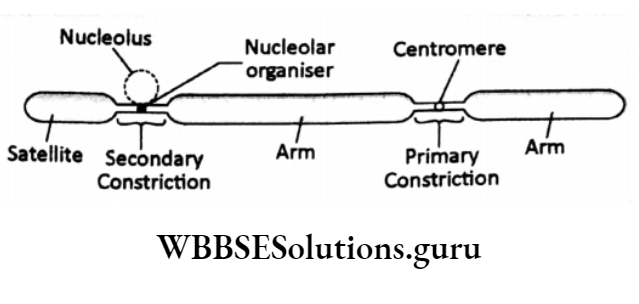
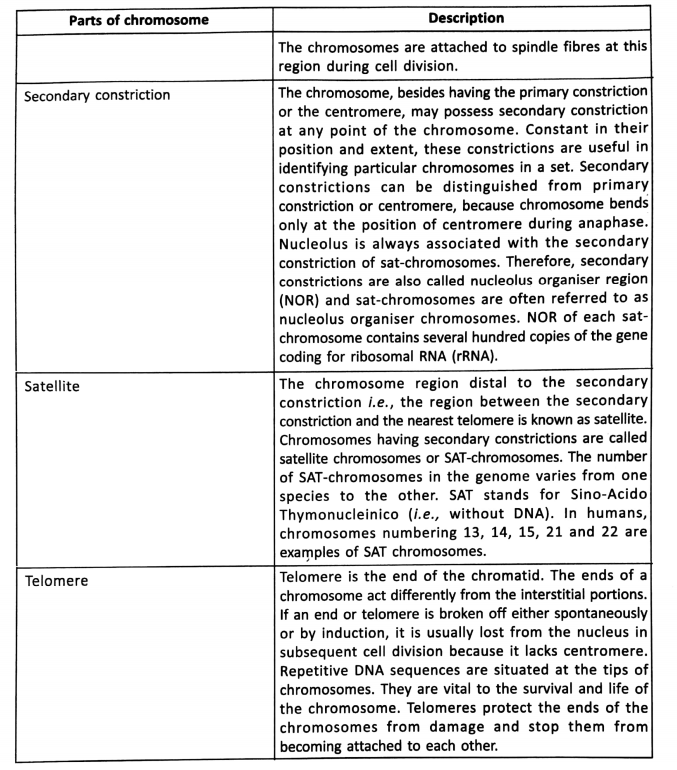
Community or ecosystem Biodiversity can be expressed at several spatial scales:

Alpha(α)Diversity:

It refers to the richness and evenness of individuals within a habitat unit. For example in the A = 7 species, Site B = 5 species, Site C = 7 species.

Alpha Diversity is a local measure. This diversity changes frequently since species undergo frequent changes when the habitat changes.

WBBSE Solutions For Class 10 Life Science Chapter 5 Environment Its Resources And Their Conservation Topic D Biodiversity And Conservation Alpha

Beta(β)Diversity:

It refers to the expression of diversity between habitats or the rate of replacement of species along a gradient of habitats like an altitudinal gradient or moisture gradient etc.

It is calculated by the following equation:

[3 diversity = (Number of species in habitat 1- Number of species of habitat 1 & 2 in common) + (Number of species in habitat 2 – Number of species of habitat 1 & 2 in common). = (H1-H1 & 2) + (H2- H1 & 2).

For example, C with 10 species differs between them and only 2 species in common.

Biodiversity And Conservation Class 10

Diversity expresses the ratio between local or diversity and regional diversity. Hence, the higher the hetero-genericity in habitats, the higher the dissimilarity between communities.

Gamma (γ) Diversity:

It refers to the landscape diversity or diversity of habitats within a landscape or region. In this example, the Gamma Diversity is 3 habitats with 12 species total diversity.

Naturally, it is a combination of both a and β-diversity. Alternatively, γdiversity is also defined as ‘geographic scale species diversity’.

In addition to the above three, recently molecular diversity has also been added as the newest level of biodiversity.
essential items and economic productivity of a country.

WBBSE Chapter 5 Topic D Biodiversity And Conservation Importance Of Biodiversity

Biodiversity includes the flora and fauna of a particular place. It controls the supply of essential items and the economic Productivity of a country

WBBSE Solutions For Class 10 Life Science Chapter 5 Environment Its Resources And Their Conservation Topic D Biodiversity And Conservation importance uses of biodiverstiy

Sources Of Food Production:

Staple food crops like rice, wheat, barley, potato, and other vegetables, provide Nourishment to the world.

WBBSE Solutions For Class 10 Life Science Chapter 5 Environment Its Resources And Their Conservation Topic D Biodiversity And Conservation sources of food products

Sources Of Drugs and Medicines: Plants are the sources of drug molecules like Basak, Tulsi, ashwagandha, ipecac, etc., Which are used in the preparation of different bulk drugs and life-saving molecules.

WBBSE Solutions For Class 10 Life Science Chapter 5 Environment Its Resources And Their Conservation Topic D Biodiversity And Conservation tulsi

Ecological Balance:  Plants are useful for maintaining the ecological balance of a particular place sand binders are useful for protecting the seashore, trees growing along the slope of a hill prevent landslides, and mangrove vegetation near the sea shore helps to protect the hinterland from high-speed wind arising in the seas and ocean, etc.

Climate Control:

The rainfall of a particular place is controlled by the vegetation. It also ensures climate control of a place.

House building and furniture building process:

The wood from different timber-yielding plants like teak and sal is used in the making of houses and furniture.

Paper production:

The soft woody tissue of forest trees is used in the preparation of paper pulp for the manufacturing of paper.

Gum production:

The gums and adhesives of industrial importance are produced from the Acacia tree.

Resin production:

Resins are another useful product of gymnospermous wood like Pinus. They may be hard or soft in nature and are used in the paint industry as an organic solvent

Example: turpentine.

Wax production:

It takes place within the bee hive. It is a product produced by a honey bee [Apis indica) consisting of myristyl alcohol and esters of palmitic acid.
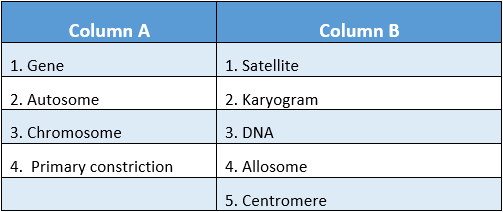
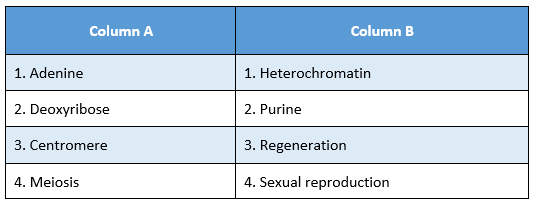
Wbbse Class 10 Life Science Biodiversity Notes

Leather Production:

The animal (cattle) hides which are slaughtered for meat are the potent source of leather, which is processed by the process of tanning using chemicals like tannins obtained from plant sources.

Silk Production:

It is a protein produced by the silkworm in its pupal stage and it consists of two major proteins, sericin, and fibroin.

The color and texture of silk thread depend on the nature of the leaf of the host plant which the silkworm larvae consume.

It may be classified into four major types in India as denoted in the table below:

WBBSE Solutions For Class 10 Life Science Chapter 5 Environment Its Resources And Their Conservation Topic D Biodiversity And Conservation ecological balance

WBBSE Solutions For Class 10 Life Science Chapter 5 Environment Its Resources And Their Conservation Topic D Biodiversity And Conservation Silk variety

Wool production:

The wool is produced from the hair of sheep. The wool texture & strength depend on the type of sheep, but they are broad of three types short, medium, and long.

The Pashmina wool of Kashmir is world-famous. The first Pashmina goat Noori has been cloned in 2012.

WBBSE Solutions For Class 10 Life Science Chapter 5 Environment Its Resources And Their Conservation Topic D Biodiversity And Conservation pashmina noori

Pearl production:

Pearls are produced from the pearl-producing oysters due to the entry of dust particles followed by the deposition of aragonite (CaC03), chitin, and luster around the particle.

They can be produced naturally or can be generated artificially by culturing. Natural pearls are more costly than artificial pearls and they have an irregular shape and more luster.

They vary in color and texture depending upon the variety of the bivalve (oyster) where it is produced.

WBBSE Solutions For Class 10 Life Science Chapter 5 Environment Its Resources And Their Conservation Topic D Biodiversity And Conservation pearl shell

Eco tourism:

Biodiversity is a source of economic wealth for many potential areas. Ecotourism, bird watching, wildlife safari, etc are growing outdoor recreational activities.

WBBSE Chapter 5 Topic D Biodiversity And Conservation Biodiversity Hotspots

Certain regions of the world are mega-diversity zones where a very large number of species are found. Norman Myers developed the concept of hotspots to designate these priority areas.

The hotspots are the richest and the most threatened reservoirs of flora and fauna on Earth.

A biodiversity hotspot is a biogeographic region with a significant reservoir of biodiversity that is under threat of destruction by human beings.

The Key Criteria To Determine A Hot Spot Are:

Number of endemic species, ie., the species which are restricted to only these areas, and

The degree of threat is measured in the manner of habitat loss.

The Hotspot status is designated by Conservation International (Cl).

Out of 35 globally identified biodiversity hotspots all over the world, there are only four in India which include

Eastern Himalayas (North Eastern Hilly states),

Indo- Myanmar (Burma) area including Andaman and Nicobar Islands,

Western Ghats and Srilanka and

Sundaland including the islands of the Andaman Sea.

Eastern Himalayas:

The Eastern Himalayas is the region encompassing Bhutan, north Eastern India, and Southern, Central, and Eastern Nepal.

The Eastern Himalayan hotspot has nearly 163 globally threatened species including the one-horned Rhinoceros (Rhinoceros unicornis), the wild Asian water Buffalo and in all 45 mammals, 50 birds, 17 reptiles, 12 amphibians, 3 invertebrates, and 26 plant species.

There are 10,000 plant species and 300 animal species like Golden langur, Himalayan tahr, pygmy hog, snow leopard, black bear, and Gangetic dolphin which are endemic in nature.

WBBSE Solutions For Class 10 Life Science Chapter 5 Environment Its Resources And Their Conservation Topic D Biodiversity And Conservation indo burma

Indo-Burma:

The Indo-Burma region is spread out from Eastern Bangladesh to Malaysia and includes North Eastern India, South of the Brahmaputra River, Myanmar, and the Southern part of China’s Yunnan province.

This region is home to several primate species such as monkeys, langurs, gibbons, etc. Almost 1,300 bird species exist in this region including the threatened white-eared night heron and the orange-necked partridge.

There are about 13,500 plant species in this hotspot, with over half of them being endemic.

Wbbse Class 10 Life Science Biodiversity Notes

Western Ghats and Sri Lanka:

The Western Ghats are a chain of hills that run along the western edge of peninsular India. These regions have moist deciduous forests and rainforests.

Nearly 77% of the amphibians and 62% of the reptile species are found here. Sri Lanka which lies to the South of India, is also a country rich in species diversity.

The western ghats of India contain more than 30% of all plant, fish, herpeto-fauna, birds, and mammal species. Many species are endemic, such as Nilgiri tahr and the lion-tailed macaque.

Sundaland:

Sundaland (also called the Sundaic region) is a biogeographical region of South-eastern Asia that encompasses the Sunda shelf, the part of the Asian continental shelf that was exposed during the last ice age.

This biodiversity hotspot is dominated by two of the largest islands in the world, Borneo and Sumatra.

The islands of Sundaland are home to many Asian mammals including elephants, monkeys, apes, tigers, tapirs, and rhinoceros.

There are at least 117 endemic plant genera in the hotspot, 59 of these are found in Borneo, 17 in Sumatra, and 41 on the Malay Peninsula.

WBBSE Chapter 5 Topic D Biodiversity And Conservation Loss Of Biodiversity

The main cause of the loss of biodiversity can be attributed to the influence of human beings on the world’s ecosystem.

Human beings have deeply altered the environment, and have modified the territory, exploiting the species directly, for example by fishing and hunting, changing the biogeochemical cycles, and transferring species from one area to another of the planet.

The Loss Of Biodiversity May Be Due To Various Reasons Which Are Indicated Below:

Habitat destruction:

The destruction has played a key role in extinctions, especially the destruction of tropical rainforests.

WBBSE Solutions For Class 10 Life Science Chapter 5 Environment Its Resources And Their Conservation Topic D Biodiversity And Conservation habitat destruction

Factors Contributing To Habitat Loss Are:

Overpopulation, deforestation, encroachment into forest areas, pollution (air, water, and soil contamination), and global warming or climate change.

WBBSE Solutions For Class 10 Life Science Chapter 5 Environment Its Resources And Their Conservation Topic D Biodiversity And Conservation habitatloss

Biodiversity and genetic diversity are codependent and diversity among species requires diversity within a species, and vice versa. If any one type is removed from the system, the cycle can break down, and the community becomes dominated by a single species.

Barriers such as large rivers, seas, oceans, mountains, and deserts encourage diversity by enabling independent evolution on either side of the barrier.

Invasion of species occurs when those barriers are destroyed or damaged. Without barriers, such species occupy new niches, which reduces the diversity substantially.

Hunting and Poaching:

Poaching has traditionally been defined as the illegal hunting, killing, or capturing of wild animals.

It is a severe threat to biodiversity, especially in economically poor South Asian countries since poachers kill animals like elephants, rhinoceros, and lions to illegally sell the horns, ivory, body parts, and skin at a high profit.

Moreover, some people cut the trees for wood and sell them at high rates causing large-scale deforestation.

Over-exploitation:

Over-exploitation occurs when a resource is consumed at an unsustainable rate. This occurs on land in the form of overhunting, excessive logging, poor soil conservation in agriculture, and the illegal wildlife trade.

All these factors are more acute in the relatively less developed countries with relatively high biodiversity resources.

Over-exploitation of a particular species reduces the size of the species’ population to the extent that it becomes on the verge of extinction.

The ever-growing illegal trade of tigers has resulted in the extinction of the big cat from many countries in South Asia.

WBBSE Solutions For Class 10 Life Science Chapter 5 Environment Its Resources And Their Conservation Topic D Biodiversity And Conservation fishes

Pollution:

Human activity influences the natural environment producing negative direct or indirect effects that alter the flow of energy, the chemical and physical constitution of the environment, and the abundance of the species.

Pollution may either reduce or eliminate populations of sensitive species. For example, pesticides have a direct link with the decline of falcons.

Lead poisoning also affects wildlife seriously. Eutrophication of water bodies drastically reduces aquatic species diversity.

WBBSE Solutions For Class 10 Life Science Chapter 5 Environment Its Resources And Their Conservation Topic D Biodiversity And Conservation thermal power station

Global Warming and Climate Change:

The direct impact of Global warming has been the destruction of the habitat of the polar species.

The melting of ice results in uncontrolled flood, modification of the wetland, and ingress of seawater into the water bodies of the hinterland.

According to a UN report, by 2050, there will be a loss of at least 10 percent of species due to global warming alone.

Wbbse Class 10 Life Science Biodiversity Notes

The heating of the earth’s surface due to climate change affects biodiversity because it endangers all the species that are adapted to the cold either due to the altitude or the altitude (mountain species).

WBBSE Solutions For Class 10 Life Science Chapter 5 Environment Its Resources And Their Conservation Topic D Biodiversity And Conservation polar bear

Natural Calamities:

Major events of flood, drought, earthquake, and tsunami have resulted in the destruction of several species of plants and animals.

Changes in the salinity of water in the Indian part of the Sundarbans due to supercyclones have resulted in the loss of the Sundari tree.

WBBSE Solutions For Class 10 Life Science Chapter 5 Environment Its Resources And Their Conservation Topic D Biodiversity And Conservation earth quake

Exotic Species:

New species entering a geographical region are called exotic or alien species.

The introduction of such alien invasive species may cause the disappearance of native species through competition in a changed biotic interactive environment.

The exotic species of water hyacinth introduced into the rivers & lakes of tropical countries including India has resulted in the modification of the lentic (stagnant water) ecosystem and has, as a result, eliminated many native aquatic species earlier native to the regions.

Similarly, Nile perch, an exotic predatory fish, introduced into Lake Victoria of South Africa has threatened the entire lake ecosystem by eliminating several freshwater native endemic species including the small Cichlid fish species.

WBBSE Solutions For Class 10 Life Science Chapter 5 Environment Its Resources And Their Conservation Topic D Biodiversity And Conservation exotic seeds

Human Population Growth:

The geometric rise in human population levels during the twentieth century is the fundamental cause of the loss of biodiversity.

It has led to an unceasing search for more arable land for food production and livestock grazing and for wood for fuel, construction, and energy.

Previously undisturbed areas (which may or may not be suitable for the purposes to which they are constrained) are being transformed into agricultural or pasture land, stripped of wood, or mined for resources to support the energy needs of an ever-growing human population.

Importance Of Biodiversity Class 10

Humans also tend to settle in areas of high biodiversity, which often have relatively rich soils and other attractions for human activities. This leads to great threats to biodiversity, especially since many of these areas have numerous endemic species.

Agriculture:

The dramatic increase in the number of humans during the twentieth century has instigated a concomitant growth in agriculture, and has led to the conversion of wild lands to croplands, massive diversions of water from lakes, rivers, and underground aquifers, and, at the same time, has polluted water and land resources with pesticides, fertilizers, and animal wastes.

The result has been the destruction, disturbance, or disabling of terrestrial ecosystems and polluted, oxygen-depleted, and atrophied water resources.

Extinction of species:

Extinction is a process in which species disappear and new ones evolve to take their place down the long geological history of Earth.

Extinction may be natural, mass, or anthropogenic in nature. Natural extinction occurred in the geological past at a very slow rate. Mass extinction also occurred in the past.

It is the anthropogenic extinction due to human activities that are the most severe threat toward depletion of biodiversity occurring within a short period of time.

WBBSE Chapter 5 Topic D Biodiversity And Conservation Environmental Problems Of The Sundarbans

The Sundarbans constitute one of the largest mangrove ecosystems comprising the deltaic regions of the Hooghly River and its tributaries in West Bengal, India, and the Padma, and Brahmaputra deltaic regions of Bangladesh.

It consists of exotic species like Halophytic mangrove vegetation and the Royal Bengal Tiger, Marshy crocodile, and other animals.

It spans over 10,000 sq km approximately, 60% of which is in Bangladesh and the rest is in India. Because of its unique biodiversity, it is considered a World Heritage site by UNESCO.

WBBSE Solutions For Class 10 Life Science Chapter 5 Environment Its Resources And Their Conservation Topic D Biodiversity And Conservation sundarbans

There are about 245 genera of plants reported from Sundarbans by David Prain (1903).

The name itself comes from the Sundari tree (Heritero littoralis), though at present, it is highly endangered in India. The mangrove forest of Sundarbans is tolerant to saline water and shows typical halophytic adaptation.

The forest is famous for Royal Bengal Tigers (Panthera tigris) but apart from that, there are about 150 species of commercially important fishes, 8 amphibia, 35 reptiles, 270 species of birds, and 42 species of mammals.

This ecosystem has been subjected to severe stress and strain, which has made the forest highly vulnerable and if not protected right now, the city of Kolkata will suffer a lot in the future from unprotected storms and cyclones coming from the Bay of Bengal.

WBBSE Solutions For Class 10 Life Science Chapter 5 Environment Its Resources And Their Conservation Topic D Biodiversity And Conservation fishing in the lake

The Causes Of This Stress Are As Follows:

Urbanization:

The increasing population pressure has led to the spreading of urban dwellings into the forest. Though the core areas of the forest have been clearly demarcated, there has been increasing in the unauthorized deforestation process.

Thus the mangrove forest ecosystem is now in a captious position. The growing human population with few alternative livelihood opportunities poses a serious threat to the mangrove forests.

Importance Of Biodiversity Class 10

The rapidly expanding shrimp farming is a significant threat to mangrove forests. Due to illegal cutting, encroachment into forest areas, and illegal poaching of wildlife, the mangrove forest is losing biodiversity at an alarming rate.

Further threats are arising due to excessive pollution, global climate change, and sea level rise which are damaging the ecosystem’s biogeochemistry.

Agriculture:

In order to meet the increasing demand for food, the forest areas have been transformed into agricultural land by the locals.

Fresh water crisis:

The area remains at the confluence of perennial rivers and sea but due to the global greenhouse effect, the sea level is rising and it causes filtration of saline water into the internal territory causing serious crises in drinking water.

Habitat destruction:

The destruction of (iv)mangrove forest and the progressing human settlement and agricultural land have resulted in the loss of habitat for the animals, making them endangered and vulnerable. Thus they may get extinct in the future.

Pollution:

The pollution from different domestic dwellings, paint, and other hydrocarbons has resulted in the destruction of aquatic microflora and the destruction of the aquatic food chain.

Modification in the prey-predator balance:

The shrinking of mangrove vegetation has resulted in a reduction in the number of herbivores and as a result, the carnivores are becoming endangered. For example, the number of tigers has gone down deeply. Moreover, they are also getting killed illegally.

Submergence of Islands:

An increased number of islands are getting submerged due to rising water levels as a result of which the habitat is shrinking and it has reduced the biodiversity of the region considerably.

WBBSE Chapter 5 Topic D Biodiversity And Conservation Conservation Of Biodiversity

Currently, the planet is inhabited by several million species in about 100 different phyla. The point of concern is that the modern extinction rate is high, at 100 to 1000 times greater than previous extinction rates calculated over the eras.

Although new species appear, existing species go extinct at a rate 1000 times that of species formation. We are in fact in the midst of a mass extinction, a time when 75% or more of species are lost over a short geological time scale.

The last great mass extinction was 65 million years ago, at the end of the Cretaceous, when the dinosaurs went extinct.

The International Union for the Conservation of Nature (IUCN) estimates that 22% of known mammals, 32% of amphibians, 14% of birds, and 32% of gymnosperms are threatened with extinction.

Thus, humans should be concerned about saving biodiversity for the overall sustenance of life on Earth.

Biodiversity conservation is about saving life on earth in all its forms from excessive rates of extinction, maintenance of genetic variability within species, and keeping the natural ecosystem functioning and healthy.

WBBSE Chapter 5 Topic D Biodiversity And Conservation Concept of Threatened Species

IUCN has recognized the following categories of species based on threat perception in connection with extinction:

Endangered species:

These are in danger of extinction and their survival is unlikely if the causal factors continue to operate. Ex: rhinoceros, tiger, sloth bear, wild ass, etc.

Vulnerable species:

These are likely to move into the endangered category shortly if the causal factors continue to operate.

Rare species:

These are with small populations localized in some specific geographical areas only. These are not at present endangered or vulnerable but are at risk.

Threatened species:

These belong to either of the three categories mentioned, ie. either endangered or vulnerable, or rare.

Importance Of Biodiversity Class 10

Out of danger:

These are now relatively secure and do not face the threat of extinction at the present moment.

WBBSE Chapter 5 Topic D Biodiversity And Conservation General Modalities Of Conservation

The protection strategy cannot be a very simple one, because the problem is multidimensional.

Some of the major points are discussed below:

Increase of Inter-Governmental cooperation towards the common goal of protecting biodiversity.

Reduction of greenhouse gases for controlling global warming.

Undertaking special programs to protect endangered species which include protection from poaching or undertaking breeding programs.

Protection of the different biodiversity hotspots.

Exotic species that have become pests can be identified taxonomically [e.g., witha  Digital Automated Identification System (DAISY), using a special barcode].

Judicious application of genetic engineering to produce GM crops.

The concept of a green or red data book maintaining the list of endangered species of plants and animals can be very effective in knowing the status of particular species.

General awareness amongst common people can lead to effective implementation of the conservation strategy.

Creation of gene banks in the form of germplasm banks.

Adding financial flavor to the conservation in the form of recreation or a nature park can make the system economically self-sustaining.

Two convenient approaches for the conservation of biological diversity are in situ conservation and ex-site conservation.

WBBSE Solutions For Class 10 Life Science Chapter 5 Environment Its Resources And Their Conservation Topic D Biodiversity And Conservation biodiverstiy conservation

WBBSE Chapter 5 Topic D Biodiversity And Conservation Insitu Conservation

Institute conservation means the conservation of living resources through their maintenance and upkeeping within natural ecosystems and habitats in which their natural ecosystems and habitats in which they occur like a system of protected areas such as national parks, sanctuaries, reserve forests, Biosphere reserves,s, and serval others.

WBBSE Solutions For Class 10 Life Science Chapter 5 Environment Its Resources And Their Conservation Topic D Biodiversity And Conservation insitu converasation method

WBBSE Solutions For Class 10 Life Science Chapter 5 Environment Its Resources And Their Conservation Topic D Biodiversity And Conservation insitu conservation methods

Advantages Of In-Situ Conservation:

The flora and fauna live in natural habitats without human interference.

The life cycles of the organisms and their evolution progress in a natural way.

In-situ conservation provides the required green cover and associated benefits to the environment.

This is less expensive and easy to manage.

The interests of indigenous people are protected.

Risks Associated With In-Situ Conservation:

vents in the survival and reproduction of species.

Environmental uncertainty due to random & unpredictable changes in weather, food supply, the population of predators, etc.

Natural catastrophes like floods, fires, or droughts may occur at random intervals.

Genetic uncertainty or random changes in genetic makeup due to genetic drift or inbreeding alters the survival and reproductive probabilities of individuals.

Methods Of Conservation Of Biodiversity Class 10

WBBSE Chapter 5 Topic D Biodiversity And Conservation Ex-situ Conservation

The ex-situ conservation of plants and animals includes the conservation of plants and animals outside their normal habitat by perpetuating sample populations in Zoological Gardens, Botanical Gardens, and Cryopreservation.


WBBSE Solutions For Class 10 Life Science Chapter 5 Environment Its Resources And Their Conservation Topic D Biodiversity And Conservation ex situ conservation methods

Advantages of ex-situ conservation:

It is extremely useful for the declining population of species.

Threatened species are bred in captivity and then released in their natural habitats.

Ex-situ centers offer the possibility of observing wild animals intimately, which is otherwise impossible.

WBBSE Chapter 5 Topic D Biodiversity And Conservation Joint Forest Management (JFM)

It is the official and popular term in India describing the partnerships in forest movement involving both the state forest departments and local communities.

The policies and objectives of the Joint Forest Movement are detailed in the Indian comprehensive National Forest Policy of 1988 and the Joint Forest Movement Guidelines of 1990 of the Government of India.

Origin and development:

Joint Forest Management originated in West Bengal accidentally at the Arabari Forest Range in West Midnapore, near Midnapore town in 1971.

The major hardwood of Arabari is the sal tree, a commercially profitable forest crop.

Ajit Kumar Banerjee, a silviculturist, working for the Forest Department as the Divisional Forest Officer, was conducting trials that were constantly being disturbed by grazing and illegal harvesting done by the local population.

At that time there were no initiatives for sharing of forest resources between the Government and the locals, with the Government considering many of the locals as “thieves”.

The forest official, against the suggestions of his coworkers, sought out representatives of eleven local villages and negotiated the terms of a contract with an ad hoc Forest Protection Committee.

The initial program involved 612 families managing 12.7 square kilometers of forests classified as “degraded”. 25% of profits from the forests were shared with the villagers.

The experiment was successful and was expanded to other parts of the state in 1987. JFM is still in force at Arabari.

A few years later, Joint Forest Management was employed in the state of Haryana to prevent soil erosion and deforestation.

In 1977, villagers were persuaded that instead of grazing on erosion-prone hills, building small dams would help agricultural output in areas currently under cultivation. The program led to the reforestation of many hills in the state.

After the initial success in West Bengal and Haryana, the JFM schemes received national importance in the legislation of 1988 and were thrust into the Guidelines of 1990.

As of 2005, 27 states of the Indian Union had various JFM schemes with over 63,000 Forest Protection Committee’s involvement in the joint management of over 140,000 km2 of forested land.

WBBSE Solutions For Class 10 Life Science Chapter 5 Environment Its Resources And Their Conservation Topic D Biodiversity And Conservation forest range office arabari range

Objectives:

Conservation of forests in a sustainable manner by the government along with the participation of the local community.

In return for their services to the forest, the communities get the benefit of various forest products like fruits, rubber, gum, medicines, etc.

WBBSE Chapter 5 Topic D Biodiversity And Conservation Peoples Biodiversity Register (PBR)

The Biodiversity Board prepares the Biodiversity Registers for the local communities. Biodiversity registers are prepared with the help of the local people and hence referred to as the People’s Biodiversity Register (PBR).

Objectives:

Preparation of a Biodiversity Register is an attempt to realize biodiversity first at the Local Government level and then at the level of the states and the whole country.

Identification of biological resources and documentation are the prerequisites for the Register preparation, which can lead to new discoveries and development of new commercial products, patenting of such products, equitable distribution of benefits, if any, and through this, paving the way for a new economic order in the country through biodiversity conservation.

Utility of PBR:

PBR is not simply a register with names of species and their distribution in a given area.

It is a comprehensive database recording people’s traditional knowledge and insight into the status, uses, history, ongoing changes, and forces driving these changes on the biological diversity resources of their localities.

This provides information on the current utilization patterns of biodiversity and its economic benefits to the local communities.

The registers form baseline data for future management strategies required for the sustainable utilization of biodiversity in a decentralized manner.

Further, it helps equitable sharing of benefits arising out of the commercial utilization of biodiversity resources and knowledge of their uses.

The Biodiversity Register offers conservation, protection of IPR, and the traditional knowledge prevailing in rural communities.

Documentation:

People’s Biodiversity Registers (PBR) document folk knowledge of status, uses, history, ongoing changes and forces driving changes in biodiversity resources, gainers and losers in these processes, and people’s perceptions of how these resources should be managed.

A number of PBRs have been prepared in different parts of India beginning in 1995 through initiatives of NGOs and educational institutions working with local communities and village councils.

These attempts have been motivated by a desire to promote decentralized systems of management of natural resources and to create the basis for equitable sharing of benefits of commercial utilization of folk knowledge of uses of biodiversity.

The documents bring together important locality-specific information on biodiversity resources and the ecological processes affecting them.

They lead to the recognition of conservation-oriented local practices such as the protection of sacred groves. They help mobilize local communities to prudently manage local biodiversity resources in ways that would promote social justice.

It is, however, important to recognize that not all folk knowledge may be correct, nor all folk practices wise, and create systems of careful assessment of the material.

Methods Of Conservation Of Biodiversity Class 10

There are many encouraging signs globally, as well as within India, such as the coming force of the Convention on Biological Diversity, forces promoting decentralized democratic systems of governance, and institutions of co-management of natural resources.

which suggests that programs like PBR will have an important role to play in promoting conservation, sustainable use, and equitable sharing of benefits of biodiversity resources in the coming decades.

WBBSE Chapter 5 Topic D Biodiversity And Conservation Conservation Of Some Major Animals Tiger (Panthera Tigris) Conservation

The main protection initiative:

Project Tiger’ by the National Tiger Conservation Authority of the Government of India.

Initiation:

This initiative was started in 1973 by the then Prime Minister Mrs. Indira Gandhi and has, to date, established more than 48 tiger reserves throughout the country.

Objectives:

To ensure the maintenance of a viable population of tigers in India for scientific, economic, aesthetic, cultural, and ecological values.

To preserve, for all times areas of biological importance as a national heritage for the benefit, education, and enjoyment of the people.

WBBSE Solutions For Class 10 Life Science Chapter 5 Environment Its Resources And Their Conservation Topic D Biodiversity And Conservation tiger panthera tigris conservation

Measures taken:

Habitat improvement:

In order to protect these animals as much as possible, tiger reserves have been established on reclaimed land, where human development and inhabitation are forbidden.

As a result of this program and its efforts, the population of Bengal Tigers has increased from about 1200 in 1973 to an impressive 2900+ in 2018.

Addressing man-animal conflict & anti-poaching initiative:

Project Tiger has also established the Tiger Protection Force with the aim of catching poachers and stopping the killing.

This initiative has been instrumental in relocating about 200,000 villagers in rural areas so that they are no longer living within the natural habitat of the tigers.

This reduces the risk of tiger attacks on humans (which often leads to the killing of the tiger for the safety of the villagers).

Strengthening infrastructure within tiger reserves including water development.

Rehabilitation of traditional hunting tribes living in & around tiger reserves.

Development of buffer or fringe area landscape.

Providing support to states for staff development and capacity building.

Example:

Sundarban and Buxa Tiger Reserve, West Bengal; Bandipur Tiger Reserve, Karnataka; Kanha Tiger Reserve, Madhya Pradesh; Sariska Tiger Reserve, Rajasthan, etc.

Importance of Tiger Conservation:

Tiger is a symbol of wilderness and the well-being of the ecosystem. By conserving and saving tigers the entire wilderness ecosystem is conserved.

In nature, barring human beings and their domesticates, the rest of the ecosystem is wild. Hence conserving wilderness is important and crucial to maintaining the life support system.

So saving tigers amounts to saving the ecosystem which is crucial for man’s own survival.

Tigers play a pivotal role in the health of the ecosystem. Tigers constitute the top carnivores in the ecosystem and are at the apex of the food chain.

The removal of a top carnivore from an ecosystem can have an impact on the relative abundance of herbivore species within a guild. Along with other major carnivores as leopards, it acts as a control mechanism for herbivores.

The interdependency of living forms in a food chain is obvious as the wild tiger is dependent upon herbivores for its survival and that he maintains its population which in turn prevents the grasslands from being overgrazed.

The herbivores depend upon producers such as grasses, herbs, shrubs, algae, fungi, and large trees for survival and they in turn maintain a balance in vegetation by controlling the extent of vegetation or flora.

Birds survive on herbs, shrubs, and trees for fruits and nectar and in turn act as seed dispersal agents for them to spread the population of the floral elements in an ecosystem.

Thus all life forms including tigers are interlinked with each other in an ecosystem and their survival depends upon how intact the ecosystem is.

Top carnivores, tigers, have an important role ultimately in ecosystems. Thus, the preservation to play in the structuring of communities and of tigers becomes an important consideration.

WBBSE Chapter 5 Topic D Biodiversity And Conservation Indian One-Horned Rhinoceros (Rhinoceros Unicornis) Conservation

Early Facts:

In 1910, all rhino hunting in India became prohibited. In 1984, five rhinos were relocated to Dudhwa National Park—four from the fields outside the Pabitora Wildlife Sanctuary and one from Goalpara.

The Indian rhinoceros was initially difficult to breed in captivity. The first recorded captive birth of a rhinoceros was in Kathmandu in 1826, but another successful birth did not occur for nearly 100 years.

In 1925, a rhino was born in Kolkata. No rhinoceros was successfully bred in Europe until 1956. On September 14, 1956, Rudra was born in Zoo Basel, Switzerland.

The Kaziranga National Park has the highest number of rhinos (2401) in India in 2015. Jaldapara in West Bengal has about the demise of other species of mammals, birds, insects, fish, and plants. Thus they play a vital role in the ecosystem.

When they browse, they keep the areas trimmed, making paths more accessible for smaller mammals. They also enrich the soil and help plants by spreading seeds through their dung.

Methods Of Conservation Of Biodiversity Class 10

Rhino-inhabited areas have about 20 times more grazing lawns than areas without rhinos. This affects not just the rhinos’ diet, but smaller grazing animals like zebra and antelope.

Thus the protection of the rhino population takes into account the protection of all other species interacting with the rhinos and those sharing the same habitat.

WBBSE Chapter 5 Topic D Biodiversity And Conservation Crocodile Conservation

Protection Initiative:

In response to declining crocodilian populations, a crocodile conservation program, the UNDP/FAO Crocodile Breeding and Management Project, was launched in 1975 in cooperation with the Government of India and the State Governments.

WBBSE Solutions For Class 10 Life Science Chapter 5 Environment Its Resources And Their Conservation Topic D Biodiversity And Conservation save the rhino visison

Indian Rhino Vision 2020:

Launched in 2005, Indian Rhino Vision 2020 is an ambitious effort to attain a wild population of at least 3000 greater one-horned rhinos spread over seven protected areas in Assam by the year 2020.

Measures taken:

Rhino translocation from overcrowded areas to other protected areas where they can breed,

Patrolling to foil poaching attempts,

Improved breeding techniques and monitoring methods,

Better habitat management.

Examples:

Kaziranga National Park, Manas National Park, Pabitora Wildlife Sanctuary, Assam; Jaldapara & Gorumara National Parks, West Bengal.

Rhinos as umbrella species:

Rhinos are an umbrella species. This means that their survival or demise directly impacts the survival or

A survey of the status of the three species of crocodiles present in India:

Gharial-(Gavialis gangeticus):

Found in rivers of North India, it is considered in danger of extinction due to habitat destruction, incidental catches in fishing nets, and poaching.

Estuarine crocodile (Crocodylus porosus):

Considered formerly common along shores and rivers, it has now become extinct in the States of Kerala, Tamil Nadu, and Andhra Pradesh. Small populations persist in deltaic areas of Odisha, the Sunderbans (West Bengal), and the Andamans.

Mugger (Crocodylus palustris):

Formerly widespread and abundant, it is considered very depleted in numbers and most endangered in comparison to the other two species. They are the most common variety in India and range between 3500-4000 in India in 2019.

Primary Project Aims:

To boost reproductive output by a collection of wild-laid eggs with subsequent incubation and rearing of young until attainment of a size (less vulnerable to predation) suitable for release in the wild.

To locate, establish and manage a series of crocodile rehabilitation centers and sanctuaries in suitable habitats.

To promote captive breeding.

To take up research on egg collection, incubation, hatching, rearing, food conservation, habitat features, behavioral biology, etc.

To involve local people in the project intimately.

Methods Of Conservation Of Biodiversity Class 10

Example:

The greatest achievement has been the re-establishment of viable gharial breeding populations in Chambal and Satkoshia Gorge sanctuaries and the setting up of the Crocodile Breeding and Management Training Institute, Hyderabad.

Crocodile project sites in Odisha:

Bhitarkanika Sanctuary, Ramatirtha Centre, Tikarpara Centre, and Nandankanan Zoo.

Importance of crocodiles:

Though crocodiles are vicious, cold-blooded, and ugly, yet in an ecological perspective, crocodiles are an important group of organisms as they are the keystone species.

Young crocodiles are a food source for countless animals like fish, mammals, birds, snakes, crabs, etc. When they get bigger, the crocodiles in turn regulate the population of other animals.

Being the top predator, it controls the distribution and population of a large number of prey species. This allows an increase in biodiversity.

Crocodiles create habitats through burrowing and nest building. They create aquatic habitats so that plants and animals will have water during the dry seasons.

During the wet seasons, animals that live on land will have a place to survive.

Thus, it is important to conserve crocodiles as their presence would enable other species to survive as well.

WBBSE Solutions For Class 10 Life Science Chapter 5 Environment Its Resources And Their Conservation Topic D Biodiversity And Conservation crocodile

WBBSE Chapter 5 Topic D Biodiversity And Conservation Red Panda (Ailurus fulgens) Conservation

Introduction:

The highly threatened Red Panda is found in four states in India (Sikkim, West Bengal, Meghalaya, and Arunachal Pradesh).

Recent surveys have shown that habitat degradation (due to the need for fuel and shifting agricultural practices), killing by dogs, hunting, and extinction in some areas are the probable causes of its decline.

Research and monitoring need to be carried out as a matter of urgency to assess the population status so that focused conservation efforts can be initiated to secure and improve the present habitat conditions and reduce the immediate threats.

WBBSE Solutions For Class 10 Life Science Chapter 5 Environment Its Resources And Their Conservation Topic D Biodiversity And Conservation red panda

The aims of conservation are as follows:

To ascertain the present status of the Red Panda in the Kangchendozonga Landscape and the Western Arunachal landscape through research and updating of distribution map, habitat maps vis-a-vis maps of the human population, and agricultural expansion.

To evaluate the extent of the identified threats and suitable mitigation measures including control of dogs, poaching and trapping (for pets), threat of proposed highway including lobbying, the raising of local awareness, etc.

To ensure effective management interventions for the protection of red pandas in protected areas and community-conserved areas.

Threats To Biodiversity Class 10 Life Science

Including increasing the capacity of forest department staff, reduction in fuelwood extraction, official recognition of conservation areas, workshops for relevant stakeholders, training in community-based tourism activities, red panda re-introduction programs, etc.

Examples:

India has 20 protected areas with known or possible red panda populations in Sikkim, Arunachal Pradesh and West Bengal such as Singalila & Khangchendzonga National Parks in Sikkim and Namdhapa National Park in Arunachal Pradesh.

Ecological Importance of Red Panda Conservation:

Saving red pandas is important because they are an ambassador for clean air and water for approximately 500 million people.

The forests where red panda live are the lungs of South Asia and if these forests are intact and function properly, then we can ensure a healthy life for the people, animals, and plants of South Asia.

The mountain chains of the Eastern Himalayas and parts of south-western China, where red pandas are found, are the origin of South Asia’s three largest rivers, the Brahmaputra, Ganges and Yangtse, which provide water for half of China, northern and northwestern India, Nepal, Tibet Autonomous Region of China, Bhutan, and Myanmar.

According to conservation biologists, red pandas are an indicator of the overall health of their home, the Eastern Himalayan Broadleaf Forest, which is the central link in the Himalayan Hotspot.

Also, protecting the red panda is important to the preservation of the World’s natural heritage and global biodiversity because it is the only species of its kind in the world.

It is unique in its behavior and specialized in its habitat requirements, as well as the fact that they have no close living relatives. They are a living relict of times past.

WBBSE Chapter 5 Topic D Biodiversity And Conservation Asiatic Lion (Panthera Leo Persica) Conservation

Introduction:

Conservation efforts for the Asiatic Lion were made for the first time in the year 1910.

The Nawab of Junagadh imposed a ban on the hunting of lions within the boundaries of his province in 1879. The ban was continued even when India gained independence in 1947.

In the 1960s and 1970s, Gir forest, the home of the last surviving Indian Lions, was converted into a National Park and Sanctuary.

Presently Kuno Project or the Asiatic Lion Reintroduction Project is being undertaken to create viable genetic resources and to avoid the chance of extinction at Gir.

WBBSE Solutions For Class 10 Life Science Chapter 5 Environment Its Resources And Their Conservation Topic D Biodiversity And Conservation lion

Under the Kuno project, a wildlife Sanctuary, known as the Kuno Wildlife Sanctuary, is being developed in Madhya Pradesh to create a near-natural habitat for the lions.

The aim behind the establishment of the sanctuary is to relocate the excess population of lions in Gir. The number was around 600 in 2018.

The framework of the project:

Shifting of villages out of the lion reintroduction site and improvement of wild habitat.

Fencing off of the sanctuary.

Eco-development, research, and monitoring.

Example:

Gir National Park, Gujarat; Kuno- Palpur Wildlife Sanctuary, Madhya Pradesh

Importance of lion conservation:

Lions play a key role in the food chain by helping to control the herbivore population. If the herbivore population is not regulated, the increase in competition among them would cause some to go extinct and thus this will reduce biodiversity.

The lions have a reputation for being the ‘chief’ predator of their habitat as they are known to kill even large herbivores such as elephants.

Threats To Biodiversity Class 10 Life Science

Lions prey mainly on herd animals.

Nature comes to play as lions take down the weakest of the herd. This keeps the herd population resilient and healthy. If lions did not exist, there would be a symbiotic relationship between parasites and herd animals.

This way, parasites could increase and spread throughout the herd, resulting in fewer healthy animals.

WBBSE Chapter 5 Topic D Biodiversity And Conservation Fill In The Blanks

Question 1. _____________ Describes the diversity of life.
Answer: Biodiversity

Question 2. _____________diversity is defined as the variation of genes within a particular species.
Answer: Genetic

Question 3. Sarpagandha is a_____________ plant.
Answer: Medicinal

Question 4. Gums are produced from_____________ tree.
Answer: Acacia

Question 5. Bombyx morifeed on _____________plants.
Answer: Mulberry

Question 6. _____________diversity refers to the expression of diversity between habitats.
Answer: Beta

Question 7. Chemically, aragonite of pearl is_____________ .
Answer: CaCO3

Question 8. Globally_____________ there are biodiversity hotspots.
Answer: 35

Question 9. In India, the lion-tailed macaque is found in_____________.
Answer: Western Ghats

Biodiversity And Conservation Class 10 MCQs

Question 10. Habitat destruction is the major cause of loss of_____________
Answer: Biodiversity

Question 11. In India,_____________ water hyacinth is a plant species.
Answer: Exotic

Question 12. _____________has identified Sundarban as World heritage site.
Answer: UNESCO

Question 13. Conservation in the biosphere is an example of _____________ conservation.
Answer: in-situ

Question 14. For cryopreservation of cells and tissues, liquid_____________ is used.
Answer: Nitrogen

Question 15. JFM, in India, originated at_____________ forest in West Bengal.
Answer: Arabari

Question 16. PBR stands for People’s Biodiversity _____________.
Answer: Register

Question 17. _____________ is conserved in Jaldapara of West Bengal.
Answer: Rhinoceros

Question 18. Crocodile Breeding and Management Training Institute is situated at_____________.
Answer: Hyderabad

Question 19. In India, Red Panda is conserved in Sikkim,_____________, Meghalaya, and Arunachal Pradesh.
Answer: West Bengal

Question 20. _____________forest is the home of Indian lions.
Answer: Gir

WBBSE Chapter 5 Topic D Biodiversity And Conservation Write True Or False

Question 1. Biodiversity includes species diversity, ecosystem diversity, and evolutionary diversity.
Answer: False

Question 2. Genetic diversity refers to the heritable variations.
Answer: True

Question 3. Ipecac is a medicinal plant.
Answer: True

Question 4. The rainfall of a particular place is controlled by an afforestation program.
Answer: True

Question 5. The more equal species are in proportion to each other, the lesser the evenness of the site.
Answer: False

Question 6. The Pashmina wool of West Bengal is world-famous.
Answer: False

Question 7. Some oysters can produce pearls.
Answer: True

Question 8. There are 14 biodiversity hotspots in India
Answer: False

Question 9. The lion-tailed macaque is an endemic species of Sundaland.
Answer: False

Question 10. Crocodiles is a keystone species in the ecosystem.
Answer: True

Biodiversity And Conservation Class 10 MCQs

Question 11. Germplasm bank is for ex-situ conservation of biodiversity.
Answer: True

Question 12. After West Bengal, JFM was introduced in Haryana.
Answer: True

Question 13. PBR is the attendance register for animals.
Answer: False

Question 14. Buxa Tiger Reserve is situated in Himachal Pradesh.
Answer: False

Question 15. Crocodylus porosus is an estuarine species.
Answer: True

WBBSE Chapter 5 Topic D Biodiversity And Conservation Match The Column

WBBSE Solutions For Class 10 Life Science Chapter 5 Environment Its Resources And Their Conservation Topic D Biodiversity And Conservation match the following
Answer: 1-E,2-C,3-B,4-A

WBBSE Solutions For Class 10 Life Science Chapter 5 Environment Its Resources And Their Conservation Topic D Biodiversity And Conservation match the following 1
Answer: 1-D,2-A,3-E,4-B

WBBSE Solutions For Class 10 Life Science Chapter 5 Environment Its Resources And Their Conservation Topic D Biodiversity And Conservation match the following 2
Answer: 1-C,2-D,3-A,4-B

WBBSE Solutions For Class 10 Life Science Chapter 5 Environment Its Resources And Their Conservation Topic D Biodiversity And Conservation match the following 4
Answer: 1-D,2-C,3-E,4-B

WBBSE Chapter 5 Topic D Biodiversity And Conservation Very Short Answer Type Questions

Question 1. What is the term used to denote the richness and evenness of individuals within a habitat unit?
Answer: Alpha diversity.

Question 2. Name a type of ecosystem.
Answer: Grassland/ aquatic/ desert ecosystem.

Question 3. What is species diversity?
Answer: It is the variety of different species in a given area.

Question 4. Name two medicinal plants.
Answer: Basak and Tulsi.

Question 5. Name two plants used for furniture building.
Answer: Teak and Sal.

Question 6. Which plant can produce resin?
Answer: Pinus can produce resin.

Question 7. State two important products of Apis.
Answer: Honey and wax.

Question 8. Give the scientific name of pearl oyster.
Answer: Pinctada fucata.

Question 9. How many biodiversity hotspots are there all over the world?
Answer: There are 35 hotspots.

Question 10. How many biodiversity hotspots are there in India?
Answer: There are 4 hotspots.

Biodiversity And Conservation Class 10 MCQs

Question 11. Name an exotic plant species found in Indian water.
Answer: Water hyacinth.

Question 12. Give two examples of natural calamities.
Answer: Flood and drought.

Question 13. Give the scientific name of the Sundari tree.
Answer: Heritera littorals.

Question 14. What type of ecosystem is Sundarban?
Answer: Mangrove ecosystem.

Question 15. Name two places of in-situ conservation of biodiversity.
Answer: National park and sanctuary.

Question 16. Name two places of ex-situ conservation of biodiversity.
Answer: Zoological garden and botanical garden.

Question 17. Write the full form of JFM.
Answer: Joint Forest Management.

Question 18. Where did JFM originate in India?
Answer: At the Arabari forest of West Midnapore, West Bengal.

Question 19. Write the full form of PBR.
Answer: People’s Biodiversity Register.

Question 20. In which year was ‘Project Tiger’ started in India?
Answer: In 1973.

Question 21. Give the scientific name of Gharial.
Answer: Gavialis gangeticus.

Question 22. Give the scientific name of the one-horned rhinoceros.
Answer: Rhinoceros unicornis.

Question 23. Where is the home of Indian lions?
Answer: Gir Forest, Gujarat

Question 24. What do you mean by extractive reserves?
Answer: Extractive reserves are the areas that allow the local people to harvest natural forest products at a rate that does not destroy the ecosystem.

Question 25. Which ecosystem has the highest biodiversity?
Answer: Coral reef biodiversity.

Biodiversity And Conservation Class 10 MCQs

Question 26. Which Indian region is considered the cradle of speciation?
Answer: Eastern Himalayas.

Question 27. What is a latitudinal gradient?
Answer: It is a diversity index used to show the distribution of flora and fauna from the poles to the tropics.

Question 28. What is co-extinction?
Answer: It is the simultaneous extinction of multiple species where one is dependent on another species.

Example: Extinction of a host fish with parasites inside.

Question 29. When is an International Day of Biodiversity celebrated?
Answer: 22nd May of every year.

Question 30. A tropical lake ecosystem site contains 11 varieties of species. What is the alpha diversity scale of the site?
Answer: Alpha (α) diversity of the site is 11.

Question 31. A pair of related terms is given below. Based on the relationship of the first pair, write the suitable word in the gap of the second pair:
Answer:

Reserve forest:

in-situ conservation method::Botanical garden: Ex-situ conservation method

Beta diversity:

Expression of diversity between habitats::Diversity of habitats within a landscape Gamma diversity

Question 32. Among the following four terms, one includes the other three. Find out that term and write it.
Answer: Biosphere reserve, in-situ conservation, sanctuary, national park In-situ conservation

Sundaland, Western Ghats & Srilanka, Biodiversity hotspots, Eastern Himalayas Biodiversity Hotspots

Question 33. Name the different levels of biodiversity.
Answer: Genetic diversity, Species diversity, and Community/ecosystem/habitat diversity.

Question 34. Choose the odd one and write it:
Answer: The passenger pigeon, Dodo, snow leopard, woolly mammoth. Snow leopard since it is a vulnerable animal while the other ones are extinct animals.

Gene bank, sanctuary, national park, reserve forest. Gene bank since it is an ex-situ conservation method while the other three are in-situ conservation methods.

Question 35. Which is the most common crocodile species found in India?
Answer: The Mugger crocodile (Crocodylus palustris).

WBBSE Chapter 5 Topic D Biodiversity And Conservation Short Answer Type Questions With Answers

Question 1. What is meant by genetic diversity?
Two environments have a total of 13 species: A, B, C, D, E, F, G, H, l, J, K, L, and M.

Environment#1 contains 10 species: A to J.
Environment#2 contains 6 species: H to M.
Calculate the beta diversity of the two environments.

Answer:

Genetic diversity

Genetic diversity is the total number of genetic characteristics in the genetic makeup of a species, for example, between varieties of crops and breeds of livestock.

It refers to the heritable variation. A species having more genetic diversity can adapt better to the change in environmental conditions. Hence genetic diversity plays an important role in the survival and adaptability of a species.

Any change in the environment natural or human affects genetic diversity. Practices like harvesting, aquaculture, degradation of habitats, and inbreeding alter the sum of available genes affecting the capacity of tolerance.

The loss of genetic diversity is difficult to see or measure but the loss within a species can result in the loss of useful and desirable traits, eg. resistance to parasites.

Reduced diversity also eliminates options to use untapped resources for food production, industry, and medicine.

Calculation of β-diversity:

Number of species in environment # 1:10 (A to J)
Number of species in environment # 2:6 (H to M)
Number of common species in both environments : 3(H to J)

∴β – diversity = (H1- H1 & 2) + (H2 – H1 & 2)
= (10-3)+ (6-3)
= 7 + 3 = 10

That is, 10 species are either only in Environment #1 or only in Environment #2

Question 2. Explain the terms- species richness and species evenness.
Answer:

Richness:

The number of groups of genetically or functionally related individuals in an ecological community is referred to as richness.

In most vegetation surveys, richness is expressed as the number of species and is usually called species richness. It is simply a count of species and does not take into account the relative abundances.

For example, if we have two plots of land, A and B, and plot A has 24 species of plants while plot B has 84 species of plants, then plot B has higher species richness.

Evenness:

It refers to the Proportions of species or functional groups present on a site. The more equal species are in proportion to each other, the greater the evenness of the site.

A site with low evenness indicates that a few species dominate the site. Species evenness ranges from 0 to 1, with zero signifying no evenness and one, complete evenness.

Two habitats having the same number of species have the same species richness. On the other hand, the first may have a high species evenness and the second one a low evenness or vice versa.

In the example above, if the majority of the plants in plot B with 84 different types of species all come from one or two different species, this plot would have low species evenness compared to the plot A.

Threats To Biodiversity Class 10 Life Science

Question 3. How does biodiversity influence ecological balance?
Answer:

Ecological balance is a state of dynamic equilibrium within a community of organisms in which genetic, species and ecosystem diversity remain relatively stable and subject to gradual changes through natural succession.

The diversity of genes and species in ecological communities affects the functioning of the communities.

In agroecosystems, biodiversity performs a variety of ecological services beyond the production of food, including recycling of nutrients, regulation of microclimate & local hydrological processes, suppression of undesirable organisms, and detoxification of noxious chemicals.

More biologically diverse communities appear to be more productive than less diverse communities, and they also appear to be more stable in the face of perturbations.

Species diversity keeps the ecosystem running smoothly. For example, predators keep the population of mice under control, insects pollinate flowers and worms decompose leaf litter.

When a habitat becomes too scarce and the species that live there become vulnerable, the ecosystem falls out of equilibrium, and biodiversity is threatened.

Changes in biotic interactions among species—predation, parasitism, competition, etc., can lead to disproportionate and irreversible alterations of ecosystem processes.

Many changes in ecosystem services are brought about by the removal or introduction of organisms in ecosystems that disrupt biotic interactions.

For example, the ecosystem services provided by the coral reefs are dependent on a single key biotic interaction-the symbiosis with algae.

Biodiversity helps to preserve nature. Losing biodiversity can destroy a farmland’s ability to bounce back from disasters like fires and droughts.

Sand binders help to protect the seashore, trees growing along the slope of the hill prevent landslides, and mangrove vegetation near the seashore helps to protect the hinterland from high winds and storms.

Thus biodiversity and ecological balance are greatly interrelated.

Question 4. State the role of biodiversity in food production.
Answer:

Biodiversity Provides a High Variety Of Food:

crops, livestock, forestry, and fish, which are important food sources for the human species.

A wide range of species provides many thousands of food products, such as fruits, vegetables, nuts, meat, and food additives in the form of food colorings, flavorings, and preservatives, through agriculture and from the harvest of natural populations.

Question 5. What are the characteristics of biodiversity hotspots?
Answer:

To qualify as a biodiversity hotspot, a region must meet two strict criteria:

1. It must have at least 1,500 vascular plants as endemics — which is to say, it must have a high percentage of plant life found nowhere else on the planet.

A hotspot, in other/words, is irreplaceable.

2. It must have 30% or less of its original natural vegetation. In other words, it must have an appreciable threat perception of extinction.

Question 6. What are the biodiversity hotspots of India?
Answer:

India hosts 4 biodiversity hotspots:

  1. The Western Ghats and Srilanka
  2. The eastern Himalayas (northeastern hilly states)
  3. The indo-Burma region and
  4. The Sundaland or the Sundaic region (including the islands of Borneo and Sumatra.)

Question 7. Write the territories of the Sundaland biodiversity hotspot.
Answer:

The territories of the Sundaland biodiversity hotspot

Sundaland (also called Sundaic region) is a biogeographical region of southeastern Asia that includes the Nicobar group of Islands, Indonesia, Malaysia, Singapore, Brunei, and the Philippines.

This biodiversity hotspot is dominated by two of the largest islands in the world, Borneo and Sumatra. More than a million years ago, the islands of Sundaland were connected to mainland Asia.

As sea levels rose during the Pleistocene, this connection periodically disappeared, eventually leading to the current isolation of the islands.

Question 8. Why exotic species are considered a threat to biodiversity?
Answer:

According to the World Conservation Union, invasive alien species are the second most significant threat to biodiversity, after habitat loss.

In their new ecosystems, invasive alien species become predators, competitors, parasites, hybridizers, and diseases of native and domesticated plants and animals and they, cause the disappearance of native species through competition in a changed biotic interactive environment.

Three Common Examples Of Such Interactions Are Mentioned Below:

Water hyacinths clog rivers and lakes and threaten the survival of many aquatic species in several tropical countries including India.

Lantana camara has invaded many forest lands in various parts of India and offered competition to the native species of plants.

Nile perch, an exotic predatory fish introduced into Lake Victoria of South Africa, threatened the entire ecosystem of the lake by eliminating several native species of small Cichlid fish species that were endemic to this freshwater aquatic ecosystem.

Question 9. What is habitat destruction?
Answer:

Habitat destruction

A habitat is an ecological or environmental area where particular species of plants, animals, or other organisms live. Examples of habitats include forests, grasslands, marshes, estuaries, reefs, bays, the sea bed, etc.

This is the living area necessary for an ecosystem to remain healthy. Destruction means to change something so much that it can no longer exist as it once was.

So, when we put the two definitions together we get habitat + destruction = a home to species that have been changed to the point it no longer exist.

Habitat destruction occurs when enough change has happened to an area that can no longer support natural wildlife. This change can be in many forms, including destruction, fragmentation, and degradation.

But no matter how it happens, it reduces or destroys biodiversity. Apart from decreasing the range of certain organism populations, this can also decrease genetic diversity.

Habitat destruction by human activity is mainly to harvest natural resources for industrial production and urbanization.

Other important causes of habitat destruction are agriculture, mining, logging, trawling, etc.

One of the most famous examples of habitat destruction-related issues is the impact upon China’s giant panda, once found across the nation but now it is only found in fragmented and isolated regions in the southwest of the country as a result of widespread deforestation in the 20th century.

Threats To Biodiversity Class 10 Life Science

Question 10. What is in-situ conservation of biodiversity?
Answer:

On-situ conservation of biodiversity

In-situ conservation is on-site conservation or the conservation of genetic resources in natural populations of plant or animal species, such as forest genetic resources in natural populations of tree species.

It is the process of protecting an endangered plant or animal species in its natural habitat, either by protecting or cleaning up the habitat itself or by defending the species from predators.

It is applied to the conservation of agricultural biodiversity in agroforestry by farmers, especially those using unconventional farming practices.

In-situ conservation is being done by declaring the area as a protected area in the form of a National Park, sanctuary, reserve forest, or biosphere reserve.

Question 11. What are the advantages of in-situ conservation?
Answer:

The advantages of in-situ conservation

  1. The flora and fauna live in natural habitats without human interference.
  2. The life cycles of the organisms and their evolution progress in a natural way.
  3. In-situ conservation provides the required green cover and its associated benefits to our environment.
  4. It is less expensive and easy to manage.
  5. The interests of the indigenous people are also protected.

Question 12. What is ex-situ conservation of biodiversity?
Answer:

Ex-situ conservation

Ex-situ conservation is the preservation of components of biological diversity outside their natural habitats.

This involves the conservation of genetic resources, as well as wild and cultivated species, and draws on a diverse body of techniques and facilities.

Such strategies include the establishment of botanical gardens, zoos, conservation strands and genes, pollen seeds, seedlings, tissue culture, DNA banks, and cryopreservation.

Question 13. What are the advantages of ex-situ conservation?
Answer:

The advantages of ex-situ conservation

  1. It is useful for the declining population of species.
  2. Endangered animals on the verge of extinction are successfully bred.
  3. Threatened species are bred in captivity and then released in their natural habitats.
  4. Ex-situ centers offer the possibility of observing wild animals, which is otherwise not possible.
  5. It is extremely useful for conducting research and scientific work on different species.

Question 14. What is ecotourism?
Answer:

Ecotourism

Ecotourism is environmentally responsible travel to natural areas, to enjoy and appreciate nature (and accompanying cultural features, both past and present) that promote conservation.

It should have a low visitor impact and provide for beneficially active socio-economic involvement of local people. Most tourism in natural areas today is not ecotourism and is not, therefore, sustainable.

Ecotourism is distinguished by its emphasis on conservation, education, traveler responsibility, and active community participation.

Several famous ecotourism spots of our country are Sunderban Biosphere Reserve, West Bengal; Bandipur National Park, Karnataka; Chilika Lake, Orissa; Kaziranga National Park, Assam, etc.

Question 15. What are endemic species?
Answer:

Endemic species

A species is endemic if it only occurs within a limited, relatively small area, such as a single island or archipelago, mountain range, or forest.

Among primates, examples include all of the lemur species that are only found on the island of Madagascar. The lemur known as Berthe’s mouse lemur, is found only in the Kirindy forest on the island’s west coast.

Queen Alexandra’s birdwing is another example.

Found only in Papua New Guinea, it is the largest butterfly in the world. Its caterpillars rely on a single plant species for food-one that is seriously threatened by the destruction of the rainforests.

Question 16. Does species diversity follow any pattern?
Answer:

The diversity of species is lowest at the poles and increases towards the equator, with deserts being the obvious exception.

Tropical rainforests and coral reefs are among the planet’s richest and most diverse ecosystems. The areas with the greatest diversity of plant life are the tropical Andes and south-eastern Asia.

The Amazon basin, Madagascar, and parts of southern and central Africa also compare favorably. The same also holds true for animal life as well.

In Amazonas state in Brazil, 95 different species of ants have been found on a single tree as compared to around 50 species of ants found throughout the entire UK.

Colombia, located near the equator, has nearly 1400 species of birds, New York at 41°N has 105 species, and Greenland at 71°N has 56 species only.

The decrease in the species diversity from the equator towards the pole is termed as a latitudinal gradient in biodiversity.

The three hypotheses behind the latitudinal gradient are:

Solar Energy:

The presence of more solar energy contributes to more productivity and in turn, more diversity.

Tropical Environment:

It is more constant, less seasonal, and more predictable which caters to greater species diversity.

Speciation:

The tropical latitudes have remained undisturbed for millions of years allowing more diversification to happen as compared to temperate regions that had frequent glaciations in the past.

Question 17. Name three critically endangered animal species found in biodiversity hotspots of India.
Answer:

Namadhapa flying squirrel, Orange necked Patridge (bird), and Annamite striped rabbit.

Threats To Biodiversity Class 10 Life Science

Question 18. What are the Red Data Book and Green Data Book?
Answer:

Red Data Book and Green Data Book

The world’s most comprehensive inventory of the global conservation status of biological status is published by IUCN as the Red Data Book.

The IUCN aims to re-evaluate the data of species every five years if possible or at least every ten years.

Species are classified by the IUCN Red Book into nine groups, specified through criteria such as rate of decline, population size, geographic distribution, and distribution fragmentation.

The book in which communities of rare plants grown in protected areas or conservation of biodiversity are listed is termed a Green Data Book.

Fill In The Blanks

Question 1. ____________ is a biosphere reserve located in WestBengal.
Answer: Sunderban

Question 2. The name of one exotic species that affects the local biodiversity is____________.
Answer: Water hyacinth

Threats To Biodiversity Class 10 Life Science

Question 3. ____________ is derived from the root of the Sarpagandha plant which is used as medicine for lowering high blood pressure.
Answer: Rauwolfia serpentina

Question 4. The ex-situ conservation by keeping sample seeds in liquid nitrogen at a temperature of – 196°C is called ____________.
Answer: Cryopreservation.

Write True or False

Question 1. One-horned rhinoceros is conserved at Manas National Park of West Bengal.
Answer: False

Very Short Answer Type Questions

Question 1. Among the following four terms, one includes the other three. Find out that term and write it: Embryo, Meristematic tissue, Seed, Cryo preservation
Answer: Cryopreservation.

Question 2. Overall knowledge regarding local biological resources, PBR, Traditional belief regarding local biological resources, and Sustainable use of local biological resources.
Answer: PBR

Question 3. Write the name of the cause of the latest concern regarding the environment of SunderbAnswer: 
Answer: Erosion of forested islands.

Question 3. Name one endangered animal conserved atSingalila National Park.
Answer: Red Panda.

Question 4. In which type of in situ conservation practice, the diversity, culture, and lifestyle of humans is preserved along with microorganisms, wild animals, and wild plants?
Answer: Biosphere reserve.

WBBSE Solutions For Class 10 Life Science Chapter 5 Environment And Human Population

WBBSE Chapter 5 Environment Its Resources And Their Conservation Topic C Environment And Human Population

Introduction to the concept of population:

The population consists of all the individuals of a species within a given area. At present the world population has reached 7.5 billion.
The three main factors that control population growth are natality (birth rate), mortality (death rate), and survivorship.

WBBSE Solutions For Class 10 Life Science Chapter 5 Environment And Human Population

Natality (birth rate):

It is the new young ones produced in a specific period.

Mortality (death rate):

It is the number of deaths per unit of time in an area.

Survivorship:

It is the percentage of individuals living at various ages.

The age distribution determines the relative proportion of individuals of different age groups in a population.

A population has 3 ecological age groups:

Read and Learn More WBBSE Solutions For Class 10 Life Science

Pre-reproductive, reproductive, and Post-reproductive.

WBBSE Notes For Class 10 Geography And EnvironmentWBBSE Notes For Class 10 History And Environment
WBBSE Solutions For Class 10 Life ScienceWBBSE Class 10 Life Science Multiple Choice Questions
WBBSE Solutions for Class 10 MathsWBBSE Class 10 Maths Multiple Choice Questions
WBBSE Notes For Class 10 Physical Science And Environment


The proportions of these three age groups determine whether the population is growing or mature (stable) or diminishing.
The growth rate of the population is the increase in the number of individuals in a population in a specific period. Mathematically,

\(\begin{aligned}
\text { growth rate } & =\frac{\text { No. of birth }(b)-\text { No.of death }(\mathrm{d})}{\text { time interval } \times \text { Average population }} \\
& =\frac{\Delta n}{t \times P} \text { where } \Delta \mathrm{n}=(\mathrm{b}-\mathrm{d}) \text { and } \mathrm{t}=\text { time }
\end{aligned}\)

Fewer than 800 million people populated the earth in the mid-18th. Century.

Today, barely 250 years later, we are more than 7.5 billion and will continue growing until 2050.

The historical growth of the world population is depicted in

The great increase in human numbers resulting from increased survival and exponential population growth is known as population explosion.

WBBSE Solutions For Class 10 Life Science Chapter 5 Environment Its Resources And Their Conservation Topic C Environment And Human Population bllions years garph

In the history of human beings, the birth and death rates have always been able to balance each other and maintain a population growth rate that is sustainable.

With growing advances in technology in past years, the growth of the population has boomed and has turned into a population explosion or overpopulation.

Overpopulation is an undesirable condition where the existing human population exceeds the carrying capacity of the earth.

Overpopulation will place great demands on resources and land, leading to widespread environmental issues in addition to impacting global economies and standards of living.

Most developed economies currently consume resources much faster than they can generate.

On the other hand, most developing countries with rapid population growth face the urgent need to improve living standards.

Environment And Human Population Class 10

Thus it is putting tremendous pressure upon natural resources to meet the present needs and destroying resources needed for the future.

WBBSE Chapter 5 Topic C Environment And Human Population Problems Of An Ever-Increasing Population

The population is an important source of development, yet it is a major source of environmental degradation when it exceeds the threshold limits of the support systems.

Unless the relationship between the multiplying population and the life support system can be stabilized, development programs, however innovative they may be, are not likely to yield desired results.

Population impacts on the environment are primarily through the use of natural resources and production of wastes and are associated with environmental stresses like loss of biodiversity, air and water pollution, and increased pressure on arable land.

Human population issues are extremely important when it comes to our way of life and our future on this planet.

Some notable problems are-

Over-exploitation and depletion of natural resources:

Natural resources are those things that were formed from the biotic and abiotic factors in the atmosphere, and which are used by man for various purposes.

Natural resources are of two types-renewable resources (they can be made again and again according to the use of trees, paper, food crops, etc.) and non-renewable resources (they can’t be made once they are used up, metals, petrol, natural gas, coal, etc.).

Over-exploitation refers to harvesting a natural resource to the point of diminishing returns and destruction.

The term applies to natural resources such as:

wild medicinal plants, grazing pastures, game animals, fish stocks, forests, and water aquifers.

Over-exploitation can lead to resource destruction, including extinction. Due to the large increase in human population and due to the technological revolution, various natural resources are being consumed at an alarming rate.

In order to fulfill the food requirements of a large population, more and more land is being brought under cultivation, and more irrigation facilities are created through the construction of dams.

When harvesting exceeds the reproduction of plant and animal species, that poses a major threat to biodiversity. It results in an enhanced rate of desertification and rapid degradation of agricultural lands.

In order to increase the yield of crops, fertilizers, and pesticides are being used extensively. These chemicals thus enter the food chain at an enhanced rate and create imbalances in the environment.

The major causes behind the depletion of natural resources are over-consumption due to overpopulation, deforestation, extensive mining, technological and industrial development, erosion and pollution, and contamination of resources.

Deforestation and loss of ecosystem:

Deforestation is the destruction or clearing of forested lands, usually for the purposes of expanding agricultural land or for timber harvesting.

When the process is conducted by clear-cutting (removal of most or all of the canopy tree growth, leaving few or no life or
dead trees standing) or when mass forest burning occurs, significant losses of habitat and biodiversity may result, including the erosion of biological community structure and the extinction of species.

Forests are complex ecosystems that affect almost every species on the planet. According to National Geographic, 80% of the world’s plants and animals live in forests and many cannot live elsewhere.

When they are degraded, it can set off a devastating chain of events both locally and around the world.

The adverse environmental impacts associated with large-scale deforestation can include significant changes in ecological, hydrological, and climatic processes at local and regional levels.

Environment And Human Population Class 10

The ecological consequences include habitat loss and habitat fragmentation and adverse changes in local species richness and biodiversity.

Many endangered plants and animals live only in a certain kind of forest habitat. Those species can be lost entirely or can become extinct in the wild very easily.

Shrinking of agricultural land:

Shrinking agricultural fields is one of the biggest challenges for making food available to the world population. Cultivable land continues to shrink.

The decrease is mainly due to the diversion of cultivable land for construction, industries, and other development activities.

The continual plowing of fields, combined with heavy use of fertilizers, has degraded soil across the world with erosion occurring at a pace of up to 100 times greater than the rate of soil formation.

It may not pose an immediate problem for the nation’s food security but its long-term effect could be disastrous with a country needing more and more foodgrains to support its growing population.

A report from the agriculture ministry of India shows that as many as 20 states reported a decrease in cultivable land to the extent of 790,000 hectares in four years from 2007-08 to 2010-11.

Shortage of freshwater:

Though water covers 70% of our planet, however, freshwater the stuff we drink, bathe in, and irrigate our farm fields with is incredibly rare.

Only 3% of the world’s water is freshwater, and two-thirds of that is tucked away in frozen glaciers or otherwise unavailable for our use.

As a result, some 1.1 billion people worldwide lack access to water, and a total of 2.7 billion find water scarce for at least one month of the year.

Inadequate sanitation is also a problem for 2.4 billion people as a consequence they are exposed to diseases, such as cholera and typhoid fever, and other water-borne illnesses.

Two million people, mostly children, die each year from diarrheal diseases alone.

Many of the water systems that keep ecosystems thriving and feed a growing human population have become stressed. Rivers, lakes, and aquifers are drying up or becoming too polluted to use.

More than half the world’s wetlands have disappeared. Agriculture consumes more water than any other source and wastes much of that through inefficiencies.

Climate change is altering patterns of weather and water around the world, causing shortages and droughts in some areas and floods in others.

The causes of global water shortage may be summarised as pollution, overuse due to overpopulation, wastage, climate change, destruction of water catchment areas, etc.

Overpopulation will strain current water resources to their limits, cause an increase In water pollution and lead to an increase In civil and international conflicts over existing water supplies.

At the current consumption rate, this situation will only get worse. By 2025, two-thirds of the world’s population may face water shortages.

Coupled with that, increasingly high demand for water will also affect food production in water-stressed areas. Thus, ecosystems around the world will suffer even more.

Air and water pollution: Air and water are the two most important abiotic components of the environment.

Air pollution can be natural or man-made, but it’s the man-made pollutants that are the most destructive.

Major man-made air pollutants are:

greenhouse gases that contribute to global warming and the destruction of the ozone layer. Carbon dioxide is one of the worst air pollutants; it’s mainly emitted from power plants, cars, planes, and other vehicles and comes from the burning of fossil fuels.

  1. Particulate matters
  2. SOX and NOX
  3. CFCs and other hydrocarbons.

Air pollution has been linked to health problems like asthma and lung disease, as well as the deterioration of the ozone layer (which protects us from harmful UV rays), the warming of the earth which may destroy the habitats of many animals, photochemical smog, fog and add rain.

If water is cloudy, smelly and has garbage floating In It, then It’s easy to know that It’s polluted, but clear and clean-looking water can be polluted as well with toxic chemicals.

Polluted waters are not safe to drink or bathe In and can cause Illness after several years of exposure.

Humans create water pollution by adding chemicals and oils to the water from factories, mining, oil spills from commercial tankers, throwing garbage Into open waters from boats or onshore, and because of untreated sewage and agricultural pollution.

Severe water pollution shall result In:

The abundance of microbes, waterborne diseases, creation of Oxygen deficient aquatic systems, algal bloom, accelerated eutrophication, and Increase of toxic elements In water bodies.

Green House Effect And Global Warming:

The major greenhouse gases are carbon dioxide, methane, chlorofluorocarbons, nitrous oxide, and water vapor.

The rising concentration of these gases due to man-made reasons Is responsible for a noticeable rise In the mean global temperatures.

In the troposphere, greenhouse gases provide an effective thermal Insulation while In the stratosphere many of these gases are responsible for causing ozone depletion.

The Consequences Of Global Warming Are:

climate change, rapid rise In mean sea level, submerging of largescale low-lying areas, unprecedented changes In wind and precipitation patterns, wastage of freshwater reserves, decline In agriculture, and losses of genetic resources on a large scale.

Destruction of wetlands and its consequences:

A wetland Is a land area that Is saturated with water, either permanently or seasonally.

Examples: lakes, ponds, streams, estuaries, lagoons, bogs, swamps, etc.

Keeping pace with population overgrowth, and a rapid rise in infrastructure development, agriculture, industry, and household consumption are major causes of degradation and destruction of wetlands.

The destruction of wetlands is a concern because they are some of the most productive habitats on the planet,

Wetlands are critical to our biodiversity since wetlands act as the biological “kidneys” of the landscape by filtering out any water that would otherwise directly run into a water system.

The loss of wetlands can cause a change in the water chemistry of major water systems that those wetlands would otherwise filter out.

With increasing emissions from cars, fertilizer and pesticide use, and animal grazing there are increasing numbers of pollutants entering our waterways.

These pollutants are changing the natural balance of nutrients in our lotic systems and having long-term consequences on the function and community composition of those systems,

Acting as stormwater management systems, wetlands help reduce the impacts of runoff after a rain storm or snowmelt event. Such runoff typically transports high concentrations of nitrogen and phosphorus and suspended solids from road surfaces to waterways,

Wetlands remove up to 90 percent of nitrates from groundwater through a process called denitrification.

Wetlands also play an important role in sediment management and erosion reduction.

They provide habitats for large-scale biodiversity, rare or threatened species, game fish, and plants for medicines and dyes.

Scarcity of food:

Malthus postulated that food growth proceeds at an arithmetic rate, while population grows at a geometric rate meaning that population grows faster than food and at a certain point population outstrips food growth leading to misery.

Food scarcity is a bigger problem than ever as human population numbers continue to swell, putting additional stress on already fragile food production and distribution systems.

The more people there are, especially in poor countries with limited amounts of land and water, the fewer resources there are to meet basic needs.  If basic needs cannot be met, development stalls, and economies begin to unravel.

In some poor countries, attempts to increase food production and consumption are undermined by rapid population growth; migration from rural to urban areas; unequal land distribution; shrinking landholdings; deepening rural poverty; and widespread land degradation. Lower birth rates, along with better management of land and water resources, are necessary to avert chronic food shortages.

WBBSE Chapter 5 Topic C Environment And Human Population Environment And Human Health

Because of the permanent interaction between man and his environment, our health, to a considerable extent, is determined by environmental quality. The environment in which we live, work, and relax, is determining our health and well-being.

The relationship between environment and health is extremely complex. Many health problems are directly associated with environmental pollution. A few important examples are discussed below.

Lung diseases:

Lung disease is any problem in the airways or the lung tissues that prevents the lungs from working properly. Two such important lung diseases are Asthma and Bronchitis. Both Asthma and Bronchitis are Airway diseases.

These diseases affect the tubes or airways that carry oxygen and other gases into and out of the lungs. They usually cause a narrowing or blockage of the airways.

Asthma :

Asthma is a common chronic inflammatory breathing problem due to narrowing of the airways characterized by variable and recurring symptoms, reversible airflow obstruction, and bronchospasm leading to narrowing of bronchi, production of extra mucus, and difficulty in breathing.

Symptoms :

Common symptoms include wheezing, coughing, chest tightness, shortness of breath, and breathing difficulty. For some people, asthma is a minor nuisance.

For others, it can be a major problem that interferes with daily activities including sleeping, and may lead to a life-threatening asthma attack.

Primary causes :

The following are the primary causes of asthma :

WBBSE Solutions For Class 10 Life Science Chapter 5 Environment Its Resources And Their Conservation Topic C Environment And Human Population primary causes

1. Environmental factors :

Air pollution, both in and out of the home, can impact the development and triggering of asthma. Environmental factors that trigger asthma include pollution, suspended particulate matter, sulfur dioxide, oxides of nitrogen, ozone, cold temperatures, and high humidity.

The most common causes of asthma attacks are extremely small and lightweight particles transported through the air and inhaled into the lungs. Thus heavy air pollution tends to cause a higher recurrence of asthma.

Smoggy conditions release both ozone and sulfur dioxide causing coughing, shortness of breath, and chest pain. Changes in weather might also stimulate attacks.

Cold air can lead to airway congestion, constricted airways, extra secretion of mucus, and other asthma symptoms.  Humidity might also lead to breathing difficulties for populations in some areas.

2. Allergies:

A strong link exists between allergies and asthma, For some people the environmental triggers are allergens. Allergens are usually natural substances, such as plant pollen and mold spores, animal dander (tiny pieces of animal hair and skin), and fecal material from dust mites and cockroaches.

Environment And Human Population Class 10

Allergens produce an exaggerated response in the immune system in which a specific antibody initiates the inflammatory response. These same allergens may cause little or no reaction in non-allergic people.

Asthma also occurs in people who do not have allergies. In these people, chemical irritants trigger an inflammatory response that is initiated in a different way than in allergen-triggered asthma.

For example, some people are sensitive to certain common chemical irritants, such as perfume, hairspray, cosmetics, and household cleaners.

3. Smoking tobacco:

Tobacco smoke is directly linked to asthma, wheezing, respiratory infections, and overproduction of mucus. It also increases breathlessness in the airways. In addition, the children of parents who smoke have a higher risk of developing asthma.

2. Bronchitis:

Bronchitis is a respiratory disease in which the mucus membrane in the lungs’ bronchial passages gets inflamed.

As the irritated membrane swells and grows thicker, it narrows or shuts off the tiny airways in the lungs, resulting in coughing spells that may be accompanied by phlegm and breathlessness.

WBBSE Solutions For Class 10 Life Science Chapter 5 Environment Its Resources And Their Conservation Topic C Environment And Human Population bronchitis

Symptoms :

For either acute or chronic bronchitis, symptoms include:

  1. Cough
  2. Production of mucus (sputum) which can be clear, white, or yellowish-grey in color and rarely may be streaked with blood.
  3. Fatigue
  4. Shortness of breath
  5. Slight fever, headache, and chills
  6. Chest discomfort.

Causes :

Bronchitis may be either acute or chronic. Acute bronchitis, also called a chest cold, is very common without lasting effects, although the cough may linger for weeks. It is usually caused by influenza viruses, the same viruses that cause colds and flu.

Chronic bronchitis, a more serious condition, is a constant irritation or inflammation of the lining of the bronchial tubes. Chronic bronchitis involves a productive cough that lasts for at least three months with recurring bouts occurring for at least two consecutive years.

Wbbse Class 10 Life Science Environment Notes

Risk factors responsible for chronic bronchitis are :

  1. Cigarette smoking
  2. contaminated air or air pollution
  3. Exposure to irritants on the job
  4. Low resistance.

Chronic bronchitis may result from a series of acute bronchitis episodes, or it may evolve gradually due to heavy cigarette smoking or breathing air contaminated with other environmental pollutants, including workplace (occupational) exposures.

In addition to cigarette smoking, the list of causative substances includes coal dust, oil mist, cement dust, welding fumes, organic dust, engine exhausts, fire smoke, and second-hand cigarette smoke.

There is a variety of components of welded materials and welding methods that may have chronic detrimental effects, including permanent disability to welders.

In the line of duty, firefighters may experience occupational exposure to gases, chemicals, particulate, and other substances with potentially damaging short and long-term effects on the respiratory system.

There are indications that repeated inhalations of smoke during routine firefighting activities can result in chronic bronchitis and abnormal lung function.

Low resistance to chronic bronchitis may result from another acute illness, such as cold or other immune disorders. Older adults, infants, and young children have greater vulnerability to infection.

2. Cancer:

Cancer is a group of more than 200 different diseases characterized by an uncontrolled growth of cells that disrupts body tissues and organs.

Cancerous cells grow and multiply to form tumors that invade local tissues, destroy them and eventually gain access to the circulatory system to scatter throughout the body.

Malignancy refers to the ability of a tumor to ultimately cause death. Metastasis is an outstanding characteristic of malignancy. Metastasis is the tendency of tumor cells to be carried from their site of origin by way of the circulatory system to invade almost every tissue and organ of the body to destroy the host.

Symptoms :

Usually In the beginning, there are no warning signs of cancer. Later, the signs of cancer are related to the location of the tumor.

As cancer progresses, it commonly causes loss of muscle tissue, pale skin, pain, fatigue, loss of appetite, blood in the urine, unexpected weight loss, indigestion, fever, etc.

Types of Cancer:

There are two major types of cancers according to the simplest method of classification:

  1. Carcinoma and Sarcoma.
  2. Carcinomas occur in epithelial tissues, which cover the body (skin) and line the inner cavitary structures of the organs (such as
  3. the respiratory or GI tract etc).

Sarcomas develop in the connective tissues, including fibrous tissues, adipose tissues, muscles, bones, blood vessels, and cartilage.

Causes of Cancer:

There is no single cause of cancer. Cancer development depends on things such as family history (genetics), health, nutrition, personal habits, and the environment.

1. Environmental factors :

External environmental causes of cancer are factors in the environment that increase the risk of cancer such as different pollutions, UV radiation, etc. In addition to lung cancer, other cancers have been linked to environmental toxins (poisons).

For example, pesticides, herbicides, and radioactive substances have the potential to cause cancer. Asbestos, chromium, and coal tar have been linked to lung cancer.

It is difficult to determine, however, what proportion of cancer is due to exposure to these agents, because the length of time between exposure and the appearance of cancer is usually prolonged.

Wbbse Class 10 Life Science Environment Notes

Smoking and tobacco :

Experts agree that tobacco is the single biggest avoidable cause of cancer in the world. Cigarettes, cigars, and pipe tobacco are made from dried tobacco leaves, and ingredients are added for flavor and to make smoking more pleasant.

The smoke from these products is a complex mixture of chemicals produced by the burning of tobacco and its additives. Tobacco smoke is made up of more than several chemicals, including many known to cause cancer (carcinogens).

WBBSE Solutions For Class 10 Life Science Chapter 5 Environment Its Resources And Their Conservation Topic C Environment And Human Population smoking and tobacco

Poisons in tobacco smoke can damage or change a cell’s DNA. When DNA is damaged, a cell can begin growing out of control and create a cancer tumor.

The number of years a person spends smoking affects his/her cancer risk most strongly. Smoking causes at least 15 different types of cancer.

Apart from lung cancer, it causes cancers of the mouth, pharynx (upper throat), nose and sinuses, larynx (voice box), esophagus, liver, pancreas, stomach, kidney, bowel, ovary, bladder, cervix, and some types of leukemia.

Impact Of Human Population On Environment Class 10

Chewing tobacco is a common type of smokeless tobacco. The risk of certain types of cancer increases if a person chews tobacco. This includes esophageal cancer and various types of oral cancer, including cancers of the mouth, throat, cheek, gums, lips, and tongue.

WBBSE Chapter 5 Topic C Environment And Human Population Fill In The Blanks

Question 1. We are now adding about _____________ people to the planet every 12 years.
Answer: One billion

Question 2. _____________ resources are of two types- renewable resources and non-renewable resources.
Answer: Natural

Question 3. Sustained_____________ can lead to the destruction of the renewable natural resource.
Answer: Overexploitation

Question 4. Forests are complex that affect almost every species on the _____________planet.
Answer: Ecosystems

Question 5. Environmental pollution, _____________, and smoking tobacco are the primary causes of asthma.
Answer: Allergies

Question 6. Pollution has been linked to health problems like asthma and lung disease, as _____________
Answer: Air

Environment And Human Population Class 10 MCQs

Question 7. Global _____________ and climate change refers to an increase in average global temperatures.
Answer: Warming

Question 8. A wetland is a_____________ area that is saturated with water.
Answer: Land

Question 9. _____________postulated that food growth proceeds at an arithmetic rate while population grows at a geometric rate.
Answer: Malthus

Question 10. 1°_____________ is a respiratory disease in which the mucus membrane in the lung’s bronchial passages becomes inflamed.
Answer: Bronchitis

Question 11. Wetlands act as biological of the_____________ landscape.
Answer: Kidneys

Question 12. _____________diseases affect the tubes that carry gases into and out of the lungs.
Answer: Airway

WBBSE Chapter 5 Topic C Environment And Human Population Write True Or False

Question 1. As the century begins, natural resources are increasing, threatening public health and development.
Answer: False

Question 2. Most undeveloped economies currently consume resources much faster than they can regenerate.
Answer: False

Question 3. We are now adding one billion people to the planet every 12 years.
Answer: True

Question 4. Trees, paper, food crops, etc. are renewable natural resources.
Answer: True

Question 5. Sustained over-exploitation can lead to the destruction of the resource.
Answer: True

Question 6. Forestation is the destruction or clearing of forested lands.
Answer: False

Question 7. Forests are complex ecosystems that affect almost every species on the planet.
Answer: True

Question 8. Water covers 90% of our planet, and it is easy to think that it will always be plentiful.
Answer: False

Question 9. Air pollution is always man-made.
Answer: False

Environment And Human Population Class 10 MCQs

Question 10. Carbon dioxide is one of the worst air pollutants.
Answer: True

Question 11. Wetlands act as the biological “heart” of the landscape.
Answer: False

Question 12. Better management of land and water resources is necessary to avert chronic food shortages.
Answer: True

Question 13. Asthma is a common chronic inflammatory disease of the airway passage.
Answer: True

Question 14. There is no single cause of cancer.
Answer: True

Question 15. Smoke, cold air, or obnoxious odor are allergens.
Answer: False

WBBSE Chapter 5 Topic C Environment And Human Population Match The Column

WBBSE Solutions For Class 10 Life Science Chapter 5 Environment Its Resources And Their Conservation Topic C Environment And Human Population match the column
Answer: 1-B,2-D,3-E,4-A

WBBSE Solutions For Class 10 Life Science Chapter 5 Environment Its Resources And Their Conservation Topic C Environment And Human Population match the column
Answer: 1-E,2-C,3-A,4-D

WBBSE Chapter 5 Topic C Environment And Human Population Very Short Answer Type Questions

Question 1. What does the vital index mean?
Answer: \(\text { Vital index }=\frac{\text { Natality }}{\text { Mortality }} \times 100\)

Question 2. What are natural resources?
Answer: Natural resources are those things that were formed from the biotic and abiotic factors in the atmosphere, and which are used by man for various purposes.

Question 3. What is the over-exploitation of natural resources?
Answer: Over-exploitation refers to harvesting a natural resource to the point of diminishing returns and destruction.

Question 4. What is deforestation?
Answer: Deforestation is the destruction or clearing of forested lands, usually to expand agricultural land or for timber harvesting.

Question 5. What percentage of the world’s water is fresh water?
Answer: About 3%

Question 6. What kind of pollution is smog?
Answer: Air pollution

Environment And Human Population Class 10 MCQs

Question 7. Name one important air pollutant.
Answer: Carbon dioxide

Question 8. What is meant by wetland?
Answer: A wetland is a land area that is saturated with water, either permanently or seasonally.

Examples: Lakes, ponds, estuaries, lagoons, etc.

Among the following four terms, one includes the other three. Find out that term and write it: COPD, Airway disease, Asthma, bronchitis Airway disease.

Question 10. Choose the odd one and write it:
Answer: Greenhouse effect, wetland destruction, green revolution, shortage of fresh water.
The green revolution, because the other three are the ill effects of an ever-increasing population.

Question 11. What is passive smoking?
Answer: Passive smoking is the involuntary (but detrimental) inhaling of smoke from other people’s cigarettes or cigars.

Question 12. List out the two most common forms of cancer caused due to cigarette smoking.
Answer: Lung and throat cancer.

WBBSE Chapter 5 Topic C Environment And Human Population
Short Answer Type Questions

Question 1. What are the ill effects of the over-exploitation of natural resources?
Answer:

Ill effects of the over-exploitation of natural resources

Over-exploitation refers to harvesting a natural resource to the point of diminishing returns. Sustained over-exploitation can lead to the destruction of the resource.

The term applies to natural resources such as:

wild medicinal plants, conventional energy sources (like coal, petroleum, etc), grazing pastures, game animals, fish stocks, forests, and water aquifers.

Due to the large increase in human population and technological revolution, various natural resources are being consumed at a very rapid rate.

This over-exploitation of natural resources is disturbing the environment in the following ways:

  1. Deforestation
  2. Desertification
  3. Extinction of species and biodiversity
  4. Soil erosion
  5. Oil Depletion and Future Energy Crisis
  6. global warming
  7. Pollution at an alarming rate
  8. Natural calamities
  9. Forced migration
  10. Economy crisis.

Since resources are limited, the consequences of over-exploitation of resources are detrimental to the environment and earth.

Question 2. What Are The Types Of Natural Resources?
Answer:

Natural Resources Are Of Two Types:

renewable resources (they can be made again and again according to the use, e.g.: trees, paper, food crops, etc.) and non-renewable resources (they can’t be made once they are used up, for Example metals, petrol, natural gas, coal, etc.).

Question 3. What is the shrinking of agricultural lands?
Answer:

The shrinking of agricultural land

Shrinking agricultural fields is one of the biggest challenges for making food available to the world population. Cultivable land continues to shrink.

The decrease is mainly due to the diversion of cultivable land for construction, industries, and other developmental activities. It is also shrinking due to depleting groundwater levels and extreme weather conditions.

It may not pose an immediate problem for the nation’s food security but its long-term effect could be disastrous with a country needing more and more food grains to support its growing population.

Environment And Human Population Class 10 MCQs

Question 4. Why is a wetland considered the kidney of the ecosystem?
Answer:

Wetlands are critical to our biodiversity and the protection of wetlands is essential.

Wetlands act as the biological “kidneys” of the landscape by filtering out any water that would otherwise directly run into a water system.

They store, assimilate and transform contaminants like nitrogen and phosphorus lost from the land after a rainstorm or a snowmelt event before they reach the waterways.

Like a giant kidney, wetlands help to dilute and filter materials that could otherwise harm the lakes, rivers, and other waterways.

Wetlands remove up to 90 percent of nitrates from groundwater through denitrification. Microbes living in wetlands absorb and break down nitrogen improving water quality.

Wetlands play an important role in sediment management and erosion reduction. Wetland vegetation traps sediment suspended in water and their roots hold riverbank soil together.

Wetlands also regulate the flow of water from land, soaking up excess flood water and then slowly releasing it to maintain summer flows or recharge groundwater.

Healthy peat wetlands help to combat global warming as they soak up excess carbon.

Question 5. What is asthma?
Answer:

Asthma

Asthma is a common chronic inflammatory breathing problem due to the narrowing of the airways characterized by variable and recurring symptoms, reversible airflow obstruction, and bronchospasm leading to the production of extra mucus and difficulty in breathing. Common symptoms include wheezing, coughing, chest tightness, and shortness of breath.

Asthma is thought to be caused by a combination of genetic, and environmental factors, allergies, and smoking tobacco.

Question 6. What is bronchitis?
Answer:

Bronchitis

Bronchitis is a respiratory disease in which the mucus membrane in the lungs’ bronchial passages becomes inflamed.

As the irritated membrane swells and grows thicker, it narrows or shuts off the tiny airways in the lungs, resulting in coughing spells that may be accompanied by phlegm and breathlessness.

Symptoms include coughing up mucus, wheezing, shortness of breath, chest discomfort, slight fever, chills, and fatigue.

Question 7. How are tobacco smoking and cancer related?
Answer:

Experts agree that tobacco is the single biggest avoidable cause of cancer in the world. Cigarettes, cigars, and pipe tobacco are made from dried tobacco leaves, and ingredients are added for flavor and to make smoking more pleasant.

The smoke from these products is a complex mixture of chemicals produced by the burning of tobacco and its additives. Tobacco smoke is made up of more than thousands of chemicals, including many known to cause cancer (carcinogens).

Some carcinogens present in tobacco smoke are nicotine, hydrogen cyanide, formaldehyde, benzene, nitrosamines, polycyclic aromatic hydrocarbons, etc.

Poisons in cigarette smoke can weaken the body’s immune system, making it harder to kill cancer cells. Poisons in tobacco smoke can damage or change a cell’s DNA.

When DNA is damaged, a cell can begin growing out of control and create a cancer tumor. Smoking causes at least 15 different types of cancers such as lung, mouth, esophagus, liver, stomach cancer, etc.

Causes Of Overpopulation Class 10

Question 8. What is the Malthusian theory of population?
Answer:

The Malthusian theory of population is a theory of population growth and food supply growth proposed by an English scholar named Thomas Robert Malthus.

Malthusian theory:

Population and food supply:

Malthus theorized that populations grow in geometric progression but food production increases in arithmetic progression. Thus populations grow faster than the supply of food. This leads to a shortage of food.

Population control:

Malthus argued that because there will be a higher population than the availability of food, many people will die from the shortage of food.

Question 9. How does environmental pollution cause cancer?
Answer:

External environmental pollutions increase the risk of cancer. In addition to lung cancer, other cancers have been linked to environmental toxins.

Water pollution:

Contaminated drinking water enhances the risk of cancer. The five most pervasive drinking water contaminants that are linked to cancer are 1, 4- Dioxane, Arsenic, Chromium- 6, disinfection byproducts, and nitrates.

These carcinogens are linked with bladder, lung, skin, stomach, liver, intestinal and ovarian cancers.

Air pollution:

Air pollution triggers defects in DNA repair function, alterations of the immune response, and the growth of new blood vessels that allow tumors to spread.

Several cancers linked to air pollution are lung, breast, liver, bile duct, gall bladder, pancreas cancers, etc. Some of the airborne carcinogens include diesel engine exhaust, solvents, metals, dust, and particulate matter.

Soil pollution:

The inhalation of soil particulate matter and the ingestion of contaminated food can potentially result in serious conditions. Cancer, including leukemia, may be caused by contact with soils contaminated with chemicals like benzene, gasoline, etc.

Exposure to polychlorinated biphenyl is linked to liver cancer. Heavy metals like chromium, lead, and mercury found in soil are carcinogenic.

Question 10. Mention the names of a few lung diseases caused by air pollution.
Answer:

Exposure to air pollution may cause several lung diseases like Asthma, Chronic Obstructive Pulmonary disease (COPD), chronic bronchitis, emphysema, and lung cancer.