WBBSE Solutions For Class 10 Life Science Chapter 1 Response And Chemical Coordination In Animals Hormones

Chapter 1 Response And Chemical Coordination In Animals Hormones Introduction To Chemical Messengers

Our body is made up of billions of cells that are organized into different tissues. The tissues constitute organs, and different organs constitute systems such as the digestive, respiratory, and circulatory systems.

The ability of an organism to detect changes and make appropriate responses is called sensitivity. Anything to which an organism responds and reacts is called a stimulus. In animals, the responses are quicker and more obvious.

WBBSE Solutions For Class 10 Life Science Chapter 1 Response And Chemical Coordination In Animals Hormones

In multicellular animals, the process of responding to stimuli is different. The responses occur within seconds, but through a complex communication network involving several life processes like movement, locomotion, transport, respiration, etc.

For example, when you step out in bright sunlight, you partly close your eyes to keep out the bright light. You may start sweating as the temperature rises.

Read and Learn More WBBSE Solutions For Class 10 Life Science

These are coordinated responses to stimuli. Metabolic processes within the organism itself also create several stimuli to which the organism has to react.

Response and coordination in animals involve the sense organs, nervous system, and chemical messengers called hormones.
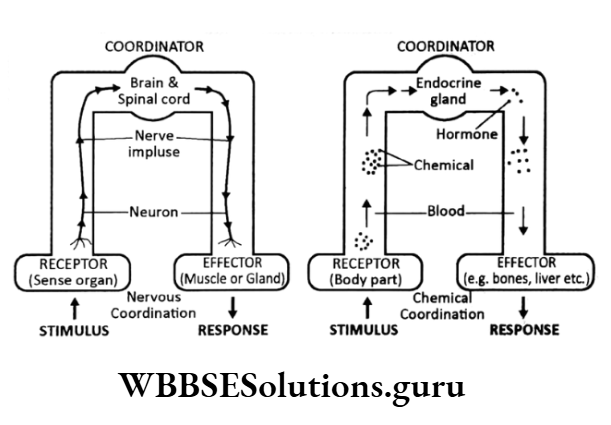
WBBSE Solutions For Class 10 Life Science Chapter 1 Hormones Coordinator

The area receiving the stimulus and the reacting organs are connected by the nervous system. On the other hand, the endocrine system is a chemical messenger system consisting of hormones, the group of glands that secrete the hormones, and the feedback loops that the hormones drive.

The objective of both the nervous system and the endocrine system is the same to keep controlled conditions within limits that maintain life (called homeostasis), but the way of achieving the objective is different.

While the nervous system regulates body activities by responding rapidly using nerve impulses, the endocrine system responds slowly, though no less effectively, by releasing hormones.

Class 10 Life Science Animal Hormones Solutions

A hormone is an organic chemical, synthesized & secreted by a cell, a gland, or an organ in one part of the body into the body or tissue fluid, and that affects cells in other parts of the organism.

In essence, it is a chemical messenger that transports a signal from one cell to another to carry out chemical coordination in a living body. The first identified hormone was Secretin and it was discovered by W.M. Bayliss & E.H. Starling.

WBBSE Chapter 1 Need For Regulation Of Different Activities Of The Animal Body

(E.G Human) And The Role Of Hormones

To perform a particular function the component organs of each system depend on each other and work in harmony. In the absence of such coordinated working, an organism cannot do many things that it normally does.

There are several examples of coordination in our bodies —

Piloerection Of Body Hair Or Goose Bumps:

WBBSE Notes For Class 10 Geography And EnvironmentWBBSE Notes For Class 10 History And Environment
WBBSE Solutions For Class 10 Life ScienceWBBSE Class 10 Life Science Multiple Choice Questions
WBBSE Solutions for Class 10 MathsWBBSE Class 10 Maths Multiple Choice Questions
WBBSE Notes For Class 10 Physical Science And Environment


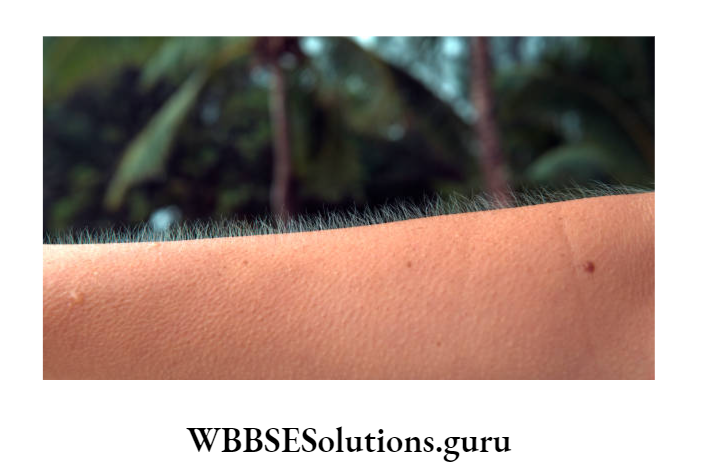
Goosebumps result from the erection of the hairs on our skin. Involuntary, or uncontrollable response to cold temperatures or strong emotions.

When we are in a cold environment, our thermoreceptors send a signal to our brain that our body temperature is decreasing.

This triggers the release of the hormone epinephrine (adrenaline), which targets the erector pili (smooth muscles surrounding hair follicles) and causes them to contract.

The contraction of these muscles causes our hair to stand erect. These raised hairs cause the insulating air layer to expand, allowing our body to retain more heat.
WBBSE Solutions For Class 10 Life Science Chapter 1 Goose Booms

Maintenance of blood glucose level:

Most cells in the human body use sugar called glucose as their major source of energy.

To ensure a constant supply of glucose to cells, blood glucose levels must be maintained at relatively constant levels.

In a healthy person, blood glucose levels are restored to normal levels primarily through the actions of two pancreatic hormones, namely insulin, and glucagon.

Combating Stress:

In the modern environment, one is exposed to various stressful conditions. Stress can lead to changes in the serum level of many hormones.

Some of these changes are necessary for the fight or flight response to protect oneself. Adrenaline, along with nor-epinephrine, is largely responsible for the immediate reactions that we feel when we are stressed and they therefore combat stress.

Class 10 Life Science Animal Hormones Solutions

Along with the increase in heart rate, adrenaline also gives us a surge of energy which we might need to run away from a dangerous situation. It also helps us to focus our attention during emergency response.

Maintenance of blood pressure:

Blood pressure is the pressure exerted by circulating blood upon the walls of vessels. Hormonal responses exist for both lowering and raising blood pressure.

They act in various ways, including vasoconstriction, vasodilation, and alteration of blood volume. The kidneys provide a hormonal mechanism (the renin-angiotensin-aldosterone system) for the regulation of blood pressure by managing blood volume.

Epinephrine and nor-epinephrine hormones, secreted by the adrenal medulla, raise blood pressure by increasing heart rate and the contractility of the heart muscles and by causing vasoconstriction of arteries and veins.

Antidiuretic hormone (ADH), a hormone produced by the hypothalamus and released by the posterior pituitary, raises blood pressure by stimulating the kidneys to retain water (raising blood pressure by increasing blood volume).

The hormone Atrial Natriuretic Peptide (ANP), produced by the atrium of the heart, lowers blood pressure by way of vasodilation.

Control Of Bmr:

Basal Metabolic Rate (BMR) is the rate of energy expended by animal (such as human) bodies when at rest. The thyroid hormones triiodothyronine (T3) and thyroxine (T4) are the main regulators of BMR.

BMR increases when the quantity of these hormones increases in the blood. Some other hormones such as testosterone, insulin, and human growth hormone (HGH) can also increase the body’s metabolic rate.

Influence on sexual behaviors:

In most animal species the brain controls and regulates sexual behavior primarily using hormones. The sex hormones are estrogen and testosterone.

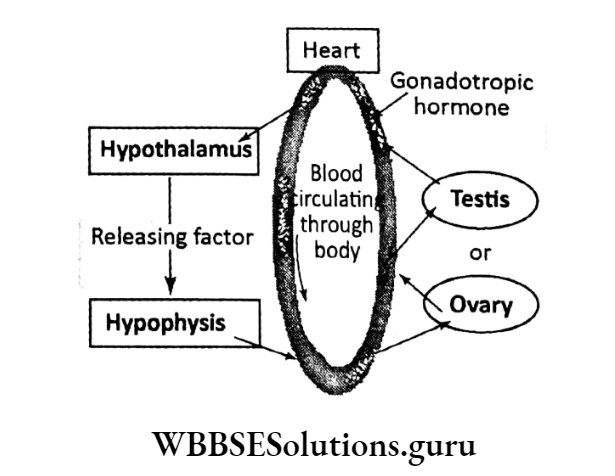
Sexual behavior is influenced by the hypothalamus. It stimulates the pituitary gland to release the sex hormones.

The hypothalamus secretes the appropriate releasing factor into the blood, which reaches the pituitary and stimulates it to secrete gonadotrophic hormone.

In the female, the target gland of the gonadotrophic hormone is the ovary.

Class 10 Life Science Animal Hormones Solutions

The ovary has two functions, the first one is to produce eggs, and the other is to secrete hormones (estrogen and progesterone).

The ovarian hormones make feedback loops to the hypophysis and develop sexual characteristics that distinguish females from males. In the male, the target gland of the gonadotrophic hormone is the testis.
WBBSE Solutions For Class 10 Life Science Chapter 1 Ovary

Like the ovary, the testis also has a dual role:

sperm production and hormone production. Androgens (testosterone) are the hormones released by the testis.

Pituitary hormones stimulate the production of testicular hormones, which, in turn, regulate the production of pituitary hormones using feedback.

Chapter 1 Characteristics Of Animal Hormones General Characteristics Of Hormones Are As Follows

Hormones are secreted by ductless endocrine glands directly into the blood. These are never stored in any other place of the animal or human body for future use except the secreting glands or tissues.

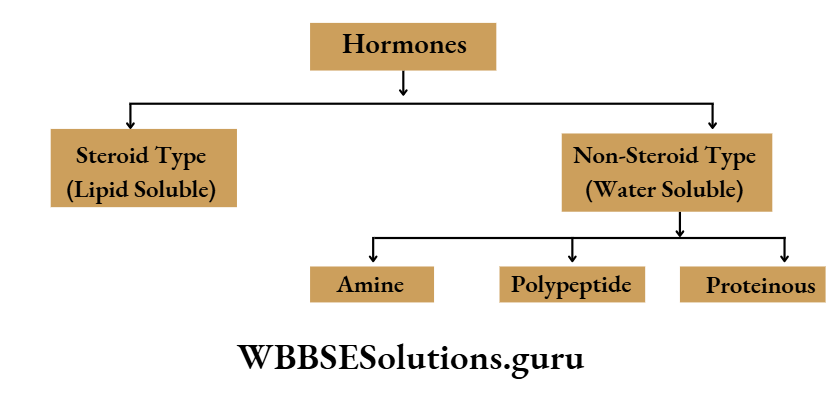
Chemically hormones may be proteinous or non-proteinous. These are classified as Amine hormones (amino acid derivatives), steroid hormones, Polypeptide hormones, and Proteinous hormones.

The secretion of hormones is regulated by the nervous system through the feedback effect. There are positive feedback systems but the negative feedback loop is more common in the endocrine system.

Most hormones are highly soluble in water and are conducted freely in the bloodstream. Lipid soluble hormones are conducted in bound form with transport protein.

Hormones cannot act on the secretory cells from where these are secreted.

Hormones generally act at a site remote from their place of production after being transported through the circulatory system. When a hormone influences the activities of a particular organ, it is called the target organ of that hormone.

Chemical Coordination In Animals Class 10 Notes

Hormones influence the biochemical activities of target organs but these never initiate any processes. It works individually in very low concentration.

Acting as a biochemical messenger, hormones usually cause long-term effects like changes in behavior, growth, etc.

Hormones are destroyed and excreted immediately after their functions are over.

Chapter 1 The General Characteristics Of Hormones Are Elaborated As Follows

WBBSE Solutions For Class 10 Life Science Chapter 1 Endocrine Gland

Sources Of Animal Hormones:

Endocrine glands are ductless glands that always secrete chemicals directly into the blood.

Endocrine glands secrete hormones into the blood. Blood then transports the hormones to all parts of the body, but the hormone only affects target cells, because of the presence of receptors for the hormone on the target cells.

The major glands of the human endocrine system, each of which produces one or more specific hormones, are the hypothalamus, the pituitary, the thyroid, the parathyroid, the islet cells of the pancreas, the adrenal, the testes (in men) and the ovaries (in. women).

Chemical nature of animal hormones is based on chemical composition, hormones are classified into the following major types:
WBBSE Solutions For Class 10 Life Science Chapter 1 Hormones

Steroid Hormones:

These are derived from cholesterol, e.g. androgens, estrogens, etc.

Amine Hormones:

These are derived from the amino acids tyrosine and tryptophan and have an amino group (-NH2), e.g. thyroxine, epinephrine, etc.

Polypeptide Hormones:

They comprise less than 100 amino acids, e.g., short peptide hormones are oxytocin, and ADH (antidiuretic hormone).

Proteinous Hormones:

Generally composed of more than 100 amino acids, e.g., LH, FSH. The LH and FSH are glycoprotein hormones.

Chemical Coordination In Animals Class 10 Notes

Feedback control:

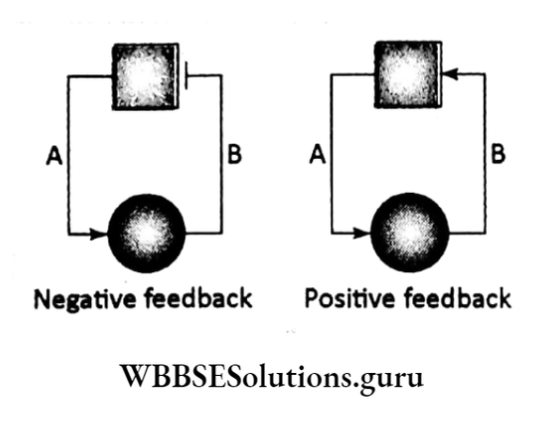
The secretion of most, if not all, hormones is regulated by some type of closed-loop control system known as a feedback mechanism

(because the amount released or secreted is sensed and that information is relayed back to the secretory cell by a variety of ways). Feedback control is mostly negative, rarely positive.

In a negative feedback control, the synthesis of a hormone slows down or halts when its level in the blood rises above the normal or threshold limit.

In the less common positive feedback mechanism, one hormone further stimulates the production of another hormone instead of diminishing it. Some examples of feedback control are given below.

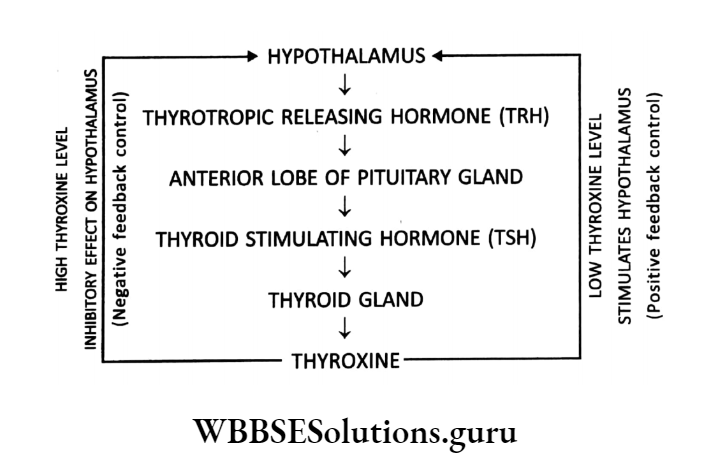
The hypothalamus, in response to some external stimulus, produces a thyrotropin-releasing hormone for the secretion of thyrotropic hormone.

The thyrotropin-releasing hormone (TRH) stimulates the anterior pituitary lobe to secrete thyrotropic hormone. The latter in turn stimulates the thyroid gland to produce thyroxine.

If thyroxine is in excess, it exerts an influence on the hypothalamus and anterior pituitary lobe, which then secrete a lesser amount of releasing hormone and thyroid-stimulating hormone (TSH) respectively.

A rise in the TSH level in the blood may also exert a negative feedback effect on the hypothalamus and retard the secretion of TRH. This restores the normal blood-thyroxine level.
WBBSE Solutions For Class 10 Life Science Chapter 1 Postively And Negatively Feedback

Sometimes, the accumulation of a biochemical increases its own production. For example, uterine contraction at the onset of labor stimulates the release of the hormone oxytocin, which intensifies uterine contractions.

The contractions further stimulate the production of oxytocin. This is a positive feedback control.

Mode Of Transport Of Animal Hormones:

Most hormones are secreted into the general circulation to exert their effects on appropriate distant target tissues. Water-soluble hormone molecules circulate in watery blood plasma in a free state, (i.e. not attached to other molecules).

Steroid and thyroid hormones are less soluble in aqueous solution and over 90% circulate in blood as complexes bound to specific transport proteins like plasma globulins or albumin.

The transport proteins make the lipid-soluble hormones temporarily water-soluble and act as a ready reserve of hormones.
 

WBBSE Solutions For Class 10 Life Science Chapter 1 Control And Coordination In Living Organisms Topic C Response And Chemical Coordination In Animals Hormones Thyroid stimulating hormone

Functioning And Fate Of Hormones:

The chemical structure of a hormone enables it to combine with a receptor in the cells of its target. The receptor may be present on the plasma membrane of the cell or inside the cytoplasm or nucleus.

Only a hormone’s “target” cells, which have receptors for that hormone, will respond to its signal. When the hormone binds to its receptor, it forms a receptor-hormone complex.

This complex changes and enters into the nucleus of the target cell. Within the nucleus, it increases the synthesis of cell protein and takes part in the metabolic process of the cell.

All hormones diminish within the body at differing rates based on their chemical half-life. Once hormones have served their function on their target organs/tissues, these are destroyed.

These are either destroyed by the liver or the tissues of the target organs and excreted out of the body.

Role Of Hormones As Biochemical Messengers and Regulators:

Hormones are informational molecules that carry the message of metabolic change from the endocrine glands to the target cells or organizer

These are released into the extracellular fluid, where they are diffused into the bloodstream. The latter carries them from the site of production to the site of action.

Hormones stimulate or inhibit one or more Physiological processes for the welfare of the body.

Maintenance of the internal chemical environment of the body to a constant is called homeostasis. Hormones play a major role in maintaining homeostasis through their integrated action.

These also play a leading role in the chemical coordination of the living body. Thus hormones are known as chemical messengers.

Chemical Coordination In Animals Class 10 Notes

Chapter 1 Topic C Response And Chemical Coordination In Animals Hormones Difference Between Hormone And Enzyme

There is a group of chemicals present inside the animal body which accelerates a series of biochemical reactions by performing as organic catalysts.

These are known as enzymes. Just as a hormone functions on its target cells by forming a receptor-hormone complex, an enzyme also forms an enzyme-substrate complex to carry out a particular biochemical reaction on a substrate.

So, after going through the characteristics of hormones the natural question that may arise in somebody’s mind is, “Is there any difference between the hormones and the enzymes?

The Major Differences Between Hormones And Enzymes Are Enumerated As Follows:

WBBSE Solutions For Class 10 Life Science Chapter 1 Control And Coordination In Living Organisms Topic C Response And Chemical Coordination In Animals hormone and emzyme

Chapter 1 Human Endocrine Glands And The Hormones Secreted From Them General Types of Hormones in Man

General Hormone:

The hormones which are secreted from one endocrine gland and that act on distant target organs are called general hormones.

Examples:

Insulin, thyroxin, etc.

Tropic Hormone:

The hormones which are secreted from one endocrine gland and that act on another endocrine gland as target organs are called tropic hormones.

Example:

Hormones of the anterior pituitary like STH, TSH, ACTH, FSH, etc.

Explanation Of Action Of Tropic Hormone:

Thyroid-stimulating hormone (TSH) is a tropic hormone that is secreted from the pituitary gland. It influences the secretion of thyroxin from the thyroid gland.

Here TSH acts as a tropic hormone and the thyroid gland is the target gland. The secretion of tropic hormones is controlled by the hypothalamus.

Stress Or Emergency Hormone:

The hormones that are secreted under physiological stress or strain (e.g. fear, anxiety, shock, grief, etc) to trigger the Fight or flight response to combat the emergencies are called the stress or emergency hormone.

Example:

Adrenaline, noradrenaline.

Local Hormone:

The hormones that are secreted from certain tissues of the body and that act at the same site of origin or in nearby organs in a strictly localized manner are called the Stress or emergency hormones are called local hormones

Example:

Adrenaline, Noradrenaline.

Once these are secreted, the local hormones enter into the bloodstream, make a round trip through the body and finally reach the target organizer

Local hormones that act on neighboring cells are called paracrine and those that act on the same cell that secretes them are called autocrine.

Chemical Coordination In Animals Class 10 Notes

Examples:

Gastrin, somatostatin, etc.

Gastrin is secreted from the mucous layer of the stomach and acts on the stomach itself to secrete gastric juice.

Somatostatin is secreted from the 5-cell islets of Langerhans in the Pancreas and controls the secretions of p-cells and a-cells of the same gland.

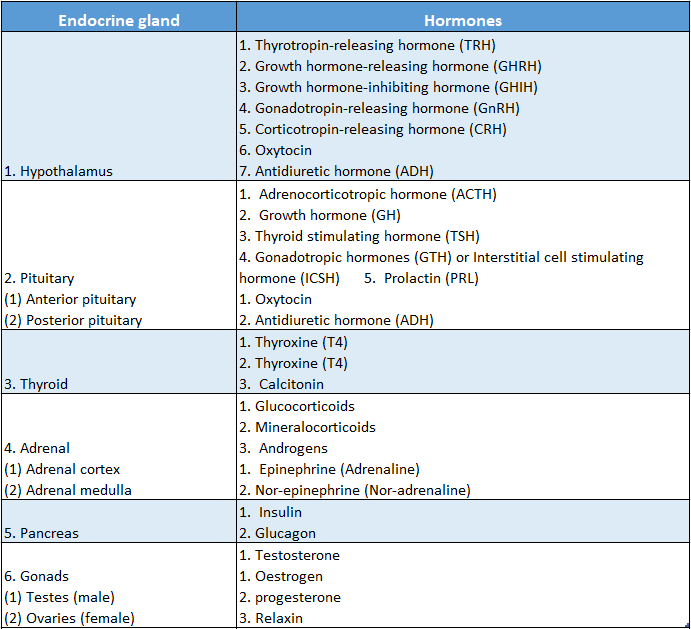
Chapter 1 Tabular Summary of Human Endocrine Glands And The Hormones
WBBSE Solutions For Class 10 Life Science Chapter 1 Control And Coordination In Living Organisms Topic C Response And Chemical Coordination In Animals hormone human endocrine Glands


WBBSE Solutions For Class 10 Life Science Chapter 1 Funtions Of Harmones

Chapter 1 Human Endocrine Glands And The Hormones
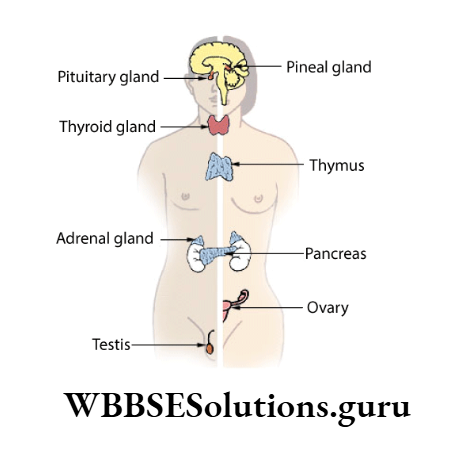
The Major Endocrine Glands Of the Human Body, With Their Locations, Hormonal Secretions, And Roles Are Mentioned Below

Hypothalamus:

It is known as the master gland.

Location:

The hypothalamus is a part of the brain located superior and anterior to the brain stem and inferior to the thalamus.

Functions:

Apart from serving many different functions in the nervous system, it is also responsible for the direct control of the endocrine system through the pituitary gland.

The hypothalamus contains special cells called neurosecretory cells—neurons that secrete hormones. It regulates the anterior pituitary by secreting different releasing hormones (-RH) and the posterior pituitary by secreting neurohormones.

Hormonal secretions:

Thyrotropin-releasing hormone (TRH)

Growth hormone-releasing hormone (GHRH)

Growth hormone-inhibiting hormone(GHIH)

Gonadotropin-releasing hormone (GnRH)

Corticotropin-releasing hormone(CRH)

Oxytocin

Antidiuretic hormone (ADH)

Functions Of The Hormones:

All of the releasing (-RH) and inhibiting hormones (-IH) affect the function of the anterior pituitary gland. TRH stimulates the anterior pituitary gland to release thyroid-stimulating hormone.

GHRH and GHIH work to regulate the release of growth hormone—GHRH stimulates growth hormone release, and GHIH inhibits its release. GnRH stimulates the release of follicle-stimulating hormone and luteinizing hormone while CRH stimulates the release of adrenocorticotropic hormone.

The last two hormones oxytocin and antidiuretic hormone are produced by the hypothalamus and transported to the posterior pituitary, where they are stored and later released.

Pituitary:

The pituitary gland is also known as the hypophysis.

Location:

It is a small pea-sized lump of tissue connected to the inferior portion of the hypothalamus of the brain by a small stalk known as the infundibulum or the pituitary stalk.

Situated in a small depression in the sphenoid bone called the sella turcica, the pituitary gland is made of two completely separate structures: the anterior and posterior pituitary glands.

WBBSE Class 10 Life Science Chapter 1 Solutions 

Anterior Pituitary:

The anterior pituitary gland is the true glandular part of the pituitary gland.

Hormonal secretions:

The anterior pituitary produces the following important tropic hormones:

Adrenocorticotropic hormone (ACTH):

It is secreted from the corticotroph cells of the anterior pituitary.

Functions:

It stimulates the adrenal cortex, the outer part of the adrenal gland, to produce its hormones.

It stimulates the secretion of cortical hormones (particularly glucocorticoids and sex steroids).

Growth hormone (GH) Or Somatotropic hormone (STH) or Somatotropin:

It is secreted from the somatotroph cells of the anterior pituitary.

Functions:

STH indirectly stimulates the growth of epiphyseal cartilage and thus helps in bone growth.

STH stimulates the growth of muscles and other visceral organs of the body.

STH synthesizes muscle protein. It raises blood glucose levels. It causes loss of body fat by mobilizing depot fat.

Thyroid-stimulating hormone (TSH):

It is a tropic hormone secreted from the thyrotropin cells of the anterior pituitary.

Functions:

TSH generally regulates the growth of the thyroid gland.

It maintains the synthesis of thyroid hormones from the thyroid gland.

WBBSE Class 10 Life Science Chapter 1 Solutions 

Gonadotropic hormones(GTH):

It is secreted from the gonadotroph cells of the anterior pituitary and influences gonads (ovary or testis). It includes two hormones Follicle-stimulating hormone (FSH):

It is a glycoprotein hormone.

Functions:

In females—

FSH increases the size and weight of the ovaries,

It helps in the maturation of immature follicles into mature Graafian follicles,

It stimulates the secretion of estrogen from the Graafian follicles.

In males, FSH induces the development of seminiferous tubules and spermatogenesis.

Luteinizing hormone (LH) or Interstitial cell-stimulating hormone (ICSH):

It is also a glycoprotein hormone.

Functions:

In females—

In the presence of FSH, the LH ruptures the Graafian follicles causing ovulation

It helps in the formation, maturation, and persistence of corpus luteum in the ovary,

It stimulates the secretion of progesterone from the corpus luteum. In males, LH stimulates the secretion of testosterone in the testis.

Prolactin (PRL), luteotropic hormone (LTH) or luteotropin:

Prolactin is also known as the ‘maternity hormone’ since it is secreted mainly during lactation.

Functions:

It stimulates the development of mammary glands of the breast during pregnancy.

It initiates and maintains the secretion of milk from the mammary glands of breasts.

It stimulates the secretion of progesterone.

Posterior Pituitary:

The posterior pituitary gland is not glandular tissue at all, but nervous tissue instead. The posterior pituitary is a small extension of the hypothalamus.

Hormonal secretions:

The Neurosecretory Cells Secrete Two Neurohormones In The Hypothalamus That Are Stored And Released By The Posterior Pituitary:

Oxytocin triggers uterine contractions during childbirth and the release of milk during breastfeeding.

Antidiuretic hormone (ADH) or Vasopressin:

After secretion, it is transported through the blood to act on blood vessels (arterioles), renal tubules, etc.

Functions:

In small doses, vasopressin acts as an antidiuretic hormone (ADH) that increases the reuptake of water in the kidneys. ADH thus decreases the volume of excretory urine and urine becomes more concentrated.

Vasopressin stimulates the contraction of involuntary smooth muscles of the urinary bladder, ureter, intestine, uterus, etc.

In large doses, vasopressin raises blood pressure by affecting arteriolar and capillary constrictions.

Thyroid:

The thyroid gland is a butterfly-shaped gland consisting of two lobes located at the base of the neck and wrapped around the lateral sides of the trachea.

Hormonal secretion:

The thyroid gland produces three major hormones: Calcitonin, Triiodothyronine (T3), and Thyroxine (T4).

Thyroxine (T4) is the main hormone secreted into the bloodstream by the thyroid gland. It is the inactive form and most of it is converted to an active form called triiodothyronine(T3) by organs such as the liver and kidneys.

The hormones T3 and T4 work together to regulate the body’s metabolic rate. Increased levels of T3 and T4 lead to increased cellular activity and energy usage in the body.

It has been observed that T3 is more active than T4.

Functions of T3 & T4:

Effect on BMR:

Thyroid hormones help BMR to increase by increasing both oxygen uptake and tissue metabolism. Hence these are known as calorigenic hormones.

Effect On Metabolism:

Thyroid hormone increases blood sugar levels. It enhances protein synthesis in low doses but depresses protein synthesis in high doses. T4 decreases serum cholesterol & phospholipids.

WBBSE Class 10 Life Science Chapter 1 Solutions 

Effect On Growth:

Thyroid hormones help in skeletal, muscular, sexual & mental growth.

Effect On Cardiovascular System:

Thyroxin enhances heart rate, cardiac output, and blood pressure.

Effect On Respiration:

Thyroid hormones increase the rate and depth of respiration by increasing utilization of 02 and formation of C02.

Effect On Gl Tract:

T4 increases the absorption of food, secretion of digestive juices, and movement of the GI tract.

Effect On RBC:

Thyroid hormones help in the development of RBC.

Effect on body temperature regulation:

In a cold environment, the secretion of thyroid hormones increases and this causes increased heat production. This helps in thermoregulation and prevents a fall in the body temperature.

Calcitonin:

Calcitonin is a protein hormone.

Functions:

Calcitonin is secreted in response to the rise of calcium in the blood. It decreases calcium levels in the blood by affecting the absorption of calcium into the matrix of bones.

Adrenal:

The adrenal glands are a pair of roughly triangular glands located immediately on the upper pole of each kidney. Hence these are called Suprarenal glands.

The adrenal glands are each made of two distinct layers, the outer adrenal cortex, and the inner adrenal medulla.

Hormonal secretions of the adrenal cortex:

The adrenal cortex produces many cortical hormones in three classes glucocorticoids, mineralocorticoids, and androgens.

Glucocorticoids have many diverse functions, including the breakdown of proteins and lipids to produce glucose,

Minerals corticoids, as their name suggests, are a group of hormones that help to regulate the concentration of mineral ions.

Androgens, such as testosterone, are produced at low levels in the adrenal cortex to regulate the growth and
the activity of cells that are receptive to male hormones.

Response And Chemical Coordination In Animals Class 10 WBBSE

Hormonal Secretions Of Adrenal Medulla:

The adrenal medulla produces the hormones epinephrine (adrenaline) and nor-epinephrine (nor-adrenaline) under stimulation by the sympathetic division of the autonomic nervous system.

It also secretes another hormone called dopamine.

Epinephrine or adrenaline:

Epinephrine, together with norepinephrine, steps up metabolism as a part of the Fight or flight response to prepare the human body to face emergency stressful conditions like those of muscular exertion, pain, shock, injury, fear, anxiety, fall of blood pressure, etc.

Hence these two hormones are known as emergency hormones.

Functions:

Effect on the circulatory system:

Epinephrine constricts all blood vessels except coronary vessels & vessels connected with skeletal muscles. As a result both blood pressure & heart rate increase.

In general, it stimulates the increase of conductivity, contractility, heart rate & cardiac output.

Effect on muscles:

Epinephrine increases the excitability, contractility & tone of skeletal muscles. It inhibits the tone of involuntary muscles present in the stomach, intestine & bronchiole. It ensures a delay in the onset of muscle fatigue.

Effect on internal organs:

It inhibits intestinal movement and causes contraction of the spleen & dilation of the pupil. It constricts renal arteries to decrease renal circulation which causes decreased urine output.

Effect on respiration:

It causes dilatation of bronchioles and increases the rate & depth of respiration.

Effect on metabolism:

Epinephrine increases blood sugar by stimulating the breakdown of liver glycogen, the formation of glucose from lactic acid, etc.

Nor-epinephrine or nor-adrenaline:

Like epinephrine, nor-epinephrine also stimulates the increase of heart rate, enhancement of both systolic and diastolic blood pressure, an increase of respiration rate & widening of the pupil.

It also stimulates the contraction of skeletal muscles.

Pancreas:

The pancreas is a large elongated gland located in the abdominal cavity just inferior and posterior to the stomach.

Hormonal Secretions:

The pancreas is considered to be a heterocrine or mixed gland as it contains both endocrine and exocrine tissue. The endocrine function consists primarily of the secretion of the two major hormones, insulin, and glucagon.

The endocrine cells of the pancreas are found in small groups throughout the pancreas called islets of Langer Within these islets are two major types of cells alpha and beta cells.

The alpha cells produce the hormone glucagon and the beta cells produce the hormone insulin.

Insulin:

It is an antidiabetogenic protein hormone that lowers blood sugar levels.

Functions:

Effect on carbohydrate metabolism:

Insulin increases the oxidation of glucose in the cells, stimulates the formation & storage of glycogen in the liver & muscle, inhibits the formation of glucose from non-carbohydrates in the liver, and increases the permeability of glucose through the cell membrane from blood to the cells.

All these activities result in the maintenance of optimum levels of blood sugar.

Effect on protein metabolism:

It increases protein synthesis in the body.

Effect on fat metabolism:

It also decreases lipid & cholesterol levels in the blood & prevents the formation of harmful ketone bodies in the liver.

Glucagon:

It is anti-insulin in nature. Together with insulin, it maintains a steady level of blood sugar in the body.

Functions:

Effect on carbohydrate metabolism: It stimulates liver glycogen to undergo breakdown to be converted into glucose which increases blood sugar levels.

Response And Chemical Coordination In Animals Class 10 WBBSE

Effect on protein metabolism:

Glucagon hydrolyses protein into amino acids and increases nitrogen excretion through urine.

Effect on fat metabolism:

It stimulates the increase of fat & cholesterol level in the blood.

Gonads:

The gonads and ovaries in females and testes in males are responsible for producing the sex hormones of the body.

Testes:

The testes are a pair of ellipsoid Fun(Iami iniaIs of Lifi Sell no organs found in the scrotum of males that produce the androgen testosterone in males after the start of puberty.

Testosterone:

It has effects on many parts of the body, including the muscles, bones, sex organs (both primary & secondary), and hair follicles,

During puberty, testosterone controls the growth and development of the sex organs and secondary sex characteristics like muscular growth, breaking of voice, growth of hair on the face, chest, etc.

Ovaries:

The ovaries are a pair of almond-shaped glands located in the pelvic body cavity lateral and superior to the uterus in females. The ovaries produce the female sex hormones progesterone and estrogens. It also secretes another hormone called relaxin.

Estrogen:

Oestrogen stimulates the growth, development, and functional activities of primary and secondary sex organs in females during puberty.

It regulates the menstrual cycle and stimulates breast development.

It enhances the deposition of fat in the female body.

Progesterone:

In the presence of estrogen, progesterone stimulates the complete development of the primary & secondary female sex organizer

It is most active during ovulation & pregnancy. It helps the embedding of embryos in the uterus and stimulates the development & maintenance of pregnancy.

It also regulates the menstrual cycle & breast development at puberty.

Relaxin:

It is secreted from the uterus at the terminal stage of pregnancy. It facilitates the expulsion of the fetus from the uterus by causing relaxation of the pelvic ligaments.

Response And Chemical Coordination In Animals Class 10 WBBSE

Chapter 1 Response And Chemical Coordination In Animals Hormones Hormonal Disorders

Endocrine disorders or hormonal disorders are typically an endocrine disease that results when a gland produces too much (hyper-secretion) or too little (hypo-secretion) of an endocrine hormone, called a hormone imbalance.

Some important hormonal disorders of humans are—

Dwarfism:

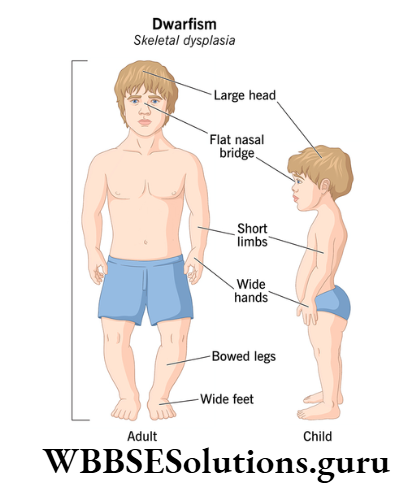
Pituitary dwarfism is decreased bodily growth due to hormonal problems (hyposecretion of STH) in childhood.

Causes:

Pituitary dwarfism, or growth hormone deficiency, is a condition in which the pituitary gland does not make enough growth hormone (hypo-function of STH).

Pituitary gland dysfunction can be congenital, which means that the child is born with the abnormality, or can be acquired during or after birth. It tends to run in families.

Symptoms:

The main symptom of pituitary dwarfism is below-average growth, although body proportions will be normal. Other characteristics might include an immature appearance, a chubby body build, a prominent forehead, and an underdeveloped bridge of the nose.
 

WBBSE Solutions For Class 10 Life Science Chapter 1 Pituitary And Dwarfism


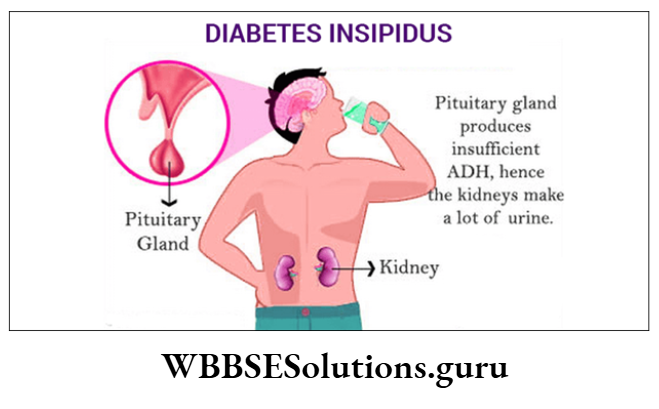
Diabetes insipidus (Dl) is a condition in which the kidneys are unable to prevent the excretion of water due to the hyposecretion of ADH leading to the excretion of an abnormally large amount of urine from the body.

Causes:

During the day, our kidneys filter the blood many times. Normally, most of them are reabsorbed and only a small amount of concentrated urine is excreted.

Dl occurs when the kidneys cannot concentrate the urine normally due to a decrease in the reabsorption of water in the renal tubules and a large amount of dilute urine is excreted.

The amount of water excreted in the urine is controlled by antidiuretic hormone (ADH). Dl caused by a lack of ADH is called central diabetes insipidus.

Excessive thirst that may be intense or uncontrollable, usually with the need to drink large amounts of water.

Excessive urine volume,

Excessive urination, often needing to urinate every hour throughout the day and night.

Goitre:

Goitre is a swelling (hypertrophy) of the thyroid gland in the neck due to hypothyroidism.

Response And Chemical Coordination In Animals Class 10 WBBSE

Causes:

Iodine deficiency, leading to hypothyroidism, is the major cause of endemic goiter. The thyroid gland needs iodine to manufacture thyroid hormones, which regulate the body’s rate of metabolism.
WBBSE Solutions For Class 10 Life Science Chapter 1 Diabetes Insipidus

Hypothyroidism is the result of an underactive thyroid gland, and this causes goiter. Because the gland produces too little thyroid hormone, it is stimulated to produce more, leading to swelling.

WBBSE Solutions For Class 10 Life Science Chapter 1 Hypothyroidism

Symptoms:

The main symptom of goiter is swelling of the thyroid gland, which causes a lump to develop in the front of the neck.

The following are the main symptoms that can result from neck swelling- symptoms of tightness, cough, and hoarseness; Trouble swallowing (dysphagia), dry & rough skin, hair loss, excessive fatigue, etc.

Diabetes mellitus:

Diabetes mellitus is a chronic, lifelong condition that affects the body’s ability to use the energy found in food.

There are two major types of diabetes:

  1. Type-1 diabetes and
  2. Type-2 diabetes.

Type-1 diabetes is also called insulin-dependent diabetes. It used to be called juvenile-onset diabetes because it often begins in childhood.

Type-2 diabetes used to be called adult-onset diabetes, but with the epidemic of obese and overweight kids, more teenagers are now developing type-2 diabetes.

Type-2 diabetes is also called non-insulin-dependent diabetes.

Causes:

All types of diabetes mellitus have something in common. Normally, our body breaks down the sugars and carbohydrates we eat into glucose.

Glucose fuels the cells in our body. But the cells need insulin, a hormone, in the bloodstream to take the glucose and use it for energy.

With diabetes mellitus, either the body doesn’t make enough insulin or it can’t use the insulin it produces, or a combination of both.

In Type-2 diabetes, the pancreas usually produces some insulin. But either the amount produced is not enough for the body’s needs, or the body’s cells are resistant to it.

WBBSE Life Science Class 10 Chapter 1 Questions And Answers 

Symptoms:

Since the cells cannot take in the glucose, it builds up in the blood. High levels of FuncIaivientaIs of UFe Sconce
blood glucose can damage the tiny blood vessels in the kidneys, heart, eyes, or nervous system.

That is why diabetes – especially if left untreated – can eventually cause heart disease, stroke, kidney disease, blindness, and damage to nerves in the feet.

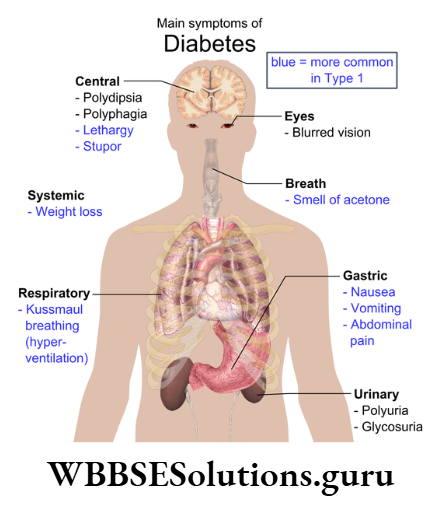
The early symptoms of untreated diabetes are related to elevated blood sugar levels and loss of glucose in the urine. The high amount of glucose in the urine can cause increased urine output and lead to dehydration.

This condition is called Polyuria. Dehydration causes increased thirst and water consumption. This condition is known as polydipsia.

The inability of insulin to perform normally has effects on protein, fat, and carbohydrate metabolism. A relative or absolute insulin deficiency eventually leads to weight loss despite an increase in appetite.

This condition is called polyphagia. Some untreated diabetes patients also complain of fatigue, nausea, and vomiting. Fluctuations in blood glucose levels can lead to blurred vision.

Extremely elevated glucose levels can lead to lethargy and coma.
WBBSE Solutions For Class 10 Life Science Chapter 1 Main Symptoms Of Diabetes

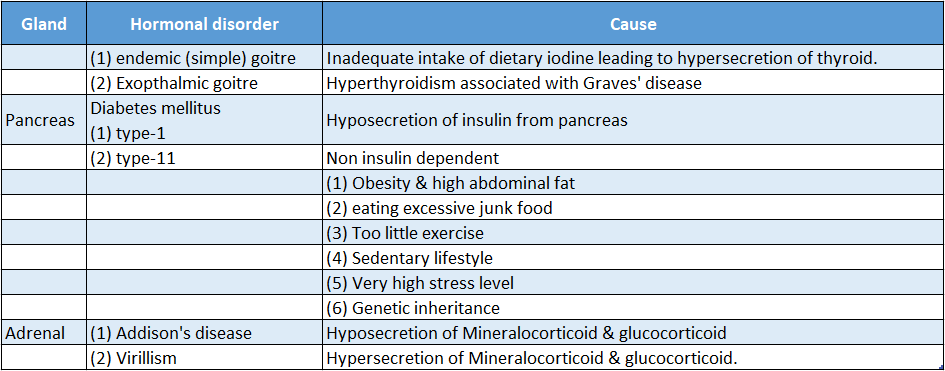
The Common Hormonal Disorders Are Summarised In The Following Table:
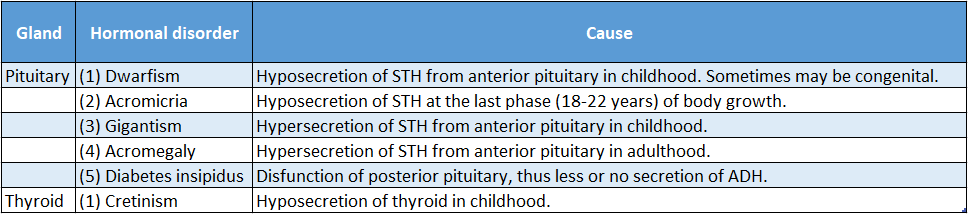
WBBSE Solutions For Class 10 Life Science Chapter 1 Control And Coordination In Living Organisms Topic C Response And Chemical Coordination In Animals Hormones hormonal disorder

WBBSE Solutions For Class 10 Life Science Chapter 1 Control And Coordination In Living Organisms Topic C Response And Chemical Coordination In Animals hormone Hormonal disorder

Chapter 1 Response And Chemical Coordination In Animals Hormones Differences Between Endocrine And Exocrine Glands

The glands Of Our Body Can Be Divided Into Two Classes: Endocrine And Exocrine Glands.

Endocrine glands:

The glands which are devoid of ducts & that secrete their products directly into the interstitial fluid surrounding the secretory cells are called ductless endocrine glands.

Examples: Pituitary, Thyroid, Adrenal gland, etc.
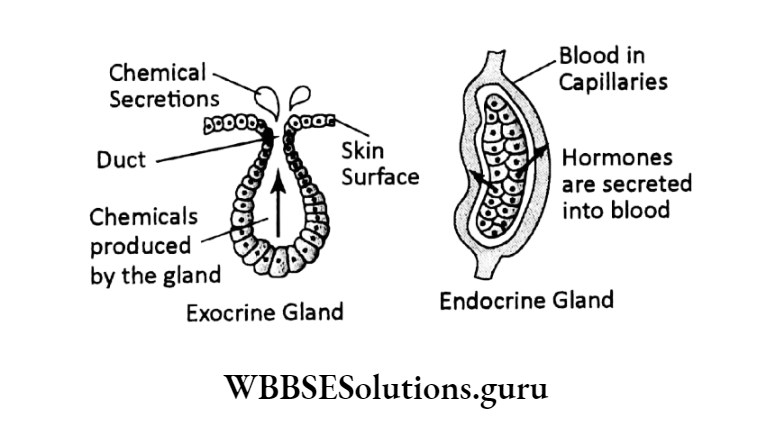
WBBSE Solutions For Class 10 Life Science Chapter 1 Control And Coordination In Living Organisms Topic C Response And Chemical Coordination In Animals Hormones endocrine glands

Exocrine glands:

The glands which possess ducts & that secrete their products into those ducts to be carried over to the body cavities, organs, or the outer surface of the body are called the ductular exocrine glands.

Example:

Salivary glands, sweat glands, mammary glands, etc.

Some Of The Distinctions That Separate The Endocrine And Exocrine Systems Include The Following:

WBBSE Solutions For Class 10 Life Science Chapter 1 Control And Coordination In Living Organisms Topic C Response And Chemical Coordination In Animals hormone exocine glands

Chapter 1 Response And Chemical Coordination In Animals Hormones Fill In The Blanks

Question 1.___________ is known as the antidiabetogenic hormone.
Answer: Insulin

Question 2. The sex hormones are estrogen and ___________.
Answer: Testosterone

Question 3. ___________are chemical messengers.
Answer: Hormones

WBBSE Life Science Class 10 Chapter 1 Questions And Answers 

Question 4. The hormone has an effect on___________ cells only.
Answer: Target

Question 5. Steroid hormones are derived from___________.
Answer: Cholesterol

Question 6. The ___________is a part of the brain located inferior to the thalamus.
Answer: Hypothalamus

Question 7. The pituitary gland is also known as the___________ .
Answer: Hypophysis

Question 8. The adrenal cortex produces many cortical hormones in 3 classes: glucocorticoids, mineralocorticoids, and___________.
Answer: Androgens

Question 9. The pancreas is considered to be a___________ or mixed gland as it contains both endocrine and exocrine tissue.
Answer: Hetrocrine

Question 10. Diabetes___________ is a condition in which the kidneys are unable to prevent the excretion of water.
Answer: Insipidus

Question 11.___________ is the swelling of the thyroid gland in the neck.
Answer: Goitre

Question 12. Type-2 diabetes is also called ___________diabetes.
Answer: Lifestyle

Question 13. The glands of our body can be divided into two classes: endocrine and___________ glands.
Answer: Exocrine

Question 14. In a healthy person, blood glucose levels are restored to normal levels primarily through the actions of two pancreatic hormones, namely insulin and___________.
Answer: Glucagon

WBBSE Life Science Class 10 Chapter 1 Questions And Answers 

Question 15.___________ response prepares the human body to face emergency actions against stress or impending danger.
Answer: Fight or flight

Question 16. The thyroid hormones triiodothyronine and are___________ the main regulators of BMR.
Answer: Thyroxine

Chapter 1 Response And Chemical Coordination In Animals Hormones Write True Or False

Question 1. Goosebumps result from the erection of the hairs on our skin.
Answer: True

Question 2. A-cells of Islets of Langerhans secrete insulin.
Answer: False

Question 3. ADH increases the volume of excretory urine and urine and thus becomes hypotonic.
Answer: False

Class 10 Life Science Animal Hormones Solutions

Question 4. In most animal species the brain controls and regulates sexual behavior primarily using hormones.
Answer: True

Question 5. Hormones are chemical messengers that circulate in the brain.
Answer: False

Question 6. A hormone specific to a target cell can only affect that target tissue because of the presence of receptors for the hormone in the target cells.
Answer: True

Question 7. Polypeptide hormones are composed of more than 100 amino acids.
Answer: False

Question 8. All hormones diminish within the body at differing rates based on their chemical half-life.
Answer: True

Question 9. The secretion of most hormones is regulated by some type of closed-loop control system known as a feedback mechanism.
Answer: True

Question 10. The hypothalamus contains special cells called neurosecretory cells that secrete hormones.
Answer: True

Question 11. TRH stimulates the anterior pituitary gland to release the testosterone-stimulating hormone.
Answer: False

Question 12. The posterior pituitary is made up of nervous tissue.
Answer: True

Question 13. Adrenocorticotropic hormone is secreted from the posterior pituitary.
Answer: False

Question 14. The hormones T3 and T4 work together to regulate the body’s metabolic rate.
Answer: True

Question 15. The exocrine cells of the pancreas are found in small groups throughout the pancreas called islets of LangerhAnswer:
Answer: False

Class 10 Life Science Animal Hormones Solutions

Question 16. The gonads—ovaries in females and testes in males—are responsible for producing the growth hormones of the body.
Answer: False

Question 17. Endocrine disease results when a gland produces too much or too little of an endocrine hormone.
Answer: True

Question 18. Persons with diabetes insipidus have excess urine volume.
Answer: True

Question 19. line deficiency, leading to hypothyroidism is me major cause of dwarfism.
Answer: False

Question 20. pe-2 diabetes is also called non-insulin-dependent diabetes.
Answer: True

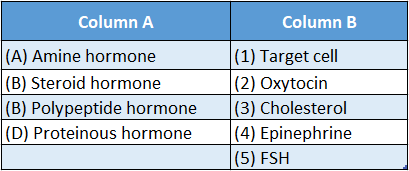
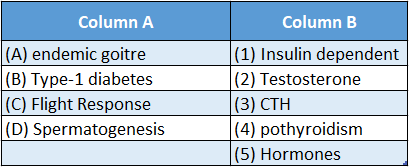
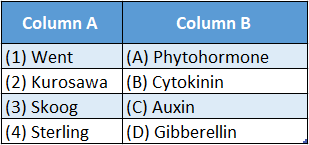
Chapter 1 Topic C Response And Chemical Coordination In Animals Hormones Match The columns
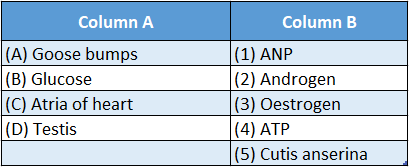
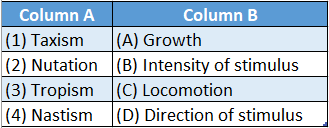
WBBSE Solutions For Class 10 Life Science Chapter 1 Control And Coordination In Living Organisms Topic C Response And Chemical Coordination In Animals hormones match the coloumn 1
Answer: 1-5,2-4,3-1,4-2

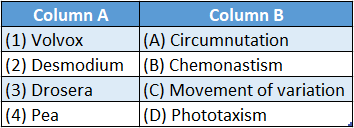
WBBSE Solutions For Class 10 Life Science Chapter 1 Control And Coordination In Living Organisms Topic C Response And Chemical Coordination In Animals hormones match the column 2
Answer: 1-4,2-3,3-2,4-5

WBBSE Solutions For Class 10 Life Science Chapter 1 Control And Coordination In Living Organisms Topic C Response And Chemical Coordination In Animals hormones match the column 3
Answer: 1-4,2-5,3-3,4-2

WBBSE Solutions For Class 10 Life Science Chapter 1 Control And Coordination In Living Organisms Topic C Response And Chemical Coordination In Animals hormones match the column 5
Answer: 1-4,2-1,3-4,4-2

Chapter 1 Response And Chemical Coordination In Animals Hormones Very Short Answer Questions

Question 1. What is sensitivity?
Answer: The ability of an organism to detect changes and make appropriate responses thereby is called sensitivity.

Question 2. How does chemical coordination take place in the animal body?
Answer: Chemical coordination in animals takes place through hormones which acts as a biochemical messenger.

Question 3. What is Cutis anserina?
Answer: Goosebumps resulting out of the erection of hairs in our skin.

Question 4. Name the smallest endocrine gland of the human body.
Answer: The Pineal Body is attached to the roof of the third ventricle of the brain. It secretes the hormone called Melatonin.

Question 5. What are neurohormones?
Answer: The chemical substances (hormones) that are secreted from the neurosecretory cells present in the hypothalamus are known as neurohormones.

Example: Vasopressin and Oxytocin.

Chemical Coordination In Animals Class 10 Notes

Question 6. What is the name of the hormone secreted by the atria of the heart?
Answer: Atrial natriuretic peptide (ANP).

Question 7. What are endocrine glands?
Answer: These are glands without ducts that secrete hormones directly into the interstitial fluid surrounding the secretory cells.
Give an example of an amine hormone. Thyroxine/epinephrine/ nor-epinephrine/ histamine (anyone).

Question 9. What is homeostasis?
Answer: The maintenance of the internal chemical environment of the body to a constant is called homeostasis.

Question 10. What is the function of TRH?
Answer: The thyrotropin-releasing hormone (TRH) stimulates the anterior pituitary lobe to secrete thyrotropic hormone.

Question 11. Where TSH is secreted?
Answer: Anterior pituitary

Question 12. What is T3?
Answer: It is the hormone triiodothyronine, secreted from the thyroid.

Question 13. Name the group of hormones that help to regulate the concentration of mineral ions in the body.
Answer: Mineralocorticoids are secreted from the adrenal cortex.

Question 14. Which hormones control the “fight-or-flight” response to stress?
Answer: Adrenaline and nor-adrenaline are secreted from the adrenal medulla.

Question 15. What is the cause of pituitary dwarfism?
Answer: Hypo-function of pituitary gland leading to hyposecretion of STH in childhood.

Question 16. Which hormone controls the amount of water excreted in urine?
Answer: The amount of water excreted in the urine is controlled by antidiuretic hormone (ADH) created from the posterior pituitary.

Question 17. What is type 1 diabetes?
Answer: Type-1 diabetes is called insulin-dependent diabetes which results due to the hyposecretion of insulin from the pancreas.

Question 18. What do you mean by calorigenic hormone?
Answer: Thyroid hormones (Thyroxin & Triiodothyronine) are known as calorigenic hormones because these increase oxygen uptake & tissue metabolism as a result of which BMR increases.

Chemical Coordination In Animals Class 10 Notes

Question 19. What are catecholamines?
Answer: The hormones of the adrenal medulla, i.e. epinephrine, norepinephrine & dopamine are together called catecholamines.

Question 20. Name two hormones that are antagonistic in functions.
Answer: Insulin (antidiabetogenic) and glucagon (hyperglycemic in function) are antagonistic hormones in the human body.

Among the following four terms, one includes the other three. Find out that term and write it:

Polyuria, polydipsia, Diabetes mellitus, polyphagia Diabetes mellitus

Thyroid gland, Pituitary gland, Adrenal gland, endocrine gland Endocrine gland

Question 22. A pair of related terms is given below. Based on the relationship in the first pair, write the suitable word in the gap of the second pair:
Answer:

Thyroid gland: ductless gland:: salivary gland: ductular gland _________

_________: Hyposecretion of thyroid in childhood:: Dwarfism: Hyposecretion of STH in childhood Cretinism Insulin dependent: type-1 diabetes::

_________: type-2 diabetes non-insulin-dependent

_________: a-cells :: Insulin : P-cells Glucagon

Question 23. Choose the odd one and write it:
Answer:

Testosterone, estrogen, epinephrine, progesterone epinephrine: It is an emergency hormone while the other examples are sex hormones.

STH, Gastrin, TSH, ACTH Gastrin: It is a local hormone while the other examples are tropic hormones.

Chapter 1 Response And Chemical Coordination In Animals Hormones Short Answer Type Questions With Answers

Question 1. What is chemical coordination? Why are hormones called chemical messengers?
Answer:

Chemical coordination

The animal body has two levels of coordination:

nervous coordination and chemical coordination. Chemical coordination occurs through the endocrine system by secreting hormones that stimulate or inhibit one or more welfare of the body.

Chemical coordination aims to maintain homeostasis of the internal chemical environment of the body.

Hormones are informational molecules that carry the message of metabolic changes from the endocrine glands to the target cells or organizer Hormones play a major role in maintaining homeostasis through their integrated action throughout the body.

These are secreted at one part of the body and then transported by the blood to another part for stimulating or inhibiting one or more physiological processes.

Chemical Coordination In Animals Class 10 Notes

Since the hormone functions chemically at a site far away from its place of origin, it is known as a chemical messenger.

Question 2. Enumerate the differences between plant and animal hormones.
Answer:

The differences between plant and animal hormones

WBBSE Solutions For Class 10 Life Science Chapter 1 Control And Coordination In Living Organisms Topic C Response And Chemical Coordination In Animals hormone plant and animal

Question 3. What are target organs or target cells? Give examples.
Answer:

Target organs or target cells

The organ or group of cells on which the excretory product (hormones) of another system (i.e. endocrine system) acts to bring about biochemical changes in the concerned organ is called the target organ or target cell.

The Target Organ Is Acted On In Three Ways As Per The Hormonal Pathway:

Endocrine action:

The hormone is distributed in blood and binds to a distant target cell.

Example:

The anterior pituitary secretes TSH to act on the thyroid gland. Hence thyroid gland is the target organ of TSH.

Paracrine action:

The hormone acts locally by diffusing from its source to target cells in the neighborhood.

Example:

After being secreted from the pancreas, Insulin acts on the liver. Thus liver is the target organ of insulin.

WBBSE Class 10 Life Science Chapter 1 Solutions

Autocrine action:

The hormone acts on the same secretory cell that produces it.

Example:

Secreted from the 8-calls of Islets of Langerhans, Somatostatin controls the secretions of p and a-cells of the same gland.

This is an example of autocrine action.
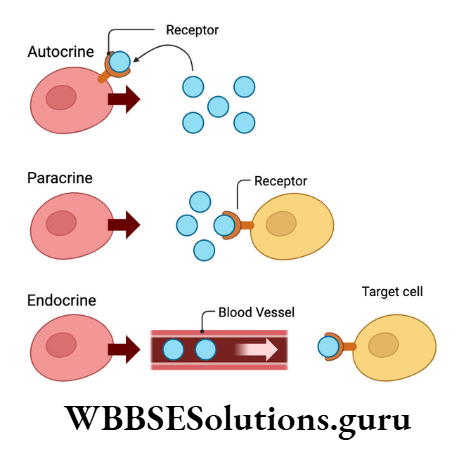
WBBSE Solutions For Class 10 Life Science Chapter 1 Autocrine Action

Question 4. Write a few general functions of the hormones.
Answer:

General functions of the hormones:

Hormones act as slow-controlling chemicals to maintain the chemical coordination of the animal body.

These may initiate the synthesis of new molecules, change of permeability of cell membrane, transport of substances into or out of the target cells, contraction or relaxation of muscles, alteration of metabolic reactions, etc.

Hormones control the differentiation & maturation of gonads, sexual activities, and secondary sexual characteristics of animals.

Hormones play a vital role in Flight response and thermotaxic (i.e. the controlling mechanism of body temperature).

In some animals metamorphosis & overall growth are controlled by hormonal actions. As an example, the metamorphosis of a tadpole into a toad is one of the important functions of thyroid hormones.

Question 5. Differentiate between local hormones & tropic hormones.
Answer:

Difference between local hormones & tropic hormones

WBBSE Solutions For Class 10 Life Science Chapter 1 Control And Coordination In Living Organisms Topic C Response And Chemical Coordination In Animals local And tropic harmone

Question 6. What are Bradycardia & Tachycardia? What are their hormonal causes?
Answer:

Bradycardia:

Bradycardia is an abnormally slow heart rate of less than 60 beats per minute. Hypothyroidism is a cause of bradycardia.

A rapid heartbeat of more than 100 beats per minute that may be regular or irregular but is out of proportion to age and level of exertion or activity is known as Tachycardia.

WBBSE Class 10 Life Science Chapter 1 Solutions

Tachycardia can be caused due to hyperthyroidism.

Question 7. How hormones are transported inside the human body?
Answer:

Characteristics Of Animal Hormones General Characteristics Of Hormones Are As Follows

Hormones are secreted by ductless endocrine glands directly into the blood. These are never stored in any other place of the animal or human body for future use except the secreting glands or tissues.

Chemically hormones may be proteinous or non-proteinous. These are classified as Amine hormones (amino acid derivatives), steroid hormones, Polypeptide hormones, and Proteinous hormones.

The secretion of hormones is regulated by the nervous system through the feedback effect. There are positive feedback systems but the negative feedback loop is more common in the endocrine system.

Most hormones are highly soluble in water and are conducted freely in the bloodstream. Lipid soluble hormones are conducted in bound form with transport protein.

Hormones cannot act on the secretory cells from where these are secreted.

Hormones generally act at a site remote from their place of production after being transported through the circulatory system. When a hormone influences the activities of a particular organ, it is called the target organ of that hormone.

Hormones influence the biochemical activities of target organs but these never initiate any processes. It works individually in very low concentration.

WBBSE Class 10 Life Science Chapter 1 Solutions

Acting as a biochemical messenger, hormones usually cause long-term effects like changes in behavior, growth, etc.

Hormones are destroyed and excreted immediately after their functions are over.

Question 8. How the glucose level of our body is regulated by hormones?
Answer:

Most cells in the human body use glucose as their major source of energy.

Glucose molecules are broken down within cells in order to produce adenosine triphosphate (ATP) molecules, the energy-rich molecules that power numerous cellular processes.

To ensure a constant supply of glucose to cells, blood glucose levels must be maintained at relatively constant levels.

In a healthy person, blood glucose levels are restored to normal levels primarily through the actions of two pancreatic hormones, namely insulin, and glucagon.

Insulin is an antidiabetogenic protein hormone. It increases the oxidation of glucose at the cellular level. It stimulates the formation & storage of glycogen in the liver and muscle after taking glucose from the blood.

Insulin inhibits gluconeogenesis & increases glucose entry through the cell membrane from the blood.

Glucagon, on the other hand, is an anti-insulin protein hormone. It does not help glucose to enter the cells. It stimulates glycogenolysis and prevents gluconeogenesis.

Response And Chemical Coordination In Animals Class 10 WBBSE

Thus it acts as a diabetogenic hormone.

Hence insulin and glucagon are antagonistic hormones.

In the human body, the normal blood glucose level is maintained by both the hypoglycemic insulin and the hyperglycemic glucagon hormones.

Question 9. State the role of hormones in the control of BMR.
Answer:

The role of hormones in the control of BMR

Basal Metabolic Rate (BMR) is the rate of energy expended by animal (such as human) bodies when at rest. The thyroid hormones triiodothyronine (T3) and thyroxine (T4) are the main regulators of BMR.

BMR increases when the quantity of these hormones in the blood increases because these hormones increase oxygen uptake and tissue metabolism.

Thyroid hormones are thus known as calorigenic hormones. Some other hormones such as testosterone, insulin, and human growth hormone (HGH) can also increase the body’s metabolic rate.

Question 10. What is feedback control of hormone functioning?
Answer:

Characteristics Of Animal Hormones General Characteristics Of Hormones Are As Follows

Hormones are secreted by ductless endocrine glands directly into the blood. These are never stored in any other place of the animal or human body for future use except the secreting glands or tissues.

Chemically hormones may be proteinous or non-proteinous. These are classified as Amine hormones (amino acid derivatives), steroid hormones, Polypeptide hormones, and Proteinous hormones.

The secretion of hormones is regulated by the nervous system through the feedback effect. There are positive feedback systems but the negative feedback loop is more common in the endocrine system.

Most hormones are highly soluble in water and are conducted freely in the bloodstream. Lipid soluble hormones are conducted in bound form with transport protein.

Hormones cannot act on the secretory cells from where these are secreted.

Response And Chemical Coordination In Animals Class 10 WBBSE

Hormones generally act at a site remote from their place of production after being transported through the circulatory system. When a hormone influences the activities of a particular organ, it is called the target organ of that hormone.

Hormones influence the biochemical activities of target organs but these never initiate any processes. It works individually in very low concentration.

Acting as a biochemical messenger, hormones usually cause long-term effects like changes in behavior, growth, etc.

Hormones are destroyed and excreted immediately after their functions are over.

Question 11. What is flight response? Why are hormones of the adrenal medulla known as emergency hormones?
Answer:

Flight response

The fight or flight response (or acute stress response) is a physiological response to prepare the animal body to face emergencies comprising of harmful events or attacks or threats to survival physical & emotional stress etc.

Emergency or stressful conditions require more energy.

The energy is provided by increasing heartbeat, blood pressure, respiration rate, blood glucose level, and cellular metabolism and by increasing blood supply to the heart, skeletal muscles & brain through dilated arterioles.

Under physical emotional or mental stress the central nervous system stimulates the adrenal medulla through the hypothalamus to release more adrenaline & noradrenaline.

Both hormones act to increase systolic & diastolic blood pressure, cardiac output, blood sugar level, etc. Adrenaline also causes the contraction of the spleen to squeeze out the stored blood in it.

The result is the enhanced rate of metabolism that prepares the body to face the stresses. Thus both adrenaline & noradrenaline are responsible for the flight response.

Hence these are known as emergency hormones. The hormones also cause the contraction of erector pili muscles of the skin to create goosebumps under stress.

Question 12. Why is the hypothalamus known as the ‘master gland’?
Answer:

Hypothalamus known as the ‘master gland’

The hypothalamus is a part of the brain located superior and anterior to the brain stem and inferior to the thalamus.

It serves many different functions in the nervous system and is also responsible for the direct control of the endocrine system through the pituitary gland.

The hypothalamus contains special cells called neurosecretory cells neurons that secrete hormones. It controls the anterior pituitary by secreting different releasing (-RH) & inhibiting (-IH) hormones and the posterior pituitary by secreting neurohormones.

The pituitary secretes several tropic hormones that control the functions of other major endocrine glands. Since the hypothalamus regulates the pituitary, hence it is called the master gland.

Response And Chemical Coordination In Animals Class 10 WBBSE

Question 13. Write about the structure and location of the pituitary gland. How many hormones are secreted by this gland?
Answer:

The pituitary gland, also known as the hypophysis, is a small pea-sized lump of tissue connected to the inferior portion of the hypothalamus of the brain.

Situated in a small depression in the sphenoid bone called the sellaturcica, the pituitary gland is made of two completely separate structures the posterior and anterior pituitary glands.
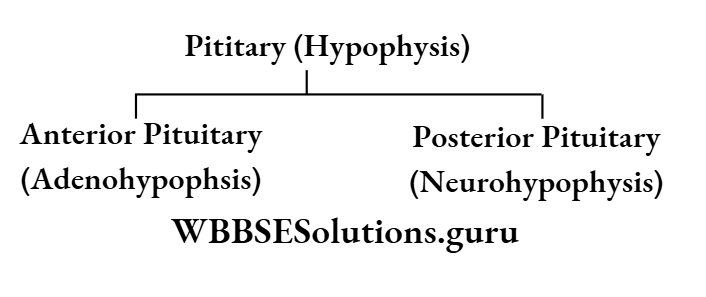
WBBSE Solutions For Class 10 Life Science Chapter 1 Pituitary

Nine types of hormones are secreted by the pituitary gland in all. These are

From anterior pituitary (7 types):

STH, ACTH, TSH, FSH, LH, LTH & MSH.

From posterior pituitary (2 types):

Vasopressin & Oxytocin.

Question 14. What is hyperglycemia?
Answer:

Hyperglycemia

Due to less secretion or lack of insulin, the stored liver glycogen breaks down by glycogenolysis into glucose due to the actions of other hormones.

In the absence of insulin, glucose can not also enter into the cell and cellular oxidation of glucose is hampered. This results in an increase in blood glucose levels. This is known as hyperglycemia.

Question 15. What are primary and secondary sex characters? Which hormones control these characters in male & female?
Answer:

Primary and secondary sex characters

While humans are born with very obvious primary sex characteristics (or body structures directly concerned with reproduction) that allow us to distinguish males from females,

(such as the penis in men and the vagina in women), secondary sex characteristics, on the other hand, are features that appear at puberty (though they later become equally prominent).

These secondary characteristics are features such as the appearance of pubic hair, breast development, etc. (in females) and the appearance of beards, muscular body growth, change of voice, etc. (in males).

Testosterone, the male reproductive hormone secreted from the testis, controls the primary & secondary sex characteristics in males.

In females, the two steroid hormones estrogen & progesterone, secreted from the ovary, control these characteristics.

WBBSE Life Science Class 10 Chapter 1 Questions And Answers 

Question 16. Enumerate the differences between Diabetes mellitus and Diabetes insipidus.
Answer:

The differences between Diabetes mellitus and Diabetes insipidus

WBBSE Solutions For Class 10 Life Science Chapter 1 Control And Coordination In Living Organisms Topic C Response And Chemical Coordination In Animals vitamin and hormone

Question 17. Mention the differences between vitamins and hormones.
Answer:

The differences between vitamins and hormones
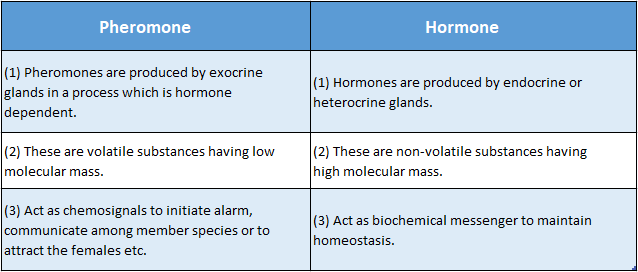
WBBSE Solutions For Class 10 Life Science Chapter 1 Control And Coordination In Living Organisms Topic C Response And Chemical Coordination In Animals pheromone and hormone

Question 18. What are pheromones ? How do they differ from hormones?
Answer:

Pheromones

Pheromones are species-specific highly volatile chemical agents that get released in minute amounts into the environment from the animals to evoke behavioral, developmental, or reproductive responses in receivers.

These are chemosignals that are also known as ectohormones.

Question 19. What are the types of diabetes mellitus?
Answer:

The types of diabetes mellitus

There are two major types of diabetes mellitus: type 1 diabetes and type 2 diabetes.

Type 1:

Diabetes is called insulin-dependent diabetes. It used to be called juvenile-onset diabetes because it often begins in childhood. This type of diabetes may be caused by a genetic predisposition.

Type 2:

Diabetes used to be called adult-onset diabetes, but with the epidemic of obese and overweight kids, more teenagers are now developing type 2 diabetes. Type 2 diabetes is also called non-insulin-dependent diabetes or Life Style Diabetes.

Chapter 1 Fill In The Blanks

Question 1. Due to a deficiency of iodine, the synthesis of____________hormone is hampered.
Answer: Thyroxin

Chapter 1 Write True Or False

Question 1. Dilute urine is profusely eliminated by a person affected with Diabetes Insipidus.
Answer: True

Chapter 1 Very Short Answer Type Questions

Question 1. Choose the odd one and write it: TSH, ACTH, GTH, CSF
Answer: CSF, because it is the cerebrospinal fluid present in the ventricles of the brain and central canal of the spinal cord. TSH, ACTH & GTH are hormones.

Chapter 1 Short Answer Type Questions

Question 1. Write two roles of GTH in the secretion of hormones from the reproductive glands in the human body.
Answer:

Human Endocrine Glands And The Hormones Secreted From Them General types of hormones in man

General Hormone:

The hormones which are secreted from one endocrine gland and that act on distant target organs are called general hormones.

Examples:

Insulin, thyroxin, etc.

Tropic Hormone:

The hormones which are secreted from one endocrine gland and that act on another endocrine gland as target organs are called tropic hormones.

Example:

Hormones of the anterior pituitary like STH, TSH, ACTH, FSH, etc.

Explanation Of Action Of Tropic Hormone:

Thyroid-stimulating hormone (TSH) is a tropic hormone that is secreted from the pituitary gland. It influences the secretion of thyroxin from the thyroid gland.

Here TSH acts as a tropic hormone and the thyroid gland is the target gland. The secretion of tropic hormones is controlled by the hypothalamus.

Stress Or Emergency Hormone:

The hormones that are secreted under physiological stress or strain (e.g. fear, anxiety, shock, grief, etc) to trigger the Fight or flight response to combat the emergencies are called the stress or emergency hormone.

Example:

Adrenaline, noradrenaline.

Local Hormone:

The hormones that are secreted from certain tissues of the body and that act at the same site of origin or in nearby organs in a strictly localized manner are called the Stress or emergency hormones are called local hormones

Example:

Adrenaline, Noradrenaline.

Once these are secreted, the local hormones enter into the bloodstream, make a round trip through the body and finally reach the target organizer

Local hormones that act on neighboring cells are called paracrine and those that act on the same cell that secretes them are called autocrine.

Examples:

Gastrin, somatostatin, etc.

Gastrin is secreted from the mucous layer of the stomach and acts on the stomach itself to secrete gastric juice.

Somatostatin is secreted from the 5-cell islets of Langerhans in the Pancreas and controls the secretions of p-cells and a-cells of the same gland.

Question 2. List the names of hormones related to the following functions:
Answer:

  1. Regulation of sugar level in blood
  2. Stimulation for the secretion of hormones

Question 2. Choose the odd one and write it: Dwarfism, Goitre, Thalassaemia, Diabetes Mellitus.
Answer:

  1. Thalassaemia, because it is a genetic disease.
  2. Dwarfism, Goitre & Diabetes Mellitus are hormonal disorders from the Thyroid gland.
  3. Causing the growth of the Corpus Leteum and stimulating the secretion of Progesterone hormone in the female body.
  4. Increasing blood pressure due to anxiety.
  5. Insulin
  6. Thyroid Stimulating hormone (TSH)
  7. Luteinising Hormone (LH)
  8. Adrenaline

WBBSE Solutions For Class 10 Life Science Chapter 2 Reproduction

WBBSE Chapter 2 Reproduction Introduction To The Concept Of Reproduction

The physiological process by which a parent organism produces its kind called the offspring leading to the continuity or perpetuity of a species is known as reproduction or breeding.

It is a fundamental characteristic feature of an organism but is not considered an essential process like respiration, nutrition, excretion, etc for the survival of an organism.

An organism can survive without reproduction but by reproduction, an organism ensures its continuity in the perspective of eternal time frame.

Organisms produce their progeny by reproduction and thus increase the size of their population.

Continuity Of Race:

Read and Learn More WBBSE Solutions For Class 10 Life Science

After a certain span of life, each organism will die naturally. To compensate for the loss, there must be new birth by reproduction to maintain the continuity of race.

Had the process of reproduction not been there, then all the plants and animals would have become extinct. Hence reproduction helps organisms to maintain race and heredity.

Wbbse Class 10 Continuity Of Life Notes – Variation & Evolution:

Recombination of genetic factors occurs during sexual reproduction. This leads to variation amongst individuals in a population. These variations, aided by natural selection, end in evolution.

Relationship between growth and reproduction:

Organisms mature through growth. In plants and animals, the growth of the somatic organs is called somatic growth and that of the reproductive organ is called reproductive growth.

Reproductive growth in plants is the growth of floral buds, flowers, fruits, seeds, etc but in animals, it signifies the growth of the testis in males and the ovary in females.

Life Science Class 10 Chapter 2 Reproduction

Thus in the course of growth, the reproductive organs of an organism attain cell differentiation and maturity. Then only the organism can produce gametes and finally, it can reproduce to create the offspring.

Therefore, growth and reproduction are closely related.

WBBSE Solutions For Class 10 Life Science Chapter 2 Reproduction

WBBSE Chapter 2 Topic B Reproduction Modes Of Reproduction

Four types of reproduction are found in the plant & animal kingdom.

These Are:

  1. Asexual reproduction
  2. Sexual reproduction
  3. Vegetative reproduction &
  4. Parthenogenesis or parthenocarpy.

Reproduction In Animals Is Of Three Types:

Asexual, sexual, and parthenogenesis. However, plants carry out all four types of reproduction as mentioned above.

Wbbse Class 10 Continuity Of Life Notes

WBBSE Chapter 2 Topic B Reproduction Asexual Reproduction

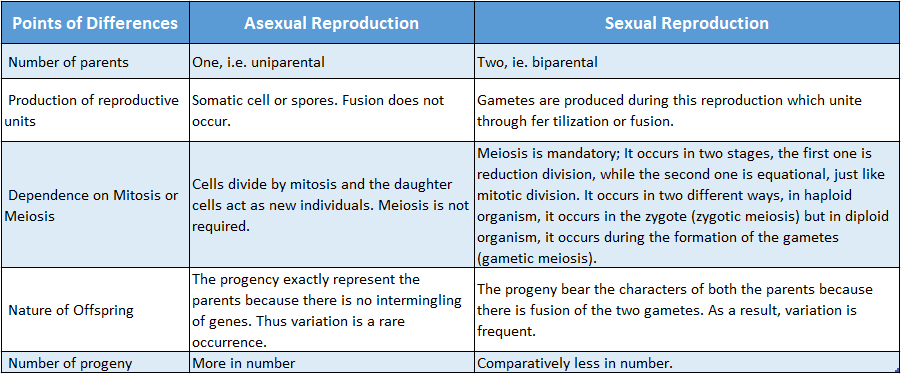
The process of reproduction by which offspring are produced from a single parent organism through the formation of spores or by direct cell division and without the fusion of gametes is called asexual reproduction.

The spores are the unit of asexual reproduction in plants. Unicellular spores contain a nucleus and some cytoplasm enclosed by a thick cell wall or membrane. Lower plants like algae, fungi, etc.

Reproduce asexually by producing spores that are either motile zoospores as in Ulothrix or non-motile aplanospores as in Chlamydomonas.

Fungi like Mucor may have non-motile spores called sporangiospores within the spore-bearing structures called sporangium.

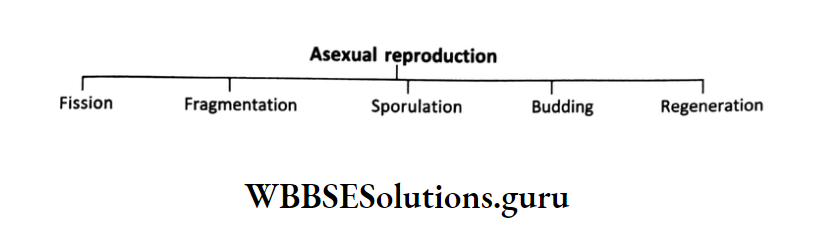
In animals, asexual reproduction is observed in different forms, like binary and multiple fissions in Amoeba, budding and fragmentation in Hydra, etc.

WBBSE Notes For Class 10 Geography And EnvironmentWBBSE Notes For Class 10 History And Environment
WBBSE Solutions For Class 10 Life ScienceWBBSE Class 10 Life Science Multiple Choice Questions
WBBSE Solutions for Class 10 MathsWBBSE Class 10 Maths Multiple Choice Questions
WBBSE Notes For Class 10 Physical Science And Environment


Asexual Reproduction In Bacteria

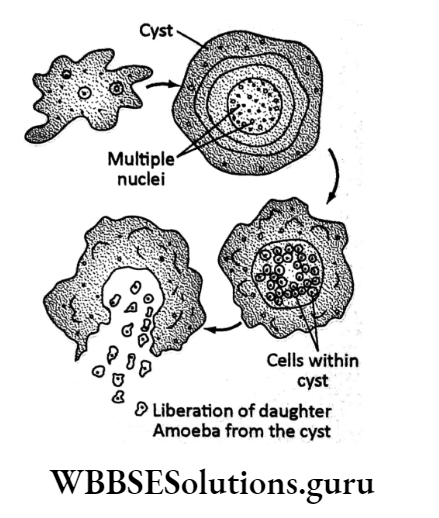
Asexual reproduction in bacteria occurs through several methods like Binary fission, Zoogloea stage, Conidia formation, Gonidia formation, Cyst formation, Budding, Fragmentation, Akinetes formation, Exospore formation, Endospore formation, etc.

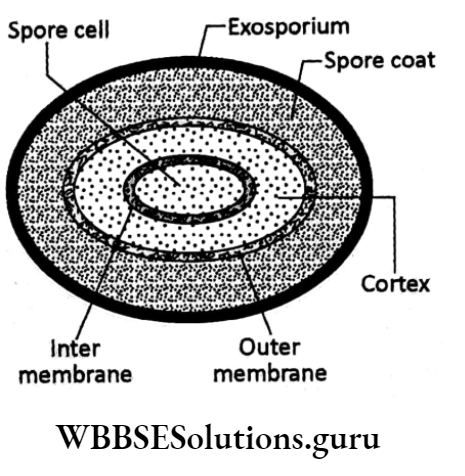
Some Gram +ve bacteria, especially bacilli and certain blue-green bacteria, produce thick-walled endospores during unfavorable conditions. During endospore formation, a portion of cytoplasm and a copy of bacterial

chromosome dehydrate and get encased by a very thick wall called the spore coat. The endospore can remain dormant for several decades and can tolerate harsh environments, heat, dehydration, toxic chemicals, polar ice, etc.

Life Science Class 10 Chapter 2 Reproduction

They germinate only under favorable conditions. The protoplasm absorbs water, swells up, and becomes active. The swollen protoplast breaks the spore covering either at the equator or at the end.

It comes out as a new bacterium surrounded by a thin core wall.

But since with the advent of favorable conditions the spore germinates to produce the same bacterial cell, it is not considered as true asexual reproduction. Fortunately, most bacteria do not produce endospores.

WBBSE Solutions For Class 10 Life Science Chapter 2 Continuity Of Life Topic 2 Reproduction Spore cell


WBBSE Chapter 2 Reproduction Sexual Reproduction

Sexual Reproduction is a form of reproduction that involves the fusion of haploid male and female reproductive cells (gametes) to create a diploid zygote through a process called fertilization.

It is the primary method of reproduction for the vast majority of macroscopic organisms including almost all eukaryotes (which includes animals and plants).

Sexual reproduction occurs through pollination & fertilization in higher plants and by the fusion of male spermatozoa and female ovum in animals.

This type of reproduction involves meiosis cell division which may be pre-zygotic or post-zygotic.

Types of sexual reproduction:

Sexual reproduction involves the union of two types of gametes. Based on the morphology and physiology of these gametes,

This process can be classified as follows—

Conjugation:

This is a simple type of sexual reproduction in which two unspecialized and identical cells unite to develop a cytoplasmic connection, through which the nucleus of one cell enters into the adjoining cell and the two nuclear contents get mixed.

By this process, a zygospore (2n) is formed.

This diploid (2n) cell then undergoes meiosis to grow into new progenies.

This type of sexual reproduction is found in algae [Spirogyra) where it can be between the ‘+’ and filaments (Scalariform) or within the same filament (lateral) and in some protozoa [Paramoecium).

The successive stages in the conjugation of Spirogyra are-

WBBSE Solutions For Class 10 Life Science Chapter 2 Continuity Of Life Topic 2 Reproduction Endospores

Syngamy:

This type of sexual reproduction involves the union of male and female gametes.

Syngamy can be classified into the following three types—

isogamy:

This process involves the union of two completely identical types of gametes. Isogamy is found in Spirogyra, Chlamydomonas etc.

Anisogamy:

This sexual reproduction occurs by the union of two structurally different types of gametes. Anisogamy is found in Chlamydomonas.

Oogamy:

Sexual reproduction in which a smaller and highly motile male gamete unites with a significantly larger and non-motile female gamete is called oogamy.

Oogamy is the most advanced type of sexual reproduction wherein the fusing gametes (male & female) differ from each other in every aspect such as size, motility, behavior, structure etc, and are called heterogametes.

Oogamy is found in Oedogonium and many other higher plants and animals.

WBBSE Solutions For Class 10 Life Science Chapter 2 Continuity Of Life Topic 2 Reproduction isogamy

Life Science Class 10 Chapter 2 Reproduction

WBBSE Chapter 2 Topic B Reproduction Differences Between Asexual And Sexual Reproduction

E:\Life science\pdf\images\ch-2 topic B\WBBSE Solutions For Class 10 Life Science Chapter 2 Continuity Of Life Topic 2 Reproduction Asexual and sexucal reproduction.png

WBBSE Chapter 2 Topic B Reproduction Vegetative Reproduction

Vegetative reproduction is basically a special type of asexual reproduction where a vegetative part of the plant body, separated from the original plant body, develops and grows into a new plant by simple cell division.

The Vegetative Reproduction Is Of Two Kinds:

  1. Methods of natural vegetative reproduction and
  2. Methods of artificial vegetative reproduction.

It occurs naturally through budding, fission, fragmentation, etc. Artificially this reproduction can be carried out by cutting, grafting, etc.

WBBSE Chapter 2 Topic B Reproduction Parthenogenesis or parthenocarpy

Parthenogenesis is a form of asexual reproduction in which the growth and development of the embryo occur without fertilization.

In animals, parthenogenesis means the development of an embryo from an unfertilized egg cell. It is common in rotifers, aphids, bees, and crustaceans.

Some vertebrates like lizards also reproduce by parthenogenesis. Parthenogenesis may be natural or artificial.

Natural parthenogenesis occurs regularly in the life cycle of some animals. It is of two types:

Complete and incomplete parthenogenesis.

Complete parthenogenesis:

It is also called obligatory partheno-genesis.

In this case, the males are completely absent and the females develop from the unfertilized eggs as is found in aphids, phyllopods, and rotifers.

It is also found in some vertebrates.

A lizard Lacerta Mexico Americana reproduces exclusively by parthenogenesis with no males, in the population.

Incomplete parthenogenesis:

In this case sexual generation alternates with parthenogenesis generation.

For example, in bees and wasps, some eggs develop without fertilization and produce males, while those eggs that are fertilized develop into females.

In Gall fly, the larvae may lay eggs which develop parthenogenetically into a new generation of larvae. This is called paedogenetic parthenogenesis or paedogenesis.

In many sexually reproducing animals, the egg can be activated by artificial methods to start the development without fertilization.

This is called artificial parthenogenesis. Eggs of Sea urchin can be made to develop successfully if treated with weak salt solutions, weak organic acids, electric shock or by shaking in seawater, or by pricking the egg with a glass needle.

In higher plants, the process of formation of fruits without pollination and fertilization is called parthenocarpy. Parthenocarpy is a form of asexual reproduction seen in flowering plants.

The fruits are generally seedless. During cultivation, parthenocarpy is introduced along with other plant hormones including gibberellin and it results in maturing of the ovaries without the process of fertilization and produces bigger and pulpy fruits.

Pineapples, bananas, cucumber, grapes, watermelon, oranges, pears,s, etc are some examples of parthenocarpy. In some plants, pollination or another stimulation is required for parthenocarpy. This is termed stimulative parthenocarpy.

Plants that do not require pollination or other stimulation to produce parthenocarpic fruits have vegetative parthenocarpy.

Seedless cucumbers are an example of vegetative parthenocarpy and seedful watermelon is an example of stimulative parthenocarpy.

WBBSE Chapter 2 Topic B Reproduction Asexual Reproduction

In asexual reproduction, the offspring arises from a single organism and inherit the genes of that parent only without involving the fusion of gametes and changes in the number of chromosomes. The unit of reproduction is commonly formed from the somatic cells of the parent.

Meiosis does not occur in asexual reproduction.

Features Of Asexual Reproduction:

It involves a single parent and offspring inherit the genes of that parent only.

There is neither any gamete formation nor any fertilization.

This is a simple & easier method of reproduction in which the whole process takes place in a small period of time.

Rapid multiplication takes place in this process whereby many offsprings can be produced from an individual parent.

There is scope for limited variation among Offspring

This method may help an organism either to regenerate to overcome unfavorable conditions.WBBSE Solutions For Class 10 Life Science Chapter 2 Continuity Of Life Topic 2 Reproduction Asexual reproduction

WBBSE Chapter 2 Topic B Reproduction Fission

Fission is the mitotic division of a single entity or cell into two or more daughter parts and the regeneration of those parts into separate entities each resembling the original parent.

Organisms in the domains of Archaea, Bacteria, and Protists (eg. sporozoans & algae) reproduce by fission.

WBBSE Solutions For Class 10 Life Science Chapter 2 Continuity Of Life Topic 2 Reproduction isogamy

Fission can be further classified as:

Binary Fission:

In this process, a cell directly divides into two daughter cells by simple amitosis.

It can be of the following types-

Simple binary fission:

When division occurs in any plane but it is always at a right angle to the elongated dividing nucleus, eg., Amoeba

Life Science Class 10 Chapter 2 Reproduction

Longitudinal binary fission:

When division occurs along the longitudinal axis, eg., Euglena, Vorticella.

Transverse binary fission:

When division occurs along the transverse axis of the organism, eg., Paramoecium, diatoms, bacteria, Planaria.

Oblique Binary Fission:

When division occurs at an angle to the transverse axis, eg., Ceratium, Gonyaulax.

Multiple fission:

The nucleus of the parent cell divides several times by amitosis to produce many nuclei. This is not immediately followed by cytokinesis.

Later on, each nucleus gathers a small amount of cytoplasm around it and the mother cell splits into many tiny daughter cells creating multiple fission.

A type of multiple fission is known as encystation. During adverse environmental conditions, the cells of certain protozoa develop a thick outer coating around their cell body, which is called a cyst. Now the nucleus undergoes several divisions.

Then each daughter nucleus gets some cytoplasm and transforms into a tiny cell or pseudospore. Thus several daughter cells are developed inside the cyst.

Now it is called a spore. With the onset of a favorable environment, the cyst breaks, and thus numerous daughter cells are liberated

Examples, Amoeba, Plasmodium, etc. There may be other types of multiple fission like Schizogony and Plasmotomy. Schizogony is a type of multiple fission present in plasmodium.

Reproduction Chapter Class 10 WBBSE

Schizogonies are of two types—

Liver schizogony and RBC schizogony.

Plasmotomy is the division of a multinucleate protozoan into several small, multinucleate daughters without nuclear division.

The daughters grow and regain the normal number of nuclei by nuclear divisions. It takes place in Opalina and Pelomyxa.

Green algae can also divide into more than two daughter cells by multiple fission. The exact number of daughter cells depends on the species of algae and on the effect of temperature and light.

schizogony and RBC schizogony

Plasmotomy is the division of a multinucleate protozoan into several small, multinucleate daughters without nuclear division.

The daughters grow and regain the normal number of nuclei by nuclear divisions. It takes place in Opalina and Pelomyxa.

Green algae can also divide into more than two daughter cells by multiple fission. The exact number of daughter cells depends on the species of algae and on the effect of temperature and light.

WBBSE Solutions For Class 10 Life Science Chapter 2 Continuity Of Life Topic 2 Reproduction opalina

WBBSE Chapter 2 Topic B Reproduction  Fragmentation

It is the process by which the multicellular filamentous body of the organism breaks at any point into two or more small slender parts and each of the broken filaments or parts produces an independent individual.

WBBSE Solutions For Class 10 Life Science Chapter 2 Continuity Of Life Topic 2 Reproduction fragmentation

In Spirogyra, this process occurs in favorable climates or rainy seasons. Fragmentati] on also occurs in the animal body where it breaks into two or more pieces each of which grows into a new individual. Example- It occurs in flatworms & Microstomum.

WBBSE Chapter 2 Topic B Reproduction Sporulation

This type of asexual reproduction is found amongst nonflowering plants.

In this process, some specialized cells are formed within specific sacs by repeated division of the cytoplasm within the cell, which is covered with the cell wall or a protective wall.

These cells are commonly known as spores. According to their nature spores are given specific names such as zoospore, aplanospore, conidia, etc.

These spores form the first cell of the gametophytic generation and they germinate to develop daughter plants. Example-Mucor, Dryopteris, Pogonatum, etc.

Spores are broadly classified into two major types, motile and non-motile. Motile spores or zoospores are found in algae & fungi (eg. Chlamydomonus & Ulothrix) and are equipped with cilia or flagella.

Reproduction Chapter Class 10 WBBSE

They can swim freely in the water. Non-motile spores or aplanospores are found in algae, conidia (ex. Penicillium), and sporangiospores found in fungi (ex. Rhizopus).

Homospores and heterospores are found in relatively higher plants like bryophytes and pteridophytes.

If the spores are of similar shape and size, they are called homospores (eg., Lycopodium, Riccia, Dryopteris) and if the spores are of different shape and size, they are called heterosporous (eg., Selaginella).

WBBSE Chapter 2 Topic B Reproduction Budding

In this process, a small wort-like structure or a lateral protuberance develops from a certain part of the vegetative body. It is called a bud.

Gradually this bud grows by mitosis into a small daughter individual and gets separated from the parental organism. This process of asexual reproduction is called budding.

Budding occurs in some protozoans (ex. budding of yeast cells in nutrient-rich medium) and certain lower animals such as sponges (Scypha), coelenterates (Hydra), annelids (Chaetopterus) and tunicates (Salpa).

There are two types of budding:

Exogenous or external budding:

Initially, a small outgrowth of the parent’s body develops into a miniature individual, it then separates from the mother to lead a free life. This is called exogenous budding.

Example: Hydra.

Endogenous or internal budding:

In freshwater sponges (eg. Spongilla) and marine sponges (eg. Sycon), the parent individual releases a specialized mass of cells enclosed in a common opaque envelope called the gemmule.

Gemmules are thought to be internal buds. Each gemmule, on germination, gives rise to offspring. This type of budding is called endogenous budding.

WBBSE Solutions For Class 10 Life Science Chapter 2 Continuity Of Life Topic 2 Reproduction exogenous

WBBSE Chapter 2 Topic B Reproduction Regeneration

It is typically found in animals whereby if a part of the animal is cut off, the cut-off vegetative fragment of the body will grow and reconstruct the complete organism.

Regeneration Is Of Two Types:

Incomplete or reparative regeneration:

Here only a part of the body is regenerated to replace the lost part or to repair the damaged body organs. In this type of regeneration, the wound is repaired or closed by the expansion of the adjoining epidermis over the wounds.

Example:

regeneration of limbs in salamanders, regeneration of lost tails in lizards, etc. In some animals like-starfish, some part of the body is broken off on being threatened by a predator.

This phenomenon of self-mutilation of the body is called autotomy.

Example:

Crabs break off their legs on approaching the enemy, starfish break off an arm, Holothurians throw off their internal viscera, etc.

Complete regeneration:

Regenerative capacity is very high among the sponges and coelenterates. The process of development of the whole organism from any fragment of an individual is called complete regeneration.

In sponges, the entire body can be reconstructed from isolated body cells. The cells rearrange and reorganize to form a bilayered sponge body wall.

Reproduction Chapter Class 10 WBBSE

In hydra and planaria, small fragments of the body can give rise to a whole animal. When a hydra or a planarium is cut into many pieces, each individual part regenerates into a whole individual.

WBBSE Solutions For Class 10 Life Science Chapter 2 Continuity Of Life Topic 2 Reproduction sponge body wall

WBBSE Chapter 2 Topic B Reproduction Vegetative Propagation

It is the process by which the plant part is separated from the plant body and it develops into a new plant body.

Characteristics of vegetative reproduction:

It is simple and rapid and allows plants to avoid the complicated process of producing sexually reproducing organs such as flowers and subsequent seeds & fruits.

New daughter organisms are produced from already existing forms.

Offsprings are practically clones of the parent plant.

If a plant has favorable traits, it can continue to pass down its advantageous genetic information to the offspring.

Vegetative propagation prevents genetic diversity.

Artificial vegetative reproduction results in the improvement of both the quality and quantity of plants.

Types of vegetative propagation:

It is of two major types—

Spontaneous or natural and artificial.

Natural vegetative propagation

Different plant parts are variously modified for vegetative propagation.

WBBSE Chapter 2 Topic B Reproduction Natural Vegetative Propagation

Different plant parts are variously modified for vegetative propagation.

WBBSE Solutions For Class 10 Life Science Chapter 2 Continuity Of Life Topic 2 Reproduction Formation of new plant from vegetative plant

Natural vegetative propagation in higher plants:

Root:

The storage root acts as a structure for perpetuation, they help the organism to survive during unfavorable conditions and also germinate to produce a new plant body. e.g. Root tuber of sweet potato, Dahlia.

WBBSE Solutions For Class 10 Life Science Chapter 2 Continuity Of Life Topic 2 Reproduction root

Stem:

The stem may also act as a parenting organ, which can grow and propagate on land and water and when separated, produces a new plant body. e.g. Offset of Water Hyacinth.

The propagation of stem in terrestrial plants is brought about by runner and stolon, e.g. There are various artificial methods like strawberries and grasses. Rhizomes are cutting, grafting, micropropagation, etc.

WBBSE Solutions For Class 10 Life Science Chapter 2 Continuity Of Life Topic 2 Reproduction stem

underground horizontally growing stems having nodes, internodes, and axillary buds. Branches grow from these buds.
A tuber is a modified underground stem tip.

The eyes or buds present on the tuber grow into new plants. The bulb is a modified shoot that has short stems and apical & axillary buds that grow to form shoots.

Class 10 Life Science Reproduction Notes

Leaf:

The leaf may become a propagating organ with the presence of storage food in the lamina and adventitious buds present at the edge of the lamina may germinate to produce a new plant body. e.g. Leaf of Bryophyllum.

WBBSE Solutions For Class 10 Life Science Chapter 2 Continuity Of Life Topic 2 Reproduction leaf


WBBSE Chapter 2 Topic B Reproduction Artificial Vegetative Propagation

This process is usually practiced for the reproduction of those plants that produce 236 either very few seeds or do not produce any viable seeds at all.

There are various artificial methods like strawberries and grasses. Rhizomes are cutting, grafting, micropropagation, etc.

Cutting:

When any part of the stem or root is cut off, it may contain adventitious buds, which germinate to produce a new plant body. Stem cuttings are generally used to obtain new plants.

The mature stem of a plant bearing nodes and lateral buds can be cut and planted in moist soil. After a few days, new roots develop from the underground cut ends and the cutting becomes a new plant.

WBBSE Solutions For Class 10 Life Science Chapter 2 Continuity Of Life Topic 2 Reproduction cutting

At times roots are not easily produced in the cuttings and, hence, they are treated with synthetic growth hormones like IAA, IBA, NAA, etc to stimulate root formation.

Plants like rose, china rose, banana, sugarcane, orange, grapes, etc are propagated by stem cutting.

Grafting:

It is a unique process where a superior plant stem from an aerial portion is cut off obliquely and it is joined with the lower part of the stem of the same species but of inferior variety.

The superior plant stem is known as the scion and the rooted shoot of the other plant is called the stock. The rootstock is generally derived from a plant resistant to diseases and efficient in water and mineral absorption.

They are covered with manure and tied with a string or tape or rubber tubing etc. This results in the fusion of cambia and the formation of new vascular tissue to produce a single plant of superior variety.

The method is commonly practiced for economically useful plants like rose, mango, apple, pear, guava, rubber, etc.

The process of grafting is successful in dicot stem but it is not successful in monocot stem because the vascular bundles are scattered and the cambium is absent in the vascular bundles, so the continuity of vascular tissue is not formed between the scion and the stock.

WBBSE Solutions For Class 10 Life Science Chapter 2 Continuity Of Life Topic 2 Reproduction Grafting

Micropropagation:

The term ‘micro’ means minute pieces.

Small pieces or tissues are cut off from the plant body and are propagated in semi-solid or liquid media containing essential nutrients and phytohormones in an aseptic or sterilized condition.

These pieces grow into an undifferentiated mass called callus tissue and by adjusting the level of the phytohormones like auxin and cytokinin, they regenerate into plantlets.

Class 10 Life Science Reproduction Notes

Plantlets are then transferred to pots or nursery beds and allowed to grow into full plants. The process is the propagation of plants by tissue culture

This process ensures rapid propagation of the same plant body within a short time.

It is particularly useful in the case of coconut and other monocot plants, where grafting is not successful because of the absence of cambial tissue.

This method has also been employed in the commercial production of orchid carnations, chrysanthemums, Asparagus, potatoes, etc.

WBBSE Solutions For Class 10 Life Science Chapter 2 Continuity Of Life Topic 2 Reproduction microprogation

WBBSE Chapter 2 Topic B Reproduction Alternation of Generation

Explanation:

The life cycle of all individual organisms has two unique phases, viz. the sporophytic generation or the diploid phase, and the gametophytic generation or the haploid phase.

The former reproduces asexually to produce the haploid spores, which germinate to produce the gametophytes containing the reproductive organs.

They produce the gametes which undergo sexual union to produce the diploid individual again. Thus the diploid phase is again initiated.

This alternation occurs in all plant and animal organisms but is most pronounced in pteridophytes like ferns (Dryopteris).

The alternation of diploid (2n) asexual sporophytic form and haploid (n) sexual gametophytic form in a cyclic manner in the life cycle of an organism is known as the alternation of generation.

It is also known as metagenesis or heterogenesis.

In Dryopteris, the parent plant body is diploid. It is differentiated into root-like rhizoids, rhizomatous stems, and compound leaves.

It is called the sporophyte.

WBBSE Solutions For Class 10 Life Science Chapter 2 Continuity Of Life Topic 2 Reproduction Alternation of generation

The lower surface of the leaf bears the sori, which contains the stalked sporangia having the diploid spore mother cells. It undergoes reduction division to produce haploid spores.

Spore marks the beginning of the haploid gametophytic generation. The spore germinates to produce the filamentous primary protonema, branched secondary protonema, and the heart-shaped thalloid prothallus.

The prothallus has photosynthetic cells and is independent of the sporophytic plant, it develops the male sex organ or the club-shaped antheridium and the female sex organ or the flask-shaped archegonium.

The antheridium produces the multi-flagellate antherozoids, which swim towards the archegonial neck by chemotactic movement and fuses the egg in the venter of the archegonium to produce the zygote and marks the beginning of the sporophytic generation.

The zygote gradually develops into a matured sporophyte.

In this way, the alternation of generation is distinctly observed in fern with both the sporophyte and the gametophyte being independent of each other.

Alternation of generation also takes place in lower plants because the haploid plants are prevalent, and the stages are not distinctly differentiated.

Class 10 Life Science Reproduction Notes

In the brown algae Ectocarpus, the sporophytic and gametophytic plant bodies look the same, so it is called isomorphic alternation of generation.

In red algae Polysiphonia, there are two types of the sporophytic plant body, viz tetra sporophyte and carposporophyte and also the gametophyte, so this type of alternation of generation is called triphasic alternation of generation.

Metagenesis:

Among animals, many invertebrates have an alternation of sexual and asexual generations (eg., protozoans, jellyfish, flatworms, hydra, obelia, etc), but the alternation of haploid and diploid generations is unknown.

Animals Like Hydra, Obelia, Jellyfish Etc Belonging To The Phyllum Cnideria Often Exhibit Two Forms:

polyp (usually fixed) and medusa (free-living).

The sedentary colonial asexual polyp phase gives rise by budding to medusa which represents a sexual generation.

However, both polyp and medusa are diploids (2n). The formation of polyp and medusa in an alternate manner is known as metagenesis. It is a modified form of alternation of generation.

WBBSE Solutions For Class 10 Life Science Chapter 2 Continuity Of Life Topic 2 Reproduction metagenisis

WBBSE Class 10 Reproduction Topic Explanation

WBBSE Chapter 2 Topic B Reproduction Fill In The Blanks

Question 1. The alternation of generation shows____________and ____________ generation.
Answer: Sporophytic, Gametophytic

Question 2. The fusion of 2 haploid gametes produce diploid____________
Answer: Zygote

Question 3. The sporangiospore is observed in____________.
Answer: Mucor

Question 4. Asexual haploid motile spore is also called____________
Answer: Zoospore

Question 5. Bacteria reproduces mostly by____________.
Answer: Binary fission

WBBSE Class 10 Reproduction Topic Explanation

Question 6. The asexual spore of bacteria is also called ____________
Answer: Endospore

Question 7. Paramoecium exchanges nuclei by____________.
Answer: Conjugation

Question 8. Ideal alternation of generation is found in ____________
Answer: Fern

Question 9. Spirogyra reproduces vegetatively by____________.
Answer: Fragmentation

Question 10. Multinucleate zoospore is also called____________.
Answer: Synzoospore

Question 11. Yeast reproduces vegetatively by ____________.
Answer: budding

Question 12. Underground modified stem in potato is called____________
Answer: Tuber

Question 13. Water hyacinth reproduces vegetatively by____________
Answer: Offset

Question 14. Starfish shows healing of a wound by____________.
Answer: Regeneration

Question 15. Oxalis propagates vegetatively by____________ .
Answer: Offset

WBBSE Chapter 2 Topic B Reproduction True Or False

Question 1. Water hyacinth shows a sub-aerial modification of the stem.
Answer: True

Question 2. An undifferentiated mass of tissue is also called a callus.
Answer: True

Question 3. Spirogyra reproduces vegetatively by conjugation.
Answer: False

Question 4. A callus mass contains all totipotent cells.
Answer: False

Question 5. Dahlia propagates by runner.
Answer: False

Question 6. Honeybees may exhibit parthenogenesis.
Answer: True

Question 7. Rhizopus exhibits sporangiospores.
Answer: True

WBBSE Class 10 Life Science Chapter 2 Question Answers

Question 8. Ulothrix reproduces asexually by zygospore.
Answer: False

Question 9. Polysiphonia exhibits triphasic alternation of generation.
Answer: True

Question 10. Hydra exhibits metagenesis.
Answer: True

Question 11. Plasmodium carries out sexual reproduction in humans.
Answer: False

Question 12. Scion and stalk are used in layering.
Answer: False

Question 13. Isomorphic alternation of generation is found in Ectocarpus.
Answer: True

Question 14. Multiple fission is observed in Amoeba.
Answer: True

Question 15. Bacteria do not exhibit true sexual reproduction.
Answer: True

WBBSE Class 10 Life Science Chapter 2 Question Answers

WBBSE Chapter 2 Topic B Reproduction Match The Column

WBBSE Solutions For Class 10 Life Science Chapter 2 Continuity Of Life Topic 2 Reproduction match the column 1
Answer: 1-B,2-A,3-D,4-C

WBBSE Solutions For Class 10 Life Science Chapter 2 Continuity Of Life Topic 2 Reproduction match the column 2
Answer: 1-B,2-C,3-D,4-A

WBBSE Solutions For Class 10 Life Science Chapter 2 Continuity Of Life Topic 2 Reproduction match the column 3
Answer: 1-D,2-C,3-A,4-B

WBBSE Solutions For Class 10 Life Science Chapter 2 Continuity Of Life Topic 2 Reproduction match the column 4
Answer: 1-C,2-D,3-A,4-B

WBBSE Class 10 Life Science Chapter 2 Question Answers

WBBSE Chapter 2 Topic B Reproduction Very Short Answer Type Questions

Question 1. What is the name of the asexual spore in bacteria?
Answer: Endospore.

Question 2. Name the two ways of vegetative reproduction in Yeast.
Answer: Fission and budding.

Question 3. Name the process of alternation of generation in Hydra.
Answer: Metagenesis.

Question 4. Name the method of vegetative reproduction in Ulothrix.
Answer: Fragmentation.

Question 5. What is the name of the diploid spore of Mucor?
Answer: zygospores

Question 6. Name the asexual spore of Rhizopus.
Answer: Sporangiospore.

Question 7. What is the life cycle with equal distribution of haploid and diploid phases known as?
Answer: Haplo-diplobiontic life cycle.

Question 8. A pair of related terms is given below. On the basis of the relationship in the first pair write the suitable word in the gap of the second pair.
Answer:

Isogamy: Sexual union of two completely identical gametes:: Anisogamy: Sexual union of two structurally different types of gametes

Zoospores:
Motile spores:: aplanospores: nonmotile spores

Asexual phase : Polyp:: Sexual phase: Medusa

Question 9. Name the propagating structure of Marsilea.
Answer: Runner.

Question 10. Name the propagating structure of Meatha.
Answer: Stolon.

Question 11. Name the propagating structure of the Chrysanthemum.
Answer: Sucker.

Question 12. Name the propagating structure of sweet potato.
Answer: Root tuber.

Question 13. Name the propagating organ of Asparagus.
Answer: Fleshy root.

Reproduction Topic 2 Class 10 Solutions

Question 14. Name two animals showing regeneration.
Answer: Planaria, Hydra.

Question 15. Name the first cell of sporophytic generation.
Answer: Zygote.

Question 16. Name the first cell of gametophytic generation.
Answer: Spore.

Question 17. Name a plant showing an epiphyllous bud.
Answer: Bryophyllum.

Question 18. Name the propagating structure of ginger.
Answer: Rhizome.

Question 19. Among the following four terms, one includes the other three. Find out that term and write it:
Answer:

  1. Spoliation, budding, asexual reproduction, regeneration
  2. Callus tissue, plantlets, explant, tissue culture.
  3. Asexual reproduction
  4. Tissue culture names the tube that helps in conjugation.

Question 20. Name a tube that helps in conjugation.
Answer: Conjugation tube.

Question 21. Name a plant and an animal where parthenogenesis is evident.
Answer: Plant- Spirogyra Animal- male bee

Question 22. Mention two inherent characteristics of amoeba and yeast that enable them to reproduce asexually.
Answer:

  1. Unicellular with simple body organization
  2. Uniparental condition

Question 23. In haploid organisms that undergo sexual reproduction, name the stage in the life cycle when meiosis occurs.
Answer: Meiosis can take place only in a diploid post-zygotic stage because the zygote is the only diploid cell in the life cycle of such organisms.

WBBSE Class 10 Life Science Chapter 2 Question Answers

Question 24. What is sexual dimorphism?
Answer: Sexual dimorphism is the existence of two morphological forms for males and females of the same species.
Example: human, cockroach, etc.

Question 25. There is no natural death in single-celled organisms like amoeba and bacteria- why? There is no natural death in Answer: single-celled organisms because the parental body is distributed among the offspring through the simplest mode of reproduction by cell division.

Reproduction Topic 2 Class 10 Solutions

Question 26. Mention one difference between endogamy and exogamy
Answer:

WBBSE Solutions For Class 10 Life Science Chapter 2 Continuity Of Life Topic 2 Reproduction endogamy and exogamy

Question 27. Name two common methods of graving.
Answer: Tongue (whip) Grating and crown grafting.

Question 28. Why do we refer to offspring formed by asexual methods of reproduction as clones?
Answer: The offspring that are produced due to the asexual method of reproduction are not only similar to one another but are also exact copies of their parent hence such a group of morphologically and genetically similar individuals is called clones.

Question 29. In what circumstances grafting is a better technique to be used?
Answer: Grafting is used in horticulture for a variety of purposes: to repair injured trees, to adapt varieties to adverse soil or climatic conditions, to propagate those plants whose seeds remain dormant for a prolonged period, and to produce multifaceted or multiflowered plants.

Question 30. What is a larva?
Answer: Larva is a juvenile free-living stage of some insects, amphibians, etc which hatch from eggs and are morphologically not similar to the adult. They develop into adults through a process of abrupt transformation called metamorphosis.

Examples: Caterpillars of butterflies, tadpoles of frogs, etc.

WBBSE Chapter 2 Topic B Reproduction Short Answer Type Questions With Answers

Question 1. What is reproduction?
Answer:

Reproduction

The physiological process by which a parent organism generates its own kind called the offspring leading to the continuity or perpetuity of a species is known as reproduction or breeding.

Question 2. What is vegetative reproduction?
Answer:

Vegetative reproduction

A special type of asexual reproduction in plants where a vegetative part gets separated from the original plant body and develops into an adult individual plant by simple cell division is called vegetative reproduction.

Question 3. What is blastogenic reproduction?
Answer:

Blastogenic reproduction

The asexual mode of reproduction that occurs by amitosis is called blastogenic or somatogenic reproduction.

Question 4. What is anisogamy?
Answer:

Anisogamy

The fusion of two games that are structurally similar but functionally different is called anisogamy. It is found in Chlamydomonas braunii.

Question 5. What is bulbil?
Answer:

Bulbil

The swollen, leafy adventitious bud having storage starch in it is called bulbil, e.g. Garlic bulbil. These may be modifications of flowers. Bulbils grow into new plants when shed from the mother plant by way of natural vegetative propagation.

Reproduction Topic 2 Class 10 Solutions

Question 6. What is gemma?
Answer:

Gemma

Gemmae are green, multicellular, asexual buds that develop in small leafy cup-like structures attached to the thallus of the bryophyte Marchantia. They help in vegetative propagation.

Question 7. What is oogamy?
Answer:

Oogamy

The fusion of two gametes (a smaller motile male gamete & a larger nonmotile female gamete) that are structurally, functionally, and developmentally different is called oogamy, e.g. Chlamydomonas coccifera. It is the most advanced type of sexual reproduction found in higher plants and animals.

Question 8. What is a zygospore?
Answer:

Zygospore

The thick-walled diploid spore formed by the fusion of two iso gametangia is called a zygospore, e.g. Spirogyra, Mucor.

Question 9. What is parthenogenesis?
Answer:

Parthenogenesis

Parthenogenesis is a form of asexual reproduction in which the growth and development of the embryo occur without fertilization. The entire animal develops from the unfertilized ovum. e.g. Honey bee males, rotifers, aphids, etc.

Question 10. What is multiple fission?
Answer:

Multiple fission

In unicellular animals like Amoeba, the cell may develop a thick wall and the nucleus divides repeatedly to produce a multinucleated form, which separates from each other and develop into an adult animal at a later stage. This is called multiple fission.

Question 11. What are adventitious buds?
Answer:

Adventitious buds

The specialized swollen buds developing in the different regions of the plant like root, stem, and leaf which separate from the parent plant and develop into a new plant body are called adventitious buds.

Reproduction Topic 2 Class 10 Solutions

Question 12. What is micro-propagation?
Answer:

Micro-propagation

The process by which a minute plant fragment (explant) is grown aseptically in a specialized culture media and the fragments are separated from this tissue mass to grow into individual plants is called micropropagation or propagation of plants by tissue culture.

Question 13. What is pseudomycelium ?
Answer:

Pseudomycelium

The yeast cell reproduces by budding, but these buds do not separate from the parent cell and instead produce a chain of cells called peseudomycelium.

Question 14. What is an alternation of generation?
Answer:

Alternation of generation

The alternation of diploid (2n) asexual sporophytic and haploid (n) sexual gametophytic generation in a cyclic manner in the life cycle of an organism is called Alternation of generation. It is ideally observed in ferns. It is also called metagenesis or heterogenesis.

Question 15. List out the advantages of artificial vegetative reproduction in plants.
Answer:

Importance of artificial vegetative reproduction:

  1. Naturally, parthenocarpic plants like bananas, pineapples, grapes, and flowering plants like roses, china-rose, etc do not develop seeds. These plants can be propagated by artificial vegetative reproduction.
  2. By this method of reproduction, the qualitative features of plants can be retained unaltered generation after generation.
  3. Plants like mango, apple, and guava take a long time to develop fruits. By grafting, the fruiting of these plants can be quickened.
  4. It is a cheaper, easier, and more rapid method of multiplication wherein all plants developed by this method are genetically similar.

Question 16. Mention the advantages and disadvantages of asexual reproduction.

Advantages of asexual reproduction:

  1. In this process, a single parental member performs reproduction.
  2. The progeny are genetically identical to their mother.
  3. This process is very easy and a large number of progeny are produced in a short period of time.

Disadvantages of asexual reproduction:

  1. This process does not involve meiosis, so no genetic recombination occurs in it. Progenies do not acquire any variation of the character.
  2. Progenies cannot adapt to the changing environment, hence do not get the favor of natural selection and may get extinct from nature.
  3. This process never helps in the origin of new species.

Question 17. With which type of reproduction do we associate the reduction division? Mention the significance of sexual reproduction.
Answer:

Reduction division or meiosis is associated with sexual reproduction, because:

The cell or meiocyte that gives rise to gametes has a diploid number of chromosomes and it is only by reducing the number by half that we can get haploid garnets through meiosis.

The constancy of chromosome number can be maintained from generation to generation through meiosis only.

Significance of sexual reproduction:

During sexual reproduction paternal and maternal characters are united by the union of gametes.

Sexual reproduction involves meiotic cell division before gamete formation or after fertilization. In this process recombination of genetic factors takes place. Therefore new genetic variations are seen in the progeny.

Sexual reproduction helps the progeny to adapt to the changing environment.

The variations, produced during sexual reproduction, being selected by nature take part in the origin of new species.

Question 18. ‘Fertilization is not an obligatory event for fruit production in certain plants’ — explain why?
Mention the significance of parthenogenesis.
Answer:

Some fruits like pineapple, banana, cucumber, grapes, etc are developed from unfertilized ovaries without pollination and fertilization through parthenocarpy which is a form of asexual reproduction seen in flowering plants.

These fruits are generally seedless. During cultivation, parthenocarpy is introduced along with other plant hormones including gibberellin and it results in maturing of the ovaries without the process of fertilization and produces bigger & pulpy fruits.

Hence it is evident that fertilization is not an obligatory event for fruit production in certain plants.

Parthenogenesis is a means of reproduction, sex determination, higher multiplication, prevention of sterility in races, maintenance of similarity in population, and production of polyploidy animals.

Question 19. Enumerate the differences between external and internal fertilization.
Answer:

The differences between external and internal fertilization

WBBSE Solutions For Class 10 Life Science Chapter 2 Continuity Of Life Topic 2 Reproduction External and internal


Question 20. Do bacteria reproduce sexually? If so, name the types of sexual reproduction that they carry out.
Answer:

Genetic studies Indicate that something like sexual reproduction, involving the fusion of two different cells and a transfer of hereditary factors, occurs in bacteria, although infrequently.

Typical sexual reproduction through the union of gametes is absent in bacteria. There are no fertilization and meiosis also.
Gene transfer occurs in bacteria through three methods Conjugation, Transformation, and Transduction.

Question 21. What are monoecious and dioecious organisms? Give examples.
Answer:

The plants carrying both male and female unisexual flowers on the same plant body are monoecious plants.

Examples: Gourd, Chara, etc. They are also called homothallic plants.

A bisexual or monoecious animal possesses both the male and female reproductive organs in the same animal body.
Examples: earthworms, snails, etc.

These are also known as hermaphrodites. The plants where male and female flowers are borne on separate plant bodies are dioecious or heterothallic plants.

Examples: Papaya, Marchantia, etc.

A unisexual or dioecious animal is either male or female, i.e. they have male and female reproductive structures on different sexes; Ex. Cockroaches, Human beings, etc.

Life Science Class 10 Chapter 2 Reproduction

Question 22. Give differences between zoospore and zygote.
Answer:

Differences between zoospore and zygote

WBBSE Solutions For Class 10 Life Science Chapter 2 Continuity Of Life Topic 2 Reproduction Zoospore and zygote

Question 23. what is the difference between the alternation of generations seen in plants and the sexual reproduction seen in mammals?
Is it better to have a more dominant sporophyte or a more dominant gametophyte in the life cycle of a plant?
Answer:

Mammals do not alternate generations and do not have variations between haploid and diploid states.

Some animals, like honey bees, do vary between haploid and diploid, but this determines their gender within a generation and does not change over generations.

In plants, however, the case is different and the gametophyte is dependent on the sporophyte and vice versa.

Neither the sporophyte nor the gametophyte should be more dominant. The dominance of a particular generation depends entirely on the successes and failures of the past generations of a species.

If the sporophyte tends to be weaker or is predated more, it will become a less prominent feature in the reproductive cycle. The same is equally true for the gametophyte.

Each species has formed a life cycle that has allowed it to survive to the present, so all are essentially equal.

Question 24. Which generation does the flowering plants in your garden represent— sporophyte or gametophyte?
In Bryophytes which stage is dominant? If the chromosome numbers in meiocytes of human beings, elephants, rice, and onion are 46, 56, 24 & 32 respectively, then what will be the chromosome number in gametes of these species?
Answer:

Flowering plants represent the sporophyte generation.
Gametophyte stage is dominant in Bryophytes.

Chromosome number in gametes: human beings = 23, elephant = 28 rice = 12, onion = 16

WBBSE Solutions For Class 10 Life Science Chapter 1 Locomotion As A Type Of Response In Animals

WBBSE Chapter 1 Locomotion As A Type Of Response In Animals Introduction To Locomotion

Most animals have the power of locomotion through the movements of the locomotory organs including movements of muscles, bones, and joints.

Animal locomotion is any of a variety of movements of different body parts (usually called the locomotory organs) that results in the progression of the whole organism from one place to another.

The study of movements is called kinesiology.

It is not that all the animals can perform locomotion. Some phylum Porifera and phylum Mollusca animals are sedentary aquatic animals without locomotory organs.

They are sessile animals and remain attached to submerged substances.

Read and Learn More WBBSE Solutions For Class 10 Life Science

Example:

Freshwater & marine sponge, Neptune cup, oysters, barnacles, etc.

WBBSE Chapter 1 Locomotion As A Type Of Response In Animals Reasons And Motivations Behind Locomotion

Animals move for various reasons, such as to find food, a mate, a suitable microhabitat, or to escape from predators.

Hunt For Food & Water:

Since animals can not prepare food, they are to perform locomotion to find a suitable area with plenty of food & water.

To seek shelter & escape from predators:

Locomotion increases the chances of survival of an organism by allowing the organism to seek shelter in favorable habitat, and to escape dangerous situations by avoiding predators.

Dispersal for mating or breeding:

Locomotion enables members of the species to disperse to find suitable mates to coordinate breeding activity and the survival of the young.

Search for a new & favorable environment:

Animals, especially birds, migrate from areas of low or decreasing resources to areas of high or increasing resources. The two primary resources being sought are food and nesting locations. Escaping from cold is also a factor.

WBBSE Solutions For Class 10 Life Science Chapter 1 Locomotion As A Type Of Response In Animals

Basic differences between movement and locomotion:

Though, in the case of animals, we often use the terms movement and locomotion, interchangeably, there are definite differences between the two.

Locomotion occurs at the organism level while movement can occur at any biological level from cellular to organisms.

In simple words, locomotion is movement from one place to another. It involves shifting of the entire body parts (e.g. a person moving or running) and movement consists of a change in shape, size, or direction of various body parts (e.g. shaking of your hands).

Locomotion In Animals Class 10 Life Science Pdf 

All kinds of locomotion are movements, but all kinds are not.

Movement is the motion that occurs in an organism or a body with or without the involvement of any change in the position or location of the organism or the body. At the same time, locomotion is defined as the voluntary movement of an organism from one place to another either in search of food or shelter or mate or to escape from the predators.

Therefore, the differences between movement and locomotion may be summarized in a tabular form as below:

WBBSE Solutions For Class 10 Life Science Chapter 1 Control And Coordination In Living Organisms Topic E Locomotion As A Type Of Response In Animals Movement And locomotion

WBBSE Chapter 1 Locomotion As A Type Of Response In Animals Different Types Of Animal Locomotion

Animal locomotion arises from complex interactions among sensory systems, the processing of sensory information into patterns of motor output, the musculoskeletal dynamics that follow motor stimulation, and the interaction of appendages and body parts with the environment.

These processes conspire to produce motions and forces that permit stunning maneuvers with important ecological and evolutionary consequences.

Many bacteria and protozoa are capable of locomotion, but animals move over much greater distances by a much larger variety of means, such as burrowing, running, hopping, flying, and swimming.

The mode of locomotion used by an animal depends on the size of the animal and the medium in which it moves—whether water, air, or land. A few different types of locomotion are discussed here.

WBBSE Chapter 1 Locomotion As A Type Of Response In Animals Amoeboid Locomotion Involving Pseudopodia

Locomotory organ:

Pseudopodia or false feet.

Process:

The amoebas move from place to place by forming temporary finger-like projections called pseudopodia or false feet derived as blunt projections of the cytoplasm.

A pseudopodium may form at any place on the surface of the body. The cytoplasm of the amoeba consists of a central fluid plasma surrounded by a more viscous plasma gel.

The sheet of plasma gel at the root of the cytoplasmic protrusion slowly thins out and is converted into plasmas.

The central granular part of the cytoplasm, that is the plasmas, then flows into the cytoplasmic outgrowth by streaming movement through the gap in the plasma gel sheet.

Next to this, the stiff plasma gel at the opposite end of the animal is gradually converted into fluid plasmas which rush forward into the pseudopodium.

WBBSE Notes For Class 10 Geography And EnvironmentWBBSE Notes For Class 10 History And Environment
WBBSE Solutions For Class 10 Life ScienceWBBSE Class 10 Life Science Multiple Choice Questions
WBBSE Solutions for Class 10 MathsWBBSE Class 10 Maths Multiple Choice Questions
WBBSE Notes For Class 10 Physical Science And Environment


While returning back along the sides of the finger-like tube, the plasma is again converted into plasma gel.

Many pseudopodia appear simultaneously but usually, one of them is extended and the others are retracted.

The sort of peculiar motion by thrusting out pseudopodia and then flowing into one of them by sol-gel transformation is known as an amoeboid movement.

Effective locomotion occurs only when the animal is in contact with the substratum and not when it is floating on the surface of the water.

The tip of the pseudopodium may adhere to the substratum by secreting a sticky juice and the entire animal glides forward into the pseudopodium.

Locomotion In Animals Class 10 Life Science Pdf 

The speed of locomotion usually ranges from 0.5 to. 5 (in per second. In favorable conditions, the speed may be as high as 25 mm per hour.

WBBSE Solutions For Class 10 Life Science Chapter 1 Control And Coordination In Living Organisms Topic E Locomotion As A Type Of Response In Animals plasmagel

WBBSE Chapter 1 Locomotion As A Type Of Response In Animals Ciliary Locomotion In Paramoecium

Locomotory organ:

Cilia

Process:

Locomotory organ:

Cilia

Process:

Paramecia move with the assistance of small hair-like structures called cilia that project from granular structures called basal bodies on all sides of their bodies

The single-celled organisms use these hairs like oars, beating them against the water to move around in pursuit of food and to avoid predators.

The whole complement of cilia beat in a rhythmic pattern, (metachronal rhythm), so that the waves of contraction pass over the cell body.

WBBSE Solutions For Class 10 Life Science Chapter 1 Control And Coordination In Living Organisms Topic E Locomotion As A Type Of Response In Animals single celled organisms

WBBSE Solutions For Class 10 Life Science Chapter 1 Control And Coordination In Living Organisms Topic E Locomotion As A Type Of Response In Animals cell body

Since cilia can beat either forwards or backward, the animal, therefore, can swim in both directions rapidly. In normal circumstances, however, it runs forward.

As the cilia beat obliquely backward, the animal rotates on its long axis during its forward progression. The cilia in the oral groove are longer and more or less fused.

They beat obliquely against the axis of the groove and hence the anterior end of the animalcule is swerved to one side or the other alternately.

As a result of the combination of forward motion, rotation, and lateral swerving, the animal is compelled to follow a spiral path. It can never swim in a straight line.

WBBSE Solutions For Class 10 Life Science Chapter 1 Control And Coordination In Living Organisms Topic E Locomotion As A Type Of Response In Animals swin in straight line

WBBSE Chapter 1 Locomotion As A Type Of Response In Animals Flagellar Locomotion In Euglena

Locomotory organ:

Flagellum

Process:

The protozoa Euglena move by a flagellum (plural, flagella),  of an outer contractile protoplasmic sheath and an inner elastic axial filament called an axoneme.

The flagellum is located on the anterior (front) end, which turns and twists in such a way as to pull the cell through the water.

Flagellum is attached to an inward pocket called the reservoir. Movement of flagellum is related to the contraction of its all fibrils.

A series of spiral waves pass successively from the base to the tip of the backwardly directed flagellum with increasing velocity and amplitude.

Locomotion In Animals Class 10 Life Science Pdf 

The waves proceed along the flagellum in a spiral manner and cause the body of Euglena to rotate once in a second. Thus, in its locomotion, it traces a spiral path about a straight line and moves forward. The rate of movement is about 3 mm per minute.


WBBSE Solutions For Class 10 Life Science Chapter 1 Control And Coordination In Living Organisms Topic E Locomotion As A Type Of Response In Animals Flagellum

WBBSE Chapter 1 Locomotion As A Type Of Response In Animals Swimming In Fish

Locomotory organ:

Muscular tail assisted by paired & unpaired fins

Fins:

The fish bears certain appendages known as the fins. The fins are membranous extensions of the skin and are supported by fin rays. The fins are either—

  1. Median unpaired fish or
  2. Lateral paired fins.

WBBSE Solutions For Class 10 Life Science Chapter 1 Control And Coordination In Living Organisms Topic E Locomotion As A Type Of Response In Animals fish

The Median Fins Are:

Anterior and posterior dorsal fins are placed on the dorsal surface of the fish. The dorsal fins serve to protect the fish against rolling and assist it in sudden turns and stops,

The caudal fin at the end of the tail. The tail acts as the propulsion organ and the caudal fin acts as the steering apparatus for change of direction

The anal or ventral fin is located on the ventral surface behind the anus. This fin is used to stabilize the fish i.e., to maintain the vertical position of the fish while swimming.

The Lateral Paired Fins Are:

Pectoral fins, one on each side of the body and placed behind the opercula. The pectoral fins are used for steering, to change direction, and as a brake to slow down or stop the movement,

Pelvic fins are placed on the ventral side of the body below and behind the pectoral fins. The pelvic fins are used for balance and to keep the fish steady by preventing rolling movements.

Myotomes:

The trunk and tail bear powerful V-shaped segmental muscles called myotomes on both sides of the backbone. Successive myotomes are separated by delicate partitions of connective tissue. These muscles are utilized for swimming.

Process:

A fish performs three types of movement-forward motion, change of direction or brake or stop and balancing. The streamlined body shape and overlapping scales allow it to move easily through the water with minimal frictional drag.

During swimming, the tail is swept from side to side to bend the body on either side alternately and produce a thrust that propels the fish forward.

The sweeping of the tail is due to the contraction and relaxation of the myotomes on either side of the body that works antagonistically against the vertebral column.

The contraction of the myotomes on the right side of the body bends the tail to the right, while the contraction of the myotomes on the left side of the body bends the tail to the left.

When the muscles of the right side contract, those of the left side relax, and vice versa. The fish pushes the water backward & sideways but the body moves forward.

WBBSE Solutions For Class 10 Life Science Chapter 1 Control And Coordination In Living Organisms Topic E Locomotion As A Type Of Response In Animals fish scales movement

WBBSE Chapter 1 Locomotion As A Type Of Response In Animals Flight In A Bird

Locomotory organ:

Wings, Quill or flight feathers & flight muscles for flight.

Birds are generally digitigrade animals (toe-walkers) who use only their hindlimbs to walk (bipedalism).


WBBSE Solutions For Class 10 Life Science Chapter 1 Control And Coordination In Living Organisms Topic E Locomotion As A Type Of Response In Animals Flight in a bird

Wings:

Forelimbs are modified into wings. Wings are composed of bones, muscles, nerves, blood vessels, and feathers. In resting condition, the wings remain folded into the body. During the flight, birds flap their wings using flight muscles.

Quill or flight feathers:

These feathers have a strong rachis (or shaft) having barbules with an interlocking arrangement.

These are of the following four types:

Remiges:

The quill feathers occurring on the wings and serving the purpose of flight are called remiges. Each wing of a pigeon has 23 remiges.

Rectrices:

The quill feathers that form the tail are called the rectrices. In the region, twelve long rectrices are arranged in semicircles on the tail. The rectrices act as a brake in alighting and as a rudder in vertical or lateral steering.

Coverts:

The quill feathers covering the basis of wing quills and tail quills are called coverts. These help to generate buoyant force in flight.

Types Of Locomotion In Animals Class 10 Notes

Contours:

The quill feathers forming the general covering of the body are called contours. These provide warmth and smooth airflow without turbulence.

Flight muscles:

The highly vascularized muscles which operate the wings during flight are called flight muscles. These are pectoral/ accessory and tensor.

Pectoral muscles:

These are the most significant muscles that remain attached to the keel of the sternum and to the wings and provide up & down movements to the wings.

There are two types:

Pectoralis Major:

It is very large, powerful, and triangular-shaped.

When the pectoralis major muscle contracts, the wing is pulled downwards and forwards, so that the body of the region is lifted up and propels itself through the air. Since it causes the downstroke of the wings, it is also called depressor muscle.

Pectoralis Minor:

It is a small & elongated muscle that elevates the wing during flight (upstroke of the wing).

Accessory muscles; Coraco-brachialis longus and coracobrachialis brevis help in depressing the wings and rotation of wings in the glenoid cavity.

Tensor muscles:

Three tensor muscles keep the wing stretched in flight.

Sternum:

The breast bone called the sternum is enlarged in birds for flight muscle attachment.

Chief modes of flight:

There are four main types of flight in birds and all the types may be used by the same bird at different times,

Gliding:

It is the simplest mode in which wings remain motionless,

Flapping:

It is the most common type in which the wings move upward and forward, downward and backward, and then more rapidly upward than downward,

Soaring:

It is a highly specialized mode and consists of circling & gliding,

Hovering:

In this flight, the body becomes vertical and motionless.

WBBSE Chapter 1 Locomotion As A Type Of Response In Animals Locomotion In Human

Bipedalism, a type of locomotion involving movement on two feet duly assisted by alternate contraction & relaxation of muscles, movement of synovial joints, etc., is the mode of locomotion performed by human beings.

Bipedal locomotion is completed in three steps- propulsion, support, and balance.

During walking, one leg always rests on the ground. It supports the body weight. The other leg moves forward.

In the moving leg, the heel is first raised from the ground, followed by the toes, and the entire leg is thus carried up & forward.

It is then placed on the ground to cause propulsion.

During forward propulsion, the heel of the moving leg touches the ground first, followed by the toes, and thus a step is completed.

A similar forward step occurs in the other leg also.

Types Of Locomotion In Animals Class 10 Notes

locomotion are as under:

During propulsion, there is alternate swinging of the arms- the right arm swings with the left leg and the left arm with the right leg. This process helps to maintain balance between the right and left sides of the body.

The major bones, joints & muscles associated with bipedal locomotion are as under:

Activity, Bones

Bipedalism or Walking-Pelvic girdle, Femur, Tibia, and Fibula

Joints, Muscles 

Pelvic joint-hamstring
Knee joint-Gasstrocnemius
Rectus-Femoris


WBBSE Solutions For Class 10 Life Science Chapter 1 Control And Coordination In Living Organisms Topic E Locomotion As A Type Of Response In Animals human body

Balance In Bipedalism:

Cerebellum and inner ear play a vital role to maintain balance and equilibrium during bipedal locomotion.

Position Feedback From Inner Ear:

The vestibular system in each inner ear is made up of three semicircular canals and two otolith organs which together provide constant feedback to the cerebellum about the head movement.

Each semicircular canal has a different orientation to detect a variety of movements such as nodding or rotating.

The movement of fluid inside the canals caused by head movements stimulates tiny hairs that send messages via the vestibular nerve to the cerebellum.

The two otolith organs (called the saccule & the utricle) send messages to the brain about body movement in a straight line and also about where the head is in relation to gravity, such as tilting, leaning, or lying down.

These organs contain small crystals that are displaced during these movements to stimulate tiny hairs, which transmit the messages via the vestibular or balance nerve to the cerebellum.

The Brain’s Movement Control Centre:

The cerebellum acts as the body’s movement and balance control center.

It receives messages about the body’s position from the inner ear, eyes, muscles, and joints and sends messages to the muscles to make any postural adjustments required to maintain balance.

It also coordinates the timing and force of muscle movements initiated by other parts of the brain.

WBBSE Chapter 1 Locomotion As A Type Of Response In Animals Role Of Movable Joints And Skeletal Muscles In Locomotion Joints

Different types of joints enable the bones forming the joints to move relative to each other in different ways and to a different extent, i.e. from freely moveable to hardly any movement at all.

The junction between two bones or between a bone and a cartilage forms joints or an articulation that permits varying degrees of movements by functioning as a fulcrum and using the force generated by the muscles to carry out the movements.

Joints Are Classified Into Three Groups:

Immovable,

Slightly Movable And

Freely Movable Or Synovial Joints.

The Term Arthrology Is Applied To The Study Of Joints.

Types Of Locomotion In Animals Class 10 Notes

Immovable Joints:

Fibrous joints do not allow any movement. This type of joint is shown by the flat skull bones which fuse end to end with the help of dense fibrous connective tissues in the form of sutures to form the cranium.

Slightly Movable Joints:

In cartilaginous

Joints Are Classified Into Three Groups:

Immovable,

Slightly Movable And

Freely Movable Or Synovial Joints.

The term arthrology is applied to the study of joints.

Immovable Joints:

Fibrous joints do not allow any movement. This type of joint is shown by the flat skull bones which fuse end to end with the help of dense fibrous connective tissues in the form of sutures to form the cranium.

Slightly movable Joints:

In cartilaginous joints, the bones involved are joined together with the help of cartilage. The joints between the adjacent vertebrae in the vertebral column are of this pattern and it permits limited movements.

Freely movable or Synovial joints or diarthrosis joints are the only joints that have a fluid-filled synovial cavity between the articulating surfaces of the two bones.

These are freely movable joints mostly present between the limb bones. They permit a great deal of movement.

Ball & socket joint (between humerous & pectoral girdle), hinge joint (knee joint), pivot joint (between atlas and axis), gliding joint (between the carpals) and saddle joint (between carpal and metacarpal of thumb) are some examples.

At a synovial joint, the adjacent bones are often so shaped that an enlargement of one fits into a depression of the other. This makes the bones less likely to disarticulate during movement.

A layer of hyaline cartilage, called articular cartilage, covers the ends of the bones.

The cartilages provide a smooth and somewhat elastic surface and reduce friction. A space, called a synovial cavity, between the two bones gives them free movement.

The cavity is lined by a fibrous synovial membrane containing secretory cells.

The latter secrete a thick sticky synovial fluid. This fluid lubricates the joint to allow nearly frictionless movement of bones on each other. The entire joint is surrounded by an articular capsule composed of connective tissue.

This allows movement of the joint as well as resistance to dislocation. Articular capsules may also possess ligaments that hold the bones together.

Synovial joints are capable of the greatest movement of the three structural joint types; however, the more mobile a joint, the weaker the joint.

WBBSE Solutions For Class 10 Life Science Chapter 1 Control And Coordination In Living Organisms Topic E Locomotion As A Type Of Response In Animals Bone

Two common examples of freely movable joints of the human body are briefly discussed below:


WBBSE Solutions For Class 10 Life Science Chapter 1 Control And Coordination In Living Organisms Topic E Locomotion As A Type Of Response In Animals Hinge joints

Hinge joints allow movement in one plane only (similar to door hinges). Here one rounded surface fits into another in such a way that movement is only possible in one plane, as it occurs in the movement of a hinge.

The cylindrical surface of one bone fits into the groove of another to form a hinge joint. They have a convex (curved outward) part of the bone that fits into the concave (curved inward) part of another bone.

This type of joint either bends or straightens a limb. The elbow, knee, and joints between phalanges (in fingers & toes) are all hinge joints. The knee joins the thigh bone (femur) to the shin bone (tibia).

Wbbse Life Science Class 10 Chapter 1 Questions And Answers

The smaller bone that runs alongside the tibia i.e., the fibula and the kneecap (patella) are the other bones that make the knee joint.

WBBSE Solutions For Class 10 Life Science Chapter 1 Control And Coordination In Living Organisms Topic E Locomotion As A Type Of Response In Animals Ball and socket joint

The ball and socket joint occurs in bones where the rounded head fits into the socket or cavity of another bone.

These bones allow the greatest degree of movement. Here one rounded extremity fits into the socket or cavity of another bone, permitting movement in all directions, as it occurs in a ball within a socket or cup-shaped cavity.

Movement may be rotational or in any plane.

The shoulder (head of the humerus of the upper arm fits into the glenoid cavity of the pectoral girdle or shoulder girdle) and hip joints [head of the femur of the thigh fits into the acetabulum cavity of the pelvic or hip girdle] are ball and socket joints.

WBBSE Chapter 1 Locomotion As A Type Of Response In Animals Skeletal and Muscular Systems

The skeletal system is composed of bones, the human skeletal system. The human skeleton is cartilage and ligaments.

There are 206 bones divided into the following parts:

WBBSE Solutions For Class 10 Life Science Chapter 1 Control And Coordination In Living Organisms Topic E Locomotion As A Type Of Response In Animals human Skeleton

The total number of skeletal muscles in the body is 656. They cover the bony parts of the skeleton in almost every part of the body giving the organism its characteristic shape.

Skeletal or voluntary muscles help in the movement of the limbs, locomotion, and liberation of heat & energy.

WBBSE Chapter 1 Locomotion As A Type Of Response In Animals Movement

Anatomical terms of movement are used to describe the actions of skeletal muscles on the skeleton. Muscles contract to produce movement at joints where two or more bones meet.

Different types of movements, that occurs in our body are—

They refer to increasing and decreasing the angle between two body parts. Flexion at the elbow is decreasing the angle between the ulna and the humerus.

Extension at the elbow is increasing the angle between the ulna and the humerus.

For example, the muscle at the top and front of the arm, the biceps brachii, flexes or bends the arm at the elbow, whereas the muscle at the back of the arm, the triceps brachii, straightens it back out, extending it.

WBBSE Solutions For Class 10 Life Science Chapter 1 Control And Coordination In Living Organisms Topic E Locomotion As A Type Of Response In Animals flexsion and extension

Abduction refers to the movement of limbs away from the midline. When a body is in the anatomical position, abduction refers to raising the upper extremities out to the sides.

Adduction refers to the movement of limbs toward the midline. Bringing the abducted upper extremities back down to the sides of the body is adduction. Drawing your fingers (or toes) close together is also adduction.

Wbbse Life Science Class 10 Chapter 1 Questions And Answers

An example of an abductor is the supraspinatus of the arm and shoulder. An example of an adductor is the adductor longus muscle of the upper leg.

WBBSE Solutions For Class 10 Life Science Chapter 1 Control And Coordination In Living Organisms Topic E Locomotion As A Type Of Response In Animals Abduction and adduction

Rotation describes the movement of the limbs around their long axis. Two types of rotations are observed.

Medial rotation:

This movement is turning a body part around its long axis, with the anterior surface moving towards the midline, like when we turn our whole lower extremity so that our foot points inward.

Lateral rotation:

We laterally rotate when we move a body part around its long axis with the anterior surface moving away from the midline, like turning our whole lower extremity so that our foot points out towards the side.

An example of a medial rotator is the gluteus medius situated on the outer surface of the pelvis, and a lateral rotator is a deltoid muscle located on the uppermost part of the arm and the top of the shoulder.

WBBSE Solutions For Class 10 Life Science Chapter 1 Control And Coordination In Living Organisms Topic E Locomotion As A Type Of Response In Animals roration


WBBSE Chapter 1 Locomotion As A Type Of Response In Animals Fill In The Blanks

Question 1. Paramecia move with the assistance of small hair-like structures called_____________.
Answer: Cilia

Question 2. The vertebral column of a fish is flexible and can be moved sideways by the contraction and relaxation of antagonistic muscles called_______________.
Answer: Myotomes

Question 3. ______________ joints are the only joints that have a space between the adjoining bones.
Answer: Synovial

Question 4. ______________refers to a movement that decreases the angle between two body parts.
Answer: Flexion

Wbbse Life Science Class 10 Chapter 1 Questions And Answers

Question 5. Locomotion requires a perfectly coordinated activity of muscular,______________ and systems.
Answer: Skeletal, Natural

Question 6. Fish has median fins and lateral______________ fins.
Answer: Umpaired, Paired

Question 7. In birds, the most powerful, large, and triangular-shaped flight muscle is known as______________.
Answer: Pectoralis major

Question 8. ______________and play a vital role in maintaining body balance during bipedal locomotion in human beings.
Answer: Cerebellum, inner, etc

WBBSE Chapter 1 Locomotion As A Type Of Response In Animals Write True Or False

Question 1. Animals perform locomotion for a variety of reasons, such as to find food, a mate, a suitable microhabitat, or to escape predators.
Answer: True

Question 2. Bipedalism involves movement on two feet.
Answer: True

Question 3. Abduction and adduction are two terms that are used to describe movements towards or away from the midline of the body.
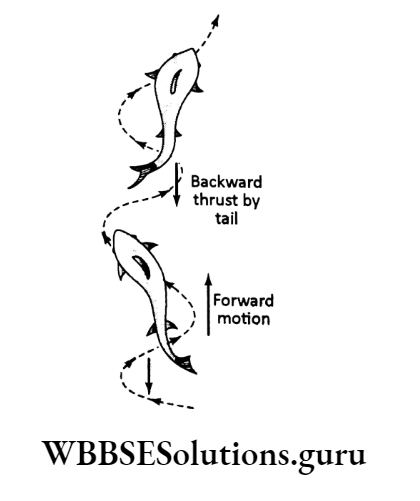
Answer: True

Question 4. When a cow uses its tail to drive away flies, it is an example of locomotion.
Answer: False

Question 5. Skeletal muscles are involuntary muscles.
Answer: False

WBBSE Chapter 1 Locomotion As A Type Of Response In Animals Match The Column

WBBSE Solutions For Class 10 Life Science Chapter 1 Control And Coordination In Living Organisms Topic E Locomotion As A Type Of Response In Animals match the column 1
Answer: 1-C,2-A,3-B,4-D

WBBSE Solutions For Class 10 Life Science Chapter 1 Control And Coordination In Living Organisms Topic E Locomotion As A Type Of Response In Animals match the column 2
Answer: 1-E,2-A,3-B,4-C

WBBSE Chapter 1 Locomotion As A Type Of Response In Animals Very Short Answer Type Questions

Question 1. What are pseudopodia?
Answer: These are temporary cytoplasmic blunt extensions formed by sol-gel transformation for locomotion, as found in Amoeba.

Question 2. What are remiges?
Answer: The flight feathers of the wings of birds are called remiges.

Question 3. What is arthrology?
Answer: The term arthrology is applied to the study of joints.

Question 4. What is a ‘ball and socket’ joint?
Answer: The ball and socket joint occurs in bones where the rounded head of one bone fits into the socket or cavity of another bone allowing the greatest degree of movement.

Wbbse Life Science Class 10 Chapter 1 Questions And Answers

Question 5. Name the cells/tissues in the human body which exhibit:
Answer:

  1. Amoeboid movement
  2. Ciliary movement
  3. Macrophages and leucocytes in blood exhibit amoeboid movement
  4. Coordinated movement of cilia is observed in the ciliated epithelium lining of the trachea.

Question 6. Name the movable skull bone in the human skeleton.
Answer: Mandible (lower jaw)

Question 7. Name the cup-shaped bone that covers the knee.
Answer: Patella.

Question 8. Classify the following as movement or locomotion:
Answer:

  1. The bees leave their hive in search of pollen
  2. The elephant uses its trunk to pick up a log
  3. Locomotion
  4. Movement

Question 9. Among the following four terms, one includes the other three. Find out that term and write it: saddle joint, pivot joint, synovial joint, hinge joint.
Answer: Synovial joint.

Question 10. Name the joints involved in the activity of lifting an object by the hand.
Answer: Shoulder joint, elbow joint, and wrist joint.

WBBSE Chapter 1 Locomotion As A Type Of Response In Animals Short Answer Type Questions

Question 1. State the difference between flagella and cilia concerning location and number.
Answer:

The difference between flagella and cilia about location and number

Location: While cilia cover the entire surface, the flagellum is present at one end of a cell.

Number:

A cell contains many cilia (a few hundred per cell) whereas the number of flagella is usually 1 or 2 only.

Question 2. Distinguish between the ball & socket joint and the hinge joint.
Answer:

Difference between the ball & socket joint and the hinge joint

WBBSE Solutions For Class 10 Life Science Chapter 1 Control And Coordination In Living Organisms Topic E Locomotion As A Type Of Response In Animals ball and socket

Question 3. Name the locomotory organ of hydra. Describe the various modes of locomotion performed by it.
Answer:

The locomotory organs of the hydra are basal discs and tentacles.

Hydra performs locomotion by-

  1. Walking
  2. Looping
  3. Somersault and
  4. Glide.

Walking:

It bends down and attaches the tentacles to the substratum with the help of nematocysts. It now releases and removes the basal disc to a new position and again stands up by disengaging the tentacles. This type of locomotion is called walking.

Locomotion As A Type Of Response In Animals Class 10 Wbbse

looping:

The hydra may bend its body to perform a looping movement like that of a leech.

Somersault:

When in a hurry, the animal runs by performing a series of somersaults.

Gliding:

Hydra may glide considerably by dragging the basal disc.

Question 4. What are joints?
Answer:

Joints

The junction between two bones or between a bone and cartilage forms joints or an articulation that permits varying degrees of movements by functioning as a fulcrum and using the force generated by the muscles to carry out the movements.

Joints Are Classified Into Three Groups:

immovable, slightly movable, and freely movable or synovial joints.

Question 5. What are synovial joints?
Answer:

Synovial joints

Synovial joints are the only joints that have a fluid-filled synovial cavity between the articulating surfaces of the two bones. These are freely movable joints mostly present between the limb bones. They permit a great deal of movement.

Question 6. What do you mean by adduction and abduction?
Answer:

Adduction and Abduction

Abduction and adduction are two terms that are used to describe movements towards or away from the midline of the body. Abduction refers to the movement of limbs away from the midline.

When a body is in the anatomical position abduction refers to raising the upper extremities out to the sides.

Adduction refers to the movement of limbs toward the midline. Bringing the abducted upper extremities back down to the sides of the body is adduction. Drawing our fingers (or toes) close together is also adduction.

WBBSE Chapter 1 Locomotion As A Type Of Response In Animals Long Answer Type Questions

Question 1. Write about the motives of animal locomotion. What are the basic differences between movement and locomotion?
Answer:

Reasons And Motivations Behind Locomotion

Animals move for a variety of reasons, such as to find food, a mate, a suitable microhabitat, or to escape from predators.

Hunt For Food & Water:

Since animals can not prepare food, they are to perform locomotion to find out suitable area with plenty of food & water.

To seek shelter & escape from predators:

Locomotion increases the chances of survival of an organism by allowing the organism to seek shelter in favorable habitat, and to escape dangerous situations by avoiding predators.

Dispersal for mating or breeding:

Locomotion enables members of the species to disperse to find suitable mates to coordinate breeding activity and the survival of the young.

Locomotion As A Type Of Response In Animals Class 10 Wbbse

Search for a new & favorable environment:

Animals, especially birds, migrate from areas of low or decreasing resources to areas of high or increasing resources. The two primary resources being sought are food and nesting locations. Escaping from cold is also a factor.

Basic differences between movement and locomotion:

Though, in the case of animals, we often use the terms movement and locomotion, interchangeably, there are definite differences between the two.

Locomotion takes place at the organism level while movement can take place at any biological level from cellular to organisms.

In simple words, locomotion is movement from one place to another and involves shifting of the entire body parts (e.g. a person moving or running) and movement involves a change in shape, size, or direction of various body parts (e.g. shaking of your hands).
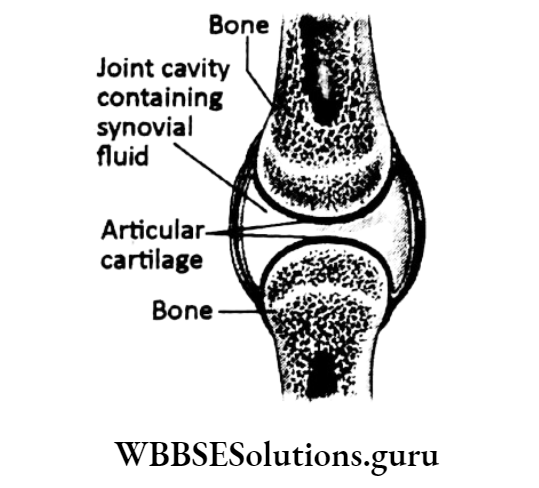
All kinds of locomotion are movements but all kinds of movements are not locomotion.

Movement is the motion that occurs in an organism or a body with or without the involvement of any change in the position or location of the organism or the body,

while locomotion is defined as the voluntary movement of an organism from one place to another either in search of food or shelter or mate or to escape from the predators.

Therefore, the differences between movement and locomotion may be summarized in a tabular form as below:

WBBSE Solutions For Class 10 Life Science Chapter 1 Control And Coordination In Living Organisms Topic E Locomotion As A Type Of Response In Animals Movement And locomotion

WBBSE Objective Type Questions Write True Or False

Question 1. Flagella is the locomotory organ of Paramoecium.
Answer: False

WBBSE Solutions For Class 10 Life Science Chapter 1 Response And Chemical Coordination In Plants Hormones

WBBSE Chapter 1 Response And Chemical Coordination In Plants Hormones Introduction to Phytohormones

Plants neither possess any nervous system nor any coordinating fluid. Maintenance of coordination between different parts of the plant is brought about by chemical substances called phytohormones or plant hormones.

The growth-promoting organic chemical substances in plants that are synthesized in minute quantities in different growing regions and help in plant growth, differentiation, and development by functioning on target organs either locally or at a site remote from its place of production are known as phytohormones or plant growth regulators (PGR) or Growth promoting substances (GPS).

Five classes of phytohormones regulate plant growth and development. Three of these auxins, cytokinins, and gibberellins are hormone classes. Each class includes several chemicals with similar structures and functions.

Read and Learn More WBBSE Solutions For Class 10 Life Science

WBBSE Chapter 1 Response And Chemical Coordination In Plants Hormones Classification Of Phytohormones


WBBSE Solutions Chapter 1 Hormones Phytohormone

Natural Phytohormones:

These hormones are synthesized within the plant body.

Examples:

Auxins (or Indole acetic acid-IAA), Gibberellins (or Gibberellic acid- GA), and Cytokinins.

Apart from the above, the natural phytohormones that are required by plants in relatively lesser amounts but have specific functions are called minor hormones.

Abscisic acid and Traumatic acid are examples of minor hormones. Abscisic acid induces the closure of stomata and the shedding of leaves. Traumatic acid helps in the healing of wounds in plants.

WBBSE Notes For Class 10 Geography And EnvironmentWBBSE Notes For Class 10 History And Environment
WBBSE Solutions For Class 10 Life ScienceWBBSE Class 10 Life Science Multiple Choice Questions
WBBSE Solutions for Class 10 MathsWBBSE Class 10 Maths Multiple Choice Questions
WBBSE Notes For Class 10 Physical Science And Environment


Artificial Phytohormones:

These are organic compounds synthesized in laboratories that act as natural phytohormones.

Examples:

Indole propionic acid (IPA), Indole butyric acid (I BA), Naphthalene acetic acid (NAA), Methyl chlorophenoxy acetic acid (MCPA), 2, 4-Dichlorophenoxy acetic acid (2, 4-D), etc.

Postulated (Hypothetical)

WBBSE Class 10 Life Science Chapter 1 Solutions 

phytohormones:

The characteristics and mode of action of these hormones are not yet fully discovered.

Examples:

Florigen, Vernalin, Dormin, Calines, etc.

WBBSE Solutions For Class 10 Life Science Chapter 1 Response And Chemical Coordination In Plants Hormones

WBBSE Chapter 1 Major Characteristics Of Phytohormones

These are complex organic compounds containing C, H, O, and N. Auxins and cytokinins are both nitrogenous hormones but Gibberellins are non-nitrogenous hormones.

These are both natural and artificial. These may be produced from different plant tissues or can be synthesized artificially in the laboratory.

These are mostly plant growth regulators.

These may be antagonistic in effect, counteracting each other; like auxin and cytokinin.

These are both localized and transported in nature, i.e. produced at one point and active at some other point after being transported along the conducting tissue by getting dissolved in water.

WBBSE Solutions Chapter 1 Hormones Major Charcteristics Of Phytohormones

They may accumulate at certain growth regions. Auxin exhibits apical dominance and brings about apical growth.

It was shown by the famous experiment of Went called the Avena coleoptile curvature test In this experiment, he showed that phototropic curvature may be blocked, if the shoot tip is excised off or if a metallic plate is inserted just below the shoot tip.

But when excised shoot tip is transferred onto an agar block and the block itself is transferred onto the decapitated shoot, the phototropic curvature reoccurs.

This indicates that the auxin, which is produced near the tip, accumulates below and induces phototropic curvature in the shoots of flowering plants.

The concentration of different phytohormones varies with the different stages of plant growth.

Phytohormones are stored in the plant body and they are destroyed after their function is over.

Phytohormones are artificially used to increase the agricultural productivity of crop plants.

Phytohormones act as specific signaling molecules that help in the initiation of different physiological functions.

WBBSE Class 10 Life Science Chapter 1 Solutions 

WBBSE Chapter 1 Response And Chemical Coordination In Plants Hormones Sources Of Phytohormones

Several types of phytohormones like auxin, gibberellin, and cytokinin are found in several plants.
Auxin occurs in the apical meristem.

Gibberellin mostly occurs in germinating seeds, cotyledons, growing leaves, apical buds, and root tips. Cytokinin occurs in endosperm tissue, apical meristem, vegetative meristem, and root tips.

WBBSE Chapter 1 Response And Chemical Coordination In Plants Hormones Hormone Mediated Sensitivity In Plants

Hormones directly control sensitivity in plants. The exposure of light from a particular direction leads to the accumulation of auxin on the opposite surface as auxin is photolabile.

Consequently, the shoot bends in the opposite direction showing positive phototropic activity.

The accumulation of auxin near the root tip under the action of gravity leads to the growth of the root tip by positive geotropism.

The presence of moisture induces the secretion of gibberellin-mediated enzyme amylase which converts insoluble storage starch to soluble monosaccharide glucose.

This increases the osmotic potential of the cell and thus endosmosis occurs as a result of which the seed coat swells and the seed germinates.

WBBSE Solutions Chapter 1 Phototropic Activity

WBBSE Chapter 1 Regulation Of Physiological Activities Of Plants Leading To Increase In The Agricultural Productivity

Apical growth of plant shoots and roots is promoted by auxin; so the plant increases in size.

Healing of wounds by the formation of callus tissue by auxin (IAA) prevents infection or insect damage.

Prevention of abscission of leaves by auxin causes pre-harvest loss of leaves.

Parthenocarpic (seedless) fruit development with the help of auxin makes fruit like grapes economically more viable.

Destruction of weed hosts with certain synthetic auxin compounds like 2,4-D reduces the competition from different weed plants.

Initiation of intercalary growth due to elongation of the internode by gibberellin (GA3), induces growth for different stem vegetables.

Transformation of the apical bud to the floral bud by GA3 induces more branching.

WBBSE Solutions Chapter 1 Branching

Application of GA3 induces flowering to many long-day rosette plants, for Example lettuce, radish, etc. Auxin induces flowering in pineapples.

Gibberellin induces early germination of seeds.

Morphogenesis by the induction of root or shoot through auxin-cytokinin balance is very useful for plant tissue culture.

Class 10 Life Science Plant Hormones Notes 

Cytokinin induces the bushy habit of a plant which is useful for plants like tea, where more apical buds and leaves are required.

WBBSE Chapter 1 Response And Chemical Coordination In Plants Hormones Mechanism Of Transport Of Phytohormones

Phytohormones Exhibit Four Major Types Of Transport:

Within the cell, they follow cyclosis around the large central vacuole or smaller vacuoles.

In between two adjacent cells, they follow the cytoplasmic streaming movement through the plasmodesmata connections.

It follows upward translocation through xylem vessels.

It can also follow the transcellular strands across the sieve plate, passing through the sieve plate regions.

The fate of hormones: They are destroyed after their function is over.

WBBSE Chapter 1 Response And Chemical Coordination In Plants Hormones Major Plant Hormones Auxin

Auxins are a class of nitrogenous phytohormones & the most important growth regulators produced from the growing regions of plant tissue including roots, shoots, and leaves.

These promote cell division and stem and root growth. These can also drastically affect plant orientation by promoting cell division on one side of the plant in response to sunlight & gravity.

The term auxin was first used by Frits Went.

Chemical composition:

Auxins generally occur as complexes, usually found with an amino acid or sugar. These are composed of carbon, hydrogen, oxygen, and nitrogen.

The amino acid Tryptophan and many other Indole compounds serve as precursors of auxins.

Chemical composition:

Auxins generally occur as complexes, usually found with an amino acid or sugar. These are composed of carbon, hydrogen, oxygen, and nitrogen.

The amino acid Tryptophan and many other Indole compounds serve as precursors of auxins.

Types: They are classified into two types as detailed below:

Natural Auxin:

They are Indole compounds like Indole 3-Acetic Acid (IAA) and Non-Indole compounds like Naphthalene Acetic Acid. Indole 3-acetic Acid was the first plant hormone identified.

It is manufactured primarily in the shoot tips (in leaf primordia and young leaves), in embryos, and in parts of developing flowers and seeds.

Synthetic Auxin:

These are synthetic compounds similar to natural auxin and they include 2,4-D (2,4-Dichlorophenoxy Acetic Acid) or 2, 4, 5-T (2,4,5- Trichlorophenoxy Acetic Acid).

Class 10 Life Science Plant Hormones Notes 

Translocation:

The transport of IAA from cell to cell through the parenchyma surrounding the vascular tissues requires the expenditure of ATP energy.

IAA moves in one direction only i.e., the movement is polar and in this case, downward.

Such downward movement in shoots is said to be basipetal (apex to base) and in roots it is acropetal (outwards towards the root apices from the base).

Synthetic auxins move in all directions inside plants.

Function:

Apical Growth:

Auxins bring about apical dominance and thereby induce apical growth of the shoot.

Tropic movements:

These are deposited unequally on the shoot or root surface and thus cause phototropic curvature and geotropism

WBBSE Solutions Chapter 1 Phototropic Curvature And Geotropism

Cell enlargement:

Auxin helps to increase the size and volume of the cells.

Cell enlargement is caused by the solubilization of carbohydrates, loosening of wall microfibrils, synthesis of more wall materials, increased membrane permeability, and respiration.

Metabolism:

Auxin stimulates respiration by increasing the availability of respiratory substrate. Thus it enhances metabolism by mobilizing plant resources.

Cambial activity:

The degree of cambial activity is directly proportional to auxin concentration. Auxin also controls xylem differentiation.

Cell division:

It initiates the cell division of the parenchymatous cells at the site of wounded tissue causing healing of wounds after mechanical injury in plants.

Root formation:

Auxin promotes root initiation at a concentration that is inhibitory for the growth of intact roots.

Class 10 Life Science Plant Hormones Notes 

Parthenocarpic fruit Development:

Pollen contains a lot of auxin, it acts as a signal indicating the completion of pollination and transformation of the ovary to fruit.

Thus the application of synthetic auxin induces the development of fruit without the act of fertilization i.e. parthenocarpic fruit development.

Synthetic auxin (2,4-D) initiates rootings in stem cuttings.

(x)Synthetic auxin can act as a weedicide by killing dicotyledonous weeds preventing the division of cambial tissue.

As monocotyledonous plants are devoid of cambium, they are not destroyed by auxin compounds.

Anti-auxin:

Auxins have an inhibitory effect on the abscission of leaves and fruits, i.e., shedding of mature leaves and ripe fruits from the plant.

It has been found that the abscission zone does not form when the concentration of auxins is high in the leaves or fruits.

On the contrary, Abscisic acid (ABA) is a major hormone in plants that induces the formation of an abscission zone in the leaf stalk or petiole and brings about the shedding of leaves.

It acts as an antiauxin because it counteracts the auxin activity by initiating abscission.

WBBSE Chapter 1 Response And Chemical Coordination In Plants Hormones Gibberellin

Gibberellins are one of the longest-known classes of non-nitrogenous phytohormones that regulate various developmental processes including stem elongation, germination, dormancy, flowering, and leaf and fruit senescence.

Gibberellic acid or gas can be of more than 100 types the most common being 3- Gibberellic Acid (GA3).

Gibberellin was discovered by Kurosawa (1926) from rice plants suffering from Bakanae (foolish seedling) disease caused by Gibberella fujikuroi.

Gibberellins are naturally synthesized in maturing seeds, germinating seedlings, growing tissues of expanding cotyledons, growing leaves, apical buds, root tips, etc.

Class 10 Life Science Plant Hormones Notes 

Chemical composition:

Gibberellins are tetracyclic diterpene acids. These consist of carbon, hydrogen, and oxygen.
Acetate is the precursor for the synthesis of all kinds of gibberellins.

The gibberellins are named GAj through GAn in the order of discovery.

Translocation:

All known gibberellins are synthesized in plastids and then modified in endoplasmic reticulum and cytosol until they reach their biologically active form.

The transport of gibberellin is not polar. These are transported in all directions from the site of formation through the xylem, phloem, or by cell tq cell.

Functions:

Elongation of internode:

It brings about the growth of the internode and thereby brings about apical growth along with auxin.

Flowering:

It modifies the apical bud to the floral bud, by bringing about the development of floral tissue through modification of the apical meristem.

Breaks seed dormancy:

It breaks seed dormancy and induces germination of seed through denovo synthesis of a-amylase.

Leaf growth:

It helps in the development of young leaves through stimulation of the leaf meristem

It promotes fruit growth and development. It also influences parthenocarpy.

WBBSE Chapter 1 Response And Chemical Coordination In Plants Hormones Cytokinins

The nitrogenous phytohormone cytokinins are amino derivatives of purine bases that promote cell division or cytokinesis, cell growth & differentiation, and also affect apical dominance, axillary bud growth, and leaf senescence.

These are present in plant tissues like plant shoots, roots, endosperm tissues, vegetative meristem, and also in yeast extract and coconut milk.

Miller first isolated cytokinin from Yeast DNA that can stimulate cell division in plants.

Class 10 Life Science Plant Hormones Notes 

Cytokinins Chemical Composition

Cytokinins are derived from nitrogen-containing adenine. These are alkaline water-soluble aminopurine and consist of carbon, hydrogen, oxygen, and nitrogen.

Types:

These are broadly of two major types:

kinetin and zeatin.

Translocation:

Most of the cytokinins are synthesized in root tips and then these are transported through the xylem.

Functions:

Cell division:

Cytokinins are essential for cytokinesis through chromosome doubling can occur in their absence.

In the presence of Auxins, cytokinins bring about division even in permanent cells.

Cell division in callus (unorganized, undifferentiated, irregular mass of dividing cells in tissue culture) is found to require both hormones.

They counteract apical dominance, prevent apical growth induced by auxin, so also called anti-auxin, and also induce lateral branching.

They stimulate lateral bud growth but inhibit lateral root growth.

Morphogenesis:

They are important growth regulators used in plant tissue culture, i.e. along with auxin, they bring about morphogenesis of plant tissue.

The intermediate amount of auxin and cytokinin induces undifferentiated callus tissue, but high auxin and low cytokinin induce rooting and low auxin and high cytokinin induces shooting in plant tissue culture experiments.

It delays senescence by preventing cell death through the mobilization of nutrients. This phenomenon is called the Richmond Lang Effect.

Ethylene

The phytohormone ethylene is a simple gaseous hydrocarbon produced from an amino acid and appears in most plant tissues in large amounts when they are stressed.

It diffuses from its site of origin into the air and affects surrounding plants as well.

Ethylene is ordinarily produced by roots, senescing flowers, ripening fruits, and the apical meristem of shoots. Auxin increases ethylene production, as does ethylene itself.

Class 10 Life Science Plant Hormones Notes 

Ethylene stimulates the ripening of fruit and initiates the abscission of fruits and leaves.

In monoecious plants (those with separate male and female flowers borne by the same plant), gibberellins and ethylene concentrations determine the sex of the flowers.

Ethylene suppresses stem and root elongation.

Abscisic Acid

Abscisic acid (ABA) is synthesized in plastids from carotenoids and diffuses in all directions through vascular tissues and parenchyma.

Its principal effect is the inhibition of cell growth. ABA increases in developing seeds and promotes dormancy. If leaves experience water stress, the amount of ABA increases immediately causing the stomata to close.

WBBSE Chapter 1 Response And Chemical Coordination In Plant Hormones Synthetic Hormone

These are chemical compounds that act as plant growth regulators and can be synthesized in the laboratory, e.g. NAA (Naphthalene Acetic Acid), 2,4-D (2,4 Dichlorophenoxy acetic acid), IPA (Indole propionic acid), etc.

Use of synthetic hormones:

Use Of Synthetic Auxins

Parthenocarpy:

Application of auxins (IAA, IBA) and conjugate auxins (e.g. IBA-alanine) to unpollinated pistils make them develop into seedless fruits or parthenocarps which carry a better market price than normal fruits having seeds.

Flowering:

NAA & 2,4—D is used to induce flowering in Litchi and Pineapple.

Pre-harvest fruit drop:

In low concentrations, 2,4-D is useful in preventing pre-harvest fruit drops of oranges and apples. NAA is used similarly to check fruit drops in tomatoes.

Weedicides/Herbicides:

These are the chemicals used to kill weeds growing in the fields.

Application of 2, 4-D and 2, 4, 5-T removes broad-leaved cereal crops and lawns because they do not affect mature monocot plants while Dalapon kills grasses in broad-leaved crops.

Response And Chemical Coordination In Plants Class 10 WBBSE

Rooting:

Auxins like IBA, IBA-alanine, and NAA stimulate root formation on the stem cutting.

WBBSE Chapter 1 Response And Chemical Coordination In Plant Hormones Use Of Synthetic Gibberellins

Fruit growth:

The application of gibberellins increases the number and size of several fruits, eg., grapes, tomatoes, etc. A mixture of GA4 and GA7 enhances the size of apples.

Overcoming dormancy:

Gibberellins induce the germination of positively photoelastic seeds of tomato and lettuce in complete darkness.

Delayed ripening:

GA7 delays senescence so that fruits can be left on the tree for longer periods. It extends the period of marketing.

Ripening of citrus fruits can be delayed with the help of gibberellins. This is useful in storing fruits.

Parthenocarpy:

The application of gibberellins to unpollinated flowers can produce seedless pomaceous fruits.

Flowering:

Gibberellins induce off-season flowering in many long-day plants as well as plants requiring vernalization.

Response And Chemical Coordination In Plants Class 10 WBBSE

Use Of Synthetic Cytokinins

Tissue culture:

Cytokinins promote cell division and morphogenesis. These are provided to tissue culture through the addition of coconut milk or yeast extract.

Resistance:

Cytokinin is helpful to plants in developing resistance to pathogens and extremes of temperature.

Overcoming senescence:

Cytokinins delay the senescence of intact plant parts.

Shelf life:

The application of cytokinin to marketed vegetables can keep them fresh for several days. The shelf life of cut shoots and flowers is prolonged by using these hormones.

WBBSE Chapter 1 Topic B Response And Chemical Coordination In Plants Hormones Fill In The Blanks

Question 1. The major plant growth hormone is____________________.
Answer: Auxin

Question 2. The hormone auxin is present in the ____________________ meristem.
Answer: Apical

Question 3. ‘Harmao’means____________________.
Answer: Excitation

Question 4. ____________________controls tropic movement in plant.
Answer: Auxin

Response And Chemical Coordination In Plants Class 10 WBBSE

Question 5. Downward translocation of auxin occurs through____________________.
Answer: phloem

Question 6. Seedless fruit is also called____________________ fruit.
Answer: Parthenocarpic

Question 7. Axillary bud is promoted by____________________.
Answer: Gibberellin

Question 8. The hormone acting as a weedicide is ____________________.
Answer: 2, 4-D

Question 9. The coleoptile contains the hormone ____________________.
Answer: Auxin

Question 10. The seed____________________ contains Cytokinin.
Answer: Endosperm

Question 11. The____________________ ring is present in Gibberellin.
Answer: Gibbane

Question 12. The dormancy of seed is broken by____________________ .
Answer: Gibberellin

Question 13. The fungus____________________contains kinetin.
Answer: Yeast

WBBSE Life Science Class 10 Chapter 1 Questions And Answers 

Question 14.____________________ is a natural auxin.
Answer: IAA

Question 15. Cytokinin induces____________________ effect.
Answer: Richmond Lang

Question 16. Gibberellin increases the activity of____________________ enzyme in the seed.
Answer: Alpha-Amylase

Question 17. Tissue culture is induced by____________________.
Answer: Kitten

Question 18. Phytohormones act as____________________ messenger
Answer: Chemical

Question 19. Gibberellin acts on ____________________ meristem.
Answer: Intercalary

Question 20.____________________ is a non-indole compound.
Answer: NAA

Question 21. ____________________is an antiabscission hormone.
Answer: IBA

Question 22. ____________________cambium is produced by cytokinin.
Answer: Inter-Fascicular

Question 23. ____________________induces branching.
Answer: KInetin

Question 24. ____________________is a postulated hormone inducing flowering.
Answer: Florigen

WBBSE Life Science Class 10 Chapter 1 Questions And Answers 

Question 25. ____________________is a gaseous hormone.
Answer: Ethylene

WBBSE Chapter 1 Response And Chemical Coordination In Plant Hormones Write True Or False

Question 1. IAA is a natural auxin.
Answer: True

Question 2. Cytokinin counteracts apical dominance.
Answer: True

Question 3. NAA is a weedicide.
Answer: False

Question 4. Ethylene is a postulated hormone.
Answer: False

Question 5. Auxin may be transported through the phloem.
Answer: True

WBBSE Life Science Class 10 Chapter 1 Questions And Answers 

Question 6. Auxin is synthesized from tyrosine.
Answer: False

Question 7. Auxin is photolabile in nature.
Answer: True

Question 8. Vernalin is a postulated hormone.
Answer: True

Question 9. Auxin is a terpenoid compound.
Answer: False

Question 10. Auxin and Kinetin help in morphogenesis.
Answer: True

Question 11. Gibberellin prolongs seed dormancy.
Answer: False

Question 12. Cytokinin induces early aging.
Answer: False

Question 13. ABA induces abscission.
Answer: True

Question 14. Auxin promotes apical growth.
Answer: True

WBBSE Life Science Class 10 Chapter 1 Questions And Answers 

Question 15. Auxin promotes taxis.
Answer: True

Question 16. Auxin promotes seed germination.
Answer: False

Question 17. Gibberellin induces the production of a-amylase in a germinating seed.
Answer: True

Question 18. Artificial auxin acts as a herbicide in crop plants.
Answer: True

Question 19. Florigen is a single hormone.
Answer: False

Question 20. Yeast produces Kinetin.
Answer: True

WBBSE Chapter 1 Topic B Response And Chemical Coordination In Plants Hormones Match The Column

WBBSE Solutions Chapter 1 Control And Coordination In Living Organisms Topic B Response And Chemical Coordination In Plants Hormones match the coulumn 1
Answer: 1-D,2-C,3-B,4-A


WBBSE Solutions Chapter 1 Control And Coordination In Living Organisms Topic B Response And Chemical Coordination In Plants Hormones match the coulumn 2
Answer: 1-C,2-D,3-B,4-A

WBBSE Chapter 1 Response And Chemical Coordination In Plants Hormones Very Short Answer Type Questions

Question 1. Name a hormone acting as weedicide.
Answer: 2,4-D.

Question 2. Who gave the name hormone?
Answer: Bayliss and Starling (1905).

Question 3. Which area of the plant usually produces phytohormone?
Answer: Meristematic tissue.

Question 4. What is usually the actual nature of phytohormone?
Answer: Growth regulator.

Question 5. Name the first discovered phytohormone.
Answer: Auxin.

WBBSE Class 10 Life Science Chapter 1 Solutions 

Question 6. Give the full name of 2, 4-D.
Answer: 2,4 dichloro phenoxy acetic acid.

Question 7. Give the full name of 2, 4, 5-T.
Answer: 2,4, 5 trichloro phenoxy acetic acid.

Question 8. Name the amino acid which produces auxin.
Answer: Tryptophan.

Question 9. Where was auxin discovered?
Answer: Avena coleoptile.

Question 10. Where was Gibberellin discovered?
Answer: Rice plant infected with Bakanae disease.

Question 11. What does auxin mean?
Answer: To grow.

Question 12. What movement in a plant is controlled by auxin?
Answer: Tropism.

Question 13. Name two hormones preventing leaf fall.
Answer: D and NAA

Question 14. Name a phytohormone that can never act alone.
Answer: Cytokinin can never act alone. In conjunction with auxin, cytokinin stimulates cell division in nonmeristematic tissue and controls cell differentiation.

Question 15. Who named Gibberellin?
Answer: Yabuta.

WBBSE Class 10 Life Science Chapter 1 Solutions 

Question 16. Name the enzyme induced by GA3 in the germinating seed.
Answer: A-amylase.

Question 17. Name the meristematic tissue that produces Gibberellin.
Answer: Intercalary meristem.

Question 18. Name an artificial kinetin.
Answer: Azakinetin.

Question 19. Give the chemical name of cytokinin.
Answer: 6 furfuryls amino purine.

Question 20. Name a rejuvenating hormone.
Answer: Cytokinin.

Question 21. Name a plant part where cytokinin content is high.
Answer: Seed endosperm.

Question 22. Name the hormone-preserving chlorophyll.
Answer: Cytokinin.

Question 23. Name a hormone derived from purine.
Answer: Kinetin.

Question 24. Give the formula for auxin.
Answer: C10H9NO2

Question 25. Give the formula for gibberellin.
Answer: C19H22°6.

WBBSE Class 10 Life Science Chapter 1 Solutions 

Question 26. Give the formula for kinetin.
Answer: C10H9 N5 O.

Question 27. Name another hormone other than auxin which
Answer: plays a part in the tropic movements of plants. In sunflowers, phototropic and geotropic responses of shoot tips are due to the redistribution of gibberellins.

Question 28. Name two hormones that determine sex expression in monoecious plants.
Answer: Ethylene and gibberellin.

Question 29. What is ‘wound hormone’?
Answer:

‘Wound hormone’

Most plants form calli when they are injured.

Injured cells secrete a wound hormone which induces the neighboring uninjured cells to become meristematic and divide till the injured part is healed up.

This wound hormone is chemically identified to be Traumatic acid.

Question 30. What are growth inhibitors?
Answer:

Growth inhibitors

Growth inhibitors retard the growth of plants irrespective of their concentration. They retard such processes as seed germination, root and stem elongation, and bud opening.

Examples: ABA, quinones, gallic acids, etc.

WBBSE Class 10 Life Science Chapter 1 Solutions 

Question 31. Choose the odd one and write it:
Answer:

IA A, NAA, 2,4-D, 2,4,5-T IAA: Natural Auxin while the other examples are synthetic auxins.

Question 32. A pair of related terms is given below. On the basis of the relationship in the first pair, write the suitable word in the gap of the second pair:

Apical dominance: Auxin:: Stimulation of lateral branching: Cytokinin

Nitrogenous phytohormone: Cytokinin:: Nonnitrogenous phytohormone: Gibberellin + State two major functions of plant hormone.

Answer:

  1. They act as chemical messengers.
  2. They act as growth regulators.

Question 2. What are natural hormones? Give example.
Answer:

Natural hormones

The hormones which are produced naturally in a plant body are called natural hormones, e.g. IAA, Gibberellic acid, and Cytokinin.

Question 3. State the chemical nature of phytohormones.
Answer:

The chemical nature of phytohormones

Phytohormones can be organic acids or amino derivatives of purine, terpenoids, polypeptides, etc.

Class 10 Life Science Plant Hormones Notes

Question 4. Where are phytohormones produced?
Answer:

Phytohormones are produced from apical and intercalary meristems, cotyledons, coleoptile, endosperm, and fruits.

Question 5. What are artificial hormones? Give example.
Answer:

Artificial hormones

Artificial hormones are chemical compounds produced in the laboratory having the same function as phytohormones, e.g. Indole Propionic Acid (IPA), Indole Butyric Acid (IBA), etc.

Question 6. What have postulated hormones? Give example.
Answer:

Postulated hormones

These are functional chemicals but their individual structure and mode of functioning are not yet determined properly. Hence these are called postulated hormones, e.g., Florigen, Vernalin, etc.

Question 7. What are growth inhibitor hormones?
Answer:

Growth inhibitor hormones

The hormones which inhibit plant growth are called growth inhibitors, e.g. Ethylene, Abscisic acid.

Question 8. State two features of auxin.
Answer:

Features of auxin:

Auxins generally occur as complexes, usually bound with an amino acid or sugar. These are composed of carbon, hydrogen, oxygen, and nitrogen.

Auxin is photolabile, i.e. susceptible to change under the influence of light.

Class 10 Life Science Plant Hormones Notes

Question 9. How can vernalization be replaced by the application of gibberellins?
Answer:

Vernalization is a period of cold treatment for plants, usually perennials or trees.

Some plants do not bloom without it. In vernalization, plants are exposed to low temperatures in order to stimulate flowering or to enhance seed production.

The biennials form their vegetative body in the first year. Then they pass through a winter season and then produce flowers and fruits in the second year.

By exogenous application of gibberellins, many biennials can be induced to behave as annuals and they no more require the natural chilling treatment for their flowering.

Question 10. Which hormone helps in the production of parthenocarpic fruit?
Answer:

IAA or IBA helps in the production of seedless fruit or parthenocarpic fruit in papaya, guava, tomato, watermelon, etc.

Question 11. Give the name of common gibberellin and state the plant tissue where it is commonly found.
Answer:

3-gibberellic acid (GA3) is the common gibberellin. It is found in matured seeds, germinating seeds, cotyledon, etc.

Question 12. What is an emergency plant hormone?
Answer:

Eemergency plant hormone

Abscisic acid is an emergency plant hormone or stress hormone because it helps the plant to survive in dry conditions by closing the stomata and thereby reducing transpiration.

ABA plays an important role in plants during water stress and drought conditions. It also causes the closure of stomata under high concentrations of CO2 in the guard cells.

The concentration of ABA increases in the leaves of plants facing such stresses. Hence it is known as a stress hormone.

Class 10 Life Science Plant Hormones Notes

Question 13. Name two synthetic anti-hormone in plants.
Answer:

Anti-auxin – 2, 3, 5 Tri iodo benzoic acid. Anti-gibberellin – Tri methyl ammonium chloride.

Question 14. Name two synthetic cytokinins.
Answer: Imidazole, Benzimidazole.

Question 15. What is florigen?
Answer:

Florigen

Florigen is a postulated hormone. It is produced in the leaf under favorable photoperiodic conditions and helps in flowering.

Question 16. The concentration of auxin stimulates the cells to grow longer on the side of the shoot which is away from light; but a potted plant, fixed vertically on a klinostat & rotated, shows no phototropic curvature in the stem-why? When the stem tip receives uniform light all around, the concentration of the growth hormone auxin remains uniform in the tip.

Answer: When the tip receives unilateral light, the concentration of auxin becomes more on the shaded side than on the lighted side.

Consequently, the higher concentration of auxin in the shaded side causes that side to grow more resulting ultimately in a positive phototropic curvature.

WBBSE Solutions Chapter 1 Phototropic Curvature

But when a young potted plant receiving unilateral light is fixed on a klinostat in a vertical position and rotated, there will be no phototropic curvature of the stem.

It is because in this case the stem tip receives unilateral light all around its tip and there will be no unequal distribution of auxin.

Question 17. State two functional roles of cytokinin.
Answer:

Two functional roles of cytokinin

  1. It helps in the rejuvenation of plants.
  2. It helps in morphogenesis in tissue culture.

Class 10 Life Science Plant Hormones Notes

Question 18. How does gibberellin help in the growth of plants?
Answer: In plants like sugarcane, tomato, and gibberellin increases the growth of internode and thus helps in the growth of dwarf plants.

Before the reproductive stage, there is too much elongation of internodes but there is less leaf formation.

An elongated internode without leaves is called a bolt-like structure and the process is called bolting.

Flowering takes place after bolting. Gibberellins induce cell division & cell elongation when bolting takes place.

Question 19. Name two hormones that help in the loss of premature fruit.
Answer: 2,4-D and NAA.

Question 20. How do hormones help in the destruction of weed?
Answer: 2, 4-D, 2, 4, 5-T, MCPA and NAA increase the osmotic stress in dicotyledonous herbaceous weeds and kill them. These act as weedicides or herbicides.

Question 21. What is the triple response in plants?
Answer:

Triple response in plants

Ethylene is a phytohormone that is produced in plants under the conditions of mechanical stress.

When the stem of a plant encounters mechanical stress (e.g., pushing against a rock above as it is sprouting), ethylene instigates the seedling to perform a growth maneuver called triple response.

The adaptive responses include the following:

  1. Elongation of the internode is inhibited to make the stem short.
  2. Increase the thickness of the stem to make the stem flat.
  3. Seedlings grow horizontally without responding to gravitropism to give rise to auxin imbalance.
  4. Ethylene removes the auxin imbalance and allows the stem to go around the obstacle by helping to form an exaggerated curved apical hook.

Class 10 Life Science Plant Hormones Notes

Question 22. What do you mean by apical dominance?
Answer:

Apical dominance

It has been generally observed that so long as the apical bud is intact on the plant, the growth of the lateral buds remains suppressed.

Upon removal of the apical bud, the lateral bud nearest to the apical bud establishes its dominance over the remaining buds, causing them to become inactive again.

This inhibitory effect of a terminal bud upon the development of the lateral buds is called apical dominance and this produces a cone-shaped plant.

Question 23. List any two inhibitory functions of auxin.
Answer:

Inhibiting growth of lateral buds: Auxin promotes apical dominance and has a dominating and inhibitory effect on the growth of lateral buds.

Inhibiting Abscission: Abscission means the fall of leaves, flowers, and fruits from the mature plant. Application of auxin can inhibit premature abscission.

Question 24. What is parthenocarpy?
Answer:

Parthenocarpy

The process of formation of fruits without pollination and fertilization is called parthenocarpy.

Nowadays it is possible to stimulate fruit development without pollination by the application of auxin (IAA) to the flower.

Due to this effect, seedless fruits or parthenocarps are produced.

Example: Banana, grapes, tomato, strawberry, squash, etc. Gibberellins also induce parthenocarpy.

Response And Chemical Coordination In Plants Class 10 WBBSE

Question 25. Mention a few similarities and dissimilarities in the functions of auxin and gibberellin. Similarities:
Answer:

Both auxin and gibberellins promote cell elongation, flowering, and parthenocarpy.

WBBSE Solutions Chapter 1 Control And Coordination In Living Organisms Topic B Response And Chemical Coordination In Plants Hormones Auxin and gibberellin

WBBSE Chapter 1 Response And Chemical Coordination In Plants Hormones Long Answer Type Questions

Question 1. What is phytohormone? State five major characteristics of phytohormone.
Answer:

Introduction to phytohormone

Plants neither possess any nervous system nor any coordinating fluid. Maintenance of coordination between different parts of the plant is brought about by chemical substances called phytohormones or plant hormones.

The growth-promoting organic chemical substances in plants that are synthesized in minute quantities in different growing regions and help in plant growth,

Differentiation, and development by functioning on target organs either locally or at a site remote from its place of production are known as phytohormones or plant growth regulators (PGR), or Growth-promoting substances (GPS).

Five classes of phytohormones regulate plant growth and development.

Three of these auxins, cytokinins, and gibberellins are hormone classes. Each class includes several chemicals with similar structures and functions.

Question 2. Mention the sources of natural phytohormones. What is the mechanism of transport of phytohormones?
Answer:

Sources Of Phytohormones

Several types of phytohormones like auxin, gibberellin, and cytokinin are found in several plants.
Auxin occurs in the apical meristem.

Gibberellin mostly occurs in germinating seeds, cotyledons, growing leaves, apical buds, and root tips. Cytokinin occurs in endosperm tissue, apical meristem, vegetative meristem, and root tips.

Mechanism Of Transport Of Phytohormones

Phytohormones Exhibit Four Major Types Of Transport:

Within the cell, they follow cyclosis around the large central vacuole or smaller vacuoles.

In between two adjacent cells, they follow the cytoplasmic streaming movement through the plasmodesmata connections.

It follows upward translocation through xylem vessels.

It can also follow the transcellular strands across the sieve plate, passing through the sieve plate regions.

The fate of hormones: They are destroyed after their function is over.

WBBSE Chapter 1 Short Answer Type Questions

Question 1. What influences gibberellin hormone exert on the seeds and internode of plants? Explain.
Answer: Influences of gibberellin on seeds & internodes of plants

Breaking of seed dormancy:

Gibberellin breaks seed dormancy and induces germination of seeds through de novo synthesis of a-amylase.

Elongation of internode:

Gibberellin brings about the growth of the internode and thereby brings about apical growth along with auxin.

WBBSE Solutions For Class 10 Life Science Chapter 1 Sensitivity And Response In Plants

WBBSE Chapter 1 Sensitivity And Response In Plants Introduction To Changing Environment

Living organisms are surrounded by and are harmful, the organisms move away from them to the environment undergoing continuous changes at all times.

Changes may be favorable or unfavorable. Changes that are detected by the organisms lead to responses.

The stimuli are a form of physiochemical change of energy, in the surrounding environment, which is detected by the organism and they respond in various ways.

Stimuli can be external, which includes modifying the outside environment like water, temperature, oxygen level, etc.

WBBSE Solutions For Class 10 Life Science Chapter 1 Sensitivity And Response In Plants

But sometimes these changes are internal like the accumulation of nitrogenous waste that necessitates excretion, osmoregulation, etc.

Sometimes these stimuli are beneficial, so organisms tend to move toward these stimuli. Unicellular green algae Chlamydomonas move towards the illuminated part of the water body, and plant roots grow towards water.

When the soil pH stimuli is acidic, the plant roots tend to retract from that part of the soil.

Read and Learn MoreWBBSE Solutions For Class 10 Life Science

What is sensitivity?
Sensitivity is the ability to detect the change in the environment and react to the stimuli accordingly. It is more pronounced in animals because they can show locomotion.

Some of the lower plants can exhibit locomotion like in unicellular or colonial green algae. Their response to stimuli is easily detectable in the form of positive or negative tactic movement.

WBBSE Class 10 Life Science Chapter 1 Solutions 

Higher plants on the other hand are fixed to the substratum with the help of roots and cannot move from place to place. So they exhibit slow growth movement that cannot be detected easily.

Certain other plants are relatively more sensitive and exhibit turgor movement in response to electrical or mechanical shock.

WBBSE Chapter 1 Sensitivity And Response In Plants Mechanism Of Sensing Environmental Changes And Stimuli In Plant

Plant organs sensing light with photosensitive compounds:

The organs are called phototropin, cryptochromes, and phytochromes, each reacting very specifically to certain wavelengths of light.

These light sensors tell the plant whether it is day or night, how long the day is, how much light is available, and where the light comes.

Shoots grow towards light and roots usually grow away from light. These responses are called phototropism and skototropism respectively.

WBBSE Notes For Class 10 Geography And EnvironmentWBBSE Notes For Class 10 History And Environment
WBBSE Solutions For Class 10 Life ScienceWBBSE Class 10 Life Science Multiple Choice Questions
WBBSE Solutions for Class 10 MathsWBBSE Class 10 Maths Multiple Choice Questions
WBBSE Notes For Class 10 Physical Science And Environment


Phototropism is affected by plant hormones along with the pigments mentioned above.

Many plants exhibit certain phenomena at specific times of the day; for example, certain flowers open only in the mornings.

Plants keep track of the time of the day with an internal molecular clock. This internal clock is set to the solar clock every day using sunlight.

The internal clock coupled with the ability to perceive light also allows plants to measure the time of the day and find the year’s season.

The seeds of many plants sprout only after they are exposed to light. This response is carried out by phytochrome signaling. Plants are also able to sense the quality of light and respond appropriately.

For example, in low light conditions, plants produce more photosynthetic pigments.

If the light is very bright or if the levels of harmful UV increase, plants produce more protective pigments, that act as sunscreens.


WBBSE Class 10 Life Science Chapter 1 Sensitivity And Response In Plants Sunflower


Production of signaling molecules:

Wounded tomatoes are known to produce the volatile methyl-jasmonate as an alarm signal.

Plants in the neighborhood can then detect the chemical by its odor and prepare for the attack by producing chemicals that defend against insects or attacking predators.

WBBSE Class 10 Life Science Chapter 1 Solutions 

Hormonal signaling in plants:

Plants systematically use hormonal signaling to coordinate their development and morphology.

A delicate balance between auxin and cytokinin brings about morphogenesis in a developing plant.

Phytochrome, gibberellin, and the hypothetical hormone florigen modify apical meristem to floral meristem.

Trapping of prey by insectivorous plants:

Stinging hairs of insectivorous plants like Sundew close the leaflets when they contact the insect body.

This is primarily due to the monastic movement.

Shock-based movement in plants:

Any mechanical or electrical pressure releases the water molecule from the pulvinus in Mimosa pudica and the plant droops down.

After some time with the discontinuity of the touch, the plant again regains its original configuration. This is called the seismonastic movement.

WBBSE Class 10 Life Science Chapter 1 Sensitivity And Response In Plants Shock Movement In Plants

A sensitivity test on Mimosa was first carried out by Acharya J.C. Bose, who showed that a low electricity shock of 1.3 volts can result in drooping and retraction movement in Mimosa pudica.

Bose used Crescograph for measuring the rate of growth of plants which is a device to magnify plant growth up to 10,000 times when different stimuli like temperature, chemicals, gases, and electricity stimulate them.

He proved that plants have life and showed that they show varied responses to stimuli.

Movement due to osmotic stress:

The leaflets of the Indian Telegraph plant Desmodium gyrans automatically go up and down with the basal leaflets’ loss and gain of turgidity.

As the leaflets go down, they lose turgidity, become light, and go up.

WBBSE Class 10 Life Science Chapter 1 Solutions 

Growth movement due to touch:

The tendril of a pea or vine grows like a spring surrounding a solid rod-like support and thereby the plant can stand erect despite having a non-woody stem.

This phenomenon occurs by the initial touch of the solid support causing the bending of the tendril (thigmotropism) followed by growth in a spring manner (circumnutate-)


WBBSE Class 10 Life Science Chapter 1 Sensitivity And Response In Plants Tendril


Plant Movement responding to different stimuli:

Movement is the displacement of the body parts of an organism keeping the whole body fixed to a position.

Major characteristics of plant movements are:-

The capacity of the movements of plants is often doubted. Many lower forms of plants like unicellular organisms have the distinct power of locomotion.

The higher plants show movements by changing the positions of the organs in various ways. The rate of movement in higher plants is usually very slow.

Plant sensitivity happens due to the action of photosensors, hormonal signaling, variation of osmotic stress, the action of alarm signaling molecules, etc.

Generally, plant movements are slow-growth movements or turgor movements. Rapid movements by plants are extremely rare the complete plant movements.

Movements in plants may be of two classes:

Movement of locomotion: Here the entire organism may move from place to place.

Movement of curvature: Here the organs of the stationary parts change positions and thus curve in different ways.

  1. Both kinds of movements may be
  2. Autonomic or spontaneous, i.e. without any external influence, or
  3. Induced, i.e. due to some kind of external stimulus like light, the force of gravity, moisture, etc.

Induced movement: Some plant movements are caused in response to certain stimuli and they are said to be induced or paratonic movements that take place spontaneously, without any irritability and sensitivity of protoplasm.

Paratonic Movements Are Of the Following Kinds:

WBBSE Class 10 Life Science Chapter 1 Sensitivity And Response In Plants Induced movement

Chapter 1 Topic A Sensitivity And Response In Plants’ Tactic Movements

It is the induced movement of locomotion where a plant can move freely or swim from one place to another by the influence of light, temperature, chemicals, etc. Tactic movements are of the following types:

Phototactic Movement: These tactic movements are in response to unidirectional light.

In free-swimming algae like Chlamydomonas, zoospores, and gametes when swim toward the diffused light are said to be positively phototactic they move away from the strong light, and they are called negatively phototactic.

WBBSE Class 10 Life Science Chapter 1 Solutions 

Chemotactic Movement: The movement of locomotion induced by chemical compounds is chemotactic movement; e.g., the movement of male antherozoids of fern towards the archegonia induced by malic acid.

WBBSE Class 10 Life Science Chapter 1 Sensitivity And Response In Plants Phototactic Movement

Thermotactic Movement: This type of movement of locomotion is induced by temperature, e.g., Colonial algae like Volvox move away from the hot water to a relatively cooler part of the water body.

Magnetotactic Movement: A polyphyletic group of bacteria orients themselves along the magnetic field lines of Earth’s magnetic field to reach regions of optimal oxygen concentration.

This biological phenomenon of microorganisms tending to move in response to the environment’s magnetic characteristics is known as magnetotaxis.

WBBSE Class 10 Life Science Chapter 1 Plant Movement And Locomotion

Chapter 1 Topic A Sensitivity And Response In Plants Tropic Movements

The induced movement of curvature of any plant part or organ which occurs in response to unidirectional external stimuli and results in the positioning of the plant part in the direction of the stimulus, is said to be tropic movement.

Depending upon the nature of the stimuli, these movements are of the following types:

Phototropism: These curvature movements occur when a plant is provided with artificial or natural light only from one direction.

Stems that generally show a curvature toward the source of light are said to be positively phototropic.

Roots that grow away from the source of light are called negatively phototropic Leaves remain at a right angle to the source of light and so they are called transversely phototropic.

Class 10 Life Science Chapter 1 Questions And Answers

Phototropism is also known as Heliotropism.


WBBSE Solutions For Class 10 Life Science Chapter 1 Heliotropism

Geotropism: Growth movements induced by the stimulus of gravity are said to be geotropism.

Primary roots always grow downward in the direction of gravity and thus are positively geotropic, whereas the main shoots grow upward away from gravity and are thus negatively geotropic.

The secondary lateral roots and shoots show a weaker response to gravity and thus take up a position at a right angle to the gravitational stimulus and are called diageotropic or transversely geotropic.

Demonstration of geotropism: Geotropism can be demonstrated in the laboratory with the instrument known as Klinostat. It can allow a potted plant fixed on it to rotate at a definite speed.

Two klinostats are taken and a potted plant on each is fixed in a horizontal position. One klinostat is rotated and the other is kept stationary.


WBBSE Solutions For Class 10 Life Science Chapter 1 Geotropism

Observations made after some time will show that the shoot of the plant fixed on the stationary klinostat bends upwards showing negative geotropism and the root bends downwards showing positive geotropism.

But there is no bending in the root and shoot of the plant fixed on the rotating klinostat. This is because gravitational stimulus is not unilateral as it affects the sides of the rotating organs equally.

Hydrotropism: Growth movements in response to the unilateral stimulus of water are known as hydrotropism. Roots are both positively geotropic and hydrotropic.

However because they bend towards the source of water while being attracted by gravity, it is said that hydrotropism is a greater force than geotropism.

WBBSE Solutions For Class 10 Life Science Chapter 1 Demonstation Of Geotropism

An interesting example of negative hydrotropism can be observed in the pneumatophores of mangroves where the roots are simultaneously negatively hydrotropic and negatively geotropic.

WBBSE Solutions For Class 10 Life Science Chapter 1 Hydrotropism

Thigmotropism: The tropic movement induced by touch is thigmotropism. The roots of a potted plant form an armor surrounding the soil and hold on to it even when the pot is broken.

Chemotropism: The tropic movement induced by a chemical compound is called chemotropic movement.

Movement of the pollen tube from the germinating pollen grain on the stigma, moving down through the style induced by sugar produced from the ovule helps in fertilization through chemotropic movement.

WBBSE Chapter 1 Sensitivity And Response In Plants’ Nastic Movements

The induced movement of curvature in the plant where the direction of the movement is not determined by the direction of the stimulus, but rather by its intensity is known as a nastic movement.

This can be due to changes in turgor or changes in growth. Depending upon the nature of the stimuli,

These movements are of the following types-

Photonastic movement: These nastic movements are induced by a change in light intensity.

Some flowers like Water lilies, sunflowers, poppies,ies, etc open at sunrise and close down at sunset. These are examples of positive photonastic movement.

Class 10 Life Science Chapter 1 Questions And Answers

Flowers of Night Queen (Cestrum nocturnum) open at night. This is an example of negative photonastic movement.

Thermonastic movement: This type of nastic movement is induced by a change in temperature intensity.

Example: Tulip and Saffron (Crocus). A temperature rise of only 0.36 °C is enough to begin the opening of a Crocus flower.

WBBSE Solutions For Class 10 Life Science Chapter 1 Thermonastic Movement

Chemonastic movement: This type of nastic movement occurs in response to some chemical stimulus.

Strong chemo nasty is exhibited by long peripheral tentacles of sundew leaves (Drosera) which respond to the presence of organic nitrogenous compounds by bending towards the middle of the leaf.

Nyctinasty: The independent movement of plant parts due to the change in light intensity and temperature is called nyctinastic movement.

Nyctinastic movements are associated with diurnal light and temperature changes and are controlled by the circadian clock and the light receptor phytochrome.

Examples are the closing of the petals of a flower at dusk and the sleep movements of the leaves of many legumes.

Thigmonasty: The nastic movement induced by touch is called a thigmotactic movement, e.g. the trapping of insects by the closing leaflets of a Venus flytrap.

Class 10 Life Science Chapter 1 Questions And Answers

Seismonastic movement: These movements are in response to shock by a touch stimulus or other mechanical stimuli.

It is exhibited by the touch me not or Mimosa pudica plant. The extent of seismonastic movements depends upon the intensity of the stimulus, the vigor, and the age of the plant.

Chapter 1 Sensitivity And Response In Plants The Sequence Of Events Of Seismonastic Movement Is As Follows

The movements are caused by differential loss of turgor on the two sides of the pulpiness. The swollen base of the petiole is called the pulvinus. Similar but smaller pulvinus are present at the base of each leaflet.

The lower half of the pulvinus is made up of thin-walled cells. It has large intercellular spaces. The cells in the upper half are comparatively thick-walled. They have few intercellular spaces.

WBBSE Solutions For Class 10 Life Science Chapter 1 Seismonastic Movement

The cells of both sides of the pulvinus are fully turgid during norm The ability of a plant to react to external stimulus is

  1. Movement
  2. Locomotion
  3. evolution
  4. Irritability Conditions, Therefore, the leaf is fully erect.

The cells of the lower half lose water into the intercellular spaces on stimulation in the form of touch or blow. Therefore, their turgor falls considerably.

The cells of the upper half retain their turgidity. They even become more turgid by absorbing water from the intercellular spaces.

Therefore, the upper turgid half of the pulvinus presses down on the lower flaccid half. Thus the leaf droops.

The cells of Acid Half gradually reabsorb water from the intercellular spaces, therefore, they regain their turgor, and the leaf returns to its normal position after some time.

Class 10 Life Science Chapter 1 Questions And Answers

Here the stimulus is perceived by the leaf, whereas the action takes place at a distance from it;

there is a sensory organ that receives the stimulus and the motor organ is the swollen pulvinus which brings about the movement.

An analogy is apparent here with the nervous mechanism in animals.

WBBSE Chapter 1 Sensitivity In Plants

Acharya Jagadish Chandra Bose made substantial discoveries in plant physiology. One of his inventions is the Crescograph, which he used to measure plants’ responses to different stimuli.

He demonstrated with experiments that plants too have life. A crescograph was used to record the plant pulses when it was connected to a plant called Desmodium gyrans.

The plant root was immersed in hydrobromic acid up to the stem.

Initially, the plant showed a steady deflection of the pointer in the crescograph and soon it became unsteady and then vibrated violently and finally stopped suddenly, indicating the death of the plant.

Sir J. C Bose also worked in the area of the action of microwaves on plant tissues.

Chapter 1 Sensitivity And Response In Plants Contribution Comparison Between Tactic, Tropic, And Nastic Movement

WBBSE Solutions For Class 10 Life Science Chapter 1 Control And Coordination In Living Organisms Topic A Sensitivity And Response In Plants tropic and nastic movement

Chapter 1 Sensitivity And Response In Plants Fill In The Blanks

Question 1. Stimulus is a form of_______________.
Answer: Energy

Question 2. The movement towards light is positive _______________.
Answer: Phototropism

Question 3. Movement controlled by the intensity of the stimulus is also called_______________.
Answer: Nastic

Question 4. Phototropism is also controlled by_______________.
Answer: Light

Question 5. Movement of Mimosa is also called_______________.
Answer: Sesimonasty

Class 10 Life Science Chapter 1 Exercise Solutions

Question 6. The movement of Indian Telegraph plant is_______________
Answer: Movement of variation

Question 7. The direction of the stimulus controls the movement of_______________.
Answer: Tropism

Question 8. Movement of plant roots towards gravity is_______________
Answer: Positive geotropism

Question 9. The movement of fern antherozoid towards archegonium is_______________.
Answer: Chemotaxis

Question 10. The movement in the tulip flower is by _______________.
Answer: Thermonasty

Question 11. _______________is exhibited by tendril of pea plant.
Answer: Circumnutation

Question 12. Movement of cytoplasm is also called_______________.
Answer: Tropism

Question 13. The moss antherozoid are attracted by_______________.
Answer: Positive Geotropism

Question 14. Lateral growth of leaflet towards light is called_______________
Answer: Diaheliotropism

Question 15. The_______________ flower blooms in evening.
Answer: 4 O’Clock

Question 16. Leaflets of insectivorous plant exhibit_______________ .
Answer: Chemonastism

Question 17. Roots of potted plant exhibits_______________ .
Answer: Thigmotropism

Question 18. _______________exhibit amoeboid movement.
Answer: Myxomycetes

Question 19. _______________controls the movement of fern antherozoid.
Answer: Malic acid

Question 20. Cyclosis around central vacuole is called_______________
Answer: Rotation

Class 10 Life Science Chapter 1 Exercise Solutions

Question 21. The pneumatophores exhibit_______________ movement.
Answer: Aerotropic

Question 22. The nastic movement controlled by both light and temperature is_______________ .
Answer: Nyctinasty

Question 23. Roots exhibit negative_______________ .
Answer: Phototropism

Question 24. Hydrotropism is a greater force than_______________
Answer: Geotropism

Question 25. Movement of variations is controlled by_______________
Answer: Osmosis

WBBSE Chapter 1 Sensitivity And Response In Plants Write True Or False

Question 1. Phototropism is independent of the direction of light intensity.
Answer: False

Question 2. Auxin controls tropism in plants.
Answer: True

Question 3. Nastic movement is the movement of locomotion.
Answer: False

Question 4. Thigmonasty is controlled by shock generated by touch.
Answer: False

Question 5. Thermotaxism is controlled by temperature.
Answer: True

Question 6. Photonastism controls the blooming of sunflowers.
Answer: True

Class 10 Life Science Chapter 1 Exercise Solutions

Question 7. The direction of stimuli determines nastic movement.
Answer: False

Question 8. Movement of variation is controlled by osmosis.
Answer: True

Question 9. Sir J. C. Bose discovered a machine called a crescograph.
Answer: True

Question 10. Fern ovum shows chemotactic movement.
Answer: False

Class 10 Life Science Chapter 1 Exercise Solutions

Question 11. Movement of variation is exhibited by the Indian Telegraph plant.
Answer: True

Question 12. Pneumatophores exhibit positive geotropic movement.
Answer: False

Question 13. Water current controls rheotaxis in aquatic plants.
Answer: True

Question 14. The flower closes by hyponasty.
Answer: True

Question 15. Matured plant cell shows circulation.
Answer: True

Question 16. Nutation is a movement induced by growth.
Answer: False

Question 17. Epinasty leads to the opening of a flower.
Answer: True

Question 18. Roots are positively geotropic.
Answer: True

Class 10 Life Science Chapter 1 Exercise Solutions

Question 19. Geotropism is a greater force than hydrotropism.
Answer: False

Question 20. Galvanotaxism is controlled by an electric current.
Answer: True

Chapter 1 Sensitivity And Response In Plants Match The Column

WBBSE Solutions For Class 10 Life Science Chapter 1 Control And Coordination In Living Organisms Topic A Sensitivity And Response In Plant Match the columns 1
Answer: 1-D,2-A,3-B,4-C

WBBSE Solutions For Class 10 Life Science Chapter 1 Control And Coordination In Living Organisms Topic A Sensitivity And Response In Plant Match the columns 2
Answer: 1-C,2-A,3-D,4-B

WBBSE Solutions For Class 10 Life Science Chapter 1 Control And Coordination In Living Organisms Topic A Sensitivity And Response In Plant Match the columns 3
Answer:  1-D,2-C,3-B,4-A

Chapter 1 Sensitivity And Response In Plants Very Short Answer Questions

Question 1. What is the ability of a plant to react to a stimulus known as?
Answer: Sensitivity.

Question 2. Name the movement of growth by which the plant part opens.
Answer: Epinasty.

Question 3. What is the name given to the growth of tendrils?
Answer: Circumnutation.

Question 4. Name the process by which the energy of the stimulus is transferred to the biological organism.
Answer: Biological transduction.

Question 5. Name the movement that is induced by osmosis.
Answer: Movement of variation.

WBBSE Life Science Class 10 Sensitivity And Response Notes

Question 6. Name the nastic movement induced by touch.
Answer: Thigmonasty.

Question 7. What is the other name for phototropism?
Answer: Heliotropism.

Question 8. How insects are trapped by Drosera?
Answer: Chemonasty.

Question 9. What is the movement of root towards air known as?
Answer: Aerotropism.

Question 10. Name the movement of the pollen tube toward the ovule.
Answer: Chemotropism.

Question 11. Name the hormone that induces phototropism and geotropism.
Answer: Auxin (IAA)

Question 12. Name a plant that exhibits seismonasty.
Answer: Mimosa pudica

Question 13. Name two algae that exhibit locomotion.
Answer: Chlamydomonas and Volvox.

WBBSE Life Science Class 10 Sensitivity And Response Notes

Question 14. Name an internal stimulus.
Answer: Hormone.

Question 15. Name a plant that exhibits movement of variation.
Answer: Indian telegraph plant (Desmodium gyrans).

Question 16. What type of movement is exhibited by myxomycetes?
Answer: Amoeboid movement.

Question 17. Name a chemical to which the plant shows negative chemotropism.
Answer: Acid or Alkali.

Question 18. Name a plant that exhibits sleep movement.
Answer: Tamariad/Caesalpinae.

Question 19. What is the reason for the opening and closing of the stomata?
Answer: Osmosis.

Question 20. What are the two types of cyclosis?
Answer: Rotation and Circulation.

Question 21. Name the stimuli that control the movement of aerial roots in orchids.
Answer: Air.

Question 22. Name the stimuli for seismonasty.
Answer: Touch or pressure.

Question 23. Name the major stimuli for taxes.
Answer: Light, temperature, chemicals.

Question 24. How do roots grow towards soil?
Answer: Geotropism and hydrotropism.

Question 25. Give an example of negative phototropism.
Answer: Movement of root towards the soil.

WBBSE Life Science Class 10 Sensitivity And Response Notes

Question 26. Name an instrument that can measure the sensitivity of plants.
Answer: Crescograph.

Question 27. Choose the odd one and write it:
Answer: Movement of male fern antherozoids induced by malic acid, bending of roots towards the source of water, movement of volvox towards cooler part of water, swimming of Chlamydomonas zoospores.

Bending of roots towards the source of water: It is a tropic movement while the other examples are tactic movements.

Question 28. A pair of related terms is given below. Based on the relationship in the first pair, write the suitable word in the gap of the second pair:

Answer: Negatively geotropic: main shoot::
Positively geotropic:___________ primary root.

__________Plant movement that depends on the direction of the stimulus:: Nastic: Plant movement that depends on the intensity of the stimulus Tropic.

Question 29. Among the following four terms, one includes the other three. Find out the term and write it:
Answer:

  1. Rotation, circulation, Autonomic movement, amoeboid movement Autonomic movement
  2. Phototropin, cryptochromes, phytochromes, photoreceptors photoreceptors

Question 30. Which movements are commonly known as ‘sleeping movements’?
Answer: Nyctinastic movements.

Chapter 1 Sensitivity And Response In Plants Short Answer Questions

Question 1. What is meant by excitability in plants Give an example.
Answer: Excitability in plants

The reaction of a plant in response to an environmental stimulus is known as excitability; e.g. Dropping down of the branches and leaves of Mimosa pudica in response to touch or pressure stimulus.

Question 2. Who discovered the instrument for measuring sensitivity in plants? Name the instrument.
Answer:

Sir J.C. Bose exhibited a sensitivity of plant to external stimulus and it was shown with a crescograph.

Question 3. What is haptotropism?
Answer: Haptotropism

Haptotropism or thigmotropism is the tropic movement of plants induced by touch either towards or away from the stimulus; e.g. Movement of a tendril of a gourd plant.

WBBSE Life Science Class 10 Sensitivity And Response Notes

Question 4. What is spontaneous movement?
Answer: Spontaneous movement

The movement of a plant body or plant part without any external stimulus is autonomous or spontaneous. Spontaneous movement of cytoplasm within the cell or cyclosis is a spontaneous movement.

Question 5. What is meant by transverse geotropic movement?
Answer: Transverse geotropic movement

The lateral branching of a stem or root normally grows at a right angle to gravity and it is called transverse geotropism.

Question 6. State the major difference between a tactic and a tropic movement.
Answer:  Tactic movement is induced movement of locomotion induced by light, temperature, and chemicals. Tropic movement is induced movement of curvature induced by the above-mentioned stimuli.

Question 7. What is heliotropic movement?
Answer: Heliotropic movement

The leaves or lateral branches of a plant may grow parallel to the ground surface induced by sunlight, which is called heliotropic movement.

Question 8. What is the major difference between tropic and nastic movement?
Answer: The tropic movement is a movement of curvature that is controlled by the direction of stimuli.

Nastic movement is independent of the direction of the stimulus. It is initiated by the intensity of the stimulus.

Question 9. What will be the direction of growth of the stem of a potted plant placed horizontally to the ground surface?
Answer:

The stem grows horizontally parallel to the surface and then it grows vertically upward due to positive phototropic curvature.

Question 10. Would you consider displacement of water hyacinth on a water body as locomotion?
Answer:

It is the movement of the plant body using water flow in the water body involving no energy expenditure. So it is not considered as locomotion.

Question 11. What is the nature of the movement of Volvox?
Answer:

The nature of the movement of Volvox

Volvox moves towards light with the help of flagella but it cannot withstand high-intensity light and usually moves away from it.

Question 12. What is tropic movement? What are its types?
Answer:

Tropic movement

The movement of curvature induced by the direction of the stimulus is called tropic movement.

It can be induced by light (phototropism), temperature (thermo-tropism), gravity (geotropism), water (hydrotropism), chemical (chemotropism), and touch (thigmotropism).

WBBSE Life Science Class 10 Sensitivity And Response Notes

Question 13. What is meant by chemotropism?
Answer:

Chemotropism

The tropic movement induced by chemicals is chemotropism, e.g. movement of the pollen tube from the stigma to the ovule is induced by sugar produced from the ovule.

Question 14. Why does negative geotropic movement occur in plants?
Answer: In the case of the root of certain mangrove plants like Sundari, the breathing roots or pneumatophores grow against gravity to take up oxygen as the soil is deficient in oxygen. This is an example of negative geotropism.

Question 15. What is the difference between thigmonasty and seismonasty?
Answer:

In the case of thigmonasty, the nastic movement is only induced by touch e.g., the movement of leaflets of certain insectivorous plants.

But in the case of seismonasty, it is due to the shock generated by touch e.g., the drooping down of leaflets in Mimosa pudica.

Question 16. How does hydrotropism predominate over geotropism?
Answer:

The roots growing down due to positive geotropism may grow laterally due to adjacent sources of water, which indicates that hydrotropism is a greater force than geotropism.

Question 17. What is nyctinasty?
Answer:

Nyctinasty:

The leaflets of Delonyx open during the daytime but close during the evening with the fall in both temperature and light. This is called nyctinasty.

These movements are commonly called ‘sleeping movements’ since the leaves or other organs of plants assume positions suggestive of sleep induced by the alternation of day and night.

Question 18. What are the major aims of locomotion?
Answer:

The aims of locomotion are

  1. Search for nutrients
  2. Search for light
  3. Search for water
  4. Reproduction and
  5. Protection from enemies.

Question 19. What is meant by osmotic movement?
Answer:

Osmotic movement

The basal leaflets of the Indian telegraph plant or Desmodium gyrans gain water by endosmosis,

Become heavy, and come down; then there occurs exosmosis, the leaflets become light and they go up. This is an autonomic movement due to variation of turgidity.

Question 20. “Movement does not involve locomotion, but locomotion always involves movement”-why?
Answer:

Movement does not involve the actual displacement of an organism. The organism remains static at a point and only the body parts move spontaneously or under the influence of stimuli.

Locomotion, on the other hand, involves the change of positions due to the movement of the locomotory organizer The whole body of an organism is shifted from one place to another by way of locomotion. Hence it involves movement also.

Sensitivity And Response In Plants Class 10 WBBSE

Question 21. which appears to be correct and why? State brief reasons.
Answer:

WBBSE Solutions For Class 10 Life Science Chapter 1 Roots And Positively

Question 22. What is a Klinostat? Why is it used?
Answer: Klinostat

A Klinostat is a device that uses rotation to negate the effects of gravitational pull on plant growth (gravitropism) and development (gravitropism).

A single-axis horizontal Klinostat consists of a disc attached to a motor. The disc is held vertically and the motor rotates it slowly at rates in the order of one revolution per minute.

A plant is attached to the disc so that it is held horizontally. The slow rotation means that the plant experiences a gravitational pull that is averaged over 360 degrees, thus approximating a weightless environment.

Question 23. Nastic movement may or may not be a growth movement with examples.
Answer:

Folding up of the leaves of a sensitive plant on touching (e.g. Mimosa pudica) is not a growth movement but the opening and closing of petals of flowers (e.g. Dandelion flower) is a growth movement.

Both of these are nastic movements. Hence nastic movement may or may not be a growing movement.

Question 24. Roots are negatively thigmotropic-explain.
Answer:

Roots follow the line of least resistance through the soil. They depend upon touch sensitivity to navigate their way through the soil.

The general touch response in roots is negative, i.e., when a root feels an object, the root goes away from the object. Thus roots are negatively thigmotropic.

Question 25. Differentiate between tropic and nastic movements concerning Response to stimulus Time of action and Reason for action
Answer: 

WBBSE Solutions For Class 10 Life Science Chapter 1 Control And Coordination In Living Organisms Topic A Sensitivity And Response In Plant tropic and nastic

WBBSE Chapter 1 Sensitivity And Response In Plants Long Answer Questions

Question 1. Define stimuli. How many types of stimuli are there? Give examples of each type. What is sensitivity?
Answer:

Introduction to Changing Environment

Living organisms are surrounded by and are harmful, the organisms move away from them. the environment which is undergoing continuous changes at all times.

Changes may be favorable or unfavorable. Changes that are detected by the organisms lead to responses.

The stimuli are a form of physiochemical change of energy, in the surrounding environment, which is detected by the organism and they respond in various ways.

Stimuli can be external, which includes the modification of the outside environment like water, temperature, oxygen level, etc.

But sometimes these changes are internal like the accumulation of nitrogenous waste that brings in the necessity for excretion, osmoregulation, etc.

Sometimes these stimuli are beneficial, so organisms tend to move toward these stimuli. Unicellular green algae Chlamydomonas move towards the illuminated part of the water body, and plant roots grow towards water.

When the stimuli the soil pH is acidic, the plant roots tend to retract from that part of the soil.

What is sensitivity?
Sensitivity is the ability to detect the change in the environment and react to the stimuli accordingly. It is more pronounced in animals because they can show locomotion.

Some of the lower plants can exhibit locomotion like in unicellular or colonial green algae and their response to stimuli is easily detectable which is in the form of positive or negative tactic movement.

Higher plants on the other hand are fixed to the substratum with the help of roots and they cannot move from place to place. So they exhibit growth movement which is very slow and cannot be detected easily.

Certain other plants are relatively more sensitive and exhibit turgor movement in response to electrical or mechanical shock.

Question 7. Distinguish between rotation and circulation. Name the type of plant movement:

  1. Waterlily opens at bright light but closes at low light,
  2. Tendril moves away from chloroform
  3. Lateral roots and branches grow at a right angle to the force of gravity,
  4. Coiling of a tendril around support.

Answer:

Rotation

A type of cyclosis movement in which protoplasm lining the cell wall shows a streaming movement along the cell wall surrounding a large central vacuole in a definite direction.

Example: Ribbon-like leaves of Vallisneria (Patashaola)

Plant movement:

  1. Positive photonastic movement
  2. Chemonastlc movement
  3. Transversely geotropic or diageotropic movement
  4. Positive thigmotropism movement

WBBSE Solutions For Class 10 Life Science Chapter 1 Rotation

Sensitivity And Response In Plants Class 10 WBBSE

Circulation

A type of cyclosis movement In which the streaming movement of protoplasm takes place centering more than one vacuole in an Irregular fashion, l.e. not In a definite direction.

WBBSE Solutions For Class 10 Life Science Chapter 1 Circulation

Chapter 1 Topic A Sensitivity And Response In Plants Nastic Movements

Question 1. Differentiate between autonomic and paratonic movements. What is meant by diaphototropic? What are positive and negative stimuli?
Answer:

The movements induced by Internal causes like changes in turgor pressure, growth
movements etc are called autonomic movements.

The movements induced by external stimuli like water, chemicals, light, gravity, etc are called paratonic movements.

Leaves show a response to light. They twist the petioles and place the upper sides of faces at a right angle to the light.

Thus leaves are diaphototropic or transversely phototropic. The movement of the plant part can be either towards or away from the stimulus.

If the movement of the plant Is towards the stimulus, It is called a positive stimulus. If the movement of the plant Is away from the stimulus, It Is called a negative stimulus.

Question 2. In a fern, antherozoids are attracted to archegonia. In higher plants, the pollen tube moves through the style towards the ovule.

In both cases, the male part is attracted to the female part using certain chemicals, yet the former is known as chemotactic movement and the latter as chemotropic movement. Give reasons.

Answer:

Chemotaxis is the movement of locomotion induced by chemical compounds in the surrounding environment.

In multi-cellular plants, it may be critical to early development, e.g. the movement of male antherozoids of fern towards archegonia induced by malic acid.

On the other hand, chemotropism is the growth of an organism (or parts of an organism including individual cells) navigated by chemical stimulus from outside of the organism or organism’s parts.

Thus the movement of the pollen tube from the germinating pollen grain of the stigma moving down the style induced by sugar produced from the ovule is a chemotropic movement towards the ovule.

WBBSE Solutions For Class 10 Life Science

Chapter 1 Control and Coordination in Living Organisms

Chapter 2 Continuity of Life

WBBSE Solutions For Class 10 Life Science

Chapter 3 Heredity and Common Genetic Diseases

Chapter 4 Evolution and Adaptation

Chapter 5 Environment: Its Resources and Their Conservation