WBBSE Solutions For Class 10 Maths Mensuration Chapter 4 Sphere

Mensuration Chapter 4 Sphere

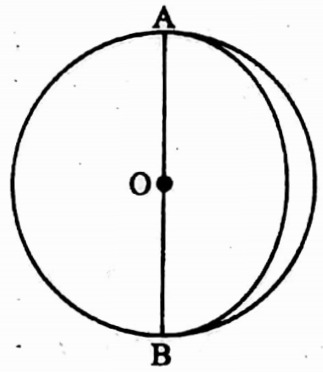
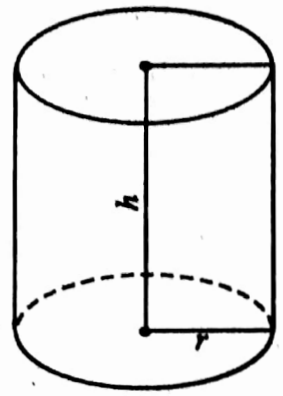
⇔ A sphere is a solid boundary by one surface and it may be seen to be generated by the revolution of a semi circle about its diameter an axis.

⇒ If the radius of a sphere be r, then

⇒ The area of the surface = π x (diameter)2 = 4πr2 sq. units

WBBSE Solutions For Class 10 Maths Mensuration Chapter 4 Sphere Sphere Area Of The Surface

⇒ Volume = \(\frac{4}{3}\)πr3 cubic units.

⇒ The volume of a hollow sphere = \(\left(\frac{4}{3} \pi R^3-\frac{4}{3} \pi r^3\right) \text { cu. units }=\frac{4}{3} \pi\left(R^3-r^3\right) \text { cu. units }\)

⇒ (External radius = R units, internal radius = r units)

Read and Learn More WBBSE Solutions for Class 10 Maths

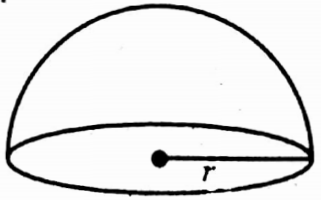
⇒ The area of the whole surface and the volume of a hemisphere

WBBSE Solutions For Class 10 Maths Mensuration Chapter 4 Sphere Sphere Area Of The Whole Surface And Volume Of The Hemisphere

  1. Area of curved surface = 2πr2 sq. units
  2. Area of whole surface = 3πr2 sq. units
  3. Volume = \(\frac{2}{3}\)πr2 cu. units.

WBBSE Solutions For Class 10 Maths Mensuration Chapter 4 Sphere

Mensuration Chapter 4 Sphere True Or False

Example 1. If we double the length of radius of a solid sphere, the volume of sphere will be doubles.

[Hints: \(\frac{4}{3} \pi(2 r)^3=8 \times \frac{4}{3} \pi r^3\)]

Solution: False

Class 10 Mensuration Chapter 4 Solved Examples

Example 2. If the ratio of the curved surface areas of two hemisphere is 4: 9, the ratio of their lengths of radius is 2 : 3.

Hint: \(\frac{2 \pi r_1^2}{2 \pi r_1^2}=\frac{4}{9} \Rightarrow \frac{r_1}{r_2}=\frac{2}{3}\)

Solution: True

Example 3. Curved surface area of sphere = 4 x (area of the circle with radius r units)

Solution: True

Example 4. The curved surface area ≠ whole surface area for a solid sphere.

Solution: False

Example 5. No. of plane surface area of a sphere is 1.

Solution: False

Example 6. Volume of a solid hemisphere = \(\frac{1}{2}\) x volume of sphere with same radius.

Solution: True

Wbbse Class 10 Mensuration Notes

Example 7. If the length of outer radius and inner radius of hollow sphere are R and r units respectively, volume of metal is required to make the hollow sphere is \(\frac{4}{3}\)π (R3 – r3) cu. units.

Solution: True

Example 8. No. of corner points of a sphere is 2.

Solution: False

WBBSE Notes For Class 10 Geography And EnvironmentWBBSE Notes For Class 10 History And Environment
WBBSE Solutions For Class 10 Life ScienceWBBSE Class 10 Life Science Multiple Choice Questions
WBBSE Solutions for Class 10 MathsWBBSE Class 10 Maths Multiple Choice Questions
WBBSE Notes For Class 10 Physical Science And Environment

Mensuration Chapter 4 Sphere Fill In The Blanks

Example 1. The name of the solid which is composed of only one surface is _______

Solution: sphere

Example 2. The number of surface of a solid hemisphere is _______

Solution: 2

Example 3. If the length of radius of a solid hemisphere is 2r units, its whole surface area is ________ sq. units.

Solution: 12

Example 4. An icecream is a shape of a cone and a _________

Solution: hemisphere

Surface Area And Volume Of Sphere Class 10

Example 5. If curved surface area and volume of a sphere are S and V respectively, then relation between S and V is _______

Solution: S3 = 36 πr2

Example 6. If length of radii of a cylinder and a hemisphere are equal, then ratio of their volumes is ________

Solution: 3: 2

Example 7. Volumes of a sphere of radius r units and a cube of length a units are equal, r : a = _________

Solution: 3 √21: 23 √11

Example 8. Volume of a biggest solid cone made from a solid hemisphere of radius r unit is ________

Solution: πr3

Example 9. If length of the radius of a hemisphere ps 2r units, then total surface area is _______ cu.

Solution: 12 πr2

Example 10. If ratio of length of radii of two sphere is 2 : 3, then ratio of their volumes is _______

Solution: 8: 27

Class 10 Maths Mensuration Important Questions

Mensuration Chapter 4 Sphere Short Answer Type Questions

Example 1. The numerical values of volume and whole surface area of a solid hemisphere are equal, let us write the length of radius of the hemisphere.

Solution: \(\frac{2}{3} \pi r^3=3 \pi r^2\)

or, r = \(\frac{9}{2}\) = 4.5 units

Example 2. The curved surface area of a solid sphere is equal to the surface area of a solid cylinder. The lengths of both height and diameter of cylinder are 12 cm. Write the length of the radius of the sphere.

Solution: 2π (6).12 = 4 πr2

or, r2 = \(\frac{12 \times 12}{4}\)

∴ r = 6 cm

Example 3. Whole surface area of a solid hemisphere is equal to the curved surface area of the solid sphere. Let us write the ratio of lengths of radius of hemisphere and sphere.

Solution: \(3 \pi r_1^2=4 \pi r_1^2\)

or, \(\frac{r_1^2}{r_2^2}=\frac{4}{3}\)

∴ \(r_1: r_2=2: \sqrt{3}\)

Example 4. If curved surface area of a solid sphere is S and volume is V, write the value of \(\frac{S^3}{V^2}\) (not putting the value of π).

Solution: S = 4πr2, V = \(\frac{4}{3}\) πr3

∴ \(\frac{s^3}{V^2}=\frac{\left(4 \pi r^2\right)^3}{\left(\frac{4}{3} \pi r^3\right)^2}\) = 9 x 4 = 36

Example 5. If the lengths of radius of a sphere is increased by 50%, let us write how much percent will be increased of its curved surface area.

Solution: Change of curved surface area

[r1 and r2 are the lengths of radii of hemisphere and sphere respectively]

= \(4 \pi\left\{\left(r+\frac{r}{2}\right)^2-r^2\right\} \text { sq. units }\)

= \(4 \pi\left(\frac{9 r^2-4 r^2}{4}\right) \text { sq. unit }\)

= \(\pi \times 5 r^2\)

% change = \(\frac{5 \pi r^2}{4 \pi r^2} \times 100 \text { sq.u }=125 \text { sq units. }\)

Class 10 Mensuration Chapter 4 Solved Examples

Example 6. The external and internal radii of a hollow sphere are 4 cm and 3 cm respectively. Find the volume of metal.

Solution: Volume = \(\frac{4}{3} \pi\left(4^3-3^3\right)\) cu. cm

= \(\frac{4}{3}\) x \(\frac{22}{7}\) x 37 cu. cm = 155\(\frac{1}{21}\)

Example 7. Find the ratio of the whole surface areas of a hemisphere and a sphere of the same radius.

Solution: Let the length of the radius = r unit

Required ratio = 3 πr2 : 4 πr2 = 3 : 4.

Example 8. A cylinder and a sphere have equal volume. The diameter of the cylinder is equal to the radius of the sphere. Find the relation between the height of the cylinder and radius of that.

Solution: Let the length of the cylinder = r unit, height = h unit

∴ radius of the sphere = 2r unit

ATP, \(\pi r^2 h=\frac{4}{3} \pi(2 r)^3\)

or, h = \(\frac{32}{3}\) r

Example 9. The perimeter of the base of a solid iron hemisphere is 6\(\frac{2}{7}\) metres. Find its volume.

Solution: 2πr = 6\(\frac{2}{7}\)

or, r = \(\frac{44 \times 7}{7 \times 2 \times 22}=1\)

Volume = \(\frac{1}{2} \times\left(\frac{4}{3} \pi r^3\right)=\frac{2}{3} \pi r^3=\frac{2}{3} \times \frac{22}{7} \times(1)^3\)

= \(\frac{44}{21}=2 \frac{2}{11} \text { cu. metres. }\)

Wbbse class 10 Maths Mensuration Solutions

Example 10. A sphere of diameter 1 metre is cut out from a wooden cube of edge 1 metre. Find the volume of the remaining wood in the cube.

Solution: Volume of sphere = \(\frac{4}{3} \pi\left(\frac{1}{2}\right)^3\) cu. mt.

= \(\frac{\pi}{6}\) cu. mt.

= \(\frac{22}{7 \times 6}\) cu. mt.

= \(\frac{11}{21}\) cu. mt.

∴ Volume of remaining woods = (13 – \(\frac{11}{21}\)) cu.mt = \(\frac{10}{21}\) cu.mt

WBBSE Solutions For Class 10 Maths Mensuration Chapter 3 Right Circular Cone

Mensuration Chapter 3 Right Circular Cone

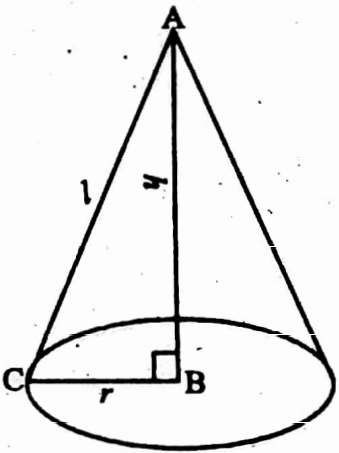
⇔ The solid generated by the revolution of a right-angled triangle about one of the sides containing the right angle as axis is called a right circular cone.

⇒ If h be the height, r the radius of the base, and l the slant height of a right circular cone, then we have.

WBBSE Solutions For Class 10 Maths Mensuration Chapter 3 Right Circular Cone

  1. The area of curved surface = \(\frac{1}{2}\) (circumference of the base) x slant height = πrl sq. unit.
  2. l2 = h2 + r2.
  3. The area of the whole surface area = πrl + πr2 = πr (l + r) sq. units.
  4. Volume = \(\frac{1}{3}\)πr2h cubic units.

Read and Learn More WBBSE Solutions for Class 10 Maths

WBBSE Solutions For Class 10 Maths Mensuration Chapter 3 Right Circular Cone

Mensuration Chapter 3 Right Circular Cone True Or False

Example 1. If the length of base radius of a right circular cone is decreased by half and its height is increased by twice of it then the volume remains same.

(Hints: Volume = \(\frac{1}{3} \pi\left(\frac{r}{2}\right)^2 \cdot 2 h=\frac{1}{2} \cdot \frac{1}{3} \pi r^2 h \neq \frac{1}{3} \pi r^2 h\))

Solution: False

Example 2. The height, radius and slant height of a right circular cone are always the three sides of a right angled triangle.

Solution: True

Class 10 Maths Mensuration Chapter 3 Solutions

Example 3. Total surface area of a cone which one face open is πrl sq. units.

Solution: True

Example 4. Height of a cone = \(\sqrt{(\text { slant height })^2+(\text { radius })^2}\)

Solution: False

Example 5. Volume of a cone= \(\frac{1}{3}\) x volume of cylinder if heights and length of radii are same for both.

Solution: True

Example 6. The radius and the height of a cone are increased by 20%. Then the volume of the cone is increased by 60%.

Solution: False

Example 7. Curved surface area = \(\pi r \sqrt{r^2-h^2} \text { sq. u. }\)

Solution: True

Combination Of Solids Class 10 Solutions

Example 8. The sharpened end of a pencil is an example of a cone.

Solution: True

WBBSE Notes For Class 10 Geography And EnvironmentWBBSE Notes For Class 10 History And Environment
WBBSE Solutions For Class 10 Life ScienceWBBSE Class 10 Life Science Multiple Choice Questions
WBBSE Solutions for Class 10 MathsWBBSE Class 10 Maths Multiple Choice Questions
WBBSE Notes For Class 10 Physical Science And Environment


Mensuration Chapter 3 Right Circular Cone Fill In The Blanks

Example 1. AC is the hypotenuse of a right-angled triangle ABC, the radius of the right circular cone formed by revolving the triangle once around side AB as axis is _____

Solution: BC

Example 2. If the volume of a right circular cone is V cubic unit and the base area is A sq. unit, then its height is _______

Solution: \(\frac{3V}{A}\)

Example 3. The lengths of the base radii and the heights of a right circular cylinder and a right circular cone are equal. The ratio of their volumes is ________

Solution: 3: 1

Example 4. If the heights of two cones are equal the ratio of their volumes is ________

Solution: (Ratio of radii)2

Class 10 Mensuration Chapter 3 Solved Examples

Example 5. If heights of two cones are equal the ratio of their volumes is _______

Solution: 1: √3

Example 6. Centre of a semicircular paper is O and diameter is AB. A _______ is formed as OA and OB are joined.

Solution: Diameter

Example 7. A _____ is generated by the revolution of a right angled triangle about one of the sides containing the right angle an axis.

Solution: cone

Example 8. The Bare of a right circular cone is ________

Solution: circular

Mensuration Chapter 3 Right Circular Cone Short Answer Type Questions

Example 1. A solid circular cylinder is made by melting a solid circular cone. The radii of both are equal. If the height of the cone is 15 cm, then find the height of the solid cylinder.

Solution: πr2h = \(\frac{1}{3}\)πr2 (15)

∴ h = 5 cm

∴ Required height 5 cm.

Example 2. The height of a right circular cone is 12 cm and its volume is 100 π cm3. Write the length of the ratius of the cone.

Solution: \(\frac{1}{3}\)πr2h = 100π

or, \(\frac{1}{3}\).π.r2.12 = 100π

or, r = 5 cm.

Example 3. The curved surface area of a right circular cone is √5 times of its base area. Write the ratio of the height and the length of radius of the cone.

Solution: πrl= √5πr2

or, πr \(\sqrt{r^2+h^2}\) = √5πr2

or, r2( r2+ h2) = 5r2.r2

or, 4r2 = h2

∴ h : r = 2:1

Wbbse Class 10 Mensuration Notes

Example 4. If the volume of a right circular cone is V cubic unit, base area is A sq unit and height is H unit, find the value of \(\frac{AH}{V}\).

Solution: \(\frac{\mathrm{AH}}{\mathrm{V}}=\frac{\pi r^2 \cdot h}{\frac{1}{3} \pi r^2 h}=3\)

Example 5. The numerical values of the volume and the lateral surface area of a right circular cone are equal. If the height and the radius of the H and r respectively, then find the value of \(\frac{1}{h^2}+\frac{1}{r^2}\).

Solution: \(\frac{1}{3} \pi r^2 h=\pi r \sqrt{\left(h^2+r^2\right)}\)

or, \(r^2 h^2=9\left(h^2+r^2\right)\)

or, \(\frac{h^2+r^2}{r^2 h^2}=\frac{1}{9}\)

or, \(\frac{1}{r^2}+\frac{1}{h^2}=\frac{1}{9}\)

Example 6. The ratio of the lengths of the base radii of a right circular cylinder and a right circular cone is 3: 4 and the ratio of their heights is 2 : 3. Write the ratio of the volume of the cylinder and cone.

Solution: \(\frac{\pi r_1{ }^2 h_1}{\frac{1}{3} \pi r_2{ }^2 h_2}=3\left(\frac{3}{4}\right)^2 \cdot\left(\frac{2}{3}\right)\)

= \(3 \times \frac{9}{16} \times \frac{2}{3}=9: 8\)

Example 7. Lateral surface area of a cone is √10 times the length of radius. Find the ratio of height and length of the diameter.

Solution: πr\(\sqrt{r^2+h^2}\) = √10.πr2

or, r2 + h2= 10r2

or, 9r2= h2

or, \(\frac{h}{2r}=\frac{3}{2}\) = 3: 2

Example 8. If length of the diameter, height, and slant height of a cone are d, h, and l respectively then what is the relation between d, h, and l?

Solution: We know r2 + h2 = l2

or, \(\left(\frac{d}{2}\right)^2\) + h2 = l ⇒ d = \(2 \sqrt{l^2-h^2}\)

Example 9. Length of the diameter and height of a cone are same which is x mt. Find its volume.

Solution: Volume = \(\frac{1}{3}\)πr2h

= \(\frac{1}{3} \pi\left(\frac{x}{2}\right)^2 \cdot x\) cubic mt = \(\frac{\pi x^3}{12}\) cu.mt

Surface Area And Volume Of Combined Solids Class 10

Example 10. Perimeter of the base and height of a cone are \(\frac{660}{7}\) cm and 20 cm respectively. Find its curved surface area.

Solution: 2πr = \(\frac{660}{7}\) ⇒ r = \(\frac{660 \times 7}{7 \times 2 \times 22}\) = 15

l = \(\sqrt{(20)^2+(15)^2}\) cm = 25 cm

πrl = \(\frac{22}{7}\) x 15 x 25 sq. cm = 1178\(\frac{4}{7}\)sq. cm

WBBSE Solutions for Class 10 Maths

Arithmetic

Algebra

Geometry

WBBSE Solutions for Class 10 Maths

Mensuration

Trigonometry

Statistics


WBBSE Solutions For Class 10 Maths Algebra Chapter 3 Quadratic Surds

Algebra Chapter 3 Quadratic Surds

⇔ If n is a positive integer and fl in a positive rational number, which can not express the nth power of some rational number, then the irrational number \(\sqrt[n]{a} \text { or } a^{\frac{1}{n}}\) that is the positive nth root of a is called surdor a radical.

⇒ The symbol \(\sqrt[n]{ }\) is called the radical sign n is the called the radical sign, n is called the order of the surd (or radical) and a is called the radicand.

⇒ Hence \(\sqrt[3]{\sqrt{2}}\) is not a surd as 2 is not a rational number.

⇒ A surd of order 2 is called a quadratic surd or square root.

⇒ Hence \(\sqrt{7}, \sqrt{\frac{4}{7}}\) are quadratic surd.

  1. If a is only a positive rational number that is not the square of a rational number, then ±√a type of number is called pure quadratic surd.
  2. Again a number of the form a±√b or ±a√b is called mixed quadratic surds where a is a rational number (≠0) and √b is a pure quadratic surd.
  3. Two or more quadratic surds are said to be similar surds if they can be expressed as rational multiple of the same surd.
  4. If a and b are such numbers prime Jo each other (i.e. HCF of a and b is 1) and neither of which is perfect square, then √a, √b are dissimilar surds.
  5. Any factor multiplying with any surds, if the product is free from surds then the factor, is called (the Rationalisation factor of that surround the process is called the Rationalisation.
  6. If the sum and the product of any mixed quadratic surd with rationalising factor are both rational number, the mixed quadratic surd is said to be conjugate or complementary surd.

Read and Learn More WBBSE Solutions for Class 10 Maths

WBBSE Solutions For Class 10 Maths Algebra Chapter 3 Quadratic Surds

Maths Algebra Chapter 3 Quadratic Surds True Or False

Example 1. √75 and √147 are similar surd.

Solution: True

Example 2. √π is a quadratic surd.

Solution: False

Example 3. Product of two surds is a surd.

Solution: False

Class 10 Maths Algebra Chapter 3 Solutions

Example 4. Product of two surds is not a surd.

Solution: False

Example 5. Sum of two surds is a surd.

Solution: False

Example 6. √6 + √3 = √7+ √7 .

Solution: False

WBBSE Notes For Class 10 Geography And EnvironmentWBBSE Notes For Class 10 History And Environment
WBBSE Solutions For Class 10 Life ScienceWBBSE Class 10 Life Science Multiple Choice Questions
WBBSE Solutions for Class 10 MathsWBBSE Class 10 Maths Multiple Choice Questions
WBBSE Notes For Class 10 Physical Science And Environment


Example 7. √6+ √ 3 > √7 + √2

Solution: False

Example 8. π is an irrational number which is not a surd.

Solution: True

Factorization Class 10 Solutions

Example 9. √32 is a surd but \(\sqrt[5]{32}\) is not a surd.

Solution: False

Example 10. Conjugate surd of √5-2 is √5 + 2

Solution: False

Maths Algebra Chapter 3 Quadratic Surds Fill In The Blanks

Example 1. 5√11 a _______ number (Rational/irrational)

Solution: Irrational

Example 2. Conjugate surd of √3-5 is _______

Solution: -√3 – √5

Example 3. If the product and sum of two quadratic surd is a rational number, then surds are ________ surd.

Solution: Conjugate

Class 10 Algebra Chapter 3 Solved Examples

Example 4. Rationalising factor of 7- √3 is _______

Solution: 7 + √3 or, -7 – √3

Example 5. Product of \(3^{\frac{1}{2}}\) and √3 is _______

Solution: 3

Example 6. √6 x √15 = x√10 then x = ________

Solution: 3

Example 7. Conjugate of -√5-1 is________

Solution: √5 -1

Wbbse Class 10 Algebra Notes

Example 8. To denote square root, we use √ instead of ______

Solution: \(\sqrt[2]{ }\)

Example 9. √108 – √75 = ______

Solution: √3

Example 10. Two quadratic surd √8 and √32 are rational multiple of same surd _______

Solution: √2

Maths Algebra Chapter 3 Quadratic Surds Short Answer Type Questions

Example 1. x = 3 + 2√2 let us write the value of x + \(\frac{1}{x}\)

Solution: \(\frac{1}{x}=\frac{1}{3+2 \sqrt{2}}\)

= \(\frac{3-2 \sqrt{2}}{(3+2 \sqrt{2})(3-2 \sqrt{2})}=\frac{(3-2 \sqrt{2}}{9-8}=3-2 \sqrt{2}\)

x + \(\frac{1}{x}\) = 3 + 2√2 + 3 -2√2 = 6

∴ The value of x + \(\frac{1}{x}\) = 6.

Example 2. Which is greater of (√15+√3) and (√10 + √8)

Solution: √15 + √10 > √8 + √3

⇒  or, \(\frac{1}{\sqrt{15}+\sqrt{10}}<\frac{1}{\sqrt{8}+\sqrt{3}}\),

⇒  or, \(\frac{\sqrt{15}-\sqrt{10}}{15-10}<\frac{\sqrt{8}-\sqrt{3}}{8-3}\)

⇒  or, √15 – √10 < √8 – √3

⇒  or, √15 + √3 < √10 + √8

∴ The value of x + \(\frac{1}{x}\) = 6.

Example 3. Let us write what should be subtracted from √72 to get √32.

Solution: √72 -√32 = \(\sqrt{4 \times 2 \times 9}-\sqrt{16 \times 2}\)

= 6√2 -4√2 = 2√2

Factorization Formulas Class 10 

Example 4. Simplify \(\frac{1}{\sqrt{2}+1}+\frac{1}{\sqrt{3}+\sqrt{2}}+\frac{1}{\sqrt{4}+\sqrt{3}}\)

Solution: Rationalising, we get

⇒  \(\frac{\sqrt{2}-1}{2-1}+\frac{\sqrt{3}-\sqrt{2}}{3-2}+\frac{\sqrt{4}-\sqrt{3}}{4-3}\)


= \(\sqrt{2}-1+\sqrt{8}-\sqrt{2}+2-\sqrt{3}=1\)

Example 5. \(\frac{\sqrt{24}+\sqrt{216}}{\sqrt{96}}=?\)

Solution: \(\frac{\sqrt{4 \times 6}+\sqrt{6 \times 6 \times 6}}{\sqrt{6 \times 16}}\)

= \(\frac{2 \sqrt{6}+6 \sqrt{6}}{4 \sqrt{6}}=\frac{8 \sqrt{6}}{4 \sqrt{6}}=2\)

Example 6. 2x = √5 +1, x2 – x – 1 = ?

Solution: x2 – x- 1

= \(\left(\frac{\sqrt{5}+1}{2}\right)^2-\left(\frac{\sqrt{5}+1}{2}\right)-1=\frac{5+1+2 \sqrt{5}}{4}-\frac{\sqrt{5}+1}{2}-1\)

= \(\frac{6+2 \sqrt{5}-2 \sqrt{5}-2-4}{4}=\frac{0}{4}=0\)

Example 7. \(x=\sqrt{3}+\sqrt{2}, \quad x^2+\frac{1}{x^2}=?\)

Solution: \(\frac{1}{x}=\frac{1}{\sqrt{3}+\sqrt{2}}=\frac{\sqrt{3}-\sqrt{2}}{3-2}\)

= \(\sqrt{3}-\sqrt{2}\)

\(\left(x^2+\frac{1}{x^2}\right)=\left(x+\frac{1}{x}\right)^2-2 x \frac{1}{x}\)


= \((\sqrt{3}+\sqrt{2}+\sqrt{3}-\sqrt{2})^2-2=4 \times 3-2=10\)

Example 8. x + y = √3, = √2, 8xy (x2+y2) = ?

Solution: 8xy (x2 + y2)

⇒  x + y ≠ x- y = √3+√2

= 4xy x 2 (x2 + y2)

= [{(x + y)2– (x – y)2} {(x + y)2} + {(x – y)2} (x + y)- x – y] = √3 – √2

={(√3)2-(√2)2} {(√3)2+(√2)2}

= (3 – 2) (3 + 2) = 5

Class 10 Maths Algebra Important Questions

Example 9. \(x+\frac{1}{x}=\sqrt{3} ; \quad x^3+\frac{1}{x^3}=?\)

Solution: \(x^3+\frac{1}{x^3}=\left(x+\frac{1}{x}\right)^3-3 x \frac{1}{x}\left(x+\frac{1}{x}\right)\)

= \((\sqrt{3})^3-3 \sqrt{3}=3 \sqrt{3}-3 \sqrt{3}=0\)

Example 10. If \(\frac{\sqrt{7}-2}{\sqrt{7}+2}=a \sqrt{7}+b\) then the value of b.

Solution: \(\frac{(\sqrt{7+2})(\sqrt{7}-2)}{7-4}=a \sqrt{7}+b\)

⇒ or, \(\frac{7+4-4 \sqrt{7}}{3}=a \sqrt{7}+b\)

⇒  or, \(\frac{11}{3}-\frac{4}{3} \sqrt{7}=a \sqrt{7}+b\) comparing relation and irrational part,

⇒  a = \(-\frac{4}{3}, b=\frac{11}{3}\).

WBBSE Solutions For Class 10 Maths Geometry Chapter 1 Theorems Related To Circle

Geometry Chapter 1 Theorems Related To Circle

⇔ Circle Definition: A circle is the locus of a point which moves in a plane in such a way that its distance from a given fixed point in the plane is always constant.

⇒ The fixed point is called the centre and the given constant distance is called the radius of the circle.

WBBSE Notes For Class 10 Geography And EnvironmentWBBSE Notes For Class 10 History And Environment
WBBSE Solutions For Class 10 Life ScienceWBBSE Class 10 Life Science Multiple Choice Questions
WBBSE Solutions for Class 10 MathsWBBSE Class 10 Maths Multiple Choice Questions
WBBSE Notes For Class 10 Physical Science And Environment


⇒ O is centre and OA is the radius of circle.

⇔ Chord Definition:  A line segment joining any two points on a circle is called a chord or a circle.
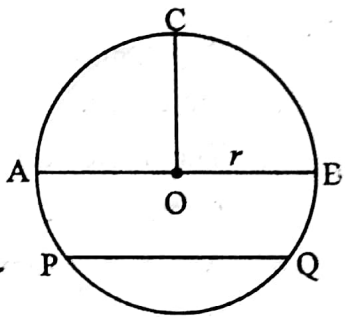
WBBSE Solutions For Class 10 Maths Geometry Chapter 1 Theorems Related To Circle Chord

⇒ PQ is the chord of a circle of centre O.

⇔ Diameter Definition:  A chord passing through the centre is known as its diameter.

⇒ AB is the diameter of the circle.

⇔ Arc Definition: The part of the circle is called Arc.

⇒ The greater arc is called Major Arc and Smaller arc is called Minor Arc.
WBBSE Solutions For Class 10 Maths Geometry Chapter 1 Theorems Related To Circle

Read and Learn More WBBSE Solutions for Class 10 Maths
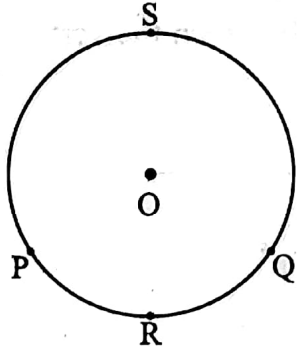
WBBSE Solutions For Class 10 Maths Geometry Chapter 1 Theorems Related To Circle Arc

⇒ Major Arc is \(\overparen{\mathrm{PSQ}}\) and Minor Arc is \(\overparen{\mathrm{PRQ}}\).

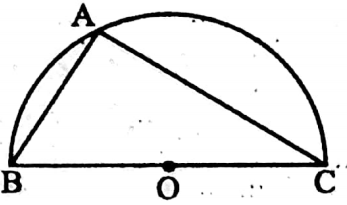
⇔ Semicircle Definition:  A diameter of a circle divides it into two equal parts which are arcs. Each of these two arcs is called a semi-circle.
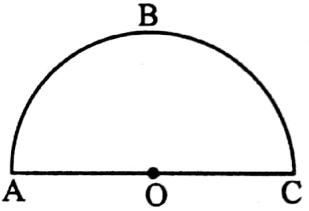
WBBSE Solutions For Class 10 Maths Geometry Chapter 1 Theorems Related To Circle Semicircle

⇒ \(\overparen{\mathrm{ABC}}\) is the semi circle.

Class 10 Maths Geometry Chapter 1 Solutions

⇔ Segment of a circle Definition:  The chord of a circle divides the circular region into two parts. Each of the parts is called a segment.
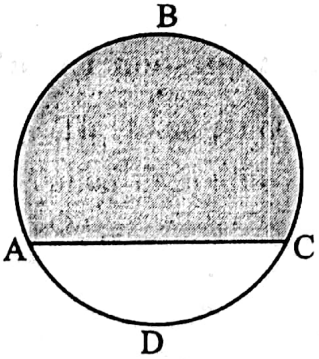
 

WBBSE Solutions For Class 10 Maths Geometry Chapter 1 Theorems Related To Circle Segment Of A Circle

⇒ The greater segment is Major segment and the Smaller segment is Minor segment.

⇒ The region ABC is Major segment and the region ADC is Minor segment.

⇔ Concentric circles Definition: Circles having the same centre but with different radii are said to be concentric circles.

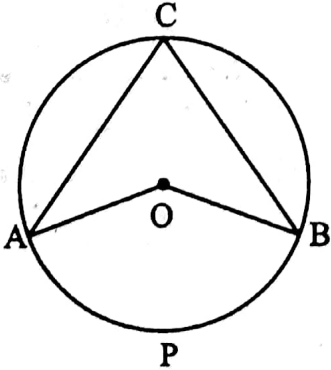
WBBSE Solutions For Class 10 Maths Geometry Chapter 1 Theorems Related To Circle Concentric Circles

WBBSE Solutions For Class 10 Maths Geometry Chapter 1 Theorems Related To Circle Concentric Circle

⇒ ∠ACB is called the front angle by the circular arc \(\overparen{\mathrm{APB}}\) and ∠AOB is called the angle at the centre O which is made by the arc \(\overparen{\mathrm{APB}}\).

Theorems related to circle:

  1. In the same circle or in equal circles, equal chords intercept equal angles at the centre.
  2. In the same circle or in equal circles, the chords which subtend equal angles at the centre are equal.
  3. One and only one circle can be drawn through three non-collinear points.
  4. If a line drawn from the centre of any circle bisects the chord, which is not a diameter, will be perpendicular on the chord.
  5. A perpendicular is drawn from the centre of a circle on a chord, which in not a diameter, and bisects the chord.
  6. The angle subtended at the centre by an arc is twice that of an angle subtended in the circle.
  7. In any circle angles in the same segment are equal.
  8. The angle in a semicircle is a right angle.
  9. If a straight line segment makes equal angles at the two points situated on the same side of it, then the four points are concyclic.
  10. The opposite angles of a cyclic quadrilateral are supplementary to each other.
  11. If the opposite angles of q quadrilateral are supplementary to each other, then the vertices of the quadrilateral are concyclic. [In case of asterisk marks proofs are not necessary.]

Basic Geometrical Concepts Class 10 Solutions

Geometry Chapter 1 Theorems Related To Circle True Or False

Example 1. Only one circle can be drawn through three collinear points.

Solution: Only one circle can be drawn through three non-collinear points.

∴ the statement is false.

Example 2. The two circles ABCDA and ABCEA are same circle.
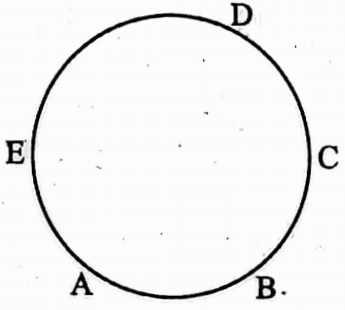
WBBSE Solutions For Class 10 Maths Geometry Chapter 1 Theorems Related To Circle True Or False Example 2

Solution: Clearly the statement is true

Example 3. If two chords AB and AC of a circle with its centre O are situated on the opposite sides of the radius OA, then ∠OAB = ∠OAC.
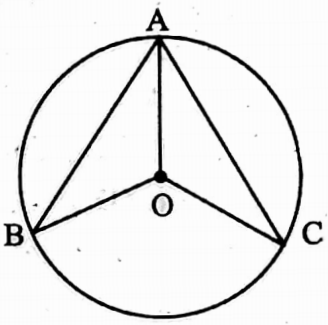
WBBSE Solutions For Class 10 Maths Geometry Chapter 1 Theorems Related To Circle True Or False Example 3

Solution: If AB = AC then ∠OAB = ∠OAC

∴ the statement is false

Example 4. If O is the centre of the circle, then ∠AOB = 2∠ACD
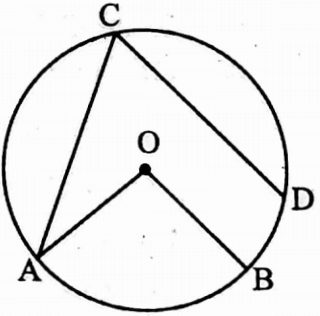
WBBSE Solutions For Class 10 Maths Geometry Chapter 1 Theorems Related To Circle True Or False Example 4

Solution: Since the angle ∠AOB is at the centre of the circle formed by circular arc AB and ∠ACD is on the circle formed by circular arc ABD of a circle with centre O,

∴ ∠AOB ≠ 2 ∠ACD

∴ The statement is false.

Class 10 Geometry Chapter 1 Solved Examples

Example 5. Point O lies within the triangular region ABC in such a way that OA = OB and ∠AOB = 2 ∠ACB. If we draw a circle with centre O and length of radius OA, then the point C lies on the circle.
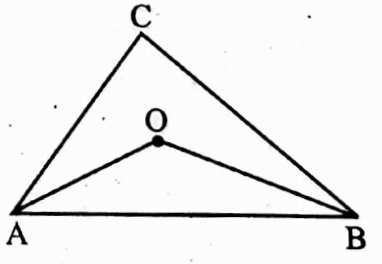
WBBSE Solutions For Class 10 Maths Geometry Chapter 1 Theorems Related To Circle True Or False Example 5

Solution: as OA = OB

∴ If we drew a circle with centre O and radius OA, then the circle passes through the point B.

∴ The angle ∠AOB is at the centre O formed by a circular arc AB.

Again ∠AOB = 2 ∠ACB

∴ ∠ACB is the angle on the circle formed by circular arc AB

∴the point C lies on the circle.

∴ The statement is true

Example 6. AD and BE are the perpendiculars on side BC and CA of the triangle ABC. A, B, D, and E are concyclic.
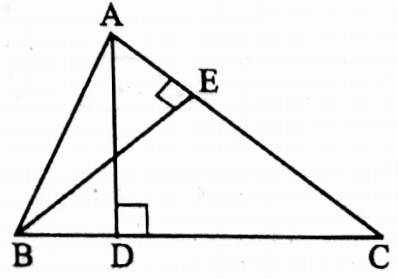
WBBSE Solutions For Class 10 Maths Geometry Chapter 1 Theorems Related To Circle True Or False Example 6

Solution: ∠AEB = ∠ADB = 90°

as a line segment AB joining two points A and B subtends equal angles at two other points D and E on the same side of AB.

∴ A, B, D, and E points are concyclic.

∴ The statement is true

Example 7. In ΔABC, AB = AC, BE and CF are the bisectors of the angles ∠ABC and ∠ACB and they intersect AC and AB at the points E and F respectively. Four points B, C, E, F are not concyclic.
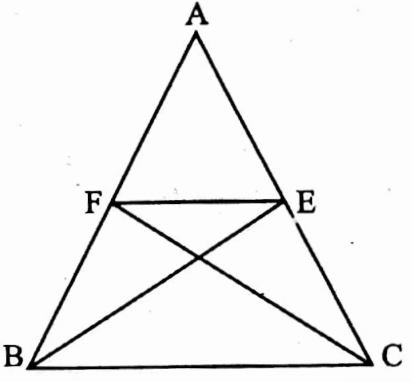
WBBSE Solutions For Class 10 Maths Geometry Chapter 1 Theorems Related To Circle True Or False Example 7

Solution: Join E, F

⇒ InΔABC, AB = AC

⇒ ∠ACB = ∠ABC

⇒ or, \(\frac{1}{2}\) ∠ACB = \(\frac{1}{2}\) ∠ABC

∴ ∠ECF = ∠EBF

⇒ as line segment BC joining two points B and C subtends equal angle at two other points E and F on the same side BC

⇒ B, C, E, and F points are concyclic.

∴ The statement is false.

Example 8. The angle in the segment of a circle which is greater than a semicircle is an obtuse angle.

Solution: Clearly statement is false.

Example 9. O is the midpoint of the side AB of the triangle ABC, and OA = OB = OC ; if we draw a circle with side AB as diameter, the circle passes through the point C.
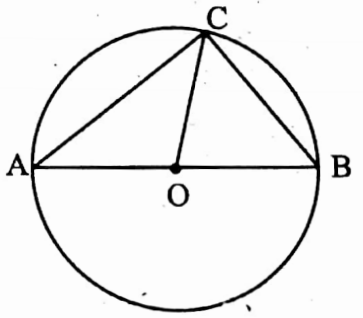
WBBSE Solutions For Class 10 Maths Geometry Chapter 1 Theorems Related To Circle True Or False Example 9

Solution: As OA = OB = OC,

∴ The statement is true.

Geometry Theorems Class 10 Solutions

Example 10. The opposite angle of a cyclic quadrilateral is complimentary.

Solution: The statement is false.

Example 11. If any side of a cyclic quadrilateral be produced the exterior angle so formed is equal to the interior opposite angle.
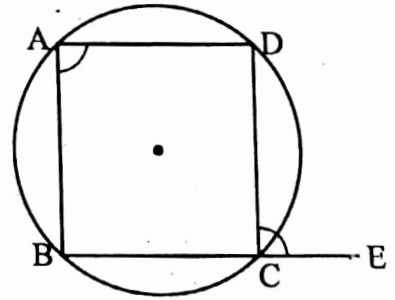
WBBSE Solutions For Class 10 Maths Geometry Chapter 1 Theorems Related To Circle True Or False Example 11

Solution: The statement is true.

Geometry Chapter 1 Theorems Related To Circle Fill In The Blanks

Example 1. If the ratio of two chords PQ and RS of a circle with its centre O is 1 : 1, then, ∠POQ: ∠ROS = _________

Solution:
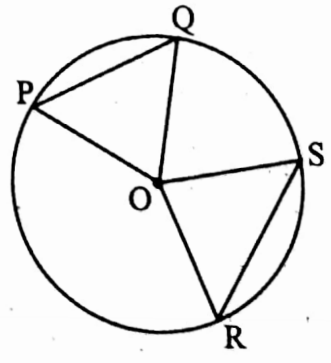
WBBSE Solutions For Class 10 Maths Geometry Chapter 1 Theorems Related To Circle Fill In The Blanks Example 1

Ratio of length of chord PQ and RS of a circle with its centre O is 1: 1

∴ PQ = RS

∴ ∠POQ = ∴ ∠ROS

∠POQ : ∠ROS =1:1

∴ 1: 1

Example 2. The perpendicular bisector of any chord of a circle is ________ of that circle

Solution:

WBBSE Solutions For Class 10 Maths Geometry Chapter 1 Theorems Related To Circle Fill In The Blanks Example 2

∴ Passes through centre.

Example 3. The angle at the centre is ________ the angle on the circle, subtended by the same arc.

Solution: Double.

Example 4. The length of two chord AB and AC are equal of a circle with centre O. If ∠APB and∠AQC are angles on the circle, then the value of the two angles are_______

Solution:
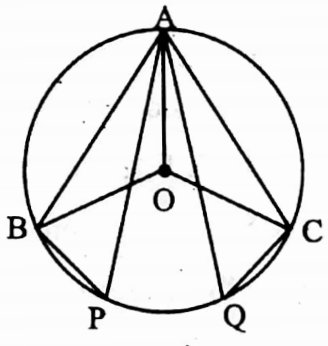
WBBSE Solutions For Class 10 Maths Geometry Chapter 1 Theorems Related To Circle Fill In The Blanks Example 4

join O, A; O, B and O, C.

⇒ As AB = AC, ∴ ∠AOB = ∠AOC

⇒ ∠AOB = 2 ∠APB and ∠AOC = 2 ∠AQC

∴ 2 ∠APB = 2 ∠AQC

⇒ or, ∠APB = ∠AQC

∴ Equal.

Example 5. All angles in the same segments are ________

Solution: Equal

Example 6. If the line segment joining two points subtends equal at two other points on the same side, then the four points are ________

Solution: Concyclic

Class 10 Maths Geometry Important Questions

Example 7. If two angles on the circle formed by two arcs are equal then the lengths of arcs are __________

Solution: Equal

Example 8. The semicircular angle is ______

Solution: Right angle.

Example 9. The angle in the segment of a circle which is less than a semicircle is an ______ angle.

Solution: obtuse

Example 10. The circle drawn with a hypotenuse of a right-angled triangle as diameter passes through the _______

Solution: Right angular vertex.

Example 11. If the opposite angles of a quadrilateral be supplementary then the vertices of the quadrilateral will be ______
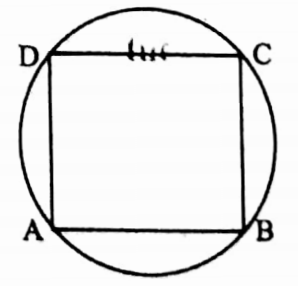
WBBSE Solutions For Class 10 Maths Geometry Chapter 1 Theorems Related To Circle Concyclic

Solution: Concyclic

Class 10 Maths Geometry Chapter 1 Solutions

Example 12. A cyclic parallelogram is a ______ picture.
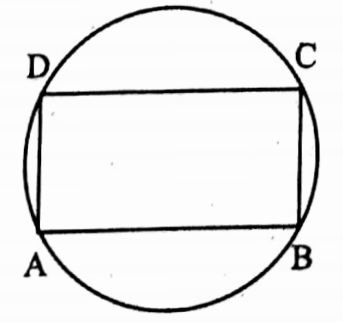
WBBSE Solutions For Class 10 Maths Geometry Chapter 1 Theorems Related To Circle Rectangular

Solution: Rectangular.

Example 13. The vertics of square is __________
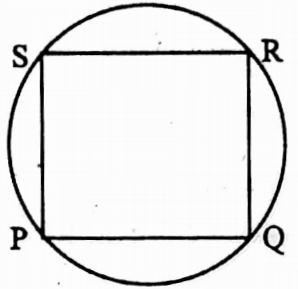
WBBSE Solutions For Class 10 Maths Geometry Chapter 1 Theorems Related To Circle Vertics Of Square Is Concyclic

Solution: Concyclic.

Geometry Chapter 1 Theorems Related To Circle Short Answer Type Question

Example 1. Two equal circles of radius 10 cm. intersect each other and the length of their common cord is 12 cm. Determine the distance between the two centres of two circles.

Solution:
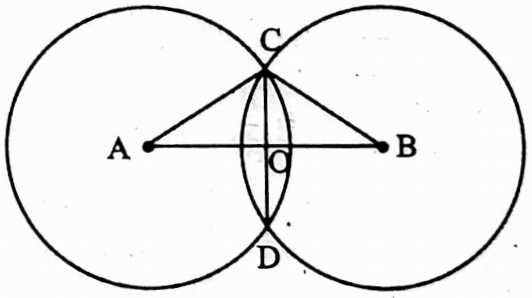
WBBSE Solutions For Class 10 Maths Geometry Chapter 1 Theorems Related To Circle Short Answer Question Example 1

⇒  Let AC and BC are the radius of two circles of centres A and B respectively.

∴ AC = BC = 10 cm their common chord is CD where CD = 12 cm AB and CD intersect at O;

∴ OC = OD = \(\frac{1}{2}\) x 12 cm = 6 cm

⇒  and ∠AOC = ∠BOC = 90°

⇒ In ΔAOC, OA2 + OC2 = AC2 [From pythagorus theorem]

⇒ OA2 + 6= 102

⇒ or, OA = \(\sqrt{100-36}\)cm = √64 cm = 8 cm

⇒ Similarly, OB = 8 cm

∴ AB = (8 + 8) cm = 16 cm.

Basic Geometrical Concepts Class 10 Solutions

Example 2. AB and AC are two equal chords of a circle having the radius of 5 cm. The centre of the circle situated at the outside of the triangle ABC. If AB = AC = 6 cm, then calculate the length of the chord BC.

Solution:
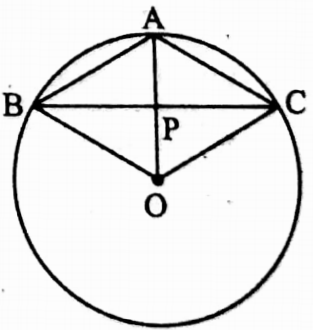
WBBSE Solutions For Class 10 Maths Geometry Chapter 1 Theorems Related To Circle Short Answer Question Example 2

⇒  OA = OB = OC = 5 cm

⇒  OA and BC intersect at P,

⇒  Let OP = x cm, AP = (5 – x) cm

⇒  In ΔAOB and ΔAOC,

⇒  AB = AC, OB = OC and OA common side

∴ ΔAOB = ΔAOC [By SSS axiom of congruency]

∴ ∠BAO = ∠CAO

⇒  i.e. ∠BAP = ∠CAP

⇒ In ΔBAP and ΔCAP,

⇒ AB = AC, ∠BAP = ∠CAP and AP = AP (common side)

∴ ΔBAP ≅ ΔCAP [By SAS axiom of congruency]

∴ ∠APB = ∠APC = \(\frac{180^{\circ}}{2}\) =90°

∴ AP ⊥ BC

∴ BP = CP [The perpendicular drawn to a chord, which is not a diameter, from the centre of the circle, bisects the chord]

In ΔABP, ∠APB = 90°

AP2 + BP2 = AB2

(5 – x)2 + BP2 = 62

⇒ BP2 = 36 – (5 – x)2

In ΔBOP, OP2 + BP2 = OB2

x2 + BP2 = 52

⇒ BP2 = 25 – x2

∴ 36 – (5 – x)2 = 25 – x2

⇒ 36 – 25 + 10x – x2 = 25 – x2

⇒ 10x = 14

⇒ x = \(\frac{7}{5}\)

\(\mathrm{BP}^2=\left\{25-\left(\frac{7}{5}\right)^2\right\} \mathrm{cm}^2=\left(25-\frac{49}{25}\right) \mathrm{cm}^2=\frac{576}{25} \mathrm{~cm}^2\) \(\mathrm{BP}=\sqrt{\frac{576}{25}} \mathrm{~cm}=\frac{24}{5} \mathrm{~cm}\)

BC = 2 x \(\frac{24}{5}\) cm = \(\frac{48}{5}\) cm = 9.6cm

∴ Length of chord BC is 9.6 cm.

Example 3. The length of two chords AB and CD of a circle with its centre O are equal. If ∠AOB 60° and CD = 6 cm; then calculate the length of the radius of the circle.

Solution:
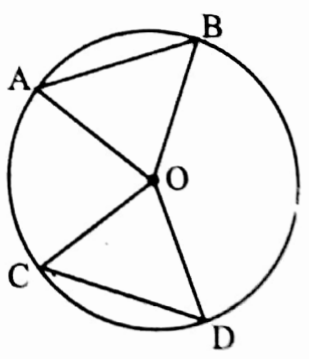
WBBSE Solutions For Class 10 Maths Geometry Chapter 1 Theorems Related To Circle Short Answer Question Example 3

Chord AB = chord DC [given]

In ΔAOB, OA = OB [Radii of same circle]

∴ ∠OBA = ∠OAB = \(\frac{180^{\circ}-\angle \mathrm{AOB}}{2}=\frac{180^{\circ}-60^{\circ}}{2}\) = 60°

∴ ∠OAB = ∠OBA = ∠AOB

∴ OB = OA = AB

∴ ΔAOB is equilateral triangle

∴ OA = AB = CD = 6 cm

∴ The length of radius of the circle is 6 cm.

Class 10 Geometry Chapter 1 Solved Examples

Example 4. P is any point in a circle with its centre O. If the length of the radius is 5 cm and OP = 3 cm. then determine the least length of the chord passing through the point.

Solution:
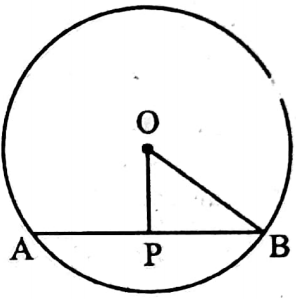
WBBSE Solutions For Class 10 Maths Geometry Chapter 1 Theorems Related To Circle Short Answer Question Example 4

⇒  The minimum distance of chord AB from centre O of the circle is (OP) = 3 cm.

⇒ length radius (OB) = 5 cm

⇒ In ΔBOP, OP2 + BP2 = OR2 [from Pythagorus theorem]

⇒ 32 + BP2 = 52

⇒ BP = \(\sqrt{25-9}\) cm = 4 cm as OP ⊥ AB

∴ BP = \(\frac{1}{2}\)AB

⇒ AB = 2BP = 2 x 4 cm = 8 cm

∴ Length of chord is 8 cm.

Example 5. The two circles with their centres at P and Q intersect each other, at the points A and B. Through the point A, a straight line parallel to PQ intersects the two circles at the points C and D respectively. If PQ = 5 cm, then determine the length of CD.

Solution:
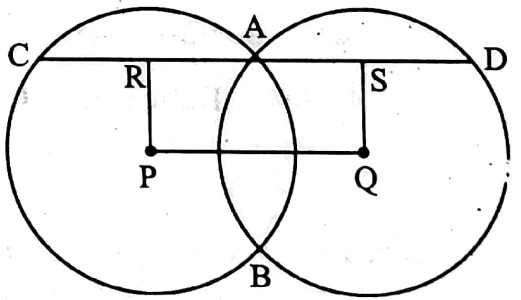
WBBSE Solutions For Class 10 Maths Geometry Chapter 1 Theorems Related To Circle Short Answer Question Example 5

⇒  From the points P and Q, two perpendiculars PR and QS are drawn on the chord AC and AD respectively which intersects.

⇒ AC at the point R and AD at the point S.

⇒ As PR ⊥ AC and QS ⊥ CD

∴ PR || QS

⇒ Again PQ || RS

∴ PQRS is a parallelogram.

∴ RS = PQ = 5 cm

⇒ PR ⊥ AC,  ∴ AR = \(\frac{1}{2}\) AC

⇒ QS ⊥ AD, ∴ AS =\(\frac{1}{2}\) AD

⇒ AR + AS = \(\frac{1}{2}\) (AC + AD) i.e. RS = \(\frac{1}{2}\) CD

⇒ CD = 2 RS = 2 x 5 cm = 10 cm

Example 6. O is the centre of the circle, if ∠OAB = 30°,∠ABC = 120°, ∠BCO = y° and ∠COA = x°, find x and y.

Solution:
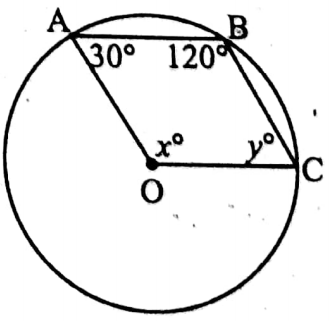
WBBSE Solutions For Class 10 Maths Geometry Chapter 1 Theorems Related To Circle Short Answer Question Example 6

AOC is the reflex angle at the centre and ∠ABC is the angle at the circle are formed with the circular arc

∴ Reflex ∠AOC = 2∠ABC = 2 x 120° = 240°

⇒ ∠AOC = 360° – 240°

⇒ x° = 120°

⇒ ∠BCO = 360° – ∠OAB -∠ABC – ∠AOC

⇒ y° = 360° – 30° – 120° – 120°

⇒ y° = 90°

∴ value of x and y are 120 and 90 respectively.

Geometry Theorems Class 10 Solutions

Example 7. O is the circumcentre of the triangle ∠ABC and D is the midpoint of the side BC. If ∠BAC = 40°, find the value of ∠BOD.

Solution:
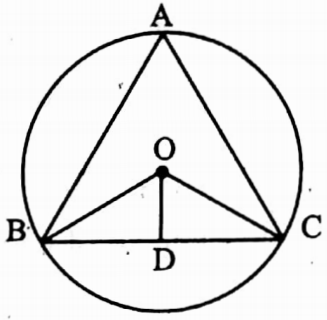
WBBSE Solutions For Class 10 Maths Geometry Chapter 1 Theorems Related To Circle Short Answer Question Example 7

∠BOC is the angle to the centre O and ∠BAC is the angle on the circle formed by circular arc BC

∴ ∠BOC = 2 ∠BAC = 2 x 40° = 80°

⇒ In ΔBOD and ΔCOD

⇒ OB = OC [radii of same circle]

⇒ BD = CD [D is the mid point of BC]

⇒ and OD = OD [common side]

∴ ΔBOD ≅ ΔCOD [By SSS aniom of congruency]

∴ ∠BOD = ∠COD = \(\frac{1}{2}\) ∠BOC = \(\frac{1}{2}\) x 80° = 40°

Example 8. Three points A, B and C lie on the circle with centre O in such a way that ΔOCB is a parallelogram, calculate the value of ∠AOC.

Solution:
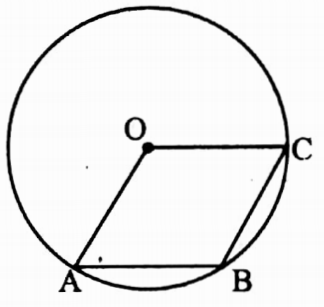
WBBSE Solutions For Class 10 Maths Geometry Chapter 1 Theorems Related To Circle Short Answer Question Example 8

Reflex ∠AOC = 2 ∠ABC

= 2 ∠AOC [opposite angles of OABC parallelogram]

Again, Reflex ∠AOC + ∠AOC = 360°

⇒ 2 ∠AOC + ∠AOC = 360°

⇒ ∠AOC = 360°

⇒ ∠AOC = 120°

Example 9. O is the circumcentre of isosceles triangle ∠ABC and ∠ABC = 120°, if the length of the radius of the circle is 5 cm, find the value of the side AB.

Solution:

WBBSE Solutions For Class 10 Maths Geometry Chapter 1 Theorems Related To Circle Short Answer Question Example 9

I join O, A and O, B

⇒ In ΔAOB and ΔBOC

⇒ AB = BC [given]

⇒ OA = OC [radii of same circle]

⇒ OB = OB [common side]

∴ ΔAOB ≅ ∠BOC [by SSS axiom of congruency]

∴ ∠ABO = ∠CBO = \(\frac{120^{\circ}}{2}\) = 60°

In ΔAOB, OA = OB [same radius]

∴ ∠OAB = ∠ABO = 60°

∠AOB = 180° – 60° – 60° = 60°

∴ ∠AOB = ∠OAB = ∠OBA

⇒  AB = OB = OA = 5 cm

Class 10 Maths Geometry Important Questions

Example 10. Two circles with centres A and B intersect each other at the points C and D. The centre B on the other circle lies on the circle with centre A. If ∠CQD = 70°, find the value of ∠CPD

Solution:
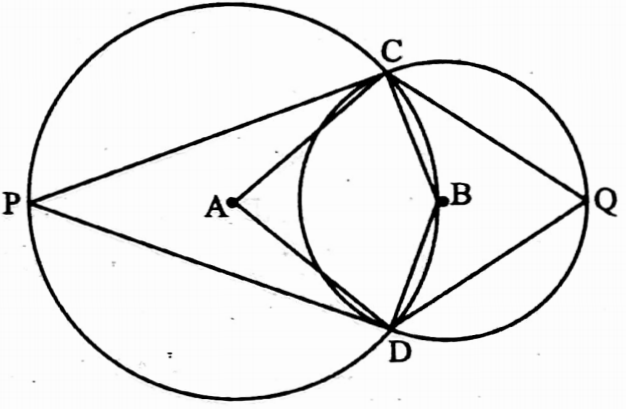
WBBSE Solutions For Class 10 Maths Geometry Chapter 1 Theorems Related To Circle Short Answer Question Example 10

I join A, C; A, D; C, Q and D, Q

⇒ ∠CBD is the angle at centre B and ∠CQD is the angle on the circle at Q formed by a circular arc CD

∴ ∠CBD = 2 ∠CQD

= 2 x 70° = 140°

⇒ Reflex ∠CAD is the angle at the centre A and ∠CBD is the angle on the circle at B formed by circular arc CPD

⇒ Reflex ∠CAD = 2 ∠CBD = 2 x 140° = 280°

∴ ∠CAD = 360° – Reflex ∠CAD = 360° – 280° = 80°

⇒ ∠CAD = 2 ∠CPD

⇒ 80° = 2 ∠CPD

⇒ ∠CPD = 40°

Example 11. O is the centre of the circle, AC is diameter and chord DE is parallel to the diameter AC. IF ∠CBD = 60°, find the value of ∠CDE.

Solution:
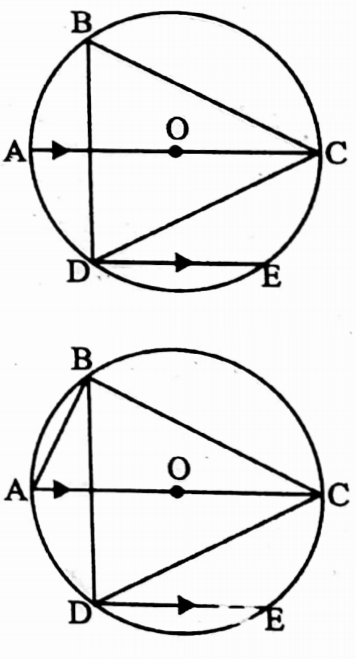
WBBSE Solutions For Class 10 Maths Geometry Chapter 1 Theorems Related To Circle Short Answer Question Example 11

I join A, B

⇒ ∠ABC = 90° [semi-circular angle]

⇒ ∠CBD = 60°

⇒ ∠ABD = 90° – 60° = 30°

⇒ ∠ACD = ∠ABD [angles in the same segment]

= 30°

⇒ AC || DE and CD is the intersection

∴ ∠CDE = alternate ∠ACD = 30°

Class 10 Maths Board Exam Solutions

Example 12. QS is bisector of an angle ∠PQR, if ∠SQR = 35° and ∠PRQ = 32°, find the value of ∠QSR.

Solution:
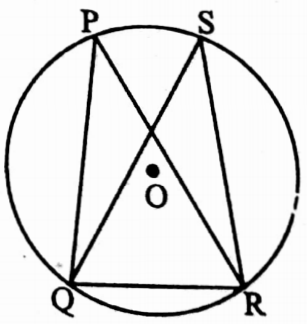
WBBSE Solutions For Class 10 Maths Geometry Chapter 1 Theorems Related To Circle Short Answer Question Example 12

∠PQR = 2 ∠SQR [QS is the bisector of ∠PQR]

= 2 x 35° = 70°

In ΔPQR, ∠PQR = 70°, ∠PRQ = 32°

∴ ∠QPR = 180° – (70° + 32°) = 78°

∠QSR = ∠QPR [angles in the same segment]

= 78°

Example 13. O is the centre of the circle and AB is diameter. If AB and CD are mutually perpendicular to each other and ∠ADC = 50°, find the value of ∠CAD.

Solution:
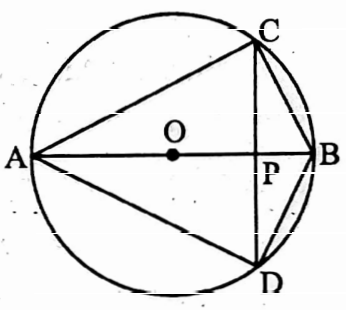
WBBSE Solutions For Class 10 Maths Geometry Chapter 1 Theorems Related To Circle Short Answer Question Example 13-1

I join B, D.

AB and CD intersect at point P.

AB ⊥ CD, ∴ ∠APC = 90°

∠ADB = 90°  [semi-circular angle]

∠ADC = 50°

∠BDC = ∠ADB – ∠ADC = 90° – 50° = 40°

∠BAC = ∠BDC = 40° [angles in the same segment]

In ΔABC, ∠ACB = 90°, ∠BAC = 40°

∴ ∠ABC = 180° – (90° + 40°) = 50°

In ΔPBC, ∠PCB = 180° – (90° + 50°) = 40°

i.e. ∠DCB = 40°

∴ ∠BAD = ∠DCB = 40° [angles in the same segment]

∠CAD = ∠BAC + ∠BAD

= 40° + 40° 80°

Class 10 Maths Board Exam Solutions

Example 14. O is the centre of the circle and AB = AC; if ∠ABC = 32°, find the value of ∠BDC.

Solution:
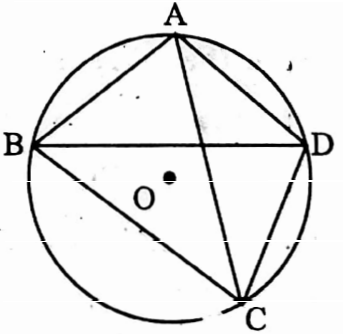
WBBSE Solutions For Class 10 Maths Geometry Chapter 1 Theorems Related To Circle Short Answer Question Example 14

In ΔABC, AB = AC

∴ ∠ACB = ∠ABC = 32°

∠ADC = ∠ABC [angles in the same segment]

= 32°

Similarly, ∠ADB = ∠ACB = 32°

∴ ∠BDC = ∠ADC + ∠ADB

= 32° + 32° = 64°

Example 15. BX and CY are the bisectors of the angles ∠ABC and ∠ACB respectively. If AB = AC and BY = 4 cm, find the length of AX.

Solution:
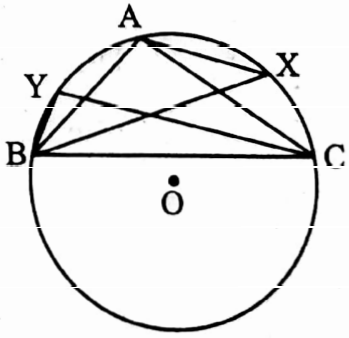
WBBSE Solutions For Class 10 Maths Geometry Chapter 1 Theorems Related To Circle Short Answer Question Example 15

In AABC, AB = AC

∴ ∠ACB = ∠ABC

or, \(\frac{1}{2}\) ∠ACB = \(\frac{1}{2}\) ∠ABC

∴ ∠BCY = ∠ABX [BX and CY are bisectors of angle ∠ABC and ∠ACB respectively]

∴ BY = AX

Again, BY = 4 cm

∴ AX = 4 cm.

Example 16. In Isosceles triangle ABC, AB = AC; a circle drawn taking AB as diameter meets the side BC at the point D. If BD = 4 cm find the value of CD

Solution:
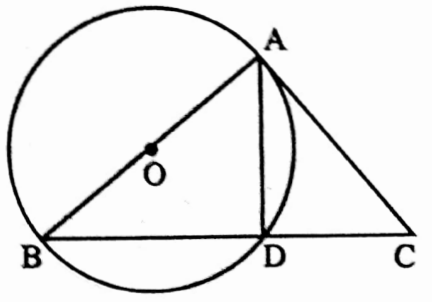
WBBSE Solutions For Class 10 Maths Geometry Chapter 1 Theorems Related To Circle Short Answer Question Example 16

I join A, D

∠ADB = 90° [semicircular angle)

∴ ∠ADC = 180° – 90° = 90°

In ΔABD and ΔACD,

AB = AC, ∠ADB = ∠ADC = 90° and ∠ABD = ∠ACD [AB = AC]

∴ ΔABD ≅ ΔACD [by AAS axiom of congruency]

∴ BD = CD BD = 4 cm

∴ CD = 4 cm

Class 10 Maths Board Exam Solutions

Example 17. Two chords AB and AC of a circle are mutually perpendicular to each other. If AB = 4cm, AC = 3 cm, find the length of the radius of the circle.

Solution:
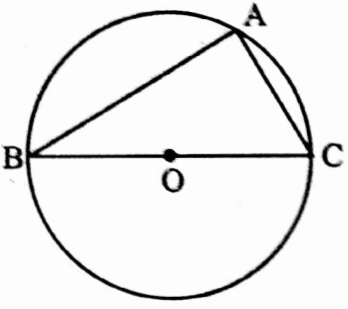
WBBSE Solutions For Class 10 Maths Geometry Chapter 1 Theorems Related To Circle Short Answer Question Example 17

∠BAC = 90° [AB ⊥ AC]

In ΔABC, BC2 = AB2 + AC2 [From Pythagorus theorem]

= (42 + 32) cm2

= 25 cm2

BC = √25 cm = 5 cm and ∠BAC = 90°.

So BC is diameter of the circle.

∴ length of radius \(\frac{5}{2}\) cm = 2.5 cm

Example 18. Two chords PQ and PR of a circle are mutually perpendicular to each other. If the length of the radius of the circle is r cm, find the length of the chord QR.

Solution:
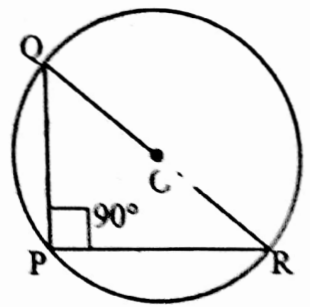
WBBSE Solutions For Class 10 Maths Geometry Chapter 1 Theorems Related To Circle Short Answer Question Example 18

∠QPR = 90° [PQ ⊥ PR]

∴ QR is the diameter of the circle of centre O.

OQ = OR = r cm [given]

∴ QR = 2r cm

Example 19. AOB is a diameter of a circle. The point C lies on the circle. If ∠OBC = 60°, find the value of ∠OCA.

Solution:
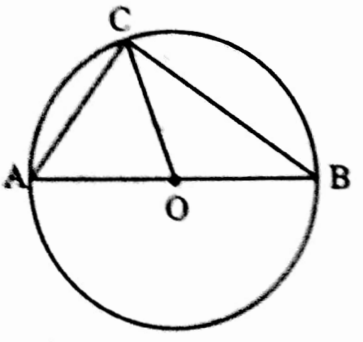
WBBSE Solutions For Class 10 Maths Geometry Chapter 1 Theorems Related To Circle Short Answer Question Example 19

In ΔBOC,

OB = OC [radii of same circle]

∴ ∠OCB = ∠OBC = 60°

∠ACB = 90° [semicircular angle]

∠OCA = ∠ACB – ∠OCB

= 90° – 60° = 30°

WBBSE class 10 Maths Geometry Solutions

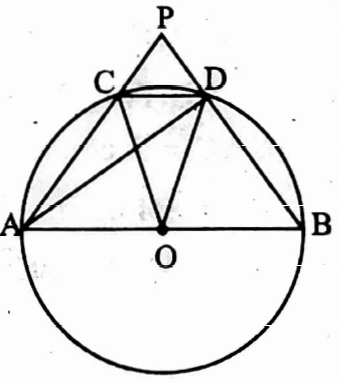
Example 20. In the picture beside, O is the centre of the circle and AB is the P diameter. The length of chord CD is equal to the length of the radius of the circle. AC and BD produced meet at point P, and find the value of ∠APB.
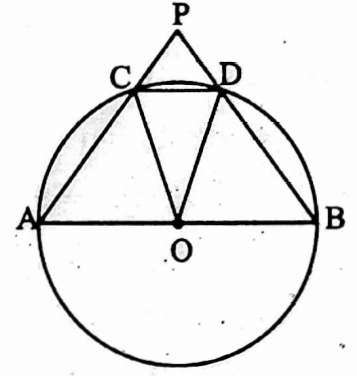
 

WBBSE Solutions For Class 10 Maths Geometry Chapter 1 Theorems Related To Circle Short Answer Question Example 20

Solution:

WBBSE Solutions For Class 10 Maths Geometry Chapter 1 Theorems Related To Circle Short Answer Question Example 20-1

I join A, D

In ΔCOD, OC = OD [radii of same circle]

∴ CD = OC = OD [according to condition]

∴ ΔCOD is an equilateral triangle

∴ ∠COD = 60°

∠COD is the angle to the centre O and ∠CAD is the angle on the circle at A formed by circular arc DC

∴ ∠CAD = \(\frac{1}{2}\) ∠COD = \(\frac{1}{2}\) x 60° = 30°

i.e. ∠PAD = 30°

again ∠ADB = 90° [semi-circular angle]

∴ ∠ADP = 180° – 90° = 90°

In ΔAPD, ∠APD = 180° – ∠ADP – ∠PAD

= 180° – 90° – 30° = 60°

i.e. ∠APB = 60°

Example 21. In the picture beside two circles with centres P and Q intersecting each at points B and C. ACP is a line segment. If ∠ARB = 150°, ∠BQD = x°, find the value of x.
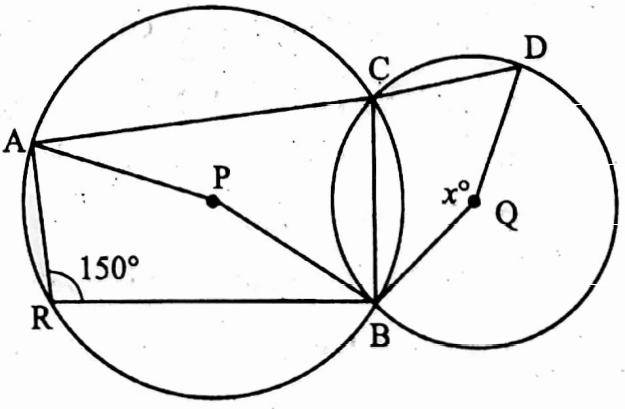
 

WBBSE Solutions For Class 10 Maths Geometry Chapter 1 Theorems Related To Circle Short Answer Question Example 21

Solution: Reflex ∠APB is the angle to the centre P and ∠ARB is angle on the circle formed by circular arc ACB

∴ Reflex ∠APB = 2 ∠ARB = 2 x 150° = 300°

∴ ∠APB = 360° – Reflex ∠APB

= 360° – 300° = 60°

Angle ∠APB is the angle to the centre P and ∠ACB is the angle on the circle formed by circular arc ARB

∴ ∠ACB = \(\frac{1}{2}\) ∠APB = \(\frac{1}{2}\) x 60° = 30°

∴ ∠BCD = 180° – ∠ACB = 180° – 30° = 150°

Similarly reflex ∠BQD = 2 ∠BCD = 2 x 150°

∴ ∠BQD = 360° – reflex ∠BQD

x° = 360° – 300° = 60°

∴ the value of x is 60.

WBBSE class 10 Maths Geometry Solutions

Example 22. In picture beside two circles intersect at the points P and Q. If ∠QAD = 80° and ∠PDA = 84°, find the value of ∠QBC and ∠BCP.
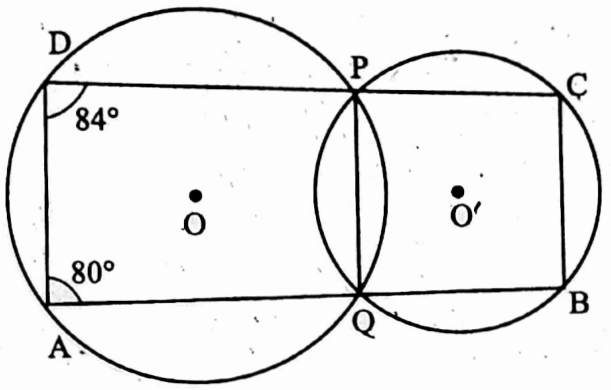
 

WBBSE Solutions For Class 10 Maths Geometry Chapter 1 Theorems Related To Circle Short Answer Question Example 22

Solution: ln ADPQ cyclic quadrilateral,

exterior ∠QPC = interior opposite ∠QAD = 80° and exterior ∠PQB = interior opposite ∠PDA = 84°

PQBC is a cyclic quadrilateral

∴ ∠QBC + ∠QPC = 180°

∠QBC + 80° =180°

or, ∠QBC = 100°

Again, ∠BCP + ∠PQB = 180°

∠BCP + 84° = 180°

or, ∠BCP = 96°

Example 23. In picture beside, if ∠BAD = 60°, ∠ABC = 80°, then find the value of ∠DPC and ∠BQC.
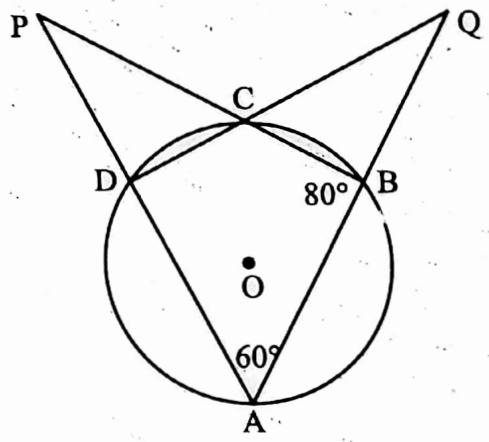
WBBSE Solutions For Class 10 Maths Geometry Chapter 1 Theorems Related To Circle Short Answer Question Example 23

Solution: In ΔABP, ∠BAP = 60° and ∠ABP = 80°

∴ ∠APB = 180° – 60° – 80° i.e. ∠DPC = 40°

In ABCD cyclic quadrilateral, ∠ADC + ∠ABC = 180°

∠ADC + 80° = 180°

⇒ ∠ADC = 180° – 80° = 100°

In ΔADQ, ∠QAD = 60°, ∠ADQ = 100°

∴ ∠AQD = 180° – 60° – 100° = 20°

i.e., ∠BQC = 20°

Example 24. In picture beside O is the centre of circle and AC is diameter. If ∠AOB = 80° and ∠ACE = 10°, find the value of ∠BED.
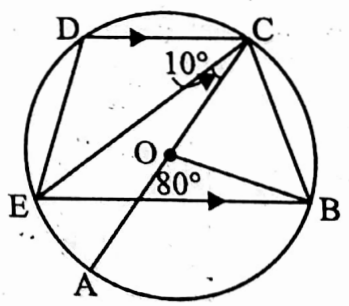
WBBSE Solutions For Class 10 Maths Geometry Chapter 1 Theorems Related To Circle Short Answer Question Example 24

Solution: ∠BOC = 180° – ∠AOB = 180° – 80° = 100°

∠BOC is the angle to centre O and ∠BEC is the angle on the circle at E formed by circular arc BC

∴ ∠BEC = \(\frac{1}{2}\) ∠BOC = \(\frac{1}{2}\) x 100° = 50°

DC || EB and EC its intersection

∴ ∠DCE = alternate ∠BEC = 50°

Similarly, ∠ACB = \(\frac{1}{2}\) ∠AOB = \(\frac{1}{2}\) x 80° = 40°

∠BCD = ∠ACB + ∠ACE + ∠DCE = 40° + 10° + 50° = 100°

In BCDE cyclic quadrilateral, ∠BED + ∠BCD = 180°

∠BED + 100° = 180°

⇒ ∠BED = 80°

WBBSE class 10 Maths Geometry Solutions

Example 25. In picture beside O is the centre of circle and AB is diameter. If ∠AOD = 140° and ∠CAB = 50°, find the value of ∠BED.
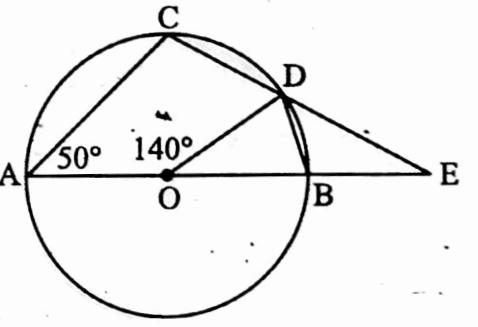
WBBSE Solutions For Class 10 Maths Geometry Chapter 1 Theorems Related To Circle Short Answer Question Example 25

Solution: ∠AOD is the angle to centre O and ∠ABD is the angle on the circle at B formed by circular arc ACD.

∴ ∠ABD = \(\frac{1}{2}\) ∠AOD = \(\frac{1}{2}\) x 140° = 70°

∴ ∠DBE = 180° – 70° = 110

In cyclic quadrilateral ABCD, exterior ∠BDE = interior opposite ∠CAB = 50°

In ΔDBE, ∠BED = 180° – ∠BDE – ∠DBE

= 180° – 50° – 110° = 20°

Example 26. The perpendicular distance of a chord from the centre of a circle, having the radius of 5 cm is 3 cm in length. Calculate the length of its chord.

Solution:
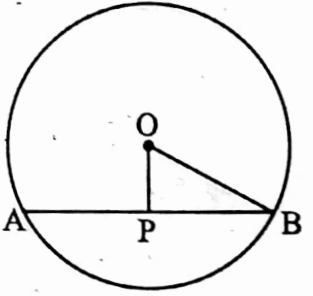
WBBSE Solutions For Class 10 Maths Geometry Chapter 1 Theorems Related To Circle Short Answer Question Example 26

Let, the length of the radius of the circle with its centre O and the perpendicular distance of the chord AB from O is OP where OP = 3 cm

In ΔBOP, ∠OPB = 90° [OP ⊥ AB]

OP2 + BP2 = OB2 [From Pythagorus theorem]

32 + BP2 = 52

⇒ BP = \(\sqrt{25-9}\) cm = √16 cm = 4 cm

∴ As, OP ⊥ AB

∴ BP = \(\frac{1}{2}\) AB [the perpendicular drawn on the chord, which is not a diameter, from the centre of the circle, bisects the chord]

⇒ AB = 2 BP

= 2 x 4 cm = 8 cm

∴ Length of chord is 8 cm.

WBBSE class 10 Maths Geometry Solutions

Example 27. The length of chord PQ of a circle with its centre O is 32 cm. If the length of radius of circle is 20 cm. then find the perpendicular distance from the centre O to the chord PQ.

Solution:
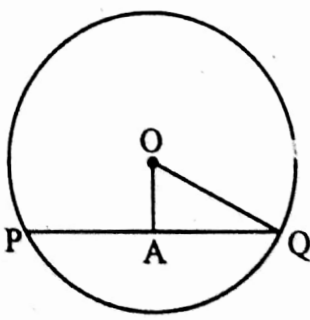
WBBSE Solutions For Class 10 Maths Geometry Chapter 1 Theorems Related To Circle Short Answer Question Example 27

The perpendicular OA, drawn on the chord PQ from centre O, intersects PQ at the point A.

∴ AQ = \(\frac{1}{2}\) PQ

= \(\frac{1}{2}\) x 32 cm = 16 cm

In right angle triangle AOQ,

OA2 + AQ2 = OQ2 [By Pythagorus theorem]

OA2 = OQ2 – AQ2

= (202 – 162) cm2

OA = \(\sqrt{400-256}\) cm

= √144 cm = 12 cm

∴ The distance from 0 to chord PQ is 12 cm.

Example 28. The perpendicular distance from the centre of a circle to a chord of length 1 2 cm is 4.5 cm. Find the length of diameter of the circle.

Solution:
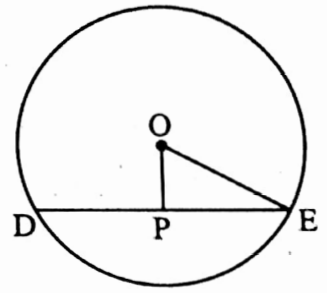
WBBSE Solutions For Class 10 Maths Geometry Chapter 1 Theorems Related To Circle Short Answer Question Example 28

Let the perpendicular distance from the centre O of a circle to a chord DE is OP,

DE = 12 cm, OP = 4.5 cm

I join O, E,

Hence OE is the radius of the circle as OP ⊥ DE

∴ PE = \(\frac{1}{2}\) DE

= \(\frac{1}{2}\) x 12 cm = 6 cm

In ΔPOE, ∠OPE – 90°

∴ OE2 = OP2 + PE2 = { (4.5)2 + (6)2} cm2

= (20.25 + 36) cm2 = 56.25 cm2

OE = \(\sqrt{56 \cdot 25}\) cm = 7.5 cm

∴ Diameter of the circle is (2 x 7.5) cm or 15 cm.

Class 10 Maths Geometry Chapter 1 Solutions

Example 29. Two chords AH and CD of length x cm and y cm respectively produce an angles 60° and 90° to the centre O of a circle. Establish the relation between x and y. [x> 0, y>0]

Solution:

WBBSE Solutions For Class 10 Maths Geometry Chapter 1 Theorems Related To Circle Short Answer Question Example 29

AB = x cm, CD = y cm ∠AOB = 60° and ∠COD = 90°

In ΔAOB, OA = OB [radii of same circle]

∴ ∠OBA = ∠OAB = \(\frac{180^{\circ}-\angle \mathrm{AOB}}{2}=\frac{180^{\circ}-60^{\circ}}{2}\) = 60°

∴ ΔAOB is equilateral triangle.

∴ OA = OB = AB = x cm.

In ΔCOD, OC = OD = x cm

∠COD = 90°

OC2 + OD2 = CD2

x2 + x2 = y2

⇒ 2x2 = y2

⇒ √2x = y

∴ This is the relation between x and y.

Example 30. The lengths of two parallel chords of a circle with a radius 5 cm in length 8 cm and 6 cm. Calculate the distance between two chords if they are in same side of the centre.

Solution:
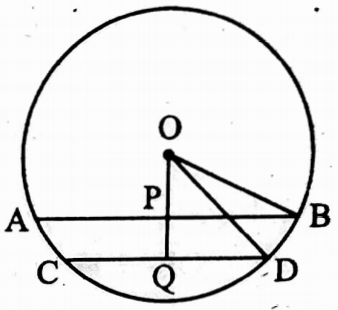
WBBSE Solutions For Class 10 Maths Geometry Chapter 1 Theorems Related To Circle Short Answer Question Example 30

Let, the length of the radius of the circle with its centre O be 5 cm. and the two chords AB and CD are in the same side the centre.

The lengths of AB and CD are 8 cm. and 6 cm. respectively. AB || CD.

From the point O, a perpendicular OQ is drawn on the chord CD which intersects AB at the point P.

Since AB || CD and OQ ⊥ CD, ∴ OP ⊥ AB.

∠OQD = corresponding ∠OPB = 90°

∴ BP = \(\frac{1}{2}\) AB = \(\frac{1}{2}\) x 8 cm = 4 cm

Again, OB = 5 cm

In right angled ΔBOP, OP2 + BP2 = OB2

⇒ OP2 = BP2 – BP2 = (52 – 42) cm2 = 9 cm2

OP = √9 cm = 3 cm

In ΔQOD, ∠OQD = 90°

∴ OQ2 + QD2 = OD2.

OQ2 = OD2 – QD2 = (52 – 32) cm2 = 16 cm2

OQ = √16 cm = 4 cm

∴ The distance between the cords AB and CD is PQ = OQ – OP = (4 – 3) cm = 1 cm

Example 31. O is the centre of the circle. ∠POT = 50° and ∠PRQ = 40°, Find the values of ∠QRT and ∠QOT.
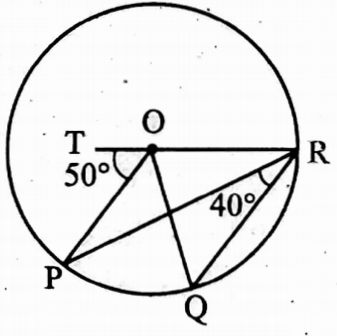
WBBSE Solutions For Class 10 Maths Geometry Chapter 1 Theorems Related To Circle Short Answer Question Example 31

Solution: ∠POQ is the angle to centre O and ∠PRQ is the angle on the circle at R formed by circular arc PQ

∴ ∠POQ = 2 ∠PRQ

∴ ∠POQ = 2 x 40° = 80°

∠QOT = ∠POQ + ∠POT

∠QOT = 80° + 50° = 130°

Example 32. O is the centre of the circle. If ∠AOC + ∠BOD = 100°, then find the value of ∠APC.

WBBSE Solutions For Class 10 Maths Geometry Chapter 1 Theorems Related To Circle Short Answer Question Example 32

Solution:

WBBSE Solutions For Class 10 Maths Geometry Chapter 1 Theorems Related To Circle Short Answer Question Example 32-1

I join B, C

∠AOC + ∠BOD

= 2 ∠ABC + 2 ∠BCD [The angle at the centre is double the angle on the circle, subtended by same arc]

= 2 ∠APC

2 ∠APC = 100°

⇒ ∠APC = 50°

Basic Geometrical Concepts Class 10 Solutions

Example 33. The circumcentre of ΔABC is O; if ∠OBC = 50°, then find the value of ∠BAC.

Solution:

WBBSE Solutions For Class 10 Maths Geometry Chapter 1 Theorems Related To Circle Short Answer Question Example 33

In Δ BOC, OB = OC [radii of same circle]

∠OCB = ∠OBC = 50°

∠BOC = 180° – (50° + 50°) = 80°

∠BAC = \(\frac{1}{2}\) ZBOC = \(\frac{1}{2}\) x 80° = 40°

Example 34. The circumcentre of ΔABC is O; if ∠BAC = 85° and ∠BCA = 55° find the value of ∠OAC.

Solution:
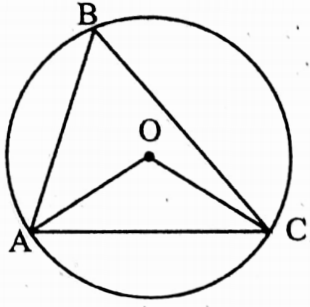
WBBSE Solutions For Class 10 Maths Geometry Chapter 1 Theorems Related To Circle Short Answer Question Example 34

In ΔABC,

∠BAC = 85°, ∠BCA = 55°

∴ ∠ABC = 180° – (85° + 55°) = 40°

∠AOC = 2 ∠ABC = 2 x 40° = 80°

In ΔAOC, OA = OC [radii of the same circle]

∠OCA = ∠OAC = \(\frac{180^{\circ}-\angle \mathrm{AOC}}{2}=\frac{180^{\circ}-80^{\circ}}{2}\) = 50°

Example 35. O is centre of the circle, ∠OAC = x°, ∠OBC = y°; find the value of ∠OAB.
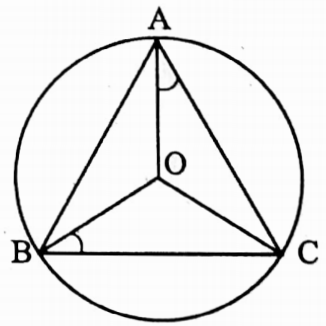
WBBSE Solutions For Class 10 Maths Geometry Chapter 1 Theorems Related To Circle Short Answer Question Example 35

Solution: In ΔAOC, OA = OC [radii of same circle]

∴ ∠OCA = ∠OAC = x°

In ΔBOC, OB = OC

∠OCB = ∠OBC = y°

∠ACB = ∠OCA + ∠OCB = x° + y°

∠AOB = 2 ∠ACB = 2 (x° + y°)

In ΔAOB, OA = OB

∴ ∠OBA = ∠OAB = \(\frac{180^{\circ}-\angle \mathrm{AOB}}{2^{\circ}}\)

= \(\frac{180^{\circ}-2\left(x^{\circ}+y^{\circ}\right)}{2}\)

∴ ∠OBA = 90°-x°-y°

Example 36. O is the centre of the circle, if ∠BPC = 100° and ∠PBD = 70° then find the value of ∠BAC.
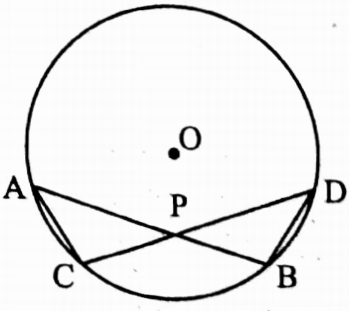
WBBSE Solutions For Class 10 Maths Geometry Chapter 1 Theorems Related To Circle Short Answer Question Example 36

Solution: In ΔPBD,

exterior ∠BPC = ∠PDB + ∠PBD

∴ 100° = ∠PDB + 70°

⇒ ∠PDB = 30° i.e. ∠CDB = 30°

Again ∠BAC =∠CDB [angles in the same segment]

∠BAC  = 30°

Example 37. AB is the diameter of the circle with its centre O; if ∠ABC = 40°, find the value of ∠BDC.
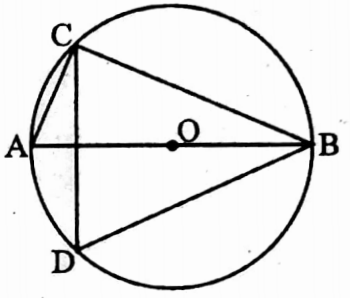
WBBSE Solutions For Class 10 Maths Geometry Chapter 1 Theorems Related To Circle Short Answer Question Example 37

Solution: ∠ACB = 90° [Semi circular angle]

In ∠ABC, ∠BAC = 180° – ∠ACB = ∠ABC

= 180° – 90° – 40° = 50°

∠BDC = ∠BAC [angles in the same segment]

∠BDC  = 50°

Example 38. O is the centre of the circle, if ∠AOB = 110° and ∠DCA = 40° then find the value of ∠BAD and ∠ADB.
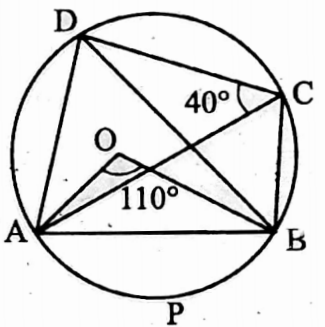
WBBSE Solutions For Class 10 Maths Geometry Chapter 1 Theorems Related To Circle Short Answer Question Example 38

Solution: 2 ∠ACB = ∠AOB [the angle at the centre is double the angle =110° on the circle, subtended by same arc]

∠ACB = 55°

∠BCD = ∠DCA + ∠ACB

= 40° + 55° = 95°

In ABCD cyclic quadrilateral,

∠BAD + ∠BCD = 180°

∠BAD + 95° = 180°

⇒ ∠BAD = 85°

∠ADB = ∠ACB [angles in the same segment] = 55°

Class 10 Geometry Chapter 1 Solved Examples

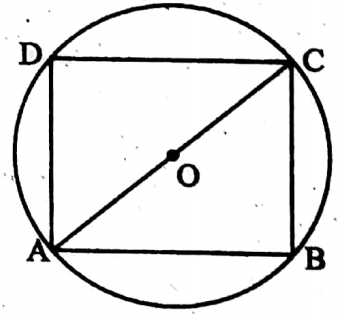
Example 39. If ABCD is a cyclic parallelogram find the value of ∠BAC.

Solution:
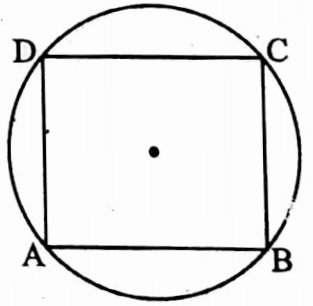
WBBSE Solutions For Class 10 Maths Geometry Chapter 1 Theorems Related To Circle Short Answer Question Example 39

In cyclic parallelogram ABCD,

∠A + ∠C =180°

again ∠A = ∠C [as ABCD is a parallelogram]

∠A + ∠A = 180°

2 ∠A = 180°

⇒ ∠A = 90° [cyclic parallelogram is a rectangular picture]

Example 40. If an angle of the cyclic trapezium is 40° then find the values of other angles.

Solution:
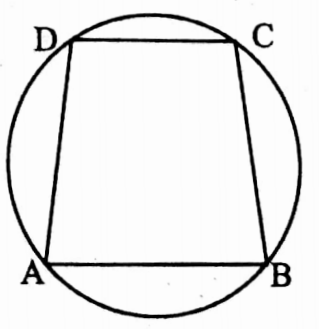
WBBSE Solutions For Class 10 Maths Geometry Chapter 1 Theorems Related To Circle Short Answer Question Example 40

Let AB || DC of a cyclic trapezium and ∠BAD = 40°as AB || DC and AD is the intersection

∴ ∠BAD + ∠ADC = 180°

40° + ∠ADC = 180°

⇒ ∠ADC = 140°

again ABCD is also a cyclic quadrilateral

∴ ∠BCD + ∠BAD = 180°

∠BCD + 40° =180°

∠BCD = 140°

∠ABC = 180° – ∠ADC

= 180° – 140° = 40°

values of other angles are 40°, 140°, 140° [cyclic trapezium is isosceles trapezium]

Example 41. Side AB of a cyclic quadrilateral ABCD is produced to the points X, if ∠XBC = 82° and ∠ADB = 47° then the find the value of ∠BAC.

Solution:
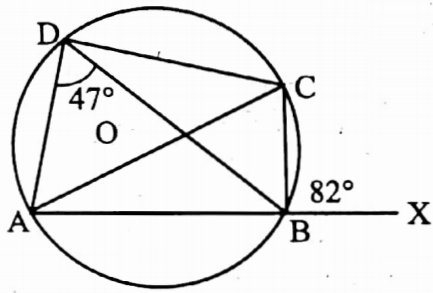
WBBSE Solutions For Class 10 Maths Geometry Chapter 1 Theorems Related To Circle Short Answer Question Example 41

In cyclic quadrilateral ABCD, exterior ∠XBC = interior opposite ∠ADC

= 82° = ∠ADC

∠BDC = ∠ADC – ∠ADB

= 82° – 47° = 35°

∠BAC = ∠BDC [angles in the same segment]

= 35°

The value of ∠BAC = 35°

Example 42. If the ratio of three consecutive angles of a cyclic quadrilateral is 1: 2 : 3 then determine the 1st and 3rd angles.

Solution: Let the measurement of these consecutive angles is x°, 2x° and 3x°

[x is common multiple and x > 0]

The opposite angles a cyclic quadrilateral are supplementary.

∴ x° + 3x° = 180°

⇒ 4x° = 180°

⇒ x° = 45°

The measurement of 1st angle is 45° and third angle is 45° x 3 or 135°

Example 43. AB is a diameter and ∠ACB is a semicircular angle of a circle of radius 4 cm in length. If BC = 2√7 cm, find the length of AC.

Solution:
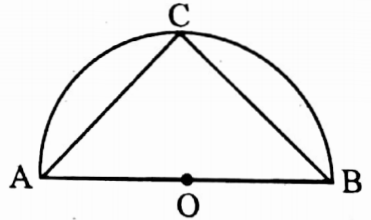
WBBSE Solutions For Class 10 Maths Geometry Chapter 1 Theorems Related To Circle Short Answer Question Example 43

∠ACB = 90°

In ΔACB, AC2 + BC2 = AB2

⇒ AC2 = AB2 – BC2 = {(2 x 4)2 – (2√7 )2} cm2

⇒ AC = \(\sqrt{64-28}\) cm = √36 cm = 6 cm.

WBBSE Solutions For Class 10 Maths Mensuration Chapter 1 Rectangular Parallelopiped Or Cuboid

Mensuration Chapter 1 Rectangular Parallelopiped Or Cuboid

The solids with rectangular surfaces of which the opposite surfaces are of equal measure and adjacent surfaces are perpendicular to each other, are called Rectangular parallelopiped or cuboid.


WBBSE Solutions For Class 10 Maths Mensuration Chapter 1 Rectangular Parallelopiped Or Cuboid Cuboid


  1. length = AB unit
  2. breadth = BC unit
  3. height = CE unit
  4. diagonal = AE unit

A rectangular parallelopiped has 8 vertices, 12 edges, 6 faces and 4 diagonals.

If each of the edges of a cuboid is of equal length, then the cuboid is called a cube.

Read and Learn More WBBSE Solutions for Class 10 Maths

WBBSE Solutions For Class 10 Maths Mensuration Chapter 1 Rectangular Parallelopiped Or Cuboid

If the length, breadth and height of a rectangular parallelopiped (or cuboid) be a unit, b unit, and c unit respectively then

  1. Volume = Area of the base x height = abc cubic unit
  2. The length of the diagonal = \(\sqrt{(\text { length })^2+(\text { breadth })^2+(\text { height })^2}=\sqrt{a^2+b^2+c^2}\)
  3. Area of total surface are a = 2 (ab + bc + ca) square unit

For cube:

  1. Volume = a3 cubic unit (Let each edge be a unit)
  2. Total surface area = 6a2 sq. unit.
  3. Length of each diagonal = √3a unit

Mensuration Chapter 1 Rectangular Parallelopiped Or Cuboid Fill In The Blanks

Example 1. Dimension of a parallelopiped is ______

Solution: 3

Example 2. No. of the surface of a cube is _____

Solution: 6

Class 10 Maths Mensuration Chapter 1 Solutions

Example 3. No. of vertices of a cuboid is ______

Solution: 8.

Example 4. If the length, breadth and height of a parallelopiped are equal then the parallelopiped is called a ______

Solution: cube.

Example 5. If side surface area of a cube is 256 sq. cm then length of each edge is _______ cm.

Solution: 8 cm.

Example 6. Ratio of the length of the diagonal of each surface of a cube and the length of the diagonal of that cube is _______

Solution: √2: √3

Example 7. The no. of diagonals of a cuboid is _____

Solution: 4

Example 8. The length of the diagonal on the surface of a cube = ________ x the length of one edge.

Solution: √2

Example 9. The number of the vertices, edges and plane surfaces of a cuboid be x, y, z respectively then x + y + z = _______

Solution: 26

Class 10 Maths Mensuration Chapter 1 Solutions

Example 10. If the size of a room is 8m x 6m x 5m, then the length of the largest straight rod that can be kept inside the room is _______

Solution: 5√5 m.

WBBSE Notes For Class 10 Geography And EnvironmentWBBSE Notes For Class 10 History And Environment
WBBSE Solutions For Class 10 Life ScienceWBBSE Class 10 Life Science Multiple Choice Questions
WBBSE Solutions for Class 10 MathsWBBSE Class 10 Maths Multiple Choice Questions
WBBSE Notes For Class 10 Physical Science And Environment


Mensuration Chapter 1 Rectangular Parallelopiped Or Cuboid True Or False

Example 1. If the length of each edge of a cube is twice of that 1st cube then the volume of this cube is 4 times more than that of the 1st cube.

Solution: False

Example 2. In the rainy season, the height of rainfall in 2-meter land is 5 cm, and the volume of rainwater is 1000 cubic meters.

Solution: True.

Example 3. The total surface area of a cuboid = (length x breadth + breadth x height + height x length) sq. unit.

Solution: False.

Example 4. No. of side faces of a cuboid is 6.

Solution: False

Surface Areas And Volumes Class 10 Solutions

Example 5. If the length of a edge of a cuboid is increased by a% then its length of the diagonal is also increased by a%.

Solution: True

Example 6. If two cubes are joined side by side, then it will be again a cube.

Solution: False.

Example 7. Sum of the edges of a cuboid = 4 (length + breadth + height).

Solution: True.

Example 8. Sum of the edges of cube = 12 x length of its one edge.

Solution: True.

Example 9. The intersecting point of the edges of a parallelopiped is called its vertex.

Solution: True.

Example 10. All cuboids are cubes.

Solution: False.

Class 10 Mensuration Chapter 1 Solved Examples

Mensuration Chapter 1 Rectangular Parallelopiped Or Cuboid Short Answer Type Questions

Example 1. If the number of surfaces of a cuboid is x, the number of edges is y, the number of vertices is z and the number of diagonals is p, then find the value of x – y + z + p.

Solution: x = 6, y – 12, z = 8, p = 4

∴ x – y + z + p = 6 – 12 + 8 + 4 = 6

The value of x – y + z = 6

Example 2. The length of dimensions of two cuboids are 4, 6, 4 units and 8, (2h – 1), 2 units respectively. If volumes of two cubes are equal find the value of h.

Solution: 4 x 6 x 4 = 8x (2h – 1) x 4

⇒ or, 2h – 1 = 6 or, h = 3.5

The value of h = 3.5

Example 3. If each edge of a cube is increased by 50% then how much the total surface area of the cube will be increased in percent?

Solution: Let each edge = a unit, total surface area = 6a2 sq. u

⇒ Increased edge = a x \(\frac{150}{100}\) unit = \(\frac{3}{2}\) a

⇒ Increased total surface area = \(6\left(\frac{3}{2} a\right)^2\)

= \(6 \times \frac{9}{4} a^2 \text { sq. } \mathrm{u}=\frac{27}{2} a^2 \text { sq. } u\)

⇒ increased % = \(\frac{\left(\frac{27}{2}-6\right) a^2}{6 a^2} \times 100 \text { sq. u }\)

= \(\frac{15}{2 \times 6} \times 100 \text { sq. } u=125 \text { sq. u }\)

∴ Total surface area is increased by 125%.

Wbbse Class 10 Mensuration Notes

Example 4. The length of two adjacent walls of a room are 12 m, and 8 m respectively. If the height of the room is 4 m, then calculate the area of the floor.

Solution: Area of the floor = length x breadth

= 12 x 8 sq. m = 96 sq. m

Example 5. The lengths of each edge of three solid cubes are 3 cm, 4 cm, and 5 cm respectively. A new solid is made by melting these three solid cubes. Write the length of each edge of the new cube.

Solution: Let the length of each edge of the new cube = a cm

∴ a3 = (33 + 43 + 53) or, a3 = 216

∴ a = 6 cm.

Example 6. No. of dimensions, vertices, edges, and surfaces of a parallelopiped are A, B, C, and D respectively, then find the value of \(\frac{2{A}+B+C-D}{B}\).

Solution: A = 3, B = 8, C = 12, D = 6

\(\frac{2 \mathrm{~A}+\mathrm{B}+\mathrm{C}-\mathrm{D}}{\mathrm{B}}=\frac{2 \times 3+8+12-6}{8}=\frac{5}{2}\)

Example 7. Volume, total surface area, and length of the diagonal of a cube are V, Z, and Z respectively, then find the value of \(\frac{AZ}{V}\).

Solution: V = a3, total surface area = 6a2, length of the diagonal = a√3

∴ \(\frac{\mathrm{AZ}}{\mathrm{V}}=\frac{6 a^2 \cdot a \sqrt{3}}{a^3}=6 \sqrt{3}\)

Example 8. Find the no. of cubes of edge 2 cm made from a cube of edge 1 m.

Solution: No. of cube made = \(\frac{(1 \mathrm{~m})^3}{(2 \mathrm{~cm})^3}=\frac{1000000}{2 \times 2 \times 2}=1,25,000\)

Surface Area And Volume Formulas Class 10

Example 9. How many boxes of dimensions 5 cm x 4 cm x 2 cm are to be kept in the box of dimensions 40 cm x 25 cm x 15 cm?

Solution: No. of boxes = \(\frac{40 \times 25 \times 15}{5 \times 4 \times 2}\) = 375

Example 10. If numerical values of total surface area and volume of a cube are equal the find the length of the diagonal.

Solution: 6a2 = a ∴ a = 6

length of the diagonal = 6√3 cm.

WBBSE Solutions For Class 10 Maths Geometry Chapter 4 Pythagoras Theorem

Geometry Chapter 4 Pythagoras Theorem

  1. In any right-angled triangle, the area of the square drawn on the hypotenuse is equal to the sum of the areas of the squares drawn on the other two sides.
  2. If in a triangle, the area of a square drawn on one side is equal to the sum of the areas of squares drawn on other two sides, then the angle opposite to the first side will be right angle.


WBBSE Solutions For Class 10 Maths Geometry Chapter 4 Pythagoras Theorem

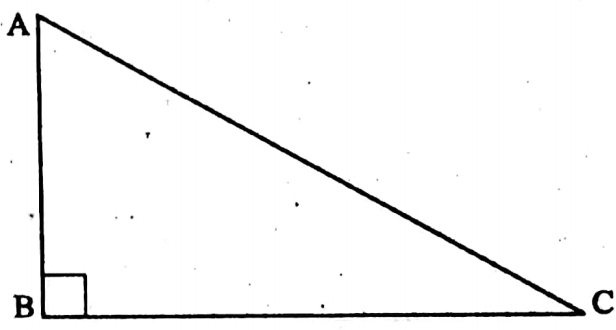
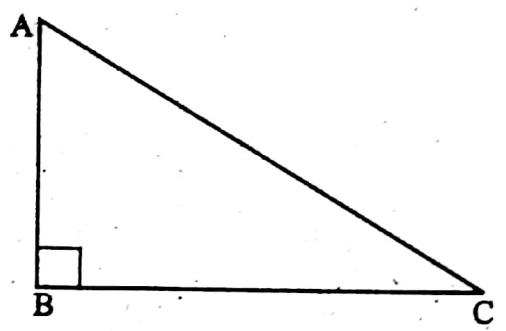
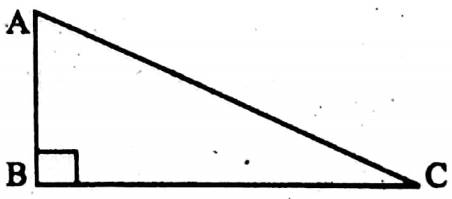
In ΔABC, ∠ABC = 90°

∴ AC2 = AB2 + BC2

Read and Learn More WBBSE Solutions for Class 10 Maths

WBBSE Solutions For Class 10 Maths Geometry Chapter 4 Pythagoras Theorem

Geometry Chapter 4 Pythagoras Theorem True Or False

Example 1. If the ratio of the lengths of three sides of a triangle is 3: 4: 5, then the triangle will always be a right-angled triangle.

Solution: Let the length of three sides are 3x unit, 4x unit and 5x units

[x is a common multiple and x > 0]

(3x)2 + (4x)2 = 9x2 + 162 = 25x2 = (5x)2

∴ The triangle is right angled triangle.

WBBSE Notes For Class 10 Geography And EnvironmentWBBSE Notes For Class 10 History And Environment
WBBSE Solutions For Class 10 Life ScienceWBBSE Class 10 Life Science Multiple Choice Questions
WBBSE Solutions for Class 10 MathsWBBSE Class 10 Maths Multiple Choice Questions
WBBSE Notes For Class 10 Physical Science And Environment


∴The statement is true.

Example 2. If in a circle of radius 10 cm in length, a chord subtends right angle at the centre, then the length of the chord will be 5 cm.

Solution: Let PQ is a chord of a circle with centre O;

WBBSE Solutions For Class 10 Maths Geometry Chapter 4 Pythagoras Theorem Chord Of A Circle With Centre O

OP = OQ = 10 cm and ∠POQ = 90°

In right angled triangle POQ, PQ2 = OP2 + OQ2

∴ PQ = \(\sqrt{O P^2+O Q^2}\)

= \(\sqrt{10^2+10^2} \mathrm{~cm}\)

= √200 cm = 10√2 cm

∴ length of chord PQ is 10√2

∴ The given statement is false.

Geometry Chapter 4 Pythagoras Theorem Fill In The Blanks

Example 1. In a right-angled triangle, the area of a square drawn on the hypotenuse is equal to the _____ of the areas of the squares drawn on other two sides.

Solution: sum

Example 2. In an isosceles right-angled triangle if the length of each of two equal sides is 4√2 cm then the length of the hypotenuse will be _______ cm.

Solution: In a right-angled triangle ABC,

WBBSE Solutions For Class 10 Maths Geometry Chapter 4 Pythagoras Theorem Isosceles Right Angled Traingle

AB = BC = 4√2 cm and ∠ABC = 90°.

AC2 = AB2 + BC2

⇒ AC = \(\sqrt{A B^2+B C^2}=\sqrt{(4 \sqrt{2})^2+(4 \sqrt{2})^2 \mathrm{~cm}}\)

= \(\sqrt{32+32} \mathrm{~cm}=\sqrt{64} \mathrm{~cm}=8 \mathrm{~cm}\)

∴ The length hypotenuse will be 8 cm.

Class 10 Maths Geometry Chapter 4 Solutions

Example 3. In a rectangular ABCD, the two diagonals AC and BD intersect each other at the point O, if AB = 12 cm, AO = 6.5 cm, then the length of BC is _______ cm.

Solution: AC and BD are bisects each other.

WBBSE Solutions For Class 10 Maths Geometry Chapter 4 Pythagoras Theorem Rectangular

∴ OC = OA = 6.5 cm

∴ AC = (6.5 x 2) cm = 13 cm

In right angle ΔABC, ∠ABC = 90°

∴ AB2 + BC2 = AC2 [By Pythagoras theorem]

⇒ BC = \(\sqrt{A C^2-A B^2}\)

= \(\sqrt{13^2-12^2} \mathrm{~cm}\)

= √25 cm = 5 cm

∴ 5 cm

Geometry Chapter 4 Pythagoras Theorem Short Answer Type Question

Example 1. In ΔABC, if AB = (2a – 1) cm, AC = 2√2a cm and BC = (2a + 1) cm, then write the value of ∠BAC.

Solution:

WBBSE Solutions For Class 10 Maths Geometry Chapter 4 Pythagoras Theorem Short Answer Question Example 1

AB2 = (2a – 1)2

AC2 = (2√2a)2 = 8a

BC2 = (2a + 1)2

AB2 + AC2 = (2a – 1)2 + 8a

= (2a – 1)2 + 4.2a.1 = (2a + 1)2

∴ AB2 + AC2 = BC2

∴ ΔABC is a right-angled triangle whose hypotenuse is BC

∴ ∠BAC = 90°

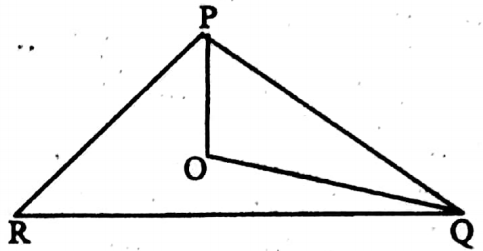
Example 2. Point O has situated within P the triangle PQR in such a way that ∠POQ = 90°, OP = 6 cm and OQ = 8 cm. Write the length of QR.

WBBSE Solutions For Class 10 Maths Geometry Chapter 4 Pythagoras Theorem Short Answer Question Example 2

Solution: In a right-angled triangle POQ, ∠POR = 90°

∴ PQ2 = OP2 + OQ2

⇒ PQ = \(\sqrt{O P^2+O Q^2}\)

= \(\sqrt{6^2+8^2} \mathrm{~cm}=\sqrt{100} \mathrm{~cm}=10 \mathrm{~cm}\)

In right-angled ΔPQR, ∠QPR = 90°

∴ QR2 = PQ2 + PR2

QR = \(\sqrt{\mathrm{PQ}^2+\mathrm{PR}^2}\)

= \(\sqrt{10^2+24^2} \mathrm{~cm}=\sqrt{676} \mathrm{~cm}=26 \mathrm{~cm}\)

Example 3. The point O is situated within the rectangular figure ABCD in such a way that OB = 6cm, OD = 8 cm and OA = 5 cm. Determine the length of OC.

Solution: I draw a parallel line PQ through O which intersects AD and BC of P and Q respectively.

WBBSE Solutions For Class 10 Maths Geometry Chapter 4 Pythagoras Theorem Short Answer Question Example 3

In quadrilateral ABQP, AB || PQ and AP || BQ.

∴ ABQP is a parallelogram  ∴ AP = BQ

Similarly, CDPQ is a parallelogram  ∴ CQ = DP

In right-angled triangle AOP, ∠APO = 90°

∴ OA2 = AP2 + OP2

Similarly, In ΔCOQ, OC2 = CQ2 + OQ2

In ΔBOQ, OB2 = BQ2 + OQ2

and In ΔDOP, OD2 = DP2 + OP2

OA2 + OC2 = AP2 + CQ2 + OP2 + OQ2

= BQ2 + DP2 + OP2 + OQ2 [AP = BQ; CQ = D]

= (BQ2 + OQ2) + (DP2 + OP2)

OA2 + OC2 = OB2 + OD2

⇒ OC = \(\sqrt{O B^2+O D^2-O A^2}\)

= \(\sqrt{6^2+8^2-5^2} \mathrm{~cm}=\sqrt{75} \mathrm{~cm}=5 \sqrt{3} \mathrm{~cm}\)

∴ Length of OC is 5√3 cm.

Areas Related To Circles Class 10 Solutions

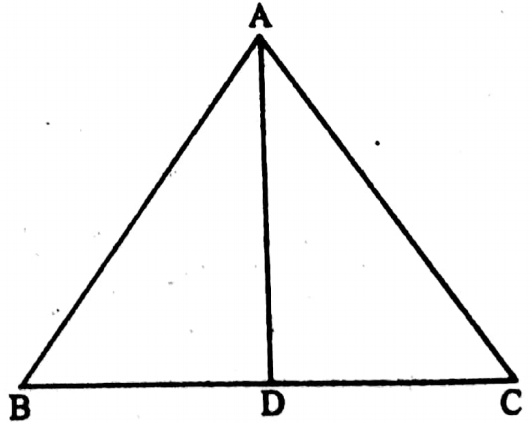
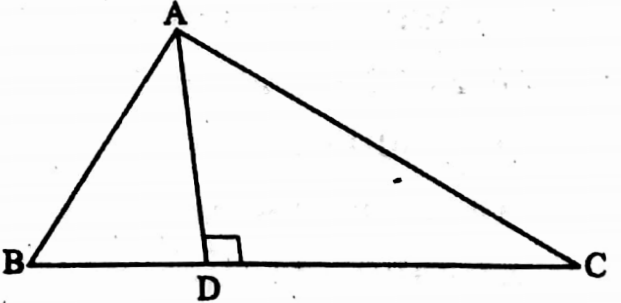
Example 4. In the triangle ABC the perpendicular AD from the point A BC at the point D. If BD = 8 cm, DC = 2 on the side BC meets the side BC at the point D. If BD = 8 cm, DC = 2 cm and AD = 4 cm, then write the measure of ∠BAC.

Solution: In ΔABD, ∠ADB = 90°cm [∵ AD ⊥ BC]

AB2 = BD2 + AD2

= {(8)2 + (4)2} sq. cm = 100 sq. cm

WBBSE Solutions For Class 10 Maths Geometry Chapter 4 Pythagoras Theorem Short Answer Question Example 4

In ΔACD, ∠ADC = 90°

∴ AC2 = AD2 + DC2

= {(4)2 + (2)2} sq. cm = 20 sq. cm

AB2 + AC2 = (100 + 20) sq. cm = 100 sq. cm

BC2 = (BD + DC)2 = (8 + 2)2 sq. cm = 100 sq. cm

∵ AB2 + AC2 = BC2

∴ ΔABC is right angled triangle whose hypotenuse is BC

∴ ∠BAC = 90°

Example 5. In the right-angled triangle, ABC, ∠ABC = 90°, AB = 3 cm, BC = 4 cm and the perpendicular BD on the side AC from the point B which meets the side AC at the point D. Determine the length of BD.

Solution:

WBBSE Solutions For Class 10 Maths Geometry Chapter 4 Pythagoras Theorem Short Answer Question Example 5

In ΔABC, ∠ABC = 90°

AC2 = AB2 + BC2

AC = \(\sqrt{\mathrm{AB}^2+\mathrm{BC}^2}=\sqrt{3^2+4^2} \mathrm{~cm}=\sqrt{25} \mathrm{~cm}=5 \mathrm{~cm}\)

let, AD = x cm [x>0]

CD = (5 – x) cm

In, ΔABD, BD2 = AB2 – AD2

In ΔBCD, BD2 = BC2 – DC2

∴ AB2 – AD2 = BC2 – DC2

32 – x2 = 42 – (5 – x)2

⇒ 9 – x2 = 16 – 25 + 10x – x2

⇒ 10x = 18

⇒ x = 1.8

∴ AD = 1.9 cm

BD = \(\sqrt{\mathrm{AB}^2-\mathrm{AD}^2}=\sqrt{(3)^2-(1 \cdot 8)^2} \mathrm{~cm}\)

= \(\sqrt{9-3 \cdot 24} \mathrm{~cm}=\sqrt{5 \cdot 76} \mathrm{~cm}=2 \cdot 4 \mathrm{~cm}\)

∴ The length of BD is 2.4 cm.

Example 6. The length of the hypotenuse of a right-angled triangle is 13 cm and the difference in length of other two sides is 7 cm. Find the perimeter of the triangle.

Solution: In right-angled ΔABC, ∠ABC = 90°

WBBSE Solutions For Class 10 Maths Geometry Chapter 4 Pythagoras Theorem Short Answer Question Example 6

hypotenuse (AC) = 13 cm and AB = AB = x cm [x > 0]

let AB < BC

∴ BC = (x + 7) cm

In ΔABC, AB2 + BC2 = AC2 [By Pythagoras theorem]

x2 + (x + 7)2 = (13)2

⇒ x2 + x2 + 14x + 49 – 169 = 0

⇒ x2 + 7x – 60 = 0

⇒ x2 + 12x- 5x- 60 = 0

⇒ x (x + 12) – 5 (x + 12) = 0

⇒ (x + 12) (x- 5) = 0

either x + 12 = 0

⇒ x =- 12

or, x- 5 = 0

⇒ x = 5

as x > 0

∴ Length of two sides are 5 cm and (5 + 7) cm and 12 cm.

∴ Perimeter of the triangle is (5 + 12 + 13) cm i.e. 30 cm.

Class 10 Geometry Chapter 4 Solved Examples

Example 7. A square is inscribed in a circle with radius 2 cm in length. Find the perimeter of the square.

Solution: ABCD is a cyclic square and the centre of the circle is O; AC is a diagonal of the square and also AC is the diameter of the circle.

WBBSE Solutions For Class 10 Maths Geometry Chapter 4 Pythagoras Theorem Short Answer Question Example 7

∴ AC = (2 x 2) cm = 4 cm

Let, AB = BC = CD = DA = x cm [x > 0]

In ΔABC, ∠ABC = 90°

∴ AB2 + BC2 = AC2

x2 + x2 = (4)2.

⇒ 2x2 = 16

⇒ x = √8 = 2√2

∴ Perimeter of the square is (4 x 2√2) cm or 8√2 cm

Example 8. The length of two equal sides of an isosceles triangle are (x + 2) cm and (2x – 1) cm. Find out the circumradius of the triangle.

Solution: ΔABC is an isosceles triangle whose ∠ABC = 90° and AB = B

WBBSE Solutions For Class 10 Maths Geometry Chapter 4 Pythagoras Theorem Short Answer Question Example 8

Let AB = (x + 2) cm and BC = (2x- 1) cm

∴ 2x – 1- x + 2  ⇒ x = 3

∴ AB = BC = (3 + 2) cm = 5 cm

ΔABC, ∠ABC = 90°

∴ AC2 = AB2 + BC2

⇒ AC = \(\sqrt{\mathrm{AB}^2+\mathrm{BC}^2}=\sqrt{5^2+5^2} \mathrm{~cm}\)

= \(\sqrt{50} \mathrm{~cm}=5 \sqrt{2} \mathrm{~cm}\)

∴ The circumradius of ΔABC is \(\frac{5 \sqrt{2}}{2}\) cm

Wbbse Class 10 Geometry Notes

Example 9. The length of a side of a rectangle is a unit and length of one diagonal is \(\sqrt{a^2+b^2}\) unit. What is the area of the rectangle?

Solution: AB unit and AC = \(\sqrt{a^2+b^2}\) unit of rectangle ABCD.

WBBSE Solutions For Class 10 Maths Geometry Chapter 4 Pythagoras Theorem Short Answer Question Example 9

Let BC = x unit

In a right-angled triangle ABC, ∠ABC = 90°

∴ AB2 + BC2 = AC2

BC = \(\sqrt{\mathrm{AC}^2-\mathrm{AB}^2}\)

= \(\sqrt{\left(\sqrt{a^2+b^2}\right)^2-a^2} \text { unit }\)

= \(\sqrt{a^2+b^2-a^2} \text { unit }=\sqrt{b^2} \text { unit }=b \text { unit }\)

∴ Area of the rectangle is = (a x b) sq. unit = ab sq. unit

Example 10. The lengths of two adjacent sides of right angle of a right-angled triangle are 16 cm and 12 cm. Find the length of the radius of incircle of the triangle.

Solution: In ΔABC, ∠ABC = 90°

AB = 12 cm, BC = 16 cm, AC2 = AB2 + BC2

AC = \(\sqrt{\mathrm{AB}^2+\mathrm{BC}^2}=\sqrt{12^2+16^2}\) = √400 cm = 20 cm

WBBSE Solutions For Class 10 Maths Geometry Chapter 4 Pythagoras Theorem Short Answer Question Example 10

Let length of radius of incircle of a triangle ABC is r cm.

∴ OD = OE = OF = r cm

ΔAOB + ΔBOC + ΔCOA = ΔABC

\(\frac{1}{2}\) x AB x OD + \(\frac{1}{2}\) x BC x OE + \(\frac{1}{2}\) x AC x OF = \(\frac{1}{2}\) x BC x AB

⇒ AB x OD + BC + OE + AC x OF = BC x AB

∴ 12 x r + 16 x r + 20 x r = 16 x 12

⇒ r = 4

∴ The length of radius of the circle is 4 cm.

Example 11. If semi perimeter of an equilateral triangle is 7.5 cm then calculate the area of the triangle.

Solution: Perimeter of the equlateral triangle ABC is (7.5 x 2) cm or 15 cm

∴ AB = BC = CA = \(\frac{15}{3}\) cm = 5 cm


WBBSE Solutions For Class 10 Maths Geometry Chapter 4 Pythagoras Theorem Short Answer Question Example 11

I draw AD ⊥ BC

In ΔABD and ΔACD,

AB = AC, ∠ABD = ∠ACD = 60° and ∠ADB = ∠ADC = 90°

∴ ΔABD ≅ ΔACD,

∴ BD = CD = \(\frac{5}{2}\) cm = 2.5 cm

In ΔABD, AD2 + BD2 = AB2

⇒ \(\mathrm{AD}=\sqrt{\mathrm{AB}^2-\mathrm{BD}^2}=\sqrt{5^2-\left(\frac{5}{2}\right)^2} \mathrm{~cm}=\sqrt{\frac{75}{4}} \mathrm{~cm}=\frac{5 \sqrt{3}}{4} \mathrm{~cm}\)

Area of ΔABC = \(\frac{1}{2}\) x BC x AD = \(\frac{1}{2}\) x 5 x \(\frac{5 \sqrt{3}}{2}\) sq cm = \(\frac{25 \sqrt{3}}{4}\) sq. cm

Area And Perimeter Of Circles Class 10

Example 12. BC is a diameter of the semicircle with centre O. If AB = (x + 3) cm, AC = (5x + 2) cm and BC = (7x – 1) cm, then find the length of the radius of the semicircle, [x > 0]


WBBSE Solutions For Class 10 Maths Geometry Chapter 4 Pythagoras Theorem Short Answer Question Example 12

Solution: ∠BAC = 90° [semicircular angle]

In a right-angled triangle, ABC, BC2 = AB2 + AC2

⇒ (7x- 1)2 = (x + 3)2 + (5x + 2)2

⇒ 49x2 – 14x + 1 = x2 + 6x + 9 + 25x2 + 20x + 4

⇒ 23x2 – 40x – 12 = 0

⇒ 23x2 – 46x + 6x – 12 = 0

⇒ 23x (x- 2) + 6 (x – 2) = 0

⇒ (x- 2) (23x + 6) = 0

either x- 2 = 0

⇒ x = 2

as x > 0,  ∴ x = 2

or, 23x + 6 = 0

⇒ x = –\(\frac{6}{23}\)

∴ BC = (7 x 2 – 1) cm = 13 cm

∴ The length of radius is \(\frac{13}{2}\) cm or 6.5 cm.

Example 13. If the perimeter of isosceles right angled triangle is √2(√2 +1) cm, then calculate the area of the triangle.

Solution: Let in ΔABC, AB = BC = x cm [x > 0]

and ∠ABC = 90°


∴ AC2 = AB2 + BC2

⇒ AC = \(\mathrm{AC}=\sqrt{\mathrm{AB}^2+\mathrm{BC}^2}=\sqrt{x^2+x^2} \mathrm{~cm}=\sqrt{2} x \mathrm{~cm}\)

Perimeter = (x + x + √2 x) cm

= (2x + √2x) cm = √2 (√2 + 1)x

According to question, √2(√2 + 1)x = √2 (√2 + 1)

⇒ x = 1

AB = BC = 1 cm

Area of ΔABC = \(\frac{1}{2}\) x BC x AB (\(\frac{1}{2}\) x 1 x 1)sq. cm = \(\frac{1}{2}\) sq. cm

Class 10 Maths Geometry Important Questions

Example 14. AB is a chord and AT is a tangent at A of a circle with centre O and OP ⊥ AB. If OP = 3 cm, AB = 8 cm and AT = 12 cm then find the length of OT.


WBBSE Solutions For Class 10 Maths Geometry Chapter 4 Pythagoras Theorem Short Answer Question Example 14


Solution: ∵ OP ⊥ AB

∴ AP = BP = \(\frac{1}{2}\) AB = (\(\frac{1}{2}\) x 8) cm = 4 cm

In ΔAOP, ∠APO = 90°

∴ OA2 = OP2 + AP2

⇒ \(\mathrm{OT}=\sqrt{\mathrm{OA}^2+\mathrm{AT}^2}=\sqrt{5^2+12^2} \mathrm{~cm}=13 \mathrm{~cm}\)

AT is a tangent at A and OA is radius of the circle

∴ OA ⊥ AT, ∴ ∠OAT = 90°

In ΔAOT, OT2 = OA2 + AT2.

⇒ OT = \(\sqrt{\mathrm{OA}^2+\mathrm{AT}^2}=\sqrt{5^2+12^2}\) = 13 cm

Class 10 Maths Geometry Important Questions

Example 15. The ratio of angles of a triangle is 1: 2 : 3; if the length of the biggest sides is 10 cm, find the lengths of the other two sides.

Solution:

WBBSE Solutions For Class 10 Maths Geometry Chapter 4 Pythagoras Theorem Short Answer Question Example 15

Ratio of angles of a triangle is 1: 2 : 3

∴ The value of 1st angle is \(\left(180^{\circ} \times \frac{1}{1+2+3}\right)\) or 30°

The value of 2nd angle is \(\left(180^{\circ} \times \frac{2}{1+2+3}\right)\) or 60°

and that of third angle is { 180° – (30° + 60°)} or 90°

Let, in ΔABC, ∠ABC = 90°, ∠BAC = 60° and ∠ACB = 30°

∴ AC = 10 cm [the biggest side]

AB is extended to BD such that AB = BD; I join C, D

In ΔABC and ΔDBC, AB = BD, ∠ABC = ∠DBC = 90° and BC = BC [common side]

∴ ΔABC ≅ ΔDBC,  ∴ ∠D = ∠A = 60° and ∠BCD = ∠ACB = 30°

∴ ∠ACD = 30° + 30° = 60°

In ΔACD, ∠DAC = ∠ACD = ∠ADC = 60°

∴ ΔACD is an equilateral triangle

∴ AD = AC = 10 cm

AB = \(\frac{1}{2}\) AD = (\(\frac{1}{2}\) x 10) cm = 5 cm

In ΔABC, AB2 + BC2 = AC2

⇒ BC = \(\sqrt{\mathrm{AC}^2-A B^2}=\sqrt{10^2-5^2} \mathrm{~cm}=\sqrt{75} \mathrm{~cm}=5 \sqrt{3} \mathrm{~cm}\)

∴ The length of other two sides are 5 cm and 5√3 cm.

WBBSE Solutions For Class 10 Maths Arithmetic Chapter 2 Compound Interest And Uniform Rate Of Increase Or Decrease

Arithmetic Chapter 2 Compound Interest And Uniform Rate Of Increase Or Decrease

Money is said to be lent at compound interest if the interest at the end of the year or a fixed period of time in added to the principal, and thus the amount obtained becomes the new principal for the next period and so on.

Important points to be remembered:

  1. For interest is calculated per annum i.e. time period is 1; compound interest is equal to simple interest.
  2. Compound interest for more than 1 year is always greater than simple interest (or for any time period, the same result will occur for more than 1 time period).

Important results: If R be the rate of interest per annum, T is the duration in years, A is the amount and P is the principal.

Read and Learn More WBBSE Solutions for Class 10 Maths

1. If interest is compounded annually, then—

  1. \(A=P\left(1+\frac{R}{100}\right)^T\)
  2. \(P=\frac{A}{\left(1+\frac{R}{100}\right)^T}\)

If interest is compounded half yearly, then (i.e. time period = \(\frac{12}{6}\) = 2)

\(A=P\left(1+\frac{\frac{\mathrm{R}}{2}}{100}\right)^{2 T}\)

If interest is compounded quarterly, then [time period \(\frac{12}{3}\) = 4]

\(A=P\left(1+\frac{\frac{R}{4}}{100}\right)^T\)

If rate of interest is R,%, R2%, R3% respeclively, for 1st, 2nd and 3rd years then

\(A=P\left[\left(1+\frac{R_1}{100}\right)\left(1+\frac{R_2}{100}\right)\left(1+\frac{R_3}{100}\right)\right]\)

WBBSE Solutions For Class 10 Maths Arithmetic Chapter 2 Compound Interest And Uniform Rate Of Increase Or Decrease

2. Compound interest = A- P

3. If a sum becomes x times in y years, then after xy years it will be (x)times.

4. It a certain sum becomes n times in T years, then rate of interest is

\(R=100\left[(n)^{\frac{1}{T}}-1\right]\)

Class 10 Maths Arithmetic Chapter 2 Solutions

5. Relation between simple interest and compound interest

Simple interest = \(\frac{\mathrm{R} \times \mathrm{T}}{100\left[\left(1+\frac{\mathrm{R}}{100}\right)^{\mathrm{T}}-1\right]} \times \mathrm{C} \cdot \mathrm{I}\)

6. Difference between compound interest and simple interest.

Compound interest- simple interest = \(P\left[\left(\frac{100+R}{100}\right)^T-\frac{R T}{100}-1\right]\)

WBBSE Notes For Class 10 Geography And EnvironmentWBBSE Notes For Class 10 History And Environment
WBBSE Solutions For Class 10 Life ScienceWBBSE Class 10 Life Science Multiple Choice Questions
WBBSE Solutions for Class 10 MathsWBBSE Class 10 Maths Multiple Choice Questions
WBBSE Notes For Class 10 Physical Science And Environment


Rate of growth and depreciation: Some basic terms:

  1. Growth: An increase in price or population or learners, production to any concerning time uniformly is called growth or appreciation.
  2. Similarly the rate decrease, uniformly concerning the time (fall of efficiency of a Machine, decrease valuation of old building, furniture, movable properties, or any) is called a uniform rate of decrease or depreciation.

Important result:

1. If the original value is P., the final value is A, the rate of growth is R% per annum and the period is T years then

For growth

1. \(A=P\left(1+\frac{R}{100}\right)^T\)

2. Increase = A – P

For depreciation

1. \(A=P\left(1-\frac{R}{100}\right) T\)

2. decrease = A – P

2. 1. If A > P, there is an increase

2 . If A < P, there is a decrease

Geometric Progression Class 10 Solutions 

Arithmetic Chapter 2 Compound Interest And Uniform Rate Of Increase Or Decrease True Or False

Example 1. In 2 years the simple interest and compound interest of a certain sum of money on a particular rate will be equal.

Solution: False

Example 2. The amount of simple interest is less than compound interest in 1 year when the principal and the rate of interest be equal.

Solution: False

Example 3. Amal borrowed Rs. P at 10% per annum simple interest and Bimal borrowed Rs. p at 10% compound interest per annum for 2 years. Bimal have to pay more than Amal to settle their loan.

Solution: True

Example 4. If P be the price of a building. It’s value decreases r% every year. The value of the building at the end of 2 years will be \(P\left(1-\frac{r}{100}\right)^2\)

Solution: True

Example 5. The formula I = \(\frac{p r t}{100}\) is used to calculating compound interest.

Solution: False

Example 6. The formula \(\mathrm{A}=\mathrm{P}\left(1-\frac{r}{100}\right)^n\) is used to find compound interest.

Solution: False

Class 10 Arithmetic Chapter 2 Solved Examples

Example 7. Compound interest will be always less than Simple Interest for some money at fixed rate of interest for a fixed time.

Solution: False

Example 8. In case of compound interest is to be added to the principal at the fixed time interval, i.e. the amount of principal increases continuously.

Solution: True

Example 9. The simple interest for the 1st year is the same as the compound interest (compounded annually) for the first year.

Solution: True

Example 10. If interest is compounded monthly, the formula for amount in compound interest is \(A=P\left(1+\frac{\frac{r}{12}}{100}\right)^{12 n}\)

Solution: True

Arithmetic Chapter 2 Compound Interest And Uniform Rate Of Increase Or Decrease Fill In The Blanks

Example 1. The formula to find the uniform rate of increase and compound interest are _______

Solution: Same

Example 2. On a certain sum of money at the same rate of simple interest and compound interest, the amount of interest receivable is equal for_______ years.

Solution: 1st

Example 3. The compound interest on Rs. 1000 for 2 years at 10% per annum is ₹ _______

Solution: Rs. 210

Wbbse Class 10 Arithmetic Notes 

Example 4. The rate of depreciation of a machine is 10% per annum two years ago the price of the machine was Rs. _______ when the present price of that machine is Rs. 500.

Solution: 405

Example 5. The compound interest and simple interest for one year at the fixed rate of interest oh fixed sum to money are______

Solution: Same

Example 6. If something are increased by fixed rate with respect time that is ______

Solution: Uniform rate

Example 7. If some things are decreased by a fixed rate with respect to time this is a uniform rate of ______

Solution: Decrease

Example 8. At 8% compound interest per annum Rs 10,000 amounts to Rs. 11664 in ____ years.

Solution: 2

Arithmetic Chapter 2 Compound Interest And Uniform Rate Of Increase Or Decrease Short Answer Type Questions

Example 1. Let us write the rate of compound interest per annum so that this amount on ₹ 400 for 2 years becomes 441.

Solution: \(A=P\left(1+\frac{r}{100}\right)^n\)

or, \(441=400\left(1+\frac{r}{100}\right)^2\)

or, \(\frac{441}{400}=\left(1+\frac{r}{100}\right)^2\)

or, \(\quad\left(1+\frac{r}{100}\right)^2=\left(\frac{21}{20}\right)^2\)

or, \(1+\frac{r}{100}=\frac{21}{20}\)

or, \(\quad \frac{r}{100}=\frac{21}{20}-1\)

or, \(\quad \frac{r}{100}=\frac{1}{20}\)

or, r=5

∴ Rate of interest in 5% per annum.

Example 2. If a sum of money doubles it self at compound interest in n years, let us write in how many years will it become four times.

Solution: \(2 \mathrm{P}=\mathrm{P}\left(1+\frac{r}{100}\right)^n\)

or, \(2=\left(1+\frac{r}{100}\right)^n\)

Now. let it become four times is T years.

\(4 P=P\left(1+\frac{r}{100}\right)^{\mathrm{T}}\)

or, \(4=\left(1+\frac{r}{100}\right)^{\mathrm{T}} \quad \text { or, }\left(1+\frac{r}{100}\right)^{2 n}=\left(1+\frac{r}{100}\right)^{\mathrm{T}}\)

∴ T = 2n; Required time is 2n years.

Example 3. Let us calculate the principle that at the rate of 5% compound interest per annum becomes  ₹ 615 after 2 years.

Solution: \(\mathrm{P}=\left(1+\frac{r}{100}\right)^n\)

WBBSE Solutions For Class 10 Maths Arithmetic Chapter 2 Compound Interest And Uniform Rate Of Increase Or Decrease Short Answer Question Example 3

∴ P = ₹ 6000.

∴ 5% compound interest per annum becomes  ₹ 615 after 2 years is ₹ 6000.

Example 4. The price of a machine depreciate at the rate of r% per annum let us find the price of the machine that was n years before.

Solution: \(P_1=\mathrm{P}\left(1-\frac{r}{100}\right)^n\)

or, \(P=A\left(1-\frac{r}{100}\right)^{-n}\)

∴ Required price = ₹ \(A\left(1-\frac{r}{100}\right)^{-n}\)

The price of the machine that was n years before ₹ \(A\left(1-\frac{r}{100}\right)^{-n}\)

Geometric Progression Formulas Class 10

Example 5. The price of a machine depreciates at the rate of \(\frac{r}{2}\) %.per annum. Let us find the price of the machine that was 2n years before.

Solution: \(\mathrm{A}=\mathrm{P}\left(1-\frac{\frac{r}{2}}{100}\right)^{2 n}=\mathrm{P}\left(1-\frac{r}{200}\right)^{2 n}\)

∴ \(\mathrm{P}=\mathrm{A}\left(1-\frac{r}{200}\right)^{-2 n}\)

∴ required price = ₹ \(\mathrm{A}\left(1-\frac{r}{200}\right)^{-2 n}\)

∴ The price of the machine that was 2n years before ₹ \(\mathrm{A}\left(1-\frac{r}{200}\right)^{-2 n}\)

Example 6. If the rate of increase in population is r% per annum the population after n years is p, let us find the population that was n years before.

Solution: \(\mathrm{P}=x\left(1+\frac{r}{100}\right)^n\)

∴ \(x=\mathrm{P}\left(1+\frac{r}{100}\right)^{-n}\)

∴ Population was \(P\left(1+\frac{r}{100}\right)^{-n}\)

Example 7. A certain sum of money invested at 4% per annum compounded semi-annually amounts to Rs 7803 at the end of 2 years find the sum.

Solution: \(\mathrm{A}=\mathrm{P}\left(1+\frac{r}{100}\right)^n\)

WBBSE Solutions For Class 10 Maths Arithmetic Chapter 2 Compound Interest And Uniform Rate Of Increase Or Decrease Short Answer Question Example 7

or, 7803 = \(P\left(1+\frac{1}{50}\right)^2 \quad \text { or, } \quad P=\frac{7803 \times 50 \times 50}{51 \times 51}=7500\)

∴ The sum invested is 7500.

Example 8. Find the effective rate when nominal rate is 8% compounded quarterly.

Solution: Effective rate = \(\left(1+\frac{8}{400}\right)^4-1=(1+0 \cdot 02)^4-1\)

= 1.0824 – 1 = .0824 = 8.24%

[If the given (nominal) rate of interest is R% and the interest compounded n times in the effective rate of interest = \(\left(1+\frac{\mathrm{R}}{100 n}\right)^n-1\)]

Example 9. Find the amount on Rs. 3000 at 10% compound interest per annum for 2 years.

Solution: \(A=P\left(1+\frac{r}{100}\right)^n\)

WBBSE Solutions For Class 10 Maths Arithmetic Chapter 2 Compound Interest And Uniform Rate Of Increase Or Decrease Short Answer Question Example 9

= Rs. 3630

10% compound interest per annum for 2 years is Rs. 3630

Geometric Progression Formulas Class 10

Example 10. What is the difference between simple interest & compound interest on 7 8000 at 10% for 2 years.

Solution:

WBBSE Solutions For Class 10 Maths Arithmetic Chapter 2 Compound Interest And Uniform Rate Of Increase Or Decrease Short Answer Question Example 10

∴ Difference = ₹ (1680 – 1600) = ₹ 80

Example 11. The population of a town increases every year by 5%. If the present population is 48000 then what will be the population of the town in the next 2 years?

Solution:

WBBSE Solutions For Class 10 Maths Arithmetic Chapter 2 Compound Interest And Uniform Rate Of Increase Or Decrease Short Answer Question Example 11

∴ The population will be 52920.

∴ The population of the town in the next 2 years is 52920.

WBBSE Solutions For Class 10 Maths Geometry Chapter 3 Similarity

Geometry Chapter 3 Similarity

Two polygons with same number of sides will be similar if,

⇔ Their corresponding angles are equal.


WBBSE Solutions For Class 10 Maths Geometry Chapter 3 Similarity Two Polygons With Same Number Of Sides Will Be Similar If Their Corresponding Angles Are Equal


⇔ Corresponding sides are proportional.

Read and Learn More WBBSE Solutions for Class 10 Maths


WBBSE Solutions For Class 10 Maths Geometry Chapter 3 Similarity Two Polygons With Same Number Of Sides Will Be Similar If Corresponding Sides Are Proportional

ΔABC and ΔDEF will be similar if

  1. ∠A = ∠D, ∠B = ∠E, ∠C = ∠F
  2. \(\frac{\mathrm{AB}}{\mathrm{DE}}=\frac{\mathrm{BC}}{\mathrm{EF}}=\frac{\mathrm{CA}}{\mathrm{FD}}\)

Two similar triangles ΔABC and ΔDEF can be written as ΔABC ~ ΔDEF

Class 10 Maths Geometry Chapter 3 Solutions

⇔ Necessary theorems:

  1. A straight line parallel to any side of any triangle divides two sides (or the extended two sides) proportionally.
  2. If a straight line divides any two sides (or their extended sides) in the same ratio, it will be parallel to the third side.
  3. If two triangles are similar then their corresponding sides are in the same ratio i.e. their corresponding sides are proportional.
  4. If the sides of two triangles are in same ratio, then their corresponding angles are equal i.e. two triangles are similar.
  5. If in two triangles, an angle of one triangle is equal to the angle of another triangle and the adjacent sides of the angle are proportional, then two triangles are similar.
  6. In any right angled triangle if a perpendicular is drawn from right angular point on the hypotenuse then the two triangles on both sides of this perpendicular are similar and each of them is similar to original triangle.

[In case of asterisk marks proofs are not included in the evaluation]

WBBSE Solutions For Class 10 Maths Geometry Chapter 3 Similarity

Geometry Chapter 3 Similarity True Or False

Example 1. Two similar triangles are always congruent.

Solution: Two congruent triangles are always similar. So the statement is false.

WBBSE Notes For Class 10 Geography And EnvironmentWBBSE Notes For Class 10 History And Environment
WBBSE Solutions For Class 10 Life ScienceWBBSE Class 10 Life Science Multiple Choice Questions
WBBSE Solutions for Class 10 MathsWBBSE Class 10 Maths Multiple Choice Questions
WBBSE Notes For Class 10 Physical Science And Environment


Example 2. If DE || BC then \(\frac{\mathrm{AB}}{\mathrm{BD}}=\frac{\mathrm{AC}}{\mathrm{CE}}\).


WBBSE Solutions For Class 10 Maths Geometry Chapter 3 Similarity True Or False Example 2

Solution: As DE || BC

∴ \(\frac{\mathrm{AD}}{\mathrm{BD}}=\frac{\mathrm{AE}}{\mathrm{EC}}\)

⇒ \(\frac{\mathrm{AD}}{\mathrm{BD}}\) + 1 = \(\frac{\mathrm{AE}}{\mathrm{EC}}\)

⇒ \(\frac{\mathrm{AD}+\mathrm{BD}}{\mathrm{BD}}=\frac{\mathrm{AE}+\mathrm{EC}}{\mathrm{EC}}\)

i.e. \(\frac{\mathrm{AB}}{\mathrm{BD}}=\frac{\mathrm{AC}}{\mathrm{EC}}\)

∴ The statement is true.

Constructions Class 10 Solutions

Example 3. If the corresponding angles of two quadrilaterals are equal, then they are similar.

Solution: Two quadrilaterals are similar if

  1. Corresponding sides are proportional and
  2. Corresponding angles are equal.

∴ The statement is false.

Example 4. If ∠ADE = ∠ACB then ΔADE ~ ΔACB.

WBBSE Solutions For Class 10 Maths Geometry Chapter 3 Similarity True Or False Example 4

Solution: In ΔADE and ΔACB,

∠ADE = ∠ACB

∠DAE = ∠BAC [common angle] and remaining ∠AED = remaining ∠ABC

∴ ΔADE ~ ΔACB

∴ The statement is true.

Example 5. In ΔPQR, D is a point on the side QR so that PD ⊥ QR; So ΔPQD ~ ΔRPD

Solution:

WBBSE Solutions For Class 10 Maths Geometry Chapter 3 Similarity True Or False Example 5

In ΔPQD and ΔRPD,

∠PDQ = ∠PDR = 90°

∴ The statement is false.

Geometry Chapter 3 Similarity Fill In The Blanks

Example 1. The line segment parallel to any side of a triangle divides other two sides or the extended two side.

Solution: Proportional.

Example 2. If the bases of two triangles are situated on a same line apd the other vertex of the two triangles are common, then the ratio of the areas of the two triangles are to the ratio of their bases.

Solution: Equal.

Example 3. The straight line parallel to the parallel sides of a trapezium divides _______ other two sides.

Solution: Proportional.

Class 10 Geometry Chapter 3 Solved Examples

Example 4. Two triangles are similar if their ______ sides are proportional.

Solution: Corresponding.

Example 5. The perimeters of ΔABC and ΔDEF are 30 cm. and 18 cm respectively. ΔABC ~ ΔDEF; BC and EF are corresponding sides. If BC = 9 cm, then EF = ______ cm

Solution: ΔABC ~ ΔDEF; BC and EF are corresponding sides.

∴ ∠A = ∠D, ∠B = ∠E and ∠C = ∠F

∴ \(\frac{AB}{\mathrm{DE}}=\frac{\mathrm{AC}}{\mathrm{DF}}=\frac{\mathrm{BC}}{\mathrm{EF}}=\frac{\mathrm{AB}+\mathrm{AC}+\mathrm{BC}}{\mathrm{DE}+\mathrm{DF}+\mathrm{EF}}\) [By applying addendo process]

= \(\frac{30}{18}=\frac{5}{3}\)

∴ \(\frac{\mathrm{BC}}{\mathrm{EF}}=\frac{5}{3}\)

⇒ \(\mathrm{EF}=\frac{3 \times \mathrm{BC}}{5}=\frac{3}{5} \times 9 \mathrm{~cm}=5.4 \mathrm{~cm}\)

∴ 5.4

Geometry Chapter 3 Similarity Short Answer Type Questions

Example 1. If in ΔABC, \(\frac{AD}{\mathrm{DB}}=\frac{\mathrm{AE}}{\mathrm{EC}}\) and ∠ADE = ∠ACB, then write the type of the triangle according to side.

WBBSE Solutions For Class 10 Maths Geometry Chapter 3 Similarity Short Answer Question Example 1

Solution: As \(\frac{AD}{\mathrm{DB}}=\frac{\mathrm{AE}}{\mathrm{EC}}\)

∴ DE || BC

∴ ∠ADE = ∠ABC [corresponding angle]

Again ∠ADE = ∠ACB

∴ ∠ABC = ∠ACB

∴ AC = AB

∴ ΔABC is as isosceles triangle.

Wbbse Class 10 Geometry Notes

Example 2. If DE || BC and AD: BD = 3:5, then write area of ΔADE: area of ΔCDE.


WBBSE Solutions For Class 10 Maths Geometry Chapter 3 Similarity Short Answer Question Example 2

Solution: As DE || BC

∴ \(\frac{AE}{\mathrm{EC}}=\frac{\mathrm{AD}}{\mathrm{BD}}\) = \(\frac{3}{5}\)

Bases of ΔADE and ΔCDE lies on the same straight line and has same vertex.

∴ \(\frac{\text { Area of } \triangle \mathrm{ADE}}{\text { Area of } \triangle \mathrm{CDE}}=\frac{\mathrm{AE}}{\mathrm{EC}}=\frac{3}{5}\)

∴ ΔADE: ΔCDE = 3 : 5

Example 3. If LM || AB and AL = (x – 3) unit, AC = 2x unit BM = (x – 2) unit and BC = (2x + 3) unit, then determine the value of x.


WBBSE Solutions For Class 10 Maths Geometry Chapter 3 Similarity Short Answer Question Example 3

Solution: LM || AB

∴  \(\frac{CL}{\mathrm{AL}}=\frac{\mathrm{CM}}{\mathrm{BM}}\)

i.e. \(\frac{\mathrm{AC}-\mathrm{AL}}{\mathrm{AL}}=\frac{\mathrm{BC}-\mathrm{BM}}{\mathrm{BM}}\)

⇒ \(\frac{\mathrm{AC}}{\mathrm{Al}}-1=\frac{\mathrm{BC}}{\mathrm{BM}}-1\)

⇒ \(\frac{\mathrm{AC}}{\mathrm{AL}}=\frac{\mathrm{BC}}{\mathrm{BM}}\)

∴ \(\frac{2 x}{x-3}=\frac{2 x+3}{x-2}\)

⇒ \(\frac{2(x-3)+6}{x-3}=\frac{2(x-2)+7}{x-2}\)

⇒ \(2+\frac{6}{x-3}=2+\frac{7}{x-2}\)

⇒ \(\frac{6}{x-3}=\frac{7}{x-2}\)

⇒ 7x – 21 = 6x-12 ⇒ x = 9

Geometric Constructions Class 10

Example 4. If in ΔABC, DE || PQ || BC and AD = 3 cm, DP = x cm, PB = 4 cm, AE = 4 cm, EQ = 5 cm, QC = y cm, then determine the value of x and y.

WBBSE Solutions For Class 10 Maths Geometry Chapter 3 Similarity Short Answer Question Example 4

Solution: In ΔAPQ, DE || PQ

∴ \(\frac{\mathrm{AD}}{\mathrm{DP}}=\frac{\mathrm{AE}}{\mathrm{EQ}}\)

∴ \(\frac{3}{x}=\frac{4}{5} \quad \Rightarrow \quad x=\frac{15}{4} \quad therefore \quad \mathrm{DP}=\frac{15}{4} \mathrm{~cm}\)

In ΔABC, PQ || BC

∴ \(\frac{\mathrm{AP}}{\mathrm{PB}}=\frac{\mathrm{AQ}}{\mathrm{QC}}\)

i.e. \(\frac{\mathrm{AD}+\mathrm{DP}}{\mathrm{PB}}=\frac{\mathrm{AE}+\mathrm{EQ}}{\mathrm{QC}}\)

∴ \(\frac{3+\frac{15}{4}}{4}=\frac{4+5}{y}\)

⇒ \(\frac{27}{16}=\frac{9}{y}\)

⇒ \(y=\frac{16 \times 9}{27}=\frac{16}{3}\)

∴ The values of x is \(\frac{15}{4}\) and value of y is \(\frac{16}{3}\)

Example 5. If DE || BC, BE || XC and \(\frac{\mathrm{AD}}{\mathrm{DB}}=\frac{2}{1}\) then determine the value of \(\frac{\mathrm{AX}}{\mathrm{XB}}\)

WBBSE Solutions For Class 10 Maths Geometry Chapter 3 Similarity Short Answer Question Example 5

Solution: DE || BC

∴ \(\frac{\mathrm{AE}}{\mathrm{EC}}=\frac{\mathrm{AD}}{\mathrm{DB}}=\frac{2}{1}\)

again BE || XC

∴ \(\frac{\mathrm{AB}}{\mathrm{XB}}=\frac{\mathrm{AE}}{\mathrm{EC}}\)

\(\frac{\mathrm{AX}-\mathrm{XB}}{\mathrm{XB}}=\frac{2}{1}\)

⇒ \(\frac{\mathrm{AX}}{\mathrm{XB}}-1=2\)

⇒ \(\frac{\mathrm{AX}}{\mathrm{XB}}=3\)

Example 6. If ∠ACB = ∠BAD, AC = 8 cm, AB = 10 cm, and AD = 3 cm, then find the length of BD.

WBBSE Solutions For Class 10 Maths Geometry Chapter 3 Similarity Short Answer Question Example 6

Solution: AD ⊥ BC,

∴ ∠ADB = ∠ADC = 90°

In ΔABC and ΔADC, ∠ADB = ∠ADC, ∠BAD = ∠ACD and remaining ∠ABD = remaining ∠CAD

∴ ΔABD ~ ΔACD

∴ \(\frac{\mathrm{AB}}{\mathrm{AC}}=\frac{\mathrm{BD}}{\mathrm{AD}}\)

⇒ \(\mathrm{BD}=\frac{\mathrm{AB} \times \mathrm{AD}}{\mathrm{AC}}=\frac{16 \times 3}{8} \mathrm{~cm}=6 \mathrm{~cm}\)

Example 7. ∠ABC = 90° and BD ⊥ AC, if AB = 5.7 cm BD = 38 cm, and CD = 5.4 cm, then determine the length of BC.

WBBSE Solutions For Class 10 Maths Geometry Chapter 3 Similarity Short Answer Question Example 7

Solution: ∠ADB = ∠BDC = 90°  [∵ BD ⊥ AC]

∠ABC = 90° [given]

In ΔABD, ∠ADB = 90°

∴ ∠BAD + ∠ABD = 90°

∴ ∠ABC = ∠BAD + ∠ABD

i.e. ∠ABD + ∠CBD = ∠BAD + ∠ABD

⇒ ∠CBD = ∠BAD

In ΔABD and ΔCBD, ∠ADB = ∠CDB = 90°

∠BAD = ∠CBD remaining ∠ABD = remaining ∠BCD

∴ ΔABD ~ ΔCBD

∴ \(\frac{\mathrm{AB}}{\mathrm{BC}}=\frac{\mathrm{BD}}{\mathrm{CD}}\)

⇒ BC = \(\frac{\mathrm{AB} \times \mathrm{CD}}{\mathrm{BD}}=\frac{5.7 \times 5.4}{3.8}\) cm = 8.1 cm

Class 10 Maths Geometry Important Questions

Example 8. ∠ABC = 90° and BD ⊥ AC, if BD = 8 cm and AD = 4 cm, then find the length of CD.

WBBSE Solutions For Class 10 Maths Geometry Chapter 3 Similarity Short Answer Question Example 8

Solution: In ΔABC, ∠ABC = 90° and BD ⊥ AC,  ∴ ∠ADB = ∠BDC = 90°

∴ ΔABD ~ ΔBCD

∴ \(\frac{A D}{B D}=\frac{B D}{C D}\)

⇒ \(C D=\frac{\mathrm{BD}^2}{\mathrm{AD}}=\frac{8 \times 8}{4} \mathrm{~cm}=16 \mathrm{~cm}\)

Example 9. In trapezium ABCD, BC || AD and AD = 4 cm. The two diagonals AC and BD intersect at the point O in such a way that, \(\frac{\mathrm{AO}}{\mathrm{OC}}=\frac{\mathrm{DO}}{\mathrm{OB}}=\frac{1}{2}\) Calculate the length of BC.

Solution: AD || BC and BD is the intersection

∴ ∠ADB = alternate ∠DBC

i.e. ∠ADO = ∠OBC

WBBSE Solutions For Class 10 Maths Geometry Chapter 3 Similarity Short Answer Question Example 9

Again, AD || BC and AC is the intersection

∴ ∠CAD = alternate ∠ACB i.e. ∠OAD = ∠OCB

In ΔAOD and ΔBOC,

∠ADO = ∠OBC, ∠AOD = ∠BOC [opposite angle]

∠OAD = ∠OCB

∴ ΔAOD – ΔBOC

∴ \(\frac{\mathrm{AD}}{\mathrm{BC}}=\frac{\mathrm{AO}}{\mathrm{OC}}=\frac{\mathrm{DO}}{\mathrm{OB}}=\frac{1}{2}\)

∴ \(\frac{\mathrm{AD}}{\mathrm{BC}}=\frac{1}{2}\)

⇒ BC = 2AD = (2 x 4) cm = 8 cm

Example 10. ΔABC – ΔDEF and in ΔABC and ΔDEF, the corresponding sides of AB, BC and CA are DE, EF and DF respectively, if ∠A = 47° and ∠E = 83°, then find the value of ∠C.

Solution:

WBBSE Solutions For Class 10 Maths Geometry Chapter 3 Similarity Short Answer Question Example 10

WBBSE Solutions For Class 10 Maths Geometry Chapter 3 Similarity Short Answer Question Example 10-1

ΔABC ~ ΔDEF and in AABC and ADEF, corresponding findings of AB, BC and CA DE, EF and DF respectively.

∴ \(\frac{\mathrm{AB}}{\mathrm{DE}}=\frac{\mathrm{BC}}{\mathrm{EF}}=\frac{\mathrm{CA}}{\mathrm{DF}}\)

∴ ∠D = ∠A = 47° and ∠B = ∠F = 83°

∠C = 180° – (∠A + ∠B) = 180° – (47° + 83°) = 50°

Example 11. AD = 3 cm, AB = 8 cm, AC = 12 cm and EC = 7.5 cm. Write down the relation between DE and BC.

WBBSE Solutions For Class 10 Maths Geometry Chapter 3 Similarity Short Answer Question Example 11

Solution: AD = cm, AB = 8 cm, DB = (8 – 3) cm = 5 cm, AC = 12 cm, EC = 7.5 cm

∴ AE = (12 – 7.5) cm = 4.5 cm

\(\frac{\mathrm{AD}}{\mathrm{DB}}=\frac{3}{5}, \frac{\mathrm{AE}}{\mathrm{EC}}=\frac{4 \cdot 5}{7 \cdot 5}=\frac{3}{5}\)

∴ \(\frac{\mathrm{AD}}{\mathrm{DB}}=\frac{\mathrm{AE}}{\mathrm{EC}}\)

∴ DE || BC  [This is the relation]

Class 10 Maths Board Exam Solutions

Example 12. In ΔABC and ΔDEF, ∠A = ∠D, ∠B = ∠E and ∠C = ∠F. Areas of ΔABC and ΔDEF are 9 sq. cm and 16 sq. cm. Find the value of AB: DE.

Solution:

WBBSE Solutions For Class 10 Maths Geometry Chapter 3 Similarity Short Answer Question Example 12

WBBSE Solutions For Class 10 Maths Geometry Chapter 3 Similarity Short Answer Question Example 12-1

In ΔABC and ΔDEF, ∠A = ∠D, ∠B = ∠E and ∠C = ∠F

∴ ΔABC ~ ΔDEF

AB and DE are corresponding sides \(\frac{\Delta \mathrm{ABC}}{\Delta \mathrm{DEF}}=\frac{\mathrm{AB}^2}{\mathrm{DE}^2}\)

\(\frac{9}{16}=\frac{\mathrm{AB}^2}{\mathrm{DE}^2}\)

⇒ \(\frac{\mathrm{AB}}{\mathrm{DE}}=\frac{3}{4}\)

⇒ AB : DE = 3 : 4

Example 13. Two chords AB and CD of a circle with centre O intersecting of P. If AP = 3 cm, BP = 4 cm, and CP = 6 cm then find the length of DP.


WBBSE Solutions For Class 10 Maths Geometry Chapter 3 Similarity Short Answer Question Example 13


Solution: In ΔAPC and ΔBPD

∠CAP = ∠PDB [angles in the same segment]

∠ACP = ∠PBD [angles in the same segment]

∠APC = ∠BPD [opposite angles]

∴ ∠APC – ∠BDP

∴ \(\frac{\mathrm{AP}}{\mathrm{DP}}=\frac{\mathrm{CP}}{\mathrm{BP}}\)

or, \(\mathrm{DP}=\frac{\mathrm{AB} \times \mathrm{BP}}{\mathrm{CP}}=\frac{3 \times 4}{6} \mathrm{~cm}=2 \mathrm{~cm}\)

Class 10 Maths Geometry Chapter 3 Solutions

Example 14. PQ is a diameter of a circle with centre O. Two tangents are drawn at points P and Q. Tangent drawn at T intersects the tangents drawn at P and Q at the points R and S respectively. If RT = 9 cm and ST = 4 cm then find the length of radius of the circle.

Solution: I join O, R; O, T and O, S

As RP and RT are two tangents of a circle with centre O.


WBBSE Solutions For Class 10 Maths Geometry Chapter 3 Similarity Short Answer Question Example 14

∠POR = ∠ROT = \(\frac{1}{2}\) ∠POT and ∠TOS = ∠QOS = \(\frac{1}{2}\) ∠QOT

∠ROS = ∠ROT + ∠TOS

= \(\frac{1}{2}\) (∠POT + ∠QOT) = \(\frac{1}{2}\) ∠POQ = \(\frac{1}{2}\) x 180° = 90°

RS is tangent to the circle at T and OT is a radius

∴ OT ⊥ RS, ∠OTR = ∠OTS = 90°

ΔROT ~ ΔTOS

∴ \(\frac{\mathrm{RT}}{\mathrm{OT}}=\frac{\mathrm{OT}}{\mathrm{ST}}\) or, OT2 + RT x ST = (9 x 4) cm2

OT = √36 cm = 6 cm

∴ Radius of the circle is 6 cm.
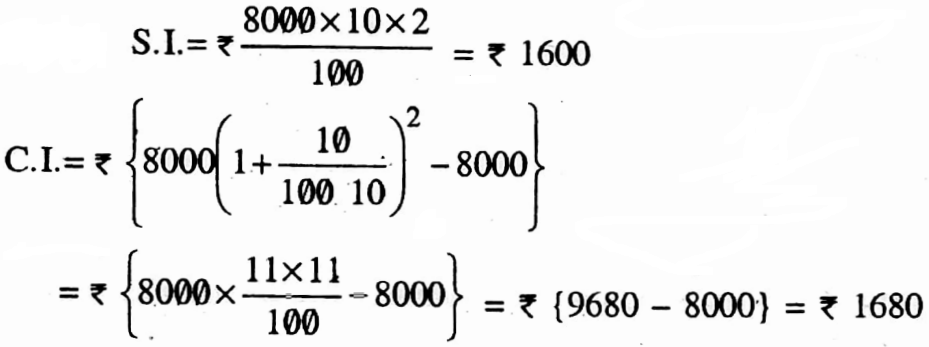
Example 15. ∠BAC = 90° and AD ⊥ BC; BD = 2 cm, AD = 3 cm, Find the length of CD.


WBBSE Solutions For Class 10 Maths Geometry Chapter 3 Similarity Short Answer Question Example 15

Solution: In ΔABC, ∠BAC = 90°, AD ⊥ BC

∴ ∠ADB = ∠ADC = 90°

In ΔABD, ∠BAD + ∠ABD = ∠BAC

ie. ∠BAD + ∠ADB = ∠BAD + ∠CAD

⇒ ∠ABD = ∠CAD

In ΔABD and ΔACD, ∠ADB = ∠CAD, ∠ADB = ∠ADC and remaining ∠BAD = remaining ∠ACD

∴ ΔABD ∼ ΔACD

∴ \(\frac{\mathrm{BD}}{\mathrm{AD}}=\frac{\mathrm{AD}}{\mathrm{CD}}\)

or, \(\mathrm{CD}=\frac{\mathrm{AD}^2}{\mathrm{BD}}=\frac{3 \times 3}{2} \mathrm{~cm}=4.5 \mathrm{~cm}\)

Class 10 Geometry Chapter 3 Solved Examples

Example 16. In ΔPQR, two point M and N on PQ and PR such that MN || QR ; If PM = a unit, MQ = b unit, PN = c unit and NR = d unit. Then calculate the values of (a2d2 + b2c2 – 2abcd)

Solution: In ΔPQR, MN || QR


WBBSE Solutions For Class 10 Maths Geometry Chapter 3 Similarity Short Answer Question Example 16

∴ \(\frac{\mathrm{PM}}{\mathrm{MQ}}=\frac{\mathrm{PN}}{\mathrm{NR}}\)

∴ \(\frac{a}{b}=\frac{c}{d}\)

⇒ ad = bc

⇒ ad – bc = 0

a2d2 + b2c2– 2abcd = (ad- bc)2 = (0)2 = 0

Example 17. DE || BC; If AD: DB = 2:3 then calculate of values of area of ΔADE: area of □DBCE.

Solution: \(\frac{\mathrm{AD}}{\mathrm{DB}}=\frac{2}{3} \Rightarrow \frac{\mathrm{DB}}{\mathrm{AD}}=\frac{3}{2}\)

⇒ \(\frac{\mathrm{DB}}{\mathrm{AD}}+1=\frac{3}{2}+1 \Rightarrow \frac{\mathrm{DB}+\mathrm{AD}}{\mathrm{AD}}=\frac{5}{2}\)

i.e., \(\frac{\mathrm{AB}}{\mathrm{AD}}=\frac{5}{2}\)


WBBSE Solutions For Class 10 Maths Geometry Chapter 3 Similarity Short Answer Question Example 17

In, ∠ABC, DE || BC, AB and AC are the intersection

∴ ∠ADE = ∠ABC and ∠AED = ∠ACB

In ΔABC and ΔADE, ∠ABC = ∠ADE, ∠ACB = ∠AED and ∠BAC = ∠DAE

∴ ΔABC ~ ΔADE

∴ \(\frac{\triangle \mathrm{ABC}}{\triangle \mathrm{ADE}}=\frac{\mathrm{AB}^2}{\mathrm{AD}^2}=\left(\frac{5}{2}\right)^2=\frac{25}{4}\)

\(\frac{\triangle \mathrm{ABC}}{\Delta \mathrm{ADE}}-1=\frac{25}{4}-1\)

⇒ \(\frac{\triangle \mathrm{ABC}-\triangle \mathrm{ADE}}{\triangle \mathrm{ADE}}=\frac{21}{4}\)

i.e. DBCE/ΔADE = \(\frac{21}{4}\)

∴ \(\triangle \mathrm{ADE}\): □DBCE = 4: 21

Example 18. In ΔABC, AD ⊥ BC and AD2 = BD.DC; Find the value of ∠BAC.

Solution: In ΔABD, AD ⊥ BC,  ∴ ∠ADB = 90°

WBBSE Solutions For Class 10 Maths Geometry Chapter 3 Similarity Short Answer Question Example 18

∴ AB2 = AD2 + BD2 [By Pythagorus theorem]

ΔACD, AC2 = AD2 + DC2

AB2 + AC2 = AD2 + BD2 + AD2 + DC2

= 2AD2 + BD2 + DC2

= 2BD.DC + BD2 + DC2

= (BD + DC)2

i.e., AB2 + AC2 = BC2

∴ ΔABC is a right-angled triangle whose hypotenuse is BC,

∴ ∠BAC = 90°

Example 19. AD is a median of ΔABC and EF || BC; If OE = 3 cm, then find the length of EF.

WBBSE Solutions For Class 10 Maths Geometry Chapter 3 Similarity Short Answer Question Example 19

Solution: ln ΔAOE and ΔABD,

∠AEO = corresponding ∠ABD

[∵ EF || BC, AB is intersected]

∠AOE = ∠ADB and ∠EAO = ∠BAD [common angle]

∴ ΔAOE – ΔABD

∴ \(\frac{E O}{B D}=\frac{A O}{A D}\) ……(1)

Similarly, ΔAOF ~ ΔADC

∴ \(\frac{O F}{D C}=\frac{A O}{A D}\)………(2)

From(1)and(2), \(\frac{E O}{B D}=\frac{O F}{D C} \Rightarrow \frac{E O}{B D}=\frac{O F}{B D}\)

⇒ OF = OE = 3 cm

EF = (OE + OF) = (3 + 3) cm = 6 cm

∴ The length of EF is 6 cm.

Wbbse Class 10 Geometry Notes

Example 20. DE || BC ; AD = (2x – 1) unit, AB = (3x + 1) unit, EC = (3x – 2) unit and AC = (4x – 1) unit ; what the values of x? [x > 0]

WBBSE Solutions For Class 10 Maths Geometry Chapter 3 Similarity Short Answer Question Example 20

Solution: DE || BC

∴ \(\frac{\mathrm{AD}}{\mathrm{DB}}=\frac{\mathrm{AE}}{\mathrm{EC}}\)

i.e. \(\frac{\mathrm{AD}}{\mathrm{AB}-\mathrm{AD}}=\frac{\mathrm{AC}-\mathrm{EC}}{\mathrm{EC}}\)

∴ \(\frac{2 x-1}{(3 x+1)-(2 x-1)}=\frac{(4 x-1)-(3 x-2)}{3 x-2}\)

⇒ \(\frac{2 x-1}{x+2}=\frac{x+1}{3 x-2}\)

⇒ (2x- 1) (3x- 2) = (x + 1) (x + 2)

⇒ 6x2 – 7x + 2 = x2 + 3x + 2

⇒ 5x2 – 10x = 0 ⇒ 5x (x – 2) = 0

⇒ x(x – 2) = 0

⇒ x ≠ 0,

= x – 2 = 0

⇒ x = 2

WBBSE Solutions For Class 10 Maths Mensuration Chapter 2 Right Circular Cylinder

Mensuration Chapter 2 Right Circular Cylinder

⇒ A right circular cylinder is a solid generated by the revolution of a rectangle round of its side as its axis.

⇒ In a right circular cylinder, we have a curved surface or lateral surface and two circular plane surfaces with same radius.

WBBSE Solutions For Class 10 Maths Mensuration Chapter 2 Right Circular Cylinder Cylinder

WBBSE Solutions For Class 10 Maths Mensuration Chapter 2 Right Circular Cylinder

⇒ The lateral surface area of a right circular cylinder = 2πrh units.

⇒ [Where r = length of the radius of the base of the right circular and h = height of the cylinder]

Read and Learn More WBBSE Solutions for Class 10 Maths

= 2πr x h units

= perimeter of the circular plane surface x height

⇒  Total surface area = Area of the lateral surface + area of two circular plane surface

= [2πrh + 2πr2] square unit

= 2 πr (h + r) square unit

⇒ Total surface area of one surface is open = 2 πrh + πr2

⇒ Volume = area of the base x height

= πr2 x h square unit

= πr2h square units

WBBSE Notes For Class 10 Geography And EnvironmentWBBSE Notes For Class 10 History And Environment
WBBSE Solutions For Class 10 Life ScienceWBBSE Class 10 Life Science Multiple Choice Questions
WBBSE Solutions for Class 10 MathsWBBSE Class 10 Maths Multiple Choice Questions
WBBSE Notes For Class 10 Physical Science And Environment


⇒ Volume of the material of a hollow cylinder = \(\left(\pi r_1{ }^2 h-\pi r_2{ }^2 h\right)\) cubic units.

= \(\pi\left(r_1^2-r_2^2\right) h\) cubic units

[where length of the outer radius is r1 units, the inner radius is r2 units and height is h units]

WBBSE Solutions For Class 10 Maths Mensuration Chapter 2 Right Circular Cylinder Total Surface Of Hollow Cylinder

Total surface area of the hellowy cylinder

= 2 π (r1 + r2) h + \(2\pi\left(r_1^2-r_2^2\right)\) sq units

Class 10 Maths Mensuration Chapter 2 Solutions

Mensuration Chapter 2 Right Circular Cylinder True Or False

Example 1. The length of right circular drum is r cm and height is h cm. If half part of the drum is tilled with water then the volume of water will be πr2h cubic cm.
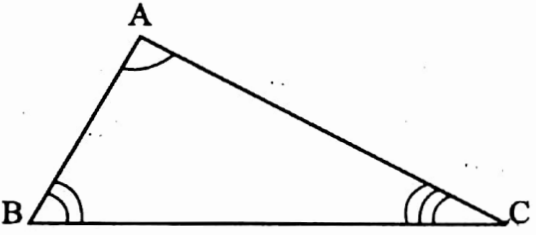
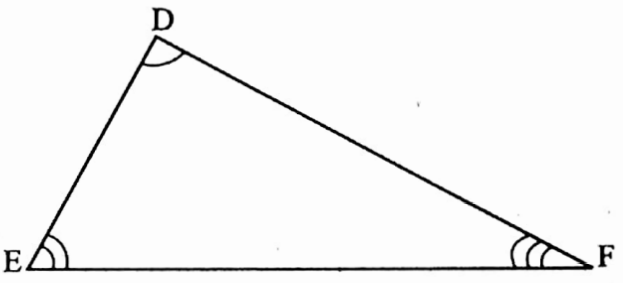
Solution: False

Example 2. If the length of radius of a right circular cylinder is 20 unit, the numerical value of volume and lateral surface area of cylinder will be equal for any height.

Solution: True

Example 3. Volume of a cylinder = Perimeter of the base x height.

Solution: False

Example 4. If length of outer radius and inner radius of a hollow right circular cylinder r1 units and r2 units respectively and height is h units, sum of outer and inner curved surface area = 2π (r1 + r2) h sq. units.

Solution: True

Example 5. Number of curved surfaces is 2 of a cylinder.

Solution: False

Class 10 Mensuration Chapter 2 Solved Examples

Example 6. In a solid cylinder no. of plane surfaces are 2.

Solution: True

Example 7. Total surface area of a cylinder with one end open = area of the base + area of the lateral surface.

Solution: True

Example 8. Radius of the right circular cylinder means radius of the base.

Solution: True

Example 9. If the volume of a cylinder is V cubic cm and height is h cm the radius of the base will be \(\sqrt{\frac{\mathrm{V}}{\pi h}}\)cm.
Solution: True

Example 10. Base of a cylinder is a square.
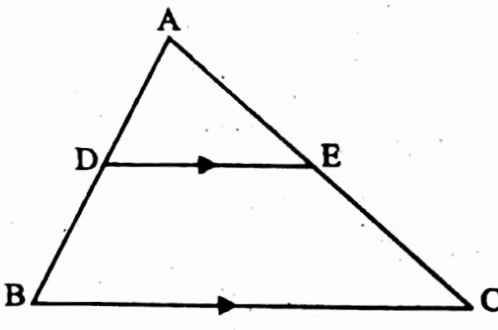
Solution: False

Wbbse Class 10 Mensuration Notes

Mensuration Chapter 2 Right Circular Cylinder Fill In The Blanks

Example 1. The length of a rectangular paper is b units and the breadth is b units. The rectangular paper is rolled and a cylinder is formed of which the perimeter is equal to the length of the paper. The lateral surface area of the cylinder is _______ sq. units.

Solution: lb

Example 2. The largest rod that can be kept in a right circular cylinder having the diameter of 3 cm and height 4 cm, then the length of rod is ______ cm.

Solution: 5

Surface Area And Volume Of Frustum Class 10

Example 3. If the numerical values of volume and lateral surface area of a right circular cylinder are equal then the length of diameter of cylinder is _____ unit.

Solution: 4

Example 4. Volume of a cylinder = ______ x height.

Solution: Area of the base

Example 5. Total surface area of cylinder = 2π x _______ x ______

Solution: radius, radius + height

Example 6. The ratio of radii of two cylinders having equal height is 3. : 4. The ratio of volumes is ______

Solution: 9: 16

Example 7. A _______ is formed when a cylinder is cut off according to its generating line.

Solution: rectangle

Example 8. If a rectangular paper is rolled with respect to its breadth as an axis then a _____ is formed.

Solution: cylinder

Surface Area And Volume Of Frustum Class 10

Mensuration Chapter 2 Right Circular Cylinder Short Answer Type Questions

Example 1. If the lateral surface area of a right circular cylindrical piller is 264 sq. metres and volume is 924 cubic metres then write the length of radius of the base of the cylinder.

Solution: 2πrh = 264, πr2h = 924

∴ \(\frac{\pi r^2 h}{2 \pi r h}=\frac{924}{264}\)

or, \(r=\frac{924 \times 2}{264}=7 \mathrm{mt}\)

Example 2. If the lateral surface area of a right circular cylinder is C sq. unit, length of radius of base is r unit and volume is V cubic unit, then write the value of \(\frac{Cr}{V}\).

Solution: 2πrh = C

\(\frac{\mathrm{Cr}}{\mathrm{V}}=\frac{2 \pi r h \cdot r}{\pi r^2 h}=2\)

Example 3. If the height of a right circular cylinder is 14 cm and lateral surface area is 264 sq. cm, then write the volume of the cylinder.

Solution: 2πrh = 264

or, \(r=\frac{264 \times 7}{2 \times 22 \times 14}\) = 3

∴ Volume = πr2h

= \(\frac{22}{7}\) x 9 x 14 cubic cm = 396 cubic cm

Example 4. If the height of two right circular cylinder are in the ratio of 1 : 2 and perimeter are in the ratio of 3 : 4, then write two ratio of their volumes.

Solution: \(\frac{\pi r_1^2 h_1}{\pi r_2^2 h_2} \quad\left[\frac{2 \pi r_1}{2 \pi r_2}=\frac{3}{4} \Rightarrow \frac{r_1}{r_2}=\frac{3}{4}\right]\)

= \(\frac{9}{16}\) x \(\frac{1}{2}\) = 9: 32

Example 5. The length of the radius of a right circular cylinder is decreased by 50% and height is increased by 50%, then write how much percent of the volume will be changed.

Solution: New volume = \(\pi\left(\frac{r}{2}\right)^2 \cdot\left(3 \frac{h}{2}\right)\) cubic unit

= \(\frac{3}{8} \pi r^2 h\) cubic unit

% change = (1 – \(\frac{3}{8}\)) x 100 cubic unit

= \(\frac{5}{8}\) x 100 cubic unit

= \(\frac{125}{2}\) cubic unit = 62 \(\frac{1}{2}\) cubic unit

Example 6. The volume of a right circular cylinder is 352 c.c. If the height of the cylinder is 7 cm, what is the length of the radius?

Solution: πr2 x 7 = 352

⇒ \(r^2=\frac{352 \times 7}{7 \times 22}=16\)

∴ r = 4 cm.

Class 10 Maths Mensuration Important Questions

Example 7. The area of the curved surface area of a cylinder is 528 sq. mt and its volume is 792 cu. mt. What is its radius?

Solution: 2πrh = 528, πr2h = 792

∴ \(\frac{\pi r^2 h}{2 \pi r h}=\frac{792}{528} \quad r=\frac{3}{2} \times 2=3 \mathrm{mt} .\)

Example 8. Find the radius of a solid cylinder of height 6 cm, if the magnitude of the volume of the cylinder be equal to magnitude of its whole surface area.

Solution: 2πr (h + r) = πr2h

or, 2 (h + r) = rh

∴ 2 (6 + r) = 6r

∴ r = 3 cm

Example 9. The diameter and height of a cylindrical drum are 1 cm and 14 cm respectively, then find the volume.

Solution: Volume = πr2h = \(\frac{22}{7} \times\left(\frac{1}{2}\right)^2\) x 14 cu. cm = 11 cu. cm

Example 10. Volume and lateral surface area of a solid cylinder are equal by numerical value. find its radius of the base.

Solution: πr2h = 2πrh

or, r = 2 units