WBBSE Solutions For Class 10 Maths Geometry Chapter 2 Theorems Related To Tangent Of A Circle

Geometry Chapter 2 Theorems Related To Tangent Of A Circle

There are three different situations between a circle and a line in a plane.

⇔ The straight line AB does not intersect the circle.
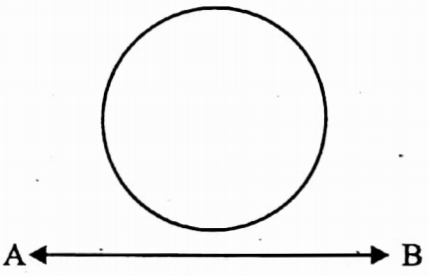
WBBSE Solutions For Class 10 Maths Geometry Chapter 2 Theorems Related To Tangent Of A Circle The Straight Line AB Does Not Intersect The Circle


⇔ The straight line AB intersects the circle at two points P and Q.

Read and Learn More WBBSE Solutions for Class 10 Maths
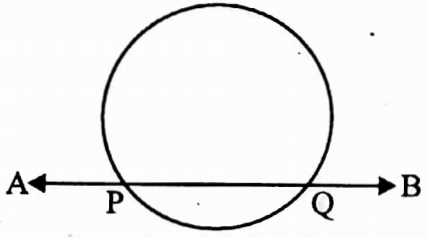
WBBSE Solutions For Class 10 Maths Geometry Chapter 2 Theorems Related To Tangent Of A Circle The Straight Line AB Intersects The Circle At Two Points P And Q

WBBSE Solutions For Class 10 Maths Geometry Chapter 2 Theorems Related To Tangent Of A Circle

⇔ The straight line AB intersects the circle at point P.

WBBSE Solutions For Class 10 Maths Geometry Chapter 2 Theorems Related To Tangent Of A Circle The Straight Line AB Intersects The Circle At A Points P

⇔ Secant: A straight line which intersects a circle in two distinct points is called a secant of circle.

WBBSE Solutions For Class 10 Maths Geometry Chapter 2 Theorems Related To Tangent Of A Circle Secant

⇒ AB is a secant of a circle with centre O.

Class 10 Maths Geometry Chapter 2 Solutions

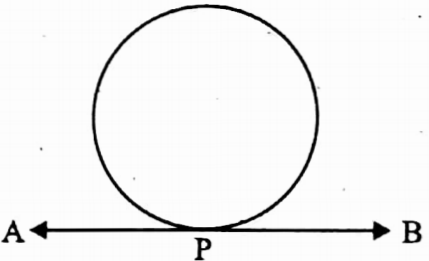
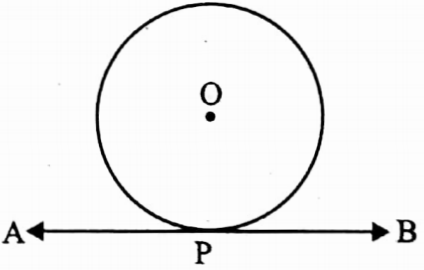
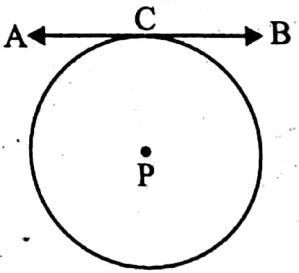
⇔ Tangent: When a straight line intersects the circle in only one point, the straight line is said to be a tangent to the circle and point is called the point contact of the tangent.

WBBSE Solutions For Class 10 Maths Geometry Chapter 2 Theorems Related To Tangent Of A Circle Tangent

⇒ AB is a tangent and P is the point of contact.

⇔ Common tangent: If a straight line touches each of two circles, then the straight line is called a common tangent of two circles.

⇔ Common tangents are two types:

  1. Direct common tangent,
  2. Transverse common tangent.

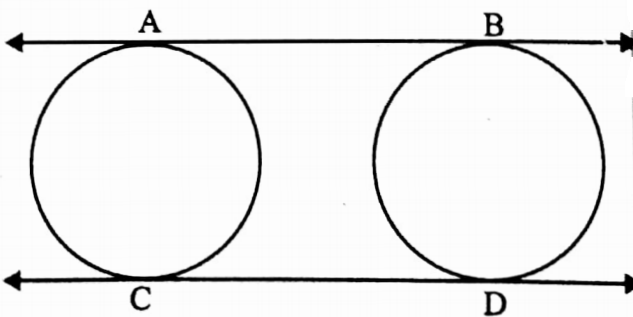
⇔ Direct common tangent: If the position of two circles are the same side of a common tangent.


WBBSE Solutions For Class 10 Maths Geometry Chapter 2 Theorems Related To Tangent Of A Circle Direct Common Tangent

⇒ Then the tangent is called a direct common tangent. AB and CD are direct common tangents.

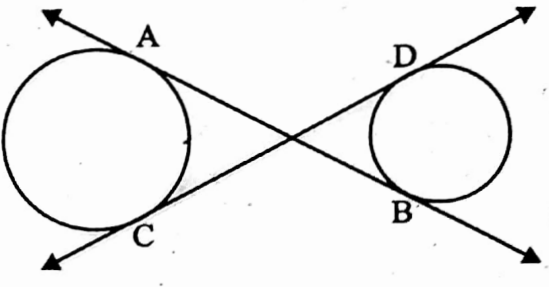
⇔ Transverse common tangent: If the position of two circles are the opposite side of a common tangent then the tangent is called a transverse common tangent.

WBBSE Solutions For Class 10 Maths Geometry Chapter 2 Theorems Related To Tangent Of A Circle Transverse Common Tangent

⇒ AB and CD are transverse common tangents.

Theorems:

  1. The tangent and the radius passing through the point of contact are perpendicular to each other.
  2. If two tangents are drawn from an external point, the line segments joining the point of contact and the exterior point are equal and they subtend equal angles at the centre.
  3. If two circles touch each other, then the point of contact will lie on the line segment joining the two centres.
WBBSE Notes For Class 10 Geography And EnvironmentWBBSE Notes For Class 10 History And Environment
WBBSE Solutions For Class 10 Life ScienceWBBSE Class 10 Life Science Multiple Choice Questions
WBBSE Solutions for Class 10 MathsWBBSE Class 10 Maths Multiple Choice Questions
WBBSE Notes For Class 10 Physical Science And Environment


Geometry Chapter 2 Theorems Related To Tangent Of A Circle True Or False

Example 1. P is a point inside a circle. Any tangent drawn on the circle does not pass through the point P.

WBBSE Solutions For Class 10 Maths Geometry Chapter 2 Theorems Related To Tangent Of A Circle True Or False Example 1

Solution: Clearly the statement is true.

Circles Class 10 Solutions

Example 2. There are more than two tangents can be drawn to a circle parallel to a fixed line.

WBBSE Solutions For Class 10 Maths Geometry Chapter 2 Theorems Related To Tangent Of A Circle True Or False Example 2

Solution: Clearly the statement is false.

Geometry Chapter 2 Theorems Related To Tangent Of A Circle Fill In The Blanks

Example 1. If a straight line intersects the circles at two points, then the straight line is called _______ of circle.

WBBSE Solutions For Class 10 Maths Geometry Chapter 2 Theorems Related To Tangent Of A Circle The Straight Line Intersects The Circle At Two Points Is Intersection

Solution: Intersection.

Example 2. If two circles do not intersect or touch each other, then the maximum number of common tangents can be drawn is _________

WBBSE Solutions For Class 10 Maths Geometry Chapter 2 Theorems Related To Tangent Of A Circle Two Circles Do Not Intersect Or Touch Each Other

Solution: Four

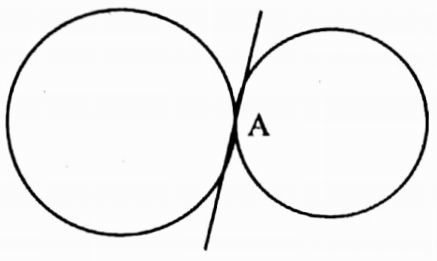
Example 3. Two circles touch each other externally at the point A. A common tangent drawn to two circles at the point A is _______ common tangent.

WBBSE Solutions For Class 10 Maths Geometry Chapter 2 Theorems Related To Tangent Of A Circle Two Circles Touch Each Other Externally At Point A Is Transverse

Solution: Transverse

Geometry Chapter 2 Theorems Theorems Related To Tangent Of A Circle Short Answer Type Question

Example 1. O is the centre and BOA is a P diameter of the circle. A tangent drawn to a circle at the point P intersects the extended BA at the point T. If ∠PBO = 30°, find the value of ∠PTA.

WBBSE Solutions For Class 10 Maths Geometry Chapter 2 Theorems Related To Tangent Of A Circle Short Answer Question Example 1

Solution: In ΔPOB, OP = OB [radii of same circle]

∴ ∠OPB = ∠PBO

⇒ Again exterior ∠POT = ∠PBO + ∠OPB

= 30° + 30° = 60°

As TP is tangent and P is a radius of the circle with centre O

‎∴ OP ⊥ PT ; ∠OPT = 90°

In ΔPOT, ∠PTA = 180° – (∠OPT + ∠POT)

∠PTA = 180° – (90° + 60°) = 30°

Class 10 Geometry Chapter 2 Solved Examples 

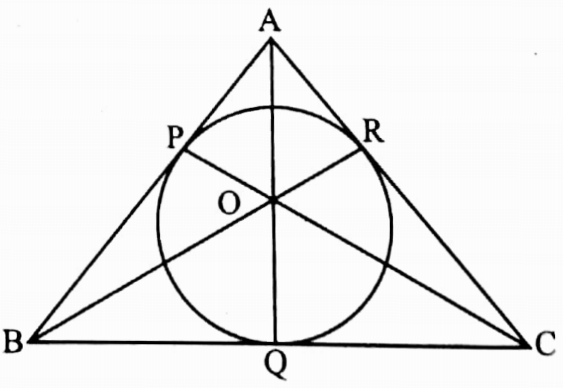
Example 2. ΔABC circumscribed a circle and touches the circle at the points P, Q, R. If AP = 4 cm, BP = 6 cm, AC = 12 cm and BC = x cm, then determine the value of x.


WBBSE Solutions For Class 10 Maths Geometry Chapter 2 Theorems Related To Tangent Of A Circle Short Answer Question Example 2

Solution: I join, O, A; O, B; O, C; O, P; O, Q and O, R

AP and AR are two tangents to a circle with centre O, drawn from the exterior point A,


WBBSE Solutions For Class 10 Maths Geometry Chapter 2 Theorems Related To Tangent Of A Circle Short Answer Question Example 2-1

So, AR = AP = 4 cm

⇒ Similarly, BQ = BP = 6 cm and CQ = CR

= AC – AR = (12 – 4) cm = 8 cm

∴ BC = BQ + CQ = (6 + 8) cm = 14 cm

∴ The value of x is 14.

Example 3. The circles with centres A, B, C touch one another externally. If AB = 5 cm, BC = 7 cm and CA = 6 cm. Find the length of radius of circle with centre A.

WBBSE Solutions For Class 10 Maths Geometry Chapter 2 Theorems Related To Tangent Of A Circle Short Answer Question Example 3

Solution: Two circles with centres A and B touch each other externally at P

∴ A, P and B are collinear.

Similarly, A, Q and C are collinear

B, R and C are collinear

Let AP = AQ = x cm [radii of same circle]

BP = BR = y cm

and CR = CQ = z cm

AP + BP = AB

x + y = 5…….(1)

BR + CR = BC

y + z =7……(2)

CQ + AQ = CA

z + x = 6………(3)

(1) + (2) + (3)

2(x + y + z) = 5 + 7 + 6

or, x + y + z = 9 ………(4)

(4) – (2)

x + y + z – y – z = 9 – 7

⇒ x = 2

∴ The length of the radius of a circle with centre O is 2 cm.

Example 4. Two tangents drawn from enternal point C to a circle with centre Q touches the circle at the points P and Q respectively. A tangent drawn at another point R of a circle intersects CP and CA at the points A and B respectively. If CP = 11 cm and BC = 7 cm, determine the length of BR.

WBBSE Solutions For Class 10 Maths Geometry Chapter 2 Theorems Related To Tangent Of A Circle Short Answer Question Example 4

Solution: CP and CQ are tangents of a circle with centre O.

So, CQ = CP = 11 cm

BQ = CQ – BC = (11 – 7) cm = 4 cm

Again, BR = BQ = 4 cm [as BR and BQ are two tangent of a circle]

Example 5. The lengths of radii of two circles are 8 cm and 3 cm and distance between two centre is 13 cm. Find the length of a common tangent of two circles.

Solution: Let BE is a direct common tangent of two circles with centres A and B respectively.

I join A, D and B, E

The distance between two circle is AB where AB = 13 cm

WBBSE Solutions For Class 10 Maths Geometry Chapter 2 Theorems Related To Tangent Of A Circle Short Answer Question Example 5

A perpendicular BC is drawn from B to AC, DE is a tangent and AD is a radius of the circle with centre A

∴ AD ⊥ DE similarly BE ⊥ DE

∴ AD || BE i.e. CE || BE

Again, BC ⊥ AD and DE ⊥ AD  ∴ BC || DE

In quadrilateral BCDE, CD || BE and BC || DE

∴ BCDE is a parallelogram

∴ DC = BE = 3 cm and DE = BC

AC = AD – DC = (8 – 3) cm = 5 cm

In right angled ΔABC, ∠ACB = 90°

∴ AC2 + BC2 = AB2 [from Pythagorus theorem

⇒ BC = \(\sqrt{\mathrm{AB}^2-A C^2}\)

= \(\sqrt{13^2-5^2} \mathrm{~cm}\)

= √144 cm = 12 cm

∴ DE = BC = 12 cm

∴ The length of a common tangent of two circle is 12 cm.

Wbbse Class 10 Geometry Notes

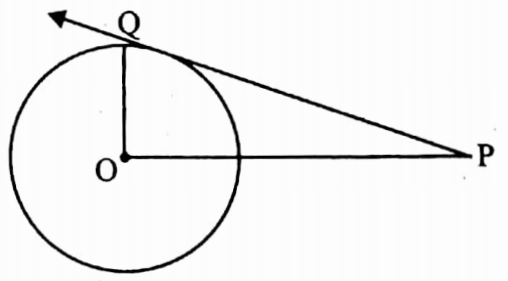
Example 6. The length of radius of a circle with centre O is 6 cm. P is a point at the distance of 10 cm from the centre. Find the length of the tangent PQ from the point P to the circle.

Solution: PQ is a tangent to the circle with centre O and OQ is a radius of the circle.


WBBSE Solutions For Class 10 Maths Geometry Chapter 2 Theorems Related To Tangent Of A Circle Short Answer Question Example 6


∴ OQ ⊥ PQ

In right-angled ΔPOQ, ∠OQP = 90°

∴ OQ2 + PQ2 = OP2 [from Pythagorus teorem]

⇒ PQ = \(\sqrt{\mathrm{OP}^2-\mathrm{OQ}^2}\)

= \(\sqrt{(10)^2-(6)^2} \mathrm{~cm}\)

= √64 cm = 8 cm

∴ Length of the tangent is 8 cm.

Example 7. A circle with centre O, a point P is 20 cm away from the centre of the circle and the length of the tangent PQ to the circle is 16 cm. Find the length of the diameter of the circle.

Solution: OQ is a radius and PQ is tangent to the circle with centre O

∴ OQ ⊥ PQ

WBBSE Solutions For Class 10 Maths Geometry Chapter 2 Theorems Related To Tangent Of A Circle Short Answer Question Example 7

In right angled triangle ΔPOQ, ∠OQP = 90°

OQ2 + PQ2 = OP2 [From Pythagoras theorem]

⇒ OQ = \(\sqrt{\mathrm{OP}^2-\mathrm{PQ}^2}\)

= \(\sqrt{20^2-16^2} \mathrm{~cm}=\sqrt{400-256} \mathrm{~cm}=\sqrt{144} \mathrm{~cm}=12 \mathrm{~cm}\)

length of radius is 12 cm

Length of a diameter of the circle is (12 x 2) cm or 24 cm

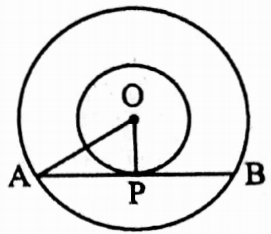
Example 8. The lengths of radius of two concentric circles arc 3 cm and 5 cm respectively. If a tangent of the smaller circle is a chord of the larger circle, find the length of that chord.

Solution: Let O be the centre of two concentric circles.

WBBSE Solutions For Class 10 Maths Geometry Chapter 2 Theorems Related To Tangent Of A Circle Short Answer Question Example 8

AB is a tangent of the smaller circle at point P

So AB is a chord of the larger circle.

Radius of smaller circle (OP) = 3 cm and radius pf larger circle (OA) = 5 cm

As AB is a tangent and OP is a radius of the circle

∴ OP ⊥ AB  ∴ ∠APO = 90°

In right angled ΔAPO, AP2 + OP2 = OA2

AP = \(\sqrt{\mathrm{OA}^2-\mathrm{OP}^2}\)

= \(\sqrt{5^2-3^2} \mathrm{~cm}\) = √16 cm = 4 cm

In larger circle, AP ⊥ AB

∴ AB = 2AP = (2 x 4) cm = 8 cm

∴ Length of the chord is 8 cm.

Circle Theorems Class 10 Solutions 

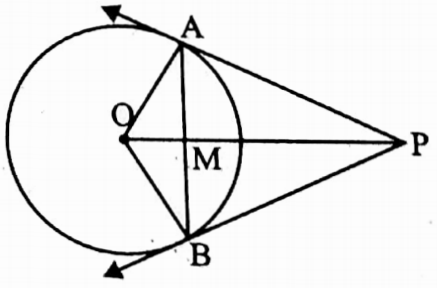
Example 9. The length of a chord AB of a circle with centre O is 6 cm at the length of radius of that circle is 5 cm. Two tangents are drawn at the points A and B of the circle intersect at P. Find the length each of the tangent.

Solution: I join O, A; O, B and O, P.

AB and OP are intersect at M.

If two tangents are drawn to a circle from a point outside it, then the line segments joining the points of contact and the exterior are equal and they subtend equal angles at the centre.

WBBSE Solutions For Class 10 Maths Geometry Chapter 2 Theorems Related To Tangent Of A Circle Short Answer Question Example 9

∴ PA = PB and ∠AOP = ∠BOP

i.e. ∠AOM = ∠BOM

In ΔAOM and ΔBOM,

OA = OB [radii of same circle]

OM = OM [common side]

and ∠AOM = ∠BOM

∴ ΔAOM ≅ ΔBOM [By SAS axiom of congruency]

∴ AM = BM = \(\frac{1}{2}\) AB

= (\(\frac{1}{2}\) x 6) cm = 3 cm and ∠AMO = ∠BMO = \(\frac{180^{\circ}}{2}\) = 90°

In right angled triangle AOM, OM2 + AM2 = OA2

⇒ OM = \(\sqrt{\mathrm{OA}^2-\mathrm{AM}^2}\)

= \(\sqrt{5^2-3^2} \mathrm{~cm}\)

∴ Let PM = x cm and PA = PB = y cm  ∴ OP = (4 + x) cm

As PA is a tangent at A and OA is a radius of the circle.

∴ OA ⊥ AP  ∴ ∠OAP = 90°

In right-angled ΔAOP, OA2 + PA2 = OP2

52 + y2 = (4 + x)2

⇒ y2 = (4 + x)2 – 25…….(1)

In right-angled ΔAMP, AM2 + PM2 = AP2

32 + x2 = y2 ……(2)

From (1) and (2), (4 + x)2 – 25 = 9 + x2

⇒ 16 + 8x + x2 – 25 = 9 + x2

⇒ 8x = 18

⇒ x = \(\frac{9}{4}\)

From (2), y2 = 32 + \(\left(\frac{9}{4}\right)^2\) = 9 + \(\frac{81}{16}\) = \(\frac{225}{16}\)

y= \(\sqrt{\frac{225}{16}}=\frac{15}{4}\) = 3.75

∴ Length of each tangent is 3.75 cm.

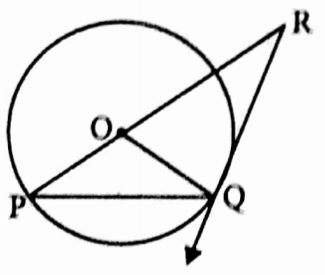
Example 10. PQ is a chord of a circle with centre O. A tangent Is drawn at the point Q which intersects extended PQ at the point R. If ∠PRQ = 30° then calculate the value of ∠RPQ.

Solution: In joining O, Q

RQ is a tangent at Q and OQ is a radius of that circle

WBBSE Solutions For Class 10 Maths Geometry Chapter 2 Theorems Related To Tangent Of A Circle Short Answer Question Example 10

∴ OQ ⊥ RQ  ∴ ∠OQR = 90°

In ΔPOQ, OP = OQ [radii of same circle]

∠OPQ = ∠OQP

the exterior ∠QOR = ∠OPQ + ∠OQP

60° = ∠OPQ + ∠OPQ

⇒ 2 ∠OPQ = 50°

⇒ ∠OPQ = 30°

i.e. ∠RPQ = 30°

Class 10 Maths Geometry Important Questions 

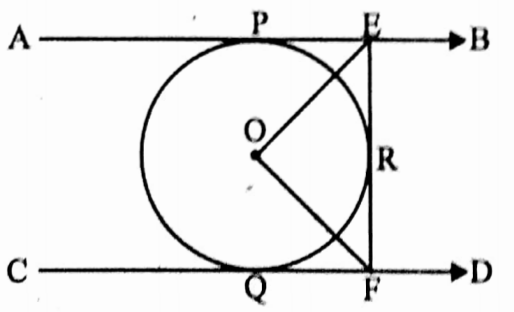
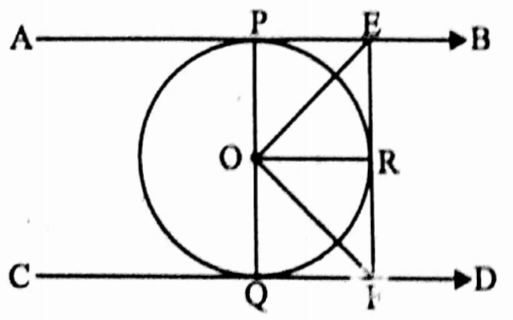
Example 11. AB and CD are two tangents of a circle with centre O at P and Q respectively. Another tangent EF is drawn which intersects AB and CD at E and F respectively. If AB || CD then find the value of ∠EOF.

WBBSE Solutions For Class 10 Maths Geometry Chapter 2 Theorems Related To Tangent Of A Circle Short Answer Question Example 11

Solution: I join, O, P; O, Q and O, R.

EP and ER are tangents to a circle with centre O.

∴ PE = RE

WBBSE Solutions For Class 10 Maths Geometry Chapter 2 Theorems Related To Tangent Of A Circle Short Answer Question Example 11-1

In ΔPOE and ΔROE

OP = OR [radii of same circle]

OE = OE [common side]

PE = RE

∴ ΔPOE = ΔROE [by SSS axiom of congruency]

∴ ∠POE = ∠REO = \(\frac{1}{2}\) ∠PER

Similarly ΔROF = ΔQOF

∴ ∠RFO = ∠QFO = \(\frac{1}{2}\) ∠QFR

AB || CD and EF is intersection

∴ ∠PER + ∠QFR = 180°

∴ 2 ∠REO + 2 ∠RFO = 180°

⇒ ∠REO + ∠RFO = 90°

In ΔEOF, ∠EOF = 180° – (∠REO + ∠RFO)

= 180° – 90° = 90°

Example 12. Two tangents AB and AC drawn from an external point A of a circle with centre O touch the circle at an point B and C. A tangent drawn to a point D lies on minor arc BC intersects AB and AC at points E and F respectively. If AB = 4 cm then find the perimeter of the ΔAEF.

Solution: As AB and AC are tangents to a circle with centre O,

∴ AB = AC

WBBSE Solutions For Class 10 Maths Geometry Chapter 2 Theorems Related To Tangent Of A Circle Short Answer Question Example 12

Similarly, EB = ED and FD = FC

Perimeter of ΔAEF, AE + EF + AF

= AE + (ED + FD) + AF = AE + (EB + FC) + AF

= (AE + EB) + (FC + AF) = AB + AC = AB + AB

= 2AB = 2 x 4 cm s 8 cm

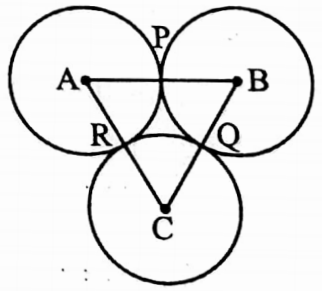
Example 13. Three equal circles touch one another externally. The length of radius of each circle is 5cm. Find the perimeter of the triangle obtained by joining the centres.

Solution: Three circles with centre A, B and C touch one another externally at points P, Q and R.

The points A, P, and B are collinear; B, Q, and C are collinear and C, R, and A are collinear.

Again, AP = BP = BQ = CQ = CR = AR = 5 cm

WBBSE Solutions For Class 10 Maths Geometry Chapter 2 Theorems Related To Tangent Of A Circle Short Answer Question Example 13

∴ AP + BP = BQ + CQ = CR + AR = (5 + 5) cm

i.e. AB = BC = CA = 10 cm

∴ Perimeter of the ΔABC is (10 x 3) cm = 30 cm

Class 10 Maths Board Exam Solutions

Example 14. BC is diameter of the circle with centre O and PAQ is a tangent at A. If ∠PAB = 60°, then find the values of ∠CAQ and ∠ABC.

Solution:

WBBSE Solutions For Class 10 Maths Geometry Chapter 2 Theorems Related To Tangent Of A Circle Short Answer Question Example 14

∠BAC = 90° [semi circular angle]

∠PAB + ∠BAC + ∠CAQ = 180°

60° + 90° + ∠CAQ = 180°

⇒ ∠CAQ = 30°

∠ABC = alternate circular ∠CAQ = 30°

WBBSE Solutions For Class 10 Maths Statistics Chapter 1 Mean Median Ogive Mode

Statistics Chapter 1 Mean

⇒ An average or a central value of a data or a statistical series is the value of the variable which describes the characteristics of the entire data or the associated frequency distribution.

⇒ Central position: If the numbers of data are arranging in ascending order then the middle number / or the positions of nearly numbers is called the central position.

⇒ There are three measures of central tendency:

  1. Mean
  2. Median
  3. Mode.

⇒ Arithmetic mean can be defined in the following three cases separately:

  1. Individual observations (or ungrouped data).
  2. Discrete frequency distribution (or grouped data)
  3. Grouped or continuous frequency distribution.

⇒ Arithmetic Mean of individual observation (or ungrouped data)

Definition: If x1, x2, x3 ………., xn are n values of a variable X, then the arithmetic mean or simply the mean of these values is denoted by \(\overline{\mathrm{X}}\) and is defined as

\(\overline{\mathrm{X}}=\frac{x_1+x_2+x_3+\cdots \cdots+x_n}{n}\)

Read and Learn More WBBSE Solutions for Class 10 Maths

= \(\frac{1}{n} \sum_{i=1}^n x_i\) [symbol ‘∑’ reading as capital sigma]

or, simply \(\bar{X}=\frac{\sum x_1}{n}\)

WBBSE Solutions For Class 10 Maths Statistics Chapter 1 Mean Median Ogive Mode

Arithmetic mean of grouped data or discreate frequency distribution

In a discreate frequency distribution, the arithmetic mean may be computed by any one of the following methods

  1. Direct method,
  2. Short-cut method,
  3. Step deviation method.

⇒ Direct method: If a variate X takes values x1, x2, x3 ………., xn with corresponding frequencies ƒ1, ƒ2, ƒ3 ……….,ƒn respectively, then the arithmetic mean of these values is given by

\(\overline{\mathrm{X}}=\frac{f_1 x_1+f_2 x_2+\cdots \cdots+f_n x_n}{f_1+f_2+\cdots \cdots+f_n}\)
WBBSE Notes For Class 10 Geography And EnvironmentWBBSE Notes For Class 10 History And Environment
WBBSE Solutions For Class 10 Life ScienceWBBSE Class 10 Life Science Multiple Choice Questions
WBBSE Solutions for Class 10 MathsWBBSE Class 10 Maths Multiple Choice Questions
WBBSE Notes For Class 10 Physical Science And Environment


= \(\frac{\sum_{i=1}^n f_i x_i}{\sum_{i=1}^n f_i} \text { or simply } \overline{\mathrm{X}}=\frac{\sum f_i x_i}{\sum f_i}\)

⇒ Short-cut method: Let x1, x2, x3 ………., xn be values of a variable X with corresponding frequencies respectively.

Taking deviations about an arbitary point ‘a’ we have

\(d_i=x_i-\dot{a}, i=1,2,3, \ldots \ldots, n\) \(f_i d_i=f_i\left(x_i-a\right)\)

⇒ \(\sum_{i=1}^n f_i d_i=\sum_{i=1}^n f_i\left(x_i-a\right)\)

⇒ \(\sum_{i=1}^n f_i d_i=\sum_{i=1}^n f_i x_i-a \sum_{i=1}^n f_i \quad \text { [as a is constant] }\)

⇒ \(\frac{1}{\sum_{i=1}^n f_i} \sum_{i=1}^n f_i d_i=\frac{\sum_{i=1}^n f_i x_i}{\sum_{i=1}^n f_i}-\frac{a \sum_{i=1}^n f_i}{\sum_{i=1}^n f_i}\)

⇒ \(\frac{1}{\sum_{i=1}^n f_i} \sum_{i=1}^n f_i d_i=\overline{\mathrm{X}}-a\)

⇒ \(\overline{\mathrm{X}}=a+\frac{\sum_{i=1}^n f_i d_i}{\sum_{i=1}^n f_i}\)

or, simply \(\overline{\mathrm{X}}=a+\frac{\sum f_i d_i}{\sum f_i}\)

[a is known as assumed mean and is generally chosen in such a way that the deviation are small]

⇒ Step-deviation method:

Mean \((\overline{\mathbf{X}})=a+h \frac{\sum f_i u_i}{\sum f_i}\)

where \(u_i=\frac{x_i-\dot{a}}{n}\) [n = class size]

Class 10 Maths Statistics Chapter 1 Solutions

Statistics Chapter 1 Median

Definition: Median of a distribution is the value of the variable which divides the distribution into two equal parts i.e. it is the value of the variable such that the number of observations above.

It is equal to the number of observations below it.

⇒ Median of ungrouped data: If the values xi in the raw data arranged in order of increasing or decreasing magnitude, then the middle, most value in the arrangement is called the median.

Let x1, x2, x3 ………., xn be the n values of a variable. X arranged in x1, x2, x3 ………., xn [where x1< x2 < x3 ………., < xn]

[Few may be equal among the values]

1. If n is odd, median is the value of \(\left(\frac{n+1}{2}\right)\)th observation

∴ Median = \(X_{\frac{n+1}{2}}\) when n is odd

2. If n is even the median is the mean of the \(\frac{n}{2}\)th and the (\(\frac{n}{2}\) + 1)th

∴ Median = \(=\frac{X_n+X_n \frac{2}{2}}{2}\), when n is even

⇒ Median of a grouped data:

Median = \(=l+\left[\frac{\frac{n}{2}-c_f}{f}\right] \times h\)

Where, l = lower limit of median class

ƒ = frequency of median class

n = number of observation

cƒ = cumulative frequency of Class preceding the median class

n = class size of the median class

Wbbse Class 10 Maths Statistics Solutions

Statistics Chapter 1 Mode

Mode is the value that occurs most frequently in a set of observations and around which the other items of the set cluster densely.

Thus, the mode of frequency distribution is the value of the variable which has the maximum frequency

Mode = \(l+\frac{f_1-f_0}{2 f_1-f_0-f_2} \times h\)

Where, l = lower limit of the modal class

h = length of the modal class

ƒ1 = frequency of the modal class

ƒ0= frequency of the class preceding the modal class

ƒ2 = frequency of the class succeeding the modal class

Relation between mean, median, and mode:

Mode = 3 x median – 2 x mean

Statistics Chapter 1 Ogive

⇒ Ogive: Ogives are graphs that can be used to determine how many data values lie above or below a particular value in a data set.

Statistics Chapter 1 Mean Median Ogive Mode True Or False

Example 1. Value of mode of data 2, 3, 9, 10, 9, 3, 9 is 10

Solution: Let us write the numbers of given data in ascending order in magnitude.

2, 3, 3, 9, 9, 9, 10

As 9 occurs a maximum number of times.

∴ The mode of data is 9

∴ The statement is false.

Example 2. Median of data 3, 14, 18, 20, and 5 is 18

Solution: Arranging the number of the given data in ascending order in magnitude, we have,

3, 4, 5, 18, 20

Here n = 5 [i.e. n is odd]

∴ Median = \(\frac{5+1}{2}\) th term = 3rd term = 5

∴ The given statement is false.

Example 3. If the arithmetic mean of 7, 10, x – 2, and x + 3 is 9 then the value of x is 9.

Solution: \(\text { Mean }(\bar{X})=\frac{7+10+x-2+x+3}{4}=9\)

⇒ 2x + 18 = 36 ⇒ x = 9

∴ The statement is true.

Example 4. If the median of arranging the ascending order of data 6, 7, x – 2, x, 17, 20 is 16 then the value of x is 18.

Solution: Here n = 6 [i.e. n is even]

∴ Median = \(\frac{1}{2}\)[\(\frac{1}{2}\) th observation + (\(\frac{1}{2}\) + 1) ovservation]

= \(\frac{1}{2}\) [3rd observation + 4th observation]

= \(\frac{1}{2}\) (x – 2 + x) = x – 1

According to question x- 1 = 16

⇒ x = 17

∴ The statement is false.

Statistics Class 10 Solutions

Statistics Chapter 1 Mean Median Ogive Mode Fill In The Blanks

Example 1. Mean, median, and mode are the measures of ______

Solution: centrally.

Example 2. If Mean of x1, x2, x3 ……….,xn is \(\bar{X}\), then mean of ax1, ax2, ax3 ……….,axn is _____

Solution: If mean of x,, x2, is \(\bar{X}\) then

\(\bar{x}=\frac{x_1+x_2+\cdots \cdots+x_n}{n}\)

The mean of \(a x_1, a x_2, \ldots \ldots, a x_n is \frac{a x_1+a x_2+\cdots \cdots+a x_n}{n}\)

= \(\frac{a\left(x_1+x_2+\cdots \cdots+x_n\right)}{n}=a \bar{x}\)

Example 3. At the time of finding the arithmetic mean by the step-deviation method, the lengths of all classes are _________

Solution: equal.

Example 4. The arithmetic mean of first n natural numbers is _________

Solution: \(\frac{n+1}{2}\)

Example 5. The median of a frequency distribution is determine by ________ graph.

Solution: Ogive.

Class 10 Statistics Chapter 1 Solved Examples

Statistics Chapter 1 Mean Median Ogive Mode Short Answer Type Question

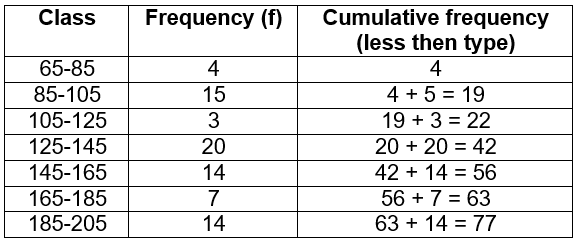
Example 1. Find the difference between upper-class limit in median class and lower class limit of modal class of the frequency distribution table

WBBSE Solutions For Class 10 Maths Statistics Chapter 1 Mean Median Ogive Mode Example 1

Solution:

WBBSE Solutions For Class 10 Maths Statistics Chapter 1 Mean Median Ogive Mode Example 1-1

N = ∑ƒ=77

At first, we locate the class where the cumulative frequency is equal to \(\frac{n}{2}\) or greater than \(\frac{n}{2}\) in the above frequency distribution table.

\(\frac{n}{2}\) = \(\frac{77}{2}\) = 38.5

∴ The cumulative frequency of the class is 42 which is just greater than 38.5 and the corresponding class is (125 – 145)

∴ The medians class is (125 – 145)

∴ The upper-class limit in median class is 145

As highest frequency in the above frequency distribution table is 20.

∴ The modal class is (125 – 145)

∴ Lower class limit of modal class is 125.

The difference between upper class limit in median class and lower class limit of modal class is (145 – 125) or 20.

Example 2. The following frequency distribution shows the time taken to complete 100 metre hardle race of 150 athletics

WBBSE Solutions For Class 10 Maths Statistics Chapter 1 Mean Median Ogive Mode Example 2

Find the number of athletics who complete the 100-metre hardle race within 14.6 seconds.

Solution: The number athletics are (2 + 4 + 5 + 71) = 82

Example 3. The mean of a frequency distribution is 8.1, if \(\sum \dot{f_I} x_i=132+5 \mathrm{k} \text { and } \sum f_i=20\); find the value of k.

Solution: Mean \(\bar{x}=\frac{\sum {f_i}{x_i}}{\sum f_i}=\frac{132+5 k}{20}\)

According to the question = \(\frac{132+5 \mathrm{k}}{20}=8 \cdot 1 \\\)

⇒ \(132+5 \mathrm{k}=162\)

⇒ \(\mathrm{k}=\frac{162-132}{5}=6\)

Wbbse Class 10 Statistics Notes

Example 4. If \(u_i=\frac{x_i-25}{10}, \Sigma f_i u_i=20 and \Sigma f_i=100\), find the value of \(\bar{x}\).

Solution: If assumed mean = a and class size = h then [/latex]u_i=\frac{x_i-a}{h}[/latex]

∴ \(\frac{x_i-a}{h}=\frac{x_i-25}{10}\)

equating both sides, we get a = 25 and h = 10

∴ Mean \((\bar{x})=a+\frac{\sum f_i u_i}{\sum f_i} \times h\)

= 25 + \(\frac{20}{100}\) x 10

= 25 + 2 = 27

∴ The value of \(\bar{X}\) is 27.

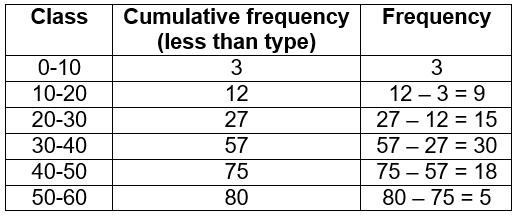
Example 5. Write the modal class from the above frequency distribution table.

WBBSE Solutions For Class 10 Maths Statistics Chapter 1 Mean Median Ogive Mode Example 5

Solution:

WBBSE Solutions For Class 10 Maths Statistics Chapter 1 Mean Median Ogive Mode Example 5-1

Highest frequency in above frequency distribution table is 30

∴ The modal class is (30- 40)

Example 6. A table of weight of 50 students are given below

WBBSE Solutions For Class 10 Maths Statistics Chapter 1 Mean Median Ogive Mode Example 6

Find the mean of their weights by direct method.

Solution:

WBBSE Solutions For Class 10 Maths Statistics Chapter 1 Mean Median Ogive Mode Example 6-1

∴ Mean weight of students = \(\frac{\sum f_i x_i}{\sum f_i}\)

= \(\frac{1919}{50} \mathrm{~kg}=38.38 \mathrm{~kg}\)

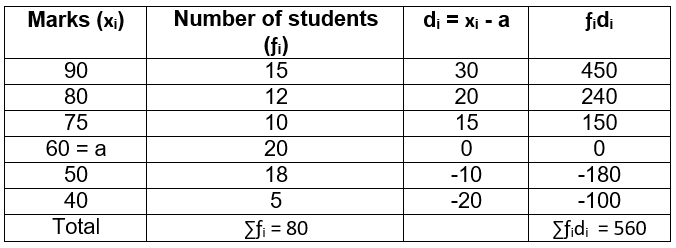
Example 7. The marks obtained by 80 students of class nine in mathematics are given in the table below

WBBSE Solutions For Class 10 Maths Statistics Chapter 1 Mean Median Ogive Mode Example 7

Find the average marks of 80 students bj using assumed mean method.

Solution: Let assumed mean (a) = 60

WBBSE Solutions For Class 10 Maths Statistics Chapter 1 Mean Median Ogive Mode Example 7-1

∴ Average marks = \(a+\frac{\sum f_i d_i}{\sum f_i}\)

= 60 + \(\frac{560}{80}\)

= 60 + 7 = 67

Measures Of Central Tendency Class 10 Solutions

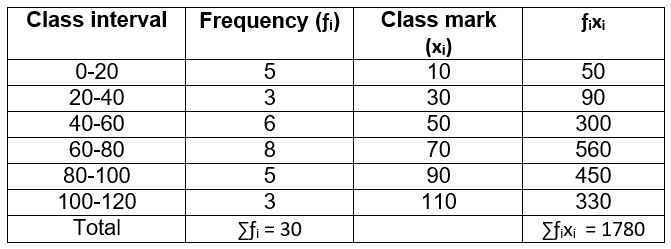
Example 8. Find the mean of the following data by using direct method.

WBBSE Solutions For Class 10 Maths Statistics Chapter 1 Mean Median Ogive Mode Example 8

Solution:

WBBSE Solutions For Class 10 Maths Statistics Chapter 1 Mean Median Ogive Mode Example 8-1

∴ Mean \(\bar{x}=\frac{\sum f_i x_i}{\sum f_i}\)

= \(\frac{1780}{30}\) = 59.33 (approx)

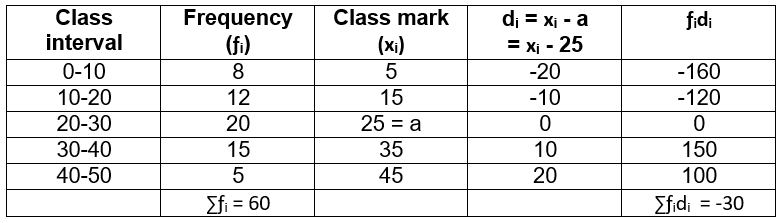
Example 9. Find the mean of the following data by using the assumed mean method.

WBBSE Solutions For Class 10 Maths Statistics Chapter 1 Mean Median Ogive Mode Example 9

Solution: Let assumed mean (a) = 25

WBBSE Solutions For Class 10 Maths Statistics Chapter 1 Mean Median Ogive Mode Example 9-1

∴ Mean \((\overline{\mathrm{X}})=a+\frac{\sum f_i d_i}{\sum f_i}\)

= \(25+\frac{-30}{60}\)

= 25 – 0.5 = 24.5

Example 10. Find the mean of the following data given below by using the step-deviation method.

WBBSE Solutions For Class 10 Maths Statistics Chapter 1 Mean Median Ogive Mode Example 10

Solution: Let the assumed mean (a) = 52.5

class size (h) = 15

WBBSE Solutions For Class 10 Maths Statistics Chapter 1 Mean Median Ogive Mode Example 10-1

∴ Mean \((\bar{X})=a+\frac{\sum f_i u_i}{\sum f_i} \times h\)

= \(52 \cdot 5+\frac{-10}{50} \times 15\)

= 52.5 – 3 = 49.5

Example 11. Height of some students in cm are 155, 145, 148, 144, 146, 150, 152, 147. Find their median.

Solution: Arranging their heights in ascending order we get,

144 cm, 145 cm, 146 cm, 147 cm, 148 cm, 150 cm, 152 cm, 155 cm, 156 cm.

Here, n = 9 i.e. n is odd

∴ Median of height = \(\frac{n+1}{2}\)th value

= \(\frac{9+1}{2}\)th value = 5 th value = 148 cm.

Class 10 Maths Statistics Important Questions

Example 12. The marks obtained by 10 students of class 9 in Bengali are 88, 65, 80, 52, 38, 70, 44, 75, 62, and 35. Find the median of marks.

Solution: Arranging the marks in ascending order we get,

35, 38, 44, 52, 62, 65, 70, 75, 80, 88

Here, n = 10 i.e. n is even

∴ Median = \(\frac{1}{2}\)[\(\frac{10}{2}\)th value + (\(\frac{1}{2}\) + 1)th value]

= \(\frac{1}{2}\)[5th value + 6th value]

= \(\frac{1}{2}\)(62 + 65) = \(\frac{127}{2}\) = 63.5

∴ Median of marks is 63.5.

Example 13. Find the median from the frequency distribution table given below

WBBSE Solutions For Class 10 Maths Statistics Chapter 1 Mean Median Ogive Mode Example 13

Solution:

WBBSE Solutions For Class 10 Maths Statistics Chapter 1 Mean Median Ogive Mode Example 13-1

Here n = ∑ƒ = 37 i.e. n is odd

∴ Median = (\(\frac{n+1}{2}\))th observation

= (\(\frac{37+1}{2}\))th observation

= 19 th observation = 42

Example 14. Find the median from frequency distribution table given below:

WBBSE Solutions For Class 10 Maths Statistics Chapter 1 Mean Median Ogive Mode Example 14

Solution:

WBBSE Solutions For Class 10 Maths Statistics Chapter 1 Mean Median Ogive Mode Example 14-1

n = ∑ƒ = 100 i.e. n is even

∴ Median = \(\frac{1}{2}\) [\(\frac{n}{2}\) th observation + (\(\frac{n}{2}\) + 1) th observation]

= \(\frac{1}{2}\)[\(\frac{100}{2}\) th observation + (\(\frac{100}{2}\) + 1) th observation]

= \(\frac{1}{2}\) [50th observation + 51th observation]

= \(\frac{1}{2}\)[42 + 4] = \(\frac{1}{2}\) x 8 = 4

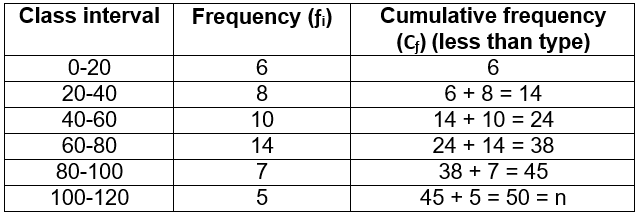
Example 15. Find the median from the frequency distribution table given below

WBBSE Solutions For Class 10 Maths Statistics Chapter 1 Mean Median Ogive Mode Example 15

Solution:

WBBSE Solutions For Class 10 Maths Statistics Chapter 1 Mean Median Ogive Mode Example 15-1

n = 50,

∴ \(\frac{n}{2}\) = \(\frac{50}{2}\) = 25

(60 – 80) is the class whose cumulative frequency 38 is just greater than 25

Median = \(l+\left[\frac{\frac{n}{2}-c f}{f}\right] \times h\)

Here, l = lower limit of median class

n = number of observation

ƒ = frequency of median class

cƒ = cumulative frequency of class preceding the median class

h = class size of the median class

∴ Median = \(l+\left[\frac{\frac{n}{2}-\mathrm{C}_f}{f}\right] \times h\) [ l = 60, n = 50, Cƒ= 24, ƒ = 14, h = 20]

= \(60+\left[\frac{\frac{50}{2}-24}{14}\right] \times 20\)

= 60 + \(\frac{1}{14} \times 20\) = 60 + 1.42 (approx) = 61.42 (approx)

Class 10 Maths Board Exam Solutions

Example 16. Find the mode of the data given below

4, 6, 10, 5, 8, 12, 5, 10, 6, 7, 5, 9, 11, 5, 12, 6, 8, 5, 12, 5

Solution: Arranging the numbers of given data in ascending order in magnitude.

4, 5, 5, 5, 5, 5, 5, 6, 6, 6, 7, 8, 8, 9, 10, 10, 11, 12, 12, 12

As 5 occurs maximum number of times.

∴ The mode of data = 5

Example 17. Find the mode of frequency distribution table given below

WBBSE Solutions For Class 10 Maths Statistics Chapter 1 Mean Median Ogive Mode Example 17

Solution: The modal class of given frequency distribution table is (30 – 40)

[As maximum number of frequency is 15]

Reqired mode = \(l+\left(\frac{f_1-f_0}{2 f_1-f_0-f_2}\right) \times h\)

Here, l = lower limit of the modal class = 30

h = length of the modal class = 10

ƒ1 = Frequency of the rhodal class =15

ƒ0 = Frequency of the class preceding the modal class = 10

ƒ2 = Frequency of the class succeeding the modal class = 8

∴ Mode = \(30+\left(\frac{15-10}{2 \times 15-10-8}\right) \times 10\)

= 30 + \(\frac{5}{12}\) x 10

= 30 \(+\frac{50}{12}\)

∴ Mode = 30 + 4.17 = 34.17(approx).