WBCHSE Class 12 Physics Ohm’s Law Temperature Coefficient of Resistance Notes

Current Electricity

Electric Current And Ohm’s Law Temperature Coefficient of Resistance

Temperature Definition

The temperature coefficient of resistance is defined as the change in resistance of the conductor per unit resistance at 0°C for a 1°C rise in temperature.

Suppose, the resistance of a conductor at 0°C = R0 and its resistance at t°C = Rt

Therefore, according to the definition, the temperature coefficient of resistance of the conductor

⇒ \(\alpha=\frac{\text { change in resistance }}{\text { resistance at } 0^{\circ} \mathrm{C} \times \text { change in temperature }}\)

or, \(\alpha=\frac{R_t-R_0}{R_0 t}\)….(1)

The value of α is different for different substances.

WBCHSE Class 12 Physics Ohm’s Law Temperature Coefficient Of Resistance Notes

Unit:

Unit of \(\alpha=\frac{\text { unit of }\left(R_t-R_0\right)}{\text { unit of } R_0 \times \text { unit of } t}=\frac{\text { ohm }}{\mathrm{ohm} \times{ }^{\circ} \mathrm{C}}\)

= \(=\frac{1}{{ }^{\circ} \mathrm{C}} \text { i.e., per degree Celsius or } \cdot{ }^{\circ} \mathrm{C}^{-1}\)

The temperature coefficient of resistance of copper is 0.00425 °C-1 means that if the resistance of a conductor of copper at 0°C is 1Ω, for 1°C rise in temperature, the increase in its resistance will be 0.00425 Ω.

Temperature Coefficient Of Resistance Class 12 Notes

Positive and negative α:

In the case of a metallic conductor its resistance Increases with the rise In temperature,

Example:

In the case of copper mentioned above, α = +0.00425 C-1. On the other hand, the resistance of an electrolyte, or a gas maintained at a low pressure or semiconductor decreases with the rise of temperature. So, In these cases Is negative.

Accurate measurement:

From equation (1) we get,

Rt – R0 = R0αt

or, Rt = R0 (1 + αt)………………………………….(2)

In case of metallic conductors if the change in temperature Is not too high then the coefficient remains constant. It means that resistance Increases at a uniform rate with the rise in temperature.

Hut if the change In temperature is very high, then the temperature coefficient of resistance does not remain constant and another constant (β) is required in addition to α. Finally, the modified form of the equation (2) is

Rt = R0 (l + αl + βt2)…(3)

Values of α for different substances:

A table showing the values of the temperature coefficient of resistance of a few substances is given below, taking β = 0.
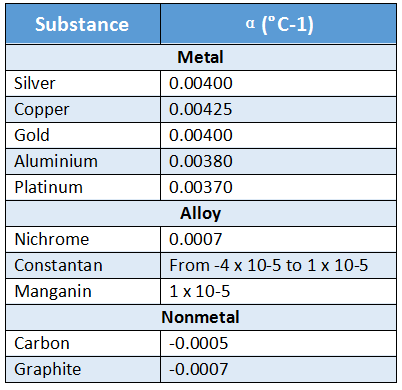
Class 12 Physics Unit 2 Current Electricity Chapter 1 Electric Current and Ohm's Law values of α for different substances

From the above table, it will be noticed that:

1. The value of a is greater for metals than for alloys. Therefore, metals show more change in resistance titan alloys, when they are heated.

This is the basic reason why alloys are used in resistance boxes and metals are used in the construction of resistance thermometers.

2. In substances like carbon, graphite or constantan, α Is negative i.e., their resistance decreases with theriseintemperature

Conventional rule:

In the laboratory, to determine the value of a it is not necessary to determine the resistance of the metallic conductor at 0°C. If R1 and R2 be the resistances of the conductor at t1°C and t2°C respectively, then,

⇒ \(R_1=R_0\left(1+\alpha t_1\right) \text { and } R_2=R_0\left(1+\alpha t_2\right)\)

So, \(\frac{R_1}{R_2}=\frac{1+\alpha t_1}{1+\alpha t_2} \text { or, } R_1\left(1+\alpha t_2\right)=R_2\left(1+\alpha t_1\right)\)

or, \(\alpha\left(R_1 t_2-R_2 t_1\right)=R_2-R_1 \quad \text { or, } \alpha=\frac{R_2-R_1}{R_1 t_2-R_2 t_1}\)

This relation is used in the laboratory to determine α of a substance.

Chango of resistivity with temperature:

Let us suppose that resistance, resistivity, length, and cross-sectional area of a conductor at 0°C are R0, \(\rho\)0, l0, and A0 respectively, and the corresponding values at t°C are R, p,l and A.

Now, let the temperature coefficient of resistance of the material of the conductor = a; coefficient of linear expansion = α’

Coefficient of superficial expansion = β = 2α’

So, \(R=R_0(1+\alpha t), l=l_0\left(1+\alpha^{\prime} t\right), A=A_0\left(1+2 \alpha^{\prime} t\right)\)

Again, \(\rho_0=\frac{R_0 A_0}{l_0} \text { and } \rho=\frac{R A}{l}\)

∴ \(\frac{\rho}{\rho_0}=\frac{R}{R_0} \cdot \frac{A}{A_0} \cdot \frac{l_0}{l}\)

⇒ \(\frac{(1+\alpha t)\left(1+2 \alpha^{\prime} t\right)}{1+\alpha^{\prime} t} \approx(1+\alpha t)\left(1+\alpha^{\prime} t\right)\) [∵ α’ is very small]

∴ \(\rho=\rho_0(1+\alpha t)\left(1+\alpha^{\prime} t\right)\)

So, the resistivity of the material of a conductor increases with the rise in temperature.

Class 12 Physics Important Questions On Ohm’s Law And Resistance

Current Electricity

Electric Current and Ohm’s Law Temperature Coefficient of Resistance Numerical Examples

Example 1. The temperature coefficient of resistance of copper is 42.5 x 10⁻⁴ °C-1. The resistance of a coll of copper at 30°C is 8 IT. What is its resistance at 100°C?
Solution:

⇒ \(R=R_0(1+\alpha t)=R_0 \alpha\left(\frac{1}{\alpha}+t\right)\)

⇒ \(\text { At } 30^{\circ} \mathrm{C}, R_{30}=R_0 \alpha\left(\frac{1}{\alpha}+30\right)\)

⇒ \(\text { At } 100^{\circ} \mathrm{C}, R_{100}=R_0 \alpha\left(\frac{1}{\alpha}+100\right)\)

So, \(\frac{R_{100}}{R_{30}}=\frac{\frac{1}{\alpha}+100}{\frac{1}{\alpha}+30}\)

Now, \(\frac{1}{\alpha}=\frac{1}{42.5 \times 10^{-4}}=\frac{10000}{42.5}=235.3\)

So, \(R_{100}=R_{30} \times \frac{235.3+100}{235.3+30}=8 \times \frac{335.3}{265.3}=10.1 \Omega\)

Resistance at 100°C \(R_{100}=R_{30} \times \frac{235.3+100}{235.3+30}=8 \times \frac{335.3}{265.3}=10.1 \Omega\)

Example 2. If \(\rho\) is the resistivity at temperature T, then the temperature coefficient of reactivity is defined as \(\alpha=\frac{1}{\rho} \frac{d \rho}{d T}\), which is a constant physical quantity for a given metal. Show that \(\rho=\rho_0 e^{\alpha\left(T-T_0\right)}\), where \(\rho_0\) = resistivity at temperature T0.
Solution:

It is given that temperature coefficient of resistivity,

⇒ \(\alpha=\frac{1}{\rho} \frac{d \rho}{d T} \quad \text { or, } \frac{d \rho}{\rho}: x \cdot d T\)

Integrating both sides, we get

\(\int \frac{d \rho}{\rho}=\int \alpha \cdot d T\)

or, \(\log _k \rho=\alpha T+k\)…(1)

where k = integration constant.

When T = T0, \(\rho=\rho_0\)

∴ \(k=\log _e \rho_0-\alpha T_0\)

Putting k in equation (1), \(\log _e \rho=\alpha T+\log _e \rho_0-\alpha T_0\)

or, \(\log _e \frac{\rho}{\rho_0}=\alpha\left(T-T_0\right) \quad \text { or, } \frac{\rho}{\rho_0}=e^{\alpha\left(T-T_0\right)}\)

∴ \(\rho=\rho_0 e^{\alpha\left(T-T_0\right)}\)

WBCHSE Class 12 Physics Ohm’s Law Elementary Idea Of Storage Cell

Current Electricity

Electric Current and Ohm’s Law Elementary Idea Of Secondary Cell Or Storage Cell

1. lead-add Accumulator: it is a secondary ceil. French Gaston Plante was discovered in 1859.

Discussion:

Positive electrode: The active element of this electrode is lead dioxide (PbO2).

Negative electrode: The active element of this electrode is metallic lead, taken in a spongy form.

Class 12 Physics Ohm’s Law Solutions

Electrolyte:

Dilute sulphuric acid of specific gravity 1.25 is taken as an electrolyte In a thick glass or bakelite vessel. The plates are dipped in the acid. Only the terminals of the two electrodes remain outside the vessel

WBCHSE Class 12 Physics Ohm’s Law Elementary Idea Of Storage Cell

The electromotive force of the cell:

When a fully charged cell begins to discharge, Its emf is 2.2 V. But after a short while the emf comes down to 2,0 V and remains constant for a long time. At last, when the cell has fully discharged the emf the cell comes down to about 1.8 V. To ascertain whether the cell has been fully charged and Is in an active state, or has been folly discharged, a voltmeterInsertedin the external circuit can well serve the purpose. The ingredients of the cell need not be Inspected.

It Is to be noted that during the time of discharge, lead sulfate Is formed at the two electrodes, and the active elements i.e., Pb, PbO2 and H2SO4 gradually decay.

The specific gravity of sulphuric acid:

The cell contains sulphuric acid of a specific gravity of 1.25. During discharging, the specific gravity of the sulphuric acid solution decreases. When the cell is fully discharged the specific gravity of the add solution falls to 1.18. During charging, sulphuric add is regenerated.

Class 12 Physics Ohm’s Law Solutions

When the cell is fully charged the specific gravity of sulphuric acid comes back to Its normal value of 1 .25. So, even by measuring the specific gravity of sulphuric acid, the condition of the cell can be determined.

However, to determine the condition of the cell, measurement of the emf of the cell with a multimeter is a better option.

Sulphuric acid Use:

The internal resistance of the cell is very low i.e., current flows through the cell almost without any resistance. So this cell is used for getting a steady current of high magnitude in the external fruit for a long time.

It is used O in cars, buses, trains, and even in laboratories, and Q in inverters, for generating electricity in houses during power cuts.

2. Alkali Accumulator:

The active elements of this cell are iron (negative plate), nickel hydroxide (positive plate), and caustic potash solution (KOH) (electrolyte). This is also called a nickel-iron accumulator or nife cell. This cell is also known as Edison cell after the name of its discoverer Thomas Alva Edison

Alkali Accumulator Disadvantages:

In comparison to lead-acid accumulator:

  1. Its internal resistance is high.
  2. Emf is low (1.3 V).
  3. Efficiency is small

Alkali Accumulator Advantages:

  1. No internal disturbance occurs on heavy jerking.
  2. It can be left for a long time in a fully charged or in a fully discharged condition.
  3. No damage is done if it is overcharged or over-discharged.

Capacity and Efficiency erf a Secondary Gell:

Capacity:

The capacity of a secondary cell is defined as the amount of electricity (charge) that the cell is capable of supplying in the external circuit before being completely discharged

Unit of capacity: Ampere-hour (A-h) is the unit of capacity.

1 A.h = 1 A x 1 h

= 1 A x 3600 s

= 3600 A.s

= 3600 C

So, a ceiling having a capacity of 1 A.h can supply a charge of 3600 C. Obviously A.h is a big unit.

Example:

By the statement that the capacity of a secondary cell is 50 A – h, we mean that the cell can supply a current of 1 amperes for 50 hours or 2 amperes for 25 hours. However, the capacity expressed in ampere-hour is always an approximate value only.

Class 12 Physics Solved Examples Ohm’S Law

Efficiency:

The amount of charge given to a secondary cell during charging cannot be back totally during discharging. The ratio of the charge obtained to the amount given is called ampere-hour efficiency. In the case of lead-acid accumulator is 0.9 or 90%.

Again the amount of external energy supplied to a secondary cell during charging cannot be get back totally in the form of electrical energy during discharging. The fraction of the supplied energy obtained from the cell is called the energy efficiency or watt-hour efficiency of the cell.It is given by,

⇒ \(\eta=\frac{\text { energy obtained during discharging }}{\text { energy supplied during charging }}\)

⇒ \(\frac{average emf during discharging x amount of charge obtained}{average emf during charging x amount of charge supplied}\)

⇒ \(\frac{\text { average emf during discharging }}{\text { average emf during charging }}\) x ampere-hour efficiency

During charging of a lead-acid accumulator the external source used has an average emf of 2.2 V. But during discharging the average emf obtained from the accumulator is 2.0 V. So, the energy efficiency of a lead-acid accumulator is,

⇒ \(\eta=\frac{2.0}{2.2} \times 0.9=0.8=80 \%\)

Current Electricity

Electric Current and Ohm’s Law Elementary Idea Of Secondary Cell Or Storage Cell Numerical Examples

Example 1. A battery Is charged at a potential of 15 V for 8 h by means of a current of 10 A. While discharging it supplies a current 5 A for 15 h at a potential difference of 14 V, Calculate the watt-hour efficiency of the battery.
Solution:

Watt-hour efficiency or energy efficiency

⇒ \(=\frac{\text { energy obtained during discharging }}{\text { energy supplied during charging }}\)

⇒ \(\frac{14 \times 5 \times 15}{15 \times 10 \times 8}\)

= \(\frac{7}{8}\)

= 0.875

= 87.5%

The watt-hour efficiency of the battery = 87.5%

Differences between Primary and Secondary Cells:

Class 12 Physics Unit 2 Current Electricity Chapter 1 Electric Current and Ohm's Law Differences between Primary and Secondary cells