WBBSE Solutions For Class 7 Maths Geometry Chapter 3 Properties Of Triangle

Geometry Chapter 3 Properties Of Triangle

Question 1. Choose the correct answer

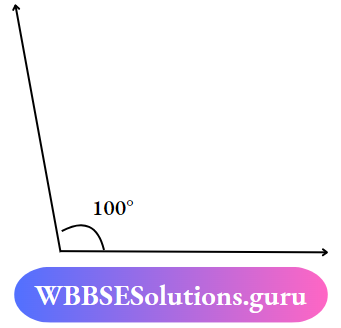
1. If the measurement of the angle of a triangle is 100° then the triangle is

  1. Right-angled triangle
  2. Acute angled triangle
  3. Obtuse angled triangle
  4. None of these

∴ The option (3), an obtuse-angled triangle ≤ 90° to 2120° is an obtuse angle.

2. If the measurement of one angle is equal to the sum of measurements of other two angles then the triangle is

  1. Acute angled
  2. Right-angled
  3. Obtuse angled
  4. None of these

Read and Learn More Class 7 Maths Solutions

Class 7 Geometry Chapter 3 Questions

∴ The option (2) Right angled triangle is the correct answer

WBBSE Solutions For Class 7 Maths Geometry Chapter 3 Properties Of Triangle Obtused Angle

Greater than 90° to equal to 120° the angle is called obtuse Angle

WBBSE Solutions For Class 7 Maths Geometry Chapter 3 Properties Of Triangle Hypotenus

Hypotenus = side+ Adjacent

WBBSE Solutions For Class 7 Maths Geometry Chapter 3 Properties Of Triangle

If the measurement of two angles is x and y then the measurement of the third angle is

  1. (X-Y)°
  2. (x+y)°
  3. 180-(2+1)°
  4. {180 -(x-x)}

∴ The option (3) is the correct answer

A sum of Angles in a triangle is 180°

Here we have two angles given x° and y°

∴ x° + y° + third angle = 180°

third angle = 180° – (x°+ y°)

WBBSE Class 7 Maths Geometry Solutions

Question 2. write the true or false.

1. Obtuse triangle has two obtuse angle

→ False

The obtuse angle lies between 90° to 120°

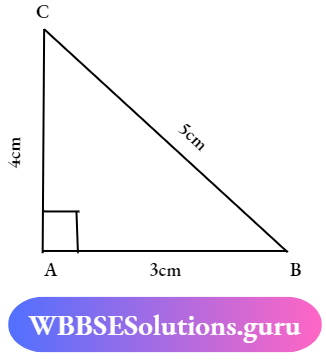
2. If the length of the three sides of a triangle 3 cm, 4cm, and 5cm then the triangle is a right-angled triangle

→ True

WBBSE Solutions For Class 7 Maths Geometry Chapter 3 Properties Of Triangle The Length Three Sides Of the Triangle Is Right Angled Triangle

3. The measurement of the three angles of an isosceles right angled triangle is 45°, 45° and 90°

→ True

In an Isosceles right angled triangle two sides (or) two angles are equal then the triangle is Isosceles and having 90° is called an Isosceles right isosceles-angled triangle.

Class 7 Geometry Textbook Solutions

Question 3. Fill in the blanks

Question 1. The median of a triangle is ______
Answer:
Concurrent.

Question 2. The point of intersection of perpendicular bisectors of a triangle is called ______
Answer: Orthocentre

Question 3. The height and median of a ______ are equal
Answer: Equilateral triangle

Question 4. If the ratio of measurement angles of a twangle is 3:4:5 then write the name of the triangle.
Solution:

The Sum of angles in a triangle is 180°

Angles of a triangle are in a ratio of 3:4:5

Let’s denote the angles are 3x,48,5x

3x+4x+5x=180°

12x = 180°

x = \(\frac{180}{12}\)

x = 15

∴ 3x = 3 ×15 ⇒ 45°

4x = 4 ×15 ⇒ 60°

5x = 5 ×15 ⇒ 75°

By observing that all three angles lie between 0° to 9°

∴ The triangled formed by the angles are Acute angle triangle

Class 7 Maths Geometry Problems

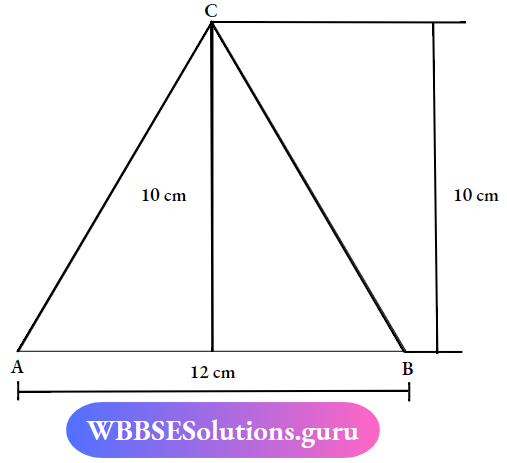
Question 5. The length of the base of a triangle is 12cm and its height is 10cm Find its area.
Solution:

Given:-

Base = 12cm

Height = 10cm

WBBSE Solutions For Class 7 Maths Geometry Chapter 3 Properties Of Triangle The Length Of Base Of Triangle

Area of triangle = \(\frac{1}{2}\) [Base x Height]

⇒ \(\frac{1}{2}\)[12×10]

⇒ \(\frac{1}{2}\)[120]

Are of triangle = 60 sqcm

Question 6. If the area of a triangle is 100sqm and length. of its base is 20cm find its altitude.
Solution:

Given:

Area of triangle = 100 sq cm

Length of base = 20cm

Altitude =?

Area of triangle = \(\frac{1}{2}\)[Base × Height]

100 = [\(\frac{20}{2}\) × Height ]

100 × \(\frac{2}{1}\) = [\(\frac{20}{2}\) × Height]

200 = 10 × Height

⇒ \(\frac{200}{20}\) = Height

200 = Height

Height Altitude = 20cm ⇒ 20cm

∴ The Altitude of a triangle is 20cm

Class 7 Geometry Formulas

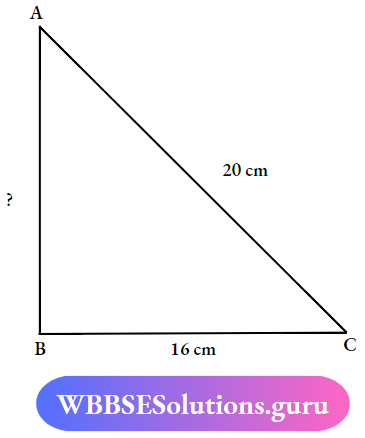
Question 7. If the length of hypotenuse use and the length of one side are 20cm and 16cm respectively. Find the length of the third side.
Solution:

Given

Length of hypotenuse = 200m

Length of one side = 16cm

WBBSE Solutions For Class 7 Maths Geometry Chapter 3 Properties Of Triangle The Two Lengths Of Hypotenuse

From Pythagoras Theorem

(Hypotenuse)2 = (Side)2 + (side)2

(20)2 = (16)2+(Side)2

(20)2 – (16)2 = (Side)2

(20+16) (20-16) =(Side)2

36 × 4 = (Side)2

144 = (Side)2

side = √144

Side = 12

∴ The length of the third side is 12cm

Class 7 Geometry Chapter 3 Explanation

Question 8. If the length of three sides of a triangle is (m2-n2) unit, 2mn unit, and (m2+n2) unit. then Write the name of the triangle.
Solution:

Given:-

The first side of the triangle = (m2-n2) unit.

The second side of the triangle = 2mn unit

The third Side of the triangle = m2+n2 unit

m2+n2 is the largest side.

m2+n2 will always be greater than the other two sides, given that m and n are positive integers.

Apply Pythagoras theorem

(m2 + n2)2 = (m2-n2)2 + (2mn)2 + (m2+n2)2

m4+2m2n2+n4 = m4 – 2m2n2 + n4 + 4m2n2

m4+2m2n2+n4 = m4 +n4+2m2n2

(m2+n2)2 = (m2+n2)2

The sum of the squares of the two smaller sides equals the square of the largest side, of a triangle. satisfies the Pythagoreus theorem.

A triangle with sides (m2-n2) unit, 2mm unit, and (m2+n2) is a right angled triangle

WBBSE Solutions For Class 7 Maths Arithmetic Chapter 3 Proportion

Arithmetic Chapter 3 Proportion

Question 1. Find if the pair of ratios given below are equal and also Find if Four members are in proportion.
Solution:

1. 4:5 and 20:25

4:5 = 4:5

20:25 = 4:5

∴ 4:5 and 20:25 are equal

Hence 4,5, 20, 25 are in proportion.

2. 2ac: 3ac and 14 ab: 21ab. [a ≠ 0; b ≠ 0. c ≠ 0]

2ac:3ac ⇒ \(\frac{2 a c}{3 a c} \Rightarrow \frac{2}{3}\) ⇒ 2:3

14ab: 21ab ⇒ \(\frac{14 a b}{21 a b} \Rightarrow \frac{2}{3}\) ⇒ 2:3

∴ 2ac : 3ac and 14ab:21ab are equal.

Hence 2ac, 3ac and 14ab, 21ab are in proportion.

3. 5:7 and 15:18

5:7 = 5:7

15:18 = 5:6

∴ 5:7 = 5:6

Hence 5:7, 15 and 18 are not in proportion.

Class 7 Arithmetic Problems With Solutions

Question 2. Fill in the blank squares

  1. 3: 7:: 21: ▢
  2. ▢: 6:: 20: 24
  3. 9: 8:: ▢: 56
  4. 18: ▢:: 30: 45

1. 3: 7:: 21: ▢

Let the square be ‘X’

∴ \(\frac{3}{7}=\frac{21}{x}\)

3x = 21×7

3x = 147

x = \(\frac{147}{3}\)

x = 49

∴ 3:7::21:49

2. ▢: 6:: 20: 24

Let the square be ‘x’

∴ \(\frac{x}{6}=\frac{20}{24}\)

24x = 120

x = \(\frac{120}{24}\)

x = 5

5: 6:: 20: 24

3. 9: 8:: ▢: 56[/latex]

Let the square be ‘x’

∴\(\frac{9}{8}=\frac{x}{56}\)

8x = 9×56

x = \(\frac{504}{8}\)

x = 63

∴ 9:8::63:56

4. 18:▢:: 30: 45

Let the square be ‘x’.

⇒ \(\frac{18}{x}=\frac{30}{45}\)

30x = 18×45

x = \(\frac{810}{30}\)

x = 27

∴ 18:27:30:45

WBBSE Class 7 Arithmetic Chapter 3

Question 3. Verify whether the following numbers are in proportion.

  1. 2, 3, 4, 6
  2. 10,8, 5,4
  3. 6,2,5,9
  4. 16, 24, 6, 9

1. 2,3,4,6

Here product of extreme = 2×6 = 12 and product of mean = 3×4 =12

∴ Product of extreme = product of means

Hence the four members are in proportion.

2. 10, 8, 5,4

Here product of extreme = 10×4 = 40 and product of mean = 8×5 = 40·

∴ Product of extreme = product of mean

Hence the four members are in proportion.

3. 6,2,5,9

Here product of extreme = 6×9= 54 and product of mean = 2×5=10

∴ Product of extreme product of mean

Hence the four members are not in proportion

4. 16, 24,6,9

Here product of extreme = 16×9 = 144 product of mean = 24×6 = 144

∴ Product of extreme = product of mean

Hence the Four members are in proportion.

1. 2,3,4,6

⇒ 2:3 and 4:6

⇒ 2:3 = 2:3

4:6 = 2:3

2:3 and 4:6 are equal Hence 2, 3, 4, 6 are in proportion.

2. 10,8,5, 4

⇒ 10:8 and 5:4

⇒ 10:8 = 5:4

5:4 = 5:4

10:8 and 5:4 are equal.

Hence 10,8,5,4 are in proportion.

Alternating method

3. 6, 2,5,9

⇒ 6:2 and 5:9

⇒ 6:2 = 3:1

5:9 = 5:9

∴ 6:2 and 5:9 are not equal.

∴ 6, 2, 5, 9 are not in proportion.

4. 16, 24, 6, 9

⇒ 16:24 and 6:9

⇒ 16:24 = 2:3

6:9 = 2:3

16:24 and 6:9 are equal

Hence 16, 24, 6,9 are in proportion.

Class 7 Maths Arithmetic Solutions WBBSE

Question 4. Form different proportions with the following numbers.

  1. 7,5, 14, 10,
  2. \(\frac{1}{3}, \frac{1}{2}, \frac{1}{6}, \frac{1}{4}\)
  3. 8,7,16,14

1. 7,5, 14, 10,

WBBSE Solutions For Class 7 Maths Arithmatics Chapter 3 Proportion Different Proportion With The Numbers 1

2. \(\frac{1}{3}, \frac{1}{2}, \frac{1}{6}, \frac{1}{4}\)

WBBSE Solutions For Class 7 Maths Arithmatics Chapter 3 Proportion Different Proportion With The Numbers 2

3. 8,7, 16, 14

WBBSE Solutions For Class 7 Maths Arithmatics Chapter 3 Proportion Different Proportion With The Numbers 3

WBBSE Class 7 Arithmetic Exercise Solutions

Question 5. Find whether the following sets of numbers are in continued proportion and write the proportionality:

  1. 5,25, 125
  2. 7, 21,63,
  3. 12, 48, 192,
  4. 6, 10, 18.

1. 5, 25, 125

5×125 = 625 = (25)2

i.e, 1st and × 3rd term = (mean)2

so, 5, 25 and 15 are in continued proportion

The proportionality is 5:25:25:125

2. 7, 21, 69

7×63 = 441=(21)2

i·e, 1st × 3rd term = (mean)2

so, 7, 21, 63 are in continued proportion.

The proportionality is 7:21:21:63

3. 12, 48, 192

12×192 = 2304 =(48)2

i.e; 1st and 3rd term = (mean)2

So 12, 48, 192 are in continued proportion.

The proportionality is 12:48:48:192

4. 6, 10, 18

6×18 = 108 ≠ (10)2

i.e, 1st term x 3rd term 7 (mean)2

so 6, 10, 18 are not in continued proportion.

WBBSE Maths Study Material Class 7 

Question 6. The three numbers in continued proportion 1st and 2nd numbers are 18 and 3 respectively. Find the third number of this proportion.
Solution:

Givent

The first number is 18

the second number is 3

18:3::3:X

⇒ \(\frac{18}{3}=\frac{3}{x}\)

18x = 9

x = \(\frac{9}{18}\)

x = \(\frac{1}{2}\)

∴ The third number in this proportion = \(\frac{1}{2}\)

Verify

18, 3, \(\frac{1}{2}\)

18 × 1/2 = 9 = (3)2 = (mean)2

∴ The three numbers are in continued proportion.

The proportion will be 18:3:3:\(\frac{1}{2}\)

Question 7. Find the mean of the following two numbers.

  1. 15,135
  2. \(\frac{1}{2}, \frac{1}{8}\)

Let positive mean proportion of 15 and 135 is ‘X’

∴ 15:x :: 2:135

⇒ \(\frac{15}{x}=\frac{x}{135}\)

x2 = 15×135

x= \(\sqrt{2025}\)

x= 45

∴ Mean proportion 15, 135, 45.

2. \(\frac{1}{2}, \frac{1}{8}\)

Let the positive mean proportion of \(\frac{1}{2} {and}\frac{1}{8}\) is ‘X’.

∴ \(\frac{1}{2}: x:: x: \frac{1}{8}\)

⇒ \(\frac{\frac{1}{2}}{x}=\frac{x}{\frac{1}{8}}\)

⇒ \(\frac{1}{2} \times \frac{1}{8}=x^2\)

⇒ \(\frac{1}{16}=x^2\)

x= \(\sqrt{\frac{1}{16}}\)

x= \(\frac{1}{4}\)

∴ Mean proportion \(\frac{1}{2}\) and \(\frac{1}{8}\) is \(\frac{1}{4}\)

WBBSE Maths Study Material Class 7 

Question 8. If \(x: \frac{27}{64}:: \frac{3}{4}: x\) (x≠0) then find the value of x.
Solution:

⇒ \(x: \frac{27}{64}:: \frac{3}{4}: x\)

⇒ \(\frac{x}{\left(\frac{27}{64}\right)}=\frac{\left(\frac{3}{4}\right)}{x}\)

Cross-multiply

⇒ \(x^2=\frac{3}{4} \times \frac{27}{64}\)

⇒ \(\frac{81}{256}\)

x = \(\sqrt{\frac{81}{256}}\)

x = \(\frac{9}{16}\)

∴ The proportion will be \(\frac{9}{16}: \frac{27}{64}:: \frac{3}{4}: \frac{9}{16}\)

Question 9. The ratio of the price of two books is 5:7. If the price of the Second book is 63, Find the price of 1st book.
Solution:

Given:

The ratio of the price of two books is 5:7

Let the price of the first book is ‘x’

Let the price of the second book be ‘y’

∴ х:y = 5:7

\(\frac{x}{y}=\frac{5}{7}\)

The price of the second book is (y) = 63

∴ \(\frac{x}{63}=\frac{5}{7}\)

7x = 63×5

7x = 315

x = \(\frac{315}{7}\)

x = 45

∴ The price of the first book is ₹45

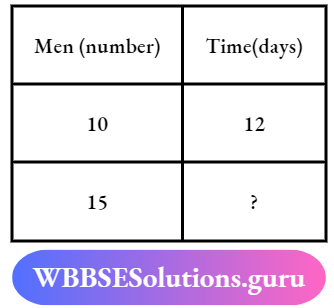
Question 10. If 10 men can do a piece of work in 12 days. Find in how many days will 15 men finish the same work.
Solution:

In the mathematical language.

WBBSE Solutions For Class 7 Maths Arithmatics Chapter 3 Proportion In The Mathematical Language Difference between Men And Time

For a particular work, if the number of persons increases less time is required to finish the work.

⇒ \(\frac{10}{15} \times 12\)

⇒ \(\frac{2}{3} \times12\)

⇒ 8

∴ In 8 days 15 men finish the Same work.

Class 7 Arithmetic Problems With Solutions

Question 11. In a relief camp, there is a provision of food For 200 people for 60 days. After 15 days 50 people went away elsewhere. Find how many days the remaining food lasts for the remaining people in this camp.
Solution:

Let the required number of days be ‘x’

In mathematical language the problem is.

WBBSE Solutions For Class 7 Maths Arithmatics Chapter 3 Proportion The Required Number Of Days Be x

200-50 = 150 Remaining.

150: 200: 45:x

⇒ \(\frac{150}{200}=\frac{45}{x}\)

150x = 200×45

x = \(\frac{9000}{150}\)

x = 60

∴ The food will go for Bodays for 150 people.

Question 12. If 8 men can do a piece of work in 12 days. Find in how many days amen can do the same work?
Solution:

In the mathematical language, the problem is.

WBBSE Solutions For Class 7 Maths Arithmatics Chapter 3 Proportion In The Mathematical Language The Problem

For a particular work, if the number of persons increases, less time is required to finish the work.

⇒ \(\frac{3}{9} \times 12\)

⇒ \(\frac{1}{3} \times 12\)

⇒ 1×4

⇒ 4

∴ In 4 days 9men can do the same work.

Class 7 Arithmetic Problems With Solutions

Question 13. The ratio of boys and girls in a school with 612 students is 5:4 which will be the new ratio of 12 new boys admitted.
Solution:

Total number of students = 612

The ratio of boys and girls is 5:4

5x+4x = 612

9x = 612

x = \(\frac{612}{9}\)

x = 68

∴ 5x = 5×68

5x = 340

4x = 4×68

4x = 272

with 12 new boys, the number of boys becomes.

340+12= 352

∴ The new ratio = \(\frac{352}{272}\)

The GCD OF 352 and 272 is 16.

So we divide both by 16.

⇒ \(\frac{352 \div 16}{272 \div 16}=\frac{22}{17}\)

∴ The new ratio of boys and girls is 22:17

Question 14. The Sum of the ages of A and B is 95 years. 5 years ago the ratio of their ages were 10:7. Find the ratio of their ages 5 years hence.
Solution:

Let’s denote the current ages of A and B as ‘A’ and ‘B’ respectively.

A+B = 95 ⇒ A = 95-B

Five years ago their ages were A-5, B-5

∴ \(\frac{A-5}{B-5}=10: 7\)

⇒ \(\frac{(95-B)-5}{B-5}=\frac{10}{7}\)

⇒ \(\frac{95-B-5}{B-5}=\frac{10}{7}\)

⇒ \(\frac{90-B}{B-5}=\frac{10}{7}\)

7×90-7×B = 10B-50

630-7B = 10B-50

630+50 = 10B+7B

680 = 17B

⇒ \(\frac{680}{17}\)

B = 40

5 years Hence the ages will be A+ 5 = 55+5=60,

B+5= 40 +5=45

The ratio of their ages:

⇒ \(\frac{A+5}{B+5}=\frac{60}{45}=\frac{4}{3}\)

The ratio of the ages 5year Hence will be 4:3

Class 7 Arithmetic Problems With Solutions

Question 15. There are 5 litres of Syrup in 15 litres of a Soft drink Find how much syrup will be required to make 21 litres of soft drink.
Solution:

Given:

Syrup Soft drink.

5     → 15

?    ← 21

⇒ \(\frac{21}{15} \times 5\)

⇒ 7 litres

∴ 7 litres of Syrup is required to make 21 litres of Soft drink.

WBBSE Solutions For Class 7 Maths Arithmetic Chapter 7 Areas Of Rectangles And Square

Arithmetic Chapter 7 Areas Of Rectangles And Square

Question 1. Choose the correct answer:

1.  If the perimeter of a square is xom then its area is.

  1. 4x2 sq.m.
  2. \(\frac{x^2}{16}\) sqcm
  3. \(\frac{x^2}{4}\) sqm.
  4. \(\frac{x^2}{2}\) sq.cm.

The perimeter of the square = 4 × length of each side.

x = 4 × length of each side

length of each side = \(\frac{x}{4}\)

Area of square = (length of side)2

⇒ \(\left(\frac{x}{4}\right)^2\)

Area of square = \(\frac{x^2}{16}\) sq. cm.

∴ The option (2) \(\frac{x^2}{16}\) 22 sq,cm is correct answer.

Class 7 Arithmetic Chapter 7 Questions

Read and Learn More Class 7 Maths Solutions

WBBSE Solutions For Class 7 Maths Arithmetic Chapter 7 Areas Of Rectangles And Square

2. 36000 sq. mm =?

  1. 3.65qcm.
  2. 36 sq.cm.
  3. 360 sq.cm.
  4. 3600sq.cm.

1cm = 10mm

? = 36000

⇒ \(\frac{36000}{10} \times 1\) = 3600 sqcm

1.sq mm = 0.01sq centimeter

⇒ \(\frac{36000}{1} \times 0.01\)

= 3605qcm.

∴ The option (3) 360 sq cm is the correct answer

3. How many tiles each \(1 \frac{1}{3}\) meter square will cover a floor 20 metres square?

  1. 200
  2. 225
  3. 15
  4. None of these.

Area of the Flood = 20m x 20m = 400m2

Each tile has dimensions of \(\frac{4}{3} m \times \frac{4}{3} m \text {. }\)

Area of one tile = \(\frac{4}{3} m \times \frac{4}{3} m=\frac{4 \times 4}{3 \times 3}=\frac{16}{9} m^2\)

Number of tiles \(=\frac{\text { Area of the floor }}{\text { Area of one tile }}\)

⇒ \(\frac{400 m^2}{\frac{16}{9} m^2}\)

⇒ \(400 \times \frac{9}{16}\)

⇒ 400 × 0.5625

Number of tiles = 225

∴ The option (2) 225 is the correct answer

WBBSE Class 7 Maths Solutions

Question 2. write true or False:

1. 1Arc = 10 sq.m. → False

2. The length. of a rectangle is 4 times its breadth

If the breadth is 6.5 cm then its area is 169 sq. cm

length of a rectangle is l = 4xb

If breadth is 6.5

The area is 169 sq. cm

l = 4×6·5

l = 26cm

Area = l × b

=26×6.5

= 165 sq. cm.

→ True

3. If the perimeter of a square is (4a+16) com then the length of each side is (a +4) cm.

The perimeter of the square = 4 × length of each side.

4a+16 = 4(a+4)

4a+16

→ True.

Question 3. Fill in the blanks:

1. 1Sq·Hm = 10000 Sq.m

2. If the area of the square is (x2+4x+4) Cm then its perimeter is

Area of Square = (length of side)2

⇒ \(\sqrt{x^2+4 x+4}\) = length of side.

⇒ \(\sqrt{(x)^2+2 \cdot 2 x+(2)^2}\) = length of side.

⇒ \(\sqrt{(x+2)^2}\) = length of side.

x+2 = length of side.

perimeter of a square = 4x length of each side

= 4x(x+2)

perimeter of a square = 4x+8 cm.

3. The ratio of length and breadth of a rectangle is 3:2 and its area is 600 sq.m. The perimeter is _______m

l:b= 3:2 ⇒ l = 3x, b = 2x Area = 600sq.m

Area = 600 Sqm

lxb = 600 Sq.m.

3x × 2х =600

6x2 = 600

x2 = \(\frac{600}{6}\)

x2 = 100

x = 10m

4. l = 32, b = 2x

l=3×10 , b = 2×10

l= 30m, b=20m

perimeter of a rectangle is 2(l+b)

⇒ 2(30+20)

⇒2(50)

⇒ 100m

Class 7 Arithmetic Textbook Solutions

Question 4. The area of a rectangle is (x2-64) sq m (x>8) and the length is (x+8)m then find its breadth.
Solution:

Given:

The area of the rectangle is x2-64 square meters.

The length of the rectangle is x+ 8 meters

The area of the Rectangle is

Area = Length x Breadth

Let ‘b’ be the breadth of the rectangle.

x2-64 = (x+8)×b

b= \(\frac{x^2-64}{x+8} \Rightarrow \frac{(x)^2-(8)^2}{x+8}\)

a2-b2 = (a+b)(a-b)

b= \(\frac{(x+8)(x-8)}{x+8}\)

Since x>8, x+8=0 and we can cancel x+8 in the numerator and denominator

b=2-8

The breadth of the rectangle is x-8 meters.

Question 5. The cost of cultivation of a 45m long piece of land is ₹200. If the breadth of land were less the cost would have been ₹150 calculate the breadth of the land.
Solution:

Let’s denote the breadth of the piece of land as ‘b’ meters

The length of the land is 45 meters.

The area of the land with breadth b is 45 × b sq.m.

The cost of cultivation is ₹200

If the breadth is reduced by 9m

breadth b-9 meters

The new Area is 45×(b-9)

The cost of cultivation is ₹150.

Cost per square meter = \(\frac{200}{45 b}\)

Reduced Breadth

Cost per square meter = \(\frac{150}{45(b-9)}\)

⇒ \(\frac{200}{45 b}=\frac{150}{45(b-9)}\)

⇒ \(\frac{200}{b}=\frac{150}{b-q}\)

⇒ 200(b-9) = b(150)

⇒ 2006-1800 = 150b.

Subtract 150b from both sides.

50b -1800 = 0

506 =1800

b = \(\frac{1800}{50}\)

b = 36

The breadth of the piece of land is 36 meters.

Class 7 Maths Arithmetic Problems

Question 6. A square plot of land of side 26m. A path 2m wide runs all around it from outside. Find the area of the path.
Solution:

Given

The Square Plot land side is 26m.

1. Calculate the Area of the large square.

The path runs all around it and is 2 meters wide.

The side length of the larger square is

26m+ 2m+2m = 30m

The area of the larger square is:

Arealarge sequence = 30mx30m = 900m2

2. Calculate the Area of the original square. Path

AreaOrigina sequence = 26m × 26m = 676m2

3. Calculate the Area of the path.

AreaPath = Arealarge sequence – AreaOriginal sequence

= 900m2-676m2 = 224m2

∴ The area of the path around the square plot of land is 224 Sq.m

Question 7. The length of the rectangle floor of a room is thrice of its breadth. It cost ₹4761 to cover the whole floor with a carpet. If one sq.m of carpet costs ₹3 then find the perimeter of the room.
Solution:

Given:

The cost to cover the whole floor ₹4761

Cost per square meter = ₹3m2

Area of the Floor = \(=\frac{\text { Total cost }}{\text { cost per square meter }}\)

= \(\frac{4761}{3}\)

= 1587Sqm2

Let the breadth of the room be ‘b’ meters.

Since the length is thrice the breadth, the length ‘l’ is 3b meters.

Area = l×b

= 3b×b

= 3b2

The area of the Floor is 1587Sq.m2

3b2 = 1587

b2 = \(\)

= 529

Class 7 Maths Chapter 7 Notes

Question 8. \(b^2=\frac{1587}{3}=529\)

b = \(\sqrt{529}\) = 23m

b = 23m

l is three times the breadth:-

l = 3b

= 3×23

1=69m

The perimeter p of a rectangle is given by

P = 2 × (l+b)

P = 2 × (69+23)

= 2 × 92

= 184m

∴ The perimeter of the room is 184 meters.

Question 9. A room 24 meters long and 12 meters high, costs 48960 For whitewashing its walls at 700 per square meter. Find the breadth of the room.
Solution:

Let the breadth of the room be m

Length of the room = 24m, and 12m high

The area of the room is (24×x) sq. m ⇒ 24x sq.m

Cost per square meter = ₹60

Total cost = ₹48960

Total Area of walls = Total cost/cost per square meter

Total Area of walls = \(\frac{48960}{60}\)

=816 sq.m.

Two longer walls each have an area of 24m × 12m

Two Shorter walls each have an area of bm × 12m

Total Area of the four walls is = 2× (24×12)+2×(b×12)

= 2×288+2×12b

576+246

The total area of the walls whitewashed is 816 sqm

576 + 246 = 816

24b = 816-576

24b = 240 = \(\frac{240}{24}\)

b ⇒ b=10

∴ The breadth of the room is 10 meters.

Class 7 Arithmetic Formulas

Question 10. what biggest size of square stones may be used to pave the floor of a room 20m long and 15m wide? Also, find the number of stones needed.
Solution:

Given the length of the room = 20m

width of room = 15m

prime factorization.

20= 2×2×5

15=3×5

The GCD of 20, 15 is 5.

So, the largest square Stone that can be used has a side length of 5 meters.

Area of room = 20m x 15m = 300 Sqm.

Area of one square stone = 5m×5m= 25 sq.m

Number of Stones = \(=\frac{\text { Total Area }}{\text { Area of one Stone }}\)

= \(\frac{300}{25}\)

= 12

The biggest size of square stones that may be used to pave the Floor is 5 meters.

The number of such stones needed to cover the floor is 12.

WBBSE Solutions For Class 7 Maths Arithmetic Chapter 6 Time And Distance

Arithmetic Chapter 6 Time And Distance

Question 1. Choose the correct answer:-

1. The time taken to travel 48kmat 36 km/h is.

  1. 1hr somin.
  2. 1hr 20min
  3. 1hr 40 min
  4. None of these.

Solution:

Distance = 48Km

speed = 36 km/h

Time =?

Speed = \(\frac{\text { Distance }}{\text { Time }}\)

Time = \(\frac{\text { Distance }}{\text { speed }}\)

⇒ \(\frac{48}{36}\)

= 1.33

Time = 1-33hr ⇒ 1hr.30 min

∴ The option (1) Thy 30 min is the correct answer.

Class 7 Maths Arithmetic Chapter 6 Solutions

Read and Learn More Class 7 Maths Solutions

WBBSE Solutions For Class 7 Maths Arithmetic Chapter 6 Time And Distance

2. The distance covered in 4.5hɣmpat 8.4km/hr is.

  1. 37.8km
  2. 36 km
  3. 36.8 km
  4. 37Km.

Time (T) = 4.5hrs

Distance =?

Speed(s) = 8.4 km/hr.

Speed\(=\frac{\text { Distance covered }}{\text { Time taken. }}\)

Distance covered = Speed x Time taken.

= 8.4×4.5

Distance covered = 37.8 Km

∴ The option (1) 37.8 km is the correct answer.

3. If the bus covers a distance of 50 km in 3hrs 45 mins. then its speed is.

  1. 45km/hr.
  2. 42.5km/hr
  3. 40km/hr
  4. None of these.

Distance = 150 KM.

Time = 3hrs 45mins ⇒ 1hr = 60 min

= 45 ⇒ \(\frac{45}{60} \times 1\) = 0.75

Speed =?

Speed = \(\frac{\text { Distance covered }}{\text { time taken }}\)

⇒ \(\frac{150}{3.75} \mathrm{~km} / \mathrm{hr}\)

= 40Km/hr

∴ The option (3) 40km/hr is the correct answer.

Question 2. Write true or False:

1. Speed remaining fixed the distance traveled and time taken are inversely proportional.

→ False

Speed = \(\frac{\text { Distance }}{\text { time }}\)

Speed ∞ Distance

⇒ \(\text { speed } \infty \frac{1}{\text { time. }}\)

2. Speed = Distance travelled × Time taken.

→ False

Speed = \(\frac{\text { Distance traveled. }}{\text { Time taken }}\)

3. when two objects move in the same direction their relative speed will be different of their actual speed.

→ True

Class 7 Arithmetic Chapter 6 Questions

Question 3. Fill in the blanks.

1. If two objects move in opposite directions, then relative speed is equal to the sum of their speed

2. \(4 \frac{1}{2}\) km/hr = 1.25 m/sec

⇒ \(4 \frac{1}{2} \Rightarrow \frac{9}{2}\) = 4.5km/hy

1Km = 1000meters

1hr = 60min = 3600sec

1 minute = 60 sec

60minute = ? 3600sec

4KM → 4000 meters

⇒ \(\frac{1}{2}\) km → 500 meters.

Total distance = 4500 meters

1hr = 3600 sec

m/sec= \(\frac{4500}{3600}\)

= 1.25

3. The time taken to travel 60km at 15 km/hr is 4 hr.

Distance = 60Km

Speed = 15km/hr

Time =?

Speed \(=\frac{\text { Distance covered }}{\text { Time taken }}\)

Time = \(\frac{\text { Distance covered }}{\text { speed }}\)

⇒ \(\frac{60}{15}\)

Time = 4hr

The time taken to travel 60 km at 15km/hr is 4hr

Question 4. A train of length 150m, moving with a speed of 75km/hr passes a tree calculate how long will it take to do so.
Solution:

Given:

Length of train = 150m

Speed of train = 75km/hr

⇒ \(75 \times \frac{5}{18}\) = 20.83 m/sec.

Time \(=\frac{\text { Distance covered }}{\text { Time taken }}\)

⇒ \(\frac{150}{20.83}\)

Time = 7.2 seconds.

So it will take approximately 7.2 seconds for the train to pass the tree.

Question 5. A train with a length of 100m takes 20 sec to pass a light post calculate the speed of the train.
Solution:

Length of the train = 100m

Time (t) = 20sec.

speed= ?

Speed \(=\frac{\text { Distance covered }}{\text { time taken }}\)

⇒ \(\frac{100 \mathrm{~m}}{20 \mathrm{sec}}\)

Speed = 5 m/sec

⇒ \(5 \times \frac{18}{5}\)

Speed = 18km/hr

∴ The speed of the train is 18km/hr

Class 7 Arithmetic Textbook Solutions

Question 6. A 120m long train with a speed of 45km/hr passes a platform in 30 sec. calculate the length of the Pat platform.
Solution:

Length of train = 120m

speed of train = 45 km/hr ⇒ \(45 \times \frac{5}{18}\) = 12.5m/s

Time required to pass the platform = 30 sec.

Let ‘x’ be the length of the platform.

The total length to pass the platform is (x+120)m

Speed \(=\frac{\text { Distance covered. }}{\text { Time taken to cover Distance }}\)

12.5 = \(\frac{x+120}{30}\)

375 = X+120

x = 375-120

x = 255m

∴ The length of the platform is 255m

Question 7. A train takes 6sec to pass a lamp post and 30 sec to pass a 280m long platform. Find the length of the train and also its speed.
Solution:

Let L be the length of the train

S be the speed of the train

For passing a lamp post

L = S × 6

For passing the platform

L+280 = S×30

6S+280 = S×30

280 = 30S-6S

280 = 24S

S = \(\frac{280}{24}\)

S = 11.67 m/s

S = \(11.67 \times \frac{18}{5}\)

S = 42.01Km/h

L = 6×S ⇒ 6 × 11.67

L≈70m

∴ The Speed of the train is 11.67mls of 42 km/h

The length of the train is 70m

Class 7 Maths Arithmetic Problems

Question 8. Two trains 120m and 105m long respectively come running at the rate of 60 km/hr and 45km/hr. respectively. How long will they take to cross each other if the two trains are running in the same direction?
Solution:

After the two trains meet, they would pass each other ie, the two trains would simultaneously pass a distance equal to the sum of their own length

The distance two trains will cover (120+105) mo8 225m

The relative speed. in the same direction

If two objects are moving in the same direction then the

relative speed = difference of their speeds.

= 60-45

relative speed = 15 km/hr

The time to cross each other.

T \(=\frac{\text { Total length }}{\text { Relative speed }}\)

⇒ \(\frac{225}{15}\)

= 15 sec

The time to cross each other is 15 sec

Question 9. A train passes two platforms of length. 275m and 140m In 28sec and 16 sec respectively calculate the length and Speed of the train
Solution:

Let the length of the train be xm

when the train passes a platform of length 275m Then the train has to cover a distance of length (275+2) m

ly

To pass the second platform of length 140m

Then the train has to cover a distance of length (140+x) m

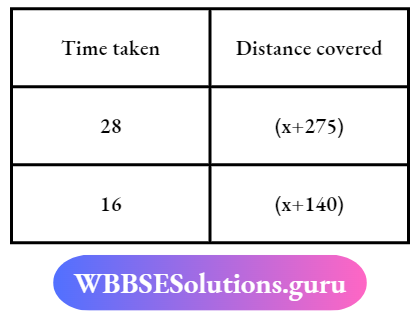
Mathematically represent

WBBSE Solutions For Class 7 Maths Arithmatics Chapter 6 Time And Distance Time Taken And Distance Covered

Speed remains constant, and time and distance are in direct proportion.

28:16:: (x+275): (X +140).

⇒ \(\frac{28}{16}=\frac{x+275}{x+140}\)

⇒ 28(x+140) = 16(2+275)

⇒  28(x+140) = 16(x+275)

⇒ 28x+ 28×140 = 16x+16×275

⇒ 28x+3920 = 16x +4400

⇒ 28x-16X = 4400-3920

⇒ 12x = 480

x = \(\frac{480}{12}\)

x = 40 meters.

∴ The length of the train is 40 meters

In 28 sec the train travels (40+275) =315m

In 1 Sec the train travels \(\frac{315}{28} \mathrm{~m}\)

In 1hr or 3600 sec the train travels = \(\frac{315 \times 3600}{28}\)

⇒ \(\frac{1134,000}{28}\)

⇒ 40,500meters

⇒ 40.5km/hr.

∴ The length of the train is 40 meters.

The Speed of the train is 40.5 km/hr.

Class 7 Arithmetic Formulas

Question 10. Two trains of equal length running in opposite directions, pass a man standing by a side of railway line in 18 secs and 12 secs respectively. At what time will the two trains cross each other?
Solution:

Let’s denote the length of each train by L meters.

Let the speed of the first train be V1 meters per second

The speed of the second train be V2 meters per second

First train

L = V1 x 18 ⇒ V1 = \(\frac{L}{18}\)

second train

L = V2 x 12 ⇒ V2 = \(\frac{L}{12}\)

Relative speed is the sum of their speeds.

The relative speed Vr is given by

Vr = V1+V2

Vr = \(\frac{L}{18}+\frac{4}{12}\)

⇒ \(\frac{2 L+3 L}{36}\)

⇒ \(\frac{5 L}{36}\)

The total length to be covered when the two trains cross each other is the sum of their lengths

Total length = L + L = 2L

The time taken to cross each other is the total length divided by the relative speed:

T \(=\frac{\text { Total length }}{\text { Relative speed }}\)

⇒ \(\frac{2 L}{\frac{5 L}{36}}\)

⇒ \(2 L \times \frac{36}{5 L}\)

⇒ \(\frac{24}{\frac{5 L}{36}}\)

⇒ \(2 L \times \frac{36}{5L}\)

⇒ \(\frac{36 \times 2}{5}\)

= 14.4 Sec

∴ The two trains cross each other at 14.4 Sec

WBBSE Solutions For Class 7 Maths Arithmetic Chapter 2 Ratio

Class 7 Ariyhmatic Chapter 2 Ratio

Question 1. Find the compound ratio of the following ratios and identify if these are ratios of greater or lesser inequality or ratio of equality.
Solution:

1. \(\frac{1}{2}: \frac{1}{3}, \frac{1}{3}: \frac{1}{4} \text { and } \frac{1}{4}: \frac{1}{5}\)

⇒ \(\frac{1}{2}: \frac{1}{3}\)

⇒ \(\frac{\frac{1}{2}}{\frac{1}{3}} \Rightarrow \frac{1}{2} \times \frac{3}{1} \Rightarrow \frac{3}{2}\)

⇒ \(\frac{1}{3}: \frac{1}{4} \Rightarrow \frac{\frac{1}{3}}{\frac{1}{4}} \Rightarrow \frac{1}{3} \times \frac{4}{1} \Rightarrow \frac{4}{3}\)

⇒ \(\frac{1}{4}: \frac{1}{5} \Rightarrow \frac{\frac{1}{4}}{\frac{1}{5}} \Rightarrow \frac{1}{4} \times \frac{5}{1} \Rightarrow \frac{5}{4}\)

Multiply these ratios to find a compound ratio

⇒ \(\frac{3}{2} \times \frac{4}{3} \times \frac{5}{4} \Rightarrow\left(\frac{3}{2} \times \frac{4}{3}\right) \times \frac{5}{4} \Rightarrow \frac{3 \times 4}{2 \times 3} \times \frac{5}{4} \Rightarrow \frac{4}{2} \times \frac{5}{4}=2 \times \frac{5}{4}=\frac{5}{2}\)

⇒ \(\left(\frac{3}{2} \times \frac{4}{3} \times \frac{5}{4}\right)=\frac{5}{2}\)

∴ The compound ratio of the given ratios is \(\frac{5}{2}\)

Read and Learn More Class 7 Maths Solutions

Since \(\frac{5}{2}>1\) (because 5>2) the compound ratio \(\frac{5}{2}\) is a ratio of greater inequality
WBBSE Solutions For Class 7 Maths Arithmetic Chapter 2 Ratio

2. \(\frac{2}{3}: 3, \frac{1}{5}: 5 \text { and } 15: \frac{1}{12}\)

⇒ \(\frac{2}{3}: 3 \Rightarrow \frac{2}{3}: \frac{3}{1} \Rightarrow \frac{2 / 3}{3 / 1} \Rightarrow \frac{2}{3} \times \frac{1}{3} \Rightarrow \frac{2}{9}\)

⇒ \(15: \frac{1}{12} \Rightarrow \frac{15}{1}: \frac{1}{12} \Rightarrow \frac{\frac{15}{1}}{\frac{1}{12}} \Rightarrow \frac{15}{1} \times \frac{12}{1} \Rightarrow 180\)

Multiply these ratios to find a compound ratio

⇒ \(\frac{2}{9} \times \frac{1}{25} \times 180 \Rightarrow\left(\frac{2}{9} \times \frac{1}{25}\right) \times 180 \Rightarrow \frac{2 \times 1}{9 \times 25} \times 180 \Rightarrow \frac{2}{225} \times 180 \Rightarrow \frac{360}{225}\)

The greatest common divisor (GCD) of 360 and 225 is 45.

⇒ \(\frac{360 \div 45}{225 \div 45}=\frac{8}{5}\)

The compound ratio is 8:5

The ratio of greater inequality is those where the compound ratio is either much greater than 1, or much less than 1

The compound ratio 8:5 is greater than 1, indicating it is a ratio of greater inequality.

Class 7 Maths Arithmetic Solutions

3. 4:6, 3:5, and 10:4

⇒ \(\frac{4}{6}, \frac{3}{5}, \frac{10}{4}\)

Multiply these ratios to find a compound ratio

⇒ \(\frac{4}{6} \times \frac{3}{5} \times \frac{10}{4} \Rightarrow\left(\frac{4}{6} \times \frac{3}{5}\right) \times \frac{10}{4} \Rightarrow \frac{4 \times 3}{6 \times 5} \times \frac{10}{4} \Rightarrow \frac{12}{30} \times \frac{10}{4}=\frac{120}{120}= \frac{1}{1}=1\)

So the compound ratio is 1:1

Ratios of equality occur when the compound ratio is exactly ‘1’.

Since the compound ratio is 1:1, it is a ratio of equality.

4. 2x:3x, 5a:6a, and 4p:9p

2x:3x ⇒ \(\frac{2 x}{3 x} \Rightarrow \frac{2}{3}\)

5a:6a ⇒ \(\frac{5 a}{6 a} \Rightarrow \frac{5}{6}\)

4p:9p ⇒ \(\frac{4 p}{9 p} \Rightarrow \frac{4}{q}\)

Multiply these ratios to find the compound ratio

⇒ \(\frac{2}{3} \times \frac{5}{6} \times \frac{4}{9} \Rightarrow\left(\frac{2}{3} \times \frac{5}{6}\right) \times \frac{4}{9} \Rightarrow \frac{2 \times 5}{3 \times 6} \times \frac{4}{9} \Rightarrow \frac{10}{18} \times \frac{4}{9} \Rightarrow \frac{20}{81}\)

∴ The compound ratio is 20:81

Ratios of greater inequality are those where the compound ratio is either much greater than 1 or much less than 1.

The compound ratio 20:81 is less than 1, indicating that it is a ratio of greater inequality.

Class 7 Arithmetic Chapter Solutions

Question 2. Reduce the following into the ratio of the whole numbers and Find their inverse ratios.
Solution:

1. 18Pq: 24pq

18pq: 24Pq [Dividing each term by 6Pq]

⇒ \(\frac{18 p q}{6 p q}: \frac{24}{6 p q}\)

⇒ 3:4

The inverse ratio of 3:4 is 4:3

2. 4.5:6

4·5:6

⇒ \(\frac{4.5}{6}=\frac{4.5 \times 10}{6 \times 10}=\frac{45}{60}\)

⇒ 3:4

The inverse ratio of 3:4 is 4:3

3. 25a: 40a

25a: 40a [Dividing each term by 5a]

⇒ \(\frac{25 a}{5 a}: \frac{40 a}{5 a}\)

⇒ 5:8

The Inverse ratio of 5:8 is 8:5

Question 3. “Reduce the Following into a ratio of the whole numbers and find their inverse ratio:

1. 0·3:0.5

⇒ \(\frac{0.3}{0.5}=\frac{0.3 \times 10}{0.5 \times 10}=\frac{3}{5}\)

⇒ 3:5

The inverse ratio of 0·3:0.5 is 5:3

2. \(3 \frac{1}{4}: 4 \frac{1}{5}\)

⇒ \(3 \frac{1}{4}: 4 \frac{1}{5}\)

⇒ \(\frac{13}{4}: \frac{21}{5}\) [LCM of 4 and 5 is 20 Multiply by L.C.M=20]

⇒ \(\frac{13}{4} \times 20: \frac{21}{5} \times 20\)

⇒ 13×5: 21×4

⇒ 65:84

The inverse ratio of 65:84 is 84:65

3. \(2 \frac{1}{3}: 6 \frac{2}{3}\)

⇒ \(2 \frac{1}{3}: 6 \frac{2}{3}\)

⇒ \(\frac{7}{3}: \frac{20}{3}\) (equal denominators so Numarators are ratios)

⇒ 7:20

The inverse ratio of 7:20 is 20:7

Class 7 Maths Arithmetic Problems

Question 4. In two types of ‘Sherbat,’ the ratios of Syrup and water are 7:5 and 5:3 Find which one is sweeter.
Solution:

The total parts in the mixture are syrup

7+5 = 12.

syrup = \(\frac{7}{12}\)

The total parts in Syrup to water mixtures.

5+3=8

second type = \(\frac{5}{8}\)

To compare \(\frac{7}{12}\), and \(\frac{5}{8}\)

The least common multiple (L.CM) OF 12 and 8 is 24

⇒ \(\frac{7}{12}=\frac{7 \times 2}{12 \times 2}=\frac{14}{24}\)

convert \(\frac{5}{8}\) to a fraction with denominator 24.

⇒ \(\frac{5}{8}=\frac{5 \times 3}{8 \times 3}=\frac{15}{24}\)

Question 5. Comparing \(\frac{14}{24} \text { and } \frac{15}{24}\) we see that
Solution:

⇒ \(\frac{14}{24}<\frac{15}{24}\)

Convert each fraction to a decimal.

⇒ \(\frac{7}{12} \approx 0.5833\)

⇒ \(\frac{\bar{s}}{8}=0.625 .\)

Comparing 0.5833 and 0.625 we see that

0.5833 < 0.625

Since \(\frac{5}{8}\)(0.625) is greater than \(\frac{7}{12}\)(0.5833), the

The second type of sherbet is sweeter.

Question 6. The ratio of measurement of the three angles of a triangle is 4:5:6 Find the measurement of the angles.
Solution:

Given

The three angles of a triangle are 4:5:6.

The three angles are represented as 4x, 5x6x.

Some of the angles in a triangle are 180°

∴ 4x+5x+6x=180°

15x = 180°

x = \(\frac{180^{\circ}}{15}\)

x = 12°

Substitute the ‘x’ value in the above equation.

42 = 4×12 = 48°

5x = 5 ×12 = 60°

6x = 6 ×12 = 72°

∴ The measurement of three angles of a triangle is 48°, 60°, 72°

Class 7 Maths Chapter 2 Questions

Question 7. If the ratio of two numbers is 4:7 and their difference is 45 then Find the numbers.
Solution:

Given:

The ratio of the two numbers is 4:7.

Let the number be represented as 4x, 7x

where ‘X’ is a common multiplier.

the difference between the two numbers is given by:-

7x-4x = 45

3x = 45

x = \(\frac{45}{3}\)

x = 15

Now substitute ‘X’ into the expression. For the two numbers

7x = 7×15 = 105

4x = 4 ×15 = 60

The two numbers are 60,105.

Question 8. The ratio of the two numbers is 5:6 and their sum is 44. Find their H.C.F
Solution:

Given:-

The ratio of the two numbers is 5:6.

Let’s represent the two numbers as 5x and 6x

The sum of the two numbers is 44

⇒ 5x+6x = 44

⇒ 11x = 44

x = \(\frac{44}{11}\)

x = 4

∴ The numbers are

5x ⇒ 5×4 = 20

6x ⇒ 6×4 = 24

The Prime Factors of 20 are 22 × 5

The prime factors of 24 are 23 × 3

The minimum power of the factor 2 is 22

Hence the H.C.F is 22 = 4.

∴ The H.C.F of 20 and 24 is 4

Class 7 Maths Textbook Solutions

Question 9. The ratio of the circumference and diameter of a circle is 22:7. If the length of the circumference is 154 cm. then Find the length of its diameter.
Solution:

Given:

The ratio of the circumference and diameter of a circle is 22:7

This can be expressed as

⇒ \(\frac{C}{D}-\frac{22}{7}\)

Given that the circumference is 154 cm.

⇒ \(C-\frac{22}{7} D\)

⇒ \(154-\frac{22}{7} D\)

⇒ 154×7 – 22D

⇒ \(\frac{1078}{22}-0\)

D-49

∴ The length of the diameter is 49 cm

Question 10. The ratio of two numbers is 8:9 and their H.C.F is 15 Find the numbers and also. Find their LCM
Solution:

Given

The ratio of the two numbers is 8:9 & their H.C.F is 15.

Let the numbers be 8% and 9x, where x’ is a common factor.

H.C.F.(8x, 9x) = x

Given H.C.F is 15

∴ x = 15

using x = 15, the numbers are

8x = 8×15= 120

9x = 9×15=135

∴ The numbers are 120 and 135.

L.C.M.(a,b) = \(\frac{a \times b}{H \cdot c \cdot f(a, b)}\)

⇒ \(\frac{120 \times 135}{15}=\frac{16200}{15}=1080\)

L.C.M(120, 135) = 1080

∴ The L.C.M of 120 and 135 is 1080

Question 11. out of 150 Sums, Arka got 80 sums correct, and out of 120 sums, Soumya got 70 sums correct
Solution:

Express them in ratio to find who got more sums correct.

For Arka:

Total sums attempted: 150

Sums correct: 80

The ratio of correct sums to total sums: \(\frac{80}{150}\)

Dividing both the numerator and the denominator by their greatest common divisor (GCD). The GCD of 80 and 150 is 10.

⇒ \(\frac{80 \div 10}{150 \div 10}=\frac{8}{15}\)

For Soumya

Total sums attempted: 120

sums correct 70

The ratio of correct sums to total sums: \(\frac{70}{120}\)

The GED OF 70 and 120 is 10.

∴ \(\frac{70 \div 10}{120 \div 10}=\frac{7}{12}\)

Class 7 Maths Textbook Solutions

Question 12. Now compare the ratios \(\frac{8}{15} \text { and } \frac{7}{12}\)
Solution:

The LCM of 15 and 12 is 60

Convert \(\frac{8}{15}\) to a fraction with denominator of 60:

⇒ \(\frac{8}{15}=\frac{8 \times 4}{15 \times 4}=\frac{32}{60}\)

Convert \(\frac{7}{12}\) to a fraction with a denominator of 60;

⇒ \(\frac{7}{12}=\frac{7 \times 5}{12 \times 5}=\frac{35}{60}\)

Now compare \(\frac{32}{60} \text { and } \frac{35}{60}\) since 35 is greater than 32.

⇒ \(\frac{35}{60}>\frac{32}{60}\)

∴ Soumya has a higher ratio of sums correct to total sums attempted.

Soumya got more sums correct in terms of ratio.

Question 13. ₹260 is divided among Rupak, Anirban, and Apurba in the ratio \(1: \frac{2}{3}: 2\). Calculate how much each will get
Solution:

The given amount is ₹7260

Rupak, Anirban and Apurba in ratio = \(1: \frac{2}{3}: 2\)

⇒ \(1: \frac{2}{3}: 2 \Rightarrow(1 \times 3):\left(\frac{2}{3} \times 3\right):(2 \times 3)\)

⇒ 3:2:6

Rupak gets = \(₹\left(7260 \times \frac{3}{3+2+6}\right)=7260 \times \frac{3}{11}= ₹1980\)

Anirban gets = \(₹\left(7260 \times \frac{2}{3+2+6}\right)=7260 \times \frac{2}{11}= ₹1320\)

Apurba gets = \(₹\left(7260 \times \frac{6}{3+2+6}\right)=7260 \times \frac{6}{11}= ₹3960\)

∴ Rupak gets = ₹1980.

Anirban gets = ₹1320

Apurba gets = ₹3960

Question 14. The ratio between the speeds of two buses is 3:5 If the first bus runs 120 km in 4 hours. Find the Speed of the Second bus.
Solution:

Given:

The ratio between the speeds of the two buses is 3:5 first bus runs 120 km in 4 hours.

Speed of the first bus = \(\frac{\text { Distance }}{\text { Time }}\)

⇒ \(\frac{120 \mathrm{~km}}{4 \mathrm{~h}}\)

⇒ 30km/h

Let the speed of the second bus be ‘x’ km/h.

⇒ \(\frac{\text { speed of first bus }}{\text { speed of second bus }}=\frac{3}{5}\)

⇒ \(\frac{30}{x}=\frac{3}{5}\)

3×x = 30×5

3x = 150

x = \(\frac{150}{3}\)

x = 50km/h

∴ The Speed of the second bus is 2 = 50km/h

WBBSE Class 7 Maths Guide

Question 15. If A:B=4:5, B:C= 6:7 then Find A:B:C:
Solution:

Given

A:B = 4:5

B:C = 6:7

The ratio of B in both equations is the same.

L.C.M OF 5 and 6 is 30.

For A: B we multiply by 6

A : B = 4×6:5×6

A : B = 24:30

For B:c we multiply by 5

B:C = 6×5:7×5

B:C = 30:35

Now, we have;

A:B = 24:30

B:C = 30:35

∴ The ratios to Find A: B: C:

A: B: C = 24:30:35

Question 16. If AB = 3:4, B: C = 5:6 and C:D = 7:8 then find  A:D and A:B: C: D.
Solution:

Givent

A:B = 3:4

B:C = 5:6

C:D = 7:8

A:B = 3:4

⇒ \(\frac{A}{B}=\frac{3}{4}\)

⇒ \(A=\frac{3}{4} B\)

B:C = 5:6

⇒ \(\frac{B}{C}=\frac{5}{6}\)

⇒ \(B=\frac{5}{6} c\)

C:D = 7:8

⇒ \(\frac{C}{D}=\frac{7}{8}\)

⇒ \(c=\frac{7}{8} D\)

Substitute \(C=\frac{7}{8} D \text { into } B=\frac{5}{6} C \text { : }\)

B = \(\frac{5}{6} c\)

⇒ \(\frac{5}{6}\left(\frac{7}{8} D\right)\)

⇒ \(\frac{5 \times 7}{6 \times 8} D\)

B = \(\frac{35}{48} D\)

Substitute B = \(B=\frac{35}{48} D \text { into } A=\frac{3}{4} B\)

WBBSE Class 7 Maths Guide

Question 17. \(A=\frac{3}{4} B \quad B=\frac{35}{48} D\)

A = \(\frac{3}{4}\left(\frac{35}{48}\right) D\)

A = \(\frac{3 \times 35}{4 \times 48} D\)

A= \(\frac{105}{192} D\)

⇒ \(\frac{A}{D}=\frac{105}{192} D\)

⇒ \(\frac{A}{D}=\frac{35}{64}\)

∴ \(A: D=\frac{35}{64}\)

We have

A = \(\frac{105}{192} D\)

B = \(\frac{35}{48} D\)

C = \(\frac{7}{8} D\)

and D = D

Convert these into a common base with D = 192

∴ A = \(\frac{105}{192} \times 192\) =105

B = \(\frac{35}{48} \times 192=35 \times 4\) = 140

C = \(\frac{7}{8} \times 192=7 \times 24\) = 168

D = 192

Hence the combined ratio A:B: C:D is 105: 140: 168: 192

Question 18. During retirement, Amal Babu gets ₹256000. He donated 7 16,000 to a club and the remaining amount he divided among his wife son and daughter in a ratio of 5:4:3 to find how much money he gave each of them.
Solution:

Retirement Amal baby get ₹256000

Amal babu donated = ₹16,000.

Remaining amount = 256000 – 16,000

= 240000

The ratio of distribution among his wife, son, and daughter is 5:4:3

Total parts = 5+4+3 = 12.

240000 Remaining amount is divided into 12 parts:

value of one part = \(\frac{2.40000}{12}\) = 20,000

Question 19. Calculate the amounts for each family member.
Solution:

Wife( 5 parts):

wife’s shone = 5x 20,000 = 1,00,000

Son (4 parts):

Son’s share = 4x 20,000 = 80,000

Daughter (3 parts):

Daughter’s share = 3x 20,000 60,000.

∴ The amounts given to each Family member are

wife: ₹1,00,000

Son: ₹80,000

Daughter: ₹760,000.

WBBSE Class 7 Maths Solutions For Arithmetic Chapter 1

Arithmetic Chapter 1 Revision

Question 1. Convert the following to a fraction:

1. 7.028
Solution:

Let x = 7.02828…

1000x= 7028.28…

Multiply ‘x’ by 10 to align the repeating parts 10x = 70.2828…..

Subtract the second equation from the first to eliminate 1000x – 10x = 7028.2828……..70.2828…

990x = 6958

Finding the greatest common divisor (GCD) of 6958 and 990

The GCD of 6958 and 990 is ‘2’ \(\frac{6958 \div 2}{990 \div 2}=\frac{3479}{495}\)

So the recurring decimal 7.02828 as a fraction is \(\frac{3479}{495}\)

∴ \(7.0 \dot{2}=17 \frac{14}{495}\)

2. 3.432
Solution:

Let x = 3.43232··…

Multiply x by 1000

1000x = 3432.32…..

Multiply x by 10 to align the repeating parts.

10x = 34.32.32……

Subtract the second equation from the First to eliminate the repeating part

4000x – 10x = 3432.323232……..34.3232…

990x = 3398

x = \(\frac{3398}{990}\)

Finding the Greatest common divisor (GCD) of 3398 and 990.

The GCD of 3398 and 990 are 2

∴ \(\frac{3398 \div 2}{990 \div 2}=\frac{1649}{495}\)

So the recurring decimal \(3 \cdot 4 \overline{32}\) as a fraction is \(\frac{1699}{495}\)

∴ \(3.4 \dot{3} \dot{2}=3 \frac{214}{495}\)

Class 7 Arithmetic Problems With Solutions

Question 2. Convert the following percentage into decimal fractions:

  1. 0.03
  2. 1.26

Solution:

1. 0.03

Decimal Fraction = \(\frac{0.03}{100}\) = 0.0003

0.03% = 0.0003

2. 1·26

Decimal Fraction = \(\frac{1.26}{100}\)

= 0.0126

1.26% = 0.0126

Question 3. Express the Following in percentage:

  1. ₹5 out of ₹25
  2. 0.3

Solution:

percentage = \(\left(\frac{\text { Part }}{\text { Whole }}\right) \times 100\)

Here part is 5 and the whole is 25

percentage = (\(\frac{5}{25}\))x100

= (0.2) x 100

percentage = 20%

∴ ₹5 out of ₹25 is 20%.

2. 0.3

To Convert the decimal 0.3 to a percentage, we multiply by 100.

percentage = 0.3× 100 = 30%

Question 4. Find the values of the following.

  1. 18% of 3600
  2. 12 \(\frac{1}{2}\) % of ₹12.08

Solution:

1. 18% of 3600

⇒ 3600 x \(\frac{18}{100}\)

⇒ 36 x 18

⇒ 648

∴ 18% of 3600 = 648

2. 12\(\frac{1}{2}\) % of 12.08.

⇒ 12.08 x \(\frac{25}{2 \times 100}\)

⇒ 12.08 x \(\frac{1}{8}\)

⇒ 12.08 × 0.125

⇒ 1.51

∴ 12 \(\frac{1}{2}\)% of ₹12.08 is ₹1.51

Class 7 Maths Chapter 1 Solved Exercises

Question 5. If the product of two numbers is 150 and their quotient is \(\frac{3}{2}\) then find the numbers.
Solution:

Let’s denote the two numbers as x and y.

Given

  1. The product of two numbers is 150:xy = 150
  2. The quotient of the two numbers is \(\frac{3}{2}\):\(\frac{x}{y}\)= \(\frac{3}{2}\)

From the second condition. \(\frac{x}{y}\) = \(\frac{3}{2}\)

x = \(\frac{3}{2}\) y

Now Substitute the ‘x’ value in 1-condition.

xy= 150

(\(\frac{3}{2}\)y)y = 150

⇒ \(\frac{3}{2}\)y² = 150

y² = 150 x \(\frac{2}{3}\)

y² = 100

y = √100

y = 10

Now that we have found y = 10, we can find x.

x = \(\frac{3}{2}\) x 10

x = 15

So the two numbers are x = 15 and y = 10.

Question 6. If the sum of two numbers is so and their HCF is 16 then Find the numbers.
Solution:

Let’s denote the two numbers as x and y.

Given

  1. The sum of the two numbers is 80: x+y=80.
  2. Their highest Common Factor (HCF) is 16.

Let’s express x and y as

x = 16a

y = 16b

where a and b are integers.

Now we substitute these expressions into the equation for their sum:

16a + 16b = 80

16(a+b)=80

(a+b) = \(\frac{80}{16}\)

a+b = 5

since a+b=5, and a and b are integers the

Possible values for a and b are a = 1, and b=4 (or) a=2, and b=3.

So the numbers are 16×1 = 16, and 16×4 = 64,08 16×2=32, and 16×3=48.

∴ The two numbers are 16 and 64 (or) 32 and 48.

Arithmetic Formulas For Class 7 WBBSE

Question 7. Find the square roots of the following numbers:

1. 11025
Solution:

To Find the square root use prime factorization.

First, let’s see if it’s a perfect square by trying

Some divisors.

11025 ÷ 25 = 441

So, we have;

11025 = 25X441

441 = 21×21

25 = 5×5

Thus

11025 = 5² x 21²

Take the square root: \(\sqrt{11025}=\sqrt{(5 \times 21)^2}\)

= \(5 \times 21\)

∴ \(\sqrt{11025}\) = 105

Question 8. Find the square root of the following numbers.

1. 15376
Solution:

First, let’s see if it’s a perfect square by trying Some divisors.

15376 ÷ 16 = 961.

15376 = 16×961

961 = 31×31

16 = 4×4.

Thus 15376 = 4² x 31²

So we can take the square root: \(\sqrt{15376}=\sqrt{(4 \times 31)^2}\)

= \(4 \times 31\)

∴ \(\sqrt{15376}\) = 124

Question 9. Parthababu pays 157. of his salary for house rent. If he pays 4500 per month for rent, then find his monthly salary.
Solution:

Let’s denote Partha babu’s monthly salary as ‘s’.

Given,

House rent = 15% of salary.

House rent = 4500.

15% of S = 4500

⇒ \(\frac{15}{100}\) X S = 4500

S = \(\frac{4500}{0.15}\)

S = 30000

∴ so Parthababu’s monthly salary is 30000.

WBBSE Maths Study Material Class 7

Question 10. A General wishing to arrange his soldiers 632 in number into a solid square found that there were 7 Soldiers over. How many were there in the front?
Solution:

Let’s denote the number of soldiers on each side of the Square as 2.

The total number of soldiers is 632 and there are 7 extra soldiers.

x² +7=632 2

x = 632-7

x² = 625

x = √625

x = 25

So there are 25 soldiers on each side of the square.

∴ 25 Soldiers on each FRONT SIDE

Question 11. 15 men working 6 hours a day can do a piece of work in 20 days. How many men working 8 hours a day Can do it in 25 days?
Solution:

Given:

15 men work 6 hours a day to complete the work in 20 days.

Total man-hours = Number of men x Number of hours per day X Number of days.

Total man-hours = 15×6×20

Now, The total man-hours For the second scenario

The number of days is 25

The number of hours per day is ‘8’

we need to find out how many men are required.

Let’s denote the number of men required as ‘x’

15×6×20 = x x 8 x 25

1800 = 200x

x = \(\frac{1800}{200}\)

x = 9

So, 9 men are required to complete the work in 25 days working 8 hours a day.

Question 12. Simplify \(\frac{2.8 \text { of } 2.2 \ddot{2}}{1.3 \dot{3}}+\left\{\frac{4.4-2.83}{1.3+2.629}\right\}\)of 8.2
Solution:

⇒ \(\frac{2.8 \times 2.27}{1.36}+\left\{\frac{4.4-2.83}{1.3+2.629}\right\} \times 8.2\)

⇒ \(\frac{6.356}{1.36}+\left\{\frac{1.57}{3.929}\right\} \times 8.2\)

⇒ \(4.67352+\{0.39959\} \times 8.2\)

⇒ 4.67352+3.276638

⇒ \(7.950158 \simeq 8\)

∴ \(\frac{2.80 f 2.27}{1.36}+\left\{\frac{4.4-2.83}{1.3+2.629}\right\}\) of 8.2 is = 8

Class 7 Maths Arithmetic Solutions WBBSE

Question 13. Write the ratio of the three angles of an isosceles Yright-angled triangle.
Solution:

Given the total sum of angles in any triangle is 180°

Let’s denote the two equal angles as ‘X’

The equation for the sum of angles in the triangle is

90+X+X = 180°

2x+90° = 180°

2x = 180-90°

2x = 90°

x = 90°/2

X = 45°

∴ The three angles in the triangle are 90°, 45° and 45°

The ratios of these angles are 90:45:45

Dividing each term by 45 is 2:1:1

∴ The ratio of the three angles in a right-angled

Isosceles triangle is 1:2:1

Question 14. The ratio of textbooks and story books in a School library is 3:5. If a number of textbooks is 864, then find the number of story books.
Solution:

Given:

The ratio of textbooks to storybooks= 3:5

If the number of textbooks is 864

we can set up a proportion to find the number of Storybooks:

Let x’ be the number of storybooks \(\frac{\text { Number of textbooks }}{\text { Number of story books }}=\frac{3}{5}\)

⇒ \(\frac{864}{x}=\frac{3}{5}\)

864 x 5 = 3x

4320 = 3x

x = \(\frac{4320}{3}\)

x = 1440

∴ So the number of story books is x = 1440.

Question 15. verify which of the following numbers are in proportion:

1. 4,6,7,8
Solution:

Given numbers are 4, 6, 7, 8

Let’s check the ratios:

1. Ratio of 4 to 6:\(\frac{4}{6}\) = \(\frac{2}{3}\)

2. Ratio of 6 to 7:\(\frac{6}{7}\)

3. Ratio of 7 t0 8: \(\frac{7}{8}\)

“If the ratios of consecutive pairs are equal, then the numbers are in proportion”

∴ \(\frac{6}{7}\) = 0.8571

∴ \(\frac{7}{8}\) = 0.875

The ratio of 6 to 7 is approximately 0.8571 and the ratio of 7 to 8 is 0.875. These two ratios are not equal.

The ratios of consecutive pairs are not equal, the numbers 4, 6, 7, and 8 are not in proportion.

Class 7 Maths Arithmetic Solutions WBBSE

Question 16. Verify which of the following numbers are in Proportion.

1. 8,12,6,9
Solution:

The given numbers are 8, 12, 6 and 9.

Let’s check the ratios:

1. Ratio of 8 to 12:\(\frac{8}{12}\) = \(\frac{2}{3}\)

2. Ratio of 12 to 6:\(\frac{12}{6}\) = 2

3. Ratio of 6 to 9:\(\frac{6}{9}\) = \(\frac{2}{3}\)

“If the ratios of consecutive pairs are equal, then the numbers are in proportion?”

  1. \(\frac{8}{12}\) = \(\frac{2}{3}\)
  2. \(\frac{12}{6}\) = 2
  3. \(\frac{6}{9}\) = \(\frac{2}{3}\)

The ratios of Consecutive pairs are equal \(\frac{2}{3}\) the numbers 8, 12, 6, and 9 are in proportion.

Question 17. Verify which of the following numbers core in proportion.

1. \(\frac{1}{2}, \frac{1}{6}, \frac{1}{3}\) and \(\frac{1}{9}\)
Solution:

The given numbers are \(\frac{1}{2}, \frac{1}{6}, \frac{1}{3}\) and \(\frac{1}{9}\)

Let’s check the ratios:

1. Ratio of \(\frac{1}{2}\) to \(\frac{1}{6}\):

⇒ \(\frac{\frac{1}{2}}{\frac{1}{6}}=\frac{1}{2} \times \frac{6}{1}=3 \text {. }\)

2. Ratio of \(\frac{1}{6}\) to \(\frac{1}{3}\):

⇒ \(\frac{\frac{1}{6}}{\frac{1}{3}}=\frac{1}{6} \times \frac{3}{1}=\frac{1}{2}\)

3. Ratio of \(\frac{1}{3}\) to \(\frac{1}{9}\):

⇒ \(\frac{\frac{1}{3}}{\frac{1}{9}}=\frac{1}{3} \times \frac{9}{1}=3\)

“If the ratios of consecutive pairs are equal, then the numbers are in proportion”

∴ All the ratios are equal to 3 the numbers \(\frac{1}{2}, \frac{1}{6}, \frac{1}{3}\) and \(\frac{1}{9}\) are in proportion.

2. Simplify: \(\frac{3}{5} \div 4 \frac{1}{3} \times 7 \frac{1}{5}+999 \frac{324}{325} \times 324\)
Solution:

⇒ \(\frac{3}{5} \div 4 \frac{1}{3} \times 7 \frac{1}{5}+999 \frac{324}{325} \times 324\)

⇒ \(\frac{3}{5} \div \frac{13}{3} \times \frac{36}{5}+\frac{324999}{325} \times 324\)

⇒ 0·6÷4·3 × 7·2+ 999.9969 x 324

⇒ 0·139534 × 7·2 + 323999.0030

⇒ 1.0046 + 323999.0030

⇒ 324000.0076.

∴ \(\frac{3}{5} \div 4 \frac{1}{3} \times 7 \frac{1}{5}+999 \frac{324}{325} \times 324=324000\)

Arithmetic Formulas For Class 7 WBBSE

Question 18. Find the greatest number that divides 175,220, and 325 to keep equal remainder in all cases.
Solution:

To find the greatest number that divides, 175, 220, and 325 while keeping equal remainders in all cases

we need to find the greatest common divisor (GCD) of the differences between these numbers.

Let ‘d’ be the Common difference then we have:

175-d = 220-d = 325-d.

Subtracting each pair of numbers we get,

220-175 = 45

325-220 = 105

325 175 = 150

Now, we need to find the greatest common divisor of these differences: 45, 105, and 150.

GCD(45,105,150) = 15

∴ The greatest number that divides 175,220, and 325 to keep equal remainder in all cases is 15.


WBBSE Class 7 Maths Solutions For Algebra Chapter 7 Formation Of Equation And Solutions

Algebra Chapter 7 Formation Of Equation And Solutions

Question 1. Choose the correct answer:

1. If ax-bx = a-b then the value of ‘x’ is

  1. 0
  2. 1
  3. ab
  4. a-b

Solution:

ax-bx = a-b

x(a-b) = a-b

x = \(\frac{a-b}{a-b}\)

x = 1

∴ The option (2) 1 is the correct answer.

Read and Learn More Class 7 Maths Solutions

WBBSE Class 7 Maths Solutions For Algebra Chapter 7 Formation Of Equation And Solutions

2. If \(\frac{x}{a}-\frac{x}{b}=b-a\) then the value of x is.

  1. 0
  2. 1
  3. ab
  4. b-a

Solution:

⇒ \(\frac{x}{a}-\frac{x}{b}=b-a\)

⇒ \(\frac{b x-a x}{a b}=b-a\)

⇒ \(\frac{x(b-a)}{a b}=b-a\)

x = \((b-a) \times \frac{a b}{(b-a)}\)

x = ab

∴ The option (3) ab is the correct answer.

3. If the difference of 1/3 rd and 1/4 th of a number is 12 then the number is 12 then the number is

  1. 144
  2. 12
  3. 1
  4. None of these.

Solution:

Let the number be ‘x’

⇒ \(\frac{x}{3}-\frac{x}{4}=12\)

⇒ \(\frac{4 x-3 x}{12}=12\)

⇒ \(\frac{x(4-3)}{12}=12\)

x = 12×12

x = 144

∴ The option (1) 144 is the correct answer.

Wbbse Class 7 Algebra Chapter 7

4. The Sum of the present ages of the father and his son is 62 years. If the age of the father is 2 years more than three times of his son’s age then the Son’s age will be.

  1. 20 years
  2. 30 years
  3. 15 years
  4. 17 year.

Solution:

Let’s define the son’s age as – ‘x’

According to the given information.

Father’s age is 2 Years more than three times of son’s age,

So the father’s age would be 3x+2

Now, the sum of their ages is 62

x+(3x+2)=62

2+3x+2 = 62

4x+2=62

4x =62-2

x = \(\frac{60}{4}\)

x = 15

∴ The Son’s age is 15 years

Option (3) 15 years is the correct answer.

5. The root of the equation 3x-2(x+5)=7x-16 is

  1. 2
  2. 1
  3. 3
  4. 4

Solution:

3x-2(x+5)=7x-16

32-2x-10 = 7x-16

x-10 = 7x-16

16-10=7x-x

6 = 6x

x = \(\frac{6}{6}\)

x = 1

∴ The option (2) 1 is the correct answer.

Class 7 Maths Algebra Solutions WBBSE

Question 2. Write true or False:

1. The Solution of the equation \(\frac{x}{3}\)-1\(\frac{1}{2}\)= \(\frac{x}{6}\) + 4 is x =-3
Solution:

⇒ \(\frac{x}{3}-1 \frac{1}{2} x=\frac{x}{6}+4\)

⇒ \(\frac{x}{3}+\frac{3 x}{2}=\frac{x}{6}+\frac{4}{1}\)

⇒ \(\frac{2 x-9 x}{6}=\frac{x+24}{6}\)

Denominators are equal Numaninators are equalized

2x-9x = x+24

-7x = x+24

-7x-x = 24

-8x = 24

x = \(\frac{-24}{8}\)

∴ \(\frac{x}{3}-1 \frac{1}{2} x=\frac{x}{6}+4\) is -3

True

2. If \(\frac{x-1}{5}+\frac{x-2}{5}+\frac{x-3}{5}=1\) then the Value of x is 10.
Solution:

⇒ \(\frac{x-1}{5}+\frac{x-2}{5}+\frac{x-3}{5}=1\)

⇒ \(\frac{x-1+x-2+x-3}{5}=1\)

3x-6 = 5

3x = 5+6

3x = 11

x = \(\frac{11}{3}\)

∴ The value of x is 10

False.

3. If \(\frac{a x-b}{c}\) and \(\frac{b x-a}{d}\) are equal then the value of ‘x’ is 1.
Solution:

⇒ \(\frac{a x-b}{c}\) = \(\frac{b x-a}{d}\)

d(ax-b) = c(bx-a)

ada-bd = bcx-ac

Now let’s isolate the terms with ‘x’ on one side.

adx – bcx = bd – ac

x(ad-bc) = bd-ac

х = \(\frac{b d-a c}{a d-b c}\)

∴ The value of ‘x’ is 1 i.e., False

WBBSE Class 7 Maths Chapter 7 Answers

Question 3. Fill in the blanks.

1. The Specific value of an unknown number for which the two sides of the ‘equal to sign are equal is called the ___________ of the equation.
Solution: Root or solution

2. The method of finding the value of the unknown number is called ________ of the equation.
Solution: Solving

3. The root of \(\frac{2 x}{5}\) = ________
Solution: \(\frac{5 x}{2}-\frac{7}{15}\)

Question 4. If \(\frac{x}{6}\) + 3(x+1) = \(\frac{x}{2}\) – 1 then find the value of ‘x’
Solution:

⇒ \(\frac{x}{6}\) + 3(x+1) = \(\frac{x}{2}\) – 1

⇒ \(\frac{x+(3 x+3)}{6}=\frac{x-2}{2}\)

⇒ \(\frac{x+18 x+18}{6}=\frac{x-2}{2}\)

⇒ \(\frac{19 x+18}{6}=\frac{x-2}{2}\)

2(19x+18)=6(x-2)

38x+36 = 6x-12

38x-6x = -36-12

32x = -48

x = \(\frac{48}{32}\) = \(\frac{3}{2}\)

x = 1 \(\frac{1}{2}\)

∴ The value of the x = 1 \(\frac{1}{2}\)

Question 5. If \(\frac{2 x}{7}+\frac{x-1}{5}=\frac{x}{3}+\frac{x}{7}\) then find the value of ‘x’.
Solution:

⇒ \(\frac{2 x}{7}+\frac{x-1}{5}=\frac{x}{3}+\frac{x}{7}\)

⇒ \(\frac{10 x+7 x-7}{35}=\frac{7 x+3 x}{21}\)

⇒ \(\frac{17 x-7}{35}=\frac{10 x}{21}\)

21(17x-7)=35(10x)

357x – 147 = 350x

357x-350x = 147

7x = 147

х = \(\frac{147}{7}\)

∴ x = 21

WBBSE Class 7 Algebra Exercise Solutions

Question 6. Solve the equations.

1. \(\frac{1}{2}\)(x-2)+ \(\frac{1}{3}\)(x-3) = \(\frac{1}{4}\)(x-4) + \(\frac{1}{5}\)(x-5) + 23
Solution:

Given, \(\frac{1}{2}\)(x-2)+ \(\frac{1}{3}\)(x-3) = \(\frac{1}{4}\)(x-4) + \(\frac{1}{5}\)(x-5) + 23

⇒ \(\frac{1}{2} x-1+\frac{1}{3} x-1=\frac{1}{4} x-1+\frac{1}{5} x-1+23\)

⇒ \(\frac{1}{2} x+\frac{1}{3} x-2=\frac{1}{4} x+\frac{1}{5} x+23-2\)

⇒ \(\left(\frac{1}{2}+\frac{1}{3}\right) x-2=\left(\frac{1}{4}+\frac{1}{5}\right) x+21\)

⇒ \(\left(\frac{3}{6}+\frac{2}{6}\right) x-2=\left(\frac{5}{20}+\frac{4}{20}\right) x+21\)

⇒ \(\frac{5}{6} x-2 \quad=\frac{9}{20} x+21\)

multiplying every term by the least common denominator

120\(\left(\frac{5}{6} x-2\right)=120\left(\frac{9}{20} x+21\right)\)

120 \(\times \frac{5}{6} x-120 \times 2=120 \times \frac{9}{20} x+120 \times 21\)

100x – 240 = 54x + 2520 (isolate x)

100x – 54x = 2520 + 240.

46x = 2760

x = \(\frac{2760}{46}\)

x = 60

∴ The Solution to the equation is x = 60

2. 0.5x – 0.75x + 0·85x = 1·2

⇒ 0.5x – 0.75x + 0·85x = 1.2

⇒ 1.35x – 0.75x = 1.2

⇒ 0.6x = 1.2

⇒ х = \(\frac{1.2}{0.6}\)

∴ The Solution to the equation is x = 2

3. \(\frac{b}{a x}-\frac{a}{b x}=\frac{a}{b}-\frac{b}{a}\)
Solution:

⇒ \(\frac{b}{a x}-\frac{a}{b x}=\frac{a}{b}-\frac{b}{a}\)

⇒ \(\frac{b^2-a^2}{a b x}=\frac{a^2-b^2}{a b}\)

The right side of the equation by multiplying both the Numerator and the denominator by ‘x’

⇒ \(\frac{b^2-a^2}{a b x}=\frac{\left(a^2-b^2\right) x}{a b x}\)

⇒ \(b^2-a^2=a^2 x-b^2 x\)

⇒ \(b^2-a^2=\left(a^2-b^2\right) x\)

⇒ \(x =\frac{b^2-a^2}{a^2-b^2}\)

⇒ \(x =\frac{(b+a)(b-a)}{(a+b)(a-b)}\)

x = \(-\left\{\frac{b+a}{a+b}\right\}\)

x =-1

∴ The Solution of the equation is x =-1

4. \(\frac{x+1}{2}+\frac{x+2}{3}+\frac{x+3}{4}=0\)
Solution:

⇒ \(\frac{6 x+6+4 x+8+3 x+9}{12}=0\)

6x+4x+3x+6+8+9 = 0

13x+23 = 0

13x = -23

x = \(-\frac{23}{13}\)

x = \(-1 \frac{10}{13}\)

∴ The Solution of the equation is x = -1 \(\frac{10}{13}\)

5. \(\frac{2}{15}\left(\frac{x}{3}-1\right)-\frac{5}{4}\left(2-\frac{x}{10}\right)=\frac{3}{5}\left(\frac{x}{4}-4\right)\)
Solution:

⇒ \(\left(\frac{2 x}{45}-\frac{2}{15}\right)-\left(\frac{10}{4}-\frac{5 x}{40}\right)=\frac{3 x}{20}-\frac{12}{5}\)

⇒ \(\left(\frac{2 x-6}{45}\right)-\left(\frac{100-5 x}{40}\right)=\left(\frac{3 x-48}{20}\right)\)

⇒ \(\frac{8(2 x-6)-9(100-5 x)}{360}=\frac{3 x-48}{20}\)

⇒ \(\frac{16 x-48-900+45 x}{360}=\frac{3 x-48}{20}\)

⇒ \(\frac{61 x-948}{360}=\frac{3 x-48}{20}\)

⇒ (61x-948)20 = (3x-48)360

⇒ 1220x – 18960 = 1080x-17280

⇒ 1220x-1080x = 18960-17280

⇒ 140x = 1680

x = \(\frac{1680}{40}\)

x = 12

∴ The Solution of the equation is x = 12

Class 7 Algebra Problems With Solutions

6. \(\frac{3 x+1}{5}+\frac{2 x-3}{8}=\frac{13 x+15}{16}-\frac{4 x+3}{15}\)
Soluton:

⇒ \(\frac{8(3 x+1)+5(2 x-3)}{40}=\frac{15(13 x+15)-16(4 x+3)}{240}\)

⇒ \(\frac{24 x+8+10 x-15}{40}=\frac{195 x+225-64 x-48}{240}\)

⇒ \(\frac{34 x-7}{11}=\frac{131 x+177}{240}\)

⇒ 240(34x-7) = 40(131x+177)

⇒ 8160x -1680 = 5240x + 7080

⇒ 8160x-5240x = 1680+7080

⇒ 2920x = 8760

⇒ x = \(\frac{8760}{2920}\)

x = 3

∴ The Solution of the equation is x = 3

7. 54-8(5+x) = (5-3x)-13(5x+27)
Solution:

54-8(5+x) = (5-3x)-13(5x+27)

⇒ 54-40-8x = 5-3x-65x-351

⇒ 14-8x = -68x-346

⇒ 14+346 = −68x+8x

⇒ 360 = -60x

⇒ x = \(\frac{360}{60}\)

x = -6

∴ The Solution of the equation is x = -6

8. \(\frac{2 x}{3}-\frac{x}{4}=\frac{x}{5}-\frac{x}{6}+23\)
Solution:

⇒ \(\frac{8 x-3 x}{12}=\frac{6 x-5 x+23 \times 30}{30}\)

⇒ \(\frac{5 x}{12}=\frac{x+690}{30}\)

150x = 12x + 690×12

150x – 12x = 8280

138x = 8280

x = \(\frac{8280}{138}\)

x = 60

∴ The Solution of the equation is x = 60

Question 7. The measurements of angles of a quadrilateral are (x-5)°, (2x-3)°; (3x+10)° and (42+8)°. Find the measurement of the greatest angle.
Solution:

Sum of all angles in a quadrilateral which is 360° (x-5)° + (2x-3)° + (3x+10)° + (4x+8)° = 360

x-5+2x-3+3x+10+4x+8 = 360

10x+10 = 360

10x = 350

x = \(\frac{350}{10}\)

x = 35

First Angle: (x-5)°= (35-5)= 30°

Second Angle: (2x-3)° (2×35-3)

⇒ 70-3

⇒ 67°

Third Angle; (3x+10)° = (3×35+10) ⇒ 105+10=115°

Fourth Angle; 4x+8= (4×35+8)

⇒ 140 +8 = 148°

∴ The Greatest Angle = 148°

Class 7 Maths Chapter 7 Solved Exercises

Question 8. If the sum of three consecutive even numbers is 60 then find the numbers
Solution:

The sum of three consecutive even numbers is 60

∴ n + (n+2) + (n+4)=60

n+n+2+n+4 = 60

30+6 = 60

3n = 60-6

3n = 54

n = \(\frac{54}{3}\)

n = 18

∴ n+2 = 18+2

= 20

∴ n+4 = 18+4

= 22

∴ The three consecutive even numbers are 18, 20, 22.

Question 9. If a train maintains an average speed of 48km/hr it arrives at its destination Punctually, if however, the average speed is 36 km/hr it arrives 10 minutes late. Find the length of the Journey.
Solution:

Speed (S1) = 48km/hr, t1 = T

Speed (S2) = 36km/hr, t2 = T+\(\frac{10}{6}\)

we know that Speed x time

Distance = Speed x time

when the distances are the same

48 x T = \(36 \times\left(T+\frac{10}{60}\right)\)

48T = \(36 \times\left(T+\frac{1}{6}\right)\)

48T = \(36 T+\frac{366}{66}\)

48T-36T = 6

12T = 6

T = \(\frac{6}{12}\)

T = \(\frac{1}{2}\)

Substitute in the above value

48 X T = Distance.

48x – \(\frac{1}{2}\)

24 = Distance

D = 24km/hr

Algebra Formulas For Class 7 WBBSE

Question 10. The sum of the present ages of a father and his Son is 80 years, 10 years ago the ratio of their ages was 5:1 Find their present ages.
Solution:

Let’s denote:

F is the present age of the father.

S is the present age of the son.

F+S = 80

10years ago the father’s age was F-10 and the son’s age was S-10.

The ratio of their ages 10 years ago was 5:1

⇒ \(\frac{F-10}{S-10}=\frac{5}{1}\)

(F-10) = 5(S-10)

F-10 = 5S -50

F = 80-S

(80-5)-10 = 5s-50

70-s = 5s-50

70+50 = 5s+s

120 = 6s

120 = 6s

s = \(\frac{120}{6}\)

s = 20

Now, F = 80-S

F = 80-20

F = 60

The father and son’s present ages are 60 and 20.

Algebra Formulas For Class 7 WBBSE

Question 11. If the difference between the five-times and three-times of number is 40. then Find the numbers.
Solution:

Given Condition:

The difference between the five-times and three-times of number is 40.

∴ Let the number be ‘x’

5x-3x = 40

2x = 40

x = \(\frac{40}{2}\)

x = 20

Substitute the value of ‘x’ in the above equation.

5x-3x = 40

5(20)-3(20) = 40

100 – 60 = 40

∴ The numbers are 100, 60.

Question 12. The denominator of a fraction exceeds its numerator by 7. If 3 is added to both its numerator and denominator the fraction becomes \(\frac{8}{15}\). Find the original fraction.
Solution:

Let’s denote the original numerator of the Fraction as’n! and the original denominator is ‘d’.

the denominator exceeds its numerator by 7 so we have:

d = n+7 → 1

n = d-7

when 3 is added to both the numerator and denominator the Fraction becomes \(\frac{8}{15}\), so we have

⇒ \(\frac{n+3}{d+3}=\frac{8}{15}\)

⇒ \(\frac{d-7+3}{d-3}=\frac{8}{15}\)

⇒ \(\frac{d-4}{d-3}=\frac{8}{15}\)

15d – 60 = 8d+24

15d-8d = 60+24

7d = 84

d = \(\frac{84}{7}\)

d = 12

Now, Finding the value of n

n = d-7 = 12-7

n = 5

∴ The original Fraction is \(\frac{5}{12}\).

Question 13. The length of a rectangle is 1 \(\frac{1}{2}\) times its breadth. If the perimeter of the rectangle is 200 meters, then find its area.
Solution:

Length of a rectangle(l) = 1 \(\frac{1}{2}\) x b

⇒ \(\frac{3}{2}\) b

⇒ 2l = 3b

perimeter of rectangle 200m

P = 2(l+b)

= 2l+2b

= 3b+2b

200 = 5b

b = \(\frac{200}{5}\)

b = 40

l = \(\frac{3}{2}\) x b

= \(\frac{3}{2}\) x 40

l = 60

∴ Area of the rectangle (A) = l x b

= 60×40

= 2400 Sq.m

Class 7 Maths Algebra Solutions WBBSE

Question 14. Gopal is at present 12 years older than his younger brother 7 years hence his age will be double that of his brother Find the present age of Gopal.
Solution:

Let’s denote:

G as the present age of Gopal.

B is the present age of his younger brother.

According to the problem.

G = B+12….(1)

G+7 = 2(B+7) …..(2)

Substitute 1 in 2

B+12+7 = 2(B+7)

B+19 = 2B+14

19-14 = 2B-B

B = 5

Substitute the ‘B’ value in 1

G = 5+12

G = 17

The present age of the Gopal is 17


WBBSE Class 7 Maths Solutions For Algebra Chapter 8 Double Bar Graph

Algebra Chapter 8 Double Bar Graph

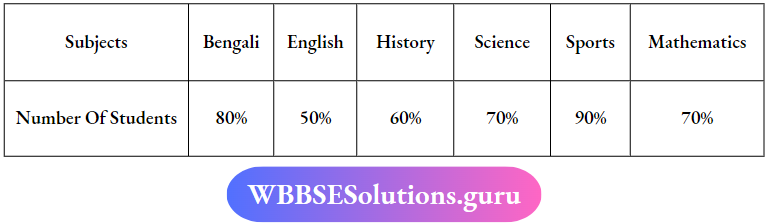
The following data gives the number of students of class in their choice of Subjects in Percentage has been made.

Double Bar Graph Subjects And Number Of Students

Represent the above data with the help of a bar graph and answer the following questions.

Question 1. Choose the correct answer

1. Number of students who like mathematics.

  1. 50%
  2. 60%
  3. 70%
  4. 80%

Solution: 3. 70%

The option (3) 70%. is the Correct Answer.

Read and Learn More Class 7 Maths Solutions

WBBSE Class 7 Maths Solutions For Algebra Chapter 8 Double Bar Graph

2. Studenns like most.

  1. Mathematics
  2. Bengali
  3. English
  4. Sports.

Solution: 4. Sports.

Option (4) Sports is the correct Answer

Double Bar Graph Subjects And Number Of Students Bar Graph

Class 7 Algebra Problems With Solutions

Question 2. Write true or False:

  1. 10% more Students like History than English.
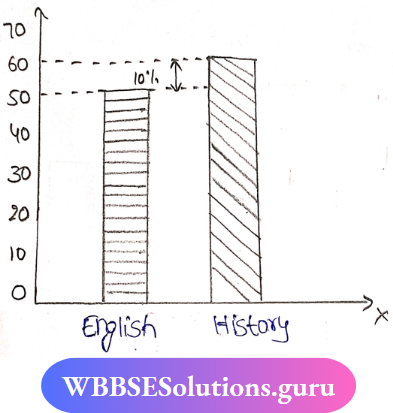
  2. Most of the students like Bengali.

Solution:

Double Bar Graph Students LIke History And English

Double Bar Graph Students Like Bengali

Question 3. Fill in the Blanks.

1. ______ % of Students like English.
Solution:
50%

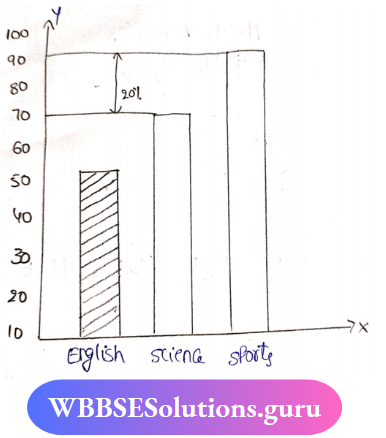
2. ______ % of more students like sports than science.
Solution:
20%

Double Bar Graph Students Like English

Algebra Formulas For Class 7 WBBSE

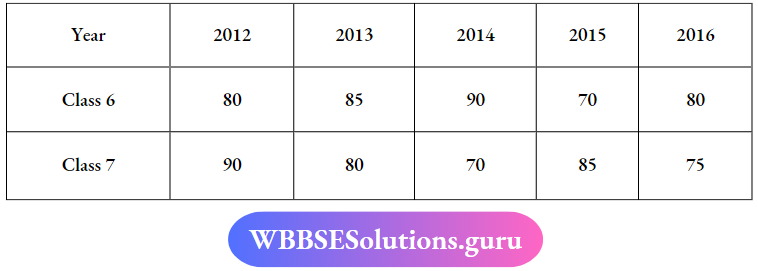
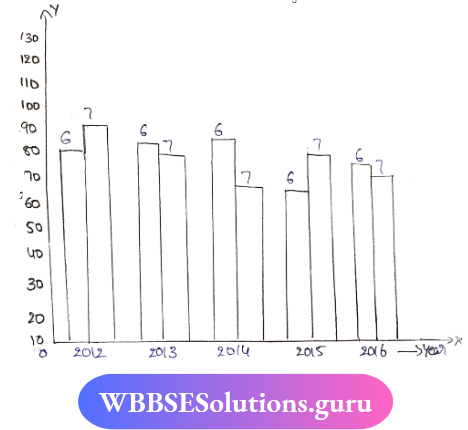
Question 4. The results of the pass percentage of class 6 and class 7 in the annual examination for 5 years of our school are given in the following table.

Double Bar Graph Percentages Of Annual Examination

Drawbar graphs to represent the data.

Double Bar Graph Percentages Of Annual Examination Graph Reprents The Data

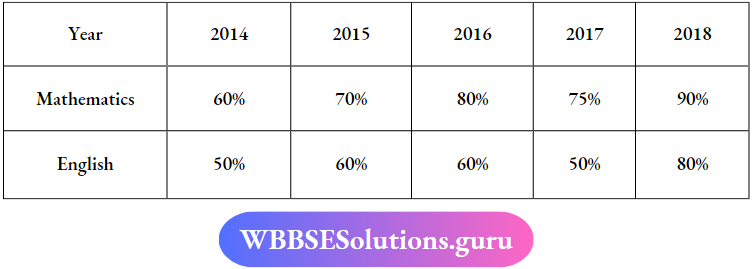
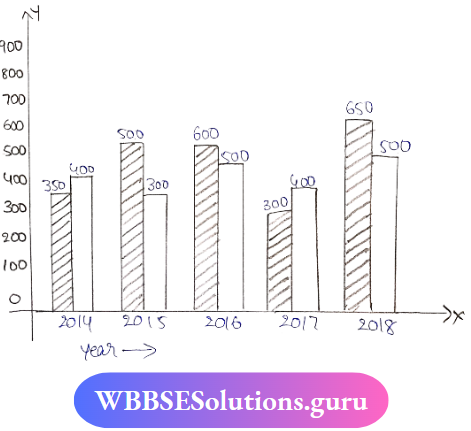
Question 5. The Students of a school have got the numbers in mathematics and English in the Madhyamik Examination in the year 2014-2018 are given below:

Double Bar Graph Students Of A School Has The umber Of Maths And English

Draw the bar graphs to represent the data.

Double Bar Graph Students Of A School Has The umber Of Maths And English Graph Represents The Data

WBBSE Maths Study Material Class 7

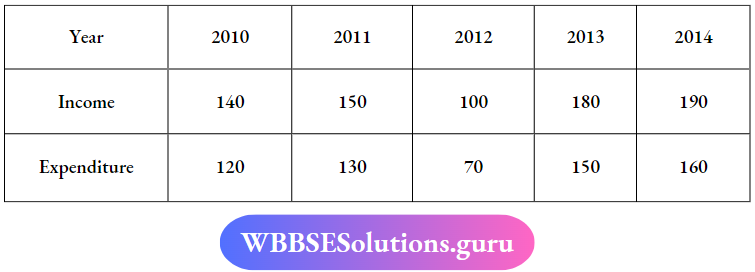
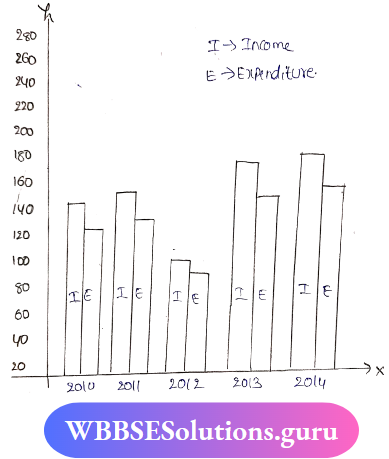
Question 6. The income and expenditure for 5 years of a family. is given in the following data.

Double Bar Graph Income And Expenditure Data

Represent the above data with a bar graph

Double Bar Graph Income And Expenditure Data Represents The Data By A Bar Graph

Question 7. The production of the Saha Textile factory from the month of January to June is given below.

Double Bar Graph Cotton Dress And Woolen Dress

Express the above information on a bar graph.

Double Bar Graph Cotton Dress And Woolen Dress Represents The Bar Graph

Class 7 Maths Exam Preparation WBBSE

Question 8. Read the following bar graph and answer the following questions:

Scale: 1unit 100 books

Double Bar Graph Cotton Dress And Woolen Dress 10 Uniy Equal To 100 Books Bar Graph

1. Write the change in the requirement of Textbooks during the year from 2014 to 2018
Solution: 2400

2. Find in which year it will sell of storybooks maximum ad in which year it was the least
Solution:

Sell of story books maximum in the year 2018

Sell of story books least in the year 2015

3. In which year does the difference between the number of story books and textbooks sold maximum and in Which Year is this difference maximum?
Solution:

The maximum number of story books and textbooks sold in the year of difference is 2015

The minimum difference between the story and textbooks sold in the year is 2014


WBBSE Solutions For Class 7 Maths

Algebra

WBBSE Solutions For Class 7 Maths

Arithmetic

Geometry


WBBSE Class 7 Maths Solutions For Algebra Chapter 6 Factorisation

Algebra Chapter 6 Factorisation

Question 1. Choose the correct answers

1. The number of prime factors of 20 a²bc³

  1. 7
  2. 6
  3. 9
  4. 10

Solution:

Prime Factor 20a²bc³

20a²bc³

= 2 х 5 х 2 х а х a x b x c x c x c

= 9

∴ 20a²bc³ = 9

∴ 20a²bc³ = 9 option ‘3’ = 9 corret Answer.

Read and Learn More Class 7 Maths Solutions

WBBSE Class 7 Maths Solutions For Algebra Chapter 6 Factorisation

2. The sum of factors of (12a4 – 18a2 + 30a) is

  1. 2a4 – 2a2 + 10
  2. a4 – a2 + 9
  3. 2a3 – 2a – 10
  4. 2a3 + 2a – 10

Solution:

Sum of factors (12a4 – 18a2 + 30a)

12a4 – 18a2 + 30a

6a(2a3 – 3a2 + 5)

cubic polynomial ax3 + bx2 + cx + d

sum of factors = –\(\frac{b}{a}\)

so for 2a3 – 3a2 + 5 = -(\(\frac{-3}{2}\)) = \(\frac{3}{2}\)

Now let’s substitute the sum back to the original equation

6a x \(\frac{3}{2}\) = 2a3 – 2a + 10

∴ The sum of factors of 12a4 – 18a2 + 30a is 2a3 – 2a + 10

∴ The option (1) 2a3 – 2a + 10 is correct answer

Class 7 Algebra Problems With Solutions

3. The Common Factor of 24a3b2c4, 36ab3c3 and 48a4bc2 is

  1. 6abc
  2. 12abc2
  3. 6a3bc2
  4. 12a2b2c2

Solution:

24a3b2c4 = 2 x 12 x a x a x a x b x b x c x c x c x c

36ab3c3 = 3 x 12 x a x b x b x b x c x c x c

48a4bc2 = 4 х 12 х а х а х ах а х b x c x с

Common Factor 12abc2

∴ Option (2) 12abc2 is the correct answer.

4. The sum of factors of x(x2-q) is

  1. x + x2 – 29
  2. x + 9
  3. x – 9

Solution:

x(x2-9)

x(x2-(3)2)

x(x+3)(x-3)

Sum of factors x + x + 3 + x – 3 = 3x

∴ The option (4) 3x is the correct answer.

5. The difference of two factors of (4x2 – 25) is

  1. 4x
  2. 4x – 10
  3. 10
  4. x – 5

Solution:

(4x2 – 25)

{(2x)2 – (5)2} [a2-b2=(a+b)(a-b)]

(2x+5)(2x-5)

The differences between the factors are

⇒ (2x + 5) – (2x – 5)

⇒ 2x + 5 – 2x + 5

⇒ 10

∴ Option (3) 10 is the correct answer.

Question 2. Write true or False

1. The number of prime factors of 6x is 3
Solution:

Prime factors of 6x  2 x 3 x x =3 → True

2. The sum of factors of (4-x2) is ‘2’
Solution:

⇒ ((2)2 – x2)

⇒ (2 + x) (2 – x)

⇒2 + x + 2 – x

⇒ 4

∴  (4-x2) sum of factors is ‘2’

∴ False

Class 7 Maths Chapter 6 Solved Exercises

3. One of the factors of (a2-a-5a3) is (a2-1-5a)
Solution:

⇒ (a2-a-5a3)

⇒ a(a-1-5a2) is (a2-1-5a)

∴ False

4. The Prime Factors of 18ab2c5 are 2 x 3 x 3 x a, b, C
Solution:

18ab2c5

2 x 3 x 3 x a x b x b x c x c x c x c x c.

prime Factors of 18ab2c5 is 2 x 3 x 3 x a x b x b x c x c x c x c x c.

∴ False

5. The Common Factor of (2a2 + 3a) and (4a – 7a2) is a
Solution:

(2a2 + 3a), (4a – 7a2)

a(2a + 3) – a(-4-7a).

a + 2a + 3 – a – 4 + 7a

3a + 3

3(a+1)

and

(6a – 4)

2(30 + 2)

Here the common factor is ‘a’

∴  True

Question 3. Fill in the Blanks:

1. There is no common Prime factor of 5a2b and 9cd2
Solution: Prime

2. The sum of factors of (3x2-27) is
Solution:

(3x2 – 27)

3(x2 – 9)

3(x2-(3)2)

3(x+3)(x-3)

3 = x + 3 + x – 3

2x + 3

∴ The sum of factors of (3x2 – 27) is (2x + 3)

3. The difference of factors of (9x2 – 16)
Solution:

9x2 – 16

⇒ (3x)2 – (4)2 [a2 – b2 = (a+b) (a-b)]

⇒ (3x + 4) (3x – 4)

Difference of factors we subtract the smaller

Factor from the larger one: (3x+4)- (3x-4)

Expanding this expression: 3x + 4 – 3x + 4 = 8

∴ The difference of factors of (9x2 – 16) is 8

Algebra Formulas For Class 7 Wbbse

Question 4. If a2 – 7a + 12 = (a – 4) (a + p). then find the value of ‘P’
Solution:

a2 – 7a + 12 = (a – 4)(a + p)

⇒ a2 – 7a +12 = a(a + p) – 4(a + p)

⇒ a2 – 7a +12 = a2 + ap – 4a – 4P

⇒ a2 – 7a + 12 = a2 + a(p-4) – 4p

∴ -7a = a(p-4)

⇒ \(\frac{7a}{a}\) = p – 4

-7 = p – 4

-7 + 4 = p

p = -3

and

12 = -4p

p = \(\frac{123}{-4}\)

p = -3

∴ a2 – 7a + 12 = (a – 4)(a + p)

∴ p = -3

Question 5. The product of two expression is \(\left(\frac{81}{a^4}-\frac{b^4}{25}\right)\) if one expresion is \(\left(\frac{a}{a^2}-\frac{b^2}{5}\right)\) then Find the other expression.
Solution:

⇒ \(\left(\frac{81}{a^4}-\frac{b^4}{25}\right)\)

⇒ \(\left\{\left(\frac{a}{a^2}\right)^2-\left(\frac{b^2}{5}\right)^2\right\}\) (\(a^2-b^2=(a+b)(a-b)\))

⇒ \(\left(\frac{9}{a^2}+\frac{b^2}{5}\right),\left(\frac{a}{a^2}-\frac{b^2}{5}\right)\)

The other expression is \(\left(\frac{9}{a^2}+\frac{b^2}{5}\right)\)

Question 6. Find the value of ‘p’ in expression (x2-px-6) if one of the Factors is (x-3) Find also another factor.
Solution:

(x2 – px – 6)

given that one factor is (x – 3) = 0

x = 3 Substitute in the above equation.

((3)2 – p(3)-6)= 0

9 – 3p – 6 = 0

-3P = -9 + 6

-3p = -3

p = \(\frac{-3}{-3}\)

∴ p = 1

(x2 – px – 6) = 0

(x2 – (1)x – 6) = 0

x2 – x – 6 = 0

x2 + 2x – 3x – 6 = 0

x(x+2)-3(x+2)=0

∴ (x+2)=0, (x-3)=0

x = -2, x = 3

∴ The value of p is 1

The other factor is (x+2)=0

∴ x = -2, and x = 3

WBBSE Maths Study Material Class 7

Question 7. Express \(\left(\frac{a}{b}-\frac{b}{a}\right)\) as a product of two expressions such that the sum of the expression is \(\left(\frac{a}{b}+\frac{b}{a}\right)\)
Solution:

⇒ \(\left(\frac{a}{b}-\frac{b}{a}\right)\)

Some of the expression is \(\left(\frac{a}{b}+\frac{b}{a}\right)\)

This can be be written as 1 + \(\frac{b}{a}\) x (\(\frac{a}{b}\) + 1)

Now let’s verify if the given expression can be factored as the product of two expressions whose sum is \(\left(\frac{a}{b}+\frac{b}{a}\right)\):

⇒ \(\left(\frac{a}{b}-\frac{b}{a}\right)\)

= \(\frac{a^2-b^2}{a b}\)

= \(\frac{(a+b)(a-b)}{a b}\)

= \(\frac{a-b}{b} \times \frac{a+b}{a}\)

= \(\left(\frac{a}{b}-1\right)\left(1+\frac{b}{a}\right)\)

∴ So \(\left(\frac{a}{b}-\frac{b}{a}\right)\) can be expressed as the product of (\(\frac{a}{b}\)-1) and (1 + \(\frac{b}{a}\)), and their sum is \(\frac{a}{b}\) + \(\frac{b}{a}\)

Question 8. Find the sum of the Factors of the expression (3a2 – b2 – c2 – 2ab – 2bc – 2ca)
Solution:

(3a2 – b – c2 – 2ab – 2bc – 2ca)

⇒ 3 + 3 + a + a – b – b – c – 2a + b − 2 + b + c – 2 + c + a

⇒ 6 + 4а – 6

⇒ 4a.

∴ The sum of factors of the expression (3a2-b2-c2-2ab-2bc-2ca) = 4a

Question 9. Resolve into factors.

1. \(\frac{a^4}{16}-\frac{81}{b^4}\)
Solution:

⇒ \(\frac{a^4}{16}-\frac{81}{b^4}\)

⇒ \(\left(\frac{a^2}{4}\right)^2-\left(\frac{9}{b^2}\right)^2\) (\(a^2-b^2=(a+b)(a-b)\))

⇒ \(\left(\frac{a^2}{4}+\frac{9}{b^2}\right)\left(\frac{a^2}{4}-\frac{9}{b^2}\right)\)

⇒ \(\left(\frac{a^2}{4}+\frac{9}{b^2}\right)\left(\left(\frac{a}{2}\right)^2-\left(\frac{3}{b}\right)^2\right)\)

⇒ \(\left(\frac{a^2}{4}+\frac{9}{b^2}\right)\left(\frac{a}{2}+\frac{3}{b}\right)\left(\frac{a}{2}-\frac{3}{b}\right)\)

∴ \(\frac{a^4}{16}-\frac{81}{b^4}=\left(\frac{a^2}{4}+\frac{9}{b^2}\right)\left(\frac{a}{2}+\frac{3}{b}\right)\left(\frac{a}{2}-\frac{3}{b}\right)\)

2. \(a^4-5 a^2+6 a\)
Solution:

⇒ \(a^4-5 a^2+6 a\)

⇒ \(a\left(a^3-5 a+6\right)\)

∴ \(a^4-5 a^2+6 a=a\left(a^3-5 a+6\right)\)

3. \(a^2-b^2+18 b-81\)
Solution:

⇒ \(a^2-b^2+18 b-81\)

⇒ \(a^2-\left(b^2-18 b+81\right)\)

⇒ \(a^2-(b-9)^2\)

(a+b-a)(a-b+9)

∴ \(a^2-b^2+18 b-81=(a+b-9)(a-b+9)\)

WBBSE Maths Study Material Class 7

4. 3x2 – xy – 4y2
Solution:

3x2 -xy – 4y2

⇒ 3x2 + 3xy – 4xy – 4y2

⇒ 3x(x+y) -4(x+y)

⇒ (x+y) (3x-4)

∴ 3x2 – xy – 4y2 = (x+4) (3x-4)

5. 18ax2 – 128a(x-2y)2
Solution:

18ax2 – 128a(x-2y)2

a[18x2 – 128(x-2y)2]

6. 18ax2 – 128a(x – 2y)2
Solution:

⇒ \(2 a \cdot 9 x^2-2 a \cdot 64(x-2 y)^2\)

⇒ \(2 a \cdot 9 x^2-2 a \cdot 64\left(x^2-4 x y+4 y^2\right)\)

⇒ \(2 a\left(9 x^2-64 x^2+256 x y-256 y^2\right)\)

⇒ \(2 a\left(9 x^2-64 x^2\right)+2 a\left(256 x y-256 y^2\right)\)

⇒ \(2 a\left(-55 x^2+256 x y-256 y^2\right)\)

⇒ \(2 a\left(-11 x^2+16 x y-16 y^2\right)\)

Now Let’s re-arrange the terms:

⇒ \(2 a\left(16 x y-11 x^2-16 y^2\right)\)

⇒ \(2 a\left(16 y(11 x-16 y)-11 x^2\right)\)

⇒ \(2 a(11 x-16 y)(16 y-5 x)\)

So, \(18 a x^2-128 a(x-2 y)^2\) can be simplified to \(2 a(11 x-6 y)(16 y-5 x)\).

7. \(81 a^4+643^4\)
Solution:

⇒ \(81 a^4+64 b^4\)

⇒ (3a+2b)(3a-2b)(3a+2b)(3a-2b)

⇒ (3a+2b)\(^2(3 a-2 b)^2\)

⇒ \(\left(9 a^2+12 a b+4 b^2\right)\left(9 a^2-12 a b+4 b^2\right)\)

And we can simplify the expression by distributing the terms.

⇒ \(\left(9 a^2+12 a b+8 b^2\right)\left(9 a^2-12 a b+8 b^2\right)\)

So, \(81 a^4+64 b^4 \mathrm{can}\) indeed be expressed as

∴ \(\left(9 a^2+12 a b+8 b^2\right)\left(9 a^2-12 a b+8 b^2\right)\)

8. 4(a+3b-c)2 – (4a-3b+2c)2
Solution:

Expand 4(a+3b-c)2

4(a+3b-c)(a+3b-c)

4(a2 + 3ab – ac + 3ab + 9b2 – 3bc – ac – 3bc + c2)

4(a2 + 6ab – 2ac + 9b2 – 6bc + c2)

Expand (4a – 3b + 2c)2

(4a-3b+2c) (4a-3b+2c)

⇒ (4a)2 -2(4a) (3b) + 2(4a)(2c) + (-3b)2 – 2(-3b)(2c)+ (2c)2

⇒ 16a2 – 24ab + 16ac + 9b2 + 12bc + 4c2

Now let’s substitute these expansions back into the original expression:

4(a+3b-c)2 – (4a-3b+2c)2

= 4(a2 + 6ab- 2ac + 9b2 – 6 bc + c2) – (16a2 – 24ab + 16ac + 9b2 + 12bc + 4c2)

= 4a2 + 24ab – 8ac + 36b2 – 24bc + 4c2 – 16ac + 24ab – 16ac – 9b2 – 12bc – 4c2

9. 4a2 – 16a2 + 24ab + 24ab – 8ac – 16ac + 36b2 – 9b2 – 24bc – 12bc + 4c2 – 4c2
Solution:

= -12a2 + 48ab – 24a + 27b2 – 36bc

Now we can factor out common terms from this expression

= -12(a2 – 4ab + 2ac – \(\frac{9}{4}\)b2 + 3bc)

Now observe that a2 – 4ab + 2ac – \(\frac{9}{4}\)b2 + \(\frac{3}{2}\)bc

Can be factored as (a – 2b + \(\frac{3}{2}\)c) (a – 2b + \(\frac{3}{4}\)c)

Thus the expression becomes:

= -12(a – 2b + \(\frac{3}{2}\)c) (a-2b+\(\frac{3}{4}\)c)

Now let’s factor this expression further.

= −12(2a – 4b + 3c)(a − 2b + \(\frac{3}{4}\)c)

= 3(-4a + 8b – 6c)(2a – 4b + \(\frac{3}{2}\)c)

= 3(2a – 4b + \(\frac{3}{2}\)c)(-4a + 8b – 6c)

= 3(2a – 4b + \(\frac{3}{2}\)c)(9b – 2a – 4c)

So, 4(a + 3b – c)2 – (4a – 3b + 2c)2 can be simplified to 3(2a + b) (9b – 20 – 4c).

10. a2 – b2 – c2 + d2+ 2(ad + bc)
Solution:

⇒ a2 – b – c2 + ď2 + 2(ad +bc)

⇒ a2 – b2 – c2 + d + 2ad + 2bc

⇒ a2+ 2ad + d2 – (b2 + c2 – 2bc)

⇒ (a+d)2 – (b-c)2

⇒ {(a+d) + (b-c)} {(a+d) – (b-c)}

⇒ (a+b-c+d) (a-b+c+d)

∴ a2 – b2 – c2 + d2 + 2(ad+bc) = (a + b – c + d) (a – b + c + d)

Class 7 Maths Algebra Solutions WBBSE

11. 7a(7a-2b) + (b+c)(b-c)
Solution:

7a(7a-2b) + (b+c) (b-c)

49a2 – 14ab + b2 – c2

((7a)2 -2(7a)(b) + b2) – c2

(7a-b)2 – c2

(7a-b+c)(7a-b-c)

∴ 7a(7a-2b)+(b+C)(b-c) = (7a-b+c) (7a-b-c)

12. (a+b)(x+cy) – (b+c)(x+ay)
Solution:

(a+b)(x+cy) – (b+c)(x+ay)

{a(x+cy) + b(x+cy)} – {b(x+ay) + c(x+ ay)}

{ax + ayc + bx + byc} – {bx + aby + cx + acy}

ax + ayc + bx + byc – bx – aby – cx – acy

ax + byc -aby -cx

(ax-cx)- by(a-c)

x(a-c)- by(a-c)

(a-c)(x-by)

∴ (a+b)(x+cy) – (b+c)(x+ay) = (a-c)(x-by)

Question 10. Factorize the following

1. a4 + a2b2 + b4
Solution:

⇒ (a2)2+ a2b2 + (b2)2

⇒ (a2 + ab + b2) (a2 – ab + b2)

∴ a4 + a2b2 + b4 = (a2 + ab + b2) (a2– ab + b2)

2. a4 – 2a2b2 – 15b4
Solution:

⇒ a4 – 2a2b2 – 15b4

⇒ a4 – 5a2b2 + 3a2b2 – 15b4

⇒ (a2-5b2) + 3b2(a2-5b2)

⇒ (a2-5b2) (a2+3b2)

∴ a4 – 2a2b2 – 15b4 = (a2-5b2) (a2+3b2)

3. 16 (3x+2y)2 – 9(x-2y)2
Solution:

⇒16(9x2 + 4y2 + 12xy) – 9(x2 + 4xy2 – 4xy)

⇒ (144x2+64y2 + 192xy) (-9x2-36y2+36xy)

⇒ (144x -9x2)+(64y2-36y2) + (192xy+36xy)

⇒ 135x2 + 28y2 + 228xy

⇒ 135x2 + 228xу + 28y2

⇒ 135x2 + 210xy + 18xy + 28y2

⇒ 15x(9x+14y) + 2y(9x+14y)

⇒ (9x+14y) (15x+2y)

∴ 16(3x+2y)2 – 9(x-2y)2= (9x+14y) (15x+2y)

Class 7 Maths Algebra Solutions WBBSE

4. x8-16y8
Solution:

(x4)2 – {(4y)4}2 (a2-b2=(a+b)(a-b))

⇒ {(x)4 + (4y)4} {(x)4-(4y)4}

⇒ {(x2)2+{(2y)2}2} {(x2)2-{(2y)2}2}

⇒ {(x2 + 2y2)2 – 2.x2.2y2} {(x2+ 2y2)x(x2– 2y2)}

⇒ {(x2+2y2)2 – 4x2y2} {(x2+2y2) × (x2-2y2)}

⇒ {(x2+2y2)2-(2xy)2} {(x2+2y2)x(x2-2y2)}

⇒ (x2 + 2x2 + 2xy)(x2 + 2y2 -2xy) (x2+2y2) x (x2-2y2)

∴ x8-16y8 = (x2+2y2+2xy) (x2+2y2-2xy) (x2+2y2)(x2-2y2)

5. (1+x)(y-z)+(1+z)(x−y)
Solution:

⇒ {1(y-z)+x(y-z)} + {1(x-y) + z(x-y)}

⇒ {y-2+xy-zx} + {x-y+2x-zy}

⇒ y-z+xy-zx+x-y+zx-zy

⇒ (xy-zy) + (x-z)

⇒ y((x-z)) + 1(x-z)

⇒ (x-z)(y+1)

∴ (1+x)(y-z) + (1+z)(x-y) = (x-z)(y+1)