- Lesson 1 The Wind Cap
- Lesson 2 Clouds
- Lesson 3 An April Day
- Lesson 4 The Great Escape
- Lesson 5 Princess September
- Lesson 6 The Sea


Summative Evaluation Test
Reading Skills
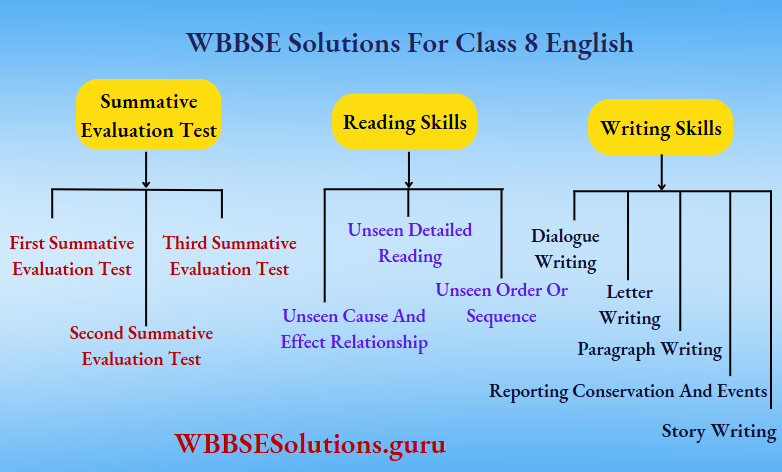
Writing Skills
Fill in the blanks with the prepositions given below.
(in, at, to, for, of)
Question 1. Don’t look ____ me
Answer: at
Question 2. She is going _____ school
Answer: to
Read And Learn More WBBSE Class 8 English Functional Grammar
Question 3. The baby is crying ________ food.
Answer: for
Question 4. Come here _______ time.
Answer: in
Question 5. Don’t be afraid _____ death.
Answer: for
Fill in the blanks with the correct verb forms given within brackets.
Question 1. He ___________ (is reading, was reading, reads) when I
Answer: was reading
Question 2. Have you ______ (saw, seen, see) my brown cat?
Answer: seen
Question 3. Dipak _______ (has come, came, will come) is here tomorrow.
Answer: will come
Question 4. Let me know who __________ (do, did, done) it.
Answer: did
Question 5. “I have not __________ (broken, break, broke) it”, said Sumita.
Answer: broken

Find out the countable and uncountable nouns from the following.
(child, oil, box, shirt, petrol, beggar, rice, milk, girl, sugar, bird, sand.
Answer:
Join the sentences using ‘if’ and ‘unless” clauses.
Question 1. I shall give you some money. Give me the book first.
Answer: If you give me the book, I shall give you some money.
Question 2. You should have good food. Otherwise, you will fall ill.
Answer: Unless you have good food, you will fall ill.
Question 3. Do you have a cold? Take rest.
Answer: If you have a cold, take a rest.
Question 4. Ruma wants to take part in the competition. She should practise well.
Answer: If Ruma wants to take part in the competition, she should practice well.
Question 5. You do not have a permit. You cannot have a job.
Answer: Unless you have a permit, you cannot have a job.
Question 6. You must hurry up. You will miss the train.
Answer: Unless you hurry up, you will miss the train.
Question 7. Do not smoke. You will be punished.
Answer: If you smoke, you will be punished.
Join the following pairs of sentences using “that”, “which”, and “whose” clauses.
Question 1. A thermometer is an instrument. It is used to measure temperature.
Answer: A thermometer is an instrument that is used to measure temperature.
Question 2. A compass is an instrument. Its needle points to the North.
Answer: A compass is an instrument whose needle points to the North
Question 3. There is another type of volcano. It is on the verge of getting extinct.
Answer: There is another type of volcano that is on the verge of getting extinct.
Question 4. This is the boy. His father died yesterday.
Answer: This is the boy whose father died yesterday
Question 5. Pesticide is a substance. It is used to kill insects.
Answer: Pesticide is a substance which (that) is used to kill insects.
Use ‘may’ or ‘can’ and rewrite the following sentences.
Question 1. Rain is likely to fall in the evening.
Answer: Rain may fall in the evening
Question 2. He is able to work out this sum.
Answer: He can work out this sum
Question 3. You are permitted to leave this place.
Answer: You may leave this place.
Question 4. We cat to live.
Answer: We eat so that we can live.
Question 5. I wish you a long life.
Answer: May you have a long life.
| WBBSE Class 8 English Functional Grammar | WBBSE Class 8 English Reading Skills |
| WBBSE Solutions For Class 8 English | WBBSE Solutions For Class 8 Maths |
Say if the sentences are Simple or Complex. For Complex sentences, write down the principal and dependent clauses.
Question 1. You may go now.
Answer: You may go now – Simple.
Question 2. I know that he is a good boy.
Answer:
Question 3. They are playing in the park.
Answer: They are playing in the park — Simple.
Question 4. That he is ill is known to all.
Answer:
Question 5. They are reading now.
Answer: They are reading now — Simple.
Question 6. This is the boy who stood first in the examination.
Answer:
Use a suitable ‘self’ form (Reflexive or Emphatic Pronoun) in the following sentences.
Question 1. I did all the work without anybody’s help.
Answer: I my self did all the work
Question 2. He went to the station without asking anybody to accompany him.
Answer: He himself went to the station
Question 3. The girl did the sum without the help of others.
Answer: The girl herself did the sum
Question 4. They dug the field without others’ help.
Answer: They themselves dug the field.
Question 5. Ranjan did the work alone. Nobody helped him.
Answer: Ranjan himself did the work.
Report the following dialogues.
Question 1. The teacher: King Charles built this castle.
Student: His son built this church.
Answer: The teacher, told the student that King Charles had built that castle; the student said that his son had built that Church
Question 2. Aruna: How are you?
Priti: I am well.
Answer: Aruna asked Priti how she was. Priti replied that she was well.
Question 3. Dipti: I could not do the exercise.
Moly: It is not difficult.
Answer: Dipti said that she could not do the exercise. Moly said that it was not difficult
Question 4. Babul: Hallo! Is it Ranjan ?
Voice: No, wrong number.
Answer:
Question 5. Mr. Chakraborty (five years ago): I can run a mile in less than four minutes.
Amal: I can swim for 8 hours.
Answer:
Question 6. Shyamal to Kabita: I have a brother and he is working in a firm.
Answer: Shyamal told Kabita that he had a brother and he was working in a firm.
Fill in the gaps with “may” or “might”.
Example: You -have told me. I came all this way for nothing.
Answer: You might have told me. I came all this way for nothing.
Question 1. I thought he ____ be able to help me, but he was useless.
Answer: I thought he might be able to help me, but he was useless.
Question 2. You _______ leave the class when you finish the exercise.
Answer: You may leave the class when you finish the exercise.
Question 3. I asked him if I ______ leave the class early.
Answer: I asked him if I might leave the class early
Question 4. Passengers ______ smoke at the back of the plane.
Answer: Passenger’s may smoke at the back of the plane.
Rewrite as directed:
Question 1. My grandfather gave the book on my birthday. I have lost it. (Join with an adjective clause)
Answer: I have lost the book that my grandfather gave me on my birthday.
Question 2. I told him all about the brilliant student. (Make it a complex sentence)
Answer: I told him all I knew about the brilliant student.
Question 3. The game was over. Aff the players left. (Combine into a compound sentence)
Answer: The game was over and all the players left.
Question 4. She will come. Nobody knows the time. (Make two complex sentences using a Noun clause and an Adjective clause)
Answer:
Question 5. The man answered the phone. He told me that you were out. (Make it a complex sentence and mark the sub-clauses)
Answer:
Fill in the blanks with the correct form of verbs given within brackets:
Question 1. A major fire _____ (break) out near Esplanade this evening. The fire _____ (caused) by a short circuit in a market complex. Several fire tenders ______(rush) to bring flames under control. By that time hundreds of stalls _______ (burn) to ashes. The police _______ (order) an official inquiry into the matter. The forensic reports _______ (expect) in a few days.
Answer:
A major fire broke out near Esplanade this evening. The fire was caused by a short circuit in a market complex. Several fire tenders were rushed to bring the flames under control. By that time hundreds of stalls were burnt to ashes. The police ordered an official inquiry into the matter. The forensic reports are expected in a few days.
Articles, Prepositions, and Adverbs, eight in total, are missing in the passage. Rewrite’ the passage supplying them in the right places.
Question 1. Some people go to bed late night and get up late morning. This is not good for them. We must sleep at night when it is dark. Darkness helps us to sleep properly. When daylight comes we must get.
Answer: Some people go to bed late at night, and get up late in the morning. This is not good for them. We must sleep at night when it is dark. Darkness helps us to sleep properly. When the daylight comes, we must get up.
Use ‘some’ or ‘any’ properly to fill in the blanks.
Question 1. She has ______ pens but has not got _____ pencils.
Answer: She has some pens, but has not got my pencil.
Question 2. I want _______ milk, but don’t think there is _____ in the bottle.
Answer: I want some milk, but don’t think there is any in the bottle
Question 3. Have you ____ ink? If not, I’ll give you ______
Answer: Have, you any ink? If not, I’ll give you some.
Question 4. I can see _____ boys, but cannot find _______ girl.
Answer: I can see some boys, but cannot find any girl
Question 5. Will you give me _____ sugar, of course, if you have ________
Answer: Will you give me some sugar, of course, if you have any?
Join each pair of sentences into a single sentence as per the direction in the brackets.
Question 1. Ghee does not contain protein. It does not contain carbohydrates too. (Use ‘neither-nor’)
Answer: Ghee contains neither protein nor carbohydrates.
Question 2. I don’t want to be a doctor. I don’t want to be an engineer. (Use ‘either… or’)
Answer: I want to be neither a doctor nor an engineer
Change the voice of:
Question 1. People still remember him.
Answer: He is still remembered by people
Question 2. Lightning struck the old tree.
Answer: The old tree was struck by lightning
Question 3. She visits the zoo quite often.
Answer: The zoo is visited by her quite often.
Question 4. My grandmother told me a nice tale.
Answer: I was told a nice tale by my grandmother. Or, A nice tale was told me by my grandmother.
Question 5. He sold his best books.
Answer: His best books were sold by him.
Join the following sentences with Emphatic Pronouns.
Question 1. Ranjan, do the homework. Don’t ask anyone to help you.
Answer: Ranjan, do the homework yourself
Question 2. My sister sewed her blouse. She did not give it to the tailor.
Answer: My sister herself sewed her blouse.
Question 3. The students cleaned the room. Nobody helped them..
Answer: The students themselves cleaned the room.
Punctuate the following sentences.
Question 1. I’ll do that he said
Answer: “I’ll do that”, he said.
Question 2. What are you doing here he asked me
Answer: “What are you doing here ?” he asked me.
Question 3. Never never be late in school
Answer: Never, never be late in school.
Question 4. Oh what a sight
Answer: Oh, what a sight!
Question 5. If i am not at home you may talk to bimal my brother
Answer: If I am not at home, you may talk to Bimal, my brother.
Question 6. Ramen Shankar and rina went to delhi last October
Answer: Ramen, Shankar, and Rina went to Delhi last October.
Question 7. Have you read the bible asked his teacher
Answer: “Have you read the Bible?” asked his teacher,
Find out the transitive and intransitive verbs from the following, in case of transitive verbs pick out their objects.
Question 1. They are laughing.
Answer: laughing — Intransitive
Question 2. The bell rang.
Answer: rang — Intransitive
Question 3. He rang the bell.
Answer: rang — Transitive, object — bell
Question 4. He is reading a book
Answer: reading — Transitive, object — book
Question 5. He can run fast.
Answer: run — Intransitive
Question 6. He ran a race.
Answer: ran — Transitive, object — race
Question 7. Bring a book for me.
Answer: bring — Transitive, objects— book, me
Fill in the blanks with proper form of verbs given in brackets.
Question 1. The Gupta period ______ (call) the Golden Age in the history of India. The Gupta kings _____ (love) and ________ (respect) by the people. The country ________(progress) a lot during the period.
Answer: The Gupta period was called the Golden Age in the history of India. The Gupta kings were loved and respected, by the people. The country progressed a lot during the period.
Question 2. A serious road accident _______ (occur) near chowmatha yesterday. A young girl ____(wound) seriously in the accident. A bus hit the girl when she ______(cross) the road. The passersby ______ (take) her to the nearby hospital. But she ______(die) there the next day.
Answer:
A serious road accident occurred near chowmatha yesterday. A young girl was wounded, seriously in the accident. A bus hit the girl when she was crossing, the road. The passersby took her to the nearby hospital. But she died there the next day.
Join the sentences as directed.
Question 1. The mountain is very high. It is very difficult to climb. (Use too … to)
Answer: The mountain is too high to climb
Question 2. We boil water. It is safe for drinking. (Use because)
Answer: We boil water because it is safe for drinking
Question 3. She wanted to score good marks in the examination. She read well (Use so…..)
Answer: She read- well so as to score good marks in the examination.
Question 4. I came back from school. He was playing (Use when….)
Answer: He was playing when 1 came back from school.
Question 5. She was looking tired. I asked her the reason. (Use why…..)
Answer: I asked her why she was looking tired.
Make new words opposite in meaning of the following words by adding suitable prefixes from the list given.
(Prefixes mis-, dis-, un-, il-)
Answer:
Change into indirect speeches.
Question 1. Arati said, “My sister is ill.”
Answer: Arati said that her sister was ill.
Question 2. He said to me, “You are wrong.”
Answer: He told me that I was wrong.
Question 3. She said, “The sky is blue.”
Answer: She said that the sky is blue
Question 4. He said to me, “Are you well?”
Answer: She asked me if I was well
Question 5. He said to her, “Do not go out.”
Answer: He ordered her not to go out.
Join each of the following sets of sentences into one sentence using a “that” or “who” clause.
Question 1. The school remained closed. The boy did not know it.
Answer: The boy did not know that the school remained closed,
Question 2. He sang a sweet song. It came into his mind.
Answer: He sang a sweet song that came into his mind.
Question 3. Air in motion is called wind. Everybody knows it.
Answer: Everybody knows that air in motion is called wind
Question 4. Sunil came here yesterday. He told me the story.
Answer: Sunil, who came here yesterday, told me the story.
Question 5. Aparna is a poetess. She will attend the function.
Answer: Apama, who is a poetess, will attend the function.
Combine each of the following sets of sentences in at least two ways:
Question 1. Some volcanoes remain inactive for a long period. These are called dormant volcanoes.
Answer:
Question 2. Oxygen is a gas. It has no color, taste or smell.
Answer:
Question 3. Rubber is processed as a solid sheet. The passage tells us about it.
Answer:
Question 4. My friend wrote me a letter. I read it out to my mother.
Answer:
Question 5. Someone has left a banana skin on the pavement. A girl stepped on it.
Answer:
Join the following sets of sentences using “neither….. nor”. One has been done for you.
[Example: Ram was not present at school. Madhu also was not present at school. ‘Ans. Neither Ram nor Madhu was present at school.]
Question 1. I don’t take tea. I don’t take coffee also.
Answer: I take neither tea nor coffee
Question 2. He won’t come in. He won’t go out, either.
Answer: He would neither come in nor go out
Question 3. Mr. Roy did not come. Mrs. Roy also didn’t come.
Answer: Neither Mr Roy nor Mrs Roy came
Question 4. I didn’t see him at home. I didn’t see him at school.
Answer: I saw him neither at home nor at school
Question 5. This pen won’t do. That pen won’t do either.
Answer: Neither this pen nor that pen would do.
Question 6. It’s not pleasant to eat. It’s not good for health.
Answer: It is neither pleasant to eat nor good for health.
Fill in the blanks with appropriate articles and prepositions.
Question 1. ________ tree plays _________ important role in our life. It stops erosion of soil, supplies us _______ oxygen, and keeps the environment free of ________ pollution.
Answer: The tree plays an important role in our life. It stops the erosion of soil, supplies us with oxygen, and keeps the environment freedom pollution.
Fill in the gaps with proper forms of verbs in the brackets.
Question 1. The examination will ______ (hold) in March.
Answer: be held
Question 2. The man has ________ (kill) the tiger.
Answer: killed.
Question 3. The police ________ (inform) in time.
Answer: was informed
Question 4. They came back _______ (dance) all the way.
Answer: dancing
Question 5. I shall get the house _____ (repair) very soon.
Answer: repaired.
Change the mode of narration:
Question 1. Anand: What is especially interesting about the story?
Ravi: It tells us about some adventures of the sailor Sindbad.
Anand: Who was Sindbad?
Ravi: He was a rich merchant. He lived in Baghdad.
Answer: Ananda asked Ravi what was especially interesting about the story. Ravi replied that it told them about some adventures of the sailor Sindbad. Ananda asked who Sindbad had been. Ravi replied that he had been a rich merchant who lived in Baghdad.
Re-write the following sentences according to the directions given in the brackets.
Question 1. Isaac built a windmill. It had no miller. (Join the sentences into a single sentence).
Answer: Isaac built a windmill that had no miller.
Question 2. Leaving Diamond sleeping in the room, Newton went out of his chamber. (Split up into three sentences.)
Answer: Diamond was sleeping in Netwon’s chamber. Newton left it in the”room. He then went out of his chamber.
Fill in the blanks with appropriate prepositions.
Question 1. They became angry _________ me.
Answer: with
Question 2. He does not take care ______ his health.
Answer: of
Question 3. Do not depend ______ others.
Answer: on
Question 4. The boys are grateful ______ their teacher.
Answer: to
Question 5. The child is fond ______ sweets.
Answer: of
Join the following sets of sentences using the suitable linkers given below. (since, because, if, as, therefore)
Question 1. He was ill. He did not go to school.
Answer: As he was ill, he did not go to school.
Or, He did not go to school because he was ill.
Or, He was ill, therefore he did not go to school.
Question 2. He may come late. In that case he will miss the train.
Answer: If he comes late, he will miss the train.
Question 3. You are a mere child. I pardon you this time.
Answer: Since you are a mere child, I pardon you this time.
Question 4. He asked me for help. I helped him.
Answer: As he asked me for help, I helped him.
Or, He asked me for help, therefore I helped him.
Or, I helped him because he asked me for help.
Or, Since he asked me for help, I helped him.
Question 5. Don’t be lazy. You will learn nothing.
Answer: If you are lazy, you will learn nothing.
Report these statements or questions beginning with the words given.
Statements/Questions
Report
Answer:
11. Rewrite as directed :
Question 1. If you are not serious, you will fail. (Rewrite using ‘unless’)
Answer: Unless you are serious, you will fail.
Question 2. Sita’s mother came from Mumbai. She was a religious lady. (Join using an Adjective clause)
Answer: Sita’s mother who was a religious lady came from Mumbai.
Question 3. Sincerity is an essential quality for success. You must remember this. (Join using a Noun clause)
Answer: You must remember that sincerity is an essential quality for success.
Question 4. He is educated. He is immodest. (Join using a ‘though’ clause)
Answer: Though he is educated, he is immodest.
Question 5. Mr Sen is a reputed person in the locality. He is a doctor. (Join using a Relative clause).
Answer: Mr Sen who is a reputed person in the locality is a doctor
Question 6. He has got the highest marks in mathematics. I know it. (Join using a Nominal clause)
Answer: I know that he has got the highest marks in mathematics.
Change the following Simple sentences into Complex sentences.
Question 1. Tell me your name.
Answer: Tell me what your name is.
Question 2. I heard of his success.
Answer: I heard that he had become successful
Question 3. I cannot read without glasses.
Answer: I cannot read if I have no glasses.
Question 4. She went out inspite of the rain.
Answer: She went out though it was raining
Question 5. She found the boy playing in the field.
Answer: She found that the boy was playing in the field
Change the voice of the following.
Question 1. He writes a letter.
Answer: A letter is written by him
Question 2. Sima did the work.
Answer: The work was done by Sima.
Question 3. The teacher teaches us English.
Answer: English is taught us by the teacher
Question 4. Arun has done the work.
Answer: The work has been done by Arun.
Question 5. I am reading the newspaper.
Answer: The newspaper is being read by me.
Say if the verbs are Transitive or Intransitive. Find out the objects of the Transitive verbs.
Question 1. The lion killed a cow.
Answer: killed — Transitive, obj. — cow
Question 2. You should go now.
Answer: go — Intransitive
Question 3. He grows vegetables.
Answer: grows — Transitive, obj. — vegetables
Question 4. The driver stopped the train.
Answer: stopped — Transitive, obj. — train
Question 5. The train stopped suddenly.
Answer: stopped — Intransitive.
Question 6. We eat everyday.
Answer: eat — Intransitive
Question 7. We eat rice.
Answer: eat — Transitive, obj. — rice
Join the sentences-using ‘either-or”.
Question 1. You must do it. You must get out.
Answer: You must either do it or get out
Question 2. You may give me the red pen. You may give me the blue one.
Answer: You may give me either the red or the blue pen
Question 3. Ram should play. Bhanu should play.
Answer: Either Ram or Bhanu should play
Question 4. Jamuna must come. Sheela must come.
Answer: Either Jamuna or Sheela must come.
Question 5. Ranu is guilty. Tapan is guilty.
Answer: Either Ranu or Tapan is guilty.
Fill in the gaps with the self-forms of the pronouns.
Question 1. Father washes his clothes _______
Answer: Father washes his clothes himself.
Question 2. We _________ organized the function.
Answer: We ourselves organised the function.
Question 3. She cursed _______
Answer: She cursed herself.
Question 4. Sheela does her homework _________
Answer: Sheela does her homework herself.
Question 5. He lost _________
Answer: He lost himself
Question 6. The teacher said to me, ‘You should clean your room _______
Answer: The teacher said to me, ‘You should clean your room yourself.’
Question 7. Ramen, Bela, and Amar _______ went to the headmaster.
Answer: Ramen, Bela, and Amar themselves went to the Headmaster.
Fill in the gaps with appropriate articles (a, an, the):
Question 1. My father is ____ M.A.
Answer: an
Question 2. I did it ____ hour ago.
Answer: an
Question 3. There is ______ university at Kalyani.
Answer: a
Question 4. I want ______ tea of Darjeeling.
Answer: the
Question 5. It is _______ one rupee note.
Answer: a
Complete the following statements, using the linking words given. One is done for you.
(as, so, therefore, because, hence)
Question 1. _______ we were late for school, we could not attend the class.
Answer: as
Question 2. They asked me to do it, _____ I did it.
Answer: so
Question 3.He failed, ______ he did not prepare his studies.
Answer: because
Question 4. He did not follow his advice and ____ his father grew angry with him.
Answer: hence
Question 5. There is not much time, _____ you’d better take a taxi.
Answer: therefore
Choose the word that best fits into the blank in each of the following sentences.
Question 1. I shall look _______ your son while you are away. (at, on, after)
Answer: after
Question 2. They call ______ me quite often. (in, on, off)
Answer: on
Question 3. He has put ______ a nice shirt. (of, out, on)
Answer: on
Question 4. We were held _________ by the traffic jam. (on, up, off)
Answer: up
Question 5. Go ______ the book quickly. (over, through, on)
Answer: through
Identify the Principal and Dependent clauses in the following sentences. For Dependent clauses, say whether they are noun clauses, adjective clauses, or adverbial clauses.
Question 1. I asked why he was late.
Answer:
Question 2. This is the place where the accident happend.
Answer:
Question 3. As he is ill, he could not come.
Answer:
Question 4. I know what he wants.
Answer:
Question 5. You would not pass unless you work hard.
Answer:
Question 6. I heard that she was ill.
Answer:
Fill in the blanks with the correct verb forms from the alternatives given within brackets.
Question 1. The sun ______ during the day (shine, shines, is shine)
Answer: shines
Question 2. I __________ him last Sunday. (have met, met, was meeting)
Answer: met
Question 3. The Ganga ____________ between the two cities, Kolkata and Howrah. (is flowing, flows, has flown)
Answer: flows
Question 4. We shall come if you _________ (think, thought, have thought) it necessary.
Answer: think
Question 5. We him here yesterday. (were seeing, saw, have seen).
Answer: saw
Fill in the blanks with the correct verb forms given within brackets.
Question 1. A 30-year-old man Sumit Roy ________ (injure) when a portion of a three-storied building collapsed at C.R. Avenue in North Kolkata. He _________ (remove) to the Medical College Hospital. The residents of the house _________(shift) to two adjacent buildings. People _________ (rush) to the spot and __________ (start) rescue operations.
Answer: was injured, was removed, were shifted, rushed, started
Join each of the following pairs of sentences into one sentence by using a Noun in Apposition:
Question 1. I have bought the works of a great poet. He is Rabindranath.
Answer: I have bought the works of Rabindranath, the great poet.
Question 2. Haren is ten years old. He is Raghu Maity’s son.
Answer: Haren, Raghu Maity’s son, is ten years old.
Combine the following sentences using a suitable ‘self’ form :
Question 1. The farmers tilled the land. They did not take the help of anyone.
Answer: The farmers themselves tilled the land.
Question 2. We will do it. We will not take the help of anyone.
Answer: We ourselves will do it.
Combine each of the following pairs of sentences. into one sentence by using an Infinitive:
Question 1. Every school has a headmaster. He looks after the affairs of the school.
Answer: Every school has a headmaster to look after the affairs of the school.
Question 2. He reads story book. This is his hobby.
Answer: His hobby is to read a storybook
Change the voice of the following:
Question 1. At first, the Chinese grew tea.
Answer: Tea was first grown by the Chinese
Question 2. We get milk from soyabeans.
Answer: Milk is got from soyabeans.
Question 3. Bring a cup of milk.
Answer: A cup of milk may be brought.
Frame questions with the Interrogatives given in the brackets.
Question 1. Mahatma Gandhi is the Father of the Nation. (Who)
Answer: Who is the father of the nation?
Question 2. I went to Kolkata yesterday. (Where)
Answer: Where did you go yesterday?
Question 3. He beat the dog severely. (How)
Answer: How did he beat the dog?
Use the correct form of verbs given in brackets and complete the sentences.
Question 1. You _________ (request) to answer the question in short.
Answer: are requested
Question 2. The thief ______ (catch) by the crowd and _____ (beat) mercilessly.
Answer: was caught, beaten
Question 3. America _________ (discover) by Columbus. He _______ (help) by Queen Isabella.
Answer: was discovered, was helped
Question 4. Five persons _______ (killed) in a road accident at Shyambazar today. In another accident at Shyambaxar today. In another accident ___________ (injure) seriously.
Answer: were killed, were injured
Question 5. The Pyramids _____ (built) by the Egyptians. three persons
Answer: were built.
Question 6. A gap at the joint of the railway line ________ (leave) in order to allow the rails to expand when they _________ (heat). If an allowance ______ (not make) for expansion, an accident may ______ (occur).
Answer: is left, are heated, is not made, occur,
Question 7. It is ________ (say) that Ashoka ______ (be) very cruel in his early life. History ______ (say) that the sights of killing in the Kalinga war _______ (give) him a great shock and he ____ (draw) to the principle of non-violence preached by Lord Buddha.
Answer: is said, was, says, gave, was drawn
Form sentences as directed using ‘may’, ‘can’, and ‘must’.
Question 1. Request your friend to give you her English dictionary.
Answer: Can you give me your English dictionary?
Question 2. Ask your friend’s permission to use his telephone.
Answer: May I use your telephone, please?
Question 3. Ask your friend to shut the window immediately.
Answer: You must shut the window immediately.
Question 4. Tell your friend that it is possible that you will return soon.
Answer: I may return soon.
Question 5. Someone is disturbing the class. Draw his attention.
Answer: You must not disturb the class.
Fill in the blanks with ‘who’/’whose’.
Question 1. Kabita is the girl _______ father is a doctor.
Answer: whose
Question 2. She is the person _______ wants to be photographed.
Answer: who
Question 3. Marie is the girl _____ mother is French.
Answer: whose
Question 4. Here is the lady _________ photograph is hanging on the wall.
Answer: whose
Question 5. She is the girl _____ parents must be proud of her.
Answer: whose
Question 6. He is a person ______ always had lots of close friends.
Answer: who
Complete the dialogue by filling in the blanks with suitable prepositions.
Question 1. 1. Robin: Hurry up! I am not going to wait _______ you any longer.
2. Champa: Oh! please wait. Don’t go _____ leaving me. I’m looking _______ my umbrella. It is going to rain. Look ______ the sky.
3. Robin: Well, you are not afraid ________ getting wet, are you?
4. Champa: No, I will travel _______ my car.
Answer:
1. Robin: Hurry up! I am not going to wait for you any longer.
2. Champa: Oh! please wait. Don’t go away leaving me. I’m looking for my umbrella. It is going to rain. Look at the sky.
3. Robin: Well, you are not afraid of getting wet, are you?
4. Champa: No, I will travel by my car.
Fill in the blanks with appropriate prepositions.
Question 1. He was absent ________ school.
Answer: from
Question 2. Add this ______ that.
Answer: to
Question 3. He does not agree ______ me.
Answer: with
Question 4. Rajib came here accompanied ________ his mother.
Answer: by
Question 5. Arun is married _______ Sharmila.
Answer: to
Question 6. I have no control _________ him.
Answer: over
Fill in the blanks with words made by adding suffixes or prefixes with the base words given within brackets.
Question 1. I am very _______ (happy) to note his ________ (legal) _________ act.
Answer: unhappy, illegal, action
Question 2. He is a very ______ (right) and ______ (trust) fellow.
Answer: upright, trustworthy.
Question 3. Do not ______ (understand) me as I value your _______ (friend) much.
Answer: misunderstanding, friendship
Fill in the blanks suitably with the words given.
Question 1. One morning a sage was __ in the Ganga. A _____ flew over his head carrying a little she-mouse. The she-mouse _____ out of the kite’s claw and ______ into the _____ hands ______ the power of yoga, the sage _______ the mouse into a girl. She grew up _____ a beautiful girl.
Words: bathing, by, to be, kite, sage’s, fell, slipped, turned.
Answer: One morning a sage was bathing in the Ganga. A kite flew over his head carrying a little she-mouse. The she-mouse slipped out of the kite’s claw and fell into the sage’s hands by the power of yoga, the sage turned the mouse into a girl. She grew up to be a beautiful girl.
Fill in the blanks with appropriate articles and prepositions. West Bengal. The city stands on University Kolkata. Its citizens are proud
Question 1. Kolkata is the capital ____ West Bengal. The city stands on _____ Hooghly. There is university ______ Kolkata. Its citizens are proud ________ this city.
Answer: of the, a, in, of.
Join the following pairs of sentences as directed.
Question 1. He is ill. It is known to all. (use that’)
Answer: He is ill js known to all
Question 2. Orpheus had a wife. He loved her very much. (use a relative pronoun)
Answer: Orpheus had a wife whom he loved very much.
Question 3. I shall give you some money. Give me the book first. (use an ‘if’ clause)
Answer: I shall give you some money if you give me the book first
Rahul is weak in English. He wrote some sentences containing mistakes. Correct them.
Question 1. The news are true.
Answer: The news is true
Question 2. Neither Ram nor his friend were hurt.
Answer: Neither Ram nor his friend was hurt.
Question 3. He and his father has arrived.
Answer: He and his father have arrived
Question 4. Ratan, do your homework himself.
Answer: Ratan, do your homework yourself.
Join the following sentences using suitable linking words given below.
(as, therefore, so)
Question 1. The English are very polite. They do not interfere with other peoples’ business.
Answer: The English are veiy polite, so they do not interfere with other people’s business.
Question 2. He is ill. He could not come.
Answer: He is ill, therefore he could not come.
Question 3. He did not work hard. He failed.
Answer: As he did not work hard, he failed.
Combine each set of the following sentences in different ways.
Question 1. Rocket is a spaceship. It is used to travel in space.
Answer:
Question 2. A computer is an instrument. It is a wonder of science.
Answer:
Question 3. A botanist is a scientist. He collects plants and studies them.
Answer:
Change the mode or narration:
Question 1. Charlie said, “Nora and Jim are getting married next month.”
Answer: Charlie said that Nora and Jim were getting married the next month.
Question 2. Andrew asked me, “Are you thinking of going to live in Canada ?”
Answer: Andrew asked me if I was thinking of going to live in Canada.
Question 3. I told Jim not to shout.
Answer: I said, “Jim, do not shout.”
Question 4. “I am enjoying my new job”, George told Ann.
Answer: George told Ann that he was enjoying his new job.
Question 5. I told him not to come before 6 o’clock.
Answer: I said to him, “Do not come before 6 o’clock.”
Rewrite as directed:
Question 1. A man answered the phone. He told me you were out. (Join with ‘who’).
Answer: A man who answered the phone told me that you were out. ‘
Question 2. I recently went back to the town. I was born there. (Join with ‘where’).
Answer: I recently went! back to the town where I was born.
Question 3. The government has called out troops. (Change the voice).
Answer: Troops have been called out by the government.
Question 4. The trains were held up by the fog. (Change the voice).
Answer: The fog held up the trains.
Question 5. He was poor, yet he was honest. (Begin with “although’).
Answer: Although he was poor, he was honest
Combine the sentences as directed.
Question 1. Mohan, do the homework. Don’t ask anyone to help you (use a suitable ‘self’ form).
Answer: Mohan, do the homework yourself.
Question 2. Somen likes clay modelling. He likes bamboo work too. (use, both…and)
Answer: Somen likes both clay modeling and bamboo work.
Question 3. Mala is not interested in gardening. She is not interested in cane and bamboo work also. (use ‘either….or’)
Answer: Mala is not interested either in gardening or in cane and bamboo work.
Question 4. Someone was careless. The life of the girl was ruined. (use ‘because’)
Answer: The life of the girl was ruined because someone was careless.
Question 5. They are dishonest fellows. They deserve to be hanged. (use ‘who’)
Answer: They are dishonest fellows who deserve to be hanged.
Fill in the blanks with appropriate articles and prepositions.
Question 1. It was ____ lovely day. Nila was playing in the garden ______ her brother. They were looking ______ the butterflies.
Answer: a, with, at.
Fill in the blanks with the words given.
Question 1. ______ Sunday last, he came _____ my place at 7 p.m. I was busy doing my Bengali homework, I asked him to wait _____ me for a few minutes. _______ he was waiting for me, he was going through a magazine __________ on the table.
as, while, on, about, for, to, lying,
Answer: On Sunday last, he came to my place at 7 p.m. I was busy doing my Bengali homework, I asked him to wait about me for a few minutes. As he was waiting for me, he was going through a magazine lying on the table.
Replace the italicized words with suitable group verbs given.
(Group verbs: call off, go on, put on, call at, give up)
Question 1. You should wear a clean dress.
Answer: put on
Question 2. The child continued crying for a long time.
Answer: went on
Question 3. Do not surrender, I am sure you will be successful.
Answer: give up
Question 4. She will visit my place soon.
Answer: call at
Question 5. The meeting was at last canceled.
Answer: called off.
Group verbs (go after, make out, put down, pull down, pass on)
Question 1. I do not understand what he wants.
Answer: make out
Question 2. Let us proceed to another subject.
Answer: pass on
Question 3. The building was demolished last night.
Answer: pulled down
Question 4. You must write here what you want.
Answer: put down
Question 5. The hunter followed the hare.
Answer: went after.
Change the following into Complex sentences.
Question 1. He boarded a running bus.
Answer: He boarded a bus which was running.
Question 2. People poured water on the burning car.
Answer: People .poured water on the car which was burning.
Question 3. I got back the missing articles.
Answer: I got back the articles that were missing.
Question 4. The cuckoo is a singing bird.
Answer: The cuckoo is a bird that sings.
Rewrite the following as directed:
Question 1. Where was he born? Do you know it? (Join using a Nominal clause and an Adjective clause)
Answer:
Question 2. I met the man last night. He is a scholar. (Join using an Adjective clause)
Answer: The man I met last night is a scholar.
Question 3. Don’t smoke. You will be punished. (Join using an Adverbial clause)
Answer: If you smoke, you will be punished.
Question 4. The Sun is far away. Our light comes from it. (Join using an Adjective clause)
Answer: Our light comes from the sun which is far away
Fill in the blanks with the correct form of verbs given within brackets.
Question 1. The bird ___ (buy) by Amal. It ____ (keep) in a cage. Today in the morning someone ______ (open) the door of the cage and the bird ______ (fly) away.
Answer: The bird was bought by Amal. It was kept in a cage. Today in the morning someone opened the door of the cage and the bird flew away.
Question 2. Nine people including a civilian ______ (kill) and fifteen others ______ (injure) when the militants _____ (attack) the security forces. The BSF today ______ (arrest) 39 militants. Till now no clues ___ (find) regarding the kidnapped engineers.
Answer: Nine people including a civilian were killed and fifteen others injured when the militants attacked the security forces. The BSF today arrested 39 militants. Till now no clues have been found regarding the kidnapped engineers.
Reading Comprehension (Seen)
Read the following passage and answer the questions given below :
“Wake up, wake up, little bird,” she said. She began to cry and her tears fell on the little bird. “I cannot sing unless I’m free and if I cannot sing, I die,” he said.
“Then take your freedom,” the Princess said. “I shut you in a golden cage because I loved you and wanted to have you all to myself. But I never knew it would kill you. Go. Fly away among the trees that are round the lake and fly over the green rice fields. I love you enough to let you be happy in your own way.”
Read And Learn Also WBBSE Solutions For Class 8 English
She threw open the window and gently placed the little bird on the sill.
“I will come because I love you, little Princess,” said the bird. “And I will sing you the loveliest songs I know. I shall go far away, but I shall always come back, and I shall never forget you.”
1. Write ‘T’ for True and ‘F’ for False statements. Give Supporting Statements:
Question 1. The little bird would sing for Princess even in cage.
Answer: False
SS: “I cannot sing unless I’m free and if I cannot sing. I die”, he said.
Question 2. The little bird promised to return to Princess.
Answer: True
SS: “I will come because I love you, little princess,” said the bird.
2. Answer the question:
Question 1. Why did the princess free the little bird?
Answer: The Princess felt that she loved the bird enough to let it be happy in her own way.
Read the poem and do as directed:
The sea is a hungry dog.
Giant and grey.
He rolls on the beach all day.
With his clashing teeth and shaggy jaws Hour upon hour he gnaws
The rumbling, tumbling stones,
And ‘Bones, bones, bones !’
The giant sea dog moans,
Licking his greasy paws.
| WBBSE Class 8 English Functional Grammar | WBBSE Class 8 English Reading Skills |
| WBBSE Solutions For Class 8 English | WBBSE Solutions For Class 8 Maths |
1. Choose the correct answer:
Question 1. The sea rolls on the beach
Answer: 2. All day
Question 2. The sea is compared to a
Answer: 3. Hungry dog
2. Complete the sentences with information for the passage:
Question 1. The sea dog moans, licking ___________
Answer: His greasy paws
Question 2. The colour of the sea is ___________
Answer: Grey

Reading Comprehension (Unseen)
Read the following passage and do as directed:
My next pet was a pigeon, the most revolting bird to look at, with his feathers, pushing through the wrinkled scarlet skin, mixed with the horrible yellow down that covers baby pigeons and makes them look as though they have just played holi. Because of his repulsive and obese appearance, we called him Bhutum. Since he had on unorthodox upbringing, without parents to teach him, Bhutum became convinced that he was not a bird at all, and refused to fly. He walked everywhere. He was always eager to join us in anything we did.
He would even try to come for walks with us. So you had to either carry him on your shoulder, which was risking an accident to your clothes, or else you let him walk behind. If you let him walk, then you had to slow down your own pace to suit his, for should you get too far ahead you would hear the most frantic and imploring coos and turn around to find Bhutum running desperately after you.
1. Choose the correct answer:
Question 1. The narrator describes the pigeon as a ‘revolting bird’ because:
Answer: 3. He had wrinkled skin covered with yellow feathers
Question 2. Bhutum got his name because:
Answer: 1. He was a fat and ugly.
Answer the following questions:
Question 1. What happened when Bhutum would go out on a walk and you went far too ahead?
Answer: When the narrator went far too ahead leaving Bhutum behind, he would hear the most frantic and imploring coos, and turning around, he would find Bhutum running desperately after him.
Grammar: Do as directed
Question 1. The boy said to his father, “I am going to my friend’s house now.” (Change the narration)
Answer: The boy said to his father that he was going to his friend’s house then.
Question 2. Do not tell lies. (Change the voice)
Answer: Let lies not be told.
Question 3. He was a man full of hope. (Underline the Adjective Phrase).
Answer: He was a man full of hope.
Question 4. The boy wore a new shirt. (Replace the underlined word with their antonym).
Answer: The boy wore an old shirt.
Question 5. She is the girl who saved the little boy from drowning. (Underline the main clause)
Answer: She is the girl.
Question 6. Find out the word which is the type of bird.
Answer: Pegion.
Writing
Question 1. Suppose you have gone to your friend’s house and see she has a pet bird. Suddenly. the bird starts talking to you. Write an imaginary dialogue between you and the caged bird.
Answer:
Me: Hi Rohan, how are you? Looks like you have a new pet. What have you named it?
Pet: My name is Ria.
Me: Wow! Rohan. Did I hear the bird talk?
Rohan: Yes
Pet: I can speak well. Rohan got me 3 weeks back.
Me: How do you like it here?
Pet: Rohan takes really good care of me. He takes me to the garden, and I can hear the | other birds there. He gives me food and water and shows me around. Life is pretty comfortable stop I don’t have to hunt for worms and food. However, sometimes, I | do miss the bright blue skies, the feeling of having the wind beneath my wings, and the adventures of unknown lands.
Reading Comprehension (Seen)
Read the below passage and do as directed.
“This is the Excalibur.”, Merlin said. “Only an honest and fearless knight who protects the common people can possess this sword.”
King Arthur accepted the enchanted sword from the mysterious hand appearing from the depths of the lake. “I shall never use this magic sword for any personal benefit,” King Arthur declared.
King Arthur could gift peace and prosperity to England. The greedy barons were unhappy with King Arthur because he was gentle and just. He married the beautiful Lady Guinevere, daughter of the king of Cornwall. On the wedding day, Merlin took him to a richly gilded pavilion, painted crimson and dark blue. The floor was marbled. In the middle of the room was a huge, round, oak table, richly carved, capable of seating fifty people. This was the famous round table around which gathered King Arthur’s devoted knights. These knights promised that they would help the helpless, be gentle to the weak, and to punish the wicked.
1. Fill in the blank with information from the text :
Question 1. The Excalibur can be possessed by ___________
Answer: Only an honest and fearless knight who protects the common people
Question 2. King Arthur declared ___________
Answer: He would never use that magic sword for any personal benefit.
2. Answer the following questions:
Question 1. Describe King Arthur’s round table.
Answer: It was a huge round table made of oak. It was richly carved, capable of seating fifty people.
Question 2. Why were the barons unhappy with King Arthur?
Answer: The barons were unhappy because they were greedy and did not like that King Arthur was gentle and just.
3. Write True or False:
Question 1. There were 20 devoted knights of King Arthur.
Answer: False
Question 2. Excalibur was the name of King Arthur’s horse.
Answer: False
Read the poem and do as directed:
But on quiet days in May or June,
When even the grasses on the dune
Play no more their reedy tune,
With his head between his paws
He lies on the sandy shores,
So quiet, so quiet, he scarcely snores
1. Fill in the blanks with words from the text:
Question 1. The _________ is green on the other side of the fence.
Answer: Grass
Question 2. The dog is licking its _________
Answer: Paws
Question 3. I was born in the month of _________
Answer: May
Question 4. Children loves to _________
Answer: Play
Reading Comprehension (Unseen)
Read the passage and do as directed:
Last year my parents and I went to Susunia in Bankura. We put up in the forest guest house there. The place was rich with flora and fauna. The guest house was situated on about a 500 feet tall hill. It was the full moon day in August. The entire region looked amazing in the silver light. Unknown birds and animals were interrupting the nocturnal silence. The smell of unknown flowers reigned in the air. We decided not to stay at the room. We went out. The silver plate in the sky was our guide. Suddenly we heard a rustling sound. Dad told us that a herd of elephants might be coming. So we quickly went back to the guest house. The beauty and mystery of that silvery night is still fresh in my memory.
1. Fill in the blanks with information from the text:
Question 1. I went to ____________
Answer: Susunia in Bankura
Question 2. The guest house was situated on about ___________
Answer: A 500 feet tall hill
Question 3. The _______ was our guide.
Answer: Silver plate in the sky
2. Answer the following questions:
Question 1. What was the rusting sound about?
Answer: The rustling sound could have been a heard of elephants coming
Question 2. What remained fresh in the narrator’s memory?
Answer: The beauty and mystery of that silvery night is still fresh in the narrator’s memory.
Grammar: Do as directed
Question 1. He said to me, “Yesterday was a holiday.” (Change the Narration)
Answer: He said to me that the day before was a holiday
Question 2. He _________ (meet) us next week. (Fill with the correct form of verb given in the bracket).
Answer: He will be meeting us next week
Question 3. India became _________ (dependent) nation in 1947. (Add a suitable prefix or suffix)
Answer: India became an independent nation -in 1947
Question 4. Mt. Everest is the highest mountain in the world. (Change into positive degree)
Answer: No other mountain is as high as Mt. Everest
Question 5. The mother hugged the child. (Change the voice)
Answer: The child was hugged by the mother
Writing
Question 1. Recently you help an elderly person cross a very busy street. Write a letter to your friend (in about eighty words) how you felt after helping the old man.
Answer:
XYZ Road
Narendrapur
14.10.22
Dear Deba,
How are things with you? I wanted to share an incident today that made me happy. I was trying to cross the main Gariahat junction around 6 p.m. The traffic was really bad cars, buses, and rickshaws all honking at each other and trying to move forward.
There was an elderly gentleman with a walking stick next to me. He had glasses on and it seemed he couldn’t see properly. He was getting anxious and frustrated. I rushed to his side to hold his hand and slowly walked him across to the other side while dealing with traffic. He was almost in tears and blessed me. His smile made my day!
Love,
Krish
Reading Comprehension (Seen)
Read the below passage and do as directed:
Swallow: It’s cold night. But strange, I am feeling warm.
Statue: That happens when you do something good to help someone. [Stage light changes to yellow]
Swallow: I will leave for Egypt tonight. I will stay with you through the day.
Statue: Swallow, Swallow, little Swallow, please stay with me for one more night.
Swallow: But all my friends are waiting for me. Tomorrow they are going to fly up River Nile to Luxor.
Statue: Far away in a little attic. I see a brown-haired young man. He is unhappy and poor. He is writing a play. for the theatre. Little Swallow, take one of my sapphire eyes and give it to him.
Swallow: Dear Prince, I can’t do that!
Statue: Swallow, little Swallow, you must.
1. Complete the following sentences with information from the text:
Question 1. The Swallow was feeling warm because ___________
Answer: He had helped someone
Question 2. The statue wished to help the brown-haired boy because ___________
Answer: Unhappy and poor.
2. Write the opposite of the following words:
Answer:
3. Answer the following question:
Question 1. The Swallow wanted to leave for Egypt. Why?
Answer: The Swallow wanted to leave for Egypt because his friends were waiting for him.
Read the poem and do as directed:
And when the night wind roars
And the moon rocks in the stormy ‘cloud,
He bounds to his feet and snuffs and sniffs,
Shaking his wet sides over the cliffs,
And howls and hollos long and loud.
1. Choose the correct answer:
Question 1. The wind roars during:
Answer: 3. Night
Question 2. Cliff means:
Answer: 1. Overhanging pieces of rocks
Reading Comprehension (Unseen)
Read the above passage and complete the following sentences:
A girl, returning home from school, stepped on a banana skin that someone had left on the pavement, slipped, and fell. She was taken to hospital with a badly broken leg. Though her life is not in danger, it is feared that she will not get back the full use of her leg. In fact, she had to limp all her life.
The life of the girl was ruined because someone was careless. I am sure that neither you nor I would care to think that either of us was that someone. Yet how often do we not do similar thoughtless things? We throw banana skins in the street or send a stone high up into the air for fun. We take dirty sweepings from our house and leave them about in the lane, and are too lazy to carry them to the dustbin although it is so near. We spit everywhere. Smokers often throw burning matchsticks and cigarette ends everywhere. People do all these things themselves and never think about the result.
1. Read the above passage and complete the following sentences:
Question 1. Someone had left a ________ on the pavement.
Answer: Banana skin.
Question 2. Neither you nor I would care ________
Answer: To think that either of us was -that someone.
Question 3. We send stone high up ___________
Answer: Into the air for tun.
2. Write True or False:
Question 1. The life of the girl was ruined because someone was careless.
Answer: True
Question 2. Smokers often throw burning matchsticks and cigarette ends everywhere.
Answer: True
Grammar: Do as directed
Question 1. _________ old man helped the little boy. (Fill in the blank with appropriate Article).
Answer: An
Question 2. The statue said to the Swallow, ‘Please give her the sapphire remaining in my other eye.” (change the narration.)
Answer: The statue requested the Swallow to give her the sapphire remaining in this other eye.
Question 3. She knows him. (Change the voice).
Answer: He is known to her.
Question 4. She _________ (run). (Fill with Present Continuous Tense.)
Answer: Is running
Question 5. A square is an area that has four equal sides. (Underline the Adjective Clause)
Answer: which has four equal sides
Writing
Question 1. Write a paragraph on about 80 words on ‘A Winter Morning.’
[Points: Introduction – chill morning – look of nature-fog-silent all round-road wet- people under the quilt or heavily dressed-some basking in the sun].
Answer:
My favorite season
My favorite season is winter and I love the winter mornings. The smell of the air and the smell of the soil is so refreshing. There is dew in the grass and it is moist. When the sun shines through, it is very pleasant and warms up the body. On weekends, I love to stay inside my quilt and my mother brings me tea and tasty snacks. I love to snuggle with my cat inside my blanket and she is very warm too.
Reading Comprehension (Seen)
Read the following passage and do as directed:
There was once a lad who wanted to be a sailor but his mother would not let him go to the sea. “Child, what do you know of sailing?” she would say. “You’re a farmer’s son, you know the turn of the seasons and the smell of the soil but you do not know the sea.”
Read And Learn Also WBBSE Solutions For Class 8 English
Now the boy whose name was Jon, had always obeyed his mother. So he went about his farm work with a heavy heart but did not again mention the sea.
One day, he had been walking behind the plow. He all but ran over a tiny green turtle on a clod of dirt. He picked the turtle up and set it on his head where he knew it would be safe. When he was done with plowing, Jon plucked the turtle.
1. Choose the correct answer:
Question 1. The lad wanted to be a
Answer: 2. Sailor
Question 2. The lad was the son of a
Answer: 2. Farmer
2. Write True or False:
Question 1. Jon always obeyed his mother.
Answer: True
Question 2. Jon’s mother wanted Jon to go to the sea.
Answer: False
| WBBSE Class 8 English Functional Grammar | WBBSE Class 8 English Reading Skills |
| WBBSE Solutions For Class 8 English | WBBSE Solutions For Class 8 Maths |
3. Answer the following questions:
Question 1. Why did the boy go about his farm work with a heavy heart?
Answer: The boy went about his farm work with a heavy heart because he wanted to be a sailor, but his mother would not let him go to the sea.
Question 2. What did the boy know?
Answer: The boy knows about the turn of the seasons and the smell of the soil.
Grammar: Do as directed
Question 1. They ______ (study) since morning. (Fill in the blanks with either the Present Perfect Continuous or the Past Perfect Continuous).
Answer: They are studying since morning.
Question 2. She was very unpopular in the school. (Replace the word with its antonym).
Answer: She was very popular in the school.
Question 3. I shall be playing in the field. (find the Future Continuous Tense).
Answer: I shall be playing in the field.
Question 4. Please give me ______ egg for breakfast. (Fill in with the appropriate article).
Answer: Please give me an egg for breakfast
Writing
Question 1. Write a paragraph on the ‘Your likes and dislikes.’
Answer:
My likes and dislikes
I like spending time with my friends, books, and movies, but my favorite is nature. I like to go to the mountains and trek there. I love to go to the sea and rivers as well. I love to run around I bare feet in the grass and feel the soil in my feet. I dislike traffic, noise, and pollution. The traffic causes pollution and it makes me allergic. The sound of the horns are too loud. They hurt my ears. I wish I could be in nature for more time.

Reading Comprehension (Seen)
Read the following passage and do as directed:
He stopped the man and asked,
“Have you seen the clouds there?”
“Clouds ?”
The grass-cutter was amazed, as though he had been asked the most peculiar question.
“Yes, clouds,”
He was disappointed to see that the grass-cutter was still mystified.
He walked on until he came upon a farmer plowing his field. He asked him the same question, “Did the clouds come here ?”.
The farmer, too couldn’t make sense of the question. “Clouds ?” he asked.
“Yes clouds.”
He was asking after the clouds like a man who has lost a child and asks wayfarers if they have seen a child wandering. Perhaps the clouds, too, were lost children and he was going around asking people about them. But no one could give him a satisfactory answer.
1. Complete the following sentences with information form the above passage:
Question 1. Seeing the grass cutter mystified, the little boy felt ______
Answer: Seeing the grass cutter mystified, the little boy felt Disappointed
Question 2. He was asking after the clouds like a _________
Answer: Man who has lost a child and asks wayfarers if they have seen a child wandering.
2. Choose the correct answer:
Question 1. The boy was looking for
Answer: 1. The clouds
Question 2. The farmer was
Answer: 3. Ploughing his field
3. Write True or False. Give a Supporting Sentence to your answer:
Question 1. The farmer answered his question promptly ______
Answer: True
SS: The farmer, too couldn’t make any sense of the question.
Grammar: Do as directed
Question 1. Underline the verbs that denote actions that will be in progress at a time in the future
Answer: I shall be going to Delhi next week.
Question 2. Underline the verb that denotes an action that will be completed in the future.
Answer: We will have left before you go to see the doctor.
Question 3. “Come in.” (Change the narration)
Answer: You are requested to come in.
Question 4. Find out word from the passage which mean the following- surprised.
Answer: Surprised: Mystified
Question 5. Find out word from the passage which mean opposite to the following: (found)
Answer: Found: Lost
Writing
1. Write a story in about eighty words using the following hints :
[Outline: A farmer’s sons quarrel among themselves Father worried – asks them to bring some sticks – sons break sticks easily but cannot break the sticks when tied in a bundle Father explains the reason.]
Answer: Farmer and his sons
An old farmer had four sons. They always quarreled among themselves. They made their father unhappy. He would always advise them not to do so, but they would not listen.
One day the unhappy farmer gave his sons a bundle of sticks. He then told each of his sons to break the bundle of sticks. They tried with all their might to break it, but none of them succeeded. Then the farmer told them to untie the bundle and break the sticks one by one. This time they broke | the sticks easily.
Then the farmer advised them by saying, “Thus you see, my sons, as long as you remain | untied like the bundle of sticks, no one can do any harm to you. But if you quarrel and fight, anyone | I can easily break you down” The sons realized their folly and promised to follow their father’s advice. They lived together in peace and happiness.
Moral: Unity is strength.
Reading Comprehension (Seen)
Read the following passage and do as directed:
On 16th January 1941, Sisir finished his dinner early and drove to Elgin road around 8.30 p.m. He parked the Wanderer at the back of the house.
Sisir and Subhas had maintained total secrecy about the plan of escape. None of the family members knew anything except Subhas’s niece Ila and a male cousin, Dwijen. Subhas and Sisir waited until the rest of the Bose family had fallen asleep.
Subhas had changed into his disguise as Muhammad Ziauddin. He was dressed in a long, brown coat, baggy shalwars, and a black fez. He wore gold wire-rimmed spectacles.
1. Choose the correct alternative:
Question 1. Sisir had his ___ early and rode to Elgin Road.
Answer: 3. Dinner
Question 2. Subhas had changed into his disguise as
Answer: 1. Muhammad Ziauddin
2. Complete the following sentences with information from the passage:
Question 1. Subhas was dressed in a long _________
Answer: Brown coat, baggy shalwars, and a black fez. He wore gold wire-rimmed spectacles.
Question 2. Sisir and Subhas maintained _____________
Answer: total secrecy about the plan of escape.
3. Answer the question:
Question 1. What is the name of Subhas’ niece?
Answer: Subhas’s niece name is Ila
Grammar
4. Write the opposite of the underlined word by adding a prefix:
Question 1. He understood the situation.
Answer: understood: Misunderstood
5. Fill in the blank by choosing the correct form of verb from those given in the bracket:
Question 1. My father and I __________ (go) to Puri next week.
Answer: Will go
6. Auntie gave Rakee a nice dress on her birthday. (Change the voice)
Answer: A nice dress was given to Rakee on her birthday by her auntie.
7. The apple is not fit to eat. (Underline the infinite).
Answer: The apple is not fit to eat
8. Find out the word which means opposite to the meaning of late
Answer: Late: Early
Writing
9. Write a letter to your friend describing how you are feeling after returning to school after a gap of two years because of Corona Virus.
Answer:
Babuijore
Birbhum
14.7.22
My dear Piku,
Hope things are going well with you. On my side, we are finally back in school in person, after 2 years because of the pandemic.
I cannot tell you how excited I am to go back to school. I love the sight and smell of everything our corridors, playground, classrooms, prayer hall, etc. I am really excited to be able to meet all my friends, my teachers, and Principal in person and catch up..
I really think that while online classes were our only option at the time, education is far more impactful when we are able to interact in person. We, as human beings, require the human touch, a hug, a smile, or even a tap on the shoulder to feel complete.
Hope you are having the same experience.
Love,
Kabir
Reading Comprehension (Seen)
Read the text and answer the questions that follow:
In 1920, when I was still only three, my mother’s eldest child, my own sister Astri, died from appendicitis. She was seven years old when she died. Astri was far and away my father’s favorite. He adored her beyond measure and her sudden death left him literally speechless for days afterwards. He was so overwhelmed with grief that when he himself went down with pneumonia a month or so afterward, he did not much care whether he lived or died.
Read And Learn Also WBBSE Solutions For Class 8 English
If they had penicillin in those days, neither appendicitis nor pneumonia would have been so much of a threat, but with no penicillin or any other magical antibiotic cures, pneumonia, in particular, was a very dangerous disease indeed. The patient had to fight to survive. My father refused to fight. He was thinking. I am quite sure, of his beloved daughter, and he was wanting to join her in heaven. So he died. He was fifty-seven years old.
My mother had now lost a daughter and a husband all in the space of a few weeks. Here she was, suddenly having to face all alone the very gravest problems and responsibilities. She had five children to look after. She sold the big house and moved to a smaller one a few miles away in Llandaff. It was called Cumberland Lodge and was nothing more than a pleasant medium-sized suburban villa. So it was in Llandaff two years later, when I was six years old, that I went to my first school.
| WBBSE Class 8 English Functional Grammar | WBBSE Class 8 English Reading Skills |
| WBBSE Solutions For Class 8 English | WBBSE Solutions For Class 8 Maths |
1. Answer the following questions:
Question 1. What did Astri die of? How old was she then?
Answer: Astri died of appendicitis.- She was only seven years old then
Question 2. Why did the narrator’s father refuse to fight the dangerous disease?
Answer: Astri’s father loved her very dearly. So when Astri died, he was so grief-stricken that he lost his will to live. He wanted to join his daughter in heaven. So he gave up the fight against the deadly disease.
Question 3. What could save both the father and the daughter in those days?
Answer: Penicillin could have saved both the father and the daughter in those days.
2. Write True or False. Give a Supporting Sentence to your answer:
Question 1. The narrator’s father became overwhelmed with grief after the death of the eldest child.
Answer: True
SS: He was so overwhelmed with grief that when he himself went down with pneumonia a month or so afterward, he did not care whether he lived or died.

Question 2. The narrator’s family moved to a new house as big as the previous one.
Answer: False
SS: She sold the big house and moved to a smaller one a few miles away in Llandaff.
Question 3. The narrator’s mother had now lost a daughter and a husband within a year.
Answer: False
SS: My mother had now lost a daughter and a husband, all in the space of a few weeks.
3. Complete the following sentences with information from the text:
Question 1. Without penicillin the patient _____________
Answer: Without penicillin, the patient had to fight to survive.
Question 2. The narrator’s father was ________ years old when he died.
Answer: The narrator’s father was fifty-seven years old when he died.
Question 3. The narrator was __________ old when he went to his first school.
Answer: The narrator was six years old when he went to his first school.
Read the poem and do as directed:
The Swallow is a summer bird;
He in our chimneys, when the weather
Is fine and warm, may then be heard
Chirping his notes for weeks together.
Come there but one cold wintry day,
Away will fly our guest the Swallow:
And much like him we find the way
Which many a gay young friend will follow.
In dreary days of snow and frost
Closer to Man will cling the Sparrow
Old friends, although in life we’re crost,
Their hearts to us will never narrow.
Give me the bird-give me the friend-
Will sing in frost-will love in sorrow-
Whate’er mischance to day may send,
Will greet me with his sight tomorrow.
1. Choose the correct alternative:
Question 1. The swallow comes to the poet in ________
Answer: 2. Summer
Question 2. The behavior of many young friends is like
Answer: 2. Sparrow
Question 3. The swallow lives in the _____ of the house.
Answer: 2. Chimney
2. Name the poet and the poem.
Answer: The name of the poem is “Summer Friends” by Mary Lamb.
Reading Comprehension (Unseen)
Read the following passage and answer the questions given below:
The next day was Sunday. The school was closed. All the boys in the village were free. It was a beautiful day. The sun was shining and the birds were singing. The trees and the flowers looked so fresh and lovely. Tom, of course, wanted to go swimming. All the other boys were going.
Tom came sadly out of the house. In one hand, he held a long brush. In the other, he carried a bucket full of whitewash. His aunt was making him whitewash the fence. Tom looked sadly at the fence. “How high it is! How long it is!’ he thought. Indeed, the height of the fence was nine feet and its length was thirty yards. Life to him seemed hollow, and existence but a burden. Sighing, he put his brush into the whitewash. He drew it slowly across the fence. It made a very small white mark. Tom tried again. Another very small white mark. Tom sat down feeling discouraged.
1. Fill in the following chart with information from the passage:
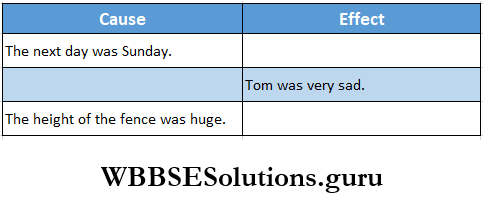
Answer:

2. Rearrange the following sentences in the correct order:
Answer:
2. Tom had to whitewash the fence.
4. Tom looked sadly at the large fence.
1. Tom could make very small white marks.
3. Tom looked sadly at the large fence.
3. Fill in the blanks with information from the text:
Question 1. It was Sunday. All the boys, in the village were ________
Answer: Free
Question 2. Like all the boys Tom wanted to go for ________
Answer: Swimming
Question 3. Tom’s aunt was making Tom ________
Answer: Whitewash the fense
Question 4. Sighing, __________
Answer: He put his brush into the whitewash
Question 5. Tom sat down feeling _________
Answer: Discouraged
4. Answer the following questions:
Question 1. What day of the week was it?
Answer: It was a Sunday.
Question 2. What was Tom holding when he came out of the house?
Answer: In one hand Tom held a long brush. In other, he carried a bucket full of whitewash.
Question 3. What colour mark did Tom make on the fence?
Answer: Tom made white color marks on the fence.
Grammar And Vocabulary: Do as directed
1. Change the narration:
Question 1. She said, “I went to school.”
Answer: She said that she had gone to school
Question 2. Ravi told me, “I will meet you tomorrow.”
Answer: Ravi told me that h6 would meet me the next day
2. Change the voice:
Question 1. He was elected secretary of the club.
Answer: Someone elected him secretary of the club.
Question 2. The mason is building the house.
Answer: The house is being built by the mason.
3. Underline the principal clause:
Question 1. Take the new dress for exchange.
Answer: Take the new dress
Question 2. Wait at the cafe till I come back.
Answer: Wait at the cafe
4. Underline the subordinate clause and state its kind:
Answer:
5. The cat chased the rat. (Underline the Subject).
Answer: The cat chased the rat.
6. The Sun rises in the East. (Underline the Predicate)
Answer: The Sun rises in the East.
7. The boy ______ (watch) television since morning.
Answer: The boy has been watching television since morning.
8. Make a meaningful sentence of your own:
Answer:
Find words from the unseen passage in Question 3 to match the following:
Answer:
Writing
Question 1. Write a letter to the Headmistress of your school informing her about your absence due to sickness.
Answer:
The Principal
XYZ School
Date: 7.9.22
Sub: Application of leave
Dear Sir,
I am a student in Class 8, Section B. I have been running a temperature of 100 degrees since last night. I am also having COVID symptoms.
I would like to request time off for at least 2 days. I will be testing for COVID and will keep you informed of the results.
Please consider my request for leave of absence starting today.
Sincerely,
Rohit Dutta
Question 2. Write a dialogue between two friends on India’s performance in Commonwealth 2022.
Answer:
Ravi: Hey, Rohan! Have you been watching the Commonwealth Games on TV.
Rohan: Of Course! I am glued to it when I come back from school. I quickly finish my homework and study so that I can catch up on it.
Ravi: Its amazing. Our medal tally is outstanding. Its unbelievable-we have 61 medals
Rohan: Agree. Out of the 61 medals, we have 22 Golds, 16 silvers, and 23 bronze medals. We have done so well this year. I am very proud of our team.
Ravi: My heart is bursting with pride. Even though sports activities have not been our strength in the past, we have come a long way and put India on the global map.
Rohan: I feel the same way. I hope we win many more medals in the future.
Reading Comprehension (Seen)
Read the passage below and do as directed:
The shadowy figure took him to an upper room, where a bright fire was burning. There was an armchair beside the fire. By the armchair was a small, oak table on which lay a battered old book bound in red leather. The shadowy figure put the candle on the table and departed silently.
Mortimer collapsed into the armchair and picked up the old book. With a shock, he realized it was the same book from his childhood, the book which contained the story of ‘Midnight Express’. Mortimer was greatly afraid. He turned the pages with trembling hands. He began to read. The story was about a man who in his childhood had read a book which contained a frightening picture.
Mortimer tried to grasp the strange cycle of events he was going through. He was filled with acute dread. “Who is the strange man who asked me into this cottage ?” Mortimer asked himself fearfully.
1. Complete the following sentences with information from the text:
Question 1. The shadowy figure led Mortimer to an __________
Answer: Upper room where a bright fire was burning
Question 2. On the oak table was __________
Answer: A battered old book bound in red leather
Question 3. The book contained the story ___________
Answer: of “Midnight Express”.
2. Write ‘T’ for True and ‘F’ for False statements. Give Supporting Sentences for each of your answers.
Question 1. Mortimer was very happy to read the book.
Answer: False
SS: With shock, he realised it was the same book form his childhood.
Question 2. Mortimer understood the strange cycle of events very easily.
Answer: False
SS: Mortimer tried to grasp the strange cycle of events he was going through
Question 3. Mortimer sat on an armchair confidently.
Answer: False
SS: Mortimer collapses into the armchair
3. Fill in the Chart with information from the text:
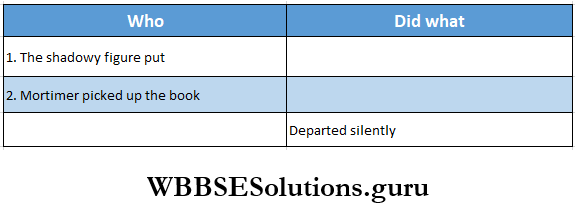
Answer:
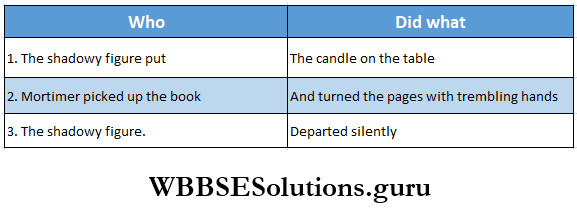
Read the poem and do as directed:
Someone came knocking
At my wee, small door,
Someone came knocking;
I’m sure-sure-sure;
I listened, I opened,
I looked to left and right,
But nought there was a stirring
In the still, dark night;
Only the busy beetle
Tap-tapping in the wall,
Only from the forest
The screech-owl’s call,
Only the cricket whistling
While the dewdrops fall,
So I know not who came knocking
At all, at all, at all.
1. Fill in the blanks with words given in the above poem:
Question 1. Someone is _________ at the door.
Answer: Knocking
Question 2. I _______ outside the window.
Answer: Looked
Question 3. A cute __________ was trying to climb the wall.
Answer: Bettle
Question 4. I saw a huge tiger in the __________
Answer: Frest
Question 5. I was surprised to see my sister when I ________ the door.
Answer: Opened
Reading Comprehension (Unseen)
Read the following passage and answer the questions given below:
Tansen had a high position in Akbar’s Court. This was not liked by many. They requested Akbar to ask Tansen to sing Deepak Raag. It was a wonderful Raag. When sung properly, it makes the atmosphere so warm that gradually the ‘Deepak’ or lamp will catch fire and ultimately the singer himself will die out of immense heat. Akbar was ignorant of the effect of the Raag. So he ordered Tansen to sing ‘Deepak’. Tansen knew that it was almost a death sentence for him. But he could not disobey the emperor. Fortune favours the brave. He was not born to turn back at unseen danger. He taught his daughters. Saraswati and Rupavati, the disciples of Haridas Swami, the Raag ‘Meghamalhar’ that brings rain. On the fateful day, Tansen began to Alaap and the air became warm. As the tempo of the raag was created, the birds fell down dead. People cried in horror as flames shot up everywhere and unlit lamps burnt. Tansen himself was gasping for breath. At the moment Saraswati and Rupavati began singing the Raag ‘Meghamalhar’. The rain came down and everything was all right again.
1. Answer the questions:
Question 1. Who was Tansen?
Answer: Tansen had a high position in Akbar’s court.
Question 2. What was so special of Raag ‘Deepak’?
Answer: When sung properly, Raag Deepak makes the atmosphere so warm that gradually the ‘Deepak’ or lamp will .catch fire and ultimately the singer himself will, die out of immense heat.
Question 3. What were the names of Tansen’s daughters?
Answer: Saraswati and Rupavati were the names of Tansen’s daughters.
2. Complete the sentence with information from the text:
Question 1. Akbar was ignorant __________
Answer: Akbar was ignorant of the effect of the Raag
Question 2. Fortune _______
Answer: Fortune favours the brave
Question 3. Raag ‘Meghamalhar’ was sung by _________
Answer: Raag ‘Meghamalhar’ was sung by Tansen’s daughters—Saraswati and Rupavati
3. Write True or False:
Question 1. Tansen knew that to sing ‘Deepak’ was almost a death sentence for him.
Answer: True
Question 2. Raag “Meghamalhar’ brings rain.
Answer: True
Question 3. Tansen’s daughters were the disciple of Harigopal Swami.
Answer: False
Grammar And Vocabulary
1. Fill in the blanks with proper articles and prepositions:
Question 1. He goes _____ church every sunday in _______ morning ________ rickshaw.
Answer: He goes to church every sunday in the morning in a rickshaw.
Do as directed:
Question 1. Mother said to her daughter, “Why are you crying?” (Change the narration)
Answer: Mother asked her daughter why was she crying.
Question 2. He says, “I am happy.” (Change the narration)
Answer: He said that he is happy:
Question 3. The girl knows it. (Change the voice)
Answer: It is known by the girl
Question 4. I have lost my book. (Change the voice)
Answer: My book has been lost
Question 5. A strong wind ________ (blew, is blowing, has been blowing) since last night. (Fill in the blank with the correct verb)
Answer: Has been blowing
Question 6. They ________ (have met, met, were meeting) him last week.
Answer: Met
Question 7. Do not disturb me, otherwise I won’t help you. (Change into a complex sentence)
Answer: If you disturb me, I won’t help you.
Question 8. He went to inspect what had happened. (Change into a simple sentence)
Answer: He went to inspect the happenings
Question 9. You will do well in the examination I am sure of it. (Join the sentence)
Answer: I am sure that you will do well in the examination.
Question 10. That is the house. I once lived there. (Join the sentence)
Answer: That is the house I lived in once.
2. Find out the word which means opposite to:
Answer:
Writing
Question 1. Write an autobiography of a Smartphone.
Answer:
Autobiography of a SmartPhone
I represent the discovery of the 21st century. I am a replacement of a number of instruments! of the 20th century-laptop, phones, TV, radio, music player, alarm, calendars, calculators, fax machines, banking just to name a few. Compared to the size of these instruments, I am tiny. However, I can do it! I everything that these instruments can do, and even more.
The best part about me is I can fit in a pocket and need little space. I am in the hands of everyone, from different walks of life-automobile drivers to a rocket scientists. I am the pulse of everyone’s life and I am proud that I can be of use and help humanity.
Question 2. You have just joined a new school. Write a page in your diary about the experience of shifting from familiar surrounding to new one.
Answer:
16.10.2022
Today I started 8th grade in a brand-new school. Since father got transferred at his job, we! I had to shift base from Kolkata to Uttarpara. I was excited and nervous at the same time. I met my I teachers and all of them introduced me as the new kid in class and made me feel welcome. I have not made any friends yet, but one of my classmates, Vinay, asked me to join him in a basketball game on the playground during lunch. I was very happy to be able to play with them. He introduced me to his friends as well and they were really nice to me.
Reading Comprehension (Seen)
Read the passsage below and do as directed:
The next year the war came, in which I was engaged for five years. With the war behind me, I had a great desire to breathe a little pure air, and I set out again along the trail through that deserted country. The land had not changed. Ever since the day before, I had been thinking about the shepherd who planted trees. Ten thousand oaks, I had said to myself, must really take up a lot of space.
When I met Elzeard Bouffier this time, I found that the war had not disturbed him at all. He had continued with his planting. The oaks of 1910 were now ten years old and were taller than me and than him. The scene was impressive I was actually speechless and we passed the whole day in silence, walking through. his forest. It was three sections, eleven kilometers long overall and, at its widest point, three kilometers wide. When I considered that this had all sprung from the hands and from the soul of this one man-without technical aids-it struck me that men could be as effective as God in domains other than destruction.
1. Choose the correct alternative:
Question 1.The war continued for:
Answer: 2. Five years
Question 2. When the narrator met Elzeard Bouffier after 10 years he:
Answer: 2. Continued with his planting
Question 3. The oaks of 1910 were now old.
Answer: 2. 10 years
2. Complete the following sentences with information from the text:
Question 1. After the war, the narrator had a great desire to ________
Answer: Breathe a little pure air.
Question 2. Ever since the day before, the narrator had been thinking _______
Answer: About the shepherd who planted trees.
Question 3. The oak trees planted in 1910 were now _________
Answer: 10 years old.
3. Answer the following questions:
Question 1. What was the realisation of the author after seeing the oak forest?
Answer: After seeing the vast oak tree forest, the author realised that men could be as effective as God in domains other than destruction.
Question 2. How did the war affect Elzeard Bouffier?
Answer: The war had not disturbed him at all. He had continued with his planting.
Read the poem and do as directed:
Someone came knocking
At my wee, small door;
Someone came knocking;
I’am sure sure sure
I listened, I opened,
I looked to left and right,
But nought there was a stirring
In the still, dark night;
Only the busy beetle
Tap-tapping in the wall,
Only from the forest
The screech-owl’s call,
Only the cricket whistling
While the dewdrops fall,
So I know not who came knocking,
At all, at all, at all.
1. Fill in the following chart with information from the text :
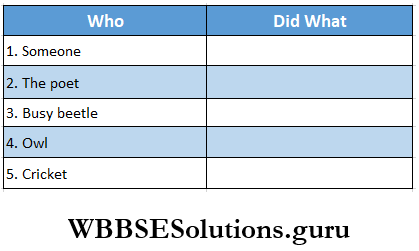
Answer:
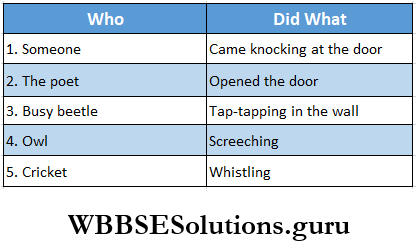
Reading Comprehension (Unseen)
Read the passage and do as directed:
The Kimono is the national dress of Japan worn by both men and women. The word Kimono means ‘clothing’ or literally ‘something to wear’ and it has been just that for the Japanese for several hundred years. With changing times though, the people of Japan now wear the Kimono only on special or ceremonial occasions.
Kimonos are ‘T’ shaped robes that fall up to the ankles. The garment has a flat collar. and wide sleeves that fall to the wrists. It is always worn left side overnight and held together at the waist by a broad sash called ‘obi’. Most women’s Kimonos are one standard size and tucked in to fit the weaves. However, very tall and large-sized women have to have their Kimonos stitched to their size. Men wear a shorter version of the women’s Kimono, called haori, along with hakama or loose-fitting pants.
These days a kimono can cost upto 10,000 dollars! Also, a silk one is but normally more expensive than a cotton one. Today, in Japan, more women than men wear kimonos but only on special occasions like tea ceremonies, weddings, and funerals.
1. Write whether the statements are True or False:
Question 1. Kimono is national dress of India.
Answer: False
Question 2. Kimonos are ‘T’ shaped robes that fall up to the ankles.
Answer: True
Question 3. Men’s kimono in Japan is called haori.
Answer: True
2. Fill in the blank with word from the text:
Question 1. The word Kimono means _______
Answer: Clothing
Question 2. The kimono has a ________ collar.
Answer: Flat
Question 3. The broad sash tied at the waist is called __________
Answer: Obi
3. Choose the correct answer:
Question 1. The national dress of Japan is called-
Answer: 3. Kimono
Question 2. The kimono is worn by-
Answer: 1. Both men and women
Question 3. Very tall women need to get their kimonos
Answer: 2. Stitched up
4. Answer the questions:
Question 1. What is the national dress of Japan?
Answer: The national dress of Japan is Kimono.
Question 2. What is the sash of a Kimono called?
Answer: The sash of the Kimono is called ‘obi’
Question 3. Nowadays, when does the men and women wear the kimono?
Answer: Nowadays a kimono is worn on special occassion like tea ceremonies, wedding and funerals
Grammar And Vocabulary Do as directed:
Question 1. Princess September was a princess. She was very unhappy. (Join using adjective clause)
Answer: Princess September who was a princess was very unhappy
Question 2. Travelling by train gives me great pleasure. (Underline the phrase).
Answer: Travelling by train.
Question 3. He is poor. He is honest. (Join the sentence)
Answer: He is poor but honest.
Question 4. The boy is good. I know the boy (Join the sentence)
Answer: I know the good boy.
Question 5. Mother said to me, “Respect the elders.” (Change the narration)
Answer: Mother advices me to respect the elders
Question 6. “How selfish I had been !” said the giant. (Change the narration)
Answer: The giant lamented that he was very selfish.
Question 7. They laughed at us. (Change the voice)
Answer: We were laughed at by them
Question 8. Let him buy a new car. (Change the voice)
Answer: Let a new car be bought by him
Question 9. The birds are flying in the sky. (Underline the main clause)
Answer: The birds are flying in the sky.
Question 10. The man jumped over the fence. (Underline the subordinate clause)
Answer: The man jumped over the fence..
Question 11. They ________ (work) since Monday last. (Fill in the blank with proper form of verb given in the bracket)
Answer: They have been working since Monday last.
Question 12. A good boy ________ (obey) his parents. (Fill in the blanks with proper form of verb given in the bracket)
Answer: A good boy obeys his parents.
Fill in the blanks with appropriate articles and prepositions:
Question 1. I went _____the market to buy ______ apple and _____ orange _____ puja.
Answer: I went to the market to buy a apple and an orange for puja.
Find out words which mean:
Answer:
Writing
Question 1. Write an autobiography of a river.
[Hints: broad and mighty river-born in the Himalayas – flow to meet the mighty ocean – useful to many – cause destruction when it rains heavily.)
Answer:
As Lord Tennyson rightly said, ‘Men may come and men may go, but I go on forever’. For centuries and through civilizations, I have flown from the tall Himalayas to the mighty oceans. I have been the cradle of civilizations, providing water for agriculture, transport for their boats, and fertile soil on the banks to grow their crops. I might flow quietly, but, with heavy rains, my quiet flow can turn into a huge flood and cause mass destruction. I signify both birth and death, and that is why I am worshipped as a Mother and a Holy river.
Question 2. Write a paragrah on “Your Hobby”.
[Hints: hobby means an activity done with pleasure – during our leisure – your hobby – when you do it – how it benefits you).
Answer:
My favourite passion or hobby is photography. I like it because I can freeze a moment in time. Earlier, I used to carry a big camera that my father bought for me, but now, my tool is my Smart Phone. I can take as many pictures as I want, share them with my friends and family in a matter of seconds. I would love to travel across the world and explore my passion.
Prepositioh কোনো Noun বা Pronoun-এর পূর্বে বসে তার সাথে Sentence-এর অন্য পদগুলির সম্পর্ক বুঝিয়ে দেয়।
নীচের উদাহরণগুলি দেখো :
He came to me
Put it on the table.
Preposition-গুলিকে মোটামুটি নিম্নলিখিতভাবে ভাগ করা যেতে পারে :
1. Prepositions of Time (at, in, on, within, from, to, with, since, for, during, after)
Read And Learn More WBBSE Class 8 English Functional Grammar
ব্যবহারের তারতম্য :
In, within
সময় নির্দেশ করতে in = at the end of
Examples:
After, In
“পরে” অর্থে “after” অতীত কাল নির্দেশ করে, এবং “in” ভবিষ্যৎ কাল নির্দেশ করে।
Examples:
Since, For, From
হতে বা ধরে অর্থে (তিন দিন ধরে পীড়িত, সোমবার হতে আসব) এই তিনটি Preposition-ই ব্যবহৃত হয়। কিন্তু :
Examples:
নীচের diagramটি লক্ষ্য করে :
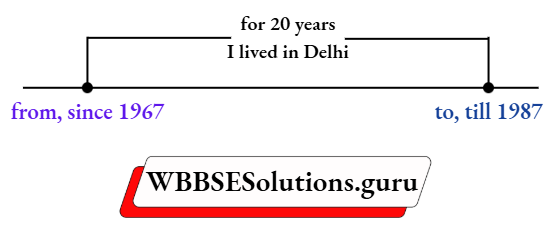
এইবার নীচের Sentence-গুলি দেখো :
Examples:
In, On, At
মাস, কাল, ঋতু বোঝাতে in ব্যবহৃত হয়। যথা :
Examples:
তারিখ ও বারের নামের পূর্বে on ব্যবহৃত হয়। যথাঃ
He came here on 7th March. Nupur will go to Kolkata on Sunday.
নির্দিষ্ট সময় (point of time) বোঝাতে at ব্যবহৃত হয়। যথা ঃ
I shall go there at 5 p.m. Please come here on Monday at 4 p.m.
সময়ের ব্যাপক অর্থে in বসে। যথা ঃ
I shall see you on October 5th / on Sunday on Christmas day / on Saturday afternoon/ at 6 o’clock in the afternoon.
| WBBSE Class 8 English Functional Grammar | WBBSE Class 8 English Reading Skills |
| WBBSE Solutions For Class 8 English | WBBSE Solutions For Class 8 Maths |
মনে রেখো ‘yesterday’; ‘today’s ‘tomorrow ‘word-গুলির পূর্বে কোনো preposition বসে না। যেমনঃ
I went there yesterday. Go there tomorrow.
নীচের ছবিটি লক্ষ্য করো :
IN → 1992
IN → February
ON → 3rd
AT → 1 P.M
2. Prepositions of Place (at, in, on, above, over, under)
ব্যবহারের তারতম্য :
Above, Over
Example:
At, In
At ছোটো স্থানের পূর্বে এবং in বড়ো স্থানের পূর্বে বসে।
Examples:
In, Into
কোনো কিছুর মধ্যে বা ভিতরে থাকা বোঝালে in এবং বাইরে থেকে ভিতরে গতি বা অবস্থা বা আকারের পরিবর্তন বোঝালে into হয়।
Examples:
কিন্তু come in (come into হয় না)।
3. Prepositions of Movement and Directions (in, at, from, to, into)
At or To
নীচের ছবিতে at ও to-এর ব্যবহারের পার্থক্য লক্ষ্য করো। Aggression বা আক্রমণাত্মক অর্থে’ at ও coop- eration বা সহযোগিতা অর্থে to ব্যবহৃত হয়।
Don’t throw it at me—আমার দিকে এটা ছুড়ো না।
Throw it to me—আমাকে এটা ছুড়ে দাও।
Shouting at him—-বকাবকি করা, গালি দেওয়া

Shouting to him – আন্তরিকভাবে অভিনন্দন জানানো।
4. Prepositions of State or Manner (in, by, with)
(from, of)
from: Wine is made from grapes.; Steel is made from iron ores.
Here the matter has lost its original composition in the process of manufacture. (পদার্থের মূল গঠনের পরিবর্তন হয়েছে।
of: The table is made of wood; The bridge is made of steel.
Here the material remains unchanged in the process of manufacture. (এখানে প্রক্রিয়াকরণে পদার্থের মূল গঠনের কোন পরিবর্তন হয়নি।)
5. Prepositions of Agent or Method (in, with, in)
by:
with: with his own hand, written with a pen, beaten with a stick.
in: written in ink or in pencil.
ব্যবহারের তারতম্য :
By, With
By যে কাজ করে (agent বা doer) তাকে নির্দেশ করে ; with যা দ্বারা কিছু করা হয় তাকে নির্দেশ করে।
Examples:
নীচে আরও কিছু Preposition-এর বিভিন্ন প্রকার ব্যবহার দেখানো হল :
At
By
For
In
Of
On
Over
Under
With
Between
Among
সাধারণত দু’য়ের মধ্যে অর্থে between ও দু’য়ের অধিকের মধ্যে অর্থে among ব্যবহৃত হয়।
ইংরাজিতে কোন্ শব্দের পর রীতিসঙ্গত (appropriate) কী Preposition বসবে তা ঠিক করা আছে। এটা Idiom বা বাক্যের শিষ্ট প্রয়োগের বিষয়। নীচে কয়েকটি উদাহরণ
Abide by (a decision)– Abide by this decision.
Abide in, at (a place)– I shall not abide long in Kolkata (or at Ranaghat). Absent from I was absent from the class.
Accompanied by (a person), with (a thing)- I was accompanied there by Jadu. He is suffering from fever accompanied with a headache.
According to, (in) accordance with – According to (or, In accordance with) your advice, I went there.
Read And Learn More WBBSE Class 8 English Functional Grammar
Account for (কৈফিয়ত দেওয়া ) – You shall have to account for your conduct.
Accused of – He was accused of theft.
Acquit (one) of (a charge) – He was acquitted of this charge.
Acquainted with I am acquainted – with him.
Affection for; affectionate to He has affection for me. He is affectionate to me.
Afraid of – I am afraid of him.
Agree with (a person), on (a point), to (a proposal) – I agree with him on that point. He agreed to the proposal.
Aim at – The hunter aimed at the tiger.
Alarmed at – We were alarmed at the news.
Ambition for; ambitious of He has no ambition for fame. He is not ambitious of fame.
Angry with (a person), for (doing something), at, about (a thing)-He was angry with me for my being there. He was angry at or about my failure.
Anxious about, for – I am anxious about the result. He is anxious for news.
Appeal to, against, for He appealed to me for help. We shall appeal against your decision.
Appetite for – I have no appetite for food
Apply to, for – He applied to the bank for a loan (ধার).
Appointed to – He was appointed to (a post).
Ashamed of – He is ashamed of his conduct.
Ask of (a person) – I asked a favour of him.
Ask (a person) for (a thing)- I asked him for a favour.
Astonished at – I was astonished at the news.
Attach to – Attach this slip to the letter.
Attacked by (a person), with (fever)– He was attacked by robbers. He was attacked with fever.
Attend to – Attend to your father.
Attend upon – I attend upon the patient (রোগী).
Attention to – Pay attention to your son.
Avail (oneself) of – He availed himself of my help.
Aware of – I am aware of the fact.
Beg (a person) for (a thing)- He begged me for the favour.
Beg (a thing) of (a person)- He begged the favor of me.
Belong to – This book belongs to me. Beware of -Beware of the enemy.
Bestow on – He bestowed a favour on me.
Blind of, in (an eye) to (a thing) – He is blind of or in an eye. He is blind to his son’s faults.
Boast of – Do not boast of wealth.
Born of – He was born of poor parents.
Care for Careful of, (take) Care of – He does not care for me. Be careful of your health. Take care of your health.
Change of – There was a change of colour in the sky.
The charge against (noun or pronoun) – What is the charge against him?
Charge (verb) a person with – He was charged with theft. The police charged him with theft.
Close to – His house is close to mine.
Compare with, to (ভিন্ন প্রকৃতির জিনিসের মধ্যে) – Compare Akbar with Aurangzeb. Anger is compared to fire.
(In) Comparison with – He is rich in comparison Differ from, in, with, on–This thing differs from with his brother.
Complain to (a person), against (another), of about, (a thing) – The boys complained to the Headmaster against him (or, about his conduct). He complained of headache.
Composed of – What is water composed of?
Confident of – I am confident of success.
Consist of, in – This sentence consists of three clauses. Happiness consists in contentment. Contrary to – You acted contrary to my advice.
Control over – He has no control over his son.
Convinced of – I am convinced (satisfied) of your innocence.
Cure (a person) of (a disease); a cure (noun) for (a disease) He is cured of his disease. There is no cure for this disease. Deal in, with, by-He deals in rice. He deals roughly with his customers. He dealt ill by me.
Depend on – Always depend on God.
Deprive of – I shall not deprive you of your share.
Desire for, desirous of – I have no desire for wealth. I am not desirous of wealth. Despair of – He despairs of success.
Devoid of – The boy is devoid of (without) common sense.
Devoted to – He is devoted to me.
Die of (a disease); by (violence), from (a cause), for (something) – He died of cholera; or, by poison; or, from overwork; or, for his country.
Differ from, in, with, on – This thing differs from that in color. I differ with You on this point.*
Difference between – There is no difference between the two.
Different from – This thing is different from that.**
Digress (verb), degression (n), from – The speaker digressed from – the main topic. We did not like the speaker’s digression from the main topic.
Inquired of, about – He inquired of me about the matter.
Discussion with – I had a discussion with him in Inquired for, after (a person)- He inquired for or this matter.
Distinguish between (two), (one) from (another) – I cannot distinguish between the two. Try to distinguish right from wrong.
No money is due to him. Dull of, at – He is dull of hearing. He is dull (weak) or Physics.
Eager for, after, about (COD) – He is eager for or after fame. He is eager about the result.
Escape from – There is no escape from death.
Familiar with, to – I am familiar with him. This is familiar to me.
Fix to, on, in – Fix this stamp to letter. He fixed his eyes on me. The idea became fixed in his mind.
Fond of, fondness for – He is fond of me. He has great fondness for me.
Full of, filled with ― The cup was full of (or, was filled with) milk.
after me (আমার সম্বন্ধে জিজ্ঞাসা করল) Inquire into – I shall inquire into the matter.
Insist on – He insisted on my doing this.
Interfer with (a person), in (a thing) – Don’t interfere with me in my business.
Invite to I invited him to the meeting.
Jealous of – He is jealous of my fame.
Lame of or in – He is lame of or in one leg.
Laugh at – Do not laugh at a lame man.
Live on, for, by – Cows live on grass.
Live for a high ideal. Live by honest means.
Long for – I long for peace.
Married to – Ram was married to Sita.
Necessary for, to Industry is necessary for or to success.
In (need) of – I am in need of money. (Any or no) need for Have you any need for money?
Glad at, of – I am glad at his success.
I am glad Object to — I object to the proposal of his help.
Grateful to (a person) for (a thing)– I am grateful to him for his help.
Guilty of He is guilty of theft. Hanker after — He hankers after fame.
Hope of, for; hopeful or hopeless of – I have no hope of success. He hopes for success.
I am hopeful or hopeless of success. Ignorant of – I am ignorant of the matter.
Ill of, with (fever)- He is ill of or with fever. Include in – His name is included in the list.
Innocent of – He is innocent of the crime.
Objection to, against (a proposal), against (a person)– I have no objection to or against the proposal (or, against him).
Obliged to, for – I am obliged to you for your help.
| WBBSE Class 8 English Functional Grammar | WBBSE Class 8 English Reading Skills |
| WBBSE Solutions For Class 8 English | WBBSE Solutions For Class 8 Maths |
Owe to – I owe my all to him. Part from, with – It is painful for a mother to par from her son. I cannot par with (do without) this book.
Pleased with (a man) at his conduct – I am please with him at his conduct.
Popular with, for – He is popular with everybod for his goodness.
Prefer to – I prefer hea to wealth.
Present (a thing) to (a person), present (a person) with (a thing) – I presented the book to him. I presented him with the book.
Preside over – He presided over the meeting.
Prevent from – He prevented me from going.
Pride in, proud of He takes pride in his son. He is proud of his son.
Proof of, against – This is a proof of his honesty.
He is proof against temptation.
Result of (noun) – The result of the examination is not yet out.
Rid of – Get rid of your bad habit.
Rob (a man) of (a thing)- He robbed me of my purse.
Satisfied with – He was satisfied with me.
Short of – I am short of funds.
Similar to – This thing is similar to that.
Stare at something ( একদৃষ্টে তাকানো ) – She is staring at the moon.
Prohibit from – He prohibited me Stare (a man) in (the face) – He is staring me in from going there.
Refer to (উল্লেখ করা ; বিচারের জন্য প্রেরণ) ) – Refer the matter to him for enquiry.
Reference to – This has a reference to your previous letter.
Regard for – I have no regard for him.
(In or with) regard to – In or with regard to that matter, I have nothing to say.
Rely on – You may rely on my word.
Repent of – I repent of my conduct.
Remind (a person) of – He reminded me of my promise.
Respect for – I have no respect for him.
(In) respect of – He is senior to me in respect of (সম্বন্ধে) age.
(With) respect to – We had a talk with respect to that matter.
Respite from – I need respite from heavy work.
Respond to – Respond to the roll-call the face.
Suffer from, for – He is suffering from fever. He suffered for his misdeeds.
Supply (a thing) to (a person), supply (a person) with (a thing) – He supplied food to the boys. He supplied the boys with food.
Sure of I am sure of success. Sympathy for, with- I have no sympathy for, or with him in his misery. I feel no sympathy with his misery.
Sympathise with, in – I sympathize with him in his misery.
Taste of – The taste of this fruit is sweet.
Taste for – I have no taste for music.
Tired of (waiting), by (a walk), or with (exertion)- I am tired of waiting for you.
I am tired by the long walk, or with exertions. True to – Be true to your words.
Trust in (God) – Trust in God.
Trust (a thing) to (a person); Trust (a person) with (a thing) (ভারার্পণ করা) — You may trust the work to me or trust me with the work.
Vain of – She is vain of her dress.
Responsible to, for – I am responsible to (In) view of — In view of what you him for my actions.
Result (verb) from (a cause), in (an effect)
Misery results from vice. Vice results in misery. say, I pardon you this time. (With a) view to – He came here with a view to getting my approval.
Wait for (a person) at (a place)– We waited for you at the corner.
Wait upon – She waited upon the guests.
Want of-There is no want of doctors here. Worthy of – He is worthy of praise.
নীচের sentence গুলি দেখো :
Kamala has put on a new dress — কমলা একটি নতুন পোষাক পড়েছে।
He gets up early in the morning everyday—সে প্রতিদিন ভোরে উঠে।
I came across him in the street-তার সাথে আমার হঠাৎ রাস্তায় দেখা হল।
Read And Learn More WBBSE Class 8 English Functional Grammar
লক্ষ্য করো, প্রত্যেকটি sentence-এ Verb-এর পরে একটি Preposition অথবা Adverb বসে যুক্ত শব্দ দুটি – একত্রে অন্য একটি অর্থে ব্যবহৃত হয়েছে।
Put on — পোষাক পরা
Get up—উঠে পড়া
Come across—হঠাৎ সাক্ষাৎ হওয়া
এইরূপ, যখন কোনো Verb একটি Preposition অথবা Adverb-এর সঙ্গে বসে একত্রে অন্য অর্থে ব্যবহৃত হয় তখন তাদের Phrasal Verb বা Group Verb বলা হয়।
| WBBSE Class 8 English Functional Grammar | WBBSE Class 8 English Reading Skills |
| WBBSE Solutions For Class 8 English | WBBSE Solutions For Class 8 Maths |
নীচের ছকটি দেখো :

কিছু Phrasal verb বা Group verb-এর উদাহরণ দেওয়া হল।