WBBSE Solutions For Class 8 English Reading Skill Seen Lesson 7 A Kings Tale

Reading Skill Seen Lesson 7 A Kings Tale

Word meanings:

Part 1

protector (প্রোটেক্টর)-রক্ষক; tending (টেন্ডিং) — পালন করে; flocks (ফ্ল) – পশুর পাল / দল; tilling (টিলিং)—চাষ করে ; heir (হেয়ার ) — উত্তরাধিকারী; royal throne – রাজ সিংহাসন; opponents (অপোনেন্টস্)— প্রতিদ্বন্দ্বীরা, বিরোধীরা; seize (সীজ্ ) — দখল করা; counsellors (কাউন্সেলর)— পরামর্শদাতারা; prophet (প্রফেট্)— ভবিষ্যদ্বক্তা ; knight (নাইট্)— যোদ্ধা; loyal (লয়াল্) – বিশ্বস্ত; wrapped (রা)—জড়ানো; scarlet (স্কারলেট্)— উজ্জ্বল লাল রঙের; bring up (ব্রিং আপ) – লালন-পালন করা; obey (ওবে) — মেনে চলা; broke out — সুরু হল; passing away—মারা যাওয়া; barons – অভিজাতরা; plotting (প্লটিং) – ষড়যন্ত্র করা; lawlessness (ললেনেস্)—অরাজকতা ; robbed (রবড্)—লুটতরাজের শিকার হওয়া।

Part 2

handsome (হ্যান্ডসাম)—সুশ্রী; torn (টন)—ছিন্নভিন্ন; rivalry (রাইভারি) — শত্রুতা, প্রতিদ্বন্দ্বিতা; longed for —চেয়েছিল; prosperity (প্রপ্যারিটি) — সমৃদ্ধি; festivity (ফেটিভিটি) — উৎসব; all around — চারিদিকে; frightened (ফ্রাইটেড্)—ভীত; magnificent (ম্যাগনিফিসেন্ট্) — জমকালো; inscribed (ইন্‌স্ক্রাইব) – খোদিত; right of birth— জন্মাধিকার; jostled (জলড্) –ধাক্কাধাক্কি করল ; succeeded (সাক্সীডেড্) – সফল হয়েছিল ; disappointed (ডিসাপয়েন্টেড)—হতাশ হওয়া; demanded (ডিমান্‌ডেড) – দাবি করল; craftsmen (ক্রাফ্টমেন্)—কারিগরগণ ; slender (স্লেন্ডার্)—ছিপ্‌ ছিপে; hailed (হেইড্) – অভিবাদন জানাল; secure (সিকিওর) — সুনিশ্চিত করা; concerned (কন্সার্নড্)—চিন্তিত; humblest (হাম্বলে)—দীনহীনতম; bracelets (ব্রেসলেট্স)—বালা; rubies (রুবিজ্‌)—চুনিগুলি ; emeralds (এমারেল্স্) – পান্নাগুলি

Read And Learn Also WBBSE Class 8 English Reading Skills

Part 3

fearless (ফিয়ারলেস্)—নির্ভীক ; protect (প্রোটেক্ট) — রক্ষা করে; possess (পসেস্) – অধিকারী হওয়া; enchanted (এচ্যান্টেড)—মায়াবি; mysterious (মিস্টিরিয়াস্)— রহস্যময়; personal (পারসোনাল)—ব্যক্তিগত; benefit (বেনিফিট্ —সুবিধা, স্বার্থ, gift (গিট্)—উপহার; greedy (গ্রীডি)— লোভী ; gilded (গিলডেড্)–ঝলমলে ; pavilion (প্যাভিলিয়ন্)—মণ্ডপ; crimson (ক্রিসন্)—টক্টকে লাল; carved (কার)–কারুকার্য্য করা; gathered (গ্যাদার্ড্) —জমায়েত হত; vows (ভাওস্)—অঙ্গীকার; hazardous (হ্যাজারডাস্) –ঝুঁকিপূর্ণ; adventures (অ্যাডভেনচার) – দুঃসাহসিক অভিযানগুলি; perished (পেরিশড্) — প্রাণ হারিয়েছিল ; trusted (ট্রাটেড্)—বিশ্বস্ত ; disappeared (ডিস্যাপিয়ার্ড)— অদৃশ্য হয়ে গেল; barge (বার্জ) –বজরা; twilight (টুইলাইট্)— গোধুলি ; tearful (টিয়ারফুল – অশ্রুপূর্ণ; goodbye (গুড্‌বাই)— বিদায়।

WBBSE Solutions For Class 8 English Reading Skill Seen Lesson 7 A Kings Tale

Reading Skill Seen Lesson 7 A Kings Tale Examples

Read the texts below and do as directed.

Question 1. Many hundreds of years ago, England was ruled by a king called Uther-Pendragon. The king, who was a friend and protector to all his people, was fair to everyone. The people of Britain lived in peace and happiness, tending their flocks and tilling their fields.

King Uther-Pendragon had married the beautiful Lady Igraine and had a son. This child was the heir to the royal throne.

The king and the queen died soon after the baby boy was born. It was a difficult time. Many of the king’s oponents were looking to seize the throne. King Uther-Pendragon had two wise counselors- Merlin, a prophet and a magician, and the brave knight, Sir Ulfius. They were greatly trusted by the royal family. When the king and the queen were no more, the two counselors met Sir Ector the Trustworthy, a loyal subject of the king, on a cold and windy midnight. They placed in his hands a baby wrapped in a scarlet cloak. Merlin said, “We order you and your wife to bring up this child as though he were your own son.”

“The boy is to be called Arthur,” Sir Ulfius said. Sir Ector, being a true knight asked no questions and promised to obey his late king’s counsellors.

As Merlin and Sir Ulfius had feared, trouble broke out in Britain after the passing away of the king. The barons were fighting among themselves and plotting to capture the throne. Britain was in the grip of lawlessness. Travelers were regularly robbed. The peasants were unhappy.

WBBSE Class 8 English Functional GrammarWBBSE Class 8 English Reading Skills
WBBSE Solutions For Class 8 EnglishWBBSE Solutions For Class 8 Maths


1. Answer the questions below:

  1. Who was the king of England and how did he treat his people?
  2. What happened to Britain soon after the death of king Uther-Pendragon?
  3. Who were Merlin and Ulfius?
  4. What did they do for the king’s orphan child?
  5. How did Sir Ector respond to the counselor’s order?

Answer:

  1. Uther-Pendragon was the king of England, and he was a friend and protector to all his people and was fair to everyone.
  2. Soon after the death of king Uther-Pendragon, trouble broke out in Britain. The barons started to fight among themselves and plot to capture the throne.
  3. They were king Uther’s two wise counselors greatly trusted by the royal family. Merlin was a prophet and magician and Sir Ulfius was a brave knight.
  4. After passing away of the king and the queen, they took the king’s orphan baby to Sir Ector, a loyal subject of the king, and ordered him and his wife to bring up the child as if he were their own son.
  5. Sir Ector asked no questions and promised to obey the counselor’s order.

2. Choose the correct answers from the alternatives given:

Question 1. During the reign of King Uther-Pendragon, the people of Britain lived a-

  1. Peaceful life,
  2. Disturbed life,
  3. Unhappy life.

Answer: 1. Peaceful life

Question 2. Lady Igraine was Uther-Pendragon’s-

  1. Mother,
  2. Wife,
  3. Sister.

Answer: 2. Wife

Question 3. The royal baby was to be brought up by-

  1. Merlin,
  2. Sir Ulfius,
  3. Sir Ector.

Answer: 3. Sir Ector

Question 4. Sir Ulfius was a-

  1. Knight,
  2. Prophet,
  3. Merchant.

Answer: 1. Knight

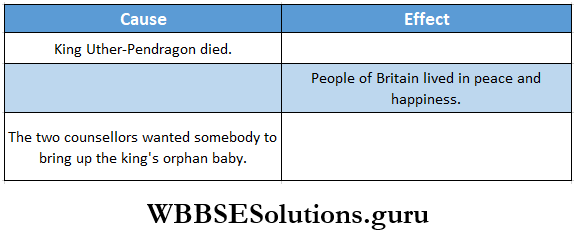
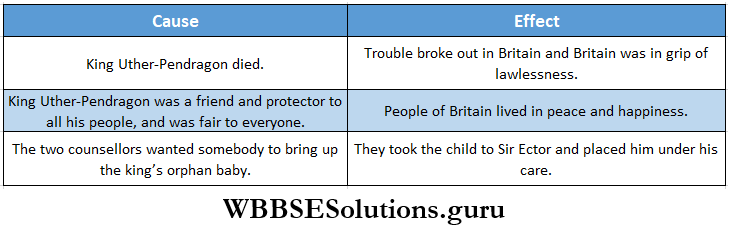
3. Fill in the chart with information from the text.

WBBSE Solutions For Class 8 English Reading Skill Seen Lesson 7 A Kings Tale Fill In The Chart With Information From The Test

Answer:

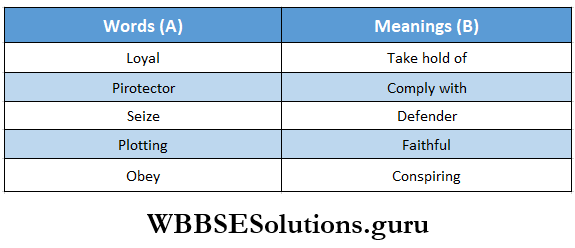
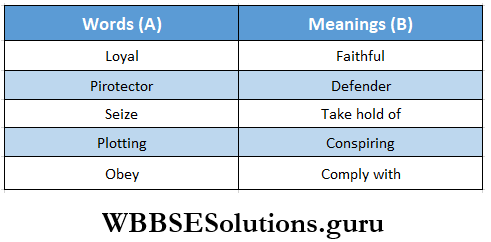
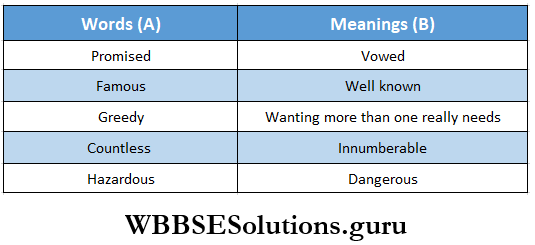
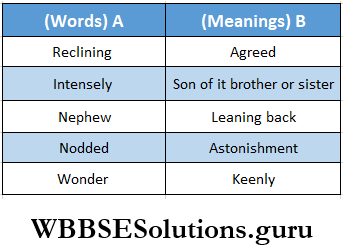
4. Match the words in A with their meanings in B.

WBBSE Solutions For Class 8 English Reading Skill Seen Lesson 7 A Kings Tale Match The Words In A With Their Meaning In B

Answer:

WBBSE Solutions For Class 8 English Reading Skill Seen Lesson 7 A Kings Tale Match The Words In A With Their Meaning In B Answer

Question 2.

In the home of Sir Ector, Arthur, the son of the late king, was spending his boyhood in happiness and safety. As he grew older, he became gentle, strong, handsome and good like his father Uther-Pendragon.

Eighteen years passed. Britain was torn by bitter rivalry. None of the fighting barons had managed to become the king. The people longed for the old days of peace and prosperity under Uther-Pendragon.

It was Christmas time, a time of festivity. But all around Britain, people were hungry, cold and frightened. One day, in a churchyard, people found a large stone on which was fixed a magnificent sword.

Upon the stone, in gold letters, was inscribed, “Whoever pulls out this sword is by right of birth, the king of England.” Immediately, the eager barons who longed to become the king,, jostled among themselves to lift the sword. None succeeded. The sword remained fixed to the stone.

1. Answer the questions below:

  1. Describe the royal baby as he grew at the home of Sir Ector.
  2. What was written upon the stone on which the sword was fixed?
  3. What was the condition of Britain for eighteen years after King Uther-Pendragon had passed?
  4. What did the people long for?

Answer:

  1. As the royal baby started growing older at the home of Sir Ector, he became gentle, strong, handsome, and good like his father Uther-Pendragon.
  2. Upon the stone was written in gold letters the words “whoever pulls out this sword is by right of birth, the king of England.”
  3. For eighteen years after the King Uther-Pendragon had passed away, Britain was torn by bitter rivalry among the barons fighting to become the king.
  4. The people longed for the old days of peace and prosperity that prevailed during the time of Uther- Pendragon.

2. Choose the correct answers from the alternatives given:

Question 1. The royal child was brought up by —

  1. Sir Ulfius,
  2. Sir Ector,
  3. Merline.

Answer: 2. Sir Ector

Question 2. The barons fought amongst themselves to become—

  1. The king,
  2. The knight,
  3. The lord.

Answer: 1. The king

Question 3. The sword was found—

  1. Under the ground,
  2. Fixed on a stone,
  3. Fixed on a large tree.

Answer: 2. Fixed on a stone

Question 4. The sword was lifted by—

  1. A baron,
  2. Arthur,
  3. None.

Answer: 3. Arthur

3. Complete the sentences with information from the text

Question 1. Arthur was growing up in __________
Answer: Arthur was growing up in the home of Sir Ector as a gentle, strong, and handsome boy, and good like his father Uther-Pendragon.

Question 2. For eighteen years__________
Answer: For eighteen years after the king had passed away, Britain was torn by bitter rivalry among the barons.

Question 3. None was successful________
Answer: None was successful in pulling out the sword fixed on the stone.

Question 4. The people longed for___________
Answer: The people longed for the old days of peace and prosperity under Uther-Pendragon.

Question 5. The stone was found_______
Answer: The stone was found to have some inscription’s on it in gold letters.

4. Fill in the blanks with words from the text. There are a few extra words.

List of words: rivalry, torn, festivity, people, handsome, safety, frightened, immediately.

Question 1. Her husband looks very __________
Answer: Handsome

Question 2. October is the mouth of __________
Answer: Festivity

Question 3. The children were _______ to see the elephant.
Answer: Frightened

Question 4. Our main concern is the ______________ of the child.
Answer: Safety

Question 5. The hoardings were __________ to pieces by the storm.
Answer: Torn

Question 3.

It was Arthur, at the age of eighteen, who succeeded in lifting the sword for the first time. The barons were angry and disappointed. They demanded a test.

Upon a bright May morning, a great trial took place in the presence of many people. There were the peasants, the craftsmen, the merchants, as well as the barons. In front of everyone, Arthur, slender and young, lifted the sword easily. The crowd hailed him as the king.

After becoming the king of England, Arthur’s first duty was to secure peace in England. He was helped by wise Merlin. Like his father, Arthur was concerned about the good of the common people. King Arthur fought battles so that no one could ill-treat the humblest of his subjects.

King Arthur had lost his royal sword in a battle. One day, Merlin took him to a valley of sweet-smelling flowers. At the edge of the plain there was a deep lake. As Arthur approached the lake, a beautiful arm with golden bracelets rose from the water. The hand held a sword set with rubies and emeralds.

1. Complete the sentences with information from the text.

Question 1. At the age of eighteen, Arthur ______________
Answer: At the age of eighteen, Arthur became of the king of England.

Question 2. The barons were angry and disappointed because ______________
Answer: The barons were angry and disappointed because while none of them could lift the sword, Arthur lifted the sword for the first time and became the king of England

Question 3. Arthur’s first duty after becoming the king was ______________
Answer: Arthur’s first duty after becoming the king was to secure peace in England.

Question 4. The crowd hailed Arthur as the king when __________
Answer: The crowd hailed Arthur as the king when he lifted the sword easily.

Question 5. When Arthur and Merlin came to the edge of the deep lake __________
Answer: When Arthur and Merline came to the edge of the deep lake, a beautiful arm with golden bracelets holding in hand a sword set with rubies and emeralds rose from the water

Question 6. Arthur needed a new sword because _______
Answer: Arthur needed a new sword because he had lost his royal sword in a battle.

2. Write ‘T’ for true and ‘F’ for false statements.

Question 1. Arthur lifted the sword with great effect.
Answer: False

Question 2. A trial was held for the lifting of the sword by Arthur.
Answer: True

Question 3. Arthur was concerned about the good of his people.
Answer: True

Question 4. A sword was held in a hand rising from the sea.
Answer: False

Question 5. Arthur was slender and young.
Answer: True

3. Find words in the text which mean the following:

  1. Disheartened;
  2. Artisans;
  3. Welcomed;
  4. Worried;
  5. Precious stones of green colour
  6. Ensure.

Answers:

  1. Disappointed,
  2. Craftsmen,
  3. Hailed,
  4. Concerned;
  5. Emeralds;
  6. Secure.

Question 4.

“This is the Excalibur”, Merlin said, “Only an honest and fearless knight who protects the common people can possess this sword.”

King Arthur accepted the enchanted sword from the mysterious hand appearing from the depths of the Jake. “I shall never use this magic sword for any personal benefit,” King Arthur declared.

King Arthur could gift peace and prosperity to England. The greedy barons were unhappy with King Arthur because he was gentle and just. He married the beautiful Lady Guinevere, daughter of the king of Cornwall. On the wedding day, Merlin took him to a richly gilded pavilion, painted crimson and dark blue.

The floor was marbled. In the middle of the room was a huge, round, oak table, richly carved, capable of seating fifty people. This was the famous round table around which gathered King Arthur’s devoted knights. These Knights promised that they would help the helpless, be gentle to the weak and punish the wicked. To keep their vows, the knights undertook countless hazardous adventures. The stories of their goodness and kindness spread throughout the country.

King Arthur ruled for many happy years and grew old with time. Many of his trusted knights had perished during their adventures. The king gave his magic sword, the Excalibur, to a trusted Knight. At the king’s command, the Knight threw the sword into the lake amid the plain of the sweet-smelling flowers. A beautiful arm arose from the lake, caught the sword, and disappeared into the green depths of water.

The Knight came back and told the king what had happened. King Arthur smiled. He instructed his people to put him on a barge. It was the hour of twilight. With tearful eyes, everyone bade goodbye to the old king as the barge sailed with him toward the setting sun.

1. Answer the questions below:

  1. Who could possess the Excalibur?
  2. Where did Merline take King Arthur on the wedding day?
  3. Describe the pavilion where the round table was placed.
  4. What did the devoted Knights of King Arthur promise?
  5. What happened when the Excalibur was thrown into the lake?

Answer:

  1. Only an honest and fearless Knight who protects the common people can possess Excalibur.
  2. On the wedding day, Merlin took King Arthur to a pavilion which was richly gilded and painted crimson and dark blue.
  3. The pavilion was richly gilded and painted crimson and dark blue. The floor was marbled, and in the middle of the room was a huge, round oak table, richly carved, capable of seating fifty people.
  4. The devoted Knights of King Arthur promised that they would help the helpless, be gentle to the weak and punish the wicked.
  5. When the sword was thrown into the lake, a beautiful arm arose from the lake, caught the sword, and disappeared into the water.

2. Write ‘T’ for true and ‘F’ for false statements. Write supporting sentences for each of your answers:

Question 1. King Arthur failed to bring peace and prosperity to England.
Answer: False

King Arthur could gift peace and prosperity to England.

Question 2. Arthur married the daughter of the king of Cornwall.
Answer: True

He married the beautiful lady Guinevere, daughter of the king of Cornwall.

Question 3. The devoted Knights of King Arthur gathered around the round table.
Answer: True

This was the famous round table around which gathered King Arthur’s devoted Knights.

Question 4. The goodness and kindness of the barons were known all over the country.
Answer: False

Question 5. The king himself threw the sword into the lake.
Answer: False

The Knights undertook. The stories of their goodness and kindness spread throughout the country.

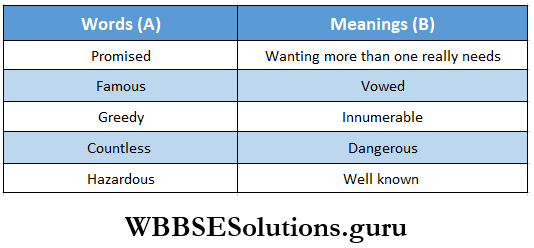
3. Match the words in A with their meanings in B.

WBBSE Solutions For Class 8 English Reading Skill Seen Lesson 7 A Kings Tale Match The Words In A With Meaning In B

Answer:

WBBSE Solutions For Class 8 English Reading Skill Seen Lesson 7 A Kings Tale Match The Words In A With Meaning In B Answer

WBBSE Solutions For Class 8 English Reading Skill Seen Lesson 8 The Happy Prince

Reading Skill Seen Lesson 8 The Happy Prince

Word meanings:

Part 1

pedestal (পেডেস্টাল্)– বেদি; stiffly (স্টিলি ) – শক্তভাবে; resembling (রিজেম্বলিং) — দেখতে একই রকম: tunic (টিউনিক্)—পোশাক ; hilt (হিল্ট) – তরবারির বাঁট; individually — (ইনডিভিজুয়ালি ) –আলাদা আলাদা ভাবে; glued (গ্লুড)—আঠা দিয়ে সাঁটা; audience’ (অডিয়্যান্স)— শ্রোতৃমণ্ডলী; admiringly (অ্যাডমায়ারিংলি ) – প্রশংসা করার ভঙ্গিতে ; sapphire (স্যাফায়ার্) – নীলকান্ত মণি (a bright blue jewel) ; ruby (রুবি) – চুনি; awe (অ)- শ্রদ্ধামিশ্রিত ভয় বা বিস্ময়; limp (লিপ্) – খুঁড়িয়ে চলা; muttering (মাটারিং) – বিড়বিড় বা গজগজ করতে করতে; dragging (ড্র্যাগিং)— টেনে নিয়ে যেতে যেতে; twittering (টুইটারিং)— কিচিরমিচির শব্দ; flap (ফ্ল্যাপ্) –ডানা ঝাপটানো ; perch (পার্চ)—উড়ে এসে বসা; jerk (জার্ক) – ঝাঁকুনি দেওয়া; puzzled (পাজড) – হতভম্ব হওয়া।

Part 2

tossing (টসিং)—এপাশ ওপাশ বা ছটফট করছে; Luxor (লাক্সর) – ইজিপ্টের একটি শহর; playwright (প্লেরাইট্) –নাট্যকার; overjoyed (ওভারজয়েড্ ) – অত্যন্ত খুশী।

Read And Learn Also WBBSE Class 8 English Reading Skills

Part 3

amazed (এ্যামেজ্ড)—বিস্মিত ; track (ট্র্যাক্)—অনুসরণ করা; miserable (মিসারেল) – দুর্দশাগ্রস্ত; darken (ডারকেন্)—অন্ধকার করা; unfed (আফেড) – অভুক্ত; pluck (প্লাক্) – তোলা; clustered (ক্লাস্টারড) – একজোট হওয়া; drooping (ড্রপিং) – ঝিমোচ্ছে; crumpled (ক্রম্‌পলড্) – দুমড়ে মুচড়ে যাওয়া অবস্থা; Mayor (মেয়র) — মহানাগরিক; councillors (কাউন্সিলরস ) – পরিষদবর্গ; angel (এঞ্জেল্)—দেবদূত।

WBBSE Solutions For Class 8 English Reading Skill Seen Lesson 8 The Happy Prince

Reading Skill Seen Lesson 8 The Happy Prince Examples

Read the following texts and do as directed.

Question 1. Student 1: So this is the famous statue of Happy Prince.

[They pause and gather admiringly around the statue of the Happy Prince]

Student 2: He is very well known in this land. Happy Prince lived in the wonderful palace of Sans- Souci. During the day, he played with his friends in the palace garden. By night, he sang and laughed. He had no idea about the people of this world who live outside his palace.

Student 1: You mean he never felt sad?

Student 2: Nothing sad ever entered the door of the prince’s palace. Everyone called him the Happy Prince and when he died, the town built this statue and named it the same.

Student 3: The Happy Prince is built with gold from head to foot. His eyes are two precious sapphires and there is a big red ruby on his sword hilt.

[Student I glances up at the Happy Prince with awe. They start walking. Student 2 speaks when they are close to the right-wing exit.]

Student 2: In this town, everyone loves the Happy Prince.

[They go out. A sad, tired-looking man immediately enters the stage from the right. He limps down with an unhappy expression. He stops before the statue of the Happy Prince and looks unhappily for three seconds. He starts limping towards the left wing exit, muttering loudly to himself.]

Man: At least, there’s one truly happy man in this town. That is something!

[The sad, tired man goes out through the left-wing exit. Immediately from the left wing emerges a young mother dragging her little boy by the hand. The boy is crying. The mother is trying to stop the boy from crying. They reach the statue of the Happy Prince. Mother speaks while walking.]

WBBSE Class 8 English Functional GrammarWBBSE Class 8 English Reading Skills
WBBSE Solutions For Class 8 EnglishWBBSE Solutions For Class 8 Maths


Young mother: I can’t understand why you keep crying! Why can’t you be happy? The Happy Prince never cries for new things.

1. Answer the questions below:

  1. Whose statue was it?
  2. Who was the Happy Prince?
  3. What was the statue of the Happy Prince made of?
  4. Why was his statue built?
  5. What did the mother tell the child when he was crying?

Answer:

  1. It was the statue of Happy Prince.
  2. He was a prince who lived in the palace Sans-Souci and was always happy. During the day he played with his friends and by night he sang and laughed.
  3. The statue of the Happy Prince was made of gold.
  4. Everyone called him Happy Prince because nothing sad ever entered his palace. So when he died, the people of the town built his statue and named it the same.
  5. The mother told the child not to cry and then informed him that the Happy Prince never cried for new things.

2. Choose the correct answer from the alternatives given:

Question 1. The students gathered around the-

  1. King,
  2. The statue of the Happy Prince,
  3. Prince.

Answer: 2. The statue of the Happy Prince

Question 2. When alive, Happy Prince knew no-

  1. Sufferings,
  2. Happiness,
  3. Joy.

Answer: 1. Sufferings

Question 3. The eyes of the Happy Prince were of

  1. Diamond,
  2. Ruby,
  3. Sapphires.

Answer: 3. Sapphires

3. Write ‘T’ for true and ‘F’ for false statements:

Question 1. The statue of the Happy Prince was built by the King.
Answer: False

Question 2. On his sword hilt, there was a red ruby.
Answer: True

Question 3. The Happy Prince was loved by everyone in the town.
Answer: True

4. Complete the sentences with information from the text.

Question 1. When alive the Happy Prince lived _____________
Answer: When alive the Happy Prince lived in the wonderful palace of Sans-Souci.

Question 2. When alive the Prince had no idea __________
Answer: When alive the Prince had no idea about the people of this world who lived outside his palace.

Question 3. The young mother could not understand ____________
Answer: The young mother could not understand why the child kept crying and why he could not be happy.

5. Fill in the blanks with words from the text. There are a few extra words.

List of words happy, idea, famous, outside, wonderful, understand, precious, never.

Question 1. His father was a _______ scientist.
Answer: Famous

Question 2. We had a ________ time last night.
Answer: Wonderful

Question 3. I have no _______ where he lives now.
Answer: Idea

Question 4. The crown was set with _________ jewels.
Answer: Precious

Question 5. I cannot ________ what he says.
Answer: Understand

Question 2. Swallow: It’s too cold here. All my friends have left for warm Egypt. I too must fly. But tonight I will rest in this unknown town. The shelter between the feet of this golden statue looks good enough.

[The Swallow perches on the pedestal-shaped box, holding a leg of the statue and resting his head against it. Swallow jerks and jumps up suddenly after five seconds]

Swallow: I thought this golden room was good shelter. But I’m getting wet in the rain.

[The Swallow sticks its neck out and looks upwards. He looks puzzled.]

Swallow: And yet, the sky is clear. It’s not raining.

[Swallow jumps up again as if a second drop of water had fallen. He now looks up at the statue and is amazed to see teardrops beneath its eyes.]

Swallow: Who are you? Why are you crying?

Status: I’m the Happy Prince. I spent my life in a palace. Now I am dead, and a statue. I stand in the middle of this town. I can see the poor people and all the ugly things in my land.

Swallow: I see you have a golden heart.

Statue: My feet are fixed here. I cannot move. Please help me, little Swallow.

[The stage is darkened. Only the Happy Prince’s voice is heard.]

Statue: There is a poor house in a little street. A woman is making a dress for a beautiful, young lady of the palace. The woman is poor and her son is suffering from a fever. Swallow, take the ruby from my sword hilt, and give it to her.

[The stage is lit again. The light is blue. Close to the right wing, there stands now an open cottage made of cardboard. There is a backdoor to the cottage for entry from the right wing. A curtain hangs in front of the cottage.]

Swallow: But all my friends have flown to Egypt. I cannot delay. It’s too cold here.

Statue: Swallow, little Swallow, please stay with me for one night.

1. Answer the questions below:

  1. Where did the Swallow take shelter and why?
  2. Why was Happy Prince crying?
  3. Why does the Swallow think that the statue of the Happy Prince has a golden heart?
  4. What help did the Happy Prince seek from the Swallow?

Answer:

  1. The Swallow took shelter between the feet of the statue of the Happy Prince because he thought the place would be good enough and not too cold like outside.
  2. Happy Prince was crying as he felt sad to see the poor people and all the ugly things in his land.
  3. The Happy Prince felt sad and his eyes were full of tears when he saw the sufferings of the poor people and all the ugly things in his land about which he was not aware when alive. This made the Swallow think that the Happy Prince had a golden heart.
  4. The Happy Prince sought Swallow’s help in taking a ruby from his sword hilt and giving it to a poor woman.

2. Write “T’ for true and ‘F’ for false statements.

Question 1. The Swallow mistook the teardrops for rain.
Answer: True

Question 2. The statue of the Happy Prince cannot see.
Answer: False

Question 3. Swallow’s friends had gone to Egypt.
Answer: True

Question 4. When the Swallow went to the woman’s house, he found her son was playing.
Answer: False

3. Complete the sentences with information from the text.

Question 1. Swallow decided that he too must fly as __________
Answer: Swallow decided that he too must fly as all his friends have left for warm Egypt.

Question 2. Swallow thought he was getting wet because ______________
Answer: Swallow thought he was getting wet because it was raining.

Question 3. The statue of the Happy Prince can see ____________
Answer: The statue of the Happy Prince can see the poor people and all the ugly things in his land.

Question 4. The poor woman was engaged in ____________
Answer: The poor woman was engaged in making a dress for a beautiful, young lady of the palace.

Question 5. The statue requested little Swallow to stay ____________
Answer: The statue requested little Swallow to stay with him for one night.

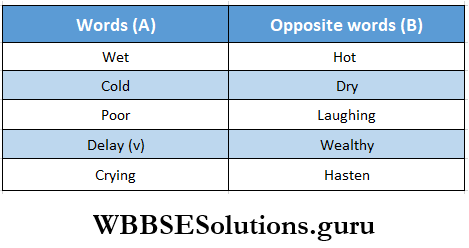
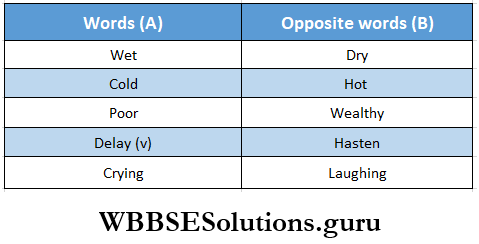
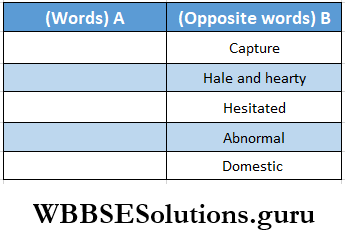
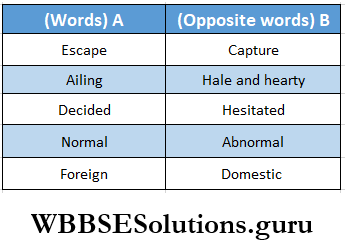
4. Match the words in A and with their opposite words in B.

WBBSE Solutions For Class 8 English Reading Skill Seen Lesson 8 The Happy Prince Match The WordIn A And With Their Oppsite Words In B

Answer:

WBBSE Solutions For Class 8 English Reading Skill Seen Lesson 8 The Happy Prince Match The WordIn A And With Their Oppsite Words In B Answer

Question 3. Statue: I see a poor little girl in the town square. She has no shoes. Little Swallow, please give her the sapphire remaining in my other eye.

Swallow: Impossible! I can’t make you blind.

Statue: Please help me, little Swallow!

[The swallow plucks the other sapphire from the prince’s eye. He goes to the cardboard cottage and removes the curtain. A little girl is discovered weeping inside. The Swallow flaps its arms and goes in. He drops the sapphire into the girl’s hand.]

Girl: That’s so nice!

[She looks up amazed. The Swallow flies out. He pulls the curtain back, and flies to the Happy Prince. The stage light changes to blue.]

Swallow: You are blind now, so I must stay with you always. But it’s too cold here.

Statue: No, little Swallow, you must fly away to Egypt and the Sun.

Swallow: I am staying with you.

Statue: Little Swallow, if you stay fly over this land. Tell me what you see.

[The stage goes dark. A. Blue spotlight trucks the Swallow. He is making a flying motion flapping his arms. He runs around the stage in a circle, The stage goes dark again, stays dark for four seconds. A red spotlight falls on a bunch of beggars in front of the stage, their clothes torn, they look hungry and miserable. Running, the Swallow crosses the stage before them flapping its arms, right wing to left wing. Stage darkens again. The blue stage light comes on immediately. The Swallow faces the Happy Prince from the left.]

Swallow: I saw many unhappy and unfed people.

Statue: Take all the gold from my body and give it to the poor people.

[The Swallow makes a plucking motion with its mouth on the Happy Prince’s golden tunic. The stage darkens. The same beggars who appeared previously, are seen again clustered on stage. They are wearing good clothes, look better, they are eating and laughing. A single-red spotlight holds them on the dark stage. The stage darkens briefly, blue light comes on. The Swallow is discovered sitting on the pedestal-shaped box, leaning against the Happy Prince’s feet. He is looking unwell and dropping. The Happy Prince has given away all the gold on his body. He is wearing a grey tunic.]

Swallow: Goodbye, my prince.

Statue: Ah, good, you’re going to Egypt! I’m happy about that. Swallow I’m going to the house of the brother of Sleep. The cold has got me. I’m dying!

1. Answer the questions below:

  1. To whom did the Swallow give the second sapphire?
  2. How did the Happy Prince become blind?
  3. How did the beggars look when the gold from the tunic of the Happy Prince was given to them?
  4. How did the Swallow die?
  5. What request did the Happy Prince make to Swallow when he said that he would stay with him?

Answer:

  1. The Swallow gave the second sapphire to a poor little girl who had no shoes.
  2. The happy prince gave away the two sapphires from his eyes to the playwright and the poor girl. Thus he became blind.
  3. The beggars looked better wearing good clothes and eating and laughing merrily.
  4. The Swallow died of cold.
  5. The Happy Prince requested the little Swallow to fly over the land and tell him what he sees.

2. Choose the correct answers from the alternatives given:

Question 1. The poor little girl had no-

  1. Shoes,
  2. Dress,
  3. Socks.

Answer: 1. Shoes

Question 2. The number of Precious stones the Happy Prince had with him was-

  1. Four,
  2. Three,
  3. Two.

Answer: 2. Three

Question 3. The Swallow decided to stay with the Happy Prince always as-

  1. It was too cold there,
  2. The Happy Prince had become blind
  3. The Happy Prince became sick.

Answer: 2. The Happy Prince had become blind

Question 4. The Swallow bade the Happy Prince goodbye before-

  1. Going to Egypt
  2. Going to the house of his brother,
  3. Dying.

Answer: 3. Dying

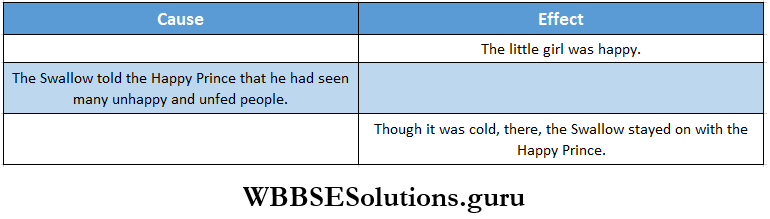
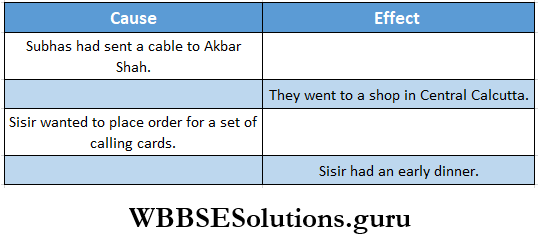
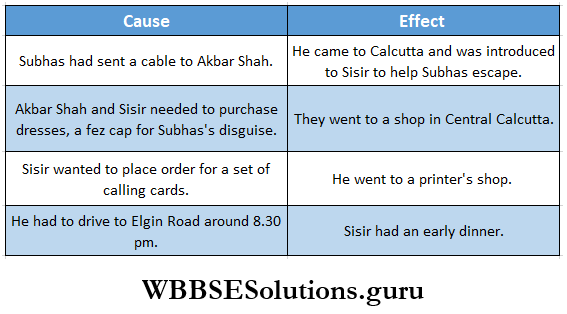
3. Fill in the following chart with information from the text.

WBBSE Solutions For Class 8 English Reading Skill Seen Lesson 8 The Happy Prince Fill In The Following Chart With Information From The Text

Answer:

WBBSE Solutions For Class 8 English Reading Skill Seen Lesson 8 The Happy Prince Fill In The Following Chart With Information From The Text With Answer

4. Match the words in A and with their meanings in B.

WBBSE Solutions For Class 8 English Reading Skill Seen Lesson 8 The Happy Prince Match The WordIn A And With Their Meaning In B

Answer:

WBBSE Solutions For Class 8 English Reading Skill Seen Lesson 8 The Happy Prince Match The WordIn A And With Their Meaning In B With Answer

WBBSE Solutions For Class 8 English Reading Skill Seen Lesson 10 Tales Of Childhood

Reading Skill Lesson 10 Tales Of Childhood

Word meanings:

Part 1

prosperous (প্রস্পারাস্)—সমৃদ্ধশালী; traded (ট্রেডেড্ )–কেনাবেচা করতেন; cheese (চীজ)— পনির; chicken- wire (চিকেন্ ওয়্যার্)—মুরগির ছানা রাখার জন্য তারের জাল; ship broker (শিপ্ ব্রোকার) — জাহাজের দালাল, অর্থাৎ জাহাজের জন্য প্রয়োজনীয় জিনিষ পত্রের যোগানদার, enormous ( এনরমাস্) — বিশাল; fuel (ফুয়েল্) – জ্বালানি; imposing (ইম্পোজিং) — জমকালো ; turret (টারেট্‌ ) — ছোট গম্বুজ ; majestic (ম্যাজেটিক্) –রাজকীয়, চমৎকার; terrace (টেরাস্)—সমতল ছাদ; woodland (উডল্যান্ড) – বনভূমি meadows (মেডোস্‌) – পশুচারণভূমি, sties (স্টাইজ)—শূয়োরের খোঁয়ারগুলি; chicken run — হাঁস মুরগি চরার জায়গা; plough (প্লাউ ) — লাঙল ; hay-wagon- খড় বোঝাই গাড়ি; gardener ( গারডেনার) – মালি।

Part 2

appendicities (অ্যাপেনডিসাইটিস্) – বৃহদন্ত্র সংলগ্ন নলের এক প্রকারের প্রদাহ; favourite (ফেবারিট্)— প্রিয়পাত্র; adored (এ্যাডের্ড্‌)—খুব ভালবাসত; literally (লিট্যারালি ) – আক্ষরিক অর্থে; speechless (স্পিচলেস্) – হতবাক্ overwhelmed (ওভার হোয়েল্ড্) – কাতর হয়ে পড়েছিলেন; pneumonia (নিউমোনিয়া) — নিউমোনিয়া রোগ; threat (থ্রেট্)—ভীতি বা আশঙ্কার লক্ষণ; antibiotic (অ্যান্টিবায়োটিক) — জীবাণু প্রতিরোধকারী ওষুধ; cure (কিওর্)—প্রতিকার; survive (সারভাইভ)—আরও বেশিকাল বেঁচে থাকা; gravest (গ্রেভেস্ট) – গুরুতর; responsibilities (রেস্পন্সিবিলিটিস্) —দায়িত্বভার; · médium sized – মাঝারি মাপের ; suburban (সুবারবন্)—শহরতলী সংলগ্ন।

Read And Learn Also WBBSE Class 8 English Reading Skills

Part 3

kindergarten (কিন্ডারগাটেন)—শিশুদের বিদ্যালয় ; astonising (অ্যাশটনিশিং)—বিস্ময়কর; remember (রিমেম্বার —মনে থাকে; blurred (ব্লাড) – আবছা ; shoolaces (শূলেসে ) – জুতোর ফিতেগুলো ; to and from –যাওয়া ও আসা; tremendously (ট্রিমেনড্যালি) – দারুণভাবে ; exciting (এক্সাইটিং) – রোমাকের; excitement—উদ্দীপনা; interests (ইন্টারেস)—আগ্রহী করে; grown-ups (গ্রোন্-আপস্) – বড়োরা ; vividly (ভিভিলি)—স্পষ্টভাবে; enormous (এনরমাস্)—প্রচণ্ড, দুর্দান্ত; glorius (গ্লোরিয়্যাস্) — গৌরবময় ; lean (লীন্ ) — হেলে যাওয়া, ঝুঁকে যাওয়া; whooping (হুপিং)—হৈচৈ করতে করতে; memories (মেমরিজ্‌ ) — স্মৃতি।

WBBSE Solutions For Class 8 English Reading Skill Seen Lesson 10 Tales Of Childhood

Reading Skill Lesson 10 Tales Of Childhood Examples

Read the texts below and do as directed.

Question 1. My father, Harold Dahl, was a Norwegian who came from a small town near Oslo, called Sarpsborg. His own father, my grandfather, was a fairly prosperous merchant who owned a store in Sarpsborg and traded in just about everything from cheese to chicken wire.

My father had lost an arm when he was fourteen but had become a successful shipbroker. A shipbroker is a person who supplies the ship with everything it needs when it comes into port fuel and food, recipes and paint, soap and towels, hammers and nails, and thousands of other little items.

A shipbroker is a kind of enormous shopkeeper for ships, and by far the most important item he supplies to them is the fuel on which the ship’s engines run in those days, only coal. He set up a shipbroking firm at Cardiff of South Wales. My father met my mother Sofie Magdalene Hesselberg during the summer of 1911 and were married soon after.

WBBSE Class 8 English Functional GrammarWBBSE Class 8 English Reading Skills
WBBSE Solutions For Class 8 EnglishWBBSE Solutions For Class 8 Maths


1. Answer the questions below:

  1. Who was Harold Dahl?
  2. What was the author’s grandfather?
  3. What does a shipbroker do?
  4. Where did the author’s father set up a shipbroking firm?
  5. What is the most important item that the shipbroker supplies to the ship?

Answer:

  1. Harold Dahl was the father of the author who came from a small town near Oslo called Sarpsborg. He was a successful shipbroker.
  2. The author’s grandfather was a prosperous merchant who owned a store in Sarpsborg and traded in almost every essential item.
  3. A shipbroker supplies the ship with everything it needs when it comes to a port-fuel, food, ropes and paint, soap and towels, nails and hammers-almost everything it needs.
  4. The author’s father set up a shipbroking firm at Cardiff in South Wales.
  5. The most important item that the shipbroker supplies to the ship is the fuel for running ship engines- in those days, only coal.

2. Pick out the correct answer from the alternatives given and complete the sentences.

Question 1. The author’s father was-

  1. A Norwegian,
  2. An English man,
  3. An Italian.

Answer: 1. A Norwegian

Question 2. The native town of the author’s father was-

  1. Oslo,
  2. Sarpsborg,
  3. Cardiff.

Answer: 2. Sarpsborg

Question 3. The author’s mother was-

  1. Sofie Magdelene,
  2. Sophie Jane,
  3. Sofie Loren.

Answer: 1. Sofie Magdelene

Question 4. The author was the son of a

  1. Writer,
  2. Sailor,
  3. Merchant.

Answer: 3. Merchant

Question 5. The fuel used by ships in olden days was-

  1. Petrol,
  2. Diesel,
  3. Coal.

Answer: 4. Coal

3. Fill in the blanks with words taken from the text.

List of words: married, trade, person, everything, successful.

Question 1. He _________ in fars and skins
Answer: Traders

Question 2. Ramen proved to be a _________ lawyer
Answer: Successful

Question 3. Ram was ______ to Sita.
Answer: Married

Question 4. __________ depends on him.
Answer: Everything

Question 5. He is a very honest ________
Answer: Person

Question 2. In 1920, when I was still only three, my mother’s eldest child, my own sister Astri, died from appendicitis. She was seven years old when she died. Astri was far and away my father’s favourite. He adored her beyond measure and her sudden death left him literally speechless for days afterwards. He was so overwhelmed with grief that when he himself went down with pneumonia a month or so afterwards, he did not much care whether he lived or died.

If they had penicillin in those days, neither appendicitis nor pneumonia would have been so much of a threat, but with no penicillin or any other magical antibiotic cures, pneumonia, in particular, was a very dangerous disease indeed. The patient had to fight to survive. My father refused to fight. He was thinking, I am quite sure, of his beloved daughter, and he was wanting to join her in heaven. So he died. He was fifty-seven years old.

1. Answer the questions below

  1. Who was Astri and how did she die?
  2. Which incident left the author’s father literally speechless?
  3. Why was pneumonia a very dangerous disease?
  4. Why does the author rue for the absence of penicillin in those days?
  5. What made the author’s father refuse to fight for survival?

Answer:

  1. Astri was the author’s sister, and she died from appendicitis.
  2. The author’s father loved his daughter Astri so dearly that her sudden death at the age of seven left him severely shocked and literally speechless.
  3. In those days, there was no such magical antibiotic cures as penicillin; so pneumonia was a very dangerous disease.
  4. The author rues for the absence of penicillin in those days because if penicillin treatment were in vogue, his sister Astri and father would have been cured by antibiotic treatment.
  5. The author’s father loved his daughter Astri so dearly that when she died, he lost all interest to live any more and wanted to join her in heaven. So he did not want to fight against the disease, as he wanted to die.

2. Write ‘T’ for true and ‘F’ for false statements. Give supporting sentences for each of your answers.

Question 1. Astri was the youngest child in the family.
Answer: False

My mother’s eldest child, my own sister Astri, died from appendicitis.

Question 2. Astri was a favourite child of her father.”
Answer: True

Astri was far and away my father’s favourite.

Question 3. The author’s father died of appendicitis.
Answer: False

He himself went down with pneumonia and did not care much whether he lived or died

Question 4. The author’s father lost the desire of living after his daughter’s death.
Answer: True

My father refused to fight so he died.

Question 5. The author lost his father when he was fifty-five years old.
Answer: False

He died. He was fifty-seven years old.

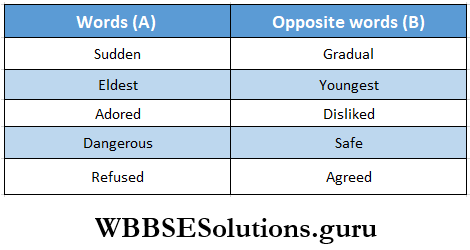
3. Match the words in A and with their opposite words in B.

WBBSE Solutions For Class 8 English Reading Skill Lesson 10 Tales Of Childhood Match The Word In A And With Thrie Opposite Words In B

Answer:

WBBSE Solutions For Class 8 English Reading Skill Lesson 10 Tales Of Childhood Match The Word In A And With Thrie Opposite Words In B Answer

Question 3. My mother had now lost a daughter and a husband all in the space of a few weeks. Here she was, suddenly having to face all alone the very gravest problems and responsibilities. She had five children to look after. She sold the big house and moved to a smaller one a few miles away in Llandaff. It was called Cumberland Lodge and was nothing more than a pleasant medium-sized suburban villa. So it was in Llandaff two years later, when I was six years old, that I went to my first school.

1. Answer the questions below:

  1. In what a situation did the author’s mother fall after the death of her daughter and husband?
  2. Why did she sell the big house?
  3. Where was the new house located?
  4. How was the new house and what was its name?
  5. When did the author join school?

Answer:

  1. After the death of her daughter and husband, the mother fell into a situation when she had to face great problems and responsibilities all alone.
  2. The sudden death of her husband and daughter made her face financial problems with five children to take care of. So she sold the big house and moved to a small house.
  3. The new house was located a few miles away in Llandaff.
  4. The new house was called Cumberland Lodge, and it was a pleasant medium-sized suburban villa.
  5. The author went to his first school in Llandaff when he was six years old.

2. Write “T’ for true and ‘F’ for false statements.

Question 1. The author’s mother lost her two children in quick succession.
Answer: False

Question 2. The mother had to take care of five children.
Answer: True

Question 3. She moved to a bigger house for safety.
Answer: False

Question 4. The new house was located outside the city centre area.
Answer: True

Question 5. The author had gone to school for the first time before he came to Llandaff.
Answer: False

3. Rearrange the following sentences in the proper order as they happened. Write the numbers in the boxes.

1. The author’s father died.

2. The mother had to face great difficulties all alone.

3. She moved to a new house in Llandaff.

4. The author’s sister died.

5. The author went to school for the first time.

6. The mother sold the big house.

Answer:

2. The mother had to face great difficulties all alone.

3. She moved to a new house in Llandaff.

5. The author went to school for the first time.

1. The author’s father died.

6. The mother sold the big house.

4. The author’s sister died.

4. Male sentences of your own with the following words:

  1. Space;
  2. Suddenly;
  3. Pleasant;
  4. Suburban;
  5. Problems.

Answer:

  1. The table takes up too much space.
  2. Suddenly he fell ill.
  3. The weather there was very pleasant.
  4. Life in suburban Kolkata is peaceful.
  5. I had to face lots of problems initially in the new place.

Question 4.

The school was a kindergarten run by two sisters, Mrs Corfield and Miss Tucker, and it was called the Elmtree House. It is astonishing how little one remembers about one’s life before the age of seven or eight. I can tell you all sorts of things that happened to me from eight onwards, but only very few before that. I went for a whole year to Elmtree House but I cannot even remember what my classroom looked like. Nor can I picture the faces of Mrs Corfield or Miss Tucker, although I am sure they were sweet and smiling. I do have a blurred memory of sitting on the stairs and trying over and over again to tie one of my shoelaces, but that is all that comes back to me at this distance of the school itself.

1. Answer the questions below:

  1. What was the name of the author’s first school? What type of school was it?
  2. Who used to run the school?
  3. What makes the author astonished.?
  4. What blurred memory does the author have of his early days”
  5. How were the two sisters Mrs Corfield and Miss Tucker?

Answer:

  1. The name of the school was Elmtree House. The school was a kindergarten.
  2. Two sisters Mrs Corfield and Miss Tucker used to run the school.
  3. The author feels astonished to note that one can hardly remember one’s life before the ages of seven or eight, but can tell everything that happened to one from the age of eight onwards.
  4. The author has a blurred memory of sitting on the stairs of his kindergarten school and trying over and over again to tie one of his shoelaces.
  5. The two sisters Mrs Corfield and Miss Tucker were very sweet and smiling.

2. Write ‘T’ for true and ‘F’ for false statements. Give supporting sentences for each of your answers.

Question 1. Elmtree House was the middle school for the author.
Answer: False

The school was a kindergarten.

Question 2. The school was run by two ladies.
Answer: True

The school was run by two sisters,

Question 3. The author studied in that school for three years.
Answer: False

I went for a whole year to Elmtree House

Question 4. The author had a vivid memory of his Elmtree House school.
Answer: False

But cannot even remember what my classroom looked like.

Question 5. The author could tell out of his memory everything that happened to him from the age of eight onwards.
Answer: True

I can tell you all sorts of things that happened to me from eight onwards.

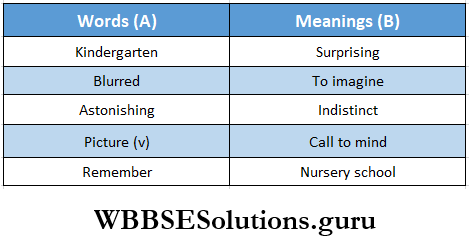
3. Match the words in A and their meanings in B.

WBBSE Solutions For Class 8 English Reading Skill Lesson 10 Tales Of Childhood Match The Word In A And With Their Meaning In B

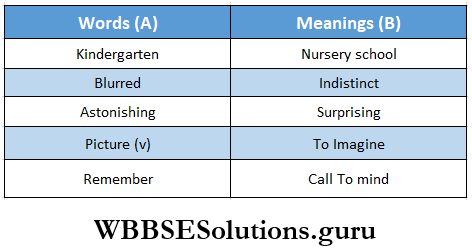
Answer:

WBBSE Solutions For Class 8 English Reading Skill Lesson 10 Tales Of Childhood Match The Word In A And With Their Meaning In B Answer

Question 5. On the other hand, I can remember very clearly the journeys. I made to and from the school because they were so tremendously exciting. Great excitement is probably the only thing that really interests a six-year-old boy and it sticks in his mind.

In my case, the excitement centred around my new tricycle. I rode to school on it every day with my eldest sister riding on hers. No grown-ups came with us, and I can remember oh so vividly how the two of us used to go racing at enormous speeds down the middle of the road and then, most glorious of all when we came to a corner, we would lean to one side and take it on two wheels.

All this, you must realize, was in the good old days when the sight of a motor car on the street was an event, and it was quite safe for tiny children to go tricycling and whooping their way to school in the centre of the highway.

So much, then, for my memories of kindergarten sixty-two years ago. It’s not much, but it’s all there is left.

1. Answer the questions below:

  1. How did the author go to his kindergarten school?
  2. Which journeys does the author still remember? Why did he not forget those journeys?
  3. Describe how the author enjoyed his rides to school.
  4. Why was it safe for children to go tricycling on highways?
  5. What was considered an ‘event’ in those days?
  6. “It’s not much, but it’s all there is left.”-Why do you think did the author make this comment?

Answer:

The author used to go to his school in his new tricycle.

  1. The author still remembers the journeys he made to and from the school in his tricycle. He did not forget those journeys because they were very exciting.
  2. The author and his sister used to go to school in their tricycles racing at great speeds down the middle of the road. When they came to a corner, they would lean to one side and take it on two wheels, The journeys were tremendously exciting and they enjoyed them thoroughly.
  3. Those days motor cars were hardly seen on roads. So it was quite safe for children to go tricycling on highways.
  4. The sight of a motor car on the street was considered an ‘event’ in those days.
  5. The author could not remember many incidents of his school days, because he was a small boy then. Yet he treasured some of the joyous moments of the school days and got pleasure in recollecting them.

2. Write “T? for true and ‘F’ for false statements.

Question 1. The author went to school by bicycle.
Answer: False

Question 2. His eldest sister rode on her tricycle along with him.
Answer: True

Question 3. They were accompanied by a servant on their trip to school.
Answer: False

Question 4. The journeys to school were very exciting to the author.
Answer: True

Question 5. Motor vehicles were quite frequent on the street.
Answer: False

Question 6. The author wrote this text when he was sixty-two years old.
Answer: True

3. Complete the sentences with information from the text.

Question 1. The only thing that probably interests a six-year-old boy is __________
Answer: The only thing that probably interests a six-year-old boy is great excitement.

Question 2. The author remembers vividly ___________
Answer: The author remembers vividly how he and his sister used to go racing in their tricycles in the middle of the road.

Question 3. The most glorious of all was __________
Answer: The most glorious of all was their leaning to one side and taking the tricycle on two wheels when they came to a corner.

Question 4. The sight of a motor car on the street ___________
Answer: The sight of a motor car on the street was an event.

4. Fill in the blanks with words opposite in meaning of the following:

  1. Remember,
  2. Exciting,
  3. Vividly,
  4. Enormous,
  5. Glorius.

Question 1. I can __________ remember my first day at school.
Answer: Vagely

Question 2. We spent some _____ days there.
Answer: Horrible

Question 3. Do not ________ to bring the book.
Answer: Forget

Question 4. The children rode on a _________ elephant.
Answer: Tiny

Question 5. The match was a _________ one.
Answer: Drap


WBBSE Solutions For Class 8 English Reading Skill Seen Lesson 11 Midnight Express

Reading Skill Seen Lesson 11 Midnight Express

Word meanings

Part 1

battered (ব্যাটাড)—জরাজীর্ণ; bound (বাউন্ড) – বাঁধানো; library (লাইব্রেরী) – গ্রন্থাগার ; rest (রেস্ট)— বাকি / অবশিষ্ট; candle light (ক্যান্ড্ল লাইট)— মোমবাতির আলো; ticked (টি)—টিক্ টিক্ শব্দ করছিল; fascinated (ফ্যাসিনেটেড্)—আকৃষ্ট হল; illustration (ইলাস্ট্রেশন)— ছবি; threatened (থ্রেটেন্‌ড্)—ভয় দেখিয়েছিল; empty (এমট্)ি—খালি, ফাঁকা; lit (লিট্‌) – আলোকিত; tunnel (টার্নেল) – সুড়ঙ্গ; midnight (মিডনাইট)—মধ্যরাত্রি।

Part 2

glowing (গ্লোয়িং)—জ্বলছিল; suddenly (সাডেলি) – হঠাৎ; solitary (সলিটারি) – নিঃসঙ্গ; instinct (ইটিংক্ট) —তাৎক্ষণিক প্রতিক্রিয়া; staring (স্টেয়ারিং)—একদৃষ্টিতে তাকিয়ে থাকা; panic (প্যানিক্)—আতঙ্ক; surged (সার্জড্) —উত্তাল হয়ে বয়ে গেল; gasp ( গ্যাপ ) – হাঁপিয়ে ওঠা, কষ্টে শ্বাস নেওয়া; stumbled (স্টাম্বলড্)— ছুটে দৌঁড়ে বেরল; moonlit (মুনলিট)—চন্দ্রালোকিত; echo (ইকো) – প্রতিধ্বনি; paused (পজড্) – থামল; shaken with — বিপর্যস্ত হয়ে পড়েছিল; desperate (ডেস্পারেট) — মরিয়া ; pounded (পাউন্ডেড্) –সজোরে ধাক্কা দিল; creaking (ক্রীকিং)—মচমচ শব্দ করে; shadowy figure — ছায়ামূর্তি; beckoned (বেকন্ড্)—ইশারা করে ডাকল।

Read And Learn Also WBBSE Class 8 English Reading Skills

Part 3

arm chair (আরম্ চেয়ার) – হাতল লাগানো আরাম কেদারা; departed (ডিপার্টেড)—চলে গেল; collapsed (কোলাসড্)—এলিয়ে পড়ল; realised (রিয়ালাইজ্‌ড্)—বুঝতে পারল; afraid (অ্যাফ্রেড) – ভীত; trembling (ট্রেম্বলিং) –কম্পিত; frightening (ফ্রাইটেনিং) – ভয়াবহ ; grasp (গ্র্যাম্প) – বুঝতে পারা, বোঝা; acute (এ্যাকিউট্) –তীব্র; dread (ড্রেড্‌)—আতঙ্ক; host (হোস্ট)— গৃহকর্তা; edged (এড্) – ধীরে-ধীরে এগিয়ে এলো; chill (চিল্‌)—শিহরণ; spine (স্পাইন্)—শিরদাঁড়া; flickered (ফ্লিকার্ড্)— দপদপ করে কাঁপছিল।

WBBSE Solutions For Class 8 English Reading Skill Seen Lesson 11 Midnight Express

Reading Skill Seen Lesson 11 Midnight Express Examples

Read the texts below and do as directed.

Question 1. It was a battered old book, bound in red leather. When Mortimer was twelve years old, he found the book in his father’s library. When the rest of his large, old house was covered in darkness, he took the book to his bedroom to read by candlelight. The clock ticked in the hall below and the sea roared outside.

Mortimer was fascinated by the battered old book. It contained a story called the ‘Midnight Express’. There was an illustration on page fifty, which threatened him for some unknown reason. The illustration showed an empty railway platform at night lit by a dull, yellow lamp. A single man stood under the lamp, his face turned towards the black mouth of a tunnel. Mortimer never read beyond page fifty.

WBBSE Class 8 English Functional GrammarWBBSE Class 8 English Reading Skills
WBBSE Solutions For Class 8 EnglishWBBSE Solutions For Class 8 Maths


1. Answer the questions below:

  1. Where did Mortimer find the book?
  2. How did the book look?
  3. When and where did Mortimer read the book?
  4. What did the illustration depict?
  5. Why do you think Mortimer never read beyond page fifty of the book?

Answer:

  1. Mortimer found the book in his father’s library.
  2. The book looked old and damaged.”
  3. When the rest of his large house was covered in darkness. Mortimer took the book to his bedroom and read it by candlelight.
  4. The illustration showed an empty railway platform at night lit by a dull, yellow lamp. A man stood there under the lamp with his face turned towards the black mouth of the tunnel.
  5. The picture on page fifty threatened Mortimer for some unknown reason. So he never read the book beyond page fifty.

2. Choose the correct answers from the alternatives given:

Question 1. The book was bound in—

  1. Red cloth,
  2. Green leather,
  3. Red leather.

Answer: 3. Red leather

Question 2. Here Midnight Express is the name of

  1. An express train,
  2. A story in a book,
  3. A railway station.

Answer: 2. A story in a book

Question 3. Mortimer was very fascinated by-

  1. The story “Midnight Express”,
  2. The old battered book,
  3. The books in the library.

Answer: 2. The old battered book

Question 4. Mortimer was able to read up to

  1. Page fifty of the book,
  2. Page sixty of the book,
  3. The last page of the book.

Answer: 1. Page fifty of the book

3. Rearrange the following sentences in the proper order as they happened. Write the numbers in the boxes.

1. He took the book to his bedroom.

2. The illustration of the story frightened him.

3. Mortimer got an old, battered book.

4. He read the book only up to page fifty.

5. He started reading the book by candlelight.

Answer:

2. The illustration of the story frightened him.

4. He read the book only up to page fifty.

1. He took the book to his bedroom.

5. He started reading the book by candlelight.

3. Mortimer got an old, battered book.

4. Find words in the text which mean the following:

  1. The room preserved for sleeping
  2. Damaged
  3. Very loud sound
  4. Attracted
  5. Picture

Answer:

  1. Bedroom,
  2. Battered,
  3. Roar,
  4. Fascinated,
  5. Illustration.

Question 2. There was a single dull lamp glowing. Mortimer, in the lamplight, suddenly noticed a dark and solitary figure he knew. It was seen on page fifty of his book in his childhood. The figure faced the black mouth of a tunnel.

Mortimer’s instincts were aroused. He walked quickly towards the figure and looked into its face. Mortimer was shocked. He was staring into his own face.

A wave of panic surged through Mortimer. He turned, gasped, and broke into a wild run. He stumbled out of the platform and rushed down a moonlit road. He could hear the echo of his own footsteps behind him. The footsteps were steadily gaining on him. Mortimer paused for a moment. He was completely shaken with fear. He began to run again.

A quarter of a mile down, Mortimer saw a small white cottage. Seeking desperate shelter, Mortimer pounded on the wooden door. He heard heavy footsteps coming down creaking stairs. The door opened and a shadowy figure stood with a candle. They exchanged no words. The shadowy figure beckoned him inside. They went up the creaking stairs.

1. Answer the questions below:

  1. What did Mortimer notice in the lamplight?
  2. When had Mortimer seen the dark and solitary figure in his childhood?
  3. When was Mortimer shocked and why?
  4. Why did he begin to run?
  5. What could Mortimer hear as he was rushing down the road?
  6. What did Mortinier do on seeing a small white cottage?

Answer:

  1. Mortimer suddenly noticed a dark and solitary figure standing on the empty platform with his face turned towards the tunnel.
  2. While reading a book from his father’s library in his childhood, he had seen the figure in an illustration on page fifty of the book.
  3. Mortimer was reminded of his childhood book on the seeing the solitary figure on the platform, and when he walked towards the figure and looked into its face he was shocked as he was staring at his own face.
  4. He began to run as a wave of panick surged through him when he saw that the man’s face resembled his own.
  5. As he was rushing down the road, Mortimer could hear the echoe of his own footsteps behind him which were steadily gaining on him.

2. Write ‘T’ for true and ‘F’ for false statements.

Question 1. Mortimer saw a host of figures.
Answer: False

Question 2. Mortimer saw the figure in his childhood in a book
Answer: True

Question 3. Mortimer was frightened.
Answer: True

Question 4. Mortimer pounded on the iron door.
Answer: False

Question 5. The door opened but nobody was found.
Answer: False

3. Rearrange the following sentences in the proper order as they happened. Write the numbers in the boxes.

1. He banged on the door.

2. Mortimer became panicky

3. The door of the cottage opened.

4. Mortimer and the shadowy figure went up the stairs.

5. A shadowy figure beckoned him inside.

6. He noticed a cottage.

7. He began to run along the road.

Answer:

4. Mortimer and the shadowy figure went up the stairs.

1. He banged on the door.

5. A shadowy figure beckoned him inside.

7. He began to run along the road.

6. He noticed a cottage.

3. The door of the cottage opened.

2. Mortimer became panicky

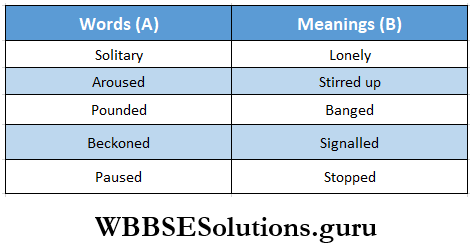
3. Match the words in A and with their meanings in B.

WBBSE Solutions For Class 8 English Reading Skill Seen Lesson 11 Midnight Express Match The Word In A And With Their Meaning In B

Answer:

WBBSE Solutions For Class 8 English Reading Skill Seen Lesson 11 Midnight Express Match The Word In A And With Their Meaning In B Answer

Question 3. The shadowy figure took him. to an upper room where a bright fire was burning. There was an armchair beside the fire. By the armchair was a small, oak table on which lay a battered old book bound in red leather. The shadowy figure put the candle on the table and departed silently.

Mortimer collapsed into the armchair and picked up the old book. With a shock, he realized it was the same book from his childhood, the book which contained the story of ‘Midnight Express’. Mortimer was greatly afraid. He turned the pages with trembling hands. He began to read. The story was about a man who in his childhood had read a book which contained a frightening picture.

1. Answer the questions below:

  1. Where did the shadowy figure lead Mortimer to? Give a small description of the room.
  2. What happened to Mortimer after he went to the room?
  3. Why was Mortimer shocked?
  4. What did he do then?
  5. Why do you think Mortimer’s hands trembled when he turned the pages of the book?

Answer:

  1. The shadowy figure led Mortimer to an upper room where a bright fire was burning. There was an armchair beside the fire, and a small oak table on which lay a battered old book in red leather. There was also a candle on the table.
  2. Mortimer collapsed into the armchair and picked up an old book and started reading it.
  3. He was shocked when he realized that it was the same book containing the story of “Midnight Express” which he had read in his childhood. He was greatly afraid.
  4. He turned the pages with trembling hands and began to read it.
  5. Mortimer’s hands trembled with fear when he realized that it was the same book as he had read in his childhood and which had an illustration that frightened him.
    Supporting sentence

2. Write ‘T’ for true and ‘F’ for false statements. Give supporting sentences for each of your answers.

Question 1. The room where Mortimer was taken was in the ground floor.
Answer:  False

The shadowy figure took him to an upper room.

Question 2. Mortimer sat on an armchair in the room.
Answer: True

Mortimer collapsed into the armchair.

Question 3. Midnight Express” was a story.
Answer: True

The book which contained the story of “Midnight Express”.

Question 4. Mortimer was greatly delighted.
Answer: False

Mortimer was greatly afraid

Question 5. The figure who led Mortimer to the room was with him all the time.
Answer: False

The shadowy figure put the candle on the table and departed silently.

3. Complete the sentences with information from the text.

Question 1. On the oak table was __________
Answer: On the oak table was lying a battered old book bound in red leather.

Question 2. The shadowy figure took Mortimer to_________
Answer: The shadowy figure took Mortimer to an upper room: where a bright fire was burning.

Question 3. After sitting on the armchair, Mortimer, __________
Answer: After sitting on the armchair, Mortimer picked up the old book.

Question 4. Mortimer was greatly afraid because ____________
Answer: Mortimer was greatly afraid because he realized that it was the same book from his childhood that contained the story of “Midnight Express” that frightened him.

Question 5. The story was about ___________
Answer: The story was about a man who in his childhood had read a book that contained a frightening picture.

4. Find words in the text which are opposite in meaning of the following.

  1. Dim,
  2. Arrived,
  3. Different,
  4. Reassuring,
  5. Steady.

Answer:

  1. Right,
  2. Departed,
  3. Same,
  4. Frightening,
  5. Trembling.

Question 4. Mortimer tried to grasp the strange cycle of events he was going through. He was filled with acute dread. “Who is the strange man who asked me into this cottage ?”Mortimer asked himself fearfully.

At that very moment the door opened and the strange host came in. His face was covered in darkness. The candle on the table cast huge shadows on the walls. The shadowy figure stood before Mortimer. Slowly he edged forward.

Mortimer, sitting on the armchair, felt a chill run up his spine. He looked up into the face of the shadowy figure. Mortimer realized he was looking at himself.

The clock ticked in the hall below and sea roared outside. The candlelight flickered. The old, battered book bound in red leather lay open on the table.

1. Answer the questions below:

  1. What was the strange cycle of events Mortimer was going through?
  2. What did Mortimer try to understand?
  3. What is the question that upset his mind with a sense of fear?
  4. Do you think the strange incidents that happened to Mortimer would not have occurred if he had not read the book?
  5. What did he feel when Mortimer looked up in the face of the shadowy figure?

Answer:

  1. Mortimer was undergoing through the same experiences as he had while reading a story in his childhood. All the incidents of the book were coming alive in front of him.
  2. Mortimer tried to understand the strange cycle of events he was going through.
  3. The question that upset his mind was “who is the strange man who asked me into this cottage.”
  4. Reading the book had implanted a sense of fear in Mortimer’s mind. The illustration on page fifty had made a permanent dent in his subconscious mind. The strange incidents that happened to Mortimer would not have occurred if he had not read the book.
  5. When Mortimer looked up in the face of the shadowy figure, he realized he was looking at himself.

2. Write ‘T’ for true and ‘F’ for false statements.

Question 1. Mortimer tried to understand the strange cycle of events he was going through.
Answer: True

Question 2. Mortimer faced the situation confidently.
Answer: False

Question 3. Mortimer could recognise the strange host.
Answer: False

Question 4. Mortimer realised that he was looking at himself.
Answer: True

Question 5. The old battered book disappeared all on a sudden.
Answer: False

3. Rearrange the events in proper order as they happened.

1. The shadowy figure stood before Mortimer.

2. Mortimer felt a chill run up his spine.

3. The door opened.

4. He realized that he was looking at himself.

5. The strange host came in.

6. Mortimer looked up in the face of the figure.

7. Slowly he came forward.

Answer:

3. The door opened.

5. The strange host came in.

1. The shadowy figure stood before Mortimer.

7. Slowly he came forward.

2. Mortimer felt a chill run up his spine.

6. Mortimer looked up in the face of the figure.

4. He realized that he was looking at himself.

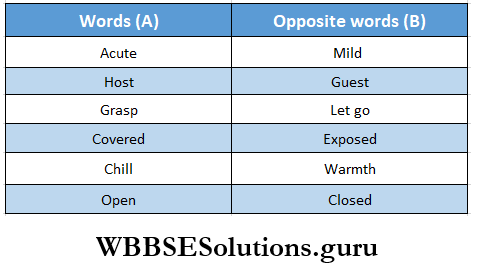
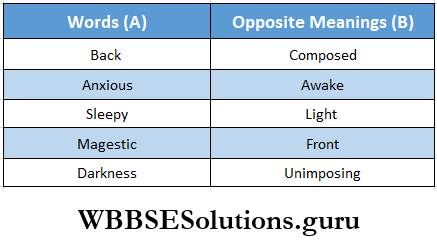
4. Match the words in A and with their opposite words (antonyms) in B.

Question 1.

WBBSE Solutions For Class 8 English Reading Skill Seen Lesson 11 Midnight Express Match The Word In A And With Their Opposite Words In B

Answer:

WBBSE Solutions For Class 8 English Reading Skill Seen Lesson 11 Midnight Express Match The Word In A And With Their Opposite Words In B Answer

WBBSE Solutions For Class 8 English Reading Skill Seen Lesson 12 Someone

Reading Skill Seen Lesson 12 Someone

Word meaning:

Stanza 1 (Someone came ………dark night )

someone (সামওয়ান) কোনো একজন; knocking (নকিং) – কড়া নাড়ছিল, টোকা দিচ্ছিল; wee (উই)—খুব ছোট; Sure (শিওর) – নিশ্চিত listened (দিসেভ) শুনেছিলাম; opened (পেন্ড) – খুললাম: nought (নট) কিছুই না stirring (স্টারিং)—নড়াচড়া ; still (স্টিল) – নিস্তব্ধ ।

Stanza 2 (Only the busy ……………. at all, at all.)

busy (বিজি)—ব্যস্ত; beetle (বিল) – গুবরে পোকা ; tap-tapping (ট্যাপ-ট্যাপিং) –ঠক্ঠক্ আওয়াজ করা ; screech- owl (স্ট্রীচ-আউল্)—লক্ষ্মী প্যাচা; cricket (ক্রিকেট) –ঝিঁঝি পোকা ; whistling (হুইসলিং) – শিস্ দিচ্ছিল; dewdrops (ডিউড্রপস) –শিশির কণা ; at all (অ্যাট অল) – আদৌ!

Read And Learn Also WBBSE Class 8 English Reading Skills

Substance:

The poet heard a knocking sound on his door. But on opening the door, he did not find anybody nearby. He looked around but there was nobody there, only the sounds of beetle, owl, and cricket were heard in the still dark night. The poet is puzzled finding no clue to the knocking sound. He is sure about listening to the sound but feels mystified at not knowing who made the knock. There was nobody at all at his doorstep.

বঙ্গানুবাদ :

কবি তাঁর দরজায় কেউ ঠক্‌ঠক্ করে আওয়াজ করছে শুনতে পেলেন, কিন্তু দরজা খুলে কাওকেই আশে পাশে দেখতে পেলেন না। এদিক ওদিক ভাল করে দেখলেন কিন্তু কাউকেই পেলেন না। শুধু গুবরে পোকা, ঝিঝি ও লক্ষ্মী পেঁচার ডাক নিঝুম রাতে শুনতে পাচ্ছিলেন। কে দরজায় টোকা দিল তার কোন হদিশ করতে না পেরে কবি হতবুদ্ধি হয়ে গেলেন। শব্দ তিনি ঠিকই শুনেছেন, কিন্তু কিভাবে সেটা হল তা জানতে না পেরে তিনি বিস্মিত হয়ে গেলেন। তার দরজায় যে আদৌ কেউই ছিল না।

WBBSE Solutions For Class 8 English Reading Skill Seen Lesson 12 Someone

Reading Skill Seen Lesson 12 Someone Examples

Read the text below and do as directed.

Question 1.

Someone came knocking
At my wee, small door;
Someone came knocking;
I’m sure-sure-sure; I listened, I opened,
I looked to left and right,
But naught there was a stirring

In the still, dark night;
Only the busy beetle
Tap-tapping in the wall,
Only from the forest
The screech-owl’s call,
Only the cricket whistling
While the dewdrops fall,
So I know not who came knocking,
At all, at all, at all.

WBBSE Class 8 English Functional GrammarWBBSE Class 8 English Reading Skills
WBBSE Solutions For Class 8 EnglishWBBSE Solutions For Class 8 Maths


1. Answer the following questions:

  1. What did the poet hear?
  2. What did he do then?
  3. What did he find?
  4. Where from was the screechowl’s call coming?
  5. What was the night like?

Answer:

  1. The poet heard someone knocking at the door.
  2. The poet opened the door and looked to left and right.
  3. He could not find anybody at the door.
  4. The screech owl’s call was coming from the forest.
  5. The night was still and dark.

2. Pick out the correct answer from the given alternatives.

Question 1. The door was-

  1. Big,
  2. Small,
  3. Wide.

Answer: 2. Small

Question 2. The poet looked-

  1. Backward and forward,
  2. Up and down,
  3. To left and right.

Answer: 3. Up and down

Question 3. The owl’s call came from the-

  1. Cage,
  2. Forest,
  3. Garden

Answer: 3. Garden

Question 4. Listening to the knock the poet-

  1. Asked who it was,
  2. Opened the door,
  3. Ignored it.

Answer: 2. Opened the door

Question 5. The night was-

  1. Still,
  2. Very stormy,
  3. Nicely moonlit.

Answer: 1. Still

3. Complete the following sentences with information from the text.

Question 1. The tip-taping on the wall was done by __________
Answer: The tip-taping on the wall was done by the busy beetle.

Question 2. Someone came knocking at __________
Answer: Someone came knocking at night on the poet’s door.

Question 3. The cricket whistles when ____________
Answer: The cricket whistles when the dew drops fall.

Question 4. The poet was sure that ____________
Answer: The poet was sure that someone came knocking.

Question 5. The poet did not know ___________
Answer: The poet did not know who came knocking.

4. Fill in the blanks with suitable words taken from the list below. Change their form if necessary. There are a few extra words.

[List: still, small, sure, screech, listened, busy, knock]

Question 1. He stood _____ and did not utter a single word.
Answer: Still

Question 2. I am _______ that he will come today.
Answer: Sure

Question 3. Please ________ before entering.
Answer: Knock

Question 4. The car ________ to a halt.
Answer: Screech

Question 5. He has a ______ schedule today.
Answer: Busy

WBBSE Solutions For Class 8 English Reading Skill Seen Lesson 13 The Man Who Planted Trees

Reading Skill Seen Lesson 13 The Man Who Planted Trees

Word meanings:

Part 1

hike (হাইক)—দীর্ঘ পদযাত্রা ; absolutely (অ্যাবসলিউট্‌লি)—সম্পূর্ণরূপে, একেবারে; penetrate (পেনিট্রেট)— প্রবেশ করেছে ; Provence (প্রভেন্স ) – দক্ষিণ-পূর্ব ফ্রান্সের একটি পূর্বতন প্রদেশ; barren (ব্যারেন) — অনুর্বর ; monotonous : (মনোটোনাস)—একঘেয়ে; wild (ওয়াইল্ড) – বুনো; desolation (ডেসোলেশন) — নির্জনতা; abandoned (অ্যাবান্ডাড —পরিত্যক্ত; ruined (রুইল্ড) – ধ্বংসপ্রাপ্ত, ভাঙ্গাচোরা; spring (স্প্রিং) – ঝরনা ; plenty of sun— রোদে ভরা; continually (কন্‌টিউনিয়ালি)—একনাগাড়ে।

Part 2

dryness (ড্রাইনেস্)—শুষ্কতা ; woody (উডি) – কাঠ কাঠ ; headed (হেডেড) – এগিয়ে গেলাম; shepherd (শেফার্ড)–মেষপালক; scorching (স্করচিং) – খুব গরম, ঝলসানো; dispersed (ডিস্পার্সড) – ছড়িয়ে ছিটিয়ে থাকা; flanks (ফ্ল্যঙ্কস্)—আশেপাশে; inhabited (ইহ্যাবিটেড)—বাস করত; charcoal (চারকোল্) – কাঠকয়লা; acorns (অ্যাকর্নস) – ওক গাছের বীজ; separating (সেপারেটিং) – আলাদা করা; intrigued (ইট্রি গড)— কৌতূহল হচ্ছিল।

Read And Learn Also WBBSE Class 8 English Reading Skills

Part 3

soak (সোক)—ভেজানো; pound (পাউন্ড) – ঠোকা; solitary (সলিটারী) – নিঃসঙ্গভাবে, একা একা; solitude (সলিচুড়)—নির্জনতা; pleasure (প্লেজার) – আনন্দ, তৃপ্তি; concluded (কনক্লুডেড) – সিদ্ধান্তে উপনীত হল; resolved (রিসলড)—মনস্থির করল, ঠিক করল; remedy (রেমিডি) – সুরাহা করা, প্রতিকার করা; parted (পার্টেড)—বিদায় নিলাম; trail (ট্রেল্)—চলার পথ; deserted (ডেসার্টেড)—পরিত্যক্ত; disturbed (ডিস্টার্বড)—বিচলিত; impressive (ইমপ্রেসিভ)—চোখ জুড়ানো; speechless (স্পিচ্‌লেশ)—হতবাক্ ; sprung (স্প্রাং)— গজিয়ে উঠেছে; soul (সোল্) – আন্তরিক প্রচেষ্টা; technical (টেক্‌নিকাল) – প্রযুক্তিগত; aid (এইড্ )–সাহায্য; effective (এফেক্টিভ)—কার্য্যকারী; ফলপ্রসূ; domains (ডোমেইন্‌স্‌) – ক্ষেত্রে; destruction (ডেস্‌ট্রাকশান্)—ধ্বংস।

WBBSE Solutions For Class 8 English Reading Skill Seen Lesson 13 The Man Who Planted Trees

Reading Skill Seen Lesson 13 The Man Who Planted Trees Examples

Read the texts carefully and do as directed.

Question 1. About forty years ago I went on a long hike through hills absolutely unknown to tourists, in that very old region where the Alps penetrate into Provence. It consisted of barren and monotonous lands. Nothing grew there except wild lavender.

I was crossing this country at its widest part, and after walking for three days, I found myself in the most complete desolation. I was camped next to an abandoned village. I had used the last of my water the day before and I needed to find more. These ruined houses of the village made me think that there must, at one time, have been a spring or a well there. There was indeed a spring, but it was dry. All life had disappeared.

WBBSE Class 8 English Functional GrammarWBBSE Class 8 English Reading Skills
WBBSE Solutions For Class 8 EnglishWBBSE Solutions For Class 8 Maths


1. Answer the questions below:

  1. Where did the author go about forty years ago?
  2. How was the place where the author went ?
  3. What was the author’s feeling after walking for three days?
  4. Where did the author camp?
  5. Why do you think the village was abandoned?

Answer:

  1. About forty years ago the author went on a long hike to a hilly region where the Alps penetrated into Provence.
  2. The place was totally barren and monotonous, and nothing grew there except wild lavender.
  3. After walking for three days, the author found himself in a state of complete desolation.
  4. The author camped next to an abandoned village.
  5. The author could see only ruined houses in the village. There was no trace of any water source. There was a spring, but it was dry. There was no sign of any life. The village, therefore, looked abandoned.

2. Choose the correct answers from the alternatives given.

Question 1. The author was speaking of his experience

  1. Of recent times,
  2. About forty years ago,
  3. Of his childhood.

Answer: 2. About forty years ago

Question 2. Alps is the name of a famous-

  1. Mountain range,
  2. River,
  3. Desert.

Answer: 1. Mountain range

Question 3. The village near which the author was camped looked-

  1. Moderately inhabited,
  2. Densely populated,
  3. Abandoned.

Answer: 3. Abandoned

Question 4. The land could produce-

  1. Plants of all types,
  2. Only wild lavender,
  3. Oak trees.

Answer: 2. Only wild lavender

3. Complete the table with information from the text.

WBBSE Solutions For Class 8 English Reading Skill Seen Lesson 13 The Man Who Planted Trees Complete The Table With Information From The Text

Answer:

WBBSE Solutions For Class 8 English Reading Skill Seen Lesson 13 The Man Who Planted Trees Complete The Table With Information From The Text Answer

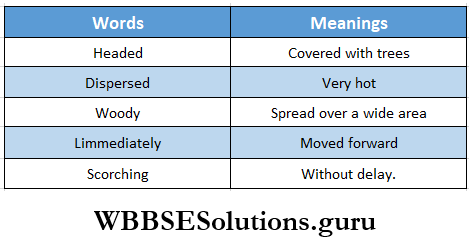
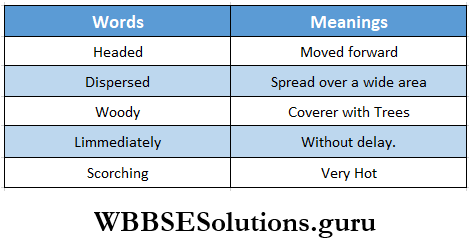
Question 2. Everywhere there was the same dryness, the same stiff, woody plants. I thought I saw in the distance the shadow of a figure. On a chance I headed towards it. It was a shepherd. Thirty lambs or so were resting near him on the scorching ground.

He gave me a drink and a little later he led me to his shepherd’s cottage. He shared his soup with me. It had been agreed immediately that I would pass the night there, the closest village being still more than a day and a half farther on. There are four or five villages dispersed far from one another on the flanks of the hills in this area. They are inhabited by woodcutters who make charcoal.

1. Complete the sentences with information from the text.

Question 1. The author saw from a distance __________
Answer: The author saw from a distance the shadow of a figure which, in fact, was that of a shepherd.

Question 2. After giving him a drink, the shepherd led __________
Answer: After giving him a drink, the shepherd led the author to his cottage.

Question 3. The shepherd’s cottage would be the shelter for the author __________
Answer: The shepherd’s cottage would be the shelter. for the author for the might as the closest village was still more than a day and a half farther on.

Question 4. The shepherd shared his __________
Answer: The shepherd shared his soup with the author.

Question 5. On the flanks of the hill there __________
Answer: On the flanks of the hill there are four or five villages dispersed far from one another.

2. Write ‘T’ for true and ‘F’ for false statements.

Question 1. The area the author reached was different from the areas he visited earlier.
Answer: False

Question 2. The shadow the author had seen was that of the lambs.
Answer: False

Question 3. The shepherd was very helpful to the author.
Answer: True

Question 4. The villages were inhabited by woodcutters.
Answer: True

Question 5. The shepherd offered rice to the author.
Answer: False

3. Rearrange the following sentences in the correct order as they happened.

1. The shepherd gave the author a drink.

2. He headed towards it.

3. He shared his soup with the author.

4. The author saw the shadow of a figure from a distance.

5. He took him to his cottage.

6. The author agreed to pass the night in the shepherd’s cottage.

7. It was a shepherd.

Answer:

4. The author saw the shadow of a figure from a distance.

2. He headed towards it.

6. The author agreed to pass the night in the shepherd’s cottage.

1. The shepherd gave the author a drink.

5. He took him to his cottage.

7. It was a shepherd.

3. He shared his soup with the author.

4. Match the words with their meanings.

WBBSE Solutions For Class 8 English Reading Skill Seen Lesson 13 The Man Who Planted Trees Match The Words With Their Meanings

Answer:

WBBSE Solutions For Class 8 English Reading Skill Seen Lesson 13 The Man Who Planted Trees Match The Words With Their Meanings Answer

Question 3. The shepherd took out a bag and poured a pile of acorns out onto the table. He began to examine them one after another with a great deal of attention, separating the good ones from the bad. When he had before him one hundred perfect acorns he stopped, and we went to bed. The company of this man brought me a feeling of peace. He gave me the impression that nothing could disturb him. I was intrigued and I wanted to find out more about this man.

1. Answer the questions below:

  1. “The shepherd took out a bag”-What did the bag contain?
  2. What did the shepherd do with the a corn?
  3. How did the author feel?
  4. Why did the author feel intrigued?

Answer:

  1. Before going out the next day, the shepherd soaked the acorns in a bucket of water.
  2. The shepherd dug the ground with an iron rod and made several holes. He then placed an acorn in each hole and filled the hole again with soil.
  3. The shepherd planted one hundred acorns when the author was with him.
  4. So far he planted one hundred thousand acorns and, of them, twenty thousand survived.

2. Complete the sentences with information from the text.

Question 1. With a great deal of attention, the shepherd ___________
Answer: With a great deal of attention, the shepherd began to examine the acorns, separating the good ones from the bad.

Question 2. The shepherd stopped his job __________
Answer: The shepherd stopped his job when he collected one hundred perfect acorns.

Question 3. The shepherd poured a __________
Answer: The shepherd poured a pile of acorns out onto a table.

Question 4. The author developed the impression that __________
Answer: The author developed the impression that nothing could disturb the shepherd.

Question 5. The company of the shepherd brought the author __________
Answer: The company of the shepherd brought the author a feeling of peace.

3. Choose the correct answers from the alternatives given:

Question 1. From the bag, the shepherd took out many-

  1. Coins,
  2. Charcoal pieces,
  3. Acorns.

Answer: 3. Acorns

Question 2. The shepherd chose to retain-

  1. All the acorns,
  2. The bad acorns,
  3. The good acorns.

Answer: 3. The good acorns

Question 3. Seeing the shepherd’s activities, the author became

  1. Curious,
  2. Shocked,
  3. Frightened.

Answer: 1. Curious

Question 4. The author wanted to know

  1. About the acorns,
  2. More about the shepherd,
  3. About the shepherd’s village.

Answer: 2. More about the shepherd

4. Make sentences of your own with the following words taken from the text.

  1. Examine;
  2. Attention;
  3. Company;
  4. Disturb;
  5. Perfect.

Answer:

  1. Her mother started to examine the articles he had brought.
  2. He turned his attention back to his lessons.
  3. I enjoyed his company during the journey.
  4. I am sorry to disturb you.
  5. It was a perfect day for picnic.

Question 4. Before going out the next day, he soaked in a bucket of water the acorns that he had so carefully chosen and counted. He carried an iron rod too, as a walking stick. He invited me to come along with him.

Having arrived at the place he had been heading for, he began to pound his iron rod into the ground. This made a hole in which he placed an acorn, and covered over the hole again. He was planting oak trees. In this way, he planted his one hundred acorns with great care.

He told me that for three years now he had been planting trees in this solitary way. He had planted one hundred thousand. Of these one hundred thousand, twenty thousand had come up.

1. Answer the questions below:

  1. What did the shepherd do with the acorns before going out the next day?
  2. How did the shepherd plant the acorns?
  3. How many acorns did he plant when? the author was with him?
  4. How many acorns did he plant so far? How many survive among them?

Answer:

  1. Before going out the next day, the shepherd soaked the acorns in a bucket of water.
  2. The shepherd dug the ground with, an iron rod and made several holes. He then placed an atom in each hole and filled the hole again with soil.
  3. The shepherd planted one hundred acorns when the author was with him.
  4. So far he planted one hundred thousand acorns and, of them twenty thousand survived.

2. Write ‘T’ for true and ‘F’ for false statements. Give supporting sentences for each of your answers.

Question 1. The shepherd soaked the acorns in a soap solution before planting.
Answer: He soaked in a bucket of water the acorns.

Question 2. For walking stick, the shepherd took an iron rod.
Answer: He carried an iron rod too, as a walking stick.

Question 3. The next morning the shepherd left his house all by himself.
Answer: He invited me to come along with him.

Question 4. The shepherd had been planting acorns for three years.
Answer: He told me that for three years now he had been planting trees.

Question 5. The shepherd was planting oak trees.
Answer: He was planting oak trees.

3. Find words in the text which mean the following.

  1. Fruits of oak trees;
  2. Put in liquid;
  3. Hit;
  4. Sowing seeds;
  5. Lonely

Answer:

  1. Acorns;
  2. Soak;
  3. Pound;
  4. Planting;
  5. Solitary.

Question 5. It was at this moment that I began to wonder about his age. He was clearly more than fifty. Fifty-five, he told me. His name was Elzeard Bouffier. He had owned a farm in the plains, where he lived most of his life. He had lost his only son, and then his wife. He had retired into this solitude, where he took pleasure in living slowly, with his flock of sheep and his dog. He had concluded that this country was dying for lack of trees. He added that having nothing more important to do, he had resolved to remedy the situation.

1. Complete the sentences with information from the text.

Question 1. The family members whom the shepherd had lost were ______________
Answer: The family members whom the shepherd had lost were his wife and only son.

Question 2. After retirement, the companions of the shepherd were __________
Answer: After retirement the companions of the shepherd were solitude, his flock of sheep, and his dog.

Question 3. He concluded that __________
Answer: He concluded that this country was dying for lack of trees.

Question 4. Having nothing more important to do the shepherd ___________
Answer: Having nothing more important to do, the shepherd resolved to remedy the situation in which the country was dying for lack of trees.

2. Answer the questions below:

  1. What did the author guess about the age of the shepherd?
  2. What was the age of the shepherd and what was his name?
  3. Where did the shepherd spend most of his life?
  4. Why did the shepherd retire into a life of solitude?
  5. What situation did the shepherd resolve to solve and how?

Answer:

  1. The author guessed that the age of the shepherd would be clearly more than fifty.
  2. The age of the shepherd was fifty-five and his name was Elzeard Bouffier.
  3. The shepherd spent most of his life in his farm in the plains.
  4. The shepherd retired into a life of solitude to enjoy the pleasure in living slowly with his flock of sheep and his dog.
  5. The country was dying for lack of trees, and the shepherd resolved to remedy that situation by planting more trees.

3. Write ‘T’ for true and ‘F’ for false statements. Write supporting sentences for each of your answers.

Question 1. The author was correct in assessing the shepherd’s age.
Answer: True

I began to wonder about his age. He was clearly more than fifty. Fifty-five he told me.

Question 2. The shepherd had spent most of his life in the hills.
Answer: False

He has owned a farm in the plains, where he lived most of his life.

Question 3. The shepherd enjoyed living his retired life in solitude.
Answer: True

He had retired into this solitude, where he took pleasure in living slowly.

Question 4. He lost his wife before his son’s death.
Answer: False

He had lost his only son, and then his wife.

Question 5. He resolved to plant more trees.
Answer: True

This country was dying for lack of trees he had resolved to remedy the situation.

4. Fill in the blanks with suitable words from the text.

Question 1. It was a great ______ meeting him.
Answer: Pleasure

Question 2. I __________ who she is.
Answer: Wounder

Question 3. She longed for peace and __________
Answer: Solitude

Question 4. This house is ________ by my friend Subir.
Answer: Owned

Question 5. He has ___________ the essay with a quotation from Tagore.
Answer: Concluded

Question 6.

The next year the war came, in which I was engaged for five years. With the war behind me, I had a great desire to breathe a little pure air, and I set out again along the trail through that deserted country. The land had not changed. Ever since the day before, I had been thinking about the shepherd who planted trees. Ten thousand oaks, I had said to myself, must really take up a lot of space.

When I met Elzeard Bouffier this time, I found that the war had not disturbed him at all. He had continued with his planting. The oaks of 1910 were now ten years old and were taller than me and than him. The scene was impressive. I was actually speechless and we passed the whole day in silence, walking through his forest. It was in three sections, eleven kilometers long overall and, at its widest point, three kilometers wide. When I considered that this had all sprung from the hands and from the soul of this one man-without technical aids-it struck me that men could be as effective as God in domains other than destruction.

1. Answer the questions below:

  1. How long was the author engaged in war?
  2. How many years later did the author revisit the country?
  3. How did the war affect Elzeard Bouffier?
  4. What impressed the author?
  5. How did he spend the day?
  6. What was the realization of the author after seeing the oak forest?

Answer:

  1. The author was engaged in war for five years.
  2. The author revisited the country after ten years.
  3. The war had not disturbed him at all and he continued with his planting.
  4. The sight of the oak trees planted in 1910, growing into a vast forest eleven kilometers long and three kilometers wide at the widest point impressed the author very much.
  5. The author spent the whole day in silence by walking through the oak forest with the shepherd.
  6. After seeing the vast oak forest that had sprung from the hands and the soul of just one man-the shepherd-without any technical help, the author realised that men could be as effective as God in domains other than destruction.

2. Choose the correct answers from the alternatives given:

Question 1. The author found that the land had

  1. Remained the same,
  2. Changed,
  3. Become barren.

Answer: 1. The woodcutters

Question 2. The oak trees were planted by-

  1. The woodcutters,
  2. The gardener,
  3. The shepherd.

Answer: 3. The shepherd

Question 3. The oak trees the author saw were-

  1. Fifteen years old,
  2. Ten years old.
  3. Five years old.

Answer: 2. Ten years old

Question 4. The forest was grown with the effort of

  1. Men and machineries,
  2. One man only
  3. All the villagers

Answer: 2. One man only

Question 5. The number of sections of the oak forest was-

  1. Three,
  2. Five,
  3. Six.

Answer: 1. Three

3. Write ‘T’ for true and ‘F’ for false statements. Quote words or expressions in support of your choice.

Question 1. The author remained engaged in war for a decade.
Answer: False

The next year the war came, in which I was engaged for five years.

Question 2. The author met Elzeard Bouffier after a time span of five years.
Answer: False

The oaks of 1910 were now ten years old.

Question 3. The author longed for breathing fresh air.
Answer: True

I had a great desire to breath a little pure air.

Question 4. The war broke out in 1911.
Answer: True

The next year the war came the oaks of 1910 were now ten years old.

Question 5. The author was highly impressed seeing the oak forest.
Answer: True

T The scene was impressive.

4. Complete the chart with suitable words from the text.

Question 1.

WBBSE Solutions For Class 8 English Reading Skill Seen Lesson 13 The Man Who Planted Trees Complete The Chart With Suitable Wordsw From The Text

Answer:

WBBSE Solutions For Class 8 English Reading Skill Seen Lesson 13 The Man Who Planted Trees Complete The Chart With Suitable Wordsw From The Text Answer

WBBSE Solutions For Class 8 English Reading Skill Unseen Cause And Effect Relationship

Reading Skill Unseen Cause And Effect Relationship

By reading a passage thoroughly it is possible to understand the theme and then identify the cause-and-effect relationship.

The exercises under this heading aim at testing the student’s power of comprehension in establishing the cause-and-effect relationship.

One thing may cause another.

For example, Heavy rain often causes floods.

এখানে flood-এর cause (কারণ) heavy rain. অন্যভাবে বিচার করলে heavy rain-এর effect (ফলাফল) flood.

Read And Learn Also WBBSE Solutions For Class 8 English

heavy rain is the cause, flood is the effect.

আবার দেখো ঃ

Sonia was happy because she had received a prize.

WBBSE Class 8 English Functional GrammarWBBSE Class 8 English Reading Skills
WBBSE Solutions For Class 8 EnglishWBBSE Solutions For Class 8 Maths


What was the cause of Sonia’s happiness (ask ‘why’)? The answer is, “She had received a prize.” What was the effect of receiving the prize? prize? The answer is, “Sonia was happy.”

সুতরাং sentence-গুলি থেকে Cause এবং Effect-এর সারাংশ এইভাবে সাজানো যেতে পারে :

WBBSE Solutions For Class 8 English Reading Skill Unseen Cause And Effect Relationship Sencentences

এইরূপ cause-effect relation যুক্ত sentence-গুলি সাধারণত নিম্নলিখিত Conjunctions দ্বারা যুক্ত হয় :

নীচের examples-গুলি দেখো :

WBBSE Solutions For Class 8 English Reading Skill Unseen Cause And Effect Relationship Sencentences Examples

পূর্বের Example-এর sentence-গুলি এইভাবেও সাজানো যায় :

WBBSE Solutions For Class 8 English Reading Skill Unseen Cause And Effect Sencentances Examples

নীচের sentence-টি ভালোভাবে লক্ষ্য করো :

  1. The team played well
  2. because they had practiced hard.

What was the cause?

The answer is ‘2’: They had practiced hard.”

What was the effect?

The answer is ‘1’: The team played well”.

WBBSE Solutions For Class 8 English Reading Skill Unseen Cause And Effect Relationship

Reading Skill Unseen Cause And Effect Relationship Examples

Question 1. In the following table the ’cause’ and their ‘effect’ are given in separate sentences in each case. Join each pair together to write one sentence, using conjunctions like ‘because’, ‘as’, and ‘since’.

WBBSE Solutions For Class 8 English Reading Skill Unseen Cause And Effect
Answer:

Today is a holiday since/because/as it is Netaji’s birthday today. Or,

Because/as/since it is Netaji’s birthday today, it is a holiday.

The room was dirty because/as/since it was not cleaned for days. Or,

As/since the room was not cleaned for days, the room was dirty.

The journey took us four hours, as /because there was a traffic jam.

The girls are happy because/as/since they are going to get new dresses. Or,

As/since the girls are going to get new dresses, they are happy.

The match stopped since/because/as it rained heavily. Or,

As/since it rained heavily, the match stopped.

WBBSE Solutions For Class 8 English Reading Skill Unseen Order Or Sequence

Reading Skill Unseen Order Or Sequence

বিভিন্ন paragraph বার বার পাঠ করে তাদের বক্তব্য সঠিক উপলব্ধি করতে পারা যায়। এই সম্বন্ধে এতক্ষণ অনুশীলন করা হয়েছে। কোনো paragraph সম্বন্ধে পরিষ্কার ধারণা করতে হলে এতে বর্ণিত ঘটনা বা বক্তব্যের ধারাক্রম (sequence order) বিশেষভাবে অনুধাবন করা প্রয়োজন। নীচের উদাহরণটি দেখো।

Pranab hurried home and shut himself in his bedroom. Who would be the goalkeeper? Tomorrow all the boys will blame him. “How unjust”, he thought.

Read And Learn Also WBBSE Solutions For Class 8 English

At the semi-final, he had been the hero and he was carried shoulder high from the field. But today there had been no cheers. As he took up position between the goalposts, he remembered Mr. Dutta’s advice, “Don’t throw the ball. Kick it hard up-field” And then in his excitement with barely a couple of seconds to go, he had thrown the ball to Jayanta, but not far enough. The opposite striker got the ball and scored a goal easily.

WBBSE Class 8 English Functional GrammarWBBSE Class 8 English Reading Skills
WBBSE Solutions For Class 8 EnglishWBBSE Solutions For Class 8 Maths


উপরের paragraph- এ ঘটনাগুলি এই পর্যায়ক্রমে বলা হয়েছে :

  1. Pranab went home.
  2. He had been the hero in the semi-final.
  3. He took up position between goalposts.
  4. He threw the ball.
  5. The opposite striker got the ball and scored.
  6. The game was lost.

কিন্তু ঘটনাগুলি ঠিক এই ধারাক্রমে ঘটেনি। প্রকৃত ধারাক্রম এইরূপ ঃ

2. He had been the hero in the semi-final.

3. He took up position between goal posts.

4. He threw the ball.

5. The opposite striker got the ball and scored.

6. The game was lost.

1. Pranab went home.

সুতরাং, কোনো paragraph-এর বক্তব্য সম্পূর্ণভাবে জানতে হলে passage-এ বর্ণিত ঘটনা বা বক্তব্যের ধারাক্রম _ sequence / order) সম্বন্ধে পরিষ্কার ধারণা থাকা প্রয়োজন।

WBBSE Solutions For Class 8 English Reading Skill Unseen Order Or Sequence

Reading Skill Unseen Order Or Sequence Examples

Question 1. Put the following statements in the correct sequence to make a comprehensive paragraph.

  1. The umpire signaled an over-boundary.
  2. The spectators left the field happily.
  3. He hit the ball hard again.
  4. Some excited spectators ran inside the area to garland Rathin.
  5. It flew into the crowd over the boundary line.
  6. He scored the winning run with a boundary.

Answer:

3. He hit the ball hard again.

5. It flew into the crowd over the boundary line.

1. The umpire signaled an over-boundary.

6. He scored the winning run with a boundary.

4. Some excited spectators ran inside the area to garland Rathin.

2. The spectators left the field happily.

Question 2. Arrange the following sentences in the proper sequence to make a meaningful passage.

  1. He became unconscious.
  2. They pulled him out of the traffic.
  3. People ran to help him.
  4. At around 9-15 one morning, a passenger fell out of a running bus.
  5. They took him to a nearby hospital.

Answer:

4. At around 9-15 one morning, a passenger fell out of a running bus.

1. He became unconscious.

3. People ran to help him.

2. They pulled him out of the traffic.

5. They took him to a nearby hospital.

Question 3. Put the following speeches in the correct sequence to make a comprehensive dialogue.

  1. No, not sure; but I suppose it is here.
  2. What are you doing here?
  3. But I am sure it is not here. You’d better leave this place.
  4. I am looking for my pen.
  5. Are you sure it is here?

Answer:

2. What are you doing here?

3. I am looking for my pen.

5. Are you sure it is here?

1. No, not sure; but I suppose it is here.

3. But I am sure it is not here. You’d better leave this place.

WBBSE Solutions For Class 8 English Reading Skill Seen Lesson 4 The Great Escape

Reading Skill Seen Lesson 4 The Great Escape

Word meanings:

Part 1

nationalist (ন্যাশনালিষ্ট) – জাতীয়তাবাদী ; founded (ফাউন্ডেড্ ) – প্রতিষ্ঠা করেছিলেন; included (ইনক্লুডে)— অন্তর্ভূক্তি করা; regiment (রেজিমেন্ট) – সেনাদল; confined (কনফাইন্ড) – বন্দী ; narrative (ন্যারেটিভ) – আখ্যান ; courageous (কারেজিয়াস ) – সাহসী; escape (এস্কেপ) – পলায়ন; clutches (ক্লাচেস্) – করল; struggle (স্ট্রাগল)— লড়াই; pale (পেল)—বিবর্ণ, ফ্যাকাশে; reclining (রিক্লাইনিং) – হেলান দিয়ে থাকা; intensely (ইনটেনলি)- গভীর ভাবে; nodded (নডেড) – মাথা নেড়ে সম্মতি জানাল; residence (রেসিডেন্স) – বাসা; wonder (ওয়ান্ডার)- বিস্ময়; subdued (সাবডিউড) – চাপা ; excitement (এক্সাইটমেন্ট) – উত্তেজনা; ailing (এইলিং) – অসুস্থ; additional (অ্যাডিশনাল)—অতিরিক্ত ; excuse (এক্সকিউজ) – অজুহাত; operating (অপারেটিং)— চালানো; broadcasts (ব্রডকাস্টস) —রেডিয়োর বার্তা; means (মিস্‌) – উপায়; drive out (ড্রাইভ আউট) — মোটরগাড়ি চালিয়ে যাওয়া; natural fashion —স্বাভাবিক উপায় ।

Part 2

cabled ( কেবল্ড)—টেলিগ্রাম করেছিল ; freedom struggle — স্বাধীনতা সংগ্রাম; operated (অপারেটেড্) – কাজ করতেন; frontier (ফ্রন্টিয়ার) – সীমান্তবর্তী; introduced (ইনট্রডিউসড্)—পরিচয় করিয়ে দিয়েছিল; baggy (ব্যাগি) —ঢিলেঢালা; fez (ফেজ)—এক ধরনের টুপি; disguise (ডিস্‌গাইজ)—ছদ্মবেশ; identity (আইডেনটিটি)—পরিচয় ; secrecy (সিকেসি) — গোপনীয়তা; asleep (অ্যাস্লিপ) – ঘুমিয়ে পড়া অবস্থায়; spectacles (স্পেকটাকেলস)— চশমা; moonlit (মুনলিট)—চন্দ্রালোকিত; signalled (সিগন্যালড্) – সংকেত দিল; preferred (প্রেফারড)—বেশী পছন্দ করল; comfort (কমফর্ট)—আরাম; blanket (ব্ল্যাংকেট্) — কম্বল।

Read And Learn Also WBBSE Class 8 English Reading Skills

Part 3

tiptoed—পা টিপে টিপে চলল; precincts (প্রেসিংট্স)—সীমানা ; thermos (থারমোস) — ফ্লাস্ক; faltered (ফলটারড্)—গোলমাল করল ; put up — আস্তানা নিল; parting (পার্টিং) – বিদায়ী; gait (গ্যেট)—চলনভঙ্গী; disappeared (ডিস্যাপিয়াড)—অদৃশ্য হয়ে গেলেন; clutter (ক্লাটার) – অবিরাম শব্দ।

Reading Skill Seen Lesson 4 The Great Escape Examples

1. Read the texts below and do as directed.

Question 1. Looking pale and thin, with a bushy half-grown beard, Subhas was reclining on his pillows when Sisir, his nephew, entered Subhas’s bedroom that December afternoon. Subhas made him sit to his right on the bed. Looking intensely at Sisir, he said, “Can you do some work for me?”
Sisir nodded.

The task, as it turned out, was to help plan and carry out Subhas’s escape from India. Sisir would have to drive his uncle, in the dead of the night, to a railway station far away from Calcutta.

From his uncle’s residence at Elgin Road, Sisir walked back that night to his own house at 1, Woodburn Park in a state of wonder and subdued excitement.

WBBSE Class 8 English Functional GrammarWBBSE Class 8 English Reading Skills
WBBSE Solutions For Class 8 EnglishWBBSE Solutions For Class 8 Maths


Answer the questions below:

  1. How was Subhas looking when Sisir visited him?
  2. What request.did Subhas make to Sisir ?
  3. Where did Sisir plan to drive his uncle too?
  4. How did Sisir feel after making out the plan of escape?

Answer:

  1. Subhas was looking pale and thin with a bushy half-grown beard. He was reclining on his pillows.
  2. Subhas requested Sisir to help him plan and carry out his escape from India.
  3. Sisir planned to drive his uncle, in the dead of the night, to a railway station far away from Calcutta.
  4. Sisir was in a state of wonder and subdued excitement after making out the plan.

WBBSE Solutions For Class 8 English Reading Skill Seen Lesson 4 The Great Escape

2. Write ‘T’ for true and ‘F’ for false statement. Give supporting sentences for each of your answers.

Question 1. Sisir was Subhas’s younger brother.
Answer: False

When Sisir, his nephew, entered Subhas’s bedroom.

Question 2. Sisir agreed to Subhas’s request for helping him to escape.
Answer: True

Sisir nodded

Question 3. Subhas looked healthy and cheerful.
Answer: False

Looking pale and thin, with a bushy half-grown beard, Subhas was reclining on his pillow.

Question 4. Subhas lived at Elgin Road.
Answer: True

From his uncle’s residence at Elgin Road, Sisir walked

Question 5. Sisir lived with Subhas at Elgin Road.
Answer: False

Sisir walked back to his own house at I, Woodburn Park.

3. Rearrange the following sentences in the correct order. Write the numbers in the boxes against each.

1. Subhas asked Sisir to sit to his right on the bed.

2. Sisir agreed to his request.

3. Subhas was reclining on his pillows.

4. Sisir walked back to his home.

5. Sisir came to visit Subhas.

6. Subhas made a request to Sisir.

Answer:

3. Subhas was reclining on his pillows.

5. Sisir came to visit Subhas.

1. Subhas asked Sisir to sit to his right on the bed.

6. Subhas made a request to Sisir.

2. Sisir agreed to his request.

4. Sisir walked back to his home.

4. Match the words in A with their meanings in B.

WBBSE Solutions For Class 8 English Reading Skill Seen Lesson 4 The Great Escape Match The Word In A With Their Meaning In B

Answer:

WBBSE Solutions For Class 8 English Reading Skill Seen Lesson 4 The Great Escape Write Words In A From The Text B

Question 2. The police were keeping watch on Subhas’s house. Though it was normal for a nephew to visit an ailing uncle, Subhas had an additional excuse for meeting his nephew: Sisir was good at operating the radio. He helped Subhas listen to foreign broadcasts.

Subhas and Sisir discussed various means of escape. Finally, they decided to drive out, in the most natural fashion, through the main gate. Sisir owned a German car called the Wanderer, which he and Subhas chose for their journey.

  1. Answer the questions below:
  2. Who were keeping watch on Subhas’s house?
  3. What additional excuse did Subhas have for meeting his nephew?
  4. What did Subhas and Sisir decide finally?
  5. What was the ‘Wanderer’ referred to in the text?
  6. Why did Subhas and Sisir decide to drive out through the main gate?

Answer:

  1. The police were keeping watch on Subhas’s house.
  2. Subhas had an additional excuse in meeting his nephew Sisir in that he was good at operating radio, and Subhas needed his help in listening to foreign broadcasts.
  3. Subhas and Sisir finally, decided to drive out by. car through the main gate.
  4. ‘Wanderer’ was a German car owned by Sisir which was used for Subhas’s escape from his house.
  5. Subhas and Sisir decided to drive out through the main gate because that would be the most natural way, and nobody would suspect that they were escaping.

2. Choose the correct answers from the list of alternatives given.

Question 1. It was normal for a nephew to-

  1. Guard his uncle’s house,
  2. Visit an ailing uncle,
  3. Operate his uncle’s radio.

Answer: 2. Visit an ailing uncle

Question 2. Sisir helped Subhas in-

  1. Listening to foreign broadcasts,
  2. Reading out newspapers,
  3. Operating television.

Answer: 1. Listening to foreign broadcasts

Question 3. The most natural fashion for escaping was to

  1. Hire a taxi,
  2. To take a personal car,
  3. To drive out through the main gate.

Answer: 3. To drive out through the main gate

3. Write words in A from the text which are opposite in meaning of the words given in B.

WBBSE Solutions For Class 8 English Reading Skill Seen Lesson 4 The Great Escape Write Words In A From The Text B

Answer:

WBBSE Solutions For Class 8 English Reading Skill Seen Lesson 4 The Great Escape Write Words In A From The Text B Answer

Question 3. Subhas had cabled Akbar Shah to meet him at Calcutta. Akbar Shah was a co-worker in the freedom struggle against British Raj. He operated in the north-western frontier provinces. He was to help Subhas escape.

Akbar Shah came to Calcutta. He was introduced to Sisir. Together they went to a shop in Central Calcutta where they purchased baggy shalwars (trousers) and a black fez for Subhas’s disguise. Later, Sisir also purchased a suitcase, a bedroll, shirts, and pillows. Subhas was to carry these with him in the journey. Sisir then went to a printer’s shop. He ordered a set of calling cards that read: ‘Muhammad Ziauddin, Travelling Inspector, the Empire of India Life Insurance Co. Ltd.’ This was the false identity with which Subhas was to travel.

On 16th January 1941, Sisir finished his dinner early and drove to Elgin Road around 8.30 pm. He parked the Wanderer at the back of the house.

1. Answer the questions below:

  1. Who was Akbar Shah?
  2. What items were purchased for Subhas to be carried with him on his journey?
  3. What was the real identity of Muhammad Ziauddin?
  4. Why do you think Subhas had to put on a false identity?

Answer:

  1. Akbar Shah was a co-worker of Subhas in the freedom struggle against British Raj. He operated in the north-western frontier provinces.
  2. A suitcase, a bedroll, shirts, pillows, baggy salwars, and a black fez were purchased for Subhas to be carried with him on his journey.
  3. Muhammed Ziauddin was no other than Subhas himself in disguise.
  4. Subhas had to put on a false identity to deceive the British police to escape from house arrest.

2. Fill in the chart with information from the text.

WBBSE Solutions For Class 8 English Reading Skill Seen Lesson 4 The Great Escape Fill In The Chart With Information

Answer:

WBBSE Solutions For Class 8 English Reading Skill Seen Lesson 4 The Great Escape Fill In The Chart With Information Answer

3. Rearrange the sentences in the correct order. Write the numbers in the boxes provided.

1. Akbar was introduced to Sisir.

2. Sisir purchased a suitcase, a bedroll, shirts, and pillows for Subhas.

3. Subhas sent a cable to Akbar Shah.

4. They purchased clothes for Subhas’s disguise.

5. Sisir went to a printer’s shop and ordered for a set of calling cards.

6. Akbar Shah came to Calcutta.

Answer:

3. Subhas sent a cable to Akbar Shah.

5. Sisir went to a printer’s shop and ordered for a set of calling cards.

1. Akbar was introduced to Sisir.

4. They purchased clothes for Subhas’s disguise.

6. Akbar Shah came to Calcutta.

2. Sisir purchased a suitcase, a bedroll, shirts, and pillows for Subhas.

4. Complete the sentences with information from the text.

Question 1. The main purpose of asking Akbar Shah to come to Calcutta was ___________
Answer: The main purpose of asking Akbar Shah to come to Calcutta was to help Subhas escape.

Question 2. Sisir and Akbar purchased baggy shalwars and a black fez for Subhas from ___________
Answer: Sisir and Akbar purchased baggy shalwars and a black fez for Subhas from a shop in Central Calcutta.

Question 3. The calling cards read ____________
Answer: The calling cards read Muhammad Ziauddin, Travelling Inspector, the Empire of India Life Insurance Co. Ltd.

Question 4. Subhas set off his journey on ___________
Answer: Subhas set off his Journey on 16th January 1941.

Question 5. Sisir parked his car ___________
Answer: Sisir parked his car at the back of his hous

5. Find words in the text which are similar in meaning of the following:

  1. Independence;
  2. Made known;
  3. A person that somebody works with;
  4. Bought ;
  5. False appearance.

Answer:

  1. Freedom,
  2. Introduced,
  3. Co-worker,
  4. Purchased,
  5. Disguise.

Question 4. Subhas and Sisir hugged the inner wall of the long house corridor and tiptoed down the back stairs to the car. Subhas sat in the back, Sisir drove the car. He started the engine and drove out from 38/2 Elgin Road as he had done on so many past occasions. At Subhas’s Elgin Road residence, the light glowed in his bedroom to give the impression that he was still there. As Calcutta slept, uncle and nephew crossed Howrah Bridge and went beyond the city’s precincts. Subhas poured Sisir coffee from a thermos. They shared a few anxious moments together when the car engine faltered once. It started again and Sisir dashed at high speed through the dark night. At around 8.30 am, they arrived at Bararee, near Dhanbad. They put up at the house of Sisir’s brother, Ashok. Subhas kept his disguise on as Muhammad Ziauddin and said he had come on insurance business, and was given room to rest during the day. They met and talked in the evening and had an early dinner.

Muhammad Ziauddin left alone for Gomoh station which was some distance away. He wanted to catch the Delhi-Kalka Mail from there.

A little further from the house, Sisir picked him up in his Wanderer and drove towards the railway station. They reached Gomoh station in the moonlit night. A sleepy porter collected their luggage.

“I am off-you go back”, Subhas said as parting words. Sisir watched him mount the railway overbridge and walk across it with his usual majestic gait. He disappeared into the darkness towards the platform on the opposite side. The Delhi-Kalka Mail released steam. Sisir heard the rhythmic clutter of the wheels and saw the train lights moving away.

1. Answer the questions below:

  1. In which direction did Sisir drive after leaving Elgin Road?
  2. Why did Subhas keep the light glowing in his bedroom?
  3. Why did Sisir pick Subhas up in his car a little further from Ashok’s house?
  4. Why did Subhas leave for Gomoh station?
  5. Describe Sisir’s last sight of Subhas.

Answer:

  1. After leaving Elgin Road, Sisir drove towards Howrah Bridge and then went beyond the city’s boundary.
  2. Subhas kept the light glowing in his bedroom to give the impression that he was still in his bedroom.
  3. He did so to show that Muhammad Ziauddin had left the house alone.
  4. Subhas left for Gomoh station to catch the Delhi-Kalka Mail from there.
  5. Subhas left Sisir in the station and told him to go back. Sisir then watched him walking across the railway over bridge with his usual majestic gait.

2. Write “T” for true and F for false statement. Give supporting sentences for each of your answers.

Question 1. Sisir and Subhas hurriedly an down the corridor and the back stairs.
Answer: False

Subhas and Sisir… and tiptoed down the back stairs to the car.

Question 2. Sisir drove out from Subhas’s Elgin Road residence many times before.
Answer: True

He started the engine and drove out from 38/2 Elgin Road as he had done on so many past occasions.

Question 3. Subhas and Sisir had to face an anxious moment during the road drive.
Answer: True

They shared a few anxious moments together when the car engine faltered once.

Question 4. In Dhanbad, they put up in a hotel.
Answer: False

They put up at the house of Sisir’s brother, Ashoke.

Question 5. Subhas sent off Sisir at Gomoh station.
Answer: True

They reached Gomoh station… …” I am off-you go back”, Subhas said as parting words.

3. Rearrange the following sentences in the correct order. Put the numbers in the boxes.

1. They reached Bararee near Dhanbad.

2. Sisir picked him up in his car on the way.

3. Subhas and Sisir took their seats in the car.

4. They reached Gomoh station.

5. “Subhas left alone for Gomoh station in disguise.

6. Subhas saw off Sisir and boarded the train.

7. They put up at the house of Sisir’s brother, Ashok.

8. They crossed Howrah Bridge.

Answer:

3. Subhas and Sisir took their seats in the car.

6. Subhas saw off Sisir and boarded the train.

1. They reached Bararee near Dhanbad.

7. They put up at the house of Sisir’s brother, Ashok.

5. “Subhas left alone for Gomoh station in disguise.

8. They crossed Howrah Bridge.

4. They reached Gomoh station.

2. Sisir picked him up in his car on the way.

4. Match the words in A with their opposite meanings in B.

WBBSE Solutions For Class 8 English Reading Skill Seen Lesson 4 The Great Escape Match The Word In A With Their Opposite Meaning In B

Answer:

WBBSE Solutions For Class 8 English Reading Skill Seen Lesson 4 The Great Escape Match The Word In A With Their Opposite Meaning In B Answer

WBBSE Solutions For Class 8 English Reading Skill Unseen Detailed Reading

Detailed Reading Examples

Read the following passages carefully and then answer the questions that follow each.

Question 1. It was on January 30, 1948. Bapuji was coming for his evening prayer. He was resting on the shoulders of Ava and Manu, his grandchildren. Godse had shot the frail old man with his revolver thrice. He was arrested by the crowd present there. The police investigation continued for five months. The special court began in Red Fort in New Delhi on June 22, 1948. On February 10, 1949, the court sentenced Godse to death.

Read And Learn Also WBBSE Solutions For Class 8 English

1. Answer the questions:

Question 1. Who murdered Gandhiji and how?
Answer: Godse murdered Gandhiji by shooting him down thrice with a revolver.

Question 2. When was he murdered?
Answer: He was murdered on January 30, 1948, when he was coming for his evening prayer.

Question 3. Who were his grandchildren?
Answer: Ava and Manu were his grandchildren.

Question 4. What was the punishment of the murderer?
Answer: The murderer Godse was sentenced to death as punishment

WBBSE Class 8 English Functional GrammarWBBSE Class 8 English Reading Skills
WBBSE Solutions For Class 8 EnglishWBBSE Solutions For Class 8 Maths


2. Complete the sentences with the word/words from the passage:

Question 1. The frail old man was ___________
Answer: The frail old man was Gandhiji.

Question 2. Two companions of Gandhiji were ___________
Answer: Two companions of Gandhiji were Ava and Manu.

Question 3. The day on which he was murdered ___________
Answer: The day on which he was murdered was 30th January 1948.

Question 4. The murderer was arrested by ___________
Answer: The murderer was arrested by the crowd present on the spot.

3. Some of the following statements are true and some are false. Write ‘True’ or ‘False’.

Question 1. Gandhiji was stabbed to death.
Answer: False

Question 2. He was murdered by Godse with his revolver.
Answer: False

Question 3. People present there caught the murderer.
Answer: False

Question 4. Godse shot Gandhiji with a revolver once.
Answer: False

Question 5. The police investigated the matter for five years.
Answer: False

Question 2. During the reign of Queen Elizabeth, there lived a famous Englishman named Sir Walter Raleigh. He was a gentleman and a favorite with the Queen. He was a scholar, a poet, and a brave and daring soldier. He sailed to the new world which we call America, and had many adventures there. He did two useful things. He brought back from America two plants that became very popular with Europeans. One was tobacco, the other was the potato. Before his time the potato was unknown in Europe, but it is now one of the commonest foods all over the world.

Raleigh first planted potatoes in Ireland, and the potato became to the Irish what wheat is to the Punjabi, and rice to the Bengalee and the Madrasi-their chief food.

[Word meaning: reign — রাজত্বকাল ; favourite – প্রিয় ; scholar — বিদ্বান ; daring – সাহসী ; adventure — দুঃসাহসিক ঘটনা ]

1. Answer the questions.

Question 1. Who was Sir Walter Raleigh?
Answer: Sir Walter Raleigh, was a famous English man who was a scholar, a poet, and a brave and daring soldier.

Question 2. What is the new world?
Answer: The new world referred to here is America.

Question 3. What were the two useful things Raleigh did?
Answer: The two useful things Raleigh did were that he brought from America two plants-one tobacco and the other potato- to Europe and he first planted potatoes in Ireland.

Question 4. What is the importance of the potato?
Answer: The importance of potato lies in the fact that it has become one of the commonest foods all over the world.

2. Some of the statements are true and some are false. Write ‘T’ against the true and ‘F’ against the false statements.

Question 1. Sir Raleigh lived during the time of Queen Elizabeth.
Answer: True

Question 2. The Queen did not like him.
Answer: False

Question 3. He was a learned soldier.
Answer: True

Question 4. He went on a pleasure trip of America.
Answer: False

3. Complete the following statements.

Question 1. The chief food of the Bengalee is _______
Answer: The chief food of the Bengalee is rice.

Question 2. The chief food of the Madrasi is _______
Answer: The chief food of the Madrasi is rice.

Question 3. The chief food of the Irish is _______
Answer: The chief food of the Irish is potato.

Question 4. The chief food of the Punjabi is _______
Answer: The chief food of the Punjabi is wheat.

4. Write the opposites of ‘Favourite’ and ‘Popular’.
Answer:

Favorite: unfavourite

Popular: unpopular

Question 3.

It was a dark night. A blind man was going along a road. He had a lamp in his hand. Two men laughed at him. One of them said, “What is the use of a lamp to a blind man?” The other called the blind man a fool. The blind man heard this. He said, “The lamp is not for me. It is for those people who are careless. They will not notice me in darkness. The lamp will show them the way.” They felt sorry for their foolishness.

[Word meaning: blind— অন্ধ; laughted at — উপহাস করল ; careless — অসাবধানী ; foolishness বোকামি

1. Answer the following questions.

Question 1. Who laughed at the blind man?
Answer: Two men laughed at the blind man.

Question 2. Do you think the lamp was useful to the blind man?
Answer: Yes, it was useful to the blind man in the dark.

Question 3. Why did the blind man carry the lamp with him?
Answer: The blind man carried the lamp with him to make others careful about him in the dark.

Question 4. Why did the two men laugh at the blind man?
Answer: The two men laughed at the blind man as they thought the lamp would be of no use to him.

2. Complete the following sentences with information from the text.

Question 1. In a dark night a blind man was going with ___________
Answer: In a dark night a blind man was going with a lamp in his hand.

Question 2. Two men laughed at the blind man as there was no use of ___________
Answer: Two men laughed at the blind man as there was no use of the lamp for the blind man.

Question 3. The blind man was carrying a lamp because _______
Answer: The blind man was carrying a lamp because it was a dark night and careless people might collide with him in the darkness.

Question 4. Two men, at last, could understand ___________
Answer: The two men at last could understand their foolishness.

3. Say whether the following statements are true or false.

Question 1. The blind man had a torchlight in his hand.
Answer: False

Question 2. The blind man was also deaf.
Answer: False

Question 3. The light would make others careful about the blind man.
Answer: True

Question 4. The two men hated the blind man.
Answer: False

Question 4.

Once there was a greedy farmer. He had a goose. When she laid her first egg, he was very much happy and excited to find that it was not an ordinary egg, but a golden one. The next day, too, the goose laid another golden egg. In this way the farmer got in possession of a number of golden eggs. He became rich by selling them one by one. But the more he got, the more did his greed increase. He thought the goose had many golden eggs in her belly. So he resolved to get them out all at once in order that he might become very rich in the quickest possible time. With this object in view, he one day killed the goose and cut open her belly. Alas! there was no golden egg inside. The farmer repented of having lost the treasure he had been getting so long daily.

[Word meaning: greedy – লোভী ; excited — উত্তেজিত; belly — পেট ; resolved —মন স্থির করল; quickest সবচেয়ে তাড়াতাড়ি। object উদ্দেশ্য; repented আপশোষ করল; treasure – সম্পদরাশি ]

1. Pick out the correct alternative from each group.

Question 1. The farmer

  1. Was very lazy.
  2. Was very cruel.
  3. Wanted to be rich very quickly.

Answer: 3. Wanted to be rich very quickly

Question 2. The goose laid a golden egg

  1. Everyday.
  2. Very often.
  3. Every alternate day.

Answer: 1. Everyday

Question 3. The farmer became rich by

  1. Selling the golden eggs.
  2. Selling the goose.
  3. Selling goose meat.

Answer: 1. Selling the golden eggs

Question 4. On cutting open the belly of the goose the farmer got

  1. Many golden eggs.
  2. No golden eggs.
  3. A few golden eggs.

Answer: 2. No golden eggs

Question 5. The goose was

  1. Made of gold.
  2. An ordinary goose.
  3. A magician.

Answer: 2. An ordinary goose

2. Write ‘T’ for true and ‘F’ for false.

Question 1. The farmer was very kind.
Answer: False

Question 2. The goose used to lay an ordinary egg daily.
Answer: False

Question 3. The farmer killed the goose to be rich very quickly.
Answer: True

Question 4. The farmer found no golden egg in the belly of the dead goose.
Answer: True

Question 5. The farmer felt happy after killing the goose.
Answer: False

3. Answer the questions in short.

Question 1. What was the specialty of the goose?
Answer: The specialty was that she would lay a golden egg every day.

Question 2. What was the farmer’s wish?
Answer: The farmer wished to become rich very quickly by getting many golden eggs from the belly of the goose all at a time

Question 3. What did he do to fulfill his wish?
Answer: He killed the goose and cut open her belly.

Question 4. What was the result?
Answer: He found no golden egg inside the belly and lost the source of his fortunes.

Question 5.

Formerly many people believed that cholera was caused by a goddess ‘Sitala’ and these super- stitous people tried to please the goddess by offering puja instead of calling in a doctor when a person is attacked with cholera.

Now we know that cholera germs get into our body through food and drink. People often sell food and sweets and cut-fruits which are often covered with flies. These make them infectious and dangerous. And people often drink unclean water from ponds and wells. Sometimes clothes used by cholera patients are washed in ponds. This should be strictly prohibited. When someone is attacked with cholera, we should give him for immediate relief plenty of salted water sweetened with sugar. This is to make up for loss of water caused by dehydration. In critical cases medical advice should be taken immediately. However, vaccination against cholera can protect us against this deadly disease.

[Word meaning: superstitious – কুসংস্কারাচ্ছন্ন; infectious — সংক্রামক ; dangerous— ভয়াবহ; prohibited—নিষিদ্ধ ; plenty — প্রচুর পরিমাণে; make up for-ক্ষতিপূরণ করে; dehydration—শরীরে জলীয় ভাগ কম হওয়া; critical — সংকটাপন্ন ; vaccination—টিকা; protect — রক্ষা করা ]

1. Fill in the chart below with information from the text.
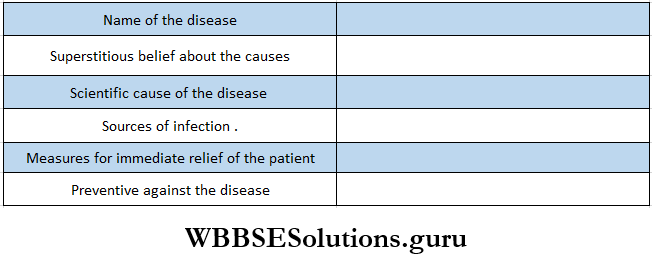
WBBSE Solutions For Class 8 English Reading Skill Unseen Detailed Reading Fill In The Chart Below With Information From The Text

Answer:

WBBSE Solutions For Class 8 English Reading Skill Unseen Detailed Reading Fill In The Chart Below With Information From The Text Answer

2. Some precautionary measures have been suggested against the disease cholera. Write them in brief.
Answer:

  1. Food, sweets, and cut fruits kept in the open should be avoided.
  2. We should not drink unclean water from ponds and wells.
  3. Clothes of cholera patients should not be washed in ponds.

3. Pick out the correct answers.

Question 1. Cholera is caused by

  1. Anger of goddess.
  2. Infection from germs.
  3. Bites of mosquitoes.

Answer: 2. Infection from germs

Question 2. Cholera patients need

  1. Dehydration.
  2. Rehydration. (“tificeer weer we offer)
  3. Vaccination.

Answer: 2. Rehydration

Question 3. Dehydration causes

  1. High temperature.
  2. Infections.
  3. Loss of fluid.

Answer: 3. Loss of fluid

Question 4. Vaccination is meant for

  1. Prevention of cholera.
  2. Treatment of cholera.
  3. Cure of cholera.

Answer: Prevention of cholera

4. Answer the questions in brief.

Question 1. How do cholera germs get into our body?
Answer: Cholera germs get into our body when we take uncovered food, sweets and cut fruits and drink unclean water from ponds and wells.

Question 2. What should be given to a cholera patient for immediate relief?
Answer: A cholera patient should be given plenty of salt water sweetened with sugar for immediate relief.

Question 3. How can we protect ourselves against this deadly disease?
Answer: We can protect ourselves against the disease by taking the cholera vaccine.

5. Write ‘T’ for true and ‘F’ for false statements.

Question 1. Cholera disease occurs because of an act of sin.
Answer: False

Question 2. Cholera is an infectious disease.
Answer: True

Question 3. We should always drink pure water to avoid infection from cholera.
Answer: True

Question 4. A cholera patient should be immediately shifted to a hospital.
Answer: False

Question 5. Vaccination is the real prevention of this disease.
Answer: True

Question 6. Flies are carriers of cholera germs.
Answer: True

6. Find words from the passage which mean the following.

Question 1. Showing unreasoning belief in supernatural influences
Answer: Superstitious

Question 2. That which spreads from one person to another
Answer: Infections

Question 3. Large quantity
Answer: Plenty

Question 4. Make up for
Answer: Compensate

Question 6.

Einstein was very simple in his ways of life and indifferent to his great fame. Once the queen of Belgium invited him to Brussels. When he got down from the train at Brussels, he could not think that there were many gorgeously dressed officials to receive him at the station. The officials also expected somebody who would appear to be rich and aristocratic to them. They never imagined that this shabby man would be Einstein himself. So they went back to the queen and informed her that he had not come by train. Einstein; however, walked the whole way with a suitcase in one hand and a violin in the other. When he reached the destination the queen said to him, “I sent a car for you, Dr. Einstein.” “I did not think,” replied the great scientist with a smile, “that anybody would send a car for me. But I can assure you, I have greatly enjoyed the walk.”

[Word meaning: indifferent; fame-; gorgeously; aristo- cratic—অভিজাত; shabby—মলিন বস্ত্র পরিহিত; destination—গন্তব্যস্থল ; assure—নিশ্চিত করা

1. Choose the correct answer.

Question 1. Einstein used to live a

  1. Gorgeous life.
  2. Simple life.
  3. Bohemian life.

Answer: 2. Simple life

Question 2. He was dressed

  1. Nicely.
  2. Gorgeously.
  3. Shabbily.

Answer: 3. Shabbily

Question 3. The officials missed Einstein because they expected to see a

  1. Simple man.
  2. Rich and aristocratic-looking man.
  3. Poorly dressed man.

Answer: 2. Rich and aristocratic-looking man

Question 4. Einstein missed the officials sent by the queen because he

  1. Found none at the station.
  2. Did not expect any officials.
  3. Did not wait long at the station.

Answer: 2. Found none at the station

Question 5. On hearing that the queen had sent a car for him Einstein said that

  1. He did not need the car and he had enjoyed the walk.
  2. He had not seen any car at the station.
  3. He found none.

Answer: 1. He did not need the car and he had enjoyed the walk

2. Write ‘T’ for true and ‘F’ for false statements.

Question 1. Einstein was very conscious of his fame.
Answer: False

Question 2. He went to Brussels, to attend a seminar.
Answer: False

Question 3. The queen sent a car to receive him.
Answer: True

Question 4. Einstein went to the palace by the queen’s car.
Answer: False

Question 5. Einstein was a great scientist.
Answer: True

3. Answer the questions in short.

Question 1. What was unexpected to Einstein at the Brussels Railway station?
Answer: Einstein did not expect that gorgeously dressed officials would come to the station with a car to receive him.

Question 2. What did the officials expect to see at the station?
Answer: The officials expected to see a rich and aristocratic-looking person as their guest.

Question 3. Describe the dress of Einstein as he came down from the train.
Answer: Einstein’s dress was quite poor and shabby.

Question 4. What did he carry in his hands?
Answer: He carried a suitcase and a violin in his hands.

Question 5. Describe Einstein’s attitude towards life and fame.
Answer: Einstein lived a simple life and was indifferent to fame.

Question 6. What did the officials report to the Queen?
Answer: The officials reported to the queen that Einstein had not come.

4. Complete the sentences with information from the text.

Question 1. The queen of Belgium invited ____________
Answer: The queen of Belgium invited Einstein to Brussels.

Question 2. The officials did not ____________
Answer: The officials did not expect that their guest would look like ordinary man in a poor dress.

Question 3. Einstein enjoyed the walk to _________
Answer: Einstein enjoyed the walk to the queen’s palace.

Question 4. The officials reported to the queen _______
Answer: The officials reported to the queen that Einstein had not come.

5. Match the words in ‘A’ with the words nearest in meaning in ‘B’.
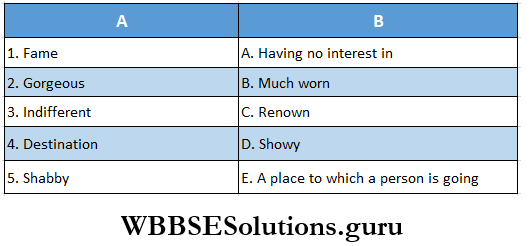
WBBSE Solutions For Class 8 English Reading Skill Unseen Detailed Reading Match The Word A With B

Answer: 1. C, 2. D, 3. A, 4. E, 5. B

Question 7.

There was a venomous snake in a field. One day a sage passed by that field and the snake ran after him to bite. The sage advised the snake not to bite anyone. The snake promised to follow his advice. The sage went away. The snake entered his hole and began to live without attempting to harm anyone. In a few days, the people concluded that the snake had lost its venom and was no longer danger- ous. They teased him, pelted him with stones, and dragged him mercilessly. Fortunately, the sage again passed by that field. Seeing the injured condition of the snake the sage enquired of the cause. “Holy Sir”, the snake replied, “this is because I do not injure anyone after your advice.” The sage smilingly said, “My friend, I simply advised you not to bite anyone, but I did not tell you not to frighten them in your self-defense.”

[Word meaning: venomous – বিষধর ; promised — প্রতিজ্ঞা করেছিল; concluded— সিদ্ধান্তে উপনীত হল; dangerous বিপদসঙ্কুল। teased বিরক্ত করল; pelted হয়েছিল; mercilessly নির্ণয়ভাবে injured—আহত; frighten — ভয় দেখানো ]

1. Answer in short.

Question 1. Where did the snake live?
Answer: The snake lived inside a hole in a field.

Question 2. What happened when a sage passed by the snake?
Answer: When the sage was passing, the snake ran after him to bite.

Question 3. What did the sage advise? Did the snake obey him?
Answer: The sage advised the snake not to bite anyone. The snake obeyed him.

Question 4. What was the conclusion of the people?
Answer: The people concluded that the snake had lost its venom and was no longer dangerous

Question 5. What did they do to the snake?
Answer: They teased the snake, pelted him with stones, and dragged him mercilessly.

Question 6. Give a suitable title to the passage.
Answer: The Sage and the Snake

2. Write ‘T’ for true and ‘F’ for false statements.

Question 1. The snake bit the sage.
Answer: False

Question 2. The snake followed the sage’s advice.
Answer: True

Question 3. The snake lost its venom.
Answer: False

Question 4. The people injured the snake.
Answer: True

Question 5. The sage advised the snake not to frighten anybody.
Answer: False

3. Complete the following sentences

Question 1. The snake wanted ___________
Answer: The snake wanted to bite the sage.

Question 2. The sage advised the snake _________
Answer: The sage advised the snake not to bite anyone.

Question 3. The people were ___________
Answer: The people were merciless

4. Find words in the passage meaning the following:

  1. Something with venom
  2. Made fun unkindly
  3. Without any mercy or compassion
  4. Cause to be afraid

Answer:

  1. Venomous,
  2. Teased,
  3. Mercilessly,
  4. Frighten

Question 8.

Astronomers, those people who study the stars, tell us that long, long ago the earth and all the planets were part of the sun. The sun was then as it is now a mass of flaming matter, terribly hot. Somehow little bits of the sun got loose and they shot out into the air.

In this way our earth also shoot out from the sun. It must have been very hot, with terribly hot gases and air all around it, but as it was very much smaller than the sun it started to cool. The sun also is getting less hot but it will take millions of years to cool down. The earth took much less time to cool. When it was hot of course, nothing could live on it—no man or animal or plant or tree. Everything should have been burnt up then.

Just as a bit of the sun shot out and became the earth, so also a bit of the earth shot out and became the moon. Many people think that the moon came out of the great hollow which is now the Pacific Ocean, between America and Japan.

[Word meaning : Astronomer – জ্যোতির্বিদ ; planet — গ্রহ; flaming — জলন্ত ; bit—অল্প অংশ ]

1. Pick out the correct alternatives.

Question 1. According to astronomers, long ago

  1. The earth was separate from the sun.
  2. The planets were separate from the sun.
  3. The earth and the planets were part of the sun.

Answer: 3. The earth and the planets were part of the sun

Question 2. Initially, the earth was

  1. Very cold.
  2. Very hot.
  3. Moderately hot.

Answer: 2. Very hot

Question 3. The moon originated from

  1. The Pacific Ocean.
  2. The earth.
  3. The sun.

Answer: 2. The earth

Question 4. The Pacific Ocean has been formed due to the shooting out of a portion of

  1. The earth.
  2. The moon.
  3. The sun.

Answer: 1. The earth

2. Write ‘T’ against true and ‘F’ against false statements.

Question 1. The sun was originally a mass of flaming matter but not now.
Answer: False

Question 2. The earth shot out of the moon.
Answer: False

Question 3. Initially, the earth had hot gases and air all around it.
Answer: True

Question 4. The sun will take a very long time to cool down.
Answer: True

Question 5. There was no life on earth when it was formed.
Answer: True

3. Complete the sentences with information from the text.

Question 1. The earth originated from _________
Answer: The earth originated from the sun.

Question 2. A bit of the earth shot out and became _________
Answer: A bit of the earth shot out and became the moon.

Question 3. People studying stars are called _________
Answer: People studying stars are called astronomers.

4. Give a suitable title to the passage.
Answer: The Origin of the Earth and the Moon

WBBSE Solutions For Class 8 English Reading Skill Unseen Detailed Reading

Question 9.

One wintry night an old infirm beggar, shivering with cold, knocked at the door of a farmer who was sitting with his children around his hearth. In a feeble voice he begged for shelter and hospitality. His feet were trembling and he could no longer drag his weary body in the chilly weather of the night. His tattered clothes could hardly afford him protection against the snow. The farmer opened the door and when the children saw the old, infirm beggar standing at the door, they ran to comfort him. They warmed his frozen limbs and gave him food and did all they could to cheer him up. The beggar was moved to tears. In the midst of their sorrow for the misery of that man, the farmer’s children felt that night a joy they had never felt in their happiest days.

[Word meaning: infirm-; hearth-s; feeble-; hospitality-fr weary— দুর্বল ; tattered— ছিন্নভিন্ন ]

1. How would you classify the text?

  1. A description;
  2. A public notice;
  3. A report
  4. A story

Answer: 4. A story

2. Choose the correct answers in the following:

Question 1. An old infirm beggar knocked at the door of

  1. A prince.
  2. A weaver.
  3. A peasant.

Answer: 3. A peasant

Question 2. The beggar asked for

  1. Shelter and hospitality.
  2. Power and position.
  3. Money and clothes

Answer: 1. Shelter and hospitality

Question 3. The farmer and his children

  1. Drove the beggar.
  2. Served the beggar.
  3. Beat the beggar

Answer: 2. Served the beggar

Question 4. The children of the farmer

  1. Fed the beggar
  2. Clothed the beggar
  3. Gave the beggar money

Answer: 1. Fed the beggar

Question 5. The beggar was moved by the farmer and his children’s

  1. Sympathy.
  2. Kindness
  3. Hospitality.

Answer: 3. Hospitality

3. Write ‘T’ against correct statements and ‘F’ against incorrect statements.

Question 1. The farmer was a selfish man.
Answer: False

Question 2. The farmer’s children felt for the beggar.
Answer: True

Question 3. When the beggar came, the farmer was standing at the door.
Answer: False

Question 4. It was raining when the beggar came in.
Answer: False

Question 5. The beggar was weak.
Answer: True

4. Match the causes with the results.
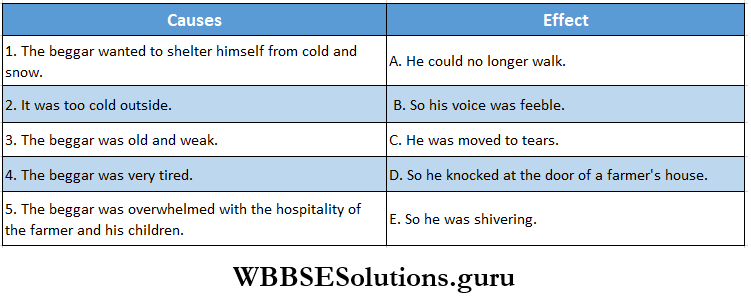
WBBSE Solutions For Class 8 English Reading Skill Unseen Detailed Reading Match The Cause With Effect

Answer: 1. D, 2. C, 3. E, 4. A, 5. B

5. Write the nearest meaning of the following words from the above text:

  1. Torn
  2. Weak

Answer:

  1. Torn: Tatters
  2. Weak: Infirm

Question 10.

Conan Doyle was a young doctor who had just entered practice. In those days it took some time for a doctor to become popular and get patients. He spent many hours in his room waiting for patients. He began to think of other ways in which he could earn his living. He tried his hand at writing and wrote a novel. It did not attract much attention. Nobody seemed interested in it. But after several years Conan Doyle wrote some short detective stories about the detective Sherlock Holmes which brought him money and fame.

[Word meaning young practice-551; popular; living- AHA: attention; interested; detective – রহস্যমূলক ]

1. Write ‘T’ for true and ‘F’ for false statements.

Question 1. Conan Doyle had a good practice as a young doctor.
Answer: False

Question 2. To earn money he took to writing.
Answer: True

Question 3. In the beginning, Doyel earned great reputation as a writer.
Answer: False

Question 4. Doyle became famous as a detective story writer.
Answer: True

Question 5. Sherlock Holmes was the name of a detective.
Answer: True

2. Answer the questions in short.

Question 1. What was Conan Doyle by profession?
Answer: Conan Doyel was a doctor by profession

Question 2. Why did he try to earn money in other ways?
Answer: Because he was not successful as a young doctor.

Question 3. How did he meet success?
Answer: He met success as a writer of short detective stories which brought him money and fame

3. Pick up a sentence from the passage that shows that Doyle’s first novel had no market.

4. Fill in the blanks with words taken from the text. Change their forms if necessary.

Question 1. He is a ______ businessman.
Answer: Successful

Question 2. Pay ____ to your studies.
Answer: Attention

Question 3. The loud sound ________ our attention.
Answer: Attracted

Question 4. She is _______ in music.
Answer: Interested

Question 11.

There lived in a certain town of Persia two painters, whose name had spread far. Both were so good at their work that it was hard to say who the better painter was. So it was settled that each was to draw a picture and there would be judges to decide who had done the better work. One of the painters painted a bunch of grapes that looked so natural that birds came and pecked at it.

The judges were struck with wonder and thought he was surely going to win. When they went to see what the other painter had done, he pointed to a screen that was before their eyes. The rival painter thought that the picture was behind the screen and went forward to see to it. He was greatly surprised to find that there was no screen there but only the picture of one that had been painted on the wall. The judges were speechless with wonder and gave the second painter the place of honor as his picture had deceived a man while that of his rival had deceived only the birds.

[Word meaning : hard — কষ্টসাধ্য; settled — স্থির করা হল; decides — মীমাংসা করা ; natural— স্বাভাবিক; pecked ঠোকরাল ; struck — হতভম্ব হল surprised — বিস্মিত; speechless নির্বাক; wonder-fe; deceived-affe; rivals]

1. Read the passage carefully and pick out the correct answers from the statements below:

Question 1. The first painter’s picture deceived.

  1. The judges.
  2. The rival painter.
  3. The birds.

Answer: 3. The birds

Question 2. The second painter’s picture deceived

  1. The judges.
  2. The rival painter.
  3. The birds.

Answer: 2. The rival painter

Question 3. The painter who had painted a screen was given the place of honour by the judges because

  1. He was the better painter.
  2. He was the best painter.
  3. He was one of the best painters.

Answer: 1. He was the better painter

Question 4. The bunch of grapes misled

  1. The judges and the birds.
  2. The birds.
  3. The rival painter.

Answer: 2. The birds

Question 5. The screen misled

  1. The birds.
  2. The rival painter.
  3. The rival painter as well as the judges.

Answer: 2. The rival painter

2. Some of the following statements are true and some are false. Write ‘T’ against the true and ‘F’ against the false statements.

Question 1. The two painters were unknown.
Answer: False

Question 2. The two painters were quite famous.
Answer: True

Question 3. One of the painters was very good but the other was quite inferior.
Answer: False

Question 4. The first painter’s painting deceived the judges.
Answer: False

Question 5. The second painter was declared the winner.
Answer: True

Question 12.

You all know that Everest, a peak of the Himalayas, is the highest mountain in the world. It was discovered by a Bengalee named Radhanath Sikdar, an officer in the Government of India. It, however, came to be called after his chief, Sir George Everest.

For many years, people have been trying to get to the top of Everest. The first attempt was made in 1921, followed by ten others up to 1952. But so great are the difficulties of the climb that they ended in failure. Even several lives were lost.

The sides of Everest are always covered with snow. It often slips and falls, and in falling, kills the climbers. There are also fearful storms of frost and snow at the top almost all the year.

No wonder, Everest stood unconquered so long. But its pride was humbled at last. The top was reached in the twelfth attempt in May, 1953, by the party led by Col. John Hunt. And the heart of every Indian is filled with pride that, of the two that reached the top, one was an Indian, Tenzing Norkey. The other was a man from New Zealand, Edmund Hillary. It is in the fitness of things that the peak which was discovered by an Indian should also be conquered by another Indian.

[Word meaning: peak – চূড়া; discovered — আবিষ্কৃত হয়েছিল; failure — ব্যর্থতা; fearful — ভয়াবহ ; frost— তুষারপাত ; unconquered — অপরাজিত; humbled — হতমান হয়েছিল; prise — গর্ব ; fitness of things— সঙ্গত কারণেই; conquered — জয় লাভ করল ]

1. Four headings are written for the four paragraphs in the above text. Match the proper headings for the paragraphs.

Headings

  1. Conquering Everest
  2. Discovery of Everest
  3. Attempts to conquer Everest
  4. Difficulties of the climb

Answer:

WBBSE Solutions For Class 8 English Reading Skill Unseen Detailed Reading Paragraphs With Headings

2. Fill in the chart below with information from the text.

WBBSE Solutions For Class 8 English Reading Skill Unseen Detailed Reading Fill In The Chart Below With Information From The Text-1

Answer:

WBBSE Solutions For Class 8 English Reading Skill Unseen Detailed Reading Fill In The Chart Below With Information From The Text Answer 1

3. Write ‘T’ against the true and ‘F’ against the false statements.

Question 1. Radhanath Sikdar was an Englishman.
Answer: False

Question 2. Everest was conquered in the twelfth attempt.
Answer: True

Question 3. There was no risk in climbing up the peak.
Answer: False

Question 4. Indians were proud at the conquest of Everest.
Answer: True

Question 5. The top of Everest remains covered with snow only for a few months.
Answer: False

Question 13.

Long ago there was a slave in a country. His name was Androcles. He committed an offence. So he was punished. Out of fear he ran away from his master’s house and lived in a cave. In that cave lived a big lion. A thorn stuck into his left foot. So he felt great pain and could not walk properly. He came limping towards Androcles. Androcles saw the thorn. He boldly came forward and drew it out. The lion got rid of the pain and felt relieved. Later on Androcles was caught and brought to the town and was asked to fight a hungry lion. It was the same lion whose thorn Androcles had drawn out. The lion at once recognized him and quietly lay down at his feet.

[Word meaning : committed – কোনো দুষ্কর্মাদি করা; offence – অপরাধ; limping – খুড়িয়ে b; got rid of মুক্ত’ হল ; relieved – নিবৃত্তি হল ; hungry – ক্ষুধার্ত ; recognised — চিনতে পারল ; quietly – ধীর ভাবে ]

1. Pick out the correct answers and write in full sentences.

Question 1. Androcles was a

  1. Greek god.
  2. A slave.
  3. A king.

Answer: 2. A slave

Question 2. Androcles ran away from his master’s house and took shelter secretly

  1. In a village.
  2. In a forest.
  3. In a cave.

Answer: 3. In a cave

Question 3. The lion came limping towards Androcles because

  1. A thorn stuck into his left foot.
  2. One of his legs was broken.
  3. He could recognize Androcles.

Answer: 1. A thorn stuck into his left foot.

Question 4. The lion which Androcles was asked to fight was

  1. A new lion.
  2. The same lion whose thorn he had drawn out.
  3. A lion used in a circus.

Answer: 2. The same lion whose thorn he had drawn out.

Question 5. The lion lay down quietly beside Androcles because

  1. He was grateful to him.
  2. He was angry with him.
  3. He was afraid of him.

Answer: 3. He was afraid of him.

2. Suggest a suitable title for the passage.

Answer: Androcles and the lion

3. Fill in the following chart with information from the text.
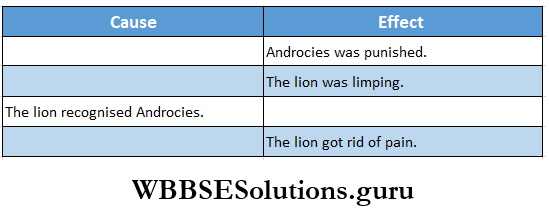
WBBSE Solutions For Class 8 English Reading Skill Unseen Detailed Reading Fill In The Folowing Chart With Information From The Text

Answer:

WBBSE Solutions For Class 8 English Reading Skill Unseen Detailed Reading Fill In The Folowing Chart With Information From The Text Answer

4. How would you classify the above text?

  1. A public notice
  2. A description
  3. A report
  4. A story

Answer: 4. A story

5. Which of the following statements are true and which are false?

Question 1. Androcles saw the lion in a cave.
Answer: True

Question 2. Androcles was killed by the lion.
Answer: True

Question 3. The lion had pain in his stomach.
Answer: True

Question 4. The lion was limping because he had lost one of his legs.
Answer: True

Question 5. The lion had a sense of gratitude.
Answer: True

Question 14.

Although Louis Braille died when he was only forty-three years old, he succeeded in devising a system of reading and writing for the blind which is now taught all over the world.

Braille lost his sight accidentally as a child. Nevertheless, he was able to complete his education at a school for the blind in Paris and became a teacher. In his days the few books that were available for the blind people were printed in big, raised type; the letters used were those of the ordinary alphabet. The reading of such books required immense effort. And writing was almost impossible, for a blind person was still restricted to an alphabet which was extraordinarily difficult to reproduce on paper. Braille’s idea was to use raised dots instead of raised letters. He evolved a system that made use of only six dots in all. By various combinations of these dots, it not only proved possible to represent each letter in the alphabet but punctuation marks, numbers, and notation as well. Reading and writing have thus been enormously simplified. The sensitive fingers of a blind person can travel rapidly over the dots; and there is a small machine something like a typewriter, which enables the blind to write quickly and clearly.

[Word meaning: Devising-; alphabet-; immense-2, restricted– সীমাবদ্ধ; extraordinarily — অস্বাভাবিক ভাবে ; reproduce — অনুলিপি করা; evolved – বের করেছিলেন; enormously-b]

1. Answer the following questions:

Question 1. How did Braille become blind?
Answer: Braille became blind accidentally.

Question 2. What type of books were available for the blind in Braille’s time?
Answer: The books available for the blind at that time were printed in big raised type ordinary alphabet.

2. Write ‘T’ for true statements and ‘F’ for false ones:

Question 1. Braille was blind from his birth.
Answer: False

Question 2. Braille died at the age of 43.
Answer: True

Question 3. Braille evolved a system of raised type using ordinary alphabet.
Answer: False

Question 4. It is easy to use the Braille system of reading and writing.
Answer: True

Question 5. Musical notation can also be written in Braille language.
Answer: True

3. Complete the following with information from the passage:

Question 1. Luois Braille became a ____________
Answer: a teacher after completing his education at a school for the blind.

Question 2. He completed his education in ____________
Answer: Paris

Question 3. Reading books for the blind in Braille’s time required ____________
Answer: immense effort.

Question 4. Braille system used only ____________
Answer: six raised dots.

4. Find out words from the text to match meaning of the following:

  1. Signs or symbols to represent numbers, amounts, etc.:
  2. Came after:
  3. Thinking out a plan:
  4. Put a limit:
  5. Greatly:

Answer:

  1. Signs or symbols to represent numbers, amount etc.: dots.
  2. Came after: evolved
  3. Thinking out a plan: devising
  4. Put a limit: restricted
  5. Greatly: enormously

Question 15.

We know that plants and trees do not move about as cats and dogs do, and so men at first thought that plants and trees are not actually alive. But now we know that plants and trees are not only alive but they can feel as well, like other living things. Sir Jagadish Chandra Bose was able to prove this and spread the idea throughout the world.

He showed that there is no difference between the life of plants and that of animals. If we give the plants a blow, they feel it, and if we make them drink a poison, they are affected by it like us. Like human beings they also sleep at night and wake up in the morning. They even die like men. He proved all these by experimenting in the laboratory with the most delicate instruments. He added something new to science and brought about a great change in the world of science.

Honors were heaped upon him. He received a knighthood and came to be known as Sir Jagadish Chandra Bose. He was asked by the various scientific institutions of the world to deliver lectures on his research. These lectures made him world-famous as a scientist. Thus we see that his discoveries gave a new light to the world and brought honour and glory to India. Jagadish Chandra is in the world of science what Rabindranath is in the world of letters.
throughout the world

Word meaning: alive; able; spread পৃথিবী ব্যাপি; difference— তফাৎ ; poison – বিষ; affected – ক্ষতিগ্রস্ত হয়; delicate— সূক্ষ্ম ; heaped — স্তূপীকৃত করা হয়েছিল; deliver lectures -বক্তৃতা দেওয়া; researches famous বিখ্যাত; glory” “গৌরর+ world of letters সাহিত্য জগত

1. Answer the questions in brief:

Question 1. Why did people think that plants had no life?
Answer: Because plants cannot move like living animals.

Question 2. Who was Sir Jagadish Chandra Bose?
Answer: Sir Jagadish Chandra Bose was a famous Indian scientist.

Question 3. What did he discover?
Answer: He discovered that plants and trees have life and they can also feel like other living things.

Question 4. How did he become famous?
Answer: He became famous by his discovery that there is no difference between the life of plants and that of animals.

Question 5. What was his contribution to science?
Answer: His discovery gave a new idea to science and brought about a great change in the world of science.

2. Complete the sentences with information from the text.

Question 1. In recognition of his great work, Jagadish Chandra was awarded ____________
Answer: In recognition of his great work, Jagadish Chandra was awarded a knighthood and came to be known as Sir Jagadish Chandra Bose.

Question 2. He proved that plants react to a poison as ____________
Answer: He proved that plants react to a poison as a man does.

Question 3. He was asked to deliver ____________
Answer: He was asked to deliver lectures on his researches at various scientific institutions of the world.

Question 4. His discovery made him ____________
Answer: His discovery made him a world-famous scientist.

Question 5. He brought honour and glory to India by ____________
Answer: He brought honour and glory to India by his famous discoveries.

Question 6. Jagadish Chandra is famous in ____________ as Rabindranath is in ____________
Answer: Jagadish Chandra is famous in the scientific world as Rabindranath is in the literary world.

3. Write ‘T’ for true and ‘F’ for false statements.

Question 1. Jagadish Chandra became famous because of his discoveries.
Answer: True

Question 2. The scientific world did not accept his theories.
Answer: False

Question 3. Plants and trees can feel and respond like human beings.
Answer: True

Question 4. India was proud of Jagadish Chandra.
Answer: True

Question 5. Rabindranath earned fame both in arts and science.
Answer: False

Question 6. Plants sleep in the daytime and wake up at night.
Answer: False

4. Make sentences of your own with the following words.

  1. Alive;
  2. Throughout;
  3. Difference;
  4. Affected;
  5. Delicate.

Answer:

  1. The animal was injured but it is still alive.
  2. He suffered a lot throughout his life.
  3. There is no difference between the two schemes.
  4. They were affected by the flood.
  5. It is a very delicate matter.

5. Write words opposite in meaning of the following.

  1. Alive;
  2. Able;
  3. Difference;
  4. Delicate;
  5. Glory.

Answer:

Alive: Dead;

Able: Unable;

Difference: Similarity;

Delicate: Coarse;

Glory: Disgrace.

Question 16.

One morning a boy, tending cattle by the side of a railway line, noticed that a small railway bridge had given way following the previous night’s heavy shower. He also saw a passenger train in the distance, coming towards it at full speed. A simple cowboy as he was, he at once realised the great danger that awaited the train and its passengers. He ran up to the line and standing on it began to wave his shirt as a warning to the driver. The driver thought that this was a mere prank of a village urchin. So the train continued to advance, whistling furiously to scare away the boy. But he would not leave his post. The driver was at last compelled to stop the train a little distance from the boy. As he and the guard came down, the boy took them to the breach. They now realized what a great danger they had escaped. The boy was later richly rewarded by the railway authorities.

Word meaning tending: চড়াচ্ছিল ; previous = আগের দিন ; realised বুঝতে পারল awaited- অপেক্ষা করছিল; wave ওড়ানো ; warning — বিপদের সঙ্কেত ; prank— দুষ্টামি কাজ urchin— দুরন্ত শিশু ; furiously – জোরে জোরে ; scare away- ভয় দেখিয়ে বিরত করা; compelled- বাধ্য হল ; breach—— ফাটল ; escaped — পরিত্রাণ পেয়েছে ; rewarded —— পুরস্কৃত হল

1. Complete the following sentences with information from the above text. You may also use your own words:

Question 1. The train driver thought __________
Answer: The train driver thought that the boy was waving his shirt just to enjoy a playful trick,

Question 2. The boy was rewarded for ____________
Answer: The boy was rewarded for preventing an accident.

Question 3. The boy saved __________
Answer: The boy saved the train and the passengers from a serious accident

Question 4. The train whistled __________
Answer: The train whistled to scare away the boy from the railway lines.

Question 5. At last the driver and __________
Answer: At last the driver and the guard came down up to the boy who took them to the breach

2. Arrange the following sentences in their proper order.

  1. The driver was forced to stop the train.
  2. The cowboy began to wave his shirt.
  3. The bridge developed a breach due to heavy overnight rain.
  4. The cowboy got the reward from the railway authorities.
  5. The train advanced whistling furiously.

Answer:

4. The cowboy got the reward from the railway authorities.

2. The cowboy began to wave his shirt.

1. The driver was forced to stop the train.

5. The train advanced whistling furiously.

3. The bridge developed a breach due to heavy overnight rain.

3. Choose an answer against the most suitable of the titles for the above text:

  1. The train and the breach
  2. A cowboy waved his shirt
  3. A cowboy prevented a train accident
  4. A heavy shower and a train accident

Answer: 3. A heavy shower and a train accident

Question 17.

Forests are far from towns and cities. So people who live in cities and towns do not think that they have any connection with the forests. But they are dependent on forests for timber, which is nothing but wood used in building houses, carts, boards, bridges, plows, paper, and many other things. People in villages also use wood as fuel for cooking their meals.

In the past there was no fear of shortage of wood. But random cutting of trees has created scarcity of firewood. It has also caused soil erosion and less rainfall.

We can, however, overcome the problems by stopping the destruction of forests and planting more trees.

[Word meaning: dependent-; random-; scarcity-; fire-wood- জ্বালানী কাঠ; soil erosion — ভূমিক্ষয়; overcome— বশে আনা ]

1. Correct the following sentences according to the passage:

Question 1. People of cities and towns are connected with forests.
Answer: People of cities and towns do not think that they have any connection with the forests.

Question 2. People of cities and towns use wood only as fuel.
Answer: People of cities and towns use wood as fuel and also for building houses, carts, boards, bridges, paper and many other things.

Question 3. Soil erosion helps trees to grow.
Answer: Soil erosion is caused by random cutting of trees.

Question 4. The cutting of trees has increased the amount of rainfall.
Answer: The cutting of trees has decreased the amount of rainfall.

Question 5. Planting of more trees is not essential.
Answer: Planting of more trees is essential.

2. Random cutting of trees has created three problems. Write them in the space. Answer in words not in sentence.
Answer:

  1. Less rainfall
  2. Soil erosion
  3. Scarcity of firewood

3. Answer in brief:

Question 1. Why do people of cities and towns think that they have no connection with forests?
Answer: As the people of cities and towns live far away from forests, they think that they have no connection with forests.

Question 2. Where do village people get firewood from?
Answer: Village people get firewood from timber which is obtained from trees.

Question 3. For what purposes is timber used?
Answer: Timber is widely used as fuel, in building houses, in making carts, boards, bridges, plows, paper, and many other things.

Question 4. Why should we plant more trees?
Answer: We should plant more trees to obtain wood which is needed for various purposes, and also for inducing rain and preventing soil erosion.

4. Find out words from the passage that mean:

  1. Link or relation
  2. Lack

Answer:

  1. Connection
  2. Shortage

5. Find out words opposite in meaning to the following: (from the passage)

  1. More
  2. Creation

Answer:

  1. More: less
  2. Creation: Destruction

Question 18.

The Kimono is the national dress of Japan worn by both men and women. The word Kimono means ‘clothing’ or literally ‘something to wear’ and it has been just that for the Japanese for several hundred years. With changing times though, the people of Japan now wear the Kimono only on special or ceremonial occasions.

Kimonos are ‘T’ shaped robes that fall up to the ankles. The garment has a flat collar and wide sleeves that fall to the wrists. It is always worn left side over night and held together at the waist by a broad sash called ‘obi’. Most women’s Kimonos are one standard size and tucked in to fit the weaver. However, very tall and large sized women have to have their Kimonos stitched to their size. Men wear a shorter version of the women’s Kimono, called haori, along with hakama or loose-fitting pants.

These days a kimono can cost up to 10,000 dollars! Also, a silk one is but naturally more expensive than a cotton one. Today, in Japan, more women than men wear kimonos but only on special occasions like tea ceremonies, weddings, and funerals.

[Word meaning literally — আক্ষরিক অর্থে; ceremonial — আনুষ্ঠানিক ; tucked গুটিয়ে নিয়ে।

1. Find a word from the passage that means the same as the words below:

  1. Wide
  2. Costly
  3. Dresses

Answer:

  1. Wide: Broad
  2. Costly: Expensive
  3. Dresses: Clothing

2. Choose the correct answer:

Question 1. The kimono

  1. Used to be the national dress of men and women in Japan.
  2. Is the national dress of men and women in Japan.
  3. Is the national dress of women in Japan.

Answer: 2. Is the national dress of men and women in Japan.

Question 2. The kimono is worn

  1. Left side over right.
  2. Right side over left.
  3. Left side under right.

Answer: 1. Left side over right.

Question 3. Very tall women need to get their kimonos

  1. Tucked in.
  2. With an ‘obi’.
  3. Stitched up.

Answer: 3. Stitched up.

3. Write answers to the following questions:

Question 1. Describe a kimono.
Answer: A kimono is a ‘T’ shaped robe that falls up to the ankles. It has a flat collar and wide sleeves that fall to the wrists. It is always worn left side over right and held together at the waist by a broad sash called ‘obi’.

Question 2. What is a hakama?
Answer: A hakama is a loose-fitting pant worn by men in Japan.

Question 3. What can be the cost of a kimono?
Answer: A kimono can cost up to 10,000 dollars.

Question 4. On what occasions do the Japanese wear kimonos?
Answer: The people of Japan wear the kimono only on special or ceremonial occasions like tea ceremonies, weddings, and funerals.

4. Write whether the following statements are True or False.

Question 1. The kimono is the national dress of Jamaica.
Answer: False

Question 2. Men’s kimono in Japan is called haori.
Answer: True

Question 3. ‘Obi’ is a loose-fitting pant.
Answer: False

Question 19.

Forests are called the green gold of a country because they provide immense wealth and riches for the country. They produce wood for building houses, furniture, railway sleepers, bullock carts, boats, and ships. People in the villages use wood as fuel for cooking food.

The other useful products from forests are honey, wax, shellac, resins, precious herbs, and medicinal plants. They are also great sources of material for paper, rubber, and gums.

Forests have a direct influence on the climate of a region. They bring about rain and prevent air pollution. An area devoid of forests will go barren and turn into a desert in the course of time. The roots of trees bind loose soil and prevent soil erosion: The top fertile soil is thus retained which is so vital for agriculture. The arrest of soil erosion also prevents siting and raising of river beds and the subsequent overflowing of rivers causing floods. Forests protect us from inclement weather also.

The thoughtless cutting of trees has reduced forest wealth considerably. It has caused less rainfall, a lowering of groundwater level, and droughts. We can, however, overcome the problems by stopping the destruction of forests and planting more trees. People have to be made tree-conscious.

Word meaning: immense • প্রচুর; riches– সম্পদ; produce – উৎপাদন করে; shellac- লাক্ষা; resin— রজন; herb — ঔষধি; bring about — ঘটানো; devoid— হীন, বর্জিত ; erosion— ক্ষয় inclement— ঝড়ো ; drought— খরচ

1. Answer the questions in brief.

Question 1. Why are forests called the green gold of a country?
Answer: Forests are called green gold as they are the health of the country.

Question 2. How are forests important for us?
Answer: Forests are important because they give us useful products like wood, fuel, wax, honey, shellac, precious herbs, etc. They also bring about rains and prevent air pollution and soil erosion.

Question 3. How do forests influence the climate of a place?
Answer: Forests influence the climate of a place because they bring about rains, and prevent air pollution, soil erosion, and floods.

Question 4. Why are forests so useful to the village people?
Answer: Because villagers use wood as fuel for cooking food.

Question 5. What should be done to save forests?
Answer: To save forests, we should stop random cutting of trees and encourage tree planting.

2. Complete the chart with information from the text.

WBBSE Solutions For Class 8 English Reading Skill Unseen Detailed Reading Complete The Chart With Information From The Text

Answer:

WBBSE Solutions For Class 8 English Reading Skill Unseen Detailed Reading Complete The Chart With Information From The Text Answer

3. Thoughtless cutting of trees has created some problems. Write them down in brief.
Answer:

  1. Causing less rainfall
  2. Lowering groundwater level
  3. Causing droughts

4. Write ‘T’ for true and ‘F’ for false statements.

Question 1. Forests are very useful to people.
Answer: True

Question 2. Soil erosion helps trees to grow and survive.
Answer: False

Question 3. Rural people use wood as fuel.
Answer: True

Question 4. Rainfall has increased as a result of cutting of trees.
Answer: False

Question 5. Soil erosion should be controlled to prevent floods.
Answer: True

Question 6. Mass consciousness is necessary to prevent the cutting of trees.
Answer: True

5. Given below are three headings. Match them with the paragraphs. Write their numbers only against the headings.

Headings

  1. Forest products
  2. Preservation of forests
  3. Influence of forests on the climate

Answer:
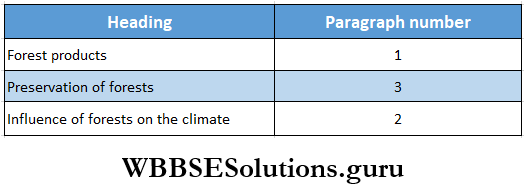
WBBSE Solutions For Class 8 English Reading Skill Unseen Detailed Reading Pragraph And Headings

Question 20.

There was once a little girl who lived with her mother in a small house near a village. The mother worked as hard as she could every day but still they were very poor. Often they did not have enough to eat.

One day when there was nothing left in the house, the little girl went out in the woods, hoping to find some wild fruit or flowers. There she met a strange-looking old woman. The little girl’s face was sad. So the old woman said, “You seem in trouble my child. What’s the matter ?” “I’m looking for food for my mother and myself, for we have none at home,” replied the little girl.

The old woman gave her a small iron pot and said, “This is a magic pot. Just say to it, ‘Cook, little pot, cook,’ and it will cook you nice sweet porridge. And when you say, ‘Stop, little pot, stop’, it will stop cooking”. The little girl was happy.

[Word meaning : worked as hard as she could – যতটা সম্ভব পরিশ্রম সে করত; woods – বন; cook— রান্না করা; porridge — একপ্রকারের খাবার (যবের মণ্ড]

1. Answer the following questions:

Question 1. Where did the little girl live and with whom?
Answer: The little girl lived in a small house near a village with her mother.

Question 2. Who gave a small iron pot to the little girl?
Answer: An old woman gave a small iron pot to the little girl.

Question 3. Why did the little girl go out in the woods?
Answer: The little girl went to the woods to find some wild fruit or flowers.

Question 4. How was the old woman in the woods?
Answer: The old woman was very strange-looking.

Question 5. Why is the small iron pot called a ‘magic pot’?
Answer: The small iron pot was called a magic pot because it would cook nice sweet porridge when asked to cook and it would stop doing so when asked to stop.

2. Complete the following with the information from the text above:

Question 1. Though the mother worked as hard as possible __________
Answer: Though the mother worked as hard as possible, she and her daughter did not get enough to eat.

Question 2. The old woman told the little girl that she was looking quite depressed __________
Answer: The old woman told the little girl that she was looking quite depressed and wanted to know the reason for it.

Question 3. Ordering the little pot to stop will lead to __________
Answer: Ordering the little pot to stop will lead to a stoppage of cooking.

3. State whether the following statements are True or False:

Question 1. The mother and the little girl were very idle by nature.
Answer: False

Question 2. They were so poor that they went without food everyday.
Answer: False

Question 3. Finding no fruit or flowers in the woods, the little girl’s face was very sad.
Answer: True

Question 4. The little girl was in search of food for herself and her parents.
Answer: True

Question 5. The strange-looking woman troubled the little girl.
Answer: False

4. Find out the appropriate words from the passage meaning the following:

  1. Sorrowful;
  2. Sufficient

Answer:

  1. Sorrowful: Sad
  2. Sufficient: Enough

Question 21.

Netaji Subhas Chandra was not a man to appeal to the grace of the British ruler for the freedom of the country. He hated any idea of compromising with anything unjust and wrong. So he started a vigorous campaign against the British Government in public. The foreign ruler sent him behind bars but could not curb his indomitable spirit. In the third week of January 1941, befooling the British Police Force he escaped from internment in his own house and went to Germany in disguise. From there he went to Japan traveling under waters in a submarine. From Japan he went to Singapore and built up the Azad Hind Fouj and established the Azad Hind Government. He was called ‘Netaji’ by the soldiers of the Azad Hind Fauj, the first Indian National Army (INA). As the leader of the Azad Hind Fauj, Netaji said to the soldiers of the Fauj. ‘Comrades! Soldiers! Let your battle cry be-to Delhi, to Delhi !’

The national salutation ‘Jai Hind’ was first conceived by Azad Hind Fauj. Netaji’s breath is still felt in this national salutation of today’s free India: ‘Jai Hind’!

[Word meaning : grace – অনুগ্রহ ; compromise — আপসে নিষ্পত্তি করা; indomitable — অদম্য; befooling— বোকা বানিয়ে; internment— গৃহবন্দী অবস্থা ; conceived— কল্পনা করা হয়েছিল ]

1. Choose the correct alternatives

Question 1. Netaji did not like to appeal to the British rulers because-

  1. He did not like to compromise with injustice hated the British
  2. He did not like the rulers
  3. He hated the British

Answer: 1. He did not like to compromise with injustice hated the British

Question 2. The foreign rulers sent Netaji to jail because-

  1. Netaji campaigned against the rulers in public
  2. Netaji killed many Britishers
  3. Netaji escaped from his house

Answer: 1. Netaji campaigned against the rulers in public

Question 3. Netaji escaped from internment

  1. In Cuttack
  2. In Calcutta
  3. In jail

Answer: 2. In Calcutta

Question 4. The Azad Hind Government was established in-

  1. Japan
  2. India
  3. Singapore

Answer: 3. Singapore

Question 5. The first Indian National Army was established in-

  1. New Delhi
  2. Singapore
  3. Calcutta

Answer: 2. Singapore

2. Complete the following chart with information from the text:
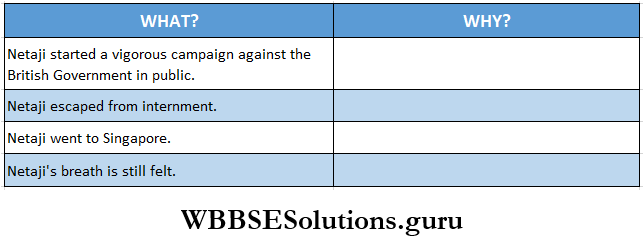
WBBSE Solutions For Class 8 English Reading Skill Unseen Detailed Reading Complete The Following Chart With Information From The Text What And Why

Answer:

WBBSE Solutions For Class 8 English Reading Skill Unseen Detailed Reading Complete The Following Chart With Information From The Text What And Why Answer 1

3. Match the words in column A with their meanings in column B.
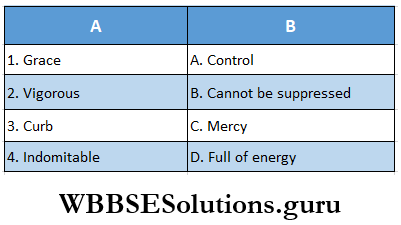
WBBSE Solutions For Class 8 English Reading Skill Unseen Detailed Reading Complete Match The Words
Answer: 1. C,2. D, 3. A, 4. B

Question 22.

Today we know the virus. It is a microbe when it is inside our body. A microbe is a living being so small that we cannot see it with our bare eyes. It is so called because it can be seen only with a microscope which enlarges a microbe thousand times and makes it visible to us. In fact, some microbes cannot be seen at all. It was Louis Pasteur who discovered microbes.

In the middle of the nineteenth century, people laughed at Pasteur when he said that microbes were man’s worst enemies. Pasteur insisted that all microbes, or germs came from the air and that it was possible, therefore, to protect milk, wine, and so on, from microbes. But the professors who thought they understood science said that Pasteur was wrong. They insisted that microbes were born spontaneously, and it was, therefore, nonsense to think that Pasteur could keep microbes out of milk or wine.

In order to convince these doubting professors, Pasteur boiled some broth in bottles, protected the broth from the air, and proved that no germs were created in this liquid. The professors answered that germs must have air in order to generate themselves. Pasteur was furious. He insisted that it was the ‘dust’ in the air and not the air itself that carried germs into the broth.

[Word meaning: microbe – জীবাণু; insisted– জোর দিয়ে বলতেন; spontaneously——-স্বতঃস্ফূর্তভাবে; -nousenise——অর্থহীন; convince – বিশ্বাস জন্মানো ]

1. Answer the following Questions:

Question 1. What is a microbe?
Answer: A microbe is a very small living being that cannot be seen with our bare eyes.

Question 2. Why is it called so?
Answer: It is so-called because it can be seen only with a microscope.

Question 3. What did the professors believe?
Answer: The professors believed that microbes were born spontaneously and they could not be kept out of milk or wine.

Question 4. How did Louis Pasteur prove that he was right?
Answer: Pasteur boiled some broth in bottles, protected the broth from the air, and showed that no germs were created in this liquid. Thus he proved himself right that it was dust in the air and not the air itself that carried germs into the broth.

Question 5. What is a microscope?
Answer: A microscope is an optical instrument that enlarges a microbe thousand times.

2. Match the cause and effect chart:
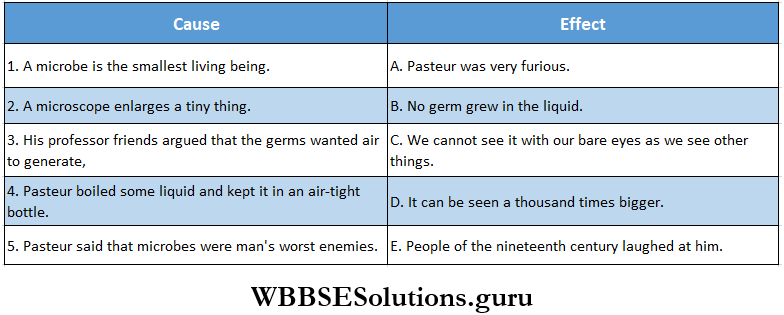
WBBSE Solutions For Class 8 English Reading Skill Unseen Detailed Reading Complete Cause And Effect

Answer:

WBBSE Solutions For Class 8 English Reading Skill Unseen Detailed Reading Complete Cause And Effect Answer

3. Fill up the blanks with information from the passage:

Question 1. There are many things that we can see without the use of a ________
Answer: Microscope

Question 2. A powerful machine can ________ the smallest thing to make it _____ to our eyes.
Answer: Visible

Question 3. It is really ______ to say that smoking is not harmful.
Answer: Wrong

Question 4. I told him the truth but could not ____ him.
Answer: Convince

Question 23.

David Livingstone was born many years ago at a small village in Scotland. His father was a poor man. So David was sent to work in a cotton mill at the age of ten. After a long day at the loom, he would read his books late into the night until his mother ordered him to go to bed. As he grew older, David began to go to school in the evening. In this way, he learnt a good deal of Latin, Greek, and medicine. And then he gave up his work in the cotton mill and went to Africa to find new rivers and lakes in that dark land and to teach the people there the story of the Bible. Accompanied by some faithful men, Livingstone set out to cross the Kalahari Desert. On the northern edge of the desert, he found the river Zuga and a great lake. Two years later he crossed the Zuga and pushed further north till he reached the great river Zambesi. Following the course of the river, he came upon the mighty falls which he named the Victoria Falls after Queen Victoria. From a distance, Livingstone had noticed five colors of spray. They were so high that they seemed to mingle with the clouds. They were white below and higher up became dark and thus looked like smoke. Tearing himself away from the beautiful sight, Livingstone pushed on down the river and reached the coast safely. In two and a half years he crossed Africa and completed one of the most wonderful travels.

[Word meanings : late into the night – অনেক রাত্রি পর্যন্ত ; tearing himself away – নিজেকে সরিয়ে নিয়ে।]

1. Choose the answer against the correct alternative:

Question 1. Livingstone’s attempt to cross Kalahari was-

  1. With some brave companions.
  2. With some reliable companions.
  3. With some able-bodied companions.

Answer: 2. With some reliable companions.

Question 2. Livingstone had to work in a loom-

  1. For experience.
  2. For poverty.
  3. For attending school in the evening.

Answer: 2. For poverty.

Question 3. Livingstone saw the great falls

  1. When he reached the river Zuga.
  2. When he reached the great lake.
  3. When he reached the river Zambesi.

Answer: 3. When he reached the river Zambesi.

2. Fill in the chart with information from the text:

WBBSE Solutions For Class 8 English Reading Skill Unseen Detailed Reading

Answer:

WBBSE Solutions For Class 8 English Reading Skill Unseen Detailed Reading

3. Supply the following information from the text:

Question 1. Birthplace of David Livingstone _________
Answer: At a small village in Scotland.

Question 2. Languages learnt by Livingstone ______
Answer: Latin and Greek.

Question 3. Time taken to complete the travel by Livingstone __________
Answer: Two and a half years.

Question 4. Subject matter of teaching the people _________
Answer: The story of the Bible.

Question 5. Name of the dark land ________
Answer: Africa

Question 6. Location of the lake _________
Answer: On the northern edge of the Kalahari Desert.