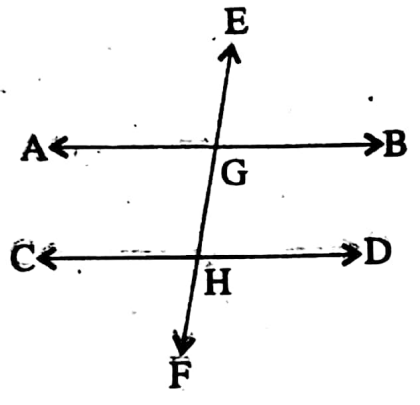
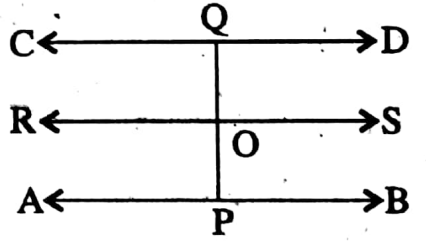
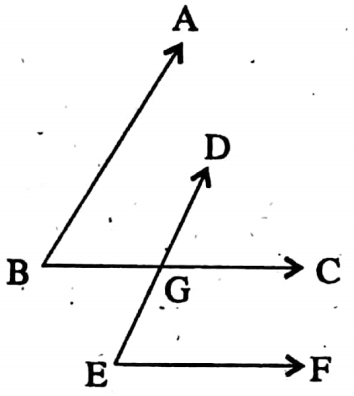
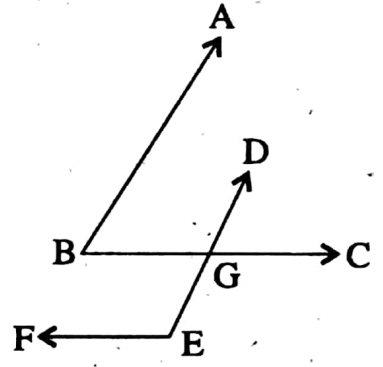
WBBSE Solutions For Class 8 Maths Algebra Chapter 8 Formation Of An Equation And Its Solutions

Algebra Chapter 8 Formation Of An Equation And Its Solutions

Equation: An equation is a statement of equality of two algebraic expressions, which involve one or more unknown quantities called the “variables”.

Example:

  1. 3x + 5 = 0
  2. 3x – 5 = x + 7
  3. y + \(\frac{1}{5}\) = \(\frac{y}{7}\) − 3
  4. x2 + 9 = 25 are equations.

⇒ In the above example equations (1), (2) and (3) involve only linear polynomials where as (4) is quadratic polynomial.

⇒ Linear equation: An equation involving linear polynomials is called a linear equation.

⇒ Solution of a linear equation: A value of the variable which when substituted for the variable in the equation makes the two sides of the equation equal is called the solution of the equation.

Read and Learn More WBBSE Solutions For Class 8 Maths

Consider the equation 4x – 3 = 5.

⇒ If we substitute the value 2 for x, we get,

LHS = 4 x 2 – 3 = 5 = RHS

∴ x = 2 is a solution of the equation 4x – 3 = 5.

WBBSE Class 8 English Functional GrammarWBBSE Class 8 English Reading Skills
WBBSE Solutions For Class 8 EnglishWBBSE Solutions For Class 8 Maths


⇒ If we substitute the value 3 for x, we get, LHS = 4 x 3 – 3= 9 ≠ RHS.

⇒ So x = 3 is not a solution of equation 4x – 3 = 5

Solving an equation: Solving a linear equation means finding a value of the variable which satisfies the equation.

WBBSE Solutions For Class 8 Maths Algebra Chapter 8 Formation Of An Equation And Its Solutions

Algebra Chapter 8 Formation Of An Equation And Its Solutions Examples

Example 1. In the following equations, verify whether the given value of the variable is a solution of the equation.

  1. \(\frac{x}{2}\) + \(\frac{x}{3}\) = 2; x = 6
  2. 2(x – 3) + 5(x + 6)= 3; x = -3

Solution:

1. LHS = \(\frac{x}{2}\) + \(\frac{x}{3}\) = \(\frac{6}{2}\) + \(\frac{6}{3}\) = 3 + 2 = 5 ≠ RHS

So x = 6 is not the solution of given equation.

2. LHS, 2(x – 3) + 5(x + 6)

= 2(-3 – 3) + 5(-3 + 6) = 2x – 6 + 5 x 3 = 12 + 15 = 3 = RHS

So x= -3 is the solution of the given equation.

To solve an equation, we use the following proporties of equality:

  1. Some quantity can be added to both sides of an equation without changing the equality.
  2. Some quantity can be subtracted from both the sides of an equation without changing the equality.
  3. Both the sides of an equation can be multiplied by the same non-zero number without changing the equality.
  4. Both the sides of an equation may be divided by the same non-zero number without changing the equality.

Illustrative examples:

Solve the following equation:

1. 12x – (3x – 5) – [7 – {2x -(2x – 5)}] = 25

Solution

Given

⇒ 12x – 3x + 5 – [7 – {2x – 2x + 5}] = 25

⇒ 9x + 5 -(7 – 5) = 25

⇒ 9x + 5 – 2 = 25

⇒ 9x + 3 = 25

⇒ 9x = 25 – 3

⇒ 9x = 22

⇒ x = \(\frac{22}{9}\)

2. 2(x – 2) (x + 4) + 3(x2 + 4) = 5(x2 – 5x + 6)

Solution.

Given

⇒ 2(x2 + 4x – 2x – 8) + 3x2 + 12

⇒ 5x2 – 25x + 30

⇒ 2x2 + 8x – 4x – 16 + 3x2 + 12 = 5x2 – 25x + 30

⇒ 5x2 + 4x – 4 = 5x – 25x + 30

⇒ 5x2 + 4x – 5x2 + 25x = 30 + 4

⇒ 29x = 34

⇒ x = \(\frac{34}{29}\)

3. \(\frac{3}{x-1}+\frac{1}{x+1}=\frac{4}{x}[x \neq 0,1,-1]\)

Solution

Given

⇒ \(\frac{3}{x-1}+\frac{1}{x+1}=\frac{1}{x}+\frac{3}{x}\)[because 4=1+3]

⇒ \(\frac{3}{x-1}-\frac{3}{x}=\frac{1}{x}-\frac{1}{x+1}\)

⇒ \(\frac{3 x-3 x+3}{x(x-1)}=\frac{x+1-x}{x(x+1)}\)

⇒ \(\frac{3}{x(x-1)}=\frac{1}{x(x+1)}\)

⇒ \(\frac{3}{x-1}=\frac{1}{x+1}\) [x ≠ 0, multilying both sides by x]

⇒ 3(x + 1) = x – 1

⇒ 3x + 3 = x – 1

⇒ 3x – x = – 1 – 3

⇒ 2x = -4

⇒ x = –\(\frac{4}{x}\)

⇒ x = -2

4. \(\frac{x-a}{b}+\frac{x-b}{a}+\frac{x-3 a-3 b}{a+b}=0\)

Solution.

Given

⇒ \(\frac{x-a}{b}+\frac{x-b}{a}+\frac{x-3(a+b)}{a+b}=0\)

⇒ \(\frac{x-a}{b}+\frac{x-b}{a}+\frac{x}{a+b}-3=0\)

⇒ \(\left(\frac{x-a}{b}-1\right)+\left(\frac{x-b}{a}-1\right)+\left(\frac{x}{a+b}-1\right)=0\)

⇒ \(\frac{x-a-b}{b}+\frac{x-b-a}{a}+\frac{x-a-b}{a+b}=0\)

⇒ \((x-a-b)\left(\frac{1}{b}+\frac{1}{a}+\frac{1}{a+b}\right)=0\)

⇒ \(x-a-b=0\left[because \frac{1}{a}+\frac{1}{a}+\frac{1}{a+b} \neq 0\right]\)

⇒ x = a + b

5. \(\frac{3 y+1}{16}+\frac{2 y-3}{7}=\frac{y+3}{8}+\frac{3 y-1}{14}\)

Solution.

Given

⇒ \(\frac{3 y+1}{16}-\frac{y+3}{8}=\frac{3 y-1}{14}-\frac{2 y-3}{7}\)

⇒ \(\frac{3 y+1-2 y-6}{16}=\frac{3 y-1-4 y+6}{14}\)

⇒ \(\frac{y-5}{16}=\frac{5-y}{14}\)

⇒ \(\frac{y-5}{8}=\frac{5-y}{7}\) [Multiplying both side by 2]

⇒ 7(y – 5) = 8(5 – y)

⇒ 7y – 35 = 40 – 8y

⇒ 7y + 8y = 40 + 35

⇒ 15y = 75

⇒ y = \(\frac{75}{15}\)

⇒ y = 5

6. \(\frac{9 x+5}{14}+\frac{8 x-7}{7}=\frac{18 x+11}{28}+\frac{5}{4}\)

Solution.

Given

⇒ \(\frac{9 x+5+16 x-14}{14}=\frac{18 x+11}{28}+\frac{5}{4}\)

⇒ \(\frac{25 x-9}{14}-\frac{18 x+11}{28}=\frac{5}{4}\)

⇒ \(\frac{50 x-18-18 x-11}{28}=\frac{5}{4}\)

⇒ \(\frac{32 x-29}{28}=\frac{5}{4}\)

⇒ 32x -29 = \(\frac{5}{4}\) x 28

⇒ 32x = 35 + 29

⇒ 32x = 64

⇒ x = \(\frac{64}{32}\)

⇒ x = 2

7. 3(x – 5)2 + 5x = (2x – 3)2 – (x + 1)2 + 1

Solution.

Given

⇒ 3(x2 – 10x + 25) + 5x = 4x2 – 12x + 9 – x2 – 2x – 1 + 1

⇒ 3x2 – 30x + 75 + 5x = 3x2 – 14x + 9

⇒ 3x2 – 30x + 5x – 3x2 + 14x = 9 – 75

⇒ -11x = -66

⇒ 11x = 66

⇒ x = \(\frac{66}{11}\)

⇒ x = 6

8. \(\frac{y+1}{2}-\frac{5 y+9}{28}=\frac{y+6}{21}+5-\frac{y-12}{3}\)

Solution.

Given

⇒ \(\frac{14 y+14-5 y-9}{28}=\frac{y+6+105-7 y+84}{21}\)

⇒ \(\frac{9 y+5}{28}=\frac{195-6 y}{21}\)

⇒ \(\frac{9 y+5}{4}=\frac{195-6 y}{3}\) [Multiplying both side by 7]

⇒ 3(9y + 5) = 4(195 – 6y)

⇒ 27y + 15 = 780 – 24y

⇒ 27y + 24y = 780 – 15

⇒ 51y = 765

⇒ y = \(\frac{765}{51}\) = 15

⇒ y = 15

9. \(\frac{1}{x}+\frac{1}{x+3}\) = \(\frac{1}{x+1}+\frac{1}{x+2}\)

Solution.

Given

⇒ \(\frac{1}{x}-\frac{1}{x+1}=\frac{1}{x+2}-\frac{1}{x+3}\)

⇒ \(\frac{x+1-x}{x(x+1)}=\frac{x+3-x-2}{(x+2)(x+3)}\)

⇒ \(\frac{1}{x(x+1)}=\frac{1}{(x+2)(x+3)}\)

⇒ \((x+2)(x+3)=x(x+1)\)

⇒ \(x^2+3 x+2 x+6=x^2+x\)

⇒ \(x^2+5 x-x^2-x=-6\)

⇒ 4x = -6

⇒ x = \(-\frac{6^3}{4^2}\)

⇒ x = \(-\frac{3}{2}\)

10. \(\frac{3}{x-2}+\frac{4}{x-3}=\frac{7}{x-4}\)

Solution.

Given

⇒ \(\frac{3}{x-2}+\frac{4}{x-3}=\frac{3}{x-4}+\frac{4}{x-4}\)

⇒ \(\frac{3}{x-2}-\frac{3}{x-4}=\frac{4}{x-4}-\frac{4}{x-3}\)

⇒ \(\frac{3(x-4)-3(x-2)}{(x-2)(x-4)}=\frac{4(x-3)-4(x-4)}{(x-4)(x-3)}\)

⇒ \(\frac{3 x-12-3 x+6}{(x-2)(x-4)}\)

⇒ \(\frac{4 x-12-4 x+16}{(x-4)(x-3)}\)

⇒ \(\frac{-6}{(x-2)(x-4)}=\frac{4}{(x-4)(x-3)}\)

⇒ \(\frac{-6}{x-2}=\frac{4}{x-3}\) [Multiplying both side by (x-4)]

⇒ 4(x – 2) = 6(x – 3) ⇒ 4x – 8 =- 6x + 18 ⇒ 4x + 6x = 18 + 8

⇒ 10x = 26

⇒ x = \(\frac{26}{10}\)

⇒ x = \(\frac{13}{5}\)

Formation of an equation:

Example 2. Find a number such that one-third of the number is 7 more than one-fourth of the number.

Solution: Let the number be x.

According to condition,

\(\frac{x}{3}-\frac{x}{4}=7 \Rightarrow \frac{4 x-3 x}{12}=7\)

⇒ \(\frac{x}{12}\) = 7

⇒ x = 12 x 7

⇒ x = 84

Hence the required number is 84.

Example 3. Divide 830 into two parts in such a way, that 30% of one part will be 4 more than 40% of the other.

Solution: Let 1st part be x

∴ 2nd part is (830 – x)

According to the question,

⇒ x x 30% = (830 – x) x 40% + 4

⇒ \(x \times \frac{30}{100}=(830-x) \times \frac{40}{100}+4\)

⇒ \(\frac{3 x}{10}=(830-x) \times \frac{4}{10}+4\)

⇒ \(\frac{3 x}{10}=\frac{3320-4 x+40}{10}\)

⇒ 3x = 3360 – 4x [Multiplying both side by 10]

⇒ 3x + 4x = 3360

⇒ 7x = 3360

⇒ \(x=\frac{3360}{7}\)

⇒ x = 480

∴ One part is 480 and the other part is (830 – 480) or 350.

Example 4. Find a fraction whose denominator is 2 more than the numerator and when 3 is added to the numerator and 3 is subtracted from the denominator, the fraction becomes equal to \(\frac{7}{3}\)

Solution: Let the numerator of the fraction be x.

∴ Denominator is (x + 2)

∴ fraction is \(\frac{x}{x+2}\)

According to the conditions,

\(\frac{x+3}{(x+2)-3}=\frac{7}{3}\) \(\frac{x+3}{x-1}=\frac{7}{3}\)

⇒ 7x – 3x = 9 + 7

⇒ 4x = 16

⇒ x = \(\frac{16}{4}\) = 4

∴ The required fraction is \(\frac{4}{4+2} \text { or } \frac{4}{6}\)

Example 5. A number consists of two digits whose sum is 9. If 27 is added to the number, the digits are interchanged. Find the number.

Solution: Let the unit’s digit be x.

Then ten’s digit = (9 – x)

∴ Number = 10(9 – x) + x = 90 – 10x + x = 90 – 9x

If the digits are interchanged then the number will be 10x + (9 − x) = 9x + 9

According to the condition,

9x + 9 = (90 – 9x)+ 27

= 9x + 9x = 90 + 27 – 9

⇒ 18x = 108

⇒ x = \(\frac{108}{18}\) = 6

∴ The required number is 90 – 9 x 6 = 90 – 54 = 36

Example 6. A father is thrice as old as his son. Four years back the father was 4 times as old his son. Find their present ages.

Solution: Let the present age of son is x years.

Father’s age is 3x years.

Four years ago son age was (x-4) years and father age was (3x – 4) years.

According to condition,

4(x – 4) = 3x – 4

⇒ 4x – 16 = 3x – 4

⇒ 4x – 3x = 16 – 4

⇒ x = 12

∴ The present age of son is 12 years and father’s age is (12 x 3) years or 36 years.

Example 7. Ramesh went to the school at a speed of 4 km/hr and returned at 3 km/hr. If he took 30 minutes more in returning, find the distance of the school from his home.

Solution: Let the distance between the school and home is x km.

Time taken in going x km from home to school is \(\frac{x}{4}\) hr.

Time taken in going x km from school to home is \(\frac{x}{3}\) hr.

According to condition,

\(\frac{x}{3}-\frac{x}{4}=\frac{30}{60}\left[30 \text { mins }=\frac{30}{60} \mathrm{hr}\right]\)

⇒ \(\frac{4 x-3 x}{12}=\frac{1}{2} \Rightarrow x=\frac{12}{2}=6\)

∴ The distance of the school from his home is 6 km.

Example 8. The length of a rectangle is 4 cm more than its breadth. If the perimeter of the rectangle is 36 cm, find its area.

Solution: Let the breadth of the rectangle is x cm.

The length is (x + 4) cm.

The perimeter is 2 (x + 4 + x) cm = 2 (2x + 4) cm.

According to question,

2(2x + 4) = 36

⇒ 4x + 8 = 36

⇒ 4x = 36 – 8 = 28

⇒ x = \(\frac{28}{4}\) = 7

∴ The breadth is 7 cm and length is (7 + 4) cm or 11 cm

Area = (11 x 7) cm2 = 77 cm2.

Example 9. Choose the correct answer:

1. If average of (x + 3) and (x – 7) is 5, then the value of x is

  1. 5
  2. 7
  3. 6
  4. 4

Solution: \(\frac{x+3+x-7}{2}=5\)

⇒ 2x – 4 = 10

⇒ 2x = 14

⇒ x = 7

∴ The correct answer is 2. 7

The value of x is 2. 7

2. What is the equation?

  1. x + 2 = 3
  2. (x + 2)2 = x2 + 4x + 4
  3. x + 2
  4. None of these

Solution: The correct answer is 1. x + 2 = 3

3. In the expression px + qy + r = 0, if x = 0 then the value of y is

  1. \(\frac{r}{q}\)
  2. \(\frac{r}{p}\)
  3. 0
  4. –\(\frac{r}{q}\)

Solution: px + qy + r = 0

∴ p x 0 + qy + r = 0

⇒ qy = -r ⇒ y = –\(\frac{r}{q}\)

∴ The correct answer is 4. –\(\frac{r}{q}\)

The value of y is –\(\frac{r}{q}\)

Example 10. Write ‘True’ or ‘False’:

1. If \(\frac{x}{9}\) = 0, then x = 9.

Solution: The statement is false.

2. The root of the equation 2x + 5 = 7x – 45 is 10.

Solution: 2x + 5 = 7x – 45

⇒ 2x – 7x = 45 – 5

⇒ -5x = – 50

⇒ 5x = 50

⇒ x = 10

∴ The statement is true.

3. If a(x + a) = b(x + b), then x = -(a + b)

Solution: a(x + a) = b(x + b)

⇒ ax + a2 = bx + b2

⇒ ax – bx = b2 – a2

⇒ x(a – b) = -(a2 – b2)

⇒ x = \(-\frac{(a+b)(a-b)}{(a-b)}\)

⇒ x = −(a + b)

∴ The statement is true.

Example 11. Fill in the blanks:

1. __________ is the root of the equation 3x + 5 = 0.

Answer: 3x + 5 = 0

⇒ 3x = -5

⇒ x = –\(\frac{5}{3}\)

2. (x + a)2 = x2 + 2ax + a2 is a __________

Answer: Identity.

3. If \(\frac{x}{2}\) + \(\frac{1}{3}\) = \(\frac{x}{3}\) + \(\frac{1}{2}\), then x = __________

Answer: \(\frac{x}{2}+\frac{1}{3}=\frac{x}{3}+\frac{1}{2}\)

⇒ \(\frac{x}{2}-\frac{x}{3}=\frac{1}{2}-\frac{1}{3}\)

⇒ \(\frac{3 x-2 x}{6}=\frac{3-2}{6} \Rightarrow \frac{x}{6}=\frac{1}{6}\)

⇒ x = 1.

WBBSE Solutions For Class 8 Maths Geometry Chapter 8 Construction

Geometry Chapter 8 Construction Examples

  1. Construction of Triangles measurements.
  2. Construction of Parallel lines.
  3. Dividing a line segment into three or five equal parts.

⇔ Construction of Triangles measurements.

Example 1. Draw a triangle, whose two angles are 45° and 30° and length of the opposite side of 30° angle is 6 cm.
Solution:

WBBSE Solutions For Class 8 Maths Geometry Chapter 8 Construction Construction Of Triangles Measurements Example 1 Step 1

Step 1.
WBBSE Solutions For Class 8 Maths Geometry Chapter 8 Construction Construction Of Triangles Measurements Example 1 Step 1-1

At first, I draw a line segment of length 6 cm with a scale.

Read and Learn More WBBSE Solutions For Class 8 Maths

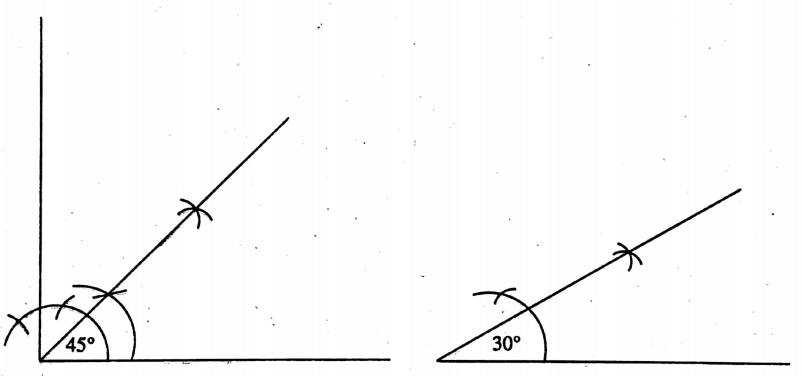
Then I draw two angles of measurement 45° and 30° with pencil compass.

Step 2.

WBBSE Solutions For Class 8 Maths Geometry Chapter 8 Construction Construction Of Triangles Measurements Example 1 Step 2


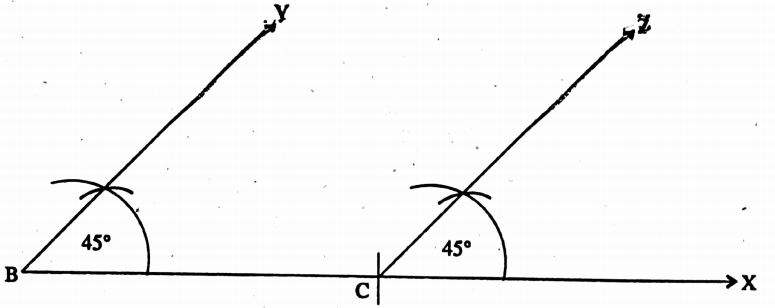
The line segment BC of length 6 cm is cut off from the ray BX.

WBBSE Class 8 English Functional GrammarWBBSE Class 8 English Reading Skills
WBBSE Solutions For Class 8 EnglishWBBSE Solutions For Class 8 Maths


Step 3.

Then I draw two angles ∠YBC and ∠ZCX of measurements 45° each at B and C respectively.


WBBSE Solutions For Class 8 Maths Geometry Chapter 8 Construction Construction Of Triangles Measurements Example 1 Step 3

WBBSE Solutions For Class 8 Maths Geometry Chapter 8 Construction

Step 4.

Then I draw an angle ∠PCZ of measurement 30° with the help of pencil compass at C on the same side of the line segment CZ where BY lies.

PC and BY meet at point A.


WBBSE Solutions For Class 8 Maths Geometry Chapter 8 Construction Construction Of Triangles Measurements Example 1 Step 4

∴ ΔABC is the required triangle where BC = 6 cm.

∠ABC = 45° ∠BAC = ∠ACZ = 30°

Proof: ∠ABC= ∠ZCX= 45° [By construction] [Corresponding angles are equal] BC is transversal.

∴ BA || CZ

Again BA || CZ and AC is transversal.

∴ ∠BAC = ∠ACZ [Alternate angles]= 30°

∴ In ΔABC, ABC = 45° and ∠BAC = 30° and the opposite sides of ∠BAC is BC = 5 cm.

Example 2. Draw a triangle length of whose two sides are 5 cm, 3.5 cm and the measurement of the angle opposite to the side of length 3.5 cm is 40°.

Solution:

WBBSE Solutions For Class 8 Maths Geometry Chapter 8 Construction Construction Of Triangles Measurements Example 2


Step 1.
I draw two line segments of lengths 5 cm and 3.5 cm and an angle of measurement 40° with the help of protractor.
Step 2.

I draw a ray BX and I draw an angle ∠XBY of measurement 40° with the compass at B on BX.

Step 3.

I cut off a line segment AB of length 5 cm from the ray BX.

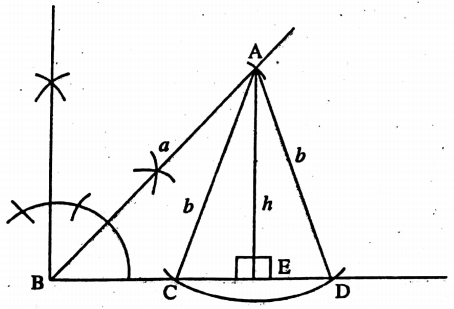
Step 4. Taking A as center I draw an arc of radius 3.5 cm which intersects the rays BX at C and D.

Joining the points A, C and A, D by a scale I get the two triangles ΔABC and ΔABD.

∴ ΔABC is a required triangle, whose AB = 5 cm, AC = 3.5 cm and ∠ABC= 40° which is opposite to the side AC.

ΔABD is also a required triangle whose AB = 5 cm, AD = 3.5 and ABD = 40° which is opposite to the side AD.

[Sometimes we are getting one triangle, sometimes two triangle and sometimes no triangle.]

WBBSE Solutions For Class 8 Maths Geometry Chapter 8 Construction Construction Of Triangles Measurements Example 2-1

Case 1. If a = b we will unable to construct one triangle.

Case 2. If h < b < a we will able to draw two triangles.

Case 3. If a < b we will able to draw one triangle.

Case 4. b = h, then we will able to draw one triangle, B.

⇔ Construction of Parallel lines:

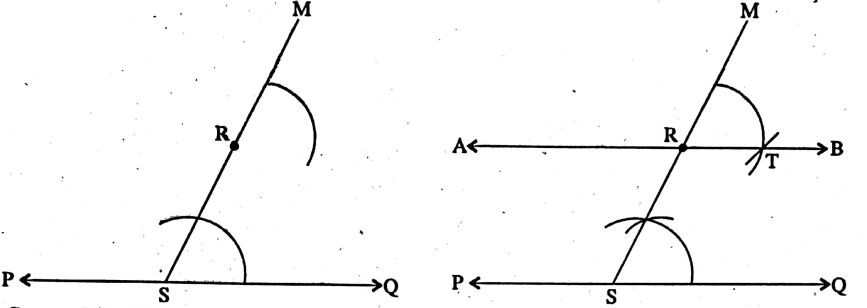
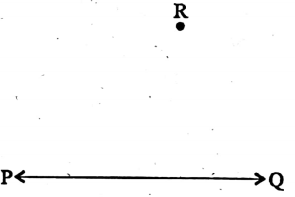
Example 3. Draw a straight line PQ and let consider a point R outside the line segment PQ. Draw a line, parallel to the line PQ that passes through R by a scale and a compass.

Solution:

Method 1.

Step 1.

WBBSE Solutions For Class 8 Maths Geometry Chapter 8 Construction Construction Of Parallel Lines Example 3 Method 1 Step 1

I draw a straight line PQ and take a point R outside the line PQ.

Step 2.

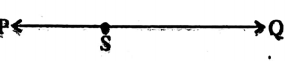
Now I take a point S on the straight line PQ and I join R, S by a scale.

As a result an angle ∠RSQ is formed.

Step 3.


WBBSE Solutions For Class 8 Maths Geometry Chapter 8 Construction Construction Of Parallel Lines Example 3 Method 1 Step 3


Now with a scale and compass we draw ∠TRS at R equal to opposite side of ∠RSQ and it is in the opposite side of ∠RSQ.

I join T and R by a scale and producing the line TR on both the sides we get a straight line AB.

Proof: ∠ARS = ∠RSQ but they are alternate angles.

∴ AB || PQ.

∴ We draw a straight line AB parallel to the straight line PQ passing through the point R which is outside the line PQ.

Method 2.

Step 1.

I take a point S on the straight line PQ.

WBBSE Solutions For Class 8 Maths Geometry Chapter 8 Construction Construction Of Parallel Lines Example 3 Method 2 Step 1

Step 2.

I join two points R and S by a scale and produced the line segment SR to M.

As a result, ∠MSQ is formed.

Step 3.

I draw an angle ∠MRT at R on the line segment RM equal to the ∠RSQ and ∠MRT is drawn on the same side of the line segment MS where ∠RSQ lies.

WBBSE Solutions For Class 8 Maths Geometry Chapter 8 Construction Construction Of Parallel Lines Example 3 Method 2 Step 3

Step 4.

Now I produce the line segment TR on both side and the straight line AB is form.

∴ Proof: ∠MRB = ∠MSQ.

But they are corresponding angles.

∴ AB || PQ.

∴ AB is the required straight line through R which is parallel to line PQ.

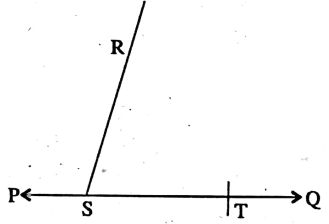
Method 3.

Step 1.

I draw a straight line PQ and take a point R outside the straight line PQ.

WBBSE Solutions For Class 8 Maths Geometry Chapter 8 Construction Construction Of Parallel Lines Example 3 Method 3 Step 1

Step 2.

Let I take a point S on the straight line PQ.

I join R, S and I got a line segment RS.


WBBSE Solutions For Class 8 Maths Geometry Chapter 8 Construction Construction Of Parallel Lines Example 3 Method 3 Step 2


Step 3.

 I cut off a line segment ST from ray SQ.


WBBSE Solutions For Class 8 Maths Geometry Chapter 8 Construction Construction Of Parallel Lines Example 3 Method 3 Step 3


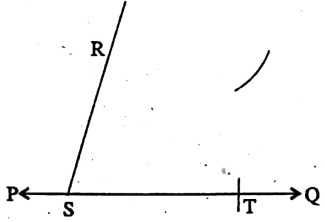
Step 4.

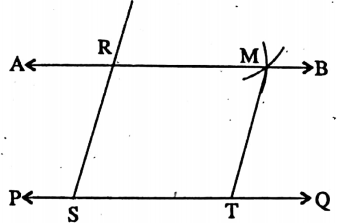
Then taking R as the center and the length of the line segment ST as radius; I draw an arc with a compass.


WBBSE Solutions For Class 8 Maths Geometry Chapter 8 Construction Construction Of Parallel Lines Example 3 Method 3 Step 4


Step 5.

Then taking T as the center and the length of the line segment RS as radius, I draw a another arc by a compass which intersects the previous arc at M.


WBBSE Solutions For Class 8 Maths Geometry Chapter 8 Construction Construction Of Parallel Lines Example 3 Method 3 Step 5


Step 6.

I join R, M and then produce RM on both side where AB straight line is form.


WBBSE Solutions For Class 8 Maths Geometry Chapter 8 Construction Construction Of Parallel Lines Example 3 Method 3 Step 6


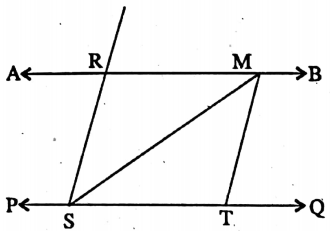
Proof: I join S, M and M, T.

In ΔRMS and ΔMTS, RM = ST, RS = MT and SM is common side.

∴ ΔRMS ≅ ΔMTS [By SSS congruency]

∴ ∠RMS = ∠MST [Corresponding angles of congruent triangles]

WBBSE Solutions For Class 8 Maths Geometry Chapter 8 Construction Construction Of Parallel Lines Example 3 Method 3 Step 6-1

But they are alternate angle.

∴ RM || ST i.e. AB || PQ.]

∴ I got the straight line AB through R which is parallel to PQ.

Dividing a line segment into three or five equal parts.

Example 4. Draw a straight line segment PQ of length 12 cm and divided the line segment PQ in five equal parts by scale and compass. Verify by scale which each part of the segment is 2.4 cm or not.

Solution:

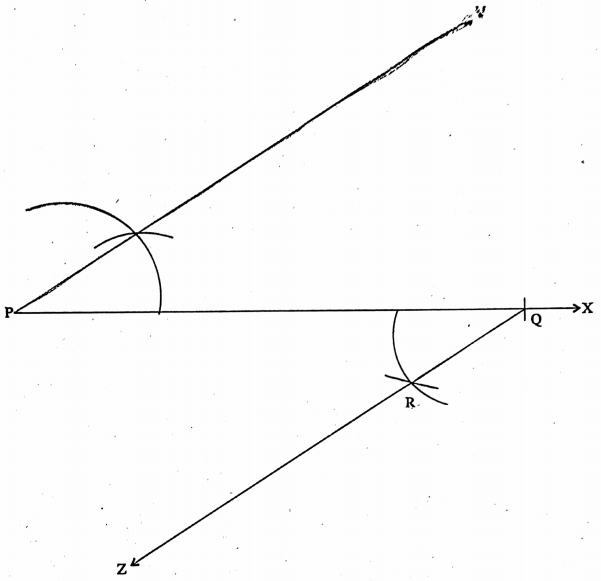
Step 1.

We draw a line segment PQ ∅ of length 10 cm.

WBBSE Solutions For Class 8 Maths Geometry Chapter 8 Construction Dividing A Line Segment Into Three Or Five Equal Parts Example 4 Step 1


Step 2.

Then I cut off the line segment PQ of length 10 cm from the ray PX.


WBBSE Solutions For Class 8 Maths Geometry Chapter 8 Construction Dividing A Line Segment Into Three Or Five Equal Parts Example 4 Step 2


Step 3.

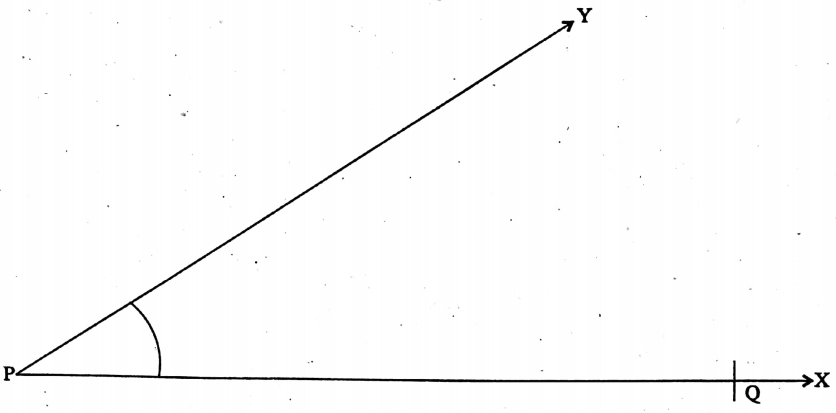
I draw an angle ∠XPY at P on PX.


WBBSE Solutions For Class 8 Maths Geometry Chapter 8 Construction Dividing A Line Segment Into Three Or Five Equal Parts Example 4 Step 3


Step 4.


WBBSE Solutions For Class 8 Maths Geometry Chapter 8 Construction Dividing A Line Segment Into Three Or Five Equal Parts Example 4 Step 4


WBBSE Solutions For Class 8 Maths Geometry Chapter 8 Construction Dividing A Line Segment Into Three Or Five Equal Parts Example 4 Step 4-1


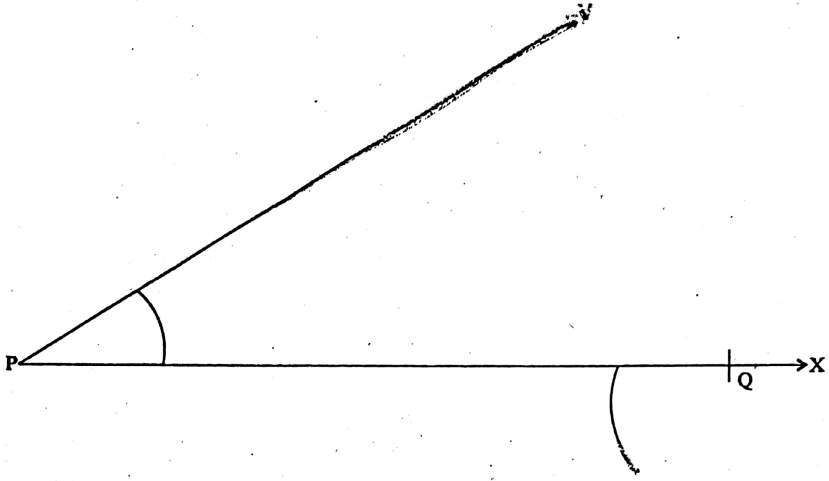
I draw ∠PQR equal to ∠YPQ on the opposite side of the line segment PQ, such that it lies below ∠QPY.


WBBSE Solutions For Class 8 Maths Geometry Chapter 8 Construction Dividing A Line Segment Into Three Or Five Equal Parts Example 4 Step 4-2


Step 5.

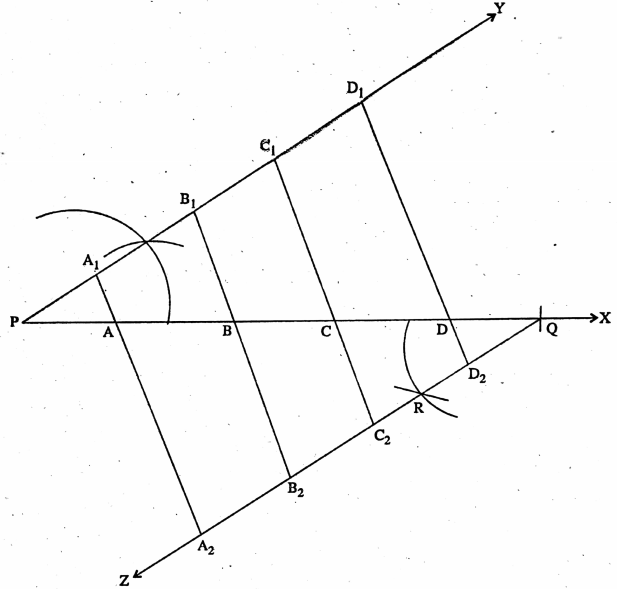
Then I cut four equal line segments PA1, A1B1, B1C1 and C1D1 from PY by pencil compass.

Again I cut another four equal line segments QD2, D2C2, C2B2 and B2A2 from QZ by pencil compass with same radius.


WBBSE Solutions For Class 8 Maths Geometry Chapter 8 Construction Dividing A Line Segment Into Three Or Five Equal Parts Example 4 Step 5


I join (A1, A2); (B1, B2); (C1, C2) and (D1, D2) by scale.

The line segment A1A2, B1B2, C1C2 and D1D2 intersects PQ at points A, B, C and D respectively.

So the line segment PQ is divided at A, B, C, and D with equal length.

So PA = AB = BC = CD = DQ = 2.4 cm.


WBBSE Solutions For Class 8 Maths Geometry Chapter 8 Construction Dividing A Line Segment Into Three Or Five Equal Parts Example 4 Step 5-1

WBBSE Solutions For Class 8 Maths Geometry Chapter 6 Verification Of The Relation Between The Angles And Sides Of A Triangle

Geometry Chapter 6 Verification Of The Relation Between The Angles And Sides Of A Triangle

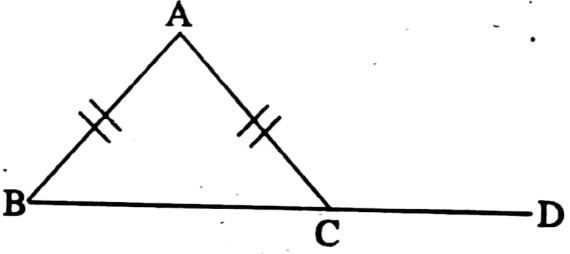
⇒ Exterior angle: The angle formed by extended of one side of an angle through vertex toward opposite direction is called the exterior angle of the given angle.

The exterior angle of ∠ABC is ∠CBD and the exterior angle of ∠CBD is ∠ABC.

WBBSE Solutions For Class 8 Maths Geometry Chapter 6 Verification Of The Relation Between The Angles And Sides Of A Triangle Exterior Angle

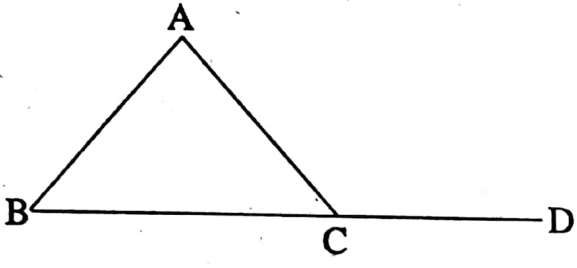
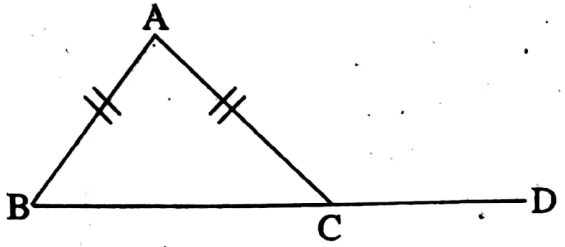
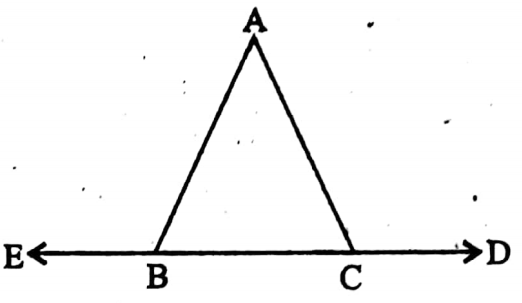
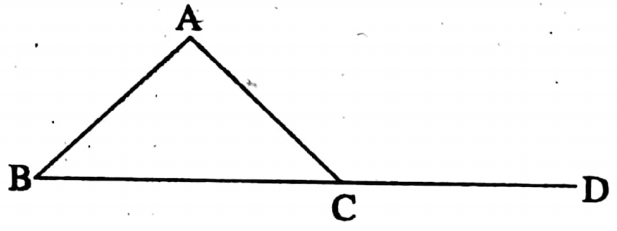
ΔABC the BC is extended to D.

Read and Learn More WBBSE Solutions For Class 8 Maths

∠ACD is called exterior angle ∠BAC and ∠ABC are interior opposite angles.

WBBSE Solutions For Class 8 Maths Geometry Chapter 6 Verification Of The Relation Between The Angles And Sides Of A Triangle Exterior Angle ∠ABC Is ∠CBD

WBBSE Solutions For Class 8 Maths Geometry Chapter 6 Verification Of The Relation Between The Angles And Sides Of A Triangle

Geometry Chapter 6 Verification Of The Relation Between The Angles And Sides Of A Triangle Theorems

Theorem 1.

⇒ If one side of a triangle is produced then one exterior angle is formed, the measurement of this exterior angle is sum of the measurement of two interior opposite angles.

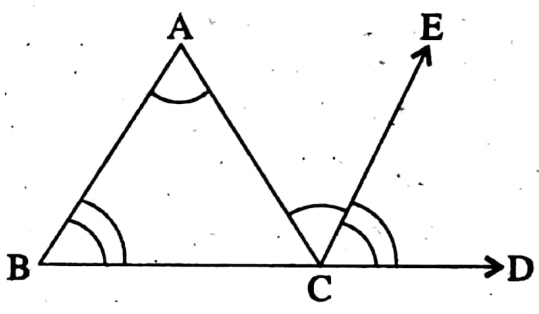
Given: ABC is a triangle and BC is produced to D. As a result one exterior angle ∠ACD and two interior opposite angles ∠BAC and ∠ABC are produced.

WBBSE Solutions For Class 8 Maths Geometry Chapter 6 Verification Of The Relation Between The Angles And Sides Of A Triangle Theorem 1

Required to prove: ∠ACD = ∠BAC + ∠ABC.

Construction: CE is drawn parallel to AB.

BA | | CE (by construction) and AC is, transversal.

∴ ∠ACE = ∠BAC [alternate angles]

Again BA || CA and BD is transversal.

∴ ∠ECD = ∠ABC [Corresponding angles]

∠ACE + ∠ECD = ∠BAC + ∠ABC i.e. ∠ACD = ∠BAC + ∠ABC (Proved)

WBBSE Class 8 English Functional GrammarWBBSE Class 8 English Reading Skills
WBBSE Solutions For Class 8 EnglishWBBSE Solutions For Class 8 Maths


Theorem 2.

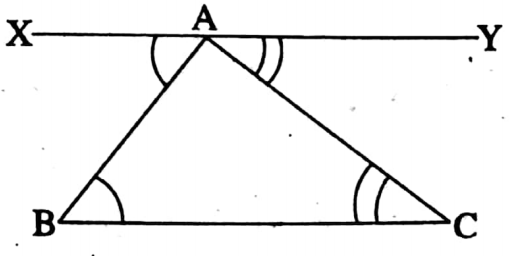
⇒ The sum of the measurement of three angles of a triangle is two right angles.

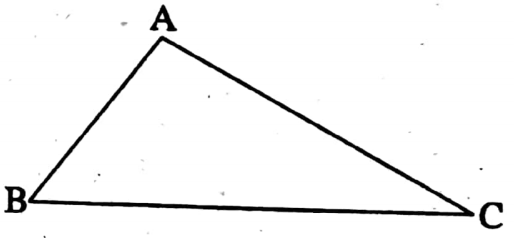
Given: ΔABC is any triangle.

WBBSE Solutions For Class 8 Maths Geometry Chapter 6 Verification Of The Relation Between The Angles And Sides Of A Triangle Theorem 2

Required to prove: The sum of measurement of three angles of ΔABC is 2 right angles.

i.e. ∠BAC+ ∠ABC + ∠ACB = 180°

Construction: A straight line XY is drawn through A, parallel to BC.

Proof: XY || BC [By construction] and AB is transversal

∴ ∠ABC = ∠XAB [alternate angles]

Again, XY || BC and AC is transversal.

∴ ∠ACB = ∠CAY [alternate angles]

∠ABC +∠ACB = ∠XAB + ∠CAY

∴ ∠ABC + ∠ACB + ∠BAC = ∠XAB + ∠BAC + ∠CAY [By adding BAC on both sides]

ie. ∠BAC + ∠ABC + ∠ACB = ∠XAY

∴ ∠BAC+ ∠ABC + ∠ACB = 180° [one straight angle] (Proved)

Theorem 3.

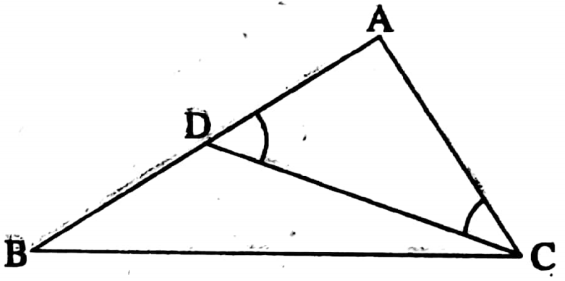
⇒ If two sides of a triangle are unequal in length the measurement of the angle opposite to the greater side is greater than the measurement of the angle opposite to the smaller side.

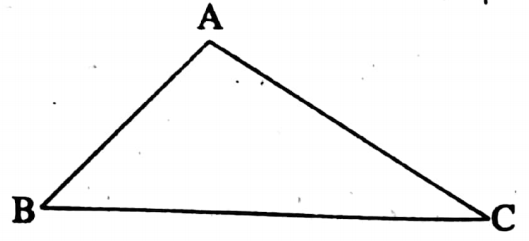
Given: In ΔABC, AB > AC.


WBBSE Solutions For Class 8 Maths Geometry Chapter 6 Verification Of The Relation Between The Angles And Sides Of A Triangle Theorem 3

Required to prove: ∠ACB > ∠ABC

Construction: I cut off the line segment AD from the side AB equal of the side AC.

I join two point C and D.

Proof: In ΔADC, AD = AC [By construction]

∴ ∠ADC = ∠ACD

In ΔBCD, the exterior ∠ADC = ∠DBC +∠DCB

∴ ∠ADC > ∠DBC

∴ ∠ACD > ∠DBC ∠ACD + ∠DCB > ∠DBC

i.e. ∠ACB > ∠ABC (Proved).

Theorem 4.

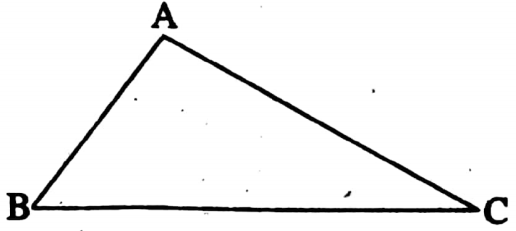
⇒ If the measurement of two angles of a triangle are unequal,, then the length of opposite side of the greater angle is greater than the length of the opposite side of the smaller angle.

Given: In ΔABC, ∠ABC > ∠ACB.

WBBSE Solutions For Class 8 Maths Geometry Chapter 6 Verification Of The Relation Between The Angles And Sides Of A Triangle Theorem 4

Required to prove: AC > AB

Prove: If AC not equal to greater than AB then either

  1. AC = AB or
  2. AC = AB

If AC < AB then ∠ABC < ∠ACB. It cannot be true.

Because it is given ∠ABC > ∠ACB.

Again, if AC = AB then ∠ABC= ∠ACB

It cannot be true because it is given ∠ABC > ∠ACB.

∴ AC > AB (Proved)

Geometry Chapter 6 Verification Of The Relation Between The Angles And Sides Of A Triangle Examples

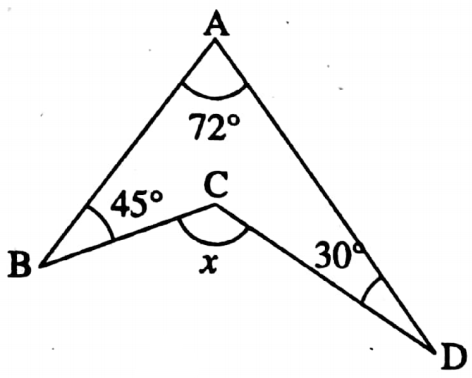
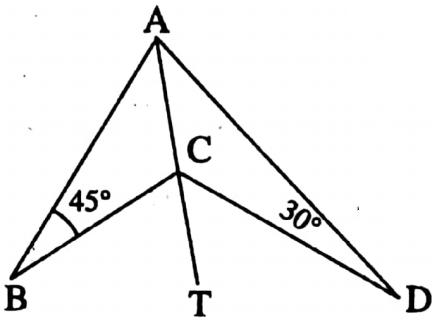
Example 1. In the adjacent, find the value of x.


WBBSE Solutions For Class 8 Maths Geometry Chapter 6 Verification Of The Relation Between The Angles And Sides Of A Triangle Example 1


WBBSE Solutions For Class 8 Maths Geometry Chapter 6 Verification Of The Relation Between The Angles And Sides Of A Triangle Example 1-1


Solution: I joined A, C and AC is produced to T.

In ΔABC,

Exterior ∠BCT = ∠BAC+ ∠ABC

In ΔACD,

Exterior ∠BCT = ∠BAC + ∠ABC

In ΔACD,

Exterior ∠DCT = ∠DAC + ∠ADC

∠BCT + ∠DCT = (∠BAC+ ∠DAC) + ∠ABC + ∠ADC

i.e. ∠BCD = ∠BAD + ∠ABC + ∠ADC

x = 72° + 45° + 30°

⇒ x = 147°.

The value of x = 147°.

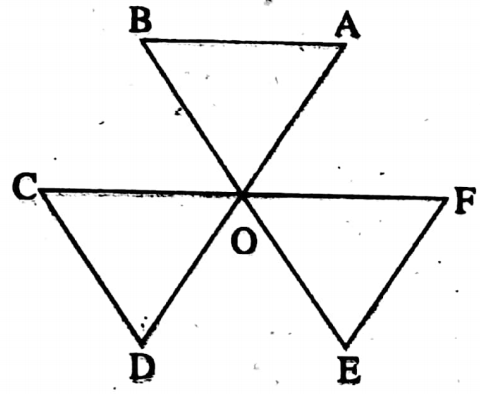
Example 2. In the adjacent find the value of ∠A + ∠B + ∠C+ ∠D + ∠E + ∠F.


WBBSE Solutions For Class 8 Maths Geometry Chapter 6 Verification Of The Relation Between The Angles And Sides Of A Triangle Example 2

Solution: (∠A + ∠B) + (∠C + ∠D) + (∠E + ∠F)

= ∠BOD + ∠DOF + ∠FOB = -360°

The value of ∠A + ∠B + ∠C+ ∠D + ∠E + ∠F is -360°

Example 3. In ΔABC, BC is produced to D. If ∠ACD = 126° and ∠B = \(\frac{3}{4}\) ∠A then find the value of ∠A.

Solution:

WBBSE Solutions For Class 8 Maths Geometry Chapter 6 Verification Of The Relation Between The Angles And Sides Of A Triangle Example 3

In ΔABC

∠A + ∠B = exterior ∠ACD

∠A + \(\frac{3}{4}\)∠A = 126°

⇒ \(\frac{7 \angle A}{4}\) = 126°

⇒ ∠A = \(\frac{4}{7}\) x 126° = 4 x 18° = 72°

The value of ∠A = 72°

Example 4. If the largest angle of a triangle is an acute angle then find the limit of that angle.

Solution: In ΔABC, ∠A is largest.

WBBSE Solutions For Class 8 Maths Geometry Chapter 6 Verification Of The Relation Between The Angles And Sides Of A Triangle Example 4

As ∠A is acute angle.

∴ ∠A < 90°.

Again ∠A is largest.

∴ ∠A > ∠B and ∠A > ∠C

∴ ∠A + ∠A > ∠B + ∠C

⇒ 2∠A > ∠B + ∠C

⇒ 2∠A + ∠A > ∠A + ∠B + ∠C

⇒ 3∠A > 180°

⇒ ∠A > \(\frac{180^{\circ}}{3}\)

⇒ ∠A > 60°

⇒ 60° < ∠A

∴ 60° < ∠A < 90°.

The limit of that angle  60° < ∠A < 90°.

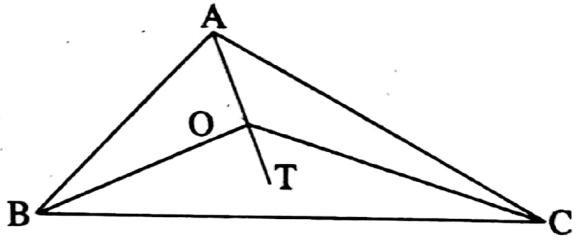
Example 5. If O is an interior point of AABC, then find the relation between ∠BOC and ∠BAC.

Solution:

WBBSE Solutions For Class 8 Maths Geometry Chapter 6 Verification Of The Relation Between The Angles And Sides Of A Triangle Example 5


I join A, O, and AO is extended to T.

In ΔAOB, the exterior ∠BOT = ∠BAO + ∠ABO

∴ ∠BOT > ∠BAO

Similarly, In ΔAOC, ∠COT > ∠CAO

∴ ∠BOT + ∠COT > ∠BAO + ∠CAO

i.e. ∠BOC > ∠BAC.

This is the relation.

The relation between ∠BOC and ∠BAC is  ∠BOC > ∠BAC.

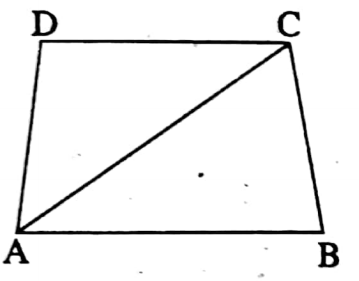
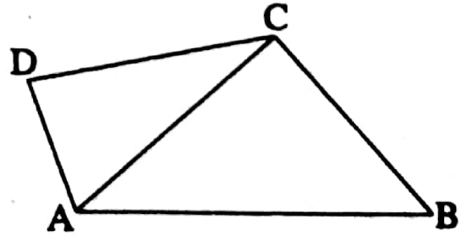
Example 6. Find the sum of measurement of all angles of a quadrilateral.

Solution:

WBBSE Solutions For Class 8 Maths Geometry Chapter 6 Verification Of The Relation Between The Angles And Sides Of A Triangle Example 6

In quadrilateral ABCD, I join A and C.

In ΔABC,

∠BAC + ∠ABC + ∠ACB = 180°

In ΔADC, ∠DAC+ ∠ADC + ∠ACD = 180°

(∠BAC + ∠DAC) + ∠ABC + ∠ADC + (∠ACB + ∠ACD) = 180° + 180°

∴ ∠BAD + ∠ABC + ∠ADC + ∠BCD = 360°

The sum of measurement of all angles of a quadrilateral = 360°

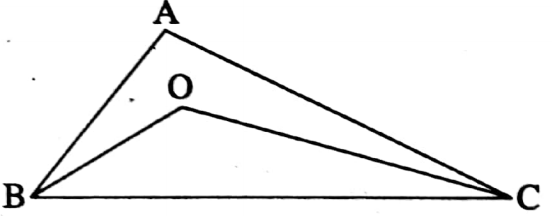
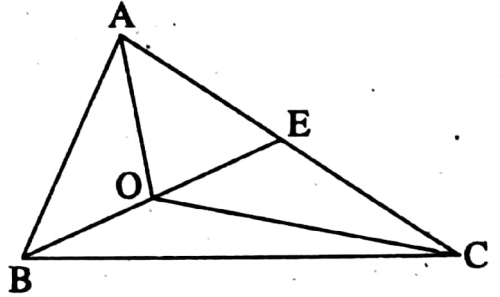
Example 7. In ΔABC, the internal bisectors of ∠ABC and ∠ACB intersect at O, If ∠BOC = 105°, then find the value of ∠BAC.

Solution:

WBBSE Solutions For Class 8 Maths Geometry Chapter 6 Verification Of The Relation Between The Angles And Sides Of A Triangle Example 7


In ΔABC, BO, and CO are the bisectors of ∠ABC and ∠ACB respectively.

∴ ∠OBC = \(\frac{1}{2}\)∠ABC and ∠OCB =\(\frac{1}{2}\)∠ACB

∠OBC + ∠OCB = \(\frac{1}{2}\)(∠ABC + ∠ACB)

180° – ∠BOC = \(\frac{1}{2}\)(180° – ∠BAC)

180° – 105° = 90° – \(\frac{1}{2}\)∠BAC

75° = 90° – \(\frac{1}{2}\)∠BAC

⇒ \(\frac{1}{2}\)∠BAC = 90° – 75° = 15°

⇒ ∠BAC = 15° x 2 = 30°

The value of ∠BAC = 30°

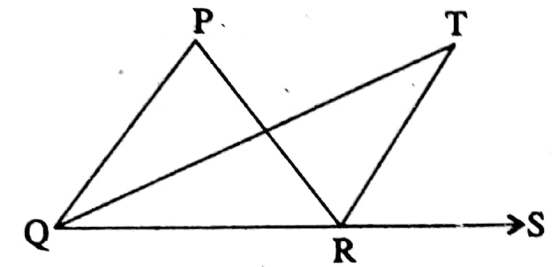
Example 8. In ΔPQR, the internal bisector of ∠PQR and the external bisector of ∠PRQ intersect at T. If ∠QPR = 40° then find the value of ∠QTR.

Solution:

WBBSE Solutions For Class 8 Maths Geometry Chapter 6 Verification Of The Relation Between The Angles And Sides Of A Triangle Example 8

In ΔPQR,

⇒ ∠QTR + ∠TQR = exterior ∠TRS

⇒ ∠QTR = \(\frac{1}{2}\)∠PRS –\(\frac{1}{2}\)∠PQR

⇒ \(\frac{1}{2}\) (∠QPR + ∠PQR) – \(\frac{1}{2}\)∠PQR

= \(\frac{1}{2}\)∠QPR + \(\frac{1}{2}\)∠PQR – \(\frac{1}{2}\)∠QPR = \(\frac{1}{2}\) x 40° = 20°

The value of ∠QTR = 20°

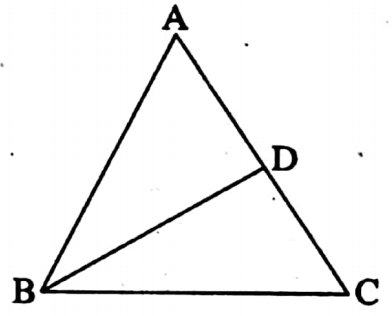
Example 9. In ΔABC, AB = AC and ∠ABC = 2∠BAC. The bisector of ∠ABC meets AC at D. Find the measurement of the angles of the triangle BCD.

Solution:

WBBSE Solutions For Class 8 Maths Geometry Chapter 6 Verification Of The Relation Between The Angles And Sides Of A Triangle Example 9

In ΔABC, AB = AC

∴ ∠ABC = ∠ACB

∠ABC + ∠ACB + ∠BAC = 180°

∠ABC + ∠ABC + ∠BAC = 180°

∴ 2∠BAC + 2∠BAC + ∠BAC = 180°

⇒ 5∠BAC = 180°

⇒ ∠BAC = \(\frac{180^{\circ}}{5}=36^{\circ}\)

∴ ∠ABC = ∠ACB = 2 x 36° = 72°

∠DBC = \(\frac{1}{2}\)∠ABC = \(\frac{1}{2}\) x 72° = 36°

In ΔBDC, ∠BDC + ∠DBC + ∠DCB = 180°

∠BDC + 36° + 72° 180°

∠BDC = 180° – 108° = 72°

∴ ∠DBC = 36°, ∠BDC = 72° and ∠DCB = 72°

The measurement of the angles of the triangle BCD = 72°

Example 10. ΔPQR, If ∠P = 80° and ∠Q= 70°, then find the relation between PQ and QR.

Solution:

WBBSE Solutions For Class 8 Maths Geometry Chapter 6 Verification Of The Relation Between The Angles And Sides Of A Triangle Example 10

In ΔPQR, ∠P = 80°, ∠Q = 70°

∴ ∠R = 180° – (80° + 70°) = 30°

As ∠P > ∠R

∴ QR > PQ (This the relation)

The relation between PQ and QR is QR > PQ

Example 11. The hypotenuse of a right-angled triangle is the greatest one – Explain.

Solution:

WBBSE Solutions For Class 8 Maths Geometry Chapter 6 Verification Of The Relation Between The Angles And Sides Of A Triangle Example 11

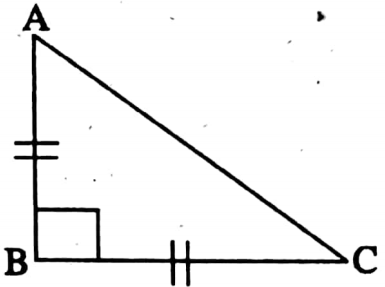
In ΔABC, ∠ABC = 90°

∴ AC is the hypotenuse.

∠A and ∠C each are acute angles.

∴ ∠ABC > ∠A and ∠ABC > ∠C

As ∠ABC > ∠A, ∴ AC > BC

As ∠ABC > ∠C  ∴ AC > AB

∴ AC is the largest side.

Example 12. If the ratio of measurement of angles of a triangle is 4: 5: 9; then write the nature of the triangle.

Solution: Let the measurement of three angles are 4x°, 5x° and 9x°

4x° +5x° + 9x° = 180°

⇒ 18x° = 180°

⇒ x° = 10°

The angles are 4 x 10° or 40°, 5 x 10° or 50° and 9 x 10° or 90°.

∴ The triangle is a right-angled triangle.

Example 13. ΔABC, if the bisector of ∠BAC and a parallel line of AB be drawn through P, the midpoint of AC intersect each other at a point E. Prove that ∠AEC = 90°.

Solution:

Given: In ΔABC, AE is the bisector of ∠BAC and D is the midpoint of AC.

DE || AB, I join E, C.


WBBSE Solutions For Class 8 Maths Geometry Chapter 6 Verification Of The Relation Between The Angles And Sides Of A Triangle Example 13

RTP:  ∠AEC = 90°

Proof: AB || DE (Given) and AE is transversal.

∴ ∠BAE = ∠AED [Alternate angles]

Again ∠BAE= ∠DAE [AE is bisector of ∠BAC]

∴ ∠AED = ∠DAE  ∴AD = DE

Again AD = DC [given]

∴ DE = DC,  ∴ ∠DEC = ∠DCE

∠AED + ∠DEC = ∠DAE + ∠DCE

i.e. ∠AEC = ∠CAE + ∠ACE

In ΔAEC, ∠AEC + ∠CAE + ∠ACE = 180°

∠AEC + ∠AEC = 180°

2∠AEC = 180°

⇒ ∠AEC = \(\frac{180^{\circ}}{2}\)

⇒ ∠AEC = 90° (Proved).

Example 14 The external bisectors of ∠ABC and ∠ACB of ΔABC meet at O. Prove that ∠BOC = 90° – \(\frac{1}{2}\)∠BAC

Solution: Given AB and AC are extended respectively.

WBBSE Solutions For Class 8 Maths Geometry Chapter 6 Verification Of The Relation Between The Angles And Sides Of A Triangle Example 14

BO and CO are the external bisectors of ∠ABC and ∠ACB of ΔABC.

RTP: ∠BOC = 90° – \(\frac{1}{2}\)∠BAC

Proof: BO and CO are the bisectors of ∠OBC

= \(\frac{1}{2}\)∠EBC and ∠OCB = \(\frac{1}{2}\)∠BCF

∠OBC + ∠OCB = \(\frac{1}{2}\)∠EBC + \(\frac{1}{2}\)∠BCF

= \(\frac{1}{2}\)(180° – ∠ABC) + \(\frac{1}{2}\)(180° – ∠ACB)

= 90° – \(\frac{1}{2}\)∠ABC + 90° – \(\frac{1}{2}\)∠ACB = 180° –\(\frac{1}{2}\) (∠ABC + ∠ACB)

= 180° – \(\frac{1}{2}\)(180° – ∠BAC) = 180° – 90° + \(\frac{1}{2}\)∠BAC

= 90° + \(\frac{1}{2}\)∠BAC

In ΔBOC,

∠BOC + ∠OBC + ∠OCB = 180°

∠BOC + 90° + \(\frac{1}{2}\)∠BAC = 180°

⇒ ∠BOC = 180°- 90° – \(\frac{1}{2}\)∠BAC

⇒ ∠BOC = 90° – \(\frac{1}{2}\)∠BAC (Proved)

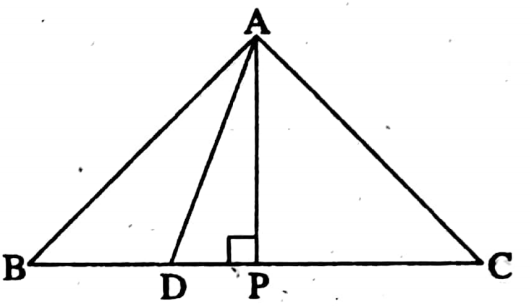
Example 15. In ΔABC, AD is the bisector of the angle ∠BAC and AP ⊥ BC; if AB > AC then prove that ∠PAD = \(\frac{1}{2}\) (∠ACB – ∠ABC)

Solution:

Given: In ΔABC, AD is the bisector of ∠BAC and AP ⊥ BC.

WBBSE Solutions For Class 8 Maths Geometry Chapter 6 Verification Of The Relation Between The Angles And Sides Of A Triangle Example 15

RTP: ∠PAD =\(\frac{1}{2}\) (∠ACB – ∠ABC)

Proof: AP ⊥ BC,  ∴  ∠APB = ∠APC = 90°

In ΔABP, ∠APB = 90°,

∴ ∠BAP + ∠ABP = 90°

In ΔAPC, ∠APC = 90°,

∴ ∠PAC + ∠ACP = 90°

∴ ∠PAC + ∠ACP = 90°

∴ ∠PAC + ∠ACP = ∠BAP + ∠ABP

⇒ ∠ACP – ∠ABP = ∠BAP – ∠PAC

= ∠BAD + ∠PAD – ∠PAD

= ∠CAD + ∠PAD – ∠PAC  [∠BAD = ∠CAD]

= (∠CAD – ∠PAC) + ∠PAD = ∠PAD + ∠PAD = 2∠PAD

⇒ ∠PAD = \(\frac{1}{2}\)(ACP – ABP)

∴ ∠PAD = \(\frac{1}{2}\) (∠ACB + ∠ABC)(Proved)

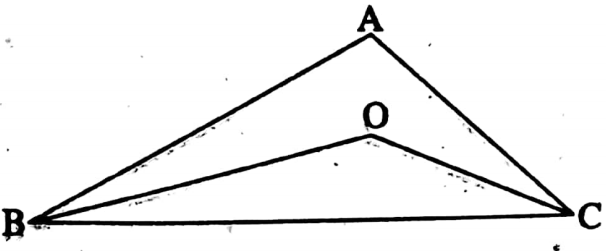
Example 16. In ΔABC, the bisectors of ∠ABC and ∠ACB meet at O. If AB > AC then prove that OB > OC.

Solution:

Given: In ΔABC, AB > AC; OB and OC are the bisectors of ∠ABC and ∠ACB respectively.


WBBSE Solutions For Class 8 Maths Geometry Chapter 6 Verification Of The Relation Between The Angles And Sides Of A Triangle Example 16


RTP: OB > OC

Proof: AB > AC

∴ ∠ACB > ∠ABC = ∠ACB > \(\frac{1}{2}\)∠ABC

∴ ∠OCB > ∠OBC

∴ OB > OC (Proved)

Example 17. AB is the greatest side and DC is the smallest side. Prove that ∠BCD > ∠BAD.

Solution:

Given: In quadrilateral ABCD, AB and DC are the greatest and smallest side respectively.

WBBSE Solutions For Class 8 Maths Geometry Chapter 6 Verification Of The Relation Between The Angles And Sides Of A Triangle Example 17

RTP: ∠BCD > ∠BAD

Construction: I join A, C.

Proof: In ΔABC, AB > BC [As AB is greatest side]

∴ ∠ACB > ∠BAC

In ΔACD, AD > DC  [DC is the smallest side]

∴ ∠ACD > ∠CAD    ∠ACB + ∠ACD > ∠BAC + ∠CAD

i.e. ∠BCD > ∠BAD (Proved)

Example 18. Choose the Correction Answer:

1. In ΔABC, AB = AC, BC is produced to D. If ∠ACD = 112° then the value of ∠BAC is

  1. 44°
  2. 68°
  3. 22°
  4. 34°

Solution:

WBBSE Solutions For Class 8 Maths Geometry Chapter 6 Verification Of The Relation Between The Angles And Sides Of A Triangle Example 18-1

∠ACD + ∠ACB = 180°

112° + ∠ACB = 180°

or, ∠ACB= 180° – 112° = 68°

In ΔABC, AB = AC, ∴ ∠ABC = ∠ACB = 68°

In ΔABC, exterior ∠ACD = ∠BAC + ∠ABC

112° = ∠BAC + 68°

⇒ ∠BAC = 112° – 68° = 44°

∴ So the correct answer is 1. 44°

The value of ∠BAC is 44°

2. In ΔABC, If ∠A = 70° and ∠B = 60°, then the relation between AB and BC is

  1. AB = BC
  2. AB > BC
  3. AB < BC
  4. None of these

Solution:

WBBSE Solutions For Class 8 Maths Geometry Chapter 6 Verification Of The Relation Between The Angles And Sides Of A Triangle Example 18-2

In ΔABC, ∠A + ∠B + ∠C = 180°

70° + 60° + ∠C = 180°

⇒ ∠C = 180° – 130° = 50°

The relation between AB and BC is

As, ∠A > ∠C

∴ BC > AB ⇒ AB > BC

∴ So the correct answer is 3. AB < BC

The relation between AB and BC is  AB < BC

3. If the measurement of an angle of a triangle is equal to sum of the other two angles, then the triangle becomes

  1. Acute angled triangle
  2. Obtuse angled triangle
  3. Equilateral triangle
  4. Right-angled triangle

Solution: In ΔABC, ∠A = ∠B + ∠C

∠A + ∠B + ∠C = 180°

∠A + ∠A = 180°

⇒ 2∠A = 180°

⇒ ∠A = 90°

The triangle is right angled triangle.

∴ So the correct answer is 4. Right angled triangle

Example 19. Write ‘True’ or ‘False’:

1. If the ratio of measurements of three angles of a triangle is 1: 2: 3, then the triangle becomes right angled triangle.

Solution: Let the angles are x°, 2x°, and 3x°.

x + 2x + 3x = 180

⇒ 6x = 180 ⇒ x = 30.

∴ The angles are 30°, 30° x 2 or 60° and 30° x 3 or 90°.

∴ The triangle is right angled triangle.

∴ So the statement is true.

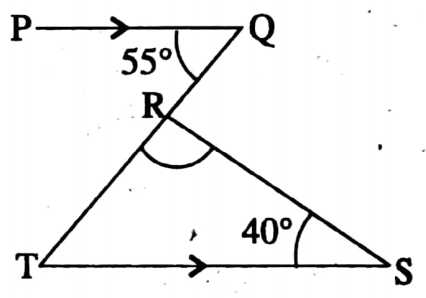
2. If PQ || TS, then the value of x is 80°.


WBBSE Solutions For Class 8 Maths Geometry Chapter 6 Verification Of The Relation Between The Angles And Sides Of A Triangle Example 19-2

Solution: ∠QTS = ∠PQT [Alternate angle] = 55°

i.e. ∠RTS = 55°

∠TRS + ∠RTS + ∠RST = 180°

x + 55° + 40° = 180°

⇒ x = 180° – 95° = 85°

∴ So the statement is false.

Example 20. Fill in the blanks:

1. In obtuse angled triangle opposite side of _______ is largest.

Answer: Obtuse angle.

WBBSE Solutions For Class 8 Maths Geometry Chapter 6 Verification Of The Relation Between The Angles And Sides Of A Triangle Example 20-1

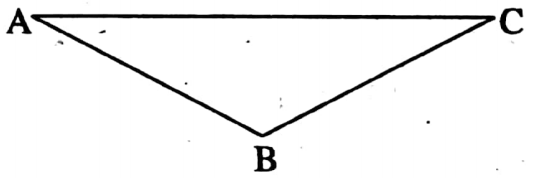
Solution: Let, In ΔABC, ∠B is obtuse angle.

∴ ∠A and ∠C are both acute angle.

∴ ∠B > ∠A and ∠B > ∠C

As ∠B > ∠C then AC > AB

∴ AC is largest.

∴ The obtuse angled triangle opposite side of obtuse angle is largest.

2. In ΔABC, AB = AC; BC is produced to D. If ∠ACD = 105° then the value of ∠BAC

Solution:

WBBSE Solutions For Class 8 Maths Geometry Chapter 6 Verification Of The Relation Between The Angles And Sides Of A Triangle Example 20-2

In, ΔABC, ∠ACD = 105°

∠ACB = 180° – ∠ACD = 180° – 105° = 75°

AB = AC

∴ ∠ABC = ∠ACB = 75°

∠BAC + ∠ABC = Exterior ∠ACD

∠BAC + 75° = 105°

⇒ ∠BAC = 105° – 75° = 30°.

The value of ∠BAC = 30°.

WBBSE Solutions For Class 8 Maths Geometry Chapter 7 Geometrical Proofs

Geometry Chapter 7 Geometrical Proofs

⇒ Polygon: A plane figure bounded by three or more than three line segment is called a polygon.

⇔ If a polygon has three sides, it is called a triangle.

⇔ Similarly quadrilateral has four sides, pentagon has five sides, hexagon has six sides etc.

⇒ Regular Polygon: A polygon whose all sides are equal in length and the measurement of all angles are equal is called regular polygon.

Example: Regular triangle is an equilateral triangle whose each angle is 60°.

⇔ Square is a regular quadrilateral whose each interior angle is 90°.

Read and Learn More WBBSE Solutions For Class 8 Maths

[Rhombus is not a regular quadrilateral because although the length of four sides are equal but the measurement of each angle are not equal]

WBBSE Solutions For Class 8 Maths Geometry Chapter 7 Geometrical Proofs

Theorem 1. The sum of length of any two sides is greater than length of the third side.

WBBSE Solutions For Class 8 Maths Geometry Chapter 7 Geometrical Proofs The Sum Of Length Of Any Two Sides IS Greater Than Length Of The Third Side

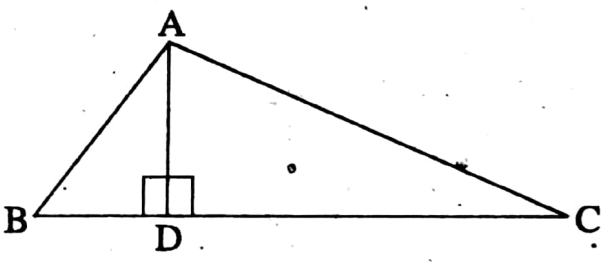
Given: Let BC is the longest side of ΔABC.

Required to prove: If we prove AB + AC > BC then it.

Will be proved that the sum of lengths of any two sides of a triangle is greater than the length of the third side.

Construction: We draw a perpendicular AD on BC from the point A which intersects BC at D.

Proof: As AD ⊥ BC [By construction]

∴ ∠ADB = ∠ADC = 90°

In ΔABD, ∠ADB is right angle and ∠BAD is an acute angle.

∴ ∠ADB > ∠BAD

∴ AB > BD [The opposite side of bigger angle is greater than the opposite side of smaller angle]

⇔ In ΔADC, ∠ADC is right angle and ∠CAD is an acute angle.

∴ ∠ADC > ∠CAD

∴ AC > CD

∴ AB+ AC > BD + CD

i.e. AB+ AC > BC (Proved)

WBBSE Class 8 English Functional GrammarWBBSE Class 8 English Reading Skills
WBBSE Solutions For Class 8 EnglishWBBSE Solutions For Class 8 Maths


Theorem 2. The sum of the measurement of all the interior angles of a polygon of sides n is 2(n-2) right angles.

WBBSE Solutions For Class 8 Maths Geometry Chapter 7 Geometrical Proofs Theorem 2

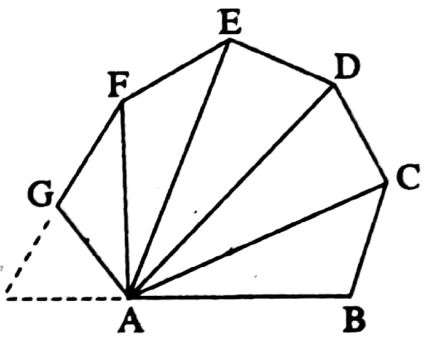
Given: Let’s ABCDEFG…. be a polygon with n sides.

Required to prove: Sum of the measurement of all the interior angles of the polygon with n. sides is 2(n − 2) right angles.

Construction: I draw the diagonals AC, AD, AE, AF, AG,…

Proof: By joining the vertex A with other vertices C, D, E, F, G…. of the polygon i.e. by construction the diagonals AC, AD, AE, AF, AG, . . . . . . of the polygon with n sides (n-2) number of triangles are formed.

∴ Sum of the measurement of all the interior angles of the polygon ABCDEFG…. is

= Sum of the measurement of interior angles of (n-2) triangles.

= (n -2) x 2 right angles = 2 (n-2) right angles. (Proved)

Theorem 3. All the line segments drawn from a point outside a straight line to any point on the straight line perpendicular is smallest one.

WBBSE Solutions For Class 8 Maths Geometry Chapter 7 Geometrical Proofs Theorem 3

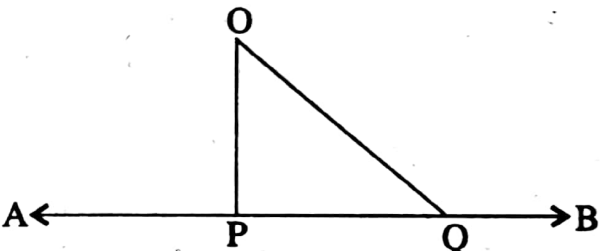
Given: Let AB be a straight line and O be a point outside of line AB and OP ⊥ AB.

Required to prove: It is to be proved that any line segment drawn from a point O to the straight line AB, the smallest one is OP.

Construction: Let Q is a point on the straight line AB other than the point P.

I join O and Q.

Proof: In ΔPOQ, ∠OPQ = 90°  [OP ⊥ AB]

∠OPQ > ∠OQP [∠OQP is an acute angle]

∴ OQ > OP [The length of opposite side of a greater angle is greater than the side opposite to smaller angle]

Q is any point on the straight line AB other than P.

∴ For any point Q on AB, OP < OQ.

∴ OP is the smallest. (Proved)

  1. In a regular polygon of n sides measurement of each interior angle is \(\frac{2(n-2)}{2}\) x 90° and the measurement of each exterior angle is \(\frac{360^{\circ}}{n}\)
  2. In ΔABC, if ∠ABC= 90°, then AB2+ BC2 = AC2 [By Pythagoras theorem]

Geometry Chapter 7 Geometrical Proofs Examples

Example 1. From the length of the following sides, in which case is it possible to draw a triangle?

  1. 3 cm, 4 cm, 7 cm
  2. 5 cm, 6 cm, 4 cm
  3. 4.5 cm, 5 cm, 10 cm
  4. 6 cm, 8 cm, 10 cm

Solution: The sum of the length of any two sides is greater than length of the third side.

1. 3 + 4 = 7

⇔ In this case it is not possible to draw a triangle.

2. 5+ 6 > 4, 4 + 5 > 6 and 6 + 4 > 5

⇔ In this case it is possible to draw a triangle.

3. 4.5+ 5 < 10

⇔ In this case it is not possible to draw a triangle.

4. 6 + 8 > 10, 6 + 10 > 8, 8 + 10 > 6

⇔ In this case it is possible to draw a triangle.

Example 2. Find the sum of measurement of all the interior angles of the following polygons:

  1. Octagon
  2. Decagon
  3. Polygon with 12 sides
  4. Polygon with 15 sides.

Solution:

  1. The sum of measurement of all the interior angles of a octagon is 2(8-2) × 90° = 2 x 6 x 90° = 1080°.
  2. Sum of measurement of all the interior angles of a decagon is 2 (10-2) × 90° = 2 x 8 x 90° = 1440°
  3. Sum of measurement of all the interior angles of polygon with sides 12 is 2(12-2) × 90° = 2 x 10 x 90° = 1800°
  4. Sum of measurement of all the interior angles of polygon with side 15 is 2(15-2) × 90° = 2 x 13 x 90° = 2340°

Example 3. Find the measurement of each interior and exterior angle of the following regular polygon.

  1. Pentagon
  2. Hexagon
  3. Polygon with side 25

Solution:

1. The measurement of each interior angle of pentagon is

\(\frac{2(5-2)}{5} \times 90^{\circ}=2 \times \frac{3}{5} \times 90^{\circ}=108^{\circ}\)

Measurement of each exterior angle of pentagon is \(\frac{360^{\circ}}{5}=72^{\circ}\)

2. The measurement of each interior angle of hexagon is

\(\frac{2(6-2)}{6} \times 90^{\circ}\) = \(\frac{2 \times 4 \times 90^{\circ}}{6}\) =120°

And each exterior angle is \(\frac{360^{\circ}}{6}=60^{\circ}\)

3. The measurement of each interior angle of polygon with 25 side is

\(2 \times \frac{(25-2)}{25} \times 90^{\circ}=2 \times \frac{23}{25} \times 90^{\circ}=\frac{828^{\circ}}{5}=165.6^{\circ}\)

And each exterior angle is \(\frac{360^{\circ}}{25}=14.4^{\circ}\)

Example 4. If the measurement of three angles of a quadrilateral are 100°, 62°, and 85° respectively, then find the measurement of the fourth angle.

Solution: The sum of the measurement of three angle is (100° + 62° + 85°) = 247°

⇔ The sum of measurement of all interior angles of a quadrilateral is 2(4 – 2) x 90° =360°

⇔ So the measurement of fourth angle is (360° – 247°) = 113°

Example 5. If sum of measurement of all interior angles of a polygon is 1440°, then find number of sides of the polygon.

Solution: Let the number of sides of the polygon is n.

∴ Sum of measurement of all interior angles is (2n – 4) x 90°

⇔ According to the question,

(2n – 4) x 90° = 1440°

⇒ 2n – 4 = \(\frac{1440}{90}\) = 16

⇒ 2n = 16+ 4 = 20

⇒ n = \(\frac{20}{2}\) = 10

∴ The number of sides of the polygon is 10.

Example 6. Find whether the following measurement are possible or not for exterior angle of a regular polygon.

  1. 15°
  2. 28°

Solution:

1. Exterior angle of the regular polygon is 15°.

∴ The number of sides = \(\frac{360^{\circ}}{15^{\circ}}\) = 24

Hence 15° is the measure of an exterior angle of a regular polygon of sides 24.

2. Each exterior angle is 28°.

∴ The number of sides = \(\frac{360}{28}=\frac{90}{7}=12 \frac{6}{7}\)

⇔ But the number of sides cannot be a fraction.

⇔ Hence 28° cannot be the measure of an exterior angle of a regular polygon.

Example 7. Find whether the following measurement of each interior angle is possible for a regular polygon.

  1. 144°
  2. 155°

Solution:

1. The measurement of each interior angle of a regular polygon is 144°.

∴ The measurement of each exterior angle is (180° – 144°) or 36°.

∴ The number of sides = \(\frac{360}{36}\) = 10

So 144° is the measure of interior angle of a regular polygon of sides 10.

2. Each interior angle is 155°.

∴ Each exterior angle is (180° – 155°) or 25°.

The number of sides = \(\frac{360}{25}\) = \(\frac{72}{5}\) = 14\(\frac{2}{5}\) which is fraction.

∴ 155° cannot be the measure of an interior angle of a regular polygon.

Example 8. Measurement of each of 4 interior angle is 150° and measurement of each of the other interior angle of a polygon is 100°. Find the number of sides of the polygon.

Solution: Let the number of sides be n.

So the number of interior angles becomes n.

Sum of measurement of interior angles of n sides is 2 (n – 2) x 90°.

Sum of measurement of first 4 interior angles is 4 x 150° or 600°.

Sum of measurement of rest (n – 4) interior angles is (n – 4) x 100°.

According to question,

= 2(n-2) x 90° = 600° + (n-4) x 100°

⇒ 2(n-2) x 9 = 60 + (n-4) × 10

⇒ 18n – 36 = 60 + 10n – 40

⇒ 18n – 10n = 20 + 36

⇒ 8n = 56 ⇒ n = 7

∴ The number of sides of the polygon is 7.

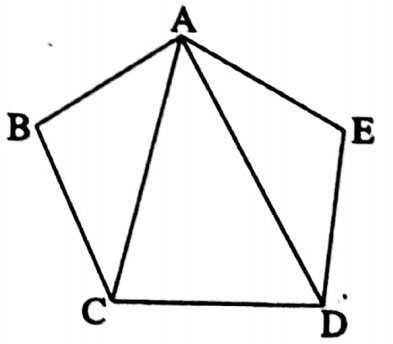
Example 9. In the adjacent ABCDE is a regular pentagon. Find the value of ∠CAD.


WBBSE Solutions For Class 8 Maths Geometry Chapter 7 Geometrical Proofs In Adjacent ABCDE IS A Regular Pentangon


Solution: The measurement of each interior angle of a regular pentagon is

\(\frac{2(5-2) \times 90^{\circ}}{5}=\frac{2 \times 3 \times 90^{\circ}}{5}=108^{\circ}\)

∴ \(\angle \mathrm{ABC}=\angle \mathrm{BAE}=\angle \mathrm{AED}=108^{\circ}\)

\(\text { In } \triangle \mathrm{ABC}, \mathrm{AB}=\mathrm{BC}\)

∴ \(\angle \mathrm{BAC}=\angle \mathrm{ACl}\)

\(\angle \mathrm{BAC}+\angle \mathrm{ABC}+\angle \mathrm{ACB}=180^{\circ}\) \(\angle \mathrm{BAC}+108^{\circ}+\angle \mathrm{BAC}=180^{\circ}\) \(2 \angle \mathrm{BAC}=180^{\circ}-108^{\circ}=72^{\circ}\)

∠BAC = \(\frac{72^{\circ}}{2}=36^{\circ}\)

Similarly ∠DAE = 36°

∠BAC + ∠CAD + ∠DAE= 108°

36° + ∠CAD + 36° = 108°

∠CAD = 108° – 72° = 36°

The value of ∠CAD = 36°

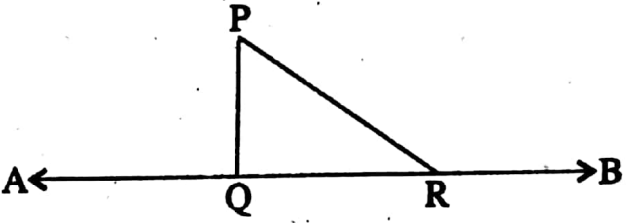
Example 10. In the adjacent, the shortest distance of point P from the straight line AB is 3 cm and length of QR is 4 cm. Find the length of PR.


WBBSE Solutions For Class 8 Maths Geometry Chapter 7 Geometrical Proofs Example 10

Solution: The shortest distance of point P from the straight line AB is PQ.

∴ PQ ⊥ AB.

∴ ∠PQR = 90°

PQ = 3cm, QR = 4cm

∴ In ΔPQR,

PR2 = PQ2 + QR2 [By applying pythagorus A theorem]

= (32+42) sq.cm. = 25 sq.cm.

PR = √25 cm = 5 cm.

∴ The length of PR is 5 cm.

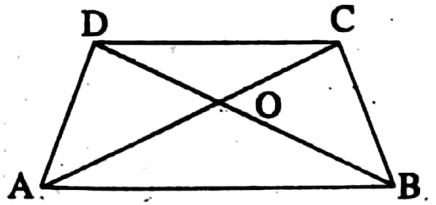
Example 11. Prove that the sum of lengths of two diagonals of a quadrilateral is greater than the semi-perimeter of the quadrilateral.

Solution:

Given: Two diagonal AC and BD of a quadrilateral ABCD intersect at O.


WBBSE Solutions For Class 8 Maths Geometry Chapter 7 Geometrical Proofs Example 11


RTP: AC + BD > \(\frac{1}{2}\)(AB + BC + CD + DA)

Proof: In ΔAOB, OA + OB > AB…… (1)

[The sum of lengths of any two sides of a triangle is greater than the length of the third side]

In ΔBOC, OB + OC > BC…….(2)

ΔCOD, OC + OD > CD…….(3)

In ΔAOD, OD + OA > DA…….(4)

∴ (1) + (2) + (3) + (4), we get

2(OA + OC + OB + OD) = AB + BC + CD + DA

∴ 2(AC+ BD) = AB + BC + CD + DA

AC + BD = \(\frac{1}{2}\)(AB + BC + CD + DA) (Proved)

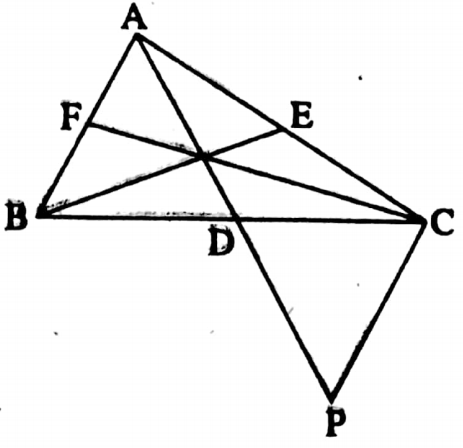
Example 12. Prove that the perimeter of a triangle is more than the sum of length of the medians.

Solution: Given: In ΔABC, AD, BE and CF are three medians.

WBBSE Solutions For Class 8 Maths Geometry Chapter 7 Geometrical Proofs Example 12

RTP: AB+ BC + CA > AD + BE + CF

Construction: I produced the line segment AD to P in such a way that AD = DP.

I join P, C.

Proof: In ΔABD and ΔPCD,

BD = CD (Given)

∠ADB = ∠PDC [Vertically opposite angles]

and AD = DP [By construction]

∴ ΔABD ≅ ΔPCD [By SAS congruency]

∴ AB = CP (Corresponding sides]

In ΔAPC, AC + CP > AP AC + AB > AD + DP

∴ AC + AB > AD + AD

∴ AB + AC > 2AD……..(2)

Similarly, AB + BC > 2BE…..(2)

and BC + AC > 2CF…..(3)

(1) + (2) + (3) we get

2(AB + BC + AC) > 2(AD + BE + CF)

⇒ AB + BC + CA > AD + BE + CF (Proved)

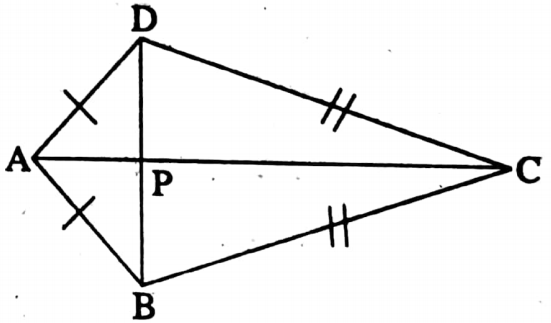
Example 13. In a quadrilateral ABCD, AB = AD and BC = DC, and DP is the smallest distance drawn from D on AC. Prove that B, P, and D are collinear.

Solution:

Given: In a quadrilateral ABCD, AB = AD, BC = DC and DP is the smallest distance drawn from D on AC.

I Join B, P.


WBBSE Solutions For Class 8 Maths Geometry Chapter 7 Geometrical Proofs Example 13


RTP: B, P, and D are collinear.

Proof: As DP is the shortest distance.

∴ DP ⊥ AC.

∴ ∠APD = ∠CPD = 90°

In ΔABC and ΔADC, AB = AD (given)

BC = DC (given) and AC is common side.

∴ ΔABC ≅ ΔADC [By SSS congruency]

∴ ∠BAC = ∠DAC [Corresponding angles]

∴ i.e. ∠BAP = ∠DAP

In ΔAPB and ΔADP,

AB = AD ΔBAP = ΔDAP and AP is common side.

∴ ΔAPB ≅ ΔADP [By SAS congruency]

∴ ∠APB + ∠APD  ∠APB = 90°

∠APB + ∠APD = 90° + 90° = 180°

∴ BP and DP lies in straight line.

∴ B, P, D are collinear. (Proved)

Example 14. O is any point inside the ΔABC. Prove that AB + BC + CA > OA + OB + OC.

Solution:


WBBSE Solutions For Class 8 Maths Geometry Chapter 7 Geometrical Proofs Example 14


Given: O is any point inside the ΔABC.

I join OA; OB and OC.

RTP: AB+ BC + CA > OA + OB + OC

Construction: BO is produced which meets AC at E.

Proof: In ΔCOE, OE + EC > OC

In ΔABE, AB + AE > BE

∴ OE+ EC + AB+ AE > OC+ BE

OE + (EC+ AE) + AB > OC + OB + OE

∴  OE + AC+ AB > OB + OC + OE

∴ AB + AC > OB + OC……. (1) [Subtracting OE from both side]

Similarly,

AB + BC > OA + OC ….. (2)

and AC + BC > OA + OB…. (3)

(1) + (2) + (3), we get,

2(AB + BC + CA) > 2 (OA + OB + OC) AB + BC + CA > OA + OB + OC

Example 15. Choose the correct answer:

1. The sum of measurement of all the interior angles of a hexagon is

  1. 360°
  2. 720°
  3. 540°
  4. 1080°

Solution: The sum of measurement of interior angle of a hexagon is 2(6 – 2) × 90° = 2 x 4 x 90° = 720°

∴ So the correct answer is 2. 720°

The sum of measurement of all the interior angles of a hexagon is  720°.

2. The measurement of each interior angle of a regular decagon is

  1. 144°
  2. 108°
  3. 120°
  4. 72°

Solution: The measurement of each interior angle of regular decagon is

\(\frac{2(10-2) \times 90^{\circ}}{10}=\frac{2 \times 8 \times 90^{\circ}}{10}=144^{\circ}\)

∴ So the correct answer is 1. 144°

The measurement of each interior angle of a regular decagon is 144°.

3. If the measurement of each exterior angle is 72°, the number of side is

  1. 12
  2. 10
  3. 5
  4. 6

Solution: The number of side = \(\frac{360^{\circ}}{72^{\circ}}=5\)

∴ So the correct answer is 3. 5

The number of side is 5.

Example 16. Write ‘True’ or ‘False’:

1. In a regular polygon of n sides measurement of each exterior angle is \(\frac{360^{\circ}}{n}\)

Solution: The sum of measurement of all the interior angles of a regular polygon is 2(n-2) x 90°.

∴ The measurement of each angle is \(\frac{2(n-2) \times 90^{\circ}}{n}\)

The sum of interior and exterior angle is 180°.

∴ The exterior angle is 180° – \(\frac{2(n-2) \times 90^{\circ}}{n}=\frac{180 n-180 n+360^{\circ}}{n}=\frac{360^{\circ}}{n}\)

∴ So the statement is true.

2. If the measurement of each interior angle of a regular polygon is 120°, then the number of sides of the polygon is 6.

Solution: Exterior angle is 180° – 120° = 60°

The number of side = \(\frac{360^{\circ}}{60^{\circ}}=6\)

∴ So the statement is true.

Example 17. Fill in the blanks:

1. The measurement of each angle of regular quadrilateral is _______

Solution: The measurement of each angle of regular quadrilateral is \(\frac{360^{\circ}}{4}=90^{\circ}\)

2. The perimeter of a quadrilateral is greater than _______ the length of any one of the diagonals.

Solution:

WBBSE Solutions For Class 8 Maths Geometry Chapter 7 Geometrical Proofs Example 17-2

In ΔABC, AB + BC > AC

In ΔADC, AD + CD > AC

AB + BC + AD + CD > AC + AC

AB + BC + CD + AD > 2AC

∴ The perimeter of the quadrilateral is greater than twice the length of any one of the diagonals.

WBBSE Solutions For Class 8 Maths Geometry Chapter 5 Relation Between Two Sides Of A Triangle And Their Opposite Angles

Geometry Chapter 5 Relation Between Two Sides Of A Triangle And Their Opposite Angles

⇒ Axiom: Two triangles are congruent if the length of two sides and the measurement of the included angle of one triangle are equal to the length of two sides and the measurement of the included angle of the other triangle. (SAS)

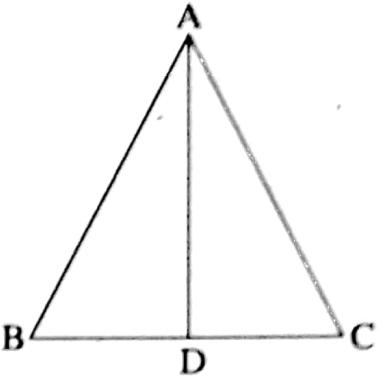
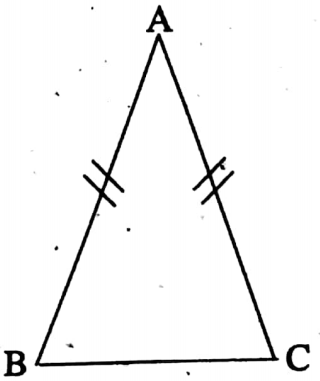
Theorem 1. Angles opposite to equal sides of an isosceles triangle are equal in measure.

WBBSE Solutions For Class 8 Maths Geometry Chapter 5 Relation Between Two Sides Of A Triangle And Their Opposite Angles Theorem 1

Given: ABC is a triangle where AB = AC.

Required to prove: In ΔABC, the measurement of angles opposite to two equal sides AB and AC are equal.

i.e. ∠ACB = ∠ABC.

Read and Learn More WBBSE Solutions For Class 8 Maths

Construction: I draw the bisector AD of ∠BAC which intersects BC at D.

Proof: In ΔABD and ΔACD,

AB = AC (given)

∠BAD = ∠CAD [by construction]

and AD = AD [Common side]

∴ ΔABD ≅ ΔACD [by SAS congruence rule]

∴ ∠ABD = ∠ACD [Corresponding angles of congruent triangles]

Hence, ∠ABC = ∠ACB (Proved).

WBBSE Class 8 English Functional GrammarWBBSE Class 8 English Reading Skills
WBBSE Solutions For Class 8 EnglishWBBSE Solutions For Class 8 Maths


Theorem 2.

  1. Two triangles are congruent if measurement of any pair of angles and length of one pair of corresponding sides are equal to the other triangle. (AAS)
  2. If length of three sides of one triangle is equal to the length of three sides of another triangle then the two triangles are congruent. (SSS)
  3. If in two right angled triangles the length of hypotenuse and length of one side of one triangle are equal to the length of the hypotenuse and the length of one side of the other triangle, then the two triangles are congruent. (RHS)

Theorem 3. The length of opposite sides of two angles equal in measurement of a triangle are equal.


WBBSE Solutions For Class 8 Maths Geometry Chapter 5 Relation Between Two Sides Of A Triangle And Their Opposite Angles Theorem 3

Given: In ΔABC, ∠ABC = ∠ACB.

Required to prove: AB = AC

Construction: I draw the bisector AD of ∠BAC which intersect BC at D.

Proof: In ΔABD and ΔACD,

∠BAD = ∠CAD [AD is a bisector of ∠BAC]

AD = AD [Common side]

and ∠ABD = ∠ACD (Given)

∴ ΔABD ≅ ΔACD [By AAS congruence rule]

∴ AB = AC [Corresponding sides of congruent triangles) (Proved)

WBBSE Solutions For Class 8 Maths Geometry Chapter 5 Relation Between Two Sides Of A Triangle And Their Opposite Angles

Geometry Chapter 5 Relation Between Two Sides Of A Triangle And Their Opposite Angles Examples

Example 1. If the measurement of an angle of an isosceles triangle is 105°, then find the measurement of other two angles.

Solution: The sum of two acute angles is (180° – 105°) or 75°.

WBBSE Solutions For Class 8 Maths Geometry Chapter 5 Relation Between Two Sides Of A Triangle And Their Opposite Angles Example 1

Let ∠A = 105° and AB = AC

∴ ∠B = ∠C = \(\frac{180^{\circ}-105^{\circ}}{2}=\frac{75^{\circ}}{2}=37 \cdot 5^{\circ}\)

The measurement of other two angles \(\frac{180^{\circ}-105^{\circ}}{2}=\frac{75^{\circ}}{2}=37 \cdot 5^{\circ}\)

Example 2. In an isosceles triangle one angle of the base is 55°, then find the measurement of vertical angle.

Solution: In an isosceles triangle one angle of the base is 55°.

∴ The other angle of base is 55°.

Then the vertical angle is 180° – (55° + 55°) = 180° – 110° = 70°

Example 3. In an isosceles triangle, the vertical angle is three times of each angle of the base. Find the measurement of the supplementary angle of the vertical angle.

Solution: Let measurement of each angle of the base is x°.

∴ The measurement of vertical angle is 3x°.

Sum of the three angles of a triangle is 180°.

∴ 3x + x + x° = 180°

⇒ 5x° = 180°

⇒ x = \(\frac{180^{\circ}}{5}=36^{\circ}\)

⇒ The vertical angle is (3 x 36°) or 108°.

The supplementary angle of verticle angle is (180° – 108°) or 72°.

Example 4. In the adjacent, in ΔABC, AB = AC, If ∠A + ∠B = 115°, find the measurement of ∠A.


WBBSE Solutions For Class 8 Maths Geometry Chapter 5 Relation Between Two Sides Of A Triangle And Their Opposite Angles Example 4


Solution: In ΔABC, ∠A + ∠B + ∠C = 180°

115° + ∠C = 180°

⇒ ∠C = 180° – 115° = 65°

As AB = AC

∴ ∠B = ∠C = 65°

∠A = 115° – 65° = 50°

The measurement of ∠A = 50°

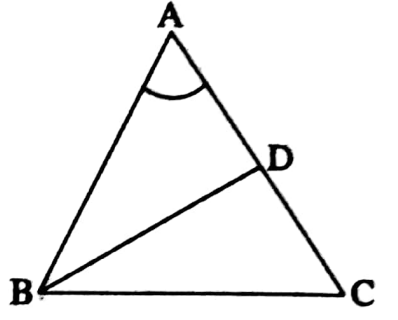
Example 5. In ΔABC, AB = AC; The bisector of ∠ABC intersects AC at D. If ∠A = 56°, then find the value of ∠ABD.

Solution:

WBBSE Solutions For Class 8 Maths Geometry Chapter 5 Relation Between Two Sides Of A Triangle And Their Opposite Angles Example 5

In ΔABC,

AB = AC

∴ ∠ABC = ∠ACB

∠BAC = 56°

In ΔABC, ∠BAC+ ∠ABC + ∠ACB = 180°

56° + ∠ABC + ∠ABC = 180°

⇒ 2∠ABC = 180° – 56° = 124°

⇒ ∠ABC = \(\frac{124^{\circ}}{2}=62^{\circ}\)

As BD is the bisector of ∠ABC.

∴ ∠ABD = \(\frac{1}{2}\)∠ABC = \(\frac{1}{2}\)∠ABC = \(\frac{1}{2}\) x 62° = 31°

The value of ∠ABD = 31°

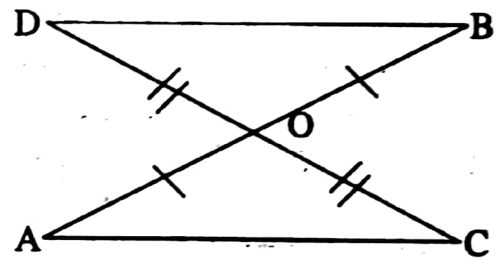
Example 6. Two line segments AB and CD bisect each other at O; If AC = 4 cm, then find the length of BD.

Solution:

WBBSE Solutions For Class 8 Maths Geometry Chapter 5 Relation Between Two Sides Of A Triangle And Their Opposite Angles Example 6

In ΔAOC and ΔBOD,

OA = OB, OC = OD and ∠AOC = ∠BOD [Vertically opposite angle]

ΔAOC ≅ ΔBOD [by SAS congruency]

∴ AC = BD

4 cm = BD

∴ The length of BD is 4 cm.

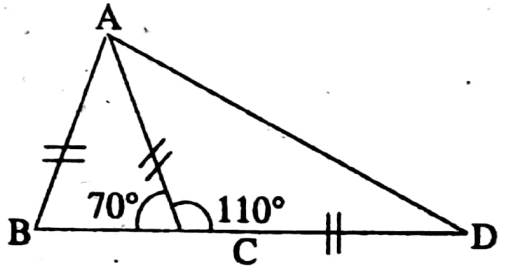
Example 7. In ΔABC, AB = AC; BC is extended to D such that AC = CD; if ∠ABC = 70°, then find the value of ∠BAD.

Solution:

WBBSE Solutions For Class 8 Maths Geometry Chapter 5 Relation Between Two Sides Of A Triangle And Their Opposite Angles Example 7

In ΔABC, AB = AC

∴ ∠ACB = ∠ABC = 70°

Again, ∠ACB + ∠ACD = 180°

70° + ∠ACD = 180°

⇒ ∠ACD = 180° – 70° = 110°

In ΔACD, AC = CD

∴ ∠DAC = ∠ADC

∠ACD + ∠ADC + ∠DAC = 180°

110° + ∠ADC + ∠ADC= 180°

2∠ADC = 180° – 110° = 70°

⇒ ∠ADC = \(\frac{70^{\circ}}{2}=35^{\circ}\)

In ΔABD, ∠ABD + ∠ADB + ∠BAD = 180°

i.e. ∠ABC + ∠ADC + ∠BAD = 180°

70° +35° + ∠BAD = 180°

⇒ ∠BAD = 180°- 105° = 75°

The value of ∠BAD = 75°

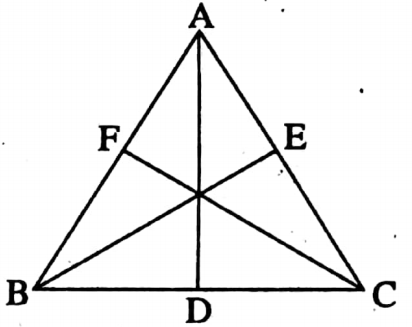
Example 8. Prove that the lengths of the medians are equal in length in an equilateral triangle.

Solution:

WBBSE Solutions For Class 8 Maths Geometry Chapter 5 Relation Between Two Sides Of A Triangle And Their Opposite Angles Example 8

Given, In ΔABC,

AB = BC = AC

Let AD, BE and CF are three medians of ΔABC.

Required to Prove: AD = BE = CF

Proof: AB = AC

⇒ \(\frac{1}{2}\)AB – \(\frac{1}{2}\)AC

∴ FB = EC [F and E are the midpoints of AB and AC respectively]

In ΔFBC and ΔEBC,

FB = EC

∠FBC = ∠ECB [As in ΔABC, AB = AC  ∴ ∠ABC = ∠ACB] and BC = BC [Common side]

∴ ΔFBC ≅ ΔEBC [By SAS congruency]

∴ CF = BE (Corresponding sides of congruent triangles.]

Similarly, it can be proved from ΔABE and ΔADB that BE = AD

∴ AD = BE = CF (Proved)

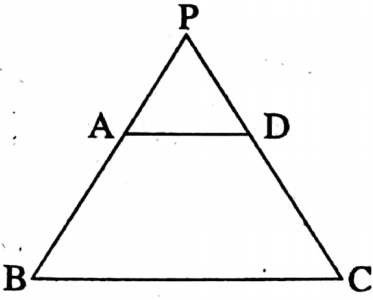
Example 9. In trapezium ABCD, AD || BC and ∠ABC = ∠BCD. Prove that ABCD is an isosceles trapezium.

Solution: In trapezium ABCD, AD || BC and ∠ABC = ∠BCD. (Given)

WBBSE Solutions For Class 8 Maths Geometry Chapter 5 Relation Between Two Sides Of A Triangle And Their Opposite Angles Example 9

Required to Prove: ABCD is an isosceles trapezium.

Construction: BA and CD are extended which meets at a point P.

Proof: In ΔPBC, ∠PBC = ∠PCB (given)

∴ PB = PC

AD || BC and AB is transversal.

∴ ∠PAD = ∠ABC [Corresponding angles]

Again, AD || BC and AC is transversal.

∴ ∠PDA = ∠BCD [Corresponding angles]

As ∠ABC = ∠BCD (given)

∴ ∠PAD = ∠PDA

In ΔPAD, ∠PAD = ∠PDA

∴ PA = PD

PB – PA = PC – PD

∴ AB = DC

∴ ABCD is an isosceles trapezium. (Proved)

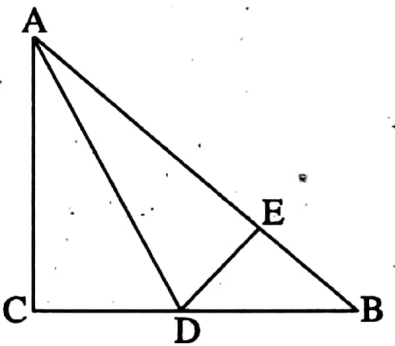
Example 10. AB is the hypotenuse of the isosceles right angled triangle ABC. AD is the bisector of ∠BAC and AD intersects. BC at D. Prove that AC + CD = AB.

Solution: In right angled isosceles triangle ABC, AB is the hypotenuse.

WBBSE Solutions For Class 8 Maths Geometry Chapter 5 Relation Between Two Sides Of A Triangle And Their Opposite Angles Example 10

AD is the bisector of ∠BAC and AD intersects BC at D. (Given)

Required to Prove: AC + CD = AB.

Construction: Through D I draw DE which is perpendicular on AB.

Proof: In ΔACD and ΔADE,

∠CAD = ∠EAD [as AD is the bisector of ∠BAC]

∠ACD = ∠AED = 90°  [DE ⊥ AB] and AD is common side.

∴ ΔACD ≅ ΔADE [by AAS congruency]

∴ AC = AE [Corresponding sides of congruent triangles]

and CD = DE [Corresponding sides]

In ΔABC, ∠ACB = 90° and AC = BC.

∴ ∠BAC = ∠ABC = \(\frac{90^{\circ}}{2}=45^{\circ}\)

In ΔBDE, ∠BED = 90°, ∠B = 45°

∴ ∠BDE = 180° – 90° – 45° = 45°

∴ ∠BDE = ∠B

∴ BE =  DE

∴ Again CD = DE.

∴ DE = CD = BE

AC + CD = AE + BE = AB

AB is the hypotenuse of the isosceles right-angled triangle ABC Hence (Proved).

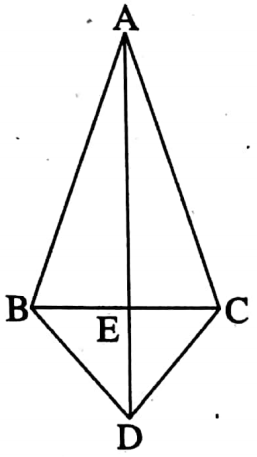
Example 11. Two isosceles triangle ABC and DBC are situated on the opposite side of BC. Prove that AD bisects BC perpendicularly.

Solution: Two isoscles triangle ABC and DBC are situated on the opposite side of BC.

WBBSE Solutions For Class 8 Maths Geometry Chapter 5 Relation Between Two Sides Of A Triangle And Their Opposite Angles Example 11

AD intersect BC at E. (Given)

Required to Prove: AD ⊥ BC and BF = CE

Proof: In ΔABD and ΔACD,

AB = AC (given)

BD = CD (given) and AD is common side.

∴ ΔACD ≅ ΔABD [By SAS congruence law]

∴ ∠BAD = ∠CAD [Corresponding angles of congruent triangles]

i.e. ∠BAE = ∠CAE

In ΔABE and ΔACE,

AB = AC, ∠BAE = ∠CAE and AE is common side.

∴ ΔABE ≅ ΔACE [By SAS congruency]

∴ BE = CE [Corresponding sides] (Proved)

and ∠AEB = ∠AEC

Again ∠AEB + ∠AEC = 180° ∠AEB + ∠AEB = 180° = 2∠AEB = 180°

⇒ ∠AEB = 90°.

∴ AE ⊥ BC i.e. AD ⊥ BC (Proved)

Example 12. Choose the correct answer:

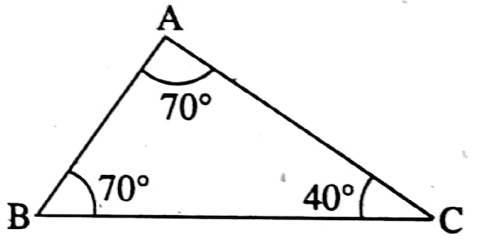
1. In the adjacent, in ΔABC, which relation is correct?

  1. AB = BC
  2. AB = AC
  3. AC = BC
  4. AC ≠ BC

WBBSE Solutions For Class 8 Maths Geometry Chapter 5 Relation Between Two Sides Of A Triangle And Their Opposite Angles Example 12-1

Solution: In ΔABC, ∠BAC = ∠ABC = 70°

∴ AC = BC [If the two angles of a triangle are equal then their opposite sides are equal]

∴ So the correct answer is 3. AC = BC

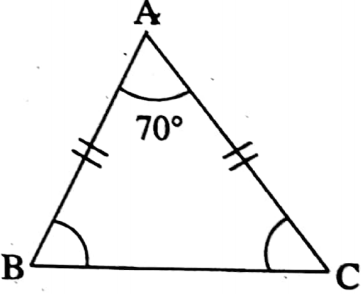
2. In ΔABC, AB = AC; If ∠BAC 70°, then the value of ∠ACB is

  1. 70°
  2. 110°
  3. 35°
  4. 55°

WBBSE Solutions For Class 8 Maths Geometry Chapter 5 Relation Between Two Sides Of A Triangle And Their Opposite Angles Example 12-2

Solution: In ΔABC, AB = AC

∴ ∠ACB = ∠ABC.

Again, ∠BAC+ ∠ABC + ∠ACB = 180°

70° + ∠ACB + ∠ACB = 180°

⇒ 2∠ACB = 180°- 70° = 110°

⇒ ∠ACB = \(\frac{110^{\circ}}{2}\) = 55°

∴ So the correct answer is 4. 55°

The value of ∠ACB is 4. 55°.

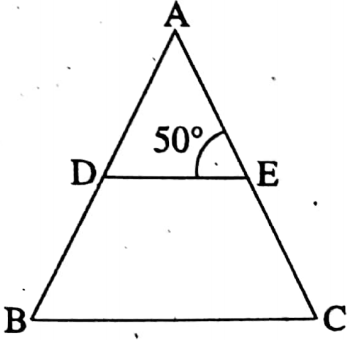
3. In the adjacent, in ΔABC, AB = AC and DE || BC; If ∠AED = 50°, then the value of ∠ABC is

  1. 50°
  2. 80°
  3. 100°
  4. 70°


WBBSE Solutions For Class 8 Maths Geometry Chapter 5 Relation Between Two Sides Of A Triangle And Their Opposite Angles Example 12-3


Solution: DE || BC and AC is transversal.

∴ ∠ACB = ∠AED [Corresponding angles] = 50°

In ΔABC, AB = AC

∴ ∠ACB = ∠ABC 50° = ∠ABC.

∴ So the correct answer is 1. 50°

The value of ∠ABC is 50°

Example 13. Write ‘True’ or ‘False’:

1. In an isosceles obtuse-angled triangle the measurement of an acute angle is 1/4 of measurement of the obtuse angle. The value of the acute angle is 20°.

Solution: Let value of each acute angle is x°.

∴ The value of obtuse angle is 4x°.

4x° + x° + x° = 180°

⇒ 6x° = 180°

⇒ x° = \(\frac{180^{\circ}}{6}=30^{\circ}\)

The measurement of each acute angle is 30°.

∴ So the statement is false.

2. In the adjacent, in ΔABC, AB = AC and ∠ACD = 100°. The value of ∠ABE becomes 100°.


WBBSE Solutions For Class 8 Maths Geometry Chapter 5 Relation Between Two Sides Of A Triangle And Their Opposite Angles Example 13-2

Solution: AC is stands on line ED.

∴ ∠ACD + ∠ACB = 180°

100° + ∠ACB = 180°

⇒ ∠ACB = 80°

In ΔABC, AB = AC

∴ ∠ABC = ∠ACB = 80°

As AB is stands on ED.

∴ ∠ABC + ∠ABE = 180°

80° + ∠ABE = 180°

⇒ ∠ABE = 180° – 80° = 100°

The value of ∠ABE becomes 100°

∴ So the statement is true.

Example 14. Fill in the blanks:

1. The measurement of each acute angle of an isoceles right-angled triangle is _______

Solution:


WBBSE Solutions For Class 8 Maths Geometry Chapter 5 Relation Between Two Sides Of A Triangle And Their Opposite Angles Example 14-1


∠ABC = 90° and AB = BC

∴ ∠A = ∠C

∠A + ∠B + ∠C = 180°

∠A + 90° + ∠A = 180°

⇒ 2∠A = 90°

⇒ A = 45°

∴ The measurements of each acute angle is 45°.

2. The measurement of each angle of an equilateral triangle is _______

Solution: Three sides are equal.

Hence three angles are equal.

∴ Each angle is = \(\frac{180^{\circ}}{3}=60^{\circ}\)

WBBSE Solutions For Class 8 Maths Geometry Chapter 4 Properties Of Parallel Lines And Their Transversal

Geometry Chapter 4 Properties Of Parallel Lines And Their Transversal

⇒ Parallel lines: If two straight lines on the same plane do not intersect when produced in any direction, the two straight lines are said to be parallel to one.

WBBSE Solutions For Class 8 Maths Geometry Chapter 4 Properties Of Parallel Lines And Their Transversal Parallel Lines

⇔ AB and CD are parallel to each other.

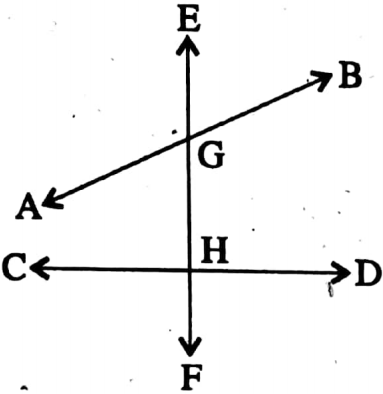
⇒ Transversal: If a straight line intersects two more straight lines in different points, then the straight line is called a transversal of the lines.

Read and Learn More WBBSE Solutions For Class 8 Maths

The straight line EF intersects the straight lines AB and CD at point G and H respectively.


WBBSE Solutions For Class 8 Maths Geometry Chapter 4 Properties Of Parallel Lines And Their Transversal Transversal

⇔ So, EF is called transversal of lines AB and CD.

WBBSE Solutions For Class 8 Maths Geometry Chapter 4 Properties Of Parallel Lines And Their Transversal

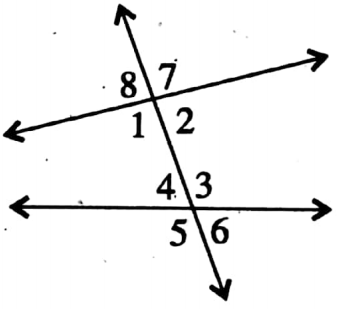
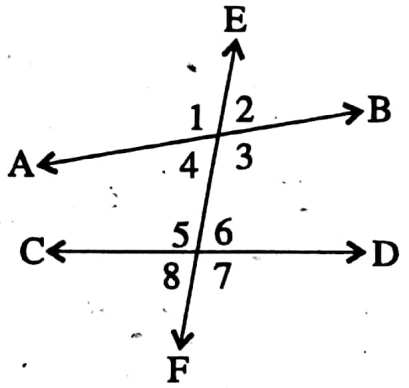
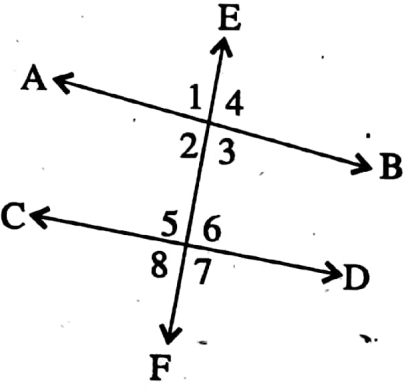
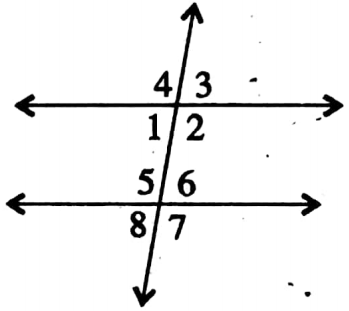
⇒ Interior angles and Exterior angles: ∠1, ∠2, ∠3, and ∠4 are interior angles whereas ∠5, ∠6, ∠7, and ∠8 are exterior angles.

WBBSE Solutions For Class 8 Maths Geometry Chapter 4 Properties Of Parallel Lines And Their Transversal Interior And Exterior Angles

⇒ Corresponding angles: Two angles lying on the same side of the transversal are known as corresponding angles if both lie either above or below the two given lines.

WBBSE Solutions For Class 8 Maths Geometry Chapter 4 Properties Of Parallel Lines And Their Transversal Corresponding Angles

⇔ There are four pairs of corresponding angles. (∠1, ∠5), (∠2, ∠6), (∠8, ∠4), and (∠7, ∠3).

WBBSE Class 8 English Functional GrammarWBBSE Class 8 English Reading Skills
WBBSE Solutions For Class 8 EnglishWBBSE Solutions For Class 8 Maths


⇒ Alternate angles: The pair of interior angles on the opposite side of the transversal are called alternate angles.

WBBSE Solutions For Class 8 Maths Geometry Chapter 4 Properties Of Parallel Lines And Their Transversal Alternate Angles

⇔ There are two pairs of alternate angles (∠2, ∠6) and (∠3, ∠5)

⇒ Axiom 1: If a straight line intersects two parallel lines, then the measurement of each pair of corresponding angles are equal.

WBBSE Solutions For Class 8 Maths Geometry Chapter 4 Properties Of Parallel Lines And Their Transversal A Straight Line Intersects Two Parallel Lines

⇔ ∠4 = ∠5, ∠3 = ∠6, ∠8 = ∠1 and ∠7 = ∠2.

⇒ Axiom 2: If a straight line intersects a pair of straight lines and the measurement of one pair of corresponding angles is equal, then the two straight lines are parallel to each other.

Theorem 1: If a straight line intersects two parallel lines, then the measurement of alternate angles are equal and the sum of measurement of two interior angles in the same side of the transversal is 180° or 2 right angles.

Given: Let AB and CD are two parallel lines and EF intersects AB and CD at G and H respectively.


WBBSE Solutions For Class 8 Maths Geometry Chapter 4 Properties Of Parallel Lines And Their Transversal Theorem 1

Required to prove:

  1. ∠AGH = ∠GHD
  2. ∠BGH + ∠GHD = 180°

Proof:

1. AB || CD and EF is a transversal.

∴ ∠EGB = ∠GHD (Corresponding angles)

Again, ∠EGB = ∠AGH (Vertically opposite angles)

∴ ∠AGH = ∠GHD (Proved)

2. AB || CD and EF is transversal.

∴ ∠EGB = ∠GHD [Corresponding angles]

Again, GB is stands on EF

∴ ∠EGB + ∠BGH = 180°

∴ ∠GHD + ∠BGH = 180°

Theorem 2: If a straight line intersects two straight lines and if

  1. Measurement of one pair of alternate angles is equal or
  2. Sum of measurement of two interior angles of the same side of the transversal is two right angles, then two straight lines are parallel.

WBBSE Solutions For Class 8 Maths Geometry Chapter 4 Properties Of Parallel Lines And Their Transversal Theorem 2

Given: Let EF intersect AB and CD at G and H respectively.

  1. ∠AGH = ∠GHD (alternate angles) or
  2. ∠BGH + ∠GHD = 2 right angles.

Required to Prove: AB || CD.

Proof:

1. ∠AGH = ∠EGB [Vertically opposite angles]

Again, ∠AGH = ∠GHD [Given]

∴ ∠EGB = ∠GHD and they are corresponding angles.

∴ AB || CD (Proved).

2. GB is stands on EF

∴ ∠EGB + ∠BGH = 180°

Again, ∠BGH + ∠GHD = 180° (Given)

∴ ∠EGB + ∠BGH = ∠BGH + ∠GHD

⇒ ∠EGB = ∠GHD [Subtracting ∠BGH from both sides] And this two angles are corresponding angles.

∴ AB || CD (Proved)

Geometry Chapter 3 Properties Of Parallel Lines And Their Transversal Examples

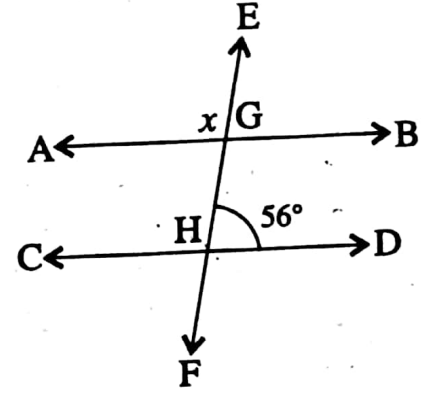
Example 1. In the adjacent find the value of x.


WBBSE Solutions For Class 8 Maths Geometry Chapter 4 Properties Of Parallel Lines And Their Transversal Example 1

Solution: AB || CD and EF is transversal.

∴ ∠EGB = ∠GHD [Corresponding angles] = 56°

∠AGE + ∠EGB = 180° [As GE stands on AB]

x + 56° = 180°

⇒ x = 180° – 56°

⇒ x = 124°

∴ The value of the x = 124°

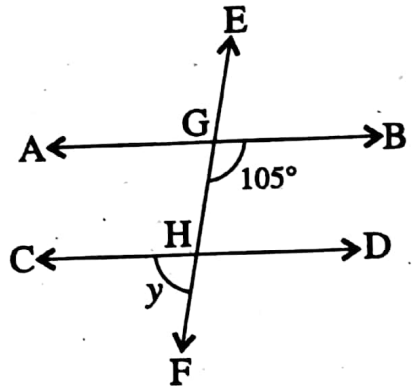
Example 2. In the adjacent find the value of y.

WBBSE Solutions For Class 8 Maths Geometry Chapter 4 Properties Of Parallel Lines And Their Transversal Example 2

Solution: AB || CD and EF is transversal.

∴ ∠DHF = ∠BGH (Corresponding angles) = 105°

∠CHF + ∠DHF = 180°

y + 105° = 180°

⇒ y = 180° – 105°

⇒ y = 75°

∴ The value of the y = 75°

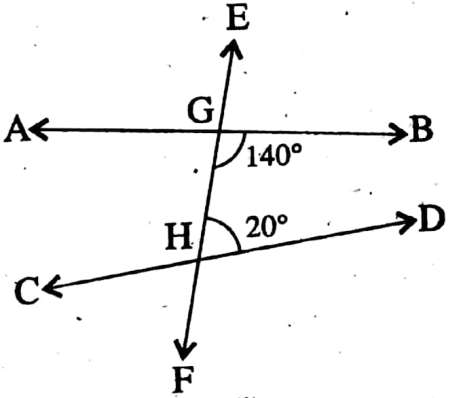
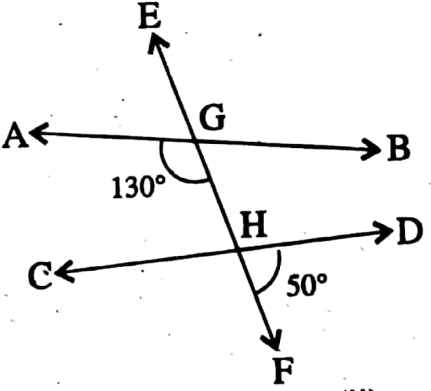
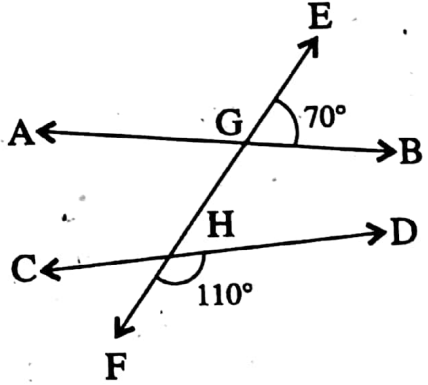
Example 3. Examining the measurement of the angles given below conclude logically AB and CD are parallel.

Solution:

WBBSE Solutions For Class 8 Maths Geometry Chapter 4 Properties Of Parallel Lines And Their Transversal Example 3-1

1. ∠BGH + ∠GHD = 140° + 20° = 160° 180°

∴ AB and CD are not parallel lines to each other.

WBBSE Solutions For Class 8 Maths Geometry Chapter 4 Properties Of Parallel Lines And Their Transversal Example 3-2

2. ∠BGH = 180°- ∠AGH = 180° – 130° = 50°

Again, ∠DHF = 50°

∴ ∠BGH = ∠DHF and these angles are corresponding angles.

∴ AB || CD

WBBSE Solutions For Class 8 Maths Geometry Chapter 4 Properties Of Parallel Lines And Their Transversal Example 3-3

3. ∠BGH = 180°- ∠EGB = 180°-70° = 110°

Again, ∠DHF = 110°

∴ ∠BGH = ∠DHF and these angles are corresponding angles.

∴ AB || CD.

⇔ AB and CD are parallel.

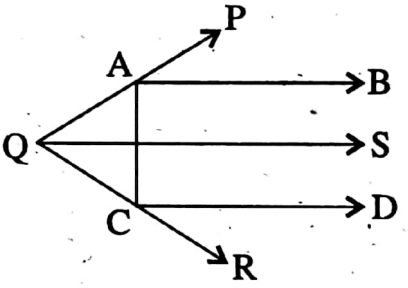
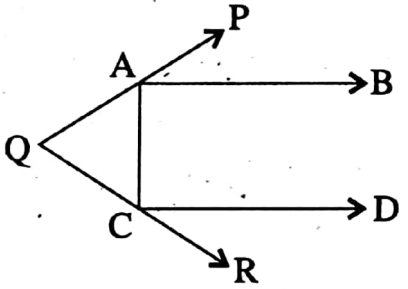
Example 4. In the adjacent AB || CD, ∠RCD = 30°, ∠PAB = 50°, ∠PAC = 140°. Find the measurement of all the angles of ΔAQC.

WBBSE Solutions For Class 8 Maths Geometry Chapter 4 Properties Of Parallel Lines And Their Transversal Example 4

Solution:

WBBSE Solutions For Class 8 Maths Geometry Chapter 4 Properties Of Parallel Lines And Their Transversal Example 4-1

I drew QS through Q which is parallel to AB.

As AB || CD and AB || QS

∴ AB || QS || CD

AB || QS and PQ is transversal.

∴ ∠PQS = ∠PAB [Corresponding angles] = 50°

QS || CD and QR is transversal.

∴ ∠RQS = ∠RCD [Corresponding angles]= 30°

∠AQC = ∠PQS + ∠RQS = 50° + 30° = 80°

∠QAC + ∠PAC = 180°

∠QAC + 140° = 180°

⇒ ∠QAC = 180°

⇒ ∠QAC = 180° – 140° = 40°

In ΔAQC, ∠AQC = 80°, ∠QAC = 40°

∴ ∠ACQ = 180° – (80° + 40°) [In ΔAQC, ∠QAC + ∠AQC + ∠ACQ = 180°]

= 180° – 120°

∴ The angle of triangle ΔAQC = 60°

Example 5. In parallelogram PQRS, if ∠P = 90°, then find the values of other three angles.

Solution: In parallelogram PQRS;

WBBSE Solutions For Class 8 Maths Geometry Chapter 4 Properties Of Parallel Lines And Their Transversal Example 5

SP || RQ and PQ is transversal:

∴ ∠P + ∠Q = 180°

∴ 90° + ∠Q = 180°

⇒ Q = 180° – 90° = 90°

Again, SR || PQ and RQ is transversal.

∴ ∠Q + ∠R = 180°

90° + ∠R = 180°

⇒ ∠R = 180° – 90° = 90°

Similarly ∠S = 90°

Example 6. In the adjacent AB || CD and ∠EGB = 50°. Find the values of ∠AGE, ∠AGH, ∠CHF, and ∠DHF.

WBBSE Solutions For Class 8 Maths Geometry Chapter 4 Properties Of Parallel Lines And Their Transversal Example 6

Solution: ∠AGE + ∠EGB = 180°

∠AGE + 50° = 180°

⇒ ∠AGE = 180° – 50° = 130°

⇒  ∠AGH = ∠EGB [Vertically opposite angles] = 50°

AB || CD and EF is transversal.

∴ ∠GHD = ∠AGH [Alternate angles] = 50°

∠CHF = ∠GHD = 50°

∠CHF + ∠DHF = 180°

50° + ∠DHF = 180°

∴ ∠DHF = 180° – 50° = 130°

Example 7. If the adjacent, PQ || RS; if ∠BAQ = 3∠ABS, then find the value of ∠RBN.

WBBSE Solutions For Class 8 Maths Geometry Chapter 4 Properties Of Parallel Lines And Their Transversal Example 7

Solution: AB || RS and MN is transversal.

∴ ∠BAQ + ∠ABS = 180°

3∠ABS + ∠ABS = 180°

⇒ 4∠ABS = 180°

⇒ ∠ABS = \(\frac{180^{\circ}}{4}=45^{\circ}\) = 45°

∠RBN = ∠ABS = 45°.

The value of ∠RBN 45°.

Example 8. O is any point inside two parallel lines AB and CD. OP and OQ are two perpendiculars on AB and CD respectively. Prove that P, O, and Q are collinear.

Solution:

WBBSE Solutions For Class 8 Maths Geometry Chapter 4 Properties Of Parallel Lines And Their Transversal Example 8

Through O the straight line RS is drawn parallel to AB.

AB || CD and AB || RS.

∴ AB || CD || RS

OP ⊥ AB.

∴ ∠OPB = 90°

OQ ⊥ CD.

∴ ∠OQD = 90°

AB || RS and OP is transversal.

∴ ∠OPB + ∠POS = 180°

90° + ∠POS = 180°

⇒ ∠POS = 180°- 90° = 90°

CD || RS and OQ is transversal.

∠OQD + ∠QOS = 180°

90° + ∠QOS = 180°

⇒ ∠QOS = 180° – 90° = 90°

∠POQ = ∠QOS + ∠POS= 90° + 90° = 180°

∴ OP and OQ lies on the same straight line.

∴ P, O, and Q are collinear.

Example 9. If the sides of an angles are respectively parallel to the sides of another angle, then the angles are either equal or supplementary.

Solution: Given Let in angles ∠ABC and ∠DEF, AB || DE and BC || EF, BC, and DE intersect at G.

Required to Prove:

  1. ∠ABC = ∠DEF [from (1)]
  2. ∠ABC and ∠DEF supplementary i.e. ∠ABC + ∠DEF = 180° [From (2)]

Proof:

WBBSE Solutions For Class 8 Maths Geometry Chapter 4 Properties Of Parallel Lines And Their Transversal Example 9.1


From (1) AB || DE and BC is transversal.

∴ ∠ABC = ∠DGC [Corresponding angles]

Again, BC || EF and DE is transversal.

∴ ∠DGC = ∠DEF [Corresponding angles]

As ∠ABC = ∠DGC and ∠DGC = ∠DEF

∴ ∠ABC = ∠DEF (Proved).


WBBSE Solutions For Class 8 Maths Geometry Chapter 4 Properties Of Parallel Lines And Their Transversal Example 9.2


From (2) BC || EF and DE is transversal.

∴ ∠DGB = ∠DEF [Corresponding angles]

Again, AB || DE and BC is transversal.

∴∠ABC + ∠DGB = 180°

∴ ∠ABC + ∠DEF = 180°

∴ ∠ABC and ∠DEF are supplementary angles. (Proved)

Example 10. Prove that straight lines perpendicular to the same straight line are parallel to one another.

Solution: Let PQ and RS are both perpendicular to AB.

WBBSE Solutions For Class 8 Maths Geometry Chapter 4 Properties Of Parallel Lines And Their Transversal Example 10

Required to Prove: PQ || RS

Proof: PQ ⊥ AB

∴ ∠PQB = 90°

∴ RS ⊥ AB

∴ ∠RSB = 90°

∴ ∠PQB = ∠RSB and these are corresponding angles.

∴ PQ || RS (Proved).

Example 11. Choose the correct answer:

1. In the adjacent if AB || CD, then the value of x is,

  1. 68°
  2. 22°
  3. 112°
  4. 34°

WBBSE Solutions For Class 8 Maths Geometry Chapter 4 Properties Of Parallel Lines And Their Transversal Example 11-1

Solution: AB || CD and EF is transversal.

∴ ∠EGB = ∠GHD [Corresponding angles] = 68°

The ray GE is stands on line AB

∴ ∠AGE + ∠EGB = 180°

∠AGE + 68° = 180°

⇒ ∠AGE = 180° – 68°

⇒ x° = 112°

∴ So the correct answer is 3. 112°

The value of x is 112°

2. In the adjacent if AB || CD, then value of x is

  1. 50
  2. 40
  3. 60
  4. 70

WBBSE Solutions For Class 8 Maths Geometry Chapter 4 Properties Of Parallel Lines And Their Transversal Example 11-2

Solution: AB || CD and EF is transvesal.

∴ ∠GHD = ∠EGB [Corresponding angles] = (2x – 50)°

∠GHD + ∠FHD = 180°

2x – 50 + x + 80 = 180

3x + 30 = 180

3x = 150

⇒ x = \(\frac{150}{3}\) = 50

∴ So the correct answer is 1. 50

Value of x is 50.

3. In the adjacent AB || CD, if ∠EGB = 50°, then the value of x is

  1. 130°
  2. 40°
  3. 50°
  4. 60°

WBBSE Solutions For Class 8 Maths Geometry Chapter 4 Properties Of Parallel Lines And Their Transversal Example 11-3

Solution: ∠GHD = ∠EGB = 50°

∠CHF = ∠GHD [Vertically opposite angle] = 50°

∴ So the correct answer is 3. 50°

The value of x is 50°

Example 12. Write ‘True’ or ‘False’:

1. In the adjacent if ∠3 = 120° and ∠8 = 60°, then AB || CD.

WBBSE Solutions For Class 8 Maths Geometry Chapter 4 Properties Of Parallel Lines And Their Transversal Example 12-1

Solution: ∠6 = ∠8 = 60°

∠3 + ∠6 = 120° + 60° = 180°

∴ AB || CD

∴ So the statement is true.

2. In the adjacent if ∠EGB = 75° and ∠DHF = 95°, then AB || CD.

WBBSE Solutions For Class 8 Maths Geometry Chapter 4 Properties Of Parallel Lines And Their Transversal Example 12-2

Solution: ∠AGH = ∠EGB [Vertically opposite angles] = 75°

∴ ∠GHC = ∠DHF = 95°

∠AGH + ∠GHC = 75° + 95° = 170°

∴ AB and CD are not parallel to each other.

∴ So the statement is false.

Example 13. Fill in the blanks:

1. In the adjacent, AB || CD and GP is the bisector of ∠AGH; if ∠AGP= 40°, then the value of ∠FHD is ________

WBBSE Solutions For Class 8 Maths Geometry Chapter 4 Properties Of Parallel Lines And Their Transversal Example 13-1

Solution: ∠AGH = 2 ∠AGP = 2 x 40° = 80°

AB || CD

∴ ∠AGH + ∠GHC = 180°

80° + ∠GHC 180°

⇒ ∠GHC = 100°

∠FHD = ∠GHC = 100°

The value of ∠FHD is 100°.

2. Straight lines perpendicular to the same straight line are ________

Solution:

WBBSE Solutions For Class 8 Maths Geometry Chapter 4 Properties Of Parallel Lines And Their Transversal Example 13-2

CD ⊥ AB and EF ⊥ AB

∴ ∠DCB + ∠FEC = 90° = 90° + 90° = 180°

∴ DC || FE

Answer: Parallel.

Straight lines perpendicular to the same straight line are  Parallel.

WBBSE Solutions For Class 8 Maths Geometry Chapter 3 Concept Of Vertically Opposite Angles

Geometry Chapter 3 Concept Of Vertically Opposite Angles

Vertically opposite angles:

If two straight lines cut each other at a point, the angles formed on opposite sides of the common point (vertex) are called vertically opposite angles.

WBBSE Solutions For Class 8 Maths Geometry Chapter 3 Concept Of Vertically Opposite Angles Vertically Opposite Angles

⇒ Two straight lines AB and CD cut each other at O.

⇒ ∠AOC and ∠BOD are two vertically opposite angles.

Read and Learn More WBBSE Solutions For Class 8 Maths

Axioms And Postulates:

⇒ Some of the properties of geometrical figures are self-evident and are accepted without any proof.

⇒ Such self-evident truths are called axioms and the statement, stating these self-evident truths are called postulates.

WBBSE Solutions For Class 8 Maths Geometry Chapter 3 Concept Of Vertically Opposite Angles

Theorem: With the help of these axioms and postulates, some other important properties in geometry can easily be proved.

The course of proving such properties is called a theorem.

Postulates:

  1. Through any two points is a unique line.
  2. A line segment may be infinitely extended in both sides.
  3. There exist circles with any center and any radius.
  4. All right angles are equal in measure.
  5. One and only one straight line can be drawn passing through a given point and parallel to a given straight line where the point is not on the line [Playfair’s postulate]

Axioms:

  1. If a ray stands on a straight line, then the sum of the measurement of two adjacent angles so formed is 180°.
  2. If the sum of the measurement of two adjacent angles is 180°, then the non-common arms of the angles form a straight line.

Theorem 1. If two straight lines intersect each other then the measurement of vertically opposite angles are equal.


WBBSE Solutions For Class 8 Maths Geometry Chapter 3 Concept Of Vertically Opposite Angles If Two Straight lines Intersect Each Other


Given: AB and CD intersect at O.

As a result two pairs of vertically opposite angles ∠AOD, ∠BOC, and ∠AOC, ∠BOD are formed.

Required to prove: ∠AOD = ∠BOC and ∠AOC = ∠BOD

Proof: AD stands on CD.

∴ ∠AOC + ∠AOD = 180°

⇒ Again OC stands on AB

∴ ∠AOC + ∠BOC = 180°

∴ ∠AOC + ∠AOD = ∠AOC + ∠BOC

⇒ ∠AOD = ∠BOC (Subtracting ∠AOC from both sides)

⇒ Again OB stands on CD

∴ ∠BOC + ∠BOD = 180°

∴ ∠AOC+ ∠BOC = ∠BOC + ∠BOD

⇒ ∠AOC = ∠BOD (Subtracting ∠BOC from both sides)

∴ ∠AOD = ∠BOC and ∠AOC = ∠BOD (Proved)

If two straight lines intersect each other then the measurement of vertically opposite angles are equal.

WBBSE Class 8 English Functional GrammarWBBSE Class 8 English Reading Skills
WBBSE Solutions For Class 8 EnglishWBBSE Solutions For Class 8 Maths

Geometry Chapter 3 Concept Of Vertically Opposite Angles Examples

Example 1. Find the measurement of ∠AOE, ∠BOD, and ∠AOC.


WBBSE Solutions For Class 8 Maths Geometry Chapter 3 Concept Of Vertically Opposite Angles In Adjacent Measurement Of ∠ AOE, ∠BOD And ∠AOC


Solution: ∠AOD = ∠BOC (vertically opposite angles)

⇒  ∠AOD = 75°

⇒  i.e. ∠AOE + ∠DOE = 75°

⇒  ∠AOE + 30° = 75°

⇒ ∠AOE = 75° – 30° = 45°

⇒  Again, ∠BOD + ∠BOC = 180° [As BO stands on CD]

⇒ ∠BOD +75° = 180°

⇒ ∠BOD = 180° – 75° = 105°

∴ ∠AOC = ∠BOD (vertically opposite angles) = 105°

The measurement of ∠AOE, ∠BOD, and ∠AOC Are 45°, 105° ,105°

Example 2. Two straight lines PQ and RS intersect at point O; OT is the bisector of ∠POS. If ∠POR = 45°, then find ∠TOS.


WBBSE Solutions For Class 8 Maths Geometry Chapter 3 Concept Of Vertically Opposite Angles Two Straight Lines PQ And RS Intersect A Point O


Solution: OP stands on RS.

∴ ∠POR + ∠POS = 180°

⇒ 45° + ∠POS = 180°

⇒ ∠POS = 180° – 45° = 135°

OT is the bisector of ∠POS

∴ ∠TOS = \(\frac{1}{2}\)∠POS = \(\frac{1}{2}\) × 135° = 67°\(\frac{1}{2}^{\circ}\)

Example 3. If ∠POR = 2 ∠QOR, then find the value of ∠POS.


WBBSE Solutions For Class 8 Maths Geometry Chapter 3 Concept Of Vertically Opposite Angles In Adjoining ∠POR = 2∠QOR Then The Value Of ∠POS = 60 Degrees


Solution: ∠POR + ∠QOR = 180° [As OR stands on PQ]

2∠QOR + ∠QOR = 180°

⇒ 3 ∠QOR = 180°

⇒ ∠QOR = \(\frac{180^{\circ}}{3}=60^{\circ}\)

⇒ ∠POS = ∠QOR [Vertically opposite angles] = 60°

Example 4. Prove that internal and external bisectors of an angle are perpendicular to each other.

Solution: Let OP and OQ are the internal and external bisector of ∠AOC respectively.

WBBSE Solutions For Class 8 Maths Geometry Chapter 3 Concept Of Vertically Opposite Angles Internal And External Bisectors Of An Angle Are Perpendicular To Each Other

Required to prove: OP and OQ are perpendicular to each other.

Proof: OQ is the external bisector of ∠AOC,

So OQ is the bisector of ∠BOC.

∠POQ = ∠POC + ∠COQ

= \(\frac{1}{2}\)∠AOC + \(\frac{1}{2}\)∠COB

[as OP and OQ are the bisectors of ∠AOC and ∠BOC respectively]

= \(\frac{1}{2}\)(∠AOC + ∠COB) = \(\frac{1}{2}\) × ∠AOB

= \(\frac{1}{2}\) x 180° [one straight angle] = 90°

∴ OP and OQ are perpendicular to each other. (Proved)

Example 5. If two straight lines intersect each other then four angles are formed. Find the sum of the measurement of four angles.

Solution: Let two straight lines AB and CD intersect at point O.


WBBSE Solutions For Class 8 Maths Geometry Chapter 3 Concept Of Vertically Opposite Angles Two Straight Lines Intersect Each Other Then Four Angles Are Formed


CO is stands on AB.

∴ ∠AOC + ∠COB = 180°

OD is stands on AB.

∴ ∠AOD + ∠BOD = 180°

∴ ∠AOC + ∠COB + ∠AOD + ∠BOD = 180°+ 180° = 360°

The sum of the measurement of four angles 360°.

Example 6. Two straight lines intersect each other at a point and thus four angles are formed. Prove that the bisectors of these angles are two perpendicular straight lines.

Solution: Let AB and CD intersects at point O.

PQ and RS are the bisectors of ∠AOD and ∠AOC respectively.


WBBSE Solutions For Class 8 Maths Geometry Chapter 3 Concept Of Vertically Opposite Angles Example 6


Required to prove: PQ and RS are perpendicular to each other.

Proof: ∠POR = ∠AOP + ∠AOR

= \(\frac{1}{2}\)∠AOD + ∠AOC

= \(\frac{1}{2}\)(∠AOD + ∠AOC)

= \(\frac{1}{2}\)∠COD = \(\frac{1}{2}\) x 180° = 90°

∴ OP and OR are perpendicular to each other. (Proved)

Example 7. Find the value of x, y, and z.


WBBSE Solutions For Class 8 Maths Geometry Chapter 3 Concept Of Vertically Opposite Angles Example 7


Solution: ∠AOC = ∠BOD (vertically opposite angles) = 40°

∠AOP + ∠POD + ∠BOD = 180°

60° + y° + 40° = 180°

⇒ y° = 180° – 100° = 80°

∠AOC + ∠COQ + ∠BOQ = 180°

40° + z° + 30° = 180°

⇒ z° = 180°-70° = 110°

Example 8. PQ and RS are two straight lines intersecting at a point O. Prove that if the bisector of the ∠POR is produced through O, it will bisects the ∠SOQ.

Solution: Let AO is the bisect ∠POR and let it be produced to B.


WBBSE Solutions For Class 8 Maths Geometry Chapter 3 Concept Of Vertically Opposite Angles Example 8


Required to Prove: OB bisects ∠SOQ.

Proof: ∠SOB = ∠AOR [Vertically opposite angles]

∠BOQ = ∠AOP [Vertically opposite angles]

Again, ∠AOR = ∠AOP [AO is the bisector of ∠POR]

∴ ∠SOB = ∠BOQ

∴ OB bisects ∠SOQ (Proved).

Example 9. Prove that the bisectors of a pair of vertically opposite angles lie in the same straight line.

Solution: Let OE and OF are the bisectors of ∠AOC and ∠BOD respectively.


WBBSE Solutions For Class 8 Maths Geometry Chapter 3 Concept Of Vertically Opposite Angles Bisectord Of A Pair Of Vertically Opposite Angles


Required to prove: OE and OF lie in the same straight line.

Proof: OE and OF are the bisectors of ∠AOC and ∠BOD respectively.

∴ ∠AOE = ∠COE and ∠DOF = ∠BOF

∠AOD = ∠BOC (Vertically opposite angles)

∠AOE + ∠COE + ∠BOC + ∠BOF + ∠DOF + ∠AOD = 360°

∠COE + ∠COE + ∠BOC + ∠BOF + ∠BOF + ∠BOC = 360°

⇒ 2(∠COE + ∠BOC+ ∠BOF) = 360°

⇒ ∠COE + ∠BOC+ ∠BOF = \(\frac{360^{\circ}}{2}=180^{\circ}\)

i.e. ∠EOF = 180°

i.e. OE and OF lies in the same straight line. (Proved).

Example 10. The straight lines AB and CD intersect at point O; ∠AOD + ∠BOC = 102°, If OP is the bisector of ∠BOD, then find the measurement of ∠BOP.

Solution: ∠AOD = ∠BOC [Vertically opposite angles]

∠AOD + ∠BOC = 102°

WBBSE Solutions For Class 8 Maths Geometry Chapter 3 Concept Of Vertically Opposite Angles Example 10

∠AOD + ∠AOD = 102°

⇒ 2 ∠AOD = 102°

⇒ ∠AOD = \(\frac{102^{\circ}}{2}=51^{\circ}\)

OD stands on AB

∴ ∠AOD + ∠BOD = 180°

51° + ∠BOD 180°

⇒ ∠BOD = 180° – 51° = 129°

OP is the bisector of ∠BOD

∴ ∠BOP = \(\frac{1}{2}\)∠BOD =\(\frac{1}{2}\) × 129° = 64\(\frac{1}{2}^{\circ}\)

The measurement of ∠BOP = \(\frac{1}{2}\)∠BOD =\(\frac{1}{2}\) × 129° = 64\(\frac{1}{2}^{\circ}\)

Example 11. Choose the correct answer:

1. If ∠I = 35°, then find the value of ∠2 is

  1. 35°
  2. 145°
  3. 70°
  4. 55°


WBBSE Solutions For Class 8 Maths Geometry Chapter 3 Concept Of Vertically Opposite Angles Example 11-1


Solution: ∠I + ∠2 = 180°

35° + ∠2 = 180°

⇒ ∠2 = 180° – 35° = 145°

∴ So the correct answer is 2. 145°

The value of ∠2 is 145°

2. If ∠TOS = 20° and ∠ROQ = 60°, then the value of ∠POT is

  1. 60°
  2. 120°
  3. 40°
  4. 80°


WBBSE Solutions For Class 8 Maths Geometry Chapter 3 Concept Of Vertically Opposite Angles Example 11-2


Solution: ∠POS = ∠ROQ [vertically opposite angles]

= 60°

i.e. ∠POT + ∠TOS = 60°

⇒ ∠POT + 20° 60°

⇒ ∠POT = 60° – 20° = 40°

∴ So the correct answer is 3. 40°

The value of ∠POT is 40°

3. If ∠AOC + ∠BOD = 112°, the value of ∠BOC is

  1. 112°
  2. 56°
  3. 68°
  4. 124°


WBBSE Solutions For Class 8 Maths Geometry Chapter 3 Concept Of Vertically Opposite Angles Example 11-3


Solution: ∠AOC = ∠BOD

∠AOC + ∠BOD = 112°

∠AOC + ∠AOC = 112°

⇒ 2∠AOC = 112°

⇒ ∠AOC = \(\frac{112^{\circ}}{2}=56^{\circ}\)

⇒ ∠BOC + ∠AOC = 180°

⇒ ∠BOC + 56° 180°

⇒ ∠BOC = 180° – 56° = 124°

∴ So the correct answer is 4. 124°

The value of ∠BOC is 124°

Example 12. Write ‘True’ or ‘False’:

1. The vertically opposite angle of 68° is 112°.

Solution: The vertically opposite angle of 68° is 68°.

So the statement is false.

2. If OP is stands on line AB and ∠AOP = 100°, then the value of ∠BOP is 80°.

Solution: OP is stands on AB


WBBSE Solutions For Class 8 Maths Geometry Chapter 3 Concept Of Vertically Opposite Angles Example 12-2


∴ ∠AOP + ∠BOP = 180°

∠AOP +80° = 180°

⇒ ∠AOP = 180° – 80° = 100°

∴ So the statement is true.

Example 13. Fill in the blanks:

1. If a ray stands on a straight line, then the sum of measurement of two ________ angles so formed is 180°.

Solution: Adjacent.

2. The value of right angle is half of ________

Solution: Straight angle.

WBBSE Solutions For Class 8 Maths Geometry Chapter 2 Complementary Angles Supplementary Angles And Adjacent Angles

Geometry Chapter 2 Complementary Angles Supplementary Angles And Adjacent Angles

Complementary angles: If the sum of two angles is equal to 90°. or a Right angle, each angle is called complementary to the other angle.

WBBSE Solutions For Class 8 Maths Geometry Chapter 2 Complementary Angles Supplementary Angles And Adjacent Angles Complementary Angles

∠AOB + ∠BOC = 90°

⇒  So, ∠AOB and ∠BOC are complementary angles to each other.

Supplementary angles: If the sum of two angles is equal to 180° or straight angle, each angle is called the supplementary to the other angle.

WBBSE Solutions For Class 8 Maths Geometry Chapter 2 Complementary Angles Supplementary Angles And Adjacent Angle


WBBSE Solutions For Class 8 Maths Geometry Chapter 2 Complementary Angles Supplementary Angles And Adjacent Angles Supplementary Angles

∠POQ + ∠QOR = 180°

So, ∠POQ and ∠QOR are supplementary angles to each other.

Adjacent angles: If two angles in the same plane have the same vertex and a common side and the angles are on two opposite of common sides, they are called Adjacent angles.

WBBSE Solutions For Class 8 Maths Geometry Chapter 2 Complementary Angles Supplementary Angles And Adjacent Angles Adjacent Angles

∠DOE and ∠EOF have the same vertex O and a common side OE and the angles are on two opposite side of OE.

Hence ∠DOE and ∠EOF are adjacent angles.

Read and Learn More WBBSE Solutions For Class 8 Maths

⇒ Internal bisector of an angle: The line which bisects an angle is called the Internal bisector of the angle.

⇒ External bisector of an angle: The line which is the internal bisector of the adjacent supplementary angle A of an angle is called the External bisector of the angle.

WBBSE Solutions For Class 8 Maths Geometry Chapter 2 Complementary Angles Supplementary Angles And Adjacent Angles Internal And External Bisector Of An Angle

OP is the internal bisector of the angle ∠AOB and external bisector of the angle ∠BOC.

Geometry Chapter 2 Complementary Angles Supplementary Angles And Adjacent Angles Examples

Example 1. Find the measurements of complementary angles of the following angles. 80°, 90°, 67\(\frac{1}{2}^{\circ}\)

Solution: The measurement of the complementary angle of 80° is (90° – 80°) or 10°.

The complementary angle of 90° is (90° – 90°) or 0°.

The complementary angle of 67 \(\frac{1}{2}^{\circ}\) is \(\left(90^{\circ}-67 \frac{1}{2}^{\circ}\right) \text { or } 22 \frac{1}{2}^{\circ}\)

Example 2. Which pairs of angles are complementary?

Solution: 54° + 36° = 90° [Complementary angles]

50° + 130° = 180°

20.5° + 70.5° = 91°

WBBSE Class 8 English Functional GrammarWBBSE Class 8 English Reading Skills
WBBSE Solutions For Class 8 EnglishWBBSE Solutions For Class 8 Maths


Example 3. Which pair of angles are supplementary?

  1. 40°, 50°
  2. 100°, 70°
  3. 120°, 60°

Solution: 40° + 50° = 90°

100° + 70° = 170°

120° + 60° = 180° [Supplementary angles]

Example 4. Find the supplementary angle of right angle.

Solution: The supplementary angle of right angle is (180° – 90°) or 90°

Example 5. If one angle of the complementary angle is 4 times the other then find the measurement of smaller angle.

Solution: Let the measurement of smaller angle is x°.

∴ Other angle is 4x°.

4x° + x° = 90°

⇒ 5x° = 90°

⇒ x° = \(\frac{90^{\circ}}{5}\) = 18°

∴ The measurement of smaller angle is 18°.

Example 6. Find the measurement of complementary angle of 35°35′35′′.

Solution: The complementary angle of 35° 35′ 35′′ is (90° – 35°35’35”) = 54°24’25”

90° = \(\begin{gathered}
89^{\circ} 59^{\prime} 60^{\prime \prime} \\
\frac{35^{\circ} 35^{\prime} 35^{\prime \prime}}{54^{\circ} 24^{\prime} 25^{\prime \prime}}
\end{gathered}\)

Example 7. Find the supplementary angle of 25°12′29′′.

Solution: The supplementary angle of 25°12′29′′ is (180° – 25°12′29″) or 154°47′31′′.

180° = \(\begin{gathered}
179^{\circ} 59^{\prime} 60^{\prime \prime} \\
\frac{25^{\circ} 12^{\prime} 29^{\prime \prime}}{154^{\circ} 47^{\prime} 31^{\prime \prime}}
\end{gathered}\)

Example 8. In the adjacent angle find the value of x.

Solution: ∠AOD = 180° [Straight angle]

∠AOB + ∠BOC+ ∠COD = 180°

x° + 105° + 2x° = 180°

⇒ 3x° = 180° – 105° = 75°

⇒ x° = \(=\frac{75^{\circ}}{3}=25^{\circ}\)

∴ The value of x is 25°.


WBBSE Solutions For Class 8 Maths Geometry Chapter 2 Complementary Angles Supplementary Angles And Adjacent Angles In The Adjacent Angles AOD+BOC+COD

Example 9. The measurement of two adjacent angles are 45.3° and 134.7°. How the external sides of those two angles are situated?

Solution: The sum of two adjacent angles is 45.3° + 134.7° = 180°

So, the external sides of those two angles situated on the same straight line.

Example 10. If ∠A and ∠B are supplementary angles and ∠A – ∠B = 100°, then find ∠A and ∠B.

Solution: ∠A and ∠B are supplementary angles.

\(\begin{aligned}
\angle A+\angle B & =180^{\circ} \\
\angle A-\angle B & =100^{\circ} \\
\hline 2 \angle A & =280^{\circ}
\end{aligned}\)

⇒ ∠A = 140°,

WBBSE Solutions For Class 8 Maths Geometry Chapter 2 Complementary Angles Supplementary Angles And Adjacent Angles Measurement Of Two Adjacent Angles


∴ ∠B = 180° – 140° = 40°.

Example 11. In the adjacent how are the line segment OA and OE situated?

Solution: ∠AOF = ∠AOB + ∠BOC+ ∠COD + ∠DOE + ∠EOF

= 25° 32° 41° + 40° + 42° = 180° (one straight angle)

∴ OA and OF are on the same straight line.

Example 12. Find the measurements of complementary and supplementary angles of (2x – 15)°.

Solution: The complementary angles of (2x – 15)° is (90 – 2x + 15)° of (105 – 2x)° and supplementary angles is (180 – 2x + 15)° or (195 – 2x)°.

Example 13. Write with explanation whether two acute angles are supplementary to each other or not.

Solution: The value of each acute angle is less than 90°.

The sum of two acute angles is always less than (90° + 90°) or 180°.

But the sum of two supplementary angles is 180°.

So two acute angles are no supplementary angles.

Example 14. Write which pair of angles are adjacent from the following:

Solution: In (1), ∠POQ and ∠QOR have the same vertex O and a common side of OQ and the angles are on two opposite side of OQ.


WBBSE Solutions For Class 8 Maths Geometry Chapter 2 Complementary Angles Supplementary Angles And Adjacent Angles Pair Of Adjacent Angles POQ,QOP


So, ∠POQ and ∠QOR are adjacent angles.

In (2), ∠POQ and ∠POR have the same vertex O and common side of OP.


WBBSE Solutions For Class 8 Maths Geometry Chapter 2 Complementary Angles Supplementary Angles And Adjacent Angles Pair Of Adjacent Angles POQ,POR


But the angles are on the same side of OP.

So, ∠POQ and ∠POR are not adjacent angles.

In (3), ∠PTQ and ∠QOR have not the same vertex [T is the vertex of ∠PTQ and O is the vertex of ∠QOR]


WBBSE Solutions For Class 8 Maths Geometry Chapter 2 Complementary Angles Supplementary Angles And Adjacent Angles Pair Of PTQ,QOR Are Not Adjacent Angles


∴ ∠PTQ and ∠QOR are not adjacent angles.

Example 15: Choose the correct answer:

1. The measurements of the complementary angle of 70° is

  1. 110°
  2. 70°
  3. 20°
  4. 35°

Solution: The measurement of the complementary angle of 70° is (90° – 70°) or 20°.

∴ So the correct answer is 3. 20°

The measurements of the complementary angle of 70° is 20°

2. Which pair of angles are complementary?

  1. 30°, 60°
  2. 40°, 42°
  3. 80°, 20°
  4. 72°, 25°

Solution: 30° + 60° = 90°

∴ 30° and 60° are complementary.

∴ So the correct answer is 1. 30°, 60°

3. Which pair of angles are not supplementary?

  1. 40°, 140°
  2. 60°, 120°
  3. 80°, 100°
  4. 90°, 75°

Solution: 40°+ 140° = 180° [Supplementary angles]

60°+ 120° = 180° [Supplementary angles]

80° + 100° = 180° [Supplementary angles]

90° + 75° = 165° [are not supplementary angles]

∴ So the correct answer is 4. 90°, 75°

Example 16. Write ‘True’ or ‘False’:

1. Any two adjacent angles are complementary to each other.

Solution: If sum of measurements of two angles is equal to 90°, then each angle is called complementary to the other angle.

As sum of any two adjacent angles may be 90° or may not be 90°.

∴ So the statement is false.

2. The supplementary angle of right angle is right angle.

Solution: The supplementary angle of right angle is (180° – 90°) or 90° which is right angle.

∴ So the statement is true.

Example 17. Fill in the blanks:

1. Two _______ angles are complementary angles.

Solution: Acute

2. The supplementary angle of 0° is _______

Solution: 180°

WBBSE Solutions For Class 8 Maths Geometry Chapter 1 Revision Of Quadrilateral

Geometry Chapter 1 Revision

Trapezium: A trapezium is a quadrilateral that has only one pair of opposite sides are parallel.


WBBSE Solutions For Class 8 Maths Geometry Chapter 1 Revision Trapezium

∴ ABCD is a trapezium whose AB || BC.

WBBSE Solutions For Class 8 Maths Geometry Chapter 1 Revision Of Quadrilateral

Parallelogram: A parallelogram is a quadrilateral whose both pairs of opposite sides are parallel with each other.

WBBSE Solutions For Class 8 Maths Geometry Chapter 1 Revision Parallelogram


∴ ABCD is a parallelogram whose AB || DC and AD || BC.

Read and Learn More WBBSE Solutions For Class 8 Maths

Rhombus: Rhombus is a parallelogram in which one pair of adjacent sides are equal in length.

WBBSE Solutions For Class 8 Maths Geometry Chapter 1 Revision Rhombus

∴ ABCD is Rhombus whose AB = BC = CD = DA.

Rectangle: Rectangle is a parallelogram whose one angle is right angle.

WBBSE Solutions For Class 8 Maths Geometry Chapter 1 Revision Rectangle

∴ ABCD is rectangle whose AB || DC, AD || BC and ∠BAD 90°

Square: Square is a rectangle in which one pair of adjacent sides are equal in length.

WBBSE Solutions For Class 8 Maths Geometry Chapter 1 Revision Square

∴ ABCD is a square whose AB = BC = CD = DA and ∠BAD = 90°

Properties:

Trapezium: Only one pair of opposite sides are parallel.

WBBSE Class 8 English Functional GrammarWBBSE Class 8 English Reading Skills
WBBSE Solutions For Class 8 EnglishWBBSE Solutions For Class 8 Maths


Parallelogram:

  1. Length of opposite sides are equal.
  2. Measurement of opposite angles are equal.
  3. Diagonals bisect each other.

Rhombus:

  1. Length of all sides are equal.
  2. Measurement of opposite angles are equal.
  3. Diagonals bisect each other perpendicularly.

Rectangle:

  1. Length of opposite sides are equal.
  2. Length of diagonals are equal.
  3. Diagonals bisect each other.

Square:

  1. Length of all sides are equal.
  2. Measurement of each angle is 90°.
  3. Length of diagonals are equal.
  4. Diagonal bisect each other perpendicularly.

Geometry Chapter 1 Revision Examples

Example 1. Draw a parallelogram ABCD where AB = 4 cm, BC = 6 cm, and ∠ABC = 45°.

Solution:

WBBSE Solutions For Class 8 Maths Geometry Chapter 1 Revision Draw A Parallelogram ABCD Where AB = 4cm, BC = 6cm And Angle ABC = 45 Degrees

I drew a parallelogram ABCD where AB = DC = 4 cm, BC = AD = 6 cm and ∠ABC = 45°

Example 2. Draw a rectangle ABCD where AB = 3.5 cm, BC = 4.6 cm.

Solution:

WBBSE Solutions For Class 8 Maths Geometry Chapter 1 Revision Draw A Rectangle ABCD Where AB = 3.5cm, BC = 4.6cm

I draw a rectangle ABCD where AB = DC = 3.5 cm, BC = AD = 4.6 cm and ∠ABC = 90°

Example 3. Draw a rhombus PQRS where PR = 8 cm, and QS = 6 cm.

Solution:

WBBSE Solutions For Class 8 Maths Geometry Chapter 1 Revision Draw A Rhombus PQRS Where PR = 8cm, QS = 6cm

The diagonal of a rhombus bisect each other perpendicularly.

I drew a rhombus PQRS where diagonal PR = 8 cm and diagonal QS = 6 cm.

Example 4. Draw a square ABCD where length of diagonal is 7 cm.

Solution:

WBBSE Solutions For Class 8 Maths Geometry Chapter 1 Revision Draw A Square ABCD Where Length Of Diagonal Is 7cm

Diagonals of a square bisect each other perpendicularly.

I drew a square where AC = BD = 7 cm.

WBBSE Solutions For Class 8 Maths Algebra Chapter 6 Simplification Of Algebraic Expression

Algebra Chapter 6 Simplification Of Algebraic Expression

When we are dividing the numerator and denominator by common factor we get the reduced form:

Example: \(\frac{15 a^2 b^3 c^4}{18 a^3 b^2 c^5}=\frac{15 a^2 b^3 c^4 \div 3 a^2 b^2 c^4}{18 a^3 b^2 c^5 \div 3 a^2 b^2 c^4}\)

[Common factor of Numerator and denominator is 3a2b2c4]

= \(\frac{5b}{6ac}\)

Alternate method:

WBBSE Solutions For Class 8 Maths Algebra Chapter 6 Simplification Of Algebraic Expression

WBBSE Solutions For Class 8 Maths Algebra Chapter 6 Simplification Of Algebraic Expression

Algebra Chapter 6 Simplification Of Algebraic Expression Examples

Example 1. Express the following algebraic fractions in the reduced form:

Read and Learn More WBBSE Solutions For Class 8 Maths

1. \(\frac{21 x^4 y z^3}{49 x^2 y^6 z^2}\)

Solution: \(\frac{21 x^4 y z^3}{49 x^2 y^6 z^2}\) = \(\frac{3 x^2 z}{7 y^5}\)

2. \(\frac{x^2-6 x+5}{x^2-1}\)

Solution: \(\frac{x^2-6 x+5}{x^2-1}=\frac{x^2-(5+1) x+5}{x^2-1}=\frac{x^2-5 x-x+5}{x^2-1}\)

= \(\frac{x(x-5)-1(x-5)}{(x+1)(x-1)}=\frac{(x-5)(x-1)}{(x+1)(x-1)}=\frac{x-5}{x+1}\)

⇒ \(\frac{x^2-6 x+5}{x^2-1}\) = \(\frac{x(x-5)-1(x-5)}{(x+1)(x-1)}=\frac{(x-5)(x-1)}{(x+1)(x-1)}=\frac{x-5}{x+1}\)

WBBSE Class 8 English Functional GrammarWBBSE Class 8 English Reading Skills
WBBSE Solutions For Class 8 EnglishWBBSE Solutions For Class 8 Maths


3. \(\frac{a^3-b^3}{a^2-b^2}\)

Solution: \(\frac{a^3-b^3}{a^2-b^2}=\frac{(a-b)\left(a^2+a b+b^2\right)}{(a+b)(a-b)}=\frac{a^2+a b+b^2}{a+b}\)

4. \(\frac{2 a^2+a b-b^2}{a^3+a^2 b-a-b}\)

Solution: \(\frac{2 a^2+a b-b^2}{a^3+a^2 b-a-b}=\frac{2 a^2+(2-1) a b-b^2}{a^2(a+b)-1(a+b)}=\frac{2 a^2+2 a b-a b-b^2}{(a+b)\left(a^2-1\right)}\)

= \(\frac{2 a(a+b)-b(a+b)}{(a+b)\left(a^2-1\right)}=\frac{(a+b)(2 a-b)}{(a+b)(a+1)(a-1)}=\frac{2 a-b}{(a+1)(a-1)}\)

5. \(\frac{x^2-y^2-2 x z+z^2}{x^2+y^2-z^2+2 x y}\)

Solution: \(\frac{x^2-y^2-2 x z+z^2}{x^2+y^2-z^2+2 x y}\)

= \(\frac{\left(x^2-2 x z+z^2\right)-y^2}{\left(x^2+2 x y+y^2\right)-z^2}=\frac{(x-z)^2-y^2}{(x+y)^2-z^2}=\frac{(x-z+y)(x-z-y)}{(x+y+z)(x+y-z)}\)

= \(\frac{(x+y-z)(x-y-z)}{(x+y+z)(x+y-z)}=\frac{x-y-z}{x+y+z}\)

6. \(\frac{a^2-2 a b-15 b^2}{a^2-9 a b+20 b^2}\)

Solution: \(\frac{a^2-2 a b-15 b^2}{a^2-9 a b+20 b^2}\)

= \(\frac{a^2-(5-3) a b-15 b^2}{a^2-(5+4) a b+20 b^2}=\frac{a^2-5 a b+3 a b-15 b^2}{a^2-5 a b-4 a b+20 b^2}\)

= \(\frac{a(a-5 b)+3 b(a-5 b)}{a(a-5 b)-4 b(a-5 b)}=\frac{(a-5 b)(a+3 b)}{(a-5 b)(a-4 b)}=\frac{a+3 b}{a-4 b}\)

Example 2. Convert the fraction into same denominator.

1.\(\frac{a}{b c}+\frac{b}{c a}-\frac{c}{a b}\)

Solution: \(\frac{a}{b c}+\frac{b}{c a}-\frac{c}{a b}\)

f(x) = \(\frac{a \times a}{a \times b c}+\frac{b \times b}{c a \times b}-\frac{c \times c}{a b \times c}\)

[LCM of bc, ca and ab is abc]

f(x) = \(\frac{a^2}{a b c}+\frac{b^2}{a b c}-\frac{c^2}{a b c}=\frac{a^2+b^2-c^2}{a b c}\)

2. \(\frac{p}{(a-b)(b-c)}+\frac{q}{(b-c)(c-a)}+\frac{r}{(c-a)(a-b)}\)

Solution: \(\frac{p}{(a-b)(b-c)}+\frac{q}{(b-c)(c-a)}+\frac{r}{(c-a)(a-b)}\)

f(a) = \(\frac{p(c-a)}{(a-b)(b-c)(c-a)}+\frac{q(a-b)}{(a-b)(b-c)(c-a)}+\frac{r(b-c)}{(c-a)(a-b)(b-c)}\)

f(a) = \(\frac{p(c-a)+q(a-b)+r(b-c)}{(a-b)(b-c)(c-a)}\)

Example 3. Simplify \(\left(\frac{8}{x}+\frac{x}{4}-3\right)+\left(\frac{x}{12}-\frac{1}{3}-\frac{8}{3 x}\right)\)

Solution: f(x) = \(\left(\frac{8}{x}+\frac{x}{4}-3\right)+\left(\frac{x}{12}-\frac{1}{3}-\frac{8}{3 x}\right)=\left(\frac{32+x^2-12 x}{4 x}\right)+\left(\frac{x^2-4 x-32}{12 x}\right)\)

f(x) = \(\frac{\left(x^2-12 x+32\right)}{4 x} \times \frac{12 x^3}{x^2-4 x-32}=\frac{x^2-(8+4) x+32}{1} \times \frac{3}{x^2-(8-4) x-32}\)

f(x) = \(\frac{x^2-8 x-4 x+32}{1} \times \frac{3}{x^2-8 x+4 x-32} \times \frac{3}{x(x-8)+4(x-8)}\)

f(x) = \(\frac{x(x-8)-4(x-8)}{1} \times \frac{3(x-4)}{x+4}\)

Example 4. Simplify: \(\frac{x-1}{x-2}-\frac{4}{4-x^2}+\frac{2}{2-x}-\frac{x+1}{x+2}\)

Solution: f(x) = \(\frac{x-1}{x-2}-\frac{4}{4-x^2}+\frac{2}{2-x}-\frac{x+1}{x+2}\)

f(x) = \(\frac{x-1}{x-2}-\frac{4}{-\left(x^2-4\right)}+\frac{2}{-(x-2)}-\frac{x+1}{x+2}\)

f(x) = \(\frac{x-1}{x-2}+\frac{4}{(x+2)(x-2)}-\frac{2}{x-2}-\frac{x+1}{x+2}\)

f(x) = \(\frac{(x-1)(x+2)+4-2(x+2)-(x+1)(x-2)}{(x-2)(x+2)}\)

f(x) = \(\frac{x^2+2 x-x-2+4-2 x-4-x^2+2 x-x+2}{(x-2)(x+2)}\)

f(x) = \(\frac{2 x-2 x}{(x-2)(x+2)}=\frac{0}{(x-2)(x+2)}=0\)

Example 5. \(\frac{1}{a-1}+\frac{1}{a+1}+\frac{2 a}{a^2+1}+\frac{4 a^3}{a^4+1}+\frac{8 a^7}{a^8+1}\)

Solution: f(a) = \(\frac{1}{a-1}+\frac{1}{a+1}+\frac{2 a}{a^2+1}+\frac{4 a^3}{a^4+1}+\frac{8 a^7}{a^8+1}\)

f(a) = \(\frac{a+1+a-1}{(a-1)(a+1)}+\frac{2 a}{a^2+1}+\frac{4 a^3}{a^4+1}+\frac{8 a^7}{a^8+1}\)

f(a) = \(\frac{2 a}{a^2-1}+\frac{2 a}{a^2+1}+\frac{4 a^3}{a^4+1}+\frac{8 a^7}{a^8+1}\)

f(a) = \(\frac{2 a\left(a^2+1\right)+2 a\left(a^2-1\right)}{\left(a^2-1\right)\left(a^2+1\right)}+\frac{4 a^3}{a^4+1}+\frac{8 a^7}{a^8+1}\)

f(a) = \(\frac{2 a^3+2 a+2 a^3-2 a}{a^4-1}+\frac{4 a^3}{a^4+1}+\frac{8 a^7}{a^8+1}\)

f(a) = \(\frac{4 a^3}{a^4-1}+\frac{4 a^3}{a^4+1}+\frac{8 a^7}{a^8+1}=\frac{4 a^3\left(a^4+1\right)+4 a^3\left(a^4-1\right)}{\left(a^4-1\right)\left(a^4+1\right)}+\frac{8 a^7}{a^8+1}\)

f(a) = \(\frac{4 a^7+4 a^8+4 a^7-4 a^3}{a^8-1}+\frac{8 a^7}{a^8+1}=\frac{8 a^7}{a^8-1}+\frac{8 a^7}{a^8+1}\)

f(a) = \(\frac{8 a^7\left(a^8+1\right)+8 a^7\left(a^8-1\right)}{\left(a^8-1\right)\left(a^8+1\right)}=\frac{8 a^{15}+8 a^7+8 a^{15}-8 a^7}{a^{16}-1}=\frac{16 a^{15}}{a^{16}-1}\)

Example 6. Simplify: \(\frac{y+z-x}{(x-y)(x-z)}+\frac{z+x-y}{(y-x)(y-z)}+\frac{x+y-z}{(z-x)(z-y)}\)

Solution: f(x) = \(\frac{y+z-x}{(x-y)(x-z)}+\frac{z+x-y}{(y-x)(y-z)}+\frac{x+y-z}{(z-x)(z-y)}\)

f(x) = \(\frac{y+z-x}{-(x-y)(z-x)}+\frac{z+x-y}{-(x-y)(y-z)}+\frac{x+y-z}{-(z-x)(y-z)}\)

f(x) = \(-\left[\frac{y+z-x}{(x-y)(z-x)}+\frac{z+x-y}{(x-y)(y-z)}+\frac{x+y-z}{(z-x)(y-z)}\right]\)

f(x) = \(-\left[\frac{(y-z)(y+z-x)+(z-x)(z+x-y)+(x-y)(x+y-z)}{(x-y)(y-z)(z-x)}\right]\)

f(x) = \(-\left[\frac{y^2-z^2-x y+x z+z^2-x^2-y z+x y+x^2-y^2-x z+y z}{(x-y)(y-z)(z-x)}\right]\)

f(x) = \(-\left[\frac{0}{(x-y)(y-z)(z-x)}\right]=0\)

Example 7. Simplify: \(\frac{y+z}{y z}(y+z-x)+\frac{z+x}{z x}(z+x-y)+\frac{x+y}{x y}(x+y-z)\)

Solution: f(x) = \(\frac{y+z}{y z}(y+z-x)+\frac{z+x}{z x}(z+x-y)+\frac{x+y}{x y}(x+y-z)\)

f(x) = \(\left(\frac{1}{z}+\frac{1}{y}\right)(y+z-x)+\left(\frac{1}{x}+\frac{1}{z}\right)(z+x-y)+\left(\frac{1}{y}+\frac{1}{x}\right)(x+y-z) \)

f(x) = \(\frac{1}{z}(y+z-x)+\frac{1}{y}(y+z-x)+\frac{1}{x}(z+x-y)+\frac{1}{z}(z+x-y)+\frac{1}{y}(x+y-z)+\frac{1}{x}(x+y-z)\)

f(x) = \(\frac{y}{z}+1-\frac{x}{z}+1+\frac{z}{y}-\frac{x}{y}+\frac{z}{x}+1-\frac{y}{x}+1+\frac{x}{z}-\frac{y}{z}+\frac{x}{y}+1-\frac{z}{y}+1+\frac{y}{x}-\frac{z}{x}=6\)

Example 8. Simplify: \(\frac{1-2 a+a^2}{1-a^6} \div \frac{1-3 a+3 a^2-a^3}{1+a^2+a^4} \times \frac{(1-a)^2}{1+a}\)

Solution: f(a) = \(\frac{1-2 a+a^2}{1-a^6} \div \frac{1-3 a+3 a^2-a^3}{1+a^2+a^4} \times \frac{(1-a)^2}{1+a}\)

f(a) = \(\frac{(1-a)^2}{(1)^3-\left(a^3\right)^2} \div \frac{(1)^3-31^2 \cdot a+3 \cdot 1 \cdot a^2-a^3}{(1)^2+2 \cdot 1 \cdot a^2+\left(a^2\right)^2-a^2} \times \frac{(1-a)^2}{1+a}\)

f(a) = \(\frac{(1-a)^2}{\left(1+a^3\right)\left(1-a^3\right)} \div \frac{(1-a)^3}{\left(1+a^2\right)^2-a^2} \times \frac{(1-a)^2}{1+a}\)

f(a) = \(\frac{(1-a)^2}{(1+a)\left(1-a+a^2\right)(1-a)\left(1+a+a^2\right)} \div \frac{(1-a)^3}{\left(1+a^2+a\right)\left(1+a^2-a\right)} \times \frac{(1-a)^2}{1+a}\)

f(a) = \(\frac{(1-k)(1-k)}{(1+a)\left(1-a+a^2\right)(1-a)\left(1+a+a^2\right)} \times \frac{\left(1+\alpha+a^2\right)\left(1-k+d^2\right)}{(1-k)(1-k)(1-k)} \times \frac{(1-k)(1-k)}{(1+a)}\)

f(a) = \(\frac{1}{(1+a)^2}=\frac{1}{1+2 a+a^2}\)

Example 9. Simplify: \(\frac{2-\frac{7}{a+3}}{1-\frac{5}{a+3}} \times \frac{1-\frac{1}{a-1}}{1+\frac{1}{2(a-1)}}\)

Solution: f(a) = \(2-\frac{\frac{7}{a+3}}{1-\frac{5}{a+3}} \times \frac{1-\frac{1}{a-1}}{1+\frac{1}{2(a-1)}}=\frac{\frac{2 a+6-7}{a+3}}{\frac{a+3-5}{a+3}} \times \frac{\frac{a-1-1}{a-1}}{\frac{2 a-2+1}{2(a-1)}}\)

f(a) = \(\frac{(2 a-1)}{(a+3)} \times \frac{(a+3)}{(a-2)} \times \frac{(a-2)}{(a-1)} \times \frac{2(a-1)}{(2 a-1)}=2\)

Example 10. If ab + bc + ca = 0, then prove that \(\frac{1}{a^2-b c}+\frac{1}{b^2-c a}+\frac{1}{c^2-a b}=0\)

Solution: f(a) = \(\frac{1}{a^2-b c}+\frac{1}{b^2-c a}+\frac{1}{c^2-a b}\)

f(a) = \(\frac{1}{a^2+a b+a c}+\frac{1}{b^2+a b+b c}+\frac{1}{c^2+b c+c a}\) [because ab+bc+ca=0]

f(a) = \(\frac{1}{a(a+b+c)}+\frac{1}{b(b+a+c)}+\frac{1}{c(c+b+a)}=\frac{b c+a c+a b}{a b c(a+b+c)}\)

f(a) = \(\frac{0}{a b c(a+b+c)}=0\)

Example 11. Choose the correct answer:

1. The simplify form of \(\frac{10 p^3 x^2}{15 p^3 x}\)

  1. \(\frac{2p}{3x}\)
  2. \(\frac{5p}{3x}\)
  3. \(\frac{3x}{2p}\)
  4. \(\frac{2x}{3}\)

Solution:

WBBSE Solutions For Class 8 Maths Algebra Chapter 6 Simplification Of Algebraic Expression Example 11

∴ So the correct answer 4. \(\frac{2x}{3}\)

2. \(\frac{5 p^2+30 p}{p^2+2 p-24}\)=?

  1. \(\frac{p+5}{p+4}\)
  2. p + 2
  3. \(\frac{5p}{p-4}\)
  4. \(\frac{6p}{p-5}\)

Solution: \(\frac{5 p^2+30 p}{p^2+2 p-24}=\frac{5 p(p+6)}{(p+6)(p-4)}=\frac{5 p}{p-4}\)

∴ So the correct answer is 3. \(\frac{5p}{p-4}\)

3. \(\frac{b^2-c^2}{b+c}+\frac{c^2-a^2}{c+a}+\frac{a^2-b^2}{a+b}=?\)

  1. 0
  2. 1
  3. -1
  4. 2

Solution: \(\frac{b^2-c^2}{b+c}+\frac{c^2-a^2}{c+a}+\frac{a^2-b^2}{a+b}\)

= \(\frac{(b+c)(b-c)}{(b+c)}+\frac{(c+a)(c-a)}{(c+a)}+\frac{(a+b)(a-b)}{(a+b)}\)

= b – c + c – a + a – b = 0

Example 12. Write ‘True’ or ‘False’

1. \(\frac{x^2+y^2}{x-y}=x+y\)

Solution: The statement is false

2. \(\frac{1}{x-2}-\frac{4}{x^2-4}=\frac{1}{x+2}\)

Solution: \(\frac{1}{x-2}-\frac{4}{x^2-4}\)

= \(\frac{1}{x-2}-\frac{4}{(x+2)(x-2)}\)

= \(\frac{x+2-4}{(x+2)(x-2)}=\frac{(x-2)}{(x+2)(x-2)}=\frac{1}{x+2}\)

The statement is true.

3. \(\frac{m^2+3 m}{m^2+4 m+3}+\frac{m^2-9}{m^2-2 m-3}=\frac{m}{m+3}\)

Solution: \(\frac{m^2+3 m}{m^2+4 m+3}+\frac{m^2-9}{m^2-2 m-3}\)

= \(\frac{m(n+3)}{(m+3)(m+1)}+\frac{(m+3)(m-3)}{(m-3)(m+1)}\)

= \(\frac{m}{m+1}+\frac{m+3}{m+1}=\frac{m+m+3}{m+1}=\frac{2 m+3}{m+1}\)

The statement is false

Example 13. Fill in the blanks

1. \(\frac{(a+b)^2-(a-b)^2}{4 ab}\) = _________

Solution: \(\frac{(a+b)^2-(a-b)^2}{4 a b}=\frac{4 a b}{4 a b}=1\)

\(\frac{(a+b)^2-(a-b)^2}{4 ab}\) = \(\frac{(a+b)^2-(a-b)^2}{4 a b}=\frac{4 a b}{4 a b}=1\)

2. \(\frac{3 a^2-9 a b}{a^2-3 a b}\) = _________

Solution: \(\frac{3 a^2-9 a b}{a^2-3 a b}=\frac{3 d(a-3 b)}{d(a-3 b)}=3\)

\(\frac{3 a^2-9 a b}{a^2-3 a b}\) = \(\frac{3 a^2-9 a b}{a^2-3 a b}=\frac{3 d(a-3 b)}{d(a-3 b)}=3\)

3. \(\frac{a}{b}+\frac{b}{a}-\frac{a^2+b^2}{a b}\) = _________

Solution: \(\frac{a}{b}+\frac{b}{a}-\frac{a^2+b^2}{a b}=\frac{a^2+b^2-a^2-b^2}{a b}=\frac{0}{a b}=0\).

\(\frac{a}{b}+\frac{b}{a}-\frac{a^2+b^2}{a b}\) = \(\frac{a}{b}+\frac{b}{a}-\frac{a^2+b^2}{a b}=\frac{a^2+b^2-a^2-b^2}{a b}=\frac{0}{a b}=0\).