WBBSE Solutions For Class 8 Maths Arithmetic Chapter 4 Rule Of Three

Arithmetic Chapter 4 Rule Of Three

If three values of two related variable quantities are known then the process of determining the fourth value is known as Rule of Three.

The unknown value of the second quantity

= Known value of the second quantity x \(\frac{\text { one value of } 1 \text { st quantity }}{\text { other value of the } 1 \text { st quantity }}\)

At the time of problem-solving by Rule of Three or more quantities

The required value of the given item

= known value of the given items x \(\frac{\text { a value of the } 1 \text { st item }}{\text { other value of the } 1 \text { st item }} \times \frac{\text { a value of the } 2 \text { nd item }}{\text { other value of the } 2 \text { nd item }}\)
WBBSE Solutions For Class 8 Maths Arithmetic Chapter 4 Rule Of Three

Arithmetic Chapter 4 Rule Of Three Examples

Example 1. If the price of 6 pens is ₹30, then find the price of 20 pens.

Solution: Let the price of 20 pens be ₹x [x > 0].

Read and Learn More WBBSE Solutions For Class 8 Maths

In the mathematical language, the problem is,

No. of pens
6
20

Price of pens (in ₹)
30
x

If the number of pen increases the price is also increases.

So the number of pens and price is directly proportional.

So, 6: 20 : :30: x

⇒ \(\frac{6}{20}\) = \(\frac{30}{x}\)

⇒ 6x = 30 x 20
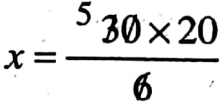
WBBSE Solutions For Class 8 Maths Arithmetic Chapter 4 Rule Of Three Example 1

∴ The cost price of 20 pens is 100.

WBBSE Class 8 English Functional GrammarWBBSE Class 8 English Reading Skills
WBBSE Solutions For Class 8 EnglishWBBSE Solutions For Class 8 Maths


Example 2. Anita travels 3 km in 20 mins. What is the speed of Anita?

Solution: In the mathematical language the problem is:

Time (mins.)
20
60

Distance (km)
3
? (x) [Let x > 0]

Time and distance are directly proportional.

So, 20: 60 : : 3: x

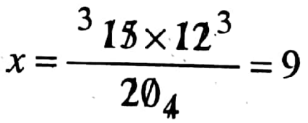
⇒ \(\frac{20}{60}\) = \(\frac{3}{x}\)

⇒ \(x =\frac{3 \times 60}{20}\)

⇒ x = 9

∴ The speed of Anita is 9 km/hr.

Example 3. If 8 labourers can cultivate 32 bighas of land, then how many bighas of land will be cultivated by 5 laborers?

Solution: In Mathematical language, the problem is:

Number of laborers (in heads)
8
5

Quantity of land (in bighas)
32
?

If the number of labourers increases the quantity of land will also increase and if the number of labourers decreases, the quantity of land will also decrease.

So, the number of labourers (heads) and quantity of land is directly proportional.

∴ 8: 5 : : 32: ?

∴ The required quantity of land = \(\frac{5 \times 32}{8}\) Bighas = 20 Bighas.

20 Bighas of land will be cultivated by 5 laborers

Example 4. 6 plumbers can complete the filling in a bathroom in 5 hours. Now if it is required to be done in 3 hours, how many more plumbers would be needed?

Solution: Let x plumbers can complete the fitting in a bathroom in 3 hours.

In mathematical language, the problem is:

Time (hrs.)
5
3

Number of plumbers
6
x

Number of plumbers and times are inversely proportional.

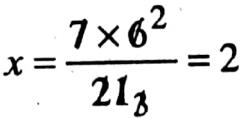
So, 3: 5 : : 6: x ⇒ \(\frac{3}{5}\) = \(\frac{6}{x}\)

⇒ x = \(\frac{5 \times 6^2}{3}\) = 10

∴ (10 – 6) or 4 more plumbers would be needed.

Example 5. A wall clock takes 10 seconds to beat 10. How much time will take by it to beat 12?

Solution: Let x seconds will taken to beat 12. There are 9 intervals among 10 beats and 11 intervals among 12 beats.

In the mathematical language the problem is:

Interval
9
11

Time taken (in secs)
10
x

The proportion is 9: 11: 10: x ⇒ x = \(\frac{11 \times 10}{9}=\frac{110}{9}=12 \frac{2}{9}\)

∴ 12\(\frac{2}{9}\) sec. time will taken to beat 12.

Example 6. There was a stock of food grains for 9 days to cater the needs of 4000 people at a shelter camp. After 3 days 1000 people left the camp for another place. How many days the rest of the people will consume the remaining food grains?

Solution: Let x days the rest of people will consume the remaining food grains. [x>0]

In the mathematical language, the problem is:

No. of people (in heads)
4000
4000 – 1000 = 3000

Time (in days)
9-3=6
x

With the same quantity of food, the less number of people will cover less days.

So, the number of people and the number of days are inversely proportional.

∴ 3000: 4000 :: 6: x

⇒ \(\frac{3000}{4000}=\frac{6}{x} \Rightarrow x=\frac{6 \times 4000}{3000} \Rightarrow x=8\)

∴ 8 days the rest of the people will consume the remaining food grains.

Example 7. A power loom is 2 1/4 times more powerful than a handloom. 12 handlooms weave 1080 meters in length of cloth in 18 days. How many power looms will be required to weave 2700 meters length of cloth in 15 days?

Solution: Let x handlooms will be required to weave 2700 meters of length of cloth in 15 days.

In the mathematical language the problem is:

Length of cloth (in metre)
1080
2700

Time (in days)
18
15

Number of handlooms
12
x

If time is constant, length of cloths and number of handlooms are inversely proportional.

If length of cloths are constant, then the required time and number of handlooms are inversely proportional.

∴ (1080 x 15): (18 x 2700): : 12: x

⇒ \(\frac{1080 \times 15}{18 \times 2700}=\frac{12}{x} \Rightarrow x=\frac{12 \times 18 \times 2700}{1080 \times 15} \Rightarrow x=36\)

36 handlooms will be required to weave 2700 meters length of cloth in 15 days.

As powerloom is 2\(\frac{1}{4}\) or \(\frac{9}{4}\) times more powerful than a handloom.

∴ The required number of powerloom is \(\left(36 \div \frac{9}{4}\right) \text { or }\left(36 \times \frac{4}{9}\right)\) or 16.

Example 8. If 50 men can do a piece of work in 12 days working 8 hours a day. How many hours a day would 60 men have to work in order to do another piece of work twice as great in 16 days?

Solution: Let the number of hours required be x.

In the mathematical language, the problem is:

No. of persons
50
60

No. of days
12
16

No. of hours
8
x

Here the number of hours is inversely proportion to the number of person and to the number of days.

∴ (60 x 16: 50 x 12): : 8: x

⇒ \(\frac{60 \times 16}{50 \times 12}=\frac{8}{x} \Rightarrow x=\frac{8 \times 50 \times 12}{60 \times 16}\)

∴ In order to do another piece of work twice as great in 16 days is (5 x 2) hours or 10 hours.

Example 9. A ship takes 18 days to reach its designated part. It starts with food for its crew of 450 men at the rate of 720 gm per day per head. After 11 days of its journey, they rescued 180 passengers from a Sinking ship. While rescuing the captain noticed a technical problem in the ship’s engine and estimated the ship would reach the destination after 9 days. How much food should they now consume per day per head so that it lasts for the rest of the journey?

Solution: In the mathematical language the problem is:

Men (by head)
450
450 + 180 = 630

Time (in days)
18-11 = 7
9

Quantity of food per day per head (in gm)
720
?

If the time is fixed, the number of men and quantity of food taken per head are inversely proportional.

Here the number of men increases.

∴ The quantity of food per head per day taken will be less.

So the fraction will be less than 1 i.e. \(\frac{450}{630}\)

If the number of men are fixed, the quantity of food per head per day is inversely proportional to time.

Here number of days increases. The fraction will be less than 1 i.e. \(\frac{7}{9}\)

So the required quantity of food per head per day

= WBBSE Solutions For Class 8 Maths Arithmetic Chapter 4 Rule Of Three Example 9 gms = 400 gm
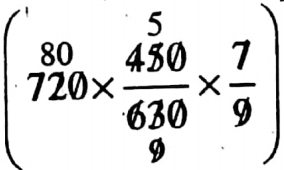
400 gm food should they now consume per day per head so that it lasts for the rest of the journey

Example 10. Choose the correct answer:

1. If the price of 3 kg dal is ₹270 then the amount of dal for ₹450 is

  1. 4 kg
  2. 5 kg
  3. 6 kg
  4. 4.5 kg

Solution: Let the amount of dal for ₹450 is x kg.

In the mathematical language, the problem is:

Price of dal (in ₹)
270
450

Amount of dal (kg)
3
x

The amount of dal and price of dal is directly proportional.

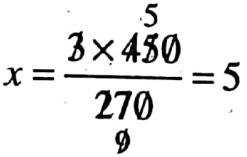
270: 450 : : 3: x ⇒ \(\frac{270}{450}=\frac{3}{x}\)

WBBSE Solutions For Class 8 Maths Arithmetic Chapter 4 Rule Of Three Example 10-1

∴ The correct answer is 2. 5 kg

The amount of dal for ₹450 is 2. 5 kg.

2. If 15 men can do a piece of work in 12 days, then how many days can 20 men do that works?

  1. 16 days
  2. 25 days
  3. 9 days
  4. 6 days

Solution: Let 20 men can do the work in x days.

In the mathematical language, the problem is:

Men
15
20

Time taken (days)
12
x

So, 20: 15 : : 12: x

WBBSE Solutions For Class 8 Maths Arithmetic Chapter 4 Rule Of Three Example 10-2

20 men can do the work in 9 days.

∴ So the correct answer is 3. 9 days

3. 9 days can 20 men do that works

Example 11. Write ‘True’ or ‘False’:

1. A poultry farm having 5000 hens has provision for 250 days. If 1000 hens must be sold after 50 days so that remaining provisions may last 250 days more.

Solution: In the mathematical language the problem is:

Hens (in heads)
5000
5000 – 1000 = 4000

No. of days
250-50 = 200
?

No. of hens and no. of days are inversely proportional.

∴ 4000: 5000 :: 200: ?

The required no. of days

= WBBSE Solutions For Class 8 Maths Arithmetic Chapter 4 Rule Of Three Example 11-1
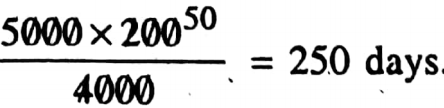
∴ The statement is true.

2. A man takes 40 mins. to reach his office from his home, traveling at a rate of 20 km/hr. The distance of the office from his house is 13 km.

Solution: In the mathematical language the problem is:

Time (mins)
60
40

Distance (km)
20
x (say)

The proportion is 60: 40 : : 20: x ⇒

Distance is 13\(\frac{1}{3}\)km.

∴ So the statement is false.

Example 12. Fill in the blanks

1. 6 men can do a piece of work in 7 days. Then _______ men will be required for that work in 21 days.

Solution: Let the required number of men are x [x > 0]

Time (days)
7
21

Men (in heads)
6
x

Number of men and days are inversely proportional.

So, 21: 7 : : 6: x

WBBSE Solutions For Class 8 Maths Arithmetic Chapter 4 Rule Of Three Example 12-1

∴ Two men will be required.

2. A wheel revolves 51 times to transverse a distance of 170 metres. That wheel revolves _____ times to transverse a distance of 1700 metres.

Solution:

Distance (metre)
170
1700

No. of revolves of wheel
51
?

Distance and number of revolves of wheel are directly proportional.

∴ 170: 1700 : : 51: ?

∴ The required no. of revolves

= WBBSE Solutions For Class 8 Maths Arithmetic Chapter 4 Rule Of Three Example 12-2

= 510 times

WBBSE Solutions For Class 8 Maths Arithmetic Chapter 3 Rational Number

Arithmetic Chapter 3 Rational Number

Natural Numbers: 1, 2, 3, 4, 5……., 125, ……. are counting numbers or natural numbers such that 1 is the first natural number and there is no last natural number.

⇒ The natural number is denoted by N and is written as N = (1, 2, 3, 4, . . . . . . . ., 125,…..)

Whole Numbers: The numbers 0, 1, 2, 3,….., and 125, are called whole numbers.

Read and Learn More WBBSE Solutions For Class 8 Maths

⇒ The whole number is denoted by W and is written as W = (0, 1, 2, 3,…… 125, …)

Integers: The numbers …. -4, -3, -2, -1; 0, 1, 2, 3 ….. are called Integers.

⇒ The Integers is denoted by Z and is written as Z = (..,-3, -2, -1, 0, 1, 2, 3…..)

⇒ The integers greater than 0, i.e. 1, 2, 3 ….. are called positive Integers and the Integers less than 0, i,.e. -1, -2, -3,…. are called negative Integers.

⇒ 0 (zero) is an Integer that is neither positive nor negative.

WBBSE Solutions For Class 8 Maths Arithmetic Chapter 3 Rational Number

Differece Between Rational And Irrational Numbers 

Rational Numbers: The numbers which can be expressed in the form of \(\frac{p}{q}\) where p and q are integers and q ≠ 0 are called Rational Numbers.

Example: 6, \(\frac{3}{9}\), 0, \(\frac{5}{6}\) etc. [All integers are Rational Numbers]

Irrational Numbers: The numbers which cannot be expressed in the form of \(\frac{p}{q}\) where p and q are integers and q ≠ 0 are called Irrational Numbers.

Example: √3, π etc.

Real Number:

  1. Rational Number
  2. Irrational Number

Some important points:

1. If two rational numbers x and y such that x < y there is a rational number. \(\frac{x+y}{2}\) i.e. x < \(\frac{x+y}{2}\) < y

2. If x and y are two rational numbers and x < y then n rational numbers between x and y are (x + d), (x + 2d), (x + 3d),…….. (x + nd), where d = \(\frac{y-x}{n+1}\)

3. If the rational numbers of the far \(\frac{p}{q}\) be expressed into decimals, it will be terminating into decimals it will be terminating decimal number, where q has prime factors 2 and 5 only.

4. If the rational numbers of the form be expressed into recurring decimals where has prime factors other than 2 and 5.

5. If rational numbers are expanded into decimals it will be terminating or recurring and the fraction whose decimal form is terminating or recurring will be rational.

6.

  1. Sum of rational numbers are rational.
  2. Difference of rational numbers are rational.
  3. Product of rational numbers are rational.
  4. Quotient of two rational numbers (not divided by 0) are rational.

7. If a, b, c are rational numbers.

WBBSE Class 8 English Functional GrammarWBBSE Class 8 English Reading Skills
WBBSE Solutions For Class 8 EnglishWBBSE Solutions For Class 8 Maths

Associative Law:

⇒ a + (b + c) = (a + b) + c [Associative law of addition]

⇒ But a (b – c) (a – b) – c [Associative law does not exists for subtraction]

⇒ and a x (b x c) = (a x b) x c [Associative law for product]

Commutative law:

⇒ a + b = b + a (for addition)

⇒ a – b + b – a (not exist for subtraction)

⇒ a x b = b x a (for product)

⇒ \(\frac{a}{b}\) \(\frac{b}{a}\) (not exist for division)

Distributive law:

⇒ a x (b+c) = a x b + a x c

Arithmetic Chapter 3 Rational Number Examples

Example 1. Find the value of (2x + 5) when x = –\(\frac{3}{8}\)

Solution:

Given f(x) = 2x + 5 and x = –\(\frac{3}{8}\)

⇒  f(-\(\frac{3}{8}\)) = 2 × (-\(\frac{3}{8}\))+5

⇒  f(-\(\frac{3}{8}\)) = – (2 × (\(\frac{3}{8}\)) +5

⇒  f(-\(\frac{3}{8}\)) = \(\frac{3}{4}+5\)

⇒  f(-\(\frac{3}{8}\)) = \(\frac{-3+20}{4}\)

⇒  f(-\(\frac{3}{8}\)) = \(\frac{17}{4}\)

⇒  f(-\(\frac{3}{8}\)) = 4 \(\frac{1}{4}\)

∴ The Value of f(x) = 2x + 5 = 4 \(\frac{1}{4}\)

Example 2. Solve the following equations and express the roots in form (where q ≠ 0 and p, q are two integers)

  1. 3x – 7 = 0
  2. y = 15 + 10y

Solution:

Given That :

f(x) = 3x – 7 = 0

⇒ 3x = 7

⇒ x = \(\frac{7}{3}\)

∴ x = \(\frac{7}{3}\)

∴ The root of the equations is ( X – \(\frac{7}{3}\)) =0

f(y) ⇒ y = 15 + 10y

y = 15 + 10y

⇒ y – 10y = 15

⇒ – 9y = 15

⇒ y = –\(\frac{15}{9}\)

⇒ y = \(\frac{-5}{3}\)

∴ y = \(\frac{-5}{3}\)

∴ The root of the equations is ( y + \(\frac{5}{3}\) ) = 0

Example 3. Write the approximate number in the following boxes:

  1. WBBSE Solutions For Class 8 Maths Arithmetic Chapter 3 Rational Number x \(\frac{-5}{3}\) = 1
  2. (-\(\frac{6}{11}\)) + (\(\frac{7}{12}\)) = WBBSE Solutions For Class 8 Maths Arithmetic Chapter 3 Rational Number

Solution :

  1. WBBSE Solutions For Class 8 Maths Arithmetic Chapter 3 Rational Number x –\(\frac{5}{3}\) = 1 ⇒ WBBSE Solutions For Class 8 Maths Arithmetic Chapter 3 Rational Number = -1 x \(\frac{13}{5}\) = –\(\frac{13}{5}\)
  2. (-\(\frac{6}{11}\)) + (\(\frac{7}{12}\)) = \(\frac{-72+77}{132}=\frac{5}{132}\)

Example 4. Write the product by multiplying \(\frac{4}{25}\) with the reciprocal of (-\(\frac{2}{15}\)).

Solution: The reciprocal of (-\(\frac{2}{15}\)) is (-\(\frac{15}{2}\))

\(\frac{4}{25} \times\left(-\frac{15}{2}\right)\)


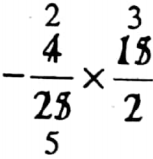
WBBSE Solutions For Class 8 Maths Arithmetic Chapter 3 Rational Number Example 4

= \(-\frac{6}{5}\)

Example 5. Find the value of the following with the help of Commutative law and Associative law.

  1. \(\frac{7}{9} \times\left(-\frac{11}{25}\right) \times\left(-\frac{87}{42}\right) \times\left(\frac{5}{121}\right)\)
  2. \(\frac{3}{4}+\left(-\frac{7}{10}\right)+\frac{5}{6}+\left(-\frac{12}{25}\right)\)

Solution:

1. \(\frac{7}{9} \times\left(-\frac{11}{25}\right) \times\left(-\frac{87}{42}\right) \times \frac{5}{121}\)

= \(\frac{7}{9} \times\left\{\left(-\frac{11}{25}\right) \times\left(-\frac{87}{42}\right)\right\} \times \frac{5}{121}\)

= \(\frac{7}{9} \times\left\{\left(-\frac{87}{42}\right) \times\left(-\frac{11}{25}\right)\right\} \times \frac{5}{121}\)

[I get with the help of Commutative Law and Associative Law]

WBBSE Solutions For Class 8 Maths Arithmetic Chapter 3 Rational Number Example 5

2. \(\frac{3}{4}+\left(-\frac{7}{10}\right)+\frac{5}{6}+\left(-\frac{12}{25}\right)\)

= \(\frac{3}{4}+\left\{\left(-\frac{7}{10}\right)+\frac{5}{6}\right\}+\left(-\frac{12}{25}\right)=\frac{3}{4}+\left\{\frac{5}{6}+\left(-\frac{7}{10}\right)\right\}+\left(-\frac{12}{25}\right)\)

= \(\left(\frac{3}{4}+\frac{5}{6}\right)+\left\{\left(-\frac{7}{10}\right)+\left(-\frac{12}{25}\right)\right\}=\left(\frac{9+10}{12}\right)+\left\{-\left(\frac{35+24}{50}\right)\right\}\)

= \(\left(\frac{19}{12}\right)+\left(-\frac{59}{50}\right)\) [I get with the help of Commutative Law and Associative Law]

= \(\frac{475-354}{300}=\frac{121}{300}\)

Example 6. Write three rational numbers between (-5) and (-4).

Solution: 3 rational numbers are -4.1 or, –\(\frac{41}{10}\), -4.3 or, –\(\frac{43}{10}\), -4.5 or –\(\frac{45}{10}\) as –\(\frac{9}{2}\)

Example 7. Write 10 rational numbers between –\(\frac{3}{5}\) and \(\frac{1}{2}\)

Solution: –\(\frac{3}{5}\) = –\(\frac{6}{10}\) = –\(\frac{12}{20}\), \(\frac{1}{2}\) = \(\frac{5}{10}\) = –\(\frac{10}{20}\)

∴ 10 rational numbers are: –\(\frac{9}{20}\), –\(\frac{7}{20}\), –\(\frac{5}{20}\), –\(\frac{3}{20}\), –\(\frac{1}{20}\), \(\frac{1}{20}\), \(\frac{3}{20}\), \(\frac{5}{20}\), \(\frac{7}{20}\), \(\frac{9}{20}\)

Example 8. Plot the number \(\frac{1}{4}\) on number line.

Solution:

WBBSE Solutions For Class 8 Maths Arithmetic Chapter 3 Rational Number Example 8


Example 9. Plot -2\(\frac{3}{5}\) on number line.

Solution :

WBBSE Solutions For Class 8 Maths Arithmetic Chapter 3 Rational Number Example 9


Example 10. Write 5 rational number lying between \(\frac{3}{5}\) and \(\frac{4}{5}\).

Solution: Here x = \(\frac{3}{5}\), y = \(\frac{4}{5}\), x = 5

d = \(d=\frac{y-x}{x+1}=\frac{\frac{4}{5}-\frac{3}{5}}{5+1}=\frac{\frac{1}{5}}{6}=\frac{1}{30}\)

∴ 5 rational numbers are: \(\left(\frac{3}{5}+\frac{1}{30}\right),\left(\frac{3}{5}+\frac{2}{30}\right),\left(\frac{3}{5}+\frac{3}{30}\right),\left(\frac{3}{5}+\frac{4}{30}\right),\left(\frac{3}{5}+\frac{5}{30}\right)\)

i.e. \(\frac{19}{30}, \frac{20}{30}, \frac{21}{30}, \frac{22}{30}, \frac{23}{30}\)

Example 11. Write 6 rational numbers lying between 5 and 6.

Solution: Write the equivalent rational numbers of 5 and 6 which have (6 + 1) or 7 as denominator.

5 = \(\frac{35}{7}\), 6 = \(\frac{42}{7}\)

∴ 6 rational numbers are: \(\frac{36}{7}, \frac{37}{7}, \frac{38}{7}, \frac{39}{7}, \frac{40}{7}, \frac{41}{7}\)

Example 12. Choose the correct answer

1. √2 is a

  1. Rational number
  2. Irrational number
  3. Natural number
  4. Whole number

Solution: √2 = 1.414…..

∴ So √2 is irrational number.

∴ So the correct answer is 2. Irrational number

√2 is a Irrational number.

2. Product of \(\frac{7}{18}\) and reciprocal of (-\(\frac{5}{6}\)) is

  1. –\(\frac{7}{15}\)
  2. –\(\frac{15}{7}\)
  3. \(\frac{7}{15}\)
  4. \(\frac{7}{15}\)

Solution: The reciprocal of (-\(\frac{5}{6}\)) is (-\(\frac{6}{5}\))

WBBSE Solutions For Class 8 Maths Arithmetic Chapter 3 Rational Number Example 12-2

∴ So the correct answer is 1. –\(\frac{7}{15}\)

Product of \(\frac{7}{18}\) and reciprocal of (-\(\frac{5}{6}\)) is –\(\frac{7}{15}\)

3. a x \(\frac{1}{a}\) =? [where a is rational number and a ≠ 0]

  1. 1
  2. a
  3. \(\frac{1}{a}\)
  4. None of these

Solution: a x \(\frac{1}{a}\)

∴ So correct answer is 1. a x \(\frac{1}{a}\)

a x \(\frac{1}{a}\) =1.

Example 13. Write ‘True’ or ‘False’:

1. Commutative law of subtraction does not exist for rational numbers.

Answer: True.

2. \(-\frac{21}{29} p-\left(\frac{21}{29}\right)=0\)

Answer: False

3. If x = –\(\frac{2}{5}\) then, \(\frac{1}{x}\) + \(\frac{x}{2}\) = –\(\frac{10}{27}\)

Solution: \(\frac{1}{x}+\frac{x}{2}=\frac{1}{-\frac{2}{5}}+\frac{-\frac{2}{5}}{2}\)

= \(-\frac{5}{2}-\frac{2}{5} \times \frac{1}{2}=-\left(\frac{5}{2}+\frac{1}{5}\right)=-\left(\frac{25+2}{10}\right)=-\frac{27}{10}\)

∴ So, the statement is false.

Example 14. Fill in the blanks

1. √47 is a ______ number.

Answer: Irrational number

√47 is a Irrational number

2. \(\frac{2}{9}\) + ____ = 0

Answer: –\(\frac{2}{9}\)

\(\frac{2}{9}\) + \(\frac{2}{9}\)= 0

3. (-\(\frac{2}{3}\)) + 0 = _____

Answer: Undefined

(-\(\frac{2}{3}\)) + 0 = Undefined

WBBSE Solutions For Class 8 Maths Arithmetic Chapter 2 Pie Chart

Arithmetic Chapter 2 Pie Chart

A pie chart is a circular statistical graphic which is divided into slices to illustrate numerical proportions.

In a pie chart, the arc length of each slice is proportional to the quantity it represents.

In pie chart values of various datas of components are represented by sectors of a circle. The angle at the centre of the sector gives the value of the data.

Read and Learn More WBBSE Solutions For Class 8 Maths

At the centre, a circle makes a complete angle i.e. 360°.

Centre angle for a data = \(\left(\frac{\text { Value of the data }}{\text { Total value }} \times 360\right)^{\circ}\)

Method of drawing of Pie Chart:

WBBSE Class 8 English Functional GrammarWBBSE Class 8 English Reading Skills
WBBSE Solutions For Class 8 EnglishWBBSE Solutions For Class 8 Maths
  1. Compute the central angles for the given datas using the above formula.
  2. Draw a circle with any radius.
  3. Divide the interior of the circle into different sectors having the angles as obtained (1) with the help of protractor.
  4. Lable the sections properly to obtain the required pie chart.

WBBSE Solutions For Class 8 Maths Arithmetic Chapter 2 Pie Chart

Arithmetic Chapter 2 Pie Chart Examples

Example 1. There are 100 students in your class. The following table shows their hobby.

WBBSE Solutions For Class 8 Maths Arithmetic Chapter 2 Pie Chart Example 1

Draw a Pie Chart for the given data.

Solution:

HobbyHobby (in percentage)Hobby (in fraction)Central part of 360°
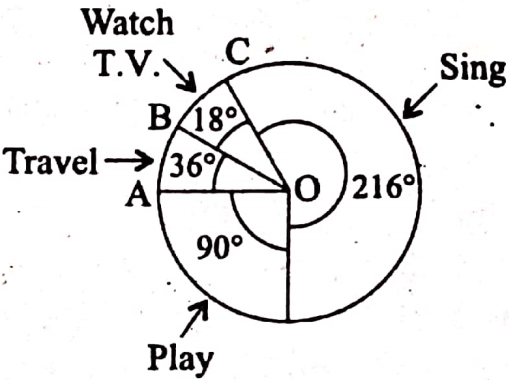
Travel10\(\frac{10}{100}\) = \(\frac{1}{10}\)\(\frac{1}{10}\) x 360° = 36°
Watch T.V5\(\frac{5}{100}\) = \(\frac{1}{20}\)\(\frac{1}{20}\) x 360° = 18°
Sing60\(\frac{60}{100}\) = \(\frac{3}{5}\)\(\frac{3}{5}\) x 360° = 216°
Play25\(\frac{25}{100}\) = \(\frac{1}{4}\)\(\frac{1}{4}\) x 360° = 90°


Process:

Draw a circle with any radius (OA).


WBBSE Solutions For Class 8 Maths Arithmetic Chapter 2 Pie Chart A Circle With Any Radius (OA)


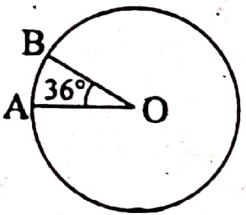
The central angle of the sector which represents the travel is 36°. So I draw ∠AOB 36° with the help of a protractor.


WBBSE Solutions For Class 8 Maths Arithmetic Chapter 2 Pie Chart Central Angle Of The Sector


Now, I draw the sectors by reversing the protractor, the central angles of which are 18°, 216° and 90° respectively.


WBBSE Solutions For Class 8 Maths Arithmetic Chapter 2 Pie Chart The Sector By Reversing The Protractor


Thus I made a pie chart of the data.

Example 2. Arpita have made a model. She made a chart of expenditures of buying materials.

WBBSE Solutions For Class 8 Maths Arithmetic Chapter 2 Pie Chart Example 2

Make a pie chart with this information and write the central angle of the sectors.

Solution:

MaterialsExpenditure (₹)Expenditure (in fraction)The central part of 360°
Art paper9\(\frac{9}{60}\) = \(\frac{3}{20}\)\(\frac{3}{20}\) x 360° = 54°
Sketch pen12\(\frac{12}{60}\) = \(\frac{1}{5}\)\(\frac{1}{5}\) x 360° = 72°
Scissor25\(\frac{25}{60}\) = \(\frac{5}{12}\)\(\frac{5}{12}\) x 360° = 150°
Colour ribbon6\(\frac{6}{60}\) = \(\frac{1}{10}\)\(\frac{1}{10}\) x 360° = 36°
Pitch board8\(\frac{8}{60}\) = \(\frac{2}{15}\)\(\frac{2}{15}\) x 360° = 48°


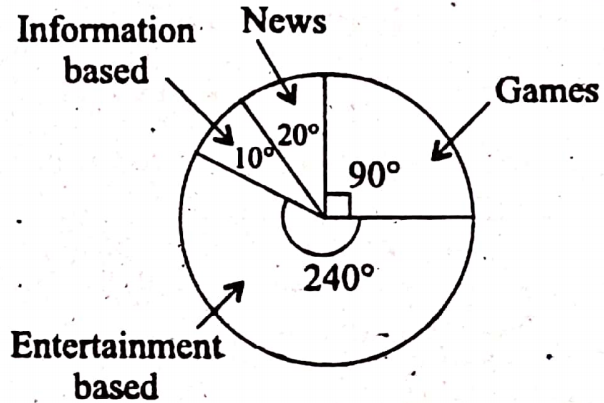
Example 3. The pie chart of what kind of programmes Information News the audience likes:

  1. Write How many parts of the total circular region is the sector of the audience who watch news in the pie chart?
  2. Write what kind of programme gets the most audience.
  3. Write what kind of programme gets the least audience.
  4. Write how many parts of the total audience watch the programmes of sports?

Solution:

  1. No. of parts of total circular region is the sector of the audience who watch news in the pie chart is \(\frac{20}{360}\) or \(\frac{1}{18}\)
  2. Entertaining programmes gets the most audience. [Entertained is 240°]
  3. Informative programme gets the least audience.
  4. \(\frac{90}{360}\) or \(\frac{1}{4}\) parts of the total audience watch the programmes of sports.


WBBSE Solutions For Class 8 Maths Arithmetic Chapter 2 Pie Chart


Example 4. Choose the correct Answer:

1. Pie Chart is also known as

  1. Circle graph
  2. Histogram
  3. Bar graph
  4. None of these

Answer: 1. Circle graph

2. Central angle for data

  1. \(\frac{\text { Total value }}{\text { Value of the data }} \times 360^{\circ}\)
  2. \(\frac{\text { Value of the data }}{\text { Total value }} \times 360^{\circ}\)
  3. \(\frac{\text { Value of the data }}{\text { Total value }} \times 100^{\circ}\)
  4. None of these

Answer: 2. \(\frac{\text { Value of the data }}{\text { Total value }} \times 360^{\circ}\)

3. A survey was made to find of music lovers like. If 20 people like classical music the number of people surveyed is

  1. 100
  2. 200
  3. 50
  4. 10

Answer: 2. 200


WBBSE Solutions For Class 8 Maths Arithmetic Chapter 2 Pie Chart


Example 5. Fill in the blanks:

1. Pie chart is also known as _______ graph.

Answer: Circle chart.

2. Study the following table below:

WBBSE Solutions For Class 8 Maths Arithmetic Chapter 2 Pie Chart Example 5-2

Measurement of central angle of Santro is ________

Solution: Measurement of central angle of santro is \(\left(\frac{6}{36} \times 360^{\circ}\right)=60^{\circ}\)

Answer: 60°

Example 6. Write ‘True’ or ‘False’.

1. Pie chart is a bar graph.

Answer: False

2. The whole circle represents the sum of the value of the components.

Answer: True

WBBSE Solutions For Class 8 Maths Arithmetic Chapter 1 Ratios And Proportion

Arithmetic Chapter 1 Ratios And Proportion Examples

Example 1. If a: b = 2:3 and b: c = 4: 5, then find the value a: b: c.

Solution:

Given That : 

a : b = 2 : 3

b: c = 4: 5

a: b: c = ?

⇒ a : b = 2 : 3

Now Multiply the  a : b  with 4 we get,

⇒ (2 x 4) : (3 x 4)

∴ a : b = 8 : 12

⇒ b : c = 4 : 5

Now Multiply the  b : c with 3 we get,

⇒ b : c = (4 x 3) : (5 x 3)

b : c = 12 : 15

∴ a : b : c = 8 : 12 : 15

The value a: b: c is  8 : 12 : 15

WBBSE Solutions For Class 8 Maths Arithmetic Chapter 1 Ratios And Proportion

Example 2. Find the compound ratio of x2: yz, y2: zx, and z2: xy.

Solution: The compound ratio of x2 = yz, y2 = zx and z2: xy

From The Above Given Equation

We Consider That L . H .S = R . H . S

= x2 x y2 x z2 : yz x zx x xy

= x2y2z2 : x2y2z2

= 1:1

∴ The compound ratio of x2 = yz, y2 = zx and z2: xy is 1:1

Read and Learn More WBBSE Solutions For Class 8 Maths

Example 3. Find the mean proportional of a2 and b2c2.

Solution: The mean proportional of a2 and b2c2 =

± \(\sqrt{a^2 \times b^2 c^2}\)

= ± abc.

The mean proportional of a2 and b2c2 = ± abc.

WBBSE Class 8 English Functional GrammarWBBSE Class 8 English Reading Skills
WBBSE Solutions For Class 8 EnglishWBBSE Solutions For Class 8 Maths


Example 4. If (3+\(\frac{4}{x}\)) : (5+\(\frac{2}{x}\)) = 1, then find the value of x.

Solution:

Given That : (3+\(\frac{4}{x}\)) : (5+\(\frac{2}{x}\)) = 1

⇒ (3+\(\frac{4}{x}\)) : (5+\(\frac{2}{x}\)) = 1

⇒ \(\frac{3+\frac{4}{x}}{5+\frac{2}{x}}=1\)

⇒ \(3+\frac{4}{x}=5+\frac{2}{x}\)

By taking the all ‘X‘ terms in on one side and Numericals to Other Side. We get,

⇒ \(\frac{4}{x}-\frac{2}{x}=5-3\)

⇒ \(\frac{2}{x}=2\)

⇒ 2x = 2

⇒ \(x=\frac{2}{2}=1\)

∴ The Value of the ‘ X ‘ is : 1

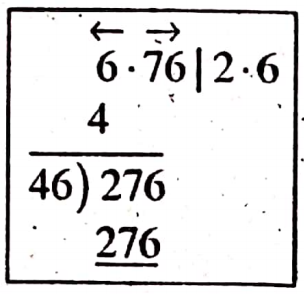
Example 5. What is the value of \(\sqrt{6 \cdot 76}-\sqrt{5 \cdot 76}+\sqrt{42 \cdot 25}\).

Solution:

Given That: \(\sqrt{6 \cdot 76}-\sqrt{5 \cdot 76}+\sqrt{42 \cdot 25}\)

⇒ \(\sqrt{6 \cdot 76}-\sqrt{5 \cdot 76}+\sqrt{42 \cdot 25}\)

By Taking the Determination to the Equation We Get,

= 2.6 – 2.4 + 6.5 = 0.2 + 6.5 = 6:7.

WBBSE Solutions For Class 8 Maths Arithmetic Chapter 1 Revision Example 5

The value of \(\sqrt{6 \cdot 76}-\sqrt{5 \cdot 76}+\sqrt{42 \cdot 25}\) is 6:7

Example 6. Find the approximate value of 7 hour 12 min 40 sec. in minutes.

Solution:

First We convert sec into minutes

40 sec = \(\frac{40}{60}\) min

= \(\frac{2}{3}\) min.

= 0.66 min.

40 sec = 1 min. (approximate)

∴ 7 hour 12 min 40 sec = 7 hour + (12 + 1) min.

⇒ 7 hour 13 min.

∴ 7 hour 12 min 40 sec = 7 hour 13 min.


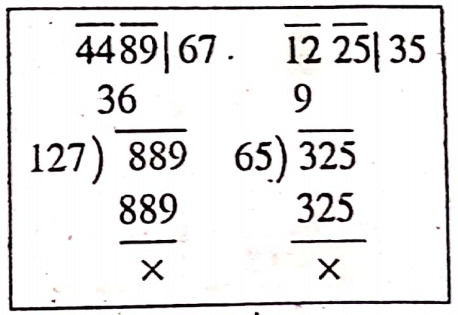
Example 7. Find the square root of 3\(\frac{814}{1225}\).

Solution: \(\sqrt{3 \frac{814}{1225}}=\sqrt{\frac{4489}{1225}}=\frac{67}{35}=1 \frac{32}{35}\)

WBBSE Solutions For Class 8 Maths Arithmetic Chapter 1 Revision Example 7

Example 8. If the length of a square becomes double, then what will be changed its areas?

Solution:

we know that all sides in a square are equal.

⇒ Let the length of each side of a square be x units.

Area is x2 sq.m.

If length of each side becomes double, then area is (2x)2 or 4x2 sq.unit.

∴ The area will be \(\frac{4 x^2}{x^2}\) or 4 times of original areas.

Example 9. If 8 men can do a piece of work in 15 days, then how many days can 12 men do that works?

Solution: Let 12 men can do the work in x days. [x > 0]

In the mathematical language the problem is:

Men
8
12

Time taken (day)
15
x

It is the case of inverse proportion.

So the proportion is

12: 8 : : 15: x

⇒ x = \(\frac{8 \times 15}{12}\)

⇒ x = 10

∴ 12 men can do a piece of work in 10 days,

Example 10. A train 200 meter long passes a tree in 12 sec. Find the speed of the train.

Solution: In passing the tree, the train must travel its own length i.e. 200 m.

The problem in mathematical language is:

Time taken (sec)
12
3600

Distance covered (meter)
200
?

According to the properties of ratio proportion we get,

12 : 3600 : : 200 : Distance covered in 1 hour.

∴ Distance covered in 1 hour = \(\frac{3600 \times 200}{12}\) meter 60000 meter = 60 km.

∴ Speed of the train is 60 km/hr.

Example 11. A train running at \(\frac{4}{7}\) of its own speed reached a place in 14 hours. In what time could it reach these running at its own speed?

Solution: Let speed of the train is x km/hr.

If the speed of the train is (x x \(\frac{4}{7}\)) km/hr or \(\frac{4x}{7}\) km/hr, then the train travels at a distance in 14 hours is (14 x \(\frac{4 x}{7}\)) km or 8x km.

The required time to cover a distance of 8x km with speed x km/hr is \(\frac{8x}{x}\) hour or 8 hours.

∴ The required time is 8 hours.

In 8 hours time could it reach these running at its own speed

Example 12. There is a path of 3 m width all around outside the square shaped park. The perimeter of the park including the path is 484 m. Calculate the area of the path.

Solution: The perimeter of the square park including the path is 484 m.

∴ The length of each side of the park including the path is \(\frac{484}{4}\) m or 121 m.

As the path is 3m width.

So length of each side of the park is (121 – 2 x 3) m or 115 m.

WBBSE Solutions For Class 8 Maths Arithmetic Chapter 1 Revision Example 12

Area of the square park is (115)2 sq.m. = 13225 sq.m.

Area of the park including the path is (121)2 sq.m. = 14641 sq.m.

∴ The area of the path = (14641 – 13225). sq.m. = 1416 sq.m

Example 13. Choose the correct answer.

1. The compound ratio of 2: 3, 4: 5, and 7: 8 is

  1. 15: 7
  2. 7: 15
  3. 8: 15
  4. 3: 5

Solution: The compound ratio of 2: 3, 4: 5, and 7: 8 is (2 x 4 x 7): (3 x 5 x 8) = 56: 120 = 7: 15

∴ So the correct answer is 2. 7: 15

The compound ratio is 2. 7: 15

2. The approximate value of \(\frac{22}{7}\) to 3 places of decimals is

  1. 3·142
  2. 3.141
  3. 3.145
  4. 3.143

Solution: \(\frac{22}{7}\) = 3.1428…… ≈ 3.143

∴ The correct answer is 4. 3.143

3. If Anita takes 25 minutes to travel 2.5 km Anita’s speed is

  1. 4 km/hr.
  2. 5 km/hr.
  3. 4.5 km/hr.
  4. 6 km/hr.

Solution: In the mathematical language the problem is:

Time taken (min.)
25
60

Distance covered (km.)
2.5
?

According to the properties of the ratio proportion we get 25: 60 : : 2.5: Required distance.

Required distance is \(\frac{60 \times 2 \cdot 5}{25}=\frac{60 \times 25}{25 \times 10} \mathrm{~km}\) = 6 km

Speed is 6 km/hr.

∴ So the correct answer is 4. 6 km/hr

Anita’s speed is 4. 6 km/hr

Example 14. Write ‘True’ or ‘False’:

1. If the ratio of measurements of angles of a triangle is 1:2:3 then the triangle is a acute angled triangle.

Solution: The sum of the measurement of three angles of the triangle is 180°.

Let the measurements of three angles are x°, 2x°, and 3x°. [x is common multiple and x > 0]

x° + 2x° + 3x°= 180°

⇒ 6°x° = 180°⇒ x° = 30°

∴ The angles are 30°, 30° x 2 or 60° and 30° x 3 or 90°

So the triangle is right angled triangle.

∴ So the statement is false.

2. The difference between 1 and the approximate value of 0.9 to the integer is zero.

Solution: The approximate value of 0.9 to the integer is 1.

1 – 1 = 0

∴ So the statement is true.

Example 15. Fill in the blanks:

1. A ______ is a method to compare two quantities of the same kind having same unit.

Answer: Ratio.

2. 1 square metre = _______ square cm.

Answer: 1 square metre = 1 m x 1 m = 100 cm x 100 = 10000 sq.cm.