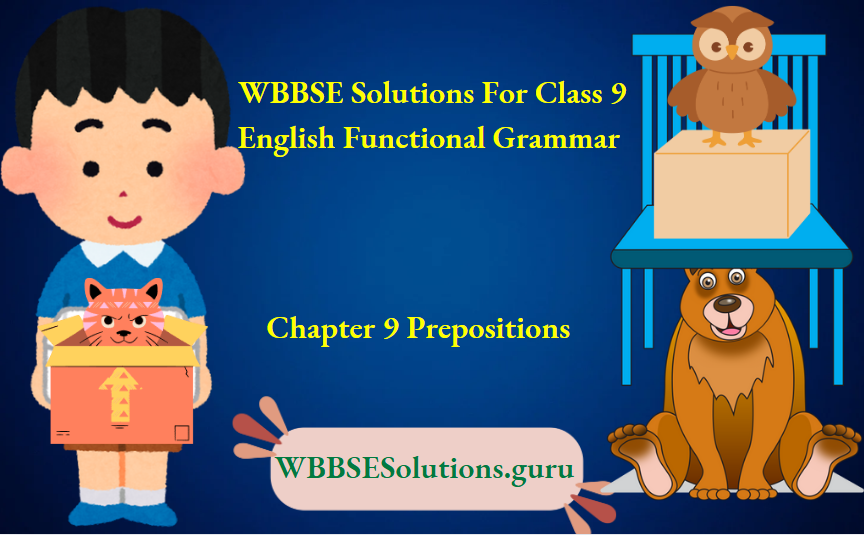
WBBSE Solutions For Class 9 English Functional Grammar Chapter 9 Prepositions

Chapter 9 Prepositions

A preposition is a word placed before a noun or a noun-equivalent to show its relation to some other word in the sentence

  • He came to me.
  • Put it on the table.

Prepositions may also govern other parts of speech used as nouns:

  • From here, before now, for good, in short, about to go.

Prepositions may govern phrases and clauses as well:

  • It depends on how you do your duty.
  • I shall go to where you have come from.
  • I am ignorant of how to do it.

Prepositions sometimes follow the words they govern when the object is an interrogative or relative pronoun understood; particularly the relative that is never governed by a preposition preceding it:

What is this for? Where do you come from? This is the boy that I spoke of. This is the e-boy that I spoke of. This is the boy (whom) I spoke to.

Read And Learn More WBBSE Class 9 English Functional Grammar

Phrase Prepositions or Prepositional Phrases are phrases used as a preposition-on account of, instead of, in spite of, by means of, owing to, by dint of, in accordance with.

WBBSE Solutions For Class 9 Fundamentals Of HistoryWBBSE Class 9 English Functional Grammar
WBBSE Class 9 Fundamentals Of History Long Answer QuestionsWBBSE Class 9 English Reading Skill
WBBSE Class 9 Fundamentals Of History Short Answer QuestionsWBBSE Class 9 English Writing Skill
WBBSE Class 9 Fundamentals Of History Very Short Answer QuestionsWBBSE Class 9 Maths Multiple Choice Questions
WBBSE Class 9 Fundamentals Of History Multiple Choice QuestionsWBBSE Solutions For Class 9 Maths
WBBSE Notes For Class 9 Geography and Environment


He could not come on account of illness. In spite of hard labor, he failed in the examination. Instead of coming here, he went home.
WBBSE Solutions For Class 9 English Functional Grammar Chapter 9 Prepositions

Uses of a few Prepositions:

WBBSE Solutions for Class 9 English Chapter 9 prepositions uses of a few prepositions at

At is often followed by an article to form a phrase:

WBBSE Solutions for Class 9 English Chapter 9 prepositions uses of a few prepositions At is often fololwed by an article

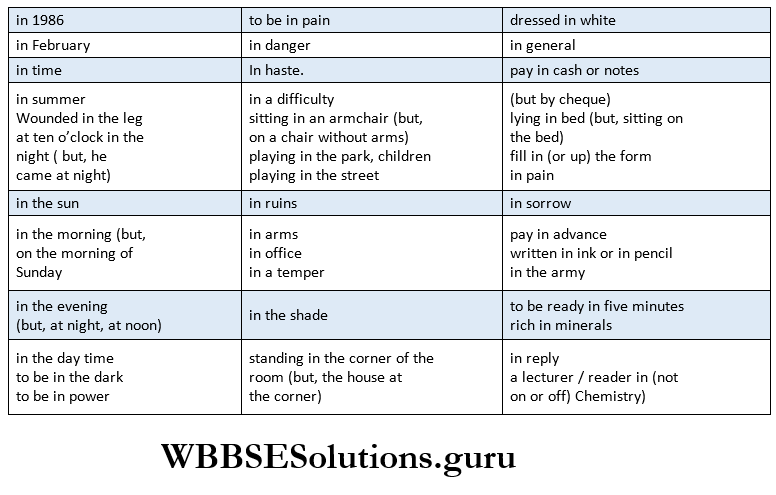
In

WBBSE Solutions for Class 9 English Chapter 9 prepositions uses of a few prepositions in

On

WBBSE Solutions for Class 9 English Chapter 9 prepositions uses of a few prepositions on

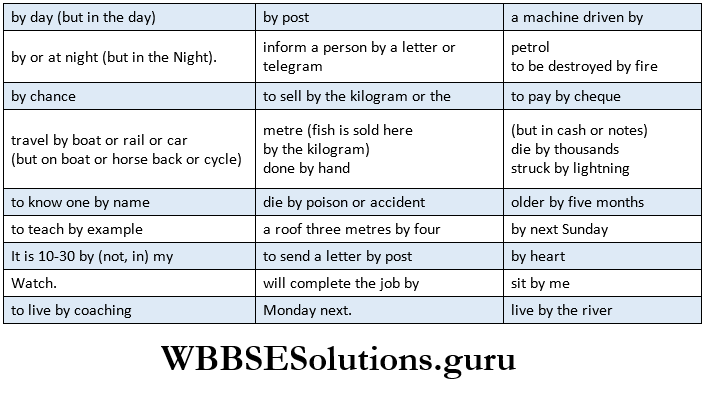
By

WBBSE Solutions for Class 9 English Chapter 9 prepositions uses of a few prepositions by

Of

WBBSE Solutions for Class 9 English Chapter 9 prepositions uses of a few prepositions of

To

WBBSE Solutions for Class 9 English Chapter 9 prepositions uses of a few prepositions to

For

WBBSE Solutions for Class 9 English Chapter 9 prepositions uses of a few prepositions for

Chapter 9 Prepositions Differences In The Use Of A Few Important Prepositions

At, In Both are used to denote time and place.

Expression of time:

At refers to a certain moment or point in time:

  1. He will come at 4 p.m.
  2. We got up at dawn and had breakfast at 8 o’clock.
  3. Take the medicine at bedtime.

Similarly:

  • At noon, at sunset, at midnight, at dinner time, at the beginning

At is also used for festivals which mark a point of time in the year:

  • We have a holiday at Christmas / Dewali.

In refers to a space or period of time (RT)

  • He will come in an hour / in a few minutes.”
  • He ran the distance in three hours.

Similarly:

In the summer, in September, in the year 1998, in the morning, in the evening. I shall see you at 3 o’clock in the afternoon. Cricket is played in the winter.

Expression of place:

At refers to a small place, town, or village; in refers to a large place (a country, a district, or a large city) (At ছোট স্থানের পূর্বে, in বড় স্থানের পূর্বে বসে) :

  • He lives in Serampur.
  • He lives in Kolkata (or in London).
  • He lives in the U.S.A.
  • He lives in Jangipur in the district of Murshidabad.
  • He has a shop at Bally in Howrah.
  • The train arrives in Delhi at 5 o’clock.

For houses and places of residence:

  • It is used to denote a kind of house or residence.
  • In a bungalow, in a flat, in a hotel, etc
  • He lives in a flat.

At is used to denote a specific one (a):

  • at 12, Chowringhee Road
  • at the Oberoi Grand

It is used to refer to names of streets and roads:

  • in Rash Behari Avenue
  • in Chowringhee Road

He lives at 25, Rash Behari Avenue in Kolkata, but he lives in Rash Behari Avenue. He lives in a hotel on Rash Behari Avenue.

By, with: By relates to the doer or agent; with relates to the instrument or the thing with which something is done; as : [By যে কাজ করে (agent বা doer) তাকে নির্দেশ করে ; with যা দ্বারা কিছু করা হয় তা নির্দেশ করে।]

  • He was struck by Ram with a stick.
  • The letter was written by him with a pen.

Among, between: Between generally relates to two persons or things; Among relates to more than two [ সাধারণতঃ দু’য়ের মধ্যে অর্থে between ও দু’য়ের অধিকের মধ্যে অর্থে among ব্যবহৃত হয়।]

  • There was a quarrel between the two brothers.
  • There was a quarrel among the boys.

For, since, from: For refers to a space of time; since and from refer to a point of time.

But while since refers only to a past point, from refers to a point of time in all tenses. As:

[ হতে অর্থে (তিনি তিন দিন হতে পীড়িত, আমি সোমবার হতে আসব) এই তিনটি শব্দই ব্যবহৃত হয়। কিন্তু

  • For space of time (সময়ের ব্যপ্তি) বোঝায়।
  • Since– past point of time
  • From – past, present ও future তিন রকম point of time-ই বোঝায়। ]
    • He has been here for a week.
    • I have not seen you for many days.
    • It is many days since I saw you last (since the point of time that I saw you last). He has been here since Monday last.
    • He began English at the age of ten (past).
    • He begins English today (present).
    • He will begin English tomorrow (future).

In, into: In refers to position or rest inside something; into refers to motion or change of state [কোনো কিছুর মধ্যে বা ভিতরে থাকা বোঝালে in এবং বাইরে থেকে ভেতরে গতি বা অবস্থা বা আকারের পরিবর্তন বোঝালে into হয়।] as:

  • There is no milk in the pot.
  • There was nobody in the room.
  • The girls ran into the hall.
  • The Ganga flows into the Bay of Bengal.
  • The ice melted into the water.

Besides, besides:

  • Beside is only a preposition and means near-Sit beside me.
  • wide of – Your remark is beside the point. Besides is
  • a preposition meaning in addition to. I have none to help me besides you.
  • an adverb = also, moreover. It is late; besides, I am tired.
  • Beside oneself means becoming out of control
  • because of a particular feeling or emotion: He was beside himself with joy when he heard the news.

After, in, within, at, by After refers to a past space of time, while in refers to a future space of time (“পরে” অর্থে “after” অতীতকাল নির্দেশ করে, এবং “in” ভবিষ্যৎ কাল নির্দেশ P).

Thus we cannot say, ‘He will come after a few days’, or ‘He died in a few days’.

The correct sentences will be, ‘He will come in a few days and ‘He died after a few days respectively.

To denote the point of time, after is used with all tenses; such as ‘He will come or comes or came after 5 o’clock’.

Within also refers to a space of future time; but whereas in denotes at the end of, within denotes some time before the end of.

I shall go in a week after the week has ended. I shall go within a week before a week has ended নীচের sentence গুলি লক্ষ্য কর:

  • He will come in a week —এক সপ্তাহ পরে আসবেন।
  • He will come within a week এক সপ্তাহের মধ্যে আসবেন।
  • He came after a week —এক সপ্তাহ পরে এসেছিলেন।
  • He will finish the work in a month – এক মাস পরে করবেন।
  • He finished the work after a month—এক মাস পরে করেছিলেন।

At refers to a definite point of time; as ‘He came at noon’.
By refers to a point of future time and means ‘sometime before that’: as “You must be back by 5 o’clock”.

We reached the place at the same time = We took the same period of time (say, 5 hours) to reach the place; we might have started and arrived at the destination at different hours.

We reached the place at the same time say, 5 o’clock; we might have started at different hours.

He reached the place within the same time = say, 5 hours; it may be, one took 3 hours, another 4 hours, etc.

Over, above: Over is generally used for a point generally higher; above is used for a point directly higher (অপেক্ষাকৃত উচ্চ স্থানে অর্থে over, কিন্তু ঠিক উপরে অর্থে above ব্যবহৃত হয়).

As

  • On our way to Kolkata, our plane flew over the Middle East.
  • My neighbors above my flat disturb me very often.

From, of:

  • Wine is made from grapes.
  • Steel is made from iron ores.

Here the material has lost its original composition in the process of manufacture.

  • The table is made of wood.
  • The bridge is made of steel.

Here the material remains unchanged in the process of manufacture.

Chapter 9 Prepositions Appropriate Prepositions

Certain words take particular prepositions after them. This is a matter of idioms.

In a few cases, the usage varies. Still, students should carefully note the generally accepted usage.

A few examples are given below:

Abide by with (a person), in, at (a place)-I shall abide by your decision. Abide (dwell, 2) with me, Lord. I shall not abide long in Kolkata, or at Bankura.

Abound in (used before both the container and the contained), with (used before the contained only)-Wild animals abound in Indian forests. Indian forests abound with wild animals (or, in good timber).

Abreast of, with (RCA)- Read newspapers to keep abreast of or with the latest developments.

Absent from (a place) -He was absent from the meeting.

Absolve (one) from (blame), of (sin) -I absolve you from blame. The priest absolved him of sin. (POD & COD).

Absorbed in He is absorbed in thought (deeply engaged)

Abstain from -I shall abstain from smoking.

Abut on The buidling abuts on the temple (একই সীমায় মেশা)

Accede to-I cannot accede (agree) to your request.

Access to We have free access to him (right of approaching, নিকটে যাবার অধিকার).

Accessible to-He is accessible to all.

Acceptable to-Your offer is acceptable to me.

Acclimatize to ( নুতন, স্থান বা পরিবেশে মানিয়ে G) They will need some time to get acclimatized to the new surroundings.

Accommodate (one) with (a loan), (oneself) to (circumstances) He accom- mandated (সাহায্য করেছিল) me with a loan. We should accommodate ( খাওয়া, মানিয়ে নেওয়া) ourselves to circumstances.

Accompanied by (a person) with (a thing)-I was accompanied there by my friend. He is suffering from a fever accompanied (combined, R) with a headache. Accomplished in The girl is accomplished in dancing.

Accord to, with- They accorded (gave, a grand reception to the leader. Your story accords (agrees, সঙ্গতিপূর্ণ) with his.

According to; (In) Accordance with- According to (or, In accordance with) your orders I went there (অনুসারে, অনুযায়ী).

Account (verb) for; Accountable (responsible) to (a person) for (an action)-I have to account for ( (3) this money. We are accountable (responsible,) to God for our deeds. Modern usage confines abound in and abound with to the two distinct senses of “be rich in” and “be infested with” respectively; vide POD.

Accrue (fall) to (one), from (a thing)-Great benefit will accrue ( জমবে ) to the country from the measure.

Accused of -He was accused of theft.

Accustomed to -I am accustomed (used) to such a life.

Acquainted with -I am acquainted with him.

Acquiesce in-He’acquiesced in (agreed to, a) the proposal.
Acquit (one) of I acquit (A) you of the charge.

Adapted to (one’s ability); for (a purpose), from (the original) This work is not adapted to (fit for, 1) my abilities.

This story is adapted for school boys from a story of Rabindranath (R). Add to (s)-Add this to that. Addicted to -He is addicted to wine. Addition to; (In) Addition to-There has been an addition to (সংযোজন, অতিরিক্ত C) their family.

During my leave period, he will look after my jobs in addition to (for) his own duties. Adept in He is adept (proficient) in music.

Adequate This amount is adequate to (sufficient) our wants.

Adhere to I still adhere (stick, CT) to my plan.

Adjacent to His house is adjacent close, to mine.

Adjourned to, for-The meeting was adjourned (put off, মুলতুবী রাখা হল) to Sunday next (or, for a week) ‘afraid to wake him.’

Admit of (excuse, -Your conduct admits of no excuse

Admit (one) to, into (a place, class, etc.)- He was admitted into the room. He was admitted to class 8.

(To take) Advantage of, (to gain) Advantage over-He took advantage of ( সুযোগ নিল) my absence to steal my book. He gained an advantage f over me in the race.

Advantageous to-The new rule is advantageous to us. Adverse to Your plan is adverse against to our interests.

Affection for, towards (POD); Affectionate to, towards- He has affection for or towards me. He is affectionate to or towards me.

The affinity between (two things), of (one thing) for (another), too, for There is an affinity between the two languages.

The affinity of milk to water poses a problem. I feel a strong affinity to or for him.

Affix to, on (COD)-Affix this stamp to or on the letter (attach).

Afflicted with (a disease), at-He is afflicted with (suffering from gout. She is affiliated with the death of her son.

Afraid of-I am afraid of him. He is afraid of doing this.

Alliance or Allied with, Allied to-

Agog (refer) with-The boys were agog with excitement at the start of the match.

Agree with (a person), on (a point), to (a proposal)-I agree with you on this point.

“I agree with what you say” (POD). I agree with your proposal. Agreeable (পছন্দমতো, সম্মত) to — The climate of this place is agreeable to me.

Are you agreeable to my proposal? Ahead of -He reached here much ahead of the scheduled time. The boy soon got ahead of the others in the long run.

Aim at ( তাক করা, লক্ষ্য করা ) He aimed at the flying bird.

Akin to -My feeling for him is akin to pity.

Alarmed at, by, -We are alarmed at (or by) the news. He is alarmed for my safety.

Alien (foreign, বিদেশি, স্বভাব বিরোধী) to; Alienated from-Such rudeness is alien to his nature. He has been alienated (separated) from his friend.

Alight from (a vehicle), at, on -He alighted from the car at the park. The bird alighted on the housetop. Align with The people aligned with (extended close cooperation.

The police fight the dacoits. Alive to, with I am alive to (conscious of, my danger. “The river is alive with boats.” (POD).

Allegiance to You must show allegiance (loyalty,) to your leader.

England has formed an alliance with [or, is allied with (united with, fare- France. The thing is allied to (of the same nature as that.

Allocate to The money was allocated to the club for social work. Allot to Fifty shares were allotted to (assigned,) me.

Allude to-He alluded to the story in the speech.

Aloof from Keep aloof (away, from such friends.

Alternate with; Alternative to-Light alternates with darkness (পর্যায়ক্রমে C). This question is an alternative to that.

Amateur at (অপটু, অপেশাদার) – He is an amateur at painting.

Amazed at-I am amazed (overwhelmed with wonder, বিস্মিত, হতচকিত) at your conduct.

Ambition for; Ambitious of-I have no ambition for fame. I am not ambitious of fame. Amenable to ( বশ্য, মেনে চলতে ইচ্ছুক ) He is not amenable to reason.

Amount to (মোট পরিমাণ দাঁড়ায়) – What does the total amount to?

Amused at, by, with (POD)-I am amused (কৌতুক বোধ করছি) at or by or with your story.

The analogy to or with (something), between (two things) (s): Analogous with-The teacher explained the mechanism of the human heart by drawing an analogy to or with the pump.

“The teacher drew an analogy between the human heart and a pump.”

The mechanism of the nervous system of the body is in a way analogous with the mechanism of a telephone exchange.

Also from (POD). “But to is getting the upper hand.”-(MEU).

Angry with (a person) for (having done something), at, about (a thing) (4, অসন্তুষ্ট)— He is angry with me for my having done this. He is angry at or about my failure.

Annex to- Annex this slip to the letter (add, সংযোজিত করা).

Annoyed (displeased) with (a person) for (doing something), at (a thing)-

He was annoyed with me for my going there. He was annoyed at my conduct.

Answer (verb) to, for (one’s conduct)- Answer to (reply or respond to, tes the roll-call. This place answers to (agrees with) the description given in the book. You must answer for (explain, Re (C) your conduct.

Answer (noun) to (not of), (In) Answer to (a)-The answer to the question is very simple. I said this in answer to his query. Answerable to (somebody) for (something) (দায়ী, কৈফিয়ৎ দিতে বাধ্য) — You are answerable to the teacher for your conduct.

Antecedent (adj.) to, (noun) of-Happenings antecedent to (4) his disappearance are being examined. The antecedents (b) of the person are not known to me.

Antidote (af) to-What is the antidote (medicine to counteract) to this poison? (Also against, for) (POD & COD). Antipathy to, against (COD)-I have an antipathy (strong dislike) to smoking, but not against or against him.

Anxious about, for I am anxious (uneasy) about the result. I am anxious for (earnestly desire) the prize.

The answer is also transitive: ‘Answer me.’ 2Also approve your action (without of).

Apathy towards -He has great apathy towards his studies. Apologise to (a person) for (rudeness)- You must apologize (ক্ষমা চাওয়া ) to him for your conduct.

Appeal to (a person) for (redress) against (a decision) করা)– I appealed to him for help.

I shall appeal against your decision. Append to-A certificate from the Headmaster is appended to the application.

Appendix to (অতিরিক্ত যুক্ত অংশ) — Please look at the appendix to the main.

Appetite for-I have no appetite (hunger) for food. Applicable to -Is the rule applicable to your case?

Apply to (a person) for (a post)-I applied to him for the post. Appoint to (a post) -He was appointed to the post.

Opposition to (WOOD)-This clause is in opposition to or with that clause.

Apprehensive-I am apprehensive (fearful) of failure. Appraised We were duly appraised (informed) of the event.

Appropriate to (উপযুক্ত, যথাযোগ্য) – Your remark is not appropriate to (fitting) the occasion.

Approve- approve of your action. -He is apt (clever) in mathematics, or at (quick) figures. (COD has only after the word).

Aptitude for (R)-I have no aptitude (talent) for music.

Argue with (a person), about or over (something), against or for (something) (কোনো কিছুর পক্ষে বা বিপক্ষে যুক্তি দেখিয়ে af 1)-I do not want to argue with you about (or over) the decision.

He argued against (or for) the bill. Arrive at (সিদ্ধান্তে আসা ) — Ultimately they arrived at a conclusion.

Ascribe-Don’t ascribe any motive to my action.

Ashamed -I am ashamed of your conduct.

Ask (a thing) of (a person)-He asked for a loan from me.

Ask (a person) for (a thing)-He asked me for a loan.

Ask about, after He asked about, or after you.

Aspire after or to (POD)-I do not aspire after or to a high post (desire something high).

Aspirant to (উচ্চাকাঙ্ক্ষী, উচ্চপদপ্রার্থী) – My friend is an aspirant to the post of the Principal.

Aspiration for, after-I have no aspiration for (or after) riches.

Assent I assented (consented) to the proposal.

Assign He assigned the task to me.

Assist in -I assisted him in his duties. Associated with (a person) in (a business)- He was associated with you in the plot.

Assure (one) of-He assured me of his help.

Astonished at-I was astonished at your courage.

Atone for ( প্রায়শ্চিত্ত করা, অনুতপ্ত হওয়া) – You must atone for (make amends) your sin.

Attach to Attach this slip to (not with) the letter. I do not attach any importance to what he says.

Attachment for (fest)-I have an attachment for the children of the school.

Attacked by (a person), with (fever) – He was attacked by robbers on the way.

He has been attacked with a fever. Attain to -He attained to (reached, মনোযোগ সহকারে শোনা ) greatness by dint of perseverance. (Also without to).

Attend to, upon, at-Attend (listen) to your teacher. I attended upon (served, or looked after সেবা করেছিলাম) the patient.

We attended at the station for him (also without at). Attended by (a person), with (a thing)- He was attended by his servants. The task is attended with difficulty. Attribute (a loss) to (a person)- He attributed the loss to me (held me responsible for it).

Attune-Their minds were attuned to the music.

Authority for, on, of, with, over, to What is your authority for such a statement? He is an authority (expert) on politics.

I say this on the authority of the Oxford English Dictionary. He has no authority (personal influence) over his brother.

Only the Secretary has authority to make payments.

1 According to McMordie “We ask a thing from a person.

Ask of is an old form, no longer in use.” But this form is given in POD & COD.

Avail (take advantage of সুযোগ নেওয়া (oneself) of; Available to-I availed me of his help. His help was available to me.

Available to (somebody) for (a purpose)-The records are available to the auditors for scrutiny.

Avenge on He will avenge (for) himself on you.

Bar to There is no bar (obstacle) to his trying for the post.

Bare of-The field is bare of (without) grass.

Based on what he says is based on truth.

Beg (a thing) of (a person) — He begged the favor of me. I beg of you to keep quiet.

Beg (a person) for (a thing) -He begged me for the favor.

Beg for (a thing) from (a person)-He begged for help from me.

Behave towards (আচরণ করা) – Behave kindly towards the poor. 2Believe in-I do not believe (have faith, বিশ্বাস করা) in his honesty.  To insist on from as the only right preposition.

Belong to (কারও অধিকারভুক্ত হওয়া) – This book belongs to me.

Beneficial to-Exercise is beneficial to health.

Benton-He is bent on going (determined to go, দৃঢ় প্রতিজ্ঞ) there.

Bequeath to He bequeathed (left by will, উইল দ্বারা দান করা) his all to me.

Bereft (deprived) of-Bereft of children, he lives a lonely life.

Beset with-He is beset (surrounded) with dangers.

Bestow May God bestow (give, t) His blessings on you.

Beware of Beware (take heed, of the enemy.

Bias against, towards-I have no bias (prejudice) against him (or towards anything particular).

Blessed with, in (অধিকারী হওয়া, পাওয়া) – He is blessed with (i.e., possesses) good health. He is blessed (i.e., happy) in his children.

Blind of, in (an eye), to (consequences)- He is blind of or in both the eyes. He is blind to his son’s faults.

Blush (লজ্জায় লাল হওয়া) to sight or word, with or for joy or shame, for another (COD) He blushed with shame at his own mistake. I shall never give you cause to blush for me.

Boast of Do not boast of your wealth.

The border on Your conduct borders on cruelty (সীমান্তবর্তী হওয়া).

Born of, in -He was born of poor parents. He was born in poverty.

Borrow of or from-I borrowed the amount of or from him.
Bound for (home), by (contract), in (honor) He is bound for (on the way to) England.

I was bound by contract to pay the money. I am bound in honor to help you.

Bow to – You should bow to (নতজানু হয়ে শ্রদ্ধা ) your superiors. I had to bow to circumstances (অবস্থার কাছে নতি স্বীকার করা).

Brood on or over (COD)-Do not brood (think sorrowfully) so much on or over your misfortune, (চিন্তা করে মন খারাপ করা):

Burdened with He is burdened with a big family. Burst into (tears), out (laughing) He burst into tears at the sad news He burst out laughing at my story.

Busy at, in, with, about-He is busy at his desk. He is busy doing his work (also, without in). He is busy with his lessons. He is always busy with nothing.

Buy (a thing) of (a person), but from (a shop) -I bought this thing of him (but bought this from his shop).

Callous to He is callous to (indifferent my suffering.

Capable of; Capacity for He is not capable of hard work. He has no capacity for hard work.

Care for, about (COD); (take) Care of He does not care (verb) for me or for wealth, or about the result (has no interest in it). He has no care for me. Take care of (your health Careful), Careless, of or about- He is careful (or careless) about his health.

Cater for, to (usually in the sense of pondering, evil inclinations)- The dispensary was set up to cater to the needs of the local people. Some newspapers cater to low tastes.

Cause of (a preceding event), for (ground or justification for)-What is the cause of your failure? There is no cause for anxiety.

Cautious of; Caution against-He is cautious of giving (careful that he may not give) offense. Take proper caution against malaria.

He cautioned me against thieves. Certain of; Certainty of, about, (POD)-I am certain (C) of it. There is no certainty of or about it.

Certificate of I want a certificate of character.

Certify to (one’s character)-I certify (প্রশংসাপত্র দেওয়া) to his honesty.

Characterized by; Charac- touristic of-His plans are characterized by boldness.

Boldness is the characteristic of his plans. Charge (noun) against (a person), of (a thing) What is the charge (RS) against him? He took charge of the affair.

Charge (verb) (a person) with (a fault), on (a person) He was charged with theft. The theft was charged to him.

Charge (a payment) to (a person)-Give him one kilogram of sugar and charge the price to me (দাম ফেলা ). Cheat) of, out of (POD)-He was cheated of or out of his dues.

Claim upon or against (a person), too, for (a thing)-I have no claim upon or against him.

I have no claim to this money. His claim for damage was accepted.

Clamour for The people are clamoring (constata) for more freedom.

Clear of (blame)-Keep clear of (free from, তফাতে থাকা) wicked friends.

Cling (stick,) to-He clung to me through my troubles.

Close to (adj.) His house is close to mine (near, সন্নিকটে)

Close with (verb) -He closed with (accepted) the offer.

Clothed with (shame), in (dress) Clothed with shame she left the place. She was clothed in white.

A clue to Find out the clue to the mystery.

Coincide with Your story coincides (agrees) with his.

Collide with-The lorry collided with the car.

(In) Collusion with (গোপনে ষড়যন্ত্র করে) – He acted in collusion with others to deceive me.

Collaborate (সহযোগিতাসহ কাজ করা) with (a person), in or on (something); (In) Collaboration with -The people collaborated with the police in rounding up the dacoits.

Collaborate on a biography with a friend. The relief work was carried out by the villagers in collaboration with government officials.

Combine with; (In) Combination with-Hydrogen combines with Oxygen to form water.

Yellow color in combination with blue produces the green color. Commence on, with-The examination commences on the 5th instant. He commenced his speech with a short prayer.

Commensurate with-His pay is not commensurate with (not in the right proportion) his qualifications. (HORNBY gives to also).

Comment on, upon (মন্তব্য করা, মন্তব্য)- Comment upon this passage. Do not make any comment on this issue.

Commit to Commit the passage to memory (মুখস্থ করো).

Common to This angle is common. to both triangles. Communicate (a thing) to (a person), with (a person) on (a thing)

Communicate (give) the information to him. I shall communicate (write letters, লেখালেখি করা) with him on this
matter.

Compare with (like things), to (unlike things)-Compare Akbar with Aurangzeb. Anger is compared (likened) to fire.

Compatible with -You should drive the car at a speed compatible with (suited to, ) safety.

Compensate (n person) for (his loss), with (a substitute)-I compensated him for (to make good) his loss. (But, we compensate a loss.) I compensated for the loss with a similar thing.

Competent for -You are not competent for the post.

Compete with, for He competed with me for the post (প্রতিদ্বন্দ্বিতা করা ) Complacent about You should not be complacent (আত্মপ্রসাদে মগ্ন ) about your examination result.

Complain to (a person) against (another), of (a thing)-He complained to me against you, or of your conduct. He complained of a headache.

Comply with; (In) Compliance with He complied with (agreed) my request. In compliance with your instructions,) the work was done.

Composed of What is water composed (made) of?

Compromise (আপসে মীমাংসা করা) with (a person or party), on (an issue)-I cannot compromise with persons holding opposite views. There cannot be any compromise on this issue.

Concean from-I concealed (kept secret) this from him.

Conceive of I cannot conceive (think) of such cruelty.

Concentrate (stat) on, upon-You should concentrate on or upon your studies.

Concerned in (a plot), at, about (feel anxiety), for (=anxious for a person’s welfare), with (having to do with).

Five men were concerned (mixed up, in the plot. I am concerned at your failure. I am much concerned (a) about the result.

I am much concerned for you (তোমার সম্পর্কে আগ্রহী). I am not concerned with this matter.

Conclusion of, to, from -There was great applause at the conclusion of the concert.

This is the conclusion of the story. You can draw some conclusions (to infer, from the evidence. Concur with (a person) in (his decision) or on (a point)-I concur with you in your decision (or on this point).

Condemn to, for-He was condemned (sentenced, 2) to death for murder.

Condole with (a person) on (his loss)-We condoled (sympathized) with him on his loss ( সহানুভূতি প্রকাশ করলাম ).

Conducive to-Early rising is conducive to health (helpful). Confer on, with (a person) about (a matter)-I shall confer (give, 27 4) a prize on the boy. I shall confer with (consult, at) him about your prayer.

Confess to (a sin); Confession of (weakness) I confess (at) to this weakness. It is a confession of weakness.

Confide in, to-Confide in (trust) me. Confide (tell in confidence, your secret to me.

Confidence in-I have full confidence in your ability.

Confident of He is confident (hopeful) of success.

Confined in (a room), to (bed)-He is confined in jail. He is confined to bed by gout.

Conform with (4) (a person) on (views) to(a rule); (In) Conformity with-I conform (agree) with you on this point.

Conform to (follow) (or Act in conformity with) our rules. Confront with-He was confronted with a very difficult situation.

Confuse with -Don’t confuse mix-up liberty with license.

Congenial to-This climate is congenial to my health (favorable).

Congratulate (one) on (one’s success)-I congratulate (অভিনন্দিত করা ) you on your success.

Often confounded with comprise. Note that comprise is transitive, meaning ‘consist of”, ‘containing, and requires no preposition after it.

Write “The family comprises ten members’ or “The family is composed of ten members.’ See also under consist.

Confess is also used as a transitive verb, when to is not required.

Connected, or Connection with; Connection between (two); (In) Connection with-I am connected with that paper.

He has no connection) with me. There is no connection, between the two. He came here in connection with an official inquiry.

Connive at; (With the) Connivance of, (In) Connivance with He connived at (overlook,) our faults.

The plot was hatched with the connivance of (or in connivance with) (tacit permission of, পরোক্ষ প্রশ্রয়ে ) the authority..

Conscious of I am conscious. of (aware) my weakness.

Consequent on (or upon) or, (In) Consequence of (P) the failure of the bank many people have lost their all.

Consent (I) (verb) to, (noun) to, for He consented to my proposal. I gave my consent to the proposal. He gave his consent for the marriage to take place.

Consideration (বিবেচনা ) for, (In) Consideration of -Show some consideration for his youth. In consideration of his youth, he is let off this time.

Consist of, in-My family consists of (contains) six members. True happiness consists in (is) contentment. Consistent) with (agreeing to)- Your action is not consistent with your principles.

Conspicuous for, by -He was conspicuous (remarkable) for his memory. He is conspicuous by absence (to attract notice, বিশেষ উল্লেখযোগ্য).

Conspire with (others), to (do something), against (somebody)-His enemies conspired with his partners to ruin him. They conspired against the leader.

Consult with (a person) on or about (a thing)-I consulted with him (also, consulted him) on or about that matter.

Contact with -I have no contact with him.

Contemporary (noun) of, (adj.) with (of the same time)-Akbar was a contemporary of, or was contemporary with Elizabeth.

Contempt for, of-I have great contempt for him. He was guilty of contempt of court.

Contend with or against (a foe or difficulties), for (a thing)-He had to contend (compete, প্রতিদ্বন্দ্বিতা করা) for the prize with or against a strong rival.

Contented with-He is contented with a little.

Contiguous to-His house is contiguous (close,) to mine.

Contingent on or upon-The success of the mission is contingent on or upon (dependant,) the reception it gets from the public.

Contrast (noun) to, between; (In) Contrast with -Your action is a contrast to (or, is in contrast with) your profession. There is a great contrast between the two.

Contrast with (verb) -Contrast (compare, g) Akbar with Aurangzeb.

Contrasted with you, your brother is poor.

Contrary to-You acted contrary to orders. (opposite). Not to be confounded with comprise, which does not require of. See under compose.

Contribute to Contribute (pay, ART ) something to this fund. Control of, over-He has no control of or over himself.

Converge on -People converged (থেকে একই স্থান অভিমুখে আসা ) on the parade ground. Conversant with -I am conversant (well-acquainted, বিশেষ অবগত) with the history of the case.

Converse with (a person) on, about (a subject) (COD)-I shall converse with him on or about the matter (talk, বলা ) Converted to, into-He was converted to Christianity.

My joy was converted into sorrow (changed). Convict He was convicted of theft (punished, দণ্ডিত হয়েছিল).

Convince of -I am convinced (satisfied with your honesty.

Cooperate with (a person), in (a task)-I hope you will cooperate with me in this mission.

Cope with I cannot cope with (manage) so much work.

Correspond with (a person). about (a thing), to, with-I shall correspond with (write to) him about the matter. “The wings of a bird correspond to the arms of a man’. Your report corresponds (agrees) with his.

Count for, upon-Our advice counts for nothing (i.e., is of no effect) with him.

I count (depend on fat), upon your help. Counter (Adj., adv.), to (verb) with-They acted counter (af) to the leader’s wishes. They countered our proposal with one of their own.

Covetous of-He is covetous (greedy, ) of wealth.

Dawn The truth, at last, dawned on (became clear to) me. Deaf of an, in one, ear, to (not listen to) He is deaf of an (or in one) ear. He is deaf to entreaty.

Deal in (trade-in, t) goods; with a person (behave, ব্যবহার বা বোঝাপড়া করা); with a subject (write or talk about it, আলোচনা করা); by or with a person (treat in a specified way)-He deals in rice but does not deal honestly with his customers. He deals with the subject in his new book. He dealt cruelly by or with me.

Deal out-He dealt out equal justice to all.

Debar from-He was debarred from (prevented) voting. Decide upon, or against-I have not decided upon my plan of action.

The case was decided against him. Dedicate to -1)-He dedicated the book to his mother.

Deduce from-I deduced (inferred) the truth from his remarks. Defend from, against-I shall defend you from your enemy. I shall defend you against all attacks.

Deficient in-He is deficient in (weak; 5) learning.

Defer The discussion was deferred (put off, মুলতবি রাখা হল) to the next meeting. (In) Deference to (SUM(ATT) — The women wore veils in deference to the customs of the country.

Delegate The power was delegated ) to the
entrusted, subordinates.

Deliberate upon (discuss) -We deliberated long upon (considered) the matter ‘(আলোচনা করলাম ).

Delete from-His name was deleted (struck out) from the list. Delight in Delighted at, with (আনন্দিত হওয়া)- He finds delight in books. He is delighted at or with the result. The child is delighted with his toys.

Disgusted with, at, by (COD) (R)-I am disgusted with, or by, or at his conduct. He was disgusted with me, Disliked to, for, (POD & COD) I dislike (or for) the boy. I cannot shake off my dislike of him.

Dispense with -I dispensed with (do without) his services. Displease with (a person) at or by (his conduct) (POD)-I am displeased with him at or by his conduct.

Dispose of (finish, Let us dispose of our work. Dispute with (a person) about, on (a matter) (COD)-I had a dispute with (তর্ক করেছিলাম) him about (or on) that matter.

Disqualified for (a post), from (competing)-He is over-age and is disqualified for (or from appearing at) the examination. Dissent from-I dissent from your views (differ,ভিন্নমত হওয়া).

Dissimilar to This thing is dissimilar to that. Dissuade from-I dissuaded him from taking up the venture. Distaste for-He has a distaste (aversion) for publicity.

Distinct from-“These families are distinct from one another.” Distinguish between, from, by Distinguish between the two. I distinguished you from him by your dress (পার্থক্য করা বা বোঝা).

Distract from-The loud music distracted (মনঃসংযোগের বিঘ্ন ঘটাল) me from study.

COD writes differ with, and from also in this sense. But MEU prefers this sense. That difference can be followed only by from and not by to is a superstition.”-MEU.

“Different from, to, then, all used by good writers past and present; than chiefly where a prep, is inconvenient.”-COD.

Distrust of There is reason for your distrust of him.

Divert from, to-The noise diverted (drew away, অন্যদিকে ঘুড়িয়ে দেওয়া) my attention from the book to the crowd.

Divest of He was divested of all power (all power was taken away from him.) Divide into (parts), between, or among-It was divided into several parts.

Divide the money between the two (or among the four) men present. Domineer over-He domineers (rules, 1) over the whole class.

Doubt about, of; Doubtful of There is no doubt about or of his honesty.

I am doubtful of his honesty. Dubious of or about-I feel dubious of his sincerity. He feels dubious (a) about what to do next.

No money is due to me (payable) from him.

Dull of (hearing), at (work)-He is dull of hearing (কানে খাটো). He is dull (কাঁচা) at Physics.

Dwell in (a place), upon (a subject)-He dwells in this house.

He dwelt long upon (discuss,) the subject. Eager for, after, about (COD)-He is eager for (or after) fame, or about the
result.

Easy He is easy to access

Efface from (মুছে যাওয়া) – Exposure to sun and rain has effaced the inscription from the plaque.

In the course of time, his memory effaced from my mind. Egress from-The plan shows sufficient egress from the stadium.

Eject from-Lava ejected from the volcano destroyed the village.

Elicit from -I elicited (drew out) the information from him.

Eligible for He is eligible for the post (qualified).

Eliminate from-He was eliminated from the tournament.

Emanate from -Real strength emanates from learning.

The embargo on -The Government decided to lay an embargo on trade with enemy countries.

Embark at (a port), for (a destination), on or in (a vessel), on (a task).-We have to embark (জাহাজে ওঠা) at Bombay for London on or in the ship.

The students embarked on a drive for a donation of blood.

Emerge from, into-The tiger emerged (came out) from the jungle into the open field.

Emigrate from, to-He emigrated-Smoke is emitted from the chimney.

Enamoured of (very fond of, 4)-He is enamored of this place. Encroach on (one’s rights, territory, etc., or abs. (COD)-Do not encroach on my land or right (enter without right, অনধিকার প্রবেশ করা).

Encumber (one) with (something,-You should not be encumbered with unnecessary luggage when traveling.

End in-Vice must end in (result) misery.

Endowed with-He is endowed with (possesses,) talents.

Engaged with (a person) on or in (some work); to-I was engaged in conversation with him. He is engaged in books (or, in work.) My daughter is engaged (betrothed) to his son.

Engrossed in-He was deeply engrossed in his studies.

Enraged with, at “He is enraged with you for speaking against him.

The bear is enraged at his keeper”-Mc Mordie. Enter into (something) with (somebody), upon (a career), for (an examination or contest)-He entered into conversation with me. He has entered upon his new duties.

I have entered the examination. Have you entered (a) for the long jump? Entertained by (a person) with (music) at (a party)-We were entertained (বিনোদিত) by him with music at the party.

Entitled to He is entitled to a reward for honesty. Entrust with, to entrusted the thing to him. I entrusted him with the thing.

I entrusted him with (দায়িত্ব অর্পণ করা ) the job. Envy of (person); of, at (advantages) (POD): Envious of-I have no envy (jealousy) of him. I have no envy of his success. I am not envious of his success. ( ঈর্ষান্বিত নই).

Equal in (rank) with (a person) to (a task); Equally with-I am equal in rank with you.

I am not equal to (able to do) the task. He is to blame equally with his brother.

Equip (somebody) with (something) for (a purpose) They equipped the boys with food and clothes for the journey. The equivalent to-One dollar is equivalent (সমান) to rupees forty-five in Indian currency.

Erase from -The marks will have to be erased from the painting.

Err in The hunter erred in his calculations of the distance

Escape from There is no escape from death.

Essential to Health is essential to success in life (অত্যাবশ্যক).

Evict from The tenants were evicted. (Foto) from the house for not paying the rent.

Exact from-He exacted (drew out, 4) promise from me. “Excel in He excels in painting (score Conte হওয়া).

Exception to; (with the) Exception of I take exception (object, f) to your remark.

There is no exception to the rule. All were present with the exception of Ram.

Exchange for, with -I often exchange ideas with him. What will you give me in exchange for this (পরিবর্তে নেওয়া বা দেওয়া)?

Exclude from; Exclusive of excluded (kept out of, Minors are from the list of voters.

The price of the thing is Rs. 100, exclusive of railway freight.

When enter means to go into some specific place, no preposition is used; it takes a direct object (e.g. enter, a room, enter a town).

In older English enter into was often used for this purpose but it is now obsolete”-F. T. Wood. COD has “excel-surpass (others in quality, in doing): be pre-eminent (in, at thing, in quality, in doing).”

Excuse from, for-I excuse you from attendance. What is your excuse for failure? Exempt from ( অব্যাহতি দেওয়া) – He was exempted from the fine.

Expect -I did not expect this from or of him (POD). Expel from-The man was expelled from the club.

Expert, in-He is an expert at the flute.

He is an expert in drawing. Expose to-Don’t expose it (keep it open, no) to the sun.

External to-These are considerations external to the main topic.

Extort from ( বলপূর্বক আদায় করা ) He tried to extort money from his friends.

Extract (verb) from, (noun) of, from-Oil is extracted from cotton seed. The extract of the fruit tastes sweet. This is an extract from the poem ‘Paradise Lost.’

Exult over (a person) at, in (his misfortune) He exulted over (rejoice exceedingly, আনন্দোচ্ছাস করা) me at or in my misfortune.

Faith in, with -Have faith in God. He broke faith in me. Faithful The dog is faithful to its master.

False to-I cannot be false (unfaithful) to my friend. Familiar with, to-I am familiar (intimate) with him. His face is familiar (well-known) to me.

Fatal to (destructive, -This mistake is fatal to his prospects.

Favor (verb) with -Will you favor us with an interview?
(In) Favor of He spoke in favor of my son.

Favorable to, for -His report is favorable to me. This time is favorable for the attack.

(The) A favorite of; (a) Favourite with or of (COD)-He is the favorite of (or a favorite with or of) his master.

Fear of; (v.) for-He is in fear of (or, fears for) his life.

Fearful, Fearless, of-He is fearful, or fearless, of danger.

Feed (intr.) on; (trans.) with-Cows feed on ( খেয়ে জীবন ধারণ করে) grass.

Feed the cow with grass.

Feel for (a person) in (his trouble)-I feel for you (s) in your trouble.

Fight for (the poor) with or against (the rich) He always fought for the poor with or against the rich.

Fire at, into, upon (COD)-He fired at the bird. The police fired into or upon the mob.

Fired with (zeal)-Fired with zeal, he set about his task.

Fit for, out, up You are not fit for the post.

The ship was fitted out (equipped, আবশ্যকীয় জিনিস দ্বারা সজ্জিত ) for the voyage. He is fitting up his house for the guests.

Fix, in, on, to (COD); up-The idea became fixed in his mind. He fixed his eyes on me.

Fix this stamp to the envelope. The date of the meeting has been fixed up (স্থির হয়েছে).

Fond of; Fondness for-He is fond of sweets. He has a great fondness for sweets.

Foreign to Rudeness is foreign to his nature (বিদেশিয়, স্বভাববিরুদ্ধ).

Forgetful of He began to work forgetful of everything else.

Free (adj.) from danger, of (tax), of (money); (verb) from, of He is now free from danger, The goods arrived free of tax.

He is free of his money (lavish). This medicine freed me from or of pain.

Glance at (an object), over (a subject)-He just glanced (looked for an instant, ক্ষণিকের জন্য দৃষ্টি দিল) at me and then went on with his work. Please glance (C) over this letter.

Glory in I glory (take pride) in your success ( গর্ব করা).

Good for (nothing), at (cricket)-He is good for nothing. He is good at cricket.

Grab at ( আঁকড়ে ধরা) – He grabbed at his collars (take roughly).

He grabbed at the opportunity and lost no time to secure the job.

Grateful too, for I am grateful (po) to him. for his help.

Greedy of, after (riches): Greed for (riches) He is not greedy of or after riches. He has no greed for riches.

Grieve at, for, about, over-I am grieved at or for or about the loss.

I grieve for him; he has lost his son. He grieved over his dead friend (McMordie).

Grumble at, over, about-He grumbles at, or about his lot (complains). There is no use grumbling over the past.

Guard from, against, over-He guarded me from (or against) their attack.

You must guard against such mistakes. He stood guard over the prisoner.

Guess He guessed the truth. (Also without at).

Guilty of-He is guilty of theft.

Hail from-He hails (come, Rajasthan) from Hang to, on, from-Hang (3) it to or on or from a hook, or from the ceiling, or to or on the wall (POD).

Hanker after I do not hanker ( 1) after wealth.

Harp (verb) on-He always harps on (talks repeatedly, ক্রমাগত একই বিষয়ে বলা) his misfortunes.

Hatred of, for (a person), of (a thing)- I have no hatred of or for him, or of that thing.

Hear of or about, from-I heard of or about you from him. (Pay) Heed to-Pay heed and listen to what I say.

Heedless of I shall go, heedless (without caring of effect.

Heir of (a person), to (a property)-He is the heir of his uncle.

He is heir to his uncle’s property (gunfire). Hesitate at-He hesitates at nothing.

Hide (a thing) from (a person)-I hide nothing from you.

Hinder from; Hindrance to He was hindered from going. There is no hindrance to his going. POD gives of, for after greedy, and of after greed.

Hinge upon-The whole case hinges (depends upon this point. Hint at-I hinted at the coming trouble.

The hope of, for; Hopeful or Hopeless of-I have no hope (n.) of or for success.

I hope for success. I am hopeful (or, hopeless) of success. Hostile to He is hostile (opposed) to my plan.

Hunt after, for, out-Don’t hunt after or for pleasure. They hunted out the tiger.

Hurtful (injurious) Smoking is hurtful to health.

Identical with Your opinion is identical. with the same as, mine. Ignorant of -He is ignorant of the fact.

Ill with, of (fever), (go ill) with-He is ill with (or of) fever.

It will go ill with you if you oppose me (তোমার ভালো হবে 1). Immaterial to This point is immaterial to our case.

Immersed in (plunged)- He is immersed in debt.

Immune from, against, to (COD)-He is immune (secure, )from or against or to infection.

Impart to Impart (give) the knowledge of the thing to him.

Impatient of, at, for He is impatient (intolerant) of (also at-COD under at) delay (অসহ্য বলে অধীর ). I am impatient for payment (eager to get, G অধীর ).

Impediment to-Such obsolete systems are great impediments to
progress.

Impervious (T) to-He is impervious to all arguments. These shoes are impervious to water.

Implicated in- He is implicated (involved, Pay) in the plot.

Import into (a country) from (another) Watches are imported into India from Switzerland.

Impose on The task was imposed on him (put). He tried to impose upon me (deceive).

Impress (a thing) upon (one’s mind), (a person or thing) with (6) a mark-I impressed the lesson upon him.

I impressed him with the idea.

Impute to-Do does not impute (ascribe) motives to him. Inaccessible to―This place is inaccessible to outsiders.

Inadequate to, for-Our preparations were inadequate for the task. The quantity of food was inadequate for such a large number of people.

Incapable of He is incapable of doing such a thing (not incapable to do).

An incentive to -This reward will be an incentive to (serve to bring forth) greater exertion (উদ্দীপক).

Incidental to All expenses incidental to (liable to occur) the meeting will be borne by the committee.

Inclination to, for-He has no inclination to (or for) study. Include in; Inclusive of -My name is included in the list. The price is Rs. 100, inclusive of railway freight.

Incompatible with -Such an action is incompatible with (not in harmony, ) his temperament.

Incongruous with-The account she gave at the trial is incongruous ( বেমানান with her earlier statement.

Inconsiderate of -You should not be inconsiderate of (সহানুভূতিহীন) the feelings of others.

Inconsistent with, in Your actions were inconsistent with your preachings.

He was inconsistent in his performance.

Inculcate (an idea) upon, in (one) (COD)-He inculcated the idea upon or in my Influence with, over (a person), upon (his decision)-I have no influence with or over him. His speech had a great influence on my mind. Influenced by (2)-His decision was influenced by my advice.

Inform against (a person), of (a thing)-He informed (complained to) the police against me.

I informed him of it. mind (impressed, সংস্কার জন্মিয়ে দেওয়া) . Infuse (ভিতরে ঢুকানো) into — He infused

Incumbent upon (somebody) to (do something)-It is incumbent upon you to warn the students of the evils of drinking.

Indebted to, for-I am indebted to you for my success. (put) a new spirit into us.

Inherent in This right is inherent in us.

Initiated into (taken in as a member of a secret group, )-He was initiated into our party.

Independent of He is independent Injurious (4) to-Smoking is injurious of my help.

Indignant with (a person) at (his conduct)- He is indignant (angry) with me at my conduct.

Indispensable: Your help, is indispensable to me (absolutely necessary, অত্যাবশ্যক).

Indulge in, with (a thing given); Indulgent to – Do not indulge (আসক্ত হওয়া, প্রশ্রয় CTG) in wine. You indulge him with your support. He is indulgent to his son.

Infected with This house is infected with smallpox (সংক্রামিত) to health.

Innocent of -I am innocent of the charge.

Inquire of (a person) about, into (a matter)-I inquired of (asked, cefterhim about the matter. He shall inquire into the matter.

Jeer at-Do not jeer at (make fun of, করা) him.

Join (a thing) to (another); (one) with or to (another); with (one) in (a thing or game) Join this angle to that. The two families were joined with or to each other by marriage. England joined with France to fight against Germany.

Join with you in your opposition to the bill. I shall join in your game (also without in).

Judge by Do not judge a thing by its appearance.

Jump at (an offer), to (a conclusion), with (joy) He jumped at (readily accepted) the offer. Do not jump to (form hastily, off) a conclusion. He jumped with joy to see me.

Junior to— He is junior ( অপেক্ষাকৃত কনিষ্ঠ ) to me in service.

Justification of, for-What is the justification (ন্যায়সংগত যুক্তি) of or for his conduct? Key to What is the key to the mystery?

Labor at (a work) under (a difficulty), for (a cause)-He labored at his work under great difficulties. He labored hard for the public good.

Lack of; Lacking in (a thing)-I have no lack of friends. He is not lacking in politeness, Investigate is a transitive verb and therefore takes a direct object. The police are investigating the matter
(not investigating into or about).

Lame of, in (one leg)-He is lame of or in one leg (COD.)

Lament for or over There is no use lamenting for (অনুশোচনা করা) or over the past (also without for or over). Laugh at—Do not laugh at ( বিদ্রূপের হাসি হাসা) the dwarf.

Lavish (adj.) of (money), in (expenditure); Lavish (v.) (favor) upon-He is lavish of money, or in his expenditure. He lavished ( মুক্ত হস্তে দিল) favours upon me.

Lean against, on, upon, to-He leaned against (at) the wall for support. He leaned on (3) his stick. I lean upon (depend, f) you for ‘help.

He leaned toward my opinion. Level (verb) (a gun) at, against (an object) (POD), (a house) with or. to (the ground) The hunter leveled the gun at or against the tiger.

The storm leveled the house with or to the ground ( ভূমিস্যাৎ করল). Level (adj.) with-This surface is in level with that.

Liable to (harm), for (an action)-He is liable to (likely to get) punishment for neglect of duty. Libel on-The play is a libel (Rope) on human nature (COD). Likeness to -I knew him by his likeness to his father.

Liking for -He has a liking for me. Limited to)-Invitation was limited to members only.

Listen to, in (to), for-Listen to what he says. Did you listen in to the Prime Minister last night? Please listen carefully to the telephone bell while I am in the kitchen.

Live in, at (a place) on, (a food), by (means), for (an ideal), within, beyond (one’s means)-He lives in Kolkata, or at Ranaghat. He lives on milk only.

Live by honest means and for a high ideal. He lives within or beyond his means. Long for, after-Everybody longs (desires eagerly,) for, or after happiness.

Lost in (thought), to (sense of shame)-He is lost (deeply absorbed, in thought. He is lost to (has nothing of, অনুভবের শক্তি হারিয়েছে) all sense of shame.

Loyal to-He is loyal to his master. Mad with, on or about, or for or after He is mad with anger. He is almost mad on or about or for or after the thing (COD).

Martyr to—He died a martyr to liberty.

Marry (one person) to (another)—Ram was married to Sita.

Match (noun) for ; (verb) with—He is no match for me. This color matches with (agrees with, that.

Meddle with, in—Do not meddle with his machine, or (interfere) in my affairs

Meditate upon—He meditated upon (thought deeply over) the folly of his action.

2Meet with (an accident)—He.has met with an accident.

Menace to The careless driver is a menace to the other road users.

Merge with, into—Smaller states merged with the bigger ones.
‘Twilight merged into darkness.’

Martyr to-He died a martyr to liberty.

Marry (one person) to (another)-Ram was married to Sita.

Match (noun) for; (verb) with-He is no match for me. This color matches with (agrees with) that.

Meddle with, in-Do not meddle with (অনর্থক নাড়াচাড়া করা) his machine, or (interfere) in my affairs.

Meditate upon (He meditated upon (thought deeply over) the folly of his action.

Meet with (an accident)-He has met with an accident.

Menace to The careless driver is a menace. to the other road users.’ Merge, into-Smaller states merged with the bigger ones. “Twilight merged into darkness.’

But when meditate means “to have in mind to do or make,” it does not require any preposition: He meditates resignation. Generally, we meditate upon a past action but meditate on a future one. 2But, we meet a person.

Mindful of-Be mindful of your duties.

Mix in (society), with (a person), up, in -I shall not mix (C) with you.

He mixes in high life. He is mixed up (involved) in or with that plot. Mourn for (the dead)-We all mourn (C +) for him.

Moved by (entreaty), to (tears), at (a sight), with (pity)-He was moved by her entreaty. He was moved to tears (or with pity) at the sight of her misery.

Murmur at, against-They murmur (complain in low tones, অসন্তোষ প্রকাশ P) at their low, wages.

People are murmuring against the new tax. Muse on He mused (thought deeply, চিন্তা 4) long on life’s changes. Natural to-Such kindness is natural to (ates) him.

The necessity for, of, to-What is the necessity for this book? The General felt the necessity of surrender (or surrendering). This is a necessity to me.

Necessary for, to Industry is necessary for or to success. 1(In) Need of; (any or no) Need for-I am in need of money.

Have you any (or no) need for money now? Neglect of, in; Neglectful of; Negligent of, in (a)-He was fined for neglect of duty, or for neglect in doing his duty.

You are neglectful or negligent of duty. You are negligent in your work. #Negotiate with (somebody), on (an issue)- We decided to negotiate (আলাপ-আলোচনা 4) with him on our wage revision.

The COD gives only after need.

Object to I object to that remark (fe করা).

Objection to, against (a proposal), against (a person) I have no objection to or against the proposal (or, against him.) Oblige (a person) with or by (doing) He obliged me with a loan, or by giving me a loan.

Obliged to (a person), for (a thing)—I am obliged (P, ) to you for your kindness.

Oblivious of, to (POD)-He sat quietly oblivious (সবকিছু ভুলে গিয়ে) of or to his surroundings.

Obsessed by or with-He was obsessed (কোনো বদ্ধমূল ধারণার বশবর্তী হওয়া) with or by the idea.

Obstacle to (4)-Poverty is often an obstacle to higher studies. Occupied with (a business), in (doing a thing) He is occupied with his books. He is occupied with writing a letter.

Occur to-The idea never occurred to ( হয়নি) me.

Offend against (a rule); Offended with (a person), at (an action); Offensive to-You has offended against (violated) good manners. I am offended (displeased,) with you at your conduct.

The smell of this acid is offensive to me. Officiate for, in-He officiated for me in that post.

Open Your plan is open to objection (আপত্তি করা যেতে পারে). “Opportunity for (action), of (doing)-He had no opportunity for going there. This is your opportunity for action.

But negotiate a treaty, an agreement, terms, etc. 3 COD & POD allow “opportunity to do” also.”

Opposed to I am opposed to the proposal.

Opposite to -His house is opposite to mine.

Opposition to-He offered strong opposition to the bill.

Opt for (something), out of (something)-I opted (সিদ্ধান্ত গ্রহণ করলাম) for mathematics as my additional subject. He opted out of (chose to take no part in) the committee.

Originate with or from (a person), in or from (a thing) (COD)-The idea originated with or from him. The fire originated) in or from the
kitchen.

Oust from-He was ousted from society.

(To be) Overcome with, by (emotion), etc., (COD) He was overcome (fo G) with fatigue, or by my. entreaties.

Overwhelmed with, at-He is overwhelmed (fog) with grief at his brother’s death.

Owe to I owe (be indebted for) my all to him.

Parallel to-The straight line is parallel to that.

Parody on or of (a poem)-This is a parody on (or of) a poem of Milton (a composition in imitation of another to make others laugh at him. বিদ্রুপাত্মক নকল).

A part from, with (say good-bye to), with (give up) (COD)-It is painful for a mother to part (GG) from or with her son. I cannot part with (দিতে পারি না ) this book.

Partake of Let us partake of some food (take a share, ভাগ নেওয়া). Also without at in this sense.

Partial to; Partiality for -He is partial to his friend. He has no partiality for his friend.

Particular about -He is very particular about his health. Party to-I am not a party to this decision.

Passion for. (strong enthusiasm)-He has a passion for music. Patient under (difficulties), of (suffering); Patience with He is patient of his sufferings.

Be patient under difficulties. He lost all patience with me. (At) Peace with I want to live at peace with you.

Peculiar to That style of play is peculiar to him.

Penetrate through, into, to (COD) (The enemy penetrated through our lines into or to the village. Penitent for He is penitent for his faults (অনুতপ্ত).

Permit of Your conduct permits no excuse.

Perplex with My mind is now perplexed with doubts and fears. Persevere in-He persevered in his attempts (বারবার চেষ্টা করা). Persist in He persisted in disturbing me ( লেগে থাকা )

Pertain to The building and the land pertaining to it were sold off. Pertinent Points pertinent to the subject only will be discussed here. Pine (আকুলভাবে আকাঙ্খা করা ) for — The exiles pined for their native country.

Pity for-Have pity for the poor. Play at (a game), on (an instrument), with They are playing at cricket1. He is playing on a harp. I shall not play with you. He played with (treated insincerely) my feelings.

Plead with (a person) for or against (something) He pleaded with me for justice (or, against the wrong done to him.) Pleased with (somebody/something), about (one’s conduct), at (before a gerund)- I am pleased with him or about his conduct.

I am pleased at finding him here. I am very pleased with her exam. results.

Plunged in (thought), into (water)-I found him plunged (engrossed, f) in thought.

He plunged (dived) into the ” river.

Point out, at, to point out the mistakes here. He pointed his gun at me. His speech pointed to some of our defects.

Polite in, to-He is polite in his manners (or to strangers). Ponder on, over-Ponder (best) well on, or over my advice.

Poor in (spirit)-Don’t be poor in spirit. Popular with, for He is popular with all for his goodness (জনপ্রিয়). Possessed by, or with (the devil, an idea)

(POD), of (wealth)-He is possessed with or by the idea and cannot give it up. He behaved as if he were possessed by or with the devil ( পাওয়া). He returned possessed (অধিকারী) of vast wealth.

Precaution against-Take precautions against the cold.

Prefer (one) to another; Preferable to-I prefer (like better) health to wealth. Health is preferable to wealth.

Preference to, over-(COD), for (a thing)- I give him preference to or over his brother. I have no preference for any of the candidates.”

Prejudice against; Prejudicial to-I have no prejudice (bias, বিরুদ্ধে সংস্কার) against intercaste marriage. Smoking is prejudicial (harmful) to health (ক্ষতিকর).

Prelude to The song is a prelude (fast) to the main function.

Pre-occupied with-He was preoccupied with his own problems. Prepare for (COD), against (danger); Preparatory to-He is preparing for the examination.

Prepare against the coming danger. He is packing up in preparation for departure.

Present (a thing) to (a person), (a person) with (a thing)-I presented the book to my sister. I presented my sister with the book.

Preside at, over-He pressed at the table (or, over the meeting).

Pretend to I do not pretend to be high birth.

Pretext for; (on or under the) Pretext of This is nothing but a pretext for avoiding responsibility.

He went inside the house on (or under) the pretext of inspecting the installations.

Prevail on, with, over or against-I

pervailed on (persuaded, af) him to go home. My argument did not prevail (prove effective, (কার্যকরী হওয়া) with him.

I prevailed over (or, against) (overcame) all difficulties. Prevent (one) from (going)-I prevented him from going.

Previous to Previous to (before) that, he was a clerk.

Prey to (greed)-noun. He is prey to greed (শিকার).

Prey upon-verb. Anxiety preyed upon (exert wasteful influence upon) my mind (ক্ষয় করা).

Pride in; Pride (oneself) on; Proud of He takes pride in or prides himself on, his rank. He is proud of his rank.

Prior to Prior to (before, 4) that, he was a clerk.

Proceed with (a thing already begun), to (a new thing); from (the source); against-He did not look at me, but proceeded with his work (কাজ করে যেতে 2). He bade me goodbye and proceeded to work.

Light and heat proceed from the sun. I shall proceed against you in a court (নালিশ করব. Proficient in, at (POD)-He is proficient (strong, ) in or at music. Profit by, on-We profit by experience.

He made a profit on the sale of the goods. Profitable to This transaction is profitable to me.

Profuse in The garden is profuse in roses.

Prohibit from-I prohibited (st) him from going.

Prompt in (answer) — He is prompt in his answers. He is prompt

Promote to-He has been promoted to a higher post (পদোন্নতি হয়েছে).

Prone to — He is prone to (খারাপ দিকে প্রবল ঝোঁক থাকা) idleness.

Proof against-He is proof against temptation (প্রলোভনের অতীত). Proportionate to Punishment should be proportionate to the offense.

Protect from or against; Protection against-I shall protect you from or against dangers.

Take proper protection against the cold. Provide against (the evil day), for (children), (one) with (a thing)-You must provide against ( পূর্বে ব্যবস্থা করা evil days or for your children.

I provide (supply) him with food. (or, I provide food to or for him.) Pry into (inspecting closely – I do not like prying on your secrets.

The purge of or from-The club was purged of or from bad people.

Pursuant; Pursuance of— Pursuant to (or, In pursuance of) (following) your orders, I wer+ there yesterday.

Qualified for He is qualified for the post. Quest for Quest of-The quest for knowledge is an endless one. He went off in quest of food.

Quick at, of He is quick at figures, or of understanding (চটপটে )

Quarrel with (a person), about, for, over (a thing)-They quarrelled with one another about or for or over the house.

Ready at, for (departure), in (answers) The clerk is ready (quick) at figures. We are ready for departure.

He is ready with his answers. Reason for, with, about-What is your reason for doing it? Don’t reason (argue,) with me about that
matter.

Rebel against -The soldiers rebelled against the king.

Recommend to, for (something)-I recommended) him to my friend for the job.

Reconciled with, to (enemy), to (an unpleasant situation)-He is reconciled (reunited, f) with or to his friend. He has become reconciled to his lot.

Recover from-He has recovered from is illness (সেরে ওঠা).

Reduced to (poverty)-He has been reduced to poverty.

Refer to, for-Refer the matter to him for inquiry (বিচারার্থে পাঠানো). Reference to This has a reference to your letter dated 5th April.

Reflect, upon-Your rude behavior reflects only on (or upon) your nature.

Refrain from-I refrain (hold oneself back) from making any remark now (R হওয়া). Regard (noun) for-I have no regard (respect) for him.

In (or With) Regard to-In (or With) regard to that matter, I have nothing to say ( সম্বন্ধে ).

Regardful or Regardless of He is regardful (or regardless) of the feelings of others (সতর্কদৃষ্টি বা উদাসীন ) He opposed me regardless of the
consequences.

Rejoice in, at “No one rejoiced at (or in) success more than she.” McMordie.

Relation of (one) to (another); between (the two)-What is the relation of the moon to the tides? What relation is he to you? What is the relation between the moon and the tides?

Related to (a family); Relations with-I am related to him. This letter relates (R) to that. My relations with him are good.

Relevant to-Your remark is not relevant (pertinent) to the point. Relieve of, from-This will relieve you of or from pain.

Rely on -You may rely on my word.

Remarkable for-He is remarkable (noted, for his strength.

Remedy for (COD) (cure )-There is no remedy for this disease. (Nesfield has a ‘remedy for or against snakebite’.)

Remind (one) of (a thing)-I reminded ( করিয়ে দেওয়া) him of his promise.

Render Render the passage in English.

Repent of Repentance for-I repent of my rudeness. I feel repentance for my rudeness. 2 Replace (one thing), with (another)— Replace this old chair with (or, with) a new one -COD.

Reply I have sent a reply to his inquiry. Repose (confidence) in (a person), in, on (a bed) on (a pillow)-Repose (place, confidence in God. He reposed (lay) in or on the bed for some time. He reposed his head on a pillow (রাখল ).

Require (a thing) of (a person)-I required a loan of him.

Requisite (m) for Sincerity and hard work are the chief requisites for success.

Resign (oneself) to-I resigned myself to fate (আত্মসমর্পণ করা).

Resistance to-The soldiers offered resistance to the enemy attack.

Resolve into (factors), upon (determined, -Resolve (analyze) the expression into factors. He is resolved upon going away.

Resort to We must resort to (use, 23 force to put them down. People resort (come) to the temple from everywhere.

Respect for I have great respect for him. Nesfield has ‘rejoice at the success of another’, but in one’s own success’. But COD does not make any such distinction.

But we ‘substitute one thing for another.’ See under substitute. “When replace is active it has for its object the name of the thing that is replaced and is followed by with…

When the verb is passive with the thing that is replaced, as its subject, by is used…..

But in a passive sentence where it is necessary to use to denote an agent, with must be used before the name of the thing that is substituted.” Current Eng.

Usage by F. T. Wood. But COD has to fill up the place of (by, with).’

(In) Respect of He is senior to me in respect of service. : (With) Respect to-We had a talk with respect to (about, ) that matter. Respectful to He is respectful to his elders.

Respite from I need some respite from the heavy work.

Respond to Respond to the roll call.

Responsible to (an authority) for (one’s action)-I am responsible to the Board for my action.

Rest with, upon-It rests (depends) with you to grant my prayer. I rest upon (rely on, f) your promise.

Restore to-Restore (give back) his property to him. Restrain from-He was restrained from taking a hasty decision. Restrict to)-Admission was restricted to students only.

Result (noun) of (a test); (verb) from (a cause), in (a consequence)-The result of the examination is out.

Misery results from vice. Vice results in misery. Retire from (business), into (loneliness), to (bed), on (pension)-He retired from service on a pension.

He retired into loneliness in his old age. Let us retire to bed.

Revenge on, for He took revenge (or He revenged himself) on me for opposing him.

Revert to-After much discussion, we reverted to (প্রত্যাবর্তন করা) the original proposal.

Reward (a man) with (something) for (service) He rewarded me with the
post for my help to his boy ( পুরস্কৃত করা ).

Rich in India is rich in minerals. Rid of Get rid of your bad habit ( করা).

Rob (a man) of (his money)-The man robbed me of my all.

Row (a) (verb) with (a person), over or about (something)-He is always rowing with his friends over or about trifling matters.

Rude to (someone), about (something), of (one) Don’t be rude to anybody.

He was rude about his objections to the proposal. It was rude of you to interrupt the lady when she was speaking.

Sacred to (a God)-This temple is sacred (e) to Lord Bishnu.

Sad at He was sad about leaving school. Saddle (somebody) with (something)-I was saddled with (put under responsibility,) the heavy tasks.

Safe, Save from-He is safe from danger. I saved him from the danger. Sanguine of (success)-I am sanguine (hopeful) of success.

Satisfied with, (the truth)-I am satisfied with him (or his conduct). I am satisfied of the truth of what you say.

Satisfaction in, at, with-I find satisfaction in helping the poor. Great was his satisfaction at or with my result.

Satisfactory to (a person), for (a purpose)-I hope this arrangement will be satisfactory to you.

His results are quite satisfactory for securing admission to the college.

The two phrases do not mean the same thing. In respect of = in point of some quality, and is preceded by an adjective.

With respect to about, and qualifies some noun or verb. “We cannot write ‘We had a talk in respect of that.” or “He is senior to me with respect to service.”

Saturated with-His clothes were saturated with rainwater. (সম্পূর্ণ রূপে ভিজে গেল) Search (C) for; (In) Search of We searched for it there. They are in search of him. Our search for the thing was of no avail.

Secede from-A a group of people who seceded from the party.

Seclude from-He lives a life secluded from society. Secure against (attack), from (harm) The town is secure against attacks. His money is secure from robbers in a bank.

Seek for, after (a thing), of, or from (a person) (POD)-We sought for it there (also, without for). We all seek happiness. We sought help from him.

Senior to He is senior to me in service.

Sensible of; Sensitive to I am sensible of (aware,) the risk I run. He is very sensitive to cold (ঠাণ্ডায় কাহিল হয়). Sentence to, for He was sentenced to death for murder.

The sequel to, The Division of the Land, was a sequel to the agreement. The famine was a sequel to the flood.

Shame at, for I feel shame at or for your conduct.

Short of (fund)-I am short of funds. Shrink from-He shrank from going there (পশ্চাদপদ হওয়া).

Sick (ill, tired, disgusted) of, for (a thing)- I am “sick of a fever” (COD).

I am sick of this idle life. I am sick for my home (অত্যন্ত আকুল). Side with He sided with me.

Silent about, on (a thing)-He is silent about or on that point. Similar to The thing is similar to that (সদৃশ),

Similarity of (one thing) with (another), between (two things)-Point out the similarity of this thing with that (or, between the two things).

Simultaneously with-The members of the opposition raised their hands simultaneously with the members of the ruling party on this issue.

Sin against-You have sinned against God, and must suffer.

Sink in (mud), into (the sea), upon (the ground), under (a burden)-He sank in mud up to the knees.

The ship sank into the sea. He sank to the ground quite exhausted. The horse sank under the heavy load put upon it.

(The) Slave of -He is the slave of his passions.

Slave to He is a slave to his passions. Slow of (speech), at, in (doing a thing) He is slow of speech or at or in making up his mind.

Slur on, over This, will put a slur (blame, ) on his name.

He slurred over his son’s faults (passed lightly over, দোষ লঘু ভাবা).

The smell of (wine) (verb)-This glass smells of wine.

Smile at He smiled at (greeted with a smile) me. He smiled (laughed) at your threat (উপহাসের হাসি হাসল)..

Smile upon)-Fortune smiled upon (favored) him at last.

Sneer at-Don’t sneer (smile to show disrespect) at me

Snatch at A drowning man snatches at a straw (ধরতে চেষ্টা করা)

Sorry, for I am sorry for my mistake.

Speak with, to, about, for, of, on-I do not speak with him.

I spoke to him about the matter. His conduct speaks well for him. He speaks highly of you. He spoke on the subject.

Specific for, against -What is the specific for this poison? There is no specific against cancer.

Spite (hatred and anger) against-He has a spite against me.

The stain upon, with, in-Your action is a stain (blot, spot) upon your character. The cloth was stained with ink. Stain the glass in blue.

Stand on, by, in, too, for, at-He stood on the ground by what he said; in the street; at attention; on ceremony; on his rights; on the balcony. It stands to reason. I shall stand for my friends who stood by me through all difficulties.

Stare at (a person)-He stared at me (4 দৃষ্টিতে তাকাল).

Start for, from (a place), at-He started from home for Kolkata. He started at (was startled by) my sudden entrance (the চমকে উঠলেন).

Startled at (surprised) (হঠাৎ চমকিত হলেন)- He was startled at the sight.

Stick at (nothing), to (a thing)-He sticks at nothing (will use every means, কিছুতেই পশ্চাদপদ নয়) to gain his point.

Stick to your point (লেগে থাকা ) . Stoop to-I cannot stoop to (lower me, নিজেকে ছোটো করা) such means.

Strange to This name is strange to me (অপরিচিত).

Stripped of He was stripped of all powers.

Subject (noun) of, for ; (verb and adj.)to -What is the subject of or for inquiry? We were subjected to great hardships. We are subject to death.

Submit to (বশ্যতা স্বীকার করা ) — The rebels submitted to the king (gave in).

Subordinate to-He is subordinate (lower in position) to me in service.

Subscribe to (a fund) I shall subscribe to the fund. He subscribes to that paper. I don’t subscribe to your views.

Subsequent to This happened subsequent to (after, ) my departure. Subsist on (a food)-We subsist on rice (live by eating).

Substitute (one thing) for (another)— Substitute single words for the following phrases.

Succeed to (a property), in (an object)-He succeeded to (inherited, eat) his father’s estates. Jahangir succeeded to (came after, ef 2) Akbar (also, without to). He succeeded in his object.

Succumb to The pedestrian succumbed (C) to the injuries.

Suffer from (fever), for (one’s misdeeds)-I am suffering from malaria. You must suffer for your misdeeds.

Suitable for, to (one), to (an occasion) This house is not suitable for or to me. The speech was not suitable for the occasion.

Suited to, the for-Your remark is not suited to the occasion. He was not suited for the post.

Superior to—He is superior (অপেক্ষাকৃত শ্রেষ্ঠ to me in all respects.

Supplement to-This volume is a supplement to that.

Supply (a person) with (a thing), (a thing) to (a person) He supplied us with food. He supplied food to us.

Sure I am sure of success.

Surety for I stand surety for him.

Surprised at, by-I am surprised at or by his conduct (বিস্মিত).

Susceptible, of-He is susceptible to cold. The statement is not susceptible to proof.

Suspect of I suspect him of treachery. Suspicious of I am suspicious of his motive.

1Sympathy. for, with I have no sympathy for or with him. Sympathise with, in-I sympathize with you in your misery.

Talk with, to, of, about, over “I was talking to or with Jones about or of or over it” (POD).

Tamper with Take care that the records are not tampered with (to make unauthorised changes, অবৈধভাবে হস্তক্ষেপ করা).

Tantamount to His request was tantamount (equal in effect to, 4) to a command.

Taste of -experience (noun and verb): I have had some taste of misery.

Thou shalt soon taste of death. To have the flavor of This dish tastes of garlic.

Taste for-He has no taste for music.

Testify to-He testified to my honesty (bore witness, সাক্ষ্য দিয়েছিল).

Testimony to; Testimony of The incident stands as testimony to his honesty.

He was presented with a gift in testimony of the appreciation of his long service.

Thankful too, for-I am thankful to you for. your help.

Think of, about-What do you think of or about him? He thinks of going away.

Think over Think carefully over his advice.

Thirst for, after-We all thirst for or after happiness.

Tide over-He has tided over (overcome, P) the difficulty.

Tired of (waiting), by (a walk) or with (exertions)-I am tired of waiting,or by the long walk, or with (P) exertions.

Tolerant of We must be tolerant of opposition (সহিষ্ণু).

Touch at (a place), upon (a subject), with (pity) This train does not touch at that station.

He touched upon (referred to,) the subject in his speech. He was touched (moved, fab) with pity at my misery.

Toy (verb) with-He toyed with the idea of (think not very seriously about, খেলোভাবে চিন্তা করা ) setting up a factory.

Trade in-He trades in tea.

Treat with (a person), of (a subject), (one) to a (dinner) He treated ( well with me.

This book treats of (discusses) music. He treated us to (gave us) a dinner.

Tremble with (fear)-The child trembled with fear.

Tribute to They paid tribute to the departed soul.

Triumph over-He triumphed over his troubles (won, জয়লাভ করল).

True to-Be true to your word.

Trust (a thing) to (a person); (a person) with (a thing); Trust to (one’s judgment), in (God)-You may trust (entrust) the work to me, or trust me with the work.

I cannot trust to (rely on) his judgment. Trust in God.

“The exception was sometimes taken to following sympathy with for instead of with is groundless.”-

Tyrannise over-He tyrannized over (oppressed) the people. Unaware of I was totally unaware of the incident.

Uncalled for The statement was uncalled for (neither desirable nor necessary, অযাচিত).

Uncared for-The child was left uncared for (অযত্নে পালিত).

Uneasy about-I am uneasy about the effect of his action.

Unequal to He is unequal to the task.

Union, (In) Unison, with-I seek union with Ram with whom I quarreled. They act in unison with one another.

Unite with I am now united with him.

United (married) to-She is united in marriage to an engineer.

Urge upon-We urged the point upon his consideration. (The) Use of; (any or no) Use for; (to be of) Use to (one) for-What is the use of this (or, of my going there)? Have you any use for it? I have no use for it.

This book is of great use to me for success in the examination. (To be) Used to-He is used to such hardships.

Useful to (a person) for (a purpose)-This book is useful to students for success in the examination. Vain of (dress)-She is vain of her dress (অহংকারী).

Vary from; (at) Variance with Your story varies (differs, 2) from his. Your story is at variance with his. Versed in-He is well versed (learned) in politics.

Vest (a power) in (a person), (a person) with (a power) That power was vested in me. I was vested with that power.

Vexed with (a person), for, at (a thing)-. He is vexed with me for opposing him. He is the opposition.

Victim of -He was a victim of the earthquake disaster.

Victim to (folly)-He died a victim of his own folly.

Vie with, in They vied (competed) with one another in their eagerness to honor me. (In) View of; (with a) View to-In view of (considering, b) what you say, I pardon you this time.

He came here with a view to getting (in order to secure) my approval.

Vital to Rest and care are now vital to his health (স্বাস্থ্যের পক্ষে অত্যাবশ্যক). Void of (sense)-Your remark is void of (without) any meaning.

Vouch for Can you vouch for (express confidence, প্রত্যয় সহকারে বলা ) his honesty?

Vulnerable to-He is vulnerable (not protected against attack, 3) to
criticism.

Wait for (a person), at (a place) upon (attend on)-We waited for you at the corner.

I waited upon (attended, ) the guest.

Want of (noun); Wanting in-I have no want of money now. He is wanting in common sense.

Warn (a person) of (danger), against (a person or a thing or a doing). (COD) I warned him of his danger.

warned him against his neighbor (or gambling).

Weak of (understanding) in (mind)-He is weak in mind and of intelligence.

Weary (adj.) of, (verb) with-I am weary (P) of their constant quarrel. I do not want to weary him with further requests.

Wink at (দেখে না দেখা) – Do not wink at (ignore) your son’s faults.
Wish for I do not wish for riches (করা).

Witness against, for, to, of-The doctor will act as a witness against (for) the defense. His clothes are a witness to his poverty. This man is a living witness to my loyalty.

Wonder at-We wondered at his ignorance.

Worthy of (favor) -He is worthy of praise.

Yearn for, to-We yearned for a glimpse of the popular leaders. He yearned to return to his home.

Yield to-The rebels yielded to the king (surrendered, করল). বশ্যতা স্বীকার

Zealous for, in-He is zealous (eager) for freedom. Be zealous for a good cause.

Zest for I have no zest (enthusiasm, Gel, ) for the work now.

Chapter 9 Prepositions Examples Worked Out

Fill in the blanks with ‘by’ or ‘with’:

1. One cannot compare a lion with a snake.

2. The pirates refused to stand by their captain.

3. The injured boy had to walk with a crutch

4. You must be here at 6 p.m. if you want to meet her.

5. You can leave the umbrella with me.

6. The house was struck by lightning.

Fill in the blanks with “beside” or “besides”

1. Please sit beside me.

2. Besides you, Ranjan will also come today.

3. Who besides you will help me?

4. Don’t go beside the river.

Fill in the blanks with “over” or “above”:

1. Keep it over there.

2. The airplanes are flying over the cloud.

3. His brother lives above my flat.

4. Look above and pray to God.

5. The bird flew over the tree.

Fill in the blanks with suitable prepositions :

1. You must abide by my decision

2. I acquit you of the charge

3. He was charged with theft.

4. I enquired him about the matter.

5. He was entrusted with the work.

6. You shall have to answer me for your conduct.

7. Why do you stare at him?

8. Why do you stare me in the face?

9. I differ from you on that point.

10. The accident resulted in his carelessness and may result in his death.

11. He has great affection for me.

12. She complained about her father and her brother.

13. No money is due to him by me.

14. I am innocent of the crime.

15. He prefers me to you.

16. This place is familiar to me.

17. He was invited to the meeting.

18. He dealt with roughly me.

19. He reminded me of the matter.

20. He is ill with a fever.

21. We waited for you at the station.

22. I do not like the taste of this fruit.

23. He has a taste for reading.

24. She is dull of hearing.

25. You are blind to your friend’s faults.

26. His conduct is worthy of praise.

27. In view of what he says, he may be pardoned this time.

28. I have no regard for the man.

29. With regard to that you need not be anxious.

30. He is proud of his riches.

31. She takes pride in her ornaments.

32. He supplied me with everything.

33. He supplied everything to me.

34. Your remark is devoid of any sense.

35. I despair of success.

36. He was appointed to that post.

37. He is true to his word.

38. She was ignorant of the fact.

39. He repented of his past conduct.

40. Have to trust me.

41. I tried to get rid of the man.

42. He is obliged to you for your support.

43. I asked him the thing.

44. Everybody hankers after happiness.

45. He informed me of the matter.

46. She is fond of me.

47. I am responsible for my work.

48. Bina is affectionate to me.

49. He robbed me of my money.

50. She has no sympathy for me.

51. Curd is made of milk.

52. The bag is made of leather.

Fill in the blanks with suitable prepositions :

1. I did not expect such a treatment on your hands.

2. The train stops at all stations.

3. If you pay, you must pay by cheque and not cash.

4. Tibet lies north of India.

5. The report must be completed the next week.

6. The hunter shot the lion —an arrow.

7. It has been raining the last week.

8. I am the dark matter.

9. You have to pay me —— in advance.

10. I have been ill since last Monday.

11. He came for a week.

12. He came here by rail.

13. The train is running on time.

14. He said this on oath.

15. I am the know of the thing.

16. He came on foot.

17. He is at school.

18. Do not go out in the sun.

19. We live with rice.

20. He came to power very soon.

21. I did this to you.

22. The food is not to my taste.

23.1 met him on the way.

24. Send the news by wire.

Fill in the blanks in the following with suitable articles and prepositions.

1. He was a round little man with a red face and a whole box of tools dials and wires. He smiled at her and gave her an apple.

2. Bose was born in 1858 in a village in Bengal. After studying Physics at Calcutta University he went to England for further studies. He graduated from Cambridge, then returned to India and was appointed Professor of Physics at Presidency College, Calcutta.

3. There was a knock on the door. I opened it and found a small dark man in a blue overcoat and wollen cap. He said he was an employee gas company and had come to read the meter.

4. A cat was brought to a house infested with mice. mice, at a meeting, decided to fasten a bell to the cat’s neck. But who was to carry the bell?

5. Every afternoon the children came and played with the Giant. But the little boy was never seen again. The Giant was kind to all the children, yet he longed for his little friend and often spoke to him.

6. We value trees not only their usefulness but also their beauty. They have way refreshing eyes and bring peace of mind.

7. Sunday last my father was going to his car at his friend’s house when he met an accident. He was immediately rushed to the hospital. He was confined to bed for nearly three months. Finding myself short of money, I wrote to my uncle for help.

8. land we live in is called Bharat or India. She is a great and beautiful country north we have the Himalayas, the highest mountains in the world.

9. In East Asia is a group of islands. These form land Japan. The people of Japan are called Japanese. Japanese are very fond of flowers. Most houses in Japan are made of wood.

10. An old beggar woman was sitting in the front big house. She was in a very- wretched condition. a young man came out with house books under his arm.

11. In the central parts of Africa there is a class of strange people called Pygmies. Pygmies live hunting and fishing. They have great skill with bow and arrow.
WBBSE Solutions For Class 9 English Functional Grammar Chapter 10 Conjunctions And Sentence Connectors Linkers

Chapter 10 Conjunctions And Sentence Connectors Linkers

Read the following sentences:

  • He said this to Ram and Shyam.
  • He sat behind you but in front of me.
  • As he was ill, he did not go to school.
  • Do you know that she came here yesterday?

All the italicized words in the above sentences are called conjunctions because they join together words, and sometimes sentences.

Read And Learn More WBBSE Class 9 English Functional Grammar

Conjunctions are words or groups of words that are used to connect words, sentences, phrases, or clauses.

Modern grammarians also use the term linking words for some of the Conjunctions.

Conjunctions joining:

Word to word-

  • Noun to Noun – Is that a tiger or a lion? Rathin and Papia will not come here.
  • Pronoun to Pronoun – You and he are both young.
  • Verb to Verb – The child sat down and cried.
  • Adj. to Adj. – They are sad but hopeful.
  • Adv. to Adv. – Slowly but steadily the tortoise won the race.
WBBSE Solutions For Class 9 Fundamentals Of HistoryWBBSE Class 9 English Functional Grammar
WBBSE Class 9 Fundamentals Of History Long Answer QuestionsWBBSE Class 9 English Reading Skill
WBBSE Class 9 Fundamentals Of History Short Answer QuestionsWBBSE Class 9 English Writing Skill
WBBSE Class 9 Fundamentals Of History Very Short Answer QuestionsWBBSE Class 9 Maths Multiple Choice Questions
WBBSE Class 9 Fundamentals Of History Multiple Choice QuestionsWBBSE Solutions For Class 9 Maths
WBBSE Notes For Class 9 Geography and Environment


Sentence to sentence

  • First sentence -Conjunction – Second sentence
  • The girl will dance – if- she is allowed to do so.
  • You may go – as since – you desire.
  • The boy ran fast- but- and- won the prize.
  • Mrinal is clever – his sister is not.
  • He closed the door – after- the clock struck nine.
  • I could not go there – because- I was sick.
  • He will go on singing – unless -you ask him to stop.
  • Father could not come – for- he is not well.
  • Look- before- you leap.
  • He could not pass- though -he worked hard.
  • Wait here -until- I come.
  • Study how two sentences can be joined by conjunctions in different ways. -He worked hard. He failed. -He worked hard but he failed.
  • He worked hard, still, he failed. Though he worked hard, he failed. Although he worked hard, he failed.
  • Suman was ill. He could not come.- As Suman was ill, he could not come. Suman was ill, so he could not come. Suman could not come because he was ill. Suman could not come, for he was ill.

WBBSE Solutions For Class 9 English Functional Grammar Chapter 10 Conjunctions And Sentence Connectors Linkers

Conjunctions are divided into two main classes:

  • Co-ordinating Conjunctions.
  • Subordinating Conjunctions

Co-ordinating Conjunctions join words or phrases or clauses of equal rank:

  • He said this to him and me.
  • He sat behind you but in front of me.
  • You may go, only make no noise.

Some of the important Co-ordinating Conjunctions and their uses are best described below:

  • Co-ordinating Conjunctions
  • Subordinating Conjunctions

Co-ordinating Conjunctions join words or phrases or clauses of equal rank

  • He said this to him and me.
  • He sat behind you but in front of me.
  • You may go, only make no noise.

WBBSE Solutions For Class 9 English Functional Grammar Chapter 10 Conjunctions And Sentence Connectors Linkers coordinating conjuctions

Some of the important co-ordinating conjunctions and uses are best described below:

WBBSE Solutions For Class 9 English Functional Grammar Chapter 10 Conjunctions And Sentence Connectors Linkers subordinationg conjuctions

Subordinating Conjunctions are those that join a subordinate or dependent clause to a principal clause:

  • He said that he was ill. As I am ill, I cannot go. I shall go if you come.

Note the different Subordinating Conjunctions and their uses:

Lest expresses a negative purpose, and should not, therefore, be followed by a negative.

Thus, we cannot write, “He was afraid lest he should not pass”.

We must write instead, “He was afraid lest he should fail”. It is also to be noted that ‘lest’ is followed by ‘should’ or the present subjunctive, never by will or would: Lest we forget; lest he be angry.

In order that, so that, etc. are followed generally by may or might, in some context, by shall and should, but never by can or could, or will or would:

He encouraged me that (or, in order that) I might lose heart. He works hard that (in order that) he may pass.

I give you this advice so that you may succeed. He is making provisions for you so that you may not fall in want. I give you this advice in order that nothing should be forgotten. (MEU).

Generally, as is used in both positive and negative sentences, but so as is used in negative sentences.

But CO has under as ‘It is not so (or as) easy as you think.

The clause giving the reason in sentences containing expressions “the reason is” and “the reason why” is introduced by that, and not by because or due to or on account of:

  • The reason why he failed is that (not, because) he did not work hard.
  • The reason for his failure is that he did not work hard.
  • But, the reason for his failure is (not, due to) his idleness.

Chapter 10 Conjunctions And Sentence Connectors Linkers Sentence Connectors Or Sentence Linkers

Read the passage carefully:

A lady paid Rs. 116.50 to Bowbazar Post Office for sending a parcel of some books to her friend in England. Unfortunately, all that her friend in England received was a half-torn packet containing only one book.

While writing to her friend in Calcutta, the addressee said. “I was baffled (f) on receiving the packet.

Even Mother Teresa was complaining in our (local) newspapers that the money sent to her from abroad had been taken away by postal thieves in India”. Actually, the problem is not as acute in the rest of India as it is in Calcutta.

But the Postal authorities seem to be callous to attend to this problem. As a matter of fact, the authorities don’t want to realize the seriousness of the problem.

In the above passage, you can see that the italicized words or groups of words provide some link with different sentences and facts to make a sensible passage.

These linking words are known as sentence linkers or sentence connectors.

Note that the sentences in the passage remain independent but the flow of expression through these sentences is best achieved by the use of the linkers.

(Sentence linkers দুটি sentence, এমনকি দুটি passage-এর মধ্যে যোগসূত্র স্থাপন করে। প্রথম passage-এ unfortunately, while, even এই wordগুলি তার পূর্ববর্তী sentence-এর সাথে যোগসূত্র স্থাপন করে passageটিকে শ্রুতিমধুর করেছে।

দ্বিতীয় passage-এ actually wordটির দ্বারা প্রথম passage-এর সাথে একটা সম্বন্ধ স্থাপন করা হয়েছে। এইরূপ but, as a matter of fact – ও sentence linker হিসাবে ব্যবহৃত হয়েছে।)

“You should remember that sentence linkers don’t necessarily always join two or more sentences into one. They only help to maintain the sequence of expression between one sentence and the next in a more sensible way”.

“Two unlinked clauses may be grammatically unlinked.; for example, they may be separated in writing by a full stop or a semicolon.

But that does not mean that there is no connection between them.

It means, rather, that the connection is implicit, and has to be inferred by the reader”. (Jan and Svartrik)

Conjunctions and Sentence Linkers should not be confused. Conjunctions join two or more sentences into one sentence:

He does not live in this house. His brother also does not live here:

Neither he nor his brother lives in this house.

Sentence Connectors or Sentence Linkers, on the other hand, help in maintaining links between different consecutive sentences to write connected ideas:

Ram is not in Calcutta now. His brother is not here: Both of them, however, will come here next month.

Note the uses of some of the most commonly used sentence connectors/linkers: He is a very strong man.

Actually, he broke a slab of stone with a single blow.

  • He is very poor.
  • Naturally, I often give him some money.
  • Dr. Sen is known to me. In fact, we were in the same class at Presidency College.
  • It rained heavily last night. As a result, all the streets have become waterlogged.
  • He jumped over 6 meters today. Still, he could not break the existing record.
  • He worked hard. Finally, he became successful.
  • I allowed him to stay in my house. Furthermore, I helped him with some money also.
  • Somen has gone to London. Also, his wife has accompanied him.
  • It is late to go for a walk now. Besides, it is raining.
  • My bus broke down on the way. However, I reached the office in time.
  • I appreciate his argument with Sujan about equal pay for men and women. Indeed, I support the argument.
  • I think so. In fact, I agree with you.
  • You don’t want to be an engineer. Then, what do you want to be?
  • He was found traveling without any ticket. Therefore, he was punished.
  • I’m not going to help him with money. Moreover, he does not deserve my help.
  • You told me about this. Otherwise, I would have gone there.

Chapter 10 Conjunctions And Sentence Connectors Linkers Examples Worked Out

Combine the following sentences in as many ways as you can by using the list of linkers given in the brackets. (so, as, yet, although, therefore, but)

1. We missed the last bus. We had to walk home.

  • We missed the last bus, so I, therefore, we had to walk home.
  • As we missed the last bus, we had to walk home.
  • We had to walk home, as we missed the last bus.

2. The task was very difficult. We managed to complete it.

  • Although the task was difficult, we managed to complete it.
  • The task was very difficult, yet but we managed to complete it.
  • We managed a complete the task although it was difficult.

3. It was a fine day. They decided to go for a walk.

  • As it was a fine day, they decided to go for a walk.
  • It was a fine day, so, therefore, they decided to go for a walk.
  • They decided to go for a walk, as it was a fine day.

4. The train was late in arriving. I missed my appointment.

  • As the train was late in arriving, I missed my appointment.
  • The train was late in arriving, so I, therefore, missed my appointment.
  • I missed my appointment as the train was late in arriving.

5. I warned him of danger. He took no notice.

  • I warned him of danger, yet / but he took no notice.
  • Although I warned him of danger, he took no notice.
  • He took no notice although I warned him of danger.

6. He had finished his work. He left the office early.

  • As he had finished his work, he left the office early.
  • He left the office early as he had finished his work.
  • He had finished his work, so I, therefore, he left the office early.

7. The ground was unfit to play on. The match had to be abandoned.

  • The ground was unfit to play on, so I, therefore, the match was abandoned.
  • As the ground was unfit to play on, the match was abandoned.
  • The match was abandoned as the ground was unfit to play on.

8. No public transport was running. The employees were on strike.

  • As the sport was running as the employees were on strike.

9. He tried repeatedly. He could not succeed.

  • He tried repeatedly, yet/but he could not succeed.
  • Although he tried repeatedly, he could not succeed.
  • He could not succeed although he tried repeatedly.

WBBSE Solutions For Class 9 English Functional Grammar Chapter 11 Phrasal Verbs Or Group Verbs

Chapter 11 Phrasal Verbs Or Group Verbs

Read the following text:

Prasun always gets up early in the morning. Then he puts on his dress and goes out for a morning walk. On return, he goes through the newspaper.

He lost his parents in his childhood and puts up with his sister.

Prasun can pick up anything quickly and is ready to carry out orders from his elders. He is unemployed and could not come across anyone who can help him.

Still, he has not given up hope and keeps on trying his luck.

Read And Learn More WBBSE Class 9 English Functional Grammar

In all the pairs of words in bold, the verb is followed either by a preposition or an adverb.

Also, note that each pair of words expresses a meaning which is different from the meaning of the words taken separately.

WBBSE Solutions For Class 9 English Functional Grammar Chapter 11 Phrasal Verbs Or Group Verbs Adverbs

WBBSE Solutions For Class 9 English Functional Grammar Chapter 11 Phrasal Verbs Or Group Verbs

Verbs when grouped in such a manner acquire an idiomatic sense and are often called phrasal verbs or group verbs. (Verb-47 preposition adverb শব্দযুগল গঠিত হয় তাহাকে group verb বা phrasal verb বলে।)

Here is a list of phrasal verbs that we use frequently. Some of them can be found in your textbook also.

WBBSE Solutions For Class 9 Fundamentals Of HistoryWBBSE Class 9 English Functional Grammar
WBBSE Class 9 Fundamentals Of History Long Answer QuestionsWBBSE Class 9 English Reading Skill
WBBSE Class 9 Fundamentals Of History Short Answer QuestionsWBBSE Class 9 English Writing Skill
WBBSE Class 9 Fundamentals Of History Very Short Answer QuestionsWBBSE Class 9 Maths Multiple Choice Questions
WBBSE Class 9 Fundamentals Of History Multiple Choice QuestionsWBBSE Solutions For Class 9 Maths
WBBSE Notes For Class 9 Geography and Environment


Аст

  • Upon: over-exercise acts upon (affects,) one’s health. Acting upon (s) the news I went there.
  • For: he acted for me (on behalf of, ) while I was ill.
  • On: I acted on (s) my brother’s advice.

Bear

  • Away: he bore away (won,) the first prize.
  • Down: he bore down (overcame) all resistance.
  • Off: he bore off (বিজয়গর্বে বহন করল) the prize.
  • On: your point has no bearing on (relevance, in the present case.
  • Out: your report bears out (confirms, his story.
  • With: I cannot bear with (tolerate, 4) such conduct.

Break

  • Away: the thief broke away (freed himself,) from the jail. His health broke down (suffered physical weakening, through overwork.
  • Down: the robbers broke in (forced their way in) at night. Last night a thief broke into (entered by breaking, our house.
  • In: he broke off (stopped, cholera has broken out (appeared suddenly) in the town.
  • Into: last night a thief broke into (entered by breaking our house)
  • Off: he broke off in the middle of the speech
  • Out: cholera has broken out (appeared suddenly, in the town)
  • Up: the meeting broke up (ended )at 5 p.m
  • With: he has broken with (parted from,)me.

Bring

  • About: his run was brought about by his own folly.
  • Down: this will bring down (lower,)the prices of things.
  • Forth: this tree brings forth(produces,)good fruit.
  • In: my business brings in(yeilds)good income.
  • Forward: the subject was brought forward for discussion in the meeting
  • Out: he has brought out (published; 4) a new book.
  • On: overeating brings on (causes) dyspepsia.
  • Through: he was very ill but proper medicine and good nursing brought him through (restored to health).
  • To: the boy fainted but was soon brought to ( জ্ঞান ফেরানো হল). He was brought up (rared) by his aunt.
  • Up: he was brought up(rared)by his aunt.

Call

  • At: I shall call at (visit,) your house soon.
  • By: Mr. Roy will call me (pay a short visit) tomorrow.
  • Off: the strike was called off (canceled, 21 201).
  • For: I called for (demanded,) his explanation.
  • Forth: his heroism called forth (elicit,) the admiration of all.
  • In: Please call in (invite, ) a doctor.
  • On: I shall call on you (visit a person, test) tomorrow.
  • Out: the troops were called out to restore order.
  • Up: I cannot call up (remember,) his name.
  • Upon: he was called upon (ordered) to explain his conduct. I shall call upon (visit) him tomorrow.

Carry

  • About: he carries about (f) a pistol wherever he goes:
  • Off: he carried off (won) all the prizes. Cholera has carried off many of my men.
  • On: I shall carry on (continue, b) the work in your absence. Let us carry out (execute,) his order.
  • Out: he was carried away by the current. Though he carried the bill through the council.
  • Away: only courage carried him through (বিপদ-আপদ কাটিয়ে উঠতে সাহায্য করা) the crisis.

Come

  • About: how did it come about (happen)
  • Across: I came across (met, হঠাৎ সাক্ষাৎ হল) him on the way.
  • At: the truth is very difficult to come at (সত্য বা তথ্য আবিষ্কার করা ).
  • Along: come along, (hurry) otherwise you’ll miss the train.
  • By: jobs are very difficult to come by.
  • Down: how did you come by that cut on your forehead?
  • Of: the rent of houses have come down (decreased, ct (std).
  • Off: the roof came down (collapsed, tomorrow.
  • Out: he comes off (is a descendent of,a rich family.
  • Round: the ceremony comes off (takes place, very soon
  • To: he came round (recovered,) very soon. His monthly salary has come to a high. We have not yet come to any conclusion.
  • Upon: I came upon (met by chance, my friend at the hotel.
    The enemy came upon (fell on,) us from behind.
  • Up to: your essay does not come up to (is not equal to,) expectation.

Cut

  • Down: cut down (p) the tree with an axe.
  • Off: cut down (reduce, ) your expenses. He lives in England, cut off (separated, r) from his relations.
  • In: he cut in (to take part suddenly), in the middle of our talk.
  • Up: he cut up (টুকরো করে কাটল) the roast.

Draw

  • Away: my attention was drawn away (diverted, by the noise.
  • Back: you should not draw back (recede) from your
    promise.
  • On: the pujas are drawing on (nearing).
  • Out: draw out the aching tooth.
  • To: I drew to the boy from the first day (felt attracted by)
  • Up : I drew up (drafted)a petition.

Fall

  • Away: he has much fallen away become Lea since I saw him last.
  • Off: false friends fall off (drop off) in misfortune. The quality of Dacca muslin has fallen off.
  • In: the roof fell in (gave away).
  • On: he fell on (attacked, me without any reason.
  • The responsibility of my family fell on me after my father’s death.
  • The brothers fell out (quarreled) over their father’s property.
  • In with I cannot fall in with your views (agree with).
  • Through: the scheme fell through (failed for want of funds.
  • To: they fell to (began eagerly, flours the food served to them.

Get

  • Along /on: how are you getting along/on (to continue, without any help?
  • Away: the prisoner got away (escaped) from the prison.
  • At: we could not get at (reach, the truth.
  • About: a rumor got about (spread) that he was ill.
  • In: what time did the train get in (arrived)?
  • Into: he got into a carriage.
  • Off: they got into trouble (the boys got off the car.
  • On: how is he getting on (doing) now?
  • Out: get out of this room.
  • Over: the secret got out (became public, at last.
  • Though: he got over (overcame, the difficulties.
    Try to get through (finish, cf* the work quickly.
    I hope to get through (succeed in, the test.
  • Up: get up at five.
    The get-up (binding, printing, etc.) The book is excellent.

Give

  • Away: he has given away his all in charity.
  • The president gave away the prizes.
  • In: he ultimately gave in (yielded).
  • Over: he gave over (handed over) the charge to me.
  • Up: give up (abandon) this bad habit.
  • Off / forth: this flower gives off / forth (emits, c^ttj) a sweet smell.

Go

  • After: the dog went after (followed) the hare.
  • About: I am too weak to go about (move about).
  • Against: I don’t like to go against) your wish.
  • By: he goes by (is known by) a false name here.
  • Off: the party went off (passed) well.
  • The pistol went off (was discharged) suddenly.
    Go on (continue) with your work.
  • On: I cannot go against) your will.
  • Down: the sun has gone down. The price of butter has gone down (decreased)
  • In for I shall go in for the law (become a lawyer).
  • Over: please go over the accounts (examine)
  • Out: the lamp went out suddenly.
  • Through: I have gone through (examine fully) your book.
  • Up: the cost of living has gone up (increased).
  • With: I go with (agree with) you in this matter.

Hang

  • About: why do you hang about (move suspiciously) the examination hall?
  • On: 1 do not like to hang on others for my bread (depend).
  • Down: he hung his head with shame.
  • Up: hang up (suspend) the picture here.
  • Over: the debate has been hung over(postponed)

Hold

  • Back: don’t hold back (conceal, ) anything from me.
    I cannot hold back (lag behind when others are moving on
  • In: hold in (check) your temper.
  • Off: you should hold off (keep aloof, from such agitation.
  • On: East Bengal held on a 1-0 lead till the end.
  • Out: Davy held out (extended his hand to Faraday.
    The ration will not hold out oast) for more than a week.
  • Over: the debate has been held over (postponed
  • Together: the whole family held together
  • To: do you still hold to (stick to,) your plan?
  • Up: all traffic was held up (stopped) for an hour.

Keep

  • Away/ off: keep away / off from bad boys.
  • Back: I never kept back (concealed) anything from you.
  • In: I cannot keep in (continue to agree) with you any longer.
  • Down: he failed to keep down his anger.
  • On: he kept on (continued) ringing the bell.
  • From: you must keep from (remain aloof from) such friends.
  • Out: I was kept out of business.
  • To: keep to (stick to) your business. Keep to the right.
  • Up: I shall keep up (maintain) the prestige of my family. He kept up (remained awake) the whole night.
  • Up with try to keep up with (keep pace with) the class.

Lay

  • Aside: lay aside (reserve) something for old age.
  • By: lay by (store up for future use) something for old age.
  • Down: no such rules are laid down (written) in the book
  • Out: the garden is well laid out.
  • Up: I am laid up (confined to bed) with a fever.
  • Out: he laid out (invested) his all in business.

Look

  • After: he will look after (take care of my boy.
  • Down upon: don’t look down upon (deride, the poor.
  • For: look for (search for) the letter in the box.
  • Forward to we look forward to (expect) his visit.
  • Into: I shall look in (pay a short visit) when I pass
    by his house.
  • Upon: I shall look into (enquire into) the matter.
  • Out: I look upon (regard) you as my best friend.
  • Over: I looked out of the window.
  • Through: the eagle is looking out for (on the watch for) prey.
    Please look over (examine,) this application.
  • To: I have looked through (examined carefully, the book.
  • Up: I look to (rely on)you for help. Look up (find out) the word in the dictionary.
  • Prices of all things are looking up (rising,) every day.
  • Please look me up (visit,) on your way to the office.

Make

  • After: the dog made after pursued, the hare.
  • Off: the man made off (ran away) with my bag.
  • Of: this table is made of (composed of, for) teak wood.
  • Out: I cannot make out (understand, what you say.
  • Make out (prepare) a list of your books.
  • Over: he made over (delivered,) charge to me.
  • Up: we made up (settled, fitter our quarrel.
  • I shall make up (recover) my loss in six months. He has not yet made up his mind (decided).

Pass

  • After: the clouds have passed away.
    He passed away (died) at night.
  • By: he passed by (overlooked) my faults.
  • For: he passed for (^flsfevo a rich man there.
    The rain has passed off (ceased) gradually)
  • Off: he was punished for trying to pass off (deceive with) false coins.
  • Off: the ceremony passed off well (was a success).
  • Let us pass on (proceed) to another subject.
  • My claim was passed over (neglected).

Pull

  • Down: we decided to pull down (demolish) the old building.
  • He looks much pulled down (depressed).
  • In: the train pulled in (entered the platform) on time.
  • Off: the children pulled off (removed.the cover of the packet.
  • Together: they are pulling together (work in harmony) nicely.
  • Up: he was pulled up (reprimanded) for his bad behavior.

Put

  • Down: put down (write) your name on this paper.
  • In: I have put in (submitted) my claim.
  • Off: don’t put off (postpone, or differ your work.
    Put off (remove) your shoes.
  • Out: he put out (stretched out. His hand.
    Put out the lamp (extinguish.).
  • Up: put up a fence around the garden.
    Put up (post) the notice here.
    I am putting up (staying for some time,) with my friend here.
  • On: put on (wear) your clothes.
    The blame was put on (thrust) me.

Run

  • After: they all ran after (pursued, the thief.
  • At: the dog ran at the hare (attacked).
  • Away: my servant ran away with (stole) my watch.
  • Down: he looks much run down (sickly
  • Off: the thief saw me and ran off.
  • Out: the garrison did not surrender until provisions ran out (were exhausted,
  • Over: a dog was run over by a car.
  • The water of the river ran over its banks (overflowed)
  • Through: I ran through (glanced over hastily, the book in an hour
  • About: set about (begin) your task immediately.
  • Aside/apart: he set aside / apart) some money for me.
  • In: the rain set in (began, ).
  • Off: he set off for Mumbai.
  • Out: he has set out for England.
  • Up: he set up (established) a school there.
  • They set up (raised) a hue and cry.

Stand

  • For: the letter “x” stands for (represents,) ten.
  • Off: I stood off (kept aloof) from the quarrel.
  • By: the chief stood by (supported) the king.
  • I merely stood by (looked on without doing anything, when they fought.
  • To: I shall stand to (stick to) my promise.

Take

  • After: the child takes after (resembles) its father.
  • Back: I cannot take back (withdraw my word.
  • Down: take down (record) the notes.
  • For: I took him to a doctor (regarded as).
  • In: I cannot take in (understand) the meaning of the passage.
  • Off: take off (remove, your coat. The plane took off safely.
  • To: he has taken to (habituated himself to gambling.
  • Upon: he took upon himself the burden of the family.

Turn

  • Away: the sight pained me and I turned away.
  • Back: don’t turn back a beggar from your door.
  • Down: he turned down (rejected) my proposal.
  • In: I turned in early last night (went to bed,
  • On: turn on the switch.
  • Out: the boy was turned out for misconduct.
    The people turned out in large numbers to see the sight.
  • Up: he did not turn up (appear) in time.

Work

  • At: the carpenter is working on the chair.
  • On: they worked on (continued to work) till sunset.
  • Out: work out (solve) this Sun. His plan did not work out(proved unsuccessful) well.

Chapter 11 Phrasal Verbs Or Group Verbs Examples Worked Out

Replace the boldfaced words in the following sentences with appropriate group verbs given within the boxes below, changing their forms where necessary.

  • My servant escaped with all my money.- ran away
  • You must solve this problem.- work out
  • The proposal failed as nobody supported it.- feel through
  • Please invite a doctor, I am sick.- call in
  • Do not always chase after money.- run after

List: run after, fall through, call in, work out, run away.

  • Please examine this paper.- look over
  • Extinguish the lamp, please. – put off
  • Remove the cover immediately.- Take out
  • You should not reject this offer.- turn down
  • You must wear this beautiful dress tonight.- put on.

List: put off, put on, take out, turn down, look over.

  • You must obey the order.-carry out
  • The enemy retreated on the face of constant shelling.-fell back
  • A prisoner escaped from police custody yesterday.-got away
  • I do not know how it happened.- came about
  • The meeting was postponed as it was raining.- laid down

List: come about, fell back, got away, called off, carry out.

  • I shall continue the work till I finish it.- carry on
  • This child has none to take care of him.-Look after
  • You must write whatever you have to say.-put down
  • The monsoon will start within a fortnight.- set in
  • All the rules have been written in this book.- laid down

List: put down, look after, set in, lay down, carry on.

  • I shall visit you tomorrow morning. – Call on
  • Please pass on this paper to Runu.- Hand on
  • I met him accidentally today.-came across
  • Prices of everything have increased.- gone up
  • Try to minimize your expenses.- keep down

List: hand on, gone up, keep down, come across, call on.

WBBSE Solutions For Class 9 English Reading Skill Lesson 5 All Summer In A Day

Lesson 5 All Summer In A Day Word Meanings

Section-1 : (It had been raining……….. It rained.)

  • gush of water (গাস অফজলের তোড়ওয়াটার)- sudden flow of water in great
  • endless (এন্ডলেস)- incessant,Continuos
  • tidal waves (টাইডাল ওয়েভস্)- waves of water during the tide
  • crushed (ক্রাশড্) অবিরাম- destroyed
  • civiliation (সিভিলাইজেশন)- a state of human society that is very developed and organized
  • Peered- peeped
  • hidden (হিডেন)- not revealed

Read And Learn More WBBSE Class 9 English Reading Skill

Section – 2 : (“It’s stopping sang of summer and the sun)

  • recall (কল)- remember
  • Stunned- too surprised to speak
  • Blooms -talked quickly and continuously peeped
  • blooms (বুস্‌ )- blossoms
  • Slackening- Slowing down, becoming less
  • Eager- Keen, very interested
  • Echoning- Reverberating
  • tunnel- an underground passage
  • underground- below the ground

WBBSE Solutions For Class 9 English Reading Skill Lesson 5 All Summer In A Day

Section 3: (The rain stopped……… Everyone stopped.)

  • hurricane ( হারিকেন)- a violent strom over the sea
  • motions (মোশনস্)- Movements
  • tremor (ট্রেমর)- trembling
  • standstill (স্ট্যান্ডস্টিল)– become immobile
  • silence (সাইলেন্স)- absence of sound
  • Immense- great, huge
  • Stuffed-filled tightly
  • Apart- at a distance
  • slid- moved smoothly
  • blazing- Shinning
  • yelling- shouting
  • took off – Removed
  • Lay out put the body flat on the ground
  • mattress- here ‘mattress means the soft grass-covered ground of the forest.
  • hide and seek – a children’s game in which one player hides and the other tries to find him out.
  • Squinted- Looked out at something with eyes partially closed.
  • Savored- Enjoyed the full taste of something.
  • Escaped- fled
  • Wailed – cried loudly
WBBSE Solutions For Class 9 Fundamentals Of HistoryWBBSE Class 9 English Functional Grammar
WBBSE Class 9 Fundamentals Of History Long Answer QuestionsWBBSE Class 9 English Reading Skill
WBBSE Class 9 Fundamentals Of History Short Answer QuestionsWBBSE Class 9 English Writing Skill
WBBSE Class 9 Fundamentals Of History Very Short Answer QuestionsWBBSE Class 9 Maths Multiple Choice Questions
WBBSE Class 9 Fundamentals Of History Multiple Choice QuestionsWBBSE Solutions For Class 9 Maths
WBBSE Notes For Class 9 Geography and Environment


Section 4: (The girl standing in the open raining and raining steadily.)

  • held out (হেল্ড ‘আউট)- stretched out, extended
  • trembling (ট্রেমব্লিং)- shaking in fear
  • gathered (গ্যাদা)- came close together
  • palm (পাম)- the inner plain surface of the hand between the wrist and
    fingers.
  • glanced (গ্লানসূত্ এক ঝলক দেখে নিল -had a brief look
  • mist (মিস্ট ) কুয়াশা- fog
  • vanished (ড্যানিশ)-disappeared
  • bloom (রুম)- a deep and loud hollow sound
  • startled (স্টারটলড)- Caused a sudden surprise
  • tumbled (টামবলড্)- rolled
  • lightning (লাইটনিং)- thunder flash
  • Darkened- beacme dark
  • Gigantic – very loud
  • Pale – Gloomy, Faded
  • Steadily – continuously

Summary (সারাংশ): “All Summar in a Day” is a science fiction which tells of a group of nine-year-old children living on the planet Venus. They are all children of men and women who came to Venus from the Earth by rockets.

Unfortunately, Venus is a rainy world where massive showers fall continuously at a stretch for long seven years, and the sun rises only for one day in seven years.

The rain then ceases but the sun remains visible for one hour only.

The children living in underground houses hardly have any opportunity to see the sun. The present story tells of one such day when the sun would appear after long seven years. When it came out last time seven years ago, the children were too young to remember what the sun looked like.

So with great excitement, they are waiting to see the sun now. As the rain stops and the sun comes out, the children rush out of their underground houses, run around and enjoy the warmth of the sun. They are amazed and overjoyed to see the sun.

But their happiness is very short-lived. Soon the sun retreats behind a cloud of mist, and the thunder shower begins.

Disappointed, the children have to return to their underground houses with pale faces. They will have to wait now for seven more years to see the sun again.

Lesson 5 All Summer In A Day Textual Questions With Answers

Tick the correct answer from the given alternatives:

Question 1. Men And Women Came From The Earth To Venus By

  1. Airplanes
  2. Helicopters
  3. Rockets
  4. Satellites

Answer: 3. Rockets

Question 2. The Children Learned That The Sun Was Like A / An

  1. Lemon
  2. Apple
  3. Orange
  4. Guava

Answer: 1. Lemon

Question 3. The Children Had Long Forgotten The Colour Of The

  1. Earth
  2. Sun
  3. Venus
  4. Moon

Answer: 2. Sun

Question 4. When The Children Felt Warm In The Sun They Took Off Their

  1. Jackets
  2. Sweaters
  3. Blazers
  4. Coats

Answer: 1. Jackets

Question 5. The Children Came To Know That The Sun Would Come Out After

  1. Two Years
  2. Six Years
  3. Seven Years
  4. Nine Years

Answer: 3. Seven Years

Answer the following questions within fifteen words:

Question 1. How did the heavy storms affect the islands of Venus?
Answer: Heavy storms caused tidal waves to come over the island and thousands of forests were crushed under the rain.

Question 2. What did the children write about the sun?
Answer: The children wrote small stories, essays, or poems about the sun.

Question 3. Where did the children play?
Answer: The children played in the echoing tunnels of the underground city of Venus.

Question 4. How did the jungle in Venus look?
Answer: The jungle on Venus looked having the color of rubber, ash, and ink.

Answer the following questions within twenty-five words

Question 1. Why were the children eager to see the sun?
Answer: The sun rises only for an hour in seven years on Venus. The nine-year-old children could not remember anything about the sun when it came out last. So they were eager to see the sun.

Question 2. What did the children do immediately after the rain stopped?
Answer: The children rushed out of their underground houses yelling and started running in the open air. Taking off their jackets, they felt the warmth of the sun.

Question 3. Why do you think that the children were feeling unhappy when it started raining again?
Answer: The children were feeling unhappy because they knew that for enjoying the warmth of the sun they would have to wait for seven more years for the sun to come out again in the rainy world of Venus.

Do as directed:

Question 1. I have a blue pen. (Change into a complex sentence)
Answer: I have a pen which is blue.

Question 2. Seeing a snake, the boy shouted. (Change into a compound sentence)
Answer: The boy saw a snake and he shouted.

Question 3. I know a man who is very wise. (Change into a simple sentence)
Answer: I know a very wise man.

Question 4. The girl who is dancing on the stage is my sister. (Change into a compound sentence)
Answer: A girl is dancing on the stage and she is my sister.

Question 5. I met my friend and told her about an incident. (Change into a simple sentence)
Answer: Meeting my friend I told her about an incident.

Question 6. The sky was overcast but it didn’t rain. (Change into a complex sentence)
Answer: Though the sky was overcast, it didn’t rain.

Lesson 5 All Summer In A Day Examples Worked Out

1. It had been raining for seven years. Thousands upon thousands of days filled from one end to the other with rain.

The days were filled with the gush of water and endless showers. Heavy storms caused tidal waves to come over the islands.

A thousand forests crushed under the rain had grown up a thousand times to be crushed again.

This was the way of life forever on planet Venus. Here was located the schoolroom of the children belonging to men and women who came by rockets from Earth. They set up a civilization in this rainy world.

  • “Ready?”
  • “Ready.”
  • “Now?”
  • “Soon.”
  • “Will it happen today, will it ?”
  • “Look, look, see for yourself.”

The children in the schoolroom chattered and pressed to each other like so many roses. They peered out of the window to look at the hidden sun.

  • It rained.
  • “It’s stopping, it’s stopping.”

Read the above text and answer the following questions.

Tick the correct answer from the given alternatives:

Question 1. The text is a / an-

  1. Autobiography
  2. Science fiction
  3. Essay
  4. Crime story

Answer: 2. Science fiction

Question 2. It has been raining in Venus for-

  1. Four years
  2. Six years
  3. Seven years
  4. Two years

Answer: 3. Seven years

Question 3. On the planet, Venus heavy storms caused-

  1. Tidal waves
  2. Floods
  3. Devastations
  4. Earthquakes

Answer: 1. Tidal waves

Question 4. Men and women came to the planet Venus by-

  1. Airplanes
  2. Rockets
  3. Spaceships
  4. Space shuttles

Answer: 2. Rockets

Question 5. People living in Venus have come from-

  1. Moon
  2. Saturn
  3. Mars
  4. Earth

Answer: 4. Earth

Question 6. The days in Venus were filled with- waves

  1. Gush of water and ceaseless showers,
  2. Bright sunshine
  3. Earthquakes
  4. Tidal

Answer: 1. Gush of water and ceaseless showers

Question 7. The students of the school are the children of people from-

  1. Earth
  2. Moon
  3. Venus
  4. Mar

Answer: 1. Earth

Question 8. The children in the schoolroom-

  1. Were very silent
  2. Were weeping
  3. Talked continuously
  4. Were shouting

Answer: 3. Talked continuously

Question 9. “Will it happen today….. ?”-These lines indicate that the children are eagerly waiting for-

  1. Solar eclipse
  2. Heavy shower
  3. Sunrise
  4. Storm

Answer: 3. Sunrise

Question 10. The children pressed to each other are compared here to-

  1. Sardines
  2. Roses
  3. Rabbits
  4. Butterflies

Answer: 2. Roses

Answer the following questions within fifteen words:

Question 1. How were the tidal waves formed?
Answer: Heavy storms caused the formation of tidal waves that come over the islands.

Question 2. What was the effect of rain on the forests?
Answer: A thousand forests were crushed under the rain and thousands that grew up later were also crushed again.

Question 3. Who did the children belong to?
Answer: The children belonged to the men and women who came from the Earth.

Question 4. Where was the schoolroom the children located?
Answer: The schoolroom of the children was located on planet Venus.

Question 5. How did the people from the Earth come to Venus?
Answer: People from Earth came to Venus by rockets.

Question 6. Why did the children in the schoolroom peer out of the window?
Answer: The children peered out of the window to look at the hidden sun.

Answer the following questions within twenty-five words:

Question 1. Why is Venus called a rainy world?
Answer: The Planet venus is called a rainy world because it had been raining there continuously for seven years.

Question 2. Give a sketch of the way of life on planet Venus.
Answer: Venus is a rainy world. Due to continuous rain for seven years, the days were filled with the gush of water. Heavy storms caused tidal waves and thousands of forests were destroyed by the rain.

Question 3. Who set up a civilization on the planet Venus and how did they do that?
Answer: Men and women from Earth came to the planet Venus and made it their home and started living in the underground city. They sent their children to a schoolroom to learn reading and writing. Thus they set up a civilization on Venus.

Question 4. “It’s stopping, it’s stopping.”-Who said this? What does the statement indicate? Answer: These words were uttered by the children when they became very excited seeing the rain coming to an end. They would now be able to see the sun for which they have been waiting for seven years.

2. The children were all nine years old. When the sun came out last time seven years ago they were too young. They could not recall the sun when it came out for just an hour and showed its face to the stunned world.”

All day yesterday they had read in class about the sun. They learned how like a lemon it was and how hot. They had written small stories, essays, or poems about it.

“I think the sun is a flower.
That blooms for just one hour.”
That was yesterday. Today, at this moment, the rain was slackening.

The children gathered at the great thick windows.
“Where’s our teacher ?”
“She’ll be back.”
“She must hurry or she’ll miss it.”
The rain slackened still more.

The children were eager to see the sun. They had been on Venus all their lives.

They had been only two years old when the sun last came out. They had long since forgotten the color and the heat of how it really was.

They played in the echoing tunnels of the underground city and sang of summer and the sun.

Read the above text and answer the following questions.

Tick the correct answer from the given alternatives:

Question 1. The children in the classroom were all-

  1. Nine years old
  2. Eight years old
  3. Ten years old
  4. Eleven years old

Answer: 1. Nine years old

Question 2. The sun came out in the Venus last time-

  1. Five years ago
  2. Eight years ago
  3. Nine years ago
  4. Seven years ago

Answer: 4. Seven years ago

Question 3. The sun appeared in Venus last time for just-

  1. One Day
  2. One Hour
  3. Two Hours
  4. Two Days

Answer: 2. One Hour

Question 4. The children read about the sun in the class-

  1. For two hours
  2. Throughout the day
  3. Only in the morning
  4. Only during the school hours

Answer: 2. Throughout the day

Question 5. One of the children thought that the sun was a flower that blooms for-

  1. A day.
  2. Just one hour
  3. A month
  4. A year

Answer: 2. Just one hour

Question 6. When the sun last appeared, the children were only-

  1. Two years old
  2. Three years old
  3. Six months old
  4. One year old

Answer: 1. Two years old

Answer the following questions within fifteen words.

Question 1. What happened when the children were two years old?
Answer: The sun came out in Venus last when the children were two years old.

Question 2. Why could not the children remember anything about the sun?
Answer: The children could not remember anything about the sun because they were then too young.

Question 3. What did the children read in class the previous day?
Answer: The children had read about the sun the previous day.

Question 4. What did the children write?
Answer: The children wrote small stories, essays, or poems about the sun.

Question 5. Why were the children worried about their teacher being late?
Answer: The children were worried because if the teacher was late, she would miss watching the rising of the sun which would be taking place after seven years.

Question 6. What had the children forgotten about the sun?”
Answer: The children had forgotten the color and the heat of the sun.

Answer the following questions with twenty-five words.

Question 1. What did the children learn by reading about the sun?
Answer: In the class, the children learned that the sun was like a lemon, and it was very hot. One of them commented that the sun was a flower blooming for just an hour.

Question 2. How did the children prepare themselves for seeing the sun?
Answer: When the rain slowed down, the children gathered at the window to see the sun. They were also eager to ensure that the teacher do not miss the opportunity of watching the sun.

Question 3. What were the children eager for and why?
Answer: The children were very eager to see the sun because they do not remember anything about the sun when it last appeared seven years ago when they were only two years old.

3. The rain stopped.

It was as if a hurricane had lost its sound. There were no motions or tremors but peace.

The world ground to a standstill. The silence was so immense one would feel as if the ears had been stuffed.

The children put their hands to their ears. They stood apart. The door slid back. The smell of the silent, waiting world came to them.

The sun came out.

It was the colour of flaming bronze and it was very large. The sky around it was blazing blue.

The jungle burned with sunlight. The children, released from their spell, rus!. d out, yelling, into the summertime.

“Now, don’t you go too far,” their teacher called after them,

“You’ve only an hour, you know.”

The children were running and turning up their faces to the sky to feel the warm sun on their cheeks.

They took off their jackets and let the sun warm their arms.

“Oh, it’s better than lamplights, isn’t it?”

“Much, much better.”

They stopped running and stood in the great jungle that covered Venus.

The jungle grew and never stopped growing. The jungle had spent years without the sun. It was the color of rubber, ash, and ink.

The children lay out laughing on the jungle mattress. They ran among the trees.

They slipped and fell. They pushed each other and played hide and seek.

Most of all they squinted at the sun until tears ran down their faces.

They breathed the fresh air and listened to the silence which held them in a blessed sea of no sound. They looked at everything and savored everything.

Then, wildly, as animals escaped from their caves, they ran and ran, shouting, in circles. They ran for an hour and did not stop running.

Read the above text and answer the following questions.

Tick the correct answer from the given alternatives:

Question 1. When the rain stopped it seemed that-

  1. The sun had risen
  2. A war had stopped
  3. A hurricane had lost its sound
  4. All had gone to sleep

Answer: 3. A hurricane had lost its sound

Question 2. The children put their hands to their

  1. Eyes
  2. Ears
  3. Noses
  4. Heads

Answer: 2. Ears

Question 3. After the rain had stopped there was-

  1. Peace
  2. Anxiety
  3. Tremor
  4. A great noise

Answer: 1. Peace

Question 4. The color of the sun looked like this-

  1. Flaming fire
  2. Flaming bronze
  3. Bright yellow
  4. Flaming orange

Answer: 2. Flaming bronze

Question 5. With the rising of the sun, the sky looked-

  1. Deep blue
  2. Clear
  3. Blazing blue
  4. Light crimson

Answer: 3. Blazing blue

Question 6. When the sun rose, the jungle burned with-

  1. Sunlight
  2. Fire
  3. Extreme heat
  4. Hot wind

Answer: 1. Sunlight

Question 7. Seeing the sun, the children-

  1. Became gloomy
  2. Cried out in delight
  3. Cried out in fear
  4. Became disappointed

Answer: 2. Cried out in delight

Question 8. The teacher warmed the children not to-

  1. Look to the sun
  2. Run in the sun
  3. Go too far
  4. Run for an hour

Answer: 3. Go too far

Question 9. The children took off their jackets to let the sun warm their-

  1. Bodies
  2. Clothes
  3. Arms
  4. Chests

Answer: 3. Arms

Question 10. The jungle did not face any sunrays for-

  1. Months
  2. Weeks
  3. Days
  4. Years

Answer: 4. Years

Question 11. The children lay out laughing on the

  1. Floor
  2. Jungle mattress
  3. Leaves
  4. Grass

Answer: 2. Jungle mattress

Question 12. The children played hide and seek in the

  1. Classroom
  2. Tunnels
  3. Jungle
  4. Park

Answer: 3. Jungle

Question 13. Tears ran down the faces of the children because they-

  1. Were sad
  2. Were overjoyed
  3. Looked at the sun for a long time
  4. Were beaten

Answer: 3. Looked at the sun for a long time

Question 14. The children enjoyed spending some time in the blessed sea of-

  1. Silence
  2. Darkness
  3. Bright sunshine
  4. Loud noise

Answer: Silence

Answer the following questions within fifteen words.

Question 1. How did one feel when the rain stopped?
Answer: When the rain stopped, it seemed that a hurricane had lost its sound. There were no motions or tremors but total peace.

Question 2. How was the silence when the rain stopped?
Answer: The silence was so immense that one would feel as if the ears had been stuffed.

Question 3. What smell came through the door when it slid back?
Answer: When the door slid back, the smell of the silent waiting world came through it.

Question 4. What was the color and size of the rising sun in the sky of Venus?
Answer: The sun looked very large and its color was flaming bronze.

Question 5. How did the sky look when the sun came out?
Answer: As the sun came out, the sky around it was blazing blue.

Question 6. What did the children do after seeing the sun?
Answer: The children free from their captivity, rushed out yelling into the summertime.

Question 7. What did the teacher tell the students?
Answer: The teacher cautioned the students not to go too far as they had only an hour for merrymaking.

Question 8. Why did the children turn up their faces to the sky?
Answer: The children turned up their faces to the sky to feel the warm sun on their cheeks.

Question 9. How was the growth of the jungle even though there was no sun?
Answer: Even though there was no sun for years, the jungle grew and it never stopped growing.

Question 10. What was the color of the jungle?
Answer: The jungle looked to have the color of rubber, ash, and ink.

Question 11. Where did the children lie?
Answer: The children lay out on the jungle mattress.

Answer the following questions within twenty-five words.

Question 1. What was the general feeling when the rain stopped?
Answer: After the rain stopped, it seemed that a hurricane had lost its sound. There were no motions or tremors. There was only peace. The world seemed to have ground to a standstill.

Question 2. How was the silence when the rain stopped?
Answer: The silence was so great that one would feel as if the ears had been filled tightly. The children put their hands to their ears.

Question 3. How did the sun and the sky look when the sun came out?
Answer: When the sun came out it looked to be very large having the color of flaming bronze. The sky around was blazing blue.

Question 4. How did the children enjoy the warmth of the sun?
Answer: The children came out running and turned their faces to the sky and took off their jackets to feel the warm sun on their cheeks and arms.

Question 5. What did the children do in the jungle?
Answer: The children lay out laughing on the jungle mattress, and ran among trees. They slipped and fell, pushed each other, and played hide and seek.

WBBSE Solutions For Class 9 English Lesson 4 A Day In The Zoo

Lesson 4 A Day in the Zoo Word Meanings

Para 1-3

  • visit (ভিজিট)- to go to see
  • ZOO – a place where animals and birds
  • quite (কোয়াইট) একদম, একেবারে মালিক হওয়া- entirely, completely to possess
  • own (গুন)-To posses
  • enables (এনাবেলস্)- Allows,makes able
  • observe (অবসার্ভ)- See, watch
  • average (অ্যাভারেজ)- Common,usal
  • dawn (ডন)-Daybreak,early morning
  • slightly ভোর, ঈযৎ, সামান্য উষাকাল- a little
  • tinged- Sliently coloured,tinted
  • awakened (অ্যাওয়েকেনড্)- a tittle
  • rich (রিচ্)- Pleasntly deep
  • fruity সুমিষ্ট- Sweet
  • hoarse (হোর্স)- husky,harsh sound
  • touracos (টুরাকোস)- a species of bird originally from South Africa
  • thrush (থ্রাস্)- a type of sweet singing bird
  • courtyard (কোর্টে- an open space inside buildings
  • earnest (আর্নেস্ট)- eager, sincere
  • peahen (পিহেন)- female peacock
  • dewy (ডিউই)- wet with dew
  • burnished (বার্নিশড্)-polished
  • greetings (গ্রিটিংস)- words of welcome
Class 9 English BlissClass 9 Life Science
Class 3 EnglishClass 9 Geography 
Class 10 Life Science Class 9 History 
Class 9 HistoryClass 9 Maths


WBBSE Solutions For Class 9 English Lesson 4 A Day In The Zoo

Para 4-6

  • mammals (ম্যাম্যালস্)- animals that give birth to live babies, not eggs, and feed their young on breast milk
  • cage (কেজ)- a place where animals are kept confined
  • gallop (গ্যালপ )- move by leaps
  • wrench (রেনশ্)- to pull with a twist
  • broom (ম)- long-handled sweeping brush
  • ape (এপ)- an animal like a monkey without a tail
  • plump (প্রা- rather fat ; having a soft, round body
  • ever-amiling (এভার স্মাইলিং)- always smiling
  • mess (মেস- dirt, untidy condition
  • sweep (সুইপ)- to clean with a broom
  • scatter (স্ক্যাটার)- spread
  • sawdust (স্যাডাস্ট)- powdery remains of wood after sawing
  • assure (অ্যাশিওর) -make sure / certain
  • eager (ইগার)- very keen
  • bustle about (ব্যাসল এবাউট)- move about hurriedly
  • cling (ক্লিং)- hold on to something lightly
  • parakeet (প্যারাকীট )- a type of small parrot with a long tail
  • cacophony (ক্যাকোফোনি) -loud unpleasand sound
  • a host of (এ হোস্ট অফ)- a number of, a group of
  • patter (প্যাটার)- to walk making repeated, quick and light sound
  • armadillo (আর্মাডিলো)- an Americal mammal and insect-eating animal
  • twitching (ট্যুইচিং)- to move or contract (muscles) spasmodically
  • source (টোরাকো)- a fruit-eating African bird with brightly coloured plumage and a long tail (COD)
  • reared (রিয়ারড)- brought up
  • peer (পিয়ার)- look closely
  • perch (পার্চ)- a high seat where the birds rest
  • husky (হাস্কি )- hoarse

Para 7-10

  • reptile (রেপটাইল)- cold-blooded species of animals like snakes, lizards, etc.
  • doze (ডোজ)- sleep drowsily
  • regard (রিগার্ড)- stare at, watch
  • calmly (কালি)- quietly
  • lidless (লিডলেস)- without an eyelid
  • gulping sound (গালপিং সাউন্ড) গিলে ফলার মতো শব্দ করা-making sound like swallowing food
  • draped (ড্রেপড্)- hung loosely on something
  • trunk (ট্রাংক)- stem of a tree
  • visitors (ভিজিটার্স)- spectators
  • flooding into-coming in large number
  • alert (অ্যালার্ট)-careful, cautions
  • ensure (এনসিওর)- make sure
  • hurt (হার্ট)- cause injury
  • prod (প্রড)- to prick or poke
  • uncivilized (আনসিভিলাইজ্‌ড়)- savage, barbaric
  • to be seen to be believed -hard to accept unless one sees it
  • thins out (থিন্‌স আউট) – decreases, becomes fewer in number
  • slanting (স্ল্যানটিং)- oblique
    crowned pigeons
  • fades (ফেস্)- becomes less bright
  • robin (রবিন)- a type of bird
  • roost (রুষ্ট)- settle for rest on the perch
  • owl (আউল)- a kind of bird
  • pretending (প্রিটেন্ডিং) – feigning
  • tree stump (ট্র স্টাম্প)- the bottom of a tree left after the main part has been cut
  • creeping – spreading slowly
  • rockery (রকারি)- garden decorated with pieces of rocks
  • Chorus- the sound made by many people together
  • chorus (কোরাস)- hay
  • separating (সেপারেটিং)- isolating
  • together- gain

Summary: The author draws a pen picture of a typical day at the zoo.

At the outset, he points out that while general people come to the zoo during visiting hours to see the animals for enjoyment, the owner of the zoo has to live in the zoo and remain busy looking after the animals.

So he is on duty for twenty-four hours a day. The average zoo day begins just before dawn marked by songs of birds, cries of turacos, and blackbirds, and the thrush and dancing of peacocks.

The day’s work starts at 8 a.m. with the arrival of the zoo staff. A lot of activities go on when they start cleaning the cages.

The monkeys, mammals, gorillas and the apes become excited and they bustle about the cages.

The parrots and parakeets, mongooses, the armadillo and touracos are busy moving about and making sounds at the start of the day. In the reptile house, the snakes are quiet, the frogs croak and the lizards lie still.

The zoo gates open at 10 o’clock for the visitors. Some of them make fun by torturing the animals by poking them with sticks and offering them lighted cigarettes and razor blades.

The zoo staff has to be on alert for the safety and security of the animals.

Towards evening the visitors start leaving. The robin stops singing, the chimpanzees start quarrelling amongst themselves. The lions cough.

The zoo day comes to an end.

Tick the correct answer from the given alternatives:

Question 1. The average day in a zoo begins just before

  1. Dusk
  2. Dawn
  3. Afternoon
  4. Evening

Answer: 2. Dawn

Question 2. The birds searching the dewy grass on the lawn were

  1. Peahens
  2. Peacocks
  3. Robins
  4. Thrushes

Answer: 1. Peahens

Question 3. Stephen with a broom in his hand was guarding over the

  1. Bears
  2. Gorilla
  3. Apes
  4. Armadillo

Answer: 3. Peahens

Question 4. The name of the black celebs ape was-

  1. Etam
  2. Jeremy
  3. Mike
  4. Stephen

Answer: 1. Etam

Question 5. The reptiles dozed in the temperature of

  1. Sixty degrees
  2. Seventy degrees
  3. Eighty degrees
  4. Ninety degrees

Answer: 3. Eighty degrees

Answer the following questions within fifteen words:

Question 1. How does the sky look as one is awakened by the birdsong?
Answer: The sky looks slightly tinged with yellow when one is awakened by the birdsong at dawn.

Question 2. How do the parrots and parakeets salute the people?
Answer: The parrots and parakeets salute the people with a cacophony of sounds.

Question 3. What do all the animals do at the start of a new day?
Answer: All the animals, excited and eager at the start of a new day, bustle about the cages.

Question 4. As the light fades, where does the robin fly off to?
Answer: As the light fades, the robin flies off to roost in the mimosa tree.

Answer the following questions within twenty-five words:

Question 1. What work do Jeremy and Mike do in the gorillas’ cages?
Answer: Jeremy and Mike are always busy keeping everything all right in the gorilla’s cage. They sweep up the mess on the floor and scatter white sawdust there.

Question 2. Describe the state of the frogs and snakes in the reptile house.
Answer: In the reptile house with a temperature of eighty degrees, the reptiles doze. Snakes stare at others calmly with lidless eyes and the frogs make gulping sounds.

Question 3. What would one see and hear while lying in bed at night?
Answer: Lying in bed, one can see through the window the moon separating itself from the shadow of the tree. One can also hear the coughing sound of the lions.

Classify the underlined adverbs according to their functions in the chart given below:

1. I have already done the job.
2. Bappa can go anywhere for his work.
3. Puja often comes to my place.
4. Nargis sings sweetly.

Answer: Functions of adverbs

WBBSE Solutions For Class 9 English Lesson 4 A Day In The Zoo functions of abverbs

Underline the clauses in the following sentences and state what kind of clauses they are:

Question 1. As he was not there, I spoke to his brother.
Answer: As he was not there-Sub. Adverbial clause of Reason. I spoke to his brother-Principal clause.

Question 2. The house where Nazrul was born is in Churulia.
Answer: The house is in the Churulia-Principal Clause where Nazrul was born-Sub. Adjective clause.

Question 3. She said that she would return soon.
Answer: She said-Principal clause. that she would return soon-Sub. Noun clause.

Question 4. Have you read the book which you borrowed from me?
Answer: Have you read the book-Principal Clause? which you borrowed from me-Sub. Adjective clause.

Identify the following sentences as simple, complex or compound sentences:

Question 1. He is too tired to walk alone.
Answer: Simple sentence

Question 2. I have a friend who lives in Mumbai.
Answer: Complex sentence.

Question 3. Priyam wrote a letter but he got no reply.
Answer: Compound sentence

Question 4. Being ill, I could not attend school.
Answer: Simple sentence.

Question 5. She told me that she would enter a house which is believed to be haunted.
Answer: Complex sentence.

Question 6. The sun shines brightly and the flowers bloom.
Answer: Compound sentence.

Lesson 4 A Day in the Zoo Examples Worked Out

1. It is one thing to visit a zoo as an ordinary member of the public.

It is quite another thing to own a zoo and live in it. It certainly enables you to rush out at any hour of the day or night to observe the animals.

It also means you are on duty twenty-four hours a day.

The average zoo day begins just before dawn.

The sky will be slightly tinged with yellow when you are awakened by the birdsong.

You can hear a robin singing. You hear the rich, fruity, slightly hoarse cries of the touracos and a joyful blackbird.

As the last of his song dies, the white-headed thrush bursts into an excited cry.

Looking out into the courtyard on the velvet green lawns you can see an earnest group of peahens searching the dewy grass.

A male peahen is dancing his burnished tail raised like a fountain in the sunlight.

Read the above text and answer the following questions.

Tick the correct answer from the given alternatives:

Question 1. The owner of a zoo can observe the animals-

  1. Only during visiting hours.
  2. Only during the day time
  3. At any time the whole day and night
  4. Only at night

Answer: 3. At any time the whole day and night

Question 2. The day in the zoo generally begins-

  1. At noon
  2. Just before dawn
  3. In the morning
  4. At 2 p.m

Answer: 2. Just before dawn

Question 3. The zoo owner is awakened by the birds

  1. Excited cries of birds
  2. Hoarse cries of the animals
  3. Croaking of frogs
  4. Song of

Answer: 4. Song of

Question 4. In the morning one can hear in the zoo the slightly hoarse cries of the

  1. Touracos
  2. Birds
  3. Peahens
  4. Robins

Answer: 1. Touracos

Question 5. The raised tail of the male peahen looks like a-

  1. Flag
  2. Fountain
  3. Fan
  4. A small branch of a tree

Answer: 2. Fountain

Answer the following questions within fifteen words.

Question 1. What hardship does the owner of the zoo have to face?
Answer: The owner of the zoo has to face the hardship of remaining on duty twenty-four hours a day.

Question 2. When does the average zoo day begin?
Answer: The average zoo day begins just before dawn.

Question 3. Name some birds that cry up in the morning in the zoo.
Answer: Hoarse cries of the touracos and the excited cry of white-headed thrush can be heard in the morning.

Question 4. What can be seen looking out into the courtyard at dawn?
Answer: A group of peahens can be seen searching for something in the dewy grass on the lawn.

Question 5. How does the tail of the male peahen look when it dances?
Answer: When it dances, the tail of the male peahen looks like a fountain in the sunlight.

Answer the following questions within twenty-five words.

Question 1. How does the involvement of a zoo owner differ from that of a visitor of the zoo?
Answer: A visitor comes to the zoo only during the visiting hours just for watching the animals for entertainment. But the owner has to live in the zoo and remain engaged in taking care of the animals twenty-four hours a day.

Question 2. When and how does an average zoo day begin?
Answer: The average zoo day begins just before dawn. The sky is then slightly tinged with yellow and one can hear the song of a robin and the hoarse cries of the touracos and a joyful blackbird. The thrush bursts into an excited cry.

Question 3. What do the peahens do?
Answer: A group of peahens are seen searching the dewy grass on the velvet green lawns in the courtyard. A male peahen is found dancing raising his polished tail like a fountain in the sunlight.

2. At eight o’clock the zoo staff arrives. You can hear them shout greetings to each other. Sounds made by their buckets and brushes are heard. You go out into the cool fresh morning to see if all is right with the zoo.

The monkeys and other mammals live in the long, two-storied granite house.

Here you find a lot of activity. The gorillas have been let out of their cages while the cages are cleaned.

They gallop about on the floor with the high spirit of children just out of school.

They try to wrench the electric heaters from their sockets or break the fluorescent lights.

Stephen, broom in hand, stands guard over the apes. Inside the gorilla’s cages Mike, plump and ever-smiling, is busy along with Jeremy.

They sweep up the mess on the floor and scatter fresh white sawdust. Everything, they assure you, is all right.

All the animals, excited and eager at the start of a new day, bustle about the cages. Etam, the black Celebes ape, clings to the wire, baring his teeth at you in greeting.

Read the above text and answer the following questions.

Tick the correct answer from the given alternatives:

Question 1. The zoo staff arrives at-

  1. 6 O’clock
  2. 8 O’clock
  3. 9 O’clock
  4. 11 O’clock

Answer: 2. 8 O’clock

Question 2. The owner of the zoo goes out in the morning to see-

  1. If all the staff members have joined
  2. That all is right with the zoo
  3. The cages
  4. The animals.

Answer: 2. That all is right with the zoo

Question 3. The granite house is meant for-

  1. Birds
  2. Only gorillas
  3. Only monkeys
  4. The monkeys and other mammals

Answer: 4. The monkeys and other mammals

Question 4. When the cages are cleaned-

  1. The gorillas are kept tied down
  2. All the animals are let out
  3. The gorillas are let out
  4. Mike stands guard over the apes

Answer: 3. The gorillas are let out

Question 5. The gorillas try to break the

  1. Fluorescent lights
  2. Cages
  3. The granite walls
  4. The electric heaters

Answer: 1. Fluorescent lights

Question 6. The name of the black celebs is-

  1. Mike
  2. Jeremy
  3. Stephen
  4. Etam

Answer: 4. Etam

Answer the following questions within fifteen words:

Question 1. What kinds of sounds are heard after the arrival of the zoo staff in the morning?
Answer: Shouts of their greetings to each other and sounds made by their buckets and brushes are heard after their arrival.

Question 2. Where do the monkeys and other mammals live in the zoo?
Answer: The monkeys and other mammals live in the long two-storied granite house of the zoo.

Question 3. Why are the gorillas let out of the cages?
Answer: The gorillas are let out of their cages because the cages need to be cleaned.

Question 4. What do Mike and Jeremy do?
Answer: Mike and Jeremy sweep up the mess on the floor of the gorillas’ cages and scatter fresh white sawdust on it.

Question 5. Who is Etam? What does he do?
Answer: Etam is a black Celebes ape who clings to the wire baring his teeth as a sign of greeting.

Answer the following questions within twenty-five words:

Question 1. How does the day’s work start in the zoo?
Answer: The day’s work starts at 8 o’clock when the zoo staff arrives with loud shouts of greetings to each other. They become busy with buckets and brushes in cleaning the cages.

Question 2. What do the gorillas do when they are let out of the cages?
Answer: The gorillas gallop about on the floor joyfully like children just out of school. They also try to wrench the electric heaters from their buckets or break the fluorescent lights.

Question 3. How do Stephen, Mike and Jeremy help with the day’s work?
Answer: Stephen stands guard over the apes, carrying a broom in hand Mike and Jeremy sweep up the mess inside the gorillas’ cages and scatter white sawdust on the floor.

Question 4. How do the animals feel at the start of the day? What do they do then?
Answer: At the start of the day all the animals feel very excited. They bustle about the cages. Etam, the black Celebes ape, clings to the wire and shows his teeth to greet the visitors.

3. At ten o’clock the zoo gates open and the first rush of visitors arrive.

As they come flooding into the grounds, everyone has to be alert. This is not to ensure that the animals do not hurt the people but to make sure that the people do not hurt the animals.

If an animal is asleep, they want to throw stones at it or prod it with sticks to make it move.

We have found visitors trying to give the chimpanzee lighted cigarettes and razor blades.

The uncivilized behaviour of some human beings in a zoo has to be seen to be believed.

Towards evening the visiting crowd thins out. The slanting rays of the sun floodlight the cage where the crowned pigeons live.

As the light fades, the robin ceases to sing and flies off to roost in the mimosa tree.

The white-faced owls that have spent all day pretending to be grey tree stumps, now open large golden eyes.

Shadows are creeping over the flower beds and rockery. There is a sudden chorus from the chimpanzee’s bedroom.

You know they are quarrelling over who should have the straw.

As you lie in bed, you watch through the window the moon separating itself from the shadow of the trees.

You hear the lion cough. Soon it will be dawn and a chorus of birds will take over; the cold morning air will ring with song.

Read the above text and answer the following questions.

Tick the correct answer from the given alternatives:

Question 1. The zoo gates open for visitors at-

  1. 8 O’clock
  2. 7 O’clock
  3. 10 O’clock
  4. 12 O’clock

Answer: 3. 10 O’clock

Question 2. After the arrival of the visitors, the staff has to remain alert about the safety of the

  1. Visitors
  2. Staffs
  3. Animals
  4. Cages

Answer: 3. Animals

Question 3. The visitors are found giving the chimpanzees

  1. Razor blades
  2. Knives
  3. Rods
  4. Forks

Answer: 1. Razor blades

Question 4. The author cannot believe that the behaviour of the visitors could be so-

  1. Uncivilised
  2. Unusual
  3. Cruel
  4. Inhuman

Answer: 1. Uncivilised

Question 5. Towards the evening the visitors in the zoo-

  1. Increase
  2. Decrease
  3. Remain the same
  4. Become nil

Answer: 2. Decrease

Question 6. The robin stops singing when-

  1. It becomes dark
  2. Light fades
  3. The moon rises
  4. It rains

Answer: 2. Light fades

Question 7. The owls have-

  1. Golden eyes
  2. Black eyes
  3. Lidless eyes
  4. Grey eyes

Answer: 1. Golden eyes

Question 8. The slanting rays of the sun floodlight the cage of the-

  1. Chimpanzees
  2. Owls
  3. Crowned pigeons
  4. Robin

Answer: 3. Crowned pigeons

Question 9. The chimpanzees quarrel over-

  1. Fruit
  2. Straw
  3. A piece of meat
  4. A safe shelter

Answer: 2. Straw

Question 10. At dawn, one could hear the song of-

  1. Birds
  2. Owls
  3. Chimpanzees
  4. Animals

Answer: 1. Birds

Answer the following questions within fifteen words.

Question 1. When do the gates of the zoo open for the visitors?
Answer: The gates of the zoo open for visitors at 10 o’clock in the morning.

Question 2. Why should the zoo staff be alert when visitors come flooding into the zoo?
Answer: The zoo staff should be alert to ensure that the visitors do not hurt the animals in any way.

Question 3. What do the visitors do when an animal is asleep?
Answer: When an animal is asleep, visitors try to throw stones at it or prod it with sticks to make it move.

Question 4. How do the visitors irritate the chimpanzee?
Answer: The visitors irritate the chimpanzee by trying to give it lighted cigarettes and razor blades.

Question 5. What is the author’s opinion about the behaviour of some visitors in the zoo?
Answer: The author feels that the behaviour of some visitors is so uncivilised that nobody will believe it unless he sees it.

Question 6. What does the robin do when the light fades?
Answer: As the light fades the robin ceases to sing and flies off to sleep in the mimosa tree.

Question 7. What do the owls do?
Answer: As the light fades the robin ceases to sing and flies off to sleep in the mimosa tree.

Question 8. Why do the chimpanzees start a sudden chorus?
Answer: The chimpanzees have a quarrel amongst themselves over who should have the straw, and they break into a sudden chorus.

Question 9. What sound can be heard in late at night?
Answer: The sound of lions coughing can be heard late at night.

Question 10. How will be the dawn at the zoo?
Answer: At dawn, the morning air will be cold and birds will fill the air with songs in the zoo.

Answer the following questions within twenty-five words.

Question 1. Why do the zoo staff remain alert during the rush hours?
Answer: During the rush hours, visitors come flooding into the zoo. The zoo staff remain alert to ensure that no injury is caused to the animals.

Question 2. Why does the author think that some visitors are uncivilised?
Answer: Some visitors behave with the animals rudely. They throw stones at the animals and push them with sticks when they fall asleep. They try to give the chimpanzees lighted cigarettes and razor blades. The author, therefore, thinks they are uncivilized.

Question 3. How does the evening come slowly in the zoo?
Answer: The slanting rays of the sun gradually fall on the cage of the crowned pigeons. With the fading of light, shadows creep over the flower beds and rockery. As the evening comes, the visiting crowd thins out slowly.

Question 4. What does the author want to say in the text “A Day in the Zoo”?
Answer: The author wants to say that animals should never be the victims of our negligence. We should be aware of the life of innocent animals in the zoo. We should love them and let them live an undisturbed and carefree life.

WBBSE Solutions For Class 9 English Functional Grammar Chapter 12 Idioms And Phrases

Chapter 12 Idioms And Phrases

“An idiom is a number of words which taken together, mean something different from the individual words of the idiom when they stand alone” Mc Mordie Some of these idioms often violate the principles of logical grammar. But they have the sanction of long usage and have to be learned as a whole without any change or modification of words.

Be kind and polite, but above all be honest.

Your enemy is after all an honest person (in spite of what may be said to the contrary)

He gave sweets to all and sundry presents there (all without exception).

He is all in all there (all powerful)

You treated me ill; I love you all the same (nevertheless)

He goes to bed at 10 p.m. as a rule (usually)

The sun is, as it were the lamp of the universe.

As for myself, I know nothing of it.

Read And Learn More WBBSE Class 9 English Functional Grammar

He is as good as (practically, lost to us.

I shall inherit my father’s property as a matter of course (as a matter of right).

He came at 5, as usual.

WBBSE Solutions For Class 9 Fundamentals Of HistoryWBBSE Class 9 English Functional Grammar
WBBSE Class 9 Fundamentals Of History Long Answer QuestionsWBBSE Class 9 English Reading Skill
WBBSE Class 9 Fundamentals Of History Short Answer QuestionsWBBSE Class 9 English Writing Skill
WBBSE Class 9 Fundamentals Of History Very Short Answer QuestionsWBBSE Class 9 Maths Multiple Choice Questions
WBBSE Class 9 Fundamentals Of History Multiple Choice QuestionsWBBSE Solutions For Class 9 Maths
WBBSE Notes For Class 9 Geography and Environment


I do not care for him at all

Stick to the truth at all costs.

WBBSE Solutions For Class 9 English Functional Grammar Chapter 12 Idioms And Phrases

I was at a loss (puzzled) and did not know what to do.

His popularity is at a low ebb (decreasing)

They would have parted at any rate (in any possible case).

He keeps me at arm’s length (avoids me,

I can walk eight miles at a stretch (with one effort,).

Come one at a time (each time,).

Life is short at best (taking the best account).

You are at best a fool.

They are at daggers drawn with each other (in a state of violent enmity,).

He was at fault (puzzled,) and did not know what to say.

I am quite at home (familiar,) with (or in) Algebra. I am quite at home (comfortable,) here.

He has his lessons at his finger-ends (or, finger-tips).

Birds are flying at large (freely,) in the sky. He is popular with the people at large (the general body of people).

He succeeded at last (ultimately,).

He has at length (after a long time) come to a decision.

He had ten men at most or at the most (taking the most hopeful view,).

I was at my wits end at the news of his failure (perplexed,).

At the outset, I must thank you all (in the beginning, প্রথমেই).

He talks at random (aimlessly, অসংলগ্নভাবে ).

I am quite at sea (perplexed, হাবুডুবু খাওয়া) in English.

Everything is at sixes and sevens here (in disorder, এলোমেলো, বিশৃঙ্খলা).

He came at the eleventh hour (at the last moment, শেষ মুহূর্তে )

He is at the end of his tether by spending lavishly (at the end of resources, আর্থিক ক্ষমতা বা আয়ের শেষ সীমায়).

He became a brilliant scholar, but only at the expense (or cost) of his health (at the loss of).

The child is at the point of death (about to die).

He is at the root of all the trouble (cause, 21601).

At times he loses his temper (occasionally, মাঝে মাঝে )

Your deeds are at variance with your words (different from,).

Let there be no bad blood (ill feeling) between us.

They left the place bag and baggage (with all belongings, তল্পিতল্পা-সমেত). (with bag and baggage).

I am at your beck and call (at your behest, ডাকলেই হাজির ).

Your remarks are beside (or, wide of) the mark (or, the point) (irrelevant, অপ্রাসঙ্গিক ).

Don’t worry, he will come back beyond doubt (without doubt, or certainly,). His honesty is beyond dispute or question ( সন্দেহাতীত )

He gave himself body and soul to the ‘pursuit of pleasure (wholly, entirely, সম্পূর্ণভাবে )

The people here are by and large (mostly) agriculturists.

You will feel better by and by (soon, শীঘ্রই ).

He shone in life by dint of industry (through, R).

He shows great energy by fits and starts (impulsively and irregularly, মাঝে মাঝে খুব উদ্যমের সাথে, নিয়মিতভাবে নয় ).

I shall get the thing by fair means or foul (also by hook or by crook) (by any means, direct or indirect, ভালোমন্দ যে কোনো উপায়েই
).

He is taller than you by head and shoulders. He is above me in courage by head and shoulders (very much).

The country has progressed by leaps and bounds (at a rapid rate, f, অর্থাৎ খুব দ্রুত গতিতে ).

He came to power by means of treachery (through).

I can by no means agree to do it (certainly not).

I said this only by the way (in passing, প্রসঙ্গক্রমে ).

He succeeded by virtue of (on account of) hard labor.

I am tired of doing the same work day in and day out (every day).

What a pity to see all his efforts running down the drain (wasted, I).

He is fair and square in his dealings (honest).

I want only fair field and no favour (impartial justice, কোনো প্রকার অনুগ্রহ নয়, শুধু নিরপেক্ষ ব্যবহার )

The news spread far and near, or far and wide (everywhere).

The visits of my friends are few and far between (rare, ).

Enquire about this first and foremost (first or all,).

Flesh and blood cannot endure such insults (human nature with emotions, weaknesses, etc., রক্ত মাংসের দেহ নিয়ে.

He left the country for good (or, for good and all) (forever).

I did this for the sake of peace between us.

This has been the custom here from time immemorial (from very ancient times, স্মরণাতীত কাল হতে).

I said this in defense of my conduct (in support).

He acted in defiance of orders (against,

I come here from time to time (occasion-PCA). nally, মাঝে মাঝে )

He gave me this book in exchange for

There are no hard and fast rules in this pen. matter (fixed, বাঁধা ধরা ) I cannot make head or tail of what you say (i.e. cannot understand.

He tried heart and soul (earnestly, 2) to help me.

Mr. Roy was left high and dry (abandoned সম্পূর্ণভাবে পরিতান্ত) by his relatives when he lost all his money.

He hates a hole and corner policy (secret, লুকোচুরি),

I heard a hue and cry (outcry, then.

He was in favor of voting for women.

In fine, he assured me of his support (in short, to sum up,).

That law is no longer in force (valid). The enemy came in force (in large numbers).

Music was in full swing (full operation) when I came.

I did this in good faith (in honest belief, সরল বিশ্বাসে).

His help stood me in good stead (was of The order has been kept in abeyance great help, বেশ কাজে লেগেছিল). (মুলতুবী).

He came in accordance with my advice (according to).

I was placed in a dilemma (or, on the horns of a dilemma) by his request (faced with a choice between things that are equally undesirable, উভয় সংকটে).

He is in deep water (great difficulties, গাঢ় সমস্যায়) and needs your help.

I am in a fix (puzzled, সমস্যায় ) and want your advice.

I know the ins and outs of the matter (full details, খুঁটিনাটি সব)

The affairs are in a mess here (বিশৃঙ্খল অবস্থায়).

Give the story in a nutshell (briefly, সংক্ষেপে).

Put it down in black and white (in writing, লিখিতভাবে),

In case (if,) you fail, what will you do? The trial was held on camera (privately, not in public).

He was murdered in cold blood (deliberately without any provocation, উত্তেজনার মুখে নয়, ঠান্ডা মাথায়).

He said this in the course of the conversation.

Though still in his teens he has made a name as a speaker (“between the ages of twelve and twenty, all the numbers coming in between, end in -teen”. – Mc. Mordie).

His deeds are in keeping with his words (consistent with). The farmers paid their rents in kind (in goods, RH, ).

He gave me land in lieu of cash (in the place of, পরিবর্তে ).

I finished the work in no time (very quickly, freak).

He is in no way inferior to me (কিছুতেই বা কোনো রূপেই না).

I said this in order to encourage him.

He came in person (personally,) to see me.

In pursuance of your advice, I went to see him (according to). The police went there in quest of a thief (in search of, cancer).

He is senior to me in respect of (in point of) service.
The cost will be Rs. 50 in round numbers (roughly, A).

He troubles me with his request in season and out of season (at all times, সময়ে অসময়ে, সব সময়েই). Give the story in short (briefly, PC). In spite of (despite,) hard labor he failed. Instead of coming here, he has gone home (পরিবর্তে).

I am in the dark about his purpose (ignorant, অন্ধকারে থাকা ) I shall be ruined in the event of my failure (in the case of, TUG).

He persevered in the face of (against) all opposition.

I am in the good books (or, graces) of my master (to have favor,).

In the bad or black books disfavor, কুনজরে in

I was in two minds about what I should do (unsure,).

In view of what you say, I pardon you this time.

This dress is much in vogue (fashion, চলতি) now.

All his kith and kin (blood relations and kinsfolk) left him. [Not kiths and kins] (আত্মীয় স্বজন).

Meetings were held throughout the length and breadth (the whole extent) of the country (সর্বত্র).

He is the life and soul of the club (main support, জীৱন ). He cared only for the loaves and fishes of office (personal gains).

Formerly our country flowed with milk and honey (abundance, 2):

They are going neck and neck (running

He came in the guise (i.e., dress) of an even in a race, keen competition or contest) beggar (ছদ্মবেশে).

The theft was committed in league with the servant (in alliance with, st).

Truth must win in the long run (ultimately, “X).

and we cannot say who will win (সমান সমান পাল্লা দেওয়া).

I searched every nook and corner (i.e., everywhere) for the missing letter ( কানাচে.

Now and again he looked at the door

( Some administrative changes are in the pipeline (waiting to be considered,). হওয়ার মুখে).

Please write to me now and then The police came in the nick of time (just (occasionally, in time, ঠিক সময়ে).

Now or never is the time to do it (this is The company is in the red (in debt) right the moment of act, 4, OR). from the inception.

Let us meet the situation boldly; we are in the same boat (have the same danger to face, এক বিপদের সম্মুখীন):

He made undue haste and was in the soup (in serious difficulties) for his utter rashness.

He acted in the teeth of strong opposition (in defiance of, প্রবল বাধা সত্ত্বেও).

I shall return in time (by the proper time). The thief will be caught in time (sooner or later).

There is something in the wind (there are signs that some step is being secretly taken, কোনো কিছু ঘটতে চলেছে তার আভাষ)

The will was declared null and void (invalid,).

Of late, he has become popular (lately, সম্প্রতি),

The servants are collecting the odds and ends of the feast (remnants, stray articles, অবশিষ্ট টুকিটাকি জিনিস)

He comes here off and on ( মাঝে মাঝে, অনিয়মিতভাবে).

He is off his head (অপ্রকৃতিস্থ).

He resigned the post of his own accord (স্বেচ্ছায়).

It is of no avail to lament the past. He is a painter of the first water ( দরের).

They marched on and on for a week (without a break).

The two essays are on par with each other (একই মানের)

The local restaurants are out of bounds for the soldiers (outside the permitted area).

Do not go out of doors now. Such fashions are out of date (সেকেল’ বলে

I thank you all on behalf of my cloud now হতে)

My stomach is a little out of order

I shall pay you the money on demand today. Your amendment is out of (চাহিবামাত্র

Read the passage once again (once more). I tell you once and for all that you must not do it (শেষ বারের মতো).

He comes here once in a blue moon ( very rarely, নয়মাসে ছয়মাসে ).

We meet once in a while ( অনেকদিন পর 213).

The proposal was supported by one and all (everybody without exception, The tournament is on its last legs (C অবস্থায়).

The bank is on the brink (or, verge) of ruin (very near).

I do not hate; on the contráry, I love you much (সম্পূর্ণ বিপরীত ).

He is never marked late in his office; he reached the office on the dot every day ( ঠিক সময়মতো).

He died on the eve of victory (just before).

The story is false on the face of it (judging by appearances when first seen or heard, আপাত দৃষ্টিতে বা শুনে যা মনে হয়).

I was on the point of going out when he came.

Their business is on the rocks (failing, পড়তির দিকে),

Do not do anything on the spur (or, heat) of the moment (হঠাৎ উত্তেজনার মুখে)

Our country is on the threshold of a new era (হঠাৎ উত্তেজনার মুখে

This company is on the verge of failure (about to fail).

His popularity is on the wane. I met him on the way home His conduct was satisfactory on the whole ( মোটের উপর)

He is out and out the best boy here (decidedly, by far) order (অপ্রাসঙ্গিক),

Your remark is out of place here (not proper to the occasion).

I am out of sorts today.

It is out of the question for me to go there.

He lives in an out-of-the-way village (before রাস্তা হতে বহুদূরে).

He is not out of the wood (free from difficulties, yet.

Over and above being poor, he is lazy (in addition).

Read this over and over again (repeatedly).

He is over head and ears in love (or in debt) (deeply).

Ambition is part and parcel of his life (ROMERT WIT).

Carefully consider the pros and cons of the question (advantages and disadvantages; ভালমন্দ দুদিকই ).

The rank and file ( সাধারণ সৈনিক) are proud of their General.

He insulted me without any rhyme or reason (reason).

He caned the boys right and left (এলোপাথাড়ি)…

They finished the work in time by working round the clock (ঘড়ির কাঁটার মত কাজ করে). I am so so (tolerably well, 4).

He looks smart in his spick and span dress (quite new and smart).

His house is within a stone’s throw (distance a stone can be thrown; i.e., very near) from mine.

What you say is all stuff and nonsense (worthless, একেবারে বাজে জিনিস ). The sum and substance of the story is this (the purport,).

He was caught in the rain and was wet through and through (completely)..

He stood by me through thick and thin (through all obstacles).

I warned him time and again (often). An angry man is, to all intents and purposes, a beast (:).

He is walking to and fro (up and down) in the garden (এদিক-ওদিক )

He enjoyed the scenary to his heart’s content (প্রাণ ভরে)

I shall oppose the bill tooth and nail (very strongly, Kuk).

He is wicked to the backbone (হাড়ে হাড়ে) I said nothing to the contrary (form).

I have followed your directions to the letter (অক্ষরে অক্ষরে).

Answer to the point (pertinently). He was under a cloud for some time (in disfavor).

Keep the paper under lock and key (তালাচাবি বন্ধ করে

This happened under my nose ( কাছে, অর্থাৎ সম্মুখে)

He does not know the A. B. C. of politics (প্রাথমিক জ্ঞান),

His supporting me on the issue will be an acid test for his loyalty towards me (a test that gives conclusive proof of the value or worth of something, অগ্নি পরীক্ষা ).

I am not going to be carried away by his airs and graces (foolish, exaggerated ways of behaving, safe).

I have had many ups and downs in life (উত্থান ও পতন).

Your essay is not up to the mark ( অনুযায়ী).

I shall follow you in weal and woe).

I know the why and wherefore of the matter (every reason for a thing,).

He gave me a wide berth to me at the party (avoided coming near,
| ছিল ).

Take his story with a grain of salt (with reservation, because of exaggeration, বাদ সাদ দিয়ে ).

He put down the rebellion with a high (or, iron) hand (+).

He came here with a view to (cm) getting my approval.

They returned with flying colors (victorious, CSTACA).

They cheered the speaker with one voice (সমস্বরে).

He was received with open arms. (warmly, বাহু প্রসারিত করে ).

I do not care for an armchair critic like him (a person who offers criticism without being actively involved).

His house is five kilometers from the station as the crow flies (straight, G).

Making money should not be the be-all- and end-all (the supreme end of aim) of an ideal youth (ধ্যানজ্ঞান).

The property has proved an apple of The throne is not a bed of roses (C discord between the brothers (a subject of,-) but a bed (or, crown) of quarrel, বিবাদের কারণ ). thorns (কন্টকাকীর্ণ স্থান)

“The origin of the term is the mythological story which tells that into an assembly of the gods, Eris-the goddess of discord-threw a golden apple on which was inscribed, For the fairest’.

For this apple the goddess Juno, Minerva, and Venus contended; it was adjudged to Venus” Mc Mordie.

He sometimes behaves in such a strange. the way that he must have a bee in his bonnet as an obsession.

I know all that passes behind the screen ভিতরে (or, scenes, or curtain) (free).

It is beneath my dignity to accept that post (অসম্মানজনক).

He does not care for you; the big wigs or big guns or big shots or great guns are in his favour (important persons, চোমরা ).

I took a bird’s eye view of the town from the tower (a general view from above, হতে সাধারণ দৃশ্য).

Birds of a (or, the same) feather flock together (persons of the same nature).

Englishmen were only birds of passage (অস্থায়ী বাসিন্দা) in India.

There are black sheep in every society (নীচ, বিশ্বাসঘাতক ব্যক্তি, কুলকলঙ্ক ). Shyamaprasad was a chip of the old block (worthy son of a worthy father,).

He was allowed to join his duties only after the doctor had given him a clean bill of health (a certificate that he was healthy and acceptable).

Let us forget our differences and begin on a clean slate (a fresh beginning).

He is a close-fisted man (a great miser, কৃপণ).

While driving on the highway, he had a close shave (a narrow escape from danger, accident, etc.) yesterday.

I was amused by his cock-and-bull story (গাঁজাখুরি গল্প ).

He was not considered for the post but it was a blessing in disguise (apparent in the meeting.

The proposal had a cold reception (a misfortune that eventually proved to be beneficial) for him.

He is proud of his blue blood (আভিজাত্য). The news of his death came upon us as a bolt from the blue (an unexpected disaster, বিনামেঘে বজ্ৰপাত ).

What is the bone of contention between the two parties (subject of dispute, তর্কের বিষয়)?

The place of English in higher education is a burning question (a hotly debated question requiring quick settlement) in India.

He tried to make a cat’s paw of you to serve his purpose (a person used as a tool by another).

The thief was caught redhanded (- নাতে ধরা পড়ল ).

Take care that you may not be caught (or, found) napping (found negligent on a particular occasion like a watchman who is found taking a nap or short sleep when he should be watching, ধরা পড়া ).

He gave chapter and verse for his statements in the book (exact authority, প্রমাণের উল্লেখ বা নির্দেশ ). I cannot depend upon a chicken-hearted fellow (timid, He showed cold feet (cowardice) when the danger came.

His refusal to join us threw (or poured) cold water on our plan (উৎসাহ নষ্ট করল).

The two big nations are at cold war (unfriendly relation, short of actual fighting, ঠান্ডা যুদ্ধ বা স্নায়ু-যুদ্ধ)

I went to him for help, but he gave me the cold shoulder (showed distaste for me). He shed crocodile tears at my failure (মায়াকান্না).

[It was once believed that the crocodile shed. tears over its prey, as if it wept for the victim it was going to destroy.] Education is the crying need of our land (প্রধান প্রয়োজন).

The demand for a hospital in the town is a cry in the wilderness ( অরণ্যে রোদন) No cut and dried policy will do here ).

We were surprised that a dark horse like him won the prize (an unknown and unexpected winner).

He is suffering from a serious disease and his days are numbered (his death is near).

I am dead against the proposal (strongly, তীব্রভাবে বিরোধী).

Prakrit is almost a dead language now (not spoken).

This law is a dead letter now (not in force, যে আইন অচল ).

I cannot understand your dog-in-the- manger policy (নিজেও নিবে না, অন্যকেও নিতে দিবে না এমন নীতি).

This factory is too small to provide elbow- room for its workers (sufficient space for work).

Don’t accept it at its face value (outward appearance).

Houses are being sold. now at a fancy price (a price far in excess of what a thing is worthy of, যা খুশি দাম ).

Be a good Samaritan to your neighbors (one who helps the needy).

What you say is Greek (or Hebrew) to me (অবোধগম্য).

If you had grey matter (intelligence), you would have understood my problem.

The plan bears the hallmark of engineering skill (শ্রেষ্ঠতার ছাপ).

“Hallmark is the official stamp of the Goldsmiths’ Company of London or of other offices which test precious metals.” Hence, genuine excellence.

My enemy is a hard nut to crack.

He came at a fag-end of the meeting. শেষ সময়)

Avoid such fair-weather (or, summer) friends (সুসময়ের বন্ধু).

From Munsiff to a High Court Judge is a far cry (অনেক দূরের পথ). It is a far cry from Kolkata to Delhi (a long way or distance,- used of both time and space).

He appeared to be a strong and forceful man but later provided to be a man with feet of clay (fundamentally weak and coward).

He feels like a fish out of water in his new position (in an uncomfortable position, জলের মাছ ডাঙ্গায় অর্থাৎ অস্বস্তিকর অবস্থায় ).

Though he has grown old, he is fit as a fiddle (in good health).

He just made a flying visit (a very short visit) to us on his way to the club.

If you accept any help from him, you are living in a fool’s paradise (illusory happiness, কাল্পনিক স্বর্গ ).

He is a free-lance politician (or journalist) (not attached to any party or paper).

The boy was punished for taking French leave from his class (being absent from duty without permission).

The hunter had a hair-breadth (or hair’s breadth) escape (GG). He knows in his heart of hearts that he was wrong (secret consciousness, গভীরতম প্রদেশে ).

I had a heart-to-heart (candid) talk with him about the matter.

Solving the unemployment problem in India is a Herculean task (a very difficult task).

It is high time (উপযুক্ত সময় অতীত প্রায় ) for you to resign the post.

It was Hobson’s choice for me (no choice at all) as all the good plots were sold out.

All his plans failed like a house of cards (insecure things,).

Netaji’s name is a household word in India.

He brought hornet’s nest about his ears by his thoughtless remark (stir up enemies, ভীমরুলের চাকে যেন ঘা মারল, অর্থাৎ অনেক শত্রুর সৃষ্টি করল)-
I do not like ifs and buts (doubtful); give me a straight answer.

He embarked on the venture with an iron will.

It is an irony of fate (অদৃষ্টের পরিহাস ) that I want fresh blood in he should fall ill before the examination. the office.

He charmed the audience with his gift of the gab ( বাগ্মিতা). His proposal is the golden mean (মধ্যপন্থা) between the two extreme views.

You live in an ivory tower and therefore cannot appreciate our difficulties (a place or state of life secluded from people and reality.)

He is a Jack of all trades, but master of nothing (সবজান্তা, সব কিছু অল্প অল্প জানে)

The new tax will prove the proverbial last straw on the poor people (বোঝার চাপে সমস্ত বোঝা অসহনীয় হয়ে ওঠে).

He made himself the laughing stock of all by his foolish remark (হাস্যাস্পদ).

He shouted a lot with threats and actions but ultimately proved to be a paper tiger (a person who appears to be powerful but who is not.

This penny-wise and pound-foolish

I cannot accept such a lame excuse (policy will prove very dear in the end (careful ওজর).

The lion’s share of our profit goes to him (মুখ্য অংশ).

The long and the short of the story is this (সারমর্ম ).

His maiden speech in the Council charmed us all (the first speech in a particular assembly, কোনোও প্রতিষ্ঠানে প্রথম | বক্তৃতা ).

Even a man in the street can understand this (অতি সাধারণ লোক ) During my illness, Dilip helped me a lot and acted as a man Friday (a loyal and faithful servant).

He is a man of letters ( পন্ডিত লোক ) He is a man of his word (keeps his promise, এক কথার মানুষ ).

His discovery, at last, turned out to be a mare’s nest (no discovery at all, a fo জাতীয় জিনিস),

He invited a mixed bag of people (a thoroughly varied mixture of people or things) to the party about small matters, but careless about important gains).

The rebel chief was driven from pillar to post, by the King’s men (from one state of difficulty to another, ক্রমাগত এক স্থান হতে স্থানান্তরে

I told him point-blank that I could not support him (খোলাখুলি, স্পষ্টভাবে).

The members of the committee are poles apart (widely separate) on this issue.

The nation offered its blood and sweat and ultimately won a Pyrrhic Victory (a victory earned at too great a cost).

Lay by something for a rainy day. I disliked the rat race for the presidentship and undignified competition for success in the club and decided to step down (fierce one’s career, social status, etc.)

Aug. 15, 1947, is a red letter day in the history of India. Red letter day is “an auspicious, fortunate day the holidays or saints’ days were marked with so called because in the old Romish Calenders, red letters, and the holy days were festival days.”

His oily tongue won him his master’s-Mc Mordie. favour (খোসামুদি কথা)..

I have an open mind on the question (mind not yet made up).
It is an open secret that you helped him (a secret that is no longer a secret but is known to all).

By coming from that place to this for fear of malaria, he has only jumped out of the frying pan into the fire (to escape a lesser evil to fall into a greater one, গুরুতর বিপদে ).

I had many friends in my palmy days (সুদিন).

I have disposed of his present; it proved to be Pandora’s box to me (a present that seems valuable, but which is, in reality, a curse).

My presence was to him like a red rag to a bull (a source of great irritation,দেওয়ার কারণ ).

Official red tape often delays action (excessive official formality from the fact that official documents are generally tied with red tapes, লাল ফিতার বাধা).

A scientist like him is a round peg in a square hole as an administrator (a person better fitted for another post than what he holds).

Men like Vidyasagar are the salt of the earth (ideal man).

The real culprit escaped scot-free Scot was formerly the name of a tax. Hence scot-free literally means, free from scot or tax, and thence, unhurt).

He was guilty of sharp practice (প্রতারণা). He is our sheet anchor, and if he fails, we are undone (প্রধান অবলম্বন, the largest anchor of a ship to which the mariner chiefly trusts for the safety of the ship; hence the main support).

His victory in the election is a shot in the arm (stimulus, encouragement) of his party. My answer to the question was merely a shot in the dark (wild guess).

I got this news straight from the horse’s mouth (information direct from a reliable source, নির্ভরযোগ্য সূত্র হতে ).

He felt so much pity for the street Arabs that he built a ‘Home’ for them.

(Children of the houseless, poor, street children. So-called because, like the Arabs, they are nomads or wanderers with no settled homes).

You have raised a storm in a teacup (great excitement over a small matter, cloud) over this petty loss.

There is a silver lining in every (অন্ধকারের’ বা অতি খারাপের মধ্যেও কিছু ভালোর আভাস বা সম্ভাবনা)

Malaria has left him all skin and bone (having only the skin and bones, without any flesh, অস্থিচর্মসার ).

His boat sank, but he escaped with (or by) the skin of his teeth (escape very narrowly, খুব অল্পের জন্য কোনোমতে প্রাণে বাঁচা).

They avoided any discussion in the matter as it is a skeleton in the cupboard of the family (something of which the family is ashamed and which it tries to keep secret, ঘরের কেলেংকারী).

I apologize to you for my slip of the tongue (an unintentional error in speaking).

He is a sleeping partner of this firm (অংশীদার বটে কিন্তু পরিচালনায় কোনো হাত নেই) He does not care for small fry like us (ছোটো বা সাধারণ মানুষ, “চুনোপুঁটি”).

The guests were engaged in small talk (ordinary social talk).

He won the promotion by applying a little soft soap (flattery).

Don’t take any decision now; I feel there is something in the wind (signs or evidence of something about to happen).

You will have a square (or fair) deal here (ন্যায়সঙ্গত ব্যবহার).

I am too poor to have a square meal every day (পেটভরে আহার), An ordinary man like him is a square peg in a round hole as the head of a department (a person who is doing or trying to do a job for which he is not suited).

We should take guard against him as he seems to be our sworn foe or enemy (an enemy who cannot be reconciled,).

His joining the film is the talk of the town now (an event exciting everybody’s attention, ).

All his tall talk (বড়ো বড়ো কথা) came to nothing.

Do not bother about the teething troubles which would soon die out (troubles which may occur during the early stages of a new enterprise, প্রাথমিক অসুবিধা, বাধা-বিপত্তি ).

I am well relieved of this thankless task (a task which brings no credit to the performer, বেগার খাটুনি ).

My partner is a thorn in my side ( কাঁটাস্বরূপ, প্রতিবন্ধক).

I must be true to my salt (নিমকের মর্য্যাদা রক্ষা করা).

Three R’s-reading, writing, and arithmetic (elementary education, ). The mass should be taught at least the three R’s.

“The phrase is formed from the alliterative beginning of these three words, the third being often vulgarly pronounced as ‘rithmetic”.”

I am ready to go through fire and water for your sake (through any difficulty, রকমের বিপদের ভিতর দিয়ে ).

You should not be angry with me; I have given you only tit for tat (like for like, কর্ম, তেমনি ফল বা উপযুক্ত প্রতিশোধ )

I advised him times out of (or without) number not to do this, but he did not listen to me (many times,t).

You will have to be very careful about the situation; this is just the tip of the iceberg (খুব বড় কিছুর সামান্যতম অংশ যা আপাততঃ দেখা যায়—ভবিষ্যতের কোনো বড় রকমের অশুভ বা বিপদের সংকেত অর্থে).

This new work will suit him to a T (exactly). king, nor can he afford to keep it; the result is that he is soon a ruined man because the elephant soon eats up all that an ordinary person.

His arrival was a wet blanket to the mirth of the boys (উৎসাহ নিভিয়ে দিল)

Physicians sometimes tell white lies in the Any Tom, Dick, and Harry (interest of their patients (well-intentioned সাধারণ ব্যক্তি ) can do this job.

The meeting was attended by the top brass of the organization (highest ranking officers, বড়ো কর্তারা ).

It was a touch-and-go (risky) business. I cannot support such a Utopian scheme (a very desirable but impracticable scheme, সুন্দর কিন্তু অবাস্তব পরিকল্পনা).

[From Sir Thomas Moor’s idealistic book. ‘Utopia’ is an imaginary island with an ideally perfect government.]

In enforcing the rule, the authority has to act against the vested interests (connections permitted by rules but involving gains,).

There is no chance of improvement of the situation which is entangled in a vicious circle (a state of affair in which a cause produces an effect which itself produces the original cause- usually refers to bad effect; মন্দের ফলে উক্ত মন্দই বৃদ্ধি পায় এমন প্রণালী) There is enough virgin soil in this State (অনাবাদী জমি).

He is well off and can help you a little (সম্পন্ন ব্যক্তি).

The title of Raja proved a white elephant to the Zaminder (a very costly possession, হাতী পোষার মতো ব্যয়সাধ্য ব্যাপার ).

The workers went into a wild cat strike (a sudden and unofficial strike) when they heard the news of the arrest of their leaders.

I cannot follow you in this wild-goose chase (অসম্ভবের জন্য শ্রম).

There are many willing horses (willing workers) who would do the job for me. (Similarly, unwilling horse).

I prize a widow’s mite more than a rich man’s hundred (humble contribution, বা গরিবের ক্ষুদকুঁড়ো ) with his tongue in his cheek (speaking Don’t take him seriously; he is speaking ironically, humoring you).

Your remark is wide of the mark (not to the point,).

Don’t trust him, he is a wolf in sheep’s clothing (an enemy posing as a friend).

I find my new man not worth his salt (really worthy, faces Tage).

You should not ignore the writing on the wall (a happening foreshowing disaster and downfall, দেওয়ালের লিখন), or else you will be in trouble.

I don’t give much credence to the reports published in the yellow press (unsprung- lousy sensational newspaper, “It is said that when the king of Siam wants to bring any of his courtiers to beggary, he).

If you knock down a person and then call him a fool, you are adding insult to injury (to commit a double offense without any remorse for the first one, to intensify a wrong done to a person).

He did yeoman’s service for his club (did very useful work).

The news will add fuel to (or fan) the flame of his anger (excite it. further, ঘৃতাহুতি দেবে ).

They bore the brunt of the enemy’s attack (প্রধান ধাক্কা সহ্য করা).

Come to the point; why do you beat about the bush (আজেবাজে বা ঘুরিয়ে ফিরিয়ে কথা বলা ) ? In trying to defeat him you are only beating the air (শূন্যে আঘাত করা অর্থাৎ বৃথা শ্রম করা).

He was beaten black and blue (মারের চোটে কালশিরা বের করা, উত্তম মধ্যম দেওয়া). The misery of the people beggars description (অবর্ণনীয়)

The plan is good, but who will bell the cat (take the lead in a risky adventure, মেও ধরা ) ?

They are bidding their time to make the attack (সুযোগের অপেক্ষায় থাকা).

I cannot take you seriously; you blow hot and cold with (or in) the same breath (both to praise and to blame at the same time).

He was ruined by burning the candle at both ends ( overtaxing his energies or spending too much).

If you study regularly, you will not have to burn the midnight oil (অধিক রাত্রি জেগে পড়াশুনা করা) before the examination.

In aspiring to a Ministership, he is only building castles in the air (আকাশ-কুসুম রচনা করা).

Let us bury the hatchet and be friends again. We have done enough work and let us call it a day (আজকের মতো কাজ শেষ করা).

In helping him with money you are simply carrying coals to Newcastle. (তেলা মাথায় (793) (Newcastle is full of coalmines, so You will be laughed at if you blow (or it is simply useless to carry coal there).

[Not sound) your own trumpet or horn (‘coal’]. ঢাক পিটান বা গুণগান কর).

He is so successful that he must have been born under a lucky star (শুভক্ষণে জন্মগ্রহণ করা).

(The reference is to the popular belief that the destiny of a man is influenced by the star under which he is born.)

He was born with a silver spoon in his mouth (born rich, বড়োলোকের ঘরে জন্মগ্রহণ করা). Failure has broken his heart ( মন ভেঙ্গে দিয়েছে).

There was silence for some time, after which I broke the ice and began to talk. (প্রাথমিক জড়তা বা নিস্তব্ধতা ভঙ্গ করলাম)-

I broke the news of his son’s death to him (দুঃসংবাদ দিলাম)

He breathed his last (died) on Monday.

The tiger was brought to bay or was at bay (bring to a position from which escape is nearly impossible, কোণঠাসা করা ).

He was brought to book for neglect of duty (তিরস্কৃত হওয়া). The secret was brought to light (2 হওয়া).

He was carried off his feet (was wild with excitement) by his success (IR): You have caught a Tartar in me ( পাল্লায় পড়া)

This unexpected development caught him on the wrong foot (caught in an unprepared state). If I catch you on the hip, I will teach you a lesson (বাগে পাওয়া).

He changed color (became pale) at the sight of the police. We took all actions to clear the decks (to get ready to do something) for a successful negotiation.

In trying to climb the tree he came across a cropper (fell heavily). After much persuasion, he came clean (confessed) and told the whole story.

We have talked a lot and now let us come (or get) down to brass tacks (turn attention to real business, actual facts, and details, কাজের কথায় আসা).

Don’t throw away the plastic bag, it may There is no going back from our decision, we have burnt our boats (come in handy (to be useful) time. পথ বন্ধ করা).

He burnt his fingers in the share market (suffering from interference or rashness or speculation). He came off with flying colors in the contest (won).

I do not know how it came to pass (happened, ).

Come to the point; why do you beat about the bush (আজেবাজে বা ঘুরিয়ে ফিরিয়ে কথা বলা ) ? In trying to defeat him you are only beating the air (শূন্যে আঘাত করা অর্থাৎ বৃথা শ্রম করা).

He was beaten black and blue (মারের চোটে কালশিরা বের করা, উত্তম মধ্যম দেওয়া). The misery of the people beggars description (অবর্ণনীয়)

The plan is good, but who will bell the cat (take the lead in a risky adventure, মেও ধরা ) ?

They are bidding their time to make the attack (সুযোগের অপেক্ষায় থাকা).

I cannot take you seriously; you blow hot and cold with (or in) the same breath (both to praise and to blame at the same time).

He was ruined by burning the candle at both ends ( overtaxing his energies or spending too much).

If you study regularly, you will not have to burn the midnight oil (অধিক রাত্রি জেগে পড়াশুনা করা) before the examination.

In aspiring to a Ministership, he is only building castles in the air (আকাশ-কুসুম রচনা করা).

Let us bury the hatchet and be friends again. We have done enough work and let us call it a day (আজকের মতো কাজ শেষ করা).

In helping him with money you are simply carrying coals to Newcastle. (তেলা মাথায় (793) (Newcastle is full of coalmines, so You will be laughed at if you blow (or it is simply useless to carry coal there). [Not sound) your own trumpet or horn (‘coal’]. ঢাক পিটান বা গুণগান করা).

He is so successful that he must have been born under a lucky star (শুভক্ষণে জন্মগ্রহণ করা).

(The reference is to the popular belief that the destiny of a man is influenced by the star under which he is born.)

He was born with a silver spoon in his mouth (born rich, বড়োলোকের ঘরে জন্মগ্রহণ করা). Failure has broken his heart ( মন ভেঙ্গে দিয়েছে).

There was silence for some time, after which I broke the ice and began to talk. (প্রাথমিক জড়তা বা নিস্তব্ধতা ভঙ্গ করলাম)-

I broke the news of his son’s death to him (দুঃসংবাদ দিলাম)

He breathed his last (died) on Monday. The tiger was brought to bay or was at bay (bring to a position from which escape is nearly impossible, কোণঠাসা করা ).

He was brought to book for neglect of duty (তিরস্কৃত হওয়া). The secret was brought to light (2 হওয়া).

He was carried off his feet (was wild with excitement) by his success (IR): You have caught a Tartar in me ( পাল্লায় পড়া)

This unexpected development caught him on the wrong foot (caught in an unprepared state).

If I catch you on the hip, I will teach you a lesson (বাগে পাওয়া). He changed color (became pale) at the sight of the police.

We took all actions to clear the decks (to get ready to do something) for a successful negotiation.

In trying to climb the tree he came across a cropper (fell heavily). After much persuasion, he came clean (confessed) and told the whole story.

We have talked a lot and now let us come (or get) down to brass tacks (turn attention to real business, actual facts, and details, কাজের কথায় আসা).

Don’t throw away the plastic bag, it may There is no going back from our decision, we have burnt our boats (come in handy (to be useful) some time. পথ বন্ধ করা).

He burnt his fingers in the share market (suffering from interference or rashness or speculation).

He came off with flying colors in the contest (won). I do not know how it came to pass (happened,).

Because of prolonged strikes and lock-outs, the company got (or, went) into the red (incurred liabilities that exceeded assets, লালবাতি জ্বালা ).

Carefully consider the question instead of jumping to a conclusion. তড়িঘড়ি face).

They tried to keep the ball rolling (keep The fate of the prisoner hanging in the the work, conversation, etc. going, balance (is undecided).

কথা চালিয়ে যাওয়া) in order to reach an The life of the patient now hangs by a agreement. thread (যে কোনো মূহূর্তে শেষ হতে পারে)

He was hauled (or called) over the coals for his bad habits (তিরস্কৃত হল)

He always harps on the same string of his past services (repeats tediously, 4 কথা পুনঃপুন বলা )

His theory has no leg to stand upon (প্রামাণ্য বা যুক্তিযুক্ত না হওয়া ) –

He had the cheek to oppose me (2001).

He has no axe to grind in making the proposal (নিজের কোনো মতলব বা স্বার্থ সাধন করবার ইচ্ছা নেই ).

As regards the present agitation, it is said he has a finger in the pie (has some part in it, usually said censoriously, T আছে ).

He has too many irons in the fire to attend to me (has too much work in hand).

We shall have no truck with (avoid dealing with) any other party in the coming election.

He is too honorable to hit his enemy below the belt (hit unfairly).

I hold no brief for anyone (defend, পক্ষ হয়ে, বলা ) but I believe Partha has done the right in opposing him.

cessor (much inferior by comparison). The excuse will not hold water (logical, গ্রহণযোগ্য বলে বিবেচিত হওয়া, ধোপে টেকা ). This rule holds good here ( হওয়া).

Axioms hold true (are true) in every case. To hope for his recovery is to hope against hope (to hope even when there is no reason for it).

You must iron out differences (মত পার্থক্য বা বিবাদ মিটিয়ে ফেলা ) and start working together.

Keep your powder dry, for the danger may come any moment (keep one’s energy ready. for action, সর্বদা তৈরি থাকা )

He had to work hard to keep the wolf from the door (to keep away from extreme poverty, ক্ষুধার জ্বালা মেটান ).

He kicked up a row over a petty affair ( সোরগোল তোলা ).

He came down to see me as well as to buy. some articles; thus he killed two birds with one stone ( এক ঢিলে দুই পাখি মারা ; cf. রথও দেখা, কলাও বেচা ).

He laughed in his sleeve at your foolish words (laughed secretly).

Let us lay our heads together to get out of the difficulty (একত্রে পরামর্শ করা ). – The two neighbors lead a cat and dog life (quarrel constantly, নকুল সম্পর্ক ).

As I do not know anything about the take it up (to act without foreseeing the matter, I shall be leaping in the dark if I consequence, অন্ধকারে ঝাঁপ দেওয়া ).

He left no stone unturned to gain his object (চেষ্টার ত্রুটি না করা ).

We should let bygones be bygones (forget the past, bata).

He has let the cat out of the bag (গুপ্তকথা প্রকাশ করা )

He did not let the grass grow under his feet, but at once began to work (make delay, বিলম্ব করা, ঝুলিয়ে রাখা ).

Do not argue with him over the matter; let the sleeping dogs lie (leave things alone that you know will cause trouble, বিপদ সৃষ্টি করতে পারে এরূপ কোনো কিছুকে না খোঁচান ).

One who lives fast (উচ্ছৃঙ্খল জীবন যাপন করা) dies early.

Our peasants live from hand to mouth (are poor, দিন আনে দিন খায় )

He pays (or gives) only lip service to the members of the staff but really does not think He is sixty, but does not look it (much of them (make promises, express regret, দেখায় না). admiration, etc. not sincerely felt, কথা দেওয়া ).

He looked blank when he got the news of his dismissal (স্তম্ভিত বা হতবুদ্ধি হয়ে শূন্যদৃষ্টিতে চাওয়া).

He looked daggers at me when I opposed him (কটমট করে তাকান).

If you do this you will look small before your friends (খাটো হওয়া).

Look sharp (off), or you will miss the train.

He had to pay through the nose for these curios (চড়া দাও’ দেওয়া).

He always tries to pick holes in my coat (find faults, পরের দোষ ধরা )

He picked a quarrel with me for nothing (গায়ে পড়ে ঝগড়া করা): The man tried to pick my pocket ( মারা).

He lost face in the party for his failure Unfortunately there was none to pick up ( lost credit or esteem, অপদস্থ হওয়া ).

The thread (resume old work) of the enemy is losing ground (unfinished work of the great leader. হওয়া). He plays ducks and drakes with his ill

They lost heart at the death of their gotten money (squander, leader (হতাশ হওয়া).

You must mend your ways if you want to prosper in life (improve your behavior, attitude, etc.)

I did not mince matters in condemning his actión (speak softly in condemning, মোলায়েমভাবে নিন্দা করা ).

As you go to finalize the deal, you must mind your P’s and Q’s (be careful what you say or do).

You should mind your own business (not to interfere in other’s affairs,তেল দেওয়া ).).

I had to pocket an insult (endure it without protest) as I had no way out. You need not poke (thrust) your nose into my affairs (অন্যের ব্যাপারে নাক গলান)

The mob was furious, but his advice. poured oil on troubled waters (to soothe and calm angry passion, আগুনে ‘ জল ঢালা ). We should provide against a rainy day.

He pulled (or made) a face (or faces) at me (মুখ ভ্যাংচান).

They tried to pull my leg (or pull me by the leg) (ঠাট্টাচ্ছলে জব্দ করবার চেষ্টা করা), but I You have missed the bus or, boat by saw through (was not deceived). your absence (lost the opportunity).

He moved heaven and earth to gain his harmoniously,). object (make the utmost efforts, তোলপাড় করা).

I hope they will pull together (work

People mustered strong to hear him (বহু সংখ্যায় হাজির হওয়া).

All my hopes were nipped in the bud by his death (অঙ্কুরেই নষ্ট হওয়া).

By treating him with contempt I only paid him back in his own (or in the same) coin (to retaliate, অসদ্ব্যবহার ফিরিয়ে দেওয়া ).

Failing to solve the problem himself he passed the buck to his assistant (transfer the responsibility to).

He was pulled up (stopped) by the (থামিয়ে দেওয়া). chairman for speaking beside the point as I did not want to put all my eggs in one I invested my savings in different businesses basket (risk everything one has in a single
venture).

It rained cats and dogs yesterday বৃষ্টি হওয়া)

you will find that he has no faith in my If you read his letter between the lines, honesty (অন্তর্নিহিত অর্থ বোঝা),

The proud boy is riding for a fall (behaving in such a way that his fall is sure, পতনের পথে অগ্রসর হওয়া) :

Ring down the curtain over the matter (close, যবনিকাপাত করা ).

The situation was difficult, but he rose to the occasion (or, was equal to the occasion, বিপদে সময়োচিত দক্ষতা দেখান )

He rules the roast or roost in the party (সবার উপরে আধিপত্য করা).

I cannot rely upon him because he always talks big (makes idle boasts, t চওড়া’ কথা বলে ).

The man tired me by talking shop of his office and job (talking too much about one’s profession).

I thank my stars that I escaped unhurt (অদৃষ্টকে ধন্যবাদ).

He tried to throw dust in our eyes I do not rub shoulders (mix) with such)

I sail in the same boat with you in the present case (be in the same situation with, সহযাত্রী অর্থাৎ একই অবস্থায় পতিত হওয়া).

I do not see eye to eye with him on this point (agree).

You must do something to save your face (সম্মান বাঁচান),

His books sell like hotcakes (very fast, খুব বিক্রি হচ্ছে ).

They showed a clean pair of heels at our approach (দৌড়িয়ে পালাল).

The shrewd man is sitting on the fence in the quarrel (is neutral between two sides to see which side wins, নিরপেক্ষ থাকা ).

I smell a rat (suspect something wrong, অন্যায় কিছু ঘটতে যাচ্ছে এরূপ সন্দেহ করা ) in the suggestion.

His remark speaks volumes for his courage (যথেষ্ট প্রমাণ দেয়) (Here the agent of the verb should be a fact, not a person).

It is no good splitting hairs (চুলচেরা তর্ক বা বিচার করা).
He stepped into his father’s shoes on the latter’s retirement (কারও শূন্য পদ অধিকার করা).

His help stood me in good stead (খুব কাজে লেগেছিল)

He stood his ground (or, stuck to his guns) in the face of all opposition (remained firm against all opposition). Unless we strike the iron while it is

Can you throw any light on the mystery (আলোকপাত করা)? your support tipped the balance (influenced) in my favor.

I washed my hands of (or, hands clean of) the matter long ago (refused to accept responsibility for, GTT).

The allusion is to the trial of Jesus. He was brought for trial before Pilate, the Roman Governor.

Perceiving that there was really no charge against Jesus, yet afraid of acquitting him for fear of the Jews, Pilate washed his hands in a vessel and said, “I am innocent of the blood of the just person,” and he handed him over to them to be crucified.

We felt very annoyed as the brothers started washing their dirty linen in public (discuss family quarrels, unpleasant affairs in the presence of other people, কেচ্ছা প্রকাশ করা ).

He is in difficulties, but I am sure he will weather the storm (overcome the difficulties, সংকট কাটিয়ে ওঠা).

They won the match hands down (easily). He is working against time (with the utmost speed, সময়ের প্রতিকূলে কাজ করা অর্থাৎ সময় অল্প বলে খুব তাড়াতাড়ি কাজ করা ).

To press for their demand the men resorted to work to rule (pay exaggerated attention to rules and regulations deliberately to reduce. output and efficiency, usually in protest).

They forsook their old leader and began to hot, we shall never succeed in life worship the rising sun (show respect and কোপ মারা). Honor to a man rising in power).

WBBSE Solutions For Class 9 English Functional Grammar Chapter 13 Direct And Indirect Reported Speeches And Reporting Dialogues

Chapter 13 Direct And Indirect Reported Speeches And Reporting Dialogues

Ram says, “Anil will come”.
Ram says that Anil will come.

In the first sentence, Ram’s speech is quoted in the actual words used by him, but in the second sentence, Ram’s speech is reported in the form of a narrative.

(প্রথম বাক্যে রামের উক্তি অবিকল উদ্ধৃত করা হয়েছে, কিন্তু দ্বিতীয় বাক্যে রামের কথার মর্ম বক্তা নিজের ভাষায় প্রকাশ করেছে। )

When a speech is quoted in the actual words used by the speaker, it is called Direct speech or narration.

Read And Learn More WBBSE Class 9 English Functional Grammar

But when the speech is reported in the form of a narrative, giving the substance or meaning of the words used by the speaker, without quoting his actual words, it is called Indirect speech or narration.

(বক্তার উক্তি অবিকল উদ্ধৃত করা হলে তাকে Direct speech বা narration বলে। বক্তার উক্তির মর্ম প্রকাশ করা হলে তাকে Indirect speech বা narration বলে। )

WBBSE Solutions For Class 9 Fundamentals Of HistoryWBBSE Class 9 English Functional Grammar
WBBSE Class 9 Fundamentals Of History Long Answer QuestionsWBBSE Class 9 English Reading Skill
WBBSE Class 9 Fundamentals Of History Short Answer QuestionsWBBSE Class 9 English Writing Skill
WBBSE Class 9 Fundamentals Of History Very Short Answer QuestionsWBBSE Class 9 Maths Multiple Choice Questions
WBBSE Class 9 Fundamentals Of History Multiple Choice QuestionsWBBSE Solutions For Class 9 Maths
WBBSE Notes For Class 9 Geography and Environment


The speech which is quoted in actual words (“Anil will come”) is called the Reported speech and the verb (here, says) that introduces the speech is called the Reporting verb.

যে উক্তিটি অবিকল উদ্ধৃত করা হয় (এখানে Anil will come ) তাকে Reported speech বলে, এবং যে verb (এখানে says) এই উক্তিটিকে সূচনা করে তাকে Reporting verb বলে।

Study the following sentences:

WBBSE Solutions For Class 9 English Functional Grammar Chapter 13 Direct And Indirect Reported Speeches And Reporting Dialogues

Chapter 13 Direct And Indirect Reported Speeches And Reporting Dialogues Conversion Of Direct Speech Into Indirect General Rules

(Reported speech-এর পূর্বে সাধারণত that বসাতে হয়)

WBBSE Solutions For Class 9 English Functional Grammar Chapter 13 Direct And Indirect Reported Speeches And Reporting Dialogues reporting verb

Statement or Assertive Sentences: The conjunction that is generally used before the reported speech in the form of a statement.

WBBSE Solutions For Class 9 English Functional Grammar Chapter 13 Direct And Indirect Reported Speeches And Reporting Dialogues direct and indirect

If the reporting verb is in the present or future tense, the tense of the verb in the reported speech is not changed at all.

(Reported verbft present future tense-Indirect-4 Reported speech- এর verb-এর tense- এর কোনো পরিবর্তন হয় না।)

WBBSE Solutions For Class 9 English Functional Grammar Chapter 13 Direct And Indirect Reported Speeches And Reporting Dialogues direct and indirect

If the reporting verb is in the past tense, change the verb in the reported speech into the corresponding past form.

(কিন্তু যদি Reporting verb-টি past tense-এর হয় তবে Indirect – এ Reported speech-এর verb-টিও অনুরূপ past tense-এ পরিবর্তিত হয়।

WBBSE Solutions For Class 9 English Functional Grammar Chapter 13 Direct And Indirect Reported Speeches And Reporting Dialogues direct and indirect past tense

The reported speech in the direct narration begins with a capital letter and it is preceded by a comma.

In indirect speech, no comma should be used after the reporting verb.

To express simple futurity, we use shall in the first person and will in the second and third persons.

So in the last two examples, I shall in the Direct becomes he would in the Indirect.

For the same reason, in the last example, you will in the Direct becomes I should in the Indirect.

If the Direct speech states a universal truth, a habitual fact or, a past historical event, the tense of the verb in the reported speech is not changed.-

(যদি নিত্যসত্য, বা নিত্যকার অভ্যাস বা অতীতের ঐতিহাসিক ঘটনা বোঝায় তা হলে Indirect speech-এ তার verb-এর tense- এর কোন পরিবর্তন হয় না। )

Direct 

  • He said honesty is the best policy
  • He said god is good
  • He said I take a bath the in the Ganga every morning
  • He said, ‘India won freedom in 1947’.
  • He said, ‘Columbus discovered America’.

Indirect

  • He said that honesty is the best policy.
  • He said that God is good.
  • He said that he takes a bath in the Ganga every morning.
  • He said that India won freedom in 1947.
  • He said that Columbus discovered America

The Indirect speech should correspond in the persons of pronouns and verbs to the persons of the individuals in the Direct speech.

(Indirect speech -4 pronoun-4 verb-এর person-টি যে ব্যক্তি সম্বন্ধে বাক্যটি বলা হচ্ছে তার সাথে সামঞ্জস্য রেখে পরিবর্তন করতে হয়। )

Direct

  • I said to him, “You are wrong.”
  • He said to me, “I shall go, but you will stay.”

Indirect

  • I told him that he was wrong.
  • He told me that./ie would go, but I should
    stay

(প্রথম উদাহরণে you কথাটি him-কে বোঝায় বলে Indirect -এ তা he হয়েছে। দ্বিতীয় উদাহরণে I কথাটি ·

He-কে এবং you কথাটি me-কে বোঝায় বলে Indirect – এ I কথাটি he এবং you কথাটি I হয়েছে।

অন্যান্য উদাহরণেও লক্ষ্য করবে যে বক্তার অথবা যাকে বলা হয় তার person অনুসারে Reported speech-এর pronoun-এর person পরিবর্তিত হয়।

“Said to him”, etc. before “that” are not good English; write “told him”, “told me,” etc.

When there is uncertainty as to the particular person to whom the pronoun in the Indirect speech refers, the name of the person should be placed in brackets.

(অনেক সময় Indirect-এ পরিবর্তিত করবার পর pronoun-গুলি ঠিক কাকে বোঝাচ্ছে এ ব্যাপারে ভ্রান্তি হয়। সেক্ষেত্রে pronoun-এর পাশে bracket-এ ব্যক্তির নাম বসানো বাঞ্ছনীয়।

Direct

  • He said to Ram, “ You are wrong.”
  • Hari said to Jatin, “You will pass”.

Indirect

  • He told Ram that he (Ram) was wrong.
  • Hari told Jatin that he (Jatin) would pass

Sometimes the introductory portion is left out and the speech only is given.

To turn such speeches into the Indirect form, the sentence should begin as He told Ram, or He told me or I told her, or something like this.

Thus,

Direct 

  • I cannot do it.
  • This is a nice house

Indirect

  • He told me (or, I told him, or you told me) that he (or, I or you) could not do it.
  • He says (or, He is saying or he will say) that this is a nice house.

Chapter 13 Direct And Indirect Reported Speeches And Reporting Dialogues Examples Worked Out

Direct

  • He says, “I am happy”.
  • She says to me, “You are wrong”.
  • You shall say, “I was ill”.
  • The teacher says, “The sky is blue.”
  • He says “Ram will be angry.”
  • You will say, “Madan is rich.”
  • He says, “I am playing”.
  • Arun says, “I was ill.”

Direct

  • He said, “Ram is happy.” ,
  • I said, ‘You were present.”
  • Ramen said to me, “I do it.”
  • The girl said, “I shall dance.”
  • You said, “I am playing.”
  • He said, “I was reading.”
  • Father said, “The sun rises in the east.” The boy said, “I play in the field every day.” ‘
  • He said, “I have done it.”

Indirect

  • He says that he is happy.
  • She tells me that I am wrong.
  • You shall say that you were ill.
  • The teacher says that the sky is blue.
  • He says that Ram will be angry.
  • You will say that Madan is rich.
  • He says that he is playing.
  • Arun says that he was ill.

Indirect

  • He said that Ram was happy.
  • I said that you had been present.
  • Ramen told me that he did it.
  • The girl said that she would dance.
  • You said that you were playing.
  • He said that he had been reading.
  • Father said that the sun rises in the east. The boy said that he plays in the field every day.
  • He said he had done it.
  • Change into the Direct form of Speech:
  • He said that he was sorry.
  • I told him that I had once seen him before. You told me that as you did not know me, you could not help me.

Interrogative Sentences: In converting such sentences change the reporting verb in to ask or enquire; then add whether or if, if the question admits of one of the two answers yes or no;

The conjunction “that” is never used in such cases.

Direct 

  • He said to me, “Are you ill V
  • You said to me, “Do you hear me ?”
  • Ram said to me, “Can you speak French?”

Indirect

  • He asked (or enquired of) me if (or whether)
  • I was ill.
  • You asked me if I heard you.
  • Ram asked (or enquired of) me if I could speak French

But

Direct 

  • He said to me, “What are you doing ?”
  • He said to me, “When will you go home ?”
  • You said to.me, “Why have you failed ?”

Indirect 

  • He asked me what I was doing.
  • He enquired of me when I would go home.
  • You asked me why I had failed

Chapter 13 Direct And Indirect Reported Speeches And Reporting Dialogues Worked Out Examples

Direct

  • Ram said to me, “Are you well?”
  • He said to me, “What is your name?”
  • She said, “Are the books good?”
  • I said to him, “Do you like it?”
  • I said to him, “Did you go there?”
  • She said to me, “Am I not tall ?”
  • I said to him, “Will you go there?”
  • He said to me, “Do you have a sister?”
  • I said to him, “What is your name?”
  • He said to me, “How old are you?”
  • You said to me, “Who is your teacher?”
  • I said to him, “Why is she crying?”
  • She said, “May I help you?”

Indirect

  • Ram asked (or, enquired of) me if (or, whether) I was well.
  • He asked me what my name was.
  • She enquired if the books were good.
  • I asked (or, enquired of) him if he liked it.
  • I asked him if I had gone there.
  • She asked me if she was not tall.
  • I asked him if he would go there.
  • He asked me if I had a sister.
  • I asked him what his name was.
  • He asked me how old I was.
  • You asked me who my teacher was.
  • I asked him why she was crying.
  • She asked if she might help me.

Imperative Sentences: In converting such sentences, change the verb in the reported speech into the Infinitive form (i.e., use “to” before the verb of the Reported speech) and the reporting verb into some such words as ‘tell’, ‘request’, ‘command’, ‘beg’, ‘entreat’, as the sense of the speech may require.

(Reported speech-এর verb-টিকে Infinitive form-এ (অর্থাৎ verb-এর পূর্বে to বসাও) এবং reporting verb-tell, request, command, beg, entreat, etc.

Direct

  • My friend said to me, “Go home at once.”
  • He said to me, “Do not go there”.
  • I said to him, “Please explain the passage.”
  • The general said to the soldiers “Marchon.” ‘
  • I said to him, “Excuse me, sir”

Indirect 

  • My friend told or advised me to go home at once.
  • He told or advised ordered me not to go there.
  • I requested him to explain the passage.
  • The general ordered the soldiers to march on.
  • I begged him to excuse me

Vocatives may be omitted, as in the last example, or may be dealt with as below ( বাদ দেওয়া বা অন্যভাবেও পরিবর্তন করা চলে)।

Direct 

  • He said, “Ram go there”.
  • He said, “Friends, lend me your ears”.
  • He shouted, “Stop, you villain!”

Indirect 

  • He told Ram to go there.
  • Addressing them as friends, he requested them to lend him their ears.
  • He shouted to the villain to stop. Or, He ordered the villain to stop. Or, Calling the man a villain, he ordered him to stop.

In the Indirect form such expressions as please, sir in the Direct are left out, or they are rendered by such expressions as kindly, politely, etc.

Even when the introductory verb is in the past tense, would, should, might, could and must do not normally change.

Direct 

  • She said, “I would help him if I could”.
  • He said to me, “You must leave the place”.
  • The man said, “Could I speak to Mr Roy?” ‘
  • He said, “I might be there”.
  • I said to him “Would you like to see the’ picture?
  • He said, “I should go there”.
  • She said, “I couldn’t come on Monday”.
  • The police said, “The thief must be somewhere around.

Indirect

  • She said that she would help him if she could.
  • He told me that I must leave the place.
  • The man asked if he could speak to Mr Roy.
  • He said that he might be there.
  • I asked him if he would like to see the picture.
  • He said that he should go there.
  • She said that she couldn’t come on Monday.
  • The police said that the thief somewhere around

Imperative sentences with ‘Let’: When Let in the Direct speech expresses a proposal or suggestion, we may use should for let, and change the reporting verb into propose or suggest.

(যদি-Direct speech-টি Let দ্বারা আরম্ভ হয়, এবং এই Let দ্বারা কোন proposal বা suggestion বোঝায়, তা হলে reporting verb-টিকে propose বা suggest-এ পরিবর্তিত করবে এবং পরে let-এর স্থানে should ব্যবহার করবে)।


But when Let does not express a proposal, it should be changed into might or might be allowed, or into some other form according to the sense.

(যদি – Let দ্বারা proposal না বোঝায়, তবে let-কে might বা might be allowed বা অনুরূপ form-এ পরিবর্তিত করবে)।

WBBSE Solutions For Class 9 English Functional Grammar Chapter 13 Direct And Indirect Reported Speeches And Reporting Dialogues direct speech

Chapter 13 Direct And Indirect Reported Speeches And Reporting Dialogues Worked Out Examples

Optative Sentences: In optative sentences, the reporting verb is changed into a wish or prayer, and the optative form is changed into a statement. (Reporting verbটিকে wish বা pray-তে পরিবর্তিত করে ইচ্ছাবোধক বাক্যটিকে সাধারণ statement-এ পরিণত করবে।)

Direct 

  • He said, “Let him do whatever he likes.”
  • He said, “Let me come in.”
  • He said, “Let me have some milk.”
  • He said to me, “Let him say whatever he
  • likes, I shall certainly support you.

Indirect

  • He said that he (a third person) might (or might be allowed to) do whatever he liked.
  • He requested that he might be allowed to come in.
  • He wished that he might have some milk.
  • He told me that he (a third person) might say whatever he liked, but he (the speaker) would certainly support me.

Exclamatory Sentences: If the Direct form is an exclamation, the reporting verb is changed to some such verb as ‘exclaim’, ‘cry out’, ‘pray’, or ‘wish’, and the exclamation is turned into a statement.

But new words and phrases have often to be introduced to express the full meaning, (Reporting verb-টিকে অর্থানুযায়ী exclaim, cry out, pray, wish – ইত্যাদিতে পরিবর্তিত করে বাক্যটিকে সাধারণ statement-এ পরিণত করবে। Interjection-টি বাদ দিয়ে Exclamatory sentence-টিকে Assertive sentence-এ পরিবর্তিত করতে হয়।)

Direct 

  • He said to me, “May you be happy.”
  • He said to you, “May God .bless you.”

Indirect

  • He wished or prayed that I might be happy.
  • He prayed that God might bless you

[ অনেক সময় what, how এবং who এই word-গুলি exclamatory sentence-এ ব্যবহৃত হয়ে আতিশয্য ( excess ) বা অভাব (absence) বোঝায়। Indirect Narration করবার সময় তাদের পরিবর্তে অর্থানুযায়ী great, greatly, very, very much, none বা ওই জাতীয় word ব্যবহার করতে হয়।]

table-Words indicating time and place: Adjectives, Adverbs and Verbs in the Direct speech, expressing nearness, are often changed into similar words expressing remoteness:

[Reported speech-এ নিকটে বোঝায় (স্থানবাচক ও কালবাচক) এইরূপ word-গুলি Indirect speech-এ সাধারণত দূরত্ববোধক অনুরূপ শব্দে পরিবর্তিত করতে হয়।]

[ অনেক স ময় what, how এবং who এই word-গুলি exclamatory sentence-এ ব্যবহৃত হয়ে আতিশয্য ( excess ) বা অভাব (absence) বোঝায়।

Indirect Narration করবার সময় তাদের পরিবর্তে অর্থানুযায়ী great, greatly, very, very much, none বা ওই জাতীয় word ব্যবহার করতে হয়।]

Direct 

  • He said, “Alas! I am undone !”
  • He said, “What a fool I am !”
  • He said, “Goodbye, my friends.”’
  • “Bless’ his kind heart !” they cried.
  • “Bravo! well done” they cried.
  • “So help me Heaven !” he cried, “ I will never do so again.”
  • He said, “By Jove! What good news

Indirect 

  • He cried out in sorrow that he was undone.
  • He exclaimed with grief that he was a great fool.
  • He bade his friends goodbye. (Or, He bade goodbye to his friends).
  • They blessed him for his kind heart.
  • They applauded him, for (or said that) he had done well.
  • He prayed to Heaven to help him in his resolve not to do so again.
  • He swore by Jove that it was very good news.

In the following examples, the indirect speeches have been framed without much addition of new words or phrases:

Direct 

  • He said to me, “How happy you are !”
  • He said, “What a nice thing it is !”
  • He said, “What was my joy to see the thing !”
  • I said, “Who knew that this would happen !”

Indirect 

  • He told me that I was very happy.
  • He said (or exclaimed with joy) that it was a very nice thing.
  • He said that his joy to see the thing was very great.
  • I said that none knew that that would happen

Questions and Answers: “Yes” and “No”-In changing answers into the Indirect form, sentences are to be given completely by supplying the words understood. (Direct speech-এ যে সব কথা ঊহ্য থাকে Indirect speech-এ তা পূরণ করে দিতে হয়। )

Direct 

  • He said, “Thank you.”
  • He said, “Curse the rain.”
  • He said, “Good morning.”
  • He said, “Congratulations!

Indirect 

  • He thanked me.
  • He cursed the rain.
  • He greeted me (or wished me) good morning.
  • He congratulated me.

Direct

  • “What is your name ?” “Ramesh”.
  • I said to him, “How long will you stay ?”
  • He replied, “For five days.”
  • He said to me, “Are you ill ?” I replied, “No (or Yes) ” 1
  • He said to me, “Do you know Ram ?”
  • I said, “No”.

Indirect 

  • I asked him what his name was. He replied that his name was Ramesh.
  • I asked him how long he would stay. He replied that he would stay for five days.
  • He asked me if I was ill. I replied that I was not (or that I was).
  • He asked me if I knew Ram. I replied that
  • I did not.

Direct 

  • Yes, Sir, I shall go.
  • No, Sir, I have not seen it.

Indirect

  • He promised that he would go.
  • He denied that he had seen it. Or, He denied having seen it.

Chapter 13 Direct And Indirect Reported Speeches And Reporting Dialogues Narration Change Of Passages

When sentences of the same kind’ occur consecutively in the reported speech, the reporting verb is to be used only once in the Indirect speech and the sentences are connected by conjunctions like and, but, etc.

(একই passage-এ একই ধরনের একাধিক sentence থাকলে Indirect করবার সময় reporting verbটি একবারেই থাকে এবং sentence-গুলি সাধারণত and, but ইত্যাদি conjunctions দ্বারা যুক্ত হয়। )

  • Direct: Ram said to me, “What is your name? What do you want?”
  • Indirect: Ram asked me what my name was and what I wanted.
  • Direct: She said, “Ram is a good student. He is very poor.”
  • Indirect: She said that Ram was a good student but he was very poor.

When sentences of different kinds (e.g. Assertive, Interrogative, Imperative, Exclamatory, etc.) occur in the reported speech, different reporting verbs are appropriate to the different sentences that have to be used in the indirect form.

(কোনো কোনো সময়ে Direct Narration এ Reported speech-এর মধ্যে বিভিন্ন প্রকারের sentence থাকে, কোনটি Assertive, কোনটি Interrogative, কোনটি Imperative অথবা কোনটি Exclamatory। এইরূপ speech-কে Indirect করবার সময় পূর্বোক্ত নিয়ম অনুসারে বিভিন্ন প্রকারের verb ব্যবহার করতে হয়। ) The teacher said, “Stand up Nabin.

Why have you not prepared for your lesson? I shall write to your father.”

Direct: The teacher ordered Nabin to stand up and asked him why he (Nabin) had not prepared his lesson. He also told him that he would write to his (Nabin’s) father.

Indirect: Indirect speech is very frequently used in reporting dialogues, conversations, etc. Note the following examples:

Chapter 13 Direct And Indirect Reported Speeches And Reporting Dialogues Reporting Dialogues And Conversations

Indirect speech is very frequently used in reporting deluges, conversations, etc.

Dr Sen: I am your friend’s physician.
Moni and Ruby: We are your neighbours.

Report: Dr Sen told Moni and Ruby that he (Dr Sen) was their friend’s physician. Moni and Ruby pointed out that they were his (Dr Sen’s) neighbours

Note the changes in pronouns. Use your common sense to change the pronouns. Tenses of reported and reporting verbs also change depending on the time of reporting.

Look at the following examples:

Gargi: I am sorry. I am late today.
Teacher: That is all right. But don’t be late again.

Report:

Immediately afterwards:

Gargi apologises for being late. The teacher tells her not to worry, advising her not to be late again.

As the dialogue was reported immediately afterwards the tenses of the dialogue are retained while writing the report.

After a few days:

Gargi apologised for being late. The teacher told her not to worry and advised her not to be late again.

As the dialogue was reported at a late date, past tense is used in reporting.

Raju: Kanu where are you going?
Kanu: I am going to meet Apu and his family.
Raju: Don’t be late. We shall have to attend a party in the evening.

Report: Raju asked Kanu where he was going. Kanu replied that he was going to meet Apu and his family.

Raju: advised him not to be late as they would have to attend a party in the evening.
Irine: Is it very cold today, Marie?
Marie: Yes, you must put on warm clothes. It is snowing outside.
Irine: Is it? Well, I didn’t know it.

Report: Irine asked Marie if it was very cold that day. Marie replied that it was, and advised Irine to put on warm clothes. It was snowing outside. Irene asked if it was so and then added that she had not known it.

Dialogues and conversations may be converted into reports in many ways. But the converted reports must contain the main points of the dialogues or conversations. Study the following example.

Chapter 13 Direct And Indirect Reported Speeches And Reporting Dialogues Actual Conversation

Sunil: Hello!
Subir: Hello! Could I speak to Tushar?
Sunil: I am afraid he is out. Can I take the message?
Subir: Oh, well, this is Subir here. I was wondering if Tushar will be free this afternoon.

I am going to the book exhibition. I’d like him to come with me if he is free. When will he be back?

Chapter 13 Direct And Indirect Reported Speeches And Reporting Dialogues Reported Conversation

Here is Sunil’s reported speech. He reports to Tushar about the telephone call from Subir when Tushar comes back:

“When you were out, Subir telephoned. He wanted to know if you would be free this afternoon.

He is going to the book exhibition. He would like you to go with him if you were free. He wanted to know when you would be back.”

Chapter 13 Direct And Indirect Reported Speeches And Reporting Dialogues Examples Worked Out

Convert into reported speech:

Question 1. “What are you doing here?” he cried in a gruff voice.
Answer: He cried in a gruff voice and asked what they were doing there.

Question 2. “Perhaps you have left it in the garden,” my aunt would suggest.
Answer: My aunt would suggest that perhaps I had left it in the garden.

Question3. He said, “Your brother has written me a letter.”
Answer: He said that my brother had written him a letter.

Question 4. “Wrap yourself up and don’t go out in the rain,” he said.
Answer: He advised me to wrap myself up and not to go out in the rain.

Question 5. The stranger said to the policeman, “Where is the bus stop?”
Answer: The stranger asked the policeman where the bus stop was.

Question 6. The teacher said, “Everest is the highest peak in the world.”
Answer: The teacher said that Everest is the highest peak in the world.

Question 7. “Let us have a picnic on Sunday,” they said.
Answer: They proposed or suggested that they should have a picnic on Sunday.

Question 8. The girl said to me, “Please remember me.”
Answer: The girl requested me to remember her.

Question 9. The teacher said to me, “Can you do the sum ?”
Answer: The teacher asked me if I could do the sum.

Question 10. Amal said, “Let me come in.”
Answer: Amal requested that he might be allowed to come in.

Question 11. “Have you lost anything today ?” said the teacher to the boy.
Answer: The teacher asked the boy if (or, whether) he had lost anything that day.

Question 12. He said, “I go to bed late at night.”
Answer: He said that he goes to bed late at night.

Question 13. “How shall I go there?” she said.
Answer: She asked how she would go there.

Question 14. “Don’t be late tomorrow”, he said to the boys.
Answer: He told the boys not to be late the next day.

Question 15. He said, “I have seen the boy. Do you know his name?”
Answer: He said that he had seen the boy and asked (or, enquired of) me if I knew his name.

Question 16.

  1. Pradip said to me, “Are you going away today?”
  2. The teacher said to the boys, “Do not make a noise.”
  3. He said, “Alas! I am undone !”

Answer:

  1. Pradip asked me if I was going away that day.
  2. The teacher told the boys not to make a noise.
  3. He cried out in sorrow that he was undone.

Question 17.

  1. “What’s the subject this year?” he asked.
  2. “Don’t disturb me, please,” said the lawyer to his assistant.

Answer:

  1. He asked what the subject was that year.
  2. The lawyer requested his assistant not to disturb him.

Question 18.

  1. “How happy we were there!” they said to each other.
  2. My mother said to my sister, “Would you sing for our visitors ?”
  3. “Oh”, said Napoleon, “we can refuse nothing to him.”
  4. The boy said, “I saw this old man long ago.”

Answer:

  1. They said to each other that they had been very happy there.
  2. My mother asked (or, enquired of) my sister if (or, whether) she would sing for our visitors.
  3. Napoleon agreed that they could refuse nothing to him.
  4. The boy said that he had seen that old man long before.

Question 19.

  1. “How I would like to see him !” he used to say.
  2. “Who hath dared to wound thee?” cried the Giant.

Answer:

  • He used to say that he would have liked to see him very much.

Question 20. “I cannot understand why the spring is so late in coming”, said the Selfish Giant.
Answer: The Selfish Giant said that he could not understand why the spring was so late in coming and hoped there would be a change in the weather.

Question 21. “It is yesterday’s paper !” he would shout, throwing it down on the table.
Answer: He would shout and say that it was the previous day’s paper, throwing it down on the table.

Question 22. Ram said, “I shall go to the club today. Can you also join me ?”
Answer: Ram said that he would go to the club that day and asked me if I could also join him.

Question 23. He said to me, “When will you go home? I shall send my son with you.”
Answer: He asked me when I would go home and said that he would send his son with me.

Question 24. “But Issac, said one of them, “you have forgotten one thing that belongs to a mill.” “What is that?” asked Issac.
Answer: One of them told Issac that the latter had forgotten one thing that belonged to a mill. Issac enquired what that was.

Chapter 13 Direct And Indirect Reported Speeches And Reporting Dialogues Worked Out Examples On Reporting Conversations

Report the following conversations:

1. “What’s your name ?” Rabi asked me.
“My name is Chandan”, I said.

Report: Rabi asked me my name (or, Rabi asked me what my name was). I said that my name was Chandan.”

2. Dulal: I am busy. Come in the evening.
Khokan: I am sorry, I can’t come again. I’m leaving for Delhi tonight.

Report: Dulal said that he was busy and asked Khokan to come in the evening.
Khokan regretted that he could not come again, as he was leaving for Delhi that night.

3. “Children, go to bed; it is bedtime,” said Mrs Bose.
“Mother, can we be late for half an hour today?” said the children.

Report: Mrs Bose ordered the children to go to bed as it was bedtime.

But the children asked her if they could be late for half an hour that day.

4. Rebeca: Could you give me some money? Henry Oh yes. How much?

Answer: Rebeca wanted some money and Henry readily agreed, asking her how much she wanted.

5. ‘Who are you’? said the Swallow. I am the happy Prince’, answered the statue. ‘Why are you weeping then’? asked the Swallow; ‘You have quite drenched me.’

Report: The swallow asked the statue who he was. The statue replied that he was the Happy Prince. The Swallow then asked why he was weeping, and said that he (the statue) had quite drenched him.

6. Davy: You have a trade at present, Mr Faraday?
Faraday: Yes, sir, I am a bookbinder.
Davy: And you desire to change?
Faraday: Yes, sir, I am anxious to do so.
Davy: Why?

Report: Davy asked Faraday if he had a trade at that time. Faraday replied politely that he had, and he was a bookbinder. Davy then asked if he desired to change his trade. Faraday said that he was anxious to do so. Davy wanted to know the reason for that.

7. ‘But where is your little companion’? said the Giant, the boy I put into the tree’. ‘We don’t know’, answered the children. ‘He has gone away.’

You must tell him to be sure and come tomorrow’, said the Giant.

Report: The Giant asked the children where their little companion, the boy he had put into the tree, was.

The children answered that they did not know; he had gone away. The Giant said that they must tell him to be sure and come the day after.

8. Dr Vine: Are you trying to teach me my business? Take your coat off at once. Lester: I won’t.

Dr Vine: Oh, yes, you will. Take your coat off when I tell you. I know my business best, and I’ve no time to waste.

Report: Dr Vine enquired of Lester if he was trying to teach him his business. He then ordered him to take his coat off at once. Lester replied that he would not.

Dr. Vine asserted that he would have to, and again ordered him to take his coat off. He knew his business best, and he had no time to waste.

9. Teacher: Why are you late again today?
Student: I missed the bus, sir.
Teacher: Yesterday it was a traffic jam, today you missed the bus. You always have some excuse. I don’t believe you.
Student: Please, believe me, sir.

Report: The teacher asked the student why he was late again that day. The student replied politely that he had missed the bus. The teacher said that the previous day it had been a traffic jam, and that day he had missed the bus.

He always had some excuse and so he did not believe him. The student begged the teacher to believe him.

10. Policeman: Why are you driving on the right side of the road?
Visitor: Do you want me to drive on the wrong side?
Policeman: You are driving on the wrong side.
Visitor: But you said I was driving on the right side.
Policeman: That is right. You’re on the right and that’s wrong.

Report: The Policeman asked the visitor why he was driving on the right side of the road.

The visitor enquired if he (Policeman) wanted him to drive on the wrong side. The Policeman told that he was driving on the wrong side.

The visitor pointed out that he (Policeman) had said that he had been driving on the right side. The Policeman confirmed that to be right; the visitor was on the right and that was wrong.

WBBSE Solutions For Class 9 English Functional Grammar Chapter 14 Clauses

Chapter 14 Clauses

As he is ill, he cannot come.
This is the boy who did it.

In the first sentence, each of the parts “As he is ill” and “he cannot come” is a complete sentence, having a subject and a predicate of its own.

Each of these two small sentences again forms part of the big sentence “As he is ill, he cannot come.”

Read And Learn More WBBSE Class 9 English Functional Grammar

Similarly, in the second sentence the two small sentences “Who did it” and “This is the boy” are parts of the big sentence “This is the boy who did it.”

Such small sentences which form part of a big sentence are called Clauses.

WBBSE Solutions For Class 9 English Functional Grammar Chapter 14 Clauses

Chapter 14 Clauses A Clause Is A Sentence Forming Part Of A Bigger Sentence.

(যে ছোট sentence কোন বৃহত্তর sentence-এর অংশ তাকে Clause বলে।)
In the above examples, “As he is ill”, “he cannot come”, “This is the boy”, and “who did it” are all clauses.

Kinds of Clauses:

Clauses are of three kinds:

  1. Principal clause.
  2. Subordinate or Dependent clause.
  3. Co-ordinate clause.

Principal and Subordinate (Dependent) Clause:

As he is ill, he cannot come.
This is the boy who did it.

In the first sentence, the clause “he cannot come” can stand alone and makes complete sense by itself.

But the clause “As he is ill” cannot stand by itself as a sentence without depending on the clause “he cannot come”. (“He cannot come” clause-

করছে। “As he is ill” এই clause-টি “he cannot come” এই clause-টির উপর নির্ভর না করে সম্পূর্ণ অর্থ প্রকাশ করতে পারে না। )

WBBSE Solutions For Class 9 Fundamentals Of HistoryWBBSE Class 9 English Functional Grammar
WBBSE Class 9 Fundamentals Of History Long Answer QuestionsWBBSE Class 9 English Reading Skill
WBBSE Class 9 Fundamentals Of History Short Answer QuestionsWBBSE Class 9 English Writing Skill
WBBSE Class 9 Fundamentals Of History Very Short Answer QuestionsWBBSE Class 9 Maths Multiple Choice Questions
WBBSE Class 9 Fundamentals Of History Multiple Choice QuestionsWBBSE Solutions For Class 9 Maths
WBBSE Notes For Class 9 Geography and Environment


Similarly, in the second sentence the clause “Who did it” has to depend on the clause “This is the boy” to convey the complete meaning.

A clause that is dependent on another clause is called a subordinate or Dependent Clause.

A clause that stands by itself and on which the Subordinate Clause depends is called the Principal Clause.

In the examples above, “he cannot come” and “This is the boy” are Principal Clauses.

“As he is ill” and “Who did it” are Subordinate or Dependent Clauses.

Note the following examples:

WBBSE Solutions For Class 9 English Functional Grammar Chapter 14 Clauses Subordinate or dependent clauses

I cannot do this unless you help me. Remember, a finite verb is the main indication of a clause.

Every clause must have a finite verb and the number of finite verbs in a sentence indicates the number of clauses.

(মনে রাখবে, finite verb-ই Clause-এর মূল জিনিস। প্রত্যেক Clause-এই একটি Finite verb থাকতে হবে এবং একটি sentence-এ যতটি Finite verb ততটি Clause থাকে। )

In the above sentences, the forms of the verbs play and sing are guided by the Number and Person of the Subjects boys and Ram, and the tense.

These are called Finite verbs. The word finite means “limited.”
A finite verb is limited by its subject.

It agrees with its subject in number and person and its form changes according to the tense.

[কোন verb যখন subject-এর number, person ও tense (time) দ্বারা সীমাবদ্ধ অর্থাৎ নিয়ন্ত্রিত হয় এবং সম্পূর্ণ অর্থ প্রকাশ করে তাকে Finite verb (Finite = limited বা সীমাবদ্ধ) বলে। সুতরাং যে verb-এর subject থাকে তাইই Finite verb.

  • Finite verb ছাড়া কোন sentence গঠিত হতে পারে না।
  • Samar likes to read.
  • Samar began smiling.
  • Going home, he met his brother.

In the above sentences, the verb forms to read, smiling, and going have no subject and their forms do not depend on number, person, and tense.

Such verb forms are called Infinite verbs or Non-finites. (যে verb-এর action বা ক্রিয়া number, person বা tense দ্বারা সীমাবদ্ধ হয় না অর্থাৎ যার কোন subject থাকে না এবং অর্থ স্বয়ংসম্পূর্ণ নয় তাকে Infinite verb বা Non-finite বলে। )

লক্ষ্য করো উপরের sentence গুলিতে likes, began ও met Finite Verbs.

Co-ordinate Clause:

He went home and then left for Delhi.
He is poor but he will help you.

In the first sentence, either of the two clauses “He went home” and “then left for Delhi” can stand by itself as a complete sentence without depending on the other.

They are of equal rank and are connected by the Co-ordinating Conjunction.

In the second sentence, the clauses “He is poor” and “he will help you” do not depend on each other to make complete sense.

They are of equal rank and connected by the Co-ordinating Conjunction but.

Such clauses are called Co-ordinate Clauses.

A Co-ordinate Clause is of the same rank as another and is connected by a Co-ordinating Conjunction with the latter.

Thus, a clause may be co-ordinate with a Main clause, or with a Subordinate clause.

Co-ordinating clauses are connected with each other by coordinating conjunctions such ȧs and, but, yet, or, not only but also, either-or, neither – nor, therefore, etc.

Note the following examples:

He left the place, but I remained there. He is lame and cannot go there alone. Either you must come or I shall go. I cannot come for I am ill.

Read or you will fail.

Subordinate Clauses: These are of three kinds:

  • The Noun Clause does the work of a noun.
  • The Adjective Clause does the work of an adjective.
  • The Adverbial Clause does the work of an adverb.

Chapter 14 Clauses The Noun Clause or Nominal Clause

A noun Clause does the work of a noun and it is usually introduced by the conjunction that, is expressed or understood, or by an interrogative pronoun or an interrogative adverb.

(Noun Clause Noun-এর মতো কাজ করে)

I know that he is ill. They say (that) he is dead. That he is ill is known to all. I know what he wants.

I shall enquire who did it. I asked him if (or whether) he was there. I know why he did it.

The Noun Clause may be :

The subject of a verb :

  • That he is ill is known to all.
  • When he will come is uncertain.

The Noun clauses “that he is ill” and “when he will come” are subjects to the verbs “is known” and “is” respectively.

The object of a verb

  • I know when he will come.
  • He said that he would go.

The Noun clauses “when he will come” and “that he would go” are objects to the verbs “know” and “said” respectively.

The object of a preposition (Preposition-4 object ):

It depends on how he behaves.

Here, the Noun clause in italics is used as an object to the preposition “on”.

The complement to a verb:

This is what we expected.
Here, the Noun clause “what we expected” is used as a complement to “is”.

In apposition to a noun or it:

  • There is a rumor that he is dead.
  • It is true that he has come.

Chapter 14 Clauses The Adjective Clause

Adjective Clause does the work of an adjective in a sentence qualifying a noun or a pronoun. (Adj. Clause Adjective

  • I know the boy who did it.
  • This is the place where he was born.
  • I have lost the book (which) you gave me.
  • This is the reason why he failed.

In the above sentences, the clauses in italics qualify the words “boy”, “place”, “book” and “reason” as Adjectives. Hence these are all Adjective Clauses.

Note also that each Subordinate Clause is introduced either by a Relative Pronoun or a Relative Adverb having an antecedent.

If there is no Antecedent, the clause would be a Noun Clause.

I know who did it.

This is where he was born: This is why he failed.

Adjective Clauses are, therefore, termed also as Relative Clauses.

The Adjective Clause is introduced by

  1. Relative Pronouns-who, which, that, as.
  2. Relative Adverbs-when, where, how, why, whence, as.

This is the boy who did it. I shall give a prize to one that will be able to complete the work.

I know the time when he comes. He lives at the place where I lived. This is the reason why he failed.

Chapter 14 Clauses The Adverbial Clause

An adverbial Clause does the work of an adverb in a sentence modifying a verb, adjective, or another adverb.

Adverbial Clauses can be introduced by any of the subordinating conjunctions except that used in Apposition:

Adverbial Clauses of Time indicate time and are introduced by when, while, after, before, till, until, since, etc.

Wait until I come. He came when I was there. Strike while the iron is hot. He came after I had left.

Adverbial Clauses of Place indicate place and are introduced by where, whence, wherever, etc.

Stay where you are. Return whence you came.

Adverbial Clauses of Reason or Cause indicate reason or cause and are introduced by because, as, since, that, etc.

He cannot come because he is ill. As he is ill, he cannot come. Since you are ill, you need not come.

I am sorry that you said so.

Adverbial Clauses of Purpose indicate a purpose and are introduced by that, in order that, so that, least, etc.

We read that we may learn. He works hard in order that he may succeed. Walk slowly lest you should fall.

Adverbial Clauses of Result indicate result and are introduced by that, so… that, such…. that:

What have I done that you desert me? I am so tired that I cannot walk.
He is such a fool that I cannot depend on him.
The conjunction is sometimes understood.
He is so weak he cannot walk. You were so late I could not wait.

Adverbial Clauses of Manner indicate results and are introduced by as Travel as you like. It happened as I expected.

Adverbial Clauses of Condition or Supposition indicate condition or supposition and are introduced by if, unless, in case, whether, on condition, provided (that), supposing that, etc.:

If I succeed I shall help you. I shall not go unless you come. I may come in case I have me.

He will come provided he gets leave. I shall try whether I succeed or not (succeed). Sometimes, the introductory conjunction is omitted:

Had I been (= if I had been) rich, I would have helped you.
Were I.(= if I were) present I would have opposed you.

Adverbial Clauses of Concession are introduced by though, although, even if, even, etc.

Though he is poor, he is honest. Even if I fail, I shall not give up hope. Although they were present, they said nothing.

Sometimes adverbial clauses of concession are introduced by pronouns or adverbs combined with ever, viz., whoever, whatever, whichever, however:

However strong you may be, I am not afraid of you. Whatever you may say, I do not believe you. Whoever he may be, he cannot be allowed.

Adverbial Clauses of Comparison or Degree are introduced by so ….. as, such….. as, as… as, then, the:

He is not as tall as his brother. He is as honest as his brother. He is as wise as you. She is taller than you. The more, the merrier.

The Relatives “who” and “which” make adverbial clauses when they signify cause or purpose:

Cause Dutta, who (= because he) had been found guilty, was fined. The picture. which (= because it) was spoiled, and has been thrown away.

Purpose:- I shall send my brother who will (= that he may) do the work. He has sent me a dog which will (= that it may) guard my house.

WBBSE Solutions For Class 9 English Functional Grammar Chapter 15 Sentences Simple Complex Compound

Chapter 15 Sentences Simple Complex Compound

Sentences are divided into three classes according to their structure:

  • Simple
  • Complex
  • Compound

Chapter 15 Sentences Simple Complex Compound Simple Sentence

A Simple Sentence is one that contains only one subject and one finite verb, expressed or understood.

It may have qualifying words, objects, etc. for the Subject and the Verb. also.

But the main thing is that it has only one subject and one finite verb.

(Simple Sentence-এ মাত্র একটি Subject ও একটি Finite verb থাকে। অবশ্য subject এবং verb-এর qualifying words, objects ইত্যাদি থাকতে পারে। কিন্তু মূল জিনিস finite verb মাত্র একটি ও subject মাত্র একটি।)

Read And Learn More WBBSE Class 9 English Functional Grammar

Note the subject words and the verbs given in italics in the following sentences:

I came.
I came home.
I came home yesterday.
The good boy obeys his parents.

Barking dogs seldom bite

WBBSE Solutions For Class 9 English Functional Grammar Chapter 15 Sentences Simple Complex Compound

Chapter 15 Sentences Simple Complex Compound-Complex Sentence

A Complex Sentence is one that contains one Principal clause with one or more Subordinate clauses.

The number of clauses will be the same as the number of finite verbs in the sentence.

(Complex Sentence-এ মাত্র একটি Principal clause ও এক বা একাধিক Subordiate clauses থাকে। মনে রেখো যতটি finite verbs ততটি clauses).

WBBSE Solutions For Class 9 Fundamentals Of HistoryWBBSE Class 9 English Functional Grammar
WBBSE Class 9 Fundamentals Of History Long Answer QuestionsWBBSE Class 9 English Reading Skill
WBBSE Class 9 Fundamentals Of History Short Answer QuestionsWBBSE Class 9 English Writing Skill
WBBSE Class 9 Fundamentals Of History Very Short Answer QuestionsWBBSE Class 9 Maths Multiple Choice Questions
WBBSE Class 9 Fundamentals Of History Multiple Choice QuestionsWBBSE Solutions For Class 9 Maths
WBBSE Notes For Class 9 Geography and Environment


In the following examples, the clauses in italics are Principal:

I know when he will come.
This is the place where he was born.
As you are rich, you must help those who are poor.

Sentences are divided into three classes according to their structure:

Simple
Complex
Compound

The third sentence has three finite verbs (gave, was, have lost); so it has three clauses: [ তৃতীয় বাক্যে তিনটি finite verbs gave, was, have lost ); সুতরাং তিনটি clauses].

The book was a good one- The principal clause
I have lost it Principal clause
which you gave me – Subordinate Adj. clause, qualifying “book”.

The Subject or the Finite verb is often understood in some sentences.

In dividing into clauses they have to be supplied:

(অনেক সময় subject অথবা finite verb উহ্য থাকে। Clause-ভাগ করবার সময় তা বসিয়ে নিতে হয়): He came but has gone away.

He or his brother is guilty.

The first sentence has two finite verbs (came, has gone away), but the subject of the second verb (he) is understood. So it is a Compound Sentence.

[ প্রথম বাক্যে finite verbs দুটি (came, has gone away), কিন্তু দ্বিতীয় verb-এর subject “he” উহ্য আছে। সুতরাং এটি Compound Sentence].

In the second sentence, there is only one finite verb (is), but two subjects (He, brother).

In the real sense, the sentence is a short form of the two clauses “He is guilty” and “or his brother is guilty” The words “is guilty” after “He” is understood.

[ দ্বিতীয় বাক্যে মাত্র একটি finite verb (is), কিন্তু subjects (He, brother) দুটি দেওয়া আছে। প্রকৃতপক্ষে sentenceটি “He is guilty” ও “or his brother is guilty”, এই দুটি clause-এর সংক্ষিপ্ত আকার— “He”-র পরে “is guilty” উহ্য আছে। সুতরাং এই বাক্যটিও Compound Sentence].

Chapter 15 Sentences Simple Complex Compound Examples Worked Out

Look at the following examples.

If you go there you will be punished.
This is a Complex sentence, consisting of the following clauses:

If you go there Subordinate Adverbial clause, modifying punished in 2. you will be punished-Principal clause.

Tell me where he lives.

This is a Complex sentence, consisting of the following clauses :
Tell me the Principal clause.
where he lives Subordinate Noun clause, object to tell in.
Help those who are poor.

This is a Complex sentence, consisting of the following clauses:

1. Help those-Principal clauses.
who is poor-Subordinate Adj? clause, qualifying those in 1.
He may be poor, but he is honest.

This is a Compound sentence consisting of the following clauses:

He may be a poor-Principal clause, co-ordinate to 2.  he is an honest-Principal clause, co-ordinate to 1. Connective but. As he is already late, I must start at home at once.

This is a Complex sentence, consisting of the following clauses :

As he is already late-Subordinate Adverbial clause, modifying the start in 2.
I must start for home at once-Principal clause.
He said that if I did not obey him, he would punish me.

This is a Complex sentence, consisting of the following clauses :

He said Principal clause. that if I did not obey him-Subordinate Adverbial clause, modifying punishment in he would punish me Subordinate Noun clause, object to said in 1. The girl who did it is my sister.

This is a Complex sentence, consisting of the following clauses :

The girl is my sister-Principal clause. who did it-Subordinate Adjective clause, qualifying sister in 1?

I am poor, but as you are my friend I shall help you.

This is a Compound sentence, consisting of the following clauses:

I am poor-Principal clause, co-ordinate to 3 as you are my friend-Subordinate Adverbial clause, modifying help in 3.

I shall help you-Principal clause, coordinate to 1.

Connective but.

When he was coming to school, he saw that you were playing.
This is a Complex sentence, consisting of the following clauses :

When he was coming to school-Subordinate Adverbial clause, qualifying saw in 2. he saw Principal clause that you were playing-Subordinate Noun clause, object to saw in 2.

This is the man who stole my book.

This is a Complex sentence, consisting of the following clauses :

This is the man-Principal clause. who stole my book Subordinate Adjective Clause, qualifying man in 1. K. He or his father must be there,

This is a Compound sentence, consisting of the following clauses: 1. He (must be there)-Principal clause, coordinate to 2.

2. his father must be there-Principal clause, coordinate to 1. Connective or.
He came to see me when I was in trouble, but when I asked him for help he went away.

This is a Compound (or double) sentence, consisting of the following clauses :

He came to see me-Principal clause, coordinate to 4.
when I was in trouble-Subordinate Adverbial clause, modifying came in 1. 3. when I asked… help-Subordinate Adverbial clause, modifying went in 4.

he went away-Principal clause, co-ordinate to 1.
Connective but.
The other day I saw a man who had lost his cow which he had bought the previous day.

This is a Complex sentence, consisting of the following clauses:
The other…. a man-Principal clause.
who had lost his cow-Subordinate Adjective clause, qualifying man in 1.
which he …. day-Subordinate Adjective clause, qualifying cow in 2.

WBBSE Solutions For Class 9 English Functional Grammar Chapter 16 Transformation Of Sentences

Chapter 16 Transformation Of Sentences

The Transformation of Sentences consists in changing a sentence from one form to another without any change of meaning (কোন sentence-এর অর্থ সম্পূর্ণ বজায় রেখে তার রূপ বা form পরিবর্তন করা যায়। একে Transformation of Sentence বলে).

The two important examples, viz, the Interchange of Active and Passive Voices, and of Direct and Indirect Narration, are given elsewhere. A few other examples are given here.

Chapter 16 Transformation Of Sentences Interchange of Affirmative and Negative Sentences

Affirmative sentences can be transformed into Negative sentences in the following ways.:

By putting a negative prefix or a word having the opposite meaning (Antonym) after a negative word like “no”, “not”, “never”, etc. – বসিয়ে) :

Read And Learn More WBBSE Class 9 English Functional Grammar

Affirmative

  • He is a bad boy.
  • He is sometimes lazy.
  • Your answer is right.
  • This information is true.
  • He is rich.
  • The knife is blunt.
  • I shall always remember you.
  • This is possible.
  • He always minds his lessons.
  • Everybody will admit it.
  • I was doubtful if he would come.
  • All must die.
  • I came here for the first time.
  • He is competent for the post.
  • Man is mortal.
  • By using Double Negatives
WBBSE Solutions For Class 9 Fundamentals Of HistoryWBBSE Class 9 English Functional Grammar
WBBSE Class 9 Fundamentals Of History Long Answer QuestionsWBBSE Class 9 English Reading Skill
WBBSE Class 9 Fundamentals Of History Short Answer QuestionsWBBSE Class 9 English Writing Skill
WBBSE Class 9 Fundamentals Of History Very Short Answer QuestionsWBBSE Class 9 Maths Multiple Choice Questions
WBBSE Class 9 Fundamentals Of History Multiple Choice QuestionsWBBSE Solutions For Class 9 Maths
WBBSE Notes For Class 9 Geography and Environment


Negative

  • He is not a good boy.
  • He is not always active.
  • Your answer is not wrong.
  • This information is not false.
  • He is not poor.
  • The knife is not sharp.
  • I shall never forget you.
  • This is not impossible.
  • He never neglects his lessons.
  • Nobody will deny it.
  • I was not sure that he would come.
  • No one can escape death.
  • I did not come here before.
  • He is not incompetent in the post.
  • Man is not immortal.

Affirmative

  • I know his name.
  • He loves you.
  • I am hopeful.
  • He tried all plan.
  • Everyone present cheered.
  • He saw you.
  • He wanted to fight.
  • We finished everything.

Negative

  • It is not that I do not know his name.
  • He is not without love for you.”
  • I am not without hope.
  • He left no plan untried.
  • There was no one present who did not cheer.
  • He did not fail to see you.
  • He did not want not to fight.
  • We left nothing unfinished.
  • Removing or using ‘too’:

Affirmative

  • He is too weak to carry this bag.
  • They are so good that they would help others.

Negative

  • He is so weak that he cannot carry this bag.
  • They are too good not to help others.
  • By Interchanging Degrees of Comparison:

Affirmative

  • He is as strong as you.
  • Partha is the best boy in the class.

Negative

  • You are not stronger than he.
  • No other boy in the class is as good as Partha.
  • He is not as intelligent as you.
  • You are more intelligent than he.
  • By the use of ‘No sooner…….. than’:

Affirmative

  • As soon as he saw me he began to weep.

Negative

  • No sooner did he see me than he began to weep.
  • By the use of the words ‘none’, but’, etc.

Affirmative

  • Only students are allowed to enter the hall.
  • He must yield to necessity.
  • You are the only person fit for the post.
  • You must attend the meeting.

Negative

  • None but the students are allowed to enter the hall.
  • He cannot but yield to necessity.
  • No other person but you is fit for the post.
  • You cannot but attend the meeting.

Miscellaneous:

Affirmative

  • It is often difficult to speak the truth.
  • Every rose has a thorn.
  • It always pours when it rains.
  • All must submit to destiny.
  • I like only sweets.

Negative

  • It is not always easy to speak the truth. There is no rose without a throne.
  • It never rains but it pours.
  • No one can escape destiny.
  • I like nothing but sweets.
  • In converting Negatives into Affirmative, we reverse the procedure.

WBBSE Solutions For Class 9 English Functional Grammar Chapter 16 Transformation Of Sentences

Chapter 16 Transformation Of Sentences Interchange Of Assertive And Exclamatory Sentences

Exclamatory

  • If I knew this before!
  • What a charming scenery!
  • Hurrah! My friend is coming.
  • How beautiful the picture is!

Assertive

  • I wish I knew this before.
  • The scenery is very charming. I rejoice that my friend is coming. The picture is very beautiful.

Exclamatory

  • How fast he runs!
  • Alas! What a bad news.
  • What a dangerous thing a little learning is!
  • What an unhappy life he leads!

Assertive

  • He runs very fast.
  • It is very bad news.
  • A little learning is a very dangerous thing.
  • He leads a most unhappy life.

Chapter 16 Transformation Of Sentences Interchange Of Interrogative And Assertive Sentences

Some questions anticipate the answers that are to be given to them. “In such interrogatives, when the question is affirmative, a negative answer is implied; and when the question is negative, an affirmative answer is implied.”

[ কোন কোন প্রশ্ন এমনভাবে করা হয় যে তার উত্তর কি হবে সহজেই অনুমান করতে পারা যায়। এইসব ক্ষেত্রে হ্যাঁ-জ্ঞাপক (affirmative) প্রশ্নের না জ্ঞাপক (negative) উত্তর এবং না- জ্ঞাপক (negative) প্রশ্নের হ্যাঁ- জ্ঞাপক (affirmative) উত্তর-ই স্বাভাবিকভাবে বোঝায়। ]

Interrogative

  • Is he not a great fool?
  • Who does not know him?
  • Are you not ashamed of your conduct?
  • Shall I ever forget such a good friend?
  • Why waste time?
  • Are not the beauties of Nature beyond description?
  • What is the use of this statue?
  • Is that the way you should behave?
  • Can I ever repay your kindness?

Assertive

  • I can never forget you.
  • No one can do this.
  • Their glory can never fade.
  • There is no hope for me if you do not come.
  • It does not matter if I fall.
  • Nowhere in the world, you fill find a mountain peak higher than Everest.

Assertive

  • He is a great fool.
  • Everybody knows him.
  • Surely, you are ashamed of your conduct.
  • I shall never forget such a good friend.
  • It is no use wasting time.
  • The beauties of Nature are beyond description.
  • There is no use for this statue.
  • That is not the way you should behave.
  • I can never repay your kindness.

Interrogative

  • Can I ever forget you? Can anyone do this?
  • Can their glory ever fade?
  • What hope for me if you do not come?
  • What though I fail? or, What does it matter if I fail?
  • Where in the world will you find a mountain peak higher than Everest?

Chapter 16 Transformation Of Sentences Interchange of Degrees of Comparison

1. Positive He is ferocious as a tiger.

Comparative – A tiger is not more ferocious than he.

2. Positive-Amal is not as tall as Bimal.

Comparative Bimal is taller than Amal.

3. Positive-He is as intimate to me as to you.

Comparative – He is not more intimate to you than to me.

4. Superlative – He is the best boy in the class.

Comparative He is better than any other boy (or, all other boys) in the class. Positive – No other boy in the class is as good as he.

5. Superlative

Iron is the most useful of all metals.

Comparative Iron is more useful than any other metal. (or, all other metals). Positive – No other metal is so useful as Iron.

6. Superlative Gold is one of the most precious metals.

Comparative Gold is more precious than most other metals.
Positive Very few metals are as precious as gold.

7. Superlative

This is one of the easiest subjects. Comparative This is easier than most other subjects. Superlative – Very few subjects are so easy as this.

Chapter 16 Transformation Of Sentences Interchange Of Parts Of Speech

In the following sentences, see how Nouns have been used for the italicized words:

  • They differ from each other.
  • He replied quickly.
  • It is not likely that he will fail.
  • The way to live long is to keep regular habits.
  • The journey was not expensive.
  • He fought bravely.
  • This cost ten rupees.
  • Though poor, he was honest.
  • He is strong enough to do it.
  • There is a difference between them.
  • He gave a quick reply.
  • ‘There is no likelihood of his failure. The way to a long life is the keeping of regular habits.
  • The journey did not require much expense. He put up a brave fight.
  • The cost of this was ten rupees.
  • In spite of his poverty, he was honest. He has enough strength to do it.

In the following sentences, see how Adverbs have been used for the italicized words on the left :

  • His action was both prompt and wise.
  • He treated me with scorn. It is unfortunate that he failed.
  • He agreed to the proposal with joy.
  • I go there every day.
  • There is no doubt that he is guilty.
  • He acted both promptly and wisely.
  • He treated me scornfully. Unfortunately, he failed.
  • He agreed to the proposal joyfully. I go there daily.
  • Undoubtedly he is guilty.

In the following sentences, see how Verbs have been used for the italicized words on the left:

  • He gave a prompt answer.
  • He had a happy life.
  • What will be the cost?
  • His movement was very careful.
  • I cannot agree to your proposal.
  • His failure is a great disappointment to me.
  • He answered promptly.
  • He lived happily.
  • How much will it cost?
  • He moved carefully.
  • I cannot agree to what you propose. That he has failed has disappointed me greatly.
  • They had their dinner before your arrival. They had dined before you arrived. His dress was poor.
  • I was surprised at his refusal to do the work.
  • He was poorly dressed.
  • I was surprised that he had refused to do the work.

In the following sentences, see how Adjectives have been used for the italicized words on the left:

  • I examined him carefully.
  • He received me coldly.
  • They differ much from each other. He had no politeness in him.
    I did not hurt your feelings intentionally.
  • I was careful in examining him.
  • He gave me a cold reception.
  • They are much different from each other. He is impolite.
  • My hurting your feelings was not intentional.

Chapter 16 Transformation Of Sentences Interchange Of Simple, Complex, and Compound Sentences Simple Into Complex

Simple sentences can be converted to Complex ones by expanding words or phrases into. subordinate clauses.

(Simple sentence-word phrase- subordinate clause-Simple sentence-Complex sentence- Subordinate claus Noun, Adjective Adverb clause হতে পারে।) .

Noun Clause

  1. Simple: I know his name.
    Complex: I know what his name is.
  2. Simple: He came at 5 p.m.
    Complex: It was 5 p.m. when he came.
  3. Simple: He will certainly go.
    Complex: It is certain that he will go.
  4. Simple: I desire to go.
    Complex: I desire that I should go.
  5. Simple: You may criticize my action.
    Complex: You may criticize what I do.
  6. Simple: He hoped to win the prize.
    Complex: He hoped that he would win the prize.

Adjective Clause

  1. Simple: He is the last man to do it.
    Complex: He is the last man that would do it.
  2. Simple: He is a rich man.
    Complex: He is a man who is rich.
  3. Simple: I follow my father’s example.
    Complex: I follow the example which was set by my father.
  4. Simple: Alexander, King of Macedon, invaded India.
    Complex: Alexander who was the King of Macedon invaded India.
  5. Simple: I have no money to spare.
    Complex: I have no money that I can spare.
  6. Simple: Our present house suits us.
    Complex: The house in which we live at present suits us.
  7. Simple: I desire to go.
    Complex: I know what his name is.

Chapter 16 Transformation Of Sentences Complex Into Simple

Complex sentences can be converted to Simple sentences by changing the Subordinate clause into a phrase or a word:

(Complex sentence কে Simple sentence-এ পরিবর্তন করতে হলে Subordinate clause-কে একটি phrase বা word-এ পরিণত করতে হয়। )

Noun Clause

  1. Complex: I know what his intention is.
    Simple: I know his intention
  2. Complex: Tell me where he lives.
    Simple: Tell me his address
  3. Complex: He wants that I should go.
    Simple: He wants me to go.
  4. Complex: That he is honest is known to all.
    Simple: His honesty is known to all.

Adjective Clause

  1. Complex: He was the last man who went there.
    Simple: He was the last man to go there.
  2. Complex: 1 have a story which I want to tell you.
    Simple: I have a story to tell you
  3. Complex: Only those boys who will work hard will succeed.
    Simple: Only hard-working boys will succeed.
  4. Complex: We must love those; who live near us.
    Simple: We must love our neighbor’s poet.

Adverb clause

  1. Complex: He is so weak that he cannot walk.
    Simple: He is too weak to walk.
  2. Complex: He left after I had come.
    Simple: He left after my arrival comes.
  3. Complex: He was glad when h – heard this.
    Simple: He was glad to hear this.
  4. Complex: As I am ill, I cannot go.
    Simple: I cannot go on account of my illness.
  5. Complex: As soon as he went, there, he got the news.
    Simple: He got the news immediately after going there.

Chapter 16 Transformation Of Sentences Simple Into Compound

Simple sentences can be converted to Compound sentences by changing the word or phrase into a Co-ordinate clause:

(Simple Sentence-এর একটি finite verb থাকে কিন্তু Compound sentence-এ দুই বা ততোধিক principal clause থাকে এবং সেইজন্য তাতে একাধিক finite verbও থাকে। Simple sentence-এর word বা phrase-কে একটি Co-ordinate clause-এ পরিণত করে তাকে Compound sentence-এ পরিবর্তন করা যায়।)

  1. Simple: Coming home, he began to work.
    Compound: He came home and began to work.
  2. Simple: He ran away to escape arrest.
    Compound: He ran away and thus escaped arrest.
  3. Simple: Hecotdd does not come on account of illness.
    Compound: He was ill, so he could not come
  4. Simple In spite of his wealth he is unhappy.
    Complex: He is wealthy but (or yet) he is unhappy
  5. Simple: He is both tall and strong.
    Compound: He is not only tall but also strong.
  6. Simple: You must work hard to succeed.
    Compound: You must work hard, or you will fail

Chapter 16 Transformation Of Sentences Compound To Complex And Simple

Compound sentences can be converted to Simple sentences by keeping only one Principal clause unchanged and turning the other Coordinate clauses into a phrase or a word.

(Compound sentence-কে Simple sentence-এ রূপান্তরিত করতে হলে তার মাত্র একটি finite verb বাদে অর্থাৎ একটি মাত্র Principal clause ঠিক রেখে অন্যান্য Co-ordinate clause – গুলিকে একটি phrase বা word-এ পরিণত করতে হবে।)

Compound sentences can be converted to Complex sentences by retaining only one clause as the Principal clause and changing the other clauses into subordinate clauses (noun, adjective, adverbial).

  1. Compound: He was poor but he was honest.
    Complex: Though he was poor, he was honest.
  2. Simple: In spite of. his poverty, he was honest.
  3. Compound: Go there, or you will be fined.
  4. Complex: Unless you go there (or If you do not go there) you will be fined.
    Simple: You must go there on the pain of a fine. You must go there to escape being fined
  5. Compound: He was ill; therefore he could not come.
    Complex: He could not come because he was ill.
    Simple: He could not come because of (or, on account of) his illness.
  6. Compound: He wanted to see you, and so he came home.
    Complex: He came home in order that he might see you.
    Simple: He came home to see you

Chapter 16 Transformation Of Sentences Complex To Compound

A Complex sentence can be converted to a Compound sentence by changing at least one of its Subordinate clauses into a Principal clause. As :

(Complex sentence-এর subordinate clause-গুলির অন্তত একটিকে Principal clause-এ পরিবর্তিত করে Complex sentence-কে Compound sentence- এ রূপান্তরিত করা যায়। )

  1. Complex: He is honest though he is poor.
    Compound: He is poor, but (or yet) he is honest.
  2. Complex: As he was ill, he could not come.
    Compound: He was ill, therefore he could not come.
  3. Complex: The enemy fled as soon as they saw us.
    Compound: The enemy saw us and fled at once.
  4. Complex: I am glad that you have come.
    Compound: You have come, and I am glad of it.