WBBSE Solutions For Class 9 English Functional Grammar Chapter 17 Correlatives

Chapter 17 Correlatives

Correlatives are pairs of words that are regularly used together (একত্র ব্যবহৃত হয়).

Here are some of the important Correlatives:

Both – and

  • Both Ram and Kali (not, as well) were present there.
  • He is both rich and (not, as well as) powerful.

Either— or; neither — nor

  • Either he or his brother was there.
  • Neither the boy nor his brother was there.

Read And Learn More WBBSE Class 9 English Functional Grammar

As— so

  • As you sow, so shall you reap.
  • As I am ill, (so) I cannot go

So — that

  • He is so ill that he cannot walk.
  • I am so poor that I cannot buy I

No sooner — than

  • No sooner did I come than they left the place.
  • No sooner had he gone than I reached the place
WBBSE Solutions For Class 9 Fundamentals Of HistoryWBBSE Class 9 English Functional Grammar
WBBSE Class 9 Fundamentals Of History Long Answer QuestionsWBBSE Class 9 English Reading Skill
WBBSE Class 9 Fundamentals Of History Short Answer QuestionsWBBSE Class 9 English Writing Skill
WBBSE Class 9 Fundamentals Of History Very Short Answer QuestionsWBBSE Class 9 Maths Multiple Choice Questions
WBBSE Class 9 Fundamentals Of History Multiple Choice QuestionsWBBSE Solutions For Class 9 Maths
WBBSE Notes For Class 9 Geography and Environment


Not only — but also

  • Not only he but his brother also were present.
  • He is not only rich but also honest.

As — as; so — as

  • Come as soon as you can.
  • He is not as eager as you are
  • Only such boys are wanted as (not, who or that) have passed.
  • The defect was such as to cause anxiety.
  • The same as

WBBSE Solutions For Class 9 English Functional Grammar Chapter 16 Transformation Of Sentences

Such ― that

  • Such was his misfortune that nobody helped him.

Hardly — when

  • Hardly was he gone when they left.
  • Hardly had he entered the room when it began to rain

Scarcely— before or when

  • Scarcely was he gone before (or when) they left.
  • Scarcely had he entered the room before (or when) it began to rain.

Such — as

  • Only such boys are wanted as (not, who or that) have passed.
  • The defect was such as to cause anxiety.

Such — that

  • Such was his misfortune that nobody helped him.
  • The defect was such that it caused anxiety

The same — as

  • This is the same book as (not, like) that.
  • He is the same person as (or, that) I saw yesterday.
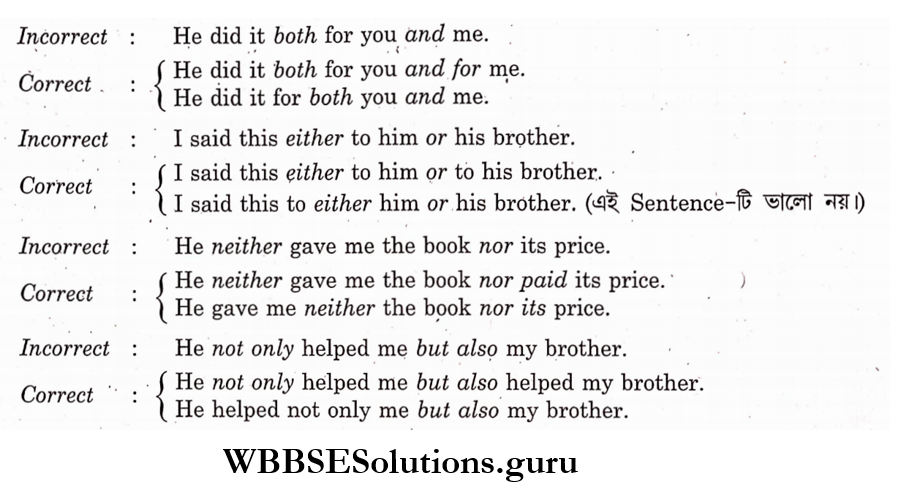
  • Each member of the Correlatives “both-and”, “either-or”, “neither-nor”, and “not only-but also” should be followed by words of the same class.
  • (Correlatives-এর উভয় অংশের পরই একই জাতীয় part of speech বসে।)

Look at the following sentences:

WBBSE Solutions For Class 9 English Functional Grammar Chapter 17 Correlatives correlatives

In the first sentence, ‘both’ is followed by a preposition and ‘and’ by a pronoun. This is wrong.

The correct form should be to put Preposition ‘for’ after ‘both’ and ‘and’.

Or, the preposition ‘for’ may be put before ‘both’ and then pronouns ‘you’ and ‘me’ placed after ‘both’ and ‘and’.

In the second sentence, if either is followed by a preposition ‘to’, ‘or’ should also be followed by the preposition, ‘to’.

Or, ‘to’ may be placed before ‘either’, ‘either’ and ‘or’

should be Followed by the same type of Parts-of-Speech (Pronoun and Noun).

In the third sentence, ‘neither’ should be followed by the verb ‘gave’ and ‘nor1 by the verb ‘paid’. Or, the verb ‘gave’ may be put before ‘neither’, and the nouns ‘book’ and ‘price’
placed after ‘neither’ and ‘nor’ respectively.

WBBSE Solutions For Class 9 English Functional Grammar Chapter 21 Spelling

Chapter 21 Spelling

1. Monosyllables ending -l, with a single vowel before it, have -11 at the close:

  • fill,
  • well,
  • tell,
  • till,
  • full.

2. Monosyllables ending in-l, with a double vowel before it, have only one-l at the close:

  • Tail,
  • Well,
  • Feel

WBBSE Solutions For Class 9 English Functional Grammar Chapter 21 Spelling

3. Monosyllables ending in-ll drop the final-l only before suffixes beginning with a consonant (except-ness), but not before those beginning with vowels:

  • Well —Welcome;
  • Full—Fulfill, Fulsome;
  • But Ill—Illness;
  • Still—Stillness;
  • Will-—Willing;
  • Fill— Filling-,
  • Hill —Hillock.

Read And Learn More WBBSE Class 9 English Functional Grammar

4. Monosyllables ending in-ll drop the final-l when they are used as suffixes:

  • Roll —Enroll;
  • Fill—Fulfill.

Exceptions: A few monosyllables retain the-ll;

  • Call: roll-call.
  • Fall: rainfall, downfall.
  • Well: farewell, unwell.

5. The final is dropped before a suffix beginning with a vowel:

  • Leave—Leaving;
  • Give—Giving;
  • Cure—Curable;
  • Move—Movable.

But, move—movement; tire tiresome.

WBBSE Solutions For Class 9 Fundamentals Of HistoryWBBSE Class 9 English Functional Grammar
WBBSE Class 9 Fundamentals Of History Long Answer QuestionsWBBSE Class 9 English Reading Skill
WBBSE Class 9 Fundamentals Of History Short Answer QuestionsWBBSE Class 9 English Writing Skill
WBBSE Class 9 Fundamentals Of History Very Short Answer QuestionsWBBSE Class 9 Maths Multiple Choice Questions
WBBSE Class 9 Fundamentals Of History Multiple Choice QuestionsWBBSE Solutions For Class 9 Maths
WBBSE Notes For Class 9 Geography and Environment


Exceptions:—But the finale is retained :

In words ending in-ce, -ge before suffixes beginning with a, o, u, if the soft sound is to be retained :

  • Service —serviceable;
  • Marriage—marriageable;
  • Courage—courageous.
  • But practice—practicable.

We, however, write singeing and swingeing to distinguish the words from singing, and swinging.

– In words ending in -ee, -oe, -ye:

  • Agree—agreeable,
  • Agreeing; hoe—hoeing;
  • Dye—dyeing; eye—eyeing.
  • But free—freer.

Monosyllables ending in-ie, change -ie into y before-mg:

In many words

  • Die—dying;
  • Lie—lying.

s before-able to show that the root vowel has a long sound: sale —saleable.

6. The finale is retained before suffixes beginning with a consonant:

  • Care —careful,
  • Dare—darkness,
  • Incite—incitement,
  • Free—freedom.

But the finale is dropped in words ending in -age, -le, -ue, -we: judge—judgment, whole—wholly, true—truly, awe—awful.

7. Monosyllables ending in a consonant, with a single vowel before it double the consonant before a suffix beginning with a vowel:

  • Get—getting;
  • Sin—sinner; hit—hitting;
  • God—goddess.
  • But good—goodness;
  • Sin—sinful; god—godlike;
  • Troop—trooper;
  • Sleep—sleepy.
  • We, however, have wool—woolen.

8. Words of more than one syllable ending in a consonant with a single vowel before it doubles the final consonant before a suffix beginning with a vowel if the accent is on the last
syllable:

  • Commit —committee;
  • Refer—referring;
  • Omit—omitting;
  • Repel—repelled.

Many words ending in-l, though not accented on the last syllable, double the final-l:

  • Travel—traveler, traveled;
  • Jewel—jeweler.

But, unparalleled, worshipper, worshipped, etc.

9. Words ending in-y changeÿ into-i before all suffixes except-ous, only when they is

  • Preceded by a consonant:
  • Dry—dried (but, dryness);
  • Deny—denial;
  • Hoary—hoariness-,
  • Gloomy—gloomier, gloominess;
  • Beauty —beautiful (but, beauteous).
  • But boy—boyhood, boyish;
  • Valley;—valleys.

WBBSE Solutions For Class 9 English Functional Grammar Chapter 19 Synthesis Or Joining Of Sentences

Chapter 19 Synthesis Or Joining Of Sentences

Joining or Synthesis (=putting together) means the combination of a number of sentences into one new sentence-simple, complex, or compound.

The following are the chief ways of combining two or more Simple Sentences into one Simple Sentence:-

By using a Participle:

1. He saw me come. He ran away.-Seeing me come, he ran away.

2. He was tired. He rested for a while-Being tired, he rested for a while.

3. The ancient Britons had long been disused to war. They were easily defeated by the Saxons. Having been long disused to war, the ancient Britons were easily defeated by the Saxons.

4. The workmen saw the approach of a violent dust storm. They took shelter in a hut- Seeing the approach of a violent dust storm, the workmen took shelter in a hut.

5. The hunter feared the lion. So, he climbed up a tree. Fearing the lion, the hunter climbed up a tree.

Read And Learn More WBBSE Class 9 English Functional Grammar

6. They were tired of the long journey. They went to a nearby hotel for rest.-Being tired (Tired) of the long journey, they went to a nearby hotel for rest.

7. We were utterly exhausted. We fainted on the ground. Utterly exhausted, we fainted on the ground.

8. The Prime Minister addressed the meeting. He asked for everybody’s cooperation.

The Prime Minister addressed the meeting asking for everybody’s cooperation:

WBBSE Solutions For Class 9 English Functional Grammar Chapter 19 Synthesis Or Joining Of Sentences

By using an Infinitive:

1. He has many sons. He has to educate them. He has many sons to educate.

2. He is very weak. He cannot walk. He is too weak to walk.

3. Srila is going home. She is going there to see her mother. Srila is going home to see her mother.

4. Everyone should be honest. Our country expects it. Our country expects everyone to be honest.

5. We shall remove the bench. That will make room for more people. We shall remove the bench to make room for more people.

6. I have bought some oranges. Their taste is sweet.-The oranges I have bought are sweet to taste.

WBBSE Solutions For Class 9 Fundamentals Of HistoryWBBSE Class 9 English Functional Grammar
WBBSE Class 9 Fundamentals Of History Long Answer QuestionsWBBSE Class 9 English Reading Skill
WBBSE Class 9 Fundamentals Of History Short Answer QuestionsWBBSE Class 9 English Writing Skill
WBBSE Class 9 Fundamentals Of History Very Short Answer QuestionsWBBSE Class 9 Maths Multiple Choice Questions
WBBSE Class 9 Fundamentals Of History Multiple Choice QuestionsWBBSE Solutions For Class 9 Maths
WBBSE Notes For Class 9 Geography and Environment


7. Some more meetings will be held. I shall attend them I have more meetings to attend (that will be held).

8. She is very ill. She cannot bear the strain of a long journey-She is too ill to bear the strain of a long journey.

9. I was overwhelmed with joy. I could not utter a single word-I was too overwhelmed with joy to utter a single word.

By using an Adverb or an Adverbial phrase

1. He failed. It was unfortunate. Unfortunately, he failed

2. He returned home. It was an evening at the time. He returned home in the evening.

3. He went there once more. His going did not produce any result. He went there once more but with no result.

4. The Germans were proud. This ruined them.-The Germans were ruined because of their pride.

5. He was demoralized. His demoralization was total. He was totally demoralized.

6. He has no patience. So, he failed. He failed for want of patience.

7. The letter came. It was most unexpected. Most unexpectedly, the letter came.

By using an Absolute Phrase:

1. The sunset. We began our march. The sun had set we began our march.

2. The dinner was over. We left the place.-Dinner (being) over, we left the place.

3. The match was over. They left for home. The match (being) over, they left for home.

4. The sun rose. The fog disappeared. The General was determined to delay no longer.

He gave orders to soldiers to march forward. The fog having disappeared at sunrise the General, determined not to delay any longer, gave order to soldiers to march forward.

5. The teacher was absent. So, there was no English class today. The teacher was absent, and there was no English class today.

6. God may will. We shall then have a prosperous year.-God willing, we shall have a prosperous year.

7. Weather may permit. We shall have a big party outside.-Weather permitting, we shall have a big party outside.

By using a Noun or a Phrase in Apposition:

1. Akbar was the Emperor of India.

He was one of the greatest kings of his time.- Akbar, the Emperor of India, was one of the greatest kings of his time.

2. Delhi was once the capital of India. It has regained the honour.-Delhi, once the capital of India, has regained the honor.

3. Sunil Gavaskar broke many records. He was the captain of the Indian Cricket team.- Sunil Gavaskar, the former captain of the Indian Cricket team, broke many records.

4. Gargi is my sister. She is now in England.-Gargi, my sister, is now in England.

5. Mr Dutta is my neighbor. He is a Professor in Botany.-Mr Dutta, my neighbor, is a Professor in Botany.

By using a Preposition with a Noun or a Gerund:

1. He came. You had already left.-He came after your departure.

2. He worked very hard. He did not sleep-He worked very hard without sleeping.

3. I helped him with money. This proved my love for him.-I proved my love for him by helping him with money.

4. He wrote for five hours. Then he took some rest. After writing for five hours, he took some rest.

5. They went by bus. At last, they could reach the station. They could reach the station at last by going there by bus.

6. The boy stood on the deck for hours. He did not move. He did not speak-The boy stood on the deck for hours without moving or speaking.

7. He gave up his claim. He won everybody’s respect. He won everybody’s respect by giving. up his claim.

8. I have just retired. I served for 30 years. After serving for thirty years, I have just retired.

Conversion of two or more Simple sentences into a Single Complex Sentence.

Two or more Simple Sentences may be combined into a Single Complex Sentence in any of the following ways:

By using a Noun Clause :

1. He is ill. It is known to all-That he is ill is known to all. Or, It is known to all that he is ill.

2. He has come. We know it. We know that he has come.

3. He did it. I do not know how. It is true. It is true that I do not know how he did it.

4. They live in some place. We do not know it.-We do not know where they live.

5. Is there anything in the box? I only want to know it. I only want to know if there is anything in the box.

6. You are an idiot. That complicates the issue. That you are an idiot complicates the issue.

7. He is laughing. Nobody knows the reason. Nobody knows (the reason) why he is laughing.

8. The boy will pass. He will pass with distinction. Everybody knows it-Everybody knows that the boy will pass with distinction. Or, That the boy will pass with distinction is known to everybody.

By using an Adjective Clause:

1. This is the girl. She stood first in the examination. This is the girl who stood first in the examination.

2. I have lost the book. You gave it to me. I have lost the book you gave me.

3. There were a few boys there. One of them threw stones at the dog. It had entered the garden-One of the boys who were there threw stones at the dog that had entered the garden.

4. The postman knocked at the door. The postman came with letters.-The postman who knocked at the door came with some letters.

5. We have a noble heritage. We cannot indulge in violence. We who have a noble heritage cannot indulge in violence.

6. Rabindranath was born in Jorasanko. It is in Calcutta.-Rabindranath was born at Jorasanko which is in Calcutta.

7. The food was very good. It was cooked by my sister.-The food which / that was cooked by my sister was very good.

8. A writer should write clearly.

You must acquire the command.-You must acquire the command of clarity that a writer must have.

By using an Adverbial clause:

1. You are pardoned. You have confessed your crime.-As you have confessed your crime. you are pardoned.

2. I may grant you your prayer. You shall have to ask for it. I may grant you your .ver if you ask for it.

3. He is rich. I was in difficulty. He did not help me.-Though he is rich, he did not help me when I was in difficulty.

4. He could lend me the money. I was in great distress. I asked him for money. He did not lend me any. As I was in great distress, I asked him for money which he could lend but declined.

5. The storm broke out in the evening. We lost our way in the jungle. We lost our way in the jungle in the evening when the storm broke out.

6. She worked overtime. She intended to complete the job before December-She worked overtime in order to complete the job before December.

7. We shall reach the meeting place. Thereafter the meeting will start. We shall reach the meeting place before the meeting starts. Or, The meeting will start after our arrival there. 8. Bintu is competent. You are competent.-You are as competent as Bintu.

Conversion of Several Simple Sentences to a Compound Sentence.

Several Simple Sentences may be converted to Compound Sentences with the help of Co-ordinating conjunctions in the following ways:

1. Amal reads in this school. Barun reads in this school-Amal and Barun read in this school.

2. He is poor. He is honest. He is poor but (yet, still) he is honest.

3. You must read. You will fail. You must read, otherwise, you will fail.

4. Run fast, you will miss the bus.-Run fast or you will miss the bus.

5. He was not sincere. He could not succeed. He was not sincere, so (consequently) he could not succeed.

6. He passed. His brother failed. He passed while (whereas) his brother failed.

7. You are guilty. I pardon you this time. You are guilty; however, I pardon you this time. 8. I do not like him. He is a wicked boy. I do not like him, for he is a wicked boy.

WBBSE Solutions For Class 9 English Functional Grammar Chapter 18 Concord Or Agreement

Chapter 18 Concord Or Agreement

Concord or agreement usually means the agreement between the Subject and the Verb.

1. A verb must agree with its subject in number and person; such as He is ill; I am happy; They were happy.

2. The Error of Proximity-The verb is sometimes made, through mistake, to agree in number with a noun or pronoun near it, instead of with its subject.

This should be guarded against অনেক সময় verb-এর number তার প্রকৃত subject অনুযায়ীনা লিখে নিকটবর্তী noun বা pronoun অনুযায়ী লেখা হয়, এটা ভুল।

One of them was (not, were) present there. The best of the boys has (not, have) got a prize. The presence of so many men is encouraging. Each of the girls is clever.

Read And Learn More WBBSE Class 9 English Functional Grammar

3. The Common Noun following one of them should be in the plural number.

He is one of the best boys (not, a boy). One of the men (not, a man) gave me the book. Lend me one of the pens.

One of, followed by a plural noun or pronoun and relative clause, often leads to error because it encourages a singular verb:

He is one of those people who is never satisfied with his job. This is one of the buildings that was destroyed in the earthquake. The antecedent of who and that is not one, but persons and buildings respectively.

It is therefore plural. The corrected sentence would be He is one of those people who are never satisfied with their job.

WBBSE Solutions For Class 9 Fundamentals Of HistoryWBBSE Class 9 English Functional Grammar
WBBSE Class 9 Fundamentals Of History Long Answer QuestionsWBBSE Class 9 English Reading Skill
WBBSE Class 9 Fundamentals Of History Short Answer QuestionsWBBSE Class 9 English Writing Skill
WBBSE Class 9 Fundamentals Of History Very Short Answer QuestionsWBBSE Class 9 Maths Multiple Choice Questions
WBBSE Class 9 Fundamentals Of History Multiple Choice QuestionsWBBSE Solutions For Class 9 Maths
WBBSE Notes For Class 9 Geography and Environment


This is one of the buildings that were destroyed in the earthquake.

One in ten boys is in default. Two in ten boys are in default. When an Infinitive, a Gerund, a Verbal Noun, a Clause, or a Phrase is the subject, the verb is in the third person singular.

To err is human. Swimming is a good exercise. Writing letters well is not easy. That he is ill is known to all. Success at any cost was his aim. What he says is not right.

4. When a Collective number is meant, the noun, though plural in form, has a singular verb: Fifty rupees is enough for me: Hundred cents make one dollar.

5. Three miles is a long distance. Eight rupees was the price of the thing. But “Twice two is four” and “Twice two are four” are equally correct-MEU under is, sec.

“In the type, five times five is/are twenty-five, either is or are is correct”-MEU.

6. The name of a thing or a country, though plural in form, takes a singular verb: The United States of America is a rich country. The Folk Tales of Bengal is a good book.

7. Use of “there is” / “there are”.

WBBSE Solutions For Class 9 English Functional Grammar Chapter 18 Concord Or Agreement

Care should be taken about the use of the number in sentences beginning with the introductory “there’.

‘There is used when referring to something singular; as There is a big tree near my house. When referring to something plural, use there are; as There are many good schools in the town.

Errors sometimes occur in longer sentences; such as, There is my friend Rakesh, my parents, and Uncle Subhas helped me. What is being referred to here is plural (friend Rakesh, parents, and uncle Subhas) and the sentence should start with there are.

8. Two or more singular subjects joined by and, expressed or understood, take a verb and a pronoun in the plural. একাধিক singular subject যদি and দ্বারা যুক্ত হয় তবে তাদের verb ও pronoun plural village.

Ram and Shyam were there, but they did nothing. She and her father have gone to their.

Exceptions: If the subjects denote the same person or thing (and গুলি যদি একই ব্যক্তি বা বস্তুকে বোঝায়।) the verb and the pronoun should be singular: Subject-

“The Secretary and Treasurer have come”-Here the same man is both Secretary and Treasurer.

If two different persons were meant, the article would have been repeated before “Treasurer” and the verb would have been having.

When the subjects express a single idea (and দ্বারা যুক্ত noun-গুলির সমন্বয় যদি একটি মাত্র ) the verb and the pronoun are singular:

The long and the short of the story is this. A hue and cry was raised.

Slow and steady wins the race. Bread and milk is his only food. All coming and going was forbidden.

When each, every, or no is put before each noun (and n-গুলির প্রত্যেকটির noun- each, every no ), the pronoun and the verb should be singular: “Each man and each woman gets a shilling’, ‘Every star and every planet is the handiwork of God’. ‘No friend and no relative care for me.’

Even when each or everyone is not repeated, the verb is singular.

Every man, woman, and child was killed-MEU. p. 24. “Every Tom, Dick, and Harry plays golf nowadays.”-Good English by G. H. Vallins.

When and is followed by a negative word as no, not, the verb and the pronoun should be of the same number as the noun or pronoun preceding and (and-no বা not থাকে তবে verb ও pronoun-গুলি and-পূর্ববর্তী noun বা pronoun অনুযায়ী হয়)

‘A friend and not a foe, greet you.’ “Two pens only, and no book, are required.

9. When a noun or pronoun is joined with another noun or pronoun by with, together with, or as well as, the verb agrees with the noun or pronoun preceding these (with, together with বা as well as দ্বারা কোন noun বা pronoun যুক্ত হলে verb বা pronoun-টি এই কথাগুলির পূর্ববর্তী noun বা pronoun অনুযায়ী হবে) :

‘Ram, with (or together with) his friends, was punished’. “They, with their father, were punished.”

“I, with my brother, am to go’, ‘Ram as well as his friends is expected.

But it is better to avoid such constructions.

10 Singular subjects joined by or, either- or, neither-nor, take singular verbs and pronouns (or, either-or, neither-nor singular subject-4 pronoun বসে). singular verb

Ram or Shyam has to go there. Either he or his brother is guilty and must suffer for his misdeeds. Neither he nor his brother is guilty.

When subjects of different persons are joined by either-or, neither-nor, the verb agrees with the subject nearest to it (either—or, neither-nor persons-এর হয় তবে verbটি নিকটতম subject অনুযায়ী হয়।); subject Either he or I am to blame.

Neither he nor you are guilty. Either he or they are guilty.

12. When subjects are joined by not only…. but also, the verb agrees with the subject nearest to it.

Not only he but also his brothers are in trouble. Not only his books but also his money bag was stolen.

13. The Relative Pronoun agrees in number, gender, and persons with its antecedent:

I who is your leader command you. This is the lady who has lost her ring. Those who are guilty shall be punished. He was one of the best boys that were seen there.

It is useless to me who has left the world.

14. The anticipatory It is used for masculine or feminine or neuter nouns, both singular and plural; but the verb is singular :

It was I (or, you, or he or she, or they) that did it. It was these books that I wanted. Also, note :

It is I who have made this house. It is Ram who has helped me. It is they who teach the poor boys in their spare time.

15. Adjectives of different degrees cannot be joined by and:

Incorrect: He is the strongest and very tall boy in the class.
Correct: He is the strongest and tallest boy in the class.
Incorrect: This town is more populous and very prosperous.
Correct: This town is more populous and more prosperous.

This town is very populous and very prosperous.

16. When objects of the same class are compared (একই জাতীয় জিনিষের মধ্যে তুলনা ), other should he inserted after any, all or no to show the exclusion or separation.

Incorrect- Correct

  • He is better than any boy in the class.- Any other boy
  • No boy goes good as he.- No other boy
  • The tiger is fiercer than all animals.-All other animals
  • No animal is so fierce as the tiger.- No other animal
  • He was wiser than all men.- all other men
  • No man was so wise as he.-No another man.
  • But in comparison by superlatives other is not used;
  • Correct any other boy no other boy all other animals no

He is the best of all the boys (not, all the other boys). The Himalayas are the highest of all mountains.

17. Each and every are followed by a singular number. In phrases like every three hours, every group of.

Every man must do his duty. Each of the boys was given a cup.

Two Singular subjects preceded by each or every, even though connected by and, take a singular verb:

Each man and each woman was given a prize. Every student and every teacher is responsible for the good name of the class.

When the antecedent is plural, each is also plural:

The boys each have done their works; we each (they each) have done our (have done their) works.-F. T. Wood.

18. Repetition of the Article: When two or more Nouns are joined by and refer to the same thing, the Article is used only before the first; but if they refer to separate things, the Article should be repeated before each.

The Secretary and the Treasurer have done this (two separate men). The Secretary and Treasurer have done this (one and the same man).

WBBSE Solutions For Class 9 English Functional Grammar Chapter 20 Punctuation

Chapter 20 Punctuation

In writing, it often becomes necessary to divide different parts of speech in such a way as to make their meaning clear by means of certain points or stops, or marks.

Punctuation means the proper use of these points, stops, or marks in writing.

The principal punctuation marks or stops are:

  • Comma—,
  • Semicolon—;
  • Colon—:
  • Full stop or Period —.
  • Note of Interrogation —?
  • Note of Exclamation—!

Read And Learn More WBBSE Class 9 English Functional Grammar

  • Quotation marks “-“
  • Apostrophe —,
  • Dash— –
  • Brackets —()[]
  • Hyphen — ()
  • Parenthesis— “()”;”-“;”,”
  • Asterisk- *

WBBSE Solutions For Class 9 English Functional Grammar Chapter 20 Punctuation

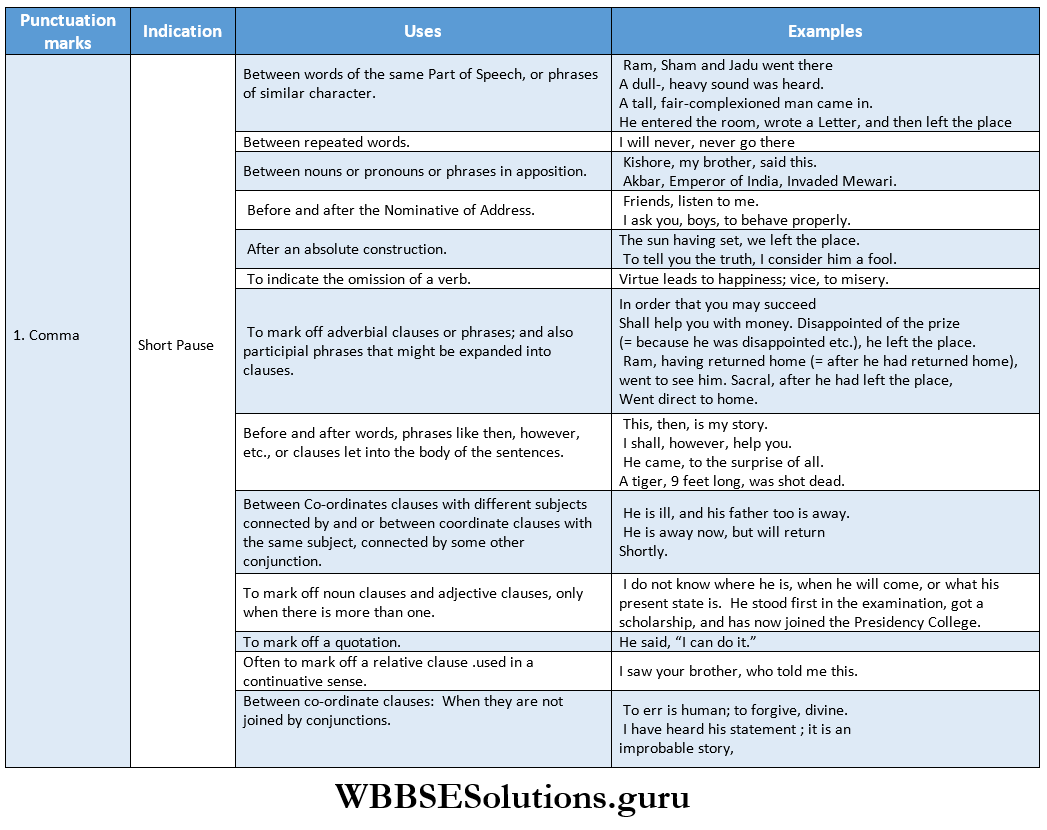
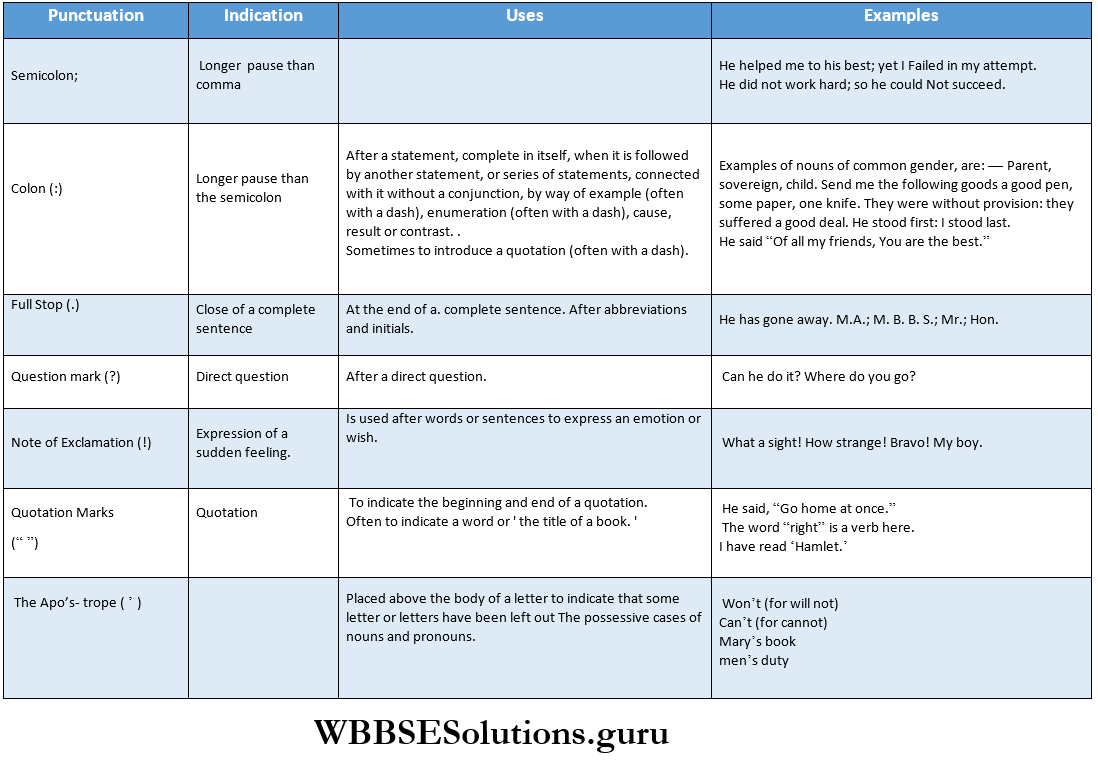
Note the uses of commonly used punctuation marks with examples:

WBBSE Solutions For Class 9 English Functional Grammar Chapter 20 Punctuction punction marks

WBBSE Solutions For Class 9 English Functional Grammar Chapter 20 Punctuction punction marks.3-6

But when only two words or phrases of the same character are joined by and, the is not required:— Ram and Shyam went there.

WBBSE Solutions For Class 9 English Functional Grammar Chapter 20 Punctuction punction marks9

Question 1. what’s the matter my aunt would ask
Answer: “What’s the matter ?” my aunt would ask.

Question 2. Shall I weep she asked and he answered weep
Answer: “Shall I weep ?” she asked. And he answered, “Weep.”

Question 3. Let him in said the mother he is doing no harm
Answer: “Let him in, “said the mother, “he is doing no harm.”

Question 4. Who are you I asked him
Answer: “Who are you ?” I asked him.

Question 5. why don’t you go home now
Answer: “Why don’t you go home now ?”

WBBSE Solutions For Class 9 Fundamentals Of HistoryWBBSE Class 9 English Functional Grammar
WBBSE Class 9 Fundamentals Of History Long Answer QuestionsWBBSE Class 9 English Reading Skill
WBBSE Class 9 Fundamentals Of History Short Answer QuestionsWBBSE Class 9 English Writing Skill
WBBSE Class 9 Fundamentals Of History Very Short Answer QuestionsWBBSE Class 9 Maths Multiple Choice Questions
WBBSE Class 9 Fundamentals Of History Multiple Choice QuestionsWBBSE Solutions For Class 9 Maths
WBBSE Notes For Class 9 Geography and Environment


Question 6.

  1. so did I sir said Morrison
  2. fast and pray yet three days said the angel
  3. shall I ask her she whispered
  4. how happy we were there they said to each other
  5. I do wish people would leave my things alone he would say
  6. I believe the spring has come at last said the giant.

Answer:

  1. “So did I, sir,” said Morrison,
  2. “Fast and pray yet three days,” said the angel
  3. “ShallI ask her ?” she whispered,
  4. “How happy we were there,” they said to each other,
  5. “I do wish people would leave my things alone,” he would say.
  6. “I believe the spring has come at last,” said the giant.’

Question 7. Draw down the blind Jim whispered to my mother they might come and watch outside
Answer: “Draw down the blind, Jim,” whispered my mother, “they might come and watch outside.”

Question 8. Always, remember to use the correct method said the teacher
Answer: “Always remember to use ‘the correct method,” said the teacher.

Question 9. what do you want why are you disturbing me said the lady
Answer: “What do you want ? Why are you disturbing me ?” said the lady.

Question 10. Yesterday in a match between mohun bagan and East Bengal. played at the salt lake stadium the former won by a solitary goal
Answer: Yesterday in a match, between Mohun Bagan and East Bengal, played at the Salt Lake Stadium, the former won by a solitary goal.

Question 11. though he is strong tall and young he is a coward
Answer: Though he is strong, tall, and young, he is a coward.

Question 12. On Monday last my father went to Europe he will return in July
Answer: On Monday last my father went to Europe. He will return in July.

WBBSE Solutions For Class 9 English Reading Skill Lesson 3 Autumn

Lesson 3 Autumn Word Meanings

Para 1

  • fitful (ফিটফুল)- often stopping and starting and not happening in a regular way
  • Gust (গাস্ট)- the strong rush of wind
  • Casement (কেসমেন্ট)- window
  • Mossy (মসি)- covered with moss
  • Elm-tree (এলম্ ট্রী)- a kind of tree like deodar
  • Faded (ফেডেড)- withered
  • Twirling (ট্রায়ার্নিং)- spinning round and round
  • Pane (পেন) – window glass

Read And Learn More WBBSE Class 9 English Reading Skill

Para 2

  • twig (টুইগ)গাছের কচি নরম ডাল- small soft branch of a tree end
  • shut (শাট্)- end
  • eve (ইভ)- evening
  • sparrow (স্প্যারো)- a kind of small bird
  • rig (first)-roof made of straw
  • chirp (চার)- bird’s sound
  • make believe-makes it appear as if
  • flirting by (ফ্লার্টিং বাই)- behaving playfully
  • lap (ল্যাপ)-
  • lie (লাই)- lean or rest

WBBSE Solutions For Class 9 English Reading Skill Lesson 3 Autumn

Para 3

  • curl up (কার্ল আপ্ )- moving upwards forming into ringlets
  • naked (নেকেড) -leafless
  • nestled (নেসেলড্)- settled comfortably
  • cote (কোট)- nest, shelter for birds drab
  • dung-hill (ডাং হিল)- a heap of dung
  • dull (ডাল)- drab
  • the mill (দি মিল)- (here) the windmill
  • heath ( হিথ )- a barren open land
WBBSE Solutions For Class 9 Fundamentals Of HistoryWBBSE Class 9 English Functional Grammar
WBBSE Class 9 Fundamentals Of History Long Answer QuestionsWBBSE Class 9 English Reading Skill
WBBSE Class 9 Fundamentals Of History Short Answer QuestionsWBBSE Class 9 English Writing Skill
WBBSE Class 9 Fundamentals Of History Very Short Answer QuestionsWBBSE Class 9 Maths Multiple Choice Questions
WBBSE Class 9 Fundamentals Of History Multiple Choice QuestionsWBBSE Solutions For Class 9 Maths
WBBSE Notes For Class 9 Geography and Environment


Para 4

  • raven (র‍্যাভেন) – a large crow
  • stubbles (স্টাবল্)-the short stems of reaped corn, remaining in a field after harvesting
  • lea- an open area of land covered with grass
  • acorns- fruits of the oak tree
  • Pattering- making a light tapping sound
  • grunting – pig’s round
  • Scramble- Move Hurriedly

Summary: The poet presents a vivid picture of the countryside in autumn.

The poet loves to observe the sudden wind shaking the casement intermittently all day long and driving away from the mossy elm tree, the withered leaves which ultimately fall down spinning round and round the window pane.

The scene of the dancing twigs in the trees till the evening charms him.

The chirping of the sparrow sitting on the cottage rig makes one believe that spring is near.

Smoke emitting from the cottage curls up through the bare trees. The pigeons nest easily in their cotes, and the cock crows upon the dunghill.

The windmill continues its motion on the open barren field. A stray feather from the raven’s breast falls upon the grassy land full of stems of the harvested crops.

Acorns fall down from the oak tree, and the grunting pigs rush to eat them.

With all these observations, the poet aims at depicting the natural beauty of autumn that gives him great pleasure.

Lesson 3 Autumn Textual Questions With Answers

Tick the correct answer from the given alternatives:

Question 1. All through the day the fitful gust shakes the

  1. Window-pane
  2. Curtains
  3. Casement
  4. Door

Answer: 3. Window-pane

Question 2. The poet loves to see the shaking twig dance till the-

  1. Coming of dawn
  2. End of night
  3. End of afternoon
  4. Shut of eve

Answer: 4. Shut off eve

Question 3. The sparrow sat on the

  1. Cottage rig
  2. House-top
  3. Mossy elm-tree
  4. Casement

Answer: 1. Cottage rig

Question 4. The pigeons nestled around the

  1. Cage
  2. Cote
  3. Branch
  4. Heath

Answer: 2. Cote

Question 5. The cock was crowing upon the-

  1. Dunghill
  2. Lea
  3. Treetops
  4. Mill-sails

Answer: 1. Dunghill

6. The grunting pigs

  1. Walk slowly
  2. Scamper by
  3. Scramble and hurry
  4. Dive and swim

Answer: 3. Scramble and hurry

Answer the following questions within twenty-five words:

Question 1. What happens to the leaves of the mossy elm tree in autumn?
Answer: In autumn the color of the leaves of the elm tree becomes faded. The withered leaves in thousands are driven away by the gusty wind through the window panes down the lane.

Question 2. What are the things the poet loves to see on November days?
Answer: On November days, the poet loves to see the cottage smoke curling upwards through the trees, the pigeons nestling around the cote, the cocks crowing upon the dung hill, and the mill sailing on the barren open land.

State whether the following sentences are in Active or Passive Voice:

Question 1. Anil will visit his grandmother’s house.
Answer: Active voice

Question 2. The President has left his office.
Answer: Active voice

Question 3. The projects will have been finished by the students.
Answer: Passive voice

Question 4. Promita’s leave has been sanctioned by the school authority.
Answer: Passive voice

Change the voice of the following sentences:

Question 1. The boy has read out the letter.
Answer: The letter has been read out by the boy.

Question 2. I shall have bought a cricket bat by tomorrow.
Answer: A cricket bat will have been bought by me by tomorrow.

Question 3. Sohini’s friends had organized a picnic.
Answer: A picnic had been organized by Sohinis’ friends.

Question 4. The football team will put up a brave fight.
Answer: A brave fight will be put up by the football team.

Change the following sentences into indirect speech:

Question 1. I said to him, “Will you share your tiffin with me?”
Answer: I asked him if he would share his tiffin with me.

Question 2. Anjan’s mother said, “Your father has left for Mumbai.”
Answer: Anjans’ mother said that my father had left for Mumbai.

Question 3. The girls triumphantly said, “Hurrah! We have won the match.”
Answer: The girls exclaimed triumphantly that they had won the match.

Question 4. He says, “Let you be successful in life.”
Answer: The captain informed us that the tournament had been postponed the previous month.

Lesson 3 Autumn Examples Worked Out

I love the fitful gust that shakes
The casement all day,
And from the mossy elm tree takes
The faded leaves away,

Twirling them by the window pane
With thousand others down the lane.

I love to see the shaking twig
Dance till the shut of eve
The sparrow on the cottage rig,
Whose chirp would make-believe
That spring was just now flirting by
In summer’s lap with flowers to lie.

Read the above text and answer the following questions.
Tick the correct answer from the given alternatives:

Question 1. The poet loves the

  1. Casement
  2. Elm-tree
  3. The wind
  4. Faded leaves

Answer: 3. The wind

Question 2. The casement is shaken by

  1. The elm-tree
  2. Gusty-wind
  3. Faded leaves
  4. Windowpane

Answer: 2. Gusty-wind

Question 3. The elm tree is covered with

  1. Moss
  2. Snow
  3. Dust
  4. Worms

Answer: 1. Moss

Question 4. The leaves of the elm tree are

  1. Very green
  2. Very bright and colorful
  3. Faded
  4. Fresh

Answer: 3. Faded

Question 5. The poet likes to see the shaking

  1. Flowers
  2. Twigs
  3. Tree
  4. Buds

Answer: 2. Cottage rig

Question 6. The sparrow sits on the

  1. Branch of a tree
  2. Top of the roof
  3. Cottage rig
  4. Woden bar

Answer: 3. Cottage rig

Answer the following questions within fifteen words:

Question 1. What does the fitful gust do?
Answer: The fitful gust shakes the casement all day and takes away the faded leaves from the mossy elm tree.

Question 2. What happens to the faded leaves ultimately?
Answer: The faded leaves twirl by the window pane with other leaves and lie scattered down the lane.

Question 3. What dance does the poet love to see?
Answer: The poet loves to see the shaking twig of the tree dancing till the evening.

Question 4. Where does the sparrow chirp?
Answer: The sparrow chirps sitting on the cottage rig.

Question 5. What does the sparrow’s chirp indicate to the poet?
Answer: The sparrow’s chirp makes the poet believe that spring is coming.

Answer the following questions within twenty-five words:

Question 1. What activities of the wind in autumn does the poet like to see?
Answer: The poet likes to see the autumn wind shaking the casement all day, driving the faded leaves from the elm tree, and making the twig dance till evening.

Question 2. How do the faded leaves fall on the ground?
Answer: The strong wind takes away the faded leaves from the elm tree. These leaves then spin round and round the window pane with many others falling on the ground.

Question 3. What does the chirping of the sparrow indicate?
Answer: The chirping of the sparrow indicates that spring is just flirting in summer’s lap with flowers to lie.

I love to see the cottage smoke Curl upwards through the naked trees, The pigeons nestled round the cote On dull November days like these; The cock upon the dung-hill crowing, The mill sails on the heath a-going.

The feather from the raven’s breast Falls on the stubble lea,
The acorns near the old crow’s nest Fall pattering down the tree; The grunting pigs, that wait for all, Scramble and hurry where they fall.

Read the above text and answer the following questions.

Tick the correct answer from the given alternatives:

Question 1. The smoke comes out from the

  1. The burnt leaves
  2. Cottage
  3. Factory
  4. Forest

Answer: 2. Cottage

Question 2. The November days are

  1. Sunny
  2. Cold
  3. Dull
  4. Bright

Answer: Dull

Question 3. The cock is seen upon a

  1. Tree
  2. Dung-hill
  3. Garbage pile
  4. Cottage roof

Answer: Dung-hill

Question 4. The windmill goes on sailing on

  1. The river
  2. A cornfield
  3. A barren field
  4. A hill

Answer: A barren field

Question 5. The crow has its nest

  1. On the cottage roof
  2. On a dung-hill
  3. In an oak tree
  4. Near a windmill

Answer: 3. In an oak tree

Question 6. The pigs scramble and hurry for

  1. Acorns
  2. The raven’s feather
  3. Oak leaves
  4. Corns

Answer: 1. Acorns

Answer the following questions within fifteen words:

Question 1. What does the poet see coming out of the cottage?
Answer: The poet sees smoke curling out of the cottage through the naked trees.

Question 2. When do the pigeons nestle around the cote?
Answer: The pigeons nestle around the cote on dull November days.

Question 3. What does the cock do sitting on the dung hill?
Answer: Sitting upon the dung hill the cock crows.

Question 4. Where does the windmill sail?
Answer: The windmill sails on the heath in full sweep.

Question 5. What do the grunting pigs do?
Answer: The grunting pigs scramble and hurry to the place where the acorns fall to grab them.

Answer the following questions within twenty five words:

Question 1. What does the poet observe about the cottage, the pigeons, and the cock?
Answer: The poet finds cottage smoke curling upwards through the naked trees, pigeons nestled around the cote, and the cock crowing sitting upon the dung hill.

Question 2. What are acorns and where and how do they fall?
Answer: Acorns are small brown nuts grown in the oak tree. They fall down from the oak tree near the nest of the old crow making repeated tapping sounds.

Question 3. What do the pigs do as the acorns fall?
Answer: The pigs wait for the acorns to fall down from the tree. As soon as the acorns fall, they scramble and hurry to grab them making grunting sounds.

Question 4. What does the poet present in the poem?
Answer: The poet presents a pictorial description of the autumn in the countryside marked by dry falling leaves, bare trees, wind, chirping sparrows, crowing cock, etc. in the fall season.

WBBSE Solutions For Class 9 English Reading Skill Lesson 2 All About A Dog

Lesson 2 All About A Dog Word Meanings

Section-1: (I was travelling……….. said her male companion.)

  • travelling (ট্র্যাভেলিং)- Journeying
  • bitterly (বিটারলি)- Extermly
  • far end (ফার এন্ড- Farthest part
  • Pekinese dog (পিকিনিজ্‌ ডগ- A breed of small dog with flat face and long, soft fur
  • conductor (কন্ডাকটার)- one who collects bus or tarm face
  • fare (ফেয়ার) – Tickect price
  • beady eyed (বিডি আইড্‌) – small eyed
  • opportunity (অপরচুনিটি) – chance
  • intended (ইনটেন্ডেড) – wished
  • make the most of it- take the most advnatage of it
  • marked him as the type – categorized, typed
  • vague (ভেগ)- indistint
  • grievance (গ্রিভান্স)- dissatisfaction
  • particular (পারটিকুলার)- Specific, special
  • shivered (শিভারড)- Trembled
  • certainly (সার্টেনলি) অবশ্যই- surely, definitely
  • evidently (এভিডেন্টলি)- clearly
  • challenge (চ্যালেঞ্জ)- objection
  • order (অর্ডার)- command
  • companion (কম্পানিয়ন) সঙ্গী- accompanying fellow
  • nonsense (ননসেন্স)- meaningless

WBBSE Solutions For Class 9 English Reading Skill Lesson 2 All About A Dog

Section-2: (The conductor pulled fares back”, said the conductor.)

  • brought out (ব্রট আউট)- removed
  • pavement (পেভমেন্ট)-footpath
  • moment of triumph মোমেন্ট অফ ট্রায়াম্প)-victory time
  • on his side- in his favour or support.
  • shameful (শেফুল)- disgraceful
  • report (রিপোর্ট)- make complaint
  • blinking (রিংকিং)- shutting and opening eyes quickly
  • unconscious (আনকনশাস)- unware, ignorant
  • engaged (এনগেজড্)- duty bound

Section-3 : (Two or three passengers have pneumonia the man said.

  • disappeared (ডিঅ্যাপিয়ার্ড)- vanished
  • indifferent (ইন্‌ডিফারেন্ট)- not interested
  • strolled up (স্ট্রোন্ড আপ) – walked leisurely
  • indignant (ইনডিগন্যান্ট) – angry
  • protest (প্রোটেস্ট)- objection
  • appeal (অ্যাপিল) – earnest request
  • genially (জেনিয়ালি)- pleasantly, amiably
  • to and fro (টু এন্ড ফ্রো ) – from this side to that
  • gale (গে)- a noisy outburst
  • threatening (থ্রেটেনিং)- warning, cautioning
  • emptying (এটিইং)- becoming vacant

Section 4: (When she had disappeared. “Good night” quite amiably.)

  • triumphant (ট্রায়ামফ্যান্ট)- winner
  • criticized (ক্রিটিসাইজড্)- faced criticism
  • in his face- directly
  • stole down (স্টোল ডাউন) -came down stealthily
  • put right (পুট্ রাইট)-rapaired
  • struggle (স্ট্রাগল)- Stife, fight
  • declared (ডিক্লেয়ার্ড)- Annoubnced
  • justify (জাস্টিফাই)- To prove to be just, vintage
  • hard and fast (হার্ড এন্ড ফাস্ট) বাঁধাধরা- fixed, infexible
  • guidance (গাইডেন্স)- Instruction, assistance
  • common sense (কমন সেন্স )- Good Sence and proper judgement
  • spirit (স্পিরিট)- main intension , essence
  • letter (লেটার)-Liteal meaning
  • mind (মাইন্ড)- Be care full
  • goodwill (গুড উইল)- Kindness
  • temper (টেম্পার)- attiude
  • amiably (অ্যামিয়েবলি- in a friendly way, Pleasantly

Summary: The story revolves around some passengers of a bus and its conductor.

A young lady carrying her pet dog got into the bus. The conductor collected the fares, but when his eyes fell on the dog, he objected to its presence inside the bus amidst the passengers and ordered the lady to take the dog out.

Read And Learn More WBBSE Class 9 English Reading Skill

Strong refusal from the lady had no effect. The conductor stopped the bus and got down.

The other passengers came in support of the lady and even threatened to report the conductor’s misconduct to the police. They even demanded their fares back.

But the conductor refused to hear them and remained firm in his stand.

WBBSE Solutions For Class 9 Fundamentals Of HistoryWBBSE Class 9 English Functional Grammar
WBBSE Class 9 Fundamentals Of History Long Answer QuestionsWBBSE Class 9 English Reading Skill
WBBSE Class 9 Fundamentals Of History Short Answer QuestionsWBBSE Class 9 English Writing Skill
WBBSE Class 9 Fundamentals Of History Very Short Answer QuestionsWBBSE Class 9 Maths Multiple Choice Questions
WBBSE Class 9 Fundamentals Of History Multiple Choice QuestionsWBBSE Solutions For Class 9 Maths
WBBSE Notes For Class 9 Geography and Environment


A policeman appeared in the scene and the passengers burst out with their complaints against the conductor’s harsh suggestion.

But the police pointed out that the conductor had done nothing wrong.

What he did was the enforcement of the rules. After a lot of hot exchanges, the lady agreed to travel on the rooftop, even though it was extremely cold outside.

The bus started moving. But soon it came to a halt as the engine developed some defects.

It took a long time to set it right. Meanwhile, the lady had come down from the top of the bus steadily and entered the bus.

Hardly had the bus moved when it stopped because the conductor had noticed the lady with her dog inside the bus. Hot altercations started again.

But the conductor remained firm in his decision. Finally, the lady agreed to go to the top of the bus again.

The above episode highlights the objectivity of framing and enforcement of rules made.

Rules are framed for maintaining order and the comfort of the people.

Sometimes rigid application of rules causes trouble for people.

In the present case, it was a cold winter, and the lady carrying the dog was suffering from a cold and cough. The other passengers on the bus did not object to the lady’s carrying the dog in their midst.

On the contrary, they sympathised with the lady and her dog. So the bus conductor could have been a little lenient in enforcing the rule.

But a stickler for rules, the conductor observed the rule in the letter, not in the true spirit.

Lesson 2 All About A Dog Textual Questions With Answers

Tick the correct answer from the given alternatives:

Question 1. The younger woman carried a little

  1. Spaniel
  2. Bull Dog
  3. Pekinese Dog
  4. Spitz

Answer: 3. Pekinese Dog

Question 2. The younger woman was suffering from

  1. Stomach Pain
  2. Back Pain
  3. Fever
  4. Cough

Answer: 4. Cough

Question 3. The bell was pulled by the

  1. Conductor
  2. Driver
  3. Younger Woman
  4. Older Woman

Answer: 1. Conductor

Question 4. The number of policemen to whom the woman
expressed her anger was

  1. Three
  2. Four
  3. Five
  4. Six

Answer: 1. Three

Question 5. The problem the bus faced was with the

  1. Tyre
  2. Engine
  3. Brake
  4. Horn

Answer: 2. Engine

Answer the following questions within fifteen words:

Question 1. How many people got on the bus with the younger woman?
Answer: Two people got into the bus with the younger woman.

Question 2. What was the conductor’s order to the younger woman?
Answer: The conductor ordered the younger woman to take her dog out of the bus.

Question 3. Why did the conductor stand triumphant?
Answer: The conductor ordered the younger woman to take her dog out of the bus.

Question 4. What is the rule which cannot be broken without danger to life and limb?
Answer: The conductor stood triumphant because the lady with the dog ultimately yielded to his order.

Answer the following questions within twenty-five words:

Question 1. When did the author feel that trouble was coming up?
Answer: Taking a dog on a bus was against the rule. So when the conductor noticed the dog of the lady, the author felt that trouble was coming up.

Question 2. Mention two demands made by the passengers when the bus stopped.
Answer: The two demands made by the passengers were to give back their fares or carry them to their destination without leaving them midway all night.

Question 3. How are rules of guidance to be observed?
Answer: The rules of guidance are to be observed in the spirit, not by the letter using one’s common sense and with goodwill and good temper.

In the following sentences, underline the verb forms which show that the person denoted by the subject does something. Circle the verb forms which show that something is done to the subject:

Question 1. She has sung a song.
Answer: She has sung a song.

Question 2. A song has been sung by her.
Answer:  A song has been sung by her.

Question 3. He will draw a picture.
Answer: He will draw a picture.

Question 4. A picture will be drawn by him.
Answer:  A picture will be drawn by him.

Change the voice of the following sentences:

Question 1. Nila has bought a book.
Answer: A book has been bought by Nila.

Question 2. They will have seen the cricket match.
Answer: The cricket match will have been seen by them.

Question 3. Bhola had seen a tiger.
Answer: A tiger had been seen by Bhola.

Question 4. The nurse will attend to the patient.
Answer: The patient will be attended to by the nurse.

Change the voice of the following sentences:

Question 1. Do the sum.
Answer: Let the sum be done.

Question 2. The poem was written by her.
Answer: She wrote the poem.

Question 3. Open the door.
Answer: Let the door be opened.

Question 4. The man is known to me.
Answer: I know the man.

Change the voice of the following sentences:

Question 1. They agreed to my plan.
Answer: My plan was agreed to by them.

Question 2. My brother lost my favourite pen.
Answer: My favourite pen was lost by my brother.

Question 3. The man is writing a letter.
Answer: A letter is written by the man.

Question 4. Titil is looking for her watch.
Answer: Her watch is being looked for by Titli.

Tick the correct alternative given in the brackets:

Question 1. It (rains / has been raining/is raining) since morning.
Answer: Has been raining

Question 2. Last Sunday I (went/had been going/go) to the zoo.
Answer: Went

Question 3. I (will be/was / am) in class X next year.
Answer: Will be

Question 4. Rina (have reached/had reached/has reached) home just now.
Answer: Has Reached

Lesson 2 All About A Dog Examples Worked Out

1. I was travelling on a bus. It was a bitterly cold night, and even at the far end of the bus the east wind cut like a knife. The bus stopped and two women and a man got in together and filled the vacant places.

The younger woman carried a little Pekinese dog. The conductor came in and took their fares.

Then his eye rested on the beady-eyed dog. I saw trouble coming up.

This was the opportunity for which the conductor had been waiting, and he intended to make the most of it.

I had marked him as the type who had a general vague grievance about everything.

He seemed to have a particular grievance against passengers who came and sat in his bus while he shivered at the door.

“You must take that dog out,” he said.

“I shall certainly do nothing of the kind. You can take my name and address,” said the woman. She had evidently expected the challenge and knew the reply.

“You must take the dog but that’s my order.”

“I won’t go on the top of the bus in such weather. It would kill me,” said the woman. “Certainly not,” said her lady companion. “You’ve got a cough as it is.”

“It’s nonsense,” said her male companion.

Read the above text and answer the following questions.

A. Tick the correct answer from the given alternatives :

Question 1. The narrator is travelling in a

  1. Car
  2. Bus
  3. Van
  4. Train

Answer: 2. Bus

Question 2. The number of persons that boarded the bus when it stopped was

  1. Two
  2. Five
  3. Three
  4. One

Answer: 3. Three

Question 3. The night the narrator was travelling was

  1. Slightly cold
  2. Very warm
  3. Rainy
  4. Bitterly cold

Answer: 4. Bitterly cold

Question 4. The conductor came to the passengers to

  1. Collect fares
  2. Show them their seats
  3. Enquire about their destinations
  4. Take care of their comfort

Answer: 1. Collect fares

Question 5. The conductor noticed in the bus a

  1. Dog
  2. Big piece of luggage
  3. Cat
  4. Bag

Answer: 1. Dog

Question 6. The conductor asked the young lady to

  1. Keep the dog under the seat
  2. Take the dog out
  3. To get off the bus
  4. Travel on the roof-tap

Answer: 2. take the dog out

Question 7. The conductor of the bus appeared to the narrator to be

  1. Angry
  2. Aggrieved
  3. Very considerate
  4. Helpful

Answer: 2. Aggrieved

Answer the following questions within fifteen words:

Question 1. How was the weather when the narrator was travelling?
Answer: When the narrator was travelling, it was a bitterly cold night with a biting east wind.

Question 2. Who were the passengers to board the bus when it stopped?
Answer: When the bus stopped, a man and two women got into the bus together and took their seats.

Question 3. What was the young woman carrying with her?
Answer: The young woman was carrying a little Pekinese dog with her when she boarded.

Question 4. What did the bus conductor notice?
Answer: The bus conductor noticed that the young woman was carrying a dog inside the bus among passengers.

Question 5. Why did the conductor have a general grievance against passengers?
Answer: The conductor had a general grievance against passengers because they sat comfortably on the bus while he shivered in the cold at the door.

Answer the following questions within twenty-five words:

Question 1. How was the night during the bus journey?
Answer: The night was bitterly cold during the bus journey. The biting east-end wind was cutting passengers even at the far end of the bus.

Question 2. When did the narrator see that trouble was coming up?
Answer: When the bus conductor collected the fares and noticed the lady’s dog on the bus, the narrator saw that trouble was coming up.

Question 3. What did the narrator think of the bus conductor?
Answer: The narrator marked the conductor as the type who had a general vague gr vance about everything. He would wait for an opportunity and intended to make the most of it.

Question 4. “This was the opportunity for which the conductor has been waiting.”-What was the opportunity?
Answer: It was the opportunity of seeming his enforcing the rule that prohibits carrying a dog inside a bus among passengers

Question 5. What feeling did the bus conductor seem to have particularly against passengers?
Answer: It was the opportunity of showing his authority in enforcing the rule that prohibits carrying a dog inside a bus among passengers.

Question 6. How did the lady react to the conductor’s order?
Answer: The bus conductor seemed to have a grievance particularly against passengers of the bus who came and sat on the seats while he shivered at the door.

2. Two or three passengers got out and disappeared into the night.

The conductor turned on the pavement and went to the driver to have a talk with him.

Another bus, the last on the road, went by. It seemed indifferent to the shouts of the passengers to stop.

A policeman strolled up and looked in at the door. The passengers burst out with indignant protests and appeals.

“Well, he’s got his rules, you know,” he said genially. Then he went away to stand a few yards down the street. There he was joined by two more constables.

Still, the little dog blinked at the lights and the conductor walked to and fro like a captain in the hour of victory.

A woman passenger’s voice rose above the gale, threatening the bus conductor.

But he was cold as the night and hard as the pavement. She expressed her anger to the three policemen who stood up the street watching the drama.

Then she came back, called her companion, and vanished. The bus was emptied.

“I’ll go to the top,” said the young lady with the dog, at last. “You’ll have pneumonia,” the man said.

When she had disappeared up the stairs, the conductor came back and pulled the bell.

The bus went on. He stood triumphant, while his conduct was criticized in his face by the passengers.

Read the above text and answer the following questions.

Tick the correct answer from the given alternatives:

Question 1. The last bus on the road

  1. Stopped
  2. Went by
  3. Broke down
  4. Responded to the shouts of the passengers

Answer: 2. Went by

Question 2. When the passenger saw the policeman strolling up, they

  1. Were very glad
  2. Remained silent
  3. Burst out with protests and appeals
  4. Became panicky

Answer:  3. Burst out with protests and appeals

Question 3. “….. He’s got his rules, you know”-this was said amiably by

  1. The driver
  2. One of the passengers
  3. The policeman
  4. The young lady

Answer: 3. The policeman

Question 4. A woman passenger threatened

  1. The driver
  2. The bus conductor
  3. The policeman
  4. One of the constables

Answer: 2. The bus conductor

Question 5. The conductor was as hard as

  1. Rock
  2. The pavement
  3. Iron
  4. Brick

Answer: 2. The pavement

Answer the following questions within fifteen words:

Question 1. How did another bus respond to the shouts of the helpless passengers?
Answer: The other bus was very indifferent to the shouts of the stranded passengers and did not stop.

Question 2. What did the passengers do when they saw the policeman?
Answer: When the passengers saw the policeman, they burst out in great anger and protested against the conductor and appealed to do something.

Question 3. What did the policeman say about the conductor’s action?
Answer: The policeman told amiably that the conductor had just acted according to law, and had done nothing wrong.

Question 4. What was the attitude of the conductor towards the threats from the angry woman passenger?
Answer: The conductor totally ignored her threats and remained cold as the night and hard as the pavement.

Question 5. What did the agitated woman ultimately do?
Answer: The agitated woman then came back, called her companion and disappeared from the spot.

Question 6. What did the young lady with the dog finally decide?
Answer: The young lady with the dog finally decided to go to the top of the bus.

Answer the following questions within twenty five words:

Question 1. Why did the passengers burst out with anger when they saw the police ?
Answer: The passengers burst out with anger to complain to the police against the bus- conductor for his misbehaviour with the lady carrying the dog.

Question 2. What action did the policeman take against the conductor?
Answer: The police stood by the conductor and declined to take any action against him and then went away a few yards down to join two more constables.

Question 3. What did the man with the young lady worry about her when she decided to go to the top of the bus?
Answer: The man with the young lady was worried that she would have pneumonia as she was already suffering from cough and cold.

Question 4. What did the conductor do when the young lady went to the roof-top along with the dog?
Answer: When the young lady with her dog went to the roof-top, the conductor came back and pulled the bell. The bus then started moving.

Question 5. “He stood triumphant”-Who is he? Why did he stand triumphant?
Answer: ‘He’ here refers to the bus conductor. He stood triumphant because his order prevailed and the lady with the dog was compelled to abide by the rule.

3. Then the bus developed engine trouble and the conductor went to the help of the driver.

It was a long job. Meanwhile, the lady with the dog stole down the stairs and re-entered the bus.

When the engine was put right, the conductor came back and pulled the bell.

There is eye fell on the dog, and his hand went to the bell rope again.

The driver looked round, the conductor pointed to the dog, and the bus stopped.

The whole struggle began all over once again. The conductor walked on the pavement, the little dog blinked at the lights, and the lady again declared that she would not go to the top. and finally went.

The bus was soon empty, and I was the last passenger left behind.

“I’ve got my rules,” the conductor said to me. He had won his victory but felt that he would like to justify himself to somebody.

“Rules,” I said, “are necessary things. Some are hard and fast rules, like the rule of the road, which cannot be broken without danger to life and limb.

But some are only rules for your guidance, like that rule about the dogs.

You can use your common sense here. They are meant to be observed in the spirit, not in the letter, for the comfort of the passengers.

You have kept the rule but broken its spirit. You should mind your rules with a little goodwill and a good temper.”

He took it very well, and when I got off the bus he said “Good night” quite amiably.

Read the above text and answer the following questions.

Tick the correct answer from the given alternatives:

Question 1. The trouble the bus faced was

  1. The problem created by the dog
  2. Extremely cold weather
  3. The problem with the passenger
  4. The engine trouble

Answer: 4. The engine trouble

Question 2. The lady with the dog came down the stairs to

  1. Re-enter the bus
  2. Talk with the conductor
  3. Travel by a car
  4. Take back the fares

Answer: 1. Re-enter the bus

Question 3. The conductor went to the help of the

  1. Passengers
  2. Driver
  3. Young lady
  4. The policeman

Answer: 2. Driver

Question 4. When the conductor’s eye fell on the dog, he pulled the bell rope to

  1. Start the bus
  2. To stop the bus
  3. To draw the young lady’s attention
  4. To draw other passengers’ attention

Answer: 2. To stop the bus

Question 5. The lady declared that

  1. She would go to the top of the bus
  2. The dog would remain on the roof-top
  3. She would not go to the top of the bus
  4. She would complain against the conductor

Answer: 3. She would not go to the top of the bus

Question 6. The last passenger remaining in the bus was

  1. The lady with the dog
  2. The dog
  3. The narrator
  4. The male companion of the lady

Answer: 3. The narrator

Question 7. The conductor tried to justify

  1. Himself
  2. The driver
  3. The lady with the dog
  4. Policeman

Answer: 1. Himself

Answer the following questions within fifteen words:

Question 1. Why did the conductor go to the driver?
Answer: 

The conductor went to the driver to help him when the bus developed some engine troubles.

Question 2. What did the lady with the dog do when the engine of the bus developed some trouble?
Answer: When the bus developed engine trouble, the lady with the dog stealthily came down the stairs and re-entered the bus.

Question 3. What happened when the conductor spotted the dog again inside the bus?
Answer: The driver pulled the bell rope and the driver stopped the bus again.

Question 4. When did the conductor walk on the pavement again?
Answer: When all the passengers started protesting again, the conductor got down and walked on the pavement.

Question 5. What did the lady with the dog do finally?
Answer: Even after declaring that she would not go to the top, she finally went up to the roof.

Question 6. According to the narrator, how should rules be followed?
Answer: According to the narrator rules should be followed not in the letter, but in the true spirit.

Question 7. Name a rule which cannot be broken without danger to life and limb.
Answer: The rule of the road is a rule that cannot be broken without danger to life and limb.

Answer the following questions within twenty-five words.

Question 1. “It was a long job.”-What was the job referred to here?
Answer: The job referred to here was the job of rectifying the engine trouble that developed. It took a long time for the driver and the conductor to set the engine right.

Question 2. Why did the bus stop even after the engine was repaired?
Answer: The conductor found the dog again inside the bus. So he pulled the bell rope again to stop the bus. The driver stopped the bus immediately.

Question 3. Why did the whole struggle begin all over again?
Answer: The bus stopped. The passengers became irritated and agitated because they were already delayed. So they started shouting and protesting against the bus conductor’s strict attitude.

Question 4. What did the conductor say to justify his action?
Answer: Observing that everybody has criticised him, the conductor said that he had his rules, and it was his bounden duty to enforce those rules. He did nothing wrong.

Question 5. What is the narrator’s opinion of the rule about the dogs?
Answer: The narrator’s opinion of the rule about the dogs is a rule only for guidance, and it should be used with common sense and in true spirit, not in the letter.

Question 6. What was the narrator’s advice to the conductor about observing rules?
Answer: The narrator said that rules are made for maintaining order and comfort to the people. They should be humane and flexible as per situation and are to be observed not in the letter, but in the true spirit with a little goodwill and good temper.

WBBSE Solutions For Class 9 English Reading Skill Lesson 1 Tales of Bhola Grandpa

Lesson 1 Tales of Bhola Grandpa Reading Skill

Reading is of vital importance to anyone learning a language. Like listening. reading is a receptive skill, and only by reading the student can acquire a fair amount of skill in a language.

Through reading texts which are sufficiently interesting in themselves and which are within the students’ range of comprehension, the students can obtain the fullest possible information from the text. Reading is an active skill.

It constantly involves guessing, predicting, checking, and asking relevant questions and topics.

Read And Learn More WBBSE Class 9 English Reading Skill

It is possible to develop a student’s power of inference through systematic practice of reading.

The syllabus in English for Secondary classes lays emphasis on the development of reading and writing skills of the students.

WBBSE Solutions For Class 9 Fundamentals Of HistoryWBBSE Class 9 English Functional Grammar
WBBSE Class 9 Fundamentals Of History Long Answer QuestionsWBBSE Class 9 English Reading Skill
WBBSE Class 9 Fundamentals Of History Short Answer QuestionsWBBSE Class 9 English Writing Skill
WBBSE Class 9 Fundamentals Of History Very Short Answer QuestionsWBBSE Class 9 Maths Multiple Choice Questions
WBBSE Class 9 Fundamentals Of History Multiple Choice QuestionsWBBSE Solutions For Class 9 Maths
WBBSE Notes For Class 9 Geography and Environment


This can be achieved through exhaustive reading of passages of different natures.

WBBSE Solutions For Class 9 English Reading Skill Lesson 1 Tales of Bhola Grandpa

Answering Questions:

Texts on Reading Skills are usually matters taken from newspapers, books on history, geography, literature, science fiction, etc.

Testing of Reading Skills is done mostly through objective-type questions set to check the power of understanding of the students.

When students read any kind of material they must grasp the meaning of what they read.

Such exercises require the students, to write little or no writing at all but require them to concentrate on their reading.

One major change that has been introduced this year in the Reading Seen (Text Based) portion is that the question pattern for this section will be a little different from that of the previous years.

Students will have to answer three different types of questions:

  1. Multiple Choice Type Questions where the correct answer will have to be found out from some given alternatives.
  2. Very Short Answer Type Questions: The answers will have to be written within fifteen words.
  3. Short Answers Type Questions: The answers will have to be written within twenty- five words.
  4. The above guidelines have been followed in all the examples provided in the Reading Seen section.

How to proceed:

  1. Read the whole passage carefully.
  2. Read the passage again and again to grasp the meaning of what has been said in the passage.
  3. Read the questions carefully too. The questions in most cases provide the answers.
  4. Pick out the correct ones through ticks, crosses, drawing arrows, writing a word or a number, etc.
  5. This chapter presents various exercises on reading skills and the students will be well advised to study them carefully.

Lesson 1 Tales of Bhola Grandpa Word Meanings

Para 1-3

  • western end (ওয়েস্টার্ন এন্ড)- last area on the western side
  • overshadowed (ওভার শ্যাডোড)- cast a shadow over something cottage
  • hut (হাট)- Cottage
  • troop (টুপ)- gang, herd
  • festival (ফেস্টিভাল )- Celebration, fair
  • foggy (ফগি)- covered with fog, misty
  • let out a loud wail (লেট আউট চিৎকার করে আর্তনাদ করে এ লাউড ওয়েইল)- ried out in a loud voice
  • surprised (সারপ্রাই)- amazed
  • halted (হল্টেড্)- stopped suddenly
  • enquiry (একোয়ারি) – asking for information
  • revealed (রিভিলম্- made known, disclosed
  • grandson (গ্র্যান্ডসন) -son of one’s son or daughter
  • held on (হেল্ড অন ) – kept holding on to something
  • realize (রিয়েলাইজ) – understand
  • slipped out ( স্লিপড আউট)-failed to grasp
  • continue as before (কন্টিনিউ)-went on going
  • sharp-eyed (শার্প-আইড্‌)- able to notice something quickly
  • Before long- soon
  • cozy (কোজি)- Comfortable and safe
  • shelter (শেল্টার)- a safe refuge

Para 4-6

  • funny (ফানিমজার- amusing
  • incident (ইনসিডেন্ট) ঘটনা- event
  • related (রিলেটেড) বিবরণ দিয়েছিলেন- narrated.
  • excitement (এক্সাইটমেন্ট) উত্তেজনা-a feeling of happiness and enthusiasm
  • pirates (পাইরেটস্) জলদস্যু- sea-robbers
  • burying (বেরিয়িং)-hiding under the earth
  • sand dunes (স্যান্ড-ডিউস্‌) মাটির নীচে পুতেছিল বালিয়াড়ি- heaps of sand formed by the wind
  • seashore (সি শোরস- coast, land along the edge of a sea
  • treasure (ট্রেজার)-valuable wealth
  • howling (হাউলিং)-cry of jackals
  • nap (ন্যাপ)- a short sleep
  • confessed (কনফেসড)-admitted
  • adventure (অ্যাডভেঞ্চার)-daring activity
  • roamed (রোমড্)-wandered about
  • dense (ডেনস্ )-thick
  • sundown (সান ডাউন)-sunset
  • weekly market (উইকলি মারকেট) সাপ্তাহিক হাট-a market that sells once a week
  • growl (গ্রাউল) -roar
  • gaze (গজ)- stare, steady look

para 7-10

  • instantly (ইন্‌স্ট্যান্টলি )-immediately
  • nearby- close
  • circled (সার্কলড্)- moved in a circle
  • settled down (সেটলড্ ডাউন) বসে পড়ল – sat, rested
  • nightfall (নাইটফল) রাত্রি নেমে আসা- the time in the evening when it becomes dark.
  • silent (সাইলেন্ট)- queit
  • beating (বিটিং)-striking repeatedly
  • dawn (ডন)- early morning
  • mound (মাউন্ড) – dune
  • confused, puzzled
  • bewildered (রিউইন্ডারড)- confused, puzzled
  • Secret- mystery
  • Stretching- extending
  • Yawning- opening the mouth wide and expressing tiredness
  • Sense- consciousness
  • Century- one hundred years
  • Forver- for good
  • Lamented- mourned
  • Sigh- breath expressing sadness
  • Breathe- inhale and exhale air to live

Summary: It is the amazing story of Bhola Grandpa who lives with his wife at the western end of the village.

Forgetful by nature, his innate simplicity drags him into several amusing incidents like losing his grandson while returning from a festival.

He walks ahead supposedly holding with a tight grip the hand of his grandson.

The grandson is ultimately found in the shelter of a cow’s belly.

He tells his friends about pirates hiding a box of treasures under the dunes in the seashore.

Immediate searching throughout the night by his friends failing to find out any hidden treasure, Bhola Grandpa confesses his mistake that he had imagined all these in his dream during the midday nap.

His encounter with the Royal Bengal Tiger is equally interesting.

He comes across a tiger on his way home and climbs up a banyan tree and stays there the whole night to save himself.

But in forgetfulness, he dreamily comes down in the morning. To everybody’s utter amazement, nothing happens between him and the tiger.

Finally, when he passes away in his sleep, his wife believes he must have forgotten to breathe.

Lesson 1 Tales of Bhola Grandpa Textual Questions With Answers

Tick the correct answer from the given alternatives:

Question 1. In the bokal tree, there lived

  1. Crows
  2. Monkeys
  3. Tigers
  4. Sparrows

Answer: 1. Crows

Question 2. On the way back from the festival, Bhola grandpa tightly held onto the two fingers of his

  1. Son
  2. Cousin
  3. Grandson
  4. Nephew

Answer: 3. Grandson

Question 3. A gang of pirates was burying a

  1. Large box
  2. Small box
  3. Large bag
  4. Small bag

Answer: 1. Large box

Question 4. Bhola’s grandpa was returning from the

  1. Yearly market
  2. Monthly market
  3. Daily market
  4. Weekly market

Answer: 4. Weekly market

Question 5. Bhola’s grandpa died at the age of

  1. Eighty-five
  2. Ninety-five
  3. Fifty-five
  4. Seventy-five

Answer: 2. Ninety-five

Answer the following questions within fifteen words:

Question 1. When did Bhola’s Grandpa let out a loud wail?
Answer: Bhola’s Grandpa let out a loud wail when he realized that his grandson had slipped out of his hand.

Question 2. Where had the grandson found a cozy shelter?
Answer: The grandson had found a cozy shelter under a cow’s belly.

Question 3. What request did Bhola Grandpa make to the first man he saw on the mound?
Answer: Bhola’s Grandpa requested the first man he saw on the mound to give him some water to drink.

Question 4. How old was Bhola Grandpa’s wife when he died?
Answer: When Bhola Grandpa died, his wife was eighty years old.

Answer the following questions within twenty-five words:

Question 1. Why was no real treasure found under the sand dunes?
Answer: No real treasure was found under the sand dunes because the entire episode of the pirates was dreamt by Bhola’s Grandpa during his midday nap.

Question 2. What did the tiger do after Bhola Grandpa had climbed up the banyan tree?
Answer: The tiger roared and circled around the tree about a hundred times, and finally settled down under a bush without taking his eyes off him.

Question 3. What was the reason for Bhola Grandpa’s death according to his wife?
Answer: Bhola Grandpa’s wife thought that he had died because he was a forgetful man and must have forgotten to take his breath.

Change the mode of narration of the following sentences:

Question 1. Bulbuli said to his friend, “Will you come tomorrow?”
Answer: Bulbuli asked his friend if he would go the next day.

Question 2. Paulami says, “I am fine.”
Answer: Paulami says that she is fine.

Question 3. The teacher said to the students, “Keep quiet.”
Answer: The teacher ordered the students to keep quiet.

Question 4. My mother said to me, “May your dreams come true.”
Answer: My mother wished that my dreams might come true.

Question 5. The students said, “Sir, please allow us to play in the field.”
Answer: The students politely requested their teacher to allow them to play on the field.

Question In each of the sentences of the following passage some articles and prepositions are used in an incorrect manner.

Underline them and replace them with the appropriate ones:

On a winter night, I was aboard a boat. It was a moonlit night full of stars. The boat was anchored up a great river. I was thrilled to see a beauty of nature.

Answer: On a winter night I was aboard a boat. It was a moonlit night full of stars.

The boat was anchored in a great river. I was thrilled to see the beauty of nature.

Lesson 1 Tales of Bhola Grandpa Examples Worked Out

1. Bhola Grandpa and his wife lived at the western end of our village.

A large bokal tree overshadowed their hut. In the Bokal tree lived a small troop of monkeys. Bhola’s Grandpa and his wife did not mind it.

One moonlit night, we were returning from a festival. The road was long and foggy.

I was riding on the village chowkidar’s shoulders. Suddenly, Bhola’s Grandpa let out a loud wail.

Everyone in our party was surprised. We halted. Inquiry revealed that Bhola’s Grandpa had taken his grandson to the festival.

He had tightly held on to the two fingers of the boy. He did not realize when those fingers slipped out. Bhola Grandpa was continuing as before.

Then someone asked Bhola’s Grandpa what he was gripping. He remembered his grandson and let out a loud wail.

My father chose two sharp-eyed men from our party to go back with Bhola Grandpa to the festival. The grandson was found before long. He had taken a cozy shelter under a cow’s belly.

Read the above text and answer the following questions.

Tick the correct answer from the given alternatives:

Question 1. Bhola’s Grandpa and his wife lived in the village’s

  1. Southern Part
  2. Western Part
  3. Eastern Part
  4. Northern Part

Answer: 2. Western part

Question 2. The hut of Bhola Grandpa was overshadowed by a

  1. Banyan tree
  2. Mango tree
  3. Bokal tree
  4. Palm tree

Answer: 3. Bokal tree

Question 3. Bhola’s Grandpa went to the festival with his

  1. Son
  2. Friend
  3. Wife
  4. Grandson

Answer: 3. Wife

Question 4. Bhola Grandpa was returning from a festival

  1. At night
  2. At noon
  3. In the afternoon
  4. In the evening

Answer:1. At night

Question 5. The narrator was riding on the shoulders of

  1. His father
  2. The village chowkidar
  3. Bhola grandpa
  4. A sharp-eyed man

Answer: 2. The village chowkidar

Question 6. When Bhola’s Grandpa realized that he had lost his grandson, he

  1. At once ran home
  2. Let out a shrill cry
  3. Let out a loud wail
  4. Tarted shouting

Answer: 3. Let out a loud wail

Question 7. The narrator’s father chose two men to accompany Bhola Grandpa to the festival

  1. For finding out his grandson
  2. For helping Grandpa with marketing
  3. For searching out the lost pet dog,
  4. To assist Grandpa in the festival’s merriment.

Answer: 1. For finding out his grandson

Question 8. The grandson took shelter

  1. Under a tree
  2. Under a cow’s belly
  3. In a cowshed,
  4. In police custody.

Answer: 2. Under a cow’s belly

Answer the following questions within fifteen words:

Question 1. Where did Bhola’s Grandpa and his wife live?
Answer: Bhola Grandpa and his wife lived at the western end of the narrator’s village.

Question 2. Who lived in the Bokal tree?
Answer: A small troop of monkeys lived in the Bokal tree.

Question 3. When was Bhola’s Grandpa coming back home from a festival?
Answer: Bhola Grandpa and his men were coming back home from a festival on a moonlit night.

Question 4. Why did the people returning from the festival halt on the way?
Answer: People returning from the festival halted on the way when Bhola Grandpa let out a loud wail.

Question 5. What could not Bhola Grandpa realize while returning from the festival?
Answer: Bhola Grandpa could not realize that the boy’s fingers which he had been tightly holding on had slipped out of his hand.

Question 6. How was the road along which the narrator and others were returning from the festival?
Answer: The road along which the narrator and others were returning was long and foggy.

Question 7. “Enquiry revealed that…..”-What did the inquiry reveal?
Answer: Enquiry revealed that the boy had slipped out of Grandpa’s grip and was missing.

Question 8. What happened to the boy ultimately?
Answer: The boy was ultimately found taking a cozy shelter under a cow’s belly.

Answer the following questions within twenty-five words:

Question 1. Give a picture of Bhola’s Grandpa and his wife’s life in the village.
Answer: Bhola Grandpa and his wife lived peacefully at the western end of the village in a peaceful co-existence with a small troop of monkeys living in a bokal tree nearby.

Question 2. Why did Bhola’s Grandpa let out a loud wail?
Answer: Bhola Grandpas was holding on to the two fingers of his grandson while returning from the festival.

Question 3. What does the above incident reveal about Bhola’s Grandpa?
Answer: The above incident reveals that Bhola’s Grandpa was very forgetful in nature. He was continuing to walk as before without noticing that his grandson had slipped out of his hand.

Question 4. How was the missing child found?
Answer: Two sharp-eyed men were chosen to go back to the festival with Bhola Grandpa for finding out the lost child. He was ultimately found taking a cozy shelter under a cow’s belly.

2. I remember another funny incident about Bhola Grandpa related by my father. It had been a rainy afternoon.

Bhola Grandpa, wild with excitement, told my father and his friends that he had seen a gang of pirates.

They were burying a large box under one of the sand dunes on the seashore by our village.

At once Father and his friends started looking for the hidden treasure.

The evening passed on tonight. Moonlight came in through the clouds.

A pack of jackals was howling. It was past midnight. At this point in time, Bhola’s Grandpa confessed that there was no real treasure.

It was all a dream which he had during his midday nap.

Read the above text and answer the following questions.

Tick the correct answer from the given alternatives:

Question 1. Bhola Grandpa told the narrator’s father and his friends that he had seen

  1. A troop of monkeys
  2. Some fishermen
  3. A gang of pirates
  4. A sand dune

Answer: 3. A gang of pirates

Question 2. While telling about the pirates, Bhola Grandpas was very much

  1. Frightened
  2. Excited
  3. Delighted
  4. Angry

Question 3. The pirates were burying a large box under

  1. A tree
  2. A heap of garbage
  3. A sand dune on the seashore
  4. The earth in a forest

Question 4. When the jackals were howling, it was

  1. Past midnight
  2. Dawn
  3. Evening
  4. Midnight

Answer: 1. Past midnight

Question 5. Bhola’s Grandpa saw the pirates

  1. In the moonlight
  2. With open eyes
  3. In his daydreams
  4. With a telescope

Answer: 3. In his daydreams

Answer the following questions within fifteen words:

Question 1. What did Bhola Grandpa tell the narrator’s father and his friends?
Answer: Bhola’s Grandpa told the narrator’s father and his friends that he had seen a gang of pirates.

Question 2. What were the pirates doing?
Answer: The pirates were burying a large box under a sand dune on the seashore by the narrator’s village.

Question 3. When did Bhola’s Grandpa tell the narrator’s father about the pirates?
Answer: Bhola’s Grandpa told the narrator’s father about the pirates on a rainy afternoon.

Question 4. What did the narrator’s father and his friends do on hearing about the pirates?
Answer: On hearing from the Bhola Grandpa, the narrator’s father and his friends started looking for the hidden treasure.

Question 5. What did Bhola’s Grandpa confess at last?
Answer: Bhola’s Grandpa confessed that there was no real treasure. It was all a dream he dreamt during his midday nap.

Answer the following questions within twenty-five words:

Question 1. What did Bhola Grandpa tell the narrator’s father and his friends on a rainy afternoon?
Answer: Bhola Grandpa told the narrator’s father and his friends that he had seen some pirates burying a large box under a sand dune on the seashore by their village.

Question 2. How did the narrator’s father and his friends respond to the story about the pirates?
Answer: On hearing about the pirates and burying of the box, they immediately started a search operation as they thought there might be some hidden treasure in the box.

Question 3. How long did they continue the job?
Answer: They carried on the searching operation for the hidden treasure all through the evening till past midnight.

Once Bhola Grandpa had a great adventure in the Sunderbans. In those days Royal Bengal tigers freely roamed the dense jungles of the Sunderbans.

People took care to move about only in groups, particularly after sundown.

One evening, Bhola Grandpa was returning from the weekly market.

Suddenly at a distance of about five yards behind him, he heard the growl of a Royal Bengal tiger.

Bhola’s Grandpa turned and found the bright gaze of the tiger on his face.

Bhola Grandpa instantly climbed up a nearby banyan tree. The tiger roared and circled the tree about a hundred times.

Then it settled down under a bush without taking its eyes off him.

With nightfall, the forest grew dark and silent. Bhola’s Grandpa could hear the tiger beating its tail on the dry leaves. Hours passed.

Dawn broke with the cooing of doves. Bhola’s Grandpa came down. There was a group of men on a mound a little away.

Bhola Grandpa climbed the mound and requested the first man he saw for some water to drink.

The man had seen the tiger waiting. He was much bewildered. “What is your secret that you simply walked past the hungry beast and it did nothing?” he asked Bhola Grandpa.

The tiger was stretching its limbs and yawning. Then, Bhola’s Grandpa remembered the tiger and looked at it.

Bhola’s Grandpa almost lost his senses in fear. He ran back home.

Half a century later, Bhola Grandpa left us forever one morning at the age of ninety- five.

His eighty-year-old wife lamented much. She said with a sigh, “The old man must have forgotten to breathe.”

Read the above text and answer the following questions.

Tick the correct answer from the given alternatives :

Question 1. In the dense jungles of the Sunderbans roamed freely

  1. The lions
  2. The Royal Bengal tigers
  3. The pirates
  4. The hunters

Answer: 2. The royal Bengal tigers

Question 2. Particularly after sunset, people took care to move about

  1. Only in groups
  2. With arms
  3. Alone
  4. With lights

Answer: 1. Only in groups

Question 3. One evening Bhola’s Grandpa was returning from

  1. A friend’s house
  2. The weekly market
  3. Jatra show
  4. A film show

Answer: 2. The weekly market

Question 4. Bhola’s Grandpa heard the

  1. Voice of some pirates
  2. Roar of a lion
  3. Laugh of some people
  4. Growl of a royal Bengal tiger

Answer: 4. Laugh of some people

Question 5. Seeing the tiger, Bhola Grandpa climbed up a nearby

  1. Mango tree
  2. Banyan tree
  3. Bokal tree
  4. Palm tree

Answer: 2. Banyan tree

Question 6. Question From the tree, Bhola’s Grandpa could hear the sound of

  1. Howling jackals,
  2. The tiger’s beating tail
  3. The tiger snoring
  4. The hunter fires shots

Answer: 2. The tiger’s beating tail

Question 7. The tiger settled down under

  1. The banyan tree,
  2. A bush
  3. The mango tree
  4. The nest of the doves

Answer: 2. A bush

Question 8. Bhola Grandpa came down from the banyan tree

  1. In the afternoon
  2. At night
  3. At dawn
  4. In the morning

Answer: 3. At dawn

Question 9. Bhola’s Grandpa requested the man to give him some

  1. Milk
  2. Food
  3. Water
  4. Money

Answer: 3. Water

Question 10. Bhola’s grandpa died at the age of

  1. Seventy,
  2. Ninety
  3. Ninety-five
  4. Eighty five

Answer: 3. Ninety-five

Answer the following questions within fifteen words:

Question 1. “Once Bhola Grandpa had a great adventure…..”. Where did he have the adventure?
Answer: Bhola’s Grandpa once had a great adventure in the Sunderbans.

Question 2. What type of animals freely roamed in the Sunderban jungles in those days?
Answer: In those days the Royal Bengal tigers roamed freely in the dense jungles of the Sunderbans.

Question 3. When did Bhola’s Grandpa see the Royal Bengal tiger?
Answer: Bhola’s Grandpa saw the Royal Bengal tiger one evening while returning from the weekly market.

Question 4. What did Bhola’s Grandpa do seeing the tiger behind him?
Answer: Immediately upon seeing the tiger, Bhola Grandpa climbed up a banyan tree nearby.

Question 5. What did the tiger do after Bhola Grandpa had climbed up a tree?
Answer: The tiger roared and circled around the tree about a hundred times on seeing Bhola Grandpa climbing up a tree.

Question 6. Where did the tiger settle down?
Answer: The tiger settled down under a bush without taking its eyes off Bhola Grandpa.

Question 7. When did Bhola Grandpa come down the banyan tree?
Answer: Bhola Grandpa came down the banyan tree as dawn broke.

Question 8. Why did Bhola Grandpa climb the mound?
Answer: Bhola Grandpa climbed the mound to request the first man he met for some water to drink.

Question 9. What did Bhola Grandpa’s wife say about his death?
Answer: She said that Bhola’s Grandpa had died because he must have forgotten to breathe while sleeping.

Answer the following questions within twenty-five words:

Question 1. Why would people move about only in groups in the Sunderbans, particularly after sundown?
Answer: The Royal Bengal tigers used to roam freely in the jungles of the Sunderbans. So people took care to move about only in groups-particularly after sundown.

Question 2. What did Bhola Grandpa notice on the mound and what did he do?
Answer: Bhola Grandpa noticed a group of men on a mound a little away. He climbed the mound and requested the man he met first for some water to drink.

Question 3. How could Bhola’s Grandpa escape unheard even though the tiger was present there all through the night?
Answer: Watching Grandpa all through the night might have made the tiger too tired and unmindful. So while it was yawning and stretching its limbs, Bhola Grandpa escaped
unnoticed.

Question 4. How long was Bhola Grandpa alive after the Royal Bengal tiger incident?
Answer: Bhola Grandpa was alive for fifty years after he met the Royal Bengal tiger, and escaped miraculously by climbing up a tree, and then got away unnoticed.

WBBSE Solutions For Class 9 English Writing Skill Letter Writing

Writing Skill Letter Writing

Letters may be divided into the following classes:

Private or Personal letters are those that relate to personal matters concerning the writer and the addressee (ব্যক্তিগত চিঠি — সাধারণত আত্মীয়-স্বজন ও বন্ধুবান্ধবদের নিকট লেখা চিঠি)-

Business or Commercial letters are those that are written by businessmen for business purposes (ব্যবসায় সংক্রান্ত চিঠি ).

Read And Learn Also WBBSE Class 9 English Writing Skill

Official letters are those that are written by persons in their official capacity. They may be strictly official or demi-official.

WBBSE Solutions For Class 9 Fundamentals Of HistoryWBBSE Class 9 English Functional Grammar
WBBSE Class 9 Fundamentals Of History Long Answer QuestionsWBBSE Class 9 English Reading Skill
WBBSE Class 9 Fundamentals Of History Short Answer QuestionsWBBSE Class 9 English Writing Skill
WBBSE Class 9 Fundamentals Of History Very Short Answer QuestionsWBBSE Class 9 Maths Multiple Choice Questions
WBBSE Class 9 Fundamentals Of History Multiple Choice QuestionsWBBSE Solutions For Class 9 Maths
WBBSE Notes For Class 9 Geography and Environment


Social letters are those that are written to invite persons to some ceremonial function, private or public ( সামাজিক অনুষ্ঠানে নিমন্ত্রণের চিঠি).

Letters to the Press are those that are written by members of the public to the editors of newspapers on matters of public interest (সংবাদপত্রে প্রকাশের জন্য চিঠি).

WBBSE Solutions For Class 9 English Writing Skill Letter Writing

The form of a letter may be best understood from the following example:

135, regent Estate,
Kolkata-700092.
28th February 2005

My dear Sushmita,

It is a great pleasure to receive your letter after a long time. I am very glad to learn that you are coming here during the Puja holidays.

It is indeed a piece of good news, for we have not met for a long time.

I have already made plans to enjoy the holiday together. I hope you will appreciate it. More when we meet. I am looking forward to meeting you.

Yours ever,
Sumona

Stamp
Sm. Sushmita Kar,
C/o. Sj Prakash Ch. Kar,
or
(প্রাপকের ঠিকানা)
P.O. Andal,
Dt. Burdwan.
PIN-713321

Specimen Private Letters

1. You have not heard from your brother for a fortnight. Enquire about his health. Also, add that you have done exceptionally well in the last annual examination.

57 College row
Kolkata-700073
14Dec.2007

My dear Brother,

I have not heard from you for a fortnight. Please let me know as early as possible how you are all doing.

The results of the Half-yearly Examination have just been announced.

You will be glad to learn that I have stood first in all the subjects.

Nothing more for the present. I am all right. With best regards to you and your mother, and love for Kutu,

Stamp
Prof. S. C. Kar
P. O. Krishnagar
Dist. Nadia

Yours affectionately,
Subodh

2. Write a letter to your friend who is ill.

2A, ‘B’ Block
Kalyani
5th July, 2006

My dear Santi,

Just came to know that you are down with a fever. I also learnt that the doctor has diagnosed the illness as typhoid.

But don’t be worried, it is not a serious illness now. Many good medicines are available in the market.

You are under the care of Dr. Roy who is a good physician. I am sure you will come round and resume your normal life in two weeks. I hope to see you sometime next week.

With best wishes,

Yours truly,
Dipti

3. Write a letter to your friend inviting him to your birthday party.

P-3/2, Lake Gardens,
Kolkata-700045.
21st Oct. 2006

My dear Sumona,

You will be glad to know that my birthday comes off on 4th November.

I have arranged a small party at our house in the afternoon at about 5 p.m. on that day.

I would earnestly request you to join the party. Nupur, Suchitra, Lila and some other friends have agreed to attend it and I sincerely believe you will also join us.

There will be lots of fun at the party. I am looking forward to seeing you.

Stamp
Sm. Sumona Roy,
C/o Prof. S. L. Roy,
10, R. B. Avenue,
Kolkata-700026.

Yours truly,
Banani

4. Reply to above

  1. Regretting

10, R. B. Avenue
Kolkata-700026
27th Oct. 2007

My dear Banani,

I am very thankful to you for your kind invitation to your birthday party.

But I am sorry to tell you that it would not be possible for me to attend the party, as I shall have to accompany my father that day to my uncle’s place to see my ailing grandfather.

How I wish I could join the party! I shall really miss such an opportunity of having a good time with you all.

I hope you will excuse me for this and will not take me amiss. Wishing you a happy birthday,

Yours ever,
Sumona

  1. Accepting

My dear Banani,

10, R. B. Avenue,
Kolkata-700026.
27th Oct. 2007

Thank you for your letter dated 21st October. I am extremely glad to hear about your birthday party.

How on earth can I afford to miss such a nice occasion? It will be a pleasure to join your birthday party.

I shall certainly reach your place by 4 p.m. on 4th November. Looking forward to seeing you,

Yours ever,
Sumona

5. Your friend has presented you with a fountain pen as a birthday gift. Thank him/her for that lovely present, expecting that it will bring you luck.

Siliguri
2nd March, 2007

My dear Aparna,

I am so glad to receive the Parker pen you sent to me as a birthday gift.

It was very nice of you to have remembered me on my birthday, and still nicer to present me with a wonderful gift with which I am writing this letter.

Every time I write something, my heart always thanks you. Indeed it was a great surprise a golden gift from a close friend like you.

I am overwhelmed by your great affection towards me and I only hope your kind present would bring me luck.

We all missed you badly at the party. Everybody was enquiring about you. Hope we shall meet soon. Please accept my love.

Ever yours,
Snigdha

6. Write a letter to your friend on how you have prepared yourself for the Madhyamik Examination.

Panskura
February 15 2007

My dear Ritesh,

I have not heard from you for a pretty long time. Perhaps this is due to want of time on account of the ensuing Madhyamik Examination.

I am sure your result in this examination will be in keeping with your school record.

For myself, I am not quite satisfied with my preparation. Some time back, I had an attack of influenza which left me very weak.

The result is, I cannot devote much time to my books. This is what is causing much anxiety.

In English particularly I am a bit nervous. Almost the same is the case with Bengali and Mathematics.

As to other subjects, I am not so much in doubt.

I am still very weak. Precautions, however, are being taken against a setback. Pray to God that I may pass through the ordeal smoothly.

With love,

Yours ever,
Santi

7. Write a letter to your brother about the usefulness of reading newspapers.

2, Kabir Road
Kolkata-700026
3rd Feb. 2006

My dear Arun,

Just received your letter. I am glad that you have started following my earlier advice. I now write on another thing-the usefulness of reading newspapers.

These days general knowledge forms an essential part of education. And the newspaper is the best means of acquiring this knowledge.

It keeps us abreast of current events all over the world. Modern newspapers also contain articles on various topics such as arts, science, politics, sports and games, etc.

They are very useful guides to all round knowledge. A man who does not read a newspaper regularly is like one shut up in a cloister.

Ignorant of current topics, he cannot take part in talks and discussions in an enlightened society and seems like a fish out of water in it.

Reading English newspapers will help you in enriching your vocabulary and understand sentence structure.

Armed with up-to-date general knowledge and a command of English, you can easily face the modern world with confidence.

So you must make it a point to read newspapers regularly. Hope this finds you all right. With love,

Yours affectionately,
Sharmila

8. Write a letter to your friend about some of your vain attempts at early rising.

43 B,
Santospur Avenue,
Kolkata-700075.
4th January 2006

My dear Apurba,

How I envy you! By rising at 5 a.m. every day you have an edge of a minimum of one hour over me.

I also tried to follow you but failed miserably. On the first night, I set the alarm clock to wake me up at 5 a.m.

But would you believe it? A cat jumped on the table, overturned the clock and broke it! In my attempt to get up early without an alarm clock, I often woke up too early.

Next, I pulled my cot to the window. At dawn, the first rays of daylight did wake me up all right, but I often felt so sleepy that I had to give it up altogether.

I feel that it is no use going against my nature. I am back to my old ways-getting off the bed at 7 a.m. I just cannot help it.

Hope this letter will find you all right.

Yours truly,
Kabir

9. Write a letter to your brother advising him to give up the habit of smoking which he has picked up recently.

[ Points smoking affects mouth, nose, respiratory organs – lung cancer- high blood pressure, heart diseases-very injurious ]

16, Shyambazar Street,
Kolkata-700003.
12th May 2007

My dear Suman,

I am sorry to learn that you have recently picked up the habit of smoking from some of your friends.

You must remember that smoking is a bad habit and it is injurious to health.

It causes various ailments affecting the mouth, nose and other respiratory organs besides the risk of developing lung cancer.

Heart diseases and high blood pressure are also sometimes caused by smoking.

All these often lead to premature death. You must, therefore, give up this bad habit immediately.

You must know that health is wealth and you should not neglect it.

With best wishes,

Yours ever,
Siddhartha

10. Write a letter to your friend describing the annual sports meet at your school.

P.o. Berhampur,
Dt. Murshidabad.
14th Jan 2006

My dear Pranab,

The annual sports of our school was held on Sunday last at the parade ground.

The sports meet was inaugurated by hoisting the national flag by chief guest Sir A. P. Roy, the District Magistrate.

This was followed by a march-past and a colourful drill display.

Then came the interesting events like 100 m. race, high jump, long jump, relay race, cycle race, etc.

The orange race and sack race for the juniors were the most interesting ones. I took part in the 100 m. race and high jump and came second.in 100 m. race.

There was great excitement among the students. The teachers also encouraged us very much.

The tug-of-war between the students and teachers was enjoyed by all. The teachers won the event. The item go-as-you-like created lots of fun.

The sports meet ended with a special item for the teachers, the musical chair.

The chief guest gave away the prizes. Hope you are keeping well. Please accept my best wishes.

Yours truly,
Joyjit

11. Write a letter to your friend inviting him to join you in visiting Darjeeling after the examination is over.

63, Beadon Street,
Kolkata-700092.
March 4, 2007

My dear Dipak,

Perhaps you will be glad to know that I am planning to visit Darjeeling with my family after the Madhyamik Examination is over. We shall spend a week visiting Darjeeling and some other places like Kalimpong and Mirik.

We shall start on 5th June. I am very much excited about it and would be glad if you also join us.

I have talked with my parents about your joining us and they have readily welcomed you. In fact, they will be too glad to have you with us.

So you need not hesitate to say ‘yes’ to my proposal. Write to me soon. I shall be waiting anxiously to hear from you.

Ever yours,
Sandip

12. Write a letter to your friend giving him / her a description of a cultural function held in your school. You have to use the following points:

[occasion of the function, date, time and place, short description, part played by you your impression.]

Balurghat 16th
Jan 2007

My dear Ashit,

A cultural programme was held in our school yesterday evening on the occasion of its foundation day.

A stage with a large pandal was set up in the school compound.

The school building and the pandal were tastefully decorated with festoons, flags and deodar leaves. A beautiful lighting arrangement was also made.

The programme began with a welcome address by our Assistant Headmaster.

This was followed by songs and recitations by the students. The Rabindrasangeet sung by Shyamal Roy of class IX charmed us all. Then followed the drama, Tipu Sultan.

I played the role of Tipu and won the applause of all. The function ended with a vote of thanks by the headmaster.

The whole function was very enjoyable. Hope you are all right.

Yours truly,
Swapan

13. Write a letter to your friend, giving him a description of an unforgettable incident in your life.

12/1, Regent Estate,
Kolkata 700 092.
3rd March 2010

My dear Partha,

The other day, I met with a serious accident as I was going to school.

While I was crossing the road, a motorcycle trying to overtake a bus hit me and sped away. I fell down on the ground.

I could not get up as I felt a strong pain in my right ankle which was seriously bruised.

It was also bleeding profusely. I felt nervous. A huge crowd gathered soon and they took me to the nearby hospital.

The doctor gave me some injections and plastered my right ankle. I had to rest in bed for one month before I could recover.

The memory of the incident haunts me till now. I was lucky that I could escape death.

I only thank God for this. Hope you are well. With love,

Yours ever,
Sanjay

14. You lent a book to a friend a long time ago but he has not yet returned it in spite of your verbal requests. Ask him politely to return the book explaining to him its urgency.

14, Kalighat Road,
Kolkata-26.

My dear Anjan,

Perhaps you remember, you took the book ‘Autobiography’ by J. L.

Nehru from me when you visited my house a few months back. I guess you have finished reading it by now.

The book actually belongs to my sister Amala from whom I borrowed it. She is coming here soon and I want to return it to her.

I shall be glad if you could return the book early so that I can give it back to her when she visits me next week.

Hope you are keeping well.

Yours ever,
Pranab

15. Write a letter to your foreign friend describing a festival in your country.

135, Regent Estate,
Kolkata-700092,
5th Sept,
2006

My dear Greig,

Hope you are keeping well. You wanted to know about the Durga Puja festival. Well, here it is.

The Durga Puja is the greatest festival of the Bengalees. It is observed once a year in the autumn.

The goddess Durga is the symbol of strength and power and she is worshipped along with her children Luxmi, Saraswati, Kartik and Ganesh.

The idol of Durga shows her as holding weapons in her ten hands and killing the demon. The goddess Durga symbolises the victory of good over evil.

The festival is held for four days with great pomp and splendour. Huge pandals artistically decorated and brilliantly illuminated mark the festival.

Men, women and children, dressed in new clothes, worship the goddess and seek her blessings.

This is also the occasion to meet others and exchange gifts and good wishes. Those who live abroad come home at this time to meet their relatives and friends.

It is really a very happy time for all. The festival ends on the fourth day when the images are immersed in rivers and tanks.

On the occasion of the Durga Puja schools, colleges and courts remain closed for a month.

This is also the occasion when people forget their differences and get together to enjoy the festival with all merriment.

This is undoubtedly the greatest significance of this wonderful festival.

Mr Greig Stanly
24, Kirkwood Irvine
California-92602
U. S. A.

Yours ever,
Santanu

16. You find in newspapers that cholera has broken out in the town of Bankura. Your friend Atanu Das lives there. Write him a letter asking him to take proper preventive measures.

17B, Salkia Road,
Salkia,
Howrah.
4.5.2006

My dear Atanu,

I find in The Statesman today that cholera has broken out in the town of Bankura. If it takes an epidemic form, I am afraid you and your family may fall easy prey to it.

So I’ll request you to take some preventive measures immediately. The first thing you all should do is to take vaccination without delay.

Cholera is a food-borne and water-borne disease. So don’t take any ready food from the open market. Don’t take any food that has remained exposed.

Keep all food-stuffs well covered so that house flies may not sit on them. Always use boiled and chlorinated water.

Maintain the proper sanitation of your surroundings. If you do so, you won’t catch the disease.

I’m sure you will act accordingly. Write to me telling me how you are all doing. With the warmest love,

Yours truly,
Santanu

17. While travelling in a bus you found a bag left by a passenger. There was an address in the bag. It was S. C. Das; 2/11 Duttapukur Road, Bankura.

Now write a letter to this person asking him to collect the bag from you. State when and how he will come. Write within 100 words.

60B, Kabir Road
Kolkata-700026
16th March 2007

Dear Mr Das,

Yesterday while travelling in a route 6 bus I found a bag under my seat.

With your name and address inside the bag, it is my duty to inform you of it. Please come down to my place to collect it.

You may come any day at my above address before 9 in the morning or after 6-30 in the evening.

My house is located just opposite the Southern Market on the main road.

You can reach here by Tollygunge tram or by any bus plying towards Tollygunge.

Yours faithfully,
X

18. Write a letter to your sister telling her about your visit to a place of interest.

Bally,
25 November, 2007

My dear Nupur,

I am just back from my first trip to Agra, and cannot resist the temptation of giving you a brief account of it.

My dream came true when last month our history teacher arranged a trip to Agra for us.

It was 24th October when we reached there. That very afternoon we were to see the famous Taj Mahal.

You can imagine our excitement when we were actually there. It is a masterpiece of architecture-all in marble.

We admired the four mosques with tall slender minarets and the huge central dome. The surroundings lend more beauty to it.

The mausoleum stands in the centre of a big garden with marble water channels, rows of fountains and stately cypress trees.

The tombs of Shah Jahan and his wife lie underneath the dome. We went to see the Agra Fort too.

When Shah Jahan was confined here, he spent his time gazing at the mausoleum of his creation from his prison window.

We saw things that we had read about in our books-the Dewani-i-am, the Diwani-i-khas, the Pearl Mosque and the Sish Mahal.

A visit to a place of historical importance does make history real and interesting.

Indeed, Agra is a unique place, and we enjoyed the visit thoroughly.

I would request you to go there once at your earliest opportunity.

I hope this finds you all quite well.

Yours sincerely,
Rumki

19. Write a letter to your friend telling him what you intend to do if you win the lottery.

“Sree Niketan”
Bose Para
P.O. Konnagar.
24th January 2012

My dear Subir,

Received your letter. It is really an amusing question you have set-what I shall do if I win the lottery?

Well, I never dream of winning the lottery even in my wildest dream. But, here is an answer to your curiosity.

If I win, say rupees two lakh fifty thousand, I shall set apart sums in different headings.

To start with, I propose to hand over 50% of the amount to my father for the welfare of our family.

Ten per cent will be kept in long-term fixed deposits to cover our educational expenses.

I shall hand over 15% to my mother to spend on my sister’s marriage.

Further, I propose to donate 3 to 5% to my needy relatives, and an equal amount to the local club. Another 15% will be reserved for emergencies.

I am now left with barely 10%. Well, perhaps it will not be too selfish if I keep 5% in my bank account and distribute the rest to my sisters equally.

I know very well that my plan to utilise lottery money will remain a distant dream.

Do write to me soon.

Yours ever,
Prabir

Writing Skill Letter Writing Letters to Newspaper

The following points are to be noted:

  • The letter is to be addressed to the Editor
  • The salutation generally is Sir (not Dear Sir)
  • The subscription is Yours faithfully or Yours truly
  • The name and address of the writer should always be given at the end even when they are not intended for publication. No newspaper publishes any anonymous letters.

Specimen

1. Write a letter to the Editor of a popular English daily within 130 words on frequent load shedding and cable faults in your locality.

The Editor,
The Statesman,
Kolkata-700001.

Sir,

Frequent power cuts are now the biggest curse in our daily life. Loadshedding due to a shortfall in power generation or cable faults is a matter of regular occurrence in our locality.

Houses, shops, and factories are affected. The whole industry gets paralysed.

Production hampers and factories run at a loss. Sometimes load-shedding continues for an indefinite period in the evening.

The students are the worst sufferers. They have to struggle with their studies in candlelight or oil lamps, straining their eyes.

The situation calls for immediate actions by the authorities for preventing greater calamities.

Dasnagar,
Howrah.
6th July 2007

Yours sincerely,
Bimal Basu

2. Prices of essential commodities are rising every day. This is affecting all classes of people. Write a letter of complaint to the editor of a newspaper.

To
The Editor,
The Statesman,
Kolkata-700001.

Sir,

Recently prices of essential commodities have gone up by leaps and bounds.

Ordinary rice now sells at Rs. 25, sugar at Rs. 45 and masoor dal and mustard oil at Rs. 70 a kilo.

Potato at Rs. 22 00 and onion at Rs. 4000 have reached an all-time high against the normal rates of Rs. 8 and Rs. 12 respectively.

Spices are scarce, coal and kerosene are out of the market. Medicines have become very dear and stationery goods have also followed suit.

Every item is beyond the reach of common people and there is no apparent reason for this.

It is high time the government took serious measures to bring down the price line of every essential commodity.

63, H.B. Town,
Sodepur.
10th June 2007.

Yours truly,
S. L. Roy

3. You do not like noise from loudspeakers at all hours during festivals. This disturbs you. You cannot sleep at night. Write a letter to the editor of a newspaper about it.

The Editor
The Statesman
Kolkata-700001

Sir,

I wonder how mikes add to the gaiety of our festivals. They blare out nothing but cheap film songs at all hours of the day and night.

As my house is very close to one such Puja pandal, you can imagine how disturbed I feel.

I find it difficult to get a wink of sleep at night. You will agree that after a sleepless night, nobody can do an honest day’s work.

You cannot protest. It will be perhaps against public sentiment. The local rowdies are there to bully you if you do so.

I should like to request every young citizen to be thoughtful and to refrain from using microphones indiscriminately.

23B, Haldarpara Road
Kolkata-700026
October 19, 2006.

Yours truly,
Nripendra Kumar Roy

4. noise pollution is created by an unauthorised factory in a residential area. Write a complaint to the editor of a newspaper.

The Editor,
The Telegraph,
Kolkata-700001.

Sir,

Residents of AD block at Salt Lake, particularly those with cardiac problems, have to contend with the problem of noise pollution created by a fabrication factory set up at AD 478.

This is in violation of the lease agreement that states that only residential buildings are to be constructed on these plots.

No action has been taken by the local civic authorities despite several complaints.

Through your esteemed columns, I would like to draw the attention of the Government to this matter.

2nd Feb 2006

Yours faithfully,
Prakash Sarma
AD 222, Salt Lake
Kolkata-700064

5. Write a letter to the Editor of an English daily complaining against the random cutting of roadside trees.

The Editor
The Statesman
Kolkata-700001

P.O. Panagar
Dt. Burdwan
6th April 2010

Sir,

Of late, there has been a sudden spurt of felling of roadside trees along the Panagar Ilambazar Road in the district of Burdwan.

On enquiry, it is learnt that P.W. D. has taken up widening of the road.

Cutting down trees, therefore, has become necessary. Needless to say that trees are useful and beautiful gifts of nature.

Loss of greenery causes environmental pollution. While widening of the road is welcome, felling of trees should be kept to the minimum.

Care should also be taken to compensate for the loss by planting as many trees as possible in new locations.

Through this column, I would invite the attention of the Government to this aspect of the road widening programme.

Yours faithfully,
A. Roy

6. Write a letter to the Editor of a newspaper about the problem created by polybags.

The Editor
The Times of India
Kolkata-700012

32, Motijheel Avenue
Kolkata-700074
5th January 2006

Sir,

Polythene bags or polyps are used extensively these days to carry food materials, groceries; fish, etc.

While these are very convenient to be used as carry bags, their disposal poses a great problem. Polybags are not bio-degradable. They neither decompose nor decay.

They cannot be destroyed even by burning. Since these are made from toxic chemicals, they are not safe for health.

Dumping them carelessly here and there creates lots of problems.

Drains and gully pits are choked by the thin films. Mixed with soil, they prevent the percolation of air and water into it-thus affecting agriculture.

Instances are there when children covering their heads playfully with polyps died gasping for breadth.

It is therefore high time that the government prohibited the use of polythene bags altogether. The ban should be strictly enforced.

Yours truly,
Sandip Roy

7. Write a letter to the Editor of a newspaper about the necessity of more pay and use of toilets in the city.

[Ponts: very few such toilets much inconvenience for elderly people and ladies, – people are forced to relieve themselves in any place – the municipal body must construct more pay and use toilets.]

The Editor,
The Times of India,
Kolkata-700012.

34, G Block, New Alipore,
Kolkata-700053.
4th February 2007

Sir,

The scarcity of public toilets and urinals creates a lot of inconvenience for the general public.

This is especially so for the ladies and the aged. In the absence of such facilities, people are often forced to relieve themselves by the roadside very much against their wishes.

I appeal to the municipal body to construct a sufficient number of pay and use toilets at important road junctions and parks.

NGOs may also come forward to offer their helping hands in this matter.

It will definitely give much relief to the general public and help in keeping the city sanitised and clean.

Yours truly,
S. Roy

8. Write a letter to the Editor of a newspaper complaining about the condition of the road in your locality.

The Editor
The Telegraph
Kolkata-700001

Patashpur
South 24-Parganas
3rd April 2006

Sir,

We, the residents of Patashpur, South 24-Parganas, shudder to think of the miseries awaiting us in the coming weeks.

The roads in our locality are in horrible condition even in the dry season.

They are full of ruts and potholes. In some places, they are so narrow that even two cyclists can hardly pass side by side.

The roads being non-metallic, they look like pools of water after a shower.

Hardly any repair works are taken up on the roads. In fact, they have become dangerous.

Just think of the unfortunate boys and girls who have to walk some 3 kilometres to attend school.

Sheer disgust and despair have compelled me to write this letter on behalf of the people in this area.

I hope that the authority will look into the matter and arrange to keep the roads in good condition.

Yours sincerely,
Ramen Mandal

9. Write a letter to the Editor of an English daily complaining about the irregular clearance of garbage in your locality by the Municipal Corporation.

The Editor,
The Statesman,
Kolkata-700001.

15, S.P. Mukherjee Rd.,
Kolkata-700026.
2nd July 2010

Sir,

The accumulation of garbages in the entire area near Kalighat Park has created an alarming situation.

Heaps of garbages piled up at the road corners have made life miserable.

The vast open drains, stagnant water in the low-lying areas and uncollected garbages all around have made the locality an ideal breeding ground for mosquitoes and flies.

It smells all around and disruption in the sewage system is feared owing to the accumulation of garbage.

Malaria and other infectious diseases may spread at any time. We have been trying to draw the attention of the local councillor to this insanitary condition, but have failed.

It is high time the authorities took effective measures and cleaned the whole area immediately.

Any further delay will prove to be disastrous.

Yours faithfully,
Sandip Sarkar

10. Write a letter to the Editor of a newspaper on reckless driving in cities and highways.

The Editor
The Statesman
Kolkata-700001

108, M. G. Road
Kolkata-700007
16th July 2007

Sir,

Recently with the increase in the traffic volume, the number of accidents has also increased.

On highways, lorries are a menace to slow-moving vehicles. In cities, buses, taxis and mini-buses are driven at breakneck speed causing much nuisance and terror to children and the old alike.

Hardly a day passes without any serious accident. The death toll is increasing annually mostly due to reckless driving. It seems the man behind the steering has little or no regard for the others.

I feel the police should take immediate steps to stop this hazard.

Yours faithfully,
Partha De Sarkar

11. Write a letter to the Editor of a daily on ticketless travelling.

The Editor
The Statesman
Kolkata-700001

Subhas Palli
P.O.New Barrackpore
24 Parganas,
North 15th September 2006

Sir,

Ticketless travelling has become the order of the day. The offender’s plea for the hike in fare does not hold good.

While some of the offenders are poor, most of them are salary earners.

There are also a few who encourage others not to buy tickets. They feel that travelling without tickets is their birthright.

This causes heavy loss to the railway exchequer. When confronted by the ticket checkers, these offenders do not hesitate to even manhandle them.

This creates lots of chaos and as a result honest and bonafide passengers suffer great inconvenience.

I would urge the authority to deploy more frequent mobile squads to put an end to this malpractice.

Yours truly,
Sushmita Mondal

12. Write a letter to the Editor of a newspaper expressing your reaction to TV programmes and commercial advertisements that have a bad effect on children.

The Editor,
The Telegraph,
Kolkata-700001.

Apsara Bldg.
7B, Lower Circular Road,
Kolkata-700019.
15. 3. 2006

Sir,

It is regrettable that the standard of most TV serials is very poor.

They cannot be enjoyed along with the family members, especially with the children.

Most of the serials do not have any creative message and they are boring.

Crime serials attract viewers for obvious reasons. Many young boys and girls died copying the tricks and actions shown in ‘Shaktiman”.

Such serials should be stopped immediately. The advertisements are packaged so attractively that children remain glued to the sets.

The authorities also fail to understand that an apparently innocent advertisement of a serial may have a negative impact on children.

In fact, commercial trends and advertisements are distorting our social values.

The authorities should think about it seriously and save the next generation.

Yours faithfully,
Rick Roy

Writing Skill Letter Writing Complaints Petitions And Official Letters

1. A letter to the local authority requesting for regular supply of kerosene oil.

The Block Development Officer,
Baruipur,
24-Pargana (S).

24th January 2006

Sir,

We have not had any supply of kerosene oil at Baruipur for the last ten days and this is causing great inconvenience to us.

The quantity we need is not much, but you are aware that it is an essential requirement for us.

The supply has always been irregular and this has reached an acute stage during the last fortnight.

We shall be grateful if you kindly see that there is a regular supply of kerosene at Baruipur.

Thanking you,

We remain,
Yours faithfully,
P. K. Mukherjee,
B. R. Sen and 40 other
residents of Baruipur

2. Travel by the Kanchanjangha Express has been made a problem by the vendors. Write a letter complaining to the General Manager, E. Rlys.

The General Manager,
Eastern Railways,
4, Fairlie Place,
Kolkata-700001.

Sir,

5th Feb. 2006

Travel by the Kanchanjangha Express is becoming more and more uncomfortable. Unauthorized vendors crowd the coaches of the Up train once it crosses Maldah.

They block the doors with sacks full of vegetables and rice. Worse, the travelling ticket examiner and personnel of the Railway Protection Force and the Government Railway Police pay no heed to protests by genuine passengers.

It is time something was done to put an end to this.

Yours faithfully,
Sanjoy Biswas
Ashrampara
Siliguri

3. You are in a hostel in a mosquito-infested place, where there are open drains, garbage, and stagnant water around.

Write a letter (in about 80 words) complaining to the civic authorities, so that they may take immediate steps for preventing the spread of Malaria and other infections. Your letter should include the following points:

WBBSE Solutions For Class 9 English Writing Skill Letter Writing

To
The Chairman
Nalhati Municipality
Nalhati.

Sir,

I regret to inform you that the entire area near our hostel has become infested with mosquitoes.

Open drains and stagnant water in low-lying areas are their breeding grounds.

Huge piles of garbage also add to our suffering. It smells all around.

The lives of the local people have become miserable. Malaria and other infectious diseases may spread at any time.

I would, therefore, request you to take immediate measures such as regular draining out of the water, spraying of insecticides, and clearing of garbages to remove this unhygienic condition and prevent the spreading of diseases.

Yours faithfully,
Partha Mukherjee

4. Write a letter to the Headmaster of your institution to grant you four days’ leave for attending a marriage ceremony in your family. Mention your relationship with the person to be married.

The Headmaster
Bud Bud Boys’ High School
Bud Bud
Burdwan

Bud Bud
3rd August 2007

Sir,

I beg most respectfully to state that my sister’s marriage ceremony comes off on Tuesday next.

I shall be busy on that occasion and, therefore, I shall not be able to attend school from the 6th to the 9th instant.

I would, therefore, request you kindly grant me a leave of absence for those days only.

Yours obediently,
Sunil Saha, X
Sec. A.

5. Write a letter to the Postmaster of your local post office informing him of your change of address and requesting him to redirect all letters, parcels, money orders, etc. to your new address.

To
The Postmaster,
Kalighat Post Office
Kolkata-700026

5/1, Pratapaditya Road
Kolkata-700026
25th April 2006

Re: Change of address

Sir,

I would like to inform you that I have planned to change my residence and would shift to Jadavpur on the 1st of May next.

I would, therefore, request you to make a note of this and redirect all my letters, parcels, money orders, etc. to my new address furnished below.

Thanking you,

New Address:
15B, Regent Estate
Kolkata-700092

Yours sincerely,
P. K. Sarkar

6. Write a letter to the Postmaster about the non-receipt of a money order.

The Postmaster,
Picnic Garden Post Office,
Kolkata-700040.

39, Picnic Garden,
Kolkata-700039.
23rd Aug. 2005

Sir,

I sent a money order for rupees two hundred (Rs 200/-) only from your post office on 4th June last to my son.

Sri Sunil Roy, a student of B. E. College, P.O. Botanic Gardens, Howrah.

Receipt No. was 3012. I am sorry to learn that though two months have passed, the money has not yet reached him.

This sort of postal irregularity makes it very difficult for him to meet his expenses.

I request you to enquire into the matter immediately so that the M. O. can be traced and payment made to the addressee without further delay. Awaiting to hear from you and thanking you,

Yours faithfully,
Subodh Roy

7. A letter to the local Municipality requesting to improve the water supply condition in your town.

The Chairman
Bhadreswar Municipality
P. O. Bhadreswar

Manasatala
P. O. Bhadreswar
28th March 2005

Sir,

You are aware that in summer we face water scarcity every year.

Supply from the municipal taps becomes very meagre and we have to depend on ponds and wells for our household works.

As you know it is unsafe to use the water of the ponds even in the best of times.

Too much of such sources might lead to health hazards. We would request you to kindly consider the urgency of the situation and sink a few more tube wells in the town to meet our requirements.

Yours faithfully,
S. N. Roy,
P. K. Das and others

8. Write a letter to the manager of a hotel enquiring about the possibility of booking accommodation. Mention the booking dates and also enquire about the charges.

The Manager
Hill View Hotel
Simla

CJ-264, Salt Lake
Kolkata-700091
18th July 2005

Sir,

My friend Mr Aloke Biswas stayed in your hotel for a week last year during the Puja holidays. He highly recommended your hotel, and I write you this letter on his advice.

I have a plan to visit Simla with family this year from the 4th of October. I need two double- bedded rooms with attached baths for seven days.

Would you kindly let me know if such an accommodation is available during that period? Also please let me know the charges and other terms and conditions.

On hearing from you, I shall remit you for advance booking, and finalise my travel programme.

Hope to hear from you.

Yours faithfully,
Mrinal Roy

9. Write a letter to the Minister of Transport requesting him to run special school buses.

The Hon’ble Minister of Transport
Govt. of West Bengal
Writers’ Buildings Kolkata-700001

45A, Harish Mukherjee Road
Kolkata-700025
10th February 2005

Sir,

The school-going children face great difficulty to get into overcrowded buses and trams to attend school.

Sometimes they are to wait anxiously for a long time to get into one. They are sometimes even late in attendance for no fault of theirs.

These are causing much physical and mental stress and strain leading to tiredness. I, therefore, request you to run special buses for students on different routes during school hours.

This will definitely help the students to a great extent.

Yours faithfully,
Sabita De Sarkar

10. Write a letter to your Headmaster applying for a transfer certificate and testimonials.

The Headmaster
Bagha Jatin Boys’ High School
Kolkata-700032

4B, Naba Palli
Kolkata 700040
25th July 2006

Sir,

I have been a student of your school for the last five years and am now studying in class IX.

During this period, I have maintained a very good record in academic performance as well as in sports and games.

Official records of the school will testify to this. My father has already been transferred to Siliguri and I am to join him shortly.

I shall be grateful if you kindly issue me a transfer certificate and also a general testimonial which would be very helpful to me in securing admission to the new place.

Thank you very much,

Your most obedient student,
Ramendra Nath Mitra
Class IX, Section A

Writing Skill Letter Writing Applications

Specimens

1. Wanted a few young hard-working technical assistants for a Kolkata-based firm. Candidates should be at least science graduates. Sportsmen will be given preference. Write in confidence to S. Sen and Co., 5, College Street, Kolkata-700012. Write an application in response to the above advertisement giving your

  1. Name, Father’s Name, Age And Address
  2. Educational Qualification.
  3. Experience
  4. Additional Information (If Any) E.G., Performance As A Sportsman

Answer:

Messrs S. Sen & Co.,
5, College Street,
Kolkata-700012.

55, M. G. Road,
Kolkata-700007.
22 March 1997

Sirs,

With reference to your advertisement in today’s The Statesman for some technical assistants, I beg most respectfully to apply for one of the posts.

A statement of my qualifications along with a few testimonials is attached for your kind perusal.

Should you require any further information about me, I would be glad to furnish you with it myself or refer you to some respectable gentlemen who know me intimately.

Yours faithfully,
Amulya Kumar Mukherjee

Writing Skill Letter Writing Bio-data

Name: Amulya Kumar Mukherjee
Father’s name: Sri Anath Kumar Mukherjee
Address: 55, Mahatma Gandhi Road, Kolkata-700007.
Date of birth: 4th July 1970
Educational qualifications:

WBBSE Solutions For Class 9 English Writing Skill bio data amulya kumar mukherjee

Experience:

  1. Worked as a technical trainee for 2 years with Messrs Bird & Co., Calcutta.
  2. At present serving as a Technical Assistant in the Engineering Section of Messrs Martin & Co., Calcutta for the last 5 years.

Other qualifications:

Represented the University of Calcutta in Inter University cricket and football tournaments for 3 years.

3. Suppose the advertisement given below appeared in the Statesman. You are interested in learning Spoken English. Write an application stating your educational background, age, address, etc.

Unique opportunity for learning Spoken English from our Institute.
Our students are highly placed in different offices and professions.
Please write to –
Vivekananda Institute of English
17, Bidhan Sarani
Kolkata-700006

The Principal,
Vivekananda Institute of English,
17, Bidhan Sarani,
Kolkata-700006

CJ 264,
Salt Lake City,
Kolkata-700091.
July 2, 2009

Sir,

In response to your advertisement in The Statesman dated 29th June last, I am writing this letter.

I intend to learn Spoken English and would, therefore, like to take up the course at your Institution.

I am 15 and I read in class X of V.B. Memorial School, Bidhan Nagar. I generally score 75% marks in English in the school examinations.

I would request you to intimate me of the fees payable and the usual class hours. Upon hearing from you, I shall contact you for finalising the matter.

Looking forward to hearing from you,

Yours faithfully,
Samar Ganguly

3. Houses and Flats to let. Areas-Ballygunge, Jodhpur Park. 2/3 bedroom flats. Box No. 21, The Statesman, Kolkata-700001.

Read the advertisement and write a suitable letter to the advertiser requesting him to supply the following information:

  1. Total floor area
  2. Distance from the main road
  3. Distance from the market
  4. Monthly rent
  5. Convenient date for inspection
  6. Other terms and conditions

The Advertiser
Box No. 21
The Statesman
Kolkata-700001

5A, B. T. Road
Kolkata-700048
18th July 2005

Sir,

This has a reference to your advertisement in the paper for letting out houses and flats.

I am looking for a flat for rent in the Ballygunge area for my use.

I am an executive in a Govt. of India undertaking with a small family comprising my wife, one child and my mother.

I would like to have a three-bedroom flat on rent in the Ballygunge area, and would request you to send me the following details:

  1. The total floor area of the proposed 3-roomed flat, room sizes, etc. and its location
  2. Distance from the main road and the market
  3. Monthly rent.

I would also like to inspect the flat on any day convenient to you. Other terms and conditions, if any, may also be communicated.

Thanking you and awaiting an early reply,

Yours faithfully,
Sadhan Gupta

4. Write an application in response to the following advertisement.

Wanted a typist having knowledge of accountancy and proficiency in English. Apply to Box No. 4881, The Statesman, Kolkata-700001.

Add your

  1. father’s name
  2. address
  3. qualifications:
    1. general
    2. professional
  4. age
  5. present salary
  6. expected salary

The Advertiser
Box No. 4881
The Statesman
Kolkata-700001

26, Chetla Central Road
Kolkata-700027
3rd May 2003

Re: Your advertisement in The Statesman for a typist

Sir,

In response to your advertisement in The Statesman of 27th April for a typist, I wish to offer myself as a candidate for the post.

A short bio-data of mine is enclosed for your kind perusal.

I hope you will kindly consider my application favourably and give me a chance to serve you.

Thanking you,

Yours faithfully,
Mrinal Kundu

Bio-Data

Name: Mrinal Kundu
Father’s name: Late Sujoy Kundu
Address: 26, Chetla Central Road, Kolkata-700027
Date of birth: 15th Jan. 1975
Educational qualifications: General

      1. Passed Madhyamik from Chetla Boys’ H. S. School in 1990 and was placed in Second Division with 56% marks in aggregate.
      2. Passed Higher Secondary Examination from the same school in 1992 and was placed in Second Division with 57% marks in aggregate.
      3. Passed B. Com. from Ashutosh College in 1994.
      4. Professional: Learnt typing and shorthand from Linkman Institute, Rash Behari Avenue, for one year.
      5. Basic course in computer operation from Lakhotia Computers. Have a working knowledge of M. S. Words.

Experience: I have nearly 7 years of office experience as follows:

WBBSE Solutions For Class 9 English Writing Skill bio data name of the employer

My responsibility includes taking dictation from sales managers, typing out the same, keeping office records in order and maintaining office accounts.

I also have to draft office letters to different customers to the satisfaction of our officers.

Salary expected: Rs. 10000/- per month.

5. The following advertisement appeared in an English daily in Kolkata. It reads:

A lady teacher offers special coaching in English for students of classes IX and X at her home in Salt Lake. Small batch, reasonable fees and personalised attention. Write Box-2513, The Statesman, Kolkata-700001.

Suppose you are weak in English. You want to avail yourself of this coaching facility. Write a letter in this context within 70-75 words.

The Advertiser
Box 2513
The Statesman
Kolkata-700001

AC 210, Sector 1
Salt Lake City
Kolkata-700091
3rd July 2006

Madam,

In response to your advertisement in The Statesman offering special coaching in English, I am writing this letter.

I am a student of class IX of V. B. Memorial School, Bidhan Nagar. I am a little weak in English and hence need your coaching.

I would request you to intimate me of the fees payable and the date and time when I can join your coaching school.

I look forward to hearing from you.

Yours faithfully,
Swapna Ganguly

Question 5. The following advertisement appeared in an English daily in Kolkata. It reads:

A lady teacher offers special coaching in English for students of classes IX and X at her home in Salt Lake.

Small batch, reasonable fees and personalised attention. Write Box-2513, The Statesman, Kolkata-700001. Suppose you are weak in English. You want to avail yourself of this coaching facility. Write a letter in this context within 70-75 words.

The Advertiser
Box 2513
The Statesman
Kolkata-700001

AC 210, Sector 1
Salt Lake City
Kolkata-700091
3rd July 2006

Madam,

In response to your advertisement in The Statesman offering special coaching in English, I am writing this letter.

I am a student of class IX of V. B. Memorial School, Bidhan Nagar. I am a little weak in English and hence need your coaching.

I would request you to intimate me of the fees payable and the date and time when I can join your coaching school.

I look forward to hearing from you.

Yours faithfully,
Swapna Ganguly

6. Suppose you are looking for a part time job to support your education.

Write an application to the Manager, S.K. Enterprise, Kolkata for a job in the accounts section in measure time 3 hours daily.

The Manager
S.K. Enterprise
Kolkata-700012

36/1, Nandan Road
Kolkata-700025
Sept. 9, 2009

Sir,

Understanding that you are looking for a part-time hand in your accounts section, I beg to offer myself as a candidate for the post.

I passed both the Madhyamik and H.S. Examinations in First Division and took my B.Com degree in 2006.

I am at present continuing my M.Com. course at Calcutta University.

I am seeking a part-time job to support my education. I can offer services for a period of 3 hours daily at convenient schedules.

I am 20 and belong to a respectable family.

I hope, you will kindly consider my application and give me an opportunity to serve you.

Yours faithfully,
Pranab Kr. Sarkar

7. Read the following advertisement and send a response to it.

Applications are invited from trained graduate teachers in: Computer Science, Mathematics, English,Science.

Apply within seven days to the Principal, J. R. High School 10, River Side Road, Howrah 711204.

The Principal
J. R. High School
10, River Side Road
Howrah-711204

15/1, Baghbazar Road
Kolkata-700004
14th Sept 2004

Sir,

In response to your advertisement in The Statesman of yesterday for trained graduate teachers in English, I beg to offer myself as a candidate for the job.

I passed the Higher Secondary Examination (Arts) in 1989 in First Division from South Point School, and took my B. A.

degree in 1992 with Second Class Honours in English from Jadavpur University.

I completed my Masters in 1994 with a high Second class Honours in English from Jadavpur University.

In the Higher Secondary Examination, I got more than 66% marks in English. I also have done my B. Ed. from Calcutta University with 62% marks.

As to practical experience, I have been the senior teacher of English and History of Baghbazar High School since 1997.

My record of service will be manifest from the testimonials attached hereto.

I am 32 and belong to the respectable family of Baghbazar. I may assure you of a careful and satisfactory discharge of my duties if I am favourites with the selection

Yours faithfully
Pranab Roy

8. Here is given a notice below that you have come across on the school notice board:

Topic:

A Debate Competition

The New Millennium: A Movement towards a bright future. Open to school students of classes IX and X

Last date of entry: December 30, 2004

Applications for entry to the competition duly forwarded by the Head of the Institution must reach the following address by the date mentioned above.

The Secretary,
Debate Society
School Debate Contest
72 Park Street,
Kolkata-700016.

Now write an application as one willing to join the contest stating your age, class and name of your school.

The Secretary,
Debate Society,
School Debate Contest,
72, Park Street,
Kolkata-700016.

(Through the Headmaster, R. K. Mission Boys’ Home High School)

Sir,

R. K. Mission Boys’ Home Hostel,
Rahara.
December 15, 2004

I am writing this letter in response to your notice in the school notice board regarding the Debate competition.

I wish to take part in the competition and would, therefore, request you to enlist my name.

I am 15 years old and a student of class X of R. K. Mission Boys’ Home High School, Rahara.

I shall be glad if you kindly send me the following information:

  • Date and time
  • Venu

Yours faithfully,
Rabin Sarkar

Hope to hear from you soon.

9. You are interested in a trip to Digha. Study the following information and write for booking a 4-seated room in the Youth Hostel. Do not forget to mention dates.

Accommodation at DIGHA was arranged by the West Bengal Department of Tourism. Rate Rs. 20 per bed. For booking and details please contact Assistant Tourist Officer, Tourist Reception Centre, Digha.

The Assistant Tourist Officer,
Department of Tourism,
W. B., Digha, Midnapore.

133N, A. P. C. Road,
Kolkata-700009.
7. 10. 1996

Dear Sir,

This is to inform you that we, the four members of the Democratic Youth Federation of India, keenly desire to visit Digha on the 24th of this month.

Our visit there will be for a week. I shall be glad if you kindly book a 4-seated room in the Youth Hostel. Early confirmation is solicited.

Thanking you,

Yours truly,
K. Sanyal

10. Write an application in response to the following advertisement:

A leading pest control company needs Sales personnel on a temporary basis. Good remuneration. Apply within seven days along with a passport-size photograph to Box 2114, The Statesman, Kolkata-700001.

The Advertiser
Box No. 2114
The Statesman
Kolkata-700001

Mitra Sadan
Sonarpur
South 24 Parganas
18.1.97

Ref: Your advertisement in The Statesman on 12. 1. 97

Sir,

In response to your advertisement in the paper for Sales personnel, I beg to apply as one of the candidates.

My bio-data and a passport-size photograph are enclosed.

I hope I shall be able to satisfy you with my sincere work if you kindly favour me with selection.

Thanking you and waiting for your favourable consideration.

Yours faithfully,
Moni Mohan Mitra

Writing Skill Letter Writing Bio-data

Name: Moni Mohan Mitra
Address: Mitra Sadan, Sonarpur, South 24 Parganas
Academic qualification: Madhyamik Examination in 1991 from St. Andrews School-1st Div. H. S. in 1993 from the same school-2nd Div.
Passed B. Com. from City College in 1995
Date of birth: January 5, 1975
Health: Good
Experience: Nil

11. Read the following advertisement carefully-

Banga Sanskriti Sammelan,
Kolkata,
Will organise a
Cultural competition in the Maidan for Students up to class X. Apply to the Secretary, 4 Baranasi Ghosh St., Kolkata-700006

You want to take part in the competition. Write to the Secretary requesting him to inform you of the time, place, items, etc.

The Secretary,
Banga Sanskriti Sammelan,
4, Baranasi Ghosh Street,
Kolkata-700006.

Biswas Lodge, 4, B. B.
Biswas Street, Kolkata-700004
Nov. 8, 2005

Sir,

Your advertisement in today’s The Statesman does not convey any information on the proposed competition.

I am eager to take part in the competition. Kindly, therefore, let me know the following details at an early date

  1. The items and item-wise time.
  2. Venue of the competition.
  3. Basis of age group, if any.
  4. Entry fee.
  5. Any special rules or terms laid down by you.
  6. Method of enlistment of the name.

An early reply is solicited.
Thanking you,

Yours truly,
Arun Biswa

WBBSE Solutions For Class 9 English Writing Skill Dialogues And Conversations

Dialogues And Conversations Completion Of Dialogues Dialogue Writing

A Dialogue is a talk between two or more persons. Writing of the conversations between persons is called Dialogue Writing.

Exercises in dialogue writing may be of two types:

  • An incomplete set of dialogues is sometimes given and students are asked to complete the dialogues.
  • To do that, you must go through the dialogues carefully to find out what the conversations try to convey.
  • This will help you to find out the correct word or words to fill in the blanks.
  • From a careful study of the questions or answers, you can find out the corresponding answer or question words.

Read And Learn Also WBBSE Class 9 English Writing Skill

  • [অনেক সময় কিছু অসম্পূর্ণ dialogue দেওয়া থাকে এবং ছাত্রকে সেই dialogue-টিকে সম্পূর্ণ করতে বলা হয়। এইসব ক্ষেত্রে অসম্পূর্ণ dialogueটি বার বার মনোযোগ দিয়ে পড়লে সংলাপের বিষয়বস্তু বা বক্তব্য সহজেই অনুমান করতে পারা যায়। প্রশ্ন ও উত্তর বোধক dialogue থাকলে উত্তরটি দেখেই যথাযথ প্রশ্নবাক্য (question word) দ্বারা শূন্যস্থান পূরণ করা যায়। অনেক সময় উত্তরগুলির মধ্যেই প্রশ্ন বা প্রশ্নের মধ্যেই উত্তর দেওয়া থাকে।]
  • Sometimes a subject matter or topic is given and you are asked to write a dialogue on the basis of imaginary conversations on the topic.
  • In such cases, the subject matter has to be carefully thought out before commencing.
  • [কোন কোন ক্ষেত্রে একটি বিষয়বস্তু দেওয়া হয় এবং ছাত্রকে সেই বিষয়বস্তুর উপরে একটা কাল্পনিক কথোপকথন (dialogue) লিখতে বলা হয়। এই ক্ষেত্রে বিষয়বস্তুর সারমর্ম বুঝে নিয়ে লেখা শুরু করতে হয়।]

WBBSE Solutions For Class 9 English Writing Skill Dialogues And Conversations

Points to note:

  • The language in dialogue writing must be colloquial (but correct) and not bookish or literary (চলতি ভাষা ব্যবহার করবে।)
  • The conversations should be brisk and rapid. Use short and simple sentences.
  • Sometimes even a single word will do. Contractions like I’ll, they’re, we’re are very often used in dialogue writing.
  • Put a colon (:) or a dash (-) after the name of the speaker at the beginning of every dialogue.
WBBSE Solutions For Class 9 Fundamentals Of HistoryWBBSE Class 9 English Functional Grammar
WBBSE Class 9 Fundamentals Of History Long Answer QuestionsWBBSE Class 9 English Reading Skill
WBBSE Class 9 Fundamentals Of History Short Answer QuestionsWBBSE Class 9 English Writing Skill
WBBSE Class 9 Fundamentals Of History Very Short Answer QuestionsWBBSE Class 9 Maths Multiple Choice Questions
WBBSE Class 9 Fundamentals Of History Multiple Choice QuestionsWBBSE Solutions For Class 9 Maths
WBBSE Notes For Class 9 Geography and Environment


The tense for the question will usually be suggested by the tense of the answer, but not always:

Question: Mohan recently? (Have you seen)
Answer: No, I haven’t seen him for a long time.

Question:……. Mohan recently? (Have you seen)
Answer: Yes, I saw him on Monday.

The questions are the same in the two examples, but tenses of the answer are different because of the time reference.

Questions in the Present Simple Tense are formed with do and does, and those in the Past Simple Tense with did:

Questions: …………apples? (Does he like)
Answer: Yes, he likes them very much.

Question: ……..go there yesterday? (Did you go)
Answer: Yes, I went there yesterday.

Answers beginning with yes or no will not normally require a “Wh”-question word i.e., interrogative pronouns, or adjectives, or adverbs such as who, which, what, why, when, where, how, etc.

Dialogues And Conversations Examples Worked Out

Question 1. Complete the dialogues by filling in blanks in the questions:

Sita can you read this Hindi book?
Geeta : No, I cannot read Hindi.

Teacher: Have you done your home task?
Student: Yes, I have done it.

Amal: Did you like the picture?
Pranab : Yes, I liked the picture.

Rana:  know my friend Bapu ?
Raja: No, I don’t.

Father: Were you like go there?
Arun: No,I won’t like to go there.

Chandan: will you There at that time?
Arun: No,I won’t like go there was he

Mother: Was he There at that time?
Son: No,he was not there at that time.

Question 1. Where is your father ?
Answer: He is at home.

Question 2. Why do you go there ?
Answer: I go there to learn spoken English.

Question 3. How will he come ?
Answer: He will come by bus

Question 4. When will he come ?
Answer: On Monday next

Question 5. What is the price of this book ?
Answer: Ten rupees

Question 6. Whom did you give the book ?
Answer: I gave the book to my brother.

Question 7. Which one is your pen ?
Answer: This one.

Question 8. Where does he live ?
Answer: In Delhi

In actual conversations, replies are often made in short sentences, without repeating the whole of the sentence. (প্রকৃত কথোপকথনের সময় আমরা প্রায়ই সম্পূর্ণ sentence ব্যবহার করি না, মাত্র দুই একটি word ব্যবহার করি।)

Question 2. Ratan met Apu after a long time. Complete their dialogues.
Answer:

Ratan: Where had you been all these days, Apu? I haven’t seen you for a long time.
Apu: I had been to Madras with my family and enjoyed the Puja holidays there.
Ratan: Is it? go there and have you returned?
Apu: I went there on 7th October and have just returned.
Ratan: How did you travel?
Apu: We could’nt get any railway reservation. So, we had to fly.

Question 3. Complete the dialogues.
Answer:

Man: What’s your name?
Girl: My name is Bina Ghosh.
Man: Where do you live?
Girl : I live in this flat.
Man : When did you come here?
Girl: I came here yesterday.

Salil: Whom do you want here, sir?
Man: I’m looking for a gentleman named Amal.
Salil: Amal? Do you know his address?
Man: No, I don’t.
Salil: Well, how old is he?
Man: He is 24 years old.
Salil: What is he?
Man: He is an engineer.
Salil: Engineer? You mean Amal Roy? Well, he lives on third floor, flat No. 4.
Man: Thank you very much.

Question 4. Complete this telephone conversation between Gargi and Lipika.
Answer:

Gargi: Hello!-it is 2412-7574?
Lipika: Yes, it is Who are you speaking please?
Gargi: This is Gargi here. You are Lipika, I suppose.How’re you?
Lipika: I’m fine. How about you?
Gargi: I’m also, How doing now?
Lipika: Reading todays’ newpaper. What is the news with you?
Gargi: My examination is over, and i’m enjoing myself

Question 5. You are Arun. You want to invite your friend Ramen to come to your house n your sister’s marriage. Write a conversation with him.
Answer:

Arun: Hallo, Ramen ! How are you ?
Ramen: I am quite well. Thank you. What a surprise meeting you so early in the morning!
Arun: To tell you frankly, I am in a great hurry. I had to dash to your place.
Ramen: What is the matter, Arun ? Anything wrong ?
Arun: Not at all. Listen. My sister Rani’s marriage comes off on 2nd August next. Here is the invitation card. You must come.
Ramen: Oh, what a good news ! I can hardly miss the occasion. What does the groom do?
Arun: He is a young doctor working at the N. R. S. Medical College. Their family is known to us.
Ramen: That’s very fine! It is really a very good news.
Arun: I must take leave of you now. I’ll have to go to a number of places. You must come, Ramen.
Ramen: Surely, thank you for the invitation.
Arun : Good bye.

Question 6. Siben and Partha are two friends who are planning a holiday. Write a dialogue between them.
Answer:

Siben: Well Partha, we’ve a holiday for three days next week. May be we can spend the few days at Digha.
Partha: That’s a good idea! I’ve never been to Digha before. What are the things we may see there?
Siben: The sea beach at Digha, I’ve heard, is simply wonderful. It is also very calm and quiet. Not much else to see.
Partha: That’ll be enough. How do we go there?
Siben: We can take a luxury bus from the Esplanade. It leaves in the morning everyday.
Partha: So we meet at the Esplanade bus stand on Friday at 7 a.m.
Siben: Yes, I shall be there right on time.

Question 7. Two friends meet after their Madyamik Examination. They are talking about how they will spend the three months ahead of them. Write the dialogue between them.
Answer:

Arun: Hello, Rajen! Where are you going?
Rajen: I am going to Ramakrishna Mission Institute of Culture, Golpark. ‘Arun : Any special reason?
Rajen: Yes, I’m going there to enquire about short-term courses in Computer and English Language classes. It will be beneficial in the long run. I want to utilize the three months after the Madhyamik Examination in the best possible way.
Arun: Very good idea indeed. Well, are you sure they conduct such short courses?
Rajen: Yes, my cousin has already joined there.
Arun: Any idea about the charges?
Rajen: I think it is Rs. 200 p.m. I have also heard they give special attention to all the individuals.
Arun: Thank you Very much. I think I shall also join yoii in that course

Question 8. Suppose you went to Puri in the last Puja vacation with your parents and had a chance of meeting a class-mate of yours on the sea beach one day. Write in the form of a dialogue the talk you had with your friend. Hey Sailen! What a surprise seeing you here.
Answer:

Dhruba: Hey Sailen ! What a surprise seeing you here.
Sailen: So am I. Well, when did you come here ?
Dhruba: Just the day before yesterday by Jagannath Express. What about you ? Sailen : Only this morning. Where are you putting up ?
Dhruba: At Puri Hotel. What about you?
Sailen: At Balaka. Do you often come here?
Dhruba: No, this is the first time. I didn’t expect Puri sea beach and the sea to be so exciting.
Sailen: Right, that’s why Puri attracts so many visitors throughout the year.
Bathing in the sea is greatly exciting. Did you try it?
Dhruba: Sorry, I cannot swim.
Sailen: Don’t worry. Take the help of a life guard. You’ll really enjoy it.
Dhruba: Is it ? Well, then I must try it. Let me go to the hotel and get ready.
Sailen: Then I hope to meet you here at this spot in the afternoon. Till then, good bye.
Dhruba: We shall certainly meet. Bye.

Question 9. Suppose you have gone to Delhi to see the historical places of interest. You have gone to the tourist office there. Now write a dialogue of ten speeches between you and the assistant of the tourist office (use your name):
Answer:

Assistant: Good morning, sir, what can I do for you ?
Partha: I have come from Kolkata and I would like to visit some of the historical places of interest in Delhi. Could you help me ?
Assistant: It will be a pleasure, sir. We have several conducted trips and I suggest you take one of them.
Partha: Is that so ? That will be very fine. Can you please give me the details ?
Assistant: There is a half-day trip which takes you to Red Fort, Jantar Mantar, Humayun Tomb, Kutub Minar, Jumma Masjid and India Gate.
Partha: What are the timings and how much does it cost ?
Assistant: The luxury bus starts from here at 9 in the morning and returns at 2 in the afternoon. The charge for each is Rs. 80/- only.
Partha: What about the other trips ? Can you take me to Agra also ?
Assistant: Yes, sir. Another trip, besides covering the above places, will take you to Agra and Fathepur Sikri and return the same day. The charge would be Rs. 150/- each. I suggest you take this trip.
Partha: Oh, yes I would like to have this trip. Please give me two tickets for tomorrow.