WBBSE Notes For Class 9 Geography and Environment Chapter 2 Movements Of The Earth

Chapter 2 Movements Of The Earth Introduction Concept Of The Movements Of The Earth

All those questions mentioned above were interrogated by our ancestors and they thought that the primary cause was the earth-centric movement of the sun.

But, scientists have proved that it is the Earth that is moving around the sun as well as around its invisible axis. The earth is spinning around its axis in approximately 24 hours.

This movement is known as Rotation. Simultaneously, the Earth is also revolving around the sun for approximately 365 days. This movement of the earth is known as the Revolution. All the members of the solar family, like the earth, have two motions-Rotation and Revolution..

Read And Learn Also WBBSE Notes For Class 9 Geography and Environment

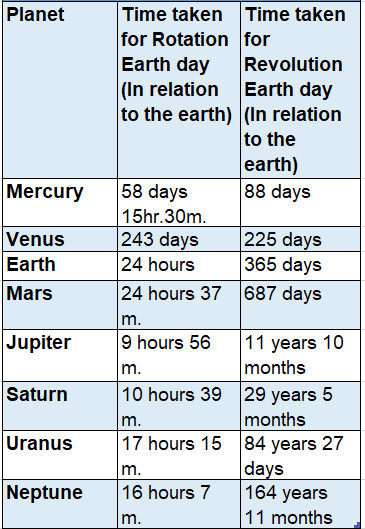
For example, Mercury, the closest planet to the Earth takes approximately, 58 Earth days (with the Earth) to spin around its axis, i.e. one day of the Mercury.

Along this rotation, the Mercury also travels around the sun in 88 earth days (about the earth), i.e. one year of the Mercury. Next to Mercury is the planet Venus which takes 243 Earth days and 225 Earth days to rotate and revolve respectively.

Other planets take more time as the distances increase with the sun. For example; Jupiter takes 11 years 10 months, Saturn takes 29 years 5 months, Uranus takes 84 years 27 days and Neptune takes 164 years 11 months.

WBBSE Notes For Class 9 Geography Chapter 2

But the time taken by each planet to revolve around the sun once is one year for that particular planet if not considered the time of the earth. For rotation, the distant planets take less time than the Earth.

WBBSE Notes For Class 9 Geography and Environment Chapter 2 Movements Of The Earth Speed of the Planets

WBBSE Notes For Class 9 Geography and Environment Chapter 2 Movements Of The Earth

Chapter 2 Movements Of The Earth Brief History Of Observation On Earths Movements

In ancient times, people thought that the sun was moving around the Earth. In the fifth century B.C. mathematician and astronomer Pythagoras and his disciples said first about the movement of the earth around the sun.

But no one believed this concept and even in the fourth century B. C. Aristotle (384-322 B.C.) also, did not believe it. After the birth of Christ, in the second century, Ptolemy also believed the concept of Aristotle.

WBBSE Solutions For Class 9 Fundamentals Of HistoryWBBSE Class 9 English Functional Grammar
WBBSE Class 9 Fundamentals Of History Long Answer QuestionsWBBSE Class 9 English Reading Skill
WBBSE Class 9 Fundamentals Of History Short Answer QuestionsWBBSE Class 9 English Writing Skill
WBBSE Class 9 Fundamentals Of History Very Short Answer QuestionsWBBSE Class 9 Maths Multiple Choice Questions
WBBSE Class 9 Fundamentals Of History Multiple Choice QuestionsWBBSE Solutions For Class 9 Maths
WBBSE Notes For Class 9 Geography and Environment


Indian mathematician and astronomer of ancient times, namely Aryabhatta, in 499 A.D. explained the movements of the sun and other stars as the effect of the movement of the earth around its axis.

But, till the medieval period, most people did not believe in the Pythagorean concept or the explanation of Aryabhatta.

Finally, in 1543 A. D. mathematician and astronomer Nicolaus Copernicus of Poland strongly explained the movement of the earth centering the sun.

Although, many people at that time followed the earth-centric movement of the sun.

Class 9 Geography Chapter 2 Important Questions WBBSE

Later on, Galileo, Kepler, Newton, and all eminent scientists were able to establish the movements of the planets by mathematical calculations and by visual proof with the help of a telescope.

Since then, people have been convinced and accepted the concept of the movements of the Earth and other planets.

Chapter 2 Movements Of The Earth Rotation

The spinning of the earth around its axis, since its origin, is known as Rotation. The time takes to rotate the earth around its axis is 23 hours, 56 minutes 4 seconds, i.e. nearly 24 hours or 1 day.

So, the Rotation of the earth is also known as Diurnal motion.

Direction Speed Effects Of Rotation

1. Direction of Rotation of the Earth:

Have you noticed the sun and other stars move from east to west? The earth is moving from the west to the east: It so happens just like from a running train we see the objects outside move in the opposite direction.

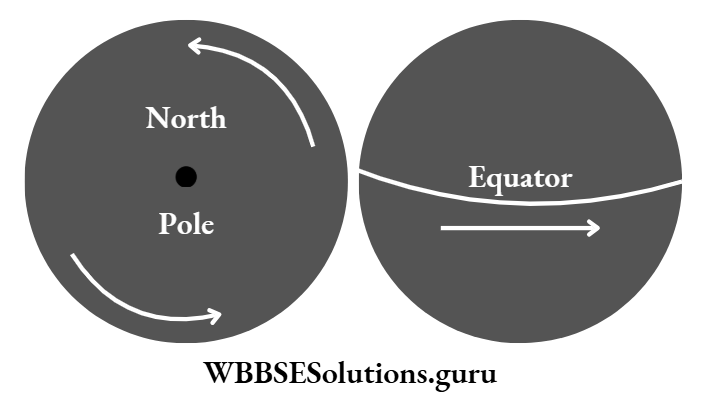
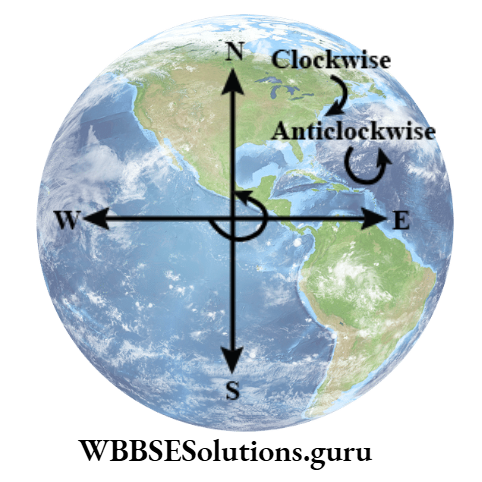
Around the poles, as it is not easy to find out the east and west directions, the direction of rotation at the north pole is anti-clockwise and at the south pole, Night is clockwise.

WBBSE Notes For Class 9 Geography and Environment Chapter 2 Movements Of The Earth At North Pole , Equator

2. Speed of Rotation of the Earth:

Due to its spherical shape, circumferences of “the earth at all parts are not equal in size. But, they take 24 hours to rotate once.

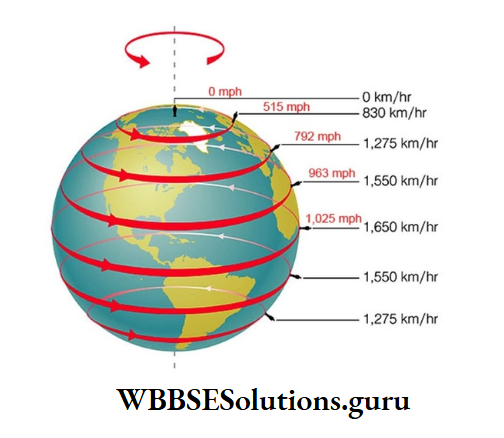
As the circumference of the earth is maximum at the equator (0°) and decreases gradually towards the two extremities at points, the speed of rotation of the earth also decreases away from the equator where it is 1630 km per hour.

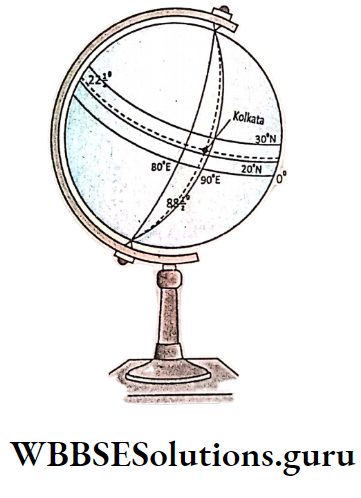
It is 1536 km per hour at Kolkata (22°30′ north), 1438 km per hour at 30° north latitude, 990 km per hour at 60° north latitude, and finally zero (0) at 90° latitude. So, at the poles, there are no relative movements.


WBBSE Notes For Class 9 Geography and Environment Chapter 2 Movements Of The Earth Speed Of Rotation Varies


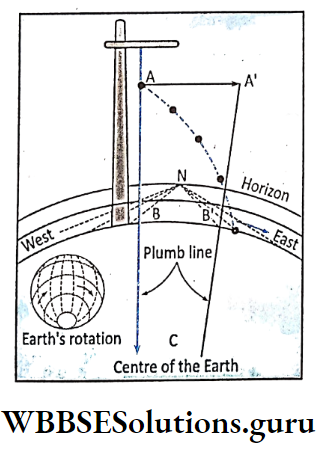
WBBSE Notes For Class 9 Geography and Environment Chapter 2 Movements Of The Earth Piece Of Stone Dropped From A High Tower


3. Effects Of Rotation Of The Earth:

Rotation of the earth results in major events like the formation of day and night, deflection of planetary winds and ocean currents, tides, and ebb, etc.

Class 9 Geography Chapter 2 Important Questions WBBSE

Chapter 2 Movements Of The Earth Alternation Of Day And Night

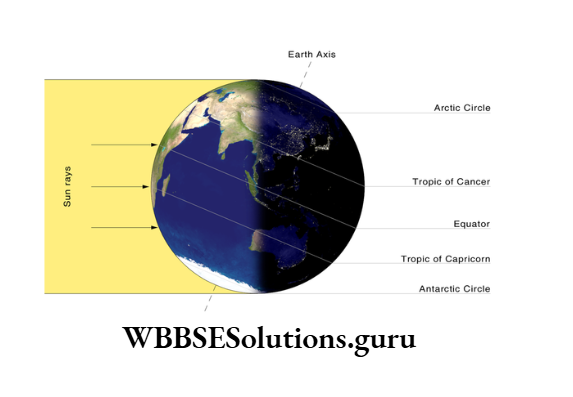
The rotation of the earth causes the alternation of day and night. The earth is round and is lighted and heated by the sun.

So during rotation, the hemisphere of the earth that faces the sun receives sun rays, and therefore, enjoys day while the opposite hemisphere remains in darkness and experiences night.

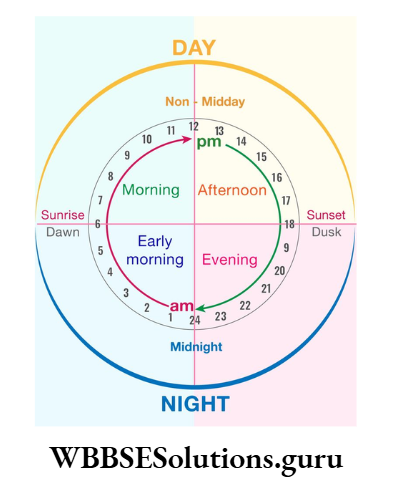
The demarcating line between the lighted and dark parts of the earth is known as a shadow circle and the transitional phases of day and night are dawn, dusk, morning, evening, noon, and midnight.

Shadow Circle

The circumference of the earth along which the lighted and dark parts of the earth cross each other is known as a shadow circle.

It moves westward on the surface of the earth with eastward rotation of the earth.

It bisects the equator which experiences 12 hours day and 12 hours night year round because of the inclination of the earth’s axis at 66° angle to its orbital plane.


WBBSE Notes For Class 9 Geography and Environment Chapter 2 Movements Of The Earth Shadow Circle


Morning And Evening

A place on the earth’s surface that crosses the shadow circle comes out from the darkness and eventually, experiences morning while the place located opposite to it crosses the shadow circle to enter the darkness and experiences evening.


WBBSE Notes For Class 9 Geography and Environment Chapter 2 Movements Of The Earth Different Parts Of Day and Night


Dawn And Dusk

The diffused sunlight seen in the sky before sunrise is known as dawn and the diffused sunlight seen in the sky after sunset is known as dusk or twilight.

WBBSE Class 9 Geography Chapter 2 Pdf

Noon And Midnight

When the sun stays at the zenith or the celestial meridian of a place it experiences noon or midday. The place is the opposite it remains in darkness and experiences midnight.

Chapter 2 Movements Of The Earth Coriolis Effect

In 1835, G. G. Coriolis (1792-1843), a French mathematician discovered the tendency of freely moving particles to deflect from their normal course.

This deflection is known as Coriolis. effect or Coriolis force after the name of the discoverer.

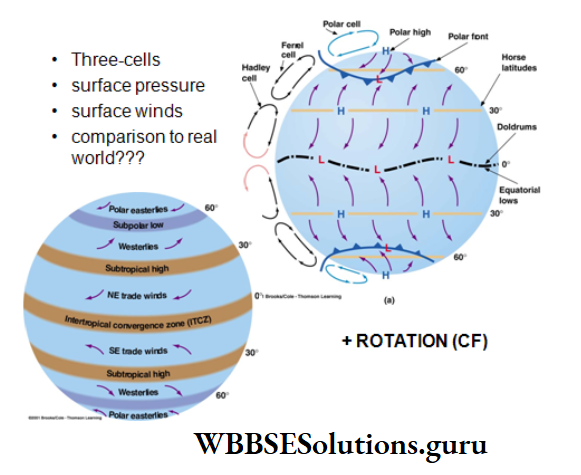
It is due to the Coriolis effect that ocean currents and planetary winds attached to the earth do not move directly in a north-south direction.

They deflect to the right in the northern hemisphere and the left in the southern hemisphere. The speed of the earth’s rotation is maximum at the equator while the minimum is at the poles.

So, the wind blowing towards the equator moves with less speed than that moves away from the equator. But the wind tries to maintain its initial speed and becomes deflected.

So, they deflect to the right in the northern hemisphere and the left in the southern hemisphere.

Example. Trade winds blowing toward the equatorial low-pressure belt are deflected as northeast trade wind in the northern hemisphere and southeast trade wind in the southern hemisphere.

WBBSE Notes For Class 9 Geography and Environment Chapter 2 Movements Of The Earth Wind Direction in Northern and Southern Hemispheres

Chapter 2 Movements Of The Earth Inclination Of The Earths Axis And Its Significance

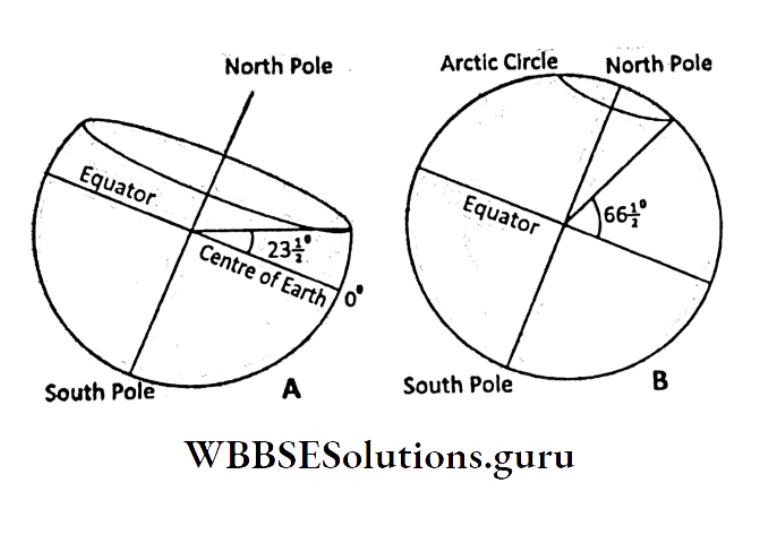
Due to the rotation of the. earth from the west to the east an invisible imaginary line joining the north pole and the south pole passing through its center has formed. This is known as the axis of the earth.

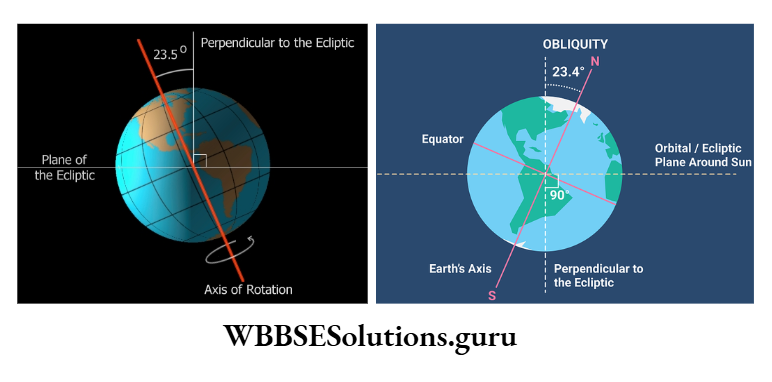
It is actually, tilted at a 23°30′ angle from the vertical i.e. 90°. The axis of the earth is tilted on its orbital plane pointing always to the pole star.

The earth revolves along with its rotation around the sun in a fixed path or orbit to which its axis inclines at a 66°30′ angle.

WBBSE Notes For Class 9 Geography and Environment Chapter 2 Movements Of The Earth Axis Of The Earth During Revolution

It is Due to the tilting of the earth’s axis at 66°30′ angle, the northern and southern hemispheres are tilted towards the sun for six months alternately.

This results in variations in the length of day and night on the earth’s surface, variations in temperature at different times of the year, and ultimately the change of seasons.

WBBSE Class 9 Geography Chapter 2 Pdf

If the axis of the earth was perpendicular to the orbit, the days and nights would be 12 hours each everywhere on the earth’s surface like the equatorial region. No change of seasons would take place.

If the axis of the earth was parallel with the orbit of the earth, like Uranus, each hemisphere would remain in light or darkness at least for six months.

WBBSE Notes For Class 9 Geography and Environment Chapter 2 Movements Of The Earth Inclination Of The Earth's Axis

Chapter 2 Movements Of The Earth Revolution

Together with Rotation, the earth revolves around the sun, along an elliptical orbit to which its axis inclines at 66+ angle, in the anti-clockwise direction. This movement of the earth is known as the Revolution.

It takes 365 days 5 hours 48 minutes 46 seconds to revolve once around the sun or approximately 365 days or one year. So, the Revolution of the earth is also known as the Annual motion of the earth.

WBBSE Notes For Class 9 Geography and Environment Chapter 2 Movements Of The Earth Revolution Of The Earth

Direction Speed Effects

1. Direction Of Revolution Of The Earth :

The earth along its rotation from the west to the east revolves around the sun in an anti-clockwise direction with its axis always tilted at a 66½º angle to its orbit or fixed path of revolution.

WBBSE Notes For Class 9 Geography and Environment Chapter 2 Movements Of The Earth Anti-Clockwise Revolution

2. Speed Of Revolution Of The Earth :

The earth moves about 30 km each second along its orbit in the anti-clockwise direction. So the velocity of the earth’s revolution is about 30 km per second or 1,08,000 km/hour.

WBBSE Class 9 Geography And Environment Chapter 2 Notes 

3. Effects Of Revolution Of The Earth:

Revolution of the earth around the sun results in the concept of Leap year, Perihelion-Aphelion positions of the earth, sun’s ecliptic or apparent annual motion of the sun.

variation in the length of day and night, equinoxes- solstices, change of seasons, etc.

Leap Year Aphelion And Perihelion

The earth takes 365 days 5 hours 48 minutes 45.51 seconds or 46 seconds to revolve once around the sun. But for calculation, it is rounded off as 365 days.

So in each year there is an excess of 6 hours (5 hours 48 minutes 46 seconds) which may be added at the end of the 4th Find out the leap years year which becomes 366 days (6 hours x 4 = 24 hours or 1 day).

This extra one day is added in February and that year is called Leap Year. A leap year is divisible by 4, for Example. 2012 and 2016 are leap years.

But all the century years are not leap years even if they are divisible by 4 because there is an inbuilt excess of 11 minutes 14 seconds in each year (6 hours-5 hours 48 minutes 45-51 seconds = 11 minutes 14-09 seconds).

And cumulative 44 minutes 56 seconds (11 minutes 14-09 seconds x 4) in each leap year. Century years are, therefore, granted as a leap year, if only, these years are divisible by 400, for Example. 2000 is a leap year but 1800, 1900, and 2100 are not leap years.

Aphelion And Perihelion:

The earth revolves in a fixed path called orbit which is elliptical. The sun is located at one of its two foci. So, the distance between the sun and the earth is not the same with an average distance of 150 million km approximately.

Aphelion

The earth goes farthest from the sun on 4th July, about 152 million km away during its revolution along the elliptical orbit. This is called Aphelion (the Latin word Apo means away, and helion means sun).

Due to greater distance, the sun appears smaller in size and the speed of the earth’s revolution becomes slower. The sun is visible 9 days more at the north pole than at the south pole during the revolution of the earth.

WBBSE Notes For Class 9 Geography and Environment Chapter 2 Movements Of The Earth Perhelion and Aphelion

Perihelion

The earth comes closest to the sun on 3rd January at a distance of 147 million km during its revolution along the elliptical orbit. This is called the Perihelion position of the earth.

The Latin word ‘Peri’ means near and ‘helion’ means sun. Due to the shorter distance, the sun appears bigger and the speed of the earth’s revolution also becomes faster.

WBBSE Class 9 Geography And Environment Chapter 2 Notes 

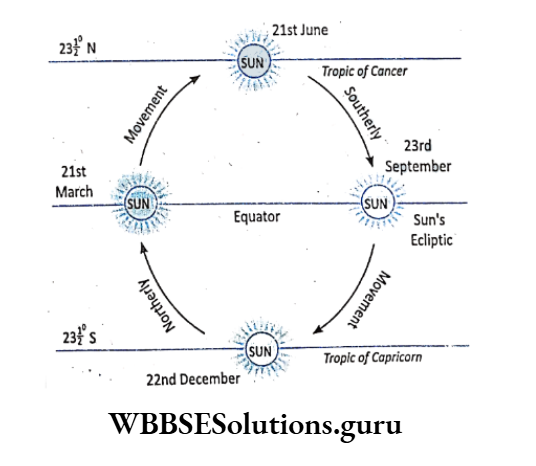
The yearly Apparent Movement Of The Sun

Did you notice that the sun rises in due east and sets in due west in March and September only? Otherwise, the sun rises and sets either north or south of these positions. This apparent movement of the sun in a year is due to the revolution of the earth along an elliptical orbit.

On the 21st of March and 23rd of September, the sun rises and sets due east and west respectively. But on other days the sun shifts to either north or south of those positions.

As a result, the sun appears to move in a north-south direction within 23°30′ north and 23°30′ south latitudes. This apparent path of the sun in the sky is known as Sun’s Ecliptic.

The northerly apparent movement of the sun is northwards from 22nd December to 21st June i.e. from the Tropic of Capricorn to the Tropic of Cancer.

The southerly apparent movement of the sun is from 21st June (tropic of cancer) to 22nd December (tropic of Capricorn). This apparent movement of the sun is known as Sun’s Ecliptic.

WBBSE Notes For Class 9 Geography and Environment Chapter 2 Movements Of The Earth Sun's Ecliptic(annual apparent movement of the sun)

Chapter 2 Movements Of The Earth Variation In The Length Of Day And Night Equinoxes And Solstice

Excepting the equatorial region, places on the earth’s surface experience either longer days and shorter nights or vice-versa at different times of the year.

Only on the 21st of March and 23rd of September, days and nights are equal on all parts of the earth.

Causes Of Variation In The Length Of Day And Night

Two major factors are responsible for variation in the length of day and night

  1. Revolution of the earth and
  2. The inclination of the earth’s axis at 66°30′ angle on the orbital plane of the earth. Other factors are the spherical shape of the earth, rotation of the earth, elliptical shape of the orbit, etc.

Explanation Of Variation In The Length Of Day And Night:

If you observe minutely the different positions of the earth in its orbit at different times of the year you may easily understand the variation in the length of day and night.

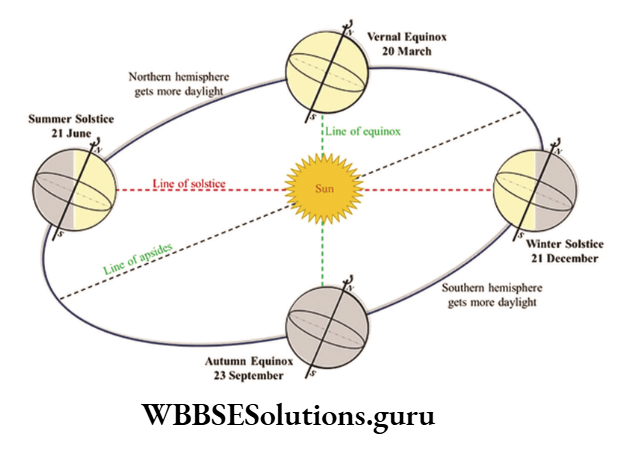
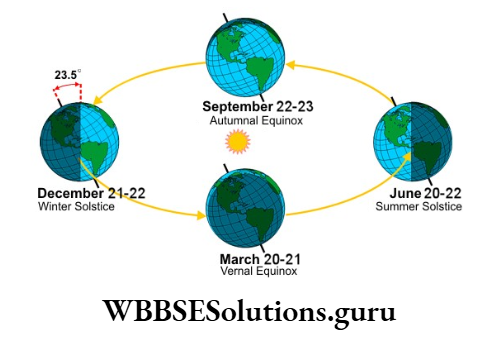
21st June

On this date, the sun lies over the tropic of Cancer and the northern hemisphere inclines towards the sun.

So the northern hemisphere enjoys the longest day and shortest night while the southern hemisphere experiences the longest night and shortest day.

WBBSE Class 9 Geography And Environment Chapter 2 Notes 

Places beyond the Arctic Circle (66 N) experience 24 hours a day while places beyond the Antarctic Circle experience 24 hours of night.

WBBSE Notes For Class 9 Geography and Environment Chapter 2 Movements Of The Earth 21st June-Sunrays Spread Over Greater Parts Of Northern Hemisphere

Summer Solstice :

23°30′ North latitude is the northern extremity of the northerly apparent movement of the sun.

So 23°30′ north latitude is called the tropic of Cancer (Tropic means turning point) and the 21st of June is known as summer solstice (solstice means sun’s stopping time) as it is summer in the northern hemisphere.

23rd September

With the end of the summer solstice, the southerly apparent movement of the sun begins and the southern hemisphere comes nearer the sun. On 23rd September the sun lies at the zenith (90°) over the equator.

Shadow circle coincides with the earth’s axis. So days and nights are equal to 12 hours on all parts of the earth.

Autumnal Equinox:

The day which experiences equal day and night is known as the equinox (equal means equal and nox means night). As it is autumn in the northern hemisphere the day is known as the Autumnal equinox.

22nd December

As the journey of the earth goes on, the southern hemisphere comes nearer the sun and on 22nd December the sun lies, over the Tropic of Capricorn.

The days become longer than nights in the southern hemisphere, while the nights become longer than days in the northern hemisphere.

Places beyond the Arctic Circle enjoy 24 hours of the night while the places beyond the Antarctic Circle experience 24 hours a day.

WBBSE Notes For Class 9 Chapter 2 Spread Over Greater Parts Of Southern Hemisphere

Winter solstice:

23°30′ south latitude is the southern extremity of the southerly apparent movement of the sun, So 23°30′ south latitude is called the Tropic of Capricorn.

22nd December is known as winter solstice as it is winter in the northern hemisphere.

21st March

With the end of the winter solstice, the sun turns its apparent journey northward and lies at the zenith over the equator on 21st March.

Shadow circle, once again, coincides with the earth’s axis. So days and nights are equal to 12 hours in duration over all parts of the earth.

Vernal Equinox:

Like the autumnal equinox, on 21st March, it is spring in the northern hemisphere. So, the 21st of March is known as Spring or Vernal equinox.

WBBSE Notes For Class 9 Geography Chapter 2 

Chapter 2 Movements Of The Earth Change Of Seasons

Our earth is a seasoned traveler. Try to feel how autumn cools into winter and spring warms up to summer following the year-long apparent circuit of the sun.

These changes are responsible for temperature variations. On that basis, a year is divided into seasons that rotate in a cycle.

Change of seasons is mainly caused by variations in temperature which depends on variations in the length of day and night and variations in the inclination of sunrays falling on the earth.

Variation In The Length Of Day And Night

Excepting the equator, days and nights are not equal in all the places on the earth. This variation in the length of day and night causes summer when days are longer than nights thereby storing excess heat daily.

When nights are longer than days excess heat is released thereby cooling the earth’s surface daily leading to winter.


WBBSE Notes For Class 9 Geography and Environment Chapter 2 Movements Of The Earth Angle Of Incident Of Sunrays Variations in Temperature

Variation In Inclination Of Sunrays Falling On The Earth’s Surface

Due to the spherical shape of the earth and the inclination of the earth’s axis at 66 angles sunrays fall on the earth’s surface at different angles on different parts of the earth.

Vertical rays concentrate on smaller areas and travel shorter distances in the atmosphere while inclined rays spread over a wider area and travel long distances in the atmosphere.

Therefore, vertical rays are responsible for summer while inclined rays are responsible for winter.

Chapter 2 Movements Of The Earth Circle Of Seasons

Four seasons namely

  1. Summer,
  2. Autumn,
  3. Winter and
  4. Spring is rotating on the earth’s surface in both hemispheres.

Summer In the Northern Hemisphere And Winter In the Southern Hemisphere

From May to July, about 1 ½ months before and after the 21st of June days are longer in the northern hemisphere. So, the temperature is maximum. Therefore, it is summer in the northern hemisphere and winter in the southern hemisphere.

WBBSE Notes For Class 9 Geography and Environment Chapter 2 Change Of Seasons

Autumn In the Northern Hemisphere And Spring In the Southern Hemisphere

From August to October, about 1 month before and after 23rd September temperature becomes moderate as the temperature gradually decreases in the northern hemisphere and increases gradually in the southern hemisphere.

WBBSE Notes For Class 9 Geography Chapter 2 

So, it is autumn in the northern hemisphere and spring in the southern hemisphere.

Winter In the Northern Hemisphere And Summer In the Southern Hemisphere

From November to January, about 1 month before and after 22nd December nights are longer in the northern hemisphere. So, the temperature is minimum in the northern hemisphere resulting in winter while it is summer in the southern hemisphere.

Spring In the Northern Hemisphere And Autumn In the Southern Hemisphere

February to April, about 1 month before and after 21st March temperature increases in the northern hemisphere but decreases in the southern hemisphere.

So, temperature becomes moderate and spring follows the winter in the northern hemisphere and autumn follows summer in the southern hemisphere.

WBBSE Notes For Class 9 Geography and Environment Chapter 2 Variation in The Length Of Days And Nights And Change Of Seasons

WBBSE Notes For Class 9 Geography And Environment Chapter 1 Earth As A Planet

WBBSE Chapter 1 Earth As A Planet Shape Of The Earth

Facts At Your Fingertips:

  1. Amongst eight planets (Mercury, Venus, Earth, Mars, Jupiter, Saturn, Uranus and Neptune) of the solar system, the most unique is the planet Earth which is the habitat of life.
  2. The earth originated about 4.5 to 4.6 billion years ago, about 500 million years after the birth of the sun.
  3. It took about 2.5 billion years for the creation of life on the earth since the origin of the earth.
  4. Earth is the third in position next to Mercury and Venus with an average distance of 150 million km from the sun and the sunlight takes 8 minutes to reach the Earth with a velocity of 3 lakh km/sec.
  5. Earth is the fifth largest planet in the solar system and is revolved by the only satellite called the Moon.
  6. Land (29%) and water (71 %) bodies are antipodal and located around the poles.
  7. The envelope of the atmospheric layers consisting of oxygen helps to sustain life on the earth.
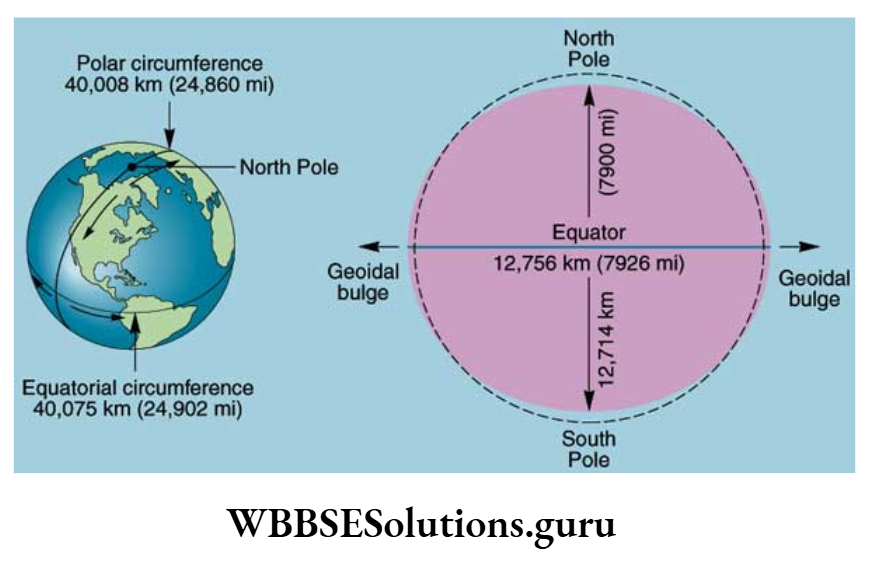
  8. The actual shape of the earth is ‘Oblate Spheroid’ and is better described as ‘Geoid’.
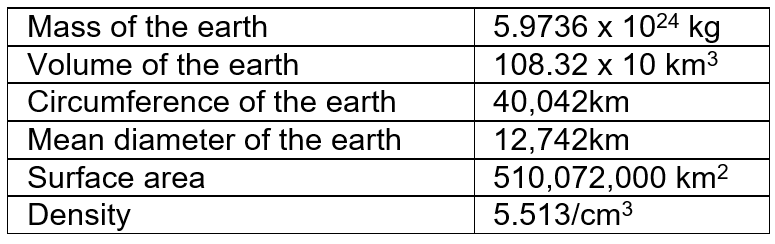
  9. The average circumference is about 40,000 km.
  10. The approximate mass of the earth is 5976 x 108 metric tonnes.

WBBSE Notes For Class 9 Geography and Environment Chapter 1 Earth As A Planet

WBBSE Chapter 1 Earth As A Planet Concept Of Shape Of The Earth

Evolution Of The Concept Of The Shape Of The Earth:

Flat Earth

The flat earth concept is an archaic belief that the earth’s shape is a plane or disc. This concept was held by many ancient cultures even in Greece until the Classical Period.

Read And Learn Also WBBSE Notes For Class 9 Geography and Environment

Ancient Chinese people believed that China was the only landmass which represented the earth and it was surrounded by oceans filled with dragons and giant fishes.

Phoenicians portrayed the earth as a flat disc floating in the ocean surrounded by a spherical sky.

WBBSE Notes For Class 9 Geography and Environment Chapter 1 The Earth Portrayed by Greek People

WBBSE Notes For Class 9 Geography Chapter 1 

Spherical Earth

The concept of spherical earth appeared in Greek philosophy with Pythagoras (6th century B.C.). Aristotle accepted the spherical shape of the earth on empirical grounds around 330 B.C.

Indian astronomer, Aryabhatta (476-550 A.D.) stated that the earth is spherical with a circumference of 39,968 km.

WBBSE Solutions For Class 9 Fundamentals Of HistoryWBBSE Class 9 English Functional Grammar
WBBSE Class 9 Fundamentals Of History Long Answer QuestionsWBBSE Class 9 English Reading Skill
WBBSE Class 9 Fundamentals Of History Short Answer QuestionsWBBSE Class 9 English Writing Skill
WBBSE Class 9 Fundamentals Of History Very Short Answer QuestionsWBBSE Class 9 Maths Multiple Choice Questions
WBBSE Class 9 Fundamentals Of History Multiple Choice QuestionsWBBSE Solutions For Class 9 Maths
WBBSE Notes For Class 9 Geography and Environment


Myth Of The Flat Earth :

The modern misconception that educated Europeans at the time of Columbus believed in a flat earth concept and his voyages refuted that belief has been referred to as the myth of the flat earth.

The paradigm of spherical earth gradually spread and was first accepted with the circumnavigation expedition (1519-1522) of Ferdinand Magellan and Juan Sebastian Elcano.

The spherical shape of the earth which was more accurately described as an ellipsoid dates back to the 18th century. In the 19th century, the flattening of the earth as an ‘ellipsoid’ was accepted.

WBBSE Chapter 1 Earth As A Planet Proofs From The Earliest Days Till Today

Portuguese exploration of Africa and Asia, Columbus’ voyage to America (1492) and finally F. Magellan’s circumnavigation of the earth (1522) is the practical evidence of the global shape of the earth.

Evidence For Spherical Earth

Sighting Of Boat:

At sea, it is possible to see the mast of a boat before the hull appears.

WBBSE Class 9 Geography Chapter 1 PDF

Position Of The Sun:

The sun is seen lower In the sky as one moves away from the tropics.

Length Of Day Light:

The length of daylight varies more between summer and winter the farther you are away from the equator.

WBBSE Notes For Class 9 Geography and Environment Chapter 1 Earth As A Planet Mast of Ship is Seen Before the Hull on Spherical Earth

Lunar Eclipse:

The Earth throws its circular shadow on the moon during a lunar eclipse.

WBBSE Notes For Class 9 Geography and Environment Chapter 1 Lunar Eclipse and, Earth Viewed From Space

Circumnavigation:

It is possible to circumnavigate the earth.

Gain Or Loss Of A Day :

Travellers who circumnavigate the earth observe the gain or loss of a day.

Satellites:

An artificial satellite can circle the Earth continuously.

WBBSE Notes For Class 9 Geography and Environment Chapter 1 Earth, Spherical Earth

Aerial Photograph:

The aerial photograph taken from space shows the disc shape of the Earth.

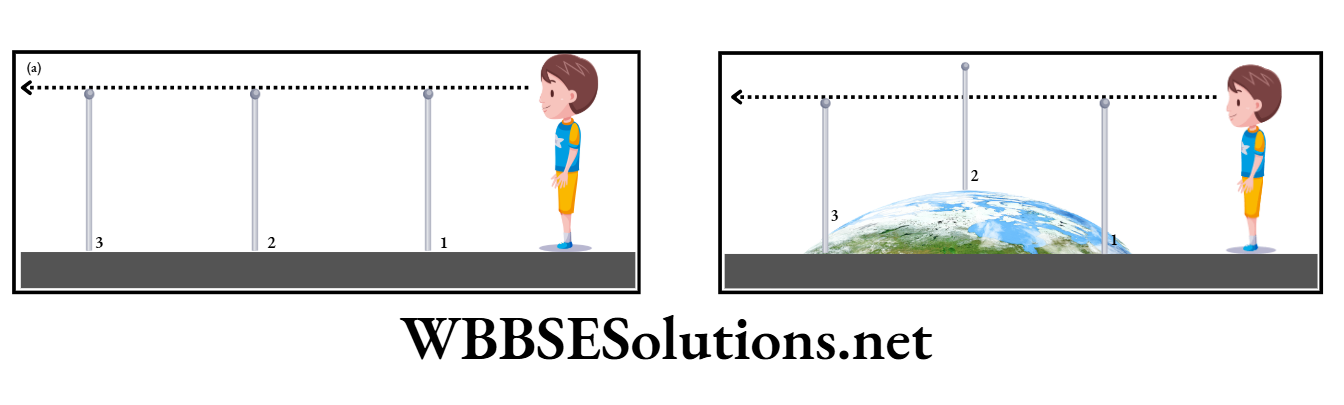
Bedford Level Experiment:

An experiment carried out by Dr Wallace along the Bedford Canal of Britain also proves the curvature of the earth.

He fixed three poles of equal length at regular intervals along the canal and found that the central pole was seen slightly above the poles at both ends.

WBBSE Class 9 Geography and Environment Chapter 1 Notes

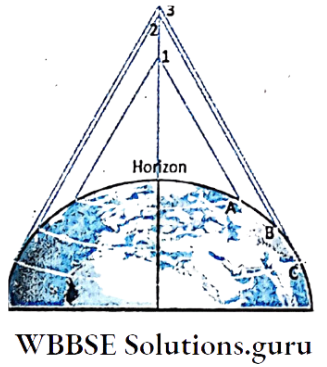
Horizon Of The Earth:

As one goes up sees the horizon spherical as well as wider.


WBBSE Notes For Class 9 Geography and Environment Chapter 1 Earth As A Planet The Horizon Widens


WBBSE Chapter 1 Earth As A Planet Earth As An Oblate Spheroid

Proofs Of Oblate Spheroid Shape Of The Earth:

Variation In Diameter:

The Equatorial diameter is 43 km longer than ‘the polar diameter. So the earth is flattened at the poles with a bulge at the equator.

Swing Of Pendulum :

An experiment carried out by French astronomer Jean Richer in 1671 revealed that the oscillation of the pendulum of a clock in 24 hours took 2 minutes less at Cayenne island (nearly 0°) than at Paris. (53°N).

The greater the force of gravity longer the period of oscillation of the pendulum. So Cayenne is nearer to the centre of the earth- than Paris.

Weight Of An Object:

Any object weighs more at the poles than at the region near the equator. So the equatorial diameter is longer than the polar diameter.

Observation Of Star :

The star that is seen above the horizon (0°) at the equator will be seen at an angle of 1° above the horizon, traveling 111 km away from the equator.

WBBSE Notes For Class 9 Geography and Environment Chapter 1 Diameter and Equatorial Diameter of the Earth

WBBSE Class 9 Geography and Environment Chapter 1 Notes

WBBSE Chapter 1 Earth As A Planet Concept Of Geoid

The earth’s surface is not smooth like the geometrical shape of an oblate spheroid. It is intervened by high mountains and deep seas like Everest (8,848 m above sea level and the Dead Sea (392 m below sea level).

So the earth is often referred to as a ‘GEOID’ which means ‘earth shaped’ that is not identical with any other geometrical shapes.

In Geodesy (combination of survey and mathematical analysis), the shape of the earth i.e. Geoid is defined by the mean sea level surface.

Practically, differences in height between mountain peaks and sea bottoms are ignored when reduced in scale to a small globe which is, actually, spherical for practical purposes.

WBBSE Notes For Class 9 Geography and Environment Chapter 1 Earth as a Geoid, Oblate Spheroid and Geoid

WBBSE Chapter 1 Earth As A Planet Size Of The Earth

Size Of The Earth In Proportion To The Other Planets:

Earth Profile:

WBBSE Notes For Class 9 Chapter 1 Earth As A Plant Earth Profile

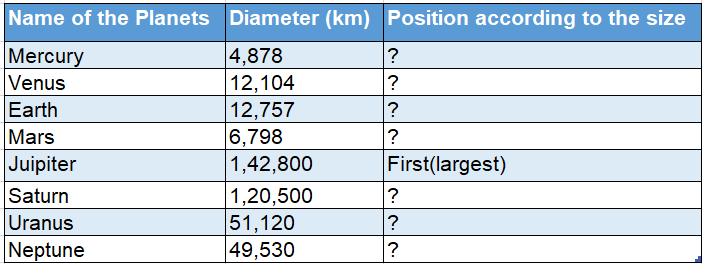
Among the eight solar system members, by size, Jupiter is the largest while Mercury is the smallest planet and the Earth is fifth in size.

In other words, Jupiter is 1319 times the size of the Earth, while Mercury is half the size of the Earth. Neptune is four times the size of the Earth.

Four planets, Jupiter, Saturn, Uranus and Neptune, are bigger than the Earth, while Mercury, Venus and Mars are smaller than the Earth.

Find Out The Position Of The Planets According To Their Sizes:

WBBSE Notes For Class 9 Geography and Environment Chapter 1 Earth As A Plant Positions of the Planets according to their Sizes


WBBSE Notes For Class 9 Geography and Environment Chapter 1 Earth As A Planet Solar System

Class 9 Geography Chapter 1 Important Questions WBBSE

WBBSE Unique Position Of The Earth In The Solar System

Unlike the other planets, the Earth is a unique member of the solar system. Its unique position i.e. 150 million km away from the sun enables the earth to receive optimum temperature i.e. 15°C (average).

Due to its proximity to the sun, Mercury is the hottest planet with day temperature rising to 450°C while Venus experiences 482°C (the atmosphere contains more carbon dioxide and sulphuric acid).

On the other hand, due to its distant location, the planet Mars is severely cold with summer temperature drops below freezing point.

Distant planets namely Jupiter, Uranus and Neptune are bitterly cold. The temperature of Uranus and Neptune remains always – 200°C.

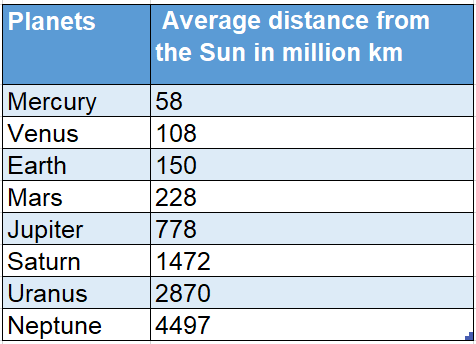
Position Of The Planets From The Sun :

WBBSE Notes For Class 9 Geography and Environment Chapter 1 Earth As A Plant Positions of the Planets from the sun


WBBSE Earth As The Home Of Humankind

We are really lucky that our habitat is the earth only planet in our solar system.

Scientists inferred that the sustainability of life is possible only on the earth which can support life in all its forms from living microorganisms to highly intelligent human beings.

It is possible only because of its (earth’s) breathable atmosphere, a suitable climate with a moderate amount of carbon dioxide, and water the most important chemical necessary for life.

Adequate light received from the sun and probably, life wouldn’t exist if the earth was not in a position with an ideal distance from the sun with an average temperature of 15°C.

Time For Action-Save The Planet:

Man has deteriorated his beautiful habitat, the earth. His unwise actions are responsible for global warming, and the pollution of air, soil and water.

Now the time has come to act to repair what has been damaged and to prepare the future so that the earth will provide a fair shelter for its inhabitants once again.

WBBSE Chapter 1 Earth As A Planet Measurements Of The Earth

Circumference:

How Big Is The Earth?

The average circumference of the earth is 40,000 km. Along the equator, it is 40,075 km. While the polar circumference is 40,009 km.


WBBSE Notes For Class 9 Geography and Environment Chapter 1 Earth As A Planet Determination of Earth's Circumference


Class 9 Geography Chapter 1 Important Questions WBBSE

Area

The area of the earth can easily be calculated by applying the formula 4πг2 (π= 22/7, r = radius i.e. 12,736 km or on average (12,800 km). So the area of the surface of the earth is 4 x 22/7 x (6400)2 km or 5, 10,072 Km2 It consists of 71% water and 29% land.

Use Of Gps

GPS or Global Positioning System is a space-based satellite navigation system made up of a network of 24 artificial satellites in orbit. It provides the location of any place in the world in any type of climate.

The location of the place is determined in terms of

  1. Latitude,
  2. Longitude,
  3. Altitude and
  4. Time

GPS consists of 24 artificial satellites orbiting the Earth twice a day in six specific orbits and a GPS receiver on the Earth.

Out of 24 satellites only four of these satellites are visible from any place at any time.

From these four satellites, four types of signals are received, such as latitude, longitude, altitude and time by the GPS receiver.

WBBSE Notes For Class 9 Geography and Environment Chapter 1 GPS-24 Satellites


Class 9 Geography Chapter 1 Important Questions WBBSE

Works Of Gps


WBBSE Notes For Class 9 Geography and Environment Chapter 1 Earth As A Planet GPS-Handset


In GPS, Orbiting satellites transmit signal information to the Earth receiver. The GPS receiver compares the time, a signal is transmitted by a satellite with the time it was received.

The difference in time is measured by an electronic clock fitted in it. The GPS receiver, thus, determines the user’s exact location.

Nowadays, GPS receiver is used in automobiles, ships, aeroplanes, laptops, mobile, and wristwatches.

Now, it is widely used in the preparation of maps, transportation, and defence, as traveller’s guides, to collect weather information, etc.

WBBSE Notes For Class 9 Geography and Environment Chapter 8 West Bengal

Chapter 8 West Bengal Location Administrative Divisions

Facts At Your Fingertips :

Area-88,752 sq km; Population-9,13,47,736 persons (2011); Highest peak- Sandakphu (3630 m); Principal river-Ganga (Bhagirathi-Hugli).

Principal Language-Bengali; Districts-23; Capital-Kolkata; Population of capital-1,40,13000 persons; Longest extension-623 km (north-south).

Read And Learn Also WBBSE Notes For Class 9 Geography and Environment

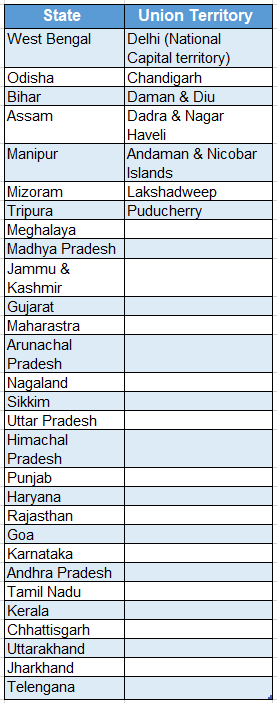
West Bengal is the most important state of the Indian Union which at present, consists of 29 states and 7 union territories. West Bengal is located in the eastern part of India.

WBBSE Notes For Class 9 Geography and Environment Chapter 8 West Bengal Indian West Bengal

Indian Union At A Glance:


WBBSE Notes For Class 9 Geography and Environment Chapter 8 West Bengal Indian Union at a Glance

Wbbse Class 9 Geography Chapter 8 Notes 

Chapter 8 West Bengal Brief Outline Of West Bengal As A State Of India After Independence

Why Is The State Called West Bengal :

Though our state is located in the eastern part of India; it is called West Bengal because at the time of independence of India.

In 1947 that area belonged to ‘Bangladesh’ which was then divided by the British the eastern part was called ‘East Pakistan’, eventually known as Bangladesh while the western part was known as ‘West Bengal’.

In the area, West Bengal accounts for only 2-7% of India i.e. 32,87,263 sq. km. About 8% people of India i.e. 1,21,02,00,000 people live in West Bengal.

WBBSE Solutions For Class 9 Fundamentals Of HistoryWBBSE Class 9 English Functional Grammar
WBBSE Class 9 Fundamentals Of History Long Answer QuestionsWBBSE Class 9 English Reading Skill
WBBSE Class 9 Fundamentals Of History Short Answer QuestionsWBBSE Class 9 English Writing Skill
WBBSE Class 9 Fundamentals Of History Very Short Answer QuestionsWBBSE Class 9 Maths Multiple Choice Questions
WBBSE Class 9 Fundamentals Of History Multiple Choice QuestionsWBBSE Solutions For Class 9 Maths
WBBSE Notes For Class 9 Geography and Environment


West Bengal ranks 4th position in population amongst 29 states of India. The density of the population in India is 382 persons per sq. km while in West Bengal, it is 1029 Persons per sq. km.

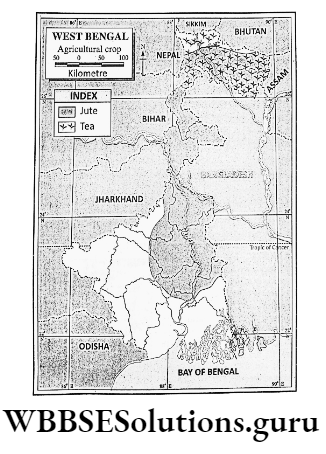
West Bengal is the leading producer of rice, jute and fish in our country. West Bengal ranks 2nd position in tea and potato production and 7th position in coal production in India.

Most of the jute mills of India are located in West Bengal. In the integrated iron and steel industry, engineering industry and tea industry, West Bengal also plays an important role in our country.

Kolkata, the capital of West Bengal is the largest trading centre of Eastern India and the biggest port of Eastern India. Netaji Subhas Chandra Bose international airport, the largest airport in Eastern India is located at Dum Dum near Kolkata.

The first metro rail in India was inaugurated in West Bengal. Kolkata is the headquarter of the Eastern and South-eastern railway.

WBBSE Notes For Class 9 Geography and Environment Chapter 8 West Bengal Political 23 Districts In West Bengal

Wbbse Class 9 Geography Chapter 8 Notes

Chapter 8 West Bengal Geographical Location

The geographical location of West Bengal can be identified in three ways

  1. With the help of latitude and longitude.
  2. According to the distance from the sea and
  3. In relation to the location of neighbouring states of India.

Location Of West Bengal According To Latitude And Longitude:

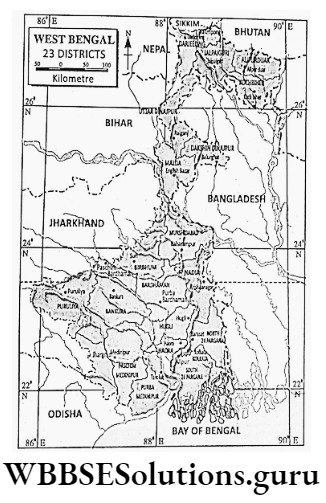
West Bengal is extending from 23°30′ north latitude in the south to 27°10′ north latitude in the north and from 85°50′ east longitude in the west to 89°53′ east longitude in the east.

Tropic of cancer i.e. 23°30′ north latitude passes through Puruliya, Bankura, Paschim Bardhaman (near Durgapur) and Nadia (near Krishnanagar) districts of the state.

Location Of West Bengal According To Boundaries:

West Bengal has land on three sides and water on one side. To the west are the states of Odisha, Jharkhand, Bihar and the neighbouring country Nepal.

To the north is the neighbouring state Sikkim and the neighbouring country Bhutan; to the east are Bangladesh and Assam. To the south is the Bay of Bengal.

Location Of West Bengal According To The Distance From The Sea:

West Bengal is bordered by the sea on its south. Hence, it is called a coastal location. North-south extent of West Bengal is about 623 km.

The east-west extension is not even. It is 320 km along the Tropic of Cancer while it is only 9 km in Uttar Dinajpur.

Chapter 8 West Bengal Neighbouring Countries And States Of West Bengal

Nepal, Bangladesh and Bhutan, the three independent neighbours are the border countries of West Bengal and five bordering states namely Bihar.

Jharkhand, Odisha, Assam and Sikkim as well as Tripura though not located along the border are very close in relation to West Bengal.

Nepal The Neighbouring Country

Nepal At A Glance :

Length of West Bengal-Nepal border about 90 km; Area of Nepal-1,40,797 sq km; Population-2,98, 001 000 persons; Density of population-211 persons per sq km; Capital-Kathmandu; Highest peak-Mt. Everest (8848 m); Longest river-Kaligandak.

Nepal is situated to the north of West Bengal along the western border of the Darjeeling district. It is a mountainous country with the highest peak Mt. Everest, the highest peak in the world. It is a sparsely populated country.

There are many valleys in Nepal, namely Kathmandu, Pokhara Valley etc. Important peaks are Makalu, Dhaulagiri, Annapurna etc. The country is occasionally forested.

Nepal is mostly dependent on agriculture. Rice is the principal crop. Other crops are jute, jowar, and millet. Fruits are apples, oranges etc. But the country lacks in industries.

Nepal is connected with West Bengal by roadways and railways, Nepal is a landlocked country. So, Nepal exports to other countries through Kolkata port.

Wbbse Class 9 Geography Chapter 8 Notes 

Bhutan The Neighbouring Country

Bhutan At A Glance :

Length of West Bengal-Bhutan border-About 150 km; Area-47,000 sq km; Population-72,00,000 persons; Density of population-15 persons per sq km.

Capital- Thimpu; Population of capital-13,000 persons; Official language-Dzonka; Highest peak- Kulakangri (7554 m); Longest river-Manas; Principal resource-Cardamom, apples, oranges, lac, orchids etc.

Bhutan belongs to the Himalayas and is another independent country located on the northern border of West Bengal. According to a special treaty Bhutan has to take advice from the Government of India about its foreign affairs.

Bhutan is a small sparsely populated country. In the northern part of Bhutan is extending the Great Himalayas, in the middle part is extending the Central Himalayas and in the southern part is extending the Siwalik Himalayas.

A few famous valleys, namely Paro, Punakha and Thimpu belong to the Central Himalayas. In the northern part of Bhutan stands the Chomolari (7314 m) which is also known as the ‘Queen of the mountains’.

The southern part of Bhutan experiences frequent ‘thunder showers’ because of which Bhutan is called the ‘Land of Thunder Dragon’. In the south at the foothills of the Himalayas, there is the ‘Duars’ which is the ‘Doorway to Bhutan’.

Torsa, Raidak, Sankosh, Manas are the principal rivers of Bhutan. Dense forests of sal, oak, and sissoo are found in Bhutan. Agriculture is not well developed. Large cardamom is the most important cash crop.

Rice, wheat, and corn are also cultivated. Bhutan is industrially backwards due to a lack of minerals. Bhutan depends on Kolkata port for its trade. Food products, medicines, and machinery are collected from West Bengal.

Bangladesh The Neighbouring Country

Bangladesh At A Glance:

Length of West Bengal-Bangladesh border-About 900 km. Area-1,43,998 sq km; Population-about 17,00,00,000 persons; Density of population-1165 persons per sq km.

Capital-Dhaka; Official language-Bengali; Highest peak-Keokradang (1230 m); Longest river-Padma-Meghna, Principal resources-jute, rice, tea, leather, natural gas etc.

Bangladesh is located along the eastern border of West Bengal. On 16th December 1971 Bangladesh established itself as an independent sovereign country.

Major parts of Bangladesh belong to the Bengal Delta except for the uplands in the east and southeast. The extensive plainland is made of alluvium deposited by the rivers Padma, Meghna, Jamuna etc.

Ganga, the principal river of West Bengal flows as Padma through Bangladesh Tista, and the principal river of North Bengal also flows through Bangladesh.

Fertile alluvial tract favours cultivation in Bangladesh. Important crops are jute, rice, tea, sugarcane, cotton, tobacco, potato, oilseeds etc.

Important industries of Bangladesh are the Jute industry, tea industry, silk industry etc.

Kolkata is connected with Dhaka, the capital of Bangladesh by airways. Bangladesh is also connected with West Bengal by waterways and roadways.


WBBSE Notes For Class 9 Geography and Environment Chapter 8 West Bengal W.B And Its Neighbouring States And Countries

Class 9 Geography And Environment Chapter 8 Solutions

Bihar The Neighbouring State

Bihar At A Glance :

Length of West Bengal-Bihar border-About 300 km; Area-94,163 km; Population- 10,38,4637 persons (2011); Density of population -1102 persons per sq km; Capital- Patna; Official language-Hindi; Principal river-Ganga.

Bihar is located on the western border of West Bengal. Ganga, the principal river of West Bengal has entered our state after flowing through Bihar.

The landform of Bihar is mostly plain. River Ganga and its tributaries are flowing through Bihar. Summers are warmer and winters are cooler than that of West Bengal.

But rainfall is less. Plenty of rice, wheat, pulses and oilseeds are produced on fertile plain land. Agro-based industries like sugar mills, and oil mills have developed.

West Bengal is connected by national highways, railways, the Ganga river and Kolkata-Patna airways with Bihar. Bihar gives oilseeds, and wheat to West Bengal and takes machinery, jute goods, and tea from West Bengal.

Chapter 8 West Bengal Jharkhand The Neighbouring State

Jharkhand At A Glance :

Length of West Bengal-Jharkhand border-About 79, 714 sq km; Population- 3,29,66,238 persons (2011); Density of population-about 414 persons per sq km; Capital- Ranchi; Official language-Hindi; Principal river-Damodar, Son etc.

Jharkhand is located on the western border of West Bengal. The state of Jharkhand was formed on 15th November 2000 comprising the mineral-rich southern part of Bihar.

The state of Jharkhand is a plateau country. The rivers, namely Damodar, Mayurakshi, and Subarnarekha have originated in Jharkhand and are flowing through West Bengal.

Due to the stony landscape, summers are too hot and winters are also severe. Trees namely sal, Palash, mahua are found in the forests which are scattered throughout the state.

Jharkhand is a mineral-rich state in India. Coal, iron ore, limestone, bauxite, mica, manganese etc. are abundant everywhere. Industries like iron and steel, cement, fertilizer, and engineering have developed.

The famous Grand Trunk Road, Eastern and South-eastern railways, and Kolkata-Ranchi airway connect West Bengal with Jharkhand.

Jharkhand gives coal, and iron to West Bengal and takes machinery, jute goods, and tea from West Bengal. Most of the import-export trade of Jharkhand is done through the Kolkata and Haldia ports of West Bengal.

Odisha The Neighbouring State

Odisha At A Glance :

Length of West Bengal-Odisha border-About 150 km; Area-1,55,782 sq km; Population-4,19,47,358 persons (2011); Density of population-269 persons per sq km; Capital-Bhubaneswar; Official language-Odia. Principal river-Mahanadi.

The state of Odisha is situated to the west of West Bengal along the border of the Purba and Paschim Medinipur districts.
The state of Odisha is a plateau country.

Moderate climate prevails in southern parts while the northern part of Odisha experiences an extreme type of climate. Forests are also scattered amidst the plateau.

Plenty of rice grows here. Jute, sugarcane, pulses and groundnut are also cultivated. Odisha is a mineral-rich state. Iron ore, coal, bauxite, limestone, graphite etc. are abundant.

Based on these minerals iron and steel, engineering as well as paper, and cement industries have developed. Bhubaneswar, the capital of Odisha and Cuttack are directly connected with Kolkata through the south-eastern railway as well as roadways and airways.

Odisha takes tea, jute goods, engineering goods, and machinery from West Bengal and gives rice, fish, minerals, machinery etc. to West Bengal.

Assam The Neighbouring State

Assam At A Glance :

Length of West Bengal-Assam border-About 90 km; Area-78,523 sq km; Population- 3,11,69,272 persons (2011); Density of population -397 persons per sq km; Capital- Dispur.; Official language-Asamiya; Principal river-Brahmaputra.

The state of Assam is situated to the northeast of West Bengal along the eastern border of Koch Bihar and Alipurduar.

The central part of Assam is occupied by the Brahmaputra valley which is bordered to the north and southeast by the mountain ranges. Excessive rainfall occurs and winters are severe.

Many parts of the state are densely forested. Assam is the leading producer of tea in India. Rice, jute, sugarcane, oranges and pineapples are produced abundantly.

Mineral oil is the most important resource of Assam. Assam is connected with West Bengal by the northeastern frontier railway and National Highway-31.

Assam is also connected with West Bengal by airways. Assam gives tea, jute, petroleum and wood to West Bengal and takes machinery, chemicals, and medicines from West Bengal.

Most of the import-export trade is carried out through the Kolkata port of West Bengal.

Sikkim The Neighbouring State

Sikkim At A Glance:

Length of West Bengal-Sikkim border-About 60 km; Area-7,96,000 sq km; Population-6,07,688 persons (2011); Density of population-86 persons per sq km.

Capital-Gangtok; Official language-Lepcha, Bhutia, Nepali; Principal river-Tista; Highest peak-Kanchenjungha (8598 m).

The state of Sikkim is situated to the northeast of West Bengal along the northern border of the Darjeeling district.

Sikkim is a mountainous state. Amidst the mountain ranges lies the Tista Valley. Rainfall is abundant, so, mountain slopes are densely forested.

Principal crops are rice, wheat, corn, large cardamom etc. Fruits like apples and oranges are common. Industries are lacking. Mainly fruit processing and cotton mills are common.

Sikkim is connected with West Bengal by National Highway-31 which runs along the river Tista.

Due to its infertile rugged terrain, Sikkim has to collect most of the items from West Bengal while West Bengal collects large cardamom, apples, and oranges from Sikkim.

Class 9 Geography And Environment Chapter 8 Solutions

Tripura The Neighbouring State

Tripura At A Glance :

Area-10,491 sq km; Population-36,71,,032 persons (2011); Density of population- 350 persons per sq km; Capital-Agartala; Official language-Bengali; Highest peak-Betling Sib (939 m); Principal river-Manu.

Tripura is located to the east of Bangladesh which is located to the east of West Bengal. Most parts of Tripura are hilly and forested.

Important agricultural crops are rice, jute, tea, rubber etc. Though the state is not developed in large-scale industries cottage industry is well developed in Tripura.

Cotton goods and cottage industrial products come from Tripura to West Bengal and from West Bengal machinery, chemicals, and medicines go to Tripura.

Chapter 8 West Bengal Administrative Divisions Of West Bengal

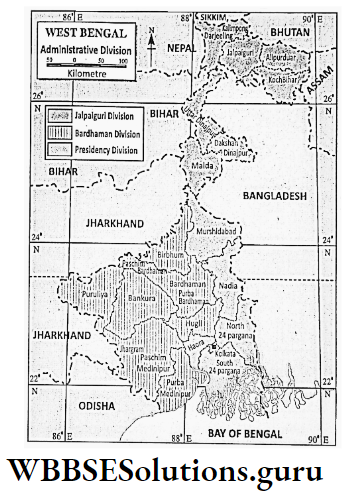
West Bengal, at present, consists of 23 districts. In West Bengal, four types of administrative structures are there-Division, District, Sub-division and Block.

Division:

23 districts of West Bengal have been grouped into five divisions. These are Bardhaman, Jalpaiguri, Presidency Malda and Medinipur divisions. Each division is administered by Divisional Commissioner.

District:

Each district of West Bengal is governed by District Collector or District Magistrate (D.M.) with exception of the Kolkata district which is administered by Kolkata Municipal Corporation (except law and order).

Sub-Division:

Each district consists of more than one sub-divisions. Example. Haora, Malda and Uttar and Dakshin Dinajpur each of these districts have two sub-divisions only. Each sub-division is governed by Sub-divisional Officer (S.D.O.)

Class 9 Geography Chapter 8 Question Answers

Administrative Divisions Of West Bengal

1. Bardhaman Division:

  1. Purba Bardhaman (H. Q. Bardhaman),
  2. Paschim Bardhaman (H. Q. Asansol),
  3. Hugli (H. Q. Chinchura),
  4. Birbhum (H. Q. Suri).

2. Presidency Division:

  1. Haora (H. Q. Haora),
  2. Kolkata (H. Q. Kolkata),
  3. Nadia (H. Q. Krishnanagar),
  4. 24 Parganas (N) (H. Q. Barasat),
  5. 24 Parganas (S) (H. Q. Alipur).

3. Jalpaiguri Division:

  1. Alipurduar (H. Q. Alipurduar),
  2. Koch Bihar (H. Q. Koch Bihar),
  3. Darjeeling (H. Q. Darjeeling),
  4. Jalpaiguri (H. Q. Jalpaiguri),
  5. Kalimpong (H. Q. Kalimpong).

4. Malda Division:

  1. Malda (H. Q. English Bazar),
  2. Uttar Dinajpur (H. Q. Raigunj),
  3. Dakshin Dinajpur (H. Q. Balurghat),
  4. Murshidabad (H. Q. Baharampur).

5.Medinipur Division:

  1. Purba Medinipur (H. Q. Tamluk),
  2. Paschim Medinipur (H. Q. Medinipur),
  3. Jhargram ( H. Q. Jhargram),
  4. Puruliya (H. Q. Puruliya,
  5. Bankura (H. Q. Bankura).


WBBSE Notes For Class 9 Geography and Environment Chapter 8 West Bengal Administrative Division

Chapter 8 West Bengal Community Development Block

Each sub-division consists of a number of C.D. Blocks. These are administered by Block Development Officer or B.D.O. Each Block consists of a few Gram Panchayats.

Panchayat Raj Or Village Council:

In West Bengal Panchayat Act was enacted in 1973. This is a three-tier administrative system. At its lowest level is Gram Panchayat which consists of a number of grams.

It is governed by Panchayat Pradhan. A few Gram Panchayat form Panchayat Samiti which is ruled by Sabhadhipati. Each block consists of one Panchayat Samiti.

At the top level is Zilla Parishad which consists of all the Panchayat Samities of the district. It is headed by the Zilla Sabhadhipati.
WBBSE Notes For Class 9 Geography and Environment Chapter 8 West Bengal 23 Districts In West Bengal

Gorkha Hill Council :

It was formed in 1988 and it consists of three sub-divisions (out of four) Darjeeling, Kalimpong and Kurseong. It administers all departments except a few like law and order, revenue etc.

Siliguri sub-division is administered by Mahakuma Parishad instead of Zilla Parishad.

Chapter 8 West Bengal Physical Environment

Physiography And Drainage Of West Bengal

The landform of West Bengal is very much diversified. Lofty mountain peaks, rolling uplands, and extensive fertile plains are the main physiographic characteristics of West Bengal.

Depending on such variation in landform, rivers of West Bengal flow either southward or southeastward.

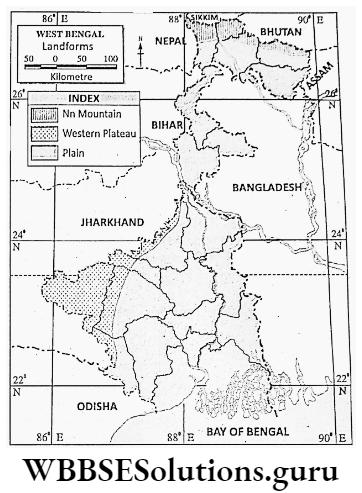
Physiographically, West Bengal can be divided into three divisions

  1. Northern mountains,
  2. Western plateau and
  3. The Plains.

Northern Mountains

Location:

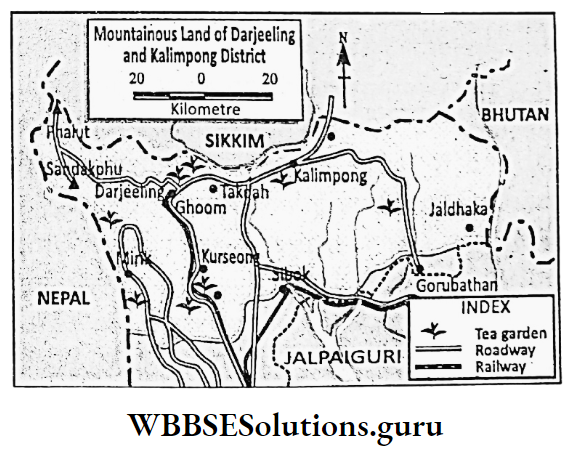
Northern Mountain consists of three sub-divisions of Darjeeling and Kalimpong district (Darjeeling town, Kalimpong and Kurseong sub-divisions) and Kumargram and Kalchini P.S. of Alipurduar district.

Relief:

Relief of this region is very much ruled due to the presence of lofty mountains intervened with deep gorges.

The river Tista is flowing from the north to the south and has divided the region into two parts-western and eastern parts of the Tista valley.
WBBSE Notes For Class 9 Geography and Environment Chapter 8 West Bengal Landforms

To the western part of the Tista Valley, Singalila and Darjeeling ranges stand in a north-south direction. Singalila stands along the border of Darjeeling district and Nepal.

There are a few lofty peaks in this range such as Sandakphu (3630 m), Phalut (3596 m), and Sabargram (3543 m). Sandakphu is the highest peak in this region as well as in West Bengal.

Class 9 Geography Chapter 8 Wbbse Solutions

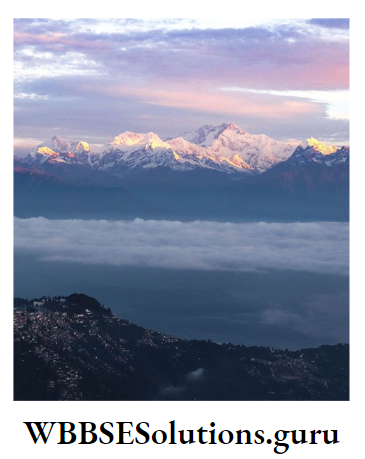
The Darjeeling range rises steeply from the Terai region in the south. To the south of it stands Tiger Hill (2573 m). Further south stands Daw Hill and to the east is Takdah Peshak Hill.

An important peak of this area is Sinchal (2615 m). The Darjeeling range is also known as the Ghoom range.

WBBSE Notes For Class 9 Geography and Environment Chapter 8 West Bengal Northern Mountainous Region


The height of the eastern part of the Tista Valley is much less. Rishila (3121 m), the highest peak of this region is situated near Kalimpong town.
WBBSE Notes For Class 9 Geography and Environment Chapter 8 West Bengal Mountainous Land Darjeeling And Kalimpong District

Kumargram and Kalchini P.S. of Alipurduar district are also mountainous but of low relief.

Renigango (1885 m) and Little Sinchula (1726 m) are two important peaks. There is a pass called Bauxa Duar which leads to Bhutan.
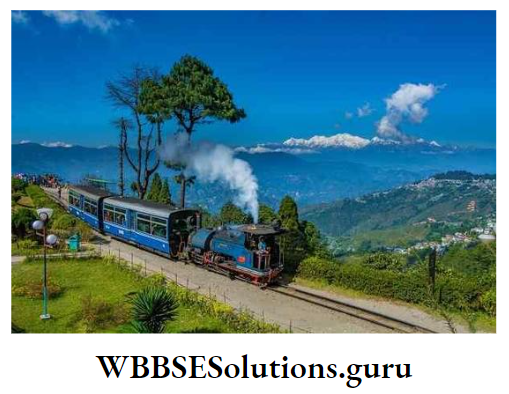
WBBSE Notes For Class 9 Geography and Environment Chapter 8 West Bengal Darjeeling - Toy Train


WBBSE Notes For Class 9 Geography and Environment Chapter 8 West Bengal Darjeeling - Tiger Hill

Rivers:

Many rivers are flowing through the mountainous region of West Bengal. These rivers are snow-fed and have water throughout the year.

They are very much turbulent and are favourable for hydel power generation. Important rivers of this region are Tista, Jaldhaka, Mahananda, Torsa, Kaljani and Balason.

The principal river of this region is Tista which rises in the Zemu glacier then flows through this region and finally joins the river Jamuna (Brahmaputra) in Bangladesh.

Class 9 Geography Chapter 8 Wbbse Solutions

River Tista has many tributaries, namely the Rangeet, Riang, the right bank tributaries and Rangpo, Reeling the left bank tributaries. Tista is very much turbulent and often floods the region.

So, it is known as the ‘River of Horror’. Another important river in this region is Jaldhaka. There is a river project on the Jaldhaka River.

WBBSE Notes For Class 9 Geography and Environment Chapter 8 West Bengal Tista River

Chapter 8 West Bengal Western Mountains

Location:

The landform of the entire Puruliya district’ and its adjacent Jhargram, Bankura, Paschim Bardhaman and the western part of Birbhum district is undulating or rolling.

This undulating upland of the western part of West Bengal is called Western Plateau.

Relief:

Geologically western plateau is part of the Chotanagpur plateau of Jharkhand. This is the most ancient landmass of West Bengal and is made of ancient igneous and metamorphic rocks with an undulating surface.

To the west, the land is higher (maximum 677 m) and to the east, it is lower (lowest 75 m). So, the plateau slopes from the west to the east.

There are small hills made of hard rocks, such as Ayodhya Hill and Baghmundi Hill in Ayodhya Hill the western part of the Puruliya district.

Gorgaburu of Ayodhya Hill is the highest peak (677 m) in this region. To the north of this district is Panchet Hill (643 m) and to the south is located Bhandari Hill.
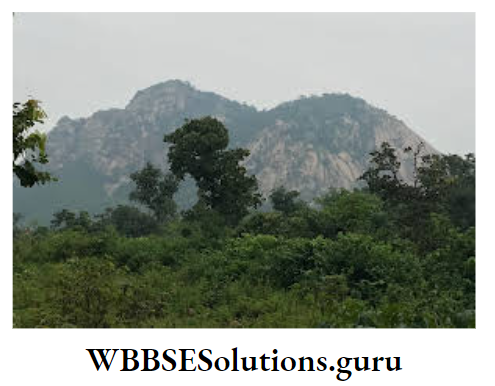
WBBSE Notes For Class 9 Geography and Environment Chapter 8 West Bengal Ayodhya Hill

The eastern part of this plateau slopes gradually and is extended in the western part of Paschim Medinipur, Bankura, Paschim Bardhaman and Birbhum districts.

Small hills of hard rocks are also in this area, such as Belpahari of Paschim Medinipur, Mathurkhali of Birbhum and Biharinath (435 m) and Susunia (440 m) of Bankura district.
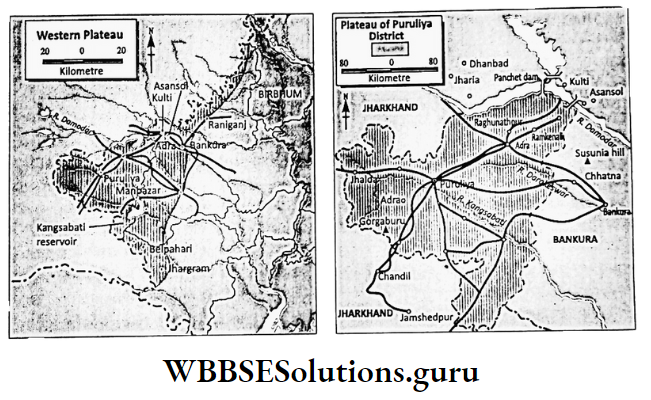
WBBSE Notes For Class 9 Geography and Environment Chapter 8 West Bengal Western Plateau, Plateau Of Puruliya District

Rivers:

Damodar is the principal river of the plateau region. After originating in the Khamarpat hill, the river Damodar is flowing through this region and finally joins the Hugli River.

Mundeswari, the distributor of Damodar joins the river Rupnarayan. Kansai or Kangsabati, another important river originates in the north of Ayodhya hill in the Puruliya district flows south-eastward and finally joins the river Hugli.

A reservoir has been made at the confluence of the river Kangsabati and Kumari, a tributary to Kangsabati near Mukutmanipur for irrigation and to control floods.

Class 9 Geography Chapter 8 Wbbse Solutions

River Darakeswar and Silai or Silabati have joined each other near Ghatal in Paschim Medinipur. Rupnarayan, the confluent of these two rivers joins the river Hugli near Geokhali.

Other important rivers are Mayurakshi, Ajoy, Dwaraka, Brahmani, Bakreswar, Kopai, Subarnarekha etc.

Chapter 8 West Bengal The Plains

Location:

Except for the northern mountains and the western plateau, the rest of West Bengal is under the plain region. The Plains of West Bengal can be divided into three regions

  1. Plains of North Bengal,
  2. Rarh Plain and
  3. The Ganga Delta Plain.

Plains Of North Bengal

The plains of North Bengal include the plains of Malda, Uttar and Dakshin Dinajpur, Koch Bihar, Jalpaiguri and Darjeeling.

The region is again subdivided into Terai or Duars Plain and Ganga-Brahmaputra Plain.

1.Terai Or Duars Plain:

Southern parts of the Alipurduar district and most parts of the Jalpaiguri district and the Siliguri sub-division of the Darjeeling district belong to the Terai or Duars plain.

The mountainous land of Darjeeling Himalaya suddenly slopes into this plain which slopes from the north (200 m) to the south (75 m) and is made of stones and pebbles brought by the swift-flowing Himalayan rivers.

The plan is forested due to heavy rainfall and the ground is humid and damp. So, the plain is called ‘Terai’ a French word which means ‘damp’. It is actually, the entrance to Bhutan.

So, Terai is also known as ‘Duars’ which means ‘doors’. Tista, Torsa, Jaldhaka, and Raidak are the important rivers of the Terai Plain.

Following the slope of the land, these rivers are flowing from the north to the south and deposit sands, stones and pebbles as they suddenly drop from the mountains into the plains.

In some places rivers are braided. In the rainy season, they occasionally flood the region and often change their courses.
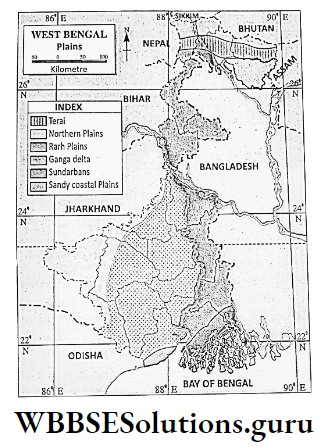
WBBSE Notes For Class 9 Geography and Environment Chapter 8 West Bengal Plains In West Bengal

2.Ganga-Brahmaputra Doab:

The land between the river Ganga and Brahmaputra is called Ganga-Brahmaputra Doab. It slopes from the north (about 75 m) to the south (about 30 m).

Based on the physiographic variation this is again divided into three sub-divisions-Tal, Barind or Barendrabhumi and Diara.

3. Tal:

Some parts of southern Jalpaiguri, most parts of Koch Bihar districts and the lowland between the river Kalindi and Mahananda of Malda district are known as Tal.

Rivers of this region often change their courses and are responsible for the occasional flood. Therefore, bills and marshes are common.
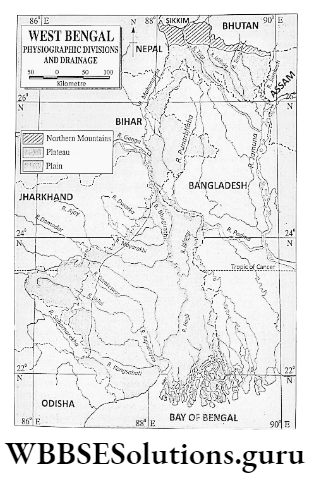
WBBSE Notes For Class 9 Geography and Environment Chapter 8 West Bengal Physigraphic Divisions And Drainage In West Bengal

4..Barind Or Barendrabhumi:

The eastern part of Dakshin Dinajpur and the eastern part of Maida districts are uneven and made of red old alluvium. This is known as Barind or Barendrabhuml.

5. Diara:

The land close to the river Ganga in the southwestern part of the Maida district is made of new alluvium and is fertile and densely populated. This is known as Diara.

Tista and Mahananda are two principal rivers of Ganga-Brahmaputra Doab region. The slope of the land is gentle, so, the rivers are flowing sluggishly in a meandering course.

Class 9 Geography And Environment Notes Wbbse

In the north important rivers are Kaljani, Raidak, and Dharall while in the south important rivers are Kalindi, Punarbhaba, Tangon, Nagar, and Atrai. The river Ganga is flowing through the southern part of the region.

Rarh Plain

The flat land in between the Bhagirathi-Hugli River in the east and the plateau in the west is known as the Rarh Plain. The region also includes the plains of Purba and Paschim Medinipur, Bankura and Bardhaman.

Rarh Plain is made of silts and alluvium deposited by the rivers which flow from the west (75 m) to the east (10 m) following the slope of the land. In the east floods are common and consequently, many lowlands have formed.

Rivers like Damodar, Mayurakshi, Ajoy, Rupnarayan and Kangsabati are flowing through the Rarh region and finally join the Bhagirathi- Hugli as tributaries.

These rivers are rainfed as they have originated in the plateau of the west. So, they become dry except in the rainy season. They flood often in the rainy season as their beds are shallow.

The Ganga-Delta Plain

The Ganga Delta comprises the districts of Murshidabad, Nadia, Kolkata, North and South 24 Parganas. The delta is formed by the deposition of silts of the river Ganga and its tributaries.

The plan is divided into four sub-divisions-Old or Moribund Delta, Mature Delta, Active Delta and Sandy coastal plain of Purba Medinipur district.

The plain slopes from the north to the south in a gentle slope with an average height of 15 m above sea level.

WBBSE Notes For Class 9 Geography and Environment Chapter 8 West Bengal Gange Delta

Moribund Delta comprises the northern part of 24 Paraganas (N), Nadia and the eastern part of Murshidabad districts.

The distributaries of Padma or Bhagirathi, namely Bhairab, Jalangi, Churni, and Mathabhanga cannot deposit silts any more. So, the process of delta formation.

Class 9 Geography And Environment Notes Wbbse

was stopped long ago and many abandoned river channels and bills have been left out. So, the region is a land of dead and decaying rivers and is locally called ‘Bagri’.
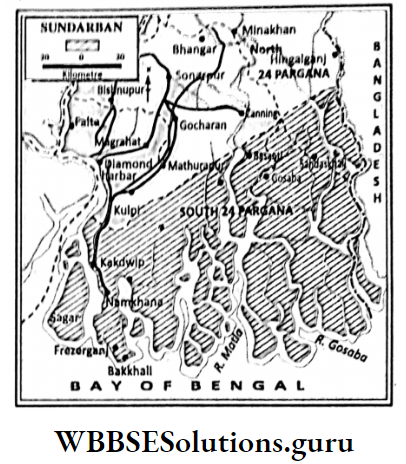
WBBSE Notes For Class 9 Geography and Environment Chapter 8 West Bengal Sundarban

The mature delta comprises the north and central parts of 24 Parganas (S), the central part of 24 Parganas (N) and the Kolkata districts.

A few rivers like the Ichhamati are still depositing a little number of silts thereby changing the landforms of the region. Many bills and marshy lands are common in this region. Example. Salt Lake to the east of Kolkata.

Active delta comprises southern parts of 24 Parganas (S) where delta formation is going on actively. So, new landmasses are developing, for Example. Purbasha or New Moore Island which is located to the south of Sundarban.

The slope of the land is very low, only 5 m above sea level. So, the saline Nurpur water of the Bay of Bengal enters easily through the rivers and the soil of this region becomes saline.

Class 9 Geography And Environment Notes Wbbse

Many islands are found Example. Sagar Island (largest), Kakdwip, Dalhousie, Lothian, Frezerganj, Baluchari etc.

The sandy coastal plain is the coastal strip along the Bay of Bengal of Purba Medinipur. It is flat but sandy, scattered with sand dunes.

In front of the Digha sand dune lies the sea beach of Digha. The land slopes from the north to the south.

WBBSE Notes For Class 9 Geography and Environment Chapter 8 West Bengal Coastal Sand Dunes

The river Bhagirathi-Hugli is flowing along the western margin of the delta region. In the eastern part, important rivers are Bhairab, Jalangi, Mathabhanga, Ichhamati, Churni and Saraswati.

These rivers are flowing from the north to the south following the slope of the land. Bhairab, Jalangi and Mathabhanga have branched out from the river Padma.

Jalangi and Mathabhanga have joined the river, Bhagirathi. The southern part of Mathabhanga is known as Churni. The river Ichhamati has branched out from Mathabhanga and drains into the Bay of Bengal.

Once the Saraswati was the main flow of Bhagirathi but now it is a dead river. In the Sundarban region, many rivers have branched into innumerable river channels like Matla, Gosaba, Vidyadhari, Piyali, Raimangal, Kalindi, and Bartala.

These rivers are tide-fed and they have wide estuaries through which saline water of the Bay of Bengal enters far into the rivers of the Sundarban region.

The rivers of the Sandy coastal plain of Purba Medinipur are small and drain into the Bay of Bengal following the slope of the land, for Example.Rasulpur, Pichhabani. Rasulpur is the principal river of this region.

Chapter 8 West Bengal Brief Overview Of Water Resources Of West Bengal

There is no alternative to water, the ‘Blue gold’ resource in which our planet Earth is rich, but scarce in fresh water. The source of this water is rainwater in which West Bengal is rich (about 175 cm annual rainfall).

Distribution Of Rainfall

Northern districts of West Bengal namely Darjeeling, Kalimpong, Jalpaiguri, Alipurduar, Koch Bihar and Uttar Dinajpur receive maximum yearly rainfall, of about 250 cm or more.

While Bankura, Birbhum, Puruliya, Jhargram, Paschim Medinipur, Nadia, and 24 Murshidabad districts receive annually 170 cm or less. Most of the rain (70 to 80%) in West Bengal occurs from June to September.

WBBSE Notes For Class 9 Geography and Environment Chapter 8 West Bengal River In West Bengal

Volume Of Rain Water

The volume of rainwater in West Bengal, if estimated will be nearly 165.56 cubic km. It is maximum in Jalpaiguri district (including Alipurduar district) about 19.15 cubic km.

It is 17.14 cubic km in 24 Parganas (S), 15-41 cubic km in Paschim Medinipur (including Jhargram), 11.23 cubic km in Bardhaman (Purba and Paschim) and 11-10 cubic km in Koch Bihar.

While it is not enough in Kolkata (0-31 cubic km), Haora (2.4-8 cubic km) Dakshin Dinajpur (4.12 cubic km), and Hugli (5.19 cubic km).

Inland Water Resource

Some of the rainwater goes underground, a little is evaporated while much of it flows as surface runoff. Inland water comprises both groundwater and surface water.

By volume, the inland water resource of West Bengal is about 129 cubic km. It is higher in Jalpaiguri including Alipurduar (16-85 cubic km), 24 Parganas (S) (11-78 cubic km), Paschim Medinipur (11.38 cubic km), Koch Bihar (9.94 cubic km).

But it is scarce in Kolkata (0.25 cubic km), Haora (2.0 cubic km), Dakshin Dinajpur (3.40 cubic km), Hugli (4.10 cubic km), and Nadia (4.83 cubic km).

The water reserves of West Bengal are only 6 cubic km. It is 4 cubic km in Ponds and bills while less than 2 cubic km in reservoirs.

Potential water per capita is decreasing. It was 5200 cubic km (yearly) in 1951, 2941 cubic km in 1971, 1870 cubic km in 1991 and 1411 cubic km in 2011.

Wbbse Class 9 Geography Chapter 8 Notes

In the previous decade’s rapid population growth, the increasing rate of using irrigation water, and global warming led to uncertainty.

Rainfall is responsible for such a reduction in the amount of per capita water resources which may cause various problems in future.

Chapter 8 West Bengal Merits And Demerits Of Multiple Use And Overuse Of Water From River Canal Tank Well Ground Water

We use mainly two types of water-surface water from ponds, bills, rivers etc. and underground water which is obtained from wells and tube wells.

Water is used mainly in three sectors-agriculture, industry and household purposes. In developed countries, water is mainly used in industries while in developing countries like India water is mainly used in agriculture.

In West Bengal, large quantities of underground water are used by wells and tube wells in agriculture for irrigation. As a result, the underground water level has been lowered and consequently, rivers, canals, ponds and bills are drying up.

Different types of salts mixed with underground water also increase the salinity of farmlands. In many parts of West Bengal, arsenic is also mixed with underground water and causes various types of diseases when used as drinking water.

Water is also polluted by household wastes, agricultural runoff from chemical and pesticide-treated fields, and runoff from domestic wastewater and sewage and waste products of industries.

Climate Of West Bengal

The climate of West Bengal is warm and humid. Rainfall occurs in summer while winters are dry and mild. This type of climate is known as Tropical Monsoon Climate.

 Climate Characteristics Of West Bengal:

The change of seasons is the most important feature of the climate of West Bengal. Four seasons, namely summer, rain, autumn and winter rotate in a cycle in the climate of West Bengal.

In summer moist south-west monsoon wind gives rain in West Bengal. In winter dry and cold north-east monsoon wind keeps the climate of West Bengal cool and dry.

In summer wind blows from the southwest direction while in winter wind blows in opposite direction.

In the mountainous region of North Bengal, summers are pleasant because of their altitude, but winters are severely cold. The rest of West Bengal experiences mild weather.

Chapter 8 West Bengal Seasons Of West Bengal

Based on variation temperature, arrival and departure of monsoon wind and the amount of rainfall the meteorological department of the Government of India has divided the climate of West Bengal into four seasons-summer, rainy season, autumn and winter.

Summer (March To May)

In March the sun crosses the equator and moves apparently towards the Tropic of Cancer. So, temperature increases in West Bengal. In April and May temperature rises from 35°C to 42°C.

WBBSE Class 9 Geography Environment Chapter 8 summary

In the plateau region in the west, the temperature reaches 44°/45°C when hot wind called ‘Loo’ blows over the plateau. But, the temperature in Darjeeling mountain remains as low as 16°C on average because of the altitude.

Often, in the evening thunder clouds from the north-west give rain along with hailstorms. This is called Nor’wester or Kalbaisakhi (Calamity of the Bengali month ‘Baisakh’).
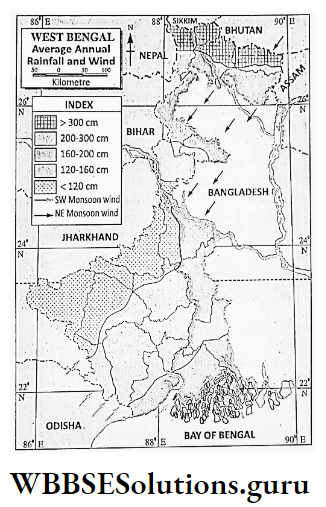
WBBSE Notes For Class 9 Geography and Environment Chapter 8 West Bengal Average Annual Rainfall And Wind In West Bengal

Rainy Season (June To September)

By the second week of June, moist south-west monsoon wind enters West Bengal and gives plenty of rain. In this season maximum rainfall (275-300 cm) occurs in the Northern mountainous region.

Moderate rainfall takes place on the plains and scanty rainfall occurs on the plateau. But the average annual rainfall in West Bengal is 175 cm 80% of annual rainfall in West Bengal occurs in the rainy season.

Autumn (October To November)

By the end of September, the sun crosses the equator and moves towards the Tropic of Capricorn. South-west monsoon wind moves back and rainfall starts to decrease. This is known as the season of Retreating Monsoon.

Slowly the north-east monsoon wind starts to arrive in West Bengal and gives an indication of winter. Often cyclonic rainfall occurs which is locally known as ‘Aswiner Jhar’.

Winter (December To February)

In December the sun is at the zenith of the Tropic of Capricorn. West Bengal receives oblique sun rays, so, the temperature starts to decrease.

Cold and dry north-east monsoon wind also starts to blow over West Bengal. In January, the temperature becomes very low. The mountainous region of Darjeeling district becomes severely cold and the temperature drops to 4°C.

Occasionally snowfall occurs. Over the plateau, the temperature is 10°C and on the plains, it is 16°C only. Winter is dry as this wind does not capture any moisture.

This stable weather condition is disturbed only when the cyclonic storm from the west sets in. This storm is called ‘Western Disturbance’.
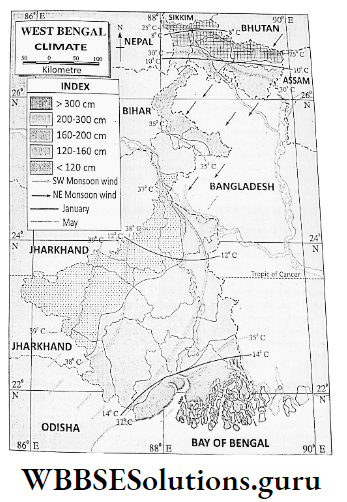
WBBSE Notes For Class 9 Geography and Environment Chapter 8 West Bengal Climate In West Bengal

Chapter 8 West Bengal Impact Of Monsoon On The Climate Of West Bengal

The word ‘monsoon’ has been coined from the Arabian word ‘Mausim’ means ‘seasons’. So the wind which blows according to the seasons is called monsoon wind.

Monsoon wind plays a great role in the climate of West Bengal. In summer when a moist southwest monsoon crossing the Bay of Bengal blows in West Bengal gives heavy rainfall.

About 70 to 80% of rain occurs during this time. Again, in winter, the cold and dry northeast monsoon wind of land origin keeps the climate of West Bengal dry and cool.

WBBSE Class 9 Geography Environment Chapter 8 summary

Cold and dry north-east monsoon wind from Siberia and Tibet blows over West Bengal in winter when the temperature becomes very low. The wind does not give any rain as it is dry.

So winters are dry in West Bengal. Based on the arrival and departure of the southwest and northeast monsoon wind the climate of West Bengal is divided into four seasons-Pre-monsoon or Summer.

Monsoon or Rainy, Retreating monsoon or Autumn and Post monsoon or Winter season.

Chapter 8 West Bengal Impact Of Change Of Seasons On Human Life

The change of seasons is an important feature of climate. There is a great impact of the change of seasons in human life.

Food habits are greatly influenced, for Example. vegetables like ladies’ fingers, mango, berry, jack fruit, leeching etc. grow in summer while cabbage, cauliflower, carrot, beet, spinach, and oranges grow in winter.

Therefore, our food habits also change according to the seasonal crops and fruits. Dresses In summer we wear light cloth while in winter we wear coarse and woollen garments.

Human skill-We get tired in summer while in winter we are energetic. Specialisation in livelihood In rainy season agriculture, pisciculture is well practised.

In autumn and in winter activities based on festivals and tourism become predominant. In winter harvesting of the Kharif crop and sowing of the Ravi crop; fairs, circuses and other entertainment-related jobs and activities become important.

Chapter 8 West Bengal Soil And Natural Vegetation Of West Bengal

Soil

The upper part of the earth’s crust that is made of fine loose materials where trees can grow is called soil. In West Bengal, three types of soils are found-alluvial soil, laterite soil and saline soil.

1. Alluvial :

Alluvial soil is formed by the deposition of sand, silt and clay brought by the rivers. It is found in the vast plain of West Bengal. Alluvial soil is of two types-old alluvium and new alluvium.

WBBSE Notes For Class 9 Geography and Environment Chapter 8 West Bengal Soil In West Bengal

2. Old Alluvium :

Old Alluvial is found in Koch Bihar, Dakshin Dinajpur and in parts of Malda. It is reddish in colour and is known as red soil. Rice, mulberry and mango grow well in this soil.

WBBSE Notes For Class 9 Geography and Environment Chapter 8 West Bengal Red Soil

3. New Alluvium:

New alluvium is found in the plains of North and South 24 Parganas, Uttar Dinajpur, Haora, Hugli, Purba Bardhaman and Nadia. The colour of the soil is grey and the soil is very much fertile. Rice, wheat, sugarcane and jute grow well.

4. Laterite Soil:

Laterite soil is found in Puruliya, Birbhum, Bankura, Murshidabad, Jhargram, Paschim Medinipur and Paschim Bardhaman districts. The word ‘Laterite’ is coined from the Latin word ‘Later’ means ‘brick’.

The iron content of the soil is high. So the soil is red in colour and is stony. Therefore it is infertile and cultivation is practised only with irrigation and the application of fertilizer.

5. Saline Soil:

Saline soil is found in North and South 24 Parganas. The soil of the Contai coast is also saline.

The soil of Sundarban is saline as the region is often flooded with seawater during high tides. Cultivation is not possible in this type of soil.

6. Mountain Soil:

Mountain soil is found in the Northern Mountains region. This soil is stony and acidic. In some places, oranges, cinchona, and apples grow.

Natural Vegetation

Trees and plants that grow naturally are together known as Natural vegetation. When it grows over a wide area is called a forest.

If only grasses grow over a wide area, it is called Grassland. In West Bengal, four types of natural vegetation are found.

1. Tropical Mixed Forest Of Mountainous Region:

In the Northern mountainous region, a mixed forest of Tropical deciduous and Tropical evergreen trees is found. Evergreen trees, namely sissoo, chapatis, gurjan and deciduous trees like oak, maple, laurel etc.

are common in this forest at an altitude of 2500 m. Above it are found coniferous trees like pine, deodar etc.

2. Tropical Humid Deciduous Forest Of Plains:

Most of the trees have been cut to make room for cultivation and settlements in the plain. Mango, banyan trees, and jackfruit are common in the plains. In terai plains sal, toon etc. grow.

WBBSE Class 9 Geography Environment Chapter 8 summary

3. Mangrove Vegetation Of Delta Or Sundarban:

On the saline soil of the Sundarban region Sundari, Goran, Geona, hentai, hola, and Kolkata are grown. They have breathing roots rising above the soil.

They also have stilt roots to protect them from storms, waves etc. This type of natural vegetation is called Mangrove vegetation.
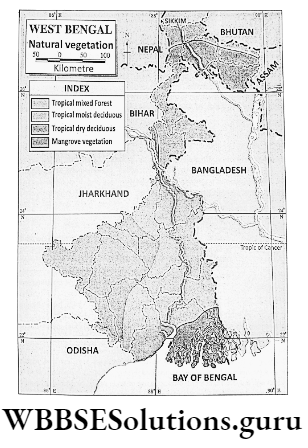
Mangrove Vegetation Of Delta Or Sundarban:

On the saline soil of the Sundarban region Sundari, Goran, Geona, hentai, hola, and Kolkata are grown. They have breathing roots rising
above the soil.

They also have stilt roots to protect them from storms, waves etc. This type of natural vegetation is called Mangrove vegetation.

WBBSE Notes For Class 9 Geography and Environment Chapter 8 West Bengal Natural Vegetation In West Bengal

4. Dry Deciduous Forest Of The Plateau:

Deciduous trees like sal, Palash, and mahua grow abundantly on the plateau. In winter these trees shed their leaves to check the loss of water through transpiration.

It is found in the districts of Puruliya, Birbhum, Bankura, Murshidabad, Jhargram, Paschim Medinipur and Paschim Bardhaman.

Major Economic Activities

The economic activities and livelihood of the people of West Bengal depend largely on the geographical environment of the state. Since independence, West Bengal has developed various types of economic activities.

Agriculture, the industry even tourism and information technology have great importance in the economic activities of West Bengal.

Chapter 8 West Bengal Agriculture Of West Bengal Major Crops (Paddy Jute Tea)

West Bengal is principally an agricultural country. About 70% of people are engaged either directly or indirectly, in agriculture.

About one-third of the annual income of the state is contributed by agricultural activities. About 65% of the land of West Bengal is devoted to agriculture.

In Indian agriculture, West Bengal plays an important role. West Bengal accounts for nearly 15% of rice production, 74% of jute production and 23% of tea production in India.

Plenty of crops like potato, oilseeds, tobacco, wheat, corn, barley, betel leaf etc. also grow in West Bengal.

West Bengal is the leading producer of rice and jute in India. The state holds 2nd position in tea and potato production in India.
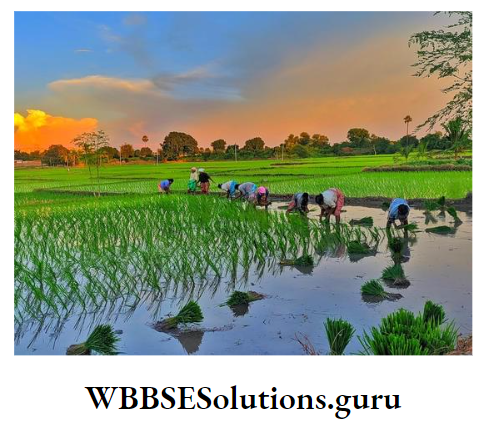
WBBSE Notes For Class 9 Geography and Environment Chapter 8 West Bengal Paddy Field

Though agriculture is the mainstay of the economy of West Bengal, yet West Bengal has to face problems in the agricultural sector.

Example. farmlands are mainly cultivated by traditional methods, the yield rate is low, about 50% of the agricultural fields have irrigation facilities, and small holdings in which modern.

implements are not applicable, want of store room, H.Y.V seeds, fertilizer etc. lack of adequate capital as the farmers are poor as well as they do not get proper remuneration.

WBBSE Class 9 Geography Environment Chapter 8 summary

Various measures have been undertaken to solve the difficulties faced by the agricultural sector in West Bengal by increasing the area of farmlands through the recovery of fallow land, marshy land, saline land etc.

Increasing multiple cropped land through irrigation; increasing use of fertilizer, pesticides and modern implements; increasing use of H.Y.V. seeds; emphasizing agricultural research; monetary help to small and marginal farmers etc.

Chapter 8 West Bengal Paddy

Paddy is the principal food crop as well as the principal agricultural crop of West Bengal. About 95% farmland of West Bengal is devoted to rice cultivation.

Rice also accounts for nearly 91% of the annual production of food crops in West Bengal.
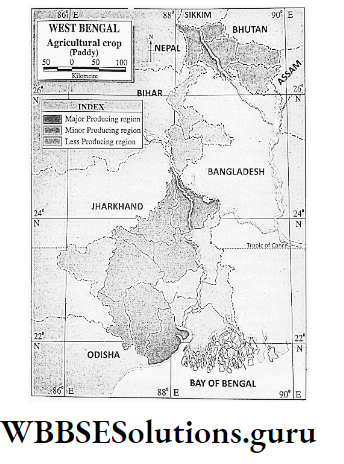
WBBSE Notes For Class 9 Geography and Environment Chapter 8 West Bengal Agricultural Crop (Paddy) In West Bengal

1. Multiple Use Of Paddy:

Rice is obtained from paddy. Rice is used in various types of foods, such as boiled rice, puffed rice, flaked rice etc. Starch obtained from boiled rice is used in the textile industry.

Wine is also produced from boiled rice. Paddy husks are used as a fodder crop. Paddy straw is used to shed mud houses. The rope is also made from paddy straw. Rice husk obtained from paddy is used to produce rice oil and fuel oil.

WBBSE Class 9 Environment Chapter 8 Important Points

2. Producing Areas:

In West Bengal paddy is cultivated mostly everywhere. But it predominates in the districts of Purba Medinipur, Purba and Paschim Bardhaman, 24 Parganas (N).

24 Parganas (S), Nadia, Uttar Dinajpur, Dakshin Dinajpur, Murshidabad, Birbhum, Bankura etc. Purba and Paschim Bardhaman is the leading producer of paddy in West Bengal.
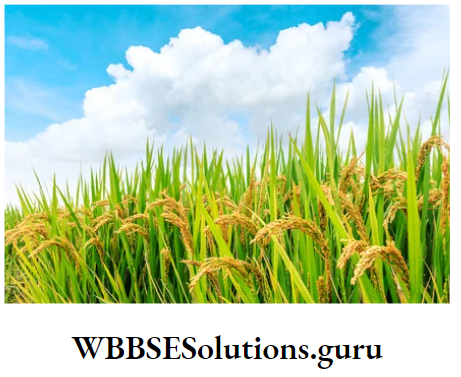
WBBSE Notes For Class 9 Geography and Environment Chapter 8 West Bengal Paddy

3. Production:

2013-14 about 15-2 million tons of paddy was produced in about 5-4 million hectares of land. West Bengal is the leading producer of paddy in India.

In West Bengal yield rate of paddy’ is 2690 kg per hectare. In West Bengal, Birbhum is the leading district followed by Bardhaman and Malda in yield rate of paddy in West Bengal.

4. Ideal Environment For Paddy Cultivation :

In West Bengal, there is extensive plain land which is ideal for cultivation. This plain is fertile and rich in alluvium.

Most parts of West Bengal receive 150-200 cm annual rainfall which is ideal for paddy cultivation. The average temperature of West Bengal varies between 22°C and 30°C which is also adequate for paddy. cultivation.

Necessary fertilizer, H.Y.V. seeds, pesticides, agricultural machinery for modern. the technique of paddy cultivation is easily available in West Bengal.

West Bengal being a densely populated state, provides cheap and skilled agricultural labour.

Chapter 8 West Bengal Jute

Jute is the principal fibre crop of West Bengal. It is bast fibre crop.
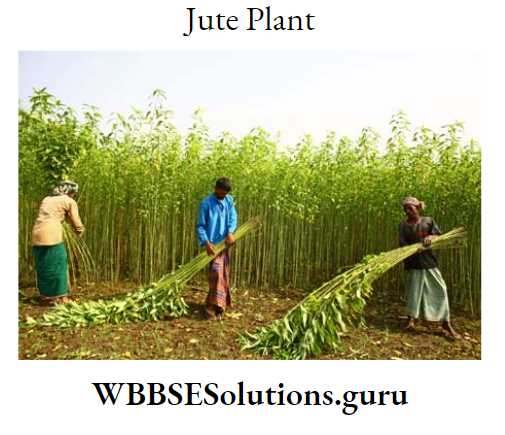
 

WBBSE Notes For Class 9 Geography and Environment Chapter 8 West Bengal Jute Plant

WBBSE Class 9 Environment Chapter 8 Important Points

1. Importance Of Jute:

Jute cultivation plays an important role in the economy of West Bengal. About 4 million people of West Bengal are engaged directly or indirectly in jute cultivation.

Millions of people in West Bengal are also linked to the production of jute goods. Every year exporting jute and jute goods large. quantities of foreign money are earned.

2. Multiple Use Of Jute:

Jute fibre Multiple uses of Jut is used in making cloth, bags, rope, carpet, tarpaulin etc. Jute stalk (stem) is used as fuel in making paper as well as in the plantation of betel leaf.

3. Types Of Jute:

There are two types of jute-White jute and Tossa jute. White jute grows well on all types of land. Tossa jute or golden jute grows on high land mainly.

4. Ideal Environment For Jute Cultivation :

In West Bengal, jute is cultivated as a Kharif crop in summer. In summer, West Bengal receives 100-120 cm rainfall on average and experiences 25°C temperature on average which is ideal for jute cultivation.

Jute cultivation prefers riverine flat plain land which is available in most parts of West Bengal. Water storage is essential for the retting of jute fibre after harvesting.

In the rainy season, a number of bills, marshes and ponds become filled with water in West Bengal. Densely populated West Bengal also provide plenty of cheap and skilled labourer for jute cultivation.

5. Producing Areas:

Plenty of jute is cultivated in almost all the districts of West Bengal, namely North and South 24 Parganas, Hugli, Nadia, Purba Medinipur, Purba Bardhaman, Malda, Uttar and Dakshin Dinajpur, Jalpaiguri including Alipurduar and Koch Bihar.

6. Production:

West Bengal is the leading producer of jute in India. In 2013-2014 about 1.5 million tons of jute were produced in about 6 lakh hectares of land and it accounts for nearly 74% of jute production in India.

Jute is the principal cash crop of West Bengal. But due to economic recession in a few previous decades, jute production has declined.

Chapter 8 West Bengal Tea

Tea is the principal cash crop of West Bengal. It is used as a mild stimulator and as a cheap beverage. It is also a plantation crop and is produced in tea estates or gardens.

1. Importance Of Tea Plant:

Tea plays an important role in the economy of West Bengal as many people are engaged directly or indirectly in tea plantations as well as by exporting tea large amount of foreign money is also earned.

2. Ideal Geographical Environment For Tea Plantation:

The tea plant is an evergreen tree. It grows well at the foothills of a mountain or along a sloping river valley of a monsoon climatic region.

Most parts of North Bengal receives 150-250 cms. of average rainfall and an average summer temperature of 27°C which are ideal climatic conditions for tea plantation.

WBBSE Class 9 Environment Chapter 8 Important Points

Tea plantation requires a hill slope which is ideal for their growth therefore, the hills of North Bengal are ideal for tea plantation.

The soil of the hills is also loamy with iron which is also ideal for tea cultivation. Women and children are engaged in the plucking of two leaves with a bud.

WBBSE Notes For Class 9 Geography and Environment Chapter 8 West Bengal Tea Plucking

3. Producing Areas:

Innumerable tea gardens have developed on the hills of Darjeeling and Kalimpong districts and on the sloping Terai and Duars of Alipurduar, Jalpaiguri and Koch Bihar districts.

Tea plantations started in 1870-1875 by the British people in the Duars region of Jalpaiguri district. Recently, tea gardens have developed in Uttar Dinajpur and on the Ayodhya hill of Puruliya district.

Best quality flavoured tea is produced on the hills of the Darjeeling district.

WBBSE Notes For Class 9 Geography and Environment Chapter 8 West Bengal Tea Plucking.


WBBSE Notes For Class 9 Geography and Environment Chapter 8 West Bengal Agricultural Crop In West Bengal

4. Production:

West Bengal ranks 2nd position in tea production in India. About 50% country’s tea is produced in Assam. In 2013-14 about 2-40 lakh tons of tea was produced in West Bengal and it was contributed by Darjeeling (5% ), Terai (33%) and Duars (62%).

Tea plantation in West Bengal is facing problems like

  1. old tea estates which reduce the quality as well as quantity of production,
  2. and scarcity in packing boxes. The development of new tea gardens and the manufacturing of packing boxes are essential to solving the problems of tea plantations.

Chapter 8 West Bengal Industries (Iron And Steel Jute Cotton Tea Food Processing Tourism Information Technology) Of West Bengal Causes Of Development Problems And Prospects

Before the independence of India the erstwhile undivided ‘Bengal’ was the leading state in industries in India.

After the independence of India, a few large-scale industries including the iron and steel industry have developed different five years plans in West Bengal.

Recently, industries like food processing, tourism, and information technology (I.T.) have also developed in West Bengal.

Iron And Steel Industry

1. Importance:

West Bengal plays an important role in the iron and steel industry in India. There are two large-scale integrated iron and steel plants-one at Durgapur and the other at Kulti-Burnpur.

One large-scale alloy steel plant has developed at Durgapur. Durgapur Steel Plant (D.S.P.) was set up at Durgapur during 2nd five-year plan.

The steel industry at Kulti-Burnpur (ISCO) was set up in 1918 and was undertaken by the Government of India in 1974. The alloy steel plant (A.S.P.) was set up at Durgapur after the independence of India during a Five-year plan.

Causes of development of these three iron and steel factories in West Bengal are: Local coal resource-Good quality coal is available from Ranigunj, Andal, Dishergarh and nearby Jharia coalfield.

Nearness to the iron ore producing region- Iron ore mines of Gua, Noamundi of Jharkhand and Gurumahisani and Badampahar of Odisha are located within 350 km distance.

Availability of limestone and manganese-Limestone of Birmitrapur of Odisha and manganese from Gangpur of Odisha are in close proximity.

Availability of water-Water is easily available from the nearby Damodar River. Good communication between the port and market-The region is connected with the port and market of the Hugli industrial region through the eastern railway, G.T.

road and the navigable canals of the D.V.C. Project. Abundant cheap labour-Labour is available from the overpopulated Jharkhand state.

Supply of electricity- Power is supplied from Durgapur and another thermal power project of D.V.C.

A number of mini steel plants and sponge iron factories have also developed in many parts of West Bengal, particularly, in the districts of Puruliya, Paschim Bardhaman, Paschim Medinipur, Haora etc.

WBBSE Notes For Class 9 Geography and Environment Chapter 8 West Bengal Iron And Steel Factory

2. Problems Of The Iron And Steel Industry:

The iron and steel industry in West Bengal is facing a few problems like iron which is not locally available in the state; good quality coking coal is not available in the state.

limestone and dolomites are collected from Odisha, Jharkhand which incurs transport costs; lack of skilled labour; old and obsolete machinery; traditional. production technique; high production cost etc.
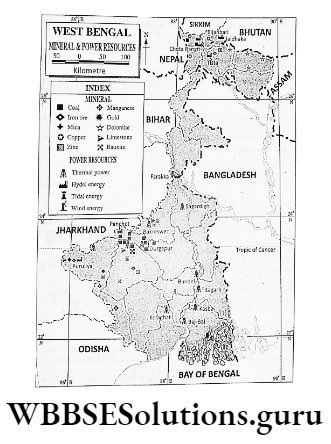
WBBSE Notes For Class 9 Geography and Environment Chapter 8 West Bengal Mineral & Power Resources In West Bengal

3. Prospects Of The Iron And Steel Industry:

There is a rapid increase in demand for a steel with the improvement of the construction of automobiles and various engineering industries.

So the prospect of this industry is much bright provided better quality steel is produced at a cheaper rate utilising modern machinery and modern techniques in future.

WBBSE Class 9 Geography Environment Chapter 8 summary

Chapter 8 West Bengal Jute Industry

The first jute mill in our country was set up in 1859 at Rishra near Kolkata as a joint venture by George Auckland and Biswambhar Sen, a Bengali businessman.

Within a few years, a number of jute mills were set up in West Bengal. At present, there are 76 jute mills in India. Amongst these, 59 mills are located in West Bengal.

These mills are located along the two banks of the river Hugli between Kalyani-Bansberia in the north to Baj-Baj- Uluberia in the south.

WBBSE Notes For Class 9 Geography and Environment Chapter 8 West Bengal Golden Fiber

Causes Of Development Of The Jute Industry

Factors of tremendous concentration i.e. centralisation of jute mills along the Hugli River are

  1. Availability of local raw jute;
  2. Close proximity to Ranigunj coal mine;
  3. Nearness to the Kolkata port;
  4. The cheap waterway of the river Hugli;
  5. Good communication system by rail-road transport;
  6. Locally available cheap labour;
  7. Initiation and inspiration of the British people etc. Important centres of this region are Birlapur, Uluberia, Baj-Baj, Rishra, Agarpara, Naihati, Baidyabati,
  8. Shrirampur, Halisahar, Bansberia, Jagaddal, Shyamnagar, Kamarhati etc.

WBBSE Notes For Class 9 Geography and Environment Chapter 8 West Bengal Jute Mill

Problems Of The Jute Industry In West Bengal

At present jute mills in West Bengal are facing a number of problems such as

  1. Competition from alternative fibres has restricted domestic demand;
  2. Old obsolete machinery of the British period cannot produce good quality jute goods;
  3. Competition in the international market from newly developed mills of foreign countries, namely Bangladesh, Thailand, and China; Managerial inefficiency and
  4. labour disputes are responsible for the closure of many mills;
  5. High export duty;
  6. Uncertainty of good quality raw jute etc.

Prospects Of Jute Mills

A few measures to be taken to solve the problems faced by jute mills, such as new items like Jute clothes, wall decorations, and fancy items are to be produced.

High-yielding variety seeds are to be used to produce good quality jute fibre; modernisation of jute mills as well as awareness programme regarding publicity of jute goods as eco-friendly items than the items produced from synthetic fibres.

WBBSE Class 9 Geography Environment Chapter 8 summary

Chapter 8 West Bengal Cotton Textile Industry

The first cotton mill in India was set up in 1818 at Ghusuri near Kolkata in West Bengal. But it was closed shortly, due to a lack of raw materials.

Later on, many cotton mills were set up in West Bengal based on raw cotton from Western and Southern India.

Causes Of Development Of The Cotton Textile Industry

Factors responsible for the growth of cotton mills in the Hugli industrial region are rail-road communication which brings raw cotton from Western and Southern India.

Port facility of Kolkata to import machinery and cotton; humid climate for weaving clothes; local demand for cotton goods; availability of cheap labour etc.

Important centres of cotton mills are Sodepur, Belgharia, Shyamnagar, Ghusuri, Salkia, Shrirampur, Rishra, Konnagar, Haora, Uluberia, Kalyani etc.

WBBSE Notes For Class 9 Geography and Environment Chapter 8 West Bengal Textile Industry

Problem Of the Cotton Textile Industry

The main problem of the cotton textile industry is. West Bengal is

  1. The non-availability of raw material i.e. cotton. Production cost is high due to transport: cost incurred in bringing cotton From Western and Southern India,
  2. Old and obsolete machinery as well as traditional production techniques which do not favour the production of high-quality cotton goods,
  3. Competition from the modern mills of Western and Southern India;
  4. Lack of skilled labour,
  5. Managerial inefficiency and labour disputes etc.

Prospects Of The Cotton Textile Industry

There is a bright future for this industry in West Bengal if the cotton mills are renovated and modernised to produce good quality cotton goods at a cheaper rate.

Chapter 8 West Bengal Tea Industry

The tea industry plays an important role in the economy of West Bengal. It not only provides jobs to the people of West Bengal it also earns large quantities of foreign money by exporting tea.

Actually, the economy of North Bengal depends on tea plantations and the tea industry.

Development of communication systems, industrial infrastructure, and settlements of Darjeeling, Kalimpong, Alipurduar, Jalpaiguri and Koch Bihar districts are mainly oriented toward the development of the tea industry.

Most of the tea of West Bengal is exported.. through Kolkata port.

During the later part of the nineteenth century (1870-75), the British people developed a few tea estates attracted by favourable geographical conditions.

For tea plantation in Terai-Duars region. In the beginning, tea gardens were developed in the Duars of the Jalpaiguri district.

Flavoured tea plantation started in the Darjeeling district. At present, in North Bengal, there are about more than 300 tea gardens. Most of the owners at present are Indians.

WBBSE Notes For Class 9 Geography and Environment Chapter 8 West Bengal Industry In West Bengal

Causes Of Development Of The Tea Industry

  1. Tea industries are developed close to the tea gardens so that after the collection of two leaves with a bud, its flavour and taste are retained as much as possible.
  2. So, most of the tea gardens of Darjeeling, Jalpaiguri and Koch Bihar were accompanied by the development of tea factories. North Bengal is well populated but lacks industries. So, local labour is available for the tea industry.
  3. The Industry was Initiated by the British people, so, capital and foreign market were easily available.
  4. Manufacturing of packing boxes is easily available as the forests of Terai and Duars provide the necessary wood.
  5. The port facility of Kolkata exports tea. All these factors are responsible for the development of the tea industry in Darjeeling, Kalimpong, Alipurduar, Jalpaiguri and Koch Bihar districts.

Important tea-producing centres of North Bengal are Happy Valley, Lopchu, Takdah of Darjeeling, Makaibari of Kurseong etc.

A number of tea gardens, as well as tea factories, are in Terai and Duars regions. Tea gardens are also developed at the experimental level in Uttar Dinajpur and Ayodhya hills of Puruliya district.

Production:

In tea production, West Bengal accounts for nearly 23% (2nd position) in India.

Problems Of The Tea Industry

Most of the tea gardens were developed in the British period. So, quantitative as well as qualitative production of tea has been lowered.

The use of insecticides in tea plantations has reduced the demand for foreigners. Many tea gardens have closed due to managerial inefficiency and labour dispute.

Climatic change due to global warming causes uncertainty of rainfall which is an added factor to the problems of the tea industry in West Bengal.

Prospects

The future of the tea industry is quite bright provided, there is the modernisation of old tea gardens and new tea gardens are set up.

chemical pesticides are replaced by organic pesticides as well as research and developments on tea plantations are going on.

Chapter 8 West Bengal Food Processing Industry

Food processing is the transformation of raw ingredients from various sectors like agriculture, pisciculture, horticulture as well as animal husbandry into food or food into other forms.

Retaining their hygienic and other properties as it is by canning, jarring, freezing etc.

It involves fruits and vegetable processing, meat processing, millet processing, health drinks and wine production, confectionaries, milk processing etc.

Important food processing centres are Malda, Baharampur, Siliguri, Raigunj, Haldia, Purba Bardhaman, Sankrail (Haora), Chak Garia (South 24 Parganas), Shankarpur (Purba Medinipur), Sultanpur, Kakdwip (South 24 Parganas) etc.

WBBSE Notes For Class 9 Geography and Environment Chapter 8 West Bengal Food Processing Centre

Causes Of Development Of The Food Processing Industry

  1. Raw ingredients from various sectors like agriculture, pisciculture, and animal husbandry are easily available.
  2. With the changes in livelihood and tastes demands such items have increased.
  3. The increasing population has favoured to development of a large market for these products.
  4. Government initiative in creating new sectors of jobs and emphasizing attention to the food processing industry.
  5. Easy availability of modern technology for the food processing industry.
  6. Rapid urbanisation, increasing literacy rate and increase in per capita income have helped in the development of the food processing industry in West Bengal.

Problems Of The Food Processing Industry

  1. Raw ingredients are easily available but their quality is not always up to the mark.
  2. In most cases, the international standard of production is not maintained.
  3. Infrastructural facilities are not available everywhere.
  4. Most of the raw ingredients are seasonal so, production is also seasonal.
  5. Modern technologies are not available everywhere.

Prospects Of The Food Processing Industry

There is a rapid development of supermarkets in most of the cities and towns of West Bengal and automatically there will be a rapid increase in demand for food processing items.

Government initiatives to solve the problems faced by this industry will turn it into a prospective industry.

Chapter 8 West Bengal Tourism

Tourism is the most prospective industry in West Bengal. West Bengal with its snow-capped peaks of the Himalayas in the north and the blue waters of the Bay of Bengal in the south is famous for tourism to the people of India as well as abroad.

West Bengal is amongst the 10 (ten) leading states of India in tourism. The number of tourists has also increased in the last few decades.

In 2011-12 more than 12 lakh tourists from foreign and about 20 million tourists from different parts of India visited West Bengal.
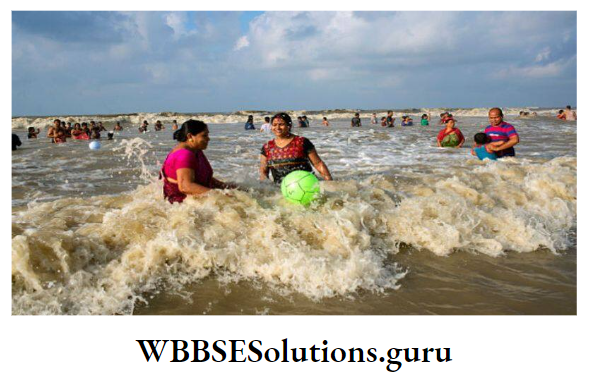
WBBSE Notes For Class 9 Geography and Environment Chapter 8 West Bengal Digha

Causes Of Development Of Tourism

There are many places in West Bengal with natural scenic beauties such as places of Darjeeling Himalayas; Forests of Duars, Sundarban; Coastal Plains of Digha, Shankarpur, Mandarmani etc.

There are also many places of historical importance in Murshidabad and Maida. Many people visit West Bengal for medical treatment in Kolkata.

Many people also visit Kolkata which is the centre of education, art and culture, sports as well as trade and commerce. Most places of West Bengal are connected by modern rail road transport system. In most places of West Bengal hotels, resorts etc.

are well developed. Important tourist spots of West Bengal are Darjeeling, Kalimpong, Kurseong, Duars, Koch Bihar, Malda, Baharampur, and Murshidabad.

Mukutmanipur, Jhargram, Bishnupur, Digha, Shankarpur, Bakkhall, Sundarban, Ayodhya hill, Furfura Sharif, Mayapur etc.
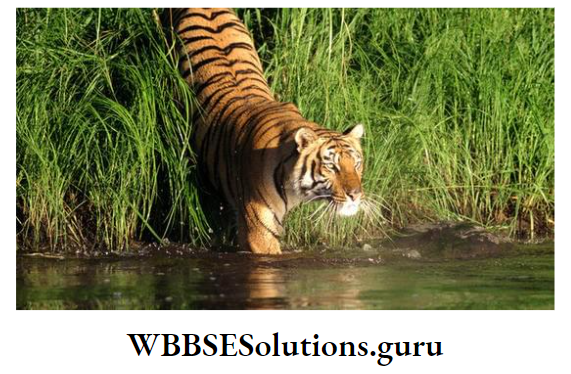
WBBSE Notes For Class 9 Geography and Environment Chapter 8 West Bengal Sundarban.

Problems Of Tourism In West Bengal

In comparison to the services provided in rail-road, airways and waterways of Maharastra, Karnataka, Delhi, Goa, and Andhra Pradesh the services of those facilities in West Bengal are not satisfactory.

Excepting a few centres, most of the tourist spots of West Bengal are not well communicated. Hotels and resorts are not also satisfying the demands of tourists in many tourist spots.

Many historical tourist spots are losing their attraction to tourists due to a lack of maintenance.
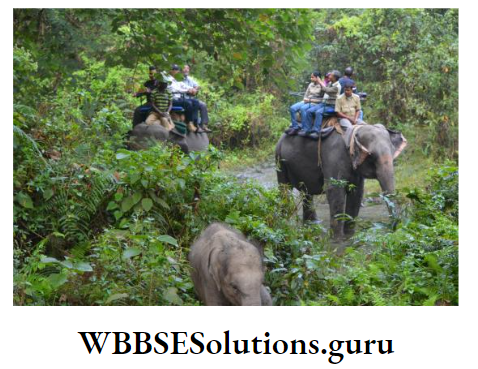
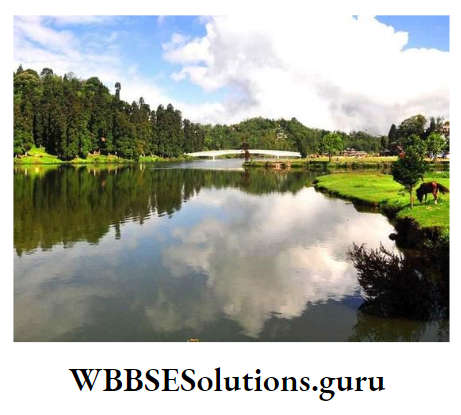
WBBSE Notes For Class 9 Geography and Environment Chapter 8 West Bengal Elephant Ride At Duars


WBBSE Notes For Class 9 Geography and Environment Chapter 8 West Bengal Mirik Lake

Prospects Of Tourism

Tourism provides jobs to many people as well as it earns a lot of foreign money. Considering such importance of the industry attention has been given to the development of infrastructural facilities.

Many tourist centres have been linked with airways and helicopter services. So, the future of Tourism seems to be prospective.

Chapter 8 West Bengal Information Technology Industry (I.T.)

Information Technology is a newly developed industry in West Bengal. Information technology is the activities related to storing, retrieving, transmitting and manipulating data for human needs through computers and telecommunication equipment.

The information technology industry involves all the work related to information technology, such as computer hardware, software, electronics, semiconductor, the internet, e-commerce, telecom equipment, computer services etc.

In West Bengal, Information technology has been developed centring Kolkata. Sector-V of Saltlake close to Kolkata is the most important I. T. hub of not only West Bengal but of the whole of Eastern India.

WBBSE Notes For Class 9 Geography and Environment Chapter 8 West Bengal I.T. Centre

Causes Of Development Of Information Technology

At present almost every aspect of human life, such as education, medical treatment, communication system, trade, weather analysis, defence etc.

depend on information technology. Plenty of skilled and experienced labour is available in and around Kolkata. There is the rapid growth of this industry in West Bengal as Kolkata is the most important centre of information technology.

Plenty of skilled and experienced labour is available in and around Kolkata. There is a rapid increase in the use of information technology in agriculture and industry.

Infrastructural facilities have also developed in the Sector-V area of Salt lake city. The government is taking necessary actions to develop centres for information technology at Haldia.

Siliguri, Durgapur and other important cities and towns of West Bengal.

Problems Of I.T. Industry

Modern and high-tech infrastructural facilities as developed in Bangaluru, Hyderabad are lacking in West Bengal. Road barricades, strikes etc. are the problems faced by this industry. Monetary affluence is also not enough.

Prospects Of I.T. Industry

Skilled and experienced I.T. labour is abundant in West Bengal. The government is taking necessary plans for the growth of this industry. So the future of this industry is quite bright.

Chapter 8 West Bengal Small Scale And Cottage Industries Of West Bengal

Small-scale industries are localised in urban and semi-urban areas with a limit of capital investment of a small amount.

Cottage industries are carried out by the artisans in their cottages with their family members. The cottage industry invests a very small amount of capital.

The advantages of small-scale and cottage industries are

  1. Less investment of capital,
  2. Involvement of a few labours,
  3. Carried out at home apart from another livelihood,
  4. It is not much skill oriented etc. A variety of such industries have developed in West Bengal like shola work, handloom, zari work, silk work, brass work,
  5. Pottery, cane work, mat making etc.

WBBSE Notes For Class 9 Geography and Environment Chapter 8 West Bengal Cottage Industries.

In different corners of West Bengal cottage industries are scattered. The most important centres are the handloom industry of Santipur
Fulia, Dhanekhali of Nadia district.

Pottery of Krishnanagar, silk industry of Baharampur in Murshidabad district; brass work at Kagra, Nabadwip; mat making of Purba Medinipur district.

cutlery works of Kanchannagar of Purba Bardhaman district, leather and wood works of Santiniketan in Birbhum district and cane work of Jalpaiguri and Koch Bihar districts.

At present small scale and cottage. industries of West Bengal are facing problems like scarcity of capital and raw materials, competition from large-scale industries etc.

But this industry can provide jobs to many people as well as can earn foreign money also. Now the Government is trying to give monetary incentives, training to improve skills etc.

WBBSE Notes For Class 9 Geography and Environment Chapter 8 West Bengal Cottage Industries

Chapter 8 West Bengal Major Cities Ports And Tourist Sites Of West Bengal

The urbanisation of settlement along with developments in agriculture, industry and transport system is responsible for the development of many towns and tourist places in West Bengal.

But ports are few as the coast of West Bengal is not very long.

Important Cities

Kolkata is the most important city, and port as well as the tourist centre of West Bengal. Kolkata is also the capital of West Bengal, the principal industrial centre and an important centre of education, culture, trade and communication of the state.

Other important towns of West Bengal are Asansol, Durgapur, Haldia, Bardhaman, Siliguri, Haora, Kharagpur, Baharampur, Darjeeling etc.

Headquarters of all the districts are also important towns, such as Tamluk, Medinipur, Puruliya, Bankura, Suri, Krishnanagar, Barasat, English Bazar, Balurghat, Raigunj, Koch Bihar, Jalpaiguri, Alipurduar, Jhargram etc.
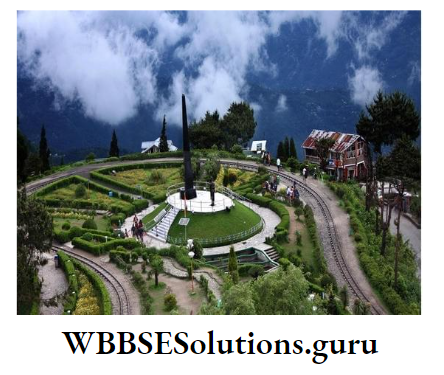
WBBSE Notes For Class 9 Geography and Environment Chapter 8 West Bengal Darjeeling - Batasia Loop

Ports

Two important commercial ports of West Bengal are Kolkata and Haldia. Haldia is actually a complementary port to Kolkata.

Other ports of West Bengal are known as fishing ports, such as Shankarpur, Diamond Harbour, Frezergunj etc. There is a possibility of developing of a new port at Sagardwip in 24 Parganas (S).
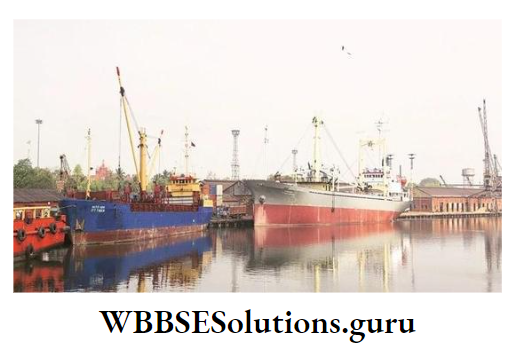
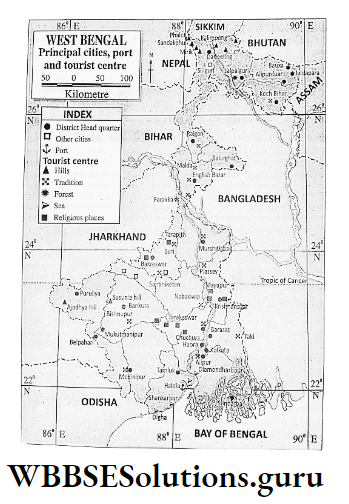
WBBSE Notes For Class 9 Geography and Environment Chapter 8 West Bengal Ship Anchored At Kolkata Port


WBBSE Notes For Class 9 Geography and Environment Chapter 8 West Bengal Principal Cities, Port And Tourist Centre In West Bengal

Tourist Spots

Kolkata is the most important tourist place of W.B. It is famous for the Victoria Memorial, Birla Planetarium, Nicco Park, Museum, Zoo etc.

The tourist places of West Bengal are famous for various reasons such as hills, forests, seaside, religious importance, historical importance etc.
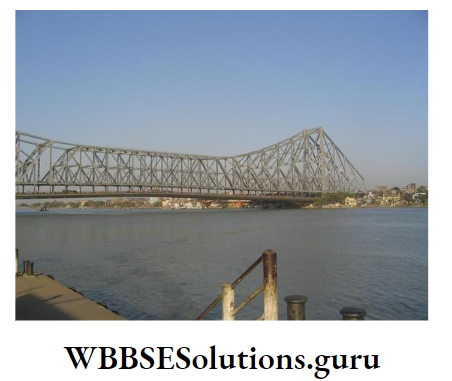

WBBSE Notes For Class 9 Geography and Environment Chapter 8 West Bengal Hugli River And Rabindra Setu (Haora Bridge)


WBBSE Notes For Class 9 Geography and Environment Chapter 8 West Bengal Kolkata Birla Planetarium

Such tourist places are Darjeeling, Kurseong, Kalimpong, and Ayodhya which are famous for mountains and hills; Sundarban, Duars, and Jhargram are famous for forests.

Digha, Shankarpur, and Bakkhali are famous for the seaside; Tarakeswar, Bandel, Furfura Sharif, Mayapur, and Dakshineswar are famous as religious places; Gour, Murshidabad are famous as historical places.

Mukutmanipur is a famous tourist place for its reservoirs and Santiniketan is famous as the centre of education.

There are many tourist places in West Bengal such as Tarapith, Bakreswar, Susunia Hill, Jairambati, Kamarpukur, Plassey etc.

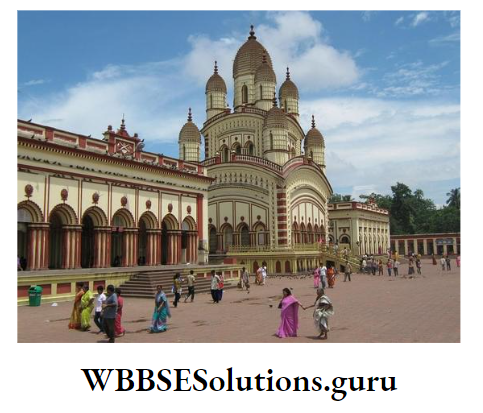
WBBSE Notes For Class 9 Geography and Environment Chapter 8 West Bengal Kolkata Victoria Memorial


WBBSE Notes For Class 9 Geography and Environment Chapter 8 West Bengal Dakshineswar Kali Temple

WBBSE Notes For Class 9 Geography and Environment Chapter 5 Weathering

Chapter 5 Weathering Introduction

Concept Of Weathering Erosion Mass Wasting And Denudation

Surface features of the earth consist of landforms such as mountains, plateaus, plains etc. A landscape is thus, the result of internal processes as well as external processes.
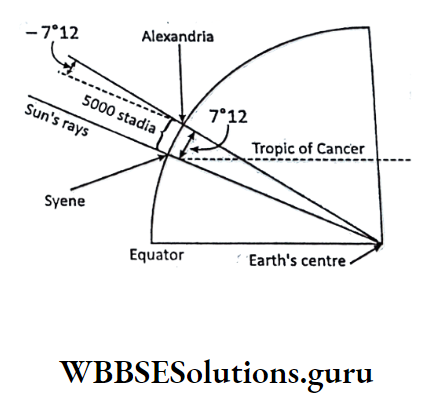
Actually, the primary landforms are weathered or prepared for their weathered materials to be transported by natural agents of gradation leading to erosion and denudation.

Geography Chapter 5 Class 9 WBBSE Solutions 

Weathering

Weathering involves two processes that work in concert. This is the combined action of several physical and chemical processes which together are responsible for the disintegration and decomposition of rocks of the earth.

Read And Learn Also WBBSE Notes For Class 9 Geography and Environment

The crust is exposed to the actions of various elements of ‘weather’ like air temperature, pressure, humidity, rainfall etc.

WBBSE Solutions For Class 9 Fundamentals Of HistoryWBBSE Class 9 English Functional Grammar
WBBSE Class 9 Fundamentals Of History Long Answer QuestionsWBBSE Class 9 English Reading Skill
WBBSE Class 9 Fundamentals Of History Short Answer QuestionsWBBSE Class 9 English Writing Skill
WBBSE Class 9 Fundamentals Of History Very Short Answer QuestionsWBBSE Class 9 Maths Multiple Choice Questions
WBBSE Class 9 Fundamentals Of History Multiple Choice QuestionsWBBSE Solutions For Class 9 Maths
WBBSE Notes For Class 9 Geography and Environment


The term weathering has been coined from the word ‘weather’ and is often described as the preparation of rock materials for transportation by the agents of erosion like rivers, glaciers, wind etc.

It is of three types

  1. Mechanical,
  2. Chemical,
  3. Biological.


WBBSE Notes For Class 9 Geography and Environment Chapter 5 Weathering Mechanical Disintegration Of Rocks

WBBSE Notes For Class 9 Geography and Environment Chapter 5 Weathering Classification Of Weathering

Mass Wasting:

Mass wasting is the movement of weathered materials downslope due to gravity. Rock falls, slumps and debris flows are all examples of mass wasting.

Erosion:

Weathered rock particles, if transported by some flowing agents such as wind, river or glacier are deposited at distant places resulting reduction in the elevation of primary landforms.

This process of wearing away rocks is known as Erosion.

Geography Chapter 5 Class 9 WBBSE Solutions 

Denudation:

Denudation is the long-term combination of processes that cause the wearing away of the earth’s surface leading to a reduction in the elevation of landforms.

Denudation involves weathering, mass wasting as well as erosion of exposed rocks on the earth’s surface.

Chapter 5 Weathering Mechanical Weathering

Mechanical Or Physical Weathering Of Rocks Takes Place In Various Ways To Form Smaller Fragments Of Rocks :

Exfoliation

Fragments like concentric shells are formed in homogenous mineral composition like granitic rocks, the outer surface of which nabi xo becomes heated faster than the inner ones and is peeled off one after another like an onion.

This is known as Exfoliation or Onion Peeling or o Spheroidal Weathering.

WBBSE Notes For Class 9 Geography and Environment Chapter 5 Weathering Exfoliation Of Rocks

Granular Disintegration

Granular Disintegration occurs in a rock of heterogenous Imineral composition in which different minerals expand and contract at different rates.

Thus, rock disintegrates into small grains and the process is known as Granular Disintegration.

WBBSE Notes For Class 9 Geography and Environment Chapter 5 Weathering Granular Disintegration

WBBSE Class 9 Geography Questions And Answers

Block Disintegration

Well-bedded and jointed rocks of homogenous mineral composition split along the joints or cracks, thus, breaking the rock into rectangular blocks. This process is known as Block Disintegration.

WBBSE Notes For Class 9 Geography and Environment Chapter 5 Weathering Block Disintegration


WBBSE Notes For Class 9 Geography and Environment Chapter 5 Weathering Frost Action In Rocks

Frost Action:

In temperate regions or on high mountains, water present in the cracks or joints of a rock freezes at night when the temperature drops below the freezing point and exerts pressure within the rock wall because of its increased volume.

Therefore, the rock breaks into fragments which form screes or tali found at the foothills of a mountain.

Chapter 5 Weathering Chemical Weathering

Role Of Oxygen, Carbon Dioxide Etc.:

Chemical weathering decomposes rocks by air and water which contain elements like oxygen, carbon dioxide etc. that react with the minerals present in the rock. It is predominant in a hot humid and humid tropical climate.
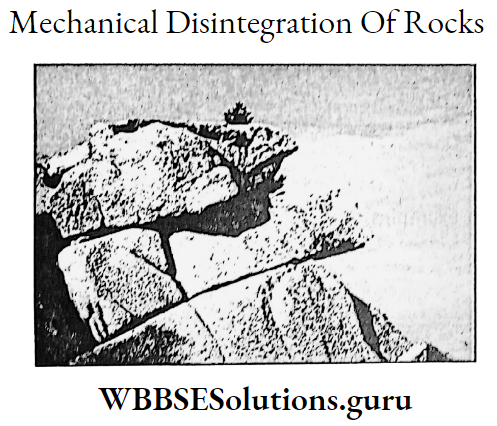
Oxidation:

In oxidation, minerals present in a rock react with the oxygen in the air and form oxides. When oxygen from the air is added to iron, ferrous oxide turns into ferric oxide of yellowish-brown rust which crumbles easily.

4FeO + 3H2O + 02= 2Fe2O3 + 3H20

Carbonation :

Carbonation involves the absorption of carbon dioxide from the atmosphere by minerals present in the rocks.

Limestone i.e. calcium carbonate changes into calcium bicarbonate when carbonic acid (carbon dioxide dissolved in water) reacts with limestone.

CaCO3 + H2O + CO2= Ca (HCO3)2

WBBSE Notes For Class 9 Geography and Environment Chapter 5 Weathering Chemical Decomposition Of Rocks

Hydration :

Hydration involves the absorption of water molecules. Anhydrite or calcium sulphate changes into gypsum.

CaSO4 + 2H2O→ CaSO4⋅2H2O

Class 9 Geography Environment Chapter Summary

Hydrolysis:

Hydrolysis involves the formation of hydroxyls. Example. Orthoclase changes into alumina-silicic acid.

KAISi308 + H2O = HAISi308 + KOH

WBBSE Notes For Class 9 Geography and Environment Chapter 5 Weathering Chemical Weathering In Limestone Region

Chapter 5 Weathering Biological Weathering

Role Of Man, Plant And Animals :

Plants and animals are responsible for the disintegration as well as decomposition of rocks.

Disintegration Of Rocks By Plants:

Plant roots enlarge cracks or joints present in rock and disintegrate the rock into fragments.

Decomposed leaves, and flowers also form humus which mixed with water, forms acid to react with rock and cause chemical weathering.

WBBSE Notes For Class 9 Geography and Environment Chapter 5 Weathering Biological Weathering By Plants

Disintegration Of Rocks By Animals:

Burrowing animals such as rats, rabbits, ants etc. are responsible for the mechanical weathering of rocks. The decomposition of animals produces acids which may also. cause chemical weathering of rocks.
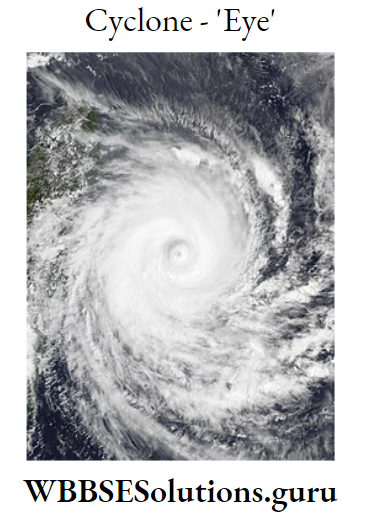
Class 9 Geography Notes Bengali Medium

Disintegration Of Rocks By Man :

Deforestation, mining and quarrying are responsible for breaking rocks into fragments. Construction of roads in the mountainous region which is blown up with dynamites is also responsible for the mechanical breaking of rocks.

Chapter 5 Weathering Effects Of Weathering And Soil Erosion

Effects Of Weathering

The most important effect of weathering is soil formation. Minerals like bauxite are produced by weathering. Regolith which is the source of soil is also produced by weathering of rocks.

Weathering of rocks reduces the elevation of landforms, and land area increases but the area becomes prone to earthquakes.

Surface water and rainwater easily percolate through weathered rocks and thus underground water resource increases.

WBBSE Notes For Class 9 Geography and Environment Chapter 5 Weathering Effects Of Mechanical Weathering On Rocks

Soil Formation

Due to weathering, overlying the firm and solid rock of the crust. there is loose unconsolidated material i.e. insoluble residual products of weathering made of decomposed and fragmentary materials of variable thickness.

This is known as Regolith. The upper portion of Regolith under suitable conditions is transformed into soil. Actually, the top layer of the regolith is the soil.

It is composed of organic materials like decayed plant bodies or humus, bacteria, fungi etc. known as humus and the process known as Humification; inorganic materials like minerals produced by weathering of rocks known as Mineralisation; water and gases like oxygen, nitrogen, and carbon dioxide etc.
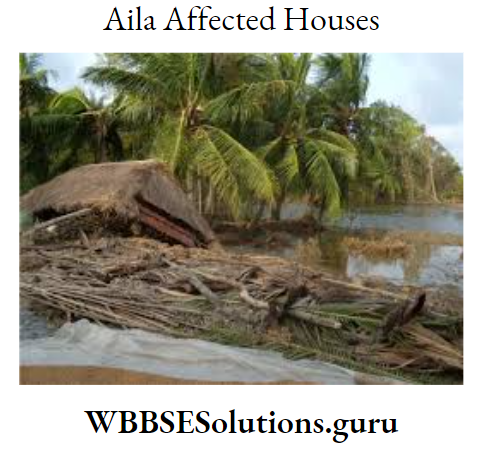
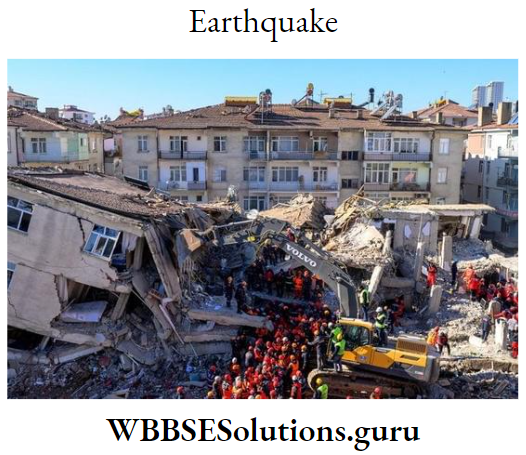
Some minerals like iron and aluminium are leached downwards. This is known as Eluviation. The deposition of minerals in the lower layer is known as Illuviation.

Weathering thus makes the soil fertile as well as porous so that the soil becomes airy and helps in plant growth.

WBBSE Class 9 Geography And Environment Notes 

Soil Erosion And Conservation Measures

Soil erosion takes place in two ways-natural and manmade.

Natural Causes Of Soil Erosion:

River, wind and sea waves are responsible for soil erosion. Rainfall washes away the topsoil. Soil is also removed by gullies.

In deserts and coastal areas, strong wind removes huge amounts of soil. Sea wave also breaks the coastal rocks and washes away the soil particles.

Soil Erosion By Human Activities:

Unwise cutting of trees, unscientific cultivation, excessive grazing, jhum cultivation by man are responsible for the quick erosion of soil.

Soil Conservation Measures:

To save soil we all earnestly have to think of soil conservation measures such as afforestation, control of overgrazing, use of the scientific method of cultivation, and covering soil to control evaporation from the soil.

Contour ploughing or step cultivation in mountainous regions, planting trees along the river banks, planting trees across the wind direction.

Improving drainage systems in agricultural fields and development of grasslands on sloping land, control of jhum cultivation etc.
WBBSE Notes For Class 9 Geography and Environment Chapter 3 Determination Of Location Of A Place On The Earths Surface

Chapter 3 Determination Of Location Of A Place On The Earths Surface Introduction

In a classroom, location i.e. placement of students usually referred to as first bench second bench etc. Similarly, you may like to refer to your village as east or west of the nearest rail. station or a pond.

It is easy for you to locate a place on a flat surface with the help of intersecting two sets of lines-vertical and horizontal lines.

Read And Learn Also WBBSE Notes For Class 9 Geography and Environment

But on a spherical earth, it is difficult to pinpoint a place on an uneven surface.

WBBSE Notes For Class 9 Geography and Environment Chapter 3 Determination Of Location Of A Place On The Earths Surface Location Of Point 'O'

WBBSE Notes For Class 9 Geography And Environment Chapter 3 Determination Of Location Of A Place On The Earths Surface

Necessity Of Determination Of The Location Of A Place On The Earths Surface

It is necessary for a tourist or a traveller to know the location of countries, cities, towns, and villages in our world.

Location of a place also gives the idea of local time, weather, natural vegetation even the livelihood of man. Also for navigation, it is important to find out the exact location of a ship.

WBBSE Notes For Class 9 Geography and Environment Chapter 3 Determination Of Location Of A Place On The Earths Surface Horizontal Co-Ordinate

WBBSE Class 9 Geography And Environment Chapter 3 Notes

Chapter 3 Determination Of Location Of A Place On The Earth’s Surface Latitudes

Concept Of Latitude

On Spherical earth, the exact location of a place is determined by an angular distance which is expressed in degrees, minutes and seconds.

On the spherical earth, the exact location of a place is determined with the help of two Imaginary lines known as Parallels of latitude and Meridians of longitude.

On a map of Atlas and Globe, the intersecting east-west and north-south lines are drawn which together form a geographical grid and are used to find out the exact location of a place.

WBBSE Solutions For Class 9 Fundamentals Of HistoryWBBSE Class 9 English Functional Grammar
WBBSE Class 9 Fundamentals Of History Long Answer QuestionsWBBSE Class 9 English Reading Skill
WBBSE Class 9 Fundamentals Of History Short Answer QuestionsWBBSE Class 9 English Writing Skill
WBBSE Class 9 Fundamentals Of History Very Short Answer QuestionsWBBSE Class 9 Maths Multiple Choice Questions
WBBSE Class 9 Fundamentals Of History Multiple Choice QuestionsWBBSE Solutions For Class 9 Maths
WBBSE Notes For Class 9 Geography and Environment

Parallels Of Latitudes

Imaginary lines drawn in the east-west direction encircling the globe are called Parallels of latitude. The most important of these lines is the Equator.

Equator

It is an east-west extended Great circle running midway between the two poles. The plane formed by the equator is called Equatorial Plane.

Latitude

This is the angular distance of a place measured from the centre of the earth either north or south of the equator on the
equatorial plane.

The Latitude of Kolkata is 22°30′ north means Kolkata is located at 22°30′ angular distance to the north of the equatorial plane.

WBBSE Notes For Class 9 Geography and Environment Chapter 3 Surface Tropic Of Cancer

Parallels Of Latitude

Imaginary lines drawn parallel to the equator to the north and south are known as Parallels of Latitude. These are full circles and extended in east-west directions.

Each line joins all the places having the same latitude. They vary from 0° (equator) to 90° (poles).

1. Importance Of Parallel Of Latitude:

Parallels of latitude help us in finding the location of a place how far to the north or south of the equator. Sunrays are Inclined away from the equator.

So temperature decreases with increasing latitude. Therefore, latitudes help us to identify the climate. They divide the earth. into Thermal belts or Heat Zones.

WBBSE Notes For Class 9 Geography and Environment Chapter 3 Parallels Of Latitude

2.Properties Of Parallels Of Latitude:

Except for the two poles all the parallels of latitude run in the east-west direction. All parallels are full circles. All of them are parallel to each other.

All parallels are not of equal sizes. They decrease in size from the equator to the poles into points. The equator is the largest one and forms a Great Circle.

The linear distance between two parallels at a 1° interval is more at the polar region because of the oblate spheroid shape of the earth. All places on a parallel of latitude in either hemisphere have latitudes of the same value.

The sum of all the latitudes of each parallel is always 360°. The angular distance between the equator and the pole is 90°.

WBBSE Notes For Class 9 Geography and Environment Chapter 3 Parallels Of Latitude equator

WBBSE Class 9 Geography And Environment Chapter 3 Notes

Important Parallels Of Latitudes And Their Uses

1. Equators:

The Equator runs midway between the north pole and the south pole encircling the earth in an east-west direction. Its value is 0°. It divides the earth into two equal parts- the northern hemisphere and the southern hemisphere.

It helps us identify the location of a place in which hemisphere and how far from the equator a place is located. The latitude of any place is also measured in angular distance from the equator.

2. Tropic Of Cancer And Tropic Of Capricorn:

Parallels of latitude located at 23°30′ north and 23°30′ south of the equator are known as the Tropic of Cancer and Tropic of Capricorn respectively.

Tropic of Cancer is the northern limit of the apparent annual movement of the sun. The Tropic of Capricorn is the southern limit of the apparent annual movement of the sun.

3. Arctic Circle And Antarctic Circle:

Parallels of latitude located at 66°30′ north and 66°30′ south of the equator are known as the Arctic Circle and Antarctic Circle respectively.

On the 21st of June, it is 24 hours daily from the Arctic Circle to the north pole and 24 hours a night from the Antarctic Circle to the south pole. On 22nd December opposite conditions prevailed.

Identification Of Heat Zones Or Belts By Latitudes

The inclination of sunrays falling on the earth’s surface varies at different latitudes.

Temperature decreases away from the equator with the increasing inclination of the sunrays as vertical rays over the equator concentrate on a small area and travel shorter distances in the atmosphere and inclined rays spread over wide areas away from the equator and travel a longer distance in the atmosphere.

Accordingly, the earth may be divided into three thermal belts

  1. Torrid belt in between 23°30′ N and 23°30′ S.
  2. Temperate belt extending from 23°30′ N to 23°30′ S and from 23°30′ N to 23°30′ S latitudes.
  3. Frigid belt from 66°30′ N to North pole and from 66°30′ S to South pole.
WBBSE Notes For Class 9 Geography and Environment Chapter 3 Thermal Belts

Chapter 3 Determination Of Location Of A Place On The Earths Surface Longitudes

Concept Of Longitudes

North-south extended lines joining the north and south poles are known as Meridians of longitude.

Prime Meridian

In 1884, by an international agreement, the meridian passing through the Royal Observatory at Greenwich near London was chosen as the Prime Meridian. Its value is 0°.

It is also known as Greenwich Meridian. Prime Meridian together with its opposite meridian i.e. 180° forms a full meridian or the Great Circle.

It divides the earth into two equal eastern and Western hemispheres. Prime Meridian helps us to determine how far east or west Prime Meridian has located a place.

The local time of Prime Meridian is considered Greenwich Mean Time or G.M.T. which is granted as Standard Time for the whole world.

WBBSE Notes For Class 9 Geography and Environment Chapter 3 Prime Meridian

Longitude

Longitude is the angular distance of a place measured, either east or west of the Prime Meridian that passes through Greenwich on the equatorial plane with its apex being the centre of the earth.

WBBSE Notes For Class 9 Geography and Environment Chapter 3 Angular Distance Of Longitude, Meridian

WBBSE Class 9 Geography And Environment Chapter 3 Notes

Chapter 3 Determination Of Location Of A Place On The Earth Surface Meridians Of Longitude

Semi-circular imaginary lines joining the north and south poles extending in a north-south direction over the earth’s surface are called Meridians of Longitude.

Each Meridian connects all the places having the same longitude in the eastern or western hemisphere. Their value increases from the prime meridian (0°) to a maximum of 180°.

Properties Of Meridians Of Longitude

All the Meridians of Longitude run in a north-south direction. Each meridian is a semi-circle and consists of a sum of 180° longitudes.

All of them are not parallel to one another. The linear distance between two adjacent meridians decreases from 111 km at the equator to 0 (zero) km at the poles.

The angular distance of meridians of longitude increases to the east as well as to the west up to 180°. But 180° E and 180° W longitudes together form one meridian.

In both hemispheres meridians of the same value are found. Each meridian and its anti-meridian together form Great Circle and their centres coincide with the centre of the earth.

All places located on the same meridian have the same longitude and the same local time. On the 21st of March and 23rd of September all places on a particular meridian experience sunrise, noon and sunset at the same time.

Important Meridians And Their Uses

Prime Meridian :

Prime Meridian is used to find out whether a place whether located in the Eastern Hemisphere or Western Hemisphere. It is also used to find out the Greenwich Mean Time or G.M.T. i.e. World Standard Time.

International Date Line Or 180° Meridian :

180 meridian is known as International Date Line. Crossing this meridian a day is either added or subtracted from the calendar.

Standard Meridian :

Most of the countries have selected a centrally extended meridian the local time of which is followed as Standard Time by the whole country.

Longitude And Time :

Longitudes are closely related to time. The earth is round with its circumference producing 360° at the centre and the earth completes a rotation around its axis in front of the sun in 24 hours.

Actually, the earth takes 24 hours to turn its 360 longitudes around its axis in front of the sun. So, in one hour (360 ÷ 24 = 15°) there is a turning of 15° longitudes. Similarly, 1° longitude turns in (60 minutes ÷ 15 = 4) 4 minutes.

WBBSE Class 9 Geography Chapter 3 PDF

The Relation Between Longitudes And Time Is Reflected In The Following Concepts

Local Time:

The local time of a place is determined in reference to the position of the sun in relation to its longitude. When the sun lies overhead of a place the local time of that place will be 12 noon or mid-day.

The local time is the same for all the places on the same meridian. This is also known as Sun time as it is determined with the help of the position of the sun.

WBBSE Notes For Class 9 Geography and Environment Chapter 3 Determination Of Location Of A Place On The Earths Surface Equatorial Plane, Determination Of Latitude

A.M. And P.M. (Ante Meridian And Post Meridian) :

The local time of any place between midnight and midday is called Ante Meridian or A.M. while the local time of place from mid-day to midnight is known as Post Meridian or P.M.

Standard Time:

If all the places of a country follow their local time then the people moving from place to place would have to adjust their watches to their respective local time.

To avoid such confusion most of the countries have selected a central meridian the local time of which is followed by the whole country.

Such a centrally extended meridian is called Standard Meridian and the local time of that meridian is known as Standard Time. The local time of 82°30′ east longitude in India is known as Indian Standard Time or I.S.T.

The longitudinal extension of India is 68°07′ to 97°25′ east. Accordingly standard meridian should be 82°46′ east.

But as the lowest limit of variation in standard time is 7°30′ longitude or 30 minutes time, so counting from Greenwich (0°) longitude standard time of India is 82°30′ east. The time difference between Greenwich and India is 5 hours and 30 minutes.

WBBSE Class 9 Geography Chapter 3 PDF

Chapter 3 Determination Of Location Of A Place On The Earths Surface Geographical Grid To Find Location

East-west extended parallels of latitude and north-south extended meridians of longitude intersect each other to form a network or the Earth’s Grid which helps to locate a place on the Earth’s surface.

The point at which the parallel of latitude and meridian of longitude intersect is the exact location of a place on the earth’s surface.

Thus the location of Kolkata is the intersecting point between two lines 88°30′ east. longitude and 22°30′ north parallel of latitude.

WBBSE Notes For Class 9 Geography and Environment Chapter 3 Determination Of Location Of A Place On The Earths Surface Location Of Kolkata On a Globe

Concept Of Great Circle

Great Circle is an imaginary circle drawn on the Earth’s surface. This is the largest possible circle. The Centre of the circle coincides with the centre of the earth.

It divides the earth into two equal halves. Amongst the parallels of latitude, only the Equator is the Great Circle as this is the largest circumference of the earth coinciding its centre with the earth’s centre and dividing the earth into two hemispheres.

Similarly, the Prime Meridian and its antipodal meridian i.e. 180° longitude together, form another Great Circle also.

WBBSE Notes For Class 9 Geography and Environment Chapter 3 Determination Of Location Of A Place On The Earths Surface Great Circle

WBBSE Class 9 Geography Chapter 3 PDF

Chapter 3 Determination Of Location Of A Place On The Earths Surface Concept Of Antipodes And International Date Line

1. Antipodes :

A place located diametrically opposite to another place on the earth’s surface is said to be the Antipode to the latter place. Therefore, two ends of an imaginary diameter of the earth are mutually antipodal to each other.

Antipodal places have the same latitude but they belong to opposite hemispheres. Example. latitude of Kolkata is 22°30′ north. So the latitude of its antipode will be 22°30′ south.

The difference in longitude between the antipodal places is 180° as antipodal places are located on opposite meridians.

WBBSE Notes For Class 9 Geography and Environment Chapter 3 Determination Of Location Of A Place On The Earths Surface Antipodal Position Of Place 'A' And 'B'

2. International Date Line :

There is great confusion and inconvenience to those who travel around the world. Suppose, a traveller moving eastwards from Greenwich at 10 a.m.

on Sunday will gain 1 hour for every 15° longitude until he reaches the 180th meridian where he will find the local time being Sunday 10 p.m. Another person on his westward journey from Greenwich will find it is 10 p.m.

Saturday on reaching the 180th meridian as he was losing 1 hour for every 15° longitude. Therefore, there is a total (12 hours + 12 hours = 24 hours or 1 day) 1-day difference between the two travellers.

So on crossing the 180th meridian a person in a ship or aircraft moving eastward will have to deduct one day, while moving westward will have to add one day in his calendar.

To avoid such confusion, Prof. Davidson took initiative to hold the ‘International Meridian Conference’ in Washington USA in 1884 where this 180th meridian was chosen as International Date Line or IDL.

International Date Line deviates either eastward or westward at some places from the 180th meridian to avoid the landmasses, for Example. Rangal Island, Aleutian Island, Fiji, Chatham etc.

Chapter 3 Determination Of Location Of A Place On The Earths Surface Mathematical Calculations On Longitudes And Time

There is 4 minutes time difference for a difference in longitude of 1°. Similarly, there is a 1-hour time difference for a difference in longitude of 15.

Therefore, places located to the east of the other place have their local time ahead of that place and the places located to the west of the other place have their local time behind that place.

So the difference in time will be added when the places in question are located to the east. It will be deducted if the place in question is situated to the west of the other place.

Mathematical Calculation For Finding Longitude And Time:

Mathematical Rules

1. Finding Of Longitude From Given Time:

If the time of a given place is ahead of that of Greenwich then the place must lie to the east and if it is behind that of GMT then the place will be located to the west of Greenwich.

The time. difference between two places found in minutes is to be divided by 4 to get the longitude of a place.

2. Finding Of Time From Given Longitude:

  1. Places lying to the east have their local times ahead of those places lying to the west and the places lying to the west have their local time lagging behind of those places lying to the east.
  2. Time 450 difference may be obtained by multiplying the longitudinal difference with 4.
  3. The time difference is added (+) when the place is located to the east and it is subtracted (-) when it is located to the west.

3. Finding of longitudinal difference:

  1. If two places lie on either side of Greenwich, longitudes of both hemispheres are to be added.
  2. If the places are located in the same hemisphere the lesser value is to be subtracted from the longitude of the higher value.

4. On crossing the International Date Line:

  1. On crossing the International Date Line from the west to the east 1 day will be added to the calendar, while crossing the International line from the eastern hemisphere to the western hemisphere 1 day is to be deducted from the calendar.
  2. On crossing the IDL eastward one day is gained but time is lost, while on crossing the IDL from the eastern hemisphere to the western hemisphere one day is lost but time is gained.

WBBSE Notes For Class 9 Geography and Environment Chapter 3 Determination Of Location Of A Place On The Earths Surface International Date Line

Mathematical Laws

1. 1° longitude is divided into 60 minutes (60°) and 1-minute longitude is subdivided into 60 seconds (60″).

2. When time is calculated

1. For 24 hours time difference longitudinal difference is 360°

∴ 1 hours time difference longitudinal difference is 360 ÷ 24 hours = 15°

2. For 15° longitudinal difference time difference is 1 hour or 60 minute

∴ 1° longitudinal difference time difference is 60 minutes ÷15° = 4 minutes

3. For 1° or 60′ longitudinal difference time difference is 4 minutes or 240 seconds

∴ 1’ or 60′ longitudinal difference time difference is 240 sec ÷ 60 = 4 sec

4. For 1′ or 60″ longitudinal difference time difference is 4 seconds

∴ 1” or 60” longitudinal difference time difference is 4 ÷ 60 or 1 ÷ 15 sec

[For 15 seconds (15″) longitudinal difference time difference is 1 second, for 30 seconds (30″). longitudinal difference time difference is 2 seconds.]

WBBSE Notes for Class 9 Geography Chapter 3

Problem-1:

It is 8 a.m. at Kolkata (88°30’E / 22°30’N) on Thursday 1st March 2012. What will be the local time, day and date on its antipode?

Solution :

The longitude of the antipode of Kolkata is 180°− 88°30’E = 91°30’ west

The difference in longitudes between Kolkata and its antipode is 91°30’ + 88°30’ = 180°

The difference in time for 1° longitude is 4 minutes

∴ Difference in time for 180° longitude is 180 × 4 = 720 minutes or 12 hours

So, the difference in time between Kolkata and its antipode is 12 hours.

As the antipode of Kolkata is located on West longitudes, so its local time will be behind that of Kolkata.

∴ When the local time of Kolkata is 8 a.m., Thursday, 1st March 2012, the local time, day and date of the antipode of Kolkata will be (8 a.m. − 12 hours) 2012 i.e. 8 p.m. i.e. 29th February, Wednesday (Leap year), 2012.

Problem-2:

A ship started its journey for Los Angeles (118° W) from Tokyo (139°E) on 30th June, Monday at 10 a.m. It crosses the Pacific Ocean by every meridian in 4 minutes. At what time, day and date the ship will reach Los Angeles?

Solution :

Difference in longitudes between Tokyo and Los Angeles is 180° − 139° = 41° and 180° − 118° 62° i.e. 41° + 62° = 103°

For 1 difference in longitude difference in time is 4 minutes

∴ 103° difference in longitude difference in time is 103 × 4 m = 412 m or,  6 hours 52 minutes.

As the east gains time, so, when the ship leaves Tokyo the local time at Los Angeles is (Monday 10 a.m. + 6 hrs. 52 minutes) Monday 4-52 p.m.

As Los Angeles is located to the west of the International Date Line, so, 1 day is to be deducted from the calendar. So, local time in Los Angeles will be Sunday from 4-52, pm.

The ship has taken 6 hours and 52 minutes to cross the Pacific Ocean for 103° longitudes. So, the time, day and date in Los Angeles are Sunday (4-52 pm + 6 hrs. 52 mins) 29th June at 11:44 pm.

Problem-3

When it is 9 a.m. in Greenwich the local time of place is 5 p.m. What is the longitude of that place?

Solution:

The difference in time between a place and a Greenwich is (9 a.m. − 5 p.m.) 480 minutes or 8 hours.

The difference in longitude for 4 minutes time difference is 1°

∴ The difference in longitude for 480 minutes time difference is 480 ÷ 4 = 120°

∴ The difference in longitude between that place and Greenwich is 120°.

As the local time of that place is ahead of that of Greenwich, the place is located to the east of Greenwich.
The longitude of the place is 120° East.

WBBSE Notes For Class 9 Geography and Environment Chapter 4 Geomorphic Processes And Landforms Of The Earth

Chapter 4 Geomorphic Processes And Landforms Of The Earth Introduction

Elementary Concept Of Geomorphic Processes

There is variation in size, shape and nature of the earth’s surface which is continuously formed by some internal or endogenetic and modified by some external or exogenetic forces, collectively known as Geomorphic processes.

WBBSE-Notes-For-Class-9-Geography-and-Environment-Chapter-4-Geomorphic-Processes-And-Landforms-Of-The-Earth-Elementary-Concept-Of-Geomorphic-Processes

Endogenetic forces are responsible for both slow and sudden changes in the earth’s surface by compression, tension, uplifting, subsidence, rifting, deformation etc. Excessive heat and intensive pressure of the earth’s interior are responsible for such forces.

WBBSE Notes For Class 9 Geography and Environment Chapter 4 Geomorphic Processes And Landforms Of The Earth

Slow Or Diastrophism

Millions of millions of years take to change the earth’s surface slowly. The resultant landforms are Mountain, Plateaus, and Plain. Diastrophism includes pyrogenic and orogenic movements.

Read And Learn Also WBBSE Notes For Class 9 Geography and Environment

Plateaus and continents are uplifted on the earth’s surface slowly by continent-building or pyrogenic force which acts radially or vertically in the earth’s interior. Resultant landforms include Rift Valley, Block Mountain, and submerged and emerged coasts. Mountains are formed by horizontal or lateral forces which act tangentially in the earth’s interior. Compression on soft rocks develops Fold mountains.

WBBSE Class 9 Geography And Environment Notes

Sudden Movement

Sudden changes on the earth’s surface are responsible for earthquakes, and vulcanism. Resultant landforms are volcanic mountains, lava plateaus etc.

Exogenetic forces are active on the earth’s surface and are continuously modifying the primary landforms produced by endogenetic forces through the agents of gradation (aggradation and degradation) like rivers. Glacier, wind, sea waves as well as weathering, and mass wasting produce landforms known as Sequential landforms.

WBBSE Solutions For Class 9 Fundamentals Of HistoryWBBSE Class 9 English Functional Grammar
WBBSE Class 9 Fundamentals Of History Long Answer QuestionsWBBSE Class 9 English Reading Skill
WBBSE Class 9 Fundamentals Of History Short Answer QuestionsWBBSE Class 9 English Writing Skill
WBBSE Class 9 Fundamentals Of History Very Short Answer QuestionsWBBSE Class 9 Maths Multiple Choice Questions
WBBSE Class 9 Fundamentals Of History Multiple Choice QuestionsWBBSE Solutions For Class 9 Maths
WBBSE Notes For Class 9 Geography and Environment

Chapter 4 Geomorphic Processes And Landforms Of The Earth Different Major Landforms Of The Earth

Landforms are the variation in size, shape, ruggedness, slope and nature of the earth’s surface, such as mountains, hills, plateaus, plains, lowlands, valleys etc.

Landforms are generally grouped into three categories

  1. Mountain,
  2. Plateau and
  3. Plain.

Lofty mountains occupy the central part of Asia. Southern and western parts of Europe and the western part of South America are also occupied by high mountain ranges.

Africa is a plateau continent. River valleys and coastal plains are almost common in each and every continent.

WBBSE Notes For Class 9 Geography and Environment Chapter 4 Major Landforms

WBBSE Notes For Class 9 Geography and Environment Chapter 4 Geomorphic Processes And Landforms Of The Earth Different Landforms

Mountains

Mountains Their Types:

An extensive area of the earth’s surface which rises over 1000 m above sea level with conical peaks, broad base, deep gorges and steep slopes is known as Mountain. Example. the Himalayas, Alps, Andes, Rockies etc.

Mountains are of four types based on their mode of formation-Fold mountains, Block (or Fault) mountains, Volcanic mountains and Residual mountains.

Fold mountains are formed due to the folding of soft sedimentary rock layers of the earth’s crust. Example. the Himalayas.

Displacement of raised blocks of rocks due to the fracture or fault produced on the earth’s crust by compressional or tensional forces on hard rocks form Block Mountain. Example. Satpura in India, Vosges in France.

WBBSE Class 9 Geography And Environment Notes

Aggradation of accumulated lava, ash and dust ejected from the magma chamber in the earth’s interior, eventually, develops volcanic mountains. Example. Mt Fuji in Japan, Barren in India.

Denudation or prolonged erosion of pre-existing mountains may, eventually, develop Residual or Relict mountains. Example. Appalachian of the USA and Aravallis in India.

Origins Of Fold Mountains (On The Basis Of Plate Tectonics)

There are several theories amongst which the most important is the Plate Tectonic theory regarding the origin of the Fold Mountains.

Plate Tectonic theory is the most modern theory which is an outcome of the investigation by the geologists T. Wilson, and D. P. Mackenzie.

D. L. Pichou, the father of the theory explained it in 1968. According to this theory, continental crust consists of seven big plates, eight medium plates and twenty small plates.

Seven big plates are

  1. Eurasian plate,
  2. Pacific Ocean plate,
  3. North American plate,
  4. South American plate,
  5. Indo-Australian plate,
  6. African plate and
  7. Antarctica plate.

Plates are separated by fault lines and extend up to 70 km below the ocean and 150 km below the continents. Along the margins of the plates where two plates meet are found the plate boundaries.

Plates are floating on the upper part of the Mantle i.e. Asthenosphere due to convectional current produced by great temperatures in the earth’s interior.

WBBSEClass 9 Geography Notes

They move very slowly about 1 or 2 cm per year. As these plates are moving, there are three types of plate boundaries, when two plates move towards each other they form

  1. Converging plate boundaries when two plates move away from each other they form
  2. Diverging plate boundary. When two plates cross each other along plate margins they form
  3. Neutral plate boundary.


WBBSE Notes For Class 9 Geography and Environment Chapter 4 Geomorphic Processes And Landforms Of The Earth Major Plates

Fold mountains are formed along the converging plate boundaries.

Converging plate boundaries are of three types

  1. Continental-Continental plate boundary,
  2. Oceanic- Continental plate boundary and
  3. Oceanic-Oceanic plate boundary.

When Two Continental:

continental plates move each other shallow sea or geosyncline in between them is filled up by the sediments deposited from the marginal plates.

The plates collide and horizontal pressure squeezes up the soft sedimentary rock layers of the sea floor into a series of folds to form great Fold mountains of the world.

Two plates, namely the Angaraland to the north and the Gondwanaland to the south of the ancient Tethys geosyncline moved towards each other to squeeze up the sediments of the Tethys seafloor into the great folds of the Himalayas.

WBBSE Notes For Class 9 Geography and Environment Chapter 4 Geomorphic Processes And Landforms Of The Earth Tethys Sea

Continental:

oceanic plates also develop Fold mountains. Two such plates when converge, and the denser oceanic plate sinks below the lighter continental plate.

Eventually, one geosyncline develops in front of the continental plate. Ultimately sediments are deposited on this sea from which the folds are squeezed up to form the great Fold mountains.

Example. Rockies and Andes have formed by the sinking of the Pacific Oceanic plate below the North and South American plate.

WBBSE Notes For Class 9 Geography and Environment Chapter 4 Geomorphic Processes And Landforms Of The Earth Fold Mountain and Origin of the Himalayas

WBBSE Notes For Class 9 Geography and Environment Chapter 4 Geomorphic Processes And Landforms Of The Earth Formation Of Fold, Anticline And Syncline

Characteristics Of Fold Mountains:

Fold mountains are of various types. Folds are either uphold or downfold. Faults are common in Fold mountains.

Fold mountains are made of sedimentary rocks and fossils are, therefore, found in Fold mountains. Most of their peaks are conical.

Chapter 4 Geomorphic Processes And Landforms Of The Earth Concept Of Old And Young Fold Mountains

According to the geologist Fold mountains have formed in three different stages and in between two consecutive stages there is one period of quiescence.

During the Paleozoic Period:

about 400 to 500 million years back the Caledonian Folds or the mountain system was formed. The mountains of Northern Ireland, Scotland and Scandinavia belong to this group.

WBBSEClass 9 Geography Notes

During Carboniferous Period:

about 220-320 million years back the Altitude or Hercynian mountain system was formed.

The Armorican and Hercynian mountain which stand to the south of the Caledonian, the mountain in Europe and the Appalachian mountain 3000 metres in North America belong to this group.

Urals of Russia, Aravallis of India, and Tien Shan and Nan Shan of China were also formed during this period.

During the Tertiary Period About 60 Sea Level To 70 Million Years Ago The Alpine Mountain:

the system was originated. It Caledonian stands to the south of the Altitude mountain system. The Alps, Himalayas, Rockies and Andes belong to this group and are known as Young Fold Mountains.

The Caledonian and the Altitude mountain systems are known as Old Fold Mountains.

At present, they are reduced to low and isolated plateaus due to denudation. Example. the Caledonian mountains of Europe.

WBBSE Notes For Class 9 Geography and Environment Chapter 4 Geomorphic Processes And Landforms Of The Earth Elementary Three Stages Of Fold Mountain

Origin Of Volcanic Mountains

Ejection of magma on the earth’s surface through the fractures called vents, results in the accumulation of lava, ash and dust.

Eventually, this accumulation of lava around the vent grows into a mountain called a Volcanic mountain or a Volcano. These are also known as the Mountain of accumulation.

WBBSE Geography Notes Pdf

Example. Fujiama in Japan, Vesuvius in Italy, Mauna Loa (Highest in the world) in Hawaii island, and Barren and Narcondam in the Andaman-Nicobar islands of India.

WBBSE Notes For Class 9 Geography and Environment Chapter 4 Geomorphic Processes And Landforms Of The Earth Volcanic Mountain Along the Plate Boundary

Most of the volcanoes of the world are located along plate boundaries. Converging, diverging and neutral all three plate boundaries are separated by fault lines which are geologically very weak.

Excessive heat generated in the earth’s interior due to friction of plates melts rock. Huge gas is also formed which is also responsible for gushing out of magma through these weak zones.

Example. there is a string of volcanoes along the margin of the Pacific Oceanic plate.

Chapter 4 Geomorphic Processes And Landforms Of The Earth Features Of Volcanic Mountains

WBBSE Notes For Class 9 Geography and Environment Chapter 4 Geomorphic Processes And Landforms Of The Earth Crater Of Volcano

Based on the nature of the eruption Volcanic mountains are of three types. Active volcanoes are those which erupt in recent times. Again, these are of two types.

Active volcanoes with continuous eruptions are known as Incessant. Example. Vesuvius in Italy. Intermittent volcanoes are those when that erupt after a period of silence, for Example. Barren in India.

WBBSE Geography Notes Pdf

Volcanoes with signs of possible eruption in future are said to be Dormant, for Example. Mt. Fuji in Japan. Extinct volcanoes are those which erupted in pre-historic times without any hope of future eruption Example. Narcondam in India.

WBBSE Notes For Class 9 Geography and Environment Chapter 4 Geomorphic Processes And Landforms Of The Earth Cone Shaped And Dome Shaped Volcanos

Based on shape and structure, volcanoes are of four types. Cone-shaped volcanoes are conical in shape Example. Mt. Fuji in Japan. Dome-shaped volcanoes are found in Hawaii island.

Volcanoes with explosive craters are found in Iceland. Volcanoes with Composite craters are those which have secondary craters besides the main one, e.g. Popacatapetl in Mexico.

Volcanoes are generally conical in shape with steep slopes. At the top is found the crater or mouth. Bigger ones have more than one crater. Crater is connected by a vent to the magma chamber.

WBBSE Notes For Class 9 Geography and Environment Chapter 4 Geomorphic Processes And Landforms Of The Earth Explosive And Composite Crater Volcanos

Origin And Features Of Block Mountains

Compressive and tensional forces produced by earth movements are responsible for the formation of cracks, or fractures when
applied on hard rocks.

This fracture is called Fault. As a result, rocks are displaced relative to one another on either side of this fault. The line along which this displacement of blocks of rocks takes place is called the Fault line.

WBBSE Geography Notes Pdf

Relatively raised blocks are called Block mountains or Fault mountains. Example. Satpura in Central India. Vosges in France, the Black Forest in Germany.

WBBSE Notes For Class 9 Geography and Environment Chapter 4 Geomorphic Processes And Landforms Of The Earth Block Mountain & Rift Valley

Block mountains originated in four ways. When a block of rock between two parallel fault lines is raised, upthrust causes the formation of the Block Mountains.

Example. Satpura. When a block of land in between two parallel fault lines subsides, down-thrust forms Block mountains on either side of the subsided block. Example. Vosges in France, the Black Forest in Germany.

Class 9 Geography Chapter 4 Solutions

When a block of land in between two parallel fault lines is raised but tilted, develops block mountains Example. Western Ghats of Southern India.

When two sides of parallel fault lines of an extensive plateau subside in relation to the central part it stands as Block Mountain.

WBBSE Notes For Class 9 Geography and Environment Chapter 4 Geomorphic Processes And Landforms Of The Earth Rift Valley Of River Rhine

Characteristics Of Block Mountain :

Block mountains are flat-topped with steep slopes. They are not as lofty as the Fold mountains nor do they stretch for a vast area. They are usually accompanied by Rift Valleys. Rapids and Waterfall are common along their steep slopes.

Chapter 4 Geomorphic Processes And Landforms Of The Earth Origin And Features Of Relict Mountains

Denudation of highlands develops low mountains known as Relict or Residual mountains. They are also known as the mountain of Degradation. Example. Appalachians of the U.S.A., the Urals in Russia, and Aravallis in India.

Prolonged erosion by exogenetic forces like rivers, glaciers, wind, sunshine etc.

May reduce any pre-existing mountains like Fold, Fault or Volcanic into low heights of the mountain with soft rocks being quickly eroded, while hard rocks stand as Relict or Residual mountains.

Old Fold mountains which have reduced to Relict mountains are Aravallis, Urals, Appalachian etc. Old plateaus also have turned into Relict mountains, such as Mahadeo and Maikal mountains in India.

Relict mountains have rounded tops with gentle slopes. They are not lofty. They are made of ancient rocks and are, therefore, stable. They are less rugged with wide river valleys.

WBBSE Notes For Class 9 Geography and Environment Chapter 4 Geomorphic Processes And Landforms Of The Earth Formation Of Residual Mountain

Importance Of Mountains

Mountains have great positive influences. The existence of mountains controls the climate. Example. The Himalayas obstruct the cold winds to enter India while giving rain by obstructing moist southwest monsoon wind.

Mountains are the source of big rivers like the Ganges, Indus and Brahmaputra. They help in the formation of extensive plains developed by the rivers that originated on their peaks. Mountainland is ideal for hydel power.

They help as well by protecting a country from foreign invasion. Mountains are rich in forest resources. Scenic beauties of the mountain land develop Tourism.

Class 9 Geography Chapter 4 Solutions

Mountains also affect adversely. As they are rugged, they do not favour agriculture. Mountainlands are also difficult to construct roadways as they are rocky and stony.

Mountains are sparsely populated. Mining is limited due to inaccessibility. Industries are also lacking.

Chapter 4 Geomorphic Processes And Landforms Of The Earth Plateau

Plateaus-Their Types:

Plateaus are steep-sided, flat-topped highlands with elevations, generally, varying between 300 and 600 m above sea level. Example. Plateau of Tibet, Brazilian plateau, Chotanagpur plateau etc.

Plateaus are extensive uplands. The top of a plateau is either flat or undulating. They are steep-sided and appear like tables. So they are also known as ‘Table land’.

Their height varies between 300 and 600 m above sea level. They have low relief. They may be old like the Deccan Plateau and young like the Tibetan Plateau. Old plateaus are resistant to erosion and are known as Shield.

WBBSE Notes For Class 9 Geography and Environment Chapter 4 Geomorphic Processes And Landforms Of The Earth Plateau

Plateaus are formed in three ways tectonics, erosion and deposition. During earth movements ancient landmasses were broken into separate plateaus, for Example. Deccan plateau, Arabian plateau.

Plateaus are also formed due to earth movements during the formation of Fold mountains, for Example. Intermontane Tibetan plateau.

During earth, movements upthrusted tilted Block may stand as a plateau. Dissected plateaus are formed by the erosion of high plateaus by rivers, glaciers, wind etc. Example. Chotanagpur plateau.

Plateaus are also formed by the deposition of Lava. Example. Lava Plateau or Deccan Trap of Maharashtra.

WBBSE Notes For Class 9 Geography and Environment Chapter 4 Geomorphic Processes And Landforms Of The Earth Based On Origin, Plateau Are Of Three Types

Intermontane Plateau

Due to earth movement, during the formation of Fold Mountain, plateaus are formed. These plateaus are actually enclosed by the Fold Mountains.

So they are called ‘Intermontane plateau which means ‘between mountains’. Example. The Tibetan plateau is enclosed by the Kunlun in the north and Karakoram in the south.

Class 9 Geography Chapter 4 Solutions

The Plateau of Iraq lies between Elburz in the north and Zagros in the south. The plateau of Anatolia in Turkey lies between the Pontic in the north and Tauras in the south.

Columbia and Yukon plateau of the north. America and the Bolivian plateau of South America have also formed this way.

WBBSE Notes For Class 9 Geography and Environment Chapter 4 Geomorphic Processes And Landforms Of The Earth Intermontane Plateau

Characteristics:

Intermontane plateaus are high and found in the young fold mountain region. It occupies an extensive area. Fossils are found in the plateaus. The climate is dry as they are surrounded by mountains.

Continental Plateau

Due to the earth’s movement, the ancient landmasses of the earth were broken and separated to form Continental blocks. These are Continental Shield.

Example.Deccan plateau of India, Siberian highland of Russia, Arabian plateau, African plateau, West Australian plateau, Brazilian highland, Canadian shield or Laurentian plateau.

Characteristics:

Continental plateaus are mostly made of ancient granite and Igneisses which are more than 1000 million years old. Mostly they have turned into Low plateaus.

Structurally, they are stable. Earth movements have no effects on them. Ancient igneous and metamorphic rocks of these plateaus are rich in minerals.

Dissected Plateau

Natural agents like rivers, glaciers, and wind through their continual process of weathering and erosion reduce an extensive high plateau into smaller blocks of the plateau with irregular surfaces.

In humid regions, a plateau, intersected by deep narrow river valleys is described as Dissected Plateau. Example. Chotanagpur plateau of India, Malnad of Karnataka, Baghelkhand and Bundelkhand of Central India etc.

WBBSE Notes For Class 9 Geography and Environment Chapter 4 Geomorphic Processes And Landforms Of The Earth Dissected Plateau

Characteristics :

plateaus are of low heights. Plateaus are associated with accordant hills and intervened with wide river valleys. They are reducing in height due to erosion and are rich in minerals as they are made of ancient rocks.

Lava Or Volcanic Plateau

The horizontal flow of lava gushes out from the earth’s interior through fissure eruption and spreads over the land surface in great thickness and solidifies to form a Lava or Volcanic plateau.

WBBSE Class 9 Geography And Environment Notes

Example. Deccan Trap of Maharashtra in India, Columbia-Snake plateau of the U.S.A. Ethiopian plateau of East Africa, the Parana plateau of South America.

WBBSE Notes For Class 9 Geography and Environment Chapter 4 Geomorphic Processes And Landforms Of The Earth Lava Plateau

Characteristics:

Lava plateaus are made of basalts. They are flat-topped. Occasionally they form steps at the margins. They are black in colour due to the presence of basalt rock.

Importance Of Plateaus

Most of the ancient plateaus are rich in minerals. Example. Deccan Plateau, Chotanagpur Plateau, Canadian Shield etc. So, mineral-based industries have developed on these plateaus.

Plateaus are rugged and stony, so, they do not favour agriculture but are favourable for hydel power generation. Life is easier here than in the mountains. So, the population is moderate.

Chapter 4 Geomorphic Processes And Landforms Of The Earth Plains

Plains-Their Types:

A plan is a lowland, either levelled undulating or gently sloping with its height below 300 m above sea level. Example. the Ganga Plain in North India.

Most of the plains cover an extensive area. Their height above sea level varies between 5 to 300 m. They are mostly flat with a gentle slope. Relative height is less.

Mostly they develop along the river valleys and along the coasts. Sometimes they develop surrounding a lake. Structurally they are stable.

According to the origin, plains are of three types-Depositional, Erosional and Tectonic or Structural.

WBBSE Notes For Class 9 Geography and Environment Chapter 4 Geomorphic Processes And Landforms Of The Earth Types Of Plains

Depositional Plains

Alluvial Plain:

Deposition of silt and sand by a river develops an Alluvial plain. These plains are of two types-Flood plain and Deltaic plain.

Flood Plain :

In the rainy season, the river floods its countryside repeatedly. As a result of, the deposition of sand, silt develops a thick plain called a Flood plain.

WBBSEClass 9 Geography Notes

Example. The flood plain of the river Ganga in the middle and lower courses and the flood plain of Brahmaputra valley in Assam. The flood plain of the River Nile in Egypt.

WBBSE Notes For Class 9 Geography and Environment Chapter 4 Geomorphic Processes And Landforms Of The Earth Flood Plain

Characteristics:

In flood plains, every year new alluvium is deposited. Flood plains are usually monotonous flat land excepting the natural levees along the river banks.

The slope of the land is insignificant so, marshes and oxbow lakes are common features. New alluvium is deposited along the river sides while away from the river, old alluvium is found.

Deltaic Plain

At the mouth of a river, silts carried by a river are deposited to form a triangular plain land which looks like the fourth letter of the Greek Alphabet, ‘A’ (delta).

This plan is known as the Deltaic Plain, Example. The Ganga-Brahmaputra Delta is the largest delta in the world.

After crossing a long distance, the river deposits its load i.e. silts and sands at its mouth as the slope of land gradually ceases.

The river is divided and subdivided into innumerable branches or channels to form a delta, which eventually becomes larger and extends landwards to form a deltaic plain.

WBBSE Notes For Class 9 Geography and Environment Chapter 4 Geomorphic Processes And Landforms Of The Earth Deltaic Plain

Characteristics:

The Deltaic plain is crisscrossed with innumerable river channels. The soil may be saline. Natural levees a reformed along the river valleys. River valley becomes shallow and the drainage is obstructed.

Coastal Plain

Coastal plains are mainly formed by the depositional work of sea waves. Waves and winds often deposit mud, sand, and silt along the coastline to form a Coastal plain, for Example. Palestine plain.

Parts of East and West Coastal plains of India. Coastal plains are, usually narrow (Western coastal plain of India). They. also may be wide (Eastern coastal plain of India), Sand and salts are excessively found in soils.

Slopes are gentle. Lakes, lagoons, kayaks and sand dunes are common.

WBBSE Notes For Class 9 Geography and Environment Chapter 4 Geomorphic Processes And Landforms Of The Earth Coastal Plain

Glacial Plain :

As the glacier descends down the slope of a mountain it melts at the foothills of the mountain where glacial-originated sands and gravels are deposited to form a plain land called a Glacial Plain.

WBBSEClass 9 Geography Notes

Example.Ladakh Valley in Kashmir and the South-Central part of Canada. Glacial plains are made of unassorted pebbles, stones and sands. It takes a long time to develop plain land.

Lacustrine Plain:

When a river empties into a lake its sands and silts are deposited in that lake. As a result, a portion of the lake is turned into a plain land known as Lacustrine Plain.

Example.Parts of Dal Lake in Kashmir. Imphal Valley has formed in Loktak Lake in Manipur.

Loess Plain :

Fine sand particles transported by the wind from a desert, when dropped at a distant place, gradually accumulate there to form a thick plain called Loess plain.

The best example is the loess plain formed along the Hwang Ho river valley in China where sands are carried away from the Gobi desert and are deposited by wind. Loess plain also has developed in the southern part of Israel.

Erosional Plains:

Natural agents like rivers, glaciers, and wind reduce a highland, through a long time of erosional work, into low plain lands, such as Peneplain, and Pediment.

Peneplain:

An ancient highland when reduced to plain land through denudation i.e. long continued erosion by either river, glacier or wind is known as Peneplain.

The plain is scattered with isolated hills of hard rocks known as Monadnocks, the name is coined from the Mount Monadnock of New Hampshire of New England.

Example. parts of the Chotanagpur plateau. Pareshnath and Panchet are monadnocks of this peneplain.

WBBSE Notes For Class 9 Geography and Environment Chapter 4 Geomorphic Processes And Landforms Of The Earth Three Stages Of Formation Of Peneplain

Pediment:

A sloping stony plain formed at the foot of a mountain produced by wind abrasion is known as Pediment. Example. plain formed at the foothills of the Atlas mountain in the Sahara desert.

WBBSEClass 9 Geography Notes

Tectonic Or Structural Plains

Plains which are formed due to earth movement are known as structural plains. They are also structurally or naturally plain land.

Structural Plain :

Without any earth movement, where sedimentary rock layers are arranged one above another for a long period of time an extensive plain land may develop. This is known as a Structural plain. Example. Siberian plain.

Chapter 4 Geomorphic Processes And Landforms Of The Earth Emerged Or Submerged Plain

Earth movement may form Emerged and Submerged coastal plains. The continental shelf may be uplifted from the sea bed.

Thus wide emerged coastal plains are formed, for Example. The coastal plain of the Gulf of Mexico. The coastal margin may also subside to form submerged coastal plains which are narrow, for Example. Turan basin.

Importance Of Plains:

Most of the plains of the world are fertile. As such, they are favourable for cultivation.

The Gangetic Plain of India, the Yangtze kiang valley of China, the Mississippi Plain of the U.S.A., and the Po Valley of Italy are the best agricultural land in the world.

A good network of transport systems has developed through roadways, railways and waterways. As a result, the plains are well-communicated and help in the development of industries and trade and commerce.

Therefore, plains are densely settled areas of the world. Metropolis like Delhi, Kolkata, Mumbai, London, and Paris have developed on the plains.

The plains have developed ancient civilisations also, such as the Egyptian civilisation, Indus civilisation, Chinese civilisation etc.

WBBSE Notes For Class 9 Geography and Environment Chapter 6 Hazards And Disasters

Chapter 6 Hazards And Disasters

A news bulletin was frequently telecasted for the last two days to aware people of the forecast of natural hazards and disaster-a super cyclone with a speed of 275 km/hour may strike the coast of Sundarban.

Read And Learn Also WBBSE Notes For Class 9 Geography and Environment

As a result, local people are tensed and worried about the news and the Disaster Management team of West Bengal is also ready to rescue people at any moment, if required.

Types Of Hazards And Disasters

Concept Of Hazards And Disasters:

You are very much familiar with the terms ‘Hazards’ and ‘Disasters’ which are synonymous with the common people. Actually, these two words are different at least in their impact on life and the environment.

Class 9 Geography Chapter 6 WBBSE Solutions 

Hazard

The word ‘hazard’ probably has been coined from the ancient Anglo-French word ‘hazard’. The other opinion is that the word ‘hazard’ is coined from the Arabian word ‘Ar-zahr’ (which means death).

WBBSE Solutions For Class 9 Fundamentals Of HistoryWBBSE Class 9 English Functional Grammar
WBBSE Class 9 Fundamentals Of History Long Answer QuestionsWBBSE Class 9 English Reading Skill
WBBSE Class 9 Fundamentals Of History Short Answer QuestionsWBBSE Class 9 English Writing Skill
WBBSE Class 9 Fundamentals Of History Very Short Answer QuestionsWBBSE Class 9 Maths Multiple Choice Questions
WBBSE Class 9 Fundamentals Of History Multiple Choice QuestionsWBBSE Solutions For Class 9 Maths
WBBSE Notes For Class 9 Geography and Environment


Hazards are of three types

  1. Natural hazard Example. earthquake, volcanism, tsunami, cyclone etc.
  2. Man-made hazard Example. hazards due to atomic bomb explosions, land, water, air pollution, wars etc.
  3. Quasi-natural hazard. Example. Flood, drought, landslide due to deforestation etc.

WBBSE Notes For Class 9 Geography and Environment Chapter 6 Hazards And Disasters Classification Of Hazard

Disaster

The word Disaster is coined from the French word ‘Desastre’ which literally means ‘bad star’. A hazard may be turned into a disaster when there is loss of life and properties as well as environmental degradation.


WBBSE Notes For Class 9 Geography and Environment Chapter 6 Hazards And Disasters Classification Of Disaster

Actually, a phenomenon is said to be hazardous when it happens rarely it happens, there is a risk of loss of life and properties, and its threats the sustainability of the environment.

Incidents are said to be disasters when

  1. human life and activities are disturbed there is a loss of life and properties on large scale,
  2. transport and communication systems are disrupted.

Hazards are, therefore, natural or man-made incidents that may lead to disasters which are responsible for the loss of life and properties. So, all disasters are hazards but all hazards are not disasters.

Difference Between Hazards And Disasters:

WBBSE Notes For Class 9 Geography and Environment Chapter 6 Hazards And Disasters Difference between Hazards And Disasters

Class 9 Geography Chapter 6 WBBSE Solutions

Chapter 6 Hazards And Disasters A General Discussion Of Different Types Of Hazards And Disasters

Flood:

The overflow of a river may cause flood in its adjoining areas. Floods may cause loss of life as well as epidemics and even threats to cultivation.

In 1935, due to the flood of the river Yangtze Kiang, there was the loss of millions of people in China.

In 1978, there was a huge loss of life and property in the southern part of West Bengal due to the flood of the river Damodar.

WBBSE Notes For Class 9 Geography and Environment Chapter 6 Hazards And Disasters Flood

Flood Prone Areas In India

According to the report of the Central Water Commission about 11% area of our country is flood-prone which includes the river valleys of West Bengal, namely Ajoy, Damodar, Kangsabati, Silal, Tista, Torsa, Bhagirathi, Mahananda etc.

the river valleys of Gomati, Ghaghara, Kosi, Yamuna, and Chambal in Uttar Pradesh; Tejpur, Dibrugarh, Guwahati areas of Brahmaputra valley in Assam; river basin of Mahanadi, Godavari, and Krishna.

Kavery of Peninsular India, and the lower basins of the river Narmada and Tapi in Western India.

WBBSE Notes For Class 9 Geography and Environment Chapter 6 Hazards And Disasters India Flood Prone Areas

Causes Of Flood

The causes of floods are mainly

  1. Wet spell for a long time,
  2. Heavy rain even over a short period,
  3. Tsunamis in coastal areas,
  4. Landslides across the river,
  5. Discharge of excessive water from the reservoir etc.

Drought

Drought is an example of a climatic disaster. Areas of a long dry spell are known as droughts. The opinion of the Indian Meteorological Department, 75% less rain than expected rainfall in an area is said to be drought.

Effects Of Drought :

Drought is responsible for hazards in economic activities like agriculture, animal rearing etc. as well as a scarcity of drinking water.

Indian Meteorological Department has classified droughts into two categories based on rainfall amount

  1. In severe drought, rainfall is 50% less than expected and
  2. In Moderate drought, rainfall is 25% to 50% less than the expectation.

Class 9 Geography Chapter 6 Important Questions

Drought Prone Areas In India

Drought-prone areas of India are Jaisalmer, Churu and Ganganagar in West Rajasthan; Kachchh and Saurashtra in Gujarat; rainshadow areas of Western Ghats which includes Eastern and Southern Maharastra.

the northern part of Karnataka and western part of Telangana, the western part of Uttar Pradesh; Tirunevelli and Coimbatore of Tamilnadu; Kalahandi of Odisha; Puruliya, Bankura districts of West Bengal etc.

WBBSE Notes For Class 9 Geography and Environment Chapter 6 Hazards And Disasters Drought

Causes Of Drought:

Droughts are caused by

  1. less rainfall than expected,
  2. loss of humidity of soil due to a high rate of evaporation.

Cyclone

Cyclone is a meteorological or natural disaster. A sudden drop in air pressure develops an intense low-pressure cell to which the wind blows spirally upward with high velocity.

This is known as Cyclone. Its high speed, continuous heavy rainfall and huge sea waves may cause severe threats to common people.

WBBSE Notes For Class 9 Geography and Environment Chapter 6 Hazards And Disasters Cyclone - 'Eye'

Effects Of Cyclone:

Cyclones and Super cyclones are one of the most destructive disasters which are responsible for the loss of life and wealth.

In 1991, millions of people died in Bangladesh due to a strike by cyclone. In 1999, a super cyclone that hits the Odisha coasts was responsible for the huge loss of life including cattle.

In 2008, also millions of people died in another severe cyclone.

WBBSE Notes For Class 9 Geography and Environment Chapter 6 Hazards And Disasters Aila Affected Houses

Causes Of Cyclone:

Tropical cyclones are originated over the seas where the temperature is 27°C a long 15° latitudes and become powerful slowly and move towards nearby landmasses.

Class 9 Geography Chapter 6 Important Questions

Chapter 6 Hazards And Disasters Earthquake

An earthquake is a physical disaster. Depending on the intensity which is measured by the Richter scale, the earthquake may be severe and destructive when the intensity is above 7.

Earthquake-Prone Areas In India:

Earthquake is frequent along the plate boundaries, fold mountain region and along the Pacific Ring of Fire where volcanoes are common.

In India, therefore, the Himalayan mountainous region in Northern India, Northeast India and Gujarat are very much prone to earthquakes.

In 1976, in China, about 7 lakh people died due to the earthquake. In 2001, an earthquake at Kachchh in Gujarat was responsible for the death of about 10 thousand people.

WBBSE Notes For Class 9 Geography and Environment Chapter 6 Hazards And Disasters Earthquake

Causes Of Earthquake:

Earthquakes are mainly caused by physical factors like plate movements, volcanism, and upliftment of the fold mountain.

Man-made causes like the construction of a reservoir on weak rock strata, and the explosion of an atomic bomb is also responsible for earthquakes.

Tsunami

Huge sea or ocean waves are called ‘Tsunami’ by the Japanese. Tsunamis are physical disasters that are closely connected to volcanoes.

In the Japanese language ‘Tsu’ means port and Nami’ means wave. So, Tsunamis are huge waves that are actually originated at sea or ocean bottom due to seaquakes and strike the coastal port or town.

WBBSE Notes For Class 9 Geography and Environment Chapter 6 Hazards And Disasters Tsunami

Effect Of Tsunami:

Numerable lives including animals died and were washed away in the coastal region, ships and boats are destroyed, and transportation and communication lines are destroyed near the sea coasts.

On 26th December 2004, a seaquake at the Indian Ocean bottom with an intensity of 8-9 Richter caused the death of more than 3 lakh people in the adjoining 11 countries.

Class 9 Geography Notes Bengali Medium Chapter 6

Causes Of Tsunami :

Seaquakes developed at the sea or ocean bottom with an intensity above 8 Richter produces huge waves or tsunamis. Huge ice chunks that fall on the sea or ocean from the nearby landmasses may also produce tsunamis.

Landslide

A landslide is a quasi-natural disaster. Along the slopes and foothills of a mountain, portions of landmasses when slide down the phenomenon is known as Landslide.

WBBSE Notes For Class 9 Geography and Environment Chapter 6 Hazards And Disasters Landslide

Effects Of Landslides:

In the Himalayan mountainous region, especially in North Bengal, landslides are frequent in the rainy season. Lives and properties are covered under landslides. Roadways and communication systems are also disconnected.

Causes Of Landslide:

Landslides are caused by physical factors like the instability of hillslopes, due to earthquakes, and rainwater percolating into the rocks may loosen the texture of the rock.

Landslides are also caused by man like deforestation in the mountains, unscientific cultivation on the mountains, and construction works like houses, bridges, canals, roadways etc.

WBBSE Notes For Class 9 Geography and Environment Chapter 6 Hazards And Disasters India Land Slide Affected Region

WBBSE Notes For Class 9 Geography and Environment Chapter 6 Hazards And Disasters Landslide On Slope

Chapter 6 Hazards And Disasters Avalanche

In cool climatic regions, on the mountain, an avalanche is a major physical disaster. When a large portion of the glacier slides down the slope of a mountain with great velocity, the phenomenon is known as Avalanche.

In 1970 about 20,000 people died in Peru of South America due to an avalanche. In 1979 about 280 people died in Lahul Valley in Western Himalayas due to an avalanche.

WBBSE Notes For Class 9 Geography and Environment Chapter 6 Hazards And Disasters Avalanche

Causes Of Avalanche :

Avalanche is caused by earthquakes, heavy snowfall as well as melting of ice due to global warming.

Class 9 Geography Notes Bengali Medium Chapter 6

Blizzard

In cool climatic regions, blizzards are frequently occurring phenomena. These are, actually, natural disasters. Blizzards are generally, associated with temperate cyclones.

Blizzards are common in northern parts of Europe, northern parts of the USA, and Canada, especially, in winter. Lives, lines of communication, and settlements are totally disrupted and destroyed.

WBBSE Notes For Class 9 Geography and Environment Chapter 6 Hazards And Disasters Blizzard

Volcanism

Gushing out of hot molten magma from the earth’s interior through cracks of the earth’s crust or a volcano is known as a volcanic eruption or volcanism.

The process may be sudden or even very slow. Due to volcanic settlements even villages and towns are covered by lava flow leading to total destruction of a civilisation.

In 1883 eruption of the Krakatoa volcano snatched away about 92 thousand lives. But Barren and Narcondam volcanoes of Andaman Nicobar Islands in India when erupted, there was no such death as the region was devoid of settlements.

WBBSE Notes For Class 9 Geography and Environment Chapter 6 Hazards And Disasters Volcanism

Forest Fire

Forest fire is a quasi-natural disaster. The burning of vast forests for a long time is known as Forest fire. Due to forest fire not only the trees but the whole ecosystem of the area is disrupted.

Affected Areas:

Forest fire is common in the forests of Jharkhand, Madhya Pradesh, and Chhattisgarh in India as well as in the forests of Australia, the USA, Russia etc.

Class 9 Geography Chapter 6 Summary 

Chapter 6 Hazards And Disasters General Nature Of Hazards And Disasters In West Bengal Their Impact

West Bengal stretches from the Himalayas in the north to the Bay of Bengal in the south.

Due to this unique geographical location hazards and disasters like floods, cyclones, forest fires, earthquakes and tsunamis, landslides etc. are common in West Bengal.

WBBSE Notes For Class 9 Geography and Environment Chapter 6 Hazards And Disasters Forest Fire

Incidents Of Hazards And Disasters In West Bengal

WBBSE Notes For Class 9 Geography and Environment Chapter 6 Hazards And Disasters Incident of Hazards And Disasters in West Bengal

Source:

  1. Disaster Management Department, Govt. of West Bengal.
  2. Seismic Centre, Pune, Maharashtra.
  3. Hazards, disasters and your community: A primer for Parliamentarian version 1.0. National Management Division, Govt. of West Bengal.

Flood In West Bengal

Flood is the major cause of hazards and disasters in West Bengal. West Bengal is a land of rivers. In rainy seasons most of the rivers overflow particularly when there is a long wet spell or a heavy shower.

As a result, the rivers flood their adjoining areas. In the northern part of West Bengal the rivers namely, Tista, Torsa, Jaldhaka etc.

In the central part, the river is like Ganga and in the southern part, the rivers like Damodar, Ajay, Rupnarayan, Kangsabati etc. are responsible for frequent floods in the rainy season.

The dams under D.V.C. and Mayurakshi projects in Jharkhand like Maithan, Panchet, and Massanjore release a huge amount of water which floods vast areas of Bardhaman, Bankura, Birbhum, Haora, Hugli, Purba Medinipur districts of West Bengal in the rainy season.

The river Ganga and its distributaries flowing through Nadia and North 24 Parganas have silted so much that this area also becomes flooded in the rainy season.

Construction of the Farakka barrage across the river Ganga is responsible for floods in the Murshidabad district.

WBBSE Notes For Class 9 Geography and Environment Chapter 6 Hazards And Disasters Flood In Village Of West Bengal

Class 9 Geography Chapter 6 Summary 

Cyclone In West Bengal

From April-May to October-November months strong tropical cyclones develop in the North Indian Ocean and the Bay of Bengal.

These cyclones frequently hit Digha and Sundarban coasts where lives and properties are destroyed in large quantities. Cyclones are actually the second most important cause of hazards and disasters in West Bengal.

Drought:

Rainfall is less than expected in the western districts of West Bengal, namely Puruliya, Bankura, Birbhum, Paschim Medinipur and the western part of Bardhaman of West Bengal.

The years in which there is long dry spell due to the erratic nature of monsoon wind the western districts of West Bengal experience drought conditions.

As a result, agriculture, pisciculture and animal rearing are hampered. So, droughts are actually, physical disasters in western districts of West Bengal.

Landslide In West Bengal

Landslides in the mountainous region of North Bengal, especially, on the hills of the Darjeeling district are common phenomena such as natural disasters. Lives and properties as well as communication systems become totally disrupted over a vast area for a few days.

Other disasters which are occasionally found in West Bengal include:

  1. Forest fires in the districts of Puruliya, Bankura, and Paschim Medinipur.
  2. Earthquakes may occur as natural disasters though West Bengal is made of alluvium soil the faults underlying may cause earthquakes.
  3. Tsunamis originated in the Indian Ocean and the Bay of Bengal and may cause disasters in Sundarban and along the Digha coasts.

Chapter 6 Hazards And Disasters Disaster Management

Concept Of Disaster Management-Role Of Students:

Disasters cause long-term interruptions to the function of a community or a society.

Disaster Management is to reduce the impact of a disaster and is meant for the sustainable development of society and to rehabilitate vulnerable people such as the disabled, elderly people and children.

The disaster management mechanism consists of three stages

  1. Pre-disaster,
  2. During disaster and
  3. Post-disaster

Pre-Disaster Management

Measures to be taken as preparation to encounter the disaster. These are

  1. Investigation, analysis and preparation of map for planning.
  2. Preparation of arrangements for the supply of food and drinking water as well as medical treatment.
  3. Interaction, planning and communication between the police force, fire station, army and disaster management department.
  4. Planning of work schedules for doctors, nurses, and health officers as well as arrangement of cars, vans, boats etc.
  5. Planning activities with trained personalities to form groups and to determine their duties and responsibilities.
  6. Frequent forecasting of the disaster at regular intervals through radio, television and other mass media.

WBBSE Notes For Class 9 Geography and Environment Chapter 6 Hazards And Disasters Disaster Management - 1

Class 9 Geography Chapter 6 Summary 

During Disaster

With the initiation of the disaster, a quick service of rescuing the victims and providing them food, drinking water, clothes and medicines as well as arranging security to mitigate other malfunctions are essential measures.

Post Disaster Management

Post-disaster management includes measures of renewal and rehabilitation. Renewal means repairing and reconstructing houses, institutions, and lines of communication including roadways, railways, electricity, drinking water etc.

Rehabilitation means the rearrangement of dwellings for the victims.

WBBSE Notes For Class 9 Geography and Environment Chapter 6 Hazards And Disasters Disaster Management - 2

Role Of Students:

Students have great opportunities to play an important role in disaster management
measures.

  1. A student may keep records of weather forecasts so that he or she can aware of the common people with rain, and rainfall deficiency as well as the location and movement of a cyclone, floods and drought.
  2. A student can also be aware that people store polythene packets, torches, matches, candles, radios, batteries, dry foods etc. in time.
  3. A student can also aware people regarding measures to be taken during disasters like switch off electric lines, water taps, gas cylinders etc.
  4. As earthquake management measures, a student can aware of people by advising them to go outside in an open place or to take shelter under cots, tables etc., not to stand near the walls or glass furniture as well as not to ignite anyway.
  5. A student also tries to keep people calm and quiet during any kind of disaster as well as not to listen to any rumours.
  6. Finally, A student must be aware of land, water, air and forest pollution; otherwise, hazards and disasters will be very much fatal to society, community as well as environment leading to the disbalance of ecology in future.

Chapter 6 Hazards And Disasters Disaster Management Strategies In West Bengal

The Disaster Management measure taken in West Bengal are mainly two principal objectives oriented

  1. Preparedness of the people to combat the disaster and
  2. To mitigate the loss after the disaster is over, as far as possible.

Measures that already have been taken in West Bengal are

  1. Forecasting of hazards and disasters in advance as early as possible with the help of remote sensing satellites and GPS systems.
  2. Construction of multifunctional houses near big apartments.
  3. Rescue, renewal and rehabilitation activities are done by connecting all governmental departments under the control of the District Magistrate.
  4. Financial help to those people who belong to the B.P.L. category.
  5. Local people are engaged in all sorts of disaster management measures.
  6. Local people are inspired to combat the disaster with the help of local eco-friendly technologies.
  7. Mass awareness programmes regarding disaster management through radio, television, mass media, print media etc.
  8. Awareness programme for common people to store tarpaulin, plastic, ropes, boats, dry foods etc.

WBBSE Notes For Class 9 Geography and Environment Chapter 7 Resource Of India

Chapter 7 Resource Of India Introduction

The first day after the Puja vacation, Rita and Mahmuda were gossiping in school about the places they visited on vacation. Rita visited Bhutan while Mahmuda visited Singapore with their parents.

From their discussion, they found that economically these two countries differ very much from each other and they learned that this difference is mainly due to the resources and their utilization by the people of these countries.

Concept Classification And Conservation Of Resources

Concept:

‘Resource’ is a valuable thing to the common people Example. land, gold, money, etc. But in geography, a resource is characterized by two factors-its functionality and utility.

Functionality is the operational capacity and utility is nothing but satisfying human needs. Example. The function of coal is to produce thermal power.

Read And Learn Also WBBSE Notes For Class 9 Geography and Environment

The utility of coal is to satisfy human needs For Example. electricity. So, coal is a resource. Similarly, fallow land is not a resource unless it produces crops.

The resource is of two forms

  1. Tangible and
  2. Intangible.

Coal is traceable so, it is a tangible resource. Human intellect, skill, and knowledge also satisfy human needs but these are abstract. So, these are intangible resources.

In 1951, Proof. E.W. Zimmerman explained the word ‘resource’ in his book that it does not refer to a thing but to its function which it may perform and its operation to satisfy a want.

WBBSE Solutions For Class 9 Fundamentals Of HistoryWBBSE Class 9 English Functional Grammar
WBBSE Class 9 Fundamentals Of History Long Answer QuestionsWBBSE Class 9 English Reading Skill
WBBSE Class 9 Fundamentals Of History Short Answer QuestionsWBBSE Class 9 English Writing Skill
WBBSE Class 9 Fundamentals Of History Very Short Answer QuestionsWBBSE Class 9 Maths Multiple Choice Questions
WBBSE Class 9 Fundamentals Of History Multiple Choice QuestionsWBBSE Solutions For Class 9 Maths
WBBSE Notes For Class 9 Geography and Environment


In 1992, the word ‘resource’ was introduced at the ‘Earth Summit’ held at Rio-de-Janeiro as a thing that satisfies human needs through its functionality and at the same time preserves the biotic environment through sustainable development.

Class 9 Geography Chapter 7 WBBSE Solutions 

A resource, therefore, may be tangible like coal, iron ore, etc., and intangible such as knowledge skill, intellect, etc. A resource that may not be utilized by man. is a neutral Example. mineral reserves in Antarctica.

Classification Of Resource

Resources are, though nature’s gift, mostly created by the combination of three factors

  1. man,
  2. nature and
  3. culture.

Resources are usually classified based on the durability of elements, characteristics, availability, ownership, etc.

WBBSE Notes For Class 9 Geography and Environment Chapter 7 Resource Of India Resource Creation

Based on durability resources are of two types

  1. Fund or Exhaustible or Non-renewable resources such as petroleum, coal, iron ore, etc. These are exhausted by continuous use.
  2. Flow or In-exhaustible or Renewable resources such as sun rays, wind, rivers, forests, grasslands, etc.

Conditionally renewable resources are those due to overconsumption, depletion of resources may result. Example. forests etc. These are also known as Choked flow resources.

Fund resources may be reused as iron scrap and are known as Revolving fund resources.

WBBSE Notes For Class 9 Geography and Environment Chapter 7 Resource Of India Change Of Resources With Time

Resources are of three types based on the elements

  1. Natural resources are those that are available in nature For Example. land, water, sun rays, minerals, etc.
  2. Human resources are population, nation, skill, labor, etc.
  3. Cultural resources are science, education, literature, technical knowledge, etc.

Class 9 Geography Chapter 7 WBBSE Solutions 

Based on biotic factors resources are of two types

  1. Biotic resources are obtained from the biosphere Examples. forest products, animals, birds, etc.
  2. Abiotic resources are non-living things Example. land, water, minerals, etc.

On the basis of distribution, resources are of four types

  1. Ubiquitous resources are found everywhere Example. air, light, water, etc.
  2. Commonalities resources are forests, grasslands, etc.
  3. Rarities are those available in a few countries for Example. mica.
  4. Uniquities like cryolite which is found only at Ivigtut in Greenland.

On the basis of own resources are four types

  1. Individual resources Example. health, and education of a person.
  2. Social resources like schools, hospitals,s, etc.
  3. National resources like the mineral resources of India.
  4. Universal resources are the atmosphere, resources of Antarctica, etc.

Classification Of Resource


WBBSE Notes For Class 9 Geography and Environment Chapter 7 Resource Of India Classification Of Resource

Conservation Of Resources:

Reserves of natural resources, especially, Fund resources are limited.

Unwise and unscientific use of resources by man is leading to the depletion of natural resources, Conservation of resources means providing resources to the present generation and maintaining provisions to satisfy the needs of future generations.

Measures of resource conservation i.e. resource management are

  1. To reduce the use of resources,
  2. To stop the overuse and depletion of resources,
  3. To reduce the free and unwise use of resources,
  4. To use flow resources,
  5. Planned and scientific use of Fund resources etc.

Class 9 Geography Chapter 7 Important Questions

Chapter 7 Resource Of India Mineral Resources

Iron Ore, Coal And Petroleum-Importance And Uses, Classification, Regional Distribution, Reserves, Trade:

Iron Ore:

Iron ore is a Non-renewable, exhaustible resource.

Importance And Uses Of Iron Ore :

Iron ore is the most important metallic mineral. Based on iron ore has developed the iron and steel industry which is the ‘backbone’ of industries. Iron ore is smelted and pure iron and steel are produced.

These two products are again used in the manufacturing of heavy machines, fish plates, rail engines, ships, etc; agricultural machinery like tractors, weapons, utensils, construction materials, automobiles, factories, bridges, etc.

WBBSE Notes For Class 9 Geography and Environment Chapter 7 Resource Of India Iron Ore

Classification Of Iron Ore

Based on the percentage of iron content iron ore is of four types

  1. Magnetite the best quality iron ore with 72% iron content is black in color.
  2. Hematite is reddish in color and contains less than 70% iron.
  3. Limonite is brownish and contains 60% iron.
  4. Siderite is greyish brown with only 48% iron. Most of the Indian iron ore is hematite.

Chapter 7 Resource Of India Regional Distribution

Odisha, Karnataka, Chhattisgarh, Goa, Jharkhand, and Andhra Pradesh are the important iron-producing states of India.

WBBSE Notes For Class 9 Geography and Environment Chapter 7 Resource Of India India Iron Ore

Odisha:

The largest producer of iron ore in India. Important mines are found at Gurumahisani, Sulaipat, and Badampahar in the Mayurbhanj district, Kiriburu and Bagiabura in the Keonjhar district, and Bonai in the Sundargarh district.

Karnataka:

Important mines are located at Donai Malai in the Bellari-Hospet region, Bababudan in the Chikmagalur district, and Kudremukh in the Chittradurg district.

Class 9 Geography Chapter 7 Important Questions

Chhattisgarh:

The second largest producer of iron ore. Iron ore mines are found at Dallirajhara in the Durg district and Bailadila in the Bastar district.

Goa :

Important iron ore mines are located at Pirna, Sirigao, Kudnem, Barjan, etc.

Jharkhand:

Iron ore mines are located at Noamundi, Gua, Budaburu, and Panshiraburu in Singhbhum district.

Iron ore mines are also located at Nellore, Cudappah, and Anantapur in Andhra Pradesh; Chanda and Ratnagiri in Maharastra; Salem, Tiruchirapalli, and Madurai in Tamil Nadu.

Jaipur and Alwar in Rajasthan; Mahendragarh in Haryana and Kangra Valley in Himachal Pradesh.

Statewise Iron Ore Production In India: 2012-2013

WBBSE Notes For Class 9 Geography and Environment Chapter 7 Resource Of India Statewise Iron Ore Production In India 2012-2013

Source:

Indian Bureau of Mines, Statistical Profiles of Minerals: 2012-13

Reserves Of Iron Ore :

According to the Geological Survey of India and the Indian Bureau of Mines, the total iron ore reserves of India estimates nearly 25,250 million tonnes.

Trade Of Iron Ore:

About 50% of iron produced in India is exported to the countries of Japan, South Korea, Italy, Iran, Poland, China, etc.

Coal :

Coal is an important non-renewable fuel mineral.

Importance And Uses Of Iron Ore

75 % of electricity produced in India is based on coal. Coal is used in all the integrated iron and steel plants in India. Coal is also used as raw material in the chemical industry.

Coal as a fuel as well as its all by-products are used in most industries. So, coal is known as the ‘black diamond’ for its immense economic importance.

In India coal is used mainly as 74% of thermal power stations for production.

electricity, 5% in the iron and steel industry for smelting iron ore, 4% in the cement industry, 1% in the fertilizer industry, 1% in a steam engine, and the remaining 15% in household activities.

WBBSE Notes For Class 9 Geography and Environment Chapter 7 Resource Of India Coal

Chapter 7 Resource Of India Classification Of Coal

Based on the percentage of carbon content coal is classified into four types

  1. Anthracite is the best quality coal which contains 90% carbon.
  2. Bituminous is a good quality coal with a carbon content ranging between 50% and 85%.
  3. Lignite, low-grade coal contains 35% to 50% carbon content.
  4. Peat consists of less than 35% carbon.

Regional Distribution Of Coal

According to the geological age, Indian coal is of two types

  1. Gondwana coal and
  2. Tertiary coal.

Gondwana Coal

About 280 to 300 million years ago the river valleys of Damodar, Mahanadi, Godavari, Wardha, etc were forested and marshy tracts. Slowly the forests were buried underground and the plants were turned into coal.

This ancient coal is known as Gondwana coal and this coal belt is mostly 10 to 20 m thick. Nearly 90% of the coal mines in India belong to the Gondwana type. It is distributed in

  1. Damodar river valley. Important mines are found at Raniganj, Asansol in West Bengal; Jharia, Bokaro, Karanpura, Giridih, Ramgarh, Daltonganj, and Rajmahal in Jharkhand.
  2. Mahanadi Valley in Odisha. Important mines are located at Talcher and Rampur.
  3. Mahanadi and Son river valleys of Chhattisgarh and Madhya Pradesh. Important mines are located at Korba, Umaria, Singarauli, Tatapani, Bishrampur, etc.
  4. Wainganga and Wardha river basin in Maharastra. An important mine is Singareni. Amongst these, the Damodar Valley coal belt produces nearly 70% of the Gondwana coal in India.

WBBSE Notes For Class 9 Geography and Environment Chapter 7 Resource Of India India Coal

Class 9 Geography Chapter 7 Important Questions

Tertiary Coal

This type of coal was formed during the formation of the Himalayas only 70 to 80 million years ago. The tremendous earth movement of this period caused the coal beds to be intensely contorted. It occurs in

  1. Hills of Mikir and Makum of Assam,
  2. In the northern part of Nagaland,
  3. Arunachal Pradesh,
  4. Bagrakot and Kalimpong of West Bengal,
  5. Rangit Valley of Sikkim,
  6. Udhampur, Punch areas of Jammu and Kashmir,
  7. Palan in Bikaner district of Rajasthan, Kachchh and Varuch of Gujarat and
  8. Neyveli in the North Arcot district of Tamil Nadu. Neyveli is the largest lignite coal-producing mine in India.

Statewise Coal Production In India: 2011-2012

WBBSE Notes For Class 9 Geography and Environment Chapter 7 Resource Of India Statewise Coal Production In India 2011-2012


Source:

Coal Directory of India: 2011-12, Coal Controller Organisation, Indian Minerals Year Book: 2012 (Part III)

Note:

In the year 2011-12, India also produced 40 million 23 lakh tons of lignite coal (Tamil Nadu contributed 24.6 million tons and Gujarat contributed 14.8 million ton of lignite coal).

Reserves:

According to the Geological Survey of India, the coal reserves in India are about 2,67,210 million tons (up to a depth of 1200 m).

Trade:

Coal is exported to the countries of Bangladesh, Nepal, Sri Lanka, etc. Good-quality coal is also imported from the countries like Australia, Indonesia, etc.

Chapter 7 Resource Of India Petroleum

Petroleum or Mineral oil is a non-renewable fuel mineral.

Importance And Uses Of Petroleum

Petroleum, nowadays, is a multifunctional resource. Modern road, rail, and water transport systems mostly depend on petroleum.

Agricultural equipment like tractors, harvesters, and pump sets also depend on petroleum. Chemical fertilizers as well as pesticides are produced from petroleum.

Raw materials of Petro-chemical and its allied industries require petroleum. In defense, aircraft, ships, tankers, and trucks also require petroleum.

Petroleum is also used in the production of electricity as well as to keep machinery mobile. So petroleum is known as ‘liquid gold’ for its immense economic importance.

WBBSE Notes For Class 9 Geography and Environment Chapter 7 Resource Of India Petroleum And By-Production

Petroleum is widely used as

  1. Petrol for running automobiles, aircraft, etc.
  2. Diesel is used for running buses, trucks, rail engines, ships,s, etc.
  3. Lubricating oil used for running machines,
  4. Kerosene is used for domestic and lighting purposes.
  5. The tar used for the construction of metalled roads,
  6. Paraffin and vaseline are used for the manufacturing of candles and pharmaceuticals,
  7. Diesel used in power stations,
  8. Naphtha is used in chemical industries to produce fertilizer, explosives, polythene, plastics, synthetic, rubber, nylon, paints, pesticides, etc.

Class 9 Geography Notes Bengali Medium Chapter 7

Distribution Of Petroleum In India

Potential oil-bearing sedimentary rocks are widely distributed in India, but extraction on a commercial basis is practiced only in seven areas.

Upper Assam Valley:

Important oil fields are Digboi (oldest), Naharkatiya, Rudrasagar, Moran, Hugrijan, Lakwa, Badarpur, etc.

Gujarat-Khambat Region:

Oil was discovered here in 1958. Important oil fields are Lunej, Kalol, Sanand, Ankleswar, Kadi, Dholka, Mahesana, Kathana, Wavel, etc.

Off-Shore Oil Fields:

Mumbai High Region:

About 100 to 150 km northwest of Mumbai has located an offshore oil field in India. This is the largest oil field in India and was discovered in 1967.

But the extraction of oil started in 1974. Sagar Samrat, an Oil rig is engaged in oil extraction. Important oil fields are Hira, Panna, Ratna, Gandhar, Thuja, Nilam, etc.

Bassien Region:

A large oil field has been discovered to the south of Mumbai High and north of Mumbai at Bassien region.

Gulf Of Khambat Region :

Petroleum has been discovered in the Aliabet region near the Gulf of Khambat.

Oil fields are located at Mangala of Barmer district of Rajasthan, foothills of Arunachal Pradesh, Godavari delta region in Andhra Pradesh, and Kaveri basin in Tamil Nadu.

WBBSE Notes For Class 9 Geography and Environment Chapter 7 Resource Of India Petroleum-Oil Rig

Statewise Mineral Oil Production In India: 2011-2012


WBBSE Notes For Class 9 Geography and Environment Chapter 7 Resource Of India Statewise Mineral Oil Production In India 2011-2012

Source:

Indian Minerals Year Book: 2012, Part-Ill, 51st ed. Govt. of India

WBBSE Notes For Class 9 Geography and Environment Chapter 7 Resource Of India India Mineral Oil


Potential Areas:

ONGC (Oil and Natural Gas Corporation) and OIL (Oil India Limited) together are engaged in exploring. potential areas of oil fields in India.

These oil fields are the deltas of the river valleys of Godavari, Kaveri, Mahanadi, and Krishna; the Continental shelf around Andaman and Nicobar islands; Ganga plains, Sundarban and its adjacent continental shelf, Tripura plains, Kangra valley, etc.

Reserves Of Petroleum :

Petroleum is found in sedimentary rocks mainly in sandstone and limestone. Crude oil in India estimates nearly 6000 million tonnes.

Trade Of Petroleum:

Petroleum produced in India satisfies 30% of the country’s demand. So, every year, India has to import petroleum from Russia, Iran, Nigeria, Saudi Arabia, Iraq, etc.

Class 9 Geography Notes Bengali Medium Chapter 7

Chapter 7 Resource Of India Power Resources (Conventional And Non-Conventional)

Sources of electricity or power resources are mostly flow resources. Four friends Sumana, Latif, Sujata, and Sumita in a group discussion found that depending on the locality.

whether in hills or plains or coastal areas, the source of power varies, such as water, air, coal or petroleum, etc. Accordingly, power resources are of various types like hydel power, thermal power, solar energy, etc.

Conventional And Non-Conventional Sources Of Power-Their Advantages And Disadvantages

All kinds of sources of power or electricity may be grouped into two types

  1. Conventional sources and
  2. Non-Conventional sources.

Conventional Sources

Conventional sources of power are used traditionally year after year. These sources are coal, mineral oil and natural gas, swift-flowing river, and radioactive minerals like uranium-thorium.

The most important advantage of Conventional sources of power is longevity. Conventional power is used for a long time eg. coal is being used for more than 300 years.

Except for hydel power, all other sources of conventional power are transportable and therefore these are imported to produce electricity.

The most important disadvantage of Conventional sources of power is, it causes environmental pollution. Most of these sources are non-renewable, so they are exhaustible.

Production cost is high, so, only developed countries are the leading producer of conventional sources of power. Reserves of these sources are also localized.

Non-Conventional Sources

Non-Conventional sources of energy are flow resources and are renewable. These sources are wind energy, solar energy, tidal energy, sea wave energy, geothermal energy, and biogas energy.

The most important advantage of non-conventional energy is that their sources are renewable i.e. they never exhaust. This type of energy is eco-friendly. Production cost is low. Reserves are unlimited and are available in most countries.

The most important disadvantage of non-conventional energy is that these sources are newly introduced, so, the technologies are not well available. All reserves are not evenly distributed.

Example. Tidal energy is available only near the sea coasts. Wind energy is also not applicable everywhere. Solar energy is not enough in frigid regions. These sources of power are not transportable.

Chapter 7 Resource Of India Conventional Sources Of Power (Thermal Hydel Atomic) Uses And Distribution

Conventional sources of power are of three types

  1. Thermal,
  2. Hydel,
  3. Atomic.

Thermal Power

Thermal power is generated with the help of a turbine from the heat produced by burning coal, petroleum, and natural gas.

Coal-based thermal power accounts for nearly 75% of the electricity produced in India. It is used in factories, household purposes, transport systems, institutions, hospitals, offices, etc.

These plants are located at Durgapur, Farakka, Bandel, Santaldih, Titagarh, and Kolaghat in West Bengal; Bokaro, Patratu, and Chandrapura in Jharkhand.

Talcher in Odisha, Korba and Amarkantak in Chhattisgarh; Satpura and Singarauli in Madhya Pradesh; Panki, Obra and Harduarganj.

In Uttar Pradesh; Ukai and Gandhinagar in Gujarat; Badarpur in Delhi; Nasik and Bhuswal in Maharastra and Neyveli in Tamil Nadu.

WBBSE Notes For Class 9 Geography and Environment Chapter 7 Resource Of India Thermal Power Plant

WBBSE Notes For Class 9 Geography and Environment Chapter 7 Resource Of India India Thermal Power

Class 9 Geography Chapter 7 Summary

Hydel Power

Hydel power is generated by turning the turbine with the help of a swift-flowing river or waterfall. Hydel power is used in factories, households, the agricultural sector, transport, etc.

Hydel power is cheap, so, it is used in the extraction of aluminum from bauxite a process that involves a huge amount of electricity. It is also required in copper extraction and paper mills.

The Himalayan mountainous region and the plateau of South India are the potential areas for hydel power generation in India. Due to a lack of coal, hydel power is mainly generated in South India.

Important hydel power stations in India are Khopali, Bhira, Bhibpuri, and Koyna in Maharastra; Shivasamudram and Sarabati in Karnataka.

Pykara and Mettur in Tamil Nadu; Pallivasal and Idukki in Kerala; Shri Sailam, Nagarjun Sagar and Tungabhadra in Andhra Pradesh.

Bhakra-Nangal in Himachal Pradesh; Baramula in Jammu and Kashmir; Loktak in Manipur; Jaldhaka in West Bengal; Hirakund in Odisha; Tilaiya in Jharkhand.

Saloa, Mahammadpur in Uttar Pradesh; Lagiyup in Sikkim, etc. Hydel power plants have also been set up at Chameri in Himachal Pradesh, Narmada in Gujarat, etc.

WBBSE Notes For Class 9 Geography and Environment Chapter 7 Resource Of India Hydel Power

WBBSE Notes For Class 9 Geography and Environment Chapter 7 Resource Of India India Hydel Power

Atomic Power

Atomic power is produced by the nuclear fusion of radioactive minerals like uranium, thorium, and plutonium applying modern and high technology.

Atomic power is used in the production of electricity, production of salt from seawater, artificial satellites, ships, and submarines, and in medical therapy.

Atomic power stations in India are located at Tarapur in Maharastra, Rana Pratap Sagar in Rajasthan; Kalapakkam in Tamil Nadu.

Narora in Uttar Pradesh, Kakrapar in Gujarat, Kaiga in Karnataka, Rawat-Bhata in Rajasthan Kudankulam in Tamil Nadu.

WBBSE Notes For Class 9 Geography and Environment Chapter 7 Resource Of India Atomic Power Plant

WBBSE Notes For Class 9 Geography and Environment Chapter 7 Resource Of India India Atomic Power

Class 9 Geography Chapter 7 Summary

Chapter 7 Resource Of India Non-Conventional Sources Of Power (Solar Wind Geo-Thermal)-Uses And Importance

Solar Energy

Uses:

Solar energy is a renewable flow and ubiquitous resource. It is continually released from the sun in all directions through light and heat.

Earlier, it was used in heating water, drying up clothes, and agriculture. Now, it is also used in the generation of electricity, as cooking fuel, and in manufacturing salt from seawater.

Importance:

The solar water heater has been installed in many houses, trade centers, and industries. The largest solar pond in the world has been developed at Madhapur near the Kachchh peninsula of Gujarat.

Solar cells set up in different parts of India produce electricity, such as Mou and Kalyanpur in Uttar Pradesh, Jamuria and Sagardwip in West Bengal; Pokhran and Jodhpur in Rajasthan, Patapur in Odisha.

Charank solar park in Gujarat and Shibganga in Tamil Nadu. India is the leading user of solar cookers in the world. India also holds a remarkable position in using solar lanterns, solar pumps, and solar lights in the world.

WBBSE Notes For Class 9 Geography and Environment Chapter 7 Resource Of India Solar Energy

Wind Energy

Uses:

Wind energy is renewable, flow as well an inexhaustible resource. It is produced by turning wind velocity by windmills.

Wind energy is used in lifting water from the wells to irrigate farmlands. It is principally used to produce electricity.

Importance:

India is the fifth largest user of wind energy in the world. The wind plant is located at Lamba in Gujarat, Kojhikod in Kerala; Kayathar and Kanyakumari in Tamil Nadu; Jogmatti in Karnataka; Frezergunj and Sagardwip in West Bengal, etc.

Lamba in Gujarat is the largest wind plant in Asia. In coastal areas with the help of windmills, India may produce 45,000 M.W. electricity every year.

WBBSE Notes For Class 9 Geography and Environment Chapter 7 Resource Of India Wind Energy

Class 9 Geography Chapter 7 WBBSE Solutions

Geo-Thermal Energy

Uses:

Geothermal energy is a flow resource as well as inexhaustible. It is generated from the heat released from the earth’s interior.

through hot springs, geysers, etc. It is used to produce electricity, heat water, dry fruits, and household purposes.

WBBSE Notes For Class 9 Geography and Environment Chapter 7 Resource Of India Geo-Thermal Energy

WBBSE Notes For Class 9 Geography and Environment Chapter 7 Resource Of India Generation Of Geo-Thermal Power

Importance :

A small geothermal plant has been set up at Manikaran in the Kulu district. There are about 340 hot springs in Dumathang in Jammu and Kashmir, Tapoban in Uttarakhand, and in Jharkhand and Chhattisgarh districts.

These are in the experimental stage to produce electricity.

WBBSE Notes For Class 9 Geography and Environment Chapter 9 Maps And Scale

Chapter 9 Maps And Scale Fundamentals Of Maps And Scale

Concept Of Maps And Scale

Maps are the graphical expression of different features of the earth’s surface like rivers, seas, oceans, mountains and hills, forests, roads and railways, bridges, religious places, etc.

Actually, a map is the blueprint of the earth’s surface on a plane surface with conventional signs and scale. Scale is the most important component of a Map.

Actually, a scale is depicted on a map to measure the actual (ground) distance between two places or features on the earth’s surface.

Read And Learn Also WBBSE Notes For Class 9 Geography and Environment

The actual distance between two places on the earth’s surface cannot be represented on a map (as it is smaller than reality), so, the ground distance is depicted on a map in a smaller ratio drawn to a scale.

A scale of a map is the relation or ratio between the distance on the map correspond to the distance on the ground.

WBBSE Solutions For Class 9 Fundamentals Of HistoryWBBSE Class 9 English Functional Grammar
WBBSE Class 9 Fundamentals Of History Long Answer QuestionsWBBSE Class 9 English Reading Skill
WBBSE Class 9 Fundamentals Of History Short Answer QuestionsWBBSE Class 9 English Writing Skill
WBBSE Class 9 Fundamentals Of History Very Short Answer QuestionsWBBSE Class 9 Maths Multiple Choice Questions
WBBSE Class 9 Fundamentals Of History Multiple Choice QuestionsWBBSE Solutions For Class 9 Maths
WBBSE Notes For Class 9 Geography and Environment


For example. the scale of the map is 1 cm = 10 km, which means if the distance between two places on the map is 1 cm the actual distance between the places will be 10 km. So, without the scale, a map is meaningless.

WBBSE Class 9 Geography Chapter 9 Notes 

Maps-Their Classification (Topographical Map Mouza Map Political Map Etc.)

On the basis of scale, purpose, information, and content maps are classified into different types. According to scale, maps are of three typesSmall scale maps, Medium scale maps, and Large scale maps.

Small-scale maps are used to depict a large area of land, for Example. wall map, atlas, etc.

Medium-scale maps are used to depict a large area of land divided into smaller sections which are drawn to a medium-scale of ratio, Example. topographical map.

A large-scale map shows a small area of land drawn to a large-scale ratio, for Example. Souza map.

WBBSE Notes For Class 9 Geography and Environment Chapter 9 Maps And Scale Classification Of Maps

According to purpose, maps are of two typesGeneral and Special. General maps are meant for common people to understand, easily, for Example. district map of West Bengal.

Special maps are drawn to use for a specific purpose. Example. climatic map.

According to information, maps are of two types-Qualitative maps and Quantitative maps.

Qualitative maps show the different inequality of the subject. Example. in a road map metalled and unmetalled depict qualitative differences.

In a Quantitative map, quantitative dimensions like altitude, and density are shown. Example. density map of India.

WBBSE Notes For Class 9 Geography and Environment Chapter 9 Maps And Scale Qualitative Map

On the basis of content, maps are of two types-Physical or natural and Cultural maps. In a Physical map elements like climate, natural vegetation, soil, etc. are shown.

In a Cultural map elements like social, economic, historical, and political items are shown. Maps are the most important tool to the Geographer for study and analysis. Important maps are Topographical, Mouza, Political, etc.

WBBSE Class 9 Geography Chapter 9 Notes 

Chapter 9 Maps And Scale Topographical Maps

Topographical maps are prepared on the basis of a detailed survey of the physical and cultural elements of a region and shown with conventional signs and symbols drawn to a scale.

These maps are also known as Toposheets. These maps are medium-scale maps and vary between 1: 50,000 to 1: 100,000.

Mouza Maps Or Cadastral Map

Mouza (or village) maps are prepared by surveying and demarcating the boundaries, area of fields, buildings, etc., and drawn to a large scale which is usually 16 inches to a mile.

These are specially used in revenue offices to realize land revenue, taxes, etc. These are also used in the preparation of land use maps.

WBBSE Notes For Class 9 Geography and Environment Chapter 9 Maps And Scale Mouza Map

Political Maps

A political map depicts the international boundaries, state or administrative boundaries within a country, or even boundaries between regions.

In the political map of West Bengal, the boundaries of 23 districts are shown. It is a small-scale map with a ratio of 1 inch to 400 miles or 500 miles.

Chapter 9 Maps And Scale Uses And Importance Of Maps

Maps are used

  1. To know the location of a place or a country or region.
  2. Climatic characteristics of different regions of the world are known from the maps.
  3. Population maps are used to know the distribution and density of the population of different countries of the world.
  4. Economic maps are used to know the distribution and production of resources in different places of the world.
  5. Transport maps help to select the shortest transport system to reach the destination.
  6. Maps of a region published at different times explain how the geographical changes take place in that region.
  7. Astronomical maps show the location of stars and planets.
  8. Maps are very important tools for taking developmental plans of a region.

Class 9 Geography And Environment Chapter 9 Solutions

Chapter 9 Maps And Scale Scale-Their Types

The scale is the ratio of the relation between the distances of two places on the map and on the ground. Example. if the actual distance of 5 km is represented on the map by a distance of 1 cm the scale is 1 cm = 5 km.

The scale of a map is depicted in three different ways

  1. Statement,
  2. Representative Fraction and
  3. Graphical scale.

Statement Scale

When the ratio between the distance of two places on the map and the actual distance on the ground is expressed by a statement in a map it is said to be Statement Scale.

Example. 1 cm = 5 km. It is easy to express and understand. It does not involve any calculation. But if the size of the map is increased or decreased its scale cannot be used.

The scale of the map also cannot be converted from one unit of measurement (say mile) to another unit (km) of measurement.

WBBSE Notes For Class 9 Geography and Environment Chapter 9 Maps And Scale Statement Scale

Representative Fraction Scale

In this scale the ratio between the distance of two places on the map and the actual distance on the ground is expressed in Fractions in which the numerator is one and the denominator, is also in the same unit of measurement.

It is also known as R.F. Scale or Ratio Scale. Example. The scale is 1: 5000 means 1 unit distance on the map is equal to 5000 units distance on the ground.

Therefore, the advantages of this map are as follows. The advantages of this scale are

  1. It can be converted into any unit of measurement of length.
  2. It can also be changed into a statement or graphical scale.

WBBSE Notes For Class 9 Geography and Environment Chapter 9 Maps And Scale Representative Fraction Scale

\(\text { R.F }=\frac{\text { numerator }}{\text { denominator }}=\frac{\text { map distance }}{\text { ground distance }}=\frac{1 \mathrm{~cm}}{5000 \mathrm{~cm}}\)

∴R.F. 1=5000

But the R.F. Scale also has disadvantages

  1. This scale cannot be used if the map is increased or decreased in size.
  2. If the denominator is a big number then it is difficult to understand the ground distance.

Class 9 Geography And Environment Chapter 9 Solutions

Graphical Scale

Graphical Scale A straight line is graded into equal parts which represent the corresponding. ground distance in a map. It is a means of visually showing the scale of a map.

WBBSE Notes For Class 9 Geography and Environment Chapter 9 Maps And Scale Reduced Map From the Actual

The graphical scale has advantages like

  1. It is easily apprehended.
  2. With the increasing

or decreasing the size of the map the scale also changes accordingly maintaining its accuracy. But the disadvantages of the graphical scale are

  1. It takes time for calculation and drawing.
  2. There are subtypes like Linear scale, Diagonal scale, Comparative scale, and Vernier scale which are difficult to understand.

WBBSE Notes For Class 9 Geography and Environment Chapter 9 Maps And Scale Enlarged Map From the Actual

Linear Scale

The linear scale is expressed by drawing a straight line. It has two parts

  1. Primary divisions and
  2. Secondary divisions.

WBBSE Notes For Class 9 Geography and Environment Chapter 9 Maps And Scale Linear Scale

Class 9 Geography And Environment Notes WBBSE

Comparative Scale

Scales of two different units of measurement are compared in a comparative scale. It is of two types

  1. Diagonal scale in which the ratio between the map distance and ground distance of two places is expressed in reference to a Diagon which connects the opposite corners of a square.
  2. Vernier scale in which a small movable graded scale is attached to the main scale to measure the fractions of the main scale.


WBBSE Notes For Class 9 Geography and Environment Chapter 9 Maps And Scale Comparative Scale

Chapter 9 Maps And Scale Uses And Importance Of Scale

Scales are used for different purposes

  1. It is only possible with the help of a scale the three-dimensional earth can be represented on a two-dimensional plane paper.
  2. With the help of a scale, a map may be enlarged or reduced in size.
  3. With the help of a scale on a map, the ground distance between two places is easily calculated.
  4. The height and area of any place on the earth’s surface can be determined with the help of a scale.
  5. The scale of a map is very much important in the defense of a country.
  6. Scale is also important in surveys.

WBBSE Notes For Class 9 Geography and Environment Chapter 9 Maps And Scale Digital Scale

WBBSE Notes For Class 9 Geography and Environment Chapter 9 Maps And Scale Vernier Scale