WBBSE Class 9 Maths Multiple Choice Questions And Answers

WBBSE Class 9 Maths Multiple Choice Questions And Answers

Arithmetic

Algebra

WBBSE Class 9 Maths Multiple Choice Questions And Answers

Geometry

Mensuration

Coordinate Geometry

Statistics

WBBSE Class 9 Maths Multiple Choice Questions

WBBSE Class 9 Maths Multiple Choice Questions

Arithmetic

Algebra

Geometry

WBBSE Class 9 Maths Multiple Choice Questions

Mensuration

Co-Ordinate Geometry

Statistics

WBBSE Class 9 Maths Algebra Chapter 1 Laws Of Indices Multiple Choice Questions

WBBSE Class 9  Algebra Chapter 1 Laws Of Indices Multiple Choice Questions

Example 1. The value of (0.243)0.2 x (10)0.6 is

  1. 0.3
  2. 3
  3. 0.9
  4. 9

Solution: The correct answer is 2. 3

= \(\left(\frac{243}{1000}\right)^{\frac{2}{10}} \times(10)^{\frac{6}{10}}\)

= \(3^{8 \times \frac{2}{102}} \times 10^{\frac{2}{105}(-3)} \times 10^{\frac{3}{5}}\)

= \(3 \times 10^{-\frac{2}{5}+\frac{3}{5}}\)

= \(3 \times 10^0=3 \times 1=3\)

The value of (0.243)0.2 x (10)0.6 is = \(3 \times 10^0=3 \times 1=3\)

Read and Learn More WBBSE Class 9 Maths Multiple Choice Questions

Example 2. The value of \(2^{\frac{1}{2}} \times 2^{-\frac{1}{2}} \times(16)^{\frac{1}{2}}\) is

  1. 1
  2. 2
  3. 4
  4. \(\frac{1}{2}\)

Solution: The correct answer is 3. 4

⇒ \(2^{\frac{1}{2}} \times 2^{-\frac{1}{2}} \times 2^2 4 \times \frac{1}{2}=2^{\frac{1}{2}-\frac{1}{2}+2}=2^2=4\)

Example 3. If 4x = 83 then value of x is

  1. \(\frac{3}{2}\)
  2. \(\frac{9}{2}\)
  3. 3
  4. 9

Solution: The correct answer is 2. \(\frac{9}{2}\)

22x = 23×3

or, 2x = 9 or, x = \(\frac{9}{2}\)

WBBSE Class 9 Maths Algebra Chapter 1 Laws Of Indices Multiple Choice Questions


Example 4. If 20-x = \(\frac{1}{7}\) then the value of (20)2x is

  1. \(\frac{1}{49}\)
  2. 7
  3. 3
  4. 9

Solution: 20x = 7

or, (20)2x = 72 = 49

∴ The correct answer is 3. 3

Example 5. If 4 x 5x = 500 then value of xx is

  1. 8
  2. 1
  3. 64
  4. 27

Solution: The correct answer is 4. 27

⇒ 5x = 125

or 5x = 53, x = 3

∴ xx = 33 = 27

Example 6. Which one of the following is the value of \(2^{\frac{1}{2}} \times 4^{\frac{1}{4}} \times 16^{-\frac{1}{4}}\)?

  1. 1
  2. 2
  3. 4
  4. \(\frac{1}{2}\)

Solution: The correct answer is 1. 1

= \(2^{\frac{1}{2}} \times\left(2^2\right)^{\frac{1}{4}} \times\left(2^4\right)^{-\frac{1}{4}}=2^{\frac{1}{2}+\frac{2}{4}+\frac{-4}{4}}\)

= \(2^{\frac{1}{2}+\frac{1}{2}-1}=2^0=1\)

Example 7. If \(4^x=8^{\frac{1}{3}}\) then x = ?

  1. \(\frac{2}{3}\)
  2. \(\frac{3}{2}\)
  3. 2
  4. \(\frac{1}{2}\)
WBBSE Solutions For Class 9 Fundamentals Of HistoryWBBSE Class 9 English Functional Grammar
WBBSE Class 9 Fundamentals Of History Long Answer QuestionsWBBSE Class 9 English Reading Skill
WBBSE Class 9 Fundamentals Of History Short Answer QuestionsWBBSE Class 9 English Writing Skill
WBBSE Class 9 Fundamentals Of History Very Short Answer QuestionsWBBSE Class 9 Maths Multiple Choice Questions
WBBSE Class 9 Fundamentals Of History Multiple Choice QuestionsWBBSE Solutions For Class 9 Maths
WBBSE Notes For Class 9 Geography and Environment


Solution: The correct answer is 4. \(\frac{1}{2}\)

⇒ \(4^x=8^{\frac{1}{3}}\)

⇒ or, \(\left(2^2\right)^x=\left(2^3\right)^{\frac{1}{3}} \quad \text { or, } 2^{2 x}=2^1\)

∴ 2x = 1 x = \(\frac{1}{2}\)

Example 8. If 2x+1 +2x-2 = 9, then x =?

  1. 1
  2. 2
  3. 0
  4. \(\frac{1}{2}\)

Solution: The correct answer is 2. 2

⇒ \(2^{x+1}+2^{x-2}=9\)

⇒ or, \(2^x\left(2^1+2^{-2}\right)=9\)

⇒ or, \(2^x\left(2+\frac{1}{2^2}\right)=9, \quad 2^x\left(\frac{9}{4}\right)=9\)

⇒ or, \(2^x=2^2\), x = 2

Example 9. \(\left(\frac{625}{81}\right)^{-\frac{3}{4}}=?\)

  1. \(\frac{3}{5}\)
  2. \(\frac{9}{25}\)
  3. \(\frac{27}{125}\)
  4. \(\frac{81}{625}\)

Solution: The correct answer is 3. \(\frac{27}{125}\)

\(\left(\frac{5^4}{3^4}\right)^{-\frac{3}{4}}=\frac{5^{4 \times\left(-\frac{3}{4}\right)}}{4 \times\left(-\frac{3}{4}\right)}\)


= \(\frac{5^{-3}}{3^{-3}}=\left(\frac{3}{5}\right)^3=\frac{27}{125}\)

Example 10. \(\sqrt[3]{\left(\frac{1}{64}\right)^{\frac{1}{2}}}=?\)

  1. 1
  2. \(\frac{1}{2}\)
  3. \(\frac{1}{3}\)
  4. \(\frac{1}{6}\)

Solution: The correct answer is \(\frac{1}{2}\)

\(\left(\frac{1}{6^4}\right)^{\frac{1}{6}}=\left(2^{-6}\right)^{\frac{1}{6}}=2^{-1}=\frac{1}{2}\)

WBBSE Class 9 Maths Algebra Chapter 2 Graph Multiple Choice Questions

WBBSE Class 9 Maths  Algebra Chapter 2 Graph Multiple Choice Questions

Example 1. The graph of the equation 2x + 3 = 0 is

  1. Parallel to X-axis
  2. Parallel to Y-axis
  3. Not parallel to any axis
  4. Passing through origin

Solution: The correct answer is 2. parallel to Y-axis

⇒ x = constant is parallel to Y-axis.

The graph of the equation 2x + 3 = 0 is constant is parallel to Y-axis.

Read and Learn More WBBSE Class 9 Maths Multiple Choice Questions

Example 2. The graph of the equation ay + b = 0, (a, b are constants) is

  1. Parallel to X-axis
  2. Parallel to y-axis
  3. Not parallel to any axis
  4. Passing through origin

Solution: The correct answer is 1. parallel to X-axis

⇒ Y = const is parallel to X-axis.

The graph of the equation ay + b = 0, (a, b are constants) is const is parallel to X-axis.

Example 3. The graph of the equation 2x + 3y = 0 is

  1. Parallel to X-axis
  2. Parallel to Y-axis
  3. Passing through the origin.
  4. Passing through (2, 0)

Solution: The correct answer is 3. not parallel to any axis

⇒ ax + by = 0 is passing through origin as a·0 + b·0 = 0

The graph of the equation 2x + 3y = 0 is Passing through the origin.

Example 4. The graph of the equation cx + d = 0 (c & d are constants c ≠ 0) will be Y-axis when

  1. d = -c
  2. d = c
  3. d = 0
  4. d = 1

Solution: The correct answer is 3. d = 0

⇒ The equation of Y-axis is X = 0

WBBSE Class 9 Maths Algebra Chapter 2 Graph Multiple Choice Questions


Example 5. The graph of the equation ay + b = 0, (a, b are constants, a ≠ 0) will be X-axis, when

  1. b = a
  2. b = -a
  3. b = 2
  4. b = 0

Solution: The correct answer is 4. b = 0

⇒ The equation of the X axis is Y = 0

Example 6. (-2,-3) lies in the

  1. 1st quadrant
  2. 2nd quadrant
  3. 3rd quadrant
  4. 4th quadrant

Solution: The correct answer is 3. 3rd quadrant

⇒ (-,-) lies in the 3rd quadrant.

Example 7. The type of straight line is represented by y = 2 is

  1. Parallel to X axis
  2. Parallel to Y axis
  3. Passing through origin
  4. None of these

Solution: The correct answer is 1. parallel to X axis

Example 8. The value of abscissa of each point on the Y-axis

  1. 0
  2. 1
  3. Constant
  4. None of these

Solution: The correct answer is 1. 0

The value of abscissa of each point on the Y-axis 0.

WBBSE Solutions For Class 9 Fundamentals Of HistoryWBBSE Class 9 English Functional Grammar
WBBSE Class 9 Fundamentals Of History Long Answer QuestionsWBBSE Class 9 English Reading Skill
WBBSE Class 9 Fundamentals Of History Short Answer QuestionsWBBSE Class 9 English Writing Skill
WBBSE Class 9 Fundamentals Of History Very Short Answer QuestionsWBBSE Class 9 Maths Multiple Choice Questions
WBBSE Class 9 Fundamentals Of History Multiple Choice QuestionsWBBSE Solutions For Class 9 Maths
WBBSE Notes For Class 9 Geography and Environment


Example 9. Distance of the point (q) from X axis is

  1. q unit
  2. p unit
  3. \(\sqrt{p^2 \times q^2}\) unit
  4. None of these

Solution: The correct answer is 1. q unit

⇒ Value of ordinate is the distance from X axis.

Distance of the point (q) from X axis is q unit

Example 10. The distance between the two points (4, 0) and (-6, 0) is

  1. 10 units
  2. 4 units
  3. 6 units
  4. None of these

Solution: The correct answer is 1. 10 units

⇒ Required distance (x1 – x2) units

= (4 – 6) units = 10 units

The distance between the two points (4, 0) and (-6, 0) is 10 units

WBBSE Class 9 Maths Algebra Chapter 3 Linear Simultaneous Equations Multiple Choice Questions

WBBSE Class 9 Maths Algebra Chapter 3 Linear Simultaneous Equations Multiple Choice Questions

Example 1. The two equations 4x + 3y = 7 and 7x – 3y = 4 have

  1. Only one solution
  2. Infinite number of solutions
  3. No solution
  4. None of these

Solution: The correct answer is 1. Only one solution

Here \(\frac{4}{7} \neq \frac{3}{-3}\)

Read and Learn More WBBSE Class 9 Maths Multiple Choice Questions

Example 2. The two equations 3x + 6y = 15 and 6x + 12y = 30 have

  1. Only one solution
  2. Infinite number of solutions
  3. No solution
  4. None of these

Solution: The correct answer is 2. Infinite number of solutions

Here \(\frac{3}{6}=\frac{6}{12}=\frac{15}{30}\)

Example 3. The two equations 4x + 4y = 20 and 5x + 5y = 30 have solution (1,1)

  1. Only one solution
  2. Infinite no of solutions
  3. No solution
  4. None of these.

Solution: The correct answer is 3. No solution

Here \(\frac{4}{5}=\frac{4}{5} \neq \frac{20}{30}\)

Example 4. Which of the following equations have a solution (1, 1)

  1. 2x + 3y = 9
  2. 6x + 2y = 9
  3. 3x + 2y = 5
  4. 4x + 6y = 8

Solution: The correct answer is 3. 3x + 2y = 5

3.1 +2.1 = 5

WBBSE Class 9 Maths Algebra Chapter 3 Linear Simultaneous Equations Multiple Choice Questions


Example 5. The two equations 4x + 3y = 25 and 5x – 2y = 14 have the solutions

  1. x = 4, y = 3
  2. x = 3, y = 4
  3. x = 3, y = 3
  4. x = 4, y = -3

Solution: The correct answer is 1. x = 4, y = 3

4x + 3y 25….. (1)

5x-2y= 14……..(2)

Multiplying equation (1) by 2 and equation (2) by 3

⇒ \(\begin{array}{r}
8 x+6 y=50 \\
15 x-6 y=42 \\
\hline 23 x=92
\end{array}\)

x = 4

∴ \(y=\frac{25-4 \times 4}{3}=3\)

Example 6. The solution of these equation x + y = 7 are

  1. (1, 6), (3, 4)
  2. (1, 6), (4, 3)
  3. (1, 6) (4, 3)
  4. (1, 6) (-4, 3)

Solution: The correct answer is 3. (1, 6) (4, 3)

1 + 6 = 7, 4 + 3 = 7

WBBSE Solutions For Class 9 Fundamentals Of HistoryWBBSE Class 9 English Functional Grammar
WBBSE Class 9 Fundamentals Of History Long Answer QuestionsWBBSE Class 9 English Reading Skill
WBBSE Class 9 Fundamentals Of History Short Answer QuestionsWBBSE Class 9 English Writing Skill
WBBSE Class 9 Fundamentals Of History Very Short Answer QuestionsWBBSE Class 9 Maths Multiple Choice Questions
WBBSE Class 9 Fundamentals Of History Multiple Choice QuestionsWBBSE Solutions For Class 9 Maths
WBBSE Notes For Class 9 Geography and Environment


Example 7. The equations \(\frac{x}{4}\) + \(\frac{x}{2}\) + 6 = 0 and 8x + \(\frac{y}{k}\) + 2 = 0 can have no solution if the value of k is one of the following.

  1. 2
  2. ±\(\frac{1}{2}\)
  3. ±2
  4. 4

Solution: The correct answer is 2. ±\(\frac{1}{2}\)

\(\frac{\frac{1}{k}}{8}=\frac{\frac{1}{2}}{\frac{1}{k}} \neq \frac{6}{2}\)

or, \(\frac{1}{k^2}=4\)

k= +\(\frac{1}{2}\)

The value of k is +\(\frac{1}{2}\)

Example 8. The equations (1+k)x + \(\frac{y}{b}\)= 1 and 3x = \(\frac{y}{k}\) = 1 cannot be solves if k is

  1. 1
  2. 2
  3. – 2
  4. – 3

Solution: The correct answer is 3. -2

\(\frac{1+k}{3}=\frac{\frac{1}{6}}{\frac{1}{k}} \neq \frac{1}{1}\)


or, \(\frac{1+k}{3}=\frac{k}{6}\)

or, 6+ 6k 3k, 3k = -6,

k = -2

The value of k is -2

Example 9. 2x + 3t = 1, y = \(\frac{t}{3}\) + 1 can be solved

  1. 2x + 9y = 10
  2. 2x – 9y = 10
  3. 2x – 9y = 0
  4. 9x + 2y = 0

Solution: The correct answer is 1. 2x + 9y = 10

2x + 3 (3y – 3) = 1 or, 2x + 9y = 10.


WBBSE Class 9 Maths Algebra Chapter 4 Polynomial Multiple Choice Questions

WBBSE Class 9 Maths  Algebra Chapter 4 Polynomial Multiple Choice Questions

Example 1. Which of the following is a polynomial is one variable?

  1. x + \(\frac{2}{x}\) + 3
  2. 3√x + \(\frac{2}{\sqrt{x}}\) + 5
  3. √2x2 – √3x + 6
  4. x10 + y5 + 8

Solution: The correct answer is 3. √2x2 – √3x + 6

Read and Learn More WBBSE Class 9 Maths Multiple Choice Questions

Example 2. Which of the following is a polynomial?

  1. x – 1
  2. \(\frac{x-1}{x+1}\)
  3. \(x^2-\frac{2}{x^2}+5\)
  4. \(x^2+\frac{2 x^{\frac{3}{2}}}{\sqrt{x^2}}+6\)

Solution: The correct answer is 1. x – 1

Example 3. Which of the following is a linear polynomial?

  1. x + x2
  2. x + 1
  3. 5x2 – x + 3
  4. x + \(\frac{1}{x}\)

Solution: The correct answer is 2. x + 1

(For linear polynomial degree will be 1).

WBBSE Class 9 Maths Algebra Chapter 4 Polynomial Multiple Choice Questions

Example 4. Which of the followings is a 2nd degree polynomial?

  1. √x – 4
  2. x3 + x
  3. x3 + 2x + 6
  4. x2 + 5x + 6

Solution: The correct answer is 4. x2 + 5x + 6

Example 5. The degree of the polynomial √3 is

  1. \(\frac{1}{2}\)
  2. 2
  3. 1
  4. 0

Solution: The correct answer is 4. 0

(√3 = √3 x x°)

The degree of the polynomial √3 is 0

Example 6. If the polynomial x3+ 6x2 + 4x + k is devisible by (x + 2) then the value of k is

  1. -6
  2. -7
  3. -8
  4. -10

Solution: The correct answer is 3. -8

x + 2 = 0, x = -2

∴ f (-2) = 0

or, (-2)2 + 6 (-2)2 + 4 (-2) + k = 0

or, -8 + 24 – 8 + k = 0

or, k = -8

The value of k is -8

WBBSE Solutions For Class 9 Fundamentals Of HistoryWBBSE Class 9 English Functional Grammar
WBBSE Class 9 Fundamentals Of History Long Answer QuestionsWBBSE Class 9 English Reading Skill
WBBSE Class 9 Fundamentals Of History Short Answer QuestionsWBBSE Class 9 English Writing Skill
WBBSE Class 9 Fundamentals Of History Very Short Answer QuestionsWBBSE Class 9 Maths Multiple Choice Questions
WBBSE Class 9 Fundamentals Of History Multiple Choice QuestionsWBBSE Solutions For Class 9 Maths
WBBSE Notes For Class 9 Geography and Environment


Example 7. In the polynomial f(x) if f(-\(\frac{1}{2}\)) =0 then the factor of f(x) will be

  1. 2x – 1
  2. 2x + 1
  3. x – 1
  4. x + 1

Solution: The correct answer is 2. 2x + 1

f(-\(\frac{1}{2}\))

∴ x = \(\frac{1}{2}\)

or, 2x + 1 = 0

The factor of f(x) will be 2x + 1.

Example 8. (x – 1) is a factor of the polynomial f(x) but it is not the factor of g(x). So (x – 1) will be a factor of

  1. f(x) g(x)
  2. – f(x) + g(x)
  3. f(x) – g(x)
  4. {f(x) + g(x)} g(x)

Solution: The correct answer is 1. f(x) g(x) (Product is the required answer)

Example 9. (x + 1) is a factor of xn + 1 when

  1. n is a positive odd integer
  2. n is a positive even integer
  3. n is a negative integer
  4. n is a positive integer

Solution: The correct answer is 1. n is a positive odd integer

x + 1 = 0, x = -1

Now, (-1)n +1 = 0 n should be the positive odd integer.

Example 10. If n2 – 1 is a factor of the polynomial an4 + bn3 + cn2+ dn + e then

  1. a + c + e = b + d
  2. a + b + e = c + d
  3. a + b + c = d + e
  4. b + c + d = a + e

Solution: The correct answer is a + c + e = b + d

n2 = 1

n = ±1

∴ a (-1)4 + b (-1)3 + c (-1)2 + d (-1) + e = 0

or, a – b + c – d + e = 0

or, a + c + e = b + d

Example 11. Which of the following is a polynomial?

  1. \(\frac{x^2}{2}-\frac{2}{x^2}\)
  2. \(\sqrt{2 x}-1\)
  3. \(x^2+\frac{3 x^{\frac{3}{2}}}{\sqrt{x}}\)
  4. \(\frac{x-1}{x+1}\)

Solution: The correct answer is 3. \(x^2+\frac{3 x^{\frac{3}{2}}}{\sqrt{x}}\)

\(x^2+3 x^{\frac{3}{2}-\frac{1}{2}}=x^2+3 x\)


Example 12. √2 is a polynomial of degree

  1. 2
  2. 0
  3. 1
  4. \(\frac{1}{2}\)

Solution: The correct answer is 2. 0

(√2 = √2x°)

Example 13. Degree of polynomial 4x4 + 0x3 + 0x5 + 5x + 7 is

  1. 0
  2. 1
  3. Any natural no
  4. Not defined

Solution: The correct answer is 3. Any natural no

Example 14. If p (x) = x2 – 2√2x + 1, then p (2√2) is equal to

  1. 0
  2. 1
  3. a√2
  4. 8√2+1

Solution: The correct answer is 2. 1

P (2√2) = (2√2)2 -2√2 – 2√2 + 1 = 8 – 8 + 1 = 1

Example 15. The value of the polynomial 5x – 4x2 + 3, when x = -1 is

  1. -6
  2. 6
  3. 2
  4. -2

Solution: The correct answer is 1. -6

5(-1) – 4(-1)2 + 3 = -5 – 4 + 3 = -6


WBBSE Class 9 Maths Algebra Chapter 5 Factorisation Multiple Choice Questions

WBBSE Class 9 Maths Algebra Chapter 5 Factorisation Multiple Choice Questions

Example 1. If a2 – b2 = 11 × 9 and a & b are positive integers (a > b) then

  1. a = 11, b = 9
  2. a = 33, b = 3
  3. a = 10, b = 1
  4. a = 100, b = 1

Solution: The correct answer is 3. a = 100, b = 1

a2 – b2 = 11 x 9, (a + b) (a – b) = 11 × 9

Read and Learn More WBBSE Class 9 Maths Multiple Choice Questions

If a + b = 11, a – b = 9 then a + b + (a – b) = 11 + 9, 2a = 20

or, a = 10

∴ b = 11 – a = 11 – 10 = 1

a = 10, b = 1

Example 2. If \(\frac{a}{b}+\frac{b}{a}\) = 1 then one of the value of a3 + b3 is

  1. 1
  2. a
  3. b
  4. 0

Solution: The correct answer is 4. 0

\(\frac{a^2+b^2}{a b}\), a2 + b2 – ab = 0 then, a3 + b3 = (a + b) (a2 + b2 – ab) = (a + b) x 0 = 0

The value of a3 + b3 is  (a + b) (a2 + b2 – ab) = (a + b) x 0 = 0

WBBSE Class 9 Maths Algebra Chapter 5 Factorisation Multiple Choice Questions

Example 3. The value of 252 – 752 + 502 + 3 x 25 x 75 x 50 is

  1. 150
  2. 0
  3. 25
  4. 50

Solution: The correct answer is 2. 0

Here a + b + c = 25 + (-75) + 50 = 0

∴ a3 + b3 + c3 – 3abc = (a + b + c) (a2 + b2 + c2 – ab – bc – ca) = 0

The value of 252 – 752 + 502 + 3 x 25 x 75 x 50 is 0.

Example 4. If a + b + c = 0 then value of \(\frac{a^2}{b c}+\frac{b^2}{c a}+\frac{c^2}{a b}\) is

  1. 0
  2. 1
  3. -1
  4. 3

Solution: The correct answer is 4. 3

\(\frac{a^2}{b c}+\frac{b^2}{c a}+\frac{c^2}{a b}=\frac{a^3+b^3+c^3}{a b c}=\frac{3 a b c}{a b c}\) as a + b + c = 0 = 3

Value of \(\frac{a^2}{b c}+\frac{b^2}{c a}+\frac{c^2}{a b}\) is 3.

Example 5. If x2 – px + 12 = (x – 3)(x -a) is an identity then the value of a and p are respectively

  1. a = 4, p = 7
  2. a = 7, p = 4
  3. a = 4, p = -7
  4. a = -4, p = 7
WBBSE Solutions For Class 9 Fundamentals Of HistoryWBBSE Class 9 English Functional Grammar
WBBSE Class 9 Fundamentals Of History Long Answer QuestionsWBBSE Class 9 English Reading Skill
WBBSE Class 9 Fundamentals Of History Short Answer QuestionsWBBSE Class 9 English Writing Skill
WBBSE Class 9 Fundamentals Of History Very Short Answer QuestionsWBBSE Class 9 Maths Multiple Choice Questions
WBBSE Class 9 Fundamentals Of History Multiple Choice QuestionsWBBSE Solutions For Class 9 Maths
WBBSE Notes For Class 9 Geography and Environment

Solution: The correct answer is 1. a = 4, p = 7

x2 – px + 12 = x2 – (3 + a) x + 3a

By comparing both sides as co-efficients of x and constant terms, we get

3a = 12, a = 4

∴ p = 3 + a = 3 + 4 = 7

The value of a and p are respectively 4 and 7.

Example 6. If ax.ay.az then x3 + y3 + z3

  1. 0
  2. -1
  3. 3
  4. 3xyz

Solution: The correct answer is 4. 3xyz

ax.ay.az = ax+y+z= a0, x + y + z = 0

∴ x3+ y3+ z3 = 3xyz

Example 7. \(\frac{(x-y)^3+(y-z)^3+(z-x)^3}{(x-y)(y-z)(z-x)}=\)

  1. 3xyz
  2. 3
  3. xyz
  4. 0

Solution: The correct answer is 2. 3

Let x – y = a, y – z = b, z – x = c

∴ x – y + y – z + z – x = 0,

∴ a + b + c = 0

∴ (x – y)3 + (y – z)3 + (z – x)3 = 3 (x − y)(y – z)(z – x)

or, \(\frac{3(x-y)(y-z)(z-x)}{(x-y)(y-z)(z-x)}\) = 3

Example 8. If a3 + b3 + c3 – 3abc = 0 and a + b + c ≠ 0 then

  1. a = 2b + c
  2. b = 2c + a
  3. a = b = c
  4. c = 2a + b

Solution: The correct answer is 3. a = b = c

a3 + b3 + c3 – 3abc = 0

or, \(\frac{1}{2}\)(a+b+c) {(a – b)2 + (b – c)2 + (c – a)2} = 0

but, a + b + c ≠ 0

∴ (a – b)2 + (b – c)2 + (c – a)2 ≠ 0

∴ a – b = 0 = b – c = c – a

∴ a = b = c.

Example 9. If x2 – px + 8 = (x – 2) (x – 4) be an identity then, p =?

  1. 0
  2. 2
  3. 4
  4. 6

Solution: The correct answer is 4. 6

x2 – px + 8 = x2 – (4 + 2)x + 8

By comparing, coefficients of x & constant terms, p = 4 + 2 = 6

p= 6.

Example 10. The number of factors of a6 – b6 is

  1. 1
  2. 2
  3. 3
  4. 4

Solution: The correct answer is 4. 4

a6 – b6 = (a3)2 – (b3)2 = (a3 + b3)(a3 – b3)

= (a + b) (a2 – ab + b2) (a – b) (a2 + ab + b2)

The number of factors of a6 – b6 is 4

WBBSE Class 9 Maths Algebra Chapter 6 Logarithm Multiple Choice Questions

WBBSE Class 9 Maths Algebra Chapter 6 Logarithm Multiple Choice Questions

Example 1. If log√x0.25 = 4 then the value of x

  1. 0.5
  2. 0.25
  3. 4
  4. 16

Solution: The correct answer is 1. 0.5

(√x)4 = 0·25

\(x^{\frac{1}{2} \times 4}=(0 \cdot 5)^2\)

∴ x = 0.5

Read and Learn More WBBSE Class 9 Maths Multiple Choice Questions

The value of x = 0.5

Example 2. If log10(7x – 5) = 2, then the value of x

  1. 10
  2. 12
  3. 15
  4. 18

Solution: The correct answer is 3. 15

102 = 7x – 5

or, 7x = 100+ 5

or, x = 15

The value of x = 15

Example 3. If log23 = a, then log827 =?

  1. 3a
  2. \(\frac{1}{a}\)
  3. 2a
  4. a

Solution: The correct answer is 4. a

\(\log _8 27=\frac{\log _2 27}{\log _2 8}\)


= \(\frac{3 \log _2 3}{3 \log _2 2}=\frac{a}{1}=a\)

log827 = \(\frac{3 \log _2 3}{3 \log _2 2}=\frac{a}{1}=a\)

WBBSE Class 9 Maths Algebra Chapter 6 Logarithm Multiple Choice Questions

Example 4. If logx√2 = a then, the value of logx2√2 is

  1. \(\frac{a}{3}\)
  2. a
  3. 2a
  4. 3a

Solution: The correct answer is 1. \(\frac{a}{3}\)

x = (√2)a

or, \(\log _{2 \sqrt{2}} x=\log _{2 \sqrt{2}}(\sqrt{2})^a=a \log _{2 \sqrt{2}} \sqrt{2}\)

= \(a \frac{\log _b \sqrt{2}}{\log _b 2 \sqrt{2}}(b \neq 0,1)=a \frac{\log _b(2)^{\frac{1}{2}}}{\log _b(2)^{\frac{3}{2}}}\)

= \(a \cdot \frac{\frac{1}{2} \log _b 2}{\frac{3}{2} \log _b 2}=\frac{a}{3}\)

The value of logx2√2 = \(a \cdot \frac{\frac{1}{2} \log _b 2}{\frac{3}{2} \log _b 2}=\frac{a}{3}\)

WBBSE Solutions For Class 9 Fundamentals Of HistoryWBBSE Class 9 English Functional Grammar
WBBSE Class 9 Fundamentals Of History Long Answer QuestionsWBBSE Class 9 English Reading Skill
WBBSE Class 9 Fundamentals Of History Short Answer QuestionsWBBSE Class 9 English Writing Skill
WBBSE Class 9 Fundamentals Of History Very Short Answer QuestionsWBBSE Class 9 Maths Multiple Choice Questions
WBBSE Class 9 Fundamentals Of History Multiple Choice QuestionsWBBSE Solutions For Class 9 Maths
WBBSE Notes For Class 9 Geography and Environment


Example 5. If \(\log _x \frac{1}{3}=-\frac{1}{3}\) then the value of x is

  1. 27
  2. 9
  3. 3
  4. \(\frac{1}{27}\)

Solution: The correct answer is 1. 27

\((x)^{-\frac{1}{3}}=\frac{1}{3}\)


or, \(x=\left(\frac{1}{3}\right)^{-3}=3^3=27\)

The value of x is \(x=\left(\frac{1}{3}\right)^{-3}=3^3=27\)

Example 6. \(\log _3\left(\frac{1}{81}\right)=?\)

  1. -1
  2. -2
  3. -3
  4. -4

Solution: The correct answer is 1. -1

Let \(\log _3\left(\frac{1}{81}\right)=x\)

∴ 3x = 3-4, x = -4

Example 7. If log√7 = x then the value of x is

  1. 3
  2. 6
  3. 9
  4. 12

Solution: The correct answer is 2. 6

(√7)x = 243 =73

or, \(7^{\frac{x}{2}}=7^3\)

x = 6

The value of x is 6.

Example 8. State which of the following is the value of log0.008√5

  1. –\(\frac{1}{6}\)
  2. –\(\frac{1}{3}\)
  3. –\(\frac{1}{2}\)
  4. –\(\frac{1}{8}\)

Solution: The correct answer is 1. –\(\frac{1}{6}\)

Let 0.008√5 = x

⇒ \((008)^x=\sqrt{5}\)

or, \(5^{-3 x}=5^{\frac{1}{2}} \quad x=-\frac{1}{6}\)

The value of log0.008√5 \(5^{-3 x}=5^{\frac{1}{2}} \quad x=-\frac{1}{6}\)

Example 9. \(\log _4 2^{-8}=\)?

  1. – 4
  2. – 3
  3. – 2
  4. – 1

Solution: The correct answer is 1. -4

Let \(\log _4 2^{-8}=x\)

∴ \(4^x=2^{-8}\)

or, 2x = -8, x = -4

Example 10. If the logarithm of 5832 be 6, then the base is

  1. 2√3
  2. 3
  3. 2
  4. 3√2

Solution: The correct answer is 4. 3√2

Let logx5832 = 6

x6 = 5832 = 36, 23

or, x6 =(3√2)6,

x = 3√2

The base is x = 3√2

WBBSE Class 9 Maths Coordinate Geometry Chapter 2 Internal And External Division Of Straight Line Segment Multiple Choice Questions

WBBSE Class 9 Maths  Coordinate Geometry Chapter 2 Internal And External Division Of Straight Line Segment Multiple Choice Questions

Example 1. The midpoint of line segment joining two points (l, 2m), (-l + 2m, 2l – 2m) is

  1. (l, m)
  2. (2,- m)
  3. (m, -l)
  4. (m, l)

Solution: \(\left(\frac{l-l+2 m}{2}, \frac{2 m+2 l-2 m}{2}\right)\) = (m, l)

Example 2. The abscissa at the point P which divides the line segment joining two points A (1, 5), and B (-4, 7) internally in the ratio 2: 3 is

  1. 1
  2. 11
  3. 1
  4. -11

Solution: \(\left(\frac{2 \times(-4)+3 \times 1}{2+3}\right)=\frac{-8+3}{5}=-1\)

Read and Learn More WBBSE Class 9 Maths Multiple Choice Questions

Example 3. The coordinates of the end points of a diameter of a circle are (7, 9) and (-1,-3). The coordinates of the centre is

  1. (3, 3)
  2. (4, 6)
  3. (3, -3)
  4. (4, -6)

Solution: Centre = \(\left(\frac{7-1}{2}, \frac{9-3}{2}\right)\) = (3, 3)

Example 4. A point which divides the line segment joining two points (2, -5), (-3, -2) externally in 4: 3 The coordinates of point is

  1. -18
  2. -7
  3. 18
  4. 7

Solution: Co-ordinates = \(\left(\frac{-3 \times 4-3 \times 2}{4-3}, \frac{4(-2)-3(-5)}{4-3}\right)\) = (-18, 7)

WBBSE Class 9 Maths Coordinate Geometry Chapter 2 Internal And External Division Of Straight Line Segment Multiple Choice Questions

Example 5. If the points P (1, 2), Q (4, 6), R (5, 7), and S (X, Y) are the vertices of a parallelogram PQRS then

  1. x = 2, y = 4
  2. x = 3, y = 4
  3. x = 2, y = 3
  4. x = 2, y = 5

Solution: Midpoint of PR = \(\left(\frac{5+1}{2}, \frac{7+2}{2}\right)=\left(3, \frac{9}{2}\right)\)

Midpoint of QS = \(=\left(\frac{4+x}{2}, \frac{6+y}{2}\right)\)

∴ \(\frac{4+y}{2}=3 \Rightarrow x=2, \quad \frac{9}{2}=\frac{6+y}{2}, \quad y=3\)

Example 6. The coordinates of the midpoint of the line segment joining the points (a + b, a- b) and (a – b, a + b) is

  1. (a, b)
  2. (a, a)
  3. (b, b)
  4. (2a, 2b)

Solution: \(\left(\frac{a+b+a-b}{2}, \frac{a-b+a+b}{2}\right)=(a, a)\)

Example 7. The coordinates of the midpoint of the line segment joining the points (1 – a, -2a), (2a – 2, a + 1) are

  1. \(\left(\frac{a-1}{2}, \frac{1-a}{2}\right)\)
  2. \(\left(\frac{2 a-1}{2}, \frac{1-2 a}{2}\right)\)
  3. \(\left(\frac{a+3}{2}, \frac{-3 a+1}{2}\right)\)
  4. \(\left(\frac{a+1}{2}, \frac{2 a+1}{2}\right)\)

Solution: \(\left(\frac{1-a+2 a-2}{2}, \frac{-2 a+a+1}{2}\right)=\left(\frac{a-1}{2}, \frac{1-a}{2}\right)\)

WBBSE Solutions For Class 9 Fundamentals Of HistoryWBBSE Class 9 English Functional Grammar
WBBSE Class 9 Fundamentals Of History Long Answer QuestionsWBBSE Class 9 English Reading Skill
WBBSE Class 9 Fundamentals Of History Short Answer QuestionsWBBSE Class 9 English Writing Skill
WBBSE Class 9 Fundamentals Of History Very Short Answer QuestionsWBBSE Class 9 Maths Multiple Choice Questions
WBBSE Class 9 Fundamentals Of History Multiple Choice QuestionsWBBSE Solutions For Class 9 Maths
WBBSE Notes For Class 9 Geography and Environment


Example 8. The coordinates of the midpoint P of the line segment joining the points A (-m, 6), and B (4, n) are (-1, -1). The value of m and n are

  1. 6, 8
  2. -6, -8
  3. 6, -8,
  4. -6, 8

Solution: \(\frac{-m+4}{2}=-1, m=4+2=6, \quad \frac{6+n}{2}=-1, n=-8\)

WBBSE Class 9 Maths Arithmetic Chapter 1 Real Numbers Multiple Choice Questions

WBBSE Class 9 Maths Arithmetic Chapter 1 Real Numbers Multiple Choice Questions

Example 1. The decimal expansion of √5 is

  1. A terminating decimal
  2. A terminating or recurring decimal
  3. A non-terminating and non-recurring decimal
  4. None of them

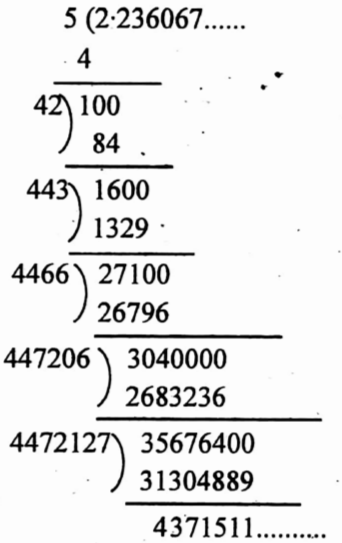
Solution:

WBBSE Class 9 Maths Arithmetic Chapter 1 Real Numbers Decimal Expansion Of Root 5


√5 = 2.236067……….

⇒ Therefore the decimal expansion of √5 is a non-terminating and non-recurring decimal.

∴ So the correct answer is 3. A non-terminating and non-recurring decimal

Read and Learn More WBBSE Class 9 Maths Multiple Choice Questions

The decimal expansion of √5 is a non-terminating and non-recurring decimal.

Example 2. The product of two irrational numbers is

  1. Always irrational number
  2. Always rational number
  3. Always an integer
  4. Rational or irrational number

Solution: The product of two irrational number √18 and √2 is √18 x √2 = √36 = 6 [rational number]

⇒ Again √7 x √2 = √14 [irrational number]

⇒ Therefore product of two irrational number is rational or irrational number.

∴ So the correct answer is 4. None of them

The product of two irrational numbers is rational or irrational number

Example 3. π and \(\frac{22}{7}\)

  1. Both are rational number
  2. Both are always irrational number
  3. π is rational and \(\frac{22}{7}\) is irrational
  4. π is irrational and \(\frac{22}{7}\) is irrational

Solution: The ratio of perimeter and diameter of each circle is a fixed number and is denoted by π where π= (approx) or 3.14 (approx).

⇒ Therefore the value of π can not be expressed as the ratio of two integers so π is a irrational number.

⇒ As \(\frac{22}{7}\) is a ratio of two integers 22 and 7, therefore \(\frac{22}{7}\) is a rational number.

∴ So the correct answer is 4. π is irrational and \(\frac{22}{7}\) is irrational

π and \(\frac{22}{7}\) is irrational and \(\frac{22}{7}\) is irrational

WBBSE Solutions For Class 9 Fundamentals Of HistoryWBBSE Class 9 English Functional Grammar
WBBSE Class 9 Fundamentals Of History Long Answer QuestionsWBBSE Class 9 English Reading Skill
WBBSE Class 9 Fundamentals Of History Short Answer QuestionsWBBSE Class 9 English Writing Skill
WBBSE Class 9 Fundamentals Of History Very Short Answer QuestionsWBBSE Class 9 Maths Multiple Choice Questions
WBBSE Class 9 Fundamentals Of History Multiple Choice QuestionsWBBSE Solutions For Class 9 Maths
WBBSE Notes For Class 9 Geography and Environment


Example 4. Between two rational numbers, there exist.

  1. No rational number
  2. Only one rational number
  3. Infinite numbers of rational numbers.
  4. No irrational number

Solution: If x and y are two rational numbers and x < y, then the rational numbers between x and y are (x + d), (x+2d),……, (x + nd).

⇒ where \(d=\frac{y-x}{x+1}\)

⇒ It is possible to take the value of n as large as we like, the number of rational numbers lying between x and y is infinite.

∴ So the correct answer is 3. Infinite numbers of rational numbers.

Between two rational numbers, infinite numbers of rational numbers exist.

Example 5. Between two irrational numbers, there exists

  1. No rational number
  2. Only one irrational number
  3. Infinite numbers of irrational
  4. No irrational number

Solution: There are infinite numbers of irrational numbers between two irrational numbers.

⇒ √2 = 1.4142103………

⇒ √3 = 1.732050807……..

⇒ The irrational numbers between √2 and √3 are 1.41421030030003……, 1.4142126122612226…..

∴ So the correct answer is 3. Infinite numbers of irrational

Between two irrational numbers, there exists Infinite numbers of irrational


Example 6. The number 0 is

  1. Whole number but not an integer
  2. Integer but not rational
  3. Rational but not a real number
  4. Whole numbers, integers, rational, and real numbers but not irrational

Solution: 0 = \(\frac{0}{1}\) = \(\frac{0}{2}\) = \(\frac{0}{17}\)

⇒ So 0 is a rational number,

⇒ Again 0 is a whole number and 0 is an integer that is neither positive nor negative.

∴ So the correct answer is 4. Whole numbers, integers, rational, and real numbers but not irrational

The number 0 is Whole numbers, integers, rational, and real numbers but not irrational

Example 7. The sum of two rational numbers is

  1. Always rational
  2. Always irrational
  3. Always integer
  4. None of them

Solution: The sum of two rational numbers will always be rational.

⇒ e.g.\(\frac{2}{3}\) + \(\frac{5}{6}\) = \(\frac{9}{6}\), √25 + √16 = \(\frac{9}{1}\)

∴ So the correct answer is 1. Always rational

The sum of two rational numbers is Always rational

Example 8. Which is not an irrational number from the following number?

  1. 25
  2. √7 – √3
  3. 4 + 2√25
  4. 9

Solution: 4 + √25 = 4 + 5 = \(\frac{9}{1}\) (rational number)

⇒ √3 x √2 = √6 (irrational number)

⇒ 2√5 (irrational number)

⇒(√7-√3) is a irrational number

∴ So the correct answer is 3. 4 + 2√25

Example 9. Which is not a rational number from the following number?

  1. √0.4
  2. 3.06
  3. \(\sqrt{1 \frac{9}{16}}\)
  4. √8

Solution: √0.4 = \(\sqrt{\frac{4}{9}}\) = \(\frac{2}{3}\) (rational number)

⇒ 3.06 = 3\(\frac{6}{90}\) (rational number) = 3\(\frac{1}{5}\) = \(\frac{46}{15}\) (rational number)

⇒ \(\sqrt{1 \frac{9}{16}}=\sqrt{\frac{25}{16}}=\frac{5}{4}\) (rational number)

⇒ √8 = \(\sqrt{4 \times 2}\) = 2√2 (irrational number)

∴ So the correct answer is 4. √8

WBBSE Class 9 Maths Arithmetic Chapter 1 Real Numbers Multiple Choice Questions


Example 10. Which of the following number is a recurring decimal?

  1. \(\frac{5}{8}\)
  2. \(\frac{11}{25}\)
  3. \(\frac{13}{80}\)
  4. \(\frac{19}{24}\)

Solution: If the rational numbers of the form \(\frac{p}{q}\) where q has the prime factors 2 and 5 only be expressed into decimals, it will be terminating decimal numbers.

⇒ But if the rational numbers of the form be expressed into decimals, it will be recurring decimal numbers, where q has prime factors other than 2 and 5.

1. The denominator of \(\frac{5}{8}\) is 8 and 8 = 23; 8 has no prime factor except 2.

∴ a terminating decimal number will be found if \(\frac{5}{8}\) be expressed into decimal.

2. The denominator of \(\frac{11}{25}\) is 25 and 25 = 52; 25 has no prime factor except 5.

∴ a terminating decimal number will be found if \(\frac{11}{25}\) is expressed into decimal.

3. The denominator of \(\frac{13}{80}\) is 80 and 80 = 24 x 5;

⇒ 80 has no prime factor except 2 and 5.

∴ a terminating decimal number will be found if \(\frac{13}{80}\) is expressed into decimal.

4. The denominator of \(\frac{19}{24}\) is 24 and 24 = 23 x 3;

⇒ 24 has a prime factor 3 other than 2

∴ The decimal form of \(\frac{19}{24}\) will not be terminating. It will be recurring.

∴ So the correct answer is 4. \(\frac{19}{24}\)