WBBSE Class 9 Coordinate Geometry Chapter 3 Area Of Triangular Region Multiple Choice Questions

WBBSE Class 9  Coordinate Geometry Chapter 3 Area Of Triangular Region Multiple Choice Questions

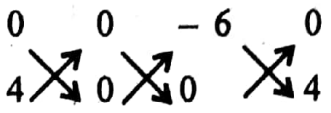
Example 1. The area of triangular formed by three points (0, 4), (0, 0), (-6, 0) is

  1. 24 sq. unit
  2. 12 sq. unit
  3. 6 sq. unit
  4. 8 sq. unit

Solution: Area = \(\frac{1}{2}|0+0-24-(0+0+0)|\) sq. unit = 12 sq. unit

WBBSE Solutions For Class 9 Maths Coordinate Geometry Chapter 3 Area Of Triangular Region Area Of Triangular Formed By Three Points

Example 2. The coordinates of the centroid of a triangle formed by three points (7, -5), (-2, 5), and (4, 6) is

  1. (3,-2)
  2. (2, 3)
  3. (3, 2)
  4. (2, -3)

Solution: \(\left(\frac{7-2+4}{3}, \frac{-5+5+6}{3}\right)=(3,2)\)

Example 3. ΔABC is a right-angled triangle of which ∠B = ordinates of A, C are (0, 4) and (3, 0). The area of two triangles is

  1. 12 sq. unit
  2. 6 sq. unit
  3. 24 sq. unit
  4. 8 sq. unit

Solution: Area = \(\frac{1}{2}\) x 3 x 4 sq. u = 6 sq. unit

WBBSE Class 9 Maths Coordinate Geometry Chapter 3 Triangle ABC Is A Right Angled Triangle


WBBSE Solutions For Class 9 Fundamentals Of HistoryWBBSE Class 9 English Functional Grammar
WBBSE Class 9 Fundamentals Of History Long Answer QuestionsWBBSE Class 9 English Reading Skill
WBBSE Class 9 Fundamentals Of History Short Answer QuestionsWBBSE Class 9 English Writing Skill
WBBSE Class 9 Fundamentals Of History Very Short Answer QuestionsWBBSE Class 9 Maths Multiple Choice Questions
WBBSE Class 9 Fundamentals Of History Multiple Choice QuestionsWBBSE Solutions For Class 9 Maths
WBBSE Notes For Class 9 Geography and Environment


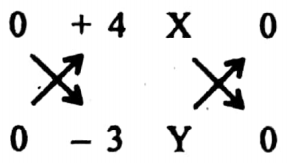
Example 4. If (0, 0), (+4, -3), (x, y) are collinear then

  1. x = 8, y = -6
  2. x = 8, y = 6
  3. x = 4, y = 6
  4. x = 8, y = 6

Solution:

WBBSE Solutions For Class 9 Maths Coordinate Geometry Chapter 3 Area Of Triangular Region Collinear

\(\frac{1}{2}|0+4 y+0-(0-3 x)|=0\)

or, \(\left|+2 y+\frac{3}{2} x\right|=0\)

x = +8, y = 6 satisfies the equations.

WBBSE Class 9 Coordinate Geometry Chapter 3 Area Of Triangular Region Multiple Choice Questions


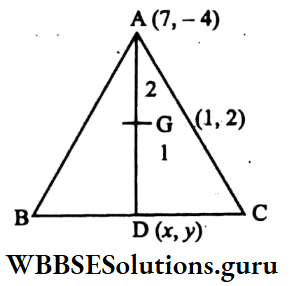
Example 5. If in triangle ABC, the co-ordinates of vertex A is (7, -4) and the centroid of the triangle is (1, 2) then the co-ordinates of midpoint of BC is

  1. (-2,-5)
  2. (-2, 5)
  3. (2, -5)
  4. (5, -2)

Solution: AG: GD = 2:1

Let the Co-ordinate of D be (x, y)

∴ \(\frac{2 x+7}{3}=1 \quad \frac{2 y-4}{3}=2\)

or, x = -2 or, y = 5

WBBSE Class 9 Maths Coordinate Geometry Chapter 3 Triangle ABC Coordinate Of Vertext And Centriod Of Triangle


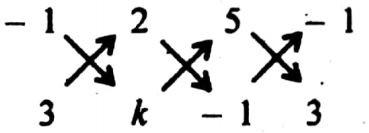
Example 6. (-1, 3), (2, k) and (5, -1) are collinear. k =

  1. 1
  2. 0
  3. 2
  4. None of these

Solution:

WBBSE Solutions For Class 9 Maths Coordinate Geometry Chapter 3 Area Of Triangular Region Collinear

= \(\frac{1}{2}|-k+13-7-5 k|=0 \Rightarrow k=1\)

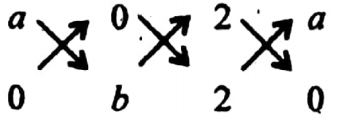
Example 7. The points (9, 0), (0, 4), (2, 2) are colinear if

  1. a + b = 2
  2. a + b + 4 = 0
  3. \(\frac{1}{a}+\frac{1}{b}=\frac{1}{2}\)
  4. ab = 2

Solution:

WBBSE Solutions For Class 9 Maths Coordinate Geometry Chapter 3 Area Of Triangular Region Collinear

= \(\frac{1}{2}|a b+0+0-2 b-2 a|=0 \text { or, } a b=2 b+2 a \text { or, } \frac{1}{a}+\frac{1}{b}=\frac{1}{2}\)

Example 8. If the points (a, 0), (0, 4), (1, 1) are on the same straight line then

  1. \(\frac{1}{a}+\frac{1}{b}\) = 1
  2. ab = 1
  3. a+b+1=0
  4. None of these

Solution:

WBBSE Solutions For Class 9 Maths Coordinate Geometry Chapter 3 Area Of Triangular Region Points Are Same Straight Line

= \(\frac{1}{2}|a b-b-a|=0\)

a + b = ab

\(\frac{1}{a}+\frac{1}{b}=1\)

WBBSE Solutions For Class 9 Maths Geometry Chapter 1 Properties Of Parallelogram

Geometry Chapter 1 Properties Of Parallelogram

⇔ Trapezium: A quadrilateral of which one pair of opposite sides are parallel is called Trapezium.


WBBSE Solutions For Class 9 Maths Geometry Chapter 1 Properties Of Parallelogram Trapezium

ABCD is a trapezium in which AB || DC

⇔ Isosceles trapezium: A trapezium of which non parallel sides are equal is called isosceles trapezium.
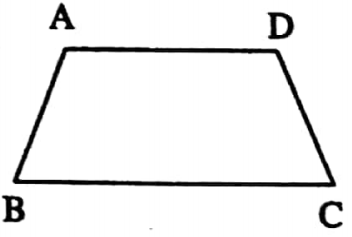
 

WBBSE Solutions For Class 9 Maths Geometry Chapter 1 Properties Of Parallelogram Isosceles Trapezium

ABCD is an isosceles trapezium whose AD || BC and AB = DC

⇔ Parallelogram: The quadrilateral of which opposite sides are parallel is called parallelogram.

Read and Learn More  WBBSE Solutions For Class 9 Maths


WBBSE Solutions For Class 9 Maths Geometry Chapter 1 Properties Of Parallelogram Parallelogram

ABCD is a parallelogram whose AB || DC and AD || BC.

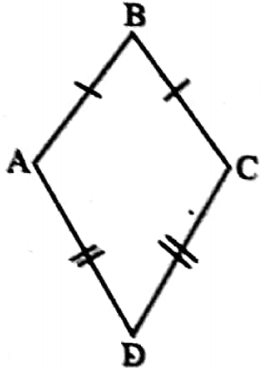
⇔ Rhombus: The parallelogram of which adjacent sides are equal in length is called Rhombus.
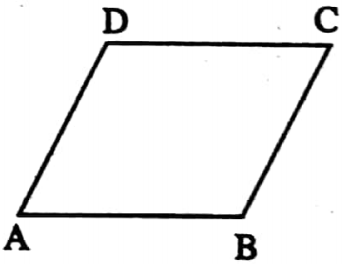
 

WBBSE Solutions For Class 9 Maths Geometry Chapter 1 Properties Of Parallelogram Rhombus

ABCD is a rhombus whose AB BC= CD = DA

⇔ Rectangle: A parallelogram of which one angle is right-angle is called rectangle.


WBBSE Solutions For Class 9 Maths Geometry Chapter 1 Properties Of Parallelogram Rectangle


ABCD is a rectangle whose AB || DC, AD || BC, and ∠A = ∠B = ∠C = ∠D = 90°.

⇔ Square: The rectangle of which one pair of adjacent sides are equal in length is called square.

or, the Rhombus of which one angle is right-angle is called square.


WBBSE Solutions For Class 9 Maths Geometry Chapter 1 Properties Of Parallelogram Square


ABCD is a square whose AB = BC = CD = DA and ∠A = ∠B = ∠C = ∠D = 90°.

⇔ Kite: The quadrilateral of which one pair of adjacent sides are equal and the remaining two sides are also equal in length is called kite.
 

WBBSE Solutions For Class 9 Maths Geometry Chapter 1 Properties Of Parallelogram Kite


ABCD is a kite whose AB BC, AD CD but AB ≠ AD and BC ≠ CD

Theorem:

1. For any parallelogram:

  1. Each diagonal bisects it into congruent triangles.
  2. Opposite sides are equal
  3. Opposite angles are equal.

2. The diagonals of a parallelogram bisect each other.

3. If opposite sides of any quadrilateral are equal, then the quadrilateral will be a parallelogram.

4. If the opposite angles of a quadrilateral are equal, then this will be a parallelogram.

5. If one pair of opposite sides of any quadrilateral is equal as well as parallel then the quadrilateral will be a parallelogram.

6. If the two diagonals of a quadrilateral bisect each other, then the quadrilateral will be a parallelogram.

WBBSE Solutions For Class 9 Fundamentals Of HistoryWBBSE Class 9 English Functional Grammar
WBBSE Class 9 Fundamentals Of History Long Answer QuestionsWBBSE Class 9 English Reading Skill
WBBSE Class 9 Fundamentals Of History Short Answer QuestionsWBBSE Class 9 English Writing Skill
WBBSE Class 9 Fundamentals Of History Very Short Answer QuestionsWBBSE Class 9 Maths Multiple Choice Questions
WBBSE Class 9 Fundamentals Of History Multiple Choice QuestionsWBBSE Solutions For Class 9 Maths
WBBSE Notes For Class 9 Geography and Environment


Geometry Chapter 1 Properties Of Parallelogram True Or False

Example 1. In parallelogram ABCD if ∠BAD = ∠ABC then parallelogram ABCD will be a rectangle.

Solution: In parallelogram ABCD,
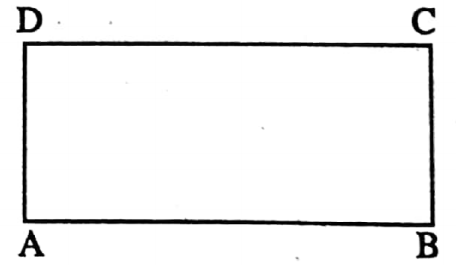
 

WBBSE Solutions For Class 9 Maths Geometry Chapter 1 Properties Of Parallelogram Parallelogram Will Be A Rectangle


∠BAD + ∠ABC = 180°

∠BAD + ∠BAD = 180° [ ∠BAD = ∠ABC]

2 ∠BAD = 180°

∠BAD = 90°

∴ Parallelogram will be a rectangle.

So the statement is true.

Example 2. In rectangle ABCD, if the diagonal AC is bisects angles ∠A and ∠C, then the rectangle ABCD will be a square.

Solution: The diagonal AC of rectangle ABCD is bisects the angles ∠A and ∠C.
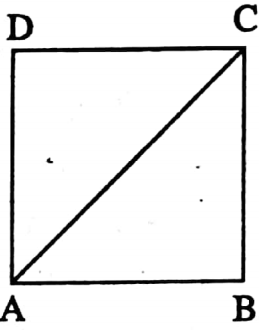
 

WBBSE Solutions For Class 9 Maths Geometry Chapter 1 Properties Of Parallelogram ABCD Is A Square


∴ ∠BAC = ∠DAC and ∠BCA = ∠DCA

Again, AB || DC and AC is the intersection

∴ ∠BAC = ∠DCA but ∠BAC = ∠DAC

∴ ∠DAC = ∠DCA

In ΔADC, ∠DAC = ∠DCA, ∴ DC = AD

but DC = AB and AD = BC

∴ AB = BC = CD

∴ ABCD is a square.

So the statement is true.

Geometry Chapter 1 Properties Of Parallelogram Fill In The Blanks

Example 1. The diagonals of a square or a rhombus bisect each other ________

Solution: Perpendicularly.

Example 2. The lengths of opposite sides of a kite is ________

Solution: Unequal.


Geometry Chapter 1 Properties Of Parallelogram Short Answer Type Questions

Example 1. In the parallelogram ABCD, ∠A: ∠B = 3: 2, write the measures of the angles of the parallelogram.

Solution: In parallelogram ABCD, ∠A: ∠B = 3:2
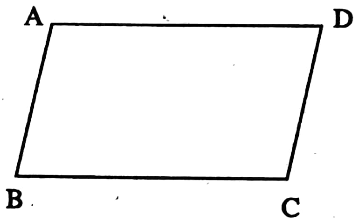
 

WBBSE Solutions For Class 9 Maths Geometry Chapter 1 Properties Of Parallelogram The Parallelogram ABCD


Let, ∠A = 3x° and ∠B = 2x° [x° is a common multiple and x > 0]

∠A + ∠B = 180°

3x° + 2x° = 180°

5x = 180°  ⇒ x° = 36°

∴ ∠D = ∠B = 2 x 36° = 72° [opposite angles of parallelogram are equal]

and ∠C = ∠A = 3 × 36° = 108°

∴ The measures of the angles of the parallelogram is 108°.

Example 2. In the parallelogram ABCD, the bisectors of ∠A and ∠B meets CD at the point E. The length of the side BC is 2 cm. Write the length of the side AB.

Solution: In parallelogram, AD = BC = 2 cm


WBBSE Solutions For Class 9 Maths Geometry Chapter 1 Properties Of Parallelogram Parallelogram ABCD The Lenght Of The Side AB Is 4 cm


As AE is the bisector of the ∠BAD

∴ ∠BAE = ∠DAE

Again, DC || AB and AE is the intersection

∴ ∠AED = alternate ∠BAE

∴ ∠AED = ∠DAE

∴ AD = DE = 2 cm [BC= 2 cm]

Similarly, CE = 2 cm

AB = DC = DE = CE = (2 + 2) cm = 4 cm.

∴ The length of the side AB is 4 cm.

Example 3. The equilateral triangle AOB lie within the square ABCD. Write the value of ∠COD.

Solution: In equilateral triangle ΔAOB, OA = AB = OB


WBBSE Solutions For Class 9 Maths Geometry Chapter 1 Properties Of Parallelogram Equilateral Triangle AOB Lie With In The Square ABCD


and ∠AOB = ∠OAB = ∠OBA = 60°

∠OBC = 90° – 60° = 30° [∠ABC = 90°]

In ΔBOC, OB = BC [OB = AB and AB = BC]

∴ ∠OCB = ∠BOC = \(\frac{180^{\circ}-30^{\circ}}{2}\) = 75°

∠OCB = 90° – ∠OCB = 90° – 75° = 15°

Similarly, ∠ODC = 15°

In ACOD, COD = 180° – ∠OCD – ∠ODC

= 180° – 15° – 15° = 150°

∴ The value of ∠COD is 150°.

Example 4. In the square ABCD, M is a point on AD so that ∠CMD= 30°. The diagonal BD intersects CM at the point P. Write the value of ∠DPC.

Solution: As BD is a diagonal of square ABCD
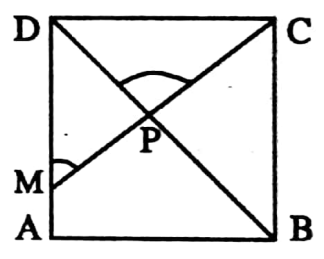
 

WBBSE Solutions For Class 9 Maths Geometry Chapter 1 Properties Of Parallelogram In The Square ABCD M Is A Point On AD


∴ ∠BDC= 45° i.e. ∠PDC= 45°

In ΔCMD, ∠CMD 30° and ∠MDC = 90°

∠DCM = 180° (30° + 90°) = 60° i.e. ∠DCP = 60°

In ΔPDC, ∠PDC = 45°, ∠DCP = 60°

∠DPC = 180° – (45° + 60°) = 75°

∴ The value of ∠DPC is 75°.

Example 5. In the rhombus ABCD, the length of the side AB is 4 cm, and ∠BCD = 60°. Write the length of the diagonal BD.

Solution: In rhombus ABCD, BC = CD = DA = AB = 4 cm
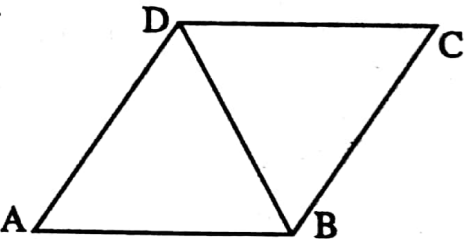
 

WBBSE Solutions For Class 9 Maths Geometry Chapter 1 Properties Of Parallelogram In Rhombus ABCD


In ΔBCD, BC = DC

∴ ∠BDC = ∠DBC

∠BCD = 60°

∴ ∠DBC = ∠BDC = \(\frac{180^{\circ}-60^{\circ}}{2}\) = 60°

∠BCD = ∠DBC = ∠BDC

∴ BD = DC = BC 4 cm

∴ The length of the diagonal BD is 4 cm.

Example 6. In parallelogram ABCD, if ∠B = 60°, then write the measures of the angles of the parallelogram.

Solution: In parallelogram ABCD, ∠D = ∠B = 60°
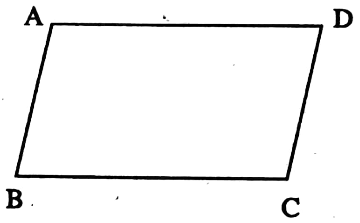
 

WBBSE Solutions For Class 9 Maths Geometry Chapter 1 Properties Of Parallelogram The Parallelogram ABCD


∠A + ∠B = 180° [as AD || BC and AB is intersection]

∠A + 60° = 180° or, ∠A = 120°

∴ ∠C = ∠A = 120°

∴ The measures of the angles of the parallelogram is 120°.

Example 7. Determine the ∠PRQ of the parallelogram PQRS.

Solution: In parallelogram, ∠PSR = ∠PQR = 55°
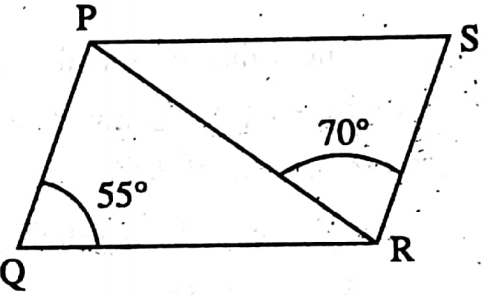
 

WBBSE Solutions For Class 9 Maths Geometry Chapter 1 Properties Of Parallelogram Angle PRO Of The Parallelogram PQRS Is 55 Degrees


In ΔPRS, ∠RPS = 180°- ∠PSR – ∠PRS

= 180° – 55°-70° = 55°.

PS || QR and PR is intersection

∴ ∠PRQ = alternate ∠RPS = 55°

∴ The ∠PRO of the parallelogram PQRS is 55°.

Example 8. In parallelogram ABCD, AP and DP are the bisectors of ∠BAD and ∠ADC respectively, find the measures of ∠APD.

Solution: In ΔAPD,

∠APD = 180° – (∠PAD + ∠ADP)


WBBSE Solutions For Class 9 Maths Geometry Chapter 1 Properties Of Parallelogram ABCD AP And DP Are Bisectors Of Angle BAD


= 180° – \(\left(\frac{1}{2} \angle \mathrm{BAD}+\frac{1}{2} \angle \mathrm{ADC}\right)\)

= 180° – \(\frac{1}{2}\)(∠BAD + ∠ADC)

= 180° – \(\frac{1}{2}\) x 108° [DC || AB and AD is intersection]

= 90°

∴ The measures of ∠APD is 90°.

Example 9. PQRS is rectangle. Find the value of x and y.

Solution: In rectangle PQRS, PR = QS; PR and QS bisect each other.


WBBSE Solutions For Class 9 Maths Geometry Chapter 1 Properties Of Parallelogram PQRS Is A Rectangle


∴ OP OQ= OR = OS

In ΔQOR, OQ = OR  ∴ ∠ORQ = ∠OQR = 25°

∠ORS = ∠QRS – ∠ORQ

x° = 90° – 25° = 65°

In, ΔROS, OR = OS,  ∴ ∠OSR = ∠ORS = 65°

exterior ∠POS = ∠ORS + ∠OSR

y° = 65° + 65° = 130°

⇒ The value of x and y are 65 and 130 respectively.

Example 10. PQRS is a rectangle. Find the value of x and y.

Solution: In rectangle PQRS, PR = QS; PR and QS bisect each other,
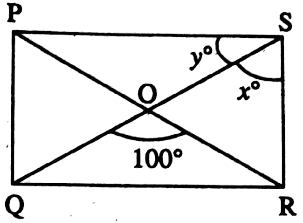
 

WBBSE Solutions For Class 9 Maths Geometry Chapter 1 Properties Of Parallelogram PQRS Is A Rectangle


∴ OP = OQ = OR = OS

∠ROS = 180° – ∠QOR = 180° – 100° = 80°

In, ΔROS, OR = OS

∴ ∠OSR = ∠ORS

\(x^{\circ}=\frac{180^{\circ}-\angle R O S}{2}=\frac{180^{\circ}-80^{\circ}}{2}=50^{\circ}\)


Again, ∠OSR + ∠OSP = 90°

⇒ ∠OSP = 40°

⇒ y° = 40°

∴ The value of x and y are 50 and 40 respectively.

Example 11. In parallelogram ABCD, AD  (5x – 2) cm, BC = (3x + 4) cm and AB = (x + 4) cm. Find the length of DC.

Solution: In parallelogram ABCD, AD = BC


WBBSE Solutions For Class 9 Maths Geometry Chapter 1 Properties Of Parallelogram The Parallelogram ABCD


5x – 2 = 3x + 4

2x = 6 ⇒ x = 3

DC = AB = (x + 4) cm = (3 + 4) cm = 7cm

∴  The length of DC is 7 cm.

Example 12.  In rhombus PQRS, if ∠SPQ = 60° and the perimeter is 24 cm, then find the length of diagonal PR.

Solution: In rhombus PQRS, PQ = QR = RS = SP = \(\frac{24}{4}\) cm = 6 cm
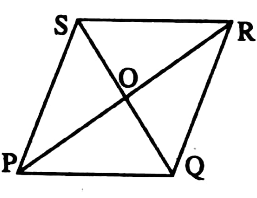
 

WBBSE Solutions For Class 9 Maths Geometry Chapter 1 Properties Of Parallelogram In Rhombus PQRS

∠SPQ = 60°

∴ ∠PQS = ∠PSQ = 60°

∴ ΔPQS is an equilateral triangle

∴ QS = PQ = 6 cm the length of diagonal PR.

Let PR and SQ meets at point O; The diagonals of a rhombus bisects each other perpendicularly.

∴ OQ = OS = \(\frac{6}{2}\) cm = 3 cm and OP = OR

In ΔPOQ, ∠POQ = 90°

PQ2 = OP2 + OQ2 [by Pythagorus theorem]

OP = \(\sqrt{P Q^2-O Q^2}=\sqrt{6^2-3^2} \mathrm{~cm}=\sqrt{27}\) cm = 3√3 cm

PR = 2 × 3√3 cm = 6√3 cm

∴ The length of diagonal PR is 6√3 cm.

WBBSE Solutions For Class 9 Maths Algebra Chapter 6 Logarithm

Algebra Chapter 6 Logarithm

If ax = N (N > 0, a > 0, N ≠ 1), then x is called the logarithm of the number N to the base a and is written as x = logaN

Thus, if ax = N, then x = logaN

Conversely, if x = logaN, then ax = N

WBBSE Solutions For Class 9 Maths Algebra Chapter 6 Logarithm

Formulae on logarithm: (M > 0, N > 0, a > 0, b > 0, a ≠ 1, b ≠ 1 and n is any real number)

  1. \(\log _a(\mathrm{MN})=\log _a \mathrm{M}+\log _a \mathrm{~N}\)
  2. \(\log _a\left(\frac{M}{N}\right)=\log _a \mathrm{M}-\log _a \mathrm{~N}\)
  3. \(\log _a \mathrm{M}^n=x \log _a \mathrm{M}\)
  4. \(\log _a \mathrm{M}=\log _b \mathrm{M} \times \log _a b\)
  5. \(\log _a 1=0\)
  6. \(\log _a a=1\)
  7. \(a^{\log _a M}=M\)
  8. \(\log _b a \times \log _a^b\) = 1
  9. \(\log _b a=\frac{1}{\log _a b}\)
  10. \(\log _b M=\frac{\log _a M}{\log _a b}\)


Read and Learn More  WBBSE Solutions For Class 9 Maths


Algebra Chapter 6 Logarithm True Or False

Example 1. loga1 = 1

Solution: The statement is False.

Example 2. logaa = 1

Solution: The statement is True.

Example 3. alogaM = a

Solution: The statement is False.

Example 4. \(\log _b a=\frac{1}{\log _a b}\)

Solution: The statement is True.

Example 5. \(\log _a \frac{1}{a}\) = 1

Solution: The statement is False.

Example 6. \(\log _b a \times \log _a b\) = 1

Solution: The statement is True.

Example 7. Solving the equation 2x = 7, we get x = log27.

Solution: The statement is True.

Example 8. Logarithm is said that idea of logarithm is 6th fundamental process.

Solution: The statement is False.

Example 9. logaM is undefined when a = 1.

Solution: The statement is True.

Example 10. logaM is defined when a = 0.

Solution: The statement is False.

WBBSE Solutions For Class 9 Fundamentals Of HistoryWBBSE Class 9 English Functional Grammar
WBBSE Class 9 Fundamentals Of History Long Answer QuestionsWBBSE Class 9 English Reading Skill
WBBSE Class 9 Fundamentals Of History Short Answer QuestionsWBBSE Class 9 English Writing Skill
WBBSE Class 9 Fundamentals Of History Very Short Answer QuestionsWBBSE Class 9 Maths Multiple Choice Questions
WBBSE Class 9 Fundamentals Of History Multiple Choice QuestionsWBBSE Solutions For Class 9 Maths
WBBSE Notes For Class 9 Geography and Environment

Algebra Chapter 6 Logarithm Fill In The Blanks

Example 1. If log10x + 1 = 0 then x _______

Solution: \(\frac{1}{10}\)

log10x = -1

x = 10-1 = \(\frac{1}{10}\)

Example 2. If b2 = ae, then logb(abc) = _______

Solution: 3

\(\log _b(b . a c)=\log _b\left(b . b^2\right)=\log _b b^3=3 \log _b b=3\)


Example 3. If \(\log _{a b} a=x\), then \(\log _{a b} b\) = ______

Solution: 1 – x

\(\log _{a b} a+\log _{a b} b=\log _{a b}(a b)=1\)


∴ \( x + \log _{a b} b=1\)

or, \(\log _{a b} b=1-x\)

Example 4. If log4(3x+4)= 3 then the value of x is

Solution: 20

43 = 3x + 4

x = \(\frac{64-4}{3}\) = 20

Example 5. If log202 = a then the value of log2010 is ______

Solution: 1 – a.

\(\log _{20} 10=\log _{20} \frac{20}{2}\)


= \(\log _{20} 20-\log _{20} 2=1-a\)

Example 6. The value of log12(log1916 x log1619) = _______

Solution: 0

log12(1) = 0

Example 7. If log4 = -2, then n = _______

Solution: \(\frac{1}{2}\)

\(x^{-2}=4\)


∴ \(\left(\frac{1}{x}\right)^2=2^2\)

∴ \(x=\frac{1}{2}\)

Example 8. If log10(x – 2) = 1 – log102 then x = _____

Solution: 7

log10 (x -2)+ log102 = 1

or, log10(2x – 4) = 1

∴ 2x – 4 = 4

x = 7

Example 9. The value of logs log√28 = ______

Solution: \(2^{\log 2 x^2 x^2}\)

\(\log _6 \cdot 3 \cdot \log _{\sqrt{2}} 2=\log _6 3 \cdot 2 \times 2=\log _6 6=1\)


Example 10. The value of \(4 \log 2^x\) is _______

Solution: \(_2 2 \log _2 x=_2 \log _2 x^2 x^2\)


Algebra Chapter 6 Logarithm Short Answer Type Questions

Example 1. Let us calculate the value of log4 log4 log4 256.

Solution: log4 log4 log4(4)4 = log4 log44

= log41 = 0

Example 2. Calculate the value of \(\frac{a^n}{b^n}+\log \frac{b^n}{c^n}+\log \frac{c^n}{a^n}\)

Solution: log ax – log bx + log bx – log cx + log cx – log ax = 0

Example 3. Show that \(a^{\log _a x}=x\)

Solution: Let \(\log _a x=\mathrm{M}\)

∴ \(a^M=x\)

Example 4. If \(\log _e 2 \log _x 25=\log _{10} 16 . \log _e 10\)

Solution: \(\log _e 2 \log _x 5^2=\log _{10} 2^4 \log _e 10\)

or, \(\log _e 2 . \log _x 5^2=4 \log _{10} 2 \log _e 10\)

or, \(\log _e 2 \log _x 5^2=4 \log _e 2\)

∴ \(x^4=5^2\)

∴ \(x^4=100\),

∴ \(x= \pm \sqrt{5}\)

Example 5. Find the value of \(\log _{2 \sqrt{3}} 1728\).

Solution: let \(\log _{2 \sqrt{3}} 1728\)

∴ \((2 \sqrt{3})^x=1728\)

or, \((2 \sqrt{3})^x=2^6 3^3=(2 \sqrt{3})^6\)

∴ x = 6

Example 6. Expression terms of \(N: \frac{1}{2} \log _3 M+\log _3 N=1\)

Solution: \(\log _3 \sqrt{M}+\log _3 N^3=1\)

or, \(\log _3 \sqrt{M} N^3=1\)

or, \(\sqrt{M} N^3=3\)

or, \(M=\left(\frac{3}{N^3}\right)^2=\frac{9}{N^6}\)

Example 7. Prove that (log x)2 – (log y)2 = \(\log (x y) \log \frac{x}{y}\)

Solution: (log x + log y) (log x log y) = log (xy) log\(\frac{x}{y}\)

Example 8. If \(\log _{30} 3=a \text { and } \log _{30} 5=b\), then find the value of \(\log _{30} 8\)

Solution: \(\log _{30} 2^3=3 \log _{30} \frac{30}{15}=3\left(\log _{30} 30-\log _{30} 15\right)\)

= \(3\left\{1-\log _{30}(3 \times 5)\right\}=3(1-a-b)\)

Example 9. Find the base when 3 is the logarithm of 343.

Solution: logx 343 = 3

∴ x3 = 343 = 73

∴ x = 7

Example 10. Find the simplest value of \(\log _3 5 \times \log _{25} 27\)

Solution: \(\log _3 5 \times \log _{5^2} 3^3=\frac{3}{2} \log _3 5 \times \log _5 3=\frac{3}{2}\)

WBBSE Solutions For Class 9 Maths Algebra Chapter 5 Factorisation

Algebra Chapter 5 Factorisation

By factorisation of a polynomial, it means that the polynomial should be represented as the product of two or more polynomials.

Each of the polynomials obtained is called a factor of the original one.

WBBSE Solutions For Class 9 Maths Algebra Chapter 5 Factorisation

If f(x) = ax3 + bx + c, then we first find the zero of the polynomial.

Let f(α) = 0 then (x – α) is a factor of fx).

This method is called vanishing or trial or zero method.

We are going to use these formulae to factorise.

  1. a2 – b2 = (a + b) (a – b)
  2. a3 + b3 = (a + b) (a2 – ab + b2)
  3. a3 – b3 = (a – b) (a2 + ab + b2)
  4. a3 + b3 + c3 – 3abc = (a + b + c) (a2 + b2 +c – ab – bc – ca) = \(\frac{1}{2}\)(a + b + c ) {(a – b)2 + (b − c)2 + (c − a)2}
  5. If a + b + c = 0 then a3 + b3 + c3 = 3abc
  6. If a3 + b3 + c3 = 3 abc then either a + bc = 0 or a = b = c
  7. For quadratic expressions, we break the middle term of factorise like x2 + (a + b)x + ab = x2 + ax + bx+ ab = x (x + a) + b (x + a) = (x + a) (x + b)

Read and Learn More  WBBSE Solutions For Class 9 Maths

Algebra Chapter 5 Factorisation True Or False

Example 1. (2a + 1) is a factor of 8a3+ 8a – 5.

Solution: The correct answer is False.

Example 2. x + \(\frac{3}{2}\) is a factor of 2x3 + x2 – 9x – 9.

Solution: The correct answer is True.

Example 3. If f(x) = x3 + 3x – 4 then (x – 1) is a factor of x3 + 3x – 4

Solution: The correct answer is True.

Example 4. If a + b + c ≠ 0 and a3 +b3 + c3 =3abc then a ≠ b ≠ c

Solution: The correct answer is False.

Example 5. There are 6 factors of 1 – x12

Solution: The correct answer is True.

Example 6. Value of a3 +b3 + c3 – 3abc when a = 999, b = 998, c = 997 is 8982.

Solution: The correct answer is True.

Example 7. (x – a) (x – b) = x2 + (a + b) x + ab

Solution: The correct answer is False.

Example 8. If x + y + z = 0 then x3 + y3 + z3 = -3xyz

Solution: The correct answer is False.

Example 9. x and (x + 9) are two factors of x2 + 9x.

Solution: The correct answer is True.

Example 10. (x – 1) and (x2 + x + 4) are two factors of x3 + 3x – 4.

Solution: The correct answer is True.

Algebra Chapter 5 Factorisation Fill In The Blanks

Example 1. 2x3 + x2 – 9x – 9 = (2x + 3) x (______)

Solution: x2

Example 2. x2 – 2ax + (a + b)(a – b) = (x – a – b) x (________)

Solution: x – a + b.

Example 3. 4x2 – 12xy + 9y2 + 2x – 3y =(2x – 3y) x (__________)

Solution: 2x – 3y + 1.

Example 4. x2 + 5x + 6 = x2 + x (_______) + 6

Solution: 3 + 2

Example 5. x2 – 5x + 6 = x2 – x (________) + 6

Solution: 3 + 2.

Example 6. a6 + 5a3 + 8 = (a2)3 + (_______)3+ 23 -3a2(_______).2

Solution: -a, – a.

Example 7. (a – b)3 + (b – c)3 + (c – a)3 = 3 ______

Solution: (a – b)(b – c)(c – a).

Example 8. (80)3 – (20)3 – (60)3 = _______

Solution: 96000.

Example 9. If a – b = -1 then a3 – b3+ 3ab + 1 = _______

Solution: 0

Example 10. If a + b + c = 0 then a3 + b3 – 3abc + c3 = _______

Solution: 0

Algebra Chapter 5 Factorisation Short Answer Type Questions

Example 1. Simplify: \(\frac{\left(b^2-c^2\right)^3+\left(c^2-a^2\right)^3+\left(a^2-b^2\right)^3}{(b-c)^3+(c-a)^3+(a-b)^3}\)

Solution: \(b^2-c^2+c^2-a^2+a^2-b^2=0\)

∴ \(\left(b^2-c^2\right)^3+\left(c^2-a^2\right)^3+\left(a^2-b^2\right)^3\)

Similarly, \(3\left(b^2-c^2\right)\left(c^2-a^2\right)\left(a^2-b^2\right)\)

∴ \(\frac{\left(b^2-c^2\right)^3+\left(c^2-a^2\right)^3+\left(a^2-b^2\right)^3}{(b-c)^3+(c-a)^3+(a-b)^3}=\frac{3\left(b^2-c^2\right)\left(c^2-a^2\right)\left(a^2-b^2\right)}{3(b-c)(c-a)(a-b)}\)

= (b+c)(c+a)(a+b)

\(\frac{\left(b^2-c^2\right)^3+\left(c^2-a^2\right)^3+\left(a^2-b^2\right)^3}{(b-c)^3+(c-a)^3+(a-b)^3}\) = (b+c)(c+a)(a+b)

WBBSE Solutions For Class 9 Fundamentals Of HistoryWBBSE Class 9 English Functional Grammar
WBBSE Class 9 Fundamentals Of History Long Answer QuestionsWBBSE Class 9 English Reading Skill
WBBSE Class 9 Fundamentals Of History Short Answer QuestionsWBBSE Class 9 English Writing Skill
WBBSE Class 9 Fundamentals Of History Very Short Answer QuestionsWBBSE Class 9 Maths Multiple Choice Questions
WBBSE Class 9 Fundamentals Of History Multiple Choice QuestionsWBBSE Solutions For Class 9 Maths
WBBSE Notes For Class 9 Geography and Environment


Example 2. Let us write the relation of a, b, c if a3 +b3 + c3 – 3abc = 0 and a + b + c ≠ 0.

Solution: a3 + b3 + c3 – 3abc

= \(\frac{1}{2}\) (a + b + c) {(a – b)2 + (b − c)2 + (c − a)2} = 0

Now, a + b + c ≠ 0

∴ (a – b)2 + (b – c)2 + (c – a)2 = 0

If sum of the squares are zero, then each term is zero

∴ a – b = 0, a = b and b – c = 0, b = c

∴ a = b = c.

Example 3. If a2 – b2 = 224 or b are negative integers (a < b) then find the values of a and b.

Solution: a2 – b2 = 225 – 1 = (15)2– (1)2

or, a2 – b2 = (-15)2 – (-1)2

a and b are negative integers and a < b

∴ a = -15, b = -1.

The values of a and b -15 and -1.

Example 4. Let us write the value of (x – a)3 + (x − b)3 + (x − c)3 – 3(x -a)(x – b)(x – c) if 3x = a + b + c.

Solution: Now x – a + x – b + x – c

= 3x – (a + b + c)

= 3x – 3x = 0

∴ (x – a)3 + (x – b)3 + (x−c)3 = 3(x − a)(x – b)(x – c)

or, (x – a)3 + (x – b)3 + (x – c)3 – 3 (x – a)(x – b)(x – c) = 0

The value of (x – a)3 + (x − b)3 + (x − c)3 – 3(x -a)(x – b)(x – c) is 0.

Example 5. Let us write the values of a and p if 2x2 + px + 6 = (2x – a)(x-2)

Solution: 2x2 + px + 6 = 2x2 – 4x – ax + 2a

= 2x2 + x (-4 – a) + 2a

Comparing both sides by coefficients of x and constant terms, we get 2a = 6, a = 3 and p = – 4- a = -4 – 3 = -7.

The values of a and p are 3 and -7 .

Example 6. Find the values of (10)3 – 53 – 53.

Solution: 10 + (-5) + (-5) = 0

∴ (10)3 + (-5)3 + (-5)3 =3.10(-5)(-5) = 750

The values of (10)3 – 53 – 53 = 750

Example 7. Find the value of \(\frac{10^3+5^3}{10^2-25}\)

Solution: \(\frac{10^3+5^3}{10^2-25}=\frac{(10+5)\left(10^2-10 \times 5+5^2\right)}{10^2-5 \times 10+5^2}\)

= 10 + 5 = 15

The value of \(\frac{10^3+5^3}{10^2-25}\) = 15

Example 8. If a3 – 0.216 = (a – 0.6) (a2 + 0.6a + k), then find the value of k.

Solution: a3 – 0.216 = (a – 0.6) (a2 + 0.6a + (0.6)2}

∴ k = (0.6)2 = 0.36

The value of k = 0.36

Example 9. Factorise 8x3 – y3 – 12xy + 6xy2.

Solution: (2x)3 + (-y)3 – 6xy (2x – y)

= (2x)3 + (-y)3 + 3 x 2x (-y) (2x + (-y)}

= (2x – y)3 = (2x – y) (2x – y)(2x – y)

8x3 – y3 – 12xy + 6xy2 = (2x – y)3 = (2x – y) (2x – y)(2x – y)

Example 10. If x + y = – 4 then find the value of x3 + y3 – 12xy + 64.

Solution: x3 + y3 – 12xy + 64

= x3 + y3 + 43 – 3xy x 4

= (x + y + 4) (x2 + y2 + 16 – xy – 4x – 4y)

= 0 x (x2 + y2 + 16 – xy – 4x – 4y) = 0

The value of x3 + y3 – 12xy + 64 = 0

WBBSE Solutions For Class 9 Maths Algebra Chapter 4 Polynomial

Algebra Chapter 4 Polynomial

All algebraic expressions in which the indices of the variables are whole numbers are called Polynomials.

x = 1, x3 + 1, x2 – 9. x3 + x2 + 9…… all these are polynomials of which the variable is x, i.e. all these are polynomials with one variable. x2 + 8 is a Binomial.

WBBSE Solutions For Class 9 Maths Algebra Chapter 4 Polynomial

5x, x, 9x2 are called Monomials, and x3 – x2 + 2 is called a Trinomial. 0 is called zero polynomial.

Index of the highest power of the variable in any polynomial is called Degree of the polynomial. The degree of any constant polynomial is 0.

⇒ The degree of zero constant polynomial is indefined.

In case of determining the degree of a polynomial in more than one variable, we will find the sum of the indices of all variables of each term and the highest sum of indices will be the degree of that polynomial.

⇒ Degree of the polynomial f (x, y) = x5 + y2 + x3y3 + 4 is 3 + 3 = 6

A number C will be called zero of the polynomial f(x), if f(C) = 0.

Read and Learn More  WBBSE Solutions For Class 9 Maths

There is no zero of constant polynomial (non zero). Zero of zero constant polynomial cannot be defined.

⇒ Remainder Theorem: f(x) is a polynomial of degree x (x ≥ 1) and a is any real number.

If f (x) is divided by (x – a), then the remainder will be f(a).

⇒ Factor Theorem: If f (x) is any polynomial with degree x (x ≥ 1) and a is any real number, then

  1. (x – a) will be a factor of f (x), if (a) = 0
  2. f(a) = 0 if (x – a) is a factor of f (x).

Algebra Chapter 4 Polynomial Fill In The Blanks

Example 1. The co-efficient of the term x of the polynomial 10 is _______

Solution: 0.

Example 2. The polynomials which have only one term are called _______

Solution: monomial.

Example 3. The polynomials having four terms are called _______

Solution: tetramonials.

Example 4. Polynomials of degree 0 are called ______ polynomials.

Solution: constant.


WBBSE Solutions For Class 9 Fundamentals Of HistoryWBBSE Class 9 English Functional Grammar
WBBSE Class 9 Fundamentals Of History Long Answer QuestionsWBBSE Class 9 English Reading Skill
WBBSE Class 9 Fundamentals Of History Short Answer QuestionsWBBSE Class 9 English Writing Skill
WBBSE Class 9 Fundamentals Of History Very Short Answer QuestionsWBBSE Class 9 Maths Multiple Choice Questions
WBBSE Class 9 Fundamentals Of History Multiple Choice QuestionsWBBSE Solutions For Class 9 Maths
WBBSE Notes For Class 9 Geography and Environment


Example 5. The co-efficient of x0 of the polynomial √11- 3√11x + x2 is ______

Solution: √11

Example 6. x + \(\frac{5}{x}\) is _______ a polynomial.

Solution: not.

Example 7. Polynomial having degree 4 are called _______ polynomial.

Solution: bignadratic

Example 8. The polynomial of degree 3 are called _______ polynomial.

Solution: cubic.

Example 9. bx + c is a ______ polynomial.

Solution: linear.

Example 10. Graph of any linear polynomial is a _______ line.

Solution: straight.

Algebra Chapter 4 Polynomial True Or False

Example 1. A binomial can have at most two terms.

Solution: The statement is False.

Example 2. Every polynomial is a binomial.

Solution: The statement is False.

Example 3. A binomial may have degree 5.

Solution: The statement is True.

Example 4. Zero of a polynomial is always 0.

Solution: The statement is False.

Example 5. A polynomial cannot have more than one zero.

Solution: The statement is False.

Example 6. The degree of the sum of two polynomials cach of degree 5 is always 5.

Solution: The statement is True.

Example 7. √5x is a linear polynomial.

Solution: The statement is False.

Example 8. The division between two polynomials may or may not be a polynomial.

Solution: The statement is True.

Example 9. The sum of two polynomials is always a polynomial.

Solution: The statement is True.

Example 10. The difference of two polynomials may or may not be a polynomial.

Solution: The statement is False.

Algebra Chapter 4 Polynomial Short Answer Type Questions

Example 1. Let us write the zero of the polynomial P(x) = 2x – 3

Solution: 2x – 3 = 0, x = \(\frac{3}{2}\)

Example 2. If P(x) = x + 4, let us write the value of P(x) + P(-x)

Solution: P(x) + P(-x) = x + 4x +4 = 8

Example 3. Let us write the remainder if the polynomial x3 + 4x2 + 4x – 3 is divided by x

Solution: Zero of polynomial x is 0

Remainder = f(0) = 03 + 402 + 4.0 – 3 (by Remainder theorem)

= -3

Example 4. If (3x – 1)7 = a7x7 + a6x6 + a5x5 +…….. +a1x + a0 then find the value of a7 + a6 + a5 + ……….+ a0.

Solution: It is an identify, we put x = 1

∴ (3 × 1 – 1)7 = a7(1)7 + a6(1)6 + a5(1)5 +…….a1.1  + a0

or, 128 = a7 + a6 + a5 + …….. + a1 + a0

Example 5. For the polynomial \(\frac{x^3+2 x+1}{5}-\frac{7}{2} x^2-x^6\), find

  1. The degree of the polynomial
  2. The co-efficient of x3
  3. The co-efficient of x6
  4. The coefficient of x0

Solution:

  1. degree is 6,
  2. \(\frac{1}{5}\)
  3. -1
  4. \(\frac{1}{5}\)

Example 6. If f(x)=3x3 -4x2 + 7x – 5, find f(3), f (-3)

Solution: f(3) = 3.33. 4.32 + 7.3 – 5

= 81 – 36 + 21 – 5 = 102 – 41 = 61.

f(-3) = 3(-3)3 – 4(-3)2 + 7(-3) – 5 = -81 – 36 – 21 – 5 = -143

Example 7. Calculate and write the value of a for which (x + a) will be a factor of the polynomial x3 + ax2 – 2x + a – 12.

Solution: Let f (a) = x3 + ax2 – 2x + a – 12

We have to find the zero of the linear polynomial x + a

x + a = 0, x = -a

∴ by factor theorem f(-a) = 0

or, (-a)3 + a (-a)2 – 2(-a) + a – 12 = 0

or, (-a)3 + a3 + 2a + a – 12 = 0

or, 3a = 12

∴ a = 4

Example 8. Find the value of k for which (x-3) will be a factor of the polynomial k2x3 – kx2 + 3kx – k

Solution: First find the zero of the linear polynomial (x-3),

x – 3= 0, x = 3

By factor theorem f(3) = 0

or, k2(3)3 – k (3)2 + 3k.3 – k = 0

or, 27k2 – 9k + 9k -k = 0

or, k (27k – 1) = 0

∴ k =0, \(\frac{1}{27}\)

Example 9. Let us write the value of f (x) + f (-x) when f(x) = 2x + 5.

Solution: f(x) + f (-x) = 2 + 5 + 2 (-x)+ 5 = 10

Example 10. Both (x – 2) and (x – \(\frac{1}{2}\)) are factors of the polynomial px2 + 5x + r, let us calculate and write the relation between p and r.

Solution: Zeros of the polynomials (x-2) and (x – \(\frac{1}{2}\))

x – 2 = 0 x = 2 and x – \(\frac{1}{2}\) = 0  x = \(\frac{1}{2}\)

Now, p(2)2 + 5(2) + r = 0

or, 4p + r = -10….. (1)

and p\(\left(\frac{1}{2}\right)^2\) + 5\(\frac{1}{2}\) + r = 0

or, \(\frac{p}{4}+\frac{5}{2}+r=0\)

or, \(\frac{p}{4}+r=-\frac{5}{2}\)……..(2)

By (1) – (2), we have,

\(4 p-\frac{p}{4}=-10+\frac{5}{2}\)

\(\frac{18 p}{4_2}=\frac{-18}{2}\)

or, p = -2

∴ p = r.

r = – 10 – 4p

= -10 – 4(-2) = -2

Example 11. Find the roots of the polynomial f(x)= 2x + 3

Solution: Zeros of the polynomials are the roots.

To find the zero of linear polynomial 2x + 3

2x + 3 = 0; x = –\(\frac{3}{2}\)

Example 12. Check the following statement, ‘The two zeros of the polynomial p(x)= x2 – 9 are 3, -3′

Solution: x2 – 9 = 0,

x = ±3

The given statement is true.

Example 13. Find the number of terms of the polynomial \(\left(\frac{x+2 x^2+x^3}{x}\right)^n\)

Solution: \(\left(\frac{x+2 x^2+x^3}{x}\right)^n=\left\{\frac{x\left(1+2 x+x^2\right)}{x}\right\}^n=\left(1+2 x+x^2\right)^n\)

= (1 + x)2x number of terms = 2x + 1

Example 14. If f(x) = 2ax + 1, then find the value of f(a).f(b).f(c)

Solution: f(a).f(b).f(c) = 2a.a+1.2ab+1 .2ac+1

= 2a2 + 1 + ab + 1 + ac + 1

= 2a(a + b+ c) + 1.22 = 4.2ax+1

When x = ax + b + c

= 4f(a + b + c)

Example 15. If f(x) = 2x, then show that f(x + 1) = 4f(x – 1)

Solution: f(x + 1) = 2x+1 = 2.2x

4f(x – 1) = 4.2x-1 = \(\frac{4.2^x}{2}\) = 2.2x

∴ f(x + 1) = 4 + (x – 1)

WBBSE Solutions For Class 9 Maths Algebra Chapter 3 Linear Simultaneous Equations

Algebra Chapter 3 Linear Simultaneous Equations

Linear equations:

You have learned from your Algebra Chapter 3 Linear Simultaneous Equations about the equations in one and two variables, and simultaneous linear equations in one and two variables.

You have learned how graphs of these linear equations are drawn on graph papers and also how they are solved with the help of a graph.

WBBSE Solutions For Class 9 Maths Algebra Chapter 3 Linear Simultaneous Equations

The general standard form of two simultaneous linear equations in two variables are:

a1x + b1y + c1 = 0 where a1, b1, c1 are constants and both a1 and b1, are not zero simultaneously.

a2x+b2y+c2 =0, where a2, b2, c2 are constants and both a2, b2 are not zero simultaneously.

You can solve two equations by two methods

Read and Learn More  WBBSE Solutions For Class 9 Maths

By drawing graphs:

  1. By finding the relations among the ratios of the coefficients of the same variables and of the constant terms of the two equations. By drawing graph if those two straight lines intersect to each other, then the two simultaneous equations are solvable and there is one and only one solution set of these two equations.
  2. If two straight lines coincide then the given two simultaneous linear equations are solvable and there are infinitely many solutions sets of these two equations.
  3. If two straight lines are parallel to each other then the given two simultaneous linear equations are not solvable. There is no solution set of these equations.

By finding the relations among the ratios between the coefficients of the same variable and the constant terms of the two equations:

  1. If \(\frac{a_1}{a_2} \neq \frac{b_1}{b_2}\), then the given two simultaneous linear equations are solvable and there is one and only one set of solutions in this case.
  2. If \(\frac{a_1}{a_2}=\frac{b_1}{b_2} \neq \frac{c_1}{c_2}\), then the given two simultaneous linear equations are solvable and there are infinitely many sets of solutions in this case.
  3. \(\frac{a_1}{a_2}=\frac{b_1}{b_2} \neq \frac{c_1}{c_2}\), then the given simultaneous linear equations are not solvable and there is
    no set of solutions in this case.

Now we can say that,

  1. If \(\frac{a_1}{a_2} \neq \frac{b_1}{b_2}\), then the graph of two given simultaneous equations intersect each other.
  2. If \(\frac{a_1}{a_2}=\frac{b_1}{b_2}=\frac{c_1}{c_2}\), then the graph of the given two simultaneous linear equations coincide.
  3. If \(\frac{a_1}{a_2}=\frac{b_1}{b_2} \neq \frac{c_1}{c_2}\), then the graph of the given two simultaneous linear equations are parallel to each other.
WBBSE Solutions For Class 9 Fundamentals Of HistoryWBBSE Class 9 English Functional Grammar
WBBSE Class 9 Fundamentals Of History Long Answer QuestionsWBBSE Class 9 English Reading Skill
WBBSE Class 9 Fundamentals Of History Short Answer QuestionsWBBSE Class 9 English Writing Skill
WBBSE Class 9 Fundamentals Of History Very Short Answer QuestionsWBBSE Class 9 Maths Multiple Choice Questions
WBBSE Class 9 Fundamentals Of History Multiple Choice QuestionsWBBSE Solutions For Class 9 Maths
WBBSE Notes For Class 9 Geography and Environment

Algebra Chapter 3 Linear Simultaneous Equations True Or False

Example 1. The equations 2x + 3y -7 = 0 and 3x + 2y – 8 = 0 are solvable

Solution: The statement is True.

Example 2. The equations x + 5y = 7, and x + 5y = 20 cannot be solved.

Solution: The statement is True.

\(\frac{1}{1}=\frac{5}{5} \neq \frac{7}{20}\)


Example 3. The equations 5x + 3y = 11, and 2x – 7y = -12 have an infinite no. of solutions.

Solution: The statement is False.

\(\frac{5}{2} \neq \frac{3}{-7}\)


Example 4. Two equations x + y = 5 and 2x + 2y = 10 are overlapping.

Solution: The statement is True.

Example 5. The equations 3x – 4y = 1 and 9x + 8y = 2 have one and only one solution.

Solution: The statement is True.

Example 6. The value of r for which rx + 2y = 5 and (r + 1) x + 3y = 2 will have no solution is 3.

Solution: The statement is False.

Example 7. x + y = 20 and 10x + 5y = 140 are solvable and there is only one common solution.

Solution: The statement is True.

Example 8. There are 3 methods to solve two linear simultaneous equations of two variables.

Solution: The statement is False. The correct answer is Four.

Example 9. We can substitute the value of one variable by another variable in the elimination method.

Solution: The statement is True. (substitution method)

Example 10. From the equations \(a_1 x+b_1 y+c_1=0 \text { and } a_2 x+b^2 y+c_2=0\) we get by method of cross multiplication, \(\frac{x}{b_1 c_2-b_2 c_1}=\frac{y}{c_2 a_2-c_2 a_1}=\frac{1}{a_1 b_2-a_2 b_1}\)

Solution: The statement is True.


Algebra Chapter 3 Linear Simultaneous Equations Fill In The Blanks

Example 1. If the equation rx + 2y = 5 and (r – 5) x + 3y = 2 have no solution then r = _______

Solution: 10.

Example 2. If the equation rx + 2y = 5 and (r + 1)x + 3y = 2 have no solution then r = _______

Solution: 2

Example 3. If the simultaneous linear equations 3x + 4y = 18 and kx – 4y = 180 have no solution then the value of k is _______

Solution: -3.

Example 4. The simultaneous linear equations in two variables will be inconsistent of their graph is _______

Solution: parallel.

Example 5. The straight lines x + y = p and \(\frac{1}{2} x+\frac{1}{2} y=\frac{1}{2} p\) are _______

Solution: parallel.


Algebra Chapter 3 Linear Simultaneous Equations Short Answer Type Questions

Example 1. If x = 3t and y = \(\frac{2t}{3}\) – 1 then for what velue of 1, x = 3y.

Solution: x = 3y

\(3 t=3\left(\frac{2 t}{3}-1\right)\)


or, 3t = 2t – 3

or, t = -3

Example 2. For what value of k two equation 2x + 5y = 8 and 2x – ky = 3 will have no solution?

Solution: \(\frac{2}{2}=\frac{5}{-k} \neq \frac{8}{3}\)

or, \(\frac{5}{-k}\) = 1 or, k = -5

Example 3. If x and y are real numbers and (x – 5)2 + (x  – y)2 = 0, then what are the values of x and y?

Solution: If sum of the squares is zero, then each is zero.

∴ x – 5 = 0, x = 5 and x – y = 0, x = y = 5

Example 4. If x2 + y2 – 2x + 4y =-5, then find the values of x and y.

Solution: (x – y)2 + (y + 2)2 = 0

If the sum of the squares is zero, then each term is zero.

∴ x – y = 0, x = y and y + 2 = 0

or, y = -2

∴ x = y = 2.

Example 5. For what values of r, the two equations rx – 3y – 1 = 0 and (4 – r) x – y + 1 = 0 would have no solution?

Solution: For no solution \(\frac{r}{4-r}=\frac{-3}{-1} \neq \frac{1}{-1}\)

∴ -r = -12 + 3r

4r = 12

or, r = 3

Example 6. Let us write the equation a1x + b1y + c1 = 0 in the form y = mx + c where m and c are constants.

Solution: a1x+b1y+ c1 = 0,

\(y_1=\frac{-a_1 x-c_1}{b_1} \quad \text { or, } \quad y_1=-\frac{a_1}{b_1} x-\frac{c_1}{b_1}\)


Example 7. For what value of k, the two equations kx – 21y + 15 = 0 and 8x – 7y = 0 have only one solution.

Solution: For only one solution, \(\frac{k}{8} \neq \frac{-21}{-7}\)

or, \(\frac{k}{8} \neq 3\)

or, k ≠ 24

Example 8. For what values of a and b, the two equations 5x + 8y = 7 and (a + b) x + (a – b) y = (2a + b + 1) have infinite number of solutions?

Solution: For infinite number of solution, \(\frac{5}{a+b}=\frac{8}{a-b}=\frac{7}{2 a+b+1}\)

or, 5a – 5b = 8a + 8b

or, 3a = -13b and, 16a + 8b + 8 = 7a – 7b

or, 9a + 15b = -8 or, 3·3a + 15b = -8

or, -24b = -8

b = \(\frac{1}{3}\)

∴ a = \(\frac{-13}{3} \times \frac{1}{3}=\frac{-13}{9}\)

Example 9. For what value of x will the two expressions \(\frac{3 x-1}{2} \text { and } \frac{2 x+6}{3}\) have the same value?

Solution: By condition, \(\frac{3 x-1}{2}\) = \(\frac{2 x+6}{3}\)

or, 3(3x – 1)= 2 (2x + 6)

or, 9x – 3 = 4x + 12

or, 5x 15, x = 3.

Example 10. For what value of p, the equation 3(x + 5)= 2p(x + 10) cannot have any solution?

Solution: 3(x + 5)= 2p(x + 10).

or, 3x + 15 = 2px + 20p

or, x (3 – 2p) = 20p – 15

or, x = \(=\frac{20 p-15}{3-2 p}\)

Clearly, the value of x cannot be determined when 3 – 2p = 0, or, p = \(\frac{3}{2}\)

When p = \(\frac{3}{2}\), the given equation cannot have any solution.

Example 11. If \(m=\sqrt{\frac{n}{x+b}}\) then express n interms of m and b.

Solution: \(m=\sqrt{\frac{n}{x+b}}\), \(m^2=\frac{n}{x+b}\)

or, \(\left(1-m^2\right) n=m^2 b\), \(n=\frac{m^2 b}{1-m^2}\)

Example 12. If x, y, z are real numbers and (x – 5)2 + (x − y)2 + (z + 4)2 = 0, find x, y, z

Solution: If the sum of three squares is zero, then each term is zero, x – 5 = 0, x = 5

∴ x – y = 0, x = y = 5, z + 4 = 0, z = -4

∴ x = y = 5, z = -4

WBBSE Solutions For Class 9 Maths Algebra Chapter 1 Laws Of Indices

Algebra Chapter 1 Laws Of Indices

If a certain real number x is multiplied m times in succession (where m is a positive integer) then the continued product so obtained is called the mth power of x and is written by xm.

Then x = x x x x x x …………. to m factors.

Here x is called the base of xm and m is called the index or exponent of xm.

WBBSE Solutions For Class 9 Maths Algebra Chapter 1 Laws Of Indices

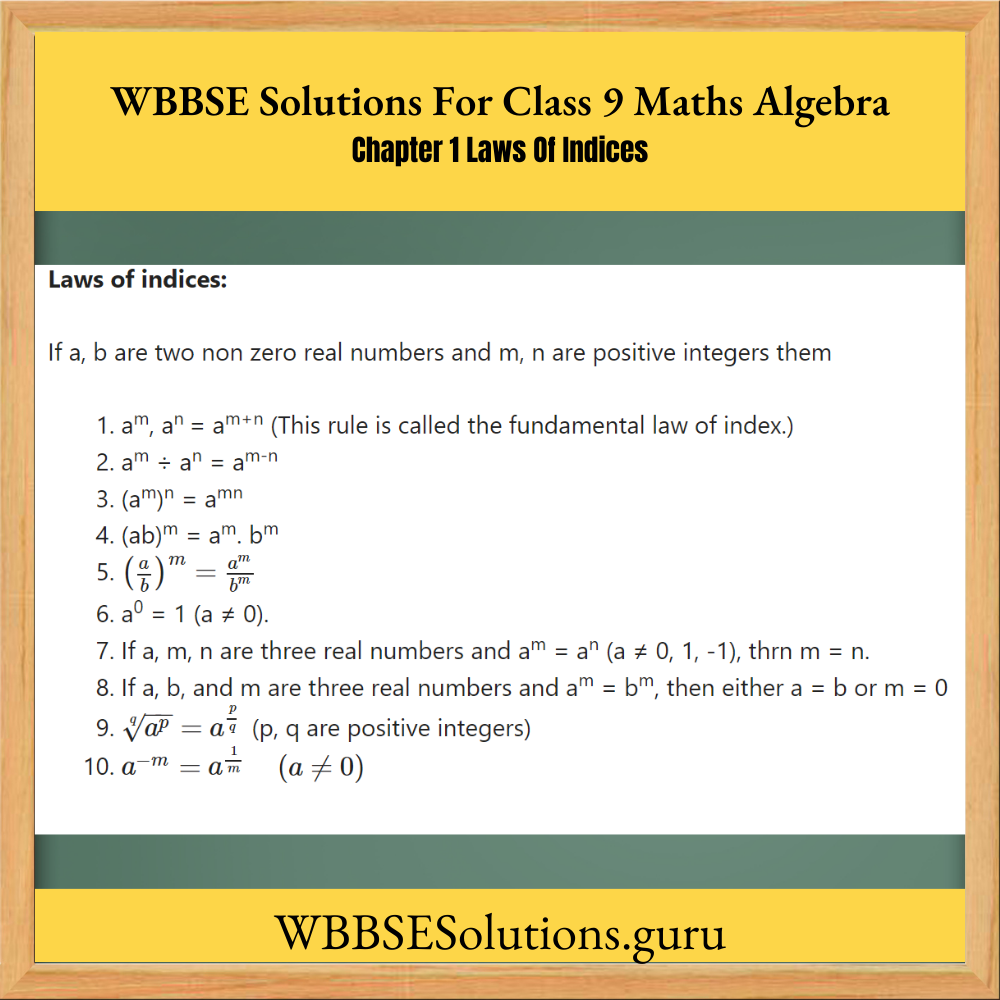
Laws of indices:

If a, b are two non zero real numbers and m, n are positive integers them

  1. am, an = am+n (This rule is called the fundamental law of index.)
  2. am ÷ an = am-n
  3. (am)n = amn
  4. (ab)m = am. bm
  5. \(\left(\frac{a}{b}\right)^m=\frac{a^m}{b^m}\)
  6. a0 = 1 (a ≠ 0).
  7. If a, m, n are three real numbers and am = an (a ≠ 0, 1, -1), thrn m = n.
  8. If a, b, and m are three real numbers and am = bm, then either a = b or m = 0
  9. \(\sqrt[q]{a^p}=a^{\frac{p}{q}}\) (p, q are positive integers)
  10. \(a^{-m}=a^{\frac{1}{m}} \quad(a \neq 0)\)


Read and Learn More  WBBSE Solutions For Class 9 Maths

Algebra Chapter 1 Laws Of Indices True Or False

Example 1. In xm, x is called index and m is called the basc.

Solution: The statement is False.

Example 2. \(\left(\frac{a}{b}\right)^2=\left(\frac{b}{a}\right)^{-2}\)

Solution: The statement is True.

Example 3. x0 = 1 for any real number x.

Solution: The statement is False.

Example 4. If ax = ay then x = y for any real number a.

Solution: The statement is False.

Example 5. \(a^{\frac{m}{n}}=\sqrt[n]{a^m}\)

Solution: The statement is True.

Example 6. If ax = k then a = k-x

Solution: The statement is False.

Example 7. If 3x = 2x then x = 0

Solution: The statement is True.

Example 8. \(a^{-\frac{p}{q}}=\sqrt[q]{a^p}\) (p, q are positive integers a ≠ 0)

Solution: The statement is True.

Example 9. \((-27)^{\frac{1}{3}}=-3\)

Solution: The statement is True.

Example 10. If m, n, and p are positive integers, then am. an. ap = am+n+p.

Solution: The statement is True.

WBBSE Solutions For Class 9 Fundamentals Of HistoryWBBSE Class 9 English Functional Grammar
WBBSE Class 9 Fundamentals Of History Long Answer QuestionsWBBSE Class 9 English Reading Skill
WBBSE Class 9 Fundamentals Of History Short Answer QuestionsWBBSE Class 9 English Writing Skill
WBBSE Class 9 Fundamentals Of History Very Short Answer QuestionsWBBSE Class 9 Maths Multiple Choice Questions
WBBSE Class 9 Fundamentals Of History Multiple Choice QuestionsWBBSE Solutions For Class 9 Maths
WBBSE Notes For Class 9 Geography and Environment


Algebra Chapter 1 Laws Of Indices Fill In The Blanks

Example 1. Value of \((81)^{\frac{3}{4}}\) is ________

Solution: 27.

Example 2. Value of p0 (p ≠ 0) is ________

Solution: 1

Example 3. \(\sqrt[3]{\left(\frac{1}{64}\right)^2}\) = ___________

Solution: \(\frac{1}{2}\)

Example 4. If (27)x = (81)x then x: y

Solution: 4:3.

Example 5. If x = 5 and y = 3 then \((x+y)^{\frac{x}{y}}\) is ___________

Solution: 32.

Example 6. If a ≠ b ≠ 0, and ax = bx then x ________

Solution: 0.

Example 7. If 4x = 83 then x = ________

Solution: \(\frac{9}{2}\)

Example 8. \(2^{\frac{1}{2}}\times 2^{-\frac{1}{2}} \times(64)^{\frac{1}{6}}\) = ________

Solution: 1

Example 9. √√2 = ________

Solution: \(2^{\frac{1}{4}}\)

Example 10. \(x^{a-b} \times x^{b-c} \times x^{c-a}\) = _______

Solution: 1.

Algebra Chapter 1 Laws Of Indices Short Answer Type Questions

Example 1. If (55+0.01)2– (520-0.01)2 = 5x then find the value of x.

Solution: 4.55.0.01 = 5x [(a + b)2 – (a – b)2 = 4.ab]

⇒ or, \(\frac{4 \times 5}{100}=5^x\)

⇒ or, 55-2 = 5x

⇒ or, x=3

The value of x is 3

Example 2. If 3 x 27x = 9x+4 then find the value of x.

Solution: 3 x (33)x = (32)x+4

or, 31+3x = 32x+8

∴ 1+3x= 2x + 8

or, x = 7.

The value of x is 7.

Example 3. Which is greater \(3^{3^3} \text { or, }\left(3^3\right)^3 \text { ? }\)

Solution: \(3^{3^3}=3^{27}, \quad\left(3^3\right)^3=3^9, 27>9\)

∴ \(3^{3^3}>\left(3^3\right)^3\)

Example 4. \((\sqrt[5]{8})^{\frac{5}{2}} \times(16)^{-\frac{3}{8}}\) = ?

Solution: = \(\left(8^{\frac{1}{5}}\right)^{\frac{5}{2}} \times\left(2^4\right)^{-\frac{3}{8}}\)

= \(8^{\frac{1}{5} \times \frac{8}{2}} \times 2^{4 \times\left(-\frac{3}{8}\right)}\)

= \(\left(2^3\right)^{\frac{1}{2}} \times 2^{-\frac{3}{2}}=2^{\frac{2}{2}+\left(-\frac{3}{2}\right)}=2^0=1\)

\((\sqrt[5]{8})^{\frac{5}{2}} \times(16)^{-\frac{3}{8}}\) = \(\left(2^3\right)^{\frac{1}{2}} \times 2^{-\frac{3}{2}}=2^{\frac{2}{2}+\left(-\frac{3}{2}\right)}=2^0=1\)

Example 5. Simplify \(\sqrt[5]{x^8 \cdot \sqrt{x^6 \cdot \sqrt{x^4}}}\)

Solution: \(\sqrt[5]{x^8 \sqrt{x^6 x^{-\frac{4^2}{2}}}}\)

= \(\sqrt[5]{x^8 \sqrt{x^{6-2}}}=\sqrt[5]{x^8 \sqrt{x^4}}\)

= \(\sqrt[5]{x^8 x^{\frac{24}{2}}}\)

= \(\sqrt[5]{x^{8+2}}=x^{\frac{10}{5}}=x^2\)

\(\sqrt[5]{x^8 \cdot \sqrt{x^6 \cdot \sqrt{x^4}}}\) = \(\sqrt[5]{x^{8+2}}=x^{\frac{10}{5}}=x^2\)

Example 6. Simplify \(\left\{(81)^{-\frac{3}{4}} \times \frac{16^{\frac{1}{4}}}{6^{-2}} \times\left(\frac{1}{27}\right)^{\frac{4}{3}}\right\}^{\frac{1}{3}}\)

Solution: =\(\left\{3 \times\left(-\frac{3}{4}\right) \times \frac{2^{4 \times \frac{1}{4}}}{3^{-2} \times 2^{-2}} \times\left(3^{-3}\right)^{-\frac{4}{3}}\right\}^{\frac{1}{3}}\)

=\(\left\{3^{-3} \times \frac{2^1}{2^{-2} \times 3^{-2}} \times 3^{-3 \times\left(-\frac{4}{3}\right)}\right\}^{\frac{1}{3}}\)

= \(\left\{3^{-3+4+2} \times 2^{1+2}\right\}^{\frac{1}{3}}\)

= \(\left(3^3 \times 2^3\right)^{\frac{1}{3}}=6^{3 \times \frac{1}{3}}=6\)

Example 7. If \(x^{p^q}=\left(x^p\right)^q\), find p in terms of q, (x ≠ 0, 1, −1)

Solution: \(x^{p^q}=x^{p q}\)

⇒ or, \(xp^q=p q \quad(x \neq 0,1,-1)\)

⇒ or, \(\frac{p^q}{p^1}=q\)

⇒ or, \(p^{q-1}=q\)

∴ \(p=q-1 \sqrt{q}\)

Example 8. Arrange in the ascending order of magnitude, 263, 345, 527, 618

Solution: 263 = (27)9 = (128)9

⇒ 345 = (35)9 = (243)9

⇒ 527 = (53)9 = 1259

⇒ 618 = (62)9 = (36)9

[Note: You have to find out the H.C.F. of 63, 45, 27, 18 which is 9]

⇒ Since 36125 < 128 < 243

⇒ Hence 618 < 527 < 263 < 345

Example 9. If \(x^{x \cdot \sqrt{x}}=(x \sqrt{x})^x\), find the value of x.

Solution: \((x \sqrt{x})^x=(x \sqrt{x})^x\)

⇒ or, \(x^{\sqrt{x}}=x \sqrt{x}\)

⇒ Now, \(x \sqrt{x}=x^{1+\frac{1}{2}}=x^{\frac{3}{2}}\)

∴ \(\sqrt{x}=\frac{3}{2}, \quad x=\frac{9}{4}\)

The value of x  \(\sqrt{x}=\frac{3}{2}, \quad x=\frac{9}{4}\)

WBBSE Solutions For Class 9 Maths Arithmetic Chapter 1 Real Numbers

Arithmetic Chapter 1 Real Numbers

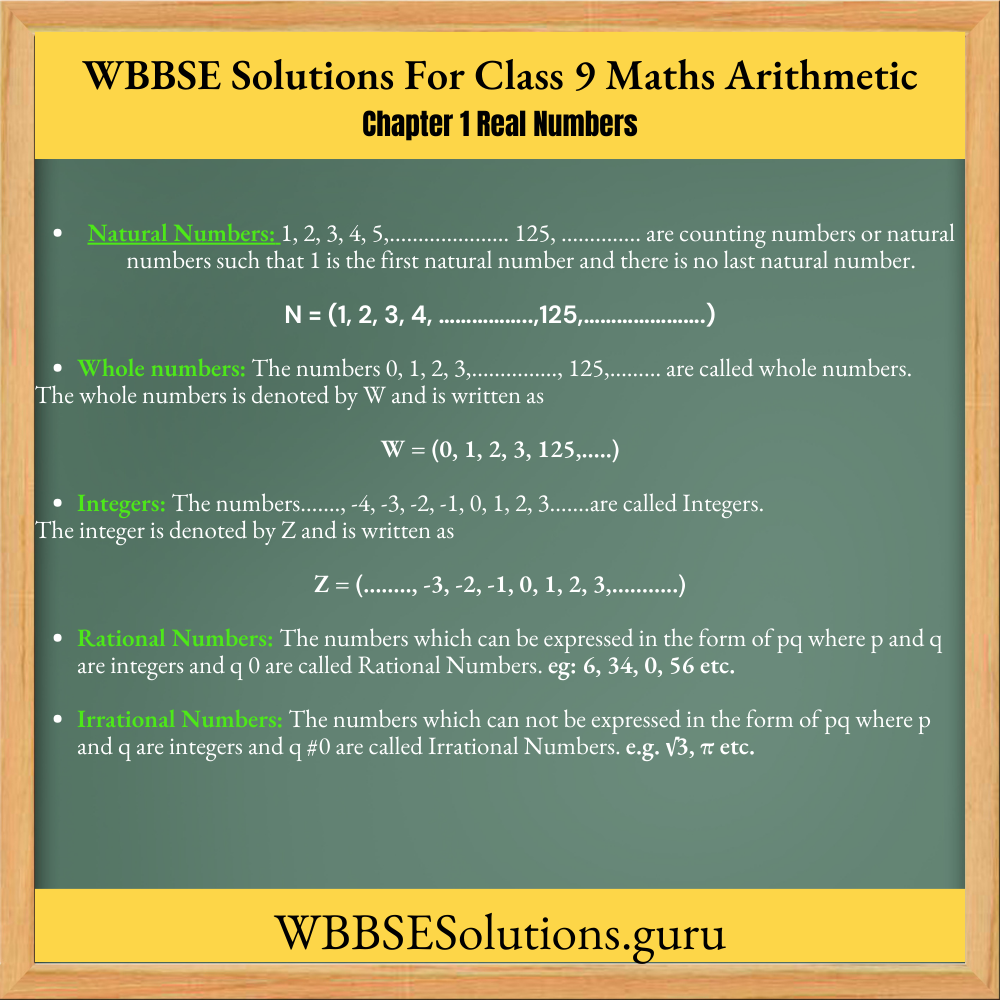
⇔ Natural Numbers: 1, 2, 3, 4, 5,………………… 125, ………….. are counting numbers or natural numbers such that 1 is the first natural number and there is no last natural number.

⇒The natural number is denoted by N and is written as

⇒ N = (1, 2, 3, 4, ……………..,125,………………….).

WBBSE Solutions For Class 9 Maths Arithmetic Chapter 1 Real Numbers


⇔ Whole numbers: The numbers 0, 1, 2, 3,……………, 125,……… are called whole numbers.

⇒ The whole numbers is denoted by W and is written as

⇒ W = (0, 1, 2, 3, 125,…..)

⇔ Integers: The numbers……., -4, -3, -2, -1, 0, 1, 2, 3…….are called Integers.

⇒ The integers is denoted by Z and is written as Z = (…….., -3, -2, -1, 0, 1, 2, 3,………..)

WBBSE Solutions For Class 9 Maths

⇒ The integers greater than 0, i.e. 1, 2, 3,……. are called Positive Integers and the integers less than 0, i.e.-1,2,3,….. are called Negative Integers.

⇒ 0 (Zero) is an integer that is neither positive nor negative.

⇔ Rational Numbers: The numbers which can be expressed in the form of \(\frac{p}{q}\) where p and q are integers and q 0 are called Rational Numbers. eg: 6, \(\frac{3}{4}\), 0, \(\frac{5}{6}\) etc.

⇒ [All integers are Rational Numbers.]

⇔ Irrational Numbers: The numbers which can not be expressed in the form of \(\frac{p}{q}\) where p and q are integers and q #0 are called Irrational Numbers. e.g. √3, π etc.

Some important points:

  1. If two rational numbers x and y such that x < y there is a rational number \(\frac{x+y}{2} \text { i.e. } x<\frac{x+y}{2}<y\)
  2. If x and y are two rational numbers and x < y then, n rational numbers between x and y are (x + d), (x + 2d), (x + 3d),….. (x + nd), where d = \(d=\frac{y-x}{n+1}\)
  3. If the rational numbers of the form \(\frac{p}{q}\) be expressed into decimals, it will be terminating decimal numbers, where q has prime factors 2 and 5 only.
  4. If the rational numbers of the form \(\frac{p}{q}\) be expressed into recurring decimals where q has prime factors other than 2 and 5.
  5. If rational numbers are expanded into decimals it will be terminating are recurring and the fraction whose decimal form is terminating or recurring will be rational.


WBBSE Solutions For Class 9 Fundamentals Of HistoryWBBSE Class 9 English Functional Grammar
WBBSE Class 9 Fundamentals Of History Long Answer QuestionsWBBSE Class 9 English Reading Skill
WBBSE Class 9 Fundamentals Of History Short Answer QuestionsWBBSE Class 9 English Writing Skill
WBBSE Class 9 Fundamentals Of History Very Short Answer QuestionsWBBSE Class 9 Maths Multiple Choice Questions
WBBSE Class 9 Fundamentals Of History Multiple Choice QuestionsWBBSE Solutions For Class 9 Maths
WBBSE Notes For Class 9 Geography and Environment


Arithmetic Chapter 1 Real Numbers True Or False

Example 1. The sum of two rational numbers is always rational.

Solution: The statement is true.

⇒ [e.g. [\(\frac{5}{7}\) + \(\frac{2}{3}\) = \(\frac{29}{21}\)]

Example 2. The sum of two irrational numbers is always irrational.

Solution: The statement is false.

⇒ [6.8. (2+√3)+(4-√3)=6]

Example 3. The product of two rational numbers is rational.

Solution: \(\frac{3}{4}\) x \(\frac{5}{6}\) = \(\frac{5}{6}\) [rational number]

∴ The statement is true.

Example 4. The product of two irrational numbers is always rational.

Solution: √3 × √5 = √15 [irrational number]

⇒ (3+√5)(3-√5)=(3)2-(√5)2

= 9 – 54 [rational number]

∴ The statement is false.

Example 5. Each rational number is real number.

Solution: \(\frac{3}{5}\), 0, √9, –\(\frac{4}{7}\) all are real number.

∴ So the statement is true.

Example 6. Each real number is irrational.

Solution: Clearly the statement is False.


Arithmetic Chapter 1 Real Numbers Fill In The Blanks

Example 1. The division of two integers is not always ______

Solution: Integer.

Example 2. The value of (2 + √3)(2 – √3) is ______

Solution: 1

(2 + √3)(2 -√3) = 22 – (√3)2 = 4 – 3 = 1

Example 3. The difference between 1 and 0.9 is ________

Solution: 0

1 – 0.9 = 1 – \(\frac{9}{9}\) = 1 – 1 = 0

Example 4. We will get _______ decimal if \(\frac{7}{20}\) are expanded into decimal.

Solution: Terminating.

20 = 22 x 5

20 has no prime factors except 2 and 5.

∴ The decimal form of \(\frac{7}{20}\) will be terminating.

Arithmetic Chapter 1 Real Numbers Short Answer Type Questions

Example 1. Give an example where sum of two irrational numbers is a rational number.

Solution:

  1. √5, -√5 √5 + (-√5) = 0 [rational number]
  2. 7 + √5; 7 – √5 (7 + √5) + (7 – √5) = 14 [rational number]

Example 2. Give an example where subtraction of two irrational number is a rational number.

Solution:

  1. √7, √7 ⇒ √7-√7=0 [rational number]
  2. (5+√3), (2+√3) ⇒ (5+√3)-(2+√3) = 5 + √3 – 2 – √3 = 3 [rational number]

Example 3. Write a rational number between \(\frac{1}{7}\) and \(\frac{2}{7}\)

Solution: A rational number between \(\frac{1}{7}\) and \(\frac{2}{7}\) is \(\frac{\frac{1}{7}+\frac{2}{7}}{2}\) = \(\frac{3}{7 \times 2}=\frac{3}{14}\)

Example 4. Determine a irrational number between \(\frac{1}{7}\) and \(\frac{2}{7}\).

Solution: \(\frac{1}{7}\) = 0.1428571428571……..= 0.142857

⇒ \(\frac{2}{7}\) = 0.285714285714……= 0.285714

⇒ The irrational number lying between \(\frac{1}{7}\) and \(\frac{2}{7}\) will be non-terminating and non-recurring.

∴ One required irrational number is 0.15015001500015………..

Example 5. Express 0.0123 in the form of \(\frac{p}{q}\) where p and q are integers and q ≠ 0.

Solution: 0.0123 = \(\frac{0123-12}{9000}=\frac{111}{9000}=\frac{37}{3000}\)

Example 6. Write four rational numbers between 2 and 3.

Solution: If x and y are two rational numbers and x < y then, n rational numbers between x and y are (x + d), (x + 2d), (x + 3d)………..(x+nd.), where \(d=\frac{y-x}{x+1}\)

⇒ Here, x = 2, y = 3 and n = 4

⇒ d = \(\frac{3-2}{4+1}=\frac{1}{5}\)

∴ The four rational numbers are

⇒ \(\left(2+\frac{1}{5}\right)\left(2+\frac{2}{5}\right)\left(2+\frac{3}{5}\right),\left(2+\frac{4}{5}\right)\)

i.e. \(\frac{11}{5}, \frac{12}{5}, \frac{13}{5} \text { and } \frac{14}{5}\)

Example 7. Write four irrational numbers between \(\frac{2}{3}\) and \(\frac{5}{3}\)

Solution: \(\frac{2}{3}\) = 0·666…………..0.6

⇒ \(\frac{5}{3}\) = 1.666…………. = 1.6

⇒ The irrational number between \(\frac{2}{3}\) and \(\frac{5}{3}\) will be non-terminating and non-recurring.

∴ Four irrational numbers between \(\frac{2}{3}\) and \(\frac{5}{3}\) are 0.707007000700007……….

⇒ 0.72572557255572………, 0.81481448144481…………., 0.93293229322293……….

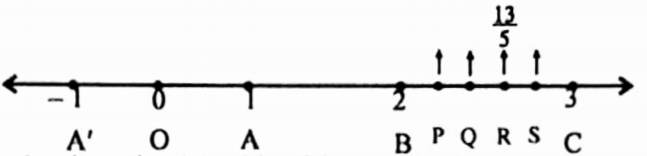
Example 8. Place the rational numbers on a Number line.

  1. –\(\frac{3}{4}\)
  2. \(\frac{13}{5}\)

Solution:

1.

WBBSE Solutions For Class 9 Maths Arithmetic Chapter 1 Real Numbers Placing The Rational Number On Number Line-1


⇒ At first, 9 take OA’ = 1 unit on the left side of the point ‘0’, OA’ is divided into 4 equal parts.

⇒ OR = –\(\frac{3}{4}\) unit.

2.

WBBSE Solutions For Class 9 Maths Arithmetic Chapter 1 Real Numbers Placing The Rational Number On Number Line-2


At first, 9 take OA 1 unit on the right side of the point ‘O’,

∴ OB = 2 units and OC = 3 units.

⇒ BC is divided into 5 equal parts BR = \(\frac{3}{5}\) unit.

∴ OR = OB + BR = = (2 + \(\frac{3}{5}\)) units = \(\frac{13}{5}\) units.

Example 9. Write two rational numbers between 0.2101 and 0.2

Solution: 0.2 = 0.2222………..

⇒ The two rational numbers between 0.2101 and 0.2 are 0.211 and 0.212

Example 10. Express each of the following numbers in the form of \(\frac{p}{q}\) where p and q are integers and q 0.

  1. 0.2345
  2. 12.0366

Solution:

  1. 0.2345 = \(\frac{2345-234}{9000}=\frac{2111}{9000}\)
  2. 12.0306 = \(\frac{120306-1203}{9900}=\frac{119103}{9900}=\frac{39701}{3300}\)

WBBSE Solutions For Class 9 Maths Coordinate Geometry Chapter 2 Internal And External Division Of Straight Line Segment

Coordinate Geometry Chapter 2 Internal And External Division Of Straight Line Segment

Concept of determination of a formula of coordinates of a point when a straight line segment is divided internally or externally in a given ratio.

1. Co-ordinates of the point P, which divides the line segment joining the points A (x1, y1) and B (x2, y2) internally in the ratio m:n are \(\left(\frac{m x_2+n x_1}{m+n}, \frac{m y_2+n y_1}{m+n}\right)\)

2. Co-ordinates of the point P, which divides the line segment joining the points A (x1, y1) and B (x2, y2) externally in the ratio m: n are \(\left(\frac{m x_2-n x_1}{m-n}, \frac{m y_2-n y_1}{m-n}\right)\)

Co-ordinate the midpoint P of the line segment joining two points A (x1, y1), B (x2, y2) are \(\left(\frac{x_1+x_2}{2}, \frac{y_1+y_2}{2}\right)\)

Co-ordinates of the centroid of the triangle ABC where co-ordinates of A, B, C are (x1, y1),(x2, y2) and (x3, y3) respectively \(\left(\frac{x_1+x_2+x_3}{3}, \frac{y_1+y_2+y_3}{3}\right)\)

Read and Learn More  WBBSE Solutions For Class 9 Maths

Coordinate Geometry Chapter 2 Internal And External Division Of Straight Line Segment Fill In The Blanks

Example 1. The coordinates of the point which divides the line segment joining (6, – 4) and (-8, 10) in the ratio 3: 4 internally is _______

Solution: \(\left(0, \frac{-26}{7}\right)\)

Example 2. The coordinates of the midpoint of the line segment joining two points (5, 4), (3, -4) is _______

Solution: (4, 0).

Example 3. The ratio in which the point (1, 3) divides the line segment joining the points (4, 6), (3, 5) is ________ externally.

Solution: 32.

Example 4. The ratio at which the line segment joining the points (7, 3), (-9, 6) divides by Y axis is _______

Solution: 79.

Example 5. A (2, 3), B (9, 6), C (10, 12), and D (10, 12) are joined in order. ABCD is a _______

Solution: parallelogram.

Example 6. The points (3, 2), (6, 3), (x, y) and (6, 5) are joined in order to make a parallelogram (x, y) = _______

Solution: (9, 6).

Coordinate Geometry Chapter 2 Internal And External Division Of Straight Line Segment True Or False

Example 1. The Centroid of the triangle formed by the points (a – b, b – c), (-a, -b), (b, c) are (0, 0).

Solution: The statement is true.

Example 2. The coordinates of the point on the x axis at which the line segment joining the points (3, 4), (-3, -4) is bisected are (3, 0).

Solution: The statement is false.

Example 3. P is such a point on the line segment AB such that AP = PB. If A (-2, 4) and P (1, 5), then (4, 6).

Solution: The statement is true.

Example 4. The distance between two points on the x axis is 10 units. It origin the midpoint of these two points then the coordinates of the two point are (5, 0) and (-5, 0).

Solution: The statement is true.

Example 5. The coordinates of the point which divides the line segment joining the points (-1, 2), (2, -1) externally is 2 5 are (3, 4).

Solution: The statement is false.

Coordinate Geometry Chapter 2 Internal And External Division Of Straight Line Segment Short Answer Type Questions

Example 1. C is the centre of a circle and AB is the diameter, the coordinates of A and C are (6, -7) and (5, -2). Calculate the coordinates of B.

WBBSE Solutions For Class 9 Fundamentals Of HistoryWBBSE Class 9 English Functional Grammar
WBBSE Class 9 Fundamentals Of History Long Answer QuestionsWBBSE Class 9 English Reading Skill
WBBSE Class 9 Fundamentals Of History Short Answer QuestionsWBBSE Class 9 English Writing Skill
WBBSE Class 9 Fundamentals Of History Very Short Answer QuestionsWBBSE Class 9 Maths Multiple Choice Questions
WBBSE Class 9 Fundamentals Of History Multiple Choice QuestionsWBBSE Solutions For Class 9 Maths
WBBSE Notes For Class 9 Geography and Environment

Solution: Let coordinates of B is (x, y)

∴ \(\frac{6+x}{2}=5 \Rightarrow x=4\)

\(\frac{-7+y}{2}=-2 \Rightarrow y=3,\)


∴ Co-ordinates are (4, 3).

∴  The coordinates of B is (4, 3).


WBBSE Solutions For Class 9 Maths Coordinate Geometry Chapter 2 Internal And External Division Of Straight Line Segment AB Is Diamtere C Is Centre


Example 2. The points P and Q lie on 1st and 3rd quadrants respectively. The distance of the two points for x axis and y axis are 6 units, 4 units respectively. Find the midpoint of PQ.

Solution: Midpoint = \(\left(\frac{4-4}{2}, \frac{6-6}{2}\right)=(0,0)\)


WBBSE Solutions For Class 9 Maths Coordinate Geometry Chapter 2 Internal And External Division Of Straight Line Segment P And Q Lie On 1st And 3rd Quadrant

The midpoint of PQ = \(\left(\frac{4-4}{2}, \frac{6-6}{2}\right)=(0,0)\)


Example 3. The point P lies on AB, AP = PB, the coordinates of A and B are (3, -4) and (-5, 2) respectively. Find their coordinates of P.

Solution: Coordinates of P = \(=\left(\frac{3-5}{2}, \frac{-h+2}{2}\right)=(-1,-1) .\)

Example 4. Points A and B lie on the 2nd and 4th quadrants. The distance of each point from x-axis and y-axis are 8 units and 6 units respectively. Write the coordinates of the midpoint of AB.

Solution: Midpoint of AB = \(\left(\frac{6+6}{2}, \frac{8-8}{2}\right)\) = (0, 0)


WBBSE Solutions For Class 9 Maths Coordinate Geometry Chapter 2 Internal And External Division Of Straight Line Segment AB Lie On 2nd And 4th Quadrant


Example 5. The sides of a rectangle ABCD are parallel to the coordinates axes. Coordinates of B and D are (7, 3) and (2, 6). Write the coordinates of A, C and the midpoint of AC.

Solution: Absciss of C = Absciss of B = 7

∴ Co-ordinate of C is (7, 6)

⇒ Absciss of A = Absciss of A = 2

⇒ Ordinate of A = Ordinate of B = 3

⇒ Co-ordinates of A (2, 3)

⇒ Co-ordinates of midpoint of AC = \(\left(\frac{7+2}{2}, \frac{6+3}{2}\right)=\left(\frac{9}{2}, \frac{9}{2}\right)\)


WBBSE Solutions For Class 9 Maths Coordinate Geometry Chapter 2 Internal And External Division Of Straight Line Segment Sides Of A Rectangle ABCD Are Parallel


Example 6. The coordinates of the vertices of a triangle are (4, -3), (-5, 2), (x, y). If the centroid of the triangle is at the origin, then find X, Y.

Solution: \(\frac{4-5+x}{3}=0 \Rightarrow x=1 \text { and } \frac{-3+2+y}{3}=0 \Rightarrow y=1\)

Example 7. Find the ratio in which the line segment joining the points (2, 3) and (5,- h) divided by x axis internally.

Solution: Let the coordinates at x-axis at which the line segment intersects i.e. (k, 0) and the ratio be m: n.

∴ \(\frac{-4 m+3 n}{m+n}\) =0 m: n = 3: 4

Example 8. Find the ratio in which the point (9, -23) divides the line segment joining (6, 4) and (7,-5)

Solution: Let the required ratio be m: n; 9 = \(\frac{7 n+6 n}{m+n}\) 9m + 9n = 7m + 6n

⇒ 2m = -3n, \(\frac{m}{n}=-\frac{3}{2}\)

∴ (9, -23) divides the line segment in 3: 2 externally.

WBBSE Solutions For Class 9 Maths Statistics Chapter 1 Statistics

Statistics Chapter 1 Statistics

Statistics may be defined as the science of collection, presentation, analysis, and interpretation of numerical data.

⇔ Data: Data are the collection of expressions or numbers by an individual or an institution for some purpose and are used by someone else in another context.

⇔ Variable: The changing numerical character is called a variable.

⇔  Example: Temperature in a day, and the daily expenditure of a family are variable.

Two types of variables:

  1. Discrete variable,
  2. Continuous variable

Example:

  1. The number of members of a family, the temperature of the day, etc. are discrete variables.
  2. The height and weight of students, etc. are continuous variables.

⇔  Attribute: In statistics the varying or changing quality is called an attribute.

Read and Learn More  WBBSE Solutions For Class 9 Maths

⇔  Range: The difference between the highest and lowest values of a given data is called range.

Example: From data 10, 12, 20, 35, 49, 15, 22, 48 the range is 49 – 10 = 39

⇔  Frequency: The number of times an observation occurs in the given data is called the frequency of the observation.

⇔  Class or class interval: The variables having extended range can be divided into a few classes. Each of these types of classes is called a class or class interval.

⇔  Class frequency: The number of values of a class included in a class is called class frequency.

⇔  Class-limit: The two end-values of the class interval is called class-limit.

The lesser value of the class limit in a particular class interval is called lower class limit and the larger value is called the upper-class limit of that class interval.

Example: In class 15-20 the lower limit is 15 and the upper limit is 20.

⇔  Class-boundary: The gaps of the class limits of any consecutive classes of statistical data are extended to the two limits, these two limits are called class-boundaries of those classes.

The lesser value is called the Lower class boundary and the greater value is called the Upper-class boundary.

Example: For classes 10-20, 20-30, 30-40,…, in class (20-30) the lower class boundary is 20, and the upper class boundary is 30.

In this class limit and class boundary are same.

Let the difference between the upper-class limit of a class and the lower-class limit of it is next class = d

Then in class (l1 -l2) the lower class boundary is \(\left(l_1-\frac{d}{2}\right)\) and the upper class boundary is \(\left(l_2+\frac{d}{2}\right)\).

Example: The class boundaries of classes 1-10, 11-20, 21-30, ……are 0.5 – 10.5, 10.5 – 20.5, 20.5 – 30.5

⇔  Class size or class length: The difference of the two class boundaries of a class is the class- size or class length.

∴ Class-size = Upper-class boundary – Lower class boundary.

In classes 0-10, 10-20, 20-30,…….., the class size of the class (20-30) is 10.

In classes 1-10, 11-20, and 21-30, the class size of class 21-30 is (30.5- 20.5) or 10

WBBSE Solutions For Class 9 Fundamentals Of HistoryWBBSE Class 9 English Functional Grammar
WBBSE Class 9 Fundamentals Of History Long Answer QuestionsWBBSE Class 9 English Reading Skill
WBBSE Class 9 Fundamentals Of History Short Answer QuestionsWBBSE Class 9 English Writing Skill
WBBSE Class 9 Fundamentals Of History Very Short Answer QuestionsWBBSE Class 9 Maths Multiple Choice Questions
WBBSE Class 9 Fundamentals Of History Multiple Choice QuestionsWBBSE Solutions For Class 9 Maths
WBBSE Notes For Class 9 Geography and Environment


⇔  Midpoint or mid-value or class mark: The value of the variable that lies exactly at the middle of two class boundaries is called the Mid-value or class mark of that class.

The mid value of a class-interval

= \(\frac{\text { Upper class limit }+ \text { lower class limit }}{2}\)

= \(\frac{\text { Upper class-boundary }+ \text { lower class }- \text { boundary }}{2}\)

Example: The mid value of class (20-30) is \(\frac{20+30}{2} \text { or } \frac{50}{2} \text { or } 25\)

⇔  Relative frequency: The ratio of class frequency of a class and total frequency of any classified statistical data is called the relative frequency of that class.

Relative frequency =\(\frac{\text { Class }- \text { frequency }}{\text { Total frequency }}\)

⇔ Frequency density: The ratio of class frequency and the class size of the class in any classified data is called frequency density.

Frequency density of a class = \(\frac{\text { class frequency of that class }}{\text { class }- \text { size }}\)

⇔ Percentage frequency: When relative frequency is expressed in percentages, it is called percentage frequency.

Percentage frequency of a class = \(\frac{\text { class frequency of that class }}{\text { Total frequency }} \times 100\)

⇔  Cumulative frequency distribution: The frequency of the first class is added to that of the second and this sum is added to that of the third and so on, then the frequencies so obtained are known as Cumulative frequency.

When the cumulative frequency of each class in a frequency distribution table is shown, it is called a cumulative distribution table.

⇔  Two types of cumulative frequency distribution table are constructed:

  1. Less than type cumulative frequency: The new frequencies were obtained by adding class frequencies successively in the above frequency distribution table.
  2. This type of frequency distribution table is called less than type cumulative frequency distribution table.
  3. More than type cumulative frequency distribution table: The new frequencies are obtained by adding class frequencies successively from the below frequency distribution table.

This type of frequency distribution table is called more than the type of cumulative frequency distribution table.


WBBSE Solutions For Class 9 Maths Statistics Chapter 1 Statistics Cumulative Frequency Distribution


Histogram: The graphical representation of a classified frequency distribution of continuous variables is called Histogram.

Frequency polygon: A frequency polygon is the graphical representation of a frequency distribution that is expressed through the classes of equal size of a continuous variable.

Statistics Chapter 1 Statistics True Or False

Example 1. Relative frequency is determined by class frequency and class length.

Solution: Relative frequency of a class = \(=\frac{\text { frequency of that class }}{\text { total frequency }}\)

So if total frequency are not given then it is impossible so determine the relative frequency.

∴ The statement is False.

Example 2. In classes 6-10, 16-20, 26-30,……, the lower class boundary of the second class is 13

Solution: The difference between the first two class is (16 – 10) or 6

Lower class boundary of the second class is 916 – \(\frac{6}{2}\) or 13

∴ The statement is True.


Statistics Chapter 1 Statistics Fill In The Blanks

Example 1. For the construction of the histogram, the values of the ________ variable are taken along X-axis

Solution: Continuous.

[If discontinuous variables are given then firstly it is converted into a continuous class boundary]

Example 2. For the construction of a frequency polygon, the values included in a class are concentrated at the _______ of the corresponding class.

Solution: midpoint.


Statistics Chapter 1 Statistics Short Answer Type Questions

Example 1. In a continuous frequency distribution table if the mid-point of a class is m and the upper class boundary is m, then find out the lower class boundary.

Solution: Let the lower class boundary of the class is n.

The upper-class boundary is u

∴ The midpoint of that class is \(\frac{x+u}{2}\)

According to question \(\frac{x+u}{2}\) = m

⇒ n + u = 2m

⇒ x = 2m – u

∴ The lower class boundary is (2m – u)

Example 2. In a continuous frequency distribution table, if the mid-point of a class is 42 and class size is 10, then write the upper and lower limit of the class.

Solution: Let the upper limit is a and lower limit is b

∴ The mid-point is \(\frac{a+b}{2}\) and class size is (a – b)

According to question, \(\frac{a+b}{2}\) = 42

⇒ a + b = 84 ……(1)

and a – b = 10…..(2)

(1) + (2) we get, a + b + a – b = 84 + 10

⇒ 2a = 94

a = \(\frac{94}{2}\)= 47

∴ b = 84 – 47 = 37

∴ The upper and lower limit of the class are 47 and 37 respectively.

Example 3.

WBBSE Solutions For Class 9 Maths Statistics Chapter 1 Statistics Class Limit Frequency Distribution

Find the frequency density of the first class of the above frequency distribution table.

Solution: The difference between the two consecutive class is 1

∴ The lower-class boundary and upper-class boundary of the first class are (70 – \(\frac{1}{2}\)) = 69.5 and (74 – \(\frac{1}{2}\)) = 74.5 respectively.

Class size 74.5 – 69.5 = 5

The frequency density = \(\frac{\text { frequency of the } 1 \text { st class }}{\text { class size }}=\frac{3}{5}=0.6\)

Example 4.

WBBSE Solutions For Class 9 Maths Statistics Chapter 1 Statistics Class Limit Frequency Distribution

Find the relative frequency of the last class of the above frequency distribution table.

Solution: Relative frequency of last class = \(\frac{\text { frequency of that class }}{\text { Total frequency }}=\frac{8}{20}=0.4\)

Example 5. Write from the following examples which one indicates attribute and which one indicates variable.

  1. The population of the family
  2. Daily temperature
  3. Educational value
  4. Monthly income are not fixed.
  5. Grade obtained in Madhyamik Examination.

Solution:

  1. The population of the family are always changeable. So it is variable.
  2. Daily temperature is always changeable, it is a variable.
  3. Educational value indicate attribute.
  4. Monthly income are not fixed. It is a variable.
  5. Grade obtained in Madhyamik Examination are indicates attributes.

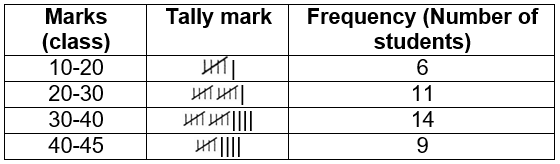
Example 6. Given below are the marks obtained by 40 students in Bengali in an Examination of School.

WBBSE Solutions For Class 9 Maths Statistics Chapter 1 Statistics Example 6

Construct a frequency distribution table for the above-given data.

Solution:

WBBSE Solutions For Class 9 Maths Statistics Chapter 1 Statistics Example 6-1

Example 7. Construct a frequency distribution table from the following cumulative frequency: distribution table, given below

WBBSE Solutions For Class 9 Maths Statistics Chapter 1 Statistics Example 7

Solution:

WBBSE Solutions For Class 9 Maths Statistics Chapter 1 Statistics Example 7-1

Example 8. In a frequency distribution table, the mid-value of five classes are 15, 20, 25, 30, and 35, and their corresponding frequency are 2, 4, 3, 6, and 8 respectively; prepare a frequency distribution table for the construction of the Histogram.

Solution: The difference of mean value between two consecutive class

= 20 – 15 = 25 – 20 = 30 – 25 = 35 – 30 = 5

The lower-class boundary and upper-class boundary of the first class are (15-\(\frac{5}{2}\)) or 12.5 and (15+\(\frac{5}{2}\)) or 17.5

So, the frequency distribution table are given below:

WBBSE Solutions For Class 9 Maths Statistics Chapter 1 Statistics Example 8

Example 9. The distribution of height (in cm) of 20 students is given below. Construct a histogram.

WBBSE Solutions For Class 9 Maths Statistics Chapter 1 Statistics Example 9

Solution:

WBBSE Solutions For Class 9 Maths Statistics Chapter 1 Statistics Graphical Representation Of A Histogram The Distribution Of Height Of Students


Example 10. Draw the frequency polygon for the frequency distribution table given below:

WBBSE Solutions For Class 9 Maths Statistics Chapter 1 Statistics Example 10

Solution: The midpoint of given classes are \(\frac{60+70}{2}, \frac{70+80}{2}, \frac{80+90}{2}, \frac{90+100}{2}\) or, 65, 75, 85, 95.


WBBSE Solutions For Class 9 Maths Statistics Chapter 1 Statistics Graphical Representation A Histogram Frequency Polygon For The Frequency Distribution