
WBBSE Class 10 Maths Geometry Chapter 3 Similarity Multiple Choice Questions
Example 1. A line parallel to the side BC of ΔABC intersects the sides AB and AC at points X and Y respectively. If AX = 2.4 cm, AY = 3.2 cm and YC = 4.8 cm, then the length of AB is
- 3.6 cm
- 6 cm
- 6.4 cm
- 7.2 cm
Solution:
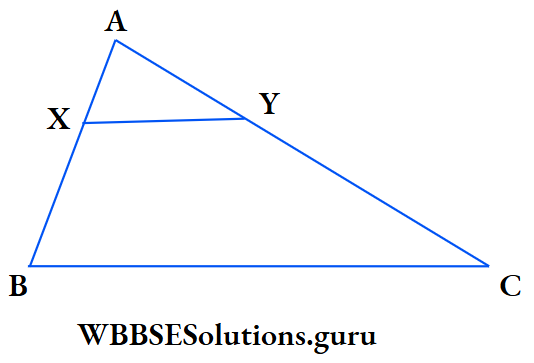
In ΔABC, XY || BC
∴ \(\frac{\mathrm{AX}}{\mathrm{XB}}=\frac{\mathrm{AY}}{\mathrm{YC}}\) [by Thales thorem]
Read And Learn Also WBBSE Class 10 Maths Multiple Choice Questions
⇒ \(\frac{2 \cdot 4 \mathrm{~cm}}{\mathrm{XB}}=\frac{3 \cdot 2 \mathrm{~cm}}{4 \cdot 8 \mathrm{~cm}}\)
⇒ \(\mathrm{XB}=\frac{2 \cdot 4 \times 4 \cdot 8}{3 \cdot 2} \mathrm{~cm}\) = 3.6 cm
AB = AX + XB = (2.4 + 3.6) cm = 6 cm
∴ The correct answer is 2. 6 cm
Example 2. The point D and E are situated on the sides AB and AC of ΔABC in such a way that DE || BC and AD: DB = 3: 1; if EA = 3.3 cm, then the length of AC is
- 11 cm
- 4 cm
- 4.4 cm
- 5.5 cm
Solution:
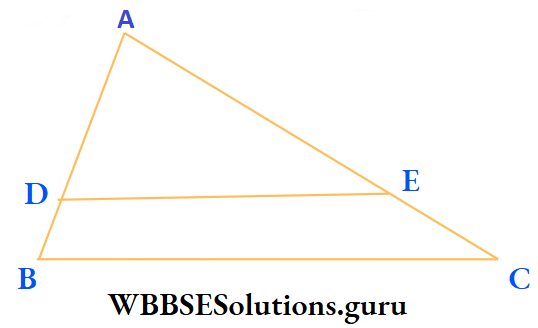
In ΔABC, DE || BC
∴ \(\frac{\mathrm{AD}}{\mathrm{DB}}=\frac{\mathrm{AE}}{\mathrm{EC}}\)
⇒ \(\frac{3}{1}=\frac{3 \cdot 3 \cdot \mathrm{cm}}{\mathrm{EC}}\)
⇒ \(\mathrm{EC}=\frac{3 \cdot 3}{3} \mathrm{~cm}=1 \cdot 1 \mathrm{~cm}\)
AC = AE + EC = (3.3 + 1.1) cm = 4.4 cm
∴ The correct answer is 3. 4.4 cm
Class 10 Maths Geometry Chapter 3 MCQs
Example 3. If DE || BC, then the value of x is
- 4
- 1
- 3
- 2
Solution:

DE || BC
∴ \(\frac{\mathrm{AD}}{\mathrm{DB}}=\frac{\mathrm{AE}}{\mathrm{EC}}\)
⇒ \(\frac{x+3}{3 x+19}=\frac{x}{3 x+4}\)
⇒ (x + 3) (3x + 4) = x (3x + 19)
⇒ 3x2 + 13x + 12 = 3x2 + 19x
⇒ x = 2
∴ The correct answer is 4. 2
Example 4. In the trapezium ΔBCD, AB || DC and the two points are situated on the sides AD and BC in such a way that PQ || DC; if PD = 18 cm, BQ = 35 cm, QC = 15 cm, then the length of AD is
- 60 cm
- 30 cm
- 12 cm
- 15 cm
Solution:
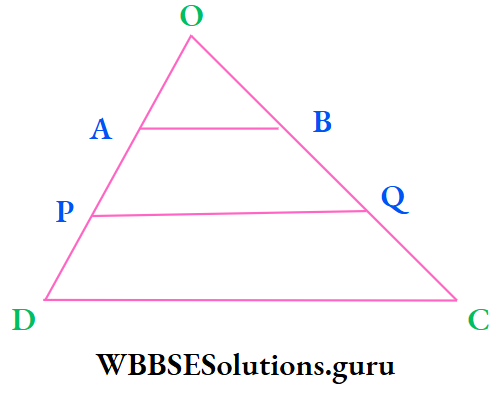
Let AB < DC; DA and CB are extended.
The extended side of DA and CB meet at O.
Let, AP = x cm. [x > 0]
As AB || DC and PQ || DC ∴ AB || PQ || DC
In ΔPOQ, AB || PQ
∴ \(\frac{\mathrm{OA}}{\mathrm{AP}}=\frac{\mathrm{OB}}{\mathrm{BQ}}\)
⇒ \(\frac{\mathrm{OA}}{\mathrm{AP}}+1=\frac{\mathrm{OB}}{\mathrm{BQ}}+1\)
⇒ \(\frac{\mathrm{OA}+\mathrm{AP}}{\mathrm{AP}}=\frac{\mathrm{OB}+\mathrm{BQ}}{\mathrm{BQ}}\)
i.e. \(\frac{\mathrm{OP}}{\mathrm{AP}}=\frac{\mathrm{OQ}}{\mathrm{BQ}}\)
⇒ \(\frac{\mathrm{OP}}{\mathrm{OQ}}=\frac{\mathrm{AP}}{\mathrm{BQ}}\)……..(1)
In ΔCOD, PQ || DC
∴ \(\frac{\mathrm{OP}}{\mathrm{PD}}\) = \(\frac{\mathrm{OQ}}{\mathrm{BQ}}\)
⇒ \(\frac{\mathrm{OP}}{\mathrm{OQ}}\) = \(\frac{\mathrm{PD}}{\mathrm{QC}}\)……(2)
From (1) and (2), \(\frac{\mathrm{AP}}{\mathrm{BQ}}\) = \(\frac{\mathrm{PD}}{\mathrm{QC}}\); \(\frac{x}{35}\) = \(\frac{18}{15}\)
⇒ x = \(\frac{18}{15}\) ⇒ x = 42
AD = AP + PD = (42 + 18) cm = 60 cm
∴ The correct answer is 1. 60cm
Class 10 Geometry Chapter 3 Mcqs With Answers
Example 5. If DP = 5 cm, DE = 15 cm, DQ = 6 cm and QF = 18 cm, then
- PQ = EF
- PQ || EF
- PQ ≠ EF
- PQ
 EF
EF
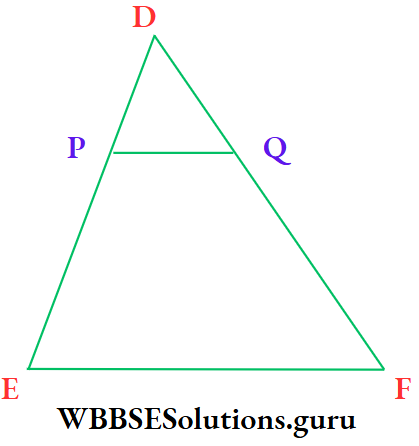
Solution: DQ = 6 cm, QF = 18 cm
⇒ \(\frac{\mathrm{DQ}}{\mathrm{QF}}\) = \(\frac{6}{18}\) = \(\frac{1}{3}\)
PE = DE – DP = (15 – 5) cm = 10 cm
⇒ \(\frac{\mathrm{DP}}{\mathrm{PE}}\) = \(\frac{5}{10}\) = \(\frac{1}{2}\)
As, \(\frac{\mathrm{DP}}{\mathrm{QF}}\) ≠ \(\frac{\mathrm{DP}}{\mathrm{PE}}\)
So, PQ EF
∴ The correct answer is 4. PQ EF
Example 6. In ΔDEF and ΔPQR, if ∠D = ∠Q and ∠R = ∠E, then let us write which of the following is not right
- \(\frac{\mathrm{EF}}{\mathrm{PR}}\) = \(\frac{\mathrm{DF}}{\mathrm{PQ}}\)
- \(\frac{\mathrm{QR}}{\mathrm{PQ}}\) = \(\frac{\mathrm{EF}}{\mathrm{DF}}\)
- \(\frac{\mathrm{DE}}{\mathrm{QR}}\) = \(\frac{\mathrm{DF}}{\mathrm{PQ}}\)
- \(\frac{\mathrm{EF}}{\mathrm{RP}}\) = \(\frac{\mathrm{DE}}{\mathrm{QR}}\)
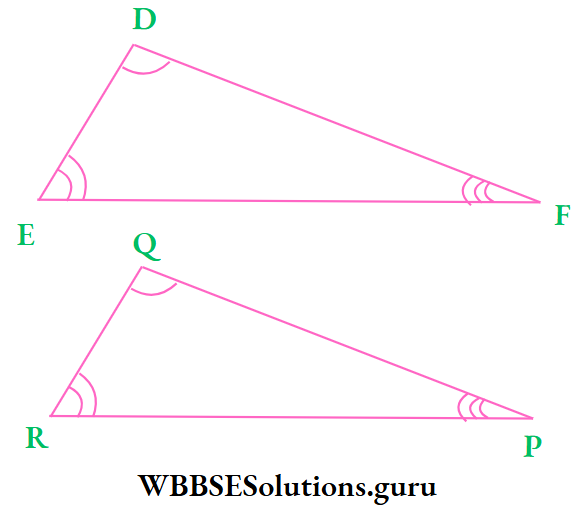
Solution: In ΔDEF and ΔPQR, ∠D = ∠Q, ∠R = ∠E
∴ 180° – (∠D + ∠E) = 180° – (∠Q + ∠R)
∴ ∠F = ∠P
∴ ΔDEF ~ ΔPQR
∴ \(\frac{\mathrm{DE}}{\mathrm{QR}}\) = \(\frac{\mathrm{EF}}{\mathrm{RP}}\) = \(\frac{\mathrm{DF}}{\mathrm{PQ}}\)
∴ The correct answer is 2. \(\frac{\mathrm{QR}}{\mathrm{PQ}}\) = \(\frac{\mathrm{EF}}{\mathrm{DF}}\)
Class 10 Maths Chapter 3 Geometry Solutions
Example 7. In ΔABC and ΔDEF, if \(\frac{\mathrm{AD}}{\mathrm{DE}}\) = \(\frac{\mathrm{BC}}{\mathrm{FD}}\) = \(\frac{\mathrm{AC}}{\mathrm{EF}}\) then
- ∠B = ∠E
- ∠A = ∠D
- ∠B = ∠D
- ∠A = ∠F
Solution:

In ΔABC and ΔDEF, \(\frac{\mathrm{AD}}{\mathrm{DE}}\) = \(\frac{\mathrm{BC}}{\mathrm{FD}}\) = \(\frac{\mathrm{AC}}{\mathrm{EF}}\)
∴ ΔABC ~ ΔDEF
∴ ∠A = ∠E ; ∠B = ∠D and ∠C = ∠F
∴ The correct answer is 3. ∠B = ∠D
Example 8. In ΔABC and ΔDEF, if ∠A = ∠E = 40°, AB : ED = AC : EF and ∠F = 65°, then the value of ∠B is
- 35°
- 65°
- 75°
- 85°
Solution:
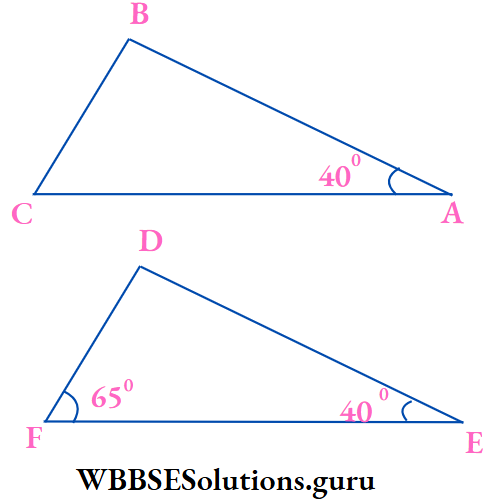
In ΔDEF, ∠D = 180° – (∠E + ∠F)
= 180° – (40° + 65°) = 75°
In ΔABC and ΔDEF, ∠A = ∠E = 40° and \(\frac{\mathrm{AB}}{\mathrm{ED}}\) = \(\frac{\mathrm{AC}}{\mathrm{EF}}\)
∴ ΔABC ∼ ΔDEF ∴ ∠B = ∠D = 75°
∴ The correct answer is 3. 75°
Wbbse Class 10 Maths Geometry Notes
Example 9. In ΔABC and ΔPQR, if \(\frac{\mathrm{AB}}{\mathrm{QR}}\) = \(\frac{\mathrm{BC}}{\mathrm{PR}}\) = \(\frac{\mathrm{CA}}{\mathrm{PQ}}\) then
- ∠A = ∠Q
- ∠A = ∠P
- ∠A = ∠R
- ∠B = ∠Q
Solution:
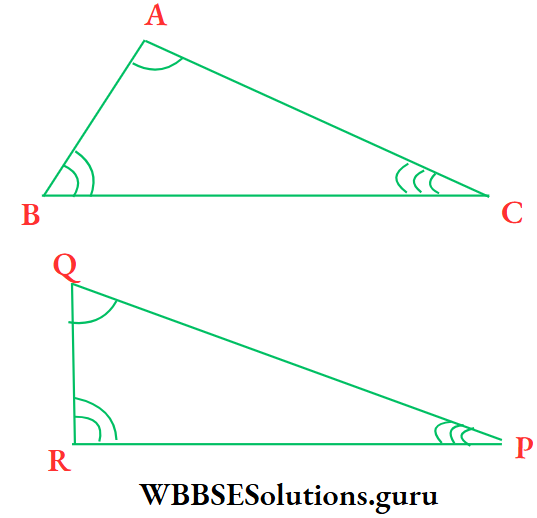
ΔABC and ΔPQR, \(\frac{\mathrm{AB}}{\mathrm{QR}}\) = \(\frac{\mathrm{BC}}{\mathrm{PR}}\) = \(\frac{\mathrm{CA}}{\mathrm{PQ}}\)
∴ ΔABC ~ ΔPQR ∴ ∠A = ∠Q
∴ The correct answer is 1. ∠A = ∠Q
Example 10. In ΔABC, AB = 9 cm, BC = 6 cm, CA = 7.5 cm. In ΔDEF the corresponding side of BC is EF; EF = 8 cm and if ΔDEF ~ ΔABC, then the perimeter of ΔDEF will be
- 22.5 cm
- 25 cm
- 27 cm
- 30 cm
Solution: ΔABC ~ ΔDEF and EF is a corresponding side of BC
∴ ∠A = ∠D, ∠B = ∠E and ∠C = ∠F
∴ \(\frac{\mathrm{AB}}{\mathrm{DE}}=\frac{\mathrm{AC}}{\mathrm{DF}}=\frac{\mathrm{BC}}{\mathrm{EF}}=\frac{6}{8}=\frac{3}{4}\)
⇒ \(\frac{\mathrm{AB}}{\mathrm{DE}}=\frac{3}{4}\)
⇒ \(\frac{9 \mathrm{~cm}}{\mathrm{DE}}=\frac{3}{4}\) or, DE = 12cm
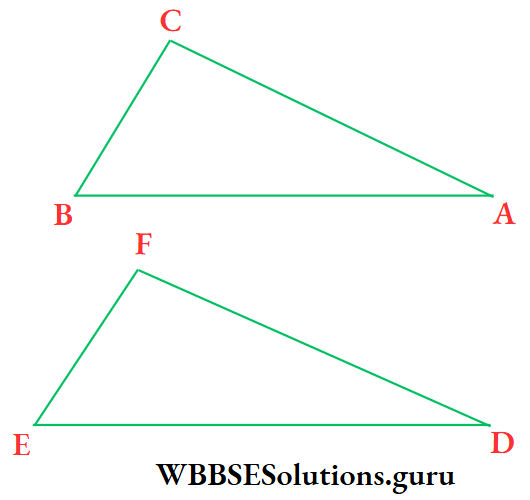
⇒ \(\frac{\mathrm{AC}}{\mathrm{DF}}=\frac{3}{4}, \quad \frac{7 \cdot 5 \mathrm{~cm}}{\mathrm{DF}}=\frac{3}{4}\)
or, DF = 10 cm
∴ Perimeter of ΔDEF = (12 + 10 + 8) cm = 30 cm
∴ The correct answer is 4. 30 cm