
WBBSE Class 9 Fundamentals Of History Chapter 1 Some Aspects Of The French Revolution Answer In A Single Sentence Very Short Answer Questions
Question 1. By what name is the period before the revolution in France known as?
Answer: The period before the revolution in France is known as the Ancien Regime.
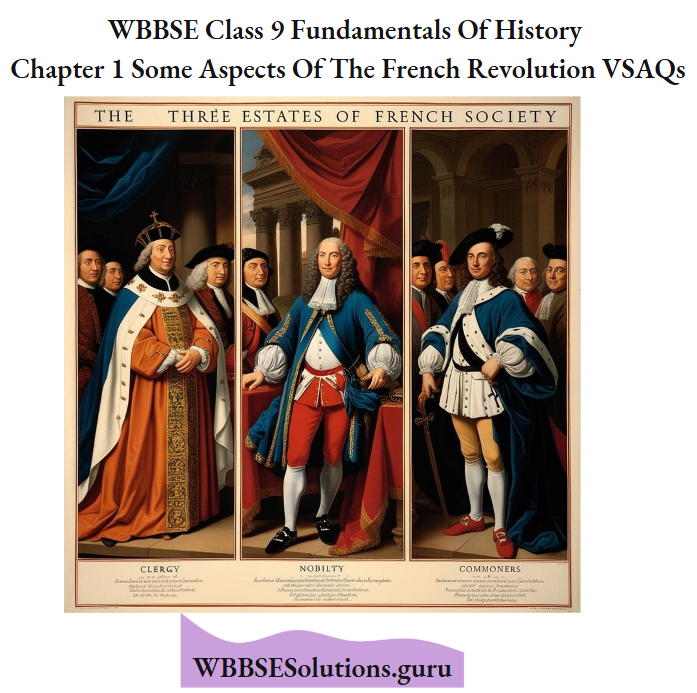
Question 2. What are the three estates of the French Society?
Answer: The three estates of the French Society were the First Estate, the Second Estate, and the Third Estate.
Read And Learn Also WBBSE Class 9 Fundamentals Of History Very Short Answer Questions
Question 3. Write the names of the groups of people who belonged to the three estates respectively of French society.
Answer: The clergies belonged to the First Estate, the aristocrats belonged to the Second Estate, and the common people belonged to the Third Estate.
Question 4. What does the word Ancien Regime mean?
Answer: In French the word Ancien means primitive and Regime means to rule the period before the Revolution of 1789 in France was known as the Ancien Regime.
Very Short Answer Questions On French Revolution For Class 9 WBBSE Intendents
Question 5. Which group benefitted from the hike in revenue that was meant to meet the revenue deficit in France?
Answer: The revenue -collectors or farmers generally benefitted from the revenue hike in France.
Question 6. Who were known as the ‘Intendents’?
Answer: The ‘Intendents’ were the high government officials who formed the main pillar of the French administration during the pre-revolutionary period.
Question 7. Who wrote the book ‘An Enquiry into the Nature and Causes of the Wealth of Nations’?
Answer: The British Economist Adam Smith wrote the book “An Enquiry into the Nature and Causes of the Wealth of Nations”.
Question 8. What was Gabelle?
Answer: Gabelle was an inequitable salt tax imposed by the royal government in France.
Question 9. What was Corvee?
Answer: Corvee was the labor service exacted instead of taxes, particularly on public roads in France before 1776.
Question 10. What was Tithe?
Answer: Tithe was a form of tax imposed upon the members of the Third Estate by the Church for religion.
Question 11. What was Vingtiemes?
Answer: The income tax that was paid by the peasants of France during the period of the old regime was known as Vingtiemes.
Question 12. When did Louis XVI summon the States-General?
Answer: Louis XVI summoned the States-General on 5th May 1789.
Question 13. Who was the French monarch at the time when the French Revolution broke out?
Answer: Louis XVI was the French monarch at the time when the French Revolution broke out.
Question 14. Who were the first to rise in revolt against the French monarchy?
Answer: The French aristocracy was the first to rise in revolt against the French monarchy.
Question 15. Who mentioned that the rule of an individual not restrained by law was arbitrary?
Answer: The French philosopher Montesquieu mentioned that the rule of an individual not restricted by law was arbitrary.
Question 16. What was the real name of Voltaire?
Answer: The real name of Voltaire was Francois-Marie Arouet.
WBBSE Class 9 Fundamentals Of History Chapter 1 Question 17. Who favored the concept of “free trade” in France?
Answer: The Physiocrats favored the concept of “free trade” in France.
Question 18. Which dynasty ruled in France at the time of the French Revolution?
Answer: The Bourbon dynasty ruled in France at the time of the French Revolution.
Question 19. From which word was the term “bourgeois” derived?
Answer: The term “bourgeois” is derived from the Anglican word “burgers” meaning city dwellers.
Class 9 History Chapter 1 WBBSE French Revolution VSAQs solutions
Question 20. What were the three main principles of the French Revolution?
Answer: The three main principles of the French Revolution were liberty, Equality, and Fraternity.
Question 21. When did the battle of Valmy take place?
Answer: The battle of Valmy took place on 20th September 1792.
Question 22. Write the name of the machine which became infamous during the Reign of Terror.
Answer: The name of the machine that became infamous during the Reign of Terror was the guillotine.
Question 23. Who formed the Third Estates?
Answer: The Third Estates of French Society comprised the bourgeoisie, the peasants, and the urban workers.
Question 24. Who was Marie Antoinette?
Answer: Marie Antoinette was the Queen of the Bourbon Monarch of France Louis XVI.
Question 25. When was the fortress of Bastille attacked?
Answer: The fortress of Bastille was attacked on 14th July 1789.
Question 26. Name two political parties of France that existed during the time of the Revolution.
Answer: The Jacobin Party and the Girondist Party were two of the political parties that existed during the time of the Revolution.
Question 27. When was the “Oath of the Tennis Court” taken?
Answer: On 20th June 1789 the “Oath of the Tennis Court” was taken.
Question 28. Name two leaders of the Jacobin Party.
Answer: Robespierre and Danton were two leaders of the Jacobin Party.
Question 29. Who wrote the book, Reflections on the Revolution in France?
Answer: Edmund Burke wrote the book, Reflections on the Revolution in France.
Short And Very Short Questions On French Revolution WBBSE Class 9
Question 30. What was known as the “Law of Suspects”?
Answer: The “Law of Suspects” was a decree that was passed by the French National Convention on 17th September 1793 during the French Revolution.
Question 31. What was “Lettre de Cachet”?
Answer: “Lettre de Cachet” were letters signed by the king of France, countersigned by one of his ministers, and closed with the royal seal, containing orders to enforce arbitrary actions and judgments that could not be appealed.
Question 32. What were the “assignats”?
Answer: The Constituent Assembly of France seized the properties of the church and retaining them as securities issued a kind of paper currency called, “assignats”.
Question 33. Where did the royal family of France take shelter after the Parisian mob broke into the royal palace at Tuileries?
Answer: The royal family of France took shelter at the Assembly House after the Parisian mob broke into the royal palace at Tuileries.
Question 34. Which political party was against the idea of the execution of the King?
Answer: The Girondins were against the idea of the execution of the King.
Question 35. Which special committee was entrusted with the supreme power of France in 1793?
Answer: The Committee of Public Safety was entrusted with the supreme power of France in 1793.
WBBSE Class 9 Fundamentals Of History Chapter 1 Question 36. Name the law that was enforced by the Revolutionary Tribunal.
Answer: The law that was enforced by the Revolutionary Tribunal was the “Law of Suspects”.
Question 37. What gift was given to America by France after she achieved independence from the colonial rule of the British?
Answer: France presented America with the Statue of Liberty after she achieved independence from British colonial rule.
Question 38. When did the Reign of Terror end in France? The Reign of Terror ended in
Answer: France on 28th July 1794.
Question 39. Which book was called the ” Bible of France”?
Answer: Rousseau’s “Social Contract” was called the “Bible of France”.
Question 40. Which day is observed as the National Day of France?
Answer: The 14th of July is observed as the National Day of France.
Question 41. Who was the author of “Lettre Philosophique”?
Answer: Voltaire was the author of “Lettre Philosophique”.
Question 42. Who was the founder of the Patriotic Party?
Answer: Abbe Sieyes was the founder of the Patriotic Party.
WBBSE Class 9 Fundamentals Of History Chapter 1 Question 43. What was known as the States-General?
Answer: The Assembly of France which comprised of the three estates of the French society that passed legislation was known as the States-General.
Question 44. What was the “Contract of Poissey”?
Answer: 1/5th of the landed property of France was controlled by the church yet the members of the upper clergy like the Bishop paid tax to the government voluntarily through a contract known as the “Contract of Poissey”.
Question 45. What is meant by the Civil List?
Answer: The Constituent Assembly of France introduced the Civil List to control the royal expenditure which was expected not to exceed the amount determined by the List.
Question 46. Who were the Sans-culottes?
Answer: The French word Sans-culottes refers to the common people of the lower classes in late 18th Century France, a great many of whom turned radical and militant partisans of the French Revolution due to their sufferings during the Ancien Regime.
Question 47. Name a revolutionary women’s organization in France.
Answer: The Society of Revolutionary Republican Women was a revolutionary women’s organization in France.
Question 48. What is the ‘Thermidorian Reaction’?
Answer: Thermidorian Reaction is the tempering of the radical phase of the French Revolution and the return to the ideals of the liberal phase with an emphasis on the Republican Government.
Question 49. Who did the French women hold responsible for their distress?
Answer: The French women hold the French monarchy responsible for their distress.
Question 50. Who introduced the Principle of Separation of Powers?
Answer: Montesquieu introduced the Principle of Separation of Powers.
Question 51. Who invented the Guillotine Machine?
Answer: The Guillotine Machine was invented by Dr.Guillotin.
Question 52. Who was known as Lock Smith King?
Answer: Louis XVI was known as Lock Smith King.
Question 53. Who said, France was the “museum of economic errors”?
Answer: Adam Smith said these words.
VSAQs For WBBSE Class 9 Chapter 1 French Revolution
Question 54. What was the Directory?
Answer: The Directory was a five-member committee that ruled France from 2nd November 1795, replacing the Committee of Public Safety until 9th November 1799, when it was overthrown by Napoleon Bonaparte in the Coup of 18th Brumaire and was replaced by the French Consulate.
Question 55. Who in the 18th Century France authored the Encyclopedia?
Answer: Diderot authored the Encyclopedia in 18th century France.
WBBSE Class 9 Fundamentals Of History Chapter 1 Question 56. When did the “September Assassination” take place?
Answer: Between 2nd and 5th September 1792 the “September Assassination” took place.
Question 57. Who were the main architects of the New French Constitution?
Answer: The main architects of the New French Constitution were Mirabeau, Abbe Sieyes, Robespierre, Muniyer, Barnave, Lafayette, and Talleyrand.
Question 58. Who said, the new French Constitution was practically “a death certificate of the Old Regime”?
Answer: Aulard said the new French Constitution was practically “a death certificate of the Old Regime”.
Question 59. When were the democratic rights of the citizens of France declared?
Answer: In France, the democratic rights of the citizens were declared on 10th August 1792.
Question 60. Who said that the new constitution was a graveyard of the old system?
Answer: Historian T.W.Raikar said the new constitution was a graveyard of the old system.
Question 61. When was the third constitution drafted and by whom?
Answer: The third constitution was drafted by the National Convention in 1792-1795.
Question 62. Who wrote the novel, “A Tale of Two Cities”?
Answer: Charles Dickens wrote the novel, “A Tale of Two Cities”.
WBBSE Class 9 Fundamentals Of History Chapter 1 Question 63. When and which countries made the Declaration of Pilnitz?
Answer: In 1791 Austria and Russia made the Declaration of Pilnitz.
Question 64. Name the new system of administration introduced by the National Convention.
Answer: The directory was the new system of administration introduced by the National Convention.
Question 65. In which year did Napoleon become the First Consul?
Answer: In 1799 Napoleon became the First Consul.
Question 66. Which document condemned the Ancien Regime?
Answer: In her literary embrace of German romanticism, Madame De Stael discussed the weaknesses of the Ancien Regime and condemned it.
Question 67. How many direct taxes were there in France?
Answer: There were three direct taxes in France.
Question 68. Who was the wife of Louis XV?
Answer: Marie Leczinska was the wife of King Louis XV of France.
Question 69. What was the Paris Commune?
Answer: After the Fall of Bastille (14th July 1789) many of the members of the royal family of France fled to England leaving the administration of the city of Paris in the hands of the Paris Commune comprising of the elected representatives of the municipality of Paris.
WBBSE Class 9 Fundamentals Of History Chapter 1 Question 70. When was the Declaration of Rights of Man and Citizens made?
Answer: The Declaration of Rights of Man and Citizens was made on 26th August 1789.