
Resistance And Rebellion Various Revolts
- After the battle of Plassey, the British assumed full political control over India. Since then, the British colonial power had resorted to exploitation.
- A senior British officer wrote, “For the common man, the police was nothing but the whip; their torture and exploitation was the main reason of grievance against our Government”.
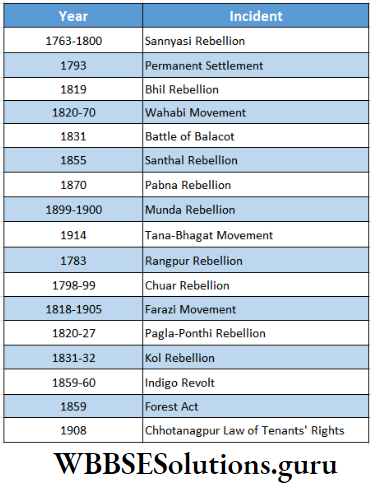
- The first group to rebel were different kinds of monks like naga, giri, grain, and fakir along with the grieving landlords, jobless soldiers, farmers, and other famine-stricken people. For a long period of forty years, this rebellion was called the Sannyasi Rebellion (1763-1800).
- The Chuar Rebellion (1766-1772,1795- 1799) in the five districts of Bengal and Bihar, viz. Bankura Midnapur, Ghatshila, Dhalbhum and Manbhum, The Rebellion of Abu Torap Choudhury in the island of Sandip(1769), the Peasants’ Rebellion led by Samsher Gazi in Tripura (1776), Rebellion led by the king of Dhalbhum (1767) and also the rebellions in Rangpur and Dinajpur (1783), Bishnupur and Birbhum (1799), Orissa (1804-1817) and Sambalpur (1827-1880) were major source of embarrassment for the British rulers.
- In 1870, the ‘Malangis’ employed in the salt industry in the 24 Parganas along with the landlords and their managers, started armed revolt against the British.
- During the same period, the King of Vizianagaram started revolting (1794). Mention should be made of the Tamil Paligar Rebellion (1790) and Parlekamedi Rebellion (1813-1814).
- Similarly, an important mass uprising was the revolt of the oppressed tribal people in Eastern India.
- The history of the nineteenth century comprises mainly of the mass awakening, mass movement, and mass rebellion of the tribal people, The Chero Rebellion of Palamau (1800), the Ho Rebellion of Singbhum (1821), the Kol Rebellion of Manbhum (1820-1837) and the Santhal Rebellion of Ranchi and Hazaribagh (1855-1856) are worth mentioning.
Read and Learn More WBBSE Notes For Class 10 History And Environment

Resistance And Rebellion The Colonial Forest Law And Reactions Of The Adivasi People
Forest laws: When the British started colonising the country, many Adivasi people had to leave their villages to work as laborers in coal mines, tea gardens, or factories. A number of Colonial Forest Laws were formulated to oust those who stayed back.
- British Government introduced the first colonial ‘forest act’ in 1865 just to capture and control over forest regions. By this act forest regions were divided into three separate belts, like
- Reserve forest belt,
- Subordinate or protected forest belts and
- Rural belts of forest.
- Except last two belts reserve forest zones were allowed to collect any type of forest property. It was an important cause of tribal revolt.
- From 1870 the British Government, greedy for more taxes, started distributing the arable land in the forest areas to landlords and money-lenders from other places. Because of the Forest Law, many tribal people had to give up their rights to non-taxable lands, which they have been using for a very long time.
- The Colonial Forest Law was the principal cause of resentment and reaction of the Adivasi people. This law introduced cooperative farming in the country.
- Before the Indigo Rebellion (1860), many land laws were instrumental in causing resentment among the tribal people. Banishment of grazing and shifting cultivation known as “Jhum Cultivation” was an another important bad effect of ‘Forest Act of 1878’.
WBBSE Class 10 History Notes
Reactions: In 1879, the local Mansabdar and the British Government in the Godavari basin came into some land settlement and as a result, the indigenous forest dwellers called the ‘Rumpa Tribe’ had to pay taxes for cutting trees in the forest or grazing their animals in the area. The Rumpa Rebellion was a direct outcome of this arrangement.
- The rebellion spread like wildfire over an area of 5000 square mile. The Forest Law of 1859 made the Santals lose their “Damin-i-Koh” or ‘God gifted hereditary tax-free land’.
- The Mundas had to lose their Khutkathi, which was jointly owned land. The Santals and the Mundas revolted against this. When the tribal people wanted to oust the antagonistic outsiders or diku from their area and reclaim their rights over the forest land, the British, the landlords, and the money lenders vehemently opposed them.
Causes of Forest Laws:
- From the beginning from the 18th century British Colonial Government was set up in India. From then the establishment of town and construction of the Railway line started in India. This was the cause of capturing forest resources from tribals.
- Government control was increased over India forests by the ‘Forest Act’ in 1855.
- A separate ‘Forest department’ was built under German Inspector General Dietrich Brandis in 1864.
- The first ‘Indian Forest Act was introduced in 1865 and the second Act in 1878. As a result, tribals lost their hereditary rights on the forest. It became the cause of the Kol revolt, Santhal revolt, Munda revolt, etc.
- To punish the rival tribes government passed three separate ‘Criminal Tribes Acts’ in 1871, 1911, and 1924.
- Dr. Sekhar Bandyapadhyay in his book ‘From Plassey to Partition and After’, said that this act helped to monopoly control of government over Indian forests. By the act of 1905 government reserved 2/3 of the Indian forests.
- Besides, jhum cultivation or shifting cultivation, hunting, and use of forest resources by tribals were strictly prohibited by the government. In 1906 ‘Scientific Forest Policy’ was accepted with the foundation of ‘Forest land Research Centre’.
Resistance And Rebellion Rebellion Uprising And Revolution
Etymologically, the three words rebellion, uprising, and revolution have differences in meaning.
- Rebellion: When turmoil and unrest accumulate inside people, once it takes the form of ‘rebellion’. For torture, injustice, and oppression over a long period of time people. organised protest and rebellion. A rebellion generally, is started by a particular group of people, in a particular location and for a particular cause. It is just beginning of a larger movement. We can cite the example of the Santhal Rebellion or the Sepoy Mutiny.
- Uprising: An uprising took place as the major outcome of a rebellion. Thus, ‘uprising’ and ‘rebellion’ are closely related to each other. For example, the uprising of the western educated middle class of India resulted in National movement on a larger scale.
- Revolution: Similarly the word ‘revolution’ means rapid change in Society and thoughts against traditional defective system and society. Its main objective is to change anything for the benefit of man and civilization. Revolution does not become imperative unless a great change takes place through rebellion and uprising. A revolution takes place only after crossing the preliminary stages of rebellion and uprising. For example, the French Revolution, the Industrial Revolution, the Russian Revolution, the Armed Revolution in India, etc. brought changes. Uprising + Rebellion = Revolution.
The Chuar Rebellion
Beginning:
- The landlords, supported by the British, called some adivasis of Chuar adivasis started the Chuar Rebellion in the northwest of Midnapur and southwest of Bankura from March 1798 to December 1799. In course of time it spread to areas like Dhalbhum, Manbhum, Birbhum, Salboni and. Ghatshila.
- However, this was not their first rebellion. They first started revolt in 1768-69 at Ghatshila under the leadership of King Jagannath Singh. 50,000 Chuar peasants or paiks (security guards of zaminders) who lost their ‘paikan land’, or tax-free land which was given in place of salary, joined the church revolt.
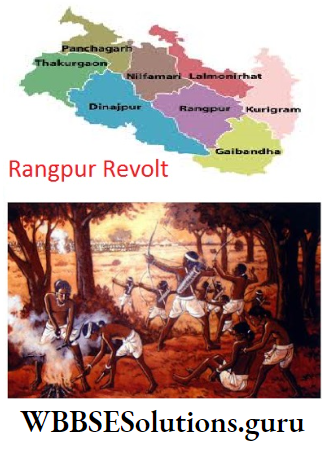
Main causes of the Chuar Revolt were
- High rate of land revenue’ on them,
- Driving out of old zamindars, ijaradars, and chukar peasants,
- After losing lands, houses, and forest the chars penetrated into endangered situation,
- The government abolished the zamindari right for which “Paikan lands” or tax-free lands of the chuars were out of hand. For this reason, chuar revolt was started by Gobardhan Dikhpati, Lal Singh, and Mohanlal.
WBBSE Class 10 History Notes
Chuar Rebellion Characteristics: The main characteristic features of the Chuar Rebellion were firstly, it was a fight to maintain their rights over the forest. These independent and fearless Chuar tribals revolted to save the forest resources and land given by landlords.
- Secondly, After Lord Cornwallis introduced the Permanent Settlement Act (1793) in Bengal, the landlords started to forcibly take away the lands belonging to the Chuar people.
- Thirdly, In north-west Medinipur the queen of Karnagarh Rani Shiromoni took the leadership of the revolt. Her three main centres were Shalbani, Bahadur, and Karnagarh. When she started revolt with the help of Paiks and common men, Gobardhan Dighpati helped them.
- Fourthly, Though Rani Shiromani and her naib were arrested, ultimately they were released and Rani get back her zamindary right from British. Rani Shiromoni was popularly called ‘Rani Laxmibai of Midnapur’.
- So, Chuar rebels, under the leadership of Durjon Singha, occupied 30 villages of Raipur.
- Fifthly, They also burned down Government offices in Salboni. Gang dacoity, looting, and mass kiling occured in Raipur, Basudevpur, Balarampur, Ramgarh, Dubagarh, Jaieswar, Tamluk, etc.
- Another leader of this rebellion, Achal Singha, led the Layek community of Bagri in a guerilla-style revolt. This is the unique characteristic of the Chuar Rebellion.
- Sixthly, The valiant Chuar Rebellion against the oppression and deprivation by the British was a great inspiration to the freedom movement in India.

Importance: The forested land inhabited by the Chuar people was named ‘Jangal Mahal’ by the British. The lexical meaning of the word ‘Chuar’ is ‘vagabond and vile people’. They were also called an ‘uncivilized’ tribe.
- According to the interpretation of an English author, the original, ‘ancient tribals of Bankura, Dhalbhum (Ghatshila), Medinipur and Manbhum are called Chuar. On the other hand, Kora, Mundari, Kurmi, Bhagdi, Majhi, Lodha, etc. tribes who had relations with the plunderers lived in the forest and hilly regions were called ‘Chuar’.
- The entire Adivasi population of Jangal Mahal united together and fought an unprecedented, bloody war. Police and the army from Medinipur town were dispatched to contain this terrible revolt. The Government adopted a divide-and-rule policy. But some English officials held the Government responsible for the revolt, having accepted the rationality behind the ‘genocide’, ‘cruelty’, and ‘brigandage’ of the Chuar rebels.
WBBSE Class 10 History And Environment Solutions
The Chuar Rebellion The Kol Rebellion 1831 To 32
Beginning:
- The tribals who started revolting against the landlords, money-lenders, and the British Government were mainly Kol, Koli, Kachari, Tipra, Lusai, Khashi, Garo, Koą, Chakma, Chuar, etc. Among these, the Kol Rebellion was of great importance. The Oraon, Munda, and Ho, belonging to the Kol community, used to live in the Chhotanagpur area of Bihar.
- After the introduction of the Permanent Settlement Act, when the oppression of the Kol tribals in the hands of the landlords and moneylenders started increasing, they resorted to the path of rebellion.
- In 1820-21, the Kols were defeated in the Battle of Chaibasa, at the hands of the Zamindar of Porahaat and his English general and were forced to surrender. With their indigenous bows and arrows, spears, etc., they couldn’t cope with the British forces armed with modern firearms.
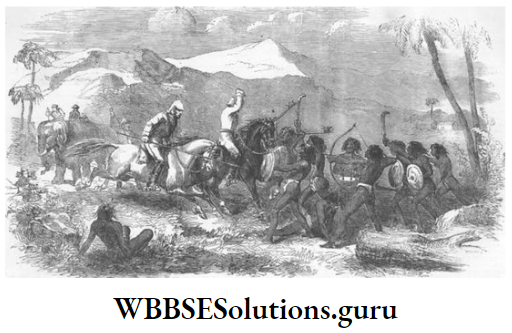
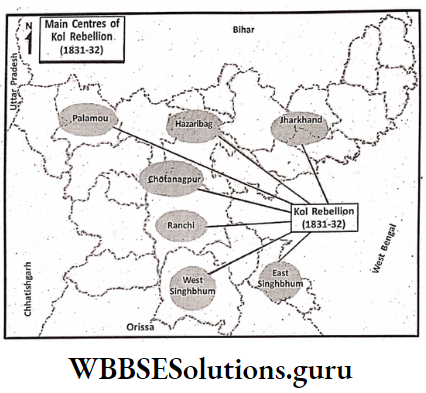
Characteristics: The actual Kol Rebellion took place in 1831-32. The main leaders of this rebellion were Buddha Bhagat, Bindrai Manki, Sui, Munda, etc. Features of the revolt were first, an important feature of this rebellion is that it spread quickly over the forested areas of Manbhum, Singbhum, Ranchi, Hazaribagh, Palamau, and Chhotanagpur.
- Secondly, for two months the rebels aimed their attacks exclusively on the landlords, hoarders, moneylenders, and British officials. They also protested against leasing out the land to Hindu, Muslim, and Sikh moneylenders, who charged exorbitant taxes.
- Thirdly, another important feature of this rebellion was mass movement and collective action. The Kols used the term diku, meaning enemy, to describe the outsiders.
- Fourthly, having acquired the lease over the land inhabited by the Kols, the landlords ruthlessly subjugated them. They imposed taxes on liquor, forced the tribals to cultivate opium, made them work as forced laborers, and abducted tribal women. This resulted in Kol Rebellion.
- Fifthly, if the tribals were unable to pay their taxes, their houses were burned down, and plundered, their womenfolk dishonored and the land was confiscated. The Kol people became vocal against such outrage.
- Sixthly, while discussing the characteristic features of the Kol rebellion it is observed that the Munda and Oraon people of Ranchi, belonging to the Kol community, started the initial phase of the revolt by playing kara-Takara and madol, their indigenous drums.
- They went from village to village, distributing bows and arrows and asking people to unite against the three oppressors, namely, moneylenders, leaseholders, and the government.
- Seventhly, they insisted that whenever people saw a tyrant moneylender, he should be immediately sacrificed to god. Major Sutherland says, “High rate of land tax and introduction of new leasing laws were the main reason of discontent among the Kol tribe”.
Importance: Having noticed the warring attitude of the Kols, Warren Hastings instructed British soldiers to be sent from Patna and Danapur. They successfully crushed the rebellion and most of the 10 thousand rebels were killed during this time.
- Many women, children, and common men also died in the hands of the British soldiers. The rebellion, which lasted for two years (1831-32), did not become successful because of the repressive tactics by the Government.
- There were incidents of genocide and arson. However, the blacksmiths and the carpenters were spared because weapons and other military equipment were made by these people. Soldiers sent from Calcutta, Patna, Danapur, Sambalpur, and Benaras, under the leadership of Captain Wilkinson and his artillerymen, completely destroyed the Kol resistance who were armed with nothing but bows and arrows.
The four principal reasons for the failure of this revolt are
- Absence of proper planning,
- Absence of a worthy leader,
- Modern weaponry and
- Absence of any support from the middle class.
- By 1833 the intensity of the rebellion was reduced to a great extent, but the heat of their discontent could be felt till 1837. In order to appease the Kol people, the Government created a reserve called South-West Border Agency exclusively for them. British laws were withdrawn and the Kol people were given, the power to formulate their own laws.
- The dishonest money lenders and leaseholders were evicted from the land which was illegally acquired by them. The Kol Rebellion fell apart because of proper leadership, restriction as a local issue, absence of support from the educated people and absence of proper communication among the rebels.
WBBSE History Chapter 3 Important Questions
The Chuar Rebellion Santhal Rebellion Or Hool 1855 To 56
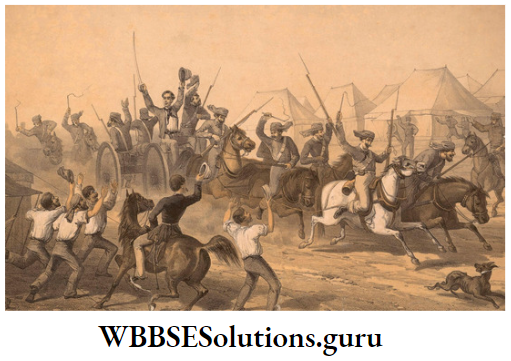
Beginning: The Santhal Rebellion was a landmark. unrest which was fallout of the Permanent Settlement. The Santhal Rebellion started in 1855. It started as a demand for their rights over the trees of the forest.
- Initially, it was restricted to ‘damin I koh’ or foothill lands or their non-taxable lands. This area extended from Purulia to the foothills of Rajmahal Hills 1366 square miles were covered under this area, of which 866 square mile was surrounded by hills and 500 square mile was agricultural land.
- According to a report (1851), about four years before the Santhal Rebellion, there were 1437 villages in the area with a total Santhal population of 82,715. They were united and a close-knit group by nature. When the zaminders, money lenders, etc. outsiders, or diku, started troubling them, the anger of these simple folks new no bounds.
Characteristics: In 1855 the Santhals, peace-loving forest dwellers who lived in the vast area between Rajmahal in Bihar to Murshidabad in West Bengal, started revolting. Features were
- The main characteristic feature of this rebellion is that the Santhals united against the oppression of the landlords, the double-crossing of the leaseholders, and the government’s policy to increase taxes.
- After the implementation of the Permanent Settlement, the Zamindar of Pora Haat acquired a large area’ on lease and as a result, Santhal Tribals living in Bankura, Medinipur, Birbhum, Manbhum, Chhota Nagpur, Palamau, Ranchi, Hazaribagh etc. lost their agricultural land.
Causes
- When taxes were imposed on them, they had to borrow from the moneylenders at steep rates of interest.
- Being heavily in debt, the Santhal people had to sell off all their worldly possessions to repay their loans.
- During this time, the Christian Missionaries tried to convert many of them. The Government employees did not hesitate to dishonor Santhal women. So, the main cause of the Santhal Rebellion was oppression by the landlords and the moneylenders.
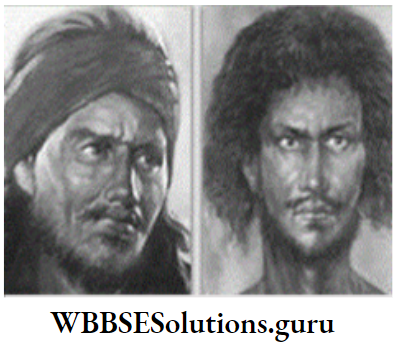
- Sidhu himself had complained, ‘The money lenders torture us and we have to pay interests at 50% to 500%. He had made it very clear that their protest was not against the Government but against the landlords. Historian William Hunter has written that the poor Santhals did not possess enough land or crops to repay even the basic loans.
- Having lost everything in their possession, the Santhals became desperate to revolt against the diku (enemy).
- The Santhals used to enjoy tax-free land in the forest area from Rajmahal to Murshidabad. The landlord’s employees went there and indiscriminately chopped down the holy sal trees to increase arable land. It was common practice to enter the Santhal territory and loot them.
- The tax-free land used by the Santhals was known as damin i koho and was a peaceful area.
- Over time, as the tyranny of the new landlords and money-lenders increased manifolds, almost 20,000 Santhals, under the leadership of Sidhu, Kanu, Chand, and Bhairab congregated in the fields of Bhagna-Dihi. They took an oath to start ‘Hool’ or a revolt (30th June 1855).

Result or Importance: On the instructions of Sidhu and Kanu, the rebellion started on 7th July 1855 and had far-reaching effects
- It spread like wildfire to Ranchi, Hazaribag, Birbhum, Chhotanagpur, Medinipur, Purulia, and Bhagalpur. A police inspector named Mahesh and his colleague were killed.
- The Santhal rebels went on a rampage, indiscriminately killing moneylenders. During the time of Lord Dalhousie, the English army crushed the revolt with a heavy hand. Commander Jarvis himself admitted, ‘What we engaged in was not a battle but genocide’.
- Although the Government restrained the Santhal Rebellion, it had to bow down to the intensity of the revolt and create a separate area called ‘Santhaldihi Paragana’ in the interests of the minority community. Despite the failure of the Santhal Rebellion, it was of great importance for various reasons.
- Firstly, the British Government had to concede to the demands of the Santhals and create a separate state of Santhal Paragana.
- Secondly, the Government learned a lesson that even unarmed poor farmers can build up resistance that can turn into large-scale rebellion.
- Thirdly, the rebellion spread outside Santhal territory among non-tribal people. According to William Hunter, semi-adivasi and very poor lower-caste Hindus participated in this rebellion.
- Fourthly, in the post-rebellion period, the Government had to create a separate reserve for the Santhals and named it ‘Santhal Paragana’.
- Fifthly, when the Forest Act was passed in 1859, parts of the forest land were reserved for them. As a result of this law, when the occupancy rights of the Santhal people in some parts of Chhotanagpur were withdrawn, they became resentful.
- Sixthly, they were dissatisfied when the Government refused to accept the special rights of the ‘Majhi’ and ‘Muliya’ castes in the Santhal society. So, once again, they started to revolt.
- Seventhly, during 1870-82, this movement was called the Kherwar Movement. It was considered to be ‘senator’ or holy because religious sentiments were involved. Eighthly, despite the failure of the Santhal Rebellion, the anti-British leaning and anti-exploitation attitude had a direct influence on the Noikoda Movement (1868) in Gujarat and the revolt of Rup Singh Gobar.
WBBSE History Chapter 3 Important Questions
The Chuar Rebellion Munda Rebellion 1899 To 1900
Beginning: The Munda community used to live in Chhotanagpur and its adjoining areas. The word ‘Munda’ means the village headman. They believed that the farmland and residential buildings that their ancestors or khuntoktidar had made by clearing deep forest were forcibly taken away by the diku.
- The British even ousted the main priest or the Pahan community. The land acquired by traditional khuntoktidar was called khuntokti. The system of collective ownership of the Munda people over this property is called khutkati.
- When the employees of The Company wanted to put an end to this system and introduce individual ownership, it gave rise to unrest all around.
- The Munda community had their system of administration, laws, and justice system. When the Government wanted to abolish these and their social customs and replace them with a new system of paying taxes in money, instead of crops, it increased public anger to a great extent.
- Apart from additional taxes, the Munda people were compelled to forced labor and as a result, they started agitating. In 1845, when the Lutheran, Anglican, and Catholic Missionaries went to preach Christianity, they received stiff resistance.
Causes: Main causes of the Munda Revolt were
- ‘Bet-began or forced labour of the Mundas,
- No help from Missionaries,
- No proper justice from government,
- Torture and exploitation from the Dikus and
- According historian K. S. Singh religious and cultural devastation of Munda tribe turned them towards the revolt.
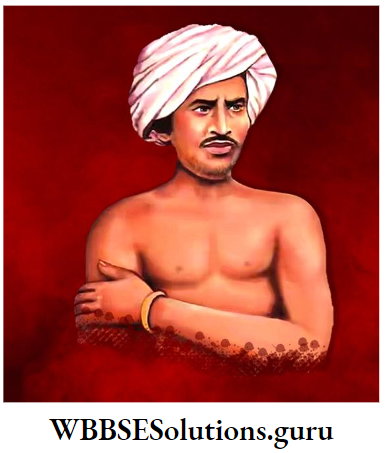
- Under these circumstances, the famous Munda leader Birsa Munda (1875-1900) took up the reins of the revolt in his own hands. He was the son of Sugan Munda, a sharecropper of Ulihatu village in Ranchi. Because of utter poverty, he was forced to live with his maternal uncle’s house for some time and then in the Primary School of his village.
- Later, at the age of 12, he adopted Christianity and lived in the German Missionary School in Chaibasa. His relationship with the missionaries soured over the years and he went back to his own village to be re-introduced to the traditional religion of his forefathers.
- He was deeply influenced by the traditions of Hinduism. In 1895, at a young age of 21 years, Birsa developed a new religious philosophy and called himself ‘dharti aba’ or ‘father of the earth’.
- He worshipped Birsa Munda ‘singbonga’ or the Sun God. He received divine instructions from this God that through moral lifestyle, self-purification, and collective prayers the Munda people would have all their wishes fulfilled.
- As a result, in the Munda society, Singbonga emerged as the one and only God instead of multiple Gods and Goddesses. Birsa also advised his followers to give up meat and the drinks called Haria and wear the sacred thread in order to lead a moral and holy life.
Features: Most important features of the Munda Revolt were
- To drive out the dikus and abolish British rule establish Munda rule,
- To destroy the Zaminders, Jaigirders, Hákim, and Christians,
- To burn the doll of Raban (British) and Mondadori (British Queen),
- Munda tribes tried to follow the cultural aspects of the landlords and zamindars,
- To spread the message of revolt through secret gathering, discussion, and prayer,
- No antagonism was shown to other subordinate tribal groups and
- Munda fighters were brave and patriotic against the British.
Spread of Revolt: Once Birsa Munda was released from the Ranchi jail in the January of 1898. He started moving from village to village and holding meetings in the light of fire torches at the dead of night.
- The Munda Rebellion was formed with only 6000 destitute Munda people. Their covert weapons were bows, arrows, spears, axes, and special battle axes called ‘tangi’.
- In order to jeopardize the ensuing Christmas celebrations, Birsa wanted to start the rebellion on the night of 24th December 1899. Accordingly, the Munda rebels attacked Churches, Government offices, and police stations in Ranchi and Singbhum. So, having a definite aim was an important feature of this rebellion. On 7th January 1900, the attacks intensified.
- Armed with spears and bows and arrows, 300 Munda people, attacked the Khunti police station. In order to deal with this rebellion, the Deputy Commissioner of Ranchi took up a position in the Dumari Hills with 2000 soldiers in his command 10 Mundas were killed in this battle.
- On 9th January Commander Gaya Munda was killed in a fierce battle in Soil Raka Hills. Few hundred Munda leaders also perished. Many of them were either sentenced for life or deported. ‘A total of 450 followers were imprisoned. 87 were presented at the session’s court and only two were hanged.
- This incident came to be known as Ulgulan or dangerous muddle. In the midst of this situation, Birsa was jailed in Ranchi on 3rd February 1900. On 2nd June, at the age of 26 years, he succumbed to cholera while still in custody. Hence, intensity and comprehensiveness were two important characteristic features of this rebellion.
Result: The rebellion led by Birsa Munda had far-reaching effects
- In spite of the fact that the rebellion had failed, the Government recognised their system of Khuntakati and passed a bill called Chhotanagpur Law of Tenants’ Rights (1908). But the Dikus had already grabbed 90% of the Khuntakati land from the Munda people.
- According to the new law, the bet begari system or forced labour and eviction of the Munda people from their land was forbidden.
- Although an independent Munda State was not established, the rebellion had awakened political consciousness among them.
- The Oraon community of Chhotanagpur started the Tana Bhagat Movement in 1914 in order to get back their rights over their Bhainyara land. The main demand of this movement was that, the adivasis would not pay any taxes on the cleared land that was once part of the forest.
- Miloniyal and Messianic movement of the Oraon community was led by a 25 years old man named Jatra Oraon, from Bekarin Owatol village under Bishnupur police station, Gumla District. He was associated with Tana Bhagat Movement.
- Even after his death, Birsa Munda remained immortal in the hearts of his people. A new group developed which was known as Birsa Community. They worshipped Birsa as their God.
WBBSE History Chapter 3 important Questions
Sannyasi Fakir Rebellion
Beginning: People from all walks of life, viz. farmers, laborers, weavers, artisans, fishermen, cobblers, cleaners, traders, artists, and the middle class, joined the pan-Indian anti-British protest, albeit intermittently.
- Between 1763 and 1856 at least 40 rebellions of various scales had taken place all over India, of which the Sannyasi-Fakir revolt is important. We know this revolt from Poems of Majnu written by, Panchanan Das, Rhym of Mahasthangarh by Dwija Gourikanta, and ‘Anandamath’ of Bankim Chandra.
Characteristics: Some features are
- The sannyasi-Fakir revolt was purely a peasant revolt.
- Many hungry peasants, landless zamindars, and jobless armies were united under Sannyasis and Fakirs.
- To attack the company’s Kuthis, treasury, Granary, and Godowns of money lenders and Kacharis of rich zaminders.
- The leaders of the revolts were religious-minded, but the revolt was free from religious roles.
- The leaders of the revolt introduced guerilla tactics of warfare against the British.
- Internal conflict among the leaders was an important feature, for the revolt was weakened.
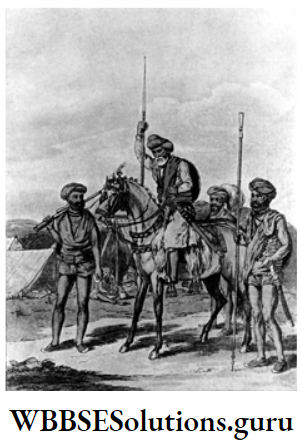
Spread Sannyasi-Fakir Rebellion was a remarkable event in the history of peasants’ rebellions. Almost 50,000 people participated in this rebellion. The fakirs of North Bengal, belonging to the ‘Madari’ sect and ‘Giri’, ‘Gosain’ and ‘Naga’ sages of North Bengal and Mymensing were the first to lead this rebellion.
- Later, ousted landlords, jobless soldiers and deported farmers also joined the rebellion. We find the mention of Sannyasi Rebellion in the famous writer Bankim Chandra Chattopdhyay’s novel, ‘Debi Chowdhurani’.
- The famous leaders of this rebellion were Bhabani Pathak, Debi Chowdhurani, Kripanath, Musha Shah, Majnu Shah, and Paragal Shah. Bhabani Pathak fought valiantly and died in 1787.
- The principal causes of this rebellion were: sages and fakirs or minstrels, who lived in Bengal and Bihar for a long time, had eventually become farmers.
- The British kept oppressing them for a long time. They used to go for their annual pilgrimage at a particular time of the year. They became resentful when the British administration intentionally imposed pilgrim taxes on them. During the famine of 1176 Bengali era (1770) having witnessed the diabolic torture meted out by the British, the rebels lost confidence on the administration, moneylenders, and some landlords. The tyranny and looting by the representatives of the Company in the name of collecting taxes. led to the spread of the rebellion all over the area.

Importance: At the onset of the rebellion,
- The rebels looted the treasury Company and landlords offices and granaries of merchant moneylenders’ houses.
- The rebellion was at its zenith between 1763 and 1778.
- The rebellion spread from Rampur and Boaliar in Rajshahi and Dhaka to Rangpur.
- In the absence of proper leadership, organization, firearms, definite aims, and ideals, the rebellion that lasted for four decades finally fell apart. According to Sirajul Islam, it was a step of the brave and patriotic struggle of mass protest against colonialism, inspite of its religious nature.
Sannyasi Fakir Rebellion Farazi Rebellion 1818 To 1905
Haji Shariyatullah (1781-1837) was the pioneer of Farazi movement in India. The Farazi Movement lasted from 1818 to 1906. The word Farazi means ‘mandatory duties as per Islam’.

Class 10 History And Environment Study Material
Characteristics: The Farazi Movement is characterised by these features
- To remove all superstitions prevalent in Islam, provide financial independence to people and secure an independent state.
- It also aimed at ending tyranny and frustration and introducing hope in. the minds of people for a new life.
- The Farazi Movement had started to deal with religious issues, but in course of time, it took a political turn. Many Hindu farmers also joined the movement.
- Farazi Movement had a role to play in giving a full revolutionary touch to the freedom movement of India. An independent government, army, and court were established under the leadership of Dudhu Mian.
- Shariyatullah wanted to build a society that was based on communism and free of superstitions.
- Farazi Movement had a constructive role to play in protesting against the indigo planters and Hindu-Muslim landlords.
- The poor farmers, weavers, artisans, labourers, and all, belonging to both communities, in Faridpur, Dhaka, Mymensingh, Barishal, etc. joined this movement. In 1820 he formed a religious sect called “Farazi”.
- After the death of Shariyatullah in 1837, his son Dudhu Mian took up the reins of this movement. Dudhu Miyan (1819-62), or Md. Musin converted Farazi movement into a political, economic, and social movement. They raised a slogan that, ‘the land belonged to those who tilled it’ or ‘all lands belong to God.
Importance: The ideology of the Farazi Movement was not contained within Dhaka, Pabna, Bakhargunj, Mymensingh, Noakhali, and Khulna alone, but it spread to Tripura and West Bengal also.
- After the death of Dudhu Mian (1862), his son Noah Mian again changed the Farazi Movement into a religious movement. Firstly, because of narrow religious principles, the Hindu-Muslim unity did not hold ground.
- Secondly, the absence of political consciousness, real-life experience, and definite goals failed the movement. Thirdly, when Dudhu Mian was imprisoned, the movement became rudderless without a leader. Finally, the Farazi Movement crumbled under the joint attack of the British landlords and indigo planters.
Wahabi Movement:
- Wahabi Movement had an important role to play in the revival of Islam. The word Wahabi means regeneration. To reform the Islamic religion from superstitions and immoral practices, Abdul Wahab (1703-87), a devout scholar, started a movement in Saudi Arabia.
- The Wahabi Movement was named after him. Syed Ahmed (1786-1831) of Rai Beriley, Uttar Pradesh, with the influence of Abdul Aziz, son of Haji Waliullah, popularised the Wahabi Movement in India. His slogan was, ‘go back to the holy Quoran’.
Wahabi Movement Features: The Wahabi Movement had religious, political, economic, and other features. First, it was not a non-communal, national movement; because although the Hindus had joined the movement, it was primarily a movement by the Muslims and for the Muslims. Secondly, many people feel that it was a theocentric, socio-economic movement.
- Again from a political angle, the Wahabis were communistic. So, although it started as a religious movement, soon it assumed a political and economic character because of the participation of the masses.
- Thirdly, its religious characteristic was that in the beginning, it started as a fight against religious superstitions. Many lower caste oppressed Hindus joined the movement.
- Fourthly, politically, the Wahabi Movement was an uninterrupted fight against British rule till 1870. Lord Canning observed, “It was the principle of Islam to revolt against the Queen’s rule”. Fifthly, they called the British-ruled India as ‘land of the enemy’ (dar-ul-harb).
- In their endeavour to establish the ‘land of piety (dar-ul-Islam), the Wahabis declared jihad. Though the movement started for religious reasons, it got transformed into an economic revolt of the peasants against the landlords.
Sannyasi Fakir Rebellion Role Of Titumir
- Syed Ahmed had an important role during the golden era of the Wahabi Movement between 1820 and 1850. He set up his head office at Siolo in the North-west corner of India.
- Having given up the ideals of Hijrat, he moved to Afghanistan, which was not occupied by the British, and to the North West corner of India. In the Battle of Balakot (1831), he declared war against the anti-Muslim landlords of Parbatar and the Government.
- He was defeated and killed by the Sikh people in 1831. Although Wahabi Movement started as a religious movement, later it took a political form. Otherwise, the movement would have lost its importance long time ago.
- In the words of the District Superintendent, Reiki, Prosperous and religious zealot farmers took part in the political movement. The boundaries of religion and caste fell apart in the Wahabi farmers’ movement against the landlords in Bengal.
- But, in spite of the enthusiasm of the people and widespread participation, this movement did not receive national importance. The main reason was that during the half-a-century-long movement, it did not have a Hindu leader. In Bengal, the Barasat Revolt (1831) of Titumir took place for political and religious reasons.
- Titumir (Mir Nishar Ali 1782-1831) took an active role in spreading the movement in Bengal. During this time, his nephew Commander Golam Masum, colleague Moinuddin and his followers namely ‘Hedayetis’ were his main associates.
- Many lower-caste Hindus also joined the forces of Titumir. He constructed a bamboo fort or banderilla in a village called Narkelberia, ten kilometers from Baduria police station, and started collecting taxes by ignoring the British Administration.
- Titumir and his 600 followers defended the fort with green wood apples, brickbats, bows-arrows, spears, etc., but was defeated by the British army, and the bamboo fort was reduced to ruins When Lord Bentinck forbade him to do so, a fierce battle was raised between the two groups.
- They attacked the British forces from the bamboo fortress on 19th November 1831. At the instructions of Bentinck, they bombarded the bamboo fortress with cannon shells and most of the soldiers perished. This incident came to be known as ‘Barasat Revolt’.
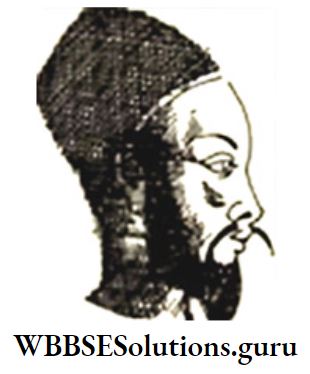
Importance: Wahabi Movement also failed, just like the Farazi Movement. But, the Hindu and Muslim farmers learned to fight together for freedom. Historian Quemuddin Ahmed, while analysing this movement, laid stress on its national and people-oriented aspects. Dr. Abhijit Dutta thought that the abolition of British rule in India was their main aim.
Class 10 History And Environment Study Material
The Indigo Revolt
Background: The British Government, in order to redress the growing grievances among the Indians, formulated a number of changes in the ruling system; but it was unable to do away totally with the discontent. During 1859-60 nearly 60 lakh indigo farmers révolted against the atrocities of British indigo planters. The indigo planters forced the farmers to cultivate only indigo in their agricultural land.
The Indigo Revolt Causes Of Indigo Revolt
Demand of the Peasants-The indigo planters used two kinds of land for the cultivation of indigo. These two kinds of land were ‘Melaka’ and ‘be-elaka’. The land which was owned by the planters themselves was called elaka land, i.e., belonging to their own territory. Daily laborers were used to cultivating indigo in this land.
- The ‘be-elaka’ land belonged to the farmer. The farmers were paid an advance or ‘dadan’ of Rs. 2/- per bigha of land. The poor farmers very often fell into this death trap. As a result, the farmers used to become target of utter deprivation.
- The number of indigo plantations kept growing in places like Nadia, Jessore, Khulna, Dhaka, Pabna and Faridpur, By 1830, there were one thousand indigo plantations in Bengal. The oppression by the indigo planters also kept increasing.
The system of Dadan-The cultivation of indigo was extremely profitable for the planters, but not so for the farmers. The land which was once used for the cultivation of indigo became unsuitable for growing food crops. The plight of the farmers caught in the debt trap of dadan was unimaginable. When the farmers refused to plant indigo in their land, the planters increased their oppression manifolds.
Tormenting the Tenants-The farmers, who refused to plant indigo, were brought to the office of the plantation and whipped with leather bound whips called ‘Shyam Chand’. Their agricultural equipment and livestock were looted. The planters used to plunder the houses of unwilling farmers and set them on fire. Women were regularly dishonored. Not only were the poor farmers affected by the torments, even well-off people and landlords had to suffer in the hands of the indigo planters. The condition of the indigo farmers worsened after 27 indigo planters were appointed as honorary Magistrates in 1857.
Regulation V-In 1830 William Bentinck passed. Regulation V. A as a result any breach of contract between the indigo farmer and the indigo planter was considered to be a criminal offense. Hence, Regulation V was discarded in 1835. However, the planters continued to torment the farmers with the help of police and the Magistrate.
Cooperation of some of the Magistrates- After laws were passed against the oppression of the indigo farmers in 1835, J. H. Manglers (1855), the Joint Magistrate of Barasat and Abdul Latif (1854), Joint Magistrate of Kalaroa sided with the indigo farmers in cases pertaining to indigo cultivation. This gave a boost to the farmers to start a revolt. In 1858, another Joint Magistrate of Barasat, Ashley Eden, announced in a bulletin that it was the prerogative of the farmer to cultivate indigo in his land or not. In 1859, Hemchandra Kar, Deputy Magistrate of Kalaroa told the police that if there was a dispute regarding the indigo farmers, the title of the land would be vested with the farmer and he would be free to cultivate any crop that he wished. Nobody could force him to cultivate indigo.
Role of newspapers and the middle class-The contemporary newspapers had encouraged the revolt of the indigo farmers. In ‘Hindu Patriot’, Harish Chandra Mukhopadhyay gave a vivid description of the oppression by indigo planters and the apathy of the police.
- Sisir Kumar Ghosh, the editor of ‘Amrita Bazar Patrika’, assumed the pseudonym ‘M.L.L. and wrote a number of letters in ‘Hindu Patriot’ to encourage the farmers. ‘Sangbad Prabhakar’ of Ishwar Gupta and ‘Tatwabodhini Patrika’ of Akshay Kumar Dutta had important roles to play in the background of the Indigo Revolt.
- Uproar was raised when Madhusudan Dutt translated Deenabandhu Mitra’s play, Nildarpan (1860), in English and published it in the name of Father James Long. When Father Long was fined Rs. 5000/- for going against the British, Kaliprasanna Singha cleared the dues for him. At this time, when the famous lawyer Sambhu Nath Pandit and Prasanna Kumar Tagore insisted that the farmers should declare all-out war against the indigo planters, the situation became turbulent.

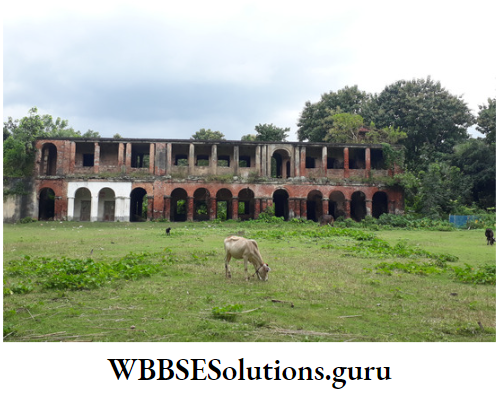
The Leaders-In 1859 Bishnucharan Biswas and Digambar Biswas of Chougacha village. in Krishnanagar started the Indigo Revolt. In course of time, people who actively led the revolt in Nadia, Jessore, Khulna, Pabna, Faridpur and Rajshahi were Baidyanath Sardar and Biswanath Sardar (Bishe Dakat) of Banshberia, Rafique Mondal of Malda, Rahimaullah of Sundarban, Zamindar Ramratan Mallick, (Nanasaheb of Bengal), Ramratan Roy and Girish Mullick of Jessore, Mahesh Banerjee of Pabna, Lal Chand Saha and Morad Biswas of Aurangabad, to name a few.
Class 10 History And Environment Study Material
Characteristics: The main characteristic feature of Indigo Revolt is that
- It was the largest farmers’ revolt in Bengal, where nearly 60 lakh farmers had taken part.
- This revolt also received the support of the educated middle class.
- Some Englishmen and Christian Missionaries were also found supporting the farmers.
- It started after the Sepoy Mutiny and Santhal Rebellion.
- The Indigo Revolt was especially important because it was instrumental in mobilizing mass movement on a huge scale.
Results or Importance:
- Firstly, Formation of the Indigo Commission-Going by the results, Indigo Revolt was a successful farmers’ rebellion. Having felt the intensity of the revolt, J. P. Grant, the Deputy Viceroy of Bengal, constituted the Indigo Commission on 31st December 1860. This five-member commission reported that on principle, the cultivation of indigo was harmful and erroneous. At the recommendations of the Indigo Commission, the price of indigo increased.
- Secondly, ‘Teen kathiya’, or the system of cultivating indigo in three cottas of land for every bigha, was introduced. There should be no coercion. Luckily, by 1891, Germany started producing synthetic indigo and as a result, the importance of indigo cultivation in India was greatly reduced. The business of natural indigo came to an end.
- Thirdly, The importance of this revolt was accepted in an article in Calcutta Review and stated that, ‘this was indeed a revolt’-the whole country participated in it. The Indigo Revolt which started two years after the Sepoy Mutiny continued for two long years. Considering its outcome and importance, the Indigo Revolt is very significant.
- Fourthly, The main objective of the Indigo Revolt was not political, but economic. The poor farmers united with strong determination and started the revolt against economic oppression and wilfulness. Almost 60 lakh farmers of Bengal, without any military training, leaped in to the revolt. Prof Chittabroto Palit feels that in this revolt the peasants, as such, had no role to play. The landlords participated actively and spontaneously in order to safeguard their own interests.
- Fifthly, The educated middle class of Bengal came forward in the interests of the farmers, to unite the nation against the tyranny of the British rulers. Unlike the Sepoy Mutiny, in the Indigo Rebellion, the middle class had an important role to play. Sixthly, A section of English clergymen and officials were sympathetic towards this revolt. As a result, there was a change among the common men about their outlook towards English well-wishers.
WBBSE Class 10 History And Environment Chapter 3 Resistance And Rebellion Very Short Question And Answers
Question 1. Who were the first group of people to revolt against the oppression of the British Government?
Answer:
The first group of people to revolt were different kinds of monks like naga, fakir, Giri, and grain along with grieving landlords, jobless soldiers, and farmers.
Question 2. Who were mostly affected by the Colonial Forest Laws?
Answer:
The tribal or adivasi people, who were indigenous forest dwellers, were mostly affected by these laws.
Question 3. Who was the leader of the Chuar Rebellion?
Answer:
The leader of the Chuar Rebellion was Durjon Singha.
Question 4. What was the term used by the Kols to describe any outsider?
Answer:
Any outsider was called ‘Diku’.
Question 5. What was the fallout of the Permanent Settlement Act?
Answer:
The Santhal Rebellion was the fallout of the Permanent Settlement Act.
Question 6. Who was the most noted leader of the Munda Rebellion?
Answer:
Birsa Munda was the most noted leader of the Munda Rebellion.
Question 7. Which book was written, on the backdrop of Sannyasi Rebellion?
Answer:
‘Debi Chowdhurani’ by Bankim Chandra Chattopadhyay was written on the backdrop of Sannyasi Rebellion.
WBBSE History Chapter 3 Important Questions
Question 8. Which movement had an important role to play in the revival of Islam?
Answer:
Wahabi Movement had an important role to play in the revival of Islam.
Question 9. What was ‘Shyamichand’?
Answer:
‘Shyamchand’ was a leather-bound whip which was used by the planters on farmers who refused to cultivate indigo.
Question 10. Who was the author of ‘Nildarpan’?
Answer:
Dinabandhu Mitra was the author of Nildarpan.
WBBSE Class 10 History And Environment Chapter 3 Resistance And Rebellion True Or False
Question 1. Lord Cornwallis introduced the Permanent Settlement Act.
Answer: True
Question 2. The Kol Rebellion took place in 1841-42.
Answer: False
Question 3. Titumir is associated with the ‘Barasat Revolt’.
Answer: True
WBBSE Class 10 History And Environment Chapter 3 Resistance And Rebellion Fill In The Blanks
Question 1. Tariqua i Mohammadia means ________
Answer: Path of Mohammad
Question 2. ______was a tax imposed of Indigo farmers. (Dadan)
Answer: Dadan
Question 3. In the _______ the Kols were defeated in the hands of the Zamindar of Porahaat.
Answer: Battle of Chaibasa
Question 4. The tax-free land used by the santhals was called _______
Answer: Damin i koho
Question 5. The Oraon rebellion was led by a 25-year-old man named __________
Answer: Jatra Oraon
WBBSE History Chapter 3 Important Questions
WBBSE Class 10 History And Environment Chapter 3 Resistance And Rebellion Short Question And Answers
Question 1. What were the main features of the Chuar Rebellion?
Answer:
The independent Chuar tribals revolted to save the forest resources and land from the landlords supported by the British. It was a fight to maintain their rights over the forest.
Question 2. What was the Farazi Rebellion?
Answer:
Farazi Rebellion
Haji Shariyatullah was the pioneer of Farazi Movement (1818-1905). It aimed at removing the religious superstitions of Islam, provide financial independence to people, and secure an independent state.
Question 3. What was the outcome of the Munda Rebellion?
Answer:
The outcome of the Munda Rebellion
The Munda Rebellion led by Birsa Munda had far-reaching implications. The Government recognised their system of khuntakati and passed a bill called Chhotanagpur Law of Tenents’ Rights. Although a separate Munda state was not established, the rebellion had awakened political consciousness among them.