
Post Colonial India Introduction
- Finally, the British rule ended in India, and independence was achieved. The post-colonial era, or the Nehru Era, began on 15th August 1947, the day India became independent.
- Jawaharlal Nehru was the first Prime Minister of India from 1947 to 1964. Independence came through riots, partition of the country, and the formation of Pakistan.
- Many a fault and defect of colonial days kept haunting the country even after independence. Pandit Nehru was at the center of Indian politics and its Constitution till he died on 27th May 1964.
The Endeavour And Disputes Regarding The Inclusion Of The Native States In The Indian Union
- The British Government, while transferring power to India, wanted to give freedom to the. Native States. Before independence, there were 552 Native States in India. They constituted 48% of the total territory of the country and their population was 20% of the entire population of India.
- Out of these Native States, some, like Kashmir, Mysore, and Hyderabad were so big that they could be compared to some European countries. There were small states also, with meager revenue, comparable to the income of a hotel.
- In 1947, more than 50% of Indian population was poor, 22% of rural people did not own. any land and 25% of people had less than one acre of land, while, two-thirds of the arable land in the country was owned by 13% of large landlords.
- After independence, it was a daunting task to regroup the 552 Native States, which were spread all over the country. To solve this problem, the State Department was formed on 27th June 1947, under the leadership of Sardar Vallavbhai Patel (1875-1950) and his personal assistant V. Sankar and the secretary of States Reorganisation Commission V. P. Menon.
- With great foresight and diplomacy, he sorted out the problem. On 5th July 1947, the kings of the Native States were asked to hand over all responsibilities regarding their foreign policy transport and defense to the Government of India. Separate agreements could be made as regards the other activities.
- Patel went on a hurricane tour in order to convince the Native States to concede to his request. It was informed that within 5th August 1947, the Native” States have to be merged with the Indian Union.
WBBSE Class 10 History Chapter 8 Notes
- These states gained independence as per Indian Independence Act of 14th July 1947. But it was left to the discretion of the ‘states involved to decide whether they would be part of India or Pakistan. The controversy started at this point.
- The British Prime Minister Clement Atlee made an announcement on 20th February 1947 that the Native States could maintain their sovereign status if they so wanted.
- Government of India was not agreeable to that, because, it might jeopardise the unity and national integration of the country and become dangerous for India. Hence, Government aimed at putting an end to all controversy and integrate the Native States in Indian Union.
- Under the leadership Sardar Vallavbhai Patel within 3 weeks most of the native states signed the deed of ‘Instrument of Agreement’ and included into the territory of India 216 native states were annexed with the adjoining provinces, 275 native states together transformed into 5 separate provinces and 61 native states were annexed with 7 central Government ruled areas.
- Though these states were included in the territory of India, Hyderabad, Junagarh, and Kashmir were not included till then. After inclusion of native states, Indian Republic was newly rearranged with four groups, such as ‘A’, ‘B’, ‘C’, and ‘D’.
- Group ‘A’ was formed with 9 British Indian Provinces combining 216 native states; like West Bengal, Assam, Bihar, Orissa, UP, MP, Punjab, Bombay, and Madras.
- Group ‘B’ was formed with 8 big native states ruled by kings or like that, such as Hyderabad, Central India, Patiala and East Punjab States Union (PEPSU), Jammu-Kashmir, Saurashtra, Rajasthan, Mysore, and Trivancore-Cochin.
- Group ‘C’ was formed with 10 states run by a commissioner including Delhi, such as Himachal Pradesh, Delhi, Kachcha, Curg, Vindhya Province, Tripura, and Manipur. and
- Group ‘D’ was formed with the states ruled by Central like Andaman and Nicobar Island.
- Sardar Vallavbhai Patel used political pressure and-diplomatic tactics and tried to merge. the Native States with India. Some of the States went to the Constituent Assembly and agreed for inclusion within India. But Native States like Travancore, Bhupal, and Hyderabad wanted to remain independent.
- But Patel requested them to join the Indian Union. The other Native States, out of fear of resistance from their subjects and considering Patel’s rigid and strict’ policy, conceded to remain within India. But the larger States like Hyderabad, Junagarh, and Jammu relented because they had sufficient army, artillery, and air force at their disposal.
1. Junagar assexation:
- When the disputes and protests about the inclusion of Junagarh within India started, Patel and Nehru sided with the protesters. On the other hand, when the Babai dynasty’s last Muslim ruler Mohammad Mahabat Khanji 3 and his adviser Nabi Baksh of Junagarh showed his interest about joining Pakistan, Jinnah congratulated them.
- However, among the citizens of Junagarh, majority were Hindus. They started terrible protests demanding inclusion within India and, as a result, the Nawab of Junagarh Mohammad Mahabat Khanji 3 fled the country and took shelter in Sind of Pakistan.
- Under these circumstances, Shahnawaz Bhutto, the Prime minister or Dewan of Junagarh, requested help and intervention from the Government of India. The Government deployed the army to conduct a referendum and Junagarh was annexed to the Indian territory in December 1947.
- In February 1948, the inclusion of Junagarh within India was supported by a large majority.
- In the same, way, Muslim ruled Hyderabad and Hindu ruled Kashmir was included within India. In 1961 it was Goa and in 1975, Sikkim that was included in India.
- Historians felt that Vallavbhai Patel was a successful statesman of highest degree, even greater than Otto Von Bismark of Germany, and named. him ‘The Iron Man of India’.
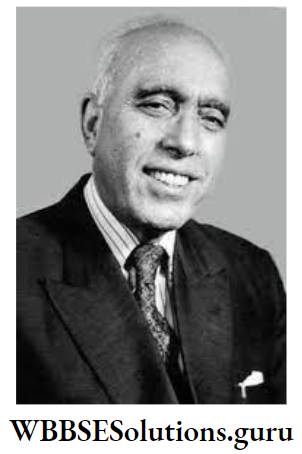
Kashmir Issue: After the independence of India, problems continued to bug the country regarding the inclusion of Kashmir within India. Kashmir was bordered by Pakistan on one side and India on the other; also 75% of the subjects were Muslims. Sk. Abdullah started a movement demanding the inclusion of Kashmir within India.
WBBSE Class 10 History Chapter 8 Notes
- Lord Mountbatten, the Viceroy of India, visited Kashmir in June 1947. King Harisingh of Kashmir was asked to take a quick decision about Kashmir being joined to the Union of India, provided his subjects were agreeable to do so.
- Even Mahatma Gandhi himself had gone to meet King Harisingh. Finally, King Harisingh of Kashmir sent his Prime Minister, Meherchand Mahajan, with a letter agreeing to join the territory of India.
- At this time Pakistan, with the help of Pathan Tribal Raiders, attacked Kashmir on October 21-22, 1947, and proceeded up to Srinagar. By that time the agreement for the inclusion of Kashmir in the Indian Union was already signed.
- So, on 26th October, at the request of Harisingh, V. P. Menon, Secretary to Patel, deployed Indian Army to drive out Pakistani raiders and free Kashmir of enemies. Now, since Kashmir was already included in India, Pandit Nehru had complained. to the Security Council of United Nations against Pakistani raiders.
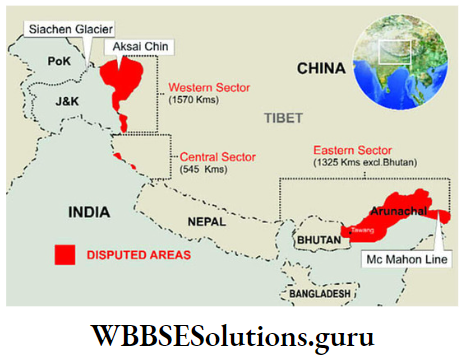
- The Council asked both the parties to move away from that place. In spite of that, Pakistan has forcibly occupied one-third of the territory, which is called ‘Azad Kashmir’ (or, Pakistan Occupied Kashmir or P. O. K) As per Article 370 of the Constitution of India, the independence, sovereignty, and special status of Kashmir has been recognised.
- Sk. Abdullah, the then Chief Minister (1948-50) of Kashmir had good rapport with Nehru. But even today, Kashmir has not been freed from the clutches of Pakistani raiders. So, the Government of India has to deploy army along the ‘Line of Control’ and spend sleepless nights.

2. Annexation of Hyderabad within India:
- Hyderabad was the largest Native State. There were more Hindus than Muslims among the subjects. Even then, the Nizam, with the support of Britain and Pakistan, tried to remain independent instead of becoming a part of India.
- They formed a communal organization named ‘Majlis-Ittehad-Ul-Muslimin’ and an armed force called ‘Rajakar’ by illegally procuring arms from Pakistan. The Congress leaders started a mass movement as a protest. The Communists also started the Peasants’ revolt in Telangana. Many people were scared at the situation and left Hyderabad for the main territory of India.
- In September 1948, Nehru and Patel jointly gave an ultimatum to the Nizam to dismantle the ‘Rajakar’ force. On 13th September 1948 under General J. N. Choudhury when the Indian Army entered Hyderabad, the Nizam surrendered and on 18th September the inclusion of Hyderabad in India was completed.
WBBSE Class 10 Environment Chapter 8 Solutions
- This operation against Nizam was known as ‘Operation Polo’. For this operation near about 40,000 people died. As a result within two months, Nizam Osman Ali Khan signed the deed of inclusion of India. On 26th January 1950, Hyderabad was officially included in India, and in 1956 Hyderabad was divided into three parts and added it to Andhra Pradesh, Bombay, and Mysore respectively.
- On 28th September, a proud Patel wrote to Surawardy, ‘This has surely created a healthy mindset in India’. Historian Sumit Sarkar said, ‘It was a great achievement of Sardar Vallavbhai Patel to unify India in such a fast manner’.
Initiative To Solve The Refugee Problem Post 1947 And Controversy
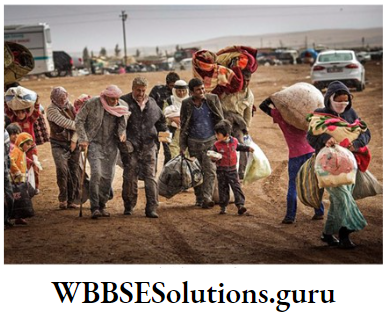
- After the independence and partition of India in 1947, a huge humanity of homeless and destitute people had to leave East and West Pakistan in search of livelihood, food-clothing- shelter, and safety.
- Those people, who were compelled to leave their homeland and came to India like an avalanche, were called ‘Refugees’. Every country in the world has some kind of ‘Refugee’ problem or other. But post-independence.
- India was witness to the heart-rending situation of an unprecedented number of more than 1 crore uprooted people, the like of which the world has not yet seen. In the history of India, the ‘Refugee’ problem became a national issue. Historian Sarvapalli Gopal remarked it “Sad morning”. Immigration of people is not a problem.
- But, after partition, the exchange of citizens created a peculiar and worrisome situation in India. This has been the largest immigration of humanity in the history of the world. The number of people who were displaced after the partition of India is more than double the population of Australia and almost equal to that of Canada.
- 49,00,000 refugees came to India from West Pakistan and 25,00,000 from East Pakistan (Bangladesh). After partition, such a huge number of people were compelled to move to India.
- Prafulla Chakraborty in his book ‘Prantik Manab’ or the Marginal Man, wrote, from 15th October 1952, when Pakistan started the system of passports and visas, India also followed ‘suit.
- As per the 1951 census, till that time, 35 lakh refugees came to West Bengal alone. Subsequently, the exodus continued, and lakhs of refugees still kept coming. It was the ‘Largest Migration’ in world history.
- Because more than one crore forty lakhs people came to India as refugees at that time one lake woman was kidnapped along with their 50,000 illegal. babies. Six lakhs died on the road and many lakhs became homeless.
Problems: At that time, because of the exodus of refugees, some immediate problems cropped up. For example:
- There was a huge pressure on the population of Bengal in particular and India in general;
- It was difficult to open so many relief camps;
- There were problems in rehabilitating the refugees;
- It was a daunting task to find proper livelihood and safety of so many refugees;
- Massive food shortage took place, which culminated in ‘Food Movement’ (1959);
- The influx of refugees across the border from East Bengal to flooded West Bengal;
- There were problems of squatting and illegal, occupation of land to form colonies 59 thousand acres of land was illegally occupied by the refugees.
WBBSE Class 10 Environment Chapter 8 Solutions
- The Government addressed the refugee problem on war footing. For example, houses were constructed, shops were set up, and employment arrangements were made for them.
- The initiative was taken by the Government to get back any property that they had to leave behind in East Bengal. It should be mentioned that even after the ‘Nehru-Liakat Agreement’ (Delhi Agreement) of 1950, the influx of refugees to India continued.
- After this agreement, the Hindu refugees came in smaller numbers, but it did not stop altogether. As per this agreement, the Muslims, who had left West Bengal and Assam, came back in droves.
- Along with them, Muslims from East Bengal also came to India. Nehru himself took the initiative to return their movable. and immovable properties back in East Bengal. Nehru did not have much confidence in Dr. Bidhan Chandra Roy, the then Chief Minister of West Bengal.
- The controversy started when Nehru did not take much interest in returning the properties of the Hindu refugees that they had abandoned in East Bengal. Perhaps, Nehru was interested in keeping the Muslims in good humour because of the ongoing Kashmir issue.
- The government had built a huge refugee colony in Cupars P. L. Home, Rupasreepally P. L. Home (Ranaghat), Chandmari P. L. Home, Dhubulia P. L. Home, Dandakaranya, (Madhya Pradesh), just like the refugee colonies of Jadavpur, Baghajatin, Ganguly Bagan, and Bijoygarh in Calcutta.
- There used to be long queues for everything in the refugee colonies, starting from getting an eligibility certificate, to distribution of aid and getting vaccinated against cholera and other diseases.
- The 946 colonies, which were set up, were not enough to accommodate all the refugees. Some of the people were sent to Government camps, but in those camps too, there was scarcity of space.
- When Dr. Bidhan Chandra Roy became the Minister in Charge of Relief and Refugee Rehabilitation, he solicited the help of Hironmoy Banerjee to address the problem immediately.
- From the end of 1949 till the middle of 1950, nearly 2 lakh refugees came from East Bengal to West Bengal. Dr. Bidhan Chandra Roy was the Chief Minister of West Bengal at that time.
1. Disputes Regarding Refugee Problem:
- Nehru had told Dr. Bidhan Chandra Roy that it was wrong on part of the Hindus to leave East Bengal. According to him rehabilitation would not solve the problem. Many people, for the sake of argument, said that Nehru did not have the guts to solve the refugee problem properly.
- He could have told that, unless the minority community was allowed to live in East Bengal, there would be war. Moreover, he did not address the problem of East Pakistan in the same way as he did for West Pakistan.
- Dr. Roy, in a letter to Nehru, expressed his resentment at Nehru’s indifference to the refugee problem of East Bengal and the meager help that was meted out. The reply which came from Nehru clearly showed his apathy towards the refugees in West Bengal.
- Before Partition, Congress leaders like Nehru and Gandhi had promised asylum to the refugees if they could not be ensured safety in their own country. However, later on, they completely denied having promised that. Nehru himself said, ‘Do not come to this country.
- There will be disaster if you come and I will not be able to do anything’. If people imposed themselves, they would be identified as ‘foreign guests’ or ‘illegal infiltrators’.
- So, it would be better to stay back in East Bengal with other Hindu people living. there. Sir Jadunath Sarkar, the President of a conference of East Bengal refugees at University Institute Hall, said in his speech-‘Add this new and dynamic branch to the old and dying tree of the refugees.
- You will be able to stand up with renewed vigour and prosperity this will be good for you merge the populace. Otherwise you will be doomed and the future of your children will also be bleak.’ Sir Jadunath had foreseen something, which Nehru did not see or perhaps did not want to see.

WBBSE Solutions for Class 10 History Chapter 8
2. Role of Shyamaprasad in the Dispute:
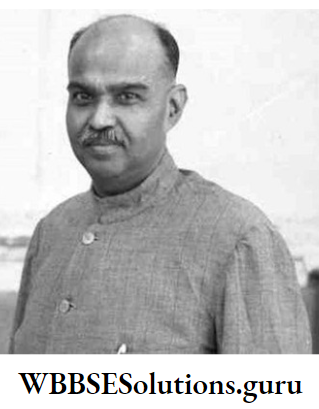
- Central Minister Dr. Shyamaprasad Mukhopadhyay, who was a known sympathizer of the refugees, discussed the problem of East Bengal refugees at length with engineer Sri Surendra Kumar De (15th March 1950).
- They were joined by Dr. Bidhan Chandra Roy, Chief Minister of Bengal. They went on a tour of inspection of the refugee camps of Dhubulia, Banshberia, Ranaghat, Bongaon, and Barasat and saw the plight of the refugees there.
- There was a great deal of debate in the Central Government, whether there will be ‘exchange of people and property’ before Nehru came to see the problems of the refugees in West Bengal.
- Central Ministers Dr. Shyamaprasad Mukhopadhyay and Sri Kshitish Chandra Neogi were in favour of the move, while Prime Minister Nehru did not agree with them. There was turmoil in the Lok Sabha over this issue (22nd February 1950).
- There was Shyamaprasad on one side of the debate and Prime Minister on the other. When Dr. Mukhopadhyay demanded the implementation of the policy of ‘exchange of people and property’, Nehru vehemently opposed citing high political morality.
- Dr. Mukhopadhyay reminded him that no such high political morality was seen in case of the Punjab. On the basis of an understanding between Nehru and Liakat Ali, Prime Minister of Pakistan, initiative was taken and a Central policy was adopted to help the refugees to return to their respective countries.
- Shyamaprasad and Kshitish Chandra both resigned from the post of Ministers after seeing Nehru’s attitude towards solution of East Bengal refugees’ problems.
- Shyamaprasad formed a new political party called ‘Janasangha’ and launched strong criticism of Nehru. Later on, Nehru endeavored to solve the refugee problem of both the countries through maintenance of peace, instead of adopting the policy of exchange of people.
- As per Nehru’s new policy, Government promised to take the responsibility of rehabilitating those people who came to India to take refugee from ‘riots. Sri Meherchand Khanna, Central Minister of Refugee and Rehabilitation, adopted a number of humanitarian policies in this regard.
- The government arranged for land and jobs for the refugees.” Many refugee colonies came up with Government assistance. Dr. Bidhan Chandra Roy, who was also the Minister of Refugee Relief and Rehabilitation, and Governor Kailash Nath Katju worked together to solve the refugee problem as soon as possible.
- Dramatist Manmotho Roy wrote the play ‘Bhanga Gora’, or Demolition and Rebuilding, to increase their confidence.
3. Partition in Autobiography and Memoirs:
- We know the pathetic story of partition. India from the autobiographical books like ‘Swaralipi’ of Sabitri Roy, ‘Epar Ganga Apar Ganga’ of Jyotirmoyi Devi, ‘Marginal Man’ of Prafulla Chakraborty, ‘Pitamahi’ of Shanta Sen ‘Chhere Asha Gram’ of Dakshina Ranjan Basu, etc.
- Ritu Menon’s ‘Borders and Boundaries How Women Experienced the Partition of India’, Choudhury Khalikuzzaman’s ‘Pathway to Pakistan’, Manik Bandyopadhyay’s ‘Swadhinatar Swad’, Selina Hossain’s Japita Jiban’, Abu Issac’s ‘Suryadighal Bari’, Kaliprasad Mukherjee’s ‘Sikarer Sandhane’, and the novels ‘Nilkantha Pakhir Khonje’ of Atin Bandyopadhyay, ‘Bipasha’ of Tarasankar Bandyopadhyay, ‘Ardhek Jiban’ of Sunil Gangopadhyay, ‘Agun Pakhi’ of Azizul Haque and ‘Forgotten Atrocities’ of B. K. Gupta.
- Some autobiographical books and memoirs like ‘Supuriboner Sari’ of Sanksha Ghosh, ‘Keyapatar Nouka’ of Prafulla Roy, and essays of Santa Sen know the picture of post-partition of India. Annadashankar Roy, in his book ‘Jukto Banger Smriti or Memories of Undivided Bengal said, ‘Provincial Government was like the beginning of another Muslim rule’.
- Sandip Bandyopadhyay wrote in his book ‘Deshbhag Deshtyag’ or Partition and Leaving the Country that after partition 90 Sikh women, led by a single Sikh lady, committed suicide by jumping into a well, to save themselves from being murdered or raped.
- Raja Singh killed 25 young. girls, along with his own daughter, in order to save their honor. Punjab and Rawalpindi resembled living hell after partition.
Class 10 History Chapter 8 Important Questions
- We come to know about post-partition riots, murders, torture of women and sorry tales of the refugees from the memoirs of Kalidas Nag and ‘My Reminiscences’ of Renuka Roy. Books such as, ‘Dhakar Chithi’ or Letters from Dhaka by Saralananda Sen, ‘Udbastu’ or Refugees by Hiranmoy Bandyopadhyay, ‘The Uprooted the book written by Kanti Pakrashi, etc. bring out the emotional history of that time in front of the present generation.
- The vivid picture of partition of India have been described in the books like ‘Tamosh’ of Viswa Shahni, ‘A Train to Pakistan’ of Kushwant Singh, ‘Godan’ of Munshi Premchand, ‘Midnight Children’ of Salman Rushdie, ‘Andhar Manik’ of Mahasweta Devi and ‘Ekattarer Dairy’ (Diary of ’71) written by Begum Sufia Kamal, etc.
Initiative And Controversies Regarding Reorganising The States On Linguistic Basis
- The linguistic policies of the Nehru Government (1947-64) raised a lot of controversies. After the transfer of power, there was a demand for demarcating the state boundaries on the basis of language spoken by the people of that area.
- Nehru was not agreeable to this’ demand. He wanted Hindi to be the universal language. The reason for this could be the pressure mounted on Nehru, who was a secular person, by the exponents of ‘Hindu-Hindi- Sanghati’ or the connection of Hindus with Hindi.
- The Constituent Assembly decided to declare Hindi as not the National language, winning the voting by one vote only. Nehru implemented the decision, but controversy kept haunting him.
- Many people felt that it was a bourgeois attitude to impose something on the multi-cultural weave of India. Big industrialists belonging to Hindu, Parsi, and Jain communities felt that by declaring Hindi as the National language, the Government was aiming at’ developing a centralized power structure in India.
- The Constituent Assembly formed the ‘Linguistic Provincial Committee in 1948 under justice. S. K. Dhar. It was known as ‘Dhar Committee’. It failed to solve the linguistic problem.
- In 1948, the J. V. P Committee, comprising of Jawaharlal Nehru, Vallavbhai Patel, and Pattabhi Sitaramaiah, was set up. It was the duty of the committee to re-organize the Indian states on a linguistic basis and without any controversy. On 1st April 1949, the committee submitted its report saying that, ‘No state will be formed right now on the basis of language’.
- In the report of the Linguistic, Provinces Commission it was informed that, ‘The narrow demand for linguistic provinces should be subdued till India becomes a Nation’.
- The Telugu-speaking Gandhian leader. Patti Sriramalu (1901-1952), without paying any heed to these recommendations, started 58 days of fasting with a demand to form a separate state of Andhra Pradesh with the 11 Telugu-speaking districts of Madras.
- He ultimately died due to fasting. Nehru was not much perturbed, instead he was quite displeased. When Sriramalu died while fasting, on 15th December 1952, his followers started 3 days riot in the Telugu-speaking districts. So, the Govt. of India was compelled to form a separate state of Andhra Pradesh on 18th December 1952 and was recognised as the first linguistic state of India in 1953.
- States Reorganisation Commission was formed to reorganize the states. The important members of this Commission were Justice Fazal Ali, Hridaynath Kunjur, and K. M. Panikkar. In 1956 Indian Parliament ended all controversies and passed the States Reorganisation Act.
Class 10 History Chapter 8 Important Questions
- As per this Act, 14 states and 6 centrally administered areas were formed on linguistic basis. Telangana area from Hyderabad was joined with Andhra Pradesh in 1956.
- Andhra Pradesh emerged as Independent India’s first state formed on linguistic basis. Similarly, Gujarat was separated from Maharashtra in 1956 for the same reasons. Malabar, Travancore, and Cochin were joined together to form the state of Kerala.
- The area of the state of Bombay was increased by adding the Marathi-speaking areas of Kutch, Saurashtra, and Hyderabad to it.
- States Reorganisation Commission rejected the demand to separate the Gujarati and Marathi-speaking areas of the state of Bombay. This again resulted in great turmoil. Finally, Bombay was joined with the state of Maharashtra and Maharashtra was recognized for Marathi-speaking people, and Gujarat was formed for the Gujarati-speaking people.
- During the linguistic reorganization of states, Sardar Vallavbhai Patel joined the smaller native states with their neighboring states, in order to maintain the solidarity of the country.


1. States Reorganisation Commission and Act (1953-56):
- Central Government of India had formed the States Reorganisation Commission in 1953. The main purpose of the Commission was to make recommendations for reorganisation of state boundaries. After two years, in 1955, the Commission suggested that new state boundaries should be re-demarcated for the formation of 16 dominions and 3 union territories.
- States Reorganisation Commission was formed with Fazal Ali, K. M. Panikkar and H. N. Kunjur. Some recommendations of States Reorganisation Commission were adopted in the States Reorganisation Act of 1956.
- The States Reorganisation Commission (1953) was formed to identify the state boundaries in the post-independence (1947) period. All the Indian states were divided into four categories. There were 9 states in part A, 8 in part B, 10 in part C and Andaman and Nicobar Islands were kept in part D.
- States Reorganisation Commission was needed to determine the boundaries of these states. Different opinions started being expressed on whether the states should be reorganized on linguistic basis or on the basis of race and religion. Fazal Ali, the retired judge of Supreme Court was appointed as the Chairman of States Reorganisation Commission (SRC).
WBBSE Class 10 History and Environment Notes
- This Commission made four observations in its report on 30th September 1955. Firstly, the three-tier system of states (Parts A, B, and C) will be removed. Secondly, the institution of ‘Rajpramukh’ and special agreement with former Princely states should be abolished. Thirdly, the general control vested in the Government of India by Article 371, will have to be removed.
- Fourthly, Andaman and Nicobar, Delhi, and Manipur only will remain. Union Territories and other parts C and D territories will have to be merged with the adjoining states. The second part of the report was titled ‘Factors Bearing on Reorganisation’.
- It was said in the report, ‘it is not possible to reorganise states on the basis of a single factor of either language or culture’. It was also recommended to convert Lakshadwip, Amindivi and Minicoy Islands, Himachal Pradesh, and Tripura into Union Territories in State Reorganisation Act.
2. Languages Recognised in the Constitution (until 1964):
Until 1964 there were 14 recognised languages in the Constitution mentioned in Articles 344 and 351 of the 8th Scheduled of the Constitution. The Home Minister Lal Bahadur Shastri planned to do it. Those are:
- Assamese (Assam),
- Bengali (West Bengal, Tripura, Andaman and Nicobar),
- Gujarati (Gujarat, Dadra, and Nagar Haveli, Daman and Diu,
- Hindi (Bihar, Delhi, Haryana, Himachal Pradesh, Madhya Pradesh, Rajasthan, Uttar Pradesh,
- Kannada (Karnataka),
- Kashmiri (Jammu and Kashmir),
- Malayalam (Kerala, Lakshadwip, and Pondicherry),
- Marathi (Maharashtra, Goa, Dadra and Nagar Haveli, Daman, and Diu),
- Oriya (Orissa),
- Punjabi (Haryana, Delhi, and Punjab),
- Sanskrit (Uttar Pradesh),
- Tamil (Tamil Nadu, Andaman and Nicobar, Pondicherry),
- Telugu (Andhra Pradesh, Pondicherry),
- Urdu (Jammu and Kashmir, Uttar Pradesh, Bihar).
- At present, in the Constitution of Independent India, there are 22 recognised languages. These languages have been recognized in the eighth schedule of the Constitution of India.
- In 1950, while adopting the Constitution of India, these 14 languages were officially recognised. Hindi and English are recognised as official languages, but nowhere in the Constitution, the term ‘National Language’ has been used.
- In 1964 there was a demand to have only Hindi as the official language instead of English, but it was not accepted.

WBBSE Class 10 History and Environment Notes
Post Colonial India Very Short Answers
Question 1. Which Department was formed to regroup the Native States?
Answer:
The State Department.
Question 2. Who was called ‘The Iron Man of India’?
Answer:
Sardar Vallavbhai Patel.
Question 3. Who was the Viceroy of India when India got independence?
Answer:
Lord Mountbatten.
Question 4. Name a few books which tell us about the plight of refugees who came to India after partition.
Answer:
‘Gandhiji in Noakhali’ by Monoranjan Choudhury, ‘Jukto Bonger Smriti’ by Annadashankar Roy, ‘Deshbhag Deshtyag’ by Sandip Bandyopadhyay etc.
Question 5. Who were the members of the J.V.P. Committee?
Answer:
Jawaharlal Nehru, Vallavbhai Patel and Pattabhi Sitaramajah.
Question 6. Why was the state Reorganisation Commission formed?
Answer:
It was formed to identify the state boundaries in the post-independence period.
Question 7. Which areas were joined together to form the state of Kerala?
Answer:
Malabar, Travancore and Cochin.
WBBSE Class 10 Chapter 8 Question Answers
Question 8. Which states formed the PEPSU?
Answer:
Patiala and East Punjab States union.
Question 9. How many recognised languages were there in the Constitution till 1964?
Answer:
14 recognised languages.
Post Colonial India True Or False
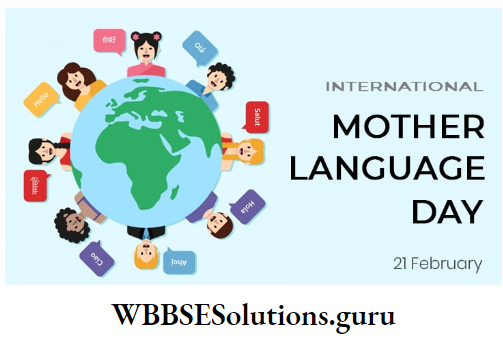
Question 1. UNO has declared 21st February as International, Mother Language Day.
Answer: True
Question 2. The States Reorganisation Commission was formed with Fazal. Ali, K,M.Panikkar and Vallavbhai Patel.
Answer: False
Question 3. Travancore was the largest of the native states.
Answer: False
Post Colonial India Fill In The Blanks
Question 1. The army of the Nizam was called ________
Answer: Rajakar
Question 2. King ________ of Kashmir wanted to join the Union of India.
Answer: Harisingh
Question 3. After the partition of India, the huge number of people who had to leave East and West Pakistan were called ________
Answer: Refugees
WBBSE Class 10 Chapter 8 Question Answers
Question 4. _______ was the Chief Minister of Bengal after Independence.
Answer: Bidhan Chandra Roy
Question 5. ‘Dhakar Chithi’ was written by __________
Answer: Saralananda Sen
Post Colonial India Short Answers
Question 1. What were the observations of the States Reorganisation Commission?
Answer:
The SRC had made four observations. The three-tier system of states (parts A, B, and C) would be removed, the institution of ‘Rajpramukh’ and special agreement with the former princely states should be abolished, the general control vested in Government of India by Article 371 will have to be removed and only Andaman and Nicobar, Delhi and Manipur will remain Union Territories and other parts C and D territories will have to be merged with the adjoining states.
Question 2. What were the immediate problems of the influx of refugees from East Pakistan?
Answer:
There was a huge pressure on the population of West Bengal, it was difficult to open so many relief camps and rehabilitate so many people, it was a daunting task to find proper livelihood and provide safety for so many refugees, there was massive food shortage which resulted in ‘Food Movement’ and there were also the problem of squatting and illegal occupation of land.
Question 3. Why did Shyamaprasad Mukhopadhyay form the party called ‘Janasangha’?
Answer:
Shyamaprasad, who was a central minister, wanted to implement the policy of ‘Exchange of people and property’ to solve the refugee problem, while Nehru vehemently. opposed him. There was a great debate in the Lok Sabha. Shyamaprasad resigned from the post of minister after seeing Nehru’s attitude and formed a new party named ‘Janasangha’.