
Chapter 3 Determination Of Location Of A Place On The Earths Surface Introduction
In a classroom, location i.e. placement of students usually referred to as first bench second bench etc. Similarly, you may like to refer to your village as east or west of the nearest rail. station or a pond.
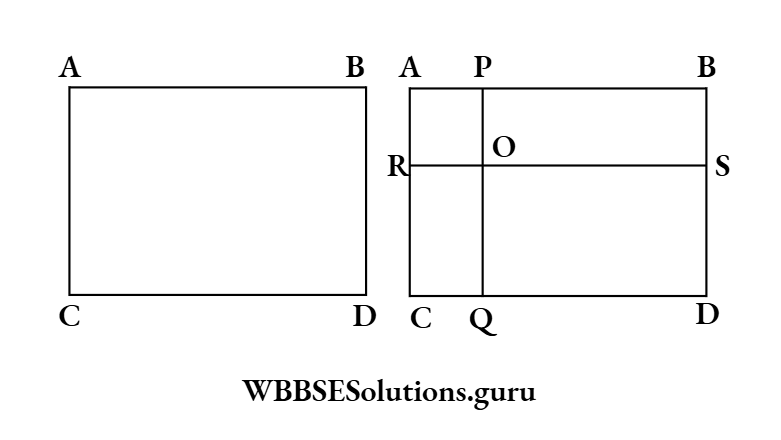
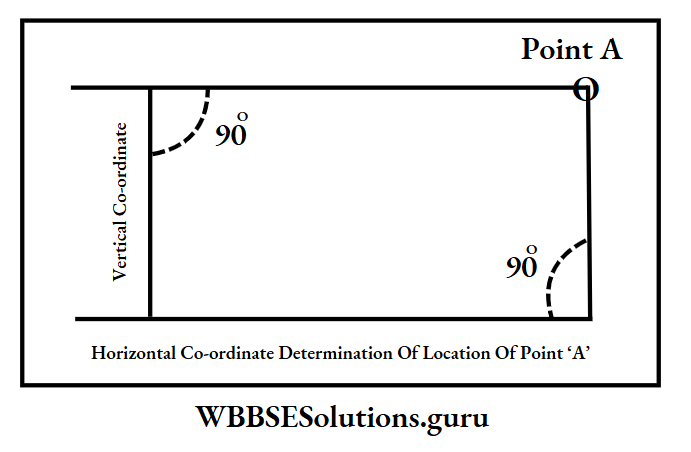
It is easy for you to locate a place on a flat surface with the help of intersecting two sets of lines-vertical and horizontal lines.
Read And Learn Also WBBSE Notes For Class 9 Geography and Environment
But on a spherical earth, it is difficult to pinpoint a place on an uneven surface.

Necessity Of Determination Of The Location Of A Place On The Earths Surface
It is necessary for a tourist or a traveller to know the location of countries, cities, towns, and villages in our world.
Location of a place also gives the idea of local time, weather, natural vegetation even the livelihood of man. Also for navigation, it is important to find out the exact location of a ship.
WBBSE Class 9 Geography And Environment Chapter 3 Notes
Chapter 3 Determination Of Location Of A Place On The Earth’s Surface Latitudes
Concept Of Latitude
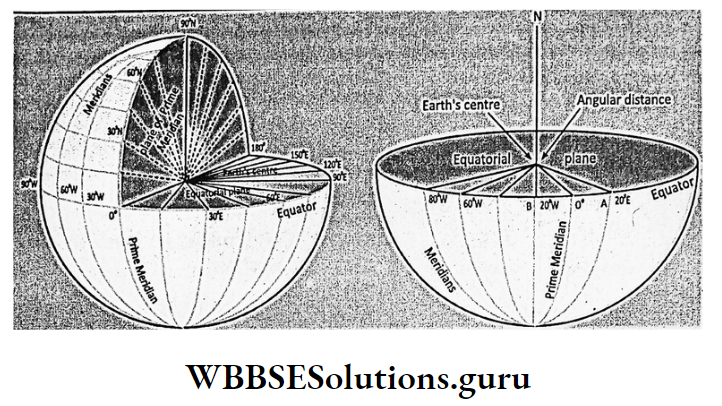
On Spherical earth, the exact location of a place is determined by an angular distance which is expressed in degrees, minutes and seconds.
On the spherical earth, the exact location of a place is determined with the help of two Imaginary lines known as Parallels of latitude and Meridians of longitude.
On a map of Atlas and Globe, the intersecting east-west and north-south lines are drawn which together form a geographical grid and are used to find out the exact location of a place.
Parallels Of Latitudes
Imaginary lines drawn in the east-west direction encircling the globe are called Parallels of latitude. The most important of these lines is the Equator.
Equator
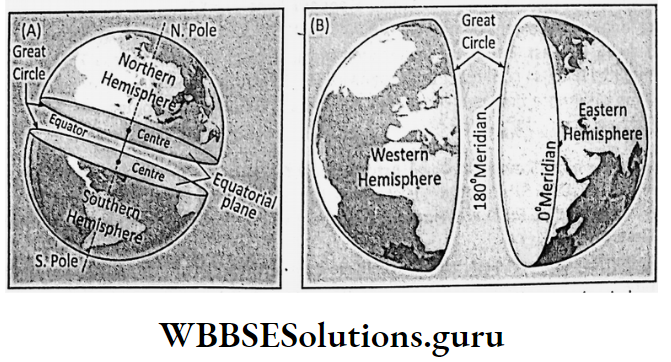
It is an east-west extended Great circle running midway between the two poles. The plane formed by the equator is called Equatorial Plane.
Latitude
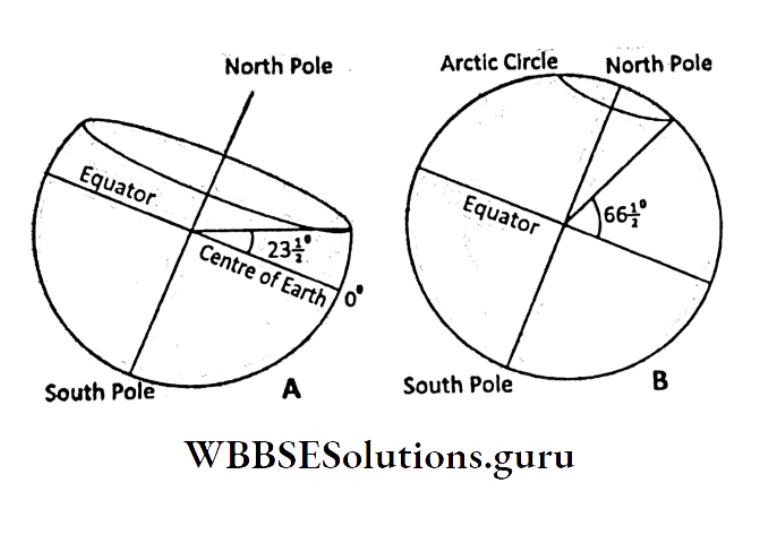
This is the angular distance of a place measured from the centre of the earth either north or south of the equator on the
equatorial plane.
The Latitude of Kolkata is 22°30′ north means Kolkata is located at 22°30′ angular distance to the north of the equatorial plane.
Parallels Of Latitude
Imaginary lines drawn parallel to the equator to the north and south are known as Parallels of Latitude. These are full circles and extended in east-west directions.
Each line joins all the places having the same latitude. They vary from 0° (equator) to 90° (poles).
1. Importance Of Parallel Of Latitude:
Parallels of latitude help us in finding the location of a place how far to the north or south of the equator. Sunrays are Inclined away from the equator.
So temperature decreases with increasing latitude. Therefore, latitudes help us to identify the climate. They divide the earth. into Thermal belts or Heat Zones.
2.Properties Of Parallels Of Latitude:
Except for the two poles all the parallels of latitude run in the east-west direction. All parallels are full circles. All of them are parallel to each other.
All parallels are not of equal sizes. They decrease in size from the equator to the poles into points. The equator is the largest one and forms a Great Circle.
The linear distance between two parallels at a 1° interval is more at the polar region because of the oblate spheroid shape of the earth. All places on a parallel of latitude in either hemisphere have latitudes of the same value.
The sum of all the latitudes of each parallel is always 360°. The angular distance between the equator and the pole is 90°.
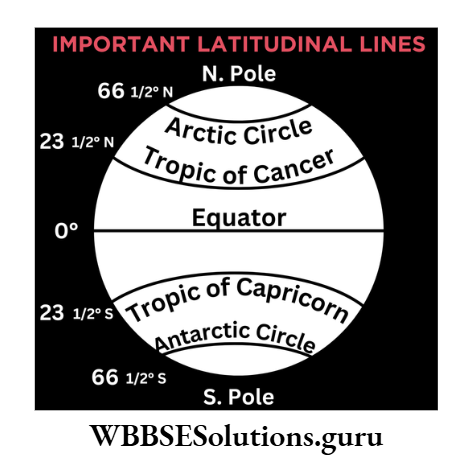
WBBSE Class 9 Geography And Environment Chapter 3 Notes
Important Parallels Of Latitudes And Their Uses
1. Equators:
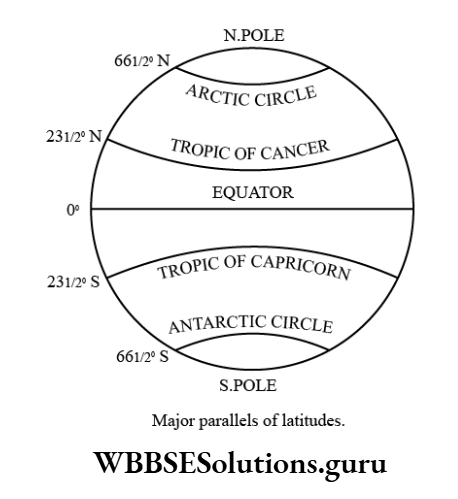
The Equator runs midway between the north pole and the south pole encircling the earth in an east-west direction. Its value is 0°. It divides the earth into two equal parts- the northern hemisphere and the southern hemisphere.
It helps us identify the location of a place in which hemisphere and how far from the equator a place is located. The latitude of any place is also measured in angular distance from the equator.
2. Tropic Of Cancer And Tropic Of Capricorn:
Parallels of latitude located at 23°30′ north and 23°30′ south of the equator are known as the Tropic of Cancer and Tropic of Capricorn respectively.
Tropic of Cancer is the northern limit of the apparent annual movement of the sun. The Tropic of Capricorn is the southern limit of the apparent annual movement of the sun.
3. Arctic Circle And Antarctic Circle:
Parallels of latitude located at 66°30′ north and 66°30′ south of the equator are known as the Arctic Circle and Antarctic Circle respectively.
On the 21st of June, it is 24 hours daily from the Arctic Circle to the north pole and 24 hours a night from the Antarctic Circle to the south pole. On 22nd December opposite conditions prevailed.
Identification Of Heat Zones Or Belts By Latitudes
The inclination of sunrays falling on the earth’s surface varies at different latitudes.
Temperature decreases away from the equator with the increasing inclination of the sunrays as vertical rays over the equator concentrate on a small area and travel shorter distances in the atmosphere and inclined rays spread over wide areas away from the equator and travel a longer distance in the atmosphere.
Accordingly, the earth may be divided into three thermal belts
- Torrid belt in between 23°30′ N and 23°30′ S.
- Temperate belt extending from 23°30′ N to 23°30′ S and from 23°30′ N to 23°30′ S latitudes.
- Frigid belt from 66°30′ N to North pole and from 66°30′ S to South pole.

Chapter 3 Determination Of Location Of A Place On The Earths Surface Longitudes
Concept Of Longitudes
North-south extended lines joining the north and south poles are known as Meridians of longitude.
Prime Meridian
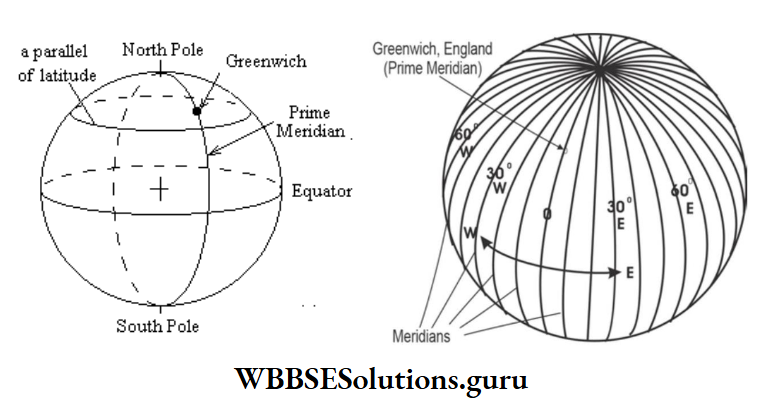
In 1884, by an international agreement, the meridian passing through the Royal Observatory at Greenwich near London was chosen as the Prime Meridian. Its value is 0°.
It is also known as Greenwich Meridian. Prime Meridian together with its opposite meridian i.e. 180° forms a full meridian or the Great Circle.
It divides the earth into two equal eastern and Western hemispheres. Prime Meridian helps us to determine how far east or west Prime Meridian has located a place.
The local time of Prime Meridian is considered Greenwich Mean Time or G.M.T. which is granted as Standard Time for the whole world.

Longitude
Longitude is the angular distance of a place measured, either east or west of the Prime Meridian that passes through Greenwich on the equatorial plane with its apex being the centre of the earth.
WBBSE Class 9 Geography And Environment Chapter 3 Notes
Chapter 3 Determination Of Location Of A Place On The Earth Surface Meridians Of Longitude
Semi-circular imaginary lines joining the north and south poles extending in a north-south direction over the earth’s surface are called Meridians of Longitude.
Each Meridian connects all the places having the same longitude in the eastern or western hemisphere. Their value increases from the prime meridian (0°) to a maximum of 180°.
Properties Of Meridians Of Longitude
All the Meridians of Longitude run in a north-south direction. Each meridian is a semi-circle and consists of a sum of 180° longitudes.
All of them are not parallel to one another. The linear distance between two adjacent meridians decreases from 111 km at the equator to 0 (zero) km at the poles.
The angular distance of meridians of longitude increases to the east as well as to the west up to 180°. But 180° E and 180° W longitudes together form one meridian.
In both hemispheres meridians of the same value are found. Each meridian and its anti-meridian together form Great Circle and their centres coincide with the centre of the earth.
All places located on the same meridian have the same longitude and the same local time. On the 21st of March and 23rd of September all places on a particular meridian experience sunrise, noon and sunset at the same time.
Important Meridians And Their Uses
Prime Meridian :
Prime Meridian is used to find out whether a place whether located in the Eastern Hemisphere or Western Hemisphere. It is also used to find out the Greenwich Mean Time or G.M.T. i.e. World Standard Time.
International Date Line Or 180° Meridian :
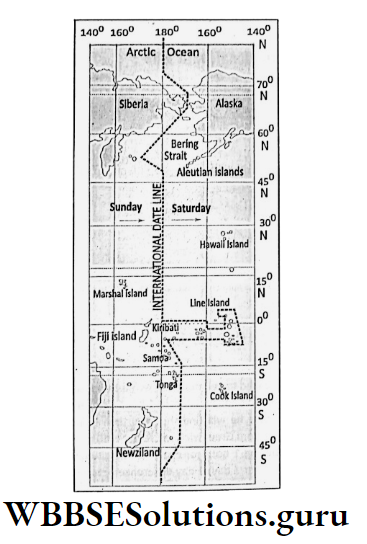
180 meridian is known as International Date Line. Crossing this meridian a day is either added or subtracted from the calendar.
Standard Meridian :
Most of the countries have selected a centrally extended meridian the local time of which is followed as Standard Time by the whole country.
Longitude And Time :
Longitudes are closely related to time. The earth is round with its circumference producing 360° at the centre and the earth completes a rotation around its axis in front of the sun in 24 hours.
Actually, the earth takes 24 hours to turn its 360 longitudes around its axis in front of the sun. So, in one hour (360 ÷ 24 = 15°) there is a turning of 15° longitudes. Similarly, 1° longitude turns in (60 minutes ÷ 15 = 4) 4 minutes.
WBBSE Class 9 Geography Chapter 3 PDF
The Relation Between Longitudes And Time Is Reflected In The Following Concepts
Local Time:
The local time of a place is determined in reference to the position of the sun in relation to its longitude. When the sun lies overhead of a place the local time of that place will be 12 noon or mid-day.
The local time is the same for all the places on the same meridian. This is also known as Sun time as it is determined with the help of the position of the sun.
A.M. And P.M. (Ante Meridian And Post Meridian) :
The local time of any place between midnight and midday is called Ante Meridian or A.M. while the local time of place from mid-day to midnight is known as Post Meridian or P.M.
Standard Time:
If all the places of a country follow their local time then the people moving from place to place would have to adjust their watches to their respective local time.
To avoid such confusion most of the countries have selected a central meridian the local time of which is followed by the whole country.
Such a centrally extended meridian is called Standard Meridian and the local time of that meridian is known as Standard Time. The local time of 82°30′ east longitude in India is known as Indian Standard Time or I.S.T.
The longitudinal extension of India is 68°07′ to 97°25′ east. Accordingly standard meridian should be 82°46′ east.
But as the lowest limit of variation in standard time is 7°30′ longitude or 30 minutes time, so counting from Greenwich (0°) longitude standard time of India is 82°30′ east. The time difference between Greenwich and India is 5 hours and 30 minutes.
WBBSE Class 9 Geography Chapter 3 PDF
Chapter 3 Determination Of Location Of A Place On The Earths Surface Geographical Grid To Find Location
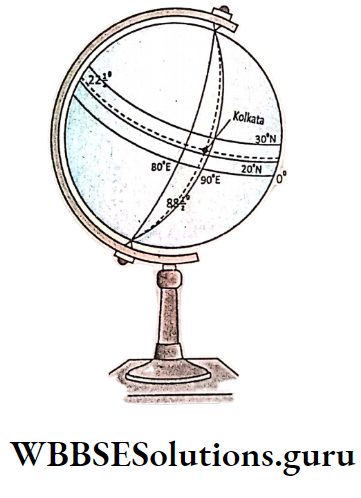
East-west extended parallels of latitude and north-south extended meridians of longitude intersect each other to form a network or the Earth’s Grid which helps to locate a place on the Earth’s surface.
The point at which the parallel of latitude and meridian of longitude intersect is the exact location of a place on the earth’s surface.
Thus the location of Kolkata is the intersecting point between two lines 88°30′ east. longitude and 22°30′ north parallel of latitude.
Concept Of Great Circle
Great Circle is an imaginary circle drawn on the Earth’s surface. This is the largest possible circle. The Centre of the circle coincides with the centre of the earth.
It divides the earth into two equal halves. Amongst the parallels of latitude, only the Equator is the Great Circle as this is the largest circumference of the earth coinciding its centre with the earth’s centre and dividing the earth into two hemispheres.
Similarly, the Prime Meridian and its antipodal meridian i.e. 180° longitude together, form another Great Circle also.
WBBSE Class 9 Geography Chapter 3 PDF
Chapter 3 Determination Of Location Of A Place On The Earths Surface Concept Of Antipodes And International Date Line
1. Antipodes :
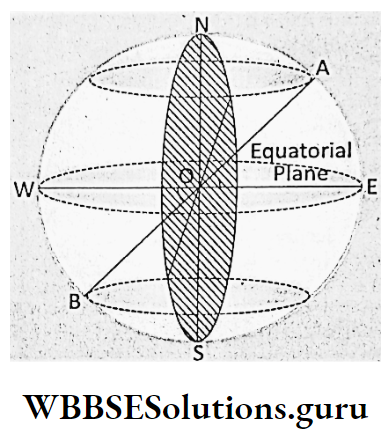
A place located diametrically opposite to another place on the earth’s surface is said to be the Antipode to the latter place. Therefore, two ends of an imaginary diameter of the earth are mutually antipodal to each other.
Antipodal places have the same latitude but they belong to opposite hemispheres. Example. latitude of Kolkata is 22°30′ north. So the latitude of its antipode will be 22°30′ south.
The difference in longitude between the antipodal places is 180° as antipodal places are located on opposite meridians.
2. International Date Line :
There is great confusion and inconvenience to those who travel around the world. Suppose, a traveller moving eastwards from Greenwich at 10 a.m.
on Sunday will gain 1 hour for every 15° longitude until he reaches the 180th meridian where he will find the local time being Sunday 10 p.m. Another person on his westward journey from Greenwich will find it is 10 p.m.
Saturday on reaching the 180th meridian as he was losing 1 hour for every 15° longitude. Therefore, there is a total (12 hours + 12 hours = 24 hours or 1 day) 1-day difference between the two travellers.
So on crossing the 180th meridian a person in a ship or aircraft moving eastward will have to deduct one day, while moving westward will have to add one day in his calendar.
To avoid such confusion, Prof. Davidson took initiative to hold the ‘International Meridian Conference’ in Washington USA in 1884 where this 180th meridian was chosen as International Date Line or IDL.
International Date Line deviates either eastward or westward at some places from the 180th meridian to avoid the landmasses, for Example. Rangal Island, Aleutian Island, Fiji, Chatham etc.
Chapter 3 Determination Of Location Of A Place On The Earths Surface Mathematical Calculations On Longitudes And Time
There is 4 minutes time difference for a difference in longitude of 1°. Similarly, there is a 1-hour time difference for a difference in longitude of 15.
Therefore, places located to the east of the other place have their local time ahead of that place and the places located to the west of the other place have their local time behind that place.
So the difference in time will be added when the places in question are located to the east. It will be deducted if the place in question is situated to the west of the other place.
Mathematical Calculation For Finding Longitude And Time:
Mathematical Rules
1. Finding Of Longitude From Given Time:
If the time of a given place is ahead of that of Greenwich then the place must lie to the east and if it is behind that of GMT then the place will be located to the west of Greenwich.
The time. difference between two places found in minutes is to be divided by 4 to get the longitude of a place.
2. Finding Of Time From Given Longitude:
- Places lying to the east have their local times ahead of those places lying to the west and the places lying to the west have their local time lagging behind of those places lying to the east.
- Time 450 difference may be obtained by multiplying the longitudinal difference with 4.
- The time difference is added (+) when the place is located to the east and it is subtracted (-) when it is located to the west.
3. Finding of longitudinal difference:
- If two places lie on either side of Greenwich, longitudes of both hemispheres are to be added.
- If the places are located in the same hemisphere the lesser value is to be subtracted from the longitude of the higher value.
4. On crossing the International Date Line:
- On crossing the International Date Line from the west to the east 1 day will be added to the calendar, while crossing the International line from the eastern hemisphere to the western hemisphere 1 day is to be deducted from the calendar.
- On crossing the IDL eastward one day is gained but time is lost, while on crossing the IDL from the eastern hemisphere to the western hemisphere one day is lost but time is gained.
Mathematical Laws
1. 1° longitude is divided into 60 minutes (60°) and 1-minute longitude is subdivided into 60 seconds (60″).
2. When time is calculated
1. For 24 hours time difference longitudinal difference is 360°
∴ 1 hours time difference longitudinal difference is 360 ÷ 24 hours = 15°
2. For 15° longitudinal difference time difference is 1 hour or 60 minute
∴ 1° longitudinal difference time difference is 60 minutes ÷15° = 4 minutes
3. For 1° or 60′ longitudinal difference time difference is 4 minutes or 240 seconds
∴ 1’ or 60′ longitudinal difference time difference is 240 sec ÷ 60 = 4 sec
4. For 1′ or 60″ longitudinal difference time difference is 4 seconds
∴ 1” or 60” longitudinal difference time difference is 4 ÷ 60 or 1 ÷ 15 sec
[For 15 seconds (15″) longitudinal difference time difference is 1 second, for 30 seconds (30″). longitudinal difference time difference is 2 seconds.]
WBBSE Notes for Class 9 Geography Chapter 3
Problem-1:
It is 8 a.m. at Kolkata (88°30’E / 22°30’N) on Thursday 1st March 2012. What will be the local time, day and date on its antipode?
Solution :
The longitude of the antipode of Kolkata is 180°− 88°30’E = 91°30’ west
The difference in longitudes between Kolkata and its antipode is 91°30’ + 88°30’ = 180°
The difference in time for 1° longitude is 4 minutes
∴ Difference in time for 180° longitude is 180 × 4 = 720 minutes or 12 hours
So, the difference in time between Kolkata and its antipode is 12 hours.
As the antipode of Kolkata is located on West longitudes, so its local time will be behind that of Kolkata.
∴ When the local time of Kolkata is 8 a.m., Thursday, 1st March 2012, the local time, day and date of the antipode of Kolkata will be (8 a.m. − 12 hours) 2012 i.e. 8 p.m. i.e. 29th February, Wednesday (Leap year), 2012.
Problem-2:
A ship started its journey for Los Angeles (118° W) from Tokyo (139°E) on 30th June, Monday at 10 a.m. It crosses the Pacific Ocean by every meridian in 4 minutes. At what time, day and date the ship will reach Los Angeles?
Solution :
Difference in longitudes between Tokyo and Los Angeles is 180° − 139° = 41° and 180° − 118° 62° i.e. 41° + 62° = 103°
For 1 difference in longitude difference in time is 4 minutes
∴ 103° difference in longitude difference in time is 103 × 4 m = 412 m or, 6 hours 52 minutes.
As the east gains time, so, when the ship leaves Tokyo the local time at Los Angeles is (Monday 10 a.m. + 6 hrs. 52 minutes) Monday 4-52 p.m.
As Los Angeles is located to the west of the International Date Line, so, 1 day is to be deducted from the calendar. So, local time in Los Angeles will be Sunday from 4-52, pm.
The ship has taken 6 hours and 52 minutes to cross the Pacific Ocean for 103° longitudes. So, the time, day and date in Los Angeles are Sunday (4-52 pm + 6 hrs. 52 mins) 29th June at 11:44 pm.
Problem-3
When it is 9 a.m. in Greenwich the local time of place is 5 p.m. What is the longitude of that place?
Solution:
The difference in time between a place and a Greenwich is (9 a.m. − 5 p.m.) 480 minutes or 8 hours.
The difference in longitude for 4 minutes time difference is 1°
∴ The difference in longitude for 480 minutes time difference is 480 ÷ 4 = 120°
∴ The difference in longitude between that place and Greenwich is 120°.
As the local time of that place is ahead of that of Greenwich, the place is located to the east of Greenwich.
The longitude of the place is 120° East.