
WBBSE Chapter 1 Control And Coordination In Living Organisms Response And Physical Coordination In Animals Nervous System Introduction To Nervous System
The system comprising of a complex network of nerves, cells, brain & spinal cord that receives a stimulus both external & internal), transmits it to other parts of the body for interpretation & command, and sends the corresponding motor output is known as the Nervous System.
The Nervous System Performs Three Basic Functions:
Receiving stimuli through sensory neurons from internal and external environments and passing them to the brain; interpretation and processing of the input stimuli in the brain and then feeding response back to the body parts through motor neurons.

WBBSE Chapter 1 Response And Physical Coordination In Animals-Nervous System Neural Control And Coordination
Our body exhibits a unique example of the division of labor among different cells, tissues, organs, and systems. Let us examine these with examples from daily life.

During running and exercise a person’s breathing and heart rate both increase. For the person to become more active his muscles will need to produce more energy.
They can do this by breaking down glucose from the consumed food, but to do this they need plenty of oxygen.
The brain then sends signals to the muscles that control breathing (the diaphragm and the intercostal muscles between the ribs) so that they shorten and relax more often.
WBBSE Class 10 Life Science Chapter 1 Solutions
This causes the person to take more breaths. As a result, more oxygen will be absorbed in the lungs and carried to the muscles that are being used to exercise the muscles belonging to the arms and legs.
Read and Learn More WBBSE Solutions For Class 10 Life Science
The heart rate increases to increase the cardiac output to cater to the enhanced need for blood supply to the effector’s muscles.
So, during these activities, the muscular system, respiratory system, circulatory system, nervous system, etc. get involved in a coordinated manner.
Here, in this example, the stimulus is of internal origin. The brain interprets the signal and sends motor commands to effector organs of both the respiratory & circulatory systems as a part of neural coordination.
When you step out in bright sunlight, you partly close your eyes to keep out the bright light. You may start sweating as the temperature rises to maintain the body temperature through thermolysis (or, the mechanism of heat loss by the body).
These are coordinated responses to stimuli. The physical part of this response and coordination in animals involves the nervous system.
WBBSE Chapter 1 Response And Physical Coordination In Animals-Nervous System The Nervous Pathway To Respond To Stimuli
This indicates that the first event in this sequence is a “Stimulus” (“Stimuli” is the plural form). It may be internal or external.
In this context, a stimulus may be defined as a physiochemical change in the environment that the human sensory receptors can detect, e.g. sound, physical contact, taste, visual sensation, hunger, etc. Irritability or sensitivity is a characteristic feature of all living organisms.
The next stage in the pathway is the “Sensory Receptors” sensing the stimulus. These receptors are located all over the body but some types of receptors are in specific areas of the body (e.g. taste buds on the tongue in the mouth).
Sensory neuron(s) then transmit information from the sensory receptor(s) to the Central Nervous System (CNS i.e. the brain and spinal cord).
WBBSE Class 10 Life Science Chapter 1 Solutions
This happens because peripheral nerves are connected to the spinal cord via the network of nerves within the nervous system.
The information so received by the CNS is further transmitted by relay neuron(s).
Finally, an effector (muscle and gland) brings about a response.
This pathway may be explained by a common example of our response after hearing the doorbell.

The ringing of the doorbell is the external stimulus. It generates sound waves that travel through the air.
The air-borne sound waves travel down through the ear canal and strike the tympanic membrane, causing it to vibrate. This vibration passes through the middle ear ossicles to the inner ear and finally stimulates the hair cells of the Organ of Corti.
The ear acts as the sensory photoreceptor for the sound stimulus. It is the movement of these hair cells which converts the vibrations into afferent nerve impulses,
The nerve impulses travel over the central auditory sensory pathways to the auditory cortex of the brain,
The brain or CNS interprets the impulses as sound and generates a response (in this case it is the action to open the door),
The response is achieved through motor nerves by our body movement to open the door.
Communication between receptors and effectors – Between the receptors and effectors are the conducting cells of the nervous system, termed neurons.
WBBSE Class 10 Life Science Chapter 1 Solutions
These are the basic structural and functional units of the nervous system. They are spread throughout the body of the organism forming a complex communication network. Neurons communicate through an electrochemical process.
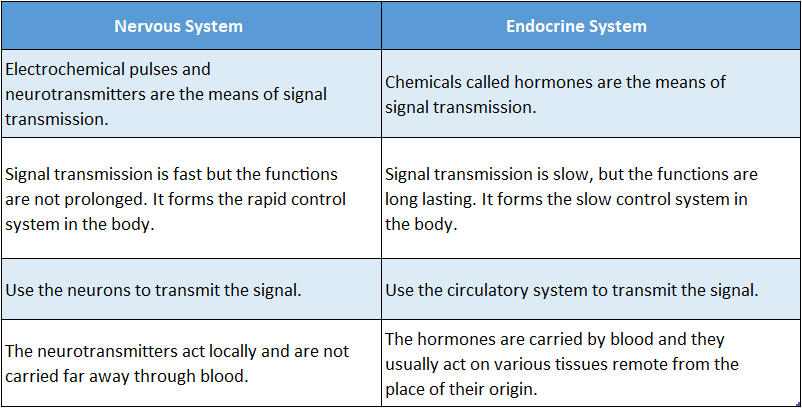
Difference Between Mode Of Action Of Hormone And Nervous System:
Both nervous and endocrine systems are the basic systems that regulate the biological processes inside an organism but through different means of passing signals.
However, the basic differences between them, regarding mode of action-
WBBSE Chapter 1 Topic D Response And Physical Coordination In Animals Nervous System Components Of Nervous System
The nervous system is made up of three basic elements nerve cells or neuron interstitial cells including neuroglia cells and connective tissue remains associated with the above elements.
Structure And Function Of Different Parts Of Neuron:
Neurons are the basic structural and functional units of the nervous system, which are readily excitable electrically to transmit information inside the bodies of animals.
The signaling or signal passing is carried out through both electrical and chemical means-
The human brain contains about 100 billion neurons.
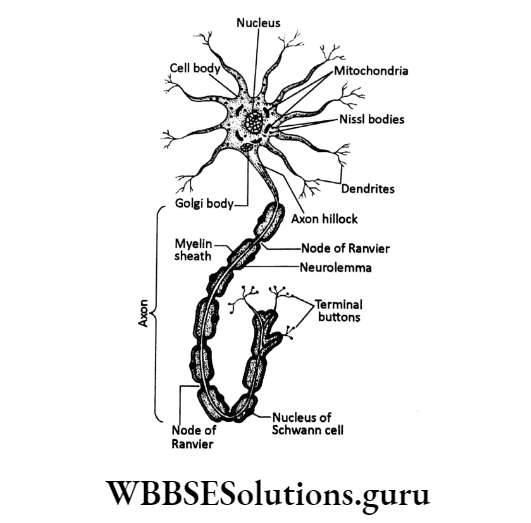
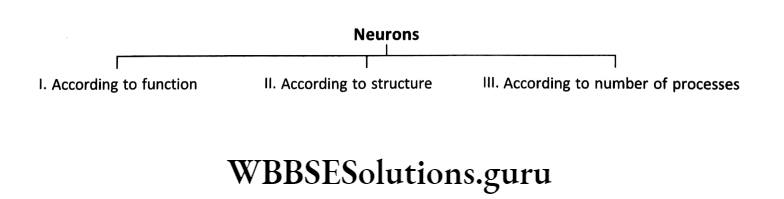
Although the morphology of various types of neurons differ in some respects, they normally contain four distinct regions with different functions the cell body, the dendrites, the axon, and the axon terminals.
WBBSE Chapter 1 Topic D Response And Physical Coordination In Animals Nervous System Type Of Neurons
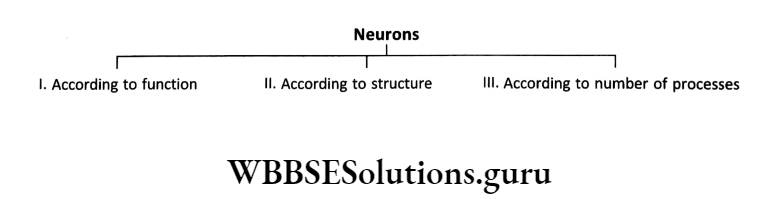
Neurons May Be Classified As Follows:
According to function:
According To Function, Neurons Are Of Three Types.
1. Sensory neurons:
These run from the various types of stimulus receptors (e.g., touch, odor, taste, sound, vision, etc.) to the central nervous system (the brain and spinal cord).
2. Inter-neurons:
These are found exclusively within the spinal cord and brain. They are stimulated by signals reaching them from sensory neurons, other interneurons, or both. Interneurons are also called association neurons or adjustors.
3. Motor neurons:
These transmit impulses from the central nervous system to the muscles and glands that carry out the response.
According to structure:
WBBSE Class 10 Life Science Chapter 1 Solutions
According To Structure, Neurons Are Of Two Types.
1. Golgi I neuron:
A Golgy type I neuron has a long axon that begins in the grey matter of the central nervous system and may extend from there.
2. Golgi II neuron:
A Golgy type II neuron has a short axon or no axon at all.
According To The Number Of Processes:
Neurons are of four types
1. Apolar neuron:
An apolar neuron contains only the cell body and there is neither any dendron nor any axon.
2. Unipolar neuron:
A unipolar neuron has only one protoplasmic process originating from the cell body.
3. Bipolar neuron:
A neuron having one axon & one dendron originating from the opposite poles of the cell body is called a bipolar neuron.
4. Multipolar neuron:
A multipolar neuron has many dendrites and one axon arising from several poles of the cell body.

Inter-relationship among, neurons, nerve fibers, and nerves.
A neuron or nerve cell is the fundamental unit of signal processing; an electrically excitable cell that processes and transmits information through electrical and chemical signals.
Dendrites are like antennae that receive information and pass it to the cell body. The cell body is a processor/integrator that decides to send action potential through the axon and at a certain frequency.
A bundle of several thousands of axons with associated connective tissue & blood vessels that lie outside the brain & spinal cord is called a nerve.
It may be myelinated (or medullated) or nonmyelinated (or non-medullated) nerve fiber. The diameter of a non-medullated nerve is less than that of the medullated one.
Class 10 Life Science Nervous System Solutions
Often the cell body sits somewhere and has its axon reaching several feet away. The axons are bundled together and go in a pipe sort of structure. It may either carry information to the brain (sensory) or from the brain (motor) or mixed.
Usually the term “nerve” is reserved for bundles of axons traveling outside the brain; inside the brain bundles of axons are called “fiber tracts” or “commissures.”
Each nerve is covered by three connective tissue layers, starting with the inner endoneurium, which covers the nerve fibers; the middle layer called the perineurium, and the outer layer over the perineurium, called the epineurium.
There are blood vessels within a nerve.
WBBSE Chapter 1 Topic D Response And Physical Coordination In Animals Nervous System Types Of Nerve
Nerves Are Categorized Into Three Groups Based On The Direction In Which Signals Are Conducted:
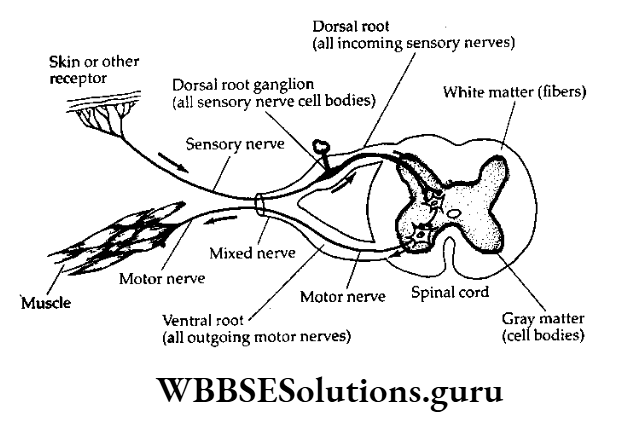
1. Afferent or sensory nerves conduct signals from receptors to the central nervous system since these are made up of sensory neurons only. Example – 1st (Olfactory) and 2nd (Optic) cranial nerves
2. Efferent or motor nerves conduct signals from the central nervous system along motor neurons to the effector organs like target muscles and glands.
Example- 3rd (Oculomotor) and 4th (Trochlear) cranial nerves.
Mixed nerves contain both afferent and efferent axons and thus conduct both incoming sensory information and outgoing muscle commands in the same bundle. Example- 5th (Trigeminal) and 7th (Facial) cranial nerves, spinal nerves.
WBBSE Chapter 1 Response And Physical Coordination In Animals Nervous System Neuroglia
Neuroglia is commonly known as glial cells or glia.
These comprise the interstitial tissue of the central nervous system. All glial cells are much smaller but far more numerous than the neurons. The cells do not possess axons.
Glial Cells Are Of Six Types-
- Macroglia
- Microglia
- Astrocytes (star-shaped)
- Oligodendrocytes
- Schwann cells and
- Satellite cells.
Functions:
- Neuroglias provide mechanical support to neurons,
- These prevent neuronal impulses from spreading in unwanted directions,
- These cells can remove foreign materials by phagocytosis,
- Neuroglia maintains homeostasis.
WBBSE Chapter 1 Response And Physical Coordination In Animals Nervous System Ganglia
Ganglia (singular = ganglion) are ovoid structures containing cell bodies of neurons and glial cells supported by connective tissue.
Ganglia function like relay stations-one nerve enters and another exits.
Formation:
In vertebrates, the ganglion is a cluster of neural bodies outside the central nervous system.
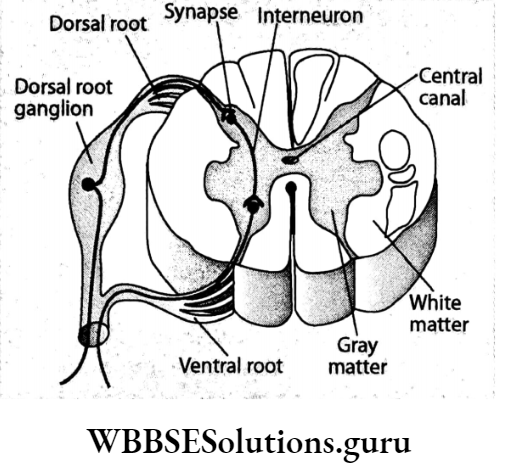
In the central nervous system, such collections of neurons are called nuclei. A spinal ganglion, for instance, is a cluster of nerve bodies positioned along the spinal cord at the dorsal and ventral roots of a spinal nerve.
Class 10 Life Science Nervous System Solutions
Function:
Ganglia provide relay points and intermediary connections between different neurological structures in the body, such as the peripheral and central nervous systems.
WBBSE Chapter 1 Response And Physical Coordination In Animals Nervous System Synapse
In the nervous system, a synapse is a structure that permits the axon terminal of one neuron to pass an electrical or chemical signal to the dendrite or cell body of the consecutive neuron through a small gap separating the two neurons in one way (forward conduction) only.
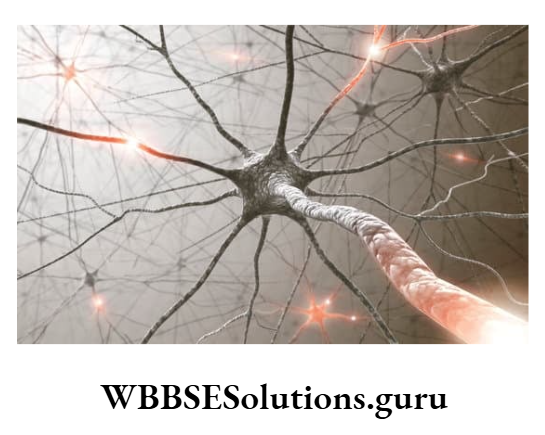
So it essentially consists of a presynaptic neuron, a post-synaptic neuron, and a synaptic gap.
Structure: The synapse consists of-
A presynaptic ending that contains neurotransmitters, mitochondria, and other cell organelles,
A post-synaptic ending that contains receptor sites for neurotransmitters, and
A synaptic cleft or space between the presynaptic and postsynaptic endings.
Function:
At the synaptic terminal (the presynaptic ending), an electrical impulse triggers the migration of vesicles containing neurotransmitters toward the presynaptic membrane.
The vesicle membrane fuses with the presynaptic membrane releasing the neurotransmitters into the synaptic cleft.
The neurotransmitter molecules then diffuse across the synaptic cleft where they can bind with receptor sites on the post-synaptic ending to generate the electrical response in the postsynaptic neuron.
Neurotransmitters are neurochemicals that are released into the synaptic cleft to transmit a nerve impulse from the presynaptic to the postsynaptic neurons. A few neurotransmitters are- acetylcholine, dopamine, gamma-aminobutyric acid (GABA), serotonin, etc.
Types:
Structurally synapses may be of three types-axodendritic (formed by the axon terminal of
one neuron with the dendrite of another), axosomatic (formed by the axon terminal of one neuron with the cell body of another), and aquaponic (formed by axon terminals of both neurons).
Class 10 Life Science Nervous System Solutions
WBBSE Chapter 1 Response And Physical Coordination In Animals Nervous System Types Of Nervous System
The nervous system is divided into the central nervous system and the peripheral nervous system.
The Central Nervous System Is Divided Into Two Parts the brain and the spinal cord. The peripheral nervous system is divided into two major parts the somatic nervous system and the autonomic nervous system.
The somatic nervous system comprises the craniospinal nerves that we actively control, like jumping with our legs or moving our arms.
The autonomic nervous system comprises a set of nerves that work automatically. The brain controls its functioning for us; for example- automatic pumping of the heart, breathing, etc.

1. Central Nervous System:
The brain and the spinal cord which lie within the craniovertebral axis together make up the central nervous system.
The brain lies protected inside the skull and from there controls all the body functions by sending and receiving messages through nerves.
The average adult human brain weighs 1.3 to 1.4 kg. The brain contains about 100 billion nerve cells (neurons) and trillions of “support cells” called glia.
The spinal cord is about 44cm long in an adult person. The vertebral column that houses the spinal cord, is about 70 cm long. However, the sizes may vary according to the body size and sex. Therefore, the spinal cord is much shorter than the vertebral column.
2. Peripheral Nervous System:
The peripheral nervous system carries messages to and from the central nervous system.
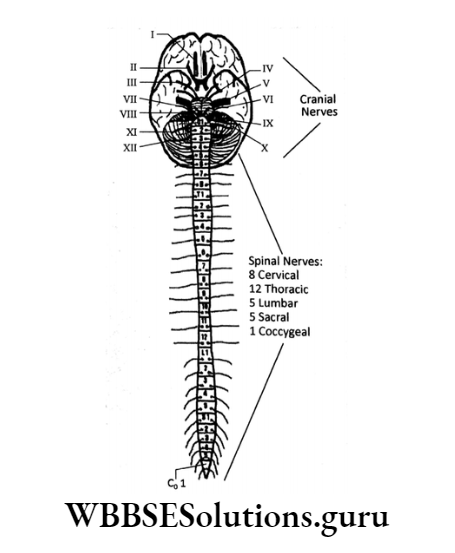
Messages travel through the cranial nerves, which branch out from the brain through various openings of the bones of the cranium of the skull and go to many places such as the ears, eyes, face, heart, lungs, etc.
There are 12 pairs of cranial nerves. Out of these 2 pairs are sensory and the rest are mixed nerves in function.
Messages also travel through the spinal nerves, which branch out from the spinal cord through the intervertebral foramen and supply different parts of the body.
There are 31 pairs of spinal nerves – 8 cervical, 12 thoracics, 5 lumbar, 5 sacral, and 1 coccygeal. Functionally all spinal nerves are of mixed type.
3. Autonomic nervous system:
Is a division of the peripheral nervous system that influences the function of internal organs without our will via motor neurons.
It regulates bodily functions such as the heart rate, digestion, respiratory rate, pupillary response, urination, and sexual arousal.
WBBSE Chapter 1 Response And Physical Coordination In Animals Nervous System Brain And Spinal Cord
Together, the brain and spinal cord form the central nervous system.
This complex system controls the things we choose to do, like walking and talking, and the things our body does automatically, like breathing and digestion of food.
The central nervous system is also involved with our senses and memory.
The brain or Encephalon is a soft, spongy mass of nerve cells and supportive tissue that lies at the cephalic end of the spinal cord within the cranium.
Class 10 Life Science Nervous System Solutions
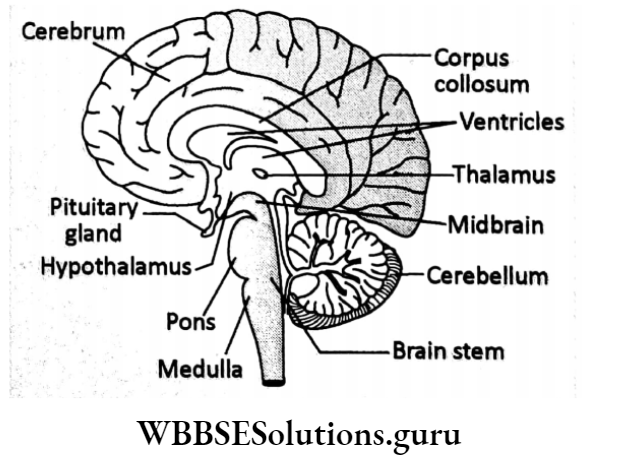
The brain is made of three main parts:
The forebrain, midbrain, and hindbrain. The forebrain consists of the cerebrum, thalamus, and hypothalamus. The midbrain consists of the tectum and tegmentum.
The hindbrain is made of the cerebellum, pons, and medulla. Often the midbrain, pons, and medulla are together referred to as the brain stem. The parts work together, but each has special functions.
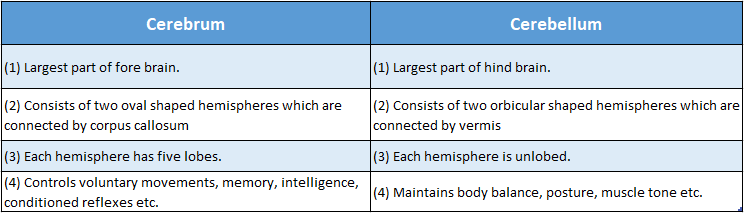
The cerebrum, the largest part of the brain, fills most of the upper skull. It has two halves called the left and right cerebral hemispheres.
The cerebrum uses information from our senses to tell us what’s going on around us and tells our body how to respond. The brain is divided into two halves.
Since the nerves cross when they enter the brain, the left side of our brain controls the right half of our body and the right side controls the left.
Each half also controls specialized functions. The right and left sides of the cerebrum are connected by a thick band of nerve fibers called the corpus callosum.
The cerebral cortex (thin outer layer of tissue) is grey because nerves in this area lack the insulation that makes most other parts of the brain appear to be white.
The cortex covers the outer portion (1.5mm to 5mm) of the cerebrum and cerebellum. The portion of the cortex that covers the cerebrum is called the cerebral cortex.
The cerebral cortex consists of folded bulges called gyri (singular = gyrus) that create deep furrows or fissures called sulci (singular = sulcus).
The folds in the brain add to its surface area and therefore increase the amount of grey matter and the quantity of information that can be processed.
Most of the actual information processing in the brain takes place in the cerebral cortex.
The cerebral cortex is divided into lobes each having a specific function. For example, there are specific areas involved in vision, hearing, touch, movement, and smell.
Other areas are critical for thinking and reasoning. Although many functions, such as touch, are found in both the right and left cerebral hemispheres, some functions are found in only one cerebral hemisphere.
For example, in most people, language abilities are found in the left hemisphere. The lobes of the cerebral cortex are –
(1) parietal Lobe – involved in the reception and processing of sensory information from the body,
(2) frontal Lobe – involved with decision-making, problem-solving, and planning,
(3) occipital Lobe – involved with vision, and
(4) temporal Lobe – involved with memory, emotion, hearing, and language.
The cerebellum is the area of the hindbrain that controls motor movement coordination, balance, equilibrium, and muscle tone.
Like the cerebral cortex, the cerebellum is comprised of white matter and a thin, outer layer of densely folded grey matter. The folded outer layer of the cerebellum (cerebellar cortex) has smaller and more compact folds than those of the cerebral cortex.
Physical Coordination In Animals Class 10 Notes
The cerebellum contains hundreds of millions of neurons for processing data. It relays information between body muscles and areas of the cerebral cortex that are involved in motor control.
The brain stem connects the brain with the spinal cord. It controls hunger and thirst and some of the most basic body functions, such as body temperature, blood pressure, and breathing.
The spinal cord is made up of bundles of nerve fibers. It runs down from the brain through the vertebral canal in the center of the bones of the spine.
These bones protect the spinal cord. The spinal cord rapidly narrows below the lumbar region to form a cone-shaped structure called conus medullaris.
In the transverse section, the spinal cord consists of central grey matter, peripheral white matter, and a central canal. Grey matter is composed of nerve cells, nerve fibers, and neuroglial cells.
The central canal runs through the whole length of the spinal cord and is continuous above the fourth ventricle of the brain.
WBBSE Chapter 1 Response And Physical Coordination In Animals Nervous System Meninges And CSF
The brain is protected by the bones of the skull and by a covering of three thin membranes called meninges. The outer layer of the meninges is called the dura mater.
This protects the brain from movements that may stretch and break brain blood vessels. The middle layer of the meninges is called the arachnoid.
It is the protective membrane that covers the brain and spinal cord. The inner layer, the one closest to the brain, is called the pia mater.
It functions to cover and protect the CNS, to protect the blood vessels and enclose the venous sinuses near the CNS, to contain the cerebrospinal fluid (CSF), and to form partitions with the skull.
Under the dura mater, the fluid-filled space is known as subdural space and the space in between the arachnoid & the pia mater is called the subarachnoid space.
The brain is also cushioned and protected by cerebrospinal fluid (CSF). This is a watery, clear, colorless fluid flowing through the ventricles and in spaces between the meninges.
Physical Coordination In Animals Class 10 Notes
CSF contains glucose, protein, lactic acid, various cations & anions, etc.
Cerebrospinal fluid brings nutrients from the blood to the brain and removes waste products from the brain. It acts as a cushion or buffer for the brain inside the skull.
Like the brain, the spinal cord is also covered by the meninges and cushioned by cerebrospinal fluid.
WBBSE Chapter 1 Response And Physical Coordination In Animals’ Nervous System Reflex Action
When a receptor is stimulated, it sends a signal to the central nervous system, where the brain coordinates the response. But sometimes a very quick response is needed, one that does not need the involvement of the brain.
This is called a reflex action. Reflex actions are rapid and happen without the involvement of thinking. For example, you would pull your hand away from a hot flame without thinking about it.
Even coughing and sneezing are reflexes. They clear the airways of irritating things.
Reflex action is a spontaneous involuntary (automatic) motor response due to a sensory stimulus that either may be harmful or routine in nature.
Examples:
- Blinking of eyelids,
- Contraction of pupils when exposed to light,
- Withdrawal of hand when one touches a hot object,
- Sneeze reflex when the nose is irritated,
- Cough reflex when the throat is irritated,
- Lacrimal reflex as tears are produced to clear objects from the eye.
WBBSE Chapter 1 Response And Physical Coordination In Animals Nervous System Types Of Reflex Action
Reflexes Are Of Two Types:
- Inborn or simple or unconditioned or natural reflex and
- Acquired or complex or conditioned reflex.
Inborn Or Simple Or Unconditioned Or Natural Reflex:
In this type of reflex, the brain is not involved. The receptor is stimulated which is conducted to the spinal cord by the effector.
The effector neuron from the spinal cord conducts a response to the muscle or the gland. This causes an immediate reaction. It does not involve any thinking or reasoning.
Unconditioned reflex is a natural response present since the birth of an individual and occurs even in newborn babies. For example, blinking of eyes when strong light falls on the eyes.
Response And Physical Coordination In Animals Class 10 WBBSE
The moving away of hand in response to pin-prick or heat is an example of this type.
Some other examples of unconditioned responses include gasping in pain after being stung by a bee, jerking your hand back after touching a hot plate on the oven, and jumping at the sound of a loud noise. In each of the above examples, the response occurs centers of the brain.
The reflexes that are not present since the birth of an individual but are acquired as a result of repeated practice and/or training are called conditioned or acquired reflex actions.

Example:
Swimming, cycling, writing, playing a musical instrument, etc.
The neural pathways in response to conditioned stimulus develop after practice. It is not transmitted through heredity. It may be lost if the conditioned stimulus is discontinued over a long period.
A series of experiments were conducted by Ivan Pavlov, a Russian biologist which demonstrated conditioned reflex. He found that when a bell was rung every time a dog was given food, the dog showed salivation only at the sound of the bell.
The ringing of the bell is called the conditioned stimulus. The dog had, thus, ‘learned’ to associate the sound of the bell to food and this made it salivate at the sound of the bell.
WBBSE Chapter 1 Response And Physical Coordination In Animals Nervous System Components Of Relax Arc
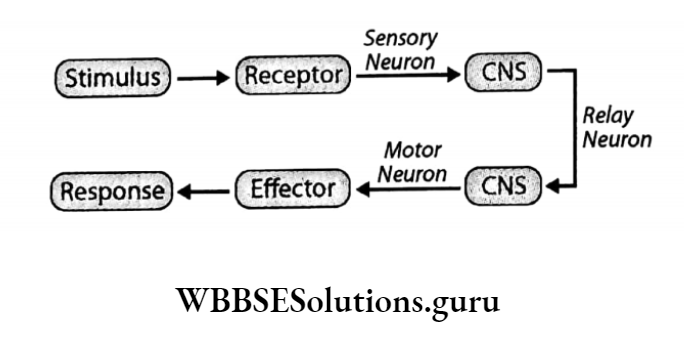
The sequences of events in a simple reflex action are stimulus receptor sensory neuron relay neuron motor neuron effector.
An arc-like neural pathway formed by a chain of neurons between receptor & effector organs through which reflex action takes place is called the reflex arc.
A reflex arc consists of five components:
Receptor:
It is a specialized sensory ending that detects a stimulus (change in the environment),
Sensory Neuron:
It forms the afferent limb of the arc and sends a signal to the relay neuron;
The relay neuron at the nerve center:
It lies in the grey matter of the spinal cord, or the brain stem. It sends the signal to the motor neuron,
The motor neuron:
It sends a signal to the effector and forms the efferent limb of the arc.
The effector:
It produces a response (the hand is pulled away quickly in response to an open flame) according to the directives of the nerve center. It may be a muscle, gland, or visceral organ.
WBBSE Chapter 1 Response And Physical Coordination In Animals Nervous System Importance Of Different Reflexes In Everyday Life
The speed of our reactions plays a large part in our everyday life.
We might duck in response to a loud sound, dodge if we see something coming towards us, retract if we touch something hot, or pull away if we stand on something sharp. A few common examples are-
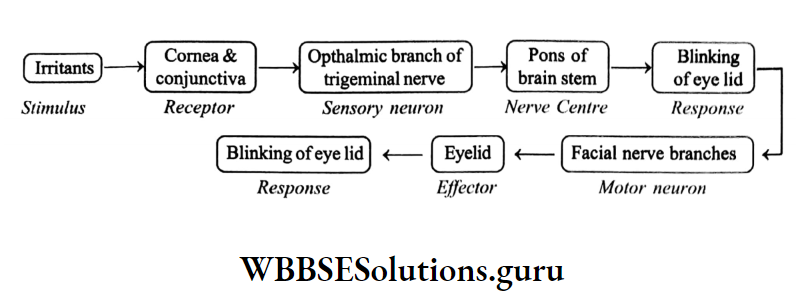
1. Blinking Of the Eye:
Blinking is a semi-autonomic rapid closing of the eyelid. A single blink is determined by the forceful closing of the eyelid, not the full opening and closing.
Response And Physical Coordination In Animals Class 10 WBBSE
Purpose:
It is an essential function of the eye that helps to spread tears across and removes irritants from the surface of the cornea and conjunctiva.
Coughing:
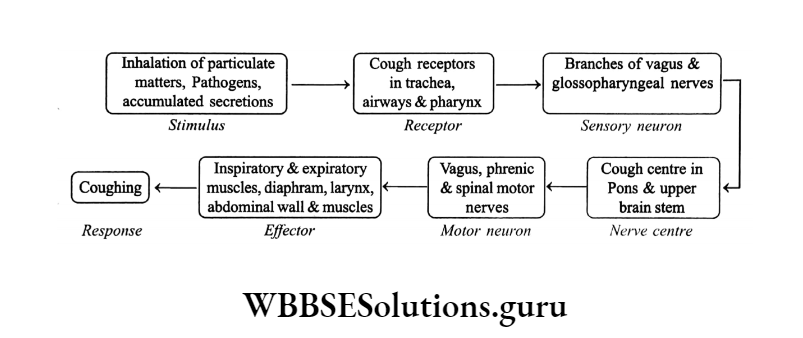
The cough reflex has both sensory (afferent) mainly via the vagus nerve and motor (efferent) components.
Pulmonary irritant receptors (cough receptors) in the epithelium of the respiratory tract are sensitive to both mechanical and chemical stimuli.
The bronchi and trachea are so sensitive to light touch that slight amounts of foreign matter or other causes of irritation initiate the cough reflex.
Response And Physical Coordination In Animals Class 10 WBBSE
Purpose:
The cough reflex removes foreign material from the respiratory tract before it reaches the lungs.
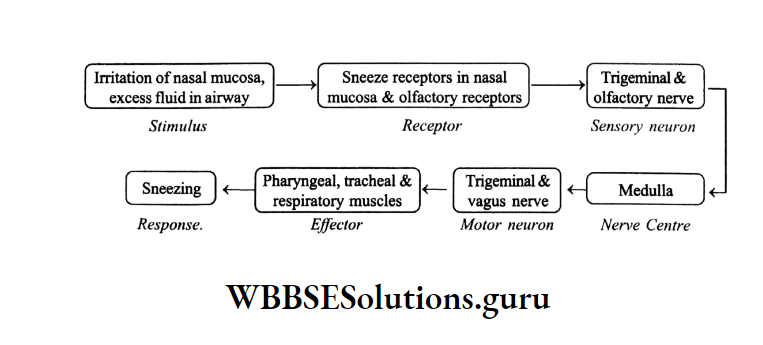
Sneezing:
Sneezing is a protective reflex and is sometimes a sign of various medical conditions.
A sneeze is the expulsion of air from the lungs through the nose and mouth, most commonly caused by the irritation of the nasal mucosa.
Sneezing is a coordinated protective respiratory reflex that occurs due to stimulation of the upper respiratory tract, particularly the nasal cavity.
Purpose:
Sneezes protect our body by clearing the nose of bacteria & viruses. It expels mucus containing irritants and foreign particles to cleanse the nasal cavity.
The Components Of the reflex arc are:
WBBSE Chapter 1 Response And Physical Coordination In Animals’ Nervous System Eyes And Coordination With Environment
In order to be able to learn about and/or solve problems presented to them by their environment, humans must be able to take in information from that environment;
process it quickly and accurately; decide when, how, and what action to take; and then perform or execute that action. To receive information from the environment we are equipped with sense organizer
A sense organ is a specialized bodily structure that receives or is sensitive to internal or external stimuli. It is composed of receptors. Human sense organs are the eyes, ears, tongue, skin, and nose.
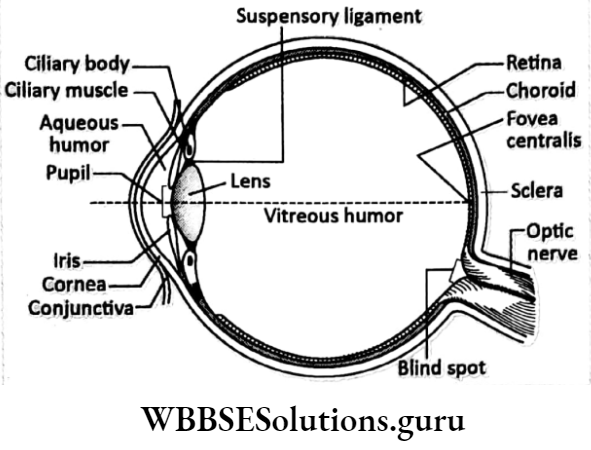
The Eye As A Sense Organ-Its Location, Structure, And Function
The sense organ consisting of photosensitive receptors (the rod & cone cells) and which helps us in vision is known as the eye.
The two eyes are located in the deep cavities of the skull called orbits on the frontal part of the cranium.
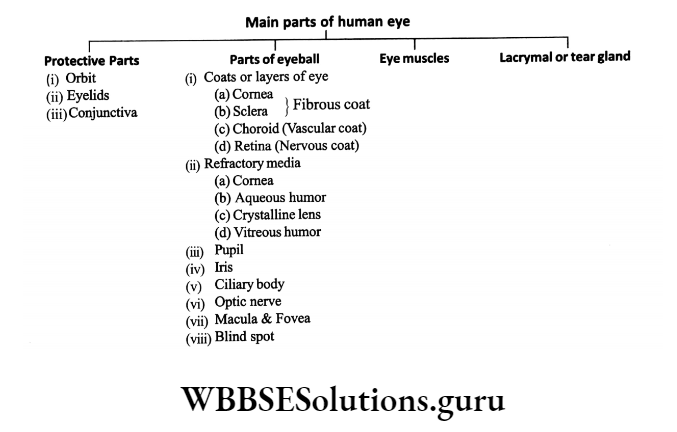
The structure of different parts of the human eye and their corresponding functions are given below:
WBBSE Chapter 1 Response And Physical Coordination In Animals Nervous System Binocular Vision
We humans are largely binocular beings. Each eye alone gives us roughly a 130-degree field of vision. With two eyes, we can see nearly 180 degrees.
Because our eyes sit side by side, each eye captures a slightly different view. When signals from the two eyes reach the brain, they are superimposed and processed into a single picture with depth.
As a result, we get a 3D picture and can judge distances well. Binocular vision is vision using two eyes with overlapping fields of view and a good perception of depth to create a single visual image.
Advantages Of Binocular Vision:
Increased depth perception to clearly distinguish between nearness & farness.
Flexibility to focus on the image directly with one eye in case the other one is damaged or blinded.
Allows 3D vision.
Visibility beyond an obstacle.
Most birds and lizards have monocular vision their eyes are on each side of their head. This gives them a greater field of view, which is useful for spotting predators.
However, they have poor depth perception. Monocular vision is the vision in which both eyes are used separately to increase the field of view while the perception of depth becomes limited.
Response And Physical Coordination In Animals Class 10 WBBSE
Advantages Of Monocular Vision:
It enables the animal to see its surroundings and to detect the predators that might be ambushing from the sides.
It provides a wider range of vision.
WBBSE Chapter 1 Response And Physical Coordination In Animals’ Nervous System Accommodation Viewing Near And Distant Objects
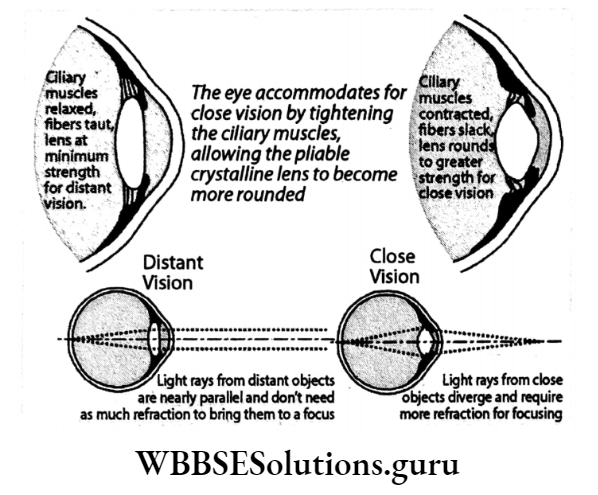
The accommodation is a reflex action of the eye, in response to focusing on a near object, then looking at a distant object (and vice versa), comprising coordinated changes in vergence, lens shape, and pupil size.
Mechanism of accommodation:
The lens is responsible for accommodation, i.e., the adjustment of the eye for observing near or far objects. It does this by changing its shape.
This changes the focal length of the lens and permits it to focus the image formed on it by the cornea. The lens is suspended from the muscular ciliary body by a number of delicate zonule fibers attached to its equator.
In the normal relaxed condition (that is, with no tension placed on the fibers by contraction of the ciliary muscle) the lens’ shape is such as to refract rays from distant objects, and the eye is focused at infinity.
Accommodation for close vision requires tension to be exerted to deform the lens. Contraction of the muscles of the ciliary body tugs at the fibers and changes the shape of the lens. Thus, the eye adjusts the shape of the lens to keep objects in focus.
Looking at distant objects:
Ciliary muscles relaxed → lens becomes thin→ focal length of the lens increases.
Looking At Objects Closer To The Eye:
Ciliary muscles contract→ increases the curvature of the eye lens → lens becomes thick → focal length of the lens decreases.
The young human eye can change focus from distance (infinity) to as near as 6.5cm from the eye. The amplitude of accommodation declines with age.
Mammals, birds & reptiles vary their optical power by changing the form of the elastic lens using the ciliary body. Fish & amphibians vary their power by changing the distance between the rigid lens and the retina with muscles.
An example of accommodation can be cited from daily life situations. Good vision for drivers is a crucial factor in road safety, both for the pedestrians and passengers of the car.
This is required to avoid road accidents by taking note of obstacles, traffic signals, and road directions. Distance acuity is probably the most important visual skill for driving.
WBBSE Life Science Class 10 Chapter 1 Questions And Answers
Distance acuity is the ability to focus and see clearly at far distances. Even the simplest reactions in driving take at least 0.4 seconds.
A driver has to change focus quickly and easily from the road to the dashboard and back again. Being able to see color is also pretty important in car driving.
WBBSE Chapter 1 Response And Physical Coordination In Animals Nervous System Defects Of Visions And Corrective Measures
A person with normal eyes can, by accommodation, see all objects that are at a distance greater than about 25 cm from the eye.
If due to certain abnormalities the eye is unable to accommodate itself to various distances, then the eye is said to be defective.
Some common defects of the eye are—
1. Myopia:
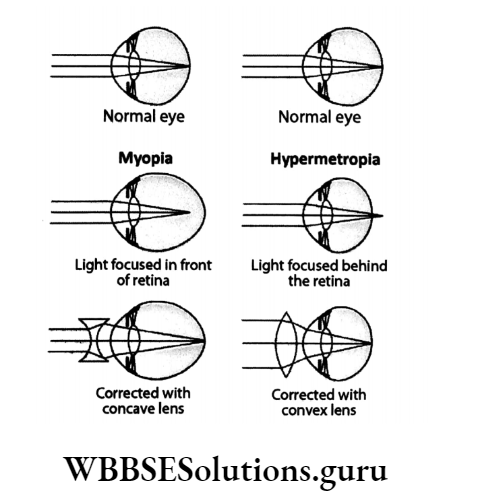
Near-sightedness, also called myopia is the common name for impaired vision in which a person sees near objects clearly while distant objects appear blurred.
In such a defective eye, the image of a distant object is formed in front of the retina and not at the retina itself. Consequently, a nearsighted person cannot focus clearly on an object farther away than the far point of the defective eye.
Causes:
This defect arises because the power of the eye is too great due to the decrease in the focal length of the crystalline lens.
This may arise due to either-
Excessive curvature of the cornea, or
Elongation of the eyeball.
Correction:
This defect can be corrected by using a concave (diverging) lens. A concave lens of appropriate minus (-) power or focal length can bring the image of the object back to the retina itself.
2. Hyperopia or hypermetropia:
Far-sightedness, also called hyperopia or hypermetropia, is the common name for a defect in vision in which a person sees near objects with blurred vision, while distant objects appear in sharp focus.
In this case, the image is formed behind the retina.
Causes:
This defect arises because either
the focal length of the eye lens is too great, or
the eyeball becomes too short so that light rays from the nearby object cannot be brought to focus on the retina to give a distinct image.
Correction:
This defect can be corrected by using a convex (converging) lens of appropriate focal length. Eyeglasses with converging lenses supply the additional focusing plus (+) power required for forming the image on the retina.
3. Presbyopia:
Presbyopia is a progressive form of farsightedness that affects most people by their early 40s. The power of accommodation of the eye decreases with aging.
Most people find that the near point gradually recedes.
WBBSE Life Science Class 10 Chapter 1 Questions And Answers
Causes:
It arises due to the gradual weakening of the ciliary muscles and diminishing flexibility of the crystalline lens.
Correction:
Simple reading eyeglasses with convex lenses correct most cases of presbyopia.
Sometimes, a person may suffer from both myopia and hypermetropia. Such people often require bifocal lenses.
In the bifocal lens, the upper portion of the bifocal lens is a concave lens, used for distant vision. The lower part of the bi-focal lens is a convex lens, used for reading purposes.
Cataract:
Generally, this defect can be found in aged or old people. Persons with this defect get blurred vision which sometimes even leads to total blindness.
The reason for this defect is that the lens loses its transparency and becomes opaque due to the deposition of protein material and calcium minerals in the lens.
This opaque condition of the lens does not allow the light rays from an object to pass through the lens. This defect can be rectified by surgically removing the lens and it has to be replaced by a highly convex lens.
Before intraocular lenses (lOLs) were developed, people had to wear very thick eyeglasses or special contact lenses to be able to see after cataract surgery.
Now, with cataract lens replacement by phacoemulsification or phaco surgery, several types of IOL implants are available to help people enjoy improved vision.
WBBSE Chapter 1 Response And Physical Coordination In Animals Nervous System Fill In The Blanks
Question 1. Between the receptors and effectors are the conducting cells of the nervous system, termed______________
Answer: Neurons
Question 2. ______________are specialized for the conduction of a particular type of electric impulse, called an action potential, outward, away from the cell body toward the axon terminus.
Answer: Axons
Question 3. ______________is a dense group of nerve cell bodies present in most animals.
Answer: Ganglion
Question 4. The central nervous system is divided into two parts: the brain and the______________.
Answer: Spinal cord
Question 5. In human there are______________ pairs of cranial nerves.
Answer: 12
Question 6. The forebrain consists of the______________ , thalamus, and hypothalamus.
Answer: Cerebrum
WBBSE Life Science Class 10 Chapter 1 Questions And Answers
Question 7. ______________is associated with vision, hearing, motor control, sleep/wake, arousal and temperature regulation.
Answer: Mid-brain
Question 8. The funnel-shaped structure of the cell body from where the axon arises is known as the______________.
Answer: Axon Hillock
Question 9. Salivation on smelling one’s favorite food is an example of reflex.
Answer: Control
Question 10. The______________ is the thin, transparent tissue that covers the outer surface of the eye.
Answer: Conjunctive
Question11. The______________ is the area of the eye that contains the pigment which gives the eye its color.
Answer: Iris
Question 12. Near-sightedness, also called______________ is the common name for impaired vision in which a person sees near objects clearly while distant objects appear blurred.
Answer: Myopia
Question 13. The middle layer of covering of a nerve is known as the______________.
Answer: Perineurium
Question 14. An axosomatic type of synapse is formed between the axon terminal of one neuron with the______________ of another.
Answer: Cell body
Response And Physical Coordination In Animals Class 10 WBBSE
Question 15. Cycling is an example of______________ reflex action.
Answer: Acquired
WBBSE Chapter 1 Response And Physical Coordination In Animals Nervous System Write True Or False
Question 1. Unconditioned reflex action occurs in newborn babies also.
Answer: True
Question 2. The nervous system is made up of two major types of cells known as neurons and neuroglia.
Answer: True
Question 3. Almost every neuron has multiple axons.
Answer: False
Question 4. Gaps that occur at regular intervals in the myelin sheath of medullated nerve fibers, between adjacent Schwann cells are known as nodes of Ranvier.
Answer: False
Question 5. Sensory neurons are found exclusively within the spinal cord and brain.
Answer: False
Response And Physical Coordination In Animals Class 10 WBBSE
Question 6. Information from one neuron flows to another neuron across a synapse.
Answer: True
Question 7. The nervous system is divided into the central nervous system and the autonomic nervous system.
Answer: False
Question 8. The autonomic nervous system is voluntarily controlled.
Answer: False
Question 9. The right and left sides of the cerebral cortex are connected by a thick band of nerve fibers called the cerebral hemispheres.
Answer: False
Question 10. The pons is a portion of the hindbrain that connects the cerebral cortex with the medulla oblongata.
Answer: True
Question 11. The brain is protected by the bones of the skull and by a covering of three thin membranes called meninges.
Answer: True
Question 12. Pavlov, a Russian biologist demonstrated conditioned reflexes.
Answer: True
Question 13. No perception of vision is there in the fovea centralis.
Answer: False
Response And Physical Coordination In Animals Class 10 WBBSE
Question 14. In cataracts, the eye lens loses its transparency & becomes opaque.
Answer: True
Question 15. In nervous coordination, the signal transmission is slow and the functions are long-lasting.
Answer: False
WBBSE Chapter 1 Response And Physical Coordination In Animals Nervous System Match The Columns
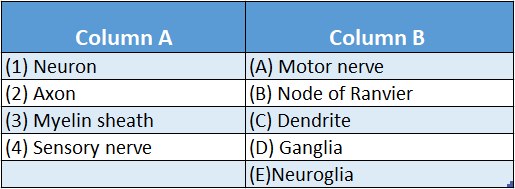
Answer: 1-A,2-C,3-B,4-A
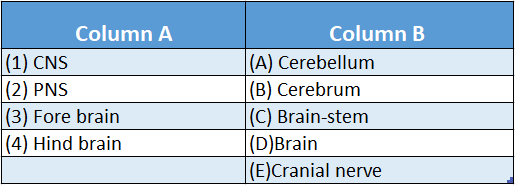
Answer: 1-D,2-E,3-B,4-A

Answer: 1-D,2-C,3-B,4-E
WBBSE Chapter 1 Response And Physical Coordination In Animals Nervous System Very Short Answer Type Questions
Question 1. Which neurons transmit information from the sensory receptor(s) to the central nervous system?
Answer: Sensory neurons.
Question 2. What is a nerve?
Answer: A nerve is an enclosed, cable-like bundle of axons with associated connective tissue & blood vessels in the peripheral nervous system.
Question 3. What is the nature of the 5th (trigeminal) cranial nerve?
Answer: It is a mixed nerve.
Question 4. What is the corpus callosum?
Answer: The right and left sides of the cerebral cortex are connected by a thick band of nerve fibers called the corpus callosum.
Question 5. What is the cerebral cortex?
Answer: The cerebral cortex is the outer layer of the cerebrum section of the brain.
WBBSE Class 10 Life Science Chapter 1 Solutions
Question 6. What are meninges?
Answer: The brain is protected by the bones of the skull and by a covering of three thin membranes called meninges.
Question 7. In which type of reflex, the brain is not directly involved?
Answer: Inborn or simple or unconditioned reflex.
Question 8. Why the blind spot of the eye is not sensitive to light?
Answer: This is not sensitive to light because there are no rods or cones there.
Question 9. How myopia can be corrected?
Answer: This defect can be corrected by using a concave lens. (‘—’ power).
Question 10. What is presbyopia?
Answer: Presbyopia is a progressive form of farsightedness that affects most people by their early 40s.
Question 11. Why does the flow of signals in a synapse occur from the axonal end of one neuron to the dendritic end of another neuron but not the reverse?
Answer: When a nerve impulse arrives at the synaptic knob of a presynaptic axon terminal of a neuron, it triggers exocytosis of synaptic vesicles to release neurotransmitter molecules.
Neurotransmitters diffuse across the synaptic cleft and bind to the neurotransmitter receptors to generate electrical impulses for onward transmission.
Hence, an electrical signal is first converted to a chemical signal at the axonal end, and then again it is reconverted to an electrical signal.
Since the neurotransmitter molecules are absent at the dendrite end of the neuron, hence a dendrite cannot convert an electrical impulse to a chemical signal.
Question 12. Why nerve cells do not divide?
Answer: Though a fully developed nerve cell body contains centrosomes, the cell body cannot divide. The role of the centrosome is not yet known. Therefore in an animal body, the number of neurons present in a newborn baby is the same as that present in an adult, i.e. the number remains unchanged, only the size increases.
WBBSE Class 10 Life Science Chapter 1 Solutions
Question 13. State the location and functions of its granules.
Answer: Nissl granules are present in the cytoplasm of the cell body of a neuron. These help in the transmission of nerve impulses.
Question 14. What are collaterals?
Answer: Axons may form lateral branches called collaterals.
Question 15. Which type of photoreceptor cells are more sensitive to light and why?
Answer: Rod cell receptors are stimulated in low light intensity whereas to simulate cone cell receptors more intensity of light is required. Hence rod cells are more sensitive to light than cone cells
Question 16. Mention the size and weight of an adult brain.
Answer: Size: About 1500 cc.
Weight: About 1200-1400g (nearly 2% of total body weight)
Question 17. What are filum terminale ?
Answer: From the tip or conus medullaris of the spinal cord, the non-nervous fibrous tissue filaments called filum terminale pass downwards.
Question 18. Which one is the largest cranial nerve?
Answer: Trigeminal (5th cranial nerve).
Question 19. Which areas act as the highest centers for the Autonomic Nervous system?
Answer: Hypothalamus and extrapyramidal area of the cerebral cortex.
Question 20. Mention the refractive indices of the components of refractory media of the human eye.
Answer:
Cornea → 1.37 (nearly)
Aqueous humor → 1.33 (nearly)
Lens → 1.40 to 1.42 Vitreous humor → 1.34 (nearly)
WBBSE Class 10 Life Science Chapter 1 Solutions
Question 21. A pair of related terms is given below. Based on the relationship in the first pair, write the suitable word in the gap of the second pair:
Answer:
Sneezing: Inborn reflex action:: Cycling Acquired reflex action _______________
__________: 12 pairs:: Spinal nerves: 31 pairs Cranial nerves
Optic nerve : sensory:: Trochlear:________________Motor
Question 22. Among the following four terms, one includes the other three. Find out that term and write it:
- Dopamine, neurotransmitters, serotonin, acetylcholine neurotransmitters
- Refractory media, cornea, aqueous humor, vitreous humor refractory media.
WBBSE Chapter 1 Response And Physical Coordination In Animals Nervous System Short Answer Type Questions
Question 1. Show the pathway of nerve impulse transmission in a word diagram.
Answer:
The pathway of nerve impulse transmission in a word diagram
Stimuli → Sensory receptors → Sensory neuron→ CNS (spinal cord) → Relay neuron → Brain or simple reflex arc → Motor neuron Effector (muscle or gland).
Question 2. Mention any two functions of the nervous system
Answer:
Any two functions of the nervous system
It perceives the changes around us by receiving stimuli through sensory neurons intensity (i.e. dim light),
whereas to stimulate cone cell receptors more intensity of light is required (i.e. bright light). Hence rod cells are more sensitive to light than cone cells.
It controls and coordinates all the activities of the effectors (muscles, glands, or visceral organs) in response to outside changes.
Question 3. What is neuroglia?
Answer:
Neuroglia
Neuroglia are commonly known as glial cells or sometimes as glia. These non-neuron cells of the nervous system are important to maintain homeostasis as well as to form myelin.
Neuroglia are also important for the protection of neurons in the brain, and there are almost the same number of neuroglia cells as the number of neuron cells in the human brain.
The structure of this cell is like a spider or an octopus, but there is no axon as in neurons.
Question 4. What are interneurons?
Answer:
Interneurons
These are found exclusively within the spinal cord and brain. They are stimulated by signals reaching them from sensory neurons, other interneurons, or both.
Interneurons are also called association neurons or adjustors. It is estimated that the human brain contains 100 billion (1011) interneurons averaging 1000 synapses on each; that is, some 1014 connections.
Question 6. What are ganglia?
Answer:
Ganglion
Ganglion (plural ganglia) is a dense group of nerve-cell bodies present in most higher animals. In vertebrates, the ganglion is a cluster of neural bodies outside the central nervous system.
In the central nervous system, such collections of neurons are called nuclei. A spinal ganglion, for instance, is a cluster of nerve bodies positioned along the spinal cord at the dorsal and ventral roots of a spinal nerve.
The dorsal root ganglia contain the cell bodies of afferent nerve fibers. Efferent neurons are present in the ventral root ganglia.
Ganglia provide relay points and intermediary connections between different neurological structures in the body, such as the peripheral and central nervous systems.
WBBSE Class 10 Life Science Chapter 1 Solutions
Question 7. Classify the following as conditioned or unconditioned reflex actions:
- Applying the brake of a car at a red signal.
- Sweating
- opening the door on hearing the doorbell
- looking left or right before crossing the road
- knee jerk.
Mention the differences between conditioned and unconditioned reflex actions.
- Conditioned reflex action
- Unconditioned reflex action

Question 8. How many types of reflex arcs are there?
Answer:
Asynaptic Reflex Arc:
This type of reflex arc does not contain any synapse and a single neuron acts both as sensory & motor components.
Monosynaptic Reflex Arc:
It is made up of one sensory & one motor fiber with one synapse in between.
Disynaptic reflex arc:
It consists of two synapses between three neurons.
Polysynaptic reflex arc:
There are many synapses in this type of arc.
Complex reflex arc:
It involves several reflex arcs spanning several spinal segments.
WBBSE Class 10 Life Science Chapter 1 Solutions
Question 9. Name a neuron that possesses an axon only. Differentiate between axon & dendron. The amacrine cell of the retina of the human eye Possesses an axon only.
Answer:

Question 10. Mention one similarity and one dissimilarity between the nervous system and the endocrine system.
Similarity:
Both the nervous system and the endocrine system coordinate, regulate and integrate all the physiological functions in the animal body.
While the mode of coordination is chemical in nature for the endocrine system, it is electrochemical in nature in the case of the nervous system.
Dissimilarity:
Nervous control is rapid with a short-lived effect. Endocrinal control is slow but with long-lasting effects.
Question 11. What are the lobes of the cerebral cortex?
Answer:
The lobes of the cerebral cortex
The cerebral cortex is divided into several lobes, as- parietal lobe— is involved in the reception and processing of sensory information from the body;
frontal lobe- involved with decision-making, problem-solving, and planning; occipital lobe- involved with vision; and temporal lobe — involved with memory, emotion, hearing, and language.
Question 12. What are the functions of the cerebellum?
Answer:
The functions of the cerebellum
The cerebellum receives information from the sensory systems, the spinal cord, and other parts of the brain and then regulates motor movements.
The cerebellum coordinates voluntary movements such as posture, balance, coordination, and speech, resulting in smooth and balanced muscular activity. It is also important for learning motor behaviors.
Question 13. State the location of the medulla oblongata.
Answer:
The location of the medulla oblongata
Medulla oblongata, also called medulla, is the lowest part of the brain and the lowest portion of the brainstem.
The medulla oblongata is connected by the pons to the midbrain and is continuous posteriorly with the spinal cord, with which it merges at the opening (foramen magnum) at the base of the skull.
Question 14. What are the components of the reflex arc?
Answer:
A reflex arc consists of five components of receptors:
- Detects a stimulus (change in the environment),
- A sensory neuron sends a signal to the relay neuron,
- The relay neuron at the nerve center sends the signal to the motor neuron,
- The motor neuron: sends a signal to the effector and
- The effector produces a response (a muscle or gland or visceral organ).
Question 15. What is the importance of blinking of eyes?
Answer:
The importance of blinking of eyes
Blinking is a semi-autonomic rapid closing of the eyelid. A single blink is determined by the forceful closing of the eyelid, not the full opening and closing.
It is an essential function of the eye that helps to spread tears across and removes irritants from the surface of the cornea and conjunctiva.
Class 10 Life Science Nervous System Solutions
Question 16. Distinguish between sensory, motor, and mixed nerve.
Answer:
Difference between sensory, motor, and mixed nerve
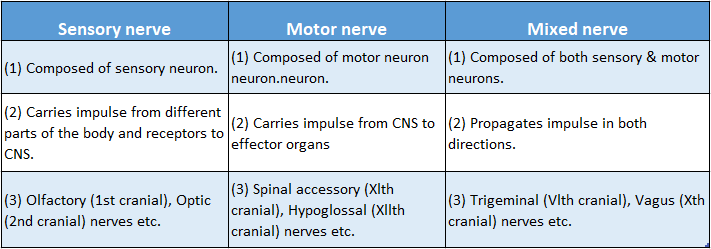
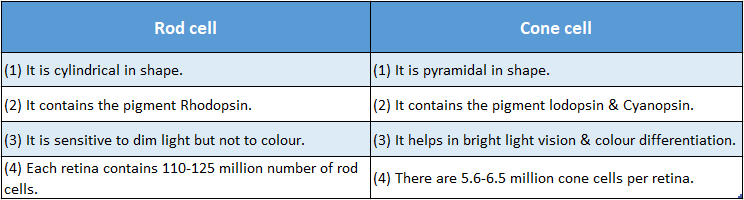
Question 17. What is a photoreceptor? Give examples. Enumerate The difference Between rod and cone cells.
Answer:
Photoreceptor
A photoreceptor is a specialized structure or cell (enterocele receptor) that is sensitive to light falling on it and can convert the light impulse into a nerve impulse.
There are three known photoreceptor cells in mammalian eyes:
Rods, Cones, And Photosensitive Retinal Ganglion Cells.
Question 18. Distinguish between cerebrum & cerebellum.
Answer:
Difference between cerebrum & cerebellum
Question 19. What are the causes of hypermetropia?
Answer:
The causes of hypermetropia
Hypermetropia arises because either the focal length of the eye lens is too great, or The eyeball becomes too short so that light rays from the nearby object cannot be brought to focus on the retina to give a distinct image.
Question 20. What is a cataract?
Answer:
Cataract
Generally cataracts can be found in old age people. Persons with this defect get blurred vision and it sometimes even leads to total blindness.
The reason for this defect is that the lens loses its transparency and become opaque due to the deposition of protein material and calcium mineral in the lens.
This opaque condition of the lens does not allow the light rays from an object to pass through the lens.
Question 21. How cataract can be rectified?
Answer:
Cataracts can be rectified by surgically removing the lens and it has to be replaced by a highly convex lens. Before intraocular lenses (lOLs) were developed,
people had to wear very thick eyeglasses or special contact lenses to be able to see after cataract surgery.
Now, with cataract lens replacement by phacoemulsification or phaco surgery, several types of IOL implants are available to help people enjoy improved vision.
Question 22. What are aqueous humor & vitreous humor? Mention their functions.
Answer:
Aqueous humor
Aqueous humor is a transparent, watery extracellular fluid that fills up the chamber in front of the eye lens. It is secreted from the ciliary epithelium.
Functions:
- Maintains intraocular pressure & inflates the globe of the eye.
- Provides nutrition to the posterior cornea, lens, etc.
- Acts as a refracting medium.
- Contains immunoglobulins that defend against pathogens.
- The vitreous humor is a transparent, colorless, gelatinous mass that fills the space in the eye between the lens and the retina.
Functions:
- It maintains the shape & pressure of the eye.
- Acts as a refractive medium.
- It contains phagocytes which keep the visual axis clear most of the time.
Chapter 1 Response And Physical Coordination In Animals Nervous System Long Answer Type Questions
Question 1. Show the nervous pathway with the help of a word diagram. Briefly explain the functioning of the pathway with the help of the doorbell reflex.
Answer:
The Nervous Pathway To Respond To Stimuli
This indicates that the first event in this sequence is a “Stimulus” (“Stimuli” is the plural form). It may be internal or external.
In this context, a stimulus may be defined as a physiochemical change in the environment that the human sensory receptors can detect, e.g. sound, physical contact, taste, visual sensation, hunger, etc. Irritability or sensitivity is a characteristic feature of all living organisms.
The next stage in the pathway is the “Sensory Receptors” sensing the stimulus. These receptors are located all over the body but some types of receptors are in specific areas of the body (e.g. taste buds on the tongue in the mouth).
Sensory neuron(s) then transmit information from the sensory receptor(s) to the Central Nervous System (CNS i.e. the brain and spinal cord).
This happens because peripheral nerves are connected to the spinal cord via the network of nerves within the nervous system.
The information so received by the CNS is further transmitted by relay neuron(s).
Finally, an effector (muscle and gland) brings about a response.
This pathway may be explained by a common example of our response after hearing of the doorbell.
The ringing of the doorbell is the external stimulus. It generates sound waves that travel through the air.
The air-borne sound waves travel down through the ear canal and strike the tympanic membrane, causing it to vibrate. This vibration passes through the middle ear ossicles to the inner ear and finally stimulates the hair cells of the Organ of Corti.
The ear acts as the sensory photoreceptor for the sound stimulus. It is the movement of these hair cells which converts the vibrations into afferent nerve impulses,
The nerve impulses travel over the central auditory sensory pathways to the auditory cortex of the brain,
The brain or CNS interprets the impulses as sound and generates a response (in this case it is the action to open the door),
The response is achieved through motor nerves by our body movement to open the door.
Class 10 Life Science Nervous System Solutions
Communication between receptors and effectors – Between the receptors and effectors are the conducting cells of the nervous system, termed neurons.
These are the basic structural and functional units of the nervous system. They are spread throughout the body of the organism forming a complex communication network. Neurons communicate through an electrochemical process.
Difference Between Mode Of Action Of Hormone And Nervous System:
Both nervous and endocrine systems are the basic systems that regulate the biological processes inside an organism but through different means of passing signals.
However, the basic differences between them, regarding mode of action is-
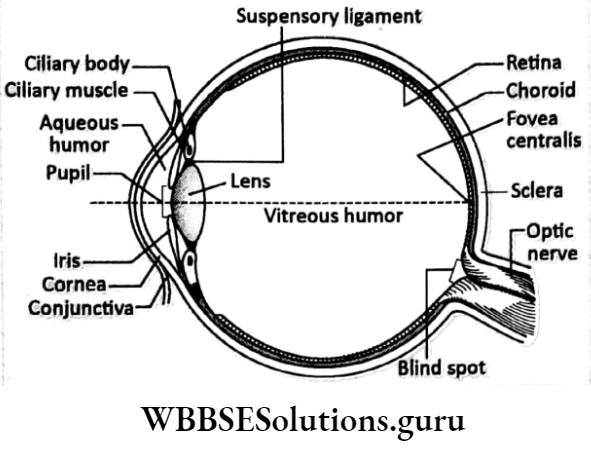
Question 3. Draw a labeled diagram of the human eye.
Answer: Diagram of the human eye:
Question 8. Mention the location of the following
- sulcus & gyrus
- inspiratory & expiratory centers
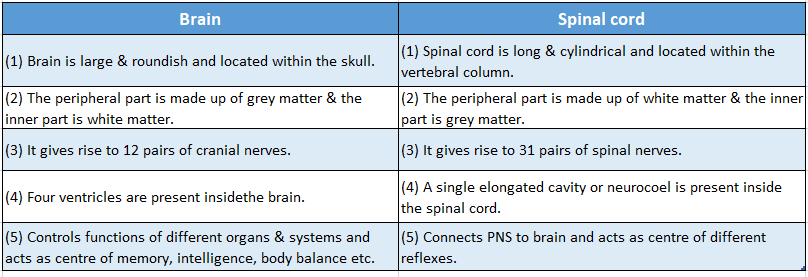
- conus medullaris Enumerate the differences between the brain & spinal cord.
Answer:
- sulcus & gyrus → cerebral cortex in the forebrain
- inspiratory & expiratory centres → pons in hindbrain
- conus medullaris → spinal cord
Question 9. Which part of the eye-
- Acts as the diaphragm of a camera
- Prevents the reflection of extra light within it.
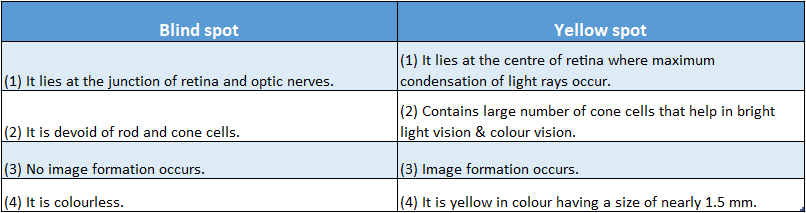
- Give the differences between blind spots and yellow spots.
Answer:
- Iris
- Choroid
Question 9. Which part of the eye
- Acts As a Diaphram of the camera
- prevents reflections Of extra light within it.
Give the differences between blind spots and yellow spots.
Answer:
- It is
- Choroid
Class 10 Life Science Nervous System Solutions
Question 10. Identify the animals having monocular & binocular vision:
Eagles, lizards, lions, owls, fish, snakes & cows. Give the differences between monocular & binocular vision. What is the normal field of view of human beings?
Answer:
Monocular vision: lizards, cows, fish Binocular vision: eagles, lions, snakes, owls. The field of view of human Beings is 190º for binocular vision.

Example 11. Explain with a diagram how myopia can be corrected. What type of lens is needed to correct presbyopia?
Which defect of the eye cannot be cured by any type of spectacle lens?
Answer:
Defects Of Visions And Corrective Measures
A person with normal eyes can, by virtue of accommodation, see clearly all objects that are at a distance greater than about 25 cm from the eye.
If due to certain abnormalities the eye is unable to accommodate itself to various distances, then the eye is said to be defective.
Some common defects of the eye are—
1. Myopia:
Near-sightedness, also called myopia is the common name for impaired vision in which a person sees near objects clearly while distant objects appear blurred.
In such a defective eye, the image of a distant object is formed in front of the retina and not at the retina itself. Consequently, a nearsighted person cannot focus clearly on an object farther away than the far point of the defective eye.
Causes:
This defect arises because the power of the eye is too great due to the decrease in the focal length of the crystalline lens.
This may arise due to either-
Excessive curvature of the cornea, or
Elongation of the eyeball.
Correction:
This defect can be corrected by using a concave (diverging) lens. A concave lens of appropriate minus (-) power or focal length is able to bring the image of the object back to the retina itself.
2. Hyperopia or hypermetropia:
Far-sightedness, also called hyperopia or hypermetropia, is the common name for a defect in vision in which a person sees near objects with blurred vision, while distant objects appear in sharp focus.
In this case, the image is formed behind the retina.
Causes:
This defect arises because either
the focal length of the eye lens is too great, or
the eyeball becomes too short so that light rays from the nearby object cannot be brought to focus on the retina to give a distinct image.
Correction:
This defect can be corrected by using a convex (converging) lens of appropriate focal length. Eyeglasses with converging lenses supply the additional focusing plus (+) power required for forming the image on the retina.
3. Presbyopia:
Presbyopia is a progressive form of farsightedness that affects most people by their early 40s. The power of accommodation of the eye decreases with aging.
Most people find that the near point gradually recedes.
Causes:
It arises due to the gradual weakening of the ciliary muscles and diminishing flexibility of the crystalline lens.
Correction:
Simple reading eyeglasses with convex lenses correct most cases of presbyopia.
Sometimes, a person may suffer from both myopia and hypermetropia. Such people often require bifocal lenses.
In the bifocal lens, the upper portion of the bifocal lens is a concave lens, used for distant vision. The lower part of the bi-focal lens is a convex lens, used for reading purposes.
Cataract:
Generally, this defect can be found in aged or old people. Persons with this defect get blurred vision which sometimes even lead to total blindness.
The reason for this defect is that the lens loses its transparency and become opaque due to the deposition of protein material and calcium mineral in the lens.
This opaque condition of the lens does not allow the light rays from an object to pass through the lens. This defect can be rectified by surgically removing the lens and it has to be replaced by a highly convex lens.
Before intraocular lenses (lOLs) were developed, people had to wear very thick eyeglasses or special contact lenses to be able to see after cataract surgery.
Now, with cataract lens replacement by phacoemulsification or phaco surgery, several types of IOL implants are available to help people enjoy improved vision.
Bi-focal lenses are needed to correct presbyopia.
Cataracts can not be corrected by using spectacle lenses.
Question 12. Give a brief description of the event rides of the brain. Mention the functions of CSF.
Answer:
There are four communicating cavities or ventricles within the brain.
Two lateral ventricles are The field of view of human beings is 190° for binocular vision. present within the cerebral hemisphere.
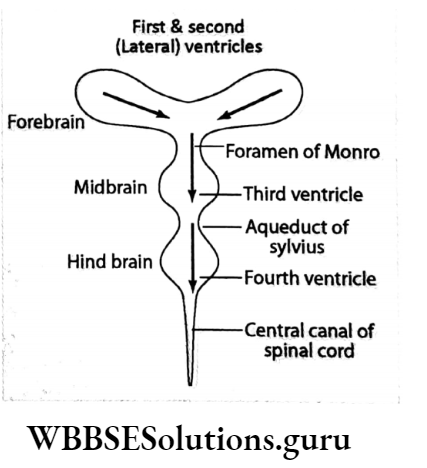
The third ventricle is a median cavity that is bounded by the thalamus and hypothalamus. The first and second lateral ventricles communicate with the third ventricle through an aperture, called the interventricular foramen or foramen of Monro.
The fourth ventricle is the most inferior and communicates anteriorly with the third ventricle by plexus, located in the walls and roofs of the ventricles.
Protection: CSF acts as a soft cushion and shock absorber to both the brain & spinal cord & helps to prevent damage against mechanical blows.
Supply of nutrition & O2: It supplies nutrition & O2 to nerve cells of CNS. It also distributes peptides, neuroendocrine factors & other nutrients.
Excretion: CSF drains out metabolites from the nerve tissues of the CNS.
WBBSE Chapter 1 Fill In The Blanks
Question 1. The process of necessary adjustment of the focal length of the lens in the human eye is called
Answer: Accommodation.
WBBSE Chapter 1 Write True Or False
Question 1. The hypothalamus helps to maintain body balance in humans.
Answer: False
Question 2. Acetylcholine and adrenaline are neurotransmitters.
Answer: True
WBBSE Chapter 1 Very Short Answer Type Questions
Question 3. Choose the odd one and write it:
Answer: Glossopharyngeal, Occulomotor, Trigeminal, Oxytocin, since it is a hormone produced by the hypothalamus while the other three are cranial nerves.
Question 4. What is the function of the fluid present in the intermediate chamber between the lens and retina of the eyeball?
Answer:
Aqueous humor is a transparent, watery extracellular fluid that fills up the chamber in front of the eye lens. It is secreted from the ciliary epithelium.
Functions:
- Maintains intraocular pressure & inflates the globe of the eye.
- Provides nutrition to the posterior cornea, lens, etc.
- Acts as a refracting medium.
- Contains immunoglobulins that defend against pathogens.
- The vitreous humor is a transparent, colorless, gelatinous mass that fills the space in the eye between the lens and the retina.
Functions:
- It maintains the shape & pressure of the eye.
- Acts as a refractive medium.
- It contains phagocytes which keep the visual axis clear most of the time.