
WBBSE Chapter 1 Locomotion As A Type Of Response In Animals Introduction To Locomotion
Most animals have the power of locomotion through the movements of the locomotory organs including movements of muscles, bones, and joints.
Animal locomotion is any of a variety of movements of different body parts (usually called the locomotory organs) that results in the progression of the whole organism from one place to another.
The study of movements is called kinesiology.
It is not that all the animals can perform locomotion. Some phylum Porifera and phylum Mollusca animals are sedentary aquatic animals without locomotory organs.
They are sessile animals and remain attached to submerged substances.
Read and Learn More WBBSE Solutions For Class 10 Life Science
Example:
Freshwater & marine sponge, Neptune cup, oysters, barnacles, etc.
WBBSE Chapter 1 Locomotion As A Type Of Response In Animals Reasons And Motivations Behind Locomotion
Animals move for various reasons, such as to find food, a mate, a suitable microhabitat, or to escape from predators.
Hunt For Food & Water:
Since animals can not prepare food, they are to perform locomotion to find a suitable area with plenty of food & water.
To seek shelter & escape from predators:
Locomotion increases the chances of survival of an organism by allowing the organism to seek shelter in favorable habitat, and to escape dangerous situations by avoiding predators.
Dispersal for mating or breeding:
Locomotion enables members of the species to disperse to find suitable mates to coordinate breeding activity and the survival of the young.
Search for a new & favorable environment:
Animals, especially birds, migrate from areas of low or decreasing resources to areas of high or increasing resources. The two primary resources being sought are food and nesting locations. Escaping from cold is also a factor.

Basic differences between movement and locomotion:
Though, in the case of animals, we often use the terms movement and locomotion, interchangeably, there are definite differences between the two.
Locomotion occurs at the organism level while movement can occur at any biological level from cellular to organisms.
In simple words, locomotion is movement from one place to another. It involves shifting of the entire body parts (e.g. a person moving or running) and movement consists of a change in shape, size, or direction of various body parts (e.g. shaking of your hands).
Locomotion In Animals Class 10 Life Science Pdf
All kinds of locomotion are movements, but all kinds are not.
Movement is the motion that occurs in an organism or a body with or without the involvement of any change in the position or location of the organism or the body. At the same time, locomotion is defined as the voluntary movement of an organism from one place to another either in search of food or shelter or mate or to escape from the predators.
Therefore, the differences between movement and locomotion may be summarized in a tabular form as below:

WBBSE Chapter 1 Locomotion As A Type Of Response In Animals Different Types Of Animal Locomotion
Animal locomotion arises from complex interactions among sensory systems, the processing of sensory information into patterns of motor output, the musculoskeletal dynamics that follow motor stimulation, and the interaction of appendages and body parts with the environment.
These processes conspire to produce motions and forces that permit stunning maneuvers with important ecological and evolutionary consequences.
Many bacteria and protozoa are capable of locomotion, but animals move over much greater distances by a much larger variety of means, such as burrowing, running, hopping, flying, and swimming.
The mode of locomotion used by an animal depends on the size of the animal and the medium in which it moves—whether water, air, or land. A few different types of locomotion are discussed here.
WBBSE Chapter 1 Locomotion As A Type Of Response In Animals Amoeboid Locomotion Involving Pseudopodia
Locomotory organ:
Pseudopodia or false feet.
Process:
The amoebas move from place to place by forming temporary finger-like projections called pseudopodia or false feet derived as blunt projections of the cytoplasm.
A pseudopodium may form at any place on the surface of the body. The cytoplasm of the amoeba consists of a central fluid plasma surrounded by a more viscous plasma gel.
The sheet of plasma gel at the root of the cytoplasmic protrusion slowly thins out and is converted into plasmas.
The central granular part of the cytoplasm, that is the plasmas, then flows into the cytoplasmic outgrowth by streaming movement through the gap in the plasma gel sheet.
Next to this, the stiff plasma gel at the opposite end of the animal is gradually converted into fluid plasmas which rush forward into the pseudopodium.
While returning back along the sides of the finger-like tube, the plasma is again converted into plasma gel.
Many pseudopodia appear simultaneously but usually, one of them is extended and the others are retracted.
The sort of peculiar motion by thrusting out pseudopodia and then flowing into one of them by sol-gel transformation is known as an amoeboid movement.
Effective locomotion occurs only when the animal is in contact with the substratum and not when it is floating on the surface of the water.
The tip of the pseudopodium may adhere to the substratum by secreting a sticky juice and the entire animal glides forward into the pseudopodium.
Locomotion In Animals Class 10 Life Science Pdf
The speed of locomotion usually ranges from 0.5 to. 5 (in per second. In favorable conditions, the speed may be as high as 25 mm per hour.

WBBSE Chapter 1 Locomotion As A Type Of Response In Animals Ciliary Locomotion In Paramoecium
Locomotory organ:
Cilia
Process:
Locomotory organ:
Cilia
Process:
Paramecia move with the assistance of small hair-like structures called cilia that project from granular structures called basal bodies on all sides of their bodies
The single-celled organisms use these hairs like oars, beating them against the water to move around in pursuit of food and to avoid predators.
The whole complement of cilia beat in a rhythmic pattern, (metachronal rhythm), so that the waves of contraction pass over the cell body.


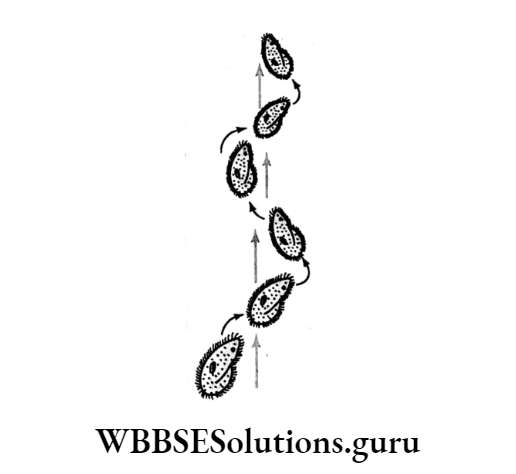
Since cilia can beat either forwards or backward, the animal, therefore, can swim in both directions rapidly. In normal circumstances, however, it runs forward.
As the cilia beat obliquely backward, the animal rotates on its long axis during its forward progression. The cilia in the oral groove are longer and more or less fused.
They beat obliquely against the axis of the groove and hence the anterior end of the animalcule is swerved to one side or the other alternately.
As a result of the combination of forward motion, rotation, and lateral swerving, the animal is compelled to follow a spiral path. It can never swim in a straight line.
WBBSE Chapter 1 Locomotion As A Type Of Response In Animals Flagellar Locomotion In Euglena
Locomotory organ:
Flagellum
Process:
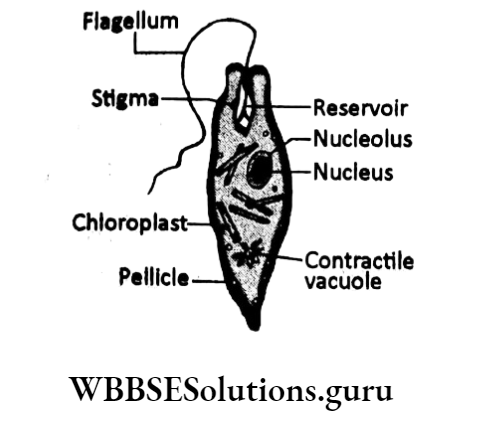
The protozoa Euglena move by a flagellum (plural, flagella), of an outer contractile protoplasmic sheath and an inner elastic axial filament called an axoneme.
The flagellum is located on the anterior (front) end, which turns and twists in such a way as to pull the cell through the water.
Flagellum is attached to an inward pocket called the reservoir. Movement of flagellum is related to the contraction of its all fibrils.
A series of spiral waves pass successively from the base to the tip of the backwardly directed flagellum with increasing velocity and amplitude.
Locomotion In Animals Class 10 Life Science Pdf
The waves proceed along the flagellum in a spiral manner and cause the body of Euglena to rotate once in a second. Thus, in its locomotion, it traces a spiral path about a straight line and moves forward. The rate of movement is about 3 mm per minute.
WBBSE Chapter 1 Locomotion As A Type Of Response In Animals Swimming In Fish
Locomotory organ:
Muscular tail assisted by paired & unpaired fins
Fins:
The fish bears certain appendages known as the fins. The fins are membranous extensions of the skin and are supported by fin rays. The fins are either—
- Median unpaired fish or
- Lateral paired fins.

The Median Fins Are:
Anterior and posterior dorsal fins are placed on the dorsal surface of the fish. The dorsal fins serve to protect the fish against rolling and assist it in sudden turns and stops,
The caudal fin at the end of the tail. The tail acts as the propulsion organ and the caudal fin acts as the steering apparatus for change of direction
The anal or ventral fin is located on the ventral surface behind the anus. This fin is used to stabilize the fish i.e., to maintain the vertical position of the fish while swimming.
The Lateral Paired Fins Are:
Pectoral fins, one on each side of the body and placed behind the opercula. The pectoral fins are used for steering, to change direction, and as a brake to slow down or stop the movement,
Pelvic fins are placed on the ventral side of the body below and behind the pectoral fins. The pelvic fins are used for balance and to keep the fish steady by preventing rolling movements.
Myotomes:
The trunk and tail bear powerful V-shaped segmental muscles called myotomes on both sides of the backbone. Successive myotomes are separated by delicate partitions of connective tissue. These muscles are utilized for swimming.
Process:
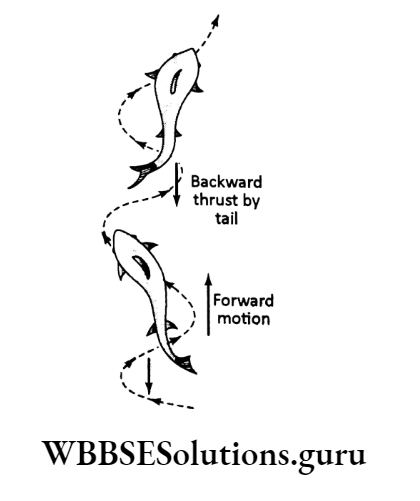
A fish performs three types of movement-forward motion, change of direction or brake or stop and balancing. The streamlined body shape and overlapping scales allow it to move easily through the water with minimal frictional drag.
During swimming, the tail is swept from side to side to bend the body on either side alternately and produce a thrust that propels the fish forward.
The sweeping of the tail is due to the contraction and relaxation of the myotomes on either side of the body that works antagonistically against the vertebral column.
The contraction of the myotomes on the right side of the body bends the tail to the right, while the contraction of the myotomes on the left side of the body bends the tail to the left.
When the muscles of the right side contract, those of the left side relax, and vice versa. The fish pushes the water backward & sideways but the body moves forward.
WBBSE Chapter 1 Locomotion As A Type Of Response In Animals Flight In A Bird
Locomotory organ:
Wings, Quill or flight feathers & flight muscles for flight.
Birds are generally digitigrade animals (toe-walkers) who use only their hindlimbs to walk (bipedalism).

Wings:
Forelimbs are modified into wings. Wings are composed of bones, muscles, nerves, blood vessels, and feathers. In resting condition, the wings remain folded into the body. During the flight, birds flap their wings using flight muscles.
Quill or flight feathers:
These feathers have a strong rachis (or shaft) having barbules with an interlocking arrangement.
These are of the following four types:
Remiges:
The quill feathers occurring on the wings and serving the purpose of flight are called remiges. Each wing of a pigeon has 23 remiges.
Rectrices:
The quill feathers that form the tail are called the rectrices. In the region, twelve long rectrices are arranged in semicircles on the tail. The rectrices act as a brake in alighting and as a rudder in vertical or lateral steering.
Coverts:
The quill feathers covering the basis of wing quills and tail quills are called coverts. These help to generate buoyant force in flight.
Types Of Locomotion In Animals Class 10 Notes
Contours:
The quill feathers forming the general covering of the body are called contours. These provide warmth and smooth airflow without turbulence.
Flight muscles:
The highly vascularized muscles which operate the wings during flight are called flight muscles. These are pectoral/ accessory and tensor.
Pectoral muscles:
These are the most significant muscles that remain attached to the keel of the sternum and to the wings and provide up & down movements to the wings.
There are two types:
Pectoralis Major:
It is very large, powerful, and triangular-shaped.
When the pectoralis major muscle contracts, the wing is pulled downwards and forwards, so that the body of the region is lifted up and propels itself through the air. Since it causes the downstroke of the wings, it is also called depressor muscle.
Pectoralis Minor:
It is a small & elongated muscle that elevates the wing during flight (upstroke of the wing).
Accessory muscles; Coraco-brachialis longus and coracobrachialis brevis help in depressing the wings and rotation of wings in the glenoid cavity.
Tensor muscles:
Three tensor muscles keep the wing stretched in flight.
Sternum:
The breast bone called the sternum is enlarged in birds for flight muscle attachment.
Chief modes of flight:
There are four main types of flight in birds and all the types may be used by the same bird at different times,
Gliding:
It is the simplest mode in which wings remain motionless,
Flapping:
It is the most common type in which the wings move upward and forward, downward and backward, and then more rapidly upward than downward,
Soaring:
It is a highly specialized mode and consists of circling & gliding,
Hovering:
In this flight, the body becomes vertical and motionless.
WBBSE Chapter 1 Locomotion As A Type Of Response In Animals Locomotion In Human
Bipedalism, a type of locomotion involving movement on two feet duly assisted by alternate contraction & relaxation of muscles, movement of synovial joints, etc., is the mode of locomotion performed by human beings.
Bipedal locomotion is completed in three steps- propulsion, support, and balance.
During walking, one leg always rests on the ground. It supports the body weight. The other leg moves forward.
In the moving leg, the heel is first raised from the ground, followed by the toes, and the entire leg is thus carried up & forward.
It is then placed on the ground to cause propulsion.
During forward propulsion, the heel of the moving leg touches the ground first, followed by the toes, and thus a step is completed.
A similar forward step occurs in the other leg also.
Types Of Locomotion In Animals Class 10 Notes
locomotion are as under:
During propulsion, there is alternate swinging of the arms- the right arm swings with the left leg and the left arm with the right leg. This process helps to maintain balance between the right and left sides of the body.
The major bones, joints & muscles associated with bipedal locomotion are as under:
Activity, Bones
Bipedalism or Walking-Pelvic girdle, Femur, Tibia, and Fibula
Joints, Muscles
Pelvic joint-hamstring
Knee joint-Gasstrocnemius
Rectus-Femoris

Balance In Bipedalism:
Cerebellum and inner ear play a vital role to maintain balance and equilibrium during bipedal locomotion.
Position Feedback From Inner Ear:
The vestibular system in each inner ear is made up of three semicircular canals and two otolith organs which together provide constant feedback to the cerebellum about the head movement.
Each semicircular canal has a different orientation to detect a variety of movements such as nodding or rotating.
The movement of fluid inside the canals caused by head movements stimulates tiny hairs that send messages via the vestibular nerve to the cerebellum.
The two otolith organs (called the saccule & the utricle) send messages to the brain about body movement in a straight line and also about where the head is in relation to gravity, such as tilting, leaning, or lying down.
These organs contain small crystals that are displaced during these movements to stimulate tiny hairs, which transmit the messages via the vestibular or balance nerve to the cerebellum.
The Brain’s Movement Control Centre:
The cerebellum acts as the body’s movement and balance control center.
It receives messages about the body’s position from the inner ear, eyes, muscles, and joints and sends messages to the muscles to make any postural adjustments required to maintain balance.
It also coordinates the timing and force of muscle movements initiated by other parts of the brain.
WBBSE Chapter 1 Locomotion As A Type Of Response In Animals Role Of Movable Joints And Skeletal Muscles In Locomotion Joints
Different types of joints enable the bones forming the joints to move relative to each other in different ways and to a different extent, i.e. from freely moveable to hardly any movement at all.
The junction between two bones or between a bone and a cartilage forms joints or an articulation that permits varying degrees of movements by functioning as a fulcrum and using the force generated by the muscles to carry out the movements.
Joints Are Classified Into Three Groups:
Immovable,
Slightly Movable And
Freely Movable Or Synovial Joints.
The Term Arthrology Is Applied To The Study Of Joints.
Types Of Locomotion In Animals Class 10 Notes
Immovable Joints:
Fibrous joints do not allow any movement. This type of joint is shown by the flat skull bones which fuse end to end with the help of dense fibrous connective tissues in the form of sutures to form the cranium.
Slightly Movable Joints:
In cartilaginous
Joints Are Classified Into Three Groups:
Immovable,
Slightly Movable And
Freely Movable Or Synovial Joints.
The term arthrology is applied to the study of joints.
Immovable Joints:
Fibrous joints do not allow any movement. This type of joint is shown by the flat skull bones which fuse end to end with the help of dense fibrous connective tissues in the form of sutures to form the cranium.
Slightly movable Joints:
In cartilaginous joints, the bones involved are joined together with the help of cartilage. The joints between the adjacent vertebrae in the vertebral column are of this pattern and it permits limited movements.
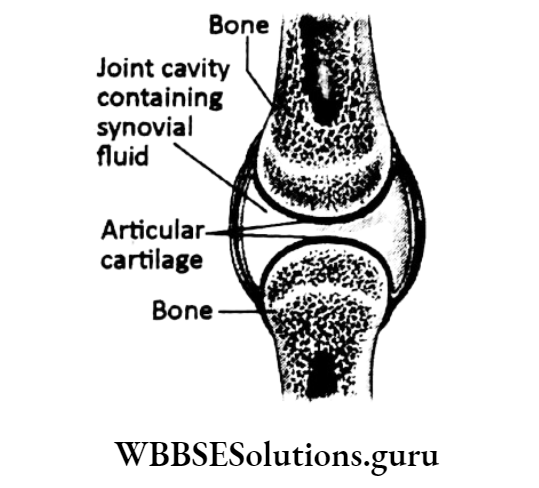
Freely movable or Synovial joints or diarthrosis joints are the only joints that have a fluid-filled synovial cavity between the articulating surfaces of the two bones.
These are freely movable joints mostly present between the limb bones. They permit a great deal of movement.
Ball & socket joint (between humerous & pectoral girdle), hinge joint (knee joint), pivot joint (between atlas and axis), gliding joint (between the carpals) and saddle joint (between carpal and metacarpal of thumb) are some examples.
At a synovial joint, the adjacent bones are often so shaped that an enlargement of one fits into a depression of the other. This makes the bones less likely to disarticulate during movement.
A layer of hyaline cartilage, called articular cartilage, covers the ends of the bones.
The cartilages provide a smooth and somewhat elastic surface and reduce friction. A space, called a synovial cavity, between the two bones gives them free movement.
The cavity is lined by a fibrous synovial membrane containing secretory cells.
The latter secrete a thick sticky synovial fluid. This fluid lubricates the joint to allow nearly frictionless movement of bones on each other. The entire joint is surrounded by an articular capsule composed of connective tissue.
This allows movement of the joint as well as resistance to dislocation. Articular capsules may also possess ligaments that hold the bones together.
Synovial joints are capable of the greatest movement of the three structural joint types; however, the more mobile a joint, the weaker the joint.
Two common examples of freely movable joints of the human body are briefly discussed below:
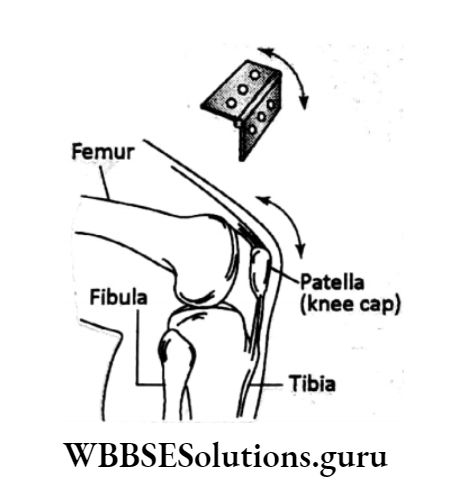
Hinge joints allow movement in one plane only (similar to door hinges). Here one rounded surface fits into another in such a way that movement is only possible in one plane, as it occurs in the movement of a hinge.
The cylindrical surface of one bone fits into the groove of another to form a hinge joint. They have a convex (curved outward) part of the bone that fits into the concave (curved inward) part of another bone.
This type of joint either bends or straightens a limb. The elbow, knee, and joints between phalanges (in fingers & toes) are all hinge joints. The knee joins the thigh bone (femur) to the shin bone (tibia).
Wbbse Life Science Class 10 Chapter 1 Questions And Answers
The smaller bone that runs alongside the tibia i.e., the fibula and the kneecap (patella) are the other bones that make the knee joint.
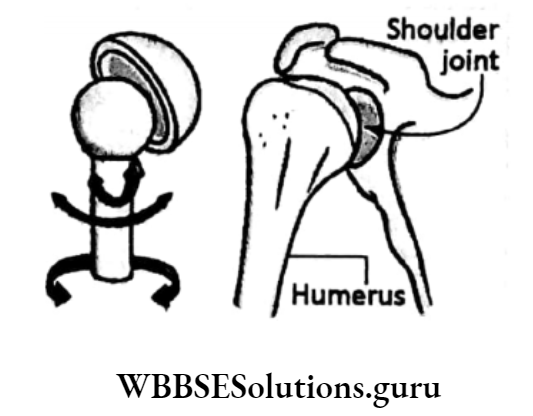
The ball and socket joint occurs in bones where the rounded head fits into the socket or cavity of another bone.
These bones allow the greatest degree of movement. Here one rounded extremity fits into the socket or cavity of another bone, permitting movement in all directions, as it occurs in a ball within a socket or cup-shaped cavity.
Movement may be rotational or in any plane.
The shoulder (head of the humerus of the upper arm fits into the glenoid cavity of the pectoral girdle or shoulder girdle) and hip joints [head of the femur of the thigh fits into the acetabulum cavity of the pelvic or hip girdle] are ball and socket joints.
WBBSE Chapter 1 Locomotion As A Type Of Response In Animals Skeletal and Muscular Systems
The skeletal system is composed of bones, the human skeletal system. The human skeleton is cartilage and ligaments.
There are 206 bones divided into the following parts:

The total number of skeletal muscles in the body is 656. They cover the bony parts of the skeleton in almost every part of the body giving the organism its characteristic shape.
Skeletal or voluntary muscles help in the movement of the limbs, locomotion, and liberation of heat & energy.
WBBSE Chapter 1 Locomotion As A Type Of Response In Animals Movement
Anatomical terms of movement are used to describe the actions of skeletal muscles on the skeleton. Muscles contract to produce movement at joints where two or more bones meet.
Different types of movements, that occurs in our body are—
They refer to increasing and decreasing the angle between two body parts. Flexion at the elbow is decreasing the angle between the ulna and the humerus.
Extension at the elbow is increasing the angle between the ulna and the humerus.
For example, the muscle at the top and front of the arm, the biceps brachii, flexes or bends the arm at the elbow, whereas the muscle at the back of the arm, the triceps brachii, straightens it back out, extending it.

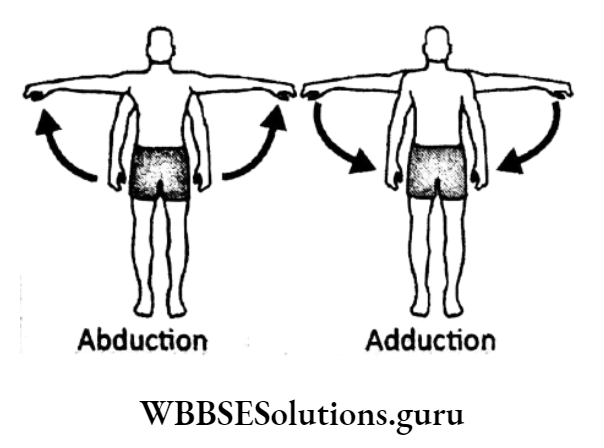
Abduction refers to the movement of limbs away from the midline. When a body is in the anatomical position, abduction refers to raising the upper extremities out to the sides.
Adduction refers to the movement of limbs toward the midline. Bringing the abducted upper extremities back down to the sides of the body is adduction. Drawing your fingers (or toes) close together is also adduction.
Wbbse Life Science Class 10 Chapter 1 Questions And Answers
An example of an abductor is the supraspinatus of the arm and shoulder. An example of an adductor is the adductor longus muscle of the upper leg.
Rotation describes the movement of the limbs around their long axis. Two types of rotations are observed.
Medial rotation:
This movement is turning a body part around its long axis, with the anterior surface moving towards the midline, like when we turn our whole lower extremity so that our foot points inward.
Lateral rotation:
We laterally rotate when we move a body part around its long axis with the anterior surface moving away from the midline, like turning our whole lower extremity so that our foot points out towards the side.
An example of a medial rotator is the gluteus medius situated on the outer surface of the pelvis, and a lateral rotator is a deltoid muscle located on the uppermost part of the arm and the top of the shoulder.

WBBSE Chapter 1 Locomotion As A Type Of Response In Animals Fill In The Blanks
Question 1. Paramecia move with the assistance of small hair-like structures called_____________.
Answer: Cilia
Question 2. The vertebral column of a fish is flexible and can be moved sideways by the contraction and relaxation of antagonistic muscles called_______________.
Answer: Myotomes
Question 3. ______________ joints are the only joints that have a space between the adjoining bones.
Answer: Synovial
Question 4. ______________refers to a movement that decreases the angle between two body parts.
Answer: Flexion
Wbbse Life Science Class 10 Chapter 1 Questions And Answers
Question 5. Locomotion requires a perfectly coordinated activity of muscular,______________ and systems.
Answer: Skeletal, Natural
Question 6. Fish has median fins and lateral______________ fins.
Answer: Umpaired, Paired
Question 7. In birds, the most powerful, large, and triangular-shaped flight muscle is known as______________.
Answer: Pectoralis major
Question 8. ______________and play a vital role in maintaining body balance during bipedal locomotion in human beings.
Answer: Cerebellum, inner, etc
WBBSE Chapter 1 Locomotion As A Type Of Response In Animals Write True Or False
Question 1. Animals perform locomotion for a variety of reasons, such as to find food, a mate, a suitable microhabitat, or to escape predators.
Answer: True
Question 2. Bipedalism involves movement on two feet.
Answer: True
Question 3. Abduction and adduction are two terms that are used to describe movements towards or away from the midline of the body.
Answer: True
Question 4. When a cow uses its tail to drive away flies, it is an example of locomotion.
Answer: False
Question 5. Skeletal muscles are involuntary muscles.
Answer: False
WBBSE Chapter 1 Locomotion As A Type Of Response In Animals Match The Column

Answer: 1-C,2-A,3-B,4-D

Answer: 1-E,2-A,3-B,4-C
WBBSE Chapter 1 Locomotion As A Type Of Response In Animals Very Short Answer Type Questions
Question 1. What are pseudopodia?
Answer: These are temporary cytoplasmic blunt extensions formed by sol-gel transformation for locomotion, as found in Amoeba.
Question 2. What are remiges?
Answer: The flight feathers of the wings of birds are called remiges.
Question 3. What is arthrology?
Answer: The term arthrology is applied to the study of joints.
Question 4. What is a ‘ball and socket’ joint?
Answer: The ball and socket joint occurs in bones where the rounded head of one bone fits into the socket or cavity of another bone allowing the greatest degree of movement.
Wbbse Life Science Class 10 Chapter 1 Questions And Answers
Question 5. Name the cells/tissues in the human body which exhibit:
Answer:
- Amoeboid movement
- Ciliary movement
- Macrophages and leucocytes in blood exhibit amoeboid movement
- Coordinated movement of cilia is observed in the ciliated epithelium lining of the trachea.
Question 6. Name the movable skull bone in the human skeleton.
Answer: Mandible (lower jaw)
Question 7. Name the cup-shaped bone that covers the knee.
Answer: Patella.
Question 8. Classify the following as movement or locomotion:
Answer:
- The bees leave their hive in search of pollen
- The elephant uses its trunk to pick up a log
- Locomotion
- Movement
Question 9. Among the following four terms, one includes the other three. Find out that term and write it: saddle joint, pivot joint, synovial joint, hinge joint.
Answer: Synovial joint.
Question 10. Name the joints involved in the activity of lifting an object by the hand.
Answer: Shoulder joint, elbow joint, and wrist joint.
WBBSE Chapter 1 Locomotion As A Type Of Response In Animals Short Answer Type Questions
Question 1. State the difference between flagella and cilia concerning location and number.
Answer:
The difference between flagella and cilia about location and number
Location: While cilia cover the entire surface, the flagellum is present at one end of a cell.
Number:
A cell contains many cilia (a few hundred per cell) whereas the number of flagella is usually 1 or 2 only.
Question 2. Distinguish between the ball & socket joint and the hinge joint.
Answer:
Difference between the ball & socket joint and the hinge joint

Question 3. Name the locomotory organ of hydra. Describe the various modes of locomotion performed by it.
Answer:
The locomotory organs of the hydra are basal discs and tentacles.
Hydra performs locomotion by-
- Walking
- Looping
- Somersault and
- Glide.
Walking:
It bends down and attaches the tentacles to the substratum with the help of nematocysts. It now releases and removes the basal disc to a new position and again stands up by disengaging the tentacles. This type of locomotion is called walking.
Locomotion As A Type Of Response In Animals Class 10 Wbbse
looping:
The hydra may bend its body to perform a looping movement like that of a leech.
Somersault:
When in a hurry, the animal runs by performing a series of somersaults.
Gliding:
Hydra may glide considerably by dragging the basal disc.
Question 4. What are joints?
Answer:
Joints
The junction between two bones or between a bone and cartilage forms joints or an articulation that permits varying degrees of movements by functioning as a fulcrum and using the force generated by the muscles to carry out the movements.
Joints Are Classified Into Three Groups:
immovable, slightly movable, and freely movable or synovial joints.
Question 5. What are synovial joints?
Answer:
Synovial joints
Synovial joints are the only joints that have a fluid-filled synovial cavity between the articulating surfaces of the two bones. These are freely movable joints mostly present between the limb bones. They permit a great deal of movement.
Question 6. What do you mean by adduction and abduction?
Answer:
Adduction and Abduction
Abduction and adduction are two terms that are used to describe movements towards or away from the midline of the body. Abduction refers to the movement of limbs away from the midline.
When a body is in the anatomical position abduction refers to raising the upper extremities out to the sides.
Adduction refers to the movement of limbs toward the midline. Bringing the abducted upper extremities back down to the sides of the body is adduction. Drawing our fingers (or toes) close together is also adduction.
WBBSE Chapter 1 Locomotion As A Type Of Response In Animals Long Answer Type Questions
Question 1. Write about the motives of animal locomotion. What are the basic differences between movement and locomotion?
Answer:
Reasons And Motivations Behind Locomotion
Animals move for a variety of reasons, such as to find food, a mate, a suitable microhabitat, or to escape from predators.
Hunt For Food & Water:
Since animals can not prepare food, they are to perform locomotion to find out suitable area with plenty of food & water.
To seek shelter & escape from predators:
Locomotion increases the chances of survival of an organism by allowing the organism to seek shelter in favorable habitat, and to escape dangerous situations by avoiding predators.
Dispersal for mating or breeding:
Locomotion enables members of the species to disperse to find suitable mates to coordinate breeding activity and the survival of the young.
Locomotion As A Type Of Response In Animals Class 10 Wbbse
Search for a new & favorable environment:
Animals, especially birds, migrate from areas of low or decreasing resources to areas of high or increasing resources. The two primary resources being sought are food and nesting locations. Escaping from cold is also a factor.
Basic differences between movement and locomotion:
Though, in the case of animals, we often use the terms movement and locomotion, interchangeably, there are definite differences between the two.
Locomotion takes place at the organism level while movement can take place at any biological level from cellular to organisms.
In simple words, locomotion is movement from one place to another and involves shifting of the entire body parts (e.g. a person moving or running) and movement involves a change in shape, size, or direction of various body parts (e.g. shaking of your hands).
All kinds of locomotion are movements but all kinds of movements are not locomotion.
Movement is the motion that occurs in an organism or a body with or without the involvement of any change in the position or location of the organism or the body,
while locomotion is defined as the voluntary movement of an organism from one place to another either in search of food or shelter or mate or to escape from the predators.
Therefore, the differences between movement and locomotion may be summarized in a tabular form as below:
WBBSE Objective Type Questions Write True Or False
Question 1. Flagella is the locomotory organ of Paramoecium.
Answer: False