
WBBSE Chapter 2 Reproduction Introduction To The Concept Of Reproduction
The physiological process by which a parent organism produces its kind called the offspring leading to the continuity or perpetuity of a species is known as reproduction or breeding.
It is a fundamental characteristic feature of an organism but is not considered an essential process like respiration, nutrition, excretion, etc for the survival of an organism.
An organism can survive without reproduction but by reproduction, an organism ensures its continuity in the perspective of eternal time frame.
Organisms produce their progeny by reproduction and thus increase the size of their population.
Continuity Of Race:
Read and Learn More WBBSE Solutions For Class 10 Life Science
After a certain span of life, each organism will die naturally. To compensate for the loss, there must be new birth by reproduction to maintain the continuity of race.
Had the process of reproduction not been there, then all the plants and animals would have become extinct. Hence reproduction helps organisms to maintain race and heredity.
Wbbse Class 10 Continuity Of Life Notes – Variation & Evolution:
Recombination of genetic factors occurs during sexual reproduction. This leads to variation amongst individuals in a population. These variations, aided by natural selection, end in evolution.
Relationship between growth and reproduction:
Organisms mature through growth. In plants and animals, the growth of the somatic organs is called somatic growth and that of the reproductive organ is called reproductive growth.
Reproductive growth in plants is the growth of floral buds, flowers, fruits, seeds, etc but in animals, it signifies the growth of the testis in males and the ovary in females.
Life Science Class 10 Chapter 2 Reproduction
Thus in the course of growth, the reproductive organs of an organism attain cell differentiation and maturity. Then only the organism can produce gametes and finally, it can reproduce to create the offspring.
Therefore, growth and reproduction are closely related.

WBBSE Chapter 2 Topic B Reproduction Modes Of Reproduction
Four types of reproduction are found in the plant & animal kingdom.
These Are:
- Asexual reproduction
- Sexual reproduction
- Vegetative reproduction &
- Parthenogenesis or parthenocarpy.
Reproduction In Animals Is Of Three Types:
Asexual, sexual, and parthenogenesis. However, plants carry out all four types of reproduction as mentioned above.
Wbbse Class 10 Continuity Of Life Notes
WBBSE Chapter 2 Topic B Reproduction Asexual Reproduction
The process of reproduction by which offspring are produced from a single parent organism through the formation of spores or by direct cell division and without the fusion of gametes is called asexual reproduction.
The spores are the unit of asexual reproduction in plants. Unicellular spores contain a nucleus and some cytoplasm enclosed by a thick cell wall or membrane. Lower plants like algae, fungi, etc.
Reproduce asexually by producing spores that are either motile zoospores as in Ulothrix or non-motile aplanospores as in Chlamydomonas.
Fungi like Mucor may have non-motile spores called sporangiospores within the spore-bearing structures called sporangium.
In animals, asexual reproduction is observed in different forms, like binary and multiple fissions in Amoeba, budding and fragmentation in Hydra, etc.
Asexual Reproduction In Bacteria
Asexual reproduction in bacteria occurs through several methods like Binary fission, Zoogloea stage, Conidia formation, Gonidia formation, Cyst formation, Budding, Fragmentation, Akinetes formation, Exospore formation, Endospore formation, etc.
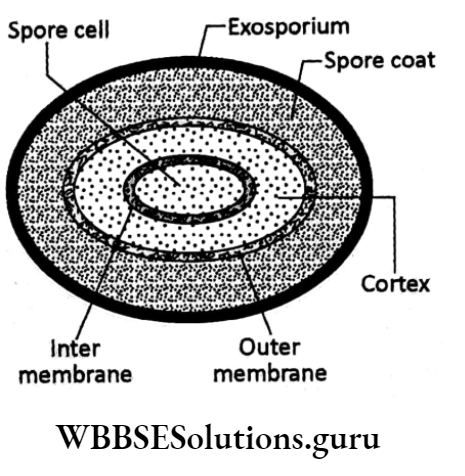
Some Gram +ve bacteria, especially bacilli and certain blue-green bacteria, produce thick-walled endospores during unfavorable conditions. During endospore formation, a portion of cytoplasm and a copy of bacterial
chromosome dehydrate and get encased by a very thick wall called the spore coat. The endospore can remain dormant for several decades and can tolerate harsh environments, heat, dehydration, toxic chemicals, polar ice, etc.
Life Science Class 10 Chapter 2 Reproduction
They germinate only under favorable conditions. The protoplasm absorbs water, swells up, and becomes active. The swollen protoplast breaks the spore covering either at the equator or at the end.
It comes out as a new bacterium surrounded by a thin core wall.
But since with the advent of favorable conditions the spore germinates to produce the same bacterial cell, it is not considered as true asexual reproduction. Fortunately, most bacteria do not produce endospores.
WBBSE Chapter 2 Reproduction Sexual Reproduction
Sexual Reproduction is a form of reproduction that involves the fusion of haploid male and female reproductive cells (gametes) to create a diploid zygote through a process called fertilization.
It is the primary method of reproduction for the vast majority of macroscopic organisms including almost all eukaryotes (which includes animals and plants).
Sexual reproduction occurs through pollination & fertilization in higher plants and by the fusion of male spermatozoa and female ovum in animals.
This type of reproduction involves meiosis cell division which may be pre-zygotic or post-zygotic.
Types of sexual reproduction:
Sexual reproduction involves the union of two types of gametes. Based on the morphology and physiology of these gametes,
This process can be classified as follows—
Conjugation:
This is a simple type of sexual reproduction in which two unspecialized and identical cells unite to develop a cytoplasmic connection, through which the nucleus of one cell enters into the adjoining cell and the two nuclear contents get mixed.
By this process, a zygospore (2n) is formed.
This diploid (2n) cell then undergoes meiosis to grow into new progenies.
This type of sexual reproduction is found in algae [Spirogyra) where it can be between the ‘+’ and filaments (Scalariform) or within the same filament (lateral) and in some protozoa [Paramoecium).
The successive stages in the conjugation of Spirogyra are-

Syngamy:
This type of sexual reproduction involves the union of male and female gametes.
Syngamy can be classified into the following three types—
isogamy:
This process involves the union of two completely identical types of gametes. Isogamy is found in Spirogyra, Chlamydomonas etc.
Anisogamy:
This sexual reproduction occurs by the union of two structurally different types of gametes. Anisogamy is found in Chlamydomonas.
Oogamy:
Sexual reproduction in which a smaller and highly motile male gamete unites with a significantly larger and non-motile female gamete is called oogamy.
Oogamy is the most advanced type of sexual reproduction wherein the fusing gametes (male & female) differ from each other in every aspect such as size, motility, behavior, structure etc, and are called heterogametes.
Oogamy is found in Oedogonium and many other higher plants and animals.

Life Science Class 10 Chapter 2 Reproduction
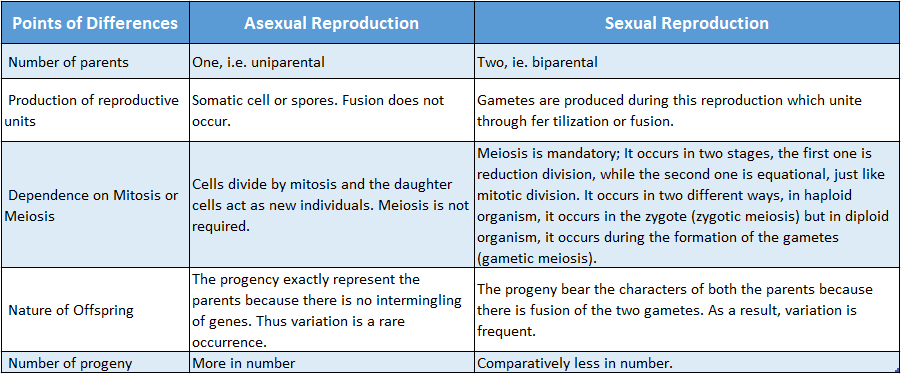
WBBSE Chapter 2 Topic B Reproduction Differences Between Asexual And Sexual Reproduction
WBBSE Chapter 2 Topic B Reproduction Vegetative Reproduction
Vegetative reproduction is basically a special type of asexual reproduction where a vegetative part of the plant body, separated from the original plant body, develops and grows into a new plant by simple cell division.
The Vegetative Reproduction Is Of Two Kinds:
- Methods of natural vegetative reproduction and
- Methods of artificial vegetative reproduction.
It occurs naturally through budding, fission, fragmentation, etc. Artificially this reproduction can be carried out by cutting, grafting, etc.
WBBSE Chapter 2 Topic B Reproduction Parthenogenesis or parthenocarpy
Parthenogenesis is a form of asexual reproduction in which the growth and development of the embryo occur without fertilization.
In animals, parthenogenesis means the development of an embryo from an unfertilized egg cell. It is common in rotifers, aphids, bees, and crustaceans.
Some vertebrates like lizards also reproduce by parthenogenesis. Parthenogenesis may be natural or artificial.
Natural parthenogenesis occurs regularly in the life cycle of some animals. It is of two types:
Complete and incomplete parthenogenesis.
Complete parthenogenesis:
It is also called obligatory partheno-genesis.
In this case, the males are completely absent and the females develop from the unfertilized eggs as is found in aphids, phyllopods, and rotifers.
It is also found in some vertebrates.
A lizard Lacerta Mexico Americana reproduces exclusively by parthenogenesis with no males, in the population.
Incomplete parthenogenesis:
In this case sexual generation alternates with parthenogenesis generation.
For example, in bees and wasps, some eggs develop without fertilization and produce males, while those eggs that are fertilized develop into females.
In Gall fly, the larvae may lay eggs which develop parthenogenetically into a new generation of larvae. This is called paedogenetic parthenogenesis or paedogenesis.
In many sexually reproducing animals, the egg can be activated by artificial methods to start the development without fertilization.
This is called artificial parthenogenesis. Eggs of Sea urchin can be made to develop successfully if treated with weak salt solutions, weak organic acids, electric shock or by shaking in seawater, or by pricking the egg with a glass needle.
In higher plants, the process of formation of fruits without pollination and fertilization is called parthenocarpy. Parthenocarpy is a form of asexual reproduction seen in flowering plants.
The fruits are generally seedless. During cultivation, parthenocarpy is introduced along with other plant hormones including gibberellin and it results in maturing of the ovaries without the process of fertilization and produces bigger and pulpy fruits.
Pineapples, bananas, cucumber, grapes, watermelon, oranges, pears,s, etc are some examples of parthenocarpy. In some plants, pollination or another stimulation is required for parthenocarpy. This is termed stimulative parthenocarpy.
Plants that do not require pollination or other stimulation to produce parthenocarpic fruits have vegetative parthenocarpy.
Seedless cucumbers are an example of vegetative parthenocarpy and seedful watermelon is an example of stimulative parthenocarpy.
WBBSE Chapter 2 Topic B Reproduction Asexual Reproduction
In asexual reproduction, the offspring arises from a single organism and inherit the genes of that parent only without involving the fusion of gametes and changes in the number of chromosomes. The unit of reproduction is commonly formed from the somatic cells of the parent.
Meiosis does not occur in asexual reproduction.
Features Of Asexual Reproduction:
It involves a single parent and offspring inherit the genes of that parent only.
There is neither any gamete formation nor any fertilization.
This is a simple & easier method of reproduction in which the whole process takes place in a small period of time.
Rapid multiplication takes place in this process whereby many offsprings can be produced from an individual parent.
There is scope for limited variation among Offspring
This method may help an organism either to regenerate to overcome unfavorable conditions.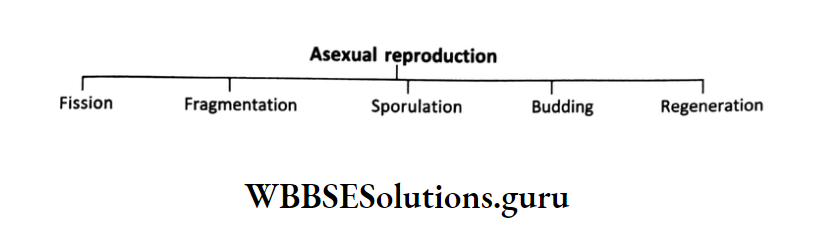
WBBSE Chapter 2 Topic B Reproduction Fission
Fission is the mitotic division of a single entity or cell into two or more daughter parts and the regeneration of those parts into separate entities each resembling the original parent.
Organisms in the domains of Archaea, Bacteria, and Protists (eg. sporozoans & algae) reproduce by fission.

Fission can be further classified as:
Binary Fission:
In this process, a cell directly divides into two daughter cells by simple amitosis.
It can be of the following types-
Simple binary fission:
When division occurs in any plane but it is always at a right angle to the elongated dividing nucleus, eg., Amoeba
Life Science Class 10 Chapter 2 Reproduction
Longitudinal binary fission:
When division occurs along the longitudinal axis, eg., Euglena, Vorticella.
Transverse binary fission:
When division occurs along the transverse axis of the organism, eg., Paramoecium, diatoms, bacteria, Planaria.
Oblique Binary Fission:
When division occurs at an angle to the transverse axis, eg., Ceratium, Gonyaulax.
Multiple fission:
The nucleus of the parent cell divides several times by amitosis to produce many nuclei. This is not immediately followed by cytokinesis.
Later on, each nucleus gathers a small amount of cytoplasm around it and the mother cell splits into many tiny daughter cells creating multiple fission.
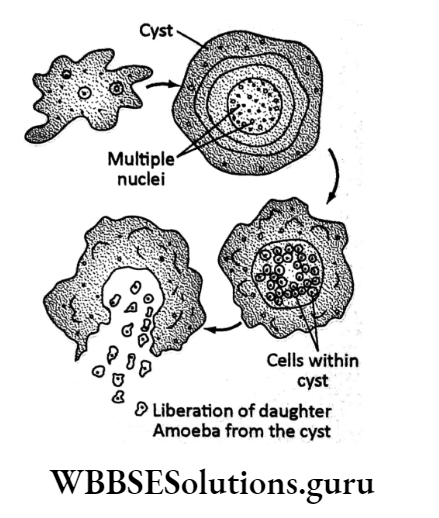
A type of multiple fission is known as encystation. During adverse environmental conditions, the cells of certain protozoa develop a thick outer coating around their cell body, which is called a cyst. Now the nucleus undergoes several divisions.
Then each daughter nucleus gets some cytoplasm and transforms into a tiny cell or pseudospore. Thus several daughter cells are developed inside the cyst.
Now it is called a spore. With the onset of a favorable environment, the cyst breaks, and thus numerous daughter cells are liberated
Examples, Amoeba, Plasmodium, etc. There may be other types of multiple fission like Schizogony and Plasmotomy. Schizogony is a type of multiple fission present in plasmodium.
Reproduction Chapter Class 10 WBBSE
Schizogonies are of two types—
Liver schizogony and RBC schizogony.
Plasmotomy is the division of a multinucleate protozoan into several small, multinucleate daughters without nuclear division.
The daughters grow and regain the normal number of nuclei by nuclear divisions. It takes place in Opalina and Pelomyxa.
Green algae can also divide into more than two daughter cells by multiple fission. The exact number of daughter cells depends on the species of algae and on the effect of temperature and light.
schizogony and RBC schizogony
Plasmotomy is the division of a multinucleate protozoan into several small, multinucleate daughters without nuclear division.
The daughters grow and regain the normal number of nuclei by nuclear divisions. It takes place in Opalina and Pelomyxa.
Green algae can also divide into more than two daughter cells by multiple fission. The exact number of daughter cells depends on the species of algae and on the effect of temperature and light.
WBBSE Chapter 2 Topic B Reproduction Fragmentation
It is the process by which the multicellular filamentous body of the organism breaks at any point into two or more small slender parts and each of the broken filaments or parts produces an independent individual.

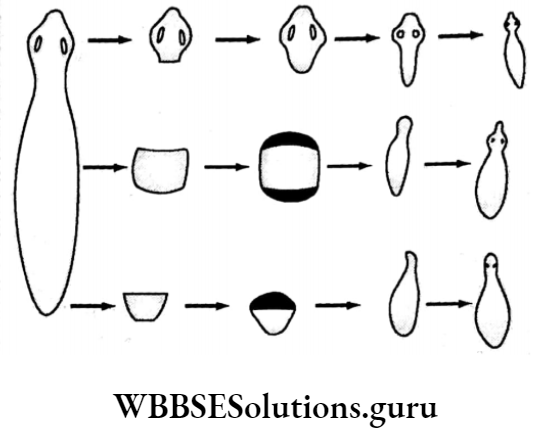
In Spirogyra, this process occurs in favorable climates or rainy seasons. Fragmentati] on also occurs in the animal body where it breaks into two or more pieces each of which grows into a new individual. Example- It occurs in flatworms & Microstomum.
WBBSE Chapter 2 Topic B Reproduction Sporulation
This type of asexual reproduction is found amongst nonflowering plants.
In this process, some specialized cells are formed within specific sacs by repeated division of the cytoplasm within the cell, which is covered with the cell wall or a protective wall.
These cells are commonly known as spores. According to their nature spores are given specific names such as zoospore, aplanospore, conidia, etc.
These spores form the first cell of the gametophytic generation and they germinate to develop daughter plants. Example-Mucor, Dryopteris, Pogonatum, etc.
Spores are broadly classified into two major types, motile and non-motile. Motile spores or zoospores are found in algae & fungi (eg. Chlamydomonus & Ulothrix) and are equipped with cilia or flagella.
Reproduction Chapter Class 10 WBBSE
They can swim freely in the water. Non-motile spores or aplanospores are found in algae, conidia (ex. Penicillium), and sporangiospores found in fungi (ex. Rhizopus).
Homospores and heterospores are found in relatively higher plants like bryophytes and pteridophytes.
If the spores are of similar shape and size, they are called homospores (eg., Lycopodium, Riccia, Dryopteris) and if the spores are of different shape and size, they are called heterosporous (eg., Selaginella).
WBBSE Chapter 2 Topic B Reproduction Budding
In this process, a small wort-like structure or a lateral protuberance develops from a certain part of the vegetative body. It is called a bud.
Gradually this bud grows by mitosis into a small daughter individual and gets separated from the parental organism. This process of asexual reproduction is called budding.
Budding occurs in some protozoans (ex. budding of yeast cells in nutrient-rich medium) and certain lower animals such as sponges (Scypha), coelenterates (Hydra), annelids (Chaetopterus) and tunicates (Salpa).
There are two types of budding:
Exogenous or external budding:
Initially, a small outgrowth of the parent’s body develops into a miniature individual, it then separates from the mother to lead a free life. This is called exogenous budding.
Example: Hydra.
Endogenous or internal budding:
In freshwater sponges (eg. Spongilla) and marine sponges (eg. Sycon), the parent individual releases a specialized mass of cells enclosed in a common opaque envelope called the gemmule.
Gemmules are thought to be internal buds. Each gemmule, on germination, gives rise to offspring. This type of budding is called endogenous budding.

WBBSE Chapter 2 Topic B Reproduction Regeneration
It is typically found in animals whereby if a part of the animal is cut off, the cut-off vegetative fragment of the body will grow and reconstruct the complete organism.
Regeneration Is Of Two Types:
Incomplete or reparative regeneration:
Here only a part of the body is regenerated to replace the lost part or to repair the damaged body organs. In this type of regeneration, the wound is repaired or closed by the expansion of the adjoining epidermis over the wounds.
Example:
regeneration of limbs in salamanders, regeneration of lost tails in lizards, etc. In some animals like-starfish, some part of the body is broken off on being threatened by a predator.
This phenomenon of self-mutilation of the body is called autotomy.
Example:
Crabs break off their legs on approaching the enemy, starfish break off an arm, Holothurians throw off their internal viscera, etc.
Complete regeneration:
Regenerative capacity is very high among the sponges and coelenterates. The process of development of the whole organism from any fragment of an individual is called complete regeneration.
In sponges, the entire body can be reconstructed from isolated body cells. The cells rearrange and reorganize to form a bilayered sponge body wall.
Reproduction Chapter Class 10 WBBSE
In hydra and planaria, small fragments of the body can give rise to a whole animal. When a hydra or a planarium is cut into many pieces, each individual part regenerates into a whole individual.
WBBSE Chapter 2 Topic B Reproduction Vegetative Propagation
It is the process by which the plant part is separated from the plant body and it develops into a new plant body.
Characteristics of vegetative reproduction:
It is simple and rapid and allows plants to avoid the complicated process of producing sexually reproducing organs such as flowers and subsequent seeds & fruits.
New daughter organisms are produced from already existing forms.
Offsprings are practically clones of the parent plant.
If a plant has favorable traits, it can continue to pass down its advantageous genetic information to the offspring.
Vegetative propagation prevents genetic diversity.
Artificial vegetative reproduction results in the improvement of both the quality and quantity of plants.
Types of vegetative propagation:
It is of two major types—
Spontaneous or natural and artificial.
Natural vegetative propagation
Different plant parts are variously modified for vegetative propagation.
WBBSE Chapter 2 Topic B Reproduction Natural Vegetative Propagation
Different plant parts are variously modified for vegetative propagation.

Natural vegetative propagation in higher plants:
Root:
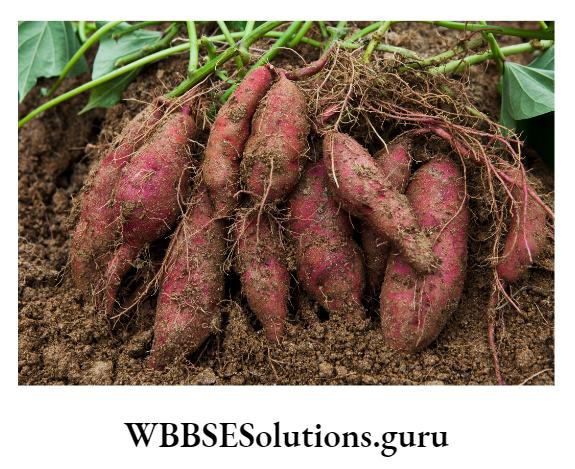
The storage root acts as a structure for perpetuation, they help the organism to survive during unfavorable conditions and also germinate to produce a new plant body. e.g. Root tuber of sweet potato, Dahlia.
Stem:
The stem may also act as a parenting organ, which can grow and propagate on land and water and when separated, produces a new plant body. e.g. Offset of Water Hyacinth.
The propagation of stem in terrestrial plants is brought about by runner and stolon, e.g. There are various artificial methods like strawberries and grasses. Rhizomes are cutting, grafting, micropropagation, etc.
underground horizontally growing stems having nodes, internodes, and axillary buds. Branches grow from these buds.
A tuber is a modified underground stem tip.
The eyes or buds present on the tuber grow into new plants. The bulb is a modified shoot that has short stems and apical & axillary buds that grow to form shoots.
Class 10 Life Science Reproduction Notes
Leaf:
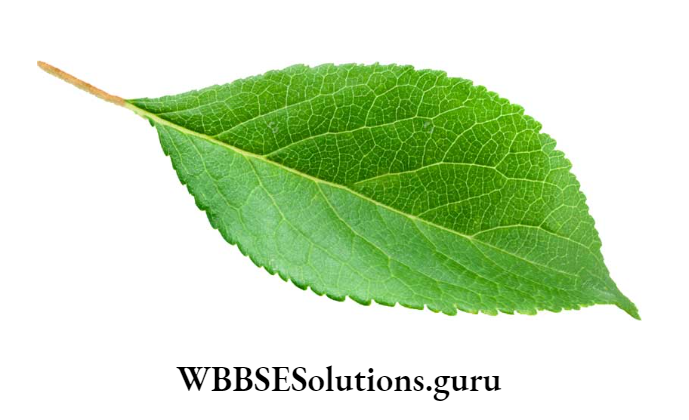
The leaf may become a propagating organ with the presence of storage food in the lamina and adventitious buds present at the edge of the lamina may germinate to produce a new plant body. e.g. Leaf of Bryophyllum.
WBBSE Chapter 2 Topic B Reproduction Artificial Vegetative Propagation
This process is usually practiced for the reproduction of those plants that produce 236 either very few seeds or do not produce any viable seeds at all.
There are various artificial methods like strawberries and grasses. Rhizomes are cutting, grafting, micropropagation, etc.
Cutting:
When any part of the stem or root is cut off, it may contain adventitious buds, which germinate to produce a new plant body. Stem cuttings are generally used to obtain new plants.
The mature stem of a plant bearing nodes and lateral buds can be cut and planted in moist soil. After a few days, new roots develop from the underground cut ends and the cutting becomes a new plant.
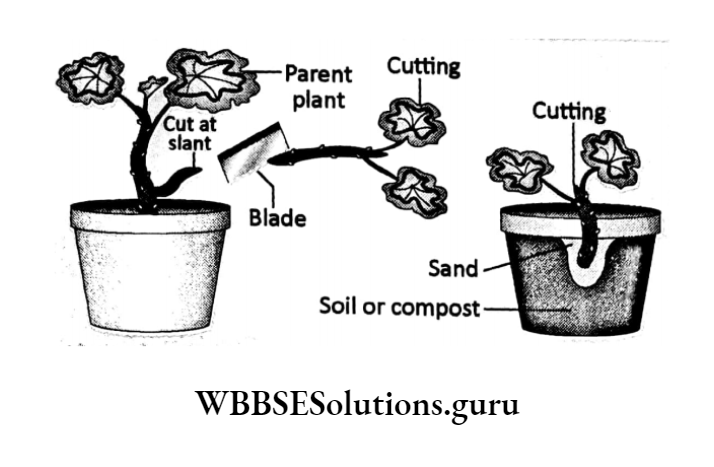
At times roots are not easily produced in the cuttings and, hence, they are treated with synthetic growth hormones like IAA, IBA, NAA, etc to stimulate root formation.
Plants like rose, china rose, banana, sugarcane, orange, grapes, etc are propagated by stem cutting.
Grafting:
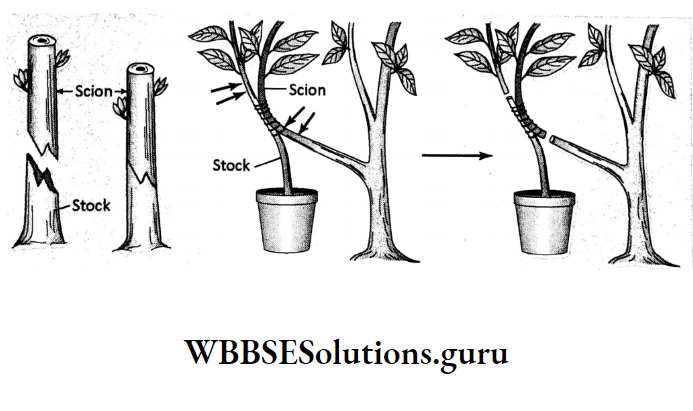
It is a unique process where a superior plant stem from an aerial portion is cut off obliquely and it is joined with the lower part of the stem of the same species but of inferior variety.
The superior plant stem is known as the scion and the rooted shoot of the other plant is called the stock. The rootstock is generally derived from a plant resistant to diseases and efficient in water and mineral absorption.
They are covered with manure and tied with a string or tape or rubber tubing etc. This results in the fusion of cambia and the formation of new vascular tissue to produce a single plant of superior variety.
The method is commonly practiced for economically useful plants like rose, mango, apple, pear, guava, rubber, etc.
The process of grafting is successful in dicot stem but it is not successful in monocot stem because the vascular bundles are scattered and the cambium is absent in the vascular bundles, so the continuity of vascular tissue is not formed between the scion and the stock.
Micropropagation:
The term ‘micro’ means minute pieces.
Small pieces or tissues are cut off from the plant body and are propagated in semi-solid or liquid media containing essential nutrients and phytohormones in an aseptic or sterilized condition.
These pieces grow into an undifferentiated mass called callus tissue and by adjusting the level of the phytohormones like auxin and cytokinin, they regenerate into plantlets.
Class 10 Life Science Reproduction Notes
Plantlets are then transferred to pots or nursery beds and allowed to grow into full plants. The process is the propagation of plants by tissue culture
This process ensures rapid propagation of the same plant body within a short time.
It is particularly useful in the case of coconut and other monocot plants, where grafting is not successful because of the absence of cambial tissue.
This method has also been employed in the commercial production of orchid carnations, chrysanthemums, Asparagus, potatoes, etc.

WBBSE Chapter 2 Topic B Reproduction Alternation of Generation
Explanation:
The life cycle of all individual organisms has two unique phases, viz. the sporophytic generation or the diploid phase, and the gametophytic generation or the haploid phase.
The former reproduces asexually to produce the haploid spores, which germinate to produce the gametophytes containing the reproductive organs.
They produce the gametes which undergo sexual union to produce the diploid individual again. Thus the diploid phase is again initiated.
This alternation occurs in all plant and animal organisms but is most pronounced in pteridophytes like ferns (Dryopteris).
The alternation of diploid (2n) asexual sporophytic form and haploid (n) sexual gametophytic form in a cyclic manner in the life cycle of an organism is known as the alternation of generation.
It is also known as metagenesis or heterogenesis.
In Dryopteris, the parent plant body is diploid. It is differentiated into root-like rhizoids, rhizomatous stems, and compound leaves.
It is called the sporophyte.

The lower surface of the leaf bears the sori, which contains the stalked sporangia having the diploid spore mother cells. It undergoes reduction division to produce haploid spores.
Spore marks the beginning of the haploid gametophytic generation. The spore germinates to produce the filamentous primary protonema, branched secondary protonema, and the heart-shaped thalloid prothallus.
The prothallus has photosynthetic cells and is independent of the sporophytic plant, it develops the male sex organ or the club-shaped antheridium and the female sex organ or the flask-shaped archegonium.
The antheridium produces the multi-flagellate antherozoids, which swim towards the archegonial neck by chemotactic movement and fuses the egg in the venter of the archegonium to produce the zygote and marks the beginning of the sporophytic generation.
The zygote gradually develops into a matured sporophyte.
In this way, the alternation of generation is distinctly observed in fern with both the sporophyte and the gametophyte being independent of each other.
Alternation of generation also takes place in lower plants because the haploid plants are prevalent, and the stages are not distinctly differentiated.
Class 10 Life Science Reproduction Notes
In the brown algae Ectocarpus, the sporophytic and gametophytic plant bodies look the same, so it is called isomorphic alternation of generation.
In red algae Polysiphonia, there are two types of the sporophytic plant body, viz tetra sporophyte and carposporophyte and also the gametophyte, so this type of alternation of generation is called triphasic alternation of generation.
Metagenesis:
Among animals, many invertebrates have an alternation of sexual and asexual generations (eg., protozoans, jellyfish, flatworms, hydra, obelia, etc), but the alternation of haploid and diploid generations is unknown.
Animals Like Hydra, Obelia, Jellyfish Etc Belonging To The Phyllum Cnideria Often Exhibit Two Forms:
polyp (usually fixed) and medusa (free-living).
The sedentary colonial asexual polyp phase gives rise by budding to medusa which represents a sexual generation.
However, both polyp and medusa are diploids (2n). The formation of polyp and medusa in an alternate manner is known as metagenesis. It is a modified form of alternation of generation.

WBBSE Class 10 Reproduction Topic Explanation
WBBSE Chapter 2 Topic B Reproduction Fill In The Blanks
Question 1. The alternation of generation shows____________and ____________ generation.
Answer: Sporophytic, Gametophytic
Question 2. The fusion of 2 haploid gametes produce diploid____________
Answer: Zygote
Question 3. The sporangiospore is observed in____________.
Answer: Mucor
Question 4. Asexual haploid motile spore is also called____________
Answer: Zoospore
Question 5. Bacteria reproduces mostly by____________.
Answer: Binary fission
WBBSE Class 10 Reproduction Topic Explanation
Question 6. The asexual spore of bacteria is also called ____________
Answer: Endospore
Question 7. Paramoecium exchanges nuclei by____________.
Answer: Conjugation
Question 8. Ideal alternation of generation is found in ____________
Answer: Fern
Question 9. Spirogyra reproduces vegetatively by____________.
Answer: Fragmentation
Question 10. Multinucleate zoospore is also called____________.
Answer: Synzoospore
Question 11. Yeast reproduces vegetatively by ____________.
Answer: budding
Question 12. Underground modified stem in potato is called____________
Answer: Tuber
Question 13. Water hyacinth reproduces vegetatively by____________
Answer: Offset
Question 14. Starfish shows healing of a wound by____________.
Answer: Regeneration
Question 15. Oxalis propagates vegetatively by____________ .
Answer: Offset
WBBSE Chapter 2 Topic B Reproduction True Or False
Question 1. Water hyacinth shows a sub-aerial modification of the stem.
Answer: True
Question 2. An undifferentiated mass of tissue is also called a callus.
Answer: True
Question 3. Spirogyra reproduces vegetatively by conjugation.
Answer: False
Question 4. A callus mass contains all totipotent cells.
Answer: False
Question 5. Dahlia propagates by runner.
Answer: False
Question 6. Honeybees may exhibit parthenogenesis.
Answer: True
Question 7. Rhizopus exhibits sporangiospores.
Answer: True
WBBSE Class 10 Life Science Chapter 2 Question Answers
Question 8. Ulothrix reproduces asexually by zygospore.
Answer: False
Question 9. Polysiphonia exhibits triphasic alternation of generation.
Answer: True
Question 10. Hydra exhibits metagenesis.
Answer: True
Question 11. Plasmodium carries out sexual reproduction in humans.
Answer: False
Question 12. Scion and stalk are used in layering.
Answer: False
Question 13. Isomorphic alternation of generation is found in Ectocarpus.
Answer: True
Question 14. Multiple fission is observed in Amoeba.
Answer: True
Question 15. Bacteria do not exhibit true sexual reproduction.
Answer: True
WBBSE Class 10 Life Science Chapter 2 Question Answers
WBBSE Chapter 2 Topic B Reproduction Match The Column

Answer: 1-B,2-A,3-D,4-C
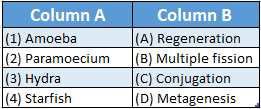
Answer: 1-B,2-C,3-D,4-A
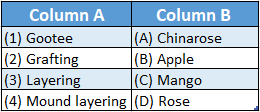
Answer: 1-D,2-C,3-A,4-B
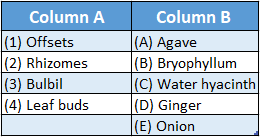
Answer: 1-C,2-D,3-A,4-B
WBBSE Class 10 Life Science Chapter 2 Question Answers
WBBSE Chapter 2 Topic B Reproduction Very Short Answer Type Questions
Question 1. What is the name of the asexual spore in bacteria?
Answer: Endospore.
Question 2. Name the two ways of vegetative reproduction in Yeast.
Answer: Fission and budding.
Question 3. Name the process of alternation of generation in Hydra.
Answer: Metagenesis.
Question 4. Name the method of vegetative reproduction in Ulothrix.
Answer: Fragmentation.
Question 5. What is the name of the diploid spore of Mucor?
Answer: zygospores
Question 6. Name the asexual spore of Rhizopus.
Answer: Sporangiospore.
Question 7. What is the life cycle with equal distribution of haploid and diploid phases known as?
Answer: Haplo-diplobiontic life cycle.
Question 8. A pair of related terms is given below. On the basis of the relationship in the first pair write the suitable word in the gap of the second pair.
Answer:
Isogamy: Sexual union of two completely identical gametes:: Anisogamy: Sexual union of two structurally different types of gametes
Zoospores: Motile spores:: aplanospores: nonmotile spores
Asexual phase : Polyp:: Sexual phase: Medusa
Question 9. Name the propagating structure of Marsilea.
Answer: Runner.
Question 10. Name the propagating structure of Meatha.
Answer: Stolon.
Question 11. Name the propagating structure of the Chrysanthemum.
Answer: Sucker.
Question 12. Name the propagating structure of sweet potato.
Answer: Root tuber.
Question 13. Name the propagating organ of Asparagus.
Answer: Fleshy root.
Reproduction Topic 2 Class 10 Solutions
Question 14. Name two animals showing regeneration.
Answer: Planaria, Hydra.
Question 15. Name the first cell of sporophytic generation.
Answer: Zygote.
Question 16. Name the first cell of gametophytic generation.
Answer: Spore.
Question 17. Name a plant showing an epiphyllous bud.
Answer: Bryophyllum.
Question 18. Name the propagating structure of ginger.
Answer: Rhizome.
Question 19. Among the following four terms, one includes the other three. Find out that term and write it:
Answer:
- Spoliation, budding, asexual reproduction, regeneration
- Callus tissue, plantlets, explant, tissue culture.
- Asexual reproduction
- Tissue culture names the tube that helps in conjugation.
Question 20. Name a tube that helps in conjugation.
Answer: Conjugation tube.
Question 21. Name a plant and an animal where parthenogenesis is evident.
Answer: Plant- Spirogyra Animal- male bee
Question 22. Mention two inherent characteristics of amoeba and yeast that enable them to reproduce asexually.
Answer:
- Unicellular with simple body organization
- Uniparental condition
Question 23. In haploid organisms that undergo sexual reproduction, name the stage in the life cycle when meiosis occurs.
Answer: Meiosis can take place only in a diploid post-zygotic stage because the zygote is the only diploid cell in the life cycle of such organisms.
WBBSE Class 10 Life Science Chapter 2 Question Answers
Question 24. What is sexual dimorphism?
Answer: Sexual dimorphism is the existence of two morphological forms for males and females of the same species.
Example: human, cockroach, etc.
Question 25. There is no natural death in single-celled organisms like amoeba and bacteria- why? There is no natural death in Answer: single-celled organisms because the parental body is distributed among the offspring through the simplest mode of reproduction by cell division.
Reproduction Topic 2 Class 10 Solutions
Question 26. Mention one difference between endogamy and exogamy
Answer:

Question 27. Name two common methods of graving.
Answer: Tongue (whip) Grating and crown grafting.
Question 28. Why do we refer to offspring formed by asexual methods of reproduction as clones?
Answer: The offspring that are produced due to the asexual method of reproduction are not only similar to one another but are also exact copies of their parent hence such a group of morphologically and genetically similar individuals is called clones.
Question 29. In what circumstances grafting is a better technique to be used?
Answer: Grafting is used in horticulture for a variety of purposes: to repair injured trees, to adapt varieties to adverse soil or climatic conditions, to propagate those plants whose seeds remain dormant for a prolonged period, and to produce multifaceted or multiflowered plants.
Question 30. What is a larva?
Answer: Larva is a juvenile free-living stage of some insects, amphibians, etc which hatch from eggs and are morphologically not similar to the adult. They develop into adults through a process of abrupt transformation called metamorphosis.
Examples: Caterpillars of butterflies, tadpoles of frogs, etc.
WBBSE Chapter 2 Topic B Reproduction Short Answer Type Questions With Answers
Question 1. What is reproduction?
Answer:
Reproduction
The physiological process by which a parent organism generates its own kind called the offspring leading to the continuity or perpetuity of a species is known as reproduction or breeding.
Question 2. What is vegetative reproduction?
Answer:
Vegetative reproduction
A special type of asexual reproduction in plants where a vegetative part gets separated from the original plant body and develops into an adult individual plant by simple cell division is called vegetative reproduction.
Question 3. What is blastogenic reproduction?
Answer:
Blastogenic reproduction
The asexual mode of reproduction that occurs by amitosis is called blastogenic or somatogenic reproduction.
Question 4. What is anisogamy?
Answer:
Anisogamy
The fusion of two games that are structurally similar but functionally different is called anisogamy. It is found in Chlamydomonas braunii.
Question 5. What is bulbil?
Answer:
Bulbil
The swollen, leafy adventitious bud having storage starch in it is called bulbil, e.g. Garlic bulbil. These may be modifications of flowers. Bulbils grow into new plants when shed from the mother plant by way of natural vegetative propagation.
Reproduction Topic 2 Class 10 Solutions
Question 6. What is gemma?
Answer:
Gemma
Gemmae are green, multicellular, asexual buds that develop in small leafy cup-like structures attached to the thallus of the bryophyte Marchantia. They help in vegetative propagation.
Question 7. What is oogamy?
Answer:
Oogamy
The fusion of two gametes (a smaller motile male gamete & a larger nonmotile female gamete) that are structurally, functionally, and developmentally different is called oogamy, e.g. Chlamydomonas coccifera. It is the most advanced type of sexual reproduction found in higher plants and animals.
Question 8. What is a zygospore?
Answer:
Zygospore
The thick-walled diploid spore formed by the fusion of two iso gametangia is called a zygospore, e.g. Spirogyra, Mucor.
Question 9. What is parthenogenesis?
Answer:
Parthenogenesis
Parthenogenesis is a form of asexual reproduction in which the growth and development of the embryo occur without fertilization. The entire animal develops from the unfertilized ovum. e.g. Honey bee males, rotifers, aphids, etc.
Question 10. What is multiple fission?
Answer:
Multiple fission
In unicellular animals like Amoeba, the cell may develop a thick wall and the nucleus divides repeatedly to produce a multinucleated form, which separates from each other and develop into an adult animal at a later stage. This is called multiple fission.
Question 11. What are adventitious buds?
Answer:
Adventitious buds
The specialized swollen buds developing in the different regions of the plant like root, stem, and leaf which separate from the parent plant and develop into a new plant body are called adventitious buds.
Reproduction Topic 2 Class 10 Solutions
Question 12. What is micro-propagation?
Answer:
Micro-propagation
The process by which a minute plant fragment (explant) is grown aseptically in a specialized culture media and the fragments are separated from this tissue mass to grow into individual plants is called micropropagation or propagation of plants by tissue culture.
Question 13. What is pseudomycelium ?
Answer:
Pseudomycelium
The yeast cell reproduces by budding, but these buds do not separate from the parent cell and instead produce a chain of cells called peseudomycelium.
Question 14. What is an alternation of generation?
Answer:
Alternation of generation
The alternation of diploid (2n) asexual sporophytic and haploid (n) sexual gametophytic generation in a cyclic manner in the life cycle of an organism is called Alternation of generation. It is ideally observed in ferns. It is also called metagenesis or heterogenesis.
Question 15. List out the advantages of artificial vegetative reproduction in plants.
Answer:
Importance of artificial vegetative reproduction:
- Naturally, parthenocarpic plants like bananas, pineapples, grapes, and flowering plants like roses, china-rose, etc do not develop seeds. These plants can be propagated by artificial vegetative reproduction.
- By this method of reproduction, the qualitative features of plants can be retained unaltered generation after generation.
- Plants like mango, apple, and guava take a long time to develop fruits. By grafting, the fruiting of these plants can be quickened.
- It is a cheaper, easier, and more rapid method of multiplication wherein all plants developed by this method are genetically similar.
Question 16. Mention the advantages and disadvantages of asexual reproduction.
Advantages of asexual reproduction:
- In this process, a single parental member performs reproduction.
- The progeny are genetically identical to their mother.
- This process is very easy and a large number of progeny are produced in a short period of time.
Disadvantages of asexual reproduction:
- This process does not involve meiosis, so no genetic recombination occurs in it. Progenies do not acquire any variation of the character.
- Progenies cannot adapt to the changing environment, hence do not get the favor of natural selection and may get extinct from nature.
- This process never helps in the origin of new species.
Question 17. With which type of reproduction do we associate the reduction division? Mention the significance of sexual reproduction.
Answer:
Reduction division or meiosis is associated with sexual reproduction, because:
The cell or meiocyte that gives rise to gametes has a diploid number of chromosomes and it is only by reducing the number by half that we can get haploid garnets through meiosis.
The constancy of chromosome number can be maintained from generation to generation through meiosis only.
Significance of sexual reproduction:
During sexual reproduction paternal and maternal characters are united by the union of gametes.
Sexual reproduction involves meiotic cell division before gamete formation or after fertilization. In this process recombination of genetic factors takes place. Therefore new genetic variations are seen in the progeny.
Sexual reproduction helps the progeny to adapt to the changing environment.
The variations, produced during sexual reproduction, being selected by nature take part in the origin of new species.
Question 18. ‘Fertilization is not an obligatory event for fruit production in certain plants’ — explain why?
Mention the significance of parthenogenesis.
Answer:
Some fruits like pineapple, banana, cucumber, grapes, etc are developed from unfertilized ovaries without pollination and fertilization through parthenocarpy which is a form of asexual reproduction seen in flowering plants.
These fruits are generally seedless. During cultivation, parthenocarpy is introduced along with other plant hormones including gibberellin and it results in maturing of the ovaries without the process of fertilization and produces bigger & pulpy fruits.
Hence it is evident that fertilization is not an obligatory event for fruit production in certain plants.
Parthenogenesis is a means of reproduction, sex determination, higher multiplication, prevention of sterility in races, maintenance of similarity in population, and production of polyploidy animals.
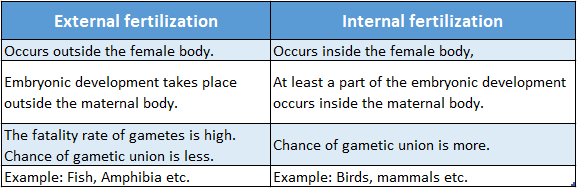
Question 19. Enumerate the differences between external and internal fertilization.
Answer:
The differences between external and internal fertilization
Question 20. Do bacteria reproduce sexually? If so, name the types of sexual reproduction that they carry out.
Answer:
Genetic studies Indicate that something like sexual reproduction, involving the fusion of two different cells and a transfer of hereditary factors, occurs in bacteria, although infrequently.
Typical sexual reproduction through the union of gametes is absent in bacteria. There are no fertilization and meiosis also.
Gene transfer occurs in bacteria through three methods Conjugation, Transformation, and Transduction.
Question 21. What are monoecious and dioecious organisms? Give examples.
Answer:
The plants carrying both male and female unisexual flowers on the same plant body are monoecious plants.
Examples: Gourd, Chara, etc. They are also called homothallic plants.
A bisexual or monoecious animal possesses both the male and female reproductive organs in the same animal body.
Examples: earthworms, snails, etc.
These are also known as hermaphrodites. The plants where male and female flowers are borne on separate plant bodies are dioecious or heterothallic plants.
Examples: Papaya, Marchantia, etc.
A unisexual or dioecious animal is either male or female, i.e. they have male and female reproductive structures on different sexes; Ex. Cockroaches, Human beings, etc.
Life Science Class 10 Chapter 2 Reproduction
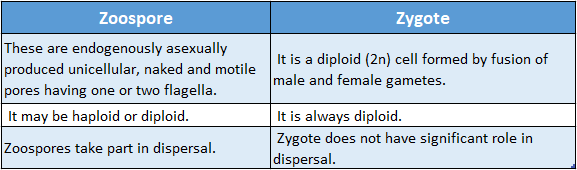
Question 22. Give differences between zoospore and zygote.
Answer:
Differences between zoospore and zygote
Question 23. what is the difference between the alternation of generations seen in plants and the sexual reproduction seen in mammals?
Is it better to have a more dominant sporophyte or a more dominant gametophyte in the life cycle of a plant?
Answer:
Mammals do not alternate generations and do not have variations between haploid and diploid states.
Some animals, like honey bees, do vary between haploid and diploid, but this determines their gender within a generation and does not change over generations.
In plants, however, the case is different and the gametophyte is dependent on the sporophyte and vice versa.
Neither the sporophyte nor the gametophyte should be more dominant. The dominance of a particular generation depends entirely on the successes and failures of the past generations of a species.
If the sporophyte tends to be weaker or is predated more, it will become a less prominent feature in the reproductive cycle. The same is equally true for the gametophyte.
Each species has formed a life cycle that has allowed it to survive to the present, so all are essentially equal.
Question 24. Which generation does the flowering plants in your garden represent— sporophyte or gametophyte?
In Bryophytes which stage is dominant? If the chromosome numbers in meiocytes of human beings, elephants, rice, and onion are 46, 56, 24 & 32 respectively, then what will be the chromosome number in gametes of these species?
Answer:
Flowering plants represent the sporophyte generation.
Gametophyte stage is dominant in Bryophytes.
Chromosome number in gametes: human beings = 23, elephant = 28 rice = 12, onion = 16