
WBBSE Chapter 2 Cell Division And Cell Cycle Introduction To Continuity Of Life
Each cell copies its chromosome exactly and passes on an identical copy to each daughter cell by cell division. Offspring may resemble or look different from the parents in bewilderingly complex ways.
This happens because individuals in nature contain many genes and different versions (alleles) of each gene.
Modern Cell Theory Or Cell Doctrine States That:
All organisms are made up of cells, ie., cells are structural & functional units of life.
Cells arise from pre-existing cells (Omnis cellula e cellula)
All organisms start their life from a single-cell
The multiplication of cells and their growth leads to the growth of an organism.
Read and Learn More WBBSE Solutions For Class 10 Life Science
WBBSE Chapter 2 Inter-Relationship Among Chromosome, DNA, And Gene
The eukaryotic cells contain a membrane-bound nucleus which is designated as the ‘Director of the cell’.
The nucleus contains many thread-like, coiled, and elongated structures called chromatin fibers or chromatin reticulum, or nuclear reticulum.
The fibers of chromatin are uniformly distributed in the nucleoplasm. Chromatin fibers are observed only during the interphase or the preparatory phase of the cell cycle.
Just before cell division, chromatin fibers condense, become thick, and wrap up very tightly to form ribbon-like structures called chromosomes.
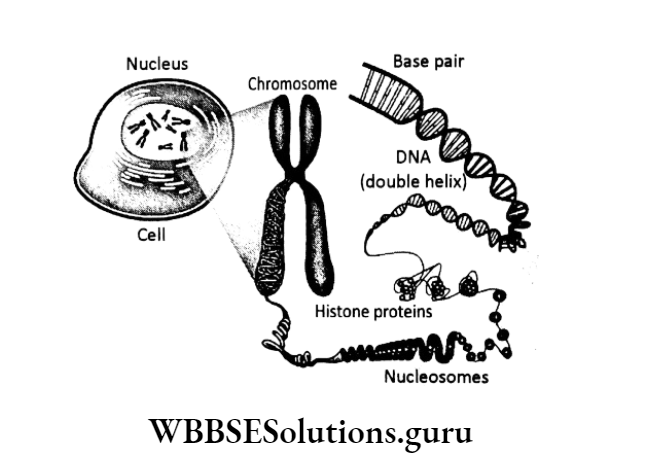
The number of particular species. They are usually found in pairs. Human beings have 23 pairs of chromosomes in each body cell.
The chromosome consists of a proteinaceous matrix and two spirally coiled chromonemata, each one of which contains a single DNA molecule.
The nucleus of an average human cell is only 6m in diameter, yet it contains 1.8 m of DNA which is distributed amongst the 23 pairs or 46 chromosomes each consisting of a single DNA molecule of about 40 mm.
Thus, Chromatin represents long-thin strands of the DNA-protein complex. It is an unfolded and uncondensed form of DNA, while chromosomes are condensed DNA and protein.
Class 10 Life Science Cell Division Solutions
The function of chromatin is to store DNA in the nucleus. Chromosomes are the bearers of hereditary instructions and regulate cellular processes.
DNA (or deoxyribonucleic acid) is the molecule that carries the genetic information in all cellular forms of life and some viruses.
It belongs to a class of molecules called nucleic acids, which are polynucleotides that is, long chains of nucleotides. Nucleotides are made up of a base, a sugar, and a phosphate. The four bases
chromosomes are constant in the nucleus for adenine (A), guanine (G), cytosine (C), and thymine (T) pair with each other (A with T and G with C).
It is the order or sequence of these base pairs that provides the information needed for the growth and development of our bodies.
Specific parts of DNA carry the code for producing specific proteins which ultimately lead to the expression of different characters in an organism.
Each of these parts of DNA is termed a gene. Thus gene is the fundamental physical and functional unit of heredity that carries information from one generation to the next.
It is a segment of DNA, composed of a transcribed region and a regulatory sequence, that makes possible transcription. A series of genes are present in each DNA.
The coordinated interaction of two or more genes produces a given phenotypic trait. A complete set of chromosomal genes is inherited by the offspring as a unit from the parent.
WBBSE Chapter 2 Cell Division And Cell Cycle Types Of Chromosome
Functionally there are two types of eukaryotic chromosomes-
- Autosomes and
- Allosomes or sex chromosomes.
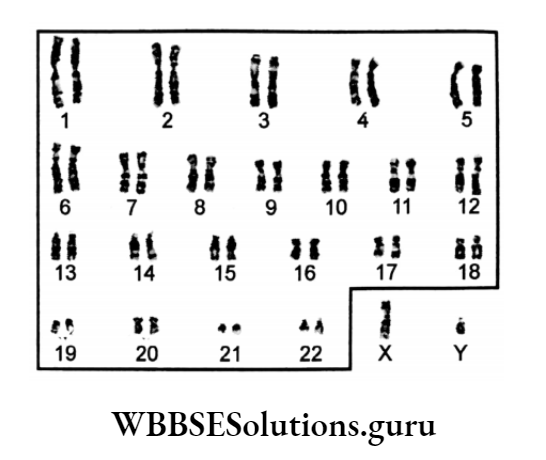
A human somatic cell contains 23 pairs of chromosomes. Out of the 22 pairs are autosomes and 1 pair is allosomes. The identical male and female parent chromosomes occurring in a pair are known as homologous chromosomes.
Each chromosome of a homologous pair is known as a homolog.
Autosomes:
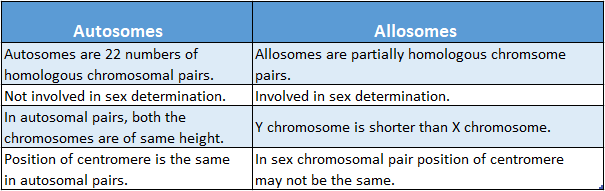
Autosomes are responsible for controlling all the somatic characteristics of the body (eg. height of the body, complexion, the texture of hair, etc) except sex determination.
There are 22 pairs of autosomes in humans.
The paired autosomes are numbered 1 through 22.
They are numbered according to size so that chromosome pair 1 is the longest, and chromosome pair 22 is the shortest. Each autosome contains a large number of genes arranged in a definite sequence.
Class 10 Life Science Cell Division Solutions
In these homologous pairs, the 2 chromosomes are of the same length. The position of the centromere is the same.
A diagram or photograph called a karyogram is often used to depict the chromosomes of a cell. In a karyogram, homologous chromosomes are placed next to each other.
For example, both homologs of chromosome pair 1 are put side by side. We get one homolog of each type of autosome pair from each of our parents.
Allosomes Or Sex Chromosomes
Allosomes are primarily responsible for the sex determination of an organism.
Out of the 23 pairs of chromosomes in each human somatic cell, one pair is known as the sex chromosome.
Sex Chromosomes Are Of Two Types In Humans:
- X and Y.
- Y is smaller, and X and Y are partially homologous.
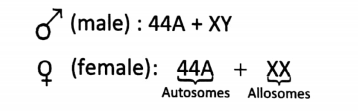
However, they pair and segregate into daughter cells during meiosis. Males have X and Y combinations. Females have X and X combinations in their body cells.
Therefore, the Karyotype Of Each Human Somatic Cell Is Depicted As Below:
WBBSE Chapter 2 Topic A Cell Division And Cell Cycle Chromosome Number
The chromosome number is the precise number of chromosomes typical for a given species. In any species, the chromosome number is always the same and constant.
Therefore, the chromosome number is used in the identification of species and in tracing the relationship within the species.
In sexually reproducing organisms, the number of chromosomes in the body cells (or somatic cells = skin cell, blood cell, muscle cell, etc.) is diploid (2n; a pair of each chromosome),
since the nucleus of the somatic cell contains two homologs of each homologous pair of chromosomes-one is the paternal set (from the father) & the other is the maternal set (from the mother).
It may however be noted that the number of chromosomes does not correlate with the apparent complexity of an animal or a plant:
In humans, for example, the diploid number is 2n = 46 (that is, 23 pairs), compared with 2n = 78, or 39 pairs, in the dog and 2n = 36 (18 pairs) in the common earthworm.
The number of chromosomes in the sex cells (or germ cells or gametes) is haploid (n) since a single set of unpaired chromosomes is present in the nucleus of such cells.
Cell Cycle And Its Phases Class 10 Notes
In man, sperm and ova possess 23 chromosomes (n) each.
Thus the diploid (2n) number of chromosomes in somatic cells is just the double haploid (n) number of chromosomes in games. The haploid number is produced during meiosis.
WBBSE Chapter 2 Topic A Cell Division And Cell Cycle Structure Of Chromosome
In the nucleus of each cell, the DNA molecule is packaged into thread-like structures called chromosomes. Each chromosome is made up of DNA tightly coiled many times around proteins called histones that support its structure. A small amount of RNA is also present.
Chromosomes are not visible in the cell’s nucleus not even under a microscope when the cell is not dividing.
However, the DNA that makes up chromosomes becomes more tightly packed during cell division and is then visible under a microscope.
Chromosomes (Gr., chrom=colour, soma= body) are rod-shaped, dark-stained bodies seen during the metaphase stage of mitosis when cells are stained with a suitable basic dye and viewed under a light microscope.
Chromosomes were first described by Strasburger (1815), and the term ‘Chromosome’ was first used by Waldeyer in 1888.
During metaphase, a chromosome appears to possess two threads called chromatids, which become intertwined in the matrix of chromosomes.
These chromatids are spirally coiled chromonemata (sing., chromonema) at metaphase. Chromatin is composed of DNA, RNA, and protein.
Purified chromatin isolated from interphase nuclei consists of about 30-40% DNA, 50-65% protein, and 0.5-10% RNA; but there is a considerable variation due to species and tissues of the same species.
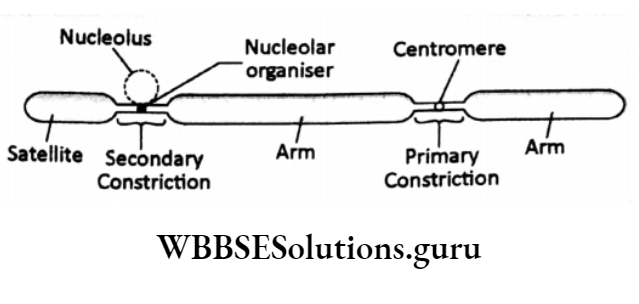
Each chromosome has a constriction point called the centromere, which divides the chromosome into two sections, or “arms”.
The location of the centromere on each chromosome gives the chromosome its characteristic shape and can be used to help describe the location of specific genes.
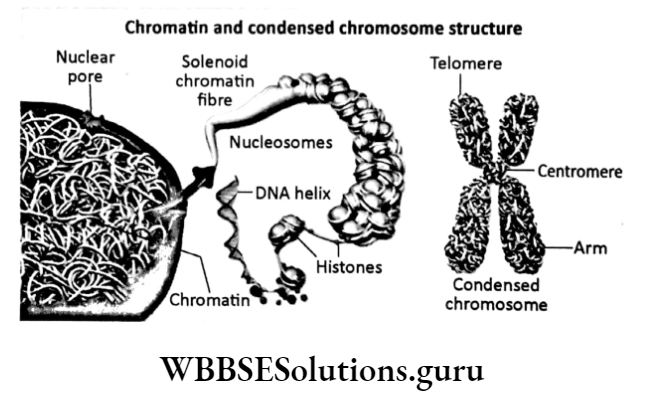
The DNA double helix is bound to proteins called histones. The histones have positively charged (basic) amino acids to bind the negatively charged (acidic) DNA.
The DNA is wrapped around the histone core of eight protein subunits, forming the nucleosome. Now all of this DNA and protein organization, all the DNA rolled around the histone proteins, is called chromatin.
Chromomeres are serially aligned, small bead-like accumulations of chromatin material that are visible along the length of the chromosome, especially during prophase.
Cell Cycle And Its Phases Class 10 Notes
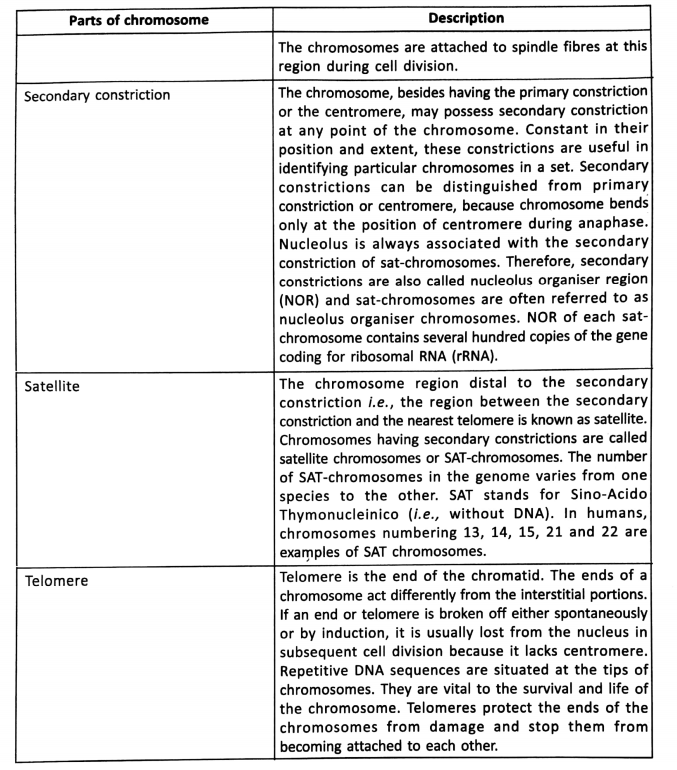
Chromosome morphology changes with the stage of cell division, and at mitotic metaphase, it is most suitable to study a eukaryotic chromosome morphology When the following structural features can be seen under a light microscope.

WBBSE Chapter 2 Topic A Cell Division And Cell Cycle Chemical Components Of Chromosomes
The material of the chromosomes is the chromatin.
Chromatin is composed of DNA, RNA, and protein.
Purified chromatin isolated from interphase nuclei consists of about 30-40% DNA, 50-65% protein, and 0.5-10% RNA, but there is a considerable variation due to species and species.
DNA: DNA (Deoxyribonucleic acid) is up of molecules nucleotides.
Each nucleotide contains a phosphate group (phosphoric acid), a sugar group, and a nitrogen base.
Nucleotides are arranged in two long strands that form a spiral called a double helix, tissues of the same The structure of the double helix is somewhat like a ladder, with the base pairs forming the ladder’s rungs and the sugar and phosphate molecules forming the vertical side pieces of the ladder.
Cell Cycle And Its Phases Class 10 Notes
There are two classes of nitrogen bases called purines (Adenine = A, Guanine = G) and pyrimidines (Cytosine = C, Thymine = T).
Each base pair is formed from two complementary nucleotides (purine with pyrimidine) bound together by hydrogen bonds. The base pairs in DNA are A with T and C with G.
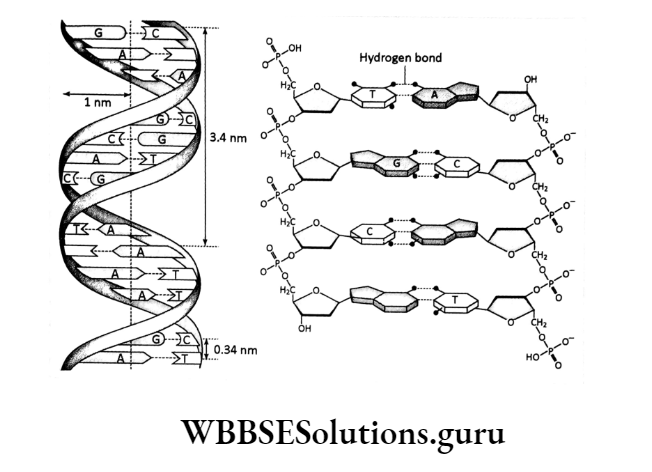
The deoxyribose sugar in DNA is a pentose, a 5-carbon sugar (commonly we know of Hexose or 6- 6-carbon sugars as C6H12O6). The carbons are numbered 1′ to 5′(pronounced ” prime carbon”).
It is from this numbering system of the sugar group that DNA gets its polarity. The linkages between nucleotides occur between the 5′ and 3′ positions in the sugar group. One end has a free 5′ end and the other has a free 3′ end.
A phosphate group consists of a central phosphorous surrounded by four oxygen.
Protein:
- Proteins Associated With Chromosomes May Be Classified Into Two Broad Groups:
- basic proteins or histones and
- nonhistone proteins (may be acidic).
- Histones constitute about 80% of the total chromosomal protein. Histones contain amino acids like histidine, arginine, lysine, etc.
- Nonhistone proteins contain amino acids like tryptophan and tyrosine.
RNA:
RNA (Ribonucleic acid) is helical single stranded having structural units called ribonucleotide.
Each ribonucleotide contains the pentose sugar called ribose, a molecule of a phosphate group, and a nitrogen base. The nitrogen base of RNA is two purine bases (Adenine, Guanine) and two pyrimidine bases (Cytosine, Uracil).
Depending on their staining properties during interphase the following two types of chromatin may be distinguished in chromosomes.
Euchromatin:
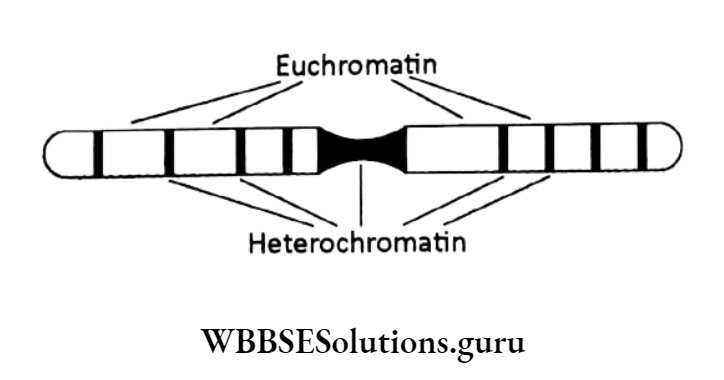
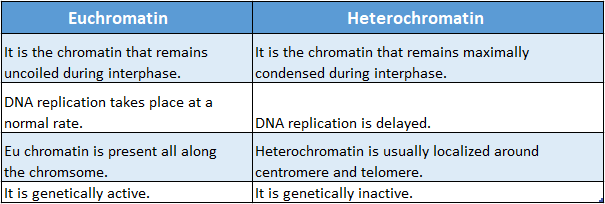
Portions of chromosomes that stain lightly are only partially condensed; this chromatin is termed euchromatin. Euchromatin contains structural genes and is considered genetically active chromatin since it has a role in the phenotype expression of the genes.
Cell Cycle And Its Phases Class 10 Notes
Heterochromatin:
In the dark-staining regions, the chromatin remains condensed and is called heterochromatin.
Heterochromatin is characterized by its especially high content of repetitive DNA sequences and contains very few if any, structural genes.
It is late replicating (i.e., it is replicated when the bulk of DNA has already been replicated) and is not transcribed.
However, heterochromatin helps in gene regulation and the protection of chromosome integrity. Centromeric regions invariably contain heterochromatin.
The distribution of euchromatin and heterochromatin portions in a typical chromosome.
WBBSE Chapter 2 Topic A Cell Division And Cell Cycle Cell Organelles And Structures Involved In Cell Division
All cells have within them a variety of different organelles. Organelles are cell parts that are adapted and specialized to perform various vital activities of the cell like the organs of the human body.
The cell organelles directly associated with cell division are—
Nucleus:
The nucleus is the seat of the chromosomes that are to be divided. A unique feature of the nucleus is that it disassembles and re-forms each time most cells divide.
At the beginning of cell division, the chromosomes condense, the nucleolus disappears, and the nuclear envelope breaks down, resulting in the release of most of the contents of the nucleus into the cytoplasm.
At the end of cell division, the process is reversed. The interphase chromatin condenses approximately a thousandfold further to form the compact chromosomes as seen in dividing cells.

Centrosome and microtubules:
The centrosome is located in the cytoplasm of an animal cell usually close to the nucleus. It consists of two centrioles — oriented at right angles to each other.
It is duplicated duringthe S- phase of the cell cycle. Just before cell division, the two centrosomes move apart until they are on opposite sides of the nucleus.
As cell division proceeds, microtubules grow out from each centrosome with their ends growing toward the metaphase plate. Microtubules are thick, strong spirals of thousands of subunits.
Cell Division And Cell Cycle Class 10 WBBSE
Those subunits are made of a protein called tubulin. The microtubule spokes radiate from a central site occupied by the centrosome, which is the primary microtubule-organizing center (MTOC) in many interphase cells.
This cytoskeleton transports material within cells and coordinates cell division. These clusters of microtubules are called spindle fibers.
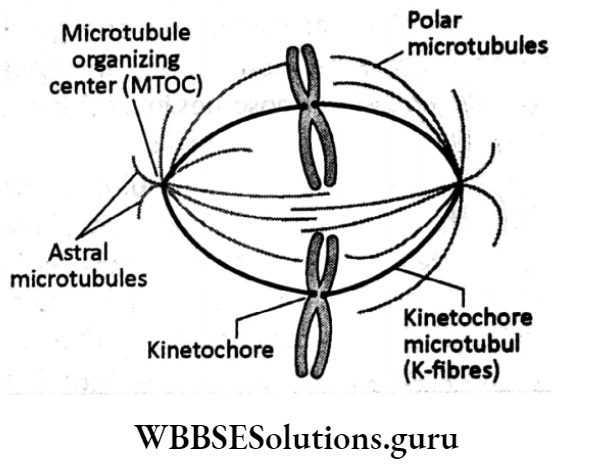
Microtubules are critical throughout the cell cycle – they organize chromosomal components and split them in two.
Spindle fibers have three destinations are attached to one kinetochore of a chromatid. Some bind to the arms of the chromosomes.
Still, others continue growing from the two centrosomes until they extend between each other in a region of overlap.
All three groups of spindle fibers participate in the assembly of the chromosomes at the metaphase plate at metaphase and the separation of the chromosomes at anaphase. In plant cells, however, the spindle is formed from cytoplasm and nucleoplasm.
Ribosome:
Ribosomes are the workbench of protein synthesis. Therefore, ribosomes play an important role in cell division. Several ribosomes become associated with Messenger RNA (mRNA) to form polyribosomes or polysomes. Polysomes act as sites for polypeptide synthesis.
A cell will not copy its DNA in preparation for cell division unless it knows that it has enough ribosomes to make new proteins because copying DNA requires a huge amount of proteins and energy.
This copying process happens during the interphase. Thus, the number of ribosomes in a cell is a form of regulating cellular homeostasis.

Mitochondria:
Cells require an ample amount of ATP (Adenosine triphosphate) to synthesize bioactive compounds such as lipids, proteins, and nucleotides for cell division.
Mitochondrial ATP production is also vital for cell division in addition to other basic functions in the cell including the regulation of cell volume, solute concentration, and cellular architecture.
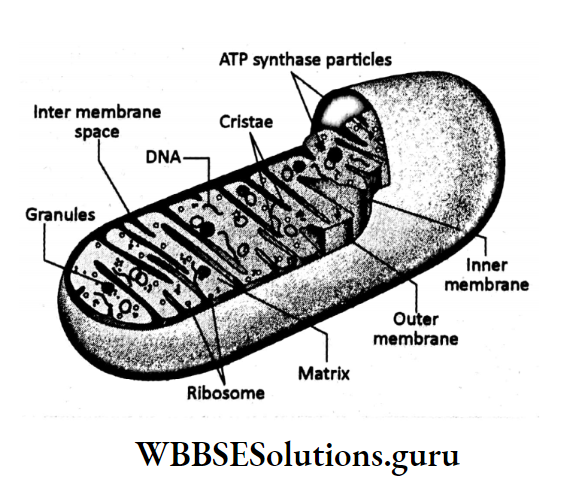
Mitochondria are the fuel of the cell and act as a type of “driver” in cell division. The mitochondrial network fragments during mitosis to allow proper segregation of the organelles between daughter cells.
WBBSE Chapter 2 Topic A Cell Division And Cell Cycle Cell Cell Division Fit Its Significance
The fundamental and active biological process by which a cell produces its replica having similar structural, genetic, and physiological properties and thereby, brings upon continuity of life is called cell division.
Significance Of Cell Division:
The importance of cell division can be appreciated by realizing the following facts:
Continuity of life:
Cell division is a prerequisite for the continuity of life.
On one hand, it helps cells to maintain a favorable surface area to volume relationship and on the other, forms the basis of evolution to various life forms,
Cell Division And Cell Cycle Class 10 WBBSE
Means of reproduction:
In unicellular organisms, cell division is the means of asexual reproduction, which produces two or more new individuals from the mother cell.
In sexually reproducing organisms, the reduction division of meiosis helps to maintain constancy of the chromosome number of a species,
Growth:
In multicellular organisms, life starts from a single cell called a zygote (fertilized egg). The zygote transforms into an adult that is composed of millions of cells formed by successive divisions.
Thus, growth occurs by cell division,
Means of repair, healing & regeneration:
Cell division is the basis of the repair and regeneration of old and worn-out tissues. It causes healing of the injured regions of the body.
WBBSE Chapter 2 Topic A Cell Division And Cell Cycle Cell Types Of Cell Division
Plant & animal cells generally undergo three types of cell division-amitosis (direct cell division), mitosis (indirect equational cell division), and meiosis (indirect reduction division).
Amitosis occurs in prokaryotes and protozoans, while mitosis and meiosis occur in eukaryotes.
In the case of direct division, the nucleus and cell body undergo a simple mass division into two parts. During indirect division, the nucleus undergoes complicated changes before it is divided into two daughter nuclei.
Amitosis:
Amitosis, also known as binary fission, is a type of direct cell division in which both the nucleus and the cytoplasm undergo a simple mass division without going through complicated stages involving spindle or chromosome formation, maneuvers, and wall formation.
It is the means of asexual reproduction in unicellular organisms like bacteria & protozoans and also a method of multiplication or growth in fetal membranes of some vertebrates.
In amitosis, the splitting of the nucleus is followed by cytoplasmic constriction.
The nucleus elongates first & then assumes simple mass division without going through complicated stages involving spindle or chromosome formation, their maneuvers, and wall formation.
It is the means of asexual reproduction in unicellular organisms like bacteria & protozoans and also a method of multiplication or growth in fetal membranes of some vertebrates.
In amitosis, the splitting of the nucleus is followed by cytoplasmic constriction. The nucleus elongates first & then assumes a dumb-bell-shaped appearance.
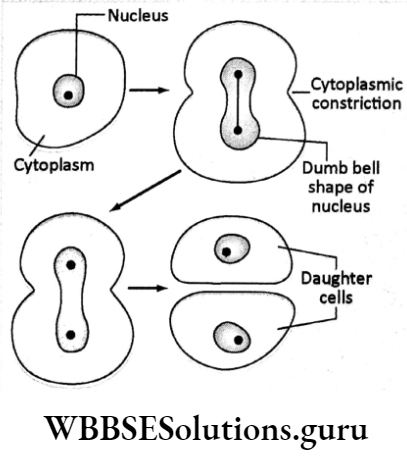
The depression or constriction increases in size & ultimately divides the nucleus into two nuclei.
Next, the cytoplasmic constriction divides the cell into two equal or approximately similar halves. Therefore, without the occurrence of any nuclear events, two daughter cells are formed each of which can grow into a completely new organism.
Mitosis:
Mitosis producestwo genetically identical daughter cellsl. It means the two daughter cells have a similar genetic composition to their parents.
Meiosis:
Meiosis produces four haploid (n) daughter cells that come from diploid parents (2n). In this process, each of the daughter cells has half the chromosome of the parental cells.
WBBSE Chapter 2 Topic A Cell Division And Cell Cycle Cell Cycle
During development from a zygote to a fully differentiated body, cells in the body alternately divide (mitosis) and “appear” to be resting (interphase).
Cell Division And Cell Cycle Class 10 WBBSE
The sequence of activities exhibited by cells in the period between the end of one division and the end of the next is termed the cell cycle.
Cell Cycle Constitutes Of Two Phases:
- Interphase &
- M phase.
Interphase:
Interphase, which appears to be a long resting stage between cell divisions, is a period of diverse activities that are indispensable in making the next mitosis possible.
During this long period, the cell constantly synthesizes DNA, RNA & protein, stores up energy, and grows in size.
The volume of the cell decreases highly as a result. The nuclear membrane, however, remains intact and chromosomes remain as long thread-like chromatin fiber in the nucleoplasm.
By studying molecular events in cells, scientists have determined that interphase can be divided into four steps:
Gap 0 (G0), Gap 1 (G1), S (synthesis) phase, Gap 2 (G2).

Gap 0 (G0):
There are times when a cell will leave the cycle and quit dividing. This may be a temporary resting period or permanent.
An example of the latter is a cell that has reached an end stage of development and will no longer divide (e.g. neuron). After birth, the nerve cells in mammals do not divide and remain in the perpetual G0 phase throughout life.
Gap 1 (G1):
Cells increase in size in Gap 1, produce RNA, and synthesize protein.
An important cell cycle control mechanism that is activated during this period (G1 Checkpoint, also known as the restriction or start checkpoint) ensures that everything is ready for DNA synthesis.
If a cell meets the requirements for the G1 checkpoint, the cell will enter the S phase and begin DNA replication.
This transition, as with all of the major checkpoint transitions in the cell cycle, is signaled by cyclins and cyclin-dependent kinases (CDKs).
Cyclins are If a cell meets the requirements for the G1 checkpoint, the cell will enter the S phase and begin DNA replication.
This transition, as with all of the major checkpoint transitions in the cell cycle, is signaled by cyclins and cyclin-dependent kinases (CDKs). Cyclins are cell signaling molecules that regulate the cell cycle.The
G12 phase varies from 3-4 hours to serval days, months, or even years
S Phase:
To produce two similar daughter cells, the complete DNA instructions in the cell must be duplicated.
DNA replication and synthesis of histone occur during this S (synthesis) phase. As a result, chromosome duplication occurs in this phase. It lasts for 7-8 hours.
Gap 2 (G2):
During the gap between DNA synthesis and mitosis, the cell will continue to grow and produce new proteins.
At the end of this gap, there is another control checkpoint (G2 Checkpoint) to determine if the cell can now proceed to enter M (mitosis) and divide.
However, the most important role of the G2 checkpoint is to ensure that all of the chromosomes have been accurately replicated without mistakes or damage.
Cell Division And Cell Cycle Class 10 WBBSE
If the checkpoint mechanisms detect problems with the DNA, the cell cycle is halted and the cell attempts to either complete DNA replication or repair the damaged DNA. In this stage, diploid cells contain 4X times the amount of DNA.
It is then followed by mitosis.
Mitosis or M Phase:
Cell growth and protein production stop at this stage in the cell cycle. All of the cell’s energy is focused on the complex and orderly division into two similar daughter cells.
Mitosis is much shorter than interphase, lasting perhaps only for one to two hours.
As in both G1 and G2, there is a Checkpoint in the middle of mitosis (Metaphase checkpoint) that ensures the cell is ready to complete cell division.
The M checkpoint is also known as the spindle checkpoint because it determines whether all the sister chromatids are correctly attached to the spindle microtubules.
Because the separation of the sister chromatids during anaphase is an irreversible step, the cycle will not proceed until the kinetochores of each pair of sister chromatids are firmly anchored to at least two spindle fibers arising from opposite poles of the cell.
WBBSE Chapter 2 Topic A Cell Division And Cell Cycle Tumor
Uncontrolled cell division or propagation of damaged DNA can contribute to genomic instability and tumorigenesis.
If cell division is not regulated, a tumor will develop due to uncontrolled cell proliferation.
A tumor, also called neoplasm, is a mass of abnormal tissue that arises without obvious cause from pre-existing body cells, has no purposeful function, and is characterized by a tendency to autonomous and unrestrained growth.
The Abnormal Cells That Generally Makeup Tumors, Differ From Normal Cells In Having Undergone One Or More Of The Following Alterations:
- Hypertrophy (or an increase in the size of individual cells)
- Hyperplasia (or an increase in the number of cells within a given zone)
- Anaplasia (or regression of the physical characteristics of a cell towards a more primitive type).
Tumors may be-
Benign or Malignant type
Benign Or Non Cancerous Tumor:
The cells keep enlarging in size but are confined to the site of origin only.
They do not spread to the other parts of the body. The cells may cause pain, and discomfort and affect other organs due to their increased size, but their effect is not lethal. However, sometimes, benign tumors can also turn cancerous.
Cell Division Class 10 Life Science Pdf
Malignant Or Cancerous Tumor:
The tumor cells do not remain confined to the site of origin. They move & spread to other parts via blood or other tissue fluid of the body to form secondary tumors.
The moving and setting process is called metastasis. Metastasis is always fatal and these cells kill other cells or tissues.
WBBSE Chapter 2 Topic A Cell Division And Cell Cycle Mitosis
Mitosis is a type of equational & indirect cell division in which chromosomes of the parent cell are equally distributed resulting in two genetically identical daughter cells.
The cells undergoing mitosis are called mitocytes. In plants, the myocytes are mostly meristematic cells. In animals, the myocytes are stem cells, germinal epithelium, and embryonic cells.
This division was first observed by Strassburger (1870) in plant cells and by Fleming (1882) in animal cells. The basic outline of mitosis remains the same in all living organisms.
Chromosomes replicated during mitosis are divided in such a way as to ensure that each daughter cell receives a copy of every chromosome of the parent cell.
The replicated chromosomes are attached to a ‘mitotic apparatus’ that aligns them and then separates the sister chromatids to produce an even partitioning of the genetic material.
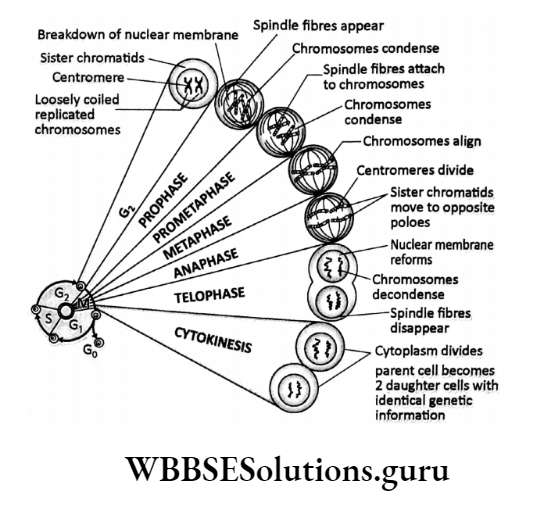
This separation of the genetic material in a mitotic nuclear division (or karyokinesis) is followed by a separation of the cell cytoplasm in a cellular division (or cytokinesis) to produce two daughter cells. A mitosis division generally takes a time of 30 minutes to 3 hours.
WBBSE Chapter 2 Topic A Cell Division And Cell Cycle Stages Of Mitosis
Though Mitosis Is A Continuous Process, For a Better Understanding
The Whole Process Is Divided Into the Following Stages:
1. Prophase (Longest phase)
2. Prometaphase
3. Metaphase
4. Anaphase (shortest phase)
5. Telophase
C-Phase or Cytokinesis (a division of cell cytoplasm)
Karyokinesis (nuclear division):
It is the process by which the nucleus of the parent cell divides into two daughter nuclei.
WBBSE Chapter 2 Topic A Cell Division And Cell Cycle Description Of Different Stages
Prophase:
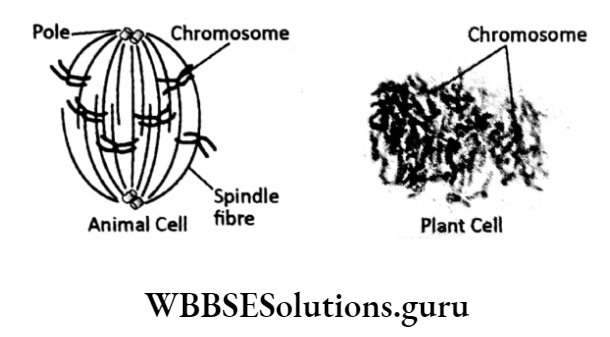
It is the longest stage of mitosis during which chromatin threads condense, shorten & thicken to form chromosomes followed by the disappearance of both the nucleolus & the nuclear membrane and the formation of the mitotic apparatus.
The observed changes are-Nucleus becomes spherical and the cytoplasm becomes more viscous.
The chromatin threads slowly condense due to dehydration, shorten & thicken to form well-defined chromosomes.

Since each chromosome is already doubled due to the doubling of DNA contents in interphase, each chromosome now appears as two sister chromatids joined at the centromere or kinetochore.
During early prophase, the chromosomes remain evenly distributed in the nucleoplasm but as prophase progresses, the chromosomes migrate towards the nuclear membrane.
The spindle fibers (microtubules) begin to form outside the nucleus.
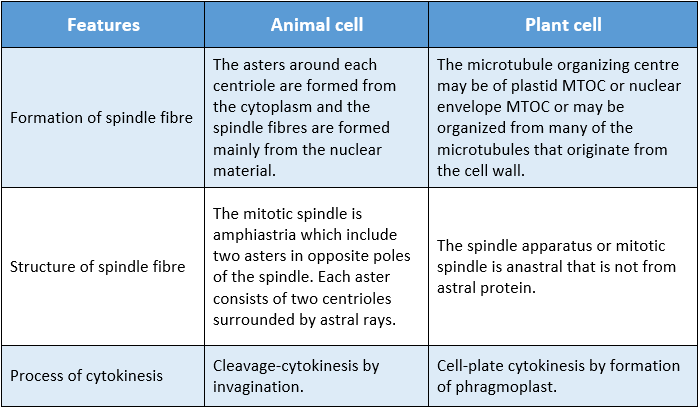
In plants, the microtubule organizing center (MTOC) may be of plastid MTOC or nuclear envelope MTOC or may be organized from many of the microtubules that originate from the rigid cell wall.
In plants the spindle apparatus or mitotic spindle is ancestral.
In animals, the movement of centrioles occurs due to the pushing apart by the growth of the spindle fiber between them. Fibrils appear like spokes of a wheel around each centriole to form asters.
The asters are formed from the cytoplasm and the spindle fibers are formed mainly from the nuclear material. In animals and brown algae, the mitotic spindle is amphiastral which includes two asters in opposite poles of the spindle.
Each aster consists of two centrioles surrounded by astral rays.
Cell Division Class 10 Life Science Pdf
Prometaphase
At the end of prophase, ie. during a cell’s entry to the prometaphase, the major event that happens is the breakdown of the nuclear envelope into small vesicles.
The observed changes are
The nuclear envelope breaks down into membrane vesicles with the result that nucleoplasm and cytoplasm mix. The chromosomes are therefore set free into the cytoplasm.
Specialized protein complexes or Kine- to chores become fully matured on the centromeres of the chromosomes.
The disruption of the nuclear envelope allows the mitotic spindles to gain access to the mature into- chores.
As the microtubules of the mitotic spindle enter the nuclear region, some chromosomes are attached to spindle microtubules through kinetochores.
These are called kinetochore microtubules. The remaining microtubules are called non-kinetochore microtubules.
Once they have captured the chromosomes, the kinetochore microtubules begin to exert force on the chromosomes to move them.
Nucleolus disappears.
Some cell biologists consider the prometaphase stage as early metaphase and include it under metaphase i.e. no separate prometaphase stage is considered.
Metaphase:
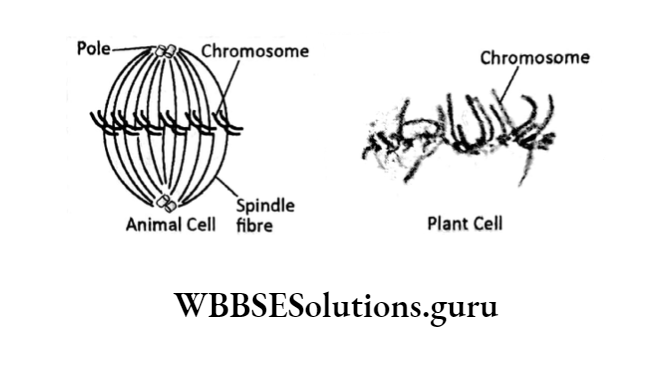
Metaphase is marked by the appearance of the spindle and the arrangement of chromosomes on the equator of the spindle. The diamond-shaped spindle formation starts in prophase and gets completed in metaphase.
Two pointed ends of the spindle are called the poles and the central broad part is known as the equator or the equatorial plate. The spindle is formed of spindle fibers that are composed of tubulin protein. There are two types of spindle fiber.s
Short fiber discontinuous fiber or chromosomal fiber-these are extended from the pole to the equator.
Long fiber continuous fiber or chromosomal fiber-these are extended from one pole to another pole.
The main events during this phase are—
The chromosomes migrate toward the equator of the spindle.
Each chromosome becomes more compact and short and its two chromatids remain separate except at the centromere which has not divided so far.
Kinetochore microtubules align the chromosomes in one plane to form a metaphase plate or equatorial plate.
The process of formation of a metaphase plate is called congression.
In animal cells, larger chromosomes remain attached to the periphery of the metaphase plate and smaller ones are placed at the central part. In plant cells, however, the orientation of chromatids on the equatorial plate is random.
Centromeres lie on the equatorial plane while the chromosome arms are directed away from the equator through a process called auto orientation.
Anaphase:
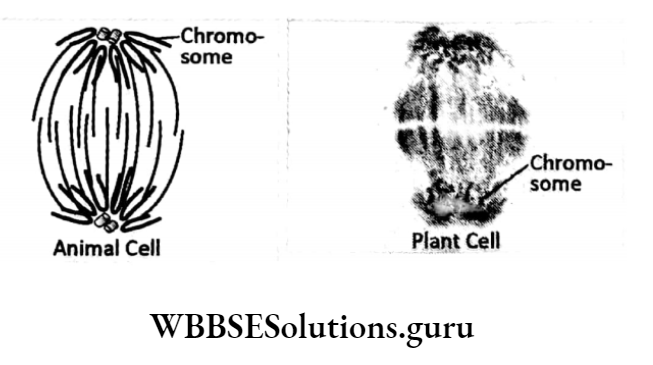
It is the shortest stage of mitosis during which the centromeres and the daughter chromosomes separate and begin to move towards the opposite poles of the equatorial plate.
The following changes occur during anaphase-
Chromosomes split simultaneously at the centromeres so that the sister chromatids separate. They are now called daughter chromosomes, each one consisting of a single chromatid.
The separated sister chromatids move towards opposite poles. This is called the anaphase movement.
The Poleward anaphase movement of daughter chromosomes occurs due to the shortening of kinetochore microtubules, the appearance and elongation of interzonal fibers, and the consequent pulling, pushing & repulsive forces.
Cell Division Class 10 Life Science Pdf
Daughter chromosomes may appear as V-shaped (metacentric) L-shaped (sub-metacentric), and L-shaped (telocentric).
The arms of daughter chromosomes remain directed towards the equator and centromere towards the pole of the spindle apparatus.

Telophase:
At the end of the polar migration of the daughter chromosomes, the telophase is marked by the uncoiling & deserialization of chromosomes followed by the reappearance of the nuclear membrane and nucleolus.
The main events during this phase are as follows-
Chromosomes reach the poles of the spindle and form two groups
Chromosomes begin to uncoil, undergo hospitalization, and form the chromatin network.
Kinetochore microtubules disappear.
The nuclear membrane is formed around each mass of chromatin from the endoplasmic reticulum resulting in the formation of two daughter nuclei.
Both the nucleoplasm and the cytoplasm are rehydrated.
Finally, a nucleolus is reorganized in each daughter nucleus at the chromosomal organizer site.
Cytokinesis:
Cytokinesis is the division of cell-cytoplasm into two separate cells each having a nucleus along with the redistribution of various cell organelles (mitochondria, Golgi bodies, etc).
It usually occurs in telophase along with the formation of daughter nuclei after the nuclear division. If cytokinesis does not occur after karyokinesis, the cell will be a binucleate one.
The process of cytokinesis differs in plant and animal cells.
Cytokinesis in Animal Cells:
In animal cells, cytokinesis starts with the appearance of a shallow groove cleavage, or furrow in the cytoplasm at the equator of the spindle. Slowly and slowly it deepens and constricts the cytoplasm and divides the cell into two parts.

Cytokinesis In Plant Cells:
In plant cells, cytokinesis is accomplished by the formation of phragmoplast and cell plate at the equator of the dividing cell. Cell plate or phragmoplast is formed by the fusion of small vesicles of Golgi bodies called phragmosomes.
Cell Division Class 10 Life Science Pdf
Gradually more amount of materials like cellulose, hemicellulose, pectin, etc are deposited on both sides of the cell plate to form a complete cell wall that separates the cytoplasm of the two daughter cells.

Basic Differences Between Mitosis Of Animal Cell And Plant Cell

WBBSE Chapter 2 Topic A Cell Division And Cell Cycle Significance Of Mitosis
The Importance Of Mitosis For The Organisms Has Been Summarised As Follows:
1. Maintaining the same genetic constitution:
In mitosis cell division, the two resulting daughter cells always contain the same number of chromosomes as the parent cell from which they derive.
Thus, It maintains equilibrium in the amount of DNA and RNA contents through equational division.
2. Opportunity for growth & development:Itt provides an opportunity for the growth and development of organs and the body of organisms. The number of cells within an organism increases by mitosis and this is the basis of growth in multicellular organisms from a single-celled zygote.
3. Repair & Replacement:
Old, decaying, and dead cells are constantly dying and being replaced by mitosis. For example- our skin cells and blood cells regularly die off; they are replaced and repaired by mitosis.
4. Regeneration & Healing:
Regeneration is the ability to replace lost or damaged body parts. Plants can regenerate all body parts from precursor cells. Some animals can regenerate whole parts of their body i.e.
legs in crustaceans, arms in starfish, and tails in lizards. The production of these new cells involves mitosis. Similarly, the healing process of a wound involves mitosis. We can regenerate skin, a large amount of liver, and the very tips of fingers and toes.
Class 10 Life Science Cell Division Solutions
5. Asexual reproduction:
Mitosis helps the organisms in asexual reproduction. By cell division, one cell divides to become two. This process is used by some organisms, such as protozoans, most plants, and lower invertebrates to reproduce.
WBBSE Chapter 2 Topic A Cell Division And Cell Cycle Melosis
Meiosis is the form of reductional eukaryotic cell division comprising a heterotypic division followed by a homotype division that produces haploid sex cells or gametes [which contain a single copy (n) of each chromosome] from diploid germ mother cells
[which contains two copies (2n) of each chromosome] in which genetic recombination takes place by crossing over between the genes.
The process takes the form of one DNA replication followed by two successive nuclear and cellular divisions (Meiosis I and Meiosis II).
Let us illustrate cell division by taking the chromosome number of humans. The cells of human beings contain a constant diploid (2n) number of chromosomes (23 pairs or 46 numbers 44 + XY in males and 44 + XX in females).
Humans reproduce sexually in which male and female gametes fuse to form the zygote. Gametes should contain haploid (n) number of chromosomes.
(23 numbers 22 + X or 22 + Y)so thatt the chromosome number of the zygote remains constant at 46 from generation to generation.
This happens due to meiosis which reduces the chromosome number to half in gametes and prevents it to go on doubling with each generation. Vanbeneden (1883) first reported meiosis. Farmer and Moore (1905) coined the term meiosis.
The cells undergoing meiosis are known as meiocytes. In plants, the meiocytes are microsporocytes (pollen mother cell) of anthers and megasporocytes (megaspore mother cell) of ovules.
In animals, the meiocytes are primary spermatocytes in the testes and primary oocytes in the ovaries.
WBBSE Chapter 2 Topic A Cell Division And Cell Cycle Stages Of Meiosis
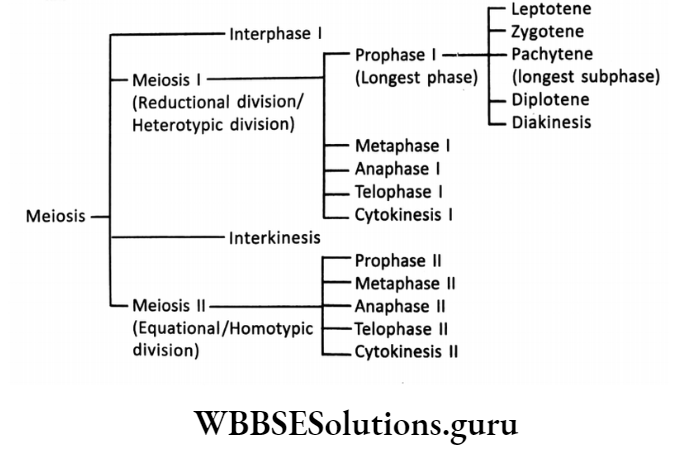
Meiosis consists of two cycles of nuclear division (Meiosis-I and Meiosis-II), usually accompanied by cell division
[especially in sexually reproducing multicellular forms, where it is generally used to produce gametes through gametogenesis], preceded by DNA replication inintermeioticc interphase.
The stages of meiosis are as follows:
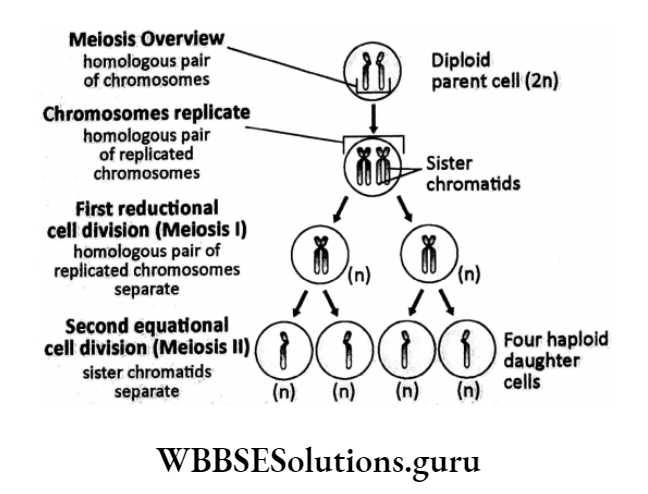
The process takes the form of one DNA replication followed by two successive nuclear and cellular divisions (Meiosis I and Meiosis II).
Let us illustrate cell division by taking the chromosome number of humans. The cells of human beings contain a constant diploid (2n) number of chromosomes (23 pairs or 46 numbers 44 + XY in males and 44 + XX in females).
Humans reproduce sexually in which male and female gametes fuse to form the zygote. Gametes should contain a haploid (n) number of chromosomes (23 numbers 22 + X or 22 + Y) so that the chromosome number of the zygote to remain constant at 46 from generation to generation.
This happens due to meiosis which reduces the chromosome number to half in gametes and prevents it to go on doubling with each generation. Vanbeneden (1883) first reported meiosis. Farmer and Moore (1905) coined the term meiosis.
Class 10 Life Science Cell Division Solutions
The cells undergoing meiosis are known as meiocytes. In plants, the meiocytes are microsporocytes (pollen mother cell) of anthers and megasporocytes (megaspore mother cell) of ovules.
In animals, the meiocytes are primary spermatocytes in the testes and primary oocytes in the ovaries.
WBBSE Chapter 2 Topic A Cell Division And Cell Cycle Stages Of Meiosis
Meiosis consists of two cycles of nuclear division (Meiosis-I and Meiosis-II), usually accompanied by cell division [especially in sexually reproducing multicellular forms, where it is generally used to produce gametes through gametogenesis], preceded by DNA replication in iintermeioticinterphase.
The stages of meiosis are as follows:
Important features of meiosis
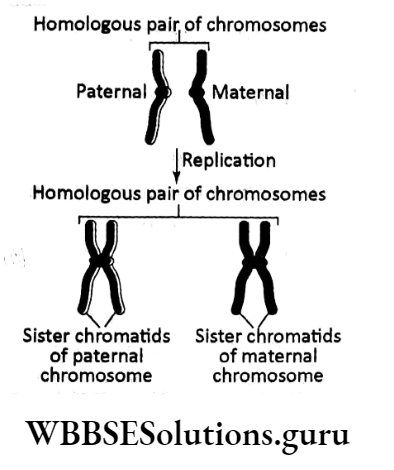
1. Homologous Chromosomes:
These are chromosome pairs of approximately the same length and centromere position. Note that diploid cells have two sets or one pair of homologous chromosomes.
Out of the pair, one is inherited from the mother (maternal) and one from the father (paternal).
2. DNA replication:
Replication of DNA takes place during the interphase preceding meiosis. DNA replication generates sister chromatids from each chromosome. Sister chromatids are two identical copies of a chromatid that remain closely aligned.
Although DNA replication occurs in interphase, no longitudinal doubleness of chromosomes is visibly evident in Leptotene of Prophase I owing to contraction.
3. Synopsis:
The movement of chromosomes initiates in the zygotene stage and this movement results from an attracting force that brings the homologous pair of chromosomes together.
The chromosomes become shorter and thicker due to compaction.
When they come closer, homologous chromosomes pair and align at the equatorial plate of the cell for equal qualitative and quantitative distribution. The pairing takes place throughout the length.
This process of pairing is known as synapsis Pairing takes place not only between the homologous chromosomes but also between homologous regions of the chromosomes. Chromosome pairs undergoing synapsis have approximately the same length and centromere position.
Out of the pair, one is inherited from the mother (maternal) and one from the father (paternal). Non-sister chromatids belong to homologs.
These are chromosome pairs having the same length, staining pattern, centromere position as well as the same characteristics of genes at particular loci.
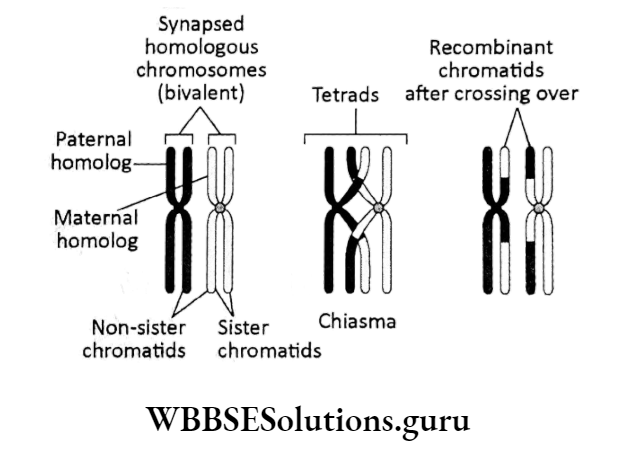
A homologous pair of chromosomes consists of one chromosome from each parent and they are known as bivalents. Each chromosome of a bivalent is found to have two chromatids. Thus the four chromatids of a bivalent are together known as a tetrad.
4. Crossing Over:
The pachytene subphase of Prophase I is marked by a process called Crossing over that happens after both the homologous chromosomes in a pair join up to form a structure called a tetrad through synapsis.
Once a tetrad is formed, a portion of each homologous chromosome breaks off transversely and is re-attached to the same part of its homolog. Crossing over occurs between non-sister chromatids of homologous Sister Chiasma chromatids chromosomes.
This mixes up the traits that are found in each of the chromosomes, thus resulting in genetic recombination due to the exchange of segments between two non-sister chromatids belonging to a bivalent tetrad.
As a result of crossing over, X liX-liketructure is formed between the non-sister chromatids. The point of attachment at the crossing-over is called chiasma. It occurs during Diplotene.
The number of chiasmas may be one, two, or more depending on the length of the chromosomes.
5. Terminalization Of Chiasmata:
Chiasmata are generally pushed to the terminal ends of the chromosomes and this process is known as the terminalization of chiasmata (singular: chiasma).
The pair of homologous chromosomes begin to separate in the diplotene subphase of prophase I and chiasmata are fully terminalized in the diakinesis subphase of prophase.
Wbbse Life Science Class 10 Chapter 2 Questions And Answers
Reduction in chromosome number:
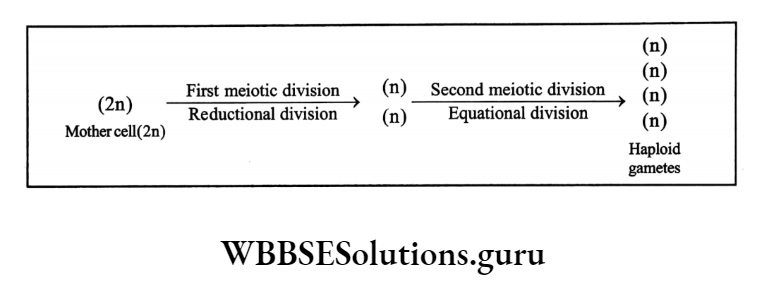
During metaphase I, the tetrads line up on the plate. During anaphase I, the homologous chromosomes separate from one another i.e. one homologous chromosome with its two sister chromatids move to opposite poles.
Thus each pole has a haploid (n) number of chromosomes i.e. a reduction in chromosome number is achieved at this stage.
Telophase results in the formation of two haploid (n) daughter nuclei with each chromosome having two chromatids. For this reason, the first meiotic division is known as the reductional or heterotypic cell division.
7. Equational division:
Meiosis II or the second meiotic division has four phases similar to mitosis and is the second round of cell divisions during meiosis whereby the cells formed during Meiosis I divide again to form four haploid (n) gametes.
Between these two stages, the interkinesis or interphase is either quite short or skipped, unlike normal mitosis. Because of this, the S phase does not occur and so the DNA in these cells is not copied, making the resulting cells from this phase haploid.
WBBSE Chapter 2 Topic A Cell Division And Cell Cycle Significance Of Meiosis
1. Gametogenesis:
It is a necessary part of the life cycle of sexually reproducing animals since it leads to the formation of gametes (sex cells) through meiosis.
2. Maintenance Of Constant Chromosome Number Of A Species:
The gametes produced as a result of meiosis are haploid (n) and the zygote formed by their fusion is diploid (2n).
Thus, it is the only means for restoring the constancy in chromosome number, which is a characteristic of the species from generation to generation.
3. Production Of Variation In Organisms:
Meiosis results in new combinations of genetic material. During crossing over, the hereditary factors from male and female parents get mixed due to the breakage and exchange of chromatids.
This brings in genetic variation within the species. The variations are important raw materials for evolution and also help in the improvement of races.
4. Alternation of generation:
Meiosis causes conversion from sporophytic generation to gametophytic generation in plants, i.e. causes the alternation of generation through prezygotic, post-zygotic, or sporadic meiosis.
Meiosis occurs in sporogenous cells (micro and megaspore mother cells) of the sporophyte-producing haploid spores. The spores on germination form gametophytes (male and female).
Wbbse Life Science Class 10 Chapter 2 Questions And Answers
Cells of the gametophyte form gametes. Fusion of these gametes again leads to diploid or sporophytic generation and in this way, the alternation of generation between gametophytic and sporophytic generations keeps on going.
WBBSE Chapter 2 Topic A Cell Division And Cell Cycle Difference Between Mitosis And Meiosis
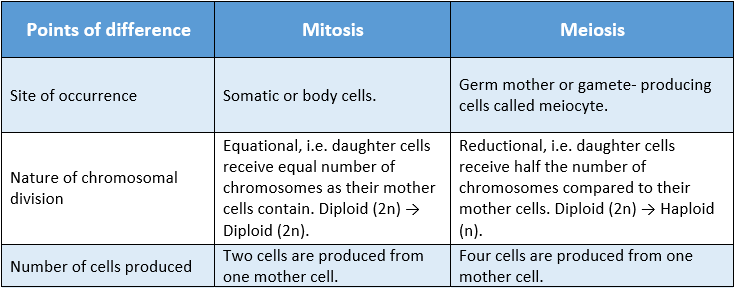
The basic differences are—
WBBSE Chapter 2 Topic A Cell Division And Cell Cycle Some Important Terminologies Associated With Cell Division


WBBSE Chapter 2 Topic A Cell Division And Cell Cycle Fill In The Blanks
Question 1. The series of cell division is prophase,___________, anaphase &___________.
Answer: Metaphase, Telophase
Question 2. The 4 bases of nucleic nucleotides of DNA are- adenine,___________, cytosine, and thymine.
Answer: Guanine
Question 3. ___________are long thread-like structures made of a DNA molecule and protein.
Answer: Chromosomes
Question 4. There are two types of chromosomes___________ and sex chromosomes or allosomes.
Answer: Autosomes
Question 5. The phenomenon of fast cell divisions in the cancerous cells leading to a stage when the cells start moving to different body parts is known as___________.
Answer: Metastasis
Wbbse Life Science Class 10 Chapter 2 Questions And Answers
Question 6. Several mitotic divisions of a mother cell required for the production of 64 cells are___________.
Answer: 6
Question 7. If meiosis II fails to occur after meiosis I, it is called___________.
Answer: Brachymeiosis
Question 8. The sequence of the cell cycle is___________.
Answer: G1.S.G2,M
Question 9. ___________protect the ends of the chromosomes.
Answer: Telomers
Question 10. Centromeric regions of chromosomes invariably contain ___________.
Answer: Hetrochormatin
Question 11. Organelles are specialized structures of the ___________ which perform specific functions.
Answer: Cell
Question 12. The___________ consists of two centrioles.
Answer: Centrosome
Question 13. As cell division proceeds,___________ grow out from each centrosome.
Answer: Microtubules
Question 14. Ribosomes are the workbench of___________ synthesis.
Answer: Protein
Question 15. Cell division is the basis of repair and___________ of old and worn-out tissues.
Answer: Regeneration
Question 16.___________ produces 4 haploid (n) daughter cells that come from diploid parents (2n).
Answer: Meiosis
Question 17. DNA replication occurs during___________ phase of interphase.
Answer: S
Question 18. The___________ checkpoint is also known as the spindle checkpoint.
Answer: M
Question 19. During the stage of cell division,___________ the chromosomes move towards the opposite poles.
Answer: Anaphase
Wbbse Life Science Class 10 Chapter 2 Questions And Answers
Question 20. In plant cells, Cytokinesis is accomplished by the formation of___________ and cell-plate.
Answer: Phragmoplast
Question 21. The cells undergoing meiosis are known as___________
Answer: Meiocytes
Question 22. If 2n = 8, the number of chromatids in each daughter cell after meiosis will be___________.
Answer: 8.
Question 23. Anastral mitosis can be traced in___________ .
Answer: Plant cells
Question 24.___________ is the shortest and is the longest phase of cell division.
Answer: Anaphase, prophase
Question 25. The pairing of homologous chromosomes in meiosis is known as___________.
Answer: Synapsis
WBBSE Chapter 2 Topic A Cell Division And Cell Cycle Write True Or False
Question 1. Genetic information is transferred from parents to offspring.
Answer: True
Question 2. The character of all living organisms results from the interaction of the environment and parents.
Answer: False
Question 3. The DNA molecule contains proteins.
Answer: False
Question 4. Nucleotides are made up of a base, a sugar, and a nitrate.
Answer: False
Question 5. Chromosomes are long thread-like structures made of a DNA molecule and protein.
Answer: True
Class 10 Life Science Cell Division Solutions
Question 6. The number of chromosomes increases with the growth of the apparent complexity of an organism.
Answer: False
Question 7. Chromatin is long strands of the DNA-protein complex.
Answer: True
Question 8. Human sex chromosomes are of 2 types- X and Y.
Answer: True
Question 9. A picture called a karyogram is often used to look at our chromosomes.
Answer: True
Question 10. Human females inherit the Y chromosome from their fathers.
Answer: False
Question 11. One arm is very long and the other is very short in the acrocentric chromosome.
Answer: True
Question 12. The chromosome region distal to the secondary constriction is called primary constriction.
Answer: False
Question 13. DNA is a polynucleotide structure.
Answer: True
Question 14. The base pairs in DNA are A-G and T-C.
Answer: False
Question 15. The deoxyribose sugar in DNA is a hexose.
Answer: False
Class 10 Life Science Cell Division Solutions
Question 16. Histones constitute about 80% of the total chromosomal protein.
Answer: True
Question 17. Nerve cells are postmitotic.
Answer: False
Question 18. Two ribosomes become associated with mRNA to form polyribosomes.
Answer: False
Question 19. The mitochondrial network fragments during mitosis to allow proper segregation of the organelles between daughter cells.
Answer: True
Question 20. Interphase is a period of no activities.
Answer: False
Question 21. Normally mitosis is much longer than interphase.
Answer: False
Question 22. Karyokinesis is the division of the nucleus.
Answer: True
Question 23. During telophase, the chromosomes reach the poles of the spindle and form two groups.
Answer: True
Question 24. Mitosis helps the organisms in asexual reproduction.
Answer: True
Question 25. Diploid cells are produced by meiosis.
Answer: False
WBBSE Chapter 2 Topic A Cell Division And Cell Cycle Match The Column
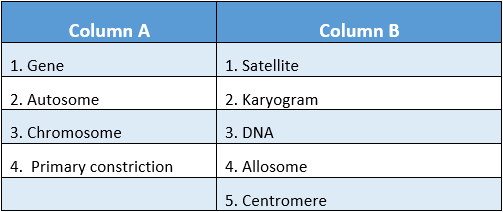
Answer: 1-C,2-D,3-B,4-E
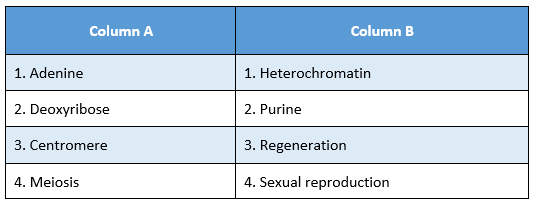
Answer: 1-B,2-E,3-A,4-D
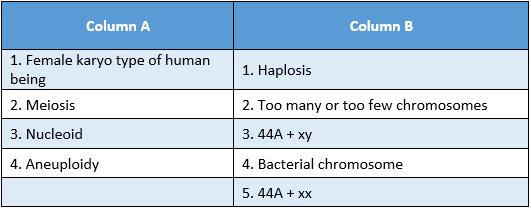
Answer: 1-E,2-A,3-D,4-B
WBBSE Chapter 2 Topic A Cell Division And Cell Cycle Very Short Answer Type Questions
Question 1. What contains the information of a cell that is inherited by future cells?
Answer: Segments of DNA, composed of a transcribed region and a regulatory sequence, called genes.
Question 2. Which are the keepers of the genetic material in eukaryotic cells?
Answer: Chromosomes
Question 3. What are the components of a nucleotide?
Answer: Nucleotides are made up of a nitrogenous base, a pentose sugar, and a phosphate group.
Question 4. What are the components of chromosomes?
Answer: Chromosomes are long thread-like structures made up of chromatin which is composed of DNA (30-40%), RNA (0.5-10%), and protein (50-65%).
Question 5. What is chromatin reticulum?
Answer: Uncoiled chromosomes are called chromatin reticulum that remain twisted, fine, anastomosed, and uniformly distributed in the nucleoplasm of an interphase nucleus
Question 6. What are sex chromosomes?
Answer: Sex chromosomes or allosomes are primarily responsible for the sex determination of an organism which differs in males and females of the same species, viz. X and Y chromosomes of humans. Males have an X and Y combination. Females have an X and X combination.
Class 10 Life Science Cell Division Solutions
Question 7. What is a karyogram?
Answer: It is a diagram or photograph of homologous chromosomes from a cell, arranged according to their size.
Question 8. What is the diploid chromosome number of human beings?
Answer: It is 2n=46.
Question 9. Who first described chromosomes?
Answer: Chromosomes were first described by Strassburger (1815).
Question 10. What will be the chromosome number of mesophyll tissue cells and male gametes in a flowering plant where 2n = 18?
Answer: Mesophyll tissue cells (somatic cells) = 2n = 18 Male gametes = n = 9
Question 11. What are sub-metacentric chromosomes?
Answer: Chromosomes with a centromere slightly away from the mid-point so that the two arms are unequal are called sub-metacentric chromosomes.
Question 12. What are the functions of telomeres?
Answer: Telomeres protect the ends of the chromosomes from damage and stop them from becoming attached
Question 13. A pair of related terms are given below: Based on the relationship in the first pair, write the suitable word in the gap of the second pair.
Answer:
DNA pyrimidine:Thymine:: RNA pyrimidine Uracil.
Embryonic cell: monocytes:: Primary oocyte Meiocytes.
Nuclear division:: cytoplasmic division: cytokinesis Karyokinesis.
Animal cell: cleavage cytokinesis:: Plant cell: Cell plate cytokinesis.
Question 14. Write the characteristics of heterochromatin.
Answer: Heterochromatin is characterized by its especially high content of repetitive DNA sequences and contains very few if any, structural genes.
Question 15. Write the full form of MTOC.
Answer: Microtubule-organizing center.
Question 16. What is tubulin?
Answer: Microtubules are made up of protein subunits called tubulin.
Question 17. What are the sub-phases of interphase?
Answer: Interphase can be divided into 4 sub-phases: Gap 0 (G0), Gap 1 (G1), S (synthesis) phase, and Gap 2 (G2).
Question 18. What are the G0 phases?
Answer: The G0 phase is the time when a cell leaves the cell cycle either permanently or temporarily and quits division.
Question 19. Write the full form of CDK.
Answer: Cyclin-dependent kinase.
Question 20. During which stage of mitosis, do chromosomes get aligned on the equator?
Answer: Metaphase
Question 21. By which type of cell division, haploid sex cells are produced?
Answer: Meiosis
Class 10 Life Science Cell Division Solutions
Question 22. What is synapsis?
Answer: The lengthwise pairing of homologous chromosomes during the zygotene stage of the first meiotic prophase is known as synapsis.
Question 23. Among the following four terms, one includes the other three. Find out the term and write it:
Answer:
Synopsis, crossing over, meiosis cell division, reduction in chromosome number Meiosis cell division.
Sporocytes, microsporocytes, megas- porocytes, meiocytes Meiocytes
G1; S, cell cycle, G2 Cell cycle
Question 24. What is endomitosis?
Answer: In endomitosis the chromosomes and DNA duplicate but fail to separate which leads to polyploidy. It occurs notably in the salivary glands of Drosophila and other flies.
Question 25. How many mother cells will form 1000 microspores?
Answer: \(\frac{1000}{4}=250 \text { mother cells. }\)
WBBSE Chapter 2 Topic A Cell Division And Cell Cycle Short Answer Type Questions
Question 1. What is nucleic acid? How is it chemically composed?
Answer:
Nucleic acid:
The organic acid that is found predominantly within the nucleus and takes part in the formation of chromosomes is known as nucleic acid.
Example:
Ribonucleic Acid or RNA (single helical) and Deoxyribonucleic Acid or DNA (double helical).
Chemically nucleic acid is made up of nucleotides. Each nucleotide is composed of a nitrogen base, a pentose sugar, and a Phosphoric acid.
Question 2. DNA consists of two complementary nucleotide chains. If the sequence of nucleotides in one of the chains is AGCTTCGA, then find the nucleotide sequence in the other chain.
Answer:
The adenine(A) base of one strand of DNA is hydrogen bonded to a thymine (T) in the opposite strand; while the guanine (G) is hydrogen bonded to a cytosine (C). Hence the complementary nucleotide sequence in the other chain would be TCGAAGCT.
Question 3. Mention The Difference Between DNA and RNA.
Answer:
The Difference Between DNA and RN
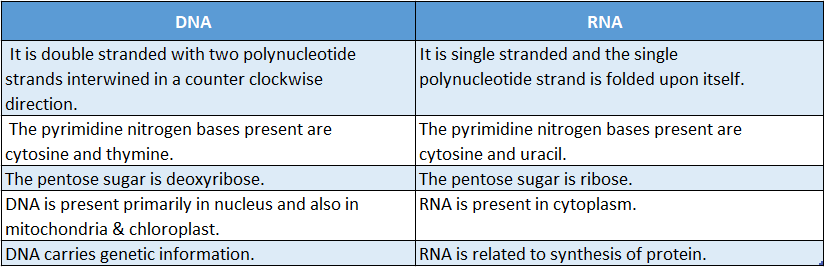
Question 4. What are giant chromosomes? Give examples. Some cells at certain stages contain large nuclei with giant or large-sized chromosomes. These chromosomes are known as giant chromosomes.
Giant chromosomes are of two types:
Polytene Chromosome:
These are also called salivary gland chromosomes.
Example:
Drosophila melanogaster
Lampbrush Chromosome:
These chromosomes are found in yolk-rich amphibian oocytes.
Question 5. Write the differences between diploid and haploid.
Answer:
The differences between diploid and haploid
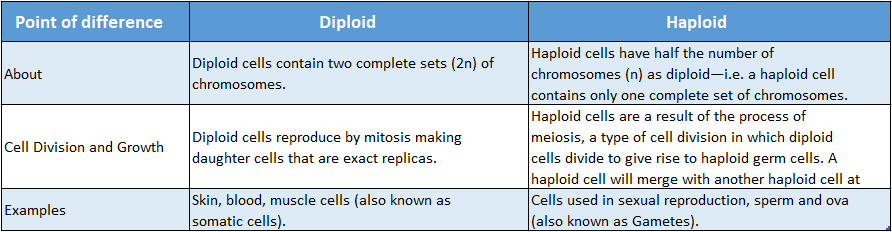
Question 6. Enumerate the difference between euchromatin and heterochromatin
Answer:
The difference between euchromatin and heterochromatin
Question 7. Which organisms have the least and the most number of chromosomes?
Answer:
The organism with the least number of chromosomes is the male Australian ant; Myrmecia pilosula with one chromosome per cell.
Ophioglossum reticulatum, a species of fern also known as Adderstongue, has the largest number of chromosomes with more than 1260 or 680 pairs per cell.
Cell Cycle And Its Phases Class 10 Notes
Question 8. What are aneuploidy and polyploidy?
Answer:
Aneuploidy
Aneuploidy refers to the random abnormal number of chromosomes in the cells due mostly to nondisjunction. It is a type of numerical change in the usual chromosomal count of the cell.
A condition in which organisms have more than two complete sets of chromosomes in their cells is called polyploidy.
Question 9. Write the differences between autosomes and allosomes.
Answer:
The differences between autosomes and allosomes
Question 10. Name two haploid organisms. In haploid organisms that undergo sexual reproduction, name the stage in the life cycle when meiosis occurs. Give reasons in support of your answer.
Answer:

Meiosis takes place during the post-zygotic stage in haploid organisms. Since the organism is haploid, meiosis cannot occur during gametogenesis.
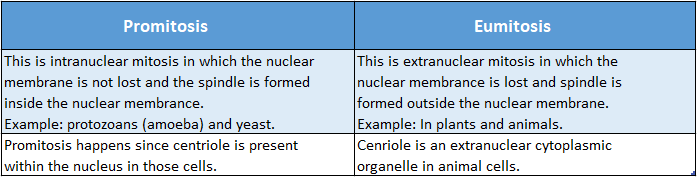
Question 11. Give the differences between pro-mitosis and mitosis.
Answer:
The differences between pro-mitosis and mitosis
Question 12. Write the specific scientific term for each of the following:
The Period Between Two Successive Mitotic Divisions
Interphase
Point At Which Two Sister Chromatids Are Held Together
Centromere
Nuclear Division
Karyokinesis
Process Of Cell Division By Which Chromosome Number Is Halved
Meiosis
Question 13. Write about the role of mitochondria in cell division.
Answer:
The role of mitochondria in cell division can be summarised as :
Cells require an ample amount of ATP (Adenosine triphosphate) to synthesize bioactive compounds such as lipids, proteins, and nucleotides for cell division.
Mitochondrial ATP production is also vital for cell division in addition to other basic functions in the cell including the regulation of cell volume, solute concentration, and cellular architecture.
Mitochondria are the fuel of the cell and act as a type of “driver” in cell division.
The mitochondrial network fragments during mitosis to allow proper segregation of the organelles between daughter cells.
Mitochondria contributes to synthesizing, breaking down, and recycling biochemicals needed for the functioning of genetic materials.
Mitochondrial dysfunction is associated with tumor metabolic pathways.
Question 14. What are the stages of mitosis?
Mitosis is a continuous process and for better understanding, the whole process is divided into the following stages:
1. Prophase
2. Prometaphase
3. Metaphase
4. Anaphase
5. Telophase
6. C-Phase or Cytokinesis (a division of cell cytoplasm)
Question 15. What are the characteristics of mitotic telophase?
Answer:
The characteristics of mitotic telophase
At the end of the polar migration of the daughter chromosomes, the telophase is marked by the uncoiling & deserialization of chromosomes followed by the reappearance of the nuclear membrane and nucleolus.
The main events during this phase are as follows-
Chromosomes reach the poles of the spindle and form two groups.
Chromosomes begin to uncoil, undergo hospitalization, and form the chromatin network.
Kinetochore microtubules disappear.
The nuclear membrane is formed around each mass of chromatin from the endoplasmic reticulum resulting in the formation of two daughter nuclei.
Both the nucleoplasm and the cytoplasm are rehydrated.
Finally, a nucleolus is reorganized in each daughter nucleus at the chromosomal organizer site.
Cell Cycle And Its Phases Class 10 Notes
Question 16. Between a prokaryote and a eukaryote, which cell has a shorter cell division time? Given that the average duplication time of E. coli is 20 minutes, how much time will two E. coli cells take to become 32 cells?
A prokaryotic cell divides by amitosis and an eukaryotic cell divides by mitosis. Amitosis is the fastest cell division which, on average, takes 20-30 minutes to complete.
The time required for mitosis differs with species and environment. Normally mitosis takes around 3 hours to complete.
Since there are two E.coli cells at the beginning, let us calculate the time required for one cell to produce 16 cellsso thatt the final count of cells to become 32.
Each cell produces two cells through one division. Since 24 = 16, therefore there will be 4 divisions to produce 16 cells.
Time required = 4 x 20 min = 80 min = 1 hr. 20 min.
Question 17. Mention the advantages and disadvantages of amitosis.
Answer:
Advantages of amitosis:
Amitosis is the fastest cell division and takes minimum time to complete. Thus it is the major means of reproduction in lower organisms like yeast, bacteria, etc.
Disadvantages of amitosis: Amitosis may result in different daughter nuclei with unequally distributed chromosome numbers.
Moreover, in this process of cell division, there is no possibility of genetic recombination and there is a possibility of expression of unwanted recessive genes.
Question 18. State the phases of the cell cycle or cell division in which the following phenomena occur:
Answer:
Interkinesis
After telophase I & before meiosis II
Chromatin fibers are present
Interphase
Synaptonemal complex formation
Prophase I of meiosis I
Centriole replication taking place
S-phase
the lowest amount of cellular growth & synthesis taking place.
Mitosis or M-phase
the cell increases in size and produces new organelles
G1 phase
Question 19. Which factors might cause cell cycle growth arrest? The following are the factors for cell cycle growth arrest:
Answer:
DNA damage:
DNA damage activates pathways either to repair the damage or to activate apoptotic pathways if the damage cannot be fixed. This causes the arrest of the cell cycle at the G2 checkpoint.
Lack of appropriate growth factors:
This will keep the cell from progressing through the cell cycle. A prolonged lack of growth is referred to as G0 of the cell cycle and occurs when the cell cannot pass the G1 checkpoint.
Failure of the chromosomes to line up on the equatorial plate during mitosis:
This prevents the cell from activating pathways to degrade the cohesion that holds the sister chromatids together. This is called metaphase checkpoint and it ensures proper segregation of chromosomes.
Question 20. State The Consequence If Each Of The Following Irregularities occurs during Mitosis:
Nuclear membrane fails to disintegrate
Intranuclear mitosis or promitosis:
The spindle is formed inside the nucleus. This happens in some protozoa (amoeba) and yeast.
Duplication of DNA does not occur
The G1 checkpoint does not allow the cell to proceed to the S phase.
Cytokinesis does not occur
Coenocyte or syncytium:
A multinucleate condition arises as it happens in Rhizopus and Vaucheria etc.
Dinomitosis:
Chromosomes get attached to the nuclear membrane during the movement. The nuclear envelope persists and the microtubular spindle is not formed.
WBBSE Chapter 1 Fill In The Blanks
Question 1. Adenine is a ______________ type of nitrogenous base.
Answer: Purine
Question 2. During embryonic development and growth in vertebrates____________cell division takes place.
Answer: Mitosis
Question 3. Chromosome is the condensed coiled structure of_____________ molecule.
Answer: DNA & protein
WBBSE Chapter 1 Write True Or False
Question 1. Ovum is only produced as a result of mitosis
Answer: False
Question 2. In DNA, Adenine is linked with Guanine by hydrogen bonds.
Answer: False
WBBSE Chapter 1 Very Short Answer Type Questions
Question 1. A pair of related terms is given below.Based onf the relationship in the first pair write the suitable word in the gap of the second pair. Prophase: Disappearance of nuclear membrane and nucleolus:: ____________________: Reappearance of nuclear membrane and nucleolus.
Answer: Telophase.
Question 2. Mitosis : Radicle ::__________________ : Spore mother cell
Answer: Meiosis.
WBBSE Chapter 1 Short Answer Type Questions
Question 1. Write two importance of the cell cycle.
Answer:
Importance of cell cycle:
The cell cycle plays an important part in the development of embryos and it is important for the growth & development of our bodies as well. The cell cycle produces new cells and also replaces cells that are old, lost, or damaged.
Cell cycles have checkpoints to detect abnormal mutations arising out of radiation, chemicals, carcinogens, etc.
Abnormal cells may either be identified or repaired through the cell cycle as it happens in case of repair by P53 protein during G1 to S stages.
Question 2. Distinguish Between DNA and RNA based On The Following Features:
- Pyrimidine base
- 5-C sugar
Answer:
Question 3. Distinguish between autosome and sex chromosome of humans based on the following features:
- Nature
- Number
Answer:
Question 4. “In case of Prophase and Telophase changes of opposite nature happen” — Write two such changes.
Answer:
Two Opposite Nature Of Changes That Take Place In Prophase And Telophase Are Shown Below:
Cell Cycle And Its Phases Class 10 Notes
Question 5. During the meiosis cell division, a reduction in the number of chromosomes and exchange of segments between chromatids take place — Analyse what are the significance of these two phenomena.
Answer:
Significances of the following phenomena in connection with meiosis cell division:
Reduction in the number of chromosomes:
During anaphase I, the homologous chromosomes separate from one another and move to opposite poles.
Telophase I results in the formation of two haploid (n) daughter nuclei with each chromosome having two chromatids. Meiosis II is an equational division.
Thus the gametes produced as a result of meiosis are haploid (n) while the zygote formed by their fusion is diploid (2n).
Hence, meiosis is the only means for restoring the constancy in chromosome number, which is a characteristic of the species from generation to generation.
Exchange of segments between chromatids:
During crossing over, the hereditary factors from male and female parents get mixed up due to the breakage and exchange of chromatids.
This brings in genetic variation within the species. The variations are important raw materials for evolution and also help in the improvement of races.
Question 6. Identify the stages ofKaryokinesis of mitotic cell division depending on the following features:
Answer:
Alignment of chromosomes along the equator of the cell and their arrangement in a definite pattern
Metaphase
The disintegration of spindle fibers
Anaphase
The disappearance of nuclear membrane and nucleolus
Prophase and prometaphase
Movement of daughter chromosomes to the opposite poles of the cell
Anaphase
Question 7.”Meiosis is characteristically different from mitosis”— how would you justify the statement?
Answer: