
WBBSE Chapter 2 Continuity Of Life Growth And Development Introduction To The Concept Of Growth And Development
Our life starts from a single fertilized cell. This cell is under constant interaction with the environment in the mother’s womb (functional state of life) and after birth with the outside world.
This interaction leads to our growth and development. Growth occurs by the addition of new substances, both protoplasmic and apoplastic (ie. nonliving substances which become components of the tissues).
Cell growth occurs during the post-mitotic phase and interphase. During growth, anabolism is higher than catabolism.

Growth in unicellular organisms is not pronounced because, in this case, growth means enlargement of the cell only.
Growth in multicellular organisms is pronounced, because it begins with a single cell, and then, over time, newer cells are added to it and so, it grows in volume.
The growth of all multicellular organisms is governed by the reproduction & growth of all the individual cells that constitute the body of the organism.
Read and Learn More WBBSE Solutions For Class 10 Life Science
Division of each cell and their growth into thousands in number, or their changing into tissues, blood, or bone, is part of the process of development.
For example, the multicellular plant body, as it grows, produces roots, stems, leaves, flowers, fruits & seeds by the differentiation of its cells, tissues, and organs This results in external differentiation in shape called development.
‘Growth’ and ‘Development’ are often used as synonymous terms. But growth is different from development. Growth means an increase in size, height, weight, length, etc. which can be measured.
Growth And Development In Plants Class 10
Development, on the other- hand, implies a change in shape, form, or structure resulting in improved working or functioning, which happens all through the life cycle.
Development distinguishes one kind of organism from another. Growth and development are the two important characteristics of a living organism. Normally growth contributes to development.
In reality though ‘growth and development’ are different, but they are inseparable. Generally, processes of growth and development go on simultaneously.
To be successful in survival, multicellular organisms have to undergo various phases of growth and development.
Importance of growth:
Growth is an essential, permanent, and irreversible feature of all living organisms that enables them to gradually mature into adult forms.
Growth involves the healing of wounds to protect the adult organism from adverse environmental conditions.
Some protozoans, sponges, and coelenterates are capable of either epimorphic or morphallactic regeneration of the lost part of the body or the entire body itself by the growth and differentiation of cells from the remaining piece of that part.
WBBSE Chapter 2 Growth And Development Growth
Growth is a permanent and irreversible increase in size or volume and dry mass due to the result of an increase in cell number (by mitosis) or cell size or both or due to the accretion of cellular materials when anabolism exceeds catabolism.
Growth involves cell division followed by cells becoming specialized. Growth can be measured as an increase in height, wet mass, and dry mass.
Height and wet mass can be measured when an organism is alive, but dry mass can only be measured when an organism has all its water removed and is dead.
However, dry mass is the best measure of growth. Dry mass is a more reliable measure of mass than fresh mass because the former excludes the fluctuating water concentrations in the biological material measured which is present in the latter.
Dry mass is the solid matter with all water removed. Let a plant sample be taken. Blot the plant to remove any free surface moisture.
Then put the plant in an oven or desiccator overnight until it is dehydrated in an atmosphere of low heat. Let the plant be cooled in a dry environment.
This would produce a dry mass. Weighing the sample on a sensitive scale gives the weight of the dry mass.
Growth in an organism consists of a permanent and more or less irreversible increase in size, commonly accompanied by an increase in solid matter, dry mass, and amount of cytoplasm.
During the growth of a multi-cellular organism, there is an increase in the number of cells. This however excludes an increase in water content and stored food materials (e.g. fat) because these are not permanent.
For example, when a plant cell is placed in a solution of higher water potential than itself, there is a net gain of water via osmosis and when placed in a solution of lower water potential, there is a net loss of water.
Hence these temporary changes are not to be considered for growth measurement.
Growth And Development In Plants Class 10
Once growth occurs in the living body, ie. there is an increase in dry weight accompanied by an increase in the size & volume of the living organism, it can not be reversed. The growth hormones have a great role in controlling both embryonic and post-embryonic growth.
If energy is obtained at the expense of protoplasmic proteins, it results in degrowth. The process in which reserve food material is utilized and exhibits negative growth is degrowth.
Degrowth results when catabolism is higher than anabolism.
Development may be defined as a series of progressive, non-repetitive, organized & genetically programmed changes through cellular differentiation that ultimately increases the complexity of an organism as it grows.
As the number of cells increases, they become differentiated (specialized for different tasks) and change shape to adapt to a specific function.
Development is closely related to growth. Development involves the differentiation of cells, an increase in dry mass (growth), and an increase in the complexity of an organism, e.g. development in flowering plants consists of the growth of a zygote into an embryo within a seed, the process of germination and growth of a seedling into an adult plant.
The main difference between growth and development is that growth involves only a quantitative change whereas development involves both quantitative and qualitative changes. Thus growth is a subset of development.
WBBSE Chapter 2 Growth And Development Types Of Growth
Growth is of different types based on different parameters as outlined below
Based on Growth & Multiplication Of Cells:
Auxetic growth:
When the volume of the body increases due to the growth of cells and not by their number, eg. growth in nematodes, rotifers, etc.
Multiplicative growth:
Here growth results due to cell division and consequent increase in cell number by mitosis, eg. growth in embryos.
Accretionary growth:
Here growth occurs due to the mitotic multiplication of some special types of reserve cells occurring in specific locations of the body, eg. post-embryonic growth of animals.
Based on continuity:
Positive growth:
Positive growth occurs when anabolism exceeds catabolism.
Negative growth:
Degrowth is termed negative growth.
In plants during the germination of a seed and the production of a seedling, there is an increase in cell number, cell size, fresh mass, length, volume, and complexity of form but the dry mass may decrease because the reserves are being used up.
From this point of view, germination is considered to include a period of negative growth which becomes positive only when the seedling starts to photosynthesize.
Before that the stored food is hydrolyzed to be used for respiration and sugars are oxidized to carbon dioxide and water, causing a net decrease in mass.
Based on the period of growth:
Limited growth:
Here growth takes place up to a certain period and then the organism dies. Plant organs like leaves, flowers, and fruits show limited growth.
Unlimited growth:
Here growth never ceases. Fishes, reptiles, and woody perennial plants show unlimited growth.
Based on organs undergoing growth:
Somatic growth:
This involves the growth of the somatic organs. In plants, it is the growth of roots, stems, leaves, etc, and in animals, somatic growth is the growth of organs like the heart, lungs, liver, etc.
Growth And Development In Plants Class 10
Reproductive growth:
This involves the growth of the reproductive organs. In plants, it is the growth of floral buds, flowers, seeds, etc whereas in animals it refers to the growth of male and female genitals.
WBBSE Chapter 2 Growth And Development Phases Of Growth
Growth Includes Three Phases As Follows
Cell Division:
One of the ways to achieve growth in an organism is by an increase in cell number as a result of mitosis cell division. In multicellular animals, the zygote divides repeatedly by mitosis to produce the morula stage.
The cells of the morula form a hollow ball with a monolayer known as a blastula. After this, a three-cell layered gastrula is formed. Cells of gastrula divide and get engaged to form the different organs in the embryonic stage.
In plants, cell division is localized in the meristematic regions.
The apical meristems of the stem tip and root tip are primarily responsible for the growth in length of the axis and the lateral meristems, cambium, and cork cambium are instrumental to the secondary increase in thickness in the stems of dicotyledons and gymno- sperms and roots of dicotyledons.
Cell Enlargement:
This is an irreversible increase in cell size due to an increased rate of anabolism than catabolism. For example, an increase in the length of stems and roots is brought about by the elongation of cells.
As the cells increase in size, vacuoles containing the cell sap begin to appear inside the cells and the vacuoles gradually fuse & expand to form a single vacuole at the center of the cells,
WBBSE Class 10 Life Science Notes
Consequently, with the appearance of the vacuole, the cells become osmotically active and thereby allow more water to enter into the cells as a result of which the cells increase in size.
Growing organisms also produce additional organic materials in their cytoplasm, which contributes to the dry mass of the cells.

Cell Differentiation:
This contributes more to development than growth. In any multicellular organism, all the cells derived from the zygote by mitosis are genetically identical.
Therefore a liver cell, for example, contains the same set of genetic instructions as a kidney cell. As cells differentiate, different genes are switched on or off in response to the environment without losing their identifying characteristics.
Thus full-grown cells undergo genetic differentiation to become more specialized for a specific function.
Cell differentiation results in both somatic growth and reproductive growth in an organism. The cells once differentiated remain unchanged till their death.

WBBSE Chapter 2 Growth And Development Human Lifespan Development
The term lifespan development refers to age-related changes that occur from birth, throughout a person’s life, into and during old age. The stages of human lifespan development are
1. Infancy (Birth to two years):
While the infant is dependent on adults for most things, many psychological characteristics undergo rapid development.
During this stage, the bond that develops between the infant and his/her primary caregiver is important in terms of the infant’s later emotional development.
The infants use the sense organs while all the organs of the body undergo rapid growth at this stage.

2. Childhood (Two to ten years):
During this stage, children become increasingly independent from their parents as they learn to do things themselves and gain more self-control due to the tremendous growth of neural fibers inside the brain.
The children’s cognitive skills develop during this stage, and they also begin to develop an understanding of what is right and wrong due to the correct coordination of the nervous system.
WBBSE Class 10 Life Science Notes
Adolescence (Ten to twenty years):
The onset of puberty marks the beginning of adolescence. It is dominated by seeking independence from parents and developing one’s own identity.
Compared to the child, an adolescent’s thought processes are more logical, complex, and idealistic. This stage is characterized by very rapid growth but the rate of growth differs in boys and girls.
Secondary sex characters develop. A significant increase in the growth of reproductive organs is observed. Spermatogenesis and Oogenesis start in males and females respectively at this stage-this causes attainment of sexual maturity.
4. Adulthood:
Biologically an adult human being is self-sufficient, has fully developed somatic organs, and has achieved sexual maturity with all primary & secondary sex characters well developed both in male and female.
This may be divided into-
Early Adulthood (Twenty to forty years):
This is the stage of establishing personal and financial independence and establishing & consolidating a career. For many, it is also the time in which individuals select a partner, develop an ongoing intimate relationship, and begin a family.
In human beings, growth stops completely at the age of 22-23 years, i.e. once somebody attains the early adulthood stage.
Middle Age (Forty to sixty-five years):
This is a period of expanding social and personal involvements and responsibilities, advancing a career, and supporting offspring in their development to become mature individuals.
5. Older Age or late adulthood or senescence (Sixty five years plus):
Senescence means the state or process of ageing-in humans it means old age. It involves an increase in impairment of physiological functions with age, resulting in a decreased ability to deal with a variety of stresses and an increased susceptibility to diseases.
It is, therefore, a period of considerable adjustment to changes in one’s life and self-perceptions. For many older people, this is a very liberating time when they no longer have the day-to-day responsibility of looking after their children or working.
Certain aspects of sensory and perceptual skills, muscular strength, and certain kinds of memory tend to diminish with age, rendering older people unsuitable for some activities.
WBBSE Class 10 Life Science Notes
There is, however, no conclusive evidence that intelligence deteriorates with age, rather it is more closely associated with education and standard of living. Senescence ultimately results in death.
WBBSE Chapter 2 Growth And Development Fill In The Blanks
Question 1. Our life starts from a single fertilized cell known as________________.
Answer: Zygote
Question 2. ________________means an irreversible increase in size, height, weight, length, etc. which can be measured.
Answer: Growth
Question 3. ________________implies a change in shape, form, or structure resulting in improved working or in functioning.
Answer: Development
Question 4. Dry mass is the solid matter with all ________________removed.
Answer: Water
Question 5. The term ________________ development refers to age-related changes that occur from birth, throughout a person’s life, into and during old age.
Answer: Lifespan
WBBSE Class 10 Life Science Notes
Question 6. The Branch of Biology that deals with the study of the process of aging is called________________.
Answer: Gerontology
WBBSE Chapter 2 Growth And Development Write True Or False
Question 1. Our life starts from a mass of cells.
Answer: False
Question 2. The single fertilized cell is known as the zygote.
Answer: True
Question 3. Growth involves an irreversible increase in the dry mass of an organism.
Answer: True
Question 4. The wet mass is a more reliable index of growth than the dry mass.
Answer: False
Question 5. Cell differentiation occurs in unicellular organisms.
Answer: False
Plant Growth And Development Class 10 MCQS
Question 6. Human childhood is from 2-10 years.
Answer: True
Question 7. The onset of puberty marks the beginning of senescence.
Answer: False
Question 8. Plants exhibit determinate growth.
Answer: False
WBBSE Chapter 2 Growth And Development Match The Column

Answer: 1-E,2-A,3-D,4-C
WBBSE Chapter 2 Growth And Development Very Short Answer Type Questions
Question 1. What is dry mass?
Answer: Dry mass is the solid matter with all water removed.
Question 2. What is cell enlargement?
Answer: Increase in cell size.
Question 3. What is lifespan development?
Answer: The term lifespan development refers to age-related changes that occur from birth, throughout a person’s life, into and during old age.
Question 4. What are the divisions of our adulthood? Adulthood may be divided into- early adulthood, middle age, and older Age or late
Answer: adulthood or senescence.
Question 5. Which type of plant tissue exhibits growth?
Answer: Meristematic tissue.
Question 6. Name a class of animals whose growth takes place in steps in an intermittent manner.
Answer: Arthropods.
Question 7. Name the period of the growth curve which shows maximum growth.
Answer: Log phase.
Plant Growth And Development Class 10 MCQS
Question 8. Among the following four terms, one includes the other three. Find out that term and write it.
Answer: log phase, growth curve, stationary phase, senescent phase
Growth, differentiation, development, and increase in complexity characteristics of growth.
- Growth Curve
- Development
Question 9. Name two environmental factors that hamper normal growth.
Answer: Drought & pollution.
Question 10. What is the average lifespan?
Answer: It is the average number of years survived by the members of a population. For humans, the average life span varies between 80-100 years.
WBBSE Chapter 2 Growth And Development Short Answer Type Questions With Answers
Question 1. What is growth? Mention a few important
Answer:
Growth
Growth is a permanent and irreversible increase in size or volume and dry mass due to the result of an increase in cell number (by mitosis) or cell size or both or due to the accretion of cellular materials when anabolism exceeds catabolism.
Characteristics Of Growth:
1. Growth is quantitative and measurable.
2. Growth comprises of irreversible increase in height, weight, size, and shape of body parts & organs like the brain, muscles, etc.
3. It happens due to cell division and cell enlargement.
4. Growth is for a limited period ie. determinate for animals and indeterminate for plants.
Question 2. Explain the growth curve, rate of growth, and the percentage growth.
Answer:
Growth curve:
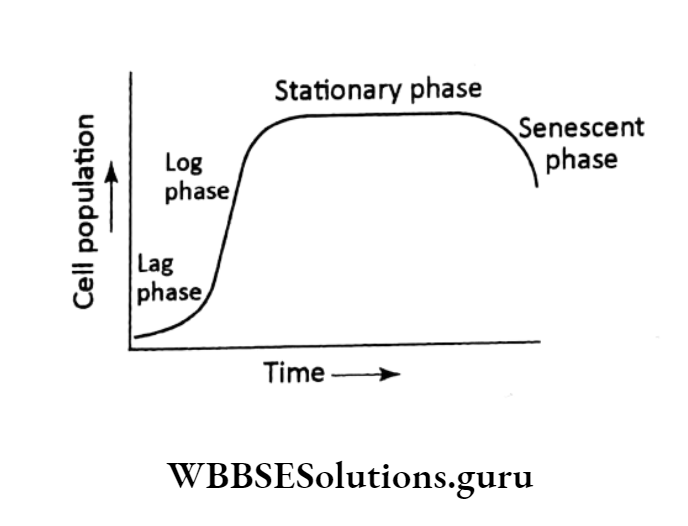
If an organism’s measurements (height, mass, etc) are plotted against time, an S-shaped ‘sigmoid’ curve is obtained which represents the growth pattern of all organisms, plants or animals, unicellular or multicellular forms.
This is known as the growth curve. Growth tends to be slow at the initial stage of cell division and the phase is called the lag phase.
The growth rate becomes maximum during the phase of cell elongation and this phase is called the log phase or exponential phase. As adult size is reached, growth slows down and at last, it finally stops.
This phase of growth is known as the stationary phase.
Rate of growth:
Rate of growth refers to the plot of growth increments against time, ie., the estimation of the increase in the size of the organism that takes place during successive intervals of time.
Plant Growth And Development Class 10 MCQS
In most of organisms, the growth rate increases steadily until it reaches a maximum, after which it gradually falls, giving a bell-shaped curve.
Percentage growth:
The increase in growth over a period of time, when expressed as a percentage growth that has already taken place, is the percentage growth.
It expresses the quantum of growth that has already occurred. Growth is fastest at the beginning of life, after which it gradually slows down. This is true for most organisms, both animal and plant.

Question 3. What do you mean by a grand period of growth? Write the differences between plant and animal growth.
Answer:
Grand period of growth
The period of maximum elongation of the body corresponding to the log phase of the growth curve is known as the grand period of growth.
The differences between plant and animal growth

Question 4. Name two of the external & internal factors that affect the growth of organisms.
Answer:
External factors: Light, water
Internal factors: Nutrition, Hormone
Question 5. Give the names of a few hormones that control human growth.
Answer:
Human growth in the first 10-13 years of age is controlled by thymosin. Growth at the end of childhood and during puberty is controlled by thyroxine and somatotropic hormones.
Question 6. How does the growth of unicellular animals vary?
Answer:
The growth of unicellular organisms like the bacterial population follows the typical S-shaped curve when a culture is inoculated with bacteria and the increase in cell number is plotted on a graph as a function of time.
Plant Growth And Development Class 10 MCQS
The Growth Curve Can Be Divided Into Four Parts:
- Lag phase
- Log phase
- Stationary phase and
- Senescent phase.
The lag phase is a period of cell adjustment to the new medium, a period of protoplasmic synthesis, cell enlargement, and preparation for division.
The log phase is the period of active cell division. The more cells there are, the more offsprings follow each division.
The stationary phase is the period in which there is no net increase in cell number.
This means that the rate of cell division equals that of cell death.
In the senescent phase, there is a decline in the number of viable cells in the population as during this time the rate of cell death exceeds that of cell replenishment.
This is the sign of senescent culture and the population continues to die unless the medium is changed.
Question 7. What do you mean by direct and indirect development? Give examples.
Answer:
Direct and indirect development
The post-embryonic development in which the embryo is directly developed into an adult animal without the involvement of any intermediate or larval form is known as direct development.
Examples: reptiles, birds, and mammals.
The post-embryonic development in which the embryo becomes an independent intermediate stage called a larva which undergoes metamorphosis to produce the adult form is known as indirect development.
Examples: amphibians, insects, etc.
Question 8. Growth can not be thought of as an increase in size only justify with examples.
Answer:
Growth is a subset of development. Growth is often thought of as an increase in size, but it is not an adequate definition.
The size of a plant cell may increase as it takes up water by osmosis, but this process is easily reversible and thus cannot be considered as growth.
Life Science Class 10 Chapter 2 WBBSE
On the other hand, when a zygote divides repeatedly to form a ball of cells (early embryo), there is an increase in cell number without an increase in size (volume and mass).
This is called cleavage and is the result of cell division without a subsequent increase in the size of daughter cells. This process is considered growth despite the fact that there is no increase in size.
Question 9. What is the relationship between aging and senescence? Mention two important features of senescence.
Answer:
The relationship between aging and senescence
The process of growing old by progressive deterioration of the structures & functions of the cells, tissues, and organs of the body that leads to old age or senescence is called again. Hence aging is the cause and senescence is the effect.
Class 10 Life Science Chapter 2 Solutions
Features Of Old Age Or Senescence:
This refers to an age group of sixty-five years plus wherein considerable adjustments need to be made in one’s life and self-perceptions due to impairment of physiological functions, decreased ability to deal with stresses, and increased susceptibility to diseases.
Certain aspects of sensory and perceptual skills, muscular strength, and certain kinds of memory tend to diminish with age, rendering older people unsuitable for some activities.