
WBBSE Chapter 3 Some Common Genetic Diseases Introduction To Genetic Diseases Or Genetic Disorders
Gene is the fundamental physical and functional unit of heredity which carries information from one generation to the next. A complete set of chromosomal genes, inherited as a unit from one parent, or the entire genotype of a cell or an individual is known as the genome.
A genetic disease or disorder is a disease in whole or in part of the individual’s genome by a change in the DNA sequence away from the normal sequence.
It can be caused by a mutation in one gene only (monogenic disorder), by mutations in multiple genes (multifactorial inheritance disorder),
by a combination of gene mutations and environmental factors, or by damage to chromosomes (changes in the number or structure of entire chromosomes).
Common Genetic Diseases Class 10
Some genetic disorders are inherited from the parents, while other genetic diseases are caused by acquired changes or mutations in a pre-existing gene or group of genes.
Mutations can occur either randomly or due to some environmental exposure to ultraviolet radiations from the sun or can occur if an error is made as DNA copies itself during cell division.
Read and Learn More WBBSE Solutions For Class 10 Life Science
Genetic disorders that typically involve the inheritance of a particular mutated disease-causing gene include sickle cell disease, cystic fibrosis, etc.
The mutated gene is passed down through a family and each generation of children can inherit the gene that causes the disease.
Rarely, one of these monogenic diseases can occur spontaneously in a child when his/her parents do not have the disease gene or there is no history of the disease in the family.
Acquired mutations are not hereditary and hence, they do not pass from parents to the offspring. Acquired mutations are much more common than inherited mutations.
Most cancers are caused by acquired mutations. This type of mutation is also called sporadic or somatic recessive.
The mutation can be spontaneous and where there is no mutation. Every time a cell divides, it creates an opportunity for mutations to occur.
Thus the number of gene mutations builds up over time which is why we have a higher risk of cancer as we get older.
WBBSE Chapter 3 Some Common Genetic Diseases Symptoms And Causes Of Some Single-Gene Disorders In Population
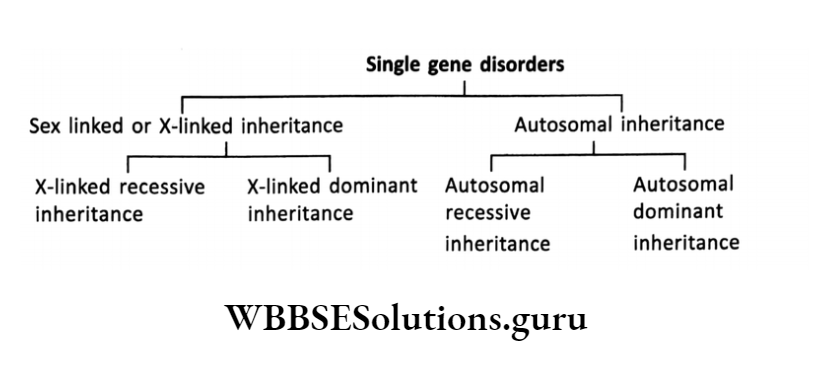
Single gene disorders (or monogenic disorders) are the result of a single defective gene that is inherited according to Mendel’s laws (Mendelian disorder).
Inheritance patterns can be autosomal dominant, autosomal recessive, or X-linked single-gene disorders in the population:
previous family history. There are more than 10,000 monogenic disorders that have been identified today.
Mendelian disorders or single gene disorders fall into two main categories or inheritance patterns based on the chromosomal
Location Of The Gene:
WBBSE Chapter 3 Some Common Genetic Diseases Sex-Linked Inheritance
The gene is located in the sex chromosome. Sex chromosomes may be X or Y chromosomes.
But, as the Y chromosome is more or less genetically inert (functionless or inactive) to the X chromosome, we generally consider sex-linked genes and X-linked genes to be synonymous.
Some X-linked recessive characteristics are- color blindness, hemophilia, etc.
Haemophilia
Haemophilia is a rare disorder in which blood doesn’t clot normally because it lacks sufficient blood-clotting proteins (clotting factors) causing the sufferer to bleed severely even from a slight injury.
Haemophilia Symptoms:
The major signs and symptoms of hemophilia are excessive bleeding and easy bruising.
Children who have mild hemophilia may not have signs unless they have excessive bleeding from a dental procedure, an accident, or surgery,
Bleeding can occur on the body’s surface (external bleeding) or inside the body (internal bleeding)— blood in stool, blood in urine, bruising, nose bleeds, heavy or prolonged periods, etc.
Swollen joints and pain in the joints.
Common Genetic Diseases Class 10
Haemophilia Causes:
A defect in one of the genes that determines how the body makes blood clotting factor VIII or IX causes hemophilia. These genes are located on the X chromosomes.
Chromosomes come in pairs. The two types of hemophilia are factor VIII deficiency (hemophilia A) and factor IX deficiency (hemophilia B, or Christmas disease).
The most common type of hemophilia is called hemophilia A in which the person does not have enough clotting factor VIII (factor eight).
A less common type is hemophilia B in which a person does not have enough clotting factor IX (factor nine). Females have two X chromosomes, while males have one X and one Y chromosome.
Only the X chromosome carries the genes related to clotting factors. Haemophilia usually occurs more in males than in females. About 1 in 5,000 males are born with hemophilia each year.
A male who has a hemophilia gene on his X chromosome will have hemophilia. When a female has a hemophilia gene on only one of her X chromosomes, she does not have symptoms of hemophilia, since at least one of the X- -chromosomes have a factor VIII or IX gene that works to produce normal or near normal levels of factors.
However, some women who carry this gene may have a bleeding tendency. They are called ‘symptomatic carriers’. They are recognized as having mild hemophilia.
In very rare cases, some women have particularly low factor levels causing them to have moderate or severe hemophilia. In such cases, both X chromosomes are affected or one is affected and the other is missing or inactive.
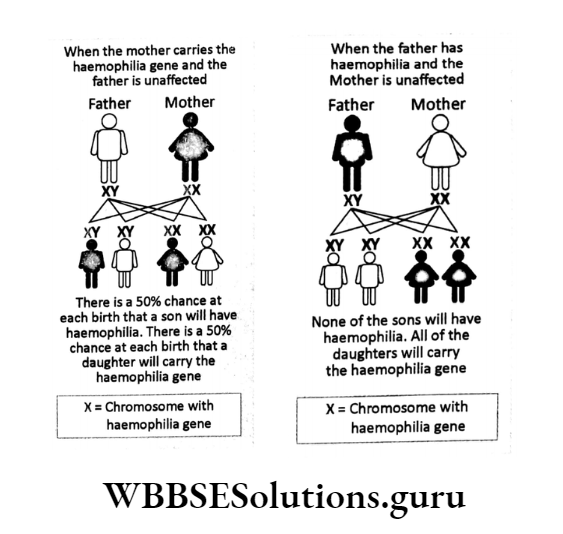
Inheritance Of Haemophilia:
In this example, the mother is a carrier of the hemophilia gene and the father does not have hemophilia There is a 50% chance that each son will have hemophilia.
There is a 50% chance that each daughter will be a carrier of the hemophilia gene.
In this example, the father has hemophilia and the mother does not carry the hemophilia gene:
None of the sons will have hemophilia All daughters will carry the hemophilia gene In this example, the father does not have hemophilia and the mother does not carry the hemophilia gene
None of the children (either daughters or sons) will have hemophilia or carry the gene.
A Royal Disease:
Haemophilia is sometimes referred to as “the royal disease,” because it affected the royal families of England, Germany, Russia, and Spain in the 19th and 20th centuries.
Queen Victoria of England, who ruled from 1837-1901, is believed to have been the carrier of hemophilia B, or factor IX deficiency. She passed the trait on to three of her nine children.
Her son Leopold died of a hemorrhage after a fall when he was 30. Her daughters Alice and Beatrice passed it on to several of their children.
Alice’s daughter Alix married Tsar Nicholas of Russia, whose son Alexei had hemophilia.
Their family’s entanglement with Rasputin, the Russian mystic, and their deaths during the Bolshevik Revolution have been chronicled in several books and films.
Common Genetic Diseases Class 10
Haemophilia was carried through various royal family members for three generations after Victoria and then disappeared.
Treatment of hemophilia:
Treatment of hemophilia involves regular injections of clotting factor medicine.
Color Blindness
Though most of us share a common color vision sensory experience, some people have a color vision deficiency, which means that their perception of colors is different from what most of us see.
Color-blind people can see things as clearly as other people but they are unable to fully ‘see’ red, green, or blue light.
Color blindness is the inability or reduced ability to see colors or to perceive obvious differences between two colors under normal lighting.
Color Blindness Symptoms:
Common symptoms of color blindness include difficulty in distinguishing between colors and inability to see shades or tones of the same color,
- People with Red-green color blindness are unable to see some shades of red and green,
- People with Blue-yellow color blindness are unable to see some shades of blue and yellow,
- People with complete color blindness do not see any colors.
Color Blindness Types:
Color blindness can be mild, moderate, or severe. Based on photo pigment defects in the three different kinds of cone cells that respond to blue, green & red light, color blindness can be of three types
Red-green color blindness:
People with this type of color blindness are unable to see some shades of red and green. Reds may appear brownish-yellow, and greens may look beige to some people.
Certain shades of orange, yellow, and green may appear yellow to others. Red may also appear black to some people. Red-green color blindness is sometimes called Daltonism after John Dalton, the famous scientist, who himself was red-green color blind.
Blue-yellow color blindness:
People with this type of color blindness are unable to see some shades of blue and yellow. Blue may appear greener and it may be difficult to distinguish yellow and red from pink. Yellow may appear violet to some people.
Complete color blindness:
People with complete color blindness do not see any colors. Poor vision accompanies complete colour blindness.
Red-green color blindness is the most common form of colour vision deficiency in many parts of the world. It is also much more common in men than in women.
Blue-yellow color blindness affects men and women equally. Complete colour blindness is rare.
Complete color blindness Causes:
Color blindness is a genetic condition caused by a difference in how one or more of the light-sensitive cells found in the retina of the eye respond to certain colors.
Inherited forms of color blindness often are related to deficiencies in certain types of cones or outright absence of cones.
Usually, genes inherited from the parents cause the deficiency or are responsible for faulty photopigments.
Men are much more likely to be colorblind than women because the genes responsible for the most common, inherited colour blindness are on the X chromosome.
Wbbse Class 10 Life Science Genetic Diseases
Males only have one X chromosome, while females have two X chromosomes. In females, a functional dominant gene for normal vision on only one of the X chromosomes is enough to compensate for the loss on the other.
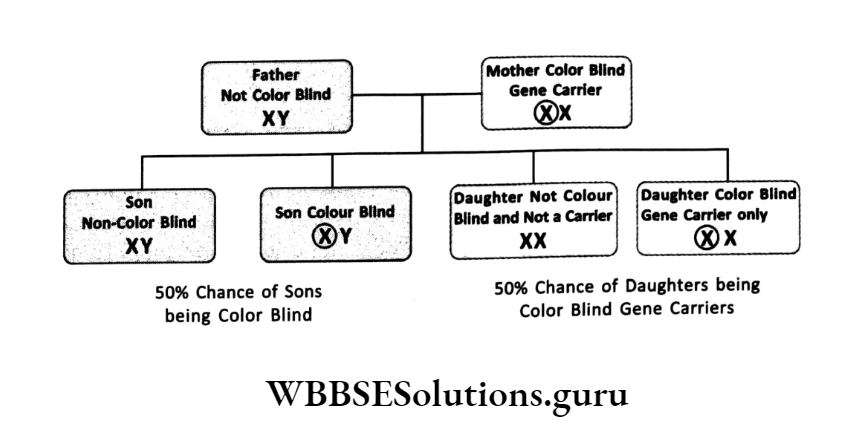
In X-linked inheritance, the mother carries the mutated gene on one of her X chromosomes and will pass on the mutated gene to 50 percent of her children.
Inheritance of colour blindness:
In X-linked inheritance, the mother carries the mutated gene on one of her X chromosomes and will pass on the mutated gene to 50 percent of her children.
Because females have two X chromosomes, the effect of a mutation on one X chromosome is offset by the normal gene on the other X chromosome.
In this case, the mother will not have the disease, but she can pass on the mutated gene and so is called a carrier.
If a mother is a carrier of an X-linked dis-ease (and the father is not affected), there is a, 1 in 2 chance that a son will have the disease, a 1 in 2 chance that a daughter will be a carrier of the disease, No chance that a daughter will have the disease.
Complete color blindness Treatment:
In general, treatments include blood transfusions, bone marrow transplants, medications, and supplements, etc.
People who receive blood transfusions receive extra iron that the body can’t easily get rid of and iron can accumulate in tissues, which can be potentially fatal.
The human body has no active mechanism for the excretion of iron.
Excess iron in vital organs, even in mild cases of iron overload, increases the risk for liver disease (cirrhosis, cancer), heart attack or heart failure, diabetes mellitus, osteoarthritis, osteoporosis metabolic syndrome, hypothyroidism, etc.
Hence the treatment of blood transfusion is to be followed with Iron chelation which involves the removal of excess iron from the bloodstream.
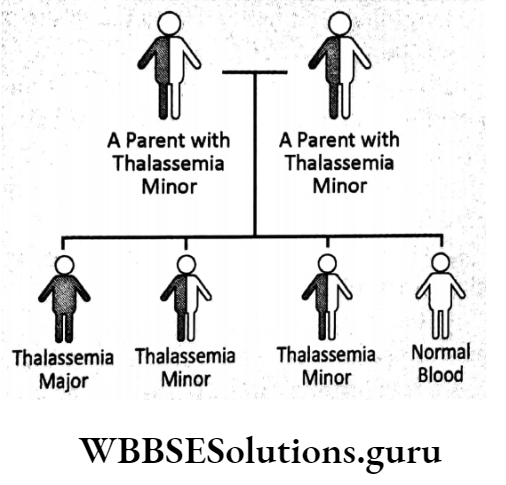
Inheritance of thalassemia:
A child who inherits two thalassemia trait genes-one from each parent will have the disease.
A child of two carriers has a 25 percent chance of receiving two trait genes and developing the disease and a 50 per cent chance of being a thalassemia trait carrier.
Wbbse Class 10 Life Science Genetic Diseases
As illustrated in marriages between two carriers (thalassemia minor) may result in – a 25% chance of thalassemia major children, a 50% chance of thalassemia minor children, and a 25% chance of normal children. Thus two thalassemia carriers should not get married.
WBBSE Chapter 3 Some Common Genetic Diseases Autosomal Inheritance
The gene is located in any autosome. The mutant allele may be dominant or recessive. Examples of autosomal recessive traits are thalassemia, albinism, etc. Autosomal dominant traits are- Huntington’s disease, polycystic kidney disease, etc.
Thalassemia:
Thalassemia is a blood-related genetic disorder that involves the absence of or errors in genes responsible for production of hemoglobin, a protein present in the red blood cells, that carries oxygen.
The disorder results in large numbers of red blood cells being destroyed, which leads to anemia and fatigue.
Thalassemia Types:
A hemoglobin molecule has sub-units commonly referred to as alpha and beta. Both sub-units are necessary to bind oxygen in the lungs properly and deliver it to tissues in other parts of the body.
A lack of a particular subunit determines the type of thalassemia. There are two main types of thalassemia-
Alpha thalassemia occurs when a gene or genes related to the alpha globin protein are missing or mutated. The severity of alpha thalassemia depends on how many genes are mutated:
One faulty gene:
The patient has no symptoms. This type is known as alpha thalassemia minima.
Two faulty genes:
The patient has mild anemia. It is known as alpha thalassemia minor.
Three faulty genes:
The patient has hemoglobin H disease, a type of chronic anemia. They need regular blood transfusions throughout their life.
Four faulty genes- This causes alpha thalassemia major, the most severe form. It is known to cause hydrops fetalis, a serious condition in which fluid accumulates in various parts of the fetus’ body.
Beta-thalassemia occurs when similar gene defects affect the production of the beta globin protein.
Severity depends on how many genes are mutated:
One faulty gene:
This is called beta thalassemia minor.
Two faulty genes:
There may be moderate or severe symptoms. This is known as beta-thalassemia major. It used to be called Cooley’s anemia.
Symptoms:
Children born with thalassemia major (Cooley’s anemia) are normal at birth, but develop severe anemia during the first year of life,
Other symptoms can include:
fatigue, growth failure, shortness of breath, yellow skin (jaundice), facial bone deformities, abdominal swelling, etc.
Treatment:
In general, treatments include blood transfusions, bone marrow transplants, medications, supplements, etc. People who receive blood transfusions receive extra iron that the body can’t easily get rid of and iron can accumulate in tissues, which can be potentially fatal.
Wbbse Class 10 Life Science Genetic Diseases
The human body has no active mechanism for the excretion of iron. Excess iron in vital organs, even in mild cases of iron overload, increases the risk for liver disease (cirrhosis, cancer), heart attack or heart failure, diabetes mellitus, osteoarthritis, osteoporosis,
metabolic syndrome, hypothyroidism, etc. Hence the treatment of blood transfusion is to be followed with Iron chelation which involves the removal of excess iron from the bloodstream.
WBBSE Chapter 3 Some Common Genetic Diseases Genetic Counselling
Thalassemia mutations and various abnormal hemoglobins interact to produce a wide range of disorders of varying degrees of severity.
Hemoglobin disorders are the most common worldwide inherited conditions. They are common in populations of tropical Africa, Asia, and the Mediterranean region and are spreading by migration throughout the world.
A stem cell transplant is the only treatment that can cure thalassemia. But only a small number of people who have severe thalassemias are able to find a good donor match and have the risky as well as expensive procedure.
Genetic counseling, therefore, plays the most important part in thalassemia prevention programs considering the diversity and severity of the problem.
Genetic counseling is defined as the process by which patients or relatives at risk of a disorder that may be hereditary are advised of the consequences of the disorder and the probability of developing and transmitting it and the ways in which this may be prevented.
Common Genetic Diseases Genetic Counselling Involves The Followings:
A correct diagnosis using genetic tests after evaluation of family history and medical records Explanation of the nature of disorder & the treatment available Estimation of genetic risk for parents and family members.
Communication of genetic risks and the options for avoiding them to avoid undue complications in an unbiased manner Support in making the right decision Accessibility for long-term contact and counseling.
Premarital screening for thalassemia and sickle cell should be made mandatory to decrease at-risk marriages.
Mendelian Disorders Class 10 Life Science
The objective is to make people aware of the consequences of thalassemia on health and socio-economics so that they voluntarily ask for screening, and prevention and change their reproductive plans when a possible risk is found.
If the risk is found before marriage, the options are to remain single, not to marry another carrier or to marry irrespective of carrier status.
If the risk is found after marriage, the options are to separate and find a non-carrier partner, to have a few or no children, selective termination of pregnancy, or to take a chance and have children as usual.
There are therefore challenges involved in genetic counseling because all the available choices involve difficult moral and social problems and in most cases, there appears to be no right answer.
But on the other hand, once people understand the risk, they can not escape from making a choice even if the decision ‘not to choose’ is a choice.
WBBSE Chapter 3 Some Common Genetic Diseases Fill In The blanks
Question 1. Single gene inheritance is also called Mendelian or_______________ inheritance.
Answer: Monogentic
Question 2. Some_______________ recessive characteristics are- color blindness, hemophilia, etc.
Answer: X-Linked
Question 3. The major signs and symptoms of_______________ are excessive bleeding and easy bruising.
Answer: hemophilia
Question 4. When a female has a hemophilia gene on only one of her X chromosomes, she is a “hemophilia_______________
Answer: Carrier
Question 5. Color blindness is also known as _______________
Answer: Daltonism
Question 6. Examples of autosomal_______________ traits are thalassemia, albinism, etc.
Answer: Recessive
Genetic Diseases Class 10 MCQs
Question 7. Alpha thalassemia occurs when a gene or genes related to the_______________ globin protein are missing or mutated.
Answer: Alpha
Question 8. Thalassemia major is also known as_______________ ane- mia.
Answer: Cooley’s
Question 9._______________ counseling plays the most important part in thalassemia prevention program.
Answer: Genetic
Question 10. Clotting factor IX deficiency results in_______________ .
Answer: Haemophilia
WBBSE Chapter 3 Some Common Genetic Diseases Write True Or False
Question 1. Single-gene inheritance is also called Mendelian or monogenetic inheritance.
Answer: True
Question 2. Multifactorial inheritance is also called complex or polygenic inheritance.
Answer: True
Question 3. Thalassemia is a rare disorder in which blood doesn’t clot normally.
Answer: False
Question 4. A defect in one of the genes that determine how the body makes blood clotting factor VIII or IX causes hemophilia
Answer: True
Question 5. Color Blindness is a genetic Condition
Answer: True
Question 6. Thalassemia is an autosomal dominant disorder.
Answer: False
Question 7. Most genetic diseases cannot be prevented by genetic counselling.
Answer: False
Question 8. Alpha thalassemia occurs when a gene or genes related to the alpha globin protein are missing or mutated.
Answer: True
Genetic Diseases Class 10 MCQs
Question 9. Marriages between two carriers (thalassemia minor) may result in – a 25% chance of thalassemia minor children.
Answer: True
Question 10. Red-green color blindness affects men and women equally.
Answer: False
WBBSE Chapter 3 Some Common Genetic Diseases Match The column
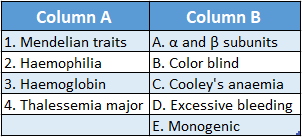
Answer: 1-E,2-D,3-A,4-C
WBBSE Chapter 3 Some Common Genetic Diseases Very Short Answer Type Questions
Question 1. Which genes show sex-linked inheritance?
Answer: The genes present on sex chromosomes (X and Y in humans) show sex-linked inheritance.
Question 2. Name a sex-linked recessive character of a human.
Answer: Colour blindness, hemophilia, etc. are sex-linked recessive characteristics.
Question 3. Name an autosomal dominant trait of humans.
Answer: Huntington’s disease, polycystic kidney disease, etc.
Question 4. Name an autosomal recessive trait of humans.
Answer: Thalassemia, albinism, etc.
Question 5. What is the Holandric gene?
Answer: A gene that occurs only in the Y chromosome is known as a holandric gene.
Question 6. What is the other name for hemophilia B?
Answer: Christmas disease.
Genetic Diseases Class 10 MCQs
Question 7. Why hemophilia is called a royal disease?
Answer: Because it affected the royal families of England, Germany, Russia, and Spain in the 19th and 20th centuries.
Question 8. What are the symptoms of thalassemia minor?
Answer: Mild anemia.
Choose the odd one and write it:
Thalassemia, polycystic kidney disease, color blindness, albinism.
Colorblindness:
It is a sex-linked genetic disorder while the others are autosomal disorders.
Question 10. A pair of related terms is given below. Based on the relationship in the first pair, write the suitable word in the gap of the second pair:
Answer:
factor VIII deficiency: hemophilia A:: factor IX deficiency: hemophilia B.
X- X-linked recessive character: Haemophilia:: Autosomal recessive character: thalassemia.
WBBSE Chapter 3 Some Common Genetic Diseases Short Answer Type Questions
Question 1. What is monogenic inheritance?
Answer:
Monogenic inheritance
Single-gene inheritance is also called Mendelian or monogenetic inheritance. This type of inheritance is caused by changes or mutations that occur in the DNA sequence of a single gene.
Examples- thalassemia, cystic fibrosis, hemophilia, color blindness, etc.
Question 2. What is the cause of hemophilia?
Answer:
The cause of hemophilia
A defect in one of the genes that determines how the body makes blood clotting factor VIII or IX causes hemophilia. These genes are recessive and located on the X chromosomes.
In hemophilia A the person does not have enough clothing factor VIII and in hemophilia B the person does not have enough clotting factor IX. This results in easy bruising and excessive bleeding.
Question 3. What are the types of colour blindness?
Answer:
The types of colour blindness
There are three main kinds of color blindness, based on photopigment defects in the three different kinds of cones that respond to blue, green, and red light. Red-green colour blindness is the most common, followed by blue-yellow colour blindness.
A complete absence of colour vision and total colour blindness is rare.
Question 4. Why more males are color-blind than females?
Answer:
Men are much more likely to be colour blind than women because the genes responsible for the most common, inherited colour blindness are on the X chromosome.
Males only have one X chromosome, while females have two X chromosomes. In females, a functional dominant gene on only one of the X chromosomes is enough to compensate for the loss on the other.
In X-linked inheritance, the mother carries the mutated gene on one of her X chromosomes and will pass on the mutated gene to 50 percent of her children.
Hereditary Diseases Class 10 Life Science
Question 5. What is thalassemia?
Answer:
Thalassemia
Thalassemia is a blood-related autosomal genetic disorder that involves the absence of or errors in genes responsible for the production of hemoglobin, a protein present in red blood cells.
Haemoglobin is the protein in red blood cells that carries oxygen. The disorder results in large numbers of red blood cells being destroyed, which leads to anemia and severe fatigue.
Question 6. What is hydrops fetalis?
Answer:
Hydrops fetalis
Hydrops fetalis usually stems from fetal anemia. It is a condition in the fetus characterized by an accumulation of fluid in at least two fetal compartments. Alpha thalassemia major is known to cause hydrops fetalis.
Hereditary Diseases Class 10 Life Science
Question 7. What is protanopia?
Answer:
Protanopia
Red-green colour blindness is also called protanopia.
Protans have either defective long wavelength cones or these L-cones are missing at all. Protans have difficulties to distinguish between blue and green colors and also between red and green colors.
WBBSE Fill In The Blanks
Question 1. ______________ is a disease created by sexlinked gene.
Answer: Haemophilia
WBBSE Very Short Answer Type Questions
Question 1. Which type of chromosome in humans carries the gene responsible for the disease thalassemia?
Answer: Autosome
Question 2. What is the cause of the expression of hemophilia disease only at homozygous conditions?
Answer: A mutation of the F8 gene in a homozygous state causes low clotting factor levels resulting in moderate or severe hemophilia.
The likelihood of encountering such hemophilia is higher in consanguineous (of the same family and related by blood) marriages.